Copyright in a Nutshell
This work byValerie LangWaldin, J.D., M.L.S., Associate Professor, HVCC is licensed under a Creative Commons
Attribution 4.0 International License.
About me
 B.A. Economics, Skidmore
 M.L.S. SUNY Albany
 J.D. University of Miami
 Law Librarian
 Associate Professor, HVCC
 Yoda’s mom
HVCC’s Copyright Research Guide
https://libguides.hvcc.edu/copyright/home
Depending on where you are…
 Copyright law varies by country.
Welcome to the world of copyright.
 Copyright law protects original creative works, such
as software, video games, books, music, images, and
videos.
How did we get here?
 1787: U.S. Constitution
 According to Article I, Section 8, Clause 8 of the U.S. Constitution, "the Congress shall have power . . . to
promote the progress of science and useful arts, by securing for limited times to authors and inventors the
exclusive right to their respective writings and discoveries."
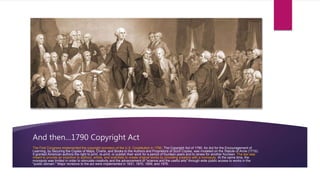
And then…1790 Copyright Act
The First Congress implemented the copyright provision of the U.S. Constitution in 1790. The Copyright Act of 1790, An Act for the Encouragement of
Learning, by Securing the Copies of Maps, Charts, and Books to the Authors and Proprietors of Such Copies, was modeled on the Statute of Anne (1710).
It granted American authors the right to print, re-print, or publish their work for a period of fourteen years and to renew for another fourteen. The law was
meant to provide an incentive to authors, artists, and scientists to create original works by providing creators with a monopoly. At the same time, the
monopoly was limited in order to stimulate creativity and the advancement of "science and the useful arts" through wide public access to works in the
"public domain." Major revisions to the act were implemented in 1831, 1870, 1909, and 1976.
1976 Revisions to the U.S. Copyright Act
 Codified in Title 17 of the United States Code
1976 Revision to the U.S. Copyright Act
 The Copyright Act of 1976 forms the basis of copyright law in the United States today.
It took effect on January 1, 1978, implementing fundamental and sweeping changes in
many aspects of copyright law.
 Foremost among the changes introduced in 1976 was the creation of federal copyright
protection for every work as soon as it is created — that is, when it is first fixed in a
tangible medium of expression.
 With this revision, for the first time the fair use and first sale doctrines were codified,
and copyright was extended to unpublished works.
 In addition, a new section was added, section 108, that allowed library photocopying
without permission for purposes of scholarship, preservation, and interlibrary loan
under certain circumstances.
Copyright Law and Administration
Statutory Authority
• Title 17 of the United States Code
• Digital Millennium Copyright Act
Case Law
• U.S. Copyright Office Fair Use Index - A
searchable database of court opinions to make
the principles and applications of fair use more
accessible and understandable
• GSU case
• Mainly scanned pages from print textbooks
• Selected Copyright Decisions of the U.S.
Supreme Court
U.S. Copyright Office
The U.S. Copyright Office, and the position of Register of Copyrights, were created by Congress in 1897 as a separate
department of the Library of Congress. the Copyright Office is responsible for administering a complex and dynamic set of laws,
which include registration, the recordation of title and licenses, a number of statutory licensing provisions, and other aspects of
the 1976 Copyright Act and the 1998 Digital Millennium Copyright Act
Public Domain
Public Domain
Lawsuits
 Copyright owners generally have the right to control
certain unauthorized uses of their work (including
the right to sue people who use their copyrighted
work without permission).
Legal Penalties for Infringement:
1. Infringer pays the actual dollar amount of damages and profits.
2. The law provides a range from $200 to $150,000 for each work infringed.
3. Infringer pays for all attorneys fees and court costs.
4. The court can issue an injunction to stop the infringing acts.
5. The court can impound the illegal works.
6. The infringer can go to jail.
Who Owns the Copyright?
• The creator of a new work is the copyright owner.
• Two or more authors working together may be joint copyright owners.
• Copyrights may be transferred by means of a written instrument signed by the
copyright owner.
• Institutional policies are important for clarifying or sharing rights to new works, but
these policies must adhere to legal requirements.
• Example: The copyright owner of a work made for hire is the employer.
Libraries and Fair Use
Fair Use

Fair use is a legal doctrine
that promotes freedom of
expression by permitting
the unlicensed use of
copyright-protected works
in certain circumstances.
Section 107 of the
Copyright Act provides the
statutory framework for
determining whether
something is a fair use and
identifies certain types of
uses—such as news
reporting, teaching,
scholarship, and research
— as examples of
activities that may qualify
as fair use.
Section 107 calls for consideration of the following four
factors in evaluating a question of fair use:
• Purpose and character of the use, including whether the use is of a commercial
nature or is for nonprofit educational purposes
• Nature of the copyrighted work (more creative, more protection)
• Amount and substantiality of the portion used in relation to the copyrighted work
as a whole
• Effect of the use upon the potential market for or value of the copyrighted work
• A fair use analysis weighs all 4 factors together.
The Good News for Libraries
Libraries and Section 108
Libraries and Special Provisions under Section 108
of the U.S. Copyright Law
 Section 108 allows many libraries to make copies of materials for preservation, private
study, and interlibrary loan (ILL).
• The library must be open to the public or outside researchers.
• Copies must be made "without any purpose of direct or indirect commercial
advantage."
• The library may make single copies on "isolated and unrelated" occasions and not
make multiple copies or engage in "systematic reproduction or distribution of single or
multiple copies."
• Each copy must include a notice of copyright or a statement that the work may be
protected by copyright.
 Notice recommended on reproduction equipment: "Notice: The copyright law of
the United States (Title 17, U.S. Code) governs the making of photocopies or other
reproductions of copyrighted material. The person using this equipment is liable for
any infringement."
Actual Language of Section 108
 It is not an infringement of copyright for a library or archives, or any of its employees
acting within the scope of their employment, to reproduce no more than one copy or
phonorecord of a work, or to distribute such copy or phonorecord, under the conditions
specified by this section, if—
 (1) the reproduction or distribution is made without any purpose of direct or indirect
commercial advantage; and
 (2) the collections of the library or archives are (i) open to the public, or (ii) available not only
to researchers affiliated with the library or archives or with the institution of which it is a part,
but also to other persons doing research in a specialized field; and
 (3) the reproduction or distribution of the work includes a notice of copyright that appears on
the copy or phonorecord that is reproduced under the 20 Copyright Law of the United States
§108 Subject Matter and Scope of Copyright provisions of this section, or includes a legend
stating that the work may be protected by copyright if no such notice can be found on the
copy or phonorecord that is reproduced under the provisions of this section.
Actual Language of Section 108
 The right of reproduction under this section applies to three copies or
phonorecords of a published work duplicated solely for the purpose of
replacement of a copy or phonorecord that is damaged, deteriorating, lost, or
stolen, or if the existing format in which the work is stored has become obsolete,
if—
 (1) the library or archives has, after a reasonable effort, determined that an unused
replacement cannot be obtained at a fair price; and
 (2) any such copy or phonorecord that is reproduced in digital format is not made
available to the public in that format outside the premises of the library or archives in
lawful possession of such copy.
 For purposes of this subsection, a format shall be considered obsolete if the machine or device
necessary to render perceptible a work stored in that format is no longer manufactured or is no
longer reasonably available in the commercial marketplace.
Copies
 Copies for Private Study:
1. Copies of articles / short works -
1. Library has no notice that the copy is for any purpose other than research and
2. Displays a warning notice on copiers
2. Entire books or substantial part thereof
1. Library must conduct reasonable investigation to conclude copy cannot be obtained at
fair price
2. Library has no notice that use is for anything other than research or private study
3. Displays warning notice on copiers
Interlibrary Loan (ILL)
 When receiving a copy of an item via ILL, ILL arrangements cannot have "as their
purpose or effect" that the library receiving the copies on behalf of requesting patrons
"does so in such aggregate quantities as to substitute for a subscription to or
purchase of such work" (17 U.S.C. Sec. 108(g)(2)).
 CONTU (National Commission on New Technological Uses of Copyrighted Works,
1979) guidelines permit a library to, during one calendar year, receive up to 5 copies
of articles from the most recent 5 years of a journal title.
•American Library Association Guidelines on Interlibrary Loan
•Copyright Clearance Center ILL Best Practices
Best Practices
Association
of Research
Libraries
Fair Use in Libraries / Best Practice Principles
1.It is fair to make course-related content available to enrolled students via digital networks.
Example: online reserve materials
Fair Use in Libraries / Best Practice Principles
1. It is fair for a library to use selections from collection materials to increase public awareness and
engagement with these collections and to promote new scholarship drawing on them. Example:
online exhibit
Fair Use in Libraries / Best Practice Principles
1. It is fair to make digital copies of collection items that are likely to deteriorate or that exist in
difficult to access formats, for purposes of preservation, and to make those copies available as
surrogates for fragile or otherwise inaccessible materials.
Fair Use in Libraries / Best Practice Principles
1. It is fair use to create digital collections of a library’s special collections and archives and to
make these version electronically accessible.
Fair Use in Libraries / Best Practice Principles
1. It is fair use for a library to reproduce materials in its collection in accessible formats for the disabled upon request
when fully accessible copies are not readily available from commercial sources.
Fair Use in Libraries / Best Practice Principles
1. It is fair use for a library to receive material for its institutional repository, and make
deposited works publicly available. Example: thesis or dissertation
Fair Use in Libraries / Best Practice Principles
1. It is fair use for libraries to develop digital databases, indexing systems and finding aids to enable
searching across the collection for both scholarly and reference purposes. Example: search engine
Fair Use in Libraries / Best Practice Principles
1. It is fair use to create topically based collections of websites and other material from the Internet and to
make them available for scholarly use. Example: HVCC subject guides.
Digital Millennium
Copyright Act of 1998
COMPLIANCE
Digital Millennium Copyright Act (DMCA)
 Digital Millennium Copyright Act (DMCA)
 The Digital Millennium Copyright Act (DMCA) was signed into law in 1998. The
law was an attempt to bring U.S. copyright law in line with world wide copyright
treaties and to address some of the issues dealing with digital content. The law is
broken down into 5 “titles”. The most important for educators and libraries are
Titles 1, 2 and 4.
DMCA & Institutional Policies
 Title 1
 Title 1 contains a provision that prohibits the implementation of technological means of
circumventing copy protection measures. Specifically, it outlaws measures that:
• are primarily designed or produced to circumvent.
• have only limited commercially significant purpose or use other than to circumvent.
• are marketed for use in circumventing.
• The DMCA allows nonprofit libraries, archives and educational institutions to circumvent access
controls solely for the purpose of making a good faith determination as to whether they wish to
obtain authorized access to the work, if the work is not reasonably available in another form.
• Again, as a practical matter this exemption will in most cases not be useful because of the lack of tools to carry
out the circumvention.
DMCA and Institutional Policies
 Title 2
 Title 2 also called the Online Copyright Infringement Liability Limitation
Act (OCILLA) sets limits of liability of Internet service providers. Since
most colleges run their own Internet services, they are in fact ISPs. In order
to maintain this protection, ISPs must act as soon as they are notified of an
infringement.
 HVCC maintains its limited liability as long as:
• it does not have actual notice of the infringing activity or knowledge of
circumstances from which infringing activity is apparent or, if it becomes
aware of such acts, expeditiously to remove it.
• it does not receive a financial benefit from the infringing activity.
• upon notice of the infringing activity, it responds expeditiously to remove or
disable the material.
• it has an agent designated to receive notifications whose name, address,
phone number, and e-mail address are available on its website and
registered with the U.S. Copyright Office. (17 U.S.C. §§ 512(a), (b), (c), and
(d).)
• For specific provisions of the DMCA that apply to faculty websites, see 17
U.S.C. Sec. 512(e).
Should your library register an agent to
obtain the DMCA’s protections?
For example, a small library that provides the public with access to the internet at one or more
computer terminals and does not provide server space to its patrons probably does not need tor
register an agent.
Should your library register an agent to
obtain the DMCA’s protections?
If the library permits the public to post pages or other digital materials on its servers, it is definitely
providing services for which it could benefit under section the DMCA.
DMCA and Institutional Policies
 Title 4
 Title 4 of the DMCA contains 6 “miscellaneous provisions.”
 2. c. which adds web-casting to the protected performance rights of the copyright
holder.
 In other words you do need a license or permission to web-cast copyright protected video
or audio, including music.
DMCA and Institutional Policies
 Title 4
• Audiovisual works …allows circumvention to make compilations of portions of
those works for educational use in the classroom by media studies or film
professors
• Computer programs and video games distributed in formats that have
become obsolete … [in an educational context]
• Literary works in ebook format when all existing ebook editions of the work
contain access controls that prevent the enabling either of the book’s read-
aloud function or of screen
• Grants nonprofit libraries the right to make back-up copies that transform audio
to newer technology and aids in preservation
DMCA Compliance
•HVCC
Compliance with
DMCA
Contact me!
VALERIE LANG WALDIN, J.D., M.L.S., V.WALDIN@HVCC.EDU,
COPYRIGHTOFFICER@HVCC.EDU, 518.629.7319
ASSOCIATE PROFESSOR, LIBRARY, HUDSON VALLEY COMMUNITY COLLEGE

Copyright in a Nutshell

  • 1.
    Copyright in aNutshell This work byValerie LangWaldin, J.D., M.L.S., Associate Professor, HVCC is licensed under a Creative Commons Attribution 4.0 International License.
  • 2.
    About me  B.A.Economics, Skidmore  M.L.S. SUNY Albany  J.D. University of Miami  Law Librarian  Associate Professor, HVCC  Yoda’s mom
  • 3.
    HVCC’s Copyright ResearchGuide https://libguides.hvcc.edu/copyright/home
  • 4.
    Depending on whereyou are…  Copyright law varies by country.
  • 5.
    Welcome to theworld of copyright.  Copyright law protects original creative works, such as software, video games, books, music, images, and videos.
  • 6.
    How did weget here?  1787: U.S. Constitution  According to Article I, Section 8, Clause 8 of the U.S. Constitution, "the Congress shall have power . . . to promote the progress of science and useful arts, by securing for limited times to authors and inventors the exclusive right to their respective writings and discoveries."
  • 7.
    And then…1790 CopyrightAct The First Congress implemented the copyright provision of the U.S. Constitution in 1790. The Copyright Act of 1790, An Act for the Encouragement of Learning, by Securing the Copies of Maps, Charts, and Books to the Authors and Proprietors of Such Copies, was modeled on the Statute of Anne (1710). It granted American authors the right to print, re-print, or publish their work for a period of fourteen years and to renew for another fourteen. The law was meant to provide an incentive to authors, artists, and scientists to create original works by providing creators with a monopoly. At the same time, the monopoly was limited in order to stimulate creativity and the advancement of "science and the useful arts" through wide public access to works in the "public domain." Major revisions to the act were implemented in 1831, 1870, 1909, and 1976.
  • 8.
    1976 Revisions tothe U.S. Copyright Act  Codified in Title 17 of the United States Code
  • 9.
    1976 Revision tothe U.S. Copyright Act  The Copyright Act of 1976 forms the basis of copyright law in the United States today. It took effect on January 1, 1978, implementing fundamental and sweeping changes in many aspects of copyright law.  Foremost among the changes introduced in 1976 was the creation of federal copyright protection for every work as soon as it is created — that is, when it is first fixed in a tangible medium of expression.  With this revision, for the first time the fair use and first sale doctrines were codified, and copyright was extended to unpublished works.  In addition, a new section was added, section 108, that allowed library photocopying without permission for purposes of scholarship, preservation, and interlibrary loan under certain circumstances.
  • 10.
    Copyright Law andAdministration Statutory Authority • Title 17 of the United States Code • Digital Millennium Copyright Act Case Law • U.S. Copyright Office Fair Use Index - A searchable database of court opinions to make the principles and applications of fair use more accessible and understandable • GSU case • Mainly scanned pages from print textbooks • Selected Copyright Decisions of the U.S. Supreme Court
  • 11.
    U.S. Copyright Office TheU.S. Copyright Office, and the position of Register of Copyrights, were created by Congress in 1897 as a separate department of the Library of Congress. the Copyright Office is responsible for administering a complex and dynamic set of laws, which include registration, the recordation of title and licenses, a number of statutory licensing provisions, and other aspects of the 1976 Copyright Act and the 1998 Digital Millennium Copyright Act
  • 12.
  • 13.
  • 14.
    Lawsuits  Copyright ownersgenerally have the right to control certain unauthorized uses of their work (including the right to sue people who use their copyrighted work without permission).
  • 15.
    Legal Penalties forInfringement: 1. Infringer pays the actual dollar amount of damages and profits. 2. The law provides a range from $200 to $150,000 for each work infringed. 3. Infringer pays for all attorneys fees and court costs. 4. The court can issue an injunction to stop the infringing acts. 5. The court can impound the illegal works. 6. The infringer can go to jail.
  • 16.
    Who Owns theCopyright? • The creator of a new work is the copyright owner. • Two or more authors working together may be joint copyright owners. • Copyrights may be transferred by means of a written instrument signed by the copyright owner. • Institutional policies are important for clarifying or sharing rights to new works, but these policies must adhere to legal requirements. • Example: The copyright owner of a work made for hire is the employer.
  • 17.
  • 18.
    Fair Use  Fair useis a legal doctrine that promotes freedom of expression by permitting the unlicensed use of copyright-protected works in certain circumstances. Section 107 of the Copyright Act provides the statutory framework for determining whether something is a fair use and identifies certain types of uses—such as news reporting, teaching, scholarship, and research — as examples of activities that may qualify as fair use.
  • 19.
    Section 107 callsfor consideration of the following four factors in evaluating a question of fair use: • Purpose and character of the use, including whether the use is of a commercial nature or is for nonprofit educational purposes • Nature of the copyrighted work (more creative, more protection) • Amount and substantiality of the portion used in relation to the copyrighted work as a whole • Effect of the use upon the potential market for or value of the copyrighted work • A fair use analysis weighs all 4 factors together.
  • 20.
    The Good Newsfor Libraries
  • 21.
  • 22.
    Libraries and SpecialProvisions under Section 108 of the U.S. Copyright Law  Section 108 allows many libraries to make copies of materials for preservation, private study, and interlibrary loan (ILL). • The library must be open to the public or outside researchers. • Copies must be made "without any purpose of direct or indirect commercial advantage." • The library may make single copies on "isolated and unrelated" occasions and not make multiple copies or engage in "systematic reproduction or distribution of single or multiple copies." • Each copy must include a notice of copyright or a statement that the work may be protected by copyright.  Notice recommended on reproduction equipment: "Notice: The copyright law of the United States (Title 17, U.S. Code) governs the making of photocopies or other reproductions of copyrighted material. The person using this equipment is liable for any infringement."
  • 23.
    Actual Language ofSection 108  It is not an infringement of copyright for a library or archives, or any of its employees acting within the scope of their employment, to reproduce no more than one copy or phonorecord of a work, or to distribute such copy or phonorecord, under the conditions specified by this section, if—  (1) the reproduction or distribution is made without any purpose of direct or indirect commercial advantage; and  (2) the collections of the library or archives are (i) open to the public, or (ii) available not only to researchers affiliated with the library or archives or with the institution of which it is a part, but also to other persons doing research in a specialized field; and  (3) the reproduction or distribution of the work includes a notice of copyright that appears on the copy or phonorecord that is reproduced under the 20 Copyright Law of the United States §108 Subject Matter and Scope of Copyright provisions of this section, or includes a legend stating that the work may be protected by copyright if no such notice can be found on the copy or phonorecord that is reproduced under the provisions of this section.
  • 24.
    Actual Language ofSection 108  The right of reproduction under this section applies to three copies or phonorecords of a published work duplicated solely for the purpose of replacement of a copy or phonorecord that is damaged, deteriorating, lost, or stolen, or if the existing format in which the work is stored has become obsolete, if—  (1) the library or archives has, after a reasonable effort, determined that an unused replacement cannot be obtained at a fair price; and  (2) any such copy or phonorecord that is reproduced in digital format is not made available to the public in that format outside the premises of the library or archives in lawful possession of such copy.  For purposes of this subsection, a format shall be considered obsolete if the machine or device necessary to render perceptible a work stored in that format is no longer manufactured or is no longer reasonably available in the commercial marketplace.
  • 25.
    Copies  Copies forPrivate Study: 1. Copies of articles / short works - 1. Library has no notice that the copy is for any purpose other than research and 2. Displays a warning notice on copiers 2. Entire books or substantial part thereof 1. Library must conduct reasonable investigation to conclude copy cannot be obtained at fair price 2. Library has no notice that use is for anything other than research or private study 3. Displays warning notice on copiers
  • 26.
    Interlibrary Loan (ILL) When receiving a copy of an item via ILL, ILL arrangements cannot have "as their purpose or effect" that the library receiving the copies on behalf of requesting patrons "does so in such aggregate quantities as to substitute for a subscription to or purchase of such work" (17 U.S.C. Sec. 108(g)(2)).  CONTU (National Commission on New Technological Uses of Copyrighted Works, 1979) guidelines permit a library to, during one calendar year, receive up to 5 copies of articles from the most recent 5 years of a journal title. •American Library Association Guidelines on Interlibrary Loan •Copyright Clearance Center ILL Best Practices
  • 27.
  • 28.
    Fair Use inLibraries / Best Practice Principles 1.It is fair to make course-related content available to enrolled students via digital networks. Example: online reserve materials
  • 29.
    Fair Use inLibraries / Best Practice Principles 1. It is fair for a library to use selections from collection materials to increase public awareness and engagement with these collections and to promote new scholarship drawing on them. Example: online exhibit
  • 30.
    Fair Use inLibraries / Best Practice Principles 1. It is fair to make digital copies of collection items that are likely to deteriorate or that exist in difficult to access formats, for purposes of preservation, and to make those copies available as surrogates for fragile or otherwise inaccessible materials.
  • 31.
    Fair Use inLibraries / Best Practice Principles 1. It is fair use to create digital collections of a library’s special collections and archives and to make these version electronically accessible.
  • 32.
    Fair Use inLibraries / Best Practice Principles 1. It is fair use for a library to reproduce materials in its collection in accessible formats for the disabled upon request when fully accessible copies are not readily available from commercial sources.
  • 33.
    Fair Use inLibraries / Best Practice Principles 1. It is fair use for a library to receive material for its institutional repository, and make deposited works publicly available. Example: thesis or dissertation
  • 34.
    Fair Use inLibraries / Best Practice Principles 1. It is fair use for libraries to develop digital databases, indexing systems and finding aids to enable searching across the collection for both scholarly and reference purposes. Example: search engine
  • 35.
    Fair Use inLibraries / Best Practice Principles 1. It is fair use to create topically based collections of websites and other material from the Internet and to make them available for scholarly use. Example: HVCC subject guides.
  • 36.
  • 37.
    Digital Millennium CopyrightAct (DMCA)  Digital Millennium Copyright Act (DMCA)  The Digital Millennium Copyright Act (DMCA) was signed into law in 1998. The law was an attempt to bring U.S. copyright law in line with world wide copyright treaties and to address some of the issues dealing with digital content. The law is broken down into 5 “titles”. The most important for educators and libraries are Titles 1, 2 and 4.
  • 38.
    DMCA & InstitutionalPolicies  Title 1  Title 1 contains a provision that prohibits the implementation of technological means of circumventing copy protection measures. Specifically, it outlaws measures that: • are primarily designed or produced to circumvent. • have only limited commercially significant purpose or use other than to circumvent. • are marketed for use in circumventing. • The DMCA allows nonprofit libraries, archives and educational institutions to circumvent access controls solely for the purpose of making a good faith determination as to whether they wish to obtain authorized access to the work, if the work is not reasonably available in another form. • Again, as a practical matter this exemption will in most cases not be useful because of the lack of tools to carry out the circumvention.
  • 39.
    DMCA and InstitutionalPolicies  Title 2  Title 2 also called the Online Copyright Infringement Liability Limitation Act (OCILLA) sets limits of liability of Internet service providers. Since most colleges run their own Internet services, they are in fact ISPs. In order to maintain this protection, ISPs must act as soon as they are notified of an infringement.  HVCC maintains its limited liability as long as: • it does not have actual notice of the infringing activity or knowledge of circumstances from which infringing activity is apparent or, if it becomes aware of such acts, expeditiously to remove it. • it does not receive a financial benefit from the infringing activity. • upon notice of the infringing activity, it responds expeditiously to remove or disable the material. • it has an agent designated to receive notifications whose name, address, phone number, and e-mail address are available on its website and registered with the U.S. Copyright Office. (17 U.S.C. §§ 512(a), (b), (c), and (d).) • For specific provisions of the DMCA that apply to faculty websites, see 17 U.S.C. Sec. 512(e).
  • 40.
    Should your libraryregister an agent to obtain the DMCA’s protections? For example, a small library that provides the public with access to the internet at one or more computer terminals and does not provide server space to its patrons probably does not need tor register an agent.
  • 41.
    Should your libraryregister an agent to obtain the DMCA’s protections? If the library permits the public to post pages or other digital materials on its servers, it is definitely providing services for which it could benefit under section the DMCA.
  • 42.
    DMCA and InstitutionalPolicies  Title 4  Title 4 of the DMCA contains 6 “miscellaneous provisions.”  2. c. which adds web-casting to the protected performance rights of the copyright holder.  In other words you do need a license or permission to web-cast copyright protected video or audio, including music.
  • 43.
    DMCA and InstitutionalPolicies  Title 4 • Audiovisual works …allows circumvention to make compilations of portions of those works for educational use in the classroom by media studies or film professors • Computer programs and video games distributed in formats that have become obsolete … [in an educational context] • Literary works in ebook format when all existing ebook editions of the work contain access controls that prevent the enabling either of the book’s read- aloud function or of screen • Grants nonprofit libraries the right to make back-up copies that transform audio to newer technology and aids in preservation
  • 44.
  • 45.
    Contact me! VALERIE LANGWALDIN, J.D., M.L.S., V.WALDIN@HVCC.EDU, COPYRIGHTOFFICER@HVCC.EDU, 518.629.7319 ASSOCIATE PROFESSOR, LIBRARY, HUDSON VALLEY COMMUNITY COLLEGE