Copyright Essentials LIB 100 : Library and Information Research Strategies Le Moyne College November 2, 2011
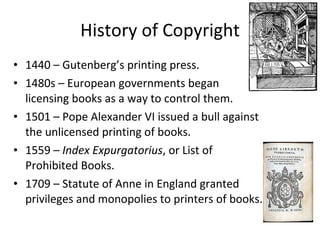
History of Copyright 1440 – Gutenberg’s printing press. 1480s – European governments began  licensing books as a way to control them. 1501 – Pope Alexander VI issued a bull against the unlicensed printing of books. 1559 –  Index Expurgatorius , or List of Prohibited Books. 1709 – Statute of Anne in England granted privileges and monopolies to printers of books.
1787: Article I, Section 8 of the U.S. Constitution "The Congress shall have Power ... To promote the Progress of Science and useful Arts, by securing for limited Times to Authors and Inventors the exclusive Right to their respective Writings and Discoveries.“ Covers two separate ideas: Copyright : Authors Patents: Inventors
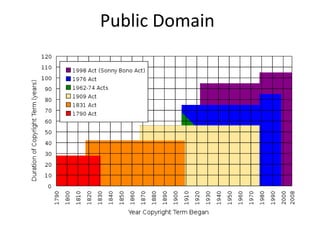
Copyright Act of 1790 First U.S. Congress granted American authors the right to print, re-print, or publish their work for a period of fourteen years and to renew for another fourteen. The law was meant to provide an incentive to create original works by providing creators with a monopoly, but limited in order to stimulate creativity and the advancement of "science and the useful arts" through wide public access to works in the "public domain."
Copyright Act of 1790 provide an incentive to create original works by providing creators with a monopoly limited term in order to stimulate creativity and the advancement of "science and the useful arts"  wide public access to works in the "public domain.“ originally framed around published print works only
Copyright Act of 1831 The term of protection of copyrighted works was extended to twenty-eight years with the possibility of a fourteen-year extension.  Congress claimed that it extended the term in order to give American authors the same protection as those in Europe.
1841: Folsom v. Marsh Court case establishing beginnings of "Fair Use" doctrine. Gives the reader of a copyrighted work more rights – allows specific kinds of scholarly uses of copyrighted works. U.S.  is unusual in explicitly making this allowance to readers
Copyright Act of 1870 Established Library of Congress Copyright Office for centralized copyright registrations. Previously had been granted by U.S. courts  at the state level.
Copyright Act of 1909 Broadened the scope to include all works of authorship, including music composers, and  extended the term of protection to twenty-eight years with a possible renewal of twenty-eight.
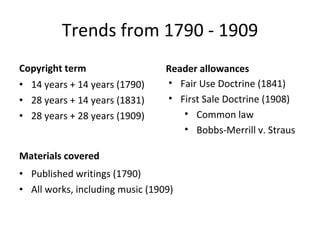
Trends from 1790 - 1909 Copyright term 14 years + 14 years (1790) 28 years + 14 years (1831) 28 years + 28 years (1909) Materials covered Published writings (1790) All works, including music (1909) Fair Use Doctrine (1841) First Sale Doctrine (1908) Common law Bobbs-Merrill v. Straus Reader allowances
Copyright Act of 1976 Preempted all previous copyright law. Extended the term of protection to life of the author plus 50 years.  Extended copyright to unpublished works. Codified fair use and first sale doctrines.  Copyright Law of the United States  and Related Laws Contained in Title 17 of the United States Code
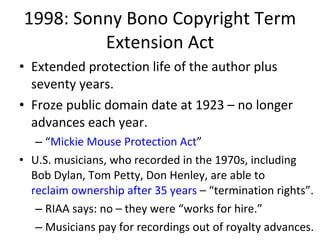
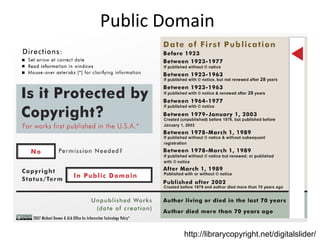
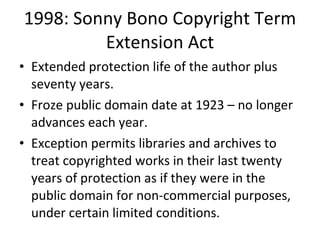
1998: Sonny Bono Copyright Term Extension Act Extended protection life of the author plus seventy years.  Froze public domain date at 1923 – no longer advances each year.
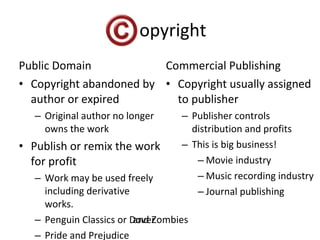
Copyright Public Domain Copyright abandoned by author or expired Original author no longer owns the work  Publish or remix the work for profit Work may be used freely including derivative works. Penguin Classics or Dover Pride and Prejudice Commercial Publishing Copyright usually assigned to publisher Publisher controls distribution and profits This is big business! Movie industry Music recording industry Journal publishing and Zombies
 
 
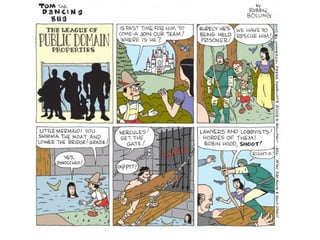
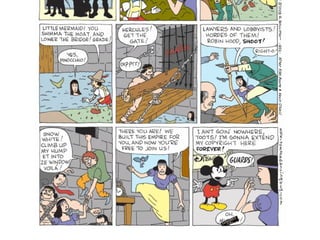
1998: Sonny Bono Copyright Term Extension Act Extended protection life of the author plus seventy years.  Froze public domain date at 1923 – no longer advances each year. “ Mickie Mouse Protection Act ” U.S. musicians, who recorded in the 1970s, including Bob Dylan, Tom Petty, Don Henley, are able to  reclaim ownership after 35 years  – “termination rights”.  RIAA says: no – they were “works for hire.” Musicians pay for recordings out of royalty advances.
Public Domain
Public Domain http://librarycopyright.net/digitalslider/
1998: Sonny Bono Copyright Term Extension Act Extended protection life of the author plus seventy years.  Froze public domain date at 1923 – no longer advances each year. Exception permits libraries and archives to treat copyrighted works in their last twenty years of protection as if they were in the public domain for non-commercial purposes, under certain limited conditions.
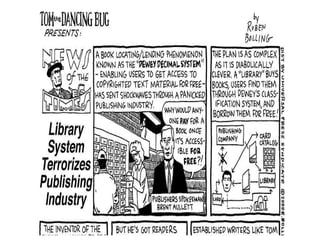
First Sale Doctrine Title 17, Section 104  Allows the purchaser to transfer (i.e., sell, lend or give away) a lawfully made copy of the copyrighted work without permission once it has been obtained. Allows individuals to sell books they have purchased. Allows libraries to lend copies of books they have purchased.
 
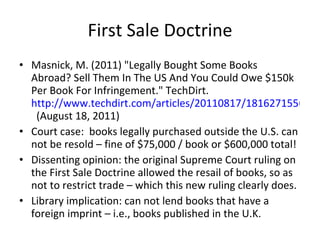
First Sale Doctrine Masnick, M. (2011) "Legally Bought Some Books Abroad? Sell Them In The US And You Could Owe $150k Per Book For Infringement." TechDirt.  http://www.techdirt.com/articles/20110817/18162715566/   (August 18, 2011) Court case:  books legally purchased outside the U.S. can not be resold – fine of $75,000 / book or $600,000 total! Dissenting opinion: the original Supreme Court ruling on the First Sale Doctrine allowed the resail of books, so as not to restrict trade – which this new ruling clearly does.  Library implication: can not lend books that have a foreign imprint – i.e., books published in the U.K.
Fair Use Doctrine Title 17, Section 107 Use of copyrighted works  without permission  of copyright holder, provided that: Socially beneficial results of the use outweigh the exclusive rights of the copyright holder Generally applies when the use is  transformative, proportional, and gives credit  to original
Fair Use Doctrine Four Criteria  - validity of use can only be tested on individual basis through court case Purpose & character of the use  - educational or non-commercial Nature of the copyrighted work  - varies with type of work; text most inclusive Amount & substantiality of the use  - how much of work would be used Effect of the use on the market  - economic loss to the copyright holder
1984: Betamax Case Sony Corp. of America v. Universal Studios Universal Studios alleged that manufacturer of video recorders (Sony) was liable for copyright infringement of their users Supreme Court ruled that recording of complete TV shows was “time shifting” and covered under “fair use” Makes TiVo and DVR legal
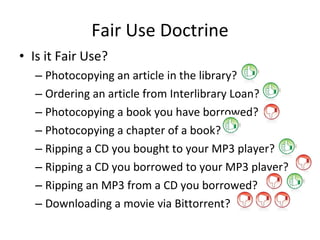
Fair Use Doctrine Is it Fair Use? Photocopying an article in the library? Ordering an article from Interlibrary Loan? Photocopying a book you have borrowed? Photocopying a chapter of a book? Ripping a CD you bought to your MP3 player? Ripping a CD you borrowed to your MP3 player? Ripping an MP3 from a CD you borrowed? Downloading a movie via Bittorrent?
Fair Use Doctrine Four Criteria  - validity of use can only be determined on individual basis through court case Purpose & character of the use  - educational or non-commercial Nature of the copyrighted work  - varies with type of work; text most inclusive Amount & substantiality of the use  - how much of work would be used Effect of the use on the market  - economic loss to the copyright holder
1998: Digital Millenium Copyright Act (DMCA) Extension to protect software copyright (1980) Prohibits gaining unauthorized access to a work by circumventing a technological protection measure put in place by the copyright owner. Rationale for the “Copyleft”  and “Open Source” software movements. Like “Open Access”, you do this with  software licenses – MIT, GNU, even CC.
Replacement and Preservation for Libraries and Archives Title 17, Section 108 Last 20 years of copyright protection exempt Access limited to researchers at that institution Preservation  –  up to 3 copies if library owns Replacement  –  up   to 3 copies if library owns Portions for Users –  1 copy of article or chapter from library copy Entire Works for Users –  1 copy of textual work (including illustrations) when not available for purchase at fair price
HathiTrust Lawsuit (2011) Google Book Scanning Project (Dec 2004) 10 million scanned volumes from library partners Authors Guild lawsuit (Oct 2005) damages against commercial partner (Google) class-action lawsuit by Guild Settlement (Oct 2008)  allowed users of libraries to access digital copy of this massive collection for research Judge rejects settlement  (Mar 2011) ruled on class-action aspects of lawsuit
HathiTrust Lawsuit (2011) HathiTrust  – library partners of Google Book Scanning Project (2008) Orphan Works Project  (June 2011) identify in-copyright works for which the author cannot be located access only for libraries that owned original Authors Guild lawsuit  (Sept 2011) lawsuit against libraries this time not class-action – individual authors seeking injunction (not damages) outcome still pending
2002: TEACH Act Technology Education and Copyright Harmonization Act Allow content delivery to students outside the classroom (non-face-to-face – e.g., Blackboard)  Authority to convert some works from analog to digital formats.  Compliance required dissemination of copyright policies and  implementation of technological restrictions on access and copying.
Classroom Instruction Title 17, Section 110 Face-to-face instruction Performance - showing a video; playing a musical work; performing a scene, etc. Display - PowerPoint with copyrighted images or text; projecting content from a website. Online classes – TEACH Act Hosting articles or slides in BlackBoard Access to streaming video Must be limited to registered students, must be password protected, must be taken down after class is completed
Trends from 1790 - 2002 Copyright term 14 years + 14 years (1790) 28 years + 14 years (1831) 28 years + 28 years (1909) Life author + 50 years (1976) Life author + 70 years (1998) Materials covered Published writings (1790) All works, including music (1909) Fair Use Doctrine (1841 & 1976) First Sale Doctrine (1908 & 1976) Reader allowances Unpublished works (1976) Software (1980) DMCA – no circumvention (1998) Time-shifted copying of video and audio (1984) Exemption for libraries for last 20 years of coverage (1998) Preservation & replace (1998) Copies for library users (1998) Exemption for online course use (2002)
Copyright Essentials  http://resources.library.lemoyne.edu/pubserv-copyright   LIB 100 Topic : Copyright http://resources.library.lemoyne.edu/lib100_copyright   To Learn More
Copyright Essentials © Tom Keays

Copyright Essentials

  • 1.
    Copyright Essentials LIB100 : Library and Information Research Strategies Le Moyne College November 2, 2011
  • 2.
    History of Copyright1440 – Gutenberg’s printing press. 1480s – European governments began licensing books as a way to control them. 1501 – Pope Alexander VI issued a bull against the unlicensed printing of books. 1559 – Index Expurgatorius , or List of Prohibited Books. 1709 – Statute of Anne in England granted privileges and monopolies to printers of books.
  • 3.
    1787: Article I,Section 8 of the U.S. Constitution "The Congress shall have Power ... To promote the Progress of Science and useful Arts, by securing for limited Times to Authors and Inventors the exclusive Right to their respective Writings and Discoveries.“ Covers two separate ideas: Copyright : Authors Patents: Inventors
  • 4.
    Copyright Act of1790 First U.S. Congress granted American authors the right to print, re-print, or publish their work for a period of fourteen years and to renew for another fourteen. The law was meant to provide an incentive to create original works by providing creators with a monopoly, but limited in order to stimulate creativity and the advancement of "science and the useful arts" through wide public access to works in the "public domain."
  • 5.
    Copyright Act of1790 provide an incentive to create original works by providing creators with a monopoly limited term in order to stimulate creativity and the advancement of "science and the useful arts" wide public access to works in the "public domain.“ originally framed around published print works only
  • 6.
    Copyright Act of1831 The term of protection of copyrighted works was extended to twenty-eight years with the possibility of a fourteen-year extension. Congress claimed that it extended the term in order to give American authors the same protection as those in Europe.
  • 7.
    1841: Folsom v.Marsh Court case establishing beginnings of "Fair Use" doctrine. Gives the reader of a copyrighted work more rights – allows specific kinds of scholarly uses of copyrighted works. U.S. is unusual in explicitly making this allowance to readers
  • 8.
    Copyright Act of1870 Established Library of Congress Copyright Office for centralized copyright registrations. Previously had been granted by U.S. courts at the state level.
  • 9.
    Copyright Act of1909 Broadened the scope to include all works of authorship, including music composers, and extended the term of protection to twenty-eight years with a possible renewal of twenty-eight.
  • 10.
    Trends from 1790- 1909 Copyright term 14 years + 14 years (1790) 28 years + 14 years (1831) 28 years + 28 years (1909) Materials covered Published writings (1790) All works, including music (1909) Fair Use Doctrine (1841) First Sale Doctrine (1908) Common law Bobbs-Merrill v. Straus Reader allowances
  • 11.
    Copyright Act of1976 Preempted all previous copyright law. Extended the term of protection to life of the author plus 50 years. Extended copyright to unpublished works. Codified fair use and first sale doctrines. Copyright Law of the United States and Related Laws Contained in Title 17 of the United States Code
  • 12.
    1998: Sonny BonoCopyright Term Extension Act Extended protection life of the author plus seventy years. Froze public domain date at 1923 – no longer advances each year.
  • 13.
    Copyright Public DomainCopyright abandoned by author or expired Original author no longer owns the work Publish or remix the work for profit Work may be used freely including derivative works. Penguin Classics or Dover Pride and Prejudice Commercial Publishing Copyright usually assigned to publisher Publisher controls distribution and profits This is big business! Movie industry Music recording industry Journal publishing and Zombies
  • 14.
  • 15.
  • 16.
    1998: Sonny BonoCopyright Term Extension Act Extended protection life of the author plus seventy years. Froze public domain date at 1923 – no longer advances each year. “ Mickie Mouse Protection Act ” U.S. musicians, who recorded in the 1970s, including Bob Dylan, Tom Petty, Don Henley, are able to reclaim ownership after 35 years – “termination rights”. RIAA says: no – they were “works for hire.” Musicians pay for recordings out of royalty advances.
  • 17.
  • 18.
  • 19.
    1998: Sonny BonoCopyright Term Extension Act Extended protection life of the author plus seventy years. Froze public domain date at 1923 – no longer advances each year. Exception permits libraries and archives to treat copyrighted works in their last twenty years of protection as if they were in the public domain for non-commercial purposes, under certain limited conditions.
  • 20.
    First Sale DoctrineTitle 17, Section 104 Allows the purchaser to transfer (i.e., sell, lend or give away) a lawfully made copy of the copyrighted work without permission once it has been obtained. Allows individuals to sell books they have purchased. Allows libraries to lend copies of books they have purchased.
  • 21.
  • 22.
    First Sale DoctrineMasnick, M. (2011) "Legally Bought Some Books Abroad? Sell Them In The US And You Could Owe $150k Per Book For Infringement." TechDirt. http://www.techdirt.com/articles/20110817/18162715566/ (August 18, 2011) Court case: books legally purchased outside the U.S. can not be resold – fine of $75,000 / book or $600,000 total! Dissenting opinion: the original Supreme Court ruling on the First Sale Doctrine allowed the resail of books, so as not to restrict trade – which this new ruling clearly does. Library implication: can not lend books that have a foreign imprint – i.e., books published in the U.K.
  • 23.
    Fair Use DoctrineTitle 17, Section 107 Use of copyrighted works without permission of copyright holder, provided that: Socially beneficial results of the use outweigh the exclusive rights of the copyright holder Generally applies when the use is transformative, proportional, and gives credit to original
  • 24.
    Fair Use DoctrineFour Criteria - validity of use can only be tested on individual basis through court case Purpose & character of the use - educational or non-commercial Nature of the copyrighted work - varies with type of work; text most inclusive Amount & substantiality of the use - how much of work would be used Effect of the use on the market - economic loss to the copyright holder
  • 25.
    1984: Betamax CaseSony Corp. of America v. Universal Studios Universal Studios alleged that manufacturer of video recorders (Sony) was liable for copyright infringement of their users Supreme Court ruled that recording of complete TV shows was “time shifting” and covered under “fair use” Makes TiVo and DVR legal
  • 26.
    Fair Use DoctrineIs it Fair Use? Photocopying an article in the library? Ordering an article from Interlibrary Loan? Photocopying a book you have borrowed? Photocopying a chapter of a book? Ripping a CD you bought to your MP3 player? Ripping a CD you borrowed to your MP3 player? Ripping an MP3 from a CD you borrowed? Downloading a movie via Bittorrent?
  • 27.
    Fair Use DoctrineFour Criteria - validity of use can only be determined on individual basis through court case Purpose & character of the use - educational or non-commercial Nature of the copyrighted work - varies with type of work; text most inclusive Amount & substantiality of the use - how much of work would be used Effect of the use on the market - economic loss to the copyright holder
  • 28.
    1998: Digital MilleniumCopyright Act (DMCA) Extension to protect software copyright (1980) Prohibits gaining unauthorized access to a work by circumventing a technological protection measure put in place by the copyright owner. Rationale for the “Copyleft” and “Open Source” software movements. Like “Open Access”, you do this with software licenses – MIT, GNU, even CC.
  • 29.
    Replacement and Preservationfor Libraries and Archives Title 17, Section 108 Last 20 years of copyright protection exempt Access limited to researchers at that institution Preservation – up to 3 copies if library owns Replacement – up to 3 copies if library owns Portions for Users – 1 copy of article or chapter from library copy Entire Works for Users – 1 copy of textual work (including illustrations) when not available for purchase at fair price
  • 30.
    HathiTrust Lawsuit (2011)Google Book Scanning Project (Dec 2004) 10 million scanned volumes from library partners Authors Guild lawsuit (Oct 2005) damages against commercial partner (Google) class-action lawsuit by Guild Settlement (Oct 2008) allowed users of libraries to access digital copy of this massive collection for research Judge rejects settlement (Mar 2011) ruled on class-action aspects of lawsuit
  • 31.
    HathiTrust Lawsuit (2011)HathiTrust – library partners of Google Book Scanning Project (2008) Orphan Works Project (June 2011) identify in-copyright works for which the author cannot be located access only for libraries that owned original Authors Guild lawsuit (Sept 2011) lawsuit against libraries this time not class-action – individual authors seeking injunction (not damages) outcome still pending
  • 32.
    2002: TEACH ActTechnology Education and Copyright Harmonization Act Allow content delivery to students outside the classroom (non-face-to-face – e.g., Blackboard) Authority to convert some works from analog to digital formats. Compliance required dissemination of copyright policies and implementation of technological restrictions on access and copying.
  • 33.
    Classroom Instruction Title17, Section 110 Face-to-face instruction Performance - showing a video; playing a musical work; performing a scene, etc. Display - PowerPoint with copyrighted images or text; projecting content from a website. Online classes – TEACH Act Hosting articles or slides in BlackBoard Access to streaming video Must be limited to registered students, must be password protected, must be taken down after class is completed
  • 34.
    Trends from 1790- 2002 Copyright term 14 years + 14 years (1790) 28 years + 14 years (1831) 28 years + 28 years (1909) Life author + 50 years (1976) Life author + 70 years (1998) Materials covered Published writings (1790) All works, including music (1909) Fair Use Doctrine (1841 & 1976) First Sale Doctrine (1908 & 1976) Reader allowances Unpublished works (1976) Software (1980) DMCA – no circumvention (1998) Time-shifted copying of video and audio (1984) Exemption for libraries for last 20 years of coverage (1998) Preservation & replace (1998) Copies for library users (1998) Exemption for online course use (2002)
  • 35.
    Copyright Essentials http://resources.library.lemoyne.edu/pubserv-copyright LIB 100 Topic : Copyright http://resources.library.lemoyne.edu/lib100_copyright To Learn More
  • 36.

Editor's Notes

  • #3 By 1480, there were printers active in 110 different places in Europe. By 1500, more than 270 cities had centers of printing and had produced more than 20 million volumes. By 1600, 150-200 million volumes had been produced.
  • #14 Pride and Prejudice 1813 by Jane Austen … and Zombies 2009 by Seth Graham-Smith