Cheryl Kohen and Rachel Owens Daytona State College Library Copyright and Open Source for Education
What makes a textbook open? A textbook becomes "open" when its copyright-holder grants usage rights to the public through an "open license," which typically includes the right to access, reformat, and customize it at no additional cost.
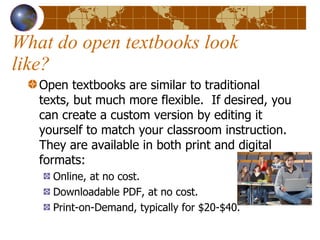
What do open textbooks look like? Open textbooks are similar to traditional texts, but much more flexible.  If desired, you can create a custom version by editing it yourself to match your classroom instruction.  They are available in both print and digital formats: Online, at no cost. Downloadable PDF, at no cost. Print-on-Demand, typically for $20-$40.
Where to find open textbooks Orange Grove Texts Plus Merlot Flat World Knowledge
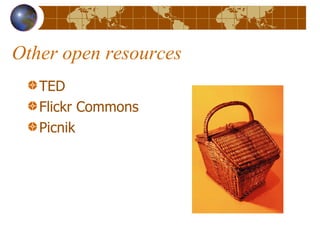
Other open resources TED Flickr Commons Picnik
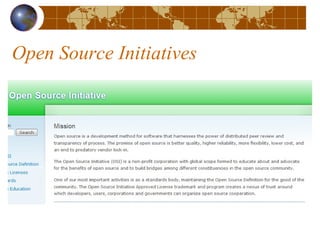
Open Source Initiatives
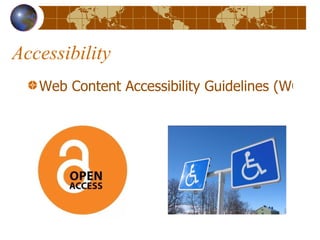
Accessibility Web Content Accessibility Guidelines (WCAG)
Open Access Journals DOAJ Peer Reviewed Open Access Journals Oxford Open
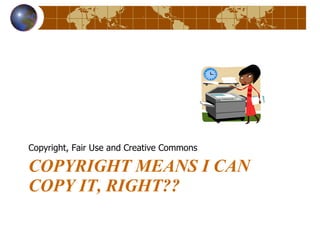
COPYRIGHT MEANS I CAN COPY IT, RIGHT?? Copyright, Fair Use and Creative Commons
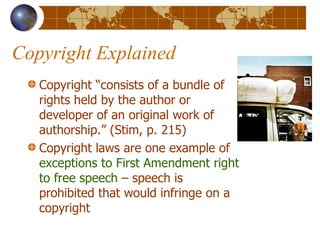
Copyright Explained Copyright “consists of a bundle of rights held by the author or developer of an original work of authorship.” (Stim, p. 215) Copyright laws are one example of  exceptions to First Amendment right to free speech  – speech is prohibited that would infringe on a copyright
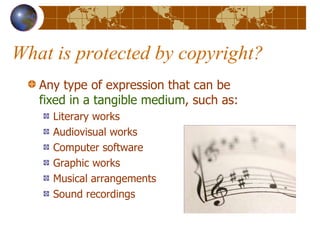
What is protected by copyright? Any type of expression that can be  fixed in a tangible medium , such as: Literary works Audiovisual works Computer software Graphic works Musical arrangements Sound recordings
What is  not  protected by copyright? The underlying facts, ideas or concepts of expressive works This allows similar works, as long as original work itself is not copied or used as a basis for later work Fiction works are more likely to be infringed upon, since they generally contain more original expression than nonfiction
Length of copyright protection Protection begins  the moment  the original work becomes fixed in a tangible form Protection lasts for the life of the author plus  70 years  or: 95 years  from date of publication or  120 years  from date of creation for employers or anonymous authors
When is a work considered “created?” When it first becomes  fixed  in some form Drafts  and other intermediate forms of the work are protected just as the final form is Each new version of an original work is considered a  separate creation
Is registration of the work required? No . “Putting a copyright notice on the work and registering it with the U.S. Copyright Office afford a copyright owner  additional protection , but neither is required for basic copyright protection.” (Stim, p. 222)
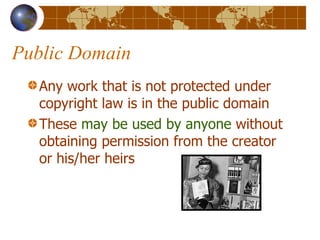
Public Domain Any work that is not protected under copyright law is in the public domain These  may be used by anyone  without obtaining permission from the creator or his/her heirs
What works are in the public domain? Those published before 1923 Those which consist solely of facts or ideas Those deliberately placed in public domain by copyright owner Those created by the federal government
Works Made for Hire Any work created by an employee within the scope of employment Scope of employment: the kind of work the employee is paid to do, prepared “substantially” on work time, prepared (at least in part) to serve the employer The  employer  owns the copyright For example: A textbook you write on DSC time Materials you create on DSC time for your courses at DSC These PowerPoint slides
Fair Use Certain uses of a work do not require permission from the copyright owner if done for noncommercial reasons. The Copyright Act authorizes any person to make “fair use” of a work, including  making copies, for teaching, scholarship or research .
Does your use qualify as Fair Use? A court will consider four factors: The  purpose and character  of the use The  nature  of the copyrighted work The  amount and substantiality  of the portion used in relation to the work as a whole The  effect of the use  on the potential market for or value of the work
Attribution It is often assumed that copyrighted material can be used as long as the author is credited.  This is  not true . Attribution does not itself qualify your use as fair use. “ That being said, judges and juries may take attribution into consideration.” (Stim, p. 197) Attribution is not required for public domain works .
Copying by Instructors Generally  considered to be fair use However, if taken to extremes, could destroy the market for educational material There is a  set of guidelines  for instructor copying They do not have force of law, but if copying is done within the guidelines, a court is very likely to consider copying done by an instructor as fair use
Guidelines for Copying – Single Copies An instructor may make  one copy  of the following items for use in teaching or research: A  chapter  from a book An  article  from a periodical A short story, essay, or short poem A chart, graph, diagram, drawing, cartoon or picture
Guidelines for Copying – Multiple Copies Multiple copies of the above items may be made if: The amount of material copied is  sufficiently brief The copying is done  spontaneously The  cumulative effect  test is met Each copy includes a  notice  of copyright Students are  not charged  more than actual cost of making the copies
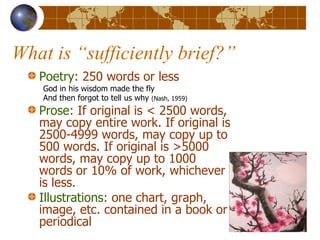
What is “sufficiently brief?” Poetry : 250 words or less God in his wisdom made the fly  And then forgot to tell us why  (Nash, 1959) Prose : If original is < 2500 words, may copy entire work. If original is 2500-4999 words, may copy up to 500 words. If original is >5000 words, may copy up to 1000 words or 10% of work, whichever is less. Illustrations : one chart, graph, image, etc. contained in a book or periodical
What is “spontaneously?” Idea to copy must have been  the instructor’s  and not that of administration, board, or other higher authority Idea to copy and the copies’ actual classroom use must be so  close in time  that it would be unreasonable to expect a reply to a request for permission from copyright owner or publisher
What is “cumulative effect?” The cumulative effect test is met if: Copying is for only  one  course in the school where copies are made Not more than  one  poem, article, story or essay, or  two  excerpts from longer works, are copied from the same author, or  three  from the same anthology Not more than  nine  instances of multiple copying for one course during one term
Copyright notices on copies A copyright notice  must appear  on all copies made  This is usually accomplished by copying the page of the work where the copyright information appears If not, the copyright notice must be added to the copies in the  exact same form  as on the original © 2007 DBCC Public Broadcasting - All Rights Reserved.  Privacy Policy
Prohibited Copying Multiple copies may not be made: To substitute for purchase of books, reprints, or periodicals To create anthologies or compilations To substitute for or replace “consumable” works (workbooks, exercises, test booklets, etc.) The same instructor may not copy the same item from term to term .
Copyright and Fair Use Online Fair use  applies online  just as it does to hard copies. Copies of electronic files can be made, downloaded or printed out, as long as: They are for  personal  use They are for  educational or scholarly  use They are for  journalistic  use
Email Email is protected the same as a physical letter – “to the extent that it is original…it is fully protected by copyright the instant it is fixed in a physical medium such as a computer hard disk.” The author of the email owns the content of the message,  unless created by an employee in the scope of employment .
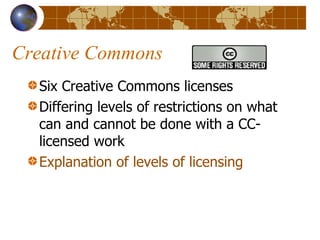
Creative Commons Six Creative Commons licenses Differing levels of restrictions on what can and cannot be done with a CC-licensed work Explanation of levels of licensing
For more information… Open Source Copyright [email_address] [email_address]
References Ensor, P. (2000). The cybrarian’s manual 2. Chicago: American Library Association. Fishman, S. (2004). Copyright handbook: how to protect and use written works (8 th  ed.). Berkeley, CA: Nolo. Nash, O. (1959). Verses from 1929 on. New York: Random House. Stim, R. (2006). Patent, copyright and trademark: an intellectual property desk reference (8 th  ed.). Berkeley, CA: Nolo.

Copyright and Open Source

  • 1.
    Cheryl Kohen andRachel Owens Daytona State College Library Copyright and Open Source for Education
  • 2.
    What makes atextbook open? A textbook becomes &quot;open&quot; when its copyright-holder grants usage rights to the public through an &quot;open license,&quot; which typically includes the right to access, reformat, and customize it at no additional cost.
  • 3.
    What do opentextbooks look like? Open textbooks are similar to traditional texts, but much more flexible.  If desired, you can create a custom version by editing it yourself to match your classroom instruction.  They are available in both print and digital formats: Online, at no cost. Downloadable PDF, at no cost. Print-on-Demand, typically for $20-$40.
  • 4.
    Where to findopen textbooks Orange Grove Texts Plus Merlot Flat World Knowledge
  • 5.
    Other open resourcesTED Flickr Commons Picnik
  • 6.
  • 7.
    Accessibility Web ContentAccessibility Guidelines (WCAG)
  • 8.
    Open Access JournalsDOAJ Peer Reviewed Open Access Journals Oxford Open
  • 9.
    COPYRIGHT MEANS ICAN COPY IT, RIGHT?? Copyright, Fair Use and Creative Commons
  • 10.
    Copyright Explained Copyright“consists of a bundle of rights held by the author or developer of an original work of authorship.” (Stim, p. 215) Copyright laws are one example of exceptions to First Amendment right to free speech – speech is prohibited that would infringe on a copyright
  • 11.
    What is protectedby copyright? Any type of expression that can be fixed in a tangible medium , such as: Literary works Audiovisual works Computer software Graphic works Musical arrangements Sound recordings
  • 12.
    What is not protected by copyright? The underlying facts, ideas or concepts of expressive works This allows similar works, as long as original work itself is not copied or used as a basis for later work Fiction works are more likely to be infringed upon, since they generally contain more original expression than nonfiction
  • 13.
    Length of copyrightprotection Protection begins the moment the original work becomes fixed in a tangible form Protection lasts for the life of the author plus 70 years or: 95 years from date of publication or 120 years from date of creation for employers or anonymous authors
  • 14.
    When is awork considered “created?” When it first becomes fixed in some form Drafts and other intermediate forms of the work are protected just as the final form is Each new version of an original work is considered a separate creation
  • 15.
    Is registration ofthe work required? No . “Putting a copyright notice on the work and registering it with the U.S. Copyright Office afford a copyright owner additional protection , but neither is required for basic copyright protection.” (Stim, p. 222)
  • 16.
    Public Domain Anywork that is not protected under copyright law is in the public domain These may be used by anyone without obtaining permission from the creator or his/her heirs
  • 17.
    What works arein the public domain? Those published before 1923 Those which consist solely of facts or ideas Those deliberately placed in public domain by copyright owner Those created by the federal government
  • 18.
    Works Made forHire Any work created by an employee within the scope of employment Scope of employment: the kind of work the employee is paid to do, prepared “substantially” on work time, prepared (at least in part) to serve the employer The employer owns the copyright For example: A textbook you write on DSC time Materials you create on DSC time for your courses at DSC These PowerPoint slides
  • 19.
    Fair Use Certainuses of a work do not require permission from the copyright owner if done for noncommercial reasons. The Copyright Act authorizes any person to make “fair use” of a work, including making copies, for teaching, scholarship or research .
  • 20.
    Does your usequalify as Fair Use? A court will consider four factors: The purpose and character of the use The nature of the copyrighted work The amount and substantiality of the portion used in relation to the work as a whole The effect of the use on the potential market for or value of the work
  • 21.
    Attribution It isoften assumed that copyrighted material can be used as long as the author is credited. This is not true . Attribution does not itself qualify your use as fair use. “ That being said, judges and juries may take attribution into consideration.” (Stim, p. 197) Attribution is not required for public domain works .
  • 22.
    Copying by InstructorsGenerally considered to be fair use However, if taken to extremes, could destroy the market for educational material There is a set of guidelines for instructor copying They do not have force of law, but if copying is done within the guidelines, a court is very likely to consider copying done by an instructor as fair use
  • 23.
    Guidelines for Copying– Single Copies An instructor may make one copy of the following items for use in teaching or research: A chapter from a book An article from a periodical A short story, essay, or short poem A chart, graph, diagram, drawing, cartoon or picture
  • 24.
    Guidelines for Copying– Multiple Copies Multiple copies of the above items may be made if: The amount of material copied is sufficiently brief The copying is done spontaneously The cumulative effect test is met Each copy includes a notice of copyright Students are not charged more than actual cost of making the copies
  • 25.
    What is “sufficientlybrief?” Poetry : 250 words or less God in his wisdom made the fly And then forgot to tell us why (Nash, 1959) Prose : If original is < 2500 words, may copy entire work. If original is 2500-4999 words, may copy up to 500 words. If original is >5000 words, may copy up to 1000 words or 10% of work, whichever is less. Illustrations : one chart, graph, image, etc. contained in a book or periodical
  • 26.
    What is “spontaneously?”Idea to copy must have been the instructor’s and not that of administration, board, or other higher authority Idea to copy and the copies’ actual classroom use must be so close in time that it would be unreasonable to expect a reply to a request for permission from copyright owner or publisher
  • 27.
    What is “cumulativeeffect?” The cumulative effect test is met if: Copying is for only one course in the school where copies are made Not more than one poem, article, story or essay, or two excerpts from longer works, are copied from the same author, or three from the same anthology Not more than nine instances of multiple copying for one course during one term
  • 28.
    Copyright notices oncopies A copyright notice must appear on all copies made This is usually accomplished by copying the page of the work where the copyright information appears If not, the copyright notice must be added to the copies in the exact same form as on the original © 2007 DBCC Public Broadcasting - All Rights Reserved. Privacy Policy
  • 29.
    Prohibited Copying Multiplecopies may not be made: To substitute for purchase of books, reprints, or periodicals To create anthologies or compilations To substitute for or replace “consumable” works (workbooks, exercises, test booklets, etc.) The same instructor may not copy the same item from term to term .
  • 30.
    Copyright and FairUse Online Fair use applies online just as it does to hard copies. Copies of electronic files can be made, downloaded or printed out, as long as: They are for personal use They are for educational or scholarly use They are for journalistic use
  • 31.
    Email Email isprotected the same as a physical letter – “to the extent that it is original…it is fully protected by copyright the instant it is fixed in a physical medium such as a computer hard disk.” The author of the email owns the content of the message, unless created by an employee in the scope of employment .
  • 32.
    Creative Commons SixCreative Commons licenses Differing levels of restrictions on what can and cannot be done with a CC-licensed work Explanation of levels of licensing
  • 33.
    For more information…Open Source Copyright [email_address] [email_address]
  • 34.
    References Ensor, P.(2000). The cybrarian’s manual 2. Chicago: American Library Association. Fishman, S. (2004). Copyright handbook: how to protect and use written works (8 th ed.). Berkeley, CA: Nolo. Nash, O. (1959). Verses from 1929 on. New York: Random House. Stim, R. (2006). Patent, copyright and trademark: an intellectual property desk reference (8 th ed.). Berkeley, CA: Nolo.

Editor's Notes

  • #2 Cheryl
  • #9 Cheryl
  • #10 Rachel
  • #14 95 years from the date of publication or 120 years from the date of creation, whichever is shorter, if the author is an employer or a commissioner of a work made for hire, or if the author uses a pseudonym or remains anonymous.
  • #21 Was the use commercial, or for non-profit, educational purposes? Did the user add value to the original by adding new expression or meaning, creating new insights or understanding? These favor fair use. Is the work informational or entertaining in nature? Copying from informational works is seen to encourage the free spread of ideas and the creation of new informational works. The more that is taken from a work, the more difficult it is to justify a fair use defense. Judge will consider whether the market for the original is undermined or the value is decreased because of its use – if so, it is not considered fair use
  • #30 Rachel
  • #31 Cheryl