MARYJO R. LIBOON
November 30, 2016
UFLS, CMU, Musuan, Bukidnon
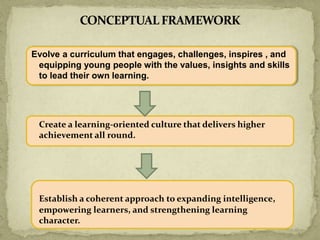
Evolve a curriculum that engages, challenges, inspires , and
equipping young people with the values, insights and skills
to lead their own learning.
Create a learning-oriented culture that delivers higher
achievement all round.
Establish a coherent approach to expanding intelligence,
empowering learners, and strengthening learning
character.
Develop leadership approaches that support
innovation, build independence, responsibility, and
monitor practice to improve the quality of learning.
Dispel myths about learning and use well founded
research to grow the teacher’s role in fostering more
intelligent learners.
Employing constructivist methods of teaching in one's
classroom forces students to take an active role in their
education by making choices and assuming responsibility for
intelligent inquiry and discovery. For instance, discussions,
projects, and experiments ensure student achievement and
allow students and the teacher to discover individual student's
preferences and strengths. This approach facilitates
differentiated activities for each student's distinctive
ambitions, making the subject more relevant to every student's
life.
I believe that all children have the ability to learn and the right to a
quality education. All youths, regardless of gender, race, ethnicity, and
capabilities should have the opportunity to learn from professional, well-
informed teachers who are sophisticated and knowledgeable, both in
their area of expertise and life. Certainly, every child has different
learning styles and aptitudes; however, by having a personal
relationship with every student, a teacher can give each an equal
chance of success. By recognizing every student's potential and having
separate, individual goals for each, a teacher can accommodate
personal needs, abilities and encourage the pursuit of academic
aspirations.
I think that teaching and learning are a reciprocal processes. When teachers
nurture individual talents in each child, educators can build self-esteem and
may encourage a lifelong skill. By supporting these special abilities, teachers
can, for example, guide students' research, and students can, in turn, enlighten
teachers about subjects in which they may not be as knowledgeable. This
mutual respect for individual skills cultivates a professional academic
relationship, leading to a give-and-take educational alliance. This liaison allows
students to feel that they are on equal intellectual ground with their teachers,
thus creating a strong academic atmosphere.
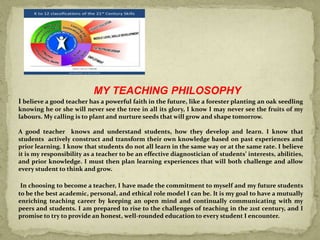
MY TEACHING PHILOSOPHY
I believe a good teacher has a powerful faith in the future, like a forester planting an oak seedling
knowing he or she will never see the tree in all its glory, I know I may never see the fruits of my
labours. My calling is to plant and nurture seeds that will grow and shape tomorrow.
A good teacher knows and understand students, how they develop and learn. I know that
students actively construct and transform their own knowledge based on past experiences and
prior learning. I know that students do not all learn in the same way or at the same rate. I believe
it is my responsibility as a teacher to be an effective diagnostician of students’ interests, abilities,
and prior knowledge. I must then plan learning experiences that will both challenge and allow
every student to think and grow.
In choosing to become a teacher, I have made the commitment to myself and my future students
to be the best academic, personal, and ethical role model I can be. It is my goal to have a mutually
enriching teaching career by keeping an open mind and continually communicating with my
peers and students. I am prepared to rise to the challenges of teaching in the 21st century, and I
promise to try to provide an honest, well-rounded education to every student I encounter.
THE 21st CENTURY LEARNER

THE 21st CENTURY LEARNER

  • 1.
    MARYJO R. LIBOON November30, 2016 UFLS, CMU, Musuan, Bukidnon
  • 3.
    Evolve a curriculumthat engages, challenges, inspires , and equipping young people with the values, insights and skills to lead their own learning. Create a learning-oriented culture that delivers higher achievement all round. Establish a coherent approach to expanding intelligence, empowering learners, and strengthening learning character.
  • 4.
    Develop leadership approachesthat support innovation, build independence, responsibility, and monitor practice to improve the quality of learning. Dispel myths about learning and use well founded research to grow the teacher’s role in fostering more intelligent learners.
  • 8.
    Employing constructivist methodsof teaching in one's classroom forces students to take an active role in their education by making choices and assuming responsibility for intelligent inquiry and discovery. For instance, discussions, projects, and experiments ensure student achievement and allow students and the teacher to discover individual student's preferences and strengths. This approach facilitates differentiated activities for each student's distinctive ambitions, making the subject more relevant to every student's life.
  • 9.
    I believe thatall children have the ability to learn and the right to a quality education. All youths, regardless of gender, race, ethnicity, and capabilities should have the opportunity to learn from professional, well- informed teachers who are sophisticated and knowledgeable, both in their area of expertise and life. Certainly, every child has different learning styles and aptitudes; however, by having a personal relationship with every student, a teacher can give each an equal chance of success. By recognizing every student's potential and having separate, individual goals for each, a teacher can accommodate personal needs, abilities and encourage the pursuit of academic aspirations.
  • 10.
    I think thatteaching and learning are a reciprocal processes. When teachers nurture individual talents in each child, educators can build self-esteem and may encourage a lifelong skill. By supporting these special abilities, teachers can, for example, guide students' research, and students can, in turn, enlighten teachers about subjects in which they may not be as knowledgeable. This mutual respect for individual skills cultivates a professional academic relationship, leading to a give-and-take educational alliance. This liaison allows students to feel that they are on equal intellectual ground with their teachers, thus creating a strong academic atmosphere.
  • 11.
    MY TEACHING PHILOSOPHY Ibelieve a good teacher has a powerful faith in the future, like a forester planting an oak seedling knowing he or she will never see the tree in all its glory, I know I may never see the fruits of my labours. My calling is to plant and nurture seeds that will grow and shape tomorrow. A good teacher knows and understand students, how they develop and learn. I know that students actively construct and transform their own knowledge based on past experiences and prior learning. I know that students do not all learn in the same way or at the same rate. I believe it is my responsibility as a teacher to be an effective diagnostician of students’ interests, abilities, and prior knowledge. I must then plan learning experiences that will both challenge and allow every student to think and grow. In choosing to become a teacher, I have made the commitment to myself and my future students to be the best academic, personal, and ethical role model I can be. It is my goal to have a mutually enriching teaching career by keeping an open mind and continually communicating with my peers and students. I am prepared to rise to the challenges of teaching in the 21st century, and I promise to try to provide an honest, well-rounded education to every student I encounter.

Editor's Notes

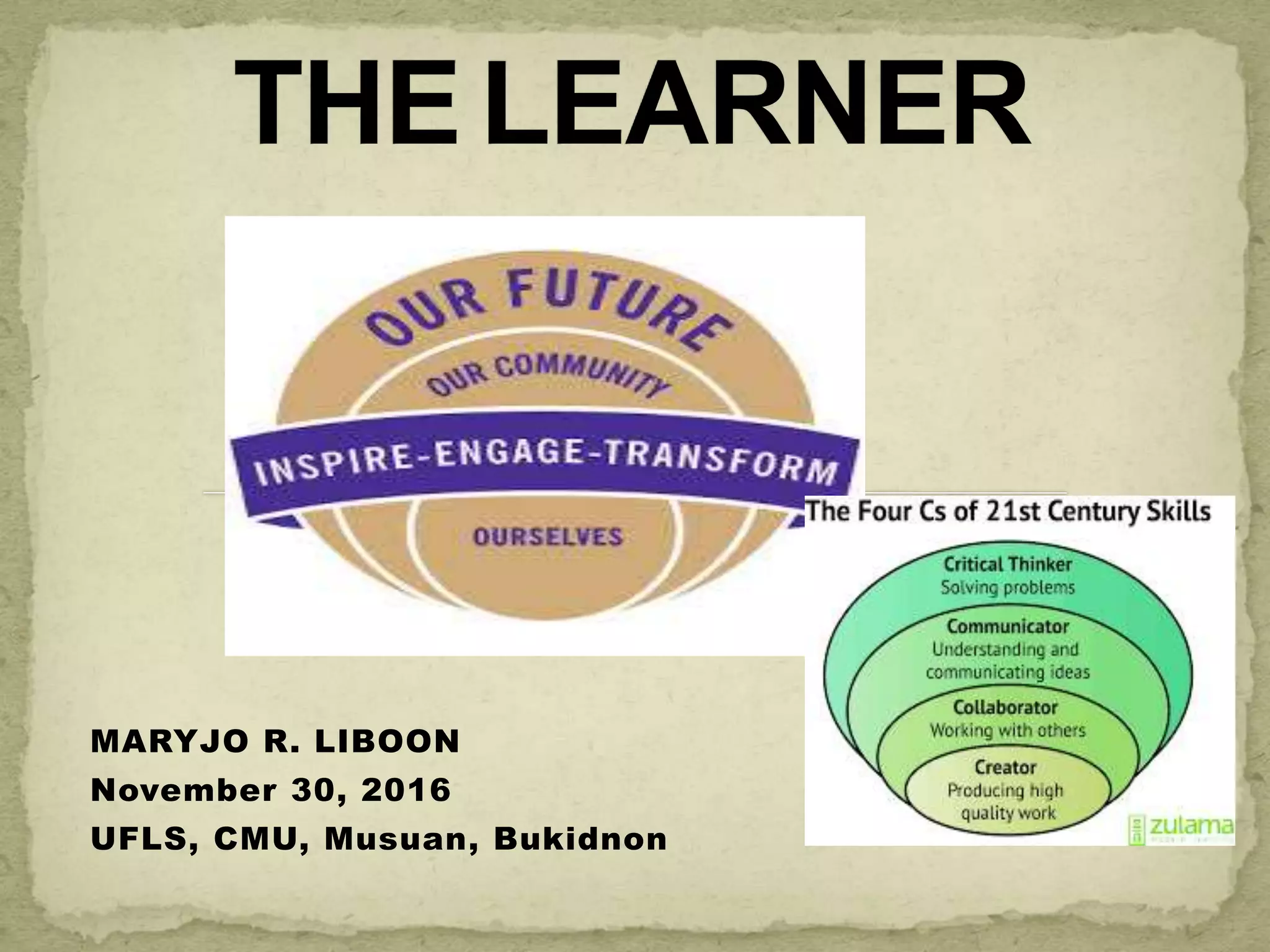
  • #2 The hope of our community that inspire-engage- and transform to become a good leader, an innovator, and a highly globalized individual through the 4C”s of the 21th century skills this learner will soar high in achieving their full potential.
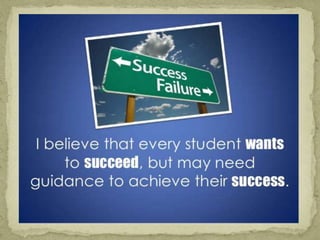
  • #3 Learn the skills you need for improving your life, achieving your dreams, and creating positive changes in your life. Thinking about success this way makes it seem like it is so hard to achieve. It seems to take a lot of effort and energy. It seems that success is something that doesn’t come to us, but we must fight for it. We wonder why life is such a struggle. Why can’t we just relax and enjoy living it. Why can’t we simply experience everything we desire in an easy and effortless way. It just seems so wrong that this is the nature of success. The truth is that it really is wrong to think that success is so difficult to get.
  • #4 What can we do to help them achieved their aspiration in life? Curriculum Engagement ... enhance learning, increase confidence and inspirechildren to reach their full potential. ... Experienced facilitators work in a range of art forms, and can engage even the most challenging students. ... This workshop will aim to stimulate in-depth discussion and debate around evolving attitudes to ... FOUR CHALLENGING PROGRAMMES PROVIDING A CONTINUUM OF EDUCATION ... caring young people who help to create a better and more peaceful world ... inspire, motivate and focus students, teachers and the entire .... preparation for students to engage in the IB ... programmes and curricula evolve and undergo ...
  • #6 How are we able to do that? 1. Be Proactive 2. Take Responsibility 3. Be a Good Leader 4. Don’t Let Fear Stop You 5. Never Stop Learning
  • #10 Because of diversity of learners I believe