Its All about CSRF
Nilesh Sapariya
Security Analyst | CEH v8 | Blogger
Who Am I ?
 Nilesh Sapariya
 Security Analyst
 3years of Experience in information security
 http://shield4you.blogspot.in/
 @nilesh_loganx
Agenda
What is CSRF ?
Problem
Basics
Validation
Defenses
 News
Demo
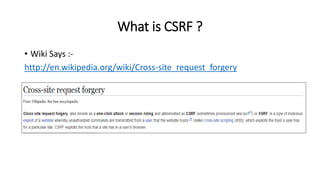
What is CSRF ?
• Wiki Says :-
http://en.wikipedia.org/wiki/Cross-site_request_forgery
CSRF | Other names of CSRF
• CSRF (Sea Surf)
• XSRF
• Session Riding
Problem
Problem | Overview
CSRF is an OWASP Top 10 vulnerability but it’s not as well understood
as many others
Many struggle with how to validate it
Customers have difficulty explaining to management why it’s
important to fix
We need to be well-versed in the main points to help the customer
with their narrative to management
Problem | Overview
 Undetectable by automated scanners
 The attack is silent
 Easily mountable
 Combines with XSS or HTML injection(stored)
Basics | OWASP
Basic | Description
“Cross-site Request Forgery is a vulnerability in a
website that allows attackers to force victims to
perform security-sensitive actions on that site
without their knowledge.”
What do we mean by “sensitive
actions”?
How do attackers “force” victims to
perform them?
And how do the victims not know it’s
happening?
Basic | Questions
Basic | Description
1. The target is a sensitive operation in the application, e.g.
UpdateSalary.aspx, that’s able to be tricked into executing.
2. Victims can be forced to execute this action through any method
that gets them to load a resource automatically, e.g. img tag, script
tag, onload form submit, etc. Note: credentials go with all requests!
3. These happen unknowingly because the actions are performed by
the victim’s browser, not by the victim explicitly.
Basic | Description
Basic | Description
Anatomy of CSRF Attack
• Step 1: Attacker hosts web pages with pre-populated HTML form data.
• Step 2: Victim browses to attacker’s HTML form.
• Step 3: Page automatically submits pre-populated form data to a site
where victim has access (No verification done by server as browser is
performing request by checking cookies)
• Step 4: Site Authenticates request (with attacker’s form data) as coming
from victim
Result : Attacker’s form data is accepted by server since it was sent from
legitimate user.
Validation
Validation | Criteria
• If you can’t change something using your CSRF vulnerability, then
you don’t have one.
• Examples of state changes:
- Updating an account (new password?)
- Transferring funds
- Changing the role of a user
- Ordering an item
- Adding an administrator to a system
Validation | Criteria
• The three components again…
1. Can you change state using it?
2. Is the function sensitive?
3. Is the request non-unique?
 This is the core of the validation process
 Any customer asking you to validate a CSRF vulnerability
should hear and learn these same concepts
Validation | Manual Validation
• How to manually verify CSRF:
1. Configure a proxy to observe traffic
2. Log in to the site with the issue in question
3. Perform the target functionality normally, through the browser
4. Observe the request, looking for state change, sensitivity, and uniqueness
5. Look for any additional controls that could stop CSRF, such as CAPTCHA or
additional authentication
6. Log out and log in with a different set of credentials
7. Submit the initial request from the new context, and see if it is successful
8. If the action is performed without issue, it is most likely CSRF
Misconception
Misconception | #1 CSRF = XSS ?
• CSRF = XSS ?
• Fact : CSRF and XSS are completely different attack vector
XSS
• Attacker insert text (for example JavaScript code) onto website by sending
the victim a specially prepared link
• <script>alert(‘nilesh’)</script>
CSRF
• Victim sends attacker’s request to the webserver without knowing about it
• http://www.example.com/admin/deleteuser.php?id=xxx
Misconception | #2 Preventing XSS stops CSRF ?
• Preventing XSS stops CSRF ?
• XSS makes CSRF easier, but it isn’t required
Basics | Trust Abuse
• Both XSS and CSRF are possible due to abused trust relationships:
In XSS the browser will run malicious JavaScript because it
was served from a site (origin) it trusts.
In CSRF the server will perform a sensitive action because it
was sent by a client that it trusts.
Defense
Defense | That Don’t Work
 Requiring multi-step transactions
- CSRF attack can perform each step in order
 CAPTCHAs
Protect forms against automated submission
Can by bypassed using automated tool
How to bypass captcha : http://shield4you.blogspot.in/2014/10/bypass-
captcha-verification-in-chrome.html
Provides security, but doesn't solve the problem
Defense | That Work
 Only use POST to initiate the request
Checking HTTP Referer Header (Accept requests only from trusted
sources by verifying the referer header)
Use random server generated user-specific token in all form
submission
Re-Authentication – Password based (Attacker must know victim
password)
Defense | TOKENS
• Approach #4 : Tokens
• Tokens are random string of character
• Insert a random string into hidden field in EVERY form
• Make sure tokens is random
• Make sure there are no XSS vulnerability on your page! This is utmost
importance! (If attacker find XSS in your page then he/she can easily
have access to your tokens)
Defense | Approach #4
 Session Tokens
• Attacker only need one token
and can access entire site while
user is logged in
• Easy to implement
 Session Tokens stored in database
• A bit more difficult to implement
• Stores unique id, random token,
current time, user id
• Attacker can only access the
form the token was assigned to
(higher security!)
• Definitely recommended
CSRF | Defenses
• Secret Validation Token
• Referer Validation
• Custom HTTP Header
<input type=hidden value=23a3af01b>
Referrer: http://www.facebook.com/home.php
X-Requested-By: XMLHttpRequest
CSRF | Defenses | Example : LinkedIn
Defense | Overview
• Beware of State-modifying GET Request
• The primary defense for Cross-site Request Forgery is creating unique
requests that cannot be easily generated by attackers.
• This is usually accomplished via a nonce (a number used once).
• CAPTCHAs can also be used, as well as authentication prompts
How To bypass | Defenses
 Clickjacking
Bypassing the captcha
Checking Token Validation
Checking header Validation
Converting POST based requests to GET based requests.
Obstacles for Attacker
Need to know victim’s server
• Knowing victim’s server is not hard in a targeted attack or a commonly used
server. Example: Famous banks, famous site etc.
Need to get victim to browser to attacker’s site (pre-populated form)
• Getting victim to load the attacker’s form isn’t hard. (Phishing is often successful.)
Needs victim to log into server
• Victim might already be logged into a site or might have automatic log-in
enabled.
• Examples: Windows Integrated authentication
• Windows integrated authentication is very popular on intranets.
Highlights |News
Latest | News
• Pay pal Defaced by CSRF
Latest | News
• Facebook Hacked #CSRF
Link: http://pyx.io/blog/facebook-csrf-leading-to-full-account-takeover
Latest | News Blogger haced # CSRF
• Blogger hacked # CSRF
Latest | News
• W3 Total Cache's W3TotalFail Vulnerability That Leads to Full Deface
by CSRF
Latest | News
• Google Account Recovery Vulnerability + CSRF
• http://www.orenh.com/2013/11/google-account-recovery-
vulnerability.html?showComment=1420318818311#c5894478871478
949015
Demo |Video
Demo | Setup
bWAPP – VM machine
Burp suite-pro
Download link:-
http://sourceforge.net/projects/bwapp/
Questions ?
Thank You 
Comments | Feedback | Suggestions
• @Twitter : @nilesh_loganx
• Email: nilesh.s.sapariya@gmail.com
• Blog: http://shield4you.blogspot.in/
• LinkedIn: https://www.linkedin.com/pub/nilesh-sapariya/39/33/735
• Slideshare: http://www.slideshare.net/Nilesh_logan

Its all about CSRF - null Mumbai Meet 10 January 2015 Null/OWASP Chapter

  • 1.
    Its All aboutCSRF Nilesh Sapariya Security Analyst | CEH v8 | Blogger
  • 2.
    Who Am I?  Nilesh Sapariya  Security Analyst  3years of Experience in information security  http://shield4you.blogspot.in/  @nilesh_loganx
  • 3.
    Agenda What is CSRF? Problem Basics Validation Defenses  News Demo
  • 4.
    What is CSRF? • Wiki Says :- http://en.wikipedia.org/wiki/Cross-site_request_forgery
  • 5.
    CSRF | Othernames of CSRF • CSRF (Sea Surf) • XSRF • Session Riding
  • 6.
  • 7.
    Problem | Overview CSRFis an OWASP Top 10 vulnerability but it’s not as well understood as many others Many struggle with how to validate it Customers have difficulty explaining to management why it’s important to fix We need to be well-versed in the main points to help the customer with their narrative to management
  • 8.
    Problem | Overview Undetectable by automated scanners  The attack is silent  Easily mountable  Combines with XSS or HTML injection(stored)
  • 10.
  • 11.
    Basic | Description “Cross-siteRequest Forgery is a vulnerability in a website that allows attackers to force victims to perform security-sensitive actions on that site without their knowledge.”
  • 12.
    What do wemean by “sensitive actions”? How do attackers “force” victims to perform them? And how do the victims not know it’s happening? Basic | Questions
  • 13.
    Basic | Description 1.The target is a sensitive operation in the application, e.g. UpdateSalary.aspx, that’s able to be tricked into executing. 2. Victims can be forced to execute this action through any method that gets them to load a resource automatically, e.g. img tag, script tag, onload form submit, etc. Note: credentials go with all requests! 3. These happen unknowingly because the actions are performed by the victim’s browser, not by the victim explicitly.
  • 14.
  • 15.
  • 16.
    Anatomy of CSRFAttack • Step 1: Attacker hosts web pages with pre-populated HTML form data. • Step 2: Victim browses to attacker’s HTML form. • Step 3: Page automatically submits pre-populated form data to a site where victim has access (No verification done by server as browser is performing request by checking cookies) • Step 4: Site Authenticates request (with attacker’s form data) as coming from victim Result : Attacker’s form data is accepted by server since it was sent from legitimate user.
  • 17.
  • 18.
    Validation | Criteria •If you can’t change something using your CSRF vulnerability, then you don’t have one. • Examples of state changes: - Updating an account (new password?) - Transferring funds - Changing the role of a user - Ordering an item - Adding an administrator to a system
  • 19.
    Validation | Criteria •The three components again… 1. Can you change state using it? 2. Is the function sensitive? 3. Is the request non-unique?  This is the core of the validation process  Any customer asking you to validate a CSRF vulnerability should hear and learn these same concepts
  • 20.
    Validation | ManualValidation • How to manually verify CSRF: 1. Configure a proxy to observe traffic 2. Log in to the site with the issue in question 3. Perform the target functionality normally, through the browser 4. Observe the request, looking for state change, sensitivity, and uniqueness 5. Look for any additional controls that could stop CSRF, such as CAPTCHA or additional authentication 6. Log out and log in with a different set of credentials 7. Submit the initial request from the new context, and see if it is successful 8. If the action is performed without issue, it is most likely CSRF
  • 21.
  • 22.
    Misconception | #1CSRF = XSS ? • CSRF = XSS ? • Fact : CSRF and XSS are completely different attack vector XSS • Attacker insert text (for example JavaScript code) onto website by sending the victim a specially prepared link • <script>alert(‘nilesh’)</script> CSRF • Victim sends attacker’s request to the webserver without knowing about it • http://www.example.com/admin/deleteuser.php?id=xxx
  • 23.
    Misconception | #2Preventing XSS stops CSRF ? • Preventing XSS stops CSRF ? • XSS makes CSRF easier, but it isn’t required
  • 24.
    Basics | TrustAbuse • Both XSS and CSRF are possible due to abused trust relationships: In XSS the browser will run malicious JavaScript because it was served from a site (origin) it trusts. In CSRF the server will perform a sensitive action because it was sent by a client that it trusts.
  • 25.
  • 26.
    Defense | ThatDon’t Work  Requiring multi-step transactions - CSRF attack can perform each step in order  CAPTCHAs Protect forms against automated submission Can by bypassed using automated tool How to bypass captcha : http://shield4you.blogspot.in/2014/10/bypass- captcha-verification-in-chrome.html Provides security, but doesn't solve the problem
  • 27.
    Defense | ThatWork  Only use POST to initiate the request Checking HTTP Referer Header (Accept requests only from trusted sources by verifying the referer header) Use random server generated user-specific token in all form submission Re-Authentication – Password based (Attacker must know victim password)
  • 28.
    Defense | TOKENS •Approach #4 : Tokens • Tokens are random string of character • Insert a random string into hidden field in EVERY form • Make sure tokens is random • Make sure there are no XSS vulnerability on your page! This is utmost importance! (If attacker find XSS in your page then he/she can easily have access to your tokens)
  • 29.
    Defense | Approach#4  Session Tokens • Attacker only need one token and can access entire site while user is logged in • Easy to implement  Session Tokens stored in database • A bit more difficult to implement • Stores unique id, random token, current time, user id • Attacker can only access the form the token was assigned to (higher security!) • Definitely recommended
  • 30.
    CSRF | Defenses •Secret Validation Token • Referer Validation • Custom HTTP Header <input type=hidden value=23a3af01b> Referrer: http://www.facebook.com/home.php X-Requested-By: XMLHttpRequest
  • 31.
    CSRF | Defenses| Example : LinkedIn
  • 32.
    Defense | Overview •Beware of State-modifying GET Request • The primary defense for Cross-site Request Forgery is creating unique requests that cannot be easily generated by attackers. • This is usually accomplished via a nonce (a number used once). • CAPTCHAs can also be used, as well as authentication prompts
  • 33.
    How To bypass| Defenses  Clickjacking Bypassing the captcha Checking Token Validation Checking header Validation Converting POST based requests to GET based requests.
  • 34.
    Obstacles for Attacker Needto know victim’s server • Knowing victim’s server is not hard in a targeted attack or a commonly used server. Example: Famous banks, famous site etc. Need to get victim to browser to attacker’s site (pre-populated form) • Getting victim to load the attacker’s form isn’t hard. (Phishing is often successful.) Needs victim to log into server • Victim might already be logged into a site or might have automatic log-in enabled. • Examples: Windows Integrated authentication • Windows integrated authentication is very popular on intranets.
  • 35.
  • 36.
    Latest | News •Pay pal Defaced by CSRF
  • 37.
    Latest | News •Facebook Hacked #CSRF Link: http://pyx.io/blog/facebook-csrf-leading-to-full-account-takeover
  • 38.
    Latest | NewsBlogger haced # CSRF • Blogger hacked # CSRF
  • 39.
    Latest | News •W3 Total Cache's W3TotalFail Vulnerability That Leads to Full Deface by CSRF
  • 40.
    Latest | News •Google Account Recovery Vulnerability + CSRF • http://www.orenh.com/2013/11/google-account-recovery- vulnerability.html?showComment=1420318818311#c5894478871478 949015
  • 41.
  • 43.
    Demo | Setup bWAPP– VM machine Burp suite-pro Download link:- http://sourceforge.net/projects/bwapp/
  • 45.
  • 46.
    Thank You  Comments| Feedback | Suggestions • @Twitter : @nilesh_loganx • Email: nilesh.s.sapariya@gmail.com • Blog: http://shield4you.blogspot.in/ • LinkedIn: https://www.linkedin.com/pub/nilesh-sapariya/39/33/735 • Slideshare: http://www.slideshare.net/Nilesh_logan