CONVERSING WITH
SOURCES
Or, How to Do More with Other Scholars’ Work than “Back Up” Your
Opinions.
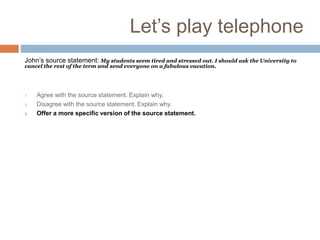
Let’s play telephone
John’s source statement: My students seem tired and stressed out. I should ask the University to
cancel the rest of the term and send everyone on a fabulous vacation.
Other teacher’s source statement: Your students are tired and stressed out because they lack
discipline. You should double the work you’re giving them.
Agree with the source statement. Explain why.
Disagree with the source statement. Explain why.
Offer a more specific version of the source statement.
Disagree with the last speaker’s statement and offer an alternative. Explain why your alternative is
preferable.
Ask a question about the source statement meant to provoke critical thought.
Respond to the critical question. Be sure to explain the reasoning behind your response.
Ask John for another source statement.
Take a side with whichever source statement you prefer. Explain your preference.
Agree with the previous speaker’s statement. Explain why.
Disagree with the previous speaker’s statement. Explain why.
Identify a (perhaps subtle) point of agreement between the two source statements. Ask a question
about that point of agreement that’s meant to provoke critical thought.
Respond to the critical question. Be sure to explain the reasoning behind your response.
Agree in part with both source statements, but propose a third alternative. Explain why it’s better.
Agree with the previous speaker’s alternative, adding a “because clause” that explains why.
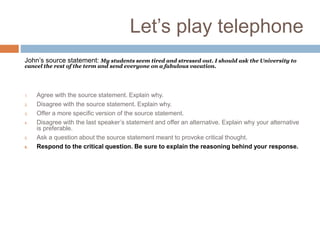
Let’s play telephone
John’s source statement: My students seem tired and stressed out. I should ask the University to
cancel the rest of the term and send everyone on a fabulous vacation.
Other teacher’s source statement: Your students are tired and stressed out because they lack
discipline. You should double the work you’re giving them.
1. Agree with the source statement. Explain why.
Disagree with the source statement. Explain why.
Offer a more specific version of the source statement.
Disagree with the last speaker’s statement and offer an alternative. Explain why your alternative is
preferable.
Ask a question about the source statement meant to provoke critical thought.
Respond to the critical question. Be sure to explain the reasoning behind your response.
Ask John for another source statement.
Take a side with whichever source statement you prefer. Explain your preference.
Agree with the previous speaker’s statement. Explain why.
Disagree with the previous speaker’s statement. Explain why.
Identify a (perhaps subtle) point of agreement between the two source statements. Ask a question
about that point of agreement that’s meant to provoke critical thought.
Respond to the critical question. Be sure to explain the reasoning behind your response.
Agree in part with both source statements, but propose a third alternative. Explain why it’s better.
Agree with the previous speaker’s alternative, adding a “because clause” that explains why.
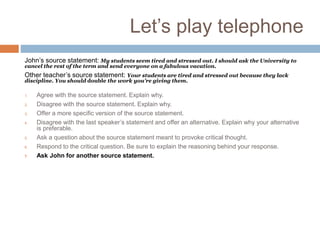
Let’s play telephone
John’s source statement: My students seem tired and stressed out. I should ask the University to
cancel the rest of the term and send everyone on a fabulous vacation.
Other teacher’s source statement: Your students are tired and stressed out because they lack
discipline. You should double the work you’re giving them.
1. Agree with the source statement. Explain why.
2. Disagree with the source statement. Explain why.
Offer a more specific version of the source statement.
Disagree with the last speaker’s statement and offer an alternative. Explain why your alternative is
preferable.
Ask a question about the source statement meant to provoke critical thought.
Respond to the critical question. Be sure to explain the reasoning behind your response.
Ask John for another source statement.
Take a side with whichever source statement you prefer. Explain your preference.
Agree with the previous speaker’s statement. Explain why.
Disagree with the previous speaker’s statement. Explain why.
Identify a (perhaps subtle) point of agreement between the two source statements. Ask a question
about that point of agreement that’s meant to provoke critical thought.
Respond to the critical question. Be sure to explain the reasoning behind your response.
Agree in part with both source statements, but propose a third alternative. Explain why it’s better.
Agree with the previous speaker’s alternative, adding a “because clause” that explains why.
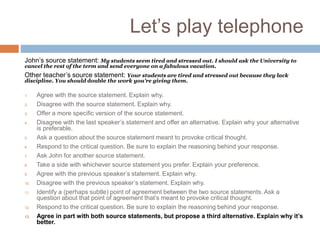
Let’s play telephone
John’s source statement: My students seem tired and stressed out. I should ask the University to
cancel the rest of the term and send everyone on a fabulous vacation.
Other teacher’s source statement: Your students are tired and stressed out because they lack
discipline. You should double the work you’re giving them.
1. Agree with the source statement. Explain why.
2. Disagree with the source statement. Explain why.
3. Offer a more specific version of the source statement.
Disagree with the last speaker’s statement and offer an alternative. Explain why your alternative is
preferable.
Ask a question about the source statement meant to provoke critical thought.
Respond to the critical question. Be sure to explain the reasoning behind your response.
Ask John for another source statement.
Take a side with whichever source statement you prefer. Explain your preference.
Agree with the previous speaker’s statement. Explain why.
Disagree with the previous speaker’s statement. Explain why.
Identify a (perhaps subtle) point of agreement between the two source statements. Ask a question
about that point of agreement that’s meant to provoke critical thought.
Respond to the critical question. Be sure to explain the reasoning behind your response.
Agree in part with both source statements, but propose a third alternative. Explain why it’s better.
Agree with the previous speaker’s alternative, adding a “because clause” that explains why.
Let’s play telephone
John’s source statement: My students seem tired and stressed out. I should ask the University to
cancel the rest of the term and send everyone on a fabulous vacation.
Other teacher’s source statement: Your students are tired and stressed out because they lack
discipline. You should double the work you’re giving them.
1. Agree with the source statement. Explain why.
2. Disagree with the source statement. Explain why.
3. Offer a more specific version of the source statement.
4. Disagree with the last speaker’s statement and offer an alternative. Explain why your
alternative is preferable.
Ask a question about the source statement meant to provoke critical thought.
Respond to the critical question. Be sure to explain the reasoning behind your response.
Ask John for another source statement.
Take a side with whichever source statement you prefer. Explain your preference.
Agree with the previous speaker’s statement. Explain why.
Disagree with the previous speaker’s statement. Explain why.
Identify a (perhaps subtle) point of agreement between the two source statements. Ask a question
about that point of agreement that’s meant to provoke critical thought.
Respond to the critical question. Be sure to explain the reasoning behind your response.
Agree in part with both source statements, but propose a third alternative. Explain why it’s better.
Agree with the previous speaker’s alternative, adding a “because clause” that explains why.
Let’s play telephone
John’s source statement: My students seem tired and stressed out. I should ask the University to
cancel the rest of the term and send everyone on a fabulous vacation.
Other teacher’s source statement: Your students are tired and stressed out because they lack
discipline. You should double the work you’re giving them.
1. Agree with the source statement. Explain why.
2. Disagree with the source statement. Explain why.
3. Offer a more specific version of the source statement.
4. Disagree with the last speaker’s statement and offer an alternative. Explain why your alternative
is preferable.
5. Ask a question about the source statement meant to provoke critical thought.
Respond to the critical question. Be sure to explain the reasoning behind your response.
Ask John for another source statement.
Take a side with whichever source statement you prefer. Explain your preference.
Agree with the previous speaker’s statement. Explain why.
Disagree with the previous speaker’s statement. Explain why.
Identify a (perhaps subtle) point of agreement between the two source statements. Ask a question
about that point of agreement that’s meant to provoke critical thought.
Respond to the critical question. Be sure to explain the reasoning behind your response.
Agree in part with both source statements, but propose a third alternative. Explain why it’s better.
Agree with the previous speaker’s alternative, adding a “because clause” that explains why.
Let’s play telephone
John’s source statement: My students seem tired and stressed out. I should ask the University to
cancel the rest of the term and send everyone on a fabulous vacation.
Other teacher’s source statement: Your students are tired and stressed out because they lack
discipline. You should double the work you’re giving them.
1. Agree with the source statement. Explain why.
2. Disagree with the source statement. Explain why.
3. Offer a more specific version of the source statement.
4. Disagree with the last speaker’s statement and offer an alternative. Explain why your alternative
is preferable.
5. Ask a question about the source statement meant to provoke critical thought.
6. Respond to the critical question. Be sure to explain the reasoning behind your response.
Ask John for another source statement.
Take a side with whichever source statement you prefer. Explain your preference.
Agree with the previous speaker’s statement. Explain why.
Disagree with the previous speaker’s statement. Explain why.
Identify a (perhaps subtle) point of agreement between the two source statements. Ask a question
about that point of agreement that’s meant to provoke critical thought.
Respond to the critical question. Be sure to explain the reasoning behind your response.
Agree in part with both source statements, but propose a third alternative. Explain why it’s better.
Agree with the previous speaker’s alternative, adding a “because clause” that explains why.
Let’s play telephone
John’s source statement: My students seem tired and stressed out. I should ask the University to
cancel the rest of the term and send everyone on a fabulous vacation.
Other teacher’s source statement: Your students are tired and stressed out because they lack
discipline. You should double the work you’re giving them.
1. Agree with the source statement. Explain why.
2. Disagree with the source statement. Explain why.
3. Offer a more specific version of the source statement.
4. Disagree with the last speaker’s statement and offer an alternative. Explain why your alternative
is preferable.
5. Ask a question about the source statement meant to provoke critical thought.
6. Respond to the critical question. Be sure to explain the reasoning behind your response.
7. Ask John for another source statement.
Take a side with whichever source statement you prefer. Explain your preference.
Agree with the previous speaker’s statement. Explain why.
Disagree with the previous speaker’s statement. Explain why.
Identify a (perhaps subtle) point of agreement between the two source statements. Ask a question
about that point of agreement that’s meant to provoke critical thought.
Respond to the critical question. Be sure to explain the reasoning behind your response.
Agree in part with both source statements, but propose a third alternative. Explain why it’s better.
Agree with the previous speaker’s alternative, adding a “because clause” that explains why.
Let’s play telephone
John’s source statement: My students seem tired and stressed out. I should ask the University to
cancel the rest of the term and send everyone on a fabulous vacation.
Other teacher’s source statement: Your students are tired and stressed out because they lack
discipline. You should double the work you’re giving them.
1. Agree with the source statement. Explain why.
2. Disagree with the source statement. Explain why.
3. Offer a more specific version of the source statement.
4. Disagree with the last speaker’s statement and offer an alternative. Explain why your alternative
is preferable.
5. Ask a question about the source statement meant to provoke critical thought.
6. Respond to the critical question. Be sure to explain the reasoning behind your response.
7. Ask John for another source statement.
Take a side with whichever source statement you prefer. Explain your preference.
Agree with the previous speaker’s statement. Explain why.
Disagree with the previous speaker’s statement. Explain why.
Identify a (perhaps subtle) point of agreement between the two source statements. Ask a question
about that point of agreement that’s meant to provoke critical thought.
Respond to the critical question. Be sure to explain the reasoning behind your response.
Agree in part with both source statements, but propose a third alternative. Explain why it’s better.
Agree with the previous speaker’s alternative, adding a “because clause” that explains why.
Let’s play telephone
John’s source statement: My students seem tired and stressed out. I should ask the University to
cancel the rest of the term and send everyone on a fabulous vacation.
Other teacher’s source statement: Your students are tired and stressed out because they lack
discipline. You should double the work you’re giving them.
1. Agree with the source statement. Explain why.
2. Disagree with the source statement. Explain why.
3. Offer a more specific version of the source statement.
4. Disagree with the last speaker’s statement and offer an alternative. Explain why your alternative
is preferable.
5. Ask a question about the source statement meant to provoke critical thought.
6. Respond to the critical question. Be sure to explain the reasoning behind your response.
7. Ask John for another source statement.
8. Take a side with whichever source statement you prefer. Explain your preference.
Agree with the previous speaker’s statement. Explain why.
Disagree with the previous speaker’s statement. Explain why.
Identify a (perhaps subtle) point of agreement between the two source statements. Ask a question
about that point of agreement that’s meant to provoke critical thought.
Respond to the critical question. Be sure to explain the reasoning behind your response.
Agree in part with both source statements, but propose a third alternative. Explain why it’s better.
Agree with the previous speaker’s alternative, adding a “because clause” that explains why.
Let’s play telephone
John’s source statement: My students seem tired and stressed out. I should ask the University to
cancel the rest of the term and send everyone on a fabulous vacation.
Other teacher’s source statement: Your students are tired and stressed out because they lack
discipline. You should double the work you’re giving them.
1. Agree with the source statement. Explain why.
2. Disagree with the source statement. Explain why.
3. Offer a more specific version of the source statement.
4. Disagree with the last speaker’s statement and offer an alternative. Explain why your alternative
is preferable.
5. Ask a question about the source statement meant to provoke critical thought.
6. Respond to the critical question. Be sure to explain the reasoning behind your response.
7. Ask John for another source statement.
8. Take a side with whichever source statement you prefer. Explain your preference.
9. Agree with the previous speaker’s statement. Explain why.
Disagree with the previous speaker’s statement. Explain why.
Identify a (perhaps subtle) point of agreement between the two source statements. Ask a question
about that point of agreement that’s meant to provoke critical thought.
Respond to the critical question. Be sure to explain the reasoning behind your response.
Agree in part with both source statements, but propose a third alternative. Explain why it’s better.
Agree with the previous speaker’s alternative, adding a “because clause” that explains why.
Let’s play telephone
John’s source statement: My students seem tired and stressed out. I should ask the University to
cancel the rest of the term and send everyone on a fabulous vacation.
Other teacher’s source statement: Your students are tired and stressed out because they lack
discipline. You should double the work you’re giving them.
1. Agree with the source statement. Explain why.
2. Disagree with the source statement. Explain why.
3. Offer a more specific version of the source statement.
4. Disagree with the last speaker’s statement and offer an alternative. Explain why your alternative
is preferable.
5. Ask a question about the source statement meant to provoke critical thought.
6. Respond to the critical question. Be sure to explain the reasoning behind your response.
7. Ask John for another source statement.
8. Take a side with whichever source statement you prefer. Explain your preference.
9. Agree with the previous speaker’s statement. Explain why.
10. Disagree with the previous speaker’s statement. Explain why.
Identify a (perhaps subtle) point of agreement between the two source statements. Ask a question
about that point of agreement that’s meant to provoke critical thought.
Respond to the critical question. Be sure to explain the reasoning behind your response.
Agree in part with both source statements, but propose a third alternative. Explain why it’s better.
Agree with the previous speaker’s alternative, adding a “because clause” that explains why.
Let’s play telephone
John’s source statement: My students seem tired and stressed out. I should ask the University to
cancel the rest of the term and send everyone on a fabulous vacation.
Other teacher’s source statement: Your students are tired and stressed out because they lack
discipline. You should double the work you’re giving them.
1. Agree with the source statement. Explain why.
2. Disagree with the source statement. Explain why.
3. Offer a more specific version of the source statement.
4. Disagree with the last speaker’s statement and offer an alternative. Explain why your alternative
is preferable.
5. Ask a question about the source statement meant to provoke critical thought.
6. Respond to the critical question. Be sure to explain the reasoning behind your response.
7. Ask John for another source statement.
8. Take a side with whichever source statement you prefer. Explain your preference.
9. Agree with the previous speaker’s statement. Explain why.
10. Disagree with the previous speaker’s statement. Explain why.
11. Identify a (perhaps subtle) point of agreement between the two source statements. Ask a
question about that point of agreement that’s meant to provoke critical thought.
Respond to the critical question. Be sure to explain the reasoning behind your response.
Agree in part with both source statements, but propose a third alternative. Explain why it’s better.
Agree with the previous speaker’s alternative, adding a “because clause” that explains why.
Let’s play telephone
John’s source statement: My students seem tired and stressed out. I should ask the University to
cancel the rest of the term and send everyone on a fabulous vacation.
Other teacher’s source statement: Your students are tired and stressed out because they lack
discipline. You should double the work you’re giving them.
1. Agree with the source statement. Explain why.
2. Disagree with the source statement. Explain why.
3. Offer a more specific version of the source statement.
4. Disagree with the last speaker’s statement and offer an alternative. Explain why your alternative
is preferable.
5. Ask a question about the source statement meant to provoke critical thought.
6. Respond to the critical question. Be sure to explain the reasoning behind your response.
7. Ask John for another source statement.
8. Take a side with whichever source statement you prefer. Explain your preference.
9. Agree with the previous speaker’s statement. Explain why.
10. Disagree with the previous speaker’s statement. Explain why.
11. Identify a (perhaps subtle) point of agreement between the two source statements. Ask a
question about that point of agreement that’s meant to provoke critical thought.
12. Respond to the critical question. Be sure to explain the reasoning behind your response.
Agree in part with both source statements, but propose a third alternative. Explain why it’s better.
Agree with the previous speaker’s alternative, adding a “because clause” that explains why.
Let’s play telephone
John’s source statement: My students seem tired and stressed out. I should ask the University to
cancel the rest of the term and send everyone on a fabulous vacation.
Other teacher’s source statement: Your students are tired and stressed out because they lack
discipline. You should double the work you’re giving them.
1. Agree with the source statement. Explain why.
2. Disagree with the source statement. Explain why.
3. Offer a more specific version of the source statement.
4. Disagree with the last speaker’s statement and offer an alternative. Explain why your alternative
is preferable.
5. Ask a question about the source statement meant to provoke critical thought.
6. Respond to the critical question. Be sure to explain the reasoning behind your response.
7. Ask John for another source statement.
8. Take a side with whichever source statement you prefer. Explain your preference.
9. Agree with the previous speaker’s statement. Explain why.
10. Disagree with the previous speaker’s statement. Explain why.
11. Identify a (perhaps subtle) point of agreement between the two source statements. Ask a
question about that point of agreement that’s meant to provoke critical thought.
12. Respond to the critical question. Be sure to explain the reasoning behind your response.
13. Agree in part with both source statements, but propose a third alternative. Explain why it’s
better.
Agree with the previous speaker’s alternative, adding a “because clause” that explains why.
Let’s play telephone
John’s source statement: My students seem tired and stressed out. I should ask the University to
cancel the rest of the term and send everyone on a fabulous vacation.
Other teacher’s source statement: Your students are tired and stressed out because they lack
discipline. You should double the work you’re giving them.
1. Agree with the source statement. Explain why.
2. Disagree with the source statement. Explain why.
3. Offer a more specific version of the source statement.
4. Disagree with the last speaker’s statement and offer an alternative. Explain why your alternative
is preferable.
5. Ask a question about the source statement meant to provoke critical thought.
6. Respond to the critical question. Be sure to explain the reasoning behind your response.
7. Ask John for another source statement.
8. Take a side with whichever source statement you prefer. Explain your preference.
9. Agree with the previous speaker’s statement. Explain why.
10. Disagree with the previous speaker’s statement. Explain why.
11. Identify a (perhaps subtle) point of agreement between the two source statements. Ask a
question about that point of agreement that’s meant to provoke critical thought.
12. Respond to the critical question. Be sure to explain the reasoning behind your response.
13. Agree in part with both source statements, but propose a third alternative. Explain why it’s better.
14. Agree with the previous speaker’s alternative, adding a “because clause” that explains
why.
Conversational strategies
 Agreement and disagreement
 Specification and generalization
 Critical questioning and response
 Synthesizing ideas and generating new ones
Conversational strategies
 Agreement and disagreement
 Specification and generalization
 Critical questioning and response
 Synthesizing ideas and generating new ones
The city in its complete sense, then, is a geographic plexus, an economic
organization, an institutional process, a theater of social action, and an aesthetic
symbol of collective unity (185).
~ Lewis Mumford, “What Is a City?”
In recent years, culture has also become a more explicit site of conflicts over social
differences and urban fears. . . (2). The look and feel of cities reflect decisions about
what – and who – should be visible and what should not. . . (7).
~ Sharon Zukin, The Culture of Cities
Conversational strategies
 Agreement and disagreement
 Specification and generalization
 Critical questioning and response
 Synthesizing ideas and generating new ones
The city in its complete sense, then, is a geographic plexus, an economic
organization, an institutional process, a theater of social action, and an aesthetic
symbol of collective unity (185).
~ Lewis Mumford, “What Is a City?”
In recent years, culture has also become a more explicit site of conflicts over social
differences and urban fears. . . (2). The look and feel of cities reflect decisions about
what – and who – should be visible and what should not. . . (7).
~ Sharon Zukin, The Culture of Cities
Write a paragraph in which you put Mumford and Zukin into conversation. Then write
a second paragraph in which you join the conversation with an argument of your
own, drawing upon your analysis of anything we’ve looked at so far (Big Blue Bear,
23rd and Curtis, the building interiors we toured in Google Maps, etc.

Conversing with sources 2015

  • 1.
    CONVERSING WITH SOURCES Or, Howto Do More with Other Scholars’ Work than “Back Up” Your Opinions.
  • 2.
    Let’s play telephone John’ssource statement: My students seem tired and stressed out. I should ask the University to cancel the rest of the term and send everyone on a fabulous vacation. Other teacher’s source statement: Your students are tired and stressed out because they lack discipline. You should double the work you’re giving them. Agree with the source statement. Explain why. Disagree with the source statement. Explain why. Offer a more specific version of the source statement. Disagree with the last speaker’s statement and offer an alternative. Explain why your alternative is preferable. Ask a question about the source statement meant to provoke critical thought. Respond to the critical question. Be sure to explain the reasoning behind your response. Ask John for another source statement. Take a side with whichever source statement you prefer. Explain your preference. Agree with the previous speaker’s statement. Explain why. Disagree with the previous speaker’s statement. Explain why. Identify a (perhaps subtle) point of agreement between the two source statements. Ask a question about that point of agreement that’s meant to provoke critical thought. Respond to the critical question. Be sure to explain the reasoning behind your response. Agree in part with both source statements, but propose a third alternative. Explain why it’s better. Agree with the previous speaker’s alternative, adding a “because clause” that explains why.
  • 3.
    Let’s play telephone John’ssource statement: My students seem tired and stressed out. I should ask the University to cancel the rest of the term and send everyone on a fabulous vacation. Other teacher’s source statement: Your students are tired and stressed out because they lack discipline. You should double the work you’re giving them. 1. Agree with the source statement. Explain why. Disagree with the source statement. Explain why. Offer a more specific version of the source statement. Disagree with the last speaker’s statement and offer an alternative. Explain why your alternative is preferable. Ask a question about the source statement meant to provoke critical thought. Respond to the critical question. Be sure to explain the reasoning behind your response. Ask John for another source statement. Take a side with whichever source statement you prefer. Explain your preference. Agree with the previous speaker’s statement. Explain why. Disagree with the previous speaker’s statement. Explain why. Identify a (perhaps subtle) point of agreement between the two source statements. Ask a question about that point of agreement that’s meant to provoke critical thought. Respond to the critical question. Be sure to explain the reasoning behind your response. Agree in part with both source statements, but propose a third alternative. Explain why it’s better. Agree with the previous speaker’s alternative, adding a “because clause” that explains why.
  • 4.
    Let’s play telephone John’ssource statement: My students seem tired and stressed out. I should ask the University to cancel the rest of the term and send everyone on a fabulous vacation. Other teacher’s source statement: Your students are tired and stressed out because they lack discipline. You should double the work you’re giving them. 1. Agree with the source statement. Explain why. 2. Disagree with the source statement. Explain why. Offer a more specific version of the source statement. Disagree with the last speaker’s statement and offer an alternative. Explain why your alternative is preferable. Ask a question about the source statement meant to provoke critical thought. Respond to the critical question. Be sure to explain the reasoning behind your response. Ask John for another source statement. Take a side with whichever source statement you prefer. Explain your preference. Agree with the previous speaker’s statement. Explain why. Disagree with the previous speaker’s statement. Explain why. Identify a (perhaps subtle) point of agreement between the two source statements. Ask a question about that point of agreement that’s meant to provoke critical thought. Respond to the critical question. Be sure to explain the reasoning behind your response. Agree in part with both source statements, but propose a third alternative. Explain why it’s better. Agree with the previous speaker’s alternative, adding a “because clause” that explains why.
  • 5.
    Let’s play telephone John’ssource statement: My students seem tired and stressed out. I should ask the University to cancel the rest of the term and send everyone on a fabulous vacation. Other teacher’s source statement: Your students are tired and stressed out because they lack discipline. You should double the work you’re giving them. 1. Agree with the source statement. Explain why. 2. Disagree with the source statement. Explain why. 3. Offer a more specific version of the source statement. Disagree with the last speaker’s statement and offer an alternative. Explain why your alternative is preferable. Ask a question about the source statement meant to provoke critical thought. Respond to the critical question. Be sure to explain the reasoning behind your response. Ask John for another source statement. Take a side with whichever source statement you prefer. Explain your preference. Agree with the previous speaker’s statement. Explain why. Disagree with the previous speaker’s statement. Explain why. Identify a (perhaps subtle) point of agreement between the two source statements. Ask a question about that point of agreement that’s meant to provoke critical thought. Respond to the critical question. Be sure to explain the reasoning behind your response. Agree in part with both source statements, but propose a third alternative. Explain why it’s better. Agree with the previous speaker’s alternative, adding a “because clause” that explains why.
  • 6.
    Let’s play telephone John’ssource statement: My students seem tired and stressed out. I should ask the University to cancel the rest of the term and send everyone on a fabulous vacation. Other teacher’s source statement: Your students are tired and stressed out because they lack discipline. You should double the work you’re giving them. 1. Agree with the source statement. Explain why. 2. Disagree with the source statement. Explain why. 3. Offer a more specific version of the source statement. 4. Disagree with the last speaker’s statement and offer an alternative. Explain why your alternative is preferable. Ask a question about the source statement meant to provoke critical thought. Respond to the critical question. Be sure to explain the reasoning behind your response. Ask John for another source statement. Take a side with whichever source statement you prefer. Explain your preference. Agree with the previous speaker’s statement. Explain why. Disagree with the previous speaker’s statement. Explain why. Identify a (perhaps subtle) point of agreement between the two source statements. Ask a question about that point of agreement that’s meant to provoke critical thought. Respond to the critical question. Be sure to explain the reasoning behind your response. Agree in part with both source statements, but propose a third alternative. Explain why it’s better. Agree with the previous speaker’s alternative, adding a “because clause” that explains why.
  • 7.
    Let’s play telephone John’ssource statement: My students seem tired and stressed out. I should ask the University to cancel the rest of the term and send everyone on a fabulous vacation. Other teacher’s source statement: Your students are tired and stressed out because they lack discipline. You should double the work you’re giving them. 1. Agree with the source statement. Explain why. 2. Disagree with the source statement. Explain why. 3. Offer a more specific version of the source statement. 4. Disagree with the last speaker’s statement and offer an alternative. Explain why your alternative is preferable. 5. Ask a question about the source statement meant to provoke critical thought. Respond to the critical question. Be sure to explain the reasoning behind your response. Ask John for another source statement. Take a side with whichever source statement you prefer. Explain your preference. Agree with the previous speaker’s statement. Explain why. Disagree with the previous speaker’s statement. Explain why. Identify a (perhaps subtle) point of agreement between the two source statements. Ask a question about that point of agreement that’s meant to provoke critical thought. Respond to the critical question. Be sure to explain the reasoning behind your response. Agree in part with both source statements, but propose a third alternative. Explain why it’s better. Agree with the previous speaker’s alternative, adding a “because clause” that explains why.
  • 8.
    Let’s play telephone John’ssource statement: My students seem tired and stressed out. I should ask the University to cancel the rest of the term and send everyone on a fabulous vacation. Other teacher’s source statement: Your students are tired and stressed out because they lack discipline. You should double the work you’re giving them. 1. Agree with the source statement. Explain why. 2. Disagree with the source statement. Explain why. 3. Offer a more specific version of the source statement. 4. Disagree with the last speaker’s statement and offer an alternative. Explain why your alternative is preferable. 5. Ask a question about the source statement meant to provoke critical thought. 6. Respond to the critical question. Be sure to explain the reasoning behind your response. Ask John for another source statement. Take a side with whichever source statement you prefer. Explain your preference. Agree with the previous speaker’s statement. Explain why. Disagree with the previous speaker’s statement. Explain why. Identify a (perhaps subtle) point of agreement between the two source statements. Ask a question about that point of agreement that’s meant to provoke critical thought. Respond to the critical question. Be sure to explain the reasoning behind your response. Agree in part with both source statements, but propose a third alternative. Explain why it’s better. Agree with the previous speaker’s alternative, adding a “because clause” that explains why.
  • 9.
    Let’s play telephone John’ssource statement: My students seem tired and stressed out. I should ask the University to cancel the rest of the term and send everyone on a fabulous vacation. Other teacher’s source statement: Your students are tired and stressed out because they lack discipline. You should double the work you’re giving them. 1. Agree with the source statement. Explain why. 2. Disagree with the source statement. Explain why. 3. Offer a more specific version of the source statement. 4. Disagree with the last speaker’s statement and offer an alternative. Explain why your alternative is preferable. 5. Ask a question about the source statement meant to provoke critical thought. 6. Respond to the critical question. Be sure to explain the reasoning behind your response. 7. Ask John for another source statement. Take a side with whichever source statement you prefer. Explain your preference. Agree with the previous speaker’s statement. Explain why. Disagree with the previous speaker’s statement. Explain why. Identify a (perhaps subtle) point of agreement between the two source statements. Ask a question about that point of agreement that’s meant to provoke critical thought. Respond to the critical question. Be sure to explain the reasoning behind your response. Agree in part with both source statements, but propose a third alternative. Explain why it’s better. Agree with the previous speaker’s alternative, adding a “because clause” that explains why.
  • 10.
    Let’s play telephone John’ssource statement: My students seem tired and stressed out. I should ask the University to cancel the rest of the term and send everyone on a fabulous vacation. Other teacher’s source statement: Your students are tired and stressed out because they lack discipline. You should double the work you’re giving them. 1. Agree with the source statement. Explain why. 2. Disagree with the source statement. Explain why. 3. Offer a more specific version of the source statement. 4. Disagree with the last speaker’s statement and offer an alternative. Explain why your alternative is preferable. 5. Ask a question about the source statement meant to provoke critical thought. 6. Respond to the critical question. Be sure to explain the reasoning behind your response. 7. Ask John for another source statement. Take a side with whichever source statement you prefer. Explain your preference. Agree with the previous speaker’s statement. Explain why. Disagree with the previous speaker’s statement. Explain why. Identify a (perhaps subtle) point of agreement between the two source statements. Ask a question about that point of agreement that’s meant to provoke critical thought. Respond to the critical question. Be sure to explain the reasoning behind your response. Agree in part with both source statements, but propose a third alternative. Explain why it’s better. Agree with the previous speaker’s alternative, adding a “because clause” that explains why.
  • 11.
    Let’s play telephone John’ssource statement: My students seem tired and stressed out. I should ask the University to cancel the rest of the term and send everyone on a fabulous vacation. Other teacher’s source statement: Your students are tired and stressed out because they lack discipline. You should double the work you’re giving them. 1. Agree with the source statement. Explain why. 2. Disagree with the source statement. Explain why. 3. Offer a more specific version of the source statement. 4. Disagree with the last speaker’s statement and offer an alternative. Explain why your alternative is preferable. 5. Ask a question about the source statement meant to provoke critical thought. 6. Respond to the critical question. Be sure to explain the reasoning behind your response. 7. Ask John for another source statement. 8. Take a side with whichever source statement you prefer. Explain your preference. Agree with the previous speaker’s statement. Explain why. Disagree with the previous speaker’s statement. Explain why. Identify a (perhaps subtle) point of agreement between the two source statements. Ask a question about that point of agreement that’s meant to provoke critical thought. Respond to the critical question. Be sure to explain the reasoning behind your response. Agree in part with both source statements, but propose a third alternative. Explain why it’s better. Agree with the previous speaker’s alternative, adding a “because clause” that explains why.
  • 12.
    Let’s play telephone John’ssource statement: My students seem tired and stressed out. I should ask the University to cancel the rest of the term and send everyone on a fabulous vacation. Other teacher’s source statement: Your students are tired and stressed out because they lack discipline. You should double the work you’re giving them. 1. Agree with the source statement. Explain why. 2. Disagree with the source statement. Explain why. 3. Offer a more specific version of the source statement. 4. Disagree with the last speaker’s statement and offer an alternative. Explain why your alternative is preferable. 5. Ask a question about the source statement meant to provoke critical thought. 6. Respond to the critical question. Be sure to explain the reasoning behind your response. 7. Ask John for another source statement. 8. Take a side with whichever source statement you prefer. Explain your preference. 9. Agree with the previous speaker’s statement. Explain why. Disagree with the previous speaker’s statement. Explain why. Identify a (perhaps subtle) point of agreement between the two source statements. Ask a question about that point of agreement that’s meant to provoke critical thought. Respond to the critical question. Be sure to explain the reasoning behind your response. Agree in part with both source statements, but propose a third alternative. Explain why it’s better. Agree with the previous speaker’s alternative, adding a “because clause” that explains why.
  • 13.
    Let’s play telephone John’ssource statement: My students seem tired and stressed out. I should ask the University to cancel the rest of the term and send everyone on a fabulous vacation. Other teacher’s source statement: Your students are tired and stressed out because they lack discipline. You should double the work you’re giving them. 1. Agree with the source statement. Explain why. 2. Disagree with the source statement. Explain why. 3. Offer a more specific version of the source statement. 4. Disagree with the last speaker’s statement and offer an alternative. Explain why your alternative is preferable. 5. Ask a question about the source statement meant to provoke critical thought. 6. Respond to the critical question. Be sure to explain the reasoning behind your response. 7. Ask John for another source statement. 8. Take a side with whichever source statement you prefer. Explain your preference. 9. Agree with the previous speaker’s statement. Explain why. 10. Disagree with the previous speaker’s statement. Explain why. Identify a (perhaps subtle) point of agreement between the two source statements. Ask a question about that point of agreement that’s meant to provoke critical thought. Respond to the critical question. Be sure to explain the reasoning behind your response. Agree in part with both source statements, but propose a third alternative. Explain why it’s better. Agree with the previous speaker’s alternative, adding a “because clause” that explains why.
  • 14.
    Let’s play telephone John’ssource statement: My students seem tired and stressed out. I should ask the University to cancel the rest of the term and send everyone on a fabulous vacation. Other teacher’s source statement: Your students are tired and stressed out because they lack discipline. You should double the work you’re giving them. 1. Agree with the source statement. Explain why. 2. Disagree with the source statement. Explain why. 3. Offer a more specific version of the source statement. 4. Disagree with the last speaker’s statement and offer an alternative. Explain why your alternative is preferable. 5. Ask a question about the source statement meant to provoke critical thought. 6. Respond to the critical question. Be sure to explain the reasoning behind your response. 7. Ask John for another source statement. 8. Take a side with whichever source statement you prefer. Explain your preference. 9. Agree with the previous speaker’s statement. Explain why. 10. Disagree with the previous speaker’s statement. Explain why. 11. Identify a (perhaps subtle) point of agreement between the two source statements. Ask a question about that point of agreement that’s meant to provoke critical thought. Respond to the critical question. Be sure to explain the reasoning behind your response. Agree in part with both source statements, but propose a third alternative. Explain why it’s better. Agree with the previous speaker’s alternative, adding a “because clause” that explains why.
  • 15.
    Let’s play telephone John’ssource statement: My students seem tired and stressed out. I should ask the University to cancel the rest of the term and send everyone on a fabulous vacation. Other teacher’s source statement: Your students are tired and stressed out because they lack discipline. You should double the work you’re giving them. 1. Agree with the source statement. Explain why. 2. Disagree with the source statement. Explain why. 3. Offer a more specific version of the source statement. 4. Disagree with the last speaker’s statement and offer an alternative. Explain why your alternative is preferable. 5. Ask a question about the source statement meant to provoke critical thought. 6. Respond to the critical question. Be sure to explain the reasoning behind your response. 7. Ask John for another source statement. 8. Take a side with whichever source statement you prefer. Explain your preference. 9. Agree with the previous speaker’s statement. Explain why. 10. Disagree with the previous speaker’s statement. Explain why. 11. Identify a (perhaps subtle) point of agreement between the two source statements. Ask a question about that point of agreement that’s meant to provoke critical thought. 12. Respond to the critical question. Be sure to explain the reasoning behind your response. Agree in part with both source statements, but propose a third alternative. Explain why it’s better. Agree with the previous speaker’s alternative, adding a “because clause” that explains why.
  • 16.
    Let’s play telephone John’ssource statement: My students seem tired and stressed out. I should ask the University to cancel the rest of the term and send everyone on a fabulous vacation. Other teacher’s source statement: Your students are tired and stressed out because they lack discipline. You should double the work you’re giving them. 1. Agree with the source statement. Explain why. 2. Disagree with the source statement. Explain why. 3. Offer a more specific version of the source statement. 4. Disagree with the last speaker’s statement and offer an alternative. Explain why your alternative is preferable. 5. Ask a question about the source statement meant to provoke critical thought. 6. Respond to the critical question. Be sure to explain the reasoning behind your response. 7. Ask John for another source statement. 8. Take a side with whichever source statement you prefer. Explain your preference. 9. Agree with the previous speaker’s statement. Explain why. 10. Disagree with the previous speaker’s statement. Explain why. 11. Identify a (perhaps subtle) point of agreement between the two source statements. Ask a question about that point of agreement that’s meant to provoke critical thought. 12. Respond to the critical question. Be sure to explain the reasoning behind your response. 13. Agree in part with both source statements, but propose a third alternative. Explain why it’s better. Agree with the previous speaker’s alternative, adding a “because clause” that explains why.
  • 17.
    Let’s play telephone John’ssource statement: My students seem tired and stressed out. I should ask the University to cancel the rest of the term and send everyone on a fabulous vacation. Other teacher’s source statement: Your students are tired and stressed out because they lack discipline. You should double the work you’re giving them. 1. Agree with the source statement. Explain why. 2. Disagree with the source statement. Explain why. 3. Offer a more specific version of the source statement. 4. Disagree with the last speaker’s statement and offer an alternative. Explain why your alternative is preferable. 5. Ask a question about the source statement meant to provoke critical thought. 6. Respond to the critical question. Be sure to explain the reasoning behind your response. 7. Ask John for another source statement. 8. Take a side with whichever source statement you prefer. Explain your preference. 9. Agree with the previous speaker’s statement. Explain why. 10. Disagree with the previous speaker’s statement. Explain why. 11. Identify a (perhaps subtle) point of agreement between the two source statements. Ask a question about that point of agreement that’s meant to provoke critical thought. 12. Respond to the critical question. Be sure to explain the reasoning behind your response. 13. Agree in part with both source statements, but propose a third alternative. Explain why it’s better. 14. Agree with the previous speaker’s alternative, adding a “because clause” that explains why.
  • 18.
    Conversational strategies  Agreementand disagreement  Specification and generalization  Critical questioning and response  Synthesizing ideas and generating new ones
  • 19.
    Conversational strategies  Agreementand disagreement  Specification and generalization  Critical questioning and response  Synthesizing ideas and generating new ones The city in its complete sense, then, is a geographic plexus, an economic organization, an institutional process, a theater of social action, and an aesthetic symbol of collective unity (185). ~ Lewis Mumford, “What Is a City?” In recent years, culture has also become a more explicit site of conflicts over social differences and urban fears. . . (2). The look and feel of cities reflect decisions about what – and who – should be visible and what should not. . . (7). ~ Sharon Zukin, The Culture of Cities
  • 20.
    Conversational strategies  Agreementand disagreement  Specification and generalization  Critical questioning and response  Synthesizing ideas and generating new ones The city in its complete sense, then, is a geographic plexus, an economic organization, an institutional process, a theater of social action, and an aesthetic symbol of collective unity (185). ~ Lewis Mumford, “What Is a City?” In recent years, culture has also become a more explicit site of conflicts over social differences and urban fears. . . (2). The look and feel of cities reflect decisions about what – and who – should be visible and what should not. . . (7). ~ Sharon Zukin, The Culture of Cities Write a paragraph in which you put Mumford and Zukin into conversation. Then write a second paragraph in which you join the conversation with an argument of your own, drawing upon your analysis of anything we’ve looked at so far (Big Blue Bear, 23rd and Curtis, the building interiors we toured in Google Maps, etc.