2008 Pearson Education, Inc., publishing as Longman Publishers
Chapter 9:
Critical Thinking
Bridging the Gap, 9/e
Brenda Smith
2008 Pearson Education, Inc., publishing as Longman Publishers
In this chapter you will answer
the questions:
What is thinking?
What is critical thinking?
What are the characteristics of critical
thinkers?
What are the barriers to critical thinking?
How do critical thinkers analyze an
argument?
What is the difference between inductive and
deductive reasoning?
What does creative thinking add to critical
thinking?
2008 Pearson Education, Inc., publishing as Longman Publishers
What is Thinking?
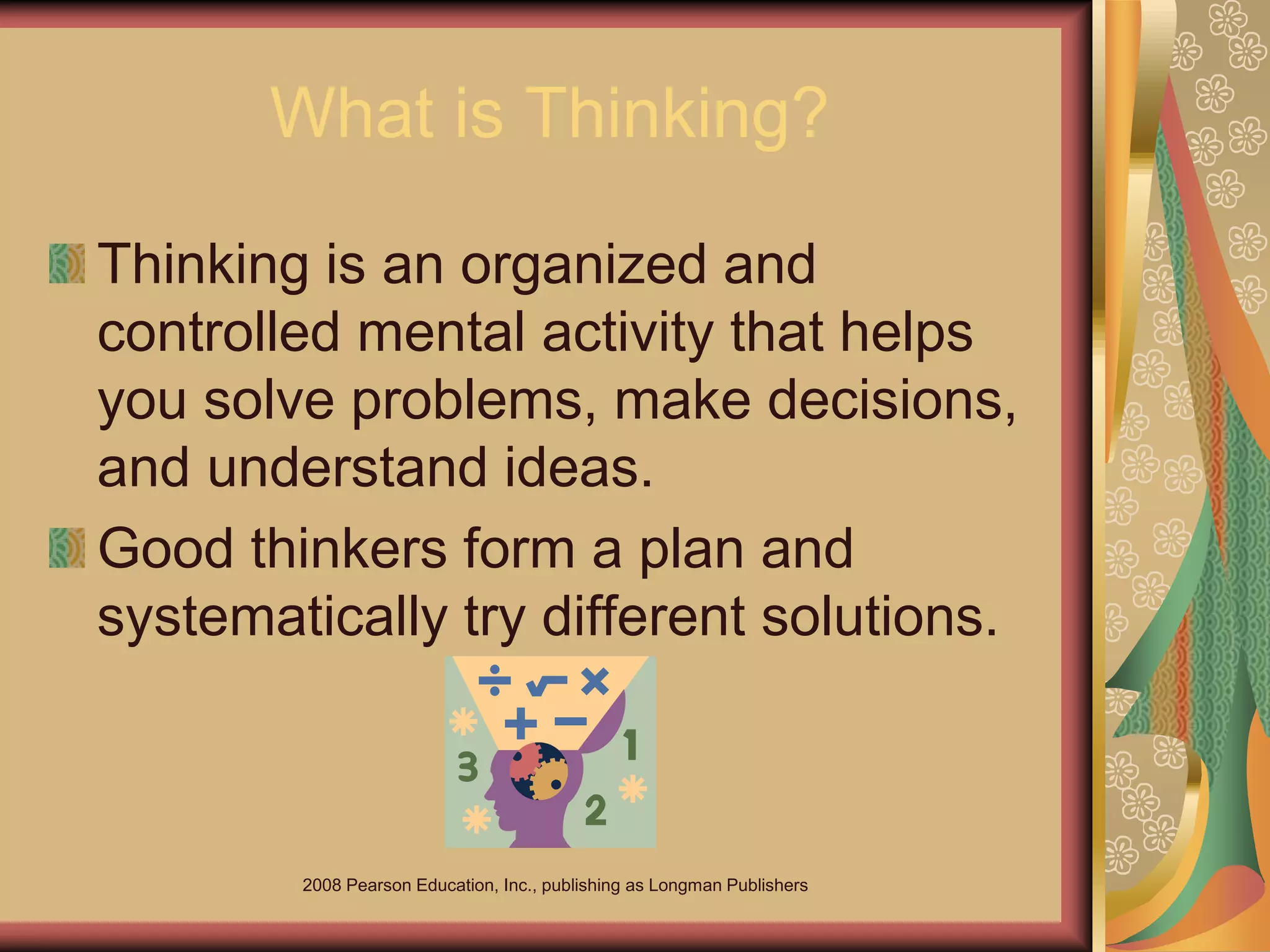
Thinking is an organized and
controlled mental activity that helps
you solve problems, make decisions,
and understand ideas.
Good thinkers form a plan and
systematically try different solutions.
2008 Pearson Education, Inc., publishing as Longman Publishers
What is Critical Thinking?
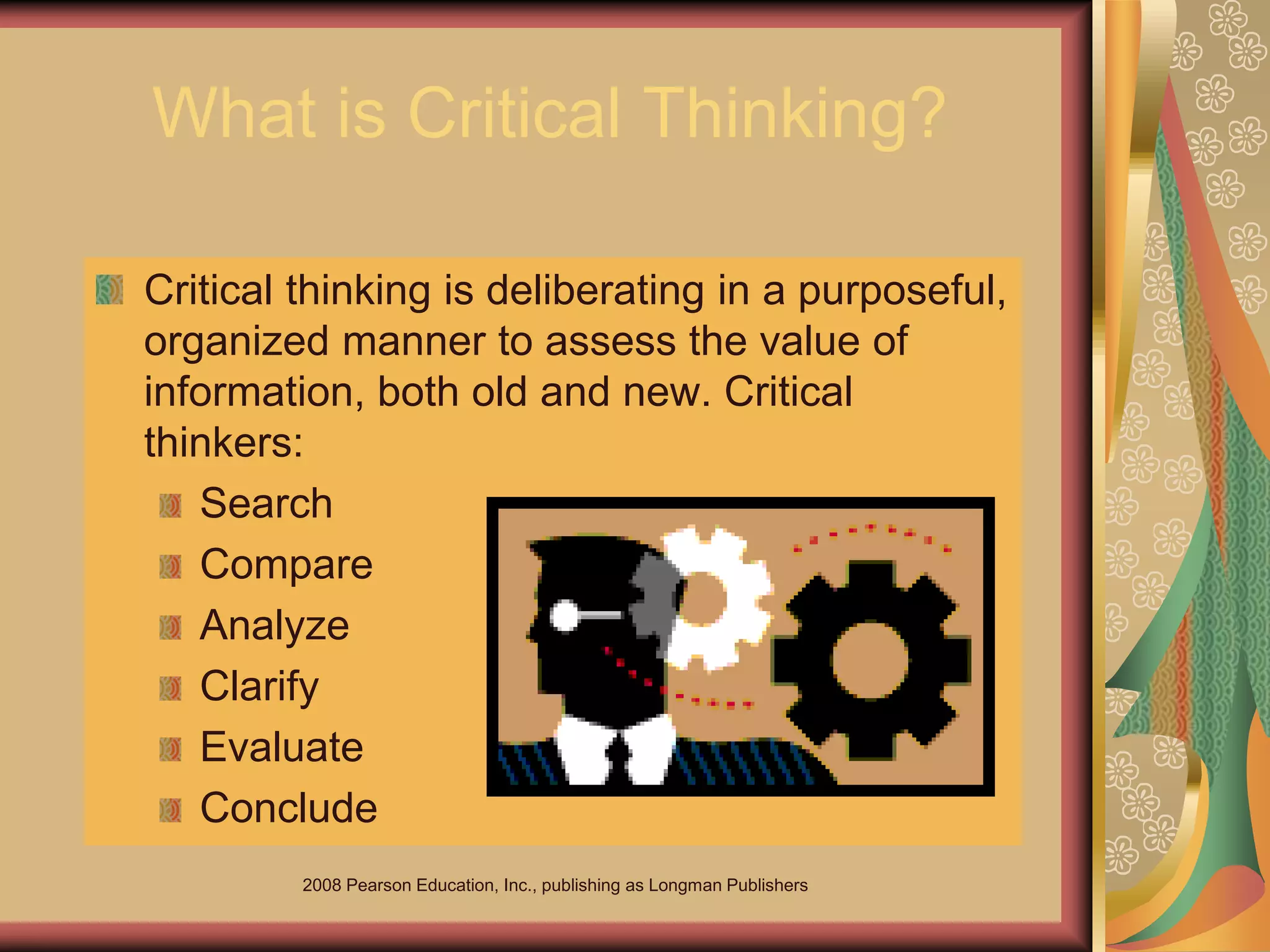
Critical thinking is deliberating in a purposeful,
organized manner to assess the value of
information, both old and new. Critical
thinkers:
Search
Compare
Analyze
Clarify
Evaluate
Conclude
2008 Pearson Education, Inc., publishing as Longman Publishers
Critical Thinking Skills and College Goals
Think systematically.
Evaluate.
Draw conclusions based on
logic.
2008 Pearson Education, Inc., publishing as Longman Publishers
Reader’s Tip: Four Habits of Effective
Critical Thinkers
Be willing to plan.
Be flexible.
Be persistent.
Be willing to self-correct.
2008 Pearson Education, Inc., publishing as Longman Publishers
Terminology for
Critical Thinking
Analogy Conclusion Argument
Consistency Induction Premise
Reliability Relevance Assertion
Believability Deduction Fallacy
2008 Pearson Education, Inc., publishing as Longman Publishers
Barriers to Critical Thinking
Frame of reference.
Wishful thinking.
Hasty moral judgments.
Reliance on authority.
Labels.
2008 Pearson Education, Inc., publishing as Longman Publishers
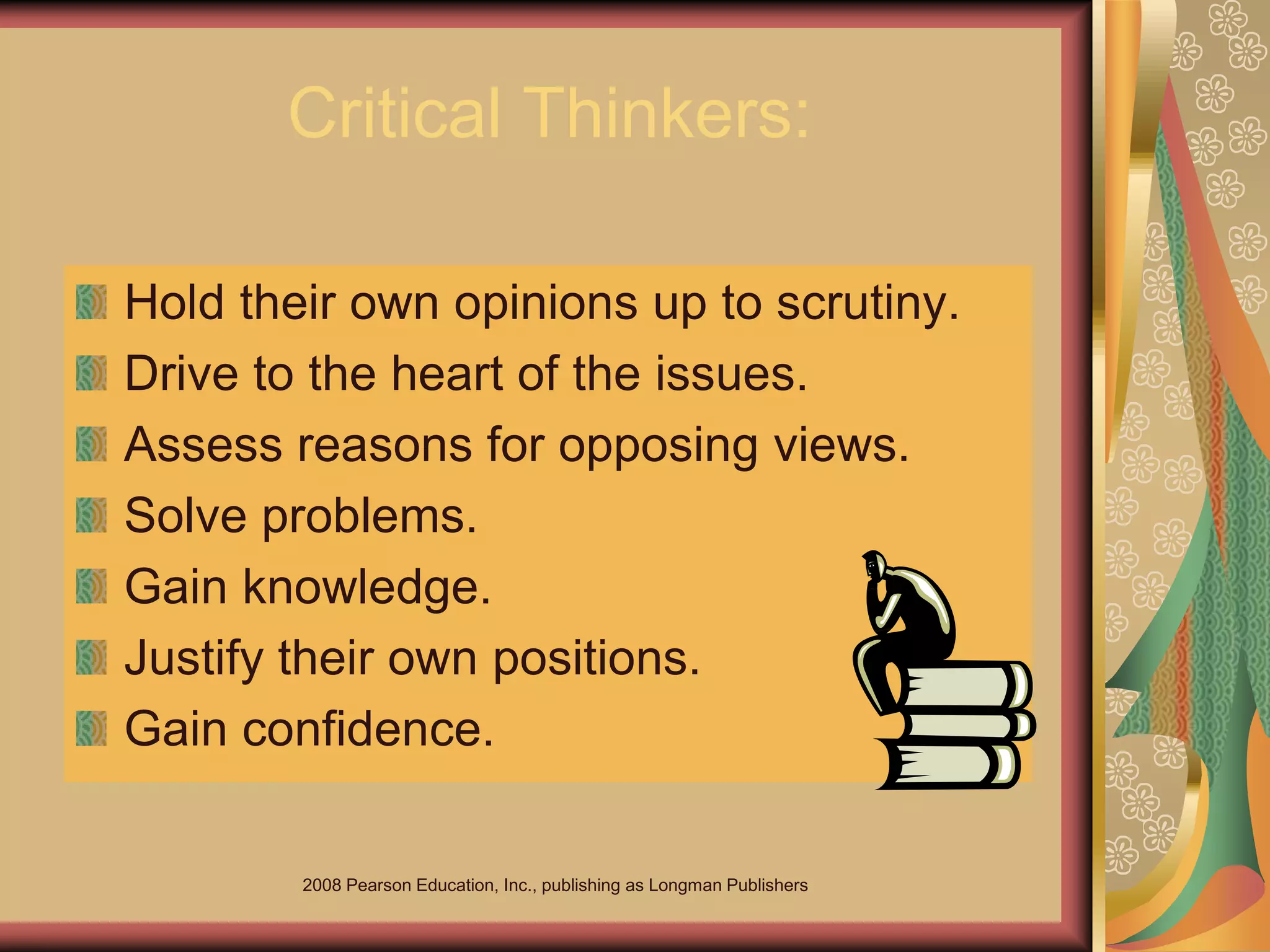
Critical Thinkers:
Hold their own opinions up to scrutiny.
Drive to the heart of the issues.
Assess reasons for opposing views.
Solve problems.
Gain knowledge.
Justify their own positions.
Gain confidence.
2008 Pearson Education, Inc., publishing as Longman Publishers
Courtroom Analogy
What is the issue?
What are the arguments?
What is the evidence?
What is the verdict?
2008 Pearson Education, Inc., publishing as Longman Publishers
Review: How to Think Critically
Be willing to plan. Think first & write later.
Don’t be impulsive. Develop a habit of planning.
Be flexible. Be open to new ideas. Consider
new solutions for old problems.
Be persistent. Continue to work even when
you are tired and discouraged. Good thinking is
hard work.
Be willing to self-correct. Don’t be defensive
about errors. Figure out what went wrong and
learn from your mistakes.
2008 Pearson Education, Inc., publishing as Longman Publishers
Recognizing an Argument
An argument is an assertion that
supports a conclusion and is intended
to persuade.
To identify arguments, use inferential
skills and recognize the underlying
purpose or intent of the author.
2008 Pearson Education, Inc., publishing as Longman Publishers
Recognizing an Argument
An argument is an assertion that supports
a conclusion and is intended to persuade.
Ex: “You should water the grass tonight
because rain is not predicted for several
days.”
Non-argumentative statements do not
question truth but simply offer information to
explain and thereby help us understand.
Ex: “The grass is wet because it rained
last night.”
2008 Pearson Education, Inc., publishing as Longman Publishers
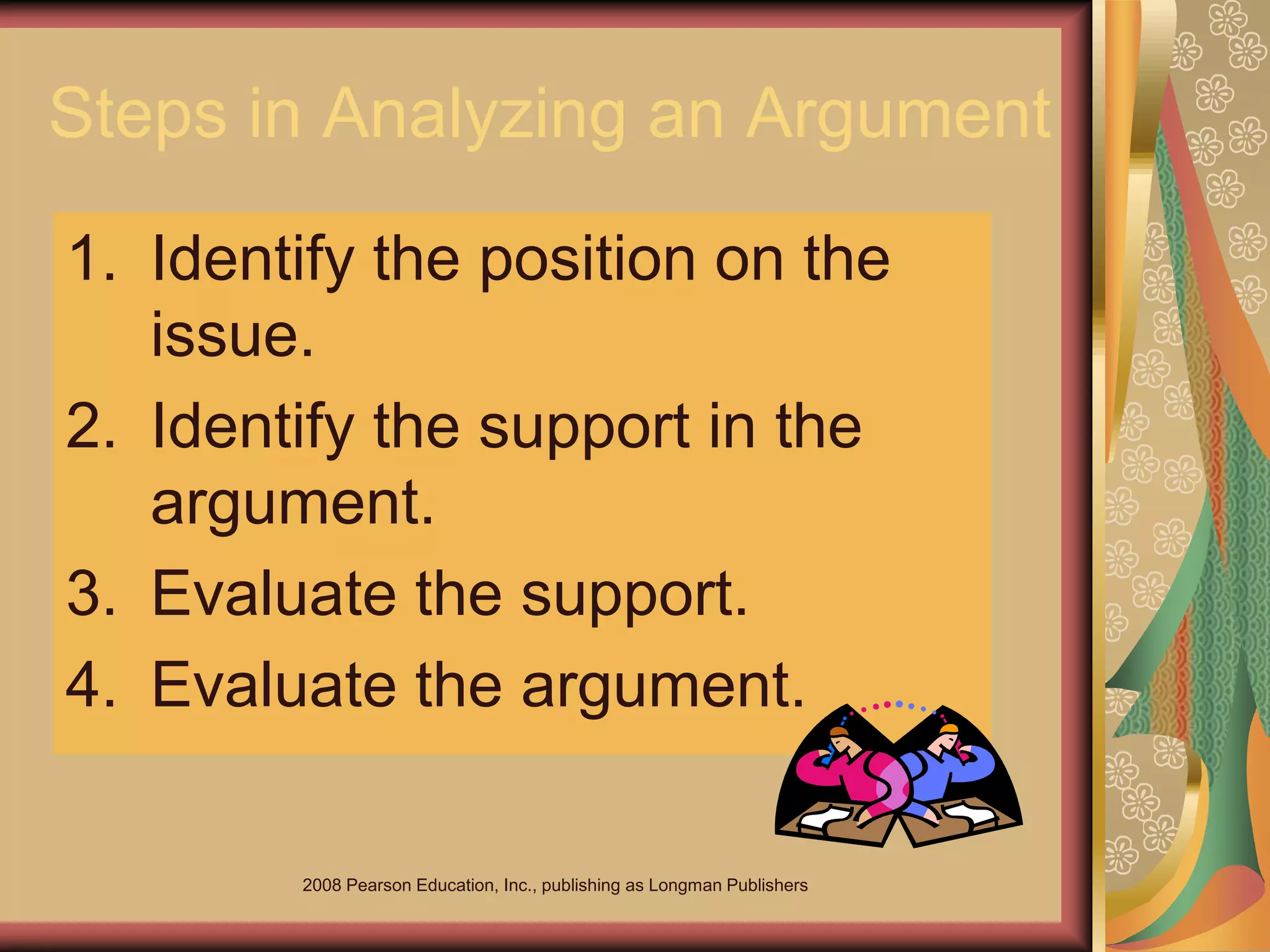
Steps in Analyzing an Argument
1. Identify the position on the
issue.
2. Identify the support in the
argument.
3. Evaluate the support.
4. Evaluate the argument.
2008 Pearson Education, Inc., publishing as Longman Publishers
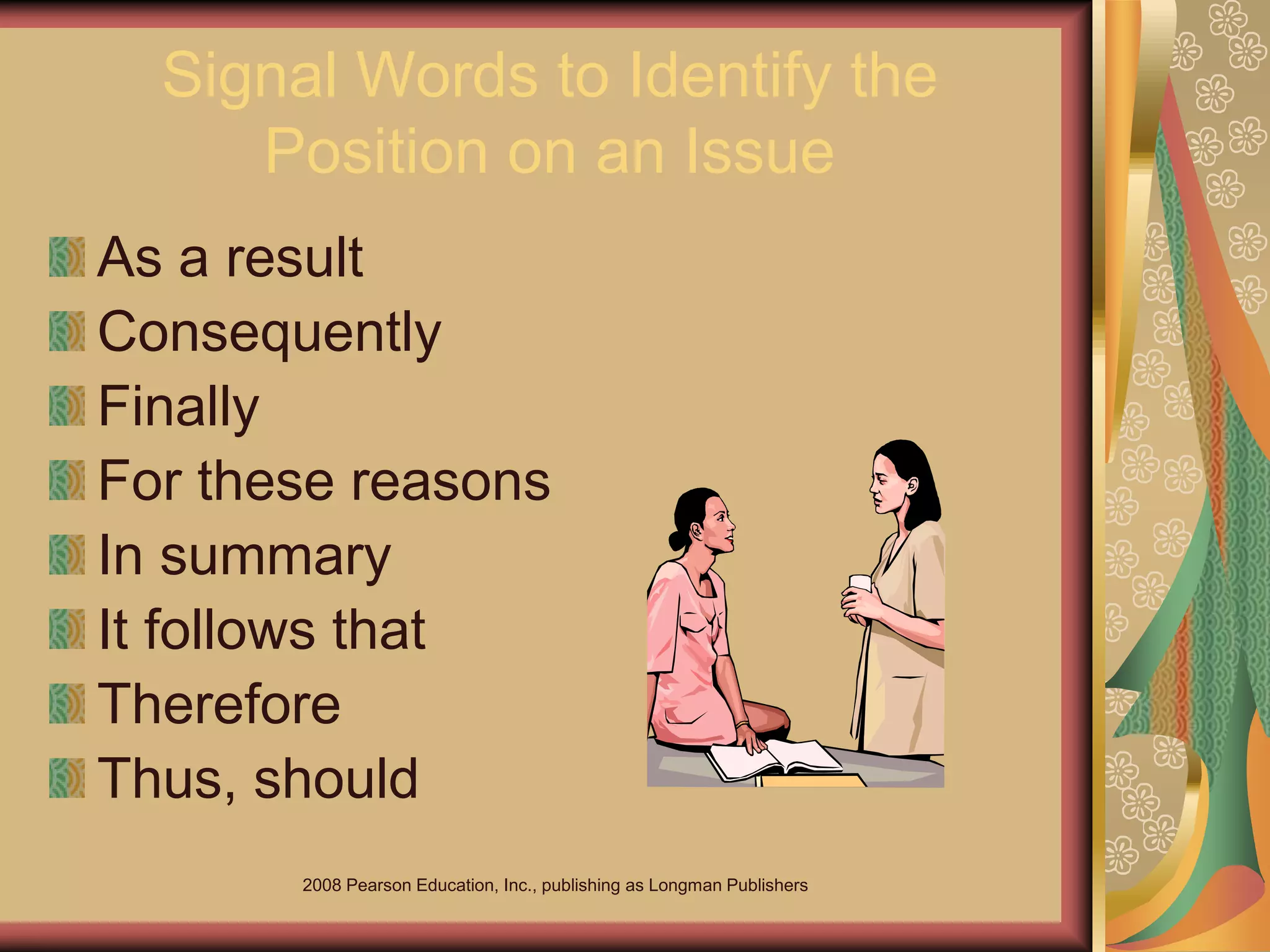
Signal Words to Identify the
Position on an Issue
As a result
Consequently
Finally
For these reasons
In summary
It follows that
Therefore
Thus, should
2008 Pearson Education, Inc., publishing as Longman Publishers
Signal Words to Identify the
Support in the Argument
Because
Since
If
First, second, finally
Assuming that
Given that
2008 Pearson Education, Inc., publishing as Longman Publishers
Reader’s Tip: Types of Support for Arguments
Facts: Objective truths.
Ask: How were the facts gathered? Are they true?
Examples: Anecdotes to demonstrate the truth.
Ask: Are the examples true and relevant?
Analogies: Comparisons to similar cases.
Ask: Are the analogies accurate and relevant?
Authority: Words from a recognized expert.
Ask: What are the credentials and biases of the
expert?
2008 Pearson Education, Inc., publishing as Longman Publishers
Reader’s Tip: Types of Support for Arguments
Causal relationship: Saying one thing caused another.
Ask: Is it an actual cause or merely an association?
Common knowledge claim: Assertion of wide
acceptance.
Ask: Is it relevant? Does everyone really believe it?
Statistics: Numerical data.
Ask: Do the numbers accurately describe the
phenomenon?
Personal experiences: Personal anecdotes.
Ask: Is the experience applicable to other situations?
2008 Pearson Education, Inc., publishing as Longman Publishers
Evaluate the Support
Fallacy - An inference that appears to
be reasonable at first glance, but
closer inspection proves it to be
unrelated, unreliable, or illogical.
1. Relevance fallacies
2. Believability fallacies
3. Consistency fallacies
2008 Pearson Education, Inc., publishing as Longman Publishers
Relevance Fallacies: Is the Support
Related to the Conclusion? - Part (1)
Ad hominem: An attack on the person rather than the
issue in hopes that if the person is opposed, the idea will
be opposed.
Ex: Do not listen to Mr. Hite’s views on education
because he is a banker.
Bandwagon: The idea that everybody is doing it and you
will be left out if you do not quickly join the crowd.
Ex: Everybody around the world is drinking Coke, so
you should too.
Misleading analogy: A comparison of two things
suggesting that they are similar when they are in fact
distinctly different.
Ex: College students are just like elementary school
students; they need to be taught self-discipline.
2008 Pearson Education, Inc., publishing as Longman Publishers
Relevance Fallacies: Is the Support
Related to the Conclusion? - Part (2)
Straw person: A distorted or exaggerated form
of the opponent’s argument is introduced and
knocked down as if to represent a totally weak
opposition.
Ex: When a teenage daughter is told she cannot go
out on the weeknight before a test, she replies with
“It’s unreasonable to say that I can never go out on a
weeknight.”
Testimonials: Opinions of agreement from
respected celebrities who are not actually
experts.
Ex: A famous actor endorses a headache pill.
2008 Pearson Education, Inc., publishing as Longman Publishers
Relevance Fallacies: Is the Support
Related to the Conclusion? - Part (3)
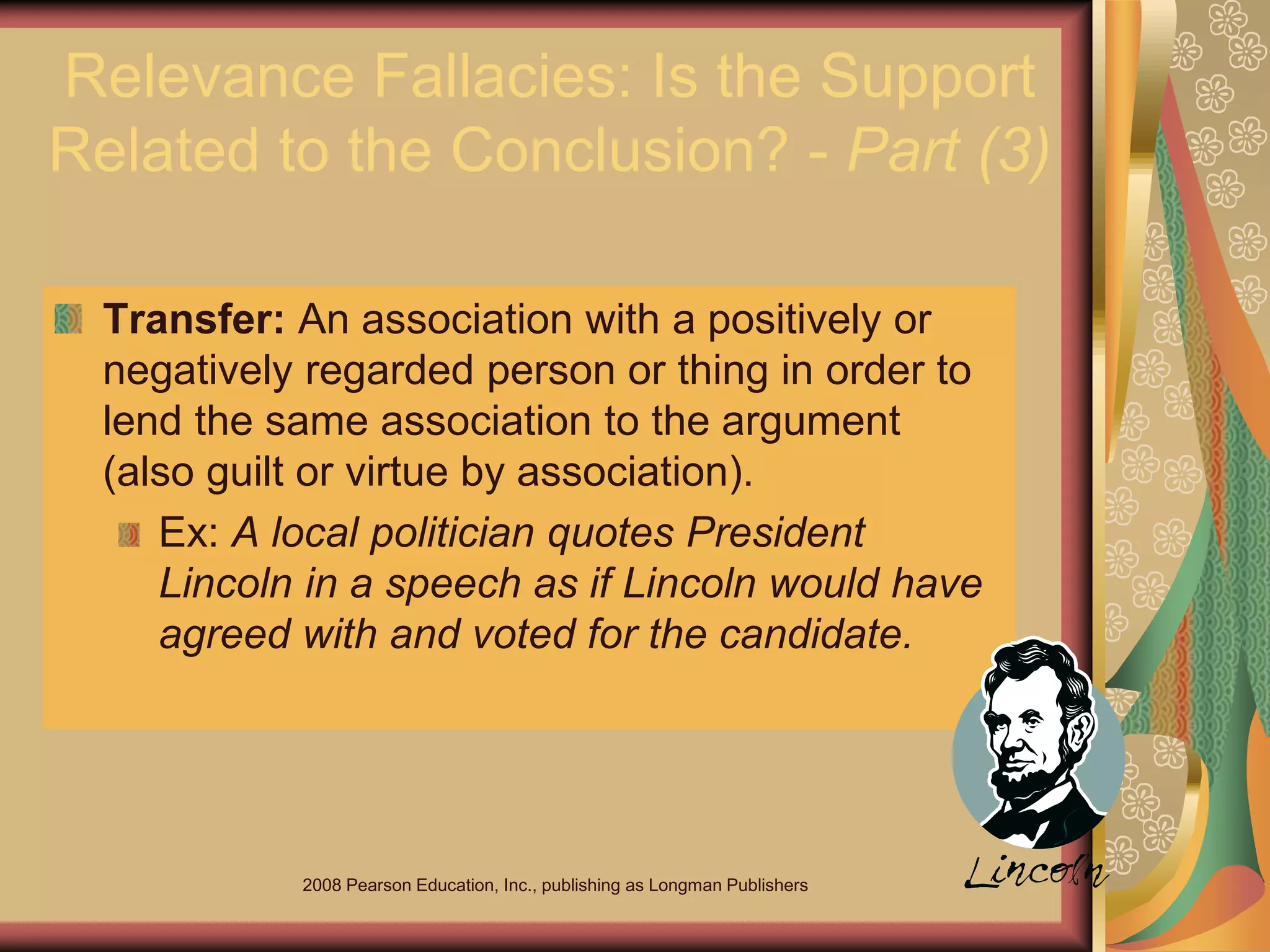
Transfer: An association with a positively or
negatively regarded person or thing in order to
lend the same association to the argument
(also guilt or virtue by association).
Ex: A local politician quotes President
Lincoln in a speech as if Lincoln would have
agreed with and voted for the candidate.
2008 Pearson Education, Inc., publishing as Longman Publishers
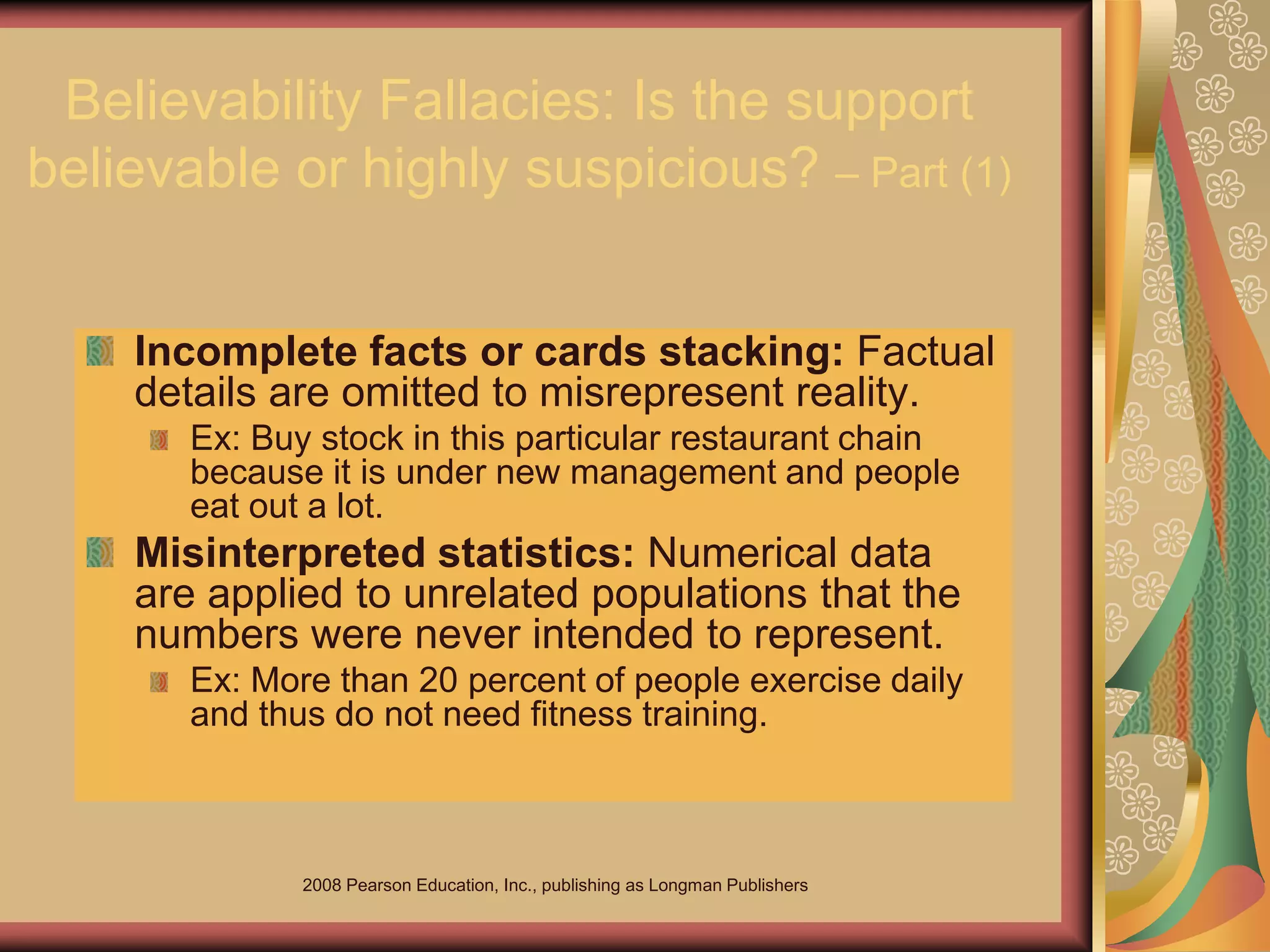
Believability Fallacies: Is the support
believable or highly suspicious? – Part (1)
Incomplete facts or cards stacking: Factual
details are omitted to misrepresent reality.
Ex: Buy stock in this particular restaurant chain
because it is under new management and people
eat out a lot.
Misinterpreted statistics: Numerical data
are applied to unrelated populations that the
numbers were never intended to represent.
Ex: More than 20 percent of people exercise daily
and thus do not need fitness training.
2008 Pearson Education, Inc., publishing as Longman Publishers
Believability Fallacies: Is the support
believable or highly suspicious? – Part (2)
Overgeneralizations: Examples and
anecdotes are asserted as if they apply to all
cases rather than a select few.
Ex: High school students do little work during their
senior year and thus are overwhelmed at college.
Questionable authority: A testimonial
suggests that people who are not experts
actually do have authority in a certain area.
Ex: Dr. Lee, a sociology professor, testified that the
DNA reports were 100 percent accurate.
2008 Pearson Education, Inc., publishing as Longman Publishers
Consistency Fallacies:
Does the Support Hold Together or Does it Fall Apart
& Contradict Itself? – Part (1)
Appeals to emotions: Highly charged language is
used for emotional manipulation.
Ex: Give money to our organization to help these
children—these starving orphans---who are in desperate
need of medical attention.
Appeals to pity: Pleas to support the underdog are
made on behalf of a person or issue.
Ex: Please give me an A for the course because I need it
to get into law school.
Begging the question or circular reasoning:
Support for the conclusion merely restates the
conclusion.
Ex: Drugs should not be legalized because it should be
against the law to take illegal drugs.
2008 Pearson Education, Inc., publishing as Longman Publishers
Consistency Fallacies:
Does the Support Hold Together or Does it Fall Apart
& Contradict Itself? – Part (2)
Oversimplification: An issue is reduced to
two simple choices, without consideration of
other alternatives.
Ex: The choices are very simple in supporting our
foreign-policy decision to send troops. You are
either for America or against it.
Slippery slope: Objections to an issue are
raised because unless dealt with, it will lead
to greater evil and disastrous consequences.
Ex: Support for assisting the suicide of a terminally
ill patient will lead to the ultimate disposal of the
marginally sick and elderly.
2008 Pearson Education, Inc., publishing as Longman Publishers
Evaluate the Argument: Four
degrees of support
1. Unrelated reasons give no support.
2. A few weak reasons do not
adequately support.
3. Many weak reasons can support.
4. Strong related reasons provide
support.
Is there really global warming?
2008 Pearson Education, Inc., publishing as Longman Publishers
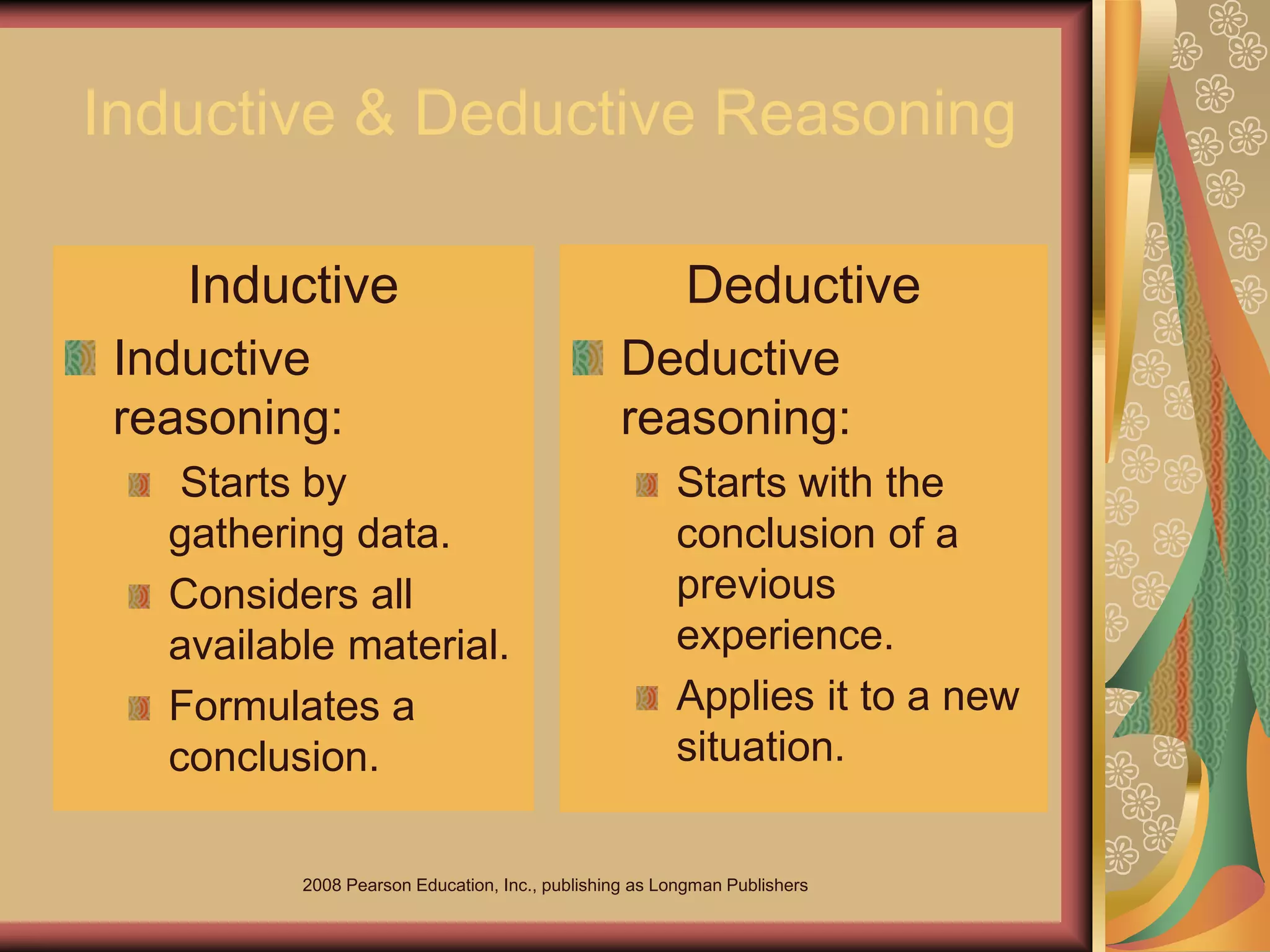
Inductive & Deductive Reasoning
Inductive
Inductive
reasoning:
Starts by
gathering data.
Considers all
available material.
Formulates a
conclusion.
Deductive
Deductive
reasoning:
Starts with the
conclusion of a
previous
experience.
Applies it to a new
situation.
2008 Pearson Education, Inc., publishing as Longman Publishers
Creative and Critical Thinking
Vertical thinking is straightforward and
a logical way of thinking.
Lateral thinking is a way of thinking
around a problem or even redefining
the problem.
Creative thinking involves both
vertical and lateral thinking.
2008 Pearson Education, Inc., publishing as Longman Publishers
Summary Points
What is thinking?
What is critical thinking?
What are the characteristics of critical
thinkers?
What are the barriers to critical thinking?
How do critical thinkers analyze an
argument?
What is the difference between inductive and
deductive reasoning?
What does creative thinking add to critical
thinking?
2008 Pearson Education, Inc., publishing as Longman Publishers
Search the Net
For suggested Web sites and other
research activities about critical
thinking, go to:
http://www.ablongman.com/smith/
2008 Pearson Education, Inc., publishing as Longman Publishers
Vocabulary Booster
Complete the vocabulary exercises
for “Lights, Camera, Action!” from
your textbook.

Critical Thinking Skills.ppt

  • 1.
    2008 Pearson Education,Inc., publishing as Longman Publishers Chapter 9: Critical Thinking Bridging the Gap, 9/e Brenda Smith
  • 2.
    2008 Pearson Education,Inc., publishing as Longman Publishers In this chapter you will answer the questions: What is thinking? What is critical thinking? What are the characteristics of critical thinkers? What are the barriers to critical thinking? How do critical thinkers analyze an argument? What is the difference between inductive and deductive reasoning? What does creative thinking add to critical thinking?
  • 3.
    2008 Pearson Education,Inc., publishing as Longman Publishers What is Thinking? Thinking is an organized and controlled mental activity that helps you solve problems, make decisions, and understand ideas. Good thinkers form a plan and systematically try different solutions.
  • 4.
    2008 Pearson Education,Inc., publishing as Longman Publishers What is Critical Thinking? Critical thinking is deliberating in a purposeful, organized manner to assess the value of information, both old and new. Critical thinkers: Search Compare Analyze Clarify Evaluate Conclude
  • 5.
    2008 Pearson Education,Inc., publishing as Longman Publishers Critical Thinking Skills and College Goals Think systematically. Evaluate. Draw conclusions based on logic.
  • 6.
    2008 Pearson Education,Inc., publishing as Longman Publishers Reader’s Tip: Four Habits of Effective Critical Thinkers Be willing to plan. Be flexible. Be persistent. Be willing to self-correct.
  • 7.
    2008 Pearson Education,Inc., publishing as Longman Publishers Terminology for Critical Thinking Analogy Conclusion Argument Consistency Induction Premise Reliability Relevance Assertion Believability Deduction Fallacy
  • 8.
    2008 Pearson Education,Inc., publishing as Longman Publishers Barriers to Critical Thinking Frame of reference. Wishful thinking. Hasty moral judgments. Reliance on authority. Labels.
  • 9.
    2008 Pearson Education,Inc., publishing as Longman Publishers Critical Thinkers: Hold their own opinions up to scrutiny. Drive to the heart of the issues. Assess reasons for opposing views. Solve problems. Gain knowledge. Justify their own positions. Gain confidence.
  • 10.
    2008 Pearson Education,Inc., publishing as Longman Publishers Courtroom Analogy What is the issue? What are the arguments? What is the evidence? What is the verdict?
  • 11.
    2008 Pearson Education,Inc., publishing as Longman Publishers Review: How to Think Critically Be willing to plan. Think first & write later. Don’t be impulsive. Develop a habit of planning. Be flexible. Be open to new ideas. Consider new solutions for old problems. Be persistent. Continue to work even when you are tired and discouraged. Good thinking is hard work. Be willing to self-correct. Don’t be defensive about errors. Figure out what went wrong and learn from your mistakes.
  • 12.
    2008 Pearson Education,Inc., publishing as Longman Publishers Recognizing an Argument An argument is an assertion that supports a conclusion and is intended to persuade. To identify arguments, use inferential skills and recognize the underlying purpose or intent of the author.
  • 13.
    2008 Pearson Education,Inc., publishing as Longman Publishers Recognizing an Argument An argument is an assertion that supports a conclusion and is intended to persuade. Ex: “You should water the grass tonight because rain is not predicted for several days.” Non-argumentative statements do not question truth but simply offer information to explain and thereby help us understand. Ex: “The grass is wet because it rained last night.”
  • 14.
    2008 Pearson Education,Inc., publishing as Longman Publishers Steps in Analyzing an Argument 1. Identify the position on the issue. 2. Identify the support in the argument. 3. Evaluate the support. 4. Evaluate the argument.
  • 15.
    2008 Pearson Education,Inc., publishing as Longman Publishers Signal Words to Identify the Position on an Issue As a result Consequently Finally For these reasons In summary It follows that Therefore Thus, should
  • 16.
    2008 Pearson Education,Inc., publishing as Longman Publishers Signal Words to Identify the Support in the Argument Because Since If First, second, finally Assuming that Given that
  • 17.
    2008 Pearson Education,Inc., publishing as Longman Publishers Reader’s Tip: Types of Support for Arguments Facts: Objective truths. Ask: How were the facts gathered? Are they true? Examples: Anecdotes to demonstrate the truth. Ask: Are the examples true and relevant? Analogies: Comparisons to similar cases. Ask: Are the analogies accurate and relevant? Authority: Words from a recognized expert. Ask: What are the credentials and biases of the expert?
  • 18.
    2008 Pearson Education,Inc., publishing as Longman Publishers Reader’s Tip: Types of Support for Arguments Causal relationship: Saying one thing caused another. Ask: Is it an actual cause or merely an association? Common knowledge claim: Assertion of wide acceptance. Ask: Is it relevant? Does everyone really believe it? Statistics: Numerical data. Ask: Do the numbers accurately describe the phenomenon? Personal experiences: Personal anecdotes. Ask: Is the experience applicable to other situations?
  • 19.
    2008 Pearson Education,Inc., publishing as Longman Publishers Evaluate the Support Fallacy - An inference that appears to be reasonable at first glance, but closer inspection proves it to be unrelated, unreliable, or illogical. 1. Relevance fallacies 2. Believability fallacies 3. Consistency fallacies
  • 20.
    2008 Pearson Education,Inc., publishing as Longman Publishers Relevance Fallacies: Is the Support Related to the Conclusion? - Part (1) Ad hominem: An attack on the person rather than the issue in hopes that if the person is opposed, the idea will be opposed. Ex: Do not listen to Mr. Hite’s views on education because he is a banker. Bandwagon: The idea that everybody is doing it and you will be left out if you do not quickly join the crowd. Ex: Everybody around the world is drinking Coke, so you should too. Misleading analogy: A comparison of two things suggesting that they are similar when they are in fact distinctly different. Ex: College students are just like elementary school students; they need to be taught self-discipline.
  • 21.
    2008 Pearson Education,Inc., publishing as Longman Publishers Relevance Fallacies: Is the Support Related to the Conclusion? - Part (2) Straw person: A distorted or exaggerated form of the opponent’s argument is introduced and knocked down as if to represent a totally weak opposition. Ex: When a teenage daughter is told she cannot go out on the weeknight before a test, she replies with “It’s unreasonable to say that I can never go out on a weeknight.” Testimonials: Opinions of agreement from respected celebrities who are not actually experts. Ex: A famous actor endorses a headache pill.
  • 22.
    2008 Pearson Education,Inc., publishing as Longman Publishers Relevance Fallacies: Is the Support Related to the Conclusion? - Part (3) Transfer: An association with a positively or negatively regarded person or thing in order to lend the same association to the argument (also guilt or virtue by association). Ex: A local politician quotes President Lincoln in a speech as if Lincoln would have agreed with and voted for the candidate.
  • 23.
    2008 Pearson Education,Inc., publishing as Longman Publishers Believability Fallacies: Is the support believable or highly suspicious? – Part (1) Incomplete facts or cards stacking: Factual details are omitted to misrepresent reality. Ex: Buy stock in this particular restaurant chain because it is under new management and people eat out a lot. Misinterpreted statistics: Numerical data are applied to unrelated populations that the numbers were never intended to represent. Ex: More than 20 percent of people exercise daily and thus do not need fitness training.
  • 24.
    2008 Pearson Education,Inc., publishing as Longman Publishers Believability Fallacies: Is the support believable or highly suspicious? – Part (2) Overgeneralizations: Examples and anecdotes are asserted as if they apply to all cases rather than a select few. Ex: High school students do little work during their senior year and thus are overwhelmed at college. Questionable authority: A testimonial suggests that people who are not experts actually do have authority in a certain area. Ex: Dr. Lee, a sociology professor, testified that the DNA reports were 100 percent accurate.
  • 25.
    2008 Pearson Education,Inc., publishing as Longman Publishers Consistency Fallacies: Does the Support Hold Together or Does it Fall Apart & Contradict Itself? – Part (1) Appeals to emotions: Highly charged language is used for emotional manipulation. Ex: Give money to our organization to help these children—these starving orphans---who are in desperate need of medical attention. Appeals to pity: Pleas to support the underdog are made on behalf of a person or issue. Ex: Please give me an A for the course because I need it to get into law school. Begging the question or circular reasoning: Support for the conclusion merely restates the conclusion. Ex: Drugs should not be legalized because it should be against the law to take illegal drugs.
  • 26.
    2008 Pearson Education,Inc., publishing as Longman Publishers Consistency Fallacies: Does the Support Hold Together or Does it Fall Apart & Contradict Itself? – Part (2) Oversimplification: An issue is reduced to two simple choices, without consideration of other alternatives. Ex: The choices are very simple in supporting our foreign-policy decision to send troops. You are either for America or against it. Slippery slope: Objections to an issue are raised because unless dealt with, it will lead to greater evil and disastrous consequences. Ex: Support for assisting the suicide of a terminally ill patient will lead to the ultimate disposal of the marginally sick and elderly.
  • 27.
    2008 Pearson Education,Inc., publishing as Longman Publishers Evaluate the Argument: Four degrees of support 1. Unrelated reasons give no support. 2. A few weak reasons do not adequately support. 3. Many weak reasons can support. 4. Strong related reasons provide support. Is there really global warming?
  • 28.
    2008 Pearson Education,Inc., publishing as Longman Publishers Inductive & Deductive Reasoning Inductive Inductive reasoning: Starts by gathering data. Considers all available material. Formulates a conclusion. Deductive Deductive reasoning: Starts with the conclusion of a previous experience. Applies it to a new situation.
  • 29.
    2008 Pearson Education,Inc., publishing as Longman Publishers Creative and Critical Thinking Vertical thinking is straightforward and a logical way of thinking. Lateral thinking is a way of thinking around a problem or even redefining the problem. Creative thinking involves both vertical and lateral thinking.
  • 30.
    2008 Pearson Education,Inc., publishing as Longman Publishers Summary Points What is thinking? What is critical thinking? What are the characteristics of critical thinkers? What are the barriers to critical thinking? How do critical thinkers analyze an argument? What is the difference between inductive and deductive reasoning? What does creative thinking add to critical thinking?
  • 31.
    2008 Pearson Education,Inc., publishing as Longman Publishers Search the Net For suggested Web sites and other research activities about critical thinking, go to: http://www.ablongman.com/smith/
  • 32.
    2008 Pearson Education,Inc., publishing as Longman Publishers Vocabulary Booster Complete the vocabulary exercises for “Lights, Camera, Action!” from your textbook.