CONQUERING THE TEAS
Part 2:
Reading Test
THE READING TEST
 53 questions in 64 minutes:
that’s about 1 ¼ min. per
question.
 You read a passage and answer
several questions about it.
 Most passages may be one
paragraph, but some can be 3 to
5.
 All questions are multiple
choice.
 Practice tests probably are the
best way to prepare.
oMain idea of a paragraph: the
topic sentence states the
main idea.
oMain idea of the entire
passage: you have to read
the entire passage to be sure
of it!
MAIN IMPORTANT READING CONCEPTS
• Main idea
o More than just the subject (topic) being written about, it is
the main point being made about that subject.
 For example: subject = penguins, main idea =
penguins are different from other birds in many ways.
 Topic sentence
o Almost always the first sentence of the
paragraph
o To find it ask “what is this paragraph about?” –
the sentence that states that is the topic
sentence.
 Detail sentences: all the other sentences in the
paragraph
o They support the topic of the paragraph
o Some TEAS questions may ask for details
from the passage.
o If details support an argument, they are called
supporting details.
 Must be both true, and relevant to the
author’s argument.
OTHER LESS OBVIOUS READING CONCEPTS
 Pattern of Organization (= Structure of the
Text)
o What techniques author uses to make the
point
o For example: personal anecdotes,
data/statistics, quotes
 Style
o The way the author uses words
o For example: formal, jargon, imagery,
simple and straightforward, simple
sentences vs. compound/complex
sentences, stream of consciousness vs well
organized.
 Purpose
o Motivation of the author: for what reason did he write?
o For example: answer a question, show support for a claim,
persuade the reader to take an action, simply to inform vs
persuade reader to agree with a point of view
 Tone/attitude
o Positive, negative, or neutral?
o Critical or supportive?
o Emotions of author, for example: angry, sad, torn, joy?
 Inference:
o A conclusion you can draw from the passage (= implication)
o Not explicitly stated in the passage
o Based strictly on the content of the passage
o Idea that is suggested by the passage without being stated
directly
FACT VS. OPINION
 Fact:
o Verifiable as true or false
o For example, a statistic is cited
o Can presumably be verified with research
 Opinion:
o Thoughts, feelings, ideas of writer
 Key words: “believe”, “think”, “feel”
o For example: something is good, bad
o Author’s idea of the why of certain facts
o Bias may exist when author ignores
reasonable counterarguments or uses
stereotypes
MAKEUP OF THE READING TEST QUESTIONS
 About 50% = “Key Ideas and Details”
o Summarize the main point
 “The main idea is…”
 “The central point is…”
 “A possible title is…”
 “The author’s primary point is…”
o Identify a topic sentence
 Usually the first sentence of every
paragraph
o Identify specific facts (details) that were
included
 “The passage states…”
 “The author says…”
 “According to what you read…”
o Recognize sequence of events: may be
implied, not directly stated.
 About 30% = “Craft and Structure”
o Recognize basic structure of the text.
 “The author proves a point through…”
 “In the passage, the author uses…”
 ‘Throughout the passage, the author seems to rely
on…”
o Recognize style, tone/attitude, purpose of author
 “The attitude of the author is…”
 “The writer’s overall feeling is…”
 “The purpose of the passage is…”
 “The author’s style is…”
o Interpret meanings of words/phrases using context.
o Distinguish fact from opinion, biases of the author, etc.
 “Which statement is a fact rather than an opinion…”
 “An example of an opinion is when the author
states…”
 About 20% = “Integration of
Knowledge and Ideas”
oUse evidence from text to make
inferences or predictions (draw
conclusions that follow from
what the text says).
“The passage implies…”
“The reader would logically
conclude that…”
oIdentify an argument: author’s
stated claims and conclusions.
MULTIPLE CHOICE STRATEGIES FOR THE
READING TEST
 Read the question but not the answers.
 What exactly is the question asking?
 First try to answer the question in your own mind
o Look back at the passage if you need to
 Now that the answer is in your mind
o Read the choices one at a time.
o Eliminate any that don’t match your idea of
what the answer should be – one of them will
match your answer.
o And that’s the answer!
 Two possible overall approaches
o Read the entire passage first, then answer questions
o Read each question first (NOT THE CHOICES), then read the entire
passage with those questions in mind, then answer questions
 If answer not obvious to you, move to
next question and come back to it
o But be sure to answer all
questions for that passage before
moving to next passage (also,
once go on to Math can’t return to
Reading).
 Can be helpful to avoid extremes
o Answers that are positive or
negative with no exceptions
(extreme positive or negative
answers) are often incorrect.
STRATEGIES FOR QUESTIONS ASKING FOR
INFERENCES/CONCLUSIONS
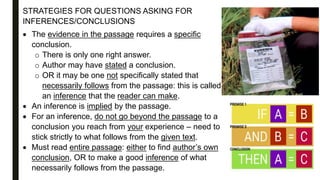
 The evidence in the passage requires a specific
conclusion.
o There is only one right answer.
o Author may have stated a conclusion.
o OR it may be one not specifically stated that
necessarily follows from the passage: this is called
an inference that the reader can make.
 An inference is implied by the passage.
 For an inference, do not go beyond the passage to a
conclusion you reach from your experience – need to
stick strictly to what follows from the given text.
 Must read entire passage: either to find author’s own
conclusion, OR to make a good inference of what
necessarily follows from the passage.
 Be careful: author may make a direct statement
which is subsequently rejected – this is why it is
important to read the entire passage.
 An obvious example of inference: passage =
“When I arrived my pants cuffs were soaked
and I folded my umbrella”; inference: it was
raining.
 If asked for the implied meaning of a statement:
o Be sure to find the context of the statement in
the passage so as to be sure you get its
correct meaning.
o Watch out for answers that sound true but
are not correct based on the proper context.
o Correct answer will often have a similar
phrase to the statement.
OTHER STRATEGIES/TIPS
 Interpret meanings of words/phrases using context:
o Examples:
 Define fealty in this sentence: “Ron’s fealty to his parents
was not shared by Karen, who disobeyed their every
command.”
 Answer: since it was not Karen’s way (disobedience)
then it must mean obedience or respect.
 Define arcane in this sentence: “The elderly scholar spent
his evenings hunched over arcane texts that few people
even knew existed.”
 Answer: since few people know about the texts that
are being read by the “elderly scholar” we can
assume that arcane must mean something like rare or
difficult academic subjects.
 Correct answer will often have a similar phrase to the
sentence.
 Never use outside knowledge to answer
questions about a reading passage –
always derive your answers from the actual
passage.
 Keep your focus when reading a passage
describing something you have no interest
in - after all, you will have to answer the
questions.
• Will be asked if references are made to “primary
source documents.”
• Primary documents are first-hand sources of
information.
• “Signal” words or phrases: “however”, “therefore”,
“in addition”, “instead of”, etc. – they indicate an
important transition in meaning.
GENERAL TYPES OF THE PURPOSE
OF A PASSAGE
 Informative (expository)
o To educate or enlighten, non-fiction,
many supporting details
o An idea or topic that is investigated
and expounded upon
o Does not include opinion of the
author.
o Can be how-to-do something:
logically ordered, but usually not
highly technical
 Technical
o Logical order, complex subject, jargon
(technical terminology)
o Special organization: clear headings or
numbered sections
 Descriptive
o To describe some object in detail
o Adjectives and adverbs to help reader form a
mental picture
 Comparison-contrast
o Two objects described and compared
(common words used are: both, same, too;
but, however, yet).
 Persuasive (=argumentative)
o Purpose: to change the mind of the reader
o Debatable issue
o Supporting details: attempt to prove author’s argument
o Common argument/support words (cause/effect):
 Since…, because…, due to…
 Consequently…, therefore…, this leads to…
o May make appeal to reader’s emotions
o If good, discusses all sides (doesn’t show bias) and
presents what the author claims is the “best” solution.
 Narrative
o Tells a story
o Can be fiction or non-fiction
o Plot, characters
o Often uses figurative language to stimulate imagination
 Entertainment
o Makes special use of colorful/figurative language
o Subject matter is enlivened to stimulate emotions
SAMPLE
EXAM
QUESTIONS
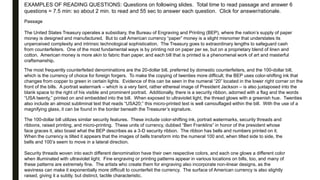
EXAMPLES OF READING QUESTIONS: Questions on following slides. Total time to read passage and answer 6
questions = 7.5 min: so about 2 min. to read and 55 sec to answer each question. Click for answer/rationale.
Passage
The United States Treasury operates a subsidiary, the Bureau of Engraving and Printing (BEP), where the nation’s supply of paper
money is designed and manufactured. But to call American currency “paper” money is a slight misnomer that understates its
unperceived complexity and intrinsic technological sophistication. The Treasury goes to extraordinary lengths to safeguard cash
from counterfeiters. One of the most fundamental ways is by printing not on paper per se, but on a proprietary blend of linen and
cotton. American money is more akin to fabric than paper, and each bill that is printed is a phenomenal work of art and masterful
craftsmanship.
The most frequently counterfeited denominations are the 20-dollar bill, preferred by domestic counterfeiters, and the 100-dollar bill,
which is the currency of choice for foreign forgers. To make the copying of twenties more difficult, the BEP uses color-shifting ink that
changes from copper to green in certain lights. Evidence of this can be seen in the numeral “20” located in the lower right corner on the
front of the bills. A portrait watermark – which is a very faint, rather ethereal image of President Jackson – is also juxtaposed into the
blank space to the right of his visible and prominent portrait. Additionally, there is a security ribbon, adorned with a flag and the words
“USA twenty,” printed on and embedded into the bill. When exposed to ultraviolet light, the thread glows with a greenish hue. Twenties
also include an almost subliminal text that reads “USA20;” this micro-printed text is well camouflaged within the bill. With the use of a
magnifying glass, it can be found in the border beneath the Treasurer’s signature.
The 100-dollar bill utilizes similar security features. These include color-shifting ink, portrait watermarks, security threads and
ribbons, raised printing, and micro-printing. These units of currency, dubbed “Ben Franklins” in honor of the president whose
face graces it, also boast what the BEP describes as a 3-D security ribbon. The ribbon has bells and numbers printed on it.
When the currency is tilted it appears that the images of bells transform into the numeral 100 and, when tilted side to side, the
bells and 100’s seem to move in a lateral direction.
Security threads woven into each different denomination have their own respective colors, and each one glows a different color
when illuminated with ultraviolet light. Fine engraving or printing patterns appear in various locations on bills, too, and many of
these patterns are extremely fine. The artists who create them for engraving also incorporate non-linear designs, as the
waviness can make it exponentially more difficult to counterfeit the currency. The surface of American currency is also slightly
raised, giving it a subtly, but distinct, tactile characteristic.
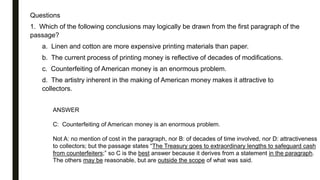
Questions
1. Which of the following conclusions may logically be drawn from the first paragraph of the
passage?
a. Linen and cotton are more expensive printing materials than paper.
b. The current process of printing money is reflective of decades of modifications.
c. Counterfeiting of American money is an enormous problem.
d. The artistry inherent in the making of American money makes it attractive to
collectors.
ANSWER
C: Counterfeiting of American money is an enormous problem.
Not A: no mention of cost in the paragraph, nor B: of decades of time involved, nor D: attractiveness
to collectors; but the passage states “The Treasury goes to extraordinary lengths to safeguard cash
from counterfeiters;” so C is the best answer because it derives from a statement in the paragraph.
The others may be reasonable, but are outside the scope of what was said.
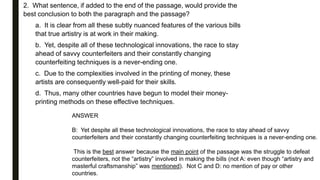
2. What sentence, if added to the end of the passage, would provide the
best conclusion to both the paragraph and the passage?
a. It is clear from all these subtly nuanced features of the various bills
that true artistry is at work in their making.
b. Yet, despite all of these technological innovations, the race to stay
ahead of savvy counterfeiters and their constantly changing
counterfeiting techniques is a never-ending one.
c. Due to the complexities involved in the printing of money, these
artists are consequently well-paid for their skills.
d. Thus, many other countries have begun to model their money-
printing methods on these effective techniques.
ANSWER
B: Yet despite all these technological innovations, the race to stay ahead of savvy
counterfeiters and their constantly changing counterfeiting techniques is a never-ending one.
This is the best answer because the main point of the passage was the struggle to defeat
counterfeiters, not the “artistry” involved in making the bills (not A: even though “artistry and
masterful craftsmanship” was mentioned). Not C and D: no mention of pay or other
countries.
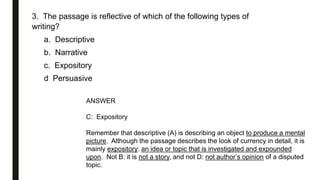
3. The passage is reflective of which of the following types of
writing?
a. Descriptive
b. Narrative
c. Expository
d Persuasive
ANSWER
C: Expository
Remember that descriptive (A) is describing an object to produce a mental
picture. Although the passage describes the look of currency in detail, it is
mainly expository: an idea or topic that is investigated and expounded
upon. Not B: it is not a story, and not D: not author’s opinion of a disputed
topic.
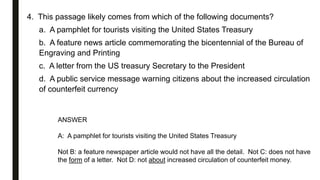
4. This passage likely comes from which of the following documents?
a. A pamphlet for tourists visiting the United States Treasury
b. A feature news article commemorating the bicentennial of the Bureau of
Engraving and Printing
c. A letter from the US treasury Secretary to the President
d. A public service message warning citizens about the increased circulation
of counterfeit currency
ANSWER
A: A pamphlet for tourists visiting the United States Treasury
Not B: a feature newspaper article would not have all the detail. Not C: does not have
the form of a letter. Not D: not about increased circulation of counterfeit money.
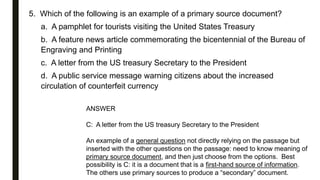
5. Which of the following is an example of a primary source document?
a. A pamphlet for tourists visiting the United States Treasury
b. A feature news article commemorating the bicentennial of the Bureau of
Engraving and Printing
c. A letter from the US treasury Secretary to the President
d. A public service message warning citizens about the increased
circulation of counterfeit currency
ANSWER
C: A letter from the US treasury Secretary to the President
An example of a general question not directly relying on the passage but
inserted with the other questions on the passage: need to know meaning of
primary source document, and then just choose from the options. Best
possibility is C: it is a document that is a first-hand source of information.
The others use primary sources to produce a “secondary” document.
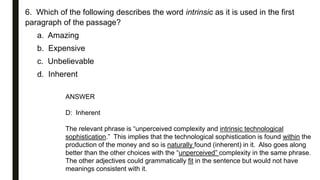
6. Which of the following describes the word intrinsic as it is used in the first
paragraph of the passage?
a. Amazing
b. Expensive
c. Unbelievable
d. Inherent
ANSWER
D: Inherent
The relevant phrase is “unperceived complexity and intrinsic technological
sophistication.” This implies that the technological sophistication is found within the
production of the money and so is naturally found (inherent) in it. Also goes along
better than the other choices with the “unperceived” complexity in the same phrase.
The other adjectives could grammatically fit in the sentence but would not have
meanings consistent with it.
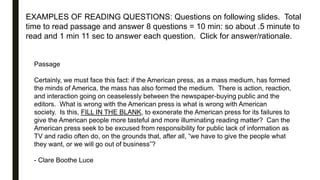
EXAMPLES OF READING QUESTIONS: Questions on following slides. Total
time to read passage and answer 8 questions = 10 min: so about .5 minute to
read and 1 min 11 sec to answer each question. Click for answer/rationale.
Passage
Certainly, we must face this fact: if the American press, as a mass medium, has formed
the minds of America, the mass has also formed the medium. There is action, reaction,
and interaction going on ceaselessly between the newspaper-buying public and the
editors. What is wrong with the American press is what is wrong with American
society. Is this, FILL IN THE BLANK, to exonerate the American press for its failures to
give the American people more tasteful and more illuminating reading matter? Can the
American press seek to be excused from responsibility for public lack of information as
TV and radio often do, on the grounds that, after all, “we have to give the people what
they want, or we will go out of business”?
- Clare Boothe Luce
Questions
1. What is the primary purpose of this text?
a. To reveal an innate problem in American society
b. To criticize the American press for not taking responsibility for their actions
c. To analyze the complex relationship that exists between the public and the
media
d. To challenge the masses to protest the lack of information disseminated by
the media
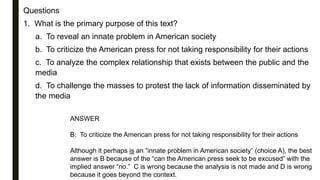
ANSWER
B: To criticize the American press for not taking responsibility for their actions
Although it perhaps is an “innate problem in American society” (choice A), the best
answer is B because of the “can the American press seek to be excused” with the
implied answer “no.” C is wrong because the analysis is not made and D is wrong
because it goes beyond the context.
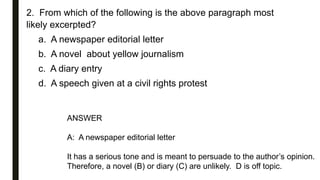
2. From which of the following is the above paragraph most
likely excerpted?
a. A newspaper editorial letter
b. A novel about yellow journalism
c. A diary entry
d. A speech given at a civil rights protest
ANSWER
A: A newspaper editorial letter
It has a serious tone and is meant to persuade to the author’s opinion.
Therefore, a novel (B) or diary (C) are unlikely. D is off topic.
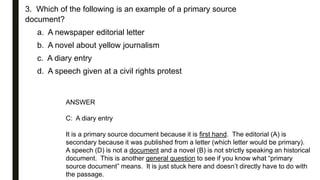
3. Which of the following is an example of a primary source
document?
a. A newspaper editorial letter
b. A novel about yellow journalism
c. A diary entry
d. A speech given at a civil rights protest
ANSWER
C: A diary entry
It is a primary source document because it is first hand. The editorial (A) is
secondary because it was published from a letter (which letter would be primary).
A speech (D) is not a document and a novel (B) is not strictly speaking an historical
document. This is another general question to see if you know what “primary
source document” means. It is just stuck here and doesn’t directly have to do with
the passage.
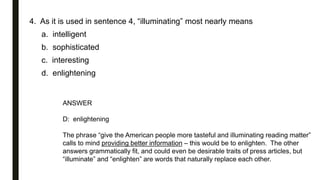
4. As it is used in sentence 4, “illuminating” most nearly means
a. intelligent
b. sophisticated
c. interesting
d. enlightening
ANSWER
D: enlightening
The phrase “give the American people more tasteful and illuminating reading matter”
calls to mind providing better information – this would be to enlighten. The other
answers grammatically fit, and could even be desirable traits of press articles, but
“illuminate” and “enlighten” are words that naturally replace each other.
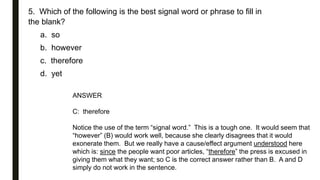
5. Which of the following is the best signal word or phrase to fill in
the blank?
a. so
b. however
c. therefore
d. yet
ANSWER
C: therefore
Notice the use of the term “signal word.” This is a tough one. It would seem that
“however” (B) would work well, because she clearly disagrees that it would
exonerate them. But we really have a cause/effect argument understood here
which is: since the people want poor articles, “therefore” the press is excused in
giving them what they want; so C is the correct answer rather than B. A and D
simply do not work in the sentence.
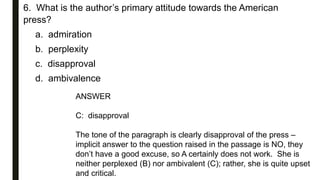
6. What is the author’s primary attitude towards the American
press?
a. admiration
b. perplexity
c. disapproval
d. ambivalence
ANSWER
C: disapproval
The tone of the paragraph is clearly disapproval of the press –
implicit answer to the question raised in the passage is NO, they
don’t have a good excuse, so A certainly does not work. She is
neither perplexed (B) nor ambivalent (C); rather, she is quite upset
and critical.
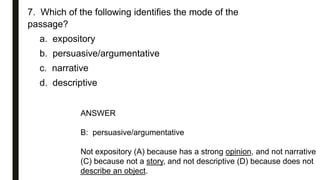
7. Which of the following identifies the mode of the
passage?
a. expository
b. persuasive/argumentative
c. narrative
d. descriptive
ANSWER
B: persuasive/argumentative
Not expository (A) because has a strong opinion, and not narrative
(C) because not a story, and not descriptive (D) because does not
describe an object.
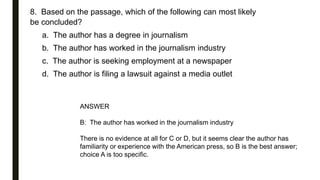
8. Based on the passage, which of the following can most likely
be concluded?
a. The author has a degree in journalism
b. The author has worked in the journalism industry
c. The author is seeking employment at a newspaper
d. The author is filing a lawsuit against a media outlet
ANSWER
B: The author has worked in the journalism industry
There is no evidence at all for C or D, but it seems clear the author has
familiarity or experience with the American press, so B is the best answer;
choice A is too specific.
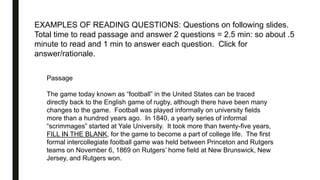
EXAMPLES OF READING QUESTIONS: Questions on following slides.
Total time to read passage and answer 2 questions = 2.5 min: so about .5
minute to read and 1 min to answer each question. Click for
answer/rationale.
Passage
The game today known as “football” in the United States can be traced
directly back to the English game of rugby, although there have been many
changes to the game. Football was played informally on university fields
more than a hundred years ago. In 1840, a yearly series of informal
“scrimmages” started at Yale University. It took more than twenty-five years,
FILL IN THE BLANK, for the game to become a part of college life. The first
formal intercollegiate football game was held between Princeton and Rutgers
teams on November 6, 1869 on Rutgers’ home field at New Brunswick, New
Jersey, and Rutgers won.
Questions
1. Which sentence, if added to the end of the paragraph, would provide the best
conclusion?
a. Despite an invitation to join the Ivy League, Rutgers University declined, but later
joined the Big Ten Conference instead.
b. Football was played for decades on school campuses nationwide before the
American Professional Football Association was formed in 1920, and then renamed
the National Football League (or the NFL) two years later.
c. Women were never allowed to play football, and that fact remains a controversial
policy at many colleges and universities.
d. Football remains the national pastime, despite rising popularity for the game of
soccer, due to increased coverage of World Cup matches.
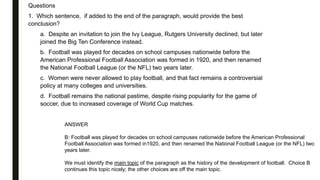
ANSWER
B: Football was played for decades on school campuses nationwide before the American Professional
Football Association was formed in1920, and then renamed the National Football League (or the NFL) two
years later.
We must identify the main topic of the paragraph as the history of the development of football. Choice B
continues this topic nicely; the other choices are off the main topic.
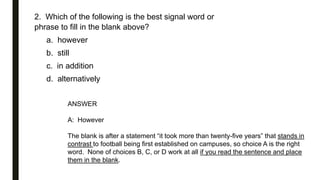
2. Which of the following is the best signal word or
phrase to fill in the blank above?
a. however
b. still
c. in addition
d. alternatively
ANSWER
A: However
The blank is after a statement “it took more than twenty-five years” that stands in
contrast to football being first established on campuses, so choice A is the right
word. None of choices B, C, or D work at all if you read the sentence and place
them in the blank.
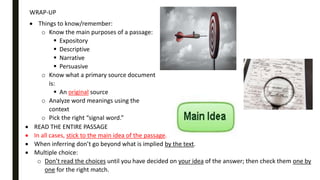
WRAP-UP
 Things to know/remember:
o Know the main purposes of a passage:
 Expository
 Descriptive
 Narrative
 Persuasive
o Know what a primary source document
is:
 An original source
o Analyze word meanings using the
context
o Pick the right “signal word.”
 READ THE ENTIRE PASSAGE
 In all cases, stick to the main idea of the passage.
 When inferring don’t go beyond what is implied by the text.
 Multiple choice:
o Don’t read the choices until you have decided on your idea of the answer; then check them one by
one for the right match.
Our Services
Study Help
• Drop-In Study Help for all courses
• Study Groups
• On-Track Appointments
• Question Drop-Off
Student Tech Help
• Live Chat
• Scheduled Lab Consultations
• Ask-a-Lab Associate Email
• Get Tech Ready and Appy Hour Workshops
Learning Help
• Check out our collection of self-service resources that supplement classroom materials
Get In Touch!
www.wccnet.edu/LC (live chat assistance offered during regular hours)
(734) 973-3420
Lab Email: LCLab@wccnet.edu
Tutoring Email: TutorWCC@wccnet.edu

Conquering the TEAS Part 2: Reading

  • 1.
    CONQUERING THE TEAS Part2: Reading Test
  • 2.
    THE READING TEST 53 questions in 64 minutes: that’s about 1 ¼ min. per question.  You read a passage and answer several questions about it.  Most passages may be one paragraph, but some can be 3 to 5.  All questions are multiple choice.  Practice tests probably are the best way to prepare.
  • 3.
    oMain idea ofa paragraph: the topic sentence states the main idea. oMain idea of the entire passage: you have to read the entire passage to be sure of it! MAIN IMPORTANT READING CONCEPTS • Main idea o More than just the subject (topic) being written about, it is the main point being made about that subject.  For example: subject = penguins, main idea = penguins are different from other birds in many ways.
  • 4.
     Topic sentence oAlmost always the first sentence of the paragraph o To find it ask “what is this paragraph about?” – the sentence that states that is the topic sentence.  Detail sentences: all the other sentences in the paragraph o They support the topic of the paragraph o Some TEAS questions may ask for details from the passage. o If details support an argument, they are called supporting details.  Must be both true, and relevant to the author’s argument.
  • 5.
    OTHER LESS OBVIOUSREADING CONCEPTS  Pattern of Organization (= Structure of the Text) o What techniques author uses to make the point o For example: personal anecdotes, data/statistics, quotes  Style o The way the author uses words o For example: formal, jargon, imagery, simple and straightforward, simple sentences vs. compound/complex sentences, stream of consciousness vs well organized.
  • 6.
     Purpose o Motivationof the author: for what reason did he write? o For example: answer a question, show support for a claim, persuade the reader to take an action, simply to inform vs persuade reader to agree with a point of view  Tone/attitude o Positive, negative, or neutral? o Critical or supportive? o Emotions of author, for example: angry, sad, torn, joy?  Inference: o A conclusion you can draw from the passage (= implication) o Not explicitly stated in the passage o Based strictly on the content of the passage o Idea that is suggested by the passage without being stated directly
  • 7.
    FACT VS. OPINION Fact: o Verifiable as true or false o For example, a statistic is cited o Can presumably be verified with research  Opinion: o Thoughts, feelings, ideas of writer  Key words: “believe”, “think”, “feel” o For example: something is good, bad o Author’s idea of the why of certain facts o Bias may exist when author ignores reasonable counterarguments or uses stereotypes
  • 8.
    MAKEUP OF THEREADING TEST QUESTIONS  About 50% = “Key Ideas and Details” o Summarize the main point  “The main idea is…”  “The central point is…”  “A possible title is…”  “The author’s primary point is…” o Identify a topic sentence  Usually the first sentence of every paragraph o Identify specific facts (details) that were included  “The passage states…”  “The author says…”  “According to what you read…” o Recognize sequence of events: may be implied, not directly stated.
  • 9.
     About 30%= “Craft and Structure” o Recognize basic structure of the text.  “The author proves a point through…”  “In the passage, the author uses…”  ‘Throughout the passage, the author seems to rely on…” o Recognize style, tone/attitude, purpose of author  “The attitude of the author is…”  “The writer’s overall feeling is…”  “The purpose of the passage is…”  “The author’s style is…” o Interpret meanings of words/phrases using context. o Distinguish fact from opinion, biases of the author, etc.  “Which statement is a fact rather than an opinion…”  “An example of an opinion is when the author states…”
  • 10.
     About 20%= “Integration of Knowledge and Ideas” oUse evidence from text to make inferences or predictions (draw conclusions that follow from what the text says). “The passage implies…” “The reader would logically conclude that…” oIdentify an argument: author’s stated claims and conclusions.
  • 11.
    MULTIPLE CHOICE STRATEGIESFOR THE READING TEST  Read the question but not the answers.  What exactly is the question asking?  First try to answer the question in your own mind o Look back at the passage if you need to  Now that the answer is in your mind o Read the choices one at a time. o Eliminate any that don’t match your idea of what the answer should be – one of them will match your answer. o And that’s the answer!
  • 12.
     Two possibleoverall approaches o Read the entire passage first, then answer questions o Read each question first (NOT THE CHOICES), then read the entire passage with those questions in mind, then answer questions  If answer not obvious to you, move to next question and come back to it o But be sure to answer all questions for that passage before moving to next passage (also, once go on to Math can’t return to Reading).  Can be helpful to avoid extremes o Answers that are positive or negative with no exceptions (extreme positive or negative answers) are often incorrect.
  • 13.
    STRATEGIES FOR QUESTIONSASKING FOR INFERENCES/CONCLUSIONS  The evidence in the passage requires a specific conclusion. o There is only one right answer. o Author may have stated a conclusion. o OR it may be one not specifically stated that necessarily follows from the passage: this is called an inference that the reader can make.  An inference is implied by the passage.  For an inference, do not go beyond the passage to a conclusion you reach from your experience – need to stick strictly to what follows from the given text.  Must read entire passage: either to find author’s own conclusion, OR to make a good inference of what necessarily follows from the passage.
  • 14.
     Be careful:author may make a direct statement which is subsequently rejected – this is why it is important to read the entire passage.  An obvious example of inference: passage = “When I arrived my pants cuffs were soaked and I folded my umbrella”; inference: it was raining.  If asked for the implied meaning of a statement: o Be sure to find the context of the statement in the passage so as to be sure you get its correct meaning. o Watch out for answers that sound true but are not correct based on the proper context. o Correct answer will often have a similar phrase to the statement.
  • 15.
    OTHER STRATEGIES/TIPS  Interpretmeanings of words/phrases using context: o Examples:  Define fealty in this sentence: “Ron’s fealty to his parents was not shared by Karen, who disobeyed their every command.”  Answer: since it was not Karen’s way (disobedience) then it must mean obedience or respect.  Define arcane in this sentence: “The elderly scholar spent his evenings hunched over arcane texts that few people even knew existed.”  Answer: since few people know about the texts that are being read by the “elderly scholar” we can assume that arcane must mean something like rare or difficult academic subjects.  Correct answer will often have a similar phrase to the sentence.
  • 16.
     Never useoutside knowledge to answer questions about a reading passage – always derive your answers from the actual passage.  Keep your focus when reading a passage describing something you have no interest in - after all, you will have to answer the questions. • Will be asked if references are made to “primary source documents.” • Primary documents are first-hand sources of information. • “Signal” words or phrases: “however”, “therefore”, “in addition”, “instead of”, etc. – they indicate an important transition in meaning.
  • 17.
    GENERAL TYPES OFTHE PURPOSE OF A PASSAGE  Informative (expository) o To educate or enlighten, non-fiction, many supporting details o An idea or topic that is investigated and expounded upon o Does not include opinion of the author. o Can be how-to-do something: logically ordered, but usually not highly technical
  • 18.
     Technical o Logicalorder, complex subject, jargon (technical terminology) o Special organization: clear headings or numbered sections  Descriptive o To describe some object in detail o Adjectives and adverbs to help reader form a mental picture  Comparison-contrast o Two objects described and compared (common words used are: both, same, too; but, however, yet).
  • 19.
     Persuasive (=argumentative) oPurpose: to change the mind of the reader o Debatable issue o Supporting details: attempt to prove author’s argument o Common argument/support words (cause/effect):  Since…, because…, due to…  Consequently…, therefore…, this leads to… o May make appeal to reader’s emotions o If good, discusses all sides (doesn’t show bias) and presents what the author claims is the “best” solution.  Narrative o Tells a story o Can be fiction or non-fiction o Plot, characters o Often uses figurative language to stimulate imagination  Entertainment o Makes special use of colorful/figurative language o Subject matter is enlivened to stimulate emotions
  • 20.
  • 21.
    EXAMPLES OF READINGQUESTIONS: Questions on following slides. Total time to read passage and answer 6 questions = 7.5 min: so about 2 min. to read and 55 sec to answer each question. Click for answer/rationale. Passage The United States Treasury operates a subsidiary, the Bureau of Engraving and Printing (BEP), where the nation’s supply of paper money is designed and manufactured. But to call American currency “paper” money is a slight misnomer that understates its unperceived complexity and intrinsic technological sophistication. The Treasury goes to extraordinary lengths to safeguard cash from counterfeiters. One of the most fundamental ways is by printing not on paper per se, but on a proprietary blend of linen and cotton. American money is more akin to fabric than paper, and each bill that is printed is a phenomenal work of art and masterful craftsmanship. The most frequently counterfeited denominations are the 20-dollar bill, preferred by domestic counterfeiters, and the 100-dollar bill, which is the currency of choice for foreign forgers. To make the copying of twenties more difficult, the BEP uses color-shifting ink that changes from copper to green in certain lights. Evidence of this can be seen in the numeral “20” located in the lower right corner on the front of the bills. A portrait watermark – which is a very faint, rather ethereal image of President Jackson – is also juxtaposed into the blank space to the right of his visible and prominent portrait. Additionally, there is a security ribbon, adorned with a flag and the words “USA twenty,” printed on and embedded into the bill. When exposed to ultraviolet light, the thread glows with a greenish hue. Twenties also include an almost subliminal text that reads “USA20;” this micro-printed text is well camouflaged within the bill. With the use of a magnifying glass, it can be found in the border beneath the Treasurer’s signature. The 100-dollar bill utilizes similar security features. These include color-shifting ink, portrait watermarks, security threads and ribbons, raised printing, and micro-printing. These units of currency, dubbed “Ben Franklins” in honor of the president whose face graces it, also boast what the BEP describes as a 3-D security ribbon. The ribbon has bells and numbers printed on it. When the currency is tilted it appears that the images of bells transform into the numeral 100 and, when tilted side to side, the bells and 100’s seem to move in a lateral direction. Security threads woven into each different denomination have their own respective colors, and each one glows a different color when illuminated with ultraviolet light. Fine engraving or printing patterns appear in various locations on bills, too, and many of these patterns are extremely fine. The artists who create them for engraving also incorporate non-linear designs, as the waviness can make it exponentially more difficult to counterfeit the currency. The surface of American currency is also slightly raised, giving it a subtly, but distinct, tactile characteristic.
  • 22.
    Questions 1. Which ofthe following conclusions may logically be drawn from the first paragraph of the passage? a. Linen and cotton are more expensive printing materials than paper. b. The current process of printing money is reflective of decades of modifications. c. Counterfeiting of American money is an enormous problem. d. The artistry inherent in the making of American money makes it attractive to collectors. ANSWER C: Counterfeiting of American money is an enormous problem. Not A: no mention of cost in the paragraph, nor B: of decades of time involved, nor D: attractiveness to collectors; but the passage states “The Treasury goes to extraordinary lengths to safeguard cash from counterfeiters;” so C is the best answer because it derives from a statement in the paragraph. The others may be reasonable, but are outside the scope of what was said.
  • 23.
    2. What sentence,if added to the end of the passage, would provide the best conclusion to both the paragraph and the passage? a. It is clear from all these subtly nuanced features of the various bills that true artistry is at work in their making. b. Yet, despite all of these technological innovations, the race to stay ahead of savvy counterfeiters and their constantly changing counterfeiting techniques is a never-ending one. c. Due to the complexities involved in the printing of money, these artists are consequently well-paid for their skills. d. Thus, many other countries have begun to model their money- printing methods on these effective techniques. ANSWER B: Yet despite all these technological innovations, the race to stay ahead of savvy counterfeiters and their constantly changing counterfeiting techniques is a never-ending one. This is the best answer because the main point of the passage was the struggle to defeat counterfeiters, not the “artistry” involved in making the bills (not A: even though “artistry and masterful craftsmanship” was mentioned). Not C and D: no mention of pay or other countries.
  • 24.
    3. The passageis reflective of which of the following types of writing? a. Descriptive b. Narrative c. Expository d Persuasive ANSWER C: Expository Remember that descriptive (A) is describing an object to produce a mental picture. Although the passage describes the look of currency in detail, it is mainly expository: an idea or topic that is investigated and expounded upon. Not B: it is not a story, and not D: not author’s opinion of a disputed topic.
  • 25.
    4. This passagelikely comes from which of the following documents? a. A pamphlet for tourists visiting the United States Treasury b. A feature news article commemorating the bicentennial of the Bureau of Engraving and Printing c. A letter from the US treasury Secretary to the President d. A public service message warning citizens about the increased circulation of counterfeit currency ANSWER A: A pamphlet for tourists visiting the United States Treasury Not B: a feature newspaper article would not have all the detail. Not C: does not have the form of a letter. Not D: not about increased circulation of counterfeit money.
  • 26.
    5. Which ofthe following is an example of a primary source document? a. A pamphlet for tourists visiting the United States Treasury b. A feature news article commemorating the bicentennial of the Bureau of Engraving and Printing c. A letter from the US treasury Secretary to the President d. A public service message warning citizens about the increased circulation of counterfeit currency ANSWER C: A letter from the US treasury Secretary to the President An example of a general question not directly relying on the passage but inserted with the other questions on the passage: need to know meaning of primary source document, and then just choose from the options. Best possibility is C: it is a document that is a first-hand source of information. The others use primary sources to produce a “secondary” document.
  • 27.
    6. Which ofthe following describes the word intrinsic as it is used in the first paragraph of the passage? a. Amazing b. Expensive c. Unbelievable d. Inherent ANSWER D: Inherent The relevant phrase is “unperceived complexity and intrinsic technological sophistication.” This implies that the technological sophistication is found within the production of the money and so is naturally found (inherent) in it. Also goes along better than the other choices with the “unperceived” complexity in the same phrase. The other adjectives could grammatically fit in the sentence but would not have meanings consistent with it.
  • 28.
    EXAMPLES OF READINGQUESTIONS: Questions on following slides. Total time to read passage and answer 8 questions = 10 min: so about .5 minute to read and 1 min 11 sec to answer each question. Click for answer/rationale. Passage Certainly, we must face this fact: if the American press, as a mass medium, has formed the minds of America, the mass has also formed the medium. There is action, reaction, and interaction going on ceaselessly between the newspaper-buying public and the editors. What is wrong with the American press is what is wrong with American society. Is this, FILL IN THE BLANK, to exonerate the American press for its failures to give the American people more tasteful and more illuminating reading matter? Can the American press seek to be excused from responsibility for public lack of information as TV and radio often do, on the grounds that, after all, “we have to give the people what they want, or we will go out of business”? - Clare Boothe Luce
  • 29.
    Questions 1. What isthe primary purpose of this text? a. To reveal an innate problem in American society b. To criticize the American press for not taking responsibility for their actions c. To analyze the complex relationship that exists between the public and the media d. To challenge the masses to protest the lack of information disseminated by the media ANSWER B: To criticize the American press for not taking responsibility for their actions Although it perhaps is an “innate problem in American society” (choice A), the best answer is B because of the “can the American press seek to be excused” with the implied answer “no.” C is wrong because the analysis is not made and D is wrong because it goes beyond the context.
  • 30.
    2. From whichof the following is the above paragraph most likely excerpted? a. A newspaper editorial letter b. A novel about yellow journalism c. A diary entry d. A speech given at a civil rights protest ANSWER A: A newspaper editorial letter It has a serious tone and is meant to persuade to the author’s opinion. Therefore, a novel (B) or diary (C) are unlikely. D is off topic.
  • 31.
    3. Which ofthe following is an example of a primary source document? a. A newspaper editorial letter b. A novel about yellow journalism c. A diary entry d. A speech given at a civil rights protest ANSWER C: A diary entry It is a primary source document because it is first hand. The editorial (A) is secondary because it was published from a letter (which letter would be primary). A speech (D) is not a document and a novel (B) is not strictly speaking an historical document. This is another general question to see if you know what “primary source document” means. It is just stuck here and doesn’t directly have to do with the passage.
  • 32.
    4. As itis used in sentence 4, “illuminating” most nearly means a. intelligent b. sophisticated c. interesting d. enlightening ANSWER D: enlightening The phrase “give the American people more tasteful and illuminating reading matter” calls to mind providing better information – this would be to enlighten. The other answers grammatically fit, and could even be desirable traits of press articles, but “illuminate” and “enlighten” are words that naturally replace each other.
  • 33.
    5. Which ofthe following is the best signal word or phrase to fill in the blank? a. so b. however c. therefore d. yet ANSWER C: therefore Notice the use of the term “signal word.” This is a tough one. It would seem that “however” (B) would work well, because she clearly disagrees that it would exonerate them. But we really have a cause/effect argument understood here which is: since the people want poor articles, “therefore” the press is excused in giving them what they want; so C is the correct answer rather than B. A and D simply do not work in the sentence.
  • 34.
    6. What isthe author’s primary attitude towards the American press? a. admiration b. perplexity c. disapproval d. ambivalence ANSWER C: disapproval The tone of the paragraph is clearly disapproval of the press – implicit answer to the question raised in the passage is NO, they don’t have a good excuse, so A certainly does not work. She is neither perplexed (B) nor ambivalent (C); rather, she is quite upset and critical.
  • 35.
    7. Which ofthe following identifies the mode of the passage? a. expository b. persuasive/argumentative c. narrative d. descriptive ANSWER B: persuasive/argumentative Not expository (A) because has a strong opinion, and not narrative (C) because not a story, and not descriptive (D) because does not describe an object.
  • 36.
    8. Based onthe passage, which of the following can most likely be concluded? a. The author has a degree in journalism b. The author has worked in the journalism industry c. The author is seeking employment at a newspaper d. The author is filing a lawsuit against a media outlet ANSWER B: The author has worked in the journalism industry There is no evidence at all for C or D, but it seems clear the author has familiarity or experience with the American press, so B is the best answer; choice A is too specific.
  • 37.
    EXAMPLES OF READINGQUESTIONS: Questions on following slides. Total time to read passage and answer 2 questions = 2.5 min: so about .5 minute to read and 1 min to answer each question. Click for answer/rationale. Passage The game today known as “football” in the United States can be traced directly back to the English game of rugby, although there have been many changes to the game. Football was played informally on university fields more than a hundred years ago. In 1840, a yearly series of informal “scrimmages” started at Yale University. It took more than twenty-five years, FILL IN THE BLANK, for the game to become a part of college life. The first formal intercollegiate football game was held between Princeton and Rutgers teams on November 6, 1869 on Rutgers’ home field at New Brunswick, New Jersey, and Rutgers won.
  • 38.
    Questions 1. Which sentence,if added to the end of the paragraph, would provide the best conclusion? a. Despite an invitation to join the Ivy League, Rutgers University declined, but later joined the Big Ten Conference instead. b. Football was played for decades on school campuses nationwide before the American Professional Football Association was formed in 1920, and then renamed the National Football League (or the NFL) two years later. c. Women were never allowed to play football, and that fact remains a controversial policy at many colleges and universities. d. Football remains the national pastime, despite rising popularity for the game of soccer, due to increased coverage of World Cup matches. ANSWER B: Football was played for decades on school campuses nationwide before the American Professional Football Association was formed in1920, and then renamed the National Football League (or the NFL) two years later. We must identify the main topic of the paragraph as the history of the development of football. Choice B continues this topic nicely; the other choices are off the main topic.
  • 39.
    2. Which ofthe following is the best signal word or phrase to fill in the blank above? a. however b. still c. in addition d. alternatively ANSWER A: However The blank is after a statement “it took more than twenty-five years” that stands in contrast to football being first established on campuses, so choice A is the right word. None of choices B, C, or D work at all if you read the sentence and place them in the blank.
  • 40.
    WRAP-UP  Things toknow/remember: o Know the main purposes of a passage:  Expository  Descriptive  Narrative  Persuasive o Know what a primary source document is:  An original source o Analyze word meanings using the context o Pick the right “signal word.”  READ THE ENTIRE PASSAGE  In all cases, stick to the main idea of the passage.  When inferring don’t go beyond what is implied by the text.  Multiple choice: o Don’t read the choices until you have decided on your idea of the answer; then check them one by one for the right match.
  • 41.
    Our Services Study Help •Drop-In Study Help for all courses • Study Groups • On-Track Appointments • Question Drop-Off Student Tech Help • Live Chat • Scheduled Lab Consultations • Ask-a-Lab Associate Email • Get Tech Ready and Appy Hour Workshops Learning Help • Check out our collection of self-service resources that supplement classroom materials Get In Touch! www.wccnet.edu/LC (live chat assistance offered during regular hours) (734) 973-3420 Lab Email: LCLab@wccnet.edu Tutoring Email: TutorWCC@wccnet.edu