Principles of Management & Organizational Behavior
TOPIC:
•Controlling
TRINITY INSTITUTE OF PROFESSIONAL STUDIES
SEC-9 DWARKA, NEW DELHI- 110075
Index
• Meaning of controlling
• Definition of controlling
• Nature/Characteristics of controlling
• Importance of controlling
Meaning
• Controlling function can be defined as comparison of actual
performance with the planned performance. If there is any difference
and taking corrective measures or action to stop those reasons so that
in future there is match between actual and planned performance.
Definitions by different authors:
• “Controlling is determining what is being accomplished that is,
evaluating the performance and, if necessary, apply corrective
measures so that performance takes place according to plans”
-Terry and Franklin
• “Controlling consists of verifying whether everything occurs in
conformity with the plans adopted, the instructions issued and the
principles established. It has for its object to point out weaknesses
and errors in order to rectify them and prevent recurrence.”
-Henry Fayol
Nature/Characteristics of Controlling
• Goal oriented: Controlling is directed towards accomplishment of
organizational goals in the best possible manner.
• Pervasive: Controlling is an essential function of every manager and
exercised at all levels of management.
• Continuous: It is not an activity to be pursued in the end only; it has to be
done on a continuous basis.
• Controlling is looking back: Controlling involves measurement of actual
performance and its comparison with the desired performance. It is the
process of checking and verification.
• Controlling is forward looking: It is related to future because it seeks
to improve future results on the basis of experience gained in the past.
Importance of Controlling
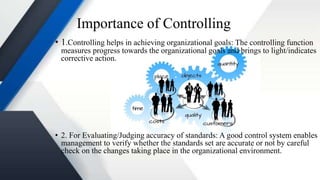
• 1.Controlling helps in achieving organizational goals: The controlling function
measures progress towards the organizational goals and brings to light/indicates
corrective action.
• 2. For Evaluating/Judging accuracy of standards: A good control system enables
management to verify whether the standards set are accurate or not by careful
check on the changes taking place in the organizational environment.
• 3. Making efficient use of resources: By the process of control, a
manager seeks to reduce wastage of resources.
• 4. Improves employees motivation: A good control system ensures
that employees know well in advance what they are expected to do &
also the standard of performance. It thus motivates & helps them to
give better performance.
5. Ensuring order and discipline: Controlling creates an atmosphere of order and
discipline in the organization by keeping a close check on the activities of its
employees.
• Presented by
• Harsh Nandan & Abhinav Singh
• BCA 2nd Shift 3rd Sem

Controlling.pptx

  • 1.
    Principles of Management& Organizational Behavior TOPIC: •Controlling TRINITY INSTITUTE OF PROFESSIONAL STUDIES SEC-9 DWARKA, NEW DELHI- 110075
  • 2.
    Index • Meaning ofcontrolling • Definition of controlling • Nature/Characteristics of controlling • Importance of controlling
  • 3.
    Meaning • Controlling functioncan be defined as comparison of actual performance with the planned performance. If there is any difference and taking corrective measures or action to stop those reasons so that in future there is match between actual and planned performance.
  • 4.
    Definitions by differentauthors: • “Controlling is determining what is being accomplished that is, evaluating the performance and, if necessary, apply corrective measures so that performance takes place according to plans” -Terry and Franklin • “Controlling consists of verifying whether everything occurs in conformity with the plans adopted, the instructions issued and the principles established. It has for its object to point out weaknesses and errors in order to rectify them and prevent recurrence.” -Henry Fayol
  • 5.
    Nature/Characteristics of Controlling •Goal oriented: Controlling is directed towards accomplishment of organizational goals in the best possible manner. • Pervasive: Controlling is an essential function of every manager and exercised at all levels of management.
  • 6.
    • Continuous: Itis not an activity to be pursued in the end only; it has to be done on a continuous basis. • Controlling is looking back: Controlling involves measurement of actual performance and its comparison with the desired performance. It is the process of checking and verification.
  • 7.
    • Controlling isforward looking: It is related to future because it seeks to improve future results on the basis of experience gained in the past.
  • 8.
    Importance of Controlling •1.Controlling helps in achieving organizational goals: The controlling function measures progress towards the organizational goals and brings to light/indicates corrective action. • 2. For Evaluating/Judging accuracy of standards: A good control system enables management to verify whether the standards set are accurate or not by careful check on the changes taking place in the organizational environment.
  • 9.
    • 3. Makingefficient use of resources: By the process of control, a manager seeks to reduce wastage of resources. • 4. Improves employees motivation: A good control system ensures that employees know well in advance what they are expected to do & also the standard of performance. It thus motivates & helps them to give better performance.
  • 10.
    5. Ensuring orderand discipline: Controlling creates an atmosphere of order and discipline in the organization by keeping a close check on the activities of its employees.
  • 11.
    • Presented by •Harsh Nandan & Abhinav Singh • BCA 2nd Shift 3rd Sem