CHAPTER 8:
SOLVING PROBLEMS:
CONTROLLING EXTRANEOUS
VARIABLES
Reporter: Nikka Veniez Sunga
Extraneous Variable
-Variable that is not the focus of an experiment and that can
confound the result if not controlled
• PHYSICAL VARIABLES
• SOCIAL VARIABLES
• PERSONALITY VARIABLES
• CONTEXT VARIABLES
PHYSICAL VARIABLES
Aspects of testing conditions that need to be controlled
• ELIMINATION AND CONSTANCY
To make sure that an extraneous variable does not effect an
experiment, sometimes we just take it out– we eliminate it.
Constancy of conditions means that we keep all aspects of the
treatment conditions as nearly similar as possible.
• BALANCE
Distributing the effects of an extraneous variable across the
different treatment conditions of the experiment.
SOCIAL VARIABLE
The qualities of the relationships between subjects and
experimenters that can influence results.
• DEMAND CHARACTERISTICS
Aspects of the experimental situation that demand that people
behave in a particular way.
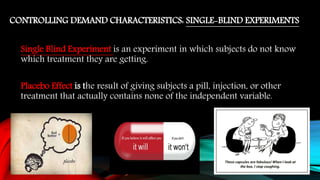
CONTROLLING DEMAND CHARACTERISTICS: SINGLE-BLIND EXPERIMENTS
Single Blind Experiment is an experiment in which subjects do not know
which treatment they are getting.
Placebo Effect is the result of giving subjects a pill, injection, or other
treatment that actually contains none of the independent variable.
CONTROLLING DEMAND CHARACTERISTICS: COVER STORIES
Cover Story a plausible but false explanation of the procedures in an
experiment told to disguise the actual research hypothesis so that
subjects will not guess what it is.
• EXPERIMENTER BIAS
The influence of what the experimenter does that creates
confounding in the experimenter
CONTROLLING EXPERIMENTER BIAS: DOUBLE-BLIND EXPERIMENT
An experiment in which neither the subjects nor the experimenter
know which treatment the subjects are in; used to control experimenter
bias.
*Rosenthal Effect/Pygmalion Effect
PERSONALITY VARIABLES
The personal characteristics that an experimenter or
volunteer subjects bring to the experimental setting
CONTEXT VARIABLES
Those that come about from procedures created by
environment, or context, of the research setting.

Controlling extraneous variables

  • 1.
    CHAPTER 8: SOLVING PROBLEMS: CONTROLLINGEXTRANEOUS VARIABLES Reporter: Nikka Veniez Sunga
  • 2.
    Extraneous Variable -Variable thatis not the focus of an experiment and that can confound the result if not controlled
  • 3.
    • PHYSICAL VARIABLES •SOCIAL VARIABLES • PERSONALITY VARIABLES • CONTEXT VARIABLES
  • 4.
    PHYSICAL VARIABLES Aspects oftesting conditions that need to be controlled
  • 5.
    • ELIMINATION ANDCONSTANCY To make sure that an extraneous variable does not effect an experiment, sometimes we just take it out– we eliminate it. Constancy of conditions means that we keep all aspects of the treatment conditions as nearly similar as possible. • BALANCE Distributing the effects of an extraneous variable across the different treatment conditions of the experiment.
  • 6.
    SOCIAL VARIABLE The qualitiesof the relationships between subjects and experimenters that can influence results.
  • 7.
    • DEMAND CHARACTERISTICS Aspectsof the experimental situation that demand that people behave in a particular way.
  • 8.
    CONTROLLING DEMAND CHARACTERISTICS:SINGLE-BLIND EXPERIMENTS Single Blind Experiment is an experiment in which subjects do not know which treatment they are getting. Placebo Effect is the result of giving subjects a pill, injection, or other treatment that actually contains none of the independent variable.
  • 9.
    CONTROLLING DEMAND CHARACTERISTICS:COVER STORIES Cover Story a plausible but false explanation of the procedures in an experiment told to disguise the actual research hypothesis so that subjects will not guess what it is.
  • 10.
    • EXPERIMENTER BIAS Theinfluence of what the experimenter does that creates confounding in the experimenter
  • 11.
    CONTROLLING EXPERIMENTER BIAS:DOUBLE-BLIND EXPERIMENT An experiment in which neither the subjects nor the experimenter know which treatment the subjects are in; used to control experimenter bias. *Rosenthal Effect/Pygmalion Effect
  • 12.
    PERSONALITY VARIABLES The personalcharacteristics that an experimenter or volunteer subjects bring to the experimental setting
  • 13.
    CONTEXT VARIABLES Those thatcome about from procedures created by environment, or context, of the research setting.