







Assisted Reproductive Techniques :
Horizon of Hope
Moderator : Dr. Bharati Dhorepatil
"Destiny is not a matter of chance,
it is a matter of choice."
Winston Churchill
Freezing eggs
Never
mind
there’s
Always
Solutions!
• Freezing eggs:
Is it worthwhile?
Apple and Facebook offer to freeze eggs for female staff -
Telegraph
Apple and Facebook offer to freeze eggs for female staff
Facebook has started offering female staff up to $20,000 to
have their eggs frozen and Apple will pay for its female
employees to go through the same process from January
Prospects for Oocyte Freezing
• ‘Fertility preservation’ for young cancer patients
• Increased (and safer!) chances of pregnancy for IVF patients
with ethical objections to embryo freezing
• ‘Fertility extension’ for social reasons?
• Better ‘matching’ and ‘quarantining’ for egg donation
recipients ?
• ‘Maternal’ donor eggs for girls diagnosed with Turner Syndrome
Malignancies in Young Women
• Damage to the ovary following cancer therapy is very
age dependent
• Exposure to high-doses of alkylating agents and ovarian
radiation are associated with an increased risk of both
acute ovarian failure and premature menopause
• Future fertility prospects are identified as a specific
anxiety for young women and their parents
‘Age plus a decade’ equals ‘reproductive age’ following
chemotherapy
Acute ovarian failure is not the only issue
• 1041 women diagnosed with cancer between 18 and 40
• 640 received chemotherapy alone
• Acute ovarian failure (AOF) reported for 8%,10%,9% and 10%
for HD, NHL, Br Ca and GI cancer
• AOF increased significantly with age (p< 0.05)
• Infertility in non-AOF patients was reported as 40% at age 35
• Probability of early menopause was 25% at age 30
Letoumeau et al Cancer August 2011
Maternal Age and Fetal loss
Danish data Andersen et al 2000
0
10
20
30
40
50
60
70
80
15 20 25 30 35 40 45
sp abortion
ectopic
stillbirth
Maternal age at conception
(1.2 Million pregnancies)
%
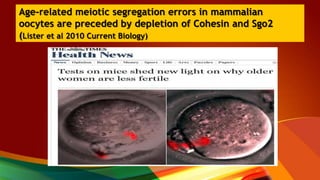
Age-related meiotic segregation errors in mammalian
oocytes are preceded by depletion of Cohesin and Sgo2
(Lister et al 2010 Current Biology)
The perils of ‘perpetual postponing’
• The risk of permanent childlessness and female age at time of
starting to try to conceive is….
• 6% at age 30
• 14% at age 35
• 35% at age 40
• Just postponing a first conception attempt from 25 to 30 years
reduces mean number of children from 2 to 1.7, increases infertility
prevalence from 9.8 to 15.8% and increases ‘incomplete’ families
from 14.8 to 24%
(Leridon INED France)
Unreasonable expectations…
• 59% of childless women aged 35-39 still planned
to have a baby
• 30% aged 40-45 did too!
(Sobotka, Austrian survey data)
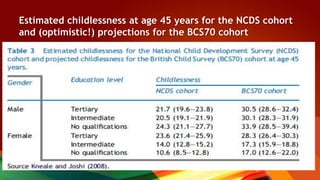
Estimated childlessness at age 45 years for the NCDS cohort
and (optimistic!) projections for the BCS70 cohort
The reality: IVF LBR (HFEA data)
• Age 40 12.1%
• Age 41 10.3%
• Age 42 7.6%
• Age 43 4.9%
• Age 44 2.6%
• Age 45 1.6%
In what other branch of medicine would we let patients
insist that we perform an elective operation with <5%
chance of it working?
Human oocyte cryopreservation
• First pregnancies achieved in 1980’s
Chen (1986) and Al Hasani et al (1987)
• Procedure abandoned for approx.
10 years due to poor results
Low fertilisation rate
Low survival rates
Hardening of zona
Possible spindle damage
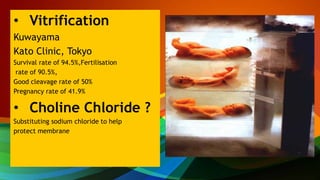
• Vitrification
Kuwayama
Kato Clinic, Tokyo
Survival rate of 94.5%,Fertilisation
rate of 90.5%,
Good cleavage rate of 50%
Pregnancy rate of 41.9%
• Choline Chloride ?
Substituting sodium chloride to help
protect membrane
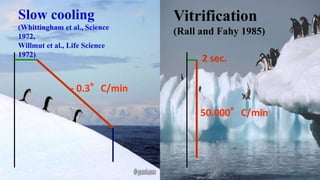
Slow cooling
(Whittingham et al., Science
1972,
Willmut et al., Life Science
1972)
- 0.3°C/min
Vitrification
(Rall and Fahy 1985)
- 50.000°C/min
2 sec.
What’s the latest Evidence?
• Cobo, Kuwayama, Perez et al (2008)
• 30 oocyte donors and 30 recipients
• Vitrification by cryotop method with warming and ICSI after one hour
(survival rate 96.7%)
• There was no difference in FR (76.3% vs 82.2%),BFR etc
• 23 ETs in vitrification group. Pregnancy rate was 65.2%, IR was 40.8% and
miscarriage rate was 20%
• What is the proper comparator?
• Nagy,Chang,Shapiro et al Fertil and Steril (2010)
• 10 oocyte donors and 20 recipients
• Vitrification for a minimum of one hour
(survival rate 87.5%, FR 87% and BFR 68%)
• 15 of 20 recipients became pregnant with 26/47 (55%)
embryos implanting and 26 live born infants
• 2 further pregnancies were established from
supernumery frozen embryos
• All outcomes were similar when compared to cycles using
the SAME oocyte donors in fresh cycles
Vitrification: Is it safe?
• Concerns because of the high concentrations of cryoprotectant
required
• Recent evidence for less damage to spindle integrity and chromosome
alignment ( Huang et al 2007) compared to ‘slow freeze’ eggs.
• Recent report of obstetric and perinatal outcome of 200 babies born
from vitrified oocytes (165 pregnancies) (Ri-Cheng Chian et al 2008)
No increased risks identified
Reasons for oocyte cryopreservation
157 patients (2009)
Fertility Preservation
(58)
36.9%10.7%7.4%
45.0%
Other
(17)
Ethical/Religious
objections to
embryo freezing
(13)
Social reasons
(69)
Results – Frozen/thawed oocytes compared with
frozen/thawed embryos
MFS data :
25% Clinical Preg. rate/transfer
Implantation rate of 12.6%
MFS data:
21.4% Clinical Preg. rate/transfer
Implantation rate of 17.4%
To conclude….We have the technology
• Women are trying to get pregnant when older
• They want their own ‘genetic’ child (or children!)
• There are few donor eggs anyway….
• Should we encourage (or even allow) a ‘trade’ in
donor eggs?
• Pregnancy rates (with vitrification) are similar to ‘fresh’
when using ‘young’ eggs
We accept oocyte freezing for young
cancer patients: So is there a difference
with ‘social’ egg freezers?
To conclude….The ethics
• Governments have tried bribing, bullying and lecturing but
still women are trying to get pregnant when older
• ‘Brute Biology’ means that women will live to 80 but most
will be functionally infertile by 40
• Why are we uncomfortable with social egg freezing?
• Will ‘social’ oocyte freezing come to be seen as significant
and revolutionary as the introduction of the OCP?
Thank you for your attention

Egg freezing - Dr Dhorepatil Bharati

  • 1.
    Assisted Reproductive Techniques: Horizon of Hope Moderator : Dr. Bharati Dhorepatil
  • 3.
    "Destiny is nota matter of chance, it is a matter of choice." Winston Churchill
  • 4.
  • 5.
  • 6.
    • Freezing eggs: Isit worthwhile? Apple and Facebook offer to freeze eggs for female staff - Telegraph Apple and Facebook offer to freeze eggs for female staff Facebook has started offering female staff up to $20,000 to have their eggs frozen and Apple will pay for its female employees to go through the same process from January
  • 7.
    Prospects for OocyteFreezing • ‘Fertility preservation’ for young cancer patients • Increased (and safer!) chances of pregnancy for IVF patients with ethical objections to embryo freezing • ‘Fertility extension’ for social reasons? • Better ‘matching’ and ‘quarantining’ for egg donation recipients ? • ‘Maternal’ donor eggs for girls diagnosed with Turner Syndrome
  • 8.
    Malignancies in YoungWomen • Damage to the ovary following cancer therapy is very age dependent • Exposure to high-doses of alkylating agents and ovarian radiation are associated with an increased risk of both acute ovarian failure and premature menopause • Future fertility prospects are identified as a specific anxiety for young women and their parents ‘Age plus a decade’ equals ‘reproductive age’ following chemotherapy
  • 9.
    Acute ovarian failureis not the only issue • 1041 women diagnosed with cancer between 18 and 40 • 640 received chemotherapy alone • Acute ovarian failure (AOF) reported for 8%,10%,9% and 10% for HD, NHL, Br Ca and GI cancer • AOF increased significantly with age (p< 0.05) • Infertility in non-AOF patients was reported as 40% at age 35 • Probability of early menopause was 25% at age 30 Letoumeau et al Cancer August 2011
  • 10.
    Maternal Age andFetal loss Danish data Andersen et al 2000 0 10 20 30 40 50 60 70 80 15 20 25 30 35 40 45 sp abortion ectopic stillbirth Maternal age at conception (1.2 Million pregnancies) %
  • 11.
    Age-related meiotic segregationerrors in mammalian oocytes are preceded by depletion of Cohesin and Sgo2 (Lister et al 2010 Current Biology)
  • 12.
    The perils of‘perpetual postponing’ • The risk of permanent childlessness and female age at time of starting to try to conceive is…. • 6% at age 30 • 14% at age 35 • 35% at age 40 • Just postponing a first conception attempt from 25 to 30 years reduces mean number of children from 2 to 1.7, increases infertility prevalence from 9.8 to 15.8% and increases ‘incomplete’ families from 14.8 to 24% (Leridon INED France)
  • 13.
    Unreasonable expectations… • 59%of childless women aged 35-39 still planned to have a baby • 30% aged 40-45 did too! (Sobotka, Austrian survey data)
  • 14.
    Estimated childlessness atage 45 years for the NCDS cohort and (optimistic!) projections for the BCS70 cohort
  • 15.
    The reality: IVFLBR (HFEA data) • Age 40 12.1% • Age 41 10.3% • Age 42 7.6% • Age 43 4.9% • Age 44 2.6% • Age 45 1.6% In what other branch of medicine would we let patients insist that we perform an elective operation with <5% chance of it working?
  • 16.
    Human oocyte cryopreservation •First pregnancies achieved in 1980’s Chen (1986) and Al Hasani et al (1987) • Procedure abandoned for approx. 10 years due to poor results Low fertilisation rate Low survival rates Hardening of zona Possible spindle damage
  • 17.
    • Vitrification Kuwayama Kato Clinic,Tokyo Survival rate of 94.5%,Fertilisation rate of 90.5%, Good cleavage rate of 50% Pregnancy rate of 41.9% • Choline Chloride ? Substituting sodium chloride to help protect membrane
  • 18.
    Slow cooling (Whittingham etal., Science 1972, Willmut et al., Life Science 1972) - 0.3°C/min Vitrification (Rall and Fahy 1985) - 50.000°C/min 2 sec.
  • 19.
    What’s the latestEvidence? • Cobo, Kuwayama, Perez et al (2008) • 30 oocyte donors and 30 recipients • Vitrification by cryotop method with warming and ICSI after one hour (survival rate 96.7%) • There was no difference in FR (76.3% vs 82.2%),BFR etc • 23 ETs in vitrification group. Pregnancy rate was 65.2%, IR was 40.8% and miscarriage rate was 20% • What is the proper comparator?
  • 20.
    • Nagy,Chang,Shapiro etal Fertil and Steril (2010) • 10 oocyte donors and 20 recipients • Vitrification for a minimum of one hour (survival rate 87.5%, FR 87% and BFR 68%) • 15 of 20 recipients became pregnant with 26/47 (55%) embryos implanting and 26 live born infants • 2 further pregnancies were established from supernumery frozen embryos • All outcomes were similar when compared to cycles using the SAME oocyte donors in fresh cycles
  • 21.
    Vitrification: Is itsafe? • Concerns because of the high concentrations of cryoprotectant required • Recent evidence for less damage to spindle integrity and chromosome alignment ( Huang et al 2007) compared to ‘slow freeze’ eggs. • Recent report of obstetric and perinatal outcome of 200 babies born from vitrified oocytes (165 pregnancies) (Ri-Cheng Chian et al 2008) No increased risks identified
  • 22.
    Reasons for oocytecryopreservation 157 patients (2009) Fertility Preservation (58) 36.9%10.7%7.4% 45.0% Other (17) Ethical/Religious objections to embryo freezing (13) Social reasons (69)
  • 23.
    Results – Frozen/thawedoocytes compared with frozen/thawed embryos MFS data : 25% Clinical Preg. rate/transfer Implantation rate of 12.6% MFS data: 21.4% Clinical Preg. rate/transfer Implantation rate of 17.4%
  • 24.
    To conclude….We havethe technology • Women are trying to get pregnant when older • They want their own ‘genetic’ child (or children!) • There are few donor eggs anyway…. • Should we encourage (or even allow) a ‘trade’ in donor eggs? • Pregnancy rates (with vitrification) are similar to ‘fresh’ when using ‘young’ eggs
  • 25.
    We accept oocytefreezing for young cancer patients: So is there a difference with ‘social’ egg freezers?
  • 26.
    To conclude….The ethics •Governments have tried bribing, bullying and lecturing but still women are trying to get pregnant when older • ‘Brute Biology’ means that women will live to 80 but most will be functionally infertile by 40 • Why are we uncomfortable with social egg freezing? • Will ‘social’ oocyte freezing come to be seen as significant and revolutionary as the introduction of the OCP?
  • 27.
    Thank you foryour attention