CONTROL TECHNOLOGY
   Lesson One: An Introduction
LESSON AIMS
• ALL: To be able to define what control
  technology is.
• MOST: Will be able to identify everyday
  appliances and give real life examples that
  involve control technology.
• SOME: Understand the need for instructions
  to be in order.
•   ALL: To be able to define what control technology is.
•   MOST: Will be able to identify everyday appliances and give real life examples that involve control technology.
•   SOME: Understand the need for instructions to be in order.
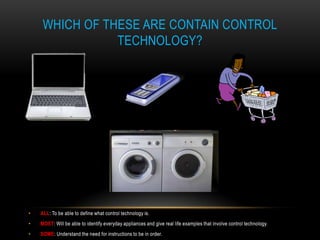
WHICH OF THESE ARE CONTAIN CONTROL
                TECHNOLOGY?


•   ALL: To be able to define what control technology is.
•   MOST: Will be able to identify everyday appliances and give real life examples that involve control technology.
•   SOME: Understand the need for instructions to be in order.
DEFINITION: CONTROL TECHNOLOGY
• Control Technology is used everyday.


• A system that controls and monitors specific things, does
  this by following a simple sequence of instructions,


• A simple definition of control technology is the manipulation
  of an input to get to a desired outcome.


•   ALL: To be able to define what control technology is.
•   MOST: Will be able to identify everyday appliances and give real life examples that involve control technology.
•   SOME: Understand the need for instructions to be in order.
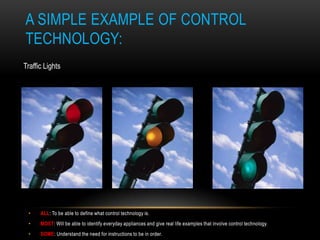
A SIMPLE EXAMPLE OF CONTROL
TECHNOLOGY:
Traffic Lights


 •    ALL: To be able to define what control technology is.
 •    MOST: Will be able to identify everyday appliances and give real life examples that involve control technology.
 •    SOME: Understand the need for instructions to be in order.
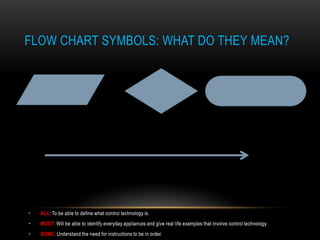
FLOW CHART SYMBOLS: WHAT DO THEY MEAN?


•   ALL: To be able to define what control technology is.
•   MOST: Will be able to identify everyday appliances and give real life examples that involve control technology.
•   SOME: Understand the need for instructions to be in order.
IMPORTANCE OF INSTRUCTIONS
• Why is it important to follow instructions?
• How do you think they should be written?
• How would you tell someone how to make
  a cup of tea?


•   ALL: To be able to define what control technology is.
•   MOST: Will be able to identify everyday appliances and give real life examples that involve control technology.
•   SOME: Understand the need for instructions to be in order.
HOW TO MAKE A CUP OF TEA?
• In pairs, write out the steps you would have to follow in order to
  make a cup of tea. (5 mins)


• Discuss with another pair, and compare your steps.


 •   ALL: To be able to define what control technology is.
 •   MOST: Will be able to identify everyday appliances and give real life examples that involve control technology.
 •   SOME: Understand the need for instructions to be in order.
START


•   ALL: To be able to define what control technology is.
•   MOST: Will be able to identify everyday appliances and give real life examples that involve control technology.
•   SOME: Understand the need for instructions to be in order.

Control technology

  • 1.
    CONTROL TECHNOLOGY Lesson One: An Introduction
  • 2.
    LESSON AIMS • ALL:To be able to define what control technology is. • MOST: Will be able to identify everyday appliances and give real life examples that involve control technology. • SOME: Understand the need for instructions to be in order. • ALL: To be able to define what control technology is. • MOST: Will be able to identify everyday appliances and give real life examples that involve control technology. • SOME: Understand the need for instructions to be in order.
  • 3.
    WHICH OF THESEARE CONTAIN CONTROL TECHNOLOGY? • ALL: To be able to define what control technology is. • MOST: Will be able to identify everyday appliances and give real life examples that involve control technology. • SOME: Understand the need for instructions to be in order.
  • 4.
    DEFINITION: CONTROL TECHNOLOGY •Control Technology is used everyday. • A system that controls and monitors specific things, does this by following a simple sequence of instructions, • A simple definition of control technology is the manipulation of an input to get to a desired outcome. • ALL: To be able to define what control technology is. • MOST: Will be able to identify everyday appliances and give real life examples that involve control technology. • SOME: Understand the need for instructions to be in order.
  • 5.
    A SIMPLE EXAMPLEOF CONTROL TECHNOLOGY: Traffic Lights • ALL: To be able to define what control technology is. • MOST: Will be able to identify everyday appliances and give real life examples that involve control technology. • SOME: Understand the need for instructions to be in order.
  • 6.
    FLOW CHART SYMBOLS:WHAT DO THEY MEAN? • ALL: To be able to define what control technology is. • MOST: Will be able to identify everyday appliances and give real life examples that involve control technology. • SOME: Understand the need for instructions to be in order.
  • 7.
    IMPORTANCE OF INSTRUCTIONS •Why is it important to follow instructions? • How do you think they should be written? • How would you tell someone how to make a cup of tea? • ALL: To be able to define what control technology is. • MOST: Will be able to identify everyday appliances and give real life examples that involve control technology. • SOME: Understand the need for instructions to be in order.
  • 8.
    HOW TO MAKEA CUP OF TEA? • In pairs, write out the steps you would have to follow in order to make a cup of tea. (5 mins) • Discuss with another pair, and compare your steps. • ALL: To be able to define what control technology is. • MOST: Will be able to identify everyday appliances and give real life examples that involve control technology. • SOME: Understand the need for instructions to be in order.
  • 9.
    START • ALL: To be able to define what control technology is. • MOST: Will be able to identify everyday appliances and give real life examples that involve control technology. • SOME: Understand the need for instructions to be in order.

Editor's Notes

  • #2 This should be a recap on children’s previous knowledge.