Principles of Management
Module 15: Control
Module Learning Outcomes
Explain the methods and need for control within an organization
15.1: Explain what control means in a business setting and why it is needed
15.2: Explain the basic control process and monitoring points
15.3: Describe the different levels and types of control
15.4: Explain the need for a balanced scorecard
15.5: Explain the use of financial and nonfinancial controls in business
Control in the Business Setting
Learning Outcomes: Control in the Business Setting
15.1: Explain what control means in a business setting and why it is
needed
15.1.1: Explain what control means in a business setting
15.1.2: Describe the benefits and costs of organizational control
What Does Control Mean in the Business Setting?
• Control is device or mechanism used
to regulate or guide operation of a
machine, apparatus, or system
• Control is in a business setting and
involves the processes that regulate,
guide, and protect an organization
• One type of control- set of financial
policies
• Most common style is top-down
control- decisions are made by high-
level executives and passed down
Implementing Organizational Control
• Organizational control means developing
rules, procedures, or other protocols for
directing the work of employees and
processes
• Important because it helps identify errors
and deviation from standards
• Benefits: improved communication,
financial stability, increased productivity,
help in meeting goals, etc.
• Employee morale may be higher when
workers see that management is paying
attention and knows what it is doing
• Example: Toyota
Disadvantages
• Some systems can be very expensive so management must weigh the cost
versus the benefit for each control
• Control mentality can lead to overstaffing and unsustainable costs for some
businesses
• Maintaining controls is also an expense
• Controls can become blind spot for management
• Rigid implementation may lead to a slowdown in the operation of the
business
The Control Process
Learning Outcomes: The Control Process
15.2: Explain the basic control process and monitoring points
15.2.1: Explain the basic control process
15.2.2: Differentiate between feedback, proactive, and concurrent controls
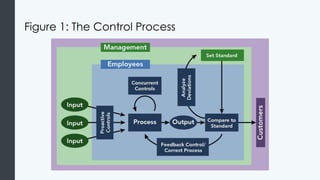
Understanding The Control Process
• Setting performance standards
• Measuring actual performance
• Comparing actual performance with
standards or goals
• Analyzing deviations
• Taking corrective action
Timing of Controls
• Controls categorized according to
time in which process or activity
occurs
• Controls related to time include:
• Feedback
• Proactive
• Concurrent
• Advantages and Disadvantages of
each
Feedback
• Occurs after an activity or process is completed
• Example: Evaluating team’s progress by comparing production standard to actual
production output
• Example: When a sales goal is set, sales team works to reach goal for next three
months, followed by review period
• Disadvantage- modifications can be made only after a process has already
been completed or an action has taken place
Proactive Control
• Involves anticipating trouble rather than waiting for a poor outcome and
reacting afterward
• About prevention or intervention
• Example: When an engineer performs tests on braking system of prototype vehicle
before it is moved on to be mass produced
• Looks forward to problems that could reasonably occur and devises
methods to prevent problems
• Disadvantage: Can’t control unforeseen and unlikely incident
Concurrent Control
• Monitoring takes place during process or activity
• May be based on standards, rules, codes, and polices
• Example: Fleet tracking by GPS to allow managers to monitor company vehicles
• Example: Keen Media tries to reduce employee inefficiency by monitoring Internet
activity
Practice Question 1
In the Lean/Agile management process, a workflow staple is the “Daily
Standup” where each team member quickly outlines what they are working on.
This would be an example of:
1. Feedback control.
2. Proactive control.
3. Concurrent control.
Practice Question 2
Also from the Lean/Agile handbook is the process called “post-mortem” where
the team evaluates their 2-week progress. This would be an example of:
1. Feedback control.
2. Proactive control.
3. Concurrent control.
Figure 1: The Control Process
Levels and Types of Control
Learning Outcomes: Levels and Types of Control
15.3: Describe the different levels and types of control
15.3.1: Differentiate between strategic, operational, and tactical controls
15.3.2: Differentiate between top-down, objective, and normative control
Strategic Control
• Involves monitoring a strategy as it is
being implemented, evaluating
deviations, and making necessary
adjustments
• May involve reassessment of strategy
due to unforeseen event
• Implementing strategy often involves
series of activities that occur
• Also involves monitoring internal and
external events
• Errors are major- failing to anticipate
customers’ reaction to competitor’s
new product
Operational Control
• Involves control over intermediate term operations and processes but not
business strategies
• Ensure that activities are consistent with established plans
• Mid-level management uses operational controls for intermediate-term
decisions
• When performance doesn’t meet standards, managers enforce actions such
as training, discipline, motivation, or termination
• Focuses more on internal sources of information and affects smaller units or
aspects of organization
• Errors may mean failing to complete project on time
Tactical Control
• Tactic is a method that meets specific objective of an overall plan
• Emphasizes current operations of an organization
• Managers determine what various parts of organization must do for
organization to be successful in the near future
• Strategic control always comes first, followed by operations, and then tactics
Top-Down Controls
• Means use of rules, regulations, and formal authority
• Includes budgets, statistical reports, and performance appraisals
• Advantages: Employees can spend their time performing their job duties
instead of discussing direction of the company and offering input into
development of new policies
• Disadvantages: lower levels are in touch with customers and recognize new
trends or new competition earlier than senior management- may discourage
employees from sharing information or ideas up chain of command
Objective and Normative Control
• Objective control—based on facts
that can be measured and tested-
measures observable behavior
• Output control is another form of
objective control
• Normative control—govern
behavior through accepted
patterns of action rather than
written policies and procedures
• Uses values and beliefs
• Reflects organization’s culture
The Need for a Balanced Scorecard
Learning Outcomes: The Need for a Balanced
Scorecard
15.4: Explain the need for a balanced scorecard
15.4.1: Identify the four typical components of the balanced scorecard
15.4.2: Explain the need for a balanced scorecard
The Balanced Scorecard
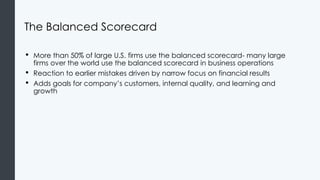
• More than 50% of large U.S. firms use the balanced scorecard- many large
firms over the world use the balanced scorecard in business operations
• Reaction to earlier mistakes driven by narrow focus on financial results
• Adds goals for company’s customers, internal quality, and learning and
growth
Balanced Scorecard Components
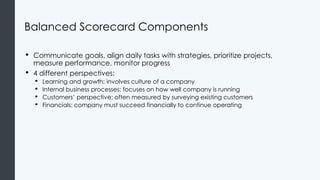
• Communicate goals, align daily tasks with strategies, prioritize projects,
measure performance, monitor progress
• 4 different perspectives:
• Learning and growth: involves culture of a company
• Internal business processes: focuses on how well company is running
• Customers’ perspective: often measured by surveying existing customers
• Financials: company must succeed financially to continue operating
Why a BSC Is Needed?
• Without balanced scorecard, executives focus on only one or a few aspects
of the organization
• Company may be doing well financially but performing poorly in another
area
• For example, company may exceed customer expectations related to
product quality, corporate social responsibility, and customer service
• Forces managers to look at company as a whole to measure performance
and more accurately determine company’s overall state
Financial and Nonfinancial Controls
Learning Outcomes: Financial and Nonfinancial
Controls
15.5: Explain the use of financial and nonfinancial controls in business
15.5.1: Explain the use of budgets to both control and delegate authority
15.5.2: Explain the use of financial ratios (comparisons) as a control method
15.5.3: Explain the benefits of quality management
15.5.4: Explain the costs of quality management
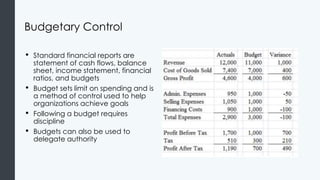
Budgetary Control
• Standard financial reports are
statement of cash flows, balance
sheet, income statement, financial
ratios, and budgets
• Budget sets limit on spending and is
a method of control used to help
organizations achieve goals
• Following a budget requires
discipline
• Budgets can also be used to
delegate authority
Financial Ratios
• Managers use ratios to analyze elements such as debt, equity, efficiency,
and activity
• Debt ratios compares organization’s debt to its assets- higher the ratio, the
more leveraged the company is
• Key to understanding ratios is comparing them to relevant benchmarks- debt
ratio for manufacturing company is around 50% but in bank is 92%
• Analyzing financial ratios helps managers determine financial health
company
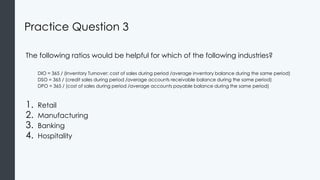
Practice Question 3
The following ratios would be helpful for which of the following industries?
DIO = 365 / (Inventory Turnover: cost of sales during period /average inventory balance during the same period)
DSO = 365 / (credit sales during period /average accounts receivable balance during the same period)
DPO = 365 / (cost of sales during period /average accounts payable balance during the same period)
1. Retail
2. Manufacturing
3. Banking
4. Hospitality
Quality Management
• Involves controlling, monitoring, and modifying tasks to maintain desired level
of quality
• Benefits—helps companies please customers so company can maintain
good reputation, gain competitive edge, and ultimately make a profit
• Company also saves both time and money by reducing defects
• Costs—regulations are type of control that society puts on companies
• Drives managers great lengths to please customers which can become quite
expensive
• Purchase new software/equipment, hire employees, conduct studies, and consult with
experts
Quick Review
• What does control mean in a business setting?
• What are the benefits and costs of organizational control?
• What is the basic control process?
• Can you differentiate between feedback, proactive, and concurrent
controls?
• Can you differentiate between strategic, operational, and tactical controls?
Between top-down, objective, and normative control
More Quick Review
• Are you able to identify the four typical components of the balanced
scorecard?
• Are you able to correctly explain the need for a balanced scorecard?
• What is the use of budgets to both control and delegate authority?
• What is the use of financial ratios as a control method?
• What are the benefits of quality management?
• What are the costs of quality management?
Class Discussion
You are one of the founders of a startup in the logistics industry. What would be
the first control mechanisms that you would put in place to get your business
started successfully?

Control Strategies in Management sector

  • 1.
  • 2.
    Module Learning Outcomes Explainthe methods and need for control within an organization 15.1: Explain what control means in a business setting and why it is needed 15.2: Explain the basic control process and monitoring points 15.3: Describe the different levels and types of control 15.4: Explain the need for a balanced scorecard 15.5: Explain the use of financial and nonfinancial controls in business
  • 3.
    Control in theBusiness Setting
  • 4.
    Learning Outcomes: Controlin the Business Setting 15.1: Explain what control means in a business setting and why it is needed 15.1.1: Explain what control means in a business setting 15.1.2: Describe the benefits and costs of organizational control
  • 5.
    What Does ControlMean in the Business Setting? • Control is device or mechanism used to regulate or guide operation of a machine, apparatus, or system • Control is in a business setting and involves the processes that regulate, guide, and protect an organization • One type of control- set of financial policies • Most common style is top-down control- decisions are made by high- level executives and passed down
  • 6.
    Implementing Organizational Control •Organizational control means developing rules, procedures, or other protocols for directing the work of employees and processes • Important because it helps identify errors and deviation from standards • Benefits: improved communication, financial stability, increased productivity, help in meeting goals, etc. • Employee morale may be higher when workers see that management is paying attention and knows what it is doing • Example: Toyota
  • 7.
    Disadvantages • Some systemscan be very expensive so management must weigh the cost versus the benefit for each control • Control mentality can lead to overstaffing and unsustainable costs for some businesses • Maintaining controls is also an expense • Controls can become blind spot for management • Rigid implementation may lead to a slowdown in the operation of the business
  • 8.
  • 9.
    Learning Outcomes: TheControl Process 15.2: Explain the basic control process and monitoring points 15.2.1: Explain the basic control process 15.2.2: Differentiate between feedback, proactive, and concurrent controls
  • 10.
    Understanding The ControlProcess • Setting performance standards • Measuring actual performance • Comparing actual performance with standards or goals • Analyzing deviations • Taking corrective action
  • 11.
    Timing of Controls •Controls categorized according to time in which process or activity occurs • Controls related to time include: • Feedback • Proactive • Concurrent • Advantages and Disadvantages of each
  • 12.
    Feedback • Occurs afteran activity or process is completed • Example: Evaluating team’s progress by comparing production standard to actual production output • Example: When a sales goal is set, sales team works to reach goal for next three months, followed by review period • Disadvantage- modifications can be made only after a process has already been completed or an action has taken place
  • 13.
    Proactive Control • Involvesanticipating trouble rather than waiting for a poor outcome and reacting afterward • About prevention or intervention • Example: When an engineer performs tests on braking system of prototype vehicle before it is moved on to be mass produced • Looks forward to problems that could reasonably occur and devises methods to prevent problems • Disadvantage: Can’t control unforeseen and unlikely incident
  • 14.
    Concurrent Control • Monitoringtakes place during process or activity • May be based on standards, rules, codes, and polices • Example: Fleet tracking by GPS to allow managers to monitor company vehicles • Example: Keen Media tries to reduce employee inefficiency by monitoring Internet activity
  • 15.
    Practice Question 1 Inthe Lean/Agile management process, a workflow staple is the “Daily Standup” where each team member quickly outlines what they are working on. This would be an example of: 1. Feedback control. 2. Proactive control. 3. Concurrent control.
  • 16.
    Practice Question 2 Alsofrom the Lean/Agile handbook is the process called “post-mortem” where the team evaluates their 2-week progress. This would be an example of: 1. Feedback control. 2. Proactive control. 3. Concurrent control.
  • 17.
    Figure 1: TheControl Process
  • 18.
    Levels and Typesof Control
  • 19.
    Learning Outcomes: Levelsand Types of Control 15.3: Describe the different levels and types of control 15.3.1: Differentiate between strategic, operational, and tactical controls 15.3.2: Differentiate between top-down, objective, and normative control
  • 20.
    Strategic Control • Involvesmonitoring a strategy as it is being implemented, evaluating deviations, and making necessary adjustments • May involve reassessment of strategy due to unforeseen event • Implementing strategy often involves series of activities that occur • Also involves monitoring internal and external events • Errors are major- failing to anticipate customers’ reaction to competitor’s new product
  • 21.
    Operational Control • Involvescontrol over intermediate term operations and processes but not business strategies • Ensure that activities are consistent with established plans • Mid-level management uses operational controls for intermediate-term decisions • When performance doesn’t meet standards, managers enforce actions such as training, discipline, motivation, or termination • Focuses more on internal sources of information and affects smaller units or aspects of organization • Errors may mean failing to complete project on time
  • 22.
    Tactical Control • Tacticis a method that meets specific objective of an overall plan • Emphasizes current operations of an organization • Managers determine what various parts of organization must do for organization to be successful in the near future • Strategic control always comes first, followed by operations, and then tactics
  • 23.
    Top-Down Controls • Meansuse of rules, regulations, and formal authority • Includes budgets, statistical reports, and performance appraisals • Advantages: Employees can spend their time performing their job duties instead of discussing direction of the company and offering input into development of new policies • Disadvantages: lower levels are in touch with customers and recognize new trends or new competition earlier than senior management- may discourage employees from sharing information or ideas up chain of command
  • 24.
    Objective and NormativeControl • Objective control—based on facts that can be measured and tested- measures observable behavior • Output control is another form of objective control • Normative control—govern behavior through accepted patterns of action rather than written policies and procedures • Uses values and beliefs • Reflects organization’s culture
  • 25.
    The Need fora Balanced Scorecard
  • 26.
    Learning Outcomes: TheNeed for a Balanced Scorecard 15.4: Explain the need for a balanced scorecard 15.4.1: Identify the four typical components of the balanced scorecard 15.4.2: Explain the need for a balanced scorecard
  • 27.
    The Balanced Scorecard •More than 50% of large U.S. firms use the balanced scorecard- many large firms over the world use the balanced scorecard in business operations • Reaction to earlier mistakes driven by narrow focus on financial results • Adds goals for company’s customers, internal quality, and learning and growth
  • 28.
    Balanced Scorecard Components •Communicate goals, align daily tasks with strategies, prioritize projects, measure performance, monitor progress • 4 different perspectives: • Learning and growth: involves culture of a company • Internal business processes: focuses on how well company is running • Customers’ perspective: often measured by surveying existing customers • Financials: company must succeed financially to continue operating
  • 29.
    Why a BSCIs Needed? • Without balanced scorecard, executives focus on only one or a few aspects of the organization • Company may be doing well financially but performing poorly in another area • For example, company may exceed customer expectations related to product quality, corporate social responsibility, and customer service • Forces managers to look at company as a whole to measure performance and more accurately determine company’s overall state
  • 30.
  • 31.
    Learning Outcomes: Financialand Nonfinancial Controls 15.5: Explain the use of financial and nonfinancial controls in business 15.5.1: Explain the use of budgets to both control and delegate authority 15.5.2: Explain the use of financial ratios (comparisons) as a control method 15.5.3: Explain the benefits of quality management 15.5.4: Explain the costs of quality management
  • 32.
    Budgetary Control • Standardfinancial reports are statement of cash flows, balance sheet, income statement, financial ratios, and budgets • Budget sets limit on spending and is a method of control used to help organizations achieve goals • Following a budget requires discipline • Budgets can also be used to delegate authority
  • 33.
    Financial Ratios • Managersuse ratios to analyze elements such as debt, equity, efficiency, and activity • Debt ratios compares organization’s debt to its assets- higher the ratio, the more leveraged the company is • Key to understanding ratios is comparing them to relevant benchmarks- debt ratio for manufacturing company is around 50% but in bank is 92% • Analyzing financial ratios helps managers determine financial health company
  • 34.
    Practice Question 3 Thefollowing ratios would be helpful for which of the following industries? DIO = 365 / (Inventory Turnover: cost of sales during period /average inventory balance during the same period) DSO = 365 / (credit sales during period /average accounts receivable balance during the same period) DPO = 365 / (cost of sales during period /average accounts payable balance during the same period) 1. Retail 2. Manufacturing 3. Banking 4. Hospitality
  • 35.
    Quality Management • Involvescontrolling, monitoring, and modifying tasks to maintain desired level of quality • Benefits—helps companies please customers so company can maintain good reputation, gain competitive edge, and ultimately make a profit • Company also saves both time and money by reducing defects • Costs—regulations are type of control that society puts on companies • Drives managers great lengths to please customers which can become quite expensive • Purchase new software/equipment, hire employees, conduct studies, and consult with experts
  • 36.
    Quick Review • Whatdoes control mean in a business setting? • What are the benefits and costs of organizational control? • What is the basic control process? • Can you differentiate between feedback, proactive, and concurrent controls? • Can you differentiate between strategic, operational, and tactical controls? Between top-down, objective, and normative control
  • 37.
    More Quick Review •Are you able to identify the four typical components of the balanced scorecard? • Are you able to correctly explain the need for a balanced scorecard? • What is the use of budgets to both control and delegate authority? • What is the use of financial ratios as a control method? • What are the benefits of quality management? • What are the costs of quality management?
  • 38.
    Class Discussion You areone of the founders of a startup in the logistics industry. What would be the first control mechanisms that you would put in place to get your business started successfully?