Principles of
Management
Unit VII:
Controlling
Contents of the unit
▸ CASE STUDY
▸ THE CONTROL PROCESS
▸ TOOLS FOR MEASURING ORGANIZATIONAL PERFORMANCE
▸ CONCLUSION
2
CONTROL
PROCESS &
CONCEPT
What control means and why it is
important for organizations?
Case Study
▸ The online leadership training for junior managers is
coming to an end. Chakira, José, Khalid, Laura, Peter,
and Samantha met there and worked together as a
group.
▸ Their focus was the effects of digitalization. As a final
task, they must consider how digitalization could affect
controlling.
4
Case Study
To make relevant suggestions, the group decides to
research the following topics:
▸ • What does controlling mean and why is it important?
▸ • What are the typical steps in a controlling process?
▸ • What tools are often used to measure organizational
performance?
5
Understanding Controlling
Since there are many different (albeit similar)
interpretations of controlling in scientific literature, we will
take a look at three particular definitions:
▸ Robbins and Coulter (2018) describe
controlling as “the process of monitoring,
comparing, and correcting work
performance”
6
Definition
▸ Bright et al. (2019) see controlling as “the
process of monitoring and evaluating
organizational effectiveness and initiating
the actions needed to maintain or
improve effectiveness”
7
“ Controlling generally means
comparing the results with
standards or benchmarks or to
regulating something
-International Association of
Controllers (ICV) 8
Case Study
▸ José likes Bright et al.’s definition the most. He
considers maintaining the improvement of effectiveness
to be the most relevant aspect, as the focus lies on the
result.
▸ He is also used to this from the marketing campaigns
he has been involved in. Since the others agree with
him, they decide to use this definition for their group
work.
9
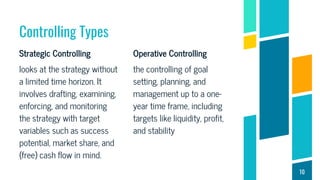
Strategic Controlling
looks at the strategy without
a limited time horizon. It
involves drafting, examining,
enforcing, and monitoring
the strategy with target
variables such as success
potential, market share, and
(free) cash flow in mind.
Controlling Types
Operative Controlling
the controlling of goal
setting, planning, and
management up to a one-
year time frame, including
targets like liquidity, profit,
and stability
10
When does controlling
takes place
Control activities can take place before, during, or after work
activities. Today, most organizations use a hybrid control
system, which prepares managers for their work with
information, controls the flow of activities, and, finally,
evaluates the results (Bright et al., 2019).
11
Case Study
▸ The group discusses the impact of digitalization. They get the
impression that an important part of digitalization lies at the strategic
level, so the question of the potential for success should be asked.
▸ At the operational level—and since the company has already
decided to have a platform solution in every business area in the
next few years—the focus should be on the implementation of
associated activities
12
Need for
Controlling
There are several reasons why
managers need controlling
Three major reasons for controlling
First (Overview)
Firstly, managers
should know what is
going on in their
units. They need to
have an overview of
a unit’s performance
and the activities
carried out there.
Second(Empower)
An effective control
system provides
information and
feedback on
employee
performance,
reducing the
potential of problems
arising.
Third(Assets)
Since environmental
threats can arise
every day, managers
must have a critical
outlook. Effective
control and security
backup plans are
helpful in minimizing
work interruptions.
14
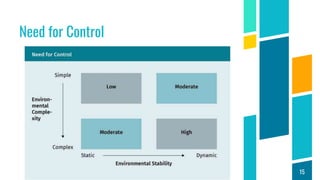
Need for Control
15
Case Study
▸ Laura explains that, in business development,
each business unit is considered separately.
▸ For example, she sees a big difference between
agrochemicals and nutrition, especially in terms of
environmental stability.
16
Case Study
▸ Agrochemicals, with its few, very clearly defined product
groups, is in a much more static environment than
nutrition, which, with its high amount of product diversity,
is in a highly dynamic environment.
▸ She sees a low need for controlling in agrochemicals,
whereas nutrition requires a high level of control.
17
The Control Process
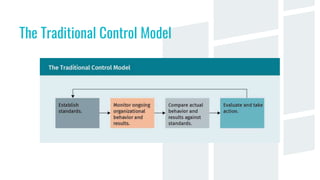
Controlling can be seen as a four-step
process that includes
1) establishing standards,
2) monitoring ongoing activities in terms
of behavior and results,
3) comparing behavior and results with
standards
4) evaluating and taking action
18
The Traditional Control Model
19
Effectiveness of Control
In order to be effective, a control system must take each
organizational objective into account appropriately.
A hybrid approach with pre-control, accompanying control, and
post-control, as well as a consistent follow-up of the control
process, provides a good basis for effectiveneness.
20
Case Study Page No. 142
21
Tools of Measurement
▸ Specific tools are required for three types of
control: feedforward control, concurrent control,
and feedback control (Robbins & Coulter, 2018).
▸ Feedforward control allows corrective managerial
action before a problem occurs. It takes place
before the activities themselves and prevents
problems.
22
Tools of Measurement
▸ Concurrent control takes place while activities are
being carried out. It is performed as a form of
direct monitoring, or “management by walking
around.”
▸ Feedback control is the most common type of
control. It takes place only after activities have
been completed. In this case, the problem has
already occurred, so the organization can only
correct the problem and provide guidelines for the
23
Measuring Organizational Performance
Organizational performance can be defined as the “accumulated
results of all the organization's work activities”
Performance indicators and factors such as productivity, cost
efficiency, industry rankings, or customer satisfaction with
services can be examined here.
24
TOOLS TO
MEASURE
ORGANIZATIONAL
PERFORMANCE
25
26
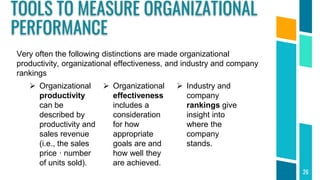
Very often the following distinctions are made organizational
productivity, organizational effectiveness, and industry and company
rankings
TOOLS TO MEASURE ORGANIZATIONAL
PERFORMANCE
 Organizational
productivity
can be
described by
productivity and
sales revenue
(i.e., the sales
price · number
of units sold).
 Organizational
effectiveness
includes a
consideration
for how
appropriate
goals are and
how well they
are achieved.
 Industry and
company
rankings give
insight into
where the
company
stands.
Financial Controls
• Using liquidity as a control for the fulfillment of short-term
obligations is done by looking at the “current ratio” (current
assets/current liabilities) and the more precise “acid test” (current
assets, minus inventories/current liabilities).
• Leverage can be described by the ratios “debt to assets” (total
debt/total assets) or “times interest earned” (profits before interest
and taxes/total interest charges).
• For activity, usually the “inventory turnover” (sales/inventory) and
the “total asset turnover” (sales/total assets) are used.
27
Financial Controls
• Profitability can be described by the “profit margin
on sales" (net profit after taxes/ total sales) and
efficiency by the “return on investment” (net profit
after taxes/total assets).
• Budgets can also be used for controlling. Examining
the deviation from the planned budget helps
managers to obtain important information on topics
such as resource
consumption.
28
Case Study
▸ Khalid tells the others that, in production, there is a monthly
comparison between the budget and the actual results. This gives
the manager information about the consumption of raw materials,
energy, electricity, and the working hours of their employees.
▸ Since this is the basis for calculating the production costs per unit
of goods, it is necessary to do this once a month to correct the
processes immediately if a negative deviation occurs.
29
Information Control
▸ Managers need correct and exact information at the right time and
in the right quantity. This helps them to monitor and measure
activities and performance.
▸ Information about the current standards and what is happening in
the area where they are responsible helps managers to compare
actual performance to the standards and determine whether any
present deviations are acceptable.
30
Information Control
▸ A management information system
(MIS) regularly provides managers with
the information they need to do this.
Nowadays, this is usually done via a
computer-based application.
31
Benchmarking
▸ To identify best practices among the best in the
industry (or even within your own organization, the
benchmarking of processes and performance metrics
can be very helpful.
32
Benchmarking
▸ To do this, benchmarks on products,
processes, finances, and methods such
as quality, time, and cost must be
identified, which represent standards of
excellence.
▸ Information is then collected and
analyzed in order to create benchmarks.
33
Case Study
▸ The group considers benchmarking to be useful in
regard to their company’s digitalization strategy. As
competitors already have platform solutions on the
market, they can learn to not make the same mistakes.
▸ Additionally, different business units will soon have the
opportunity to learn from each other once some of them
have developed their own platform solutions.
34
CONCLUSION

POM Unit VII.pptx

  • 1.
  • 2.
    Contents of theunit ▸ CASE STUDY ▸ THE CONTROL PROCESS ▸ TOOLS FOR MEASURING ORGANIZATIONAL PERFORMANCE ▸ CONCLUSION 2
  • 3.
    CONTROL PROCESS & CONCEPT What controlmeans and why it is important for organizations?
  • 4.
    Case Study ▸ Theonline leadership training for junior managers is coming to an end. Chakira, José, Khalid, Laura, Peter, and Samantha met there and worked together as a group. ▸ Their focus was the effects of digitalization. As a final task, they must consider how digitalization could affect controlling. 4
  • 5.
    Case Study To makerelevant suggestions, the group decides to research the following topics: ▸ • What does controlling mean and why is it important? ▸ • What are the typical steps in a controlling process? ▸ • What tools are often used to measure organizational performance? 5
  • 6.
    Understanding Controlling Since thereare many different (albeit similar) interpretations of controlling in scientific literature, we will take a look at three particular definitions: ▸ Robbins and Coulter (2018) describe controlling as “the process of monitoring, comparing, and correcting work performance” 6
  • 7.
    Definition ▸ Bright etal. (2019) see controlling as “the process of monitoring and evaluating organizational effectiveness and initiating the actions needed to maintain or improve effectiveness” 7
  • 8.
    “ Controlling generallymeans comparing the results with standards or benchmarks or to regulating something -International Association of Controllers (ICV) 8
  • 9.
    Case Study ▸ Josélikes Bright et al.’s definition the most. He considers maintaining the improvement of effectiveness to be the most relevant aspect, as the focus lies on the result. ▸ He is also used to this from the marketing campaigns he has been involved in. Since the others agree with him, they decide to use this definition for their group work. 9
  • 10.
    Strategic Controlling looks atthe strategy without a limited time horizon. It involves drafting, examining, enforcing, and monitoring the strategy with target variables such as success potential, market share, and (free) cash flow in mind. Controlling Types Operative Controlling the controlling of goal setting, planning, and management up to a one- year time frame, including targets like liquidity, profit, and stability 10
  • 11.
    When does controlling takesplace Control activities can take place before, during, or after work activities. Today, most organizations use a hybrid control system, which prepares managers for their work with information, controls the flow of activities, and, finally, evaluates the results (Bright et al., 2019). 11
  • 12.
    Case Study ▸ Thegroup discusses the impact of digitalization. They get the impression that an important part of digitalization lies at the strategic level, so the question of the potential for success should be asked. ▸ At the operational level—and since the company has already decided to have a platform solution in every business area in the next few years—the focus should be on the implementation of associated activities 12
  • 13.
    Need for Controlling There areseveral reasons why managers need controlling
  • 14.
    Three major reasonsfor controlling First (Overview) Firstly, managers should know what is going on in their units. They need to have an overview of a unit’s performance and the activities carried out there. Second(Empower) An effective control system provides information and feedback on employee performance, reducing the potential of problems arising. Third(Assets) Since environmental threats can arise every day, managers must have a critical outlook. Effective control and security backup plans are helpful in minimizing work interruptions. 14
  • 15.
  • 16.
    Case Study ▸ Lauraexplains that, in business development, each business unit is considered separately. ▸ For example, she sees a big difference between agrochemicals and nutrition, especially in terms of environmental stability. 16
  • 17.
    Case Study ▸ Agrochemicals,with its few, very clearly defined product groups, is in a much more static environment than nutrition, which, with its high amount of product diversity, is in a highly dynamic environment. ▸ She sees a low need for controlling in agrochemicals, whereas nutrition requires a high level of control. 17
  • 18.
    The Control Process Controllingcan be seen as a four-step process that includes 1) establishing standards, 2) monitoring ongoing activities in terms of behavior and results, 3) comparing behavior and results with standards 4) evaluating and taking action 18
  • 19.
  • 20.
    Effectiveness of Control Inorder to be effective, a control system must take each organizational objective into account appropriately. A hybrid approach with pre-control, accompanying control, and post-control, as well as a consistent follow-up of the control process, provides a good basis for effectiveneness. 20
  • 21.
    Case Study PageNo. 142 21
  • 22.
    Tools of Measurement ▸Specific tools are required for three types of control: feedforward control, concurrent control, and feedback control (Robbins & Coulter, 2018). ▸ Feedforward control allows corrective managerial action before a problem occurs. It takes place before the activities themselves and prevents problems. 22
  • 23.
    Tools of Measurement ▸Concurrent control takes place while activities are being carried out. It is performed as a form of direct monitoring, or “management by walking around.” ▸ Feedback control is the most common type of control. It takes place only after activities have been completed. In this case, the problem has already occurred, so the organization can only correct the problem and provide guidelines for the 23
  • 24.
    Measuring Organizational Performance Organizationalperformance can be defined as the “accumulated results of all the organization's work activities” Performance indicators and factors such as productivity, cost efficiency, industry rankings, or customer satisfaction with services can be examined here. 24
  • 25.
  • 26.
    26 Very often thefollowing distinctions are made organizational productivity, organizational effectiveness, and industry and company rankings TOOLS TO MEASURE ORGANIZATIONAL PERFORMANCE  Organizational productivity can be described by productivity and sales revenue (i.e., the sales price · number of units sold).  Organizational effectiveness includes a consideration for how appropriate goals are and how well they are achieved.  Industry and company rankings give insight into where the company stands.
  • 27.
    Financial Controls • Usingliquidity as a control for the fulfillment of short-term obligations is done by looking at the “current ratio” (current assets/current liabilities) and the more precise “acid test” (current assets, minus inventories/current liabilities). • Leverage can be described by the ratios “debt to assets” (total debt/total assets) or “times interest earned” (profits before interest and taxes/total interest charges). • For activity, usually the “inventory turnover” (sales/inventory) and the “total asset turnover” (sales/total assets) are used. 27
  • 28.
    Financial Controls • Profitabilitycan be described by the “profit margin on sales" (net profit after taxes/ total sales) and efficiency by the “return on investment” (net profit after taxes/total assets). • Budgets can also be used for controlling. Examining the deviation from the planned budget helps managers to obtain important information on topics such as resource consumption. 28
  • 29.
    Case Study ▸ Khalidtells the others that, in production, there is a monthly comparison between the budget and the actual results. This gives the manager information about the consumption of raw materials, energy, electricity, and the working hours of their employees. ▸ Since this is the basis for calculating the production costs per unit of goods, it is necessary to do this once a month to correct the processes immediately if a negative deviation occurs. 29
  • 30.
    Information Control ▸ Managersneed correct and exact information at the right time and in the right quantity. This helps them to monitor and measure activities and performance. ▸ Information about the current standards and what is happening in the area where they are responsible helps managers to compare actual performance to the standards and determine whether any present deviations are acceptable. 30
  • 31.
    Information Control ▸ Amanagement information system (MIS) regularly provides managers with the information they need to do this. Nowadays, this is usually done via a computer-based application. 31
  • 32.
    Benchmarking ▸ To identifybest practices among the best in the industry (or even within your own organization, the benchmarking of processes and performance metrics can be very helpful. 32
  • 33.
    Benchmarking ▸ To dothis, benchmarks on products, processes, finances, and methods such as quality, time, and cost must be identified, which represent standards of excellence. ▸ Information is then collected and analyzed in order to create benchmarks. 33
  • 34.
    Case Study ▸ Thegroup considers benchmarking to be useful in regard to their company’s digitalization strategy. As competitors already have platform solutions on the market, they can learn to not make the same mistakes. ▸ Additionally, different business units will soon have the opportunity to learn from each other once some of them have developed their own platform solutions. 34
  • 35.