Successful Interviews
Making the most of the interview
Business Communication Course
Prepared by Kristina Limarenko
Overview
Preparing for interviews
The interview experience
Questions to expect and to ask
Different types of interview
Interviews
 Interview = A meeting with an objective
 Employer’s objective is to find the best person for the job
– Employer: reviews candidate’s experience and abilities
• Can you do the job? (skills, abilitie, qualifications)
• Will you do the job? (interest, attitude & motivation)
• How will you fit into the organisation? (personality)
 You: impress employer and assess position on offer
• What does this position offer me?
• How does it fit with my career plans?
 Congratulations - you have passed the first hurdle
 You must prove that you are the most suitable candidate
for this position
Preparation is the key to success
– Review own skills, experiences and qualities
• Check CV
• Anticipate questions and identify relevant examples
• Prepare key selling points
– Research organisation
• Websites, reports, articles, company literature, etc
• Contacts with knowledge of organisation or sector
• Relevant articles in the press
• Personal visit or telephone call
– Research job and occupational area
• Job description – or similar
• Current issues
– Prepare your questions
– Practice
Watch the Body Language
First impressions very powerful
– Halo effect or Devil effect
Allow time to relax
Dress appropriately
Entrance, introductions & handshake
Smile and make eye contact
Be aware of own movements
Watch body language of interviewer
Typical Questions
 About you
– Tell me about yourself - Bring me up to date with your CV?
– Why did you choose that particular degree programme?
– What experience have you had that is relevant to this post?
– What would you consider your major achievements to date?
 About the job
– What interests you about this job?
– What do you know about this organisation?
– What other options are you considering?
– How do you see your career developing – 5 years?
– If you were Head of Department, what would be your priorities?
 General knowledge
– What do you think of the Government’s policy on college fees?
– What’s your opinion of the Ryanair bid for Aer Lingus?
Other Type of Questions
“What if” Questions
– No experience - how are you likely to respond to a
situation
Probing Questions
– How exactly did you deal with the situation?
– How did you know it worked?
– How did you feel about the outcome?
– Could you have handled it differently?
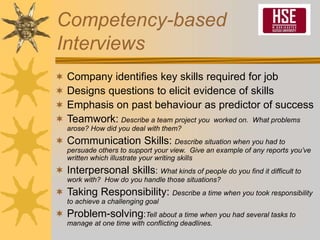
Competency-based
Interviews
 Company identifies key skills required for job
 Designs questions to elicit evidence of skills
 Emphasis on past behaviour as predictor of success
 Teamwork: Describe a team project you worked on. What problems
arose? How did you deal with them?
 Communication Skills: Describe situation when you had to
persuade others to support your view. Give an example of any reports you’ve
written which illustrate your writing skills
 Interpersonal skills: What kinds of people do you find it difficult to
work with? How do you handle those situations?
 Taking Responsibility: Describe a time when you took responsibility
to achieve a challenging goal
 Problem-solving:Tell about a time when you had several tasks to
manage at one time with conflicting deadlines.
Preparing for Competency Interview
Identify the competencies required for job
– Review job description or ask for information
Define each competency in behavioural terms
Identify past experience to illustrate how you
demonstrated that behaviour
Prepare examples for each competency
Practice talking about your experience
Try to give a complete answer - STAR
Responding to Competency Q
Q Give me an example of a problem you encountered.
How did you approach it. What was the outcome?
STAR response
– S: Describe the situation
– T: Explain the task/problem that arose
– A: What action did you take?
– R: What was the result or outcome?
– What did you learn from this experience?
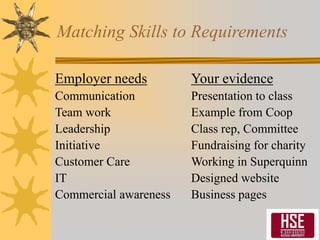
Matching Skills to Requirements
Employer needs
Communication
Team work
Leadership
Initiative
Customer Care
IT
Commercial awareness
Your evidence
Presentation to class
Example from Coop
Class rep, Committee
Fundraising for charity
Working in Superquinn
Designed website
Business pages
Your Answers
Listen carefully, seek clarification
Illustrate answers with real examples and
evidence
Be positive – constructive criticism
Keep answers specific
Take time to respond
Be alert to interviewer’s body language
Speak clearly, smile and show enthusiasm
Know what you want to say, and find the
opportunity
Qualities Employers Seek
Good all-round intelligence
Enthusiasm, commitment and motivation
Good communication skills
Team work ability
Ability to solve problems
Capacity to work hard
Initiative and self-reliance
Balanced personality
What creates a bad impression
Poor personal appearance
Negative attitude – evasive, using excuses
Lack of interest and enthusiasm
Lack of preparation
Poor knowledge of role
Failure to give concrete examples of skills
Over emphasis on money/rewards
Lack of career plan
After the Interview
Review own performance
what went well
what went badly
what you wished you had said
prepare for next stage
Invitation to second / final round interviews
assessment centre
psychometric testing
panel interview
Rejection letter / email
if you can request feedback - use it
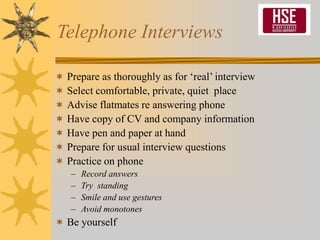
Telephone Interviews
 Prepare as thoroughly as for ‘real’ interview
 Select comfortable, private, quiet place
 Advise flatmates re answering phone
 Have copy of CV and company information
 Have pen and paper at hand
 Prepare for usual interview questions
 Practice on phone
– Record answers
– Try standing
– Smile and use gestures
– Avoid monotones
 Be yourself
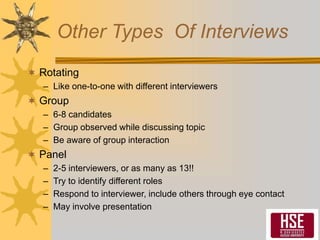
Other Types Of Interviews
 Rotating
– Like one-to-one with different interviewers
 Group
– 6-8 candidates
– Group observed while discussing topic
– Be aware of group interaction
 Panel
– 2-5 interviewers, or as many as 13!!
– Try to identify different roles
– Respond to interviewer, include others through eye contact
– May involve presentation
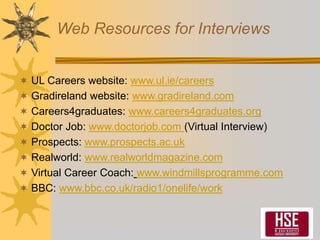
Web Resources for Interviews
 UL Careers website: www.ul.ie/careers
 Gradireland website: www.gradireland.com
 Careers4graduates: www.careers4graduates.org
 Doctor Job: www.doctorjob.com (Virtual Interview)
 Prospects: www.prospects.ac.uk
 Realworld: www.realworldmagazine.com
 Virtual Career Coach: www.windmillsprogramme.com
 BBC: www.bbc.co.uk/radio1/onelife/work

Successful Interview tips and suggestions .ppt

  • 1.
    Successful Interviews Making themost of the interview Business Communication Course Prepared by Kristina Limarenko
  • 2.
    Overview Preparing for interviews Theinterview experience Questions to expect and to ask Different types of interview
  • 3.
    Interviews  Interview =A meeting with an objective  Employer’s objective is to find the best person for the job – Employer: reviews candidate’s experience and abilities • Can you do the job? (skills, abilitie, qualifications) • Will you do the job? (interest, attitude & motivation) • How will you fit into the organisation? (personality)  You: impress employer and assess position on offer • What does this position offer me? • How does it fit with my career plans?  Congratulations - you have passed the first hurdle  You must prove that you are the most suitable candidate for this position
  • 4.
    Preparation is thekey to success – Review own skills, experiences and qualities • Check CV • Anticipate questions and identify relevant examples • Prepare key selling points – Research organisation • Websites, reports, articles, company literature, etc • Contacts with knowledge of organisation or sector • Relevant articles in the press • Personal visit or telephone call – Research job and occupational area • Job description – or similar • Current issues – Prepare your questions – Practice
  • 5.
    Watch the BodyLanguage First impressions very powerful – Halo effect or Devil effect Allow time to relax Dress appropriately Entrance, introductions & handshake Smile and make eye contact Be aware of own movements Watch body language of interviewer
  • 6.
    Typical Questions  Aboutyou – Tell me about yourself - Bring me up to date with your CV? – Why did you choose that particular degree programme? – What experience have you had that is relevant to this post? – What would you consider your major achievements to date?  About the job – What interests you about this job? – What do you know about this organisation? – What other options are you considering? – How do you see your career developing – 5 years? – If you were Head of Department, what would be your priorities?  General knowledge – What do you think of the Government’s policy on college fees? – What’s your opinion of the Ryanair bid for Aer Lingus?
  • 7.
    Other Type ofQuestions “What if” Questions – No experience - how are you likely to respond to a situation Probing Questions – How exactly did you deal with the situation? – How did you know it worked? – How did you feel about the outcome? – Could you have handled it differently?
  • 8.
    Competency-based Interviews  Company identifieskey skills required for job  Designs questions to elicit evidence of skills  Emphasis on past behaviour as predictor of success  Teamwork: Describe a team project you worked on. What problems arose? How did you deal with them?  Communication Skills: Describe situation when you had to persuade others to support your view. Give an example of any reports you’ve written which illustrate your writing skills  Interpersonal skills: What kinds of people do you find it difficult to work with? How do you handle those situations?  Taking Responsibility: Describe a time when you took responsibility to achieve a challenging goal  Problem-solving:Tell about a time when you had several tasks to manage at one time with conflicting deadlines.
  • 9.
    Preparing for CompetencyInterview Identify the competencies required for job – Review job description or ask for information Define each competency in behavioural terms Identify past experience to illustrate how you demonstrated that behaviour Prepare examples for each competency Practice talking about your experience Try to give a complete answer - STAR
  • 10.
    Responding to CompetencyQ Q Give me an example of a problem you encountered. How did you approach it. What was the outcome? STAR response – S: Describe the situation – T: Explain the task/problem that arose – A: What action did you take? – R: What was the result or outcome? – What did you learn from this experience?
  • 11.
    Matching Skills toRequirements Employer needs Communication Team work Leadership Initiative Customer Care IT Commercial awareness Your evidence Presentation to class Example from Coop Class rep, Committee Fundraising for charity Working in Superquinn Designed website Business pages
  • 12.
    Your Answers Listen carefully,seek clarification Illustrate answers with real examples and evidence Be positive – constructive criticism Keep answers specific Take time to respond Be alert to interviewer’s body language Speak clearly, smile and show enthusiasm Know what you want to say, and find the opportunity
  • 13.
    Qualities Employers Seek Goodall-round intelligence Enthusiasm, commitment and motivation Good communication skills Team work ability Ability to solve problems Capacity to work hard Initiative and self-reliance Balanced personality
  • 14.
    What creates abad impression Poor personal appearance Negative attitude – evasive, using excuses Lack of interest and enthusiasm Lack of preparation Poor knowledge of role Failure to give concrete examples of skills Over emphasis on money/rewards Lack of career plan
  • 15.
    After the Interview Reviewown performance what went well what went badly what you wished you had said prepare for next stage Invitation to second / final round interviews assessment centre psychometric testing panel interview Rejection letter / email if you can request feedback - use it
  • 16.
    Telephone Interviews  Prepareas thoroughly as for ‘real’ interview  Select comfortable, private, quiet place  Advise flatmates re answering phone  Have copy of CV and company information  Have pen and paper at hand  Prepare for usual interview questions  Practice on phone – Record answers – Try standing – Smile and use gestures – Avoid monotones  Be yourself
  • 17.
    Other Types OfInterviews  Rotating – Like one-to-one with different interviewers  Group – 6-8 candidates – Group observed while discussing topic – Be aware of group interaction  Panel – 2-5 interviewers, or as many as 13!! – Try to identify different roles – Respond to interviewer, include others through eye contact – May involve presentation
  • 18.
    Web Resources forInterviews  UL Careers website: www.ul.ie/careers  Gradireland website: www.gradireland.com  Careers4graduates: www.careers4graduates.org  Doctor Job: www.doctorjob.com (Virtual Interview)  Prospects: www.prospects.ac.uk  Realworld: www.realworldmagazine.com  Virtual Career Coach: www.windmillsprogramme.com  BBC: www.bbc.co.uk/radio1/onelife/work