Control and Performance Management- Management Concepts
CONTROL PROCESS
The control process is a vital aspect of management that enables organizations to ensure that
their activities are aligned with their goals and objectives. The control process is like a set of
checks and balances for organizations. It helps managers make sure everything is running
smoothly and according to plan. It involves setting goals, measuring progress, comparing
results to expectations, and making tweaks when necessary.
Defining Controlling in Management
In the realm of management, controlling is seen as a pivotal function. Its absence could
render the entire management process ineffective. With the control function in place,
management can accurately assess whether the plans are being executed as intended.
The primary goal of the control process is to ensure that activities within an organization
align with the plan. It assists managers in assessing the performance of their organizations.
Steps in Control Process in Management
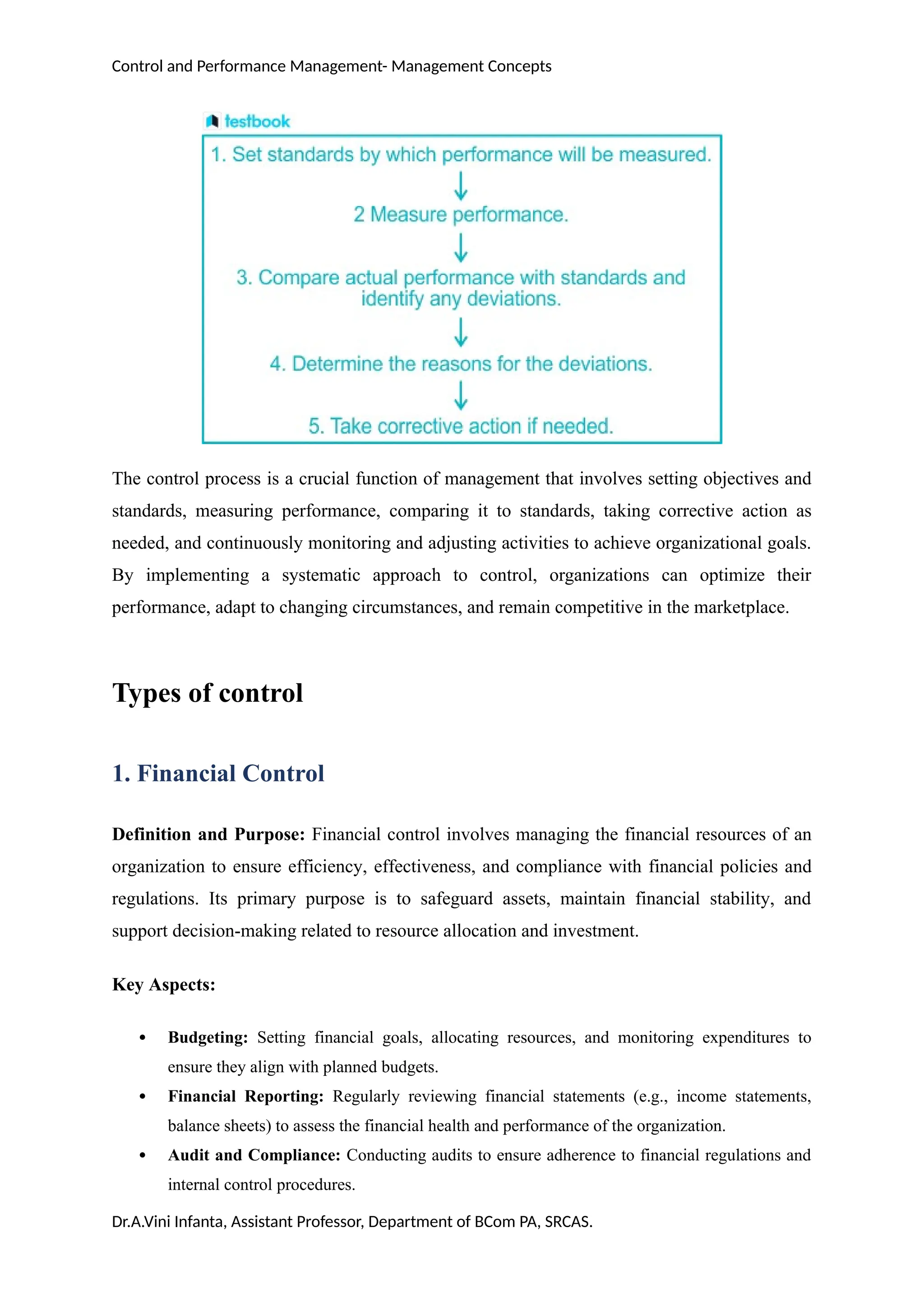
The control process is a fundamental aspect of management that involves setting standards,
measuring performance, comparing results to standards, and taking corrective action as
necessary to ensure organizational objectives are achieved. Here's a step-by-step guide to the
control process:
Establish Objectives and Standards: Establish Objectives and Standards is the first step in
the process of control is to establish clear objectives for the organization, department, team,
or individual. These objectives should be specific, measurable, achievable, relevant, and
time-bound (SMART). Along with objectives, standards or benchmarks must be set to gauge
performance against.
Measure Performance: Once objectives and standards are set, the next step is to measure
actual performance. This involves collecting data on various aspects of the organization's
operations, such as output, quality, costs, customer satisfaction, and employee performance.
Performance measurement can be quantitative (e.g., sales figures, production output)
or qualitative (e.g., customer feedback, employee evaluations).
Dr.A.Vini Infanta, Assistant Professor, Department of BCom PA, SRCAS.
Control and Performance Management- Management Concepts
Compare Performance to Standards: After measuring performance, the next step is to
compare the actual results to the established standards. This comparison helps identify any
discrepancies or deviations from the desired performance levels. If actual performance meets
or exceeds the standards, no further action may be needed. However, if there are significant
differences between actual performance and standards, it indicates a need for corrective
action.
Analyze Deviations: When discrepancies between actual performance and standards are
identified, the next step is to analyze the root causes of these deviations. This analysis may
involve examining internal and external factors that could be influencing performance, such
as changes in market conditions, technology, resources, processes, or employee behavior.
Understanding the causes of deviations is crucial for determining the appropriate corrective
actions.
Take Corrective Action: Based on the analysis of deviations, management must decide on
the appropriate corrective actions to address any performance gaps. These actions may
involve making changes to processes, reallocating resources, providing additional training or
support to employees, revising objectives or standards, or implementing new strategies. The
goal of corrective action is to bring actual performance back in line with established
standards and objectives.
Monitor and Adjust: The control process is not a one-time event but rather a continuous
cycle. After taking corrective action, it's essential to monitor performance closely to ensure
that the desired improvements are achieved and sustained over time. Regular monitoring
allows management to identify any new deviations or emerging issues promptly. If necessary,
adjustments to objectives, standards, or strategies may be made to maintain optimal
performance.
Feedback and Learning: Finally, the control process should incorporate mechanisms for
gathering feedback and learning from the outcomes of control activities. This feedback loop
helps organizations improve their performance management processes over time by
identifying what works well and what needs to be improved or refined. By continuously
learning and adapting, organizations can enhance their ability to achieve their objectives
effectively and efficiently.
Dr.A.Vini Infanta, Assistant Professor, Department of BCom PA, SRCAS.
Control and Performance Management- Management Concepts
The control process is a crucial function of management that involves setting objectives and
standards, measuring performance, comparing it to standards, taking corrective action as
needed, and continuously monitoring and adjusting activities to achieve organizational goals.
By implementing a systematic approach to control, organizations can optimize their
performance, adapt to changing circumstances, and remain competitive in the marketplace.
Types of control
1. Financial Control
Definition and Purpose: Financial control involves managing the financial resources of an
organization to ensure efficiency, effectiveness, and compliance with financial policies and
regulations. Its primary purpose is to safeguard assets, maintain financial stability, and
support decision-making related to resource allocation and investment.
Key Aspects:
 Budgeting: Setting financial goals, allocating resources, and monitoring expenditures to
ensure they align with planned budgets.
 Financial Reporting: Regularly reviewing financial statements (e.g., income statements,
balance sheets) to assess the financial health and performance of the organization.
 Audit and Compliance: Conducting audits to ensure adherence to financial regulations and
internal control procedures.
Dr.A.Vini Infanta, Assistant Professor, Department of BCom PA, SRCAS.
Control and Performance Management- Management Concepts
 Cost Control: Managing costs and expenses to optimize financial performance and
profitability.
Advantages:
 Risk Management: Helps in identifying and mitigating financial risks such as fraud,
misappropriation of funds, and financial mismanagement.
 Transparency and Accountability: Ensures transparency in financial operations
through regular financial reporting and audits, enhancing accountability to
stakeholders.
 Resource Optimization: Facilitates optimal allocation of financial resources,
budgeting, and cost control measures to improve profitability.
 Compliance: Ensures adherence to financial regulations and internal control
procedures, reducing legal and regulatory risks.
Disadvantages:
 Rigidity: Strict financial controls may sometimes hinder flexibility and innovation,
especially in rapidly changing environments.
 Costly: Implementing comprehensive financial controls, including audits and
compliance measures, can be resource-intensive.
 Complexity: Maintaining and managing financial controls requires specialized
knowledge and expertise, which may be challenging for smaller organizations.
Importance: Financial control provides stakeholders, including management, investors, and
regulators, with confidence in the organization's financial integrity. It helps in identifying
financial risks, preventing fraud, and ensuring transparency in financial operations.
2. Operational Control
Definition and Purpose: Operational control focuses on monitoring and managing day-to-
day operations and processes to ensure efficiency, effectiveness, and alignment with
organizational goals. It aims to optimize operational performance, minimize risks, and deliver
products or services consistently to meet customer expectations.
Dr.A.Vini Infanta, Assistant Professor, Department of BCom PA, SRCAS.
Control and Performance Management- Management Concepts
Key Aspects:
 Process Monitoring: Monitoring workflows, procedures, and operational metrics to identify
deviations and inefficiencies.
 Quality Control: Ensuring products or services meet established quality standards and
customer requirements.
 Inventory Control: Managing inventory levels to balance supply and demand and optimize
supply chain efficiency.
 Performance Management: Setting performance targets, measuring performance against
benchmarks, and implementing corrective actions as needed.
Advantages:
 Efficiency: Improves efficiency by identifying and eliminating operational
inefficiencies, reducing waste, and improving productivity.
 Quality Assurance: Ensures consistent product or service quality through rigorous
quality control measures and process improvements.
 Risk Mitigation: Helps in managing operational risks such as supply chain
disruptions, production delays, and service failures.
 Customer Satisfaction: Enhances customer satisfaction by ensuring timely delivery,
responsiveness, and adherence to quality standards.
Disadvantages:
 Bureaucracy: Overly stringent operational controls may lead to bureaucratic
processes and decision-making, slowing down responsiveness.
 Resistance to Change: Operational controls may resist changes or innovations that
could potentially improve processes but require flexibility.
 Operational Costs: Implementing and maintaining operational controls may incur
additional costs, impacting overall profitability.
 Complexity: Balancing operational controls with the need for agility and adaptation
in dynamic environments can be challenging.
Dr.A.Vini Infanta, Assistant Professor, Department of BCom PA, SRCAS.
Control and Performance Management- Management Concepts
Importance: Operational control helps in maintaining smooth operations, improving
productivity, and mitigating operational risks. It ensures that resources are utilized effectively
and that operational goals contribute to achieving broader organizational objectives.
3. Strategic Control
Definition and Purpose: Strategic control involves monitoring and evaluating the strategic
direction and long-term goals of the organization. It ensures that strategic plans are
implemented effectively, adapts to changes in the internal and external environment, and
achieves sustainable competitive advantage.
Key Aspects:
 Strategic Planning: Formulating and aligning strategic objectives, goals, and initiatives with
the organization's mission and vision.
 Performance Measurement: Evaluating performance against strategic objectives and key
performance indicators (KPIs).
 Environmental Monitoring: Assessing external factors (e.g., market trends, competitive
landscape, regulatory changes) that impact strategic goals.
 Adaptation and Adjustment: Making strategic adjustments and realignments in response to
changes in the business environment.
Advantages:
 Alignment: Ensures alignment of organizational activities with strategic objectives,
enhancing focus and clarity of purpose.
 Adaptability: Facilitates adaptation to changing market conditions, technological
advancements, and competitive pressures.
 Competitive Advantage: Helps in identifying and capitalizing on opportunities,
reducing threats, and maintaining a competitive edge.
 Long-term Sustainability: Promotes long-term sustainability and growth by guiding
resource allocation and investment decisions.
Disadvantages:
Dr.A.Vini Infanta, Assistant Professor, Department of BCom PA, SRCAS.
Control and Performance Management- Management Concepts
 Complexity: Strategic control involves managing complexities related to market
dynamics, competitive landscape, and organizational capabilities.
 Time-Consuming: Monitoring and evaluating strategic initiatives can be time-
consuming, requiring continuous assessment and adjustment.
 Resistance to Change: Strategic controls may face resistance from stakeholders
reluctant to deviate from established strategies or paradigms.
 Uncertainty: Adapting to unforeseen changes in the business environment may pose
challenges in maintaining strategic control effectiveness.
Importance: Strategic control ensures that the organization remains focused on its long-term
vision and objectives. It guides decision-making, resource allocation, and organizational
priorities to capitalize on opportunities and navigate challenges effectively.
Integration and Interdependence
These types of control are interconnected and mutually reinforcing within organizations:
 Financial Control supports Operational Control by ensuring financial resources are
managed efficiently to support daily operations.
 Operational Control ensures that day-to-day activities align with the strategic direction set
by Strategic Control.
 Strategic Control guides the development of operational plans and financial strategies to
achieve long-term organizational goals.
Benefits and Challenges
 Benefits: Improved decision-making, enhanced efficiency, risk management, and alignment
with organizational goals.
 Challenges: Balancing control with flexibility, adapting to rapid changes, and ensuring
integration across different types of control.
By effectively implementing and integrating financial, operational, and strategic control,
organizations can optimize performance, manage risks, and achieve sustainable growth. Each type of
control plays a critical role in ensuring organizational success by providing frameworks for
Dr.A.Vini Infanta, Assistant Professor, Department of BCom PA, SRCAS.
Control and Performance Management- Management Concepts
monitoring, evaluating, and adjusting activities to achieve desired outcomes in a dynamic and
competitive business environment.
PERFORMANCE MEASUREMENT AND EVALUATION
Performance measurement and evaluation are critical processes within organizations aimed at
assessing the effectiveness, efficiency, and outcomes of various activities, processes, and
initiatives. These processes provide valuable insights into whether organizational goals are
being achieved and help identify areas for improvement and optimization.
Performance Measurement
Definition: Performance measurement involves quantifying and assessing the results or
outcomes of organizational activities against predetermined goals, objectives, or standards. It
focuses on capturing data and metrics that reflect performance in different areas of the
organization.
Key Aspects:
 Metrics and Indicators: Establishing specific metrics and key performance
indicators (KPIs) relevant to each area of the organization (e.g., sales, production,
customer service).
 Data Collection: Gathering data systematically through various sources, such as
financial reports, operational records, customer feedback, and employee evaluations.
 Benchmarking: Comparing current performance metrics against historical data,
industry standards, or competitor benchmarks to gauge performance levels.
 Regular Monitoring: Continuously tracking and updating performance metrics to
reflect changes and trends over time.
Purpose:
 Accountability: Holding individuals, teams, and departments accountable for
achieving their objectives and contributing to organizational success.
 Decision-Making: Providing data-driven insights to support strategic decision-
making and resource allocation.
Dr.A.Vini Infanta, Assistant Professor, Department of BCom PA, SRCAS.
Control and Performance Management- Management Concepts
 Continuous Improvement: Identifying areas of strength and weakness to drive
continuous improvement initiatives.
 Communication: Facilitating transparent communication and alignment of goals
across the organization.
Performance Evaluation
Definition: Performance evaluation involves the systematic assessment and analysis of
performance data and information to draw conclusions about the effectiveness and efficiency
of organizational activities, processes, and strategies.
Key Aspects:
 Analysis and Interpretation: Examining performance metrics and data to identify
trends, patterns, correlations, and deviations.
 Root Cause Analysis: Investigating underlying factors contributing to performance
outcomes, whether positive or negative.
 Feedback and Reporting: Providing feedback to stakeholders, including
management, employees, and external partners, on performance outcomes and
implications.
 Action Planning: Developing action plans and recommendations based on evaluation
findings to address areas needing improvement or capitalize on strengths.
Purpose:
 Performance Improvement: Guiding efforts to improve organizational efficiency,
effectiveness, and competitiveness.
 Strategic Alignment: Assessing the alignment of organizational activities with
strategic goals and priorities.
 Accountability and Recognition: Recognizing high performers and addressing
performance issues through constructive feedback and interventions.
 Learning and Development: Informing learning and development initiatives to
enhance individual and organizational capabilities.
Dr.A.Vini Infanta, Assistant Professor, Department of BCom PA, SRCAS.
Control and Performance Management- Management Concepts
Importance of Performance Measurement and Evaluation
 Goal Achievement: Ensuring that organizational goals and objectives are met
efficiently and effectively.
 Accountability: Holding stakeholders accountable for their contributions and
responsibilities.
 Resource Optimization: Allocating resources (e.g., budget, personnel, time) based
on performance priorities and needs.
 Continuous Improvement: Driving ongoing improvements in processes, products,
services, and overall organizational performance.
 Decision Support: Providing data-driven insights to support strategic decision-
making and planning.
Challenges of Performance Measurement and Evaluation
 Data Quality: Ensuring the accuracy, reliability, and relevance of performance data.
 Complexity: Managing the complexity of measuring and evaluating multifaceted
organizational activities and outcomes.
 Subjectivity: Addressing biases and subjectivity in interpreting performance data and
evaluation outcomes.
 Resistance to Change: Overcoming resistance to feedback and recommendations for
improvement.
Best Practices for Effective Performance Measurement and Evaluation
 Clear Objectives: Aligning performance metrics with organizational goals and
objectives.
 Data Integrity: Ensuring accurate and reliable data collection and analysis methods.
 Regular Reviews: Conducting periodic reviews and updates of performance metrics
and evaluation criteria.
 Stakeholder Engagement: Involving stakeholders in the process to enhance buy-in
and accountability.
 Continuous Improvement: Using findings from evaluations to drive ongoing
improvements and innovations.
Dr.A.Vini Infanta, Assistant Professor, Department of BCom PA, SRCAS.
Control and Performance Management- Management Concepts
Advantages of Performance Measurement and Evaluation
1. Strategic Alignment: Helps align organizational activities and initiatives with
strategic goals and objectives, ensuring that resources are allocated effectively to
achieve desired outcomes.
2. Accountability: Establishes accountability by clearly defining roles, responsibilities,
and performance expectations for individuals, teams, and departments within the
organization.
3. Decision-Making: Provides data-driven insights that support informed decision-
making at all levels of the organization, from operational to strategic decisions.
4. Continuous Improvement: Facilitates ongoing improvement by identifying areas of
strength and opportunities for enhancement, leading to enhanced efficiency and
effectiveness.
5. Performance Recognition: Recognizes and rewards high-performing individuals and
teams, motivating employees and fostering a culture of excellence.
6. Transparency: Promotes transparency within the organization by making
performance data accessible to stakeholders, fostering trust and alignment.
7. Benchmarking: Allows for benchmarking against industry standards, best practices,
or competitors, providing a basis for comparison and setting realistic performance
targets.
8. Resource Optimization: Optimizes resource allocation by directing investments and
efforts towards activities that deliver the greatest value and impact.
Disadvantages of Performance Measurement and Evaluation
1. Complexity: Implementing and managing performance measurement systems can be
complex and resource-intensive, requiring dedicated time, effort, and expertise.
2. Data Quality: Ensuring the accuracy, reliability, and relevance of performance data
can be challenging, particularly when data collection methods or systems are not
robust.
3. Subjectivity: Interpreting performance data and evaluation outcomes may be
subjective, influenced by biases, perspectives, or interpretations of stakeholders.
4. Resistance to Feedback: Employees or teams may resist performance feedback or
evaluations, especially if they perceive them as punitive rather than constructive.
Dr.A.Vini Infanta, Assistant Professor, Department of BCom PA, SRCAS.
Control and Performance Management- Management Concepts
5. Overemphasis on Metrics: Overreliance on metrics or KPIs may lead to a narrow
focus on quantitative outcomes, potentially overlooking qualitative aspects of
performance or unintended consequences.
6. Short-term Focus: Performance measurements may prioritize short-term gains over
long-term strategic objectives, potentially neglecting investments in innovation or
sustainability.
7. Unintended Consequences: Misaligned incentives or performance metrics could
inadvertently encourage behaviors that undermine collaboration, innovation, or ethical
conduct.
8. Costs and Resources: Developing, implementing, and maintaining performance
measurement and evaluation systems can incur costs in terms of technology, training,
and personnel.
Mitigating Challenges and Enhancing Effectiveness
 Clear Objectives: Ensure performance metrics are aligned with organizational goals
and objectives to maintain focus and relevance.
 Data Integrity: Implement robust data collection and validation processes to enhance
the accuracy and reliability of performance data.
 Stakeholder Engagement: Involve stakeholders in the design and implementation of
performance measurement systems to enhance buy-in and ownership.
 Balanced Approach: Balance quantitative metrics with qualitative assessments and
contextual understanding to provide a comprehensive view of performance.
 Continuous Review: Regularly review and update performance metrics and
evaluation criteria to adapt to changing organizational priorities and external factors.
BALANCED SCORECARD (BSC) APPROACH
The Balanced Scorecard (BSC) approach in management is a strategic performance
management framework that helps organizations translate their vision and strategy into
actionable objectives and measures. It was developed by Robert Kaplan and David Norton in
the early 1990s and has since become a widely used tool to align business activities with
Dr.A.Vini Infanta, Assistant Professor, Department of BCom PA, SRCAS.
Control and Performance Management- Management Concepts
strategic goals and monitor performance across key areas. Here’s a detailed exploration of the
Balanced Scorecard approach in management:
Objectives of the Balanced Scorecard Approach
1. Strategic Alignment:
o The primary objective of the Balanced Scorecard is to align organizational
activities with the strategic goals and vision of the organization. It ensures that
all levels of the organization understand and work towards common
objectives.
o By linking strategic objectives with performance measures, the Balanced
Scorecard helps clarify priorities and ensures that resources are allocated
effectively to achieve desired outcomes.
2. Performance Measurement:
o It serves as a comprehensive performance measurement system that goes
beyond traditional financial metrics. The Balanced Scorecard includes both
financial and non-financial measures across multiple perspectives (financial,
customer, internal processes, and learning & growth).
o This holistic approach provides a balanced view of organizational
performance, enabling managers to assess performance from various angles
and make informed decisions.
3. Strategy Execution:
o Facilitates strategy execution by translating high-level strategic goals into
specific objectives, initiatives, and performance indicators that can be
monitored and managed over time.
o By creating a cause-and-effect relationship between strategic objectives and
operational activities, the Balanced Scorecard helps ensure that day-to-day
actions contribute to long-term strategic success.
Components of the Balanced Scorecard
The Balanced Scorecard typically includes four interconnected perspectives, each focusing
on different aspects of organizational performance:
Dr.A.Vini Infanta, Assistant Professor, Department of BCom PA, SRCAS.
Control and Performance Management- Management Concepts
1. Financial Perspective:
o Measures financial outcomes that are critical to achieving the organization's
strategic objectives, such as revenue growth, profitability, ROI, and cost
management.
2. Customer Perspective:
o Focuses on customer-related metrics that indicate how the organization is
perceived by its customers, including customer satisfaction, retention, market
share, and customer loyalty.
3. Internal Processes Perspective:
o Evaluates the efficiency and effectiveness of internal processes and operations
that drive customer satisfaction and financial performance. Key metrics may
include process cycle times, quality levels, and operational excellence.
4. Learning & Growth Perspective:
o Assesses the organization's ability to innovate, learn, and grow to support
long-term success. Metrics often include employee satisfaction, skills
development, organizational culture, and innovation capabilities.
Implementation of the Balanced Scorecard
Successful implementation of the Balanced Scorecard requires careful planning, collaboration
across functions, and commitment from leadership. Key steps include:
 Strategic Planning: Aligning the Balanced Scorecard objectives with the
organization's overall strategic plan and goals.
 Performance Measures: Defining clear and measurable performance indicators
(KPIs) for each perspective that reflect strategic priorities and desired outcomes.
 Strategy Mapping: Developing a strategy map that visually represents the cause-and-
effect relationships between objectives across perspectives.
 Communication and Alignment: Ensuring that all stakeholders understand their
roles in achieving Balanced Scorecard objectives and aligning their efforts
accordingly.
Dr.A.Vini Infanta, Assistant Professor, Department of BCom PA, SRCAS.
Control and Performance Management- Management Concepts
Advantages of the Balanced Scorecard Approach
 Comprehensive View: Provides a balanced view of organizational performance by
considering financial and non-financial measures across multiple perspectives.
 Alignment: Ensures alignment of activities and resources with strategic priorities,
fostering a unified organizational focus.
 Performance Improvement: Facilitates continuous improvement by identifying
areas of strength and opportunities for enhancement across different aspects of the
organization.
 Decision Support: Provides data-driven insights that support informed decision-
making at all levels of the organization.
Challenges of the Balanced Scorecard Approach
 Complexity: Implementing and managing a Balanced Scorecard system can be
complex, requiring significant time, resources, and expertise.
 Measurement Difficulties: Identifying and defining relevant performance metrics
and ensuring data accuracy can be challenging.
 Resistance to Change: Stakeholders may resist adopting new performance
measurement frameworks, especially if they perceive them as additional bureaucracy.
 Overemphasis on Metrics: There is a risk of focusing too much on achieving
numerical targets at the expense of broader strategic objectives and qualitative aspects
of performance.
The Balanced Scorecard approach is a valuable tool for modern management, offering a
structured framework to align organizational activities with strategic goals, monitor
performance comprehensively, and drive continuous improvement. While it presents
challenges in implementation and management, the benefits of enhanced strategic alignment,
improved decision-making, and organizational focus make it a preferred method for many
organizations striving for sustainable success in a competitive environment.
Dr.A.Vini Infanta, Assistant Professor, Department of BCom PA, SRCAS.
Control and Performance Management- Management Concepts
QUALITY MANAGEMENT AND CONTINUOUS IMPROVEMENT
Quality management is an important component of a successful business that helps ensure
companies produce services and products consistently and effectively. Quality management
has several key components: planning, control, assurance and improvement. Understanding
this process can help you ensure that a company operates at a certain production standard to
maintain high quality for its customers.
Quality management
Quality management, or managing for quality, is a process that companies implement to
ensure they complete all their tasks and production operations to ensure a certain level of
excellence. Quality management often relates to the actual product production process, but
this strategy is important for any area in which the company directly impacts or affects
consumers. It ensures a company is achieving and maintaining a set level of quality that
customers can expect every time they shop with that business.
7 principles of quality management
1. Customer focus
It's important to prioritize customers as much as possible during the quality management
process. Meeting and exceeding customers' expectations often results in happier customers,
leading to increased revenue and higher customer retention rates. The more a company knows
its customers' needs, the better it can create products and services that meet them.
2. Leadership
Another primary principle of successful quality control is strong leadership. Leaders who
engage and motivate their employees to contribute to the company's goals may experience
better quality management results. Effective leadership can also create a more efficient
workplace and improve the quality of the company's products.
Dr.A.Vini Infanta, Assistant Professor, Department of BCom PA, SRCAS.
Control and Performance Management- Management Concepts
3. Engagement of people
Being able to engage employees effectively is an important component of quality
management. The more engaged employees are, the more likely they will be motivated to
contribute to higher quality standards. They may also be more willing to improve their skills
continuously, stay consistent in their work and remain motivated when performing their
tasks.
4. Process approach
The process approach principle of quality management emphasizes effectiveness and
efficiency regarding the company's processes. Strong processes support improved
performance, reduced cost and waste and steady improvement. Some processes can help
companies improve the quality of production, operations, marketing, accounting and
distribution.
5. Continuous improvement
Another important aspect of successful quality management is a commitment to continuous
improvement. When creating your quality management system, make room for regular
improvement, including analyzing what's working and what's not and making changes. The
more committed you are to continuous improvement, the better your overall quality
management may be.
6. Evidence-based decision-making
Companies can use an evidence-based approach when formulating their quality management
plan. This involves gathering and analyzing both qualitative and quantitative data when
developing plans. The evidence can include previous and current data on the company's
quality management systems regarding whether the current systems achieve the desired
results and how past decisions have impacted quality control.
7. Relationship management
Different parties can significantly influence an organization's performance and quality
management efforts. Primary parties that can impact quality management include retailers,
Dr.A.Vini Infanta, Assistant Professor, Department of BCom PA, SRCAS.
Control and Performance Management- Management Concepts
suppliers and manufacturers. Strong relationships with these parties ensure open
communication and the company's goals are being met.
Components of quality management
Quality planning
The initial step in creating a solid quality management system is the planning process.
Effective planning enables accurate monitoring, evaluation, and continuous product and
service quality improvement. Companies that take time to determine what they want their
baseline quality to be and what procedures they want to implement often find greater success
in meeting their goals.
Things to consider in this part of the quality management process include:
 How the organization defines success. This means establishing key performance
indicators (KPIs) to track the organization's goals and processes.
 How often the organization analyzes procedures and processes for improvement
 If the stakeholders have any priorities, expectations or specific goals in terms of
quality
 If there are any legal processes or standards for obtaining the level of quality the
company wants to implement
 If there are any industry-specific standards or certification requirements, like those
required for medical devices or aerospace equipment
Quality control
Once you've created a quality control plan, you can begin inspecting and testing the plan you
formed to ensure it's viable. Try to look for any errors or issues related to the quality
standards in place and correct them as soon as possible. Quality control helps ensure that
products or services meet the needs of consumers, which can improve customer satisfaction.
Quality assurance
Quality assurance is the process of assessing the delivery of goods or services. Quality
assurance typically occurs where the company creates the goods or services so that you can
identify any errors or issues before they get to the customer. This stage of quality
management also allows you to identify any areas of improvement that can help the
Dr.A.Vini Infanta, Assistant Professor, Department of BCom PA, SRCAS.
Control and Performance Management- Management Concepts
production process run more smoothly.A company should complete quality assurance
regularly, preferably with every product or service produced. Some companies use third
parties for quality assurance to ensure no emotional or financial bias.
Quality review
The quality review step is an opportunity for management to systematically evaluate the data
from quality assurance efforts and use the information to make informed decisions about
changes to the production process. By conducting a thorough quality review, management
can make well-informed decisions about adjustments to their production process, establishing
a foundation for continuous improvement.
During the quality review, management teams:
 analyze the quality assurance data
 identify areas for improvement
 evaluate the effectiveness of current processes
 gather feedback from stakeholders
 develop an action plan
Quality improvement
The quality improvement component of quality management is your opportunity to fine-tune
your system and methods and make changes to improve your overall quality management.
During this step, analyze all data collected in the previous steps and note any areas that need
improvement. Each cycle of production should ultimately be better than the last.
Benefits of quality management
There are several reasons why quality management is an important component of a successful
business. Here are some of its benefits:
 Ensures high-quality services and products
 Supports overall customer satisfaction
 Increases revenue and customer retention rates
 Improves productivity within the organization
Dr.A.Vini Infanta, Assistant Professor, Department of BCom PA, SRCAS.
Control and Performance Management- Management Concepts
BENCHMARKING DEFINITION
Benchmarking is the continuous process of comparing one’s business processes and
performance metrics to industry bests and/or best practices from other industries. Dimensions
typically measured are quality, time, and cost. Improvements from learning mean doing
things better, faster, and cheaper.
Approaches to Benchmarking
METHODS
1. Internal Benchmarking: Comparison of one internal operation to another internal
operation.
2. Competitive Benchmarking: Direct comparison to a competitor in the same or related
industry.
3. Functional Benchmarking: Comparison of similar or identical functions across many
different industries.
4. Generic Benchmarking: Comparing generic business processes across a wide cross-
section of industries.
Approaches to Benchmarking
FORMS
Ø “Results”—comparative performance within and between organizations
(efficiency/effectiveness)
Ø “Process”—analysis of activities and tasks that turn resources inputs into outputs and
outcomes
Ø “Best-Practice Standards”—take the form of goals and benchmarks to which orgs aspire,
as part of planning and continuous improvement
Dr.A.Vini Infanta, Assistant Professor, Department of BCom PA, SRCAS.
Control and Performance Management- Management Concepts
What is a Best Practice?
Ø It must demonstrate through evidence that it yields a “better, faster, cheaper” result.
Ø It must successfully demonstrate that it is a superior approach in more than one setting.
Ø It must be able to prove it can help achieve organizational objectives.
ETHICAL CONSIDERATIONS IN CONTROL AND
PERFORMANCE MANAGEMENT
ethics in performance management is about adhering to a set of moral principles and values
that serve as a compass for evaluating and enhancing employee performance. This ethical
foundation guides how organizations conduct performance assessments and underscores the
significance of doing so in a transparent, unbiased, and respectful manner.
Ethical performance management upholds the dignity and rights of every individual within
the organization. It recognizes that each employee is a unique contributor, deserving of fair
and equitable treatment throughout the evaluation process. This means that ethical
performance management is not solely focused on quantitative outcomes or metrics but
encompasses a broader perspective.
An ethically sound performance management system acknowledges that performance
evaluations have far-reaching implications beyond just numerical scores. It delves deeper,
Dr.A.Vini Infanta, Assistant Professor, Department of BCom PA, SRCAS.
Control and Performance Management- Management Concepts
considering the broader impact of these evaluations on the well-being of employees and the
organization’s overall culture. It seeks to foster an environment where employees feel valued,
motivated, and treated fairly and respectfully.
The Role of Ethics in Performance Management
Ethics plays a pivotal role in shaping how performance management approach functions.
Here’s how ethics influences various aspects of performance evaluation:
1. Fairness and Equity
Ethical performance management is rooted in the principles of fairness and equity. This
means that every employee should be treated without bias or favoritism during the evaluation
process.
It ensures that no individual faces discrimination based on gender, age, ethnicity, or personal
relationships. Instead, evaluations are based solely on an employee’s merit and performance.
2. Transparency
Transparency is a cornerstone of ethical performance management. It involves open and
transparent communication between employees and management regarding performance
expectations, evaluation criteria, and the consequences tied to performance outcomes.
When organizations are transparent in their communication about performance, employees
develop trust in the process. They understand what is expected of them, how they will be
assessed, and the potential outcomes of their performance.
3. Employee Development
Ethical performance management prioritizes the development and growth of employees. It’s
not solely about rating past performance; it’s also about identifying areas where employees
can improve and providing them with the support and resources to do so.
Constructive feedback is a key component of ethical performance management. Rather than
focusing solely on past mistakes, it encourages a forward-looking approach that helps
employees reach their full potential.
4. Accountability
Dr.A.Vini Infanta, Assistant Professor, Department of BCom PA, SRCAS.
Control and Performance Management- Management Concepts
Ethical evaluations hold both employees and managers accountable for their roles in
the performance management process. This accountability fosters a sense of responsibility
and commitment to the organization’s mission and values.
Employees are held accountable for meeting performance expectations and striving for
continuous improvement. Managers are responsible for conducting evaluations fairly and
providing the necessary guidance and resources for employee development.
5. Privacy and Confidentiality
Respecting employees’ privacy and maintaining the confidentiality of their performance-
related information are critical ethical considerations.
This means that performance data and feedback are handled with care and discretion.
Information is only shared with individuals who have a legitimate need to know and is not
used for personal or unauthorized purposes.
All in all, ethics in performance management is the ethical foundation upon which the entire
performance evaluation process rests. It ensures that evaluations are conducted fairly,
transparently, and focused on employee development and accountability while respecting
privacy and confidentiality. When organizations embrace these ethical principles, they create
an environment where employees can thrive, trust is built, and performance management
catalyzes growth and success.
Ethical Issues and Dilemmas in Performance Management
Navigating the landscape of performance management ethics often presents challenges. Some
common ethical issues include:
1. Bias and Discrimination
One of the most significant ethical challenges in performance management is the presence of
bias and discrimination. This occurs when unconscious or even conscious prejudices affect
how employees are evaluated. It can result in unfair treatment based on gender, age, ethnicity,
or other personal characteristics.
Dr.A.Vini Infanta, Assistant Professor, Department of BCom PA, SRCAS.
Control and Performance Management- Management Concepts
For example, if a manager unconsciously favors employees who share their background or
interests, it can lead to biased evaluations where deserving individuals are overlooked, and
others receive undue advantages.
Ethical performance management strives to identify and eliminate evaluation bias to ensure
fair and equitable employee treatment.
2. Subjectivity
Subjectivity refers to using personal opinions and judgments rather than objective criteria in
performance evaluations. When evaluations rely heavily on subjective assessments, they can
become inconsistent and unjust.
For instance, if a manager evaluates an employee’s performance primarily based on their
personal rapport or feelings toward that individual, it can lead to varying assessments for
similar performance levels.
Ethical performance management aims to minimize subjectivity by establishing clear,
objective criteria and evaluation processes, ensuring that reviews are fair and consistent
across the board.
3. Goal Distortion
Goal distortion occurs when organizations set unrealistic performance goals for employees.
When these goals are unattainable, it can create ethical dilemmas.
Employees may resort to unethical behavior, such as falsifying data or cutting corners, to
meet these unrealistic targets. This compromises the integrity of the performance
management process and can lead to adverse consequences for the organization and its
employees.
Ethical performance management sets realistic and achievable goals that challenge employees
to excel without pushing them to engage in unethical practices.
4. Lack of Feedback
Failure to provide timely and constructive feedback is another ethical concern in performance
management. With feedback, employees can understand their strengths and weaknesses and
make improvements. This lack of communication can lead to frustration, decreased morale,
and hindered professional growth.
Dr.A.Vini Infanta, Assistant Professor, Department of BCom PA, SRCAS.
Control and Performance Management- Management Concepts
Ethical performance management emphasizes the importance of regular and meaningful
feedback, ensuring that employees receive the guidance and support needed for their
development.
5. Misuse of Information
Improper use of performance data is a critical ethical issue. When performance data is used
for personal vendettas or to settle scores, it violates ethical standards.
For instance, if a manager uses an employee’s performance data to target or unfairly
undermine that individual, it damages the employee’s reputation and erodes trust within the
organization.
Ethical performance management insists on using performance data solely to evaluate and
improve employee performance while maintaining confidentiality and respect for individuals.
Navigating Ethical Performance Management
To ensure ethical performance management, organizations can adopt several strategies:
1. Establish Clear Performance Criteria and Transparent Communication
Organizations should set clear and well-defined performance criteria that outline the
expectations and standards for employees’ job performance. These criteria should be
communicated transparently to all employees.
Transparency in expectations ensures that employees understand expectations, reducing
confusion and ambiguity in the evaluation process.
2. Provide Training on Bias Recognition and Mitigation
Organizations can offer managers training programs to combat biases that can seep into
performance evaluations. These programs should focus on recognizing and addressing
unconscious biases during the evaluation process.
Bias recognition and mitigation training help managers make more objective and fair
assessments, reducing the risk of unfair treatment based on factors like gender, age, or
ethnicity.
3. Implement 360-Degree Feedback
Dr.A.Vini Infanta, Assistant Professor, Department of BCom PA, SRCAS.
Control and Performance Management- Management Concepts
360-degree feedback is a comprehensive evaluation approach that gathers input from multiple
sources, including peers, subordinates, and supervisors. This method provides a well-rounded
perspective on an employee’s performance.
Implementing 360-degree feedback helps counteract subjectivity and ensures that evaluations
are based on a broader set of perspectives, making them more reliable and ethical.
4. Encourage Open Dialogue between Employees and Managers
Open communication is a cornerstone of ethical performance management. Organizations
should encourage a culture of openness where employees feel comfortable discussing their
career aspirations, concerns, and challenges with their managers.
Regular dialogue between employees and managers promotes understanding, trust, and
alignment of goals. It also allows for the identification and resolution of performance-related
issues in a timely and constructive manner.
5. Regularly Review and Refine the Performance Evaluation Process
Ethical standards in performance management evolve over time. Therefore, organizations
should regularly review and refine their performance evaluation processes to align with
changing ethical standards.
This ongoing review ensures that the evaluation process remains fair, relevant, and free from
practices that could compromise ethics.
Ethical performance management requires a proactive approach to continuous improvement.
By implementing these strategies, organizations can navigate the complex landscape of
performance management while upholding ethical standards and fostering a workplace
culture of fairness, trust, and growth.
Dr.A.Vini Infanta, Assistant Professor, Department of BCom PA, SRCAS.

CONTROL AND PERFORMANCE MANAGEMENT DOCUMENT

  • 1.
    Control and PerformanceManagement- Management Concepts CONTROL PROCESS The control process is a vital aspect of management that enables organizations to ensure that their activities are aligned with their goals and objectives. The control process is like a set of checks and balances for organizations. It helps managers make sure everything is running smoothly and according to plan. It involves setting goals, measuring progress, comparing results to expectations, and making tweaks when necessary. Defining Controlling in Management In the realm of management, controlling is seen as a pivotal function. Its absence could render the entire management process ineffective. With the control function in place, management can accurately assess whether the plans are being executed as intended. The primary goal of the control process is to ensure that activities within an organization align with the plan. It assists managers in assessing the performance of their organizations. Steps in Control Process in Management The control process is a fundamental aspect of management that involves setting standards, measuring performance, comparing results to standards, and taking corrective action as necessary to ensure organizational objectives are achieved. Here's a step-by-step guide to the control process: Establish Objectives and Standards: Establish Objectives and Standards is the first step in the process of control is to establish clear objectives for the organization, department, team, or individual. These objectives should be specific, measurable, achievable, relevant, and time-bound (SMART). Along with objectives, standards or benchmarks must be set to gauge performance against. Measure Performance: Once objectives and standards are set, the next step is to measure actual performance. This involves collecting data on various aspects of the organization's operations, such as output, quality, costs, customer satisfaction, and employee performance. Performance measurement can be quantitative (e.g., sales figures, production output) or qualitative (e.g., customer feedback, employee evaluations). Dr.A.Vini Infanta, Assistant Professor, Department of BCom PA, SRCAS.
  • 2.
    Control and PerformanceManagement- Management Concepts Compare Performance to Standards: After measuring performance, the next step is to compare the actual results to the established standards. This comparison helps identify any discrepancies or deviations from the desired performance levels. If actual performance meets or exceeds the standards, no further action may be needed. However, if there are significant differences between actual performance and standards, it indicates a need for corrective action. Analyze Deviations: When discrepancies between actual performance and standards are identified, the next step is to analyze the root causes of these deviations. This analysis may involve examining internal and external factors that could be influencing performance, such as changes in market conditions, technology, resources, processes, or employee behavior. Understanding the causes of deviations is crucial for determining the appropriate corrective actions. Take Corrective Action: Based on the analysis of deviations, management must decide on the appropriate corrective actions to address any performance gaps. These actions may involve making changes to processes, reallocating resources, providing additional training or support to employees, revising objectives or standards, or implementing new strategies. The goal of corrective action is to bring actual performance back in line with established standards and objectives. Monitor and Adjust: The control process is not a one-time event but rather a continuous cycle. After taking corrective action, it's essential to monitor performance closely to ensure that the desired improvements are achieved and sustained over time. Regular monitoring allows management to identify any new deviations or emerging issues promptly. If necessary, adjustments to objectives, standards, or strategies may be made to maintain optimal performance. Feedback and Learning: Finally, the control process should incorporate mechanisms for gathering feedback and learning from the outcomes of control activities. This feedback loop helps organizations improve their performance management processes over time by identifying what works well and what needs to be improved or refined. By continuously learning and adapting, organizations can enhance their ability to achieve their objectives effectively and efficiently. Dr.A.Vini Infanta, Assistant Professor, Department of BCom PA, SRCAS.
  • 3.
    Control and PerformanceManagement- Management Concepts The control process is a crucial function of management that involves setting objectives and standards, measuring performance, comparing it to standards, taking corrective action as needed, and continuously monitoring and adjusting activities to achieve organizational goals. By implementing a systematic approach to control, organizations can optimize their performance, adapt to changing circumstances, and remain competitive in the marketplace. Types of control 1. Financial Control Definition and Purpose: Financial control involves managing the financial resources of an organization to ensure efficiency, effectiveness, and compliance with financial policies and regulations. Its primary purpose is to safeguard assets, maintain financial stability, and support decision-making related to resource allocation and investment. Key Aspects:  Budgeting: Setting financial goals, allocating resources, and monitoring expenditures to ensure they align with planned budgets.  Financial Reporting: Regularly reviewing financial statements (e.g., income statements, balance sheets) to assess the financial health and performance of the organization.  Audit and Compliance: Conducting audits to ensure adherence to financial regulations and internal control procedures. Dr.A.Vini Infanta, Assistant Professor, Department of BCom PA, SRCAS.
  • 4.
    Control and PerformanceManagement- Management Concepts  Cost Control: Managing costs and expenses to optimize financial performance and profitability. Advantages:  Risk Management: Helps in identifying and mitigating financial risks such as fraud, misappropriation of funds, and financial mismanagement.  Transparency and Accountability: Ensures transparency in financial operations through regular financial reporting and audits, enhancing accountability to stakeholders.  Resource Optimization: Facilitates optimal allocation of financial resources, budgeting, and cost control measures to improve profitability.  Compliance: Ensures adherence to financial regulations and internal control procedures, reducing legal and regulatory risks. Disadvantages:  Rigidity: Strict financial controls may sometimes hinder flexibility and innovation, especially in rapidly changing environments.  Costly: Implementing comprehensive financial controls, including audits and compliance measures, can be resource-intensive.  Complexity: Maintaining and managing financial controls requires specialized knowledge and expertise, which may be challenging for smaller organizations. Importance: Financial control provides stakeholders, including management, investors, and regulators, with confidence in the organization's financial integrity. It helps in identifying financial risks, preventing fraud, and ensuring transparency in financial operations. 2. Operational Control Definition and Purpose: Operational control focuses on monitoring and managing day-to- day operations and processes to ensure efficiency, effectiveness, and alignment with organizational goals. It aims to optimize operational performance, minimize risks, and deliver products or services consistently to meet customer expectations. Dr.A.Vini Infanta, Assistant Professor, Department of BCom PA, SRCAS.
  • 5.
    Control and PerformanceManagement- Management Concepts Key Aspects:  Process Monitoring: Monitoring workflows, procedures, and operational metrics to identify deviations and inefficiencies.  Quality Control: Ensuring products or services meet established quality standards and customer requirements.  Inventory Control: Managing inventory levels to balance supply and demand and optimize supply chain efficiency.  Performance Management: Setting performance targets, measuring performance against benchmarks, and implementing corrective actions as needed. Advantages:  Efficiency: Improves efficiency by identifying and eliminating operational inefficiencies, reducing waste, and improving productivity.  Quality Assurance: Ensures consistent product or service quality through rigorous quality control measures and process improvements.  Risk Mitigation: Helps in managing operational risks such as supply chain disruptions, production delays, and service failures.  Customer Satisfaction: Enhances customer satisfaction by ensuring timely delivery, responsiveness, and adherence to quality standards. Disadvantages:  Bureaucracy: Overly stringent operational controls may lead to bureaucratic processes and decision-making, slowing down responsiveness.  Resistance to Change: Operational controls may resist changes or innovations that could potentially improve processes but require flexibility.  Operational Costs: Implementing and maintaining operational controls may incur additional costs, impacting overall profitability.  Complexity: Balancing operational controls with the need for agility and adaptation in dynamic environments can be challenging. Dr.A.Vini Infanta, Assistant Professor, Department of BCom PA, SRCAS.
  • 6.
    Control and PerformanceManagement- Management Concepts Importance: Operational control helps in maintaining smooth operations, improving productivity, and mitigating operational risks. It ensures that resources are utilized effectively and that operational goals contribute to achieving broader organizational objectives. 3. Strategic Control Definition and Purpose: Strategic control involves monitoring and evaluating the strategic direction and long-term goals of the organization. It ensures that strategic plans are implemented effectively, adapts to changes in the internal and external environment, and achieves sustainable competitive advantage. Key Aspects:  Strategic Planning: Formulating and aligning strategic objectives, goals, and initiatives with the organization's mission and vision.  Performance Measurement: Evaluating performance against strategic objectives and key performance indicators (KPIs).  Environmental Monitoring: Assessing external factors (e.g., market trends, competitive landscape, regulatory changes) that impact strategic goals.  Adaptation and Adjustment: Making strategic adjustments and realignments in response to changes in the business environment. Advantages:  Alignment: Ensures alignment of organizational activities with strategic objectives, enhancing focus and clarity of purpose.  Adaptability: Facilitates adaptation to changing market conditions, technological advancements, and competitive pressures.  Competitive Advantage: Helps in identifying and capitalizing on opportunities, reducing threats, and maintaining a competitive edge.  Long-term Sustainability: Promotes long-term sustainability and growth by guiding resource allocation and investment decisions. Disadvantages: Dr.A.Vini Infanta, Assistant Professor, Department of BCom PA, SRCAS.
  • 7.
    Control and PerformanceManagement- Management Concepts  Complexity: Strategic control involves managing complexities related to market dynamics, competitive landscape, and organizational capabilities.  Time-Consuming: Monitoring and evaluating strategic initiatives can be time- consuming, requiring continuous assessment and adjustment.  Resistance to Change: Strategic controls may face resistance from stakeholders reluctant to deviate from established strategies or paradigms.  Uncertainty: Adapting to unforeseen changes in the business environment may pose challenges in maintaining strategic control effectiveness. Importance: Strategic control ensures that the organization remains focused on its long-term vision and objectives. It guides decision-making, resource allocation, and organizational priorities to capitalize on opportunities and navigate challenges effectively. Integration and Interdependence These types of control are interconnected and mutually reinforcing within organizations:  Financial Control supports Operational Control by ensuring financial resources are managed efficiently to support daily operations.  Operational Control ensures that day-to-day activities align with the strategic direction set by Strategic Control.  Strategic Control guides the development of operational plans and financial strategies to achieve long-term organizational goals. Benefits and Challenges  Benefits: Improved decision-making, enhanced efficiency, risk management, and alignment with organizational goals.  Challenges: Balancing control with flexibility, adapting to rapid changes, and ensuring integration across different types of control. By effectively implementing and integrating financial, operational, and strategic control, organizations can optimize performance, manage risks, and achieve sustainable growth. Each type of control plays a critical role in ensuring organizational success by providing frameworks for Dr.A.Vini Infanta, Assistant Professor, Department of BCom PA, SRCAS.
  • 8.
    Control and PerformanceManagement- Management Concepts monitoring, evaluating, and adjusting activities to achieve desired outcomes in a dynamic and competitive business environment. PERFORMANCE MEASUREMENT AND EVALUATION Performance measurement and evaluation are critical processes within organizations aimed at assessing the effectiveness, efficiency, and outcomes of various activities, processes, and initiatives. These processes provide valuable insights into whether organizational goals are being achieved and help identify areas for improvement and optimization. Performance Measurement Definition: Performance measurement involves quantifying and assessing the results or outcomes of organizational activities against predetermined goals, objectives, or standards. It focuses on capturing data and metrics that reflect performance in different areas of the organization. Key Aspects:  Metrics and Indicators: Establishing specific metrics and key performance indicators (KPIs) relevant to each area of the organization (e.g., sales, production, customer service).  Data Collection: Gathering data systematically through various sources, such as financial reports, operational records, customer feedback, and employee evaluations.  Benchmarking: Comparing current performance metrics against historical data, industry standards, or competitor benchmarks to gauge performance levels.  Regular Monitoring: Continuously tracking and updating performance metrics to reflect changes and trends over time. Purpose:  Accountability: Holding individuals, teams, and departments accountable for achieving their objectives and contributing to organizational success.  Decision-Making: Providing data-driven insights to support strategic decision- making and resource allocation. Dr.A.Vini Infanta, Assistant Professor, Department of BCom PA, SRCAS.
  • 9.
    Control and PerformanceManagement- Management Concepts  Continuous Improvement: Identifying areas of strength and weakness to drive continuous improvement initiatives.  Communication: Facilitating transparent communication and alignment of goals across the organization. Performance Evaluation Definition: Performance evaluation involves the systematic assessment and analysis of performance data and information to draw conclusions about the effectiveness and efficiency of organizational activities, processes, and strategies. Key Aspects:  Analysis and Interpretation: Examining performance metrics and data to identify trends, patterns, correlations, and deviations.  Root Cause Analysis: Investigating underlying factors contributing to performance outcomes, whether positive or negative.  Feedback and Reporting: Providing feedback to stakeholders, including management, employees, and external partners, on performance outcomes and implications.  Action Planning: Developing action plans and recommendations based on evaluation findings to address areas needing improvement or capitalize on strengths. Purpose:  Performance Improvement: Guiding efforts to improve organizational efficiency, effectiveness, and competitiveness.  Strategic Alignment: Assessing the alignment of organizational activities with strategic goals and priorities.  Accountability and Recognition: Recognizing high performers and addressing performance issues through constructive feedback and interventions.  Learning and Development: Informing learning and development initiatives to enhance individual and organizational capabilities. Dr.A.Vini Infanta, Assistant Professor, Department of BCom PA, SRCAS.
  • 10.
    Control and PerformanceManagement- Management Concepts Importance of Performance Measurement and Evaluation  Goal Achievement: Ensuring that organizational goals and objectives are met efficiently and effectively.  Accountability: Holding stakeholders accountable for their contributions and responsibilities.  Resource Optimization: Allocating resources (e.g., budget, personnel, time) based on performance priorities and needs.  Continuous Improvement: Driving ongoing improvements in processes, products, services, and overall organizational performance.  Decision Support: Providing data-driven insights to support strategic decision- making and planning. Challenges of Performance Measurement and Evaluation  Data Quality: Ensuring the accuracy, reliability, and relevance of performance data.  Complexity: Managing the complexity of measuring and evaluating multifaceted organizational activities and outcomes.  Subjectivity: Addressing biases and subjectivity in interpreting performance data and evaluation outcomes.  Resistance to Change: Overcoming resistance to feedback and recommendations for improvement. Best Practices for Effective Performance Measurement and Evaluation  Clear Objectives: Aligning performance metrics with organizational goals and objectives.  Data Integrity: Ensuring accurate and reliable data collection and analysis methods.  Regular Reviews: Conducting periodic reviews and updates of performance metrics and evaluation criteria.  Stakeholder Engagement: Involving stakeholders in the process to enhance buy-in and accountability.  Continuous Improvement: Using findings from evaluations to drive ongoing improvements and innovations. Dr.A.Vini Infanta, Assistant Professor, Department of BCom PA, SRCAS.
  • 11.
    Control and PerformanceManagement- Management Concepts Advantages of Performance Measurement and Evaluation 1. Strategic Alignment: Helps align organizational activities and initiatives with strategic goals and objectives, ensuring that resources are allocated effectively to achieve desired outcomes. 2. Accountability: Establishes accountability by clearly defining roles, responsibilities, and performance expectations for individuals, teams, and departments within the organization. 3. Decision-Making: Provides data-driven insights that support informed decision- making at all levels of the organization, from operational to strategic decisions. 4. Continuous Improvement: Facilitates ongoing improvement by identifying areas of strength and opportunities for enhancement, leading to enhanced efficiency and effectiveness. 5. Performance Recognition: Recognizes and rewards high-performing individuals and teams, motivating employees and fostering a culture of excellence. 6. Transparency: Promotes transparency within the organization by making performance data accessible to stakeholders, fostering trust and alignment. 7. Benchmarking: Allows for benchmarking against industry standards, best practices, or competitors, providing a basis for comparison and setting realistic performance targets. 8. Resource Optimization: Optimizes resource allocation by directing investments and efforts towards activities that deliver the greatest value and impact. Disadvantages of Performance Measurement and Evaluation 1. Complexity: Implementing and managing performance measurement systems can be complex and resource-intensive, requiring dedicated time, effort, and expertise. 2. Data Quality: Ensuring the accuracy, reliability, and relevance of performance data can be challenging, particularly when data collection methods or systems are not robust. 3. Subjectivity: Interpreting performance data and evaluation outcomes may be subjective, influenced by biases, perspectives, or interpretations of stakeholders. 4. Resistance to Feedback: Employees or teams may resist performance feedback or evaluations, especially if they perceive them as punitive rather than constructive. Dr.A.Vini Infanta, Assistant Professor, Department of BCom PA, SRCAS.
  • 12.
    Control and PerformanceManagement- Management Concepts 5. Overemphasis on Metrics: Overreliance on metrics or KPIs may lead to a narrow focus on quantitative outcomes, potentially overlooking qualitative aspects of performance or unintended consequences. 6. Short-term Focus: Performance measurements may prioritize short-term gains over long-term strategic objectives, potentially neglecting investments in innovation or sustainability. 7. Unintended Consequences: Misaligned incentives or performance metrics could inadvertently encourage behaviors that undermine collaboration, innovation, or ethical conduct. 8. Costs and Resources: Developing, implementing, and maintaining performance measurement and evaluation systems can incur costs in terms of technology, training, and personnel. Mitigating Challenges and Enhancing Effectiveness  Clear Objectives: Ensure performance metrics are aligned with organizational goals and objectives to maintain focus and relevance.  Data Integrity: Implement robust data collection and validation processes to enhance the accuracy and reliability of performance data.  Stakeholder Engagement: Involve stakeholders in the design and implementation of performance measurement systems to enhance buy-in and ownership.  Balanced Approach: Balance quantitative metrics with qualitative assessments and contextual understanding to provide a comprehensive view of performance.  Continuous Review: Regularly review and update performance metrics and evaluation criteria to adapt to changing organizational priorities and external factors. BALANCED SCORECARD (BSC) APPROACH The Balanced Scorecard (BSC) approach in management is a strategic performance management framework that helps organizations translate their vision and strategy into actionable objectives and measures. It was developed by Robert Kaplan and David Norton in the early 1990s and has since become a widely used tool to align business activities with Dr.A.Vini Infanta, Assistant Professor, Department of BCom PA, SRCAS.
  • 13.
    Control and PerformanceManagement- Management Concepts strategic goals and monitor performance across key areas. Here’s a detailed exploration of the Balanced Scorecard approach in management: Objectives of the Balanced Scorecard Approach 1. Strategic Alignment: o The primary objective of the Balanced Scorecard is to align organizational activities with the strategic goals and vision of the organization. It ensures that all levels of the organization understand and work towards common objectives. o By linking strategic objectives with performance measures, the Balanced Scorecard helps clarify priorities and ensures that resources are allocated effectively to achieve desired outcomes. 2. Performance Measurement: o It serves as a comprehensive performance measurement system that goes beyond traditional financial metrics. The Balanced Scorecard includes both financial and non-financial measures across multiple perspectives (financial, customer, internal processes, and learning & growth). o This holistic approach provides a balanced view of organizational performance, enabling managers to assess performance from various angles and make informed decisions. 3. Strategy Execution: o Facilitates strategy execution by translating high-level strategic goals into specific objectives, initiatives, and performance indicators that can be monitored and managed over time. o By creating a cause-and-effect relationship between strategic objectives and operational activities, the Balanced Scorecard helps ensure that day-to-day actions contribute to long-term strategic success. Components of the Balanced Scorecard The Balanced Scorecard typically includes four interconnected perspectives, each focusing on different aspects of organizational performance: Dr.A.Vini Infanta, Assistant Professor, Department of BCom PA, SRCAS.
  • 14.
    Control and PerformanceManagement- Management Concepts 1. Financial Perspective: o Measures financial outcomes that are critical to achieving the organization's strategic objectives, such as revenue growth, profitability, ROI, and cost management. 2. Customer Perspective: o Focuses on customer-related metrics that indicate how the organization is perceived by its customers, including customer satisfaction, retention, market share, and customer loyalty. 3. Internal Processes Perspective: o Evaluates the efficiency and effectiveness of internal processes and operations that drive customer satisfaction and financial performance. Key metrics may include process cycle times, quality levels, and operational excellence. 4. Learning & Growth Perspective: o Assesses the organization's ability to innovate, learn, and grow to support long-term success. Metrics often include employee satisfaction, skills development, organizational culture, and innovation capabilities. Implementation of the Balanced Scorecard Successful implementation of the Balanced Scorecard requires careful planning, collaboration across functions, and commitment from leadership. Key steps include:  Strategic Planning: Aligning the Balanced Scorecard objectives with the organization's overall strategic plan and goals.  Performance Measures: Defining clear and measurable performance indicators (KPIs) for each perspective that reflect strategic priorities and desired outcomes.  Strategy Mapping: Developing a strategy map that visually represents the cause-and- effect relationships between objectives across perspectives.  Communication and Alignment: Ensuring that all stakeholders understand their roles in achieving Balanced Scorecard objectives and aligning their efforts accordingly. Dr.A.Vini Infanta, Assistant Professor, Department of BCom PA, SRCAS.
  • 15.
    Control and PerformanceManagement- Management Concepts Advantages of the Balanced Scorecard Approach  Comprehensive View: Provides a balanced view of organizational performance by considering financial and non-financial measures across multiple perspectives.  Alignment: Ensures alignment of activities and resources with strategic priorities, fostering a unified organizational focus.  Performance Improvement: Facilitates continuous improvement by identifying areas of strength and opportunities for enhancement across different aspects of the organization.  Decision Support: Provides data-driven insights that support informed decision- making at all levels of the organization. Challenges of the Balanced Scorecard Approach  Complexity: Implementing and managing a Balanced Scorecard system can be complex, requiring significant time, resources, and expertise.  Measurement Difficulties: Identifying and defining relevant performance metrics and ensuring data accuracy can be challenging.  Resistance to Change: Stakeholders may resist adopting new performance measurement frameworks, especially if they perceive them as additional bureaucracy.  Overemphasis on Metrics: There is a risk of focusing too much on achieving numerical targets at the expense of broader strategic objectives and qualitative aspects of performance. The Balanced Scorecard approach is a valuable tool for modern management, offering a structured framework to align organizational activities with strategic goals, monitor performance comprehensively, and drive continuous improvement. While it presents challenges in implementation and management, the benefits of enhanced strategic alignment, improved decision-making, and organizational focus make it a preferred method for many organizations striving for sustainable success in a competitive environment. Dr.A.Vini Infanta, Assistant Professor, Department of BCom PA, SRCAS.
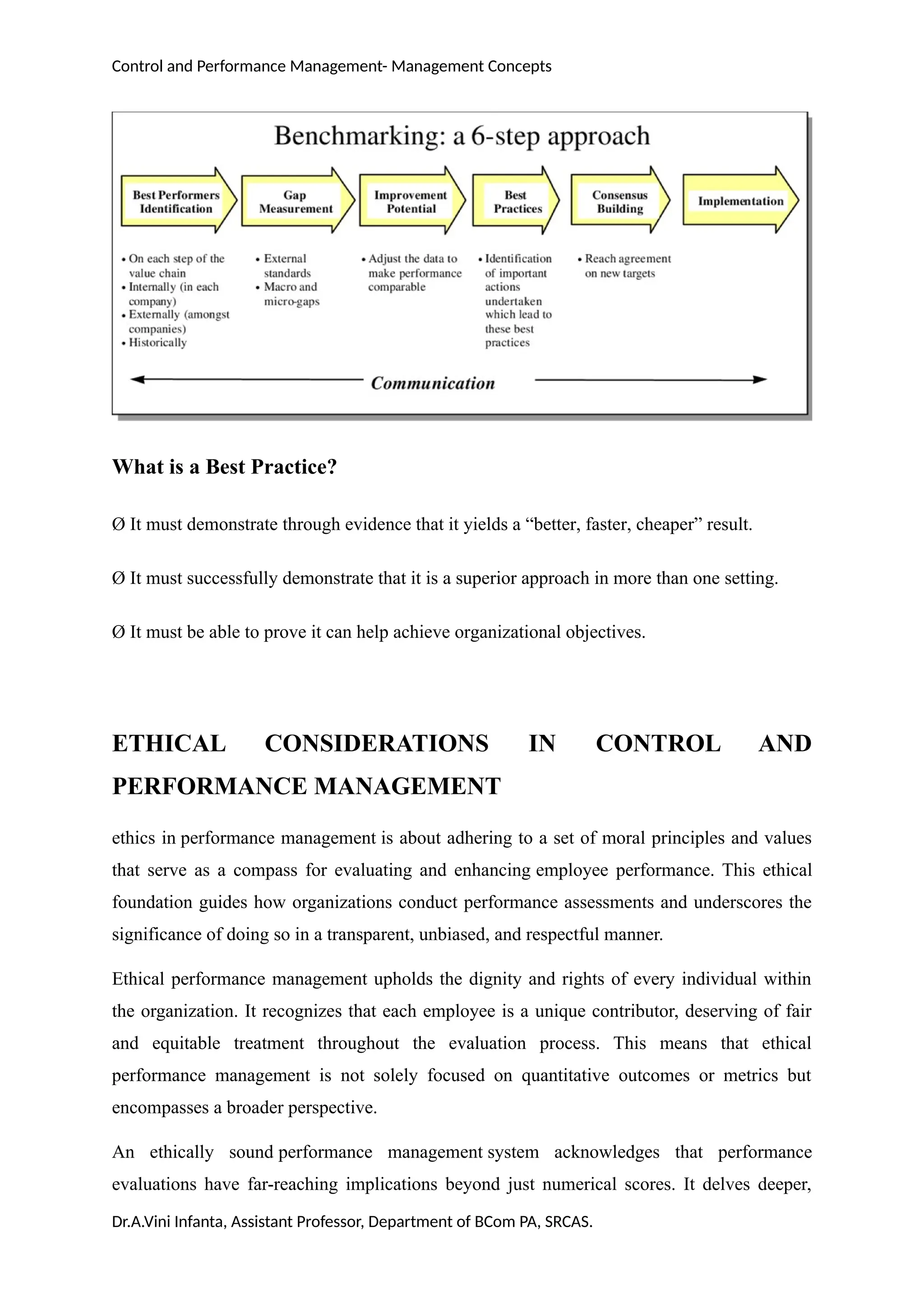
  • 16.
    Control and PerformanceManagement- Management Concepts QUALITY MANAGEMENT AND CONTINUOUS IMPROVEMENT Quality management is an important component of a successful business that helps ensure companies produce services and products consistently and effectively. Quality management has several key components: planning, control, assurance and improvement. Understanding this process can help you ensure that a company operates at a certain production standard to maintain high quality for its customers. Quality management Quality management, or managing for quality, is a process that companies implement to ensure they complete all their tasks and production operations to ensure a certain level of excellence. Quality management often relates to the actual product production process, but this strategy is important for any area in which the company directly impacts or affects consumers. It ensures a company is achieving and maintaining a set level of quality that customers can expect every time they shop with that business. 7 principles of quality management 1. Customer focus It's important to prioritize customers as much as possible during the quality management process. Meeting and exceeding customers' expectations often results in happier customers, leading to increased revenue and higher customer retention rates. The more a company knows its customers' needs, the better it can create products and services that meet them. 2. Leadership Another primary principle of successful quality control is strong leadership. Leaders who engage and motivate their employees to contribute to the company's goals may experience better quality management results. Effective leadership can also create a more efficient workplace and improve the quality of the company's products. Dr.A.Vini Infanta, Assistant Professor, Department of BCom PA, SRCAS.
  • 17.
    Control and PerformanceManagement- Management Concepts 3. Engagement of people Being able to engage employees effectively is an important component of quality management. The more engaged employees are, the more likely they will be motivated to contribute to higher quality standards. They may also be more willing to improve their skills continuously, stay consistent in their work and remain motivated when performing their tasks. 4. Process approach The process approach principle of quality management emphasizes effectiveness and efficiency regarding the company's processes. Strong processes support improved performance, reduced cost and waste and steady improvement. Some processes can help companies improve the quality of production, operations, marketing, accounting and distribution. 5. Continuous improvement Another important aspect of successful quality management is a commitment to continuous improvement. When creating your quality management system, make room for regular improvement, including analyzing what's working and what's not and making changes. The more committed you are to continuous improvement, the better your overall quality management may be. 6. Evidence-based decision-making Companies can use an evidence-based approach when formulating their quality management plan. This involves gathering and analyzing both qualitative and quantitative data when developing plans. The evidence can include previous and current data on the company's quality management systems regarding whether the current systems achieve the desired results and how past decisions have impacted quality control. 7. Relationship management Different parties can significantly influence an organization's performance and quality management efforts. Primary parties that can impact quality management include retailers, Dr.A.Vini Infanta, Assistant Professor, Department of BCom PA, SRCAS.
  • 18.
    Control and PerformanceManagement- Management Concepts suppliers and manufacturers. Strong relationships with these parties ensure open communication and the company's goals are being met. Components of quality management Quality planning The initial step in creating a solid quality management system is the planning process. Effective planning enables accurate monitoring, evaluation, and continuous product and service quality improvement. Companies that take time to determine what they want their baseline quality to be and what procedures they want to implement often find greater success in meeting their goals. Things to consider in this part of the quality management process include:  How the organization defines success. This means establishing key performance indicators (KPIs) to track the organization's goals and processes.  How often the organization analyzes procedures and processes for improvement  If the stakeholders have any priorities, expectations or specific goals in terms of quality  If there are any legal processes or standards for obtaining the level of quality the company wants to implement  If there are any industry-specific standards or certification requirements, like those required for medical devices or aerospace equipment Quality control Once you've created a quality control plan, you can begin inspecting and testing the plan you formed to ensure it's viable. Try to look for any errors or issues related to the quality standards in place and correct them as soon as possible. Quality control helps ensure that products or services meet the needs of consumers, which can improve customer satisfaction. Quality assurance Quality assurance is the process of assessing the delivery of goods or services. Quality assurance typically occurs where the company creates the goods or services so that you can identify any errors or issues before they get to the customer. This stage of quality management also allows you to identify any areas of improvement that can help the Dr.A.Vini Infanta, Assistant Professor, Department of BCom PA, SRCAS.
  • 19.
    Control and PerformanceManagement- Management Concepts production process run more smoothly.A company should complete quality assurance regularly, preferably with every product or service produced. Some companies use third parties for quality assurance to ensure no emotional or financial bias. Quality review The quality review step is an opportunity for management to systematically evaluate the data from quality assurance efforts and use the information to make informed decisions about changes to the production process. By conducting a thorough quality review, management can make well-informed decisions about adjustments to their production process, establishing a foundation for continuous improvement. During the quality review, management teams:  analyze the quality assurance data  identify areas for improvement  evaluate the effectiveness of current processes  gather feedback from stakeholders  develop an action plan Quality improvement The quality improvement component of quality management is your opportunity to fine-tune your system and methods and make changes to improve your overall quality management. During this step, analyze all data collected in the previous steps and note any areas that need improvement. Each cycle of production should ultimately be better than the last. Benefits of quality management There are several reasons why quality management is an important component of a successful business. Here are some of its benefits:  Ensures high-quality services and products  Supports overall customer satisfaction  Increases revenue and customer retention rates  Improves productivity within the organization Dr.A.Vini Infanta, Assistant Professor, Department of BCom PA, SRCAS.
  • 20.
    Control and PerformanceManagement- Management Concepts BENCHMARKING DEFINITION Benchmarking is the continuous process of comparing one’s business processes and performance metrics to industry bests and/or best practices from other industries. Dimensions typically measured are quality, time, and cost. Improvements from learning mean doing things better, faster, and cheaper. Approaches to Benchmarking METHODS 1. Internal Benchmarking: Comparison of one internal operation to another internal operation. 2. Competitive Benchmarking: Direct comparison to a competitor in the same or related industry. 3. Functional Benchmarking: Comparison of similar or identical functions across many different industries. 4. Generic Benchmarking: Comparing generic business processes across a wide cross- section of industries. Approaches to Benchmarking FORMS Ø “Results”—comparative performance within and between organizations (efficiency/effectiveness) Ø “Process”—analysis of activities and tasks that turn resources inputs into outputs and outcomes Ø “Best-Practice Standards”—take the form of goals and benchmarks to which orgs aspire, as part of planning and continuous improvement Dr.A.Vini Infanta, Assistant Professor, Department of BCom PA, SRCAS.
  • 21.
    Control and PerformanceManagement- Management Concepts What is a Best Practice? Ø It must demonstrate through evidence that it yields a “better, faster, cheaper” result. Ø It must successfully demonstrate that it is a superior approach in more than one setting. Ø It must be able to prove it can help achieve organizational objectives. ETHICAL CONSIDERATIONS IN CONTROL AND PERFORMANCE MANAGEMENT ethics in performance management is about adhering to a set of moral principles and values that serve as a compass for evaluating and enhancing employee performance. This ethical foundation guides how organizations conduct performance assessments and underscores the significance of doing so in a transparent, unbiased, and respectful manner. Ethical performance management upholds the dignity and rights of every individual within the organization. It recognizes that each employee is a unique contributor, deserving of fair and equitable treatment throughout the evaluation process. This means that ethical performance management is not solely focused on quantitative outcomes or metrics but encompasses a broader perspective. An ethically sound performance management system acknowledges that performance evaluations have far-reaching implications beyond just numerical scores. It delves deeper, Dr.A.Vini Infanta, Assistant Professor, Department of BCom PA, SRCAS.
  • 22.
    Control and PerformanceManagement- Management Concepts considering the broader impact of these evaluations on the well-being of employees and the organization’s overall culture. It seeks to foster an environment where employees feel valued, motivated, and treated fairly and respectfully. The Role of Ethics in Performance Management Ethics plays a pivotal role in shaping how performance management approach functions. Here’s how ethics influences various aspects of performance evaluation: 1. Fairness and Equity Ethical performance management is rooted in the principles of fairness and equity. This means that every employee should be treated without bias or favoritism during the evaluation process. It ensures that no individual faces discrimination based on gender, age, ethnicity, or personal relationships. Instead, evaluations are based solely on an employee’s merit and performance. 2. Transparency Transparency is a cornerstone of ethical performance management. It involves open and transparent communication between employees and management regarding performance expectations, evaluation criteria, and the consequences tied to performance outcomes. When organizations are transparent in their communication about performance, employees develop trust in the process. They understand what is expected of them, how they will be assessed, and the potential outcomes of their performance. 3. Employee Development Ethical performance management prioritizes the development and growth of employees. It’s not solely about rating past performance; it’s also about identifying areas where employees can improve and providing them with the support and resources to do so. Constructive feedback is a key component of ethical performance management. Rather than focusing solely on past mistakes, it encourages a forward-looking approach that helps employees reach their full potential. 4. Accountability Dr.A.Vini Infanta, Assistant Professor, Department of BCom PA, SRCAS.
  • 23.
    Control and PerformanceManagement- Management Concepts Ethical evaluations hold both employees and managers accountable for their roles in the performance management process. This accountability fosters a sense of responsibility and commitment to the organization’s mission and values. Employees are held accountable for meeting performance expectations and striving for continuous improvement. Managers are responsible for conducting evaluations fairly and providing the necessary guidance and resources for employee development. 5. Privacy and Confidentiality Respecting employees’ privacy and maintaining the confidentiality of their performance- related information are critical ethical considerations. This means that performance data and feedback are handled with care and discretion. Information is only shared with individuals who have a legitimate need to know and is not used for personal or unauthorized purposes. All in all, ethics in performance management is the ethical foundation upon which the entire performance evaluation process rests. It ensures that evaluations are conducted fairly, transparently, and focused on employee development and accountability while respecting privacy and confidentiality. When organizations embrace these ethical principles, they create an environment where employees can thrive, trust is built, and performance management catalyzes growth and success. Ethical Issues and Dilemmas in Performance Management Navigating the landscape of performance management ethics often presents challenges. Some common ethical issues include: 1. Bias and Discrimination One of the most significant ethical challenges in performance management is the presence of bias and discrimination. This occurs when unconscious or even conscious prejudices affect how employees are evaluated. It can result in unfair treatment based on gender, age, ethnicity, or other personal characteristics. Dr.A.Vini Infanta, Assistant Professor, Department of BCom PA, SRCAS.
  • 24.
    Control and PerformanceManagement- Management Concepts For example, if a manager unconsciously favors employees who share their background or interests, it can lead to biased evaluations where deserving individuals are overlooked, and others receive undue advantages. Ethical performance management strives to identify and eliminate evaluation bias to ensure fair and equitable employee treatment. 2. Subjectivity Subjectivity refers to using personal opinions and judgments rather than objective criteria in performance evaluations. When evaluations rely heavily on subjective assessments, they can become inconsistent and unjust. For instance, if a manager evaluates an employee’s performance primarily based on their personal rapport or feelings toward that individual, it can lead to varying assessments for similar performance levels. Ethical performance management aims to minimize subjectivity by establishing clear, objective criteria and evaluation processes, ensuring that reviews are fair and consistent across the board. 3. Goal Distortion Goal distortion occurs when organizations set unrealistic performance goals for employees. When these goals are unattainable, it can create ethical dilemmas. Employees may resort to unethical behavior, such as falsifying data or cutting corners, to meet these unrealistic targets. This compromises the integrity of the performance management process and can lead to adverse consequences for the organization and its employees. Ethical performance management sets realistic and achievable goals that challenge employees to excel without pushing them to engage in unethical practices. 4. Lack of Feedback Failure to provide timely and constructive feedback is another ethical concern in performance management. With feedback, employees can understand their strengths and weaknesses and make improvements. This lack of communication can lead to frustration, decreased morale, and hindered professional growth. Dr.A.Vini Infanta, Assistant Professor, Department of BCom PA, SRCAS.
  • 25.
    Control and PerformanceManagement- Management Concepts Ethical performance management emphasizes the importance of regular and meaningful feedback, ensuring that employees receive the guidance and support needed for their development. 5. Misuse of Information Improper use of performance data is a critical ethical issue. When performance data is used for personal vendettas or to settle scores, it violates ethical standards. For instance, if a manager uses an employee’s performance data to target or unfairly undermine that individual, it damages the employee’s reputation and erodes trust within the organization. Ethical performance management insists on using performance data solely to evaluate and improve employee performance while maintaining confidentiality and respect for individuals. Navigating Ethical Performance Management To ensure ethical performance management, organizations can adopt several strategies: 1. Establish Clear Performance Criteria and Transparent Communication Organizations should set clear and well-defined performance criteria that outline the expectations and standards for employees’ job performance. These criteria should be communicated transparently to all employees. Transparency in expectations ensures that employees understand expectations, reducing confusion and ambiguity in the evaluation process. 2. Provide Training on Bias Recognition and Mitigation Organizations can offer managers training programs to combat biases that can seep into performance evaluations. These programs should focus on recognizing and addressing unconscious biases during the evaluation process. Bias recognition and mitigation training help managers make more objective and fair assessments, reducing the risk of unfair treatment based on factors like gender, age, or ethnicity. 3. Implement 360-Degree Feedback Dr.A.Vini Infanta, Assistant Professor, Department of BCom PA, SRCAS.
  • 26.
    Control and PerformanceManagement- Management Concepts 360-degree feedback is a comprehensive evaluation approach that gathers input from multiple sources, including peers, subordinates, and supervisors. This method provides a well-rounded perspective on an employee’s performance. Implementing 360-degree feedback helps counteract subjectivity and ensures that evaluations are based on a broader set of perspectives, making them more reliable and ethical. 4. Encourage Open Dialogue between Employees and Managers Open communication is a cornerstone of ethical performance management. Organizations should encourage a culture of openness where employees feel comfortable discussing their career aspirations, concerns, and challenges with their managers. Regular dialogue between employees and managers promotes understanding, trust, and alignment of goals. It also allows for the identification and resolution of performance-related issues in a timely and constructive manner. 5. Regularly Review and Refine the Performance Evaluation Process Ethical standards in performance management evolve over time. Therefore, organizations should regularly review and refine their performance evaluation processes to align with changing ethical standards. This ongoing review ensures that the evaluation process remains fair, relevant, and free from practices that could compromise ethics. Ethical performance management requires a proactive approach to continuous improvement. By implementing these strategies, organizations can navigate the complex landscape of performance management while upholding ethical standards and fostering a workplace culture of fairness, trust, and growth. Dr.A.Vini Infanta, Assistant Professor, Department of BCom PA, SRCAS.