Continuous Wave and Pulsed
Wave
Dr Zoshia Ali Zaidi
PG Radiology
CMH Jhelum
Continuous
wavesystem
 CW's are from technical point of view the simplest
Doppler devices. They use two crystals (lenses) as
transducers - one constantly transmits ultrasound
waves (usually 2 to 16 MHz in diagnostic ultrasound),
the second crystal receives signal which reflects from
singular erythrocytes. Furthermore, the angle between
transducers is very obtuse, so overlapping of the
transmitted and received beams happens in relatively
big area (several centimetres, depends on the probe).
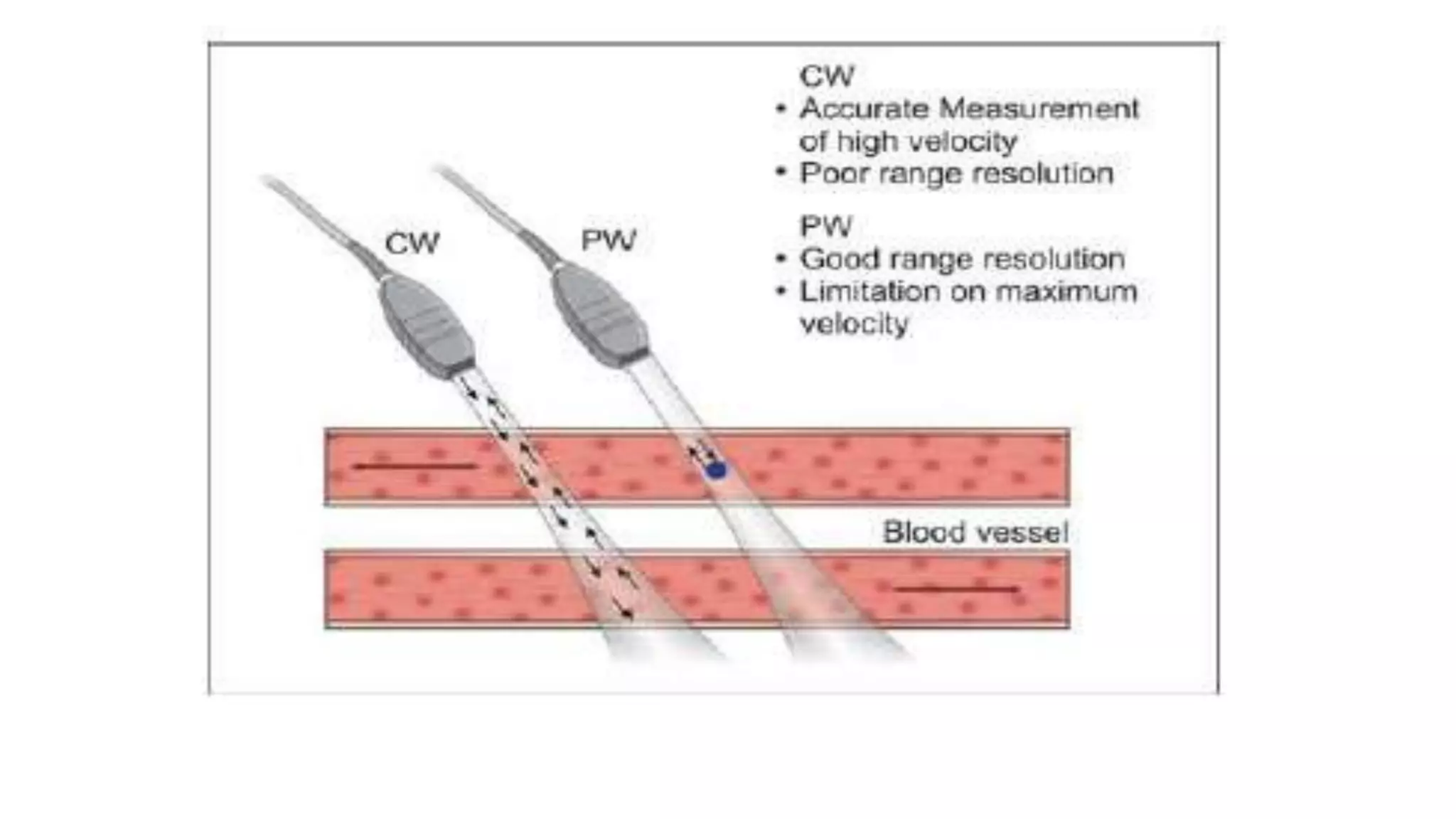
The devices are cheap and relatively simple, but they
have a big disadvatage - they lack axial resolution.
Device measures all reflected waves from the beam's
direction, therefore we can not measure blood flow
velocity in deep arteries. But in hands of experienced
physician, it can be a quick way how to measure
arterial flow in extremities, or even measure cardiac
contractions in conceptus (foetus).
PulsedWave
system
 PW's use one piezoelectric element, which alternately
transmits and receives ultrasound. The probe
measures the distance between a probe and a volume
sample (an artery) and it is defined by the time
between transmitting impulse and beginning receiving
impulse. The time for how long the signal is received,
determines the axial size of a volume sample, which is
very useful. All of the modern sonographers use Pulse
system. There is a downside to this system and that is
a velocity limit of the blood flow. High velocity leads to
aliasing, which is calculating error. On the other hand,
precise localisation of the source of frequency shifts
(flowing blood cells) in axial direction is possible.
Continuous Wave and Pulsed Wave.pptx

Continuous Wave and Pulsed Wave.pptx

  • 1.
    Continuous Wave andPulsed Wave Dr Zoshia Ali Zaidi PG Radiology CMH Jhelum
  • 2.
    Continuous wavesystem  CW's arefrom technical point of view the simplest Doppler devices. They use two crystals (lenses) as transducers - one constantly transmits ultrasound waves (usually 2 to 16 MHz in diagnostic ultrasound), the second crystal receives signal which reflects from singular erythrocytes. Furthermore, the angle between transducers is very obtuse, so overlapping of the transmitted and received beams happens in relatively big area (several centimetres, depends on the probe). The devices are cheap and relatively simple, but they have a big disadvatage - they lack axial resolution. Device measures all reflected waves from the beam's direction, therefore we can not measure blood flow velocity in deep arteries. But in hands of experienced physician, it can be a quick way how to measure arterial flow in extremities, or even measure cardiac contractions in conceptus (foetus).
  • 3.
    PulsedWave system  PW's useone piezoelectric element, which alternately transmits and receives ultrasound. The probe measures the distance between a probe and a volume sample (an artery) and it is defined by the time between transmitting impulse and beginning receiving impulse. The time for how long the signal is received, determines the axial size of a volume sample, which is very useful. All of the modern sonographers use Pulse system. There is a downside to this system and that is a velocity limit of the blood flow. High velocity leads to aliasing, which is calculating error. On the other hand, precise localisation of the source of frequency shifts (flowing blood cells) in axial direction is possible.