This material is for training use only 
Introduction 
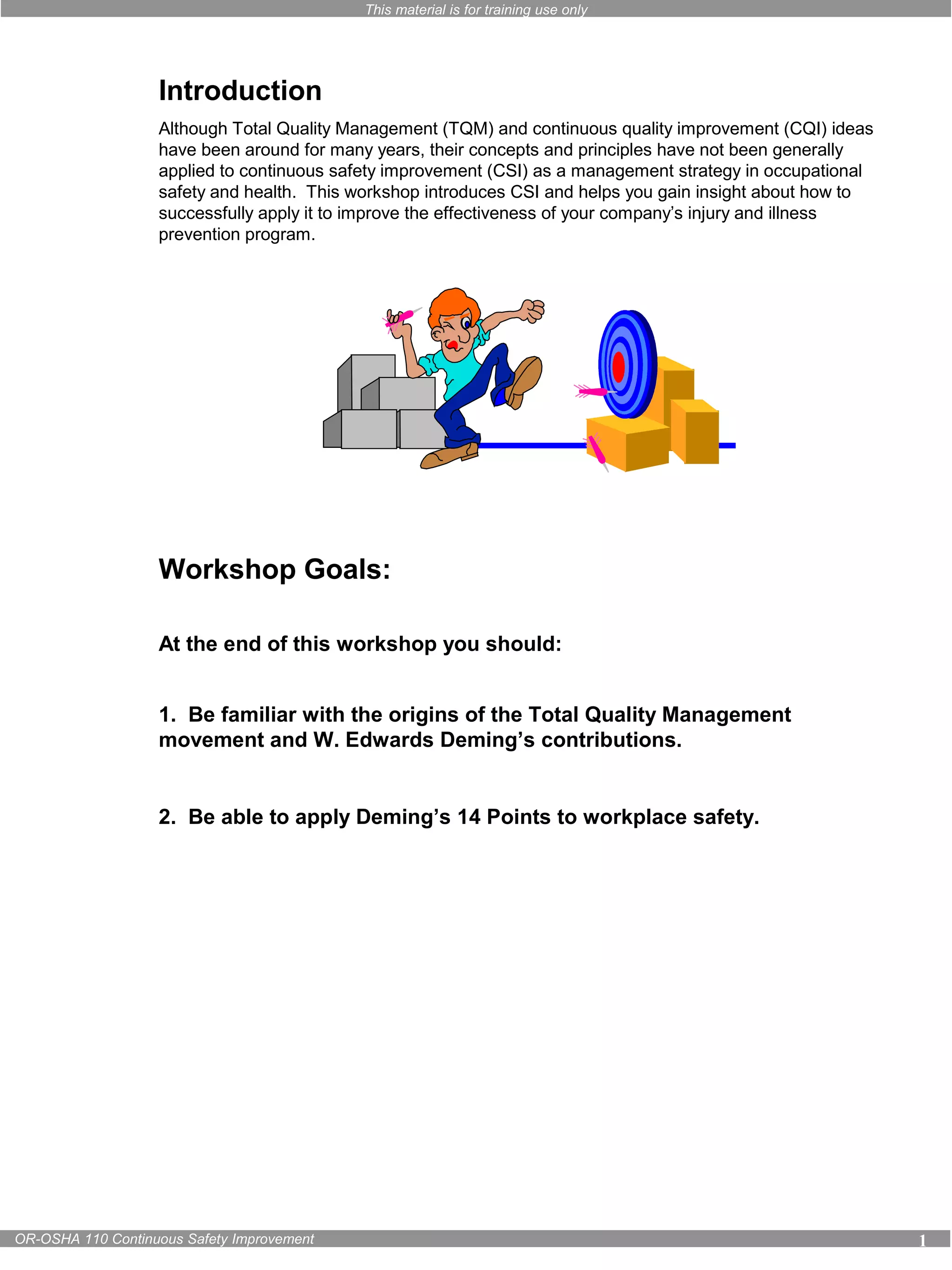
Although Total Quality Management (TQM) and continuous quality improvement (CQI) ideas 
have been around for many years, their concepts and principles have not been generally 
applied to continuous safety improvement (CSI) as a management strategy in occupational 
safety and health. This workshop introduces CSI and helps you gain insight about how to 
successfully apply it to improve the effectiveness of your company’s injury and illness 
prevention program. 
Workshop Goals: 
At the end of this workshop you should: 
1. Be familiar with the origins of the Total Quality Management 
movement and W. Edwards Deming’s contributions. 
2. Be able to apply Deming’s 14 Points to workplace safety. 
OR-OSHA 110 Continuous Safety Improvement 1
This material is for training use only 
Form Safety Improvement Teams! 
Introductions 
Elect a Team Leader __________________ 
Select a spokesperson __________________ 
Name your Team __________________ 
PPaarrtt II:: CCSSII CCoonncceeppttss 
Traditional safety management philosophy and practices have resulted in some 
reductions in accident rates nationally over the years, but it appears that further 
reductions will require new ideas. A shift in the way we think about safety is the 
answer. 
As you might guess, the concepts and principles of continuous safety improvement find 
their home in the Total Quality Management movement and Continuous Quality 
Improvement. In Part 1 we discuss some of the very important concepts and principles 
that make up continuous safety improvement. 
OR-OSHA 110 Continuous Safety Improvement 2
This material is for training use only 
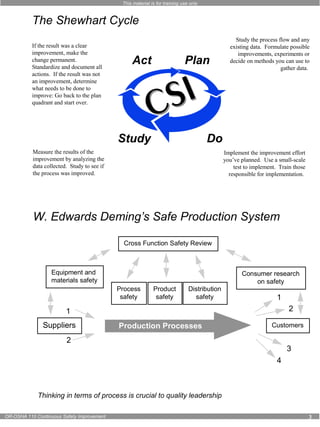
Plan 
The Shewhart Cycle 
Act 
Study 
Do 
Study the process flow and any 
existing data. Formulate possible 
improvements, experiments or 
decide on methods you can use to 
Implement the improvement effort 
you’ve planned. Use a small-scale 
test to implement. Train those 
responsible for implementation. 
If the result was a clear 
improvement, make the 
change permanent. 
Standardize and document all 
actions. If the result was not 
an improvement, determine 
what needs to be done to 
improve: Go back to the plan 
quadrant and start over. 
Measure the results of the 
improvement by analyzing the 
data collected. Study to see if 
the process was improved. 
W. Edwards Deming’s Safe Production System 
Equipment and 
materials safety 
1 
Suppliers 
2 
Cross Function Safety Review 
Product 
safety 
Distribution 
safety 
gather data. 
1 
2 
Process 
safety 
Production Processes Customers 
Thinking in terms of process is crucial to quality leadership 
Consumer research 
on safety 
3 
4 
OR-OSHA 110 Continuous Safety Improvement 3
This material is for training use only 
Customer focus 
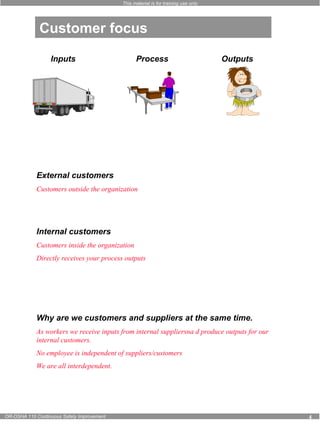
Inputs Process Outputs 
External customers 
Customers outside the organization 
Internal customers 
Customers inside the organization 
Directly receives your process outputs 
Why are we customers and suppliers at the same time. 
As workers we receive inputs from internal suppliersna d produce outputs for our 
internal customers. 
No employee is independent of suppliers/customers 
We are all interdependent. 
OR-OSHA 110 Continuous Safety Improvement 4
This material is for training use only 
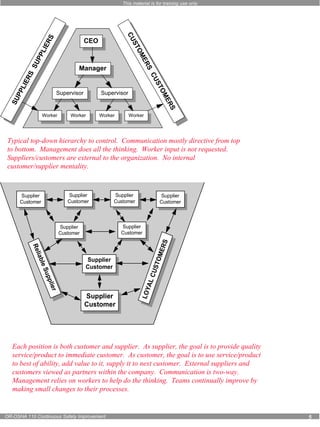
CEO 
Manager 
SUPPLIERS SUPPLIERS 
Supervisor 
CUSTOMERS CUSTOMERS 
Supervisor 
Worker Worker Worker Worker 
Typical top-down hierarchy to control. Communication mostly directive from top 
to bottom. Management does all the thinking. Worker input is not requested. 
Suppliers/customers are external to the organization. No internal 
customer/supplier mentality. 
Supplier 
Customer 
Supplier 
Customer 
Supplier 
Customer 
Supplier 
Customer 
Supplier 
Customer 
Supplier 
Customer 
Supplier 
Customer 
Supplier 
Customer 
Reliable Supplier 
LOYAL CUSTOMERS 
Each position is both customer and supplier. As supplier, the goal is to provide quality 
service/product to immediate customer. As customer, the goal is to use service/product 
to best of ability, add value to it, supply it to next customer. External suppliers and 
customers viewed as partners within the company. Communication is two-way. 
Management relies on workers to help do the thinking. Teams continually improve by 
making small changes to their processes. 
OR-OSHA 110 Continuous Safety Improvement 5
This material is for training use only 
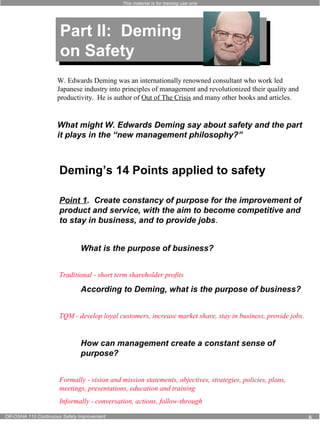
Part II: Deming 
on Safety 
Part II: Deming 
on Safety 
W. Edwards Deming was an internationally renowned consultant who work led 
Japanese industry into principles of management and revolutionized their quality and 
productivity. He is author of Out of The Crisis and many other books and articles. 
What might W. Edwards Deming say about safety and the part 
it plays in the “new management philosophy?” 
Deming’s 14 Points applied to safety 
Point 1. Create constancy of purpose for the improvement of 
product and service, with the aim to become competitive and 
to stay in business, and to provide jobs. 
What is the purpose of business? 
Traditional - short term shareholder profits 
According to Deming, what is the purpose of business? 
TQM - develop loyal customers, increase market share, stay in business, provide jobs. 
How can management create a constant sense of 
purpose? 
Formally - vision and mission statements, objectives, strategies, policies, plans, 
meetings, presentations, education and training 
Informally - conversation, actions, follow-through 
OR-OSHA 110 Continuous Safety Improvement 6
This material is for training use only 
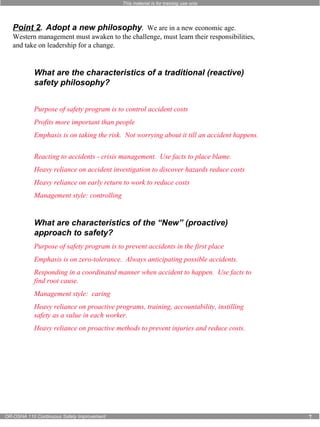
Point 2. Adopt a new philosophy. We are in a new economic age. 
Western management must awaken to the challenge, must learn their responsibilities, 
and take on leadership for a change. 
What are the characteristics of a traditional (reactive) 
safety philosophy? 
Purpose of safety program is to control accident costs 
Profits more important than people 
Emphasis is on taking the risk. Not worrying about it till an accident happens. 
Reacting to accidents - crisis management. Use facts to place blame. 
Heavy reliance on accident investigation to discover hazards reduce costs 
Heavy reliance on early return to work to reduce costs 
Management style: controlling 
What are characteristics of the “New” (proactive) 
approach to safety? 
Purpose of safety program is to prevent accidents in the first place 
Emphasis is on zero-tolerance. Always anticipating possible accidents. 
Responding in a coordinated manner when accident to happen. Use facts to 
find root cause. 
Management style: caring 
Heavy reliance on proactive programs, training, accountability, instilling 
safety as a value in each worker. 
Heavy reliance on proactive methods to prevent injuries and reduce costs. 
OR-OSHA 110 Continuous Safety Improvement 7
This material is for training use only 
Point 3. Cease dependence on mass inspection to achieve 
quality. Eliminate the need for inspection on a mass basis by building quality into 
the product in the first place. 
Some corporate safety systems depend solely on regular walk-around 
inspections by the safety director, supervisors and safety committees. 
Why is reliance on walkaround safety inspections not 
an effective strategy? 
Uncovers hazardous conditions...not procedures 
Inspectors must be properly trained 
What can a company do to improve safety without 
relying on walk-around inspections? 
List and describe your ideas: 
Proactive activities: 
training, 
meetings, 
job hazard analysis, 
recognition programs that reward appropriate behavior (reporting, 
complying) 
incident investigation, 
safety improvement teams in each department, 
OR-OSHA 110 Continuous Safety Improvement 8
This material is for training use only 
Point 4. End the practice of awarding business on the basis 
of price tag. Instead, minimize total cost. Move toward a single supplier for any 
one item, on a long-term relationship of loyalty and trust. 
Where does the safety process begin? 
Purchasing safe materials, equipment, tools, etc. Helping the supplier design 
safety into their products/services. 
Why does quality suffer sometimes when companies do 
business with a large number of suppliers? 
Each supplier might make the same product, but with varying degrees of 
quality. Your end product is dependent on the quality of the materials you 
receive from your suppliers. 
What policies regarding the purchase of safety products, 
materials, equipment, and tools might a company adopt 
to improve safety? 
Develop a close long-term working relationship with one or two suppliers. 
Help them improve their product in quality so that it meets your high 
standards. Have the supplier come out to your workplace to better understand 
your needs. Have the supplier do some training if needed. Go to supplier’s 
workplace, see how product is being made. Insist on high standards. 
OR-OSHA 110 Continuous Safety Improvement 9
This material is for training use only 
Point 5. Improve constantly and forever the system of 
production and service, to improve quality and productivity, and 
thus constantly decrease costs. Improving quality and safety is not a one-time 
effort with a narrow focus on a limited number of corporate functions. 
What approach to safety must a company take to ensure 
continuous improvement? 
Proactive, continual line-organization focus on safety as equally important part of 
the production process as well as all other aspects. Instil the perception that 
safety is a subset of quality and that it’s everyone’s responsibility to build safety 
into their processes. And, hold people accountable for it. 
Identifying and correcting hazards is merely “putting out 
fires,” not solving the problem. What must a company do 
to make sure safety problems are solved permanently? 
All you’re doing is removing special causes which is a one-time immediate fix to 
the problem. As long as common causes remain, special causes will continue to 
result in accidents. You must go after common (root) causes in the system to effect 
permanent change in the system. 
What must a company do to make sure safety problems are 
solved permanently? 
Go after root causes. 
OR-OSHA 110 Continuous Safety Improvement 10
This material is for training use only 
Point 6. Institute training and retraining on the job. 
What is the danger in too little safety training or 
training not conducted by a competent person? 
If a worker is not trained properly, it increases variation (common causes) 
in the process. If training is not conducted by competent person, again 
variation increases. The errors of the one person are transferred to the next 
unless the person being trained. Variation continues high with increased 
chance of accident. 
Who should do the training? 
Competent person, preferably the supervisor who must also oversee safe 
work and hold others accountable. If supervisor does not have expertise, 
he/she should get an expert to train. Supervisor should be involved. Learn 
how to do the training. 
OR-OSHA 110 Continuous Safety Improvement 11
This material is for training use only 
Point 7. Adopt and institute leadership. The aim of supervision should 
be to help people and machines do a better job, and to increase pride of workmanship. 
Supervision of management is in need of overhaul, as well as supervision of 
production workers. 
What are the qualities of good leadership? 
Human qualities - Care, inspire, motivate, work harder than the rest, etc. 
How can managers and supervisors display safety 
leadership? 
Leadership - safety is important - watch me. 
Recognition 
Supplying best PPE, 
High quality training, 
safe materials, 
properly designed maintained equipment 
holding workers accountable - counseling 
OR-OSHA 110 Continuous Safety Improvement 12
This material is for training use only 
Point 8. Drive out fear, so that everyone may work effectively 
for the company. 
Deming wrote that the “The economic loss from fear is 
appalling.” What did he mean by this statement, and 
how does it apply to workplace safety? 
Management by fear is defeating the purpose of the company. Workers can’t 
excel as long as they are worried about their very survival. Morale suffers. 
Production suffers. 
Reactive safety incentive programs reward “not reporting” accidents. 
Negative peer pressure can influence decisions. 
What approach to safety is required to drive out fear? 
Proactive recognition. An enlightened management should recognize the 
contribution of workers who report hazards, injuries, and comply with safety 
rules. Recognize it as professional behavior, desired, helpful to the purpose 
of the company. 
Managers and supervisors must be educated about the costs of accidents so 
they understand why these behaviors are important. 
Managers and workers at all levels must perceive/receive benefit from these 
behaviors. 
OR-OSHA 110 Continuous Safety Improvement 13
This material is for training use only 
Point 9. Break down barriers between staff areas. People in 
research, design, sales, and production must work as a team to foresee problems of 
production, product or service. 
Cooperation and competition. There’s a place for both. 
But, why may it be harmful for employers to create a 
climate of competition among departments? 
Internal competition is usually unwanted because it might result in undesired 
behaviors being played out. One group might sabotage the efforts of another 
to improve their own numbers. The only group to compete against are your 
external competitors. 
If departments compete against each other in some sort of reactive incentive 
program, measuring accident rates or time loss (which no one can control), 
they may not report hazards in other depts. 
In regard to safety, why is it important for various 
departments to communicate and cooperate? 
If hazards are detected in one department, all departments should hear about 
it so the company improves the system, accidents decrease, everyone wins. 
What workplace group is specifically responsible to 
help break down safety barriers? 
Safety committee 
OR-OSHA 110 Continuous Safety Improvement 14
This material is for training use only 
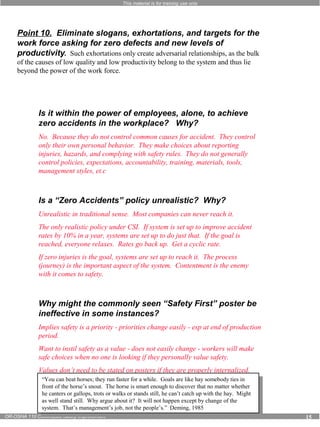
Point 10. Eliminate slogans, exhortations, and targets for the 
work force asking for zero defects and new levels of 
productivity. Such exhortations only create adversarial relationships, as the bulk 
of the causes of low quality and low productivity belong to the system and thus lie 
beyond the power of the work force. 
Is it within the power of employees, alone, to achieve 
zero accidents in the workplace? Why? 
No. Because they do not control common causes for accident. They control 
only their own personal behavior. They make choices about reporting 
injuries, hazards, and complying with safety rules. They do not generally 
control policies, expectations, accountability, training, materials, tools, 
management styles, et.c 
Is a “Zero Accidents” policy unrealistic? Why? 
Unrealistic in traditional sense. Most companies can never reach it. 
The only realistic policy under CSI. If system is set up to improve accident 
rates by 10% in a year, systems are set up to do just that. If the goal is 
reached, everyone relaxes. Rates go back up. Get a cyclic rate. 
If zero injuries is the goal, systems are set up to reach it. The process 
(journey) is the important aspect of the system. Contentment is the enemy 
with it comes to safety. 
Why might the commonly seen “Safety First” poster be 
ineffective in some instances? 
Implies safety is a priority - priorities change easily - esp at end of production 
period. 
Want to instil safety as a value - does not easily change - workers will make 
safe choices when no one is looking if they personally value safety. 
Values don’t need to be stated on posters if they are properly internalized. 
“You “You can can beat beat horses; horses; they they run run faster faster for for a a while. while. Goals Goals are are like like hay somebody ties in 
front front of of the the horse’s horse’s snout. snout. The The horse horse is smart enough to discover hay somebody ties in 
he canters or gallops, trots or walks or stands is smart enough to discover that that no no matter matter whether 
whether 
as he well canters stand or still. gallops, Why trots argue or about walks it? or stands still, still, he he can’t can’t catch catch up up with with the the hay. hay. Might 
Might 
system. as well stand still. It will not happen except by change of the 
system. That’s That’s management’s Why argue management’s job, about not it? the It people’s.” will not happen Deming, except job, not the people’s.” Deming, 1985 
by change of the 
1985 
OR-OSHA 110 Continuous Safety Improvement 15
This material is for training use only 
Point 11. Eliminate numerical quotas for the workforce, and 
eliminate management by objectives. Eliminate numerical 
goals for people in management. Substitute leadership. 
What’s wrong with focusing primarily on numerical 
goals like accident rates or MOD rates to measure the 
success of a safety program? 
Focusing on results statistics, which we have little control over, causes little 
improvement. If we look only at results, we can only react to results, we do 
not continually look at variation in the process to improve the results. We 
have control over the process. Work on fixing what we can control. 
If we focus on continually improving the process, the results will take care of 
them selves. 
If, according to Deming, we shouldn’t measure the 
safety success of a manager purely on numerical 
results, what should we measure? (Hint: Read point 11 
carefully) 
Measure leadership activities. We have control over activities. 
Safety meetings 
Training 
Recognition 
Setting proper example 
Accountability 
Supplying needs 
Incident investigations 
Inspections 
etc. 
OR-OSHA 110 Continuous Safety Improvement 16
This material is for training use only 
Point 12. Remove barriers that rob people of their pride of 
workmanship. The responsibility of supervisors must be changed from sheer 
numbers to quality. Remove barriers that rob people of their right to pride of 
workmanship. Abolish the annual merit rating. 
What is “pride of workmanship”? 
A desire to put you name on the product or service you provide. 
How may supervisors help increase pride of 
workmanship? 
By supplying the highest quality leadership and resources available. 
Worker can’t have pride in the quality of work they do if materials, equipment, 
tools, leadership is inferior. Workers don’t control any of that. Can be very 
frustrating, demoralizing. 
According to Deming, why might annual performance 
appraisals that rate or rank employee performance be 
ineffective? 
Should be providing feedback about quality of work continually, year-round. 
There should be no surprises in an annual performance session. If employees 
are rated, half are above average, half below. In reality, all are meeting 
criteria. Variation most probably do to common causes (lack of supplies of one 
kind or another). 
Performance appraisal assumes workers work independently. This is never the 
case. All workers/managers are interdependent upon each other as 
suppliers/customers for quality/safety. 
It also assumes workers are provided with everything they need to do the job. 
This is usually not the case. 
OR-OSHA 110 Continuous Safety Improvement 17
This material is for training use only 
Point 13. Institute a vigorous program of education and self-improvement 
for everyone. 
What would a vigorous program in safety education and 
self-improvement look like? 
Thorough initial orientation that includes clearly stated accountabilities. 
Rules are discussed. Workers learn WHY the rules are important. 
On-the-job training and retraining on a regular basis. If procedures is done 
frequently, supervisor feedback is needed. If procedure is done infrequently, 
practice is needed. 
Workers are expected to become expert in safety 
Workers learn hazard ID and control principles 
Workers attend external training 
Workers participate in safety improvement teams 
Workers do training 
Workers are recognized for safety expertise 
Point 14. Take action to accomplish the transformation. Put 
everybody in the company to work to accomplish the transformation. The 
transformation is everyone’s job. 
How can you get everyone to participate in the 
transformation to continuous safety improvement? 
Top manager communicates expectations 
Set up recognition, benefits 
Educate, educate, educate 
Walk the talk 
OR-OSHA 110 Continuous Safety Improvement 18
This material is for training use only 
Key Paradigms of 
Continuous Safety Improvement 
CSI is a management approach that: 
Focuses on meeting or beating customer expectations for 
process and product safety. 
 Rigorous use of facts and analysis in everyday safety 
decisions. 
 Benchmarking against “World-Class” safety performance. 
 Effective teamwork across the organization. 
 Recognition for outstanding safety performance. 
 Information that helps people and systems continuously 
improve. 
 A culture that fosters continuous improvement in 
workplace safety. 
 Focuses on effective hazard identification, correction, and 
accident prevention efforts. 
Key Elements: 
• Customer focus 
• Facts and 
analysis 
• Benchmarking 
• Cross Function 
Teamwork 
• Recognition 
• Information and 
measurement 
• Continuous 
improvement 
• Identification, 
correction, 
prevention 
OR-OSHA 110 Continuous Safety Improvement 19
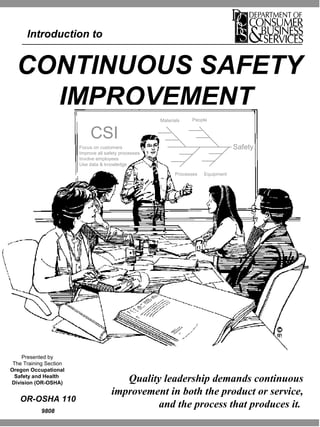
Introduction to 
CONTINUOUS SAFETY 
IMPROVEMENT 
People 
Focus on customers Safety 
Improve all safety processes 
Involve employees 
Use data & knowledge 
Quality leadership demands continuous 
improvement in both the product or service, 
and the process that produces it. 
CSI 
Materials 
Processes Equipment 
Presented by 
The Training Section 
Oregon Occupational 
Safety and Health 
Division (OR-OSHA) 
OR-OSHA 110 
9808
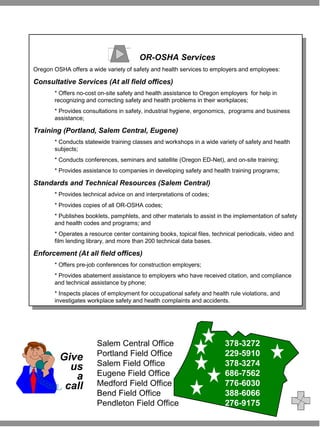
OR-OSHA Services 
OR-OSHA Services 
Oregon OSHA offers a wide variety of safety and health services to employers and employees: 
Consultative Services (At all field offices) 
Oregon OSHA offers a wide variety of safety and health services to employers and employees: 
Consultative Services (At all field offices) 
* Offers no-cost on-site safety and health assistance to Oregon employers for help in 
recognizing and correcting safety and health problems in their workplaces; 
* Provides consultations in safety, industrial hygiene, ergonomics, programs and business 
assistance; 
* Offers no-cost on-site safety and health assistance to Oregon employers for help in 
recognizing and correcting safety and health problems in their workplaces; 
* Provides consultations in safety, industrial hygiene, ergonomics, programs and business 
assistance; 
Training (Portland, Salem Central, Eugene) 
* Conducts statewide training classes and workshops in a wide variety of safety and health 
subjects; 
* Conducts conferences, seminars and satellite (Oregon ED-Net), and on-site training; 
* Provides assistance to companies in developing safety and health training programs; 
* Conducts statewide training classes and workshops in a wide variety of safety and health 
subjects; 
* Conducts conferences, seminars and satellite (Oregon ED-Net), and on-site training; 
* Provides assistance to companies in developing safety and health training programs; 
Standards and Technical Resources (Salem Central) 
* Provides technical advice on and interpretations of codes; 
* Provides copies of all OR-OSHA codes; 
* Publishes booklets, pamphlets, and other materials to assist in the implementation of safety 
and health codes and programs; and 
* Operates a resource center containing books, topical files, technical periodicals, video and 
film lending library, and more than 200 technical data bases. 
* Provides technical advice on and interpretations of codes; 
* Provides copies of all OR-OSHA codes; 
* Publishes booklets, pamphlets, and other materials to assist in the implementation of safety 
and health codes and programs; and 
* Operates a resource center containing books, topical files, technical periodicals, video and 
film lending library, and more than 200 technical data bases. 
Enforcement (At all field offices) 
* Offers pre-job conferences for construction employers; 
* Provides abatement assistance to employers who have received citation, and compliance 
and technical assistance by phone; 
* Inspects places of employment for occupational safety and health rule violations, and 
investigates workplace safety and health complaints and accidents. 
* Offers pre-job conferences for construction employers; 
* Provides abatement assistance to employers who have received citation, and compliance 
and technical assistance by phone; 
* Inspects places of employment for occupational safety and health rule violations, and 
investigates workplace safety and health complaints and accidents. 
Give 
us 
a 
call 
Salem Central Office 378-3272 
Portland Field Office 229-5910 
Salem Field Office 378-3274 
Eugene Field Office 686-7562 
Medford Field Office 776-6030 
Bend Field Office 388-6066 
Pendleton Field Office 276-9175

Continuous safety improvement

  • 1.
    This material isfor training use only Introduction Although Total Quality Management (TQM) and continuous quality improvement (CQI) ideas have been around for many years, their concepts and principles have not been generally applied to continuous safety improvement (CSI) as a management strategy in occupational safety and health. This workshop introduces CSI and helps you gain insight about how to successfully apply it to improve the effectiveness of your company’s injury and illness prevention program. Workshop Goals: At the end of this workshop you should: 1. Be familiar with the origins of the Total Quality Management movement and W. Edwards Deming’s contributions. 2. Be able to apply Deming’s 14 Points to workplace safety. OR-OSHA 110 Continuous Safety Improvement 1
  • 2.
    This material isfor training use only Form Safety Improvement Teams! Introductions Elect a Team Leader __________________ Select a spokesperson __________________ Name your Team __________________ PPaarrtt II:: CCSSII CCoonncceeppttss Traditional safety management philosophy and practices have resulted in some reductions in accident rates nationally over the years, but it appears that further reductions will require new ideas. A shift in the way we think about safety is the answer. As you might guess, the concepts and principles of continuous safety improvement find their home in the Total Quality Management movement and Continuous Quality Improvement. In Part 1 we discuss some of the very important concepts and principles that make up continuous safety improvement. OR-OSHA 110 Continuous Safety Improvement 2
  • 3.
    This material isfor training use only Plan The Shewhart Cycle Act Study Do Study the process flow and any existing data. Formulate possible improvements, experiments or decide on methods you can use to Implement the improvement effort you’ve planned. Use a small-scale test to implement. Train those responsible for implementation. If the result was a clear improvement, make the change permanent. Standardize and document all actions. If the result was not an improvement, determine what needs to be done to improve: Go back to the plan quadrant and start over. Measure the results of the improvement by analyzing the data collected. Study to see if the process was improved. W. Edwards Deming’s Safe Production System Equipment and materials safety 1 Suppliers 2 Cross Function Safety Review Product safety Distribution safety gather data. 1 2 Process safety Production Processes Customers Thinking in terms of process is crucial to quality leadership Consumer research on safety 3 4 OR-OSHA 110 Continuous Safety Improvement 3
  • 4.
    This material isfor training use only Customer focus Inputs Process Outputs External customers Customers outside the organization Internal customers Customers inside the organization Directly receives your process outputs Why are we customers and suppliers at the same time. As workers we receive inputs from internal suppliersna d produce outputs for our internal customers. No employee is independent of suppliers/customers We are all interdependent. OR-OSHA 110 Continuous Safety Improvement 4
  • 5.
    This material isfor training use only CEO Manager SUPPLIERS SUPPLIERS Supervisor CUSTOMERS CUSTOMERS Supervisor Worker Worker Worker Worker Typical top-down hierarchy to control. Communication mostly directive from top to bottom. Management does all the thinking. Worker input is not requested. Suppliers/customers are external to the organization. No internal customer/supplier mentality. Supplier Customer Supplier Customer Supplier Customer Supplier Customer Supplier Customer Supplier Customer Supplier Customer Supplier Customer Reliable Supplier LOYAL CUSTOMERS Each position is both customer and supplier. As supplier, the goal is to provide quality service/product to immediate customer. As customer, the goal is to use service/product to best of ability, add value to it, supply it to next customer. External suppliers and customers viewed as partners within the company. Communication is two-way. Management relies on workers to help do the thinking. Teams continually improve by making small changes to their processes. OR-OSHA 110 Continuous Safety Improvement 5
  • 6.
    This material isfor training use only Part II: Deming on Safety Part II: Deming on Safety W. Edwards Deming was an internationally renowned consultant who work led Japanese industry into principles of management and revolutionized their quality and productivity. He is author of Out of The Crisis and many other books and articles. What might W. Edwards Deming say about safety and the part it plays in the “new management philosophy?” Deming’s 14 Points applied to safety Point 1. Create constancy of purpose for the improvement of product and service, with the aim to become competitive and to stay in business, and to provide jobs. What is the purpose of business? Traditional - short term shareholder profits According to Deming, what is the purpose of business? TQM - develop loyal customers, increase market share, stay in business, provide jobs. How can management create a constant sense of purpose? Formally - vision and mission statements, objectives, strategies, policies, plans, meetings, presentations, education and training Informally - conversation, actions, follow-through OR-OSHA 110 Continuous Safety Improvement 6
  • 7.
    This material isfor training use only Point 2. Adopt a new philosophy. We are in a new economic age. Western management must awaken to the challenge, must learn their responsibilities, and take on leadership for a change. What are the characteristics of a traditional (reactive) safety philosophy? Purpose of safety program is to control accident costs Profits more important than people Emphasis is on taking the risk. Not worrying about it till an accident happens. Reacting to accidents - crisis management. Use facts to place blame. Heavy reliance on accident investigation to discover hazards reduce costs Heavy reliance on early return to work to reduce costs Management style: controlling What are characteristics of the “New” (proactive) approach to safety? Purpose of safety program is to prevent accidents in the first place Emphasis is on zero-tolerance. Always anticipating possible accidents. Responding in a coordinated manner when accident to happen. Use facts to find root cause. Management style: caring Heavy reliance on proactive programs, training, accountability, instilling safety as a value in each worker. Heavy reliance on proactive methods to prevent injuries and reduce costs. OR-OSHA 110 Continuous Safety Improvement 7
  • 8.
    This material isfor training use only Point 3. Cease dependence on mass inspection to achieve quality. Eliminate the need for inspection on a mass basis by building quality into the product in the first place. Some corporate safety systems depend solely on regular walk-around inspections by the safety director, supervisors and safety committees. Why is reliance on walkaround safety inspections not an effective strategy? Uncovers hazardous conditions...not procedures Inspectors must be properly trained What can a company do to improve safety without relying on walk-around inspections? List and describe your ideas: Proactive activities: training, meetings, job hazard analysis, recognition programs that reward appropriate behavior (reporting, complying) incident investigation, safety improvement teams in each department, OR-OSHA 110 Continuous Safety Improvement 8
  • 9.
    This material isfor training use only Point 4. End the practice of awarding business on the basis of price tag. Instead, minimize total cost. Move toward a single supplier for any one item, on a long-term relationship of loyalty and trust. Where does the safety process begin? Purchasing safe materials, equipment, tools, etc. Helping the supplier design safety into their products/services. Why does quality suffer sometimes when companies do business with a large number of suppliers? Each supplier might make the same product, but with varying degrees of quality. Your end product is dependent on the quality of the materials you receive from your suppliers. What policies regarding the purchase of safety products, materials, equipment, and tools might a company adopt to improve safety? Develop a close long-term working relationship with one or two suppliers. Help them improve their product in quality so that it meets your high standards. Have the supplier come out to your workplace to better understand your needs. Have the supplier do some training if needed. Go to supplier’s workplace, see how product is being made. Insist on high standards. OR-OSHA 110 Continuous Safety Improvement 9
  • 10.
    This material isfor training use only Point 5. Improve constantly and forever the system of production and service, to improve quality and productivity, and thus constantly decrease costs. Improving quality and safety is not a one-time effort with a narrow focus on a limited number of corporate functions. What approach to safety must a company take to ensure continuous improvement? Proactive, continual line-organization focus on safety as equally important part of the production process as well as all other aspects. Instil the perception that safety is a subset of quality and that it’s everyone’s responsibility to build safety into their processes. And, hold people accountable for it. Identifying and correcting hazards is merely “putting out fires,” not solving the problem. What must a company do to make sure safety problems are solved permanently? All you’re doing is removing special causes which is a one-time immediate fix to the problem. As long as common causes remain, special causes will continue to result in accidents. You must go after common (root) causes in the system to effect permanent change in the system. What must a company do to make sure safety problems are solved permanently? Go after root causes. OR-OSHA 110 Continuous Safety Improvement 10
  • 11.
    This material isfor training use only Point 6. Institute training and retraining on the job. What is the danger in too little safety training or training not conducted by a competent person? If a worker is not trained properly, it increases variation (common causes) in the process. If training is not conducted by competent person, again variation increases. The errors of the one person are transferred to the next unless the person being trained. Variation continues high with increased chance of accident. Who should do the training? Competent person, preferably the supervisor who must also oversee safe work and hold others accountable. If supervisor does not have expertise, he/she should get an expert to train. Supervisor should be involved. Learn how to do the training. OR-OSHA 110 Continuous Safety Improvement 11
  • 12.
    This material isfor training use only Point 7. Adopt and institute leadership. The aim of supervision should be to help people and machines do a better job, and to increase pride of workmanship. Supervision of management is in need of overhaul, as well as supervision of production workers. What are the qualities of good leadership? Human qualities - Care, inspire, motivate, work harder than the rest, etc. How can managers and supervisors display safety leadership? Leadership - safety is important - watch me. Recognition Supplying best PPE, High quality training, safe materials, properly designed maintained equipment holding workers accountable - counseling OR-OSHA 110 Continuous Safety Improvement 12
  • 13.
    This material isfor training use only Point 8. Drive out fear, so that everyone may work effectively for the company. Deming wrote that the “The economic loss from fear is appalling.” What did he mean by this statement, and how does it apply to workplace safety? Management by fear is defeating the purpose of the company. Workers can’t excel as long as they are worried about their very survival. Morale suffers. Production suffers. Reactive safety incentive programs reward “not reporting” accidents. Negative peer pressure can influence decisions. What approach to safety is required to drive out fear? Proactive recognition. An enlightened management should recognize the contribution of workers who report hazards, injuries, and comply with safety rules. Recognize it as professional behavior, desired, helpful to the purpose of the company. Managers and supervisors must be educated about the costs of accidents so they understand why these behaviors are important. Managers and workers at all levels must perceive/receive benefit from these behaviors. OR-OSHA 110 Continuous Safety Improvement 13
  • 14.
    This material isfor training use only Point 9. Break down barriers between staff areas. People in research, design, sales, and production must work as a team to foresee problems of production, product or service. Cooperation and competition. There’s a place for both. But, why may it be harmful for employers to create a climate of competition among departments? Internal competition is usually unwanted because it might result in undesired behaviors being played out. One group might sabotage the efforts of another to improve their own numbers. The only group to compete against are your external competitors. If departments compete against each other in some sort of reactive incentive program, measuring accident rates or time loss (which no one can control), they may not report hazards in other depts. In regard to safety, why is it important for various departments to communicate and cooperate? If hazards are detected in one department, all departments should hear about it so the company improves the system, accidents decrease, everyone wins. What workplace group is specifically responsible to help break down safety barriers? Safety committee OR-OSHA 110 Continuous Safety Improvement 14
  • 15.
    This material isfor training use only Point 10. Eliminate slogans, exhortations, and targets for the work force asking for zero defects and new levels of productivity. Such exhortations only create adversarial relationships, as the bulk of the causes of low quality and low productivity belong to the system and thus lie beyond the power of the work force. Is it within the power of employees, alone, to achieve zero accidents in the workplace? Why? No. Because they do not control common causes for accident. They control only their own personal behavior. They make choices about reporting injuries, hazards, and complying with safety rules. They do not generally control policies, expectations, accountability, training, materials, tools, management styles, et.c Is a “Zero Accidents” policy unrealistic? Why? Unrealistic in traditional sense. Most companies can never reach it. The only realistic policy under CSI. If system is set up to improve accident rates by 10% in a year, systems are set up to do just that. If the goal is reached, everyone relaxes. Rates go back up. Get a cyclic rate. If zero injuries is the goal, systems are set up to reach it. The process (journey) is the important aspect of the system. Contentment is the enemy with it comes to safety. Why might the commonly seen “Safety First” poster be ineffective in some instances? Implies safety is a priority - priorities change easily - esp at end of production period. Want to instil safety as a value - does not easily change - workers will make safe choices when no one is looking if they personally value safety. Values don’t need to be stated on posters if they are properly internalized. “You “You can can beat beat horses; horses; they they run run faster faster for for a a while. while. Goals Goals are are like like hay somebody ties in front front of of the the horse’s horse’s snout. snout. The The horse horse is smart enough to discover hay somebody ties in he canters or gallops, trots or walks or stands is smart enough to discover that that no no matter matter whether whether as he well canters stand or still. gallops, Why trots argue or about walks it? or stands still, still, he he can’t can’t catch catch up up with with the the hay. hay. Might Might system. as well stand still. It will not happen except by change of the system. That’s That’s management’s Why argue management’s job, about not it? the It people’s.” will not happen Deming, except job, not the people’s.” Deming, 1985 by change of the 1985 OR-OSHA 110 Continuous Safety Improvement 15
  • 16.
    This material isfor training use only Point 11. Eliminate numerical quotas for the workforce, and eliminate management by objectives. Eliminate numerical goals for people in management. Substitute leadership. What’s wrong with focusing primarily on numerical goals like accident rates or MOD rates to measure the success of a safety program? Focusing on results statistics, which we have little control over, causes little improvement. If we look only at results, we can only react to results, we do not continually look at variation in the process to improve the results. We have control over the process. Work on fixing what we can control. If we focus on continually improving the process, the results will take care of them selves. If, according to Deming, we shouldn’t measure the safety success of a manager purely on numerical results, what should we measure? (Hint: Read point 11 carefully) Measure leadership activities. We have control over activities. Safety meetings Training Recognition Setting proper example Accountability Supplying needs Incident investigations Inspections etc. OR-OSHA 110 Continuous Safety Improvement 16
  • 17.
    This material isfor training use only Point 12. Remove barriers that rob people of their pride of workmanship. The responsibility of supervisors must be changed from sheer numbers to quality. Remove barriers that rob people of their right to pride of workmanship. Abolish the annual merit rating. What is “pride of workmanship”? A desire to put you name on the product or service you provide. How may supervisors help increase pride of workmanship? By supplying the highest quality leadership and resources available. Worker can’t have pride in the quality of work they do if materials, equipment, tools, leadership is inferior. Workers don’t control any of that. Can be very frustrating, demoralizing. According to Deming, why might annual performance appraisals that rate or rank employee performance be ineffective? Should be providing feedback about quality of work continually, year-round. There should be no surprises in an annual performance session. If employees are rated, half are above average, half below. In reality, all are meeting criteria. Variation most probably do to common causes (lack of supplies of one kind or another). Performance appraisal assumes workers work independently. This is never the case. All workers/managers are interdependent upon each other as suppliers/customers for quality/safety. It also assumes workers are provided with everything they need to do the job. This is usually not the case. OR-OSHA 110 Continuous Safety Improvement 17
  • 18.
    This material isfor training use only Point 13. Institute a vigorous program of education and self-improvement for everyone. What would a vigorous program in safety education and self-improvement look like? Thorough initial orientation that includes clearly stated accountabilities. Rules are discussed. Workers learn WHY the rules are important. On-the-job training and retraining on a regular basis. If procedures is done frequently, supervisor feedback is needed. If procedure is done infrequently, practice is needed. Workers are expected to become expert in safety Workers learn hazard ID and control principles Workers attend external training Workers participate in safety improvement teams Workers do training Workers are recognized for safety expertise Point 14. Take action to accomplish the transformation. Put everybody in the company to work to accomplish the transformation. The transformation is everyone’s job. How can you get everyone to participate in the transformation to continuous safety improvement? Top manager communicates expectations Set up recognition, benefits Educate, educate, educate Walk the talk OR-OSHA 110 Continuous Safety Improvement 18
  • 19.
    This material isfor training use only Key Paradigms of Continuous Safety Improvement CSI is a management approach that: Focuses on meeting or beating customer expectations for process and product safety.  Rigorous use of facts and analysis in everyday safety decisions.  Benchmarking against “World-Class” safety performance.  Effective teamwork across the organization.  Recognition for outstanding safety performance.  Information that helps people and systems continuously improve.  A culture that fosters continuous improvement in workplace safety.  Focuses on effective hazard identification, correction, and accident prevention efforts. Key Elements: • Customer focus • Facts and analysis • Benchmarking • Cross Function Teamwork • Recognition • Information and measurement • Continuous improvement • Identification, correction, prevention OR-OSHA 110 Continuous Safety Improvement 19
  • 20.
    Introduction to CONTINUOUSSAFETY IMPROVEMENT People Focus on customers Safety Improve all safety processes Involve employees Use data & knowledge Quality leadership demands continuous improvement in both the product or service, and the process that produces it. CSI Materials Processes Equipment Presented by The Training Section Oregon Occupational Safety and Health Division (OR-OSHA) OR-OSHA 110 9808
  • 21.
    OR-OSHA Services OR-OSHAServices Oregon OSHA offers a wide variety of safety and health services to employers and employees: Consultative Services (At all field offices) Oregon OSHA offers a wide variety of safety and health services to employers and employees: Consultative Services (At all field offices) * Offers no-cost on-site safety and health assistance to Oregon employers for help in recognizing and correcting safety and health problems in their workplaces; * Provides consultations in safety, industrial hygiene, ergonomics, programs and business assistance; * Offers no-cost on-site safety and health assistance to Oregon employers for help in recognizing and correcting safety and health problems in their workplaces; * Provides consultations in safety, industrial hygiene, ergonomics, programs and business assistance; Training (Portland, Salem Central, Eugene) Training (Portland, Salem Central, Eugene) * Conducts statewide training classes and workshops in a wide variety of safety and health subjects; * Conducts conferences, seminars and satellite (Oregon ED-Net), and on-site training; * Provides assistance to companies in developing safety and health training programs; * Conducts statewide training classes and workshops in a wide variety of safety and health subjects; * Conducts conferences, seminars and satellite (Oregon ED-Net), and on-site training; * Provides assistance to companies in developing safety and health training programs; Standards and Technical Resources (Salem Central) Standards and Technical Resources (Salem Central) * Provides technical advice on and interpretations of codes; * Provides copies of all OR-OSHA codes; * Publishes booklets, pamphlets, and other materials to assist in the implementation of safety and health codes and programs; and * Operates a resource center containing books, topical files, technical periodicals, video and film lending library, and more than 200 technical data bases. * Provides technical advice on and interpretations of codes; * Provides copies of all OR-OSHA codes; * Publishes booklets, pamphlets, and other materials to assist in the implementation of safety and health codes and programs; and * Operates a resource center containing books, topical files, technical periodicals, video and film lending library, and more than 200 technical data bases. Enforcement (At all field offices) Enforcement (At all field offices) * Offers pre-job conferences for construction employers; * Provides abatement assistance to employers who have received citation, and compliance and technical assistance by phone; * Inspects places of employment for occupational safety and health rule violations, and investigates workplace safety and health complaints and accidents. * Offers pre-job conferences for construction employers; * Provides abatement assistance to employers who have received citation, and compliance and technical assistance by phone; * Inspects places of employment for occupational safety and health rule violations, and investigates workplace safety and health complaints and accidents. Give us a call Salem Central Office 378-3272 Portland Field Office 229-5910 Salem Field Office 378-3274 Eugene Field Office 686-7562 Medford Field Office 776-6030 Bend Field Office 388-6066 Pendleton Field Office 276-9175