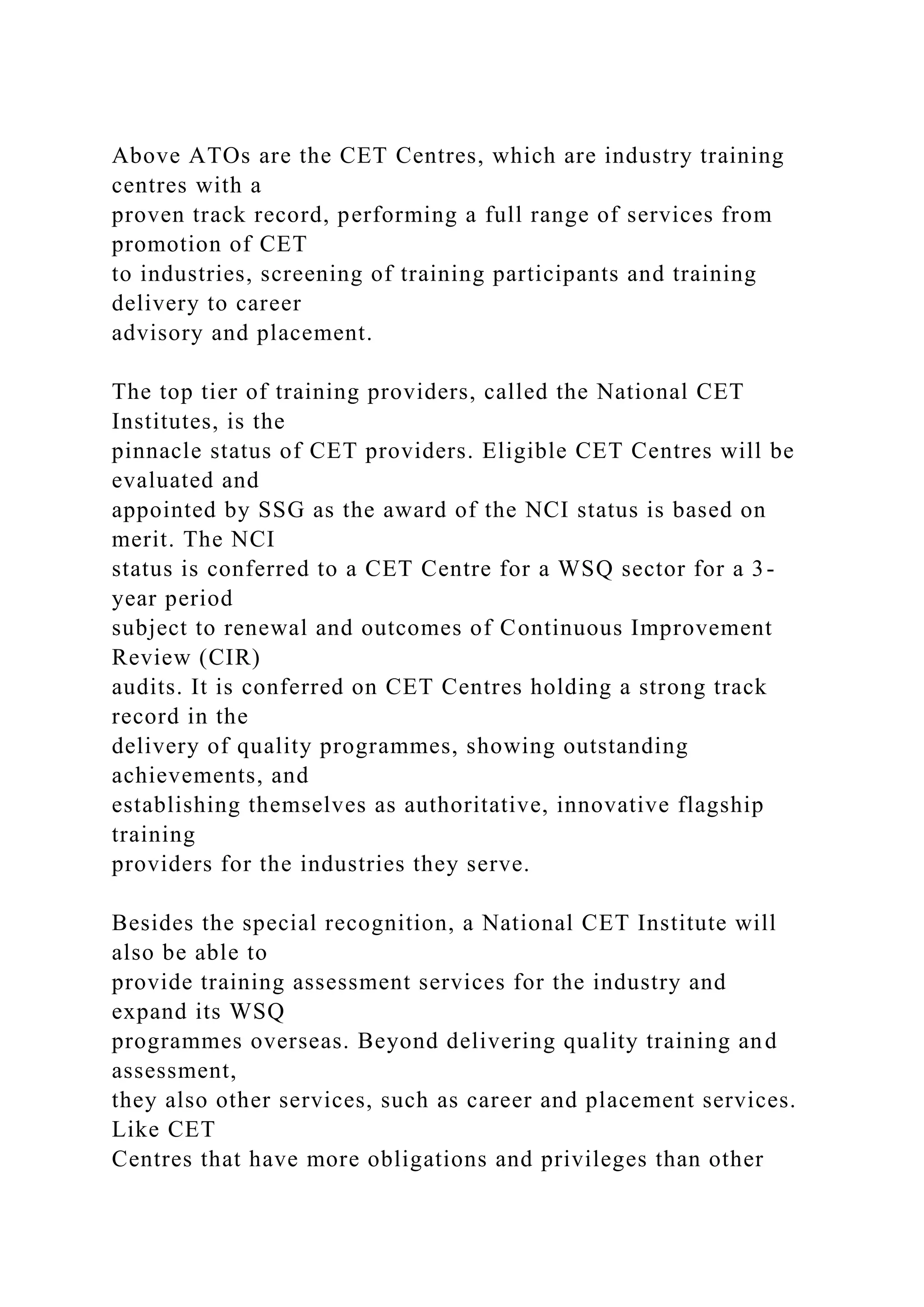
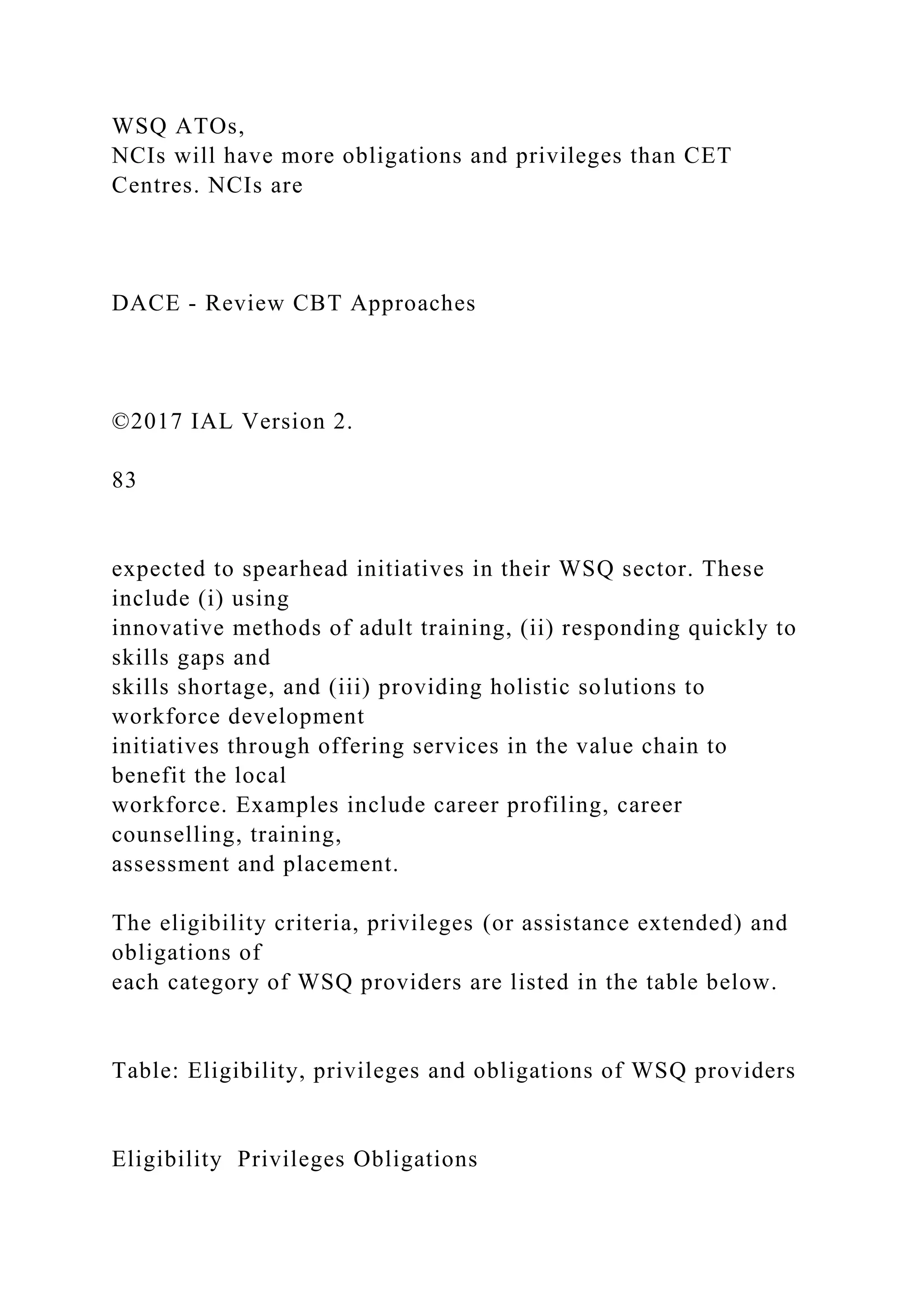
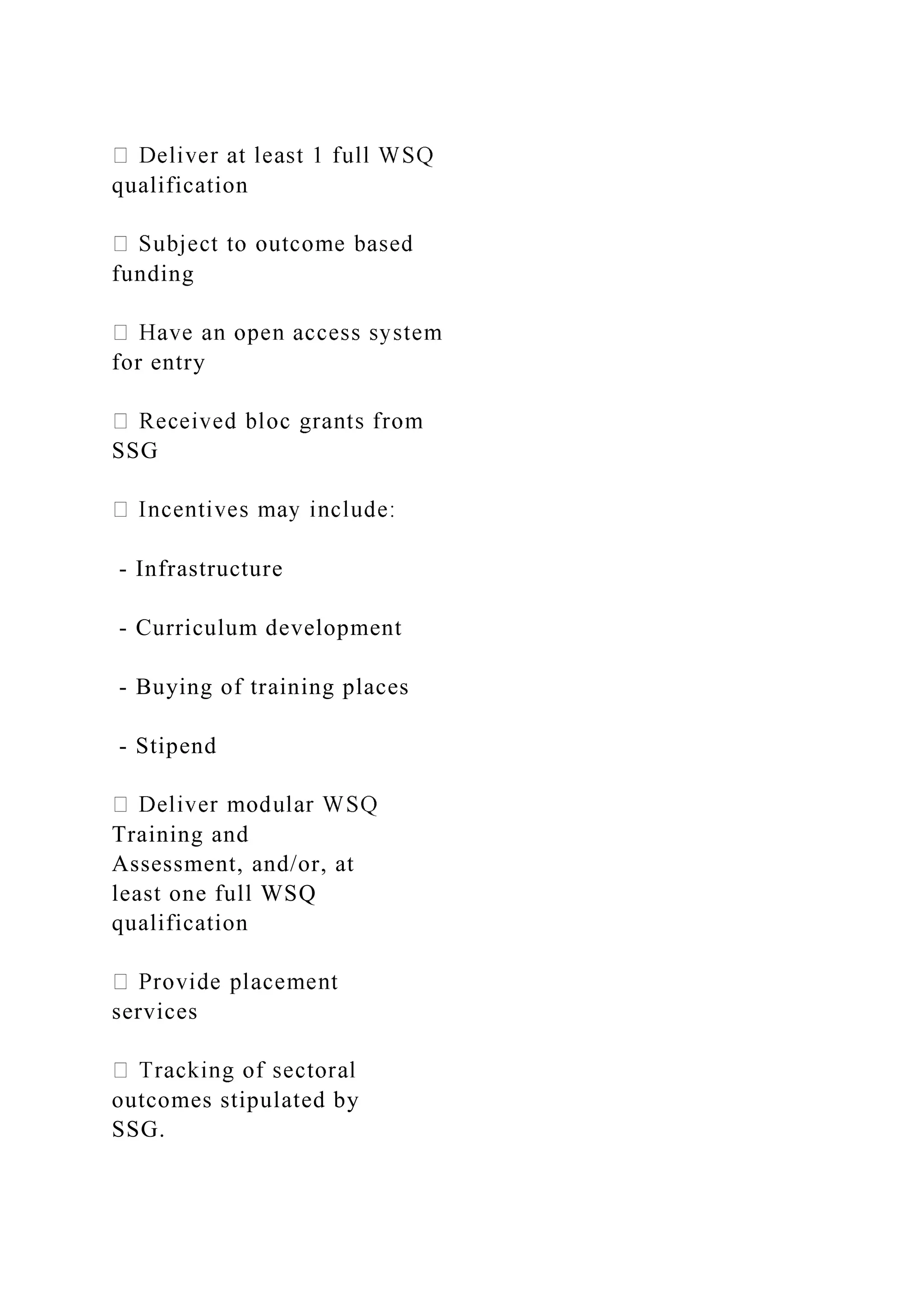
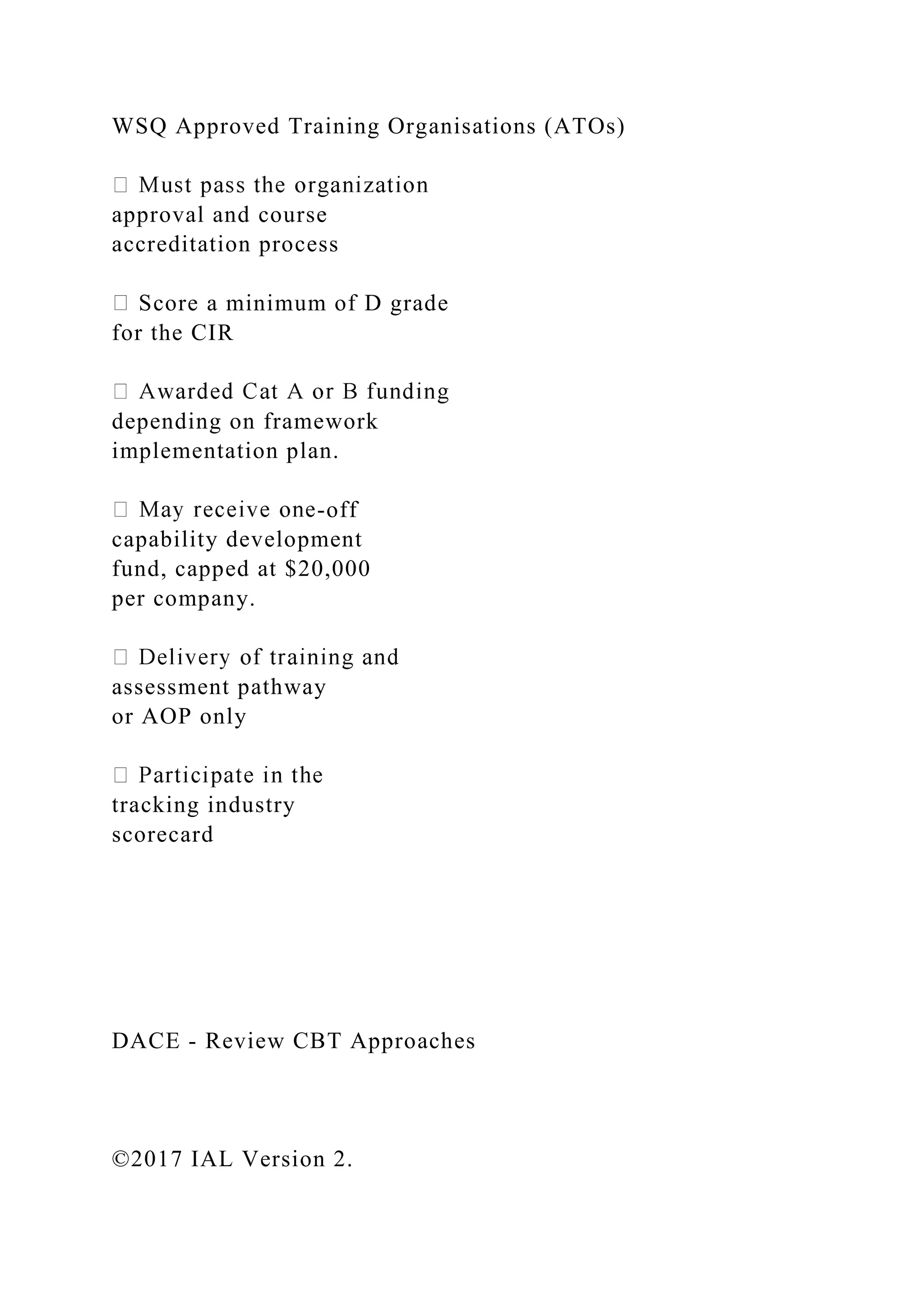
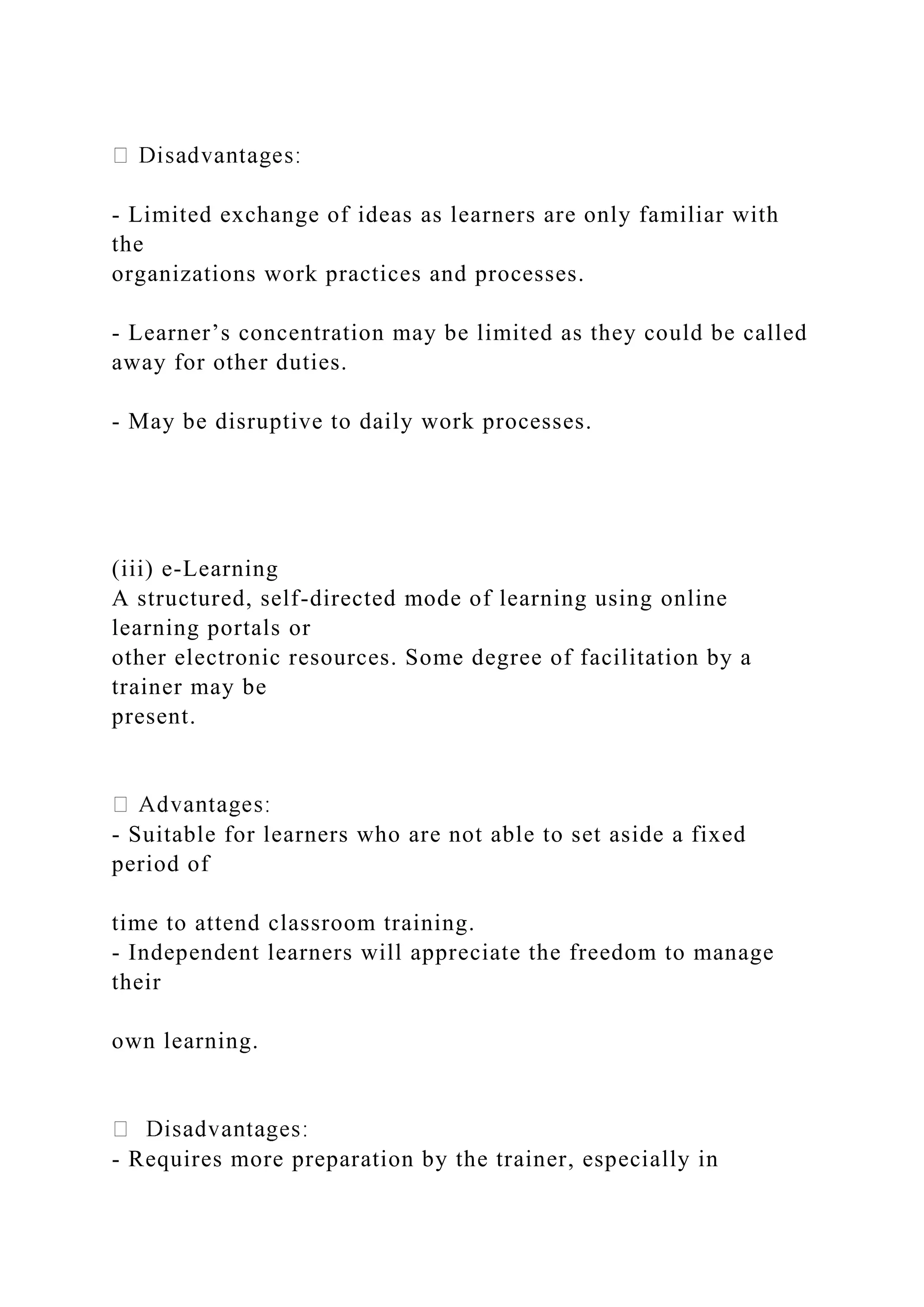
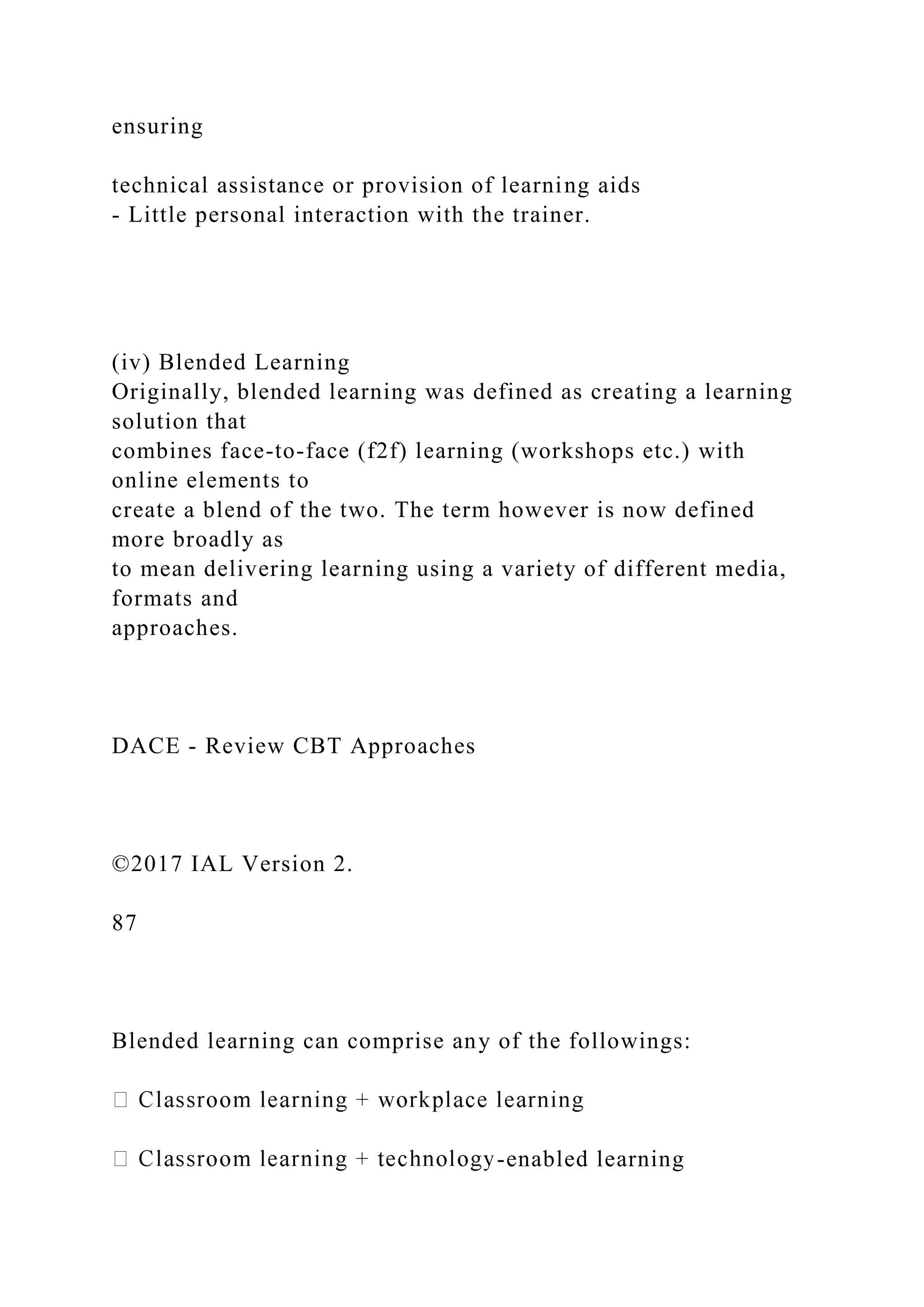
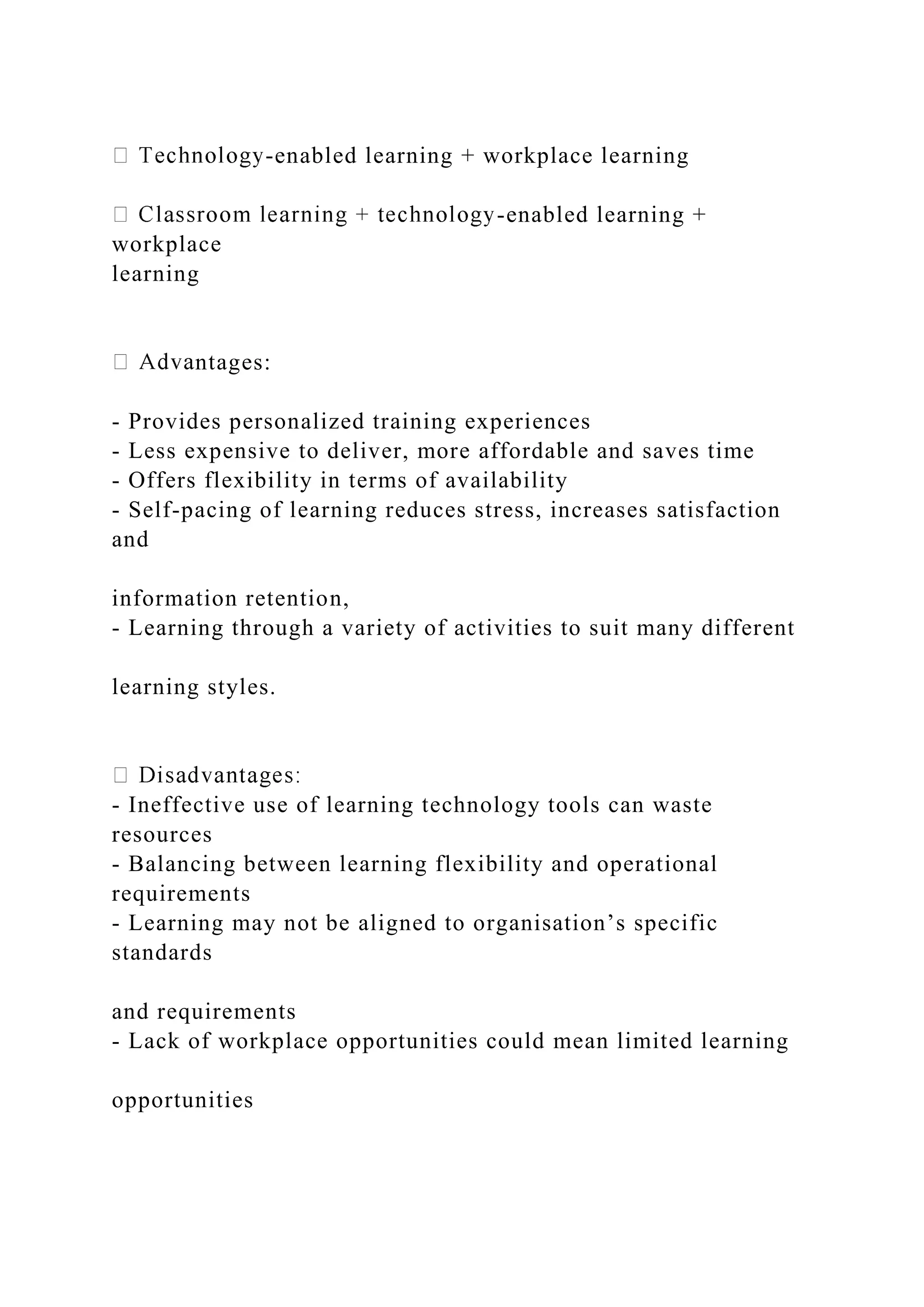
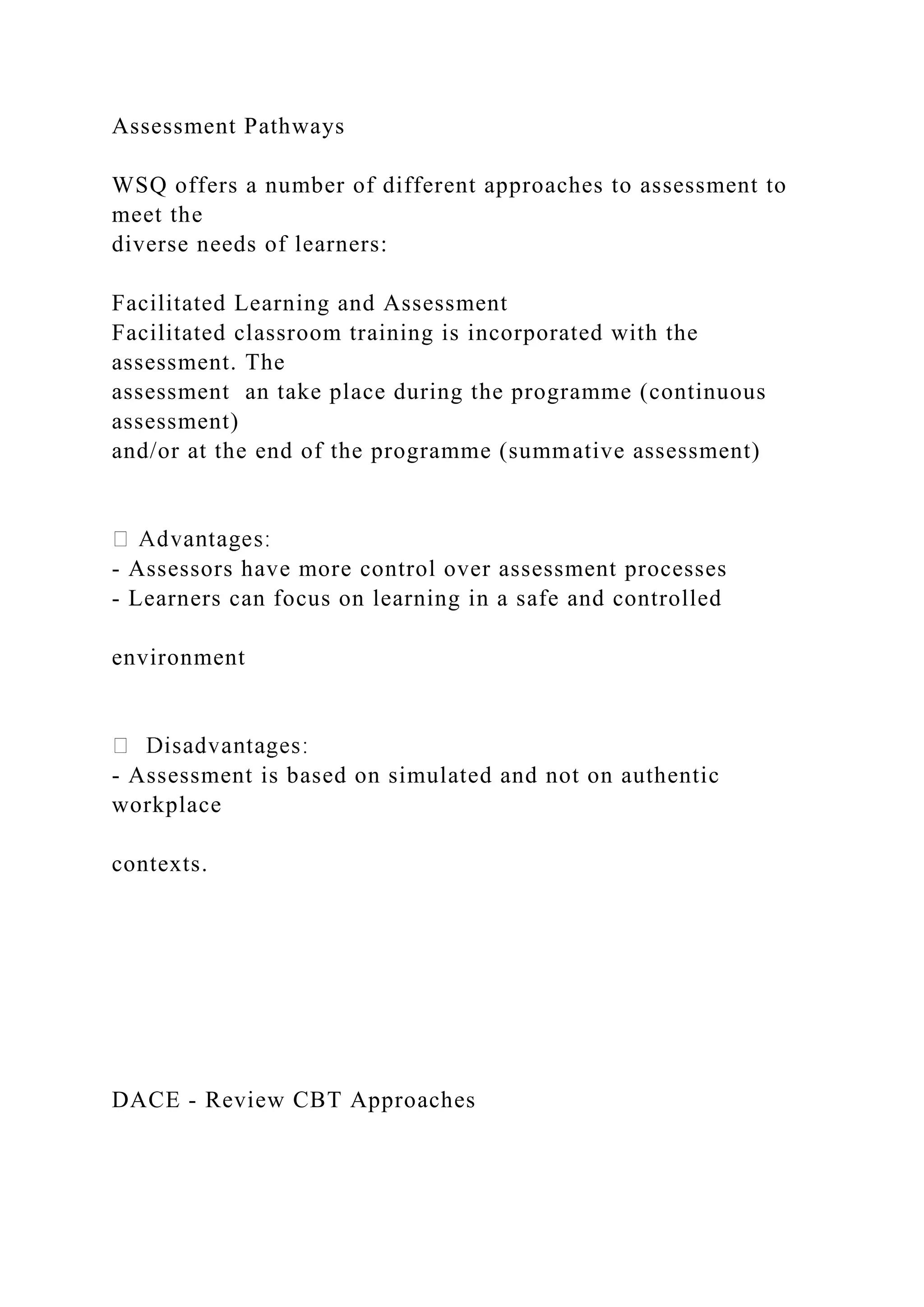
A CPD Framework for Early Childhood Educators
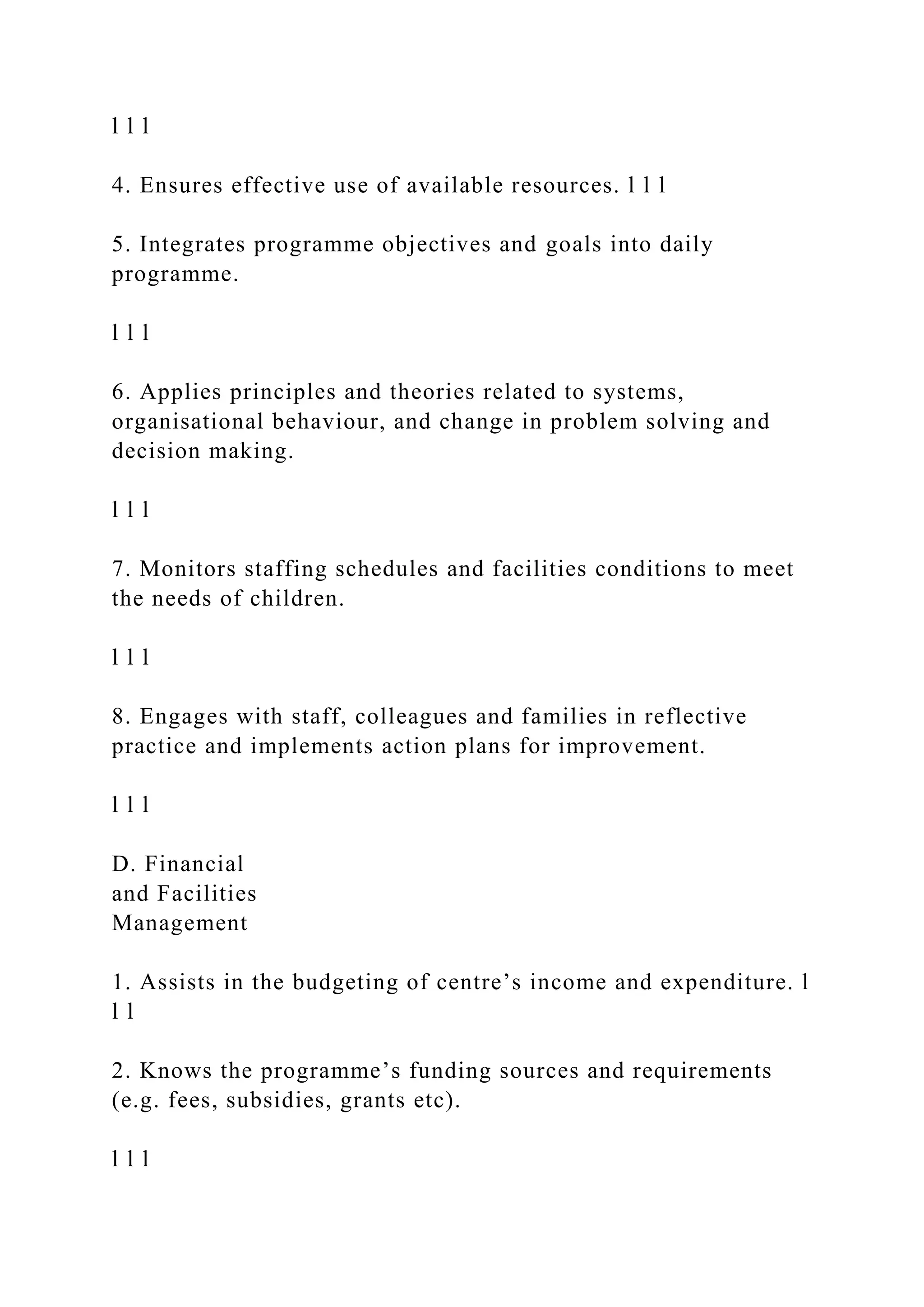
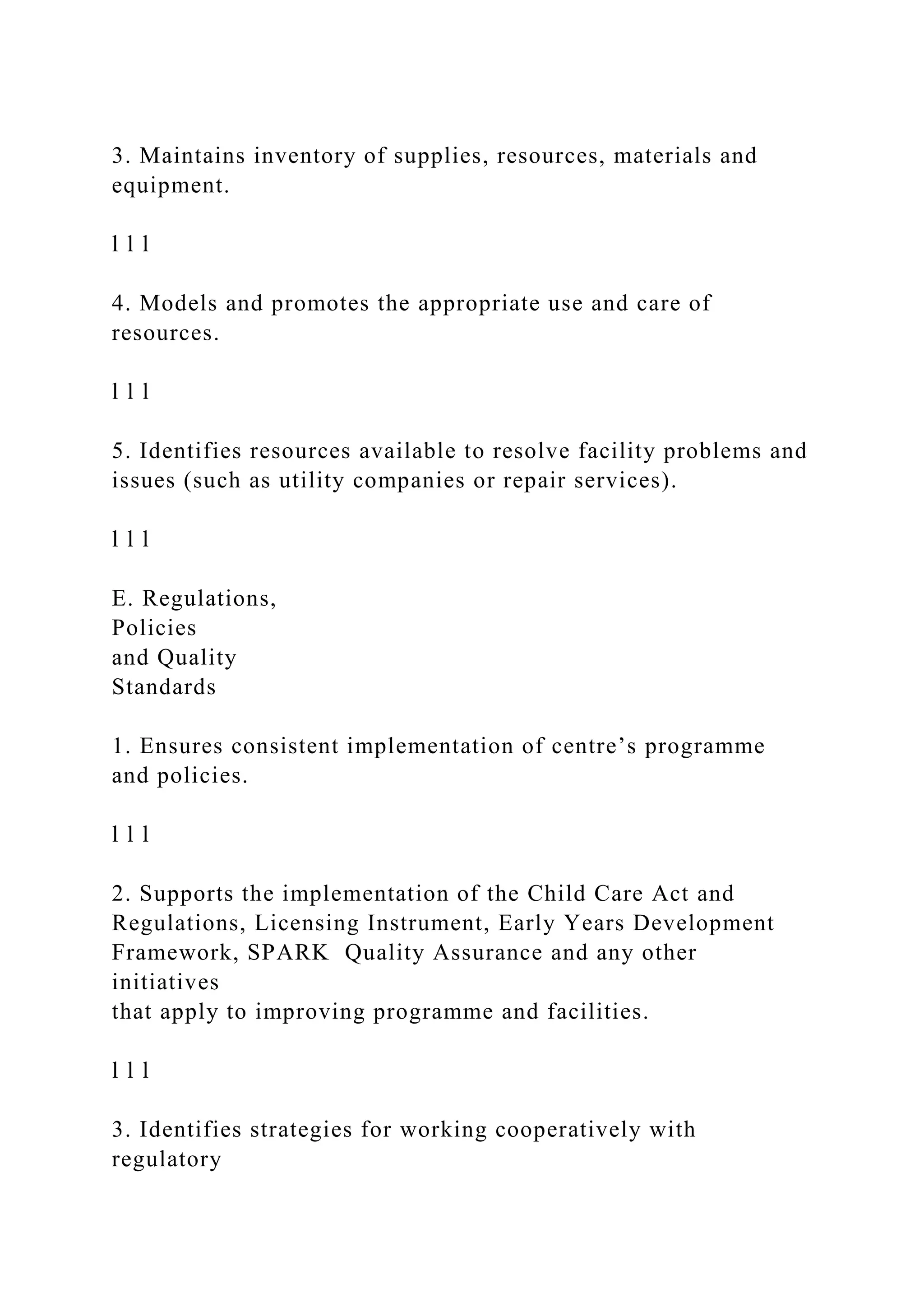
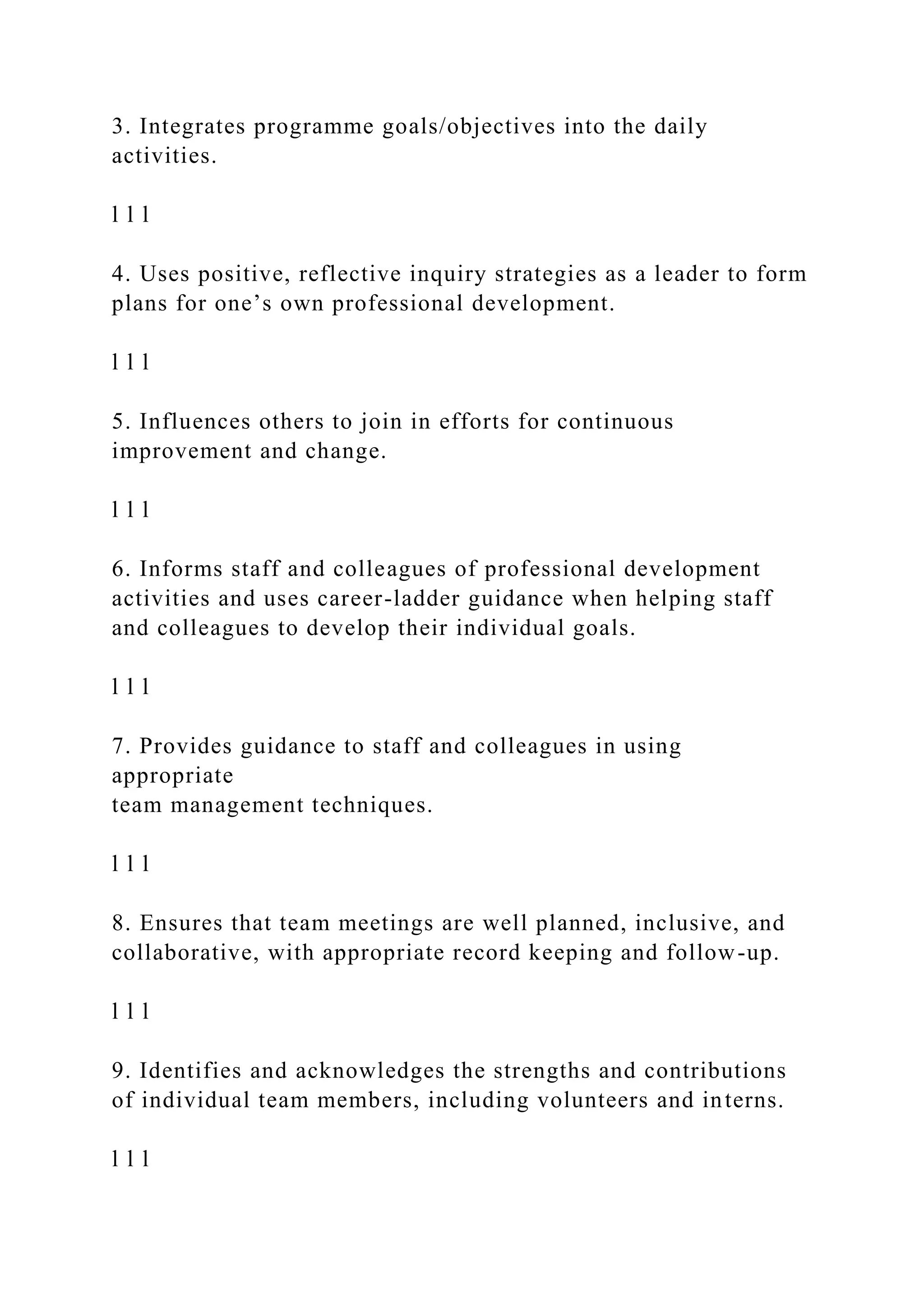
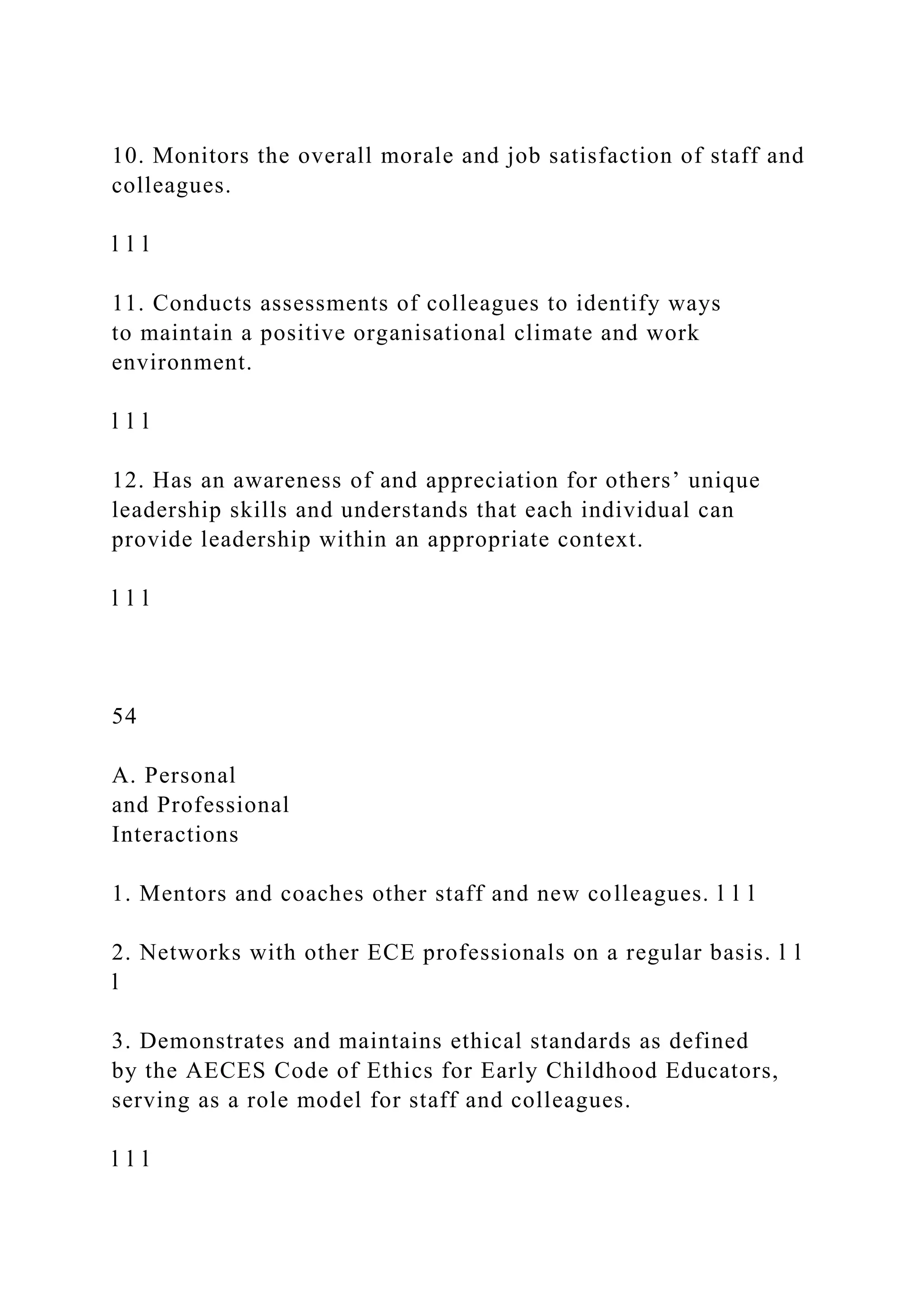
Continuing
Professional
Development
Achieving Excellence through
C
M
Y
CM
MY
CY
CMY
K
Cover Inside.pdf 10/1/12 6:54:14 PM
FOREWORD
Increased awareness of how early education
impacts children’s development has resulted
in a greater emphasis on the professional
development of their teachers and carers.
Studies have shown that sustained
professional development for teachers is
associated with more positive and stimulating
teacher behaviour and positive child
outcomes. When designed well, these
opportunities help teachers master content,
hone teaching skills and address challenges
faced in the classroom.
Regardless of the duration and quality of
pre-service education a teacher receives, it is
not su�cient to prepare them for the
challenges they will face throughout their
careers. As such, quality continuing
professional development (CPD) is necessary
to ensure that teachers are able to meet the
demands of diverse children needs, engage
parents, as well as become active agents of
their own professional growth.
This CPD framework provides child care
personnel with a structured pathway to
develop, update, or even specialise in
knowledge and skills relevant to their
profession, so that they may continue to
provide high quality programmes and
services to children and families.
This framework comprises two sections: a
lattice of core competencies and a toolkit that
sets out strategies and resources for operators
to chart their employees’ professional growth.
There is also a list of resources and suggested
CPD activities that child care personnel can
participate in – from attending conferences,
seminars, workshops, mentoring, professional
reading to participating in learning
communities.
By adopting this framework, we hope that
centre leaders and teachers will work in
partnership to create more professional
development opportunities. This, we believe,
will postively impact the quality of teaching
practices and learning for both children and
teachers in the years ahead.
Chan Lin Ho (Dr)
Deputy Director
(Policy & Development)
Child Care Division
2
CONTENTS
FOREWORD 1
CPD AND HOW IT BENEFITS YOU
Introduction
...............................................................................................
........................................................................5
Training Framework and Pathways
...............................................................................................
.............................6
What is Continuing Professional Development?
...............................................................................................
...7
The Benefits of CPD
...............................................................................................
....................................................... 10
Profile Story: Watching Teachers Grow
...............................................................................................
................... 12
COMPONENTS OF THE CPD FRAMEWORK
An Overview of the CPD Framework
...............................................................................................
....................... 15
Levels of Professional Development
...............................................................................................
....................... 16
Levels of Proficiency
...............................................................................................
...................................................... 18
How the Core Competencies Lattice Can be Used
............................................................................................
20
Profile Story: CPD for Career Success
...............................................................................................
...................... 22
Core Knowledge Domains
Profile Story: Achieving Professional
Status......................................................................................
............ 25
Structure of Knowledge Domains
...............................................................................................
.................... 26
Domain 1: Child Development
....................................................................................... ........
........................... 28
Domain 2: Learning Environments and Curriculum
.................................................................................. 34
Domain 3: Family and Community Engagement
........................................................................................ 42
Domain 4: Management, Administration and Leadership
...................................................................... 48
THE CPD PLANNER: TOOLKIT FOR YOUR PROFESSIONAL
JOURNEY
The Toolkit: Its Intent and Purpose
...............................................................................................
........................... 61
Overview of Toolkit
...............................................................................................
........................................................ 61
Reflecting Before Professional Development Planning
................................................................................... 64
Profile Story: Striving to Become a Better Teacher
............................................................................................
66
The Professional Development Planning Cycle
...............................................................................................
... 67
Case Scenario 1: Moving on Up
...............................................................................................
................................. 69
Case Scenario 2: Becoming a Successful Mentor
...............................................................................................
71
Case Scenario 3: Putting a Shine on Leadership Skills
..................................................................................... 73
Developing Your Professional Portfolio
...............................................................................................
.................. 75
Profile Story: Leading by Example
...............................................................................................
............................ 76
Sharing Professional Development Learning with Others
............................................................................. 77
The Role of Your Centre in CPD
...............................................................................................
................................. 78
Types of CPD Activities
...............................................................................................
................................................. 79
GETTING STARTED
Your CPD Journey Begins Here
...............................................................................................
.................................. 85
Toolkit:
Let’s Reflect: Where am I Now?
...............................................................................................
........................... 86
Step 1: Assessing My CPD Needs
...............................................................................................
....................... 88
Step 2: Developing My CPD Goals, Identifying Content and
Activities .............................................. 89
Step 3: Making CPD Happen!
...............................................................................................
.............................. 93
Step 4: Reviewing and Evaluating What I Have Learnt
.............................................................................. 94
Documents in My CPD
Portfolio.................................................................................
....................................... 95
Sharing My CPD Learning with Others
...............................................................................................
............ 96
CPD Centre Planner for Centre Administrators and
Supervisors........................................................... 97
ACKNOWLEDGEMENTS AND RESOURCES
Acknowledgements
...............................................................................................
....................................................101
Bibliography
...............................................................................................
...................................................................102
Useful Links &
Resources................................................................................
...........................................................103
CPD
and How
it Benefits You CPD and How it
Benefits You
5
Rationale for a Continuing
Professional Development
Framework
The knowledge, skills, and practices of early childhood
educators are important factors in determining how
much a young child learns and how prepared that
child is for entry into school.
Early childhood educators are expected to have
deeper understandings of child development and
early education issues so that they can:
provide richer educational experiences for all •
children, including those who are vulnerable and
disadvantaged
engage children of varying abilities and •
backgrounds
connect with a diverse array of families•
The quality of pre-school provision depends greatly
on the teachers and the training received by them.
Teacher training and qualification offer high leverage
opportunities for enhancing standards of training
and expanding career opportunities for early
childhood educators.
In 2010 to 2011, a series of focus group meetings
were conducted with child care operators, teachers
and various training providers on the need to
have a comprehensive Continuous Professional
Development (CPD) framework to guide and
support the development of ECE teachers and
leaders.
IntroductIon
The quality of pre-school provision
depends greatly on the teachers
and the training received by them.
Teacher training and qualification
offer high leverage opportunities for
enhancing standards of training
and expanding career opportunities
for early childhood educators.
Participants in these consultations unanimously
agreed that investing in their teachers’ professional
development is a key strategy for retaining
employees and improving the quality of their
programmes for children.
Besides required certification courses, ongoing
professional development and training will ensure
that pre-school professionals are well equipped
to provide our young with an enriched learning
environment to nurture their social skills and values,
and prepare them for lifelong learning.
6
traInIng Framework and Pathways
CPD is designed to complement the existing
training pathways for early childhood educators,
going beyond the basic accredited training courses
required for teacher certification.
Currently, all ECE training pathways fall under the
purview of the Pre-school Qualification Accreditation
Committee (PQAC) and the Early Years Accreditation
Committee (EYQAC) to oversee the standards and
quality of pre-school teacher training for both
kindergarten and child care sectors in Singapore.
In September 2011, the Ministry of Community
Development, Youth and Sports (MCYS) announced
the new training and certification pathway for
educarers (child care professionals who work with
young children 0 to 3 years old). The new Singapore
Workforce Skills Qualifications (WSQ) training
pathway aims to raise the skills level of early
years educarers, targeted at building specialised
competencies to cater to the unique developmental
needs for this age group. The new pathway comprises
two new courses: the Advance Certificate in Early
Years (WSQ ACEY) for those who wish to work with
infants and toddlers aged from two months to three
years, and the Higher Certificate in Infant Care (WSQ
HCIC), for those who wish to work with infants.
With the integrated training pathways catering to
both educarers and pre-school educators in place,
it is timely for the child care sector to embrace the
concept of continuing professional development.
CPD is designed to
complement the existing
training pathways for
early childhood educators,
going beyond the basic
accreditation training
courses required for
teacher certification.
7
what Is contInuIng ProFessIonal
develoPment?
The term Continuing Professional Development,
or CPD, is common to many professions. CPD
embraces the idea that individuals aim for
continuous improvement in their professional skills
and knowledge, beyond the basic training initially
required to carry out the job1.
Continuing professional development is a life-
long process of learning. This CPD framework and
toolkit serves as a guide for child care operators and
educators to plan and develop ongoing professional
training, enabling staff to fulfil their present or future
roles more effectively as well as maintaining a high
standard of professional competence.
Every early childhood professional has a personal
responsibility to develop and maintain their
knowledge and skills to ensure professional
competence throughout their careers. Simply put,
CPD is an investment in your future.
The key principles of the CPD framework are:
1. Individual and centre commitment to improve and learn
Continuing professional development is both an individual
responsibility and the responsibility of the
employer. Every child care educator has a professional
responsibility to maintain a sufficiently high
standard of professional competence and to be current in their
knowledge and skill base in order to
provide the best care and development programmes for young
children. Every centre needs to commit
to the on-going efforts to upgrade its teachers.
2. CPD opportunities include both formal and informal training
and development
activities
Continuing professional development opportunities should be
relevant to the educator’s work and
teaching responsibilities and every child care personnel should
be able to participate in continuing
professional development opportunities.
8
The term professional development refers to
different types of facilitated learning experiences
that are designed to support the acquisition of
professional knowledge, skills, and dispositions as
well as the application of this knowledge to practice.
Knowledge• consists of facts, concepts, ideas,
vocabulary, and related aspects of educational
culture and best practice.
Skills• refer to the observable units of action that
occur in a relatively discrete period of time. These
are learned through direct instruction, modelling
and imitation, application of theory to practice,
discovery, or other methods, and are modified or
improved through feedback, guidance, practice,
repetition, drill, and continuous use.
Dispositions• are prevailing tendencies to exhibit
a pattern of behaviour frequently, consciously,
and voluntarily. Dispositions are distinguished
from skills in being broader in scope and includes
motivation to be applied and put to use –
in contrast, one can have a skill but no desire to
use it.
“There is plenty of research evidence pointing to the positive
correlation between teachers’ on-going professional
development and
improved outcomes for children’s learning. What is important
then,
for leaders as well as teachers planning for professional
development,
is to set real goals, design a realistic and practical plan and
allocate
resources appropriately and wisely both for individuals as well
as for
the centre as a whole. This is what the CPD Framework sets out
to do.”
Dr Jane Ching-Kwan, Principal, KLC School of Education
9
Professional development includes a wide range of
learning activities, including formal higher education
that results in awarding credit, and informal training
activities delivered to in-service early child care
providers in the form of training workshops and
activities, in-house training and even professional
reflection and writing.
As training needs differ according to the
developmental stage of the teacher, it is useful
to select the appropriate types of CPD activities
that cater to the different needs and experience of
teachers. For beginning teachers, on-site support
and technical assistance, colleague advice and access
to specialists would be more helpful at this stage of
their professional development.
For more experienced teachers, attending
conferences, reading journals, networking with
other professionals and visits to demonstration
projects would be more engaging and appropriate
as they welcome the opportunity to read widely and
to interact with other educators working on similar
problem areas.
“The CPD Framework is
designed to encourage
the development of Early
Childhood professionals so
that they reflect on their
practices and its quality, are
able to adopt and assess
new approaches to their
practice and develop better
ways of working.”
Ms Lynn Heng,
Group Professional Leadership Officer,
NTUC First Campus
10
the BeneFIts oF cPd
How does CPD benefit me?
Teachers play a key role in ensuring quality in child care
programmes. A key factor that is
positively associated with teacher quality is participation in
professional development2.
CPD involves the process of regularly assessing current and
future skills and knowledge
requirements that are relevant to a teacher’s responsibilities, as
well as planning and
implementing an ongoing programme of training and
development to address these
needs. When adopted and embraced, the process allows you to:
1 Foster excellence in your teaching and leadership practice
2 Be accountable for remaining current in your practice, thus
improving the profession’s credibility with the public
3 Enhance professional image
4 Progress your career
5 Reflect on personal achievements and invest in future
development
6 Learn from others and exchange knowledge and ideas
7 Benchmark your performance
8 Plan and design your own professional development
9 Develop the skills you need to do your job more effectively
10 Learn in a flexible style, identifying and making the most of
available development opportunities
11
Evidence from Research
Evidence from research is just beginning to uncover
the complex interplay of factors that change
providers’ practices and how it affects the quality
of care children receive. The knowledge, skills, and
practices of early childhood educators are important
factors in determining how much a young child
learns. For young children in early childhood settings,
interactions with teachers/caregivers are the “primary
mechanism” through which experiences affect the
child3.
Professional development of the early care and
education sector is linked to quality in the following
ways:
A. Professional development and programme
quality
There is evidence of a positive correlation •
between training and programme quality, even
when level of education is taken into account4.
B. Professional development and child outcomes
Studies show that both education and •
training are associated with more positive
and stimulating teacher/caregiver behaviours
and positive child outcomes. Education and
training that increases positive interactions
between adults and children affect multiple
areas of development5.
Training on implementation of curriculum, •
when accompanied by coaching, can produce
large changes in practices that support
children’s developmental outcomes.
C. Professional development and workforce
stability
Compensation initiatives that are linked to •
increased education and/or completion of
training can result in workforce stability.
Reports of participation, education levels, and •
staff retention indicate that CPD initiatives
have been successful in lowering turnover rates
among participants, increasing educational
levels, as well as motivating participants to
pursue ongoing professional development5.
END NOTES
1. Gray, S.L. 2005. An Enquiry Into Continuing Professional
Development for Teachers.
2. Kagan, S. L., Tarrant, K., Carson, A., & Kauerz, K. 2006.
The early care and education teaching workforce: At the
fulcrum.
3. Pianta, R. C. 2006. Standardized observation and professional
development: A focus on individualized implementation and
practices.
In M. Zaslow & I. Martinez-Beck (Eds.), Critical issues in early
childhood professional development. Baltimore, MD: Paul H.
Brookes
Publishing.
4. Zaslow, Martha and Martinez-Beck, Ivelisse. 2005. “Quality
and Qualifications: Links Between Professional Development
and Quality
in Early Care and Education Settings,” Critical Issues in Early
Childhood Professional Development, published by Paul H.
Brookes
Publishing Company.
5. Pianta, R. C. 2006. Standardized observation and professional
development: A focus on individualized implementation and
practices.
In M. Zaslow & I. Martinez-Beck (Eds.), Critical issues in early
childhood professional development. Baltimore, MD: Paul H.
Brookes
Publishing; and Ramey, S., Ramey C., Timraz, N., Grace, C., &
Davis, L., 2008. The “Right from Birth” study: An evidence-
informed
training model to improve the quality of early child care and
education.
12
With proper training and guidance, Continuous Professional
Development can enable
inexperienced teachers to bloom.
Rohayu encouraged the young teacher to attend modular
courses at SEED Institute that taught practical strategies
for managing the classroom. Additionally, the teacher
would also seek advice from her peers on ways to improve
herself during regular school days.
In Rohayu’s opinion, ECE practitioners can continuously
improve their skills in other avenues aside from training. “I
am glad CPD also includes peer training, peer learning and
reading of articles from good literature sources.”
She also hopes that there would be more technology-
based CPD programmes, such as e-learning platforms,
forums or even blogging. “Perhaps ECE teachers can find
other ways to improve themselves using technology.”
“Through CPD, I could
see that the teacher
gained classroom
management skills
and she managed the
classroom better.”
Ms Rohayu Bte Nabebe
Executive Principal
My First Skool, Hougang
“Continuous Professional Development (CPD) is essential
for young ECE teachers who lack field experience,” says Ms
Rohayu Bte Nabebe. As the Executive Principal of My First
Skool in Hougang, she has seen how CPD can transform
a young, inexperienced teacher into a competent, highly
skilled one.
Recalling an incident two years ago, Rohayu says she had
a teacher who had joined after obtaining the pre-requisite
diploma and degree. But as the young teacher lacked the
necessary experience, she found managing her class of
nursery students to be a difficult task.
Watching Teachers Grow
Com
ponents of the
CPD
Fram
ew
ork
Components of the
CPD Framework
15
I. Child Development
II. Learning Environments
and Curriculum
III. Family and Community
Engagement
IV. Management, Administration
and Leadership
How is the CPD framework
organised?
The CPD Framework includes the following
components:
1. A lattice of core competencies comprising four
core knowledge domains.
2. A toolkit and planner that serves as a guide
for educators and supervisors to develop a
professional development plan for teachers
and themselves using the core competencies
lattice. It sets out the steps, planning templates
and resources to chart employees’ professional
development.
3. A list of resources and suggested CPD activities
that child care personnel can participate in – from
attending conferences, seminars, workshops,
mentoring, professional reading to participating
in learning communities.
Together, the competencies lattice and toolkit
serve as a document and resource to identify areas
for continuing professional development and career
progression for early childhood educators and
leaders.
The first section of the framework maps out the
core competencies according to the four core
knowledge areas. To find out how to identify the core
competencies for your professional development,
the toolkit section describes the processes and steps
for doing so. These include:
A. Regular reflection on your work experiences
through reading, writing, and developing a
professional portfolio.
AN OVERVIEW OF THE CPD FRAMEWORK
B. Participation in professional development
activities such as workshops, seminars,
conferences, in-service trainings, communities
of practice sessions or accredited training
courses*.
C. One-on-one learning activities such as
receiving guidance, mentoring and coaching
from a mentor or supervisor.
What do early childhood teachers
need to know and do?
Early Childhood Educators’ (ECE) competencies are
what they need to know and do to demonstrate that
they are well prepared to effectively educate and
care for young children. ECE competencies typically
start with broad concepts or domains of knowledge
and skills (e.g., knowledge about child development,
working with families, etc). The detailed lattice is
found on page 29 - 58.
The four core knowledge domains that make up the
professional competencies lattice are:
* Accredited training courses include programmes accredited
under the Singapore Workforce Skills Qualifications (WSQ)
system. Directory of available training programmes can be
found under Useful Links and Resources within the CPD toolkit.
16
LEVELS OF PROFESSIONAL DEVELOPMENT
The three levels of professional development of a
teacher’s career described in the framework state
the professional characteristics that a teacher
practitioner is expected to maintain and to build on
at his/her current career stage.
Each set of domain competencies at each level builds
on the previous set. You will be expected to continue
to meet the core competencies and to broaden and
deepen your professional attributes, knowledge,
understanding and skills within a specific level.
For instance, a teacher being considered for Level 2
would need to satisfy the Level 1 competencies as
well as meet the competencies of Level 2. A teacher
aspiring to become Level 3 would need to satisfy the
standards that are specific to that level and meet the
preceding standards for Level 1 and 2.
The relevant competencies should be looked at
as a whole in order to help teachers identify areas
of strength and areas for further professional
development. As your career progresses, you will
be expected to demonstrate and extend the depth
and breadth of knowledge, skill and understanding
in terms of your mastery as well as increasing
effectiveness in meeting the competencies,
according to the role you are fulfilling and in the
context in which you are working.
Level 1:
Beginning Practitioner
Level 2:
Experienced Practitioner
Level 3:
Advanced Practitioner
Core Domains
Child Development
Learning Environments & Curriculum Management,
Administration & Leadership
Family & Community Engagement
Proficient
Developing
EmergingProficient
Developing
Emerging
Proficient
Developing
Emerging
Fig 2-1: Core competencies lattice
17
The following table summarises three broad levels of
professional development:
Level of Competency Knowledge, Skills, Attributes What This
May Look Like
in Practice
Level 1 Practitioners
are beginning their careers in early
childhood education. They would
have undertaken and completed
an accredited ECCE programme
(Certificate) in teaching and possess
the requisite knowledge, skills,
values and attitudes to plan for
and implement age appropriate
activities and curriculum for young
children.
Have fundamental understanding
of core knowledge areas for entry-
level professionals, working under
supervision and with the ability to
apply solutions to familiar problems
and situations.
Able to carry out routine tasks with
basic competence in a range of roles
and responsibilities.
Level 2 Practitioners
are experienced (with at least 3
years of relevant work experience in
early childhood education and care
programmes) and professionally
competent in their roles. They
demonstrate successful teaching
experience and would have
completed at least a Diploma in
Early Childhood Care and Education
and/or Leadership.
Include the Level 1 competencies
as well as the knowledge, skills and
attitudes associated with Level 2 and
has a broad range and depth of core
knowledge.
Able to interpret and reflect on
information and possess a wide range
of practical skills.
Show propensity to acquire specialist
knowledge in an area and is able
to access, evaluate, compare and
interpret information. Have a well-
developed range of skills and ability
to employ in complex situations.
Able to effectively monitor, evaluate
and plan for developmental and
educational programmes that meet
the needs of children.
Level 3 Practitioners
are highly proficient personnel who
are accomplished and successful
practitioners with extensive relevant
ECE experience as a teacher and/or
centre principal.
These are personnel who have a
record of outstanding teaching
and leadership qualities and
competencies and are committed
to enhancing the quality of teaching
and learning of children and adults.
They are likely to possess either
a Degree in ECE (or a related
field) or are currently enrolled in
an Undergraduate or Graduate
programme in ECE.
Include the Level 1 and 2 competencies
as well as the knowledge, skills and
attitudes associated with Level 3.
Possess in-depth understanding of
comprehensive body of knowledge
with expertise in particular area
of knowledge. Demonstrate and
generate innovative responses to
challenging situations.
Able to analyse, evaluate and interpret
a wide range of information.
Are committed educators who can
articulate a vision of education to their
colleagues, peers, the profession and
the wider community.
Demonstrate a mastery of complex
theoretical knowledge and able
to critically evaluate knowledge,
concepts and practice.
Recognised as having in-depth
knowledge of child development and
curriculum and pedagogy and provide
an exemplary model to others through
their professional expertise.
Typically, assume a leading role in
raising standards in the centre by
supporting improvements in teaching
practice as well as support and help
their colleagues to improve their
effectiveness.
As practitioners, provide models of
excellent and innovative teaching and
use their skills to enhance teaching and
learning by undertaking and leading
school improvement activities and
continuing professional development
(CPD) for other teachers.
Carry out developmental work across
a range of workplaces and draw on
the experience they gain elsewhere
to improve practice in their own and
other centres.
18
LEVELS OF PROFICIENCY
Professionals may enter the field of early childhood
at different points of their professional development
and have varying levels or proficiency for the different
competencies. As each competency is gained over
time from a combination of education, experience
and reflection, it is important to remember that even
after taking a Level I, 2 or 3 professional development
At this level, the individual shows a mastery of the competency
and
consistently demonstrates the competency in his/her day to day
practice in the
following ways:
has a strong grasp of theoretical knowledge of child
development and •
applies this to initiate or lead the development of effective
programmes,
policies and processes;
exhibits and shares comprehensive knowledge of the
content/competency •
with other teachers to develop exemplary, content-rich, teaching
activities
and programmes;
evaluates and monitors the implementation of effective policies,
processes •
and teaching and learning practices;
provides leadership and encouragement to colleagues by
modelling and •
sharing of resources and knowledge that help to develop
programmes and
policies (e.g. innovation to enhance positive learning
environments and
strategies).
The individual is familiar with this competency but it is not
routinely evident in
his/her day to day practice. The individual:
demonstrates the ability to apply and use current knowledge and
skills of •
the content/competency, designs and implements contextually
relevant
programmes and initiatives (e.g. teaching and learning
sequences);
assists and supports the implementation of quality teaching and
learning •
programmes;
demonstrates capacity to apply effective strategies for
teaching/leadership. •
At this level, the individual is less familiar with an area or
competency and
demonstrates basic knowledge and understanding of the central
concepts of
the content/competence.
PROFICIENT
DEVELOPING
P
R
O
F
IC
IE
N
C
Y
L
E
V
E
L
S
activity, it is possible that you may still be at the
Emerging or Developing level of attainment.
For each competency, you may find your knowledge
and skills of that competency to be at varying levels
of proficiency and mastery. The following illustrates
what this may look like in practice:
EMERGING
19
46
DOMAIN 1
CHILD DEVELOPMENTEarly Childhood Professionals
understand and apply child development knowledge to promote
and support
children’s learning and holistic development specific to
individual needs.
A. How
Children
Develop
1. Identifies and understands that infant/toddler and
preschooler development can be described with regard to the
developmental domains (physical, cognitive, social-emotional,
communication, creativity strengths).
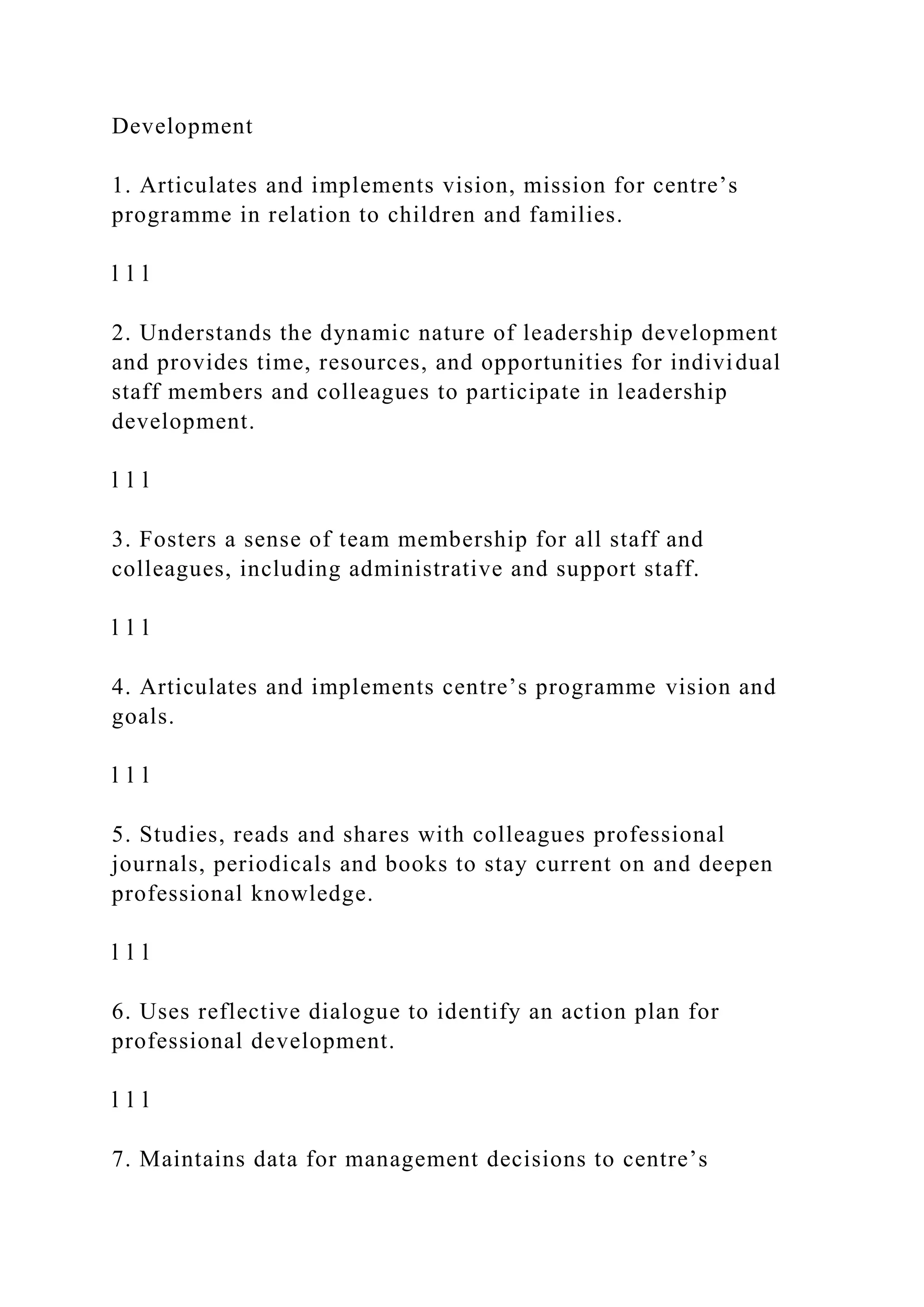
l l l
2. Gains knowledge by using the Early Years Development
Framework (EYDF) and the Nurturing Early Years (NEL). l l l3.
Identifies developmental milestones of children from birth up to
8 years old.
l l l4. Identifies the different ways children learn.
l l l
5. Recognises the role of play and its impact on children’s
overall
development.
l l l6. Practises respect for cultural diversity and the uniqueness
of
each child.
l l l
Sub-area
Proficiency Level
Level 1 Competency
Pr
ofi
cie
nt
Em
erg
ing
De
ve
lop
ing
1 2
3 4
Fig 2-2: Structure of knowledge domains
The illustration below shows how the Core Knowledge
Domains, Sub-areas and Core competencies form the
Professional Competencies Lattice.
Sub-areas break the core knowledge
domains into smaller chunks. They
describe the component parts that make
up the core knowledge domain. For
example under Child Development one
sub-area is ‘‘How Children Develop”.
The core competencies in each Core Knowledge
Domain are arranged in levels from entry level
to advanced. Level 1 addresses the Beginning
Practitioner, Level 2 the Experienced Practitioner,
and Level 3 the Advanced Practitioner.
Core Knowledge Domains refer to the foundational
knowledge base, skills and standards of practice
that all practitioners in the field need to possess.
Core competencies are the smallest pieces. They detail
the teachers’ professional attributes, professional
knowledge, understanding, skills, values and
dispositions needed to provide high quality services.
These are not meant to replace or to be confused
with the professional duties, roles and responsibilities
contained in the job scopes of teachers and those in
leadership roles.
20
The core competencies are formatted in a grid. They
are to be used as an assessment tool by individuals
to conduct self-assessment, as well as by mentors or
supervisors to assess and guide other professionals.
The competencies at each level will support teachers
in identifying their professional development
needs. Where teachers wish to progress to the
next career stage, the next level of the framework
provides a reference point for all teachers when
considering future development. While you may not
necessarily want to move to the next career stage,
the competencies will enable you to identify ways
to broaden and deepen your knowledge, skills and
expertise within your current career stage.
As you may specialise in or assume different roles or
job responsibilities, it is advisable to focus on just one
to two core areas of knowledge and skills to develop
and hone in. For example, a centre principal wanting
to further develop her competencies in programme
administration can first look at the Management,
Administration and Leadership core knowledge
domain, and plan her professional development by
selecting relevant CPD courses and activities that will
help her to acquire the knowledge and skills in that
area at a particular level.
HOW THE CORE COMPETENCIES LATTICE
CAN BE USED
“The competencies in ‘Family
and Community Engagement’
are good because they help
us to relate to parents from a
different perspective, taking
into consideration their different
backgrounds.”
Ms Irene Lim, Child Care Teacher, Creative O Preschoolers’
Bay
21
The core competencies can be used by everyone
working in the field of early childhood in different
contexts:
Child Care and Pre-school
Personnel
Practitioners and professionals working directly
with children and families (teachers, providers,
caregivers, paraprofessionals and others) can use the
competencies lattice to:
assess their own skills, knowledge and attitudes•
identify their learning needs and strengths to •
create professional development plans that
address gaps in the above
Supervisors, administrators, mentors and others
who provide support to practitioners can use the
competencies to:
provide orientation for teachers•
develop job descriptions•
evaluate work performance of teachers•
assess strengths, challenges and learning needs •
of teachers so as to provide opportunities for
advancement
support individuals in creating a professional •
development plan
As performance management is an integral process
to support teacher’s professional development, the
lattice provides the context for regular discussions
about teachers’ career aspirations and their future
development.
Hence, it is intended that this framework will provide
a backdrop for discussions about how a teacher’s
performance should be viewed in relation to his/
her current career stage and the career stage he/she
is approaching. Supervisors can review the level of
competencies expected of their teachers during the
appraisal process by tapping on the competencies
listed within the lattice.
“I think this CPD planner is a good
tool because it gives an indication
of where ECE teachers are in their
work and where they can work
towards.”
Ms Zita Tan, Centre Supervisor, Pebble Place
Organisations Providing Training
Courses
Instructors and those who sponsor or plan
professional development can use the competencies
to:
design and evaluate course content•
organise professional development •
opportunities for participants to develop their
core competencies
What comes next?
It is more useful and realistic to view CPD as a process
of learning and change that is coupled with honest
and comprehensive assessment for the purpose
of planning on-going and future professional
development.
As self-reflection is a key ingredient of the self-
assessment process, the next section, “The CPD
Planner: Toolkit for your Professional Journey”,
will provide a set of planning tools and a step-by-
step guide to help you build a roadmap for your
continuing professional development.
22
Continuous Professional Development is a life-long process of
learning. As an
investment in one’s work skills and knowledge, CPD can also
help groom the next
generation of effective, well trained ECE teachers.
to upgrade from her Ngee Ann Polytechnic diploma by
pursuing a degree in Early Childhood Education.
For Jocelyn, the most important insight that she has gained
is managing her emotions and patience when teaching
children. She also hopes to learn more about dealing with
children with special needs or how to use art as a medium
for teaching.
Right now, Jocelyn is geared toward chalking up more
experience as a child care teacher. With continuous
learning, she even hopes to move up the career ladder in
the future.
CPD For Career Success
No matter how many years of experience one has, a
competent and skilled ECE practitioner knows that
learning never stops throughout one’s career.
This is true for Ms Jocelyn Lim, an ECE teacher who teaches
a class of kindergarten children at the Little Skoolhouse
International. Having worked there for the past three
years, Jocelyn is constantly upgrading herself through
courses and in-house training programmes that the centre
provides. Some of the courses that she has participated in
include first-aid training and phonetics courses.
Jocelyn is not resting on her laurels, and took the initiative
“In a few years time,
hopefully I would have
improved as a teacher
and even move up to the
management level.”
Ms Jocelyn Lim
Teacher
Little Skoolhouse International
Core Know
ledge D
om
ains
Core Knowledge
Domains
I. Child Development
II. Learning Environments and Curriculum
III. Family and Community Engagement
IV. Management, Administration and Leadership
25
Through Continuous Professional Development, teachers such
as Mr Abu Bakar are
becoming more confident of their teaching abilities.
about children’s behaviour, then you can give parents the
appropriate advice,” he explains. “If you carry yourself well,
you come across as a confident person,” states Bakar, “ and
this confidence can only come after constant upgrading
and learning.”
A teacher of nine years, Bakar says his career has come
a long way since starting out as an ECE assistant who
would teach art and help kids with their drawings.
Since obtaining his degree in Early Child Care from the
University of South Australia, Bakar now banks
on his knowledge to observe whether children
are displaying the age-appropriate learning and
capabilities in his class.
Not only does Continuous Professional Development
(CPD) help raise the standards of child care, it also
enables ECE teachers to be seen as professionals in their
own right.
As senior ECE teacher at Chiltern House (East Coast), Mr
Abu Bakar often fields questions from concerned parents
from topics ranging from child behaviour to learning
milestones. “Some parents would ask me, ‘My child is not
eating, what should I do?’ ” he says.
In such instances, Bakar relies on his knowledge on
child development to reassure parents or educate them
about their children’s learning milestones. “If you learn
“CPD gives you the
drive to learn. You
can’t stagnate in
your work and it’s
important to keep
up to date with the
latest developments
in the field.”
Mr Abu Bakar
Senior Teacher
Chiltern House (East Coast)
Achieving Professional Status
26
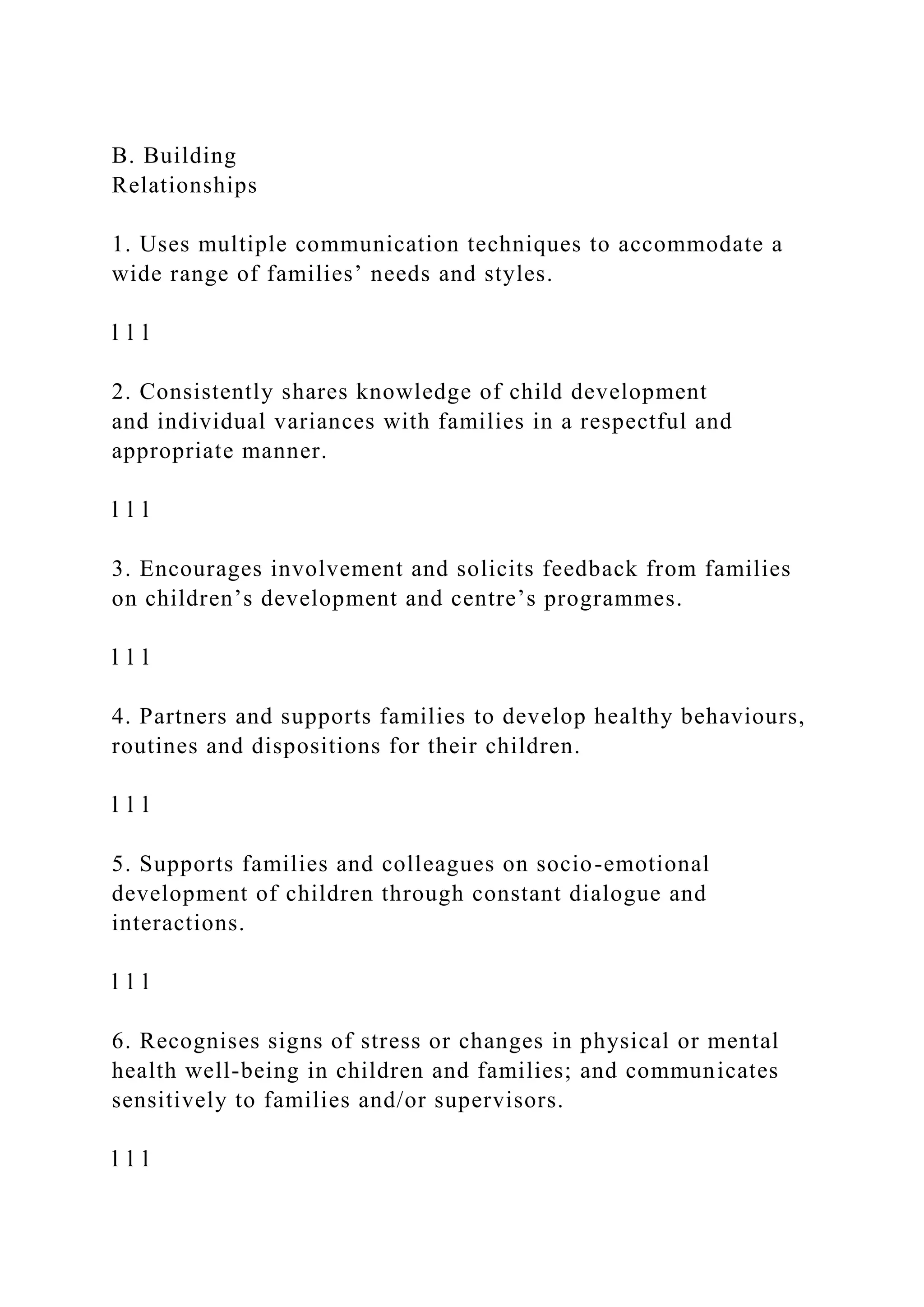
The core knowledge domains and sub-areas are summarised in
the following table:
I. Child Development II. Learning Environments and
Curriculum
Early Childhood Professionals
understand and apply child
development knowledge to
promote and support children’s
learning and holistic development
specific to individual needs.
A. How Children Develop
Addresses the principles and
knowledge of child development
to be applied in practice with
respect to individual learning
needs to support children’s healthy
development.
B. Factors that Contribute to
Development
Addresses the individual, social,
emotional, cultural and ecological
aspects of a child’s life that work
together to facilitate optimal
learning and development for
positive outcomes.
Early Childhood Professionals plan and implement a child-
centred intentional programme based on a cyclical process
of observation, documentation and evaluation to facilitate
children’s learning needs and interests.
A. Environmental Design - Materials and Equipment
Describes strategies to create learning spaces that promote
exploration, experimentation and discovery in a safe,
developmentally appropriate and resource-rich environment.
Addresses the range and variety of resources made accessible
and
available to children in sensorial, play-based learning
experiences.
B. Schedules and Care Routines
Addresses the components of personal care, routines and
transitions
in the curriculum to support children’s needs.
C. Strategies to Support Learning and Development
Encompasses the knowledge, skills and techniques of
intentional
teaching to meet learning outcomes and programme goals.
D. The Intentional Programme and Curriculum
Addresses the principles of purposeful, meaningful,
developmentally appropriate and culturally responsive
experiences
that support children’s learning dispositions, growth,
development
and learning.
E. Observation and Assessment
Describes the purposes, strategies and tools for gathering
information on children’s learning and development as an
individual
and in group settings. Encompasses the variety of tools to
interpret,
analyse and evaluate children’s learning and development from
observations and documentation to support planning.
F. Supporting Children’s Emotional Development and Positive
Relationships
Emphasises the importance and significance of respectful,
reciprocal relationships central to a child’s development of
identity,
self-regulation and resilience as a foundation in the early years.
STRUCTURE OF KNOWLEDGE DOMAINS
27
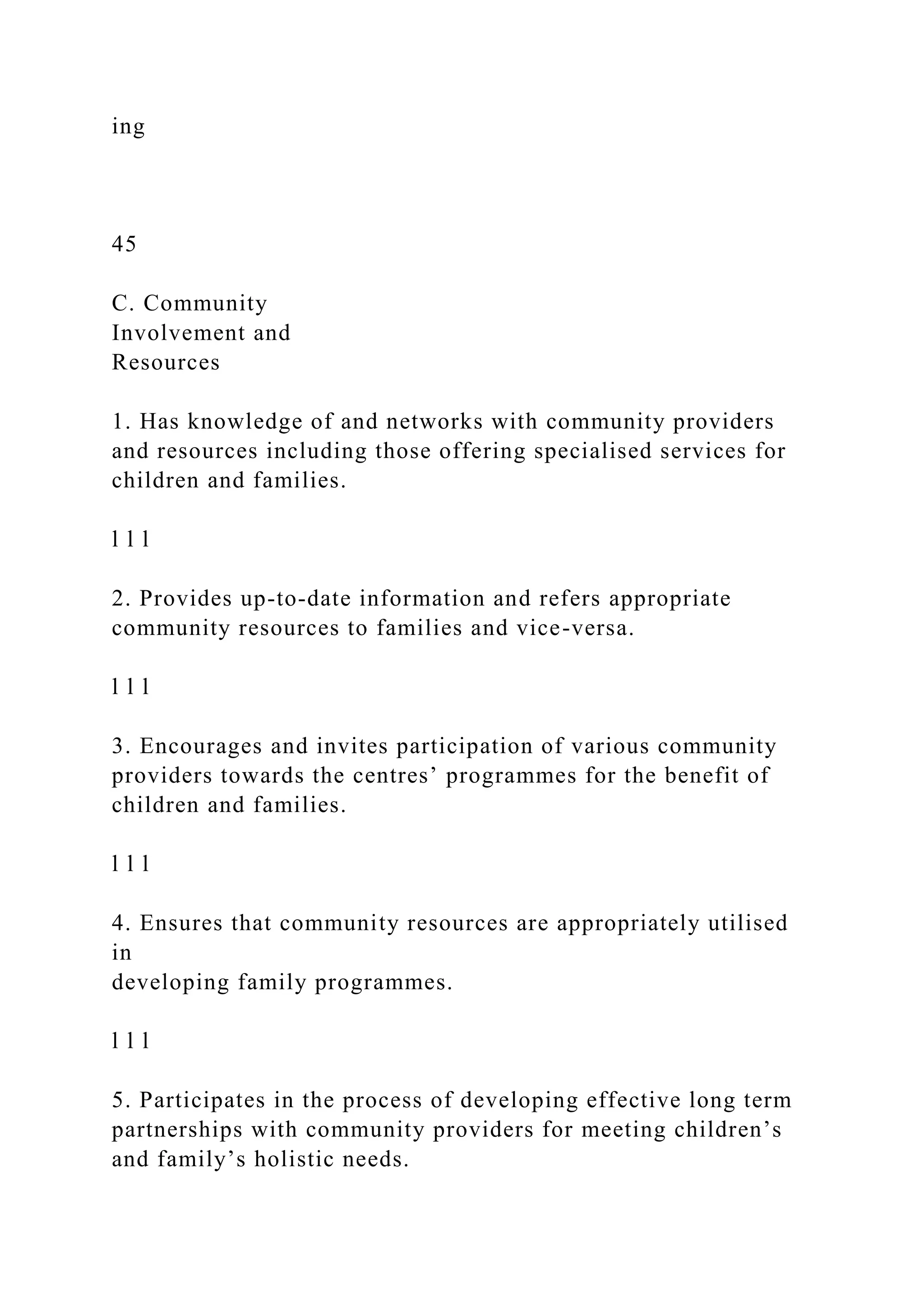
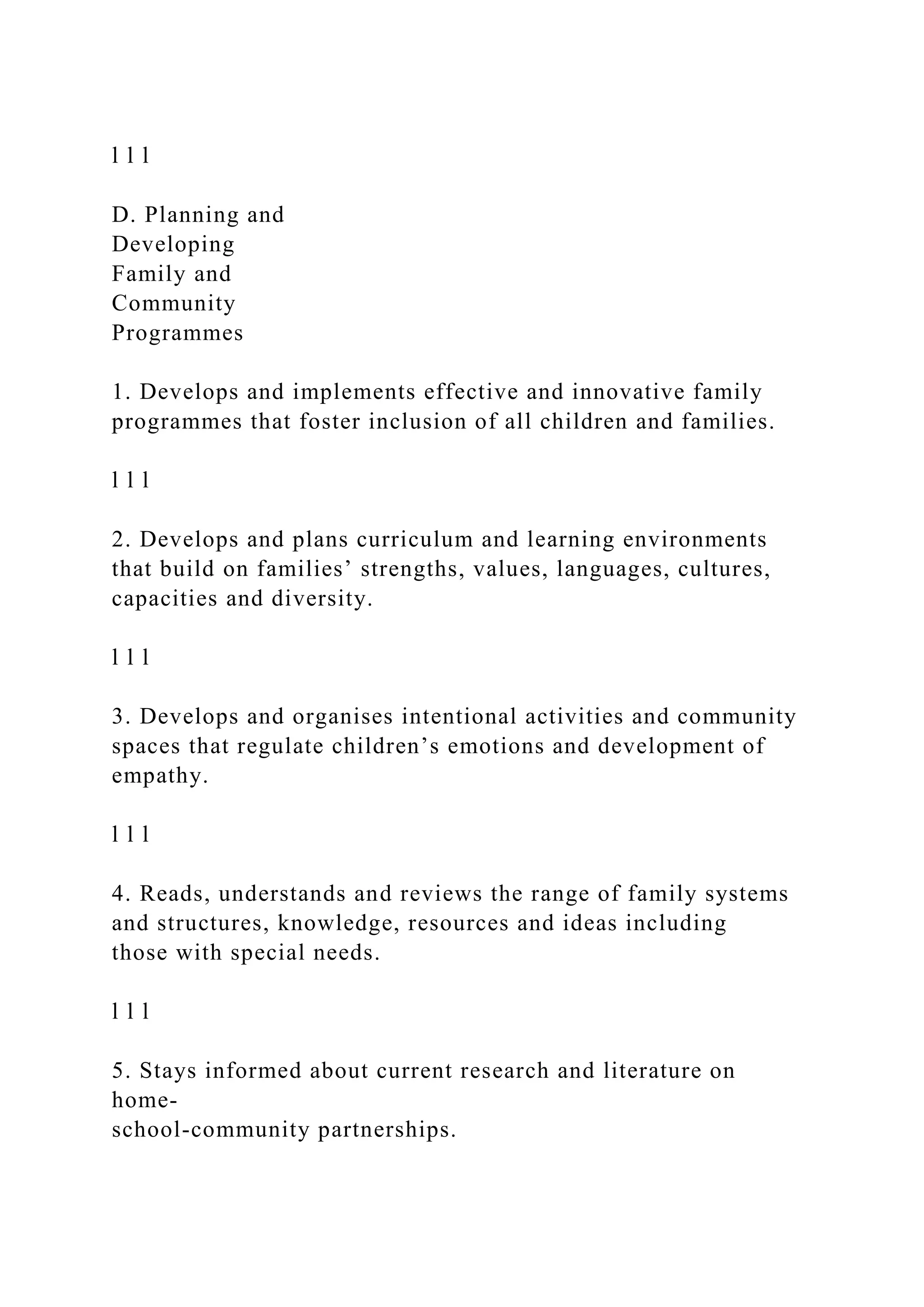
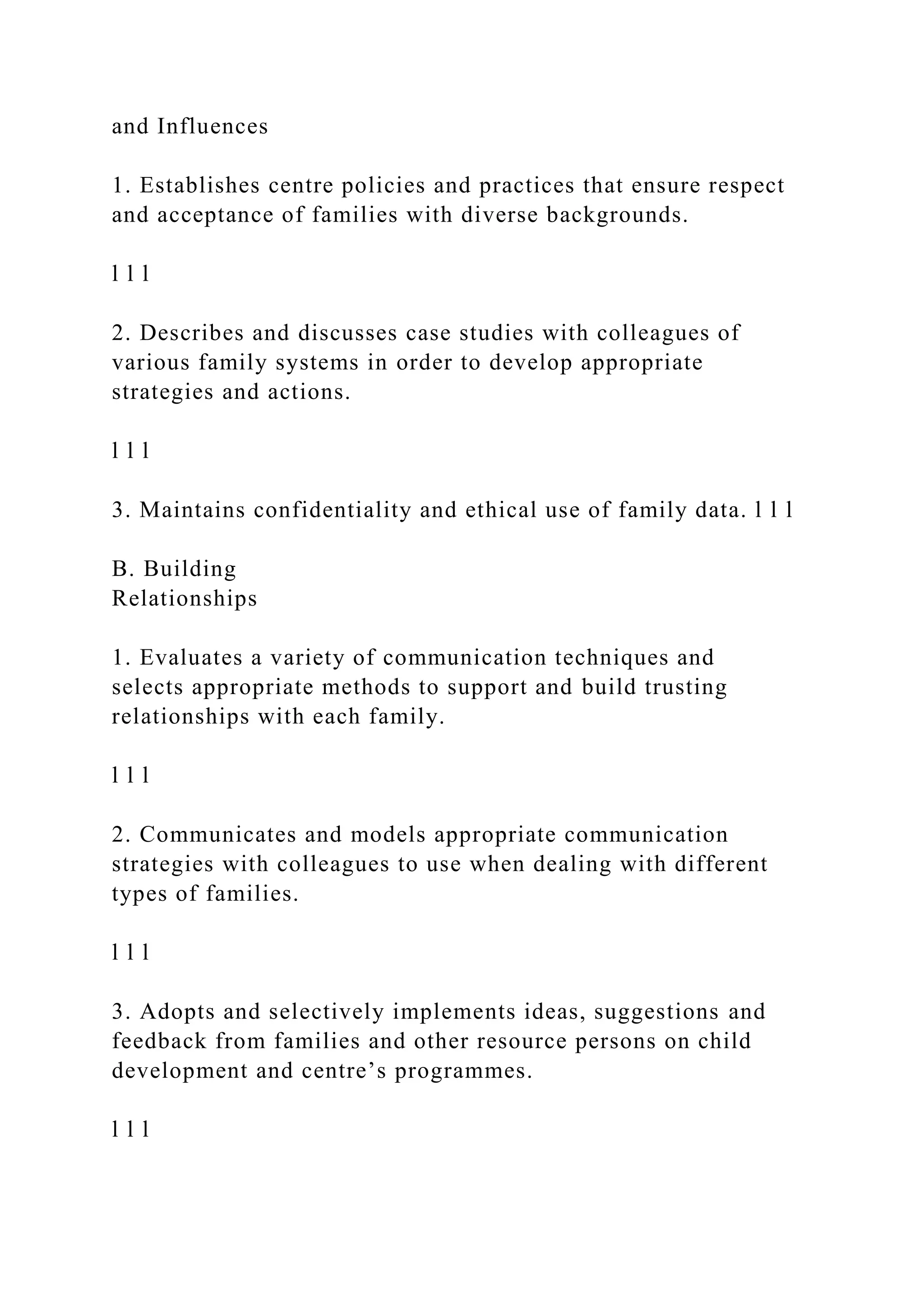
III. Family and Community
Engagement
IV. Management, Administration and
Leadership
Early Childhood Professionals build
strong partnerships with families
by communicating and sharing
information and resources to
facilitate the continuity of learning
between centre, homes and the
wider community.
A. Family Characteristics and
Influences
Addresses the central role of families
in every child’s life and the principles
of inclusive practice in embracing and
incorporating diverse family culture
and backgrounds into the curriculum.
B. Building Relationships
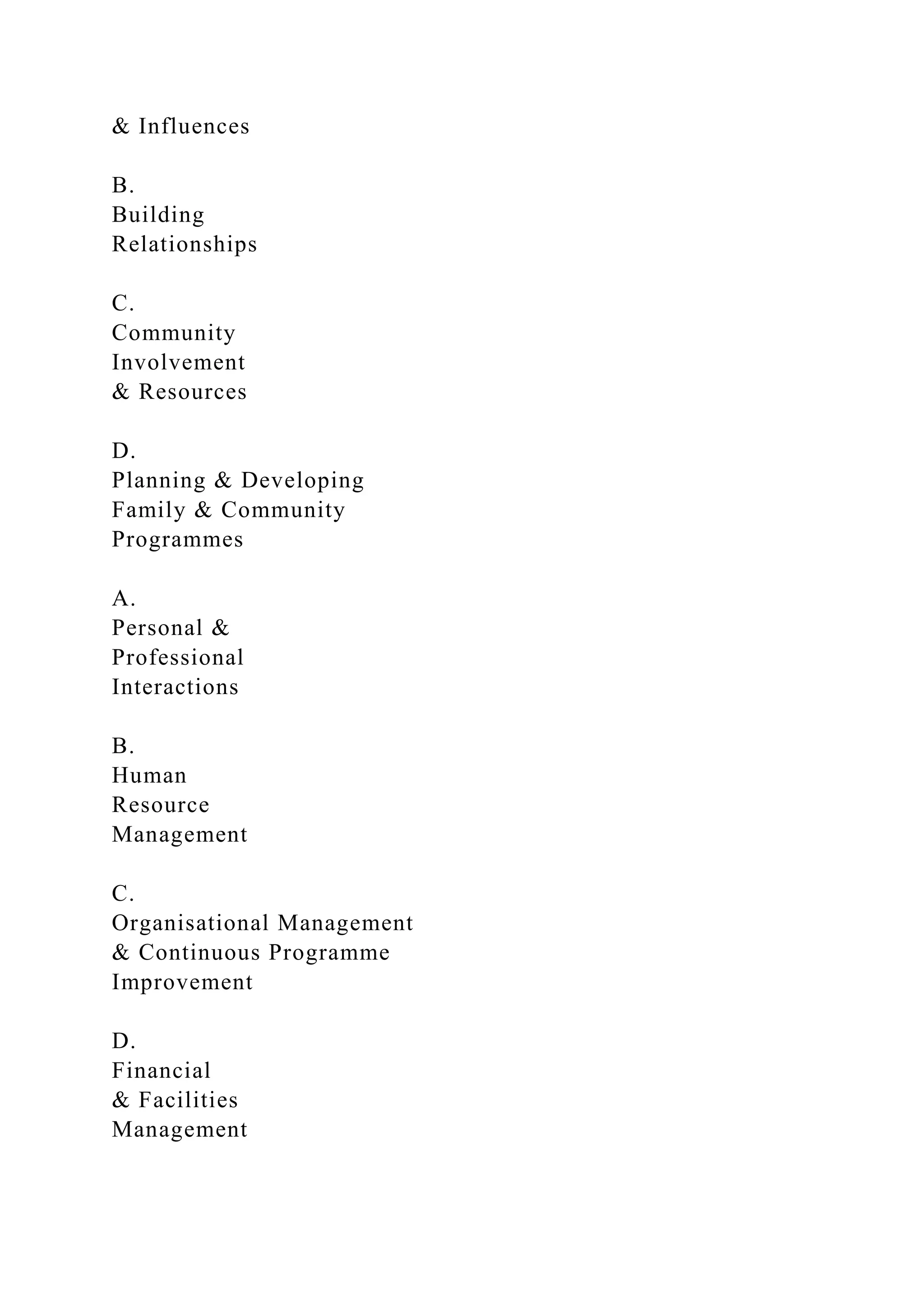
Emphasises respectful communication
practices, positive interactions and
collaborative partnerships between
centre staff and families to support
children’s learning.
C. Community Involvement and
Resources
Focuses on strategies of family
engagement and connecting with
families and community to promote
positive learning outcomes for
children.
D. Planning and Developing
Family and Community
Programmes
Focuses on the exchange of information
and resources between the centre,
families and the wider community
supported by staff and centre
programmes.
Early Childhood Professionals maintain a high level of
ethics and professionalism through effective administrative
practices, professional development and collaborative
teamwork within centre, in and across sectors in advocacy
for a high quality of care and education.
A. Personal and Professional Interactions
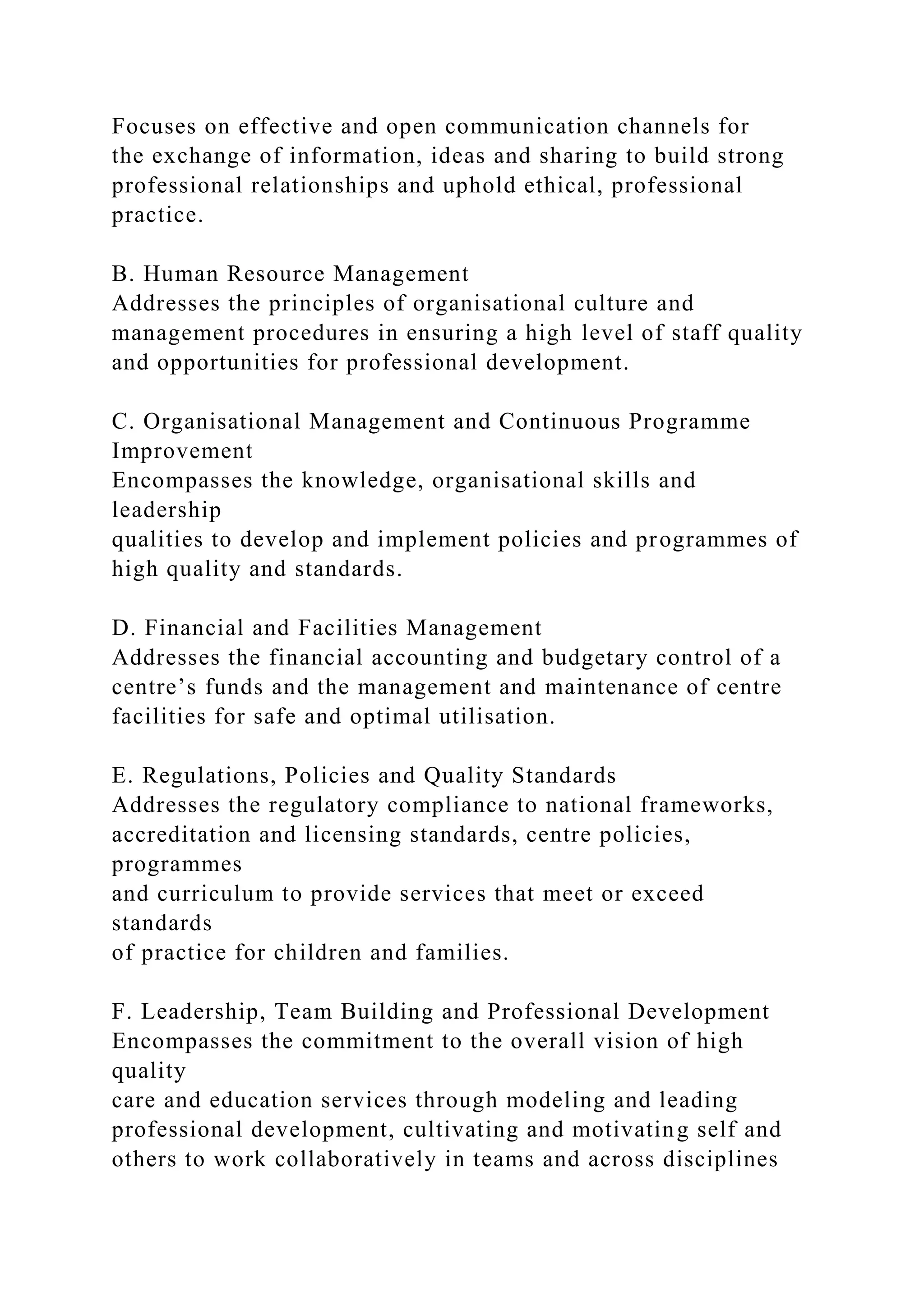
Focuses on effective and open communication channels for
the exchange of information, ideas and sharing to build strong
professional relationships and uphold ethical, professional
practice.
B. Human Resource Management
Addresses the principles of organisational culture and
management procedures in ensuring a high level of staff quality
and opportunities for professional development.
C. Organisational Management and Continuous Programme
Improvement
Encompasses the knowledge, organisational skills and
leadership
qualities to develop and implement policies and programmes of
high quality and standards.
D. Financial and Facilities Management
Addresses the financial accounting and budgetary control of a
centre’s funds and the management and maintenance of centre
facilities for safe and optimal utilisation.
E. Regulations, Policies and Quality Standards
Addresses the regulatory compliance to national frameworks,
accreditation and licensing standards, centre policies,
programmes
and curriculum to provide services that meet or exceed
standards
of practice for children and families.
F. Leadership, Team Building and Professional Development
Encompasses the commitment to the overall vision of high
quality
care and education services through modeling and leading
professional development, cultivating and motivating self and
others to work collaboratively in teams and across disciplines
and
interests groups to form communities of practice.
28
DOMAIN 1
CHILD DEVELOPMENT
Early Childhood Professionals understand and apply child
development knowledge to promote and support
children’s learning and holistic development specific to
individual needs.
A. How
Children
Develop
1. Identifies and understands that infant/toddler and
preschooler development can be described with regard to the
developmental domains (physical, cognitive, social-emotional,
communication, creativity strengths).
l l l
2. Gains knowledge by using the Early Years Development
Framework (EYDF) and the Nurturing Early Learners
Framework
(NEL).
l l l
3. Identifies developmental milestones of children from birth up
to
8 years old.
l l l
4. Identifies the different ways children learn. l l l
5. Recognises the role of play and its impact on children’s
overall
development.
l l l
6. Practises respect for cultural diversity and the uniqueness of
each child.
l l l
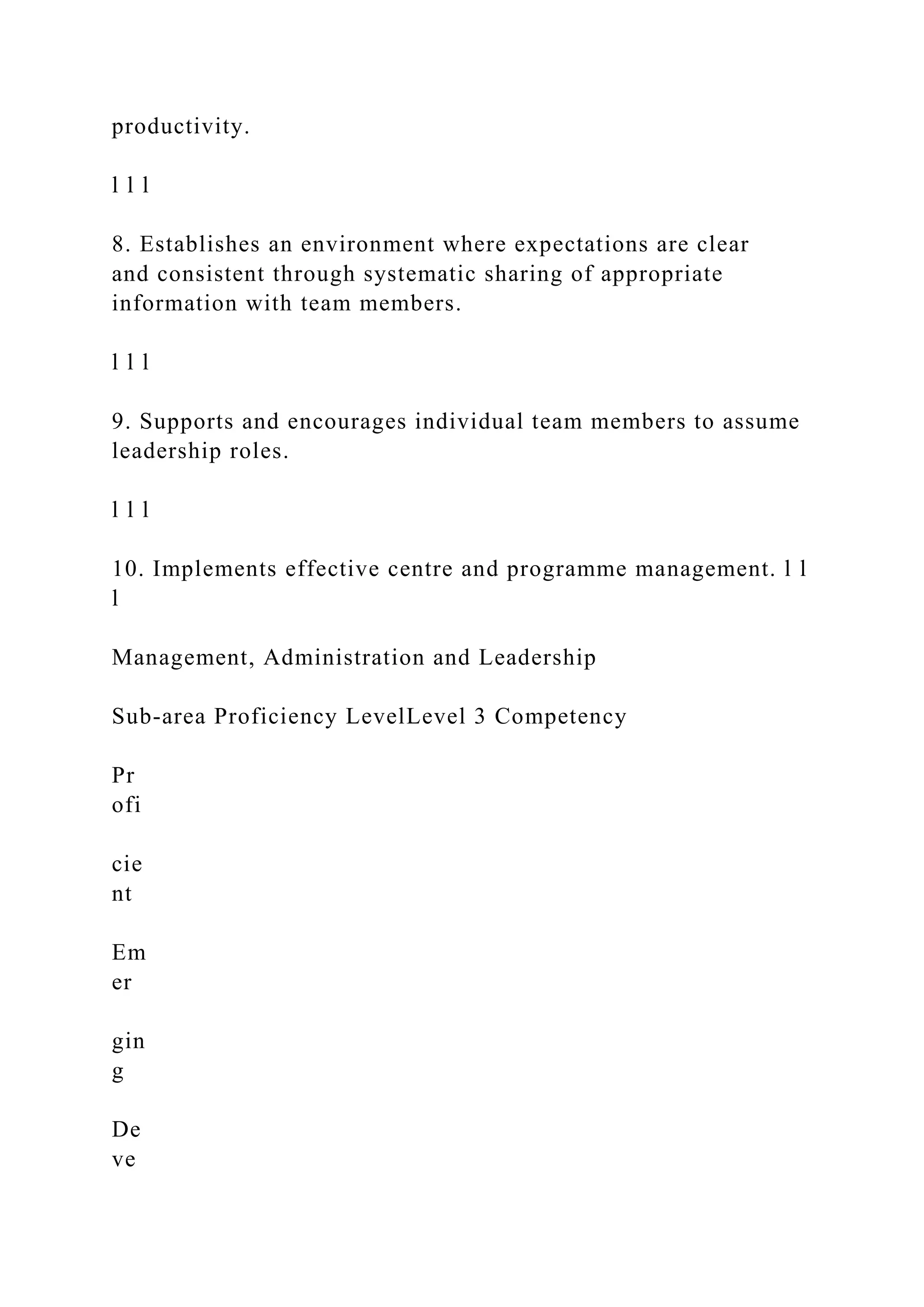
Sub-area Proficiency LevelLevel 1 Competency
Pr
ofi
cie
nt
Em
er
gin
g
De
ve
lop
ing
29
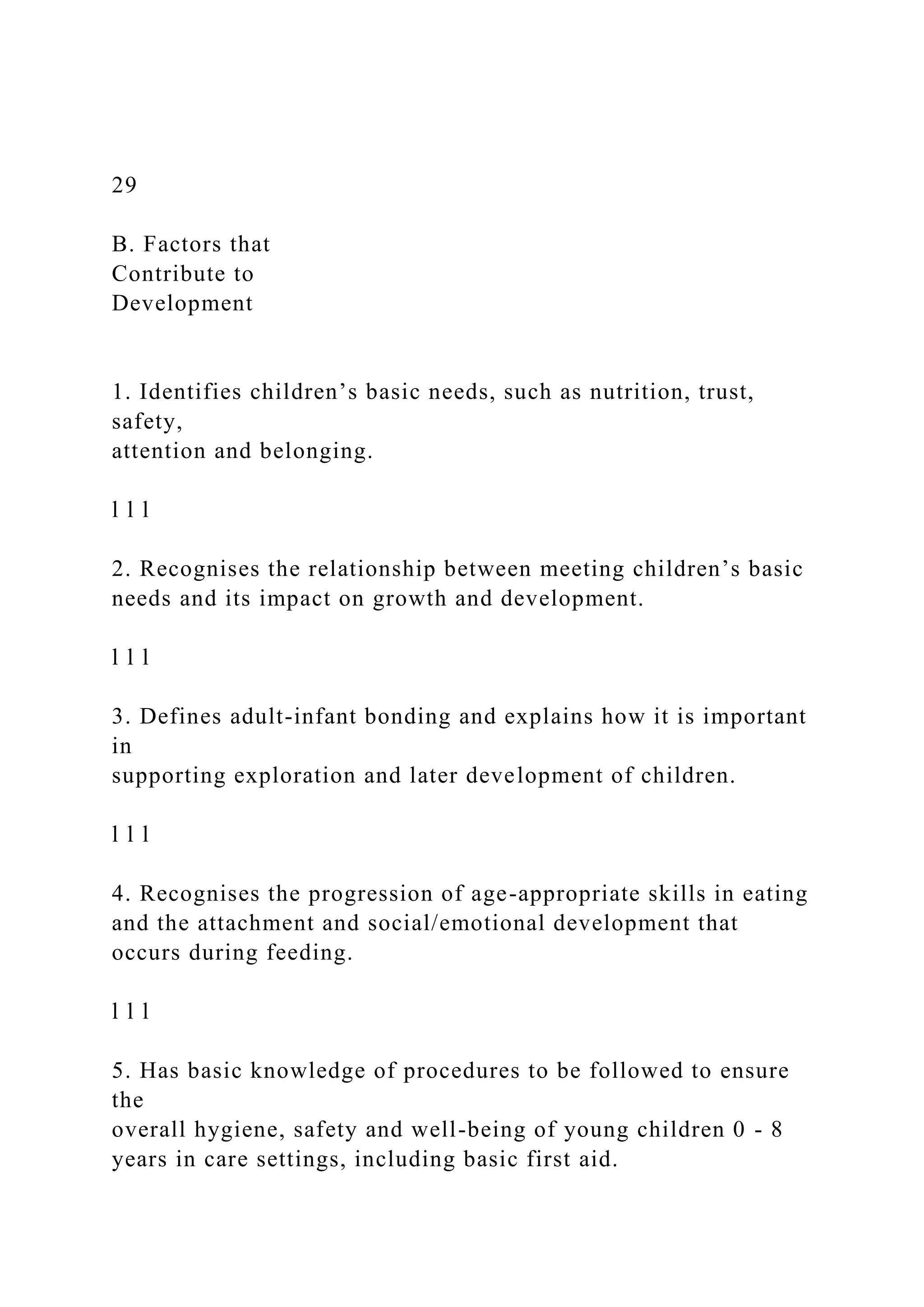
B. Factors that
Contribute to
Development
1. Identifies children’s basic needs, such as nutrition, trust,
safety,
attention and belonging.
l l l
2. Recognises the relationship between meeting children’s basic
needs and its impact on growth and development.
l l l
3. Defines adult-infant bonding and explains how it is important
in
supporting exploration and later development of children.
l l l
4. Recognises the progression of age-appropriate skills in eating
and the attachment and social/emotional development that
occurs during feeding.
l l l
5. Has basic knowledge of procedures to be followed to ensure
the
overall hygiene, safety and well-being of young children 0 - 8
years in care settings, including basic first aid.
l l l
6. Understands the important roles of children’s families and
other
social environments in supporting and shaping the children’s
development.
l l l
7. Identifies factors in the environment that impact
development,
including prenatal factors, media factors, pollutants and
contaminants.
l l l
8. Defines temperament and its role in children’s bonding with
people and the environment.
l l l
9. Understands differences between typical and atypical
development, recognising that there is a range of ages at which
children acquire skills.
l l l
10. Defines resiliency in children and identifies characteristics
of a
resilient child.
l l l
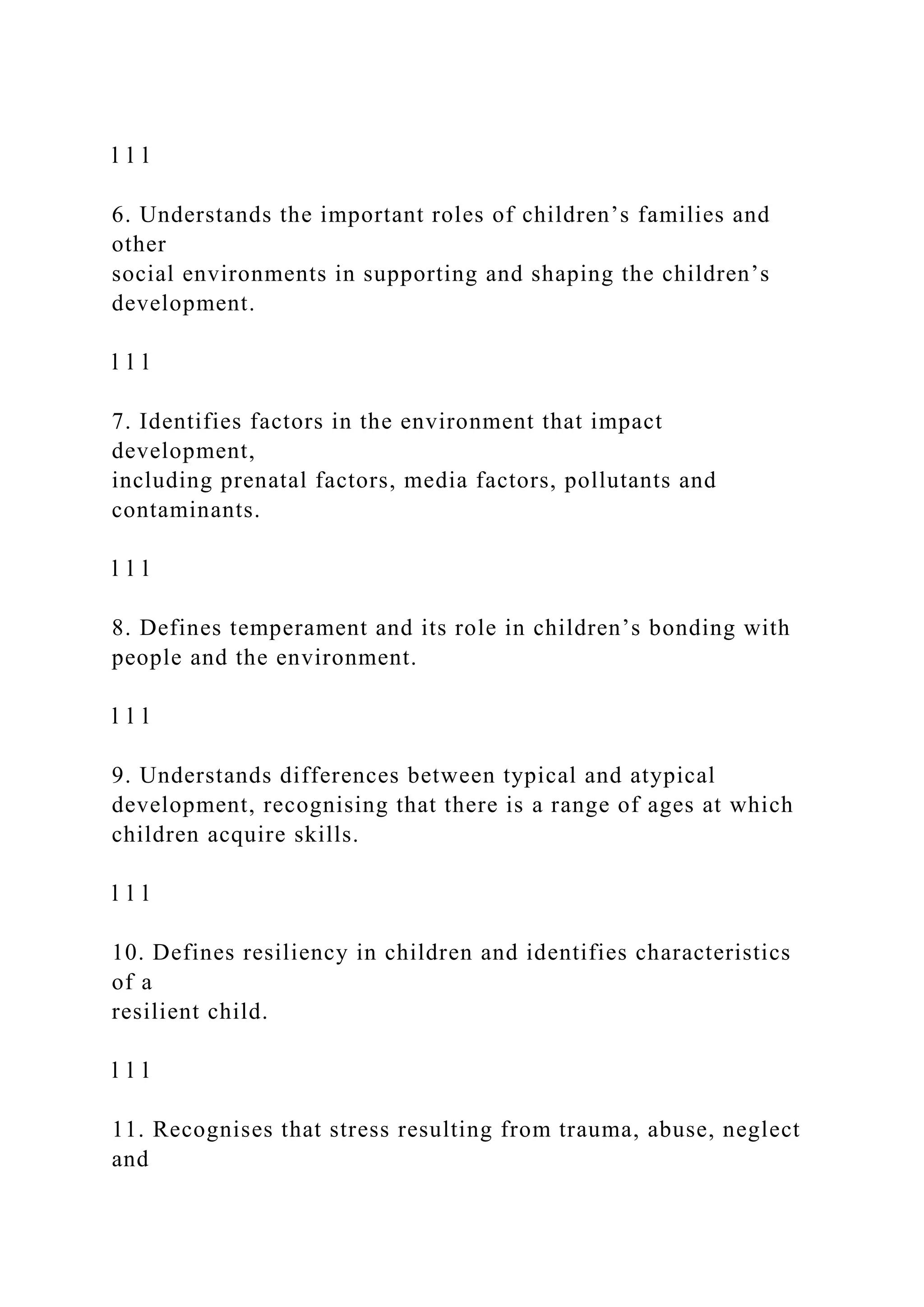
11. Recognises that stress resulting from trauma, abuse, neglect
and
other factors affects children’s development and behaviour in
individual ways.
l l l
Child Development
Sub-area Proficiency LevelLevel 1 Competency
Pr
ofi
cie
nt
Em
er
gin
g
De
ve
lop
ing
30
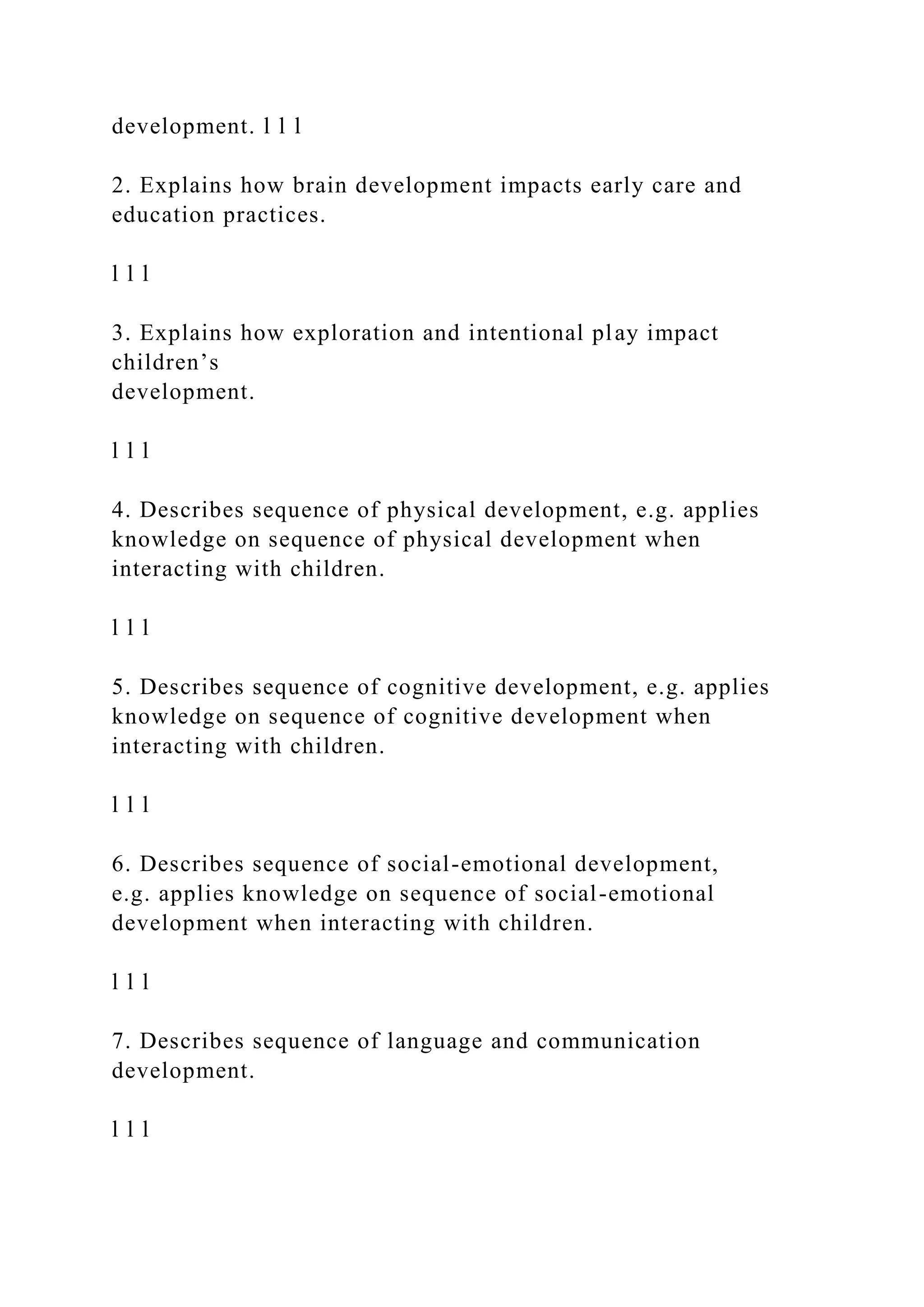
A. How
Children
Develop
1. Distinguishes major theories and concepts of child
development. l l l
2. Explains how brain development impacts early care and
education practices.
l l l
3. Explains how exploration and intentional play impact
children’s
development.
l l l
4. Describes sequence of physical development, e.g. applies
knowledge on sequence of physical development when
interacting with children.
l l l
5. Describes sequence of cognitive development, e.g. applies
knowledge on sequence of cognitive development when
interacting with children.
l l l
6. Describes sequence of social-emotional development,
e.g. applies knowledge on sequence of social-emotional
development when interacting with children.
l l l
7. Describes sequence of language and communication
development.
l l l
8. Plans experiences that support infant/toddler and preschooler
development and learning in all domains.
l l l
9. Identifies resources for acquiring additional information of a
particular development.
l l l
10. Communicates with staff, colleagues, and families about the
ways in which environments and programmes are designed to
support and promote development in an integrated way.
l l l
Child Development
Sub-area Proficiency LevelLevel 2 Competency
Pr
ofi
cie
nt
Em
er
gin
g
De
ve
lop
ing
31
B. Factors that
Contribute to
Development
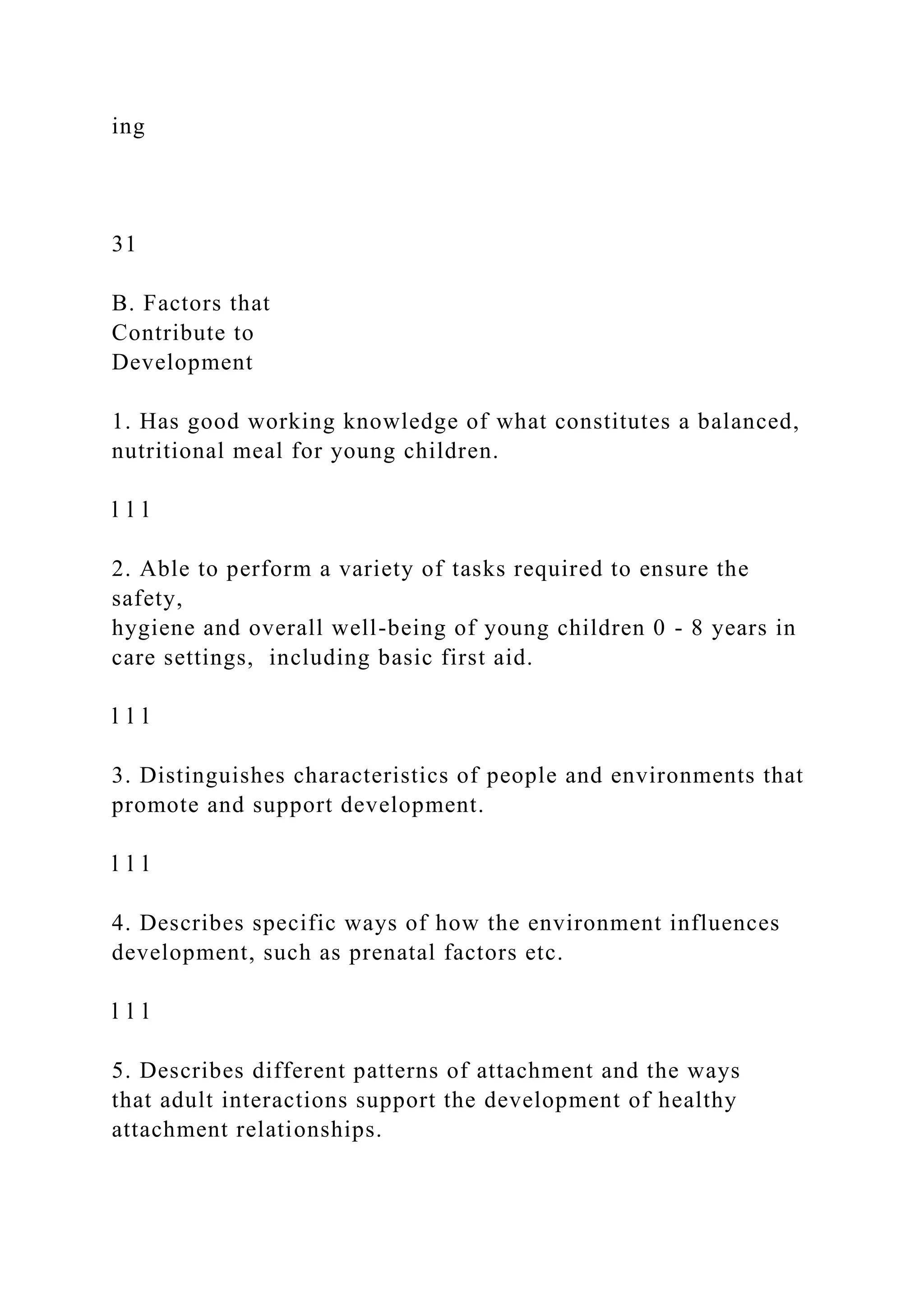
1. Has good working knowledge of what constitutes a balanced,
nutritional meal for young children.
l l l
2. Able to perform a variety of tasks required to ensure the
safety,
hygiene and overall well-being of young children 0 - 8 years in
care settings, including basic first aid.
l l l
3. Distinguishes characteristics of people and environments that
promote and support development.
l l l
4. Describes specific ways of how the environment influences
development, such as prenatal factors etc.
l l l
5. Describes different patterns of attachment and the ways
that adult interactions support the development of healthy
attachment relationships.
l l l
6. Describes the specific ways that stress resulting by trauma,
abuse, neglect and other factors impacts children’s development
and behaviour.
l l l
7. Explains the different ways children experience grief and
loss. l l l
8. Considers temperament and other individual differences when
explaining individual children’s development and behaviour.
l l l
9. Describes factors influencing resiliency in children. l l l
10. Describes aspects of children’s health status that impact
behaviour, interactions and learning.
l l l
11. Elaborates the needs of children based on observation,
understanding individuals and their cues, signals and
communications, and the child’s social environment.
l l l
12. Identifies when and where to seek the help of others in
understanding and addressing children’s atypical development.
l l l
13. Able to support junior staff in carrying out the required
procedures to ensure the above.
l l l
Child Development
Sub-area Proficiency LevelLevel 2 Competency
Pr
ofi
cie
nt
Em
er
gin
g
De
ve
lop
ing
32
A. How
Children
Develop
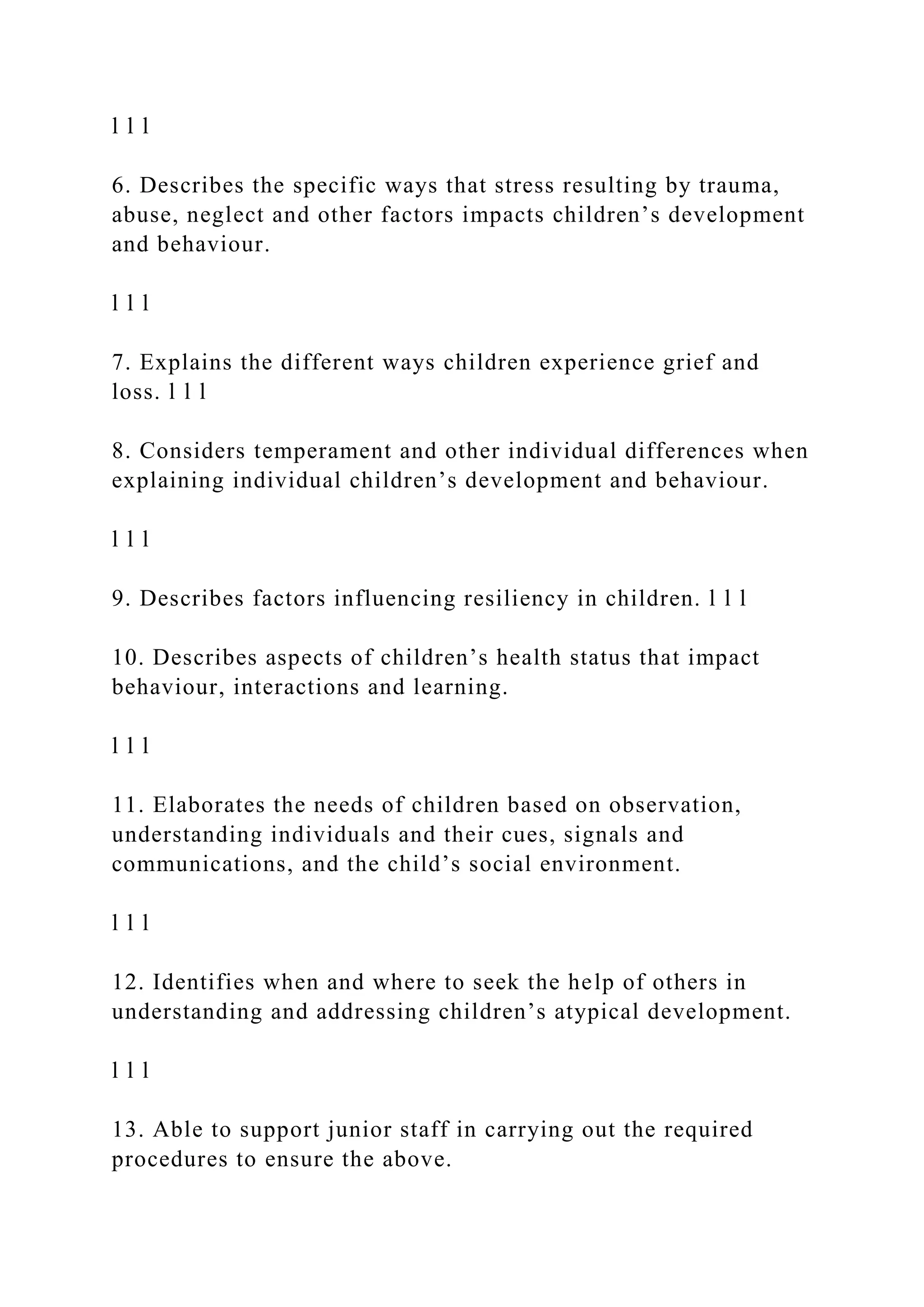
1. Applies knowledge of the sequence of development (of all
domains) for the individual children’s interests and needs.
l l l
2. Incorporates a variety of practices to support brain
development
of infants and toddlers within the programme.
l l l
3. Names a variety of practices that nurture brain development
in
infants and toddlers and chooses appropriate practices within
the programme.
l l l
4. Adopts approaches and practices that optimise the healthy
development of children.
l l l
5. Analyses physical or behavioural changes in children as
possible
indicators of presence of stress and takes appropriate actions.
l l l
6. Uses observation strategies to analyse children’s progress and
record developmental changes.
l l l
7. Monitors each child’s progress (identify strengths, interests
and
needs) and intervenes when necessary.
l l l
8. Collaborates with parents in their child’s learning/growing
journey.
l l l
B. Factors that
Contribute to
Development
1. Has in-depth knowledge of nutritional needs, basic first aid,
as
well as a variety of Standard Operating Procedures in the centre
for illness and diseases control.
l l l
2. Takes responsibility for the consistent and smooth execution
of
all procedures necessary to ensure the health, safety and
hygiene
of children 0 - 8 years in group settings.
l l l
3. Has awareness of child protection issues. l l l
4. Identifies strengths, needs, and interests of each child, and
develops strategies to support each child’s growth and
development.
l l l
5. Integrates information on child development with an
understanding of individual children’s needs and interests to
tailor the programme to each child.
l l l
6. Supports children in creating healthy attachment
relationships
with significant adults.
l l l
Child Development
Sub-area Proficiency LevelLevel 3 Competency
Pr
ofi
cie
nt
Em
er
gin
g
De
ve
lop
ing
33
B. Factors that
Contribute to
Development
7. Employs strategies that support and optimise the healthy
development of children.
l l l
8. Considers the impact of stress (due to trauma, abuse, neglect,
poverty and other factors) when addressing the needs of
individual children.
l l l
9. Identifies environmental factors influencing development in
individual children, including prenatal factors, media factors,
pollutants and contaminants.
l l l
10. Analyses physical or behaviour changes in children as
possible
stress indicators and takes appropriate action.
l l l
11. Responds appropriately to the variety of ways children
experience grief and loss.
l l l
12. Is responsive to the impact of organic and environmental
influences on children’s development.
l l l
13. Monitors children’s health status and intervenes
appropriately
when it impacts their behaviour, interactions and learning.
l l l
14. Incorporates practices that support children’s resiliency into
the
programme.
l l l
15. Identifies and discusses issues in child development arising
from
differences in gender, race, culture, and class.
l l l
16. Collaborates with parents in seeking the help of specialists
in
assessing, understanding and addressing their children’s
atypical
development.
l l l
Child Development
Sub-area Proficiency LevelLevel 3 Competency
Pr
ofi
cie
nt
Em
er
gin
g
De
ve
lop
ing
34
DOMAIN 2
LEARNING ENVIRONMENTS AND CURRICULUM
Early Childhood Professionals plan and implement a child-
centred intentional programme based on a cyclical
process of observation, documentation and evaluation to
facilitate children’s learning needs and interests.
A. Environmental
Design -
Materials and
Equipment
1. Has basic knowledge and ability to set up developmentally
appropriate indoor and outdoor learning environments.
l l l
2. Maintains a safe and hygienic environment for children. l l l
3. Identifies ways to modify learning environments according to
children’s needs and interests.
l l l
4. Identifies toys and materials for infants, toddlers and
preschoolers in the room programmes. l l l
5. Describes how to use technology in appropriate and
meaningful ways (for e.g. computers, television etc).
l l l
6. Engages children in an active process of exploring materials
and equipment.
l l l
7. Understands and demonstrates the rationale for selecting and
arranging materials and equipment and makes adaptations
when required.
l l l
B. Schedules and
Care Routines
1. Identifies how routine activities and transitions are an
important part of the programme.
l l l
2. Follows daily schedules and understands the importance of
predictability for young children.
l l l
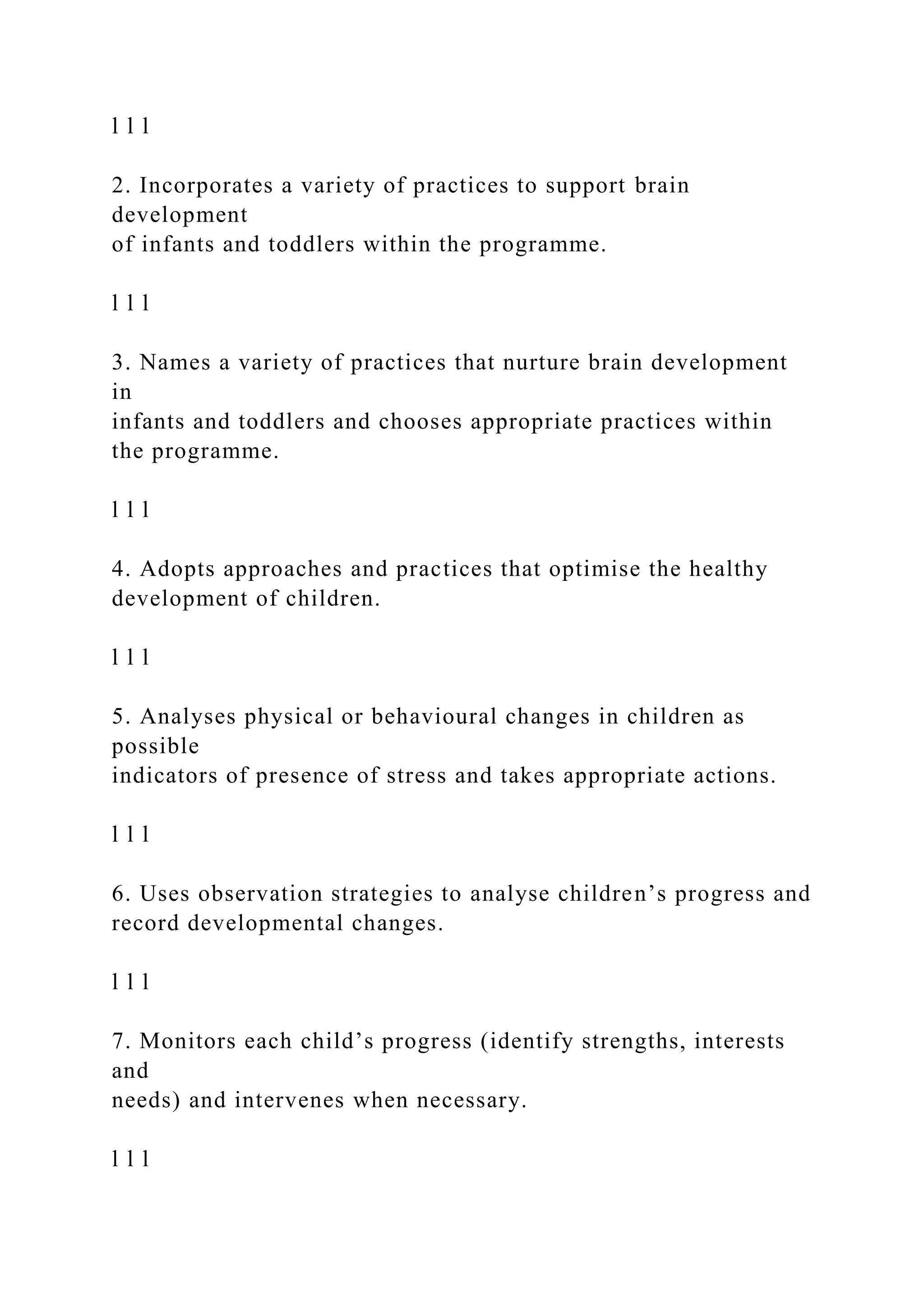
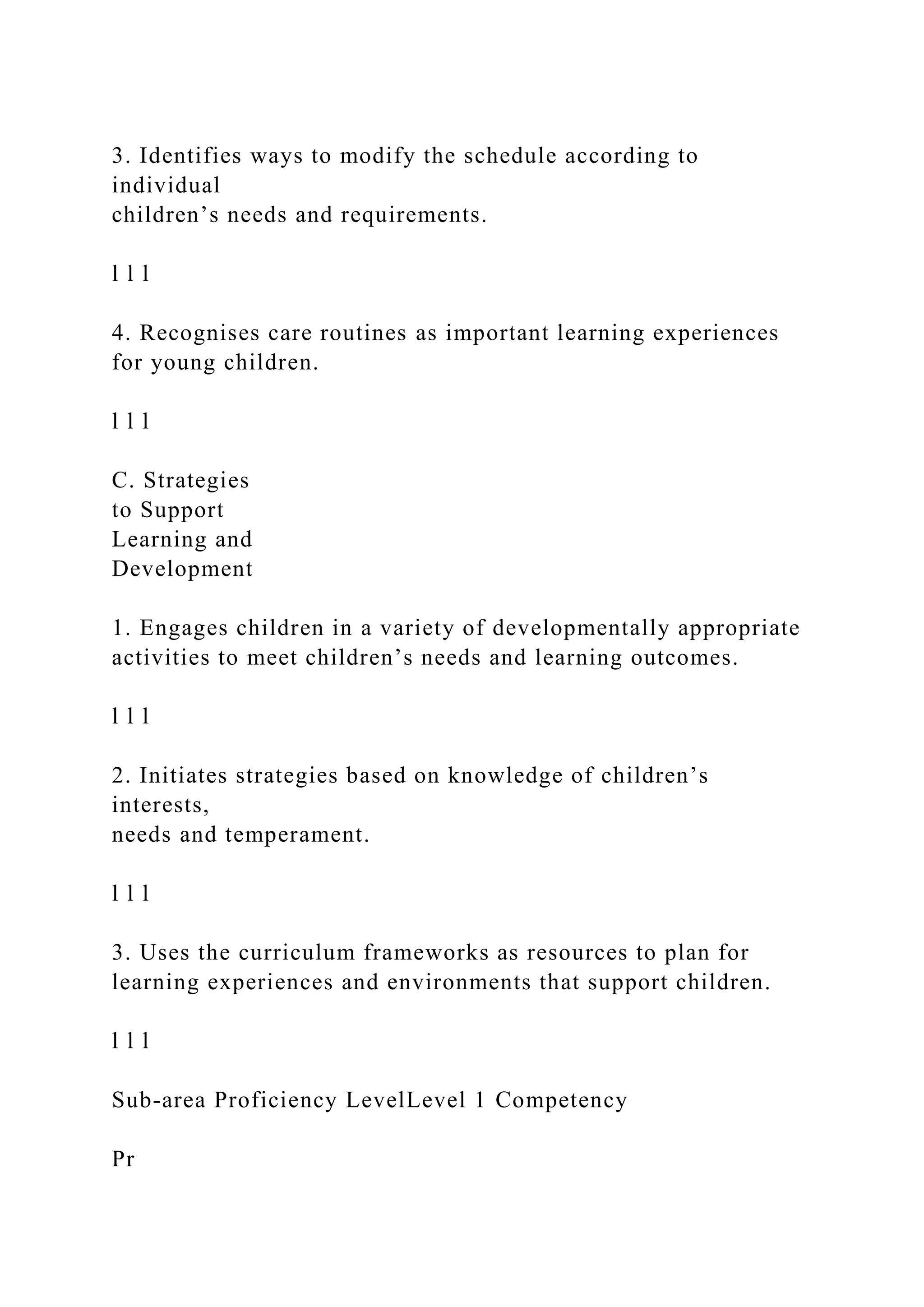
3. Identifies ways to modify the schedule according to
individual
children’s needs and requirements.
l l l
4. Recognises care routines as important learning experiences
for young children.
l l l
C. Strategies
to Support
Learning and
Development
1. Engages children in a variety of developmentally appropriate
activities to meet children’s needs and learning outcomes.
l l l
2. Initiates strategies based on knowledge of children’s
interests,
needs and temperament.
l l l
3. Uses the curriculum frameworks as resources to plan for
learning experiences and environments that support children.
l l l
Sub-area Proficiency LevelLevel 1 Competency
Pr
ofi
cie
nt
Em
er
gin
g
De
ve
lop
ing
35
D. The
Intentional
Programme
and Curriculum
1. Recognises the importance of sensory experiences,
exploration
and play in children’s growth and learning.
l l l
2. Understands and facilitates child-initiated and adult-
facilitated
activities and interactions.
l l l
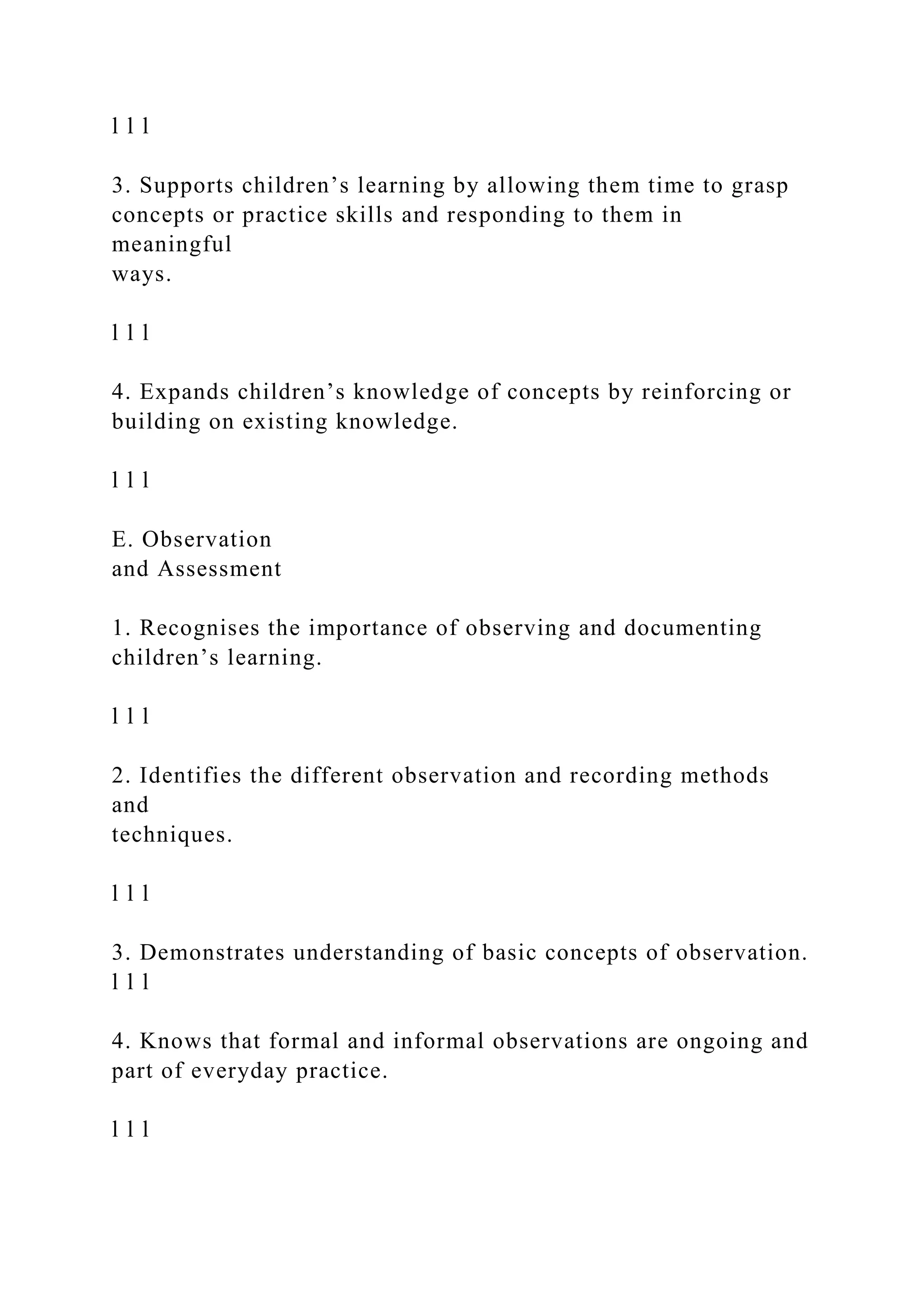
3. Supports children’s learning by allowing them time to grasp
concepts or practice skills and responding to them in
meaningful
ways.
l l l
4. Expands children’s knowledge of concepts by reinforcing or
building on existing knowledge.
l l l
E. Observation
and Assessment
1. Recognises the importance of observing and documenting
children’s learning.
l l l
2. Identifies the different observation and recording methods
and
techniques.
l l l
3. Demonstrates understanding of basic concepts of observation.
l l l
4. Knows that formal and informal observations are ongoing and
part of everyday practice.
l l l
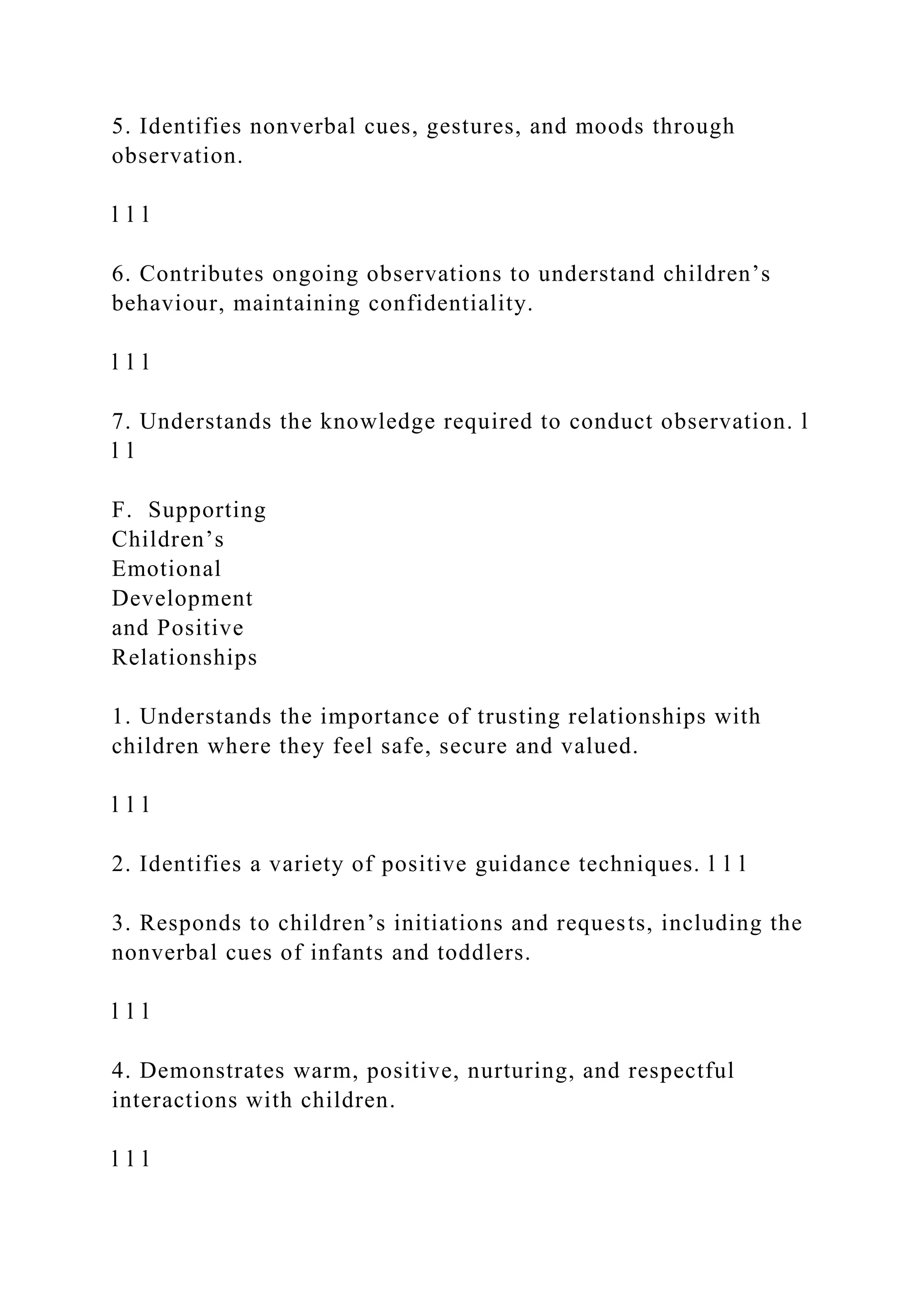
5. Identifies nonverbal cues, gestures, and moods through
observation.
l l l
6. Contributes ongoing observations to understand children’s
behaviour, maintaining confidentiality.
l l l
7. Understands the knowledge required to conduct observation. l
l l
F. Supporting
Children’s
Emotional
Development
and Positive
Relationships
1. Understands the importance of trusting relationships with
children where they feel safe, secure and valued.
l l l
2. Identifies a variety of positive guidance techniques. l l l
3. Responds to children’s initiations and requests, including the
nonverbal cues of infants and toddlers.
l l l
4. Demonstrates warm, positive, nurturing, and respectful
interactions with children.
l l l
5. Uses care-giving activities, such as diapering and dressing, as
an opportunity to foster healthy development through positive
adult/child interactions.
l l l
6. Participates in children’s play without taking over the
activity. l l l
7. Communicates with others in positive, respectful ways as a
model
for children.
l l l
8. Observes children’s relationships and is aware of their
involvement with each other.
l l l
Learning Environments and Curriculum
Sub-area Proficiency LevelLevel 1 Competency
Pr
ofi
cie
nt
Em
er
gin
g
De
ve
lop
ing
36
A. Environmental
Design -
Materials and
Equipment
1. Plans aesthetically pleasing indoor and outdoor environments
that support the room programme and reflect children’s
experiences.
l l l
2. Creates a learning environment that encourages exploration
and play-based learning.
l l l
3. Communicates with colleagues and families about the
relationship between environmental design and programme
design.
l l l
4. Establishes and maintains learning environments that are
responsive to and meet the needs of children at different ages
and developmental levels.
l l l
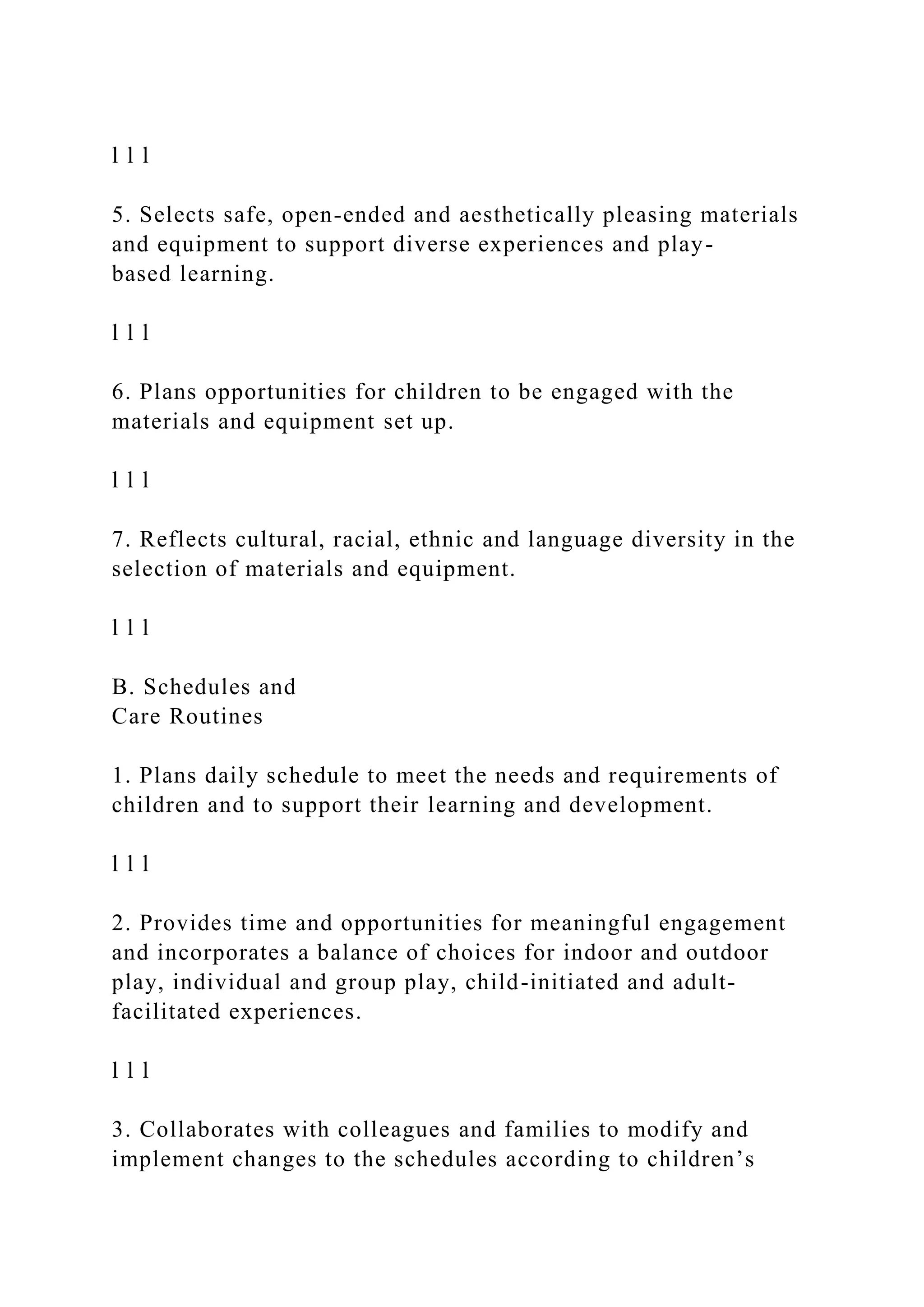
5. Selects safe, open-ended and aesthetically pleasing materials
and equipment to support diverse experiences and play-
based learning.
l l l
6. Plans opportunities for children to be engaged with the
materials and equipment set up.
l l l
7. Reflects cultural, racial, ethnic and language diversity in the
selection of materials and equipment.
l l l
B. Schedules and
Care Routines
1. Plans daily schedule to meet the needs and requirements of
children and to support their learning and development.
l l l
2. Provides time and opportunities for meaningful engagement
and incorporates a balance of choices for indoor and outdoor
play, individual and group play, child-initiated and adult-
facilitated experiences.
l l l
3. Collaborates with colleagues and families to modify and
implement changes to the schedules according to children’s
needs.
l l l
C. Strategies
to Support
Learning and
Development
1. Plans schedules and programmes to incorporate a variety of
strategies that respond to children’s interests and needs.
l l l
2. Demonstrates knowledge of various group configurations,
including one-on-one, small group, large groups and indoor/
outdoor choices to meet learning outcomes.
l l l
3. Plans strategies that give children choices. l l l
Sub-area Proficiency LevelLevel 2 Competency
Pr
ofi
cie
nt
Em
er
gin
g
De
ve
lop
ing
Learning Environments and Curriculum
37
D. The
Intentional
Programme
and Curriculum
1. Incorporates a balance of child-initiated play, exploration and
adult-facilitated activities in the programme.
l l l
2. Engages staff, colleagues and families in discussions to
ensure
the continuity of learning between centre and home.
l l l
3. Selects and implements curriculum based on principles of
child development, best practices and early learning standards
(EYDF and NEL). Anticipates emerging skills and plans
experiences for children to build and extend their knowledge
and skills over time.
l l l
4. Communicates with colleagues and families about strategies
to support children’s learning.
l l l
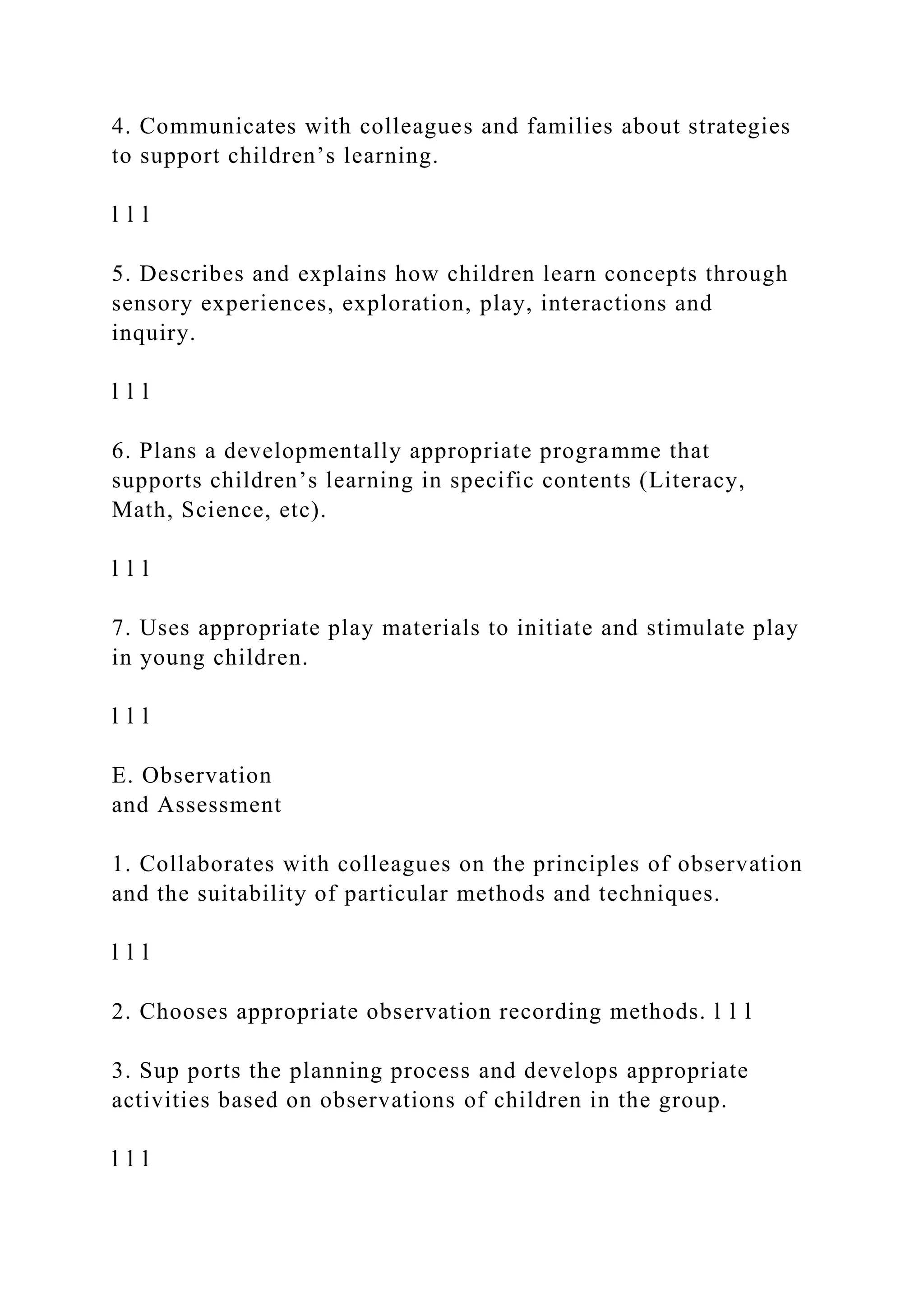
5. Describes and explains how children learn concepts through
sensory experiences, exploration, play, interactions and
inquiry.
l l l
6. Plans a developmentally appropriate programme that
supports children’s learning in specific contents (Literacy,
Math, Science, etc).
l l l
7. Uses appropriate play materials to initiate and stimulate play
in young children.
l l l
E. Observation
and Assessment
1. Collaborates with colleagues on the principles of observation
and the suitability of particular methods and techniques.
l l l
2. Chooses appropriate observation recording methods. l l l
3. Sup ports the planning process and develops appropriate
activities based on observations of children in the group.
l l l
4. Conducts formal and informal observations of children across
settings, in cluding their interactions with adults who are
important to the child.
l l l
5. Collects children’s works as evidence of accomplishing
curriculum goals.
l l l
6. Uses of appropriate documentation methods (e.g. anecdotal
records, running records, checklists, event recordings, time
sampling, sociograms, photographic evidence).
l l l
7. Gathers observations from the home, group, staff, colleagues,
families, and service providers to inform the planning process
for individual children and the group.
l l l
8. Responds to questions from colleagues and families about
children’s behaviour or refers to appropriate staff.
l l l
Learning Environments and Curriculum
Sub-area Proficiency LevelLevel 2 Competency
Pr
ofi
cie
nt
Em
er
gin
g
De
ve
lop
ing
38
F. Supporting
Children’s
Emotional
Development
and Positive
Relationships
1. Provides opportunities for children to listen, interact, and
communicate freely and meaningfully with other children and
adults.
l l l
2. Cultivates positive, pro-social relationships among children
and helps each child feel accepted in the group.
l l l
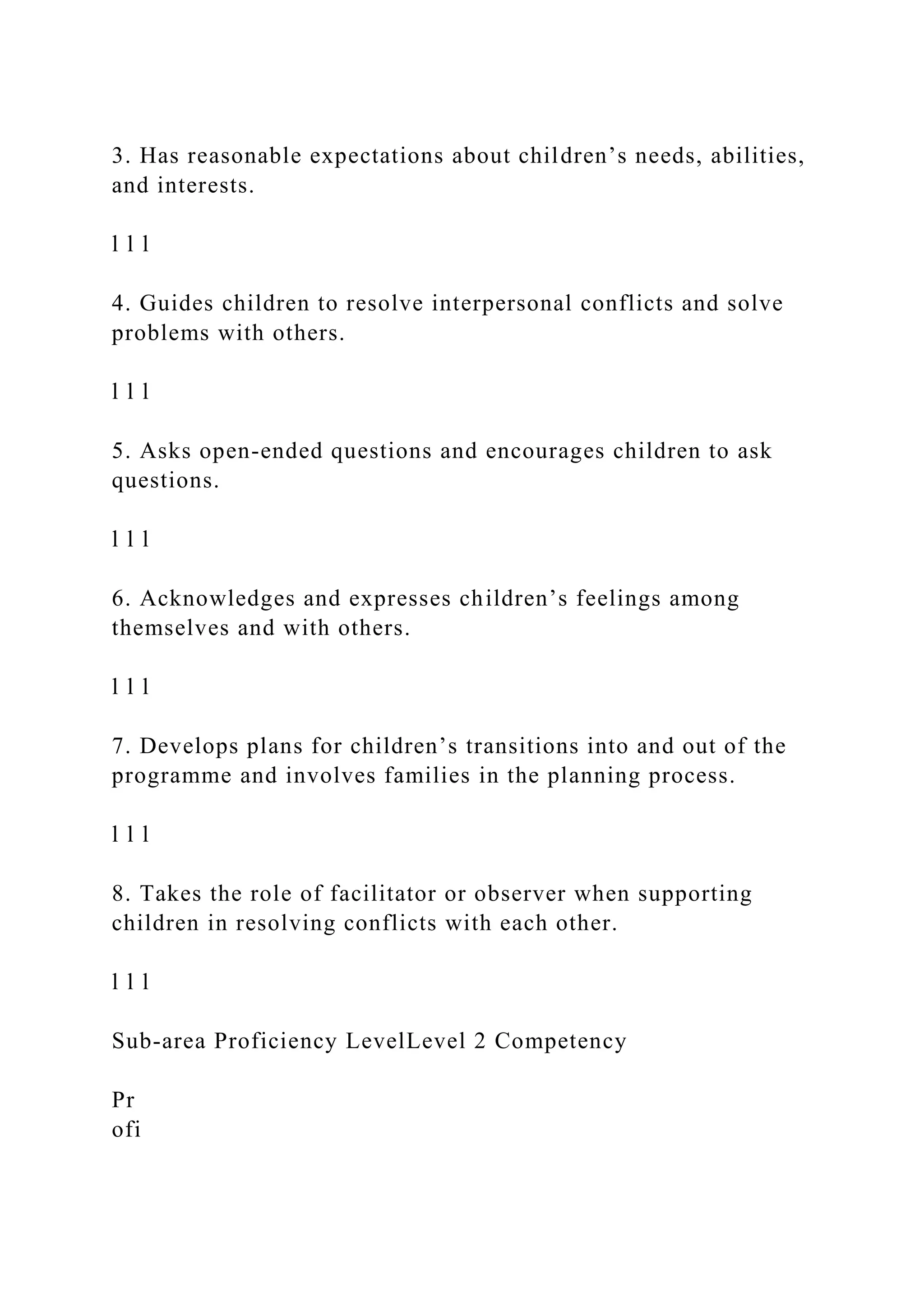
3. Has reasonable expectations about children’s needs, abilities,
and interests.
l l l
4. Guides children to resolve interpersonal conflicts and solve
problems with others.
l l l
5. Asks open-ended questions and encourages children to ask
questions.
l l l
6. Acknowledges and expresses children’s feelings among
themselves and with others.
l l l
7. Develops plans for children’s transitions into and out of the
programme and involves families in the planning process.
l l l
8. Takes the role of facilitator or observer when supporting
children in resolving conflicts with each other.
l l l
Sub-area Proficiency LevelLevel 2 Competency
Pr
ofi
cie
nt
Em
er
gin
g
De
ve
lop
ing
Learning Environments and Curriculum
39
A. Environmental
Design -
Materials and
Equipment
1. Plans, creates and evaluates indoor and outdoor learning
environments that are intentionally designed to meet
curriculum goals and learning outcomes.
l l l
2. Observes and evaluates the environments to make
modifications where necessary to meet the needs of children.
l l l
3. Builds awareness of the role of environmental design in
ECCE settings and collaborates with colleagues and other
stakeholders to ensure a high quality learning environment.
l l l
4. Communicates with colleagues and families about
environmental components within the broader programme
context.
l l l
5. Ensures access to a wide variety of materials and equipment
to
staff and children.
l l l
6. Evaluates and ensures that the use of materials and
equipment meet programme goals and centre philosophy.
l l l
7. Manages the purchase and maintenance of supplies, materials
and equipment.
l l l
B. Schedules and
Care Routines
1. Guides colleagues and staff in planning and implementing
developmentally appropriate routines and schedules that
promote and support children’s individual needs.
l l l
2. Works with colleagues and families to develop programme
schedules that meet children’s needs and support smooth
transitions.
l l l
C. Strategies
to Support
Learning and
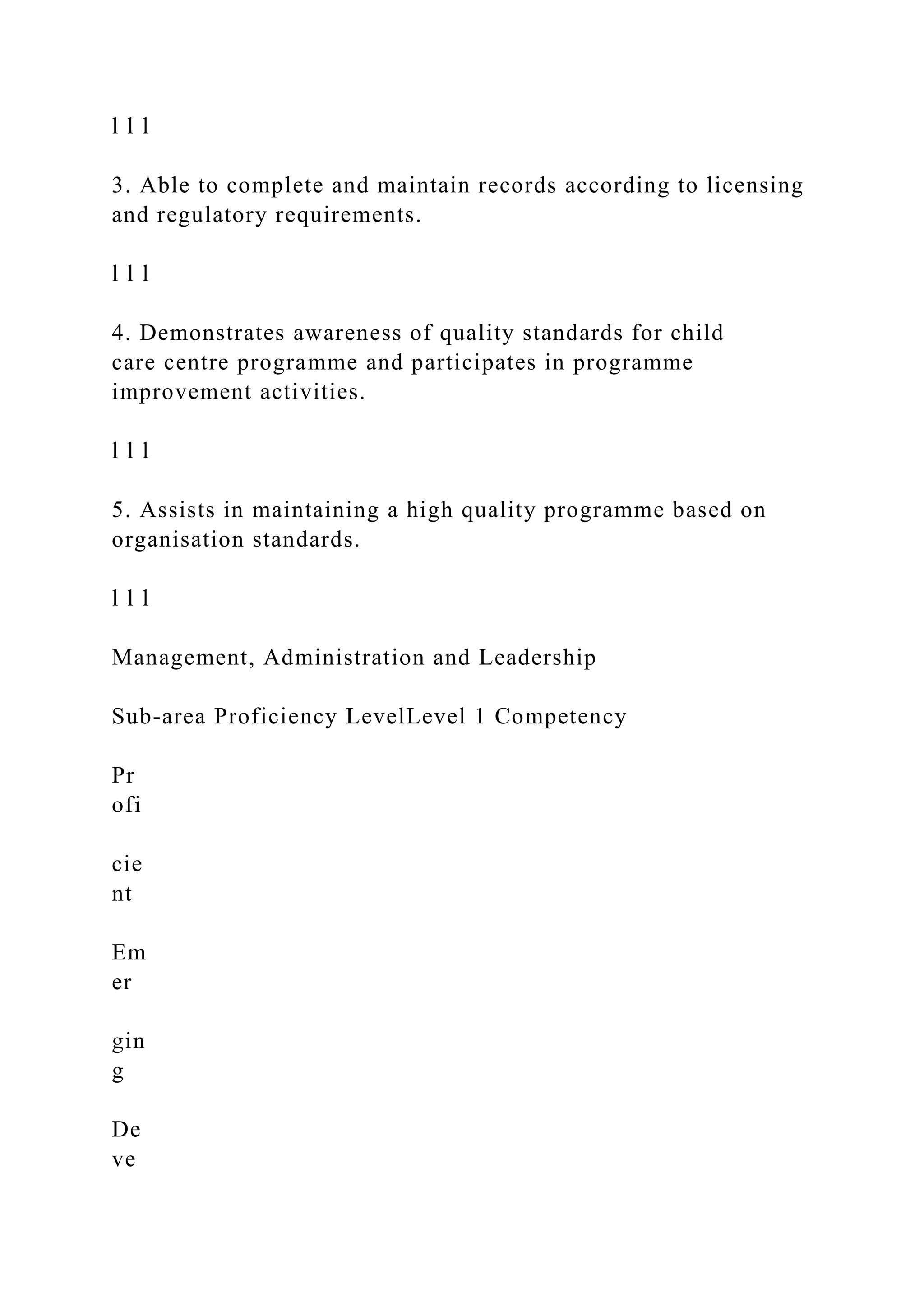
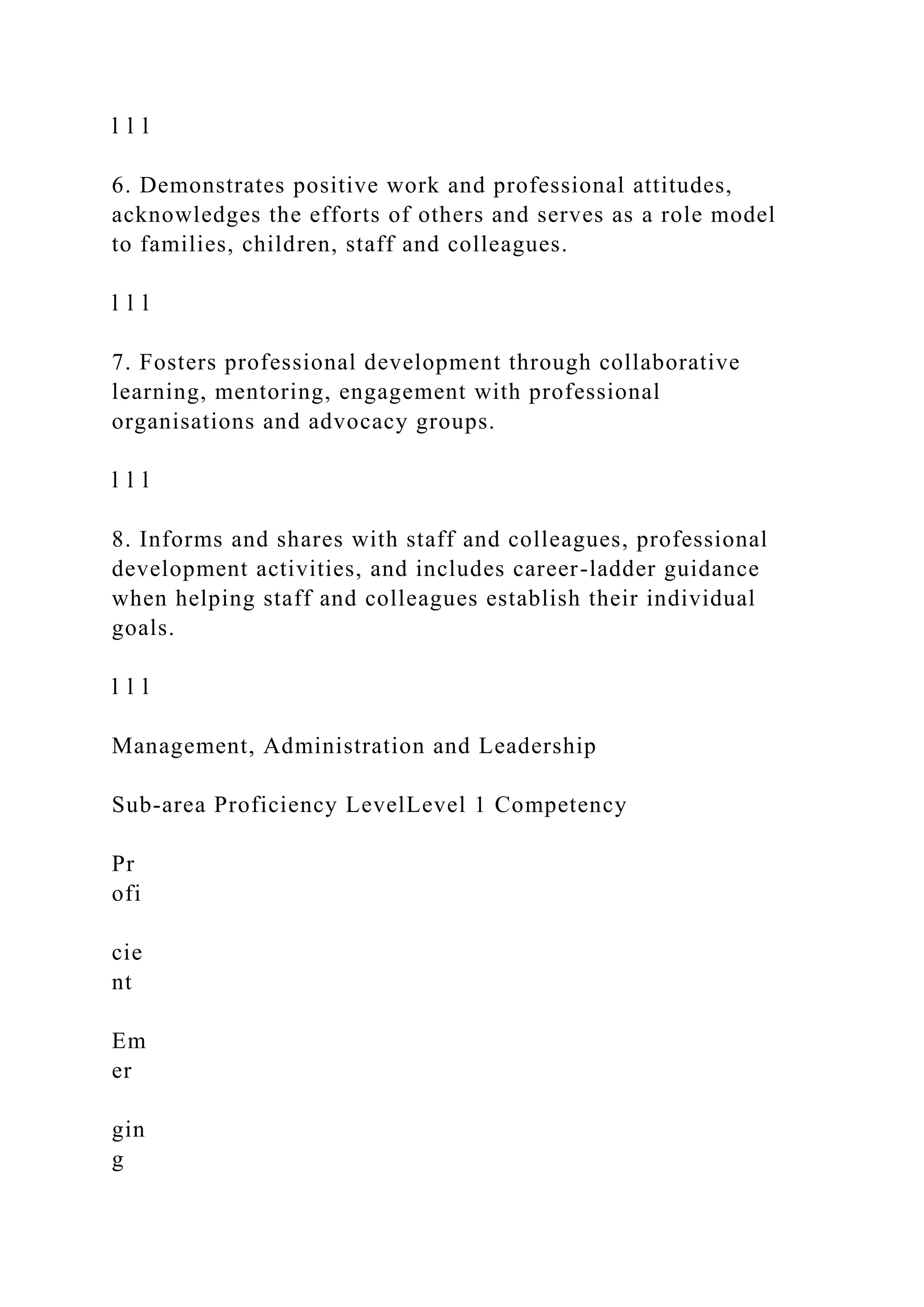
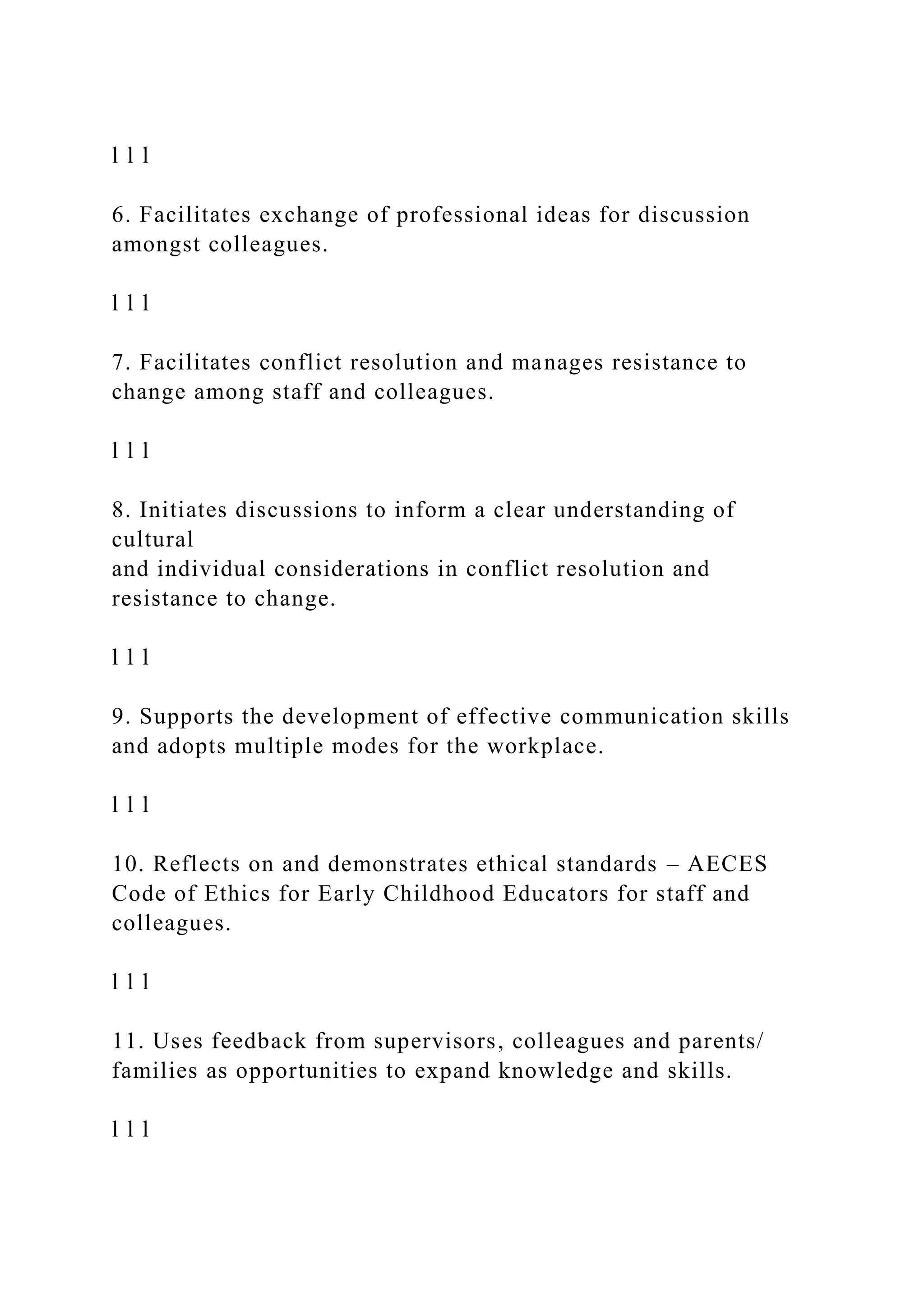
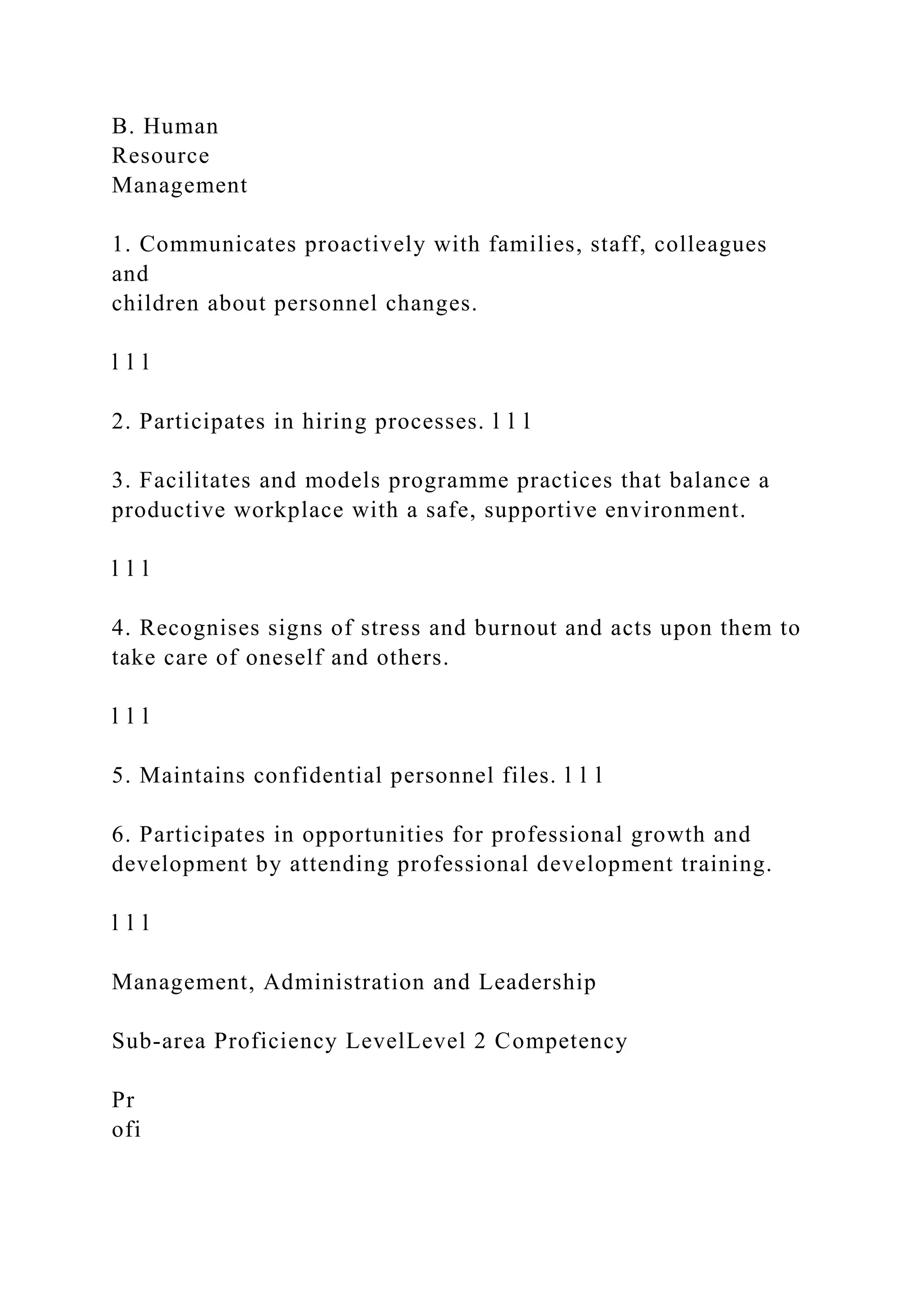
Development
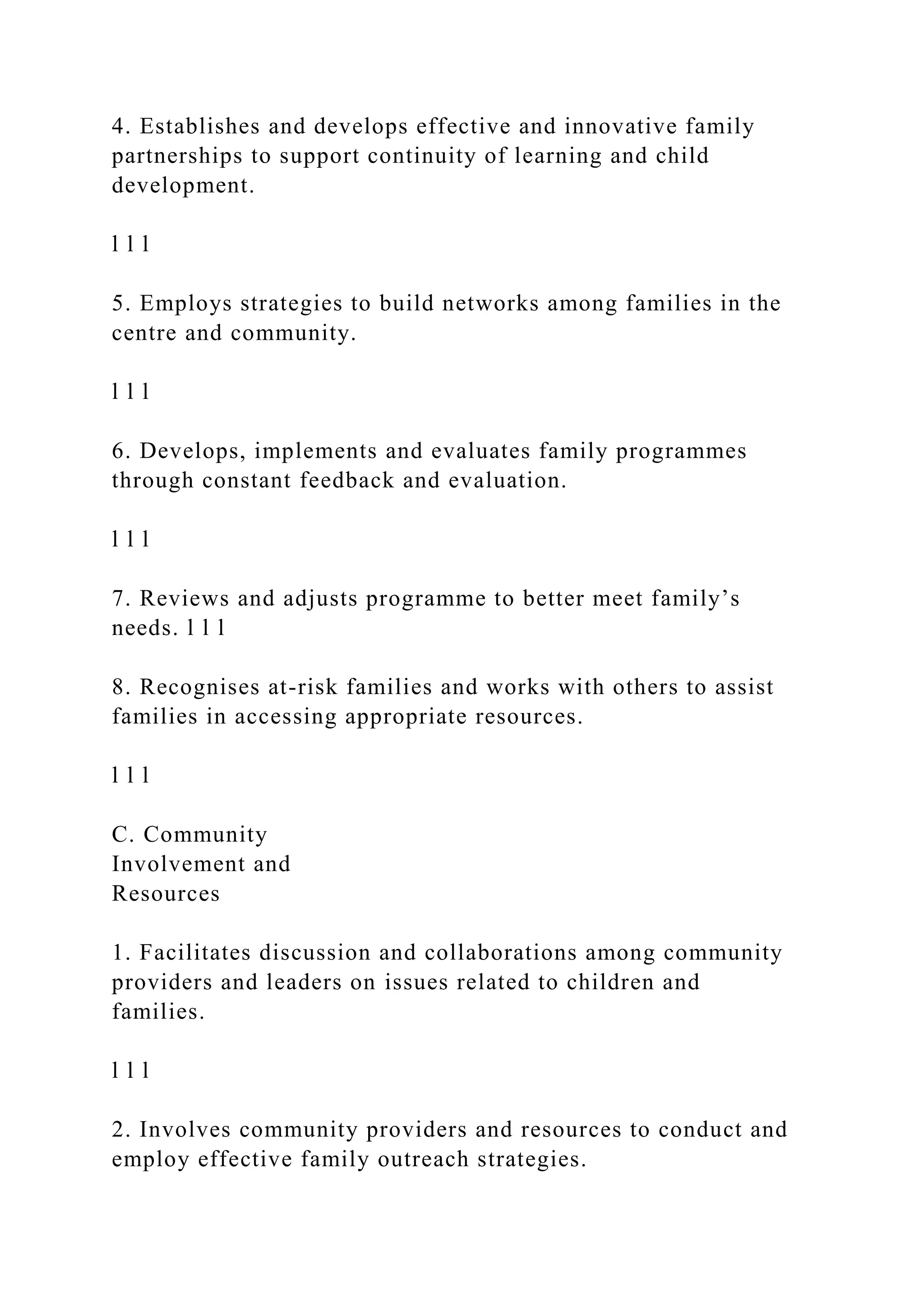
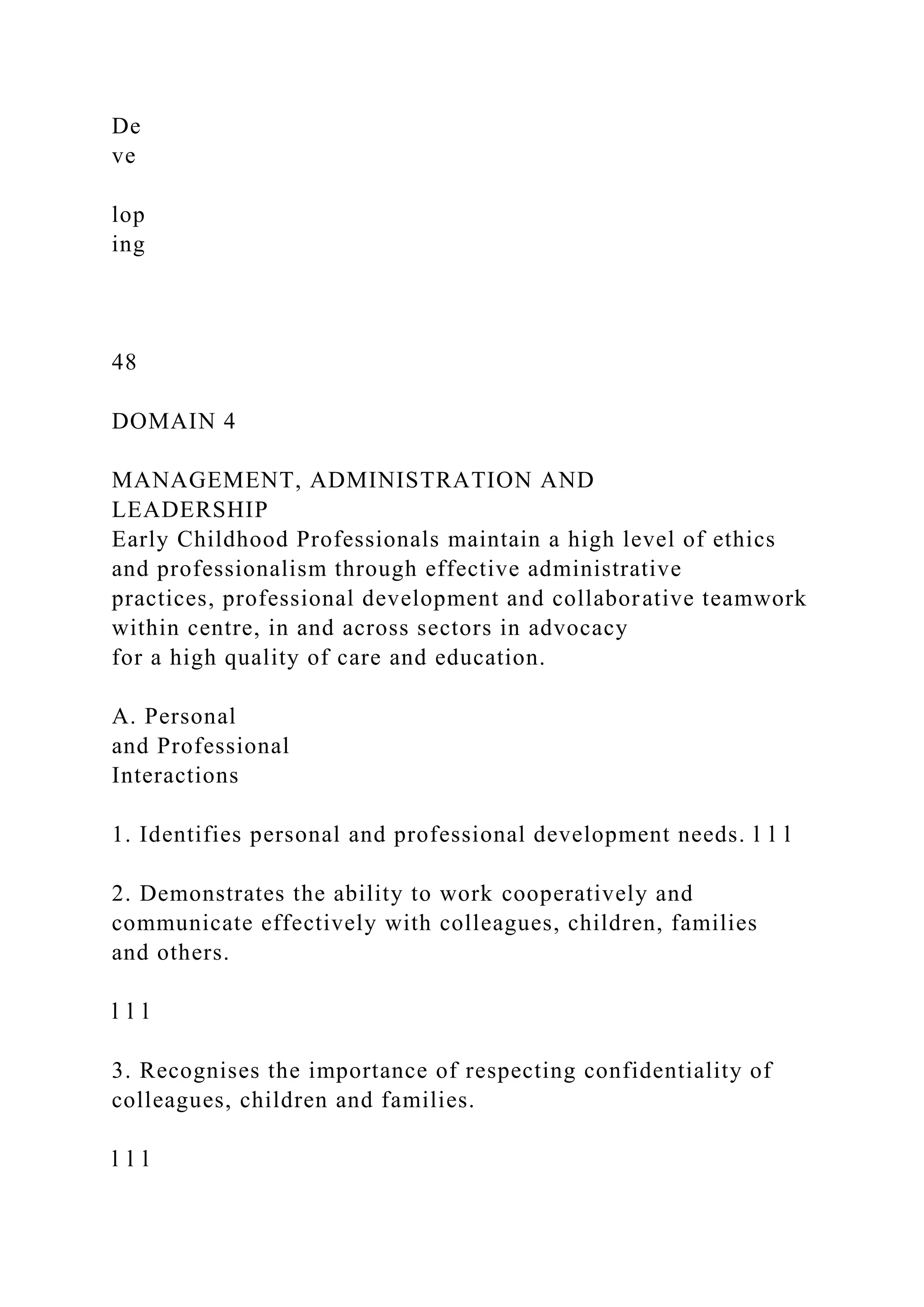
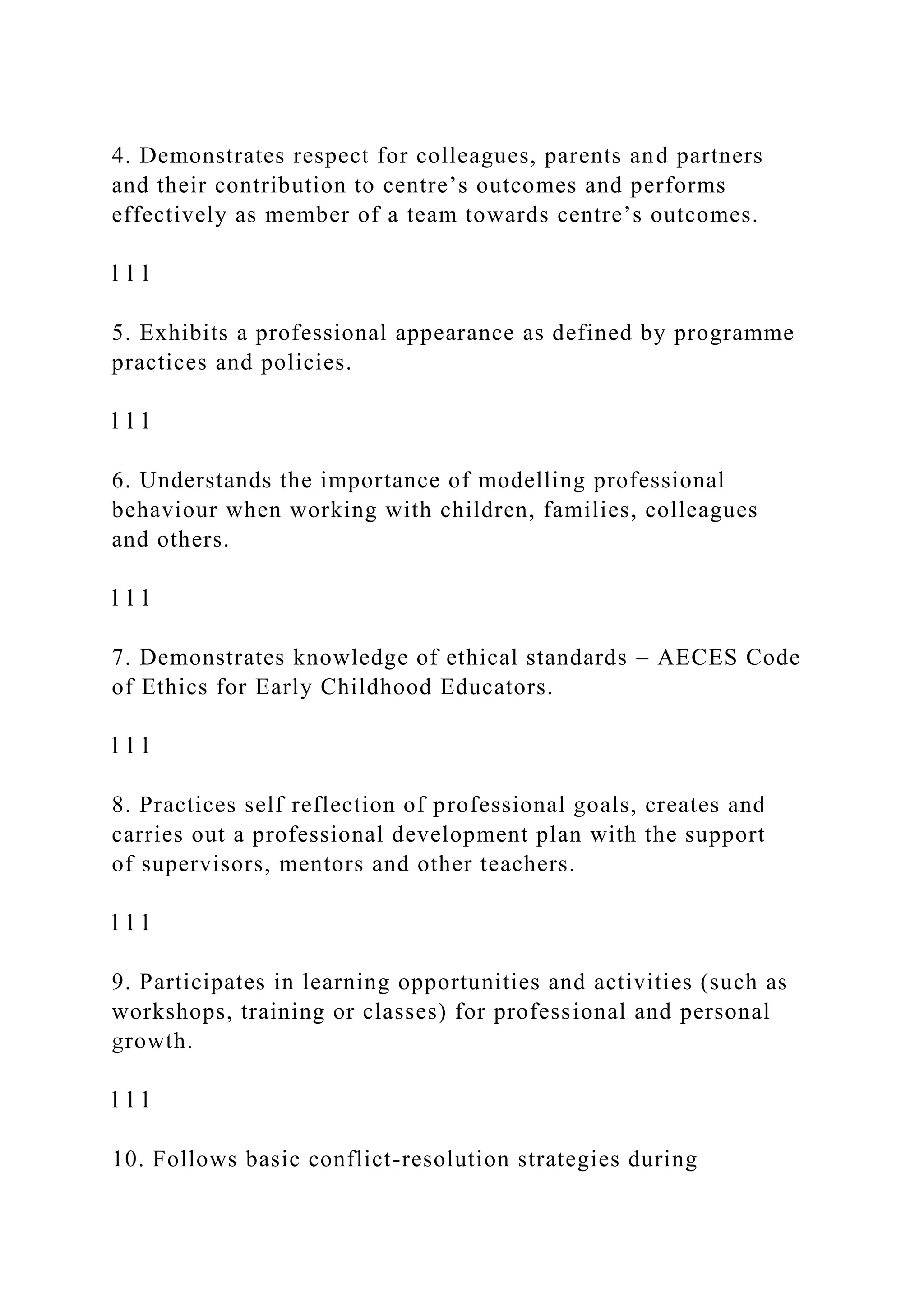
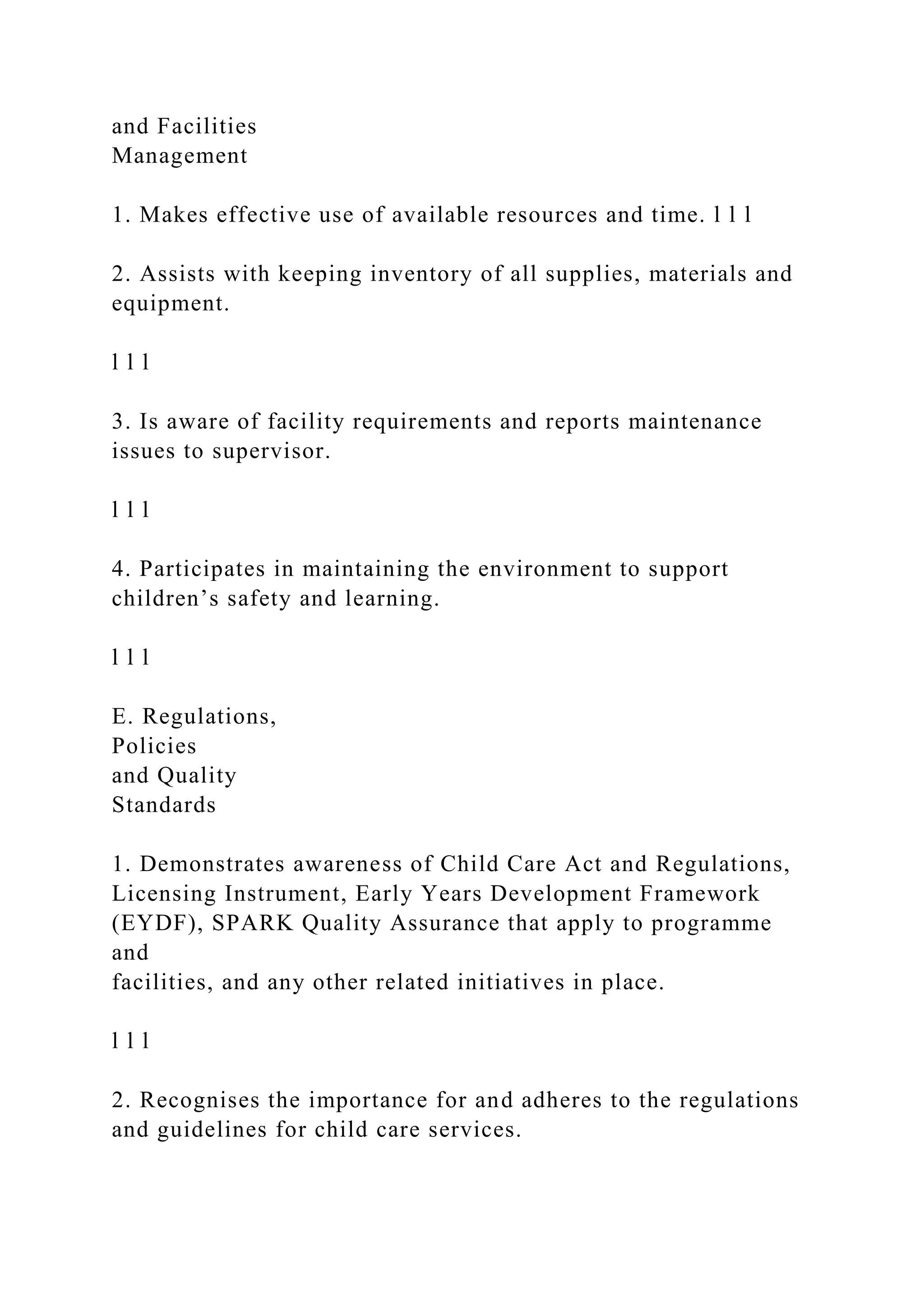
1. Provides professional development and leadership for staff
and colleagues on resources that help educators incorporate a
variety of strategies to support programme goals.
l l l
2. Provides guidance to colleagues and staff on responsive and
sensitive engagement in their interactions with children and
activities.
l l l
3. Supports and participates in action research to improve
teaching and learning.
l l l
Learning Environments and Curriculum
Sub-area Proficiency LevelLevel 3 Competency
Pr
ofi
cie
nt
Em
er
gin
g
De
ve
lop
ing
40
D. The
Intentional
Programme
and Curriculum
1. Applies and adapts national frameworks in programme
planning with staff and colleagues.
l l l
2. Plans appropriate learning experiences based on observations
and analysis of children’s behaviours, interests, learning needs
and activities.
l l l
3. Participates in implementing plans that accommodate
children with special needs.
l l l
4. Analyses curriculum models along with their rationales and
limitations.
l l l
5. Evaluates the implementation of curriculum by staff. l l l
6. Provides opportunities for children to inquire, explore,
problem-solve and question in individual and group activities.
l l l
E. Observation
and Assessment
1. Analyses various methods of observation, documentation and
assessment and chooses appropriate techniques according to
the desired purpose.
l l l
2. Explains the role of observation in programme plan ning. l l l
3. Uses suitable methods to observe, document and monitor
children’s development, behaviour and wellness.
l l l
4. Collects, organises and interprets children’s work/activities
as
evidence of accomplishing curriculum goals regularly.
l l l
5. Shares observations and documentation with families
regularly on children’s development, interests, and
achievement of curriculum goals.
l l l
6. Develops programme policies and communicates with
families about principles of observation.
l l l
7. Provides professional development and support to colleagues
on conducting formal and informal observations and eliciting
inputs from families.
l l l
8. Arranges staffing patterns and schedules to facilitate
observations.
l l l
9. Provides support, i.e., small groups, low staff-to-children
ratios,
and paid planning time, for the documentation and analysis of
observations.
l l l
10. Provides resources for observations that may require
specific
tools.
l l l
11. Communicates with families about the programme’s
approach
to observation.
l l l
Sub-area Proficiency LevelLevel 3 Competency
Pr
ofi
cie
nt
Em
er
gin
g
De
ve
lop
ing
Learning Environments and Curriculum
41
F. Supporting
Children’s
Emotional
Development
and Positive
Relationships
1. Effectively de-escalates emotional and behavioural situations
with children in supportive ways.
l l l
2. Encourages children to develop independence by providing
physical and emotional security and opportunities for children
to master Novice Emerging skills, experience success, and
safely take risks.
l l l
3. Monitors children’s interactions and adjusts the programme
to support all children in listening, interacting, and
communicating freely with others.
l l l
4. Designs and implements plans to guide children towards
appropriate behaviour in cooperation with other children and
involved adults as appropriate for individual child.
l l l
5. Develops programmes and routines to foster self regulation
and for children to take responsibility for own actions.
l l l
6. Evaluates a variety of positive guidance techniques and
selects
appropriate methods for the specific situation or child.
l l l
7. Uses a consistent procedure, in partnership with families, to
transit children into and out of the programme.
l l l
8. Guides staff to use specific references when giving praise,
encouragement and acknowledgement.
l l l
9. Allows colleagues sufficient time for meaningful interactions
with children who may require extra attention.
l l l
Learning Environments and Curriculum
Sub-area Proficiency LevelLevel 3 Competency
Pr
ofi
cie
nt
Em
er
gin
g
De
ve
lop
ing
42
DOMAIN 3
FAMILY AND COMMUNITY ENGAGEMENT
Early Childhood Professionals build strong partnerships with
families by communicating and sharing information
and resources to facilitate the continuity of learning between
centre, homes and the wider community.
A. Family
Characteristics
and Influences
1. Recognises that culture, language, socio-economic factors,
and the experiences of one’s early childhood years influence
their parenting styles.
l l l
2. Gains knowledge and understanding of human development
to enhance relationships among colleagues, children and
families.
l l l
B. Building
Relationships
1. Identifies and uses appropriate communication skills to
communicate positively and in a manner that respects
diversity with families.
l l l
2. Interacts and encourages family involvement, and
acknowledges the importance of welcoming all families
during visits and at drop-off and pick-up times.
l l l
3. Identifies and uses various modes of communication that
are preferred and suited for varied families’ needs (e.g. active
listening, e-mails, phone conversations, parent-teacher
conferences, communication booklets, newsletters).
l l l
4. Actively finds out and learns a few words in each of the
child’s
home language, such as greetings, names of family members,
words of comfort, and important objects and places.
l l l
5. Maintains confidentiality and ensures privacy on
communications and data about children, families and
colleagues.
l l l
6. Builds and sustains respectful relationships with families that
capitalise on families’ strengths and capacities.
l l l
7. Respects the families’ decisions, opinions and feedback; and
demonstrates an understanding of cultural considerations in
conflict resolution.
l l l
Sub-area Proficiency LevelLevel 1 Competency
Pr
ofi
cie
nt
Em
er
gin
g
De
ve
lop
ing
43
B. Building
Relationships
8. Demonstrates an understanding that children and parents
may show a range of emotions at times of separation or
during transitions and consistently establishes routines to
support children and their families.
l l l
9. Responds promptly to parents’ questions and concerns. l l l
10. Supports each child’s development of empathy, providing
opportunities for children and families to respond
appropriately to the emotions of others.
l l l
11. Supports the development of parent-child relationships. l l l
12. Shares information and relevant resources with families
about
the curriculum, children’s daily activities and their progress on
a regular basis.
l l l
C. Community
Involvement and
Resources
1. Demonstrates familiarity with and identifies community
resources for supporting children and families.
l l l
2. Establishes collaborative partnerships with community
providers for meeting children’s and families’ holistic needs.
l l l
3. Supports families and children in accessing community
resources.
l l l
D. Planning and
Developing
Family and
Community
Programmes
1. Implements family and community programmes that foster
inclusion of all families and children.
l l l
2. Encourages family participation and involvement during
orientation and other family-centred programmes.
l l l
3. Encourages feedback from families on centre-based family
programmes and other community initiatives.
l l l
Family and Community Engagement
Sub-area Proficiency LevelLevel 1 Competency
Pr
ofi
cie
nt
Em
er
gin
g
De
ve
lop
ing
44
A. Family
Characteristics
and Influences
1. Understands that parenting is a lifelong developmental
process that is strongly influenced by culture, language, socio-
economic factors and personal experiences.
l l l
2. Understands and acknowledges that each family has its own
strengths, capacities and social capital that can be developed
and enhanced for the benefit of the children and centre.
l l l
3. Understands, appreciates and accepts diversity in family
structures, values, cultures, languages, and special needs.
l l l
B. Building
Relationships
1. Uses multiple communication techniques to accommodate a
wide range of families’ needs and styles.
l l l
2. Consistently shares knowledge of child development
and individual variances with families in a respectful and
appropriate manner.
l l l
3. Encourages involvement and solicits feedback from families
on children’s development and centre’s programmes.
l l l
4. Partners and supports families to develop healthy behaviours,
routines and dispositions for their children.
l l l
5. Supports families and colleagues on socio-emotional
development of children through constant dialogue and
interactions.
l l l
6. Recognises signs of stress or changes in physical or mental
health well-being in children and families; and communicates
sensitively to families and/or supervisors.
l l l
7. Understands various conflict resolution strategies with
different families.
l l l
8. Applies and models conflict resolution strategies between
colleagues and families, and between colleagues and children.
l l l
9. Reviews and evaluates the various conflict resolution
strategies used; and shares information with colleagues.
l l l
Family and Community Engagement
Sub-area Proficiency LevelLevel 2 Competency
Pr
ofi
cie
nt
Em
er
gin
g
De
ve
lop
ing
45
C. Community
Involvement and
Resources
1. Has knowledge of and networks with community providers
and resources including those offering specialised services for
children and families.
l l l
2. Provides up-to-date information and refers appropriate
community resources to families and vice-versa.
l l l
3. Encourages and invites participation of various community
providers towards the centres’ programmes for the benefit of
children and families.
l l l
4. Ensures that community resources are appropriately utilised
in
developing family programmes.
l l l
5. Participates in the process of developing effective long term
partnerships with community providers for meeting children’s
and family’s holistic needs.
l l l
D. Planning and
Developing
Family and
Community
Programmes
1. Develops and implements effective and innovative family
programmes that foster inclusion of all children and families.
l l l
2. Develops and plans curriculum and learning environments
that build on families’ strengths, values, languages, cultures,
capacities and diversity.
l l l
3. Develops and organises intentional activities and community
spaces that regulate children’s emotions and development of
empathy.
l l l
4. Reads, understands and reviews the range of family systems
and structures, knowledge, resources and ideas including
those with special needs.
l l l
5. Stays informed about current research and literature on
home-
school-community partnerships.
l l l
6. Shares pertinent information, knowledge, resources and ideas
with colleagues, families and others to support children and
families.
l l l
Family and Community Engagement
Sub-area Proficiency LevelLevel 2 Competency
Pr
ofi
cie
nt
Em
er
gin
g
De
ve
lop
ing
46
A. Family
Characteristics
and Influences
1. Establishes centre policies and practices that ensure respect
and acceptance of families with diverse backgrounds.
l l l
2. Describes and discusses case studies with colleagues of
various family systems in order to develop appropriate
strategies and actions.
l l l
3. Maintains confidentiality and ethical use of family data. l l l
B. Building
Relationships
1. Evaluates a variety of communication techniques and
selects appropriate methods to support and build trusting
relationships with each family.
l l l
2. Communicates and models appropriate communication
strategies with colleagues to use when dealing with different
types of families.
l l l
3. Adopts and selectively implements ideas, suggestions and
feedback from families and other resource persons on child
development and centre’s programmes.
l l l
4. Establishes and develops effective and innovative family
partnerships to support continuity of learning and child
development.
l l l
5. Employs strategies to build networks among families in the
centre and community.
l l l
6. Develops, implements and evaluates family programmes
through constant feedback and evaluation.
l l l
7. Reviews and adjusts programme to better meet family’s
needs. l l l
8. Recognises at-risk families and works with others to assist
families in accessing appropriate resources.
l l l
C. Community
Involvement and
Resources
1. Facilitates discussion and collaborations among community
providers and leaders on issues related to children and
families.
l l l
2. Involves community providers and resources to conduct and
employ effective family outreach strategies.
l l l
3. Leads home-school-community collaborative partnerships to
access community resources and programmes; and enhances
the early childhood services to the wider community.
l l l
Family and Community Engagement
Sub-area Proficiency LevelLevel 3 Competency
Pr
ofi
cie
nt
Em
er
gin
g
De
ve
lop
ing
47
D. Planning and
Developing
Family and
Community
Programmes
1. Develops, implements and evaluates policies and practices
that foster inclusion of all families and children.
l l l
2. Develops partnerships between colleagues, families and
community stakeholders to address the holistic needs of
children and families.

l l l
3. Researches, implements, evaluates and shares innovative
home-school-community partnership models in the centre
and the wider community.
l l l
4. Shares knowledge through organised talks and workshops for
families and peers in a range of current topics to support the
development of children.
l l l
5. Develops a mentoring programme and encourages continuing
professional development for staff to deal effectively
with all types of families (e.g. communication and conflict
resolution strategies) and developing effective and innovative
programmes for families and communities.
l l l
6. Provides resources, guidance and professional development
opportunities to staff and families that focus on ways young
children express their feelings.
l l l
7. Promotes and advocates for resources, programmes and
collaborations that engage families and communities for the
benefit of children’s development both in the centre and at
home.
l l l
8. Provides leadership in creating safe, open and inclusive
family
and community environments and programmes that capitalise
on children’s development, abilities and strengths.
l l l
Family and Community Engagement
Sub-area Proficiency LevelLevel 3 Competency
Pr
ofi
cie
nt
Em
er
gin
g
De
ve
lop
ing
48
DOMAIN 4
MANAGEMENT, ADMINISTRATION AND
LEADERSHIP
Early Childhood Professionals maintain a high level of ethics
and professionalism through effective administrative
practices, professional development and collaborative teamwork
within centre, in and across sectors in advocacy
for a high quality of care and education.
A. Personal
and Professional
Interactions
1. Identifies personal and professional development needs. l l l
2. Demonstrates the ability to work cooperatively and
communicate effectively with colleagues, children, families
and others.
l l l
3. Recognises the importance of respecting confidentiality of
colleagues, children and families.
l l l
4. Demonstrates respect for colleagues, parents and partners
and their contribution to centre’s outcomes and performs
effectively as member of a team towards centre’s outcomes.
l l l
5. Exhibits a professional appearance as defined by programme
practices and policies.
l l l
6. Understands the importance of modelling professional
behaviour when working with children, families, colleagues
and others.
l l l
7. Demonstrates knowledge of ethical standards – AECES Code
of Ethics for Early Childhood Educators.
l l l
8. Practices self reflection of professional goals, creates and
carries out a professional development plan with the support
of supervisors, mentors and other teachers.
l l l
9. Participates in learning opportunities and activities (such as
workshops, training or classes) for professional and personal
growth.
l l l
10. Follows basic conflict-resolution strategies during
interactions
with staff, colleagues and parents.
l l l
Sub-area Proficiency LevelLevel 1 Competency
Pr
ofi
cie
nt
Em
er
gin
g
De
ve
lop
ing
49
B. Human
Resource
Management
1. Knows the expectations of one’s job description and is
familiar
with the organisation’s personnel policies, including those
that involve performance management, wages, benefits,
and internship contracts. Knows the different roles in the
programme.
l l l
2. Contributes to performance review of self and with
supervisor. l l l
C. Organisational
Management
and Continuous
Programme
Improvement
1. Knows and follows all programme policies and procedures. l l
l
2. Responds to basic policy and procedural questions from
families.
l l l
3. Follows staff roster and centre timetables. l l l
4. Understands and supports the vision, mission and core values
of the centre.
l l l
5. Contributes to Programme Planning process, including
curriculum and the enrolment of children.
l l l
D. Financial
and Facilities
Management
1. Makes effective use of available resources and time. l l l
2. Assists with keeping inventory of all supplies, materials and
equipment.
l l l
3. Is aware of facility requirements and reports maintenance
issues to supervisor.
l l l
4. Participates in maintaining the environment to support
children’s safety and learning.
l l l
E. Regulations,
Policies
and Quality
Standards
1. Demonstrates awareness of Child Care Act and Regulations,
Licensing Instrument, Early Years Development Framework
(EYDF), SPARK Quality Assurance that apply to programme
and
facilities, and any other related initiatives in place.
l l l
2. Recognises the importance for and adheres to the regulations
and guidelines for child care services.
l l l
3. Able to complete and maintain records according to licensing
and regulatory requirements.
l l l
4. Demonstrates awareness of quality standards for child
care centre programme and participates in programme
improvement activities.
l l l
5. Assists in maintaining a high quality programme based on
organisation standards.
l l l
Management, Administration and Leadership
Sub-area Proficiency LevelLevel 1 Competency
Pr
ofi
cie
nt
Em
er
gin
g
De
ve
lop
ing
50
F. Leadership,
Team Building
and Professional
Development
1. Demonstrates commitment to providing quality care and
education for the children.
l l l
2. Recognises the importance of supporting the diverse needs of
children through positive partnership with families and others.
l l l
3. Maintains a plan for one’s own early childhood career
professional development.
l l l
4. Uses reflective dialogue to identify an action plan for
professional development.
l l l
5. Encourages all staff and colleagues to establish professional
development and career goals.
l l l
6. Demonstrates positive work and professional attitudes,
acknowledges the efforts of others and serves as a role model
to families, children, staff and colleagues.
l l l
7. Fosters professional development through collaborative
learning, mentoring, engagement with professional
organisations and advocacy groups.
l l l
8. Informs and shares with staff and colleagues, professional
development activities, and includes career-ladder guidance
when helping staff and colleagues establish their individual
goals.
l l l
Management, Administration and Leadership
Sub-area Proficiency LevelLevel 1 Competency
Pr
ofi
cie
nt
Em
er
gin
g
De
ve
lop
ing
51
A. Personal
and Professional
Interactions
1. Participates in mentoring peers and other colleagues. l l l
2. Guides new staff and colleagues, and conduct on-the-job
training.
l l l
3. Establishes and maintains productive relationships with
colleagues, families and community partners.
l l l
4. Models appropriate methods of communication with
consideration for the preferences of colleagues and
parents; maintains confidentiality and professionalism in
communications with staff.
l l l
5. Maintains transparency and accountability in interactions and
provides timely and accurate communication.
l l l
6. Facilitates exchange of professional ideas for discussion
amongst colleagues.
l l l
7. Facilitates conflict resolution and manages resistance to
change among staff and colleagues.
l l l
8. Initiates discussions to inform a clear understanding of
cultural
and individual considerations in conflict resolution and
resistance to change.
l l l
9. Supports the development of effective communication skills
and adopts multiple modes for the workplace.
l l l
10. Reflects on and demonstrates ethical standards – AECES
Code of Ethics for Early Childhood Educators for staff and
colleagues.
l l l
11. Uses feedback from supervisors, colleagues and parents/
families as opportunities to expand knowledge and skills.
l l l
B. Human
Resource
Management
1. Communicates proactively with families, staff, colleagues
and
children about personnel changes.
l l l
2. Participates in hiring processes. l l l
3. Facilitates and models programme practices that balance a
productive workplace with a safe, supportive environment.
l l l
4. Recognises signs of stress and burnout and acts upon them to
take care of oneself and others.
l l l
5. Maintains confidential personnel files. l l l
6. Participates in opportunities for professional growth and
development by attending professional development training.
l l l
Management, Administration and Leadership
Sub-area Proficiency LevelLevel 2 Competency
Pr
ofi
cie
nt
Em
er
gin
g
De
ve
lop
ing
52
C. Organisational
Management
and Continuous
Programme
Improvement
1. Documents and reports incidents affecting the welfare of the
children accurately, objectively and correctly.
l l l
2. Plans for and manages programme resources effectively. l l l
3. Assists in guiding staff in the selection of appropriate
materials
for the classroom.
l l l
4. Ensures effective use of available resources. l l l
5. Integrates programme objectives and goals into daily
programme.
l l l
6. Applies principles and theories related to systems,
organisational behaviour, and change in problem solving and
decision making.
l l l
7. Monitors staffing schedules and facilities conditions to meet
the needs of children.
l l l
8. Engages with staff, colleagues and families in reflective
practice and implements action plans for improvement.
l l l
D. Financial
and Facilities
Management
1. Assists in the budgeting of centre’s income and expenditure. l
l l
2. Knows the programme’s funding sources and requirements
(e.g. fees, subsidies, grants etc).
l l l
3. Maintains inventory of supplies, resources, materials and
equipment.
l l l
4. Models and promotes the appropriate use and care of
resources.
l l l
5. Identifies resources available to resolve facility problems and
issues (such as utility companies or repair services).
l l l
E. Regulations,
Policies
and Quality
Standards
1. Ensures consistent implementation of centre’s programme
and policies.
l l l
2. Supports the implementation of the Child Care Act and
Regulations, Licensing Instrument, Early Years Development
Framework, SPARK Quality Assurance and any other
initiatives
that apply to improving programme and facilities.
l l l
3. Identifies strategies for working cooperatively with
regulatory
agencies and stakeholders.
l l l
4. Implements quality standards for ECCE programmes in child
care centres
l l l
Management, Administration and Leadership
Sub-area Proficiency LevelLevel 2 Competency
Pr
ofi
cie
nt
Em
er
gin
g
De
ve
lop
ing
53
Management, Administration and Leadership
Sub-area Proficiency LevelLevel 2 Competency
Pr
ofi
cie
nt
Em
er
gin
g
De
ve
lop
ing
F. Leadership,
Team Building
and Professional
Development
1. Articulates the vision, mission and core values of the centre’s
programme.
l l l
2. Recognises and supports the diverse needs of children,
families and colleagues and others.
l l l
3. Integrates programme goals/objectives into the daily
activities.
l l l
4. Uses positive, reflective inquiry strategies as a leader to form
plans for one’s own professional development.
l l l
5. Influences others to join in efforts for continuous
improvement and change.
l l l
6. Informs staff and colleagues of professional development
activities and uses career-ladder guidance when helping staff
and colleagues to develop their individual goals.
l l l
7. Provides guidance to staff and colleagues in using
appropriate
team management techniques.
l l l
8. Ensures that team meetings are well planned, inclusive, and
collaborative, with appropriate record keeping and follow-up.
l l l
9. Identifies and acknowledges the strengths and contributions
of individual team members, including volunteers and interns.
l l l
10. Monitors the overall morale and job satisfaction of staff and
colleagues.
l l l
11. Conducts assessments of colleagues to identify ways
to maintain a positive organisational climate and work
environment.
l l l
12. Has an awareness of and appreciation for others’ unique
leadership skills and understands that each individual can
provide leadership within an appropriate context.
l l l
54
A. Personal
and Professional
Interactions
1. Mentors and coaches other staff and new colleagues. l l l
2. Networks with other ECE professionals on a regular basis. l l
l
3. Demonstrates and maintains ethical standards as defined
by the AECES Code of Ethics for Early Childhood Educators,
serving as a role model for staff and colleagues.
l l l
4. Articulates a personal philosophy of early childhood care and
education.
l l l
5. Incorporates personal and professional philosophies into
practice.
l l l
6. Practises advocacy to benefit young children, their families
and ECE practitioners.
l l l
7. Leads in the planning of activities that are inclusive and
respectful of children, families, colleagues and others.
l l l
8. Makes available a variety of systems or strategies to
facilitate
effective communication among staff and colleagues.
l l l
9. Participates in reflective discussion and establishes protocols
to address conflict and resistance to change among staff and
colleagues.
l l l
10. Plans opportunities to address conflict-resolution issues. l l
l
11. Engages staff and colleagues in the development of
protocols
or resolution of specific conflict situations deem appropriate.
l l l
12. Provides staff and colleagues with professional development
and support on conflict resolution.
l l l
Management, Administration and Leadership
Sub-area Proficiency LevelLevel 3 Competency
Pr
ofi
cie
nt
Em
er
gin
g
De
ve
lop
ing
55
Management, Administration and Leadership
Sub-area Proficiency LevelLevel 3 Competency
Pr
ofi
cie
nt
Em
er
gin
g
De
ve
lop
ing
B. Human
Resource
Management
1. Identifies and addresses issues related to hiring practices
such
as recruitment and retention.
l l l
2. Plans for staff recruitment, selection and retention. l l l
3. Identifies and establishes a monitoring system for all
personnel procedures to ensure they are consistent with
regulatory requirements.
l l l
4. Orientates new staff and colleagues, including interns about
policies and procedures of the centre.
l l l
5. Articulates, analyses, evaluates and applies current theory,
research and policy of personnel management.
l l l
6. Assesses and documents the performance of staff and
colleagues based on clearly defined job descriptions,
expectations and ongoing direct observation.
l l l
7. Conducts and contributes to formal performance reviews,
including review of supervisor performance at least annually.
l l l
8. Maintains confidentiality and privacy in the supervision and
evaluation of staff and colleagues.
l l l
9. Designs and implements staff professional development
plans.
l l l
10. Provides opportunities for advancement of staff and
colleagues.
l l l
56
C. Organisational
Management
and Continuous
Programme
Improvement
1. Applies organisational theory and leadership styles as they
relate to early childhood care and education settings and the
process of programme evaluation.
l l l
2. Develops policies and standards to promote positive
outcomes for children.
l l l
3. Demonstrates ability to create programme policies – parents’
and staff handbooks, administrative forms etc.
l l l
4. Participates in programme evaluation and assessment. l l l
5. Recognises the importance of effective time management and
carries out time management strategies.
l l l
6. Communicates effectively to management and stakeholders. l
l l
D. Financial
and Facilities
Management
1. Maintains and manages programme budget for materials and
supplies in line with fiscal policy and programme goals.
l l l
2. Collaborates with centre’s partners and community
stakeholders in funding of programmes.
l l l
E. Regulations,
Policies
and Quality
Standards
1. Implements Child Care Act and Regulations, SPARK Quality
Assurance and any other initiatives to improve quality and
develop centre’s programme and processes.
l l l
2. Designs and implements centre policies and procedures
to comply with requirements of applicable regulatory
bodies (e.g. Child Care Act and licensing Regulations, Early
Years Development Framework (EYDF) and SPARK Quality
Assurance).
l l l
3. Establishes and implements quality assurance processes for
centre.
l l l
Management, Administration and Leadership
Sub-area Proficiency LevelLevel 3 Competency
Pr
ofi
cie
nt
Em
er
gin
g
De
ve
lop
ing
57
F. Leadership,
Team Building
and Professional
Development
1. Articulates and implements vision, mission for centre’s
programme in relation to children and families.
l l l
2. Understands the dynamic nature of leadership development
and provides time, resources, and opportunities for individual
staff members and colleagues to participate in leadership
development.
l l l
3. Fosters a sense of team membership for all staff and
colleagues, including administrative and support staff.
l l l
4. Articulates and implements centre’s programme vision and
goals.
l l l
5. Studies, reads and shares with colleagues professional
journals, periodicals and books to stay current on and deepen
professional knowledge.
l l l
6. Uses reflective dialogue to identify an action plan for
professional development.
l l l
7. Maintains data for management decisions to centre’s
productivity.
l l l
8. Establishes an environment where expectations are clear
and consistent through systematic sharing of appropriate
information with team members.
l l l
9. Supports and encourages individual team members to assume
leadership roles.
l l l
10. Implements effective centre and programme management. l l
l
Management, Administration and Leadership
Sub-area Proficiency LevelLevel 3 Competency
Pr
ofi
cie
nt
Em
er
gin
g
De
ve
lop
ing
58
The CPD
Planner: Toolkit for
Your Professional Journey
The CPD Planner:
Toolkit for Your
Professional Journey
How can I use this
toolkit?This toolkit is organised into 4 key segments. Each
segment o�ers suggestions and information as well as useful
steps, strategies and planning tools to create a professional
development plan that is both purposeful and meaningful for
you. It is important that you take the initiative and the
responsibility of mapping out your own professional
development plan.
61
CORE KNOWLEDGE DOMAINS
I. Child Development (2 Sub-areas)
II. Learning Environment and
Curriculum (6 Sub-areas)
III. Family and Community
Engagement (4 Sub-areas)
IV. Management, Administration
and Leadership (6 Sub-areas)
COMPETENCY LEVELS
Level 3
Level 2
Level 1
PROFICIENCY LEVELS
Pro�cient
Developing
Emerging
THE TOOLKIT:
ITS INTENT AND
PURPOSE
This toolkit is designed to complement the CPD
Framework. It is a professional compass that will
guide you through the process from designing your
development plan, identifying your professional
needs right down to implementing and evaluating
the plan and sharing your experiences.
You can use this toolkit to plan, assess and identify
the knowledge domains in the professional
competencies lattice that you want to build on, and
the skills-set and strategies you want to acquire.
Collectively, these aspects will help you chart your
professional direction as you navigate through the
4 core knowledge domains•
18 sub-areas across•
3 levels of competencies and •
3 proficiency levels within each competency level •
as illustrated in figure 3-1.
From this, you will be able to identify your training
and learning needs and priorities that will impact
the quality of your performance, learning and
development.
Good pedagogy and practices are important for
professional development. Connecting and engaging
with other professional colleagues and sharing
sustained conversations will help to maintain quality
and excellence in early childhood care and education.
This toolkit suggests steps that you can take to come
together as professional learning communities to
share, exchange and learn.
OVERVIEW OF
TOOLKIT
Fig 3-1: The CPD framework: 4 main core knowledge domains,
3 competency levels and
3 proficiency levels.
How can I use this toolkit?
This toolkit is organised into 4 key segments. Each
segment offers suggestions, information as well
as useful steps, strategies and planning tools to
create a professional development plan that is both
purposeful and meaningful for you. It is important
that you take the initiative and the responsibility of
mapping out your own professional development
plan.
62
Part 1. Professional Development
Planning Cycle
This segment brings you through the 4 steps of
the planning cycle as illustrated in Figure 3-2. It
calls for deliberate reflection and intentionality
on your part. Each step in the planning cycle is a
personalised signpost for you to create a professional
development plan. As you reflect on where you are
in your stage of professional development and in
terms of your knowledge and skills. You will think
about your priorities in relation to yourself, the
children, your colleagues, the families, the centre
you work at as well as the larger EC landscape.
The 4-step planning cycle is preceded by a
reflection phase. After completing the 4-step
planning cycle, you will start compiling and putting
together your professional development portfolio
as well as initiate plans to share your learning
with others.
The tools are designed to help you articulate your
needs, strengths, intentions, priorities and goals as
you work through the various steps in the planning
cycle. The steps are:
Step 1: Assessing my CPD needs
Step 2: Developing my CPD goals,
identifying content and activities
Step 3: Making CPD happen
Step 4: Reviewing and evaluating what
I have learned
Part 2. Building a Professional
Development Portfolio
As an early childhood educator, organising the
various pieces of your professional journey in a
coherent structure provides clarity and focus to
your professional development planning. Your
professional development portfolio is a living
document of completed work-plans, reflections and
intended plans for future professional development.
A portfolio typically includes evidence from multiple
sources which reflect your performance (e.g.
appraisals), products (e.g. accolades from parents,
children’s portfolio) and process (e.g. reflections)
collected over a period of time. Adopting a “multi-
lens” will help you to construct a more authentic
and meaningful evidence of your learning and
development. The portfolio can also be used as an
appraisal tool in discussions with your supervisor
or administrator on the different aspects of your
performance and career development.
Part 3. Aligning Individual
Professional Development
Plans with Centre’s Goals
Centre administrators, principals and supervisors
need to provide guidance, counsel and support for
their staff’s professional development process. Being
involved in your staff’s reflection and assessment of
their training and development needs can help with
selecting the content and type of CPD activities
appropriate for them. In doing so, you will be able
to relate your centre’s development plans with your
staff’s professional development plans accordingly.
Child care centres who plan with an overall view on
the management of their staff’s professional needs
will be better able to coordinate and strategise when
it comes to meeting their centre’s vision and mission,
and improving the quality and standards for the
children and families they serve.
Part 4. Useful Resources and
Links
This toolkit also suggests a list of resources and links
to other professional development sites. It will
augment and support your journey of continuing
professional development. The key to staying relevant
and current is part of good professional development
ethos. This is what makes the early childhood field
dynamic and fluid, and continually responsive to
emerging research, and good practices.
63
Fi
g
3-
2:
P
ro
fe
ss
io
na
l D
ev
el
op
m
en
t P
la
nn
ni
ng
C
yc
le
Pl
an
ni
ng
C
yc
le
Pr
e
Ph
as
e
Po
st
P
ha
se
De
ve
lo
pi
ng
M
y
Pr
of
es
sio
na
l
Po
rt
fo
lio
De
ve
lo
Pr
of
es
Po
rt
fo
Sh
ar
in
g
M
y C
PD
Le
ar
ni
ng
w
ith
O
th
er
s
ST
EP
1
As
se
ss
in
g
M
y
CP
D
Ne
ed
s
ST
EP
2
De
ve
lo
pi
ng
M
y C
PD
Go
al
s,
Id
en
tif
yi
ng
Co
nt
en
t a
nd
A
ct
iv
iti
es
ST
EP
4
Re
vi
ew
in
g
an
d
Ev
al
ua
tin
g
W
ha
t I
H
av
e L
ea
rn
t
ST
EP
3
M
ak
in
g
CP
D
Ha
pp
en
Le
t’s
R
efl
ec
t:
W
he
re
a
m
I
N
ow
?
W
ha
t i
s
N
ex
t?
64
REFLECTING BEFORE PROFESSIONAL
DEVELOPMENT PLANNING
Planning is key to the success of your professional development
journey. Let’s begin the
journey together…
u Think about your values and philosophy about
working with young children.
What influences my relationships, care and •
pedagogical practices with young children?
Are there areas that could be strengthened or •
harnessed?
What are my personal and professional goals?•
How do my own needs and concerns relate to •
the priorities of the team and centre?
u Consider how the physical and socio-emotional
environment contribute to your learning
and teaching experiences and to the children’s
experiences.
86
Let’s Reflect: Wh
ere am I Now?
Reflect and write
in your answers
to the list of ques
tions given.
What are my beli
efs,
values and philo
sophy?
Am I living these
out?
What are my stre
ngths
and abilities? Wh
at
new knowledge,
skills
or abilities do I n
eed
to develop to be
more
effective in my ro
le?
Why are these im
portant?
For example: I beli
eve and respect th
at young children
learn differently a
nd in their own tim
e.
For example: Desi
gning small space
s for effective lear
ning; utilising furn
iture to create lear
ning spaces.
KEY AREAS
Suggested Areas
/Questions
REFLEC TIONS
1
2
.
u Determine if there are areas in the environment
that could be modified, strengthened or worked
on.
u Find out your strengths and abilities as well
as the knowledge and skills you would need
to influence and/or support the environment.
u Engage in conversations with significant others
for richer perspectives.
Who can I discuss my reflections and plans •
with?
What questions can I ask?•
What other perspectives should I consider?•
Fill in the worksheet “Let’s Reflect: Where am I Now?”
(page 86)
65
u Consider your key responsibilities in working
with:
Children•
Families•
Colleagues•
Community•
u Reflect and review your experiences,
qualifications and the training you have
attended in the context of the following:
What have I learned or acquired?•
How useful have these been in my work?•
Are there areas I need to focus on?•
What would be the priority areas?•
u Think about the expectations you have of your
professional development:
Where am I now?•
Where am I heading?•
“It is important to have the Pre-CPD reflection step to guide
early childhood
educators to think and reflect on their motivations behind the
professional
pathways planned for them. Having this reflection section also
helps to give
them a sense of direction that will be more meaningful for the
new and current
early childhood educators as they embark on their CPD
journey.”
Ms Nurshahilah Bibi, Child Care Teacher, PPIS Child
Development Centre
What do I hope to accomplish?•
What change or impact do I wish to make?•
u Think about your centre’s goals for the children
and families and whether your goals are aligned:
How is the mission of my centre changing? •
What other changes are occurring regarding
our programme, school-family partnership,
services, work processes, organisational
structure, reporting relationships and
personnel?
What is the centre’s changing needs regarding •
their staff development? What new expertise
and skills will be required or are desirable?
In what areas do my interests and personal •
plans overlap with the changing needs of my
centre?
66
Continuous Professional Development helps teachers learn new
methods of teaching
for the best results.
undertaking her degree has reinforced her style of
teaching. Having read the research and theories on
teaching, she understands how her teaching styles enable
her students to learn better. She also counts her fortunate
to have the support and help from her workplace and
colleagues while she pursues her degree.
A self-professed learner, Rajeswarii hopes that her love
for continuing professional development will inspire
and influence her peers to do likewise. “I would like to
influence teachers with what I have learnt,” she says.
“Basically, I would like to show them that juggling family
and learning is possible.”
Striving To Become A Better Teacher
To keep up with the changing curriculum, teachers such
as Mrs Rajeswarii d/o Raghavan are pursuing degrees to
raise their level of teaching.
Even with ten years of experience under her belt,
Rajeswarii, an ECE teacher at Care Corner Child
Development Centre sees a crucial need to keep herself
updated with the changing curriculum and industry
trends.
This is why Rajeswarii chose to pursue a part-time Early
Child Care degree at UniSIM, despite her initial
hesitations. As an educator who has always taught
through “experiential learning”, Rajeswarii says that
“Through my degree,
I am getting a lot of
in-depth knowledge
that is based on
research, and this goes
hand-in-hand with my
classroom practice.”
Mrs Rajeswarii d/o Raghavan
Teacher
Care Corner Child Development Centre
67
88
Core Knowledg
e
Domain 1:
Child Develop
ment
Core Knowledg
e
Domain 2:
Learning Env
ironments
and Curriculu
m
Core Knowledg
e
Domain 3:
Family and Co
mmunity
Engagement
Core Knowledg
e
Domain 4:
Management
, Administrat
ion
and Leadersh
ip
A. How Child
ren
Develop
B. Factors th
at
Contribute to
Development
l
l
A. Environm
ental Design -
Materials
and Equipme
nt
B. Schedules
and Care Rou
tines
C. Strategies
to Support Le
arning
and Developm
ent
D. The Inten
tional Program
me and
Curriculum
E. Observati
on and Assess
ment
F. Supportin
g Children’s Em
otional
Development
and Positive
Relationships
l
l
l
l
l
l
A. Family Ch
aracteristics
and Influence
s
B. Building R
elationships
C. Commun
ity Involveme
nt
and Resource
s
D. Planning
and Developi
ng
Family and Co
mmunity
Programmes
l
l
l
l
A. Personal a
nd Profession
al
Interactions
B. Human Re
source
Management
C. Organisat
ional
Management
and
Continuous P
rogramme
Improvement
D. Financial
and Facilities
Management
E. Regulatio
ns, Policies an
d
Quality Stand
ards
F. Leadershi
p, Team
Building and P
rofessional
Development
l
l
l
l
l
l
NAME OF STA
FF:
LEVEL:
PROFICIENCY
:
DATE:
Step 1: Asses
sing My CPD
Needs
Based on you
r reflections, t
ick the sub-ar
eas that you w
ant to improv
e and develop
in your work.
*For the full co
mpetencies lat
tice, download
the PDF at Ch
ild Care Link a
t http://www.c
hildcarelink.g
ov.sg
THE PROFESSIONAL DEVELOPMENT
PLANNING CYCLE
Fill in the worksheet “Assessing My CPD Needs”
(page 88)
STEP
1 ASSESSING YOUR CPD NEEDS
.
Integrate your review and reflection with the
assessment of your development needs and
outcomes to help you develop a more targeted and
intentional PDP. For a start, read through the various
core knowledge domains and sub-areas in the CPD
lattice carefully. The worksheet is illustrated below.
Reflect on the different level of competencies and
the proficiency level you are functioning at for each
competency statement.
68
u As you reflect on each core knowledge domain
and sub-area, consider:
What existing knowledge base and •
experience do I now have?
What are my strengths and areas for •
improvement? (support these with evidences
e.g. journal entries, appraisals, evaluation
and feedback from parents, comments from
colleagues).
Which domain do I work on first and next? •
Prioritise the domains in terms of needs and
importance (e.g. Child Development (1);
Learning Environments and Curriculum (2) ).
u Decide which level of competency you are
functioning at.
What skills and capabilities do I currently have •
and want to work on?
Which level am I functioning at? Is it at •
“Level 1, Level 2 or Level 3”?
u Decide which proficiency level you are
performing at for each competency:
What have been my experiences so far?•
Which level do I think I am functioning at? Is it •
“Emerging, Developing or Proficient”?
u Discuss and have conversations with significant
others including principals, supervisors and
colleagues.
u Think about your learning and professional
development goals.
As CPD plans are based on the needs and work experiences of
ECE practitioners, this means that no two
plans will be identical. In the following pages, we follow the
journey of three different ECE practitioners
with varying professional backgrounds as they embark on the
various steps outlined in the CPD
framework to improve their knowledge and skills.
Moving on up
Who?
Megan, a young educarer who has been working with infants in
a
child care centre for the past year.
What are Megan’s reasons for CPD?
Being relatively new in the profession, Megan needs to enhance
her
knowledge and skills so that she can provide quality
experiences
for the infants in her care.
Pre-CPD, Let’s Reflect: Where am I now?
Before embarking on her CPD journey, Megan decides to spend
time examining where she is now in her profession, reflecting
on
her beliefs, values and philosophy and how she sees herself in 3
to
5 years time.
Step 1, Assessing CPD Needs:
Megan goes through all the 4 domains in the CPD framework
and decides to engage her supervisor and colleagues to further
understand the different domains, sub-areas, competencies
and proficiency levels. Acknowledging her work and other
commitments, Megan realistically prioritises her CPD efforts to
2
domains, “Child Development” and “Learning Environments
and
Curriculum”.
After some discussion with her supervisor, Megan decides
that she is ready to focus on the “Child Development” Domain
for
a start. She then selects the sub-area of “How Children
Develop”
and evaluates herself as a “Emerging” and functioning at Level
1.
Megan looks through the competencies and finds that she needs
to broaden her understanding of “Infant/toddler and preschooler
development” in terms of their developmental domains
(physical,
cognitive, social-emotional, communication, creativity
strengths).
She knows that planning experiences that meet the needs of
infants in her care require a deeper understanding of children’s
development
Step 2, Developing CPD Goals, Identifying Content
and Activities:
Here, Megan thinks about the type of activity that would best
suit
her learning needs, bearing in mind the benefits of combining
both
formal classroom activities and informal ones. Megan is aware
that
fulfilling a minimum number of CPD hours is a necessary part
of
keeping her knowledge, understanding and skills relevant and
effective, and her professionalism grounded. She develops two
specific professional development goals which states “To be
able
to identify children’s development in the various domains” and
“To
plan appropriate programmes for infants and toddlers”. Megan
goes through the various courses that are available and selects
one
that aligns with her goals. This is a 30-hour course on infant
and
toddler development for planning high quality experiences.
Step 3, Making it Happen:
Megan looks carefully at her PD plan and the support she is
going
to need to achieve her learning goals. She carefully reviews the
available resources and discusses her intended plan with her
administrator or supervisor, and even her colleagues. Megan
then
reflects on the anticipated learning points and key insights (e.g.
that children vary in their individual differences and
experiences
planned need to account for the uniqueness of each child) from
the intended CPD. Once again, she discusses with her
supervisor
how she can go about achieving her CPD goals. It was mutually
agreed, that Megan will work in the mornings on her course
days.
In addition, she will be given time-off from work to leave early
which will give her some time to catch up with her course work
and readings.
Step 4, Reviewing and Evaluating:
After completing the CPD activities, Megan reflects and
account
for the success of her plan. She evaluates on whether the goals
have been achieved and identifies factors affecting her CPD
plans.
Throughout the course, Megan maintains a journal where she
notes
down her reflections of the content and what she is learning.
More importantly, Megan will address how she will apply her
learning and the impact or the change this will have on her
practice
and her professional development. To transfer her learning to
classroom practice, she discusses her key learning insights with
her
supervisor.
Additionally, Megan will also start to think about what steps
she
should take to develop herself further. Throughout this process,
Megan knows that discussing and seeking feedback from her
supervisor and peers will benefit her further. She identifies the
challenges that she has encountered throughout the course (e.g.
trying to identify the indicators for each developmental domain)
and how she has circumvented this (e.g. engaging her course
mates
in discussions and reading up). She evaluates the effectiveness
of
the course in strengthening her knowledge and reflects on what
could be done further to address the gaps in knowledge and
understanding. Megan decides to look at workshops on
observing
infants and toddlers.
Post-CPD, Sharing Professional Learning with
Others:
Having undergone the CPD activities, Megan decides to present
her learning in a short presentation to her colleagues at work.
Not only does this ground her newfound knowledge, but this
also
enables Megan to share new knowledge with her peers which
will
spur further discussions and her learning to a higher level.
CASE
SCENARIO
1
69
70
Fill in the worksheet “Developing my CPD Goals,
Identifying Content and Activities” (page 89).
Setting goals is an essential part of your professional
development. Goals are tangible markers as you
review and evaluate your professional development
plans. They will help you achieve the results or
outcomes that you want.
As part of goal-setting, consider your learning styles,
the different modes that support how best you
learn as you identify and plan the content and the
activities that will help you to achieve your learning
outcomes.
It is also important that you consider varying the
experiences through a range of CPD activities
that will support your learning. For instance,
combining a formal training programme with small
group discussions on early childhood issues and
professional learning circles with other peers could
increase the impact as well as extend the breadth
and depth of your understanding and learning. The
key is to be intentional in having a combination and
range of CPD activities that best suit your learning
styles and needs.
Refer to the list of suggested Continuous
Professional Development Activities listed on
page 79 - 81. It is good professional practice to
target to achieve at least 30 - 50 CPD hours a
year comprising a range of CPD activities e.g.
attending seminars, workshops, participating in
professional learning circles or even discussions
with your supervisor on a particular early
childhood or project that you are working on.
Aim to:
u Develop specific CPD goals to include learning
outcomes and objectives.
u Identify specific CPD content required to meet
each professional development goal.
u Identify CPD activities and rationale for your
selection (e.g. how will it address your learning
goals? Is this mode relevant to the content?).
u List the CPD hours for each of your activity.
DEVELOPING CPD GOALS, IDENTIFYING
CONTENT AND ACTIVITIES
STEP
2
Who?
Abby, a kindergarten teacher armed with an Early
Childhood Education diploma and has been working in
the field for the past 5 years.
What are Abby’s reasons for CPD?
Though she has gained sufficient experience to mentor her
colleague who is a new teacher, she is aware that she still needs
to develop and become more proficient skills in this area.
Pre-CPD, Let’s Reflect: Where am I now?
Abby is aware that she should reflect on her current
knowledge and skills, and think about what she needs to
learn in order to further develop her mentoring skills and
teaching methods.
Step 1, Assessing CPD Needs:
Abby goes through all the 4 domains in the CPD framework.
After engaging the help of her principal to observe her during
class, Abby receives valuable feedback on how she could
improve. Abby also seeks feedback from her colleague whom
she is mentoring. She then proceeds to fill out the CPD lattice
based on the reflection on her current knowledge and skills, as
well as the various forms of feedback from her principal,
parents
and colleagues.
Abby realises that in order to strengthen her mentoring skills,
she needs to work on the sub-area “Personal and Professional
Interactions” under the “Management, Administration
and Leadership” domain. Here she assesses herself as
“Developing” and functioning at Level 2. This is one of her
priorities in professional development in order to move from
the “Developing” to the “Proficient” level. Under the domain
“Learning Environments and Curriculum”, Abby considers the
importance of further broadening and expanding her skills
set in the area of play and selects sub-area “The Intentional
Programme and Curriculum”. Here, too, she sees herself as
“Developing” and functioning at Level 2.
Step 2, Developing CPD Goals, Identifying Content
and Activities:
In this step, Abby decides to gain more in-depth
information about using play in her teaching and
strengthening her mentoring skills. She has listed these as
her professional development goals and begins thinking
about the types of CPD activities that she can attend. After
listing the activities, Abby realises that between the two
sub-areas, she needs to include a variety of activities such
as online learning, literature review, workshops and even
discussions with her supervisor to clock up the 30 hours
and proceeds to review her CPD goals and the activities
to fulfil them.
Her final professional development goals are “To
understand the various forms of play and the materials
needed to involve and engage children’s participation”
and “To understand and implement an effective
mentoring structure” as well as “To learn about
documenting the mentoring process”.
Step 3, Making it Happen:
Abby will discuss her CPD plan with her supervisor and
colleagues. As some of the activities (e.g. workshops and
seminars) chosen are conducted during the centre’s programme
hours, Abby needs to obtain her supervisor’s approval and
discuss how this can be worked out. Abby also enlists her
colleagues’ help, as they will be taking over her group of
children while she is away.
Step 4, Reviewing and Evaluating:
Abby has completed most of the activities listed in her CPD
plan.
She then sits down to evaluate if her plan had worked, review
what had not worked and what could be changed in future.
Abby realises that one of the workshops she attended shared
similar content to what she had learnt during her diploma
training. Nevertheless, she notes this down and thinks about
what other strategies that she can use from this workshop to
add on to her current knowledge and skills and to inform her
practice.
Post-CPD, Sharing Professional Learning with
Others:
After completing the CPD process, Abby has decided to become
a mentor to a newer employee in her centre. At the same time,
Abby also documents this mentoring process so that she can
find areas to improve upon in the future. Having discussions
with peers is also an added benefit for Abby as it helps to
crystallise her thoughts and next steps. On the understanding
she has acquired on adopting a play-based learning and how
to resource the different corners, Abby plans a series of articles
which she will feature in her centre’s e-newsletter periodically
throughout the year. She knows that the outreach will be
expansive as the e-newsletter is targeted at both parents
and teachers.
Becoming a
successful mentor
CASE
SCENARIO
2
71
72
93
Step 3: Making CPD Happen!Fill in how you will carry out your
CPD activities.
For example: Teaching & learning: environmental design
For example: Literature review
For example: Funding support/approval and time off
For example:
Jun 2013,
in 4 months
For example: Setting up environments/factors to take into
consideration
Log these 2 columns after each CPD Activity
What Do I Want To Learn? When Do I
Do This?
What Resources Do I Need?
Which Domain/Sub-area/Competency Item Do I Want To Work
On?
Which CPD
Activity
Will I Choose?
Fill in the worksheet “Making CPD Happen!”
(page 93).
Walk the talk and put your plan in action! Carry out
the activities in your plan. Maintain a detailed activity
log and record of your progress. Include dates as
well as the duration of the activity and when it was
undertaken. Reflect on learning points as well as
any issues or challenges you encounter along the
way. You may also want to reflect on its anticipated
outcomes or impact.
u State the domains and competencies you
want to work on.
u Think about the type of CPD activity you feel
will best help you to acquire the knowledge and
skills you need to reach the CPD goals that you
have set for yourself.
STEP
3 MAKING IT HAPPEN!
u Write down specifically what you want to
learn from the CPD activity.
u Determine your funding sources, resources,
support and approvals you will need to
achieve your plan.
u Plan your timelines for the activities.
u Maintain a detailed activity log and record
of your progress.
u Include dates as well as the duration of the
activity and where and when it was undertaken.
Putting a shine on
leadership skills
Who?
Kelly who holds an Early Childhood Education (Teaching and
Leadership) diploma has taught for over 3 years. She was just
promoted into a supervisory role six months ago.
What are Kelly’s reasons for CPD?
As a new supervisor, Kelly is keen to put her knowledge into
practice. After observing the centre’s routines and
administrative
processes, Kelly feels the need to implement change to the
centre’s routines. However, she does not know how to go about
it and feels inadequate due to the lack of experience in guiding
her staff. Kelly also observes that her teachers need more
guidance in the area of environmental design.
Pre-CPD, Let’s Reflect: Where am I now?
Kelly knows that she needs to gain more skills to become an
effective leader and begins reflecting on her CPD needs.
Step 1, Assessing CPD Needs:
First, Kelly goes through the “Management, Administration
and Leadership” Domain and realises that she has to work on
a number of skills to strengthen this area. Next, she reviews
the Domain area “Learning Environments and Curriculum”
and selects a few areas to focus on. Kelly then speaks with her
centre administrator and head teachers to gain feedback on
her leadership skills. Kelly’s colleagues provide constructive
feedback, which Kelly notes and uses in assessing herself on the
CPD lattice.
After the assessment, Kelly is able to identify the areas that
need to be worked on. For a start, she selects the sub-area
“Leadership, Team Building and Professional Development.
Here, Kelly considers herself as “Emerging” and functioning at
Level 1. In the Domain area of “Learning Environments and
Curriculum”, she sees the need to broaden her understanding
and skills in “Environmental Design – Materials and
Equipment”.
For this sub-area, she assesses herself as “Developing” and
functioning at Level 2.
Step 2, Developing CPD Goals, Identifying Content
and Activities:
Kelly comes up with a list of CPD goals that addresses both
her teaching and leadership needs. She develops two goals
for each domain – “To understand the different types of
leadership” and “To enhance team building skills”. For the
learning environments and curriculum domain she has “To
understand the factors that influence environmental design”
and “To enhance skills in designing spaces for young children”.
She researches the different types of activities that can fulfil
her needs and goals. Kelly explores the possibility of attending
seminars and workshops. After calculating the total CPD hours,
Kelly realises her goals require more hours than she can afford.
But on the other hand, she feels the need to equip herself with
the necessary skills.
Kelly decides that the best approach would be to
pace herself over the next 12 months and pick a variety
of activities like communities of practice, online learning
and attending workshops.
Step 3, Making it Happen:
To make time for her CPD activities, Kelly makes
arrangements among her head teachers and
administrator to cover her duties in her absence. She lists
down the resources and support needed to enable her
to carry out her CPD plan and plans her timelines to pace
herself comfortably.
Step 4, Reviewing and Evaluating:
When evaluating the outcome of her PD plan, Kelly
decides that she was too focused on some aspects
of her professional development and leadership and
needs to start looking at other areas to broaden her
understanding and skills. Guiding her staff in their
professional development is an important component in
good leadership that Kelly has to start focusing on. Kelly
jots this down as one of the reflection points and sets this
as a goal for future professional development. She also
realises that she did not quite achieve one of her goals
and deliberates over the reasons and how these may be
overcome in her next plan of action.
Post-CPD, Sharing Professional Learning with
Others:
Having completed her CPD activities, Kelly puts into
practice her newly acquired knowledge and skills by
hosting a parents’ night at the centre. By creating this
new initiative, she has the opportunity to practice her
leadership and communication skills. Kelly also schedules
sharing sessions with her teachers over a 3-week period.
CASE
SCENARIO
3
73
74
94
I have met my
learning goals such a
s...
(elaborate)
Step 4: Reviewing an
d Evaluating What I H
ave Learnt
Fill in the blanks with
your reflections and
thoughts on the CPD
activities that you’ve
undertaken.
In my classroom and
centre, I will change
...
(elaborate)
Next, I will embark o
n...
(suggest)
I have overcome
challenges like...
(explain)
I overcame these
challenges because..
.
(analyse)
Fill in the worksheet “Reviewing and Evaluating
What I Have Learnt” (page 94).
Assessment involves critically reflecting on a wide
range of actions and experiences to identify current
skills, knowledge and areas. Use multiple lenses to
provide for richer perspectives to your assessment.
u Determine if your plan worked. Are there any
surprises, setbacks or challenges? What would
you have done otherwise?
u Reflect on learning points as well as any issues or
challenges you encountered along the way.
Think about:
What are my feelings about the activity?•
What is the mode of learning?•
Are the learning or professional development •
goals I set achieved?
What are the learning points and key •
takeaways from the activity?
How can I apply the skills and knowledge I •
have acquired?
STEP
4 REVIEWING AND EVALUATING
What steps can I take to apply the learning?•
Are there other professional development •
activities that will further augment or
supplement my learning?
u Consider if your plan has enabled you to achieve
the objectives, goals and outcomes you have
outlined.
u Reflect if your professional development needs
have been met and what you have learnt or
gained as insights.
u Think about the impact or difference your PD will
have and how you can apply it to your practice.
u Think about where to go from here. What are
your next steps or plan of action?
75
DEVELOPING YOUR PROFESSIONAL
PORTFOLIO
As you embark on your learning journey in
professional development, you will find it useful
to document your experiences, your professional
knowledge and skills that you have acquired in your
professional development portfolio. Artefacts such
as your self-assessments, professional development
plans, professional activities undertaken, reflections
and evaluations in a cohesive and coherent manner
can be filed in the portfolio.
Your CPD or professional portfolio not only shows
evidence of your professional growth but will
also encourage you to reflect and think critically
about your knowledge and understanding of early
childhood, your skills learnt from past experiences
and current activities.
The various sections of your CPD portfolio can
include:
u A statement of your philosophy of education:
Write a short narrative that describes your beliefs
about children, what teaching and learning
means to you. It will also include a brief
description of your teaching methods and
reasons why you have chosen these methods.
u Teaching/leadership experience and
responsibilities: Document your various
experiences as a teacher/leader and include
papers that show your growth as an educator.
This section will also include a summary of
different teaching and leadership positions
you have held over the years and various
responsibilities that you have fulfilled.
.
u Courses and CPD activities attended: Include
all the different courses, seminars and CPD
activities that you have attended, participated
in or facilitated.
u Evaluations: Document all evaluations of your
teaching/leadership abilities. Ask for evaluation
letters from principals, mentors or professors who
have employed, taught and/or observed you
teach in a regular classroom. Include feedback
and accolades received about your abilities.
As you continue to grow as an educator, reviewing
your teaching portfolio periodically and adding
documents and materials will provide the evidence
of your teaching abilities and growth. Suggestions
of how to organise and assemble the appropriate
artefacts for your PD Portfolio are given on page 95.
Fill in the worksheet “Documents in My CPD Portfolio”
(page 95)
95
n Curriculum Vitae
n
q
Statement of Teaching Roles and Responsibilities
n
q
Reflective Statement of Teaching Goals and Approaches
n Teaching Philosophy
n Teaching Strategies and Methods
ROLES, RESPONSIBILITIES, AND GOALS
n Service on committees
n Development of student teacher apprentice programmes
n Assistance to colleagues on teachingn Publications in teaching
journals
n Work on curriculum revision or development n Obtaining
funds/equipment for programmes, projects
CONTRIBUTIONS TO INSTITUTION OR PROFESSION
n Evidence of teaching effectivenessn Video recordings of
teaching
n Feedback and evaluations
n Letters from supervisor or instructor
EVALUATIONS OF TEACHING
n Teaching awards from centre/organisationn Teaching awards
from profession
n Invitations based on teaching reputation to consult, give
workshops, write articles, etc. AWARDS, RECOGNITION AND
TESTIMONY
n Curriculum and lesson plans and evaluations
n Samples of children’s work that demonstrate their learning
MATERIALS SHOWING EXTENT OF STUDENT LEARNING
Documents in My CPD PortfolioCreate a CPD Portfolio using
some of the suggested documents below.
n Future teaching goals
n Activities to improve instruction
n Representative assignments from professional courses
completedn Participation in seminars or professional meeting on
teaching
PROFESSIONAL DEVELOPMENT PLAN
76
“By attending these
training sessions, we
are better able to help
teachers address their
issues they face in the
training course by
sharing the ways in
which we overcame
the challenge.”
Madam Rebecca Goh-Quek
Zone Principal
Kinderland Educare Services Pte Ltd
Leading By Example
Continuous Professional Development (CPD) benefits seasoned
centre supervisors
and managers as it keeps their skills and knowledge current and
up-to-date.
Apart from training courses, Rebecca also reads a wide
variety of ECE related articles and reports in magazines
and newspapers. The responsibility of CPD, Rebecca
believes, is very much in the hands of the individual.
She credits the government for its supportive funding
schemes, and adds that ECE practitioners should also
make full use of these CPD opportunities. “We cannot
expect to be spoon-fed. It is definitely up to us to take the
first step and sign ourselves up for training to upgrade
our skills.”
At Kinderland Educare Services, Zone Principal Madam
Rebecca Goh-Quek is often the person who trains and
mentors her younger teachers. Some of her responsibilities
include inducting younger teachers on the centre policies,
as well as advising teachers on how they should handle
the various cultural nuances seen in the children.
However, one of Rebecca’s roles is to be a guide for teachers
when they encounter problems during their training
courses. But to perform this responsibility well, she has to
participate in the training sessions too.
77
Research has proven that teachers reap considerable
gains when they engage in critical thinking as well as
dialogues with their significant others and colleagues.
When these conversations take place before the
professional development activity, during the
process and upon completion, it directly influences,
informs and transforms programmes, pedagogy
and practice, even enhancing an educator’s sense of
professionalism as well.
Circumstances or factors in your environment may
change, or your role and responsibilities may evolve
considerably. Checking your plan periodically will
help ensure that your plan is on track. In fact, a
divergence from the plan also serves as a learning
point for you to think about alternative plans and/or
strategies, or how it could have been circumvented.
.
u Discuss with your administrator, supervisor and/
or colleagues on your plans to share your
learning experience or key take-aways from the
CPD activities you have participated in.
u Think about how you will share your experiences
and knowledge and the mode of sharing (e.g.
informal dialogue session with your parents,
presentation to colleagues, contributing to
communities of practice).
u Explore different ways or formats for sharing your
experience and key learning points (e.g.
presentations interspersed with hands-on
activities or discussions).
Fill in the worksheet “Sharing My CPD Learning with Others”
(page 96)
SHARING PROFESSIONAL DEVELOPMENT
LEARNING WITH OTHERS
“The questions provided in this toolkit
are useful because they help guide
the dialogue sessions between ECE
teachers and their supervisors about
their work.”
Ms Dora Phoon, Education Development Specialist,
NTUC First Campus Cooperative Ltd
78
THE ROLE OF YOUR CENTRE IN CPD
Centre administrators and supervisors take on
important roles as leaders, mentors and coaches. They
operationalise the child care centre’s vision, mission
and philosophy, and help shape the professional
learning culture of the centre. Keeping in touch with
the most current research in pedagogy and practices
is vital as it influences administrators and supervisors
to align their decisions effectively.
As effective leaders, administrators and supervisors
should actively encourage educators to upgrade
themselves professionally through qualifications and
ongoing training. This will help teachers stay relevant
and abreast with up-to-date research findings,
good practices, issues and challenges in the early
childhood field. Teachers armed with knowledge and
skills of the best practices can then engage children
in purposeful and meaningful learning.
Administrators and supervisors play a pivotal role
in monitoring, guiding and counseling educators
throughout the 4-step professional development
planning cycle. It is a collaborative partnership
.
with the aim of ensuring quality provisions for
young children. In addition, working collaboratively
with your staff will ensure that the professional
development efforts of the educators are closely
aligned with the vision and mission of the centre, as
well as meeting the sector’s regulatory requirements
and quality initiatives (e.g. Early Years Development
Framework, SPARKS etc). Resources including the
Child Care licensing instrument and the Good
Employer’s Toolkit can also serve as useful reference
guides for planning and deciding the priority areas
for staff development. Tapping on available funding
schemes and information on CPD courses will enable
you to draw up a total training plan for that will meet
the needs of your employees.
The individual professional development plans of
the staff can be pooled together to create a map of
the centre’s professional development plan. The CPD
Planner is designed to provide an overview of the
range of CPD training needs and gaps in terms of
the content and activities of your centre, which the
administrator and supervisor needs to address.
Fill in the worksheet “CPD Centre Planner for Centre
Administrators and Supervisors” (page 97)
CPD Centre Planner for Centre Administrators and Supervisors
With one line for each employee, tick the CPD boxes that your
teachers are pursuing this year. This will give you an overview
of your centre’s CPD efforts. Year:CORE KNOWLEDGE
DOMAIN Child Development Learning Environments and
Curriculum
Family and Community Engagement
Management, Administration and Leadership
A.
How Children
Develop
B.
Factors that
Contribute to
Development
A.
Environmental
Design-Materials
& Equipment
B.
Schedules
& Care
Routines
C.
Strategies to
Support Learning
& Development
D.
The Intentional
Programme &
Curriculum
E.
Observation
& Assessment
F.
Supporting Children’s
Emotional Development
& Positive Relationships
A.
Family
Characteristics
& Influences
B.
Building
Relationships
C.
Community
Involvement
& Resources
D.
Planning & Developing
Family & Community
Programmes
A.
Personal &
Professional
Interactions
B.
Human
Resource
Management
C.
Organisational Management
& Continuous Programme
Improvement
D.
Financial
& Facilities
Management
E.
Regulations,
Policies & Quality
Standards
F.
Leadership,
Team Building
& Professional
Development
1.
2.
3.
4.
5.
6.
7.
8.
9.
10.
11.
12.
13.
14.
15.
16.
17.
18.
19.
20.
SUB-AREA
STAFF
93
“The responsibility of
CPD should be on both
centres and teachers. It is
important that ECE teachers
are intrinsically motivated
to learn and develop as a
professional.”
Ms Rebecca Chan, Manager, Praises
79
TYPES OF CPD ACTIVITIES
Self-initiated Activities
Self-evaluation•
Reading professional literature•
Individual research•
Participation in action research•
Reading the latest journal articles in your subject•
Updating knowledge through internet or other media•
Giving a presentation at a conference in your subject area•
Writing reports or papers to inform your colleagues•
Reviewing books or articles for colleagues•
Suggesting and leading a new initiative•
Here are some suggestions of CPD activities that you can
participate in.
80
Classroom-related activities:
Courses and workshops•
Education conferences and seminars•
Qualification programmes•
Open distance learning •
Peer-related activities:
Observation visits to other schools or • joint training
exercises
Participating in professional • development networks,
specialist
subject interest groups and communities of practice sessions
Peer observation•
Informal dialogues to •
improve teaching
Collaborative research•
Collaborative planning •
and evaluation
81
Leadership-related activities:
Inducting, mentoring and assessing individual teachers•
Supervising teachers’ research•
Conducting whole centre training days•
Taking part in sabbaticals and exchanges with other leaders•
“Training and CPD helps us learn new
perspectives and insights. And when we
take these back and apply them to our
work, we become better teachers.”
Mr Ben Lee, Child Care Teacher, My First Skool
82
Getting Started
Getting Started
85
Let’s Reflect: Where am I now?
This tool will guide you as you reflect on your
knowledge and skills as an ECE practitioner,
as well as your goals and intentions in your
work.
Assessing my CPD Needs
This tool enables you to assess your
current knowledge and skills. By using the
appropriate CPD Lattice, you can gauge
whether you are an “Emerging”, “Developing”
or “Proficient” practitioner in the various
sub-areas.
Developing Goals, Identifying Content and
Activities
This tool is aimed at helping you set your
CPD goals, as well as identify the content and
the activities that will achieve your desired
learning outcomes.
Making CPD Happen
This tool is an activity log for you to record
your CPD progress.
Your CPD Journey Begins Here
Reviewing and Evaluating What I Have Learnt
This tool helps you reflect on your CPD
learning points as well as any issues or
challenges you may have encountered along
the way.
Documents in My CPD Portfolio
This tool provides you with a list of documents
and work-related items that you can use to
build your CPD Portfolio.
Sharing My CPD Learning with Others
This tool guides you in how you can share
your knowledge and skills with children,
parents or colleagues.
CPD Centre Planner for Centre Administrators
and Supervisors
Designed for Centre Administrators and
Supervisors, this tool helps pool together the
individual professional development plans of
the staff, providing an overview of the CPD
content and activities.
This toolkit has been designed to guide ECE professionals in
every step of their Continuing
Professional Development as they journey towards becoming
highly skilled professionals.
Within the book, you will find the following tools:
By using these tools, you will be able to design a development
plan, identify professional needs
and implement the CPD plan that is both purposeful and
meaningful for you.
This toolkit will also be your guide as you learn and grow in
your professional career. It is
important that you return to this toolkit periodically to see how
far you have progressed, as
well as to map out the next steps in your learning and
development journey.
Let’s get started!
86
Le
t’s
R
ef
le
ct
: W
he
re
a
m
I
N
ow
?
Re
fle
ct
a
nd
w
ri
te
in
y
ou
r a
ns
w
er
s
to
th
e
lis
t o
f q
ue
st
io
ns
g
iv
en
.
W
ha
t a
re
m
y
be
lie
fs
,
va
lu
es
a
nd
p
hi
lo
so
ph
y?
A
m
I
liv
in
g
th
es
e
ou
t?
W
ha
t a
re
m
y
st
re
ng
th
s
an
d
ab
ili
tie
s?
W
ha
t
ne
w
k
no
w
le
dg
e,
s
ki
lls
or
a
bi
lit
ie
s
do
I
ne
ed
to
d
ev
el
op
to
b
e
m
or
e
eff
ec
tiv
e
in
m
y
ro
le
?
W
hy
a
re
th
es
e
im
po
rt
an
t?
Fo
r e
xa
m
pl
e:
I b
el
ie
ve
a
nd
re
sp
ec
t t
ha
t y
ou
ng
c
hi
ld
re
n
le
ar
n
di
ffe
re
nt
ly
a
nd
in
th
ei
r o
w
n
tim
e.
Fo
r e
xa
m
pl
e:
D
es
ig
ni
ng
sm
al
l s
pa
ce
s f
or
e
ffe
ct
iv
e
le
ar
ni
ng
; u
til
is
in
g
fu
rn
itu
re
to
c
re
at
e
le
ar
ni
ng
sp
ac
es
.
K
E
Y
A
R
E
A
S
Su
gg
es
te
d
A
re
as
/Q
ue
st
io
ns
R
E
F
LE
C
T
IO
N
S
1 2
87
Fo
r e
xa
m
pl
e:
To
e
xp
an
d
m
y
un
de
rs
ta
nd
in
g
of
c
hi
ld
d
ev
el
op
m
en
t i
n
th
e
ne
xt
1
2
m
on
th
s;
To
e
nh
an
ce
m
y
sk
ill
s i
n
w
or
ki
ng
w
ith
fa
m
ili
es
fo
r t
he
n
ex
t 2
y
ea
rs
; T
o
en
ab
le
m
e
to
o
rg
an
is
e
w
or
ks
ho
ps
fo
r p
ar
en
ts
in
th
e
ne
xt
5
y
ea
rs
.
In
w
ha
t w
ay
s
ca
n
m
y
ce
nt
re
s
up
po
rt
m
e?
W
ha
t
re
so
ur
ce
s
w
ou
ld
I
ne
ed
to
ac
hi
ev
e
m
y
go
al
s?
H
ow
c
an
I
co
nt
ri
bu
te
to
m
y
ce
nt
re
to
m
ak
e
it
be
tt
er
?
Fo
r e
xa
m
pl
e:
P
ro
vi
de
ti
m
e-
of
f f
or
le
ar
ni
ng
; S
po
ns
or
w
or
ks
ho
ps
.
Fo
r e
xa
m
pl
e:
H
av
e
m
or
e
co
nv
er
sa
tio
ns
w
ith
m
y
co
lle
ag
ue
s o
n
th
e
im
po
rt
an
ce
o
f a
ce
rt
ai
n
is
su
e.
4 5
W
ha
t a
re
m
y
m
or
e
im
m
ed
ia
te
p
ro
fe
ss
io
na
l
de
ve
lo
pm
en
t g
oa
ls
in
th
e
ne
xt
1
2
m
on
th
s,
th
e
ne
xt
2
ye
ar
s
an
d
5
ye
ar
s
fr
om
no
w
? W
hy
d
o
I n
ee
d
to
s
et
th
es
e
go
al
s?
3
88
Co
re
K
no
w
le
dg
e
D
om
ai
n
1:
Ch
ild
D
ev
el
op
m
en
t
Co
re
K
no
w
le
dg
e
D
om
ai
n
2:
Le
ar
ni
ng
E
nv
ir
on
m
en
ts
an
d
Cu
rr
ic
ul
um
Co
re
K
no
w
le
dg
e
D
om
ai
n
3:
Fa
m
ily
a
nd
C
om
m
un
it
y
En
ga
ge
m
en
t
Co
re
K
no
w
le
dg
e
D
om
ai
n
4:
M
an
ag
em
en
t,
A
dm
in
is
tr
at
io
n
an
d
Le
ad
er
sh
ip
A
.
H
ow
C
hi
ld
re
n
D
ev
el
op
B.
Fa
ct
or
s
th
at
Co
nt
rib
ut
e
to
D
ev
el
op
m
en
t
l l
A
.
En
vi
ro
nm
en
ta
l D
es
ig
n
- M
at
er
ia
ls
an
d
Eq
ui
pm
en
t
B.
Sc
he
du
le
s
an
d
Ca
re
R
ou
tin
es
C.
St
ra
te
gi
es
to
S
up
po
rt
L
ea
rn
in
g
an
d
D
ev
el
op
m
en
t
D
.
Th
e
In
te
nt
io
na
l P
ro
gr
am
m
e
an
d
Cu
rr
ic
ul
um
E.
O
bs
er
va
tio
n
an
d
A
ss
es
sm
en
t
F.
Su
pp
or
tin
g
Ch
ild
re
n’
s
Em
ot
io
na
l
D
ev
el
op
m
en
t a
nd
P
os
iti
ve
Re
la
tio
ns
hi
ps
l l l
l
l l
A
.
Fa
m
ily
C
ha
ra
ct
er
is
tic
s
an
d
In
flu
en
ce
s
B.
Bu
ild
in
g
Re
la
tio
ns
hi
ps
C.
Co
m
m
un
ity
In
vo
lv
em
en
t
an
d
Re
so
ur
ce
s
D
.
Pl
an
ni
ng
a
nd
D
ev
el
op
in
g
Fa
m
ily
a
nd
C
om
m
un
ity
Pr
og
ra
m
m
es
l
l l
l
A
.
Pe
rs
on
al
a
nd
P
ro
fe
ss
io
na
l
In
te
ra
ct
io
ns
B.
H
um
an
R
es
ou
rc
e
M
an
ag
em
en
t
C.
O
rg
an
is
at
io
na
l
M
an
ag
em
en
t a
nd
Co
nt
in
uo
us
P
ro
gr
am
m
e
Im
pr
ov
em
en
t
D
.
Fi
na
nc
ia
l a
nd
F
ac
ili
tie
s
M
an
ag
em
en
t
E.
Re
gu
la
tio
ns
, P
ol
ic
ie
s
an
d
Q
ua
lit
y
St
an
da
rd
s
F.
Le
ad
er
sh
ip
, T
ea
m
Bu
ild
in
g
an
d
Pr
of
es
si
on
al
D
ev
el
op
m
en
t
l
l
l
l
l
l
N
A
M
E
O
F
ST
A
FF
:
LE
V
EL
:
PR
O
FI
CI
EN
CY
:
D
AT
E:
St
ep
1
: A
ss
es
si
ng
M
y
CP
D
N
ee
ds
Ba
se
d
on
y
ou
r r
ef
le
ct
io
ns
, t
ic
k
th
e
su
b-
ar
ea
s
th
at
y
ou
w
an
t t
o
im
pr
ov
e
an
d
de
ve
lo
p
in
y
ou
r w
or
k.
*F
or
th
e
fu
ll
co
m
pe
te
nc
ie
s l
at
tic
e,
d
ow
nl
oa
d
th
e
PD
F
at
C
hi
ld
C
ar
e
Li
nk
a
t h
tt
p:
//
w
w
w
.c
hi
ld
ca
re
lin
k.
go
v.
sg
89
CO
RE
K
NO
W
LE
DG
E
DO
M
AI
N
SU
B-
AR
EA
/
CO
M
PE
TE
NC
Y I
TE
M
N
O.
LE
AR
NI
NG
G
OA
LS
TY
PE
O
F A
CT
IV
IT
Y
CP
D
H
OU
RS
Ex
am
pl
e
1:
Ch
ild
D
ev
el
op
m
en
t
Ho
w
C
hi
ld
re
n
Le
ar
n
To
im
pr
ov
e
m
y
un
de
rs
ta
nd
in
g
of
o
bs
er
va
tio
n
1.
an
d
do
cu
m
en
ta
tio
n
To
im
pr
ov
e
m
y
te
ch
ni
qu
es
in
c
on
du
ct
in
g
2.
ob
se
rv
at
io
n
an
d
do
cu
m
en
ta
tio
n
1.
In
-h
ou
se
tr
ai
ni
ng
2.
W
or
ks
ho
p
3.
D
is
cu
ss
io
ns
w
ith
S
up
er
vi
so
r/
Co
lle
ag
ue
s
3
ho
ur
s
16
h
ou
rs
3
ho
ur
s
Ex
am
pl
e
2:
Le
ar
ni
ng
En
vi
ro
nm
en
ts
an
d
Cu
rr
ic
ul
um
To
im
pr
ov
e
m
y
un
de
rs
ta
nd
in
g
of
h
ow
to
1.
de
si
gn
a
n
en
vi
ro
nm
en
t f
or
in
fa
nt
s
1.
W
or
ks
ho
p
2.
Li
te
ra
tu
re
R
ev
ie
w
CH
IL
D
D
EV
EL
O
PM
EN
T
St
ep
2
: D
ev
el
op
in
g
M
y
CP
D
G
oa
ls
, I
de
nt
ify
in
g
Co
nt
en
t a
nd
A
ct
iv
it
ie
s
Fi
ll
in
y
ou
r C
PD
g
oa
ls
, a
nd
th
e
co
nt
en
t a
nd
a
ct
iv
iti
es
th
at
c
an
h
el
p
yo
u
ac
hi
ev
e
th
em
.
90
CO
RE
K
NO
W
LE
DG
E
DO
M
AI
N
SU
B-
AR
EA
/
CO
M
PE
TE
NC
Y I
TE
M
N
O.
LE
AR
NI
NG
G
OA
LS
TY
PE
O
F A
CT
IV
IT
Y
CP
D
H
OU
RS
LE
A
RN
IN
G
EN
V
IR
O
N
M
EN
TS
A
N
D
CU
RR
IC
U
LU
M
St
ep
2
: D
ev
el
op
in
g
M
y
CP
D
G
oa
ls
, I
de
nt
ify
in
g
Co
nt
en
t a
nd
A
ct
iv
it
ie
s
Fi
ll
in
y
ou
r C
PD
g
oa
ls
, a
nd
th
e
co
nt
en
t a
nd
a
ct
iv
iti
es
th
at
c
an
h
el
p
yo
u
ac
hi
ev
e
th
em
.
91
CO
RE
K
NO
W
LE
DG
E
DO
M
AI
N
SU
B-
AR
EA
/
CO
M
PE
TE
NC
Y I
TE
M
N
O.
LE
AR
NI
NG
G
OA
LS
TY
PE
O
F A
CT
IV
IT
Y
CP
D
H
OU
RS
FA
M
IL
Y
A
N
D
CO
M
M
U
N
IT
Y
EN
G
A
G
EM
EN
T
St
ep
2
: D
ev
el
op
in
g
M
y
CP
D
G
oa
ls
, I
de
nt
ify
in
g
Co
nt
en
t a
nd
A
ct
iv
it
ie
s
Fi
ll
in
y
ou
r C
PD
g
oa
ls
, a
nd
th
e
co
nt
en
t a
nd
a
ct
iv
iti
es
th
at
c
an
h
el
p
yo
u
ac
hi
ev
e
th
em
.
92
CO
RE
K
NO
W
LE
DG
E
DO
M
AI
N
SU
B-
AR
EA
/
CO
M
PE
TE
NC
Y I
TE
M
N
O.
LE
AR
NI
NG
G
OA
LS
TY
PE
O
F A
CT
IV
IT
Y
CP
D
H
OU
RS
M
A
N
A
G
EM
EN
T,
A
D
M
IN
IS
TR
AT
IO
N
A
N
D
L
EA
D
ER
SH
IP
St
ep
2
: D
ev
el
op
in
g
M
y
CP
D
G
oa
ls
, I
de
nt
ify
in
g
Co
nt
en
t a
nd
A
ct
iv
it
ie
s
Fi
ll
in
y
ou
r C
PD
g
oa
ls
, a
nd
th
e
co
nt
en
t a
nd
a
ct
iv
iti
es
th
at
c
an
h
el
p
yo
u
ac
hi
ev
e
th
em
.
93
St
ep
3
: M
ak
in
g
CP
D
H
ap
pe
n!
Fi
ll
in
h
ow
y
ou
w
ill
c
ar
ry
o
ut
y
ou
r C
PD
a
ct
iv
iti
es
.
Fo
r e
xa
m
pl
e:
Te
ac
hi
ng
&
le
ar
ni
ng
:
en
vi
ro
nm
en
ta
l d
es
ig
n
Fo
r e
xa
m
pl
e:
Li
te
ra
tu
re
re
vi
ew
Fo
r e
xa
m
pl
e:
Fu
nd
in
g
su
pp
or
t/
ap
pr
ov
al
an
d
ti
m
e
off
Fo
r e
xa
m
pl
e:
Ju
n
20
13
,
in
4
m
on
th
s
Fo
r e
xa
m
pl
e:
Se
tt
in
g
up
e
nv
iro
nm
en
ts
/f
ac
to
rs
to
ta
ke
in
to
co
ns
id
er
at
io
n
Lo
g
th
es
e
2
co
lu
m
ns
a
ft
er
e
ac
h
CP
D
A
ct
iv
ity
W
ha
t D
o
I W
an
t T
o
Le
ar
n?
W
he
n
D
o
I
D
o
Th
is
?
W
ha
t R
es
ou
rc
es
D
o
I N
ee
d?
W
hi
ch
D
om
ai
n/
Su
b-
ar
ea
/
Co
m
pe
te
nc
y
Ite
m
D
o
I W
an
t T
o
W
or
k
O
n?
W
hi
ch
C
PD
A
ct
iv
it
y
W
ill
I
Ch
oo
se
?
94
I h
av
e
m
et
m
y
le
ar
ni
ng
g
oa
ls
su
ch
a
s.
..
(e
la
bo
ra
te
)
St
ep
4
: R
ev
ie
w
in
g
an
d
Ev
al
ua
ti
ng
W
ha
t I
H
av
e
Le
ar
nt
Fi
ll
in
th
e
bl
an
ks
w
ith
y
ou
r r
efl
ec
tio
ns
a
nd
th
ou
gh
ts
o
n
th
e
CP
D
a
ct
iv
iti
es
th
at
y
ou
’v
e
un
de
rt
ak
en
.
In
m
y
cl
as
sr
oo
m
a
nd
ce
nt
re
,
I
w
ill
c
ha
ng
e.
..
(e
la
bo
ra
te
)
Ne
xt
,
I
w
ill
e
m
ba
rk
o
n.
..
(s
ug
ge
st
)
I h
av
e
ov
er
co
m
e
ch
al
le
ng
es
li
ke
...
(e
xp
la
in
)
I o
ve
rc
am
e
th
es
e
ch
al
le
ng
es
b
ec
au
se
...
(a
na
ly
se
)
95
n
Cu
rr
ic
ul
um
V
ita
e
n
q
St
at
em
en
t o
f T
ea
ch
in
g
Ro
le
s
an
d
Re
sp
on
si
bi
lit
ie
s
n
q
Re
fle
ct
iv
e
St
at
em
en
t o
f T
ea
ch
in
g
G
oa
ls
a
nd
A
pp
ro
ac
he
s
n
Te
ac
hi
ng
P
hi
lo
so
ph
y
n
Te
ac
hi
ng
S
tr
at
eg
ie
s
an
d
M
et
ho
ds
RO
LE
S,
R
ES
PO
N
SI
BI
LI
TI
ES
, A
N
D
G
O
A
LS
n
Se
rv
ic
e
on
c
om
m
itt
ee
s
n
D
ev
el
op
m
en
t o
f s
tu
de
nt
te
ac
he
r a
pp
re
nt
ic
e
pr
og
ra
m
m
es
n
A
ss
is
ta
nc
e
to
c
ol
le
ag
ue
s
on
te
ac
hi
ng
n
Pu
bl
ic
at
io
ns
in
te
ac
hi
ng
jo
ur
na
ls
n
W
or
k
on
c
ur
ri
cu
lu
m
re
vi
si
on
o
r d
ev
el
op
m
en
t
n
O
bt
ai
ni
ng
fu
nd
s/
eq
ui
pm
en
t f
or
pr
og
ra
m
m
es
, p
ro
je
ct
s
CO
N
TR
IB
U
TI
O
N
S
TO
IN
ST
IT
U
TI
O
N
O
R
PR
O
FE
SS
IO
N
n
Ev
id
en
ce
o
f t
ea
ch
in
g
eff
ec
tiv
en
es
s
n
Vi
de
o
re
co
rd
in
gs
o
f t
ea
ch
in
g
n
Fe
ed
ba
ck
a
nd
e
va
lu
at
io
ns
n
Le
tt
er
s
fr
om
s
up
er
vi
so
r o
r i
ns
tr
uc
to
r
EV
A
LU
AT
IO
N
S
O
F
TE
A
CH
IN
G
n
Te
ac
hi
ng
a
w
ar
ds
fr
om
c
en
tr
e/
or
ga
ni
sa
tio
n
n
Te
ac
hi
ng
a
w
ar
ds
fr
om
p
ro
fe
ss
io
n
n
In
vi
ta
tio
ns
b
as
ed
o
n
te
ac
hi
ng
re
pu
ta
tio
n
to
c
on
su
lt,
g
iv
e
w
or
ks
ho
ps
, w
ri
te
a
rt
ic
le
s,
e
tc
.
AW
A
RD
S,
R
EC
O
G
N
IT
IO
N
A
N
D
T
ES
TI
M
O
N
Y
n
Cu
rr
ic
ul
um
a
nd
le
ss
on
p
la
ns
a
nd
ev
al
ua
tio
ns
n
Sa
m
pl
es
o
f c
hi
ld
re
n’
s
w
or
k
th
at
de
m
on
st
ra
te
th
ei
r l
ea
rn
in
g
M
AT
ER
IA
LS
S
H
O
W
IN
G
E
XT
EN
T
O
F
ST
U
D
EN
T
LE
A
RN
IN
G
D
oc
um
en
ts
in
M
y
CP
D
P
or
tf
ol
io
Cr
ea
te
a
C
PD
P
or
tf
ol
io
u
si
ng
s
om
e
of
th
e
su
gg
es
te
d
do
cu
m
en
ts
b
el
ow
.
n
Fu
tu
re
te
ac
hi
ng
g
oa
ls
n
A
ct
iv
iti
es
to
im
pr
ov
e
in
st
ru
ct
io
n
n
Re
pr
es
en
ta
tiv
e
as
si
gn
m
en
ts
fr
om
pr
of
es
si
on
al
c
ou
rs
es
c
om
pl
et
ed
n
Pa
rt
ic
ip
at
io
n
in
s
em
in
ar
s
or
p
ro
fe
ss
io
na
l
m
ee
tin
g
on
te
ac
hi
ng
PR
O
FE
SS
IO
N
A
L
D
EV
EL
O
PM
EN
T
PL
A
N
96
O
BJ
EC
TI
V
ES
TO
W
H
O
M
M
ED
IA
T
O
B
E
U
SE
D
TY
PE
O
F
A
CT
IV
IT
Y
Fo
r e
xa
m
pl
e:
1.
O
pe
n-
ho
us
e
ni
gh
ts
2.
W
or
ks
ho
p
Fo
r e
xa
m
pl
e:
Pa
re
nt
s
Fo
r e
xa
m
pl
e:
1.
To
e
nh
an
ce
p
ar
en
ts
’ u
nd
er
st
an
di
ng
a
nd
sk
ill
s
in
st
or
y
re
ad
in
g.
2.
To
d
ev
el
op
st
or
y
bo
ok
s f
or
th
ei
r c
hi
ld
re
n.
Fo
r e
xa
m
pl
e:
In
fo
rm
at
io
n
on
la
ng
ua
ge
a
nd
li
te
ra
cy
1.
de
ve
lo
pm
en
t i
n
yo
un
g
ch
ild
re
n
on
d
is
pl
ay
bo
ar
ds
.
In
te
ra
ct
iv
e
ha
nd
s-
on
se
ss
io
n
w
ith
a
ct
iv
iti
es
2.
fo
r p
ar
en
ts
to
w
or
k
w
ith
th
ei
r c
hi
ld
re
n.
Sh
ar
in
g
M
y
CP
D
L
ea
rn
in
g
w
it
h
O
th
er
s
St
at
e
ho
w
y
ou
w
ou
ld
s
ha
re
y
ou
r n
ew
k
no
w
le
dg
e
w
ith
o
th
er
s
in
th
e
gi
ve
n
bo
xe
s.
CPD Centre Planner for Centre Administrators and Supervisors
With one line for each employee, tick the CPD boxes that your
teachers are pursuing this year. This will give you an overview
of your centre’s CPD efforts.
Year:
CORE KNOWLEDGE DOMAIN Child Development Learning
Environments and Curriculum Family and Community
Engagement Management, Administration and Leadership
A.
How Children
Develop
B.
Factors that
Contribute to
Development
A.
Environmental
Design-Materials
& Equipment
B.
Schedules
& Care
Routines
C.
Strategies to
Support Learning
& Development
D.
The Intentional
Programme &
Curriculum
E.
Observation
& Assessment
F.
Supporting Children’s
Emotional Development
& Positive Relationships
A.
Family
Characteristics
& Influences
B.
Building
Relationships
C.
Community
Involvement
& Resources
D.
Planning & Developing
Family & Community
Programmes
A.
Personal &
Professional
Interactions
B.
Human
Resource
Management
C.
Organisational Management
& Continuous Programme
Improvement
D.
Financial
& Facilities
Management
E.
Regulations,
Policies & Quality
Standards
F.
Leadership,
Team Building
& Professional
Development
1.
2.
3.
4.
5.
6.
7.
8.
9.
10.
11.
12.
13.
14.
15.
16.
17.
18.
19.
20.
SUB-AREA
STAFF
97
Acknow
ledgem
ents
and Resources
Acknowledgements
and Resources
101
ACKNOWLEDGEMENTS
A series of focus group meetings were conducted in 2010-2011
with child care operators, teachers and various training
providers on the need to have a comprehensive Continuous
Professional Development (CPD) framework that will guide
and support the development of ECE teachers and leaders.
Participants unanimously agreed that a framework would
help improve overall teacher quality.
The Ministry of Social and Family Development (MSF) would
like to acknowledge and thank the following individuals,
organisations, teachers and operators of various child care
centres and training providers who participated in these
discussions and for sharing their insights and suggestions that
were incorporated into the CPD framework:
Our Editorial consultants for their advice and guidance on the
conceptualisation and drafting of the document:
Dr Jane Ching-Kwan Ms Lynn Heng
KLC School of Education NTUC First Campus
Finally, we would like to acknowledge the contributions from
members of the CPD framework working group from the
Policy and Development Branch, Child Care Division:
Child Care Organisations and Centres
Adelfibel Infant and Child Development Centre Pte Ltd
Care Corner Child Development Centre
Chee Hwan Kog Childcare Centre
Chiltern House
Creative O Preschoolers’ Bay
Early Learning Centre Pte Ltd
Just Kids Learning Place Pte Ltd
Kidsville Child Care and Development Centre
Kinderland Child Care Centre
Learning Kidz Educare Pte Ltd
Learning Vision @ Work Pte Ltd
Little Footies Pte Ltd
Learning Vision Group
Moriah Child Care and Development Centre
My First Skool
My Little Campus
NTUC First Campus
PAP Community Foundation
Pebble Place Development Centre
PPIS Child Development Centre
Praises Kids Academy
Rejoice Kidscampus
SASCO Child Care Centre
YWCA Child Development Centre
Partners and Training Agencies
Asian International College
Institute for Adult Learning (IAL)
KLC School of Education
Singapore Workforce Development Agency (WDA)
Dr Chan Lin Ho
Deputy Director
Policy & Development
Ms Angela Anthony
Assistant Director
Child Development & Child Development Network
Ms Maria Mahat
Assistant Manager
Child Development Network
Ms Sandra Wu
Child Care Officer
Child Development Network
Mrs Bernadette Ho
Senior Assistant Director
Professional Development Section
Mrs Jenny Wong
Manager
Professional Development Section
Ms Dhana Bharathi
Assistant Manager
Professional Development Section
Ms Marian Gan
Child Care Officer
Professional Development Section
102
BIBLIOGRAPHY
California Department of Education (2011). California
Early Childhood Educator Competencies and First 5
California. Sacremento, CA: California Department of
Education.
Carter, M. and Curtis, D. (2009). The Visionary Director: A
Handbook for Dreaming, Organizing, and Improvising
in Your Center. St. Paul, MN: Redleaf. Retrieved from
http://www.naeyc.org/files/tyc/file/TYC_V3N4_
Reflectiveteacherexpanded.pdf
Core Competencies for Early Care and Education
Professionals in Kansas and Missouri. (2001).
Department of Justice, Equality and Law Reform. (2002).
Quality childcare and lifelong learning: Model Framework
for Education, Training and Professional Development in
the Early Childhood Care and Education Sector.
Early Childhood Professional Development Systems.
(2009). National Child Care Information and Technical
Assistance Center.
Fukkink, R., G. & Lont, A. (2007). Does Training Matter? A
Meta-Analysis and Review of Caregiver Training Studies,
in Early Childhood Research Quarterly, Vol.22, No.3.
Retrieved from: http://www.researchconnections.org/
location/12946
Guidelines for your continuing professional development
(CPD) Institute for Learning (2009) United Kingdom.
Retrieved from:
http://www.hfrp.org/out-of-school-time/ost-database-
bibliography/database/afterschoolliteracy-coaching-
initiative-of-boston/evaluation-2004-2006-final-
evaluation-report.
Hassel, E. (1999). Professional Development: Learning
from the best – A toolkit for schools and districts.
Kagan, S. L., Tarrant, K., Carson, A., & Kauerz, K. (2006).
The early care and education teaching workforce: At the
fulcrum. Retrieved August 25, 2010, from http://www.
cornerstones4kids.org/images/teachers_report_0107.pdf
Miller, B. M.; Brigham, R. & Perea, F. (2006). Afterschool
Literacy Coaching Initiative of Boston: Final evaluation
report. Boston: Massachusetts.
National Professional Development Center for Inclusion,
The Big Picture: Building Cross-Sector Professional
Development Systems. (2009). Presentation at National
Smart Start Conference. Retrieved from: http://
community.fpg.unc.edu/resources/presentations/NPDCI_
SmartStartPresentation-5-6-2009.pdf/view.
OECD. (2009). Encouraging Quality in Early Childhood
Education and Care (ECEC) OECD, Paris. Retrieved
on October 2012 Retrieved from: www.oecd.org/
dataoecd/28/9/43128462.pdf
Pianta, R. C. (2006). Standardized observation and
professional development: A focus on individualized
implementation and practices. In M. Zaslow & I. Martinez-
Beck (Eds.), Critical issues in early childhood professional
development (pp.231–254). Baltimore, MD: Paul H.
Brookes Publishing.
Ramey, S., Ramey C., Timraz, N., Grace, C., & Davis, L.
(2008, July 31). The “Right from Birth” study: An evidence-
informed training model to improve the quality of early
child care and education [PowerPoint slides]. Retrieved
August 25, 2011, from http://che.georgetown.edu/
presentations/
Reisner, E., Vandell, D. L., Pechman, E., M., Pierce, K.,
Brown, Bradford, B. & Bolt, D. (2007). Charting the Benefits
of High-Quality After-School Program Experiences:
Evidence from New Research on Improving After-School
Opportunities for Disadvantaged Youth, by Policy
Associates.
Vermont Northern Lights Career Development
Center (2008) Core competencies for Early Childhood
Professionals. Vermont Department of Education.
Weber, R., B. & Trauten, M. (2008). A review of the research
literature: Effective investments in the child care and early
education profession executive summary. Oregon State
University. Retrieved October 6 2011, from http://health.
oregonstate.edu/sites/default/files/sbhs/pdf/Effective-
Investments-Exec-Summary.pdf
Zaslow, M., & Martinez-Beck, I. (2005). “Quality and
Qualifications: Links Between Professional Development
and Quality in Early Care and Education Settings,” Critical
Issues in Early Childhood Professional Development. Paul
H. Brookes Publishing Company.
103
USEFUL LINKS & RESOURCES
Reflection Tools
ALPS Area of Reflection
http://learnweb.harvard.edu/alps/reflect/index.cfm
We draw conclusions everyday from our experiences.
Are our conclusions reasonable and helpful to us as we
plan future experiences? How can we know? Through
reflection we can assess our conclusions, actions and work
process itself to further our personal and professional
development. The reflection tool is designed for you
to reflect on aspects of your teaching and thinking.
The intent of the exercise is to help you bring what you
care most about into your work thoughtfully and with
understanding.
Ontario College of Teachers : A Self Reflective
Professional Learning Tool
http://www.oct.ca/standards/resource_kit/pdf/Self_Reflection_
Brochure_EN.pdf
This self-reflective professional learning tool is designed
to assist educators in thinking about their professional
practice. This self-reflective tool provides educators with
a process for reflection and exploration into one’s own
professional practice. It features many questions in a form
of an online brochure. You may print it out and attempt
the questions in the boxes provided.
Leading for Learning
http://depts.washington.edu/ctpmail/PDFs/
LforLSummary-02-03.pdf
The reflective ideas and tools for educators offered here
synthesise ideas from many sources, including research
literature, examples of leadership in action, and educators’
craft knowledge. The content relates to instructional
leadership, teacher learning and professional community,
teacher leadership, organisational learning, and policy-
practice connections. The document contains many
reflective ideas and tools for education leaders. Directors,
principals and teachers taking on leadership roles may
use this resource as a form of reflection and as means to
improve their leadership practices.
Portfolios
Teaching Portfolio Handbook
http://www.brown.edu/Administration/Sheridan_Center/docs/
teach_port.pdf
This handbook is to introduce and explain the Teaching
Portfolio concept as a way to demonstrate one’s teaching
credentials to colleagues, department chairs and potential
employers. Individuals and/or departments may also use
Teaching Portfolios for other uses such as a means for
assessment and development of courses. Creating your
first Teaching Portfolio enables you, the instructor, to
think more critically about your teaching, to create new
methods of assessing it and to discuss pedagogy with
colleagues, advisors, students and others. You will find lists
of artefacts to give you an idea of the materials you may
include in your portfolio. Also, samples of artefacts are also
included.
A Teacher’s Portfolio (Video)
http://www.youtube.com/watch?v=1sv3HA0A5ag
This is a video showcasing an example of an organised
teacher’s portfolio. It displays the artefacts that can be
included, types of dividers that you may use and the look
and feel of a professional portfolio. Also, descriptions of all
the artefacts and explanations are narrated as well.
Portfolio Organisation and Contents (Video)
http://www.youtube.com/watch?v=8AtvY1w0G2o&feature=re
lated
This is a video which shows the various ways that you
can organise your portfolio such as binding into a book,
collating the materials into a ring binder etc. It also
mentions the content that you should include in your
portfolio.
104
Types of CPD Activities
COMMUNITIES OF PRACTICE
NAEYC- Teacher Research Initiatives: Teacher
Communities of Practice
http://www.naeyc.org/content/teacher-research-initiatives
Teacher research is increasingly recognised nationally
and internationally as a critical part of early childhood
professional development. This website highlights the
wide range of early childhood teacher research initiatives
through brief summaries. They include contact information
for educators interested in learning more about specific
project goals and methods. Educators may learn about
the research that is ongoing in the field or contact the
researchers if they have further enquiries.
CONFERENCES, WORKSHOPS & SEMINARS
CDN Event Calendar
https://app.cdn.gov.sg/Events.aspx
This calendar on the Child Development Network (CDN)
charts all major seminars, workshops and conferences that
are conducted in Singapore. The dates and venues of each
event is available when you ‘mouse-over’ each event title.
Other information such as registration forms and contacts
are available as well.
Asia Festival of Children’s Content: Asian Primary &
Pre-school Teachers Congress
http://www.afcc.com.sg/about-afcc/afcc-info/
AFCC offers a unique occasion for participants to meet,
interact, network and find common ground and business
opportunities with the entire community of children’s
content creators. On top of that, AFCC also organises
the Asian Primary & Pre-school Teachers Congress. Many
speakers from all over the world attend this event and
share about various insightful topics related to early
childhood education.
Association for Early Childhood Educators, Singapore
(AECES) - Events & Programmes
http://www.aeces.org/educators
AECES as an organisation is a resource for the community
because over the years, it has nurtured many early
childhood professionals who now act as resource persons.
This page features the upcoming seminars and conferences
that are organised by AECES and other regional events as
well.
Singapore Human Resources Institute (SHRI)
http://www.shri.org.sg/
The Singapore Human Resources Institute (SHRI) is the
only not-for-profit professional HR body in Singapore,
representing over 3,000 human resource professionals.
Founded in 1965, SHRI is committed to promulgating and
maintaining high standards of professionalism in human
resource management and development.
FORUMS & DIALOGUE PLATFORMS
Child Development Network Forum
https://app.cdn.gov.sg/Forum.aspx
The CDN Forum is a place that brings members of the Early
Childhood Community together to ask questions, share
views and find answers on early childhood issues. Teachers,
centre supervisors and operators, early childhood experts
and interested members of the public may join the forum
and contribute to the discussions.
The Teacher’s Corner
http://forums.theteacherscorner.net/forumdisplay.php?59-
Preschool-Early-Childhood
This is an overseas based forum that has members from all
over the world discussing about various topics related to
early childhood education. Interest areas such as learning
through play, welcome letters to parents and even
interview questions for a pre-school teacher are some of
the topics being discussed. You may also find information
on themes, lesson plans and curriculum in this website.
TRAINING PROGRAMMES
CDN: List of Upcoming Courses
https://app.cdn.gov.sg/Portals/0/imapbuilder/2012%20
Training%20Calendar%20(Sep%2012).pdf
This list denotes the different upgrading and training
courses that various training agencies offer. The course
titles, course descriptions, course period and also the
name and contact information of each training agency are
clearly displayed.
Early Childhood Courses
http://www.childcarelink.gov.sg/ccls/home/CCLS_
HomeEarlyChildhoodCourses.jsp
This link features lists of PQAC and Ministry approved
training courses. You will find information on course
syllabus, required training hours and list of training
agencies that provide the various courses. If you require
information on first aid courses, you can find them here
as well.
WDA Accredited WSQ courses
http://app.cdn.gov.sg/WDAAccreditedWSQCourses.aspx
This link provides a list of accredited courses under the
Singapore Workforce Skills Qualifications (WSQ) system.
The courses have been mapped against the identified
competencies in the CPD toolkit for easy reference. You
may wish to refer to the list of courses available and
contact the training providers directly to obtain more
information.
105
Research Portals
Arts Hub Aotearoa
http://aha.canterbury.ac.nz/ejournal
Te Puna Puoru National Centre for Research in Music
Education and Sound Arts, MERC (Music Education
Research Centre), publishes its peer-reviewed journal
e-Journal of studies in music education (previously Sound
Ideas) online. The first and second online editions are
free PDF files and downloadable at http://www.merc.
canterbury.ac.nz/sound_ideas.shtml.
Asia-Pacific Journal for Arts Education (APJAE)
http://www.ied.edu.hk/cca/apjae/apjae.htm
Published by the Hong Kong Institute of Education,
the Asia-Pacific Journal for Arts Education (APJAE) is an
international refereed journal which has been developed
to promote and nurture arts education research in the
Asia-Pacific region. The journal is open to all researchers
and authors who wish to report their updated research
studies and findings related to arts education (including
visual arts, music, drama, dance and other art forms) in the
Asia-Pacific region. The Journal may also publish abstracts
of dissertations and theses successfully accepted for
higher degree studies, plus reviews of recent publications.
Starting from Volume 6, the APJAE is available on line. Hard
copies will continue to be available by subscription.
Child Research Net
http://www.childresearch.net/papers/
Child Research Net (CRN) is a non-profit, internet-based
child research institute. They have designed CRN’s English
site to bring together people concerned about children and
to offer a forum for innovative interdisciplinary discussion.
Their vast network of professionals, researchers and
educators around the world will bring you articles, reliable
data and the latest research in English, mainly on Japanese
children and youth that are not otherwise available.
CRN’s aim is to exchange information and knowledge on
the Internet with child experts and researchers worldwide
and pursue the happiness of children from the biological
and social perspectives of Kodomogaku, Child Science, in
its consideration of children.
Google Scholar
http://scholar.google.com.sg/
Google Scholar provides a simple way to broadly search for
scholarly literature. From one place, you can search across
many disciplines and sources: articles, theses, books,
abstracts and court opinions, from academic publishers,
professional societies, online repositories, universities and
other web sites. Google Scholar helps you find relevant
work across the world of scholarly research.
Institute for Early Childhood Education and Research
(IECER)
http://earlychildhood.educ.ubc.ca/community/about-iecer-0
The Institute is an interdisciplinary unit and involves
the active participation of faculty, students, and visiting
scholars from a range of units across the campus and the
broader community. The major purpose of the Institute is
to serve as a community of discourse within the Faculty
and the University around issues pertaining to professional
development, research, policy, and leadership in the area
of early childhood development and education. It aims to
actively engage communities, professionals, students, •
and researchers in dialogue about early childhood
issues
promote quality in young children’s learning, early •
childhood teacher education, early childhood
research, and early childhood policy and leadership.
build bridges between early childhood research and •
practice
provide courses, programmes, and professional •
development for teachers of young children (birth to
age 8)
International Journal of Education and the Arts
http://www.ijea.org/
The International Journal of Education & the Arts currently
serves as an open access platform for scholarly dialogue.
Our commitment is to the highest forms of scholarship
invested in the significances of the arts in education and
the education within the arts. As editors, our personal
goal is to create a communal space in which to incite
productive dialogue revealing the potential of the arts
within education through all forms of inquiry. The journal
primarily publishes peer reviewed research-based field
studies including, among others, aesthetics, art theory,
music education, visual arts education, drama education,
dance education, education in literature, and narrative
and holistic integrated studies that cross or transcend
these fields.
NLB SearchPlus
http://nlbsearchplus.nlb.gov.sg/primo_library/libweb/action/
search.do?vid=SEARCHPLUS
NLB SearchPlus is a search service by the National Library
Board that gives users easy access to a wider collection of
library resources. It has new features such as allowing users
to save their searches, set up email alerts, write reviews
and add their own tags to library resources.
Professional Development Research: Emerging
Findings and Implications (#566) NCCIC 2009
http://occ-archive.org/poptopics/pd_research_findings.html
The Child Care Bureau and the Office of Planning, Research
and Evaluation (OPRE), both within the Administration
for Children and Families, U.S. Department of Health
and Human Services, fund a number of research efforts
that address the effectiveness, results, and implications
of a variety of early and school-age care professional
106
development interventions, initiatives, and approaches.
A number of other organisations and funders are also
exploring the impacts of early childhood professional
development on provider practice, programme quality, and
child outcomes. This document begins with a discussion
of issues and considerations related to recent findings and
follows with select emerging research findings.
Taylor & Francis Group
http://www.tandfonline.com/toc/vaep20/current
Taylor & Francis Online’s portfolio of 1,600-plus journals
deliver the very latest peer-reviewed research. Many
journals offer access to articles in advance of publication
and you never have to miss research in your field with our
extensive range of email alerts and RSS feeds.
Zero To Three
http://www.zerotothree.org/
ZERO TO THREE is a national nonprofit organisation that
informs, trains and supports professionals, policymakers
and parents in their efforts to improve the lives of infants
and toddlers.
Neuroscientists have documented that our earliest days,
weeks and months of life are a period of unparalleled
growth when trillions of brain cell connections are made.
Research and clinical experience also demonstrate that
health and development are directly influenced by the
quality of care and experiences a child has with his parents
and other adults.
That is why at ZERO TO THREE our mission is to promote
the health and development of infants and toddlers.
UNESCO-NIE Centre for Arts Research in Education
(CARE)
http://www.unesco-care.nie.edu.sg/
The UNESCO-NIE Centre for Arts Research in Education
(CARE) is a clearing-house of research on the instrumental
benefits of arts in education in Singapore and the Asia-
Pacific region.
It is part of a region-wide network of Observatories
stemming from the UNESCO Asia-Pacific Action Plan.
These Observatories are tasked to collect, analyse,
repackage and disseminate research about arts education
in a web-accessible manner. This body of evidence about
the value of arts in education is used to support advocacy
efforts for mainstreaming the arts in Asian education.
Teaching Resources
Bright Beginnings
https://app.cdn.gov.sg/Portals/0/imapbuilder/Bright%20
Beginnings%20Handbook.pdf
This handbook showcases good employment practices
for ECCE professionals in areas of work-life harmony,
acknowledgement of excellent work performance,
training and development, and age-friendly employment
practices. These will help centre operators to attract,
develop and retain quality ECCE professionals, and
promote ECCE as an industry of career choice. Also
included are information on Singapore’s employment laws,
and training programmes that employers can leverage on
for their staff.
Early Years Development Framework
http://www.cdn.gov.sg/eydf/index.html
The Early Years Development Framework (EYDF) aims to
builds a strong foundation for the holistic development of
young children from two months to three years of age.
The EYDF sets the standards for quality care and learning
practices that are specific to the developmental needs of
infants, toddlers and nursery children. It defines outcomes
for learning and development, and provides broad
guidelines for educarers to plan and deliver culturally
and developmentally appropriate experiences for these
children.
The objectives of the Framework are to:
define the principles for quality care and learning •
practices
communicate standards on programmes and •
practices
foster strong partnership and community •
collaborations
strengthen and promote continuing professional •
development
Nurturing Early Learners: A Framework for a
Kindergarten Curriculum
http://www.moe.gov.sg/education/preschool/files/
kindergarten-curriculum-framework.pdf
The Kindergarten Curriculum Framework adopts a
holistic approach for children to develop and learn.
Both kindergartens and child care centres refer to this
framework to design their own programmes and lesson
plans.
Professional Development for Kindergartens
Principals and Teachers
http://www.moe.gov.sg/education/preschool/files/
prospectus-2012.pdf
This prospectus has been developed to support
kindergartens in their planning for staff training and
development in the year ahead. The quality of education
that kindergartens provide depends greatly on the quality
107
of training received by kindergarten principals and
teachers. Besides acquiring the necessary professional
qualifications, kindergarten educators should continue to
improve themselves in the areas of professional practice
and personal effectiveness. This will help to equip them
with the knowledge and skills to enhance children’s
learning.
Singapore Pre-school Accreditation Framework
(SPARK)
http://www.moe.gov.sg/education/preschool/spark/
The Singapore Pre-school Accreditation Framework
(SPARK) is a quality assurance framework introduced
by the Ministry of Education to raise the quality of pre-
schools in Singapore. The framework supports pre-school
leaders in their efforts to enhance their teaching, learning,
administration and management processes. It provides
pre-schools with a blueprint for planning and carrying out
both immediate and long-range improvements.
Inside Teaching
http://insideteaching.org/
This website is designed to support a community of
learning, which includes teachers, professional developers,
and other educators interested in learning and in teaching.
Visit collections of multimedia records of teaching
practice. Learn from others’ perspectives on using records
of practice for teacher learning. Contribute your own
teaching and learning experiences and browse materials
and resources that reflect the larger context of the work
featured here. This site itself is an environment of learning,
a “living archive” that relies upon the contributions of
visitors in order to grow and to thrive.
Practice.ie
http://www.practice.ie/
Practice.ie is the website of the first professional network in
Ireland for artists working with children and young people
and was developed by Kids’ Own Publishing Partnership
in 2008. It is an online collaborative space that provides
an interactive platform for artists to connect, share and
make visible their work with children and young people.
As a user-driven resource it allows artists to create their
own content and share the learning that they feel is most
relevant to the wider community.
Practice.ie also aims to validate and raise the profile of arts
practice with children and young people by showcasing
projects that represent best practice within the sector;
featuring interviews with key pracitioners; and containing
essays and articles of note that bear relevance to current
contemporary practice.
Professional Development
Networks
Asia-Pacific Regional Network for Early Childhood
(ARNEC)
http://www.arnec.net/
The Asia-Pacific Regional Network for Early Childhood
(ARNEC) is a network established to build strong
partnerships across sectors and different disciplines,
organisations, agencies and institutions in the Asia-Pacific
region to advance the agenda on and investment in early
childhood.
Association for Early Childhood Educators, Singapore
(AECES)
http://www.aeces.org/
The Association for Early Childhood Educators (Singapore)
– AECES aims to work towards promoting quality
programmes for young children and their families through
constant and continuous professional development for
early childhood educators. AECES as an organisation is a
resource for the community because over the years, it has
nurtured many early childhood professionals who now act
as resource persons.
Child Development Network
http://www.cdn.gov.sg
The Child Development Network aims to promote quality
early childhood care and development in Singapore, with
a focus on professional development and research in early
childhood.
This portal is a online resource for articles about child
development, developmentally appropriate practices,
how to choose a child care centre and much more in
their publications. Those who are interested in research
can look forward to the Early Childhood Research Fund, a
grant to support evidence-based action research on early
childhood issues in Singapore.
Stay in touch with the latest topics on early childhood
education, updates on events and training workshops in
our Early Childhood Digest. A free e-Newsletter will also
be delivered straight to your inbox every month for all
subscribers.
108
Education Services Union
http://www.esu.org.sg
The Education Services Union (ESU) was formed on 31
March 2006 to support the growth of Singapore as a
Global Schoolhouse and further the interests of working
people in the education services industry. All employees
working in the private education industry can be an ESU
member. This includes anyone working in:
tertiary institutions •
private education institutions (peis) •
arts institutions •
international schools •
early childhood care and education (kindergartens •
and child care centres)
Professional Chapter for Early Childhood Educators
http://www.ece.org.sg/
To provide greater value-added services to union
members, Education Services union (ESU) has formed a
first-of-its-kind profession-based community specially
created for early childhood educators in Singapore -
Professional Chapter for Early Childhood Educators. This
is an NTUC initiative, managed by ESU, and supported by
NTUC family members to provide a holistic suite of services
to early childhood educators.
The National Association for the Education of Young
Children (NAEYC)
http://www.naeyc.org/
The National Association for the Education of Young
Children (NAEYC) is the world’s largest organisation
working on behalf of young children with nearly 80,000
members, a national network of more than 300 state
and local Affiliates, and a growing global alliance of like-
minded organisations.
It is a membership association for those working with
and on behalf of children from birth through age 8.
NAEYC convenes thought leaders, teachers and other
practitioners, researchers, and other stakeholders and
sets standards of excellence for programmes and teachers
in early childhood education. NAEYC members include
teachers, paraeducators, center directors, trainers, college
educators, families of young children, and the public at
large. Membership is open to all individuals who share a
desire to serve and act on behalf of the needs and rights
of all young children.
Ministry of Social and Family Development
510 Thomson Road, #13 SLF Building, Singapore 298135
Tel: 62585812 Fax: 63548236
Email: [email protected]
www.msf.gov.sg
© 2017 Institute for Adult Learning Singapore
Diploma in
Adult and Continuing Education
(DACE)
CM2:
Review Competency-Based Training
Approaches for Adult Workers
TR-PSC-402C-1
Learner Guide
DACE CM2 - Review CBT Approaches for Adult Workers
2
Version Control Record
Version
Effective
Date
Changes Author
1.0 1 Oct 2014 N.A. IAL
1.1 7 Apr 2015
Updated “Institutional Policy on
Academic Dishonesty”
IAL
1.2 5 Oct 2015
Updated “Advisory on Academic
Honesty and Learner Code of
Conduct
IAL
2.0 14 Feb 2017 Major Changes to reflect current
CBT trends
IAL
2.1 1 Apr 2018 Updates on Skills Framework IAL
Copyright 2018, Institute for Adult Learning. All rights
reserved. This document is provided for the
explicit use and guidance of learners of Diploma in Adult and
Continuing Education (DACE) programme
with the Institute for Adult Learning (IAL). Any other use of
this document or parts thereof, including
reproduction, publication, distribution, transmission, re-
transmission or public showing, or storage in
a retrieval system in any form, electronic or otherwise, for
purposes other than that expressly stated
above without the express permission of SSG is strictly
prohibited.
For enquiries and feedback about this competency unit, please
email [email protected]
mailto:[email protected]
DACE CM2 - Review CBT Approaches for Adult Workers
2
TABLE OF CONTENTS
Contents
1. Overview
...............................................................................................
................ 3
2. The Local Context of Adult Education
.............................................................. 6
3. The Emergence of Vocational Education and Training
............................... 37
4. The Missing Link: WSQ
.................................................................................... 64
5. Applying and Using the WSQ and ES WSQ Systems ......
Error! Bookmark
not defined.
6. The Way Forward ........................................... Error!
Bookmark not defined.
7. References ....................................................... Error!
Bookmark not defined.
8. Annexes ............................................................ Error!
Bookmark not defined.
9. Assessment Requirements ........................... Error!
Bookmark not defined.
DACE - Review CBT Approaches
©2017 IAL Version 2.
3
1. Overview
Welcome to this module (Review Competency-based Training
Approaches for
Adult Workers) is a 2-credit value module of 15 hours contact
class time. It
covers six key learning outcomes or ‘performance statements’,
each of which is
set out as a specific section of the Learner Guide. Each of these
includes a set
of Learner Guide notes as well as activities and relevant
readings. The selected
readings are included in the last section of the Learner Guide.
The six key learning outcomes and associated content are set
out below:
PS1: Describe National Training Systems in Other
Countries.
PS6: Review non-WSQ competency training
models to meet the total needs of implementing
competency-based training at the workplace
PS5: Discuss the application of the WSQ system in
addressing the emerging issues in the CET
landscape
PS4: Describe the influence of the environment
on Continuing Education and Training in
Singapore.
PS3: Apply competency-based training
approaches based on workplace requirements
PS2: Relate the development and implementation of
the Singapore Workforce Skills Qualifications
(WSQ) system
DACE - Review CBT Approaches
©2017 IAL Version 2.
4
What does it take to do well in this module?
This is a knowledge intensive module which looks to be about
mere descriptions
about various training systems. However, there can be much to
glean from this
module, if the learner is able to make connections between the
various sections.
To do well, the highly competent candidate should be able to
demonstrate
competence in the following ways:
(i) Integrate the various pieces of information in the light of the
wider
Continuing Education and Training environment.
(ii) Distil operating principles which can be applied to various
contexts.
(iii) Analyse the current context in view of given information to
consider future
implications.
(iv) Suggest and recommend further action to keep the WSQ
system relevant
for Singapore.
Using this Learner Guide
The Learner Guide has been designed to maximize your
learning. Each section
has been put together as a self-contained, competency-based
learning
package. Each of these sections contains the following
components:
Your Goals at the beginning of each section outlines the
specific learning outcomes which a learner is expected to
achieve. It is useful for the learner to do his/her review
against this checklist in preparation for the assessment.
Your Goals
Making Links is a bridging activity to trigger some
thoughts about the section by helping the learner recall
any prior experience and/or learning in the area. This
helps to set the tone for the section and to identify the
current competency in view of the expected
competencies described in the Your Goals section.
Making Links
DACE - Review CBT Approaches
©2017 IAL Version 2.
5
A Reflective Point comprises questions that lead
the learner towards drawing out his/her own
experiences and linking these to the learning points.
Time spent on the reflection questions will help the
learner surface his/her values, beliefs and
assumptions about his/her professional practice as
an Adult Educator. You are strongly encouraged to
do the exercises as your discoveries will serve as
useful fodder for the reflective portfolio component
of the assessment.
The Getting the Point exercises are means to facilitate your
understanding of
the theoretical concepts and principles discussed. Practicing the
set of
questions provided will prepare you for the assessment.
A Reflective Point
Getting the Point
A Learning Activity involves the learner in ‘doing’ to
learn through experience and/or discussion with peers.
Your facilitator may use these in class or have you
complete the activity as homework.
A Learning Activity
DACE CM2 - Review CBT Approaches for Adult Workers
6
2. The Local Context of Adult
Education
In this part of the module we will be examining the local
context closely to
understand the issues surrounding the promotion and
implementation of a
Continuing Education and Training (CET) system for adults in
Singapore. The
section begins with a description of the labour market and
government initiatives
and weaves these into a discussion of emerging issues in
Singapore’s CET
system.
1. Identify the size of the labour market in Singapore.
2. Describe the profile of the labour force in Singapore.
3. Describe the state of employment in Singapore.
4. Relate government initiatives that impact on workforce
development.
5. Explain the challenges of workforce development in the
context of the wider Singapore economy.
6. Explain the case for a CET System.
Your Goals
The Missing Link:
WSQ
1. The Labour Market
2. Government Initiatives
3. Emerging Issues
Applying and Using
the Skills
Framework and
WSQ Systems
The Local
Context
The Way
Forward
The Emergence
of VET
DACE - Review CBT Approaches
©2017 IAL Version 2.
7
You have had many years of experience working in industry and
are
considering switching lines and becoming a trainer within the
industry.
You have heard that the Training industry offers much prospect
as the
Government recognises our human capital as a vital resource for
economic
growth and is spending a lot of money to encourage
Singaporeans to upgrade
their skills. You believe that there are many opportunities for
trainers in the
years to come as the labour market is expanding, and more
foreign workers
in Singapore contribute to growing demand for training.
To take stock, you decide to list down all that you already
currently know about
the Singapore’s Continuing Education and Training (CET)
environment.
What I know about CET in Singapore:
Making Links
DACE CM2 - Review CBT Approaches for Adult Workers
8
Labour Force
Singapore’s total labour force totalled 3.61 million persons in
June 2015,
comprising 2.23 million residents and 1.38 million non-
residents. Total labour
force growth from 2010-2015 is 2.9% per annum (p.a.) versus
from 2006 -
2010 is 5.2% p.a., despite the tightening of the immigration
framework and
foreign manpower measures. The resident labour force growth
from 2006-
2010 is 2.7% p.a. versus 2010-2015 is 1.7% p.a., while that for
non-residents
slowed from 11% p.a. to 4.8% p.a.
Chart: Composition of Labour 2006, 2010 and 2015 (June)
Source: Survey on Labour Force in Singapore, 2015
Labour Force Participation
Sustained increase in labour force participation
The resident labour force participation rate (LFPR) rose for the
fourth
consecutive year to 68.3% in 2015. Women and older residents
continued to
post increases in their LFPR. The female LFPR rose from 54.3%
in 2006 to
60.4% in 2015, as more entered or stayed on in the labour
market amid
greater availability of flexible work arrangements for better
work-life
integration. The labour market continued to benefit from the
tripartite efforts to
enhance the employability of older workers, where the LFPR
rose significantly
Singapore’s Labour Market Situation
DACE - Review CBT Approaches
©2017 IAL Version 2.
9
from 56.3% in 2006 to 69.5% in 2015 for older residents aged
55 to 64, and
from 25.3% to 42.2% for those aged 65 to 69.
Chart: Age-Sex Specific Resident Labour Force Participation
Rate, 2006
And 2015 (June)
Source: Survey on Labour Force in Singapore, 2015
Summarise the trend. What implications does this have for those
of us
involved in the Continuing Education and Training of adults?
DACE - Review CBT Approaches
©2017 IAL Version 2.
10
Age Profile of the Labour Force
Share of older residents in the labour force rose
More older residents were in the labour force: around one in
three (34%)
residents in the labour force in 2015 were aged 50 & over, up
from around one
in four (24%) in 2006. The median age of residents in the labour
force also rose
to 43 years in 2015 from 40 years in 2006.
Chart: Distribution of Resident Labour Force By Age, 2006
And 2015 (June)
Source: Survey on Labour Force in Singapore, 2015
How is the age profile of the labour force changing? What are
the
implications of these findings?
DACE - Review CBT Approaches
©2017 IAL Version 2.
11
Educational Profile of the Labour Force
The education profile of the resident labour force continued to
improve, where
slightly more than half (52%) of the resident labour force in
2015 were tertiary-
educated, up from 39% in 2006. Most of the increase was
attributed to degree
holders, whose share in the labour force rose from 23% to 32%
over this period.
Chart: Distribution of Resident Labour Force By Highest
Qualification
Attained, 2006 And 2015 (June)
Source: Survey on Labour Force in Singapore, 2015
How will the learner profile of those participating in CET
change? How
will the way training and assessment is conducted be changed?
DACE - Review CBT Approaches
©2017 IAL Version 2.
12
Employment Rate
The employment rate for residents aged 25 to 64 increased to
80.5% in 2015
from 79.7% in 2014. Similarly, the employment rate for women
and prime-
working age men continue to rise over the years. The
employment rates for
women aged 25 to 54 (77.1%) and 55 to 64 (54.2%) continued
to trend up but
at a more moderated pace than 2014. The employment rate for
men aged 25
to 54 also rose from 92.2% in 2014 to 92.9% in 2015, though
their trend was
largely flat. 80.1% of older men aged 55 to 64 were employed in
2015 but their
increase in employment rate had moderated from 2012 to 2015,
after rising
significantly from 71.3% in 2006 to 79.7% in 2012.
Chart: Resident Employment Rate by Selected Age Group and
Sex,
2006 To 2015 (June)
DACE - Review CBT Approaches
©2017 IAL Version 2.
13
DACE - Review CBT Approaches
©2017 IAL Version 2.
14
Source: Survey on Labour Force in Singapore, 2015
Share of professionals, managers, executives & technicians
among
employed residents increased
Professionals, managers, executives & technicians (PMETs)
they grew faster
than the other two broad occupational groups. The employment
growth of
PMETs was 3.6% p.a. from 2011 to 2015, compared with 1.6%
p.a. for clerical,
sales & service workers and -0.2% p.a. for production &
transport operators,
cleaners & labourers. This raised the share of PMETs among
employed
residents from 49% to 54%.
The number of residents employed in PMET jobs continued to
increase from
2011 to 2015, though the pace of increase (2.7% p.a.) was
slower than from
2007 to 2011 (4.6% p.a.). This occurred as robust hiring in
domestic-oriented
sectors in recent years mainly benefitted mid- and lower-skilled
workers.
Resident employment growth for clerical, sales & service
workers was slightly
faster from 2011 to 2015 (1.7% p.a.) than 2007 to 2011 (1.5%
p.a.). There
was a slight drop in number of residents employed as production
& transport
operators, cleaners & labourers in the recent four years (-0.1%
p.a.) than the
earlier four years (-0.4% p.a.).
DACE - Review CBT Approaches
©2017 IAL Version 2.
15
Chart: Distribution of Employed
Residents by Broad Occupational Group, 2007 And 2015 (June)
Source: Survey on Labour Force in Singapore, 2015
The Current Labour Market Situation
Table: Annualized Change Employed Residents by Broad
Occupational
Group, 2007 To 2015 (June)
Source: Survey on Labour Force in Singapore, 2015
DACE - Review CBT Approaches
©2017 IAL Version 2.
16
1. What is labour market?
2. What factors affect the labour market movement?
3. Can you identify the factors?
A Learning Activity
DACE - Review CBT Approaches
©2017 IAL Version 2.
17
There are numeral initiatives from various government agencies,
in addition to
those under Workforce Singapore (WSG) and SkillsFuture
Singapore (SSG)
that have an impact on workforce development. Some of these
are briefly
described below:
1. Committee on University Education Pathways Beyond 2015
(CUEP)
2. Applied Study in the Polytechnics and ITE Review (ASPIRE)
3. Occupational Safety and Health
4. WorkPro
5. Capability Development Grant (CDG)
6. Enterprise Training Support (ETS)
7. Workfare Training Scheme (WTS)
8. Progressive Wage Model (PWM)
9. SkillsFuture Programmes
1. Committee on University Education Pathways Beyond 2015
(CUEP)
The CUEP has proposed changes to the university landscape, to
provide
Singaporeans with more diverse opportunities to develop their
full potential. The
recommendations are:
-funded pre-employment training (PET)
university
cohort participation rate (CPR) to 40% by 2020, thereby
creating about
3,000 additional places then, compared to today. This increase
should
be through a new degree applied pathway, which would have
close nexus
with the economy and produced graduates equipped with a
strong
theoretical foundation and a keen understanding of its real-life
applications.
education
via the CET pathway, so that publicly-funded part-time degree
places can
grow to 10% CPR by 2020.
2. Applied Study in the Polytechnics and ITE Review (ASPIRE)
ASPIRE was launched in November 2013 to look at enhancing
career and
academic progression prospects for Polytechnic and ITE
graduates through the
strengthening of industry linkages to provide work-relevant
training for students,
enhanced educational and career guidance, and pursuit of
industrial research,
innovation and enterprise activities that support the
Polytechnics and ITE’s
academic mission.
The Committee was tasked to study how applied education in
the polytechnics
and ITE could be enhanced by:
education
pathways to enable them to maximise their potential;
Government Initiatives that Impact on Workforce
Development
DACE - Review CBT Approaches
©2017 IAL Version 2.
18
-industry collaborations so that
polytechnic and
ITE students can learn deep skills and enjoy better career
progression;
and
teaching and
learning for polytechnic and ITE students.
The overall objective of the review was to secure better
outcomes and
opportunities for our polytechnic and ITE graduates.
Recommendations by ASPIRE Committee
1. Recommendation 1: Strengthen education and career
guidance (ECG)
efforts in schools, polytechnics and ITE.
2. Recommendation 2: Enhance internships at the polytechnics
and ITE.
3. Recommendation 3: Increase NITEC to Higher NITEC
progression
opportunities so ITE students can deepen their skills.
4. Recommendation 4: Establish polytechnic and ITE leads for
each key
industry sector to strengthen linkages with industry and help
enhance
programme offerings.
5. Recommendation 5: Expand online learning opportunities to
make it
easier for individuals to learn anywhere and anytime.
6. Recommendation 6: Provide more development and support
programmes for polytechnic and ITE students to help every
enrolled
student succeed.
7. Recommendation 7: Launch new programmes that integrate
work and
study, such as place-and-train programmes, to provide an
additional
skills-upgrading option for polytechnic and ITE graduates.
8. Recommendation 8: Increase post-diploma Continuing
Education and
Training (CET) opportunities at our polytechnics to refresh and
deepen
the skills of polytechnic graduates.
9. Recommendation 9: Support vocation-based deployments
during
National Service (NS) to help polytechnic and ITE graduates
maintain
their skills.
10. Recommendation 10: Develop sector-specific skills
frameworks and
career progression pathways in collaboration with industry to
support
progression based on industry-relevant skills.
These recommendations seek to create more opportunities for
polytechnic and
ITE students to progress and to achieve their aspirations, as
well as help
businesses with their manpower needs, and grow and develop
talent pipelines.
For more information on ASPIRE (URL available:
http://www.parliament.gov.sg/lib/sites/default/files/paperpresen
ted/pdf/2014/Mi
sc.%203%20of%202014_0.pdf , last accessed 16 November
2016)
http://www.parliament.gov.sg/lib/sites/default/files/paperpresen
ted/pdf/2014/Misc.%203%20of%202014_0.pdf
http://www.parliament.gov.sg/lib/sites/default/files/paperpresen
ted/pdf/2014/Misc.%203%20of%202014_0.pdf
DACE - Review CBT Approaches
©2017 IAL Version 2.
19
3. Occupational Safety and Health
The Ministry of Manpower’s Occupational Safety and Health
(OSH) framework
aims to cultivate good safety habits in all individuals, so as to
create a strong
safety culture at the workplace.
The Workplace Safety and Health Act (WSHA), which came
into effect on 1
March 2006, was the key legislation affecting the principles of
the OSH
framework. The WSHA emphasised the importance of
managing Workplace
Safety and Health (WSH) proactively, by requiring stakeholders
to take
reasonably practicable measures to ensure the safety and health
of all workers.
Coupled with the Workplace Safety and Health Act is the WSH
2015 strategy.
The aim of WSH 2015 is to achieve the vision of “A safe and
healthy workplace
for everyone; and be a country renowned for best practices in
workplace safety
and health”.
A review of WSH 2015 was taken, which involved identifying
areas for
enhancement and new areas of work. The review culminated in
an updated
national strategy known as WSH 2018. WSH 2018 is a national
strategy for
Singapore to achieve sustained, continuous improvement in
WSH standards.
The strategic outcomes are:
(i) The reduction in WSH incident rates.
(ii) Workplace safety and health as an integral part of business.
(iii) Singapore as a renowned Centre of Excellence for WSH.
(iv) A progressive and pervasive WSH Culture.
To realise these outcomes, both MOM and the WSH Council
will ramp up efforts
to strengthen the capabilities of WSH professionals and
approved training
providers, both in terms of quantity and quality. The scope of
the WSH
professional will also be broadened by developing programmes
and
competency roadmaps for WSH professionals in a variety of
fields, from
occupational hygienists to workplace health professionals. The
WSH
professionals will then be able to assist employers to identify,
anticipate and
manage not just workplace safety risks but also health risks.
4. WorkPro
WorkPro was introduced in April 2013 to augment local
manpower, foster
progressive workplaces and strengthen the Singaporean core of
our workforce.
It has been enhanced in July 2016 to further encourage
employers to implement
age-friendly workplaces to benefit Singaporeans through job
redesign and age
management practices for older workers.
Under the enhancements, companies can receive a grant of up to
$480,000 to
support the implementation of initiatives in the following areas:
a. Implement age management practices;
DACE - Review CBT Approaches
©2017 IAL Version 2.
20
b. Redesign workplaces and processes to create easier, safer and
smarter jobs for older workers; and
c. Implement flexible work arrangements for all workers.
For more information on WorkPro (URL available:
http://www.mom.gov.sg/employment-practices/schemes-for-
employers-and-
employees/workpro , last accessed 16 November 2016)
5. Capability Development Grant (CDG)
The CDG defrays up to 70 percent of qualifying project costs
such as
consultancy, training, certification and equipment costs.
Companies can take on
large scale upgrading projects in areas like increasing
productivity, process
improvement, product development and market access.
Eligibility Criteria:
annual sales turnover ≤ S$100m or group employment
of ≤200
employees
It covers these development areas:
Source: https://www.spring.gov.sg/Growing-
Business/Grant/Pages/capability-
development-grant.aspx, last accessed 15 Dec 2016
http://www.mom.gov.sg/employment-practices/schemes-for-
employers-and-employees/workpro
http://www.mom.gov.sg/employment-practices/schemes-for-
employers-and-employees/workpro
https://www.spring.gov.sg/Growing-
Business/Grant/Pages/capability-development-grant.aspx
https://www.spring.gov.sg/Growing-
Business/Grant/Pages/capability-development-grant.aspx
DACE - Review CBT Approaches
©2017 IAL Version 2.
21
6. Enterprise Training Support (ETS)
The Enterprise Training Support scheme encourages businesses
to implement
progressive and innovative human resource systems that would
help raise the
skills and productivity of employees.
Purpose of the Scheme
The aim of the Enterprise Training Support scheme is to help
businesses:
and skills levels
o the development of good Human Resource (HR) and
management systems and training practices
o engaging consultants to help review and restructure wages and
benefits to market rates
Eligibility Criteria
Any organisation, company, society or non-profit organisation
that is registered
or incorporated in Singapore. However, if the organisation had
previously
tapped on other government assistance schemes for similar
funding, they may
not qualify for some specific grant components.
Funding Support
Funding support is provided in the following five areas:
a. Training Grant
training,
including Singapore Workforce Skills Qualification (WSQ),
structured
non-WSQ training and on-the-job training (OJT).
b. Capability Grant
-house capabilities for training delivery
and
infrastructure.
c. Curriculum Contextualisation and Alignment Grant
ay costs in developing and/or contextualising WSQ
training
modules; and/or converting existing WSQ training modules to e-
learning
or mobile learning modules; and/or developing OJT blueprints.
d. HR Development Grant
g consultants to improve the
learning
and development system:
o develop a system to administer and monitor the organisation’s
training plan
o integrate WSQ into the training plans and HR policy
DACE - Review CBT Approaches
©2017 IAL Version 2.
22
o enhance existing or develop new learning and development
systems to support adoption of WSQ and measure learning gains
o develop career progression pathways, tied to the training
roadmap
with WSQ components
e. Compensation and Benefits System Review Grant
1. Help defray the costs to review and restructure the company's
wages and
benefits.
For more information on ETS (URL available:
https://www.smeportal.sg/content/smeportal/en/moneymatters/gr
ants/enterpris
e-training-support-ets.html , last accessed 16 November 2016)
7. Workfare Training Support (WTS)
The WTS Scheme was introduced in 2010 to help older (35
years old and
above), lower wage Singaporeans (earning not more than $1,700
per month)
upgrade their skills through training, thereby improving their
employability,
upgrade to better jobs and earn more.
WTS covers more than 8,000 Certifiable Skills training courses
accredited or
supported by SkillsFuture Singapore (SSG) as well as academic
CET courses
approved by MOE. WTS comprises three components namely
Enhanced Grant,
Training Commitment Award and Workfare - Skill Up.
As of 1 July 2013, WTS was enhanced to cover a wider pool of
workers (those
earning not more than $1,900 per month), and to provide
support to employed
Singaporeans who sign up for training on their own. The range
of courses
covered under WTS will also be increased to include over 2,000
additional good
courses outside the WSQ system.
Employees, self-employed workers and employers can benefit
from 95% course
fee funding for a wider range of courses when sign up for any of
these courses:
-time ITE Skills Certificate, Part-time NITEC and Part-
time Higher
NITEC courses offered by the Institute of Technical Education
(ITE).
-time Diploma, Advanced Diploma, Specialist Diploma
and Diploma
(Conversion) programmes offered by the five local
Polytechnics.
the
SkillsFuture Singapore (SSG).
For more information on WTS (URL available:
https://www.workfare.gov.sg/Pages/WTSEmployee.aspx, last
accessed 16
November, 2016)
https://www.smeportal.sg/content/smeportal/en/moneymatters/gr
ants/enterprise-training-support-ets.html
https://www.smeportal.sg/content/smeportal/en/moneymatters/gr
ants/enterprise-training-support-ets.html
https://www.workfare.gov.sg/Pages/WTSEmployee.aspx
DACE - Review CBT Approaches
©2017 IAL Version 2.
23
8. Progressive Wage Model (PWM)
The PWM introduced by the Labour Movement in June 2012
aims to help
workers earn better wages through skills upgrading and
productivity
improvements via:
-skill and career progression
pathways for
workers.
Productivity improvements and skills training.
-wage
sectors where
cheap-sourcing is prevalent and wages are stagnant.
It applies to workers in the cleaning, security and landscape
sectors.
PWM for cleaning sector
From 1 September 2015, cleaning companies must meet the
PWM wage and
training requirements for cleaners who are Singapore citizens or
permanent
residents.
More details about the cleaning licensing regime can be found
at the NEA
website.
Order by Commissioner for Labour under Section 80H (2) of the
Environmental Public Health Act
The Commissioner for Labour has considered and fully adopted
the Tripartite
Cluster for Cleaners (TCC)’s recommendations for resident
cleaners’ starting
basic wages.
PWM for landscape sector
From 30 June 2016, landscape companies must meet the PWM
wage and
training requirements for landscape workers who are Singapore
citizens or
permanent residents.
PWM for security sector
From 1 September 2016, security companies must meet the
PWM wage and
training requirements for security officers who are Singapore
citizens or
permanent residents.
For more information on PWM (URL available:
http://www.mom.gov.sg/employment-practices/progressive-
wage-model
, last accessed 16 November 2016)
9. SkillsFuture Programmes
SkillsFuture is a national movement to provide Singaporeans
with the
opportunities to develop their fullest potential throughout life,
regardless of their
starting points, and to prepare every individual for Singapore’s
next phase of
development towards an advanced economy and inclusive
society. There are
four key thrusts:
http://www.mom.gov.sg/employment-practices/progressive-
wage-model
DACE - Review CBT Approaches
©2017 IAL Version 2.
24
1. Help individuals make well-informed choices in education,
training and
careers
2. Develop an integrated high-quality system of education and
training that
responds to constantly evolving needs
3. Promote employer recognition and career development based
on skills
and mastery
4. Foster a culture that supports and celebrates lifelong learning
Programmes under SkillsFuture are designed along these key
thrusts for:
1. Students
2. Early career employees
3. Mid-career onwards employees
4. Employers
5. Training Providers
1. Students
– a framework of initiatives
for
professional development for current information and
communications
technology (ICT) professionals and non-ICT professionals to
upgrade
and acquire new skills and domain knowledge that are in
demand, and to
stay competitive and meet the challenges of a fast-moving
digital
landscape. Students can leverage on the Critical Infocomm
Technology
Resource Programme Plus (CITREP+) to acquire technical skills
sets to
prepare for employment.
– an overseas market
immersion
programme extended to polytechnic and ITE students, who can
sign up
for overseas internships and work and study programmes so as
to
prepare them to take on international assignments in their
careers.
2. Early career employees
-Max – an enhanced Place-and-Train programme that aims
to place
3,000 Professionals, Managers and Executives (PMEs) in Small
and
Medium Enterprises (SME) by 31 December 2017. Through P-
Max,
PMEs will also be able to acquire skills e.g. workplace ethics,
and
strategic planning, to help them excel in an SME work
environment.
– aims to encourage individual ownership
of skills
development and lifelong learning. All Singaporeans aged 25
and above
will receive an opening credit of S$500 from January 2016. The
credit will
not expire and the government will provide periodic top-ups, so
that
individual may accumulate their credit.
– for those in their early and mid-
career so
they can develop and deepen their skills in future growth
clusters. A
monetary award of S$5000 will be given to over 500 study
awards
recipients from October 2015, with up to 2,000 study awards
given
annually at a later stage.
– see earlier section.
DACE - Review CBT Approaches
©2017 IAL Version 2.
25
– taps on the
knowledge and
expertise of industry veterans to help individuals make
informed career
decisions.
– a place-and-train
programme
for fresh polytechnic and ITE graduates, so they can be placed
with an
employer and have opportunities to learn through structured on-
the-job
training and institution-based training. This programme will
equip
graduates with industry-relevant skills. Those who successfully
complete
this programme will receive industry-recognised qualifications
and a sign-
on incentive.
– recognises the efforts of
Singapore
Citizens in attaining WSQ full qualifications, which equip them
with
comprehensive and robust sets of skills to perform their jobs
competently,
pursue career progression and explore new job opportunities.
3. Mid-career onwards employees
-Max – see earlier section.
– see earlier
section.
– a pilot outreach initiative that
complements
existing advisory services and resources to help Singaporeans
make
well-informed decisions about their training and careers.
– increased
collaborations with companies to design and enhance
developmental
opportunities for high-potential talents.
– see earlier section.
– a tripartite initiative that
recognizes Singapore
Citizens who have acquired deep skills through significant work
experience industries or job functions, are champions of
lifelong learning
and are committed to contributing to the skills development of
others.
Award recipients will receive a monetary award of S$10,000
each to
support their journey towards skills mastery in their respective
field.
-Career Enhanced Subsidy – All
Singaporeans aged 40
and above will receive up to 90% course fee subsidy for SSG-
funded
courses, including modular courses in publicly funded post-
secondary
education institutions and additional reductions in MOE-funded
diploma
and degree courses.
– see earlier section.
DACE - Review CBT Approaches
©2017 IAL Version 2.
26
4. Employers
– a learning innovation initiative, which will
drive the use
of blended learning in Continuing Education and Training
(CET) to meet
the dynamic learning needs of business enterprises and
individuals.
iN.LEARN 2020 aims to foster closer collaboration among CET
partners
and practitioners to enhance the quality, accessibility, and
effectiveness
of learning.
) – see earlier section.
-Max – see earlier section.
– a tripartite initiative that
recognizes
employers who have made significant efforts in investing in
their
employees’ skills development and are strong advocates for
SkillsFuture
and building a lifelong learning culture in their workplaces.
5. Training Providers
– see earlier section.
-Career Enhanced Subsidy – see earlier
section.
There is a range of WSG and SSG programmes and
initiatives.
1. Can you analyse and identify the policy intent for any
of these programmes?
2. What are the common policy considerations?
A Learning Activity
DACE - Review CBT Approaches
©2017 IAL Version 2.
27
Definition of Continuing Education and Training (CET)
Before we go further, a word about PET – Pre-Employment
Training and CET
- Continuing Education and Training.
Singapore has a comprehensive PET system – this comprises
our schools, the
ITE, the polytechnics and the universities which is the focus of
the Ministry of
Education (MOE). The PET system prepares our young people
with a broad
general education, academic development and in ITE and the
polytechnics, it
provides rounded vocational preparation for people moving into
their first jobs.
PET transits the young into adulthood, it prepares them for life,
citizenship and
their first ‘entry-level’ jobs. PET takes care of the quality of
flow of new workers
into the economy.
And Singapore has been remarkably successful with its PET
system achieving
first place in primary and secondary mathematics and science
achievement
worldwide and with Singapore’s Universities ranked in the top
100 in the world.
Moreover, ITE and the polytechnics are the envy of many other
developed
countries.
For many years, the three tiers of PET - primary education,
secondary and
junior college education and post-secondary further and higher
education were
seen as all that was needed in a national system of education.
People
completed their education, got their degree or diploma, or ITE
NITEC, moved
into their first job and ‘were set for life’. No further education
and training
needed.
However it is now recognised that PET alone is not enough to
help workers
cope with globalization and the more dynamic work
environment. There is an
increasing need for Continuing Education and Training (CET).
CET refers to education and training activities after a person
has left the formal
school system and started work, and which fulfils the social and
economic
objectives of keeping our workers employed in the changing
economy.
CET comprises competency-based vocational training that
focuses on specific
skills required for occupations and specified by industries and
knowledge-
based education and training which are more academic-based.
Singapore’s
vision of the CET system is one which will be a key lever of
Singapore’s
competitiveness and contribute to raising the skills profile,
employability and
productivity and income growth of our workforce.
Current Issues in Continuing Education and
Training (CET) in Singapore
DACE - Review CBT Approaches
©2017 IAL Version 2.
28
The relationship between PET and CET is summarized in the
Figure below.
Figure: The relationship between PET and CET
With the scene set through insights into the labour market and
policies, the
issues facing CET in Singapore can be identified:
changes: With an ageing population and
declining birth rate
leading to declining growth of the resident workforce,
Singaporeans will
need to work longer. Conversely, the government will need to
encourage
and ensure that workers stay employed and are re-employed.
-skilled workers: With the rapid change in the demand
for skilled
workers, low-skilled workers would be more vulnerable to
structural
unemployment. More effort will be required to ensure that they
up-skill and
re-skill.
ased mobility of workers: With international travel
being made more
accessible and workers being presented with more opportunities
for work
overseas, the increased mobility of workers means that the
average stay of
workers on a job has shortened. Frequent staff induction and
training for
new positions is necessary.
economic
instability and challenges, there will be a trend for workers to
change
careers several times during their lifetime to stay employed.
Initiatives to
have information about job availability made accessible will
reduce the
search time for jobs.
workers will
need higher order skills to remain adaptable and responsive to
the changing
needs. This calls for the need to look into the kinds of
programmes offered
in CET to equip workers with skills to engage in lifelong
learning.
some existing
ones may be phased out. New and existing industries need new
skills and
Pre-employment education
Kindergarten → University
24165 62 & beyond
Age
Continuing Education and Training (CET)
Preparing the
young for life,
citizenship and
work
Skills upgrading for lifelong employability
and new jobs
CET complements the Pre Employment Training System….
DACE - Review CBT Approaches
©2017 IAL Version 2.
29
higher skills and so workers have to keep up and continuously
learn to stay
relevant. New jobs which did not exist just a few years ago
which are
coming onto the scene include those from biologics, clean
energy,
integrated resorts, and sports. World-class training providers
will be needed
to equip Singaporeans with the skills necessary in these new
growth areas.
away, globalization
brings about the need to further manage diversity in the
workforce. The
workforce will be characterised by employees of different races,
religion and
cultural backgrounds. Sensitivity to needs will have to be
heightened.
In summary, it looks to be that continual learning has
undoubtedly become the
key to surviving in today’s global workplace.
Will these issues still be relevant to CET in Singapore for
the next 5 or 10 years?
A Learning Activity
DACE - Review CBT Approaches
©2017 IAL Version 2.
30
Continuing Education and Training (CET) 2020 Masterplan
The new Continuing Education and Training (CET) Masterplan
by the former
Singapore Workforce Development Agency (WDA) [now known
as
SkillsFuture Singapore and Workforce Singapore] supports the
work of the
new tripartite committee led by Deputy Prime Minister Tharman
Shanmugaratnam.
Known as CET 2020, the Masterplan will support efforts to
restructure the
economy and build a career-resilient workforce:
a. Build deep expertise in the Singapore workforce, with
increased
involvement by employers in building and valuing skills;
b. Enable individuals to make informed learning and career
choices
through the improved delivery of education, training and career
guidance, and
c. Develop a vibrant CET ecosystem with a wide range of high-
quality
learning opportunities.
Mr Ng Cher Pong, then Chief Executive of the Singapore
Workforce
Development Agency (WDA), said: “CET 2020 has been
developed based on
feedback from individuals, unions and employers. We have
identified the
major shifts required to enable Singaporeans to be career-
resilient in an
advanced economy that is driven by innovation and
productivity. To realise
CET 2020, WDA plans to significantly strengthen its
partnerships with
employers, industry associations, unions and training
organisations to
implement the key initiatives and effect these major shifts.”
Note:
On 12 Jan 2016, the Government reorganised its functions for
effective
implementation of two key priorities: the national SkillsFuture
initiative and the
need to ensure competitiveness and quality jobs for
Singaporeans over the
long term.
w statutory board under the Ministry of Education
(MOE),
SkillsFuture Singapore (SSG), is formed to drive and coordinate
the
implementation of SkillsFuture. It takes over some of the
functions
currently performed by the Singapore Workforce Development
Agency
(WDA) and absorb the Council for Private Education (CPE), an
existing
statutory board under MOE.
statutory board,
Workforce Singapore (WSG), focused on jobs and ensuring
enterprises can become manpower-lean while remaining
competitive.
The new statutory board will remain under the Ministry of
Manpower
(MOM).
DACE - Review CBT Approaches
©2017 IAL Version 2.
31
A. Increased Involvement by Employers in Building and
Valuing Skills
SSG-WSG will continue to work closely with employers and
other key
stakeholders to build and value the skills acquired by
individuals under CET
2020. This collaborative effort will enable individuals to
deepen their
professional competencies, and advance in their careers based
on the skills
they gain. Specifically, SSG-WSG will undertake these
initiatives:
a. SSG-WSG will work closely with sector lead agencies,
employers and
unions to co-develop medium-term manpower and skills plans
for each
key sector, in order to support industry growth and productivity
efforts.
These Sectoral Manpower Strategies will identify the sector-
specific
manpower and skills requirements over a five-year period, and
outline
a holistic package of measures to meet these requirements. The
package will cover major initiatives that will be undertaken by
the
different stakeholders in each sector to attract, develop and
retain
talent. Details of the sectoral manpower strategies will be
announced
by the respective sector lead agency when they are ready.
b. SSG-WSG will also build on the existing Singapore
Workforce Skills
Qualifications (WSQ) frameworks to develop Sectoral
Competency
Frameworks that will underpin the development of both Pre-
Employment Training programmes offered by the Post-
Secondary
Education Institutions, as well as CET programmes. For
employers,
these frameworks will serve as useful references to guide their
HR
practices such as recruiting and planning career progression
pathways
for their employees. Individuals will also better understand how
they
can deepen their skills in specific sectors and progress in their
careers.
c. Small and medium-sized enterprises (SMEs) employ 70 per
cent of the
total workforce. While the involvement of SMEs in skills
training and
development has increased over the years, it is still generally
below the
industry average. Based on the Ministry of Manpower
Employer-
Supported Training Survey 2012, the proportion of small and
medium-
sized private establishments (with 25 to 199 employees) that
provided
structured training in 2012 is 68%, which is lower than the
overall
average of 71%. SSG-WSG will therefore step up efforts to
reach out
to SMEs, including partnering with SPRING’s network of SME
Centres
to offer manpower and training advisory support. This will
allow
SMEs to conveniently access a comprehensive suite of
Government
schemes that address their manpower and skills needs.
B. Enable Individuals to make Informed Learning and Career
Choices
through Improved Delivery of Education, Training and Career
Guidance
There will be multiple pathways for individuals to deepen their
skills and
maximise their potential. For individuals to effectively do so,
they need to
discover their strengths and interests, and have the relevant
labour market
information to make informed education, training and career
choices. In
DACE - Review CBT Approaches
©2017 IAL Version 2.
32
partnership with the Ministry of Education, SSG-WSG will
build up a suite of
common resources and tools for all Singaporeans, and enable
the integrated
delivery of education, training and career guidance across
different
touchpoints:
a. SSG-WSG has developed MySkillsFuture.sg, an online
education,
training and career guidance portal for individuals to chart and
review their education, training and career developments,
starting from
when they are in schools and through their careers. The portal
allows
users to personalise their learning needs by assessing their
interests
and matching them to the type of training they will have to go
through
to embark on their desired career path.
b. SSG-WSG has also built a Lifelong Learning Exploration
Centre at
the Lifelong Learning Institute (LLI) for visitors to learn more
about
themselves through profiling tests and games, and explore
learning
pathways that can help them fulfil their career aspirations.
c. In addition, SSG-WSG will continue to raise the
professionalism of
its career coaches to deliver education, training and career
guidance,
particularly in providing support to different workforce
segments. The
number of career coaches at its career centres will also be
increased
to enhance outreach and assistance to individuals.
C. Wide Range of High-Quality Learning Opportunities in a
Vibrant CET
Ecosystem
SSG-WSG will continue to raise the overall quality of training
providers, adult
educators and training programmes. The polytechnics and the
Institutes of
Technical Education (ITE) will increase their role in CET to
offer quality
training to working adults. High-quality private CET providers
will also play
key roles and add diversity to the overall training landscape. To
provide a
wider range of high quality learning opportunities:
a. SSG-WSG has introduced more courses using blended
learning (combining classroom and online learning) and e-
learning
approaches to make e-learning more engaging and accessible to
working adults. The Institute for Adult Learning will take the
lead to
experiment with and innovate in using technology to deliver
training,
and share its learning and insights with CET partners.
b. iN.LAB has been set up in 2015 at the LLI to support CET
partners
and practitioners in their innovation efforts. iN.LAB will
provide a
conducive and creative environment to collaborate, experiment,
apply
and invent innovative pedagogical as well as cutting-edge
learning
solutions.
c. SSG-WSG has introduced more structured workplace-based
learning. Workplace-based learning is an integral component of
the
CET system, and complements institution-based training. Such
training
is conducted in authentic learning environments, which enable
trainees
to apply the skills acquired immediately. SSG-WSG is working
with
DACE - Review CBT Approaches
©2017 IAL Version 2.
33
training providers, sector lead agencies and industry to mount
more Place-and-Train programmes, including Place-and-Train
programmes targeted at fresh polytechnic and ITE graduates.
CET 2020 outlines all the changes that will be made to enable
all working
adults, regardless of their starting qualifications, to continue to
build and
deepen their skills and competencies, throughout their working
lives.
See Annex A for the CET2020 infographics.
DACE - Review CBT Approaches
©2017 IAL Version 2.
34
With its extensive portfolio of fashion retail brands such as
G2000 and
Topshop/Topman, Wing Tai Retail is a strong advocate of staff
development
and training. There are plans to send its 1,000-strong frontline
staff to be trained
in customer service skills, and also for its supervisors and
managers to be well-
versed in personnel management/development and interpersonal
skills. The
company is looking to upskill their employees in a way that can
be
contextualised to their internal training framework.
Source: WDA Annual Report 2012/13.
Help? Read Wing Tai Retail’s story below and consider
if they can be helped. Is there a place for a company like
Wing Tai Retail in Singapore’s CET environment? How
does the CET Masterplan 2020 help a company like
Wing Tai Retail?
A Learning Activity
DACE - Review CBT Approaches
©2017 IAL Version 2.
35
1. What are the initiatives that have been launched to help
older
workers as well as low-waged, low- skilled workers stay
employable?
2. What are some issues faced in CET in Singapore today?
3. How can the CET Masterplan 2020 respond to these issues
faced in
CET?
Review the following questions.
Getting the Point
DACE - Review CBT Approaches
©2017 IAL Version 2.
36
A Reflective Point
Where do you see
yourself in 5 years’
time? 10 years’
time?
How will the future
face of CET in
Singapore impact
your practice as an
Adult Educator?
DACE - Review CBT Approaches
©2017 IAL Version 2.
37
3. The Emergence of Vocational
Education and Training
This section looks at how vocational education and training
(VET) has evolved
over the centuries, and specifically considers the influences
which are still
relevant to national training systems today.
1. Outline the origins of vocational education and training.
2. Describe National Training Systems in other countries.
Your Goals
1. Origins of Vocational Education and
Training
2. Emergence of VET Systems in
Developed Countries
The Missing Link:
WSQ
Applying and Using
the Skills
Framework and
WSQ Systems
sYSTEMS Systems
The Local
Context
The Way
Forward
The Emergence
of VET
DACE - Review CBT Approaches
©2017 IAL Version 2.
38
What kind of training and development programmes have you
attended
during the course of your career? What areas were they in? How
was the
training conducted? Who was the training provider?
Which of these courses were related to acquiring skills, as
opposed to the
acquisition of knowledge?
Have you experienced any kind of on-the-job-training? If so,
what areas were
they in?
Making Links
DACE - Review CBT Approaches
©2017 IAL Version 2.
39
In a detailed and systematic study of the origins of competency-
based
training, Hodge (2007) sees it necessary to distinguish between
the ‘societal
origins’ and ‘theoretical origins’. Societal origins point to
origins in the USA
where it was widely known as Performance Based Education
between 1950s
to 1970s. It is from here that education was linked to industrial
and business
models resulting in the specification of behavioural outcomes.
Much of the
earlier initiatives were in the area of teacher training and
education; and soon
after in the health sciences. The theoretical origins however
point to the
influences of behaviourism and systems theory on VET which
has branched
into CBT as we know it today.
VET as we know it today has been exposed to much contextual
influences
that have brought about its evolution into workforce education
and
development. Whilst much of the thrust for VET is driven by
economic
development, these initiatives have been informed by
philosophical, historical,
legislative and ethical influences. At a more micro level, the
operationalisation
of VET is also informed by various sociological and
psychological foundations.
Classical Education and Vocational Apprenticeship
To unearth the roots of VET, it is useful to take ourselves back
in time to
Medieval Europe of the 11th and 12th centuries where the great
traditions of
Western general education began to take root.
The Origins of Vocational Education and Training
DACE - Review CBT Approaches
©2017 IAL Version 2.
40
1. What is TVET?
2. How similar or different is an applied university versus an
academic / research VET?
3. Which ASEAN country (ies) used the term TVET or VET?
Guild-based Apprenticeship System
In the later Middle Ages, a different tradition of learning began
to take root:
the guild-based apprenticeship system which we might think of
as the first
structured form of training, indeed on-the-job training. The
system of
apprenticeship is one where young working-class boys are
supervised by a
master craftsman who is entitled to employ young people as an
inexpensive
form of labour in exchange for providing formal training in the
craft in areas
such as carpentry, leather making, brick making, and wheel
wrighting. The
apprenticeship could last up to 7 years and upon completion, the
apprentice
became a journeyman and could join the craft-guild or trade
association. The
Surf to Search
DACE - Review CBT Approaches
©2017 IAL Version 2.
41
first formal apprenticeship agreement can be traced back to
1291.
Apprenticeship training is still prevalent today, especially in
Europe.
(i) What gives one the ‘right’ to be a master craftsman?
(ii) Were female apprentices accepted?
(iii) How is the formalisation of apprenticeship schemes similar
to the
education system today?
(iv) What is the modern concept of apprenticeship?
Surf to Search
Source:
https://en.wikipedia.org/wiki/Master_craftsman,
accessed 5 March 2017.
http://upload.wikimedia.org/wikipedia/commons/0/00/Medieval
_baker.jpg
DACE - Review CBT Approaches
©2017 IAL Version 2.
42
Industrialisation and Competency-based Training
CBTA schemes developed more recently, probably first in the
context of the
scientific management models of work-design advocated by
Frederick
Winslow Taylor (1911) in the late 19th and early 20th centuries
and in the
intensive factory-worker training of women during World War
II.
Taylor advocated a model of work practice on the new
automated production
lines of the late 19th and early 20th century factories which
defined the “one
best way” of performing a task, then divided this into
describable elements.
Jobs were to be defined in detail to remove individual discretion
so that
workers could be trained to perform at high levels of speed and
precision.
(i) Taylorism is now virtually rejected as a management
practice. Why do you think
so?
(ii) Are there any principles of Taylorism that are relevant to
CBTA?
Give some further thought to Taylorism.
A Learning Activity
DACE - Review CBT Approaches
©2017 IAL Version 2.
43
With World War II, the USA was hard pressed to train large
numbers to meet
the needs of the military in an efficient and effective manner.
When it became
necessary to rapidly train factory workers, often women, in
ammunitions and
other war production quickly and efficiently the modern form of
competency-
based training emerged and competency based training was
codified in war-
time training manuals. It was from here that systems theory
marked its
contribution to CBTA where training as a subsystem interacted
within a bigger
parent system. The training subsystem was soon regarded as a
system in its
own right where task description, task analysis, job design,
training and
performance measures became identified as components of the
system.
In the post-war era, the thrust towards CBTA was fuelled by the
need to
contain school drop-outs, rising unemployment and the
improvement of
teacher preparation programmes. Hodge (2007) points to the
movement
towards ‘personalisation’ and ‘accountability’ during this time.
Learners were
calling for instruction that met individual needs, and teachers
were expected
to be knowledgeable about practice. This leads to the
government funded
project to identify the essential characteristics of Performance
Based Teacher
Education, and a push towards certification programmes. It is
believed that
the sophistication of this framework led to the push for CBTA
beyond teacher
training and beyond the USA.
DACE - Review CBT Approaches
©2017 IAL Version 2.
44
Pre-war Influences on CBTA Post-war Influences on CBTA
Create two lists of words to compare the pre-war
and post-war influences on CBTA.
A Learning Activity
DACE - Review CBT Approaches
©2017 IAL Version 2.
45
Behaviourism
Behaviourism is a theory of learning which
became popular in the mid-20th century and
around which developed a substantial body of
educational theory. The behavioural objectives
movement identified specific outcomes of
education defined in terms of desired
behaviours. The original psychological
research is attributed to BF Skinner’s work on
classical conditioning. The theory was that if
training in specific behaviours is repetitive and
accompanied by suitable rewards and
punishments it will be internalized. Rote
learning and repetitive practice are related
forms of general education and competency-
based training can be seen as reflective of some aspects of
behaviourism.
However, when applied in the modern context of vocational
adult education,
CBTA does not exhibit behaviourism’s more negative features.
This may be attributed to the work in the field of ‘mastery
learning’ theory
where together with the influences of behaviourism and the
reform efforts of
various theorists, CBTA began to take on a different face. In
recognizing the
individual differences, it was advocated that there can be no set
period of time
for learning. It is from there that customized instruction in the
form of smaller
learning units was set in place with the use of feedback. The
face of
assessment also started to change with an emphasis given to
proficiency as
measured by job tests and oral examinations. We see that CBTA
began to
take on a more humanist face.
In a final push, the 1970s saw significant contribution to the
assessment
aspect of CBT. ‘Norm-referenced’ measures of performance
which measured
a learner’s performance relative to that of other learners was
criticized for its
inability to provide useful feedback of any kind. ‘Criterion-
referenced’
measures were regarded as more able to provide information
about how far
or close a learner’s performance is to the ideal. Benchmarks
such as 90%
scores were used as the passing rates. In a socio-political move,
the use of
‘Minimum Competency Testing’ in the USA was promoted to
ensure that
learners met prespecified levels of performance. Learners would
then be
segregated into two categories of ‘competent’ or ‘not-yet-
competent’; and that
is the system that we work within today.
DACE - Review CBT Approaches
©2017 IAL Version 2.
46
The Movement to Establish National Workforce Training
Standards
The development of VET in modern history sees the movement
towards
nationally coordinated efforts at workforce education and
development, often
articulated in the way of nationally established workforce
training standards.
Forerunners in this process include United Kingdom’s National
Vocational
Qualifications System (NVQ) introduced in 1986 by the
National Council for
Vocational Qualifications, and the Australian Qualifications
Framework (AQF)
and National Training Packages developed by the Australian
National
Training Authority between 1991 and 1997.
UK’s National Vocational Qualifications (NVQ)
National Vocation Qualification (NVQ) was launched in 1985.
It offers work
based qualification which recognises the skills and knowledge a
person needs
to do a job. NVQ’s are competency based, i.e. candidate needs
to
demonstrate and prove their competency in their chosen role or
career path.
The NVQs are available to adults and young people. It has five
qualification
levels ranging from:
Attainment of NVQs can lead to further training or on to a
higher education
course in a related vocational area such as:
However, the NVQ framework was heavily criticised for being
too rigid in its
application and too narrow in its scope, and that it was mainly
addressing
work-based awards.
In 2003 the NVQ-framework was replaced by the national
qualifications
framework (NQF) for England, Northern-Ireland and Wales.
NQF aims to
show the relationship between qualifications and to help
learners, employers,
higher education and other stakeholders to make well-informed
judgements
and choices about qualifications. It has a broad scope,
addressing both work
and school based awards, and covers all publicly funded
qualifications,
including general and vocational education but excluding
degree-awarding
institutions (higher education).
The Emergence of VET Systems in Developed
Countries
DACE - Review CBT Approaches
©2017 IAL Version 2.
47
NQF for England, Northern-Ireland and Wales
The Qualifications and Credit Framework (QCF) replaced the
National
Qualifications Framework (NQF) which closed for
accreditations at the
end of 2010. It was a national credit transfer system for
education
qualification in England, Northern Ireland. The QCF forms the
basis of a major
reform of the vocational qualification framework and the
intention is to make
the system and qualifications more relevant to the needs of the
employers
and more flexible and accessible for learners.
The QCF offers a system for recognising skills and
qualifications:
learning).
of credits
gained by learners who complete that unit.
qualifications at their
own pace along routes that suit them best.
http://en.wikipedia.org/wiki/NQF
DACE - Review CBT Approaches
©2017 IAL Version 2.
48
Qualifications and Credit Framework (QCF) Levels
Source:
http://www.accreditedqualifications.org.uk/qualifications-and-
credit-framework-qcf.html, last accessed 14 Feb 2017.
On September 2015, the rules governing the QCF was formally
withdrawn,
because there was:
• Not enough focus on quality, too much on meeting design
rules that
were inflexible
• Unitisation did not work for all types of qualifications
• No real evidence of supporting social or labour mobility
http://www.accreditedqualifications.org.uk/qualifications-and-
credit-framework-qcf.html
http://www.accreditedqualifications.org.uk/qualifications-and-
credit-framework-qcf.html
http://www.accreditedqualifications.org.uk/qualifications-and-
credit-framework-qcf.html
DACE - Review CBT Approaches
©2017 IAL Version 2.
49
Regulated Qualifications Framework
On October 2015, the Office of Qualifications and Examinations
Regulation (Ofqual) launched the Regulated Qualifications
Framework
(RQF) to help understand qualifications in a consistent way.
RQF provides a
single, simple system for cataloguing all qualifications
regulated by UK
government. RQF replaced the QCF and NQF in October 2015.
Qualification Level
Its Qualification Level indicate the difficulty and complexity of
the knowledge
and skills associated with any qualification. There are eight
levels supported
by three ‘entry’ levels. While most qualifications will be
assigned a single level
some, such as GCSEs, can span more than one.
Qualification Size
There is also a standard definition of Qualification Size which
refers to the
estimated total amount of time it could typically take to study
and be assessed
for a qualification. Size is expressed in terms of Total
Qualification Time. The
part of that time typically spent being taught or supervised,
rather than
studying alone, is known as Guided Learning Hours.
Qualifications can sit at
different levels, but require similar amounts of study and
assessment time.
Equally, qualifications at the same level can take different
amounts of study
and assessment time.
Source: OfQual.
DACE - Review CBT Approaches
©2017 IAL Version 2.
50
Below chart summarises the timeline of UK changes in their
National Training
System.
For more information on withdrawing the qualifications and
credit framework
and introducing the regulated qualifications framework (URL
available:
https://www.gov.uk/government/consultations/after-the-qcf-a-
new-
qualifications-framework , last accessed 16 November 2016)
For more information about RQF (URL available:
https://ofqual.blog.gov.uk/2015/10/01/explaining-the-rqf/ , last
accessed on 16
November 2016)
UK National Occupational Standards (NOS)
The NOS are statements of the standards of performance
individuals must
achieve when carrying out functions in the workplace, together
with
specifications of the underpinning knowledge and
understanding. They can be
used in every part of the UK where the functions are carried
out, and they
describe the performance required of an individual when
carrying out functions
in the workplace. The NOS specify the statements of effective
performance
which have been agreed by a representative sample of
employers and other
key stakeholders and approved by the UK NOS Panel
(standards).
NOS are developed for employers by employers through the
relevant Sector
Skills Council or Standards Setting Organisation.
For more information, see URL
http://www.ukstandards.org.uk/Pages/index.aspx, last
accessed 15 Dec
2016.
UK Sector Skills Council (SSC)
The SSCs are independent, strategic UK-wide organisations who
are
responsible for skills and workforce development of all those
employed in their
sectors. Each SSC is an employer-led organisation that actively
involves trade
unions, professional bodies and other key stakeholders, and is
supported by
Federation for Industry Sector Skills and Standards
NVQ
(1985)
NQF
(2003)
QCF
(2010)
RQF
(2015)
https://www.gov.uk/government/consultations/after-the-qcf-a-
new-qualifications-framework
https://www.gov.uk/government/consultations/after-the-qcf-a-
new-qualifications-framework
https://ofqual.blog.gov.uk/2015/10/01/explaining-the-rqf/
http://www.ukstandards.org.uk/Pages/index.aspx
DACE - Review CBT Approaches
©2017 IAL Version 2.
51
There are 16 Sector Skills Councils and 5 Sector Skills Bodies
who work with
over 550,000 employers to define skills needs and skills
standards in their
industry.
SSCs’ roles are to:
For more information, see URL http://fisss.org/sector-skills-
council-body/ last
accessed 15 Dec 2016.
Federation for Industry Sector Skills and Standards (FISSS)
FISSS is a network of SSCs that provides the employer
leadership to address
skills needs within and across sectors. They are responsible for:
practice and
developing a code of practice
epresent Sector Skills Councils
For more information, see URL http://fisss.org/ last accessed
15 Dec 2016.
Professional Standards for Teachers and Trainers – England
In the field of further / vocational education, there is a set of
professional
standards for teachers and trainers. These standards set out clear
expectations
of effective practice in education and training, and enable
teachers, trainers and
other practitioners to identify areas for their own professional
development. It
also support initial teacher education and provides a national
reference point
that organisations can use to support the development of their
staff.
For more information, see URL http://www.et-
foundation.co.uk/supporting/support-practitioners/professional-
standards/
Last accessed 15 Dec 2016.
http://fisss.org/sector-skills-council-body/
http://fisss.org/
http://fisss.org/
http://fisss.org/
http://www.et-foundation.co.uk/supporting/support-
practitioners/professional-standards/
http://www.et-foundation.co.uk/supporting/support-
practitioners/professional-standards/
http://www.et-foundation.co.uk/supporting/support-
practitioners/professional-standards/
DACE - Review CBT Approaches
©2017 IAL Version 2.
52
What are three strengths of the UK Systems that
Singapore can learn from?
A Learning Activity
DACE - Review CBT Approaches
©2017 IAL Version 2.
53
The Australian Qualifications Framework
The Australian Qualifications Framework (AQF) is the national
policy for
regulated qualifications in Australian education and training. It
incorporates
the qualifications from each education and training sector into a
single
comprehensive national qualifications framework. The AQF was
first
introduced in 1995 to underpin the national system of
qualifications in
Australia encompassing higher education, vocational education
and training
and schools.
In Australia, education and training is a shared responsibility of
all
Commonwealth, State and Territory governments. Education,
training and
employment ministers collectively own and are responsible for
the AQF.
In 2011, the AQF was revised to ensure that qualification
outcomes remain
relevant and nationally consistent, continue to support flexible
qualifications
linkages and pathways and enable national and international
portability and
comparability of qualifications.
AQF comprises:
– school, TVET, Higher Education
5, Advanced Diploma at
level 6 &
Vocational Graduate Certificate at Level 8
DACE - Review CBT Approaches
©2017 IAL Version 2.
54
For more details on background of AQF: (Available URL:
http://www.aqf.edu.au/wp-content/uploads/2013/02/History-of-
the-AQF-PDF-
2A-1b.pdf, last accessed 14 Feb 2017).
The objectives of the AQF are to provide a contemporary and
flexible
framework that:
education and
training now and into the future.
contemporary, relevant and nationally consistent qualification
outcomes which build confidence in qualifications.
which
provide access to qualifications and assist people to move easily
and
readily between different education and training sectors and
between
those sectors and the labour market.
basis for
individuals to progress through education and training and gain
recognition for their prior learning and experiences.
arrangements for
education and training.
ational mobility
of
graduates and workers through increased recognition of the
value and
comparability of Australian qualifications.
qualifications
frameworks.
The benefits of AQF are as follows:
move easily
through education and training and work.
workers.
ality assurance arrangements for
education and training.
qualifications.
international
qualifications.
For benefits of various stakeholders: (Available URL:
http://www.aqf.edu.au/aqf/about/benefits/, last accessed 6
March 2017).
Governing and Monitoring the AQF
The governance of the AQF is delivered through the Australian
Government
Department of Education and Training in consultation with the
states and
territories. The Department of Education and Training monitors
and maintains
http://www.aqf.edu.au/wp-content/uploads/2013/02/History-of-
the-AQF-PDF-2A-1b.pdf
http://www.aqf.edu.au/wp-content/uploads/2013/02/History-of-
the-AQF-PDF-2A-1b.pdf
http://www.aqf.edu.au/aqf/about/benefits/
DACE - Review CBT Approaches
©2017 IAL Version 2.
55
the AQF, supports its users and promotes the AQF and its role
in Australia’s
education system. Expert consultative bodies are convened as
required to
advise Ministers on any AQF policy matters which arise.
Council of Australian Governments (COAG) Industry and Skills
Council
The Council is tasked to develop and implement high-level
policies that will
assist Australian industry to be competitive and motivated to
create jobs and
investment They are responsible for:
pressures
nd national training arrangements.
The Australian Industry and Skills Committee (ISC) is
established by the
COAG Industry and Skills Council in May 2015 to give industry
a formal,
expanded role in policy direction and decision-making for the
vocational
education and training sector. Its functions include:
implementation;
accredited
training;
training (VET)
sector research priorities, including the work of the National
Centre for
Vocational Education Research (NCVER);
Council on
training
provider and regulator standards
and
Skills Council meetings; and
Council.
Supporting the ISC is the Industry Reference Committees (IRC)
who is
responsible to drive the process of training package
development. Their role
is to ensure training packages address the needs and concerns of
employers,
employees and training providers. The IRC is supported by
independent and
professional Skills Service Organisations (SSOs), which are
also a key
access point for industry stakeholders wishing to play a part in
training
package development.
For more information, see URLs:
https://industry.gov.au/AboutUs/Pages/COAG-Industry-and-
Skills-
Council.aspx, last accessed 14 Feb 2017.
https://www.aisc.net.au/content/terms-reference, last accessed
14 Feb 2017.
https://www.aisc.net.au/ircs, last accessed 14 Feb 2017.
https://industry.gov.au/AboutUs/Pages/COAG-Industry-and-
Skills-Council.aspx
https://industry.gov.au/AboutUs/Pages/COAG-Industry-and-
Skills-Council.aspx
https://www.aisc.net.au/content/terms-reference
https://www.aisc.net.au/ircs
DACE - Review CBT Approaches
©2017 IAL Version 2.
56
Australian Skills Quality Authority (ASQA)
ASQA is the national regulator for Australia’s vocational
education and
training sector. They regulates courses and training providers to
ensure
nationally approved quality standards are met. The primary risk
faced by the
ASQA is a registered training organisation certifying that a
person has
competencies that do not reflect his/her skills, knowledge and
attitudes. As
such ASQA takes a risk-based approach to regulation.
For more information, see URL https://www.asqa.gov.au/ last
accessed on
15 Dec 2016.
Australia Training Package
Unlike the UK which has NOS, Training Packages are
developed by Service
Skills Organisations (formerly by Industry Skills Councils) to
meet the training
needs of an industry, or a group of industries. These training
packages specify
the skills and knowledge required to perform effectively in the
workplace.
Each training package is made up of three components:
operate
effectively and how they need to be applied to perform
effectively in a
workplace context.
ranging from
Certificate I to Graduate Diploma level.
ferred approach to
assessment, including the qualifications required by assessors,
the
design of assessment processes and how assessments should be
conducted.
For more information, see URL
https://www.asqa.gov.au/about/australias-vet-
sector/training-packages, last accessed on 15 Dec 2016.
What are three strengths of the AQF System that
Singapore can learn from?
A Learning Activity
https://www.asqa.gov.au/
https://www.asqa.gov.au/about/australias-vet-sector/training-
packages
https://www.asqa.gov.au/about/australias-vet-sector/training-
packages
https://www.asqa.gov.au/about/australias-vet-sector/training-
packages
https://www.asqa.gov.au/about/australias-vet-sector/training-
packages
DACE - Review CBT Approaches
©2017 IAL Version 2.
57
Germany’s Dual System
The system of vocational education and training in Germany is
based on the
Dual System where the public and private sectors work in
partnership to
provide on-the-job training or in-company training combined
with part-time
vocational school training. The system is described as dual
because training
is conducted in two places of learning – companies and
vocational schools. It
normally lasts three years.
The aim of the Dual System is to provide an organized training
programme of
basic vocational training and to provide the qualifications and
competencies
required to practice in an occupation as a skilled worker in a
changing world
of work. As such, a characteristic feature of this approach is
that theoretical
knowledge and skills are integrated during training (Available
URL:
http://www.cedefop.europa.eu/EN/Files/5173_en.pdf, last
accessed 14 Feb
2017). A trainee must have completed compulsory full-time
education before
embarking on a programme in the Dual System which typically
lasts three
years. Other than this, the Dual System is accessible to all.
The Dual Vocational Education System includes at least:
o examinations
Dual Vocational
Education
System
http://www.cedefop.europa.eu/EN/Files/5173_en.pdf
DACE - Review CBT Approaches
©2017 IAL Version 2.
58
Illustration of Dual Vocational Education System
Related Agencies
• The Federal Government
• The States
• Employer’s associations (including the industry chambers)
• Trade unions.
These agencies are involved in developing qualification profiles
(standards),
examination requirements, content of training programmes,
qualification
levels and the criteria for quality assurance.
A major strength of the dual system is the high degree of
engagement and
ownership on the part of employers and other social partners.
Furthermore,
this system offers entry into a career that does not end with the
initial training.
Advanced vocational training can lead to a master craftsman's
diploma; and
a new qualification track offers career compatible continued
education which
can lead to a master's degree from a university
However, the system is also characterised by an intricate web of
checks and
balances at the national, state, municipal, and company levels
that ensures
that the short-term needs of employers do not distort broader
educational and
economic goals. The Bundesministerium für Bildung und
Forschung (Federal
Ministry of Education and Research) only creates general
guidelines for
education – the states make their own legislation. This means
that the
implementation of the education system can differs from state to
state.
DACE - Review CBT Approaches
©2017 IAL Version 2.
59
For more information on Dual education system (Available
URL:
http://en.wikipedia.org/wiki/Dual_education_system, last
accessed 14 Feb
2017).
For more information on Dual training (Available URL:
https://www.bmbf.de/en/the-german-vocational-training-system-
2129.html,
last accessed 14 Feb 2017).
http://en.wikipedia.org/wiki/Dual_education_system
https://www.bmbf.de/en/the-german-vocational-training-system-
2129.html
DACE - Review CBT Approaches
©2017 IAL Version 2.
60
Characteristics UK’s RQF Australia’s AQF
Germany’s
Dual System
Nationally
recognised
credentials
Yes / No Yes / No Yes / No
Industry
collaboration
Yes / No Yes / No Yes / No
Open access
Yes / No Yes / No Yes / No
Use of
competency-
based training for
workplace
relevance
Yes / No Yes / No Yes / No
How are the three systems – UK’s RQF, Australia’s
AQF and Germany’s Dual System – alike or
different? Complete the table below as follows: (i)
Circle ‘Yes’ or ‘No’ and (ii) Explain your choice in the
space provided in the cells.
A Learning Activity – Comparing
three National Training Systems
DACE - Review CBT Approaches
©2017 IAL Version 2.
61
Operating Principles of National Training Systems
The close examination of the various national training systems
will point to
some operating principles of what makes for national training
systems that
work:
(i) Nationally recognised credentials enhancing job mobility,
with
nationally recognized work standards for employment in the
regulated
trades. So for the first time training for plumbers or chefs was
consistent from Scotland to Wales; and from Perth in Western
Australia
to Brisbane in Queensland. In large countries with multiple
jurisdictions,
such as states and counties, this promoted both worker mobility
and
national best practice benchmarks.
(ii) Collaboration with industry: The notion of ‘national training
systems’
does not necessarily imply that systems are government-run.
Partnership with industry largely takes place in two ways:
a. Establishing of standardized work practices which are
endorsed
by sectoral industry bodies.
b. On-the-job experience in the way of workplace attachment.
As
noted in the German system, industry partners are vital in this
aspect.
(iii) Open access system of training, where all workers and
trainee
workers could participate. Many such workers had not
completed a
conventional education.
(iv) Work-based learning and competency-based training
defined
performance (competency standards) were established and
against
which training programmes and performance-based assessment
were
designed. These new national training systems underpinned the
modern apprenticeships in both countries.
(v) A sophisticated system comprising various levels of
qualifications
giving workers an opportunity to progress in their studies.
Benefits to Workforce Development
National Training System provides the structure for formal
learning and
qualifications to be recognised and accredited. The institutional
system or
framework allows for a coordinated development and
implementation of
national skills development policies & strategies to develop and
improve the
skills of the nation workforce, to support the achievement of
economic agenda.
It also allows learners, training providers and employers to gain
information
about the demand and supply of skills and training, and how
these skills are
recognised and benchmarked to the industries requirements and
standards.
Individuals who are pursuing skills upgrading in the NTS will
be ensured of the
DACE - Review CBT Approaches
©2017 IAL Version 2.
62
provision of continuing, demand and quality based education
and training in and
for the workplace.
National Qualification Framework (NQF)
OECD defines NQF as “a qualifications Framework is an
instrument for the
development and classification of qualifications according to a
set of criteria for
levels of learning achieved.” Common features of NQF
includes:
criteria
occupational sectors
Components of NQF
New Zealand and South Africa were one of the first few
countries who
introduced NQFs in 1990s, while ASEAN countries only
recently developed
NQFs in 2000s and 2010s.
National
Qualification
Framework
Legislation
Competency
Standards
Qualifications
Funding
Training
Organisations
Trainers
Employment
Services
DACE - Review CBT Approaches
©2017 IAL Version 2.
63
1. Describe the key characteristics of Singapore’s Education
System
and the CET System, with reference to the components of a
National Qualifications Framework.
2. What aspects of the various global National Training System
do you
find relevant to Singapore’s situation?
Review the following questions.
Getting the Point
DACE - Review CBT Approaches
©2017 IAL Version 2.
64
4. The Missing Link: WSQ
This section traces the history of how the CET System in
Singapore developed
and hence leads into the story of the Workforce Skills
Qualification (WSQ)
system as they exist today.
The Missing Link:
WSQ
1. Singapore’s Early Efforts
2. The WSQ System
3. Moving Ahead with the Skills
Framework
Applying and Using
the Skills
Framework and
WSQ Systems
The Local
Context
The Way
Forward
The Emergence
of VET
1. Trace the history of vocational education and training in
Singapore.
2. Describe the Singapore Workforce Skills Qualifications
(WSQ) system.
3. Relate the development and implementation of the
Employability Skills WSQ (ES WSQ) in Singapore.
Your Goals
DACE - Review CBT Approaches
©2017 IAL Version 2.
65
Approach a classmate, and plan to have tea/lunch with him/her.
During your session, interview him/her about his involvement in
the WSQ system.
Find out all you can about
(i) the WSQ training he/she has undergone, and
(ii) (ii) The WSQ training that he/she conducts or administers.
Make notes of your interview session.
Making Links
DACE - Review CBT Approaches
©2017 IAL Version 2.
66
The Beginnings: Formalising VET in the PET System
The beginnings of vocational education and training in
Singapore can
perhaps be best linked to the Adult Education Board (AEB).
Established in
1960, it had always existed to meet the educational needs of
working adults
by providing general education and basic vocational training.
However, it was
only in 1964 that vocational education training or VET was
formalised through
the Singapore Vocational Institute (SVI) which was set up to
operate the
school system. Although the pace of industrialisation in the
Singapore
economy was increasing, the interest was still biased towards an
academic-
focused education. To promote VET, the Technical Education
Department
(TED) was established within the Ministry of Education (MOE)
in 1968 to
oversee the development of technical secondary education,
industrial training
and technical teacher training. In four years, nine vocational
institutes were
established with the number of graduates increasing tenfold to
over 4000 in
1972.
VET Beyond the PET System
In the first moves to advance VET beyond the Pre-Employment
Education
and Training or PET system, the Industrial Training Board
(ITB) was
established in 1973. Its key functions were to centralise,
coordinate and
intensify industrial training outside the school system. As a
statutory board,
the ITB had the autonomy and flexibility to respond to the
challenges of
meeting the technical manpower needs of a rapidly expanding
economy.
Soon after, the National Trade Certificate (NTC) was introduced
to meet the
different levels of skills and standards required by industry.
Based on
competency standards, a wide range of courses was introduced
in areas
such as Electrical, Electronics, Metal, Mechanical Engineering,
Heavy-duty
Diesel and Motor Vehicle Mechanics. These programmes were
pitched at
NTC-3, a semi-skilled level of certification. One feature of this
was that the
same competency standards were used for the full-time
vocational training
courses and the public trade testing system for working adults.
Another initiative during this period was the Economic
Development Board’s
(EDB) role in strengthening the industrial training system. In
partnership with
multinational corporations such as Tata of India, Rollei of
Germany and
Philips of Holland, it established “Joint Government Training
Centres” which
helped to enlarge the pool of trained technical manpower. From
this, new
approaches and practices were also infused into the local
training system.
The Emergence of a CET System in Singapore
DACE - Review CBT Approaches
©2017 IAL Version 2.
67
Expansion and Quality Improvement of VET
In 1979, the Government embarked on a major restructuring of
the economy
towards higher value-added, high technology and more capital-
intensive
industries. With the education and training system called upon
to respond to
the manpower needs of more capital-intensive industries, the
stage was set
for the establishment of the Vocational and Industrial Training
Board (VITB)
by amalgamating the ITB and the Adult Education Board
(AEB). They were
amalgamated to provide PET and CET vocational training and
adult
education courses and develop national skills standards and
public trade
tests. With the formation of VITB, efforts were directed towards
expanding
the training system, developing new programmes and improving
the quality
of vocational training. In particular, the higher NTC-2 skilled
level of
certification was extended to include Electrical, Electronics,
Precision
Engineering and Automotive Technology. A Centre of
Vocational Training
was also set up within VITB to develop professional capability
and quality in
areas such as training of trainers, curriculum development, and
instructional
media development.
Formalising VET for Foreign Investment and Industrialisation
BEST, WISE and MOST
With the economic restructuring, the Government also came to
realise that
the workforce could not meet national needs in terms of the
required
knowledge, education and skills. National efforts were therefore
directed
towards facilitating the upgrading and re-skilling of those with
lower education
and skills. Three national CET Programmes were launched,
namely; the
Basic Education for Skills Training (BEST), Work Improvement
Through
Secondary Education (WISE) and Modular Skills Training
(MOST).
DACE - Review CBT Approaches
©2017 IAL Version 2.
68
The BEST programme was started in 1983 to equip adult
workers with literacy
and numeracy skills up to Primary School Leaving Examination
(PSLE)
standard. The Work Improvement through Secondary Education
(WISE)
programme was launched in 1987 to help workers upgrade to the
equivalent
of “N” level and upon graduation, to further their training at the
vocational
institutes. These programmes were made accessible through an
extensive
network of vocational institutes, schools, companies, union
centres and the
Ministry of Defence Centres. MOST, on the other hand,
provided a system of
training for working adults to upgrade and acquire a technical
skills
qualification on a modular basis. In 1990, the industrial training
system was
further strengthened with the introduction of a New Apprentice
System,
patterned after the well-known Dual System of Apprenticeship
in Germany.
Over the years, BEST and WISE have benefited some 380,000
workers,
allowing many to progress to NITEC courses offered at the
Institute of
Technical Education (ITE). BEST and WISE was phased out in
2009, and
subsequently replaced with the Employability Skills WSQ
framework’s
Workplace Literacy & Numeracy (WPLN) Programme.
Skills Upgrading and Apprenticeship System
Strengthening the Case for a CET system
The 1990s saw the case for a robust CET system being
strengthened. In
1991, the Government published a new Economic Plan charting
the next
phase of Singapore's development. The goal was to turn
Singapore into a
first league developed nation within the next 30 to 40 years by
focusing on
the manufacturing and service sectors as the twin engines of
economic
growth. Following a review of school education and vocational
training by the
Ministry of Education, it became clear that primary school
education alone
was no longer sufficient for those who wished to pursue
vocational technical
training. A policy of a minimum of 10 years of basic general
education for all
DACE - Review CBT Approaches
©2017 IAL Version 2.
69
pupils in the school system was therefore implemented.
Employers needed
vocational graduates who have had a secondary education and
higher-level
NTC-2 skills to respond and adapt to the dynamic changes in
the global
economy. This review was a turning point for the establishment
of the Institute
of Technical Education (ITE), replacing the VITBs, as a post-
secondary
educational institution in 1992.
At the same time, the Government also chose to retain the
Polytechnics as
valuable institutions playing a critical role in providing a career
and job-
focused education in preparing graduates for middle
management. And so,
the number of Polytechnics more than doubled from 2 in 1990
to 5 in 2002.
The Manpower 21 Committee was set up in June 1998 to
formulate a
manpower blueprint which would represent the manpower vision
for
Singapore in the knowledge economy where the concept of
lifetime skills was
no longer tenable. As the economy fluctuates with external
impact, workers
are expected to continually acquire new skills and knowledge in
order to
remain employable and stay agile and resilient in a globalised
and
entrepreneurial environment. Hence, it was important that
workers embraced
lifelong learning for lifelong employability. These changes
mean that people
must train and re-train continuously throughout their working
life.
One of the recommendations of the Manpower 21 Committee
was to put in
place a formal and robust CET system in Singapore. The system
proposed
was a competency-based framework for in-employment
education and
training to enable all levels of the workforce to learn and re-
learn through their
lives and apply what they have learnt at the workplace. The
Singapore
Workforce Development Agency (WDA) was set up on 1
September 2003
for this purpose.
WDA, WSQ and CET
WDA’s focus on CET is different from traditional CET that is
primarily about
gaining more knowledge and acquiring higher academic
qualifications in
adulthood. Instead WDA’s strategy is to build a first-class CET
system that is
skills-based, delivered in bite sizes, accessible to workers,
relevant to
industries, and reaches out to broad segments of the workforce –
young and
old, and from rank and file workers to Professionals, Managers
and
Executives (PMEs). In preparing workers for jobs, WDA’s
mission is to
enhance the employability and competitiveness of employees
and job
seekers, and to build a workforce that meets the changing needs
of
Singapore’s economy. This work is fuelled by a vision of a
competitive
workforce, with workers Learning for Life, and Advancing with
Skills.
The CET system that has emerged over the past years is
industry centric in
design, and worker centric in delivery. It is based on the four
pillars:
DACE - Review CBT Approaches
©2017 IAL Version 2.
70
1. A Workforce Skills Qualifications (WSQ) System that
provides
a skills and competency-based certification framework that is
authoritative, relevant to industries and offers workers a
pathway
to advance in their careers.
2. An Employability Skills WSQ framework which equips
workers,
especially those who have missed out on formal schooling, with
the
foundational skills required to participate in the workforce.
3. Good CET Centres that deliver Employability Skills and
WSQ
programmes which workers can enrol directly.
4. A network of career centres, operated by the Community
Development Councils (CDCs) and the Employment and
Employability Institute (e2i) of the National Trades Union
Congress
(NTUC), which interface with workers and job seekers and
advise
them on the skills they need to advance in their careers.
Strengthening the CET System via WDA
These key areas will be elaborated in the sections that follow.
DACE - Review CBT Approaches
©2017 IAL Version 2.
71
Starting from 1960 with the formation of the Adult
Education Board, mark out milestones in the history of
CET of Singapore by noting the year and the key
events that year on the timeline below.
A Learning Activity – Tracing CET in
Singapore
1960
Today
DACE - Review CBT Approaches
©2017 IAL Version 2.
72
Role of CET in 2020
Proposition: In 2020, with CET as a key pillar of
our national skills framework, it can play not only
an economic role but also a social one.
CET helps to develop and maintain our social
landscape by providing people with opportunities
for progress. Similar to the education system, our
CET system can also help to attract and retain
local and international talent.
A Reflective Point
Do you agree with this
proposition?
DACE - Review CBT Approaches
©2017 IAL Version 2.
73
This section goes into greater detail of the various aspects that
make up
Singapore’s Workforce Skills Qualification (WSQ) system.
The WSQ system was launched in 2005. It is a national
credentialing system
that trains, develops, assesses and certifies skills and
competencies for the
workforce under the SkillsFuture Singapore. WSQ supports the
SkillsFuture
movement to:
progression, mastery and mobility;
technical and
generic skills and competencies;
professionalising skills
and
competencies to drive industry transformation, productivity and
innovation efforts; and
1. Interpret the objectives of the WSQ System.
2. Describe the building blocks of the WSQ System.
3. Explain the training and assessment pathways offered
within the WSQ System
4. Describe the types of WSQ Frameworks and Skills.
5. Explain the approach to validation.
6. Identify the component documents of the WSQ
Framework.
Your Goals
The Workforce Skills Qualification (WSQ) System
DACE - Review CBT Approaches
©2017 IAL Version 2.
74
Objective of the WSQ System
The main objective of the WSQ System is to enhance the
employability of the
Singapore workers in support of economic growth and industry
development
strategy.
The workforce intervention programmes aim to bridge structural
skills gaps
and provide avenues for workers to upgrade their skills. For
this, the training
component within the system is vital in fulfilling the needs of
workers and
companies.
In addition, the ‘4M’ framework underpins the design of
programmes and
initiatives implemented by SSG:
– unemployed finds gainful employment
– worker gets promoted or get a
bigger job
– worker finds new
job within
same industry such as in the case to avoid retrenchment
– worker finds new job in a
different
industry, such as in the case of a growing industry, to seize new
opportunities
For Individuals
The WSQ System helps individuals to:
job role;
demonstrate
skills sets to
employers;
mobility.
For Employers
The WSQ System benefits employers as it helps to:
• Provide quality assured and industry-relevant training choices
• Guide training and development planning
• Guide performance management
• Strengthen in-house training capabilities
• Facilitate recruitment of competent staff who are certified and
equipped
with the required skills and competencies.
DACE - Review CBT Approaches
©2017 IAL Version 2.
75
Building Blocks of Workforce Skills Qualification (WSQ)
System
For the WSQ System to achieve its objectives of enhancing the
employability
of the Singapore workers in support of economic growth and
industry
development strategy, there are five essential building blocks:
1. Four Underlying Principles
2. WSQ Levels and Qualifications
3. Industry Skills & Training Councils (ISTCs) or the larger
Manpower
Skills & Training Councils (MSTCs)
4. Quality Assurance System
5. CET Centres and Training Providers
1. Four Underlying Principles
The WSQ System is governed by four fundamental underpinning
principles:
Authority
The WSQ is a national certification and qualification system.
WSQ statements
of attainments and qualifications are issued by SSG, a
government statutory
body. Thus WSQ qualifications carry the authority of firstly the
Singapore
government and secondly of the industry sectors which
supervised the
development of the training standards.
Accessibility
The WSQ is an open access training system. To ensure that
every employee
can access the skills and upgrading pathways and benefit from
structured
training, no academic entry pre-requirements exist for WSQ
courses. The
system recognises existing skills, work experiences and
credentials.
Accessibility is also ensured through offering training in bite-
sized modules as
well as on-the-job to widen opportunities for upgrading.
Relevance
WSQ training is relevant to jobs and the workplace because all
WSQ skills
standards and qualifications are validated by industry and
approved by a
specialist industry council set up by SSG.
Progression
WSQ courses offer progression pathways as courses and
standards at
different levels (operator, expert technician, supervisor,
manager and
professional) that are linked thus allowing employees to
upgrade their skills
for career progression.
DACE - Review CBT Approaches
©2017 IAL Version 2.
76
2. WSQ Levels and Qualifications
The WSQ has six levels of nationally recognized qualifications
as shown:
Level WSQ Qualification
6 Graduate Diploma
5 Specialist Diploma
4 Diploma
3 Advanced Certificate
2 Higher Certificate
1 Certificate
These qualifications correspond to the WSQ Competency Level
Descriptors
which describe work tasks according to
g out a
work
role.
For more details on the WSQ Level descriptions, please see
Annex B1.
A WSQ qualification provides acknowledgement that a graduate
with this
qualification possesses a broad range of skills and knowledge
and prepares
the graduate to take on further training that would lead to higher
WSQ
qualifications.
In your own words, describe what the principles
stands for.
A Learning Activity – Four
Principles of WSQ
DACE - Review CBT Approaches
©2017 IAL Version 2.
77
To be awarded a full qualification, the worker must clear all the
competency
units making up the qualification. Each time, he/she clears the
assessment
for a competency unit and is deemed to be competent, he/she is
awarded a
Statement of Attainment (SOA). For example, to obtain the
Advanced
Certificate in Training and Assessment (ACTA) which
comprises six
competency units, the worker has to obtain six Statements of
Attainment
before he/she gets the full qualification.
Previously, WSQ qualifications comprised of competency units
which are
further designated as core and elective competency units. Core
units address
generic skills and industry knowledge and skills that make them
employable
within an industry and in some cases to another industry.
Elective units
address occupational skills, allowing graduates to obtain skills
and knowledge
that are specific to the occupational or functional grouping that
they belong to
in an industry
In late 2017, the WSQ qualification rules were revised and
simplified so that
there are no core and elective units prescribed. Developers are
now given
more flexibility to create qualifications according to the number
of skills
meeting volume and level of learning required as shown in the
table.
For example, to obtain an SOA at the Higher Certificate
qualification level, the
worker will undergo a module of learning of 16 – 24 hours (2
CV) with learning
outcomes pegged at Higher Certificate.
To obtain the full qualification at Higher Certificate, the
learning duration will
be at least 100 hours (10 CV) and cover a minimum of 5 Skills
with learning
outcomes pegged at Higher Certificate.
DACE - Review CBT Approaches
©2017 IAL Version 2.
78
WSQ Qualification Level/
Titles
SOA Qualification
Credit
Value
(CV)
Min. CV Min. Number of
Skills
L6 Graduate Diploma 3 15 5
L5 Specialist Diploma 3 15 5
L4 Diploma 3 20 7
L3 Advanced Certificate 3 15 5
L2 Higher Certificate 2 10 5
L1 Certificate 2 10 5
Note : 1 CV = 10 hours
3. Industry Skills & Training Councils (ISTCs) or the larger
Manpower
Skills & Training Councils (MSTCs)
ISTCs/MSTCs are initiated and formed by SSG-WSG to:
red for jobs in each sector,
programmes
to benefit the industry.
Members of the ISTCs/MSTCs comprise industry players,
training institutions
and unions, representing the different segments and
stakeholders in the
industry. Personnel who are invited need to have an
understanding of the
sector at the macro level to provide strategic leadership and
guidance in the
consultation process, and they may include:
sonnel who have an
overview of the
organization structure, job profiles and requirements and
training
needs
skills gaps
and emerging skill needs based on industry trends
hat have insights on skills needs,
information on
manpower profile, manpower demand growth projection figures
and
licensing or legislative requirements knowledge
professional
requirements and continuous professional needs
The ISTCs/MSTCs play a critical role in maintaining the
relevance and
credibility of the WSQ system through the validation process.
This point will
be discussed later under “Validation of WSQ Frameworks and
Skills” on
page 98 of this guide.
DACE - Review CBT Approaches
©2017 IAL Version 2.
79
4. Quality Assurance System
A Quality Assurance (QA) system underpins any credible
training
qualifications system, whether it is university degrees,
polytechnic diplomas,
NITEC or WSQ. QA seeks to ensure that a qualifications
system is of an
appropriate standard.
The WSQ QA system is rigorous yet flexible to ensure that
WSQ programmes
cater to the needs of working adults and WSQ certifications are
valuable to
the recipients. In addition, the system was also designed to be
responsive to
market conditions and to recognize different capabilities of
training providers.
As of many good QA systems, the WSQ QA system emphasizes
a continuous
process which ensures consistency in quality of WSQ
programmes and
certification. The WSQ QA system has adopted the expost
supervision model
whereby emphasis is on post-accreditation supervision to ensure
sustainability of our training providers and help training
providers continuously
improve.
Key components of WSQ Quality Assurance System
The WSQ QA system comprises four components, as follows:
Table : WSQ QA effort and stage at which it should be
undertaken
SN Quality Assurance Effort Stage of WSQ Life Cycle /
Purpose
1 Industry Training and
infrastructure Capability Study
(iTIC)
potential training partners in industry
2 Organisational and Course
Accreditation (OA and CA)
offer WSQ programmes
3 Continuous Improvement
Review (CIR)
WSQ programmes
dentifies training providers that can be
groomed to be flagship training provider(s) for
industry
4 Capability Development (CD)
-going
improve their WSQ training and assessment
systems and resources
DACE - Review CBT Approaches
©2017 IAL Version 2.
80
Figure: WSQ Accreditation System
Organisational and Course Accreditation (Pre-delivery)
All providers must undergo organizational and course
accreditation before
they are permitted to deliver training and assessments under
WSQ. To be
accredited as an Approved Training Organisation (ATO),
training providers
would be evaluated on the following requirements:
Organisational Course
esign requirement
requirements
requirements
The ATO internally appoints a Management Representative
(MR) as the point
of contact with SSG.
Continuous Improvement Review (CIR) (Post-delivery)
Within 9 to 12 months of approval, CIR will be conducted to
ascertain if the
ATO has put in place the required systems and processes and
pursued
continuous improvements. The strengths of the internal QA
system and
capability of each ATO will also be evaluated.
1) Organisation
Approval
(Registration &
evaluation of potential
organisations)
Pre-Delivery
Pre-Delivery 2) Course Accreditation
(Availability of quality
courseware & assessment
plan)
Post-Delivery
4) Continuous Improvement Review (CIR) (Ongoing review
on quality of design &
delivery of training & assessment)
- Areas of Review:
i. Effective course design & delivery
ii. Ability to deliver outcomes
iii. Fulfilment of continuous improvement
requirements
iv. Viability of Organisation
v. Free from breach of terms & conditions
3) Deliver Training /
Assessment (funding
support for course fees /
absentee payroll)
Outcome determines renewal of status & continuity of funding
DACE - Review CBT Approaches
©2017 IAL Version 2.
81
The ATO will be reviewed in 5 areas, which essentially tie back
to WSQ
accreditation requirements as follow:
(i) Effective course design and delivery and caters to the needs
of adult
workers;
(ii) Ability to deliver Level 1 and 2 outcomes, and having a
system to
collate data on Level 3 and 4 outcomes;
(iii) Fulfilment of continual improvement efforts identified in
previous CIRs;
(iv) Viability of organization, particularly solvency of ATO;
and
(v) Free from breach of terms and conditions of an ATO.
To continue with the ATO status, all ATOs will need to attain a
minimum grade
as defined by CIR evaluation framework. ATOs with less than
acceptable
grade will be submitted to the QAC to decide on further course
of action. The
likely follow ups could be: termination of ATO status,
suspension from further
course approvals, or an intensive supervision process to address
the
shortcomings so as to rescue the ATO.
1. Explain the requirements to be met during the course and
organizational accreditation stage.
2. Explain what is covered during the CIR process.
Review the following questions.
Getting the Point
DACE - Review CBT Approaches
©2017 IAL Version 2.
82
5. CET Centres and Training Providers
There are different types of training providers as the hierarchy
of WSQ
providers illustrated in the figure below shows:
Figure: Hierarchy of WSQ providers
At the base are the Approved Training Organisations which
include in-
house providers training their own employees, and third party
training
providers serving specific clients. In-house training providers
are often
industry players who are committed to using the WSQ
framework for staff
recruitment, appraisal and development.
Above ATOs are the CET Centres, which are industry training
centres with a
proven track record, performing a full range of services from
promotion of CET
to industries, screening of training participants and training
delivery to career
advisory and placement.
The top tier of training providers, called the National CET
Institutes, is the
pinnacle status of CET providers. Eligible CET Centres will be
evaluated and
appointed by SSG as the award of the NCI status is based on
merit. The NCI
status is conferred to a CET Centre for a WSQ sector for a 3-
year period
subject to renewal and outcomes of Continuous Improvement
Review (CIR)
audits. It is conferred on CET Centres holding a strong track
record in the
delivery of quality programmes, showing outstanding
achievements, and
establishing themselves as authoritative, innovative flagship
training
providers for the industries they serve.
Besides the special recognition, a National CET Institute will
also be able to
provide training assessment services for the industry and
expand its WSQ
programmes overseas. Beyond delivering quality training and
assessment,
they also other services, such as career and placement services.
Like CET
Centres that have more obligations and privileges than other
WSQ ATOs,
NCIs will have more obligations and privileges than CET
Centres. NCIs are
DACE - Review CBT Approaches
©2017 IAL Version 2.
83
expected to spearhead initiatives in their WSQ sector. These
include (i) using
innovative methods of adult training, (ii) responding quickly to
skills gaps and
skills shortage, and (iii) providing holistic solutions to
workforce development
initiatives through offering services in the value chain to
benefit the local
workforce. Examples include career profiling, career
counselling, training,
assessment and placement.
The eligibility criteria, privileges (or assistance extended) and
obligations of
each category of WSQ providers are listed in the table below.
Table: Eligibility, privileges and obligations of WSQ providers
Eligibility Privileges Obligations
National CET Institutes (NCIs)
inted as a CET Centre
for at least one full year.
score based on the most
recent quality audits and
should not have a “C” and
below grade in the last 2
audits.
comprising at least one full
qualification.
system to WSQ programmes
position
Privileges (WAP) by MOM
accreditation requirements
(Submit course outline and
assessment plan only)
appointed as assessment
centre for foreign workers
to upgrade them m R2 - R1
workpass or from R1 to S
Pass in specific sectors
programme overseas will
be considered favourably
by SSG.
main CET
programmes and
certifications
pathway or at least one
track within the
framework
of training places
(SOA) and full WSQ
qualifications
stipulated by SSG.
services from career
counselling to
placement
WSQ CET Centres
ITIC studies
qualification
funding
for entry
SSG
- Infrastructure
- Curriculum development
- Buying of training places
- Stipend
Training and
Assessment, and/or, at
least one full WSQ
qualification
services
outcomes stipulated by
SSG.
WSQ Approved Training Organisations (ATOs)
approval and course
accreditation process
Score a minimum of D grade
for the CIR
depending on framework
implementation plan.
-off
capability development
fund, capped at $20,000
per company.
assessment pathway
or AOP only
tracking industry
scorecard
DACE - Review CBT Approaches
©2017 IAL Version 2.
84
Lead Training Providers
Recognising that our WSQ system and ES WSQ are only as
good as the
delivery of the training, SSG actively seeks strategic
partnerships with
institutions to provide a strong adult-learning infrastructure and
ensure a high
standard of skills training.
One such partnership is with an integrated CET Centre for
Culinary and F&B
Services which was opened in November 2011, boasting 40,000
sq. feet of
world class facilities including multi-purpose demo kitchen,
dedicated
laboratories for wine and spirits, coffee and tea academy, and
delicatessen
for meat fabrication and meat curing. In addition, the institute is
home to two
Innovation Laboratories with kitchen equipment to allow
companies to
conduct R&D to improve work and food process so as to boost
productivity
for the sector. It is also the first and largest purpose-built WSQ
institute to
deliver a comprehensive suite of WSQ programmes ranging
from professional
modular courses to professional WSQ diplomas in a wide array
of specialised
skills.
Another is appointment of the Textile & Fashion Industry
Training Centre
(TaFtc) as a CET Centre for the Textile & Fashion sector, the
first CET centre
for the industry in January 2012. TaFtc offers a comprehensive
range of
courses catering to jobs roles throughout the value chain, from
design and
product development to visual merchandising and marketing.
The former
WDA invested $8.3 mil for three years in TaFtc to nurture new
talent and
upgrade capabilities of the existing workers. Over 2,500 locals
will benefit
from the existing WSQ courses and new qualifications in
footwear design,
fashion sourcing among others.
DACE - Review CBT Approaches
©2017 IAL Version 2.
85
Training and Assessment Pathways
To meet the diverse needs of learners WSQ offers various
training pathways:
(i) Classroom training (Facilitated Learning) pathway
Learners undergo a structured training programme to learn and
acquire the
necessary competencies whilst guided by a trainer who
facilitates the learning
process.
- Classroom training offers learners a step-by-step learning
pathway. This may be suitable for learners who are new to the
subject.
- Face-to-face interaction with a trainer can be of great value to
such
learners.
- Suitable for learners who prefer interaction in the course of
learning; the presence of other learners will allow for dialogue
and
sharing of experiences.
- Time required to attend classes.
- May not be suitable for experienced workers.
(ii) Workplace Learning
This pathway embraces all types of learning which are
generated or
stimulated by the needs of the workplace including formal on-
the-job training,
informal learning and work-related off-the-job education and
training.’ (Unwin
and Fuller, 2003, p. 7 cited in Evans and Kersh, 2006, p. 4).
ges:
- Individuals decide what they need to learn, how and when they
should learn it
- Individuals select the most appropriate format for their needs
and,
importantly,
- how they organize or manage their own learning
- Requires more preparation by the organisation and trainer,
especially in ensuring workplace learning opportunities
- Balancing between work and learning
- Learning may not be aligned to organisation’s specific
standards
and requirements
See URL: https://learningatwork.ial.edu.sg/ (accessed 14 Feb
2017) for more
information about workplace learning.
https://learningatwork.ial.edu.sg/
DACE - Review CBT Approaches
©2017 IAL Version 2.
86
A strategy of Workplace Learning that we are familiar with is
on-the-job
training. On-the-job training typically takes place in the natural
work setting
of the learner using the tools, equipment, documents or
materials used at
work. If it is conducted away from the work site, a close
simulation of the
natural work situation is used. On-the-job training is most
effective for
vocational work and the development of skills.
- Useful for learners who are not able to set aside time after
work to
attend training.
- Use of in-house trainers helps learners who are less confident
as
they may be more at ease being taught by people they know.
- Promotes familiarity with the equipment being used.
- Learning takes place in an authentic setting
- Limited exchange of ideas as learners are only familiar with
the
organizations work practices and processes.
- Learner’s concentration may be limited as they could be called
away for other duties.
- May be disruptive to daily work processes.
(iii) e-Learning
A structured, self-directed mode of learning using online
learning portals or
other electronic resources. Some degree of facilitation by a
trainer may be
present.
- Suitable for learners who are not able to set aside a fixed
period of
time to attend classroom training.
- Independent learners will appreciate the freedom to manage
their
own learning.
- Requires more preparation by the trainer, especially in
ensuring
technical assistance or provision of learning aids
- Little personal interaction with the trainer.
(iv) Blended Learning
Originally, blended learning was defined as creating a learning
solution that
combines face-to-face (f2f) learning (workshops etc.) with
online elements to
create a blend of the two. The term however is now defined
more broadly as
to mean delivering learning using a variety of different media,
formats and
approaches.
DACE - Review CBT Approaches
©2017 IAL Version 2.
87
Blended learning can comprise any of the followings:
-enabled learning
-enabled learning + workplace learning
-enabled learning +
workplace
learning
ntages:
- Provides personalized training experiences
- Less expensive to deliver, more affordable and saves time
- Offers flexibility in terms of availability
- Self-pacing of learning reduces stress, increases satisfaction
and
information retention,
- Learning through a variety of activities to suit many different
learning styles.
- Ineffective use of learning technology tools can waste
resources
- Balancing between learning flexibility and operational
requirements
- Learning may not be aligned to organisation’s specific
standards
and requirements
- Lack of workplace opportunities could mean limited learning
opportunities
Assessment Pathways
WSQ offers a number of different approaches to assessment to
meet the
diverse needs of learners:
Facilitated Learning and Assessment
Facilitated classroom training is incorporated with the
assessment. The
assessment an take place during the programme (continuous
assessment)
and/or at the end of the programme (summative assessment)
- Assessors have more control over assessment processes
- Learners can focus on learning in a safe and controlled
environment
- Assessment is based on simulated and not on authentic
workplace
contexts.
DACE - Review CBT Approaches
©2017 IAL Version 2.
88
Workplace Assessment
Workplace assessment refers to the assessment of day-to-day
work practices
and procedures used in the working environment.
- High validity as actual performance in the workplace is
examined.
- Quicker completion of the competency unit.
- Suitable for learners who are experienced and upgrading their
skills.
- May be disruptive to the workplace.
Assessment only Pathway (AOP)
In the Assessment Only Pathway, learners skip training
completely as they
feel they are capable of undertaking the assessment without
being taught the
material.
- Quicker completion of the competency unit
- Learners may misinterpret the assessment requirements.
- Learners get no support during the preparation for assessment.
Composite Assessment
Composite assessment refers to a single assessment programme
which
covers several modules, or even a full qualification.
- Assessment is holistic and integrated.
- Savings in terms of time and resources.
- Learners may be over-assessed.
- Assessment fatigue may set in.
Practicum-based Assessment
Assessment takes the form of real-world practical and applied
projects.
- Assessment is holistic and integrated.
- Assessment activities are valid as they involve real workplace
projects and tasks.
es:
DACE - Review CBT Approaches
©2017 IAL Version 2.
89
- Reliant on the collaboration of the workplace supervisor to
assign
workplace projects suited to the assessment needs.
Recognition of Prior Learning (RPL)
Recognition of Prior Learning allows the learner to obtain
recognition for the
skills and knowledge acquired through prior training, work or
life experience.
Learners will need to produce the required evidence to prove
their
competency. The evidence may be in the form of
documentations, third party
reports, video recording of their performance, testimonials,
resume, etc.
- Assessment is flexible, as it does not matter how and where
the
skills and knowledge were attained, including overseas.
- Meet the needs of experienced and competent learners.
- Evidence may not be the candidate’s own work.
- Currency of the evidence submitted maybe questionable.
- Effort needed to gather and compile the evidence.
What are the benefits of having a range of training
and assessment pathways?
A Learning Activity – Training and
Assessment Pathways
DACE - Review CBT Approaches
©2017 IAL Version 2.
90
Types of WSQ Frameworks
Following from the building blocks of the 4 principles, every
WSQ framework
aims serve at least one of the following objectives:
(i) To professionalize the industry by giving workers formal and
authoritative recognition of their skills, and establishing
training
pathways for workers to progress in their careers. This is
especially
applicable for industries for which there are no recognized CET
qualifications presently, and which the Pre-Employment
Training
(PET) system has not traditionally given strong support in terms
of
training and credentialing.
(ii) To enhance labour market flexibility and skills portability.
This is
especially applicable to growing industries with high demand
for
workers and where there is clear possibility of attracting
workers
from other industries through skills conversion. WSQ will also
benefit industries where a movement of workers between
companies is expected, by providing a common skills
recognition
system.
(iii) To provide an education progression pathway for workers.
WSQ
being a national credentialing system, should assist workers
who
wish to pursue higher education via a credit system and
articulation
with higher education institutions.
As of Jan 2017, there are 31 Industry WSQ Frameworks and 9
Generic Skills
Frameworks.
See SkillsFuture Singapore website for more details of the
Frameworks.
URL: http://www.ssg.gov.sg/wsq.html?activeAcc=3, last
accessed 1 Feb
2017
(i) Generic WSQ Frameworks
Generic frameworks document competencies that are applicable
in many or
all industries. This prevents duplication of training across
sectors that require
similar sets of skills and knowledge. Generic frameworks can be
sub-
classified as foundational frameworks and cross-cutting
frameworks.
a) Foundational frameworks document skills and knowledge that
are
applicable in all sectors, workplaces, and at all levels of
jobs/occupations. It also covers skills and knowledge that all
workers should have in order to acquire more learning.
http://www.ssg.gov.sg/wsq.html?activeAcc=3
DACE - Review CBT Approaches
©2017 IAL Version 2.
91
b) Cross-cutting frameworks document competencies that are
relevant in many sectors.
(ii) Sector-Specific WSQ frameworks
Sector-specific frameworks document competencies that are
applicable to a
sector or industry. Sector-specific frameworks can be sub-
classified as
sectoral, multi-sectoral and sub-sectoral frameworks.
Sector-specific frameworks range in size and scope. There are
smaller sector
frameworks that cover about 70 competency units to larger ones
that cover
more than 700 competency units.
c) Sectoral frameworks address all relevant occupations in a
sector. It
is developed for sectors that can be well-defined and rather
distinct
from other sectors with few competencies that can be shared
with
other sectors.
d) Multi-Sectoral frameworks address all relevant occupations
across
many related frameworks. These sectors are different and yet
related in that they share a set of common competencies.
An example is the WSQ for Process Industries which document
competencies for pharmaceuticals, petrochemicals,
environment/waste management and process industries. These
industries are all involved in the translation or processing of
inputs into
outputs and thus there is a set of competencies that are common
across all the Process Industries.
By developing a multi-sectoral WSQ framework for the Process
Industries, the duplication of training would be minimized and
the
mobility of skilled workers among the sectors would be
enhanced.
e) Sub-Sectoral frameworks address specific occupations or
occupational groups unique to a sector. They are usually niche
areas that the industry needs to develop in Singapore. It is
likely
that the industry lacks a structured training pathway; without
any
well established and internationally recognized training
requirements.
Generic frameworks complement sector-specific frameworks.
The
competencies documented in generic frameworks are generally
highly
portable across sector-specific frameworks. Competencies that
are found in
generic frameworks are popularly used to supplement the list of
core units in
WSQ qualifications of sector-specific frameworks. For example,
competency
units in WSQ Service Excellence framework are imported into
WSQ Food &
Beverage and Retail frameworks. Similarly many ESS
competency units are
found across other WSQ frameworks. Participants who have
completed
DACE - Review CBT Approaches
©2017 IAL Version 2.
92
competency units from generic frameworks that are found in
more than one
WSQ framework would have their Statements of Attainment for
those units
recognized when they pursue training under different WSQ
frameworks.
Type of WSQ framework Examples
Generic
Foundational Employability Skills
Cross-cutting
Service Excellence, Generic
Manufacturing, Human Resource,
Leadership and People Management,
Workplace Safety & Health
Professionals
Sector-
specific
Sectoral
Retail, Landscape, Precision
Engineering, Security, Training,
Finance, Food & Beverage, Floristry,
Tourism
Multi-sectoral
Community and Social Services,
Creative Industries, Process Industries
Sub-sectoral
Aerospace Maintenance, Repair &
Overhaul (MRO), Healthcare Support
Examine the list of frameworks closely.
(i) Any there any for which using competency-based
training and assessment presents a challenge?
(ii) Suggest some jobs and/or industry which you think
competency-based training and assessment is
unsuited for. Explain your answer.
A Learning Activity – WSQ
Frameworks
DACE - Review CBT Approaches
©2017 IAL Version 2.
93
Types of Skills within the WSQ System
No matter the size or type of WSQ framework, WSQ
frameworks contain three
types of skill sets, these are (i) foundational skills, (ii) industry
skills and (iii)
occupational skills
Foundational Skills
Foundational Skills provide a foundation upon which workers
obtain a range
of know-how and attributes that are portable across occupations
and
industries.
Complete frameworks of generic skills in the WSQ family
which can stand
alone such as the Employability Skills and Service Excellence
WSQ
frameworks.
Industry Skills
Industry skills refer to the skills and know-how that are
applicable to a
particular industry or industry cluster. It may include
knowledge of an industry,
products and services and codes of practice.
For example, in the Food & Beverage sector, skills and
knowledge relating to
food hygiene is essential in many occupations and the
competency unit on
food hygiene is a must-have competency unit in the Food &
Beverage sector
Occupational Skills
Occupational skills refer to job specific skills set that are
needed to perform
tasks for a specific sector of an industry. Most of the
competency standards
set out in WSQ frameworks are specific occupational skills.
For example, the Food & Beverage WSQ identifies all the
critical skills
required to work in the various sub-sectors such as Cafes and
Bakeries, Pubs
and Bars, Catering Establishments, Food Courts, Hawker
Centres and Coffee
Shops.
DACE - Review CBT Approaches
©2017 IAL Version 2.
94
Source: http://www.ssg.gov.sg/wsq/wsq-for-employers.html,
last accessed 14
Feb 2017
Skills IT technician Retail store manager
Foundational skills
Industry skills
Occupational skills
Identify examples of foundational, industry and
occupational skills that (i) an IT technician and (ii) a
retail store manager should have.
A Learning Activity – Types of Skills
http://www.ssg.gov.sg/wsq/wsq-for-employers.html
DACE - Review CBT Approaches
©2017 IAL Version 2.
95
In enhancing the employability of the worker, it was recognised
early in the
development of the industry-based WSQ system that there was a
need for
another set of skills to complement the industry-based
frameworks. Many
workers, even before engaging with industry specific skills
needed to develop
more generic employability skills. To meet these needs, the
Employability
Skills System (ESS) was developed.
As of Sep 2011, ESS was renamed to Employability Skills
Workforce Skills
Qualifications (ES WSQ). Similar to ESS, ES WSQ aims to
equip the workforce
with generic and portable skills to adapt and be resilient to
challenges posed by
a globalised and dynamic working environment. It enables
employers to access
and maintain a skilled workforce which provides a competitive
edge for
sustaining organisation success. It also equips workers with
skills required to
gain employment, progress within an organisation and
contribute successfully
to the organisation’s strategic directions.
The ES WSQ identifies five essential categories of skills to
build a strong
foundation for our workforce. These include the higher order
thinking skill for
PMEs, critical workplace skills and language literacy for Rank
and Files.
There are 2 programmes catered for PMEs:
1. Executive Development and Growth for Excellence (EDGE)
2. ES WSQ Chinese Workplace Literacy (CWPL)
For Rank and Files, Workplace Skills Series (WPS) and
Workplace Literacy and
Numeracy Series (WPLN) are available.
Programmes for PMEs
Executive Development and Growth for Excellence (EDGE)
The globalised and changing business world requires T-shaped
PMEs who
embody both "vertical skills" which includes technical know-
how, as well as
strong "horizontal skills" such as leadership, analytical,
conceptual,
communication, interpersonal and other higher thinking skills.
As such, the
EDGE programme aims to equip PMEs with the soft skills
needed in a diverse
workplace.
The courses are grouped into 5 Categories:
Communication Technologies Skills (ICT)
Employability Skills Workforce Skills Qualifications
DACE - Review CBT Approaches
©2017 IAL Version 2.
96
Participants who undergo the EDGE training will receive a
Statement on
Attainment (SOA) upon successful completion and assessment
at end of
training.
ES WSQ Chinese Workplace Literacy (CWPL)
The Chinese Workplace Literacy Programme (CWPL), also
known as Business
Chinese, is designed to facilitate effective communication in the
business
environment. It is an international vocational-based assessment
developed by
The Office of Chinese Language Council International (Hanban)
- an institution
affiliated to Ministry of Education, Beijing, China.
The BCT has been carried out in countries such as China,
Korea, and Japan,
and is gaining recognition as a formal assessment of an
individual's Chinese
language skills. Many of these test takers come from the retail,
services, finance
and education sectors.
Features of CWPL include:
progression
to enhance
learning outcomes
Chinese Test to
reduce waiting time for course commencement
Courses to
prepare learners for Business Chinese Test to be taken for Level
2 and
Above Business Chinese courses
It is structured into three assessments and you can choose to
take any of the
assessment to assess your proficiency. For training purposes
however, you will
need to take the required assessments for the training pathway
in order to be
issued with a training recommendation for placement into the
CWPL modules.
There are a total of five levels, with Level 5 being the highest
proficiency level.
For more information on Business Chinese test (Available URL:
http://www.ssg.gov.sg/wsq/Foundational-Skills/business-
chinese-test.html,
last accessed 21 Jan 2017).
Programmes for Rank and File
Workplace Skills Series (WPS)
The WPS aims to equip Rank and Files’ portable skills, and
become a more
productive and better-skilled employee. The WPS are offered at
two
occupational levels - Operations and Supervisory. WPS consists
of the
following competency skills:
http://www.ssg.gov.sg/wsq/Foundational-Skills/business-
chinese-test.html
DACE - Review CBT Approaches
©2017 IAL Version 2.
97
Workplace Literacy and Numeracy Series (WPLN)
WPLN is part of the Employability Skills Workforce Skills
Qualifications (ES
WSQ). The WPLN aims to refine Rank and Files’
communication skills with
improved listening, speaking, reading and writing skills in
English. There are
eight language proficiency levels in the WPLN series starting
from pre-
beginning (Level 1) to advanced (Level 8) through proficient
use of the
language.
WPLN consists of Workplace English and Mathematics.
Workplace English
includes 3 pathways, Conversational, Writing and
Comprehensive with
corresponding skills. Workplace Mathematics includes 3 levels,
Beginner,
Intermediate and Advanced.
The WPLN Assessment can be taken as different combinations
of the following
five components:
Speaking
What are three ways in which the ES WSQ has
been designed to remain relevant to workers and
the workforce?
A Learning Activity – Types of Skills
DACE - Review CBT Approaches
©2017 IAL Version 2.
98
Validation of WSQ Frameworks and Skills
To maintain the relevance and credibility of WSQ, the industry
specific WSQ
framework being developed goes through a stringent validation
process. This
is to ensure that the framework is grounded on solid and
tangible industry
development outcomes, and economic and manpower objectives.
This validation process is undertaken by the Industry or
Manpower Skills and
Training Councils (ISTCs/MSTCs) using various modes of
validation such as:
-to-Face (FTF)
eleconference
-Based
-to-one company/ individual visit (1-1V)
Often, validation sessions adopt FTF mode or a combination of
a few modes.
For example, under the Community and Social Services (CSS)
WSQ, FTF,
Web-Based, Email and 1-1V modes were adopted and under
Creative
Industries WSQ, FTF, Teleconference, Email and 1-1V modes
were adopted.
Component Documents Used in WSQ
To operationalise the various industry skills into WSQ training
programmes
and qualifications, various component documents are required.
The following
pages discusses the various WSQ Component Documents such
as
1. Competency Map
2. Competency Standards
3. Curriculum, Training and Assessment Guide (CTAG)
4. Qualifications and SOA
5. Standard Curriculum (SC) & Standard Assessment Plan
(SAP)
The Competency Map
A competency map (CM) is defined as a document that provides
an overview
of the industry’s core functions, key occupations and the
corresponding critical
competency standards which support the industry’s current and
future
objectives. The following components are captured in a typical
CM:
-sectors
ion of competency standards
DACE - Review CBT Approaches
©2017 IAL Version 2.
99
However, due to the uniqueness of various industries and the
flexibility needed
in the design of CM, there are variations in the format of CM.
The table below
highlights some similarities and differences of the following
CMs:
Table: Comparison of Competency Maps
Components
Healthcare
Support
WSQ
Human
Resource
WSQ
FICS NICF
Coverage of
Industry
Part of
Healthcare
Industry
HR practices
across
industry
Financial
Industry
ICT industry
domain areas
Coverage of
WSQ levels
1-3 2-6
(concentration
in 5 & 6)
1-6
(concentration
in 4 to 6)
3-6
(concentration
in 4 & 5)
Typical
Occupational
Titles
Uses
occupational
title
Uses
occupational
titles
Uses job
role/job
families matrix
Use job
families
Sub-Sectors NA NA NA Yes
Listing of
Competency
Standards
CS title CS title CS title +
levelling
information
CS title
Categorisation
of Competency
Standards
Competency
categories
Competency
categories
Job families Job families
Qualification
Structure
Core
Electives
Generic
Skills
Core
Electives
Follows FICS
certification
closely though
qualification
title is broad
based and
generic
Based on
credit value
Import from
other
frameworks
ES &
Service
Excellence
NA NA ES and LPM
Adopting CM
from other
WSQ
Frameworks
Yes -
Therapy
Services CM
with CSS
WSQ
NA NA Yes - Games
& animation
CM with CI
WSQ
DACE - Review CBT Approaches
©2017 IAL Version 2.
100
The Competency Standard
A Competency Standard (CS) is a set of industry agreed
statements which
establish the knowledge, skills and attitudes to be achieved by
an individual
performing a particular task according to the endorsed minimum
national
standard to be deemed competent.
The CS document constitutes the main body of a WSQ
framework. As the CS
could be used by different stakeholders for different purposes, it
is important
that all end users of the CS documents have a set of common
understanding
of what each component means.
In general, CS documents are “written” and “packaged” based
on some broad
based guidelines. The table outlines the major differences
between the three
different types of CS documents and its relation to the
Curriculum Training and
Assessment Guide (CTAG):
as one
document
Referring to the competency map provided, suggest
uses of a competency map.
A Learning Activity – Competency
Maps
DACE - Review CBT Approaches
©2017 IAL Version 2.
101
Table: Major Differences between the CS Documents
SN Items 1st Gen Model * ESS Model
2nd Gen
Model**
1
CS and CTAG as
one document
One
consolidated
document
One
consolidated
document
Separate
document
2
One CS to One
CTAG or Many CS to
One CTAG
One CS to One
CTAG
Many CS to
One CTAG
- One CTAG
to One CS
- Many CS to
One CTAG
3
Modules
/Competency
Elements/
Performance Criteria/
Performance
Statement
CE & PC
Competency
Module, CE
and PC
PS only
Note: * - Example: Retail and Tourism WSQ ** - Example: CI
and NICF
CS and CTAG as one document
The CS and CTAG used to be one document. Following
implementation, the
feedback from training providers was that the CTAG was too
brief in nature and
thus not helpful in assisting them to unpack the CS into training
programmes.
With that feedback, more detailed documents were developed of
which some
general guiding principles of competency-based training and
assessment
(CBTA) were introduced together with customised advice on
how one could
design the curriculum, deliver the training and conduct the
assessment for each
CS.
This approach is used in the first generation documents and
within the ESS.
One CS to one CTAG and Many CS to One CTAG
Subsequently, there was request for general advice as to how
one could design
and deliver composite training and assessment covering a few
CS and thus an
overall guide to design curriculum, deliver training and conduct
assessment was
developed. This is particularly useful for training providers who
attempt to roll
out a full qualification programme or a specialized programme
where several
relevant CS are packaged together.
Both choices are now used depending on the needs of the
industry for which
the framework is being developed.
DACE - Review CBT Approaches
©2017 IAL Version 2.
102
Figure: Compositions of CS and CTAG
Features and Components of Competency Standards
Competency Element, Performance Criteria and Performance
Statement
There are 2 Types of Competency Standard Templates used in
WSQ
Frameworks:
1) Type 1: Competency Element / Performance Criteria
-based competencies
2) Type 2: Performance Statement
-based, analytical
rvisory-level & above competencies
Model 1
One
consolidated
doc
CS +
CTAG
Model 2
One CS -to-One CTAG
CTAG
1 CTAG
CS
1 to 3
CS
1
CS
2
CS
3
CTAG
2
CTAG
3
Model 3
Many CS-to-One
CTAG
DACE - Review CBT Approaches
©2017 IAL Version 2.
103
Figure: Type 1: Competency Element / Performance Criteria
The competency element (CE) and performance criteria (PC)
format is still the
most widely used in the current WSQ framework structure
where CEs are sub-
tasks of CUS and the PC under each of the CEs would spell out
the
performance requirements. For more specialized sectors and for
higher order
CS, there is a general preference to use the PS instead of the CE
and PC format
as it is difficult to state the performance required of a worker in
detail. However,
the majority of the second generation CS still adopts the CE and
PC format.
ES WSQ Model - Competency Module, CE and PC
The ES WSQ module basically has a different structure of
which it adopted one
Competency Module to many CS format of which under each
CS, there are CE
and PC.
Figure: Type 2: Performance Statement
Competency Unit to Performance Statement Structure
Some second and third generation CS, especially those at level
4 and above
adopt the CU to PS structure, where the performance of the
worker is
DACE - Review CBT Approaches
©2017 IAL Version 2.
104
generalised into a series of Performance Statements instead.
This then allows
for some level of flexibility in the interpretation of the PSs in
the curriculum, etc.
Interpretation of Competency Standards
Every CS document comes with identifiers which need to be
understood so that
users can meet the standards outlined in the document. These
identifiers are
on either on the cover page or within the document.
Table: Identifiers on CS Cover Page
Identifiers on cover
page of CS
Remarks
is
being developed and endorsed.
this CS is imported to other frameworks. This
idea is similar to the “place of birth” field in our
identity cards.
Competency
Category
ion of CS based on
the activities or tasks listed at a broader level.
competency category.
even if this CS is imported to other frameworks.
his is a unique code assigned to the CS.
TR-PSC-401C-1, it is interpreted as follows:
- TR (Training industry): WSQ Framework
- PSC (Policy, System and Capability
Development for Continuing Education and
Training (CET)): Competency category
- 4: Competency level
- 01: Unit serial number
- C: Core (i.e. E: Elective, S: Specialised or
G: Generic)
- 1: Revision status (starts with ‘1’)
.
DACE - Review CBT Approaches
©2017 IAL Version 2.
105
Identifiers on cover
page of CS
Remarks
Competency
Descriptor
of performance statements.
depth
of learning required, expected performance
level to be achieved in the job role and
expected by industry.
complexity level.
categorize all tasks into 6 levels based on the
complexity and demand of the tasks.
ask and Level 6 is
the most complex task.
Hours (RLH) which is the total hours of
competency-based training and assessment,
taking into account the time required for
directed learning activities.
trainer/assessor-directed and purposefully
instructed to learners to complete as part of
instructional design of a structured training and
assessment programme.
ed up to whole no. (I.e. round up
when 0.6 & above, round down when 0.5 &
below).
to
the CS after endorsement.
time, there is a need to have an indicator to
inform the reader the version which they are
reading or using.
cover page.
version control table at end of CS document.
the relevant Steering Committee (SC) or the
Manpower, Skills and Training Council (MSTC).
DACE - Review CBT Approaches
©2017 IAL Version 2.
106
Identifiers on cover
page of CS
Remarks
Review Date
CS.
i.e. Singapore Workforce Development
Agency.
Division in WDA that drives
the development & owns the CS.
established to ensure that the document is kept
current and if any changes are to be made or
are being made, the custodian will be the one
to execute it and inform the relevant
stakeholders.
property
rights of all WSQ documents, unless there is
prior agreement for WDA to share the IP rights
with another government agency. E.g. the
Finance WSQ framework is 100% owned by
MAS.
DACE - Review CBT Approaches
©2017 IAL Version 2.
107
Table: Descriptions of Components within CS Document
Components in CS
document
Remarks
Relevant Job Roles /
Occupations
s to the relevant job roles/occupations that
the CS is applicable to.
CTAG. However, the newer generation of CS
developed under the National Infocomm Competency
Framework (NICF) and Creative Industries (CI) do
capture this piece of information upfront in their CS
documents. The listing of relevant occupations
indicates that the competency is performed by those
personnel.
individual with a clear beginning and an end in the
process, it may list job titles of personnel who perform
and complete the task activities.
Assumed Attitudes,
Skills and Knowledge
learners should preferably have/expected to already
have to confidently undertake the unit and to be
successful subsequently on the job.
readiness.
The absence of attitudes, skills and knowledge by an
individual should not become a deterrent for learning
or a barrier for entry into training programmes.
Instead, use this as a guide to assess one’s
readiness to undertake the unit will help an individual
to quickly identify his knowledge and skills gaps and
take proactive action such as attending bridging
programmes to address them, where necessary, to
be successful in the training and on the job
subsequently.
Underpinning
Knowledge (UK)
achieve desired performance/behavioural outcome
as stipulated in the Performance Criteria (PC) or
Performance Statement (PS).
UK using Bloom’s Cognitive Domain.
For more information on the explanation of the
cognitive levels and suggested verbs (Available URL:
http://www.nwlink.com/~donclark/hrd/bloom.html,
last accessed 6 March 2017).
In determining the appropriate cognitive level,
reference should be made to the WSQ level
descriptors. The recommended cognitive level for
http://www.nwlink.com/~donclark/hrd/bloom.html
DACE - Review CBT Approaches
©2017 IAL Version 2.
108
Components in CS
document
Remarks
majority of the UK items should not be vastly different
from the WSQ level.
Range of Application.
Evidence Sources.
he Range of
Application are italicised for ease of reference.
related to procedures, policies, guidelines, principles,
protocols, legislative and legal requirements,
techniques, methods, skills, theories, philosophy,
tools and equipment, etc.
Performance
Criteria (PC) or
Performance
Statements (PS)
outcomes or behaviours and expected level of
performance to be demonstrated by a competent
individual.
o one that documents performance outcomes
as ‘Competency Elements’ and ‘Performance
Criteria’
o one that documents performance outcomes
as ‘Performance Statements’.
mes of work items that are
pegged to lower WSQ competency levels can be
more easily standardised since the work procedures
can be easily generalised across industry; work
performance outcomes can be further grouped into
competency elements that correspond to major sub-
tasks. WSQ Frameworks that have used this format
are Precision Engineering, Aerospace MRO, Retail,
Tourism and Healthcare Support.
developed later for documenting work performance
outcomes of professional occupations and
competency units that are pegged to WSQ Diploma
and above levels. The work performance outcomes
tend to be less micro because the work items are less
procedural in nature; such that it is difficult to
standardise minute work performance outcomes
across the industry. WSQ Frameworks that have
used this format are Creative Industries, InfoComm
Technology and Wafer Fabrication.
the ‘Plan, Do, Check, Action’ flow.
behavioural terms.
appropriate competency level using Bloom’s model
on Cognitive, Affective & Psychomotor Domains. The
DACE - Review CBT Approaches
©2017 IAL Version 2.
109
Components in CS
document
Remarks
explanation of the levels and suggested verbs can be
found in Annex A.
differentiate competent performance.
- Outcome (e.g. something that happens or does
not happen)
- Evaluative measure (e.g. when, how and how
well). Includes relevant behaviour.
qualify the requirements.
Application are italicised for ease of reference.
An example of PC with an “outcome-evaluative”
statement is shown below:
Distribute meeting documents (Outcome) within
designated timelines and (Evaluative Statement 1)and
in accordance with organizational procedures
(Evaluative Statement 2)
above PC has two evaluative statements,
in most of the PC or PS, there is only one evaluative
component.
demonstrating the tasks and therefore one should not
simply cut and paste all steps gathered from standard
operating procedures (SOP).
Range and Context
(RnC) or
Range of Application
“Range and Context”, whereas in some frameworks
such as the CI WSQ and NICF, it is referred to as
“Range of Application”. Regardless of the different
terminologies, they specify the type of situations in
which the PC or PS must be demonstrated and is
supported by UK.
Range of Application
which performance may be demonstrated
operating environments, products/services
- ‘may’ – some listed items are applicable to
o PS and the training provider may include
DACE - Review CBT Approaches
©2017 IAL Version 2.
110
Components in CS
document
Remarks
o additional items not listed
- ‘must’ – all listed items are applicable to
PS and the training provider may choose
to include additional items not listed
The examples below all use a similar sentence structure
which ends with “may include”:
Example 1
Support provided by team members in achieving work
requirements may include:
Coaching
Example 2
Types of feeding methods may include:
- Percutaneous gastrostomy (PEG)
- Naso gastric (NG)
For some frameworks (e.g. HR and LPM), the PC/PS
have italicised the words where a listing of RnC is found.
Example
PC : Review current payroll management practices in the
market place and adopt best practices
RnC: Review aspects of payroll management market
practices may include payroll systems, payment
processes, pay slips formats or payroll reports.
evidence sources
to support proof of competencies. In terms of
evidences, there are:
- Three forms of evidence sources:
o Direct (e.g. observation of work)
o Indirect (e.g. written assignments), and
o Supplementary (e.g. third party report such
as references and testimonials)
- Three types of evidences:
o Product – Tangible outputs (e.g. report
generated, services rendered)
o Process - Actions carried out (e.g. SOP
adhered to)
o Knowledge - Underpinning knowledge (e.g.
theories applied, verbal or written accounts)
DACE - Review CBT Approaches
©2017 IAL Version 2.
111
Components in CS
document
Remarks
There are two approaches which document the evidence
sources: one way is to have a master listing of evidences
for the entire CU, and the other method is to list down the
evidences for each and every CE.
Regardless of what forms of evidence sources or types
of evidences proposed, they must adhere to the
principles of:
– evidence should match or reflect the type of
performance which is being assessed
- enough evidences are collected to
satisfy that the candidate is competent across all
Performance Statements
- person being assessed has current
competencies in performing the tasks
- the work must be performed by the
candidates
Version Control
Record
to the CS
The Curriculum, Training and Assessment Guide
This Guide is designed for SSG’s Approved Training
Organisations (ATOs) and
Adult Educators who are responsible for the design and delivery
of programs
within the <<Title of WSQ Qualification>> of the <<Name of
WSQ
Framework>>.
This Guide aims to provide essential curriculum, training and
assessment
design advisory information, to guide developers, trainers and
assessment in
the interpretation and translation of competency standards into
training and
assessment programme. The Guide also contains training and
assessment
requirements stipulated by industry, and WSQ accreditation
information for
compliance. It is divided into 2 parts:
Part I - Details specific recommendations and advice for <<Title
of WSQ
Qualification>> programme developers.
Part II - Provides a broad spectrum of information about WSQ
and related
components relevant to the <<Title of WSQ Qualification>>
programme.
See Annex B for the descriptions of Part I and II of the CTAG.
DACE - Review CBT Approaches
©2017 IAL Version 2.
112
Qualifications and SOA
See page 76 - 78 of this Learner’s Guide.
Standard Curriculum (SC) & Standard Assessment Plan (SAP)
SC and SAP are produced by SSG with the intention to
standardise the
training delivery and assessment in the industry. At times, it
was produced to
help the industry jump-start the training provision as there were
not existing
training providers that could undertake the training.
SC and SAP are typically issued to ATOs for their use within a
specified time
period. After which, these will be retracted as the ATOs are
expected to
develop their own curriculum and assessment plan.
1. What is a competency standard? And why do we need it?
2. Must CTAG be part of CS? Why?
3. What is the difference between PS and PC?
4. What is competency category?
5. How is CS coded? Can two CS share the same CS code?
6. How many WSQ levels are there?
7. What is credit value? And how is it determined?
8. What is UK? Why do we need to incorporate this information
in the CS?
9. What is Range and Context?
10. What are evidence sources?
11. What are the components in a CTAG?
Review the following questions.
Getting the Point
DACE - Review CBT Approaches
©2017 IAL Version 2.
113
The Future of WSQ Component Documents
Since 2016, SSG have been rolling out Skills Frameworks (SFs)
for various
sectors. As a result, the WSQ programmes for the affected
sector were aligned
to support the SF developed. With regard to development of
new WSQ
programmes for the sector, these will be based on component
documents from
the Skills Framework instead of WSQ documents. Under this
arrangement, the
WSQ system will function mainly as a credentialing system to
support the
training and certification of the skills and competencies of the
Skills Framework.
The table below shows how the different formats for the
competency
documents are related to each other
DACE - Review CBT Approaches
©2017 IAL Version 2.
114
Summary of WSQ
The WSQ System shares attributes of the NVQ and AQF system,
and yet it is
also uniquely designed for Singapore’s needs. The key ideas
about the WSQ
system which can be gleaned from the close examination of the
purpose and
role of the various components within the system are:
1. The training is ‘vocational’ in nature, in that it is work and
job focused.
The purpose of training is that it prepares workers to do a
specific job.
2. The training is competency-based. With a focus on specific
competency
standards, workers are trained to be competent in performing a
specific
job or task.
3. WSQ is a credentialing system where workers can be
formally
recognized for the skills they have.
4. WSQ is an open-access training system, meaning workers do
not have
to have particular academic pre-requisites to be admitted to a
course.
5. It is “industry-led” which means the industry players tell SSG
what the
training standard – the skills, knowledge, and attitudes are to do
the job
and check (through “validation”) that the standard accurately
reflects the
job requirements.
6. WSQ training is “quality assured” meaning that there are
certain
requirements of training organizations to deliver WSQ training.
Training
must meet certain standards, and training outcomes are
monitored for
quality.
7. WSQ training is formally assessed. Every WSQ module has
an
assessment which participants must undertake
DACE - Review CBT Approaches
©2017 IAL Version 2.
115
From the preceding section, we have mentioned how the WSQ
system is to
support the credentialing of skills and competencies in the
Skills Framework.
This section looks into the role and function of the Skills
Framework and its
different components.
About the Skills Framework
The Skills Framework is an integral part of the Industry
Manpower Plan (IMP)
and one of the SkillsFuture initiatives that supports the Industry
Transformation
Map (ITM). The ITMs being one of the 7 Future Economic
Council’s strategies
for Singapore, play a vital role in helping Singapore’s industries
to address
specific needs and challenges arising from significant shifts in
the global
economy. For more information on the ITMs, please see the
factsheet at the
MTI website
(https://www.mti.gov.sg/MTIInsights/Pages/ITM.aspx, last
accessed 17 Dec 2017).
In support of the ITMs, the Skills Framework aims to create a
common skills
language for individuals, employers and training providers. This
will facilitate
skills recognition and support the design of training
programmes for skills and
career development of the various industries.
Moving ahead with the Skills Framework
1. Describe Singapore Skills Framework and its
components.
2. Identify the similarities and differences between Skills
Framework and WSQ Framework
Your Goals
DACE - Review CBT Approaches
©2017 IAL Version 2.
116
Each Skills Framework is co-created by the government and the
industry with
key stakeholders such as, employers, industry associations,
unions,
professional bodies, education and training providers. It is
designed to provide
up-to-date information on employment, career pathways,
occupations, job roles,
existing and emerging skills and competencies, as well as
relevant education
and training programmes.
The Skills Framework is targeted for use by a wide variety of
people such as
Audience Uses Skills Framework to:
aspirations
for the
jobs
Parents,
teachers
and career
counsellors
and the sector and employment prospects
the
work attributes which are demanded by the employers in the
sectors
choose
their desired pre-employment training programme
Individuals
who are
starting or
growing
their
careers
as
emerging jobs and skills in demand
xt and the
work
attributes which are demanded by the employers in the sector
before settling on a career choice or switching career
requirements for
one to progress into the desired occupation/job role
sive competency framework as well as
training
roadmaps for the company
improved
performance
Training
Providers
ghts into sector trends, as well as existing and
emerging skills in demand so as to innovate and contextualise
their
curricula design and training programmes to suit the needs of
employers and learners
iness
improvement programmes such as job redesign programmes for
productivity and growth for companies
DACE - Review CBT Approaches
©2017 IAL Version 2.
117
As at 15 Mar 18, the Skills Framework have been developed for
16 sectors.
They are:
1. Accountancy
2. Aerospace
3. Bio-pharmacuetical Manufacturing
4. Early Childhood Care and Education
5. Electronics
6. Energy and Chemicals
7. Environmental Services
8. Food Services
9. Hotel and Accommodation Services
10. Infocomm Technology
11. Logistics
12. Marine and Offshore
13. Precision Engineering
14. Retail
15. Sea Transport
16. Security
As more Skills Frameworks will be added over time, please
refer to
http://www.skillsfuture.sg/skills-framework for the latest
updates.
Components of the Skills Framework
Every Skills Framework feature 5 common components which
are:
1. Sector and Employment Information – Describes the sector
and employment landscapes and it includes useful statistics on
the
sector’s manpower and occupational/job requirements, in line
with the
Industry Transformation Map.
2. Career Pathways – Shows how the occupations/job roles in
the
sector are structured progressively based on sector norm. From
the
Career Pathways, users can identify vertical and lateral
advancement
opportunities.
Additional note to training providers and programme developers
It is important to emphasize that the Skills Framework is part of
the ITMs and
is an open-source information repository on sectors, progression
pathways,
occupations/ job roles, and skills. The nature of the Skills
Framework is
advisory and unlike the WSQ Framework, it does not set,
regulate and
enforce work standards nor will it include training courseware
to outline how
people are to be trained.
http://www.skillsfuture.sg/skills-framework
DACE - Review CBT Approaches
©2017 IAL Version 2.
118
3. Occupation and Job Roles (a.k.a Skills Map) – Provides an
overall introduction to the occupation/job role and describes the
skills
requirement, work context and expected profile of the worker
performing
the occupational/job role.
4. Skill Description (a.k.a Skills and Competencies) – Every
occupation/job role in the Skills Framework contains a set of
skills. Each
skill is carefully analysed and written to capture both
occupational/job
and personal domains of the skill for holistic development.
Similar to
Occupation/Job Role Description, Skill Description provides
overall
introduction to the skills by summarising the performance
expectations
of the skills.
5. Training Programmes – List of programmes is not limited to
academic qualifications, and continuing education and training
programmes, but also list of apprenticeships, recognition of
prior learning
and any other skills-based programmes and manpower
initiatives such
as SkillsFuture Earn and Learn Programme that are available in
the
sector.
Two Versions of the Skills Framework
As at Dec 17, there are 2 versions of the Skills Framework in
use. They are
termed by SSG as the Previous Construct (SF Version 1) and
Enhanced
Construct (SF Version 2).
The Previous Construct refers to the earlier version of the Skills
Framework that
was used in the development of the SF for the first few sectors.
The sectors
are
1. Aerospace
2. Early Childhood Care and Education
3. Food Services
4. Hotel and Accommodation Services
5. Precision Engineering
The Enhanced Construct refers to the later version of the Skills
Framework and
is being used in the development of the Skills Framework of the
remaining
sectors. The first 5 Skills Frameworks will also eventually be
aligned to
Enhanced Construct when the Skills Frameworks are next
reviewed.
The 2 versions of the Skills Frame are largely the same except
for the following
areas:
DACE - Review CBT Approaches
©2017 IAL Version 2.
119
Areas Previous Construct
SF Version 1
Enhanced Construct
SF Version 2
Occupation and
Job Roles
or
Skills Maps
Occupation Titles
Job Description
Skills Categories and Skill
Descriptions
Occupation/Job Titles
Job Description
Critical Work Functions, Key
Tasks, Performance Expectations
Titles and Levels of:
- Technical Skills and
Competencies (TSC) and
- Generic Skills and
Competencies (GSC)
Programme Listing
Skill Description
or
Skills and
Competencies
Skills Standards featuring 5
Domains of Competency
Range of Application
Competencies Reference
featuring Knowledge and
Abilities
Competencies Descriptions
Level of Skills 8 Levels 6 Levels
Type of Skills and Level Descriptions in Skills Framework
i) Skills Framework Previous Construct (SF Version 1)
In the Previous Construct version, the Skills Framework
comprises eight-level
skills that would provide sufficient runway to comprehensively
capture skills
progression in a framework. The skills levels start from Level 1,
which profiles
a novice worker that is starting out as a new entrant in the
industry and
performing highly supervised task-based job roles that are
generally routine in
nature. Level 8 is the highest skill level which profiles an
expert worker that is
expected to deal with uncertainties and provide visionary
guidance or possess
respectable expertise in a particular area of work.
In this earlier version, skills and competencies for jobs were
developed using
five domains of competence which are:
1. Knowledge and Analysis – It refers to gathering, cognitive
processing,
integration and inspection of facts and information required to
perform
the work tasks and activities.
DACE - Review CBT Approaches
©2017 IAL Version 2.
120
2. Application and Adaptation – It refers to the ability to
perform the work
tasks and activities required of the occupation, and the ability to
react to
and manage the changes at work.
3. Innovation and Value Creation – It refers to the ability to
generate
purposive ideas to improve work performance and/or enhance
business
values that are aligned to organizational goals.
4. Social Intelligence and Ethics – It refers to the ability to use
affective
factors in leadership, relationship and diversity management
guided by
professional codes of ethics.
5. Learning to Learn – It refers to the ability to develop and
improve one’s
self within and outside of one’s area of work.
See Annexes C1 and C2 for the Level Descriptions of the SF
and its Domains
of Competence.
ii) Skills Framework Enhanced Construct (SF Version 2)
In the Skills Framework Enhanced Construct, skills and
competencies identified
for jobs are classified into 2 main categories: Technical Skills
and
Competencies (TSC) and Generic Skills and Competencies
(GSC).
Technical Skills and Competencies (TSC) are occupation/job-
specific
knowledge, skills and abilities that a person needs to have to
perform the
various tasks. At the industry level overview, individual TSCs
are also grouped
into TSC Categories which helps us understand how the TSCs
are related to
particular work functions or outcome. For example, the Retail
TSCs “Business
Negotiation” and “Workplace Communication” are clustered in
the TSC
Category “Communication” whereas “Content Writing and
Editing” and “Print
Management” are classified under the TSC Category “Copy
Writing” as shown
below:
DACE - Review CBT Approaches
©2017 IAL Version 2.
121
TSCs are further specified using a 6-level proficiency
description. This
description generally outlines how knowledge and abilities are
applied to
support the job performance required for a particular level. Job
tasks and work
which requires lower levels of responsibility, autonomy and
complexity will
generally be performed using TSCs at the lower levels and vice
versa. For
more details on the TSC general descriptions and levels, please
see Annex
C3.
Generic Skills and Competencies (GSC) refer to employability
or transferable
skills and competencies. At present, 18 skills have been
identified which cut
across all the industries and common to all the Skills
Frameworks.
The GSCs are further specified using 3 proficiency level
descriptions: Basic,
Intermediate and Advanced. Unlike the TSC, GSCs have very
general
proficiency descriptions and do not specify the knowledge and
abilities. This
allows the GSCs to be widely interpreted. For more details on
the GSC general
descriptions and levels, please see Annex C4.
DACE - Review CBT Approaches
©2017 IAL Version 2.
122
The following pages provide examples of information found in
the Skills
Framework Previous Construct (Version 1).
Sector and Employment Information
Example of Sector and Employment Information for Hotel and
Accommodation Sector:
DACE - Review CBT Approaches
©2017 IAL Version 2.
123
DACE - Review CBT Approaches
©2017 IAL Version 2.
124
DACE - Review CBT Approaches
©2017 IAL Version 2.
125
More information can be accessed via
http://www.skillsfuture.sg/skills-
framework/has, last accessed 14 Feb 2017.
http://www.skillsfuture.sg/skills-framework/has
DACE - Review CBT Approaches
©2017 IAL Version 2.
126
Career Pathways
Example of Career Pathways for Hotel and Accommodation
Sector:
More information can be accessed via
http://www.skillsfuture.sg/skills-
framework/has last accessed 14 Feb 2017.
http://www.skillsfuture.sg/skills-framework/has
DACE - Review CBT Approaches
©2017 IAL Version 2.
127
Occupations/Job Roles Description
Example of Occupations/Job Roles Description for Hotel and
Accommodation
Sector:
More information can be accessed via
http://www.skillsfuture.sg/skills-
framework/has last accessed 14 Feb 2017.
http://www.skillsfuture.sg/skills-framework/has
DACE - Review CBT Approaches
©2017 IAL Version 2.
128
Skill Description
Example of Skill Description for Hotel and Accommodation
Sector:
DACE - Review CBT Approaches
©2017 IAL Version 2.
129
DACE - Review CBT Approaches
©2017 IAL Version 2.
130
More information can be accessed via
http://www.skillsfuture.sg/skills-
framework/has last accessed 14 Feb 2017.
http://www.skillsfuture.sg/skills-framework/has
DACE - Review CBT Approaches
©2017 IAL Version 2.
131
Training Programmes
Example of Training Programmes for Hotel and Accommodation
Sector:
More information can be accessed via
http://www.skillsfuture.sg/skills-
framework/has last accessed 14 Feb 2017.
http://www.skillsfuture.sg/skills-framework/has
DACE - Review CBT Approaches
©2017 IAL Version 2.
132
The next few pages provide examples of information found in
the Skills
Framework Enhanced Construct (Version 2) which are different
from those in
SF Version 1.
Occupations/Job Roles Description (a.k.a Skills Map)
Example of Skills Map for Retail Sector: Job Role of E-
Commerce Associate
DACE - Review CBT Approaches
©2017 IAL Version 2.
133
(rest not shown)
More information can be accessed via
http://www.skillsfuture.sg/skills-
framework/retail last accessed 17 Dec 2017.
http://www.skillsfuture.sg/skills-framework/retail
DACE - Review CBT Approaches
©2017 IAL Version 2.
134
Skill Description (a.k.a Skills and Competencies)
Example of Technical Skills and Competencies for Retail
Sector:
Service Challenge TSC
More information can be accessed via
http://www.skillsfuture.sg/skills-
framework/retail last accessed 17 Dec 2017.
http://www.skillsfuture.sg/skills-framework/retail
DACE - Review CBT Approaches
©2017 IAL Version 2.
135
For more details, please refer to
Annexes D1 to D5 for SF Previous Construct (Version 1)
documents based on
information of the Hotel and Accommodation Services Sector
examples on:
D1: Sector and Employment Information
D2: Career Pathways
D3: Skills Map for Front Office Track
D4: Skills Standards for Front Office Agent
D5: Training Programmes List for Front Office
Annexes D6 to D12 SF Enhanced Construct (Version 2)
documents based on
information of Retail Sector examples on:
D6: Sector and Employment Information
D7: Career Pathways
D8: Skills Map for e-Commerce Associate
D9: Technical Skills and Competencies Overview for Retail
D10: Technical Skills and Competencies: Service Challenge
D11: Technical Skills and Competencies: Delivery Management
D12: Training Programmes List for e-Commerce Associate
DACE - Review CBT Approaches
©2017 IAL Version 2.
136
Components of WSQ
Framework
Put an equal (
= ) sign if you
think they are
similar
Components of SF
6 WSQ Levels and
corresponding Qualifications
Previous Construct (Ver 1)
8 Skills Levels
Enhanced Construct (Ver 2)
6 TSC Levels
GSC Level Descriptors: Basic,
Intermediate and Advance
Serves workers, employers and
training providers
For Students; Parents, teachers and
career counsellors; Individuals;
Employers; Training providers
Nil Sector and Employment Information
Career Pathways (brief) Career Pathways
(detailed with salary information)
Competency Profile for a Typical
Job Level (Operator / Supervisor
/ Manager / C-Suite)
Occupations/Job Roles Description
(comprise Job Description, Skills
Categories and Skills)
Competency Map (typically)
consists of:
1. Industry key purpose (IKP)
2. Typical occupational titles
3. Settings
4. Sub-sectors
5. Listing of competency
standards
6. Categorisation of
competency standards
7. Career and training
progression pathways
8. Qualification structure
Previous Construct (Ver 1)
Skills Map consists of:
kills categories
Enhanced Construct (Ver 2)
Skills Map consists of:
In view of all you know about the WSQ and SF
systems, can you identify the similarities and
differences?
A Learning Activity – Similarities
and Differences between WSQ and
SF Systems and Components
DACE - Review CBT Approaches
©2017 IAL Version 2.
137
Components of WSQ
Framework
Put an equal (
= ) sign if you
think they are
similar
Components of SF
Work Functions, Key Tasks and
Performance Expectations
Levels
Competency Standard consists
of:
1. Competency Unit Title
2. Competency Unit
Description
3. Competency Unit Code
4. Credit Value
5. Assumed Attitudes, Skills
and Knowledge
6. Competency Elements /
Performance Statements
7. Performance Criteria
8. Underpinning Knowledge
9. Range and Context / Range
of Application
10. Evidence Sources
11. Version Control
Previous Construct (Ver 1)
Skill Standards consists of:
1. Occupation Description
2. Skills Title
3. Skills Description
4. Skills Unit Code
5. Skills Category and Sub-Skill
Category
6. Five Domains of Competence
(i) Knowledge and Analysis
(ii) Application and Adaptation
(iii) Innovation and Value
Creation
(iv) Social Intelligence and Ethics
(v) Learning to Learn
7. Range of Application
8. Version Control
Enhanced Construct (Ver 2)
Technical Skills and Competency
Reference document consists of
1. TSC Category
2. TSC Title
3. TSC Proficiency Descriptor
- Level, TSC Code, TSC
Short Description
4. Knowledge Statements
5. Abilities Statements
6. Version Control
WSQ-centric Qualifications List of Sector-specific Training
Programmes
CTAG Nil
DACE - Review CBT Approaches
©2017 IAL Version 2.
138
5. Applying and Using the Skills
Framework and WSQ Systems
Having described the structure and components of the Skills
Framework and
WSQ system earlier, this section now considers how they can be
applied
towards meeting workplace requirements. With technological
disruptions
and global shifts becoming the norm, the workplace is changing
in an
unprecedented manner. As such, the limitations of these systems
have also
come to light and will be discussed in view of any necessary
future
developments.
Your Goals
1. Describe the applications of the Skills Framework
and WSQ system.
2. Explain the emerging issues of the Skills
Framework and WSQ system.
1. Applications
2. Emerging Issues
The Missing Link:
WSQ
Applying and Using
the Skills
Framework and
WSQ Systems
sYSTEMS Systems
The Local
Context
The Way
Forward
The Emergence
of VET
DACE - Review CBT Approaches
©2017 IAL Version 2.
139
Making Links
Read the article that follows.
Hotel Industry Set to Transform with New Manpower
and
Skills Development Initiatives
Singapore, 23 September 2016 – The hotel industry can now
boost its skills
development efforts and talent pipeline with the launch of two
new initiatives
– the Professional Conversion Programme for Professional
Executives and
the Skills Framework for Hotel and Accommodation Services
(HAS). These
two initiatives were launched by the Singapore Workforce
Development
Agency (WDA) at the Hotel Day today to create greater
awareness of exciting
job opportunities and career progression pathways in the Hotel
sector and
equip the workforce with relevant and emerging skills to
support the
transformation of the hotel industry.
New Professional Conversion Programme for Professional
Executives
To further professionalise jobs in the services sectors, a new
Professional
Conversion Programme (PCP) for Professional Executives to
help mid-career
Singaporeans build exciting careers in sales, project
management and
administrative roles has been introduced. A total of 2,100
vacancies are
available across hotel and other various industries. As part of
the Adapt and
Grow initiative to help Singaporeans take ownership of their
career
development to reskill and grow in their careers, the first PCP
for Professional
Executives will be rolled out in the hotel industry in October
this year and will
focus on grooming sales executives or assistant sales managers.
First Skills Framework launched to meet demand in emerging
skills
and jobs
The Skills Framework for HAS is the first Skills Framework to
be launched
under the national SkillsFuture initiative. The Skills
Framework is an integral
component of the Hotel Industry Manpower Plan1 and aims to
enable skills
mastery in the hotel industry. Jointly developed by WDA and
the Singapore
Tourism Board (STB), the framework will be a guide for
individuals, employers
and training providers, and serve as a common reference to
identify key skills
and competencies in new areas such as digital marketing, data
analytics,
revenue management and business process re-design.
DACE - Review CBT Approaches
©2017 IAL Version 2.
140
The Skills Framework will guide individuals who wish to join
or progress within
the hotel industry, to assess their career interest, identify
relevant training
programmes to upgrade their skills and prepare for their desired
jobs.
Employers will be able to recognise these skills and invest in
training their
employees for career development and skills upgrading.
Training
providers can gain insights on sector trends, existing and
emerging
skills that are in demand, and design programmes to address the
industry needs accordingly. Information on employment, career
pathways, about 57 occupations and job roles, skills and
competencies
and training programmes are available in this particular Skills
Framework.
“With technology driving changes across the economy and the
tightening manpower situation, it has become even more critical
for the
hotel industry to transform itself, and build skills and
competencies for
the future jobs of this industry. By doing so, the hotel industry
will
become more manpower-lean and productive for sustainable
business
growth ahead. We are pleased to work with the Singapore Hotel
Association (SHA) and Employment and Employability Institute
(e2i)
to organise the Hotel Day, in order to create public awareness
about
the exciting career opportunities available in the hotel industry.
WDA will continue to collaborate with strategic partners across
different industries to enable more Singaporeans to acquire new
skills
and prepare themselves for future jobs,” said Mr Ng Cher Pong,
Chief
Executive of WDA.
A total of 33 hotel employers participated in the Hotel Day,
offering over
more than 1,000 vacancies in Professionals, Managers,
Executives
and Technicians and Rank and File job roles, including PCP
vacancies.
Source: http://www.ssg-wsg.gov.sg/new-and-
announcements/23_Sep_2016.html, last accessed 14
Feb 2017.
What are your reactions after having read the article?
http://www.ssg-wsg.gov.sg/new-and-
announcements/23_Sep_2016.html
http://www.ssg-wsg.gov.sg/new-and-
announcements/23_Sep_2016.html
DACE - Review CBT Approaches
©2017 IAL Version 2.
141
Applications
Whilst the Skills Framework and WSQ system aim to meet the
Continuing
Education and Training needs of Singapore, it is also necessary
for us
consider its applications in the light of workplace requirements
for
competency-based training approaches. This next section
specifically
considers various ways in which competency-based training
approaches can
be applied such as:
Selection
The goal of selection is to assess the suitability of applicants
for appointment
to a specified job role. A typical selection process will entail
identifying
selection criteria, assessing the applicants and making the
decision.
Competencies can be used in this process as the selection
criteria for
assessing applicants and having the applicants to undertake job-
relevant
tasks in a simulated environment that is realistic and
appropriate to the
organisation’s needs. Whiddett and Hollyforde (2007) outline
the process as
follows:
(i) Identifying the competencies and the levels critical for
effective
performance in the required job role. They recommend the use
of six
to eight critical competencies as part of the selection criteria.
(ii) Identifying desirable competencies to differentiate between
two
equally competent applicants.
(iii) Developing detailed descriptions of generic behaviours
which
candidates should exhibit to serve as a benchmark during the
decision
making process.
The identification of competencies begins with the analysis of
the relevant
competency documents to identify the level of performance
required. The Skills
Map (if already available for the sector) can provide valuable
information
such as the critical functions and key tasks which are required
of the job; as
well as the type of skills and competencies needed to support
the performance.
With this description, it can be used them to attract the right
applicants and
for giving feedback to applicants in the selection process.
DACE - Review CBT Approaches
©2017 IAL Version 2.
142
Competency Profiling
A competency profile typically refers to a group of
competencies that are
required for a job role. In situations where the job role is new,
a
competency profiling exercise is conducted to find out the
knowledge and
skills needed to enable the desired level of performance.
Competency
profiles can be developed at the level of the whole organisation,
for generic
roles such as Clerical Officers or for functional or occupational
areas such
as the Human Resource Executive or Product Design Engineer.
Developing competency profiles typically involves the
following steps:
1. Conducting an occupation and task analysis to determine the
required competencies, and the tasks that are performed.
2. Interviewing successful workers and their supervisors to find
out more about the competencies and tasks as well as the
required competency standards
3. Documenting the competencies and the required performance
standards into a competency profile (Iowa Department of
Administrative Services, 2006).
As the WSQ frameworks and Skills Frameworks have been
developed by
the former WDA and SSG respectively, there exists an
information
repository on the knowledge and skills required for jobs for
many
industries. Thus, there is no need to develop the competency
profile from
scratch. Through research, a list of required competencies and
tasks for
the job can be quickly identified. These selected skills and
competencies
could then be verified with the organisation’s stakeholders and
subject
matter experts to confirm their relevance in supporting the
performance
required of the job role.
Performance Review
A performance review is part of a larger process of performance
management involving appraisals and career planning.
Performance reviews
are important in that it becomes the impetus for action and the
revision of
work goals. Typical performance review processes will entail
the following:
(i) Identifying competencies relevant for effective
performance
(ii) Collecting information on performance
(iii) Organizing the information
(iv) Reviewing the information
(v) Agreeing on outcomes
DACE - Review CBT Approaches
©2017 IAL Version 2.
143
Competencies can be used in performance reviews as they
describe
behaviours which provide evidence of competent performance.
Moreover,
they are useful to the performance review as it helps to:
(i) Establish performance levels;
(ii) Identify performance gaps and therefore the need for
performance
improvement;
(iii) Identify development potential for promotion and
succession, and
(iv) Identify career interests and goals
Identification of Performance Gaps
Competencies can be used for the identification of performance
gaps as part
of training needs analysis. By finding out the skills and
competencies required
for a job task, the information serves as a reference point in
determining if the
worker has the required skills and knowledge stated and if the
worker is able
to perform his/her work according to the performance criteria,
expectations or
proficiency as described.
In order to identify the learning needs of a worker, the
following steps can be
carried out:
1. Understanding the job requirements. This can be gleaned
through a study of the descriptions of competency profiles or
Skills Map
if that is available.
2. Selecting relevant skills and competencies that match job
requirements.
3. Comparing the worker’s actual performance to the abilities
and
knowledge proficiency requirements stated in the competency
references.
4. Identifying areas where there are performance gaps (i.e.
Knowledge and abilities that are not demonstrated by worker).
5. Considering whether the performance gap is due to the lack
of
skills such as not knowing how to perform certain tasks or
personnel
issue such as not wanting to perform a certain task. If the
desirable
behaviour is not exhibited because of the lack of skills and
knowledge,
training can be proposed. If the desirable behaviour is not
exhibited
because of other reasons, it may be a personnel issue that needs
to be
addressed through other HR intervention strategies.
An alternative to companies comparing the worker’s
performance to the
competency standards is to send workers to undergo WSQ
assessments at
Approved Training Organisations and WSQ CET Centres. WSQ
assessments
DACE - Review CBT Approaches
©2017 IAL Version 2.
144
are designed to test if a candidate has the required skills and
knowledge and
if the candidate can perform job tasks specified in the
performance criteria.
Training and Development
Training and development refers to the activities and events that
transfer
skills and knowledge to workers to enhance job performance.
Skills and competency references contribute towards training
and
development in that it can be used to:
(i) Identify training needs (as described above through the
identification of performance gaps using the competency
standards)
(ii) Identify the learning outcomes of the training programme
derived from the competency elements, underpinning
knowledge and performance criteria described in the
competency standards. This is akin to scoping the content
coverage of the training programme.
Actual
performance by
worker
Required
performance
standard
Personnel issues:
HR intervention
Skills gap:
Training
intervention
Performance
Gap: Actual
performance does
not meet required
standard
DACE - Review CBT Approaches
©2017 IAL Version 2.
145
Contextualisation
The Skills Framework and WSQ system both offer flexibility in
meeting the
specific needs of learners and organisations through the concept
of
contextualisation. Contextualisation is important as it:
different
organisations in the same industry may be using the same set of
skills
and competencies for “Service Challenge” but the service
standards
described differ from organization to organisation.
to
increase learner’s interest and rate of retention.
s and knowledge
learnt to
the workplace as the examples and activities are related to their
work
context. For example, the use of the organization’s health and
safety
guidelines will allow the learners to practice the work process
and be
assessed in accordance with the guidelines.
The process for contextualisation basically entails obtaining
information
about the:
– Job task
At its most basic level this entails analysing the competency
standards. Visits to the worksite or interviews with stakeholders
may also be required.
– Environment
The environment incorporates the immediate and wider context
in
which the worker is operating in to include:
(i) Organisational requirements
E.g. incorporating policies and procedures, health and
safety guidelines and standard operating procedures.
(ii) Industry
requirements
E.g. relevant Codes of Practice, Workplace Safety and Health
Act
(iii) Legal
requirements
E.g. Consumer Protection Act, Environmental Public Health
– Learners
What is assumed of them, their knowledge and
skills?
DACE - Review CBT Approaches
©2017 IAL Version 2.
146
Contextualisation is common among competency standards from
generic
frameworks because the standard and training programme is
applicable and
adopted by many sectors.
It is important to note that contextualization of the skills and
competencies
must maintain the integrity of learning outcomes as well as all
legal, industry
and any other regulatory requirements.
Assessment
The WSQ competency-based system also greatly aids training
and
development through its emphasis on assessment and the awards
given in
recognition of a worker’s competence.
After the worker has attended the training, it is important to
determine if the
worker has gained learning which will determine if the training
has been
effective and if the training investment was worthwhile. Every
WSQ training
programme has an assessment component. This means that
workers will be
assessed to see if they are able to perform the tasks at the
required
competency standards. If the worker is assessed to be
competent, it means
that the training has been effective and that the WSQ framework
has helped
to bridge skills and performance gaps. The WSQ assessment
would also be
able to advise on the skills gaps remaining if the worker has
been assessed
to be not-yet-competent and thus identify specific re-training
required.
Finally, with the results of the WSQ assessments, companies
may decide
on new job assignments that the worker can undertake with the
new skills
and knowledge acquired, opportunities for further training or in
other cases,
training to strengthen and reinforce specific skills and
knowledge.
A Note on Customisation
Customisation means that there is change in the contents such
that
the training programme is no longer fully aligned to the skills
and
competencies it was originally based on. It would have
undergone
drastic changes such as the removal/addition of abilities and
knowledge, performance criteria, competency elements or the
removal/addition of training contents such that it is no longer
fully
aligned to the original competency references.
A training provider can customise a training programme so that
the
training programme can be used for specific in-company
training.
However, the customised training programme will not lead
to the
award of the WSQ Statement-of-Attainment as the training
programme is no longer considered aligned to the WSQ
competency
standards or Skills Framework TSC.
DACE - Review CBT Approaches
©2017 IAL Version 2.
147
Emerging Issues in Application
Changing Face of the Workforce
Declining working-age citizens, new immigrants
Singapore will experience an unprecedented age shift between
now
and
2030. Over 900,000 Baby Boomers, more than a quarter of the
current
citizen population, will enter their silver years. From 2020
onwards, the
number of working-age citizens will decline, as older
Singaporeans retiring
outnumber younger ones starting work. At our current low birth
rate, our
citizen population will age rapidly, and also start declining from
2025, if we
do not take in any new immigrants.
As such, foreigners will make up the other portion of the
workforce. The
Skills Framework and WSQ system will need to consider the
implications
of this for funding and accessibility.
Singaporean workforce getting more
qualified
The Singaporean workforce is becoming progressively better
qualified, as
better educated young Singaporeans start work, and existing
workers
upgrade themselves through continuing education and training.
We
anticipate a significant upgrading of the Singaporean workforce
towards
Professional, Managerial and Executive (PME) jobs. By 2030,
the number
of Singaporeans in PME jobs is expected to rise by nearly 50%
to about
1.25 million compared to 850,000 today, while the number in
non-PME jobs
is expected to fall by over 20% to 650,000 compared to 850,000
today.
Overall, two-thirds of Singaporeans will hold PME jobs in
2030, compared
to about half today. We will continue to provide opportunities
to non-PME
Singaporeans, and help them to upgrade and upskill.
From this, we can anticipate that PMEs will make up a sizeable
portion
of the workforce. The WSQ system will need to respond with
programmes
that progress up the qualifications ladder. One effective way of
doing so is
through the international articulation to graduate programmes.
With the
workforce hungry for recognised qualifications, partnership
with
established foreign universities will help to meet the demands
of PMEs. An
example of such an international articulation is the Master of
Arts in Lifelong
Learning from the Institute of Education, UK, offered in the
training
framework. The IOE is one of the top 10 universities in the
world in
educational research. Another is the Master of Training and
Development
from Griffith University, Australia catered to practicing adult
education
professionals
DACE - Review CBT Approaches
©2017 IAL Version 2.
148
Emergence of Transnational Qualifications Framework
European Qualifications Framework
One well known transnational qualification is the European
Qualifications Framework.
The EQF is a reference point linking the qualifications systems
of different
countries together. It acts as a translation device to make
qualifications
more readable and understandable across different countries and
systems in Europe. It has two principal aims: to promote
citizens’ mobility
between countries and to facilitate their lifelong learning.
The recommendation for the EQF was formally entered into
force in
April 2008 with 2010 set as the recommended target date for
countries to
relate their national qualifications systems to the EQF, and 2012
for
countries to ensure that individual qualification certificates bear
a
reference to the appropriate EQF level. The EQF will relate
different
countries’ national qualifications systems and frameworks
together
around a common European reference – its eight reference
levels. The
levels span the full scale of qualifications, from basic (Level 1,
for example
school leaving certificates) to advanced (Level 8, for example
Doctorates)
levels. As an instrument for the promotion of lifelong learning,
the EQF
encompasses all levels of qualifications acquired in general,
vocational as
well as academic education and training. Additionally, the
framework
addresses qualifications acquired in initial and continuing
education and
training. The eight reference levels are described in terms of
learning
outcomes. The EQF recognises that Europe’s education and
training
systems are so diverse that a shift to learning outcomes is
necessary to
make comparison and cooperation between countries and
institutions
possible.
In the EQF, a learning outcome is defined as a statement of
what a learner
knows, understands and is able to do on completion of a
learning process.
The EQF therefore emphasises the results of learning rather
than
focusing on inputs such as length of study. Learning outcomes
are
specified in three categories – as knowledge, skills and
competence. This
signals that qualifications – in different combinations – capture
a broad
scope of learning outcomes, including theoretical knowledge,
practical
and technical skills, and social competences where the ability to
work with
others will be crucial
(Available URL: http://www.cedefop.europa.eu/en/events-and-
projects/projects/european-qualifications-framework-eqf, last
accessed
14 Feb 2017)
The EQF points the way to more linkages between national CET
systems.
Internationally, countries with established CET systems are
forging more
http://www.cedefop.europa.eu/en/events-and-
DACE - Review CBT Approaches
©2017 IAL Version 2.
149
links with each other for cross-national recognition. Similar to
the global
education industry, countries with more established CET
systems, such
as Australia, will also expand their CET provision into other
countries.
With a mobile and international workforce, Singapore may have
to
consider how to recognise other countries’ CET systems and
how we can
exploit the opportunity for our own CET system to expand
overseas
and/or be recognised internationally.
ASEAN Qualifications Reference Framework (AQRF)
The AQRF aims to promote mobility within the region and
specifically
supports the implementation of ASEAN Economic Community
Blueprint.
It is a device to facilitate the free flow of services by 2015
through
recognition of professional qualifications as well as the
ASEAN
Socio-Cultural Community Blueprint.
The AQRF enable comparisons of qualifications across ASEAN
Member
States while at the same time support and enhance each
country’s
national qualifications framework or qualifications systems that
are
currently at varying levels of development, scope and
implementation.
The purpose of this framework is to enable comparisons of
qualifications
across countries that will:
Support recognition of qualifications
Facilitate lifelong learning
Promote and encourage credit transfer and learner mobility
Promote worker mobility
The target year for referencing national qualifications
frameworks with
the ASEAN Qualifications Reference Framework is 2018.
For more information on the AQRF (Available URL:
http://asean.org/asean- develops-framework-to-facilitate-
movement-of-
skilled-labour-and- professionals/, accessed 14 Feb 2017).
New industries which demand new cross-cutting skills
The operating environment will continue to be marked by short
business
cycles and keen global competition for talent and investments.
In a
globalised world where many multi-national firms have
restructured into
globally integrated enterprises with networked teams of people
around
the world working together, companies place a premium on
people who
can work across traditional disciplines and communicate across
cultures.
Value creation can be derived either through specialisation or
from new
industries which cut across the boundaries of traditional ones,
similar to
how biomedical engineering has combined the medical and
biology
http://asean.org/asean-develops-framework-to-facilitate-
movement-of-skilled-labour-and-professionals/
http://asean.org/asean-develops-framework-to-facilitate-
movement-of-skilled-labour-and-professionals/
http://asean.org/asean-develops-framework-to-facilitate-
movement-of-skilled-labour-and-professionals/
http://asean.org/asean-develops-framework-to-facilitate-
movement-of-skilled-labour-and-professionals/
DACE - Review CBT Approaches
©2017 IAL Version 2.
150
disciplines with engineering principles, and space exploration
which
requires the expertise of both the aerospace and
telecommunications
industries.
Industry research will be necessary. And in so doing, the
perspective of
industry overview should not only focus on the existing
landscape, it is
equally important or even more vital to determine the future
trends within
the industry and its uncertainties.
New and emerging sectors may require new skill sets that
cannot be
readily found locally, e.g. in the case of croupiers and ride
technicians in
the integrated resorts. Any skills gap will help SSG determine
and propose
appropriate training and intervention programmes to equip
locals with the
required skills to meet the industry needs.
In time-sensitive environments where the skills demand is far
outstripping
supply; and where the tedious process of developing a Skills
Framework
from scratch cannot happen, it may be necessary to do reverse
engineering of competency frameworks and standards already
established in more developed nations and/or non-competency
based
training programmes.
Doing the above will also likely require the expertise of subject
specialists,
professionals and experts.
Key findings from the Survey of Adult Skills
The Survey of Adult Skills, a product of the OECD Programme
for the
International Assessment of Adult Competencies (PIAAC),
provides a
picture of adults’ proficiency in three key information-
processing skills:
– the ability to understand and respond appropriately
to written texts
– the ability to use numerical and mathematical
concepts
-rich environments – the
capacity
to access, interpret and analyze information found, transformed
and communicated in digital environments.
The Survey of Adult Skills was conducted in Singapore from 1
April 2014
to 31 January 2015, and a total of 5,468 adults aged 16-65 were
surveyed.
Key Findings for Singapore:
-65-year-olds) in the OECD
countries that
participated in the survey, adults in Singapore show below-
average
proficiency in literacy and numeracy, but above-average
proficiency
in problem solving in technology-rich environments. The high
prevalence of adults whose native language is different from
that of
DACE - Review CBT Approaches
©2017 IAL Version 2.
151
the assessment (English) contributed significantly to below-
average
proficiency.
-24 performed better than
the
OECD average in literacy, and had the highest average score
among participating countries in numeracy. By contrast, older
adults,
particularly 55-65-year-olds, attained some of the lowest scores
in
literacy and numeracy among all participating
countries/economies.
higher
prevalence of non-native English speakers and by their
relatively
low levels of educational attainment.
than
in most other participating countries/economies.
reading, numeracy
and
especially ICT skills at work. Their proficiency in literacy and
numeracy is rewarded with higher wages to a larger extent than
in
OECD countries. More proficient adults generally report to be
in
better health and are more likely to engage in volunteer
activities.
Recommendations from the Committee of Future
Economy (CFE)
To chart our next phase of growth amidst significant structural
shifts in
the global economy, the Committee of Future Economy (CFE)
was set
up to re-examine Singapore’s operating assumptions and model.
Their
report released on 9 Feb 2017 recommended 7 Key Strategies
which are:
1. Deepen and diversify our international connections
2. Acquire and utilise deep skills
3. Strengthen enterprise capabilities to innovate and scale up
4. Build strong digital capabilities
5. Develop a vibrant and connected city of opportunity
6. Develop and implement Industry Transformation Maps
(ITMs)
7. Partner each other to enable innovation and growth
See Annex E for the Strategies Recommendations in
infographics and the
CFE report website (URL:https://www.gov.sg/microsites/future-
economy/the-cfe-report/overview, retrieved 17 Dec 2017).
While the Skills Frameworks supports the strategy “Develop
and
implement Industry Transformation Maps (ITMs)”, by
identifying how jobs
will evolve and the future skills and competencies needed
within the
various sectors; the WSQ system potentially can play a bigger
role in
supporting the other CFE strategies.
.
https://www.gov.sg/microsites/future-economy/the-cfe-
report/overview
https://www.gov.sg/microsites/future-economy/the-cfe-
report/overview
DACE - Review CBT Approaches
©2017 IAL Version 2.
152
A Reflective Point
Describe the kind
of operating
environment in
which you would
thrive as an Adult
Educator. How
much regulation
by a central
authority are you
comfortable
with?
To what extent
will you take
responsibility
for your own
professional
development?
DACE - Review CBT Approaches
©2017 IAL Version 2.
153
A Learning Activity
Next Steps: Read the cases that follow and recommend
some next steps for each of the individuals described
below.
Source: WDA Annual Report 2012/13.
Engineering the Future
Ms Nurhusniyah Binte Azman
completed her ‘A’ levels education
at the Tampines Junior College and
did well enough to be offered both
the NTU
Accountancy and NIE teaching
programme. Instead, Ms Nur
wanted to pursue her passion in a
career in the Aerospace industry.
Gaining an EDGE
As a Sales Manager at SLS
Bearings, Mr Jaeson Chua
wondered how he would instil in
team members greater am
commitment and a sense of
connnectivity to work and with
one other. He is looking for a
training programme t h a t w i l l
a l l o w h im t o cover innovative
ways to manage his team.
DACE - Review CBT Approaches
©2017 IAL Version 2.
154
6. The Way Forward
This section begins with a review of several non-WSQ
competency-based
training models and proceeds to distil the characteristics that
remain relevant to
the future of CET.
Your Goals
1. Describe approaches to CBTA.
2. Identify the dimensions of a competency.
3. Explain the principles of competency-based training.
4. Review non-WSQ competency-based training models.
The Missing Link:
WSQ
1. Job competence Model
2. Professional competence
3. Professional action competency
Applying and Using
the Skills
Framework and
WSQ Systems
The Local
Context
The Way
Forward
The Emergence
of VET
DACE - Review CBT Approaches
©2017 IAL Version 2.
155
Making Links
Think of in the performance management review system in your
workplace.
What are you appraised on? What does your manager look out
for? What
does it take to get a good grading? Or promotion to the next
level?
Is it knowledge, skills or attitude that is most important?
DACE - Review CBT Approaches
©2017 IAL Version 2.
156
Overview
The Singapore Workforce Skills Qualifications (WSQ) System
has its roots in
Competency-Based Training and Assessment (CBTA), and this
has served us well
since 2004 in jumpstarting the Continuing Education and
Training (CET) sector in
Singapore. It is timely that we consider more closely the
implications of such a model
for the maturing CET sector in Singapore.
This session will introduce CBTA through a brief treatment of
some of the more
commonly used approaches and models in the world of adult
education and training.
This will serve to highlight the issues behind the use of CBTA
and its implications for
the Singapore system in view of the wider global and local
environment which will be
discussed in the rest of the module.
DACE - Review CBT Approaches
©2017 IAL Version 2.
157
A Reflective Point
Do you agree to this
proposition?
Is this a way to shift our
focus towards workers
with at least a diploma if
not a degree?
Why do you think
interdisciplinary and soft
skills are needed?
Types of CET in 2020
Proposition: With increasing fluidity
between competency-based and
knowledge-based CET, and a more
educated population, CET will need to
expand beyond traditional competency-
based skills.
Examples of new CET skill types are:
higher- level skills, hybrids of academic
and competency- based qualifications,
interdisciplinary skills and
‘soft skills’ such as in communication,
innovation and managing of teams
DACE - Review CBT Approaches
©2017 IAL Version 2.
158
Definitions Arising
For a start, much of the literature argues that competence is a
broader concept than
the ability to perform workplace tasks. Competency-based
training often stresses
work performance, and the outcomes of that which are
observable, measurable and
assessable. But performance is underpinned by the constituents
of competence:
personally held skills, knowledge and abilities which
collectively underpin and enable
performance (Schofield & McDonald
2004). Competence is therefore a ‘fuzzy’ term and the fuzziness
reflects the
conflation of distinct concepts and usages.
Furthermore, the literature points to the seemingly
uncoordinated field of CBTA where
there are ample points of view about the definitions of the key
concepts (see for
example Cheetham and Chivers, 1999; Ennis, 2008 and Tippelt,
R. and Amoros,
2003). Some of the literature seems to suggest that there is a
difference between the
terms ‘competencies’ and ‘competences’. Drawing on the
delineation between the
input and output approach below, the Chartered Institute’s
Personnel Development’s
(2009) explanation offers a parallel distinction between
‘competency’ and
‘competence’. ‘Competency’ is defined from a functional
perspective as “the
behaviours that employees must have, or must acquire, to input
into a situation in
order to achieve high levels of performance”. On the other
hand, ‘competence’ is
defined as “a system of minimum standards or is demonstrated
by performance and
outputs”. It is this latter definition of ‘competence’ that aligns
well with the WSQ
system in Singapore where nationally defined standards of
competence are used to
benchmark the performance of workers in the various industries.
Moving on to a discussion of the approaches, it would seem that
the mere defining of
terms would do little for the practitioner. A consideration of
more holistic approaches
would serve to provide a more integrated perspective of how
CBTA can serve the
learner-employee and the employer in a dynamic environment.
DACE - Review CBT Approaches
©2017 IAL Version 2.
159
Approaches to Competency-Based Training and
Assessment
Mansfield (2004) in Burke (2004) provides a good overview of
various approaches to
understanding competence. He explains that the way to
approach these models is to
consider whether the models are based on inputs or outputs.
Input models are “based
on assumptions about aptitudes, knowledge and skills which
individuals possess”
(p.27). Outcome models are broader in that they describe
aspects of work and hence
cannot be viewed in isolation as they “are not confined to
descriptions of individual
knowledge and skills” (p.27). The table below compares the
input and output
approaches.
Input Approach Output Approach
Competence is
defined as
…
The knowledge, skills
and attitudes of
individuals
The ability to meet role
expectations in response to
the external environment
The purpose
of
competence
is to meet the
…
Strategic aims of the
organisation
Strategic aims of the
competitive economy
Performance
is defined by
…
Content consisting of
inputs
and processes
Standards consisting of
outcomes
Performance
is influenced
by …
Current activities and
needs
Future strategic capability
The focus is
on …
Learning and assessment Industry standards of
competence
DACE - Review CBT Approaches
©2017 IAL Version 2.
160
Job Competence Model
An outcomes based approach which we are familiar with is
based on Mansfield and
Matthews’ (1985) job competence model which describes the
dimensions of a
competency. A competency has four dimensions: task skills,
task management skills,
contingency management skills and job and role management
skills.
Task Skills
This refers to the performance of technical skills in a routine,
sequential and
procedural manner. It is based on predictable and tangible
outcomes based on
stipulated standards.
The standards may refer to that which is described in the
training programme or
what is expected in the workplace.
Task management skills
Managing a number of different tasks within the job to complete
an entire work
activity or to achieve overall job function and objectives.
Contingency management skills
Having the ability to respond to problems and irregularities
such as breakdowns
and changes in routines, procedures and sequences.
Job and role management skills
Having the capacity to deal with the responsibilities and
expectations of the work
role and work environment which may be about any one of the
following aspects:
(i) natural constraints, (ii) working relationships, (iii) standards
applied or (iv)
work organization.
Natural constraints include factors such as the physical
conditions, natural
hazards, health and safety considerations and product restraints
(batch size,
bulk and fragility).
Working relationships refer to the need for direct contact with
stakeholders; and
at times the need to work alone without supervision.
Standards applied are about the types of standards applied
(accuracy, speed
etc.), the basis of judgment (absolute, tolerance, benchmark and
subjective), the
observation context (product and process) and error traps.
Work organization refers to adherence to guidelines and
procedures, the need
for making decisions and judgments based on given parameters.
In essence, this broad-based approach considers the interaction
of the worker with the
environment. It is dynamic in that it promotes adaptation and
innovation in managing
the changing work environment. Routine and change are both
part and parcel of
performance on the job. From this, it is also evident that there is
a need for transfer
DACE - Review CBT Approaches
©2017 IAL Version 2.
161
skills, i.e. having the ability to apply knowledge, skills and
attitudes to new tasks and
to new situations
For this, the definition of competence to adopt is best described
as performing “whole”
work roles according to standards expected from employment in
real work
environments.
A Holistic Model of Professional Competence
Cheetham and Chivers (1999) offer a holistic model that begins
to tie together the
ideas discussed from above into a holistic model of professional
competence,
illustrated in the figure below.
The revised model starts with the identification of four core
components which they
name as:
(i) Knowledge/cognitive competence – which is the use of
knowledge in
appropriate work settings.
(ii) Functional competence – which entails the effective
performance of work
tasks.
(iii) Personal/behavioural competence – defined as the
ability to adopt
appropriate, observable behaviours in work situations.
(iv) Values/ethical competence – which is defined as the
possession of
appropriate personal and professional values and using these to
make sound
judgments in work situations.
These four core components comprise of groups of similar,
individual competencies
known as ‘constituents’.
(i) Knowledge/cognitive competence
– formal knowledge base of
profession.
-practical knowledge – difficult to articulate or pass on,
often linked to
the performance of particular functions.
– the process of carrying out the
routine tasks (i.e. how,
what, who, when etc.) within the profession.
– the background knowledge
about the
environment, organization, sector, geography, client base etc.).
– including synthesis, transfer and
conceptualisation
skills.
(ii) Functional competence
-specific – these refer to range of profession-
specific tasks or
functions.
– these refer to generic
skills common
to all professions (e.g. planning, monitoring, implementing,
delegating,
evaluating, self/time management).
DACE - Review CBT Approaches
©2017 IAL Version 2.
162
– these are generic skills that involve mental activity
(e.g. literacy,
numeracy, diagnosis, IT skills).
– these are generic skills of a more physical nature
(e.g. hand- eye
coordination, manual dexterity, keyboard skills).
(iii) Personal/behavioural competence
– refers to skills for personal management
(e.g. self-
confidence, persistence, thinking on feet, control of emotions
and stress,
listening skills, task-centredness, interpersonal skills, empathy).
– refers to behaviours that relate to
interaction with other
professionals (e.g. collegiality, conformity to norms of
professional behaviour).
(iv) Values/ethical competence
– ethical considerations of a personal nature (e.g.
adherence to law,
adherence to moral or religious codes, sensibility to needs and
values of
others).
– ethical adherence to professional codes, clients
and the
environment (e.g. adopting appropriate attitudes, adherence to
professional
codes of conduct, self-regulation, environmental sensitivity,
client-
centredness, ethical judgement, acknowledging boundaries of
own
competence, duty to keep up to date, duty to help develop
newcomers to
profession, judgements re ‘whistle blowing’ on colleagues).
To tie these four core components together, there are meta-
competencies/trans-
competencies (e.g. communication, creativity, problem-solving,
learning/self-
development, mental agility, analysis, reflection). Meta-
competencies/trans-
competencies play the role of enhancing competence in any of
the four core
component areas or aid in the acquisition of other competencies.
In this model, outcomes may be of three kinds:
(i) macro-outcomes – the broad, overall results of professional
activity
(ii) micro-outcomes – specific results under the core
components
(iii) partial outcomes – where activities are
uncompleted
Finally, reflection (super meta) ties all these parts of the model
together through a
feedback loop. Cheetham and Chivers (1999) adopt Schon’s
model in explaining that
reflection can take place in-action, followed by on-action
DACE - Review CBT Approaches
©2017 IAL Version 2.
163
Figure: Cheetham and Chivers’ revised model of Professional
Competence
Source: Cheetham and Chivers (2006), cited in
Torr (2008)
DACE - Review CBT Approaches
©2017 IAL Version 2.
164
Professional Action Competency (Handlungskompetenz)
Tippelt and Amoros (2003) refer to the German concept of a
person’s professional
competence as “the knowledge, skills and abilities he requires
to carry out an
occupation, if he or she can solve tasks independently and
flexibly and is both willing
and able to plan ahead in his working sphere and within work-
organisational
structures” (p.9). This is a responsive, pro-active approach
which is centred on the
concept of professional action competency.
Professional action competency takes into account four distinct
areas:
(i) Technical competency – which refers to the knowledge and
skills
required for a job
(ii) Methodological competency – which is about the ability to
take in workplace
information and to respond with appropriate procedures as
called for on the
job.
(iii) Social competency – which is the ability to apply
collaborative
and communication skills to work with others
(iv) Individual competency – this refers to the ability to reflect
for
self-knowledge so as to take on responsibility for one’s role.
Source: ‘Competency-based training - Compilation of seminar
subject matter:
Training the trainers’ InWEnt – Capacity Building
International, Germany.
In this performance oriented approach, the competent employee
is self-organised and
has the skills to ensure his/her own continual learning on-the-
job; traits vital in the
modern economy.
Professional action competency is perhaps best exemplified by
Siemens, the world
leader in mechanics and automated systems technologies. With
over 100 years of
experience in technical education, Siemens Technik Akademie
Berlin is committed to
DACE - Review CBT Approaches
©2017 IAL Version 2.
165
the German concept of ‘handlungskompetez’ which is defined as
“when a skilled
worker is able to adapt to a new situation or system in a self-
dependent, flexible and
fast way of working” (Available URL: http://www.siemens-
certifications.com/content/0/9131/9147/9148/, last accessed 14
Feb 2017). It calls for
occupational competence in that well-rounded individuals will
be able to adapt to new
work situations quickly, autonomously and appropriately
through his/her own initiative,
in conjunction with the concrete requirements of the
employment system."
The mechatronics certification programme articulates
this concept of
‘handlungskompetez’ at three levels:
Level 1: Intelligent machine operator, the emphasis is on
efficient operation and
troubleshooting
Level 2: Technician-level worker, the emphasis is on systems
management,
investigation, repair and troubleshooting to identify, foresee
and prevent possible
problems, conflicts and failures.
Level 3: Engineer, the emphasis is on design, planning,
management and
execution of technical projects, with a focus on process
optimization, cost control
and customer satisfaction. This calls for a review of past system
performance and
carrying out of comprehensive system tests, with the aim of
locating ways to
improve operations for cost, quality, and efficiency
Other Competence Models
In addition to the earlier three models, we can also distinguish
other models of
competence based on:
"Skills and
Tasks for Jobs: A SCANS Report for America 2000," by the
Secretary's
Commission on Achieving Necessary Skills, U.S. Department of
Labor,
1992.)
A summary of these Competence Models’ Characteristics and
Elements are
appended in Annex F.
Source: Selected Proceedings 14th International Congress on
Project Engineering.
AEIPRO. International Project Management Association
(IPMA). Pp: 51-68
http://www.siemens-
certifications.com/content/0/9131/9147/9148/
http://www.siemens-
certifications.com/content/0/9131/9147/9148/
DACE - Review CBT Approaches
©2017 IAL Version 2.
166
Getting the Point
Review the following questions.
1. How are the competency categories described in Cheetah and
Chivers’
model of Professional Competence similar to that of the German
concept of
Professional Action Competency?
2. Which competency model will be suitable for an
organisation to adopt and
use? Why?
DACE - Review CBT Approaches
©2017 IAL Version 2.
167
Unifying Principles of CBT Models
A closer examination of these various approaches to
competency-based training
will point to some unifying principles:
(i) Holistic approaches: CBT cannot be limited to Behavioural
outcomes. The
modern day approaches to CBT acknowledges that there is a
place for
knowledge and the affective in CBT. A broader definition of
competence will
be better able to meet the needs of a modern economy like
Singapore.
(ii) Adaptability: Models of CBT are pointing to the need for
workers to be
equipped to solve work place problems and to respond to
environmental
demands. CBT approaches are emphasizing a different set of
skills such as
creativity and decision-making to ensure that workers are
adaptable to
changes in the environment.
(iii) Definition of the learner: There appears to be an emphasis
beyond
functional competence, as what a worker can do, towards a
combination of
functional and occupational analysis to deepen definition of the
learner based
on the many roles; including and not limited to, the social roles
that he/she
plays. These holistic models build in scope for respecting the
uniqueness of
learners.
(iv) Inclusion of context: It is essential to consider the
intricacies of the
environment and how these affect learning.
(v) Reflection for improvement of professional practice: The
development
of competency is based on reflection of experience. This
promotes learning,
and encourages a quicker and more appropriate response to
workplace
issues.
(vi) Transfer of learning: The training programme that is
designed around
specified performance criteria should provide for transfer and
continuing
development. Burke (2004) describes this as providing for role
development
and role extension.
DACE - Review CBT Approaches
©2017 IAL Version 2.
168
Implications
There are a variety of conceptual approaches to view or define
the concept of
competence, and different perspectives can lead to different
shades (Vargas Zúñiga,
2004), (Stoof, Martens, & Merriënboer, 2007).
The functionalistic focus, which originated in the United
Kingdom, is essentially
concerned with the evaluation of performance, in accordance
with established norms
(functional analysis). It defines competency as “the group of
skills and knowledge
which are applied in order to carry out a task or function, in
accordance with the
requirements imposed by the job.”
The constructivist focus, which originated in France, as a
critique of traditional
scholastic theoretical knowledge based pedagogy, defines
professional proficiency as:
“the individual and collective understanding of productive
situations subjected to the
complexity of problems which cause its evolution.”
The holistic-integrative focus, which is adopted in Germany, is
based on the
conceptualisation of dual vocational training as a system of
occupations that leads
young people to a global professional qualification – rather than
a series of partial
qualifications – forms the basis of the holistic competency
based training focus.
(Source: ‘Competency-based training - Compilation of seminar
subject matter:
Training the trainers’ InWEnt – Capacity Building
International, Germany.)
Implications of these various approaches to CBT point to the
following:
(i) There are no universal definitions of competence. Nor are
there any
definitive models of CBT. Stakeholders will need to develop a
working definition
depending on whether the field is a product or process specific
one (Burke,
2004).
(ii) Performance criteria and abilities in competency references
can be and
should be written to encourage continuing professional
development. This moves
us beyond the functional approach which tends to promote the
meeting of
‘minimum competence levels’.
(iii) To respond to these holistic, integrated models of CBT,
there will be a
need to research and improve assessment practices especially
for the evaluation
of higher level competencies and attitudes.
In conclusion, to bring about authentic learning, any CBT
approach of value would
introduce the complexity of the environment into its model, and
that is perhaps the
best way forward too for the future of CET in Singapore.
DACE - Review CBT Approaches
©2017 IAL Version 2.
169
7. References
Burke, J. W. (2004). Competency Based Education and
Training. London: Routledge.
Cheetham, G. and Chivers, G. (1999). Professional competence:
Harmonising
reflective practitioner and competence-based approaches. In
O’Reilly, D.,
Cunningham, L. and Lester, S. (Eds.) (1999). Developing the
capable practitioner.
Pp.215-228. UK: Taylor and Francis Ltd.
Ennis, M. (2008). Competency models: A review of the
literature and the role of the
Employment and Training Administration. US: Department of
Labour.
Hodge, S. (2007). The origins of competency-based training.
Australian journal of adult
learning, 47(2), 179-209.
Ministry of Manpower. Survey on Labour Force in Singapore,
2015.
Selected Proceedings 14th International Congress on Project
Engineering. AEIPRO. International Project Management
Association (IPMA).
Pp: 51-68.
Schofield, K. and McDonald, R. (2004). Moving on … Report of
the high level review
of training packages. Australian National Training Authority,
Melbourne.
Tippelt, R. and Amoros, A. (2003). Competency-based training:
Compilation of seminar
subject matter: Training the trainers. Germany: InWEnt –
Capacity Building
International.
Torr, A. (2008). A complex view of professional competence,
presented at 17th
National Vocational Education and Training Research
Conference, NCVER, Adelaide.
Whiddett, S. and Hollyforde, S. (2007). A practical guide to
competencies: How to
enhance individual and organizational performances. 2nd
edition. UK: Chartered Institute
of Personnel and Development.
DACE - Review CBT Approaches
©2017 IAL Version 2.
170
8. Annexes
A. CET2020 Infographics
B. CTAG Part I and II
B1. WSQ Competency / Qualifications Level Descriptors
C1 & 2 SF Level Descriptions
C3 Overview of Technical Skills and Competencies
C4 Overview of Generic Skills and Competencies
D1. HAS Sector and Employment Information
D2. HAS Career Pathways
D3. HAS Skills Map for Front Office
D4. HAS Skills Standards for Front Office
D5. HAS Training Programme for Front Office
D6. Retail Sector and Employment Information
D7. Retail Career Pathways
D8. Skills Map for e-Commerce Associate
D9. Technical Skills and Competencies Overview for Retail
D10. Technical Skills and Competencies: Service Challenge
D11. Technical Skills and Competencies: Delivery Management
D12. Training Programmes List for e-Commerce Associate
E. CFE Recommendations Infographics
F. Competence Models Summary
Cmap Example: Retail WSQ Competency Map
CS Example: WSQ Interact With Customers
DACE - Review CBT Approaches
©2017 IAL Version 2.
171
9. Assessment Requirements
Performance Statements / Underpinning Knowledge
Written
Assignment
PS1 Describe National Training Systems in other
countries
UK1 Global competency-based national training
systems (Comprehension)
UK4 The Singapore Workforce Skills
Qualifications (WSQ) system
(Comprehension)
PS2 Relate the development and implementation of the
Singapore Workforce Skills Qualifications (WSQ)
system
UK4 The Singapore Workforce Skills
Qualifications (WSQ) system
(Comprehension)
PS3 Apply competency-based training (CBT)
approaches based on workplace requirements
UK2 Use of competency-based training
approaches at workplace (Application)
PS4 Describe the influence of environment on
Continuing Education and Training in Singapore
UK3 Continuing Education and Training (CET) in
Singapore (Comprehension)
PS5 Discuss the application of the WSQ system in
addressing the emerging issues in the CET
landscape
PS6 Review non-WSQ competency-based training
models to meet the total needs of implementing
competency-based training at the workplace
UK5 Non-WSQ competency-based training
models (Evaluation)
Duration
30 min (oral
interview)
DACE CM2 - Review CBT Approaches for Adult Workers
172
Assessment Requirements for CBT
a) Written Assignment
(To be emailed to assessor at least 5 calendar days before
assessment date)
As fulfilment of the assessment for Review Competency-based
Training
Approaches for Adult Workers (CBT), you are to submit a
written assignment
of between 10 to 15 pages answering the following questions:
1) Describe at least 2 environmental issues or factors1 and
discuss
how these have affected or could affect the CET landscape in
Singapore.
2) a. How can a CBT approach2 be applied to your
workplace or
any organisation that you have worked for (describe at least
1 approach)?
b. What features3 of the current WSQ system (describe at
least 3
features) are relevant to this approach you have outlined?
3) How can the WSQ system address emerging issues in the
CET
landscape? (Describe at least 1 issue)
4) Describe and justify how 1 non-WSQ competency-based
training
model can be applied to your workplace. Describe at least 2
operating principles4 that are relevant to the application.
5) Describe at least 3 features5 of a non-WSQ National Training
system and explain how they have helped in that country’s
workforce development.
1 Environmental issues or factors include: Labour market, State
of employment,
Government initiatives, Challenges of workforce development
etc.
2 CBT approaches include: Selection, Identification of
performance gaps, Competency profiling,
Training and development, Contextualization of learning etc.
3 Examples of features of WSQ include: 4 Principles of WSQ,
Qualifications, Component Documents,
Training & Assessment Pathways, Training Providers, Quality
Assurance, Validation etc.
4 Operating principles include: Holistic development, definition
of the learner, adaptability, inclusion of
context,
reflective learning, and transfer of learning.
5 Features of National Training System include: Competency /
Skills Standards, Credit accumulation
and transfer system, Legislation, Training organisations,
Legislations, Quality / accreditation agencies,
Funding, Employment / career services, Apprenticeship.
©2017 IAL Version 2.0
173
DACE - Review CBT Approaches
Descriptors for ‘Competent with Merit’ and ‘Competent with
Distinction’
Competent
with Merit
(CM)
Holistic Rubric
Candidate demonstrates strong ability to apply competency-
based
training approaches through the submitted assignment and the
oral
presentation. This is evident through the candidate’s ability to
provide
any three of the following:
Succinct description of the emerging issues and formulating a
coherent development strategy on the impact of these issues on
the CET environment.
Critical review of National Training systems using the relevant
operating principles to elicit the strengths and weaknesses of
these systems.
Application of a coherent combination of CBT approaches to
the
workplace supported by the relevant WSQ features, taking into
consideration the requirements of the workplace.
Application of the non-WSQ CBTA models in formulating a
holistic strategy for the workplace, supported by the operating
principles.
Competent
with
Distinction
(CD)
Holistic Rubric
In addition to the competencies under ‘CM’ grading, candidate
demonstrates strong critical thinking ability of an Adult
Educator
well versed in competency-based training approaches. Strong
critical thinking ability can any one of the following:
Able to distil impact of the environmental influences and
emerging issues on the CET environment and workplace.
Able to recommend how National Training systems can be
enhanced to address these environmental influences and
emerging issues.
Demonstrating a keen sense of reality (e.g. awareness of real
situations, objective rather than subjective judgment) in
proposing the CBT approaches and the non-WSQ CBT models
to the workplace.
©2017 IAL Version 2.0
174
DACE - Review CBT Approaches
CBT Assessment Requirements for Reflective Practice module
Written Assignment (e-Portfolio)
As fulfilment of the assessment for Developing Practice through
Reflection (RP), you are to create and maintain for the entire
duration of
the DACE course, an e- Portfolio of your reflective practice
journey in IAL’s
learning management system (learningspace.ial.edu.sg).
Your e-Portfolio should document the following:
After CBT module:
competency-based
learning and assessment in your context
1 Artefacts can include:
courses that candidate has
attended)
ritical incidents
Internet)
©2017 IAL Version 2.0
175
DACE - Review CBT Approaches
Submission of Assessment
All assessment dates assigned are considered confirmed.
All written assignments should be submitted at least 7 working
days before the
assessment. If the written assignment is not received 7 working
days before the
assessment date, your timeslot may be given up to another
candidate. You may
be slotted to a later time of the day or another scheduled
date/time.
Advisory on Academic
Honesty
IAL regards academic dishonesty as a serious matter
undermining the
integrity of academic standards.
Where plagiarism or collusion is identified, the candidate will
be given ‘NYC’
outcome which can further lead to expulsion without refund of
course fees
depending on the severity. Candidates may like to take note of
other penalties
that may also apply.
Candidates are to include the appended paragraph at the
beginning of the
first e-Portfolio entry for every module:
‘I declare that I am sole author of this e-Portfolio
reflections/assignment
and that no part of this e-Portfolio reflections/assignment has
been taken
or lifted from other sources. All of this submission is original.’
For full details, please refer to the Learner Handbook on LMS.
CARE &
EDUCA
TION
SKILLS
FRAME
WORK
FOR EA
RLY CHI
LDHOOD
A GUIDE ON OCCUPATIONS AND SKILLS
GIVING EVERY CHILD A GOOD START
The Skills Framework for Early Childhood Care and Education
(ECCE)
sector is a key initiative under SkillsFuture. It is a forward-
looking
document to guide interested individuals to join the sector and
for
educators to work towards larger job roles. It is developed by
the Early
Childhood Development Agency (ECDA) and the Singapore
Workforce
Development Agency (WDA), together with educators,
employers and
unions. It is also part of the SkillsFuture movement to promote
mastery
and recognition of skills, and to foster a culture of lifelong
learning.
Through the Skills Framework, we hope to share with you key
information such as wage information, workforce profiles and
career pathways, so as to guide you in your decision to become
an early childhood (EC) educator.
A key feature of the Skills Framework is the recognition of
prior learning
and competencies attained on-the-job. Support will be provided
to every
individual who is interested in joining the sector, or currently in
the sector.
This Guide is for you if:
• you are interested in a career in the ECCE sector, or
• you are an in-service EC educator
If you have the passion to work with children, we invite you to
join the
early childhood profession. As an educator, you hold the key to
inspiring
young minds and preparing them for their future and for life.
Join us to
realise our vision of giving every child a good start!
For a Fulfilling Career in the Early Childhood
Care and Education (ECCE) Sector
INTRODUCTION
01
03
02
04
05
5 MUST-KNOWS
Why Quality
ECCE is
Important
Where the
Opportunities
are for You
How the
Government
Supports You
What’s
Next
for You
What it Takes
for You to be an
Inspiring EC Educator
For more information on the Skills Framework for ECCE, please
visit
www.skillsfuture.sg/skills-framework/ecce.
Page 01
Page 07
Page 03
Page 15
Page 17
Quality Early Childhood Education has a strong positive impact
on adult outcomes such as
educational attainment, future earnings, health and socio-
emotional development. These
outcomes are strongly influenced by the experiences that young
children have in their
interactions with other people and with their environment.*
As an EC educator, you are key to creating rich and stimulating
learning
environments that ensure the desired learning outcomes for each
child.
1 Sylva, K., Melhuish, E.C., Sammons, P., Siraj, I. and Taggart,
B. (2004). The Effective Provision of Pre-School Education
(EPPE) Project: Technical Paper 12 – The Final
Report: Effective Pre-school Education. London: DfES /
Institute of Education, University of London.
2 Heckman, J. J., and D. V. Masterov. (2007). “The Productivity
Argument for Investing in Young Children.” Applied Economic
Perspectives and Policy 29(3): 446–493.
Administration for Children and Families. (2002). Making a
difference in the lives of infants and toddlers and their families:
The impacts of early head start.
(Final technical report). Washington, DC: US Department of
Health and Human Services.
Pence, A. (2008). Introduction. Contemporary Issues in Early
Childhood, 9(3),189–90.
Woodhead, M., & Oates, J. (2009). Early childhood in focus.
Milton Keynes, England: The Open University. Center on the
Developing Child at Harvard University
(2009). In brief: The science of early childhood development.
Retrieved from http://developingchild.harvard.edu/.
*According to research in ECCE, such as the Effective Pre-
School and Primary Education (EPPE)
study1 and other studies2.
1
WHY QUALITY ECCE IS IMPORTANT
Skills Framework • Early Childhood Care & Education
1
QUALITY ECCE
Correlates positively with
Socio-Emotional
Development
Health
Future
Earnings
Educational
Attainment
In 1996, I made a career switch
to fulfil my dream of being an
early childhood educator. Over
the years, I have grown in my
appreciation and understanding
of the importance of quality
education. This keeps me
motivated in ensuring that I do
make a difference in the lives of
young children.
I believe in the importance of
instilling sound values in young
children, through modelling
positive behaviour and attitudes,
to nurture their love for learning.
Children should grow in respect
and appreciation towards
individuals, and understand
the value of perseverance in
overcoming challenges.
I also believe that learning is an
active and ongoing process for
both educators and children.
Children, as active and competent
learners, are capable of developing
a greater understanding of the
… the importance of quality education…
keeps me motivated in ensuring that
I do make a difference in the lives of
young children...
2
Ms Alicia Tang Bee Kay
Teacher,
PCF Pasir Ris East
Blk 216–213
Winner,
ECDA Outstanding Early
Childhood Teacher Award 2013
world through their observations.
To provide the best learning
experiences for children, it is
essential for me to continue
to upgrade myself and keep
abreast of developments in
this field.
With support from my
kindergarten, I obtained a
Diploma in Early Childhood
Care and Education (Teaching)
in 2004 and received the Best
Academic Performance award.
I am currently pursuing a degree in
Early Childhood Education to better
equip myself to contribute more
effectively to my kindergarten and
the sector.
As an early childhood educator,
it is my responsibility to equip
the children under my care with
skills for living in the 21st century.
Tapping on their boundless
curiosity about the world, I
hope to nurture in them a love
for learning.
Skills Framework • Early Childhood Care & Education
For children fromFor children from
Throughout the Year
Generally 4 hours
WHERE THE OPPORTUNITIES ARE
FOR YOU
2
The ECCE sector comprises Early Childhood Development
Centres, i.e.
child care centres and kindergartens. You can choose to work in
either one.
CHILD CARE CENTRE KINDERGARTEN
Both offer early childhood development programmes tailored to
the
needs of children of various ages. These include learning
activities that
develop language and literacy, numeracy, social and emotional
skills,
inquiry and problem-solving skills, motor skills, as well as
aesthetics and
creative expression.
3 Skills Framework • Early Childhood Care & Education
AGE GROUP
OPERATING
HOURS
PROGRAMME
DURATION
PROGRAMME
BELOWBELOW
77
YEARS
OLD
MONTHS YEARS
OLD
YEARS
OLD
22
MON SAT MON FRI
During School Term
4
CHILD
CARE
SERVICES
DEVELOPMENTAL
PROGRAMMES
FULL DAY / HALF DAY /
FLEXIBLE PROGRAMMES
DEVELOPMENTAL
PROGRAMMES
Rising Demand for Early Childhood Services
The ECCE sector has seen significant growth over the past few
years, and is expected to continue
to grow strongly in line with rising demand for early childhood
services.
4Skills Framework • Early Childhood Care & Education
EARLY
CHILDHOOD
SERVICES
ECCE
SECTOR
RISING
DEMAND
Improved Remuneration and Benefits
Salaries for qualified early childhood educators have improved
in recent years, and fresh graduates
can find employment terms that are competitive with other
sectors.EMPLOYMENT
TERMS
IMPROVED
More and Better Employment Opportunities
A wide variety of employment opportunities are available in the
sector to fit diverse educational and
skills profiles. As of May 2016, there are about 16,000 early
childhood educators, and we expect
about 2,000 more will be needed over the next two to three
years.
MAY
2016
16,000
EC Educators
2,000
In 2–3 years time
For more information on the Skills Framework for ECCE, please
visit www.skillsfuture.sg/skills-framework/ecce.
Enhanced Support for New Entrants and In-Service Educators
Early Childhood educators hold the key to inspiring bright,
inquisitive young minds and preparing them for
life. The Government is committed to supporting early
childhood educators with the passion and heart to
give every child a good start. There are many pathways for
prospective entrants to join the sector e.g. place-
and-train programmes or full-time courses. There are also many
professional development opportunities
for incumbent educators to prepare themselves for larger roles.
Please refer to the infographic
on pages 15-16 for more details.
GOVERNMENT
SUPPORT
IMPROVE
CAREER
PROFESSIONAL
DEVELOPMENT &
Between 2008 and 2015, the number of early childhood
development centres (both kindergartens
and childcare centres) has increased from about 1,200 to about
1,700 throughout Singapore.
Growing Number of Early Childhood Development Centres
Figure 1 : Number of Early Childhood Development Centres in
Singapore
Number of Early Childhood Development Centres
1400
1200
1000
800
600
400
200
0
2008 2009 2010 2011 2012 2013 2014 2015
Kindergartens
Child Care Centres
… I grasped every teachable moment and
cultivated a deep sense of wonder and
curiosity in the little ones under my care…
I am currently developing myself as a
mentor to teachers in my capacity as an
early childhood leader… I know that with my
current position, I can inspire my teachers to
in turn nurture their children…
Mrs Yeong Huimin Clara
Principal,
St. James’ Church Kindergarten
(Leedon)
Winner,
ECDA Outstanding Early
Childhood Educarer Award 2013
I have always enjoyed interacting
with children. Working part-time
in a child care centre after my
O-levels affirmed my decision to
be an early childhood educator.
To acquire the teaching skills
as an early childhood educator,
I pursued a degree in Early
Childhood Studies two years
after obtaining a Diploma in Early
Childhood Education.
When I worked with children
below 3 years, I was a singing
teacher. I sang my instructions to
encourage engaging cooperation,
and actively facilitated their play
experiences. Every moment was
a learning opportunity. I grasped
every teachable moment and
cultivated a deep sense of wonder
and curiosity in the little ones
under my care.
I believe that every child is unique
and it is important to embrace
an ecological attitude in building
empathetic relationships with the
community of children and their
families.
I am currently developing myself
as a mentor to teachers in my
capacity as an early childhood
leader. Although I enjoy working
directly with children, I know that
with my current position, I can
inspire my teachers to in turn
nurture their children.
I aspire to groom dedicated and
passionate educators through
mentoring and empowering
them to be leaders who will
positively influence other early
childhood educators.
5 Skills Framework • Early Childhood Care & Education
There are 3 tracks covering 13 occupations in the ECCE sector.
You can aspire to
progress within each track, as well as laterally between the
Educarer and Teacher
tracks in the ECCE sector. You can also choose to build your
capabilities in niche
areas of specialisation in teaching and learning. Some examples
include learning
support for children, music and movement, arts and creative
expression. You can
also specialise in learning support, to be equipped to work with
children with
mild developmental needs.
Educators on all three tracks require ECDA-certification to
progress along the ECCE career
pathways, on top of the competencies and professional
qualifications to be attained. In
addition to professional qualifications, capabilities such as
language proficiency are taken
into consideration for the certification of EC educators.
*Refer to Annex for more information on these qualifications.
Attainment of
competencies to progress
Attainment of competencies
and professional
qualifications* to progress
SENIOR LEAD TEACHERLEADER TRACK
TEACHER TRACK
EDUCARER TRACK
[1] Based on the 2014 Graduate Employment Survey (GES) and
consultations with operators.
Career Pathways in ECCE
SENIOR CENTRE LEADER
PINNACLE LEADER
6Skills Framework • Early Childhood Care & Education
DECCE-T required
LEAD TEACHER
PRE-SCHOOL TEACHER
BEGINNING PRE-SCHOOL
TEACHER
Higher Nitec /
ACECCE required
ACEY required
SENIOR EDUCARER
EDUCARER 2
EDUCARER 1
BEGINNING
EDUCARER
INFANT/
TODDLER
EDUCARER
CENTRE LEADER
1The salary ranges are aggregated from public and private
sources and provide a reference of the general monthly salaries
for educators at different job
roles, based on information current as of 2015.
2Infant/Toddler Educarers will work with children aged 2
months to 3 years, while Beginning Educarers and related job
roles will work with children aged
18 months to 4 years.
3Educators with a Diploma in Early Childhood Care and
Education (Teaching), or equivalent, will be able to work with
children aged 18 months to 6 years.
The Teacher Track and related job roles are specific to
educators currently deployed to work with children aged 4 to 6
years old.
SENIOR PRE-SCHOOL
TEACHER
TRACK DEFINITION SALARY RANGE11
Educarer Track
Educators on this track will work
with children aged 2 months to 4 years in
both kindergartens and child care centres2.
$1,800– $2,100
Teacher Track
Educators on this track will work with
children aged 4 to 6 years in both
kindergartens and child care centres3.
$2,200– $3,000
Leader Track
Educators on this track will take on centre
or teacher leadership positions in both
kindergartens and child care centres.
$3,100– $6,000
The early childhood (EC) educator is passionate about helping
young children develop
holistically. The EC educator is patient and respectful towards
the individual child and his/her
family, forming meaningful relationships with them. Willing to
take risks, he/she perseveres
through tasks and challenges, while displaying pragmatism,
flexibility and creativity. The EC
educator cultivates critical thinking, and supports the curiosity
and love for learning in each
child. With high levels of energy and a great sense of humour,
the EC educator is ready to
take on the day.
Dedicated to improving pedagogical practice and supporting the
unique needs of each
child, the EC educator is responsible for his/her own
professional learning and engages in
reflective practice. The EC educator actively contributes to the
building of the EC fraternity
through collaboration with peers.
Above all, the EC educator is a confident and competent
professional, displaying integrity
and commitment, and upholding the values of the profession.
Nurturing CURIOSITY
and a LOVE for learning
Great sense
of HUMOUR
PRAGMATIC
and FLEXIBLE
PERSEVERANCE through
tasks and challenges
PATIENT and
RESPECTFUL
WHAT IT TAKES FOR YOU TO BE
AN INSPIRING EC EDUCATOR
3
Typical Attributes of an Early Childhood Educator
7 Skills Framework • Early Childhood Care & Education
High level of
ENERGY
PASSION for working
with young children
CREATIVE
8Skills Framework • Early Childhood Care & Education
I have been an early childhood
educarer for the past 18 years and
will continue to be one for as long
as I can. This is my true calling.
Knowing that I could care for
and raise my three children, I did
not think that being an Educarer
would be a challenge. However,
I soon discovered that Early
Childhood Education is not just
about caring for children, but
also about scaffolding their learning
and growth. It is about working
with parents and providing them
with timely support. It is also about
being a team player and working
cohesively with colleagues.
… I soon discovered that Early Childhood
Education is not just about caring for
children, but also about scaffolding their
learning and growth…
Ms Rajwant Kaur
Infant Educarer,
Academy Kidz Inc Pte Ltd
Winner,
ECDA Outstanding Early
Childhood Educarer Award 2013
My years of professional
development led me to excel both
professionally and personally. I
apply my learning in my classroom,
reflect on my practice and share
the knowledge with my colleagues
and parents. I also innovate and
create new materials for my
children to explore with.
The Educarer is a selfless being
and the rewards are immense.
Nothing will stop me from learning
and excelling in my field.
I believe that all children have
the potential to excel. Thus, it is
my duty to nurture them in their
growth and create an environment
that fosters learning.
… A key value that I have learnt… is the
virtue of patience… Every child is unique and
needs to learn at his or her own pace… As
educators, we also need to see from children’s
perspectives to provide them with the
appropriate guidance and intervention...
Ms Kartini Binte Sudirman
Teacher,
PCF Bukit Panjang, Blk 254
Winner,
ECDA Outstanding Early
Childhood Teacher Award 2014
Relief teaching in primary schools
ignited my passion for teaching
young children and inspired me
to enrol in the Diploma in Early
Childhood Care and Education
(Teaching) programme.
My personal philosophy is that
every child deserves a quality
education that is fun and
explorative. As early childhood
educators, we have the privilege of
being our children’s first teachers
besides their immediate family.
Therefore, we are key to laying the
foundation for many more years of
enjoyable and meaningful learning
in their lives.
I am currently enrolled in an Early
Childhood Care and Education
degree programme, to further
develop myself professionally
and contribute to the sector.
The types of professional
development I have engaged in
have impressed upon me the
importance of being a reflective
practitioner who continually
refines her teaching and learning
craft.
Early Childhood Education has
helped shape my life as much as
I aim to nurture the lives of the
children under my care. A key
value that I have learnt through my
experience in this field is the virtue
of patience. Every child is unique
and needs to learn at his or her
own pace without being rushed
or pressured. As educators, we
also need to see from children’s
perspectives to provide them
with the appropriate guidance
and intervention. After all, being
an early childhood educator is
about the children.
9 Skills Framework • Early Childhood Care & Education
10Skills Framework • Early Childhood Care & Education
This is to ensure that all EC educators are equipped with
relevant knowledge and skills to nurture the holistic
development of children.
* Refer to Annex for ECCE Career Entry Criteria &
Information.
The Educarer works with young children between
the ages of 2 months and 4 years. He/she is
passionate about and committed to helping young
children develop holistically. The Educarer works
closely with families to ensure that the best care
is provided for their children. With dedication,
resilience and confidence, the Educarer nurtures
the curiosity in and supports the unique needs of
each child.
The Pre-school Teacher works with children aged 4
to 6 years old. He/She cultivates critical thinking and
supports the curiosity and love for learning in each
child with varying strengths and abilities. The Pre-
school Teacher also forms meaningful relationships
with each child and his/her family to ensure the
child’s holistic development and well-being. The Pre-
school Teacher is dedicated to improving pedagogical
practice and displays professionalism and commitment
in his/her role. A Pre-school Teacher can also take
on additional training to become a Learning Support
Educator (LSEd). The LSEd works closely with children
with mild developmental needs and equips them with
age-appropriate skills to optimise learning.
If you are passionate about helping young children develop
holistically and have the desire to nurture the
curiosity and support the unique needs of infants and toddlers,
you can receive training* to acquire the relevant
skills for one of the following occupations:
For Aspiring Educarers & Pre-school Teachers
What is the role of the Educarer?
What is the role of the Pre-school Teacher?
1 32
Beginning Educarer
Beginning Pre-school
Teacher
Infant/Toddler
Educarer
You may refer to the Skills Framework for ECCE: A Guide on
Occupations and Skills (Skills Map) for more information on
skills and training programmes.
… As a leader now, I realise the need to ensure
the professional growth and development of
my teachers. I support and guide them through
mentoring, and provide them with opportunities
to share their reflections and good pedagogical
practices…
Ms Suhana Bte Salleh
Principal,
My First Skool (Blk 803 Tampines)
Winner,
ECDA Outstanding Early
Childhood Leader Award 2013
My positive experience as an
assistant teacher inspired me to
follow my dream of becoming an
early childhood educator. I realised
that being an early childhood
educator was not merely about
teaching children, but also about
learning and discovering new
insights from them each day.
Through my experience as an
early childhood educator, I
believe that children learn best
when they are provided with
hands-on experiences and
opportunities to explore and
engage in meaningful activities.
Through continuous learning and
upgrading of my knowledge and
skills, I have attained my certificate,
diploma and bachelor degree in
Early Childhood Education.
I always make the effort to
translate my learning into
practice, and feel a great sense
of satisfaction when children enjoy
their learning and show progress.
In addition, receiving appreciation
from parents and colleagues
motivates me to continue to give
my best.
As a leader now, I realise the need
to ensure the professional growth
and development of my teachers.
I support and guide them through
mentoring, and provide them
with opportunities to share their
reflections and good pedagogical
practices.
11 Skills Framework • Early Childhood Care & Education
*Refer to Annex for information on ECCE Leader Track Course
Requirements.
If you are currently an in-service EC educator and you would
like to take on the occupational role of teacher
leadership or centre leadership, you can receive training* to
acquire the relevant skills for one of the following
occupations:
12Skills Framework • Early Childhood Care & Education
An EC educator who takes on centre leadership
fosters a shared vision among staff and nurtures
professionalism and a culture of care, respect and
collaboration within the centre. He/she sets the
tone for learning in the centre, to ensure the holistic
development of children. The Centre Leader develops
structures and processes to facilitate sustained
collaborative partnerships with stakeholders, and is
also responsible for managing centre operations.
An EC educator who takes on teacher leadership
is focused on developing high quality teaching
and learning within his/her centre and/or the
sector. The EC educator is a pedagogical change
agent, building teaching and learning capacity
through bringing to the fore effective teaching and
learning practices. He/she is proficient in facilitating
learning, doing so through various means such as
professional/networked learning communities.
For Aspiring Leaders
What is the role of an EC Educator who takes on Centre
Leadership?
What is the role of an EC Educator who takes on Teacher
Leadership?
1 2
Centre LeaderLead Teacher
You may refer to the Skills Framework for ECCE: A Guide on
Occupations and Skills (Skills Map) for more information on
skills and training programmes.
… passion alone would not suffice, and
that skills and knowledge are necessary...
obtained my Master of Education (Early
Childhood Education)… embarked on
my leadership journey as Principal… As
I reflect on my days in the corporate and
Early Childhood fields, I realise that making
a career switch was one of the wisest
decisions I had made. Being in the ECCE
sector has given me a strong sense of
fulfilment and meaningful purpose in life...
13 Skills Framework • Early Childhood Care & Education
Eighteen years ago, I made a
mid-life career change from the
corporate world to Early Childhood
Education. While the initial days
were plagued with doubts and
adaptation was a challenge, I
was propelled by my passion for
teaching and being with young
children.
Over time, I learnt that passion
alone would not suffice, and
that skills and knowledge are
necessary for me to realise my
passion for nurturing the lives
of young children. I enrolled
in the Certificate in Pre-school
Teaching course in my mid-
40s, and obtained my Master
of Education (Early Childhood
Education) in my mid-50s. During
these years, I embarked on my
leadership journey as Principal of
the Ramakrishna Mission Sarada
Kindergarten.
I view every situation as a learning
opportunity, and continue to learn
from the children, parents, peers,
lecturers and the many people in
my life. As a firm believer in the
Ms Narayanasamy Pushpavalli
Principal,
Ramakrishna Mission Sarada
Kindergarten
ECDA Fellow
Winner,
ECDA Outstanding Early
Childhood Leader Award 2013
value of professional development,
I also develop my teachers through
mentoring, discussions, modelling
of lessons, fine-tuning observation
skills and peer sharing. The teachers
discuss their aspirations with me
and we plan their professional
development together.
As I reflect on my days in the
corporate and Early Childhood
fields, I realise that making a career
switch was one of the wisest
decisions I had made. Being in the
ECCE sector has given me a strong
sense of fulfilment and meaningful
purpose in life, allowing me to
mature even as I help others
develop and grow.
As early childhood educators,
we are blessed with the unique
gift to inspire and make a long-
lasting impact in the lives of young
children. Thus, this gift should
be received with a strong sense
of responsibility and valued for
the way it can better the lives of
children, families and oneself.
14Skills Framework • Early Childhood Care & Education
The Pinnacle Leader is a transformational leader who works
with ECDA to uplift the quality and image of
the ECCE sector. He/she is an advocate of the mission, vision
and values of the ECCE sector. He/she drives
pedagogical excellence and fosters strategic partnerships within
the ECCE fraternity and the wider community.
He/she is a proponent of continuous learning and reflective
practice, and role models how to establish a culture
of continuous learning and research in teaching and learning.
The Pinnacle Leader also serves as advisor and
mentor to educators and leads in fostering a culture of
collaboration and professionalism among educators.
To be an Inspiring Leader
Pinnacle Leader
What does the Pinnacle Leader do?
You may refer to the Skills Framework for ECCE: A Guide on
Occupations and Skills (Skills Map) for more information on
skills and training programmes.
PINNACLE LEADER
Advocate
Transformational
Advisor
Mentor
Drive Pedagogical
Excellence
Forge Strategic
Partnerships
Establish Culture Of
Continuous Learning
Catalyst of Change
Inspire Innovation
Passionate
Inspirational
Role Model
The Skills Framework also includes an overview of the suite of
manpower initiatives to
recognise and support early childhood (EC) educators at every
stage of their career.
15 Skills Framework • Early Childhood Care & Education
HOW THE GOVERNMENT SUPPORTS YOU4
for full-time EC Diploma
courses at polytechnics.
Allows schools to better
select students based on
strengths and aptitudes
specific to the sector
Students’ learning at the workplace through more
structured learning outcomes and better mentorship
Selected operators in hosting students
Manpower costs, teaching and learning resources, and
monthly internship stipends
$16,000– $40,000
For students who intend to pursue an EC career
ECDA TRAINING AWARD
For full-time ECCE Polytechnic and ITE students For existing
EC educators
PRE-SERVICE IN-SERVICE
SKILLSFUTURE INITIATIVES
SKILLSFUTURE CREDIT
Learning credits for all
Singaporeans aged 25 years and
above to pay for course fees
for work-skills related courses
supported by public agencies.
EDUCATION & CAREER
GUIDANCE (ECG)
Counsellors to help individuals
make well-informed decisions on
education, training and careers.
CONTINUING PROFESSIONAL DEVELOPMENT
(CPD) MASTERPLAN
for centre leaders, teachers and educarers
Help educators deepen
knowledge and skills, and
chart progress
CPD COURSES
& MILESTONE
COURSES
SUBSIDIES
SUPPORT FOR
OPERATORS
PROFESSIONAL DEVELOPMENT PROGRAMME
(PDP) for EC educators
180 hours of professional
development over 3 years
At least 3 years of relevant
teaching experience in the EC
sector
Nominated by employer to take
on larger job roles
from
2016
from
2017
onwards
FOR TEACHERS
FOR EDUCARERS &
LEADERS
To be rolled out progressively:
ECDA will offer these at programme milestones:
New modular courses
From government schemes and
ECDA for CPD course fees
Time-off for teachers to attend
training
Cash award of
$12,000 for PDP
(Teachers)
EARLY CHILDHOOD
CAPABILITY GRANT
ENHANCED
INTERNSHIPS
for polytechnic
and ITE ECCE
students
TO STRENGTHEN:
TO SUPPORT:
TO COVER:
Structured 3-year
professional
development
programme
OPERATORS,
TEACHERS
AND ECDA
Collaboration
between:
TRAINING
CAREER
ED
UC
AT
IO
N
INDIVIDUAL LEARNING
PORTFOLIO
An online, one-stop education,
training and career guidance portal
for every Singaporean to plan their
education, training and career paths.
UP TO
50%
DISCRETIONARY
ADMISSION
$ 3,500 to $ 3,800
PER STUDENT
INCREASING
INTAKE
sizes of EC courses at
POLYTECHNICS
AND ITE
16Skills Framework • Early Childhood Care & Education
For back-to-work individuals and career switchers
MID-CAREER
SKILLSFUTURE MID-CAREER
ENHANCED SUBSIDY
All Singaporeans aged 40 years and
above to receive a minimum of 90%
course subsidy for MOE-funded and
WDA-supported courses.
RESKILLING FOR JOBS
– WORK TRIAL
Provides initial working experience
Training allowance and incentives
upon completion of programme and
staying on in the sector
PROFESSIONAL CONVERSION
PROGRAMME for Teachers
PLACE-AND-TRAIN
PROGRAMME for Educarers
To allow mid-career individuals to
attain professional qualifications
Individuals will receive course
sponsorship and monthly
salary during the duration of the
programme
RELIEF STAFF PROGRAMME (RSP)
To equip relief staff with skills to carry out
routine care duties and non-structured activities
110-HOUR
WSQ training
programme
Course
FEE GRANT
Training
ALLOWANCE
developed by SEED Institute, in
consultation with WDA and ECDA
90% of course fees
up to $360
EDUCARERS
5–14
MONTHS
TEACHERS
10–18
MONTHS
BACK
TO
WORK
ECDA SCHOLARSHIPS, TEACHING AWARDS &
SPONSORSHIPS to upgrade to a higher professional
qualification
Sponsorship for
programme fees
Learning Resource
Allowances
CONTINUING EDUCATION & TRAINING DIPLOMA
in ECCE at Polytechnics
New pathway for educators with Certificate in ECCE or
Higher NITEC in EC
Greater opportunities for upgrading
Recognition of prior learning and on-the-job
competencies
Complete course in a shorter duration
ENCOURAGE CAREER PROGRESSION & SKILLS
DEEPENING through the Skills Framework
Collaboration between ECDA and WDA to develop a
structured competency-based career pathway for the
ECCE sector
SKILLSFUTURE STUDY AWARD FOR EARLY CHILDHOOD
SECTOR
A bond-free, $5,000 monetary award that supports experienced
EC educators
to deepen their skills and prepare them to take on larger job
roles in the sector.
All EC educators accepted into the Advanced Diploma in Early
Childhood
Leadership (ADECL) may apply for this award.
This is testament to the government’s commitment to attract,
retain and develop talent, as
well as uplift the quality of the Early Childhood Care and
Education (ECCE) sector.
ECDA FELLOWS
• To recognise pinnacle leaders in the sector
• Uplift sector quality
• Create a fraternity of EC educators
• Targeted at centre leaders/senior centre leaders
and lead teachers/senior lead teachers
Appointed by ECDA,
and required to contribute
100 hours of service roles
to the sector a year, in addition
to their current employment
Annual Service Recognition
Allowance of $ 9,000
upon completion of their
responsibilities
$ 5,000
17 Skills Framework • Early Childhood Care & Education
WHAT’S NEXT FOR YOU5
For Aspiring EC Educators
This is how you can use the Skills Framework for ECCE to find
out more about a career in ECCE:
For In-service EC Educators
This is how you can use the Skills Framework for ECCE to
chart your career:
Refer to Skills Framework for ECCE:
A Guide On Occupations & Skills
Refer to Skills Framework
for ECCE: A Guide on
Occupations and Skills
(Skills Map) and
SkillsFuture Website
(Skills Standards)
Refer to Skills Framework for ECCE:
A Guide On Occupations & Skills
(Skills Map)
Refer to Skills Framework
for ECCE: A Guide on
Occupations and Skills
(Skills Map)
Refer to Skills Framework
for ECCE: A Guide On
Occupations & Skills
Understand the prospects of the sector, job
opportunities and career pathways
Most importantly, consider if you have the right
attributes to be an EC educator
Identify the skills that you are
lacking in your current or next
occupational role
Understand skills required for an occupation in
the ECCE sector
Identify relevant early childhood training
programmes to become a qualified EC educator
Embark on your career as an EC educator!
Identify relevant training
programmes
to bridge the learning
gaps
Plan for vertical career
progression within the track
that you are currently in, or
lateral career moves across the
tracks
So, wait no more. Visit www.ecda.gov.sg/eccareers and
www.wda.gov.sg today!
For more information on the Skills Framework for ECCE, please
visit www.skillsfuture.sg/skills-framework/ecce.
THEIR LIFELONG JOURNEY OF DISCOVERY BEGINS
WITH YOU
You have read the real life experiences of EC educators
enjoying a fulfilling career and making a difference in
many children’s lives. Now, you too can take the next step to
make that difference!
18Skills Framework • Early Childhood Care & Education
ANNEX
ECCE Career Entry Criteria & Information
1WPL refers to the Workplace Literacy series, part of the
Employability Skills Workforce Skills Qualifications (ES
WSQ). SOA refers to the Statement of Attainment awarded for
the
completion of a WSQ module. For more information on WSQ,
please visit www.wda.gov.sg.
2Educators with a Diploma in Early Childhood Care and
Education (Teaching), or equivalent, will be able to work with
children aged 18 months to 6 years. The Teacher Track and
related job roles are specific to educators currently deployed to
work with children aged 4 to 6 years old.
Track
Age Group
of Children
Occupation Early Childhood Courses Course Minimum Entry
Requirements
Educarer
2 months
to 3 years
Infant/
Toddler
Educarer
WSQ Advanced
Certificate in
Early Years (ACEY)
Minimum Secondary 4 education or
completed 10 years of formal education
At least average SOA 5 in the Workplace
Literacy (WPL) series, including SOA 5 for
WPL (Written)
18 months
to 4 years
Beginning
Educarer
Higher Nitec in Early
Childhood/ WSQ
Advanced Certificate in
Early Childhood Care and
Education (ACECCE)
Minimum 3 GCE ‘O’ level credits including
a credit (at least C6) in EL1 OR English
Language Acceptable Alternatives
Teacher 4 to 6 years2
Beginning
Pre-school
Teacher
Diploma in Early
Childhood Care and
Education in Teaching
(DECCE-T) / WSQ
Professional Diploma in
Early Childhood Care &
Education (PDECCE)
Minimum 5 GCE ‘O’ level credits, including
a credit (at least C6) in EL1 OR English
Language Acceptable Alternatives
WSQ Professional
Diploma in Early
Childhood Care &
Education - Childcare
(PDECCE-CC) or WSQ
Professional Diploma in
Early Childhood Care &
Education - Kindergarten
Teaching (PDECCE-KT) /
Diploma (Conversion) in
Kindergarten Education -
Teaching (NVKET)
3-year polytechnic diploma with at least
a credit in GCE ‘O’ level English as a first
language (EL1)OR English Language
Acceptable Alternatives
OR
State-recognised university degree where the
medium of instruction is English
Leader —
Lead
Teacher
Advanced Diploma in
Early Childhood
Teaching & Learning
(ADECT)
• Be ECDA-certified as a Level 2 pre-school
teacher
• Have completed an ECDA-recognised
diploma in early childhood care and
education
• Have at least 3 years of trained teaching
experience
Centre
Leader
Advanced Diploma in
Early Childhood
Leadership (ADECL)
• Be ECDA-certified as a Level 2 pre-school
teacher
• Have completed an ECDA-recognised
diploma in early childhood care and
education
• Have met the competency level for Senior
Pre-school Teacher (with reference to the
Skills Map)
• Have completed the pre-requisite core
course(s) as identified and offered by ECDA
The Skills Framework for Early Childhood Care and Education
was developed jointly by ECDA and WDA, and
made possible with the commitment and support from many key
sector partners.
ECDA is the regulatory and development authority for the
early childhood sector in Singapore. It oversees key aspects
of children’s development below the age of 7, across both
kindergartens and child care centres.
WDA works with employers, industry associations, the
Union and training organisations to help the Singapore’s
workforce advance in their careers and lives. It develops
and strengthens skills-based training for adults.
19 Skills Framework • Early Childhood Care & Education
Special thanks to the following organisations for their support
in the development of the
Skills Framework for Early Childhood Care and Education, and
active participation in the
validation process:
Agape Little Uni Learning Vision @ Work Pte Ltd SEED
Institute
Association for Early Childhood
Educators (Singapore) (AECES)
Living Sanctuary Kindergarten Skool4Kidz Pte Ltd
Asian International College
Ministry of Education, Pre-School
Education Branch (MOE PEB)
Singapore Polytechnic
Busy Bees – Odyssey
the Global Pre-school
MOE Kindergarten St James’ Church Kindergarten
Education Services Union My First Skool Temasek Polytechnic
EtonHouse Pre-School Pte Ltd MY World Pre-school Ltd The
Acorn Child Care
Far Eastern Kindergarten Ngee Ann Polytechnic
The Association of Early
Childhood & Training Services
(ASSETS)
Institute of Technical Education
NTUC First Campus
Co-operative Ltd
The Caterpillar’s Cove Child
Development and Study Centre
Kinderland Pre-school PAP Community Foundation
The Little Skool-House
International
KLC International Institute
Ramakrishna Mission
Sarada Kindergarten
SIM University (UniSIM)
Skills Framework for ECCE Version 2.0
Published in September 2016
Important Points to Note about this Document
This document is intended purely to provide general information
to enable individuals, employers and training
providers to be informed about the skills for career, training and
education purposes. The Singapore Workforce
Development Agency and the Early childhood Development
Agency provide no warranty whatsoever about the
contents of this document, and do not warrant that the courses
of action mentioned in this document will secure
employment, promotion, or monetary benefits.
Assessment Requirement
Assignment Title: Competency-based Training Approaches for
Adult Workers
(CBT)
Words: 2000
Referencing Format APA
References 20
Note: Please do your own research to answer these questions;
some
questions require research on early childhood Singapore;
attached learners guide, links, and some papers. Write paper in
Singapore context
Paper Outline and Questions:
Abstract
Introduction
Questions
1. Describe at least 4 environmental issues or factors1 and
discuss how these have affected
or could affect the Continuing Education and Training (CET)
landscape in Singapore.
a. 4 environmental issues are
i. Labour market,
ii. State of employment,
iii. Government initiatives, and
iv. Challenges of workforce development
b. How these environmental issues affected Continuing
Education and Training
(CET) in Singapore (Write in General)
Note: Since I am an early childhood educator, I would like to
include how the
environmental issues affected CET in Singapore Early
Childhood Industry
2. a. How can a Competency-based Training Approaches be
applied to your workplace or
any organisation that you have worked for (describe at least 3
approach)?
The CBT approaches are:
• identification of performance gaps;
• training and development; and
• contextualisation.
Note: Since I am an early childhood educator, I would like to
include how CBT applied
to early childhood industry Singapore. Check this list link to
use it as an example
https://www.ecda.gov.sg/PressReleases/Pages/NEW-
INITIATIVES-TO-ATTRACT-
AND-DEVELOP-INFANT-EDUCARERS.aspx
Use these three approaches to
answer 2a
https://www.ecda.gov.sg/PressReleases/Pages/NEW-
INITIATIVES-TO-ATTRACT-AND-DEVELOP-INFANT-
EDUCARERS.aspx
https://www.ecda.gov.sg/PressReleases/Pages/NEW-
INITIATIVES-TO-ATTRACT-AND-DEVELOP-INFANT-
EDUCARERS.aspx
2 b. What features3 of the current Workforce Skills
Qualification (WSQ) System (describe at
least 4 features) are relevant to this approach you have
outlined?
4 features of WSQ system relevant to CBT approaches in ECE
Singapore
Types of Skills
Training Pathways
Assessment Pathways,
WSQ Levels
3. How can the WSQ system address emerging issues in the
CET landscape? (Describe at
least 2 issue)
2 emerging issues where WSQ system address in the CET
landscape are:
1. Changing Face of the Workforce
2. Emergence of Transnational Qualifications Framework
4. Describe and justify how 1 non-WSQ competency-based
training model can be applied to
your workplace. Describe at least 3 operating principles4 that
are relevant to the
application.
The non-WSQ competency-based training model that can be
applied in the Early
Childhood Industry, Singapore is Professional Action
Competency
(Handlungskompetenz).
The 2 operating principle that are relevant to the application
are:
Holistic development, reflective learning, and transfer of
learning.
5. Describe at least 4 features5 of a non-WSQ National Training
system and explain how
they have helped in that country’s workforce development.
Germany’s Dual System
Explain the 4 features that help Germany’s workforce
development
Conclusion
______________________
1 Environmental issues or factors include: Labour market, State
of employment, Government
initiatives, Challenges of workforce development etc.
2 CBT approaches include: Selection, Identification of
performance gaps, Competency
profiling, Training and development, Contextualization of
learning etc.
3 Examples of features of WSQ include: 4 Principles of WSQ,
Qualifications, Component
Documents, Training &
Assessment Pathways, Training Providers, Quality Assurance,
Validation etc.
4 Operating principles include: Holistic development, definition
of the learner, adaptability,
inclusion of context, reflective learning, and transfer of
learning.
5 Features of National Training System include: Competency /
Skills Standards, Credit
accumulation and transfer system, Legislation, Training
organisations, Legislations, Quality /
accreditation agencies, Funding, Employment / career services,
Apprenticeship.
IN
T
R
O
D
U
C
T
IO
N
The ECCE Skills Map details the skills for each of the ECCE
occupations, aligned to the
three tracks (Educarer Track, Teacher Track and Leader Track)
in the ECCE career pathways.
The components within the Skills Map and brief descriptions
are as follows:
• ECCE Occupations
• Skills Categories
• Skills
• Training Programmes
ECCE OCCUPATIONS
There are 13 ECCE occupations listed on the Skills Map. A
broad overview of the profile of each
occupation is provided in the table on ‘Occupation Description’.
SKILLS CATEGORIES
Skills categories provide information on the broad area or
function in which the skills within the Skills
Map are mainly found. This information is used to provide
contextual information on the background
of the Skills Standards.
The ECCE Skills Map comprises 4 Skills Categories across all
occupations in the career pathways:
Developing the Child Holistically
This category focuses on the holistic development of children
through programme development.
This would include having a sound understanding of child
development theories, pedagogy, the
learning environment, interactions and relationships, as well as
health, safety and nutrition.
Collaborating with Families and the Community
This category focuses on establishing and sustaining strong
partnerships with families and
community stakeholders.
Building Professional Capacity
This category focuses on the importance of life-long learning
and taking ownership of one’s
professional growth and development for the purpose of
strengthening children’s learning and
development.
Building Organisational Capacity
This category focuses on enhancing capabilities, as well as
aligning systems and structures within
centres to realise centres’ goals and vision.
SKILLS
A skill is the ability to perform a designated set of work
activities. Each skill is related to a specific
skill category.
TRAINING PROGRAMMES
You will find the relevant training programmes and
opportunities that will equip you with the knowledge,
skills and dispositions for the respective occupations.
For more information on the Skills Framework
for ECCE and the Skills Standards, please visit
www.skillsfuture.sg/skills-framework/ecce.
Introduction to the ECCE Skills Map
ECCE
Occupation Occupation Description
Pinnacle Leader The Pinnacle Leader is a transformational
leader who works with ECDA to uplift the quality and image of
the ECCE sector. He/she is an advocate of the vision, mission
and values of the ECCE sector. He/she drives
pedagogical excellence and fosters strategic partnerships within
the ECCE fraternity and the wider community.
He/she is a proponent of continuous learning and reflective
practice, and role models how to establish a culture
of continuous learning and research in teaching and learning.
The Pinnacle Leader also serves as advisor and
mentor to educators and leads in fostering a culture of
collaboration and professionalism among educators.
Senior Centre
Leader
The Senior Centre Leader has a span of influence over a cluster
of centres/Centre Leaders. He/she plays an
active role as a mentor to Centre Leaders, guiding them in the
development of strategic plans and structures to
foster a culture of care, respect, continuous learning, and
collaboration. Steeped in pedagogical knowledge and
leadership, the Senior Centre Leader advances professionalism
and organisation excellence through mentoring
Centre Leaders on centre leadership and management. He/she
drives the conceptualisation of cluster wide
networking plans to establish and sustain collaborative
partnerships with stakeholders.
Senior Lead
Teacher
The Senior Lead Teacher has a span of influence over
professional matters within a cluster. Steeped in knowledge
on the latest developments in pedagogy, the Senior Lead
Teacher provides leadership in the review, design and
implementation of holistic curriculum and drives the
development of teaching and learning practices within
the cluster. He/she fosters a strong culture of collaboration
among educators and promotes professionalism.
Centre Leader The Centre Leader leads in developing strategic
plans and structures to foster a culture of care and trust,
mentoring, collaborative professionalism, and continuous
learning within the centre. As a mentor to Senior
Pre-school Teachers/Educarers, the Centre Leader inspires a
vision of learning and curriculum, and guides them
in designing and implementing a holistic curriculum. He/she
develops frameworks for sustained collaborative
partnerships with stakeholders. The Centre Leader is
responsible for managing centre operations and adhering
to industry regulations. He/she leads in establishing and
sustaining the centre’s mission, vision and values, and
oversees the well-being of staff.
Lead Teacher The Lead Teacher provides leadership for the
development of teaching and learning practices at the centre.
Steeped in knowledge on the latest developments in pedagogy,
the Lead Teacher mentors Senior Pre-school
Teachers and provides leadership in designing and
implementing a holistic curriculum. Working with the Centre
Leader, he/she fosters a culture of continuous learning and
professionalism, and develops and leads teachers in
partnerships and sustained collaboration with stakeholders.
Senior Pre-
school Teacher
The Senior Pre-school Teacher mentors teachers to enhance
their teaching practice including the nurturing of
trusting and respectful relationships with children. He/she
utilises in-depth subject knowledge and pedagogical
expertise to design and implement a developmentally and
culturally appropriate curriculum for children, as well
as contributes to innovations in teaching and learning practices.
As an experienced early childhood educator,
the Senior Pre-school Teacher oversees the design and set up of
secure and quality learning environments for
children. He/she develops structures for sustained collaborative
partnerships with families and communities,
and supports the Lead Teacher in fostering a culture of
continuous learning, collaboration and collegiality within
the centre.
Pre-school
Teacher
The Pre-school Teacher effectively creates a secure a quality
learning environment for children. He/she creates
a secure environment for children through enhancing trusting
and respectful relationships with them. He/
she enriches children’s learning through co-designing and
implementing a developmentally and culturally
appropriate curriculum, while effectively integrating innovative
teaching and learning practices. The Pre-school
Teacher is proactive and intentional in strengthening
partnerships with families and the community, and co-
designs collaborative efforts with colleagues and stakeholders
to achieve this goal. As an experienced early
childhood educator, the Pre-school Teacher guides teachers in
enhancing their practice. The Pre-school
Teacher engages in continuous learning and reflective practice.
He/she also contributes to the centre’s culture
of collaboration and collegiality.
A Pre-school Teacher who has at least 3 years of experience can
undergo additional training to become a
Learning Support Educator (LSEd). The LSEd works closely
with children with mild developmental needs and
equips them with age-appropriate skills to optimise learning.
Beginning Pre-
school Teacher
The Beginning Pre-school Teacher creates a secure and quality
learning environment for children through
fostering meaningful relationships with them. He/she supports
the holistic development of children through
implementing a developmentally and culturally appropriate
curriculum, and nurturing trusting and respectful
relationships with children. The Beginning Pre-school Teacher
is intentional in building partnerships with parents
and families, and actively engages in centre initiatives to
support its collaborative efforts with the community.
He/she works closely with colleagues and contributes to a
culture of collaboration and collegiality. As an early
childhood educator, the Beginning Pre-school Teacher engages
in continuous learning and reflective practice.
Senior Educarer The Senior Educarer plays an active role as a
mentor to educarers. He/she provides leadership in the design
and set up of secure and quality learning environments for
young children, and guides educarers in nurturing
respectful, responsive and reciprocal relationships with them.
The Senior Educarer leads in the design and
implementation of a developmentally and culturally appropriate
curriculum. He/she develops structures for
sustained collaborative partnerships with families and the
community, and is intentional in establishing and
co-leading collaborative partnerships with them. The Senior
Educarer designs and implements centre initiatives
and programmes, and contributes to the centre’s culture of
continuous learning, collaboration and collegiality,
in line with its vision, mission and goals
Educarer 2 The Educarer 2 guides educarers in responding to
the needs of young children. He/she ensures a secure and
quality learning environment for children, and models
respectful, responsive and reciprocal relationships
with them. The Educarer 2 is proficient in designing and
implementing a developmentally and culturally
appropriate curriculum to support the learning and
developmental needs of the individual child. He/she
is intentional in establishing partnerships with families and the
community, and supports the centre’s
collaborative efforts in engaging the community. As an
experienced early childhood educator, the Educarer
2 guides educarers to improve their teaching and caregiving
practices. He/She engages in ongoing
professional development and reflective practice, and
contributes to fostering a culture of collaboration and
collegiality with relevant stakeholders.
Educarer 1 The Educarer 1 is attuned and responsive to the
needs of young children. He/she successfully creates a
secure environment for young children through enhancing
respectful, responsive and reciprocal relationships
with them. He/she also creates a quality learning environment
through designing and implementing
developmentally and culturally appropriate curriculum. The
Educarer 1 is proactive and intentional in building
trusting and respectful partnerships with parents and families,
and supports the centre’s collaborative efforts in
engaging the community. He/she actively engages in and
contributes to the centre’s initiatives, contributing to
fostering a culture of collaboration and collegiality. As an early
childhood educator, the Educarer 1 engages in
continuous learning and reflective practice.
Infant/Toddler
Educarer
Beginning
Educarer
The Infant/Toddler Educarer or Beginning Educarer is
responsive to the needs of young children. He/she
creates a secure environment for young children through
nurturing respectful, responsive and reciprocal
relationships with them. He/she also creates a quality learning
environment through assisting in implementing
a developmentally and culturally appropriate curriculum. The
Infant/Toddler Educarer or Beginning Educarer is
intentional in building trusting and respectful partnerships with
parents and families. He/she actively engages
in centre initiatives and supports its collaborative efforts with
the community. He/she also works closely with
colleagues and contributes to a culture of collaboration and
collegiality. As an early childhood educator, the
Infant/Toddler Educarer or Beginning Educarer engages in
continuous learning and reflective practice.
O
c
c
u
p
a
tio
n
D
e
s
c
rip
tio
n
SKILLS FRAMEWORK
FOR EARLY CHILDHOOD CARE
AND EDUCATION
Career Pathways in ECCE
Attainment of
competencies to progress
Attainment of competencies
and professional
qualifications* to progress
SENIOR LEAD TEACHERLEADER TRACK
TEACHER TRACK
EDUCARER TRACK
SENIOR CENTRE LEADER
PINNACLE LEADER
DECCE-T required
LEAD TEACHER
PRE-SCHOOL TEACHER
BEGINNING PRE-SCHOOL
TEACHER
Higher Nitec /
ACECCE required
ACEY required
SENIOR EDUCARER
EDUCARER 2
EDUCARER 1
BEGINNING
EDUCARER
INFANT/
TODDLER
EDUCARER
CENTRE LEADER
SENIOR PRE-SCHOOL
TEACHER
Educators on all three tracks require ECDA-certification to
progress
along the ECCE career pathways, on top of the competencies
and
professional qualifications to be attained. In addition to
professional
qualifications, capabilities such as language proficiency are
taken into
consideration for the certification of EC educators.
AssignScenario XYZ Hospital's Ambulatory Surgery Center
(ASC) decisionsXYZ Hospital is considering the operations and
financial performance of its off-site Ambulatory Surgery
CenterThere are 4 Operating Rooms (ORs), averaging 5.25
surgeries/day with a max of 3 more per OR/Day (64%), 250
days a year, from 6 a.m. to 6 p.m.The hospital has seen
inpatient surgeries decline, largely due to technological
innovations, and moving more toward ASC's.There has been
growth in minimally invasive procedures in conjunction with
Home Health capabilities again shifting care to ASC'sUnder
Alternative Payment Models, the conversion from inpatient to
outpatient surgeries has positive reimbursement implications for
the ASC.The ASC is operating at small operating profit per
month.However, after the allocation of hospital
overhead/services the ASC' small profit is virtually gone.The
CEO is under the impression that there are only 3 options1Close
the ASC2Operate the ASC without offering physicians
ownership participation3Operate the ASC with Physician
ParticipationThe AssignmentYou were hired to review Financial
and Operating Data to help the CEO make a decision.Some
preliminary information you were given includes the following
as well as the spreadsheet.2018 visits = 5,250 and is being used
to project the average as the Base for 2020.Staffing is
grumblingAvg Staff Non-Admin Hrs Per
Case9.7110.00BenchmarkLease is Long-term. Canceling it
would cost $125K (3 mos)The hospital averages 1.2 admits/day
from the ASC with an ALOS of 5.4 days at $2,800/day.Added
Hospital Revenue from ASC/YrThe hospital's inpatient margin
is 3.8%Added Hospital Profits from ASC/Yr1.0Calculate the
balance of Columns B &C including Contribution Margin and
Breakeven.Added Hospital Profits from ASC/Mo.2.0Complete
the spreadsheet showing the impact of increasing surgeries per
mo.(F2,G2,H2 show the impact of 1,2,3 surgeries added per OR
per day and F3,G3,H3, add these to C32.1Net Revenue/Surgery
D42.2Project Monthly Revenues F4-H4 using D42.3Projected
Monthly Expenses F8-H18 and Percentage of Revenues for
specified expenses in Col I.2.4Complete Projections for F16 to
H20 of Profits with and without Physician Profit
Split3.0Narrative, supported by above findings and any added
analysis, research, benchmarks, etc.3.01What are the major/key
items affecting the ASC's profitability before overhead?3.02Are
there issues with the Hospital's Overhead Allocation?3.1What
should the recommendations be to the CEO?3.11Regarding
Operations3.12Regarding Financial Projections3.13Regarding
Physician Participation3.14Which scenario is the most likely
Base Case, Worst Case, Best Case?3.2Are there other values to
the Hospital derived from this clinic? Can these be quantified?
Consider the following:3.21Does the ASC compete with the
hospital's inpatient surgeries? 3.22Does the ASC compete with
its other referring/admitting surgeons?3.23Would this help/hurt
the hospital's bottom line? 3.3Are there other ASC expense
issues to be addressed that you have noticed? What would their
impact be to the bottom line?3.4Are there any long-term
considerations for the hospital, given changes in reimbursement
and in the local market?
DataXYZ HOSP - Ambulatory Surgical Care CenterAdded
Surgeries/Mo Scenarios 2018 DataMonthly AveragePer
Surgery83.2166.4249.6Total Surgeries5,250438Total
Surg521604687Net Revenue$ 6,450,000$ 537,500$
1,228.57Total RevFIXED/MoVARIABLE/ SurgeryMONTHLY
EXPENSE PROJECTIONSActual % of RevBenchSalaries and
Wages$ 1,393,536$ 116,128$ 50,000$
151.1526.70%Medical Director$ 170,000$ 14,167$ 14,167$
(0.00)Insurance.$ 244,600$ 20,383$ 7,750$
28.883.2%Medical Supplies/Anesth$ 1,436,282$ 119,690$
20,000$ 227.8626.0%General Supplies$ 161,582$ 13,465$
2,500$ 25.06Facilities$ 779,625$ 64,969$ 43,833$
48.316.0%Equipment Leases/Maint$ 1,025,916$ 85,493$
55,000$ 69.70Other Operating Expenses$ 980,009$ 81,667$
6,000$ 172.95 Total Operating Expenses$ 6,191,550$
515,963$ 199,250$ 723.9177.6%NO SURGEON $$$
PARTICIPATIONNet Operating Profit/ EBITDAOperating
Profit MarginHosp Gen & Admin OH$ 250,000$ 20,833$
20,833$ 20,833$ 20,833Total Net ProfitContribution
MarginSURGEON PARTICIPATE @ 40% of ProfitsBreakeven
Surgs/Mo. incl Hosp OHPhys ShareBreakeven
Surgeries/dayHosp NetOP Profit MarginOther Benchmarks for
ASC's from Becker's Management Fees (most of Alloc.
Expense) 50% of providers are < $200K/yr only 10% $200K-
$300K Staffing costs per Operating Room $481K/yr x 4 =
$1.9M Case Mix%Avg /CaseWtd Avg• Gastroenterology:
29.0%$ 1,004.00$ 291.16• Ophthalmology: 20.0%$
1,434.00$ 286.80• Orthopedics: 16.0%$ 3,133.00$ 501.28•
Pain management: 16.0%$ 1,074.00$ 171.84•
Otolaryngology8.0%$ 2,591.00$ 207.28• General surgery:
7.0%$ 2,156.00$ 150.92• Oral surgery: 7.0%$ 1,217.00$
85.19• Urology:6.0%$ 2,368.00$ 142.08• Obstetrics and
gyn4.0%$ 2,344.00$ 93.76• Plastic surgery:4.0%$
1,797.00$ 71.88• Podiatry: 3.0%$ 2,506.00$ 75.18Total
Weighted Average$ 2,077.37OSHPD reports lowest LA ASC
Revs $2,400Average Expenses $ 1,612.00Profit$ 465.37
Assessment Requirement
Assignment Title:
Competency-based Training Approaches for Adult Workers
(CBT)
Words:
2000
Referencing Format
APA
References
20
Note:
Please do your own research to answer these questions; some
questions require research on early childhood Singapore;
attached learners guide, links, and some papers. Write paper in
Singapore context
Paper Outline and Questions:
Abstract
Introduction
Questions
1. Describe at least 4 environmental issues or factors1 and
discuss how these have affected or could affect the Continuing
Education and Training (CET) landscape in Singapore.
a. 4 environmental issues are
i. Labour market,
ii. State of employment,
iii. Government initiatives, and
iv. Challenges of workforce development
b. How these environmental issues affected Continuing
Education and Training
(CET) in Singapore (Write in General)
Note: Since I am an early childhood educator, I would like to
include how the environmental issues affected CET in
Singapore Early Childhood Industry
2. a. How can a Competency-based Training Approaches be
applied to your workplace or any organisation that you have
worked for (describe at least 3 approach)?
Use these three approaches to answer 2a
The CBT approaches are:
· identification of performance gaps;
· training and development; and
· contextualisation.
Note: Since I am an early childhood educator, I would like to
include how CBT applied to early childhood industry Singapore.
Check this list link to use it as an example
https://www.ecda.gov.sg/PressReleases/Pages/NEW-
INITIATIVES-TO-ATTRACTAND-DEVELOP-INFANT-
EDUCARERS.aspx
2 b. What features3 of the current Workforce Skills
Qualification (WSQ) System (describe at least 4 features) are
relevant to this approach you have outlined?
4 features of WSQ system relevant to CBT approaches in ECE
Singapore
Types of Skills
Training Pathways
Assessment Pathways,
WSQ Levels
3. How can the WSQ system address emerging issues in the
CET landscape? (Describe at least 2 issue)
How and Describe
2 emerging issues where WSQ system address in the CET
landscape are:
1. Changing Face of the Workforce
2. Emergence of Transnational Qualifications Framework
4. Describe and justify how 1 non-WSQ competency-based
training model can be applied to your workplace. Describe at
least 3 operating principles4 that are relevant to the application.
Professional Action Competency (Handlungskompetenz) is a
non-WSQ competency-based training model. Describe
Professional Action Competency (Handlungskompetenz).
Justify how Professional Action Competency
(Handlungskompetenz) can be applied in the Early Childhood
Industry, Singapore is
The 3 operating principle that are relevant to the application
are:
Holistic development, reflective learning, and transfer of
learning. Relate it to the early childhood workplace. For
example, for a preschool teacher
5. Describe at least 4 features5 of a non-WSQ National Training
system and explain how they have helped in that country’s
workforce development.
Describe Germany’s Dual System
Explain the 4 features that help Germany’s workforce
development
Conclusion
______________________
1 Environmental issues or factors include: Labour market, State
of employment, Government initiatives, Challenges of
workforce development etc.
2 CBT approaches include: Selection, Identification of
performance gaps, Competency profiling, Training and
development, Contextualization of learning etc.
3 Examples of features of WSQ include: 4 Principles of WSQ,
Qualifications, Component Documents, Training &
Assessment Pathways, Training Providers, Quality Assurance,
Validation etc.
4 Operating principles include: Holistic development, definition
of the learner, adaptability, inclusion of context, reflective
learning, and transfer of learning.
5 Features of National Training System include: Competency /
Skills Standards, Credit accumulation and transfer system,
Legislation, Training organisations, Legislations, Quality /
accreditation agencies, Funding, Employment / career services,
Apprenticeship.
A CPD Framework for Early Childhood EducatorsContinuingP.docx

A CPD Framework for Early Childhood EducatorsContinuingP.docx

  • 1.
    A CPD Frameworkfor Early Childhood Educators Continuing Professional Development Achieving Excellence through C M Y CM MY CY CMY K Cover Inside.pdf 10/1/12 6:54:14 PM FOREWORD
  • 2.
    Increased awareness ofhow early education impacts children’s development has resulted in a greater emphasis on the professional development of their teachers and carers. Studies have shown that sustained professional development for teachers is associated with more positive and stimulating teacher behaviour and positive child outcomes. When designed well, these opportunities help teachers master content, hone teaching skills and address challenges faced in the classroom. Regardless of the duration and quality of pre-service education a teacher receives, it is not su�cient to prepare them for the challenges they will face throughout their careers. As such, quality continuing professional development (CPD) is necessary to ensure that teachers are able to meet the demands of diverse children needs, engage parents, as well as become active agents of their own professional growth. This CPD framework provides child care personnel with a structured pathway to develop, update, or even specialise in knowledge and skills relevant to their profession, so that they may continue to provide high quality programmes and services to children and families. This framework comprises two sections: a lattice of core competencies and a toolkit that
  • 3.
    sets out strategiesand resources for operators to chart their employees’ professional growth. There is also a list of resources and suggested CPD activities that child care personnel can participate in – from attending conferences, seminars, workshops, mentoring, professional reading to participating in learning communities. By adopting this framework, we hope that centre leaders and teachers will work in partnership to create more professional development opportunities. This, we believe, will postively impact the quality of teaching practices and learning for both children and teachers in the years ahead. Chan Lin Ho (Dr) Deputy Director (Policy & Development) Child Care Division 2 CONTENTS FOREWORD 1 CPD AND HOW IT BENEFITS YOU Introduction ............................................................................................... ........................................................................5 Training Framework and Pathways ...............................................................................................
  • 4.
    .............................6 What is ContinuingProfessional Development? ............................................................................................... ...7 The Benefits of CPD ............................................................................................... ....................................................... 10 Profile Story: Watching Teachers Grow ............................................................................................... ................... 12 COMPONENTS OF THE CPD FRAMEWORK An Overview of the CPD Framework ............................................................................................... ....................... 15 Levels of Professional Development ............................................................................................... ....................... 16 Levels of Proficiency ............................................................................................... ...................................................... 18 How the Core Competencies Lattice Can be Used ............................................................................................ 20 Profile Story: CPD for Career Success ............................................................................................... ...................... 22 Core Knowledge Domains Profile Story: Achieving Professional Status...................................................................................... ............ 25 Structure of Knowledge Domains ............................................................................................... .................... 26 Domain 1: Child Development
  • 5.
    ....................................................................................... ........ ........................... 28 Domain2: Learning Environments and Curriculum .................................................................................. 34 Domain 3: Family and Community Engagement ........................................................................................ 42 Domain 4: Management, Administration and Leadership ...................................................................... 48 THE CPD PLANNER: TOOLKIT FOR YOUR PROFESSIONAL JOURNEY The Toolkit: Its Intent and Purpose ............................................................................................... ........................... 61 Overview of Toolkit ............................................................................................... ........................................................ 61 Reflecting Before Professional Development Planning ................................................................................... 64 Profile Story: Striving to Become a Better Teacher ............................................................................................ 66 The Professional Development Planning Cycle ............................................................................................... ... 67 Case Scenario 1: Moving on Up ............................................................................................... ................................. 69 Case Scenario 2: Becoming a Successful Mentor ............................................................................................... 71 Case Scenario 3: Putting a Shine on Leadership Skills ..................................................................................... 73 Developing Your Professional Portfolio ............................................................................................... .................. 75
  • 6.
    Profile Story: Leadingby Example ............................................................................................... ............................ 76 Sharing Professional Development Learning with Others ............................................................................. 77 The Role of Your Centre in CPD ............................................................................................... ................................. 78 Types of CPD Activities ............................................................................................... ................................................. 79 GETTING STARTED Your CPD Journey Begins Here ............................................................................................... .................................. 85 Toolkit: Let’s Reflect: Where am I Now? ............................................................................................... ........................... 86 Step 1: Assessing My CPD Needs ............................................................................................... ....................... 88 Step 2: Developing My CPD Goals, Identifying Content and Activities .............................................. 89 Step 3: Making CPD Happen! ............................................................................................... .............................. 93 Step 4: Reviewing and Evaluating What I Have Learnt .............................................................................. 94 Documents in My CPD Portfolio................................................................................. ....................................... 95 Sharing My CPD Learning with Others ...............................................................................................
  • 7.
    ............ 96 CPD CentrePlanner for Centre Administrators and Supervisors........................................................... 97 ACKNOWLEDGEMENTS AND RESOURCES Acknowledgements ............................................................................................... ....................................................101 Bibliography ............................................................................................... ...................................................................102 Useful Links & Resources................................................................................ ...........................................................103 CPD and How it Benefits You CPD and How it Benefits You 5 Rationale for a Continuing Professional Development Framework The knowledge, skills, and practices of early childhood educators are important factors in determining how much a young child learns and how prepared that
  • 8.
    child is forentry into school. Early childhood educators are expected to have deeper understandings of child development and early education issues so that they can: provide richer educational experiences for all • children, including those who are vulnerable and disadvantaged engage children of varying abilities and • backgrounds connect with a diverse array of families• The quality of pre-school provision depends greatly on the teachers and the training received by them. Teacher training and qualification offer high leverage opportunities for enhancing standards of training and expanding career opportunities for early childhood educators. In 2010 to 2011, a series of focus group meetings were conducted with child care operators, teachers and various training providers on the need to have a comprehensive Continuous Professional Development (CPD) framework to guide and support the development of ECE teachers and leaders. IntroductIon The quality of pre-school provision depends greatly on the teachers and the training received by them. Teacher training and qualification
  • 9.
    offer high leverageopportunities for enhancing standards of training and expanding career opportunities for early childhood educators. Participants in these consultations unanimously agreed that investing in their teachers’ professional development is a key strategy for retaining employees and improving the quality of their programmes for children. Besides required certification courses, ongoing professional development and training will ensure that pre-school professionals are well equipped to provide our young with an enriched learning environment to nurture their social skills and values, and prepare them for lifelong learning. 6 traInIng Framework and Pathways CPD is designed to complement the existing training pathways for early childhood educators, going beyond the basic accredited training courses required for teacher certification. Currently, all ECE training pathways fall under the purview of the Pre-school Qualification Accreditation Committee (PQAC) and the Early Years Accreditation Committee (EYQAC) to oversee the standards and quality of pre-school teacher training for both kindergarten and child care sectors in Singapore. In September 2011, the Ministry of Community
  • 10.
    Development, Youth andSports (MCYS) announced the new training and certification pathway for educarers (child care professionals who work with young children 0 to 3 years old). The new Singapore Workforce Skills Qualifications (WSQ) training pathway aims to raise the skills level of early years educarers, targeted at building specialised competencies to cater to the unique developmental needs for this age group. The new pathway comprises two new courses: the Advance Certificate in Early Years (WSQ ACEY) for those who wish to work with infants and toddlers aged from two months to three years, and the Higher Certificate in Infant Care (WSQ HCIC), for those who wish to work with infants. With the integrated training pathways catering to both educarers and pre-school educators in place, it is timely for the child care sector to embrace the concept of continuing professional development. CPD is designed to complement the existing training pathways for early childhood educators, going beyond the basic accreditation training courses required for teacher certification. 7 what Is contInuIng ProFessIonal develoPment? The term Continuing Professional Development,
  • 11.
    or CPD, iscommon to many professions. CPD embraces the idea that individuals aim for continuous improvement in their professional skills and knowledge, beyond the basic training initially required to carry out the job1. Continuing professional development is a life- long process of learning. This CPD framework and toolkit serves as a guide for child care operators and educators to plan and develop ongoing professional training, enabling staff to fulfil their present or future roles more effectively as well as maintaining a high standard of professional competence. Every early childhood professional has a personal responsibility to develop and maintain their knowledge and skills to ensure professional competence throughout their careers. Simply put, CPD is an investment in your future. The key principles of the CPD framework are: 1. Individual and centre commitment to improve and learn Continuing professional development is both an individual responsibility and the responsibility of the employer. Every child care educator has a professional responsibility to maintain a sufficiently high standard of professional competence and to be current in their knowledge and skill base in order to provide the best care and development programmes for young children. Every centre needs to commit to the on-going efforts to upgrade its teachers. 2. CPD opportunities include both formal and informal training and development activities
  • 12.
    Continuing professional developmentopportunities should be relevant to the educator’s work and teaching responsibilities and every child care personnel should be able to participate in continuing professional development opportunities. 8 The term professional development refers to different types of facilitated learning experiences that are designed to support the acquisition of professional knowledge, skills, and dispositions as well as the application of this knowledge to practice. Knowledge• consists of facts, concepts, ideas, vocabulary, and related aspects of educational culture and best practice. Skills• refer to the observable units of action that occur in a relatively discrete period of time. These are learned through direct instruction, modelling and imitation, application of theory to practice, discovery, or other methods, and are modified or improved through feedback, guidance, practice, repetition, drill, and continuous use. Dispositions• are prevailing tendencies to exhibit a pattern of behaviour frequently, consciously, and voluntarily. Dispositions are distinguished from skills in being broader in scope and includes motivation to be applied and put to use – in contrast, one can have a skill but no desire to use it.
  • 13.
    “There is plentyof research evidence pointing to the positive correlation between teachers’ on-going professional development and improved outcomes for children’s learning. What is important then, for leaders as well as teachers planning for professional development, is to set real goals, design a realistic and practical plan and allocate resources appropriately and wisely both for individuals as well as for the centre as a whole. This is what the CPD Framework sets out to do.” Dr Jane Ching-Kwan, Principal, KLC School of Education 9 Professional development includes a wide range of learning activities, including formal higher education that results in awarding credit, and informal training activities delivered to in-service early child care providers in the form of training workshops and activities, in-house training and even professional reflection and writing. As training needs differ according to the developmental stage of the teacher, it is useful to select the appropriate types of CPD activities that cater to the different needs and experience of teachers. For beginning teachers, on-site support and technical assistance, colleague advice and access to specialists would be more helpful at this stage of their professional development.
  • 14.
    For more experiencedteachers, attending conferences, reading journals, networking with other professionals and visits to demonstration projects would be more engaging and appropriate as they welcome the opportunity to read widely and to interact with other educators working on similar problem areas. “The CPD Framework is designed to encourage the development of Early Childhood professionals so that they reflect on their practices and its quality, are able to adopt and assess new approaches to their practice and develop better ways of working.” Ms Lynn Heng, Group Professional Leadership Officer, NTUC First Campus 10 the BeneFIts oF cPd How does CPD benefit me? Teachers play a key role in ensuring quality in child care programmes. A key factor that is positively associated with teacher quality is participation in professional development2. CPD involves the process of regularly assessing current and
  • 15.
    future skills andknowledge requirements that are relevant to a teacher’s responsibilities, as well as planning and implementing an ongoing programme of training and development to address these needs. When adopted and embraced, the process allows you to: 1 Foster excellence in your teaching and leadership practice 2 Be accountable for remaining current in your practice, thus improving the profession’s credibility with the public 3 Enhance professional image 4 Progress your career 5 Reflect on personal achievements and invest in future development 6 Learn from others and exchange knowledge and ideas 7 Benchmark your performance 8 Plan and design your own professional development 9 Develop the skills you need to do your job more effectively 10 Learn in a flexible style, identifying and making the most of available development opportunities 11 Evidence from Research
  • 16.
    Evidence from researchis just beginning to uncover the complex interplay of factors that change providers’ practices and how it affects the quality of care children receive. The knowledge, skills, and practices of early childhood educators are important factors in determining how much a young child learns. For young children in early childhood settings, interactions with teachers/caregivers are the “primary mechanism” through which experiences affect the child3. Professional development of the early care and education sector is linked to quality in the following ways: A. Professional development and programme quality There is evidence of a positive correlation • between training and programme quality, even when level of education is taken into account4. B. Professional development and child outcomes Studies show that both education and • training are associated with more positive and stimulating teacher/caregiver behaviours and positive child outcomes. Education and training that increases positive interactions between adults and children affect multiple areas of development5. Training on implementation of curriculum, • when accompanied by coaching, can produce large changes in practices that support children’s developmental outcomes.
  • 17.
    C. Professional developmentand workforce stability Compensation initiatives that are linked to • increased education and/or completion of training can result in workforce stability. Reports of participation, education levels, and • staff retention indicate that CPD initiatives have been successful in lowering turnover rates among participants, increasing educational levels, as well as motivating participants to pursue ongoing professional development5. END NOTES 1. Gray, S.L. 2005. An Enquiry Into Continuing Professional Development for Teachers. 2. Kagan, S. L., Tarrant, K., Carson, A., & Kauerz, K. 2006. The early care and education teaching workforce: At the fulcrum. 3. Pianta, R. C. 2006. Standardized observation and professional development: A focus on individualized implementation and practices. In M. Zaslow & I. Martinez-Beck (Eds.), Critical issues in early childhood professional development. Baltimore, MD: Paul H. Brookes Publishing. 4. Zaslow, Martha and Martinez-Beck, Ivelisse. 2005. “Quality and Qualifications: Links Between Professional Development and Quality in Early Care and Education Settings,” Critical Issues in Early Childhood Professional Development, published by Paul H.
  • 18.
    Brookes Publishing Company. 5. Pianta,R. C. 2006. Standardized observation and professional development: A focus on individualized implementation and practices. In M. Zaslow & I. Martinez-Beck (Eds.), Critical issues in early childhood professional development. Baltimore, MD: Paul H. Brookes Publishing; and Ramey, S., Ramey C., Timraz, N., Grace, C., & Davis, L., 2008. The “Right from Birth” study: An evidence- informed training model to improve the quality of early child care and education. 12 With proper training and guidance, Continuous Professional Development can enable inexperienced teachers to bloom. Rohayu encouraged the young teacher to attend modular courses at SEED Institute that taught practical strategies for managing the classroom. Additionally, the teacher would also seek advice from her peers on ways to improve herself during regular school days. In Rohayu’s opinion, ECE practitioners can continuously improve their skills in other avenues aside from training. “I am glad CPD also includes peer training, peer learning and reading of articles from good literature sources.” She also hopes that there would be more technology- based CPD programmes, such as e-learning platforms,
  • 19.
    forums or evenblogging. “Perhaps ECE teachers can find other ways to improve themselves using technology.” “Through CPD, I could see that the teacher gained classroom management skills and she managed the classroom better.” Ms Rohayu Bte Nabebe Executive Principal My First Skool, Hougang “Continuous Professional Development (CPD) is essential for young ECE teachers who lack field experience,” says Ms Rohayu Bte Nabebe. As the Executive Principal of My First Skool in Hougang, she has seen how CPD can transform a young, inexperienced teacher into a competent, highly skilled one. Recalling an incident two years ago, Rohayu says she had a teacher who had joined after obtaining the pre-requisite diploma and degree. But as the young teacher lacked the necessary experience, she found managing her class of nursery students to be a difficult task. Watching Teachers Grow Com ponents of the CPD Fram
  • 20.
    ew ork Components of the CPDFramework 15 I. Child Development II. Learning Environments and Curriculum III. Family and Community Engagement IV. Management, Administration and Leadership How is the CPD framework organised? The CPD Framework includes the following components: 1. A lattice of core competencies comprising four core knowledge domains. 2. A toolkit and planner that serves as a guide for educators and supervisors to develop a professional development plan for teachers and themselves using the core competencies
  • 21.
    lattice. It setsout the steps, planning templates and resources to chart employees’ professional development. 3. A list of resources and suggested CPD activities that child care personnel can participate in – from attending conferences, seminars, workshops, mentoring, professional reading to participating in learning communities. Together, the competencies lattice and toolkit serve as a document and resource to identify areas for continuing professional development and career progression for early childhood educators and leaders. The first section of the framework maps out the core competencies according to the four core knowledge areas. To find out how to identify the core competencies for your professional development, the toolkit section describes the processes and steps for doing so. These include: A. Regular reflection on your work experiences through reading, writing, and developing a professional portfolio. AN OVERVIEW OF THE CPD FRAMEWORK B. Participation in professional development activities such as workshops, seminars, conferences, in-service trainings, communities of practice sessions or accredited training courses*.
  • 22.
    C. One-on-one learningactivities such as receiving guidance, mentoring and coaching from a mentor or supervisor. What do early childhood teachers need to know and do? Early Childhood Educators’ (ECE) competencies are what they need to know and do to demonstrate that they are well prepared to effectively educate and care for young children. ECE competencies typically start with broad concepts or domains of knowledge and skills (e.g., knowledge about child development, working with families, etc). The detailed lattice is found on page 29 - 58. The four core knowledge domains that make up the professional competencies lattice are: * Accredited training courses include programmes accredited under the Singapore Workforce Skills Qualifications (WSQ) system. Directory of available training programmes can be found under Useful Links and Resources within the CPD toolkit. 16 LEVELS OF PROFESSIONAL DEVELOPMENT The three levels of professional development of a teacher’s career described in the framework state the professional characteristics that a teacher practitioner is expected to maintain and to build on at his/her current career stage. Each set of domain competencies at each level builds
  • 23.
    on the previousset. You will be expected to continue to meet the core competencies and to broaden and deepen your professional attributes, knowledge, understanding and skills within a specific level. For instance, a teacher being considered for Level 2 would need to satisfy the Level 1 competencies as well as meet the competencies of Level 2. A teacher aspiring to become Level 3 would need to satisfy the standards that are specific to that level and meet the preceding standards for Level 1 and 2. The relevant competencies should be looked at as a whole in order to help teachers identify areas of strength and areas for further professional development. As your career progresses, you will be expected to demonstrate and extend the depth and breadth of knowledge, skill and understanding in terms of your mastery as well as increasing effectiveness in meeting the competencies, according to the role you are fulfilling and in the context in which you are working. Level 1: Beginning Practitioner Level 2: Experienced Practitioner Level 3: Advanced Practitioner Core Domains Child Development
  • 24.
    Learning Environments &Curriculum Management, Administration & Leadership Family & Community Engagement Proficient Developing EmergingProficient Developing Emerging Proficient Developing Emerging Fig 2-1: Core competencies lattice 17 The following table summarises three broad levels of professional development: Level of Competency Knowledge, Skills, Attributes What This May Look Like in Practice Level 1 Practitioners are beginning their careers in early
  • 25.
    childhood education. Theywould have undertaken and completed an accredited ECCE programme (Certificate) in teaching and possess the requisite knowledge, skills, values and attitudes to plan for and implement age appropriate activities and curriculum for young children. Have fundamental understanding of core knowledge areas for entry- level professionals, working under supervision and with the ability to apply solutions to familiar problems and situations. Able to carry out routine tasks with basic competence in a range of roles and responsibilities. Level 2 Practitioners are experienced (with at least 3 years of relevant work experience in early childhood education and care programmes) and professionally competent in their roles. They demonstrate successful teaching experience and would have completed at least a Diploma in Early Childhood Care and Education and/or Leadership. Include the Level 1 competencies as well as the knowledge, skills and attitudes associated with Level 2 and
  • 26.
    has a broadrange and depth of core knowledge. Able to interpret and reflect on information and possess a wide range of practical skills. Show propensity to acquire specialist knowledge in an area and is able to access, evaluate, compare and interpret information. Have a well- developed range of skills and ability to employ in complex situations. Able to effectively monitor, evaluate and plan for developmental and educational programmes that meet the needs of children. Level 3 Practitioners are highly proficient personnel who are accomplished and successful practitioners with extensive relevant ECE experience as a teacher and/or centre principal. These are personnel who have a record of outstanding teaching and leadership qualities and competencies and are committed to enhancing the quality of teaching and learning of children and adults. They are likely to possess either a Degree in ECE (or a related field) or are currently enrolled in
  • 27.
    an Undergraduate orGraduate programme in ECE. Include the Level 1 and 2 competencies as well as the knowledge, skills and attitudes associated with Level 3. Possess in-depth understanding of comprehensive body of knowledge with expertise in particular area of knowledge. Demonstrate and generate innovative responses to challenging situations. Able to analyse, evaluate and interpret a wide range of information. Are committed educators who can articulate a vision of education to their colleagues, peers, the profession and the wider community. Demonstrate a mastery of complex theoretical knowledge and able to critically evaluate knowledge, concepts and practice. Recognised as having in-depth knowledge of child development and curriculum and pedagogy and provide an exemplary model to others through their professional expertise. Typically, assume a leading role in raising standards in the centre by supporting improvements in teaching
  • 28.
    practice as wellas support and help their colleagues to improve their effectiveness. As practitioners, provide models of excellent and innovative teaching and use their skills to enhance teaching and learning by undertaking and leading school improvement activities and continuing professional development (CPD) for other teachers. Carry out developmental work across a range of workplaces and draw on the experience they gain elsewhere to improve practice in their own and other centres. 18 LEVELS OF PROFICIENCY Professionals may enter the field of early childhood at different points of their professional development and have varying levels or proficiency for the different competencies. As each competency is gained over time from a combination of education, experience and reflection, it is important to remember that even after taking a Level I, 2 or 3 professional development At this level, the individual shows a mastery of the competency and consistently demonstrates the competency in his/her day to day practice in the following ways:
  • 29.
    has a stronggrasp of theoretical knowledge of child development and • applies this to initiate or lead the development of effective programmes, policies and processes; exhibits and shares comprehensive knowledge of the content/competency • with other teachers to develop exemplary, content-rich, teaching activities and programmes; evaluates and monitors the implementation of effective policies, processes • and teaching and learning practices; provides leadership and encouragement to colleagues by modelling and • sharing of resources and knowledge that help to develop programmes and policies (e.g. innovation to enhance positive learning environments and strategies). The individual is familiar with this competency but it is not routinely evident in his/her day to day practice. The individual: demonstrates the ability to apply and use current knowledge and skills of • the content/competency, designs and implements contextually relevant programmes and initiatives (e.g. teaching and learning sequences);
  • 30.
    assists and supportsthe implementation of quality teaching and learning • programmes; demonstrates capacity to apply effective strategies for teaching/leadership. • At this level, the individual is less familiar with an area or competency and demonstrates basic knowledge and understanding of the central concepts of the content/competence. PROFICIENT DEVELOPING P R O F IC IE N C Y L E V E
  • 31.
    L S activity, it ispossible that you may still be at the Emerging or Developing level of attainment. For each competency, you may find your knowledge and skills of that competency to be at varying levels of proficiency and mastery. The following illustrates what this may look like in practice: EMERGING 19 46 DOMAIN 1 CHILD DEVELOPMENTEarly Childhood Professionals understand and apply child development knowledge to promote and support children’s learning and holistic development specific to individual needs. A. How Children Develop 1. Identifies and understands that infant/toddler and preschooler development can be described with regard to the developmental domains (physical, cognitive, social-emotional, communication, creativity strengths).
  • 32.
    l l l 2.Gains knowledge by using the Early Years Development Framework (EYDF) and the Nurturing Early Years (NEL). l l l3. Identifies developmental milestones of children from birth up to 8 years old. l l l4. Identifies the different ways children learn. l l l 5. Recognises the role of play and its impact on children’s overall development. l l l6. Practises respect for cultural diversity and the uniqueness of each child. l l l Sub-area Proficiency Level Level 1 Competency Pr ofi cie nt Em erg
  • 33.
    ing De ve lop ing 1 2 3 4 Fig2-2: Structure of knowledge domains The illustration below shows how the Core Knowledge Domains, Sub-areas and Core competencies form the Professional Competencies Lattice. Sub-areas break the core knowledge domains into smaller chunks. They describe the component parts that make up the core knowledge domain. For example under Child Development one sub-area is ‘‘How Children Develop”. The core competencies in each Core Knowledge Domain are arranged in levels from entry level to advanced. Level 1 addresses the Beginning Practitioner, Level 2 the Experienced Practitioner, and Level 3 the Advanced Practitioner. Core Knowledge Domains refer to the foundational knowledge base, skills and standards of practice that all practitioners in the field need to possess. Core competencies are the smallest pieces. They detail
  • 34.
    the teachers’ professionalattributes, professional knowledge, understanding, skills, values and dispositions needed to provide high quality services. These are not meant to replace or to be confused with the professional duties, roles and responsibilities contained in the job scopes of teachers and those in leadership roles. 20 The core competencies are formatted in a grid. They are to be used as an assessment tool by individuals to conduct self-assessment, as well as by mentors or supervisors to assess and guide other professionals. The competencies at each level will support teachers in identifying their professional development needs. Where teachers wish to progress to the next career stage, the next level of the framework provides a reference point for all teachers when considering future development. While you may not necessarily want to move to the next career stage, the competencies will enable you to identify ways to broaden and deepen your knowledge, skills and expertise within your current career stage. As you may specialise in or assume different roles or job responsibilities, it is advisable to focus on just one to two core areas of knowledge and skills to develop and hone in. For example, a centre principal wanting to further develop her competencies in programme administration can first look at the Management, Administration and Leadership core knowledge domain, and plan her professional development by
  • 35.
    selecting relevant CPDcourses and activities that will help her to acquire the knowledge and skills in that area at a particular level. HOW THE CORE COMPETENCIES LATTICE CAN BE USED “The competencies in ‘Family and Community Engagement’ are good because they help us to relate to parents from a different perspective, taking into consideration their different backgrounds.” Ms Irene Lim, Child Care Teacher, Creative O Preschoolers’ Bay 21 The core competencies can be used by everyone working in the field of early childhood in different contexts: Child Care and Pre-school Personnel Practitioners and professionals working directly with children and families (teachers, providers, caregivers, paraprofessionals and others) can use the competencies lattice to: assess their own skills, knowledge and attitudes• identify their learning needs and strengths to • create professional development plans that
  • 36.
    address gaps inthe above Supervisors, administrators, mentors and others who provide support to practitioners can use the competencies to: provide orientation for teachers• develop job descriptions• evaluate work performance of teachers• assess strengths, challenges and learning needs • of teachers so as to provide opportunities for advancement support individuals in creating a professional • development plan As performance management is an integral process to support teacher’s professional development, the lattice provides the context for regular discussions about teachers’ career aspirations and their future development. Hence, it is intended that this framework will provide a backdrop for discussions about how a teacher’s performance should be viewed in relation to his/ her current career stage and the career stage he/she is approaching. Supervisors can review the level of competencies expected of their teachers during the appraisal process by tapping on the competencies listed within the lattice. “I think this CPD planner is a good tool because it gives an indication of where ECE teachers are in their work and where they can work towards.” Ms Zita Tan, Centre Supervisor, Pebble Place
  • 37.
    Organisations Providing Training Courses Instructorsand those who sponsor or plan professional development can use the competencies to: design and evaluate course content• organise professional development • opportunities for participants to develop their core competencies What comes next? It is more useful and realistic to view CPD as a process of learning and change that is coupled with honest and comprehensive assessment for the purpose of planning on-going and future professional development. As self-reflection is a key ingredient of the self- assessment process, the next section, “The CPD Planner: Toolkit for your Professional Journey”, will provide a set of planning tools and a step-by- step guide to help you build a roadmap for your continuing professional development. 22 Continuous Professional Development is a life-long process of learning. As an investment in one’s work skills and knowledge, CPD can also
  • 38.
    help groom thenext generation of effective, well trained ECE teachers. to upgrade from her Ngee Ann Polytechnic diploma by pursuing a degree in Early Childhood Education. For Jocelyn, the most important insight that she has gained is managing her emotions and patience when teaching children. She also hopes to learn more about dealing with children with special needs or how to use art as a medium for teaching. Right now, Jocelyn is geared toward chalking up more experience as a child care teacher. With continuous learning, she even hopes to move up the career ladder in the future. CPD For Career Success No matter how many years of experience one has, a competent and skilled ECE practitioner knows that learning never stops throughout one’s career. This is true for Ms Jocelyn Lim, an ECE teacher who teaches a class of kindergarten children at the Little Skoolhouse International. Having worked there for the past three years, Jocelyn is constantly upgrading herself through courses and in-house training programmes that the centre provides. Some of the courses that she has participated in include first-aid training and phonetics courses. Jocelyn is not resting on her laurels, and took the initiative “In a few years time, hopefully I would have improved as a teacher
  • 39.
    and even moveup to the management level.” Ms Jocelyn Lim Teacher Little Skoolhouse International Core Know ledge D om ains Core Knowledge Domains I. Child Development II. Learning Environments and Curriculum III. Family and Community Engagement IV. Management, Administration and Leadership 25 Through Continuous Professional Development, teachers such as Mr Abu Bakar are becoming more confident of their teaching abilities. about children’s behaviour, then you can give parents the appropriate advice,” he explains. “If you carry yourself well, you come across as a confident person,” states Bakar, “ and this confidence can only come after constant upgrading and learning.”
  • 40.
    A teacher ofnine years, Bakar says his career has come a long way since starting out as an ECE assistant who would teach art and help kids with their drawings. Since obtaining his degree in Early Child Care from the University of South Australia, Bakar now banks on his knowledge to observe whether children are displaying the age-appropriate learning and capabilities in his class. Not only does Continuous Professional Development (CPD) help raise the standards of child care, it also enables ECE teachers to be seen as professionals in their own right. As senior ECE teacher at Chiltern House (East Coast), Mr Abu Bakar often fields questions from concerned parents from topics ranging from child behaviour to learning milestones. “Some parents would ask me, ‘My child is not eating, what should I do?’ ” he says. In such instances, Bakar relies on his knowledge on child development to reassure parents or educate them about their children’s learning milestones. “If you learn “CPD gives you the drive to learn. You can’t stagnate in your work and it’s important to keep up to date with the latest developments in the field.” Mr Abu Bakar Senior Teacher Chiltern House (East Coast)
  • 41.
    Achieving Professional Status 26 Thecore knowledge domains and sub-areas are summarised in the following table: I. Child Development II. Learning Environments and Curriculum Early Childhood Professionals understand and apply child development knowledge to promote and support children’s learning and holistic development specific to individual needs. A. How Children Develop Addresses the principles and knowledge of child development to be applied in practice with respect to individual learning needs to support children’s healthy development. B. Factors that Contribute to Development Addresses the individual, social, emotional, cultural and ecological aspects of a child’s life that work together to facilitate optimal learning and development for positive outcomes.
  • 42.
    Early Childhood Professionalsplan and implement a child- centred intentional programme based on a cyclical process of observation, documentation and evaluation to facilitate children’s learning needs and interests. A. Environmental Design - Materials and Equipment Describes strategies to create learning spaces that promote exploration, experimentation and discovery in a safe, developmentally appropriate and resource-rich environment. Addresses the range and variety of resources made accessible and available to children in sensorial, play-based learning experiences. B. Schedules and Care Routines Addresses the components of personal care, routines and transitions in the curriculum to support children’s needs. C. Strategies to Support Learning and Development Encompasses the knowledge, skills and techniques of intentional teaching to meet learning outcomes and programme goals. D. The Intentional Programme and Curriculum Addresses the principles of purposeful, meaningful, developmentally appropriate and culturally responsive experiences that support children’s learning dispositions, growth, development and learning. E. Observation and Assessment Describes the purposes, strategies and tools for gathering information on children’s learning and development as an
  • 43.
    individual and in groupsettings. Encompasses the variety of tools to interpret, analyse and evaluate children’s learning and development from observations and documentation to support planning. F. Supporting Children’s Emotional Development and Positive Relationships Emphasises the importance and significance of respectful, reciprocal relationships central to a child’s development of identity, self-regulation and resilience as a foundation in the early years. STRUCTURE OF KNOWLEDGE DOMAINS 27 III. Family and Community Engagement IV. Management, Administration and Leadership Early Childhood Professionals build strong partnerships with families by communicating and sharing information and resources to facilitate the continuity of learning between centre, homes and the wider community. A. Family Characteristics and Influences Addresses the central role of families
  • 44.
    in every child’slife and the principles of inclusive practice in embracing and incorporating diverse family culture and backgrounds into the curriculum. B. Building Relationships Emphasises respectful communication practices, positive interactions and collaborative partnerships between centre staff and families to support children’s learning. C. Community Involvement and Resources Focuses on strategies of family engagement and connecting with families and community to promote positive learning outcomes for children. D. Planning and Developing Family and Community Programmes Focuses on the exchange of information and resources between the centre, families and the wider community supported by staff and centre programmes. Early Childhood Professionals maintain a high level of ethics and professionalism through effective administrative practices, professional development and collaborative teamwork within centre, in and across sectors in advocacy for a high quality of care and education. A. Personal and Professional Interactions
  • 45.
    Focuses on effectiveand open communication channels for the exchange of information, ideas and sharing to build strong professional relationships and uphold ethical, professional practice. B. Human Resource Management Addresses the principles of organisational culture and management procedures in ensuring a high level of staff quality and opportunities for professional development. C. Organisational Management and Continuous Programme Improvement Encompasses the knowledge, organisational skills and leadership qualities to develop and implement policies and programmes of high quality and standards. D. Financial and Facilities Management Addresses the financial accounting and budgetary control of a centre’s funds and the management and maintenance of centre facilities for safe and optimal utilisation. E. Regulations, Policies and Quality Standards Addresses the regulatory compliance to national frameworks, accreditation and licensing standards, centre policies, programmes and curriculum to provide services that meet or exceed standards of practice for children and families. F. Leadership, Team Building and Professional Development Encompasses the commitment to the overall vision of high quality care and education services through modeling and leading professional development, cultivating and motivating self and others to work collaboratively in teams and across disciplines
  • 46.
    and interests groups toform communities of practice. 28 DOMAIN 1 CHILD DEVELOPMENT Early Childhood Professionals understand and apply child development knowledge to promote and support children’s learning and holistic development specific to individual needs. A. How Children Develop 1. Identifies and understands that infant/toddler and preschooler development can be described with regard to the developmental domains (physical, cognitive, social-emotional, communication, creativity strengths). l l l 2. Gains knowledge by using the Early Years Development Framework (EYDF) and the Nurturing Early Learners Framework (NEL). l l l 3. Identifies developmental milestones of children from birth up to 8 years old.
  • 47.
    l l l 4.Identifies the different ways children learn. l l l 5. Recognises the role of play and its impact on children’s overall development. l l l 6. Practises respect for cultural diversity and the uniqueness of each child. l l l Sub-area Proficiency LevelLevel 1 Competency Pr ofi cie nt Em er gin g De ve lop ing
  • 48.
    29 B. Factors that Contributeto Development 1. Identifies children’s basic needs, such as nutrition, trust, safety, attention and belonging. l l l 2. Recognises the relationship between meeting children’s basic needs and its impact on growth and development. l l l 3. Defines adult-infant bonding and explains how it is important in supporting exploration and later development of children. l l l 4. Recognises the progression of age-appropriate skills in eating and the attachment and social/emotional development that occurs during feeding. l l l 5. Has basic knowledge of procedures to be followed to ensure the overall hygiene, safety and well-being of young children 0 - 8 years in care settings, including basic first aid.
  • 49.
    l l l 6.Understands the important roles of children’s families and other social environments in supporting and shaping the children’s development. l l l 7. Identifies factors in the environment that impact development, including prenatal factors, media factors, pollutants and contaminants. l l l 8. Defines temperament and its role in children’s bonding with people and the environment. l l l 9. Understands differences between typical and atypical development, recognising that there is a range of ages at which children acquire skills. l l l 10. Defines resiliency in children and identifies characteristics of a resilient child. l l l 11. Recognises that stress resulting from trauma, abuse, neglect and
  • 50.
    other factors affectschildren’s development and behaviour in individual ways. l l l Child Development Sub-area Proficiency LevelLevel 1 Competency Pr ofi cie nt Em er gin g De ve lop ing 30 A. How Children Develop 1. Distinguishes major theories and concepts of child
  • 51.
    development. l ll 2. Explains how brain development impacts early care and education practices. l l l 3. Explains how exploration and intentional play impact children’s development. l l l 4. Describes sequence of physical development, e.g. applies knowledge on sequence of physical development when interacting with children. l l l 5. Describes sequence of cognitive development, e.g. applies knowledge on sequence of cognitive development when interacting with children. l l l 6. Describes sequence of social-emotional development, e.g. applies knowledge on sequence of social-emotional development when interacting with children. l l l 7. Describes sequence of language and communication development. l l l
  • 52.
    8. Plans experiencesthat support infant/toddler and preschooler development and learning in all domains. l l l 9. Identifies resources for acquiring additional information of a particular development. l l l 10. Communicates with staff, colleagues, and families about the ways in which environments and programmes are designed to support and promote development in an integrated way. l l l Child Development Sub-area Proficiency LevelLevel 2 Competency Pr ofi cie nt Em er gin g De ve lop
  • 53.
    ing 31 B. Factors that Contributeto Development 1. Has good working knowledge of what constitutes a balanced, nutritional meal for young children. l l l 2. Able to perform a variety of tasks required to ensure the safety, hygiene and overall well-being of young children 0 - 8 years in care settings, including basic first aid. l l l 3. Distinguishes characteristics of people and environments that promote and support development. l l l 4. Describes specific ways of how the environment influences development, such as prenatal factors etc. l l l 5. Describes different patterns of attachment and the ways that adult interactions support the development of healthy attachment relationships.
  • 54.
    l l l 6.Describes the specific ways that stress resulting by trauma, abuse, neglect and other factors impacts children’s development and behaviour. l l l 7. Explains the different ways children experience grief and loss. l l l 8. Considers temperament and other individual differences when explaining individual children’s development and behaviour. l l l 9. Describes factors influencing resiliency in children. l l l 10. Describes aspects of children’s health status that impact behaviour, interactions and learning. l l l 11. Elaborates the needs of children based on observation, understanding individuals and their cues, signals and communications, and the child’s social environment. l l l 12. Identifies when and where to seek the help of others in understanding and addressing children’s atypical development. l l l 13. Able to support junior staff in carrying out the required procedures to ensure the above.
  • 55.
    l l l ChildDevelopment Sub-area Proficiency LevelLevel 2 Competency Pr ofi cie nt Em er gin g De ve lop ing 32 A. How Children Develop 1. Applies knowledge of the sequence of development (of all domains) for the individual children’s interests and needs.
  • 56.
    l l l 2.Incorporates a variety of practices to support brain development of infants and toddlers within the programme. l l l 3. Names a variety of practices that nurture brain development in infants and toddlers and chooses appropriate practices within the programme. l l l 4. Adopts approaches and practices that optimise the healthy development of children. l l l 5. Analyses physical or behavioural changes in children as possible indicators of presence of stress and takes appropriate actions. l l l 6. Uses observation strategies to analyse children’s progress and record developmental changes. l l l 7. Monitors each child’s progress (identify strengths, interests and needs) and intervenes when necessary. l l l
  • 57.
    8. Collaborates withparents in their child’s learning/growing journey. l l l B. Factors that Contribute to Development 1. Has in-depth knowledge of nutritional needs, basic first aid, as well as a variety of Standard Operating Procedures in the centre for illness and diseases control. l l l 2. Takes responsibility for the consistent and smooth execution of all procedures necessary to ensure the health, safety and hygiene of children 0 - 8 years in group settings. l l l 3. Has awareness of child protection issues. l l l 4. Identifies strengths, needs, and interests of each child, and develops strategies to support each child’s growth and development. l l l 5. Integrates information on child development with an understanding of individual children’s needs and interests to tailor the programme to each child.
  • 58.
    l l l 6.Supports children in creating healthy attachment relationships with significant adults. l l l Child Development Sub-area Proficiency LevelLevel 3 Competency Pr ofi cie nt Em er gin g De ve lop ing 33 B. Factors that
  • 59.
    Contribute to Development 7. Employsstrategies that support and optimise the healthy development of children. l l l 8. Considers the impact of stress (due to trauma, abuse, neglect, poverty and other factors) when addressing the needs of individual children. l l l 9. Identifies environmental factors influencing development in individual children, including prenatal factors, media factors, pollutants and contaminants. l l l 10. Analyses physical or behaviour changes in children as possible stress indicators and takes appropriate action. l l l 11. Responds appropriately to the variety of ways children experience grief and loss. l l l 12. Is responsive to the impact of organic and environmental influences on children’s development. l l l
  • 60.
    13. Monitors children’shealth status and intervenes appropriately when it impacts their behaviour, interactions and learning. l l l 14. Incorporates practices that support children’s resiliency into the programme. l l l 15. Identifies and discusses issues in child development arising from differences in gender, race, culture, and class. l l l 16. Collaborates with parents in seeking the help of specialists in assessing, understanding and addressing their children’s atypical development. l l l Child Development Sub-area Proficiency LevelLevel 3 Competency Pr ofi cie nt
  • 61.
    Em er gin g De ve lop ing 34 DOMAIN 2 LEARNING ENVIRONMENTSAND CURRICULUM Early Childhood Professionals plan and implement a child- centred intentional programme based on a cyclical process of observation, documentation and evaluation to facilitate children’s learning needs and interests. A. Environmental Design - Materials and Equipment 1. Has basic knowledge and ability to set up developmentally appropriate indoor and outdoor learning environments. l l l 2. Maintains a safe and hygienic environment for children. l l l
  • 62.
    3. Identifies waysto modify learning environments according to children’s needs and interests. l l l 4. Identifies toys and materials for infants, toddlers and preschoolers in the room programmes. l l l 5. Describes how to use technology in appropriate and meaningful ways (for e.g. computers, television etc). l l l 6. Engages children in an active process of exploring materials and equipment. l l l 7. Understands and demonstrates the rationale for selecting and arranging materials and equipment and makes adaptations when required. l l l B. Schedules and Care Routines 1. Identifies how routine activities and transitions are an important part of the programme. l l l 2. Follows daily schedules and understands the importance of predictability for young children. l l l
  • 63.
    3. Identifies waysto modify the schedule according to individual children’s needs and requirements. l l l 4. Recognises care routines as important learning experiences for young children. l l l C. Strategies to Support Learning and Development 1. Engages children in a variety of developmentally appropriate activities to meet children’s needs and learning outcomes. l l l 2. Initiates strategies based on knowledge of children’s interests, needs and temperament. l l l 3. Uses the curriculum frameworks as resources to plan for learning experiences and environments that support children. l l l Sub-area Proficiency LevelLevel 1 Competency Pr
  • 64.
    ofi cie nt Em er gin g De ve lop ing 35 D. The Intentional Programme and Curriculum 1.Recognises the importance of sensory experiences, exploration and play in children’s growth and learning. l l l 2. Understands and facilitates child-initiated and adult- facilitated activities and interactions.
  • 65.
    l l l 3.Supports children’s learning by allowing them time to grasp concepts or practice skills and responding to them in meaningful ways. l l l 4. Expands children’s knowledge of concepts by reinforcing or building on existing knowledge. l l l E. Observation and Assessment 1. Recognises the importance of observing and documenting children’s learning. l l l 2. Identifies the different observation and recording methods and techniques. l l l 3. Demonstrates understanding of basic concepts of observation. l l l 4. Knows that formal and informal observations are ongoing and part of everyday practice. l l l
  • 66.
    5. Identifies nonverbalcues, gestures, and moods through observation. l l l 6. Contributes ongoing observations to understand children’s behaviour, maintaining confidentiality. l l l 7. Understands the knowledge required to conduct observation. l l l F. Supporting Children’s Emotional Development and Positive Relationships 1. Understands the importance of trusting relationships with children where they feel safe, secure and valued. l l l 2. Identifies a variety of positive guidance techniques. l l l 3. Responds to children’s initiations and requests, including the nonverbal cues of infants and toddlers. l l l 4. Demonstrates warm, positive, nurturing, and respectful interactions with children. l l l
  • 67.
    5. Uses care-givingactivities, such as diapering and dressing, as an opportunity to foster healthy development through positive adult/child interactions. l l l 6. Participates in children’s play without taking over the activity. l l l 7. Communicates with others in positive, respectful ways as a model for children. l l l 8. Observes children’s relationships and is aware of their involvement with each other. l l l Learning Environments and Curriculum Sub-area Proficiency LevelLevel 1 Competency Pr ofi cie nt Em er gin g
  • 68.
    De ve lop ing 36 A. Environmental Design - Materialsand Equipment 1. Plans aesthetically pleasing indoor and outdoor environments that support the room programme and reflect children’s experiences. l l l 2. Creates a learning environment that encourages exploration and play-based learning. l l l 3. Communicates with colleagues and families about the relationship between environmental design and programme design. l l l 4. Establishes and maintains learning environments that are responsive to and meet the needs of children at different ages and developmental levels.
  • 69.
    l l l 5.Selects safe, open-ended and aesthetically pleasing materials and equipment to support diverse experiences and play- based learning. l l l 6. Plans opportunities for children to be engaged with the materials and equipment set up. l l l 7. Reflects cultural, racial, ethnic and language diversity in the selection of materials and equipment. l l l B. Schedules and Care Routines 1. Plans daily schedule to meet the needs and requirements of children and to support their learning and development. l l l 2. Provides time and opportunities for meaningful engagement and incorporates a balance of choices for indoor and outdoor play, individual and group play, child-initiated and adult- facilitated experiences. l l l 3. Collaborates with colleagues and families to modify and implement changes to the schedules according to children’s
  • 70.
    needs. l l l C.Strategies to Support Learning and Development 1. Plans schedules and programmes to incorporate a variety of strategies that respond to children’s interests and needs. l l l 2. Demonstrates knowledge of various group configurations, including one-on-one, small group, large groups and indoor/ outdoor choices to meet learning outcomes. l l l 3. Plans strategies that give children choices. l l l Sub-area Proficiency LevelLevel 2 Competency Pr ofi cie nt Em er gin g
  • 71.
    De ve lop ing Learning Environments andCurriculum 37 D. The Intentional Programme and Curriculum 1. Incorporates a balance of child-initiated play, exploration and adult-facilitated activities in the programme. l l l 2. Engages staff, colleagues and families in discussions to ensure the continuity of learning between centre and home. l l l 3. Selects and implements curriculum based on principles of child development, best practices and early learning standards (EYDF and NEL). Anticipates emerging skills and plans experiences for children to build and extend their knowledge and skills over time. l l l
  • 72.
    4. Communicates withcolleagues and families about strategies to support children’s learning. l l l 5. Describes and explains how children learn concepts through sensory experiences, exploration, play, interactions and inquiry. l l l 6. Plans a developmentally appropriate programme that supports children’s learning in specific contents (Literacy, Math, Science, etc). l l l 7. Uses appropriate play materials to initiate and stimulate play in young children. l l l E. Observation and Assessment 1. Collaborates with colleagues on the principles of observation and the suitability of particular methods and techniques. l l l 2. Chooses appropriate observation recording methods. l l l 3. Sup ports the planning process and develops appropriate activities based on observations of children in the group. l l l
  • 73.
    4. Conducts formaland informal observations of children across settings, in cluding their interactions with adults who are important to the child. l l l 5. Collects children’s works as evidence of accomplishing curriculum goals. l l l 6. Uses of appropriate documentation methods (e.g. anecdotal records, running records, checklists, event recordings, time sampling, sociograms, photographic evidence). l l l 7. Gathers observations from the home, group, staff, colleagues, families, and service providers to inform the planning process for individual children and the group. l l l 8. Responds to questions from colleagues and families about children’s behaviour or refers to appropriate staff. l l l Learning Environments and Curriculum Sub-area Proficiency LevelLevel 2 Competency Pr ofi
  • 74.
    cie nt Em er gin g De ve lop ing 38 F. Supporting Children’s Emotional Development and Positive Relationships 1.Provides opportunities for children to listen, interact, and communicate freely and meaningfully with other children and adults. l l l 2. Cultivates positive, pro-social relationships among children and helps each child feel accepted in the group. l l l
  • 75.
    3. Has reasonableexpectations about children’s needs, abilities, and interests. l l l 4. Guides children to resolve interpersonal conflicts and solve problems with others. l l l 5. Asks open-ended questions and encourages children to ask questions. l l l 6. Acknowledges and expresses children’s feelings among themselves and with others. l l l 7. Develops plans for children’s transitions into and out of the programme and involves families in the planning process. l l l 8. Takes the role of facilitator or observer when supporting children in resolving conflicts with each other. l l l Sub-area Proficiency LevelLevel 2 Competency Pr ofi
  • 76.
    cie nt Em er gin g De ve lop ing Learning Environments andCurriculum 39 A. Environmental Design - Materials and Equipment 1. Plans, creates and evaluates indoor and outdoor learning environments that are intentionally designed to meet curriculum goals and learning outcomes. l l l 2. Observes and evaluates the environments to make modifications where necessary to meet the needs of children. l l l
  • 77.
    3. Builds awarenessof the role of environmental design in ECCE settings and collaborates with colleagues and other stakeholders to ensure a high quality learning environment. l l l 4. Communicates with colleagues and families about environmental components within the broader programme context. l l l 5. Ensures access to a wide variety of materials and equipment to staff and children. l l l 6. Evaluates and ensures that the use of materials and equipment meet programme goals and centre philosophy. l l l 7. Manages the purchase and maintenance of supplies, materials and equipment. l l l B. Schedules and Care Routines 1. Guides colleagues and staff in planning and implementing developmentally appropriate routines and schedules that promote and support children’s individual needs.
  • 78.
    l l l 2.Works with colleagues and families to develop programme schedules that meet children’s needs and support smooth transitions. l l l C. Strategies to Support Learning and Development 1. Provides professional development and leadership for staff and colleagues on resources that help educators incorporate a variety of strategies to support programme goals. l l l 2. Provides guidance to colleagues and staff on responsive and sensitive engagement in their interactions with children and activities. l l l 3. Supports and participates in action research to improve teaching and learning. l l l Learning Environments and Curriculum Sub-area Proficiency LevelLevel 3 Competency Pr ofi
  • 79.
    cie nt Em er gin g De ve lop ing 40 D. The Intentional Programme and Curriculum 1.Applies and adapts national frameworks in programme planning with staff and colleagues. l l l 2. Plans appropriate learning experiences based on observations and analysis of children’s behaviours, interests, learning needs and activities. l l l
  • 80.
    3. Participates inimplementing plans that accommodate children with special needs. l l l 4. Analyses curriculum models along with their rationales and limitations. l l l 5. Evaluates the implementation of curriculum by staff. l l l 6. Provides opportunities for children to inquire, explore, problem-solve and question in individual and group activities. l l l E. Observation and Assessment 1. Analyses various methods of observation, documentation and assessment and chooses appropriate techniques according to the desired purpose. l l l 2. Explains the role of observation in programme plan ning. l l l 3. Uses suitable methods to observe, document and monitor children’s development, behaviour and wellness. l l l 4. Collects, organises and interprets children’s work/activities as evidence of accomplishing curriculum goals regularly.
  • 81.
    l l l 5.Shares observations and documentation with families regularly on children’s development, interests, and achievement of curriculum goals. l l l 6. Develops programme policies and communicates with families about principles of observation. l l l 7. Provides professional development and support to colleagues on conducting formal and informal observations and eliciting inputs from families. l l l 8. Arranges staffing patterns and schedules to facilitate observations. l l l 9. Provides support, i.e., small groups, low staff-to-children ratios, and paid planning time, for the documentation and analysis of observations. l l l 10. Provides resources for observations that may require specific tools.
  • 82.
    l l l 11.Communicates with families about the programme’s approach to observation. l l l Sub-area Proficiency LevelLevel 3 Competency Pr ofi cie nt Em er gin g De ve lop ing Learning Environments and Curriculum 41 F. Supporting Children’s
  • 83.
    Emotional Development and Positive Relationships 1. Effectivelyde-escalates emotional and behavioural situations with children in supportive ways. l l l 2. Encourages children to develop independence by providing physical and emotional security and opportunities for children to master Novice Emerging skills, experience success, and safely take risks. l l l 3. Monitors children’s interactions and adjusts the programme to support all children in listening, interacting, and communicating freely with others. l l l 4. Designs and implements plans to guide children towards appropriate behaviour in cooperation with other children and involved adults as appropriate for individual child. l l l 5. Develops programmes and routines to foster self regulation and for children to take responsibility for own actions. l l l 6. Evaluates a variety of positive guidance techniques and selects
  • 84.
    appropriate methods forthe specific situation or child. l l l 7. Uses a consistent procedure, in partnership with families, to transit children into and out of the programme. l l l 8. Guides staff to use specific references when giving praise, encouragement and acknowledgement. l l l 9. Allows colleagues sufficient time for meaningful interactions with children who may require extra attention. l l l Learning Environments and Curriculum Sub-area Proficiency LevelLevel 3 Competency Pr ofi cie nt Em er gin g De
  • 85.
    ve lop ing 42 DOMAIN 3 FAMILY ANDCOMMUNITY ENGAGEMENT Early Childhood Professionals build strong partnerships with families by communicating and sharing information and resources to facilitate the continuity of learning between centre, homes and the wider community. A. Family Characteristics and Influences 1. Recognises that culture, language, socio-economic factors, and the experiences of one’s early childhood years influence their parenting styles. l l l 2. Gains knowledge and understanding of human development to enhance relationships among colleagues, children and families. l l l B. Building Relationships
  • 86.
    1. Identifies anduses appropriate communication skills to communicate positively and in a manner that respects diversity with families. l l l 2. Interacts and encourages family involvement, and acknowledges the importance of welcoming all families during visits and at drop-off and pick-up times. l l l 3. Identifies and uses various modes of communication that are preferred and suited for varied families’ needs (e.g. active listening, e-mails, phone conversations, parent-teacher conferences, communication booklets, newsletters). l l l 4. Actively finds out and learns a few words in each of the child’s home language, such as greetings, names of family members, words of comfort, and important objects and places. l l l 5. Maintains confidentiality and ensures privacy on communications and data about children, families and colleagues. l l l 6. Builds and sustains respectful relationships with families that capitalise on families’ strengths and capacities. l l l
  • 87.
    7. Respects thefamilies’ decisions, opinions and feedback; and demonstrates an understanding of cultural considerations in conflict resolution. l l l Sub-area Proficiency LevelLevel 1 Competency Pr ofi cie nt Em er gin g De ve lop ing 43 B. Building Relationships 8. Demonstrates an understanding that children and parents may show a range of emotions at times of separation or
  • 88.
    during transitions andconsistently establishes routines to support children and their families. l l l 9. Responds promptly to parents’ questions and concerns. l l l 10. Supports each child’s development of empathy, providing opportunities for children and families to respond appropriately to the emotions of others. l l l 11. Supports the development of parent-child relationships. l l l 12. Shares information and relevant resources with families about the curriculum, children’s daily activities and their progress on a regular basis. l l l C. Community Involvement and Resources 1. Demonstrates familiarity with and identifies community resources for supporting children and families. l l l 2. Establishes collaborative partnerships with community providers for meeting children’s and families’ holistic needs. l l l
  • 89.
    3. Supports familiesand children in accessing community resources. l l l D. Planning and Developing Family and Community Programmes 1. Implements family and community programmes that foster inclusion of all families and children. l l l 2. Encourages family participation and involvement during orientation and other family-centred programmes. l l l 3. Encourages feedback from families on centre-based family programmes and other community initiatives. l l l Family and Community Engagement Sub-area Proficiency LevelLevel 1 Competency Pr ofi cie nt
  • 90.
    Em er gin g De ve lop ing 44 A. Family Characteristics and Influences 1.Understands that parenting is a lifelong developmental process that is strongly influenced by culture, language, socio- economic factors and personal experiences. l l l 2. Understands and acknowledges that each family has its own strengths, capacities and social capital that can be developed and enhanced for the benefit of the children and centre. l l l 3. Understands, appreciates and accepts diversity in family structures, values, cultures, languages, and special needs. l l l
  • 91.
    B. Building Relationships 1. Usesmultiple communication techniques to accommodate a wide range of families’ needs and styles. l l l 2. Consistently shares knowledge of child development and individual variances with families in a respectful and appropriate manner. l l l 3. Encourages involvement and solicits feedback from families on children’s development and centre’s programmes. l l l 4. Partners and supports families to develop healthy behaviours, routines and dispositions for their children. l l l 5. Supports families and colleagues on socio-emotional development of children through constant dialogue and interactions. l l l 6. Recognises signs of stress or changes in physical or mental health well-being in children and families; and communicates sensitively to families and/or supervisors. l l l
  • 92.
    7. Understands variousconflict resolution strategies with different families. l l l 8. Applies and models conflict resolution strategies between colleagues and families, and between colleagues and children. l l l 9. Reviews and evaluates the various conflict resolution strategies used; and shares information with colleagues. l l l Family and Community Engagement Sub-area Proficiency LevelLevel 2 Competency Pr ofi cie nt Em er gin g De ve lop
  • 93.
    ing 45 C. Community Involvement and Resources 1.Has knowledge of and networks with community providers and resources including those offering specialised services for children and families. l l l 2. Provides up-to-date information and refers appropriate community resources to families and vice-versa. l l l 3. Encourages and invites participation of various community providers towards the centres’ programmes for the benefit of children and families. l l l 4. Ensures that community resources are appropriately utilised in developing family programmes. l l l 5. Participates in the process of developing effective long term partnerships with community providers for meeting children’s and family’s holistic needs.
  • 94.
    l l l D.Planning and Developing Family and Community Programmes 1. Develops and implements effective and innovative family programmes that foster inclusion of all children and families. l l l 2. Develops and plans curriculum and learning environments that build on families’ strengths, values, languages, cultures, capacities and diversity. l l l 3. Develops and organises intentional activities and community spaces that regulate children’s emotions and development of empathy. l l l 4. Reads, understands and reviews the range of family systems and structures, knowledge, resources and ideas including those with special needs. l l l 5. Stays informed about current research and literature on home- school-community partnerships.
  • 95.
    l l l 6.Shares pertinent information, knowledge, resources and ideas with colleagues, families and others to support children and families. l l l Family and Community Engagement Sub-area Proficiency LevelLevel 2 Competency Pr ofi cie nt Em er gin g De ve lop ing 46 A. Family Characteristics
  • 96.
    and Influences 1. Establishescentre policies and practices that ensure respect and acceptance of families with diverse backgrounds. l l l 2. Describes and discusses case studies with colleagues of various family systems in order to develop appropriate strategies and actions. l l l 3. Maintains confidentiality and ethical use of family data. l l l B. Building Relationships 1. Evaluates a variety of communication techniques and selects appropriate methods to support and build trusting relationships with each family. l l l 2. Communicates and models appropriate communication strategies with colleagues to use when dealing with different types of families. l l l 3. Adopts and selectively implements ideas, suggestions and feedback from families and other resource persons on child development and centre’s programmes. l l l
  • 97.
    4. Establishes anddevelops effective and innovative family partnerships to support continuity of learning and child development. l l l 5. Employs strategies to build networks among families in the centre and community. l l l 6. Develops, implements and evaluates family programmes through constant feedback and evaluation. l l l 7. Reviews and adjusts programme to better meet family’s needs. l l l 8. Recognises at-risk families and works with others to assist families in accessing appropriate resources. l l l C. Community Involvement and Resources 1. Facilitates discussion and collaborations among community providers and leaders on issues related to children and families. l l l 2. Involves community providers and resources to conduct and employ effective family outreach strategies.
  • 98.
    l l l 3.Leads home-school-community collaborative partnerships to access community resources and programmes; and enhances the early childhood services to the wider community. l l l Family and Community Engagement Sub-area Proficiency LevelLevel 3 Competency Pr ofi cie nt Em er gin g De ve lop ing 47 D. Planning and
  • 99.
    Developing Family and Community Programmes 1. Develops,implements and evaluates policies and practices that foster inclusion of all families and children. l l l 2. Develops partnerships between colleagues, families and community stakeholders to address the holistic needs of children and families. l l l 3. Researches, implements, evaluates and shares innovative home-school-community partnership models in the centre and the wider community. l l l 4. Shares knowledge through organised talks and workshops for families and peers in a range of current topics to support the development of children. l l l 5. Develops a mentoring programme and encourages continuing professional development for staff to deal effectively with all types of families (e.g. communication and conflict resolution strategies) and developing effective and innovative programmes for families and communities. l l l
  • 100.
    6. Provides resources,guidance and professional development opportunities to staff and families that focus on ways young children express their feelings. l l l 7. Promotes and advocates for resources, programmes and collaborations that engage families and communities for the benefit of children’s development both in the centre and at home. l l l 8. Provides leadership in creating safe, open and inclusive family and community environments and programmes that capitalise on children’s development, abilities and strengths. l l l Family and Community Engagement Sub-area Proficiency LevelLevel 3 Competency Pr ofi cie nt Em er gin g
  • 101.
    De ve lop ing 48 DOMAIN 4 MANAGEMENT, ADMINISTRATIONAND LEADERSHIP Early Childhood Professionals maintain a high level of ethics and professionalism through effective administrative practices, professional development and collaborative teamwork within centre, in and across sectors in advocacy for a high quality of care and education. A. Personal and Professional Interactions 1. Identifies personal and professional development needs. l l l 2. Demonstrates the ability to work cooperatively and communicate effectively with colleagues, children, families and others. l l l 3. Recognises the importance of respecting confidentiality of colleagues, children and families. l l l
  • 102.
    4. Demonstrates respectfor colleagues, parents and partners and their contribution to centre’s outcomes and performs effectively as member of a team towards centre’s outcomes. l l l 5. Exhibits a professional appearance as defined by programme practices and policies. l l l 6. Understands the importance of modelling professional behaviour when working with children, families, colleagues and others. l l l 7. Demonstrates knowledge of ethical standards – AECES Code of Ethics for Early Childhood Educators. l l l 8. Practices self reflection of professional goals, creates and carries out a professional development plan with the support of supervisors, mentors and other teachers. l l l 9. Participates in learning opportunities and activities (such as workshops, training or classes) for professional and personal growth. l l l 10. Follows basic conflict-resolution strategies during
  • 103.
    interactions with staff, colleaguesand parents. l l l Sub-area Proficiency LevelLevel 1 Competency Pr ofi cie nt Em er gin g De ve lop ing 49 B. Human Resource Management 1. Knows the expectations of one’s job description and is familiar with the organisation’s personnel policies, including those
  • 104.
    that involve performancemanagement, wages, benefits, and internship contracts. Knows the different roles in the programme. l l l 2. Contributes to performance review of self and with supervisor. l l l C. Organisational Management and Continuous Programme Improvement 1. Knows and follows all programme policies and procedures. l l l 2. Responds to basic policy and procedural questions from families. l l l 3. Follows staff roster and centre timetables. l l l 4. Understands and supports the vision, mission and core values of the centre. l l l 5. Contributes to Programme Planning process, including curriculum and the enrolment of children. l l l D. Financial
  • 105.
    and Facilities Management 1. Makeseffective use of available resources and time. l l l 2. Assists with keeping inventory of all supplies, materials and equipment. l l l 3. Is aware of facility requirements and reports maintenance issues to supervisor. l l l 4. Participates in maintaining the environment to support children’s safety and learning. l l l E. Regulations, Policies and Quality Standards 1. Demonstrates awareness of Child Care Act and Regulations, Licensing Instrument, Early Years Development Framework (EYDF), SPARK Quality Assurance that apply to programme and facilities, and any other related initiatives in place. l l l 2. Recognises the importance for and adheres to the regulations and guidelines for child care services.
  • 106.
    l l l 3.Able to complete and maintain records according to licensing and regulatory requirements. l l l 4. Demonstrates awareness of quality standards for child care centre programme and participates in programme improvement activities. l l l 5. Assists in maintaining a high quality programme based on organisation standards. l l l Management, Administration and Leadership Sub-area Proficiency LevelLevel 1 Competency Pr ofi cie nt Em er gin g De ve
  • 107.
    lop ing 50 F. Leadership, Team Building andProfessional Development 1. Demonstrates commitment to providing quality care and education for the children. l l l 2. Recognises the importance of supporting the diverse needs of children through positive partnership with families and others. l l l 3. Maintains a plan for one’s own early childhood career professional development. l l l 4. Uses reflective dialogue to identify an action plan for professional development. l l l 5. Encourages all staff and colleagues to establish professional development and career goals.
  • 108.
    l l l 6.Demonstrates positive work and professional attitudes, acknowledges the efforts of others and serves as a role model to families, children, staff and colleagues. l l l 7. Fosters professional development through collaborative learning, mentoring, engagement with professional organisations and advocacy groups. l l l 8. Informs and shares with staff and colleagues, professional development activities, and includes career-ladder guidance when helping staff and colleagues establish their individual goals. l l l Management, Administration and Leadership Sub-area Proficiency LevelLevel 1 Competency Pr ofi cie nt Em er gin g
  • 109.
    De ve lop ing 51 A. Personal and Professional Interactions 1.Participates in mentoring peers and other colleagues. l l l 2. Guides new staff and colleagues, and conduct on-the-job training. l l l 3. Establishes and maintains productive relationships with colleagues, families and community partners. l l l 4. Models appropriate methods of communication with consideration for the preferences of colleagues and parents; maintains confidentiality and professionalism in communications with staff. l l l 5. Maintains transparency and accountability in interactions and provides timely and accurate communication.
  • 110.
    l l l 6.Facilitates exchange of professional ideas for discussion amongst colleagues. l l l 7. Facilitates conflict resolution and manages resistance to change among staff and colleagues. l l l 8. Initiates discussions to inform a clear understanding of cultural and individual considerations in conflict resolution and resistance to change. l l l 9. Supports the development of effective communication skills and adopts multiple modes for the workplace. l l l 10. Reflects on and demonstrates ethical standards – AECES Code of Ethics for Early Childhood Educators for staff and colleagues. l l l 11. Uses feedback from supervisors, colleagues and parents/ families as opportunities to expand knowledge and skills. l l l
  • 111.
    B. Human Resource Management 1. Communicatesproactively with families, staff, colleagues and children about personnel changes. l l l 2. Participates in hiring processes. l l l 3. Facilitates and models programme practices that balance a productive workplace with a safe, supportive environment. l l l 4. Recognises signs of stress and burnout and acts upon them to take care of oneself and others. l l l 5. Maintains confidential personnel files. l l l 6. Participates in opportunities for professional growth and development by attending professional development training. l l l Management, Administration and Leadership Sub-area Proficiency LevelLevel 2 Competency Pr ofi
  • 112.
    cie nt Em er gin g De ve lop ing 52 C. Organisational Management and Continuous Programme Improvement 1.Documents and reports incidents affecting the welfare of the children accurately, objectively and correctly. l l l 2. Plans for and manages programme resources effectively. l l l 3. Assists in guiding staff in the selection of appropriate materials for the classroom.
  • 113.
    l l l 4.Ensures effective use of available resources. l l l 5. Integrates programme objectives and goals into daily programme. l l l 6. Applies principles and theories related to systems, organisational behaviour, and change in problem solving and decision making. l l l 7. Monitors staffing schedules and facilities conditions to meet the needs of children. l l l 8. Engages with staff, colleagues and families in reflective practice and implements action plans for improvement. l l l D. Financial and Facilities Management 1. Assists in the budgeting of centre’s income and expenditure. l l l 2. Knows the programme’s funding sources and requirements (e.g. fees, subsidies, grants etc). l l l
  • 114.
    3. Maintains inventoryof supplies, resources, materials and equipment. l l l 4. Models and promotes the appropriate use and care of resources. l l l 5. Identifies resources available to resolve facility problems and issues (such as utility companies or repair services). l l l E. Regulations, Policies and Quality Standards 1. Ensures consistent implementation of centre’s programme and policies. l l l 2. Supports the implementation of the Child Care Act and Regulations, Licensing Instrument, Early Years Development Framework, SPARK Quality Assurance and any other initiatives that apply to improving programme and facilities. l l l 3. Identifies strategies for working cooperatively with regulatory
  • 115.
    agencies and stakeholders. ll l 4. Implements quality standards for ECCE programmes in child care centres l l l Management, Administration and Leadership Sub-area Proficiency LevelLevel 2 Competency Pr ofi cie nt Em er gin g De ve lop ing 53 Management, Administration and Leadership
  • 116.
    Sub-area Proficiency LevelLevel2 Competency Pr ofi cie nt Em er gin g De ve lop ing F. Leadership, Team Building and Professional Development 1. Articulates the vision, mission and core values of the centre’s programme. l l l 2. Recognises and supports the diverse needs of children, families and colleagues and others. l l l
  • 117.
    3. Integrates programmegoals/objectives into the daily activities. l l l 4. Uses positive, reflective inquiry strategies as a leader to form plans for one’s own professional development. l l l 5. Influences others to join in efforts for continuous improvement and change. l l l 6. Informs staff and colleagues of professional development activities and uses career-ladder guidance when helping staff and colleagues to develop their individual goals. l l l 7. Provides guidance to staff and colleagues in using appropriate team management techniques. l l l 8. Ensures that team meetings are well planned, inclusive, and collaborative, with appropriate record keeping and follow-up. l l l 9. Identifies and acknowledges the strengths and contributions of individual team members, including volunteers and interns. l l l
  • 118.
    10. Monitors theoverall morale and job satisfaction of staff and colleagues. l l l 11. Conducts assessments of colleagues to identify ways to maintain a positive organisational climate and work environment. l l l 12. Has an awareness of and appreciation for others’ unique leadership skills and understands that each individual can provide leadership within an appropriate context. l l l 54 A. Personal and Professional Interactions 1. Mentors and coaches other staff and new colleagues. l l l 2. Networks with other ECE professionals on a regular basis. l l l 3. Demonstrates and maintains ethical standards as defined by the AECES Code of Ethics for Early Childhood Educators, serving as a role model for staff and colleagues. l l l
  • 119.
    4. Articulates apersonal philosophy of early childhood care and education. l l l 5. Incorporates personal and professional philosophies into practice. l l l 6. Practises advocacy to benefit young children, their families and ECE practitioners. l l l 7. Leads in the planning of activities that are inclusive and respectful of children, families, colleagues and others. l l l 8. Makes available a variety of systems or strategies to facilitate effective communication among staff and colleagues. l l l 9. Participates in reflective discussion and establishes protocols to address conflict and resistance to change among staff and colleagues. l l l 10. Plans opportunities to address conflict-resolution issues. l l l
  • 120.
    11. Engages staffand colleagues in the development of protocols or resolution of specific conflict situations deem appropriate. l l l 12. Provides staff and colleagues with professional development and support on conflict resolution. l l l Management, Administration and Leadership Sub-area Proficiency LevelLevel 3 Competency Pr ofi cie nt Em er gin g De ve lop ing 55
  • 121.
    Management, Administration andLeadership Sub-area Proficiency LevelLevel 3 Competency Pr ofi cie nt Em er gin g De ve lop ing B. Human Resource Management 1. Identifies and addresses issues related to hiring practices such as recruitment and retention. l l l 2. Plans for staff recruitment, selection and retention. l l l 3. Identifies and establishes a monitoring system for all
  • 122.
    personnel procedures toensure they are consistent with regulatory requirements. l l l 4. Orientates new staff and colleagues, including interns about policies and procedures of the centre. l l l 5. Articulates, analyses, evaluates and applies current theory, research and policy of personnel management. l l l 6. Assesses and documents the performance of staff and colleagues based on clearly defined job descriptions, expectations and ongoing direct observation. l l l 7. Conducts and contributes to formal performance reviews, including review of supervisor performance at least annually. l l l 8. Maintains confidentiality and privacy in the supervision and evaluation of staff and colleagues. l l l 9. Designs and implements staff professional development plans. l l l
  • 123.
    10. Provides opportunitiesfor advancement of staff and colleagues. l l l 56 C. Organisational Management and Continuous Programme Improvement 1. Applies organisational theory and leadership styles as they relate to early childhood care and education settings and the process of programme evaluation. l l l 2. Develops policies and standards to promote positive outcomes for children. l l l 3. Demonstrates ability to create programme policies – parents’ and staff handbooks, administrative forms etc. l l l 4. Participates in programme evaluation and assessment. l l l 5. Recognises the importance of effective time management and carries out time management strategies.
  • 124.
    l l l 6.Communicates effectively to management and stakeholders. l l l D. Financial and Facilities Management 1. Maintains and manages programme budget for materials and supplies in line with fiscal policy and programme goals. l l l 2. Collaborates with centre’s partners and community stakeholders in funding of programmes. l l l E. Regulations, Policies and Quality Standards 1. Implements Child Care Act and Regulations, SPARK Quality Assurance and any other initiatives to improve quality and develop centre’s programme and processes. l l l 2. Designs and implements centre policies and procedures to comply with requirements of applicable regulatory bodies (e.g. Child Care Act and licensing Regulations, Early Years Development Framework (EYDF) and SPARK Quality Assurance).
  • 125.
    l l l 3.Establishes and implements quality assurance processes for centre. l l l Management, Administration and Leadership Sub-area Proficiency LevelLevel 3 Competency Pr ofi cie nt Em er gin g De ve lop ing 57 F. Leadership, Team Building and Professional
  • 126.
    Development 1. Articulates andimplements vision, mission for centre’s programme in relation to children and families. l l l 2. Understands the dynamic nature of leadership development and provides time, resources, and opportunities for individual staff members and colleagues to participate in leadership development. l l l 3. Fosters a sense of team membership for all staff and colleagues, including administrative and support staff. l l l 4. Articulates and implements centre’s programme vision and goals. l l l 5. Studies, reads and shares with colleagues professional journals, periodicals and books to stay current on and deepen professional knowledge. l l l 6. Uses reflective dialogue to identify an action plan for professional development. l l l 7. Maintains data for management decisions to centre’s
  • 127.
    productivity. l l l 8.Establishes an environment where expectations are clear and consistent through systematic sharing of appropriate information with team members. l l l 9. Supports and encourages individual team members to assume leadership roles. l l l 10. Implements effective centre and programme management. l l l Management, Administration and Leadership Sub-area Proficiency LevelLevel 3 Competency Pr ofi cie nt Em er gin g De ve
  • 128.
    lop ing 58 The CPD Planner: Toolkitfor Your Professional Journey The CPD Planner: Toolkit for Your Professional Journey How can I use this toolkit?This toolkit is organised into 4 key segments. Each segment o�ers suggestions and information as well as useful steps, strategies and planning tools to create a professional development plan that is both purposeful and meaningful for you. It is important that you take the initiative and the responsibility of mapping out your own professional development plan. 61 CORE KNOWLEDGE DOMAINS
  • 129.
    I. Child Development(2 Sub-areas) II. Learning Environment and Curriculum (6 Sub-areas) III. Family and Community Engagement (4 Sub-areas) IV. Management, Administration and Leadership (6 Sub-areas) COMPETENCY LEVELS Level 3 Level 2 Level 1 PROFICIENCY LEVELS Pro�cient Developing Emerging THE TOOLKIT: ITS INTENT AND PURPOSE This toolkit is designed to complement the CPD Framework. It is a professional compass that will guide you through the process from designing your development plan, identifying your professional needs right down to implementing and evaluating the plan and sharing your experiences.
  • 130.
    You can usethis toolkit to plan, assess and identify the knowledge domains in the professional competencies lattice that you want to build on, and the skills-set and strategies you want to acquire. Collectively, these aspects will help you chart your professional direction as you navigate through the 4 core knowledge domains• 18 sub-areas across• 3 levels of competencies and • 3 proficiency levels within each competency level • as illustrated in figure 3-1. From this, you will be able to identify your training and learning needs and priorities that will impact the quality of your performance, learning and development. Good pedagogy and practices are important for professional development. Connecting and engaging with other professional colleagues and sharing sustained conversations will help to maintain quality and excellence in early childhood care and education. This toolkit suggests steps that you can take to come together as professional learning communities to share, exchange and learn. OVERVIEW OF TOOLKIT Fig 3-1: The CPD framework: 4 main core knowledge domains,
  • 131.
    3 competency levelsand 3 proficiency levels. How can I use this toolkit? This toolkit is organised into 4 key segments. Each segment offers suggestions, information as well as useful steps, strategies and planning tools to create a professional development plan that is both purposeful and meaningful for you. It is important that you take the initiative and the responsibility of mapping out your own professional development plan. 62 Part 1. Professional Development Planning Cycle This segment brings you through the 4 steps of the planning cycle as illustrated in Figure 3-2. It calls for deliberate reflection and intentionality on your part. Each step in the planning cycle is a personalised signpost for you to create a professional development plan. As you reflect on where you are in your stage of professional development and in terms of your knowledge and skills. You will think about your priorities in relation to yourself, the children, your colleagues, the families, the centre you work at as well as the larger EC landscape. The 4-step planning cycle is preceded by a reflection phase. After completing the 4-step planning cycle, you will start compiling and putting together your professional development portfolio
  • 132.
    as well asinitiate plans to share your learning with others. The tools are designed to help you articulate your needs, strengths, intentions, priorities and goals as you work through the various steps in the planning cycle. The steps are: Step 1: Assessing my CPD needs Step 2: Developing my CPD goals, identifying content and activities Step 3: Making CPD happen Step 4: Reviewing and evaluating what I have learned Part 2. Building a Professional Development Portfolio As an early childhood educator, organising the various pieces of your professional journey in a coherent structure provides clarity and focus to your professional development planning. Your professional development portfolio is a living document of completed work-plans, reflections and intended plans for future professional development. A portfolio typically includes evidence from multiple sources which reflect your performance (e.g. appraisals), products (e.g. accolades from parents, children’s portfolio) and process (e.g. reflections) collected over a period of time. Adopting a “multi- lens” will help you to construct a more authentic and meaningful evidence of your learning and development. The portfolio can also be used as an appraisal tool in discussions with your supervisor or administrator on the different aspects of your
  • 133.
    performance and careerdevelopment. Part 3. Aligning Individual Professional Development Plans with Centre’s Goals Centre administrators, principals and supervisors need to provide guidance, counsel and support for their staff’s professional development process. Being involved in your staff’s reflection and assessment of their training and development needs can help with selecting the content and type of CPD activities appropriate for them. In doing so, you will be able to relate your centre’s development plans with your staff’s professional development plans accordingly. Child care centres who plan with an overall view on the management of their staff’s professional needs will be better able to coordinate and strategise when it comes to meeting their centre’s vision and mission, and improving the quality and standards for the children and families they serve. Part 4. Useful Resources and Links This toolkit also suggests a list of resources and links to other professional development sites. It will augment and support your journey of continuing professional development. The key to staying relevant and current is part of good professional development ethos. This is what makes the early childhood field dynamic and fluid, and continually responsive to emerging research, and good practices.
  • 134.
  • 135.
  • 136.
  • 137.
  • 138.
  • 139.
  • 140.
  • 141.
  • 142.
    64 REFLECTING BEFORE PROFESSIONAL DEVELOPMENTPLANNING Planning is key to the success of your professional development journey. Let’s begin the journey together… u Think about your values and philosophy about working with young children. What influences my relationships, care and • pedagogical practices with young children? Are there areas that could be strengthened or • harnessed? What are my personal and professional goals?• How do my own needs and concerns relate to • the priorities of the team and centre? u Consider how the physical and socio-emotional environment contribute to your learning and teaching experiences and to the children’s experiences. 86 Let’s Reflect: Wh ere am I Now? Reflect and write in your answers
  • 143.
    to the listof ques tions given. What are my beli efs, values and philo sophy? Am I living these out? What are my stre ngths and abilities? Wh at new knowledge, skills or abilities do I n eed to develop to be more effective in my ro le? Why are these im portant? For example: I beli eve and respect th
  • 144.
    at young children learndifferently a nd in their own tim e. For example: Desi gning small space s for effective lear ning; utilising furn iture to create lear ning spaces. KEY AREAS Suggested Areas /Questions REFLEC TIONS 1 2 . u Determine if there are areas in the environment that could be modified, strengthened or worked on. u Find out your strengths and abilities as well as the knowledge and skills you would need to influence and/or support the environment. u Engage in conversations with significant others
  • 145.
    for richer perspectives. Whocan I discuss my reflections and plans • with? What questions can I ask?• What other perspectives should I consider?• Fill in the worksheet “Let’s Reflect: Where am I Now?” (page 86) 65 u Consider your key responsibilities in working with: Children• Families• Colleagues• Community• u Reflect and review your experiences, qualifications and the training you have attended in the context of the following: What have I learned or acquired?• How useful have these been in my work?• Are there areas I need to focus on?•
  • 146.
    What would bethe priority areas?• u Think about the expectations you have of your professional development: Where am I now?• Where am I heading?• “It is important to have the Pre-CPD reflection step to guide early childhood educators to think and reflect on their motivations behind the professional pathways planned for them. Having this reflection section also helps to give them a sense of direction that will be more meaningful for the new and current early childhood educators as they embark on their CPD journey.” Ms Nurshahilah Bibi, Child Care Teacher, PPIS Child Development Centre What do I hope to accomplish?• What change or impact do I wish to make?• u Think about your centre’s goals for the children and families and whether your goals are aligned: How is the mission of my centre changing? • What other changes are occurring regarding our programme, school-family partnership, services, work processes, organisational structure, reporting relationships and personnel?
  • 147.
    What is thecentre’s changing needs regarding • their staff development? What new expertise and skills will be required or are desirable? In what areas do my interests and personal • plans overlap with the changing needs of my centre? 66 Continuous Professional Development helps teachers learn new methods of teaching for the best results. undertaking her degree has reinforced her style of teaching. Having read the research and theories on teaching, she understands how her teaching styles enable her students to learn better. She also counts her fortunate to have the support and help from her workplace and colleagues while she pursues her degree. A self-professed learner, Rajeswarii hopes that her love for continuing professional development will inspire and influence her peers to do likewise. “I would like to influence teachers with what I have learnt,” she says. “Basically, I would like to show them that juggling family and learning is possible.” Striving To Become A Better Teacher To keep up with the changing curriculum, teachers such as Mrs Rajeswarii d/o Raghavan are pursuing degrees to raise their level of teaching.
  • 148.
    Even with tenyears of experience under her belt, Rajeswarii, an ECE teacher at Care Corner Child Development Centre sees a crucial need to keep herself updated with the changing curriculum and industry trends. This is why Rajeswarii chose to pursue a part-time Early Child Care degree at UniSIM, despite her initial hesitations. As an educator who has always taught through “experiential learning”, Rajeswarii says that “Through my degree, I am getting a lot of in-depth knowledge that is based on research, and this goes hand-in-hand with my classroom practice.” Mrs Rajeswarii d/o Raghavan Teacher Care Corner Child Development Centre 67 88 Core Knowledg e Domain 1: Child Develop ment
  • 149.
    Core Knowledg e Domain 2: LearningEnv ironments and Curriculu m Core Knowledg e Domain 3: Family and Co mmunity Engagement Core Knowledg e Domain 4: Management , Administrat ion and Leadersh ip A. How Child
  • 150.
    ren Develop B. Factors th at Contributeto Development l l A. Environm ental Design - Materials and Equipme nt B. Schedules and Care Rou tines C. Strategies to Support Le arning and Developm
  • 151.
    ent D. The Inten tionalProgram me and Curriculum E. Observati on and Assess ment F. Supportin g Children’s Em otional Development and Positive Relationships l l l l l l
  • 152.
    A. Family Ch aracteristics andInfluence s B. Building R elationships C. Commun ity Involveme nt and Resource s D. Planning and Developi ng Family and Co mmunity Programmes l l l l A. Personal a
  • 153.
    nd Profession al Interactions B. HumanRe source Management C. Organisat ional Management and Continuous P rogramme Improvement D. Financial and Facilities Management E. Regulatio ns, Policies an d Quality Stand ards F. Leadershi
  • 154.
    p, Team Building andP rofessional Development l l l l l l NAME OF STA FF: LEVEL: PROFICIENCY : DATE: Step 1: Asses sing My CPD Needs
  • 155.
    Based on you rreflections, t ick the sub-ar eas that you w ant to improv e and develop in your work. *For the full co mpetencies lat tice, download the PDF at Ch ild Care Link a t http://www.c hildcarelink.g ov.sg THE PROFESSIONAL DEVELOPMENT PLANNING CYCLE Fill in the worksheet “Assessing My CPD Needs” (page 88) STEP 1 ASSESSING YOUR CPD NEEDS . Integrate your review and reflection with the
  • 156.
    assessment of yourdevelopment needs and outcomes to help you develop a more targeted and intentional PDP. For a start, read through the various core knowledge domains and sub-areas in the CPD lattice carefully. The worksheet is illustrated below. Reflect on the different level of competencies and the proficiency level you are functioning at for each competency statement. 68 u As you reflect on each core knowledge domain and sub-area, consider: What existing knowledge base and • experience do I now have? What are my strengths and areas for • improvement? (support these with evidences e.g. journal entries, appraisals, evaluation and feedback from parents, comments from colleagues). Which domain do I work on first and next? • Prioritise the domains in terms of needs and importance (e.g. Child Development (1); Learning Environments and Curriculum (2) ). u Decide which level of competency you are functioning at. What skills and capabilities do I currently have • and want to work on?
  • 157.
    Which level amI functioning at? Is it at • “Level 1, Level 2 or Level 3”? u Decide which proficiency level you are performing at for each competency: What have been my experiences so far?• Which level do I think I am functioning at? Is it • “Emerging, Developing or Proficient”? u Discuss and have conversations with significant others including principals, supervisors and colleagues. u Think about your learning and professional development goals. As CPD plans are based on the needs and work experiences of ECE practitioners, this means that no two plans will be identical. In the following pages, we follow the journey of three different ECE practitioners with varying professional backgrounds as they embark on the various steps outlined in the CPD framework to improve their knowledge and skills. Moving on up Who? Megan, a young educarer who has been working with infants in a child care centre for the past year. What are Megan’s reasons for CPD?
  • 158.
    Being relatively newin the profession, Megan needs to enhance her knowledge and skills so that she can provide quality experiences for the infants in her care. Pre-CPD, Let’s Reflect: Where am I now? Before embarking on her CPD journey, Megan decides to spend time examining where she is now in her profession, reflecting on her beliefs, values and philosophy and how she sees herself in 3 to 5 years time. Step 1, Assessing CPD Needs: Megan goes through all the 4 domains in the CPD framework and decides to engage her supervisor and colleagues to further understand the different domains, sub-areas, competencies and proficiency levels. Acknowledging her work and other commitments, Megan realistically prioritises her CPD efforts to 2 domains, “Child Development” and “Learning Environments and Curriculum”. After some discussion with her supervisor, Megan decides that she is ready to focus on the “Child Development” Domain for a start. She then selects the sub-area of “How Children Develop” and evaluates herself as a “Emerging” and functioning at Level 1. Megan looks through the competencies and finds that she needs to broaden her understanding of “Infant/toddler and preschooler development” in terms of their developmental domains (physical,
  • 159.
    cognitive, social-emotional, communication,creativity strengths). She knows that planning experiences that meet the needs of infants in her care require a deeper understanding of children’s development Step 2, Developing CPD Goals, Identifying Content and Activities: Here, Megan thinks about the type of activity that would best suit her learning needs, bearing in mind the benefits of combining both formal classroom activities and informal ones. Megan is aware that fulfilling a minimum number of CPD hours is a necessary part of keeping her knowledge, understanding and skills relevant and effective, and her professionalism grounded. She develops two specific professional development goals which states “To be able to identify children’s development in the various domains” and “To plan appropriate programmes for infants and toddlers”. Megan goes through the various courses that are available and selects one that aligns with her goals. This is a 30-hour course on infant and toddler development for planning high quality experiences. Step 3, Making it Happen: Megan looks carefully at her PD plan and the support she is going to need to achieve her learning goals. She carefully reviews the available resources and discusses her intended plan with her administrator or supervisor, and even her colleagues. Megan
  • 160.
    then reflects on theanticipated learning points and key insights (e.g. that children vary in their individual differences and experiences planned need to account for the uniqueness of each child) from the intended CPD. Once again, she discusses with her supervisor how she can go about achieving her CPD goals. It was mutually agreed, that Megan will work in the mornings on her course days. In addition, she will be given time-off from work to leave early which will give her some time to catch up with her course work and readings. Step 4, Reviewing and Evaluating: After completing the CPD activities, Megan reflects and account for the success of her plan. She evaluates on whether the goals have been achieved and identifies factors affecting her CPD plans. Throughout the course, Megan maintains a journal where she notes down her reflections of the content and what she is learning. More importantly, Megan will address how she will apply her learning and the impact or the change this will have on her practice and her professional development. To transfer her learning to classroom practice, she discusses her key learning insights with her supervisor. Additionally, Megan will also start to think about what steps she should take to develop herself further. Throughout this process, Megan knows that discussing and seeking feedback from her
  • 161.
    supervisor and peerswill benefit her further. She identifies the challenges that she has encountered throughout the course (e.g. trying to identify the indicators for each developmental domain) and how she has circumvented this (e.g. engaging her course mates in discussions and reading up). She evaluates the effectiveness of the course in strengthening her knowledge and reflects on what could be done further to address the gaps in knowledge and understanding. Megan decides to look at workshops on observing infants and toddlers. Post-CPD, Sharing Professional Learning with Others: Having undergone the CPD activities, Megan decides to present her learning in a short presentation to her colleagues at work. Not only does this ground her newfound knowledge, but this also enables Megan to share new knowledge with her peers which will spur further discussions and her learning to a higher level. CASE SCENARIO 1 69 70 Fill in the worksheet “Developing my CPD Goals, Identifying Content and Activities” (page 89).
  • 162.
    Setting goals isan essential part of your professional development. Goals are tangible markers as you review and evaluate your professional development plans. They will help you achieve the results or outcomes that you want. As part of goal-setting, consider your learning styles, the different modes that support how best you learn as you identify and plan the content and the activities that will help you to achieve your learning outcomes. It is also important that you consider varying the experiences through a range of CPD activities that will support your learning. For instance, combining a formal training programme with small group discussions on early childhood issues and professional learning circles with other peers could increase the impact as well as extend the breadth and depth of your understanding and learning. The key is to be intentional in having a combination and range of CPD activities that best suit your learning styles and needs. Refer to the list of suggested Continuous Professional Development Activities listed on page 79 - 81. It is good professional practice to target to achieve at least 30 - 50 CPD hours a year comprising a range of CPD activities e.g. attending seminars, workshops, participating in professional learning circles or even discussions with your supervisor on a particular early childhood or project that you are working on. Aim to:
  • 163.
    u Develop specificCPD goals to include learning outcomes and objectives. u Identify specific CPD content required to meet each professional development goal. u Identify CPD activities and rationale for your selection (e.g. how will it address your learning goals? Is this mode relevant to the content?). u List the CPD hours for each of your activity. DEVELOPING CPD GOALS, IDENTIFYING CONTENT AND ACTIVITIES STEP 2 Who? Abby, a kindergarten teacher armed with an Early Childhood Education diploma and has been working in the field for the past 5 years. What are Abby’s reasons for CPD? Though she has gained sufficient experience to mentor her colleague who is a new teacher, she is aware that she still needs to develop and become more proficient skills in this area. Pre-CPD, Let’s Reflect: Where am I now? Abby is aware that she should reflect on her current knowledge and skills, and think about what she needs to learn in order to further develop her mentoring skills and teaching methods.
  • 164.
    Step 1, AssessingCPD Needs: Abby goes through all the 4 domains in the CPD framework. After engaging the help of her principal to observe her during class, Abby receives valuable feedback on how she could improve. Abby also seeks feedback from her colleague whom she is mentoring. She then proceeds to fill out the CPD lattice based on the reflection on her current knowledge and skills, as well as the various forms of feedback from her principal, parents and colleagues. Abby realises that in order to strengthen her mentoring skills, she needs to work on the sub-area “Personal and Professional Interactions” under the “Management, Administration and Leadership” domain. Here she assesses herself as “Developing” and functioning at Level 2. This is one of her priorities in professional development in order to move from the “Developing” to the “Proficient” level. Under the domain “Learning Environments and Curriculum”, Abby considers the importance of further broadening and expanding her skills set in the area of play and selects sub-area “The Intentional Programme and Curriculum”. Here, too, she sees herself as “Developing” and functioning at Level 2. Step 2, Developing CPD Goals, Identifying Content and Activities: In this step, Abby decides to gain more in-depth information about using play in her teaching and strengthening her mentoring skills. She has listed these as her professional development goals and begins thinking about the types of CPD activities that she can attend. After listing the activities, Abby realises that between the two sub-areas, she needs to include a variety of activities such as online learning, literature review, workshops and even discussions with her supervisor to clock up the 30 hours
  • 165.
    and proceeds toreview her CPD goals and the activities to fulfil them. Her final professional development goals are “To understand the various forms of play and the materials needed to involve and engage children’s participation” and “To understand and implement an effective mentoring structure” as well as “To learn about documenting the mentoring process”. Step 3, Making it Happen: Abby will discuss her CPD plan with her supervisor and colleagues. As some of the activities (e.g. workshops and seminars) chosen are conducted during the centre’s programme hours, Abby needs to obtain her supervisor’s approval and discuss how this can be worked out. Abby also enlists her colleagues’ help, as they will be taking over her group of children while she is away. Step 4, Reviewing and Evaluating: Abby has completed most of the activities listed in her CPD plan. She then sits down to evaluate if her plan had worked, review what had not worked and what could be changed in future. Abby realises that one of the workshops she attended shared similar content to what she had learnt during her diploma training. Nevertheless, she notes this down and thinks about what other strategies that she can use from this workshop to add on to her current knowledge and skills and to inform her practice. Post-CPD, Sharing Professional Learning with Others: After completing the CPD process, Abby has decided to become a mentor to a newer employee in her centre. At the same time,
  • 166.
    Abby also documentsthis mentoring process so that she can find areas to improve upon in the future. Having discussions with peers is also an added benefit for Abby as it helps to crystallise her thoughts and next steps. On the understanding she has acquired on adopting a play-based learning and how to resource the different corners, Abby plans a series of articles which she will feature in her centre’s e-newsletter periodically throughout the year. She knows that the outreach will be expansive as the e-newsletter is targeted at both parents and teachers. Becoming a successful mentor CASE SCENARIO 2 71 72 93 Step 3: Making CPD Happen!Fill in how you will carry out your CPD activities. For example: Teaching & learning: environmental design For example: Literature review For example: Funding support/approval and time off For example:
  • 167.
    Jun 2013, in 4months For example: Setting up environments/factors to take into consideration Log these 2 columns after each CPD Activity What Do I Want To Learn? When Do I Do This? What Resources Do I Need? Which Domain/Sub-area/Competency Item Do I Want To Work On? Which CPD Activity Will I Choose? Fill in the worksheet “Making CPD Happen!” (page 93). Walk the talk and put your plan in action! Carry out the activities in your plan. Maintain a detailed activity log and record of your progress. Include dates as well as the duration of the activity and when it was undertaken. Reflect on learning points as well as any issues or challenges you encounter along the way. You may also want to reflect on its anticipated outcomes or impact. u State the domains and competencies you want to work on.
  • 168.
    u Think aboutthe type of CPD activity you feel will best help you to acquire the knowledge and skills you need to reach the CPD goals that you have set for yourself. STEP 3 MAKING IT HAPPEN! u Write down specifically what you want to learn from the CPD activity. u Determine your funding sources, resources, support and approvals you will need to achieve your plan. u Plan your timelines for the activities. u Maintain a detailed activity log and record of your progress. u Include dates as well as the duration of the activity and where and when it was undertaken. Putting a shine on leadership skills Who? Kelly who holds an Early Childhood Education (Teaching and Leadership) diploma has taught for over 3 years. She was just promoted into a supervisory role six months ago. What are Kelly’s reasons for CPD? As a new supervisor, Kelly is keen to put her knowledge into
  • 169.
    practice. After observingthe centre’s routines and administrative processes, Kelly feels the need to implement change to the centre’s routines. However, she does not know how to go about it and feels inadequate due to the lack of experience in guiding her staff. Kelly also observes that her teachers need more guidance in the area of environmental design. Pre-CPD, Let’s Reflect: Where am I now? Kelly knows that she needs to gain more skills to become an effective leader and begins reflecting on her CPD needs. Step 1, Assessing CPD Needs: First, Kelly goes through the “Management, Administration and Leadership” Domain and realises that she has to work on a number of skills to strengthen this area. Next, she reviews the Domain area “Learning Environments and Curriculum” and selects a few areas to focus on. Kelly then speaks with her centre administrator and head teachers to gain feedback on her leadership skills. Kelly’s colleagues provide constructive feedback, which Kelly notes and uses in assessing herself on the CPD lattice. After the assessment, Kelly is able to identify the areas that need to be worked on. For a start, she selects the sub-area “Leadership, Team Building and Professional Development. Here, Kelly considers herself as “Emerging” and functioning at Level 1. In the Domain area of “Learning Environments and Curriculum”, she sees the need to broaden her understanding and skills in “Environmental Design – Materials and Equipment”. For this sub-area, she assesses herself as “Developing” and functioning at Level 2. Step 2, Developing CPD Goals, Identifying Content and Activities:
  • 170.
    Kelly comes upwith a list of CPD goals that addresses both her teaching and leadership needs. She develops two goals for each domain – “To understand the different types of leadership” and “To enhance team building skills”. For the learning environments and curriculum domain she has “To understand the factors that influence environmental design” and “To enhance skills in designing spaces for young children”. She researches the different types of activities that can fulfil her needs and goals. Kelly explores the possibility of attending seminars and workshops. After calculating the total CPD hours, Kelly realises her goals require more hours than she can afford. But on the other hand, she feels the need to equip herself with the necessary skills. Kelly decides that the best approach would be to pace herself over the next 12 months and pick a variety of activities like communities of practice, online learning and attending workshops. Step 3, Making it Happen: To make time for her CPD activities, Kelly makes arrangements among her head teachers and administrator to cover her duties in her absence. She lists down the resources and support needed to enable her to carry out her CPD plan and plans her timelines to pace herself comfortably. Step 4, Reviewing and Evaluating: When evaluating the outcome of her PD plan, Kelly decides that she was too focused on some aspects of her professional development and leadership and needs to start looking at other areas to broaden her understanding and skills. Guiding her staff in their professional development is an important component in good leadership that Kelly has to start focusing on. Kelly jots this down as one of the reflection points and sets this
  • 171.
    as a goalfor future professional development. She also realises that she did not quite achieve one of her goals and deliberates over the reasons and how these may be overcome in her next plan of action. Post-CPD, Sharing Professional Learning with Others: Having completed her CPD activities, Kelly puts into practice her newly acquired knowledge and skills by hosting a parents’ night at the centre. By creating this new initiative, she has the opportunity to practice her leadership and communication skills. Kelly also schedules sharing sessions with her teachers over a 3-week period. CASE SCENARIO 3 73 74 94 I have met my learning goals such a s... (elaborate) Step 4: Reviewing an d Evaluating What I H
  • 172.
    ave Learnt Fill inthe blanks with your reflections and thoughts on the CPD activities that you’ve undertaken. In my classroom and centre, I will change ... (elaborate) Next, I will embark o n... (suggest) I have overcome challenges like... (explain) I overcame these challenges because.. . (analyse)
  • 173.
    Fill in theworksheet “Reviewing and Evaluating What I Have Learnt” (page 94). Assessment involves critically reflecting on a wide range of actions and experiences to identify current skills, knowledge and areas. Use multiple lenses to provide for richer perspectives to your assessment. u Determine if your plan worked. Are there any surprises, setbacks or challenges? What would you have done otherwise? u Reflect on learning points as well as any issues or challenges you encountered along the way. Think about: What are my feelings about the activity?• What is the mode of learning?• Are the learning or professional development • goals I set achieved? What are the learning points and key • takeaways from the activity? How can I apply the skills and knowledge I • have acquired? STEP 4 REVIEWING AND EVALUATING What steps can I take to apply the learning?• Are there other professional development •
  • 174.
    activities that willfurther augment or supplement my learning? u Consider if your plan has enabled you to achieve the objectives, goals and outcomes you have outlined. u Reflect if your professional development needs have been met and what you have learnt or gained as insights. u Think about the impact or difference your PD will have and how you can apply it to your practice. u Think about where to go from here. What are your next steps or plan of action? 75 DEVELOPING YOUR PROFESSIONAL PORTFOLIO As you embark on your learning journey in professional development, you will find it useful to document your experiences, your professional knowledge and skills that you have acquired in your professional development portfolio. Artefacts such as your self-assessments, professional development plans, professional activities undertaken, reflections and evaluations in a cohesive and coherent manner can be filed in the portfolio. Your CPD or professional portfolio not only shows evidence of your professional growth but will
  • 175.
    also encourage youto reflect and think critically about your knowledge and understanding of early childhood, your skills learnt from past experiences and current activities. The various sections of your CPD portfolio can include: u A statement of your philosophy of education: Write a short narrative that describes your beliefs about children, what teaching and learning means to you. It will also include a brief description of your teaching methods and reasons why you have chosen these methods. u Teaching/leadership experience and responsibilities: Document your various experiences as a teacher/leader and include papers that show your growth as an educator. This section will also include a summary of different teaching and leadership positions you have held over the years and various responsibilities that you have fulfilled. . u Courses and CPD activities attended: Include all the different courses, seminars and CPD activities that you have attended, participated in or facilitated. u Evaluations: Document all evaluations of your teaching/leadership abilities. Ask for evaluation letters from principals, mentors or professors who have employed, taught and/or observed you teach in a regular classroom. Include feedback and accolades received about your abilities.
  • 176.
    As you continueto grow as an educator, reviewing your teaching portfolio periodically and adding documents and materials will provide the evidence of your teaching abilities and growth. Suggestions of how to organise and assemble the appropriate artefacts for your PD Portfolio are given on page 95. Fill in the worksheet “Documents in My CPD Portfolio” (page 95) 95 n Curriculum Vitae n q Statement of Teaching Roles and Responsibilities n q Reflective Statement of Teaching Goals and Approaches n Teaching Philosophy n Teaching Strategies and Methods ROLES, RESPONSIBILITIES, AND GOALS n Service on committees n Development of student teacher apprentice programmes n Assistance to colleagues on teachingn Publications in teaching journals n Work on curriculum revision or development n Obtaining funds/equipment for programmes, projects CONTRIBUTIONS TO INSTITUTION OR PROFESSION
  • 177.
    n Evidence ofteaching effectivenessn Video recordings of teaching n Feedback and evaluations n Letters from supervisor or instructor EVALUATIONS OF TEACHING n Teaching awards from centre/organisationn Teaching awards from profession n Invitations based on teaching reputation to consult, give workshops, write articles, etc. AWARDS, RECOGNITION AND TESTIMONY n Curriculum and lesson plans and evaluations n Samples of children’s work that demonstrate their learning MATERIALS SHOWING EXTENT OF STUDENT LEARNING Documents in My CPD PortfolioCreate a CPD Portfolio using some of the suggested documents below. n Future teaching goals n Activities to improve instruction n Representative assignments from professional courses completedn Participation in seminars or professional meeting on teaching PROFESSIONAL DEVELOPMENT PLAN 76 “By attending these training sessions, we
  • 178.
    are better ableto help teachers address their issues they face in the training course by sharing the ways in which we overcame the challenge.” Madam Rebecca Goh-Quek Zone Principal Kinderland Educare Services Pte Ltd Leading By Example Continuous Professional Development (CPD) benefits seasoned centre supervisors and managers as it keeps their skills and knowledge current and up-to-date. Apart from training courses, Rebecca also reads a wide variety of ECE related articles and reports in magazines and newspapers. The responsibility of CPD, Rebecca believes, is very much in the hands of the individual. She credits the government for its supportive funding schemes, and adds that ECE practitioners should also make full use of these CPD opportunities. “We cannot expect to be spoon-fed. It is definitely up to us to take the first step and sign ourselves up for training to upgrade our skills.” At Kinderland Educare Services, Zone Principal Madam Rebecca Goh-Quek is often the person who trains and mentors her younger teachers. Some of her responsibilities include inducting younger teachers on the centre policies, as well as advising teachers on how they should handle the various cultural nuances seen in the children. However, one of Rebecca’s roles is to be a guide for teachers
  • 179.
    when they encounterproblems during their training courses. But to perform this responsibility well, she has to participate in the training sessions too. 77 Research has proven that teachers reap considerable gains when they engage in critical thinking as well as dialogues with their significant others and colleagues. When these conversations take place before the professional development activity, during the process and upon completion, it directly influences, informs and transforms programmes, pedagogy and practice, even enhancing an educator’s sense of professionalism as well. Circumstances or factors in your environment may change, or your role and responsibilities may evolve considerably. Checking your plan periodically will help ensure that your plan is on track. In fact, a divergence from the plan also serves as a learning point for you to think about alternative plans and/or strategies, or how it could have been circumvented. . u Discuss with your administrator, supervisor and/ or colleagues on your plans to share your learning experience or key take-aways from the CPD activities you have participated in. u Think about how you will share your experiences and knowledge and the mode of sharing (e.g. informal dialogue session with your parents, presentation to colleagues, contributing to
  • 180.
    communities of practice). uExplore different ways or formats for sharing your experience and key learning points (e.g. presentations interspersed with hands-on activities or discussions). Fill in the worksheet “Sharing My CPD Learning with Others” (page 96) SHARING PROFESSIONAL DEVELOPMENT LEARNING WITH OTHERS “The questions provided in this toolkit are useful because they help guide the dialogue sessions between ECE teachers and their supervisors about their work.” Ms Dora Phoon, Education Development Specialist, NTUC First Campus Cooperative Ltd 78 THE ROLE OF YOUR CENTRE IN CPD Centre administrators and supervisors take on important roles as leaders, mentors and coaches. They operationalise the child care centre’s vision, mission and philosophy, and help shape the professional learning culture of the centre. Keeping in touch with the most current research in pedagogy and practices is vital as it influences administrators and supervisors to align their decisions effectively.
  • 181.
    As effective leaders,administrators and supervisors should actively encourage educators to upgrade themselves professionally through qualifications and ongoing training. This will help teachers stay relevant and abreast with up-to-date research findings, good practices, issues and challenges in the early childhood field. Teachers armed with knowledge and skills of the best practices can then engage children in purposeful and meaningful learning. Administrators and supervisors play a pivotal role in monitoring, guiding and counseling educators throughout the 4-step professional development planning cycle. It is a collaborative partnership . with the aim of ensuring quality provisions for young children. In addition, working collaboratively with your staff will ensure that the professional development efforts of the educators are closely aligned with the vision and mission of the centre, as well as meeting the sector’s regulatory requirements and quality initiatives (e.g. Early Years Development Framework, SPARKS etc). Resources including the Child Care licensing instrument and the Good Employer’s Toolkit can also serve as useful reference guides for planning and deciding the priority areas for staff development. Tapping on available funding schemes and information on CPD courses will enable you to draw up a total training plan for that will meet the needs of your employees. The individual professional development plans of the staff can be pooled together to create a map of the centre’s professional development plan. The CPD
  • 182.
    Planner is designedto provide an overview of the range of CPD training needs and gaps in terms of the content and activities of your centre, which the administrator and supervisor needs to address. Fill in the worksheet “CPD Centre Planner for Centre Administrators and Supervisors” (page 97) CPD Centre Planner for Centre Administrators and Supervisors With one line for each employee, tick the CPD boxes that your teachers are pursuing this year. This will give you an overview of your centre’s CPD efforts. Year:CORE KNOWLEDGE DOMAIN Child Development Learning Environments and Curriculum Family and Community Engagement Management, Administration and Leadership A. How Children Develop B. Factors that Contribute to Development A. Environmental Design-Materials & Equipment B. Schedules & Care Routines
  • 183.
    C. Strategies to Support Learning &Development D. The Intentional Programme & Curriculum E. Observation & Assessment F. Supporting Children’s Emotional Development & Positive Relationships A. Family Characteristics & Influences B. Building Relationships C. Community Involvement & Resources D.
  • 184.
    Planning & Developing Family& Community Programmes A. Personal & Professional Interactions B. Human Resource Management C. Organisational Management & Continuous Programme Improvement D. Financial & Facilities Management E. Regulations, Policies & Quality Standards F. Leadership, Team Building & Professional Development 1.
  • 185.
  • 186.
    20. SUB-AREA STAFF 93 “The responsibility of CPDshould be on both centres and teachers. It is important that ECE teachers are intrinsically motivated to learn and develop as a professional.” Ms Rebecca Chan, Manager, Praises 79 TYPES OF CPD ACTIVITIES Self-initiated Activities Self-evaluation• Reading professional literature• Individual research• Participation in action research• Reading the latest journal articles in your subject• Updating knowledge through internet or other media•
  • 187.
    Giving a presentationat a conference in your subject area• Writing reports or papers to inform your colleagues• Reviewing books or articles for colleagues• Suggesting and leading a new initiative• Here are some suggestions of CPD activities that you can participate in. 80 Classroom-related activities: Courses and workshops• Education conferences and seminars• Qualification programmes• Open distance learning • Peer-related activities: Observation visits to other schools or • joint training exercises Participating in professional • development networks, specialist subject interest groups and communities of practice sessions Peer observation• Informal dialogues to •
  • 188.
    improve teaching Collaborative research• Collaborativeplanning • and evaluation 81 Leadership-related activities: Inducting, mentoring and assessing individual teachers• Supervising teachers’ research• Conducting whole centre training days• Taking part in sabbaticals and exchanges with other leaders• “Training and CPD helps us learn new perspectives and insights. And when we take these back and apply them to our work, we become better teachers.” Mr Ben Lee, Child Care Teacher, My First Skool 82 Getting Started Getting Started
  • 189.
    85 Let’s Reflect: Wheream I now? This tool will guide you as you reflect on your knowledge and skills as an ECE practitioner, as well as your goals and intentions in your work. Assessing my CPD Needs This tool enables you to assess your current knowledge and skills. By using the appropriate CPD Lattice, you can gauge whether you are an “Emerging”, “Developing” or “Proficient” practitioner in the various sub-areas. Developing Goals, Identifying Content and Activities This tool is aimed at helping you set your CPD goals, as well as identify the content and the activities that will achieve your desired learning outcomes. Making CPD Happen This tool is an activity log for you to record your CPD progress. Your CPD Journey Begins Here Reviewing and Evaluating What I Have Learnt This tool helps you reflect on your CPD learning points as well as any issues or
  • 190.
    challenges you mayhave encountered along the way. Documents in My CPD Portfolio This tool provides you with a list of documents and work-related items that you can use to build your CPD Portfolio. Sharing My CPD Learning with Others This tool guides you in how you can share your knowledge and skills with children, parents or colleagues. CPD Centre Planner for Centre Administrators and Supervisors Designed for Centre Administrators and Supervisors, this tool helps pool together the individual professional development plans of the staff, providing an overview of the CPD content and activities. This toolkit has been designed to guide ECE professionals in every step of their Continuing Professional Development as they journey towards becoming highly skilled professionals. Within the book, you will find the following tools: By using these tools, you will be able to design a development plan, identify professional needs and implement the CPD plan that is both purposeful and meaningful for you. This toolkit will also be your guide as you learn and grow in your professional career. It is important that you return to this toolkit periodically to see how
  • 191.
    far you haveprogressed, as well as to map out the next steps in your learning and development journey. Let’s get started! 86 Le t’s R ef le ct : W he re a m I N ow ? Re fle ct
  • 192.
  • 193.
  • 194.
  • 195.
  • 196.
  • 197.
  • 198.
    I b el ie ve a nd re sp ec t t ha ty ou ng c hi ld re n le ar n di ffe
  • 199.
  • 200.
  • 201.
  • 202.
  • 203.
  • 204.
  • 205.
  • 206.
  • 207.
  • 208.
  • 209.
  • 210.
  • 211.
  • 212.
  • 213.
  • 214.
  • 215.
  • 216.
  • 217.
  • 218.
  • 219.
  • 220.
  • 221.
  • 222.
  • 223.
  • 224.
  • 225.
  • 226.
  • 227.
  • 228.
  • 229.
    la tio ns hi ps l l l l ll A . Fa m ily C ha ra ct er is tic s
  • 230.
  • 231.
  • 232.
  • 233.
  • 234.
  • 235.
  • 236.
  • 237.
  • 238.
  • 239.
  • 240.
  • 241.
  • 242.
  • 243.
  • 244.
  • 245.
  • 246.
  • 247.
  • 248.
  • 249.
  • 250.
  • 251.
  • 252.
  • 253.
  • 254.
  • 255.
  • 256.
  • 257.
  • 258.
  • 259.
  • 260.
  • 261.
  • 262.
  • 263.
  • 264.
  • 265.
    r C PD g oa ls , a nd th e co nt en ta nd a ct iv iti es th at c an h
  • 266.
  • 267.
  • 268.
  • 269.
  • 270.
  • 271.
    y ou r C PD g oa ls , a nd th e co nt en ta nd a ct iv iti es th at c
  • 272.
  • 273.
  • 274.
  • 275.
  • 276.
  • 277.
  • 278.
  • 279.
  • 280.
  • 281.
  • 282.
  • 283.
  • 284.
  • 285.
  • 286.
  • 287.
  • 288.
  • 289.
  • 290.
  • 291.
  • 292.
  • 293.
  • 294.
  • 295.
  • 296.
  • 297.
  • 298.
  • 299.
  • 300.
  • 301.
  • 302.
  • 303.
  • 304.
  • 305.
  • 306.
  • 307.
  • 308.
  • 309.
  • 310.
  • 311.
  • 312.
  • 313.
  • 314.
  • 315.
  • 316.
  • 317.
  • 318.
  • 319.
  • 320.
  • 321.
  • 322.
  • 323.
  • 324.
  • 325.
  • 326.
  • 327.
  • 328.
  • 329.
  • 330.
  • 331.
  • 332.
  • 333.
  • 334.
  • 335.
  • 336.
  • 337.
  • 338.
    er s in th e gi ve n bo xe s. CPD Centre Plannerfor Centre Administrators and Supervisors With one line for each employee, tick the CPD boxes that your teachers are pursuing this year. This will give you an overview of your centre’s CPD efforts. Year: CORE KNOWLEDGE DOMAIN Child Development Learning Environments and Curriculum Family and Community Engagement Management, Administration and Leadership A. How Children Develop B. Factors that
  • 339.
    Contribute to Development A. Environmental Design-Materials & Equipment B. Schedules &Care Routines C. Strategies to Support Learning & Development D. The Intentional Programme & Curriculum E. Observation & Assessment F. Supporting Children’s Emotional Development & Positive Relationships A. Family Characteristics
  • 340.
    & Influences B. Building Relationships C. Community Involvement & Resources D. Planning& Developing Family & Community Programmes A. Personal & Professional Interactions B. Human Resource Management C. Organisational Management & Continuous Programme Improvement D. Financial & Facilities Management
  • 341.
    E. Regulations, Policies & Quality Standards F. Leadership, TeamBuilding & Professional Development 1. 2. 3. 4. 5. 6. 7. 8. 9. 10. 11. 12. 13.
  • 342.
  • 343.
    101 ACKNOWLEDGEMENTS A series offocus group meetings were conducted in 2010-2011 with child care operators, teachers and various training providers on the need to have a comprehensive Continuous Professional Development (CPD) framework that will guide and support the development of ECE teachers and leaders. Participants unanimously agreed that a framework would help improve overall teacher quality. The Ministry of Social and Family Development (MSF) would like to acknowledge and thank the following individuals, organisations, teachers and operators of various child care centres and training providers who participated in these discussions and for sharing their insights and suggestions that were incorporated into the CPD framework: Our Editorial consultants for their advice and guidance on the conceptualisation and drafting of the document: Dr Jane Ching-Kwan Ms Lynn Heng KLC School of Education NTUC First Campus Finally, we would like to acknowledge the contributions from members of the CPD framework working group from the Policy and Development Branch, Child Care Division: Child Care Organisations and Centres Adelfibel Infant and Child Development Centre Pte Ltd Care Corner Child Development Centre Chee Hwan Kog Childcare Centre Chiltern House
  • 344.
    Creative O Preschoolers’Bay Early Learning Centre Pte Ltd Just Kids Learning Place Pte Ltd Kidsville Child Care and Development Centre Kinderland Child Care Centre Learning Kidz Educare Pte Ltd Learning Vision @ Work Pte Ltd Little Footies Pte Ltd Learning Vision Group Moriah Child Care and Development Centre My First Skool My Little Campus NTUC First Campus PAP Community Foundation Pebble Place Development Centre PPIS Child Development Centre Praises Kids Academy Rejoice Kidscampus SASCO Child Care Centre YWCA Child Development Centre Partners and Training Agencies Asian International College Institute for Adult Learning (IAL) KLC School of Education Singapore Workforce Development Agency (WDA) Dr Chan Lin Ho Deputy Director Policy & Development Ms Angela Anthony Assistant Director Child Development & Child Development Network
  • 345.
    Ms Maria Mahat AssistantManager Child Development Network Ms Sandra Wu Child Care Officer Child Development Network Mrs Bernadette Ho Senior Assistant Director Professional Development Section Mrs Jenny Wong Manager Professional Development Section Ms Dhana Bharathi Assistant Manager Professional Development Section Ms Marian Gan Child Care Officer Professional Development Section 102 BIBLIOGRAPHY California Department of Education (2011). California Early Childhood Educator Competencies and First 5 California. Sacremento, CA: California Department of Education. Carter, M. and Curtis, D. (2009). The Visionary Director: A
  • 346.
    Handbook for Dreaming,Organizing, and Improvising in Your Center. St. Paul, MN: Redleaf. Retrieved from http://www.naeyc.org/files/tyc/file/TYC_V3N4_ Reflectiveteacherexpanded.pdf Core Competencies for Early Care and Education Professionals in Kansas and Missouri. (2001). Department of Justice, Equality and Law Reform. (2002). Quality childcare and lifelong learning: Model Framework for Education, Training and Professional Development in the Early Childhood Care and Education Sector. Early Childhood Professional Development Systems. (2009). National Child Care Information and Technical Assistance Center. Fukkink, R., G. & Lont, A. (2007). Does Training Matter? A Meta-Analysis and Review of Caregiver Training Studies, in Early Childhood Research Quarterly, Vol.22, No.3. Retrieved from: http://www.researchconnections.org/ location/12946 Guidelines for your continuing professional development (CPD) Institute for Learning (2009) United Kingdom. Retrieved from: http://www.hfrp.org/out-of-school-time/ost-database- bibliography/database/afterschoolliteracy-coaching- initiative-of-boston/evaluation-2004-2006-final- evaluation-report. Hassel, E. (1999). Professional Development: Learning from the best – A toolkit for schools and districts. Kagan, S. L., Tarrant, K., Carson, A., & Kauerz, K. (2006). The early care and education teaching workforce: At the
  • 347.
    fulcrum. Retrieved August25, 2010, from http://www. cornerstones4kids.org/images/teachers_report_0107.pdf Miller, B. M.; Brigham, R. & Perea, F. (2006). Afterschool Literacy Coaching Initiative of Boston: Final evaluation report. Boston: Massachusetts. National Professional Development Center for Inclusion, The Big Picture: Building Cross-Sector Professional Development Systems. (2009). Presentation at National Smart Start Conference. Retrieved from: http:// community.fpg.unc.edu/resources/presentations/NPDCI_ SmartStartPresentation-5-6-2009.pdf/view. OECD. (2009). Encouraging Quality in Early Childhood Education and Care (ECEC) OECD, Paris. Retrieved on October 2012 Retrieved from: www.oecd.org/ dataoecd/28/9/43128462.pdf Pianta, R. C. (2006). Standardized observation and professional development: A focus on individualized implementation and practices. In M. Zaslow & I. Martinez- Beck (Eds.), Critical issues in early childhood professional development (pp.231–254). Baltimore, MD: Paul H. Brookes Publishing. Ramey, S., Ramey C., Timraz, N., Grace, C., & Davis, L. (2008, July 31). The “Right from Birth” study: An evidence- informed training model to improve the quality of early child care and education [PowerPoint slides]. Retrieved August 25, 2011, from http://che.georgetown.edu/ presentations/ Reisner, E., Vandell, D. L., Pechman, E., M., Pierce, K., Brown, Bradford, B. & Bolt, D. (2007). Charting the Benefits of High-Quality After-School Program Experiences:
  • 348.
    Evidence from NewResearch on Improving After-School Opportunities for Disadvantaged Youth, by Policy Associates. Vermont Northern Lights Career Development Center (2008) Core competencies for Early Childhood Professionals. Vermont Department of Education. Weber, R., B. & Trauten, M. (2008). A review of the research literature: Effective investments in the child care and early education profession executive summary. Oregon State University. Retrieved October 6 2011, from http://health. oregonstate.edu/sites/default/files/sbhs/pdf/Effective- Investments-Exec-Summary.pdf Zaslow, M., & Martinez-Beck, I. (2005). “Quality and Qualifications: Links Between Professional Development and Quality in Early Care and Education Settings,” Critical Issues in Early Childhood Professional Development. Paul H. Brookes Publishing Company. 103 USEFUL LINKS & RESOURCES Reflection Tools ALPS Area of Reflection http://learnweb.harvard.edu/alps/reflect/index.cfm We draw conclusions everyday from our experiences. Are our conclusions reasonable and helpful to us as we plan future experiences? How can we know? Through reflection we can assess our conclusions, actions and work process itself to further our personal and professional
  • 349.
    development. The reflectiontool is designed for you to reflect on aspects of your teaching and thinking. The intent of the exercise is to help you bring what you care most about into your work thoughtfully and with understanding. Ontario College of Teachers : A Self Reflective Professional Learning Tool http://www.oct.ca/standards/resource_kit/pdf/Self_Reflection_ Brochure_EN.pdf This self-reflective professional learning tool is designed to assist educators in thinking about their professional practice. This self-reflective tool provides educators with a process for reflection and exploration into one’s own professional practice. It features many questions in a form of an online brochure. You may print it out and attempt the questions in the boxes provided. Leading for Learning http://depts.washington.edu/ctpmail/PDFs/ LforLSummary-02-03.pdf The reflective ideas and tools for educators offered here synthesise ideas from many sources, including research literature, examples of leadership in action, and educators’ craft knowledge. The content relates to instructional leadership, teacher learning and professional community, teacher leadership, organisational learning, and policy- practice connections. The document contains many reflective ideas and tools for education leaders. Directors, principals and teachers taking on leadership roles may use this resource as a form of reflection and as means to improve their leadership practices. Portfolios
  • 350.
    Teaching Portfolio Handbook http://www.brown.edu/Administration/Sheridan_Center/docs/ teach_port.pdf Thishandbook is to introduce and explain the Teaching Portfolio concept as a way to demonstrate one’s teaching credentials to colleagues, department chairs and potential employers. Individuals and/or departments may also use Teaching Portfolios for other uses such as a means for assessment and development of courses. Creating your first Teaching Portfolio enables you, the instructor, to think more critically about your teaching, to create new methods of assessing it and to discuss pedagogy with colleagues, advisors, students and others. You will find lists of artefacts to give you an idea of the materials you may include in your portfolio. Also, samples of artefacts are also included. A Teacher’s Portfolio (Video) http://www.youtube.com/watch?v=1sv3HA0A5ag This is a video showcasing an example of an organised teacher’s portfolio. It displays the artefacts that can be included, types of dividers that you may use and the look and feel of a professional portfolio. Also, descriptions of all the artefacts and explanations are narrated as well. Portfolio Organisation and Contents (Video) http://www.youtube.com/watch?v=8AtvY1w0G2o&feature=re lated This is a video which shows the various ways that you can organise your portfolio such as binding into a book, collating the materials into a ring binder etc. It also mentions the content that you should include in your
  • 351.
    portfolio. 104 Types of CPDActivities COMMUNITIES OF PRACTICE NAEYC- Teacher Research Initiatives: Teacher Communities of Practice http://www.naeyc.org/content/teacher-research-initiatives Teacher research is increasingly recognised nationally and internationally as a critical part of early childhood professional development. This website highlights the wide range of early childhood teacher research initiatives through brief summaries. They include contact information for educators interested in learning more about specific project goals and methods. Educators may learn about the research that is ongoing in the field or contact the researchers if they have further enquiries. CONFERENCES, WORKSHOPS & SEMINARS CDN Event Calendar https://app.cdn.gov.sg/Events.aspx This calendar on the Child Development Network (CDN) charts all major seminars, workshops and conferences that are conducted in Singapore. The dates and venues of each event is available when you ‘mouse-over’ each event title. Other information such as registration forms and contacts are available as well.
  • 352.
    Asia Festival ofChildren’s Content: Asian Primary & Pre-school Teachers Congress http://www.afcc.com.sg/about-afcc/afcc-info/ AFCC offers a unique occasion for participants to meet, interact, network and find common ground and business opportunities with the entire community of children’s content creators. On top of that, AFCC also organises the Asian Primary & Pre-school Teachers Congress. Many speakers from all over the world attend this event and share about various insightful topics related to early childhood education. Association for Early Childhood Educators, Singapore (AECES) - Events & Programmes http://www.aeces.org/educators AECES as an organisation is a resource for the community because over the years, it has nurtured many early childhood professionals who now act as resource persons. This page features the upcoming seminars and conferences that are organised by AECES and other regional events as well. Singapore Human Resources Institute (SHRI) http://www.shri.org.sg/ The Singapore Human Resources Institute (SHRI) is the only not-for-profit professional HR body in Singapore, representing over 3,000 human resource professionals. Founded in 1965, SHRI is committed to promulgating and maintaining high standards of professionalism in human resource management and development. FORUMS & DIALOGUE PLATFORMS
  • 353.
    Child Development NetworkForum https://app.cdn.gov.sg/Forum.aspx The CDN Forum is a place that brings members of the Early Childhood Community together to ask questions, share views and find answers on early childhood issues. Teachers, centre supervisors and operators, early childhood experts and interested members of the public may join the forum and contribute to the discussions. The Teacher’s Corner http://forums.theteacherscorner.net/forumdisplay.php?59- Preschool-Early-Childhood This is an overseas based forum that has members from all over the world discussing about various topics related to early childhood education. Interest areas such as learning through play, welcome letters to parents and even interview questions for a pre-school teacher are some of the topics being discussed. You may also find information on themes, lesson plans and curriculum in this website. TRAINING PROGRAMMES CDN: List of Upcoming Courses https://app.cdn.gov.sg/Portals/0/imapbuilder/2012%20 Training%20Calendar%20(Sep%2012).pdf This list denotes the different upgrading and training courses that various training agencies offer. The course titles, course descriptions, course period and also the name and contact information of each training agency are clearly displayed. Early Childhood Courses http://www.childcarelink.gov.sg/ccls/home/CCLS_
  • 354.
    HomeEarlyChildhoodCourses.jsp This link featureslists of PQAC and Ministry approved training courses. You will find information on course syllabus, required training hours and list of training agencies that provide the various courses. If you require information on first aid courses, you can find them here as well. WDA Accredited WSQ courses http://app.cdn.gov.sg/WDAAccreditedWSQCourses.aspx This link provides a list of accredited courses under the Singapore Workforce Skills Qualifications (WSQ) system. The courses have been mapped against the identified competencies in the CPD toolkit for easy reference. You may wish to refer to the list of courses available and contact the training providers directly to obtain more information. 105 Research Portals Arts Hub Aotearoa http://aha.canterbury.ac.nz/ejournal Te Puna Puoru National Centre for Research in Music Education and Sound Arts, MERC (Music Education Research Centre), publishes its peer-reviewed journal e-Journal of studies in music education (previously Sound Ideas) online. The first and second online editions are free PDF files and downloadable at http://www.merc. canterbury.ac.nz/sound_ideas.shtml.
  • 355.
    Asia-Pacific Journal forArts Education (APJAE) http://www.ied.edu.hk/cca/apjae/apjae.htm Published by the Hong Kong Institute of Education, the Asia-Pacific Journal for Arts Education (APJAE) is an international refereed journal which has been developed to promote and nurture arts education research in the Asia-Pacific region. The journal is open to all researchers and authors who wish to report their updated research studies and findings related to arts education (including visual arts, music, drama, dance and other art forms) in the Asia-Pacific region. The Journal may also publish abstracts of dissertations and theses successfully accepted for higher degree studies, plus reviews of recent publications. Starting from Volume 6, the APJAE is available on line. Hard copies will continue to be available by subscription. Child Research Net http://www.childresearch.net/papers/ Child Research Net (CRN) is a non-profit, internet-based child research institute. They have designed CRN’s English site to bring together people concerned about children and to offer a forum for innovative interdisciplinary discussion. Their vast network of professionals, researchers and educators around the world will bring you articles, reliable data and the latest research in English, mainly on Japanese children and youth that are not otherwise available. CRN’s aim is to exchange information and knowledge on the Internet with child experts and researchers worldwide and pursue the happiness of children from the biological and social perspectives of Kodomogaku, Child Science, in its consideration of children.
  • 356.
    Google Scholar http://scholar.google.com.sg/ Google Scholarprovides a simple way to broadly search for scholarly literature. From one place, you can search across many disciplines and sources: articles, theses, books, abstracts and court opinions, from academic publishers, professional societies, online repositories, universities and other web sites. Google Scholar helps you find relevant work across the world of scholarly research. Institute for Early Childhood Education and Research (IECER) http://earlychildhood.educ.ubc.ca/community/about-iecer-0 The Institute is an interdisciplinary unit and involves the active participation of faculty, students, and visiting scholars from a range of units across the campus and the broader community. The major purpose of the Institute is to serve as a community of discourse within the Faculty and the University around issues pertaining to professional development, research, policy, and leadership in the area of early childhood development and education. It aims to actively engage communities, professionals, students, • and researchers in dialogue about early childhood issues promote quality in young children’s learning, early • childhood teacher education, early childhood research, and early childhood policy and leadership. build bridges between early childhood research and • practice provide courses, programmes, and professional • development for teachers of young children (birth to age 8)
  • 357.
    International Journal ofEducation and the Arts http://www.ijea.org/ The International Journal of Education & the Arts currently serves as an open access platform for scholarly dialogue. Our commitment is to the highest forms of scholarship invested in the significances of the arts in education and the education within the arts. As editors, our personal goal is to create a communal space in which to incite productive dialogue revealing the potential of the arts within education through all forms of inquiry. The journal primarily publishes peer reviewed research-based field studies including, among others, aesthetics, art theory, music education, visual arts education, drama education, dance education, education in literature, and narrative and holistic integrated studies that cross or transcend these fields. NLB SearchPlus http://nlbsearchplus.nlb.gov.sg/primo_library/libweb/action/ search.do?vid=SEARCHPLUS NLB SearchPlus is a search service by the National Library Board that gives users easy access to a wider collection of library resources. It has new features such as allowing users to save their searches, set up email alerts, write reviews and add their own tags to library resources. Professional Development Research: Emerging Findings and Implications (#566) NCCIC 2009 http://occ-archive.org/poptopics/pd_research_findings.html The Child Care Bureau and the Office of Planning, Research and Evaluation (OPRE), both within the Administration for Children and Families, U.S. Department of Health and Human Services, fund a number of research efforts
  • 358.
    that address theeffectiveness, results, and implications of a variety of early and school-age care professional 106 development interventions, initiatives, and approaches. A number of other organisations and funders are also exploring the impacts of early childhood professional development on provider practice, programme quality, and child outcomes. This document begins with a discussion of issues and considerations related to recent findings and follows with select emerging research findings. Taylor & Francis Group http://www.tandfonline.com/toc/vaep20/current Taylor & Francis Online’s portfolio of 1,600-plus journals deliver the very latest peer-reviewed research. Many journals offer access to articles in advance of publication and you never have to miss research in your field with our extensive range of email alerts and RSS feeds. Zero To Three http://www.zerotothree.org/ ZERO TO THREE is a national nonprofit organisation that informs, trains and supports professionals, policymakers and parents in their efforts to improve the lives of infants and toddlers. Neuroscientists have documented that our earliest days, weeks and months of life are a period of unparalleled growth when trillions of brain cell connections are made. Research and clinical experience also demonstrate that
  • 359.
    health and developmentare directly influenced by the quality of care and experiences a child has with his parents and other adults. That is why at ZERO TO THREE our mission is to promote the health and development of infants and toddlers. UNESCO-NIE Centre for Arts Research in Education (CARE) http://www.unesco-care.nie.edu.sg/ The UNESCO-NIE Centre for Arts Research in Education (CARE) is a clearing-house of research on the instrumental benefits of arts in education in Singapore and the Asia- Pacific region. It is part of a region-wide network of Observatories stemming from the UNESCO Asia-Pacific Action Plan. These Observatories are tasked to collect, analyse, repackage and disseminate research about arts education in a web-accessible manner. This body of evidence about the value of arts in education is used to support advocacy efforts for mainstreaming the arts in Asian education. Teaching Resources Bright Beginnings https://app.cdn.gov.sg/Portals/0/imapbuilder/Bright%20 Beginnings%20Handbook.pdf This handbook showcases good employment practices for ECCE professionals in areas of work-life harmony, acknowledgement of excellent work performance, training and development, and age-friendly employment practices. These will help centre operators to attract, develop and retain quality ECCE professionals, and
  • 360.
    promote ECCE asan industry of career choice. Also included are information on Singapore’s employment laws, and training programmes that employers can leverage on for their staff. Early Years Development Framework http://www.cdn.gov.sg/eydf/index.html The Early Years Development Framework (EYDF) aims to builds a strong foundation for the holistic development of young children from two months to three years of age. The EYDF sets the standards for quality care and learning practices that are specific to the developmental needs of infants, toddlers and nursery children. It defines outcomes for learning and development, and provides broad guidelines for educarers to plan and deliver culturally and developmentally appropriate experiences for these children. The objectives of the Framework are to: define the principles for quality care and learning • practices communicate standards on programmes and • practices foster strong partnership and community • collaborations strengthen and promote continuing professional • development Nurturing Early Learners: A Framework for a Kindergarten Curriculum http://www.moe.gov.sg/education/preschool/files/ kindergarten-curriculum-framework.pdf The Kindergarten Curriculum Framework adopts a
  • 361.
    holistic approach forchildren to develop and learn. Both kindergartens and child care centres refer to this framework to design their own programmes and lesson plans. Professional Development for Kindergartens Principals and Teachers http://www.moe.gov.sg/education/preschool/files/ prospectus-2012.pdf This prospectus has been developed to support kindergartens in their planning for staff training and development in the year ahead. The quality of education that kindergartens provide depends greatly on the quality 107 of training received by kindergarten principals and teachers. Besides acquiring the necessary professional qualifications, kindergarten educators should continue to improve themselves in the areas of professional practice and personal effectiveness. This will help to equip them with the knowledge and skills to enhance children’s learning. Singapore Pre-school Accreditation Framework (SPARK) http://www.moe.gov.sg/education/preschool/spark/ The Singapore Pre-school Accreditation Framework (SPARK) is a quality assurance framework introduced by the Ministry of Education to raise the quality of pre- schools in Singapore. The framework supports pre-school leaders in their efforts to enhance their teaching, learning,
  • 362.
    administration and managementprocesses. It provides pre-schools with a blueprint for planning and carrying out both immediate and long-range improvements. Inside Teaching http://insideteaching.org/ This website is designed to support a community of learning, which includes teachers, professional developers, and other educators interested in learning and in teaching. Visit collections of multimedia records of teaching practice. Learn from others’ perspectives on using records of practice for teacher learning. Contribute your own teaching and learning experiences and browse materials and resources that reflect the larger context of the work featured here. This site itself is an environment of learning, a “living archive” that relies upon the contributions of visitors in order to grow and to thrive. Practice.ie http://www.practice.ie/ Practice.ie is the website of the first professional network in Ireland for artists working with children and young people and was developed by Kids’ Own Publishing Partnership in 2008. It is an online collaborative space that provides an interactive platform for artists to connect, share and make visible their work with children and young people. As a user-driven resource it allows artists to create their own content and share the learning that they feel is most relevant to the wider community. Practice.ie also aims to validate and raise the profile of arts practice with children and young people by showcasing projects that represent best practice within the sector; featuring interviews with key pracitioners; and containing
  • 363.
    essays and articlesof note that bear relevance to current contemporary practice. Professional Development Networks Asia-Pacific Regional Network for Early Childhood (ARNEC) http://www.arnec.net/ The Asia-Pacific Regional Network for Early Childhood (ARNEC) is a network established to build strong partnerships across sectors and different disciplines, organisations, agencies and institutions in the Asia-Pacific region to advance the agenda on and investment in early childhood. Association for Early Childhood Educators, Singapore (AECES) http://www.aeces.org/ The Association for Early Childhood Educators (Singapore) – AECES aims to work towards promoting quality programmes for young children and their families through constant and continuous professional development for early childhood educators. AECES as an organisation is a resource for the community because over the years, it has nurtured many early childhood professionals who now act as resource persons. Child Development Network http://www.cdn.gov.sg The Child Development Network aims to promote quality early childhood care and development in Singapore, with a focus on professional development and research in early
  • 364.
    childhood. This portal isa online resource for articles about child development, developmentally appropriate practices, how to choose a child care centre and much more in their publications. Those who are interested in research can look forward to the Early Childhood Research Fund, a grant to support evidence-based action research on early childhood issues in Singapore. Stay in touch with the latest topics on early childhood education, updates on events and training workshops in our Early Childhood Digest. A free e-Newsletter will also be delivered straight to your inbox every month for all subscribers. 108 Education Services Union http://www.esu.org.sg The Education Services Union (ESU) was formed on 31 March 2006 to support the growth of Singapore as a Global Schoolhouse and further the interests of working people in the education services industry. All employees working in the private education industry can be an ESU member. This includes anyone working in: tertiary institutions • private education institutions (peis) • arts institutions • international schools • early childhood care and education (kindergartens • and child care centres)
  • 365.
    Professional Chapter forEarly Childhood Educators http://www.ece.org.sg/ To provide greater value-added services to union members, Education Services union (ESU) has formed a first-of-its-kind profession-based community specially created for early childhood educators in Singapore - Professional Chapter for Early Childhood Educators. This is an NTUC initiative, managed by ESU, and supported by NTUC family members to provide a holistic suite of services to early childhood educators. The National Association for the Education of Young Children (NAEYC) http://www.naeyc.org/ The National Association for the Education of Young Children (NAEYC) is the world’s largest organisation working on behalf of young children with nearly 80,000 members, a national network of more than 300 state and local Affiliates, and a growing global alliance of like- minded organisations. It is a membership association for those working with and on behalf of children from birth through age 8. NAEYC convenes thought leaders, teachers and other practitioners, researchers, and other stakeholders and sets standards of excellence for programmes and teachers in early childhood education. NAEYC members include teachers, paraeducators, center directors, trainers, college educators, families of young children, and the public at large. Membership is open to all individuals who share a desire to serve and act on behalf of the needs and rights of all young children.
  • 366.
    Ministry of Socialand Family Development 510 Thomson Road, #13 SLF Building, Singapore 298135 Tel: 62585812 Fax: 63548236 Email: [email protected] www.msf.gov.sg © 2017 Institute for Adult Learning Singapore Diploma in Adult and Continuing Education (DACE) CM2: Review Competency-Based Training Approaches for Adult Workers TR-PSC-402C-1
  • 367.
    Learner Guide DACE CM2- Review CBT Approaches for Adult Workers 2 Version Control Record Version Effective Date Changes Author 1.0 1 Oct 2014 N.A. IAL 1.1 7 Apr 2015 Updated “Institutional Policy on Academic Dishonesty” IAL
  • 368.
    1.2 5 Oct2015 Updated “Advisory on Academic Honesty and Learner Code of Conduct IAL 2.0 14 Feb 2017 Major Changes to reflect current CBT trends IAL 2.1 1 Apr 2018 Updates on Skills Framework IAL Copyright 2018, Institute for Adult Learning. All rights reserved. This document is provided for the explicit use and guidance of learners of Diploma in Adult and Continuing Education (DACE) programme with the Institute for Adult Learning (IAL). Any other use of this document or parts thereof, including reproduction, publication, distribution, transmission, re- transmission or public showing, or storage in a retrieval system in any form, electronic or otherwise, for purposes other than that expressly stated above without the express permission of SSG is strictly prohibited.
  • 369.
    For enquiries andfeedback about this competency unit, please email [email protected] mailto:[email protected] DACE CM2 - Review CBT Approaches for Adult Workers 2 TABLE OF CONTENTS Contents 1. Overview ............................................................................................... ................ 3 2. The Local Context of Adult Education .............................................................. 6 3. The Emergence of Vocational Education and Training ............................... 37 4. The Missing Link: WSQ .................................................................................... 64 5. Applying and Using the WSQ and ES WSQ Systems ...... Error! Bookmark not defined.
  • 370.
    6. The WayForward ........................................... Error! Bookmark not defined. 7. References ....................................................... Error! Bookmark not defined. 8. Annexes ............................................................ Error! Bookmark not defined. 9. Assessment Requirements ........................... Error! Bookmark not defined. DACE - Review CBT Approaches ©2017 IAL Version 2. 3 1. Overview Welcome to this module (Review Competency-based Training Approaches for Adult Workers) is a 2-credit value module of 15 hours contact class time. It covers six key learning outcomes or ‘performance statements’, each of which is set out as a specific section of the Learner Guide. Each of these
  • 371.
    includes a set ofLearner Guide notes as well as activities and relevant readings. The selected readings are included in the last section of the Learner Guide. The six key learning outcomes and associated content are set out below: PS1: Describe National Training Systems in Other Countries. PS6: Review non-WSQ competency training models to meet the total needs of implementing competency-based training at the workplace PS5: Discuss the application of the WSQ system in addressing the emerging issues in the CET landscape PS4: Describe the influence of the environment on Continuing Education and Training in Singapore.
  • 372.
    PS3: Apply competency-basedtraining approaches based on workplace requirements PS2: Relate the development and implementation of the Singapore Workforce Skills Qualifications (WSQ) system DACE - Review CBT Approaches ©2017 IAL Version 2. 4 What does it take to do well in this module? This is a knowledge intensive module which looks to be about mere descriptions about various training systems. However, there can be much to glean from this module, if the learner is able to make connections between the various sections. To do well, the highly competent candidate should be able to
  • 373.
    demonstrate competence in thefollowing ways: (i) Integrate the various pieces of information in the light of the wider Continuing Education and Training environment. (ii) Distil operating principles which can be applied to various contexts. (iii) Analyse the current context in view of given information to consider future implications. (iv) Suggest and recommend further action to keep the WSQ system relevant for Singapore. Using this Learner Guide The Learner Guide has been designed to maximize your learning. Each section has been put together as a self-contained, competency-based learning package. Each of these sections contains the following components:
  • 374.
    Your Goals atthe beginning of each section outlines the specific learning outcomes which a learner is expected to achieve. It is useful for the learner to do his/her review against this checklist in preparation for the assessment. Your Goals Making Links is a bridging activity to trigger some thoughts about the section by helping the learner recall any prior experience and/or learning in the area. This helps to set the tone for the section and to identify the current competency in view of the expected competencies described in the Your Goals section. Making Links DACE - Review CBT Approaches ©2017 IAL Version 2. 5
  • 375.
    A Reflective Pointcomprises questions that lead the learner towards drawing out his/her own experiences and linking these to the learning points. Time spent on the reflection questions will help the learner surface his/her values, beliefs and assumptions about his/her professional practice as an Adult Educator. You are strongly encouraged to do the exercises as your discoveries will serve as useful fodder for the reflective portfolio component of the assessment. The Getting the Point exercises are means to facilitate your understanding of the theoretical concepts and principles discussed. Practicing the set of questions provided will prepare you for the assessment.
  • 376.
    A Reflective Point Gettingthe Point A Learning Activity involves the learner in ‘doing’ to learn through experience and/or discussion with peers. Your facilitator may use these in class or have you complete the activity as homework. A Learning Activity DACE CM2 - Review CBT Approaches for Adult Workers 6 2. The Local Context of Adult Education
  • 377.
    In this partof the module we will be examining the local context closely to understand the issues surrounding the promotion and implementation of a Continuing Education and Training (CET) system for adults in Singapore. The section begins with a description of the labour market and government initiatives and weaves these into a discussion of emerging issues in Singapore’s CET system. 1. Identify the size of the labour market in Singapore.
  • 378.
    2. Describe theprofile of the labour force in Singapore. 3. Describe the state of employment in Singapore. 4. Relate government initiatives that impact on workforce development. 5. Explain the challenges of workforce development in the context of the wider Singapore economy. 6. Explain the case for a CET System. Your Goals The Missing Link: WSQ 1. The Labour Market 2. Government Initiatives 3. Emerging Issues Applying and Using the Skills Framework and WSQ Systems The Local Context The Way
  • 379.
    Forward The Emergence of VET DACE- Review CBT Approaches ©2017 IAL Version 2. 7 You have had many years of experience working in industry and are considering switching lines and becoming a trainer within the industry. You have heard that the Training industry offers much prospect as the Government recognises our human capital as a vital resource for economic growth and is spending a lot of money to encourage Singaporeans to upgrade their skills. You believe that there are many opportunities for
  • 380.
    trainers in the yearsto come as the labour market is expanding, and more foreign workers in Singapore contribute to growing demand for training. To take stock, you decide to list down all that you already currently know about the Singapore’s Continuing Education and Training (CET) environment. What I know about CET in Singapore: Making Links DACE CM2 - Review CBT Approaches for Adult Workers 8 Labour Force Singapore’s total labour force totalled 3.61 million persons in June 2015, comprising 2.23 million residents and 1.38 million non- residents. Total labour
  • 381.
    force growth from2010-2015 is 2.9% per annum (p.a.) versus from 2006 - 2010 is 5.2% p.a., despite the tightening of the immigration framework and foreign manpower measures. The resident labour force growth from 2006- 2010 is 2.7% p.a. versus 2010-2015 is 1.7% p.a., while that for non-residents slowed from 11% p.a. to 4.8% p.a. Chart: Composition of Labour 2006, 2010 and 2015 (June) Source: Survey on Labour Force in Singapore, 2015 Labour Force Participation Sustained increase in labour force participation The resident labour force participation rate (LFPR) rose for the fourth consecutive year to 68.3% in 2015. Women and older residents continued to post increases in their LFPR. The female LFPR rose from 54.3% in 2006 to 60.4% in 2015, as more entered or stayed on in the labour market amid greater availability of flexible work arrangements for better work-life integration. The labour market continued to benefit from the tripartite efforts to enhance the employability of older workers, where the LFPR rose significantly Singapore’s Labour Market Situation
  • 382.
    DACE - ReviewCBT Approaches ©2017 IAL Version 2. 9 from 56.3% in 2006 to 69.5% in 2015 for older residents aged 55 to 64, and from 25.3% to 42.2% for those aged 65 to 69. Chart: Age-Sex Specific Resident Labour Force Participation Rate, 2006 And 2015 (June) Source: Survey on Labour Force in Singapore, 2015 Summarise the trend. What implications does this have for those of us involved in the Continuing Education and Training of adults?
  • 383.
    DACE - ReviewCBT Approaches ©2017 IAL Version 2. 10 Age Profile of the Labour Force Share of older residents in the labour force rose More older residents were in the labour force: around one in three (34%) residents in the labour force in 2015 were aged 50 & over, up from around one in four (24%) in 2006. The median age of residents in the labour force also rose
  • 384.
    to 43 yearsin 2015 from 40 years in 2006. Chart: Distribution of Resident Labour Force By Age, 2006 And 2015 (June) Source: Survey on Labour Force in Singapore, 2015 How is the age profile of the labour force changing? What are the implications of these findings? DACE - Review CBT Approaches ©2017 IAL Version 2.
  • 385.
    11 Educational Profile ofthe Labour Force The education profile of the resident labour force continued to improve, where slightly more than half (52%) of the resident labour force in 2015 were tertiary- educated, up from 39% in 2006. Most of the increase was attributed to degree holders, whose share in the labour force rose from 23% to 32% over this period. Chart: Distribution of Resident Labour Force By Highest Qualification Attained, 2006 And 2015 (June) Source: Survey on Labour Force in Singapore, 2015 How will the learner profile of those participating in CET change? How will the way training and assessment is conducted be changed?
  • 386.
    DACE - ReviewCBT Approaches ©2017 IAL Version 2. 12 Employment Rate The employment rate for residents aged 25 to 64 increased to 80.5% in 2015 from 79.7% in 2014. Similarly, the employment rate for women and prime- working age men continue to rise over the years. The employment rates for women aged 25 to 54 (77.1%) and 55 to 64 (54.2%) continued to trend up but at a more moderated pace than 2014. The employment rate for men aged 25 to 54 also rose from 92.2% in 2014 to 92.9% in 2015, though their trend was largely flat. 80.1% of older men aged 55 to 64 were employed in 2015 but their
  • 387.
    increase in employmentrate had moderated from 2012 to 2015, after rising significantly from 71.3% in 2006 to 79.7% in 2012. Chart: Resident Employment Rate by Selected Age Group and Sex, 2006 To 2015 (June) DACE - Review CBT Approaches ©2017 IAL Version 2. 13 DACE - Review CBT Approaches ©2017 IAL Version 2. 14
  • 388.
    Source: Survey onLabour Force in Singapore, 2015 Share of professionals, managers, executives & technicians among employed residents increased Professionals, managers, executives & technicians (PMETs) they grew faster than the other two broad occupational groups. The employment growth of PMETs was 3.6% p.a. from 2011 to 2015, compared with 1.6% p.a. for clerical, sales & service workers and -0.2% p.a. for production & transport operators, cleaners & labourers. This raised the share of PMETs among employed residents from 49% to 54%. The number of residents employed in PMET jobs continued to increase from 2011 to 2015, though the pace of increase (2.7% p.a.) was slower than from 2007 to 2011 (4.6% p.a.). This occurred as robust hiring in domestic-oriented sectors in recent years mainly benefitted mid- and lower-skilled workers. Resident employment growth for clerical, sales & service workers was slightly faster from 2011 to 2015 (1.7% p.a.) than 2007 to 2011 (1.5% p.a.). There was a slight drop in number of residents employed as production
  • 389.
    & transport operators, cleaners& labourers in the recent four years (-0.1% p.a.) than the earlier four years (-0.4% p.a.). DACE - Review CBT Approaches ©2017 IAL Version 2. 15 Chart: Distribution of Employed Residents by Broad Occupational Group, 2007 And 2015 (June) Source: Survey on Labour Force in Singapore, 2015 The Current Labour Market Situation Table: Annualized Change Employed Residents by Broad Occupational
  • 390.
    Group, 2007 To2015 (June) Source: Survey on Labour Force in Singapore, 2015 DACE - Review CBT Approaches ©2017 IAL Version 2. 16 1. What is labour market? 2. What factors affect the labour market movement? 3. Can you identify the factors? A Learning Activity DACE - Review CBT Approaches ©2017 IAL Version 2.
  • 391.
    17 There are numeralinitiatives from various government agencies, in addition to those under Workforce Singapore (WSG) and SkillsFuture Singapore (SSG) that have an impact on workforce development. Some of these are briefly described below: 1. Committee on University Education Pathways Beyond 2015 (CUEP) 2. Applied Study in the Polytechnics and ITE Review (ASPIRE) 3. Occupational Safety and Health 4. WorkPro 5. Capability Development Grant (CDG) 6. Enterprise Training Support (ETS) 7. Workfare Training Scheme (WTS) 8. Progressive Wage Model (PWM) 9. SkillsFuture Programmes 1. Committee on University Education Pathways Beyond 2015 (CUEP) The CUEP has proposed changes to the university landscape, to provide Singaporeans with more diverse opportunities to develop their full potential. The
  • 392.
    recommendations are: -funded pre-employmenttraining (PET) university cohort participation rate (CPR) to 40% by 2020, thereby creating about 3,000 additional places then, compared to today. This increase should be through a new degree applied pathway, which would have close nexus with the economy and produced graduates equipped with a strong theoretical foundation and a keen understanding of its real-life applications. education via the CET pathway, so that publicly-funded part-time degree places can grow to 10% CPR by 2020. 2. Applied Study in the Polytechnics and ITE Review (ASPIRE) ASPIRE was launched in November 2013 to look at enhancing career and academic progression prospects for Polytechnic and ITE graduates through the strengthening of industry linkages to provide work-relevant training for students, enhanced educational and career guidance, and pursuit of industrial research, innovation and enterprise activities that support the
  • 393.
    Polytechnics and ITE’s academicmission. The Committee was tasked to study how applied education in the polytechnics and ITE could be enhanced by: education pathways to enable them to maximise their potential; Government Initiatives that Impact on Workforce Development DACE - Review CBT Approaches ©2017 IAL Version 2. 18 -industry collaborations so that polytechnic and ITE students can learn deep skills and enjoy better career progression; and teaching and learning for polytechnic and ITE students.
  • 394.
    The overall objectiveof the review was to secure better outcomes and opportunities for our polytechnic and ITE graduates. Recommendations by ASPIRE Committee 1. Recommendation 1: Strengthen education and career guidance (ECG) efforts in schools, polytechnics and ITE. 2. Recommendation 2: Enhance internships at the polytechnics and ITE. 3. Recommendation 3: Increase NITEC to Higher NITEC progression opportunities so ITE students can deepen their skills. 4. Recommendation 4: Establish polytechnic and ITE leads for each key industry sector to strengthen linkages with industry and help enhance programme offerings. 5. Recommendation 5: Expand online learning opportunities to make it easier for individuals to learn anywhere and anytime. 6. Recommendation 6: Provide more development and support programmes for polytechnic and ITE students to help every enrolled student succeed. 7. Recommendation 7: Launch new programmes that integrate work and
  • 395.
    study, such asplace-and-train programmes, to provide an additional skills-upgrading option for polytechnic and ITE graduates. 8. Recommendation 8: Increase post-diploma Continuing Education and Training (CET) opportunities at our polytechnics to refresh and deepen the skills of polytechnic graduates. 9. Recommendation 9: Support vocation-based deployments during National Service (NS) to help polytechnic and ITE graduates maintain their skills. 10. Recommendation 10: Develop sector-specific skills frameworks and career progression pathways in collaboration with industry to support progression based on industry-relevant skills. These recommendations seek to create more opportunities for polytechnic and ITE students to progress and to achieve their aspirations, as well as help businesses with their manpower needs, and grow and develop talent pipelines. For more information on ASPIRE (URL available: http://www.parliament.gov.sg/lib/sites/default/files/paperpresen ted/pdf/2014/Mi sc.%203%20of%202014_0.pdf , last accessed 16 November 2016)
  • 396.
    http://www.parliament.gov.sg/lib/sites/default/files/paperpresen ted/pdf/2014/Misc.%203%20of%202014_0.pdf http://www.parliament.gov.sg/lib/sites/default/files/paperpresen ted/pdf/2014/Misc.%203%20of%202014_0.pdf DACE - ReviewCBT Approaches ©2017 IAL Version 2. 19 3. Occupational Safety and Health The Ministry of Manpower’s Occupational Safety and Health (OSH) framework aims to cultivate good safety habits in all individuals, so as to create a strong safety culture at the workplace. The Workplace Safety and Health Act (WSHA), which came into effect on 1 March 2006, was the key legislation affecting the principles of the OSH framework. The WSHA emphasised the importance of managing Workplace Safety and Health (WSH) proactively, by requiring stakeholders to take reasonably practicable measures to ensure the safety and health
  • 397.
    of all workers. Coupledwith the Workplace Safety and Health Act is the WSH 2015 strategy. The aim of WSH 2015 is to achieve the vision of “A safe and healthy workplace for everyone; and be a country renowned for best practices in workplace safety and health”. A review of WSH 2015 was taken, which involved identifying areas for enhancement and new areas of work. The review culminated in an updated national strategy known as WSH 2018. WSH 2018 is a national strategy for Singapore to achieve sustained, continuous improvement in WSH standards. The strategic outcomes are: (i) The reduction in WSH incident rates. (ii) Workplace safety and health as an integral part of business. (iii) Singapore as a renowned Centre of Excellence for WSH. (iv) A progressive and pervasive WSH Culture. To realise these outcomes, both MOM and the WSH Council will ramp up efforts to strengthen the capabilities of WSH professionals and approved training providers, both in terms of quantity and quality. The scope of the WSH professional will also be broadened by developing programmes and
  • 398.
    competency roadmaps forWSH professionals in a variety of fields, from occupational hygienists to workplace health professionals. The WSH professionals will then be able to assist employers to identify, anticipate and manage not just workplace safety risks but also health risks. 4. WorkPro WorkPro was introduced in April 2013 to augment local manpower, foster progressive workplaces and strengthen the Singaporean core of our workforce. It has been enhanced in July 2016 to further encourage employers to implement age-friendly workplaces to benefit Singaporeans through job redesign and age management practices for older workers. Under the enhancements, companies can receive a grant of up to $480,000 to support the implementation of initiatives in the following areas: a. Implement age management practices; DACE - Review CBT Approaches ©2017 IAL Version 2. 20
  • 399.
    b. Redesign workplacesand processes to create easier, safer and smarter jobs for older workers; and c. Implement flexible work arrangements for all workers. For more information on WorkPro (URL available: http://www.mom.gov.sg/employment-practices/schemes-for- employers-and- employees/workpro , last accessed 16 November 2016) 5. Capability Development Grant (CDG) The CDG defrays up to 70 percent of qualifying project costs such as consultancy, training, certification and equipment costs. Companies can take on large scale upgrading projects in areas like increasing productivity, process improvement, product development and market access. Eligibility Criteria: annual sales turnover ≤ S$100m or group employment of ≤200 employees It covers these development areas:
  • 400.
    Source: https://www.spring.gov.sg/Growing- Business/Grant/Pages/capability- development-grant.aspx, lastaccessed 15 Dec 2016 http://www.mom.gov.sg/employment-practices/schemes-for- employers-and-employees/workpro http://www.mom.gov.sg/employment-practices/schemes-for- employers-and-employees/workpro https://www.spring.gov.sg/Growing- Business/Grant/Pages/capability-development-grant.aspx https://www.spring.gov.sg/Growing- Business/Grant/Pages/capability-development-grant.aspx DACE - Review CBT Approaches ©2017 IAL Version 2. 21 6. Enterprise Training Support (ETS) The Enterprise Training Support scheme encourages businesses to implement progressive and innovative human resource systems that would help raise the skills and productivity of employees.
  • 401.
    Purpose of theScheme The aim of the Enterprise Training Support scheme is to help businesses: and skills levels o the development of good Human Resource (HR) and management systems and training practices o engaging consultants to help review and restructure wages and benefits to market rates Eligibility Criteria Any organisation, company, society or non-profit organisation that is registered or incorporated in Singapore. However, if the organisation had previously tapped on other government assistance schemes for similar funding, they may not qualify for some specific grant components. Funding Support Funding support is provided in the following five areas: a. Training Grant training, including Singapore Workforce Skills Qualification (WSQ), structured non-WSQ training and on-the-job training (OJT). b. Capability Grant -house capabilities for training delivery
  • 402.
    and infrastructure. c. Curriculum Contextualisationand Alignment Grant ay costs in developing and/or contextualising WSQ training modules; and/or converting existing WSQ training modules to e- learning or mobile learning modules; and/or developing OJT blueprints. d. HR Development Grant g consultants to improve the learning and development system: o develop a system to administer and monitor the organisation’s training plan o integrate WSQ into the training plans and HR policy DACE - Review CBT Approaches ©2017 IAL Version 2. 22 o enhance existing or develop new learning and development systems to support adoption of WSQ and measure learning gains
  • 403.
    o develop careerprogression pathways, tied to the training roadmap with WSQ components e. Compensation and Benefits System Review Grant 1. Help defray the costs to review and restructure the company's wages and benefits. For more information on ETS (URL available: https://www.smeportal.sg/content/smeportal/en/moneymatters/gr ants/enterpris e-training-support-ets.html , last accessed 16 November 2016) 7. Workfare Training Support (WTS) The WTS Scheme was introduced in 2010 to help older (35 years old and above), lower wage Singaporeans (earning not more than $1,700 per month) upgrade their skills through training, thereby improving their employability, upgrade to better jobs and earn more. WTS covers more than 8,000 Certifiable Skills training courses accredited or supported by SkillsFuture Singapore (SSG) as well as academic CET courses approved by MOE. WTS comprises three components namely Enhanced Grant, Training Commitment Award and Workfare - Skill Up. As of 1 July 2013, WTS was enhanced to cover a wider pool of workers (those earning not more than $1,900 per month), and to provide
  • 404.
    support to employed Singaporeanswho sign up for training on their own. The range of courses covered under WTS will also be increased to include over 2,000 additional good courses outside the WSQ system. Employees, self-employed workers and employers can benefit from 95% course fee funding for a wider range of courses when sign up for any of these courses: -time ITE Skills Certificate, Part-time NITEC and Part- time Higher NITEC courses offered by the Institute of Technical Education (ITE). -time Diploma, Advanced Diploma, Specialist Diploma and Diploma (Conversion) programmes offered by the five local Polytechnics. the SkillsFuture Singapore (SSG). For more information on WTS (URL available: https://www.workfare.gov.sg/Pages/WTSEmployee.aspx, last accessed 16 November, 2016)
  • 405.
    https://www.smeportal.sg/content/smeportal/en/moneymatters/gr ants/enterprise-training-support-ets.html https://www.smeportal.sg/content/smeportal/en/moneymatters/gr ants/enterprise-training-support-ets.html https://www.workfare.gov.sg/Pages/WTSEmployee.aspx DACE - ReviewCBT Approaches ©2017 IAL Version 2. 23 8. Progressive Wage Model (PWM) The PWM introduced by the Labour Movement in June 2012 aims to help workers earn better wages through skills upgrading and productivity improvements via: -skill and career progression pathways for workers. Productivity improvements and skills training. -wage sectors where cheap-sourcing is prevalent and wages are stagnant.
  • 406.
    It applies toworkers in the cleaning, security and landscape sectors. PWM for cleaning sector From 1 September 2015, cleaning companies must meet the PWM wage and training requirements for cleaners who are Singapore citizens or permanent residents. More details about the cleaning licensing regime can be found at the NEA website. Order by Commissioner for Labour under Section 80H (2) of the Environmental Public Health Act The Commissioner for Labour has considered and fully adopted the Tripartite Cluster for Cleaners (TCC)’s recommendations for resident cleaners’ starting basic wages. PWM for landscape sector From 30 June 2016, landscape companies must meet the PWM wage and training requirements for landscape workers who are Singapore citizens or permanent residents. PWM for security sector From 1 September 2016, security companies must meet the PWM wage and training requirements for security officers who are Singapore
  • 407.
    citizens or permanent residents. Formore information on PWM (URL available: http://www.mom.gov.sg/employment-practices/progressive- wage-model , last accessed 16 November 2016) 9. SkillsFuture Programmes SkillsFuture is a national movement to provide Singaporeans with the opportunities to develop their fullest potential throughout life, regardless of their starting points, and to prepare every individual for Singapore’s next phase of development towards an advanced economy and inclusive society. There are four key thrusts: http://www.mom.gov.sg/employment-practices/progressive- wage-model DACE - Review CBT Approaches ©2017 IAL Version 2. 24
  • 408.
    1. Help individualsmake well-informed choices in education, training and careers 2. Develop an integrated high-quality system of education and training that responds to constantly evolving needs 3. Promote employer recognition and career development based on skills and mastery 4. Foster a culture that supports and celebrates lifelong learning Programmes under SkillsFuture are designed along these key thrusts for: 1. Students 2. Early career employees 3. Mid-career onwards employees 4. Employers 5. Training Providers 1. Students – a framework of initiatives for professional development for current information and communications technology (ICT) professionals and non-ICT professionals to upgrade and acquire new skills and domain knowledge that are in demand, and to stay competitive and meet the challenges of a fast-moving
  • 409.
    digital landscape. Students canleverage on the Critical Infocomm Technology Resource Programme Plus (CITREP+) to acquire technical skills sets to prepare for employment. – an overseas market immersion programme extended to polytechnic and ITE students, who can sign up for overseas internships and work and study programmes so as to prepare them to take on international assignments in their careers. 2. Early career employees -Max – an enhanced Place-and-Train programme that aims to place 3,000 Professionals, Managers and Executives (PMEs) in Small and Medium Enterprises (SME) by 31 December 2017. Through P- Max, PMEs will also be able to acquire skills e.g. workplace ethics, and strategic planning, to help them excel in an SME work environment. – aims to encourage individual ownership of skills development and lifelong learning. All Singaporeans aged 25 and above will receive an opening credit of S$500 from January 2016. The credit will
  • 410.
    not expire andthe government will provide periodic top-ups, so that individual may accumulate their credit. – for those in their early and mid- career so they can develop and deepen their skills in future growth clusters. A monetary award of S$5000 will be given to over 500 study awards recipients from October 2015, with up to 2,000 study awards given annually at a later stage. – see earlier section. DACE - Review CBT Approaches ©2017 IAL Version 2. 25 – taps on the knowledge and expertise of industry veterans to help individuals make informed career decisions. – a place-and-train programme for fresh polytechnic and ITE graduates, so they can be placed
  • 411.
    with an employer andhave opportunities to learn through structured on- the-job training and institution-based training. This programme will equip graduates with industry-relevant skills. Those who successfully complete this programme will receive industry-recognised qualifications and a sign- on incentive. – recognises the efforts of Singapore Citizens in attaining WSQ full qualifications, which equip them with comprehensive and robust sets of skills to perform their jobs competently, pursue career progression and explore new job opportunities. 3. Mid-career onwards employees -Max – see earlier section. – see earlier section. – a pilot outreach initiative that complements existing advisory services and resources to help Singaporeans make well-informed decisions about their training and careers. – increased collaborations with companies to design and enhance developmental
  • 412.
    opportunities for high-potentialtalents. – see earlier section. – see earlier section. – a tripartite initiative that recognizes Singapore Citizens who have acquired deep skills through significant work experience industries or job functions, are champions of lifelong learning and are committed to contributing to the skills development of others. Award recipients will receive a monetary award of S$10,000 each to support their journey towards skills mastery in their respective field. -Career Enhanced Subsidy – All Singaporeans aged 40 and above will receive up to 90% course fee subsidy for SSG- funded courses, including modular courses in publicly funded post- secondary education institutions and additional reductions in MOE-funded diploma and degree courses. – see earlier section. – see earlier section.
  • 413.
    DACE - ReviewCBT Approaches ©2017 IAL Version 2. 26 4. Employers – a learning innovation initiative, which will drive the use of blended learning in Continuing Education and Training (CET) to meet the dynamic learning needs of business enterprises and individuals. iN.LEARN 2020 aims to foster closer collaboration among CET partners and practitioners to enhance the quality, accessibility, and effectiveness of learning. ) – see earlier section. -Max – see earlier section. – a tripartite initiative that recognizes employers who have made significant efforts in investing in their employees’ skills development and are strong advocates for
  • 414.
    SkillsFuture and building alifelong learning culture in their workplaces. 5. Training Providers – see earlier section. -Career Enhanced Subsidy – see earlier section.
  • 415.
    There is arange of WSG and SSG programmes and initiatives. 1. Can you analyse and identify the policy intent for any of these programmes? 2. What are the common policy considerations? A Learning Activity DACE - Review CBT Approaches ©2017 IAL Version 2. 27 Definition of Continuing Education and Training (CET) Before we go further, a word about PET – Pre-Employment Training and CET - Continuing Education and Training. Singapore has a comprehensive PET system – this comprises our schools, the ITE, the polytechnics and the universities which is the focus of
  • 416.
    the Ministry of Education(MOE). The PET system prepares our young people with a broad general education, academic development and in ITE and the polytechnics, it provides rounded vocational preparation for people moving into their first jobs. PET transits the young into adulthood, it prepares them for life, citizenship and their first ‘entry-level’ jobs. PET takes care of the quality of flow of new workers into the economy. And Singapore has been remarkably successful with its PET system achieving first place in primary and secondary mathematics and science achievement worldwide and with Singapore’s Universities ranked in the top 100 in the world. Moreover, ITE and the polytechnics are the envy of many other developed countries. For many years, the three tiers of PET - primary education, secondary and junior college education and post-secondary further and higher education were seen as all that was needed in a national system of education. People completed their education, got their degree or diploma, or ITE NITEC, moved into their first job and ‘were set for life’. No further education and training needed. However it is now recognised that PET alone is not enough to
  • 417.
    help workers cope withglobalization and the more dynamic work environment. There is an increasing need for Continuing Education and Training (CET). CET refers to education and training activities after a person has left the formal school system and started work, and which fulfils the social and economic objectives of keeping our workers employed in the changing economy. CET comprises competency-based vocational training that focuses on specific skills required for occupations and specified by industries and knowledge- based education and training which are more academic-based. Singapore’s vision of the CET system is one which will be a key lever of Singapore’s competitiveness and contribute to raising the skills profile, employability and productivity and income growth of our workforce. Current Issues in Continuing Education and Training (CET) in Singapore DACE - Review CBT Approaches
  • 418.
    ©2017 IAL Version2. 28 The relationship between PET and CET is summarized in the Figure below. Figure: The relationship between PET and CET With the scene set through insights into the labour market and policies, the issues facing CET in Singapore can be identified: changes: With an ageing population and declining birth rate leading to declining growth of the resident workforce, Singaporeans will need to work longer. Conversely, the government will need to encourage and ensure that workers stay employed and are re-employed. -skilled workers: With the rapid change in the demand for skilled workers, low-skilled workers would be more vulnerable to structural unemployment. More effort will be required to ensure that they up-skill and
  • 419.
    re-skill. ased mobility ofworkers: With international travel being made more accessible and workers being presented with more opportunities for work overseas, the increased mobility of workers means that the average stay of workers on a job has shortened. Frequent staff induction and training for new positions is necessary. economic instability and challenges, there will be a trend for workers to change careers several times during their lifetime to stay employed. Initiatives to have information about job availability made accessible will reduce the search time for jobs. workers will need higher order skills to remain adaptable and responsive to the changing needs. This calls for the need to look into the kinds of programmes offered in CET to equip workers with skills to engage in lifelong learning. some existing ones may be phased out. New and existing industries need new skills and
  • 420.
    Pre-employment education Kindergarten →University 24165 62 & beyond Age Continuing Education and Training (CET) Preparing the young for life, citizenship and work Skills upgrading for lifelong employability and new jobs CET complements the Pre Employment Training System…. DACE - Review CBT Approaches ©2017 IAL Version 2. 29 higher skills and so workers have to keep up and continuously learn to stay relevant. New jobs which did not exist just a few years ago
  • 421.
    which are coming ontothe scene include those from biologics, clean energy, integrated resorts, and sports. World-class training providers will be needed to equip Singaporeans with the skills necessary in these new growth areas. away, globalization brings about the need to further manage diversity in the workforce. The workforce will be characterised by employees of different races, religion and cultural backgrounds. Sensitivity to needs will have to be heightened. In summary, it looks to be that continual learning has undoubtedly become the key to surviving in today’s global workplace. Will these issues still be relevant to CET in Singapore for the next 5 or 10 years? A Learning Activity DACE - Review CBT Approaches
  • 422.
    ©2017 IAL Version2. 30 Continuing Education and Training (CET) 2020 Masterplan The new Continuing Education and Training (CET) Masterplan by the former Singapore Workforce Development Agency (WDA) [now known as SkillsFuture Singapore and Workforce Singapore] supports the work of the new tripartite committee led by Deputy Prime Minister Tharman Shanmugaratnam. Known as CET 2020, the Masterplan will support efforts to restructure the economy and build a career-resilient workforce: a. Build deep expertise in the Singapore workforce, with increased involvement by employers in building and valuing skills; b. Enable individuals to make informed learning and career choices through the improved delivery of education, training and career guidance, and c. Develop a vibrant CET ecosystem with a wide range of high- quality learning opportunities. Mr Ng Cher Pong, then Chief Executive of the Singapore Workforce Development Agency (WDA), said: “CET 2020 has been
  • 423.
    developed based on feedbackfrom individuals, unions and employers. We have identified the major shifts required to enable Singaporeans to be career- resilient in an advanced economy that is driven by innovation and productivity. To realise CET 2020, WDA plans to significantly strengthen its partnerships with employers, industry associations, unions and training organisations to implement the key initiatives and effect these major shifts.” Note: On 12 Jan 2016, the Government reorganised its functions for effective implementation of two key priorities: the national SkillsFuture initiative and the need to ensure competitiveness and quality jobs for Singaporeans over the long term. w statutory board under the Ministry of Education (MOE), SkillsFuture Singapore (SSG), is formed to drive and coordinate the implementation of SkillsFuture. It takes over some of the functions currently performed by the Singapore Workforce Development Agency (WDA) and absorb the Council for Private Education (CPE), an existing statutory board under MOE.
  • 424.
    statutory board, Workforce Singapore(WSG), focused on jobs and ensuring enterprises can become manpower-lean while remaining competitive. The new statutory board will remain under the Ministry of Manpower (MOM). DACE - Review CBT Approaches ©2017 IAL Version 2. 31 A. Increased Involvement by Employers in Building and Valuing Skills SSG-WSG will continue to work closely with employers and other key stakeholders to build and value the skills acquired by individuals under CET 2020. This collaborative effort will enable individuals to deepen their professional competencies, and advance in their careers based on the skills they gain. Specifically, SSG-WSG will undertake these initiatives:
  • 425.
    a. SSG-WSG willwork closely with sector lead agencies, employers and unions to co-develop medium-term manpower and skills plans for each key sector, in order to support industry growth and productivity efforts. These Sectoral Manpower Strategies will identify the sector- specific manpower and skills requirements over a five-year period, and outline a holistic package of measures to meet these requirements. The package will cover major initiatives that will be undertaken by the different stakeholders in each sector to attract, develop and retain talent. Details of the sectoral manpower strategies will be announced by the respective sector lead agency when they are ready. b. SSG-WSG will also build on the existing Singapore Workforce Skills Qualifications (WSQ) frameworks to develop Sectoral Competency Frameworks that will underpin the development of both Pre- Employment Training programmes offered by the Post- Secondary Education Institutions, as well as CET programmes. For employers, these frameworks will serve as useful references to guide their HR practices such as recruiting and planning career progression pathways for their employees. Individuals will also better understand how they can deepen their skills in specific sectors and progress in their
  • 426.
    careers. c. Small andmedium-sized enterprises (SMEs) employ 70 per cent of the total workforce. While the involvement of SMEs in skills training and development has increased over the years, it is still generally below the industry average. Based on the Ministry of Manpower Employer- Supported Training Survey 2012, the proportion of small and medium- sized private establishments (with 25 to 199 employees) that provided structured training in 2012 is 68%, which is lower than the overall average of 71%. SSG-WSG will therefore step up efforts to reach out to SMEs, including partnering with SPRING’s network of SME Centres to offer manpower and training advisory support. This will allow SMEs to conveniently access a comprehensive suite of Government schemes that address their manpower and skills needs. B. Enable Individuals to make Informed Learning and Career Choices through Improved Delivery of Education, Training and Career Guidance There will be multiple pathways for individuals to deepen their skills and maximise their potential. For individuals to effectively do so, they need to
  • 427.
    discover their strengthsand interests, and have the relevant labour market information to make informed education, training and career choices. In DACE - Review CBT Approaches ©2017 IAL Version 2. 32 partnership with the Ministry of Education, SSG-WSG will build up a suite of common resources and tools for all Singaporeans, and enable the integrated delivery of education, training and career guidance across different touchpoints: a. SSG-WSG has developed MySkillsFuture.sg, an online education, training and career guidance portal for individuals to chart and review their education, training and career developments, starting from when they are in schools and through their careers. The portal allows users to personalise their learning needs by assessing their interests and matching them to the type of training they will have to go through to embark on their desired career path.
  • 428.
    b. SSG-WSG hasalso built a Lifelong Learning Exploration Centre at the Lifelong Learning Institute (LLI) for visitors to learn more about themselves through profiling tests and games, and explore learning pathways that can help them fulfil their career aspirations. c. In addition, SSG-WSG will continue to raise the professionalism of its career coaches to deliver education, training and career guidance, particularly in providing support to different workforce segments. The number of career coaches at its career centres will also be increased to enhance outreach and assistance to individuals. C. Wide Range of High-Quality Learning Opportunities in a Vibrant CET Ecosystem SSG-WSG will continue to raise the overall quality of training providers, adult educators and training programmes. The polytechnics and the Institutes of Technical Education (ITE) will increase their role in CET to offer quality training to working adults. High-quality private CET providers will also play key roles and add diversity to the overall training landscape. To provide a wider range of high quality learning opportunities:
  • 429.
    a. SSG-WSG hasintroduced more courses using blended learning (combining classroom and online learning) and e- learning approaches to make e-learning more engaging and accessible to working adults. The Institute for Adult Learning will take the lead to experiment with and innovate in using technology to deliver training, and share its learning and insights with CET partners. b. iN.LAB has been set up in 2015 at the LLI to support CET partners and practitioners in their innovation efforts. iN.LAB will provide a conducive and creative environment to collaborate, experiment, apply and invent innovative pedagogical as well as cutting-edge learning solutions. c. SSG-WSG has introduced more structured workplace-based learning. Workplace-based learning is an integral component of the CET system, and complements institution-based training. Such training is conducted in authentic learning environments, which enable trainees to apply the skills acquired immediately. SSG-WSG is working with DACE - Review CBT Approaches
  • 430.
    ©2017 IAL Version2. 33 training providers, sector lead agencies and industry to mount more Place-and-Train programmes, including Place-and-Train programmes targeted at fresh polytechnic and ITE graduates. CET 2020 outlines all the changes that will be made to enable all working adults, regardless of their starting qualifications, to continue to build and deepen their skills and competencies, throughout their working lives.
  • 431.
    See Annex Afor the CET2020 infographics. DACE - Review CBT Approaches ©2017 IAL Version 2. 34 With its extensive portfolio of fashion retail brands such as G2000 and Topshop/Topman, Wing Tai Retail is a strong advocate of staff development and training. There are plans to send its 1,000-strong frontline staff to be trained in customer service skills, and also for its supervisors and managers to be well- versed in personnel management/development and interpersonal
  • 432.
    skills. The company islooking to upskill their employees in a way that can be contextualised to their internal training framework. Source: WDA Annual Report 2012/13. Help? Read Wing Tai Retail’s story below and consider if they can be helped. Is there a place for a company like Wing Tai Retail in Singapore’s CET environment? How does the CET Masterplan 2020 help a company like Wing Tai Retail? A Learning Activity DACE - Review CBT Approaches ©2017 IAL Version 2. 35 1. What are the initiatives that have been launched to help older
  • 433.
    workers as wellas low-waged, low- skilled workers stay employable? 2. What are some issues faced in CET in Singapore today? 3. How can the CET Masterplan 2020 respond to these issues faced in CET? Review the following questions. Getting the Point
  • 434.
    DACE - ReviewCBT Approaches ©2017 IAL Version 2. 36 A Reflective Point Where do you see yourself in 5 years’ time? 10 years’ time? How will the future face of CET in Singapore impact your practice as an Adult Educator? DACE - Review CBT Approaches ©2017 IAL Version 2.
  • 435.
    37 3. The Emergenceof Vocational Education and Training
  • 436.
    This section looksat how vocational education and training (VET) has evolved over the centuries, and specifically considers the influences which are still relevant to national training systems today. 1. Outline the origins of vocational education and training. 2. Describe National Training Systems in other countries. Your Goals 1. Origins of Vocational Education and Training 2. Emergence of VET Systems in Developed Countries The Missing Link: WSQ
  • 437.
    Applying and Using theSkills Framework and WSQ Systems sYSTEMS Systems The Local Context The Way Forward The Emergence of VET DACE - Review CBT Approaches ©2017 IAL Version 2. 38
  • 438.
    What kind oftraining and development programmes have you attended during the course of your career? What areas were they in? How was the training conducted? Who was the training provider? Which of these courses were related to acquiring skills, as opposed to the acquisition of knowledge? Have you experienced any kind of on-the-job-training? If so, what areas were they in? Making Links DACE - Review CBT Approaches ©2017 IAL Version 2. 39
  • 439.
    In a detailedand systematic study of the origins of competency- based training, Hodge (2007) sees it necessary to distinguish between the ‘societal origins’ and ‘theoretical origins’. Societal origins point to origins in the USA where it was widely known as Performance Based Education between 1950s to 1970s. It is from here that education was linked to industrial and business models resulting in the specification of behavioural outcomes. Much of the earlier initiatives were in the area of teacher training and education; and soon after in the health sciences. The theoretical origins however point to the influences of behaviourism and systems theory on VET which has branched into CBT as we know it today. VET as we know it today has been exposed to much contextual influences that have brought about its evolution into workforce education and development. Whilst much of the thrust for VET is driven by economic development, these initiatives have been informed by philosophical, historical, legislative and ethical influences. At a more micro level, the operationalisation of VET is also informed by various sociological and psychological foundations. Classical Education and Vocational Apprenticeship
  • 440.
    To unearth theroots of VET, it is useful to take ourselves back in time to Medieval Europe of the 11th and 12th centuries where the great traditions of Western general education began to take root. The Origins of Vocational Education and Training DACE - Review CBT Approaches ©2017 IAL Version 2. 40 1. What is TVET?
  • 441.
    2. How similaror different is an applied university versus an academic / research VET? 3. Which ASEAN country (ies) used the term TVET or VET? Guild-based Apprenticeship System In the later Middle Ages, a different tradition of learning began to take root: the guild-based apprenticeship system which we might think of as the first structured form of training, indeed on-the-job training. The system of apprenticeship is one where young working-class boys are supervised by a
  • 442.
    master craftsman whois entitled to employ young people as an inexpensive form of labour in exchange for providing formal training in the craft in areas such as carpentry, leather making, brick making, and wheel wrighting. The apprenticeship could last up to 7 years and upon completion, the apprentice became a journeyman and could join the craft-guild or trade association. The Surf to Search DACE - Review CBT Approaches ©2017 IAL Version 2. 41 first formal apprenticeship agreement can be traced back to 1291. Apprenticeship training is still prevalent today, especially in Europe.
  • 443.
    (i) What givesone the ‘right’ to be a master craftsman? (ii) Were female apprentices accepted? (iii) How is the formalisation of apprenticeship schemes similar to the education system today? (iv) What is the modern concept of apprenticeship?
  • 444.
    Surf to Search Source: https://en.wikipedia.org/wiki/Master_craftsman, accessed5 March 2017. http://upload.wikimedia.org/wikipedia/commons/0/00/Medieval _baker.jpg DACE - Review CBT Approaches ©2017 IAL Version 2. 42 Industrialisation and Competency-based Training CBTA schemes developed more recently, probably first in the context of the scientific management models of work-design advocated by Frederick Winslow Taylor (1911) in the late 19th and early 20th centuries and in the intensive factory-worker training of women during World War II. Taylor advocated a model of work practice on the new
  • 445.
    automated production lines ofthe late 19th and early 20th century factories which defined the “one best way” of performing a task, then divided this into describable elements. Jobs were to be defined in detail to remove individual discretion so that workers could be trained to perform at high levels of speed and precision. (i) Taylorism is now virtually rejected as a management practice. Why do you think so? (ii) Are there any principles of Taylorism that are relevant to CBTA?
  • 446.
    Give some furtherthought to Taylorism. A Learning Activity DACE - Review CBT Approaches ©2017 IAL Version 2. 43 With World War II, the USA was hard pressed to train large numbers to meet the needs of the military in an efficient and effective manner. When it became necessary to rapidly train factory workers, often women, in ammunitions and other war production quickly and efficiently the modern form of competency- based training emerged and competency based training was codified in war-
  • 447.
    time training manuals.It was from here that systems theory marked its contribution to CBTA where training as a subsystem interacted within a bigger parent system. The training subsystem was soon regarded as a system in its own right where task description, task analysis, job design, training and performance measures became identified as components of the system. In the post-war era, the thrust towards CBTA was fuelled by the need to contain school drop-outs, rising unemployment and the improvement of teacher preparation programmes. Hodge (2007) points to the movement towards ‘personalisation’ and ‘accountability’ during this time. Learners were calling for instruction that met individual needs, and teachers were expected to be knowledgeable about practice. This leads to the government funded project to identify the essential characteristics of Performance Based Teacher Education, and a push towards certification programmes. It is believed that the sophistication of this framework led to the push for CBTA beyond teacher training and beyond the USA.
  • 448.
    DACE - ReviewCBT Approaches ©2017 IAL Version 2. 44 Pre-war Influences on CBTA Post-war Influences on CBTA Create two lists of words to compare the pre-war and post-war influences on CBTA. A Learning Activity DACE - Review CBT Approaches ©2017 IAL Version 2. 45 Behaviourism Behaviourism is a theory of learning which
  • 449.
    became popular inthe mid-20th century and around which developed a substantial body of educational theory. The behavioural objectives movement identified specific outcomes of education defined in terms of desired behaviours. The original psychological research is attributed to BF Skinner’s work on classical conditioning. The theory was that if training in specific behaviours is repetitive and accompanied by suitable rewards and punishments it will be internalized. Rote learning and repetitive practice are related forms of general education and competency- based training can be seen as reflective of some aspects of behaviourism. However, when applied in the modern context of vocational adult education, CBTA does not exhibit behaviourism’s more negative features. This may be attributed to the work in the field of ‘mastery learning’ theory where together with the influences of behaviourism and the reform efforts of various theorists, CBTA began to take on a different face. In recognizing the individual differences, it was advocated that there can be no set period of time for learning. It is from there that customized instruction in the form of smaller learning units was set in place with the use of feedback. The face of assessment also started to change with an emphasis given to proficiency as measured by job tests and oral examinations. We see that CBTA began to take on a more humanist face.
  • 450.
    In a finalpush, the 1970s saw significant contribution to the assessment aspect of CBT. ‘Norm-referenced’ measures of performance which measured a learner’s performance relative to that of other learners was criticized for its inability to provide useful feedback of any kind. ‘Criterion- referenced’ measures were regarded as more able to provide information about how far or close a learner’s performance is to the ideal. Benchmarks such as 90% scores were used as the passing rates. In a socio-political move, the use of ‘Minimum Competency Testing’ in the USA was promoted to ensure that learners met prespecified levels of performance. Learners would then be segregated into two categories of ‘competent’ or ‘not-yet- competent’; and that is the system that we work within today. DACE - Review CBT Approaches ©2017 IAL Version 2. 46
  • 451.
    The Movement toEstablish National Workforce Training Standards The development of VET in modern history sees the movement towards nationally coordinated efforts at workforce education and development, often articulated in the way of nationally established workforce training standards. Forerunners in this process include United Kingdom’s National Vocational Qualifications System (NVQ) introduced in 1986 by the National Council for Vocational Qualifications, and the Australian Qualifications Framework (AQF) and National Training Packages developed by the Australian National Training Authority between 1991 and 1997. UK’s National Vocational Qualifications (NVQ) National Vocation Qualification (NVQ) was launched in 1985. It offers work based qualification which recognises the skills and knowledge a person needs to do a job. NVQ’s are competency based, i.e. candidate needs to demonstrate and prove their competency in their chosen role or career path. The NVQs are available to adults and young people. It has five qualification levels ranging from:
  • 452.
    Attainment of NVQscan lead to further training or on to a higher education course in a related vocational area such as: However, the NVQ framework was heavily criticised for being too rigid in its application and too narrow in its scope, and that it was mainly addressing work-based awards. In 2003 the NVQ-framework was replaced by the national qualifications framework (NQF) for England, Northern-Ireland and Wales. NQF aims to show the relationship between qualifications and to help learners, employers, higher education and other stakeholders to make well-informed judgements and choices about qualifications. It has a broad scope, addressing both work and school based awards, and covers all publicly funded qualifications, including general and vocational education but excluding degree-awarding institutions (higher education).
  • 453.
    The Emergence ofVET Systems in Developed Countries DACE - Review CBT Approaches ©2017 IAL Version 2. 47 NQF for England, Northern-Ireland and Wales The Qualifications and Credit Framework (QCF) replaced the National Qualifications Framework (NQF) which closed for accreditations at the end of 2010. It was a national credit transfer system for education qualification in England, Northern Ireland. The QCF forms the basis of a major reform of the vocational qualification framework and the intention is to make the system and qualifications more relevant to the needs of the
  • 454.
    employers and more flexibleand accessible for learners. The QCF offers a system for recognising skills and qualifications: learning). of credits gained by learners who complete that unit. qualifications at their own pace along routes that suit them best. http://en.wikipedia.org/wiki/NQF http://en.wikipedia.org/wiki/NQF DACE - Review CBT Approaches ©2017 IAL Version 2. 48 Qualifications and Credit Framework (QCF) Levels
  • 455.
    Source: http://www.accreditedqualifications.org.uk/qualifications-and- credit-framework-qcf.html, last accessed14 Feb 2017. On September 2015, the rules governing the QCF was formally withdrawn, because there was: • Not enough focus on quality, too much on meeting design rules that were inflexible • Unitisation did not work for all types of qualifications • No real evidence of supporting social or labour mobility http://www.accreditedqualifications.org.uk/qualifications-and- credit-framework-qcf.html http://www.accreditedqualifications.org.uk/qualifications-and- credit-framework-qcf.html http://www.accreditedqualifications.org.uk/qualifications-and- credit-framework-qcf.html DACE - Review CBT Approaches ©2017 IAL Version 2. 49
  • 456.
    Regulated Qualifications Framework OnOctober 2015, the Office of Qualifications and Examinations Regulation (Ofqual) launched the Regulated Qualifications Framework (RQF) to help understand qualifications in a consistent way. RQF provides a single, simple system for cataloguing all qualifications regulated by UK government. RQF replaced the QCF and NQF in October 2015. Qualification Level Its Qualification Level indicate the difficulty and complexity of the knowledge and skills associated with any qualification. There are eight levels supported by three ‘entry’ levels. While most qualifications will be assigned a single level some, such as GCSEs, can span more than one. Qualification Size There is also a standard definition of Qualification Size which refers to the estimated total amount of time it could typically take to study and be assessed for a qualification. Size is expressed in terms of Total Qualification Time. The part of that time typically spent being taught or supervised, rather than studying alone, is known as Guided Learning Hours. Qualifications can sit at different levels, but require similar amounts of study and assessment time. Equally, qualifications at the same level can take different
  • 457.
    amounts of study andassessment time. Source: OfQual. DACE - Review CBT Approaches ©2017 IAL Version 2. 50 Below chart summarises the timeline of UK changes in their National Training System. For more information on withdrawing the qualifications and credit framework and introducing the regulated qualifications framework (URL available: https://www.gov.uk/government/consultations/after-the-qcf-a- new- qualifications-framework , last accessed 16 November 2016) For more information about RQF (URL available: https://ofqual.blog.gov.uk/2015/10/01/explaining-the-rqf/ , last
  • 458.
    accessed on 16 November2016) UK National Occupational Standards (NOS) The NOS are statements of the standards of performance individuals must achieve when carrying out functions in the workplace, together with specifications of the underpinning knowledge and understanding. They can be used in every part of the UK where the functions are carried out, and they describe the performance required of an individual when carrying out functions in the workplace. The NOS specify the statements of effective performance which have been agreed by a representative sample of employers and other key stakeholders and approved by the UK NOS Panel (standards). NOS are developed for employers by employers through the relevant Sector Skills Council or Standards Setting Organisation. For more information, see URL http://www.ukstandards.org.uk/Pages/index.aspx, last accessed 15 Dec 2016. UK Sector Skills Council (SSC)
  • 459.
    The SSCs areindependent, strategic UK-wide organisations who are responsible for skills and workforce development of all those employed in their sectors. Each SSC is an employer-led organisation that actively involves trade unions, professional bodies and other key stakeholders, and is supported by Federation for Industry Sector Skills and Standards NVQ (1985) NQF (2003) QCF (2010) RQF (2015) https://www.gov.uk/government/consultations/after-the-qcf-a- new-qualifications-framework https://www.gov.uk/government/consultations/after-the-qcf-a- new-qualifications-framework https://ofqual.blog.gov.uk/2015/10/01/explaining-the-rqf/ http://www.ukstandards.org.uk/Pages/index.aspx http://www.ukstandards.org.uk/Pages/index.aspx DACE - Review CBT Approaches
  • 460.
    ©2017 IAL Version2. 51 There are 16 Sector Skills Councils and 5 Sector Skills Bodies who work with over 550,000 employers to define skills needs and skills standards in their industry. SSCs’ roles are to: For more information, see URL http://fisss.org/sector-skills- council-body/ last accessed 15 Dec 2016. Federation for Industry Sector Skills and Standards (FISSS) FISSS is a network of SSCs that provides the employer leadership to address skills needs within and across sectors. They are responsible for:
  • 461.
    practice and developing acode of practice epresent Sector Skills Councils For more information, see URL http://fisss.org/ last accessed 15 Dec 2016. Professional Standards for Teachers and Trainers – England In the field of further / vocational education, there is a set of professional standards for teachers and trainers. These standards set out clear expectations of effective practice in education and training, and enable teachers, trainers and other practitioners to identify areas for their own professional development. It also support initial teacher education and provides a national reference point that organisations can use to support the development of their staff. For more information, see URL http://www.et- foundation.co.uk/supporting/support-practitioners/professional- standards/ Last accessed 15 Dec 2016.
  • 462.
  • 463.
    DACE - ReviewCBT Approaches ©2017 IAL Version 2. 53 The Australian Qualifications Framework The Australian Qualifications Framework (AQF) is the national policy for regulated qualifications in Australian education and training. It incorporates the qualifications from each education and training sector into a single comprehensive national qualifications framework. The AQF was first introduced in 1995 to underpin the national system of qualifications in Australia encompassing higher education, vocational education and training and schools. In Australia, education and training is a shared responsibility of all Commonwealth, State and Territory governments. Education, training and employment ministers collectively own and are responsible for the AQF.
  • 464.
    In 2011, theAQF was revised to ensure that qualification outcomes remain relevant and nationally consistent, continue to support flexible qualifications linkages and pathways and enable national and international portability and comparability of qualifications. AQF comprises: – school, TVET, Higher Education 5, Advanced Diploma at level 6 & Vocational Graduate Certificate at Level 8 DACE - Review CBT Approaches ©2017 IAL Version 2. 54 For more details on background of AQF: (Available URL: http://www.aqf.edu.au/wp-content/uploads/2013/02/History-of- the-AQF-PDF- 2A-1b.pdf, last accessed 14 Feb 2017).
  • 465.
    The objectives ofthe AQF are to provide a contemporary and flexible framework that: education and training now and into the future. contemporary, relevant and nationally consistent qualification outcomes which build confidence in qualifications. which provide access to qualifications and assist people to move easily and readily between different education and training sectors and between those sectors and the labour market. basis for individuals to progress through education and training and gain recognition for their prior learning and experiences. arrangements for education and training. ational mobility of graduates and workers through increased recognition of the value and comparability of Australian qualifications.
  • 466.
    qualifications frameworks. The benefits ofAQF are as follows: move easily through education and training and work. workers. ality assurance arrangements for education and training. qualifications. international qualifications. For benefits of various stakeholders: (Available URL: http://www.aqf.edu.au/aqf/about/benefits/, last accessed 6 March 2017). Governing and Monitoring the AQF The governance of the AQF is delivered through the Australian Government
  • 467.
    Department of Educationand Training in consultation with the states and territories. The Department of Education and Training monitors and maintains http://www.aqf.edu.au/wp-content/uploads/2013/02/History-of- the-AQF-PDF-2A-1b.pdf http://www.aqf.edu.au/wp-content/uploads/2013/02/History-of- the-AQF-PDF-2A-1b.pdf http://www.aqf.edu.au/aqf/about/benefits/ DACE - Review CBT Approaches ©2017 IAL Version 2. 55 the AQF, supports its users and promotes the AQF and its role in Australia’s education system. Expert consultative bodies are convened as required to advise Ministers on any AQF policy matters which arise. Council of Australian Governments (COAG) Industry and Skills Council The Council is tasked to develop and implement high-level policies that will assist Australian industry to be competitive and motivated to create jobs and investment They are responsible for:
  • 468.
    pressures nd national trainingarrangements. The Australian Industry and Skills Committee (ISC) is established by the COAG Industry and Skills Council in May 2015 to give industry a formal, expanded role in policy direction and decision-making for the vocational education and training sector. Its functions include: implementation; accredited training; training (VET) sector research priorities, including the work of the National Centre for Vocational Education Research (NCVER); Council on training provider and regulator standards and
  • 469.
    Skills Council meetings;and Council. Supporting the ISC is the Industry Reference Committees (IRC) who is responsible to drive the process of training package development. Their role is to ensure training packages address the needs and concerns of employers, employees and training providers. The IRC is supported by independent and professional Skills Service Organisations (SSOs), which are also a key access point for industry stakeholders wishing to play a part in training package development. For more information, see URLs: https://industry.gov.au/AboutUs/Pages/COAG-Industry-and- Skills- Council.aspx, last accessed 14 Feb 2017. https://www.aisc.net.au/content/terms-reference, last accessed 14 Feb 2017. https://www.aisc.net.au/ircs, last accessed 14 Feb 2017. https://industry.gov.au/AboutUs/Pages/COAG-Industry-and- Skills-Council.aspx https://industry.gov.au/AboutUs/Pages/COAG-Industry-and- Skills-Council.aspx https://www.aisc.net.au/content/terms-reference
  • 470.
    https://www.aisc.net.au/ircs DACE - ReviewCBT Approaches ©2017 IAL Version 2. 56 Australian Skills Quality Authority (ASQA) ASQA is the national regulator for Australia’s vocational education and training sector. They regulates courses and training providers to ensure nationally approved quality standards are met. The primary risk faced by the ASQA is a registered training organisation certifying that a person has competencies that do not reflect his/her skills, knowledge and attitudes. As such ASQA takes a risk-based approach to regulation. For more information, see URL https://www.asqa.gov.au/ last accessed on 15 Dec 2016. Australia Training Package Unlike the UK which has NOS, Training Packages are developed by Service Skills Organisations (formerly by Industry Skills Councils) to
  • 471.
    meet the training needsof an industry, or a group of industries. These training packages specify the skills and knowledge required to perform effectively in the workplace. Each training package is made up of three components: operate effectively and how they need to be applied to perform effectively in a workplace context. ranging from Certificate I to Graduate Diploma level. ferred approach to assessment, including the qualifications required by assessors, the design of assessment processes and how assessments should be conducted. For more information, see URL https://www.asqa.gov.au/about/australias-vet- sector/training-packages, last accessed on 15 Dec 2016. What are three strengths of the AQF System that Singapore can learn from? A Learning Activity
  • 472.
    https://www.asqa.gov.au/ https://www.asqa.gov.au/ https://www.asqa.gov.au/about/australias-vet-sector/training- packages https://www.asqa.gov.au/about/australias-vet-sector/training- packages https://www.asqa.gov.au/about/australias-vet-sector/training- packages https://www.asqa.gov.au/about/australias-vet-sector/training- packages DACE - ReviewCBT Approaches ©2017 IAL Version 2. 57 Germany’s Dual System The system of vocational education and training in Germany is based on the Dual System where the public and private sectors work in partnership to provide on-the-job training or in-company training combined with part-time vocational school training. The system is described as dual because training is conducted in two places of learning – companies and vocational schools. It
  • 473.
    normally lasts threeyears. The aim of the Dual System is to provide an organized training programme of basic vocational training and to provide the qualifications and competencies required to practice in an occupation as a skilled worker in a changing world of work. As such, a characteristic feature of this approach is that theoretical knowledge and skills are integrated during training (Available URL: http://www.cedefop.europa.eu/EN/Files/5173_en.pdf, last accessed 14 Feb 2017). A trainee must have completed compulsory full-time education before embarking on a programme in the Dual System which typically lasts three years. Other than this, the Dual System is accessible to all. The Dual Vocational Education System includes at least: o examinations Dual Vocational Education
  • 474.
    System http://www.cedefop.europa.eu/EN/Files/5173_en.pdf DACE - ReviewCBT Approaches ©2017 IAL Version 2. 58 Illustration of Dual Vocational Education System Related Agencies • The Federal Government • The States • Employer’s associations (including the industry chambers) • Trade unions. These agencies are involved in developing qualification profiles (standards), examination requirements, content of training programmes, qualification levels and the criteria for quality assurance. A major strength of the dual system is the high degree of
  • 475.
    engagement and ownership onthe part of employers and other social partners. Furthermore, this system offers entry into a career that does not end with the initial training. Advanced vocational training can lead to a master craftsman's diploma; and a new qualification track offers career compatible continued education which can lead to a master's degree from a university However, the system is also characterised by an intricate web of checks and balances at the national, state, municipal, and company levels that ensures that the short-term needs of employers do not distort broader educational and economic goals. The Bundesministerium für Bildung und Forschung (Federal Ministry of Education and Research) only creates general guidelines for education – the states make their own legislation. This means that the implementation of the education system can differs from state to state. DACE - Review CBT Approaches ©2017 IAL Version 2. 59
  • 476.
    For more informationon Dual education system (Available URL: http://en.wikipedia.org/wiki/Dual_education_system, last accessed 14 Feb 2017). For more information on Dual training (Available URL: https://www.bmbf.de/en/the-german-vocational-training-system- 2129.html, last accessed 14 Feb 2017). http://en.wikipedia.org/wiki/Dual_education_system https://www.bmbf.de/en/the-german-vocational-training-system- 2129.html DACE - Review CBT Approaches ©2017 IAL Version 2. 60 Characteristics UK’s RQF Australia’s AQF Germany’s
  • 477.
    Dual System Nationally recognised credentials Yes /No Yes / No Yes / No Industry collaboration Yes / No Yes / No Yes / No Open access Yes / No Yes / No Yes / No Use of competency- based training for workplace relevance Yes / No Yes / No Yes / No
  • 478.
    How are thethree systems – UK’s RQF, Australia’s AQF and Germany’s Dual System – alike or different? Complete the table below as follows: (i) Circle ‘Yes’ or ‘No’ and (ii) Explain your choice in the space provided in the cells. A Learning Activity – Comparing three National Training Systems DACE - Review CBT Approaches ©2017 IAL Version 2. 61 Operating Principles of National Training Systems The close examination of the various national training systems will point to some operating principles of what makes for national training systems that work: (i) Nationally recognised credentials enhancing job mobility, with nationally recognized work standards for employment in the regulated trades. So for the first time training for plumbers or chefs was
  • 479.
    consistent from Scotlandto Wales; and from Perth in Western Australia to Brisbane in Queensland. In large countries with multiple jurisdictions, such as states and counties, this promoted both worker mobility and national best practice benchmarks. (ii) Collaboration with industry: The notion of ‘national training systems’ does not necessarily imply that systems are government-run. Partnership with industry largely takes place in two ways: a. Establishing of standardized work practices which are endorsed by sectoral industry bodies. b. On-the-job experience in the way of workplace attachment. As noted in the German system, industry partners are vital in this aspect. (iii) Open access system of training, where all workers and trainee workers could participate. Many such workers had not completed a conventional education. (iv) Work-based learning and competency-based training defined performance (competency standards) were established and against which training programmes and performance-based assessment
  • 480.
    were designed. These newnational training systems underpinned the modern apprenticeships in both countries. (v) A sophisticated system comprising various levels of qualifications giving workers an opportunity to progress in their studies. Benefits to Workforce Development National Training System provides the structure for formal learning and qualifications to be recognised and accredited. The institutional system or framework allows for a coordinated development and implementation of national skills development policies & strategies to develop and improve the skills of the nation workforce, to support the achievement of economic agenda. It also allows learners, training providers and employers to gain information about the demand and supply of skills and training, and how these skills are recognised and benchmarked to the industries requirements and standards. Individuals who are pursuing skills upgrading in the NTS will be ensured of the DACE - Review CBT Approaches
  • 481.
    ©2017 IAL Version2. 62 provision of continuing, demand and quality based education and training in and for the workplace. National Qualification Framework (NQF) OECD defines NQF as “a qualifications Framework is an instrument for the development and classification of qualifications according to a set of criteria for levels of learning achieved.” Common features of NQF includes: criteria occupational sectors
  • 482.
    Components of NQF NewZealand and South Africa were one of the first few countries who introduced NQFs in 1990s, while ASEAN countries only recently developed NQFs in 2000s and 2010s. National Qualification Framework Legislation Competency Standards Qualifications Funding Training Organisations Trainers Employment Services
  • 483.
    DACE - ReviewCBT Approaches ©2017 IAL Version 2. 63 1. Describe the key characteristics of Singapore’s Education System and the CET System, with reference to the components of a National Qualifications Framework. 2. What aspects of the various global National Training System do you find relevant to Singapore’s situation? Review the following questions. Getting the Point DACE - Review CBT Approaches ©2017 IAL Version 2.
  • 484.
    64 4. The MissingLink: WSQ This section traces the history of how the CET System in Singapore developed and hence leads into the story of the Workforce Skills
  • 485.
    Qualification (WSQ) system asthey exist today. The Missing Link: WSQ 1. Singapore’s Early Efforts 2. The WSQ System 3. Moving Ahead with the Skills Framework Applying and Using the Skills Framework and WSQ Systems The Local Context The Way Forward The Emergence of VET 1. Trace the history of vocational education and training in
  • 486.
    Singapore. 2. Describe theSingapore Workforce Skills Qualifications (WSQ) system. 3. Relate the development and implementation of the Employability Skills WSQ (ES WSQ) in Singapore. Your Goals DACE - Review CBT Approaches ©2017 IAL Version 2. 65 Approach a classmate, and plan to have tea/lunch with him/her. During your session, interview him/her about his involvement in the WSQ system. Find out all you can about
  • 487.
    (i) the WSQtraining he/she has undergone, and (ii) (ii) The WSQ training that he/she conducts or administers. Make notes of your interview session. Making Links DACE - Review CBT Approaches ©2017 IAL Version 2. 66 The Beginnings: Formalising VET in the PET System The beginnings of vocational education and training in Singapore can perhaps be best linked to the Adult Education Board (AEB). Established in 1960, it had always existed to meet the educational needs of working adults by providing general education and basic vocational training. However, it was only in 1964 that vocational education training or VET was formalised through
  • 488.
    the Singapore VocationalInstitute (SVI) which was set up to operate the school system. Although the pace of industrialisation in the Singapore economy was increasing, the interest was still biased towards an academic- focused education. To promote VET, the Technical Education Department (TED) was established within the Ministry of Education (MOE) in 1968 to oversee the development of technical secondary education, industrial training and technical teacher training. In four years, nine vocational institutes were established with the number of graduates increasing tenfold to over 4000 in 1972. VET Beyond the PET System In the first moves to advance VET beyond the Pre-Employment Education and Training or PET system, the Industrial Training Board (ITB) was established in 1973. Its key functions were to centralise, coordinate and intensify industrial training outside the school system. As a statutory board, the ITB had the autonomy and flexibility to respond to the challenges of meeting the technical manpower needs of a rapidly expanding economy. Soon after, the National Trade Certificate (NTC) was introduced to meet the
  • 489.
    different levels ofskills and standards required by industry. Based on competency standards, a wide range of courses was introduced in areas such as Electrical, Electronics, Metal, Mechanical Engineering, Heavy-duty Diesel and Motor Vehicle Mechanics. These programmes were pitched at NTC-3, a semi-skilled level of certification. One feature of this was that the same competency standards were used for the full-time vocational training courses and the public trade testing system for working adults. Another initiative during this period was the Economic Development Board’s (EDB) role in strengthening the industrial training system. In partnership with multinational corporations such as Tata of India, Rollei of Germany and Philips of Holland, it established “Joint Government Training Centres” which helped to enlarge the pool of trained technical manpower. From this, new approaches and practices were also infused into the local training system. The Emergence of a CET System in Singapore
  • 490.
    DACE - ReviewCBT Approaches ©2017 IAL Version 2. 67 Expansion and Quality Improvement of VET In 1979, the Government embarked on a major restructuring of the economy towards higher value-added, high technology and more capital- intensive industries. With the education and training system called upon to respond to the manpower needs of more capital-intensive industries, the stage was set for the establishment of the Vocational and Industrial Training Board (VITB) by amalgamating the ITB and the Adult Education Board (AEB). They were amalgamated to provide PET and CET vocational training and adult education courses and develop national skills standards and public trade tests. With the formation of VITB, efforts were directed towards expanding the training system, developing new programmes and improving the quality of vocational training. In particular, the higher NTC-2 skilled level of certification was extended to include Electrical, Electronics, Precision
  • 491.
    Engineering and AutomotiveTechnology. A Centre of Vocational Training was also set up within VITB to develop professional capability and quality in areas such as training of trainers, curriculum development, and instructional media development. Formalising VET for Foreign Investment and Industrialisation BEST, WISE and MOST With the economic restructuring, the Government also came to realise that the workforce could not meet national needs in terms of the required knowledge, education and skills. National efforts were therefore directed towards facilitating the upgrading and re-skilling of those with lower education and skills. Three national CET Programmes were launched, namely; the Basic Education for Skills Training (BEST), Work Improvement Through Secondary Education (WISE) and Modular Skills Training (MOST). DACE - Review CBT Approaches
  • 492.
    ©2017 IAL Version2. 68 The BEST programme was started in 1983 to equip adult workers with literacy and numeracy skills up to Primary School Leaving Examination (PSLE) standard. The Work Improvement through Secondary Education (WISE) programme was launched in 1987 to help workers upgrade to the equivalent of “N” level and upon graduation, to further their training at the vocational institutes. These programmes were made accessible through an extensive network of vocational institutes, schools, companies, union centres and the Ministry of Defence Centres. MOST, on the other hand, provided a system of training for working adults to upgrade and acquire a technical skills qualification on a modular basis. In 1990, the industrial training system was further strengthened with the introduction of a New Apprentice System, patterned after the well-known Dual System of Apprenticeship in Germany. Over the years, BEST and WISE have benefited some 380,000 workers, allowing many to progress to NITEC courses offered at the Institute of Technical Education (ITE). BEST and WISE was phased out in
  • 493.
    2009, and subsequently replacedwith the Employability Skills WSQ framework’s Workplace Literacy & Numeracy (WPLN) Programme. Skills Upgrading and Apprenticeship System Strengthening the Case for a CET system The 1990s saw the case for a robust CET system being strengthened. In 1991, the Government published a new Economic Plan charting the next phase of Singapore's development. The goal was to turn Singapore into a first league developed nation within the next 30 to 40 years by focusing on the manufacturing and service sectors as the twin engines of economic growth. Following a review of school education and vocational training by the Ministry of Education, it became clear that primary school education alone was no longer sufficient for those who wished to pursue vocational technical training. A policy of a minimum of 10 years of basic general education for all DACE - Review CBT Approaches
  • 494.
    ©2017 IAL Version2. 69 pupils in the school system was therefore implemented. Employers needed vocational graduates who have had a secondary education and higher-level NTC-2 skills to respond and adapt to the dynamic changes in the global economy. This review was a turning point for the establishment of the Institute of Technical Education (ITE), replacing the VITBs, as a post- secondary educational institution in 1992. At the same time, the Government also chose to retain the Polytechnics as valuable institutions playing a critical role in providing a career and job- focused education in preparing graduates for middle management. And so, the number of Polytechnics more than doubled from 2 in 1990 to 5 in 2002. The Manpower 21 Committee was set up in June 1998 to formulate a manpower blueprint which would represent the manpower vision for Singapore in the knowledge economy where the concept of lifetime skills was no longer tenable. As the economy fluctuates with external impact, workers are expected to continually acquire new skills and knowledge in
  • 495.
    order to remain employableand stay agile and resilient in a globalised and entrepreneurial environment. Hence, it was important that workers embraced lifelong learning for lifelong employability. These changes mean that people must train and re-train continuously throughout their working life. One of the recommendations of the Manpower 21 Committee was to put in place a formal and robust CET system in Singapore. The system proposed was a competency-based framework for in-employment education and training to enable all levels of the workforce to learn and re- learn through their lives and apply what they have learnt at the workplace. The Singapore Workforce Development Agency (WDA) was set up on 1 September 2003 for this purpose. WDA, WSQ and CET WDA’s focus on CET is different from traditional CET that is primarily about gaining more knowledge and acquiring higher academic qualifications in adulthood. Instead WDA’s strategy is to build a first-class CET system that is skills-based, delivered in bite sizes, accessible to workers, relevant to industries, and reaches out to broad segments of the workforce –
  • 496.
    young and old, andfrom rank and file workers to Professionals, Managers and Executives (PMEs). In preparing workers for jobs, WDA’s mission is to enhance the employability and competitiveness of employees and job seekers, and to build a workforce that meets the changing needs of Singapore’s economy. This work is fuelled by a vision of a competitive workforce, with workers Learning for Life, and Advancing with Skills. The CET system that has emerged over the past years is industry centric in design, and worker centric in delivery. It is based on the four pillars: DACE - Review CBT Approaches ©2017 IAL Version 2. 70 1. A Workforce Skills Qualifications (WSQ) System that provides a skills and competency-based certification framework that is authoritative, relevant to industries and offers workers a pathway
  • 497.
    to advance intheir careers. 2. An Employability Skills WSQ framework which equips workers, especially those who have missed out on formal schooling, with the foundational skills required to participate in the workforce. 3. Good CET Centres that deliver Employability Skills and WSQ programmes which workers can enrol directly. 4. A network of career centres, operated by the Community Development Councils (CDCs) and the Employment and Employability Institute (e2i) of the National Trades Union Congress (NTUC), which interface with workers and job seekers and advise them on the skills they need to advance in their careers. Strengthening the CET System via WDA These key areas will be elaborated in the sections that follow.
  • 498.
    DACE - ReviewCBT Approaches ©2017 IAL Version 2. 71 Starting from 1960 with the formation of the Adult Education Board, mark out milestones in the history of CET of Singapore by noting the year and the key events that year on the timeline below. A Learning Activity – Tracing CET in Singapore 1960 Today DACE - Review CBT Approaches ©2017 IAL Version 2. 72
  • 499.
    Role of CETin 2020 Proposition: In 2020, with CET as a key pillar of our national skills framework, it can play not only an economic role but also a social one. CET helps to develop and maintain our social landscape by providing people with opportunities for progress. Similar to the education system, our CET system can also help to attract and retain local and international talent. A Reflective Point Do you agree with this proposition?
  • 500.
    DACE - ReviewCBT Approaches ©2017 IAL Version 2. 73 This section goes into greater detail of the various aspects that make up Singapore’s Workforce Skills Qualification (WSQ) system. The WSQ system was launched in 2005. It is a national credentialing system that trains, develops, assesses and certifies skills and
  • 501.
    competencies for the workforceunder the SkillsFuture Singapore. WSQ supports the SkillsFuture movement to: progression, mastery and mobility; technical and generic skills and competencies; professionalising skills and competencies to drive industry transformation, productivity and innovation efforts; and 1. Interpret the objectives of the WSQ System. 2. Describe the building blocks of the WSQ System. 3. Explain the training and assessment pathways offered within the WSQ System 4. Describe the types of WSQ Frameworks and Skills. 5. Explain the approach to validation. 6. Identify the component documents of the WSQ Framework. Your Goals
  • 502.
    The Workforce SkillsQualification (WSQ) System DACE - Review CBT Approaches ©2017 IAL Version 2. 74 Objective of the WSQ System The main objective of the WSQ System is to enhance the employability of the Singapore workers in support of economic growth and industry development strategy. The workforce intervention programmes aim to bridge structural skills gaps and provide avenues for workers to upgrade their skills. For this, the training component within the system is vital in fulfilling the needs of workers and companies. In addition, the ‘4M’ framework underpins the design of programmes and initiatives implemented by SSG:
  • 503.
    – unemployed findsgainful employment – worker gets promoted or get a bigger job – worker finds new job within same industry such as in the case to avoid retrenchment – worker finds new job in a different industry, such as in the case of a growing industry, to seize new opportunities For Individuals The WSQ System helps individuals to: job role; demonstrate skills sets to employers; mobility.
  • 504.
    For Employers The WSQSystem benefits employers as it helps to: • Provide quality assured and industry-relevant training choices • Guide training and development planning • Guide performance management • Strengthen in-house training capabilities • Facilitate recruitment of competent staff who are certified and equipped with the required skills and competencies. DACE - Review CBT Approaches ©2017 IAL Version 2. 75 Building Blocks of Workforce Skills Qualification (WSQ) System For the WSQ System to achieve its objectives of enhancing the employability of the Singapore workers in support of economic growth and industry development strategy, there are five essential building blocks:
  • 505.
    1. Four UnderlyingPrinciples 2. WSQ Levels and Qualifications 3. Industry Skills & Training Councils (ISTCs) or the larger Manpower Skills & Training Councils (MSTCs) 4. Quality Assurance System 5. CET Centres and Training Providers 1. Four Underlying Principles The WSQ System is governed by four fundamental underpinning principles: Authority The WSQ is a national certification and qualification system. WSQ statements of attainments and qualifications are issued by SSG, a government statutory body. Thus WSQ qualifications carry the authority of firstly the Singapore government and secondly of the industry sectors which supervised the development of the training standards. Accessibility The WSQ is an open access training system. To ensure that every employee can access the skills and upgrading pathways and benefit from structured training, no academic entry pre-requirements exist for WSQ courses. The
  • 506.
    system recognises existingskills, work experiences and credentials. Accessibility is also ensured through offering training in bite- sized modules as well as on-the-job to widen opportunities for upgrading. Relevance WSQ training is relevant to jobs and the workplace because all WSQ skills standards and qualifications are validated by industry and approved by a specialist industry council set up by SSG. Progression WSQ courses offer progression pathways as courses and standards at different levels (operator, expert technician, supervisor, manager and professional) that are linked thus allowing employees to upgrade their skills for career progression. DACE - Review CBT Approaches ©2017 IAL Version 2. 76
  • 507.
    2. WSQ Levelsand Qualifications The WSQ has six levels of nationally recognized qualifications as shown: Level WSQ Qualification 6 Graduate Diploma 5 Specialist Diploma 4 Diploma
  • 508.
    3 Advanced Certificate 2Higher Certificate 1 Certificate These qualifications correspond to the WSQ Competency Level Descriptors which describe work tasks according to g out a work role. For more details on the WSQ Level descriptions, please see Annex B1. A WSQ qualification provides acknowledgement that a graduate with this qualification possesses a broad range of skills and knowledge and prepares the graduate to take on further training that would lead to higher WSQ qualifications. In your own words, describe what the principles stands for. A Learning Activity – Four Principles of WSQ
  • 509.
    DACE - ReviewCBT Approaches ©2017 IAL Version 2. 77 To be awarded a full qualification, the worker must clear all the competency units making up the qualification. Each time, he/she clears the assessment for a competency unit and is deemed to be competent, he/she is awarded a Statement of Attainment (SOA). For example, to obtain the Advanced Certificate in Training and Assessment (ACTA) which comprises six competency units, the worker has to obtain six Statements of Attainment before he/she gets the full qualification. Previously, WSQ qualifications comprised of competency units which are further designated as core and elective competency units. Core units address generic skills and industry knowledge and skills that make them employable
  • 510.
    within an industryand in some cases to another industry. Elective units address occupational skills, allowing graduates to obtain skills and knowledge that are specific to the occupational or functional grouping that they belong to in an industry In late 2017, the WSQ qualification rules were revised and simplified so that there are no core and elective units prescribed. Developers are now given more flexibility to create qualifications according to the number of skills meeting volume and level of learning required as shown in the table. For example, to obtain an SOA at the Higher Certificate qualification level, the worker will undergo a module of learning of 16 – 24 hours (2 CV) with learning outcomes pegged at Higher Certificate. To obtain the full qualification at Higher Certificate, the learning duration will be at least 100 hours (10 CV) and cover a minimum of 5 Skills with learning outcomes pegged at Higher Certificate. DACE - Review CBT Approaches
  • 511.
    ©2017 IAL Version2. 78 WSQ Qualification Level/ Titles SOA Qualification Credit Value (CV) Min. CV Min. Number of Skills L6 Graduate Diploma 3 15 5 L5 Specialist Diploma 3 15 5 L4 Diploma 3 20 7 L3 Advanced Certificate 3 15 5 L2 Higher Certificate 2 10 5 L1 Certificate 2 10 5 Note : 1 CV = 10 hours 3. Industry Skills & Training Councils (ISTCs) or the larger
  • 512.
    Manpower Skills & TrainingCouncils (MSTCs) ISTCs/MSTCs are initiated and formed by SSG-WSG to: red for jobs in each sector, programmes to benefit the industry. Members of the ISTCs/MSTCs comprise industry players, training institutions and unions, representing the different segments and stakeholders in the industry. Personnel who are invited need to have an understanding of the sector at the macro level to provide strategic leadership and guidance in the consultation process, and they may include: sonnel who have an overview of the organization structure, job profiles and requirements and training needs skills gaps and emerging skill needs based on industry trends
  • 513.
    hat have insightson skills needs, information on manpower profile, manpower demand growth projection figures and licensing or legislative requirements knowledge professional requirements and continuous professional needs The ISTCs/MSTCs play a critical role in maintaining the relevance and credibility of the WSQ system through the validation process. This point will be discussed later under “Validation of WSQ Frameworks and Skills” on page 98 of this guide. DACE - Review CBT Approaches ©2017 IAL Version 2. 79 4. Quality Assurance System A Quality Assurance (QA) system underpins any credible
  • 514.
    training qualifications system, whetherit is university degrees, polytechnic diplomas, NITEC or WSQ. QA seeks to ensure that a qualifications system is of an appropriate standard. The WSQ QA system is rigorous yet flexible to ensure that WSQ programmes cater to the needs of working adults and WSQ certifications are valuable to the recipients. In addition, the system was also designed to be responsive to market conditions and to recognize different capabilities of training providers. As of many good QA systems, the WSQ QA system emphasizes a continuous process which ensures consistency in quality of WSQ programmes and certification. The WSQ QA system has adopted the expost supervision model whereby emphasis is on post-accreditation supervision to ensure sustainability of our training providers and help training providers continuously improve. Key components of WSQ Quality Assurance System The WSQ QA system comprises four components, as follows: Table : WSQ QA effort and stage at which it should be undertaken SN Quality Assurance Effort Stage of WSQ Life Cycle / Purpose
  • 515.
    1 Industry Trainingand infrastructure Capability Study (iTIC) potential training partners in industry 2 Organisational and Course Accreditation (OA and CA) offer WSQ programmes 3 Continuous Improvement Review (CIR) WSQ programmes dentifies training providers that can be groomed to be flagship training provider(s) for industry 4 Capability Development (CD) -going improve their WSQ training and assessment systems and resources
  • 516.
    DACE - ReviewCBT Approaches ©2017 IAL Version 2. 80 Figure: WSQ Accreditation System Organisational and Course Accreditation (Pre-delivery) All providers must undergo organizational and course accreditation before they are permitted to deliver training and assessments under WSQ. To be accredited as an Approved Training Organisation (ATO), training providers would be evaluated on the following requirements: Organisational Course esign requirement requirements
  • 517.
    requirements The ATO internallyappoints a Management Representative (MR) as the point of contact with SSG. Continuous Improvement Review (CIR) (Post-delivery) Within 9 to 12 months of approval, CIR will be conducted to ascertain if the ATO has put in place the required systems and processes and pursued continuous improvements. The strengths of the internal QA system and capability of each ATO will also be evaluated. 1) Organisation Approval (Registration & evaluation of potential organisations) Pre-Delivery Pre-Delivery 2) Course Accreditation
  • 518.
    (Availability of quality courseware& assessment plan) Post-Delivery 4) Continuous Improvement Review (CIR) (Ongoing review on quality of design & delivery of training & assessment) - Areas of Review: i. Effective course design & delivery ii. Ability to deliver outcomes iii. Fulfilment of continuous improvement requirements iv. Viability of Organisation v. Free from breach of terms & conditions 3) Deliver Training / Assessment (funding support for course fees / absentee payroll)
  • 519.
    Outcome determines renewalof status & continuity of funding DACE - Review CBT Approaches ©2017 IAL Version 2. 81 The ATO will be reviewed in 5 areas, which essentially tie back to WSQ accreditation requirements as follow: (i) Effective course design and delivery and caters to the needs of adult workers; (ii) Ability to deliver Level 1 and 2 outcomes, and having a system to collate data on Level 3 and 4 outcomes; (iii) Fulfilment of continual improvement efforts identified in previous CIRs; (iv) Viability of organization, particularly solvency of ATO; and (v) Free from breach of terms and conditions of an ATO. To continue with the ATO status, all ATOs will need to attain a minimum grade as defined by CIR evaluation framework. ATOs with less than acceptable
  • 520.
    grade will besubmitted to the QAC to decide on further course of action. The likely follow ups could be: termination of ATO status, suspension from further course approvals, or an intensive supervision process to address the shortcomings so as to rescue the ATO. 1. Explain the requirements to be met during the course and organizational accreditation stage. 2. Explain what is covered during the CIR process.
  • 521.
    Review the followingquestions. Getting the Point DACE - Review CBT Approaches ©2017 IAL Version 2. 82 5. CET Centres and Training Providers There are different types of training providers as the hierarchy of WSQ providers illustrated in the figure below shows: Figure: Hierarchy of WSQ providers At the base are the Approved Training Organisations which include in- house providers training their own employees, and third party training providers serving specific clients. In-house training providers are often industry players who are committed to using the WSQ framework for staff recruitment, appraisal and development.
  • 522.
    Above ATOs arethe CET Centres, which are industry training centres with a proven track record, performing a full range of services from promotion of CET to industries, screening of training participants and training delivery to career advisory and placement. The top tier of training providers, called the National CET Institutes, is the pinnacle status of CET providers. Eligible CET Centres will be evaluated and appointed by SSG as the award of the NCI status is based on merit. The NCI status is conferred to a CET Centre for a WSQ sector for a 3- year period subject to renewal and outcomes of Continuous Improvement Review (CIR) audits. It is conferred on CET Centres holding a strong track record in the delivery of quality programmes, showing outstanding achievements, and establishing themselves as authoritative, innovative flagship training providers for the industries they serve. Besides the special recognition, a National CET Institute will also be able to provide training assessment services for the industry and expand its WSQ programmes overseas. Beyond delivering quality training and assessment, they also other services, such as career and placement services. Like CET Centres that have more obligations and privileges than other
  • 523.
    WSQ ATOs, NCIs willhave more obligations and privileges than CET Centres. NCIs are DACE - Review CBT Approaches ©2017 IAL Version 2. 83 expected to spearhead initiatives in their WSQ sector. These include (i) using innovative methods of adult training, (ii) responding quickly to skills gaps and skills shortage, and (iii) providing holistic solutions to workforce development initiatives through offering services in the value chain to benefit the local workforce. Examples include career profiling, career counselling, training, assessment and placement. The eligibility criteria, privileges (or assistance extended) and obligations of each category of WSQ providers are listed in the table below. Table: Eligibility, privileges and obligations of WSQ providers Eligibility Privileges Obligations
  • 524.
    National CET Institutes(NCIs) inted as a CET Centre for at least one full year. score based on the most recent quality audits and should not have a “C” and below grade in the last 2 audits. comprising at least one full qualification. system to WSQ programmes position Privileges (WAP) by MOM accreditation requirements (Submit course outline and assessment plan only) appointed as assessment centre for foreign workers to upgrade them m R2 - R1 workpass or from R1 to S
  • 525.
    Pass in specificsectors programme overseas will be considered favourably by SSG. main CET programmes and certifications pathway or at least one track within the framework of training places (SOA) and full WSQ qualifications stipulated by SSG. services from career counselling to placement WSQ CET Centres ITIC studies
  • 526.
    qualification funding for entry SSG - Infrastructure -Curriculum development - Buying of training places - Stipend Training and Assessment, and/or, at least one full WSQ qualification services outcomes stipulated by SSG.
  • 527.
    WSQ Approved TrainingOrganisations (ATOs) approval and course accreditation process Score a minimum of D grade for the CIR depending on framework implementation plan. -off capability development fund, capped at $20,000 per company. assessment pathway or AOP only tracking industry scorecard DACE - Review CBT Approaches ©2017 IAL Version 2.
  • 528.
    84 Lead Training Providers Recognisingthat our WSQ system and ES WSQ are only as good as the delivery of the training, SSG actively seeks strategic partnerships with institutions to provide a strong adult-learning infrastructure and ensure a high standard of skills training. One such partnership is with an integrated CET Centre for Culinary and F&B Services which was opened in November 2011, boasting 40,000 sq. feet of world class facilities including multi-purpose demo kitchen, dedicated laboratories for wine and spirits, coffee and tea academy, and delicatessen for meat fabrication and meat curing. In addition, the institute is home to two Innovation Laboratories with kitchen equipment to allow companies to conduct R&D to improve work and food process so as to boost productivity for the sector. It is also the first and largest purpose-built WSQ institute to deliver a comprehensive suite of WSQ programmes ranging from professional modular courses to professional WSQ diplomas in a wide array of specialised skills.
  • 529.
    Another is appointmentof the Textile & Fashion Industry Training Centre (TaFtc) as a CET Centre for the Textile & Fashion sector, the first CET centre for the industry in January 2012. TaFtc offers a comprehensive range of courses catering to jobs roles throughout the value chain, from design and product development to visual merchandising and marketing. The former WDA invested $8.3 mil for three years in TaFtc to nurture new talent and upgrade capabilities of the existing workers. Over 2,500 locals will benefit from the existing WSQ courses and new qualifications in footwear design, fashion sourcing among others. DACE - Review CBT Approaches ©2017 IAL Version 2. 85 Training and Assessment Pathways
  • 530.
    To meet thediverse needs of learners WSQ offers various training pathways: (i) Classroom training (Facilitated Learning) pathway Learners undergo a structured training programme to learn and acquire the necessary competencies whilst guided by a trainer who facilitates the learning process. - Classroom training offers learners a step-by-step learning pathway. This may be suitable for learners who are new to the subject. - Face-to-face interaction with a trainer can be of great value to such learners. - Suitable for learners who prefer interaction in the course of learning; the presence of other learners will allow for dialogue and sharing of experiences. - Time required to attend classes. - May not be suitable for experienced workers. (ii) Workplace Learning This pathway embraces all types of learning which are
  • 531.
    generated or stimulated bythe needs of the workplace including formal on- the-job training, informal learning and work-related off-the-job education and training.’ (Unwin and Fuller, 2003, p. 7 cited in Evans and Kersh, 2006, p. 4). ges: - Individuals decide what they need to learn, how and when they should learn it - Individuals select the most appropriate format for their needs and, importantly, - how they organize or manage their own learning - Requires more preparation by the organisation and trainer, especially in ensuring workplace learning opportunities - Balancing between work and learning - Learning may not be aligned to organisation’s specific standards and requirements See URL: https://learningatwork.ial.edu.sg/ (accessed 14 Feb 2017) for more information about workplace learning. https://learningatwork.ial.edu.sg/
  • 532.
    DACE - ReviewCBT Approaches ©2017 IAL Version 2. 86 A strategy of Workplace Learning that we are familiar with is on-the-job training. On-the-job training typically takes place in the natural work setting of the learner using the tools, equipment, documents or materials used at work. If it is conducted away from the work site, a close simulation of the natural work situation is used. On-the-job training is most effective for vocational work and the development of skills. - Useful for learners who are not able to set aside time after work to attend training. - Use of in-house trainers helps learners who are less confident as they may be more at ease being taught by people they know. - Promotes familiarity with the equipment being used. - Learning takes place in an authentic setting
  • 533.
    - Limited exchangeof ideas as learners are only familiar with the organizations work practices and processes. - Learner’s concentration may be limited as they could be called away for other duties. - May be disruptive to daily work processes. (iii) e-Learning A structured, self-directed mode of learning using online learning portals or other electronic resources. Some degree of facilitation by a trainer may be present. - Suitable for learners who are not able to set aside a fixed period of time to attend classroom training. - Independent learners will appreciate the freedom to manage their own learning. - Requires more preparation by the trainer, especially in
  • 534.
    ensuring technical assistance orprovision of learning aids - Little personal interaction with the trainer. (iv) Blended Learning Originally, blended learning was defined as creating a learning solution that combines face-to-face (f2f) learning (workshops etc.) with online elements to create a blend of the two. The term however is now defined more broadly as to mean delivering learning using a variety of different media, formats and approaches. DACE - Review CBT Approaches ©2017 IAL Version 2. 87 Blended learning can comprise any of the followings: -enabled learning
  • 535.
    -enabled learning +workplace learning -enabled learning + workplace learning ntages: - Provides personalized training experiences - Less expensive to deliver, more affordable and saves time - Offers flexibility in terms of availability - Self-pacing of learning reduces stress, increases satisfaction and information retention, - Learning through a variety of activities to suit many different learning styles. - Ineffective use of learning technology tools can waste resources - Balancing between learning flexibility and operational requirements - Learning may not be aligned to organisation’s specific standards and requirements - Lack of workplace opportunities could mean limited learning opportunities
  • 536.
    Assessment Pathways WSQ offersa number of different approaches to assessment to meet the diverse needs of learners: Facilitated Learning and Assessment Facilitated classroom training is incorporated with the assessment. The assessment an take place during the programme (continuous assessment) and/or at the end of the programme (summative assessment) - Assessors have more control over assessment processes - Learners can focus on learning in a safe and controlled environment - Assessment is based on simulated and not on authentic workplace contexts. DACE - Review CBT Approaches
  • 537.
    ©2017 IAL Version2. 88 Workplace Assessment Workplace assessment refers to the assessment of day-to-day work practices and procedures used in the working environment. - High validity as actual performance in the workplace is examined. - Quicker completion of the competency unit. - Suitable for learners who are experienced and upgrading their skills. - May be disruptive to the workplace. Assessment only Pathway (AOP) In the Assessment Only Pathway, learners skip training completely as they feel they are capable of undertaking the assessment without being taught the material.
  • 538.
    - Quicker completionof the competency unit - Learners may misinterpret the assessment requirements. - Learners get no support during the preparation for assessment. Composite Assessment Composite assessment refers to a single assessment programme which covers several modules, or even a full qualification. - Assessment is holistic and integrated. - Savings in terms of time and resources. - Learners may be over-assessed. - Assessment fatigue may set in. Practicum-based Assessment Assessment takes the form of real-world practical and applied projects. - Assessment is holistic and integrated.
  • 539.
    - Assessment activitiesare valid as they involve real workplace projects and tasks. es: DACE - Review CBT Approaches ©2017 IAL Version 2. 89 - Reliant on the collaboration of the workplace supervisor to assign workplace projects suited to the assessment needs. Recognition of Prior Learning (RPL) Recognition of Prior Learning allows the learner to obtain recognition for the skills and knowledge acquired through prior training, work or life experience. Learners will need to produce the required evidence to prove their competency. The evidence may be in the form of documentations, third party reports, video recording of their performance, testimonials, resume, etc.
  • 540.
    - Assessment isflexible, as it does not matter how and where the skills and knowledge were attained, including overseas. - Meet the needs of experienced and competent learners. - Evidence may not be the candidate’s own work. - Currency of the evidence submitted maybe questionable. - Effort needed to gather and compile the evidence. What are the benefits of having a range of training and assessment pathways? A Learning Activity – Training and Assessment Pathways DACE - Review CBT Approaches ©2017 IAL Version 2. 90
  • 541.
    Types of WSQFrameworks Following from the building blocks of the 4 principles, every WSQ framework aims serve at least one of the following objectives: (i) To professionalize the industry by giving workers formal and authoritative recognition of their skills, and establishing training pathways for workers to progress in their careers. This is especially applicable for industries for which there are no recognized CET qualifications presently, and which the Pre-Employment Training (PET) system has not traditionally given strong support in terms of training and credentialing. (ii) To enhance labour market flexibility and skills portability. This is especially applicable to growing industries with high demand for workers and where there is clear possibility of attracting workers from other industries through skills conversion. WSQ will also benefit industries where a movement of workers between companies is expected, by providing a common skills recognition system.
  • 542.
    (iii) To providean education progression pathway for workers. WSQ being a national credentialing system, should assist workers who wish to pursue higher education via a credit system and articulation with higher education institutions. As of Jan 2017, there are 31 Industry WSQ Frameworks and 9 Generic Skills Frameworks. See SkillsFuture Singapore website for more details of the Frameworks. URL: http://www.ssg.gov.sg/wsq.html?activeAcc=3, last accessed 1 Feb 2017 (i) Generic WSQ Frameworks Generic frameworks document competencies that are applicable in many or all industries. This prevents duplication of training across sectors that require similar sets of skills and knowledge. Generic frameworks can be sub- classified as foundational frameworks and cross-cutting frameworks. a) Foundational frameworks document skills and knowledge that are
  • 543.
    applicable in allsectors, workplaces, and at all levels of jobs/occupations. It also covers skills and knowledge that all workers should have in order to acquire more learning. http://www.ssg.gov.sg/wsq.html?activeAcc=3 DACE - Review CBT Approaches ©2017 IAL Version 2. 91 b) Cross-cutting frameworks document competencies that are relevant in many sectors. (ii) Sector-Specific WSQ frameworks Sector-specific frameworks document competencies that are applicable to a sector or industry. Sector-specific frameworks can be sub- classified as sectoral, multi-sectoral and sub-sectoral frameworks. Sector-specific frameworks range in size and scope. There are smaller sector frameworks that cover about 70 competency units to larger ones that cover more than 700 competency units.
  • 544.
    c) Sectoral frameworksaddress all relevant occupations in a sector. It is developed for sectors that can be well-defined and rather distinct from other sectors with few competencies that can be shared with other sectors. d) Multi-Sectoral frameworks address all relevant occupations across many related frameworks. These sectors are different and yet related in that they share a set of common competencies. An example is the WSQ for Process Industries which document competencies for pharmaceuticals, petrochemicals, environment/waste management and process industries. These industries are all involved in the translation or processing of inputs into outputs and thus there is a set of competencies that are common across all the Process Industries. By developing a multi-sectoral WSQ framework for the Process Industries, the duplication of training would be minimized and the mobility of skilled workers among the sectors would be enhanced. e) Sub-Sectoral frameworks address specific occupations or occupational groups unique to a sector. They are usually niche
  • 545.
    areas that theindustry needs to develop in Singapore. It is likely that the industry lacks a structured training pathway; without any well established and internationally recognized training requirements. Generic frameworks complement sector-specific frameworks. The competencies documented in generic frameworks are generally highly portable across sector-specific frameworks. Competencies that are found in generic frameworks are popularly used to supplement the list of core units in WSQ qualifications of sector-specific frameworks. For example, competency units in WSQ Service Excellence framework are imported into WSQ Food & Beverage and Retail frameworks. Similarly many ESS competency units are found across other WSQ frameworks. Participants who have completed DACE - Review CBT Approaches ©2017 IAL Version 2. 92
  • 546.
    competency units fromgeneric frameworks that are found in more than one WSQ framework would have their Statements of Attainment for those units recognized when they pursue training under different WSQ frameworks. Type of WSQ framework Examples Generic Foundational Employability Skills Cross-cutting Service Excellence, Generic Manufacturing, Human Resource, Leadership and People Management, Workplace Safety & Health Professionals Sector- specific Sectoral Retail, Landscape, Precision Engineering, Security, Training, Finance, Food & Beverage, Floristry, Tourism Multi-sectoral Community and Social Services, Creative Industries, Process Industries
  • 547.
    Sub-sectoral Aerospace Maintenance, Repair& Overhaul (MRO), Healthcare Support Examine the list of frameworks closely. (i) Any there any for which using competency-based training and assessment presents a challenge? (ii) Suggest some jobs and/or industry which you think competency-based training and assessment is unsuited for. Explain your answer. A Learning Activity – WSQ Frameworks DACE - Review CBT Approaches ©2017 IAL Version 2. 93
  • 548.
    Types of Skillswithin the WSQ System No matter the size or type of WSQ framework, WSQ frameworks contain three types of skill sets, these are (i) foundational skills, (ii) industry skills and (iii) occupational skills Foundational Skills Foundational Skills provide a foundation upon which workers obtain a range of know-how and attributes that are portable across occupations and industries. Complete frameworks of generic skills in the WSQ family which can stand alone such as the Employability Skills and Service Excellence WSQ frameworks. Industry Skills Industry skills refer to the skills and know-how that are applicable to a particular industry or industry cluster. It may include knowledge of an industry, products and services and codes of practice. For example, in the Food & Beverage sector, skills and knowledge relating to food hygiene is essential in many occupations and the competency unit on food hygiene is a must-have competency unit in the Food & Beverage sector Occupational Skills
  • 549.
    Occupational skills referto job specific skills set that are needed to perform tasks for a specific sector of an industry. Most of the competency standards set out in WSQ frameworks are specific occupational skills. For example, the Food & Beverage WSQ identifies all the critical skills required to work in the various sub-sectors such as Cafes and Bakeries, Pubs and Bars, Catering Establishments, Food Courts, Hawker Centres and Coffee Shops. DACE - Review CBT Approaches ©2017 IAL Version 2. 94 Source: http://www.ssg.gov.sg/wsq/wsq-for-employers.html, last accessed 14 Feb 2017 Skills IT technician Retail store manager Foundational skills
  • 550.
    Industry skills Occupational skills Identifyexamples of foundational, industry and occupational skills that (i) an IT technician and (ii) a retail store manager should have. A Learning Activity – Types of Skills http://www.ssg.gov.sg/wsq/wsq-for-employers.html
  • 551.
    DACE - ReviewCBT Approaches ©2017 IAL Version 2. 95 In enhancing the employability of the worker, it was recognised early in the development of the industry-based WSQ system that there was a need for another set of skills to complement the industry-based frameworks. Many workers, even before engaging with industry specific skills needed to develop more generic employability skills. To meet these needs, the Employability Skills System (ESS) was developed. As of Sep 2011, ESS was renamed to Employability Skills Workforce Skills Qualifications (ES WSQ). Similar to ESS, ES WSQ aims to equip the workforce with generic and portable skills to adapt and be resilient to challenges posed by a globalised and dynamic working environment. It enables employers to access and maintain a skilled workforce which provides a competitive edge for sustaining organisation success. It also equips workers with skills required to
  • 552.
    gain employment, progresswithin an organisation and contribute successfully to the organisation’s strategic directions. The ES WSQ identifies five essential categories of skills to build a strong foundation for our workforce. These include the higher order thinking skill for PMEs, critical workplace skills and language literacy for Rank and Files. There are 2 programmes catered for PMEs: 1. Executive Development and Growth for Excellence (EDGE) 2. ES WSQ Chinese Workplace Literacy (CWPL) For Rank and Files, Workplace Skills Series (WPS) and Workplace Literacy and Numeracy Series (WPLN) are available. Programmes for PMEs Executive Development and Growth for Excellence (EDGE) The globalised and changing business world requires T-shaped PMEs who embody both "vertical skills" which includes technical know- how, as well as strong "horizontal skills" such as leadership, analytical, conceptual, communication, interpersonal and other higher thinking skills. As such, the EDGE programme aims to equip PMEs with the soft skills needed in a diverse workplace.
  • 553.
    The courses aregrouped into 5 Categories: Communication Technologies Skills (ICT) Employability Skills Workforce Skills Qualifications DACE - Review CBT Approaches ©2017 IAL Version 2. 96 Participants who undergo the EDGE training will receive a Statement on Attainment (SOA) upon successful completion and assessment at end of training. ES WSQ Chinese Workplace Literacy (CWPL) The Chinese Workplace Literacy Programme (CWPL), also
  • 554.
    known as Business Chinese,is designed to facilitate effective communication in the business environment. It is an international vocational-based assessment developed by The Office of Chinese Language Council International (Hanban) - an institution affiliated to Ministry of Education, Beijing, China. The BCT has been carried out in countries such as China, Korea, and Japan, and is gaining recognition as a formal assessment of an individual's Chinese language skills. Many of these test takers come from the retail, services, finance and education sectors. Features of CWPL include: progression to enhance learning outcomes Chinese Test to reduce waiting time for course commencement Courses to prepare learners for Business Chinese Test to be taken for Level 2 and
  • 555.
    Above Business Chinesecourses It is structured into three assessments and you can choose to take any of the assessment to assess your proficiency. For training purposes however, you will need to take the required assessments for the training pathway in order to be issued with a training recommendation for placement into the CWPL modules. There are a total of five levels, with Level 5 being the highest proficiency level. For more information on Business Chinese test (Available URL: http://www.ssg.gov.sg/wsq/Foundational-Skills/business- chinese-test.html, last accessed 21 Jan 2017). Programmes for Rank and File Workplace Skills Series (WPS) The WPS aims to equip Rank and Files’ portable skills, and become a more productive and better-skilled employee. The WPS are offered at two occupational levels - Operations and Supervisory. WPS consists of the following competency skills: http://www.ssg.gov.sg/wsq/Foundational-Skills/business- chinese-test.html
  • 556.
    DACE - ReviewCBT Approaches ©2017 IAL Version 2. 97 Workplace Literacy and Numeracy Series (WPLN) WPLN is part of the Employability Skills Workforce Skills Qualifications (ES WSQ). The WPLN aims to refine Rank and Files’ communication skills with improved listening, speaking, reading and writing skills in English. There are eight language proficiency levels in the WPLN series starting from pre- beginning (Level 1) to advanced (Level 8) through proficient use of the language. WPLN consists of Workplace English and Mathematics. Workplace English
  • 557.
    includes 3 pathways,Conversational, Writing and Comprehensive with corresponding skills. Workplace Mathematics includes 3 levels, Beginner, Intermediate and Advanced. The WPLN Assessment can be taken as different combinations of the following five components: Speaking What are three ways in which the ES WSQ has been designed to remain relevant to workers and the workforce? A Learning Activity – Types of Skills DACE - Review CBT Approaches
  • 558.
    ©2017 IAL Version2. 98 Validation of WSQ Frameworks and Skills To maintain the relevance and credibility of WSQ, the industry specific WSQ framework being developed goes through a stringent validation process. This is to ensure that the framework is grounded on solid and tangible industry development outcomes, and economic and manpower objectives. This validation process is undertaken by the Industry or Manpower Skills and Training Councils (ISTCs/MSTCs) using various modes of validation such as: -to-Face (FTF) eleconference -Based -to-one company/ individual visit (1-1V) Often, validation sessions adopt FTF mode or a combination of a few modes.
  • 559.
    For example, underthe Community and Social Services (CSS) WSQ, FTF, Web-Based, Email and 1-1V modes were adopted and under Creative Industries WSQ, FTF, Teleconference, Email and 1-1V modes were adopted. Component Documents Used in WSQ To operationalise the various industry skills into WSQ training programmes and qualifications, various component documents are required. The following pages discusses the various WSQ Component Documents such as 1. Competency Map 2. Competency Standards 3. Curriculum, Training and Assessment Guide (CTAG) 4. Qualifications and SOA 5. Standard Curriculum (SC) & Standard Assessment Plan (SAP) The Competency Map A competency map (CM) is defined as a document that provides an overview of the industry’s core functions, key occupations and the corresponding critical competency standards which support the industry’s current and future objectives. The following components are captured in a typical
  • 560.
    CM: -sectors ion of competencystandards DACE - Review CBT Approaches ©2017 IAL Version 2. 99 However, due to the uniqueness of various industries and the flexibility needed in the design of CM, there are variations in the format of CM. The table below highlights some similarities and differences of the following CMs:
  • 561.
    Table: Comparison ofCompetency Maps Components Healthcare Support WSQ Human Resource WSQ FICS NICF Coverage of Industry Part of Healthcare Industry HR practices across industry
  • 562.
    Financial Industry ICT industry domain areas Coverageof WSQ levels 1-3 2-6 (concentration in 5 & 6) 1-6 (concentration in 4 to 6) 3-6 (concentration in 4 & 5) Typical Occupational Titles Uses occupational title Uses occupational titles Uses job role/job
  • 563.
    families matrix Use job families Sub-SectorsNA NA NA Yes Listing of Competency Standards CS title CS title CS title + levelling information CS title Categorisation of Competency Standards Competency categories Competency categories Job families Job families Qualification Structure Core Electives Generic Skills
  • 564.
    Core Electives Follows FICS certification closely though qualification titleis broad based and generic Based on credit value Import from other frameworks ES & Service Excellence NA NA ES and LPM Adopting CM from other WSQ Frameworks Yes - Therapy Services CM with CSS WSQ
  • 565.
    NA NA Yes- Games & animation CM with CI WSQ DACE - Review CBT Approaches ©2017 IAL Version 2. 100
  • 566.
    The Competency Standard ACompetency Standard (CS) is a set of industry agreed statements which establish the knowledge, skills and attitudes to be achieved by an individual performing a particular task according to the endorsed minimum national standard to be deemed competent. The CS document constitutes the main body of a WSQ framework. As the CS could be used by different stakeholders for different purposes, it is important that all end users of the CS documents have a set of common understanding of what each component means. In general, CS documents are “written” and “packaged” based on some broad based guidelines. The table outlines the major differences between the three different types of CS documents and its relation to the Curriculum Training and Assessment Guide (CTAG): as one document
  • 567.
    Referring to thecompetency map provided, suggest uses of a competency map. A Learning Activity – Competency Maps DACE - Review CBT Approaches ©2017 IAL Version 2. 101 Table: Major Differences between the CS Documents SN Items 1st Gen Model * ESS Model 2nd Gen Model** 1 CS and CTAG as one document One consolidated document
  • 568.
    One consolidated document Separate document 2 One CS toOne CTAG or Many CS to One CTAG One CS to One CTAG Many CS to One CTAG - One CTAG to One CS - Many CS to One CTAG 3 Modules /Competency Elements/ Performance Criteria/ Performance Statement CE & PC Competency
  • 569.
    Module, CE and PC PSonly Note: * - Example: Retail and Tourism WSQ ** - Example: CI and NICF CS and CTAG as one document The CS and CTAG used to be one document. Following implementation, the feedback from training providers was that the CTAG was too brief in nature and thus not helpful in assisting them to unpack the CS into training programmes. With that feedback, more detailed documents were developed of which some general guiding principles of competency-based training and assessment (CBTA) were introduced together with customised advice on how one could design the curriculum, deliver the training and conduct the assessment for each CS. This approach is used in the first generation documents and within the ESS. One CS to one CTAG and Many CS to One CTAG Subsequently, there was request for general advice as to how one could design and deliver composite training and assessment covering a few
  • 570.
    CS and thusan overall guide to design curriculum, deliver training and conduct assessment was developed. This is particularly useful for training providers who attempt to roll out a full qualification programme or a specialized programme where several relevant CS are packaged together. Both choices are now used depending on the needs of the industry for which the framework is being developed. DACE - Review CBT Approaches ©2017 IAL Version 2. 102 Figure: Compositions of CS and CTAG Features and Components of Competency Standards Competency Element, Performance Criteria and Performance Statement
  • 571.
    There are 2Types of Competency Standard Templates used in WSQ Frameworks: 1) Type 1: Competency Element / Performance Criteria -based competencies 2) Type 2: Performance Statement -based, analytical rvisory-level & above competencies Model 1 One consolidated doc CS + CTAG Model 2
  • 572.
    One CS -to-OneCTAG CTAG 1 CTAG CS 1 to 3 CS 1 CS 2 CS 3 CTAG 2 CTAG 3 Model 3 Many CS-to-One CTAG
  • 573.
    DACE - ReviewCBT Approaches ©2017 IAL Version 2. 103 Figure: Type 1: Competency Element / Performance Criteria The competency element (CE) and performance criteria (PC) format is still the most widely used in the current WSQ framework structure where CEs are sub- tasks of CUS and the PC under each of the CEs would spell out the performance requirements. For more specialized sectors and for higher order CS, there is a general preference to use the PS instead of the CE and PC format as it is difficult to state the performance required of a worker in detail. However, the majority of the second generation CS still adopts the CE and PC format. ES WSQ Model - Competency Module, CE and PC The ES WSQ module basically has a different structure of which it adopted one
  • 574.
    Competency Module tomany CS format of which under each CS, there are CE and PC. Figure: Type 2: Performance Statement Competency Unit to Performance Statement Structure Some second and third generation CS, especially those at level 4 and above adopt the CU to PS structure, where the performance of the worker is DACE - Review CBT Approaches ©2017 IAL Version 2. 104 generalised into a series of Performance Statements instead. This then allows for some level of flexibility in the interpretation of the PSs in the curriculum, etc. Interpretation of Competency Standards
  • 575.
    Every CS documentcomes with identifiers which need to be understood so that users can meet the standards outlined in the document. These identifiers are on either on the cover page or within the document. Table: Identifiers on CS Cover Page Identifiers on cover page of CS Remarks is being developed and endorsed. this CS is imported to other frameworks. This idea is similar to the “place of birth” field in our identity cards. Competency Category ion of CS based on the activities or tasks listed at a broader level. competency category.
  • 576.
    even if thisCS is imported to other frameworks. his is a unique code assigned to the CS. TR-PSC-401C-1, it is interpreted as follows: - TR (Training industry): WSQ Framework - PSC (Policy, System and Capability Development for Continuing Education and Training (CET)): Competency category - 4: Competency level - 01: Unit serial number - C: Core (i.e. E: Elective, S: Specialised or G: Generic) - 1: Revision status (starts with ‘1’) . DACE - Review CBT Approaches ©2017 IAL Version 2.
  • 577.
    105 Identifiers on cover pageof CS Remarks Competency Descriptor of performance statements. depth of learning required, expected performance level to be achieved in the job role and expected by industry. complexity level. categorize all tasks into 6 levels based on the complexity and demand of the tasks. ask and Level 6 is the most complex task. Hours (RLH) which is the total hours of competency-based training and assessment, taking into account the time required for
  • 578.
    directed learning activities. trainer/assessor-directedand purposefully instructed to learners to complete as part of instructional design of a structured training and assessment programme. ed up to whole no. (I.e. round up when 0.6 & above, round down when 0.5 & below). to the CS after endorsement. time, there is a need to have an indicator to inform the reader the version which they are reading or using. cover page. version control table at end of CS document. the relevant Steering Committee (SC) or the Manpower, Skills and Training Council (MSTC).
  • 579.
    DACE - ReviewCBT Approaches ©2017 IAL Version 2. 106 Identifiers on cover page of CS Remarks Review Date CS. i.e. Singapore Workforce Development Agency. Division in WDA that drives the development & owns the CS. established to ensure that the document is kept
  • 580.
    current and ifany changes are to be made or are being made, the custodian will be the one to execute it and inform the relevant stakeholders. property rights of all WSQ documents, unless there is prior agreement for WDA to share the IP rights with another government agency. E.g. the Finance WSQ framework is 100% owned by MAS. DACE - Review CBT Approaches ©2017 IAL Version 2. 107 Table: Descriptions of Components within CS Document Components in CS document Remarks
  • 581.
    Relevant Job Roles/ Occupations s to the relevant job roles/occupations that the CS is applicable to. CTAG. However, the newer generation of CS developed under the National Infocomm Competency Framework (NICF) and Creative Industries (CI) do capture this piece of information upfront in their CS documents. The listing of relevant occupations indicates that the competency is performed by those personnel. individual with a clear beginning and an end in the process, it may list job titles of personnel who perform and complete the task activities. Assumed Attitudes, Skills and Knowledge learners should preferably have/expected to already have to confidently undertake the unit and to be successful subsequently on the job. readiness.
  • 582.
    The absence ofattitudes, skills and knowledge by an individual should not become a deterrent for learning or a barrier for entry into training programmes. Instead, use this as a guide to assess one’s readiness to undertake the unit will help an individual to quickly identify his knowledge and skills gaps and take proactive action such as attending bridging programmes to address them, where necessary, to be successful in the training and on the job subsequently. Underpinning Knowledge (UK) achieve desired performance/behavioural outcome as stipulated in the Performance Criteria (PC) or Performance Statement (PS). UK using Bloom’s Cognitive Domain. For more information on the explanation of the cognitive levels and suggested verbs (Available URL: http://www.nwlink.com/~donclark/hrd/bloom.html, last accessed 6 March 2017). In determining the appropriate cognitive level, reference should be made to the WSQ level descriptors. The recommended cognitive level for http://www.nwlink.com/~donclark/hrd/bloom.html DACE - Review CBT Approaches
  • 583.
    ©2017 IAL Version2. 108 Components in CS document Remarks majority of the UK items should not be vastly different from the WSQ level. Range of Application. Evidence Sources. he Range of Application are italicised for ease of reference. related to procedures, policies, guidelines, principles, protocols, legislative and legal requirements, techniques, methods, skills, theories, philosophy, tools and equipment, etc. Performance Criteria (PC) or Performance Statements (PS)
  • 584.
    outcomes or behavioursand expected level of performance to be demonstrated by a competent individual. o one that documents performance outcomes as ‘Competency Elements’ and ‘Performance Criteria’ o one that documents performance outcomes as ‘Performance Statements’. mes of work items that are pegged to lower WSQ competency levels can be more easily standardised since the work procedures can be easily generalised across industry; work performance outcomes can be further grouped into competency elements that correspond to major sub- tasks. WSQ Frameworks that have used this format are Precision Engineering, Aerospace MRO, Retail, Tourism and Healthcare Support. developed later for documenting work performance outcomes of professional occupations and competency units that are pegged to WSQ Diploma and above levels. The work performance outcomes tend to be less micro because the work items are less procedural in nature; such that it is difficult to standardise minute work performance outcomes across the industry. WSQ Frameworks that have used this format are Creative Industries, InfoComm Technology and Wafer Fabrication.
  • 585.
    the ‘Plan, Do,Check, Action’ flow. behavioural terms. appropriate competency level using Bloom’s model on Cognitive, Affective & Psychomotor Domains. The DACE - Review CBT Approaches ©2017 IAL Version 2. 109 Components in CS document Remarks explanation of the levels and suggested verbs can be found in Annex A. differentiate competent performance.
  • 586.
    - Outcome (e.g.something that happens or does not happen) - Evaluative measure (e.g. when, how and how well). Includes relevant behaviour. qualify the requirements. Application are italicised for ease of reference. An example of PC with an “outcome-evaluative” statement is shown below: Distribute meeting documents (Outcome) within designated timelines and (Evaluative Statement 1)and in accordance with organizational procedures (Evaluative Statement 2) above PC has two evaluative statements, in most of the PC or PS, there is only one evaluative component. demonstrating the tasks and therefore one should not simply cut and paste all steps gathered from standard operating procedures (SOP).
  • 587.
    Range and Context (RnC)or Range of Application “Range and Context”, whereas in some frameworks such as the CI WSQ and NICF, it is referred to as “Range of Application”. Regardless of the different terminologies, they specify the type of situations in which the PC or PS must be demonstrated and is supported by UK. Range of Application which performance may be demonstrated operating environments, products/services - ‘may’ – some listed items are applicable to o PS and the training provider may include DACE - Review CBT Approaches ©2017 IAL Version 2. 110
  • 588.
    Components in CS document Remarks oadditional items not listed - ‘must’ – all listed items are applicable to PS and the training provider may choose to include additional items not listed The examples below all use a similar sentence structure which ends with “may include”: Example 1 Support provided by team members in achieving work requirements may include: Coaching Example 2 Types of feeding methods may include: - Percutaneous gastrostomy (PEG) - Naso gastric (NG)
  • 589.
    For some frameworks(e.g. HR and LPM), the PC/PS have italicised the words where a listing of RnC is found. Example PC : Review current payroll management practices in the market place and adopt best practices RnC: Review aspects of payroll management market practices may include payroll systems, payment processes, pay slips formats or payroll reports. evidence sources to support proof of competencies. In terms of evidences, there are: - Three forms of evidence sources: o Direct (e.g. observation of work) o Indirect (e.g. written assignments), and o Supplementary (e.g. third party report such as references and testimonials) - Three types of evidences: o Product – Tangible outputs (e.g. report generated, services rendered) o Process - Actions carried out (e.g. SOP adhered to) o Knowledge - Underpinning knowledge (e.g. theories applied, verbal or written accounts)
  • 590.
    DACE - ReviewCBT Approaches ©2017 IAL Version 2. 111 Components in CS document Remarks There are two approaches which document the evidence sources: one way is to have a master listing of evidences for the entire CU, and the other method is to list down the evidences for each and every CE. Regardless of what forms of evidence sources or types of evidences proposed, they must adhere to the principles of: – evidence should match or reflect the type of performance which is being assessed - enough evidences are collected to satisfy that the candidate is competent across all Performance Statements - person being assessed has current competencies in performing the tasks
  • 591.
    - the workmust be performed by the candidates Version Control Record to the CS The Curriculum, Training and Assessment Guide This Guide is designed for SSG’s Approved Training Organisations (ATOs) and Adult Educators who are responsible for the design and delivery of programs within the <<Title of WSQ Qualification>> of the <<Name of WSQ Framework>>. This Guide aims to provide essential curriculum, training and assessment design advisory information, to guide developers, trainers and assessment in the interpretation and translation of competency standards into training and assessment programme. The Guide also contains training and assessment requirements stipulated by industry, and WSQ accreditation information for compliance. It is divided into 2 parts: Part I - Details specific recommendations and advice for <<Title of WSQ
  • 592.
    Qualification>> programme developers. PartII - Provides a broad spectrum of information about WSQ and related components relevant to the <<Title of WSQ Qualification>> programme. See Annex B for the descriptions of Part I and II of the CTAG. DACE - Review CBT Approaches ©2017 IAL Version 2. 112 Qualifications and SOA See page 76 - 78 of this Learner’s Guide. Standard Curriculum (SC) & Standard Assessment Plan (SAP) SC and SAP are produced by SSG with the intention to standardise the
  • 593.
    training delivery andassessment in the industry. At times, it was produced to help the industry jump-start the training provision as there were not existing training providers that could undertake the training. SC and SAP are typically issued to ATOs for their use within a specified time period. After which, these will be retracted as the ATOs are expected to develop their own curriculum and assessment plan. 1. What is a competency standard? And why do we need it? 2. Must CTAG be part of CS? Why? 3. What is the difference between PS and PC? 4. What is competency category? 5. How is CS coded? Can two CS share the same CS code? 6. How many WSQ levels are there? 7. What is credit value? And how is it determined?
  • 594.
    8. What isUK? Why do we need to incorporate this information in the CS? 9. What is Range and Context? 10. What are evidence sources? 11. What are the components in a CTAG? Review the following questions. Getting the Point DACE - Review CBT Approaches ©2017 IAL Version 2. 113 The Future of WSQ Component Documents Since 2016, SSG have been rolling out Skills Frameworks (SFs) for various sectors. As a result, the WSQ programmes for the affected sector were aligned to support the SF developed. With regard to development of new WSQ programmes for the sector, these will be based on component documents from
  • 595.
    the Skills Frameworkinstead of WSQ documents. Under this arrangement, the WSQ system will function mainly as a credentialing system to support the training and certification of the skills and competencies of the Skills Framework. The table below shows how the different formats for the competency documents are related to each other DACE - Review CBT Approaches ©2017 IAL Version 2. 114 Summary of WSQ The WSQ System shares attributes of the NVQ and AQF system, and yet it is also uniquely designed for Singapore’s needs. The key ideas about the WSQ system which can be gleaned from the close examination of the
  • 596.
    purpose and role ofthe various components within the system are: 1. The training is ‘vocational’ in nature, in that it is work and job focused. The purpose of training is that it prepares workers to do a specific job. 2. The training is competency-based. With a focus on specific competency standards, workers are trained to be competent in performing a specific job or task. 3. WSQ is a credentialing system where workers can be formally recognized for the skills they have. 4. WSQ is an open-access training system, meaning workers do not have to have particular academic pre-requisites to be admitted to a course. 5. It is “industry-led” which means the industry players tell SSG what the training standard – the skills, knowledge, and attitudes are to do the job and check (through “validation”) that the standard accurately
  • 597.
    reflects the job requirements. 6.WSQ training is “quality assured” meaning that there are certain requirements of training organizations to deliver WSQ training. Training must meet certain standards, and training outcomes are monitored for quality. 7. WSQ training is formally assessed. Every WSQ module has an assessment which participants must undertake DACE - Review CBT Approaches ©2017 IAL Version 2. 115 From the preceding section, we have mentioned how the WSQ system is to support the credentialing of skills and competencies in the Skills Framework.
  • 598.
    This section looksinto the role and function of the Skills Framework and its different components. About the Skills Framework The Skills Framework is an integral part of the Industry Manpower Plan (IMP) and one of the SkillsFuture initiatives that supports the Industry Transformation Map (ITM). The ITMs being one of the 7 Future Economic Council’s strategies for Singapore, play a vital role in helping Singapore’s industries to address specific needs and challenges arising from significant shifts in the global economy. For more information on the ITMs, please see the factsheet at the MTI website (https://www.mti.gov.sg/MTIInsights/Pages/ITM.aspx, last accessed 17 Dec 2017).
  • 599.
    In support ofthe ITMs, the Skills Framework aims to create a common skills language for individuals, employers and training providers. This will facilitate skills recognition and support the design of training programmes for skills and career development of the various industries. Moving ahead with the Skills Framework 1. Describe Singapore Skills Framework and its components. 2. Identify the similarities and differences between Skills Framework and WSQ Framework Your Goals DACE - Review CBT Approaches ©2017 IAL Version 2. 116 Each Skills Framework is co-created by the government and the industry with key stakeholders such as, employers, industry associations, unions, professional bodies, education and training providers. It is
  • 600.
    designed to provide up-to-dateinformation on employment, career pathways, occupations, job roles, existing and emerging skills and competencies, as well as relevant education and training programmes. The Skills Framework is targeted for use by a wide variety of people such as Audience Uses Skills Framework to: aspirations for the jobs Parents, teachers and career counsellors and the sector and employment prospects the work attributes which are demanded by the employers in the sectors choose
  • 601.
    their desired pre-employmenttraining programme Individuals who are starting or growing their careers as emerging jobs and skills in demand xt and the work attributes which are demanded by the employers in the sector before settling on a career choice or switching career requirements for one to progress into the desired occupation/job role sive competency framework as well as training roadmaps for the company
  • 602.
    improved performance Training Providers ghts into sectortrends, as well as existing and emerging skills in demand so as to innovate and contextualise their curricula design and training programmes to suit the needs of employers and learners iness improvement programmes such as job redesign programmes for productivity and growth for companies DACE - Review CBT Approaches ©2017 IAL Version 2. 117
  • 603.
    As at 15Mar 18, the Skills Framework have been developed for 16 sectors. They are: 1. Accountancy 2. Aerospace 3. Bio-pharmacuetical Manufacturing 4. Early Childhood Care and Education 5. Electronics 6. Energy and Chemicals 7. Environmental Services 8. Food Services 9. Hotel and Accommodation Services 10. Infocomm Technology 11. Logistics 12. Marine and Offshore 13. Precision Engineering 14. Retail 15. Sea Transport 16. Security As more Skills Frameworks will be added over time, please refer to http://www.skillsfuture.sg/skills-framework for the latest updates. Components of the Skills Framework Every Skills Framework feature 5 common components which
  • 604.
    are: 1. Sector andEmployment Information – Describes the sector and employment landscapes and it includes useful statistics on the sector’s manpower and occupational/job requirements, in line with the Industry Transformation Map. 2. Career Pathways – Shows how the occupations/job roles in the sector are structured progressively based on sector norm. From the Career Pathways, users can identify vertical and lateral advancement opportunities. Additional note to training providers and programme developers It is important to emphasize that the Skills Framework is part of the ITMs and is an open-source information repository on sectors, progression pathways, occupations/ job roles, and skills. The nature of the Skills Framework is advisory and unlike the WSQ Framework, it does not set, regulate and enforce work standards nor will it include training courseware to outline how people are to be trained. http://www.skillsfuture.sg/skills-framework DACE - Review CBT Approaches
  • 605.
    ©2017 IAL Version2. 118 3. Occupation and Job Roles (a.k.a Skills Map) – Provides an overall introduction to the occupation/job role and describes the skills requirement, work context and expected profile of the worker performing the occupational/job role. 4. Skill Description (a.k.a Skills and Competencies) – Every occupation/job role in the Skills Framework contains a set of skills. Each skill is carefully analysed and written to capture both occupational/job and personal domains of the skill for holistic development. Similar to Occupation/Job Role Description, Skill Description provides overall introduction to the skills by summarising the performance expectations of the skills. 5. Training Programmes – List of programmes is not limited to academic qualifications, and continuing education and training programmes, but also list of apprenticeships, recognition of prior learning and any other skills-based programmes and manpower
  • 606.
    initiatives such as SkillsFutureEarn and Learn Programme that are available in the sector. Two Versions of the Skills Framework As at Dec 17, there are 2 versions of the Skills Framework in use. They are termed by SSG as the Previous Construct (SF Version 1) and Enhanced Construct (SF Version 2). The Previous Construct refers to the earlier version of the Skills Framework that was used in the development of the SF for the first few sectors. The sectors are 1. Aerospace 2. Early Childhood Care and Education 3. Food Services 4. Hotel and Accommodation Services 5. Precision Engineering The Enhanced Construct refers to the later version of the Skills Framework and is being used in the development of the Skills Framework of the remaining sectors. The first 5 Skills Frameworks will also eventually be aligned to
  • 607.
    Enhanced Construct whenthe Skills Frameworks are next reviewed. The 2 versions of the Skills Frame are largely the same except for the following areas: DACE - Review CBT Approaches ©2017 IAL Version 2. 119 Areas Previous Construct SF Version 1 Enhanced Construct SF Version 2 Occupation and Job Roles or Skills Maps
  • 608.
    Occupation Titles Job Description SkillsCategories and Skill Descriptions Occupation/Job Titles Job Description Critical Work Functions, Key Tasks, Performance Expectations Titles and Levels of: - Technical Skills and Competencies (TSC) and - Generic Skills and Competencies (GSC) Programme Listing Skill Description or Skills and Competencies Skills Standards featuring 5 Domains of Competency
  • 609.
    Range of Application CompetenciesReference featuring Knowledge and Abilities Competencies Descriptions Level of Skills 8 Levels 6 Levels Type of Skills and Level Descriptions in Skills Framework i) Skills Framework Previous Construct (SF Version 1) In the Previous Construct version, the Skills Framework comprises eight-level skills that would provide sufficient runway to comprehensively capture skills progression in a framework. The skills levels start from Level 1, which profiles a novice worker that is starting out as a new entrant in the industry and performing highly supervised task-based job roles that are generally routine in nature. Level 8 is the highest skill level which profiles an expert worker that is expected to deal with uncertainties and provide visionary guidance or possess
  • 610.
    respectable expertise ina particular area of work. In this earlier version, skills and competencies for jobs were developed using five domains of competence which are: 1. Knowledge and Analysis – It refers to gathering, cognitive processing, integration and inspection of facts and information required to perform the work tasks and activities. DACE - Review CBT Approaches ©2017 IAL Version 2. 120 2. Application and Adaptation – It refers to the ability to perform the work tasks and activities required of the occupation, and the ability to react to and manage the changes at work. 3. Innovation and Value Creation – It refers to the ability to generate purposive ideas to improve work performance and/or enhance business values that are aligned to organizational goals.
  • 611.
    4. Social Intelligenceand Ethics – It refers to the ability to use affective factors in leadership, relationship and diversity management guided by professional codes of ethics. 5. Learning to Learn – It refers to the ability to develop and improve one’s self within and outside of one’s area of work. See Annexes C1 and C2 for the Level Descriptions of the SF and its Domains of Competence. ii) Skills Framework Enhanced Construct (SF Version 2) In the Skills Framework Enhanced Construct, skills and competencies identified for jobs are classified into 2 main categories: Technical Skills and Competencies (TSC) and Generic Skills and Competencies (GSC). Technical Skills and Competencies (TSC) are occupation/job- specific knowledge, skills and abilities that a person needs to have to perform the various tasks. At the industry level overview, individual TSCs are also grouped into TSC Categories which helps us understand how the TSCs are related to particular work functions or outcome. For example, the Retail
  • 612.
    TSCs “Business Negotiation” and“Workplace Communication” are clustered in the TSC Category “Communication” whereas “Content Writing and Editing” and “Print Management” are classified under the TSC Category “Copy Writing” as shown below: DACE - Review CBT Approaches ©2017 IAL Version 2. 121 TSCs are further specified using a 6-level proficiency description. This description generally outlines how knowledge and abilities are applied to support the job performance required for a particular level. Job tasks and work which requires lower levels of responsibility, autonomy and complexity will generally be performed using TSCs at the lower levels and vice versa. For more details on the TSC general descriptions and levels, please see Annex
  • 613.
    C3. Generic Skills andCompetencies (GSC) refer to employability or transferable skills and competencies. At present, 18 skills have been identified which cut across all the industries and common to all the Skills Frameworks. The GSCs are further specified using 3 proficiency level descriptions: Basic, Intermediate and Advanced. Unlike the TSC, GSCs have very general proficiency descriptions and do not specify the knowledge and abilities. This allows the GSCs to be widely interpreted. For more details on the GSC general descriptions and levels, please see Annex C4. DACE - Review CBT Approaches ©2017 IAL Version 2. 122
  • 614.
    The following pagesprovide examples of information found in the Skills Framework Previous Construct (Version 1). Sector and Employment Information Example of Sector and Employment Information for Hotel and Accommodation Sector: DACE - Review CBT Approaches ©2017 IAL Version 2. 123
  • 615.
    DACE - ReviewCBT Approaches
  • 616.
  • 617.
    DACE - ReviewCBT Approaches ©2017 IAL Version 2. 125 More information can be accessed via http://www.skillsfuture.sg/skills- framework/has, last accessed 14 Feb 2017. http://www.skillsfuture.sg/skills-framework/has http://www.skillsfuture.sg/skills-framework/has
  • 618.
    DACE - ReviewCBT Approaches ©2017 IAL Version 2. 126 Career Pathways Example of Career Pathways for Hotel and Accommodation Sector: More information can be accessed via http://www.skillsfuture.sg/skills- framework/has last accessed 14 Feb 2017. http://www.skillsfuture.sg/skills-framework/has
  • 619.
    http://www.skillsfuture.sg/skills-framework/has DACE - ReviewCBT Approaches ©2017 IAL Version 2. 127 Occupations/Job Roles Description Example of Occupations/Job Roles Description for Hotel and Accommodation Sector: More information can be accessed via http://www.skillsfuture.sg/skills- framework/has last accessed 14 Feb 2017. http://www.skillsfuture.sg/skills-framework/has http://www.skillsfuture.sg/skills-framework/has DACE - Review CBT Approaches
  • 620.
    ©2017 IAL Version2. 128 Skill Description Example of Skill Description for Hotel and Accommodation Sector: DACE - Review CBT Approaches ©2017 IAL Version 2. 129 DACE - Review CBT Approaches ©2017 IAL Version 2.
  • 621.
    130 More information canbe accessed via http://www.skillsfuture.sg/skills- framework/has last accessed 14 Feb 2017. http://www.skillsfuture.sg/skills-framework/has http://www.skillsfuture.sg/skills-framework/has DACE - Review CBT Approaches ©2017 IAL Version 2. 131 Training Programmes Example of Training Programmes for Hotel and Accommodation Sector:
  • 622.
    More information canbe accessed via http://www.skillsfuture.sg/skills- framework/has last accessed 14 Feb 2017. http://www.skillsfuture.sg/skills-framework/has http://www.skillsfuture.sg/skills-framework/has DACE - Review CBT Approaches ©2017 IAL Version 2. 132 The next few pages provide examples of information found in the Skills Framework Enhanced Construct (Version 2) which are different from those in SF Version 1. Occupations/Job Roles Description (a.k.a Skills Map) Example of Skills Map for Retail Sector: Job Role of E- Commerce Associate
  • 623.
    DACE - ReviewCBT Approaches ©2017 IAL Version 2. 133 (rest not shown) More information can be accessed via http://www.skillsfuture.sg/skills- framework/retail last accessed 17 Dec 2017. http://www.skillsfuture.sg/skills-framework/retail http://www.skillsfuture.sg/skills-framework/retail DACE - Review CBT Approaches ©2017 IAL Version 2. 134 Skill Description (a.k.a Skills and Competencies)
  • 624.
    Example of TechnicalSkills and Competencies for Retail Sector: Service Challenge TSC More information can be accessed via http://www.skillsfuture.sg/skills- framework/retail last accessed 17 Dec 2017. http://www.skillsfuture.sg/skills-framework/retail http://www.skillsfuture.sg/skills-framework/retail DACE - Review CBT Approaches ©2017 IAL Version 2. 135 For more details, please refer to Annexes D1 to D5 for SF Previous Construct (Version 1) documents based on information of the Hotel and Accommodation Services Sector
  • 625.
    examples on: D1: Sectorand Employment Information D2: Career Pathways D3: Skills Map for Front Office Track D4: Skills Standards for Front Office Agent D5: Training Programmes List for Front Office Annexes D6 to D12 SF Enhanced Construct (Version 2) documents based on information of Retail Sector examples on: D6: Sector and Employment Information D7: Career Pathways D8: Skills Map for e-Commerce Associate D9: Technical Skills and Competencies Overview for Retail D10: Technical Skills and Competencies: Service Challenge D11: Technical Skills and Competencies: Delivery Management D12: Training Programmes List for e-Commerce Associate
  • 626.
    DACE - ReviewCBT Approaches ©2017 IAL Version 2. 136 Components of WSQ Framework Put an equal ( = ) sign if you think they are similar Components of SF 6 WSQ Levels and corresponding Qualifications Previous Construct (Ver 1) 8 Skills Levels
  • 627.
    Enhanced Construct (Ver2) 6 TSC Levels GSC Level Descriptors: Basic, Intermediate and Advance Serves workers, employers and training providers For Students; Parents, teachers and career counsellors; Individuals; Employers; Training providers Nil Sector and Employment Information Career Pathways (brief) Career Pathways (detailed with salary information) Competency Profile for a Typical Job Level (Operator / Supervisor / Manager / C-Suite) Occupations/Job Roles Description (comprise Job Description, Skills Categories and Skills) Competency Map (typically) consists of: 1. Industry key purpose (IKP)
  • 628.
    2. Typical occupationaltitles 3. Settings 4. Sub-sectors 5. Listing of competency standards 6. Categorisation of competency standards 7. Career and training progression pathways 8. Qualification structure Previous Construct (Ver 1) Skills Map consists of: kills categories Enhanced Construct (Ver 2) Skills Map consists of:
  • 629.
    In view ofall you know about the WSQ and SF systems, can you identify the similarities and differences? A Learning Activity – Similarities and Differences between WSQ and SF Systems and Components DACE - Review CBT Approaches ©2017 IAL Version 2. 137 Components of WSQ Framework Put an equal ( = ) sign if you think they are similar Components of SF
  • 630.
    Work Functions, KeyTasks and Performance Expectations Levels Competency Standard consists of: 1. Competency Unit Title 2. Competency Unit Description 3. Competency Unit Code 4. Credit Value 5. Assumed Attitudes, Skills and Knowledge 6. Competency Elements / Performance Statements 7. Performance Criteria 8. Underpinning Knowledge 9. Range and Context / Range of Application 10. Evidence Sources
  • 631.
    11. Version Control PreviousConstruct (Ver 1) Skill Standards consists of: 1. Occupation Description 2. Skills Title 3. Skills Description 4. Skills Unit Code 5. Skills Category and Sub-Skill Category 6. Five Domains of Competence (i) Knowledge and Analysis (ii) Application and Adaptation (iii) Innovation and Value Creation (iv) Social Intelligence and Ethics (v) Learning to Learn 7. Range of Application 8. Version Control
  • 632.
    Enhanced Construct (Ver2) Technical Skills and Competency Reference document consists of 1. TSC Category 2. TSC Title 3. TSC Proficiency Descriptor - Level, TSC Code, TSC Short Description 4. Knowledge Statements 5. Abilities Statements 6. Version Control WSQ-centric Qualifications List of Sector-specific Training Programmes CTAG Nil DACE - Review CBT Approaches ©2017 IAL Version 2.
  • 633.
    138 5. Applying andUsing the Skills Framework and WSQ Systems Having described the structure and components of the Skills Framework and WSQ system earlier, this section now considers how they can be applied towards meeting workplace requirements. With technological disruptions and global shifts becoming the norm, the workplace is changing in an unprecedented manner. As such, the limitations of these systems have also come to light and will be discussed in view of any necessary future developments. Your Goals 1. Describe the applications of the Skills Framework and WSQ system. 2. Explain the emerging issues of the Skills Framework and WSQ system. 1. Applications 2. Emerging Issues
  • 634.
    The Missing Link: WSQ Applyingand Using the Skills Framework and WSQ Systems sYSTEMS Systems The Local Context The Way Forward The Emergence of VET DACE - Review CBT Approaches ©2017 IAL Version 2. 139
  • 635.
    Making Links Read thearticle that follows. Hotel Industry Set to Transform with New Manpower and Skills Development Initiatives Singapore, 23 September 2016 – The hotel industry can now boost its skills development efforts and talent pipeline with the launch of two new initiatives – the Professional Conversion Programme for Professional Executives and the Skills Framework for Hotel and Accommodation Services (HAS). These two initiatives were launched by the Singapore Workforce Development Agency (WDA) at the Hotel Day today to create greater awareness of exciting job opportunities and career progression pathways in the Hotel sector and equip the workforce with relevant and emerging skills to support the
  • 636.
    transformation of thehotel industry. New Professional Conversion Programme for Professional Executives To further professionalise jobs in the services sectors, a new Professional Conversion Programme (PCP) for Professional Executives to help mid-career Singaporeans build exciting careers in sales, project management and administrative roles has been introduced. A total of 2,100 vacancies are available across hotel and other various industries. As part of the Adapt and Grow initiative to help Singaporeans take ownership of their career development to reskill and grow in their careers, the first PCP for Professional Executives will be rolled out in the hotel industry in October this year and will focus on grooming sales executives or assistant sales managers. First Skills Framework launched to meet demand in emerging skills and jobs The Skills Framework for HAS is the first Skills Framework to be launched under the national SkillsFuture initiative. The Skills Framework is an integral component of the Hotel Industry Manpower Plan1 and aims to enable skills
  • 637.
    mastery in thehotel industry. Jointly developed by WDA and the Singapore Tourism Board (STB), the framework will be a guide for individuals, employers and training providers, and serve as a common reference to identify key skills and competencies in new areas such as digital marketing, data analytics, revenue management and business process re-design. DACE - Review CBT Approaches ©2017 IAL Version 2. 140 The Skills Framework will guide individuals who wish to join or progress within the hotel industry, to assess their career interest, identify relevant training programmes to upgrade their skills and prepare for their desired jobs. Employers will be able to recognise these skills and invest in training their
  • 638.
    employees for careerdevelopment and skills upgrading. Training providers can gain insights on sector trends, existing and emerging skills that are in demand, and design programmes to address the industry needs accordingly. Information on employment, career pathways, about 57 occupations and job roles, skills and competencies and training programmes are available in this particular Skills Framework. “With technology driving changes across the economy and the tightening manpower situation, it has become even more critical for the hotel industry to transform itself, and build skills and competencies for the future jobs of this industry. By doing so, the hotel industry will become more manpower-lean and productive for sustainable business growth ahead. We are pleased to work with the Singapore Hotel Association (SHA) and Employment and Employability Institute (e2i) to organise the Hotel Day, in order to create public awareness about the exciting career opportunities available in the hotel industry. WDA will continue to collaborate with strategic partners across different industries to enable more Singaporeans to acquire new skills and prepare themselves for future jobs,” said Mr Ng Cher Pong, Chief Executive of WDA. A total of 33 hotel employers participated in the Hotel Day, offering over
  • 639.
    more than 1,000vacancies in Professionals, Managers, Executives and Technicians and Rank and File job roles, including PCP vacancies. Source: http://www.ssg-wsg.gov.sg/new-and- announcements/23_Sep_2016.html, last accessed 14 Feb 2017. What are your reactions after having read the article? http://www.ssg-wsg.gov.sg/new-and- announcements/23_Sep_2016.html http://www.ssg-wsg.gov.sg/new-and- announcements/23_Sep_2016.html DACE - Review CBT Approaches ©2017 IAL Version 2. 141 Applications
  • 640.
    Whilst the SkillsFramework and WSQ system aim to meet the Continuing Education and Training needs of Singapore, it is also necessary for us consider its applications in the light of workplace requirements for competency-based training approaches. This next section specifically considers various ways in which competency-based training approaches can be applied such as: Selection The goal of selection is to assess the suitability of applicants for appointment to a specified job role. A typical selection process will entail identifying selection criteria, assessing the applicants and making the decision. Competencies can be used in this process as the selection criteria for
  • 641.
    assessing applicants andhaving the applicants to undertake job- relevant tasks in a simulated environment that is realistic and appropriate to the organisation’s needs. Whiddett and Hollyforde (2007) outline the process as follows: (i) Identifying the competencies and the levels critical for effective performance in the required job role. They recommend the use of six to eight critical competencies as part of the selection criteria. (ii) Identifying desirable competencies to differentiate between two equally competent applicants. (iii) Developing detailed descriptions of generic behaviours which candidates should exhibit to serve as a benchmark during the decision making process. The identification of competencies begins with the analysis of the relevant competency documents to identify the level of performance required. The Skills Map (if already available for the sector) can provide valuable information such as the critical functions and key tasks which are required of the job; as well as the type of skills and competencies needed to support
  • 642.
    the performance. With thisdescription, it can be used them to attract the right applicants and for giving feedback to applicants in the selection process. DACE - Review CBT Approaches ©2017 IAL Version 2. 142 Competency Profiling A competency profile typically refers to a group of competencies that are required for a job role. In situations where the job role is new, a competency profiling exercise is conducted to find out the knowledge and skills needed to enable the desired level of performance. Competency profiles can be developed at the level of the whole organisation, for generic roles such as Clerical Officers or for functional or occupational areas such as the Human Resource Executive or Product Design Engineer. Developing competency profiles typically involves the
  • 643.
    following steps: 1. Conductingan occupation and task analysis to determine the required competencies, and the tasks that are performed. 2. Interviewing successful workers and their supervisors to find out more about the competencies and tasks as well as the required competency standards 3. Documenting the competencies and the required performance standards into a competency profile (Iowa Department of Administrative Services, 2006). As the WSQ frameworks and Skills Frameworks have been developed by the former WDA and SSG respectively, there exists an information repository on the knowledge and skills required for jobs for many industries. Thus, there is no need to develop the competency profile from scratch. Through research, a list of required competencies and tasks for the job can be quickly identified. These selected skills and competencies could then be verified with the organisation’s stakeholders and subject matter experts to confirm their relevance in supporting the performance required of the job role.
  • 644.
    Performance Review A performancereview is part of a larger process of performance management involving appraisals and career planning. Performance reviews are important in that it becomes the impetus for action and the revision of work goals. Typical performance review processes will entail the following: (i) Identifying competencies relevant for effective performance (ii) Collecting information on performance (iii) Organizing the information (iv) Reviewing the information (v) Agreeing on outcomes DACE - Review CBT Approaches ©2017 IAL Version 2. 143 Competencies can be used in performance reviews as they describe behaviours which provide evidence of competent performance. Moreover,
  • 645.
    they are usefulto the performance review as it helps to: (i) Establish performance levels; (ii) Identify performance gaps and therefore the need for performance improvement; (iii) Identify development potential for promotion and succession, and (iv) Identify career interests and goals Identification of Performance Gaps Competencies can be used for the identification of performance gaps as part of training needs analysis. By finding out the skills and competencies required for a job task, the information serves as a reference point in determining if the worker has the required skills and knowledge stated and if the worker is able to perform his/her work according to the performance criteria, expectations or proficiency as described. In order to identify the learning needs of a worker, the following steps can be carried out: 1. Understanding the job requirements. This can be gleaned through a study of the descriptions of competency profiles or Skills Map if that is available.
  • 646.
    2. Selecting relevantskills and competencies that match job requirements. 3. Comparing the worker’s actual performance to the abilities and knowledge proficiency requirements stated in the competency references. 4. Identifying areas where there are performance gaps (i.e. Knowledge and abilities that are not demonstrated by worker). 5. Considering whether the performance gap is due to the lack of skills such as not knowing how to perform certain tasks or personnel issue such as not wanting to perform a certain task. If the desirable behaviour is not exhibited because of the lack of skills and knowledge, training can be proposed. If the desirable behaviour is not exhibited because of other reasons, it may be a personnel issue that needs to be addressed through other HR intervention strategies. An alternative to companies comparing the worker’s performance to the competency standards is to send workers to undergo WSQ assessments at Approved Training Organisations and WSQ CET Centres. WSQ assessments
  • 647.
    DACE - ReviewCBT Approaches ©2017 IAL Version 2. 144 are designed to test if a candidate has the required skills and knowledge and if the candidate can perform job tasks specified in the performance criteria.
  • 648.
    Training and Development Trainingand development refers to the activities and events that transfer skills and knowledge to workers to enhance job performance. Skills and competency references contribute towards training and development in that it can be used to: (i) Identify training needs (as described above through the identification of performance gaps using the competency standards) (ii) Identify the learning outcomes of the training programme derived from the competency elements, underpinning knowledge and performance criteria described in the competency standards. This is akin to scoping the content coverage of the training programme. Actual performance by worker Required performance
  • 649.
    standard Personnel issues: HR intervention Skillsgap: Training intervention Performance Gap: Actual performance does not meet required standard DACE - Review CBT Approaches ©2017 IAL Version 2. 145 Contextualisation The Skills Framework and WSQ system both offer flexibility in
  • 650.
    meeting the specific needsof learners and organisations through the concept of contextualisation. Contextualisation is important as it: different organisations in the same industry may be using the same set of skills and competencies for “Service Challenge” but the service standards described differ from organization to organisation. to increase learner’s interest and rate of retention. s and knowledge learnt to the workplace as the examples and activities are related to their work context. For example, the use of the organization’s health and safety guidelines will allow the learners to practice the work process and be assessed in accordance with the guidelines. The process for contextualisation basically entails obtaining information about the: – Job task
  • 651.
    At its mostbasic level this entails analysing the competency standards. Visits to the worksite or interviews with stakeholders may also be required. – Environment The environment incorporates the immediate and wider context in which the worker is operating in to include: (i) Organisational requirements E.g. incorporating policies and procedures, health and safety guidelines and standard operating procedures. (ii) Industry requirements E.g. relevant Codes of Practice, Workplace Safety and Health Act (iii) Legal requirements E.g. Consumer Protection Act, Environmental Public Health – Learners What is assumed of them, their knowledge and skills? DACE - Review CBT Approaches
  • 652.
    ©2017 IAL Version2. 146 Contextualisation is common among competency standards from generic frameworks because the standard and training programme is applicable and adopted by many sectors. It is important to note that contextualization of the skills and competencies must maintain the integrity of learning outcomes as well as all legal, industry and any other regulatory requirements. Assessment The WSQ competency-based system also greatly aids training and development through its emphasis on assessment and the awards given in recognition of a worker’s competence. After the worker has attended the training, it is important to determine if the worker has gained learning which will determine if the training has been effective and if the training investment was worthwhile. Every WSQ training
  • 653.
    programme has anassessment component. This means that workers will be assessed to see if they are able to perform the tasks at the required competency standards. If the worker is assessed to be competent, it means that the training has been effective and that the WSQ framework has helped to bridge skills and performance gaps. The WSQ assessment would also be able to advise on the skills gaps remaining if the worker has been assessed to be not-yet-competent and thus identify specific re-training required. Finally, with the results of the WSQ assessments, companies may decide on new job assignments that the worker can undertake with the new skills and knowledge acquired, opportunities for further training or in other cases, training to strengthen and reinforce specific skills and knowledge. A Note on Customisation Customisation means that there is change in the contents such that the training programme is no longer fully aligned to the skills and competencies it was originally based on. It would have undergone drastic changes such as the removal/addition of abilities and knowledge, performance criteria, competency elements or the removal/addition of training contents such that it is no longer
  • 654.
    fully aligned to theoriginal competency references. A training provider can customise a training programme so that the training programme can be used for specific in-company training. However, the customised training programme will not lead to the award of the WSQ Statement-of-Attainment as the training programme is no longer considered aligned to the WSQ competency standards or Skills Framework TSC. DACE - Review CBT Approaches ©2017 IAL Version 2. 147 Emerging Issues in Application Changing Face of the Workforce Declining working-age citizens, new immigrants
  • 655.
    Singapore will experiencean unprecedented age shift between now and 2030. Over 900,000 Baby Boomers, more than a quarter of the current citizen population, will enter their silver years. From 2020 onwards, the number of working-age citizens will decline, as older Singaporeans retiring outnumber younger ones starting work. At our current low birth rate, our citizen population will age rapidly, and also start declining from 2025, if we do not take in any new immigrants. As such, foreigners will make up the other portion of the workforce. The Skills Framework and WSQ system will need to consider the implications of this for funding and accessibility. Singaporean workforce getting more qualified The Singaporean workforce is becoming progressively better qualified, as better educated young Singaporeans start work, and existing workers upgrade themselves through continuing education and training. We anticipate a significant upgrading of the Singaporean workforce
  • 656.
    towards Professional, Managerial andExecutive (PME) jobs. By 2030, the number of Singaporeans in PME jobs is expected to rise by nearly 50% to about 1.25 million compared to 850,000 today, while the number in non-PME jobs is expected to fall by over 20% to 650,000 compared to 850,000 today. Overall, two-thirds of Singaporeans will hold PME jobs in 2030, compared to about half today. We will continue to provide opportunities to non-PME Singaporeans, and help them to upgrade and upskill. From this, we can anticipate that PMEs will make up a sizeable portion of the workforce. The WSQ system will need to respond with programmes that progress up the qualifications ladder. One effective way of doing so is through the international articulation to graduate programmes. With the workforce hungry for recognised qualifications, partnership with established foreign universities will help to meet the demands of PMEs. An example of such an international articulation is the Master of Arts in Lifelong Learning from the Institute of Education, UK, offered in the training framework. The IOE is one of the top 10 universities in the world in educational research. Another is the Master of Training and Development
  • 657.
    from Griffith University,Australia catered to practicing adult education professionals DACE - Review CBT Approaches ©2017 IAL Version 2. 148 Emergence of Transnational Qualifications Framework European Qualifications Framework One well known transnational qualification is the European Qualifications Framework. The EQF is a reference point linking the qualifications systems of different countries together. It acts as a translation device to make qualifications more readable and understandable across different countries and systems in Europe. It has two principal aims: to promote citizens’ mobility between countries and to facilitate their lifelong learning. The recommendation for the EQF was formally entered into
  • 658.
    force in April 2008with 2010 set as the recommended target date for countries to relate their national qualifications systems to the EQF, and 2012 for countries to ensure that individual qualification certificates bear a reference to the appropriate EQF level. The EQF will relate different countries’ national qualifications systems and frameworks together around a common European reference – its eight reference levels. The levels span the full scale of qualifications, from basic (Level 1, for example school leaving certificates) to advanced (Level 8, for example Doctorates) levels. As an instrument for the promotion of lifelong learning, the EQF encompasses all levels of qualifications acquired in general, vocational as well as academic education and training. Additionally, the framework addresses qualifications acquired in initial and continuing education and training. The eight reference levels are described in terms of learning outcomes. The EQF recognises that Europe’s education and training systems are so diverse that a shift to learning outcomes is necessary to make comparison and cooperation between countries and institutions possible. In the EQF, a learning outcome is defined as a statement of
  • 659.
    what a learner knows,understands and is able to do on completion of a learning process. The EQF therefore emphasises the results of learning rather than focusing on inputs such as length of study. Learning outcomes are specified in three categories – as knowledge, skills and competence. This signals that qualifications – in different combinations – capture a broad scope of learning outcomes, including theoretical knowledge, practical and technical skills, and social competences where the ability to work with others will be crucial (Available URL: http://www.cedefop.europa.eu/en/events-and- projects/projects/european-qualifications-framework-eqf, last accessed 14 Feb 2017) The EQF points the way to more linkages between national CET systems. Internationally, countries with established CET systems are forging more http://www.cedefop.europa.eu/en/events-and- http://www.cedefop.europa.eu/en/events-and- DACE - Review CBT Approaches
  • 660.
    ©2017 IAL Version2. 149 links with each other for cross-national recognition. Similar to the global education industry, countries with more established CET systems, such as Australia, will also expand their CET provision into other countries. With a mobile and international workforce, Singapore may have to consider how to recognise other countries’ CET systems and how we can exploit the opportunity for our own CET system to expand overseas and/or be recognised internationally. ASEAN Qualifications Reference Framework (AQRF) The AQRF aims to promote mobility within the region and specifically supports the implementation of ASEAN Economic Community Blueprint. It is a device to facilitate the free flow of services by 2015 through recognition of professional qualifications as well as the ASEAN Socio-Cultural Community Blueprint. The AQRF enable comparisons of qualifications across ASEAN
  • 661.
    Member States while atthe same time support and enhance each country’s national qualifications framework or qualifications systems that are currently at varying levels of development, scope and implementation. The purpose of this framework is to enable comparisons of qualifications across countries that will: Support recognition of qualifications Facilitate lifelong learning Promote and encourage credit transfer and learner mobility Promote worker mobility The target year for referencing national qualifications frameworks with the ASEAN Qualifications Reference Framework is 2018. For more information on the AQRF (Available URL: http://asean.org/asean- develops-framework-to-facilitate- movement-of- skilled-labour-and- professionals/, accessed 14 Feb 2017). New industries which demand new cross-cutting skills The operating environment will continue to be marked by short business cycles and keen global competition for talent and investments.
  • 662.
    In a globalised worldwhere many multi-national firms have restructured into globally integrated enterprises with networked teams of people around the world working together, companies place a premium on people who can work across traditional disciplines and communicate across cultures. Value creation can be derived either through specialisation or from new industries which cut across the boundaries of traditional ones, similar to how biomedical engineering has combined the medical and biology http://asean.org/asean-develops-framework-to-facilitate- movement-of-skilled-labour-and-professionals/ http://asean.org/asean-develops-framework-to-facilitate- movement-of-skilled-labour-and-professionals/ http://asean.org/asean-develops-framework-to-facilitate- movement-of-skilled-labour-and-professionals/ http://asean.org/asean-develops-framework-to-facilitate- movement-of-skilled-labour-and-professionals/ DACE - Review CBT Approaches ©2017 IAL Version 2. 150 disciplines with engineering principles, and space exploration
  • 663.
    which requires the expertiseof both the aerospace and telecommunications industries. Industry research will be necessary. And in so doing, the perspective of industry overview should not only focus on the existing landscape, it is equally important or even more vital to determine the future trends within the industry and its uncertainties. New and emerging sectors may require new skill sets that cannot be readily found locally, e.g. in the case of croupiers and ride technicians in the integrated resorts. Any skills gap will help SSG determine and propose appropriate training and intervention programmes to equip locals with the required skills to meet the industry needs. In time-sensitive environments where the skills demand is far outstripping supply; and where the tedious process of developing a Skills Framework from scratch cannot happen, it may be necessary to do reverse engineering of competency frameworks and standards already established in more developed nations and/or non-competency based training programmes. Doing the above will also likely require the expertise of subject
  • 664.
    specialists, professionals and experts. Keyfindings from the Survey of Adult Skills The Survey of Adult Skills, a product of the OECD Programme for the International Assessment of Adult Competencies (PIAAC), provides a picture of adults’ proficiency in three key information- processing skills: – the ability to understand and respond appropriately to written texts – the ability to use numerical and mathematical concepts -rich environments – the capacity to access, interpret and analyze information found, transformed and communicated in digital environments. The Survey of Adult Skills was conducted in Singapore from 1 April 2014 to 31 January 2015, and a total of 5,468 adults aged 16-65 were surveyed. Key Findings for Singapore: -65-year-olds) in the OECD countries that
  • 665.
    participated in thesurvey, adults in Singapore show below- average proficiency in literacy and numeracy, but above-average proficiency in problem solving in technology-rich environments. The high prevalence of adults whose native language is different from that of DACE - Review CBT Approaches ©2017 IAL Version 2. 151 the assessment (English) contributed significantly to below- average proficiency. -24 performed better than the OECD average in literacy, and had the highest average score among participating countries in numeracy. By contrast, older adults, particularly 55-65-year-olds, attained some of the lowest scores in literacy and numeracy among all participating countries/economies. higher prevalence of non-native English speakers and by their
  • 666.
    relatively low levels ofeducational attainment. than in most other participating countries/economies. reading, numeracy and especially ICT skills at work. Their proficiency in literacy and numeracy is rewarded with higher wages to a larger extent than in OECD countries. More proficient adults generally report to be in better health and are more likely to engage in volunteer activities. Recommendations from the Committee of Future Economy (CFE) To chart our next phase of growth amidst significant structural shifts in the global economy, the Committee of Future Economy (CFE) was set up to re-examine Singapore’s operating assumptions and model. Their report released on 9 Feb 2017 recommended 7 Key Strategies which are: 1. Deepen and diversify our international connections 2. Acquire and utilise deep skills 3. Strengthen enterprise capabilities to innovate and scale up 4. Build strong digital capabilities
  • 667.
    5. Develop avibrant and connected city of opportunity 6. Develop and implement Industry Transformation Maps (ITMs) 7. Partner each other to enable innovation and growth See Annex E for the Strategies Recommendations in infographics and the CFE report website (URL:https://www.gov.sg/microsites/future- economy/the-cfe-report/overview, retrieved 17 Dec 2017). While the Skills Frameworks supports the strategy “Develop and implement Industry Transformation Maps (ITMs)”, by identifying how jobs will evolve and the future skills and competencies needed within the various sectors; the WSQ system potentially can play a bigger role in supporting the other CFE strategies. . https://www.gov.sg/microsites/future-economy/the-cfe- report/overview https://www.gov.sg/microsites/future-economy/the-cfe- report/overview DACE - Review CBT Approaches
  • 668.
    ©2017 IAL Version2. 152 A Reflective Point Describe the kind of operating environment in which you would thrive as an Adult Educator. How much regulation by a central authority are you comfortable with? To what extent will you take responsibility for your own professional development? DACE - Review CBT Approaches
  • 669.
    ©2017 IAL Version2. 153 A Learning Activity Next Steps: Read the cases that follow and recommend some next steps for each of the individuals described below. Source: WDA Annual Report 2012/13. Engineering the Future Ms Nurhusniyah Binte Azman completed her ‘A’ levels education at the Tampines Junior College and did well enough to be offered both the NTU Accountancy and NIE teaching programme. Instead, Ms Nur wanted to pursue her passion in a career in the Aerospace industry. Gaining an EDGE As a Sales Manager at SLS Bearings, Mr Jaeson Chua wondered how he would instil in
  • 670.
    team members greateram commitment and a sense of connnectivity to work and with one other. He is looking for a training programme t h a t w i l l a l l o w h im t o cover innovative ways to manage his team. DACE - Review CBT Approaches ©2017 IAL Version 2. 154 6. The Way Forward
  • 671.
    This section beginswith a review of several non-WSQ competency-based training models and proceeds to distil the characteristics that remain relevant to the future of CET. Your Goals 1. Describe approaches to CBTA. 2. Identify the dimensions of a competency. 3. Explain the principles of competency-based training. 4. Review non-WSQ competency-based training models.
  • 672.
    The Missing Link: WSQ 1.Job competence Model 2. Professional competence 3. Professional action competency Applying and Using the Skills Framework and WSQ Systems The Local Context The Way Forward The Emergence of VET DACE - Review CBT Approaches ©2017 IAL Version 2.
  • 673.
    155 Making Links Think ofin the performance management review system in your workplace. What are you appraised on? What does your manager look out for? What does it take to get a good grading? Or promotion to the next level? Is it knowledge, skills or attitude that is most important? DACE - Review CBT Approaches ©2017 IAL Version 2. 156 Overview The Singapore Workforce Skills Qualifications (WSQ) System
  • 674.
    has its rootsin Competency-Based Training and Assessment (CBTA), and this has served us well since 2004 in jumpstarting the Continuing Education and Training (CET) sector in Singapore. It is timely that we consider more closely the implications of such a model for the maturing CET sector in Singapore. This session will introduce CBTA through a brief treatment of some of the more commonly used approaches and models in the world of adult education and training. This will serve to highlight the issues behind the use of CBTA and its implications for the Singapore system in view of the wider global and local environment which will be discussed in the rest of the module. DACE - Review CBT Approaches ©2017 IAL Version 2. 157
  • 675.
    A Reflective Point Doyou agree to this proposition? Is this a way to shift our focus towards workers with at least a diploma if not a degree? Why do you think interdisciplinary and soft skills are needed? Types of CET in 2020 Proposition: With increasing fluidity between competency-based and knowledge-based CET, and a more educated population, CET will need to expand beyond traditional competency- based skills. Examples of new CET skill types are: higher- level skills, hybrids of academic and competency- based qualifications, interdisciplinary skills and
  • 676.
    ‘soft skills’ suchas in communication, innovation and managing of teams DACE - Review CBT Approaches ©2017 IAL Version 2. 158 Definitions Arising For a start, much of the literature argues that competence is a broader concept than the ability to perform workplace tasks. Competency-based training often stresses work performance, and the outcomes of that which are observable, measurable and assessable. But performance is underpinned by the constituents of competence: personally held skills, knowledge and abilities which collectively underpin and enable performance (Schofield & McDonald 2004). Competence is therefore a ‘fuzzy’ term and the fuzziness reflects the conflation of distinct concepts and usages.
  • 677.
    Furthermore, the literaturepoints to the seemingly uncoordinated field of CBTA where there are ample points of view about the definitions of the key concepts (see for example Cheetham and Chivers, 1999; Ennis, 2008 and Tippelt, R. and Amoros, 2003). Some of the literature seems to suggest that there is a difference between the terms ‘competencies’ and ‘competences’. Drawing on the delineation between the input and output approach below, the Chartered Institute’s Personnel Development’s (2009) explanation offers a parallel distinction between ‘competency’ and ‘competence’. ‘Competency’ is defined from a functional perspective as “the behaviours that employees must have, or must acquire, to input into a situation in order to achieve high levels of performance”. On the other hand, ‘competence’ is defined as “a system of minimum standards or is demonstrated by performance and outputs”. It is this latter definition of ‘competence’ that aligns well with the WSQ system in Singapore where nationally defined standards of competence are used to benchmark the performance of workers in the various industries. Moving on to a discussion of the approaches, it would seem that the mere defining of terms would do little for the practitioner. A consideration of more holistic approaches would serve to provide a more integrated perspective of how CBTA can serve the learner-employee and the employer in a dynamic environment.
  • 678.
    DACE - ReviewCBT Approaches ©2017 IAL Version 2. 159 Approaches to Competency-Based Training and Assessment Mansfield (2004) in Burke (2004) provides a good overview of various approaches to understanding competence. He explains that the way to approach these models is to consider whether the models are based on inputs or outputs. Input models are “based on assumptions about aptitudes, knowledge and skills which individuals possess” (p.27). Outcome models are broader in that they describe aspects of work and hence cannot be viewed in isolation as they “are not confined to descriptions of individual knowledge and skills” (p.27). The table below compares the input and output approaches.
  • 679.
    Input Approach OutputApproach Competence is defined as … The knowledge, skills and attitudes of individuals The ability to meet role expectations in response to the external environment The purpose of competence is to meet the … Strategic aims of the organisation Strategic aims of the competitive economy Performance is defined by … Content consisting of inputs and processes
  • 680.
    Standards consisting of outcomes Performance isinfluenced by … Current activities and needs Future strategic capability The focus is on … Learning and assessment Industry standards of competence DACE - Review CBT Approaches ©2017 IAL Version 2. 160 Job Competence Model An outcomes based approach which we are familiar with is
  • 681.
    based on Mansfieldand Matthews’ (1985) job competence model which describes the dimensions of a competency. A competency has four dimensions: task skills, task management skills, contingency management skills and job and role management skills. Task Skills This refers to the performance of technical skills in a routine, sequential and procedural manner. It is based on predictable and tangible outcomes based on stipulated standards. The standards may refer to that which is described in the training programme or what is expected in the workplace. Task management skills Managing a number of different tasks within the job to complete an entire work activity or to achieve overall job function and objectives. Contingency management skills Having the ability to respond to problems and irregularities such as breakdowns and changes in routines, procedures and sequences. Job and role management skills Having the capacity to deal with the responsibilities and expectations of the work role and work environment which may be about any one of the following aspects: (i) natural constraints, (ii) working relationships, (iii) standards
  • 682.
    applied or (iv) workorganization. Natural constraints include factors such as the physical conditions, natural hazards, health and safety considerations and product restraints (batch size, bulk and fragility). Working relationships refer to the need for direct contact with stakeholders; and at times the need to work alone without supervision. Standards applied are about the types of standards applied (accuracy, speed etc.), the basis of judgment (absolute, tolerance, benchmark and subjective), the observation context (product and process) and error traps. Work organization refers to adherence to guidelines and procedures, the need for making decisions and judgments based on given parameters. In essence, this broad-based approach considers the interaction of the worker with the environment. It is dynamic in that it promotes adaptation and innovation in managing the changing work environment. Routine and change are both part and parcel of performance on the job. From this, it is also evident that there is a need for transfer
  • 683.
    DACE - ReviewCBT Approaches ©2017 IAL Version 2. 161 skills, i.e. having the ability to apply knowledge, skills and attitudes to new tasks and to new situations For this, the definition of competence to adopt is best described as performing “whole” work roles according to standards expected from employment in real work environments. A Holistic Model of Professional Competence Cheetham and Chivers (1999) offer a holistic model that begins to tie together the ideas discussed from above into a holistic model of professional competence, illustrated in the figure below. The revised model starts with the identification of four core components which they name as:
  • 684.
    (i) Knowledge/cognitive competence– which is the use of knowledge in appropriate work settings. (ii) Functional competence – which entails the effective performance of work tasks. (iii) Personal/behavioural competence – defined as the ability to adopt appropriate, observable behaviours in work situations. (iv) Values/ethical competence – which is defined as the possession of appropriate personal and professional values and using these to make sound judgments in work situations. These four core components comprise of groups of similar, individual competencies known as ‘constituents’. (i) Knowledge/cognitive competence – formal knowledge base of profession. -practical knowledge – difficult to articulate or pass on, often linked to the performance of particular functions. – the process of carrying out the routine tasks (i.e. how,
  • 685.
    what, who, whenetc.) within the profession. – the background knowledge about the environment, organization, sector, geography, client base etc.). – including synthesis, transfer and conceptualisation skills. (ii) Functional competence -specific – these refer to range of profession- specific tasks or functions. – these refer to generic skills common to all professions (e.g. planning, monitoring, implementing, delegating, evaluating, self/time management). DACE - Review CBT Approaches ©2017 IAL Version 2. 162 – these are generic skills that involve mental activity (e.g. literacy,
  • 686.
    numeracy, diagnosis, ITskills). – these are generic skills of a more physical nature (e.g. hand- eye coordination, manual dexterity, keyboard skills). (iii) Personal/behavioural competence – refers to skills for personal management (e.g. self- confidence, persistence, thinking on feet, control of emotions and stress, listening skills, task-centredness, interpersonal skills, empathy). – refers to behaviours that relate to interaction with other professionals (e.g. collegiality, conformity to norms of professional behaviour). (iv) Values/ethical competence – ethical considerations of a personal nature (e.g. adherence to law, adherence to moral or religious codes, sensibility to needs and values of others). – ethical adherence to professional codes, clients and the environment (e.g. adopting appropriate attitudes, adherence to professional codes of conduct, self-regulation, environmental sensitivity, client- centredness, ethical judgement, acknowledging boundaries of
  • 687.
    own competence, duty tokeep up to date, duty to help develop newcomers to profession, judgements re ‘whistle blowing’ on colleagues). To tie these four core components together, there are meta- competencies/trans- competencies (e.g. communication, creativity, problem-solving, learning/self- development, mental agility, analysis, reflection). Meta- competencies/trans- competencies play the role of enhancing competence in any of the four core component areas or aid in the acquisition of other competencies. In this model, outcomes may be of three kinds: (i) macro-outcomes – the broad, overall results of professional activity (ii) micro-outcomes – specific results under the core components (iii) partial outcomes – where activities are uncompleted Finally, reflection (super meta) ties all these parts of the model together through a feedback loop. Cheetham and Chivers (1999) adopt Schon’s model in explaining that reflection can take place in-action, followed by on-action
  • 688.
    DACE - ReviewCBT Approaches ©2017 IAL Version 2. 163 Figure: Cheetham and Chivers’ revised model of Professional Competence Source: Cheetham and Chivers (2006), cited in Torr (2008) DACE - Review CBT Approaches
  • 689.
    ©2017 IAL Version2. 164 Professional Action Competency (Handlungskompetenz) Tippelt and Amoros (2003) refer to the German concept of a person’s professional competence as “the knowledge, skills and abilities he requires to carry out an occupation, if he or she can solve tasks independently and flexibly and is both willing and able to plan ahead in his working sphere and within work- organisational structures” (p.9). This is a responsive, pro-active approach which is centred on the concept of professional action competency. Professional action competency takes into account four distinct areas: (i) Technical competency – which refers to the knowledge and skills required for a job (ii) Methodological competency – which is about the ability to take in workplace information and to respond with appropriate procedures as
  • 690.
    called for onthe job. (iii) Social competency – which is the ability to apply collaborative and communication skills to work with others (iv) Individual competency – this refers to the ability to reflect for self-knowledge so as to take on responsibility for one’s role. Source: ‘Competency-based training - Compilation of seminar subject matter: Training the trainers’ InWEnt – Capacity Building International, Germany. In this performance oriented approach, the competent employee is self-organised and has the skills to ensure his/her own continual learning on-the- job; traits vital in the modern economy. Professional action competency is perhaps best exemplified by Siemens, the world leader in mechanics and automated systems technologies. With over 100 years of experience in technical education, Siemens Technik Akademie Berlin is committed to
  • 691.
    DACE - ReviewCBT Approaches ©2017 IAL Version 2. 165 the German concept of ‘handlungskompetez’ which is defined as “when a skilled worker is able to adapt to a new situation or system in a self- dependent, flexible and fast way of working” (Available URL: http://www.siemens- certifications.com/content/0/9131/9147/9148/, last accessed 14 Feb 2017). It calls for occupational competence in that well-rounded individuals will be able to adapt to new work situations quickly, autonomously and appropriately through his/her own initiative, in conjunction with the concrete requirements of the employment system." The mechatronics certification programme articulates this concept of ‘handlungskompetez’ at three levels: Level 1: Intelligent machine operator, the emphasis is on efficient operation and troubleshooting Level 2: Technician-level worker, the emphasis is on systems management, investigation, repair and troubleshooting to identify, foresee and prevent possible
  • 692.
    problems, conflicts andfailures. Level 3: Engineer, the emphasis is on design, planning, management and execution of technical projects, with a focus on process optimization, cost control and customer satisfaction. This calls for a review of past system performance and carrying out of comprehensive system tests, with the aim of locating ways to improve operations for cost, quality, and efficiency Other Competence Models In addition to the earlier three models, we can also distinguish other models of competence based on: "Skills and Tasks for Jobs: A SCANS Report for America 2000," by the Secretary's Commission on Achieving Necessary Skills, U.S. Department of Labor, 1992.)
  • 693.
    A summary ofthese Competence Models’ Characteristics and Elements are appended in Annex F. Source: Selected Proceedings 14th International Congress on Project Engineering. AEIPRO. International Project Management Association (IPMA). Pp: 51-68 http://www.siemens- certifications.com/content/0/9131/9147/9148/ http://www.siemens- certifications.com/content/0/9131/9147/9148/ DACE - Review CBT Approaches ©2017 IAL Version 2. 166 Getting the Point Review the following questions.
  • 694.
    1. How arethe competency categories described in Cheetah and Chivers’ model of Professional Competence similar to that of the German concept of Professional Action Competency? 2. Which competency model will be suitable for an organisation to adopt and use? Why? DACE - Review CBT Approaches ©2017 IAL Version 2. 167 Unifying Principles of CBT Models A closer examination of these various approaches to
  • 695.
    competency-based training will pointto some unifying principles: (i) Holistic approaches: CBT cannot be limited to Behavioural outcomes. The modern day approaches to CBT acknowledges that there is a place for knowledge and the affective in CBT. A broader definition of competence will be better able to meet the needs of a modern economy like Singapore. (ii) Adaptability: Models of CBT are pointing to the need for workers to be equipped to solve work place problems and to respond to environmental demands. CBT approaches are emphasizing a different set of skills such as creativity and decision-making to ensure that workers are adaptable to changes in the environment. (iii) Definition of the learner: There appears to be an emphasis beyond functional competence, as what a worker can do, towards a combination of functional and occupational analysis to deepen definition of the learner based on the many roles; including and not limited to, the social roles that he/she
  • 696.
    plays. These holisticmodels build in scope for respecting the uniqueness of learners. (iv) Inclusion of context: It is essential to consider the intricacies of the environment and how these affect learning. (v) Reflection for improvement of professional practice: The development of competency is based on reflection of experience. This promotes learning, and encourages a quicker and more appropriate response to workplace issues. (vi) Transfer of learning: The training programme that is designed around specified performance criteria should provide for transfer and continuing development. Burke (2004) describes this as providing for role development and role extension. DACE - Review CBT Approaches
  • 697.
    ©2017 IAL Version2. 168 Implications There are a variety of conceptual approaches to view or define the concept of competence, and different perspectives can lead to different shades (Vargas Zúñiga, 2004), (Stoof, Martens, & Merriënboer, 2007). The functionalistic focus, which originated in the United Kingdom, is essentially concerned with the evaluation of performance, in accordance with established norms (functional analysis). It defines competency as “the group of skills and knowledge which are applied in order to carry out a task or function, in accordance with the requirements imposed by the job.” The constructivist focus, which originated in France, as a critique of traditional scholastic theoretical knowledge based pedagogy, defines professional proficiency as: “the individual and collective understanding of productive situations subjected to the complexity of problems which cause its evolution.”
  • 698.
    The holistic-integrative focus,which is adopted in Germany, is based on the conceptualisation of dual vocational training as a system of occupations that leads young people to a global professional qualification – rather than a series of partial qualifications – forms the basis of the holistic competency based training focus. (Source: ‘Competency-based training - Compilation of seminar subject matter: Training the trainers’ InWEnt – Capacity Building International, Germany.) Implications of these various approaches to CBT point to the following: (i) There are no universal definitions of competence. Nor are there any definitive models of CBT. Stakeholders will need to develop a working definition depending on whether the field is a product or process specific one (Burke, 2004). (ii) Performance criteria and abilities in competency references can be and should be written to encourage continuing professional development. This moves us beyond the functional approach which tends to promote the meeting of
  • 699.
    ‘minimum competence levels’. (iii)To respond to these holistic, integrated models of CBT, there will be a need to research and improve assessment practices especially for the evaluation of higher level competencies and attitudes. In conclusion, to bring about authentic learning, any CBT approach of value would introduce the complexity of the environment into its model, and that is perhaps the best way forward too for the future of CET in Singapore. DACE - Review CBT Approaches ©2017 IAL Version 2. 169 7. References Burke, J. W. (2004). Competency Based Education and Training. London: Routledge.
  • 700.
    Cheetham, G. andChivers, G. (1999). Professional competence: Harmonising reflective practitioner and competence-based approaches. In O’Reilly, D., Cunningham, L. and Lester, S. (Eds.) (1999). Developing the capable practitioner. Pp.215-228. UK: Taylor and Francis Ltd. Ennis, M. (2008). Competency models: A review of the literature and the role of the Employment and Training Administration. US: Department of Labour. Hodge, S. (2007). The origins of competency-based training. Australian journal of adult learning, 47(2), 179-209. Ministry of Manpower. Survey on Labour Force in Singapore, 2015. Selected Proceedings 14th International Congress on Project Engineering. AEIPRO. International Project Management Association (IPMA). Pp: 51-68. Schofield, K. and McDonald, R. (2004). Moving on … Report of the high level review of training packages. Australian National Training Authority, Melbourne.
  • 701.
    Tippelt, R. andAmoros, A. (2003). Competency-based training: Compilation of seminar subject matter: Training the trainers. Germany: InWEnt – Capacity Building International. Torr, A. (2008). A complex view of professional competence, presented at 17th National Vocational Education and Training Research Conference, NCVER, Adelaide. Whiddett, S. and Hollyforde, S. (2007). A practical guide to competencies: How to enhance individual and organizational performances. 2nd edition. UK: Chartered Institute of Personnel and Development. DACE - Review CBT Approaches ©2017 IAL Version 2. 170
  • 702.
    8. Annexes A. CET2020Infographics B. CTAG Part I and II B1. WSQ Competency / Qualifications Level Descriptors C1 & 2 SF Level Descriptions C3 Overview of Technical Skills and Competencies C4 Overview of Generic Skills and Competencies D1. HAS Sector and Employment Information D2. HAS Career Pathways D3. HAS Skills Map for Front Office D4. HAS Skills Standards for Front Office D5. HAS Training Programme for Front Office D6. Retail Sector and Employment Information D7. Retail Career Pathways D8. Skills Map for e-Commerce Associate D9. Technical Skills and Competencies Overview for Retail D10. Technical Skills and Competencies: Service Challenge D11. Technical Skills and Competencies: Delivery Management D12. Training Programmes List for e-Commerce Associate E. CFE Recommendations Infographics F. Competence Models Summary Cmap Example: Retail WSQ Competency Map CS Example: WSQ Interact With Customers
  • 703.
    DACE - ReviewCBT Approaches ©2017 IAL Version 2. 171 9. Assessment Requirements Performance Statements / Underpinning Knowledge Written Assignment PS1 Describe National Training Systems in other countries UK1 Global competency-based national training systems (Comprehension) UK4 The Singapore Workforce Skills Qualifications (WSQ) system (Comprehension)
  • 704.
    PS2 Relate thedevelopment and implementation of the Singapore Workforce Skills Qualifications (WSQ) system UK4 The Singapore Workforce Skills Qualifications (WSQ) system (Comprehension) PS3 Apply competency-based training (CBT) approaches based on workplace requirements UK2 Use of competency-based training approaches at workplace (Application) PS4 Describe the influence of environment on Continuing Education and Training in Singapore UK3 Continuing Education and Training (CET) in Singapore (Comprehension)
  • 705.
    PS5 Discuss theapplication of the WSQ system in addressing the emerging issues in the CET landscape PS6 Review non-WSQ competency-based training models to meet the total needs of implementing competency-based training at the workplace UK5 Non-WSQ competency-based training models (Evaluation) Duration 30 min (oral interview) DACE CM2 - Review CBT Approaches for Adult Workers
  • 706.
    172 Assessment Requirements forCBT a) Written Assignment (To be emailed to assessor at least 5 calendar days before assessment date) As fulfilment of the assessment for Review Competency-based Training Approaches for Adult Workers (CBT), you are to submit a written assignment of between 10 to 15 pages answering the following questions: 1) Describe at least 2 environmental issues or factors1 and discuss how these have affected or could affect the CET landscape in Singapore. 2) a. How can a CBT approach2 be applied to your workplace or any organisation that you have worked for (describe at least 1 approach)? b. What features3 of the current WSQ system (describe at
  • 707.
    least 3 features) arerelevant to this approach you have outlined? 3) How can the WSQ system address emerging issues in the CET landscape? (Describe at least 1 issue) 4) Describe and justify how 1 non-WSQ competency-based training model can be applied to your workplace. Describe at least 2 operating principles4 that are relevant to the application. 5) Describe at least 3 features5 of a non-WSQ National Training system and explain how they have helped in that country’s workforce development.
  • 708.
    1 Environmental issuesor factors include: Labour market, State of employment, Government initiatives, Challenges of workforce development etc. 2 CBT approaches include: Selection, Identification of performance gaps, Competency profiling, Training and development, Contextualization of learning etc. 3 Examples of features of WSQ include: 4 Principles of WSQ, Qualifications, Component Documents, Training & Assessment Pathways, Training Providers, Quality Assurance, Validation etc. 4 Operating principles include: Holistic development, definition of the learner, adaptability, inclusion of context, reflective learning, and transfer of learning. 5 Features of National Training System include: Competency / Skills Standards, Credit accumulation and transfer system, Legislation, Training organisations, Legislations, Quality / accreditation agencies, Funding, Employment / career services, Apprenticeship. ©2017 IAL Version 2.0 173 DACE - Review CBT Approaches
  • 709.
    Descriptors for ‘Competentwith Merit’ and ‘Competent with Distinction’ Competent with Merit (CM) Holistic Rubric Candidate demonstrates strong ability to apply competency- based training approaches through the submitted assignment and the oral presentation. This is evident through the candidate’s ability to provide any three of the following: Succinct description of the emerging issues and formulating a coherent development strategy on the impact of these issues on the CET environment. Critical review of National Training systems using the relevant operating principles to elicit the strengths and weaknesses of these systems.
  • 710.
    Application of acoherent combination of CBT approaches to the workplace supported by the relevant WSQ features, taking into consideration the requirements of the workplace. Application of the non-WSQ CBTA models in formulating a holistic strategy for the workplace, supported by the operating principles. Competent with Distinction (CD) Holistic Rubric In addition to the competencies under ‘CM’ grading, candidate demonstrates strong critical thinking ability of an Adult Educator well versed in competency-based training approaches. Strong critical thinking ability can any one of the following: Able to distil impact of the environmental influences and emerging issues on the CET environment and workplace.
  • 711.
    Able to recommendhow National Training systems can be enhanced to address these environmental influences and emerging issues. Demonstrating a keen sense of reality (e.g. awareness of real situations, objective rather than subjective judgment) in proposing the CBT approaches and the non-WSQ CBT models to the workplace. ©2017 IAL Version 2.0 174 DACE - Review CBT Approaches CBT Assessment Requirements for Reflective Practice module Written Assignment (e-Portfolio) As fulfilment of the assessment for Developing Practice through
  • 712.
    Reflection (RP), youare to create and maintain for the entire duration of the DACE course, an e- Portfolio of your reflective practice journey in IAL’s learning management system (learningspace.ial.edu.sg). Your e-Portfolio should document the following: After CBT module: competency-based learning and assessment in your context 1 Artefacts can include: courses that candidate has attended) ritical incidents
  • 713.
    Internet) ©2017 IAL Version2.0 175 DACE - Review CBT Approaches Submission of Assessment All assessment dates assigned are considered confirmed. All written assignments should be submitted at least 7 working days before the assessment. If the written assignment is not received 7 working days before the assessment date, your timeslot may be given up to another candidate. You may be slotted to a later time of the day or another scheduled date/time. Advisory on Academic Honesty IAL regards academic dishonesty as a serious matter undermining the
  • 714.
    integrity of academicstandards. Where plagiarism or collusion is identified, the candidate will be given ‘NYC’ outcome which can further lead to expulsion without refund of course fees depending on the severity. Candidates may like to take note of other penalties that may also apply. Candidates are to include the appended paragraph at the beginning of the first e-Portfolio entry for every module: ‘I declare that I am sole author of this e-Portfolio reflections/assignment and that no part of this e-Portfolio reflections/assignment has been taken or lifted from other sources. All of this submission is original.’ For full details, please refer to the Learner Handbook on LMS. CARE & EDUCA TION SKILLS
  • 715.
    FRAME WORK FOR EA RLY CHI LDHOOD AGUIDE ON OCCUPATIONS AND SKILLS GIVING EVERY CHILD A GOOD START The Skills Framework for Early Childhood Care and Education (ECCE) sector is a key initiative under SkillsFuture. It is a forward- looking document to guide interested individuals to join the sector and for educators to work towards larger job roles. It is developed by the Early Childhood Development Agency (ECDA) and the Singapore Workforce Development Agency (WDA), together with educators, employers and unions. It is also part of the SkillsFuture movement to promote mastery and recognition of skills, and to foster a culture of lifelong learning. Through the Skills Framework, we hope to share with you key information such as wage information, workforce profiles and
  • 716.
    career pathways, soas to guide you in your decision to become an early childhood (EC) educator. A key feature of the Skills Framework is the recognition of prior learning and competencies attained on-the-job. Support will be provided to every individual who is interested in joining the sector, or currently in the sector. This Guide is for you if: • you are interested in a career in the ECCE sector, or • you are an in-service EC educator If you have the passion to work with children, we invite you to join the early childhood profession. As an educator, you hold the key to inspiring young minds and preparing them for their future and for life. Join us to realise our vision of giving every child a good start! For a Fulfilling Career in the Early Childhood Care and Education (ECCE) Sector INTRODUCTION 01 03 02 04
  • 717.
    05 5 MUST-KNOWS Why Quality ECCEis Important Where the Opportunities are for You How the Government Supports You What’s Next for You What it Takes for You to be an Inspiring EC Educator For more information on the Skills Framework for ECCE, please visit www.skillsfuture.sg/skills-framework/ecce. Page 01 Page 07 Page 03 Page 15
  • 718.
    Page 17 Quality EarlyChildhood Education has a strong positive impact on adult outcomes such as educational attainment, future earnings, health and socio- emotional development. These outcomes are strongly influenced by the experiences that young children have in their interactions with other people and with their environment.* As an EC educator, you are key to creating rich and stimulating learning environments that ensure the desired learning outcomes for each child. 1 Sylva, K., Melhuish, E.C., Sammons, P., Siraj, I. and Taggart, B. (2004). The Effective Provision of Pre-School Education (EPPE) Project: Technical Paper 12 – The Final Report: Effective Pre-school Education. London: DfES / Institute of Education, University of London. 2 Heckman, J. J., and D. V. Masterov. (2007). “The Productivity Argument for Investing in Young Children.” Applied Economic Perspectives and Policy 29(3): 446–493. Administration for Children and Families. (2002). Making a difference in the lives of infants and toddlers and their families: The impacts of early head start. (Final technical report). Washington, DC: US Department of Health and Human Services. Pence, A. (2008). Introduction. Contemporary Issues in Early Childhood, 9(3),189–90.
  • 719.
    Woodhead, M., &Oates, J. (2009). Early childhood in focus. Milton Keynes, England: The Open University. Center on the Developing Child at Harvard University (2009). In brief: The science of early childhood development. Retrieved from http://developingchild.harvard.edu/. *According to research in ECCE, such as the Effective Pre- School and Primary Education (EPPE) study1 and other studies2. 1 WHY QUALITY ECCE IS IMPORTANT Skills Framework • Early Childhood Care & Education 1 QUALITY ECCE Correlates positively with Socio-Emotional Development Health Future Earnings Educational Attainment In 1996, I made a career switch
  • 720.
    to fulfil mydream of being an early childhood educator. Over the years, I have grown in my appreciation and understanding of the importance of quality education. This keeps me motivated in ensuring that I do make a difference in the lives of young children. I believe in the importance of instilling sound values in young children, through modelling positive behaviour and attitudes, to nurture their love for learning. Children should grow in respect and appreciation towards individuals, and understand the value of perseverance in overcoming challenges. I also believe that learning is an active and ongoing process for both educators and children. Children, as active and competent learners, are capable of developing a greater understanding of the … the importance of quality education… keeps me motivated in ensuring that I do make a difference in the lives of young children... 2 Ms Alicia Tang Bee Kay
  • 721.
    Teacher, PCF Pasir RisEast Blk 216–213 Winner, ECDA Outstanding Early Childhood Teacher Award 2013 world through their observations. To provide the best learning experiences for children, it is essential for me to continue to upgrade myself and keep abreast of developments in this field. With support from my kindergarten, I obtained a Diploma in Early Childhood Care and Education (Teaching) in 2004 and received the Best Academic Performance award. I am currently pursuing a degree in Early Childhood Education to better equip myself to contribute more effectively to my kindergarten and the sector. As an early childhood educator, it is my responsibility to equip the children under my care with skills for living in the 21st century. Tapping on their boundless curiosity about the world, I hope to nurture in them a love
  • 722.
    for learning. Skills Framework• Early Childhood Care & Education For children fromFor children from Throughout the Year Generally 4 hours WHERE THE OPPORTUNITIES ARE FOR YOU 2 The ECCE sector comprises Early Childhood Development Centres, i.e. child care centres and kindergartens. You can choose to work in either one. CHILD CARE CENTRE KINDERGARTEN Both offer early childhood development programmes tailored to the needs of children of various ages. These include learning activities that develop language and literacy, numeracy, social and emotional skills, inquiry and problem-solving skills, motor skills, as well as aesthetics and creative expression. 3 Skills Framework • Early Childhood Care & Education
  • 723.
  • 724.
    DEVELOPMENTAL PROGRAMMES FULL DAY /HALF DAY / FLEXIBLE PROGRAMMES DEVELOPMENTAL PROGRAMMES Rising Demand for Early Childhood Services The ECCE sector has seen significant growth over the past few years, and is expected to continue to grow strongly in line with rising demand for early childhood services. 4Skills Framework • Early Childhood Care & Education EARLY CHILDHOOD SERVICES ECCE SECTOR RISING DEMAND Improved Remuneration and Benefits Salaries for qualified early childhood educators have improved in recent years, and fresh graduates can find employment terms that are competitive with other sectors.EMPLOYMENT
  • 725.
    TERMS IMPROVED More and BetterEmployment Opportunities A wide variety of employment opportunities are available in the sector to fit diverse educational and skills profiles. As of May 2016, there are about 16,000 early childhood educators, and we expect about 2,000 more will be needed over the next two to three years. MAY 2016 16,000 EC Educators 2,000 In 2–3 years time For more information on the Skills Framework for ECCE, please visit www.skillsfuture.sg/skills-framework/ecce. Enhanced Support for New Entrants and In-Service Educators Early Childhood educators hold the key to inspiring bright, inquisitive young minds and preparing them for life. The Government is committed to supporting early childhood educators with the passion and heart to give every child a good start. There are many pathways for prospective entrants to join the sector e.g. place- and-train programmes or full-time courses. There are also many professional development opportunities
  • 726.
    for incumbent educatorsto prepare themselves for larger roles. Please refer to the infographic on pages 15-16 for more details. GOVERNMENT SUPPORT IMPROVE CAREER PROFESSIONAL DEVELOPMENT & Between 2008 and 2015, the number of early childhood development centres (both kindergartens and childcare centres) has increased from about 1,200 to about 1,700 throughout Singapore. Growing Number of Early Childhood Development Centres Figure 1 : Number of Early Childhood Development Centres in Singapore Number of Early Childhood Development Centres 1400 1200 1000 800 600 400
  • 727.
    200 0 2008 2009 20102011 2012 2013 2014 2015 Kindergartens Child Care Centres … I grasped every teachable moment and cultivated a deep sense of wonder and curiosity in the little ones under my care… I am currently developing myself as a mentor to teachers in my capacity as an early childhood leader… I know that with my current position, I can inspire my teachers to in turn nurture their children… Mrs Yeong Huimin Clara Principal, St. James’ Church Kindergarten (Leedon) Winner, ECDA Outstanding Early Childhood Educarer Award 2013 I have always enjoyed interacting with children. Working part-time in a child care centre after my O-levels affirmed my decision to be an early childhood educator.
  • 728.
    To acquire theteaching skills as an early childhood educator, I pursued a degree in Early Childhood Studies two years after obtaining a Diploma in Early Childhood Education. When I worked with children below 3 years, I was a singing teacher. I sang my instructions to encourage engaging cooperation, and actively facilitated their play experiences. Every moment was a learning opportunity. I grasped every teachable moment and cultivated a deep sense of wonder and curiosity in the little ones under my care. I believe that every child is unique and it is important to embrace an ecological attitude in building empathetic relationships with the community of children and their families. I am currently developing myself as a mentor to teachers in my capacity as an early childhood leader. Although I enjoy working directly with children, I know that with my current position, I can inspire my teachers to in turn nurture their children.
  • 729.
    I aspire togroom dedicated and passionate educators through mentoring and empowering them to be leaders who will positively influence other early childhood educators. 5 Skills Framework • Early Childhood Care & Education There are 3 tracks covering 13 occupations in the ECCE sector. You can aspire to progress within each track, as well as laterally between the Educarer and Teacher tracks in the ECCE sector. You can also choose to build your capabilities in niche areas of specialisation in teaching and learning. Some examples include learning support for children, music and movement, arts and creative expression. You can also specialise in learning support, to be equipped to work with children with mild developmental needs. Educators on all three tracks require ECDA-certification to progress along the ECCE career pathways, on top of the competencies and professional qualifications to be attained. In addition to professional qualifications, capabilities such as language proficiency are taken into consideration for the certification of EC educators. *Refer to Annex for more information on these qualifications. Attainment of
  • 730.
    competencies to progress Attainmentof competencies and professional qualifications* to progress SENIOR LEAD TEACHERLEADER TRACK TEACHER TRACK EDUCARER TRACK [1] Based on the 2014 Graduate Employment Survey (GES) and consultations with operators. Career Pathways in ECCE SENIOR CENTRE LEADER PINNACLE LEADER 6Skills Framework • Early Childhood Care & Education DECCE-T required LEAD TEACHER PRE-SCHOOL TEACHER BEGINNING PRE-SCHOOL TEACHER Higher Nitec / ACECCE required ACEY required
  • 731.
    SENIOR EDUCARER EDUCARER 2 EDUCARER1 BEGINNING EDUCARER INFANT/ TODDLER EDUCARER CENTRE LEADER 1The salary ranges are aggregated from public and private sources and provide a reference of the general monthly salaries for educators at different job roles, based on information current as of 2015. 2Infant/Toddler Educarers will work with children aged 2 months to 3 years, while Beginning Educarers and related job roles will work with children aged 18 months to 4 years. 3Educators with a Diploma in Early Childhood Care and Education (Teaching), or equivalent, will be able to work with children aged 18 months to 6 years. The Teacher Track and related job roles are specific to educators currently deployed to work with children aged 4 to 6 years old. SENIOR PRE-SCHOOL TEACHER
  • 732.
    TRACK DEFINITION SALARYRANGE11 Educarer Track Educators on this track will work with children aged 2 months to 4 years in both kindergartens and child care centres2. $1,800– $2,100 Teacher Track Educators on this track will work with children aged 4 to 6 years in both kindergartens and child care centres3. $2,200– $3,000 Leader Track Educators on this track will take on centre or teacher leadership positions in both kindergartens and child care centres. $3,100– $6,000 The early childhood (EC) educator is passionate about helping young children develop holistically. The EC educator is patient and respectful towards the individual child and his/her family, forming meaningful relationships with them. Willing to take risks, he/she perseveres through tasks and challenges, while displaying pragmatism,
  • 733.
    flexibility and creativity.The EC educator cultivates critical thinking, and supports the curiosity and love for learning in each child. With high levels of energy and a great sense of humour, the EC educator is ready to take on the day. Dedicated to improving pedagogical practice and supporting the unique needs of each child, the EC educator is responsible for his/her own professional learning and engages in reflective practice. The EC educator actively contributes to the building of the EC fraternity through collaboration with peers. Above all, the EC educator is a confident and competent professional, displaying integrity and commitment, and upholding the values of the profession. Nurturing CURIOSITY and a LOVE for learning Great sense of HUMOUR PRAGMATIC and FLEXIBLE PERSEVERANCE through tasks and challenges PATIENT and RESPECTFUL WHAT IT TAKES FOR YOU TO BE AN INSPIRING EC EDUCATOR
  • 734.
    3 Typical Attributes ofan Early Childhood Educator 7 Skills Framework • Early Childhood Care & Education High level of ENERGY PASSION for working with young children CREATIVE 8Skills Framework • Early Childhood Care & Education I have been an early childhood educarer for the past 18 years and will continue to be one for as long as I can. This is my true calling. Knowing that I could care for and raise my three children, I did not think that being an Educarer would be a challenge. However, I soon discovered that Early Childhood Education is not just about caring for children, but also about scaffolding their learning and growth. It is about working with parents and providing them with timely support. It is also about being a team player and working
  • 735.
    cohesively with colleagues. …I soon discovered that Early Childhood Education is not just about caring for children, but also about scaffolding their learning and growth… Ms Rajwant Kaur Infant Educarer, Academy Kidz Inc Pte Ltd Winner, ECDA Outstanding Early Childhood Educarer Award 2013 My years of professional development led me to excel both professionally and personally. I apply my learning in my classroom, reflect on my practice and share the knowledge with my colleagues and parents. I also innovate and create new materials for my children to explore with. The Educarer is a selfless being and the rewards are immense. Nothing will stop me from learning and excelling in my field. I believe that all children have the potential to excel. Thus, it is my duty to nurture them in their growth and create an environment that fosters learning.
  • 736.
    … A keyvalue that I have learnt… is the virtue of patience… Every child is unique and needs to learn at his or her own pace… As educators, we also need to see from children’s perspectives to provide them with the appropriate guidance and intervention... Ms Kartini Binte Sudirman Teacher, PCF Bukit Panjang, Blk 254 Winner, ECDA Outstanding Early Childhood Teacher Award 2014 Relief teaching in primary schools ignited my passion for teaching young children and inspired me to enrol in the Diploma in Early Childhood Care and Education (Teaching) programme. My personal philosophy is that every child deserves a quality education that is fun and explorative. As early childhood educators, we have the privilege of being our children’s first teachers besides their immediate family. Therefore, we are key to laying the foundation for many more years of enjoyable and meaningful learning
  • 737.
    in their lives. Iam currently enrolled in an Early Childhood Care and Education degree programme, to further develop myself professionally and contribute to the sector. The types of professional development I have engaged in have impressed upon me the importance of being a reflective practitioner who continually refines her teaching and learning craft. Early Childhood Education has helped shape my life as much as I aim to nurture the lives of the children under my care. A key value that I have learnt through my experience in this field is the virtue of patience. Every child is unique and needs to learn at his or her own pace without being rushed or pressured. As educators, we also need to see from children’s perspectives to provide them with the appropriate guidance and intervention. After all, being an early childhood educator is about the children. 9 Skills Framework • Early Childhood Care & Education
  • 738.
    10Skills Framework •Early Childhood Care & Education This is to ensure that all EC educators are equipped with relevant knowledge and skills to nurture the holistic development of children. * Refer to Annex for ECCE Career Entry Criteria & Information. The Educarer works with young children between the ages of 2 months and 4 years. He/she is passionate about and committed to helping young children develop holistically. The Educarer works closely with families to ensure that the best care is provided for their children. With dedication, resilience and confidence, the Educarer nurtures the curiosity in and supports the unique needs of each child. The Pre-school Teacher works with children aged 4 to 6 years old. He/She cultivates critical thinking and supports the curiosity and love for learning in each child with varying strengths and abilities. The Pre- school Teacher also forms meaningful relationships with each child and his/her family to ensure the child’s holistic development and well-being. The Pre- school Teacher is dedicated to improving pedagogical practice and displays professionalism and commitment in his/her role. A Pre-school Teacher can also take on additional training to become a Learning Support Educator (LSEd). The LSEd works closely with children with mild developmental needs and equips them with age-appropriate skills to optimise learning. If you are passionate about helping young children develop
  • 739.
    holistically and havethe desire to nurture the curiosity and support the unique needs of infants and toddlers, you can receive training* to acquire the relevant skills for one of the following occupations: For Aspiring Educarers & Pre-school Teachers What is the role of the Educarer? What is the role of the Pre-school Teacher? 1 32 Beginning Educarer Beginning Pre-school Teacher Infant/Toddler Educarer You may refer to the Skills Framework for ECCE: A Guide on Occupations and Skills (Skills Map) for more information on skills and training programmes. … As a leader now, I realise the need to ensure the professional growth and development of my teachers. I support and guide them through mentoring, and provide them with opportunities to share their reflections and good pedagogical practices… Ms Suhana Bte Salleh
  • 740.
    Principal, My First Skool(Blk 803 Tampines) Winner, ECDA Outstanding Early Childhood Leader Award 2013 My positive experience as an assistant teacher inspired me to follow my dream of becoming an early childhood educator. I realised that being an early childhood educator was not merely about teaching children, but also about learning and discovering new insights from them each day. Through my experience as an early childhood educator, I believe that children learn best when they are provided with hands-on experiences and opportunities to explore and engage in meaningful activities. Through continuous learning and upgrading of my knowledge and skills, I have attained my certificate, diploma and bachelor degree in Early Childhood Education. I always make the effort to translate my learning into practice, and feel a great sense of satisfaction when children enjoy
  • 741.
    their learning andshow progress. In addition, receiving appreciation from parents and colleagues motivates me to continue to give my best. As a leader now, I realise the need to ensure the professional growth and development of my teachers. I support and guide them through mentoring, and provide them with opportunities to share their reflections and good pedagogical practices. 11 Skills Framework • Early Childhood Care & Education *Refer to Annex for information on ECCE Leader Track Course Requirements. If you are currently an in-service EC educator and you would like to take on the occupational role of teacher leadership or centre leadership, you can receive training* to acquire the relevant skills for one of the following occupations: 12Skills Framework • Early Childhood Care & Education An EC educator who takes on centre leadership fosters a shared vision among staff and nurtures professionalism and a culture of care, respect and collaboration within the centre. He/she sets the tone for learning in the centre, to ensure the holistic development of children. The Centre Leader develops
  • 742.
    structures and processesto facilitate sustained collaborative partnerships with stakeholders, and is also responsible for managing centre operations. An EC educator who takes on teacher leadership is focused on developing high quality teaching and learning within his/her centre and/or the sector. The EC educator is a pedagogical change agent, building teaching and learning capacity through bringing to the fore effective teaching and learning practices. He/she is proficient in facilitating learning, doing so through various means such as professional/networked learning communities. For Aspiring Leaders What is the role of an EC Educator who takes on Centre Leadership? What is the role of an EC Educator who takes on Teacher Leadership? 1 2 Centre LeaderLead Teacher You may refer to the Skills Framework for ECCE: A Guide on Occupations and Skills (Skills Map) for more information on skills and training programmes. … passion alone would not suffice, and that skills and knowledge are necessary... obtained my Master of Education (Early Childhood Education)… embarked on
  • 743.
    my leadership journeyas Principal… As I reflect on my days in the corporate and Early Childhood fields, I realise that making a career switch was one of the wisest decisions I had made. Being in the ECCE sector has given me a strong sense of fulfilment and meaningful purpose in life... 13 Skills Framework • Early Childhood Care & Education Eighteen years ago, I made a mid-life career change from the corporate world to Early Childhood Education. While the initial days were plagued with doubts and adaptation was a challenge, I was propelled by my passion for teaching and being with young children. Over time, I learnt that passion alone would not suffice, and that skills and knowledge are necessary for me to realise my passion for nurturing the lives of young children. I enrolled in the Certificate in Pre-school Teaching course in my mid- 40s, and obtained my Master of Education (Early Childhood Education) in my mid-50s. During these years, I embarked on my leadership journey as Principal of the Ramakrishna Mission Sarada Kindergarten.
  • 744.
    I view everysituation as a learning opportunity, and continue to learn from the children, parents, peers, lecturers and the many people in my life. As a firm believer in the Ms Narayanasamy Pushpavalli Principal, Ramakrishna Mission Sarada Kindergarten ECDA Fellow Winner, ECDA Outstanding Early Childhood Leader Award 2013 value of professional development, I also develop my teachers through mentoring, discussions, modelling of lessons, fine-tuning observation skills and peer sharing. The teachers discuss their aspirations with me and we plan their professional development together. As I reflect on my days in the corporate and Early Childhood fields, I realise that making a career switch was one of the wisest decisions I had made. Being in the ECCE sector has given me a strong sense of fulfilment and meaningful purpose in life, allowing me to mature even as I help others
  • 745.
    develop and grow. Asearly childhood educators, we are blessed with the unique gift to inspire and make a long- lasting impact in the lives of young children. Thus, this gift should be received with a strong sense of responsibility and valued for the way it can better the lives of children, families and oneself. 14Skills Framework • Early Childhood Care & Education The Pinnacle Leader is a transformational leader who works with ECDA to uplift the quality and image of the ECCE sector. He/she is an advocate of the mission, vision and values of the ECCE sector. He/she drives pedagogical excellence and fosters strategic partnerships within the ECCE fraternity and the wider community. He/she is a proponent of continuous learning and reflective practice, and role models how to establish a culture of continuous learning and research in teaching and learning. The Pinnacle Leader also serves as advisor and mentor to educators and leads in fostering a culture of collaboration and professionalism among educators. To be an Inspiring Leader Pinnacle Leader What does the Pinnacle Leader do? You may refer to the Skills Framework for ECCE: A Guide on Occupations and Skills (Skills Map) for more information on
  • 746.
    skills and trainingprogrammes. PINNACLE LEADER Advocate Transformational Advisor Mentor Drive Pedagogical Excellence Forge Strategic Partnerships Establish Culture Of Continuous Learning Catalyst of Change Inspire Innovation Passionate Inspirational Role Model The Skills Framework also includes an overview of the suite of manpower initiatives to recognise and support early childhood (EC) educators at every stage of their career. 15 Skills Framework • Early Childhood Care & Education
  • 747.
    HOW THE GOVERNMENTSUPPORTS YOU4 for full-time EC Diploma courses at polytechnics. Allows schools to better select students based on strengths and aptitudes specific to the sector Students’ learning at the workplace through more structured learning outcomes and better mentorship Selected operators in hosting students Manpower costs, teaching and learning resources, and monthly internship stipends $16,000– $40,000 For students who intend to pursue an EC career ECDA TRAINING AWARD For full-time ECCE Polytechnic and ITE students For existing EC educators PRE-SERVICE IN-SERVICE SKILLSFUTURE INITIATIVES SKILLSFUTURE CREDIT Learning credits for all Singaporeans aged 25 years and above to pay for course fees for work-skills related courses
  • 748.
    supported by publicagencies. EDUCATION & CAREER GUIDANCE (ECG) Counsellors to help individuals make well-informed decisions on education, training and careers. CONTINUING PROFESSIONAL DEVELOPMENT (CPD) MASTERPLAN for centre leaders, teachers and educarers Help educators deepen knowledge and skills, and chart progress CPD COURSES & MILESTONE COURSES SUBSIDIES SUPPORT FOR OPERATORS PROFESSIONAL DEVELOPMENT PROGRAMME (PDP) for EC educators 180 hours of professional development over 3 years At least 3 years of relevant teaching experience in the EC sector
  • 749.
    Nominated by employerto take on larger job roles from 2016 from 2017 onwards FOR TEACHERS FOR EDUCARERS & LEADERS To be rolled out progressively: ECDA will offer these at programme milestones: New modular courses From government schemes and ECDA for CPD course fees Time-off for teachers to attend training Cash award of $12,000 for PDP (Teachers) EARLY CHILDHOOD CAPABILITY GRANT ENHANCED
  • 750.
    INTERNSHIPS for polytechnic and ITEECCE students TO STRENGTHEN: TO SUPPORT: TO COVER: Structured 3-year professional development programme OPERATORS, TEACHERS AND ECDA Collaboration between: TRAINING CAREER ED UC AT IO N
  • 751.
    INDIVIDUAL LEARNING PORTFOLIO An online,one-stop education, training and career guidance portal for every Singaporean to plan their education, training and career paths. UP TO 50% DISCRETIONARY ADMISSION $ 3,500 to $ 3,800 PER STUDENT INCREASING INTAKE sizes of EC courses at POLYTECHNICS AND ITE 16Skills Framework • Early Childhood Care & Education For back-to-work individuals and career switchers MID-CAREER SKILLSFUTURE MID-CAREER ENHANCED SUBSIDY All Singaporeans aged 40 years and
  • 752.
    above to receivea minimum of 90% course subsidy for MOE-funded and WDA-supported courses. RESKILLING FOR JOBS – WORK TRIAL Provides initial working experience Training allowance and incentives upon completion of programme and staying on in the sector PROFESSIONAL CONVERSION PROGRAMME for Teachers PLACE-AND-TRAIN PROGRAMME for Educarers To allow mid-career individuals to attain professional qualifications Individuals will receive course sponsorship and monthly salary during the duration of the programme RELIEF STAFF PROGRAMME (RSP) To equip relief staff with skills to carry out routine care duties and non-structured activities 110-HOUR WSQ training programme Course FEE GRANT
  • 753.
    Training ALLOWANCE developed by SEEDInstitute, in consultation with WDA and ECDA 90% of course fees up to $360 EDUCARERS 5–14 MONTHS TEACHERS 10–18 MONTHS BACK TO WORK ECDA SCHOLARSHIPS, TEACHING AWARDS & SPONSORSHIPS to upgrade to a higher professional qualification Sponsorship for programme fees Learning Resource Allowances CONTINUING EDUCATION & TRAINING DIPLOMA
  • 754.
    in ECCE atPolytechnics New pathway for educators with Certificate in ECCE or Higher NITEC in EC Greater opportunities for upgrading Recognition of prior learning and on-the-job competencies Complete course in a shorter duration ENCOURAGE CAREER PROGRESSION & SKILLS DEEPENING through the Skills Framework Collaboration between ECDA and WDA to develop a structured competency-based career pathway for the ECCE sector SKILLSFUTURE STUDY AWARD FOR EARLY CHILDHOOD SECTOR A bond-free, $5,000 monetary award that supports experienced EC educators to deepen their skills and prepare them to take on larger job roles in the sector. All EC educators accepted into the Advanced Diploma in Early Childhood Leadership (ADECL) may apply for this award. This is testament to the government’s commitment to attract, retain and develop talent, as well as uplift the quality of the Early Childhood Care and Education (ECCE) sector. ECDA FELLOWS
  • 755.
    • To recognisepinnacle leaders in the sector • Uplift sector quality • Create a fraternity of EC educators • Targeted at centre leaders/senior centre leaders and lead teachers/senior lead teachers Appointed by ECDA, and required to contribute 100 hours of service roles to the sector a year, in addition to their current employment Annual Service Recognition Allowance of $ 9,000 upon completion of their responsibilities $ 5,000 17 Skills Framework • Early Childhood Care & Education WHAT’S NEXT FOR YOU5 For Aspiring EC Educators This is how you can use the Skills Framework for ECCE to find out more about a career in ECCE: For In-service EC Educators This is how you can use the Skills Framework for ECCE to chart your career:
  • 756.
    Refer to SkillsFramework for ECCE: A Guide On Occupations & Skills Refer to Skills Framework for ECCE: A Guide on Occupations and Skills (Skills Map) and SkillsFuture Website (Skills Standards) Refer to Skills Framework for ECCE: A Guide On Occupations & Skills (Skills Map) Refer to Skills Framework for ECCE: A Guide on Occupations and Skills (Skills Map) Refer to Skills Framework for ECCE: A Guide On Occupations & Skills Understand the prospects of the sector, job opportunities and career pathways Most importantly, consider if you have the right attributes to be an EC educator Identify the skills that you are lacking in your current or next occupational role Understand skills required for an occupation in the ECCE sector
  • 757.
    Identify relevant earlychildhood training programmes to become a qualified EC educator Embark on your career as an EC educator! Identify relevant training programmes to bridge the learning gaps Plan for vertical career progression within the track that you are currently in, or lateral career moves across the tracks So, wait no more. Visit www.ecda.gov.sg/eccareers and www.wda.gov.sg today! For more information on the Skills Framework for ECCE, please visit www.skillsfuture.sg/skills-framework/ecce. THEIR LIFELONG JOURNEY OF DISCOVERY BEGINS WITH YOU You have read the real life experiences of EC educators enjoying a fulfilling career and making a difference in many children’s lives. Now, you too can take the next step to make that difference! 18Skills Framework • Early Childhood Care & Education ANNEX
  • 758.
    ECCE Career EntryCriteria & Information 1WPL refers to the Workplace Literacy series, part of the Employability Skills Workforce Skills Qualifications (ES WSQ). SOA refers to the Statement of Attainment awarded for the completion of a WSQ module. For more information on WSQ, please visit www.wda.gov.sg. 2Educators with a Diploma in Early Childhood Care and Education (Teaching), or equivalent, will be able to work with children aged 18 months to 6 years. The Teacher Track and related job roles are specific to educators currently deployed to work with children aged 4 to 6 years old. Track Age Group of Children Occupation Early Childhood Courses Course Minimum Entry Requirements Educarer 2 months to 3 years Infant/ Toddler Educarer WSQ Advanced Certificate in Early Years (ACEY)
  • 759.
    Minimum Secondary 4education or completed 10 years of formal education At least average SOA 5 in the Workplace Literacy (WPL) series, including SOA 5 for WPL (Written) 18 months to 4 years Beginning Educarer Higher Nitec in Early Childhood/ WSQ Advanced Certificate in Early Childhood Care and Education (ACECCE) Minimum 3 GCE ‘O’ level credits including a credit (at least C6) in EL1 OR English Language Acceptable Alternatives Teacher 4 to 6 years2 Beginning Pre-school Teacher Diploma in Early Childhood Care and Education in Teaching (DECCE-T) / WSQ Professional Diploma in Early Childhood Care & Education (PDECCE)
  • 760.
    Minimum 5 GCE‘O’ level credits, including a credit (at least C6) in EL1 OR English Language Acceptable Alternatives WSQ Professional Diploma in Early Childhood Care & Education - Childcare (PDECCE-CC) or WSQ Professional Diploma in Early Childhood Care & Education - Kindergarten Teaching (PDECCE-KT) / Diploma (Conversion) in Kindergarten Education - Teaching (NVKET) 3-year polytechnic diploma with at least a credit in GCE ‘O’ level English as a first language (EL1)OR English Language Acceptable Alternatives OR State-recognised university degree where the medium of instruction is English Leader — Lead Teacher Advanced Diploma in Early Childhood Teaching & Learning
  • 761.
    (ADECT) • Be ECDA-certifiedas a Level 2 pre-school teacher • Have completed an ECDA-recognised diploma in early childhood care and education • Have at least 3 years of trained teaching experience Centre Leader Advanced Diploma in Early Childhood Leadership (ADECL) • Be ECDA-certified as a Level 2 pre-school teacher • Have completed an ECDA-recognised diploma in early childhood care and education • Have met the competency level for Senior Pre-school Teacher (with reference to the Skills Map) • Have completed the pre-requisite core course(s) as identified and offered by ECDA The Skills Framework for Early Childhood Care and Education
  • 762.
    was developed jointlyby ECDA and WDA, and made possible with the commitment and support from many key sector partners. ECDA is the regulatory and development authority for the early childhood sector in Singapore. It oversees key aspects of children’s development below the age of 7, across both kindergartens and child care centres. WDA works with employers, industry associations, the Union and training organisations to help the Singapore’s workforce advance in their careers and lives. It develops and strengthens skills-based training for adults. 19 Skills Framework • Early Childhood Care & Education Special thanks to the following organisations for their support in the development of the Skills Framework for Early Childhood Care and Education, and active participation in the validation process: Agape Little Uni Learning Vision @ Work Pte Ltd SEED Institute Association for Early Childhood Educators (Singapore) (AECES) Living Sanctuary Kindergarten Skool4Kidz Pte Ltd Asian International College Ministry of Education, Pre-School Education Branch (MOE PEB) Singapore Polytechnic
  • 763.
    Busy Bees –Odyssey the Global Pre-school MOE Kindergarten St James’ Church Kindergarten Education Services Union My First Skool Temasek Polytechnic EtonHouse Pre-School Pte Ltd MY World Pre-school Ltd The Acorn Child Care Far Eastern Kindergarten Ngee Ann Polytechnic The Association of Early Childhood & Training Services (ASSETS) Institute of Technical Education NTUC First Campus Co-operative Ltd The Caterpillar’s Cove Child Development and Study Centre Kinderland Pre-school PAP Community Foundation The Little Skool-House International KLC International Institute Ramakrishna Mission Sarada Kindergarten SIM University (UniSIM)
  • 764.
    Skills Framework forECCE Version 2.0 Published in September 2016 Important Points to Note about this Document This document is intended purely to provide general information to enable individuals, employers and training providers to be informed about the skills for career, training and education purposes. The Singapore Workforce Development Agency and the Early childhood Development Agency provide no warranty whatsoever about the contents of this document, and do not warrant that the courses of action mentioned in this document will secure employment, promotion, or monetary benefits. Assessment Requirement Assignment Title: Competency-based Training Approaches for Adult Workers (CBT) Words: 2000 Referencing Format APA References 20
  • 765.
    Note: Please doyour own research to answer these questions; some questions require research on early childhood Singapore; attached learners guide, links, and some papers. Write paper in Singapore context Paper Outline and Questions: Abstract Introduction Questions 1. Describe at least 4 environmental issues or factors1 and discuss how these have affected or could affect the Continuing Education and Training (CET) landscape in Singapore. a. 4 environmental issues are i. Labour market, ii. State of employment, iii. Government initiatives, and iv. Challenges of workforce development b. How these environmental issues affected Continuing Education and Training
  • 766.
    (CET) in Singapore(Write in General) Note: Since I am an early childhood educator, I would like to include how the environmental issues affected CET in Singapore Early Childhood Industry 2. a. How can a Competency-based Training Approaches be applied to your workplace or any organisation that you have worked for (describe at least 3 approach)? The CBT approaches are: • identification of performance gaps; • training and development; and • contextualisation. Note: Since I am an early childhood educator, I would like to include how CBT applied to early childhood industry Singapore. Check this list link to use it as an example https://www.ecda.gov.sg/PressReleases/Pages/NEW- INITIATIVES-TO-ATTRACT- AND-DEVELOP-INFANT-EDUCARERS.aspx
  • 767.
    Use these threeapproaches to answer 2a https://www.ecda.gov.sg/PressReleases/Pages/NEW- INITIATIVES-TO-ATTRACT-AND-DEVELOP-INFANT- EDUCARERS.aspx https://www.ecda.gov.sg/PressReleases/Pages/NEW- INITIATIVES-TO-ATTRACT-AND-DEVELOP-INFANT- EDUCARERS.aspx 2 b. What features3 of the current Workforce Skills Qualification (WSQ) System (describe at least 4 features) are relevant to this approach you have outlined? 4 features of WSQ system relevant to CBT approaches in ECE Singapore Types of Skills Training Pathways Assessment Pathways, WSQ Levels 3. How can the WSQ system address emerging issues in the CET landscape? (Describe at least 2 issue) 2 emerging issues where WSQ system address in the CET
  • 768.
    landscape are: 1. ChangingFace of the Workforce 2. Emergence of Transnational Qualifications Framework 4. Describe and justify how 1 non-WSQ competency-based training model can be applied to your workplace. Describe at least 3 operating principles4 that are relevant to the application. The non-WSQ competency-based training model that can be applied in the Early Childhood Industry, Singapore is Professional Action Competency (Handlungskompetenz). The 2 operating principle that are relevant to the application are: Holistic development, reflective learning, and transfer of learning. 5. Describe at least 4 features5 of a non-WSQ National Training system and explain how they have helped in that country’s workforce development. Germany’s Dual System
  • 769.
    Explain the 4features that help Germany’s workforce development Conclusion ______________________ 1 Environmental issues or factors include: Labour market, State of employment, Government initiatives, Challenges of workforce development etc. 2 CBT approaches include: Selection, Identification of performance gaps, Competency profiling, Training and development, Contextualization of learning etc. 3 Examples of features of WSQ include: 4 Principles of WSQ, Qualifications, Component Documents, Training & Assessment Pathways, Training Providers, Quality Assurance, Validation etc. 4 Operating principles include: Holistic development, definition of the learner, adaptability, inclusion of context, reflective learning, and transfer of learning. 5 Features of National Training System include: Competency /
  • 770.
    Skills Standards, Credit accumulationand transfer system, Legislation, Training organisations, Legislations, Quality / accreditation agencies, Funding, Employment / career services, Apprenticeship. IN T R O D U C T IO N The ECCE Skills Map details the skills for each of the ECCE occupations, aligned to the three tracks (Educarer Track, Teacher Track and Leader Track) in the ECCE career pathways. The components within the Skills Map and brief descriptions are as follows: • ECCE Occupations • Skills Categories
  • 771.
    • Skills • TrainingProgrammes ECCE OCCUPATIONS There are 13 ECCE occupations listed on the Skills Map. A broad overview of the profile of each occupation is provided in the table on ‘Occupation Description’. SKILLS CATEGORIES Skills categories provide information on the broad area or function in which the skills within the Skills Map are mainly found. This information is used to provide contextual information on the background of the Skills Standards. The ECCE Skills Map comprises 4 Skills Categories across all occupations in the career pathways: Developing the Child Holistically This category focuses on the holistic development of children through programme development. This would include having a sound understanding of child development theories, pedagogy, the learning environment, interactions and relationships, as well as health, safety and nutrition. Collaborating with Families and the Community This category focuses on establishing and sustaining strong partnerships with families and community stakeholders. Building Professional Capacity This category focuses on the importance of life-long learning and taking ownership of one’s professional growth and development for the purpose of strengthening children’s learning and
  • 772.
    development. Building Organisational Capacity Thiscategory focuses on enhancing capabilities, as well as aligning systems and structures within centres to realise centres’ goals and vision. SKILLS A skill is the ability to perform a designated set of work activities. Each skill is related to a specific skill category. TRAINING PROGRAMMES You will find the relevant training programmes and opportunities that will equip you with the knowledge, skills and dispositions for the respective occupations. For more information on the Skills Framework for ECCE and the Skills Standards, please visit www.skillsfuture.sg/skills-framework/ecce. Introduction to the ECCE Skills Map ECCE Occupation Occupation Description Pinnacle Leader The Pinnacle Leader is a transformational leader who works with ECDA to uplift the quality and image of the ECCE sector. He/she is an advocate of the vision, mission and values of the ECCE sector. He/she drives pedagogical excellence and fosters strategic partnerships within the ECCE fraternity and the wider community.
  • 773.
    He/she is aproponent of continuous learning and reflective practice, and role models how to establish a culture of continuous learning and research in teaching and learning. The Pinnacle Leader also serves as advisor and mentor to educators and leads in fostering a culture of collaboration and professionalism among educators. Senior Centre Leader The Senior Centre Leader has a span of influence over a cluster of centres/Centre Leaders. He/she plays an active role as a mentor to Centre Leaders, guiding them in the development of strategic plans and structures to foster a culture of care, respect, continuous learning, and collaboration. Steeped in pedagogical knowledge and leadership, the Senior Centre Leader advances professionalism and organisation excellence through mentoring Centre Leaders on centre leadership and management. He/she drives the conceptualisation of cluster wide networking plans to establish and sustain collaborative partnerships with stakeholders. Senior Lead Teacher The Senior Lead Teacher has a span of influence over professional matters within a cluster. Steeped in knowledge on the latest developments in pedagogy, the Senior Lead Teacher provides leadership in the review, design and implementation of holistic curriculum and drives the development of teaching and learning practices within the cluster. He/she fosters a strong culture of collaboration among educators and promotes professionalism. Centre Leader The Centre Leader leads in developing strategic
  • 774.
    plans and structuresto foster a culture of care and trust, mentoring, collaborative professionalism, and continuous learning within the centre. As a mentor to Senior Pre-school Teachers/Educarers, the Centre Leader inspires a vision of learning and curriculum, and guides them in designing and implementing a holistic curriculum. He/she develops frameworks for sustained collaborative partnerships with stakeholders. The Centre Leader is responsible for managing centre operations and adhering to industry regulations. He/she leads in establishing and sustaining the centre’s mission, vision and values, and oversees the well-being of staff. Lead Teacher The Lead Teacher provides leadership for the development of teaching and learning practices at the centre. Steeped in knowledge on the latest developments in pedagogy, the Lead Teacher mentors Senior Pre-school Teachers and provides leadership in designing and implementing a holistic curriculum. Working with the Centre Leader, he/she fosters a culture of continuous learning and professionalism, and develops and leads teachers in partnerships and sustained collaboration with stakeholders. Senior Pre- school Teacher The Senior Pre-school Teacher mentors teachers to enhance their teaching practice including the nurturing of trusting and respectful relationships with children. He/she utilises in-depth subject knowledge and pedagogical expertise to design and implement a developmentally and culturally appropriate curriculum for children, as well as contributes to innovations in teaching and learning practices. As an experienced early childhood educator, the Senior Pre-school Teacher oversees the design and set up of secure and quality learning environments for
  • 775.
    children. He/she developsstructures for sustained collaborative partnerships with families and communities, and supports the Lead Teacher in fostering a culture of continuous learning, collaboration and collegiality within the centre. Pre-school Teacher The Pre-school Teacher effectively creates a secure a quality learning environment for children. He/she creates a secure environment for children through enhancing trusting and respectful relationships with them. He/ she enriches children’s learning through co-designing and implementing a developmentally and culturally appropriate curriculum, while effectively integrating innovative teaching and learning practices. The Pre-school Teacher is proactive and intentional in strengthening partnerships with families and the community, and co- designs collaborative efforts with colleagues and stakeholders to achieve this goal. As an experienced early childhood educator, the Pre-school Teacher guides teachers in enhancing their practice. The Pre-school Teacher engages in continuous learning and reflective practice. He/she also contributes to the centre’s culture of collaboration and collegiality. A Pre-school Teacher who has at least 3 years of experience can undergo additional training to become a Learning Support Educator (LSEd). The LSEd works closely with children with mild developmental needs and equips them with age-appropriate skills to optimise learning. Beginning Pre- school Teacher
  • 776.
    The Beginning Pre-schoolTeacher creates a secure and quality learning environment for children through fostering meaningful relationships with them. He/she supports the holistic development of children through implementing a developmentally and culturally appropriate curriculum, and nurturing trusting and respectful relationships with children. The Beginning Pre-school Teacher is intentional in building partnerships with parents and families, and actively engages in centre initiatives to support its collaborative efforts with the community. He/she works closely with colleagues and contributes to a culture of collaboration and collegiality. As an early childhood educator, the Beginning Pre-school Teacher engages in continuous learning and reflective practice. Senior Educarer The Senior Educarer plays an active role as a mentor to educarers. He/she provides leadership in the design and set up of secure and quality learning environments for young children, and guides educarers in nurturing respectful, responsive and reciprocal relationships with them. The Senior Educarer leads in the design and implementation of a developmentally and culturally appropriate curriculum. He/she develops structures for sustained collaborative partnerships with families and the community, and is intentional in establishing and co-leading collaborative partnerships with them. The Senior Educarer designs and implements centre initiatives and programmes, and contributes to the centre’s culture of continuous learning, collaboration and collegiality, in line with its vision, mission and goals Educarer 2 The Educarer 2 guides educarers in responding to the needs of young children. He/she ensures a secure and quality learning environment for children, and models respectful, responsive and reciprocal relationships with them. The Educarer 2 is proficient in designing and
  • 777.
    implementing a developmentallyand culturally appropriate curriculum to support the learning and developmental needs of the individual child. He/she is intentional in establishing partnerships with families and the community, and supports the centre’s collaborative efforts in engaging the community. As an experienced early childhood educator, the Educarer 2 guides educarers to improve their teaching and caregiving practices. He/She engages in ongoing professional development and reflective practice, and contributes to fostering a culture of collaboration and collegiality with relevant stakeholders. Educarer 1 The Educarer 1 is attuned and responsive to the needs of young children. He/she successfully creates a secure environment for young children through enhancing respectful, responsive and reciprocal relationships with them. He/she also creates a quality learning environment through designing and implementing developmentally and culturally appropriate curriculum. The Educarer 1 is proactive and intentional in building trusting and respectful partnerships with parents and families, and supports the centre’s collaborative efforts in engaging the community. He/she actively engages in and contributes to the centre’s initiatives, contributing to fostering a culture of collaboration and collegiality. As an early childhood educator, the Educarer 1 engages in continuous learning and reflective practice. Infant/Toddler Educarer Beginning Educarer The Infant/Toddler Educarer or Beginning Educarer is
  • 778.
    responsive to theneeds of young children. He/she creates a secure environment for young children through nurturing respectful, responsive and reciprocal relationships with them. He/she also creates a quality learning environment through assisting in implementing a developmentally and culturally appropriate curriculum. The Infant/Toddler Educarer or Beginning Educarer is intentional in building trusting and respectful partnerships with parents and families. He/she actively engages in centre initiatives and supports its collaborative efforts with the community. He/she also works closely with colleagues and contributes to a culture of collaboration and collegiality. As an early childhood educator, the Infant/Toddler Educarer or Beginning Educarer engages in continuous learning and reflective practice. O c c u p a tio n D e s c rip tio
  • 779.
    n SKILLS FRAMEWORK FOR EARLYCHILDHOOD CARE AND EDUCATION Career Pathways in ECCE Attainment of competencies to progress Attainment of competencies and professional qualifications* to progress SENIOR LEAD TEACHERLEADER TRACK TEACHER TRACK EDUCARER TRACK SENIOR CENTRE LEADER PINNACLE LEADER DECCE-T required LEAD TEACHER PRE-SCHOOL TEACHER
  • 780.
    BEGINNING PRE-SCHOOL TEACHER Higher Nitec/ ACECCE required ACEY required SENIOR EDUCARER EDUCARER 2 EDUCARER 1 BEGINNING EDUCARER INFANT/ TODDLER EDUCARER CENTRE LEADER SENIOR PRE-SCHOOL TEACHER Educators on all three tracks require ECDA-certification to progress along the ECCE career pathways, on top of the competencies and professional qualifications to be attained. In addition to professional qualifications, capabilities such as language proficiency are taken into consideration for the certification of EC educators.
  • 781.
    AssignScenario XYZ Hospital'sAmbulatory Surgery Center (ASC) decisionsXYZ Hospital is considering the operations and financial performance of its off-site Ambulatory Surgery CenterThere are 4 Operating Rooms (ORs), averaging 5.25 surgeries/day with a max of 3 more per OR/Day (64%), 250 days a year, from 6 a.m. to 6 p.m.The hospital has seen inpatient surgeries decline, largely due to technological innovations, and moving more toward ASC's.There has been growth in minimally invasive procedures in conjunction with Home Health capabilities again shifting care to ASC'sUnder Alternative Payment Models, the conversion from inpatient to outpatient surgeries has positive reimbursement implications for the ASC.The ASC is operating at small operating profit per month.However, after the allocation of hospital overhead/services the ASC' small profit is virtually gone.The CEO is under the impression that there are only 3 options1Close the ASC2Operate the ASC without offering physicians ownership participation3Operate the ASC with Physician ParticipationThe AssignmentYou were hired to review Financial and Operating Data to help the CEO make a decision.Some preliminary information you were given includes the following as well as the spreadsheet.2018 visits = 5,250 and is being used to project the average as the Base for 2020.Staffing is grumblingAvg Staff Non-Admin Hrs Per Case9.7110.00BenchmarkLease is Long-term. Canceling it would cost $125K (3 mos)The hospital averages 1.2 admits/day from the ASC with an ALOS of 5.4 days at $2,800/day.Added Hospital Revenue from ASC/YrThe hospital's inpatient margin is 3.8%Added Hospital Profits from ASC/Yr1.0Calculate the balance of Columns B &C including Contribution Margin and Breakeven.Added Hospital Profits from ASC/Mo.2.0Complete the spreadsheet showing the impact of increasing surgeries per mo.(F2,G2,H2 show the impact of 1,2,3 surgeries added per OR per day and F3,G3,H3, add these to C32.1Net Revenue/Surgery
  • 782.
    D42.2Project Monthly RevenuesF4-H4 using D42.3Projected Monthly Expenses F8-H18 and Percentage of Revenues for specified expenses in Col I.2.4Complete Projections for F16 to H20 of Profits with and without Physician Profit Split3.0Narrative, supported by above findings and any added analysis, research, benchmarks, etc.3.01What are the major/key items affecting the ASC's profitability before overhead?3.02Are there issues with the Hospital's Overhead Allocation?3.1What should the recommendations be to the CEO?3.11Regarding Operations3.12Regarding Financial Projections3.13Regarding Physician Participation3.14Which scenario is the most likely Base Case, Worst Case, Best Case?3.2Are there other values to the Hospital derived from this clinic? Can these be quantified? Consider the following:3.21Does the ASC compete with the hospital's inpatient surgeries? 3.22Does the ASC compete with its other referring/admitting surgeons?3.23Would this help/hurt the hospital's bottom line? 3.3Are there other ASC expense issues to be addressed that you have noticed? What would their impact be to the bottom line?3.4Are there any long-term considerations for the hospital, given changes in reimbursement and in the local market? DataXYZ HOSP - Ambulatory Surgical Care CenterAdded Surgeries/Mo Scenarios 2018 DataMonthly AveragePer Surgery83.2166.4249.6Total Surgeries5,250438Total Surg521604687Net Revenue$ 6,450,000$ 537,500$ 1,228.57Total RevFIXED/MoVARIABLE/ SurgeryMONTHLY EXPENSE PROJECTIONSActual % of RevBenchSalaries and Wages$ 1,393,536$ 116,128$ 50,000$ 151.1526.70%Medical Director$ 170,000$ 14,167$ 14,167$ (0.00)Insurance.$ 244,600$ 20,383$ 7,750$ 28.883.2%Medical Supplies/Anesth$ 1,436,282$ 119,690$ 20,000$ 227.8626.0%General Supplies$ 161,582$ 13,465$ 2,500$ 25.06Facilities$ 779,625$ 64,969$ 43,833$ 48.316.0%Equipment Leases/Maint$ 1,025,916$ 85,493$ 55,000$ 69.70Other Operating Expenses$ 980,009$ 81,667$ 6,000$ 172.95 Total Operating Expenses$ 6,191,550$
  • 783.
    515,963$ 199,250$ 723.9177.6%NOSURGEON $$$ PARTICIPATIONNet Operating Profit/ EBITDAOperating Profit MarginHosp Gen & Admin OH$ 250,000$ 20,833$ 20,833$ 20,833$ 20,833Total Net ProfitContribution MarginSURGEON PARTICIPATE @ 40% of ProfitsBreakeven Surgs/Mo. incl Hosp OHPhys ShareBreakeven Surgeries/dayHosp NetOP Profit MarginOther Benchmarks for ASC's from Becker's Management Fees (most of Alloc. Expense) 50% of providers are < $200K/yr only 10% $200K- $300K Staffing costs per Operating Room $481K/yr x 4 = $1.9M Case Mix%Avg /CaseWtd Avg• Gastroenterology: 29.0%$ 1,004.00$ 291.16• Ophthalmology: 20.0%$ 1,434.00$ 286.80• Orthopedics: 16.0%$ 3,133.00$ 501.28• Pain management: 16.0%$ 1,074.00$ 171.84• Otolaryngology8.0%$ 2,591.00$ 207.28• General surgery: 7.0%$ 2,156.00$ 150.92• Oral surgery: 7.0%$ 1,217.00$ 85.19• Urology:6.0%$ 2,368.00$ 142.08• Obstetrics and gyn4.0%$ 2,344.00$ 93.76• Plastic surgery:4.0%$ 1,797.00$ 71.88• Podiatry: 3.0%$ 2,506.00$ 75.18Total Weighted Average$ 2,077.37OSHPD reports lowest LA ASC Revs $2,400Average Expenses $ 1,612.00Profit$ 465.37 Assessment Requirement Assignment Title: Competency-based Training Approaches for Adult Workers (CBT) Words: 2000 Referencing Format APA References 20
  • 784.
    Note: Please do yourown research to answer these questions; some questions require research on early childhood Singapore; attached learners guide, links, and some papers. Write paper in Singapore context Paper Outline and Questions: Abstract Introduction Questions 1. Describe at least 4 environmental issues or factors1 and discuss how these have affected or could affect the Continuing Education and Training (CET) landscape in Singapore. a. 4 environmental issues are i. Labour market, ii. State of employment, iii. Government initiatives, and iv. Challenges of workforce development b. How these environmental issues affected Continuing Education and Training (CET) in Singapore (Write in General) Note: Since I am an early childhood educator, I would like to include how the environmental issues affected CET in Singapore Early Childhood Industry 2. a. How can a Competency-based Training Approaches be applied to your workplace or any organisation that you have worked for (describe at least 3 approach)? Use these three approaches to answer 2a The CBT approaches are: · identification of performance gaps; · training and development; and · contextualisation.




  • 785.
    Note: Since Iam an early childhood educator, I would like to include how CBT applied to early childhood industry Singapore. Check this list link to use it as an example https://www.ecda.gov.sg/PressReleases/Pages/NEW- INITIATIVES-TO-ATTRACTAND-DEVELOP-INFANT- EDUCARERS.aspx 2 b. What features3 of the current Workforce Skills Qualification (WSQ) System (describe at least 4 features) are relevant to this approach you have outlined? 4 features of WSQ system relevant to CBT approaches in ECE Singapore Types of Skills Training Pathways Assessment Pathways, WSQ Levels 3. How can the WSQ system address emerging issues in the CET landscape? (Describe at least 2 issue) How and Describe 2 emerging issues where WSQ system address in the CET landscape are: 1. Changing Face of the Workforce 2. Emergence of Transnational Qualifications Framework 4. Describe and justify how 1 non-WSQ competency-based training model can be applied to your workplace. Describe at least 3 operating principles4 that are relevant to the application. Professional Action Competency (Handlungskompetenz) is a non-WSQ competency-based training model. Describe Professional Action Competency (Handlungskompetenz). Justify how Professional Action Competency (Handlungskompetenz) can be applied in the Early Childhood Industry, Singapore is The 3 operating principle that are relevant to the application are:
  • 786.
    Holistic development, reflectivelearning, and transfer of learning. Relate it to the early childhood workplace. For example, for a preschool teacher 5. Describe at least 4 features5 of a non-WSQ National Training system and explain how they have helped in that country’s workforce development. Describe Germany’s Dual System Explain the 4 features that help Germany’s workforce development Conclusion ______________________ 1 Environmental issues or factors include: Labour market, State of employment, Government initiatives, Challenges of workforce development etc. 2 CBT approaches include: Selection, Identification of performance gaps, Competency profiling, Training and development, Contextualization of learning etc. 3 Examples of features of WSQ include: 4 Principles of WSQ, Qualifications, Component Documents, Training & Assessment Pathways, Training Providers, Quality Assurance, Validation etc. 4 Operating principles include: Holistic development, definition of the learner, adaptability, inclusion of context, reflective learning, and transfer of learning. 5 Features of National Training System include: Competency / Skills Standards, Credit accumulation and transfer system, Legislation, Training organisations, Legislations, Quality / accreditation agencies, Funding, Employment / career services, Apprenticeship.