Lecture-17
Context Free Languages
Group ID - 11
Prepared under CS222 at IIT Jodhpur
Contribution
Each person has contributed almost equally for this
presentation.
Whereas specific contributions include
Muskan Bathla(B18CSE036): slides 27-50=24 slides
*Nivedit Jain(B18CSE039): slides 3-18, slide 51- 62=28 slides
Sanskar Mani(B18CSE048): slides 19-26=8 slides
* was on academic leave during lecture. Approval
2
Presentation Outline
3
Slide 4-18
Context Free
Language
Introduction
and Grammar
(Prerequisite)
Slide 19-21
Writing
Grammar for
Languages
Slide 22-31
Examples
and Problems
Slide 43-61
Chomsky
Normal Form
Slide 32-42
Ambiguous
Grammar
Context Free
Language
The collections of languages associated with context-free
grammars are called the Context Free Languages.
5
The collections of languages associated with context-free
grammars are called the Context Free Languages.
6
Context Free Grammars ???
The collections of languages associated with context-free
grammars are called the Context Free Languages.
7
Context Free Grammars ???
Context Free
Grammar ?
8
Context Free Grammar
9
Formally,
A context-free grammar is a 4-tuple (V,∑,R,S), where
1. V is a finite set called the variables.
2. ∑ is a finite set, disjoint from V, called terminals.
3. R is a finite set of rules, with each rule being a
variable and a string of variables and terminals, and
4. S ϵ V is the start variable
Michael Sipser. 1996. Introduction to the Theory of Computation (1st. ed.). International Thomson Publishing.
Context Free Grammar
10
Formally,
A context-free grammar is a 4-tuple (V,∑,R,S), where
1. V is a finite set called the variables.
2. ∑ is a finite set, disjoint from V, called terminals.
3. R is a finite set of rules, with each rule being a
variable and a string of variables and terminals, and
4. S ϵ V is the start variable
Michael Sipser. 1996. Introduction to the Theory of Computation (1st. ed.). International Thomson Publishing.
Context Free Grammar
11
Formally,
A context-free grammar is a 4-tuple (V,∑,R,S), where
1. V is a finite set called the variables.
2. ∑ is a finite set, disjoint from V, called terminals.
3. R is a finite set of rules, with each rule being a
variable and a string of variables and terminals, and
4. S ϵ V is the start variable
Michael Sipser. 1996. Introduction to the Theory of Computation (1st. ed.). International Thomson Publishing.
SURE!!
Let's consider an example
12
eg
A → 0A1
A → B
B → #
Let's consider an example
13
eg
A → 0A1
A → B
B → #
A grammar
consists of a
collection of
substitution
rules, also called
productions.
Let's consider an example
14
eg
A → 0A1
A → B
B → #
Symbol is called
a variable
Let's consider an example
15
eg
A → 0A1
A → B
B → #
The string
consists of
variables and
other symbols
called terminals
Let's consider an example
16
eg
A → 0A1
A → B
B → #
Start variable, it
occurs on the
left-hand side of
the topmost rule.
I am A and I am
the start variable
Context Free Grammar
17
Formally,
A context-free grammar is a 4-tuple (V,∑,R,S), where
1. V is a finite set called the variables.
2. ∑ is a finite set, disjoint from V, called terminals.
3. R is a finite set of rules, with each rule being a
variable and a string of variables and terminals, and
4. S ϵ V is the start variable
Michael Sipser. 1996. Introduction to the Theory of Computation (1st. ed.). International Thomson Publishing.
Context Free Grammar
18
Formally,
A context-free grammar is a 4-tuple (V,∑,R,S), where
1. V is a finite set called the variables.
2. ∑ is a finite set, disjoint from V, called terminals.
3. R is a finite set of rules, with each rule being a
variable and a string of variables and terminals, and
4. S ϵ V is the start variable
Michael Sipser. 1996. Introduction to the Theory of Computation (1st. ed.). International Thomson Publishing.
Grammar for
Languages
Method
20
You use a grammar to describe a language by
generating each string of that
language in the following manner -
1. Write down the start variable. It is the variable on
the left-hand side of the
top rule, unless specified otherwise.
Method (contd.)
21
2. Find a variable that is written down and a rule
that starts with that variable.
Replace the written down variable with the
right-hand side of that rule.
3. Repeat step 2 until no variables remain.
Examples
Example 1
23
eg
Write grammar for all
even length palindromes.
Solution:
24
eg
Even length palindromes =
{aa , bb , aaaa , abba , baab ,
bbbb , … }
S→aSa | bSb | aa | bb
Example 2
25
eg
Write grammar to
generate
L = { ai
bj
| i,j > 0 }
Solution:
26
eg
L = {ab , aab , abb , aaab ,
aabb , abbb , bbbb , … }
S→AB
A→aAa | a
B→bBb | b
Example 3
27
eg
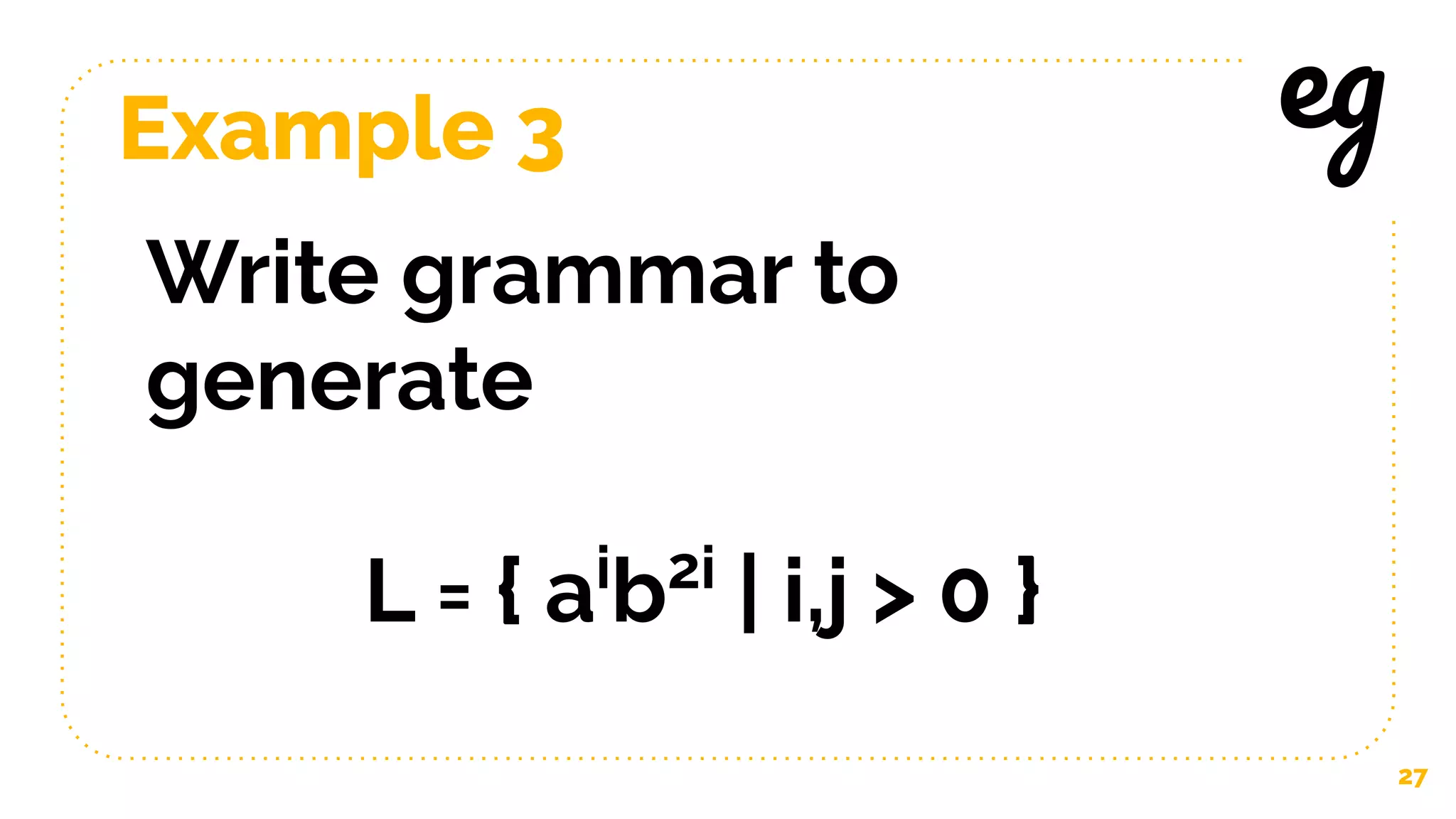
Write grammar to
generate
L = { ai
b2i
| i,j > 0 }
Solution:
28
eg
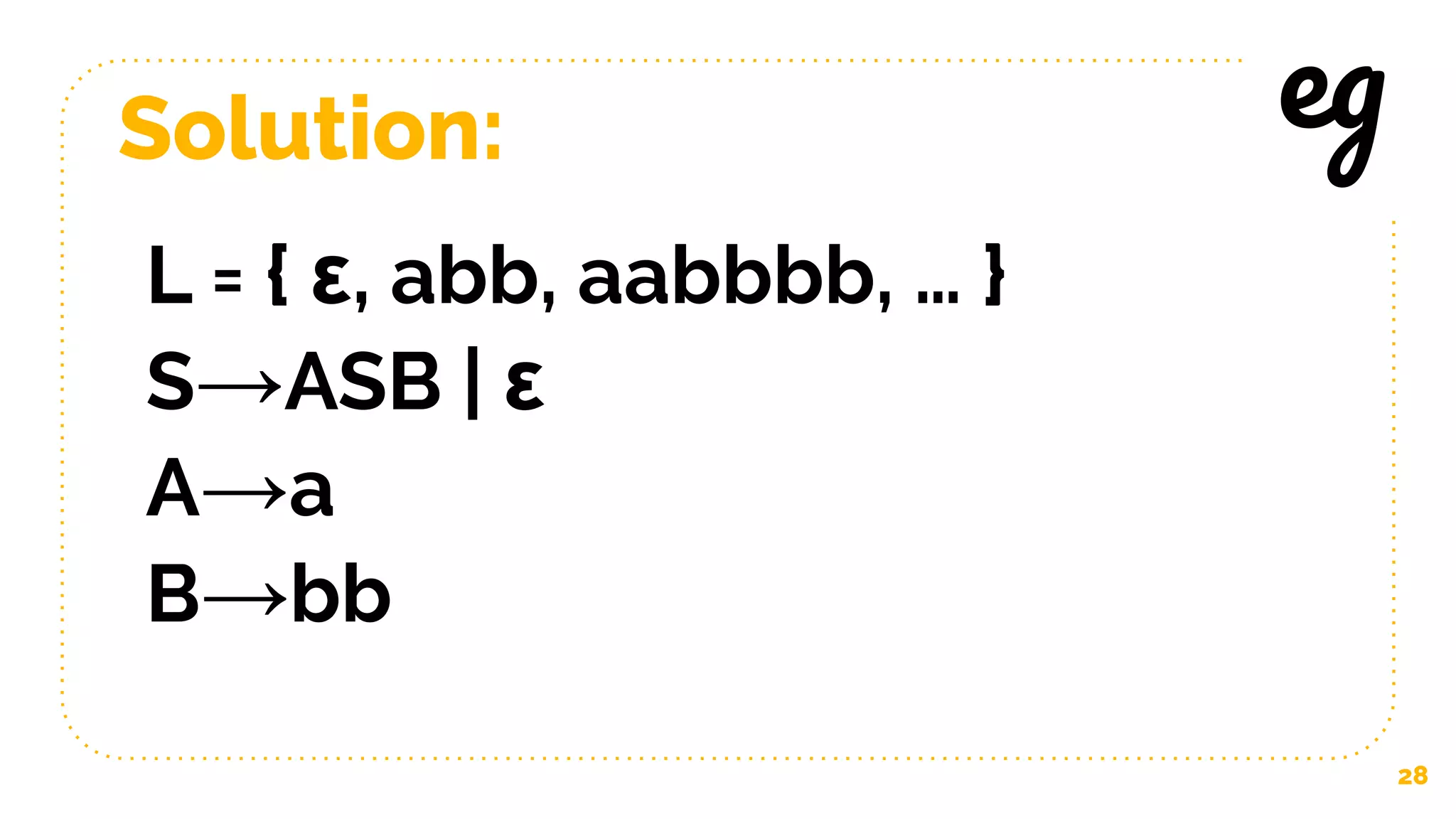
L = { ε, abb, aabbbb, … }
S→ASB | ε
A→a
B→bb
Example 4
29
eg
E → E+E | ExE | (E) | a
w= a+axa
Write the parse tree for w.
Solution:
30
eg
or
Solution (contd.) :
31
eg
● As we can see, there are two different parse
trees possible
● When a grammar generates the same string in
different ways, we say that the string is derived
ambiguously
● Such a grammar is known as ambiguous
grammar
Michael Sipser. 1996. Introduction to the Theory of Computation (1st. ed.). International Thomson Publishing.
Ambiguity
Ambiguous Grammar
33
Formally,
A string w is derived ambiguously in context-free
grammar G if it has two or more different leftmost
derivations. Grammar G is ambiguous if it
generates some string ambiguously.
Michael Sipser. 1996. Introduction to the Theory of Computation (1st. ed.). International Thomson Publishing.
Note Points:
34
1. When we say that a grammar generates a string
ambiguously, we mean that the string has two
different parse trees, not two different derivations.
2. Sometimes, we can find an unambiguous
grammar that generates the same language as
generated by our ambiguous grammar.
Michael Sipser. 1996. Introduction to the Theory of Computation (1st. ed.). International Thomson Publishing.
Example 1
35
eg
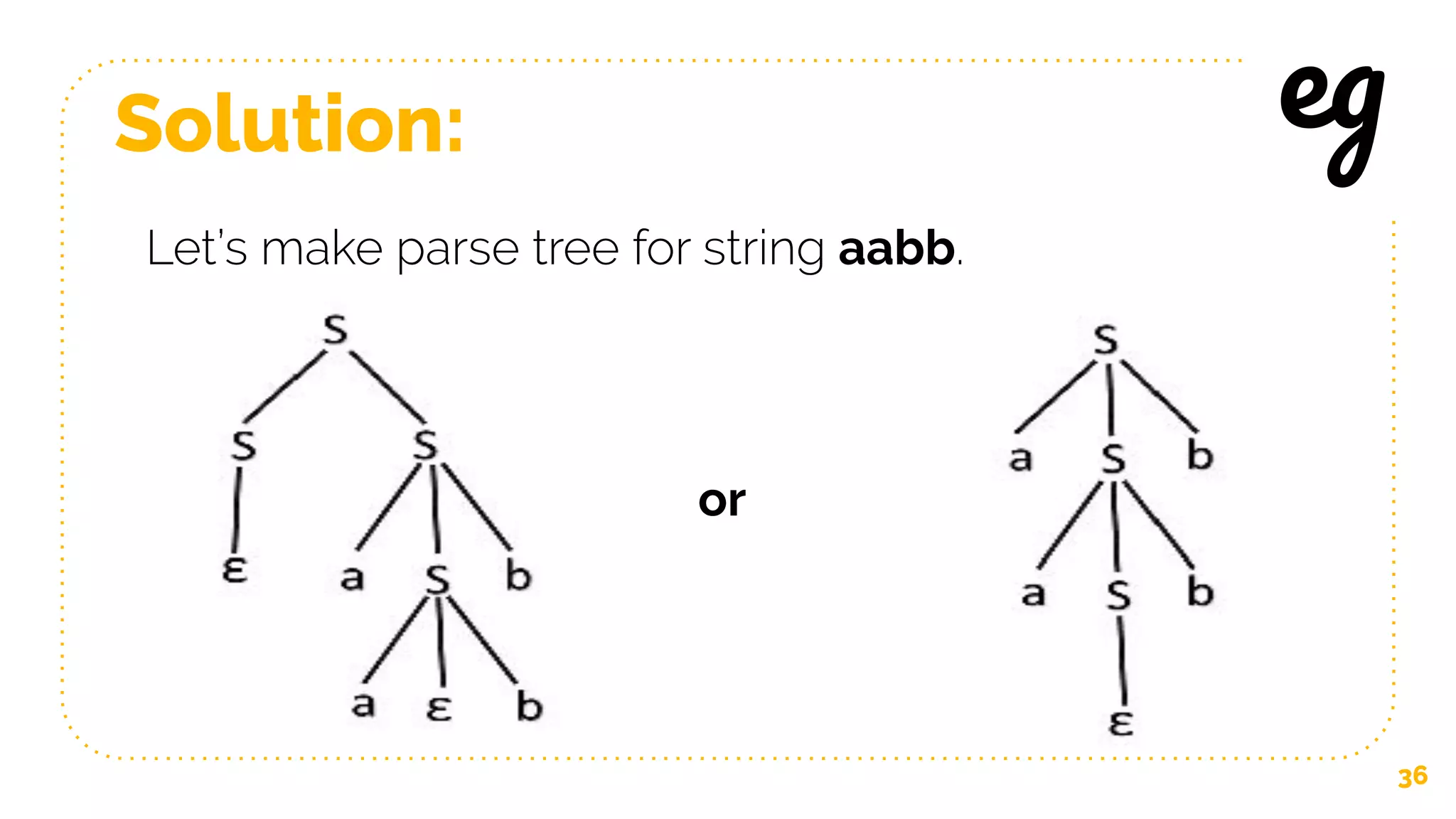
S → aSb | SS | ε
Check if the grammar is
ambiguous or not.
Solution:
36
eg
Let’s make parse tree for string aabb.
or
Solution (contd.) :
37
eg
Since two different parse trees are
possible, the language is ambiguous.
Example 2
38
eg
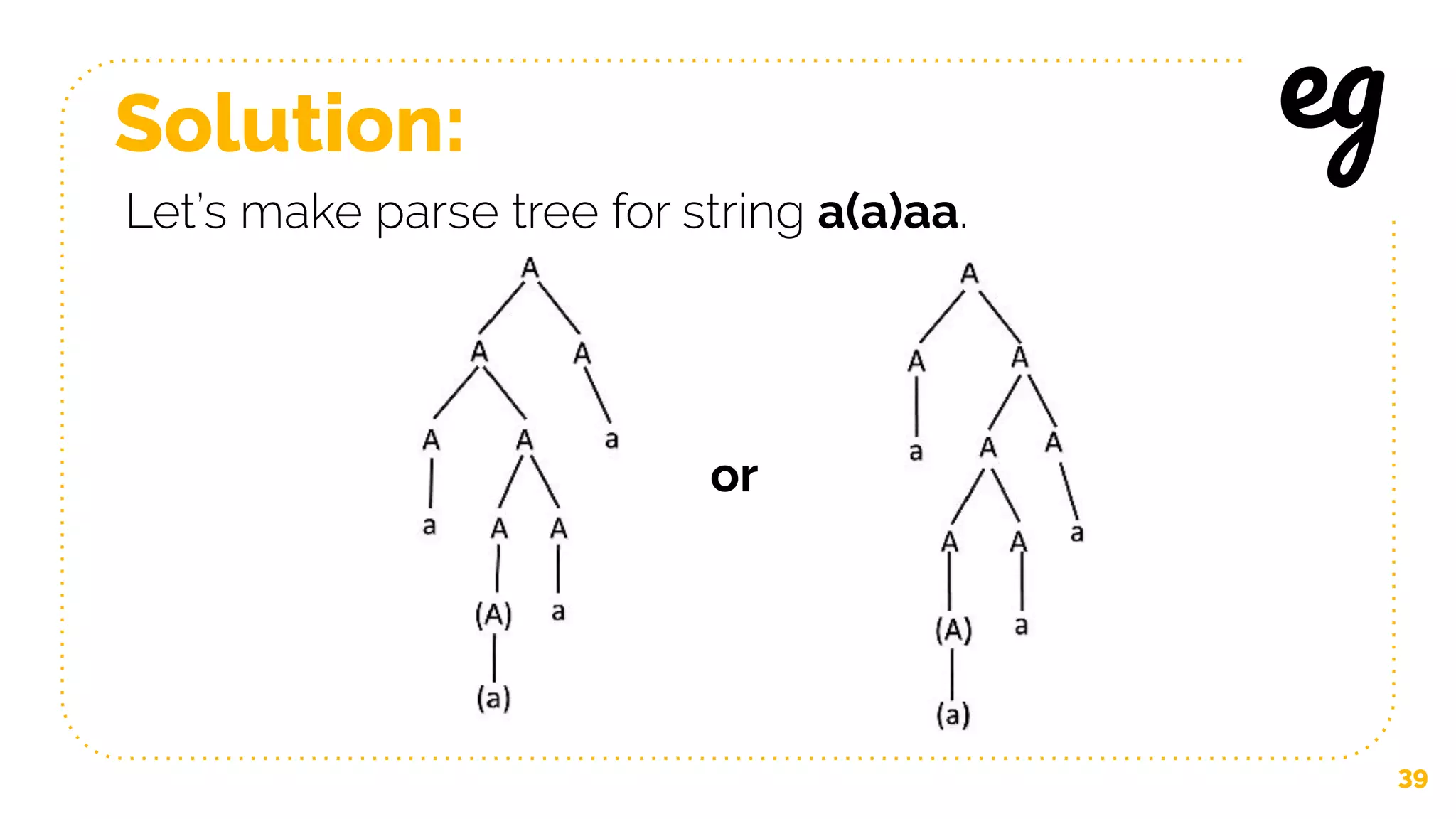
A → AA | (A) | a
Check if the grammar is
ambiguous or not.
Solution:
39
eg
Let’s make parse tree for string a(a)aa.
or
Solution (contd.) :
40
eg
Since two different parse trees are
possible, the language is ambiguous.
Inherently Ambiguous Language
41
Some languages can be generated only by
ambiguous grammars.
Such languages are called inherently ambiguous.
Michael Sipser. 1996. Introduction to the Theory of Computation (1st. ed.). International Thomson Publishing.
Example
42
eg
A= { ai
bj
ck
| i=j or j=k }
A is inherently ambiguous
Chomsky Normal
Form
Chomsky Normal Form
44
Formally,
A context-free grammar is in chomsky normal form if every rule is
of the form
A→BC
A→a
where a is any terminal and A,B and C are any variable except that
B and C may not be start variable. In addition we permit the rule
S→ε
Michael Sipser. 1996. Introduction to the Theory of Computation (1st. ed.). International Thomson Publishing.
Any context-free language is
generated by a context-free
grammar in Chomsky normal
form !!
45
Theorem
Michael Sipser. 1996. Introduction to the Theory of Computation (1st. ed.). International Thomson Publishing.
How to convert any
context free grammar to
Chomsky Normal
Form (CNF) ?
CFG →CNF
47
Step 1
Eliminate start symbol from the right hand side
If the start symbol is at the RHS of any production in
grammar, create a new start variable and new
production as
Eg, S0
→S
So, S0
becomes the new start variable.
CFG →CNF
48
Step 2
Eliminate null, unit and useless productions
CFG →CNF
49
Step 3
Eliminate terminals from RHS if they exist with other
terminals or non-terminals
Eg,
X→xY can be decomposed as
X→ZY
Z→x
CFG →CNF
50
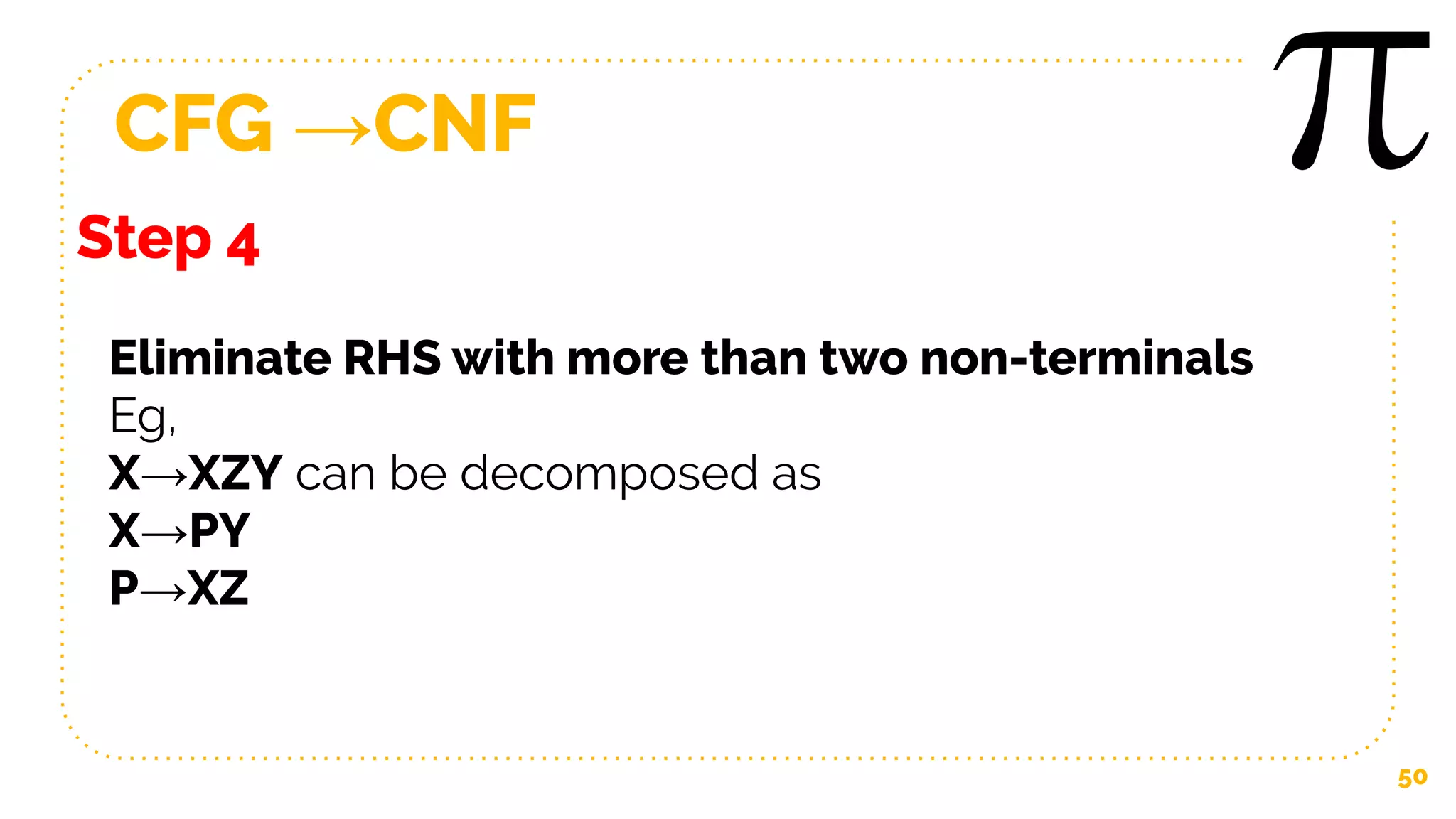
Step 4
Eliminate RHS with more than two non-terminals
Eg,
X→XZY can be decomposed as
X→PY
P→XZ
Examples CFG→CNF
CFG →CNF
52
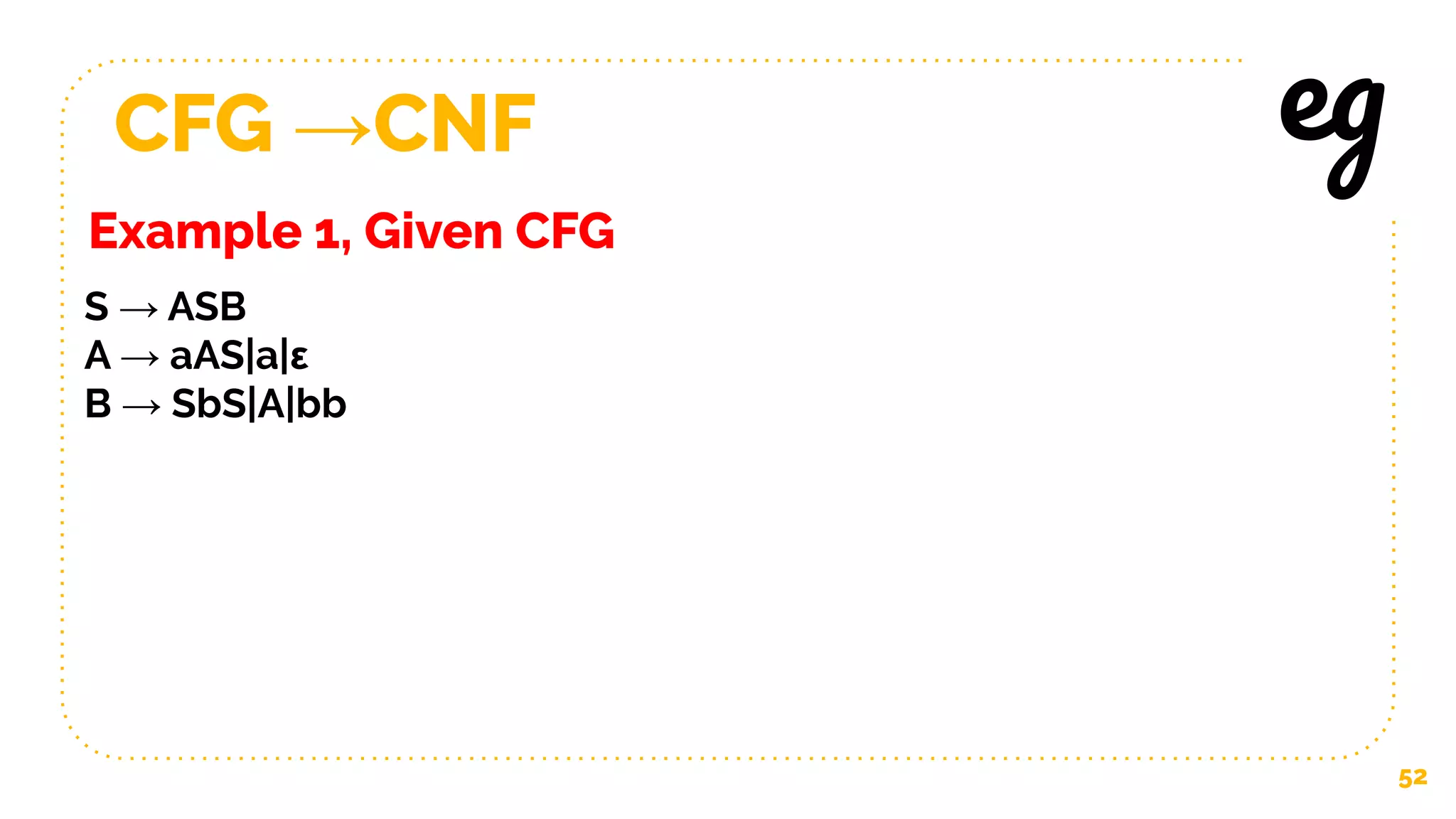
Example 1, Given CFG
eg
S → ASB
A → aAS|a|ε
B → SbS|A|bb
CFG →CNF
53
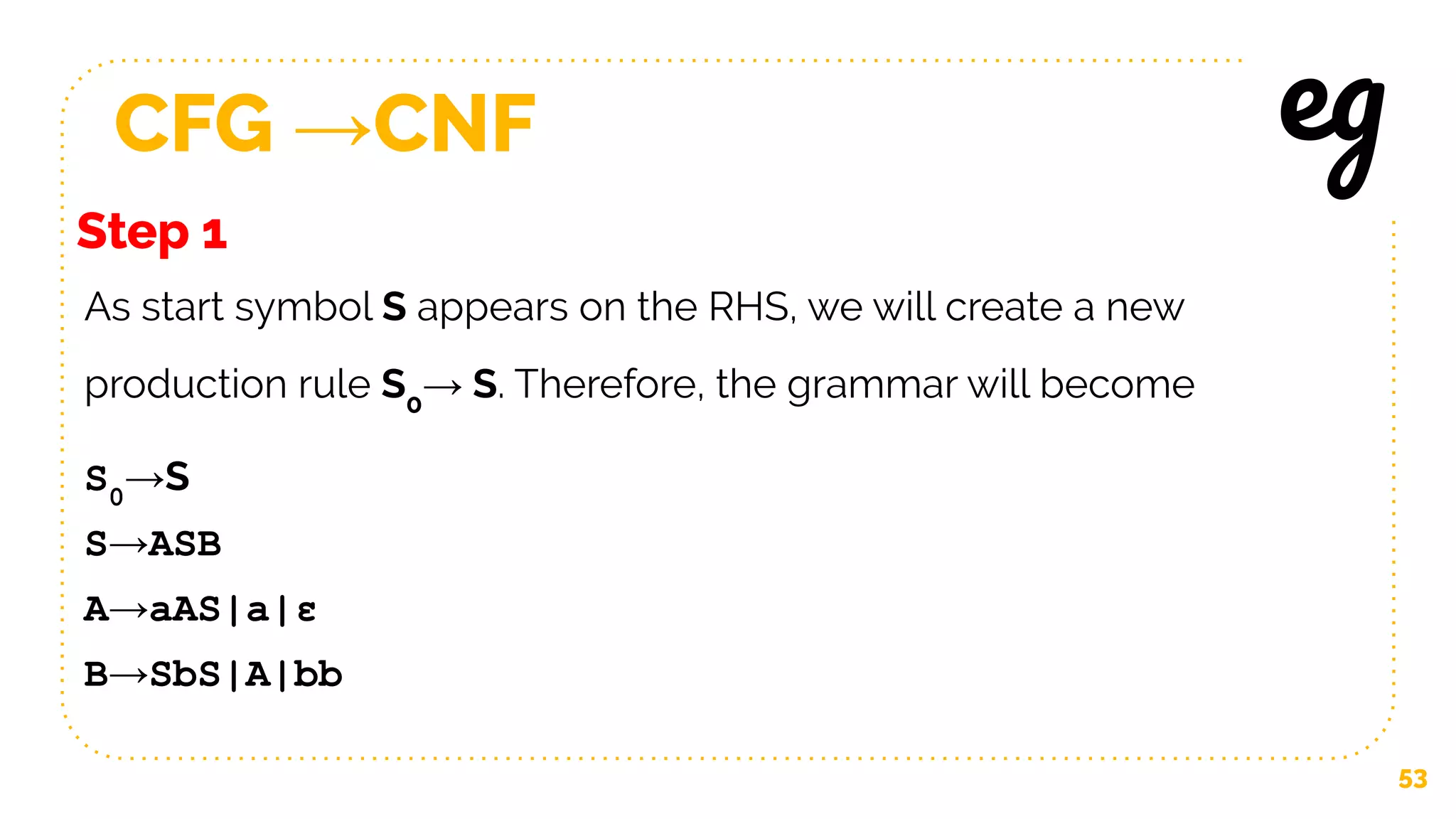
Step 1
eg
As start symbol S appears on the RHS, we will create a new
production rule S0
→ S. Therefore, the grammar will become
S0
→S
S→ASB
A→aAS|a|ε
B→SbS|A|bb
CFG →CNF
54
Step 2
eg
As grammar contains null production A→ε and B→ε, its removal
from the grammar yields
S0
→S
S→AS|ASB|SB|S
A→aAS|aS|a
B→SbS|A|bb
CFG →CNF
55
Step 2 (continued)
eg
As grammar contains null production B→A and S0
→S, its removal
from the grammar yields
S0
→AS|ASB|SB|S
S→AS|ASB|SB|S
A→aAS|aS|a
B→SbS|aAS|aS|a|bb
CFG →CNF
56
Step 3
eg
terminals a and b exist on RHS with non-terminates. Removing
them from RHS
S0
→AS|ASB|SB
S→AS|ASB|SB
A→XAS|XS|a
B→SYS|bb|XAS|XS|a
X→a
Y→b
CFG →CNF
57
Step 3
eg
B→bb can’t be part of CNF, removing it from grammar yields
S0
→AS|ASB|SB
S→AS|ASB|SB
A→XAS|XS|a
B→SYS|VV|XAS|XS|a
X→a
Y→b
V→b
CFG →CNF
58
Step 4
eg
Eliminating RHS with more than two non-terminals, finally we get
CFG →CNF
59
Step 4
eg
S0
→ AS|PB|SB
S → AS|QB|SB
A → RS|XS|a
B → TS|VV|US|XS|a
X → a
Y → b
V → b
P → AS
Q → AS
R → XA
T → SY
U → XA
CFG →CNF
60
Example 2, Given CFG
eg
S → ASA | aB
A → B | S
B → b | ε
CFG →CNF
61
Example 2, CNF
eg
S0→ AX | YB | a | AS | SA
S→ AX | YB | a | AS | SA
A → b |AX | YB | a | AS | SA
B → b
X → SA
Y → a
62
Thank
You!

Context Free Grammar

  • 1.
    Lecture-17 Context Free Languages GroupID - 11 Prepared under CS222 at IIT Jodhpur
  • 2.
    Contribution Each person hascontributed almost equally for this presentation. Whereas specific contributions include Muskan Bathla(B18CSE036): slides 27-50=24 slides *Nivedit Jain(B18CSE039): slides 3-18, slide 51- 62=28 slides Sanskar Mani(B18CSE048): slides 19-26=8 slides * was on academic leave during lecture. Approval 2
  • 3.
    Presentation Outline 3 Slide 4-18 ContextFree Language Introduction and Grammar (Prerequisite) Slide 19-21 Writing Grammar for Languages Slide 22-31 Examples and Problems Slide 43-61 Chomsky Normal Form Slide 32-42 Ambiguous Grammar
  • 4.
  • 5.
    The collections oflanguages associated with context-free grammars are called the Context Free Languages. 5
  • 6.
    The collections oflanguages associated with context-free grammars are called the Context Free Languages. 6 Context Free Grammars ???
  • 7.
    The collections oflanguages associated with context-free grammars are called the Context Free Languages. 7 Context Free Grammars ???
  • 8.
  • 9.
    Context Free Grammar 9 Formally, Acontext-free grammar is a 4-tuple (V,∑,R,S), where 1. V is a finite set called the variables. 2. ∑ is a finite set, disjoint from V, called terminals. 3. R is a finite set of rules, with each rule being a variable and a string of variables and terminals, and 4. S ϵ V is the start variable Michael Sipser. 1996. Introduction to the Theory of Computation (1st. ed.). International Thomson Publishing.
  • 10.
    Context Free Grammar 10 Formally, Acontext-free grammar is a 4-tuple (V,∑,R,S), where 1. V is a finite set called the variables. 2. ∑ is a finite set, disjoint from V, called terminals. 3. R is a finite set of rules, with each rule being a variable and a string of variables and terminals, and 4. S ϵ V is the start variable Michael Sipser. 1996. Introduction to the Theory of Computation (1st. ed.). International Thomson Publishing.
  • 11.
    Context Free Grammar 11 Formally, Acontext-free grammar is a 4-tuple (V,∑,R,S), where 1. V is a finite set called the variables. 2. ∑ is a finite set, disjoint from V, called terminals. 3. R is a finite set of rules, with each rule being a variable and a string of variables and terminals, and 4. S ϵ V is the start variable Michael Sipser. 1996. Introduction to the Theory of Computation (1st. ed.). International Thomson Publishing. SURE!!
  • 12.
    Let's consider anexample 12 eg A → 0A1 A → B B → #
  • 13.
    Let's consider anexample 13 eg A → 0A1 A → B B → # A grammar consists of a collection of substitution rules, also called productions.
  • 14.
    Let's consider anexample 14 eg A → 0A1 A → B B → # Symbol is called a variable
  • 15.
    Let's consider anexample 15 eg A → 0A1 A → B B → # The string consists of variables and other symbols called terminals
  • 16.
    Let's consider anexample 16 eg A → 0A1 A → B B → # Start variable, it occurs on the left-hand side of the topmost rule. I am A and I am the start variable
  • 17.
    Context Free Grammar 17 Formally, Acontext-free grammar is a 4-tuple (V,∑,R,S), where 1. V is a finite set called the variables. 2. ∑ is a finite set, disjoint from V, called terminals. 3. R is a finite set of rules, with each rule being a variable and a string of variables and terminals, and 4. S ϵ V is the start variable Michael Sipser. 1996. Introduction to the Theory of Computation (1st. ed.). International Thomson Publishing.
  • 18.
    Context Free Grammar 18 Formally, Acontext-free grammar is a 4-tuple (V,∑,R,S), where 1. V is a finite set called the variables. 2. ∑ is a finite set, disjoint from V, called terminals. 3. R is a finite set of rules, with each rule being a variable and a string of variables and terminals, and 4. S ϵ V is the start variable Michael Sipser. 1996. Introduction to the Theory of Computation (1st. ed.). International Thomson Publishing.
  • 19.
  • 20.
    Method 20 You use agrammar to describe a language by generating each string of that language in the following manner - 1. Write down the start variable. It is the variable on the left-hand side of the top rule, unless specified otherwise.
  • 21.
    Method (contd.) 21 2. Finda variable that is written down and a rule that starts with that variable. Replace the written down variable with the right-hand side of that rule. 3. Repeat step 2 until no variables remain.
  • 22.
  • 23.
    Example 1 23 eg Write grammarfor all even length palindromes.
  • 24.
    Solution: 24 eg Even length palindromes= {aa , bb , aaaa , abba , baab , bbbb , … } S→aSa | bSb | aa | bb
  • 25.
    Example 2 25 eg Write grammarto generate L = { ai bj | i,j > 0 }
  • 26.
    Solution: 26 eg L = {ab, aab , abb , aaab , aabb , abbb , bbbb , … } S→AB A→aAa | a B→bBb | b
  • 27.
    Example 3 27 eg Write grammarto generate L = { ai b2i | i,j > 0 }
  • 28.
    Solution: 28 eg L = {ε, abb, aabbbb, … } S→ASB | ε A→a B→bb
  • 29.
    Example 4 29 eg E →E+E | ExE | (E) | a w= a+axa Write the parse tree for w.
  • 30.
  • 31.
    Solution (contd.) : 31 eg ●As we can see, there are two different parse trees possible ● When a grammar generates the same string in different ways, we say that the string is derived ambiguously ● Such a grammar is known as ambiguous grammar Michael Sipser. 1996. Introduction to the Theory of Computation (1st. ed.). International Thomson Publishing.
  • 32.
  • 33.
    Ambiguous Grammar 33 Formally, A stringw is derived ambiguously in context-free grammar G if it has two or more different leftmost derivations. Grammar G is ambiguous if it generates some string ambiguously. Michael Sipser. 1996. Introduction to the Theory of Computation (1st. ed.). International Thomson Publishing.
  • 34.
    Note Points: 34 1. Whenwe say that a grammar generates a string ambiguously, we mean that the string has two different parse trees, not two different derivations. 2. Sometimes, we can find an unambiguous grammar that generates the same language as generated by our ambiguous grammar. Michael Sipser. 1996. Introduction to the Theory of Computation (1st. ed.). International Thomson Publishing.
  • 35.
    Example 1 35 eg S →aSb | SS | ε Check if the grammar is ambiguous or not.
  • 36.
    Solution: 36 eg Let’s make parsetree for string aabb. or
  • 37.
    Solution (contd.) : 37 eg Sincetwo different parse trees are possible, the language is ambiguous.
  • 38.
    Example 2 38 eg A →AA | (A) | a Check if the grammar is ambiguous or not.
  • 39.
    Solution: 39 eg Let’s make parsetree for string a(a)aa. or
  • 40.
    Solution (contd.) : 40 eg Sincetwo different parse trees are possible, the language is ambiguous.
  • 41.
    Inherently Ambiguous Language 41 Somelanguages can be generated only by ambiguous grammars. Such languages are called inherently ambiguous. Michael Sipser. 1996. Introduction to the Theory of Computation (1st. ed.). International Thomson Publishing.
  • 42.
    Example 42 eg A= { ai bj ck |i=j or j=k } A is inherently ambiguous
  • 43.
  • 44.
    Chomsky Normal Form 44 Formally, Acontext-free grammar is in chomsky normal form if every rule is of the form A→BC A→a where a is any terminal and A,B and C are any variable except that B and C may not be start variable. In addition we permit the rule S→ε Michael Sipser. 1996. Introduction to the Theory of Computation (1st. ed.). International Thomson Publishing.
  • 45.
    Any context-free languageis generated by a context-free grammar in Chomsky normal form !! 45 Theorem Michael Sipser. 1996. Introduction to the Theory of Computation (1st. ed.). International Thomson Publishing.
  • 46.
    How to convertany context free grammar to Chomsky Normal Form (CNF) ?
  • 47.
    CFG →CNF 47 Step 1 Eliminatestart symbol from the right hand side If the start symbol is at the RHS of any production in grammar, create a new start variable and new production as Eg, S0 →S So, S0 becomes the new start variable.
  • 48.
    CFG →CNF 48 Step 2 Eliminatenull, unit and useless productions
  • 49.
    CFG →CNF 49 Step 3 Eliminateterminals from RHS if they exist with other terminals or non-terminals Eg, X→xY can be decomposed as X→ZY Z→x
  • 50.
    CFG →CNF 50 Step 4 EliminateRHS with more than two non-terminals Eg, X→XZY can be decomposed as X→PY P→XZ
  • 51.
  • 52.
    CFG →CNF 52 Example 1,Given CFG eg S → ASB A → aAS|a|ε B → SbS|A|bb
  • 53.
    CFG →CNF 53 Step 1 eg Asstart symbol S appears on the RHS, we will create a new production rule S0 → S. Therefore, the grammar will become S0 →S S→ASB A→aAS|a|ε B→SbS|A|bb
  • 54.
    CFG →CNF 54 Step 2 eg Asgrammar contains null production A→ε and B→ε, its removal from the grammar yields S0 →S S→AS|ASB|SB|S A→aAS|aS|a B→SbS|A|bb
  • 55.
    CFG →CNF 55 Step 2(continued) eg As grammar contains null production B→A and S0 →S, its removal from the grammar yields S0 →AS|ASB|SB|S S→AS|ASB|SB|S A→aAS|aS|a B→SbS|aAS|aS|a|bb
  • 56.
    CFG →CNF 56 Step 3 eg terminalsa and b exist on RHS with non-terminates. Removing them from RHS S0 →AS|ASB|SB S→AS|ASB|SB A→XAS|XS|a B→SYS|bb|XAS|XS|a X→a Y→b
  • 57.
    CFG →CNF 57 Step 3 eg B→bbcan’t be part of CNF, removing it from grammar yields S0 →AS|ASB|SB S→AS|ASB|SB A→XAS|XS|a B→SYS|VV|XAS|XS|a X→a Y→b V→b
  • 58.
    CFG →CNF 58 Step 4 eg EliminatingRHS with more than two non-terminals, finally we get
  • 59.
    CFG →CNF 59 Step 4 eg S0 →AS|PB|SB S → AS|QB|SB A → RS|XS|a B → TS|VV|US|XS|a X → a Y → b V → b P → AS Q → AS R → XA T → SY U → XA
  • 60.
    CFG →CNF 60 Example 2,Given CFG eg S → ASA | aB A → B | S B → b | ε
  • 61.
    CFG →CNF 61 Example 2,CNF eg S0→ AX | YB | a | AS | SA S→ AX | YB | a | AS | SA A → b |AX | YB | a | AS | SA B → b X → SA Y → a
  • 62.