Virtual
Try-On
B18CSE039, B18CSE041, B18CSE043
1. Problem Statement
2. Goals
3. Literature Survey
4. Our HandsOn Work
4.1. U-Net
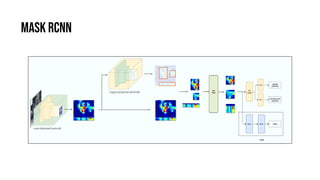
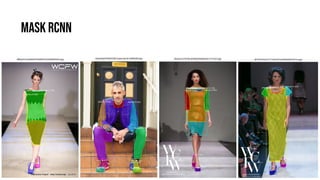
4.2. Mask RCNN
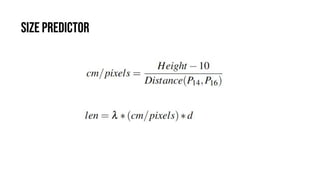
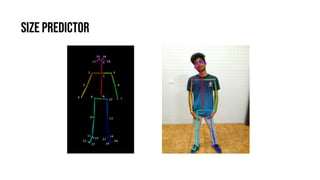
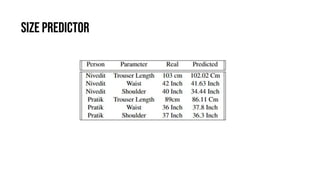
4.3. Cloth Size Estimation
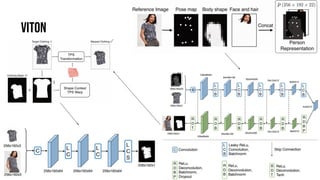
4.4. VITON
5. Proposals
6. Accomplishments
7. Issues Faced
8. Future Work
9. Concluding Remarks
Index
Problem Statement
To survey and explore some of the methods that can be
used to create a modular pipeline for a virtual try-on
system and to understand the existing one, to make a
productive solution for $1.5 Trillion eFashion Industry.
GOALS
We assigned the following goals for our project:
1. An extensive survey of the papers regarding
technologies that can be used in the fashion industry.
2. Perform cloth parsing on images using instance
segmentation models.
3. Understand the existing virtual-tryon systems.
4. Develop methods to perform human cloth size
estimation.
5. Deploying a feasible solution.
LITERATURE REVIEW
1. Depth Cameras
2. Depth Camera based size prediction
3. Camera Based
4. Parsing
5. Virtual Try On
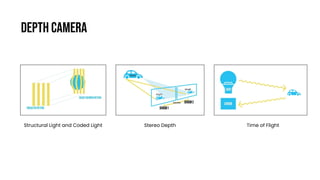
DEPTH CAMERA
Structural Light and Coded Light Stereo Depth Time of Flight
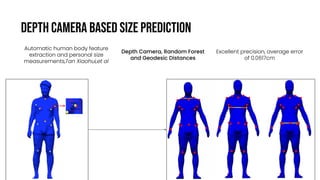
DEPTH CAMERA BASED SIZE PREDICTION
Automatic human body feature
extraction and personal size
measurements,Tan Xiaohui,et al
Depth Camera, Random Forest
and Geodesic Distances
Excellent precision, average error
of 0.0617cm
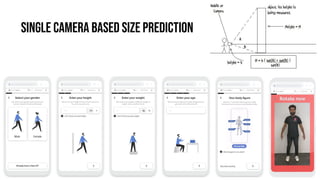
Single CAMERA BASED size prediction
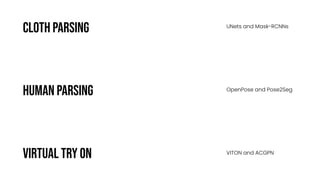
CLOTH PARSING
HUMAN PARSING
VIRTUAL TRY ON
UNets and Mask-RCNNs
OpenPose and Pose2Seg
VITON and ACGPN
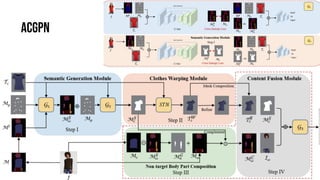
ACGPN
Our Work
1. U-Net
2. Mask RCNN
3. Cloth Size Estimation
4. VITON
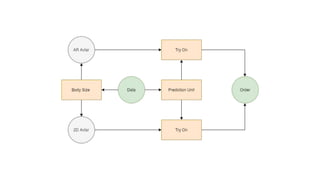
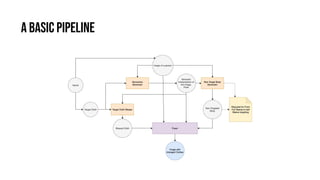
A Basic Pipeline
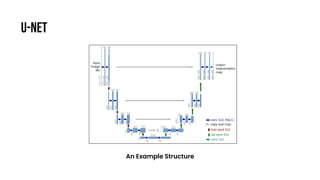
U-NEt
An Example Structure
U-NEt
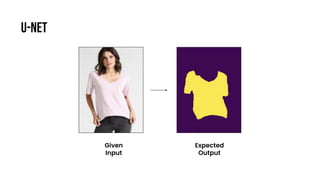
Given
Input
Expected
Output
U-NEt
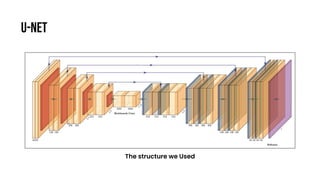
The structure we Used
U-NEt
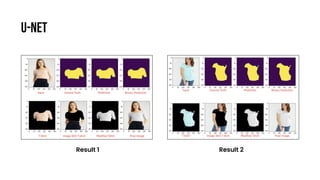
Result 1 Result 2
U-NEt
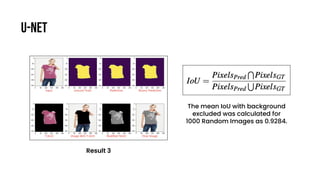
The mean IoU with background
excluded was calculated for
1000 Random Images as 0.9284.
Result 3
Mask RCNN
Mask RCNN
Mask RCNN
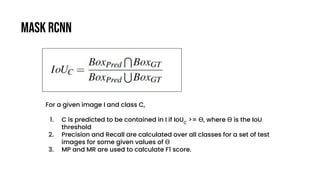
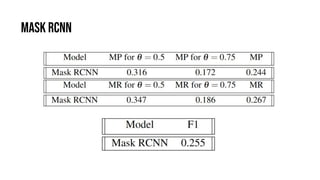
For a given image I and class C,
1. C is predicted to be contained in I if IoUC
>= Ө, where Ө is the IoU
threshold
2. Precision and Recall are calculated over all classes for a set of test
images for some given values of Ө
3. MP and MR are used to calculate F1 score.
Mask RCNN
Size PreDictor
Size PreDictor
Size PreDictor
VITON
Proposals
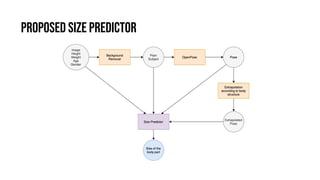
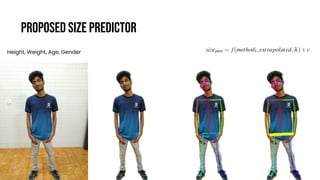
PROPOSED SIZE PREDICTOR
Height, Weight, Age, Gender
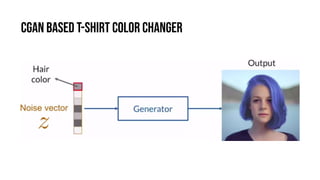
CGAN BASED T-SHIRT COLOR CHANGER
Accomplishments
1. Learned and understood the fundamentals
of necessary technology.
2. Found and understood appropriate
technologies/research for our pipelines.
3. Implemented few methods based on UNet,
Mask-RCNN and OpenPose
4. Proposed few intermediate processes.
Issues Faced
1. The mathematical details regarding the
workings of the virtual tryon models
proved to be out of scope for us, and
hence we weren’t able to proceed to
create a version of our own.
2. The multi-class implementation of U-Net
gave poor performance on the test
images, and the faults weren’t clear, and
hence we proceeded with a single class
implementation only.
3. Good dataset was not available to check
to experiments, train and validated our
proposed body shape model.
4. Lack of depth sensing hardware.
5. Computational very expensive units.
6. Restrictions and challenges due to
uncertain events due to COVID-19.
Future work
1. To gain better mathematical understanding
behind VITON and ACGPN
2. To understand and design cloth wrapping
modules.
3. To prepare a good size dataset
4. To design and optimise the model such that it
can work on a mobile device with a primitive
GPUs.
5. To extend the capabilities to AR.
CONCLUDING REMARKS
1. This BTP was a great learning experience and
have gained much insights of the field.
2. Learning Outcomes Slides (GMMs, UNet, Mask
RCNN, Generative Models, AR) available at
http://bit.ly/VirtualTry
3. Report Available at http://bit.ly/VirtualTry
4. Special Thanks to Dr. Anand Mishra for the
constant support and encouragement.
5. We would be further continuing work in the
area, goal is to make it in hands of users.

BTP Presentation.pdf

  • 1.
  • 2.
    1. Problem Statement 2.Goals 3. Literature Survey 4. Our HandsOn Work 4.1. U-Net 4.2. Mask RCNN 4.3. Cloth Size Estimation 4.4. VITON 5. Proposals 6. Accomplishments 7. Issues Faced 8. Future Work 9. Concluding Remarks Index
  • 3.
    Problem Statement To surveyand explore some of the methods that can be used to create a modular pipeline for a virtual try-on system and to understand the existing one, to make a productive solution for $1.5 Trillion eFashion Industry. GOALS We assigned the following goals for our project: 1. An extensive survey of the papers regarding technologies that can be used in the fashion industry. 2. Perform cloth parsing on images using instance segmentation models. 3. Understand the existing virtual-tryon systems. 4. Develop methods to perform human cloth size estimation. 5. Deploying a feasible solution.
  • 5.
    LITERATURE REVIEW 1. DepthCameras 2. Depth Camera based size prediction 3. Camera Based 4. Parsing 5. Virtual Try On
  • 6.
    DEPTH CAMERA Structural Lightand Coded Light Stereo Depth Time of Flight
  • 7.
    DEPTH CAMERA BASEDSIZE PREDICTION Automatic human body feature extraction and personal size measurements,Tan Xiaohui,et al Depth Camera, Random Forest and Geodesic Distances Excellent precision, average error of 0.0617cm
  • 8.
    Single CAMERA BASEDsize prediction
  • 9.
    CLOTH PARSING HUMAN PARSING VIRTUALTRY ON UNets and Mask-RCNNs OpenPose and Pose2Seg VITON and ACGPN
  • 10.
  • 11.
    Our Work 1. U-Net 2.Mask RCNN 3. Cloth Size Estimation 4. VITON
  • 12.
  • 13.
  • 14.
  • 15.
  • 16.
  • 17.
    U-NEt The mean IoUwith background excluded was calculated for 1000 Random Images as 0.9284. Result 3
  • 18.
  • 19.
  • 20.
    Mask RCNN For agiven image I and class C, 1. C is predicted to be contained in I if IoUC >= Ө, where Ө is the IoU threshold 2. Precision and Recall are calculated over all classes for a set of test images for some given values of Ө 3. MP and MR are used to calculate F1 score.
  • 21.
  • 22.
  • 23.
  • 24.
  • 25.
  • 26.
  • 27.
  • 28.
  • 29.
    CGAN BASED T-SHIRTCOLOR CHANGER
  • 30.
    Accomplishments 1. Learned andunderstood the fundamentals of necessary technology. 2. Found and understood appropriate technologies/research for our pipelines. 3. Implemented few methods based on UNet, Mask-RCNN and OpenPose 4. Proposed few intermediate processes.
  • 31.
    Issues Faced 1. Themathematical details regarding the workings of the virtual tryon models proved to be out of scope for us, and hence we weren’t able to proceed to create a version of our own. 2. The multi-class implementation of U-Net gave poor performance on the test images, and the faults weren’t clear, and hence we proceeded with a single class implementation only. 3. Good dataset was not available to check to experiments, train and validated our proposed body shape model. 4. Lack of depth sensing hardware. 5. Computational very expensive units. 6. Restrictions and challenges due to uncertain events due to COVID-19.
  • 32.
    Future work 1. Togain better mathematical understanding behind VITON and ACGPN 2. To understand and design cloth wrapping modules. 3. To prepare a good size dataset 4. To design and optimise the model such that it can work on a mobile device with a primitive GPUs. 5. To extend the capabilities to AR.
  • 33.
    CONCLUDING REMARKS 1. ThisBTP was a great learning experience and have gained much insights of the field. 2. Learning Outcomes Slides (GMMs, UNet, Mask RCNN, Generative Models, AR) available at http://bit.ly/VirtualTry 3. Report Available at http://bit.ly/VirtualTry 4. Special Thanks to Dr. Anand Mishra for the constant support and encouragement. 5. We would be further continuing work in the area, goal is to make it in hands of users.