
Billy Elliot
Module C:
INTO THE
WORLD
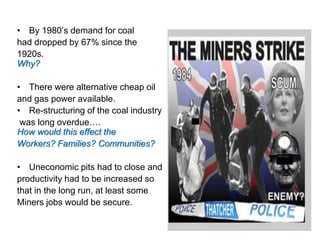
• By 1980’s demand for coal
had dropped by 67% since the
1920s.
Why?
• There were alternative cheap oil
and gas power available.
• Re-structuring of the coal industry
was long overdue….
How would this effect the
Workers? Families? Communities?
• Uneconomic pits had to close and
productivity had to be increased so
that in the long run, at least some
Miners jobs would be secure.
Important Definitions
Trade Unions
A trade union is an organisation
or group of workers who join
together to negotiate , hours,
benefits, and working conditions.
….. Why do we need Trade Unions?
• Union members and supporters of unions claim
that they are necessary because the people that
run companies want to pay as little as possible.
Collective Bargaining
• The leaders of a union work with
management (the people who run the
business)/ or Government in order to get a
contract that gives workers what they
want.
• What happens if they
don’t get what they want?
Strike and Picket Line
• A Strike is when a large number of workers stop
working in protest of pay or conditions. (in this
case, the closing down of mines and the loss of
jobs).
• Strikes are sometimes used to pressure
governments to change policies.
• The workers walk in front of where they work,
chanting and holding signs. This is called a
Picket Line.
“Scabs”
• Scabs refers to any circumstance in which
union workers themselves cross picket lines
to work.
• Why are they called scabs???
• They argue that the picket line is symbolic of
a wound and those who break its borders to
return to work are the scabs who try to heal
that wound before it treated/fixed.
A culture of violence?
• Workers on strike would sometimes
forceably try to prevent a desperate
worker from crossing the picket line.
• Violence would often break out and riot
police often controlled situations.
• However, most workers would not cross a
picket line. This is a way of showing
solidarity (or support) for the union.
Privatisation
the process of transferring ownership of a government
run business, to the private
• Jobs are often cut in a bid to make the business more
efficient and more profitable.
• Steps were taken by government (and the new
business that now run the business) to try and stop
overstaffing and overspending.
Margaret Thatcher’s Cunning Plan!
“by the 1970’s the coal mining industry had come
to symbolise everything that was wrong with
Britain.”
(inefficient/costly/supported = must be fixed)
Anticipating mine worker strikes, the government
built up the national stocks of coal ready, if
necessary for a long strike haul. (i.e. ‘strike for
as long as you like .. You are only hurting
yourself)
Music as a social voice
• Popular music focused on subject matter that
revolved around the social issues of the time:
social displacement*, unemployment*, racial
conflict*, drug use*, and the responsibilities
of adulthood*.
(* all aspects that an individual faces in their
experience of going “into the world”)
• We hear music of this genre throughout the film. 
it is an anchor, tying the images we see with the
social attitudes at that time.
The basic premise…
• Billy’s father and brother work and live in the poor
mining community of Durham, North England.
• Privatisation and anti-union measures by
Margaret Thatcher in the previous decade had
seen the closing of many mines and the decline
in heavy industry.
 Major upheavals in employment meant threats to
the struggling mining communities and the deeply
entrenched traditional attitudes shaping men
(which define them and restrict them.)
Consider …
How does SETTING (time, place,
context/atmosphere) shape a character?
According the values and attitudes of people in
Durham (1985) - What is a “man”?
1. List the qualities that (according to social
expectations in 1985 in Durham) a “real
man” possessed:
• Name the characters in Billy Elliot who
possess – or support - the qualities of a
“real man” in Durham.
– Identify and analyse specific scenes to prove
your statements.
• Name the characters (male and female) in
Billy Elliot who CHALLENGE the stereotype
of the “real man” in Durham.
– Identify and analyse specific scenes to prove
your statements.

context and values in BILLY ELLIOT

  • 1.
  • 7.
    • By 1980’sdemand for coal had dropped by 67% since the 1920s. Why? • There were alternative cheap oil and gas power available. • Re-structuring of the coal industry was long overdue…. How would this effect the Workers? Families? Communities? • Uneconomic pits had to close and productivity had to be increased so that in the long run, at least some Miners jobs would be secure.
  • 8.
    Important Definitions Trade Unions Atrade union is an organisation or group of workers who join together to negotiate , hours, benefits, and working conditions. ….. Why do we need Trade Unions? • Union members and supporters of unions claim that they are necessary because the people that run companies want to pay as little as possible.
  • 9.
    Collective Bargaining • Theleaders of a union work with management (the people who run the business)/ or Government in order to get a contract that gives workers what they want. • What happens if they don’t get what they want?
  • 10.
    Strike and PicketLine • A Strike is when a large number of workers stop working in protest of pay or conditions. (in this case, the closing down of mines and the loss of jobs). • Strikes are sometimes used to pressure governments to change policies. • The workers walk in front of where they work, chanting and holding signs. This is called a Picket Line.
  • 11.
    “Scabs” • Scabs refersto any circumstance in which union workers themselves cross picket lines to work. • Why are they called scabs??? • They argue that the picket line is symbolic of a wound and those who break its borders to return to work are the scabs who try to heal that wound before it treated/fixed.
  • 12.
    A culture ofviolence? • Workers on strike would sometimes forceably try to prevent a desperate worker from crossing the picket line. • Violence would often break out and riot police often controlled situations. • However, most workers would not cross a picket line. This is a way of showing solidarity (or support) for the union.
  • 13.
    Privatisation the process oftransferring ownership of a government run business, to the private • Jobs are often cut in a bid to make the business more efficient and more profitable. • Steps were taken by government (and the new business that now run the business) to try and stop overstaffing and overspending.
  • 14.
    Margaret Thatcher’s CunningPlan! “by the 1970’s the coal mining industry had come to symbolise everything that was wrong with Britain.” (inefficient/costly/supported = must be fixed) Anticipating mine worker strikes, the government built up the national stocks of coal ready, if necessary for a long strike haul. (i.e. ‘strike for as long as you like .. You are only hurting yourself)
  • 17.
    Music as asocial voice • Popular music focused on subject matter that revolved around the social issues of the time: social displacement*, unemployment*, racial conflict*, drug use*, and the responsibilities of adulthood*. (* all aspects that an individual faces in their experience of going “into the world”) • We hear music of this genre throughout the film.  it is an anchor, tying the images we see with the social attitudes at that time.
  • 18.
    The basic premise… •Billy’s father and brother work and live in the poor mining community of Durham, North England. • Privatisation and anti-union measures by Margaret Thatcher in the previous decade had seen the closing of many mines and the decline in heavy industry.  Major upheavals in employment meant threats to the struggling mining communities and the deeply entrenched traditional attitudes shaping men (which define them and restrict them.)
  • 21.
    Consider … How doesSETTING (time, place, context/atmosphere) shape a character? According the values and attitudes of people in Durham (1985) - What is a “man”? 1. List the qualities that (according to social expectations in 1985 in Durham) a “real man” possessed:
  • 22.
    • Name thecharacters in Billy Elliot who possess – or support - the qualities of a “real man” in Durham. – Identify and analyse specific scenes to prove your statements. • Name the characters (male and female) in Billy Elliot who CHALLENGE the stereotype of the “real man” in Durham. – Identify and analyse specific scenes to prove your statements.