Bell Ringer 3/1/06

“ We return. We return from fighting. We
  return fighting.” (W.E.B DuBois)

What is this quote referring to?
Why did this quote prove to be true?
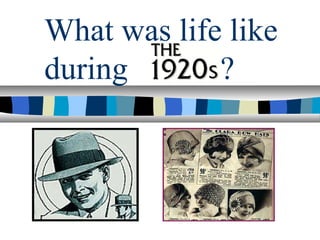
What was life like
during       ?
Post War America
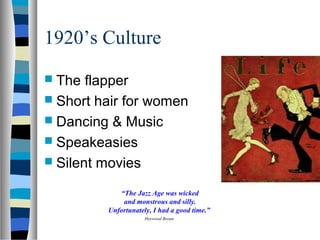
1920’s Culture
 The  flapper
 Short hair for women
 Dancing & Music
 Speakeasies
 Silent movies

            “The Jazz Age was wicked
             and monstrous and silly.
         Unfortunately, I had a good time.”
                     Heywood Broun
How did technology impact society?
 15  million cars were sold
 80% were bought on credit
 A Model T Ford cost $290 in 1920
 20% of U.S. homes had electricity by
  the end of the decade
 10 million families owned radios by
  1929
 Shifting of America from a rural country
  to an urban country
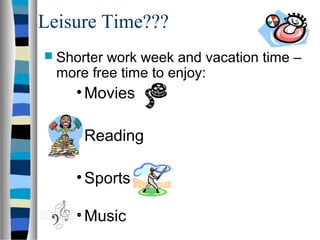
Leisure Time???
 Shorter work week and vacation time –
  more free time to enjoy:
     • Movies

     • Reading

     • Sports

     • Music
Too much of a good thing????
 Mass consumption, changing values,
 new technologies – are they always
 good???
  – Many said NO
  – Harlem Renaissance benefited and
    reacted against it
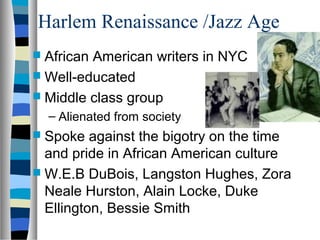
Harlem Renaissance /Jazz Age
 AfricanAmerican writers in NYC
 Well-educated
 Middle class group
  – Alienated from society
 Spoke   against the bigotry on the time
  and pride in African American culture
 W.E.B DuBois, Langston Hughes, Zora
  Neale Hurston, Alain Locke, Duke
  Ellington, Bessie Smith
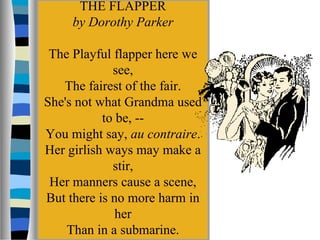
THE FLAPPER
     by Dorothy Parker

 The Playful flapper here we
             see,
   The fairest of the fair.
She's not what Grandma used
           to be, --
You might say, au contraire.
Her girlish ways may make a
             stir,
 Her manners cause a scene,
But there is no more harm in
              her
    Than in a submarine.
Women in the 20s…….
 By 1929, made up 22% of the
  workforce
 90% of married women did not work
 Work available to women were low
  paying and of lower status
 Voted in 1920 election – not very many
  participated
 Majority were not flappers, but were
  helped by the technology
 Family size smaller, divorce laws still
  favored men
Immigrants in the 20s ……


 KKK
 Quotas
 Nativism
Struggle of OLD vs. NEW
 Prohibition
 Minorities
 Cultural   Values
 Women
   Scopes Trial
    – Modernization of society
    – Religion not as important
Who’s Who
 Hand   in:
  – #1 Project
  – #2 Sources
  – #3 Rubric with your name on it!!!!
Harding vs. Coolidge
Harding (1920 – 1923) Coolidge (1923 – 1928)
 Former Newspaper     Laissez-faire
  Publisher and not     economic policy and
  experienced in        committed to
  politics              business interests
 Scandals – theft of  Small recession –
  Veteran supplies,     post war decline
  fraud, Teapot Dome  1923 – 1929
  Scandal (bribery      business booming
  and oil reserves)    “Coolidge Prosperity”
Coolidge Prosperity???????????
 LargeBusiness prosper – Upper Class
 prospers


 MiddleClass, Laborers, Farmers,
 Native Americans, and African
 Americans did not prosper
Election of 1928
 Hoover (Rep.) vs. Alfred Smith (Dem.)
 Hoover – secretary of commerce

          - Self Made Millionaire
          - Humanitarian
          - Leader in war effort and post
  war reconstruction
 Hoover won 84% of the electoral vote
Roaring 20s End
    Great Depression Begins
What was the Great Depression?
 The worst economic crisis of the
  century
 Over 13 million people unemployed
 “Dust bowl” as a result of drought
 Farmers lost crops
 Many lost their homes
What caused the Great
    Depression?
 Stock  market crash of 1929
 Unequal distribution of
  wealth
 Excessive Buying on Credit
 Weak Business Structure
 Weak Banking Structure
 Inadequate Government
  Policies
 Weak International economy
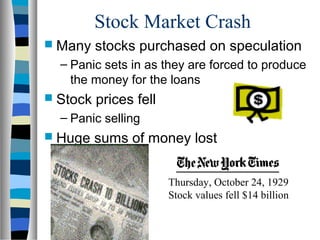
Stock Market Crash
 Many    stocks purchased on speculation
  – Panic sets in as they are forced to produce
    the money for the loans
 Stock   prices fell
  – Panic selling
 Huge    sums of money lost


                        Thursday, October 24, 1929
                        Stock values fell $14 billion
Unequal Distribution of Wealth
 No middle class
 Supply not equal to demand
 Credit cards created false demand
Excessive Buying on Credit

 Creates a false demand
 Under consumption
 People unable to make installment
  payments, therefore stop buying
Weak Business Structure
 Business consolidation – makes a few
  large companies for each industry

 Profitsand control were in the hands of
  a few – fragile system
Weak Banking Structure
 No   FDIC – No government regulation

 People   pull money out – Panic

 Banks   close with people’s money
Inadequate Government Policies
 No  government regulation of stock
  market
 Tax policies contributed to unequal
  distribution of wealth


 Antitrustlaws were not enforced
 Federal Reserve Board made poor
  decisions
Weak International Economy
 WWI   and the Stock Market crash
  effected the world
 No U.S. foreign investment – no money
  to pay America back
 Foreign countries had no money to buy
  American goods
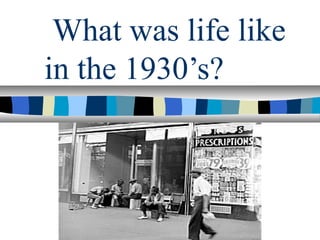
What was life like
in the 1930’s?
Hooverisms
   Hoover Hog – armadillos that were baked in
    the desert
   Hoover Flag – empty pocket turned out
   Hoover Blanket – Newspaper slept under
   Hoover Car – Abandoned Cars
   Hoover Bag – suitcase with holes
   Hoover Shoes – shoes with holes in soles
   Hoovervilles – shack towns of boxes and
    crates.
“Hooverism”
 Hoover’s
         response to the Great
 Depression:
  – Restore confidence in economy
  – Promoted helping businesses to help
    economy
  – Reconstruction Finance Corporation
  – Federal Work Projects to create jobs
  – Halted war repayment by Europe
  – Asked businesses to not lower wages or
    prices
Failure of “Hooverism”
 No direct relief – damaged image
 Economy was continuing to spiral and
  Hoover continued to say things were
  improving
 “Bonus Army” - march on Washington,
  disbanded by army
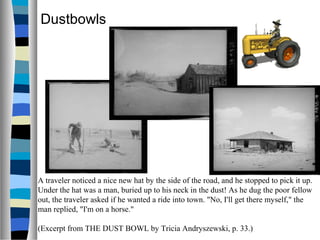
Dustbowls


A traveler noticed a nice new hat by the side of the road, and he stopped to pick it up.
Under the hat was a man, buried up to his neck in the dust! As he dug the poor fellow
out, the traveler asked if he wanted a ride into town. "No, I'll get there myself," the
man replied, "I'm on a horse."

(Excerpt from THE DUST BOWL by Tricia Andryszewski, p. 33.)
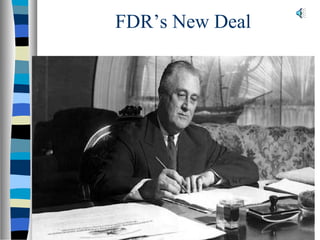
FDR’s New Deal
Franklin Delano Roosevelt
 Elected in 1932 with 89% of the
  electoral vote
 Government experience:
  – NYS Legislature
  – Asst. Secretary of the Navy
  – Governor of NYS
3 R’s of the New Deal
 RELIEF   of those who were suffering

 RECOVERY     for the economy

 REFORM    to avoid future depressions
New Deal Programs Outcomes
   Banking Emergency Act (FDIC) – restored
    confidence, soon more deposits than
    withdrawls
   Federal Emergency Relief Admin. (FERA) –
    Helped to revitalize relief organizations and
    encourage work
   Civilian Conservation Corps (CCC) –
    Taught men and women to be independent,
    increased self confidence and self esteem
New Deal Programs Outcomes
   Public Work Administration PWA –
    benefited America and American workers
    Agricultural Adjustment Act (AAA) –
    Declared unconstitutional, did not raise prices
    as hoped – just made people upset
   Tennessee Valley Authority (TVA) - cheap
    electric power, flood control, and recreational
    opportunities to the entire Tennessee River
    valley.
New Deal Programs Outcomes
 Works   Progress Admin. (WPA) –
  decreased unemployment
 Social Security Act (SSA) - it did help
  millions of Americans feel more secure.
 National Recovery Admin. (NRA) –
  organized the relief effort, centralized
  government efforts
 Rural Electrification Admin. (REA) –
  gave several small farmers electricity
Wagner Act
 Also known as the National Labor
  Relations Act (1935)
 Guaranteed labor unions the right to
  form unions and to practice collective
  bargaining
 Progressive Legislation??????
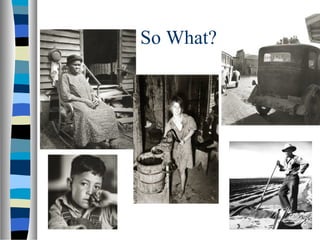
So What?
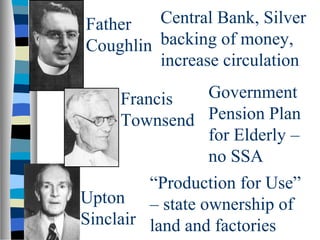
Father   Central Bank, Silver
Coughlin backing of money,
         increase circulation

     Francis     Government
     Townsend Pension Plan
                 for Elderly –
                 no SSA
         “Production for Use”
Upton – state ownership of
Sinclair land and factories
Table of Contents
#1 Outline/Concepts      #16 Hoover vs. FDR
#2 Twenties Talk         #17 Share our Wealth
#3 Sports Stars          #18 FDR’s New Deal
#4 Who’s Who             #19 You and the New Deal
#5 Roaring 20s Culture   #20 Be a New Deal Worker
#6 The Automobile        #21 No New Deal
#7 The New Woman         #22 The S.C. and New Deal
#8 Roaring 20s Packet    #23 FDR and the S.C.
#9 Great Migration
#10 Immigration
#11 Urban-Rural Change
#12 Roaring 20s Politics
#13 What caused the Great Depression?
#14 Hooverisms
#15 Images of the Great Depression
The New Deal and the Supreme
            Court
 NRA – Schechter Poultry Corp v. United
 States (1935)
 – NRA codes were too much like laws
 – Executive was legislating
 – Declared unconstitutional
 AAA   – declared unconstitutional
 – Congress passed another similar law to
   circumvent the Supreme Court.
The New Deal and the Supreme
            Court
 Court-Packing
  – Conservative Court did not follow FDR’s
    plan
  – Democratic President and a Republican
    Court
  – Proposed a plan to increase the number of
    justices
Third Term Controversy
 Elected:
  – 1932
  – 1936
  – 1940
  – 1944
 Republicans   accused him of breaking
  the unwritten constitution
 After death, 22nd Amendment was
  proposed to limit to two terms
 1951 – 22nd Amendment ratified
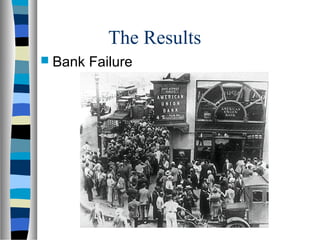
The Results
 Bank   Failure
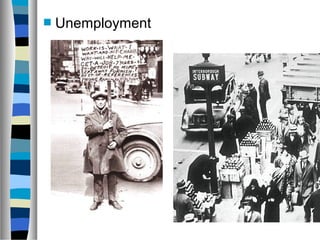
 Unemployment
 Lossof homes
    “Hoovervilles”


Here were all these people living in old
rusted-out car bodies. ... One family ... [was]
 living in a piano box. This wasn't just a little
section, this was maybe 10 miles wide and 10
miles long. People living in whatever they
could junk together. ..."
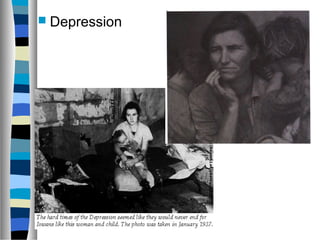
 Depression
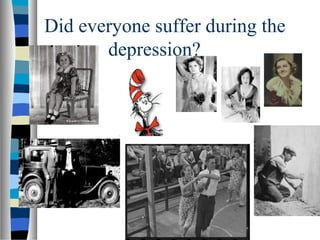
Did everyone suffer during the
       depression?
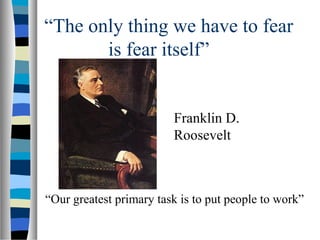
“The only thing we have to fear
       is fear itself”


                         Franklin D.
                         Roosevelt


“Our greatest primary task is to put people to work”
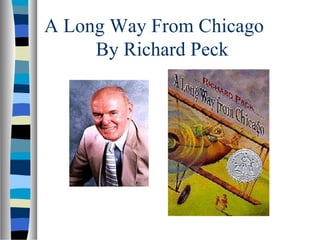
A Long Way From Chicago
     By Richard Peck

Depression

  • 1.
    Bell Ringer 3/1/06 “We return. We return from fighting. We return fighting.” (W.E.B DuBois) What is this quote referring to? Why did this quote prove to be true?
  • 2.
    What was lifelike during ?
  • 3.
  • 4.
    1920’s Culture  The flapper  Short hair for women  Dancing & Music  Speakeasies  Silent movies “The Jazz Age was wicked and monstrous and silly. Unfortunately, I had a good time.” Heywood Broun
  • 5.
    How did technologyimpact society?  15 million cars were sold  80% were bought on credit  A Model T Ford cost $290 in 1920  20% of U.S. homes had electricity by the end of the decade  10 million families owned radios by 1929  Shifting of America from a rural country to an urban country
  • 6.
    Leisure Time???  Shorterwork week and vacation time – more free time to enjoy: • Movies • Reading • Sports • Music
  • 7.
    Too much ofa good thing????  Mass consumption, changing values, new technologies – are they always good??? – Many said NO – Harlem Renaissance benefited and reacted against it
  • 8.
    Harlem Renaissance /JazzAge  AfricanAmerican writers in NYC  Well-educated  Middle class group – Alienated from society  Spoke against the bigotry on the time and pride in African American culture  W.E.B DuBois, Langston Hughes, Zora Neale Hurston, Alain Locke, Duke Ellington, Bessie Smith
  • 9.
    THE FLAPPER by Dorothy Parker The Playful flapper here we see, The fairest of the fair. She's not what Grandma used to be, -- You might say, au contraire. Her girlish ways may make a stir, Her manners cause a scene, But there is no more harm in her Than in a submarine.
  • 10.
    Women in the20s…….  By 1929, made up 22% of the workforce  90% of married women did not work  Work available to women were low paying and of lower status  Voted in 1920 election – not very many participated  Majority were not flappers, but were helped by the technology  Family size smaller, divorce laws still favored men
  • 11.
    Immigrants in the20s …… KKK Quotas Nativism
  • 12.
    Struggle of OLDvs. NEW  Prohibition  Minorities  Cultural Values  Women  Scopes Trial – Modernization of society – Religion not as important
  • 13.
    Who’s Who  Hand in: – #1 Project – #2 Sources – #3 Rubric with your name on it!!!!
  • 14.
    Harding vs. Coolidge Harding(1920 – 1923) Coolidge (1923 – 1928)  Former Newspaper  Laissez-faire Publisher and not economic policy and experienced in committed to politics business interests  Scandals – theft of  Small recession – Veteran supplies, post war decline fraud, Teapot Dome  1923 – 1929 Scandal (bribery business booming and oil reserves) “Coolidge Prosperity”
  • 15.
    Coolidge Prosperity???????????  LargeBusinessprosper – Upper Class prospers  MiddleClass, Laborers, Farmers, Native Americans, and African Americans did not prosper
  • 16.
    Election of 1928 Hoover (Rep.) vs. Alfred Smith (Dem.)  Hoover – secretary of commerce - Self Made Millionaire - Humanitarian - Leader in war effort and post war reconstruction  Hoover won 84% of the electoral vote
  • 17.
    Roaring 20s End Great Depression Begins What was the Great Depression?  The worst economic crisis of the century  Over 13 million people unemployed  “Dust bowl” as a result of drought  Farmers lost crops  Many lost their homes
  • 18.
    What caused theGreat Depression?  Stock market crash of 1929  Unequal distribution of wealth  Excessive Buying on Credit  Weak Business Structure  Weak Banking Structure  Inadequate Government Policies  Weak International economy
  • 19.
    Stock Market Crash Many stocks purchased on speculation – Panic sets in as they are forced to produce the money for the loans  Stock prices fell – Panic selling  Huge sums of money lost Thursday, October 24, 1929 Stock values fell $14 billion
  • 20.
    Unequal Distribution ofWealth  No middle class  Supply not equal to demand  Credit cards created false demand
  • 21.
    Excessive Buying onCredit  Creates a false demand  Under consumption  People unable to make installment payments, therefore stop buying
  • 22.
    Weak Business Structure Business consolidation – makes a few large companies for each industry  Profitsand control were in the hands of a few – fragile system
  • 23.
    Weak Banking Structure No FDIC – No government regulation  People pull money out – Panic  Banks close with people’s money
  • 24.
    Inadequate Government Policies No government regulation of stock market  Tax policies contributed to unequal distribution of wealth  Antitrustlaws were not enforced  Federal Reserve Board made poor decisions
  • 25.
    Weak International Economy WWI and the Stock Market crash effected the world  No U.S. foreign investment – no money to pay America back  Foreign countries had no money to buy American goods
  • 26.
    What was lifelike in the 1930’s?
  • 27.
    Hooverisms  Hoover Hog – armadillos that were baked in the desert  Hoover Flag – empty pocket turned out  Hoover Blanket – Newspaper slept under  Hoover Car – Abandoned Cars  Hoover Bag – suitcase with holes  Hoover Shoes – shoes with holes in soles  Hoovervilles – shack towns of boxes and crates.
  • 28.
    “Hooverism”  Hoover’s response to the Great Depression: – Restore confidence in economy – Promoted helping businesses to help economy – Reconstruction Finance Corporation – Federal Work Projects to create jobs – Halted war repayment by Europe – Asked businesses to not lower wages or prices
  • 29.
    Failure of “Hooverism” No direct relief – damaged image  Economy was continuing to spiral and Hoover continued to say things were improving  “Bonus Army” - march on Washington, disbanded by army
  • 30.
    Dustbowls A traveler noticeda nice new hat by the side of the road, and he stopped to pick it up. Under the hat was a man, buried up to his neck in the dust! As he dug the poor fellow out, the traveler asked if he wanted a ride into town. "No, I'll get there myself," the man replied, "I'm on a horse." (Excerpt from THE DUST BOWL by Tricia Andryszewski, p. 33.)
  • 31.
  • 32.
    Franklin Delano Roosevelt Elected in 1932 with 89% of the electoral vote  Government experience: – NYS Legislature – Asst. Secretary of the Navy – Governor of NYS
  • 33.
    3 R’s ofthe New Deal  RELIEF of those who were suffering  RECOVERY for the economy  REFORM to avoid future depressions
  • 34.
    New Deal ProgramsOutcomes  Banking Emergency Act (FDIC) – restored confidence, soon more deposits than withdrawls  Federal Emergency Relief Admin. (FERA) – Helped to revitalize relief organizations and encourage work  Civilian Conservation Corps (CCC) – Taught men and women to be independent, increased self confidence and self esteem
  • 35.
    New Deal ProgramsOutcomes  Public Work Administration PWA – benefited America and American workers  Agricultural Adjustment Act (AAA) – Declared unconstitutional, did not raise prices as hoped – just made people upset  Tennessee Valley Authority (TVA) - cheap electric power, flood control, and recreational opportunities to the entire Tennessee River valley.
  • 36.
    New Deal ProgramsOutcomes  Works Progress Admin. (WPA) – decreased unemployment  Social Security Act (SSA) - it did help millions of Americans feel more secure.  National Recovery Admin. (NRA) – organized the relief effort, centralized government efforts  Rural Electrification Admin. (REA) – gave several small farmers electricity
  • 37.
    Wagner Act  Alsoknown as the National Labor Relations Act (1935)  Guaranteed labor unions the right to form unions and to practice collective bargaining  Progressive Legislation??????
  • 38.
  • 39.
    Father Central Bank, Silver Coughlin backing of money, increase circulation Francis Government Townsend Pension Plan for Elderly – no SSA “Production for Use” Upton – state ownership of Sinclair land and factories
  • 40.
    Table of Contents #1Outline/Concepts #16 Hoover vs. FDR #2 Twenties Talk #17 Share our Wealth #3 Sports Stars #18 FDR’s New Deal #4 Who’s Who #19 You and the New Deal #5 Roaring 20s Culture #20 Be a New Deal Worker #6 The Automobile #21 No New Deal #7 The New Woman #22 The S.C. and New Deal #8 Roaring 20s Packet #23 FDR and the S.C. #9 Great Migration #10 Immigration #11 Urban-Rural Change #12 Roaring 20s Politics #13 What caused the Great Depression? #14 Hooverisms #15 Images of the Great Depression
  • 41.
    The New Dealand the Supreme Court  NRA – Schechter Poultry Corp v. United States (1935) – NRA codes were too much like laws – Executive was legislating – Declared unconstitutional  AAA – declared unconstitutional – Congress passed another similar law to circumvent the Supreme Court.
  • 42.
    The New Dealand the Supreme Court  Court-Packing – Conservative Court did not follow FDR’s plan – Democratic President and a Republican Court – Proposed a plan to increase the number of justices
  • 43.
    Third Term Controversy Elected: – 1932 – 1936 – 1940 – 1944  Republicans accused him of breaking the unwritten constitution  After death, 22nd Amendment was proposed to limit to two terms  1951 – 22nd Amendment ratified
  • 44.
  • 45.
  • 46.
     Lossof homes  “Hoovervilles” Here were all these people living in old rusted-out car bodies. ... One family ... [was] living in a piano box. This wasn't just a little section, this was maybe 10 miles wide and 10 miles long. People living in whatever they could junk together. ..."
  • 47.
  • 48.
    Did everyone sufferduring the depression?
  • 49.
    “The only thingwe have to fear is fear itself” Franklin D. Roosevelt “Our greatest primary task is to put people to work”
  • 50.
    A Long WayFrom Chicago By Richard Peck