A Digital Solutions Firm delivering
Marketing and Technology Solutions
New York . Toronto . Phoenix . Los Angeles . London. Dubai . New Delhi
CMS Selection
Select the best CMS for your business
1
Trends
CMS Selection – Key Considerations
• Product Strategy
• Digital Ecosystem
• Market Strategy
• Technology
• Content production
• Marketing Automation
• Content Migration
• Costs
• Implementation
CMS Selection Best Practices Approach
Agenda
22
Trends
3
• Web Content Management –
The term needs a rethink
Not just about content
management!
Experience management
Multi-device, multi-channel
Marketing automation
4
Three emerging trends
- All in one
- Best-of-breed
- Consolidation
5
Marketing capabilities are now
available in small to mid
market CMSs
- Testing (A/B)
- Personalization
- Analytics
6
• Many options
Thousands of CMS have
available in the market place
7
CMS Selection
Key Considerations
8
CMS Selection –
PRODUCT STRATEGY
AND ROADMAP
9
Don’t get feature happy
 Understand Product Strategy First
Does Roadmap align with your needs
 How often is the product revised?
Target Audience
 Development focused or usability focused?
SAS or Standalone
 Pros and Cons of SAS?
Product Strategy and Roadmap
1010
DIGITAL ECOSYSTEM
1111
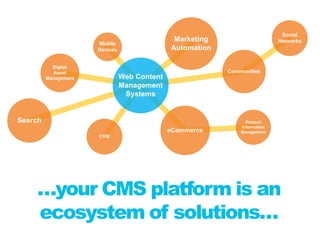
…there is more that
meets the eye once you
get started.
12
Digital
Asset
Management
CRM
Search
Mobile
Devices
eCommerce
Marketing
Automation
Web Content
Management
Systems
Product
Information
Management
Social
Networks
Communities
…your CMS platform is an
ecosystem of solutions…
1313
…that leads you to
look at a basket of
platform options.
14
Rarely a single technology
addresses the entire spectrum of
visitor engagement expectations
Value is delivered more quickly
with a pre-integrated ecosystem
of complementary platforms
Contemporary interfaces enable
platforms to communicate
seamlessly to provide complete
engagement solution
Understanding the Ecosystem
Value is delivered from an integrated CMS Ecosystem more
effectively than from siloed platforms working independently
CMS
Digital Asset
Management
(DAM)
Marketing
Automation
Community
Search
Customer
Relationship
Management
(CRM)
Mobile
1515
MARKET STRATEGY
16
 Enterprise? Mid Market?
 Focus on Particular Industry, Business Scenarios
 Social Media Strategy
 All in one may not be the best
Market Strategy
17
The Product will depend on your need
 Corporate Website
 Multi-channel publishing
 Ecommerce
 Intranet
 Internal marketing sites
 Multi sites
 Community
1818
TECHNOLOGY
19
To go open source or not?
 Do you want to be a strong technology shop?
 Support
 Total cost of ownership
 Lot of features ready to go, and they just keep coming
 Roadmap concerns
 End user adoption
 Pick a product that will stay around, and won't go out of favour quickly
 Community
Technology
.Net, Java or Open Source?
20
Technology
 Delivery Architecture
 Simple instance – renders in real time
 Separate instance – pushes content on to the web server
 Ability to Integrate and develop
 Integration with CRM, ecommerce, Social Media, etc
 Products with proprietary languages can be tricky
 Page Rendering
 Security
 Ease of Upgrade
 Performance Considerations
 WCM Architecture
 Integrated or isolated
2121
CONTENT
PRODUCTION
22
Content Production
Content Production Content Management Content Delivery
Content Creation and Development
 Type of Content - audio, content, multimedia
User friendly editing features
 In-line vs In-context editor
 RIA driven
Workflow
 Flexibility is the key
Deployment
 Support for multistage deployment and publishing
 Centralized management at all stages of deployment
23
Content Management
Content Production Content Management Content Delivery
Content Classification and taxonomy
Creation and management of templates
Page rendering
Rich Media Management, DAM
Access Control
Indexing
Archiving
Version Control
24
Content Delivery
Content Production Content Management Content Delivery
Publication of dynamic content
 Multichannel and syndication
 Delivery model – RIA, 3rd party app server, portal & mobile
 Social computing
Internationalization
Analytics and testing tools
 WCM capabilities – AB, MV testing
 Integration with third party tools – Omniture, Web Trends
2525
MARKETING
AUTOMATION
26
WCM
Marketing
Automation
Personalization
Lead
Management
Automation
Web
Analytics
Marketing Automation and Analytics
2727
CONTENT
MIGRATION
28
 Banana skin of implementations
 Typically, an afterthought
 Have a well defined migration strategy
 Manual Vs. Automated – could have impact on
cost, effort and timeline
Content Migration
2929
COST OF
LAUNCHING A SITE
30
Not only licensing cost… consider the total cost of ownership
 Licensing: CPU, Server, year on year
 Design
 Build
 Hardware
 Training
 Maintenance and Support
Cost of Launching a Site
3131
IMPLEMENTATION
32
Implementation approach options
 In-house
 WCM Vendor PS
 Partner
Implementation Considerations
3333
CMS Selection Best
Practice Approach
34
Not a technology project
Marketing should be a key decision maker in the initiative
Drive stakeholder participation
Drive hard to get internal sign-off of requirements
Consultants can bring value
 Broad expertise
 Strong understanding of products and gaps
 Beyond theory
Set up a team that will win
Involving a broad stakeholder team lays the foundation for later
success; Marketing should lead the effort with goals in mind
35
We follow a 4-step process
 Discovery: Understand the vision and objectives for the project
 Analysis: Capture and prioritize requirements
 Investigation: Identify vendors with align with requirements
 Selection: Prove vendor recommendations to a final selection
Holistic approach to incorporating stakeholder input
 Designed to incorporate and balance key corporate objectives
 Engage all stakeholders equally, while prioritizing requirements
 Enable open discussions of requirements with software aspects
Proven process
Use a proven process to make sure the proper approach and
techniques are used to make best-fit platform decisions
36
Selection Process
Stakeholders are involved along the entire process, providing
confirmation that enables confidence in the next step
37
Discovery
Stakeholder interviews capture key objectives, challenges and
requirements, along with user stories, creating a foundation
38
Analysis
The requirements are documented, refined and prioritized
before becoming the selection criteria to distinguish a CMS
39
Investigation
The initial list of vendors are identified and filtered, while
preparing the tools to further filter vendors from the list
40
Selection
The RFI, demonstrations and proof-of-concept applications
narrow the vendors to that align with key criteria
41
Selection Funnel
Pre-defined gates in the process quickly reduce the number of
vendors to a relevant set that are left for the final evaluation
42
Objective
 Replace aging digital platform supporting the corporate website and
partner portal
 Platform selection for CMS, analytics and search
Background
 Project duration: 12 weeks
 Number of stakeholders: 30+
 Number of departments: 6
 Number of countries: 5+
Case Study: Consumer Electronics
Large, international consumer electronics manufacturer was
looking to replace their decade-old digital platform
43
Group education and elicitation
 Kick-off, Best-practices review and team elicitation session
 1-2 hour long sessions that were performed in person and on the
phone with groups
Individual discussions
 1-2 hours with key stakeholders—particularly department
management
Special attention
 The EMEA and APAC regions
Case Study: Research overview
Key requirements stakeholder groups: IT, Marketing, Product
management, Customer support, EMEA and APAC
44
Must have characteristics: Formed the basis and direction for the
vendor selection process
 Proven longevity—Gartner and Forrester vetted participants
 Multi-language support—clear support of regional stakeholders
 Open architecture—clear path for integration with systems
RFI responses: Revealed commonality and differences
 RFIs—for Web CMS,
Vendor demonstrations: Provided insight into product subtleties
and the potential vendor relationship
Selection of product
Case Study: Key decision points
Key decision points: Must-have characteristics, requirements-
driven RFI responses and vendor demonstrations
45
Key take aways
- Focus on value not features - focus on roadmap and
fit rather than only features
- More than just product – Consider the digital eco-
system and what features will be necessary
- Marketing should lead the project; do not consider
this to only be an IT project
- Have a solid process that drives success
Conclusion
46
Connect with us
1-877-339-6264
www.edynamic.net
contact@edynamic.net
twitter.com/edynamic
youtube.com/1999dynamic
facebook.com/edynamic.net

Content Management System Selection Best Practices

  • 1.
    A Digital SolutionsFirm delivering Marketing and Technology Solutions New York . Toronto . Phoenix . Los Angeles . London. Dubai . New Delhi CMS Selection Select the best CMS for your business
  • 2.
    1 Trends CMS Selection –Key Considerations • Product Strategy • Digital Ecosystem • Market Strategy • Technology • Content production • Marketing Automation • Content Migration • Costs • Implementation CMS Selection Best Practices Approach Agenda
  • 3.
  • 4.
    3 • Web ContentManagement – The term needs a rethink Not just about content management! Experience management Multi-device, multi-channel Marketing automation
  • 5.
    4 Three emerging trends -All in one - Best-of-breed - Consolidation
  • 6.
    5 Marketing capabilities arenow available in small to mid market CMSs - Testing (A/B) - Personalization - Analytics
  • 7.
    6 • Many options Thousandsof CMS have available in the market place
  • 8.
  • 9.
    8 CMS Selection – PRODUCTSTRATEGY AND ROADMAP
  • 10.
    9 Don’t get featurehappy  Understand Product Strategy First Does Roadmap align with your needs  How often is the product revised? Target Audience  Development focused or usability focused? SAS or Standalone  Pros and Cons of SAS? Product Strategy and Roadmap
  • 11.
  • 12.
    1111 …there is morethat meets the eye once you get started.
  • 13.
  • 14.
    1313 …that leads youto look at a basket of platform options.
  • 15.
    14 Rarely a singletechnology addresses the entire spectrum of visitor engagement expectations Value is delivered more quickly with a pre-integrated ecosystem of complementary platforms Contemporary interfaces enable platforms to communicate seamlessly to provide complete engagement solution Understanding the Ecosystem Value is delivered from an integrated CMS Ecosystem more effectively than from siloed platforms working independently CMS Digital Asset Management (DAM) Marketing Automation Community Search Customer Relationship Management (CRM) Mobile
  • 16.
  • 17.
    16  Enterprise? MidMarket?  Focus on Particular Industry, Business Scenarios  Social Media Strategy  All in one may not be the best Market Strategy
  • 18.
    17 The Product willdepend on your need  Corporate Website  Multi-channel publishing  Ecommerce  Intranet  Internal marketing sites  Multi sites  Community
  • 19.
  • 20.
    19 To go opensource or not?  Do you want to be a strong technology shop?  Support  Total cost of ownership  Lot of features ready to go, and they just keep coming  Roadmap concerns  End user adoption  Pick a product that will stay around, and won't go out of favour quickly  Community Technology .Net, Java or Open Source?
  • 21.
    20 Technology  Delivery Architecture Simple instance – renders in real time  Separate instance – pushes content on to the web server  Ability to Integrate and develop  Integration with CRM, ecommerce, Social Media, etc  Products with proprietary languages can be tricky  Page Rendering  Security  Ease of Upgrade  Performance Considerations  WCM Architecture  Integrated or isolated
  • 22.
  • 23.
    22 Content Production Content ProductionContent Management Content Delivery Content Creation and Development  Type of Content - audio, content, multimedia User friendly editing features  In-line vs In-context editor  RIA driven Workflow  Flexibility is the key Deployment  Support for multistage deployment and publishing  Centralized management at all stages of deployment
  • 24.
    23 Content Management Content ProductionContent Management Content Delivery Content Classification and taxonomy Creation and management of templates Page rendering Rich Media Management, DAM Access Control Indexing Archiving Version Control
  • 25.
    24 Content Delivery Content ProductionContent Management Content Delivery Publication of dynamic content  Multichannel and syndication  Delivery model – RIA, 3rd party app server, portal & mobile  Social computing Internationalization Analytics and testing tools  WCM capabilities – AB, MV testing  Integration with third party tools – Omniture, Web Trends
  • 26.
  • 27.
  • 28.
  • 29.
    28  Banana skinof implementations  Typically, an afterthought  Have a well defined migration strategy  Manual Vs. Automated – could have impact on cost, effort and timeline Content Migration
  • 30.
  • 31.
    30 Not only licensingcost… consider the total cost of ownership  Licensing: CPU, Server, year on year  Design  Build  Hardware  Training  Maintenance and Support Cost of Launching a Site
  • 32.
  • 33.
    32 Implementation approach options In-house  WCM Vendor PS  Partner Implementation Considerations
  • 34.
  • 35.
    34 Not a technologyproject Marketing should be a key decision maker in the initiative Drive stakeholder participation Drive hard to get internal sign-off of requirements Consultants can bring value  Broad expertise  Strong understanding of products and gaps  Beyond theory Set up a team that will win Involving a broad stakeholder team lays the foundation for later success; Marketing should lead the effort with goals in mind
  • 36.
    35 We follow a4-step process  Discovery: Understand the vision and objectives for the project  Analysis: Capture and prioritize requirements  Investigation: Identify vendors with align with requirements  Selection: Prove vendor recommendations to a final selection Holistic approach to incorporating stakeholder input  Designed to incorporate and balance key corporate objectives  Engage all stakeholders equally, while prioritizing requirements  Enable open discussions of requirements with software aspects Proven process Use a proven process to make sure the proper approach and techniques are used to make best-fit platform decisions
  • 37.
    36 Selection Process Stakeholders areinvolved along the entire process, providing confirmation that enables confidence in the next step
  • 38.
    37 Discovery Stakeholder interviews capturekey objectives, challenges and requirements, along with user stories, creating a foundation
  • 39.
    38 Analysis The requirements aredocumented, refined and prioritized before becoming the selection criteria to distinguish a CMS
  • 40.
    39 Investigation The initial listof vendors are identified and filtered, while preparing the tools to further filter vendors from the list
  • 41.
    40 Selection The RFI, demonstrationsand proof-of-concept applications narrow the vendors to that align with key criteria
  • 42.
    41 Selection Funnel Pre-defined gatesin the process quickly reduce the number of vendors to a relevant set that are left for the final evaluation
  • 43.
    42 Objective  Replace agingdigital platform supporting the corporate website and partner portal  Platform selection for CMS, analytics and search Background  Project duration: 12 weeks  Number of stakeholders: 30+  Number of departments: 6  Number of countries: 5+ Case Study: Consumer Electronics Large, international consumer electronics manufacturer was looking to replace their decade-old digital platform
  • 44.
    43 Group education andelicitation  Kick-off, Best-practices review and team elicitation session  1-2 hour long sessions that were performed in person and on the phone with groups Individual discussions  1-2 hours with key stakeholders—particularly department management Special attention  The EMEA and APAC regions Case Study: Research overview Key requirements stakeholder groups: IT, Marketing, Product management, Customer support, EMEA and APAC
  • 45.
    44 Must have characteristics:Formed the basis and direction for the vendor selection process  Proven longevity—Gartner and Forrester vetted participants  Multi-language support—clear support of regional stakeholders  Open architecture—clear path for integration with systems RFI responses: Revealed commonality and differences  RFIs—for Web CMS, Vendor demonstrations: Provided insight into product subtleties and the potential vendor relationship Selection of product Case Study: Key decision points Key decision points: Must-have characteristics, requirements- driven RFI responses and vendor demonstrations
  • 46.
    45 Key take aways -Focus on value not features - focus on roadmap and fit rather than only features - More than just product – Consider the digital eco- system and what features will be necessary - Marketing should lead the project; do not consider this to only be an IT project - Have a solid process that drives success Conclusion
  • 47.