Dr. G C Mohanta, BE(Mech), MSc(Engg), MBA, PhD(Mgt)
                    Professor


                                                      1
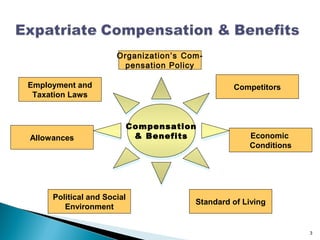
Compensation & Benefits
Organization’s Com-
                        pensation Policy

Employment and                                  Competitors
 Taxation Laws


                            Compensation
                            Compensation
Allowances                   & Benefits
                             & Benefits             Economic
                                                    Conditions


     Political and Social
                                       Standard of Living
        Environment


                                                                 3
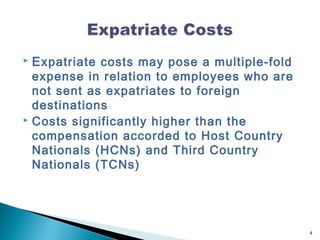
 E xpatriate costs may pose a multiple-fold
  expense in relation to employees who are
  not sent as expatriates to foreign
  destinations
 Costs significantly higher than the

  compensation accorded to Host Country
  Nationals (HCNs) and Third Country
  Nationals (TCNs)


                                               4
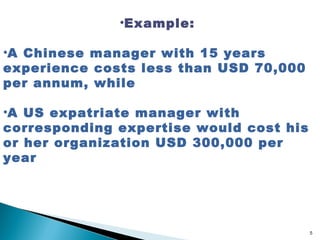
•Example:

•A Chinese manager with 15 years
experience costs less than USD 70,000
per annum, while

•A US expatriate manager with
corresponding expertise would cost his
or her organization USD 300,000 per
year


                                         5
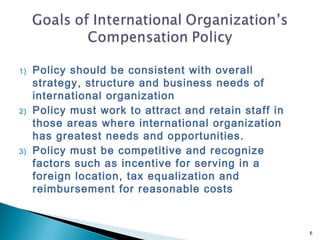
1)   Policy should be consistent with overall
     strategy, structure and business needs of
     international organization
2)   Policy must work to attract and retain staff in
     those areas where international organization
     has greatest needs and opportunities.
3)   Policy must be competitive and recognize
     factors such as incentive for serving in a
     foreign location, tax equalization and
     reimbursement for reasonable costs


                                                       6
3) Policy should facilitate transfer of
  international employees in most cost-
  effective manner

4) Policy must give due consideration to
  equity and ease of administration


                                           7
   Financial protection in terms of benefits, social
    security and cost of living in foreign location

   Foreign assignment offers opportunities for
    advancement through income and/or savings

   Issues such as housing, education of children
    and recreation are addressed

    Note that the expectations of the employees often do not
          coincide with the interests of the organization


                                                               8
   Base Salary

   Base salary - main component in
    international compensation
   It is used as main benchmark for other
    elements in expatriate compensation
    package, such as, bonuses and benefits

   Base salary is either paid in expatriate’s
    home or parent country currency, or in
    currency of expatriate’s host country


                                                 9
   Hardship Premium

   For expatriate’s (usually PCNs, TCNs) who will
    encounter “hardships” caused by the transfer to
    a foreign location, determining the appropriate
    level of payment can be difficult


                                                      10
• Factors determining hardship premium,
usually expressed in terms of an expatriate’s
base pay:

  Assignment
  Actual hardship
  Tax consequences
  Length of assignment


                                                11
Allowances: There are many types of
  allowances in
an international compensation package:
 Cost of Living Allowance – Payment made to

  the expatriate with a view to compensating for
  differences in expenditure between home or
  parent country and host country
 Factors such as inflation differentials and

  price level need to be considered
 Often, cost of living allowance is difficult to

  determine
                                               12
   Housing Allowance – Payment made to expatriate with a
    view to ensuring that he or she can maintain their home-
    country living standard in host country.
   Organization may provide
-   Housing facilities on a mandatory or optional basis
-   Support services to expatriate for selling or renting
    expatriate’s house in home country

   Home Leave Allowance – Payment made to expatriate
    with a view to facilitating their visit back to home country,
    once or twice a year.
   Home leave allowance enables expatriate to renew
    business, family and social ties, avoiding adjustment
    problems subsequent to repatriation


                                                                13
 Education Allowance – Payment made with a view to
  supporting education of expatriate’s children, i.e.
  tuition, language class, school enrollment fees,
  books and supplies, transportation to educational
  establishment, room and boarding, school uniforms
  etc.
 Problems regarding level of education required and
  adequacy of schools in host country & transportation
  costs may pose significant problems for
  organizations

   Relocation Allowance – Payment made with a view to
    enable relocation of expatriate to assignment
    location includes moving, shipping, storage costs,
    subsidies for purchase of appliances and automobile
                                                      14
 Miscellaneous   Allowances – Depending on
  level of seniority of expatriate, payments to
  him for club memberships, sport associations,
  maintenance of household staff, etc. may be
  provided
 Organization may provide financial assistance

  to spouse for loss of income as a result of
  transfer of expatriate


                                              15
   Benefits – Support rendered to expatriate in addition
    to allowances:
   Social Security Benefits (home country or host
    country)
   Paid Vacations for expatriate and family
   Rest and Rehabilitation leave (especially for
    expatriates based in “hardship” assignment locations)
   Emergency Cases (severe illness, death)


                                                        16
Two basic approaches used to determine
an international compensation package:

 Going Rate Approach

 Balance Sheet Approach


                                         17
   Based on local market rates
   Relies on survey comparisons
    ◦ Local nationals (HCNs)
    ◦ Expatriates of same nationality
    ◦ Expatriates of all nationalities
   Compensation based on selected survey comparison
   Base pay and benefits may be supplemented by additional
    payments for low-pay countries
   Example: Should a Indian bank operating in London use
    local British salaries, salaries of other Indian competitor
    banks in London or average salary offered by all foreign
    banks operating in London as reference point for base salary
    offered


                                                                   18
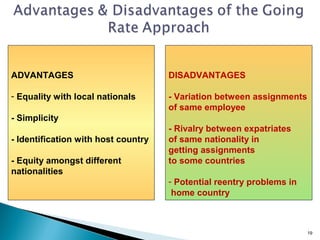
ADVANTAGES                           DISADVANTAGES

- Equality with local nationals      - Variation between assignments
                                     of same employee
- Simplicity
                                     - Rivalry between expatriates
- Identification with host country   of same nationality in
                                     getting assignments
- Equity amongst different           to some countries
nationalities
                                     - Potential reentry problems in
                                      home country


                                                                       19
      Balance sheet approach to international
    compensation is a system designed to equalize
     purchasing power of employees at comparable
    position levels living abroad and in home
    country, and to provide incentives to offset
    qualitative differences between assignment
    locations


                                                20
Balance sheet approach is widely used by
    international organizations to determine
    compensation package for expatriates:

 Basic objective is maintenance of home-country
  living standard, plus financial inducement
 Home-country pay and benefits are foundations of
  this approach
 Adjustments to home package to balance
  additional expenditure in host country
 Financial incentives (expatriate / hardship
  premium) added to make package attractive


                                                     21
Balance sheet approach considers four types of outlays which
    are incurred by expatriates:

   Goods and services – Outlays incurred in home country for food,
    personal care, clothing, household furnishings, recreation,
    transportation and medical care

   Housing – All major costs associated with housing in host country

   Income Taxes – Parent country and host country income tax
    expenditures

   Reserve – Contributions to savings, payments for benefits,
    pension contributions, investments, education expenses, social
    security taxes, etc.

   Where costs of host country > costs of home country 
    organization pays the expatriate to make up the difference


                                                                        22
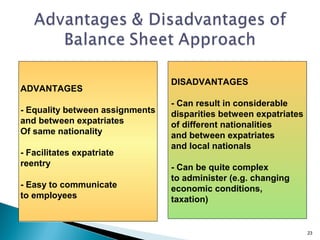
DISADVANTAGES
ADVANTAGES
                                 - Can result in considerable
- Equality between assignments   disparities between expatriates
and between expatriates          of different nationalities
Of same nationality              and between expatriates
                                 and local nationals
- Facilitates expatriate
reentry                          - Can be quite complex
                                 to administer (e.g. changing
- Easy to communicate            economic conditions,
to employees                     taxation)


                                                                   23

Contemporary strategic compensation challenges

  • 1.
    Dr. G CMohanta, BE(Mech), MSc(Engg), MBA, PhD(Mgt) Professor 1
  • 2.
  • 3.
    Organization’s Com- pensation Policy Employment and Competitors Taxation Laws Compensation Compensation Allowances & Benefits & Benefits Economic Conditions Political and Social Standard of Living Environment 3
  • 4.
     E xpatriatecosts may pose a multiple-fold expense in relation to employees who are not sent as expatriates to foreign destinations  Costs significantly higher than the compensation accorded to Host Country Nationals (HCNs) and Third Country Nationals (TCNs) 4
  • 5.
    •Example: •A Chinese managerwith 15 years experience costs less than USD 70,000 per annum, while •A US expatriate manager with corresponding expertise would cost his or her organization USD 300,000 per year 5
  • 6.
    1) Policy should be consistent with overall strategy, structure and business needs of international organization 2) Policy must work to attract and retain staff in those areas where international organization has greatest needs and opportunities. 3) Policy must be competitive and recognize factors such as incentive for serving in a foreign location, tax equalization and reimbursement for reasonable costs 6
  • 7.
    3) Policy shouldfacilitate transfer of international employees in most cost- effective manner 4) Policy must give due consideration to equity and ease of administration 7
  • 8.
    Financial protection in terms of benefits, social security and cost of living in foreign location  Foreign assignment offers opportunities for advancement through income and/or savings  Issues such as housing, education of children and recreation are addressed Note that the expectations of the employees often do not coincide with the interests of the organization 8
  • 9.
    Base Salary  Base salary - main component in international compensation  It is used as main benchmark for other elements in expatriate compensation package, such as, bonuses and benefits  Base salary is either paid in expatriate’s home or parent country currency, or in currency of expatriate’s host country 9
  • 10.
    Hardship Premium  For expatriate’s (usually PCNs, TCNs) who will encounter “hardships” caused by the transfer to a foreign location, determining the appropriate level of payment can be difficult 10
  • 11.
    • Factors determininghardship premium, usually expressed in terms of an expatriate’s base pay: Assignment Actual hardship Tax consequences Length of assignment 11
  • 12.
    Allowances: There aremany types of allowances in an international compensation package:  Cost of Living Allowance – Payment made to the expatriate with a view to compensating for differences in expenditure between home or parent country and host country  Factors such as inflation differentials and price level need to be considered  Often, cost of living allowance is difficult to determine 12
  • 13.
    Housing Allowance – Payment made to expatriate with a view to ensuring that he or she can maintain their home- country living standard in host country.  Organization may provide - Housing facilities on a mandatory or optional basis - Support services to expatriate for selling or renting expatriate’s house in home country  Home Leave Allowance – Payment made to expatriate with a view to facilitating their visit back to home country, once or twice a year.  Home leave allowance enables expatriate to renew business, family and social ties, avoiding adjustment problems subsequent to repatriation 13
  • 14.
     Education Allowance– Payment made with a view to supporting education of expatriate’s children, i.e. tuition, language class, school enrollment fees, books and supplies, transportation to educational establishment, room and boarding, school uniforms etc.  Problems regarding level of education required and adequacy of schools in host country & transportation costs may pose significant problems for organizations  Relocation Allowance – Payment made with a view to enable relocation of expatriate to assignment location includes moving, shipping, storage costs, subsidies for purchase of appliances and automobile 14
  • 15.
     Miscellaneous Allowances – Depending on level of seniority of expatriate, payments to him for club memberships, sport associations, maintenance of household staff, etc. may be provided  Organization may provide financial assistance to spouse for loss of income as a result of transfer of expatriate 15
  • 16.
    Benefits – Support rendered to expatriate in addition to allowances:  Social Security Benefits (home country or host country)  Paid Vacations for expatriate and family  Rest and Rehabilitation leave (especially for expatriates based in “hardship” assignment locations)  Emergency Cases (severe illness, death) 16
  • 17.
    Two basic approachesused to determine an international compensation package: Going Rate Approach Balance Sheet Approach 17
  • 18.
    Based on local market rates  Relies on survey comparisons ◦ Local nationals (HCNs) ◦ Expatriates of same nationality ◦ Expatriates of all nationalities  Compensation based on selected survey comparison  Base pay and benefits may be supplemented by additional payments for low-pay countries  Example: Should a Indian bank operating in London use local British salaries, salaries of other Indian competitor banks in London or average salary offered by all foreign banks operating in London as reference point for base salary offered 18
  • 19.
    ADVANTAGES DISADVANTAGES - Equality with local nationals - Variation between assignments of same employee - Simplicity - Rivalry between expatriates - Identification with host country of same nationality in getting assignments - Equity amongst different to some countries nationalities - Potential reentry problems in home country 19
  • 20.
    Balance sheet approach to international compensation is a system designed to equalize purchasing power of employees at comparable position levels living abroad and in home country, and to provide incentives to offset qualitative differences between assignment locations 20
  • 21.
    Balance sheet approachis widely used by international organizations to determine compensation package for expatriates:  Basic objective is maintenance of home-country living standard, plus financial inducement  Home-country pay and benefits are foundations of this approach  Adjustments to home package to balance additional expenditure in host country  Financial incentives (expatriate / hardship premium) added to make package attractive 21
  • 22.
    Balance sheet approachconsiders four types of outlays which are incurred by expatriates:  Goods and services – Outlays incurred in home country for food, personal care, clothing, household furnishings, recreation, transportation and medical care  Housing – All major costs associated with housing in host country  Income Taxes – Parent country and host country income tax expenditures  Reserve – Contributions to savings, payments for benefits, pension contributions, investments, education expenses, social security taxes, etc.  Where costs of host country > costs of home country  organization pays the expatriate to make up the difference 22
  • 23.
    DISADVANTAGES ADVANTAGES - Can result in considerable - Equality between assignments disparities between expatriates and between expatriates of different nationalities Of same nationality and between expatriates and local nationals - Facilitates expatriate reentry - Can be quite complex to administer (e.g. changing - Easy to communicate economic conditions, to employees taxation) 23