Compensating Flexible Workforce:
     Contingent Employees and Flexible
             Work Schedules
Dr. G C Mohanta, BE(Mech), MSc(Engg), MBA, PhD(Mgt)
                    Professor
Flexible Workforce/Contingent Employees
 Part-time employees
 Temporary & on-call workers
 Leased employees
 Independent contractors
 Freelancers
 Consultants
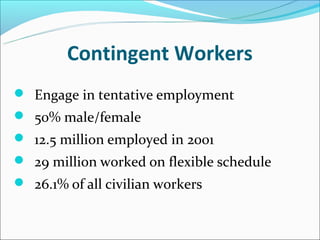
Contingent Workers
 Engage in tentative employment
 50% male/female
 12.5 million employed in 2001
 29 million worked on flexible schedule
 26.1% of all civilian workers
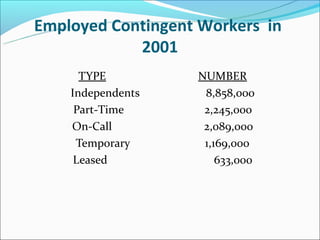
Employed Contingent Workers in
            2001
      TYPE         NUMBER
    Independents    8,858,000
     Part-Time      2,245,000
    On-Call         2,089,000
     Temporary      1,169,000
     Leased            633,000
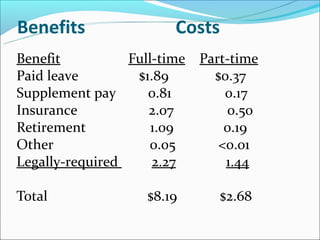
Benefits                Costs
Benefit          Full-time   Part-time
Paid leave        $1.89        $0.37
Supplement pay      0.81         0.17
Insurance           2.07         0.50
Retirement           1.09        0.19
Other               0.05        <0.01
Legally-required     2.27        1.44

Total               $8.19       $2.68
Job Sharing
 2 or more part-timers perform 1 job
 Reduces costs
 Increases flexibility
 Maintains productivity levels
 May increase morale & loyalty
Temporary Workers
 Fill in for core employees
 Help ease high demand periods
 Help determine future employment needs
 May be assessed for a core position
 Don’t receive company benefits
Leased Employee Arrangements
  Lease company does all HRM functions
  Fees either % of payroll, or % per employee
  Employees work for contract duration
  Food service, security, building maintenance,
  administration
Rise In Use Of Contingent Worker
 Economic recessions
 International competition
 From manufacturing to service
 More females in workforce
Service Divisions
 Transportation
 Communication
 Public utilities
 Wholesale trade
 Retail trade
 Government
Federal Compensation Guidelines
 ERISA (Employee Retirement Income Security Act)
  NLRA (National Labour Relations Act)
  ADA (Americans with Disabilities Act)
  ADEA (Age Discrimination in Employment Act)
  Title VII of 1964 Civil Rights Act - outlawed major forms of
  discrimination against blacks & women including racial segregation
 FLSA (Fair Labour Standards Act ) - established minimum wage,
  guaranteed ’time and a half’ for overtime, prohibited employment of
  minors
 COBRA (Consolidated Omnibus Budget Reconciliation Act ) - workers
  and their families can choose to continue group health benefits during
  voluntary or involuntary job loss/reduction in hours worked/transition
  between jobs/ death/divorce
 FMLA (Family and Medical Leave Act) – employees can take unpaid, job-
  protected leave for specified family & medical reasons with continuation of
  group health insurance coverage
Wage Comparisons in 2004
         Group             F-T      P-T
Management & Professional $30.38   $23.79
        Production         14.62    8.92
        Service            10.26    7.57

        Overall Average   $19.05   $10.17
Benefits Offered In 2004
                    % of Companies
Type                Offering Benefits
Paid time-off             25%
Medical insurance         11%
Retirement                20%
Leased Workers’ Benefits
 Leasing company is legal employer
 In 2001, average wage was $19.75
 Leasing & hiring companies responsible for
 discretionary benefits
 Covered by safe harbor rules
Safe Harbor Rules
 Leased employees covered by leasing company’s
  pension plan
 Nonintegrated employer contribution rate of 10%
 Full & immediate participation in vesting
 Leased employees less than 20% of non-highly paid


  workforce
Independent Contractors
 Freelancers & consultants
 Companies not responsible for
  Federal Taxes
  FLSA Overtime or Minimum Wage
  Workers’ Compensation
  ERISA, FMLA, NLRA, ADA, Title VII of Civil
   Rights Act
 Economic reality test
 Right to work test
Economic Reality Test
 Extent a worker controls methods & results
 The control a company has on worker’s earnings
 Importance of worker’s service to the company

 Initiative or skill level required

 Permanency, exclusivity, or length of assignment

 Worker’s investment in materials or equipment
Right To Control Test
 IRC test to determine workers’ independence
 20 Considerations, including:
   Hiring, training, supervising, firing
   Hours
   Services
   Compensation
   Equipment, materials, location
Flexible Work Schedules
 Flextime


 Compressed work weeks


 Telecommuting
Flextime
 Set weekly not daily hours
 May have to work core hours
 Possible employer benefits
   Lower tardiness & absenteeism
   Higher productivity
   Extended business hours
 Possible employer drawbacks
   Increased overhead costs
   Coordination problems
Compressed Workweeks
 Example:
  40 hours in 3 - 4 days
 Possible benefits
   Can promote recruitment and retention
   Can reduce commuting time
   Can allow more family time
Telecommuting
 Employees work on-site & off-site
 Constant direct contact with other
 employees
 Possible benefits
   Same as with flextime
 Possible disadvantages
   Less direct employee interactions
   Makes performance appraisals difficult
Telecommuting Arrangements
 Satellite work centers
 Neighborhood work centers
 Nomadic executive office
 Work off-site and/or on-site
 Temporary or permanently
The flexible workforce
Definition:
A workforce that can respond quickly in
 quantity and type to changes in demand a
 business may face.


                                            © PhotoDisc
The flexible workforce
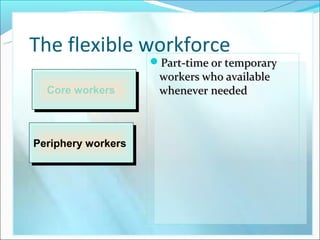
The organization of a flexible workforce


            Periphery Workers

              Core workers


                                            © PhotoDisc
The flexible workforce
                 Full-time employees
  Core workers
  Core workers
                  who have specific skills
                  and job security
The flexible workforce
                    Part-time or temporary
                     workers who available
  Core workers
  Core workers       whenever needed


Periphery workers
Periphery workers
The flexible workforce
Examples of flexible workforce
 practices:
Part-time
Temporary
Bank time
Job sharing


                                 © PhotoDisc
The flexible workforce
Major advantages of a flexible workforce:
Employee benefiting from flexible working
 hours
More employee opportunities of training and
 being multi-skilled
Reducing business costs and increasing
 productivity
Reacting quickly to changes in the workforce
                                          © PhotoDisc
HR Issues in the New Workplace
                   Temporary Employees

 In opening years of the 21st century, largest employer in
     U.S. was a temporary employment agency, Manpower, Inc.
 Temporary Employees do everything from data entry to
     interim CEO
 Contingent workers = people who work for an
     organization, but not on a permanent or full-time basis,
     including temporary placements, contracted professionals,
     or leased employees


30
HR Issues in the New Workplace
                         Technology
 Telecommuting and virtual teams are related trends
 Telecommuting = using computers and
     telecommunications equipment to perform work from
     home or another remote location
 Work anywhere - wireless Internet devices, laptops, cell
     phones, fax machines
 Extreme telecommuting = people live nd work in countries
     far away from the organization’s physical location

31
HR Issues in the New
                 Workplace
                  Work-Life Balance
     Telecommuting is one way organizations help
      employees lead more balanced lives
     Flexible scheduling important in today’s
      workplace – 27% of workforce/flexible hours
     Broad Work-Life Balance initiatives – critical
      retention strategy – on-site gym & childcare, paid
      leaves & sabbaticals

32
HR Issues in the New Workplace
                        Downsizing
 Downsizing = intentional, planned reduction in the size of a
     company’s workforce
 Managers can smooth the downsizing process
     Regularly communicating with employees

     Providing them with as much information as possible

     Providing assistance to workers who will lose their jobs
     Using training and development for remaining employees


33
The Flexible Workforce
Core workers
  Fulltime workers


Contingent workers
  Part time employees
  Contract / Outsourced workers
  Temporary workers
  Interns
Flexible Schedules
Flexible work hours
Core time
Flextime
Compressed work weeks
Telecommuting
Case
Everyone telecommutes at your firm. All work is done in
virtual teams of four. Divide up into groups of four and
respond to the following questions:
  How  will you organize your team?
  Do you need a virtual leader?

  How will you select your virtual team?

  How will you hold team members
   accountable?

Compensating flexible workforce

  • 1.
    Compensating Flexible Workforce: Contingent Employees and Flexible Work Schedules Dr. G C Mohanta, BE(Mech), MSc(Engg), MBA, PhD(Mgt) Professor
  • 2.
    Flexible Workforce/Contingent Employees Part-time employees  Temporary & on-call workers  Leased employees  Independent contractors  Freelancers  Consultants
  • 3.
    Contingent Workers  Engagein tentative employment  50% male/female  12.5 million employed in 2001  29 million worked on flexible schedule  26.1% of all civilian workers
  • 4.
    Employed Contingent Workersin 2001 TYPE NUMBER Independents 8,858,000 Part-Time 2,245,000 On-Call 2,089,000 Temporary 1,169,000 Leased 633,000
  • 5.
    Benefits Costs Benefit Full-time Part-time Paid leave $1.89 $0.37 Supplement pay 0.81 0.17 Insurance 2.07 0.50 Retirement 1.09 0.19 Other 0.05 <0.01 Legally-required 2.27 1.44 Total $8.19 $2.68
  • 6.
    Job Sharing  2or more part-timers perform 1 job  Reduces costs  Increases flexibility  Maintains productivity levels  May increase morale & loyalty
  • 7.
    Temporary Workers  Fillin for core employees  Help ease high demand periods  Help determine future employment needs  May be assessed for a core position  Don’t receive company benefits
  • 8.
    Leased Employee Arrangements  Lease company does all HRM functions  Fees either % of payroll, or % per employee  Employees work for contract duration  Food service, security, building maintenance, administration
  • 9.
    Rise In UseOf Contingent Worker  Economic recessions  International competition  From manufacturing to service  More females in workforce
  • 10.
    Service Divisions  Transportation Communication  Public utilities  Wholesale trade  Retail trade  Government
  • 11.
    Federal Compensation Guidelines ERISA (Employee Retirement Income Security Act)  NLRA (National Labour Relations Act)  ADA (Americans with Disabilities Act)  ADEA (Age Discrimination in Employment Act)  Title VII of 1964 Civil Rights Act - outlawed major forms of discrimination against blacks & women including racial segregation  FLSA (Fair Labour Standards Act ) - established minimum wage, guaranteed ’time and a half’ for overtime, prohibited employment of minors  COBRA (Consolidated Omnibus Budget Reconciliation Act ) - workers and their families can choose to continue group health benefits during voluntary or involuntary job loss/reduction in hours worked/transition between jobs/ death/divorce  FMLA (Family and Medical Leave Act) – employees can take unpaid, job- protected leave for specified family & medical reasons with continuation of group health insurance coverage
  • 12.
    Wage Comparisons in2004 Group F-T P-T Management & Professional $30.38 $23.79 Production 14.62 8.92 Service 10.26 7.57 Overall Average $19.05 $10.17
  • 13.
    Benefits Offered In2004 % of Companies Type Offering Benefits Paid time-off 25% Medical insurance 11% Retirement 20%
  • 14.
    Leased Workers’ Benefits Leasing company is legal employer  In 2001, average wage was $19.75  Leasing & hiring companies responsible for discretionary benefits  Covered by safe harbor rules
  • 15.
    Safe Harbor Rules Leased employees covered by leasing company’s pension plan  Nonintegrated employer contribution rate of 10%  Full & immediate participation in vesting  Leased employees less than 20% of non-highly paid workforce
  • 16.
    Independent Contractors  Freelancers& consultants  Companies not responsible for  Federal Taxes  FLSA Overtime or Minimum Wage  Workers’ Compensation  ERISA, FMLA, NLRA, ADA, Title VII of Civil Rights Act  Economic reality test  Right to work test
  • 17.
    Economic Reality Test Extent a worker controls methods & results  The control a company has on worker’s earnings  Importance of worker’s service to the company  Initiative or skill level required  Permanency, exclusivity, or length of assignment  Worker’s investment in materials or equipment
  • 18.
    Right To ControlTest  IRC test to determine workers’ independence  20 Considerations, including:  Hiring, training, supervising, firing  Hours  Services  Compensation  Equipment, materials, location
  • 19.
    Flexible Work Schedules Flextime  Compressed work weeks  Telecommuting
  • 20.
    Flextime  Set weeklynot daily hours  May have to work core hours  Possible employer benefits  Lower tardiness & absenteeism  Higher productivity  Extended business hours  Possible employer drawbacks  Increased overhead costs  Coordination problems
  • 21.
    Compressed Workweeks  Example:  40 hours in 3 - 4 days  Possible benefits  Can promote recruitment and retention  Can reduce commuting time  Can allow more family time
  • 22.
    Telecommuting  Employees workon-site & off-site  Constant direct contact with other employees  Possible benefits  Same as with flextime  Possible disadvantages  Less direct employee interactions  Makes performance appraisals difficult
  • 23.
    Telecommuting Arrangements  Satellitework centers  Neighborhood work centers  Nomadic executive office  Work off-site and/or on-site  Temporary or permanently
  • 24.
    The flexible workforce Definition: Aworkforce that can respond quickly in quantity and type to changes in demand a business may face. © PhotoDisc
  • 25.
    The flexible workforce Theorganization of a flexible workforce Periphery Workers Core workers © PhotoDisc
  • 26.
    The flexible workforce Full-time employees Core workers Core workers who have specific skills and job security
  • 27.
    The flexible workforce Part-time or temporary workers who available Core workers Core workers whenever needed Periphery workers Periphery workers
  • 28.
    The flexible workforce Examplesof flexible workforce practices: Part-time Temporary Bank time Job sharing © PhotoDisc
  • 29.
    The flexible workforce Majoradvantages of a flexible workforce: Employee benefiting from flexible working hours More employee opportunities of training and being multi-skilled Reducing business costs and increasing productivity Reacting quickly to changes in the workforce © PhotoDisc
  • 30.
    HR Issues inthe New Workplace Temporary Employees In opening years of the 21st century, largest employer in U.S. was a temporary employment agency, Manpower, Inc. Temporary Employees do everything from data entry to interim CEO Contingent workers = people who work for an organization, but not on a permanent or full-time basis, including temporary placements, contracted professionals, or leased employees 30
  • 31.
    HR Issues inthe New Workplace Technology Telecommuting and virtual teams are related trends Telecommuting = using computers and telecommunications equipment to perform work from home or another remote location Work anywhere - wireless Internet devices, laptops, cell phones, fax machines Extreme telecommuting = people live nd work in countries far away from the organization’s physical location 31
  • 32.
    HR Issues inthe New Workplace Work-Life Balance Telecommuting is one way organizations help employees lead more balanced lives Flexible scheduling important in today’s workplace – 27% of workforce/flexible hours Broad Work-Life Balance initiatives – critical retention strategy – on-site gym & childcare, paid leaves & sabbaticals 32
  • 33.
    HR Issues inthe New Workplace Downsizing Downsizing = intentional, planned reduction in the size of a company’s workforce Managers can smooth the downsizing process Regularly communicating with employees Providing them with as much information as possible Providing assistance to workers who will lose their jobs Using training and development for remaining employees 33
  • 34.
    The Flexible Workforce Coreworkers Fulltime workers Contingent workers Part time employees Contract / Outsourced workers Temporary workers Interns
  • 35.
    Flexible Schedules Flexible workhours Core time Flextime Compressed work weeks Telecommuting
  • 36.
    Case Everyone telecommutes atyour firm. All work is done in virtual teams of four. Divide up into groups of four and respond to the following questions: How will you organize your team? Do you need a virtual leader? How will you select your virtual team? How will you hold team members accountable?

Editor's Notes

  • #35 Modern organizations require worker flexibility. Core workers have fulltime jobs with benefits. Contingent workers are those who work based on the needs and efficiency of the organization and are easily dismissed when the organization no longer needs their services. They actually help protect jobs of core workers, as a result.
  • #36 Flexible work hours give employees control over the starting and ending times of their day – when they do their work. Core time means that everyone is onsite at the organization – perhaps 11 am – 2 pm. Flextime means that employees can work outside the organization before 11 am and after 2 pm. Core time allows staff to schedule meetings or trainings, knowing everyone will be on site.
  • #37 Students will have various responses to each questions. Some type of “virtual leadership” will probably be necessary – maybe a rotating leader position. The virtual team will probably be selected much as any other team would be selected – based on skills, expertise, ability to collaborate, etc. The accountability is crucial when not face to face. They may email drafts of their work – one person circulates their draft and all edit or provide feedback, etc.