
U.S. Customs and Border Protection  Response to Terrorism (Click anywhere to continue or press <Esc> to exit this presentation)
The events of September 11, 2001  dramatically affected the entire world March 11, 2004 Madrid, and July 7, 2005 London confirms the risks! (Click anywhere to continue or press <Esc> to exit this presentation)
Imagine if a weapon of mass destruction ...  (Click anywhere to continue or press <Esc> to exit this presentation)
…  sitting in a container within the  sea cargo environment ... (Click anywhere to continue or press <Esc> to exit this presentation)
…  were detonated. (Click anywhere to continue or press <Esc> to exit this presentation)
This program helps keep that  from happening. (Click anywhere to continue or press <Esc> to exit this presentation)
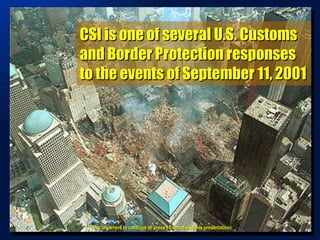
CSI is one of several U.S. Customs and Border Protection responses to the events of September 11, 2001 (Click anywhere to continue or press <Esc> to exit this presentation)
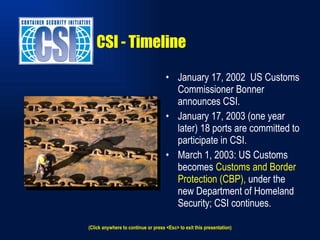
January 17, 2002  US Customs Commissioner Bonner announces CSI. January 17, 2003 (one year later) 18 ports are committed to participate in CSI. March 1, 2003: US Customs becomes  Customs and Border Protection (CBP),  under the new Department of Homeland Security; CSI continues. CSI - Timeline (Click anywhere to continue or press <Esc> to exit this presentation)
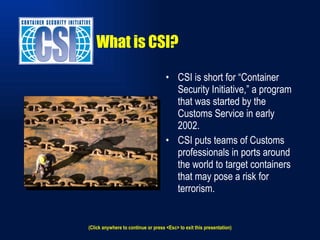
What is CSI? CSI is short for “Container Security Initiative,” a program that was started by the Customs Service in early 2002. CSI puts teams of Customs professionals in ports around the world to target containers that may pose a risk for terrorism. (Click anywhere to continue or press <Esc> to exit this presentation)
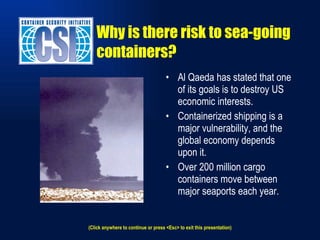
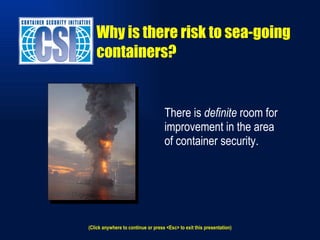
Al Qaeda has stated that one of its goals is to destroy US economic interests. Containerized shipping is a major vulnerability, and the global economy depends upon it.  Over 200 million cargo containers move between major seaports each year. Why is there risk to sea-going containers? (Click anywhere to continue or press <Esc> to exit this presentation)
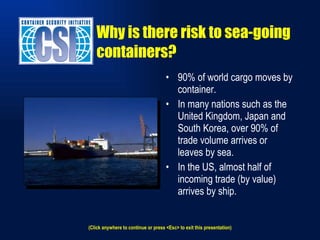
90% of world cargo moves by container. In many nations such as the United Kingdom, Japan and South Korea, over 90% of trade volume arrives or leaves by sea. In the US, almost half of incoming trade (by value) arrives by ship. Why is there risk to sea-going containers? (Click anywhere to continue or press <Esc> to exit this presentation)
There is  definite  room for improvement in the area of container security. Why is there risk to sea-going containers? (Click anywhere to continue or press <Esc> to exit this presentation)
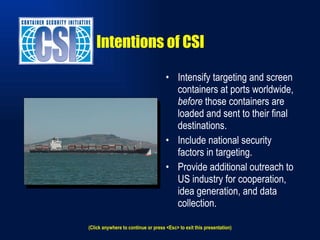
Intentions of CSI Intensify targeting and screen containers at ports worldwide,  before  those containers are loaded and sent to their final destinations. Include national security factors in targeting. Provide additional outreach to US industry for cooperation, idea generation, and data collection. (Click anywhere to continue or press <Esc> to exit this presentation)
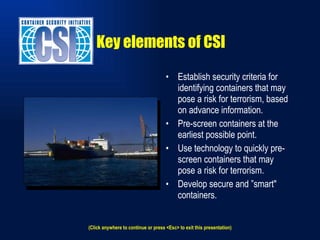
Key elements of CSI Establish security criteria for identifying containers that may pose a risk for terrorism, based on advance information. Pre-screen containers at the earliest possible point. Use technology to quickly pre-screen containers that may pose a risk for terrorism. Develop secure and ”smart&quot; containers. (Click anywhere to continue or press <Esc> to exit this presentation)
Key benefits of CSI Significantly increases ability to intercept containers that may pose a risk for terrorism, before they reach US shores. Increases security of the global trading system. Facilitates smooth movement of legitimate trade. (Click anywhere to continue or press <Esc> to exit this presentation)
Key benefits of CSI Protects port infrastructures. Enhances safety and security for all. Gives a competitive advantage to the trade. International reciprocity. Insurance; deterrence. (Click anywhere to continue or press <Esc> to exit this presentation)
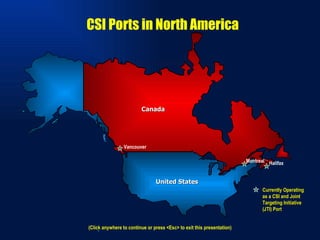
Current CSI ports operating: In Canada: Vancouver, Montreal, and Halifax. (While ports in Vancouver, Montreal, and Halifax host CSI teams, they began as pilot ports of the program on which CSI is modeled, the Joint Targeting Initiative (JTI).  Information  on JTI is available at www.cbp.gov: search on “Joint Targeting Initiative”.) (Click anywhere to continue or press <Esc> to exit this presentation)
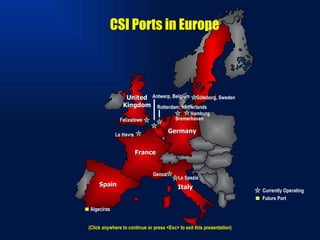
Current CSI ports operating: In Europe: Rotterdam, Netherlands. Antwerp, Belgium. Le Havre, France. Bremerhaven and Hamburg, Germany. Genoa and La Spezia, Italy. Felixstowe, United Kingdom. Göteborg, Sweden. (Click anywhere to continue or press <Esc> to exit this presentation)
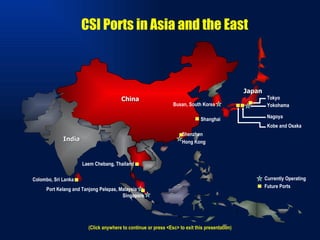
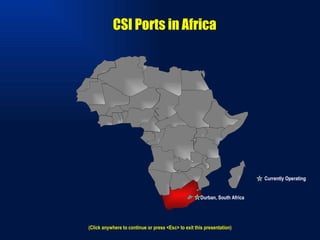
Current CSI ports operating: In Asia and the East: Hong Kong. Singapore. Busan, South Korea. Yokohama, Japan. Port Kelang, Malaysia In Africa : Durban, South Africa. (Click anywhere to continue or press <Esc> to exit this presentation)
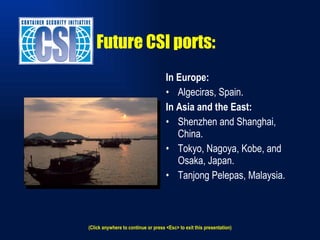
Future CSI ports: In Europe: Algeciras, Spain. In Asia and the East: Shenzhen and Shanghai, China. Tokyo, Nagoya, Kobe, and Osaka, Japan. Tanjong Pelepas, Malaysia. (Click anywhere to continue or press <Esc> to exit this presentation)
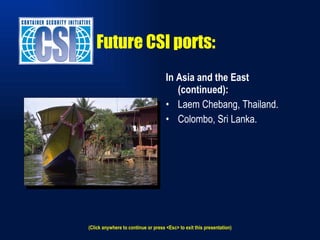
Future CSI ports: In Asia and the East (continued): Laem Chebang, Thailand. Colombo, Sri Lanka. (Click anywhere to continue or press <Esc> to exit this presentation)
How and Why Does It Work? U.S. Customs and Border Protection (CBP) CSI team works in the host country with the host government to identify and target for pre-screening containers that may pose a risk for terrorism. Host government conducts the inspection while the US CSI team observes. Low-risk and CSI-pre-screened containers enter without additional delay unless more information dictates otherwise. CSI both increases security and facilitates flow of legitimate trade. (Click anywhere to continue or press <Esc> to exit this presentation)
CSI Is Working 1. CSI partners work with CBP to develop best CSI enforcement and facilitation practices. 2. Cooperative targeting with CSI partners results in: - Better information, which improves targeting decisions; - Fewer containers identified as possibly posing a risk for   terrorism (for better facilitation); - Determination is now based on more complete   information (for enhanced security). 3. Specific successes include important seizures at several  CSI ports. (Click anywhere to continue or press <Esc> to exit this presentation)
United States CSI Ports in North America Canada Montreal Halifax Vancouver (Click anywhere to continue or press <Esc> to exit this presentation) Currently Operating as a CSI and Joint Targeting Initiative (JTI) Port
CSI Ports in Europe Le Havre  Felixstowe  Bremerhaven Hamburg Algeciras Spain France Germany Italy Genoa La Spezia United Kingdom Göteborg, Sweden (Click anywhere to continue or press <Esc> to exit this presentation) Future Port Rotterdam, Netherlands Antwerp, Belgium Currently Operating
China Hong Kong Singapore Shanghai Shenzhen  Busan, South Korea Japan Port Kelang and Tanjong Pelepas, Malaysia Laem Chebang, Thailand Colombo, Sri Lanka India CSI Ports in Asia and the East (Click anywhere to continue or press <Esc> to exit this presentation) Future Ports Tokyo Yokohama Nagoya Kobe and Osaka Currently Operating
CSI Ports in Africa Durban, South Africa (Click anywhere to continue or press <Esc> to exit this presentation) Currently Operating
For more information …  Call CBP Media Services at 202-927-8727. Visit www.cbp.gov. (Click anywhere to continue or press <Esc> to exit this presentation)

Container Security Initiative CSI

  • 1.
    U.S. Customs andBorder Protection Response to Terrorism (Click anywhere to continue or press <Esc> to exit this presentation)
  • 2.
    The events ofSeptember 11, 2001 dramatically affected the entire world March 11, 2004 Madrid, and July 7, 2005 London confirms the risks! (Click anywhere to continue or press <Esc> to exit this presentation)
  • 3.
    Imagine if aweapon of mass destruction ... (Click anywhere to continue or press <Esc> to exit this presentation)
  • 4.
    … sittingin a container within the sea cargo environment ... (Click anywhere to continue or press <Esc> to exit this presentation)
  • 5.
    … weredetonated. (Click anywhere to continue or press <Esc> to exit this presentation)
  • 6.
    This program helpskeep that from happening. (Click anywhere to continue or press <Esc> to exit this presentation)
  • 7.
    CSI is oneof several U.S. Customs and Border Protection responses to the events of September 11, 2001 (Click anywhere to continue or press <Esc> to exit this presentation)
  • 8.
    January 17, 2002 US Customs Commissioner Bonner announces CSI. January 17, 2003 (one year later) 18 ports are committed to participate in CSI. March 1, 2003: US Customs becomes Customs and Border Protection (CBP), under the new Department of Homeland Security; CSI continues. CSI - Timeline (Click anywhere to continue or press <Esc> to exit this presentation)
  • 9.
    What is CSI?CSI is short for “Container Security Initiative,” a program that was started by the Customs Service in early 2002. CSI puts teams of Customs professionals in ports around the world to target containers that may pose a risk for terrorism. (Click anywhere to continue or press <Esc> to exit this presentation)
  • 10.
    Al Qaeda hasstated that one of its goals is to destroy US economic interests. Containerized shipping is a major vulnerability, and the global economy depends upon it. Over 200 million cargo containers move between major seaports each year. Why is there risk to sea-going containers? (Click anywhere to continue or press <Esc> to exit this presentation)
  • 11.
    90% of worldcargo moves by container. In many nations such as the United Kingdom, Japan and South Korea, over 90% of trade volume arrives or leaves by sea. In the US, almost half of incoming trade (by value) arrives by ship. Why is there risk to sea-going containers? (Click anywhere to continue or press <Esc> to exit this presentation)
  • 12.
    There is definite room for improvement in the area of container security. Why is there risk to sea-going containers? (Click anywhere to continue or press <Esc> to exit this presentation)
  • 13.
    Intentions of CSIIntensify targeting and screen containers at ports worldwide, before those containers are loaded and sent to their final destinations. Include national security factors in targeting. Provide additional outreach to US industry for cooperation, idea generation, and data collection. (Click anywhere to continue or press <Esc> to exit this presentation)
  • 14.
    Key elements ofCSI Establish security criteria for identifying containers that may pose a risk for terrorism, based on advance information. Pre-screen containers at the earliest possible point. Use technology to quickly pre-screen containers that may pose a risk for terrorism. Develop secure and ”smart&quot; containers. (Click anywhere to continue or press <Esc> to exit this presentation)
  • 15.
    Key benefits ofCSI Significantly increases ability to intercept containers that may pose a risk for terrorism, before they reach US shores. Increases security of the global trading system. Facilitates smooth movement of legitimate trade. (Click anywhere to continue or press <Esc> to exit this presentation)
  • 16.
    Key benefits ofCSI Protects port infrastructures. Enhances safety and security for all. Gives a competitive advantage to the trade. International reciprocity. Insurance; deterrence. (Click anywhere to continue or press <Esc> to exit this presentation)
  • 17.
    Current CSI portsoperating: In Canada: Vancouver, Montreal, and Halifax. (While ports in Vancouver, Montreal, and Halifax host CSI teams, they began as pilot ports of the program on which CSI is modeled, the Joint Targeting Initiative (JTI). Information on JTI is available at www.cbp.gov: search on “Joint Targeting Initiative”.) (Click anywhere to continue or press <Esc> to exit this presentation)
  • 18.
    Current CSI portsoperating: In Europe: Rotterdam, Netherlands. Antwerp, Belgium. Le Havre, France. Bremerhaven and Hamburg, Germany. Genoa and La Spezia, Italy. Felixstowe, United Kingdom. Göteborg, Sweden. (Click anywhere to continue or press <Esc> to exit this presentation)
  • 19.
    Current CSI portsoperating: In Asia and the East: Hong Kong. Singapore. Busan, South Korea. Yokohama, Japan. Port Kelang, Malaysia In Africa : Durban, South Africa. (Click anywhere to continue or press <Esc> to exit this presentation)
  • 20.
    Future CSI ports:In Europe: Algeciras, Spain. In Asia and the East: Shenzhen and Shanghai, China. Tokyo, Nagoya, Kobe, and Osaka, Japan. Tanjong Pelepas, Malaysia. (Click anywhere to continue or press <Esc> to exit this presentation)
  • 21.
    Future CSI ports:In Asia and the East (continued): Laem Chebang, Thailand. Colombo, Sri Lanka. (Click anywhere to continue or press <Esc> to exit this presentation)
  • 22.
    How and WhyDoes It Work? U.S. Customs and Border Protection (CBP) CSI team works in the host country with the host government to identify and target for pre-screening containers that may pose a risk for terrorism. Host government conducts the inspection while the US CSI team observes. Low-risk and CSI-pre-screened containers enter without additional delay unless more information dictates otherwise. CSI both increases security and facilitates flow of legitimate trade. (Click anywhere to continue or press <Esc> to exit this presentation)
  • 23.
    CSI Is Working1. CSI partners work with CBP to develop best CSI enforcement and facilitation practices. 2. Cooperative targeting with CSI partners results in: - Better information, which improves targeting decisions; - Fewer containers identified as possibly posing a risk for terrorism (for better facilitation); - Determination is now based on more complete information (for enhanced security). 3. Specific successes include important seizures at several CSI ports. (Click anywhere to continue or press <Esc> to exit this presentation)
  • 24.
    United States CSIPorts in North America Canada Montreal Halifax Vancouver (Click anywhere to continue or press <Esc> to exit this presentation) Currently Operating as a CSI and Joint Targeting Initiative (JTI) Port
  • 25.
    CSI Ports inEurope Le Havre Felixstowe Bremerhaven Hamburg Algeciras Spain France Germany Italy Genoa La Spezia United Kingdom Göteborg, Sweden (Click anywhere to continue or press <Esc> to exit this presentation) Future Port Rotterdam, Netherlands Antwerp, Belgium Currently Operating
  • 26.
    China Hong KongSingapore Shanghai Shenzhen Busan, South Korea Japan Port Kelang and Tanjong Pelepas, Malaysia Laem Chebang, Thailand Colombo, Sri Lanka India CSI Ports in Asia and the East (Click anywhere to continue or press <Esc> to exit this presentation) Future Ports Tokyo Yokohama Nagoya Kobe and Osaka Currently Operating
  • 27.
    CSI Ports inAfrica Durban, South Africa (Click anywhere to continue or press <Esc> to exit this presentation) Currently Operating
  • 28.
    For more information… Call CBP Media Services at 202-927-8727. Visit www.cbp.gov. (Click anywhere to continue or press <Esc> to exit this presentation)