









CONSUMPTION
CHAPTER # 17
GROUP MEMBERS


KAMRAN KHALID

52



OMAIR UR REHMAN

53



UMER DRAZ

43



M. AMIR

50



HUSNAIN SHAH

47
HUSNAIN SHAH
ROLL # 47
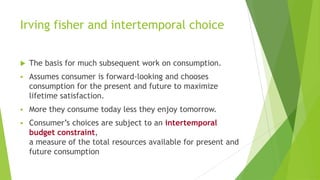
Irving fisher and intertemporal choice


The basis for much subsequent work on consumption.



Assumes consumer is forward-looking and chooses
consumption for the present and future to maximize
lifetime satisfaction.



More they consume today less they enjoy tomorrow.



Consumer’s choices are subject to an intertemporal
budget constraint,
a measure of the total resources available for present and
future consumption
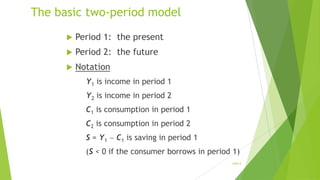
The basic two-period model


Period 1: the present



Period 2: the future



Notation
Y1 is income in period 1
Y2 is income in period 2
C1 is consumption in period 1
C2 is consumption in period 2
S = Y1

C1 is saving in period 1

(S < 0 if the consumer borrows in period 1)
slide 6
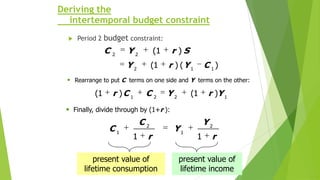
Deriving the
intertemporal budget constraint


Period 2 budget constraint:

C2

Y2

(1

r )S

Y2

(1

r ) (Y 1

C 1)

 Rearrange to put C terms on one side and Y terms on the other:

(1

r )C 1

C2

Y2

(1

r )Y 1

 Finally, divide through by (1+r ):

C1

C2
1

r

present value of
lifetime consumption

Y1

Y2
1

r

present value of
slid
e
lifetime income 7
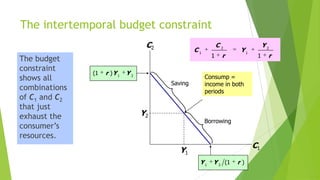
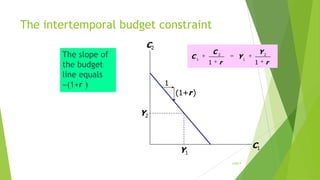
The intertemporal budget constraint
C2
The budget
constraint
shows all
combinations
of C1 and C2
that just
exhaust the
consumer’s
resources.

(1

r )Y 1

C2

C1

Y2
Saving

Y2

1

r

Y1

Y2
1

Consump =
income in both
periods

Borrowing

C1

Y1
Y1

Y 2 (1

r)

slide 8

r
The intertemporal budget constraint
The slope of
the budget
line equals
(1+r )

C2
C1

C2
1

r

Y1

Y2
1

1

(1+r )

Y2

C1

Y1
slide 9

r
UMER DRAZ
ROLL # 43
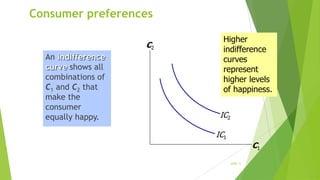
Consumer preferences
C2

An indifference
curve shows all
combinations of
C1 and C2 that
make the
consumer
equally happy.

Higher
indifference
curves
represent
higher levels
of happiness.
IC2
IC1

C1
slide 11
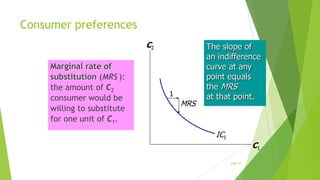
Consumer preferences
C2

Marginal rate of
substitution (MRS ):
the amount of C2
consumer would be
willing to substitute
for one unit of C1.

1

MRS

The slope of
an indifference
curve at any
point equals
the MRS
at that point.

IC1

C1
slide 12
M. AMIR
ROLL # 50
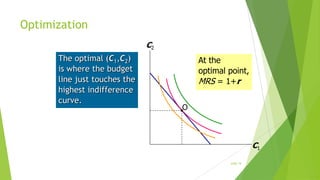
Optimization
C2

The optimal (C1,C2)
is where the budget
line just touches the
highest indifference
curve.

At the
optimal point,
MRS = 1+r
O

C1
slide 14
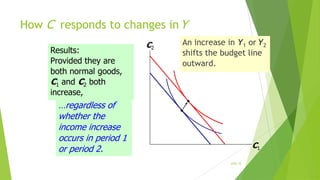
How C responds to changes in Y
Results:
Provided they are
both normal goods,
C1 and C2 both
increase,

C2

An increase in Y1 or Y2
shifts the budget line
outward.

…regardless of
whether the
income increase
occurs in period 1
or period 2.

C1
slide 15
KAMRAN KHALID
ROLL # 52
Keynes vs. Fisher


Keynes:
current consumption depends only on current income



Fisher:
current consumption depends only on
the present value of lifetime income;
the timing of income is irrelevant
because the consumer can borrow or lend between
periods.

slide 17
OMAIR UR REHMAN
ROLL # 53
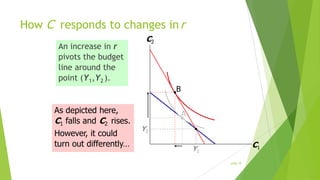
How C responds to changes in r
An increase in r
pivots the budget
line around the
point (Y1,Y2 ).

C2

B

As depicted here,
C1 falls and C2 rises.
However, it could
turn out differently…

A
Y2

C1

Y1
slide 19
How C responds to changes in r


Income effect
If consumer is a saver, the rise in r makes him
better off, which tends to increase
consumption in both periods.



Substitution effect
The rise in r increases the opportunity cost of
current consumption, which tends to reduce C1
and increase C2.



Both effects

C2.

Whether C1 rises or falls depends on the
relative size of the income & substitution
effects.
slide 20
ANY QUESTION

Consumption

  • 2.
  • 3.
    GROUP MEMBERS  KAMRAN KHALID 52  OMAIRUR REHMAN 53  UMER DRAZ 43  M. AMIR 50  HUSNAIN SHAH 47
  • 4.
  • 5.
    Irving fisher andintertemporal choice  The basis for much subsequent work on consumption.  Assumes consumer is forward-looking and chooses consumption for the present and future to maximize lifetime satisfaction.  More they consume today less they enjoy tomorrow.  Consumer’s choices are subject to an intertemporal budget constraint, a measure of the total resources available for present and future consumption
  • 6.
    The basic two-periodmodel  Period 1: the present  Period 2: the future  Notation Y1 is income in period 1 Y2 is income in period 2 C1 is consumption in period 1 C2 is consumption in period 2 S = Y1 C1 is saving in period 1 (S < 0 if the consumer borrows in period 1) slide 6
  • 7.
    Deriving the intertemporal budgetconstraint  Period 2 budget constraint: C2 Y2 (1 r )S Y2 (1 r ) (Y 1 C 1)  Rearrange to put C terms on one side and Y terms on the other: (1 r )C 1 C2 Y2 (1 r )Y 1  Finally, divide through by (1+r ): C1 C2 1 r present value of lifetime consumption Y1 Y2 1 r present value of slid e lifetime income 7
  • 8.
    The intertemporal budgetconstraint C2 The budget constraint shows all combinations of C1 and C2 that just exhaust the consumer’s resources. (1 r )Y 1 C2 C1 Y2 Saving Y2 1 r Y1 Y2 1 Consump = income in both periods Borrowing C1 Y1 Y1 Y 2 (1 r) slide 8 r
  • 9.
    The intertemporal budgetconstraint The slope of the budget line equals (1+r ) C2 C1 C2 1 r Y1 Y2 1 1 (1+r ) Y2 C1 Y1 slide 9 r
  • 10.
  • 11.
    Consumer preferences C2 An indifference curveshows all combinations of C1 and C2 that make the consumer equally happy. Higher indifference curves represent higher levels of happiness. IC2 IC1 C1 slide 11
  • 12.
    Consumer preferences C2 Marginal rateof substitution (MRS ): the amount of C2 consumer would be willing to substitute for one unit of C1. 1 MRS The slope of an indifference curve at any point equals the MRS at that point. IC1 C1 slide 12
  • 13.
  • 14.
    Optimization C2 The optimal (C1,C2) iswhere the budget line just touches the highest indifference curve. At the optimal point, MRS = 1+r O C1 slide 14
  • 15.
    How C respondsto changes in Y Results: Provided they are both normal goods, C1 and C2 both increase, C2 An increase in Y1 or Y2 shifts the budget line outward. …regardless of whether the income increase occurs in period 1 or period 2. C1 slide 15
  • 16.
  • 17.
    Keynes vs. Fisher  Keynes: currentconsumption depends only on current income  Fisher: current consumption depends only on the present value of lifetime income; the timing of income is irrelevant because the consumer can borrow or lend between periods. slide 17
  • 18.
  • 19.
    How C respondsto changes in r An increase in r pivots the budget line around the point (Y1,Y2 ). C2 B As depicted here, C1 falls and C2 rises. However, it could turn out differently… A Y2 C1 Y1 slide 19
  • 20.
    How C respondsto changes in r  Income effect If consumer is a saver, the rise in r makes him better off, which tends to increase consumption in both periods.  Substitution effect The rise in r increases the opportunity cost of current consumption, which tends to reduce C1 and increase C2.  Both effects C2. Whether C1 rises or falls depends on the relative size of the income & substitution effects. slide 20
  • 21.