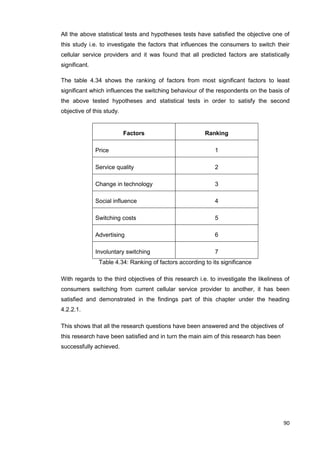
1
1. INTRODUCTION
1.1 Introduction
The dramatic growth in the recent years has changed cellular phone industry and the
cellular phones have moved beyond their fundamental role of communication. In
today’s scenario, consumers continuously want more out of their phone i.e. they use
their phones to listen music, play games, read news headlines, access the internet,
check their bank balance and more (Kavita and Chopra, 2011). Due to this dramatic
growth, the cellular industry all over the world has been witnessing fall in the costs of
cellular services, very high growth rates in subscriber base, and increasing competition
and deregulation. For developing countries in particular, cellular services are becoming
a very significant proportion of the overall telecom infrastructure (Dutta and Sridhar,
2003). The increasing competition in cellular service industry may be for the purpose of
attracting consumers towards the firms because consumers are the main source of
profitability of the firm (Parhizgar, 2002).
According to Rahman, et al. (2010), the service providers are offering most
sophisticated mobile services with an expanding number of value added services such
as Short Message Service (SMS), Wireless Application Protocol (WAP), subscription
services (SS), General Packet Radio Services, and Third Generation services, which
will help to attract consumers and the influence their buying behaviour. This value
added services are increasing the level of consumers’ expectations from service
provider and if the service provider is unable to meet these expectations then, the
consumers considers switching to competitors services. The switching behaviour of the
consumers will significantly affect the revenues, service continuity, and market share of
the firm (Oyeniyi and Abiodun, 2010). Therefore, in order to prevent consumers from
switching to competitors, the service providers are forced to add new schemes, offers,
technological advancements, and benefits with the services (Satish, et. al., 2011).
Cellular services have become the main source of growth in telecommunication sector
in India. The flexibility offered in communications and falling tariffs are playing a
significant role in popularising mobile communications (Rao, 2007). According to
Paulrajan and Rajkumar (2011), in the last decade, the mobile revolution has played a
significant role in the growth and development of Indian economy. As the number of
cellular service providers are continuously increasing, it is expected that the Indian
telecom industry will grow at a compound annual growth rate (CAGR) of 15.8 percent
between 2010 and 2014 and will touch revenues of $82 billion (377,683 crore INR)
(telecomleads.com). The Indian cellular consumer market is expected to double its
2
subscription base by 2015 when compared to present subscriptions (press trust of
Indian, 2011).
According to Kumar, et. al. (2011), the earnings and profitability of the company will be
highly affected, if it loses even a single consumer, as it can cost five times more to
acquire new customer than to retain an old customer. Therefore, in order to retain the
old consumers and reduce the rate of consumers from switching to competing service
providers, it is very important to study the factors that influence consumer behaviour in
terms of switching between the cellular service providers.
1.2 Problem statement
As the telecom sector is rapidly growing in India, due to the industry attractiveness,
new players are entering into the industry and making it more competitive, adding more
options for the consumers to switch between the cellular service providers. As the
study of Oyeniyi and Abiodun (2010) indicates that, the consumer switching behaviour
will affect the cellular service providers in terms of lowering market share, revenues
and consumer base of the firm. Therefore, the research is carried out on the topic of
consumer switching behaviour which could help the cellular service providers to
understand the reasons or rationale behind switching behaviour of consumer in cellular
services.
This research is targeting young adults aged between 18 to 35 years because India
has one of the largest youth population in the world and cellular services are one of the
services which would be interesting to them (Levi, 2007). Young adults are in general
more frequent mobile phone users than elderly people (Weslund, 2006). According to
Ericson (2004), young people are showing again and again that they are willing to
experiment with new services and that they define new uses for mobile services. It has
been indicated that young people are the heaviest users of mobile technology and are
highly desirable demographics because of their discretionary buying power (Miller,
2004). Therefore, it becomes very important for the cellular service providers to
understand the factors which influence this group of consumers to switch their service
provider because understanding this factors can help the company to maintain existing
consumers and win the new consumers which increase the consumer base of the firm
which in turn provides the opportunity to increase profitability and market share of the
firm.
In this research, sample is selected from Bangalore city located in Karnataka, South
India because it has a strong base in telecommunications and other industries. It is
also known as the science and technology capital of India, (Yue, et al., 2001). Due to
3
the rapid increase in telecom industry in India, the major cities including Bangalore
have registered new records in the sale of telecom services. Bangalore is one of the
cities with leading telecom directory in India and also one among the cities which are
the main telecom business centre of India (indiahousing.com). The major cellular
service providers in India such as BSNL (Bharat Sanchar Nigam Limited, MTNL
(Mahanagar Telecom Nigam Limited), Reliance communications limited, Tata Docomo
limited, Bharti Airtel, Vodafone Essar, Aircel and others have initially targeted big cities
including Bangalore for the launch of new telecom services such as third generation
(3G) mobile services (articles.economictimes.indiatimes.com). Therefore, this research
carried out in Bangalore city could help the cellular service providers to understand the
factors responsible for consumers switching behaviour. It will help the service providers
to offer the services according to consumer requirements, which in turn will help the
companies to prevent consumers from switching the cellular service provider and gain
loyalty and competitive advantage in order to compete in the rapidly increasing
competition scenario in Bangalore city.
1.3 Justification of the study
This study will make several contributions to the marketing literature from both a
theoretical and a managerial. Firstly, this study will contribute to the marketing literature
by providing an empirical examination of several service marketing constructs. The
results of this research can help the cellular service providers to have the deep
understanding about the factors that influence the consumers to switch between the
different service providers in cellular service industry.
Secondly, this study will benefit marketers and practitioners in the cellular service
industry. This research will identify the most important factors that cause customers to
switch or stay with a cellular service provider. This knowledge can make a contribution
to enhancing long-term customer relationships with customers. In addition, the
managers of the cellular service company can utilise this knowledge to prevent
potential customers from switching service providers. From the perspective of the
cellular service providers, that are attempting to attract new customers, this information
will enable cellular service providers to develop strategies to overcome switching
barriers and gain market share (Colgate & Lang, 2001). As Hennig-Tharau and
Hansen, (2000) states that, learning from the consumer switching stories, companies
can improve the services to avoid future switching behaviours.
4
1.4 Research Aim and Objectives
The research is designed to address the following aims and objectives. The broad aim
of the research is to explore and examine the factors that determine the consumers
switching behaviour of young adults (aged 18-35 years) in cellular service providers.
The objectives of the research are as follows.
1. To investigate the factors that influence consumers to switch the cellular service
providers.
2. To critically evaluate the most and the least significant factors that influence
consumers switching behaviour in cellular services?
3. To investigate the likeliness of consumers to switch from current cellular service
provider to another.
1.5 Research questions
The desired objectives of the research will be accomplished by addressing the
following research questions.
 What are the situations which influence consumers to switch their cellular
service provider?
 What is the effect of consumers switching behaviour on the cellular service
providers?
 What is the percentage of customers who are willing and unwilling to switch
their current service provider?
 What measures have to be taken to reduce the rate consumers switching
behaviour?
 What are the steps to be taken to retain and gain customers?
1.6 Research Overview
This research has been split into five main chapter; Introduction, literature review,
methodology, findings and analysis, and conclusion and suggestions. The overview of
each chapter is given below.
1.6.1 Chapter 1: Introduction
In this chapter, firstly the telecommunications industry has been introduced indicating
the impact of development and change on cellular service providing companies in
relation to the consumers. Then the justification has been given about how this
5
research contributes to business or management. Lastly, the aim, objectives and
questions has been explained in this chapter.
1.6.2 Chapter 2: Literature review
In this chapter, the existing literature on relevant theories and researches has been
explored. The key theories and researches relating to the topic of ‘consumer switching
behaviour in cellular service provider’ have been discussed in order to gain both
theoretical and practical knowledge of this research. The main purpose of discussing
relevant theories and researches is to explore the factors that help to achieve the
objectives of this research. The literature review includes studies of many researchers
such as Richard Lee and Jamie Murphy (2005), Inger Roos, Bo Edvardsson, and
Anders Gustafsson (2004), and others. The discussion is based on marketing concepts
relating to the topic of consumer behaviour in terms of switching cellular services. The
major factors including service quality, price, switching costs, technological
advancements, advertising, social influence (reference groups), and involuntary
switching, that are mainly responsible for consumers switching behaviour in cellular
services have been discussed. Then, on the basis of these factors, the hypotheses
have been developed in this chapter.
1.6.3 Chapter 3: Research Methodology
This chapter explains and justifies the research methodology undertaken to carry out
this research. The different research methods have been discussed in this chapter and
the one which are assumed to be appropriate to achieve the objectives are chosen and
its impact on this research has been explained. The research methodology includes the
studies of many researchers such as Denscombe (2003), Saunders (2009),
Denscombe (2003), Kumar (2005), and more. The research methodology starts with
explaining the meaning of business research, then the research
paradigms/philosophies (interpretivism and positivism), research methods (quantitative,
qualitative, and triangulation), sampling (probabilistic and non-probabilistic), and data
collection (primary data and secondary data) have been discussed simultaneously with
chosen methods and its impact on this research. And then the undertaken data
analysis method and limitations of this research has been discussed in this chapter.
1.6.4 Chapter 4: Findings and Analysis
This chapter explains the findings drawn from the collected data through
questionnaires and presented in the form of tables and charts. Then those findings
have been analysed using different statistical tests such as descriptive statistics,
6
regression analysis, and correlation analysis in order to show the relationship between
the variables and draw the results. Then, on the basis of the tests and results, the
hypotheses have been tested followed by discussion and implication of the results of
each hypothesis in order to answer research question. Finally, the results of the
hypotheses are summarised and different switching factors have been ranked in terms
of their significance level in order to achieve research objectives.
1.6.5 Chapter 5: Conclusion and Suggestions
This chapter provides the brief summary of the whole research and also provides the
suggestions for further research, which can help the other fellow researchers who wish
to take this research to further end. The suggestions may also be helpful for the cellular
service providing companies operating in the area where the research has been carried
out.
7
2. LITERATURE REVIEW
2.1 Introduction
This chapter explores the literature on relevant theories and researches which help to
gain both practical and theoretical knowledge and understanding of the topic of
consumer switching behaviour in cellular services. The theoretical concepts and
researches explored in this chapter also includes the debates made by previous
researchers on similar topics, which significantly contributes to have better
understanding about the objectives of this research i.e. the factors that influence
switching behaviour and decisions of consumers in terms of cellular service providers.
The literature review firstly explains impact of marketing in relation to cellular service
industry, and then the main concept of this study has been discussed i.e. consumer
switching behaviour including the major factors that determine consumers’ switching
behaviour (switching determinants) in cellular services such as service quality, price,
switching costs, change in technology, advertising, social influences and involuntary
switching. Lastly, the hypothesis has been developed on the basis of the literature.
2.2 Marketing
According to Kotler, et al. (2009:6), ‘’marketing is a customer focus that permeates
organisational functions and processes, and is geared towards marketing promises
through value proposition, enabling the fulfilment of individual expectations created by
such promises and fulfilling such expectations through support to customers’ value-
generating processes, thereby supporting value creation in the firm’s as well as its
customers’ and other stakeholders’ processes’’.
Today, Marketing must not be understood in the old sense of making a sale – ‘’ telling
and selling’’, but in the new sense of satisfying customer needs (Kotler and Armstrong,
2008:7). This implies that, if the companies want to gain long-term benefits from its
customers, they have to understand marketing in the new sense of satisfying customer
needs. If the companies are able to satisfy the needs and expectations of its
customers, then customers will repurchase the products or services of a particular
company i.e. they exhibit loyalty towards the company, regardless of competitors’
efforts to distract customer attention towards them.
With respect to service marketing, Lovelock and Wirtz (2007), defines services as the
economic activities which one party offers to another, most commonly employing time-
based performances in order to bring about desired results in recipients themselves or
in objects or other assets for which purchasers have responsibility. Customers of
8
service expect to obtain value from access to goods, facilities, professional skills,
network, and systems; but there is no transfer of ownership of any physical elements is
involved.
Muddie and Pirrie (2006), identified four basic characteristics of services i.e.
intangibility, inseparability (simultaneous production and consumption), variability
(heterogeneity) and perishability. He also argued that marketing activity is normally
structured around the ‘4Ps’ i.e. product, price, promotion and place; but the distinctive
characteristics of services requires 3 more Ps in addition i.e. people, physical evidence
and process.
Considering the cellular services Kapoor, et al. (2011:337) states that, the services
provided by several companies are generally similar in their nature, therefore the only
way a service provider can make a mark on the consumers is by way of distinguishing
the physical evidence, people, and process attached to services of the company. For
example, the customer needs has to be served differently in terms of non-disruptive
connectivity, value additions in physical evidences, and the courteous services by the
people involved in rendering these services.
In regards to the current scenario of telecom services marketing in India, Kapoor, et al.
(2011:344) asserted that, the telecom services are facing a very dynamic marketing
situation with the international and global companies making their presence felt in the
Indian telecom markets. For example, with the entry of Virgin mobiles, Vodafone, and
many other international players, the customer has suddenly been placed as the main
beneficiary in the telecom scenario.
Schiffman, et al. (2008) stated that, consumer behaviour is a root of marketing concept.
Therefore, the concept of consumer behaviour in terms of switching in cellular service
industry has been discussed below because it may be significantly important for the
cellular service providers to understand the grounds in which consumers’ exhibit
switching behaviour in order to gain understanding on consumers’ needs and
expectations, and the ways for satisfying them. It can enable cellular service providers
to reduce the risk of customers switching from one cellular service provider to another,
as the success or failure of the company may depend on its consumers.
9
2.3 Consumer switching behaviour
2.3.1 Consumer behaviour
According to Loudon and Betta (1993), consumers are those individuals who purchase
goods or services for the individual or household consumption purpose. They defines
consumer behaviour as ‘’the decision process and physical activity individuals engage
in when evaluating, acquiring, using, or disposing of goods and services’’. Similarly,
Hoyer and Macinnis (2010:3), defines consumer behaviour as ‘‘the totality of
consumers’ decisions with respect to the acquisition, consumption and disposition of
goods, services, activities, experiences, people and ideas by decision-making over
time’’. A simplified framework proposed by Khan (2007), in the figure 2.1 helps to
understand the concept of consumer behaviour more clearly.
Figure 2.1: Simplified framework of consumer behaviour
Adapted from Khan (2002), Consumer Behaviour.
The study of consumer behaviour helps the companies to improve their marketing
strategies by understanding the issues described as follows
(consumerpsychologist.com).
 How the psychology of consumers thinks, feel, reason, and select between
different alternatives.
 How the psychology of consumers is influenced by the environment (for
example; family, friends, etc).
 How the behaviour of consumers while making buying decisions.
10
 How marketers can adapt and improve their marketing campaigns and
marketing strategies in order to reach consumers more effectively etc.
Therefore, the above discussion on consumer behaviour implies that, in order to fulfil
the objectives of this research, it is very important to understand consumer behaviour
because in cellular services, different consumers behave differently under the same
situation, which can directly or indirectly make positive or negative impact on profits,
market share, etc. Consumer behaviour in terms of switching is an important aspect for
the service companies. Due to the fast changing nature cellular telecommunications
industry, the cellular services consumers are often switching from one service provider
to another. Hence, it can be said that it is very important for the companies to
understand the reason behind consumers’ switching behaviour in order to compete,
gain market share, increase profitability and consumer base.
2.3.2 Switching behaviour
Switching in the context of consumer behaviour is referred to the times when consumer
chooses a competing choice rather than the previously purchased choice on the next
purchase occasion (Babin and Haris, 2011). Switching behaviour reflects the decision
that a consumer makes to stop purchasing a particular service or patronising the
service firm completely (Boote, 1998).
Satish, et al. (2011) argued that, consumers exhibits switching behaviour based on
their satisfaction level with the service provider. Conversely, the study of Roos (1998)
indicates that, even though customers may express their dissatisfaction, they
nevertheless frequently seem to switch service provider. Consumer satisfaction is
developed on the information from all previous experiences with service provider.
Customer wants and expectations are changing or increasing all the time (Paulrajan
and Rajkumar, 2011). In telecommunications industry customer bring high expectations
from its service providers Roos (1998) and if the service providers are unable to meet
these expectations then customers will take their business to somewhere else.
Therefore, it can be argued that the cellular service providing companies need to
consistently monitor and fulfil the changing wants and expectations in order to satisfy
them and prevent them from switching.
Customer satisfaction does not necessarily lead to loyalty. However, customers’ loyalty
is strengthened towards the service provider, when they are satisfied (Satish, et al.,
2011). Similarly, Fill (2005) argues that, if there is decrease in the consumers’
satisfaction level then loyalty may be lost and the complex switching behaviour occurs.
According to Brown and Chen (2001), some studies suggest that customer satisfaction
11
is an important antecedent of loyalty. Customer loyalty is influenced by customer
satisfaction and a loyal customer base is the real asset for a company.
Customer loyalty has a powerful impact on organisation’s performance and most of the
companies consider it as a source of competitive advantage. It increases revenue,
reduces customer acquisition costs, and lowers the costs of serving repeat purchasers,
which leads to greater profitability. Customers may avoid switch and remain loyal to
service provider, if they feel that they are receiving greater value than they would
receive from competitors (Lam, et. al., 2004). Oliver, (1999) stated that consumer
loyalty is a deeply held commitment to re-buy or repurchase a preferred service
consistently, regardless of situational influences and marketing efforts that have the
potential to cause switching behaviour. Customer loyalty is an important factor that
contributes to the firm’s profits, earnings and reduces defection rates (Duncan and
Elliot, 2002).
Considering the points raised by researchers relating to customers satisfaction and
loyalty which is discussed above, it can be noted that customer satisfaction is very
important factor and high responsible for gaining customers loyalty towards the firms.
Hence, cellular service providers have to to satisfy its consumers in every aspect
relating to their services and because if they fail to satisfy its consumers, then
consumer loyalty may be lost and they may consider switching their service provider
which in turn may bear loses for the firm. The impact of consumer switching or
defection on the firm is discussed below.
The study of Oyeniyi and Abiodun (2010) indicates that, the revenues and service
continuity could be significantly affected by customers’ defection or switching.
Reichheld and Sasser (1990) states that reducing customer defections by five per cent
increased profit by seventy five per cent. Defections have stronger impact on
profitability than unit costs, market share and more.
According to Bansal and Taylor (1999), the service providers are becoming more
concerned about customer retention because of the negative effects of customer
switching such as reduced market share, impaired profitability, and increased costs.
The service providers should carefully manage consumer retention because on the one
hand it is costly to retain a customer and on the other hand, all customers do not
generate same value to the firm and therefore it is not efficient to retain all customers
(Lopez, et. al., 2006). Thus, it can be understood that, for the cellular service providers
it is very important to carefully retain consumers because they are the main source to
generate potential profits and add value to the firm. If the firm fails to manage
12
consumer retention then, it may result in losing consumers loyalty towards the firm and
the rate consumers switching between the cellular service providers will be increased.
According to Colgate and Danaher (2000), relationship marketing has gained
increasing importance due to its benefits for both firms and the customers. The
strength of relationship between the service provider and consumer may encourage
consumers to switch or to stay with current service provider. For example Gwinner, et.
al. (1998), argued that consumer will commit themselves to service provider by
establishing, developing and maintaining relationships that provides superior valued
benefits. Similarly, the study of Colgate and Lang, (2001), shows that if consumers
switch from one service provider to another, then they may lose the benefits that are
available from the current service provider. Conversely, the study of Lopez, et. al.
(2006) indicates that building long-term relationships with consumers increases
profitability and their future viability for the firms. Hence it can be said that, the service
provider should give careful consideration to maintain long-term relationship with
consumers in order to reduce the risk of consumer switching from one service provider
to another.
Bansal and Taylor (1999) states that switching leads to negative outcome for the firm
which also involves replacing or changing the current service provider with another
service provider. Similarly, the study of Lee and Murphy (2005) indicate that,
consumers with negative service experience switch or consider switching to another
service provider. Therefore, it is significantly important to understand the major factors
that influence or determine consumers’ behaviour to switch cellular service providers
and decisions to buy cellular services for the purpose of retaining consumers and
reducing the rate of consumers switching from one service provider to another. It
enables the cellular service provider to gain competitive advantage which in turn helps
to generate revenues, increase market share and consumer base of the firm.
2.3.2.1 Switching determinants
According to Lee and Murphy (2005), there are several factors that determine
consumers to stay with their current service providers or to switch. Some of the
important factors which determine switching are:
 Price is rated as the most important reason for switching.
 Brand trust leads to commitment towards brand, which then reduces the
consumers’ behaviour to switch the service provider.
13
 Switching costs are also important switching determinant because switching
costs such as monetary loss and uncertainties with new service provider deter
switching regardless of dissatisfaction.
 Reference Groups which plays a significant role in influencing consumer to
switch the service provider in order to conform to others, norms, broad values
and behaviour.
Roos and Gustafsson (2007) states that, customers switch the service providers for
many reasons such as existing service provider no longer meets its customers’ needs
because of their changing circumstances or customers are getting better offers from
the competitors or customers wanting some variables. According to Mallikarjuna, et al
(2011) these reasons/determinants for consumer switching behaviour can be classified
into eight general categories – inconvenience, pricing, core service failure, service
encounter failure, response to service failure, competition, ethical problems and
involuntary switching. According to a classification given by Bruhn and Georgi (2006),
reasons for switching can be divided into three groups:
1. Customer-related switching reasons are concerned with customer characteristics
with a more or less direct connection with the service provider. Characteristics
concerns customers age, sex, preferences, lifestyles, etc and are directly connected
to customers’ needs (Bhrun and Georgi, 2006)
2. Provider-related switching reasons are closely connected to cause customer
retention and it is concerned with perceived service quality and customer
satisfaction. Service prodders can easily manage this category of reasons. It is the
most important source for avoiding customer defection (Bhrun and Georgi, 2006).
3. Competition-related switching reasons lead to customer defection because
consumer behaviour not often depends on the current service provider and its
service but also on its competitors. For example, when a mobile phone customer’s
basic criterion of buying is price, and then they compare the price system of their
current service provider and other provider (Bhrun and Georgi, 2006).
Roos, et al. (2004) stated that, customers own expressions of reasons for switching are
known as switching determinants. The reason for switching may be due the service
provider’s poor knowledge about how customers changing situations influence their
needs. The study of Lee and Murphy (2005) indicates that, in subscription market such
as telecommunications, consumers exhibit complete loyalty to one service provider and
often over long period. They also state that consumer subscribe to mobile services with
no initial intention to switch and remain completely loyal until triggers change them from
being loyal to switching or intending to switch the service provider. As there are number
14
of determinants which relates to loyalty and switching, this transitions may be due to
changes in underlying determinants, new determinants coming into play, or both (Lee
and Murphy, 2005). Some of the important factors that determine consumer switching
behaviour in cellular service industry have been discussed below to gain the
knowledge about underlying facts of those factors for the purpose of achieving the
objectives of this research.
2.3.2.1.1 Service quality and its dimensions
2.3.2.1.1.1 Service quality
Service quality as perceived by customers is defined by Zeithaml, et. al., (1990), as
‘’the extent of discrepancy between customers expectations or desires and their
perceptions’’. Bansal and Taylor (1999), favourably available that service quality is the
consumer’s judgement about a firm’s overall excellence or superiority. Perceived
service quality is obtained from the viewpoint of a consumers’ attitude towards to judge
the overall service prevision (Spathis, et. al., 2004). Lewis (1989) argued that,
perceived service quality is the judgement of consumers which is derived after
comparing between their expectations of service and the perceptions of actual service
performance.
Many researches revealed that there is a close relationship between service quality
and customer satisfaction which leads in influencing consumer behaviour. For instance,
according to Lee and Murphy (2005), existing literature suggests that improving service
quality satisfies customers and retains their loyalty. And the customers with negative
service experience may switch their service providers.
With regards to Cellular services, the study of Paulrajan and Rajkumar (2011)
indicates, that service providers are expected to compete on service quality and price,
as it is very important for service providers to meet consumers’ expectations in terms of
service quality. Services mainly depend on some factors and consumers buy services
which has many attributes in order to fulfil their desires. In cellular mobile markets,
customers carry high level of expectations from its cellular service providers in terms of
communication and if the service providers are unable to meet customers’
expectations, then it could result in customers switching their cellular service providers.
For example, the study of Paulrajan and Rajkumar (2011) indicates that, in today’s
scenario, cellular mobile has became a very important part for our daily communication
and customers buy the cellular mobile for instant communication and various services.
However, many researches indicate that the dimensions of service quality play a
significant role in determining service quality of the firm.
15
2.3.2.1.1.2 Dimensions of service quality
According to Cronin and Taylor (1992), service quality is a multi-dimensional or multi-
attribute construct. However, Gronoos (1990) noted that, there are three dimensions of
service quality i.e. functional dimension (process), technical dimension (outcome), and
image (corporate image). According to the study of Kang and James (2004), the
customers perceives service quality as what they receives as the outcome of the
process in which the resources are used i.e. technical dimension. But more often and
importantly customers perceives service quality as how the process itself functions i.e.
functional dimension. Customers bring their past experiences and overall perceptions
of a service firm to each encounter because they often have continuous contact with
the same service firm i.e. image dimension (Gronoos, 2001). Brady and Cronin (2001)
argued that, there is no general agreement as to the nature of the dimensions of
service quality.
Service quality dimensions with regards to cellular services providers include call
quality, call drop rate, geographical coverage, call forwarding and waiting, short
message service, mobile entertainment, complaint redressal system and others
(Paurajan and Rajkumar, 2011).
Considering the above discussion on service quality and its dimensions, it can be
therefore understood that, in the scenario of increasing competition in cellular service
industry, it is very important for the cellular service providers to continuously monitor
and improve service quality in order to meet the changing expectations, desires or
wants of consumers in terms of service quality for the purpose of satisfying consumers.
It is also very important for the cellular service providers to understand the impact of
service quality which is playing a significant role in consumers’ switching behaviour in
cellular service industry. This helps to gain consumers loyalty towards the company. It
can also help cellular service providers to reduce the rate of consumers’ switching from
one service provider to another, and retain and attract consumers towards the firm.
Ignorance of understanding the impact of the factors relating to service quality may
lead to lose the potential consumers, which in turn will have negative impact on the
firm.
16
2.3.2.1.2 Price
From the marketing point of view, researchers have recognised the importance of price
in affecting the behaviour of existing customers (Lemon, 1999). In most of the studies it
was found that price is the most important factor which affects customer to switch
loyalties to competing service provider (Satish, et al., 2011). Roos, et al. (2004)
favourably argued that price play a key role in consumers decision making to switch
service provider. Similarly, the study of Krishna, et al., (2002) indicate that, comparing
the price charged by current service provider with that of competitors, consumers
influences perceived savings. For example (Polo and Sese, 2009), when the price of
current service provider is high, consumers perceived savings from switching will be
high, as they would benefit from better pricing offered by competitors. The consumers
monetary saving will be high from switching the service providers when the
competitors’ prices are low (Polo and Sese, 2009). Polo and Sese (2009) also argued
that, competitors will use price to stimulate consumer switching behaviour. Hence, it
implies that the cellular service providers are more interested in attracting customers of
their competitors in order to increase market share, profitability, and consumer base of
the firm. Due to the competitor’s prices, the consumers are encouraged to switch the
cellular service provider by which the consumers can save money. However, this type
of competition may affect the revenues of not only one but both the competiting firms.
According to Bolton (1998), and Drew (1991), price is one of the most important
determinant which influence switching intentions in telecommunications industry.
Pricing factor include all critical switching behaviour that involved rates, fees, service
charges, price promotions, and others (Keaveney, 1995). For example, in
telecommunications sector, price may include call rates, subscription fees, roaming
charges, etc. The study of Keaveney (1995) revealed that, more than half of the
customers switched because of the poor price perceptions and suggested that
unfavourable price perceptions directly influence customers’ intentions to switch.
Therefore, in the context of cellular service industry, it can be assumed that, high price
or unfavourable price if the services (the price, which the consumers do not agree or
perceives it as unworthy to pay for the particular services or firm) can have negative
effect on consumers and may influence them to switch between the cellular service
providers.
The study of Lehtinen and Lehtinen (1991) indicates that, price plays a vital role in
telecommunications market, especially in cellular service providers. They also stated
that a price dominated mass market leads to customers having more choices and
opportunities to compare the pricing structures of different service providers. Hence, it
17
indicates that the companies which offers low price for the services may be able to
attract more customers, gain loyalty, and retain lost consumers. This can also help to
reduce or prevent consumers from switching their cellular service providers.
In the study carried out by Paulrajan and Rajkumar (2011), it was found that price has
significant positive impact on consumer perception in terms of selecting the
telecommunication service providers. However, Dutta and Sridhar (2003) argued that
price has both positive and the negative effects such as, in price-cap regulated market
the service providers use appropriate pricing strategy to win customers and market
share on one side. And on the other side, for example, in India which is highly price-
elastic market the cellular service providers reduce prices which may lead to increase
in subscribers base and so is the network traffic. This increased network traffic
decreases the performance and lowers service quality, inviting customers to switch the
service provider (Dutta and Sridhar, 2003). Hence, it can be understood that price
plays a significant role in influencing consumers buying decisions of cellular services
and it can also influence consumers switching intentions. It implies that cellular service
providers have to pay careful attentions on pricing their services because on the basis
of the above discussion, it can be said that consumers are very sensitive to price.
According to Pan (2009), Bharti Airtel, the biggest mobile operator in India, has
requested that TRAI (Telecom Regulatory Authority of India) to explore the business
models of companies that provide low-cost service to attract the new users. This was
the first time when the company has expressed the concerns over the ongoing low-
tariff initiated by Tata DoCoMo, one of the major competitor, when it had launched per
second billing plan in India. Bharti Airtel has urged the regulator to investigate the
predatory pricing plans adopted by telecom operators, which are increasing
competition in the country. For example, Indian cellular service providers, are offering a
variety of service plans as a means to attract new customers such as pre-paid calling
schemes, discounted call rates at evening and night time, discounted roaming charges,
free or minimum activation fee, discounted mobile-to-mobile call rates for long distance
calling, and free SMS messaging service (Dutta and Sridhar, 2003). Therefore, it can
be said that this might be one of the reason for increased competition among cellular
service providers to win customers by offering services on reduced prices which
therefore influence customers to switch the service providers because if the consumers
perceive that the competitor’s price is better than the current cellular service provider,
they considers switching. So, the cellular service providers have to way out the non-
pricing competition strategies to win customers.
18
2.3.2.1.3 Switching costs
Burnham, et al., (2003), defines switching costs as ‘the onetime costs that customers
associate with the process of switching from one service provider to another’. Switching
costs can be categorised in different ways such as Fornell, (1992) summarises
switching costs into search costs, transaction costs, learning costs, loyal customer
discounts, customer habit, emotional cost and cognitive effort, coupled with financial,
social and psychological risk. Similarly, Burnham, et al. (2003), classified switching
costs into procedural switching costs, financial switching costs and relational switching
costs. And Klemperer, (1995), describes switching costs as artificial costs, learning
costs and transactional costs. Switching costs protect firms from short-term fluctuations
in service quality and provide flexibility to charge prices above marginal costs, to a
certain point without fear of losing customers (Shy, 2002).
There are many researches that investigated the relationship between switching cost
and consumer switching behaviour. For example, Fornell (1992) states that switching
cost can help to prevent switching behaviour by making it costly for consumers to
change the service providers. High switching costs discourage consumers to leave the
current service provider because the consumers may perceive switching costs to be
higher than the expected benefits of switching the service provider (Lee, et. al., 2007).
Cross-industry findings of Burnham, et. al. (2003), indicate that switching costs, such
as monetary loss and uncertainties with the new service provider, deter switching
despite dissatisfaction. Similarly Gronhaug and Gilly, (1991), states that high switching
costs may tend even the dissatisfied customers to remain loyal.
An alternative to increasing customer retention and improving profits is to create
switching costs that make it difficult for customers to switch to competing service
providers (Klemperer, 1995). It was noted that if the switching costs are too high then
consumers prefers to stay with current service provider even if they are dissatisfied
(Gronhaug and Gilly, 1991). Hauser, et al. (1994) stated that when switching costs are
high, consumers become less sensitive to satisfaction level. Therefore, it can be
understood that switching costs in terms of time, money and efforts acts as a significant
barrier to switching when the consumers are dissatisfied with current service provider.
With regards to cellular telecommunication services, switching costs are defined as
loss cost, adaptation cost and move-in cost. Loss cost refers to the perception of loss
in social status or performance, when cancelling a contract with current service
provider; adaptation cost refers to perceived cost of adaptation, such as search cost
and learning cost; and move-in cost refers to the economic cost which is involved in
19
switching to a new service provider, such as purchase of SIM card and subscribers fee
(Kim, et al., 2004).
According to Paul de Bijl and Peitz (2002), switching costs with regards to
telecommunications market, the subscription of a consumer is valuable beyond the
profits stemming from that consumer in the current period, because there are lock-in
effects. Namely, a consumer suffers monetary or non-monetary disutility from switching
service providers. Switching costs may be advantageous to early arrivals and
disadvantageous to late arrivals, because initial market share is valuable. The
presence of consumer switching costs might lead to higher profits. If consumers are
aware of the lock-in effects then the companies possibly have to attract consumers by
low prices and if the consumers are ignorant about lock-in effects then the companies
have an advantage to build up market share as soon as possible because this allows
them to extract profits from these consumers (Paul de Bijl and Peitz, 2002).
In India the costs of switching from one cellular service provider to another is going
down rapidly. In the beginning, changing the service provider also meant losing the
number. But now, Mobile Number Portability (MNP) service was recently launched in
India in January 2011. It allows consumers to switch from their current service provider
to new service provider by retaining their current mobile number by paying just 19
Indian Rupees (telecomtalk.info). Therefore, it can be implied that switching cost is very
low and consumers can easily afford to switch, if they feel so. It leads to increase in
numbers alternatives and also added flexibility to the consumer to switch between the
service providers with low switching costs. These low switching costs are also forcing
cellular service providers to become more competitive in order to win the customers,
market share, and profitability.
2.3.2.1.4 Changes in Technology
As technology is advancing at a rapid pace, cellular service providers are scrambling to
keep up with customer needs and in the process trying to distinguish themselves from
the competitors. According to Sindhu (2005), offering new services not only helps to
retain and gain customers but it also provides a means of generating greater revenue
from one customer. He also states that companies which do not offer services in
keeping with the technological trend ultimately end up with losing the customer to the
competitor that does offer the service. For example, MTNL (Mahanagar Telecom
Nigam Limited) was the first provider to launch 3G mobile service in India
(telecomtalk.info). It might have helped MTNL company to retain and gain customers
from its competitors through its new service, as the customers may be keen to use new
20
services that are in trend in the market. It is also able to generate more revenues by its
value added service i.e. 3G mobile service was not available from any other service
provider in India except MTNL.
Sindhu (2005) states that, not only service providers but cellular manufactures are also
trying to keep up with the trend by offering latest devices to the customers. For
example, the new technologies in smart phones in which there are number of
applications are made available by the manufacturers but the cellular service providers
should make the services available to its customers by which they can be access the
applications available in their phones or devices which were offered by the
manufacturers. Sindhu (2005) states that, the cellular service providers that tie up with
these manufacturers to offer the latest equipment along with enhanced services appear
to emerge as winners in today’s market.
In today’s scenario of rapid advancements in technology, as the cellular phone
manufacturers are adding advanced options or applications in the phones, the cellular
service providers are also forced to upgrade their services because of the increasing
needs and wants of customers. If the cellular service providing firm ignore this fact,
then the consumers may prefer switching to another service provider due to the
unavailability of value added services or advanced services despite the availability of
the core service which leads the company to lose its potential customers and may bear
potential losses for the firm in terms of revenues, market share, etc.
2.3.2.1.5 Advertising
According to Lee and Johnson (2005), advertising is a paid, non-personal form of
communication about the organisation and its products or services that is transmitted to
the target audience through mass media such as television, radio, newspaper,
magazines, direct mails, outdoor displays, etc. Cengiz, et al. (2007) states advertising
as the activities undertaken to increase sales or enhance the image of a service, firm or
business, and the primary aim of advertising is to inform the potential consumers about
the characteristics of products or services. In the scenario of intense competition,
effective advertising may help organisation to communicate to the target customers
more easily, effectively, and successfully.
According to Davies (1996), Advertising can strengthen the communication between
organisations and the consumers’, and help to reduce consumers’ perceived risks
effectively. Advertising can also affect consumers’ behaviour because it can provide
information to guide consumers’ purchasing decision. Similarly, Zou and Fu (2011),
states that advertising aims to influence the way consumers view themselves and how
21
buying certain products or service can prove to be beneficial for them. The message is
conveyed through advertising and tries to influence consumers’ purchasing decision.
Steuernagel (2000), states that advertising for cellular services can be found on radio
and television, and increasingly in national as well as local commercials, because of
the consolidation of the carriers and participation of national companies. Most of the
companies invest in ‘brand ambassadors’ for spreading positive message of the brand
(Yeshin, 2006). For example, in India, most of the cellular service providers are
investing on brand ambassadors and most of the brand ambassadors are famous
television actors for promoting their brands. These brand ambassadors are influencing
the audience to buy a particular brand by which most of the consumers are highly
influenced and switch from one service provider to other irrespective of its price,
quality, costs and other benefits. This may lead to increase in the rate consumer
switching the current service provider to the competitor by the influence of favourite
actors i.e. brand ambassadors.
However, the literature indicates the several effects of advertising on switching
behaviour, such as the study of Balmer and Stotvig (1997), indicates that effective
advertising competition may stimulate consumer switching behaviour because of
cellular service consumers’ have been informed about more opportunities for their
purchasing choices. Hence, efficient advertising could enhance consumers’ loyalty and
help retain consumers’ (Cengiz, et. al., 2007).
On the basis of above discussion relating to advertising, it can be understood that
advertising plays a significant role from influencing consumers decisions in terms of
buy cellular services, and it also influence consumers intentions in terms of switching
cellular service providers, as advertising makes consumers aware about the products,
offerings, benefits, and others factors which act as the source of influencing or
attracting consumers’ behaviour in favour of the firm.
2.3.2.1.6 Social influences (reference groups)
According to Rodriguez (2009), social influence is the widely accepted factor which
determines consumer behaviour. The members of social network heavily influence
most of the consumers in choosing the mobile service provider. Rodriguez (2009), in
her studies found that most of the consumers chose the same service provider as their
friends, family members or colleagues were using. Similarly, the study of Kasande,
(2008), indicates that social/reference groups which force consumer to match to others
expectations or standards, affects broad values, and other factors and influence
switching behaviour.
22
The study of Dasgupta, et al. (2008) indicates that, there is a relationship between
social networks or groups and switching behaviour in mobile telecommunications. They
used call graphs which was developed from a large amount of Call Data Records, and
showed that the tendency of subscriber to switch the service provider was influenced
by the number of members of social group who had already switched. It is likely that
the other members of social group of the switcher will also get defected.
Kasande, (2008), stated that the dissatisfied customers may express their feelings by
complaining, looking for alternatives or negative word of mouth. The study of
Wangenheim (2005), has explored customer behaviour after having switched a service
provider. It says that the customers express their disappointment about a dropped
service provider to others (social groups) in the form of negative word of mouth. The
word of mouth (WOM) has been recognised as an important force in marketplace,
influencing attitudes, preferences, purchase intention and decision making. He also
indicates that, it is important for the service provider to understand why or in what
situations the customers spread negative WOM after switching. Hence, it can help
cellular service providers to predict which customers are most likely to spread negative
WOM and represents ‘dangerous’ customer group if lost, because negative WOM
prevent potential new customers of the social group of dissatisfied customer from
choosing the service provider and it can also increases defection rate of current
customers.
Therefore, social influence or reference groups should be considered as one of the
important factor which influence switching behaviour and buying decisions of
consumers in cellular services. These are the groups which can influence the
consumers to buy cellular services of a company by expressing positive feeling or
experience with the service provider. They can also influence consumer switching
behaviour by expressing negative experience with the service provider. Hence, it can
be said that, the cellular service providers should be able effectively maintain the
relationships with its existing consumers, which could help the company to decrease
the rate of switching behaviour and also attract the social groups of existing
consumers. This increases the firm’s consumer base, revenues, and also its market
share.
23
2.3.2.1.7 Involuntary switching
According to Rajeev (2008) states that, there are three types of switching
determinants; influential triggers, situational triggers, and reactional triggers. He also
states that involuntary switching falls under the category of situational triggers. He
defined situational triggers as the changes in customers own lives which are not
essentially related to service provider and therefore consumers decide to switch when
they perceive that the service provider no longer reflects their reality. Therefore, it can
be said that the different changes may act as situational triggers such as changes in
work hours, financial status, location, and others which tend the consumers to switch
their service provider unintentionally.
Switching behaviour is occurred not only with the intentions to switch but also due to
the involuntary factors (Roos, 1999). The involuntary switching factors are not under
the control of both parties i.e. consumers and the service providers (Keaveney, 1995).
Hence, it can be implied that for example, relocation of house in area where the
services of current service provider are not available then the consumer is forced to
switch the service provider unintentionally because it is beyond the control of consumer
and service provider and it can put an end to service relationship despite satisfaction.
The latest wave of acquisition and mergers within this industry is another factor leading
to involuntary switching (Sidhu, 2005). For instance, the cellular service provider in
India, Idea cellular has acquired Spice telecommunications in 2008
(articles.timesofindia.indiatimes.com) by which the entire consumer base of Spice
telecommunications was forced to switch to Idea cellular. Therefore, it indicates that the
consumers are forced for switch their cellular service providers due to the
circumstances which are neither in the control of service provider, nor in the control of
consumers. Under this situation, both the cellular service provider and the consumer
will be unable help each other from exhibiting consumer switching behaviour.
2.4 Hypothesis Development
On the basis of the above discussed literature relating to the topic of this research,
following hypotheses have been developed to satisfy the objectives of the study.
H1: Service quality has a direct and significant effect on consumers’ switching
behaviour in terms of switching cellular service provider.
H2: Price has a direct and significant effect on consumers’ switching behaviour in terms
of switching cellular service provider.
24
H3: Switching costs has a direct and significant effect on consumers’ switching
behaviour in terms of switching cellular service provider.
H4: Changes in technology has a direct and significant effect on consumers’ switching
behaviour in terms of switching cellular service provider.
H5: Advertising has a direct and significant effect on consumers’ switching behaviour in
terms of switching cellular service provider.
H6: Social Influence (reference groups) has a direct and significant effect on
consumers’ switching behaviour in terms of switching cellular service provider.
H7: Involuntary switching has a direct and significant effect on consumers’ switching
behaviour in terms of switching cellular service provider.
2.5 Chapter summary
The above discussion has been aimed to provide the thorough understanding about
the factors that influence consumer behaviour in terms of switching cellular service
providers. For the purpose achieving the objectives of this study, seven most important
factors that can influence consumers switching behaviour in cellular service has been
explored on the basis of the literature. These factors are; service quality, price,
switching costs, change in technology, advertising, social influence, and involuntary
switching. In addition, the key arguments made by several researchers such as Lee
and Murphy (2005), Roos, Edvardsson and Gustafsson (2004), Keanvey (1995), etc
relating to these factors have been explored for the purpose of satisfying the objectives
of this research and making this research more reliable. Furthermore, the methodology
undertaken to carry out this research is discussed in the next chapter.
25
3. RESEARCH METHODOLOGY
3.1 Introduction
This chapter will elaborate the methodology employed to carry out this research. It
firstly defines the business research and then highlight research philosophies which
include interpretivism philosophy and positivism philosophy and then discusses the
chosen research philosophy i.e. positivisim philosophy. Then the types of research
methods including qualitative method, quantitative method, and triangulation method
have been explained and method taken for this research i.e. quantitative method has
been justified. Furthermore, the types of sampling methods which include probabilistic
and non-probabilistic sampling are explained and then the chosen sampling method i.e.
simple random sampling has been justified. Then, the types of data collection used in
this research (primary data and secondary data) have been discussed. Lastly, the data
analysis method undertaken for this research and the limitations of this research has
been discussed.
3.2 Business Research
Research can be defined as something undertaken in a systematic way to increase
and enhance knowledge (Saunders, et al., 2009). Cooper and schindler (2006), defines
business research as ‘’a process of planning acquiring, analysing, and disseminating
the relevant data, information and insight to decision makers in ways that mobilize the
organisation to take appropriate actions which in turn maximise business
performance’’. In relation to this, there are several things to be considered when
someone is undertaking a research, including research philosophies/paradigms.
3.3 Research Philosophy/Paradigm
According to Saunders, et al. (2009), research paradigm is defined as ‘basic belief
system or world view that guides the investigation, not only in choices of method but in
ontologically and epistemologically fundamental ways’. Research method is defined as
methods or techniques used by a researcher when performing the action of research.
However, research methodology is a way to systemically solve the research question
(Kumar, 2005). Methods refer only to the various means by which data can be
collected and/or analysed (Collis and Hussey, 2003).
26
According to Denscombe (2003), there are two types of research
philosophies/paradigms; interpretivism (phenomenology y) and positivism.
 Interpretivism philosophy can be defined as 'an approach that focuses how life
is experienced'. This research approach examines human experiences, and is
also 'characterised by a particular interest in the basics of social science'.
(Denscombe, 2003). Intrepretivism also refers to the construction of social
reality, seeing things from others' eyes, in which it has several significances in
social research. In this type of research, the researchers assumes access to
social reality and people experiences through social constructions i.e. language,
consciousness, shared meanings and instruments (Michel and Myers, 2008).
This type of research includes ethnography, interviews, participant
observations, conversational analysis, focus groups, and case studies (Lincoln
and Denzin, 2000).
 Positivism philosophy argues that knowledge of social world can be obtained
objectively and only the measureable data should be taken into account. Davies
and Parker, (2007) argues that, positivist research is a scientific method in
which after identification of problem data is collected. Furthermore, during the
positivist research, human behaviour is predicted on the basis of universal laws
and phenomenon. Positivist research includes questionnaires, secondary data,
and quantitative statistics.
Easterby-Smith et al. (1997), identify three reasons why the exploration of philosophy
may be significant with particular reference to research methodology: First, it would
help the researcher to refine and specify the research methods utilised in a study. This
is intended to clarify the overall research strategy used. This would include the type of
evidence gathered and its origin, the way in which such evidence is interpreted, and
now it helps to answer the research questions posed.
Understanding of research philosophy will enable and help the researcher to evaluate
different methodologies and methods and avoid inappropriate use and unnecessary
work by identifying the limitations of particular approaches at an early stage. Finally, it
may help the researcher to be creative and innovative in either selection or adaptation
of methods that were previously outside his or her.
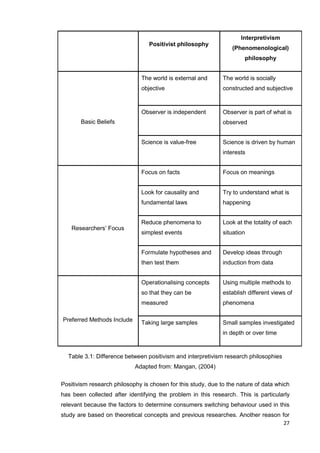
The table 3.1 shows the differences between positivism and interpretivism
(phenomenological) research philosophy.
27
Positivist philosophy
Interpretivism
(Phenomenological)
philosophy
Basic Beliefs
The world is external and
objective
The world is socially
constructed and subjective
Observer is independent Observer is part of what is
observed
Science is value-free Science is driven by human
interests
Researchers’ Focus
Focus on facts Focus on meanings
Look for causality and
fundamental laws
Try to understand what is
happening
Reduce phenomena to
simplest events
Look at the totality of each
situation
Formulate hypotheses and
then test them
Develop ideas through
induction from data
Preferred Methods Include
Operationalising concepts
so that they can be
measured
Using multiple methods to
establish different views of
phenomena
Taking large samples Small samples investigated
in depth or over time
Table 3.1: Difference between positivism and interpretivism research philosophies
Adapted from: Mangan, (2004)
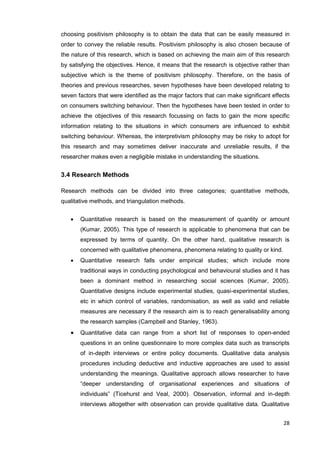
Positivism research philosophy is chosen for this study, due to the nature of data which
has been collected after identifying the problem in this research. This is particularly
relevant because the factors to determine consumers switching behaviour used in this
study are based on theoretical concepts and previous researches. Another reason for
28
choosing positivism philosophy is to obtain the data that can be easily measured in
order to convey the reliable results. Positivism philosophy is also chosen because of
the nature of this research, which is based on achieving the main aim of this research
by satisfying the objectives. Hence, it means that the research is objective rather than
subjective which is the theme of positivism philosophy. Therefore, on the basis of
theories and previous researches, seven hypotheses have been developed relating to
seven factors that were identified as the major factors that can make significant effects
on consumers switching behaviour. Then the hypotheses have been tested in order to
achieve the objectives of this research focussing on facts to gain the more specific
information relating to the situations in which consumers are influenced to exhibit
switching behaviour. Whereas, the interpretivism philosophy may be risky to adopt for
this research and may sometimes deliver inaccurate and unreliable results, if the
researcher makes even a negligible mistake in understanding the situations.
3.4 Research Methods
Research methods can be divided into three categories; quantitative methods,
qualitative methods, and triangulation methods.
 Quantitative research is based on the measurement of quantity or amount
(Kumar, 2005). This type of research is applicable to phenomena that can be
expressed by terms of quantity. On the other hand, qualitative research is
concerned with qualitative phenomena, phenomena relating to quality or kind.
 Quantitative research falls under empirical studies; which include more
traditional ways in conducting psychological and behavioural studies and it has
been a dominant method in researching social sciences (Kumar, 2005).
Quantitative designs include experimental studies, quasi-experimental studies,
etc in which control of variables, randomisation, as well as valid and reliable
measures are necessary if the research aim is to reach generalisability among
the research samples (Campbell and Stanley, 1963).
 Quantitative data can range from a short list of responses to open-ended
questions in an online questionnaire to more complex data such as transcripts
of in-depth interviews or entire policy documents. Qualitative data analysis
procedures including deductive and inductive approaches are used to assist
understanding the meanings. Qualitative approach allows researcher to have
“deeper understanding of organisational experiences and situations of
individuals” (Ticehurst and Veal, 2000). Observation, informal and in-depth
interviews altogether with observation can provide qualitative data. Qualitative
29
methods make use of limits the number of observations allowing deeper
understanding of the study.
 Whereas, in triangulation method, a mixture of both qualitative and quantitative
methods is used (Cooper and Schindler, 2006). First a qualitative data is used
interviewing a sample of respondents to achieve the key questions and then
these are used to design and evaluate survey questionnaires for the second
stage. As Binsardi, (2008) states that, qualitative methods informs quantitative
analysis.
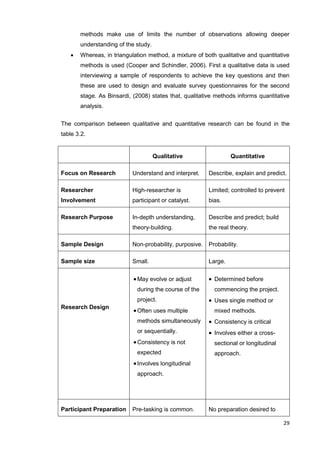
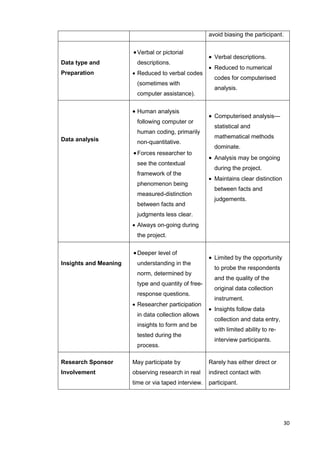
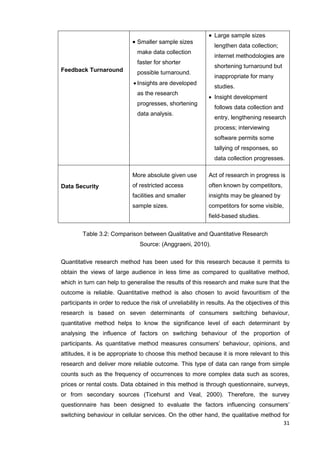
The comparison between qualitative and quantitative research can be found in the
table 3.2.
Qualitative Quantitative
Focus on Research Understand and interpret. Describe, explain and predict.
Researcher
Involvement
High-researcher is
participant or catalyst.
Limited; controlled to prevent
bias.
Research Purpose In-depth understanding,
theory-building.
Describe and predict; build
the real theory.
Sample Design Non-probability, purposive. Probability.
Sample size Small. Large.
Research Design
May evolve or adjust
during the course of the
project.
Often uses multiple
methods simultaneously
or sequentially.
Consistency is not
expected
Involves longitudinal
approach.
 Determined before
commencing the project.
 Uses single method or
mixed methods.
 Consistency is critical
 Involves either a cross-
sectional or longitudinal
approach.
Participant Preparation Pre-tasking is common. No preparation desired to
30
avoid biasing the participant.
Data type and
Preparation
Verbal or pictorial
descriptions.
 Reduced to verbal codes
(sometimes with
computer assistance).
 Verbal descriptions.
 Reduced to numerical
codes for computerised
analysis.
Data analysis
 Human analysis
following computer or
human coding, primarily
non-quantitative.
Forces researcher to
see the contextual
framework of the
phenomenon being
measured-distinction
between facts and
judgments less clear.
 Always on-going during
the project.
 Computerised analysis—
statistical and
mathematical methods
dominate.
 Analysis may be ongoing
during the project.
 Maintains clear distinction
between facts and
judgements.
Insights and Meaning
Deeper level of
understanding in the
norm, determined by
type and quantity of free-
response questions.
 Researcher participation
in data collection allows
insights to form and be
tested during the
process.
 Limited by the opportunity
to probe the respondents
and the quality of the
original data collection
instrument.
 Insights follow data
collection and data entry,
with limited ability to re-
interview participants.
Research Sponsor
Involvement
May participate by
observing research in real
time or via taped interview.
Rarely has either direct or
indirect contact with
participant.
31
Feedback Turnaround
 Smaller sample sizes
make data collection
faster for shorter
possible turnaround.
 Insights are developed
as the research
progresses, shortening
data analysis.
 Large sample sizes
lengthen data collection;
internet methodologies are
shortening turnaround but
inappropriate for many
studies.
 Insight development
follows data collection and
entry, lengthening research
process; interviewing
software permits some
tallying of responses, so
data collection progresses.
Data Security
More absolute given use
of restricted access
facilities and smaller
sample sizes.
Act of research in progress is
often known by competitors,
insights may be gleaned by
competitors for some visible,
field-based studies.
Table 3.2: Comparison between Qualitative and Quantitative Research
Source: (Anggraeni, 2010).
Quantitative research method has been used for this research because it permits to
obtain the views of large audience in less time as compared to qualitative method,
which in turn can help to generalise the results of this research and make sure that the
outcome is reliable. Quantitative method is also chosen to avoid favouritism of the
participants in order to reduce the risk of unreliability in results. As the objectives of this
research is based on seven determinants of consumers switching behaviour,
quantitative method helps to know the significance level of each determinant by
analysing the influence of factors on switching behaviour of the proportion of
participants. As quantitative method measures consumers’ behaviour, opinions, and
attitudes, it is be appropriate to choose this method because it is more relevant to this
research and deliver more reliable outcome. This type of data can range from simple
counts such as the frequency of occurrences to more complex data such as scores,
prices or rental costs. Data obtained in this method is through questionnaire, surveys,
or from secondary sources (Ticehurst and Veal, 2000). Therefore, the survey
questionnaire has been designed to evaluate the factors influencing consumers’
switching behaviour in cellular services. On the other hand, the qualitative method for
32
this research may incur biasing of participants and may not provide the appropriate
information on significance level of each determinant or factor that influence consumer
switching behaviour because the number of participants will be less as compared to
quantitative method.
3.5 Sampling
According to Denscombe (2003), there are two kinds of sampling techniques that can
be used by researchers. The first is known as ‘probability’ sampling and the second is
known as ‘non-probability’ sampling.
 Probability sampling is based on the idea that people or events that are chosen
as the sample are chosen because the researcher has some notion of the
probability that these will be the representative cross-section of people or
events in the whole population being studied (Denscombe, 2003). Probability
sampling is the most utilised sampling method for social research purpose
(Babbie, 2008). Probability sampling can be divided into different types which
include simple random sampling, interval or systematic sampling, stratified
sampling, cluster or multi-stage sampling (Bless, et al., 2006).
 Non-probability sampling is often conducted in social research where the
situations do not permit probability samples used in large scale basis (Babbie,
2008). Non-probability sampling includes accidental or availability sampling,
purposive or judgemental sampling, and quota sampling (Bless, et al., 2006).
This type of sampling can also be used where no probability sampling method
is appropriate. Non-probability sampling can be further divided into purposive
sampling, snowball sampling, and quota sampling.
The objectives of this research are to explore the factors that influence consumers
switching behaviour of young adults in regards to cellular service providers. Therefore,
in order to achieve these objectives specifically, the mobile phone users in Bangalore
who are aged between 18 to 35 years are to be chosen, so the appropriate method for
sampling is ‘simple random sampling’. It helps to obtain the opinions of respondents
with different characteristics and can also help to add some extent of generalisability in
the results. This method is also used for this research, for the purpose of providing the
greater flexibility in collecting the primary data. Sample has been collected by sending
questionnaires electronically to respondents via e-mail and the purpose of this research
has also been explained to the respondents, so that they can feel free and secure to
participate and respond genuinely to the questions that has been asked to them for the
purpose of evaluating the influence of factors on switching behaviour. This will add
33
more reliability to results of this research. The questionnaires were emailed to 100
respondents in Bangalore but out of 80, only 60 of them responded. Hence, 60
questionnaires are used for the analysis.
3.6 Data Collection
There are mainly two types of data: primary data and secondary data. The primary data
can be collected through various methods like personal interviews, questionnaires and
direct observations etc. Thus, researchers may obtain the original data from the
respondents. Furthermore, the primary data can provide the current and realistic views
about the research questions. The secondary data is mainly gathered from internal
company information, government agents, books, journals and trade associations. This
type of data is easily available and accessible. In addition to that, secondary data can
aid primary data collection and make the results more specific and reliable.
Both primary data and secondary data are used for this study. Primary data will be
collected using questionnaire which is distributed electronically to respondents via
internet in Bangalore, India. The respondents are mobile phone users, with age ranging
from 18-35 years old. As Garbarino and Johnson (1999) asserted, customers’
evaluation of a supplier’s or service provider’s offerings would shape their behaviours.
Hence, this questionnaire aims to assess the most prominent perception with regards
to relationship; commitment towards the service providers (Moorman et al, 1992).
Satisfaction and payment equity are important factors in affecting customer’s
evaluation towards the service provider’s offering and hence should be included
(Bolton and Lemon, 1999).
Questionnaires method is chosen for this research because it has advantages over
other methods of data collection. Although the advantages can vary according to the
methods with which they are being compared, the primary advantages of using
questionnaire as data collection method are efficiency, large sample size, cheap costs,
assured confidentiality, sampling of many topics, and having a permanent original copy
of the responses (Downs and Adrian, 2004).
Questionnaire is one of the most popular used research techniques in social research.
The main part in questionnaire is question. First type is open questions, which ‘leave
the respondent to decide the wording of the answer, the length of the answer and the
kind of matters to be raised in the answer’ (Denscombe, 2004:155). Another type is
close question, which needs respondent to select answers from a range of options
designed on the questionnaire. This question may generate a number of quantitative
34
data. Thus, researchers should know well about what kind of quantitative data will be
collected and what statistic procedures will be adopted in order to avoid generating
pool analysis. Figure 3.1 shows the different types of questionnaire based on how they
are administered
Figure 3.1: Types of Questionnaire
Source: (Saunders, et al., 2009)
Types of questionnaire are also classified basing on the structure of the questions
asked. Normally, they are divided into several classifications; such as free-response
questions, dichotomous questions, multiple-choice questions (Cooper and Schindler,
2006). Dichotomous questions are questions which divide the respondents into two or
more groups according to the attributes, such as male and female, different age
groups, education group, and others. Multiple choice questions would allow the
respondents to have more choices and select the one that fits within a possible frame
of answers. These answers are usually designed by the researcher by using scoring
method such as 1 to 5 or giving options, etc. Open-ended questions are meant to
gather unstructured responses from the respondents.
The type of questionnaire used in this research was self administered questionnaire.
This was that type of questionnaire where there was no guidance to the respondents
by the researcher (Saunders et al., 2007). The questionnaire has closed ended
questions and for the main research questions, 5-point likert scale has been used. It is
frequently used variation of the summated rating scale which consists of statements
that express either a favourable or unfavourable attitude towards the object of interest
(Cooper and Schindler, 2006). The scale presents a set of statements where
respondents are asked to express their level of agreement or disagreement on five-
35
point scale. Each degree of agreement or disagreement was provided 5 options
ranging from strongly disagree to strongly agree.
The questions has been designed on the basis of the literature to assess the major
factors influencing switching behaviour and are divided into 23 questions in total and
the questionnaire has been divided into two sections.
Section 1 has 4 questions which deal with the behavioural and demographic
characteristics of the respondents. The questions are on the gender, age group,
educational level, and occupation of the respondents.
Section 2 has 19 questions which include one general question on switching behaviour
and eighteen questions on that were classified on the basis of seven factors that were
identified as the major factors in influencing consumer switching behaviour in cellular
services. The seven factors on which questions are divided include service quality,
price, switching costs, change in technology, advertising, social influence, and
involuntary switching.
Secondary data was also used to achieve the objectives of this research and it has
been collected from various textbooks and journals related to marketing, customer
relationship management, and customer behaviours, as well as previous relevant
researches.
3.7 Data Analysis
This study have utilised Microsoft word to design the questionnaire and SPSS 19 to
analysis the primary data. Microsoft word is first used to design the questionnaire, and
then SPSS 19 to generate tables and diagrams from the findings. The data from the
respondents has been coded under several categories such as ‘price’, ‘service quality’,
‘switching costs’ etc. Furthermore, the findings will be statistically analysed to draw a
conclusion using SPSS 19. Firstly, the descriptive statistics has been used to describe
the basic features of the data in a study and to provide simple summaries about the
sample and the measures and also to provide quantitative analysis of collected data.
Then, regression analysis and correlation analysis has been used to investigate the
statistical significance and relationships between the variables (independent and
dependent variables) that were designed to test the hypotheses and to achieve the
objectives of the research which is to evaluate the factors influencing consumers
switching behaviour in cellular services..
36
3.8 Limitations
It is accepted that the focus on mobile phone services users in Bangalore, India would
impose limitations on this research’s ability to arrive at conclusive findings in relation to
the switching behaviours of mobile phone users in general. Given the time available to
finish this study and the geographical as well as funding limitations, biases may occur
in the favour of generalising the research findings.
In order to counter the limitations with regards to the focus of this study, the
respondents were asked in details when they fill up the questionnaire. The variables
used in this research are service good variables (service by mobile phone service
providers). This can bring limitations to the study as it is possible that different type of
services has many different ways in retaining customers and customers of different
type of services will possess different customer behaviours.
Due to the time constraint and access availability, the sample size of this study is also
limited. Having more respondents for the primary data would increase the validity and
reliability of the findings. In terms of data, it is acknowledged that both qualitative and
quantitative data have their own strengths and weaknesses.
3.9 Chapter summary
The research methods that have greater relevance to the topic of this study has been
highlighted and discussed in order to achieve the objectives more evidently. In this
chapter, the theoretical concepts and studies of known researchers such as Saunders
(2007), Descombe (2003, 2004), Bolton and Lemon (1999), etc has been considered
which has relevance with this research. It can help to select appropriate research
method for this research and gain more reliability. The main focus of this chapter was
aimed to provide the clear idea about the methods adopted in this research by
illuminating the reasons for adopting the respective methods. The discussion on
appropriate research methods has been made for the purpose of gaining the valuable
insight for the chosen methods in order to achieve the objectives of this research. It
includes the discussion on research philosophy, research methods, sampling, data
collection, data analysis and limitations of this research. Furthermore, the next chapter
will discuss key findings identified from the data collected and then analysed using
statistical tests. Primary data in this study will be collected by the means of
questionnaires, which are expected to be 60.
37
4. FINDINGS AND ANALYSIS
4.1 Introduction
After collecting information from the data i.e. primary and the secondary data, the
next step is to analyse the data. In this chapter, firstly the findings from the collected
will be drawn and explained in terms of tables and graphs representing frequency
and percentage of respondents by using SPSS for the purpose of bringing the ease
in representation. Then the analysis of the collected data will be done by using
descriptive statistics, regression analysis and correlation analysis. Then the
Hypotheses testing and discussion has been given. The results will highlight, if there
is any effects of service quality, price, switching costs, change in technology,
advertising, social influence, and involuntary switching, with consumers switching
behaviour. The subsequent results gained from this research will be used to underpin
the research questions in order to achieve the objectives of this research.
The total number of questionnaires sent out to mobile phone users in Bangalore city
was 100 and only 60 has been received completely which can be interpreted. This
indicates that the response rate is only 60 percent. If response rate is taken into
consideration, high response rate points to the importance of what a researcher is
doing (Gillham, 2000).
4.2 Findings of the data
The findings of the data collected have been divided into two sections. The first section
is related to the demographics of the respondents. The second section is related to the
respondents’ opinion about the factors which have/can influence their decision to
switch the cellular service provider.
38
4.2.1 Section 1
4.2.1.1 Demographics
As according to Block & Roering (1976), demographic characteristics have been
regarded as a basis for understanding customer characteristics and behaviour in the
marketing area. Therefore, the following questions on demographics of respondents
have been designed in order to understand the role of particular demographics in
switching behaviour and to satisfy the aim of this research.
4.2.1.1.1 Gender
This question was about the gender of the respondents. The table 4.1 and the graph
below show the finding of this question.
What is your gender?
Frequency Percent
Valid
Percent Cumulative Percent
Male 46 76.7 76.7 76.7
Female 14 23.3 23.3 100.0
Total 60 100.0 100.0
Table 4.1: Gender
Chart 4.1: Gender
Noel (2009) indicates that, consumers with different gender exhibit different behaviour
in the same situation and they also have different spending powers. For example, 25%
of women in United States are earning more than others and can spend more. Hence,
76.70%
23.30%
0.00%
20.00%
40.00%
60.00%
80.00%
100.00%
Male Female
Gender
39
it becomes important to understand the forces that influence switching behaviour of
both genders i.e. male and female. The findings of this question on gender shows that,
46 respondents were male which makes 76.7% and 14 respondents were female
making 23.3% of the total respondents.
4.2.1.1.2 Age group
The second question in the questionnaire was to know the age group of respondents.
The table 4.2 and chart 4.2 below shows the findings of this question.
Table 4.2: Age group
Chart 4.2: Age group
Age group is plays a very important role in determining the consumers switching
behaviour. The consumers with different age groups have different needs and interests
and also different buying powers (Noel, 2009). The young consumers are more
frequent mobile phone users than elderly people and they also frequently switch their
cellular service providers because they are always willing to experiment new services
38.30%
33.30%
28.30%
0.00%
5.00%
10.00%
15.00%
20.00%
25.00%
30.00%
35.00%
40.00%
45.00%
18-24 Years 25-29 Years 30-35 Years
Age group
What is your age group?
Frequency Percent
Valid
Percent
Cumulative
Percent
18-24 Years 23 38.3 38.3 38.3
25-29 Years 20 33.3 33.3 71.7
30-35 Years 17 28.3 28.3 100.0
Total 60 100.0 100.0
40
(Ericson, 2004). Hence, the forces that influence young consumers are needed to be
understood as the objective of this research is evaluate the factors influencing young
adults to switch cellular service providers. The findings of this question on age group
shows that, it was found that majority of respondents belong to the age group of 18-24
years i.e. 23 respondents which make 38.30% of the total respondents. Whereas the
respondents with the age group of 25-29 were 20 making 33.30% of the total
respondents. And the respondents with the age group of 30-35 were 17 making
28.30% of the whole sample size.
4.2.1.1.3 Occupation
The third question in the questionnaire was to enquire about the occupation of the
respondents. The table 4.3 and chart 4.3 shows the findings of this question.
What is your occupation?
Frequency Percent Valid Percent
Cumulative
Percent
Student 22 36.7 36.7 36.7
Professional 18 30.0 30.0 66.7
Self-employed 6 10.0 10.0 76.7
Labourer 10 16.7 16.7 93.3
Unemployed 4 6.7 6.7 100.0
Total 60 100.0 100.0
Table 4.3: Occupation
Chart 4.3: Occupation
36.70%
30.00%
10.00%
16.70%
6.70%
0.00%
5.00%
10.00%
15.00%
20.00%
25.00%
30.00%
35.00%
40.00%
Occupation
41
The consumers with different occupation have different level of income and so as the
spending powers and they make their buying decisions on the basis of their status
(Noel, 2009). Hence, this question has been designed to understand the behaviour
consumers with different occupations in order to enquire which factors influence them
to switch cellular service providers. The findings of this question shows that, the
respondents participated in this research were from different occupational
backgrounds. It has been found that majority of respondents were students 22
respondents which makes 36.70% of the total respondents. Whereas, 18 respondents
were professionals and 10 were labourers making 30% and 16.70% respectively.
Remaining 6 were self-employed and 4 were unemployed, making 10% and 6.70% of
the total respondents.
4.2.1.1.4 Educational level
The fourth question in the questionnaire was to enquire the educational level of the
respondents. The table 4.4 and 4.4 shows findings of this question.
What is the highest level of education level of education you have
achieved?
Frequency Percent
Valid
Percent
Cumulative
Percent
Primary education 6 10.0 10.0 10.0
High school education 11 18.3 18.3 28.3
Diploma/certification 10 16.7 16.7 45.0
Bachelor degree 13 21.7 21.7 66.7
Post-graduate degree 20 33.3 33.3 100.0
Total 60 100.0 100.0
Table 4.4: Educational level
42
Chart 4.4: Educational level
Consumers with different educational levels perceive services differently and also have
different level of information and knowledge about the products and services due to the
trend in schools, colleges, universities, etc ( Noel, 2009). Different factors influence the
decision of consumers with different educational level to switch cellular service provider
and therefore, this question is designed to understand those factors. The findings of
this question shows that, the respondents have achieved different educational levels
i.e. 20 respondents were post-graduates making 33.30% of the total respondents and
13 were bachelor degree holders making 21.70% of the total. Whereas, 11
respondents has achieved high school education which makes 18.30% and 10 and 6
has achieved diploma/certification and primary education making 16.70% and 10% of
the total sample respectively.
10%
18.30% 16.70%
21.70%
33.30%
0%
5%
10%
15%
20%
25%
30%
35%
Educational Level
43
4.2.2 Section 2
4.2.2.1 Likeliness of switching service provider
The fifth question in the questionnaire was to find out the likeliness of consumers to
switch from current cellular service provider to another. This question helps to enquire
what percentage of respondents are likely to switch their cellular service provider and
the reasons for switching which has been asked in the following question in order to
satisfy the aim and objectives of this research. The finding of this question is shown in
the table 4.5 and chart 4.5.
Are you likely to switch from current cellular service provider to
another?
Frequency Percent
Valid
Percent Cumulative Percent
Very Unlikely
Unlikely
Neutral
Likely
Very Likely
11
12
5
19
13
18.3
20
8.3
31.7
21.7
18.3
20
8.3
31.7
21.7
18.3
38.3
46.7
78.3
100.0
Total 60 100.0 100.0
Table 4.5: Likeliness of switching service provider
Chart 4.5: Likeliness of switching service provider.
18.30%
20%
8.30%
31.70%
21.70%
0.00%
5.00%
10.00%
15.00%
20.00%
25.00%
30.00%
35.00%
Very
Unlikely
Unlikely Neutral Likely Very Likely
Likeliness of switching service provider
44
The findings of this question shows that, 19 respondents are likely to switch which
makes 31.70% and 13 are very likely which makes 21.70% of the total respondents.
Whereas, 12 respondents are unlikely and 11 are very unlikely making 20% and
18.30% respectively and remaining 5 respondents are neutral, which makes 8.30% of
the total respondents. This question was aimed at understanding the rate of
respondents likely to switch their cellular services providers and the situations which is
influencing them to switch. Understanding the situations and factors can helps to
cellular service providers to reduce the likely of consumers who are willing to switch
and to attract consumer of competitors who are about to switch. This question was also
aimed at satisfying the third objective of this research which is to investigate the
likeliness of respondents to switch from current cellular service provider to another.
However, the measures as to how the cellular service providers can prevent or reduce
the rate of likeliness of the switching has been tested and discussed in the analysis
part of this chapter.
45
4.2.2.2 Service quality
It was indicated that, improving service quality satisfies customers and retains their
loyalty and the customers with negative service experience may consider switching
their service providers (Lee and Murphy, 2005). Therefore, in order to determine the
effect of service quality on consumers’ switching behaviour, following questions relating
to service quality has been designed to address the research objectives.
4.2.2.2.1 (SQ1): Customer service
The sixth question was to find out the level of customer service provided by the current
cellular service provider to respondents. The finding of this question is shown in the
table 4.6 and chart 4.6.
The level of customer service provided by the current cellular service
provider is good.
Frequency Percent
Valid
Percent
Cumulative
Percent
Strongly disagree 13 21.7 21.7 21.7
Disagree 30 50.0 50.0 71.7
Neutral 4 6.7 6.7 78.3
Agree 10 16.7 16.7 95.0
Strongly agree 3 5.0 5.0 100.0
Total 60 100.0 100.0
Table 4.6: Level of customer service
Chart 4.6: Level of customer service
21.70%
50%
6.70%
16.70%
5%
0.00%
10.00%
20.00%
30.00%
40.00%
50.00%
60.00%
Strngly
disagree
Disagree Neutral Agree Strongly agree
Level of customer service
46
The importance of customer service cannot be underestimated. It requires constant
effort to maintain good relations with the customers of the company. It is a critical
element in all growth and retention strategies (Gershon, 2009). Therefore, this question
helps to understand the impact of customer service on switching behaviour. The
findings of this question shows that, from the whole sample size, 30 respondents i.e.
50% disagree with the statement and 13 respondents strongly disagree which makes
21.70% of the total respondents. Whereas, 10 respondents agree with the statement
and 3 respondents strongly agree making 16.70% and 5% respectively. Remaining 4
respondents are neutral with the statement which makes 6.70% of the total
respondents. It implies that majority of consumers are towards the negative side when
it comes the customer service provided by their cellular service providers which means
that consumers service is also influencing the likeliness of consumers switching
behaviour.
4.2.2.2.2 (SQ2): Network coverage
The seventh question in the questionnaire was to enquire about the network coverage
of the current cellular service provider of the respondents. The finding of this question
is shown in the table 4.7 and chart 4.7.
The network coverage of the current cellular service provider is
good.
Frequency Percent
Valid
Percent
Cumulative
Percent
Strongly disagree 18 30.0 30.0 30.0
Disagree 13 21.7 21.7 51.7
Neutral 8 13.3 13.3 65.0
Agree 12 20.0 20.0 85.0
Strongly agree 9 15.0 15.0 100.0
Total 60 100.0 100.0
Table 4.7: network coverage
47
Chart 4.7: Network coverage
The major feature of mobile telecommunications is its coverage. Consumers evaluate
network coverage of the cellular service providers differently according to the utility
they drive from completed calls (Madden, 2003). The impact of network coverage on
consumers switching behaviour can be evaluated through this question. The findings of
this question shows that, 18 respondents strongly disagree to the above statement
about network coverage which makes 30% of the total respondents and 13
respondents disagree making 21.70% of the total sample. And 12 respondents agree
and 9 respondents strongly agree with the statement which makes 21% and 15% of the
total respondents respectively. The remaining 8 respondents are neutral with the
statement making 13.30% of the total respondents. The finding of the above question
relating to network coverage of the cellular service provider is based on achieving the
objectives of this research. This implies that most of the respondents expressed
negative opinion when it comes to network coverage and therefore may be likely to
switch their cellular service provider.
30.00%
21.70%
13.30%
20%
15.00%
0.00%
5.00%
10.00%
15.00%
20.00%
25.00%
30.00%
35.00%
Strongly
disagree
Disagree Neutral Agree Strongly agree
Network coverage
48
4.2.2.2.3 (SQ3): Network problems
The eighth question in the questionnaire was to enquire about the network problems
with the current cellular service provider. The finding of this question is given in the
table 4.8 and chart 4.8.
There are frequent network problems with the services of the current
cellular service provider.
Frequency Percent
Valid
Percent
Cumulative
Percent
Strongly disagree 8 13.3 13.3 13.3
Disagree 15 25.0 25.0 38.3
Neutral 5 8.3 8.3 46.7
Agree 20 33.3 33.3 80.0
Strongly agree 12 20.0 20.0 100.0
Total 60 100.0 100.0
Table 4.8: Network problems
Chart 4.8: Network problems
Frequent network problems refer to weak connectivity and frequent disconnections in
the services provided by cellular service providers (Avresky and Diaz, 2009). This
question helps to evaluate the effect of network problems on switching behaviour of
consumers. The findings of this question shows that, 20 respondents agree and 12
respondents strongly agree to the above statement about network problems which
makes 33.3% and 20% of the total respondents, whereas, 15 respondents disagree
and 8 respondents strongly disagree to the statement making 25% and 13.30% of the
13.30%
25%
8.30%
33.30%
20%
0.00%
5.00%
10.00%
15.00%
20.00%
25.00%
30.00%
35.00%
Strongly
disagree
Disagree Neutral Agree Strongly agree
Network problems
49
total respondents respectively. Remaining 5 respondents are neutral to this statement
about network problems making 8.30% of the total respondents. It implies that the
majority of respondents have experienced frequent network problems and therefore
this might be one of the factors which is influencing likeliness of respondents to switch
their cellular service provider.
4.2.2.2.4 (SQ4): Call quality
The ninth question was to enquire about the call quality of the current cellular service
provider of the respondents. The finding of this question is given in the table 4.9 and
chart 4.9.
The call quality provided by the current cellular service provider is
good.
Frequency Percent
Valid
Percent
Cumulative
Percent
Strongly disagree 14 23.3 23.3 23.3
Disagree 17 28.3 28.3 51.7
Neutral 4 6.7 6.7 58.3
Agree 11 18.3 18.3 76.7
Strongly disagree 4 6.7 6.7 100.0
Total 60 100.0 100.0
Table 4.9: Call quality
Chart 4.9: Call quality
The cellular service providers should pay greater attention on call quality because it
is the one of the major factors driving customer satisfaction (Irizzary, 2007).
23.30%
28.30%
6.70%
18.30%
6.70%
0.00%
5.00%
10.00%
15.00%
20.00%
25.00%
30.00%
Strongly
disagree
Disagree Neutral Agree Stongly agree
Call quality
50
Therefore, in order to determine the impact of call quality on consumer switching
behaviour, this question has been designed. The findings of this question show that,
17 respondents disagree with the above statement about call quality which makes
28% of the total respondents and 14 respondents strongly disagree. And, 11
respondents agree and 4 respondents strongly agree with the statement making
18.30% and 6.70% of the total respondents. Remaining 4 respondents are neutral to
the statement making 6.70% of the total respondents. This implies that, as the
cellular service providers are not providing good call quality and hence majority of
respondents are dissatisfied and also are likely to switch.
4.2.2.2.5 (SQ5): Billing error
The tenth question was to enquire about the billing errors from the side of the current
cellular service provider of the respondents. The finding of this question is given in the
table 4.10 and chart 4.10.
There is/was error/s in billing from the side of current cellular
service provider.
Frequency Percent
Valid
Percent
Cumulative
Percent
Strongly disagree 8 13.3 13.3 13.3
Disagree 16 26.7 26.7 40.0
Neutral 9 15.0 15.0 63.3
Agree 15 25.0 25.0 88.3
Strongly agree 12 20.0 20.0 100.0
Total 60 100.0 100.0
Table 4.10: Error in billing
Chart 4.10: Error in billing
13%
26.70%
15%
25%
20.00%
0%
5%
10%
15%
20%
25%
30%
Strongly
disagree
Disagree Neutral Agree Strongly agree
Error/s in billing
51
Errors in billing refer to multiple charges for SMS, value added services, and others,
which will cause financial distress to the consumers and force them to switch their
cellular service provider (Ezenezi, 2011). This question has been designed to evaluate
the effect of billing errors on switching behaviour. The findings of this question shows
that, 15 respondents agree with the above statement about errors in billing which
makes 26.70% of the total respondents and 12 respondents strongly agree that there
is/was error/s from the side of their current cellular service provider making 20% of the
total respondents, whereas 16 respondents disagree and 8 respondents strongly
disagree to the statement making 26.70% and 13% of the total respondents
respectively. Remaining 9 respondents were neutral with the above statement making
15% of the total respondents. It implies that the respondents also have the billing
problems which may be causing due the ignorance or improper services of the current
cellular service providers of the dissatisfied respondents which can be reason for
likeliness of switching.
52
4.2.2.3 Price
As according to Keaveney (1995), more than half of the customers switched because
of the poor price perceptions and suggested that unfavourable price perceptions
directly influence customers’ intentions to switch. Price includes call rates, service
charges, etc (Keaveney, 1995). Therefore, following questions relating to price will help
to study the impact of price factor in influencing the consumer switching behaviour in
cellular services in order to achieve the objectives of this research.
4.2.2.3.1 (P1): Tariffs
The eleventh question was to enquire about the tariffs offered by the current cellular
service provider of the respondents. The finding of this question has been shown in the
table 4.11 and graph 4.11.
The current cellular service provider offers suitable tariffs for different
age groups.
Frequency Percent
Valid
Percent
Cumulative
Percent
Strongly Disagree 9 15.0 15.0 15.0
Disagree 16 26.7 26.7 41.7
Neutral 4 6.7 6.7 48.3
Agree 19 31.7 31.7 30.0
Strongly Agree 12 20.0 20.0 100.0
Total 60 100.0 100.0
Table 4.11: Tariffs
Chart 4.11: Tariffs
15%
26.70%
6.70%
31.70%
20%
0%
5%
10%
15%
20%
25%
30%
35%
Strongly
disagree
Disagree Neutral Agree Strongly agree
Tariffs
53
The findings of this question shows that, 19 respondents agree and 12 respondents
strongly agree to the statement that their current cellular service provider offers suitable
tariffs for different age groups which makes 31.70% and 20% of the total respondents
respectively and whereas, the 16 respondents and 9 respondents disagree and
strongly disagree with the statement which makes 26% and 15% of the total
respondents. Remaining 4 respondents are neutral with the statement making 6.70% of
the total respondents. It implies that majority of the respondent have expressed their
opinion positively for this question. However, on the other hand some of the
respondents expressed their opinion negatively and it may the reason which can lead
to their switching behaviour.
4.2.2.3.2 (P2): Call rates
The twelfth question in the questionnaire was to enquire about the call rates of the
current cellular service provider of respondents. The finding of this question has shown
in the table 4.12 and chart 4.12.
The call rates offered by the current cellular service provider are
high.
Frequency Percent
Valid
Percent
Cumulative
Percent
Strongly Disagree 8 13.3 13.3 13.3
Disagree 10 16.7 16.7 30.0
Neutral 4 6.7 6.7 36.7
Agree 22 36.7 36.7 73.3
Strongly Agree 16 26.7 26.7 100.0
Total 60 100.0 100.0
Table 4.12: Call rates
54
Chart 4.12: Call rates
Call rates are the charges incurred to make calls. This question helps to evaluate the
effect of call rates on switching behaviour. The findings of this question shows that, 22
respondents agree and 16 respondents strongly agree to the statement that their
current cellular service provider offers high call rates which makes 36.7% and 26.7% of
the total respondents, whereas 10 respondents disagree and 8 respondents strongly
disagree with the statement, making 16.7% and 13.3% of the total respondents.
Remaining 4 respondents are neutral with the statement, making 6.7% of the total
respondents. This implies that call rates are the main reason responsible for switching
behaviour of the respondents as the majority of respondents expressed their opinion
negative relating to call rates which means that the call rates are unfavourable and
causing the likeliness of switching.
13.30%
16.70%
6.70%
36.70%
26.70%
0.00%
5.00%
10.00%
15.00%
20.00%
25.00%
30.00%
35.00%
40.00%
Strongly
disagree
Disagree Neutral Agree Strongly agree
Call rates
55
4.2.2.3.3 (P3): Value-added services
The thirteenth question in the questionnaire was to enquire about cost of value-added
services offered by the current cellular service provider of the respondents. The finding
of this question is shown in the table 4.13 and chart 4.13.
The value-added services offered by the current cellular service
provider are costly.
Frequency Percent
Valid
Percent
Cumulative
Percent
Strongly Disagree 10 16.7 16.7 16.7
Disagree 3 5.0 5.0 21.7
Neutral 14 23.3 23.3 45.0
Agree 17 28.3 28.3 73.3
Strongly Agree 16 26.7 26.7 100.0
Total 60 100.0 100.0
Table 4.13: Value-added services
Chart 4.13: Value-added services
Bohlin, et al. (2004) indicate that, value added services can become an important
driving force in increasing a customers’ positive behaviour. It has some lock-in effects
and the service providers use value added services as a differentiator in order to
compete and retain customers. This question has been designed to evaluate the effect
of value-added services on switching behaviour. The findings of this question show
that, 17 respondents agree and 16 respondents strongly agree to the statement that
the value-added services offered by the current cellular service provider of the
respondents are costly which makes 28.3% and 26.7% of the total respondents
whereas, 10 respondents strongly disagree and 3 respondents disagree making 16.7%
16.70%
5%
23.30%
28.30%
26.70%
0.00%
5.00%
10.00%
15.00%
20.00%
25.00%
30.00%
Strongly
Disagree
Disagree Neutral Agree Strongly Agree
Value added services
56
and 5% of the total respondents. Remaining 14 respondents are neutral to the
statement which makes 23.3% of the total respondents. The finding of this question
implies that the majority of the respondents think that the value added services are high
and it is also the reason responsible for switching behaviour of the respondents.
4.2.2.3.4 (P4): High service charges
The fourteenth question in the questionnaire was to enquire about the service charges
on recharges/top-ups. The finding of this question is shown in the table 4.14 and chart
4.14.
The current cellular service provider charges high service
charges on top-ups/recharges.
Frequency Percent
Valid
Percent
Cumulative
Percent
Strongly Disagree 7 11.7 11.7 11.7
Disagree 10 16.7 16.7 28.3
Neutral 12 20.0 20.0 48.3
Agree 18 30.0 30.0 78.3
Strongly Agree 13 21.7 21.7 100.0
Total 60 100.0 100.0
Table 4.14: Charges on top-ups/recharges
Chart 4.14: Charges on top-ups/recharges
The findings of this question shows that, 18 respondents agree and 13 respondents
strongly agree to the statement that their current cellular service provider charges high
11.70%
16.70%
20%
30%
21.00%
0.00%
5.00%
10.00%
15.00%
20.00%
25.00%
30.00%
35.00%
Strongly
disagree
Disagree Neutral Agree Strongly agree
Charges on recharges/top-ups
57
service charges on recharges/top-ups which makes 30% and 21.7% of the total
respondents whereas, 10 respondents disagree and 7 respondents strongly disagree
to the statement making 16.7% and 11.7% of the total respondents. Remaining 12
respondents are neutral with the statement making 20% of the total respondents. It
implies that the majority of respondents are dissatisfied with the service charges that
the cellular service providers are charging on top-ups/recharges and therefore
influenced to switch their cellular service provider.
58
4.2.2.4 Switching costs
4.2.2.4.1 (SC1): Switching time
The fifteenth question in the questionnaire was to enquire the time it will take for the
respondents to switch to new cellular service provider. The finding of this question is
shown in the table 4.15 and chart 4.15.
It will take too much time to switch to new cellular service
provider.
Frequency Percent
Valid
Percent
Cumulative
Percent
Strongly Disagree 16 26.7 26.7 26.7
Disagree 15 25.0 25.0 51.7
Neutral 6 10.0 10.0 61.7
Agree 19 6.7 31.7 93.3
Strongly Agree 4 31.7 6.7 100.0
Total 60 100.0 100.0
Table 4.15: Switching time
Chart 4.15: Switching time
The findings of this question shows that, 16 respondents strongly disagree and 15
respondents disagree with the statement that switch cellular service provider will take
lot of time making 26.7% and 25% of the total respondents respectively whereas, 19
respondents agree and 4 respondents strongly agree with the statement making 31.7%
and 6.7% of the total respondents respectively. Remaining 6 respondents are neutral
with the statement which makes 10% of the total respondents. Therefore, it implies that
the majority respondents feels that the time it will take to switch cellular service
26.70%
25%
10%
31.70%
6.70%
0.00%
5.00%
10.00%
15.00%
20.00%
25.00%
30.00%
35.00%
Strongly
disagree
Disagree Neutral Agree Strongly agree
Switching time
59
providers is less which also implies that this factor is also influencing the likeliness of
consumers switching behaviour.
4.2.2.4.2 (SC2): Switching cost
The sixteenth question was to enquire about the cost it will take for the respondents to
switch to new cellular service provider. The finding of this question is shown in the table
4.16 and chart 4.16.
It will cost lot of money to switch to new cellular service provider.
Frequency Percent
Valid
Percent
Cumulative
Percent
Strongly Disagree 20 33.3 33.3 33.3
Disagree 17 28.3 28.3 61.7
Neutral 6 10.0 10.0 71.7
Agree 5 8.3 8.3 80.0
Strongly Agree 12 20.0 20.0 100.0
Total 60 100.0 100.0
Table 4.16: Switching costs
Chart 4.16: Switching cost
The findings of this question shows that, 20 respondents strongly disagree and 17
respondents disagree with statement that it will cost lot of money to switch to new
cellular service provider which makes 38.3% and 28.3% of the total respondents
respectively whereas, 12 respondents strongly agree and 5 respondents agree with the
statement making 20% and 8.3% of the total respondents respectively. Remaining 6
respondents are neutral with the statement making 10% of the total respondents. It
implies that, the majority of respondents do not think it will cost more money to switch
their cellular service provider. Therefore, the cost in terms of money is also influencing
33.30%
28.30%
10% 8.30%
20%
0.00%
5.00%
10.00%
15.00%
20.00%
25.00%
30.00%
35.00%
Strongly
Disagree
Disagree Neutral Agree Strongly Agree
Switching cost
60
the consumers to switch service providers, because they can switching their cellular
service providers without worrying about cost, as it is very low and affordable.
4.2.2.5 Change in technology
4.2.2.5.1 (CIT1): Service upgrade
The seventeenth question was to enquire about the upgrades or advancements in the
services of the current cellular service provider to the respondents. The finding of this
question is shown in the table 4.17 and chart 4.17.
The current cellular service provider continuously upgrade it services
according to trend. (Eg. 3G mobile service)
Frequency Percent Valid Percent Cumulative Percent
Strongly Disagree 9 15.0 15.0 15.0
Disagree 13 21.7 21.7 36.7
Neutral 7 11.7 11.7 48.3
Agree 17 28.3 28.3 76.7
Strongly Agree 14 23.3 23.3 100.0
Total 60 100.0 100.0
Table 4.17: Service upgrade
Chart 4.17: Service upgrade
The findings of this question shows that, 17 respondents agree and 14 respondents
strongly agree with statement that their current cellular service provider continuously
upgrade its services according to the trend which makes 28.3% and 23.3% of the total
respondents whereas, 13 respondents disagree and 9 respondents strongly disagree
with the statement making 21.7% and 15% of the total respondents. Remaining 7
respondents are neutral with the statement making 11.7% of the total respondents. It
15%
21.70%
11.70%
28.30%
23.30%
0%
5%
10%
15%
20%
25%
30%
Strongly
Disagree
Disagree Neutral Agree Strongly Agree
Service upgrade
61
implies that, majority of respondents feel that their cellular service providers upgrade it
services whereas, some of the respondents do not feel so and are influenced to switch
their cellular service providers. Hence, it can be said that failure to upgrade services is
also influencing switching behaviour as sindhu (2005) indicates that providing new
service will retain and gain consumer loyalty.
4.2.2.5.2 (CIT2): New devices with services
The eighteenth question was to enquire that whether or not the current cellular service
provider of the respondents offers advanced technology devices with their services.
The finding of this question is shown in the table 4.18 and chart 4.18.
The current cellular service provider offers new technology and trendy
phones with its services enabling the consumers to use wide range of
applications on the phone through the services of cellular service
provider. (Eg. use of skype on iPhone4)
Frequency Percent
Valid
Percent Cumulative Percent
Strongly Disagree 20 33.3 33.3 33.3
Disagree 18 30.0 30.0 63.3
Neutral 5 8.3 8.3 71.7
Agree 10 16.7 16.7 88.3
Strongly Agree 7 11.7 11.7 100.0
Total 60 100.0 100.0
Table 4.18: New devices with services
Chart 4.18: New devices with services
33.30%
30%
8.30%
16.70%
11.70%
0.00%
5.00%
10.00%
15.00%
20.00%
25.00%
30.00%
35.00%
Strongly
Disagree
Disagree Neutral Agree StronglY Agree
New devices with services
62
The findings of this question shows that, 20 respondents strongly disagree and 18
respondents disagree with the above statement of new devices with services which
makes 33.3% and 30% of the total respondents whereas, 10 respondents agree and 7
respondents strongly agree with the statement making 16.7% and 11.7% of the total
respondents. Remaining 5 respondents are neutral with the statement making 8.3% of
the total respondents. It implies that, majority of respondents’ think that their cellular
service provider offers latest cellular devices and hence it may be the reason by which
the respondents are likely to switch their cellular service providers, as Sindhu (2005)
indicates that, cellular service providers who do not offer latest equipments with its
services are likely to lose its consumers and also the market share.
63
4.2.2.6 Advertising
4.2.6.1 (A1): Advertisements
The nineteenth question was to enquire that whether or not the advertisements are
encouraging the respondents to switch their current cellular service provider. The
finding of this question is shown in the table 4.19 and chart 4.19.
The advertisements of the competitors are encouraging me to switch from
current cellular service provider.
Frequency Percent Valid Percent Cumulative Percent
Strongly Disagree 11 18.3 18.3 18.3
Disagree 11 18.3 18.3 36.7
Neutral 3 5.0 5.0 41.7
Agree 24 40.0 40.0 81.7
Strongly Agree 11 18.3 18.3 100.0
Total 60 100.0 100.0
Table 4.19: Advertisements
Chart 4.19: Advertisements
Advertisements tries to influence consumers purchase decisions and also intended to
switch loyalties of consumers of the competitors’ (Zou and Fu, 2011). This question
helps to evaluate the effect of advertisements on switching behaviour of respondents.
The findings of this question shows that, 24 respondents agree and 11 respondents
strongly agree with the statement that advertisements of the competitors are
encouraging them to switch current cellular service provider, which makes 40% and
18.3% of the total respondents whereas, 11 respondents disagree and 11 respondents
18.30% 18.30%
5%
40%
18.30%
0.00%
5.00%
10.00%
15.00%
20.00%
25.00%
30.00%
35.00%
40.00%
45.00%
Strongly
Disagree
Disagree Neutral Agree Strongly Agree
Advertisments
64
strongly disagree with the statement making 18.3% and 18.3% respectively. Remaining
3 respondents are neutral with the statement making 5% of the total respondents. It
implies that, most of the respondents feel that the competitors advertising of cellular
services is influencing the likeliness of consumers to switch from current cellular
service provider.
4.2.2.6.2 (A2): Brand ambassadors
The twentieth question was to enquire whether or not the brand ambassadors are
influencing them to switch current cellular service provider. The finding of this question
is shown in the table 4.20 and chart 4.20.
The brand ambassadors of the competitor are influencing to
switch current cellular service provider.
Frequency Percent
Valid
Percent
Cumulative
Percent
Strongly Disagree 18 30.0 30.0 30.0
Disagree 7 11.7 11.7 41.7
Neutral 16 26.7 26.7 68.3
Agree 11 18.3 18.3 86.7
Strongly Agree 8 13.3 13.3 100.0
Total 60 100.0 100.0
Table 4.20: Brand ambassadors
Chart 4.20: Brand ambassadors
Companies invest in brand ambassadors for spreading positive message of the brand
or company to stimulate the behaviour of competitors’ consumers (Yeshwin, 2006).
This question helps to evaluate the effect of effect of brand ambassadors on switching
30%
11.70%
26.70%
18.30%
13.30%
0%
5%
10%
15%
20%
25%
30%
35%
Strongly
Disagree
Disagree Neutral Agree Strongly Agree
Brand ambassadors
65
behaviour of respondents. The findings of this question show that, 18 respondents
strongly disagree and 7 respondents disagree to the statement that the brand
ambassadors of the competitors are influencing them to switch current cellular service
provider, which makes 30% and 11.70% of the total respondents whereas, 11
respondents agree and 8 percent respondents strongly agree with the statement
making 18.3% and 13.3% of the total respondents respectively. Remaining 16
respondents are neutral with the statement making 26.7% of the respondents. It implies
that the brand ambassadors are also influencing the likeliness of respondents to switch
cellular service provider, as some of the brand ambassadors of competitors may be the
idols of some of the respondents and hence they are influenced to switch. However,
majority of respondents expressed negative opinion that brand ambassadors do not
influence them to switch.
66
4.2.3.7 Social influence
4.2.2.7.1 (SI): Social groups
The twenty first question was to enquire the influence of the respondents’ family and
friends to switch current cellular service provider. The finding of this question is shown
in the table 4.21 and chart 4.21.
My family and friends are influencing me to switch current
cellular service provider.
Frequency Percent
Valid
Percent
Cumulative
Percent
Strongly Disagree 8 13.3 13.3 13.3
Disagree 12 20.0 20.0 33.3
Neutral 10 16.7 16.7 50.0
Agree 17 28.3 28.3 78.3
Strongly Agree 13 21.7 21.7 100.0
Total 60 100.0 100.0
Table 4.21: Social groups
Chart 4.21: Social groups
Dasgupta et al. (2008) indicates that, there is a relationship between social networks
and switching behaviour in mobile telecommunications and according to Wangenheim
(2005), the consumers express their disappointment or dissatisfaction in their social
group about a dropped service provider. This question helps to evaluate the effect of
social groups on switching behaviour of respondents. The findings of this question
show that, 17 respondents agree and 13 respondents strongly agree to the statement
13%
20%
16.70%
28.30%
21.70%
0%
5%
10%
15%
20%
25%
30%
Strongly
disagree
Disagree Neutral Agree Strongly agree
Social groups
67
that their family and friends are influencing them to switch current cellular service
provider, which makes 28.3% and 21.7% of the total respondents respectively
whereas, 12 respondents disagree and 8 respondents strongly disagree to the
statement making 20% and 13% of the total respondents respectively. Remaining 10
respondents are neutral with the statement making 16.7% of the total respondents.
4.2.2.8 Involuntary switching
4.2.2.8.1 (IS1): Geographic location
The twenty second question in the questionnaire was to enquire about the geographic
location in determining switching behaviour. The finding of this question is shown the
table 4.22 and chart 4.22.
I am likely to switch because I am/may be moving outside the
geographic location where the services of current cellular
service provider are not available.
Frequency Percent
Valid
Percent
Cumulative
Percent
Strongly Disagree 16 26.7 26.7 26.7
Disagree 17 28.3 28.3 55.0
Neutral 8 13.3 13.3 68.3
Agree 10 16.7 16.7 85.0
Strongly Agree 9 15.0 15.0 100.0
Total 60 100.0 100.0
Table 4.22: Geographic location
Chart 4.22: Geographic location
26.30%
28.30%
13.30%
16.70%
15%
0.00%
5.00%
10.00%
15.00%
20.00%
25.00%
30.00%
Strongly
disagree
Disagree Neutral Agree Strongly agree
Geographic location
68
The findings of this questions shows that, 17 respondents disagree and 16
respondents strongly disagree to the above statement about geographic location in
determining their switching behaviour, which makes 26.3% and 28.3% of the total
respondents whereas, 10 respondents agree and 9 respondents strongly agree with
the statement making 16.7% and 15% of the total respondents. Remaining 8
respondents are neutral with the statement making 13.3% of the total respondents.
Switching behaviour is caused not only with the intentions to switch but also due the
involuntary factors including relocation of geographic region of the consumers (Roos,
1999). The finding of this question helps to evaluate the effect of geographic re-location
of consumers on the firm.
4.2.2.8.2 (IS2): Acquisition
The twenty third question in the questionnaire was to enquire respondents’ likeliness of
switching due to acquisition of the current cellular service provider. The finding of this
question is shown in the table 4.23 and graph 4.23.
I am likely to switch because some other firm has
acquired/acquiring my current cellular service provider.
Frequency Percent
Valid
Percent
Cumulative
Percent
Strongly Disagree 19 31.7 31.7 31.7
Disagree 16 26.7 26.7 58.3
Neutral 6 10.0 10.0 68.3
Agree 12 20.0 20.0 88.3
Strongly Agree 7 11.7 11.7 100.0
Total 60 100.0 100.0
Table 4.23: Acquisition
69
Chart 4.23: Acquisition
As Sindhu (2005) indicate that, acquisition and mergers within the cellular industry is
one of the factors leading to involuntary switching. This question helps to assess the
effect of switching due to acquisition on the company. The findings of this questions
shows that, 19 respondents strongly disagree and 16 respondents disagree to the
above statement the they are likely to switch due to acquisition of the current cellular
service provider, which makes 31.7% and 26.7% of the total respondents whereas, 12
respondents agree and 7 respondents strongly agree with the statement making 20%
and 11.7% of the total respondents. Remaining 6 respondents are neutral with the
statement making 10% of the total respondents. It implies that, majority of respondents
do not think they are likely to switch due to acquisition of their cellular service provider.
It may be because the majority of respondents may be the subscribers of leading
cellular service providers which have no risk of acquisition. But, some of the
respondents feel that they are likely to switch due to acquisition.
31.70%
26.70%
10%
20%
11.70%
0.00%
5.00%
10.00%
15.00%
20.00%
25.00%
30.00%
35.00%
Strongly agree Agree Neutral Agree Strongly agree
Acquisition
70
4.3 Analysis
4.3.1 Descriptive statistics
Descriptive statistics are applied on 18 items related to 7 switching determinants. It is
carried out in order to find out the importance of the statements used to evaluate the
factors influencing switching behaviour in cellular service industry. The table below
shows the descriptive statistics applied on the 18 items.
Items
N Mean
Factor
mean
Service quality
1. Level of customer service (S1) 60 4.12
2. Network coverage (S2) 60 4.31
3. Network problems (S3) 60 4.15
4. Call quality (S4) 60 4.23
5. Error/s in billing (S5) 60 3.56 4.07
Price
6. Suitable tariffs for different age groups
(P1)
60 4.01
7. Call rates (P2) 60 4.42
8. value-added services (P3)
60 4.31
9. Charges on top-ups/recharges (P4).
60 3.78 4.13
Switching costs
10. Time to switch (SC1)
60 3.92
11. Money to switch (SC2).
60 3.53 3.72
71
Change in technology
12. Services upgrade (CIT1)
60 4.07
13. New technology and trendy phones
with services (CIT2)
60 3.88 3.97
Advertising
14. Advertisements such as commercial
ads, leaflets, etc (A1)
60 3.98
15. Brand ambassadors (A2) 60 3.24 3.61
Social influence
16. Influence from family, friends,
colleagues etc (SI)
60 3.82 3.82
Involuntary switching
17. Geographic location (IS1). 60 3.71
18. Switching due to acquisition (IS2) 60 3.42 3.56
Valid N (list wise) 60
Table 4.24: Descriptive statistics
Looking at the results above after applying the descriptive statistics, following results
can be drawn after analysis;
 All the 18 items (100%) have been scored above 3 on a scale of 5 (1 indicating
strongly disagree to 5 indicating strongly agree), indicating that the majority of
the respondents have responded their opinion favouring that the factors have
positive effect on switching behaviour.
 The 7th
item i.e. call rates has the highest mean of 4.42 which indicates that
respondents strongly agree to the fact that high call rates influence consumers
switching behaviour.
 The 18th
item (brand ambassadors) has the lowest mean of 3.24 which
indicates that the respondents were neutral (neither agree nor disagree) to the
fact that brand ambassadors influence consumers switching behaviour in
cellular service industry.
 The 7 switching factors and their respective mean scores are: service quality
(4.07), price (4.13), switching costs (3.72), change in technology (3.97),
advertising (3.61), social influence (3.82), and involuntary switching (3.56).
72
4.3.2 Regression Analysis
In this section, regression analysis has been carried out on all the factors in order to
evaluate the level of relationship between the factors (independent variable) and
consumers switching behaviour (dependent variable). There are two tables i.e. the first
table shows the variables entered (independent and dependent variables) to evaluate
the level of relationship and the second table shows the values regression relationship
i.e. R, R square, adjusted R square, and standard error of the estimate.
4.3.2.1 Service quality and switching behaviour
Variables Entered/Removedb
Model
Variables
Entered
Variables
Removed Method
1 Service
qualitya . Enter
a. All requested variables entered.
b. Dependent Variable: Switching behaviour.
Model Summary
Model R R Square
Adjusted R
Square
Std. Error of the
Estimate
1 .885a
.783 .021 .647
a. Predictors: (Constant), Service quality
Table 4.25: Service quality and switching behaviour
It can be observed from the regression value tables 4.25 that the value of R for the
regression relationship between service quality and switching behaviour is .885 and the
value of R square is .783. Therefore, from the value of R Square of it can be
interpreted that 78.3% of the variants of service quality can influence the switching
behaviour.
73
4.3.2.2 Price and switching behaviour
Variables Entered/Removedb
Model
Variables
Entered
Variables
Removed Method
1 Pricea
. Enter
a. All requested variables entered.
b. Dependent Variable: Switching behaviour
Model Summary
Model R R Square
Adjusted R
Square
Std. Error of
the Estimate
1 .916a
.839 .289 0.546
a. Predictors: (Constant), Price
Table 4.26: Price and switching behaviour
It can be observed from the regression value table 4.26, that the value of R for the
regression relationship between Price and switching behaviour is .916 and the value of
R square is .839. Therefore, from the value of R Square of it can be interpreted that
83.9% of the variants of price can influence the switching behaviour.
74
4.3.2.3 Switching costs and switching behaviour
Variables Entered/Removedb
Model
Variables
Entered
Variables
Removed Method
1 Switching
costsa
. Enter
a. All requested variables entered.
b. Dependent Variable: Switching behaviour
Model Summary
Model R R Square
Adjusted R
Square
Std. Error of
the Estimate
1 .798a
.636 .043 .723
a. Predictors: (Constant), Switching Costs
Table 4.27: Switching costs and switching behaviour
From the above regression value table 4.27, it can be observed that the value of R for
the regression relationship between switching costs and switching behaviour is .798
and the value of R Square is .636. Therefore, from the value of R Square it can be
interpreted that 63.6% of the variants of switching costs can influence the switching
behaviour.
75
4.3.2.4 Change in technology and Switching behaviour
Variables Entered/Removedb
Model
Variables
Entered
Variables
Removed Method
1 Change in
Technologya
. Enter
a. All requested variables entered.
b. Dependent Variable: Switching behaviour
Model Summary
Model R R Square
Adjusted R
Square
Std. Error of
the Estimate
1 .834a
.695 .028 .774
a. Predictors: (Constant), Change in technology
Table 4.28: Change in technology and switching behaviour
The regression value table 4.28 indicates that, the value of R for the relationship
between change in technology and switching behaviour is .834 and the value of R
Square is .695. Therefore, from the value of R Square, it can be interpreted that the
69.5% of the variants of change in technology can influence the switching behaviour.
76
4.3.2.5 Advertising and switching behaviour
Variables Entered/Removedb
Model
Variables
Entered
Variables
Removed Method
1 Advertisinga
. Enter
a. All requested variables entered.
b. Dependent Variable: Switching behaviour
Model Summary
Model R R Square
Adjusted R
Square
Std. Error of
the Estimate
1 .782a
.611 .031 .634
a. Predictors: (Constant), Advertising
Table 4.29: Advertising and switching behaviour
The regression value table 4.29 for relationship between advertising and switching
behaviour indicates that the value of R is .782 and the value of R Square is .611. It can
be interpreted from the value of R Square that 61.1% of the variants of advertising can
influence switching behaviour.
77
4.3.2.6 Social influence and switching behaviour
Variables Entered/Removedb
Model
Variables
Entered
Variables
Removed Method
1 Social
Influencea
. Enter
a. All requested variables entered.
b. Dependent Variable: Switching behaviour
Model Summary
Model R R Square
Adjusted R
Square
Std. Error of
the Estimate
1 .825a
.680 .016 .763
a. Predictors: (Constant), Social Influence
Table 4.30: Social influence and switching behaviour
From the above regression value table 4.30, it can be observed that the value of R for
regression relationship between social influence and switching behaviour is .825 and
the value of R Square is .68 which can be interpreted that 68% of the variants of social
influence can influence switching behaviour.
78
4.3.2.7 Involuntary switching and switching behaviour
Variables Entered/Removedb
Model
Variables
Entered
Variables
Removed Method
1 Involuntary
switchinga
. Enter
a. All requested variables entered.
b. Dependent Variable: Switching behaviour
Model Summary
Model R R Square
Adjusted R
Square
Std. Error of
the Estimate
1 .721a
.519 .028 .851
a. Predictors: (Constant), Involuntary switching
Table 4.31: Involuntary switching and switching behaviour
From the above regression value table 4.31, it can be observed that the value of R for
the regression relationship between involuntary switching and switching behaviour is
.721 and R Square is .519. Therefore, from the value of R Square, it can be interpreted
that 51.9% of the variants of involuntary can influence switching behaviour.
79
4.3.3 Correlation analysis
In order to test whether and how strongly the pair of variables (dependent and
independent variables) are related, correlation analysis has been carried out using
SPSS 19. The independent variables are service quality, price, switching costs, change
in technology, advertising, social influence, and involuntary switching, and the
dependent variable is switching behaviour. In correlation analysis, if the value falls in
between 0.1 and 0.5, it means that there is a weak correlation between the variables
and if the value falls in between 0.5 to 1, then it indicates that there is strong
relationship between the variables. The correlations between the switching
determinants and the switching behaviour have been shown in the following table.
Correlations
(Dependent variable)
Switching behaviour
(Independentvariables)
Service quality .798
Price .854
Switching costs .662
Change in technology .761
Advertising .598
Social influence .719
Involuntary switching .551
Table 4.32: Correlation analysis
80
4.3.4 Hypothesis testing, and Discussion and implications
The hypothesis will be tested and its implications will be discussed on the basis of the
above analysis and theoretical concepts, in order to answer research questions and to
satisfy the objectives of this research. The hypotheses and the following discussion
and implications are as follows.
4.3.4.1 Service quality
4.3.4.1.1 Hypothesis testing
(H1): Service quality has a direct significant effect on consumers’ switching behaviour
behaviour in terms of switching cellular service provider.
(H0): Service quality has no direct and significant effect on consumers’ switching
behaviour in terms of switching cellular service provider.
The above regression analysis shows that the value of R square has been proved to be
.783 which has been interpreted as 78.3% of the variations in service quality are
influencing the likeliness of switching behaviour of the respondents. The correlation
analysis has also revealed that the correlation value between the service quality and
switching behaviour is .798, which means that there is a direct and significant
relationship between service quality and switching behaviour, as the value is above
0.5, that is 0.798>0.5, hence H1 is proved and H0 is rejected.
4.3.4.1.2 Discussion and implications
After statistically analysing and testing the hypotheses relating to service quality and
switching behaviour, it is proved that the service quality has an important role in
influencing the young adults of Bangalore city to switch their cellular service provider.
As the study of Lee and Murphy (2005) point out that, improving service quality
satisfies customers and retains their loyalty, and the customers with negative service
experience consider switching their service providers. Hence, in the case of this study,
it implies that, the cellular service providers has to continuously improve and should be
able to provide high level of overall service quality in both technical and functional
terms as indicated by Groonos (1995). In this study, the variable included to assess
service quality are customer service, network coverage, frequent network problems,
billing errors, and call quality. The majority of respondents who are likely to switch are
not satisfied with the service quality of their current cellular service provider, because
they expects that service providers to compete on service quality (Paulrajan and
Rajkumar, 2011). This will make significant negative impact on the revenues, market
81
share, and corporate image of the firm. Thus, it is found to be one of significant factor
influencing the consumers switching behaviour, and therefore, the cellular service
providers should improve and provide high quality of service, and satisfy consumers’
expectations, in order to gain loyalty and new consumers that will in turn help to
increase the consumer base, profitability, market share, and enhance corporate image
of the firm. This discussion and implication is aimed at achieving the objectives of this
research and the relationship between service quality and switching behaviour has
been ranked according to its significance in Table 4.34.
82
4.3.4.2 Price
4.3.4.2.1 Hypothesis testing
(H2): Price has a direct and significant effect on consumers’ switching behaviour in
terms of switching cellular service provider.
(H0): Price has no direct and significant effect on consumers’ switching behaviour in
terms of switching cellular service provider.
The above analysis shows that the regression value of R square is .839 and has been
interpreted that 83.9% of the variations in price is influencing the likeliness of switching
behaviour of respondents and the correlation analysis has also revealed that the
correlation value between the price and switching behaviour is .854, which means that
there is a direct and significant relationship between price and switching behaviour, as
the value is above 0.5, that is 0.854>0.5, hence H2 is proved and H0 is rejected.
4.3.4.2.2 Discussion and implications
The results after statistically analysing and testing the hypothesis relating to price and
its effect on consumers switching behaviour has proved that price has the most
significant effect on influencing the switching behaviour of respondents. This implies
that the majority of respondents are affected by price, as they perceive that price
offered by current cellular service provider is higher than the competiting service
providers and therefore likely to switch to the competitors. Satish, et al. (2011) also
identified that price is the most important factor which effects consumers to switch
loyalties to competitor. As Polo and Sese (2009) asserted that, competitors will use
price to stimulate consumers switching behaviour, it implies that the cellular service
providers in Bangalore should give the most careful consideration to price including call
rates, cost of value-added services, overall tariffs, service charges on top-ups, etc,
while making pricing decisions of their services i.e. they should offer services in the
price which is favourably perceived by the consumers in order to prevent the
consumers from switching loyalties to the competitor, gain loyalty and attract new
consumers. As there is increased level of competition in Bangalore’s cellular service
market, consumers are likely to switch to the service provider who is offering service on
low prices in order to save their money. This will bear lose to firm by significantly
affecting negatively to the consumer base, market share, and corporate image. Hence,
it can be said that the lower the price of the cellular service, the lower the chances of
consumers switching their loyalties and higher the chances of attracting new
customers, gaining loyalty, and retaining lost customers (Lehtinen and Lehtinen, 1991).
The rank of price has been shown in the table 4.34 for the purpose of clearly
83
demonstrating its significance and impact on switching behaviour and achieving the
objectives of this research.
4.3.4.3 Switching costs
4.3.4.3.1 Hypothesis testing
(H1): Switching costs has a direct and significant effect on consumers’ switching
behaviour in terms of switching cellular service provider.
(H0): Switching costs has no direct and significant effect on consumers’ switching
behaviour in terms of switching cellular service provider.
The above analysis shows that the regression value of R square has been proved to be
.636 and has been interpreted that 63.6% of the variations in switching costs is
influencing the likeliness of switching behaviour of the respondents. Whereas the
correlation analysis, has also proved that the correlation between switching costs and
switching behaviour is significant as the correlation value between the two of these
factors is .662 which is above 0.5, that is 0.662>0.5. Hence H3 is proved and H0 is
rejected.
4.3.4.3.2 Discussion and implications
The statistical tests and hypotheses relating to switching costs and switching behaviour
clearly demonstrate that the switching costs also play a significant role in influencing
the young adults in Bangalore city to switch their cellular service providers. It implies
that the costs of switching are encouraging the consumers to switch their current
cellular service, if they are not satisfied with the one. Costs of switching cellular service
provider in Bangalore are low due to the launch MNP (Mobile Number Portability)
service that has been recently launched in India which costs only 19 INR (Indian
National Rupees) (telecomtalk.info). Hence, the statistical tests and hypothesis
confirms that switching costs are also influencing the dissatisfied respondents to the
respondents to switch their current cellular service providers by just incurring 19 INR
which is very less amount and easily affordable, and utilise MNP service which enables
them to switch to desired cellular service provider without the risk of losing the existing
number. As Fornell (1992) states that switching cost can help to prevent switching
behaviour by making it costly for consumers to change the service providers and
Gronhaug and Gilly, (1991) states that, high switching costs may tend even the
dissatisfied customers to remain loyal. It implies that in the case of this study, the
cellular service provider should try to make switching costly in order to prevent
switching behaviour of consumers and gain loyalty which will in turn. It is also clear
from the results of descriptive statistics that it will take very less time to switch cellular
84
service. Hence, it can be said that cellular service providers operating in Bangalore
should give careful consideration to increase switching costs in terms of both the time
and money and should plan strategies for locking-in the consumers at the very first
time they subscribe to the services of the company such as attracting consumers by
offering low prices and making a contract for specific period. It will help to prevent even
the dissatisfied consumers to switch cellular service provider which in turn enable the
firm to build market share, extract high level of profits from these consumers (Paul de
Bijl and Peitz, 2002). To achieve the objectives of this research, switching costs has
been ranked and presented in table 4.34 according to its significance in influencing
consumers switching behaviour.
85
4.3.4.4 Change in technology
4.3.4.4.1 Hypothesis testing
(H1): Changes in technology has a direct and significant effect on consumers’
switching behaviour in terms of switching cellular service provider.
(H0): Change in technology has a direct and significant effect on consumers’ switching
behaviour in terms of switching cellular service provider.
The regression analysis has showed that the regression value i.e. R square is .695
which means that 69.5% of the variations in change in technology are influencing
switching behaviour of the respondents. The correlation analysis has revealed that
change in technology and switching behaviour are significantly correlated, as the
correlation value is .761 which is above 0.5, that is 0.761>0.5. Hence, H4 is proved and
H0 is rejected.
4.3.4.4.2 Discussion and implications
The statistical tests and hypothesis relating to change in technology it has been proved
that change in technology is also making the significant effect on the likeliness of
respondents to switch their cellular service providers. As according to Sindhu (2005),
offering new services not only helps to retain and gain customers but also provides a
means of generating greater revenue from one customer. The cellular service
providers that tie up with these manufacturers to offer the latest equipment along with
enhanced services appear to emerge as winners in today’s market (Sindhu, 2005).
Hence, it implies that, the cellular services providers should try to bring continuous
technological advancements in their services and also tie up with the leading
manufacturers of the cellular devices who manufacture the latest, trendy, and branded
devices, in order to provide consumers with improved services and latest devices or
equipments. This helps the cellular service providers to reduce the rate of consumer
switching behaviour, retain customers, and also to win new customers enabling to
generate higher profits, and increase market, and add increased consumer base to the
firm. The significance of change in technology on consumers switching behaviour of
cellular services has been shown in table 4.34.
86
4.3.4.5 Advertising
4.3.4.5.1 Hypothesis testing
(H5): Advertising has a direct and significant effect on consumers’ switching behaviour
in terms of switching cellular service provider.
(H0): Advertising has no direct and significant effect on consumers’ switching
behaviour in terms switching cellular service provider.
The results of the regression analysis showed that the regression value i.e. R square
between advertising and the switching behaviour is .611 which means that 61.10% of
the variations in advertising are influencing the likeliness switching behaviour of
consumers. The correlation analysis has also revealed that the advertising and
switching behaviour are also significantly correlated, as the correlation value is .598
which is above 0.5 i.e. 0.598>0.5. Hence, H6 is proved and H0 is rejected.
4.3.4.5.2 Discussion and implications
After testing the hypothesis relating to advertising and its effect on switching behaviour,
it has been proved that advertising also plays a significant role in influencing the
likeliness of respondents to switch the cellular service providers. The significance of
advertising has been presented in table 4.34 by ranking it accordingly on the basis of
statistical tests. Balmer and Stotvig (1997) states that, effective advertising competition
may stimulate consumer switching behaviour because of cellular service consumers’
have been informed about more opportunities for their purchasing choices. Most of the
companies invest in ‘brand ambassadors’ for spreading positive message of the brand
(Yeshin, 2006). In Bangalore city, the competitors of the cellular service providers are
using advertising as a medium to influence purchasing decisions and to stimulate
switching behaviour of the respondents. Therefore cellular service providers should
monitor which type of advertising is influencing consumers more. As there are several
methods of advertising, but the cellular service providers should adopt the method
through which the message conveyed to the consumers can reach more effectively
such as brand ambassadors in television ads of the company can effectively
communicate and influence consumer behaviour in terms of purchasing decisions and
switching intentions than normal ads. This helps the cellular service providers to gain
loyalty, increase profitability and market share of the firm by attracting large number of
audience by creating awareness among consumers about the benefits that are made
available with the services of the company.
87
4.3.4.6 Social influence
4.3.4.6.1 Hypothesis testing
(H6): Social Influence (reference groups) has a direct and significant effect on
consumers’ switching behaviour in terms of switching cellular service provider.
(H0): Social Influence (reference groups) has no direct and significant effect on
consumers’ switching behaviour in terms of switching cellular service provider.
The results of the regression analysis have showed that the regression value of R
square is .680 which means that 68% of variations in social influence is influencing the
likeliness of switching behaviour of the respondents and the results of the correlation
analysis reveals that there is a significant correlation between social influence and
switching behaviour of respondents, as the correlation value is .719 which is above 0.5
i.e. 0.719>0.5. Hence, H6 is proved and H0 is rejected.
4.3.4.6.2 Discussion and implications
After testing the above hypothesis in order to answer research questions and achieve
research objectives, it is proved that, social influence also has a significant role in
influencing the likeliness of respondents to switch cellular service provider. As
Rodriguez (2009) points out that, social influence determines consumer behaviour and
the members of the social network heavily influence most of the consumers to choose
the cellular service provider. The members such as family, friends, colleagues, etc are
found to be one of the significant factor by which the respondents are forced or
influenced to switch their service provider. It might be due to meeting the expectations
of the members of the social groups in order to maintain their standards or reputation in
the group or society. Therefore, it implies that the cellular service providers should
maintain the corporate image of the firm because the consumers in order to maintain
their social image will switch their cellular service provider if the image of the firm is
unfavourable among the social group or society of the consumers. According to
Kasande (2008), dissatisfied customers may express their feelings by complaining,
looking for alternatives or negative word of mouth. Hence, it implies that the cellular
service providers should be able to satisfy their customers in terms of every aspect
relating to their services such as service quality, price, brand image, etc in order to
influence existing consumers to spread positive word of mouth among their social
groups in order to prevent potential consumers from switching loyalties to the
competitors. It will in turn also help to increase the consumer base of the firm, generate
increased revenues, and also build corporate image of the firm. Table 4.34
demonstrates the position of social influence according to its significance in
88
determining the switching behaviour of young adults to switch their cellular service
providers which has been specifically designed to achieve the research objectives.
4.3.4.7 Involuntary switching
4.3.4.7.1 Hypothesis testing
(H7): Involuntary switching has a direct and significant effect on consumers’ switching
behaviour in terms of switching cellular service provider.
(H0): Involuntary switching has no direct and significant effect on consumers’ switching
behaviour in terms of switching cellular service provider.
The regression analysis showed that the regression value of R square is .519 which
means that 51.90% of the variations in involuntary switching are influencing the
likeliness of switching behaviour of the respondents. The correlation analysis has also
showed that the correlation value between the involuntary switching and the likeliness
of switching behaviour is .551 which means that there is a direct and significant
relationship between the involuntary switching and likeliness of switching behaviour, as
the value is above 0.5 i.e. 0.551>0.5. Hence, H7 is proved and H0 is rejected.
4.3.4.7.2 Discussion and implications
As according to Rajeev (2008), involuntary switching is categorised under situational
triggers. After statistically analysing and testing hypothesis relating to involuntary
switching in order to achieve the objectives of this study, it is proved that involuntary
switching is also making a significant impact on the likeliness of switching behaviour of
the respondents. Switching behaviour is occurred not only with the intentions to switch
but also due to the involuntary factors (Roos, 1999). In this research, it implies that, the
likeliness of switching behaviour of the respondents to switch cellular service providers
is also causing due to the relocation of their geographic region which might be due to
jobs, studies, or any other purpose and the respondents are forced to switch their
cellular service providers without any intentions to switch. On the other hand, the
respondents are also forced to switch the cellular service provider because it has been
acquired by some other firm. This is resulting in the cellular service providers losing the
consumer base of the firm due to involuntary factors such as consumers’ relocation of
geographic region, firms’ acquisition, etc which in turn also significantly affects the
revenues and market share of the firm. This situation is caused unintentionally from
either of both parties and is uncontrollable. As indicated by Keaveney (1995),
involuntary switching factors are not under the control of consumers and the service
providers. Hence, it implies that cellular service providers should try to expand the
geographic location of their service in order to avoid consumers switching due
89
relocation of geographic region which in turn will maintain the market share and
revenues of the firm and prevent the chances of acquisition of the firm due to loses or
low market share. The importance of this involuntary switching in determining
consumer switching behaviour has been ranked and present in table 4.34 for the
purpose of answering the research objectives more clearly.
The results of the hypothesis are summarised in the table 4.33.
Hypotheses Supported Not supported
H1: Service quality has a direct and significant effect
on consumers’ switching behaviour in terms of
switching cellular service provider.
√
H2: Price has a direct and significant effect on
consumers’ switching behaviour in terms of switching
cellular service provider.
√
H3: Switching costs has a direct and significant effect
on consumers’ switching behaviour in terms of
switching cellular service provider.
√
H4: Changes in technology has a direct and
significant effect on consumers’ switching behaviour
in terms of switching cellular service provider.
√
H5: Advertising has a direct and significant effect on
consumers’ switching behaviour in terms of switching
cellular service provider.
√
H6: Social Influence (reference groups) has a direct
and significant effect on consumers’ switching
behaviour in terms of switching cellular service
provider.
√
H7: Involuntary switching has a direct and significant
effect on consumers’ switching behaviour in terms of
switching cellular service provider.
√
Table 4.33: Summary of hypotheses tests
90
All the above statistical tests and hypotheses tests have satisfied the objective one of
this study i.e. to investigate the factors that influences the consumers to switch their
cellular service providers and it was found that all predicted factors are statistically
significant.
The table 4.34 shows the ranking of factors from most significant factors to least
significant which influences the switching behaviour of the respondents on the basis of
the above tested hypotheses and statistical tests in order to satisfy the second
objective of this study.
Factors Ranking
Price 1
Service quality 2
Change in technology 3
Social influence 4
Switching costs 5
Advertising 6
Involuntary switching 7
Table 4.34: Ranking of factors according to its significance
With regards to the third objectives of this research i.e. to investigate the likeliness of
consumers switching from current cellular service provider to another, it has been
satisfied and demonstrated in the findings part of this chapter under the heading
4.2.2.1.
This shows that all the research questions have been answered and the objectives of
this research have been satisfied and in turn the main aim of this research has been
successfully achieved.
91
4.4 Chapter summary
This chapter presented the findings that have been extracted from the survey
questionnaires which were filled in by the respondents. Then all the findings have been
analysed using three statistical tests i.e. descriptive statistics, regression analysis and
correlation analysis in order to draw the results and test the hypotheses. Descriptive
statistics unfolded the basic features and simple summaries of the collected data and
the regression analysis has shown the relationship between switching behaviour and
the factors i.e. service quality, price, switching costs, change in technology, advertising,
social influence and involuntary switching. The correlation analysis has determined the
extent to which dependent variable and independent variables are linked. All the
hypotheses have been proved to be correct and the null hypotheses were rejected. The
discussion and implications that made after testing each hypothesis has answered all
research questions and in turn satisfied the objectives of this research. The next
chapter will look at the overall conclusion of this research and suggestion for the further
research.
92
5. CONCLUSION AND SUGGESTIONS
5.1 Introduction
This chapter presents the overall conclusion of this research and also the suggestions
for further research to enable the cellular service providers and the fellow researchers
to take benefit from this research and also to take this research to further end.
5.2 Conclusion of the study
This research has explored some of the major factors that are influencing the
consumers’ behaviour to switch their cellular services providers, through an exploratory
investigation. However there may be some other factors that have impact on
consumers’ switching behaviour but only the factors which are most important and
relevant to cellular services were examined. The results of this study have proved that
all the seven factors are significantly influencing the switching behaviour of consumers.
An understanding of these influencing factors allows managers to direct efforts and
resources in the most effective and efficient way to prevent consumers’ switching
behaviour, and reduce business losses in the long run that results from consumers’
switching behaviour.
All the research questions of this study have been answered and in turn achieved the
objectives of this research. For the purpose of achieving the objectives of this research,
similar studies of several researches has been taken into account such as Roos (1998,
1999), keanvey (1995), paulrajan and Rajkumar (2011), Bansal and Taylor (1999),
Rahman, Haque, and Amed (2010), and many others. This has significantly contributed
identify the major switching factors and bringing the reliable outcome for this research
and achieving the research objectives.
The results have disclosed that amongst all factors, price was the most influential factor
that influences the behaviour of young adults in Bangalore to switch from their current
cellular service provider to another. The cellular service providers should pay attention
to all factors and especially towards the price of the services, because the consumers’
switching intentions were found to be most significantly influenced by the price,
followed by service quality, change in technology, social influence, switching costs,
advertising, and involuntary switching which is least important. The unfavourable price
perceptions are the principally affecting consumers to switch loyalties to competing
service provider (Satish, et al. 2011). Favourable price for the cellular services is very
important in order to gain loyalty, market share, and corporate image of the firm. As it
has been acknowledged that majority of respondents are likely to switch from their
93
current cellular service provider i.e. around 53 percent. Hence, the cellular service
provider can make use of the information provided in this research to gain loyalty by
meeting their expectations and satisfying needs and desires because, if the service
providers are unable to meet the expectations then consumers will take their business
to somewhere else (Roos, 1998).
Cellular service providers who try to attract new consumers from their competitors will
also benefit from an understanding of what factors cause consumers to switch cellular
service providers. The management can make use of such information to develop
appropriate strategies to attract new consumers and retain lost consumers.
In general, the greater the knowledge, the management has about the factors
influencing their consumers to exhibit switching behaviour, the greater their ability to
develop appropriate strategies to reduce consumers switching their loyalties to the
competitors.
5.3 Suggestions for further research
The purpose of this research was to evaluate to effect of switching factors on
consumers’ switching behaviour in cellular services. The outcome of this research
supported the hypotheses show the positive relationship between the factors and
switching behaviour. The suggestions for further research are as follows.
 This research was carried out only on consumers with specific age group i.e.
young adults aged between 18-35 years. It can be suggested, similar study can
be conducted on consumers with other age groups as well.
 This study was conducted only on the consumers’ of Bangalore city. It can be
suggested that, a more extended geographic sample may reveal differences in
customers’ attitudes towards switching behaviour in cellular services, which
would also have managerial implications.
 This study empirically examined seven factors that may influence consumers’
switching behaviour in cellular services. However, there may be some other
factors that can have an impact on consumers’ switching behaviour but were
not examined in this study. Further empirical research is required to examine
the other factors that can impact or influence consumers’ switching decisions.
 This research was conducted on overall service industry in Bangalore,
regardless of particular service provider. Therefore, it can be suggested that,
similar research can be carried out on particular cellular service provider in
order to obtain company specific knowledge about the factors responsible for
consumers’ switching behaviour.
94
 For this research the questionnaires from only 60 respondents were collected
due to time constraints. Therefore, it can be suggested that studying the
consumers’ switching behaviour with higher number of respondents by involving
interviews and other methods can help to generate more accurate results.
It can be concluded that the management should give careful consideration to all seven
factors influencing consumers switching behaviour in cellular, that were explored and
examined in this research in order to develop appropriate strategies for reducing the
rate of consumers’ switching the cellular service providers.
95
References and Bibliography
Anggraeni, A. (2010), Cross-Cultural Analysis of UK FMCG Advertising Content from
Non-UK Perspectives. MBA Thesis, Glyndwr University.
Au, K., Hui, M. K., & Leung, K. (2001), ‘Who should be responsible? Effects of voice
and compensation on responsibility attribution, perceived justice, and post complaint
behaviour across cultures’. The International Journal of Conflict Management, Vol. 2,
No. 4, 350-364.
Babbie, Earl R. (2008), The Basics of Social Research USA: Cengage Learning.
Babin, b.J. and Haris, E.G. (2011), CB2, p 271. USA, South-Western Cengage
learning.
Balmer, J. M. T., & Stotving, S. (1997). Corporate identity and private banking: A
review and case study. International Journal of Bank Marketing, 15(5), 169-184.
Bansal, H.S. and Taylor, S.F. (1999), ‘The Service Provider Switching Model (SPSM):
A model of consumer switching behaviour in service industry’. Journal of service
research, Vol. 2(2), 200-218.
Binsardi, A. (2008), Research methods for management, pedagogic Teaching series,
Vol. 1.
Bless, C., Higson-Smith, C. and Kagee, A. (2006), Fundamentals of Social Research
Methods: An African Perspective (4th
edn.). South Africa, Juta and co. Ltd.
Block, C. & Roering, K. J. (1976), Essential of customer behaviour: Based on engel,
kollat, and blackwell’s consumer behaviour. The Dryden Press.
Bohlin, E., Levin, S.L., Sung, N. and Yoon, C.H. (2004), Global Economy and Digital
Society, p223, Netherlands, Elservier.
Bolton, R.N. (1998), ‘A Dynamic model of the duration of the customer’s relationships
with the continuous service provider: The role of satisfaction. Marketing Science, Vol.
17(1), 45-65.
Bolton, R. and Lemon, K. (1999) “A Dynamic Model of Customers’ Usage of Services:
Usage as an Antecedent and Consequence of Satisfaction,” Journal of Marketing
Research 36 (May) 171-86.
96
Boote, J. (1998), ‘Towards a comprehensive taxonomy and model of consumer
complaining behaviour’. Journal of Consume Satisfaction, Dissatisfaction and
Complaining Behaviour, Vol. 11, 141-149.
Bowen, J. T., and Chen, S. L., (2001), ‘The relationship between customer loyalty and
customer satisfaction’. International Journal of Contemporary Hospitality Management,
Vol. 13 (4/5), 213-217.
Brady, M.K. and Cronin, J.J. Jr (2001), “Some new thoughts on conceptualizing
perceived service quality: a hierarchical approach”. Journal of Marketing, Vol. 65, 34-
49.
Bruhn, M. and Georgi, D. (2006), Service Marketing: Managing the service value chain,
pp127-28. England, Prentice Hall.
Burnham, T.A., Frels, J.K. and Mahajan, V. (2003), ‘Consumer switching costs: A
typology, antecedents, and consequences’. Journal of the Academy of Marketing
Science, Vol. 31(2), 109-126.
Cengiz, E., Ayyildiz, H., & Er. B. (2007), ‘Effects of image and adverting efficiency on
customer loyalty and antecedents of loyalty: Turkish banks sample’. Banks and Bank
Systems, Vol. 2(1), 56-80.
Colgate, M. and Danaher, P. (2000), ‘Implementing a consumer relationship strategy:
the asymmetric impact of poor versus excellent execution’. Journal of Academic
Marketing Science, Vol. 28(3), 375-87.
Colgate, M. and Lang, B. (2001), ‘Switching Barriers in Consumer Markets: an
investigation of the financial services industry’. Journal of Consumer Marketing, Vol.
18(4), 332-347.
Cooper, D.R. and Schindler, P.S. (2006), Business Research Methods (9th
edn.).
United States, McGraw Hill.
Cronin, J.J. Jr and Taylor, S.A. (1992), “Measuring service quality: a re-examination
and extension”. Journal of Marketing, Vol. 56, 55-68.
Dasgupta, K., Singh, R., Vishwanath, B., Mukherjea, S., and Nanavati, A. (2008),
‘Social Ties and their Relevance to Churn in Mobile Telecom Networks’. In Proceeding
of 11th
International Conference on extending database technology: Advances in
database technology Nantes, France.
97
Davies, B. and Parket, C. (1997), Writing the doctoral dissertation: a systematic
approach, Barron’s Educational Series.
Denscombe, Martyn (2003) The Good Research Guide: For Small Scale Social
Research Projects. United Kingdom, Open University Press
Drew, J.H. (1991), ‘A Multistage model of customer assessments of service quality and
value’. Journal of Consumer Research, Vol. 17, 375-84.
Duncan, E. and Elliot, G. (2002), ‘Customer service quality and financial performance
among Australian retail financial institution’. Journal of Financial Services Marketing, 7
(1), 25-41.
Dutta, A. and Sridhar, V. (2003), ‘Modelling Growth of Cellular Services in India: A
Systems Dynamics Approach’ [papers presented at proceeding of the 36th
Hawaii
International Conference on system sciences, 2003]. Hawaii.
Ezenezi, R.E. (2011), Impact of Cellphone Techonology User, p58. United States,
Xlibris Corporation.
Fill, C. (2005), Marketing Communications: engagement, strategies and practices (4th
edn.), p612. England, Prentice Hall.
Fornell, C. (1992), ‘A National Customer Satisfaction Barometer: The Swedish
Experience’. Journal of Marketing, Vol. 56, 6-21.
Frangos, C.C. (2009), Proceedings of the 2nd
international conference: qualitative and
quantitative methodologies in economic and administrative sciences, p165. Greece,
Athens.
Garbarino, Ellen, and Johnson, Mark (1999) “The Different Roles of Satisfaction, Trust
and Commitment in Customer Relationships” Journal of Marketing, Vol. 63 (April), 70-
87.
Gershon, R.A. (2009), Telecommunications and Business Strategy, p109. New York,
Routledge.
Gillham, B., (2000), Developing a Questionnaire. London, Continuum Books.
Gronhaug, K., & Gilly, M. C. (1991), ‘A transaction cost approach to customer
dissatisfaction and complaint actions’. Journal of Economic Psychology, Vol. 12, 165-
183.
98
Gronroos, C. (1990), Service Management and Marketing. Lexington Books, Lexington,
MA.
Gronroos, C. (2001), “The perceived service quality concept – a mistake?”. Managing
Service Quality, Vol. 11(3), 150-2.
Gwinner, K.P., Gremler, D.D. and Briner, M.J. (1998), ‘Relational benefits in services
industries: the customers’ perspective’. Journal of Academic Marketing Science, Vol.
26(2), 101-14.
Hauser, J.R., Simester, D.I., & Wernerfelt, B. (1994), ‘Customer satisfaction incentives’.
Journal of Marketing Science, Vol. 13(4), 327-350.
Hennig-Tharau, T. and Hansen, U. (2000), Relationship Marketing: gaining advantage
through customer satisfaction and customer retention, p166. New York, Springer.
Hoyer, W.D. and Macinnis, D.J. (2010), Consumer behaviour (5th
edn.), p3. USA,
South-Western, Cengage Learing.
Irizzary, M.S (2007), Wireless Network Call Quality: A Quantitative Investigation into
the Correlation between Network Call Quality and Subscribers Perceived Call Quality,
p35. United states, ProQuest Information and Learning Company.
Kapoor, R., Paul, J. and Halder, B. (2011), Services Marketing: Concepts and
Practices, pp337-344. India, Tata-McGraw-Hill.
Kang, G. and James, J. (2004), ‘’Service quality dimension: an examination of Gronoos
service quality model’’. Managing service quality, Vol. 14(4), 266-277.
Kasande, S.P. (2008), ‘An investigation of switching costs and customer loyalty in the
Indian cellular telephony industry’, Proceeds of 2nd
IIMA conference on Research in
Marketing, pp7-13. India, Labdhi R. Bhandari Memorial Fund.
Kavita and Chopra, S. (2011), ‘Impact of value added service on telecom service
providers - A study on Altruist technologies’. International journal of research in finance
and marketing, Vol. 1(1), 1-11.
Keaveney, S.M. (1995), ‘Customer behaviour in services industries: An exploratory
study’. Journal of Marketing, Vol. 59(2), 71-82.
Khan, M. (2007), Consumer Behaviour, p3. India, New Age International.
99
Kim, M.K., Park, M.C. and Jeong, D.H. (2004), ‘The effects of customer satisfaction
and switching barrier on customer loyalty in Korean mobile telecommunication
services’, Telecommunications Policy, Vol. 28, 145-159.
Klemperer, P. (1995) ‘Competition When Consumers Have Switching Costs: An
Overview with Applications to Industrial Organisation, Macroeconomics and
International Trade’. Review of Economics Studies, Vol. 62, 515-539.
Kotler, P. and Armstrong, G. (2008), Principles of Marketing (12th
edn.), pp4-5. New
Jersey, Prentice Hall.
Kotler, P., Keller, K. L., Brady, M., Goodman, M., and Hansen, T. (2009), Marketing
Management, pp6-7. England, Prentice Hall.
Kumar, R. (2005), Research Methodology. India, APH Publishing.
Lam, S.Y., Shanker, V., Erramilli, M.K. and Murthy, B. (2004), ‘Customer Value,
Satisfaction, Loyalty, and Switching Costs: An Illustration From a Business-to-Business
Service Context’. Journal of Academy of Marketing Science, Vol. 32(3), 293-311.
Lee, M. and John, C. (2005), Principles of Advertising: A Global Perspective (2nd
edn.),
p3. New York, Haworth Press.
Lee, R. and Murphy, J. (2005) "From Loyalty to Switching: Exploring Determinants in
the Transition," ANZMAC 2005, Perth, Australia, December.
Lees, G., Garland, R., & Wright, M. (2007), ‘Switching banks: Old bank gone but not
forgotten’. Journal of Financial Services Marketing, Vol. 12 (2), 146-157.
Lehtinen, U. and Lehtinen, J.R. (1991), ‘Two Approaches to Service Quality
Dimensions’. The Service Industries Journal, Vol. 11(3), 287-305.
Lemon, K.N. (1999), ‘A Dynamic Model of Customers’ Usage of Services: Usage as an
Antecedent and Consequence of Satisfaction’. Journal of Marketing Research, 36, 171-
186.
Levi, J.B. (2007), Market Entry Strategies of Foreign Telecom Companies in India,
p208. Germany, Deutscher Universitats-Verlag.
Lewis, B. R (1989). Quality in the service sector: A review. International Journal of
Bank Marketing, Vol. 7(5), 4-12.
100
Lincoln, Eds. and Denzin, K.G. (2000), Emerging Confluences: Handbook of
Qualitative Research, Sage Publications Limited.
Lopez, J.P.M., Redondo, Y.P. and Olivan, F.J.S. (2006), ‘The impact of customer
relationship characteristics on customer switching behaviour: Differences between
switchers and stayers’. Managing Service Quality, Vol. 16(6), 556-574.
Lovelock, C. and Wirtz, J. (2007), Services Marketing: People, Technology, Strategy
(6th
edn.), p15. Singapore, Prentice Hall.
Madden, G. (1993), Emerging Telecommunications Networks: The International
Handbook of Telecommunications Economics (vol. ii), p106, United Kingdom, Edward
Elgar.
Mallikarjuna, V., Mohan, G.K., and Kumar, D.P. (2011), ‘Customer switching of mobile
industry: An analysis of prepaid mobile customers in AP circle of India’. International
Journal of Research in Computer Application and Management, Vol. 1(3), 63-66.
Mangan, J., et al. (2004), “Combining quantitative and qualitative methodologies in
logistics research”, International Journal of Physical Distribution & Logistics
Management, Vol. 34(7), 565-578.
Michael, D. and Myers (2008), Qualitative research in Business and Management,
Sage Publications Limited.
Moorman, Christine et al (1992) “Relationships Between Providers and Users of
Marketing Research: The Dynamics of Trust Within and Between Organizations”,
Journal of Marketing Research, Vol. 29 (August), 314-28.
Mudie, P. and Pirrie, A. (2006), Services Marketing Management (3rd
edn.), pp3-6.
USA, Elsevier.
Noel, H. (2009), Consumer Behaviour, AVA Publishing, Switzerland.
Oyeniyi, O. J. and Abiodun, A. J. (2010), ‘Switching Cost and Customers Loyalty in the
Mobile Phone Market: The Nigerian Experience’. Business Intelligence Journal, Vol.
3(1), 111-121.
Parhizgar, K.D. (2002), Multicultural Behaviour and Global Business Environment,
p117. New York, Haworth Press.
101
Pan, H. (2009), ‘India Weekly Telecom Newsletter’. Information Gatekeepters, Vol.
6(49), 1-8, December 4.
Paul de Bijl and Peitz, M. (2002), Regulation and Entry into Telecommunications
Markets, pp27-28. Cambridge, Cambridge University Press.
Paulrajan, R. and Rajkumar, H. (2011) ‘Service quality and customers preference of
cellular mobile service providers’. Journal of technology management and innovation,
Vol. 6(1), 38-45.
Polo, Y. and Sese, F.J. (2009), ‘How to make switching costly: The role of marketing
and relationship characteristics’. Journal of service research, Vol. 12(2), 119-137.
Press trust of India (2011), ‘India to outpace China on growth front by 2015: ICICI
Bank’. PTI: New Delhi.
Rahman, S., Haque, A. and Ahmad, I.S. (2010), ‘Exploring influencing factors for the
selection of mobile phone service providers: A structural equational modelling (SEM)
approach on consumers’. African Journal of Business Management, Vol. 4(13), 2885-
2898.
Rajeev, K. (2008), ‘Lost Customers Complaint Behaviour and Trigger: An Exploratory
Study’, Proceeds of 2nd
IIMA conference on Research in Marketing, p5. India, Labdhi
R. Bhandari Memorial Fund.
Rao, C.S. (2007) ‘Equity vs Efficiency in Telecom Spectrum Management in India’.
Margin: The journal of applied economic research, Vol. 1(3), 321-335.
Rodriques, T. (2008), Impact of Switching Barriers, Perceived Fairness, Perceived
Service Quality and Socio-economic Classification on Intentions to Switch and
Switching Behaviour. Master’s Thesis, National Cheng Kung University, Taiwan.
Roos, I. (1998), “Customer Switching Behavior in Retailing,” Research Report No. 41,
Swedish School of Economics and Business Administration, Helsinki, Finland.
Roos, I., (1999), ‘Switching processes in customer relationships’. Journal of Service
Research, Vol. 2(1), 376-393.
Roos, I. and Gustafsson, A. (2007), ‘Understanding frequent switching patterns: A
crucial element in managing customer relationships’. Journal of service research, Vol.
10(1), 93-108.
102
Roos, I., Edvardsson, B., and Gustafsson, A. (2004), ‘Customer switching patterns in
competitive and non-competitive service industries’. Journal of service research, Vol.
6(3), 256-271.
Reichheld, F. F. and Sasser, W. E. (1990), ‘Zero Deflections: Quality Comes to
Services’. Harvard Business Review, Vol. 68, 105-111.
Satish, M., Kumar, K. S., Naveen, K.J. and Jeevanantham, V. (2011) ‘A study on
consumer switching behaviour in cellular service provider - A study with reference to
Chennai’. Far East Journal of Psychology and Business, Vol. 2(2), 71-81.
Saunders et al. (2009) Research Methods for Business Students. United States,
Financial Times/Prentice Hall.
Schiffman, L.G., Kanuk, L.L. and Hansen, H. (2008), Consumer Behaviour: A
European Outlook, p4. England, Prentice Hall.
Sidhu, A. (2005), Canadian Cellular Industry: Consumer Switching Behaviour. MBA
thesis, Simon Fraser University.
Shy, O. (2002), ‘A quick and easy method for estimating switching costs’. International
Journal of Industrial Organization, Vol. 20, 71-87.
Spathis, C., Petridou, E., and Glaveli, N. (2004). Managing service quality in banks:
Customers’ gender effects. Managing Service Quality, Vol. 14(1), 90.
Steuernagel, R.A. (2000), The Cellular Connection: A Guide to Cellular Telephones (4th
edn.), p23. New York, John Wiley and Sons.
Ticehurst, G.W., and Veal, A.J. (2000) Business Research Methods. Essex, Longman.
Wangenheim, F.V. (2005), ‘Postswitching negative word of mouth’. Journal of service
research, Vol. 8(1), 67-78.
Westlund, O. (2006), ‘Beyond time and space Sweden and their Mobile Internet News
Users (MINU)’. Paper presented at AOIR 7.0 conference “Internet and convergence”,
Brisbane 27-30, September 2006.
Yeshin, T. (2006), Advertising, p378. London, Thomson Learning.
Yue, C.S., Freeman, N.J., Venkatesan, R. and Malvea, S.V. (2001), Growth and
Development of IT Industry in Bangalore and Singapore: A Comparative Study, p4.
New Delhi, Sterling Publishers Private Limited.
103
Zeithaml, V., Parasuraman, A. and Berry, L. L. (1990), Delivering service quality, p19.
New York, Free Press.
Zou, S. and Fu, H. (2011), International Marketing: Emerging Markets, p116. United
Kingdom, Emerald Group Publishing Limited.
Electronic source
http://articles.economictimes.indiatimes.com/2011-03-04/news/28657609_1_offer-3g-
services-mobile-operator-bharti-airtel (electronically accessed on 29-07 2011).
http://articles.timesofindia.indiatimes.com/2011-07-06/telecom/29742480_1_telecom-
sector-punjab-and-karnataka-circles (electronically accessed on 31-07-2011).
http://www.consumerpsychologist.com/ (electronically accessed on 22-07-2011).
http://www.indiahousing.com/infrastructure-in-india/telecom-industry-india.html
(electronically accessed on 29-07 2011).
http://www.telecomlead.com/inner-page-details.php?id=846&block= (electronically
accessed on 30-06-2011).
http://telecomtalk.info/mobile-number-portability-launched-in-haryana-pan-india-by-
january-20/49150/ (electronically accessed on 30-06-2011).
http://telecomtalk.info/mtnl-launches-new-3g-prepaid-plan-in-delhi/27566/
(electronically accessed on 02-08-2011).
104
Appendix A
Survey questionnaire
I am Mohammed Abdul Raheem, an MBA student from Glyndwr University, Wales,
United Kingdom. I am currently conducting a research towards my MBA dissertation on
the topic of ‘consumer switching behaviour in cellular service providers’. This
questionnaire survey is conducted for the purpose of data collection. We ensure that
your identity will remain strictly confidential. Thank you for your kind consideration. If
you have any further questions, feel free to contact me by emailing at
maraheemp@gmail.com.
Please tick (X) in the bracket to give your opinion
Section 1
 Demographics
1. What is your gender?
( ) Male ( ) Female
2. What is your age group?
( ) 18-24 ( ) 25-29 ( ) 30-35
3. What is your occupation?
( ) Student ( ) professional ( ) Self-employed ( ) labourer
( ) Unemployed ( ) Retired
4. What is the highest level of education you have achieved?
( ) Primary education ( ) High school education ( ) Diploma/certification
( ) Bachelor degree ( ) Post-graduate degree ( ) PhD
SECTION 2
5. Are you likely to switch from current cellular service provider to another?
( ) Very unlikely ( ) Unlikely ( ) Neutral ( ) Likely ( ) Very likely
 Service quality
6. The level of customer service provided by the current cellular service provider is
good.
( ) Strongly Agree ( ) Agree ( ) Neutral ( ) Disagree ( ) Strongly Disagree
105
7. The network coverage of the current cellular service provider is good.
( ) Strongly Agree ( ) Agree ( ) Neutral ( ) Disagree ( ) Strongly Disagree
8. There are frequent network problems with the services of the current cellular service
provider.
( ) Strongly Agree ( ) Agree ( ) Neutral ( ) Disagree ( ) Strongly Disagree
9. The call quality provided by the current cellular service provider is good.
( ) Strongly Agree ( ) Agree ( ) Neutral ( ) Disagree ( ) Strongly Disagree
10. There was an error/s in billing from the side of the current cellular service provider.
( ) Strongly Agree ( ) Agree ( ) Neutral ( ) Disagree ( ) Strongly Disagree
 Price
11. The current cellular service provider offers suitable tariffs for different age groups.
( ) Strongly Agree ( ) Agree ( ) Neutral ( ) Disagree ( ) Strongly Disagree
12. The call rates offered by the current cellular service provider are high.
( ) Strongly Agree ( ) Agree ( ) Neutral ( ) Disagree ( ) Strongly Disagree
13. The value-added services offered by the current cellular service provider are costly
(Eg. Voicemail, internet)
( ) Strongly Agree ( ) Agree ( ) Neutral ( ) Disagree ( ) Strongly Disagree
14. The current cellular service provider charges high service charges for
recharges/top-ups.
( ) Strongly Agree ( ) Agree ( ) Neutral ( ) Disagree ( ) Strongly Disagree
 Switching costs
15. It will take too much time to switch to new service provider.
( ) Strongly Agree ( ) Agree ( ) Neutral ( ) Disagree ( ) Strongly Disagree
16. It will cost lot of money to switch to new service provider.
( ) Strongly Agree ( ) Agree ( ) Neutral ( ) Disagree ( ) Strongly Disagree
106
 Change in technology
17. The current cellular service provider continuously upgrades its services according
to the trend (eg. 3G mobile service)
( ) Strongly Agree ( ) Agree ( ) Neutral ( ) Disagree ( ) Strongly Disagree
18. The current cellular service provider offers new technology and trendy phones with
its services enabling the customers to use wide range of applications on their phone
through the services of cellular service provider (eg. use of skype on iPhone 4).
( ) Strongly Agree ( ) Agree ( ) Neutral ( ) Disagree ( ) Strongly Disagree
 Advertising
19. The advertisements of the competitors are encouraging me to switch the cellular
service provider.
( ) Strongly Agree ( ) Agree ( ) Neutral ( ) Disagree ( ) Strongly Disagree
20. The brand ambassadors of the company are influencing me to switch the cellular
service provider.
( ) Strongly Agree ( ) Agree ( ) Neutral ( ) Disagree ( ) Strongly Disagree
 Social influence
21. My family and friends are influencing me to switch current cellular service provider.
( ) Strongly Agree ( ) Agree ( ) Neutral ( ) Disagree ( ) Strongly Disagree
 Involuntary switching
22. I am likely to switch because I will be moving outside the geographic location where
the services of current service provider are not available.
( ) Strongly Agree ( ) Agree ( ) Neutral ( ) Disagree ( ) Strongly Disagree
23. I am likely to switch because some other firm has acquired/acquiring my current
cellular service provider.
( ) Strongly Agree ( ) Agree ( ) Neutral ( ) Disagree ( ) Strongly Disagree

Consumers switching behaviour

  • 1.
    1 1. INTRODUCTION 1.1 Introduction Thedramatic growth in the recent years has changed cellular phone industry and the cellular phones have moved beyond their fundamental role of communication. In today’s scenario, consumers continuously want more out of their phone i.e. they use their phones to listen music, play games, read news headlines, access the internet, check their bank balance and more (Kavita and Chopra, 2011). Due to this dramatic growth, the cellular industry all over the world has been witnessing fall in the costs of cellular services, very high growth rates in subscriber base, and increasing competition and deregulation. For developing countries in particular, cellular services are becoming a very significant proportion of the overall telecom infrastructure (Dutta and Sridhar, 2003). The increasing competition in cellular service industry may be for the purpose of attracting consumers towards the firms because consumers are the main source of profitability of the firm (Parhizgar, 2002). According to Rahman, et al. (2010), the service providers are offering most sophisticated mobile services with an expanding number of value added services such as Short Message Service (SMS), Wireless Application Protocol (WAP), subscription services (SS), General Packet Radio Services, and Third Generation services, which will help to attract consumers and the influence their buying behaviour. This value added services are increasing the level of consumers’ expectations from service provider and if the service provider is unable to meet these expectations then, the consumers considers switching to competitors services. The switching behaviour of the consumers will significantly affect the revenues, service continuity, and market share of the firm (Oyeniyi and Abiodun, 2010). Therefore, in order to prevent consumers from switching to competitors, the service providers are forced to add new schemes, offers, technological advancements, and benefits with the services (Satish, et. al., 2011). Cellular services have become the main source of growth in telecommunication sector in India. The flexibility offered in communications and falling tariffs are playing a significant role in popularising mobile communications (Rao, 2007). According to Paulrajan and Rajkumar (2011), in the last decade, the mobile revolution has played a significant role in the growth and development of Indian economy. As the number of cellular service providers are continuously increasing, it is expected that the Indian telecom industry will grow at a compound annual growth rate (CAGR) of 15.8 percent between 2010 and 2014 and will touch revenues of $82 billion (377,683 crore INR) (telecomleads.com). The Indian cellular consumer market is expected to double its
  • 2.
    2 subscription base by2015 when compared to present subscriptions (press trust of Indian, 2011). According to Kumar, et. al. (2011), the earnings and profitability of the company will be highly affected, if it loses even a single consumer, as it can cost five times more to acquire new customer than to retain an old customer. Therefore, in order to retain the old consumers and reduce the rate of consumers from switching to competing service providers, it is very important to study the factors that influence consumer behaviour in terms of switching between the cellular service providers. 1.2 Problem statement As the telecom sector is rapidly growing in India, due to the industry attractiveness, new players are entering into the industry and making it more competitive, adding more options for the consumers to switch between the cellular service providers. As the study of Oyeniyi and Abiodun (2010) indicates that, the consumer switching behaviour will affect the cellular service providers in terms of lowering market share, revenues and consumer base of the firm. Therefore, the research is carried out on the topic of consumer switching behaviour which could help the cellular service providers to understand the reasons or rationale behind switching behaviour of consumer in cellular services. This research is targeting young adults aged between 18 to 35 years because India has one of the largest youth population in the world and cellular services are one of the services which would be interesting to them (Levi, 2007). Young adults are in general more frequent mobile phone users than elderly people (Weslund, 2006). According to Ericson (2004), young people are showing again and again that they are willing to experiment with new services and that they define new uses for mobile services. It has been indicated that young people are the heaviest users of mobile technology and are highly desirable demographics because of their discretionary buying power (Miller, 2004). Therefore, it becomes very important for the cellular service providers to understand the factors which influence this group of consumers to switch their service provider because understanding this factors can help the company to maintain existing consumers and win the new consumers which increase the consumer base of the firm which in turn provides the opportunity to increase profitability and market share of the firm. In this research, sample is selected from Bangalore city located in Karnataka, South India because it has a strong base in telecommunications and other industries. It is also known as the science and technology capital of India, (Yue, et al., 2001). Due to
  • 3.
    3 the rapid increasein telecom industry in India, the major cities including Bangalore have registered new records in the sale of telecom services. Bangalore is one of the cities with leading telecom directory in India and also one among the cities which are the main telecom business centre of India (indiahousing.com). The major cellular service providers in India such as BSNL (Bharat Sanchar Nigam Limited, MTNL (Mahanagar Telecom Nigam Limited), Reliance communications limited, Tata Docomo limited, Bharti Airtel, Vodafone Essar, Aircel and others have initially targeted big cities including Bangalore for the launch of new telecom services such as third generation (3G) mobile services (articles.economictimes.indiatimes.com). Therefore, this research carried out in Bangalore city could help the cellular service providers to understand the factors responsible for consumers switching behaviour. It will help the service providers to offer the services according to consumer requirements, which in turn will help the companies to prevent consumers from switching the cellular service provider and gain loyalty and competitive advantage in order to compete in the rapidly increasing competition scenario in Bangalore city. 1.3 Justification of the study This study will make several contributions to the marketing literature from both a theoretical and a managerial. Firstly, this study will contribute to the marketing literature by providing an empirical examination of several service marketing constructs. The results of this research can help the cellular service providers to have the deep understanding about the factors that influence the consumers to switch between the different service providers in cellular service industry. Secondly, this study will benefit marketers and practitioners in the cellular service industry. This research will identify the most important factors that cause customers to switch or stay with a cellular service provider. This knowledge can make a contribution to enhancing long-term customer relationships with customers. In addition, the managers of the cellular service company can utilise this knowledge to prevent potential customers from switching service providers. From the perspective of the cellular service providers, that are attempting to attract new customers, this information will enable cellular service providers to develop strategies to overcome switching barriers and gain market share (Colgate & Lang, 2001). As Hennig-Tharau and Hansen, (2000) states that, learning from the consumer switching stories, companies can improve the services to avoid future switching behaviours.
  • 4.
    4 1.4 Research Aimand Objectives The research is designed to address the following aims and objectives. The broad aim of the research is to explore and examine the factors that determine the consumers switching behaviour of young adults (aged 18-35 years) in cellular service providers. The objectives of the research are as follows. 1. To investigate the factors that influence consumers to switch the cellular service providers. 2. To critically evaluate the most and the least significant factors that influence consumers switching behaviour in cellular services? 3. To investigate the likeliness of consumers to switch from current cellular service provider to another. 1.5 Research questions The desired objectives of the research will be accomplished by addressing the following research questions.  What are the situations which influence consumers to switch their cellular service provider?  What is the effect of consumers switching behaviour on the cellular service providers?  What is the percentage of customers who are willing and unwilling to switch their current service provider?  What measures have to be taken to reduce the rate consumers switching behaviour?  What are the steps to be taken to retain and gain customers? 1.6 Research Overview This research has been split into five main chapter; Introduction, literature review, methodology, findings and analysis, and conclusion and suggestions. The overview of each chapter is given below. 1.6.1 Chapter 1: Introduction In this chapter, firstly the telecommunications industry has been introduced indicating the impact of development and change on cellular service providing companies in relation to the consumers. Then the justification has been given about how this
  • 5.
    5 research contributes tobusiness or management. Lastly, the aim, objectives and questions has been explained in this chapter. 1.6.2 Chapter 2: Literature review In this chapter, the existing literature on relevant theories and researches has been explored. The key theories and researches relating to the topic of ‘consumer switching behaviour in cellular service provider’ have been discussed in order to gain both theoretical and practical knowledge of this research. The main purpose of discussing relevant theories and researches is to explore the factors that help to achieve the objectives of this research. The literature review includes studies of many researchers such as Richard Lee and Jamie Murphy (2005), Inger Roos, Bo Edvardsson, and Anders Gustafsson (2004), and others. The discussion is based on marketing concepts relating to the topic of consumer behaviour in terms of switching cellular services. The major factors including service quality, price, switching costs, technological advancements, advertising, social influence (reference groups), and involuntary switching, that are mainly responsible for consumers switching behaviour in cellular services have been discussed. Then, on the basis of these factors, the hypotheses have been developed in this chapter. 1.6.3 Chapter 3: Research Methodology This chapter explains and justifies the research methodology undertaken to carry out this research. The different research methods have been discussed in this chapter and the one which are assumed to be appropriate to achieve the objectives are chosen and its impact on this research has been explained. The research methodology includes the studies of many researchers such as Denscombe (2003), Saunders (2009), Denscombe (2003), Kumar (2005), and more. The research methodology starts with explaining the meaning of business research, then the research paradigms/philosophies (interpretivism and positivism), research methods (quantitative, qualitative, and triangulation), sampling (probabilistic and non-probabilistic), and data collection (primary data and secondary data) have been discussed simultaneously with chosen methods and its impact on this research. And then the undertaken data analysis method and limitations of this research has been discussed in this chapter. 1.6.4 Chapter 4: Findings and Analysis This chapter explains the findings drawn from the collected data through questionnaires and presented in the form of tables and charts. Then those findings have been analysed using different statistical tests such as descriptive statistics,
  • 6.
    6 regression analysis, andcorrelation analysis in order to show the relationship between the variables and draw the results. Then, on the basis of the tests and results, the hypotheses have been tested followed by discussion and implication of the results of each hypothesis in order to answer research question. Finally, the results of the hypotheses are summarised and different switching factors have been ranked in terms of their significance level in order to achieve research objectives. 1.6.5 Chapter 5: Conclusion and Suggestions This chapter provides the brief summary of the whole research and also provides the suggestions for further research, which can help the other fellow researchers who wish to take this research to further end. The suggestions may also be helpful for the cellular service providing companies operating in the area where the research has been carried out.
  • 7.
    7 2. LITERATURE REVIEW 2.1Introduction This chapter explores the literature on relevant theories and researches which help to gain both practical and theoretical knowledge and understanding of the topic of consumer switching behaviour in cellular services. The theoretical concepts and researches explored in this chapter also includes the debates made by previous researchers on similar topics, which significantly contributes to have better understanding about the objectives of this research i.e. the factors that influence switching behaviour and decisions of consumers in terms of cellular service providers. The literature review firstly explains impact of marketing in relation to cellular service industry, and then the main concept of this study has been discussed i.e. consumer switching behaviour including the major factors that determine consumers’ switching behaviour (switching determinants) in cellular services such as service quality, price, switching costs, change in technology, advertising, social influences and involuntary switching. Lastly, the hypothesis has been developed on the basis of the literature. 2.2 Marketing According to Kotler, et al. (2009:6), ‘’marketing is a customer focus that permeates organisational functions and processes, and is geared towards marketing promises through value proposition, enabling the fulfilment of individual expectations created by such promises and fulfilling such expectations through support to customers’ value- generating processes, thereby supporting value creation in the firm’s as well as its customers’ and other stakeholders’ processes’’. Today, Marketing must not be understood in the old sense of making a sale – ‘’ telling and selling’’, but in the new sense of satisfying customer needs (Kotler and Armstrong, 2008:7). This implies that, if the companies want to gain long-term benefits from its customers, they have to understand marketing in the new sense of satisfying customer needs. If the companies are able to satisfy the needs and expectations of its customers, then customers will repurchase the products or services of a particular company i.e. they exhibit loyalty towards the company, regardless of competitors’ efforts to distract customer attention towards them. With respect to service marketing, Lovelock and Wirtz (2007), defines services as the economic activities which one party offers to another, most commonly employing time- based performances in order to bring about desired results in recipients themselves or in objects or other assets for which purchasers have responsibility. Customers of
  • 8.
    8 service expect toobtain value from access to goods, facilities, professional skills, network, and systems; but there is no transfer of ownership of any physical elements is involved. Muddie and Pirrie (2006), identified four basic characteristics of services i.e. intangibility, inseparability (simultaneous production and consumption), variability (heterogeneity) and perishability. He also argued that marketing activity is normally structured around the ‘4Ps’ i.e. product, price, promotion and place; but the distinctive characteristics of services requires 3 more Ps in addition i.e. people, physical evidence and process. Considering the cellular services Kapoor, et al. (2011:337) states that, the services provided by several companies are generally similar in their nature, therefore the only way a service provider can make a mark on the consumers is by way of distinguishing the physical evidence, people, and process attached to services of the company. For example, the customer needs has to be served differently in terms of non-disruptive connectivity, value additions in physical evidences, and the courteous services by the people involved in rendering these services. In regards to the current scenario of telecom services marketing in India, Kapoor, et al. (2011:344) asserted that, the telecom services are facing a very dynamic marketing situation with the international and global companies making their presence felt in the Indian telecom markets. For example, with the entry of Virgin mobiles, Vodafone, and many other international players, the customer has suddenly been placed as the main beneficiary in the telecom scenario. Schiffman, et al. (2008) stated that, consumer behaviour is a root of marketing concept. Therefore, the concept of consumer behaviour in terms of switching in cellular service industry has been discussed below because it may be significantly important for the cellular service providers to understand the grounds in which consumers’ exhibit switching behaviour in order to gain understanding on consumers’ needs and expectations, and the ways for satisfying them. It can enable cellular service providers to reduce the risk of customers switching from one cellular service provider to another, as the success or failure of the company may depend on its consumers.
  • 9.
    9 2.3 Consumer switchingbehaviour 2.3.1 Consumer behaviour According to Loudon and Betta (1993), consumers are those individuals who purchase goods or services for the individual or household consumption purpose. They defines consumer behaviour as ‘’the decision process and physical activity individuals engage in when evaluating, acquiring, using, or disposing of goods and services’’. Similarly, Hoyer and Macinnis (2010:3), defines consumer behaviour as ‘‘the totality of consumers’ decisions with respect to the acquisition, consumption and disposition of goods, services, activities, experiences, people and ideas by decision-making over time’’. A simplified framework proposed by Khan (2007), in the figure 2.1 helps to understand the concept of consumer behaviour more clearly. Figure 2.1: Simplified framework of consumer behaviour Adapted from Khan (2002), Consumer Behaviour. The study of consumer behaviour helps the companies to improve their marketing strategies by understanding the issues described as follows (consumerpsychologist.com).  How the psychology of consumers thinks, feel, reason, and select between different alternatives.  How the psychology of consumers is influenced by the environment (for example; family, friends, etc).  How the behaviour of consumers while making buying decisions.
  • 10.
    10  How marketerscan adapt and improve their marketing campaigns and marketing strategies in order to reach consumers more effectively etc. Therefore, the above discussion on consumer behaviour implies that, in order to fulfil the objectives of this research, it is very important to understand consumer behaviour because in cellular services, different consumers behave differently under the same situation, which can directly or indirectly make positive or negative impact on profits, market share, etc. Consumer behaviour in terms of switching is an important aspect for the service companies. Due to the fast changing nature cellular telecommunications industry, the cellular services consumers are often switching from one service provider to another. Hence, it can be said that it is very important for the companies to understand the reason behind consumers’ switching behaviour in order to compete, gain market share, increase profitability and consumer base. 2.3.2 Switching behaviour Switching in the context of consumer behaviour is referred to the times when consumer chooses a competing choice rather than the previously purchased choice on the next purchase occasion (Babin and Haris, 2011). Switching behaviour reflects the decision that a consumer makes to stop purchasing a particular service or patronising the service firm completely (Boote, 1998). Satish, et al. (2011) argued that, consumers exhibits switching behaviour based on their satisfaction level with the service provider. Conversely, the study of Roos (1998) indicates that, even though customers may express their dissatisfaction, they nevertheless frequently seem to switch service provider. Consumer satisfaction is developed on the information from all previous experiences with service provider. Customer wants and expectations are changing or increasing all the time (Paulrajan and Rajkumar, 2011). In telecommunications industry customer bring high expectations from its service providers Roos (1998) and if the service providers are unable to meet these expectations then customers will take their business to somewhere else. Therefore, it can be argued that the cellular service providing companies need to consistently monitor and fulfil the changing wants and expectations in order to satisfy them and prevent them from switching. Customer satisfaction does not necessarily lead to loyalty. However, customers’ loyalty is strengthened towards the service provider, when they are satisfied (Satish, et al., 2011). Similarly, Fill (2005) argues that, if there is decrease in the consumers’ satisfaction level then loyalty may be lost and the complex switching behaviour occurs. According to Brown and Chen (2001), some studies suggest that customer satisfaction
  • 11.
    11 is an importantantecedent of loyalty. Customer loyalty is influenced by customer satisfaction and a loyal customer base is the real asset for a company. Customer loyalty has a powerful impact on organisation’s performance and most of the companies consider it as a source of competitive advantage. It increases revenue, reduces customer acquisition costs, and lowers the costs of serving repeat purchasers, which leads to greater profitability. Customers may avoid switch and remain loyal to service provider, if they feel that they are receiving greater value than they would receive from competitors (Lam, et. al., 2004). Oliver, (1999) stated that consumer loyalty is a deeply held commitment to re-buy or repurchase a preferred service consistently, regardless of situational influences and marketing efforts that have the potential to cause switching behaviour. Customer loyalty is an important factor that contributes to the firm’s profits, earnings and reduces defection rates (Duncan and Elliot, 2002). Considering the points raised by researchers relating to customers satisfaction and loyalty which is discussed above, it can be noted that customer satisfaction is very important factor and high responsible for gaining customers loyalty towards the firms. Hence, cellular service providers have to to satisfy its consumers in every aspect relating to their services and because if they fail to satisfy its consumers, then consumer loyalty may be lost and they may consider switching their service provider which in turn may bear loses for the firm. The impact of consumer switching or defection on the firm is discussed below. The study of Oyeniyi and Abiodun (2010) indicates that, the revenues and service continuity could be significantly affected by customers’ defection or switching. Reichheld and Sasser (1990) states that reducing customer defections by five per cent increased profit by seventy five per cent. Defections have stronger impact on profitability than unit costs, market share and more. According to Bansal and Taylor (1999), the service providers are becoming more concerned about customer retention because of the negative effects of customer switching such as reduced market share, impaired profitability, and increased costs. The service providers should carefully manage consumer retention because on the one hand it is costly to retain a customer and on the other hand, all customers do not generate same value to the firm and therefore it is not efficient to retain all customers (Lopez, et. al., 2006). Thus, it can be understood that, for the cellular service providers it is very important to carefully retain consumers because they are the main source to generate potential profits and add value to the firm. If the firm fails to manage
  • 12.
    12 consumer retention then,it may result in losing consumers loyalty towards the firm and the rate consumers switching between the cellular service providers will be increased. According to Colgate and Danaher (2000), relationship marketing has gained increasing importance due to its benefits for both firms and the customers. The strength of relationship between the service provider and consumer may encourage consumers to switch or to stay with current service provider. For example Gwinner, et. al. (1998), argued that consumer will commit themselves to service provider by establishing, developing and maintaining relationships that provides superior valued benefits. Similarly, the study of Colgate and Lang, (2001), shows that if consumers switch from one service provider to another, then they may lose the benefits that are available from the current service provider. Conversely, the study of Lopez, et. al. (2006) indicates that building long-term relationships with consumers increases profitability and their future viability for the firms. Hence it can be said that, the service provider should give careful consideration to maintain long-term relationship with consumers in order to reduce the risk of consumer switching from one service provider to another. Bansal and Taylor (1999) states that switching leads to negative outcome for the firm which also involves replacing or changing the current service provider with another service provider. Similarly, the study of Lee and Murphy (2005) indicate that, consumers with negative service experience switch or consider switching to another service provider. Therefore, it is significantly important to understand the major factors that influence or determine consumers’ behaviour to switch cellular service providers and decisions to buy cellular services for the purpose of retaining consumers and reducing the rate of consumers switching from one service provider to another. It enables the cellular service provider to gain competitive advantage which in turn helps to generate revenues, increase market share and consumer base of the firm. 2.3.2.1 Switching determinants According to Lee and Murphy (2005), there are several factors that determine consumers to stay with their current service providers or to switch. Some of the important factors which determine switching are:  Price is rated as the most important reason for switching.  Brand trust leads to commitment towards brand, which then reduces the consumers’ behaviour to switch the service provider.
  • 13.
    13  Switching costsare also important switching determinant because switching costs such as monetary loss and uncertainties with new service provider deter switching regardless of dissatisfaction.  Reference Groups which plays a significant role in influencing consumer to switch the service provider in order to conform to others, norms, broad values and behaviour. Roos and Gustafsson (2007) states that, customers switch the service providers for many reasons such as existing service provider no longer meets its customers’ needs because of their changing circumstances or customers are getting better offers from the competitors or customers wanting some variables. According to Mallikarjuna, et al (2011) these reasons/determinants for consumer switching behaviour can be classified into eight general categories – inconvenience, pricing, core service failure, service encounter failure, response to service failure, competition, ethical problems and involuntary switching. According to a classification given by Bruhn and Georgi (2006), reasons for switching can be divided into three groups: 1. Customer-related switching reasons are concerned with customer characteristics with a more or less direct connection with the service provider. Characteristics concerns customers age, sex, preferences, lifestyles, etc and are directly connected to customers’ needs (Bhrun and Georgi, 2006) 2. Provider-related switching reasons are closely connected to cause customer retention and it is concerned with perceived service quality and customer satisfaction. Service prodders can easily manage this category of reasons. It is the most important source for avoiding customer defection (Bhrun and Georgi, 2006). 3. Competition-related switching reasons lead to customer defection because consumer behaviour not often depends on the current service provider and its service but also on its competitors. For example, when a mobile phone customer’s basic criterion of buying is price, and then they compare the price system of their current service provider and other provider (Bhrun and Georgi, 2006). Roos, et al. (2004) stated that, customers own expressions of reasons for switching are known as switching determinants. The reason for switching may be due the service provider’s poor knowledge about how customers changing situations influence their needs. The study of Lee and Murphy (2005) indicates that, in subscription market such as telecommunications, consumers exhibit complete loyalty to one service provider and often over long period. They also state that consumer subscribe to mobile services with no initial intention to switch and remain completely loyal until triggers change them from being loyal to switching or intending to switch the service provider. As there are number
  • 14.
    14 of determinants whichrelates to loyalty and switching, this transitions may be due to changes in underlying determinants, new determinants coming into play, or both (Lee and Murphy, 2005). Some of the important factors that determine consumer switching behaviour in cellular service industry have been discussed below to gain the knowledge about underlying facts of those factors for the purpose of achieving the objectives of this research. 2.3.2.1.1 Service quality and its dimensions 2.3.2.1.1.1 Service quality Service quality as perceived by customers is defined by Zeithaml, et. al., (1990), as ‘’the extent of discrepancy between customers expectations or desires and their perceptions’’. Bansal and Taylor (1999), favourably available that service quality is the consumer’s judgement about a firm’s overall excellence or superiority. Perceived service quality is obtained from the viewpoint of a consumers’ attitude towards to judge the overall service prevision (Spathis, et. al., 2004). Lewis (1989) argued that, perceived service quality is the judgement of consumers which is derived after comparing between their expectations of service and the perceptions of actual service performance. Many researches revealed that there is a close relationship between service quality and customer satisfaction which leads in influencing consumer behaviour. For instance, according to Lee and Murphy (2005), existing literature suggests that improving service quality satisfies customers and retains their loyalty. And the customers with negative service experience may switch their service providers. With regards to Cellular services, the study of Paulrajan and Rajkumar (2011) indicates, that service providers are expected to compete on service quality and price, as it is very important for service providers to meet consumers’ expectations in terms of service quality. Services mainly depend on some factors and consumers buy services which has many attributes in order to fulfil their desires. In cellular mobile markets, customers carry high level of expectations from its cellular service providers in terms of communication and if the service providers are unable to meet customers’ expectations, then it could result in customers switching their cellular service providers. For example, the study of Paulrajan and Rajkumar (2011) indicates that, in today’s scenario, cellular mobile has became a very important part for our daily communication and customers buy the cellular mobile for instant communication and various services. However, many researches indicate that the dimensions of service quality play a significant role in determining service quality of the firm.
  • 15.
    15 2.3.2.1.1.2 Dimensions ofservice quality According to Cronin and Taylor (1992), service quality is a multi-dimensional or multi- attribute construct. However, Gronoos (1990) noted that, there are three dimensions of service quality i.e. functional dimension (process), technical dimension (outcome), and image (corporate image). According to the study of Kang and James (2004), the customers perceives service quality as what they receives as the outcome of the process in which the resources are used i.e. technical dimension. But more often and importantly customers perceives service quality as how the process itself functions i.e. functional dimension. Customers bring their past experiences and overall perceptions of a service firm to each encounter because they often have continuous contact with the same service firm i.e. image dimension (Gronoos, 2001). Brady and Cronin (2001) argued that, there is no general agreement as to the nature of the dimensions of service quality. Service quality dimensions with regards to cellular services providers include call quality, call drop rate, geographical coverage, call forwarding and waiting, short message service, mobile entertainment, complaint redressal system and others (Paurajan and Rajkumar, 2011). Considering the above discussion on service quality and its dimensions, it can be therefore understood that, in the scenario of increasing competition in cellular service industry, it is very important for the cellular service providers to continuously monitor and improve service quality in order to meet the changing expectations, desires or wants of consumers in terms of service quality for the purpose of satisfying consumers. It is also very important for the cellular service providers to understand the impact of service quality which is playing a significant role in consumers’ switching behaviour in cellular service industry. This helps to gain consumers loyalty towards the company. It can also help cellular service providers to reduce the rate of consumers’ switching from one service provider to another, and retain and attract consumers towards the firm. Ignorance of understanding the impact of the factors relating to service quality may lead to lose the potential consumers, which in turn will have negative impact on the firm.
  • 16.
    16 2.3.2.1.2 Price From themarketing point of view, researchers have recognised the importance of price in affecting the behaviour of existing customers (Lemon, 1999). In most of the studies it was found that price is the most important factor which affects customer to switch loyalties to competing service provider (Satish, et al., 2011). Roos, et al. (2004) favourably argued that price play a key role in consumers decision making to switch service provider. Similarly, the study of Krishna, et al., (2002) indicate that, comparing the price charged by current service provider with that of competitors, consumers influences perceived savings. For example (Polo and Sese, 2009), when the price of current service provider is high, consumers perceived savings from switching will be high, as they would benefit from better pricing offered by competitors. The consumers monetary saving will be high from switching the service providers when the competitors’ prices are low (Polo and Sese, 2009). Polo and Sese (2009) also argued that, competitors will use price to stimulate consumer switching behaviour. Hence, it implies that the cellular service providers are more interested in attracting customers of their competitors in order to increase market share, profitability, and consumer base of the firm. Due to the competitor’s prices, the consumers are encouraged to switch the cellular service provider by which the consumers can save money. However, this type of competition may affect the revenues of not only one but both the competiting firms. According to Bolton (1998), and Drew (1991), price is one of the most important determinant which influence switching intentions in telecommunications industry. Pricing factor include all critical switching behaviour that involved rates, fees, service charges, price promotions, and others (Keaveney, 1995). For example, in telecommunications sector, price may include call rates, subscription fees, roaming charges, etc. The study of Keaveney (1995) revealed that, more than half of the customers switched because of the poor price perceptions and suggested that unfavourable price perceptions directly influence customers’ intentions to switch. Therefore, in the context of cellular service industry, it can be assumed that, high price or unfavourable price if the services (the price, which the consumers do not agree or perceives it as unworthy to pay for the particular services or firm) can have negative effect on consumers and may influence them to switch between the cellular service providers. The study of Lehtinen and Lehtinen (1991) indicates that, price plays a vital role in telecommunications market, especially in cellular service providers. They also stated that a price dominated mass market leads to customers having more choices and opportunities to compare the pricing structures of different service providers. Hence, it
  • 17.
    17 indicates that thecompanies which offers low price for the services may be able to attract more customers, gain loyalty, and retain lost consumers. This can also help to reduce or prevent consumers from switching their cellular service providers. In the study carried out by Paulrajan and Rajkumar (2011), it was found that price has significant positive impact on consumer perception in terms of selecting the telecommunication service providers. However, Dutta and Sridhar (2003) argued that price has both positive and the negative effects such as, in price-cap regulated market the service providers use appropriate pricing strategy to win customers and market share on one side. And on the other side, for example, in India which is highly price- elastic market the cellular service providers reduce prices which may lead to increase in subscribers base and so is the network traffic. This increased network traffic decreases the performance and lowers service quality, inviting customers to switch the service provider (Dutta and Sridhar, 2003). Hence, it can be understood that price plays a significant role in influencing consumers buying decisions of cellular services and it can also influence consumers switching intentions. It implies that cellular service providers have to pay careful attentions on pricing their services because on the basis of the above discussion, it can be said that consumers are very sensitive to price. According to Pan (2009), Bharti Airtel, the biggest mobile operator in India, has requested that TRAI (Telecom Regulatory Authority of India) to explore the business models of companies that provide low-cost service to attract the new users. This was the first time when the company has expressed the concerns over the ongoing low- tariff initiated by Tata DoCoMo, one of the major competitor, when it had launched per second billing plan in India. Bharti Airtel has urged the regulator to investigate the predatory pricing plans adopted by telecom operators, which are increasing competition in the country. For example, Indian cellular service providers, are offering a variety of service plans as a means to attract new customers such as pre-paid calling schemes, discounted call rates at evening and night time, discounted roaming charges, free or minimum activation fee, discounted mobile-to-mobile call rates for long distance calling, and free SMS messaging service (Dutta and Sridhar, 2003). Therefore, it can be said that this might be one of the reason for increased competition among cellular service providers to win customers by offering services on reduced prices which therefore influence customers to switch the service providers because if the consumers perceive that the competitor’s price is better than the current cellular service provider, they considers switching. So, the cellular service providers have to way out the non- pricing competition strategies to win customers.
  • 18.
    18 2.3.2.1.3 Switching costs Burnham,et al., (2003), defines switching costs as ‘the onetime costs that customers associate with the process of switching from one service provider to another’. Switching costs can be categorised in different ways such as Fornell, (1992) summarises switching costs into search costs, transaction costs, learning costs, loyal customer discounts, customer habit, emotional cost and cognitive effort, coupled with financial, social and psychological risk. Similarly, Burnham, et al. (2003), classified switching costs into procedural switching costs, financial switching costs and relational switching costs. And Klemperer, (1995), describes switching costs as artificial costs, learning costs and transactional costs. Switching costs protect firms from short-term fluctuations in service quality and provide flexibility to charge prices above marginal costs, to a certain point without fear of losing customers (Shy, 2002). There are many researches that investigated the relationship between switching cost and consumer switching behaviour. For example, Fornell (1992) states that switching cost can help to prevent switching behaviour by making it costly for consumers to change the service providers. High switching costs discourage consumers to leave the current service provider because the consumers may perceive switching costs to be higher than the expected benefits of switching the service provider (Lee, et. al., 2007). Cross-industry findings of Burnham, et. al. (2003), indicate that switching costs, such as monetary loss and uncertainties with the new service provider, deter switching despite dissatisfaction. Similarly Gronhaug and Gilly, (1991), states that high switching costs may tend even the dissatisfied customers to remain loyal. An alternative to increasing customer retention and improving profits is to create switching costs that make it difficult for customers to switch to competing service providers (Klemperer, 1995). It was noted that if the switching costs are too high then consumers prefers to stay with current service provider even if they are dissatisfied (Gronhaug and Gilly, 1991). Hauser, et al. (1994) stated that when switching costs are high, consumers become less sensitive to satisfaction level. Therefore, it can be understood that switching costs in terms of time, money and efforts acts as a significant barrier to switching when the consumers are dissatisfied with current service provider. With regards to cellular telecommunication services, switching costs are defined as loss cost, adaptation cost and move-in cost. Loss cost refers to the perception of loss in social status or performance, when cancelling a contract with current service provider; adaptation cost refers to perceived cost of adaptation, such as search cost and learning cost; and move-in cost refers to the economic cost which is involved in
  • 19.
    19 switching to anew service provider, such as purchase of SIM card and subscribers fee (Kim, et al., 2004). According to Paul de Bijl and Peitz (2002), switching costs with regards to telecommunications market, the subscription of a consumer is valuable beyond the profits stemming from that consumer in the current period, because there are lock-in effects. Namely, a consumer suffers monetary or non-monetary disutility from switching service providers. Switching costs may be advantageous to early arrivals and disadvantageous to late arrivals, because initial market share is valuable. The presence of consumer switching costs might lead to higher profits. If consumers are aware of the lock-in effects then the companies possibly have to attract consumers by low prices and if the consumers are ignorant about lock-in effects then the companies have an advantage to build up market share as soon as possible because this allows them to extract profits from these consumers (Paul de Bijl and Peitz, 2002). In India the costs of switching from one cellular service provider to another is going down rapidly. In the beginning, changing the service provider also meant losing the number. But now, Mobile Number Portability (MNP) service was recently launched in India in January 2011. It allows consumers to switch from their current service provider to new service provider by retaining their current mobile number by paying just 19 Indian Rupees (telecomtalk.info). Therefore, it can be implied that switching cost is very low and consumers can easily afford to switch, if they feel so. It leads to increase in numbers alternatives and also added flexibility to the consumer to switch between the service providers with low switching costs. These low switching costs are also forcing cellular service providers to become more competitive in order to win the customers, market share, and profitability. 2.3.2.1.4 Changes in Technology As technology is advancing at a rapid pace, cellular service providers are scrambling to keep up with customer needs and in the process trying to distinguish themselves from the competitors. According to Sindhu (2005), offering new services not only helps to retain and gain customers but it also provides a means of generating greater revenue from one customer. He also states that companies which do not offer services in keeping with the technological trend ultimately end up with losing the customer to the competitor that does offer the service. For example, MTNL (Mahanagar Telecom Nigam Limited) was the first provider to launch 3G mobile service in India (telecomtalk.info). It might have helped MTNL company to retain and gain customers from its competitors through its new service, as the customers may be keen to use new
  • 20.
    20 services that arein trend in the market. It is also able to generate more revenues by its value added service i.e. 3G mobile service was not available from any other service provider in India except MTNL. Sindhu (2005) states that, not only service providers but cellular manufactures are also trying to keep up with the trend by offering latest devices to the customers. For example, the new technologies in smart phones in which there are number of applications are made available by the manufacturers but the cellular service providers should make the services available to its customers by which they can be access the applications available in their phones or devices which were offered by the manufacturers. Sindhu (2005) states that, the cellular service providers that tie up with these manufacturers to offer the latest equipment along with enhanced services appear to emerge as winners in today’s market. In today’s scenario of rapid advancements in technology, as the cellular phone manufacturers are adding advanced options or applications in the phones, the cellular service providers are also forced to upgrade their services because of the increasing needs and wants of customers. If the cellular service providing firm ignore this fact, then the consumers may prefer switching to another service provider due to the unavailability of value added services or advanced services despite the availability of the core service which leads the company to lose its potential customers and may bear potential losses for the firm in terms of revenues, market share, etc. 2.3.2.1.5 Advertising According to Lee and Johnson (2005), advertising is a paid, non-personal form of communication about the organisation and its products or services that is transmitted to the target audience through mass media such as television, radio, newspaper, magazines, direct mails, outdoor displays, etc. Cengiz, et al. (2007) states advertising as the activities undertaken to increase sales or enhance the image of a service, firm or business, and the primary aim of advertising is to inform the potential consumers about the characteristics of products or services. In the scenario of intense competition, effective advertising may help organisation to communicate to the target customers more easily, effectively, and successfully. According to Davies (1996), Advertising can strengthen the communication between organisations and the consumers’, and help to reduce consumers’ perceived risks effectively. Advertising can also affect consumers’ behaviour because it can provide information to guide consumers’ purchasing decision. Similarly, Zou and Fu (2011), states that advertising aims to influence the way consumers view themselves and how
  • 21.
    21 buying certain productsor service can prove to be beneficial for them. The message is conveyed through advertising and tries to influence consumers’ purchasing decision. Steuernagel (2000), states that advertising for cellular services can be found on radio and television, and increasingly in national as well as local commercials, because of the consolidation of the carriers and participation of national companies. Most of the companies invest in ‘brand ambassadors’ for spreading positive message of the brand (Yeshin, 2006). For example, in India, most of the cellular service providers are investing on brand ambassadors and most of the brand ambassadors are famous television actors for promoting their brands. These brand ambassadors are influencing the audience to buy a particular brand by which most of the consumers are highly influenced and switch from one service provider to other irrespective of its price, quality, costs and other benefits. This may lead to increase in the rate consumer switching the current service provider to the competitor by the influence of favourite actors i.e. brand ambassadors. However, the literature indicates the several effects of advertising on switching behaviour, such as the study of Balmer and Stotvig (1997), indicates that effective advertising competition may stimulate consumer switching behaviour because of cellular service consumers’ have been informed about more opportunities for their purchasing choices. Hence, efficient advertising could enhance consumers’ loyalty and help retain consumers’ (Cengiz, et. al., 2007). On the basis of above discussion relating to advertising, it can be understood that advertising plays a significant role from influencing consumers decisions in terms of buy cellular services, and it also influence consumers intentions in terms of switching cellular service providers, as advertising makes consumers aware about the products, offerings, benefits, and others factors which act as the source of influencing or attracting consumers’ behaviour in favour of the firm. 2.3.2.1.6 Social influences (reference groups) According to Rodriguez (2009), social influence is the widely accepted factor which determines consumer behaviour. The members of social network heavily influence most of the consumers in choosing the mobile service provider. Rodriguez (2009), in her studies found that most of the consumers chose the same service provider as their friends, family members or colleagues were using. Similarly, the study of Kasande, (2008), indicates that social/reference groups which force consumer to match to others expectations or standards, affects broad values, and other factors and influence switching behaviour.
  • 22.
    22 The study ofDasgupta, et al. (2008) indicates that, there is a relationship between social networks or groups and switching behaviour in mobile telecommunications. They used call graphs which was developed from a large amount of Call Data Records, and showed that the tendency of subscriber to switch the service provider was influenced by the number of members of social group who had already switched. It is likely that the other members of social group of the switcher will also get defected. Kasande, (2008), stated that the dissatisfied customers may express their feelings by complaining, looking for alternatives or negative word of mouth. The study of Wangenheim (2005), has explored customer behaviour after having switched a service provider. It says that the customers express their disappointment about a dropped service provider to others (social groups) in the form of negative word of mouth. The word of mouth (WOM) has been recognised as an important force in marketplace, influencing attitudes, preferences, purchase intention and decision making. He also indicates that, it is important for the service provider to understand why or in what situations the customers spread negative WOM after switching. Hence, it can help cellular service providers to predict which customers are most likely to spread negative WOM and represents ‘dangerous’ customer group if lost, because negative WOM prevent potential new customers of the social group of dissatisfied customer from choosing the service provider and it can also increases defection rate of current customers. Therefore, social influence or reference groups should be considered as one of the important factor which influence switching behaviour and buying decisions of consumers in cellular services. These are the groups which can influence the consumers to buy cellular services of a company by expressing positive feeling or experience with the service provider. They can also influence consumer switching behaviour by expressing negative experience with the service provider. Hence, it can be said that, the cellular service providers should be able effectively maintain the relationships with its existing consumers, which could help the company to decrease the rate of switching behaviour and also attract the social groups of existing consumers. This increases the firm’s consumer base, revenues, and also its market share.
  • 23.
    23 2.3.2.1.7 Involuntary switching Accordingto Rajeev (2008) states that, there are three types of switching determinants; influential triggers, situational triggers, and reactional triggers. He also states that involuntary switching falls under the category of situational triggers. He defined situational triggers as the changes in customers own lives which are not essentially related to service provider and therefore consumers decide to switch when they perceive that the service provider no longer reflects their reality. Therefore, it can be said that the different changes may act as situational triggers such as changes in work hours, financial status, location, and others which tend the consumers to switch their service provider unintentionally. Switching behaviour is occurred not only with the intentions to switch but also due to the involuntary factors (Roos, 1999). The involuntary switching factors are not under the control of both parties i.e. consumers and the service providers (Keaveney, 1995). Hence, it can be implied that for example, relocation of house in area where the services of current service provider are not available then the consumer is forced to switch the service provider unintentionally because it is beyond the control of consumer and service provider and it can put an end to service relationship despite satisfaction. The latest wave of acquisition and mergers within this industry is another factor leading to involuntary switching (Sidhu, 2005). For instance, the cellular service provider in India, Idea cellular has acquired Spice telecommunications in 2008 (articles.timesofindia.indiatimes.com) by which the entire consumer base of Spice telecommunications was forced to switch to Idea cellular. Therefore, it indicates that the consumers are forced for switch their cellular service providers due to the circumstances which are neither in the control of service provider, nor in the control of consumers. Under this situation, both the cellular service provider and the consumer will be unable help each other from exhibiting consumer switching behaviour. 2.4 Hypothesis Development On the basis of the above discussed literature relating to the topic of this research, following hypotheses have been developed to satisfy the objectives of the study. H1: Service quality has a direct and significant effect on consumers’ switching behaviour in terms of switching cellular service provider. H2: Price has a direct and significant effect on consumers’ switching behaviour in terms of switching cellular service provider.
  • 24.
    24 H3: Switching costshas a direct and significant effect on consumers’ switching behaviour in terms of switching cellular service provider. H4: Changes in technology has a direct and significant effect on consumers’ switching behaviour in terms of switching cellular service provider. H5: Advertising has a direct and significant effect on consumers’ switching behaviour in terms of switching cellular service provider. H6: Social Influence (reference groups) has a direct and significant effect on consumers’ switching behaviour in terms of switching cellular service provider. H7: Involuntary switching has a direct and significant effect on consumers’ switching behaviour in terms of switching cellular service provider. 2.5 Chapter summary The above discussion has been aimed to provide the thorough understanding about the factors that influence consumer behaviour in terms of switching cellular service providers. For the purpose achieving the objectives of this study, seven most important factors that can influence consumers switching behaviour in cellular service has been explored on the basis of the literature. These factors are; service quality, price, switching costs, change in technology, advertising, social influence, and involuntary switching. In addition, the key arguments made by several researchers such as Lee and Murphy (2005), Roos, Edvardsson and Gustafsson (2004), Keanvey (1995), etc relating to these factors have been explored for the purpose of satisfying the objectives of this research and making this research more reliable. Furthermore, the methodology undertaken to carry out this research is discussed in the next chapter.
  • 25.
    25 3. RESEARCH METHODOLOGY 3.1Introduction This chapter will elaborate the methodology employed to carry out this research. It firstly defines the business research and then highlight research philosophies which include interpretivism philosophy and positivism philosophy and then discusses the chosen research philosophy i.e. positivisim philosophy. Then the types of research methods including qualitative method, quantitative method, and triangulation method have been explained and method taken for this research i.e. quantitative method has been justified. Furthermore, the types of sampling methods which include probabilistic and non-probabilistic sampling are explained and then the chosen sampling method i.e. simple random sampling has been justified. Then, the types of data collection used in this research (primary data and secondary data) have been discussed. Lastly, the data analysis method undertaken for this research and the limitations of this research has been discussed. 3.2 Business Research Research can be defined as something undertaken in a systematic way to increase and enhance knowledge (Saunders, et al., 2009). Cooper and schindler (2006), defines business research as ‘’a process of planning acquiring, analysing, and disseminating the relevant data, information and insight to decision makers in ways that mobilize the organisation to take appropriate actions which in turn maximise business performance’’. In relation to this, there are several things to be considered when someone is undertaking a research, including research philosophies/paradigms. 3.3 Research Philosophy/Paradigm According to Saunders, et al. (2009), research paradigm is defined as ‘basic belief system or world view that guides the investigation, not only in choices of method but in ontologically and epistemologically fundamental ways’. Research method is defined as methods or techniques used by a researcher when performing the action of research. However, research methodology is a way to systemically solve the research question (Kumar, 2005). Methods refer only to the various means by which data can be collected and/or analysed (Collis and Hussey, 2003).
  • 26.
    26 According to Denscombe(2003), there are two types of research philosophies/paradigms; interpretivism (phenomenology y) and positivism.  Interpretivism philosophy can be defined as 'an approach that focuses how life is experienced'. This research approach examines human experiences, and is also 'characterised by a particular interest in the basics of social science'. (Denscombe, 2003). Intrepretivism also refers to the construction of social reality, seeing things from others' eyes, in which it has several significances in social research. In this type of research, the researchers assumes access to social reality and people experiences through social constructions i.e. language, consciousness, shared meanings and instruments (Michel and Myers, 2008). This type of research includes ethnography, interviews, participant observations, conversational analysis, focus groups, and case studies (Lincoln and Denzin, 2000).  Positivism philosophy argues that knowledge of social world can be obtained objectively and only the measureable data should be taken into account. Davies and Parker, (2007) argues that, positivist research is a scientific method in which after identification of problem data is collected. Furthermore, during the positivist research, human behaviour is predicted on the basis of universal laws and phenomenon. Positivist research includes questionnaires, secondary data, and quantitative statistics. Easterby-Smith et al. (1997), identify three reasons why the exploration of philosophy may be significant with particular reference to research methodology: First, it would help the researcher to refine and specify the research methods utilised in a study. This is intended to clarify the overall research strategy used. This would include the type of evidence gathered and its origin, the way in which such evidence is interpreted, and now it helps to answer the research questions posed. Understanding of research philosophy will enable and help the researcher to evaluate different methodologies and methods and avoid inappropriate use and unnecessary work by identifying the limitations of particular approaches at an early stage. Finally, it may help the researcher to be creative and innovative in either selection or adaptation of methods that were previously outside his or her. The table 3.1 shows the differences between positivism and interpretivism (phenomenological) research philosophy.
  • 27.
    27 Positivist philosophy Interpretivism (Phenomenological) philosophy Basic Beliefs Theworld is external and objective The world is socially constructed and subjective Observer is independent Observer is part of what is observed Science is value-free Science is driven by human interests Researchers’ Focus Focus on facts Focus on meanings Look for causality and fundamental laws Try to understand what is happening Reduce phenomena to simplest events Look at the totality of each situation Formulate hypotheses and then test them Develop ideas through induction from data Preferred Methods Include Operationalising concepts so that they can be measured Using multiple methods to establish different views of phenomena Taking large samples Small samples investigated in depth or over time Table 3.1: Difference between positivism and interpretivism research philosophies Adapted from: Mangan, (2004) Positivism research philosophy is chosen for this study, due to the nature of data which has been collected after identifying the problem in this research. This is particularly relevant because the factors to determine consumers switching behaviour used in this study are based on theoretical concepts and previous researches. Another reason for
  • 28.
    28 choosing positivism philosophyis to obtain the data that can be easily measured in order to convey the reliable results. Positivism philosophy is also chosen because of the nature of this research, which is based on achieving the main aim of this research by satisfying the objectives. Hence, it means that the research is objective rather than subjective which is the theme of positivism philosophy. Therefore, on the basis of theories and previous researches, seven hypotheses have been developed relating to seven factors that were identified as the major factors that can make significant effects on consumers switching behaviour. Then the hypotheses have been tested in order to achieve the objectives of this research focussing on facts to gain the more specific information relating to the situations in which consumers are influenced to exhibit switching behaviour. Whereas, the interpretivism philosophy may be risky to adopt for this research and may sometimes deliver inaccurate and unreliable results, if the researcher makes even a negligible mistake in understanding the situations. 3.4 Research Methods Research methods can be divided into three categories; quantitative methods, qualitative methods, and triangulation methods.  Quantitative research is based on the measurement of quantity or amount (Kumar, 2005). This type of research is applicable to phenomena that can be expressed by terms of quantity. On the other hand, qualitative research is concerned with qualitative phenomena, phenomena relating to quality or kind.  Quantitative research falls under empirical studies; which include more traditional ways in conducting psychological and behavioural studies and it has been a dominant method in researching social sciences (Kumar, 2005). Quantitative designs include experimental studies, quasi-experimental studies, etc in which control of variables, randomisation, as well as valid and reliable measures are necessary if the research aim is to reach generalisability among the research samples (Campbell and Stanley, 1963).  Quantitative data can range from a short list of responses to open-ended questions in an online questionnaire to more complex data such as transcripts of in-depth interviews or entire policy documents. Qualitative data analysis procedures including deductive and inductive approaches are used to assist understanding the meanings. Qualitative approach allows researcher to have “deeper understanding of organisational experiences and situations of individuals” (Ticehurst and Veal, 2000). Observation, informal and in-depth interviews altogether with observation can provide qualitative data. Qualitative
  • 29.
    29 methods make useof limits the number of observations allowing deeper understanding of the study.  Whereas, in triangulation method, a mixture of both qualitative and quantitative methods is used (Cooper and Schindler, 2006). First a qualitative data is used interviewing a sample of respondents to achieve the key questions and then these are used to design and evaluate survey questionnaires for the second stage. As Binsardi, (2008) states that, qualitative methods informs quantitative analysis. The comparison between qualitative and quantitative research can be found in the table 3.2. Qualitative Quantitative Focus on Research Understand and interpret. Describe, explain and predict. Researcher Involvement High-researcher is participant or catalyst. Limited; controlled to prevent bias. Research Purpose In-depth understanding, theory-building. Describe and predict; build the real theory. Sample Design Non-probability, purposive. Probability. Sample size Small. Large. Research Design May evolve or adjust during the course of the project. Often uses multiple methods simultaneously or sequentially. Consistency is not expected Involves longitudinal approach.  Determined before commencing the project.  Uses single method or mixed methods.  Consistency is critical  Involves either a cross- sectional or longitudinal approach. Participant Preparation Pre-tasking is common. No preparation desired to
  • 30.
    30 avoid biasing theparticipant. Data type and Preparation Verbal or pictorial descriptions.  Reduced to verbal codes (sometimes with computer assistance).  Verbal descriptions.  Reduced to numerical codes for computerised analysis. Data analysis  Human analysis following computer or human coding, primarily non-quantitative. Forces researcher to see the contextual framework of the phenomenon being measured-distinction between facts and judgments less clear.  Always on-going during the project.  Computerised analysis— statistical and mathematical methods dominate.  Analysis may be ongoing during the project.  Maintains clear distinction between facts and judgements. Insights and Meaning Deeper level of understanding in the norm, determined by type and quantity of free- response questions.  Researcher participation in data collection allows insights to form and be tested during the process.  Limited by the opportunity to probe the respondents and the quality of the original data collection instrument.  Insights follow data collection and data entry, with limited ability to re- interview participants. Research Sponsor Involvement May participate by observing research in real time or via taped interview. Rarely has either direct or indirect contact with participant.
  • 31.
    31 Feedback Turnaround  Smallersample sizes make data collection faster for shorter possible turnaround.  Insights are developed as the research progresses, shortening data analysis.  Large sample sizes lengthen data collection; internet methodologies are shortening turnaround but inappropriate for many studies.  Insight development follows data collection and entry, lengthening research process; interviewing software permits some tallying of responses, so data collection progresses. Data Security More absolute given use of restricted access facilities and smaller sample sizes. Act of research in progress is often known by competitors, insights may be gleaned by competitors for some visible, field-based studies. Table 3.2: Comparison between Qualitative and Quantitative Research Source: (Anggraeni, 2010). Quantitative research method has been used for this research because it permits to obtain the views of large audience in less time as compared to qualitative method, which in turn can help to generalise the results of this research and make sure that the outcome is reliable. Quantitative method is also chosen to avoid favouritism of the participants in order to reduce the risk of unreliability in results. As the objectives of this research is based on seven determinants of consumers switching behaviour, quantitative method helps to know the significance level of each determinant by analysing the influence of factors on switching behaviour of the proportion of participants. As quantitative method measures consumers’ behaviour, opinions, and attitudes, it is be appropriate to choose this method because it is more relevant to this research and deliver more reliable outcome. This type of data can range from simple counts such as the frequency of occurrences to more complex data such as scores, prices or rental costs. Data obtained in this method is through questionnaire, surveys, or from secondary sources (Ticehurst and Veal, 2000). Therefore, the survey questionnaire has been designed to evaluate the factors influencing consumers’ switching behaviour in cellular services. On the other hand, the qualitative method for
  • 32.
    32 this research mayincur biasing of participants and may not provide the appropriate information on significance level of each determinant or factor that influence consumer switching behaviour because the number of participants will be less as compared to quantitative method. 3.5 Sampling According to Denscombe (2003), there are two kinds of sampling techniques that can be used by researchers. The first is known as ‘probability’ sampling and the second is known as ‘non-probability’ sampling.  Probability sampling is based on the idea that people or events that are chosen as the sample are chosen because the researcher has some notion of the probability that these will be the representative cross-section of people or events in the whole population being studied (Denscombe, 2003). Probability sampling is the most utilised sampling method for social research purpose (Babbie, 2008). Probability sampling can be divided into different types which include simple random sampling, interval or systematic sampling, stratified sampling, cluster or multi-stage sampling (Bless, et al., 2006).  Non-probability sampling is often conducted in social research where the situations do not permit probability samples used in large scale basis (Babbie, 2008). Non-probability sampling includes accidental or availability sampling, purposive or judgemental sampling, and quota sampling (Bless, et al., 2006). This type of sampling can also be used where no probability sampling method is appropriate. Non-probability sampling can be further divided into purposive sampling, snowball sampling, and quota sampling. The objectives of this research are to explore the factors that influence consumers switching behaviour of young adults in regards to cellular service providers. Therefore, in order to achieve these objectives specifically, the mobile phone users in Bangalore who are aged between 18 to 35 years are to be chosen, so the appropriate method for sampling is ‘simple random sampling’. It helps to obtain the opinions of respondents with different characteristics and can also help to add some extent of generalisability in the results. This method is also used for this research, for the purpose of providing the greater flexibility in collecting the primary data. Sample has been collected by sending questionnaires electronically to respondents via e-mail and the purpose of this research has also been explained to the respondents, so that they can feel free and secure to participate and respond genuinely to the questions that has been asked to them for the purpose of evaluating the influence of factors on switching behaviour. This will add
  • 33.
    33 more reliability toresults of this research. The questionnaires were emailed to 100 respondents in Bangalore but out of 80, only 60 of them responded. Hence, 60 questionnaires are used for the analysis. 3.6 Data Collection There are mainly two types of data: primary data and secondary data. The primary data can be collected through various methods like personal interviews, questionnaires and direct observations etc. Thus, researchers may obtain the original data from the respondents. Furthermore, the primary data can provide the current and realistic views about the research questions. The secondary data is mainly gathered from internal company information, government agents, books, journals and trade associations. This type of data is easily available and accessible. In addition to that, secondary data can aid primary data collection and make the results more specific and reliable. Both primary data and secondary data are used for this study. Primary data will be collected using questionnaire which is distributed electronically to respondents via internet in Bangalore, India. The respondents are mobile phone users, with age ranging from 18-35 years old. As Garbarino and Johnson (1999) asserted, customers’ evaluation of a supplier’s or service provider’s offerings would shape their behaviours. Hence, this questionnaire aims to assess the most prominent perception with regards to relationship; commitment towards the service providers (Moorman et al, 1992). Satisfaction and payment equity are important factors in affecting customer’s evaluation towards the service provider’s offering and hence should be included (Bolton and Lemon, 1999). Questionnaires method is chosen for this research because it has advantages over other methods of data collection. Although the advantages can vary according to the methods with which they are being compared, the primary advantages of using questionnaire as data collection method are efficiency, large sample size, cheap costs, assured confidentiality, sampling of many topics, and having a permanent original copy of the responses (Downs and Adrian, 2004). Questionnaire is one of the most popular used research techniques in social research. The main part in questionnaire is question. First type is open questions, which ‘leave the respondent to decide the wording of the answer, the length of the answer and the kind of matters to be raised in the answer’ (Denscombe, 2004:155). Another type is close question, which needs respondent to select answers from a range of options designed on the questionnaire. This question may generate a number of quantitative
  • 34.
    34 data. Thus, researchersshould know well about what kind of quantitative data will be collected and what statistic procedures will be adopted in order to avoid generating pool analysis. Figure 3.1 shows the different types of questionnaire based on how they are administered Figure 3.1: Types of Questionnaire Source: (Saunders, et al., 2009) Types of questionnaire are also classified basing on the structure of the questions asked. Normally, they are divided into several classifications; such as free-response questions, dichotomous questions, multiple-choice questions (Cooper and Schindler, 2006). Dichotomous questions are questions which divide the respondents into two or more groups according to the attributes, such as male and female, different age groups, education group, and others. Multiple choice questions would allow the respondents to have more choices and select the one that fits within a possible frame of answers. These answers are usually designed by the researcher by using scoring method such as 1 to 5 or giving options, etc. Open-ended questions are meant to gather unstructured responses from the respondents. The type of questionnaire used in this research was self administered questionnaire. This was that type of questionnaire where there was no guidance to the respondents by the researcher (Saunders et al., 2007). The questionnaire has closed ended questions and for the main research questions, 5-point likert scale has been used. It is frequently used variation of the summated rating scale which consists of statements that express either a favourable or unfavourable attitude towards the object of interest (Cooper and Schindler, 2006). The scale presents a set of statements where respondents are asked to express their level of agreement or disagreement on five-
  • 35.
    35 point scale. Eachdegree of agreement or disagreement was provided 5 options ranging from strongly disagree to strongly agree. The questions has been designed on the basis of the literature to assess the major factors influencing switching behaviour and are divided into 23 questions in total and the questionnaire has been divided into two sections. Section 1 has 4 questions which deal with the behavioural and demographic characteristics of the respondents. The questions are on the gender, age group, educational level, and occupation of the respondents. Section 2 has 19 questions which include one general question on switching behaviour and eighteen questions on that were classified on the basis of seven factors that were identified as the major factors in influencing consumer switching behaviour in cellular services. The seven factors on which questions are divided include service quality, price, switching costs, change in technology, advertising, social influence, and involuntary switching. Secondary data was also used to achieve the objectives of this research and it has been collected from various textbooks and journals related to marketing, customer relationship management, and customer behaviours, as well as previous relevant researches. 3.7 Data Analysis This study have utilised Microsoft word to design the questionnaire and SPSS 19 to analysis the primary data. Microsoft word is first used to design the questionnaire, and then SPSS 19 to generate tables and diagrams from the findings. The data from the respondents has been coded under several categories such as ‘price’, ‘service quality’, ‘switching costs’ etc. Furthermore, the findings will be statistically analysed to draw a conclusion using SPSS 19. Firstly, the descriptive statistics has been used to describe the basic features of the data in a study and to provide simple summaries about the sample and the measures and also to provide quantitative analysis of collected data. Then, regression analysis and correlation analysis has been used to investigate the statistical significance and relationships between the variables (independent and dependent variables) that were designed to test the hypotheses and to achieve the objectives of the research which is to evaluate the factors influencing consumers switching behaviour in cellular services..
  • 36.
    36 3.8 Limitations It isaccepted that the focus on mobile phone services users in Bangalore, India would impose limitations on this research’s ability to arrive at conclusive findings in relation to the switching behaviours of mobile phone users in general. Given the time available to finish this study and the geographical as well as funding limitations, biases may occur in the favour of generalising the research findings. In order to counter the limitations with regards to the focus of this study, the respondents were asked in details when they fill up the questionnaire. The variables used in this research are service good variables (service by mobile phone service providers). This can bring limitations to the study as it is possible that different type of services has many different ways in retaining customers and customers of different type of services will possess different customer behaviours. Due to the time constraint and access availability, the sample size of this study is also limited. Having more respondents for the primary data would increase the validity and reliability of the findings. In terms of data, it is acknowledged that both qualitative and quantitative data have their own strengths and weaknesses. 3.9 Chapter summary The research methods that have greater relevance to the topic of this study has been highlighted and discussed in order to achieve the objectives more evidently. In this chapter, the theoretical concepts and studies of known researchers such as Saunders (2007), Descombe (2003, 2004), Bolton and Lemon (1999), etc has been considered which has relevance with this research. It can help to select appropriate research method for this research and gain more reliability. The main focus of this chapter was aimed to provide the clear idea about the methods adopted in this research by illuminating the reasons for adopting the respective methods. The discussion on appropriate research methods has been made for the purpose of gaining the valuable insight for the chosen methods in order to achieve the objectives of this research. It includes the discussion on research philosophy, research methods, sampling, data collection, data analysis and limitations of this research. Furthermore, the next chapter will discuss key findings identified from the data collected and then analysed using statistical tests. Primary data in this study will be collected by the means of questionnaires, which are expected to be 60.
  • 37.
    37 4. FINDINGS ANDANALYSIS 4.1 Introduction After collecting information from the data i.e. primary and the secondary data, the next step is to analyse the data. In this chapter, firstly the findings from the collected will be drawn and explained in terms of tables and graphs representing frequency and percentage of respondents by using SPSS for the purpose of bringing the ease in representation. Then the analysis of the collected data will be done by using descriptive statistics, regression analysis and correlation analysis. Then the Hypotheses testing and discussion has been given. The results will highlight, if there is any effects of service quality, price, switching costs, change in technology, advertising, social influence, and involuntary switching, with consumers switching behaviour. The subsequent results gained from this research will be used to underpin the research questions in order to achieve the objectives of this research. The total number of questionnaires sent out to mobile phone users in Bangalore city was 100 and only 60 has been received completely which can be interpreted. This indicates that the response rate is only 60 percent. If response rate is taken into consideration, high response rate points to the importance of what a researcher is doing (Gillham, 2000). 4.2 Findings of the data The findings of the data collected have been divided into two sections. The first section is related to the demographics of the respondents. The second section is related to the respondents’ opinion about the factors which have/can influence their decision to switch the cellular service provider.
  • 38.
    38 4.2.1 Section 1 4.2.1.1Demographics As according to Block & Roering (1976), demographic characteristics have been regarded as a basis for understanding customer characteristics and behaviour in the marketing area. Therefore, the following questions on demographics of respondents have been designed in order to understand the role of particular demographics in switching behaviour and to satisfy the aim of this research. 4.2.1.1.1 Gender This question was about the gender of the respondents. The table 4.1 and the graph below show the finding of this question. What is your gender? Frequency Percent Valid Percent Cumulative Percent Male 46 76.7 76.7 76.7 Female 14 23.3 23.3 100.0 Total 60 100.0 100.0 Table 4.1: Gender Chart 4.1: Gender Noel (2009) indicates that, consumers with different gender exhibit different behaviour in the same situation and they also have different spending powers. For example, 25% of women in United States are earning more than others and can spend more. Hence, 76.70% 23.30% 0.00% 20.00% 40.00% 60.00% 80.00% 100.00% Male Female Gender
  • 39.
    39 it becomes importantto understand the forces that influence switching behaviour of both genders i.e. male and female. The findings of this question on gender shows that, 46 respondents were male which makes 76.7% and 14 respondents were female making 23.3% of the total respondents. 4.2.1.1.2 Age group The second question in the questionnaire was to know the age group of respondents. The table 4.2 and chart 4.2 below shows the findings of this question. Table 4.2: Age group Chart 4.2: Age group Age group is plays a very important role in determining the consumers switching behaviour. The consumers with different age groups have different needs and interests and also different buying powers (Noel, 2009). The young consumers are more frequent mobile phone users than elderly people and they also frequently switch their cellular service providers because they are always willing to experiment new services 38.30% 33.30% 28.30% 0.00% 5.00% 10.00% 15.00% 20.00% 25.00% 30.00% 35.00% 40.00% 45.00% 18-24 Years 25-29 Years 30-35 Years Age group What is your age group? Frequency Percent Valid Percent Cumulative Percent 18-24 Years 23 38.3 38.3 38.3 25-29 Years 20 33.3 33.3 71.7 30-35 Years 17 28.3 28.3 100.0 Total 60 100.0 100.0
  • 40.
    40 (Ericson, 2004). Hence,the forces that influence young consumers are needed to be understood as the objective of this research is evaluate the factors influencing young adults to switch cellular service providers. The findings of this question on age group shows that, it was found that majority of respondents belong to the age group of 18-24 years i.e. 23 respondents which make 38.30% of the total respondents. Whereas the respondents with the age group of 25-29 were 20 making 33.30% of the total respondents. And the respondents with the age group of 30-35 were 17 making 28.30% of the whole sample size. 4.2.1.1.3 Occupation The third question in the questionnaire was to enquire about the occupation of the respondents. The table 4.3 and chart 4.3 shows the findings of this question. What is your occupation? Frequency Percent Valid Percent Cumulative Percent Student 22 36.7 36.7 36.7 Professional 18 30.0 30.0 66.7 Self-employed 6 10.0 10.0 76.7 Labourer 10 16.7 16.7 93.3 Unemployed 4 6.7 6.7 100.0 Total 60 100.0 100.0 Table 4.3: Occupation Chart 4.3: Occupation 36.70% 30.00% 10.00% 16.70% 6.70% 0.00% 5.00% 10.00% 15.00% 20.00% 25.00% 30.00% 35.00% 40.00% Occupation
  • 41.
    41 The consumers withdifferent occupation have different level of income and so as the spending powers and they make their buying decisions on the basis of their status (Noel, 2009). Hence, this question has been designed to understand the behaviour consumers with different occupations in order to enquire which factors influence them to switch cellular service providers. The findings of this question shows that, the respondents participated in this research were from different occupational backgrounds. It has been found that majority of respondents were students 22 respondents which makes 36.70% of the total respondents. Whereas, 18 respondents were professionals and 10 were labourers making 30% and 16.70% respectively. Remaining 6 were self-employed and 4 were unemployed, making 10% and 6.70% of the total respondents. 4.2.1.1.4 Educational level The fourth question in the questionnaire was to enquire the educational level of the respondents. The table 4.4 and 4.4 shows findings of this question. What is the highest level of education level of education you have achieved? Frequency Percent Valid Percent Cumulative Percent Primary education 6 10.0 10.0 10.0 High school education 11 18.3 18.3 28.3 Diploma/certification 10 16.7 16.7 45.0 Bachelor degree 13 21.7 21.7 66.7 Post-graduate degree 20 33.3 33.3 100.0 Total 60 100.0 100.0 Table 4.4: Educational level
  • 42.
    42 Chart 4.4: Educationallevel Consumers with different educational levels perceive services differently and also have different level of information and knowledge about the products and services due to the trend in schools, colleges, universities, etc ( Noel, 2009). Different factors influence the decision of consumers with different educational level to switch cellular service provider and therefore, this question is designed to understand those factors. The findings of this question shows that, the respondents have achieved different educational levels i.e. 20 respondents were post-graduates making 33.30% of the total respondents and 13 were bachelor degree holders making 21.70% of the total. Whereas, 11 respondents has achieved high school education which makes 18.30% and 10 and 6 has achieved diploma/certification and primary education making 16.70% and 10% of the total sample respectively. 10% 18.30% 16.70% 21.70% 33.30% 0% 5% 10% 15% 20% 25% 30% 35% Educational Level
  • 43.
    43 4.2.2 Section 2 4.2.2.1Likeliness of switching service provider The fifth question in the questionnaire was to find out the likeliness of consumers to switch from current cellular service provider to another. This question helps to enquire what percentage of respondents are likely to switch their cellular service provider and the reasons for switching which has been asked in the following question in order to satisfy the aim and objectives of this research. The finding of this question is shown in the table 4.5 and chart 4.5. Are you likely to switch from current cellular service provider to another? Frequency Percent Valid Percent Cumulative Percent Very Unlikely Unlikely Neutral Likely Very Likely 11 12 5 19 13 18.3 20 8.3 31.7 21.7 18.3 20 8.3 31.7 21.7 18.3 38.3 46.7 78.3 100.0 Total 60 100.0 100.0 Table 4.5: Likeliness of switching service provider Chart 4.5: Likeliness of switching service provider. 18.30% 20% 8.30% 31.70% 21.70% 0.00% 5.00% 10.00% 15.00% 20.00% 25.00% 30.00% 35.00% Very Unlikely Unlikely Neutral Likely Very Likely Likeliness of switching service provider
  • 44.
    44 The findings ofthis question shows that, 19 respondents are likely to switch which makes 31.70% and 13 are very likely which makes 21.70% of the total respondents. Whereas, 12 respondents are unlikely and 11 are very unlikely making 20% and 18.30% respectively and remaining 5 respondents are neutral, which makes 8.30% of the total respondents. This question was aimed at understanding the rate of respondents likely to switch their cellular services providers and the situations which is influencing them to switch. Understanding the situations and factors can helps to cellular service providers to reduce the likely of consumers who are willing to switch and to attract consumer of competitors who are about to switch. This question was also aimed at satisfying the third objective of this research which is to investigate the likeliness of respondents to switch from current cellular service provider to another. However, the measures as to how the cellular service providers can prevent or reduce the rate of likeliness of the switching has been tested and discussed in the analysis part of this chapter.
  • 45.
    45 4.2.2.2 Service quality Itwas indicated that, improving service quality satisfies customers and retains their loyalty and the customers with negative service experience may consider switching their service providers (Lee and Murphy, 2005). Therefore, in order to determine the effect of service quality on consumers’ switching behaviour, following questions relating to service quality has been designed to address the research objectives. 4.2.2.2.1 (SQ1): Customer service The sixth question was to find out the level of customer service provided by the current cellular service provider to respondents. The finding of this question is shown in the table 4.6 and chart 4.6. The level of customer service provided by the current cellular service provider is good. Frequency Percent Valid Percent Cumulative Percent Strongly disagree 13 21.7 21.7 21.7 Disagree 30 50.0 50.0 71.7 Neutral 4 6.7 6.7 78.3 Agree 10 16.7 16.7 95.0 Strongly agree 3 5.0 5.0 100.0 Total 60 100.0 100.0 Table 4.6: Level of customer service Chart 4.6: Level of customer service 21.70% 50% 6.70% 16.70% 5% 0.00% 10.00% 20.00% 30.00% 40.00% 50.00% 60.00% Strngly disagree Disagree Neutral Agree Strongly agree Level of customer service
  • 46.
    46 The importance ofcustomer service cannot be underestimated. It requires constant effort to maintain good relations with the customers of the company. It is a critical element in all growth and retention strategies (Gershon, 2009). Therefore, this question helps to understand the impact of customer service on switching behaviour. The findings of this question shows that, from the whole sample size, 30 respondents i.e. 50% disagree with the statement and 13 respondents strongly disagree which makes 21.70% of the total respondents. Whereas, 10 respondents agree with the statement and 3 respondents strongly agree making 16.70% and 5% respectively. Remaining 4 respondents are neutral with the statement which makes 6.70% of the total respondents. It implies that majority of consumers are towards the negative side when it comes the customer service provided by their cellular service providers which means that consumers service is also influencing the likeliness of consumers switching behaviour. 4.2.2.2.2 (SQ2): Network coverage The seventh question in the questionnaire was to enquire about the network coverage of the current cellular service provider of the respondents. The finding of this question is shown in the table 4.7 and chart 4.7. The network coverage of the current cellular service provider is good. Frequency Percent Valid Percent Cumulative Percent Strongly disagree 18 30.0 30.0 30.0 Disagree 13 21.7 21.7 51.7 Neutral 8 13.3 13.3 65.0 Agree 12 20.0 20.0 85.0 Strongly agree 9 15.0 15.0 100.0 Total 60 100.0 100.0 Table 4.7: network coverage
  • 47.
    47 Chart 4.7: Networkcoverage The major feature of mobile telecommunications is its coverage. Consumers evaluate network coverage of the cellular service providers differently according to the utility they drive from completed calls (Madden, 2003). The impact of network coverage on consumers switching behaviour can be evaluated through this question. The findings of this question shows that, 18 respondents strongly disagree to the above statement about network coverage which makes 30% of the total respondents and 13 respondents disagree making 21.70% of the total sample. And 12 respondents agree and 9 respondents strongly agree with the statement which makes 21% and 15% of the total respondents respectively. The remaining 8 respondents are neutral with the statement making 13.30% of the total respondents. The finding of the above question relating to network coverage of the cellular service provider is based on achieving the objectives of this research. This implies that most of the respondents expressed negative opinion when it comes to network coverage and therefore may be likely to switch their cellular service provider. 30.00% 21.70% 13.30% 20% 15.00% 0.00% 5.00% 10.00% 15.00% 20.00% 25.00% 30.00% 35.00% Strongly disagree Disagree Neutral Agree Strongly agree Network coverage
  • 48.
    48 4.2.2.2.3 (SQ3): Networkproblems The eighth question in the questionnaire was to enquire about the network problems with the current cellular service provider. The finding of this question is given in the table 4.8 and chart 4.8. There are frequent network problems with the services of the current cellular service provider. Frequency Percent Valid Percent Cumulative Percent Strongly disagree 8 13.3 13.3 13.3 Disagree 15 25.0 25.0 38.3 Neutral 5 8.3 8.3 46.7 Agree 20 33.3 33.3 80.0 Strongly agree 12 20.0 20.0 100.0 Total 60 100.0 100.0 Table 4.8: Network problems Chart 4.8: Network problems Frequent network problems refer to weak connectivity and frequent disconnections in the services provided by cellular service providers (Avresky and Diaz, 2009). This question helps to evaluate the effect of network problems on switching behaviour of consumers. The findings of this question shows that, 20 respondents agree and 12 respondents strongly agree to the above statement about network problems which makes 33.3% and 20% of the total respondents, whereas, 15 respondents disagree and 8 respondents strongly disagree to the statement making 25% and 13.30% of the 13.30% 25% 8.30% 33.30% 20% 0.00% 5.00% 10.00% 15.00% 20.00% 25.00% 30.00% 35.00% Strongly disagree Disagree Neutral Agree Strongly agree Network problems
  • 49.
    49 total respondents respectively.Remaining 5 respondents are neutral to this statement about network problems making 8.30% of the total respondents. It implies that the majority of respondents have experienced frequent network problems and therefore this might be one of the factors which is influencing likeliness of respondents to switch their cellular service provider. 4.2.2.2.4 (SQ4): Call quality The ninth question was to enquire about the call quality of the current cellular service provider of the respondents. The finding of this question is given in the table 4.9 and chart 4.9. The call quality provided by the current cellular service provider is good. Frequency Percent Valid Percent Cumulative Percent Strongly disagree 14 23.3 23.3 23.3 Disagree 17 28.3 28.3 51.7 Neutral 4 6.7 6.7 58.3 Agree 11 18.3 18.3 76.7 Strongly disagree 4 6.7 6.7 100.0 Total 60 100.0 100.0 Table 4.9: Call quality Chart 4.9: Call quality The cellular service providers should pay greater attention on call quality because it is the one of the major factors driving customer satisfaction (Irizzary, 2007). 23.30% 28.30% 6.70% 18.30% 6.70% 0.00% 5.00% 10.00% 15.00% 20.00% 25.00% 30.00% Strongly disagree Disagree Neutral Agree Stongly agree Call quality
  • 50.
    50 Therefore, in orderto determine the impact of call quality on consumer switching behaviour, this question has been designed. The findings of this question show that, 17 respondents disagree with the above statement about call quality which makes 28% of the total respondents and 14 respondents strongly disagree. And, 11 respondents agree and 4 respondents strongly agree with the statement making 18.30% and 6.70% of the total respondents. Remaining 4 respondents are neutral to the statement making 6.70% of the total respondents. This implies that, as the cellular service providers are not providing good call quality and hence majority of respondents are dissatisfied and also are likely to switch. 4.2.2.2.5 (SQ5): Billing error The tenth question was to enquire about the billing errors from the side of the current cellular service provider of the respondents. The finding of this question is given in the table 4.10 and chart 4.10. There is/was error/s in billing from the side of current cellular service provider. Frequency Percent Valid Percent Cumulative Percent Strongly disagree 8 13.3 13.3 13.3 Disagree 16 26.7 26.7 40.0 Neutral 9 15.0 15.0 63.3 Agree 15 25.0 25.0 88.3 Strongly agree 12 20.0 20.0 100.0 Total 60 100.0 100.0 Table 4.10: Error in billing Chart 4.10: Error in billing 13% 26.70% 15% 25% 20.00% 0% 5% 10% 15% 20% 25% 30% Strongly disagree Disagree Neutral Agree Strongly agree Error/s in billing
  • 51.
    51 Errors in billingrefer to multiple charges for SMS, value added services, and others, which will cause financial distress to the consumers and force them to switch their cellular service provider (Ezenezi, 2011). This question has been designed to evaluate the effect of billing errors on switching behaviour. The findings of this question shows that, 15 respondents agree with the above statement about errors in billing which makes 26.70% of the total respondents and 12 respondents strongly agree that there is/was error/s from the side of their current cellular service provider making 20% of the total respondents, whereas 16 respondents disagree and 8 respondents strongly disagree to the statement making 26.70% and 13% of the total respondents respectively. Remaining 9 respondents were neutral with the above statement making 15% of the total respondents. It implies that the respondents also have the billing problems which may be causing due the ignorance or improper services of the current cellular service providers of the dissatisfied respondents which can be reason for likeliness of switching.
  • 52.
    52 4.2.2.3 Price As accordingto Keaveney (1995), more than half of the customers switched because of the poor price perceptions and suggested that unfavourable price perceptions directly influence customers’ intentions to switch. Price includes call rates, service charges, etc (Keaveney, 1995). Therefore, following questions relating to price will help to study the impact of price factor in influencing the consumer switching behaviour in cellular services in order to achieve the objectives of this research. 4.2.2.3.1 (P1): Tariffs The eleventh question was to enquire about the tariffs offered by the current cellular service provider of the respondents. The finding of this question has been shown in the table 4.11 and graph 4.11. The current cellular service provider offers suitable tariffs for different age groups. Frequency Percent Valid Percent Cumulative Percent Strongly Disagree 9 15.0 15.0 15.0 Disagree 16 26.7 26.7 41.7 Neutral 4 6.7 6.7 48.3 Agree 19 31.7 31.7 30.0 Strongly Agree 12 20.0 20.0 100.0 Total 60 100.0 100.0 Table 4.11: Tariffs Chart 4.11: Tariffs 15% 26.70% 6.70% 31.70% 20% 0% 5% 10% 15% 20% 25% 30% 35% Strongly disagree Disagree Neutral Agree Strongly agree Tariffs
  • 53.
    53 The findings ofthis question shows that, 19 respondents agree and 12 respondents strongly agree to the statement that their current cellular service provider offers suitable tariffs for different age groups which makes 31.70% and 20% of the total respondents respectively and whereas, the 16 respondents and 9 respondents disagree and strongly disagree with the statement which makes 26% and 15% of the total respondents. Remaining 4 respondents are neutral with the statement making 6.70% of the total respondents. It implies that majority of the respondent have expressed their opinion positively for this question. However, on the other hand some of the respondents expressed their opinion negatively and it may the reason which can lead to their switching behaviour. 4.2.2.3.2 (P2): Call rates The twelfth question in the questionnaire was to enquire about the call rates of the current cellular service provider of respondents. The finding of this question has shown in the table 4.12 and chart 4.12. The call rates offered by the current cellular service provider are high. Frequency Percent Valid Percent Cumulative Percent Strongly Disagree 8 13.3 13.3 13.3 Disagree 10 16.7 16.7 30.0 Neutral 4 6.7 6.7 36.7 Agree 22 36.7 36.7 73.3 Strongly Agree 16 26.7 26.7 100.0 Total 60 100.0 100.0 Table 4.12: Call rates
  • 54.
    54 Chart 4.12: Callrates Call rates are the charges incurred to make calls. This question helps to evaluate the effect of call rates on switching behaviour. The findings of this question shows that, 22 respondents agree and 16 respondents strongly agree to the statement that their current cellular service provider offers high call rates which makes 36.7% and 26.7% of the total respondents, whereas 10 respondents disagree and 8 respondents strongly disagree with the statement, making 16.7% and 13.3% of the total respondents. Remaining 4 respondents are neutral with the statement, making 6.7% of the total respondents. This implies that call rates are the main reason responsible for switching behaviour of the respondents as the majority of respondents expressed their opinion negative relating to call rates which means that the call rates are unfavourable and causing the likeliness of switching. 13.30% 16.70% 6.70% 36.70% 26.70% 0.00% 5.00% 10.00% 15.00% 20.00% 25.00% 30.00% 35.00% 40.00% Strongly disagree Disagree Neutral Agree Strongly agree Call rates
  • 55.
    55 4.2.2.3.3 (P3): Value-addedservices The thirteenth question in the questionnaire was to enquire about cost of value-added services offered by the current cellular service provider of the respondents. The finding of this question is shown in the table 4.13 and chart 4.13. The value-added services offered by the current cellular service provider are costly. Frequency Percent Valid Percent Cumulative Percent Strongly Disagree 10 16.7 16.7 16.7 Disagree 3 5.0 5.0 21.7 Neutral 14 23.3 23.3 45.0 Agree 17 28.3 28.3 73.3 Strongly Agree 16 26.7 26.7 100.0 Total 60 100.0 100.0 Table 4.13: Value-added services Chart 4.13: Value-added services Bohlin, et al. (2004) indicate that, value added services can become an important driving force in increasing a customers’ positive behaviour. It has some lock-in effects and the service providers use value added services as a differentiator in order to compete and retain customers. This question has been designed to evaluate the effect of value-added services on switching behaviour. The findings of this question show that, 17 respondents agree and 16 respondents strongly agree to the statement that the value-added services offered by the current cellular service provider of the respondents are costly which makes 28.3% and 26.7% of the total respondents whereas, 10 respondents strongly disagree and 3 respondents disagree making 16.7% 16.70% 5% 23.30% 28.30% 26.70% 0.00% 5.00% 10.00% 15.00% 20.00% 25.00% 30.00% Strongly Disagree Disagree Neutral Agree Strongly Agree Value added services
  • 56.
    56 and 5% ofthe total respondents. Remaining 14 respondents are neutral to the statement which makes 23.3% of the total respondents. The finding of this question implies that the majority of the respondents think that the value added services are high and it is also the reason responsible for switching behaviour of the respondents. 4.2.2.3.4 (P4): High service charges The fourteenth question in the questionnaire was to enquire about the service charges on recharges/top-ups. The finding of this question is shown in the table 4.14 and chart 4.14. The current cellular service provider charges high service charges on top-ups/recharges. Frequency Percent Valid Percent Cumulative Percent Strongly Disagree 7 11.7 11.7 11.7 Disagree 10 16.7 16.7 28.3 Neutral 12 20.0 20.0 48.3 Agree 18 30.0 30.0 78.3 Strongly Agree 13 21.7 21.7 100.0 Total 60 100.0 100.0 Table 4.14: Charges on top-ups/recharges Chart 4.14: Charges on top-ups/recharges The findings of this question shows that, 18 respondents agree and 13 respondents strongly agree to the statement that their current cellular service provider charges high 11.70% 16.70% 20% 30% 21.00% 0.00% 5.00% 10.00% 15.00% 20.00% 25.00% 30.00% 35.00% Strongly disagree Disagree Neutral Agree Strongly agree Charges on recharges/top-ups
  • 57.
    57 service charges onrecharges/top-ups which makes 30% and 21.7% of the total respondents whereas, 10 respondents disagree and 7 respondents strongly disagree to the statement making 16.7% and 11.7% of the total respondents. Remaining 12 respondents are neutral with the statement making 20% of the total respondents. It implies that the majority of respondents are dissatisfied with the service charges that the cellular service providers are charging on top-ups/recharges and therefore influenced to switch their cellular service provider.
  • 58.
    58 4.2.2.4 Switching costs 4.2.2.4.1(SC1): Switching time The fifteenth question in the questionnaire was to enquire the time it will take for the respondents to switch to new cellular service provider. The finding of this question is shown in the table 4.15 and chart 4.15. It will take too much time to switch to new cellular service provider. Frequency Percent Valid Percent Cumulative Percent Strongly Disagree 16 26.7 26.7 26.7 Disagree 15 25.0 25.0 51.7 Neutral 6 10.0 10.0 61.7 Agree 19 6.7 31.7 93.3 Strongly Agree 4 31.7 6.7 100.0 Total 60 100.0 100.0 Table 4.15: Switching time Chart 4.15: Switching time The findings of this question shows that, 16 respondents strongly disagree and 15 respondents disagree with the statement that switch cellular service provider will take lot of time making 26.7% and 25% of the total respondents respectively whereas, 19 respondents agree and 4 respondents strongly agree with the statement making 31.7% and 6.7% of the total respondents respectively. Remaining 6 respondents are neutral with the statement which makes 10% of the total respondents. Therefore, it implies that the majority respondents feels that the time it will take to switch cellular service 26.70% 25% 10% 31.70% 6.70% 0.00% 5.00% 10.00% 15.00% 20.00% 25.00% 30.00% 35.00% Strongly disagree Disagree Neutral Agree Strongly agree Switching time
  • 59.
    59 providers is lesswhich also implies that this factor is also influencing the likeliness of consumers switching behaviour. 4.2.2.4.2 (SC2): Switching cost The sixteenth question was to enquire about the cost it will take for the respondents to switch to new cellular service provider. The finding of this question is shown in the table 4.16 and chart 4.16. It will cost lot of money to switch to new cellular service provider. Frequency Percent Valid Percent Cumulative Percent Strongly Disagree 20 33.3 33.3 33.3 Disagree 17 28.3 28.3 61.7 Neutral 6 10.0 10.0 71.7 Agree 5 8.3 8.3 80.0 Strongly Agree 12 20.0 20.0 100.0 Total 60 100.0 100.0 Table 4.16: Switching costs Chart 4.16: Switching cost The findings of this question shows that, 20 respondents strongly disagree and 17 respondents disagree with statement that it will cost lot of money to switch to new cellular service provider which makes 38.3% and 28.3% of the total respondents respectively whereas, 12 respondents strongly agree and 5 respondents agree with the statement making 20% and 8.3% of the total respondents respectively. Remaining 6 respondents are neutral with the statement making 10% of the total respondents. It implies that, the majority of respondents do not think it will cost more money to switch their cellular service provider. Therefore, the cost in terms of money is also influencing 33.30% 28.30% 10% 8.30% 20% 0.00% 5.00% 10.00% 15.00% 20.00% 25.00% 30.00% 35.00% Strongly Disagree Disagree Neutral Agree Strongly Agree Switching cost
  • 60.
    60 the consumers toswitch service providers, because they can switching their cellular service providers without worrying about cost, as it is very low and affordable. 4.2.2.5 Change in technology 4.2.2.5.1 (CIT1): Service upgrade The seventeenth question was to enquire about the upgrades or advancements in the services of the current cellular service provider to the respondents. The finding of this question is shown in the table 4.17 and chart 4.17. The current cellular service provider continuously upgrade it services according to trend. (Eg. 3G mobile service) Frequency Percent Valid Percent Cumulative Percent Strongly Disagree 9 15.0 15.0 15.0 Disagree 13 21.7 21.7 36.7 Neutral 7 11.7 11.7 48.3 Agree 17 28.3 28.3 76.7 Strongly Agree 14 23.3 23.3 100.0 Total 60 100.0 100.0 Table 4.17: Service upgrade Chart 4.17: Service upgrade The findings of this question shows that, 17 respondents agree and 14 respondents strongly agree with statement that their current cellular service provider continuously upgrade its services according to the trend which makes 28.3% and 23.3% of the total respondents whereas, 13 respondents disagree and 9 respondents strongly disagree with the statement making 21.7% and 15% of the total respondents. Remaining 7 respondents are neutral with the statement making 11.7% of the total respondents. It 15% 21.70% 11.70% 28.30% 23.30% 0% 5% 10% 15% 20% 25% 30% Strongly Disagree Disagree Neutral Agree Strongly Agree Service upgrade
  • 61.
    61 implies that, majorityof respondents feel that their cellular service providers upgrade it services whereas, some of the respondents do not feel so and are influenced to switch their cellular service providers. Hence, it can be said that failure to upgrade services is also influencing switching behaviour as sindhu (2005) indicates that providing new service will retain and gain consumer loyalty. 4.2.2.5.2 (CIT2): New devices with services The eighteenth question was to enquire that whether or not the current cellular service provider of the respondents offers advanced technology devices with their services. The finding of this question is shown in the table 4.18 and chart 4.18. The current cellular service provider offers new technology and trendy phones with its services enabling the consumers to use wide range of applications on the phone through the services of cellular service provider. (Eg. use of skype on iPhone4) Frequency Percent Valid Percent Cumulative Percent Strongly Disagree 20 33.3 33.3 33.3 Disagree 18 30.0 30.0 63.3 Neutral 5 8.3 8.3 71.7 Agree 10 16.7 16.7 88.3 Strongly Agree 7 11.7 11.7 100.0 Total 60 100.0 100.0 Table 4.18: New devices with services Chart 4.18: New devices with services 33.30% 30% 8.30% 16.70% 11.70% 0.00% 5.00% 10.00% 15.00% 20.00% 25.00% 30.00% 35.00% Strongly Disagree Disagree Neutral Agree StronglY Agree New devices with services
  • 62.
    62 The findings ofthis question shows that, 20 respondents strongly disagree and 18 respondents disagree with the above statement of new devices with services which makes 33.3% and 30% of the total respondents whereas, 10 respondents agree and 7 respondents strongly agree with the statement making 16.7% and 11.7% of the total respondents. Remaining 5 respondents are neutral with the statement making 8.3% of the total respondents. It implies that, majority of respondents’ think that their cellular service provider offers latest cellular devices and hence it may be the reason by which the respondents are likely to switch their cellular service providers, as Sindhu (2005) indicates that, cellular service providers who do not offer latest equipments with its services are likely to lose its consumers and also the market share.
  • 63.
    63 4.2.2.6 Advertising 4.2.6.1 (A1):Advertisements The nineteenth question was to enquire that whether or not the advertisements are encouraging the respondents to switch their current cellular service provider. The finding of this question is shown in the table 4.19 and chart 4.19. The advertisements of the competitors are encouraging me to switch from current cellular service provider. Frequency Percent Valid Percent Cumulative Percent Strongly Disagree 11 18.3 18.3 18.3 Disagree 11 18.3 18.3 36.7 Neutral 3 5.0 5.0 41.7 Agree 24 40.0 40.0 81.7 Strongly Agree 11 18.3 18.3 100.0 Total 60 100.0 100.0 Table 4.19: Advertisements Chart 4.19: Advertisements Advertisements tries to influence consumers purchase decisions and also intended to switch loyalties of consumers of the competitors’ (Zou and Fu, 2011). This question helps to evaluate the effect of advertisements on switching behaviour of respondents. The findings of this question shows that, 24 respondents agree and 11 respondents strongly agree with the statement that advertisements of the competitors are encouraging them to switch current cellular service provider, which makes 40% and 18.3% of the total respondents whereas, 11 respondents disagree and 11 respondents 18.30% 18.30% 5% 40% 18.30% 0.00% 5.00% 10.00% 15.00% 20.00% 25.00% 30.00% 35.00% 40.00% 45.00% Strongly Disagree Disagree Neutral Agree Strongly Agree Advertisments
  • 64.
    64 strongly disagree withthe statement making 18.3% and 18.3% respectively. Remaining 3 respondents are neutral with the statement making 5% of the total respondents. It implies that, most of the respondents feel that the competitors advertising of cellular services is influencing the likeliness of consumers to switch from current cellular service provider. 4.2.2.6.2 (A2): Brand ambassadors The twentieth question was to enquire whether or not the brand ambassadors are influencing them to switch current cellular service provider. The finding of this question is shown in the table 4.20 and chart 4.20. The brand ambassadors of the competitor are influencing to switch current cellular service provider. Frequency Percent Valid Percent Cumulative Percent Strongly Disagree 18 30.0 30.0 30.0 Disagree 7 11.7 11.7 41.7 Neutral 16 26.7 26.7 68.3 Agree 11 18.3 18.3 86.7 Strongly Agree 8 13.3 13.3 100.0 Total 60 100.0 100.0 Table 4.20: Brand ambassadors Chart 4.20: Brand ambassadors Companies invest in brand ambassadors for spreading positive message of the brand or company to stimulate the behaviour of competitors’ consumers (Yeshwin, 2006). This question helps to evaluate the effect of effect of brand ambassadors on switching 30% 11.70% 26.70% 18.30% 13.30% 0% 5% 10% 15% 20% 25% 30% 35% Strongly Disagree Disagree Neutral Agree Strongly Agree Brand ambassadors
  • 65.
    65 behaviour of respondents.The findings of this question show that, 18 respondents strongly disagree and 7 respondents disagree to the statement that the brand ambassadors of the competitors are influencing them to switch current cellular service provider, which makes 30% and 11.70% of the total respondents whereas, 11 respondents agree and 8 percent respondents strongly agree with the statement making 18.3% and 13.3% of the total respondents respectively. Remaining 16 respondents are neutral with the statement making 26.7% of the respondents. It implies that the brand ambassadors are also influencing the likeliness of respondents to switch cellular service provider, as some of the brand ambassadors of competitors may be the idols of some of the respondents and hence they are influenced to switch. However, majority of respondents expressed negative opinion that brand ambassadors do not influence them to switch.
  • 66.
    66 4.2.3.7 Social influence 4.2.2.7.1(SI): Social groups The twenty first question was to enquire the influence of the respondents’ family and friends to switch current cellular service provider. The finding of this question is shown in the table 4.21 and chart 4.21. My family and friends are influencing me to switch current cellular service provider. Frequency Percent Valid Percent Cumulative Percent Strongly Disagree 8 13.3 13.3 13.3 Disagree 12 20.0 20.0 33.3 Neutral 10 16.7 16.7 50.0 Agree 17 28.3 28.3 78.3 Strongly Agree 13 21.7 21.7 100.0 Total 60 100.0 100.0 Table 4.21: Social groups Chart 4.21: Social groups Dasgupta et al. (2008) indicates that, there is a relationship between social networks and switching behaviour in mobile telecommunications and according to Wangenheim (2005), the consumers express their disappointment or dissatisfaction in their social group about a dropped service provider. This question helps to evaluate the effect of social groups on switching behaviour of respondents. The findings of this question show that, 17 respondents agree and 13 respondents strongly agree to the statement 13% 20% 16.70% 28.30% 21.70% 0% 5% 10% 15% 20% 25% 30% Strongly disagree Disagree Neutral Agree Strongly agree Social groups
  • 67.
    67 that their familyand friends are influencing them to switch current cellular service provider, which makes 28.3% and 21.7% of the total respondents respectively whereas, 12 respondents disagree and 8 respondents strongly disagree to the statement making 20% and 13% of the total respondents respectively. Remaining 10 respondents are neutral with the statement making 16.7% of the total respondents. 4.2.2.8 Involuntary switching 4.2.2.8.1 (IS1): Geographic location The twenty second question in the questionnaire was to enquire about the geographic location in determining switching behaviour. The finding of this question is shown the table 4.22 and chart 4.22. I am likely to switch because I am/may be moving outside the geographic location where the services of current cellular service provider are not available. Frequency Percent Valid Percent Cumulative Percent Strongly Disagree 16 26.7 26.7 26.7 Disagree 17 28.3 28.3 55.0 Neutral 8 13.3 13.3 68.3 Agree 10 16.7 16.7 85.0 Strongly Agree 9 15.0 15.0 100.0 Total 60 100.0 100.0 Table 4.22: Geographic location Chart 4.22: Geographic location 26.30% 28.30% 13.30% 16.70% 15% 0.00% 5.00% 10.00% 15.00% 20.00% 25.00% 30.00% Strongly disagree Disagree Neutral Agree Strongly agree Geographic location
  • 68.
    68 The findings ofthis questions shows that, 17 respondents disagree and 16 respondents strongly disagree to the above statement about geographic location in determining their switching behaviour, which makes 26.3% and 28.3% of the total respondents whereas, 10 respondents agree and 9 respondents strongly agree with the statement making 16.7% and 15% of the total respondents. Remaining 8 respondents are neutral with the statement making 13.3% of the total respondents. Switching behaviour is caused not only with the intentions to switch but also due the involuntary factors including relocation of geographic region of the consumers (Roos, 1999). The finding of this question helps to evaluate the effect of geographic re-location of consumers on the firm. 4.2.2.8.2 (IS2): Acquisition The twenty third question in the questionnaire was to enquire respondents’ likeliness of switching due to acquisition of the current cellular service provider. The finding of this question is shown in the table 4.23 and graph 4.23. I am likely to switch because some other firm has acquired/acquiring my current cellular service provider. Frequency Percent Valid Percent Cumulative Percent Strongly Disagree 19 31.7 31.7 31.7 Disagree 16 26.7 26.7 58.3 Neutral 6 10.0 10.0 68.3 Agree 12 20.0 20.0 88.3 Strongly Agree 7 11.7 11.7 100.0 Total 60 100.0 100.0 Table 4.23: Acquisition
  • 69.
    69 Chart 4.23: Acquisition AsSindhu (2005) indicate that, acquisition and mergers within the cellular industry is one of the factors leading to involuntary switching. This question helps to assess the effect of switching due to acquisition on the company. The findings of this questions shows that, 19 respondents strongly disagree and 16 respondents disagree to the above statement the they are likely to switch due to acquisition of the current cellular service provider, which makes 31.7% and 26.7% of the total respondents whereas, 12 respondents agree and 7 respondents strongly agree with the statement making 20% and 11.7% of the total respondents. Remaining 6 respondents are neutral with the statement making 10% of the total respondents. It implies that, majority of respondents do not think they are likely to switch due to acquisition of their cellular service provider. It may be because the majority of respondents may be the subscribers of leading cellular service providers which have no risk of acquisition. But, some of the respondents feel that they are likely to switch due to acquisition. 31.70% 26.70% 10% 20% 11.70% 0.00% 5.00% 10.00% 15.00% 20.00% 25.00% 30.00% 35.00% Strongly agree Agree Neutral Agree Strongly agree Acquisition
  • 70.
    70 4.3 Analysis 4.3.1 Descriptivestatistics Descriptive statistics are applied on 18 items related to 7 switching determinants. It is carried out in order to find out the importance of the statements used to evaluate the factors influencing switching behaviour in cellular service industry. The table below shows the descriptive statistics applied on the 18 items. Items N Mean Factor mean Service quality 1. Level of customer service (S1) 60 4.12 2. Network coverage (S2) 60 4.31 3. Network problems (S3) 60 4.15 4. Call quality (S4) 60 4.23 5. Error/s in billing (S5) 60 3.56 4.07 Price 6. Suitable tariffs for different age groups (P1) 60 4.01 7. Call rates (P2) 60 4.42 8. value-added services (P3) 60 4.31 9. Charges on top-ups/recharges (P4). 60 3.78 4.13 Switching costs 10. Time to switch (SC1) 60 3.92 11. Money to switch (SC2). 60 3.53 3.72
  • 71.
    71 Change in technology 12.Services upgrade (CIT1) 60 4.07 13. New technology and trendy phones with services (CIT2) 60 3.88 3.97 Advertising 14. Advertisements such as commercial ads, leaflets, etc (A1) 60 3.98 15. Brand ambassadors (A2) 60 3.24 3.61 Social influence 16. Influence from family, friends, colleagues etc (SI) 60 3.82 3.82 Involuntary switching 17. Geographic location (IS1). 60 3.71 18. Switching due to acquisition (IS2) 60 3.42 3.56 Valid N (list wise) 60 Table 4.24: Descriptive statistics Looking at the results above after applying the descriptive statistics, following results can be drawn after analysis;  All the 18 items (100%) have been scored above 3 on a scale of 5 (1 indicating strongly disagree to 5 indicating strongly agree), indicating that the majority of the respondents have responded their opinion favouring that the factors have positive effect on switching behaviour.  The 7th item i.e. call rates has the highest mean of 4.42 which indicates that respondents strongly agree to the fact that high call rates influence consumers switching behaviour.  The 18th item (brand ambassadors) has the lowest mean of 3.24 which indicates that the respondents were neutral (neither agree nor disagree) to the fact that brand ambassadors influence consumers switching behaviour in cellular service industry.  The 7 switching factors and their respective mean scores are: service quality (4.07), price (4.13), switching costs (3.72), change in technology (3.97), advertising (3.61), social influence (3.82), and involuntary switching (3.56).
  • 72.
    72 4.3.2 Regression Analysis Inthis section, regression analysis has been carried out on all the factors in order to evaluate the level of relationship between the factors (independent variable) and consumers switching behaviour (dependent variable). There are two tables i.e. the first table shows the variables entered (independent and dependent variables) to evaluate the level of relationship and the second table shows the values regression relationship i.e. R, R square, adjusted R square, and standard error of the estimate. 4.3.2.1 Service quality and switching behaviour Variables Entered/Removedb Model Variables Entered Variables Removed Method 1 Service qualitya . Enter a. All requested variables entered. b. Dependent Variable: Switching behaviour. Model Summary Model R R Square Adjusted R Square Std. Error of the Estimate 1 .885a .783 .021 .647 a. Predictors: (Constant), Service quality Table 4.25: Service quality and switching behaviour It can be observed from the regression value tables 4.25 that the value of R for the regression relationship between service quality and switching behaviour is .885 and the value of R square is .783. Therefore, from the value of R Square of it can be interpreted that 78.3% of the variants of service quality can influence the switching behaviour.
  • 73.
    73 4.3.2.2 Price andswitching behaviour Variables Entered/Removedb Model Variables Entered Variables Removed Method 1 Pricea . Enter a. All requested variables entered. b. Dependent Variable: Switching behaviour Model Summary Model R R Square Adjusted R Square Std. Error of the Estimate 1 .916a .839 .289 0.546 a. Predictors: (Constant), Price Table 4.26: Price and switching behaviour It can be observed from the regression value table 4.26, that the value of R for the regression relationship between Price and switching behaviour is .916 and the value of R square is .839. Therefore, from the value of R Square of it can be interpreted that 83.9% of the variants of price can influence the switching behaviour.
  • 74.
    74 4.3.2.3 Switching costsand switching behaviour Variables Entered/Removedb Model Variables Entered Variables Removed Method 1 Switching costsa . Enter a. All requested variables entered. b. Dependent Variable: Switching behaviour Model Summary Model R R Square Adjusted R Square Std. Error of the Estimate 1 .798a .636 .043 .723 a. Predictors: (Constant), Switching Costs Table 4.27: Switching costs and switching behaviour From the above regression value table 4.27, it can be observed that the value of R for the regression relationship between switching costs and switching behaviour is .798 and the value of R Square is .636. Therefore, from the value of R Square it can be interpreted that 63.6% of the variants of switching costs can influence the switching behaviour.
  • 75.
    75 4.3.2.4 Change intechnology and Switching behaviour Variables Entered/Removedb Model Variables Entered Variables Removed Method 1 Change in Technologya . Enter a. All requested variables entered. b. Dependent Variable: Switching behaviour Model Summary Model R R Square Adjusted R Square Std. Error of the Estimate 1 .834a .695 .028 .774 a. Predictors: (Constant), Change in technology Table 4.28: Change in technology and switching behaviour The regression value table 4.28 indicates that, the value of R for the relationship between change in technology and switching behaviour is .834 and the value of R Square is .695. Therefore, from the value of R Square, it can be interpreted that the 69.5% of the variants of change in technology can influence the switching behaviour.
  • 76.
    76 4.3.2.5 Advertising andswitching behaviour Variables Entered/Removedb Model Variables Entered Variables Removed Method 1 Advertisinga . Enter a. All requested variables entered. b. Dependent Variable: Switching behaviour Model Summary Model R R Square Adjusted R Square Std. Error of the Estimate 1 .782a .611 .031 .634 a. Predictors: (Constant), Advertising Table 4.29: Advertising and switching behaviour The regression value table 4.29 for relationship between advertising and switching behaviour indicates that the value of R is .782 and the value of R Square is .611. It can be interpreted from the value of R Square that 61.1% of the variants of advertising can influence switching behaviour.
  • 77.
    77 4.3.2.6 Social influenceand switching behaviour Variables Entered/Removedb Model Variables Entered Variables Removed Method 1 Social Influencea . Enter a. All requested variables entered. b. Dependent Variable: Switching behaviour Model Summary Model R R Square Adjusted R Square Std. Error of the Estimate 1 .825a .680 .016 .763 a. Predictors: (Constant), Social Influence Table 4.30: Social influence and switching behaviour From the above regression value table 4.30, it can be observed that the value of R for regression relationship between social influence and switching behaviour is .825 and the value of R Square is .68 which can be interpreted that 68% of the variants of social influence can influence switching behaviour.
  • 78.
    78 4.3.2.7 Involuntary switchingand switching behaviour Variables Entered/Removedb Model Variables Entered Variables Removed Method 1 Involuntary switchinga . Enter a. All requested variables entered. b. Dependent Variable: Switching behaviour Model Summary Model R R Square Adjusted R Square Std. Error of the Estimate 1 .721a .519 .028 .851 a. Predictors: (Constant), Involuntary switching Table 4.31: Involuntary switching and switching behaviour From the above regression value table 4.31, it can be observed that the value of R for the regression relationship between involuntary switching and switching behaviour is .721 and R Square is .519. Therefore, from the value of R Square, it can be interpreted that 51.9% of the variants of involuntary can influence switching behaviour.
  • 79.
    79 4.3.3 Correlation analysis Inorder to test whether and how strongly the pair of variables (dependent and independent variables) are related, correlation analysis has been carried out using SPSS 19. The independent variables are service quality, price, switching costs, change in technology, advertising, social influence, and involuntary switching, and the dependent variable is switching behaviour. In correlation analysis, if the value falls in between 0.1 and 0.5, it means that there is a weak correlation between the variables and if the value falls in between 0.5 to 1, then it indicates that there is strong relationship between the variables. The correlations between the switching determinants and the switching behaviour have been shown in the following table. Correlations (Dependent variable) Switching behaviour (Independentvariables) Service quality .798 Price .854 Switching costs .662 Change in technology .761 Advertising .598 Social influence .719 Involuntary switching .551 Table 4.32: Correlation analysis
  • 80.
    80 4.3.4 Hypothesis testing,and Discussion and implications The hypothesis will be tested and its implications will be discussed on the basis of the above analysis and theoretical concepts, in order to answer research questions and to satisfy the objectives of this research. The hypotheses and the following discussion and implications are as follows. 4.3.4.1 Service quality 4.3.4.1.1 Hypothesis testing (H1): Service quality has a direct significant effect on consumers’ switching behaviour behaviour in terms of switching cellular service provider. (H0): Service quality has no direct and significant effect on consumers’ switching behaviour in terms of switching cellular service provider. The above regression analysis shows that the value of R square has been proved to be .783 which has been interpreted as 78.3% of the variations in service quality are influencing the likeliness of switching behaviour of the respondents. The correlation analysis has also revealed that the correlation value between the service quality and switching behaviour is .798, which means that there is a direct and significant relationship between service quality and switching behaviour, as the value is above 0.5, that is 0.798>0.5, hence H1 is proved and H0 is rejected. 4.3.4.1.2 Discussion and implications After statistically analysing and testing the hypotheses relating to service quality and switching behaviour, it is proved that the service quality has an important role in influencing the young adults of Bangalore city to switch their cellular service provider. As the study of Lee and Murphy (2005) point out that, improving service quality satisfies customers and retains their loyalty, and the customers with negative service experience consider switching their service providers. Hence, in the case of this study, it implies that, the cellular service providers has to continuously improve and should be able to provide high level of overall service quality in both technical and functional terms as indicated by Groonos (1995). In this study, the variable included to assess service quality are customer service, network coverage, frequent network problems, billing errors, and call quality. The majority of respondents who are likely to switch are not satisfied with the service quality of their current cellular service provider, because they expects that service providers to compete on service quality (Paulrajan and Rajkumar, 2011). This will make significant negative impact on the revenues, market
  • 81.
    81 share, and corporateimage of the firm. Thus, it is found to be one of significant factor influencing the consumers switching behaviour, and therefore, the cellular service providers should improve and provide high quality of service, and satisfy consumers’ expectations, in order to gain loyalty and new consumers that will in turn help to increase the consumer base, profitability, market share, and enhance corporate image of the firm. This discussion and implication is aimed at achieving the objectives of this research and the relationship between service quality and switching behaviour has been ranked according to its significance in Table 4.34.
  • 82.
    82 4.3.4.2 Price 4.3.4.2.1 Hypothesistesting (H2): Price has a direct and significant effect on consumers’ switching behaviour in terms of switching cellular service provider. (H0): Price has no direct and significant effect on consumers’ switching behaviour in terms of switching cellular service provider. The above analysis shows that the regression value of R square is .839 and has been interpreted that 83.9% of the variations in price is influencing the likeliness of switching behaviour of respondents and the correlation analysis has also revealed that the correlation value between the price and switching behaviour is .854, which means that there is a direct and significant relationship between price and switching behaviour, as the value is above 0.5, that is 0.854>0.5, hence H2 is proved and H0 is rejected. 4.3.4.2.2 Discussion and implications The results after statistically analysing and testing the hypothesis relating to price and its effect on consumers switching behaviour has proved that price has the most significant effect on influencing the switching behaviour of respondents. This implies that the majority of respondents are affected by price, as they perceive that price offered by current cellular service provider is higher than the competiting service providers and therefore likely to switch to the competitors. Satish, et al. (2011) also identified that price is the most important factor which effects consumers to switch loyalties to competitor. As Polo and Sese (2009) asserted that, competitors will use price to stimulate consumers switching behaviour, it implies that the cellular service providers in Bangalore should give the most careful consideration to price including call rates, cost of value-added services, overall tariffs, service charges on top-ups, etc, while making pricing decisions of their services i.e. they should offer services in the price which is favourably perceived by the consumers in order to prevent the consumers from switching loyalties to the competitor, gain loyalty and attract new consumers. As there is increased level of competition in Bangalore’s cellular service market, consumers are likely to switch to the service provider who is offering service on low prices in order to save their money. This will bear lose to firm by significantly affecting negatively to the consumer base, market share, and corporate image. Hence, it can be said that the lower the price of the cellular service, the lower the chances of consumers switching their loyalties and higher the chances of attracting new customers, gaining loyalty, and retaining lost customers (Lehtinen and Lehtinen, 1991). The rank of price has been shown in the table 4.34 for the purpose of clearly
  • 83.
    83 demonstrating its significanceand impact on switching behaviour and achieving the objectives of this research. 4.3.4.3 Switching costs 4.3.4.3.1 Hypothesis testing (H1): Switching costs has a direct and significant effect on consumers’ switching behaviour in terms of switching cellular service provider. (H0): Switching costs has no direct and significant effect on consumers’ switching behaviour in terms of switching cellular service provider. The above analysis shows that the regression value of R square has been proved to be .636 and has been interpreted that 63.6% of the variations in switching costs is influencing the likeliness of switching behaviour of the respondents. Whereas the correlation analysis, has also proved that the correlation between switching costs and switching behaviour is significant as the correlation value between the two of these factors is .662 which is above 0.5, that is 0.662>0.5. Hence H3 is proved and H0 is rejected. 4.3.4.3.2 Discussion and implications The statistical tests and hypotheses relating to switching costs and switching behaviour clearly demonstrate that the switching costs also play a significant role in influencing the young adults in Bangalore city to switch their cellular service providers. It implies that the costs of switching are encouraging the consumers to switch their current cellular service, if they are not satisfied with the one. Costs of switching cellular service provider in Bangalore are low due to the launch MNP (Mobile Number Portability) service that has been recently launched in India which costs only 19 INR (Indian National Rupees) (telecomtalk.info). Hence, the statistical tests and hypothesis confirms that switching costs are also influencing the dissatisfied respondents to the respondents to switch their current cellular service providers by just incurring 19 INR which is very less amount and easily affordable, and utilise MNP service which enables them to switch to desired cellular service provider without the risk of losing the existing number. As Fornell (1992) states that switching cost can help to prevent switching behaviour by making it costly for consumers to change the service providers and Gronhaug and Gilly, (1991) states that, high switching costs may tend even the dissatisfied customers to remain loyal. It implies that in the case of this study, the cellular service provider should try to make switching costly in order to prevent switching behaviour of consumers and gain loyalty which will in turn. It is also clear from the results of descriptive statistics that it will take very less time to switch cellular
  • 84.
    84 service. Hence, itcan be said that cellular service providers operating in Bangalore should give careful consideration to increase switching costs in terms of both the time and money and should plan strategies for locking-in the consumers at the very first time they subscribe to the services of the company such as attracting consumers by offering low prices and making a contract for specific period. It will help to prevent even the dissatisfied consumers to switch cellular service provider which in turn enable the firm to build market share, extract high level of profits from these consumers (Paul de Bijl and Peitz, 2002). To achieve the objectives of this research, switching costs has been ranked and presented in table 4.34 according to its significance in influencing consumers switching behaviour.
  • 85.
    85 4.3.4.4 Change intechnology 4.3.4.4.1 Hypothesis testing (H1): Changes in technology has a direct and significant effect on consumers’ switching behaviour in terms of switching cellular service provider. (H0): Change in technology has a direct and significant effect on consumers’ switching behaviour in terms of switching cellular service provider. The regression analysis has showed that the regression value i.e. R square is .695 which means that 69.5% of the variations in change in technology are influencing switching behaviour of the respondents. The correlation analysis has revealed that change in technology and switching behaviour are significantly correlated, as the correlation value is .761 which is above 0.5, that is 0.761>0.5. Hence, H4 is proved and H0 is rejected. 4.3.4.4.2 Discussion and implications The statistical tests and hypothesis relating to change in technology it has been proved that change in technology is also making the significant effect on the likeliness of respondents to switch their cellular service providers. As according to Sindhu (2005), offering new services not only helps to retain and gain customers but also provides a means of generating greater revenue from one customer. The cellular service providers that tie up with these manufacturers to offer the latest equipment along with enhanced services appear to emerge as winners in today’s market (Sindhu, 2005). Hence, it implies that, the cellular services providers should try to bring continuous technological advancements in their services and also tie up with the leading manufacturers of the cellular devices who manufacture the latest, trendy, and branded devices, in order to provide consumers with improved services and latest devices or equipments. This helps the cellular service providers to reduce the rate of consumer switching behaviour, retain customers, and also to win new customers enabling to generate higher profits, and increase market, and add increased consumer base to the firm. The significance of change in technology on consumers switching behaviour of cellular services has been shown in table 4.34.
  • 86.
    86 4.3.4.5 Advertising 4.3.4.5.1 Hypothesistesting (H5): Advertising has a direct and significant effect on consumers’ switching behaviour in terms of switching cellular service provider. (H0): Advertising has no direct and significant effect on consumers’ switching behaviour in terms switching cellular service provider. The results of the regression analysis showed that the regression value i.e. R square between advertising and the switching behaviour is .611 which means that 61.10% of the variations in advertising are influencing the likeliness switching behaviour of consumers. The correlation analysis has also revealed that the advertising and switching behaviour are also significantly correlated, as the correlation value is .598 which is above 0.5 i.e. 0.598>0.5. Hence, H6 is proved and H0 is rejected. 4.3.4.5.2 Discussion and implications After testing the hypothesis relating to advertising and its effect on switching behaviour, it has been proved that advertising also plays a significant role in influencing the likeliness of respondents to switch the cellular service providers. The significance of advertising has been presented in table 4.34 by ranking it accordingly on the basis of statistical tests. Balmer and Stotvig (1997) states that, effective advertising competition may stimulate consumer switching behaviour because of cellular service consumers’ have been informed about more opportunities for their purchasing choices. Most of the companies invest in ‘brand ambassadors’ for spreading positive message of the brand (Yeshin, 2006). In Bangalore city, the competitors of the cellular service providers are using advertising as a medium to influence purchasing decisions and to stimulate switching behaviour of the respondents. Therefore cellular service providers should monitor which type of advertising is influencing consumers more. As there are several methods of advertising, but the cellular service providers should adopt the method through which the message conveyed to the consumers can reach more effectively such as brand ambassadors in television ads of the company can effectively communicate and influence consumer behaviour in terms of purchasing decisions and switching intentions than normal ads. This helps the cellular service providers to gain loyalty, increase profitability and market share of the firm by attracting large number of audience by creating awareness among consumers about the benefits that are made available with the services of the company.
  • 87.
    87 4.3.4.6 Social influence 4.3.4.6.1Hypothesis testing (H6): Social Influence (reference groups) has a direct and significant effect on consumers’ switching behaviour in terms of switching cellular service provider. (H0): Social Influence (reference groups) has no direct and significant effect on consumers’ switching behaviour in terms of switching cellular service provider. The results of the regression analysis have showed that the regression value of R square is .680 which means that 68% of variations in social influence is influencing the likeliness of switching behaviour of the respondents and the results of the correlation analysis reveals that there is a significant correlation between social influence and switching behaviour of respondents, as the correlation value is .719 which is above 0.5 i.e. 0.719>0.5. Hence, H6 is proved and H0 is rejected. 4.3.4.6.2 Discussion and implications After testing the above hypothesis in order to answer research questions and achieve research objectives, it is proved that, social influence also has a significant role in influencing the likeliness of respondents to switch cellular service provider. As Rodriguez (2009) points out that, social influence determines consumer behaviour and the members of the social network heavily influence most of the consumers to choose the cellular service provider. The members such as family, friends, colleagues, etc are found to be one of the significant factor by which the respondents are forced or influenced to switch their service provider. It might be due to meeting the expectations of the members of the social groups in order to maintain their standards or reputation in the group or society. Therefore, it implies that the cellular service providers should maintain the corporate image of the firm because the consumers in order to maintain their social image will switch their cellular service provider if the image of the firm is unfavourable among the social group or society of the consumers. According to Kasande (2008), dissatisfied customers may express their feelings by complaining, looking for alternatives or negative word of mouth. Hence, it implies that the cellular service providers should be able to satisfy their customers in terms of every aspect relating to their services such as service quality, price, brand image, etc in order to influence existing consumers to spread positive word of mouth among their social groups in order to prevent potential consumers from switching loyalties to the competitors. It will in turn also help to increase the consumer base of the firm, generate increased revenues, and also build corporate image of the firm. Table 4.34 demonstrates the position of social influence according to its significance in
  • 88.
    88 determining the switchingbehaviour of young adults to switch their cellular service providers which has been specifically designed to achieve the research objectives. 4.3.4.7 Involuntary switching 4.3.4.7.1 Hypothesis testing (H7): Involuntary switching has a direct and significant effect on consumers’ switching behaviour in terms of switching cellular service provider. (H0): Involuntary switching has no direct and significant effect on consumers’ switching behaviour in terms of switching cellular service provider. The regression analysis showed that the regression value of R square is .519 which means that 51.90% of the variations in involuntary switching are influencing the likeliness of switching behaviour of the respondents. The correlation analysis has also showed that the correlation value between the involuntary switching and the likeliness of switching behaviour is .551 which means that there is a direct and significant relationship between the involuntary switching and likeliness of switching behaviour, as the value is above 0.5 i.e. 0.551>0.5. Hence, H7 is proved and H0 is rejected. 4.3.4.7.2 Discussion and implications As according to Rajeev (2008), involuntary switching is categorised under situational triggers. After statistically analysing and testing hypothesis relating to involuntary switching in order to achieve the objectives of this study, it is proved that involuntary switching is also making a significant impact on the likeliness of switching behaviour of the respondents. Switching behaviour is occurred not only with the intentions to switch but also due to the involuntary factors (Roos, 1999). In this research, it implies that, the likeliness of switching behaviour of the respondents to switch cellular service providers is also causing due to the relocation of their geographic region which might be due to jobs, studies, or any other purpose and the respondents are forced to switch their cellular service providers without any intentions to switch. On the other hand, the respondents are also forced to switch the cellular service provider because it has been acquired by some other firm. This is resulting in the cellular service providers losing the consumer base of the firm due to involuntary factors such as consumers’ relocation of geographic region, firms’ acquisition, etc which in turn also significantly affects the revenues and market share of the firm. This situation is caused unintentionally from either of both parties and is uncontrollable. As indicated by Keaveney (1995), involuntary switching factors are not under the control of consumers and the service providers. Hence, it implies that cellular service providers should try to expand the geographic location of their service in order to avoid consumers switching due
  • 89.
    89 relocation of geographicregion which in turn will maintain the market share and revenues of the firm and prevent the chances of acquisition of the firm due to loses or low market share. The importance of this involuntary switching in determining consumer switching behaviour has been ranked and present in table 4.34 for the purpose of answering the research objectives more clearly. The results of the hypothesis are summarised in the table 4.33. Hypotheses Supported Not supported H1: Service quality has a direct and significant effect on consumers’ switching behaviour in terms of switching cellular service provider. √ H2: Price has a direct and significant effect on consumers’ switching behaviour in terms of switching cellular service provider. √ H3: Switching costs has a direct and significant effect on consumers’ switching behaviour in terms of switching cellular service provider. √ H4: Changes in technology has a direct and significant effect on consumers’ switching behaviour in terms of switching cellular service provider. √ H5: Advertising has a direct and significant effect on consumers’ switching behaviour in terms of switching cellular service provider. √ H6: Social Influence (reference groups) has a direct and significant effect on consumers’ switching behaviour in terms of switching cellular service provider. √ H7: Involuntary switching has a direct and significant effect on consumers’ switching behaviour in terms of switching cellular service provider. √ Table 4.33: Summary of hypotheses tests
  • 90.
    90 All the abovestatistical tests and hypotheses tests have satisfied the objective one of this study i.e. to investigate the factors that influences the consumers to switch their cellular service providers and it was found that all predicted factors are statistically significant. The table 4.34 shows the ranking of factors from most significant factors to least significant which influences the switching behaviour of the respondents on the basis of the above tested hypotheses and statistical tests in order to satisfy the second objective of this study. Factors Ranking Price 1 Service quality 2 Change in technology 3 Social influence 4 Switching costs 5 Advertising 6 Involuntary switching 7 Table 4.34: Ranking of factors according to its significance With regards to the third objectives of this research i.e. to investigate the likeliness of consumers switching from current cellular service provider to another, it has been satisfied and demonstrated in the findings part of this chapter under the heading 4.2.2.1. This shows that all the research questions have been answered and the objectives of this research have been satisfied and in turn the main aim of this research has been successfully achieved.
  • 91.
    91 4.4 Chapter summary Thischapter presented the findings that have been extracted from the survey questionnaires which were filled in by the respondents. Then all the findings have been analysed using three statistical tests i.e. descriptive statistics, regression analysis and correlation analysis in order to draw the results and test the hypotheses. Descriptive statistics unfolded the basic features and simple summaries of the collected data and the regression analysis has shown the relationship between switching behaviour and the factors i.e. service quality, price, switching costs, change in technology, advertising, social influence and involuntary switching. The correlation analysis has determined the extent to which dependent variable and independent variables are linked. All the hypotheses have been proved to be correct and the null hypotheses were rejected. The discussion and implications that made after testing each hypothesis has answered all research questions and in turn satisfied the objectives of this research. The next chapter will look at the overall conclusion of this research and suggestion for the further research.
  • 92.
    92 5. CONCLUSION ANDSUGGESTIONS 5.1 Introduction This chapter presents the overall conclusion of this research and also the suggestions for further research to enable the cellular service providers and the fellow researchers to take benefit from this research and also to take this research to further end. 5.2 Conclusion of the study This research has explored some of the major factors that are influencing the consumers’ behaviour to switch their cellular services providers, through an exploratory investigation. However there may be some other factors that have impact on consumers’ switching behaviour but only the factors which are most important and relevant to cellular services were examined. The results of this study have proved that all the seven factors are significantly influencing the switching behaviour of consumers. An understanding of these influencing factors allows managers to direct efforts and resources in the most effective and efficient way to prevent consumers’ switching behaviour, and reduce business losses in the long run that results from consumers’ switching behaviour. All the research questions of this study have been answered and in turn achieved the objectives of this research. For the purpose of achieving the objectives of this research, similar studies of several researches has been taken into account such as Roos (1998, 1999), keanvey (1995), paulrajan and Rajkumar (2011), Bansal and Taylor (1999), Rahman, Haque, and Amed (2010), and many others. This has significantly contributed identify the major switching factors and bringing the reliable outcome for this research and achieving the research objectives. The results have disclosed that amongst all factors, price was the most influential factor that influences the behaviour of young adults in Bangalore to switch from their current cellular service provider to another. The cellular service providers should pay attention to all factors and especially towards the price of the services, because the consumers’ switching intentions were found to be most significantly influenced by the price, followed by service quality, change in technology, social influence, switching costs, advertising, and involuntary switching which is least important. The unfavourable price perceptions are the principally affecting consumers to switch loyalties to competing service provider (Satish, et al. 2011). Favourable price for the cellular services is very important in order to gain loyalty, market share, and corporate image of the firm. As it has been acknowledged that majority of respondents are likely to switch from their
  • 93.
    93 current cellular serviceprovider i.e. around 53 percent. Hence, the cellular service provider can make use of the information provided in this research to gain loyalty by meeting their expectations and satisfying needs and desires because, if the service providers are unable to meet the expectations then consumers will take their business to somewhere else (Roos, 1998). Cellular service providers who try to attract new consumers from their competitors will also benefit from an understanding of what factors cause consumers to switch cellular service providers. The management can make use of such information to develop appropriate strategies to attract new consumers and retain lost consumers. In general, the greater the knowledge, the management has about the factors influencing their consumers to exhibit switching behaviour, the greater their ability to develop appropriate strategies to reduce consumers switching their loyalties to the competitors. 5.3 Suggestions for further research The purpose of this research was to evaluate to effect of switching factors on consumers’ switching behaviour in cellular services. The outcome of this research supported the hypotheses show the positive relationship between the factors and switching behaviour. The suggestions for further research are as follows.  This research was carried out only on consumers with specific age group i.e. young adults aged between 18-35 years. It can be suggested, similar study can be conducted on consumers with other age groups as well.  This study was conducted only on the consumers’ of Bangalore city. It can be suggested that, a more extended geographic sample may reveal differences in customers’ attitudes towards switching behaviour in cellular services, which would also have managerial implications.  This study empirically examined seven factors that may influence consumers’ switching behaviour in cellular services. However, there may be some other factors that can have an impact on consumers’ switching behaviour but were not examined in this study. Further empirical research is required to examine the other factors that can impact or influence consumers’ switching decisions.  This research was conducted on overall service industry in Bangalore, regardless of particular service provider. Therefore, it can be suggested that, similar research can be carried out on particular cellular service provider in order to obtain company specific knowledge about the factors responsible for consumers’ switching behaviour.
  • 94.
    94  For thisresearch the questionnaires from only 60 respondents were collected due to time constraints. Therefore, it can be suggested that studying the consumers’ switching behaviour with higher number of respondents by involving interviews and other methods can help to generate more accurate results. It can be concluded that the management should give careful consideration to all seven factors influencing consumers switching behaviour in cellular, that were explored and examined in this research in order to develop appropriate strategies for reducing the rate of consumers’ switching the cellular service providers.
  • 95.
    95 References and Bibliography Anggraeni,A. (2010), Cross-Cultural Analysis of UK FMCG Advertising Content from Non-UK Perspectives. MBA Thesis, Glyndwr University. Au, K., Hui, M. K., & Leung, K. (2001), ‘Who should be responsible? Effects of voice and compensation on responsibility attribution, perceived justice, and post complaint behaviour across cultures’. The International Journal of Conflict Management, Vol. 2, No. 4, 350-364. Babbie, Earl R. (2008), The Basics of Social Research USA: Cengage Learning. Babin, b.J. and Haris, E.G. (2011), CB2, p 271. USA, South-Western Cengage learning. Balmer, J. M. T., & Stotving, S. (1997). Corporate identity and private banking: A review and case study. International Journal of Bank Marketing, 15(5), 169-184. Bansal, H.S. and Taylor, S.F. (1999), ‘The Service Provider Switching Model (SPSM): A model of consumer switching behaviour in service industry’. Journal of service research, Vol. 2(2), 200-218. Binsardi, A. (2008), Research methods for management, pedagogic Teaching series, Vol. 1. Bless, C., Higson-Smith, C. and Kagee, A. (2006), Fundamentals of Social Research Methods: An African Perspective (4th edn.). South Africa, Juta and co. Ltd. Block, C. & Roering, K. J. (1976), Essential of customer behaviour: Based on engel, kollat, and blackwell’s consumer behaviour. The Dryden Press. Bohlin, E., Levin, S.L., Sung, N. and Yoon, C.H. (2004), Global Economy and Digital Society, p223, Netherlands, Elservier. Bolton, R.N. (1998), ‘A Dynamic model of the duration of the customer’s relationships with the continuous service provider: The role of satisfaction. Marketing Science, Vol. 17(1), 45-65. Bolton, R. and Lemon, K. (1999) “A Dynamic Model of Customers’ Usage of Services: Usage as an Antecedent and Consequence of Satisfaction,” Journal of Marketing Research 36 (May) 171-86.
  • 96.
    96 Boote, J. (1998),‘Towards a comprehensive taxonomy and model of consumer complaining behaviour’. Journal of Consume Satisfaction, Dissatisfaction and Complaining Behaviour, Vol. 11, 141-149. Bowen, J. T., and Chen, S. L., (2001), ‘The relationship between customer loyalty and customer satisfaction’. International Journal of Contemporary Hospitality Management, Vol. 13 (4/5), 213-217. Brady, M.K. and Cronin, J.J. Jr (2001), “Some new thoughts on conceptualizing perceived service quality: a hierarchical approach”. Journal of Marketing, Vol. 65, 34- 49. Bruhn, M. and Georgi, D. (2006), Service Marketing: Managing the service value chain, pp127-28. England, Prentice Hall. Burnham, T.A., Frels, J.K. and Mahajan, V. (2003), ‘Consumer switching costs: A typology, antecedents, and consequences’. Journal of the Academy of Marketing Science, Vol. 31(2), 109-126. Cengiz, E., Ayyildiz, H., & Er. B. (2007), ‘Effects of image and adverting efficiency on customer loyalty and antecedents of loyalty: Turkish banks sample’. Banks and Bank Systems, Vol. 2(1), 56-80. Colgate, M. and Danaher, P. (2000), ‘Implementing a consumer relationship strategy: the asymmetric impact of poor versus excellent execution’. Journal of Academic Marketing Science, Vol. 28(3), 375-87. Colgate, M. and Lang, B. (2001), ‘Switching Barriers in Consumer Markets: an investigation of the financial services industry’. Journal of Consumer Marketing, Vol. 18(4), 332-347. Cooper, D.R. and Schindler, P.S. (2006), Business Research Methods (9th edn.). United States, McGraw Hill. Cronin, J.J. Jr and Taylor, S.A. (1992), “Measuring service quality: a re-examination and extension”. Journal of Marketing, Vol. 56, 55-68. Dasgupta, K., Singh, R., Vishwanath, B., Mukherjea, S., and Nanavati, A. (2008), ‘Social Ties and their Relevance to Churn in Mobile Telecom Networks’. In Proceeding of 11th International Conference on extending database technology: Advances in database technology Nantes, France.
  • 97.
    97 Davies, B. andParket, C. (1997), Writing the doctoral dissertation: a systematic approach, Barron’s Educational Series. Denscombe, Martyn (2003) The Good Research Guide: For Small Scale Social Research Projects. United Kingdom, Open University Press Drew, J.H. (1991), ‘A Multistage model of customer assessments of service quality and value’. Journal of Consumer Research, Vol. 17, 375-84. Duncan, E. and Elliot, G. (2002), ‘Customer service quality and financial performance among Australian retail financial institution’. Journal of Financial Services Marketing, 7 (1), 25-41. Dutta, A. and Sridhar, V. (2003), ‘Modelling Growth of Cellular Services in India: A Systems Dynamics Approach’ [papers presented at proceeding of the 36th Hawaii International Conference on system sciences, 2003]. Hawaii. Ezenezi, R.E. (2011), Impact of Cellphone Techonology User, p58. United States, Xlibris Corporation. Fill, C. (2005), Marketing Communications: engagement, strategies and practices (4th edn.), p612. England, Prentice Hall. Fornell, C. (1992), ‘A National Customer Satisfaction Barometer: The Swedish Experience’. Journal of Marketing, Vol. 56, 6-21. Frangos, C.C. (2009), Proceedings of the 2nd international conference: qualitative and quantitative methodologies in economic and administrative sciences, p165. Greece, Athens. Garbarino, Ellen, and Johnson, Mark (1999) “The Different Roles of Satisfaction, Trust and Commitment in Customer Relationships” Journal of Marketing, Vol. 63 (April), 70- 87. Gershon, R.A. (2009), Telecommunications and Business Strategy, p109. New York, Routledge. Gillham, B., (2000), Developing a Questionnaire. London, Continuum Books. Gronhaug, K., & Gilly, M. C. (1991), ‘A transaction cost approach to customer dissatisfaction and complaint actions’. Journal of Economic Psychology, Vol. 12, 165- 183.
  • 98.
    98 Gronroos, C. (1990),Service Management and Marketing. Lexington Books, Lexington, MA. Gronroos, C. (2001), “The perceived service quality concept – a mistake?”. Managing Service Quality, Vol. 11(3), 150-2. Gwinner, K.P., Gremler, D.D. and Briner, M.J. (1998), ‘Relational benefits in services industries: the customers’ perspective’. Journal of Academic Marketing Science, Vol. 26(2), 101-14. Hauser, J.R., Simester, D.I., & Wernerfelt, B. (1994), ‘Customer satisfaction incentives’. Journal of Marketing Science, Vol. 13(4), 327-350. Hennig-Tharau, T. and Hansen, U. (2000), Relationship Marketing: gaining advantage through customer satisfaction and customer retention, p166. New York, Springer. Hoyer, W.D. and Macinnis, D.J. (2010), Consumer behaviour (5th edn.), p3. USA, South-Western, Cengage Learing. Irizzary, M.S (2007), Wireless Network Call Quality: A Quantitative Investigation into the Correlation between Network Call Quality and Subscribers Perceived Call Quality, p35. United states, ProQuest Information and Learning Company. Kapoor, R., Paul, J. and Halder, B. (2011), Services Marketing: Concepts and Practices, pp337-344. India, Tata-McGraw-Hill. Kang, G. and James, J. (2004), ‘’Service quality dimension: an examination of Gronoos service quality model’’. Managing service quality, Vol. 14(4), 266-277. Kasande, S.P. (2008), ‘An investigation of switching costs and customer loyalty in the Indian cellular telephony industry’, Proceeds of 2nd IIMA conference on Research in Marketing, pp7-13. India, Labdhi R. Bhandari Memorial Fund. Kavita and Chopra, S. (2011), ‘Impact of value added service on telecom service providers - A study on Altruist technologies’. International journal of research in finance and marketing, Vol. 1(1), 1-11. Keaveney, S.M. (1995), ‘Customer behaviour in services industries: An exploratory study’. Journal of Marketing, Vol. 59(2), 71-82. Khan, M. (2007), Consumer Behaviour, p3. India, New Age International.
  • 99.
    99 Kim, M.K., Park,M.C. and Jeong, D.H. (2004), ‘The effects of customer satisfaction and switching barrier on customer loyalty in Korean mobile telecommunication services’, Telecommunications Policy, Vol. 28, 145-159. Klemperer, P. (1995) ‘Competition When Consumers Have Switching Costs: An Overview with Applications to Industrial Organisation, Macroeconomics and International Trade’. Review of Economics Studies, Vol. 62, 515-539. Kotler, P. and Armstrong, G. (2008), Principles of Marketing (12th edn.), pp4-5. New Jersey, Prentice Hall. Kotler, P., Keller, K. L., Brady, M., Goodman, M., and Hansen, T. (2009), Marketing Management, pp6-7. England, Prentice Hall. Kumar, R. (2005), Research Methodology. India, APH Publishing. Lam, S.Y., Shanker, V., Erramilli, M.K. and Murthy, B. (2004), ‘Customer Value, Satisfaction, Loyalty, and Switching Costs: An Illustration From a Business-to-Business Service Context’. Journal of Academy of Marketing Science, Vol. 32(3), 293-311. Lee, M. and John, C. (2005), Principles of Advertising: A Global Perspective (2nd edn.), p3. New York, Haworth Press. Lee, R. and Murphy, J. (2005) "From Loyalty to Switching: Exploring Determinants in the Transition," ANZMAC 2005, Perth, Australia, December. Lees, G., Garland, R., & Wright, M. (2007), ‘Switching banks: Old bank gone but not forgotten’. Journal of Financial Services Marketing, Vol. 12 (2), 146-157. Lehtinen, U. and Lehtinen, J.R. (1991), ‘Two Approaches to Service Quality Dimensions’. The Service Industries Journal, Vol. 11(3), 287-305. Lemon, K.N. (1999), ‘A Dynamic Model of Customers’ Usage of Services: Usage as an Antecedent and Consequence of Satisfaction’. Journal of Marketing Research, 36, 171- 186. Levi, J.B. (2007), Market Entry Strategies of Foreign Telecom Companies in India, p208. Germany, Deutscher Universitats-Verlag. Lewis, B. R (1989). Quality in the service sector: A review. International Journal of Bank Marketing, Vol. 7(5), 4-12.
  • 100.
    100 Lincoln, Eds. andDenzin, K.G. (2000), Emerging Confluences: Handbook of Qualitative Research, Sage Publications Limited. Lopez, J.P.M., Redondo, Y.P. and Olivan, F.J.S. (2006), ‘The impact of customer relationship characteristics on customer switching behaviour: Differences between switchers and stayers’. Managing Service Quality, Vol. 16(6), 556-574. Lovelock, C. and Wirtz, J. (2007), Services Marketing: People, Technology, Strategy (6th edn.), p15. Singapore, Prentice Hall. Madden, G. (1993), Emerging Telecommunications Networks: The International Handbook of Telecommunications Economics (vol. ii), p106, United Kingdom, Edward Elgar. Mallikarjuna, V., Mohan, G.K., and Kumar, D.P. (2011), ‘Customer switching of mobile industry: An analysis of prepaid mobile customers in AP circle of India’. International Journal of Research in Computer Application and Management, Vol. 1(3), 63-66. Mangan, J., et al. (2004), “Combining quantitative and qualitative methodologies in logistics research”, International Journal of Physical Distribution & Logistics Management, Vol. 34(7), 565-578. Michael, D. and Myers (2008), Qualitative research in Business and Management, Sage Publications Limited. Moorman, Christine et al (1992) “Relationships Between Providers and Users of Marketing Research: The Dynamics of Trust Within and Between Organizations”, Journal of Marketing Research, Vol. 29 (August), 314-28. Mudie, P. and Pirrie, A. (2006), Services Marketing Management (3rd edn.), pp3-6. USA, Elsevier. Noel, H. (2009), Consumer Behaviour, AVA Publishing, Switzerland. Oyeniyi, O. J. and Abiodun, A. J. (2010), ‘Switching Cost and Customers Loyalty in the Mobile Phone Market: The Nigerian Experience’. Business Intelligence Journal, Vol. 3(1), 111-121. Parhizgar, K.D. (2002), Multicultural Behaviour and Global Business Environment, p117. New York, Haworth Press.
  • 101.
    101 Pan, H. (2009),‘India Weekly Telecom Newsletter’. Information Gatekeepters, Vol. 6(49), 1-8, December 4. Paul de Bijl and Peitz, M. (2002), Regulation and Entry into Telecommunications Markets, pp27-28. Cambridge, Cambridge University Press. Paulrajan, R. and Rajkumar, H. (2011) ‘Service quality and customers preference of cellular mobile service providers’. Journal of technology management and innovation, Vol. 6(1), 38-45. Polo, Y. and Sese, F.J. (2009), ‘How to make switching costly: The role of marketing and relationship characteristics’. Journal of service research, Vol. 12(2), 119-137. Press trust of India (2011), ‘India to outpace China on growth front by 2015: ICICI Bank’. PTI: New Delhi. Rahman, S., Haque, A. and Ahmad, I.S. (2010), ‘Exploring influencing factors for the selection of mobile phone service providers: A structural equational modelling (SEM) approach on consumers’. African Journal of Business Management, Vol. 4(13), 2885- 2898. Rajeev, K. (2008), ‘Lost Customers Complaint Behaviour and Trigger: An Exploratory Study’, Proceeds of 2nd IIMA conference on Research in Marketing, p5. India, Labdhi R. Bhandari Memorial Fund. Rao, C.S. (2007) ‘Equity vs Efficiency in Telecom Spectrum Management in India’. Margin: The journal of applied economic research, Vol. 1(3), 321-335. Rodriques, T. (2008), Impact of Switching Barriers, Perceived Fairness, Perceived Service Quality and Socio-economic Classification on Intentions to Switch and Switching Behaviour. Master’s Thesis, National Cheng Kung University, Taiwan. Roos, I. (1998), “Customer Switching Behavior in Retailing,” Research Report No. 41, Swedish School of Economics and Business Administration, Helsinki, Finland. Roos, I., (1999), ‘Switching processes in customer relationships’. Journal of Service Research, Vol. 2(1), 376-393. Roos, I. and Gustafsson, A. (2007), ‘Understanding frequent switching patterns: A crucial element in managing customer relationships’. Journal of service research, Vol. 10(1), 93-108.
  • 102.
    102 Roos, I., Edvardsson,B., and Gustafsson, A. (2004), ‘Customer switching patterns in competitive and non-competitive service industries’. Journal of service research, Vol. 6(3), 256-271. Reichheld, F. F. and Sasser, W. E. (1990), ‘Zero Deflections: Quality Comes to Services’. Harvard Business Review, Vol. 68, 105-111. Satish, M., Kumar, K. S., Naveen, K.J. and Jeevanantham, V. (2011) ‘A study on consumer switching behaviour in cellular service provider - A study with reference to Chennai’. Far East Journal of Psychology and Business, Vol. 2(2), 71-81. Saunders et al. (2009) Research Methods for Business Students. United States, Financial Times/Prentice Hall. Schiffman, L.G., Kanuk, L.L. and Hansen, H. (2008), Consumer Behaviour: A European Outlook, p4. England, Prentice Hall. Sidhu, A. (2005), Canadian Cellular Industry: Consumer Switching Behaviour. MBA thesis, Simon Fraser University. Shy, O. (2002), ‘A quick and easy method for estimating switching costs’. International Journal of Industrial Organization, Vol. 20, 71-87. Spathis, C., Petridou, E., and Glaveli, N. (2004). Managing service quality in banks: Customers’ gender effects. Managing Service Quality, Vol. 14(1), 90. Steuernagel, R.A. (2000), The Cellular Connection: A Guide to Cellular Telephones (4th edn.), p23. New York, John Wiley and Sons. Ticehurst, G.W., and Veal, A.J. (2000) Business Research Methods. Essex, Longman. Wangenheim, F.V. (2005), ‘Postswitching negative word of mouth’. Journal of service research, Vol. 8(1), 67-78. Westlund, O. (2006), ‘Beyond time and space Sweden and their Mobile Internet News Users (MINU)’. Paper presented at AOIR 7.0 conference “Internet and convergence”, Brisbane 27-30, September 2006. Yeshin, T. (2006), Advertising, p378. London, Thomson Learning. Yue, C.S., Freeman, N.J., Venkatesan, R. and Malvea, S.V. (2001), Growth and Development of IT Industry in Bangalore and Singapore: A Comparative Study, p4. New Delhi, Sterling Publishers Private Limited.
  • 103.
    103 Zeithaml, V., Parasuraman,A. and Berry, L. L. (1990), Delivering service quality, p19. New York, Free Press. Zou, S. and Fu, H. (2011), International Marketing: Emerging Markets, p116. United Kingdom, Emerald Group Publishing Limited. Electronic source http://articles.economictimes.indiatimes.com/2011-03-04/news/28657609_1_offer-3g- services-mobile-operator-bharti-airtel (electronically accessed on 29-07 2011). http://articles.timesofindia.indiatimes.com/2011-07-06/telecom/29742480_1_telecom- sector-punjab-and-karnataka-circles (electronically accessed on 31-07-2011). http://www.consumerpsychologist.com/ (electronically accessed on 22-07-2011). http://www.indiahousing.com/infrastructure-in-india/telecom-industry-india.html (electronically accessed on 29-07 2011). http://www.telecomlead.com/inner-page-details.php?id=846&block= (electronically accessed on 30-06-2011). http://telecomtalk.info/mobile-number-portability-launched-in-haryana-pan-india-by- january-20/49150/ (electronically accessed on 30-06-2011). http://telecomtalk.info/mtnl-launches-new-3g-prepaid-plan-in-delhi/27566/ (electronically accessed on 02-08-2011).
  • 104.
    104 Appendix A Survey questionnaire Iam Mohammed Abdul Raheem, an MBA student from Glyndwr University, Wales, United Kingdom. I am currently conducting a research towards my MBA dissertation on the topic of ‘consumer switching behaviour in cellular service providers’. This questionnaire survey is conducted for the purpose of data collection. We ensure that your identity will remain strictly confidential. Thank you for your kind consideration. If you have any further questions, feel free to contact me by emailing at maraheemp@gmail.com. Please tick (X) in the bracket to give your opinion Section 1  Demographics 1. What is your gender? ( ) Male ( ) Female 2. What is your age group? ( ) 18-24 ( ) 25-29 ( ) 30-35 3. What is your occupation? ( ) Student ( ) professional ( ) Self-employed ( ) labourer ( ) Unemployed ( ) Retired 4. What is the highest level of education you have achieved? ( ) Primary education ( ) High school education ( ) Diploma/certification ( ) Bachelor degree ( ) Post-graduate degree ( ) PhD SECTION 2 5. Are you likely to switch from current cellular service provider to another? ( ) Very unlikely ( ) Unlikely ( ) Neutral ( ) Likely ( ) Very likely  Service quality 6. The level of customer service provided by the current cellular service provider is good. ( ) Strongly Agree ( ) Agree ( ) Neutral ( ) Disagree ( ) Strongly Disagree
  • 105.
    105 7. The networkcoverage of the current cellular service provider is good. ( ) Strongly Agree ( ) Agree ( ) Neutral ( ) Disagree ( ) Strongly Disagree 8. There are frequent network problems with the services of the current cellular service provider. ( ) Strongly Agree ( ) Agree ( ) Neutral ( ) Disagree ( ) Strongly Disagree 9. The call quality provided by the current cellular service provider is good. ( ) Strongly Agree ( ) Agree ( ) Neutral ( ) Disagree ( ) Strongly Disagree 10. There was an error/s in billing from the side of the current cellular service provider. ( ) Strongly Agree ( ) Agree ( ) Neutral ( ) Disagree ( ) Strongly Disagree  Price 11. The current cellular service provider offers suitable tariffs for different age groups. ( ) Strongly Agree ( ) Agree ( ) Neutral ( ) Disagree ( ) Strongly Disagree 12. The call rates offered by the current cellular service provider are high. ( ) Strongly Agree ( ) Agree ( ) Neutral ( ) Disagree ( ) Strongly Disagree 13. The value-added services offered by the current cellular service provider are costly (Eg. Voicemail, internet) ( ) Strongly Agree ( ) Agree ( ) Neutral ( ) Disagree ( ) Strongly Disagree 14. The current cellular service provider charges high service charges for recharges/top-ups. ( ) Strongly Agree ( ) Agree ( ) Neutral ( ) Disagree ( ) Strongly Disagree  Switching costs 15. It will take too much time to switch to new service provider. ( ) Strongly Agree ( ) Agree ( ) Neutral ( ) Disagree ( ) Strongly Disagree 16. It will cost lot of money to switch to new service provider. ( ) Strongly Agree ( ) Agree ( ) Neutral ( ) Disagree ( ) Strongly Disagree
  • 106.
    106  Change intechnology 17. The current cellular service provider continuously upgrades its services according to the trend (eg. 3G mobile service) ( ) Strongly Agree ( ) Agree ( ) Neutral ( ) Disagree ( ) Strongly Disagree 18. The current cellular service provider offers new technology and trendy phones with its services enabling the customers to use wide range of applications on their phone through the services of cellular service provider (eg. use of skype on iPhone 4). ( ) Strongly Agree ( ) Agree ( ) Neutral ( ) Disagree ( ) Strongly Disagree  Advertising 19. The advertisements of the competitors are encouraging me to switch the cellular service provider. ( ) Strongly Agree ( ) Agree ( ) Neutral ( ) Disagree ( ) Strongly Disagree 20. The brand ambassadors of the company are influencing me to switch the cellular service provider. ( ) Strongly Agree ( ) Agree ( ) Neutral ( ) Disagree ( ) Strongly Disagree  Social influence 21. My family and friends are influencing me to switch current cellular service provider. ( ) Strongly Agree ( ) Agree ( ) Neutral ( ) Disagree ( ) Strongly Disagree  Involuntary switching 22. I am likely to switch because I will be moving outside the geographic location where the services of current service provider are not available. ( ) Strongly Agree ( ) Agree ( ) Neutral ( ) Disagree ( ) Strongly Disagree 23. I am likely to switch because some other firm has acquired/acquiring my current cellular service provider. ( ) Strongly Agree ( ) Agree ( ) Neutral ( ) Disagree ( ) Strongly Disagree