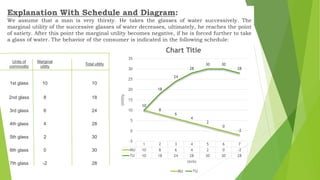
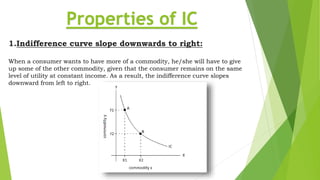
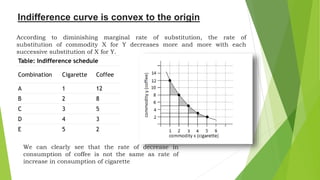
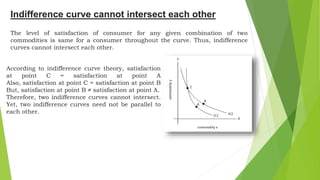
Utility is a measure of the satisfaction derived from consuming a good or service. There are two theories of utility - cardinal utility which measures utility quantitatively, and ordinal utility which ranks preferences qualitatively. The law of diminishing marginal utility states that as consumption of a good increases, the satisfaction from each additional unit decreases. Marginal utility is the additional satisfaction from consuming one more unit, and is positive at first but becomes negative once satiety is reached. Indifference curves, which plot equal levels of satisfaction from different combinations of goods, slope downward, are convex to the origin, do not intersect, and higher curves represent greater satisfaction.