




Reference Group
and
Consumer Behaviour
Like Share Subscribe
Reference group
2
A reference group involves one or more people whom
someone uses as a basis for comparison or point of reference
in forming affective and cognitive responses and performing
behaviors.
People’s reference groups (and single referent persons)
may be of any size , may be tangible or just symbolic , may be
from the same or other social classes, subcultures, and even
cultures
1
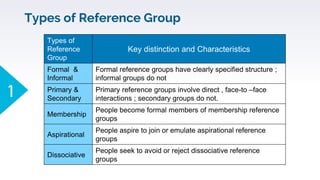
Types of
Reference
Group
Key distinction and Characteristics
Formal &
Informal
Formal reference groups have clearly specified structure ;
informal groups do not
Primary &
Secondary
Primary reference groups involve direct , face-to –face
interactions ; secondary groups do not.
Membership
People become formal members of membership reference
groups
Aspirational
People aspire to join or emulate aspirational reference
groups
Dissociative
People seek to avoid or reject dissociative reference
groups
Types of Reference Group
Analysing Reference Groups
4
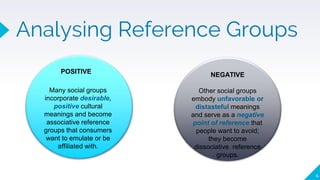
POSITIVE
Many social groups
incorporate desirable,
positive cultural
meanings and become
associative reference
groups that consumers
want to emulate or be
affiliated with.
NEGATIVE
Other social groups
embody unfavorable or
distasteful meanings
and serve as a negative
point of reference that
people want to avoid;
they become
dissociative reference
groups.
Why people choose reference
group
5
To obtain
rewards or
avoid
punishments
To gain
useful
knowledge
To acquire
meanings for
constructing,
modifying, or
maintaining their
self-concept
Informational
reference group
influence
Utilitarian
reference group
influence
Value-expressive
reference group
influence
Informational reference group
influence
6
The individual seeks information about various brands
from an association of professionals or independent group of
experts.
The individual’s observation of what experts influences
his or her choice of a brand.
Utilitarian reference group
influence
7
The individual’s decision to purchase a particular brand is
influenced by the preferences of people with whom he or she
has social interaction.
The desire to satisfy the expectations that others have
of him or her has an impact on the individual’s brand choice.
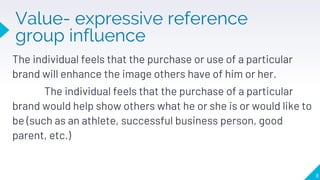
Value- expressive reference
group influence
8
The individual feels that the purchase or use of a particular
brand will enhance the image others have of him or her.
The individual feels that the purchase of a particular
brand would help show others what he or she is or would like to
be (such as an athlete, successful business person, good
parent, etc.)
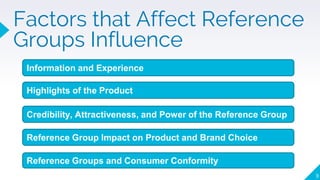
Factors that Affect Reference
Groups Influence
9
Information and Experience
Reference Groups and Consumer Conformity
Highlights of the Product
Credibility, Attractiveness, and Power of the Reference Group
Reference Group Impact on Product and Brand Choice
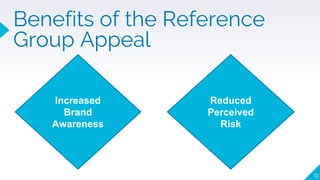
Benefits of the Reference
Group Appeal
10
Increased
Brand
Awareness
Reduced
Perceived
Risk
11
THANKS!
You can find me at:
▸ vijyata.rwc@gmail.com
Or comment in the comment box

Reference group and Consumer Behaviour

  • 1.
  • 2.
    Reference group 2 A referencegroup involves one or more people whom someone uses as a basis for comparison or point of reference in forming affective and cognitive responses and performing behaviors. People’s reference groups (and single referent persons) may be of any size , may be tangible or just symbolic , may be from the same or other social classes, subcultures, and even cultures
  • 3.
    1 Types of Reference Group Key distinctionand Characteristics Formal & Informal Formal reference groups have clearly specified structure ; informal groups do not Primary & Secondary Primary reference groups involve direct , face-to –face interactions ; secondary groups do not. Membership People become formal members of membership reference groups Aspirational People aspire to join or emulate aspirational reference groups Dissociative People seek to avoid or reject dissociative reference groups Types of Reference Group
  • 4.
    Analysing Reference Groups 4 POSITIVE Manysocial groups incorporate desirable, positive cultural meanings and become associative reference groups that consumers want to emulate or be affiliated with. NEGATIVE Other social groups embody unfavorable or distasteful meanings and serve as a negative point of reference that people want to avoid; they become dissociative reference groups.
  • 5.
    Why people choosereference group 5 To obtain rewards or avoid punishments To gain useful knowledge To acquire meanings for constructing, modifying, or maintaining their self-concept Informational reference group influence Utilitarian reference group influence Value-expressive reference group influence
  • 6.
    Informational reference group influence 6 Theindividual seeks information about various brands from an association of professionals or independent group of experts. The individual’s observation of what experts influences his or her choice of a brand.
  • 7.
    Utilitarian reference group influence 7 Theindividual’s decision to purchase a particular brand is influenced by the preferences of people with whom he or she has social interaction. The desire to satisfy the expectations that others have of him or her has an impact on the individual’s brand choice.
  • 8.
    Value- expressive reference groupinfluence 8 The individual feels that the purchase or use of a particular brand will enhance the image others have of him or her. The individual feels that the purchase of a particular brand would help show others what he or she is or would like to be (such as an athlete, successful business person, good parent, etc.)
  • 9.
    Factors that AffectReference Groups Influence 9 Information and Experience Reference Groups and Consumer Conformity Highlights of the Product Credibility, Attractiveness, and Power of the Reference Group Reference Group Impact on Product and Brand Choice
  • 10.
    Benefits of theReference Group Appeal 10 Increased Brand Awareness Reduced Perceived Risk
  • 11.
    11 THANKS! You can findme at: ▸ vijyata.rwc@gmail.com Or comment in the comment box