Buying Behavior
Reference Groups & Opinion Leadership
Prof. Abhipsa Mishra
Learning Objectives
• Understand how reference groups influence
consumer behaviour
• Discuss the role of conformity as a social
influence
• Discuss the importance of word-of-mouth
communication
• Understand the nature of opinion leadership
• Understand the impact of Groups and Social
Networks
What is a Reference Group
• Reference group: any person or group of
people who significantly influences an
individual’s behavior
Eg. Individuals (Celebrities, Athletes, or Political
leaders)
Groups of individuals with similarities (Musical
groups or Sports teams)
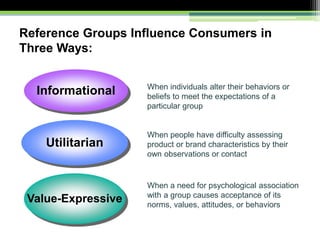
Reference Groups Influence Consumers in
Three Ways:
Informational
Value-Expressive
Utilitarian
When individuals alter their behaviors or
beliefs to meet the expectations of a
particular group
When a need for psychological association
with a group causes acceptance of its
norms, values, attitudes, or behaviors
When people have difficulty assessing
product or brand characteristics by their
own observations or contact
Why Reference Groups are Important?
• Social Power:
▫ The capacity to alter the actions of others
• Referent Power:
▫ When consumers imitate qualities by copying
behaviors of a prominent person they admire.
• Information Power:
▫ Able to influence consumer opinion by virtue of their
(assumed) access to the “truth”
• Legitimate Power:
▫ Granted to people by virtue of social agreements
• Expert Power:
– Derived from possessing specific knowledge about a
content area
• Reward Power:
– When a person or group has the means to provide
positive reinforcement
• Coercive Power:
– Influencing a person by social or physical
intimidation
Why Reference Groups are Important?
• Primary Groups: a social aggregation that is sufficiently
intimate to permit and facilitate unrestricted direct
interaction (e.g., family)
• Secondary Groups: also have direct interaction, but it is
more sporadic, less comprehensive, and less influential in
shaping thought and behavior (e.g., professional associations
or community organizations)
• Formal Groups: Characterized by a defined structure
(often written) and a known list of members and
requirements for membership
• Informal Groups: Have less structure than formal groups
and are likely to be based on friendship or interests
Types of Reference Groups
• Membership: when individuals are recognized as members
of a group, they have achieved formal acceptance status in
the group
• Aspirational Groups: exhibit a desire to adopt the norms,
values, and behaviors of others with whom the individuals
aspire to associate
• Dissociative Groups: groups from which an individual
tries to avoid association
• Virtual Groups: groups that are based on virtual
communities rather than geographic ones
Types of Reference Groups
How Reference Groups Influence Individuals
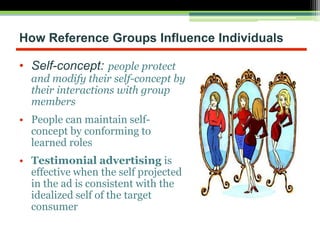
• Self-concept: people protect
and modify their self-concept by
their interactions with group
members
• People can maintain self-
concept by conforming to
learned roles
• Testimonial advertising is
effective when the self projected
in the ad is consistent with the
idealized self of the target
consumer
Reference Groups
Help
Define Self-Concept
Testimonial
advertising
How Reference Groups Influence Individuals
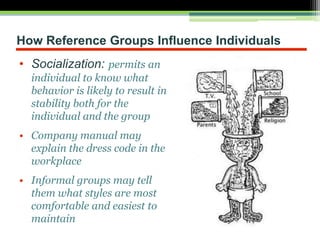
• Socialization: permits an
individual to know what
behavior is likely to result in
stability both for the
individual and the group
• Company manual may
explain the dress code in the
workplace
• Informal groups may tell
them what styles are most
comfortable and easiest to
maintain
How Reference Groups Influence Individuals
• Social comparison: individuals often evaluate
themselves by comparing themselves to others
• Consumers often use reference groups as benchmarks to
measure their own behaviors, opinions, abilities, and
possessions
• Advertising or television can be sources of social
comparison
How Reference Groups Influence Individuals
• Conformity: a change in beliefs or actions based on
real or perceived group pressures
• Compliance: when an individual conforms to the
wishes of the group without accepting all its beliefs or
behaviors
• Acceptance: when an individual actually changes his
or her beliefs and values to those of the group
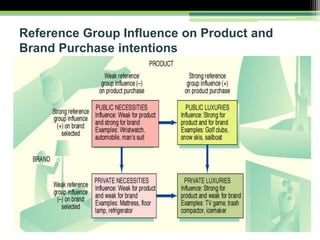
Reference Group Influence on Product and
Brand Purchase intentions
Brand Communities and Tribes
• Brand Community:
▫ A set of consumers who share a set of social
relationships based upon usage or interest in a
product. Eg. Brandfests
• Consumer Tribe:
▫ A group of people who share a lifestyle and who can
identify with each other because of a shared allegiance
to an activity or product.
• Tribal Marketing:
▫ To link one’s product to the needs of a group as a
whole.
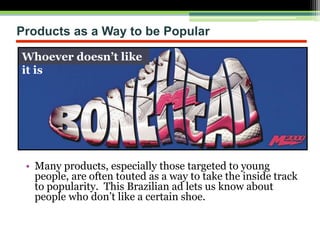
Products as a Way to be Popular
• Many products, especially those targeted to young
people, are often touted as a way to take the inside track
to popularity. This Brazilian ad lets us know about
people who don’t like a certain shoe.
Whoever doesn’t like
it is
Membership vs. Aspirational Reference Groups
• Aspirational Reference Groups
▫ Comprise idealized figures such as successful business
people, athletes, or performers.
• Membership Reference Group
▫ Ordinary people whose consumption activities provide
informational social influence.
 Propinquity: Physical nearness
 Mere Exposure: Liking persons or things simply as a result of
seeing them more often (mere exposure phenomenon)
 Group Cohesiveness: The degree to which members of a group
are attracted to each other and value their group membership
Match.com
Positive Versus Negative Reference Groups
• Avoidance Groups
▫ Groups that consumers purposely try to distance
themselves from
 Nerds
 Druggies
 Preppies
▫ The motivation to distance oneself from a negative
reference group can be as powerful or more powerful
than the desire to please a positive group
Positive Reference Groups
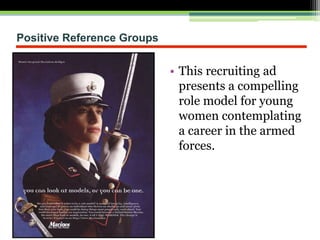
• This recruiting ad
presents a compelling
role model for young
women contemplating
a career in the armed
forces.
Consumers Do it in Groups
• Deindividuation:
▫ A process in which individual identities become
submerged within a group.
• Social Loafing:
▫ People do not devote as much to a task when their
contribution is part of a larger group effort
• Risky Shift:
▫ Group members are willing to consider riskier
alternatives subsequent to group discussion
• Diffusion of Responsibility:
▫ As more people are involved in a decision, each
individual is less accountable for the outcome
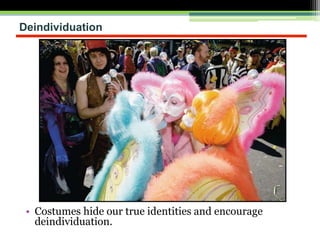
Deindividuation
• Costumes hide our true identities and encourage
deindividuation.
Consumers Do it in Groups (cont.)
• Value Hypothesis:
▫ Riskiness is a culturally valued characteristic to which
individuals feel pressure to conform
• Decision Polarization:
▫ Whichever direction the group members were leaning
toward before discussion becomes more extreme
subsequent to discussion
• Home Shopping Parties:
▫ Capitalize on group pressures to increase sales
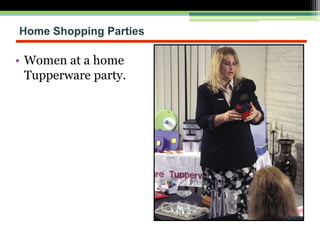
Home Shopping Parties
• Women at a home
Tupperware party.
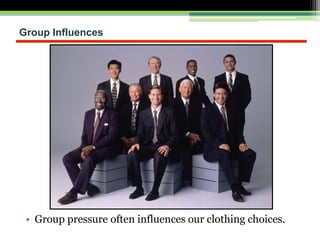
Group Influences
• Group pressure often influences our clothing choices.
Conformity
• Conformity
▫ A change in beliefs or actions as a reaction to real or
imagined group pressure.
• Norms
▫ Informal rules that govern behavior.
• Factors Influencing the Likelihood of Conformity
▫ Cultural Pressures
▫ Fear of Deviance
▫ Commitment
 Principle of Least Interest
▫ Group Unanimity, Size, and Expertise
▫ Susceptibility to Interpersonal Influence
 Role-relaxed consumers
Social Comparison
• Social Comparison Theory:
▫ Asserts that people look to the behavior of others to
increase the stability of their self-evaluation
▫ Co-oriented peer: A person of equivalent standing
• Resisting Conformity:
▫ Independence: Being oblivious or indifferent to the
expectations of others
▫ Anticonformity: Defiance of the group is the actual
behavior
▫ Reactance: The negative emotional state that results
when we are deprived of our freedom to choose
Word-of-Mouth Communication
• Word-of-Mouth (WOM):
▫ Product information transmitted by individuals to
individuals.
• Negative WOM and the Power of Rumors:
▫ Negative WOM: Consumers weigh negative info from
other consumers more heavily than they do positive
comments
Word-of-Mouth
• The U.S. Postal Service
hopes to create a buzz
via word of mouth.
Rumors
• Hoaxkill.com is a Web site dedicated to tracking
hoaxes and debunking product rumors.
The Transmission of Misinformation
Changing Information
• Serial Reproduction:
▫ Technique to examine the phenomenon that
information changes as it is transmitted among
consumers
 Assimilation: Distortions tend to follow a pattern
from ambiguous to conventional to fit with existing
schemas
 Leveling: Details are omitted to simplify structure
 Sharpening: Prominent details are accentuated
Cutting-Edge WOM Strategies
• Virtual Communities
▫ Virtual Community of Consumption: A
collection of people whose online
interactions are based upon shared
enthusiasm for and knowledge of a specific
consumption activity.
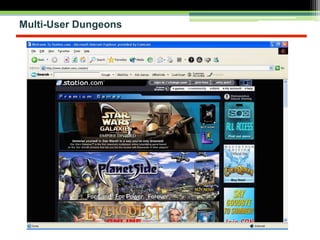
 Multi-user Dungeons (MUD)
 Rooms, rings and lists (e.g. chat rooms)
 Boards
 Blogs (weblog)
Multi-User Dungeons
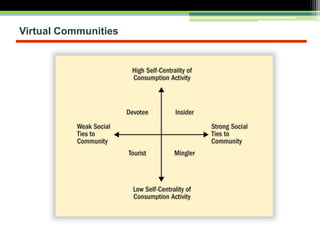
Four Types of Virtual Community Members
• Tourists:
▫ Lack strong social ties to the group
• Minglers:
▫ Maintain strong social ties, but are not interested in
the central consumption activity
• Devotees:
▫ Express strong interest in the activity, but have few
social attachments to the group
• Insiders:
▫ Exhibit both strong social ties and strong interest in
the activity
Virtual Communities
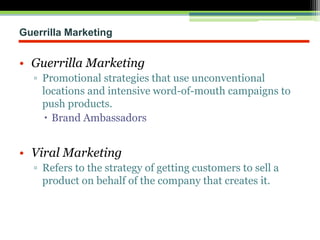
Guerrilla Marketing
• Guerrilla Marketing
▫ Promotional strategies that use unconventional
locations and intensive word-of-mouth campaigns to
push products.
 Brand Ambassadors
• Viral Marketing
▫ Refers to the strategy of getting customers to sell a
product on behalf of the company that creates it.
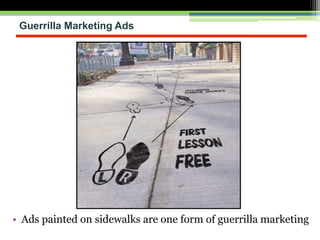
Guerrilla Marketing Ads
• Ads painted on sidewalks are one form of guerrilla marketing
Opinion Leadership
• The Nature of Opinion Leadership
▫ Opinion Leaders: People who are knowledgeable about
products and whose advice is taken seriously by others.
▫ Homophily: The degree to which a pair of individuals is
similar in terms of education, social status, and beliefs.
• How Influential Is an Opinion Leader?
▫ Generalized Opinion Leader: Somebody whose
recommendations are sought for all types of purchases.
▫ Monomorphic: An expert in a limited field.
▫ Polymorphic: An expert in many fields.
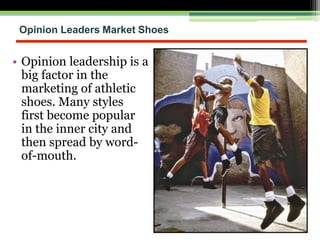
Opinion Leaders Market Shoes
• Opinion leadership is a
big factor in the
marketing of athletic
shoes. Many styles
first become popular
in the inner city and
then spread by word-
of-mouth.
Types of Opinion Leaders
• Innovators
▫ Early purchasers
• Innovative Communicators
▫ Opinion leaders who also are early purchasers
▫ Opinion leaders also are likely to be opinion seekers
• The Market Maven
▫ Describes people who are actively involved in
transmitting marketplace information of all types.
• The Surrogate Consumer
▫ A person who is hired to provide input in purchase
decisions.
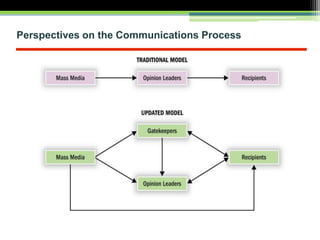
Perspectives on the Communications Process
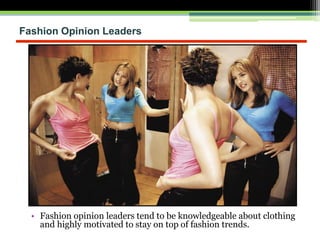
Fashion Opinion Leaders
• Fashion opinion leaders tend to be knowledgeable about clothing
and highly motivated to stay on top of fashion trends.
Identifying Opinion Leaders
• Self-designated Opinion Leaders
• Sociometric Methods
▫ Trace Communication patterns among members of a
group.
▫ Referral Behavior
▫ Network Analysis: Focuses on communication in social
systems
▫ Referral Network
▫ Tie Strength: The nature of the bond between people.
▫ Bridging Function: Allows a consumer access between
subgroups.
▫ Cliques: Subgroups
Revised Opinion Leadership Scale

Reference Groups

  • 1.
    Buying Behavior Reference Groups& Opinion Leadership Prof. Abhipsa Mishra
  • 2.
    Learning Objectives • Understandhow reference groups influence consumer behaviour • Discuss the role of conformity as a social influence • Discuss the importance of word-of-mouth communication • Understand the nature of opinion leadership • Understand the impact of Groups and Social Networks
  • 3.
    What is aReference Group • Reference group: any person or group of people who significantly influences an individual’s behavior Eg. Individuals (Celebrities, Athletes, or Political leaders) Groups of individuals with similarities (Musical groups or Sports teams)
  • 4.
    Reference Groups InfluenceConsumers in Three Ways: Informational Value-Expressive Utilitarian When individuals alter their behaviors or beliefs to meet the expectations of a particular group When a need for psychological association with a group causes acceptance of its norms, values, attitudes, or behaviors When people have difficulty assessing product or brand characteristics by their own observations or contact
  • 5.
    Why Reference Groupsare Important? • Social Power: ▫ The capacity to alter the actions of others • Referent Power: ▫ When consumers imitate qualities by copying behaviors of a prominent person they admire. • Information Power: ▫ Able to influence consumer opinion by virtue of their (assumed) access to the “truth” • Legitimate Power: ▫ Granted to people by virtue of social agreements
  • 6.
    • Expert Power: –Derived from possessing specific knowledge about a content area • Reward Power: – When a person or group has the means to provide positive reinforcement • Coercive Power: – Influencing a person by social or physical intimidation Why Reference Groups are Important?
  • 7.
    • Primary Groups:a social aggregation that is sufficiently intimate to permit and facilitate unrestricted direct interaction (e.g., family) • Secondary Groups: also have direct interaction, but it is more sporadic, less comprehensive, and less influential in shaping thought and behavior (e.g., professional associations or community organizations) • Formal Groups: Characterized by a defined structure (often written) and a known list of members and requirements for membership • Informal Groups: Have less structure than formal groups and are likely to be based on friendship or interests Types of Reference Groups
  • 8.
    • Membership: whenindividuals are recognized as members of a group, they have achieved formal acceptance status in the group • Aspirational Groups: exhibit a desire to adopt the norms, values, and behaviors of others with whom the individuals aspire to associate • Dissociative Groups: groups from which an individual tries to avoid association • Virtual Groups: groups that are based on virtual communities rather than geographic ones Types of Reference Groups
  • 9.
    How Reference GroupsInfluence Individuals • Self-concept: people protect and modify their self-concept by their interactions with group members • People can maintain self- concept by conforming to learned roles • Testimonial advertising is effective when the self projected in the ad is consistent with the idealized self of the target consumer
  • 10.
  • 11.
  • 12.
    How Reference GroupsInfluence Individuals • Socialization: permits an individual to know what behavior is likely to result in stability both for the individual and the group • Company manual may explain the dress code in the workplace • Informal groups may tell them what styles are most comfortable and easiest to maintain
  • 13.
    How Reference GroupsInfluence Individuals • Social comparison: individuals often evaluate themselves by comparing themselves to others • Consumers often use reference groups as benchmarks to measure their own behaviors, opinions, abilities, and possessions • Advertising or television can be sources of social comparison
  • 14.
    How Reference GroupsInfluence Individuals • Conformity: a change in beliefs or actions based on real or perceived group pressures • Compliance: when an individual conforms to the wishes of the group without accepting all its beliefs or behaviors • Acceptance: when an individual actually changes his or her beliefs and values to those of the group
  • 15.
    Reference Group Influenceon Product and Brand Purchase intentions
  • 16.
    Brand Communities andTribes • Brand Community: ▫ A set of consumers who share a set of social relationships based upon usage or interest in a product. Eg. Brandfests • Consumer Tribe: ▫ A group of people who share a lifestyle and who can identify with each other because of a shared allegiance to an activity or product. • Tribal Marketing: ▫ To link one’s product to the needs of a group as a whole.
  • 17.
    Products as aWay to be Popular • Many products, especially those targeted to young people, are often touted as a way to take the inside track to popularity. This Brazilian ad lets us know about people who don’t like a certain shoe. Whoever doesn’t like it is
  • 18.
    Membership vs. AspirationalReference Groups • Aspirational Reference Groups ▫ Comprise idealized figures such as successful business people, athletes, or performers. • Membership Reference Group ▫ Ordinary people whose consumption activities provide informational social influence.  Propinquity: Physical nearness  Mere Exposure: Liking persons or things simply as a result of seeing them more often (mere exposure phenomenon)  Group Cohesiveness: The degree to which members of a group are attracted to each other and value their group membership
  • 19.
  • 20.
    Positive Versus NegativeReference Groups • Avoidance Groups ▫ Groups that consumers purposely try to distance themselves from  Nerds  Druggies  Preppies ▫ The motivation to distance oneself from a negative reference group can be as powerful or more powerful than the desire to please a positive group
  • 21.
    Positive Reference Groups •This recruiting ad presents a compelling role model for young women contemplating a career in the armed forces.
  • 22.
    Consumers Do itin Groups • Deindividuation: ▫ A process in which individual identities become submerged within a group. • Social Loafing: ▫ People do not devote as much to a task when their contribution is part of a larger group effort • Risky Shift: ▫ Group members are willing to consider riskier alternatives subsequent to group discussion • Diffusion of Responsibility: ▫ As more people are involved in a decision, each individual is less accountable for the outcome
  • 23.
    Deindividuation • Costumes hideour true identities and encourage deindividuation.
  • 24.
    Consumers Do itin Groups (cont.) • Value Hypothesis: ▫ Riskiness is a culturally valued characteristic to which individuals feel pressure to conform • Decision Polarization: ▫ Whichever direction the group members were leaning toward before discussion becomes more extreme subsequent to discussion • Home Shopping Parties: ▫ Capitalize on group pressures to increase sales
  • 25.
    Home Shopping Parties •Women at a home Tupperware party.
  • 26.
    Group Influences • Grouppressure often influences our clothing choices.
  • 27.
    Conformity • Conformity ▫ Achange in beliefs or actions as a reaction to real or imagined group pressure. • Norms ▫ Informal rules that govern behavior. • Factors Influencing the Likelihood of Conformity ▫ Cultural Pressures ▫ Fear of Deviance ▫ Commitment  Principle of Least Interest ▫ Group Unanimity, Size, and Expertise ▫ Susceptibility to Interpersonal Influence  Role-relaxed consumers
  • 28.
    Social Comparison • SocialComparison Theory: ▫ Asserts that people look to the behavior of others to increase the stability of their self-evaluation ▫ Co-oriented peer: A person of equivalent standing • Resisting Conformity: ▫ Independence: Being oblivious or indifferent to the expectations of others ▫ Anticonformity: Defiance of the group is the actual behavior ▫ Reactance: The negative emotional state that results when we are deprived of our freedom to choose
  • 29.
    Word-of-Mouth Communication • Word-of-Mouth(WOM): ▫ Product information transmitted by individuals to individuals. • Negative WOM and the Power of Rumors: ▫ Negative WOM: Consumers weigh negative info from other consumers more heavily than they do positive comments
  • 30.
    Word-of-Mouth • The U.S.Postal Service hopes to create a buzz via word of mouth.
  • 31.
    Rumors • Hoaxkill.com isa Web site dedicated to tracking hoaxes and debunking product rumors.
  • 32.
    The Transmission ofMisinformation
  • 33.
    Changing Information • SerialReproduction: ▫ Technique to examine the phenomenon that information changes as it is transmitted among consumers  Assimilation: Distortions tend to follow a pattern from ambiguous to conventional to fit with existing schemas  Leveling: Details are omitted to simplify structure  Sharpening: Prominent details are accentuated
  • 34.
    Cutting-Edge WOM Strategies •Virtual Communities ▫ Virtual Community of Consumption: A collection of people whose online interactions are based upon shared enthusiasm for and knowledge of a specific consumption activity.  Multi-user Dungeons (MUD)  Rooms, rings and lists (e.g. chat rooms)  Boards  Blogs (weblog)
  • 35.
  • 36.
    Four Types ofVirtual Community Members • Tourists: ▫ Lack strong social ties to the group • Minglers: ▫ Maintain strong social ties, but are not interested in the central consumption activity • Devotees: ▫ Express strong interest in the activity, but have few social attachments to the group • Insiders: ▫ Exhibit both strong social ties and strong interest in the activity
  • 37.
  • 38.
    Guerrilla Marketing • GuerrillaMarketing ▫ Promotional strategies that use unconventional locations and intensive word-of-mouth campaigns to push products.  Brand Ambassadors • Viral Marketing ▫ Refers to the strategy of getting customers to sell a product on behalf of the company that creates it.
  • 39.
    Guerrilla Marketing Ads •Ads painted on sidewalks are one form of guerrilla marketing
  • 40.
    Opinion Leadership • TheNature of Opinion Leadership ▫ Opinion Leaders: People who are knowledgeable about products and whose advice is taken seriously by others. ▫ Homophily: The degree to which a pair of individuals is similar in terms of education, social status, and beliefs. • How Influential Is an Opinion Leader? ▫ Generalized Opinion Leader: Somebody whose recommendations are sought for all types of purchases. ▫ Monomorphic: An expert in a limited field. ▫ Polymorphic: An expert in many fields.
  • 41.
    Opinion Leaders MarketShoes • Opinion leadership is a big factor in the marketing of athletic shoes. Many styles first become popular in the inner city and then spread by word- of-mouth.
  • 42.
    Types of OpinionLeaders • Innovators ▫ Early purchasers • Innovative Communicators ▫ Opinion leaders who also are early purchasers ▫ Opinion leaders also are likely to be opinion seekers • The Market Maven ▫ Describes people who are actively involved in transmitting marketplace information of all types. • The Surrogate Consumer ▫ A person who is hired to provide input in purchase decisions.
  • 43.
    Perspectives on theCommunications Process
  • 44.
    Fashion Opinion Leaders •Fashion opinion leaders tend to be knowledgeable about clothing and highly motivated to stay on top of fashion trends.
  • 45.
    Identifying Opinion Leaders •Self-designated Opinion Leaders • Sociometric Methods ▫ Trace Communication patterns among members of a group. ▫ Referral Behavior ▫ Network Analysis: Focuses on communication in social systems ▫ Referral Network ▫ Tie Strength: The nature of the bond between people. ▫ Bridging Function: Allows a consumer access between subgroups. ▫ Cliques: Subgroups
  • 46.