 The Consumer Durables industry consists of durable
goods and appliances for domestic use such as
televisions, refrigerators, air conditioners and washing
machines. Instruments such as cell phones and kitchen
appliances like microwave ovens are also included in
this category.
 The government of India has increased liberalisation
which has favoured foreign direct investment. Also
policies such as National Electronics mission
digitization of television and setting up of Electronic
Hardware Technology Parks is expected to boost the
growth of this sector.
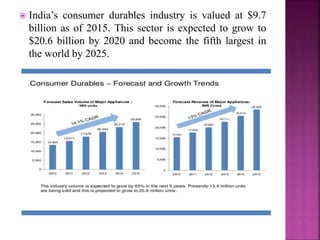
 India’s consumer durables industry is valued at $9.7
billion as of 2015. This sector is expected to grow to
$20.6 billion by 2020 and become the fifth largest in
the world by 2025.
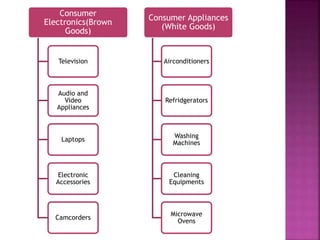
Consumer
Electronics(Brown
Goods)
Television
Audio and
Video
Appliances
Laptops
Electronic
Accessories
Camcorders
Consumer Appliances
(White Goods)
Airconditioners
Refridgerators
Washing
Machines
Cleaning
Equipments
Microwave
Ovens
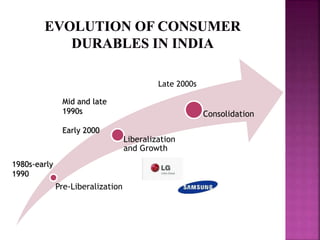
Pre-Liberalization
Liberalization
and Growth
Consolidation
1980s-early
1990
Mid and late
1990s
Early 2000
Late 2000s
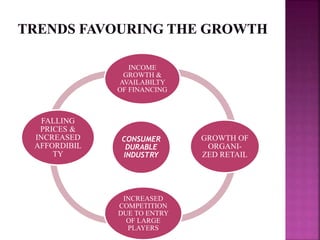
CONSUMER
DURABLE
INDUSTRY
INCOME
GROWTH &
AVAILABILTY
OF FINANCING
GROWTH OF
ORGANI-
ZED RETAIL
INCREASED
COMPETITION
DUE TO ENTRY
OF LARGE
PLAYERS
FALLING
PRICES &
INCREASED
AFFORDIBIL
TY
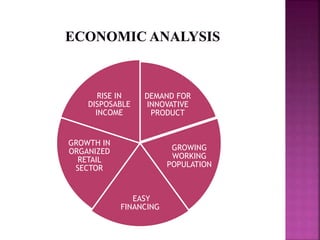
DEMAND FOR
INNOVATIVE
PRODUCT
GROWING
WORKING
POPULATION
EASY
FINANCING
GROWTH IN
ORGANIZED
RETAIL
SECTOR
RISE IN
DISPOSABLE
INCOME
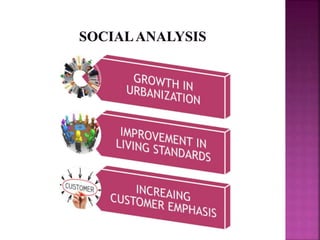
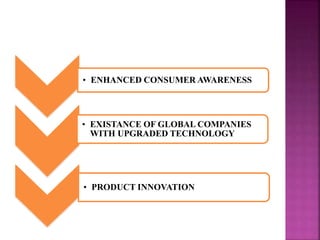
• ENHANCED CONSUMER AWARENESS
• EXISTANCE OF GLOBAL COMPANIES
WITH UPGRADED TECHNOLOGY
• PRODUCT INNOVATION
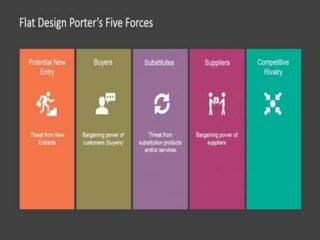
PORTER’S FIVE
FORCES
ANALYSIS
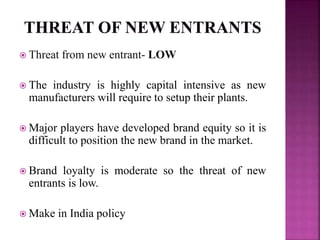
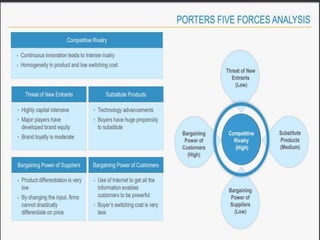
 Threat from new entrant- LOW
 The industry is highly capital intensive as new
manufacturers will require to setup their plants.
 Major players have developed brand equity so it is
difficult to position the new brand in the market.
 Brand loyalty is moderate so the threat of new
entrants is low.
 Make in India policy
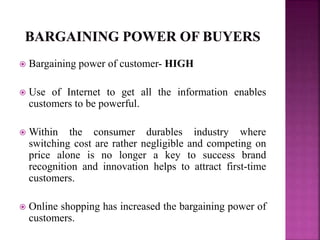
 Bargaining power of customer- HIGH
 Use of Internet to get all the information enables
customers to be powerful.
 Within the consumer durables industry where
switching cost are rather negligible and competing on
price alone is no longer a key to success brand
recognition and innovation helps to attract first-time
customers.
 Online shopping has increased the bargaining power of
customers.

 Threat from the substitute product- HIGH
 Technology advancement
 Buyers have huge propensity to substitute.
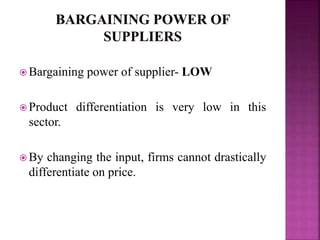
 Bargaining power of supplier- LOW
 Product differentiation is very low in this
sector.
 By changing the input, firms cannot drastically
differentiate on price.
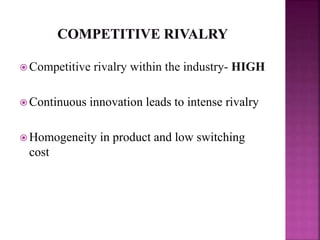
 Competitive rivalry within the industry- HIGH
 Continuous innovation leads to intense rivalry
 Homogeneity in product and low switching
cost
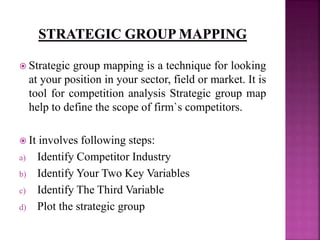
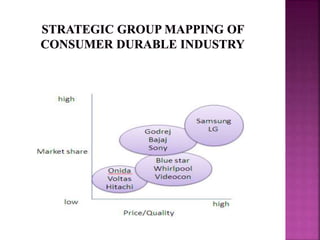
 Strategic group mapping is a technique for looking
at your position in your sector, field or market. It is
tool for competition analysis Strategic group map
help to define the scope of firm`s competitors.
 It involves following steps:
a) Identify Competitor Industry
b) Identify Your Two Key Variables
c) Identify The Third Variable
d) Plot the strategic group
 The consumer durables industry in India is set for
sustained growth over the long term, fuelled by
favourable consumer demographics, overall growth in
services and industrial sectors and infrastructure
development in sub-urban and rural areas
 The product and approach to market need to be
customised to suit the unique needs of the Indian
market.
Analysis of consumer durable industry

Analysis of consumer durable industry

  • 2.
     The ConsumerDurables industry consists of durable goods and appliances for domestic use such as televisions, refrigerators, air conditioners and washing machines. Instruments such as cell phones and kitchen appliances like microwave ovens are also included in this category.  The government of India has increased liberalisation which has favoured foreign direct investment. Also policies such as National Electronics mission digitization of television and setting up of Electronic Hardware Technology Parks is expected to boost the growth of this sector.
  • 3.
     India’s consumerdurables industry is valued at $9.7 billion as of 2015. This sector is expected to grow to $20.6 billion by 2020 and become the fifth largest in the world by 2025.
  • 4.
  • 5.
  • 6.
    CONSUMER DURABLE INDUSTRY INCOME GROWTH & AVAILABILTY OF FINANCING GROWTHOF ORGANI- ZED RETAIL INCREASED COMPETITION DUE TO ENTRY OF LARGE PLAYERS FALLING PRICES & INCREASED AFFORDIBIL TY
  • 12.
  • 16.
    • ENHANCED CONSUMERAWARENESS • EXISTANCE OF GLOBAL COMPANIES WITH UPGRADED TECHNOLOGY • PRODUCT INNOVATION
  • 17.
  • 19.
     Threat fromnew entrant- LOW  The industry is highly capital intensive as new manufacturers will require to setup their plants.  Major players have developed brand equity so it is difficult to position the new brand in the market.  Brand loyalty is moderate so the threat of new entrants is low.  Make in India policy
  • 20.
     Bargaining powerof customer- HIGH  Use of Internet to get all the information enables customers to be powerful.  Within the consumer durables industry where switching cost are rather negligible and competing on price alone is no longer a key to success brand recognition and innovation helps to attract first-time customers.  Online shopping has increased the bargaining power of customers.
  • 21.
     Threat fromthe substitute product- HIGH  Technology advancement  Buyers have huge propensity to substitute.
  • 22.
     Bargaining powerof supplier- LOW  Product differentiation is very low in this sector.  By changing the input, firms cannot drastically differentiate on price.
  • 23.
     Competitive rivalrywithin the industry- HIGH  Continuous innovation leads to intense rivalry  Homogeneity in product and low switching cost
  • 26.
     Strategic groupmapping is a technique for looking at your position in your sector, field or market. It is tool for competition analysis Strategic group map help to define the scope of firm`s competitors.  It involves following steps: a) Identify Competitor Industry b) Identify Your Two Key Variables c) Identify The Third Variable d) Plot the strategic group
  • 29.
     The consumerdurables industry in India is set for sustained growth over the long term, fuelled by favourable consumer demographics, overall growth in services and industrial sectors and infrastructure development in sub-urban and rural areas  The product and approach to market need to be customised to suit the unique needs of the Indian market.