INDUSTRY ANALYSIS
Industry : FMCD
Group members
Aegidius Savio Mondol
Anshuree Mazumdar
Cyril Victor
Pousali Mukherjee
Prabar Rakshit
Ranjeet Singh
Suman Kumar Dey
Tamasree Sutradhar
History
Growth of the consumer durables sector is poised for growth as disposable incomes grow. Also,
increasing electrification of rural areas would augment
demand. This sector attracted significant investment
even during global recession. Rural is expected to grow
at a compound annual growth rate (CAGR) of 25%
from US$ 21 billion in FY10 to US$ 6.4 billion in
FY15.
100% FDI allowed in the electronics hardware
manufacturing sector under the automatic rout. The
consumer durables market recorded revenues of US$
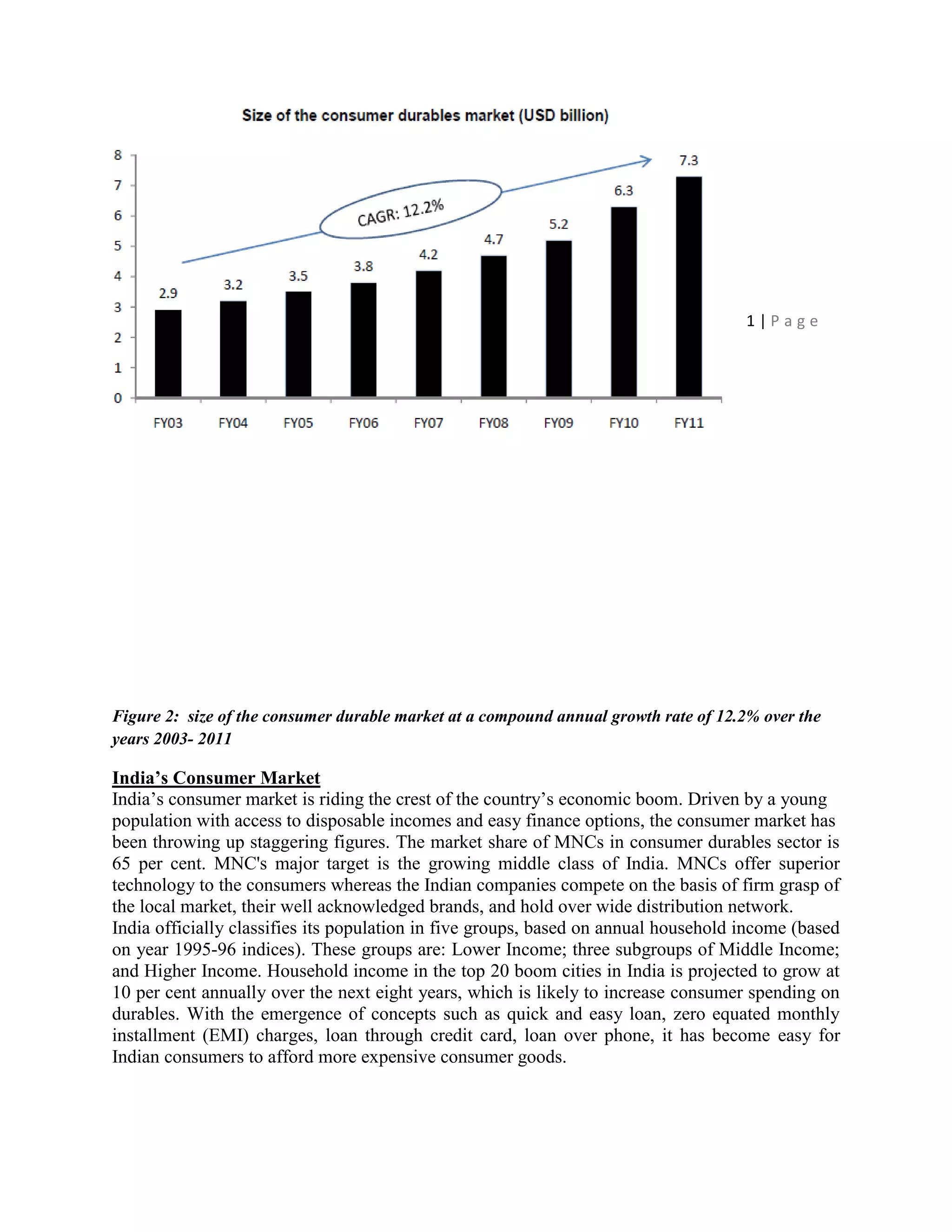
7.3billion in FY11. During FY03-FY11, the industry
expanded at a CAGR of 12.2%.
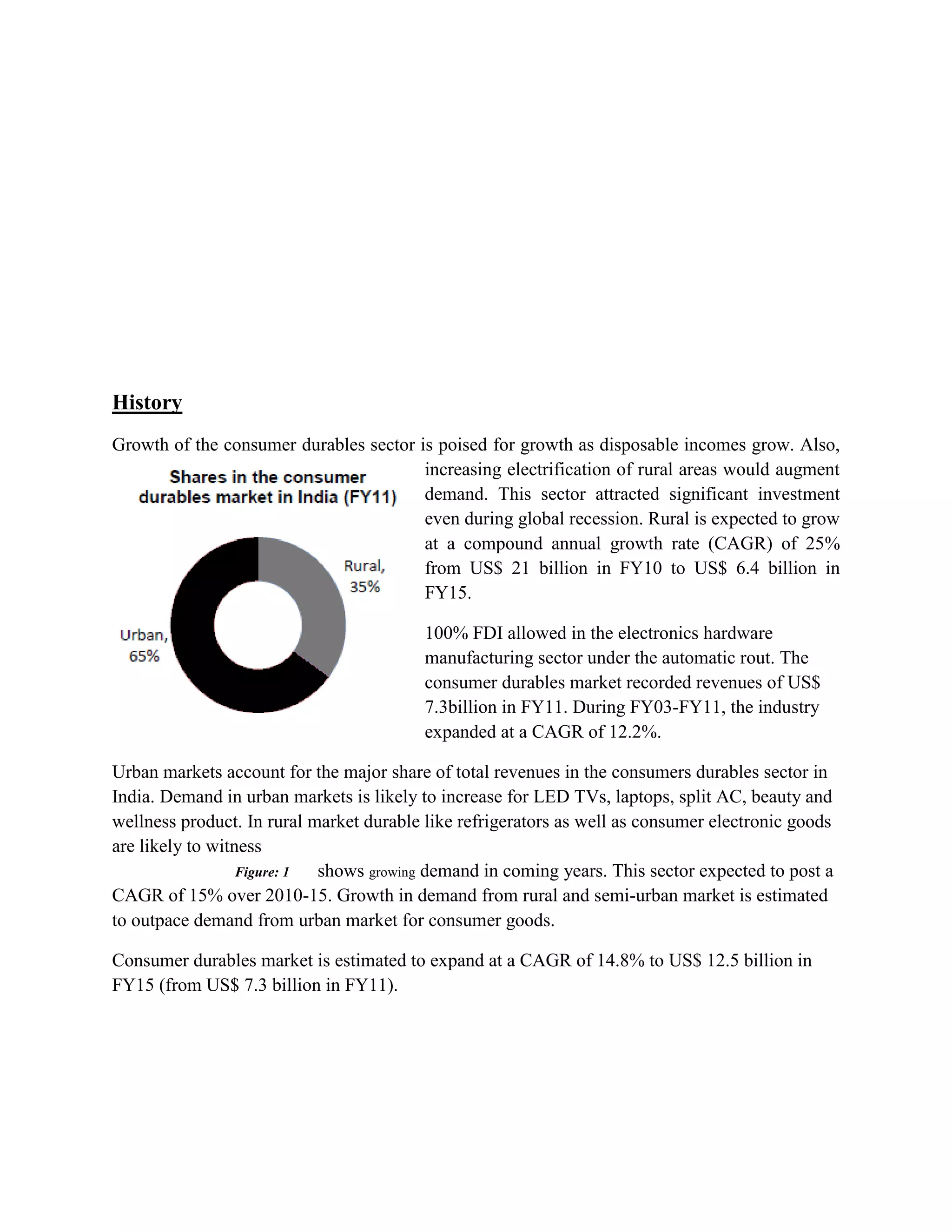
Urban markets account for the major share of total revenues in the consumers durables sector in
India. Demand in urban markets is likely to increase for LED TVs, laptops, split AC, beauty and
wellness product. In rural market durable like refrigerators as well as consumer electronic goods
are likely to witness
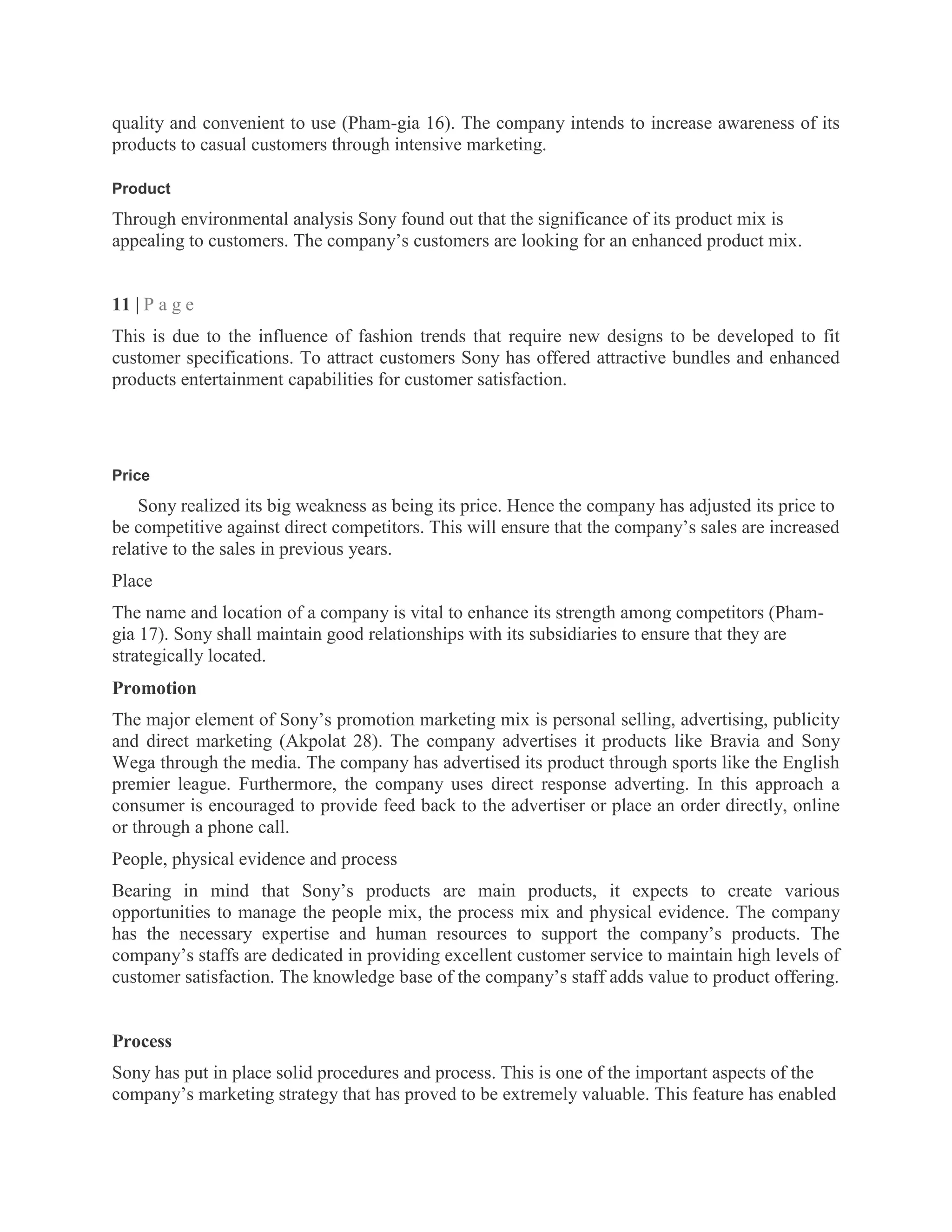
Figure: 1 shows growing demand in coming years. This sector expected to post a
CAGR of 15% over 2010-15. Growth in demand from rural and semi-urban market is estimated
to outpace demand from urban market for consumer goods.
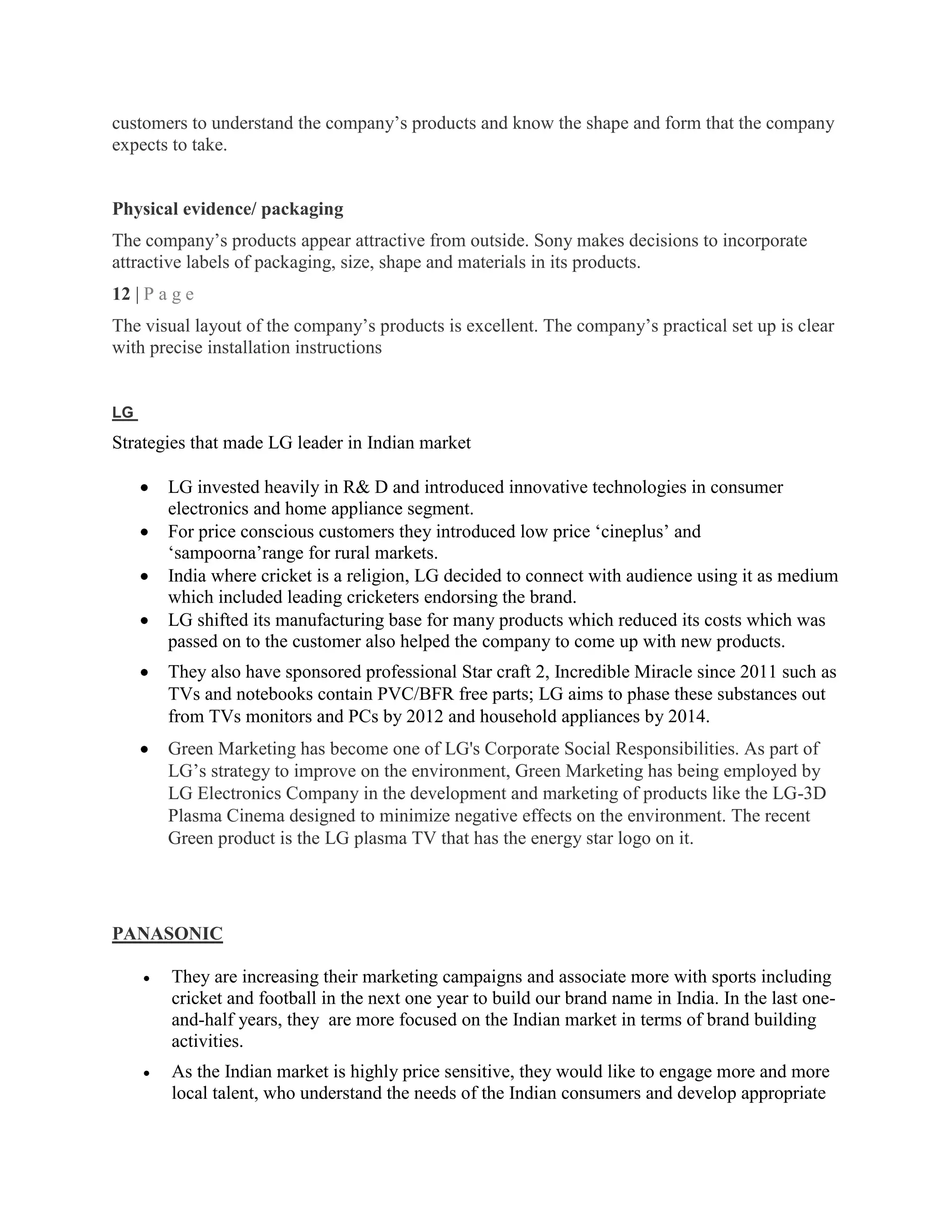
Consumer durables market is estimated to expand at a CAGR of 14.8% to US$ 12.5 billion in
FY15 (from US$ 7.3 billion in FY11).
1 | P a g e
Figure 2: size of the consumer durable market at a compound annual growth rate of 12.2% over the
years 2003- 2011
India’s Consumer Market
India‘s consumer market is riding the crest of the country‘s economic boom. Driven by a young
population with access to disposable incomes and easy finance options, the consumer market has
been throwing up staggering figures. The market share of MNCs in consumer durables sector is
65 per cent. MNC's major target is the growing middle class of India. MNCs offer superior
technology to the consumers whereas the Indian companies compete on the basis of firm grasp of
the local market, their well acknowledged brands, and hold over wide distribution network.
India officially classifies its population in five groups, based on annual household income (based
on year 1995-96 indices). These groups are: Lower Income; three subgroups of Middle Income;
and Higher Income. Household income in the top 20 boom cities in India is projected to grow at
10 per cent annually over the next eight years, which is likely to increase consumer spending on
durables. With the emergence of concepts such as quick and easy loan, zero equated monthly
installment (EMI) charges, loan through credit card, loan over phone, it has become easy for
Indian consumers to afford more expensive consumer goods.
Consumer Classes
Even discounting the purchase power parity factor, income classifications do not serve as an
effective indicator of ownership and consumption trends in the economy. Accordingly, the
National Council for Applied Economic Research (NCAER), India‘s premier economic research
institution, has released an alternative classification system based on consumption indicators,
which is more relevant for ascertaining consumption patterns of various classes of goods.
2 | P a g e
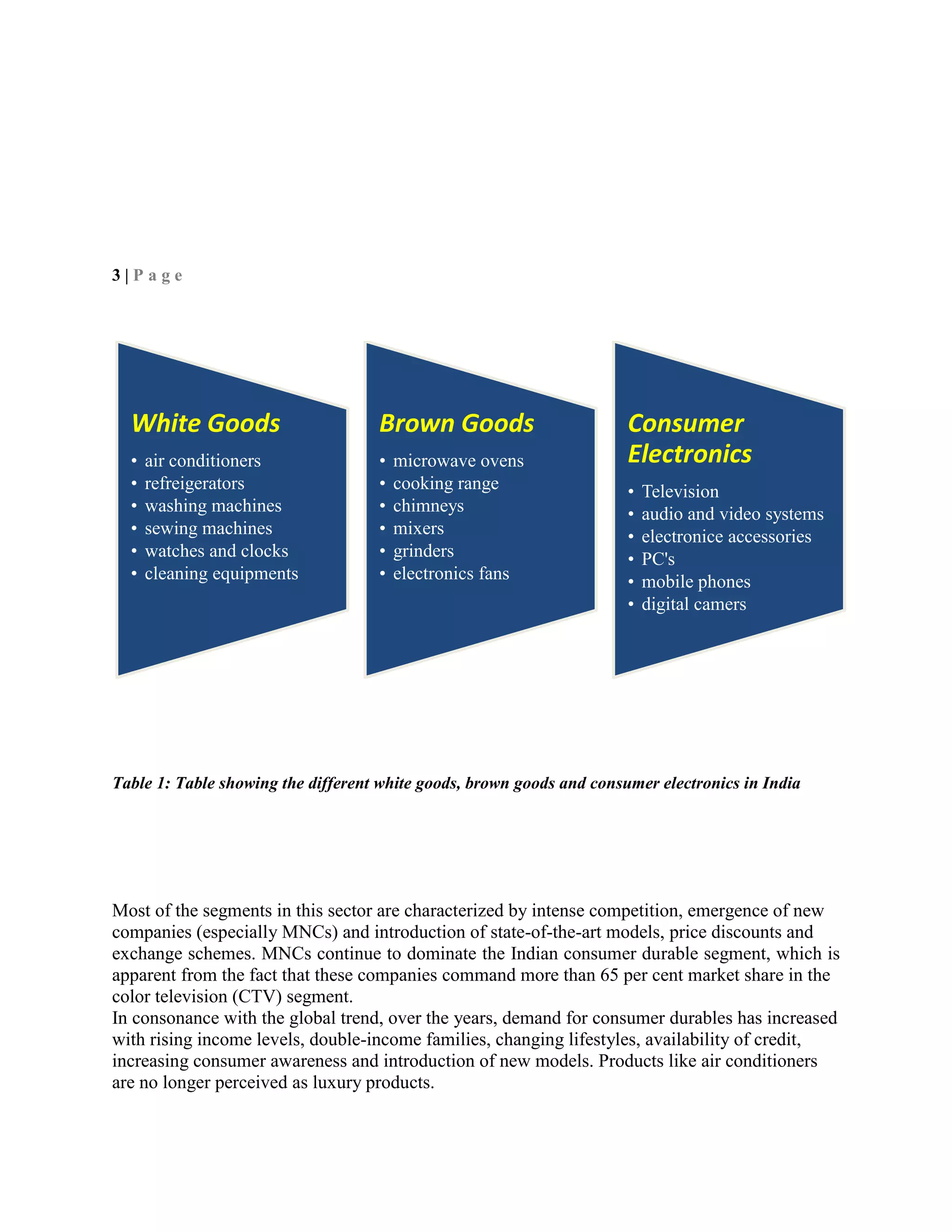
The consumer durables market is divided into two segments – consumer electronics, also known
as the brown goods (television, digital camera, audio-video systems, computers, electronic
accessories, etc) and consumer appliances or the white goods (air conditioners, refrigerators,
microwave ovens, other household appliances, etc.).
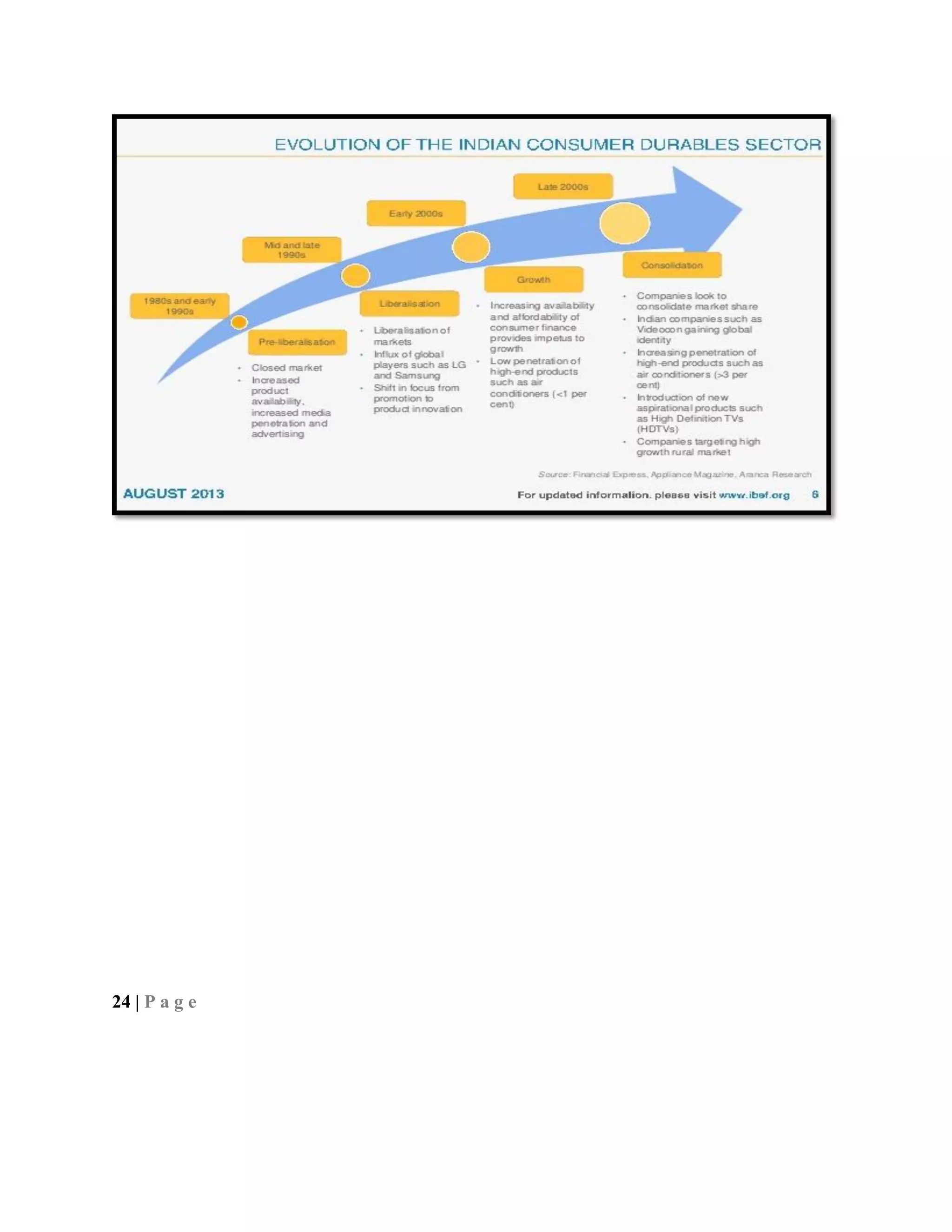
In its initial years, the sector relied greatly on media and advertising for consumer penetration.
Liberalization of markets in late 1990s saw the entry of global players like Samsung and LG and
a shift in focus towards product innovation. Accessibility to high-end products was, however,
low till mid 2000s. Last few years has seen high end and aspirational products like air
conditioners and High Definition TVs gain stronghold in the market.
The industry size for consumer durables stands at Rs 350 billion (as on March 2012). The sector
rides and relies on the state of the country‘s economy. With household incomes in top 20 cities
across India expected to grow at 10 percent annually over the next eight years, and concepts of
easy loans, equated monthly installment (EMI) charges, availability of credit, etc., become
commonplace, the Indian consumer is likely to spend more on both utility and luxury consumer
goods.
The consumer durables sector is marked by stiff competition between market players to launch
newer models and versions of products, discounts and schemes. The key players in the consumer
durables sector are MNCs like LG, Samsung, Blue Star, Daikin, Hitachi, Sony, etc. LG and
Samsung account for the largest shares of the market, and it is estimated that India‘s share in
their global revenues will double to 12 per cent in FY15 from 6 per cent in FY10 and similarly
from 2.5 per cent to 5 per cent respectively.
3 | P a g e
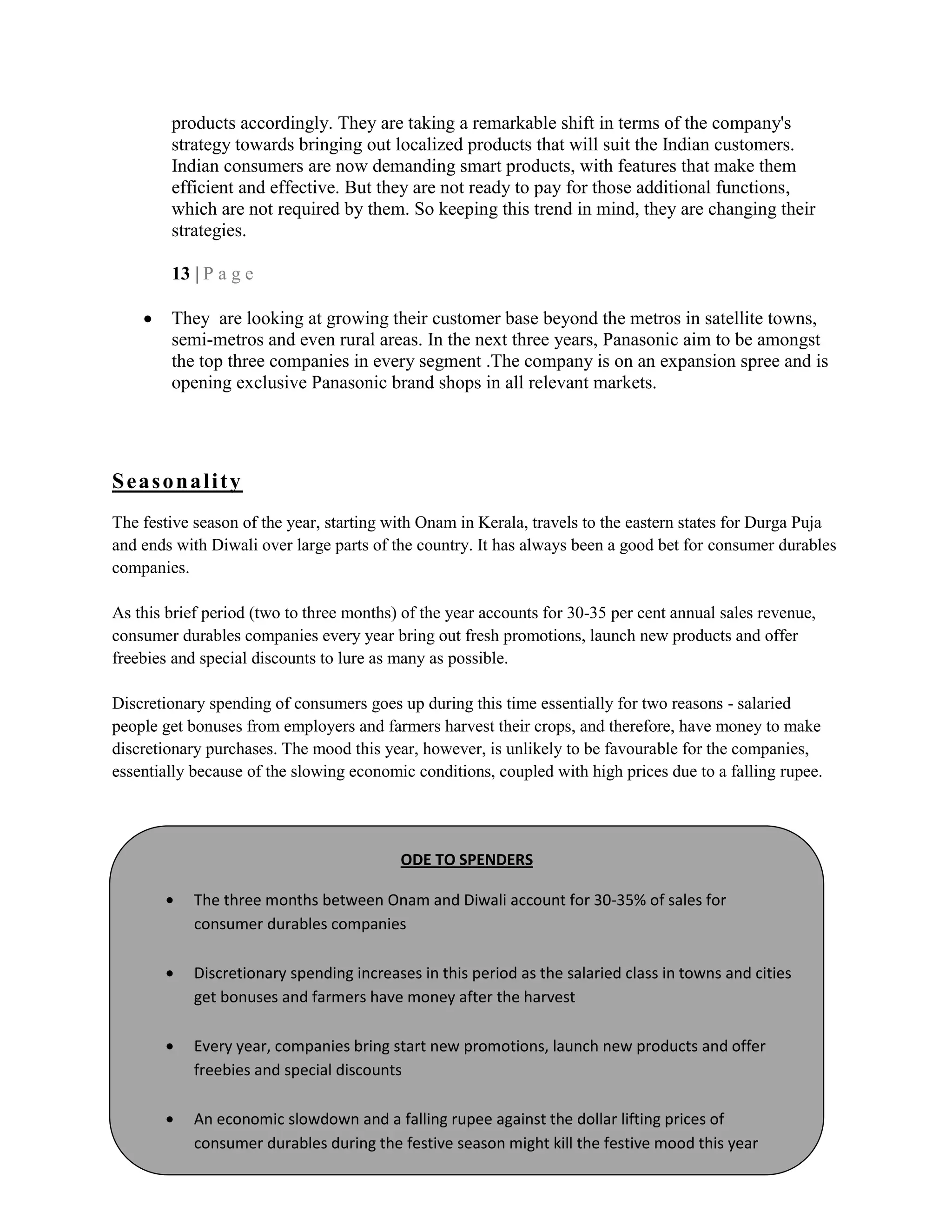
Table 1: Table showing the different white goods, brown goods and consumer electronics in India
Most of the segments in this sector are characterized by intense competition, emergence of new
companies (especially MNCs) and introduction of state-of-the-art models, price discounts and
exchange schemes. MNCs continue to dominate the Indian consumer durable segment, which is
apparent from the fact that these companies command more than 65 per cent market share in the
color television (CTV) segment.
In consonance with the global trend, over the years, demand for consumer durables has increased
with rising income levels, double-income families, changing lifestyles, availability of credit,
increasing consumer awareness and introduction of new models. Products like air conditioners
are no longer perceived as luxury products.
White Goods
• air conditioners
• refreigerators
• washing machines
• sewing machines
• watches and clocks
• cleaning equipments
Brown Goods
• microwave ovens
• cooking range
• chimneys
• mixers
• grinders
• electronics fans
Consumer
Electronics
• Television
• audio and video systems
• electronice accessories
• PC's
• mobile phones
• digital camers
4 | P a g e
Factors that affect growth
Increased disposable incomes and greater accessibility to credit is growing the consumer
base, especially in the middle and upper sections of the population.
Relaxation of tariffs and increased liberalisation amid a favourable FDI environment is
leading to expansion in India, increased investments and greater R&D. Key players like
Whirpool, Hitachi, and Panasonic announced huge investment plans in the year 2011.
Government Regulations
Free Trade Agreement:
WTO regime which came in force in 2005, results in zero customs duty on imports of all telecom
equipment. 217 IT/electronic items were covered under the Information Technology Agreement (ITA) of
the WTO for complete customs tariff elimination by 2005.
Out of these 217 items, several items were already at NIL customs duty. In fact, IT/electronics was the
first sector in India to face complete customs tariff elimination. The ITA-1 would result in intensifying
competition as more imported products will be easily available at lower prices.
Foreign Investment Policy( FDI):
Foreign investment up to 100 per cent is allowed in Indian electronics industry set up exclusively for
exports. The units set up under these programmes are bonded factories eligible to import, free of duty,
their entire requirements of capital goods, raw materials and components, spares and consumables, office
equipment etc. Deemed export benefits are available to suppliers of these goods from the Domestic Tariff
Area (DTA).
A part of the production from such units is permitted to be sold in the DTA depending upon the level of
the value addition achieved. The FDI approval for electrical equipment (including computer software and
electronics) from April 2000 to January 2010 was US$ 21.24 billion, which was 2.01 per cent of the total
Foreign Direct Investment (FDI) approved.
Procedure for approval:
Once the investment in equity has been approved, the import of capital goods, components and raw
materials or the engagement of foreign technicians for short duration does not require any additional
approvals.
Approval of Ministry of Home Affairs is not needed for hiring foreign nationals holding valid
employment visa.
Approval for setting up units in Export Processing Zones (EPZs) is given by the Board of Approvals in
the Ministry of Commerce.
5 | P a g e
Approval for setting up export-oriented units (EOUs) outside the zones is given by the Ministry of
Industry.
Approvals for setting up Electronic Hardware Technology Park (EHTP) and Software Technology Park
(STP) units are cleared by the Inter Ministerial Standing Committee (IMSC) set-up under the
Chairmanship of the Secretary, Department of Information Technology.
Proposals involving foreign direct investment not covered under the automatic route are considered by the
Foreign Investment Promotion Board (FIPB).
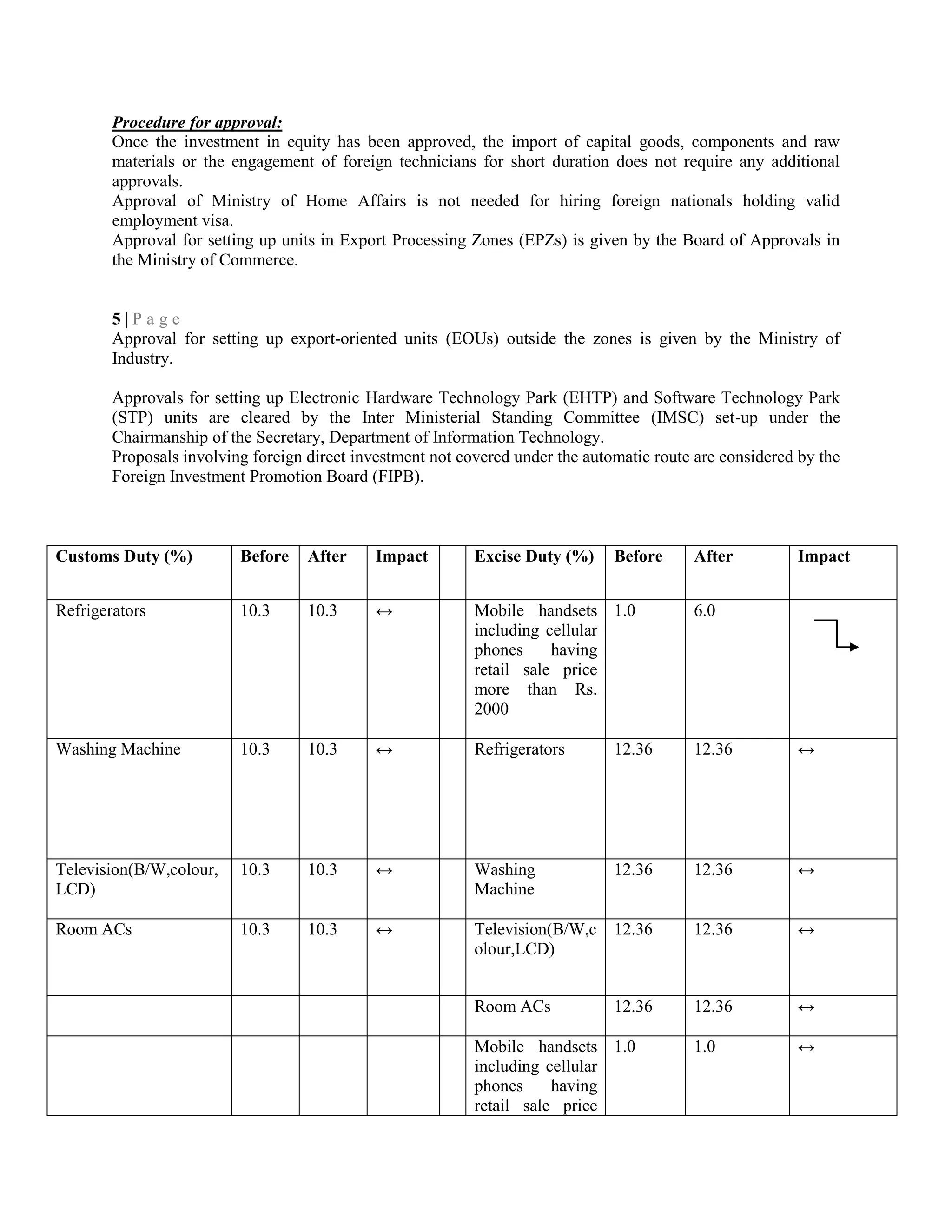
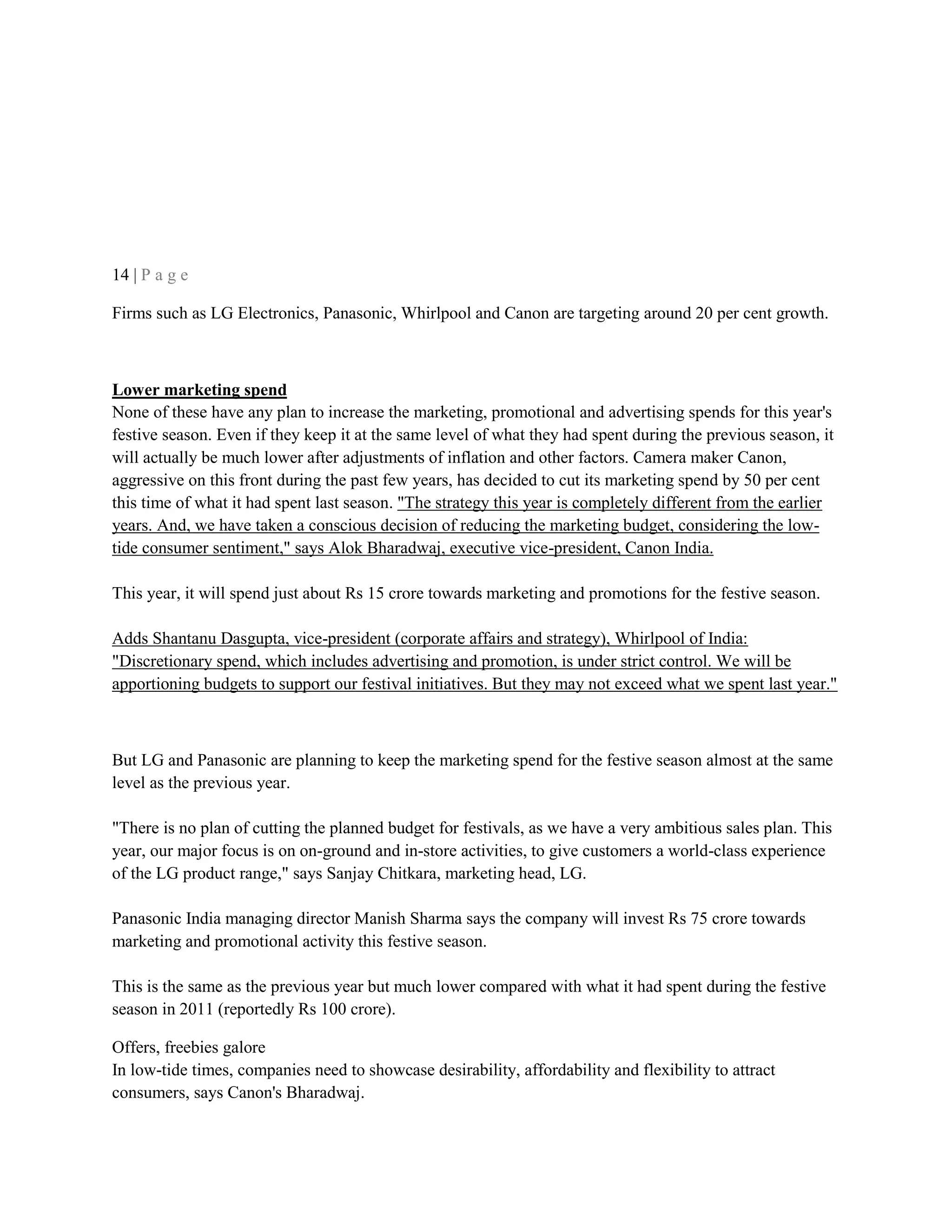
Customs Duty (%) Before After Impact Excise Duty (%) Before After Impact
Refrigerators 10.3 10.3 ↔ Mobile handsets
including cellular
phones having
retail sale price
more than Rs.
2000
1.0 6.0
Washing Machine 10.3 10.3 ↔ Refrigerators 12.36 12.36 ↔
Television(B/W,colour,
LCD)
10.3 10.3 ↔ Washing
Machine
12.36 12.36 ↔
Room ACs 10.3 10.3 ↔ Television(B/W,c
olour,LCD)
12.36 12.36 ↔
Room ACs 12.36 12.36 ↔
Mobile handsets
including cellular
phones having
retail sale price
1.0 1.0 ↔
less than Rs.
2000
6 | P a g e
Leading Businesses in the Industry
SAMSUNG INDIA
Samsung India commenced its operations in India in December 1995, today enjoys a sales
turnover of over US$ 1 billion in just a decade of operations in the country. Samsung design
centers are located in London, Los Angeles, San Francisco, Tokyo, Shanghai and Romen.
Samsung India has its headquartered in New Delhi and has a network of 19 Branch Offices
located all over the country. The Samsung manufacturing complex housing manufacturing
facilities for Colour Televisions, Colour Monitors, Refrigerators and Washing Machines is
located at Noida, near Delhi. Samsung ‗Made in India‘ products like Colour Televisions, Color
Monitors and Refrigerators are being exported to Middle East, CIS and SAARC countries from
its Noida manufacturing complex. Samsung India currently employs over 1600 employees, with
around 18% of its employees working in Research & Development.
WHIRLPOOL INDIA
Whirlpool was established in 1911 as first commercial manufacturer of motorized washers to the
current market position of being world's number one manufacturer and marketer of major home
appliances. The parent company is headquartered at Benton Harbor, Michigan, USA with a
global presence in over 170 countries and manufacturing operation in 13 countries with 11
major brand names such as Whirlpool, KitchenAid, Roper, Estate, Bauknecht, Laden and Ignis.
Today, Whirlpool is the most recognized brand in home appliances in India and holds a market
share of over 25 per cent. The company owns three state-of-the-art manufacturing facilities at
Faridabad, Pondicherry and Pune.
LG INDIA
LG Electronics was established on October 1, 1958 (As a private Company) and in 1959, LGE
started manufacturing radios, operating 77 subsidiaries around the world with over 72,000
employees worldwide it is one of the major giants in the consumer durable domain worldwide.
The company has as many as 27 R & D centers and 5 design centers. Its global leading products
include residential air conditioners, DVD players, CDMA handsets, home theatre systems and
optical storage systems.
GODREJ INDIA
Godrej India was established in 1897, the Company was incorporated with limited liability on
March 3, 1932, under the Indian Companies Act, 1913. The Company is one of the largest
privately-held diversified industrial corporations in India.
7 | P a g e
The Company has a network of 38Company-owned Retail Stores, more than 2,200 Wholesale
Dealers, and more than 18,000 Retail
Outlets. The Company has Representative Offices in Sharjah (UAE), Nairobi (Kenya), Colombo
(Sri Lanka), Riyadh (Saudi Arabia) and Guangzhou (China-PRC).
VIDEOCON
Videocon was established in the year 1979.Videocon Industries Limited manufacture, assemble
and distribute a comprehensive range of consumer electronics, products and home appliances,
including finished goods such as Television, Home entertainment systems, Refrigerators,
Washing machines, Air Conditioners and other small household appliances and components such
as glass shell(panels & funnels), compressors, motors etc.
SONY INDIA
Sony Corporation, Japan, established its India operations in November 1994. In India, Sony has
its distribution network comprising of over 7000 channel partners, 215 Sony World and Sony
Exclusive outlets and 21 direct branch locations. The company also has presence across the
country with 21 company owned and 172 authorized service centers.
HITACHI
Hitachi India Ltd (HIL) was established in June 1998 and engaged in marketing and sells a wide
range of products ranging from Power and Industrial Systems, Industrial Components &
Equipment, Air Conditioning & Refrigeration Equipment to International Procurement of
software, materials and components. Some of HIL‘s product range includes Semiconductors and
Display Components. It also supports the sale of LCD Projectors, Smart Boards and DVD
Camcorders.
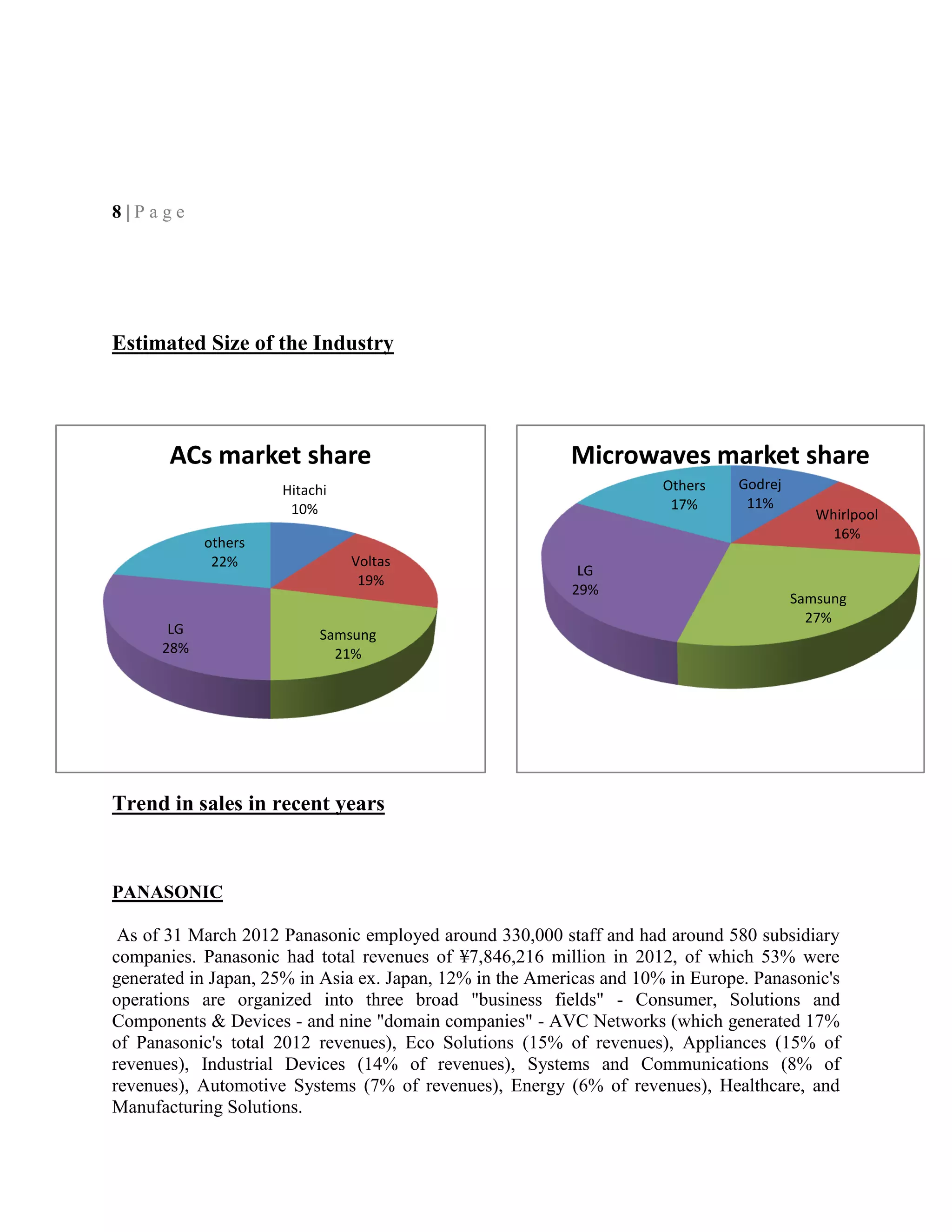
Hitachi
10%
Voltas
19%
Samsung
21%
LG
28%
others
22%
ACs market share
Godrej
11%
Whirlpool
16%
Samsung
27%
LG
29%
Others
17%
Microwaves market share
8 | P a g e
Estimated Size of the Industry
Trend in sales in recent years
PANASONIC
As of 31 March 2012 Panasonic employed around 330,000 staff and had around 580 subsidiary
companies. Panasonic had total revenues of ¥7,846,216 million in 2012, of which 53% were
generated in Japan, 25% in Asia ex. Japan, 12% in the Americas and 10% in Europe. Panasonic's
operations are organized into three broad "business fields" - Consumer, Solutions and
Components & Devices - and nine "domain companies" - AVC Networks (which generated 17%
of Panasonic's total 2012 revenues), Eco Solutions (15% of revenues), Appliances (15% of
revenues), Industrial Devices (14% of revenues), Systems and Communications (8% of
revenues), Automotive Systems (7% of revenues), Energy (6% of revenues), Healthcare, and
Manufacturing Solutions.
Panasonic invested a total of ¥520,216 million in research and development in 2012, equivalent
to 6.6% of its revenues in that year. As of 31 March 2012 Panasonic held a total of 140,146
patents worldwide.
9| P a g e
VIDEOCON
Videocon is a market leader of consumer electronics and home appliances in India. Videocon
manufactures home appliances such as refrigerators, microwave ovens, compressors, ACs and
washing machines. The company recorded a change in net sales by -3 per cent to US$ 64.08
million in Q1, FY‘08 compared to US$ 65.75 million in Q1,FY‘07. For financial year ended
March 2007, the company recorded a change in the profit by 3 per cent to US$ 7.24 million. The
net sales of the company in the financial year ended 2007 recorded an increase of 3 per cent to
US$ 258.65 million Videocon is planning to acquire Daewoo‘s consumer electronic businesses
worldwide. The acquisition would bring Daewoo‘s consumer electronics business including
LCD TVs, plasma TVs and components into Videocon‘s fold, strengthening its position in the
industry. It would also have a strategic fit into the group as it would find a consuming partner for
its recently-acquired Thomson‘s picture tube business.
SONY
In Q3 2013, Sony sold more phones than the previous quarter, or this time last year. While
profits down, though, the growth is not as impressive as you‘d like to think. Sony eked out about
10 million mobile devices last quarter, which is an incremental increase over the 9.6 million the
sold the previous quarter. Sony sold 8.8 million in Q3 2012, so the year-over-year growth is
promising, but not impressive yet. On the back of powerhouse devices like the Xperia
Z1 and Xperia Z Ultra, we thought there would be better news.
Sony reported an upward trend in sales and operating revenue, with $18 billion in Q3. That‘s a
10.6% hike compared to last year, though Sony notes that number is due to a favorable exchange
rate adjustment and sales of mobile devices. On a constant currency basis (not appreciating for
exchange rates), Sony‘s sales are down 9% year-over-year.
Their operating income is down to $151 million, which Sony notes has to do with a sharp decline
in sales everywhere but mobile.
LG
LG Electronics has reported its earnings for Q3 2012, notching its third straight quarter of
positive income with a net profit of 157 billion won ($138.57 million) and "solid" performances
from its home theater and mobile businesses. Revenue is down from the same period last year,
but seeing as it's actually making money this time around it's probably still reason to celebrate.
On the mobile side of the aisle it reports an operating profit of $19.42 million with slightly
higher sales than Q2, mostly thanks to those LTE smart phones it's been rolling out. Its home
entertainment biz noted a rise in LCD sales, with 3D TVs and LED-lit models growing from last
quarter in most markets. Looking towards the future it's obviously going all-in on the Optimus
G (although our interests run towards the Nexus that should debut next week), and also looks for
its Ultra HD television to raise its standing as a premium brand.
10 | P a g e
Market Strategies prevalent
SAMSUNG
Pricing strategy
Pricing played a significant role in Samsung‘s success. Samsung believes in providing good
products in affordable prices to its customers. Samsung technology plank communications
helped the company to gain market share, even though it did not offer any discount or exchange
scheme when it entered India. Samsung focuses on cost cutting measures to keep it prices low
which helps to combat the discount scheme of the local companies.
Samsung once drastically reduced its operational costs which enable the company to keep low
prices for certain products and extract higher profit margin from premium products. This helped
Samsung to post a turnover of Rs 30 bn
Advertising and sales promotion
Brand ambassador Amir Khan and Priyanka chopra.
Organizing contest like Samsung Mobile karaoke festival
Opening the Samsung fun club and for better customer relationships
Free online software updates and customer service
Established many Samsung mobile stores to increase the visibility if the brand.
Direct Mail
Samsung uses Direct mail concept for its product promotion. Samsung sends mail to target
customers depending on the data base i.e. the frequency of the sites visits and on their purchases..
Samsung is very actively involves in ecommerce
SONY
.
Sony is focused on increasing its sales for electronic products and deliver corporate value to its
customers and partners. The company projects to increase the sales of Television sets to 17.5
million TV‘s by 2013. With regard to play station games, the company plans to sell 16 million
units of the play station games by 2013. Sony controls 52.1% of the play station games market.
The company adopted a marketing objective of positioning itself as the greatest brand in the eyes
of consumers. Through this strategy, 50% of consumers consider Sony products to be of high
quality and convenient to use (Pham-gia 16). The company intends to increase awareness of its
products to casual customers through intensive marketing.
Product
Through environmental analysis Sony found out that the significance of its product mix is
appealing to customers. The company‘s customers are looking for an enhanced product mix.
11 | P a g e
This is due to the influence of fashion trends that require new designs to be developed to fit
customer specifications. To attract customers Sony has offered attractive bundles and enhanced
products entertainment capabilities for customer satisfaction.
Price
Sony realized its big weakness as being its price. Hence the company has adjusted its price to
be competitive against direct competitors. This will ensure that the company‘s sales are increased
relative to the sales in previous years.
Place
The name and location of a company is vital to enhance its strength among competitors (Pham-
gia 17). Sony shall maintain good relationships with its subsidiaries to ensure that they are
strategically located.
Promotion
The major element of Sony‘s promotion marketing mix is personal selling, advertising, publicity
and direct marketing (Akpolat 28). The company advertises it products like Bravia and Sony
Wega through the media. The company has advertised its product through sports like the English
premier league. Furthermore, the company uses direct response adverting. In this approach a
consumer is encouraged to provide feed back to the advertiser or place an order directly, online
or through a phone call.
People, physical evidence and process
Bearing in mind that Sony‘s products are main products, it expects to create various
opportunities to manage the people mix, the process mix and physical evidence. The company
has the necessary expertise and human resources to support the company‘s products. The
company‘s staffs are dedicated in providing excellent customer service to maintain high levels of
customer satisfaction. The knowledge base of the company‘s staff adds value to product offering.
Process
Sony has put in place solid procedures and process. This is one of the important aspects of the
company‘s marketing strategy that has proved to be extremely valuable. This feature has enabled
customers to understand the company‘s products and know the shape and form that the company
expects to take.
Physical evidence/ packaging
The company‘s products appear attractive from outside. Sony makes decisions to incorporate
attractive labels of packaging, size, shape and materials in its products.
12 | P a g e
The visual layout of the company‘s products is excellent. The company‘s practical set up is clear
with precise installation instructions
LG
Strategies that made LG leader in Indian market
LG invested heavily in R& D and introduced innovative technologies in consumer
electronics and home appliance segment.
For price conscious customers they introduced low price ‗cineplus‘ and
‗sampoorna‘range for rural markets.
India where cricket is a religion, LG decided to connect with audience using it as medium
which included leading cricketers endorsing the brand.
LG shifted its manufacturing base for many products which reduced its costs which was
passed on to the customer also helped the company to come up with new products.
They also have sponsored professional Star craft 2, Incredible Miracle since 2011 such as
TVs and notebooks contain PVC/BFR free parts; LG aims to phase these substances out
from TVs monitors and PCs by 2012 and household appliances by 2014.
Green Marketing has become one of LG's Corporate Social Responsibilities. As part of
LG‘s strategy to improve on the environment, Green Marketing has being employed by
LG Electronics Company in the development and marketing of products like the LG-3D
Plasma Cinema designed to minimize negative effects on the environment. The recent
Green product is the LG plasma TV that has the energy star logo on it.
PANASONIC
They are increasing their marketing campaigns and associate more with sports including
cricket and football in the next one year to build our brand name in India. In the last one-
and-half years, they are more focused on the Indian market in terms of brand building
activities.
As the Indian market is highly price sensitive, they would like to engage more and more
local talent, who understand the needs of the Indian consumers and develop appropriate
products accordingly. They are taking a remarkable shift in terms of the company's
strategy towards bringing out localized products that will suit the Indian customers.
Indian consumers are now demanding smart products, with features that make them
efficient and effective. But they are not ready to pay for those additional functions,
which are not required by them. So keeping this trend in mind, they are changing their
strategies.
13 | P a g e
They are looking at growing their customer base beyond the metros in satellite towns,
semi-metros and even rural areas. In the next three years, Panasonic aim to be amongst
the top three companies in every segment .The company is on an expansion spree and is
opening exclusive Panasonic brand shops in all relevant markets.
Seasonality
The festive season of the year, starting with Onam in Kerala, travels to the eastern states for Durga Puja
and ends with Diwali over large parts of the country. It has always been a good bet for consumer durables
companies.
As this brief period (two to three months) of the year accounts for 30-35 per cent annual sales revenue,
consumer durables companies every year bring out fresh promotions, launch new products and offer
freebies and special discounts to lure as many as possible.
Discretionary spending of consumers goes up during this time essentially for two reasons - salaried
people get bonuses from employers and farmers harvest their crops, and therefore, have money to make
discretionary purchases. The mood this year, however, is unlikely to be favourable for the companies,
essentially because of the slowing economic conditions, coupled with high prices due to a falling rupee.
ODE TO SPENDERS
The three months between Onam and Diwali account for 30-35% of sales for
consumer durables companies
Discretionary spending increases in this period as the salaried class in towns and cities
get bonuses and farmers have money after the harvest
Every year, companies bring start new promotions, launch new products and offer
freebies and special discounts
An economic slowdown and a falling rupee against the dollar lifting prices of
consumer durables during the festive season might kill the festive mood this year
14 | P a g e
Firms such as LG Electronics, Panasonic, Whirlpool and Canon are targeting around 20 per cent growth.
Lower marketing spend
None of these have any plan to increase the marketing, promotional and advertising spends for this year's
festive season. Even if they keep it at the same level of what they had spent during the previous season, it
will actually be much lower after adjustments of inflation and other factors. Camera maker Canon,
aggressive on this front during the past few years, has decided to cut its marketing spend by 50 per cent
this time of what it had spent last season. "The strategy this year is completely different from the earlier
years. And, we have taken a conscious decision of reducing the marketing budget, considering the low-
tide consumer sentiment," says Alok Bharadwaj, executive vice-president, Canon India.
This year, it will spend just about Rs 15 crore towards marketing and promotions for the festive season.
Adds Shantanu Dasgupta, vice-president (corporate affairs and strategy), Whirlpool of India:
"Discretionary spend, which includes advertising and promotion, is under strict control. We will be
apportioning budgets to support our festival initiatives. But they may not exceed what we spent last year."
But LG and Panasonic are planning to keep the marketing spend for the festive season almost at the same
level as the previous year.
"There is no plan of cutting the planned budget for festivals, as we have a very ambitious sales plan. This
year, our major focus is on on-ground and in-store activities, to give customers a world-class experience
of the LG product range," says Sanjay Chitkara, marketing head, LG.
Panasonic India managing director Manish Sharma says the company will invest Rs 75 crore towards
marketing and promotional activity this festive season.
This is the same as the previous year but much lower compared with what it had spent during the festive
season in 2011 (reportedly Rs 100 crore).
Offers, freebies galore
In low-tide times, companies need to showcase desirability, affordability and flexibility to attract
consumers, says Canon's Bharadwaj.
Not only Canon, most companies are offering extended warranty and free gifts (such as Panasonic
offering Free Benetton bag on the purchase of a 29-inch LED TV and Free Microlab Speakers on
purchase of select models of 39-inch LED TV). Affordable finance schemes or zero-interest EMI
(equated monthly instalment) options and special gift offers are also available.
15| P a g e
For example, Whirlpool's Onam scheme is offering bumper scratch card of 51 return tickets to Dubai for
couples and the company is also flying down 25 Keralites living in West Asia, who have not visited home
in the past three years, during Onam.
Canon, for instance, has started adding one extra lens in the starter kit and offering special warranty for
some products. "Every company is redesigning the marketing strategy this year, so we are," adds
Bharadwaj.
Fresh launches
In spite of weak consumer sentiment, no company wants to go slow on new launches and promotions.
What matters in the business, especially when the markets go weak is brand perception and visibility. So,
there is no scope to cut corners here.
But the number of fresh launches is likely to be fewer compared with the previous years.
According to a spokesperson of Samsung Electronics, it plans to launch premium products such as Panel
TVs, Q9000 (air conditioner), new models of Frost-free refrigerators and microwave ovens in the Indian
market for the festival season.
Whirlpool would launch a French Door Bottom Mount, some new colour finishes in Frost Free
Refrigerators, two new ranges in Top-Load Washing Machine, and a couple of new Microwave models.
Most products would be rolled out between September and October.
But companies like Panasonic and LG did not reveal details of fresh launches for this festive season.
Purchase necessarily done only during the harvest , festive and wedding seasons – April to June and
October to November in North India and October to February in the, believed to be months `good for
buying‘, should be converted to routine regular feature from the seasonal character. Rural India that
accounts for nearly 70% of the total number of households, has a 2% penetration in case of
refrigerators and 0.5% for washing machines, offers plenty of scope and opportunities for the white
goods industry
Among consumer durables, stocks like Whirlpool, Bajaj Electricals, Videocon, Voltas and Blue
Star, all of which sell cooling products such as coolers and ACs, are listed on the stock
exchanges. Air-conditioning and cooler scrips have around 30% weightage for white goods in
the BSE Consumer Durables index.
16 | P a g e
Generally, a durable good is one that does not wear out soon, or that yields utility over time
rather than being completely consumed in one use. Consumer durables such as refrigerators and
air conditioners usually continue to be useful for three or more years at least.
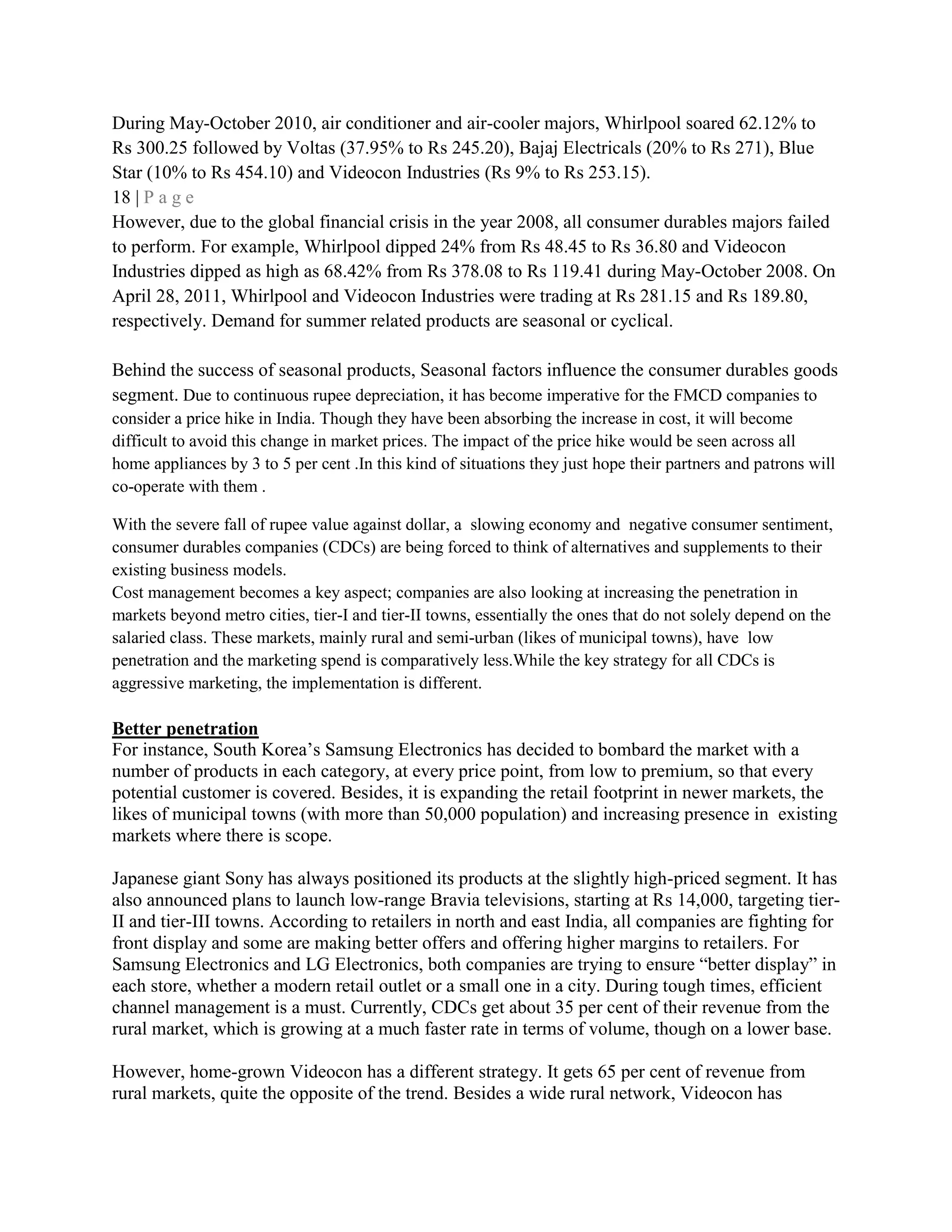
Since its inception in 1999, the BSE consumer durables index gained on seven occasions during the
summer months till 2010 (see table on the performance of the BSE CD index).
During May-October 2010, the BSE Consumer Durables index surged 1,860 points, or 40%, to 6,544.48
against 45.59% to 6,239.69 during the financial year 2010-11. The index gained 1,516 points, or 83%, to
3,348.21 during May-October 2009 against a full year growth of 153% to 4,220.71 during the financial
year 2009-10.
Season-related products particularly air-conditioners, refrigerators, fans and coolers are in high
demand during the summer months for obvious reasons. With increased prosperity in semi-urban
and rural areas, coupled with generally increasing income and aspiration levels, consumer
durables stocks are expected to perform well on the back of increased demand during the
summer months. These stocks could get a boost towards the end of the summer season due
festival-season demand.
The sales for products such as air-conditioners, refrigerators and coolers can grow multifold
during the summer season. Market experts believe that before investing in consumer durables
goods investors should look into distribution strength and spread with particular focus on reach
in semi-urban and rural areas, market positioning of the products (leadership or otherwise) and
track record and credibility of management. Also, don't forget to measure the relative valuation
of the company in the context of similar other stocks.
17 | P a g e
Sensitivity to economic fluctuations
Rupee Pressure
The depreciating rupee has already forced the consumer durable companies to go for a price hike
of two-five per cent across categories during the past three months.
And, most companies are planning for another round of price rise. But, keeping the festive
season in mind, some may try to hold on. But Panasonic's Sharma says the company would pass
on the pressure to consumers only if the rupee depreciated further. The price rise will be across
all categories.
With the rupee breaching 68 against the US dollar, consumer durables are likely to become dearer by up
to 7 per cent, even as consumption demand continues to crumble and the festive season is round the
corner.
It is certainly going to impact the industry, especially where import content is high. The cost of
input is going up. Industry is already working on thin margins. The sector is highly price elastic.
All white goods and brown goods are going to become expensive. Given the elasticity, if the
prices go up by 1 per cent, demand comes down by 3 per cent.
Even good monsoons have failed to cheer the industry due to the depreciation of the domestic
currency.
That most of the electronic goods have very high import content. For instance, products like
picture tubes, washing machines timers, are not manufactured in the country, while goods like
microwave and ovens are imported as completely built units in India.
So, naturally, their prices would go up even during the festive season, anything between 4-7 per
cent, depending on the sector.
According to industry estimates, due to slowdown and rupee depreciation, in July the consumer
electronics and home appliances sector contracted 30 per cent. Electronic products including raw
material worth $31 billion were imported last year, he said adding that in May, 1.75 lakh flat-
panel TV sets were imported, of which 1.4 lakh were under the duty-free regime.
Reflecting the scenario, S&P BSE consumer durables dropped 2.32 per cent on Wednesday. It
was down 2.97 per cent Tuesday while a week ago, on August 21, it declined 3.19 per cent. A
month ago, too, consumer durables shares fell 13.97 per cent, mirroring the sentiment of the
sector.
During May-October 2010, air conditioner and air-cooler majors, Whirlpool soared 62.12% to
Rs 300.25 followed by Voltas (37.95% to Rs 245.20), Bajaj Electricals (20% to Rs 271), Blue
Star (10% to Rs 454.10) and Videocon Industries (Rs 9% to Rs 253.15).
18 | P a g e
However, due to the global financial crisis in the year 2008, all consumer durables majors failed
to perform. For example, Whirlpool dipped 24% from Rs 48.45 to Rs 36.80 and Videocon
Industries dipped as high as 68.42% from Rs 378.08 to Rs 119.41 during May-October 2008. On
April 28, 2011, Whirlpool and Videocon Industries were trading at Rs 281.15 and Rs 189.80,
respectively. Demand for summer related products are seasonal or cyclical.
Behind the success of seasonal products, Seasonal factors influence the consumer durables goods
segment. Due to continuous rupee depreciation, it has become imperative for the FMCD companies to
consider a price hike in India. Though they have been absorbing the increase in cost, it will become
difficult to avoid this change in market prices. The impact of the price hike would be seen across all
home appliances by 3 to 5 per cent .In this kind of situations they just hope their partners and patrons will
co-operate with them .
With the severe fall of rupee value against dollar, a slowing economy and negative consumer sentiment,
consumer durables companies (CDCs) are being forced to think of alternatives and supplements to their
existing business models.
Cost management becomes a key aspect; companies are also looking at increasing the penetration in
markets beyond metro cities, tier-I and tier-II towns, essentially the ones that do not solely depend on the
salaried class. These markets, mainly rural and semi-urban (likes of municipal towns), have low
penetration and the marketing spend is comparatively less.While the key strategy for all CDCs is
aggressive marketing, the implementation is different.
Better penetration
For instance, South Korea‘s Samsung Electronics has decided to bombard the market with a
number of products in each category, at every price point, from low to premium, so that every
potential customer is covered. Besides, it is expanding the retail footprint in newer markets, the
likes of municipal towns (with more than 50,000 population) and increasing presence in existing
markets where there is scope.
Japanese giant Sony has always positioned its products at the slightly high-priced segment. It has
also announced plans to launch low-range Bravia televisions, starting at Rs 14,000, targeting tier-
II and tier-III towns. According to retailers in north and east India, all companies are fighting for
front display and some are making better offers and offering higher margins to retailers. For
Samsung Electronics and LG Electronics, both companies are trying to ensure ―better display‖ in
each store, whether a modern retail outlet or a small one in a city. During tough times, efficient
channel management is a must. Currently, CDCs get about 35 per cent of their revenue from the
rural market, which is growing at a much faster rate in terms of volume, though on a lower base.
However, home-grown Videocon has a different strategy. It gets 65 per cent of revenue from
rural markets, quite the opposite of the trend. Besides a wide rural network, Videocon has
another advantage. It still sells products like CRT televisions and single-door and direct cool
refrigerators, which its competitors exited sometime earlier.
19 | P a g e
These categories still sell well in rural areas because of the costing. As part of aggressive
marketing strategy, all CDCs have been launching new products every month across categories,
ensuring at least one product launch each month. On an average, companies are launching about
15 per cent more in numbers of products this year, according to industry sources.
Affordability
Prices of consumer durables have gone up and are likely to do so even more because of the rupee
devaluation. During tough times, companies need to showcase desirability, affordability and flexibility to
lure consumers. Canon has, for the first time, decided to offer zero-interest equated monthly installment
(EMI) options.EMI schemes, coupled with exchange offers, have worked well in India. The mobile
handset category, for instance. After it started offering exchange offers linked with EMI schemes, Apple‘s
sales surged 417 per cent in India in the past year. Samsung, LG, Sony and BlackBerry are no exception.
EMI schemes worked well in the handset segment, especially because it is credit card-linked and backed
by exchange offers, said a Samsung spokesperson.
EMI schemes make expensive products affordable for consumers as they don‘t need to pay the entire
amount upfront. Sometimes, consumers also upgrade to the next level while buying a device. So,
companies are getting better revenue.
Increasing local manufacturing
Keeping the long-term gains in mind, consumer electronics companies are trying to increase production
as much as possible. Local manufacturing helps to control costs, but companies can‘t suddenly start
production in India for various reasons, with unavailability of majority of equipment in India. According
to a study by Corporate Catalyst India, just 30-35% of electronic component required for manufacturing
are available from local sources and semiconductors are imported almost 100%.
However, the government's move early this week to ban duty-free imports of flat-panel television sets
beginning August 26 is expected to give local manufacturing a leg-up. Almost 1.5 to 2 million flat panel
TVs out of a 6-million-unit-strong-market is imported every year. By slapping a steep duty of 35% to
discourage imports, local demand will grow giving a fillip to domestic manufacturing.
According to industry estimates, almost 65 to 70% of parts going into locally manufactured products such
as TVs, refrigerators, washing machines and air conditioners come from markets such as China, Japan,
Indonesia, Malaysia and Taiwan. Also, high-end products in these categories are completely imported
from abroad since it makes no economic sense to produce them here.
The same goes for categories such as laptops, tablets, micro-wave ovens and digital cameras, which are
all imported as completely built units from abroad.
Barring high-end models and new product categories such as water purifiers, Whirlpool produces all entry
and mid-level home-appliance models in the country. Plans are to have more products manufactured here,
he says. But persons in the know say this plan is partly linked to Whirlpool's strategy of converting India
into a manufacturing base for its Asian operations.
20 | P a g e
Companies such as Samsung and LG also say they have no plans to cut production in India. They
manufacture all their consumer electronic products here barring a few high- end refrigerators, ultra high-
definition TVs, and microwave ovens. Industry sources say that it takes up to a year to set up a
manufacturing plant in the country. A new production line, on the other hand, could take upto six months
to become fully operations. So a decision taken now to set up either a new production line or
manufacturing plant will be realized only one year down the line.
Looking at high cost of imports, Panasonic has decided to take two crucial decisions. They mainly include
increased focus on B2B (business-to-business) products to keep up profit margins; and to increase local
production, especially India-specific products, to maintain volume growth.
―The B2B segment can help expand our margins and lead to better profitability. The costs are lower as
there are no ad budgets and distribution expenses. We are putting more efforts on our enterprise product
line targeted at the healthcare, security and education space. To drive cost efficiencies in the consumer
space, we have increased our production capacity at our plant in Jhajjar, Haryana with an investment of
USD 200 million over a five-year period,‖ said Manish Sharma, MD- Panasonic India.
Some companies, however, are trying to leverage the export route to take advantage of the rupee
devaluation. They invested at the right time, and that has helped them to fight against the falling rupee.
They have also started exporting. Exports actually would give them better growth in this market
condition. They expect to get about 5% of their revenue from exports to Sri Lanka, Nepal and
Bangladesh.
21| P a g e
Industry Developments, News, Innovations
In its initial years, the sector relied greatly on media and advertising for consumer penetration.
Liberalization of markets in late 1990s saw the entry of global players like Samsung and LG and
a shift in focus towards product innovation.
The sector has been witnessing significant growth in recent years, helped by several drivers such
as the emerging retail boom, real estate and housing demand, greater disposable income and an
overall increase in the level of affluence of a significant section of the population. Penetration
of durables has gone up significantly in the past decade when categories like refrigerators,
washing machines and televisions were at single-digit levels. Today, penetration of
televisions alone is at 29%, refrigerators at 18%, washing machines at 11-12%, air
conditioners at 10% and microwave ovens at 3-4%, according to the latest industry data.
In recent years, consumer durables companies have focused on quality, technical design, and
innovation and aspirational/lifestyle branding to differentiate their products in mature markets. In
emerging markets, these groups have sought to exploit lower-cost manufacturing opportunities
and greater growth potential. In the current global recession, the common challenge across
categories and markets is falling consumer spending on what are often big-ticket, discretionary
items. The response to this global reduction in demand has differed markedly between different
companies, even in the same industry. While some have chosen to restructure and consolidate
operations, others are pursuing a more aggressive strategy of pushing for market share through
innovation and acquisition.
Consumption growth gives Indian firms confidence to rework strategies.
From cathode ray tube (CRT) TVs and noisy air coolers to flashy ultra HD TVs and silent split
air conditioners, the Indian consumer is now spoilt for choice. The last two decades have marked
the rise and fall of several brands and technologies. It also marks the Indian consumer's fast
changing priorities and preferences.
The liberalization of the economy saw the entry of international players in early to mid 1990s, in
the Indian consumer durable market that was largely dominated by a few domestic players. With
the arrival of global players, came in new technologies.
The availability of loans and financing schemes made consumer products like refrigerators and
television sets more affordable and provided the much needed boost for the durables companies
in the early 2000s. This was also when air-conditioners, once considered a luxury, made their
way into middle class Indian homes.
22 | P a g e
The late 2000s saw the advent of aspirational products like HD Television. This was also the
time when some Indian players managed to make a mark and consolidate their positions as the
rural Indian consumption story began to unfold. Today the rural market is growing faster than
urban India although the penetration level is much lower.
Indian durable space also witnessed in the past few years the domination by Korean brands as
they tapped into the opportunity presented by rising income levels, double-income families and
increasing consumer awareness.
What made the Korean brands so successful? They focused on product innovation and product
differentiation to woo customers. He said the Korean companies were the first ones to pamper
the dealers and distributors and channel partners offering them better margins than others that
motivated them to push sales. These companies invested in the future, focused on research and
development and manufacturing in India rather than rely only on imports which helped them
price their products just right. Korean brands also focus on after-sale service.
In recent years though the best practices have spread across and both international and Indian
players are giving competition to the Korean brands, even as Korean brands continue to maintain
market leadership.
What has also changed dramatically in the last 2-3 years is the advent of smart phones for Indian
homes and every durable firm wants a share of the pie. The reasons are clear. Technology and
connectivity have become important. Indian consumers today are more willing to spend on
upgrading and changing their smart phones every two years while postponing similar upgrades
for other consumer product. All durable firms are either well entrenched in the handset business
or looking to grab market share.
Industry veterans and observers also believe it is not necessary that Korean firms will lead the
next revolution in the durable space and it can be anyone's game.
23 | P a g e
24 | P a g e
NEWS :
The government announced digitization of cable television in India, which may lead to
complete switchover from analogue cable to Digital Addressable Systems in a phased
manner. As a result, the number of DTH subscribers in India is expected to increase from
44million currently to 200 million by 2018.
Global technology companies are planning to invest around Rs.3,500 crore cumulatively
in India through the modified special incentive package scheme (M-SIPS) route.
M-SIPS—prepared under the National Policy on Electronics 2012 that seeks to speed up
local manufacturing and curb electronics imports—provides investors a subsidy of 20-
25% on capital expenditure, as well as a subsidy of 50-75% for companies investing in
so-called electronics manufacturing clusters.
Samsung India Electronics Pvt. Ltd, the local arm of the South Korean electronics maker,
on 14 February launched its ―Rex series‖ of affordable feature phones that will be made
and sold in India as well as exported to China and West Asia.
25 | P a g e
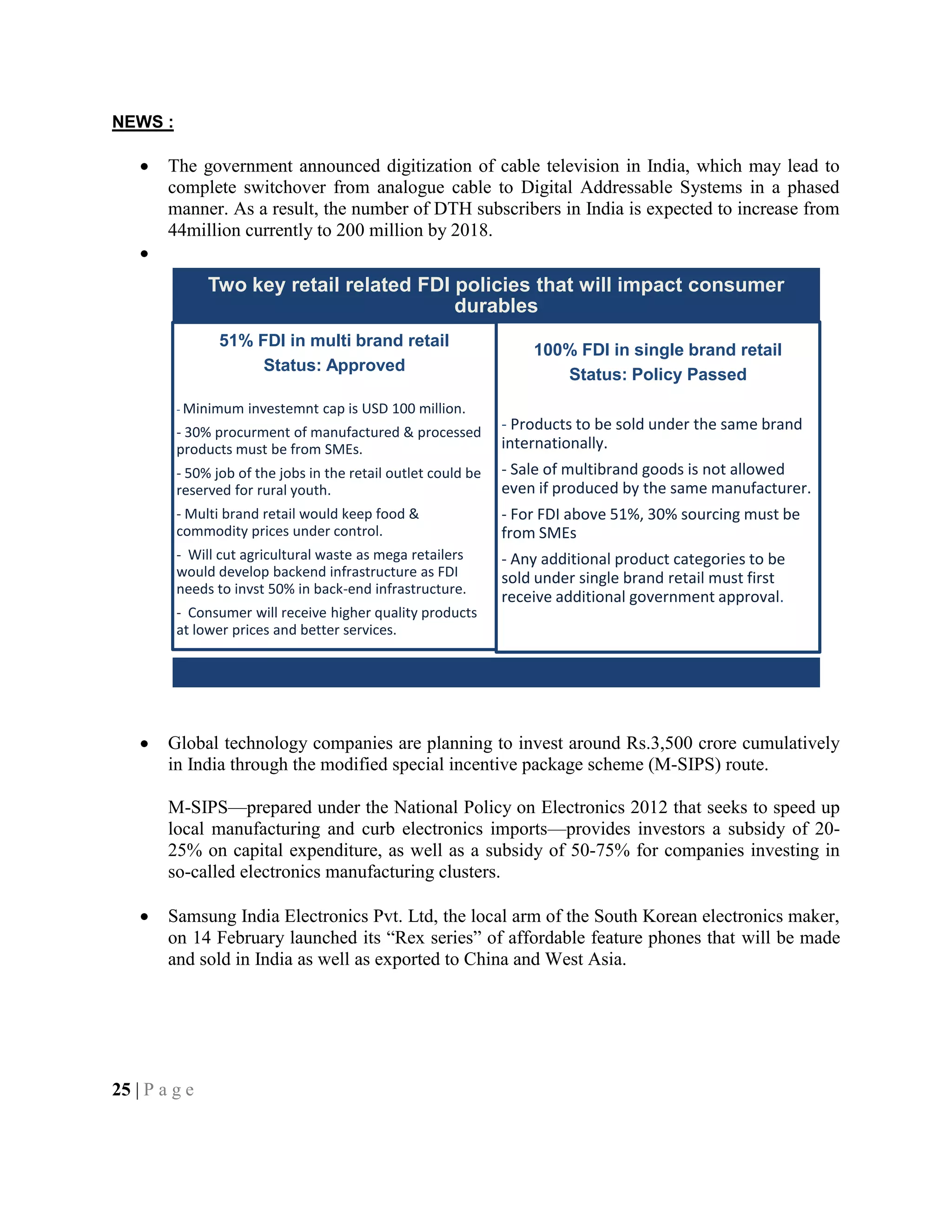
Two key retail related FDI policies that will impact consumer
durables
51% FDI in multi brand retail
Status: Approved
- Minimum investemnt cap is USD 100 million.
- 30% procurment of manufactured & processed
products must be from SMEs.
- 50% job of the jobs in the retail outlet could be
reserved for rural youth.
- Multi brand retail would keep food &
commodity prices under control.
- Will cut agricultural waste as mega retailers
would develop backend infrastructure as FDI
needs to invst 50% in back-end infrastructure.
- Consumer will receive higher quality products
at lower prices and better services.
100% FDI in single brand retail
Status: Policy Passed
- Products to be sold under the same brand
internationally.
- Sale of multibrand goods is not allowed
even if produced by the same manufacturer.
- For FDI above 51%, 30% sourcing must be
from SMEs
- Any additional product categories to be
sold under single brand retail must first
receive additional government approval.
Haier India, the domestic unit of Hong Kong-listed Haier Electronics Group Co. Ltd that
makes washing machines and other consumer electronics, plans to commission two more
factories in the country. ―Once our Pune factory is utilized to the maximum, we see us
opening a factory in the north and one in the south for better logistics,‖ said Eric
Braganza, president, Haier India.
India‘s electronic system design and manufacturing industry is estimated to grow at a
compounded annual growth rate of 9.9% the next few years—from $64.6 billion in 2011
to $94.2 billion in 2015, according to a 22 January report by the India Electronics and
Semiconductor Association (IESA). Consumer Electronics and Appliances
Manufacturers Association, projected data in its 22 February report, stating that demand
for electronics hardware in India will grow at 22% annually till 2020, making it a $400
billion opportunity. Industry experts see India‘s electronic imports surpassing its high oil
import bill by 2030.
LG India has chalked out plans to launch an array of smartphones under its ambit as the
company seeks to drop its conservative attitude and grab market share, currently
dominated by other brands such as Apple, Samsung and Nokia.
The company also unveiled a pocket photo printer that is expected to be priced at Rs.
14,990 and will be launched around June. The portable printer can print instant
photographs from a Smartphone.
This year too, the market looks gloomy for the industry as people have not showed up in
showrooms during the eve Dhanteras. This is majorly due to multiple rounds of increase
in prices of kitchen appliances and consumer durables for past one year.
Marketers say the companies have increased prices across all product categories almost
three times over a year owing to the decline in value of Indian currency against dollar in
the global market. Since companies have to import raw materials and finished goods from
other countries, the cost naturally increases while transacting in dollars.
NBFCs such as Capital First and Shriram Capital sought to make most of the opportunity.
Public sector banks, including State Bank of India and Punjab National Bank, joined the
party by lowering interest rates on consumer durables loans just ahead of Diwali after the
finance ministry pushed them to do so to stimulate demand.
26 | P a g e
Japanese electronics major Panasonic launched T31, the fifth model into the Indian
market, which runs on Android Jelly Bean operating system, has 4-inch WVGA display
screen and dual-core processor, expanding its Smartphone portfolio. With starting range
of 7,000/- to 8,000/-.
They aim to go beyond the metros and cater to the consumers across tier-II/III cities and
deliver a remarkable mobile experience to the Indian mass consumers.
INNOVATIONS :
To keep pace with the fast changing Indian consumer durables market, firms have to differentiate
their products in the areas of relevance to the consumers, innovate in technology, develop a
strong global network, and find more effective ways of promotion and distribution. The products
and the approach to the market need to be customized to suit the unique needs of the consumers.
Several Indian and MNC players are looking to strengthen their presence in India to leverage this
opportunity.
Startup company, Livares Technologies has launched an Android application called
‗Phone Away‘ that will let users convert their Smartphone into a remote control. By
using the ‗Phone Away‘ application, users can access contents on their phone from
another mobile phone or pc. Users can even locate a lost phone that is set on silent mode
by activating the remote-ringer capability. It is power-efficient and does not consume a
lot of battery life. This, mainly because it activates and uses features like wifi or
GPRS/3G only when needed and also turns it off automatically after use.
The company, which is a brainchild of enterprising, young entrepreneurs who are out to
make a difference, is based primarily in Techno park, Thiruvananthapuram and Startup
Village, Kochi.
DTH (direct to home) company Tata Sky, launched Everywhere TV, by which its
subscribers will be able to enjoy all their favorite TV channels and movies on demand on
their mobile. The services entitle a subscriber to access 50 channels with a monthly
payment of Rs 60. With the launch of this service, Tata Sky will extend its range of
services from indoors (at home) to outdoors and on-the-move.
27 | P a g e
Rotimatic does is to take the tedium out of the process of making rotis — the relentless sifting,
kneading, rolling and baking everyday.
Smart Watches: smart watch, is a computerized wristwatch with functionality that is
enhanced beyond timekeeping, and is often comparable to a personal digital assistant
(PDA) device, modern smart watches are effectively wearable computers. Many smart
watches run mobile apps, while a smaller number of models run a mobile operating
system and function as portable media players, offering playback of FM radio, audio, and
video files to the user via a Bluetooth headset and many more.
Samsung‘s Smart TVs with voice recognition, its touch screen etc.
Smartphones: a mobile phone that is able to perform many of the functions of a
computer, typically having a relatively large screen and an operating system capable of
running general-purpose applications, fully automatic washing machines.
Many more innovations like microwave ovens with grill and convection mode, air
conditioners with both heating and cooling function, large-capacity frost-free, self
controlled refrigerators, etc.
Allowing customers to directly take part in the design creation online. LG is planning to
make their official website a significant source of new ideas for up-to-date and
personalized designs. Promoting interactivity and multi-directional communication, the
company‘s website might become a valuable instrument to sense the global market‘s
trends, periodically communicate with the end-users and build strategic customers loyalty
programmes. An additional benefit of online customization and commercialization is that
the dependence on operators and retailers will be somewhat reduced, thereby improving
LG‘s bargaining power towards them.
To beat the inflation and slowdown pangs, companies have come out with discounts and
consumer offers this year. While a few consumer durable giants are giving scratch cards
carrying cash-back offers worth Rs 200-1,000 on every purchase, others are giving free
warrantee up to three years or assured gifts like make-up kit, hair-drier etc., on every
product.
Some companies have announced lucky draw offers to attract consumers this Dhanteras,
offering prizes like car or gadget but all these attempts have failed to pull the crowd.
Though prospects of any bumper sale seem bleak, marketers are hopeful about the next 3-
4 days.
28 | P a g e
Out of these top companies we have selected Videocon and accordingly we will be discussing
Consumer market data and competitors.
Consumer Market Data
 Demographics:
Videocon‗s customer base is fairly homogeneous in their needs and attitudes, they are likely to
respond similarly to a given marketing strategy. They are likely to have similar feelings and
ideas about a marketing mix comprised of a given product or service, sold at a given
price, distributed in a certain way and promoted in a certain way.
High end product sales are no longer restricted to metros. Consumer in tier-2 cities seems to be as
evolved in lifestyle needs. The consumer profile, too, has changed. Higher disposable
incomes, greater aspirations and younger demographic have increased demands for the
technologies. And Videocon is targeting this segment. Videocon targets mostly the people
within the age group of 20-40.
Competitor information
SAMSUNG
PROFILE:
Samsung India commenced its operations in India in December 1995, today enjoys a sales
turnover of over US$ 1 billion in just a decade of operations in the country. Samsung design
centers are located in London, Los Angeles, San Francisco, Tokyo, Shanghai and Romen.
Samsung India has its headquartered in New Delhi and has a network of 19 Branch Offices
located all over the country. The Samsung manufacturing complex housing manufacturing
facilities for Color Televisions, Colour Monitors, Refrigerators and Washing Machines is located
at Noida, near Delhi. Samsung ‗Made in India‘ products like Colour Televisions, Colour
Monitors and Refrigerators are being exported to Middle East, CIS and SAARC countries from
its Noida manufacturing complex. Samsung India currently employs over 1600 employees, with
around 18% of its employees working in Research & Development.
29| P a g e
CURRENT MARKET SHARE:
Sales of Samsung indiaElctronics Ltd. ( SIEL) have been growing at a CAGR of almost 50 per
cent over the past four years.
SIEL is the market leader in high end digital television (Plasma, LCD and LED). In the highly
competitive Colour Television market in India, Samsung has a market share of 15.5 per cent.
Samsung holds the No. 1 position in the Flat Television category, Frost Free refrigerators as well
as in the Microwave oven segment.
Samsung is the leader in the IT essentials segment with 63 per cent Market share in TFT, LCD
and LED monitors, 51 per cent in Monitors, 43 per cent in Multifunction Printers and 47 per cent
in Hard Disc segment. In the telecom space, Samsung is the market leader in colour screen
phones with 36 per cent market share. It is also the largest selling mobile phone brand across all
categories in India.
OPERATIONAL STRATEGIES AND USP
Innovative promotion and advertising initiatives
To establish trust and confidence among Indian consumers, Samsung did active promotion and
advertising by taking the following initiatives.
Samsung India associated itself with the ruling passion of the Indian mass consciousness:
Cricket. Samsung launched the Team Samsung campaign with the stars of the Indian cricket
team, which caught the imagination of an entire nation.
Not confining itself to cricket, Samsung sponsors the Indian contingent to the Olympics and the
Asian Games. It also ran training programmes for deserving Indian athletes under the Olympic
Ratnabanner.
Samsung also launcheda series of innovativebelow-the-line activities. In mobile phones,Samsung
tied up with noted painter SatishGujralfor his paintings to be available as downloads on Samsung
mobile phones
Branded its products as superior technology and environment friendly ones. The Samsung
refrigerators and ACs incorporate a revolutionary new technology called Silver Nano Health
System that ensures freshness and bacteria free environment.
Launching the best in design and technology in India
To differentiate its products from the competition, Samsung followed a deliberate strategy of
bringing in the world‘s best design and technologies to India from its parent. It launched its
products in India around the same time as the global launch of products.
30 | P a g e
Samsung pioneered the introduction of several world first features in its mobile phones like the
first Dual Screen Phone, the first 65K TFT / LCD Colour Phone, the first Phones with
Polyphonic
Ringtones, the first phones with rotating lens and ultimately pioneered the move for bringing
smart phones in India.
In IT products, Samsung introduced the thinnest and lightest Note PCs in the world, the world‘s
smallest MP3 players and India‘s first 17" TFT-LCD TV-Monitor that comes with the unique
‗wise-link‘ Samsung technology where various digital gadgets can be connected directly to the
Display. It also launched the world‘s smallest Digital multi-function device that scans,
prints and copies at the same time
Samsung has won over 150 awards in India for its technology and design based products.
Customized products for Indian Consumers
Samsung understands the local cultural sensibilities to customize its products according to the
Indian market.
Samsung phones support five Indian languages - Hindi, Marathi, Bangla, Punjabi and Tamil. The
phones supports phone menu, fonts and SMS in these five languages. Samsung is the first
company in the world to introduce a Bangla menu.
It has set up a ―usability lab‖ at the Indian Institute of Technology in New Delhi to customize
Samsung products to meet the specific needs of Indian consumers. This industry-institute
partnership is helping Samsung to study and analyze consumer response in aspects of product
design, including aesthetics, ergonomics and interface.
Through its research done on consumer preferences in India, Samsung has concluded
that Indian consumers want more soundorientedproducts. Thus, the Samsung televisions
of India have a higher sound capacity than their foreign counterparts.
Samsung washing machines have an additional menu that takes care of the local Indian
wardrobes. They also have a ‗memory re-start‘ that takes care of the frequent power failures in
India.
Research and Development Potential
Samsung has set up two R&D centres in India, at Bangalore and Noida. Both the R&D centers
are involved in cutting edge research and development
The Noida centre is involved in the business of developing embedded software for Samsung
Electronics Corporation in a variety of areas related to Digital TV and other Multimedia
technologies. The centre has successfully completed more than a hundred projects in
collaboration with Samsung Headquarters Visual Display and Digital Media divisions. Its
engineers continuously strive to improve performance and introduce innovative features to make
the end products more efficient and user friendly.
31 | P a g e
The Bangalore operation is involved in the business of developing software for Samsung
Electronics Corporation technology solutions in a variety of different areas. It is known for the
expertise that it possesses in certain key technology domains. Its contributions have been in very
key knowledge based areas of new and evolving technologies like 3G, UMTS, CDMA2000,
Multimedia, Home Networking, Digital Media, System LSI, Network Protocols, Wireless
terminals to mention some. The centre boasts of a highly talented and motivated work force who
have been constantly enriching their knowledge and skills
Corporate Social Responsibility
Samsung has also made its mark as a company with a conscience and an organization with social
responsibilities. In 2004, Samsung won the Golden Peacock Special Commendation for
Corporate Social Responsibility. This award was given by the Institute of Directors and the
World Council for Corporate Governance. Samsung runs the Digital Hope programme,
Supportingorganisations that promote the use of technology to improve the lives of youth,
empower them and help bridge the ‗digital divide‘. Organisationssupported by this programme
include Development Alternatives and the National Centre for Promotion of Employment of
Disabled People (NCPEDP).
Therefore, concluding these points it can be said that, the thing which makes their product
unique is their level of quality n satisfaction which they provide to the consumer also their
methods of promotion is their main U.S.P.
SONY
PROFILE:
Starting its business operations in India in 1994, Sony India is one of the most recognized
consumer electronics brand in the country, with a reputation for new age technology, digital
concepts and excellent after sales service. In India, Sony has its footprint across all major towns
and cities in the country through a distribution network comprising of over 10,400 dealers and
distributors, 270 exclusive Sony outlets and 23 direct branch locations. Sony India also has a
strong service presence across the country with 255 service outlets. Manned by customer friendly
and informed sales persons, Sony‘s exclusive stores ‗Sony Center‘ are fast becoming the most
visible face of the company in India. A distinctive feature of Sony‘s service is its highly
motivated and well-trained staff that provides the kind of attentive and sensitive service that is
rare today.
With brands names such as BRAVIA, VAIO, Tablet, Handycam®, Cyber-
shot, Walkman®,Xplod™, Sony hi-fi, Memory stick® and PlayStation®, Sony has established
itself as a value leader across its various product categories of Audio/Visual Entertainment
products, Information and Communications, Recording Media, Business and Professional
products.
32 | P a g e
MARKET SHARE :
Some facts:
BRAVIA is No.1 in Flat Panel Market with 18.8% share (In Qty.) in CY13(As per Display
Search)
Cyber-shot is No.1 in Compact Digital Camera market with 34% share in FY12 (As per
Import Data)
VAIO for the first time hit No.1 share of 20% in Q4, 2012 (As per IDC Report)
May 22, 2013, New Delhi: Sony India today announced its Sales achievement of Rs. 6,313 crore
in FY12
BRAVIA, VAIO and Digital Imaging (Cyber-shot, Handycam, Alpha& Photo Frame) have been
the growth drivers of the business in India, contributing 35%, 20% and 15%, respectively to the
total sales in FY12.
Performance of each Category:
BRAVIA
Sony has been ruling the Indian market by continuously maintaining a very high market
share in the Flat Panel TV segment in India. As per Display Search, Sony India hit
Number One position with 18.8% share (In Qty) in FY11.
As per latest GFK Research Findings, BRAVIA is the top selling brand in all screen sizes
right from 22/26 inch up to 46/55 inch. As a matter of fact, Sony BRAVIA Internet TV
has been the favorite in India, garnering a whopping market share of 53% of Internet TV
(with Browser) Sales in CY11.
In FY10, Sony sold 8.3 lakh BRAVIA TVs, which went up to 9 lakh units by end of
FY11.
33 | P a g e
FY10 FY11 FY12
Rs. 3,694 crore Rs. 5,446 crore Rs. 6,313 crore
Cyber-shot™
With Cyber-shot, Sony retains its No.1 position in Compact Digital Camera market with
an unbeatable market share of 34% (In Qty.) in FY11 (As per Import Data), which is
much ahead of the nearest competitor.
In FY11, Sony sold 11 lakh Cyber-shot cameras, which is expected to go up to 14 lakh
units by end of FY12.
Not only this, Handycam has approximately 90% share of the camcorder market, and
Sony is the only player to drive this market in India
.
VAIO
VAIO has been the dark horse of the Indian operation. Sony VAIO emerged as the
market leader in the consumer notebook market in the 4th Quarter of 2011 from Oct- Dec
2011 period, grabbing an overwhelming market share of 20% by volume, as per IDC
(International Data Corporation) research findings. Sony‘s market share rose consistently
in the past two years, right from 6% in Quarter 1, 2010 to the current 20% in Quarter 4,
2011.
Sony VAIO outgrows the market almost thrice from CY10 to CY11. Market growth was
28.6% whereas VAIO grew at 84.8% rate.
In FY10, Sony sold 2.5 lakh notebooks, which went up to 5 lakh notebooks in FY11.
OPERATIONAL STRATEGIES AND USP
Building on operational strengths in an assertive bid to attract middle-income consumers
As India is geographically large, it is critical to operate in the most suitable way that fits each
city and region. Sony classifies the Indian market into three categories, ranging from small cities
to large metropolitan areas. Our 19 sales branches cover a total of 450 cities. To ensure our
customers can use Sony products without concern, we have also developed a network of 250
service centers across the country.
As transport can be difficult due to the state of many roads and taxes on interstate sales, we have
established 30 warehouses nationwide, ensuring our ability to manage our supply chain
effectively. Building on this robust operational structure, we are accelerating efforts to expand
our marketing activities beyond our traditional customer base -- India's 40 million affluent
citizens -- in an assertive bid to attract consumers in the country's middle class, which is
expected to see further growth in the years ahead.
Enhancing Sony's respected brand strength through a carefully tailored channel strategy
As with its operational structure, Sony recognized the importance of having an effective channel
strategy that takes into account regional differences.
34 | P a g e
In addition to national chain stores that cover many areas in India, we have regional chain stores
in specific areas, and both types of stores continue to see sales growth.
In India, there is not a single chain store network of identical stores in every city and town in the
country; rather, store configurations differ from region to region. For this reason, we are seeking
to increase the number of contracted sub dealers we work with. To enable us to communicate the
Sony brand message to consumers directly, we have established a network of approximately 270
Sony Center and other branded shops nationwide. Branded shops sell not only electronics
products, but also PlayStation® products and Sony Ericsson mobile phones, among other
products. Branded shops thus contribute to an enhanced brand image, as well as to greater
recognition of the Sony name.
Sony Pictures Entertainment's television operations in India
India has one of the largest and most dynamic television audiences in the world reaching more
than 124 million households in the country and generating nearly U.S. $6 billion in revenue a
year. Indian television has boomed since 2004 with yearly double-digit growth in distribution,
contentandadvertising.*
Sony Pictures Entertainment entered the Indian television market in 1995 with the launch of
Sony Entertainment Television (SET). The general entertainment Hindi-language channel
quickly became a success and has remained one of the top-rated channels for more than 15 years
with hit shows like Who Wants to Be a Millionaire (KaunBanegaCrorepati) and Indian Idol.
The company added to its portfolio of channel brands with the launch of AXN (1998), SET
MAX (MAX) (1999), Animax (2004), SAB (2005) and SET PIX (2006). All of Sony Pictures'
channels in India are owned, operated or distributed through a joint venture, Multi Screen Media
Private Limited (MSM).
As the official home in India for the Indian Premier League's (IPL) renowned Twenty20 cricket
competition, MAX typically rates in the top five of the country's channels. At the start of the
IPL's fourth season in April 2011, over 154 million viewers tuned in to MAX.
AXN is a leading English-language general entertainment channel commanding a more than
50% share of this audience across all demographics as compared to its competitors in this
category.
Contributing to the further evolution of India's entertainment industry through the newly
established Media Technology Centre
35 | P a g e
To encourage the proliferation of HD and 3D film production, in March 2011 Sony
inaugurated Sony Media Technology Centre in Mumbai, India -- which joins similar
facilities established in the United States and the United Kingdom -- at the Mumbai
campus of film school Whistling Woods International. Within the Centre, Sony has
installed cutting-edge Sony equipment to create content, such as video cameras and
equipment for editing, for use in training in the areas of digital HD movie production and
3D content creation not only for the school's aspiring filmmakers, but also for industry
professionals. By extending advanced technologies and products, as well as its training
expertise, Sony hopes to contribute to the further growth and development of India's
entertainment industry. SONY‘s USP can be summed up as dwelling back into branding
and making more appealing and purposeful products a safer bet
OPERATIONAL AND MARKETING STARTEGY OF PANASONIC:
They are developing a state-of-the-art manufacturing unit along with R&D facility in Haryana, with an
investment of about $250 million. Around half of their global revenue of $75 billion come from the
Indian market. They are committed to enhance infrastructure and R&D capabilities for the Indian
market and are aiming to achieve sales upto Rs 5,000 crore by 2014.
Panasonic already has five manufacturing plants in India. But in Haryana, they plan to set up a Panasonic
techno park on a larger scale. They will bring multiple operations there and also localize R&D activities.
With the acquisition of Sanyo, Sanyo has become a consolidated subsidiary of Panasonic and will
continue pursuing its business as a Panasonic Group company. The acquisition will allow Panasonic to
enter into energy business. In the next four months, they will draw up a blueprint for combining their
global operations, which includes everything from semiconductor chips to TVs to solar panels. Panasonic
wants Sanyo's expertise in two key areas-- batteries and solar panels. Sanyo is the largest global supplier
of rechargeable batteries for laptops, cameras, mobile phones and other portable gizmos.
Marketing Strategy
They have further increased their marketing campaigns and associate more with sports including cricket
and football in the next one year to build the brand name in India. In the last one-and-half years, they
have focused on the Indian market in terms of brand building activities.
As the Indian market is highly price sensitive, Panasonic has engaged in more and more local talent, who
understand the needs of the Indian consumers and develop appropriate products accordingly.
36 | P a g e
Indian consumers are now demanding smart products, with features that make them efficient and
effective. But they are not ready to pay for those additional functions, which are not required by
them. So keeping this trend in mind, Panasonic is changing their strategies.
The company is on an expansion spree and is opening exclusive Panasonic brand shops in all
relevant markets. Around 210 core to be spend for promotional activities. 50% of this will be
invested in various activities, including exhibitions and road shows.
USP:
The company, which today expanded Smart TV portfolio
The firm has introduced 30 new models of LEDs, LCDs and Plasma TVs priced between Rs 13,990 and Rs
3,20,000.
The latest introduction in existing line up of Smart Viera.
Operational strategy of LG
The chief aim of LG India is to enhance its domestic market by inventing new electronic devices
in state-of-art form with the best technology possible. The price range of the products of LG
India is quite reasonable and affordable so as to make it easier for every class of people to go for
it thereby increasing the consumer level. LG India manufactures products of high digital
innovativeness to satisfy the needs of its consumers not only in the domestic market but all
across the globe. The upcoming goal set by LG India for its growth is to be among the top three
brands in terms of electronic devices, information, and telecommunication companies in the
world. The three main capabilities of LG India are product leadership, people leadership, and
market leadership that will intensify the company‘s abilities for teamwork.
Code of Ethics
It is the intention of LG, as set forth in the management charter, to spread the management
philosophies of "creating value for customers" and "respect based management" allowing for
more responsible and open management. LG continues to develop as the global leading company
through seeking greater public benefits founded in cooperation, mutual trust, and respect for the
free market economy. For this reason all LG employees promise to act uprightly and make value
judgments in accordance with the code of ethics.
37 | P a g e
Compliance code of conduct
LG Electronics is committed to "winning by the rules". They regard sound and transparent management
practices as the foundation to achieving individual success and global competitiveness. Throughout their
global operations, LG Electronics pledges to comply with local laws and regulations, compete fairly, and
uphold the highest standards of business conduct. The LG Electronics Compliance Code of Conduct sets
forth clear standards for legal and regulatory compliance all employees should live by in order to realize
the principles provided in the LG Code of Ethics.
Global Labor Policy
In August 2010, LG Electronics has declared its Global Labor Policy. The policy was established as part of
LG Electronics’ efforts to advance its management philosophy of “respecting human dignity,” and aims
to uphold human dignity and value of all employees in terms of labor.
The Global Labor Policy has been translated and distributed in a total of 20 languages including English
and Chinese, and LG Electronics plans to realign and operate all of its humanity and labor related
processes based on the policy
EICC (ELECTRONIC INDUSTRY CITIZENSHIP COALITION)
In August 2010, LG Electronics joined the Electronic Industry Citizenship Coalition (EICC), which has high
standards regarding working conditions, ethics of the business, safe and health of workers, and the
environment that can be implemented across whole supply chain.
LG Electronics has already implemented a range of measures to improve its CSR management systems at
home and abroad in order to bring its global practices in line with the EICC Code of Conduct which
focuses significantly on issues related to labor, health and safety, environment, management systems
and ethics.
However, EICC involvement is another example of LG Electronics putting into practice its philosophy of
Jeong-do Management, the unique code-of-conduct system for conducting business in a transparent
and honest manner
38| P a g e
For the purpose, LG Electronics introduced a Supplier Code of Conduct consistent with EICC standards
for its suppliers to follow if they wish to continue their business relationship with LG Electronics in
September 2010. In 2011, LG Electronics will also offer its contractors training and consulting as they
move to adopt management practices consistent with EICC guidelines.
As part of EICC recommendations, LG Electronics will play an even greater role in the operations of its
suppliers by sharing best practices, promoting CSR initiatives and helping to develop social responsibility
strategies.
MARKETING STRATEGIES OF LG:
LG India is expecting its total revenue to grow by 20 per cent in 2013 on the back of its revamped
marketing strategy. Apart from focusing on the first ‘P’- Product of marketing and introducing 70 new
products, they are all set for new promotions and campaigns with a special emphasis on rural marketing.
They are starting a campaign in rural India focusing on both ATL and BTL promotions that will encourage
consumers to upgrade from color televisions to LCD and LED.
LG showcased its diverse range of futuristic products with an advanced line-up of cutting edge
technology and innovative products across categories at LG Tech Show- 2013.
LG announced that it would release 22 ad films featuring world-class cricketers to strengthen its
association with cricket.
The campaign, 'Cricket First,' which featured captains of the 14 teams participating in World Cup 2003,
highlighted the spirit of cricket with a tagline, 'Captains of Cricket World, for the Captain of Consumer
Electronics and Home Appliances.'
Of all the elements of marketing mix, LG seemed to have put more emphasis on promotion and
advertising. Some analysts are of the opinion that the cornerstone of LG's strategy was its heavy
advertising.
Unlike many Indian brands which advertises seasonally i.e., (two-three months of the festival season-
September, October and November), LG advertises all round the year. According to analysts, this results
in high brand recall and successful positioning.
39 | P a g e
USP:
We can see that LG always comes up with new and innovative products each and every time to meet the
new need of the customers. This new products are produced in order to meet the latent demands of the
customers and products which suits and fulfill the needs of the customers. The products are made in
order to make the life good and happy of the buyers as LG says Life’s Good.
40 | P a g e
 FMCD Industry

FMCD Industry

  • 1.
    INDUSTRY ANALYSIS Industry :FMCD Group members Aegidius Savio Mondol Anshuree Mazumdar Cyril Victor Pousali Mukherjee Prabar Rakshit Ranjeet Singh Suman Kumar Dey Tamasree Sutradhar
  • 2.
    History Growth of theconsumer durables sector is poised for growth as disposable incomes grow. Also, increasing electrification of rural areas would augment demand. This sector attracted significant investment even during global recession. Rural is expected to grow at a compound annual growth rate (CAGR) of 25% from US$ 21 billion in FY10 to US$ 6.4 billion in FY15. 100% FDI allowed in the electronics hardware manufacturing sector under the automatic rout. The consumer durables market recorded revenues of US$ 7.3billion in FY11. During FY03-FY11, the industry expanded at a CAGR of 12.2%. Urban markets account for the major share of total revenues in the consumers durables sector in India. Demand in urban markets is likely to increase for LED TVs, laptops, split AC, beauty and wellness product. In rural market durable like refrigerators as well as consumer electronic goods are likely to witness Figure: 1 shows growing demand in coming years. This sector expected to post a CAGR of 15% over 2010-15. Growth in demand from rural and semi-urban market is estimated to outpace demand from urban market for consumer goods. Consumer durables market is estimated to expand at a CAGR of 14.8% to US$ 12.5 billion in FY15 (from US$ 7.3 billion in FY11).
  • 3.
    1 | Pa g e Figure 2: size of the consumer durable market at a compound annual growth rate of 12.2% over the years 2003- 2011 India’s Consumer Market India‘s consumer market is riding the crest of the country‘s economic boom. Driven by a young population with access to disposable incomes and easy finance options, the consumer market has been throwing up staggering figures. The market share of MNCs in consumer durables sector is 65 per cent. MNC's major target is the growing middle class of India. MNCs offer superior technology to the consumers whereas the Indian companies compete on the basis of firm grasp of the local market, their well acknowledged brands, and hold over wide distribution network. India officially classifies its population in five groups, based on annual household income (based on year 1995-96 indices). These groups are: Lower Income; three subgroups of Middle Income; and Higher Income. Household income in the top 20 boom cities in India is projected to grow at 10 per cent annually over the next eight years, which is likely to increase consumer spending on durables. With the emergence of concepts such as quick and easy loan, zero equated monthly installment (EMI) charges, loan through credit card, loan over phone, it has become easy for Indian consumers to afford more expensive consumer goods.
  • 4.
    Consumer Classes Even discountingthe purchase power parity factor, income classifications do not serve as an effective indicator of ownership and consumption trends in the economy. Accordingly, the National Council for Applied Economic Research (NCAER), India‘s premier economic research institution, has released an alternative classification system based on consumption indicators, which is more relevant for ascertaining consumption patterns of various classes of goods. 2 | P a g e The consumer durables market is divided into two segments – consumer electronics, also known as the brown goods (television, digital camera, audio-video systems, computers, electronic accessories, etc) and consumer appliances or the white goods (air conditioners, refrigerators, microwave ovens, other household appliances, etc.). In its initial years, the sector relied greatly on media and advertising for consumer penetration. Liberalization of markets in late 1990s saw the entry of global players like Samsung and LG and a shift in focus towards product innovation. Accessibility to high-end products was, however, low till mid 2000s. Last few years has seen high end and aspirational products like air conditioners and High Definition TVs gain stronghold in the market. The industry size for consumer durables stands at Rs 350 billion (as on March 2012). The sector rides and relies on the state of the country‘s economy. With household incomes in top 20 cities across India expected to grow at 10 percent annually over the next eight years, and concepts of easy loans, equated monthly installment (EMI) charges, availability of credit, etc., become commonplace, the Indian consumer is likely to spend more on both utility and luxury consumer goods. The consumer durables sector is marked by stiff competition between market players to launch newer models and versions of products, discounts and schemes. The key players in the consumer durables sector are MNCs like LG, Samsung, Blue Star, Daikin, Hitachi, Sony, etc. LG and Samsung account for the largest shares of the market, and it is estimated that India‘s share in their global revenues will double to 12 per cent in FY15 from 6 per cent in FY10 and similarly from 2.5 per cent to 5 per cent respectively.
  • 5.
    3 | Pa g e Table 1: Table showing the different white goods, brown goods and consumer electronics in India Most of the segments in this sector are characterized by intense competition, emergence of new companies (especially MNCs) and introduction of state-of-the-art models, price discounts and exchange schemes. MNCs continue to dominate the Indian consumer durable segment, which is apparent from the fact that these companies command more than 65 per cent market share in the color television (CTV) segment. In consonance with the global trend, over the years, demand for consumer durables has increased with rising income levels, double-income families, changing lifestyles, availability of credit, increasing consumer awareness and introduction of new models. Products like air conditioners are no longer perceived as luxury products. White Goods • air conditioners • refreigerators • washing machines • sewing machines • watches and clocks • cleaning equipments Brown Goods • microwave ovens • cooking range • chimneys • mixers • grinders • electronics fans Consumer Electronics • Television • audio and video systems • electronice accessories • PC's • mobile phones • digital camers
  • 6.
    4 | Pa g e Factors that affect growth Increased disposable incomes and greater accessibility to credit is growing the consumer base, especially in the middle and upper sections of the population. Relaxation of tariffs and increased liberalisation amid a favourable FDI environment is leading to expansion in India, increased investments and greater R&D. Key players like Whirpool, Hitachi, and Panasonic announced huge investment plans in the year 2011. Government Regulations Free Trade Agreement: WTO regime which came in force in 2005, results in zero customs duty on imports of all telecom equipment. 217 IT/electronic items were covered under the Information Technology Agreement (ITA) of the WTO for complete customs tariff elimination by 2005. Out of these 217 items, several items were already at NIL customs duty. In fact, IT/electronics was the first sector in India to face complete customs tariff elimination. The ITA-1 would result in intensifying competition as more imported products will be easily available at lower prices. Foreign Investment Policy( FDI): Foreign investment up to 100 per cent is allowed in Indian electronics industry set up exclusively for exports. The units set up under these programmes are bonded factories eligible to import, free of duty, their entire requirements of capital goods, raw materials and components, spares and consumables, office equipment etc. Deemed export benefits are available to suppliers of these goods from the Domestic Tariff Area (DTA). A part of the production from such units is permitted to be sold in the DTA depending upon the level of the value addition achieved. The FDI approval for electrical equipment (including computer software and electronics) from April 2000 to January 2010 was US$ 21.24 billion, which was 2.01 per cent of the total Foreign Direct Investment (FDI) approved.
  • 7.
    Procedure for approval: Oncethe investment in equity has been approved, the import of capital goods, components and raw materials or the engagement of foreign technicians for short duration does not require any additional approvals. Approval of Ministry of Home Affairs is not needed for hiring foreign nationals holding valid employment visa. Approval for setting up units in Export Processing Zones (EPZs) is given by the Board of Approvals in the Ministry of Commerce. 5 | P a g e Approval for setting up export-oriented units (EOUs) outside the zones is given by the Ministry of Industry. Approvals for setting up Electronic Hardware Technology Park (EHTP) and Software Technology Park (STP) units are cleared by the Inter Ministerial Standing Committee (IMSC) set-up under the Chairmanship of the Secretary, Department of Information Technology. Proposals involving foreign direct investment not covered under the automatic route are considered by the Foreign Investment Promotion Board (FIPB). Customs Duty (%) Before After Impact Excise Duty (%) Before After Impact Refrigerators 10.3 10.3 ↔ Mobile handsets including cellular phones having retail sale price more than Rs. 2000 1.0 6.0 Washing Machine 10.3 10.3 ↔ Refrigerators 12.36 12.36 ↔ Television(B/W,colour, LCD) 10.3 10.3 ↔ Washing Machine 12.36 12.36 ↔ Room ACs 10.3 10.3 ↔ Television(B/W,c olour,LCD) 12.36 12.36 ↔ Room ACs 12.36 12.36 ↔ Mobile handsets including cellular phones having retail sale price 1.0 1.0 ↔
  • 8.
    less than Rs. 2000 6| P a g e Leading Businesses in the Industry SAMSUNG INDIA Samsung India commenced its operations in India in December 1995, today enjoys a sales turnover of over US$ 1 billion in just a decade of operations in the country. Samsung design centers are located in London, Los Angeles, San Francisco, Tokyo, Shanghai and Romen. Samsung India has its headquartered in New Delhi and has a network of 19 Branch Offices located all over the country. The Samsung manufacturing complex housing manufacturing facilities for Colour Televisions, Colour Monitors, Refrigerators and Washing Machines is located at Noida, near Delhi. Samsung ‗Made in India‘ products like Colour Televisions, Color Monitors and Refrigerators are being exported to Middle East, CIS and SAARC countries from its Noida manufacturing complex. Samsung India currently employs over 1600 employees, with around 18% of its employees working in Research & Development. WHIRLPOOL INDIA Whirlpool was established in 1911 as first commercial manufacturer of motorized washers to the current market position of being world's number one manufacturer and marketer of major home appliances. The parent company is headquartered at Benton Harbor, Michigan, USA with a global presence in over 170 countries and manufacturing operation in 13 countries with 11 major brand names such as Whirlpool, KitchenAid, Roper, Estate, Bauknecht, Laden and Ignis. Today, Whirlpool is the most recognized brand in home appliances in India and holds a market share of over 25 per cent. The company owns three state-of-the-art manufacturing facilities at Faridabad, Pondicherry and Pune. LG INDIA LG Electronics was established on October 1, 1958 (As a private Company) and in 1959, LGE started manufacturing radios, operating 77 subsidiaries around the world with over 72,000 employees worldwide it is one of the major giants in the consumer durable domain worldwide. The company has as many as 27 R & D centers and 5 design centers. Its global leading products
  • 9.
    include residential airconditioners, DVD players, CDMA handsets, home theatre systems and optical storage systems. GODREJ INDIA Godrej India was established in 1897, the Company was incorporated with limited liability on March 3, 1932, under the Indian Companies Act, 1913. The Company is one of the largest privately-held diversified industrial corporations in India. 7 | P a g e The Company has a network of 38Company-owned Retail Stores, more than 2,200 Wholesale Dealers, and more than 18,000 Retail Outlets. The Company has Representative Offices in Sharjah (UAE), Nairobi (Kenya), Colombo (Sri Lanka), Riyadh (Saudi Arabia) and Guangzhou (China-PRC). VIDEOCON Videocon was established in the year 1979.Videocon Industries Limited manufacture, assemble and distribute a comprehensive range of consumer electronics, products and home appliances, including finished goods such as Television, Home entertainment systems, Refrigerators, Washing machines, Air Conditioners and other small household appliances and components such as glass shell(panels & funnels), compressors, motors etc. SONY INDIA Sony Corporation, Japan, established its India operations in November 1994. In India, Sony has its distribution network comprising of over 7000 channel partners, 215 Sony World and Sony Exclusive outlets and 21 direct branch locations. The company also has presence across the country with 21 company owned and 172 authorized service centers. HITACHI Hitachi India Ltd (HIL) was established in June 1998 and engaged in marketing and sells a wide range of products ranging from Power and Industrial Systems, Industrial Components & Equipment, Air Conditioning & Refrigeration Equipment to International Procurement of software, materials and components. Some of HIL‘s product range includes Semiconductors and Display Components. It also supports the sale of LCD Projectors, Smart Boards and DVD Camcorders.
  • 10.
    Hitachi 10% Voltas 19% Samsung 21% LG 28% others 22% ACs market share Godrej 11% Whirlpool 16% Samsung 27% LG 29% Others 17% Microwavesmarket share 8 | P a g e Estimated Size of the Industry Trend in sales in recent years PANASONIC As of 31 March 2012 Panasonic employed around 330,000 staff and had around 580 subsidiary companies. Panasonic had total revenues of ¥7,846,216 million in 2012, of which 53% were generated in Japan, 25% in Asia ex. Japan, 12% in the Americas and 10% in Europe. Panasonic's operations are organized into three broad "business fields" - Consumer, Solutions and Components & Devices - and nine "domain companies" - AVC Networks (which generated 17% of Panasonic's total 2012 revenues), Eco Solutions (15% of revenues), Appliances (15% of revenues), Industrial Devices (14% of revenues), Systems and Communications (8% of revenues), Automotive Systems (7% of revenues), Energy (6% of revenues), Healthcare, and Manufacturing Solutions.
  • 11.
    Panasonic invested atotal of ¥520,216 million in research and development in 2012, equivalent to 6.6% of its revenues in that year. As of 31 March 2012 Panasonic held a total of 140,146 patents worldwide. 9| P a g e VIDEOCON Videocon is a market leader of consumer electronics and home appliances in India. Videocon manufactures home appliances such as refrigerators, microwave ovens, compressors, ACs and washing machines. The company recorded a change in net sales by -3 per cent to US$ 64.08 million in Q1, FY‘08 compared to US$ 65.75 million in Q1,FY‘07. For financial year ended March 2007, the company recorded a change in the profit by 3 per cent to US$ 7.24 million. The net sales of the company in the financial year ended 2007 recorded an increase of 3 per cent to US$ 258.65 million Videocon is planning to acquire Daewoo‘s consumer electronic businesses worldwide. The acquisition would bring Daewoo‘s consumer electronics business including LCD TVs, plasma TVs and components into Videocon‘s fold, strengthening its position in the industry. It would also have a strategic fit into the group as it would find a consuming partner for its recently-acquired Thomson‘s picture tube business. SONY In Q3 2013, Sony sold more phones than the previous quarter, or this time last year. While profits down, though, the growth is not as impressive as you‘d like to think. Sony eked out about 10 million mobile devices last quarter, which is an incremental increase over the 9.6 million the sold the previous quarter. Sony sold 8.8 million in Q3 2012, so the year-over-year growth is promising, but not impressive yet. On the back of powerhouse devices like the Xperia Z1 and Xperia Z Ultra, we thought there would be better news. Sony reported an upward trend in sales and operating revenue, with $18 billion in Q3. That‘s a 10.6% hike compared to last year, though Sony notes that number is due to a favorable exchange rate adjustment and sales of mobile devices. On a constant currency basis (not appreciating for exchange rates), Sony‘s sales are down 9% year-over-year. Their operating income is down to $151 million, which Sony notes has to do with a sharp decline in sales everywhere but mobile. LG LG Electronics has reported its earnings for Q3 2012, notching its third straight quarter of positive income with a net profit of 157 billion won ($138.57 million) and "solid" performances from its home theater and mobile businesses. Revenue is down from the same period last year, but seeing as it's actually making money this time around it's probably still reason to celebrate. On the mobile side of the aisle it reports an operating profit of $19.42 million with slightly higher sales than Q2, mostly thanks to those LTE smart phones it's been rolling out. Its home entertainment biz noted a rise in LCD sales, with 3D TVs and LED-lit models growing from last
  • 12.
    quarter in mostmarkets. Looking towards the future it's obviously going all-in on the Optimus G (although our interests run towards the Nexus that should debut next week), and also looks for its Ultra HD television to raise its standing as a premium brand. 10 | P a g e Market Strategies prevalent SAMSUNG Pricing strategy Pricing played a significant role in Samsung‘s success. Samsung believes in providing good products in affordable prices to its customers. Samsung technology plank communications helped the company to gain market share, even though it did not offer any discount or exchange scheme when it entered India. Samsung focuses on cost cutting measures to keep it prices low which helps to combat the discount scheme of the local companies. Samsung once drastically reduced its operational costs which enable the company to keep low prices for certain products and extract higher profit margin from premium products. This helped Samsung to post a turnover of Rs 30 bn Advertising and sales promotion Brand ambassador Amir Khan and Priyanka chopra. Organizing contest like Samsung Mobile karaoke festival Opening the Samsung fun club and for better customer relationships Free online software updates and customer service Established many Samsung mobile stores to increase the visibility if the brand. Direct Mail Samsung uses Direct mail concept for its product promotion. Samsung sends mail to target customers depending on the data base i.e. the frequency of the sites visits and on their purchases.. Samsung is very actively involves in ecommerce SONY . Sony is focused on increasing its sales for electronic products and deliver corporate value to its customers and partners. The company projects to increase the sales of Television sets to 17.5 million TV‘s by 2013. With regard to play station games, the company plans to sell 16 million units of the play station games by 2013. Sony controls 52.1% of the play station games market. The company adopted a marketing objective of positioning itself as the greatest brand in the eyes of consumers. Through this strategy, 50% of consumers consider Sony products to be of high
  • 13.
    quality and convenientto use (Pham-gia 16). The company intends to increase awareness of its products to casual customers through intensive marketing. Product Through environmental analysis Sony found out that the significance of its product mix is appealing to customers. The company‘s customers are looking for an enhanced product mix. 11 | P a g e This is due to the influence of fashion trends that require new designs to be developed to fit customer specifications. To attract customers Sony has offered attractive bundles and enhanced products entertainment capabilities for customer satisfaction. Price Sony realized its big weakness as being its price. Hence the company has adjusted its price to be competitive against direct competitors. This will ensure that the company‘s sales are increased relative to the sales in previous years. Place The name and location of a company is vital to enhance its strength among competitors (Pham- gia 17). Sony shall maintain good relationships with its subsidiaries to ensure that they are strategically located. Promotion The major element of Sony‘s promotion marketing mix is personal selling, advertising, publicity and direct marketing (Akpolat 28). The company advertises it products like Bravia and Sony Wega through the media. The company has advertised its product through sports like the English premier league. Furthermore, the company uses direct response adverting. In this approach a consumer is encouraged to provide feed back to the advertiser or place an order directly, online or through a phone call. People, physical evidence and process Bearing in mind that Sony‘s products are main products, it expects to create various opportunities to manage the people mix, the process mix and physical evidence. The company has the necessary expertise and human resources to support the company‘s products. The company‘s staffs are dedicated in providing excellent customer service to maintain high levels of customer satisfaction. The knowledge base of the company‘s staff adds value to product offering. Process Sony has put in place solid procedures and process. This is one of the important aspects of the company‘s marketing strategy that has proved to be extremely valuable. This feature has enabled
  • 14.
    customers to understandthe company‘s products and know the shape and form that the company expects to take. Physical evidence/ packaging The company‘s products appear attractive from outside. Sony makes decisions to incorporate attractive labels of packaging, size, shape and materials in its products. 12 | P a g e The visual layout of the company‘s products is excellent. The company‘s practical set up is clear with precise installation instructions LG Strategies that made LG leader in Indian market LG invested heavily in R& D and introduced innovative technologies in consumer electronics and home appliance segment. For price conscious customers they introduced low price ‗cineplus‘ and ‗sampoorna‘range for rural markets. India where cricket is a religion, LG decided to connect with audience using it as medium which included leading cricketers endorsing the brand. LG shifted its manufacturing base for many products which reduced its costs which was passed on to the customer also helped the company to come up with new products. They also have sponsored professional Star craft 2, Incredible Miracle since 2011 such as TVs and notebooks contain PVC/BFR free parts; LG aims to phase these substances out from TVs monitors and PCs by 2012 and household appliances by 2014. Green Marketing has become one of LG's Corporate Social Responsibilities. As part of LG‘s strategy to improve on the environment, Green Marketing has being employed by LG Electronics Company in the development and marketing of products like the LG-3D Plasma Cinema designed to minimize negative effects on the environment. The recent Green product is the LG plasma TV that has the energy star logo on it. PANASONIC They are increasing their marketing campaigns and associate more with sports including cricket and football in the next one year to build our brand name in India. In the last one- and-half years, they are more focused on the Indian market in terms of brand building activities. As the Indian market is highly price sensitive, they would like to engage more and more local talent, who understand the needs of the Indian consumers and develop appropriate
  • 15.
    products accordingly. Theyare taking a remarkable shift in terms of the company's strategy towards bringing out localized products that will suit the Indian customers. Indian consumers are now demanding smart products, with features that make them efficient and effective. But they are not ready to pay for those additional functions, which are not required by them. So keeping this trend in mind, they are changing their strategies. 13 | P a g e They are looking at growing their customer base beyond the metros in satellite towns, semi-metros and even rural areas. In the next three years, Panasonic aim to be amongst the top three companies in every segment .The company is on an expansion spree and is opening exclusive Panasonic brand shops in all relevant markets. Seasonality The festive season of the year, starting with Onam in Kerala, travels to the eastern states for Durga Puja and ends with Diwali over large parts of the country. It has always been a good bet for consumer durables companies. As this brief period (two to three months) of the year accounts for 30-35 per cent annual sales revenue, consumer durables companies every year bring out fresh promotions, launch new products and offer freebies and special discounts to lure as many as possible. Discretionary spending of consumers goes up during this time essentially for two reasons - salaried people get bonuses from employers and farmers harvest their crops, and therefore, have money to make discretionary purchases. The mood this year, however, is unlikely to be favourable for the companies, essentially because of the slowing economic conditions, coupled with high prices due to a falling rupee. ODE TO SPENDERS The three months between Onam and Diwali account for 30-35% of sales for consumer durables companies Discretionary spending increases in this period as the salaried class in towns and cities get bonuses and farmers have money after the harvest Every year, companies bring start new promotions, launch new products and offer freebies and special discounts An economic slowdown and a falling rupee against the dollar lifting prices of consumer durables during the festive season might kill the festive mood this year
  • 16.
    14 | Pa g e Firms such as LG Electronics, Panasonic, Whirlpool and Canon are targeting around 20 per cent growth. Lower marketing spend None of these have any plan to increase the marketing, promotional and advertising spends for this year's festive season. Even if they keep it at the same level of what they had spent during the previous season, it will actually be much lower after adjustments of inflation and other factors. Camera maker Canon, aggressive on this front during the past few years, has decided to cut its marketing spend by 50 per cent this time of what it had spent last season. "The strategy this year is completely different from the earlier years. And, we have taken a conscious decision of reducing the marketing budget, considering the low- tide consumer sentiment," says Alok Bharadwaj, executive vice-president, Canon India. This year, it will spend just about Rs 15 crore towards marketing and promotions for the festive season. Adds Shantanu Dasgupta, vice-president (corporate affairs and strategy), Whirlpool of India: "Discretionary spend, which includes advertising and promotion, is under strict control. We will be apportioning budgets to support our festival initiatives. But they may not exceed what we spent last year." But LG and Panasonic are planning to keep the marketing spend for the festive season almost at the same level as the previous year. "There is no plan of cutting the planned budget for festivals, as we have a very ambitious sales plan. This year, our major focus is on on-ground and in-store activities, to give customers a world-class experience of the LG product range," says Sanjay Chitkara, marketing head, LG. Panasonic India managing director Manish Sharma says the company will invest Rs 75 crore towards marketing and promotional activity this festive season. This is the same as the previous year but much lower compared with what it had spent during the festive season in 2011 (reportedly Rs 100 crore). Offers, freebies galore In low-tide times, companies need to showcase desirability, affordability and flexibility to attract consumers, says Canon's Bharadwaj.
  • 17.
    Not only Canon,most companies are offering extended warranty and free gifts (such as Panasonic offering Free Benetton bag on the purchase of a 29-inch LED TV and Free Microlab Speakers on purchase of select models of 39-inch LED TV). Affordable finance schemes or zero-interest EMI (equated monthly instalment) options and special gift offers are also available. 15| P a g e For example, Whirlpool's Onam scheme is offering bumper scratch card of 51 return tickets to Dubai for couples and the company is also flying down 25 Keralites living in West Asia, who have not visited home in the past three years, during Onam. Canon, for instance, has started adding one extra lens in the starter kit and offering special warranty for some products. "Every company is redesigning the marketing strategy this year, so we are," adds Bharadwaj. Fresh launches In spite of weak consumer sentiment, no company wants to go slow on new launches and promotions. What matters in the business, especially when the markets go weak is brand perception and visibility. So, there is no scope to cut corners here. But the number of fresh launches is likely to be fewer compared with the previous years. According to a spokesperson of Samsung Electronics, it plans to launch premium products such as Panel TVs, Q9000 (air conditioner), new models of Frost-free refrigerators and microwave ovens in the Indian market for the festival season. Whirlpool would launch a French Door Bottom Mount, some new colour finishes in Frost Free Refrigerators, two new ranges in Top-Load Washing Machine, and a couple of new Microwave models. Most products would be rolled out between September and October. But companies like Panasonic and LG did not reveal details of fresh launches for this festive season. Purchase necessarily done only during the harvest , festive and wedding seasons – April to June and October to November in North India and October to February in the, believed to be months `good for buying‘, should be converted to routine regular feature from the seasonal character. Rural India that accounts for nearly 70% of the total number of households, has a 2% penetration in case of refrigerators and 0.5% for washing machines, offers plenty of scope and opportunities for the white goods industry Among consumer durables, stocks like Whirlpool, Bajaj Electricals, Videocon, Voltas and Blue Star, all of which sell cooling products such as coolers and ACs, are listed on the stock exchanges. Air-conditioning and cooler scrips have around 30% weightage for white goods in the BSE Consumer Durables index.
  • 18.
    16 | Pa g e Generally, a durable good is one that does not wear out soon, or that yields utility over time rather than being completely consumed in one use. Consumer durables such as refrigerators and air conditioners usually continue to be useful for three or more years at least. Since its inception in 1999, the BSE consumer durables index gained on seven occasions during the summer months till 2010 (see table on the performance of the BSE CD index). During May-October 2010, the BSE Consumer Durables index surged 1,860 points, or 40%, to 6,544.48 against 45.59% to 6,239.69 during the financial year 2010-11. The index gained 1,516 points, or 83%, to 3,348.21 during May-October 2009 against a full year growth of 153% to 4,220.71 during the financial year 2009-10. Season-related products particularly air-conditioners, refrigerators, fans and coolers are in high demand during the summer months for obvious reasons. With increased prosperity in semi-urban and rural areas, coupled with generally increasing income and aspiration levels, consumer durables stocks are expected to perform well on the back of increased demand during the summer months. These stocks could get a boost towards the end of the summer season due festival-season demand. The sales for products such as air-conditioners, refrigerators and coolers can grow multifold during the summer season. Market experts believe that before investing in consumer durables goods investors should look into distribution strength and spread with particular focus on reach in semi-urban and rural areas, market positioning of the products (leadership or otherwise) and
  • 19.
    track record andcredibility of management. Also, don't forget to measure the relative valuation of the company in the context of similar other stocks. 17 | P a g e Sensitivity to economic fluctuations Rupee Pressure The depreciating rupee has already forced the consumer durable companies to go for a price hike of two-five per cent across categories during the past three months. And, most companies are planning for another round of price rise. But, keeping the festive season in mind, some may try to hold on. But Panasonic's Sharma says the company would pass on the pressure to consumers only if the rupee depreciated further. The price rise will be across all categories. With the rupee breaching 68 against the US dollar, consumer durables are likely to become dearer by up to 7 per cent, even as consumption demand continues to crumble and the festive season is round the corner. It is certainly going to impact the industry, especially where import content is high. The cost of input is going up. Industry is already working on thin margins. The sector is highly price elastic. All white goods and brown goods are going to become expensive. Given the elasticity, if the prices go up by 1 per cent, demand comes down by 3 per cent. Even good monsoons have failed to cheer the industry due to the depreciation of the domestic currency. That most of the electronic goods have very high import content. For instance, products like picture tubes, washing machines timers, are not manufactured in the country, while goods like microwave and ovens are imported as completely built units in India. So, naturally, their prices would go up even during the festive season, anything between 4-7 per cent, depending on the sector. According to industry estimates, due to slowdown and rupee depreciation, in July the consumer electronics and home appliances sector contracted 30 per cent. Electronic products including raw material worth $31 billion were imported last year, he said adding that in May, 1.75 lakh flat- panel TV sets were imported, of which 1.4 lakh were under the duty-free regime. Reflecting the scenario, S&P BSE consumer durables dropped 2.32 per cent on Wednesday. It was down 2.97 per cent Tuesday while a week ago, on August 21, it declined 3.19 per cent. A month ago, too, consumer durables shares fell 13.97 per cent, mirroring the sentiment of the sector.
  • 20.
    During May-October 2010,air conditioner and air-cooler majors, Whirlpool soared 62.12% to Rs 300.25 followed by Voltas (37.95% to Rs 245.20), Bajaj Electricals (20% to Rs 271), Blue Star (10% to Rs 454.10) and Videocon Industries (Rs 9% to Rs 253.15). 18 | P a g e However, due to the global financial crisis in the year 2008, all consumer durables majors failed to perform. For example, Whirlpool dipped 24% from Rs 48.45 to Rs 36.80 and Videocon Industries dipped as high as 68.42% from Rs 378.08 to Rs 119.41 during May-October 2008. On April 28, 2011, Whirlpool and Videocon Industries were trading at Rs 281.15 and Rs 189.80, respectively. Demand for summer related products are seasonal or cyclical. Behind the success of seasonal products, Seasonal factors influence the consumer durables goods segment. Due to continuous rupee depreciation, it has become imperative for the FMCD companies to consider a price hike in India. Though they have been absorbing the increase in cost, it will become difficult to avoid this change in market prices. The impact of the price hike would be seen across all home appliances by 3 to 5 per cent .In this kind of situations they just hope their partners and patrons will co-operate with them . With the severe fall of rupee value against dollar, a slowing economy and negative consumer sentiment, consumer durables companies (CDCs) are being forced to think of alternatives and supplements to their existing business models. Cost management becomes a key aspect; companies are also looking at increasing the penetration in markets beyond metro cities, tier-I and tier-II towns, essentially the ones that do not solely depend on the salaried class. These markets, mainly rural and semi-urban (likes of municipal towns), have low penetration and the marketing spend is comparatively less.While the key strategy for all CDCs is aggressive marketing, the implementation is different. Better penetration For instance, South Korea‘s Samsung Electronics has decided to bombard the market with a number of products in each category, at every price point, from low to premium, so that every potential customer is covered. Besides, it is expanding the retail footprint in newer markets, the likes of municipal towns (with more than 50,000 population) and increasing presence in existing markets where there is scope. Japanese giant Sony has always positioned its products at the slightly high-priced segment. It has also announced plans to launch low-range Bravia televisions, starting at Rs 14,000, targeting tier- II and tier-III towns. According to retailers in north and east India, all companies are fighting for front display and some are making better offers and offering higher margins to retailers. For Samsung Electronics and LG Electronics, both companies are trying to ensure ―better display‖ in each store, whether a modern retail outlet or a small one in a city. During tough times, efficient channel management is a must. Currently, CDCs get about 35 per cent of their revenue from the rural market, which is growing at a much faster rate in terms of volume, though on a lower base. However, home-grown Videocon has a different strategy. It gets 65 per cent of revenue from rural markets, quite the opposite of the trend. Besides a wide rural network, Videocon has
  • 21.
    another advantage. Itstill sells products like CRT televisions and single-door and direct cool refrigerators, which its competitors exited sometime earlier. 19 | P a g e These categories still sell well in rural areas because of the costing. As part of aggressive marketing strategy, all CDCs have been launching new products every month across categories, ensuring at least one product launch each month. On an average, companies are launching about 15 per cent more in numbers of products this year, according to industry sources. Affordability Prices of consumer durables have gone up and are likely to do so even more because of the rupee devaluation. During tough times, companies need to showcase desirability, affordability and flexibility to lure consumers. Canon has, for the first time, decided to offer zero-interest equated monthly installment (EMI) options.EMI schemes, coupled with exchange offers, have worked well in India. The mobile handset category, for instance. After it started offering exchange offers linked with EMI schemes, Apple‘s sales surged 417 per cent in India in the past year. Samsung, LG, Sony and BlackBerry are no exception. EMI schemes worked well in the handset segment, especially because it is credit card-linked and backed by exchange offers, said a Samsung spokesperson. EMI schemes make expensive products affordable for consumers as they don‘t need to pay the entire amount upfront. Sometimes, consumers also upgrade to the next level while buying a device. So, companies are getting better revenue. Increasing local manufacturing Keeping the long-term gains in mind, consumer electronics companies are trying to increase production as much as possible. Local manufacturing helps to control costs, but companies can‘t suddenly start production in India for various reasons, with unavailability of majority of equipment in India. According to a study by Corporate Catalyst India, just 30-35% of electronic component required for manufacturing are available from local sources and semiconductors are imported almost 100%. However, the government's move early this week to ban duty-free imports of flat-panel television sets beginning August 26 is expected to give local manufacturing a leg-up. Almost 1.5 to 2 million flat panel TVs out of a 6-million-unit-strong-market is imported every year. By slapping a steep duty of 35% to discourage imports, local demand will grow giving a fillip to domestic manufacturing. According to industry estimates, almost 65 to 70% of parts going into locally manufactured products such as TVs, refrigerators, washing machines and air conditioners come from markets such as China, Japan, Indonesia, Malaysia and Taiwan. Also, high-end products in these categories are completely imported from abroad since it makes no economic sense to produce them here. The same goes for categories such as laptops, tablets, micro-wave ovens and digital cameras, which are all imported as completely built units from abroad. Barring high-end models and new product categories such as water purifiers, Whirlpool produces all entry and mid-level home-appliance models in the country. Plans are to have more products manufactured here,
  • 22.
    he says. Butpersons in the know say this plan is partly linked to Whirlpool's strategy of converting India into a manufacturing base for its Asian operations. 20 | P a g e Companies such as Samsung and LG also say they have no plans to cut production in India. They manufacture all their consumer electronic products here barring a few high- end refrigerators, ultra high- definition TVs, and microwave ovens. Industry sources say that it takes up to a year to set up a manufacturing plant in the country. A new production line, on the other hand, could take upto six months to become fully operations. So a decision taken now to set up either a new production line or manufacturing plant will be realized only one year down the line. Looking at high cost of imports, Panasonic has decided to take two crucial decisions. They mainly include increased focus on B2B (business-to-business) products to keep up profit margins; and to increase local production, especially India-specific products, to maintain volume growth. ―The B2B segment can help expand our margins and lead to better profitability. The costs are lower as there are no ad budgets and distribution expenses. We are putting more efforts on our enterprise product line targeted at the healthcare, security and education space. To drive cost efficiencies in the consumer space, we have increased our production capacity at our plant in Jhajjar, Haryana with an investment of USD 200 million over a five-year period,‖ said Manish Sharma, MD- Panasonic India. Some companies, however, are trying to leverage the export route to take advantage of the rupee devaluation. They invested at the right time, and that has helped them to fight against the falling rupee. They have also started exporting. Exports actually would give them better growth in this market condition. They expect to get about 5% of their revenue from exports to Sri Lanka, Nepal and Bangladesh. 21| P a g e
  • 23.
    Industry Developments, News,Innovations In its initial years, the sector relied greatly on media and advertising for consumer penetration. Liberalization of markets in late 1990s saw the entry of global players like Samsung and LG and a shift in focus towards product innovation. The sector has been witnessing significant growth in recent years, helped by several drivers such as the emerging retail boom, real estate and housing demand, greater disposable income and an overall increase in the level of affluence of a significant section of the population. Penetration of durables has gone up significantly in the past decade when categories like refrigerators, washing machines and televisions were at single-digit levels. Today, penetration of televisions alone is at 29%, refrigerators at 18%, washing machines at 11-12%, air conditioners at 10% and microwave ovens at 3-4%, according to the latest industry data. In recent years, consumer durables companies have focused on quality, technical design, and innovation and aspirational/lifestyle branding to differentiate their products in mature markets. In emerging markets, these groups have sought to exploit lower-cost manufacturing opportunities and greater growth potential. In the current global recession, the common challenge across categories and markets is falling consumer spending on what are often big-ticket, discretionary items. The response to this global reduction in demand has differed markedly between different companies, even in the same industry. While some have chosen to restructure and consolidate operations, others are pursuing a more aggressive strategy of pushing for market share through innovation and acquisition. Consumption growth gives Indian firms confidence to rework strategies. From cathode ray tube (CRT) TVs and noisy air coolers to flashy ultra HD TVs and silent split air conditioners, the Indian consumer is now spoilt for choice. The last two decades have marked the rise and fall of several brands and technologies. It also marks the Indian consumer's fast changing priorities and preferences. The liberalization of the economy saw the entry of international players in early to mid 1990s, in the Indian consumer durable market that was largely dominated by a few domestic players. With the arrival of global players, came in new technologies. The availability of loans and financing schemes made consumer products like refrigerators and television sets more affordable and provided the much needed boost for the durables companies in the early 2000s. This was also when air-conditioners, once considered a luxury, made their way into middle class Indian homes.
  • 24.
    22 | Pa g e The late 2000s saw the advent of aspirational products like HD Television. This was also the time when some Indian players managed to make a mark and consolidate their positions as the rural Indian consumption story began to unfold. Today the rural market is growing faster than urban India although the penetration level is much lower. Indian durable space also witnessed in the past few years the domination by Korean brands as they tapped into the opportunity presented by rising income levels, double-income families and increasing consumer awareness. What made the Korean brands so successful? They focused on product innovation and product differentiation to woo customers. He said the Korean companies were the first ones to pamper the dealers and distributors and channel partners offering them better margins than others that motivated them to push sales. These companies invested in the future, focused on research and development and manufacturing in India rather than rely only on imports which helped them price their products just right. Korean brands also focus on after-sale service. In recent years though the best practices have spread across and both international and Indian players are giving competition to the Korean brands, even as Korean brands continue to maintain market leadership. What has also changed dramatically in the last 2-3 years is the advent of smart phones for Indian homes and every durable firm wants a share of the pie. The reasons are clear. Technology and connectivity have become important. Indian consumers today are more willing to spend on upgrading and changing their smart phones every two years while postponing similar upgrades for other consumer product. All durable firms are either well entrenched in the handset business or looking to grab market share. Industry veterans and observers also believe it is not necessary that Korean firms will lead the next revolution in the durable space and it can be anyone's game. 23 | P a g e
  • 25.
    24 | Pa g e
  • 26.
    NEWS : The governmentannounced digitization of cable television in India, which may lead to complete switchover from analogue cable to Digital Addressable Systems in a phased manner. As a result, the number of DTH subscribers in India is expected to increase from 44million currently to 200 million by 2018. Global technology companies are planning to invest around Rs.3,500 crore cumulatively in India through the modified special incentive package scheme (M-SIPS) route. M-SIPS—prepared under the National Policy on Electronics 2012 that seeks to speed up local manufacturing and curb electronics imports—provides investors a subsidy of 20- 25% on capital expenditure, as well as a subsidy of 50-75% for companies investing in so-called electronics manufacturing clusters. Samsung India Electronics Pvt. Ltd, the local arm of the South Korean electronics maker, on 14 February launched its ―Rex series‖ of affordable feature phones that will be made and sold in India as well as exported to China and West Asia. 25 | P a g e Two key retail related FDI policies that will impact consumer durables 51% FDI in multi brand retail Status: Approved - Minimum investemnt cap is USD 100 million. - 30% procurment of manufactured & processed products must be from SMEs. - 50% job of the jobs in the retail outlet could be reserved for rural youth. - Multi brand retail would keep food & commodity prices under control. - Will cut agricultural waste as mega retailers would develop backend infrastructure as FDI needs to invst 50% in back-end infrastructure. - Consumer will receive higher quality products at lower prices and better services. 100% FDI in single brand retail Status: Policy Passed - Products to be sold under the same brand internationally. - Sale of multibrand goods is not allowed even if produced by the same manufacturer. - For FDI above 51%, 30% sourcing must be from SMEs - Any additional product categories to be sold under single brand retail must first receive additional government approval.
  • 27.
    Haier India, thedomestic unit of Hong Kong-listed Haier Electronics Group Co. Ltd that makes washing machines and other consumer electronics, plans to commission two more factories in the country. ―Once our Pune factory is utilized to the maximum, we see us opening a factory in the north and one in the south for better logistics,‖ said Eric Braganza, president, Haier India. India‘s electronic system design and manufacturing industry is estimated to grow at a compounded annual growth rate of 9.9% the next few years—from $64.6 billion in 2011 to $94.2 billion in 2015, according to a 22 January report by the India Electronics and Semiconductor Association (IESA). Consumer Electronics and Appliances Manufacturers Association, projected data in its 22 February report, stating that demand for electronics hardware in India will grow at 22% annually till 2020, making it a $400 billion opportunity. Industry experts see India‘s electronic imports surpassing its high oil import bill by 2030. LG India has chalked out plans to launch an array of smartphones under its ambit as the company seeks to drop its conservative attitude and grab market share, currently dominated by other brands such as Apple, Samsung and Nokia. The company also unveiled a pocket photo printer that is expected to be priced at Rs. 14,990 and will be launched around June. The portable printer can print instant photographs from a Smartphone. This year too, the market looks gloomy for the industry as people have not showed up in showrooms during the eve Dhanteras. This is majorly due to multiple rounds of increase in prices of kitchen appliances and consumer durables for past one year. Marketers say the companies have increased prices across all product categories almost three times over a year owing to the decline in value of Indian currency against dollar in the global market. Since companies have to import raw materials and finished goods from other countries, the cost naturally increases while transacting in dollars. NBFCs such as Capital First and Shriram Capital sought to make most of the opportunity. Public sector banks, including State Bank of India and Punjab National Bank, joined the party by lowering interest rates on consumer durables loans just ahead of Diwali after the finance ministry pushed them to do so to stimulate demand. 26 | P a g e
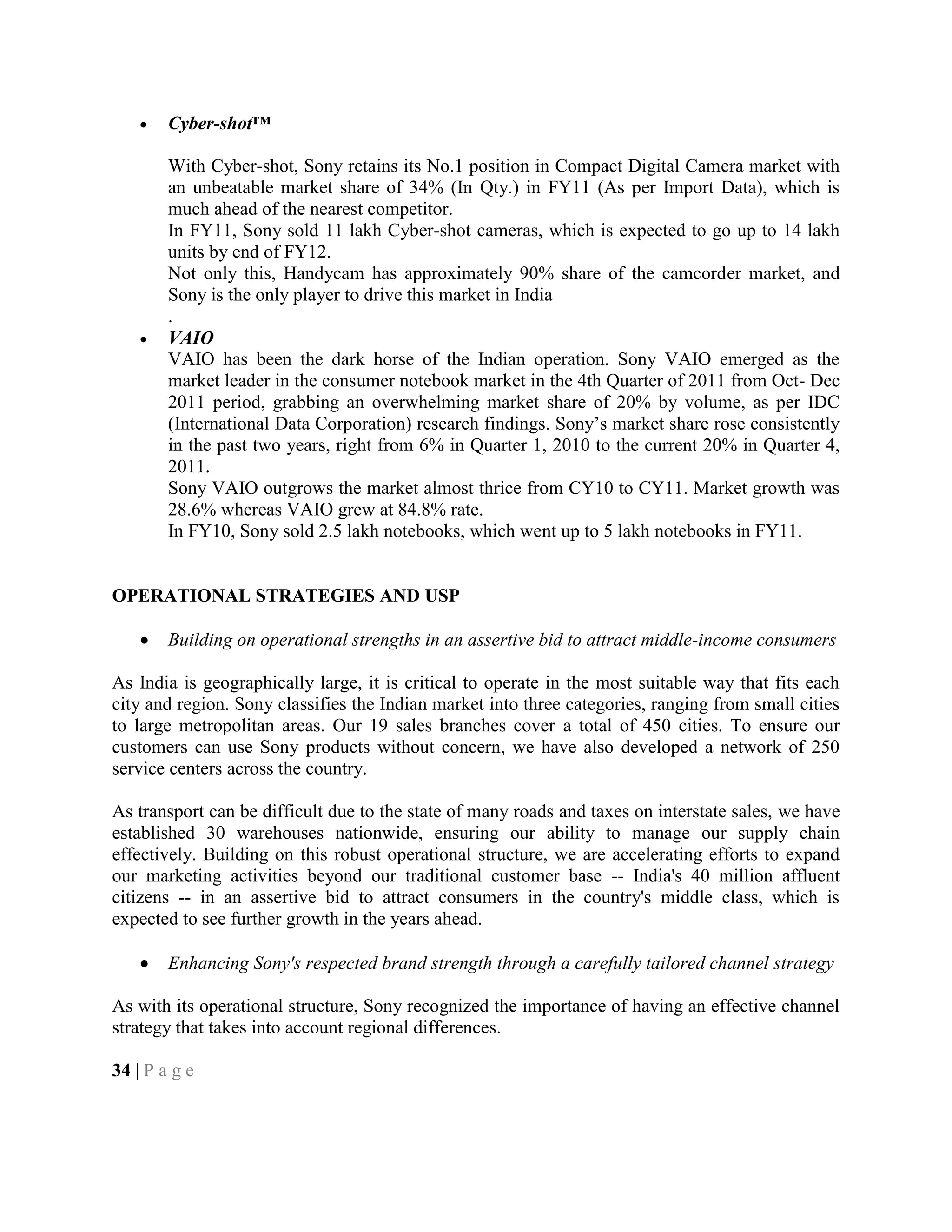
  • 28.
    Japanese electronics majorPanasonic launched T31, the fifth model into the Indian market, which runs on Android Jelly Bean operating system, has 4-inch WVGA display screen and dual-core processor, expanding its Smartphone portfolio. With starting range of 7,000/- to 8,000/-. They aim to go beyond the metros and cater to the consumers across tier-II/III cities and deliver a remarkable mobile experience to the Indian mass consumers. INNOVATIONS : To keep pace with the fast changing Indian consumer durables market, firms have to differentiate their products in the areas of relevance to the consumers, innovate in technology, develop a strong global network, and find more effective ways of promotion and distribution. The products and the approach to the market need to be customized to suit the unique needs of the consumers. Several Indian and MNC players are looking to strengthen their presence in India to leverage this opportunity. Startup company, Livares Technologies has launched an Android application called ‗Phone Away‘ that will let users convert their Smartphone into a remote control. By using the ‗Phone Away‘ application, users can access contents on their phone from another mobile phone or pc. Users can even locate a lost phone that is set on silent mode by activating the remote-ringer capability. It is power-efficient and does not consume a lot of battery life. This, mainly because it activates and uses features like wifi or GPRS/3G only when needed and also turns it off automatically after use. The company, which is a brainchild of enterprising, young entrepreneurs who are out to make a difference, is based primarily in Techno park, Thiruvananthapuram and Startup Village, Kochi. DTH (direct to home) company Tata Sky, launched Everywhere TV, by which its subscribers will be able to enjoy all their favorite TV channels and movies on demand on their mobile. The services entitle a subscriber to access 50 channels with a monthly payment of Rs 60. With the launch of this service, Tata Sky will extend its range of services from indoors (at home) to outdoors and on-the-move. 27 | P a g e
  • 29.
    Rotimatic does isto take the tedium out of the process of making rotis — the relentless sifting, kneading, rolling and baking everyday. Smart Watches: smart watch, is a computerized wristwatch with functionality that is enhanced beyond timekeeping, and is often comparable to a personal digital assistant (PDA) device, modern smart watches are effectively wearable computers. Many smart watches run mobile apps, while a smaller number of models run a mobile operating system and function as portable media players, offering playback of FM radio, audio, and video files to the user via a Bluetooth headset and many more. Samsung‘s Smart TVs with voice recognition, its touch screen etc. Smartphones: a mobile phone that is able to perform many of the functions of a computer, typically having a relatively large screen and an operating system capable of running general-purpose applications, fully automatic washing machines. Many more innovations like microwave ovens with grill and convection mode, air conditioners with both heating and cooling function, large-capacity frost-free, self controlled refrigerators, etc. Allowing customers to directly take part in the design creation online. LG is planning to make their official website a significant source of new ideas for up-to-date and personalized designs. Promoting interactivity and multi-directional communication, the company‘s website might become a valuable instrument to sense the global market‘s trends, periodically communicate with the end-users and build strategic customers loyalty programmes. An additional benefit of online customization and commercialization is that the dependence on operators and retailers will be somewhat reduced, thereby improving LG‘s bargaining power towards them. To beat the inflation and slowdown pangs, companies have come out with discounts and consumer offers this year. While a few consumer durable giants are giving scratch cards carrying cash-back offers worth Rs 200-1,000 on every purchase, others are giving free warrantee up to three years or assured gifts like make-up kit, hair-drier etc., on every product. Some companies have announced lucky draw offers to attract consumers this Dhanteras, offering prizes like car or gadget but all these attempts have failed to pull the crowd. Though prospects of any bumper sale seem bleak, marketers are hopeful about the next 3- 4 days. 28 | P a g e
  • 30.
    Out of thesetop companies we have selected Videocon and accordingly we will be discussing Consumer market data and competitors. Consumer Market Data  Demographics: Videocon‗s customer base is fairly homogeneous in their needs and attitudes, they are likely to respond similarly to a given marketing strategy. They are likely to have similar feelings and ideas about a marketing mix comprised of a given product or service, sold at a given price, distributed in a certain way and promoted in a certain way. High end product sales are no longer restricted to metros. Consumer in tier-2 cities seems to be as evolved in lifestyle needs. The consumer profile, too, has changed. Higher disposable incomes, greater aspirations and younger demographic have increased demands for the technologies. And Videocon is targeting this segment. Videocon targets mostly the people within the age group of 20-40. Competitor information SAMSUNG PROFILE: Samsung India commenced its operations in India in December 1995, today enjoys a sales turnover of over US$ 1 billion in just a decade of operations in the country. Samsung design centers are located in London, Los Angeles, San Francisco, Tokyo, Shanghai and Romen. Samsung India has its headquartered in New Delhi and has a network of 19 Branch Offices located all over the country. The Samsung manufacturing complex housing manufacturing facilities for Color Televisions, Colour Monitors, Refrigerators and Washing Machines is located at Noida, near Delhi. Samsung ‗Made in India‘ products like Colour Televisions, Colour Monitors and Refrigerators are being exported to Middle East, CIS and SAARC countries from its Noida manufacturing complex. Samsung India currently employs over 1600 employees, with around 18% of its employees working in Research & Development. 29| P a g e
  • 31.
    CURRENT MARKET SHARE: Salesof Samsung indiaElctronics Ltd. ( SIEL) have been growing at a CAGR of almost 50 per cent over the past four years. SIEL is the market leader in high end digital television (Plasma, LCD and LED). In the highly competitive Colour Television market in India, Samsung has a market share of 15.5 per cent. Samsung holds the No. 1 position in the Flat Television category, Frost Free refrigerators as well as in the Microwave oven segment. Samsung is the leader in the IT essentials segment with 63 per cent Market share in TFT, LCD and LED monitors, 51 per cent in Monitors, 43 per cent in Multifunction Printers and 47 per cent in Hard Disc segment. In the telecom space, Samsung is the market leader in colour screen phones with 36 per cent market share. It is also the largest selling mobile phone brand across all categories in India. OPERATIONAL STRATEGIES AND USP Innovative promotion and advertising initiatives To establish trust and confidence among Indian consumers, Samsung did active promotion and advertising by taking the following initiatives. Samsung India associated itself with the ruling passion of the Indian mass consciousness: Cricket. Samsung launched the Team Samsung campaign with the stars of the Indian cricket team, which caught the imagination of an entire nation. Not confining itself to cricket, Samsung sponsors the Indian contingent to the Olympics and the Asian Games. It also ran training programmes for deserving Indian athletes under the Olympic Ratnabanner. Samsung also launcheda series of innovativebelow-the-line activities. In mobile phones,Samsung tied up with noted painter SatishGujralfor his paintings to be available as downloads on Samsung mobile phones Branded its products as superior technology and environment friendly ones. The Samsung refrigerators and ACs incorporate a revolutionary new technology called Silver Nano Health System that ensures freshness and bacteria free environment. Launching the best in design and technology in India To differentiate its products from the competition, Samsung followed a deliberate strategy of bringing in the world‘s best design and technologies to India from its parent. It launched its products in India around the same time as the global launch of products. 30 | P a g e
  • 32.
    Samsung pioneered theintroduction of several world first features in its mobile phones like the first Dual Screen Phone, the first 65K TFT / LCD Colour Phone, the first Phones with Polyphonic Ringtones, the first phones with rotating lens and ultimately pioneered the move for bringing smart phones in India. In IT products, Samsung introduced the thinnest and lightest Note PCs in the world, the world‘s smallest MP3 players and India‘s first 17" TFT-LCD TV-Monitor that comes with the unique ‗wise-link‘ Samsung technology where various digital gadgets can be connected directly to the Display. It also launched the world‘s smallest Digital multi-function device that scans, prints and copies at the same time Samsung has won over 150 awards in India for its technology and design based products. Customized products for Indian Consumers Samsung understands the local cultural sensibilities to customize its products according to the Indian market. Samsung phones support five Indian languages - Hindi, Marathi, Bangla, Punjabi and Tamil. The phones supports phone menu, fonts and SMS in these five languages. Samsung is the first company in the world to introduce a Bangla menu. It has set up a ―usability lab‖ at the Indian Institute of Technology in New Delhi to customize Samsung products to meet the specific needs of Indian consumers. This industry-institute partnership is helping Samsung to study and analyze consumer response in aspects of product design, including aesthetics, ergonomics and interface. Through its research done on consumer preferences in India, Samsung has concluded that Indian consumers want more soundorientedproducts. Thus, the Samsung televisions of India have a higher sound capacity than their foreign counterparts. Samsung washing machines have an additional menu that takes care of the local Indian wardrobes. They also have a ‗memory re-start‘ that takes care of the frequent power failures in India. Research and Development Potential Samsung has set up two R&D centres in India, at Bangalore and Noida. Both the R&D centers are involved in cutting edge research and development The Noida centre is involved in the business of developing embedded software for Samsung Electronics Corporation in a variety of areas related to Digital TV and other Multimedia technologies. The centre has successfully completed more than a hundred projects in collaboration with Samsung Headquarters Visual Display and Digital Media divisions. Its engineers continuously strive to improve performance and introduce innovative features to make the end products more efficient and user friendly. 31 | P a g e
  • 33.
    The Bangalore operationis involved in the business of developing software for Samsung Electronics Corporation technology solutions in a variety of different areas. It is known for the expertise that it possesses in certain key technology domains. Its contributions have been in very key knowledge based areas of new and evolving technologies like 3G, UMTS, CDMA2000, Multimedia, Home Networking, Digital Media, System LSI, Network Protocols, Wireless terminals to mention some. The centre boasts of a highly talented and motivated work force who have been constantly enriching their knowledge and skills Corporate Social Responsibility Samsung has also made its mark as a company with a conscience and an organization with social responsibilities. In 2004, Samsung won the Golden Peacock Special Commendation for Corporate Social Responsibility. This award was given by the Institute of Directors and the World Council for Corporate Governance. Samsung runs the Digital Hope programme, Supportingorganisations that promote the use of technology to improve the lives of youth, empower them and help bridge the ‗digital divide‘. Organisationssupported by this programme include Development Alternatives and the National Centre for Promotion of Employment of Disabled People (NCPEDP). Therefore, concluding these points it can be said that, the thing which makes their product unique is their level of quality n satisfaction which they provide to the consumer also their methods of promotion is their main U.S.P. SONY PROFILE: Starting its business operations in India in 1994, Sony India is one of the most recognized consumer electronics brand in the country, with a reputation for new age technology, digital concepts and excellent after sales service. In India, Sony has its footprint across all major towns and cities in the country through a distribution network comprising of over 10,400 dealers and distributors, 270 exclusive Sony outlets and 23 direct branch locations. Sony India also has a strong service presence across the country with 255 service outlets. Manned by customer friendly and informed sales persons, Sony‘s exclusive stores ‗Sony Center‘ are fast becoming the most visible face of the company in India. A distinctive feature of Sony‘s service is its highly motivated and well-trained staff that provides the kind of attentive and sensitive service that is rare today. With brands names such as BRAVIA, VAIO, Tablet, Handycam®, Cyber- shot, Walkman®,Xplod™, Sony hi-fi, Memory stick® and PlayStation®, Sony has established itself as a value leader across its various product categories of Audio/Visual Entertainment products, Information and Communications, Recording Media, Business and Professional products. 32 | P a g e
  • 34.
    MARKET SHARE : Somefacts: BRAVIA is No.1 in Flat Panel Market with 18.8% share (In Qty.) in CY13(As per Display Search) Cyber-shot is No.1 in Compact Digital Camera market with 34% share in FY12 (As per Import Data) VAIO for the first time hit No.1 share of 20% in Q4, 2012 (As per IDC Report) May 22, 2013, New Delhi: Sony India today announced its Sales achievement of Rs. 6,313 crore in FY12 BRAVIA, VAIO and Digital Imaging (Cyber-shot, Handycam, Alpha& Photo Frame) have been the growth drivers of the business in India, contributing 35%, 20% and 15%, respectively to the total sales in FY12. Performance of each Category: BRAVIA Sony has been ruling the Indian market by continuously maintaining a very high market share in the Flat Panel TV segment in India. As per Display Search, Sony India hit Number One position with 18.8% share (In Qty) in FY11. As per latest GFK Research Findings, BRAVIA is the top selling brand in all screen sizes right from 22/26 inch up to 46/55 inch. As a matter of fact, Sony BRAVIA Internet TV has been the favorite in India, garnering a whopping market share of 53% of Internet TV (with Browser) Sales in CY11. In FY10, Sony sold 8.3 lakh BRAVIA TVs, which went up to 9 lakh units by end of FY11. 33 | P a g e FY10 FY11 FY12 Rs. 3,694 crore Rs. 5,446 crore Rs. 6,313 crore
  • 35.
    Cyber-shot™ With Cyber-shot, Sonyretains its No.1 position in Compact Digital Camera market with an unbeatable market share of 34% (In Qty.) in FY11 (As per Import Data), which is much ahead of the nearest competitor. In FY11, Sony sold 11 lakh Cyber-shot cameras, which is expected to go up to 14 lakh units by end of FY12. Not only this, Handycam has approximately 90% share of the camcorder market, and Sony is the only player to drive this market in India . VAIO VAIO has been the dark horse of the Indian operation. Sony VAIO emerged as the market leader in the consumer notebook market in the 4th Quarter of 2011 from Oct- Dec 2011 period, grabbing an overwhelming market share of 20% by volume, as per IDC (International Data Corporation) research findings. Sony‘s market share rose consistently in the past two years, right from 6% in Quarter 1, 2010 to the current 20% in Quarter 4, 2011. Sony VAIO outgrows the market almost thrice from CY10 to CY11. Market growth was 28.6% whereas VAIO grew at 84.8% rate. In FY10, Sony sold 2.5 lakh notebooks, which went up to 5 lakh notebooks in FY11. OPERATIONAL STRATEGIES AND USP Building on operational strengths in an assertive bid to attract middle-income consumers As India is geographically large, it is critical to operate in the most suitable way that fits each city and region. Sony classifies the Indian market into three categories, ranging from small cities to large metropolitan areas. Our 19 sales branches cover a total of 450 cities. To ensure our customers can use Sony products without concern, we have also developed a network of 250 service centers across the country. As transport can be difficult due to the state of many roads and taxes on interstate sales, we have established 30 warehouses nationwide, ensuring our ability to manage our supply chain effectively. Building on this robust operational structure, we are accelerating efforts to expand our marketing activities beyond our traditional customer base -- India's 40 million affluent citizens -- in an assertive bid to attract consumers in the country's middle class, which is expected to see further growth in the years ahead. Enhancing Sony's respected brand strength through a carefully tailored channel strategy As with its operational structure, Sony recognized the importance of having an effective channel strategy that takes into account regional differences. 34 | P a g e
  • 36.
    In addition tonational chain stores that cover many areas in India, we have regional chain stores in specific areas, and both types of stores continue to see sales growth. In India, there is not a single chain store network of identical stores in every city and town in the country; rather, store configurations differ from region to region. For this reason, we are seeking to increase the number of contracted sub dealers we work with. To enable us to communicate the Sony brand message to consumers directly, we have established a network of approximately 270 Sony Center and other branded shops nationwide. Branded shops sell not only electronics products, but also PlayStation® products and Sony Ericsson mobile phones, among other products. Branded shops thus contribute to an enhanced brand image, as well as to greater recognition of the Sony name. Sony Pictures Entertainment's television operations in India India has one of the largest and most dynamic television audiences in the world reaching more than 124 million households in the country and generating nearly U.S. $6 billion in revenue a year. Indian television has boomed since 2004 with yearly double-digit growth in distribution, contentandadvertising.* Sony Pictures Entertainment entered the Indian television market in 1995 with the launch of Sony Entertainment Television (SET). The general entertainment Hindi-language channel quickly became a success and has remained one of the top-rated channels for more than 15 years with hit shows like Who Wants to Be a Millionaire (KaunBanegaCrorepati) and Indian Idol. The company added to its portfolio of channel brands with the launch of AXN (1998), SET MAX (MAX) (1999), Animax (2004), SAB (2005) and SET PIX (2006). All of Sony Pictures' channels in India are owned, operated or distributed through a joint venture, Multi Screen Media Private Limited (MSM). As the official home in India for the Indian Premier League's (IPL) renowned Twenty20 cricket competition, MAX typically rates in the top five of the country's channels. At the start of the IPL's fourth season in April 2011, over 154 million viewers tuned in to MAX. AXN is a leading English-language general entertainment channel commanding a more than 50% share of this audience across all demographics as compared to its competitors in this category. Contributing to the further evolution of India's entertainment industry through the newly established Media Technology Centre 35 | P a g e
  • 37.
    To encourage theproliferation of HD and 3D film production, in March 2011 Sony inaugurated Sony Media Technology Centre in Mumbai, India -- which joins similar facilities established in the United States and the United Kingdom -- at the Mumbai campus of film school Whistling Woods International. Within the Centre, Sony has installed cutting-edge Sony equipment to create content, such as video cameras and equipment for editing, for use in training in the areas of digital HD movie production and 3D content creation not only for the school's aspiring filmmakers, but also for industry professionals. By extending advanced technologies and products, as well as its training expertise, Sony hopes to contribute to the further growth and development of India's entertainment industry. SONY‘s USP can be summed up as dwelling back into branding and making more appealing and purposeful products a safer bet OPERATIONAL AND MARKETING STARTEGY OF PANASONIC: They are developing a state-of-the-art manufacturing unit along with R&D facility in Haryana, with an investment of about $250 million. Around half of their global revenue of $75 billion come from the Indian market. They are committed to enhance infrastructure and R&D capabilities for the Indian market and are aiming to achieve sales upto Rs 5,000 crore by 2014. Panasonic already has five manufacturing plants in India. But in Haryana, they plan to set up a Panasonic techno park on a larger scale. They will bring multiple operations there and also localize R&D activities. With the acquisition of Sanyo, Sanyo has become a consolidated subsidiary of Panasonic and will continue pursuing its business as a Panasonic Group company. The acquisition will allow Panasonic to enter into energy business. In the next four months, they will draw up a blueprint for combining their global operations, which includes everything from semiconductor chips to TVs to solar panels. Panasonic wants Sanyo's expertise in two key areas-- batteries and solar panels. Sanyo is the largest global supplier of rechargeable batteries for laptops, cameras, mobile phones and other portable gizmos. Marketing Strategy They have further increased their marketing campaigns and associate more with sports including cricket and football in the next one year to build the brand name in India. In the last one-and-half years, they have focused on the Indian market in terms of brand building activities. As the Indian market is highly price sensitive, Panasonic has engaged in more and more local talent, who understand the needs of the Indian consumers and develop appropriate products accordingly. 36 | P a g e
  • 38.
    Indian consumers arenow demanding smart products, with features that make them efficient and effective. But they are not ready to pay for those additional functions, which are not required by them. So keeping this trend in mind, Panasonic is changing their strategies. The company is on an expansion spree and is opening exclusive Panasonic brand shops in all relevant markets. Around 210 core to be spend for promotional activities. 50% of this will be invested in various activities, including exhibitions and road shows. USP: The company, which today expanded Smart TV portfolio The firm has introduced 30 new models of LEDs, LCDs and Plasma TVs priced between Rs 13,990 and Rs 3,20,000. The latest introduction in existing line up of Smart Viera. Operational strategy of LG The chief aim of LG India is to enhance its domestic market by inventing new electronic devices in state-of-art form with the best technology possible. The price range of the products of LG India is quite reasonable and affordable so as to make it easier for every class of people to go for it thereby increasing the consumer level. LG India manufactures products of high digital innovativeness to satisfy the needs of its consumers not only in the domestic market but all across the globe. The upcoming goal set by LG India for its growth is to be among the top three brands in terms of electronic devices, information, and telecommunication companies in the world. The three main capabilities of LG India are product leadership, people leadership, and market leadership that will intensify the company‘s abilities for teamwork. Code of Ethics It is the intention of LG, as set forth in the management charter, to spread the management philosophies of "creating value for customers" and "respect based management" allowing for more responsible and open management. LG continues to develop as the global leading company through seeking greater public benefits founded in cooperation, mutual trust, and respect for the free market economy. For this reason all LG employees promise to act uprightly and make value judgments in accordance with the code of ethics. 37 | P a g e
  • 39.
    Compliance code ofconduct LG Electronics is committed to "winning by the rules". They regard sound and transparent management practices as the foundation to achieving individual success and global competitiveness. Throughout their global operations, LG Electronics pledges to comply with local laws and regulations, compete fairly, and uphold the highest standards of business conduct. The LG Electronics Compliance Code of Conduct sets forth clear standards for legal and regulatory compliance all employees should live by in order to realize the principles provided in the LG Code of Ethics. Global Labor Policy In August 2010, LG Electronics has declared its Global Labor Policy. The policy was established as part of LG Electronics’ efforts to advance its management philosophy of “respecting human dignity,” and aims to uphold human dignity and value of all employees in terms of labor. The Global Labor Policy has been translated and distributed in a total of 20 languages including English and Chinese, and LG Electronics plans to realign and operate all of its humanity and labor related processes based on the policy EICC (ELECTRONIC INDUSTRY CITIZENSHIP COALITION) In August 2010, LG Electronics joined the Electronic Industry Citizenship Coalition (EICC), which has high standards regarding working conditions, ethics of the business, safe and health of workers, and the environment that can be implemented across whole supply chain. LG Electronics has already implemented a range of measures to improve its CSR management systems at home and abroad in order to bring its global practices in line with the EICC Code of Conduct which focuses significantly on issues related to labor, health and safety, environment, management systems and ethics. However, EICC involvement is another example of LG Electronics putting into practice its philosophy of Jeong-do Management, the unique code-of-conduct system for conducting business in a transparent
  • 40.
    and honest manner 38|P a g e For the purpose, LG Electronics introduced a Supplier Code of Conduct consistent with EICC standards for its suppliers to follow if they wish to continue their business relationship with LG Electronics in September 2010. In 2011, LG Electronics will also offer its contractors training and consulting as they move to adopt management practices consistent with EICC guidelines. As part of EICC recommendations, LG Electronics will play an even greater role in the operations of its suppliers by sharing best practices, promoting CSR initiatives and helping to develop social responsibility strategies. MARKETING STRATEGIES OF LG: LG India is expecting its total revenue to grow by 20 per cent in 2013 on the back of its revamped marketing strategy. Apart from focusing on the first ‘P’- Product of marketing and introducing 70 new products, they are all set for new promotions and campaigns with a special emphasis on rural marketing. They are starting a campaign in rural India focusing on both ATL and BTL promotions that will encourage consumers to upgrade from color televisions to LCD and LED. LG showcased its diverse range of futuristic products with an advanced line-up of cutting edge technology and innovative products across categories at LG Tech Show- 2013. LG announced that it would release 22 ad films featuring world-class cricketers to strengthen its association with cricket. The campaign, 'Cricket First,' which featured captains of the 14 teams participating in World Cup 2003, highlighted the spirit of cricket with a tagline, 'Captains of Cricket World, for the Captain of Consumer Electronics and Home Appliances.' Of all the elements of marketing mix, LG seemed to have put more emphasis on promotion and advertising. Some analysts are of the opinion that the cornerstone of LG's strategy was its heavy advertising. Unlike many Indian brands which advertises seasonally i.e., (two-three months of the festival season- September, October and November), LG advertises all round the year. According to analysts, this results in high brand recall and successful positioning.
  • 41.
    39 | Pa g e USP: We can see that LG always comes up with new and innovative products each and every time to meet the new need of the customers. This new products are produced in order to meet the latent demands of the customers and products which suits and fulfill the needs of the customers. The products are made in order to make the life good and happy of the buyers as LG says Life’s Good. 40 | P a g e