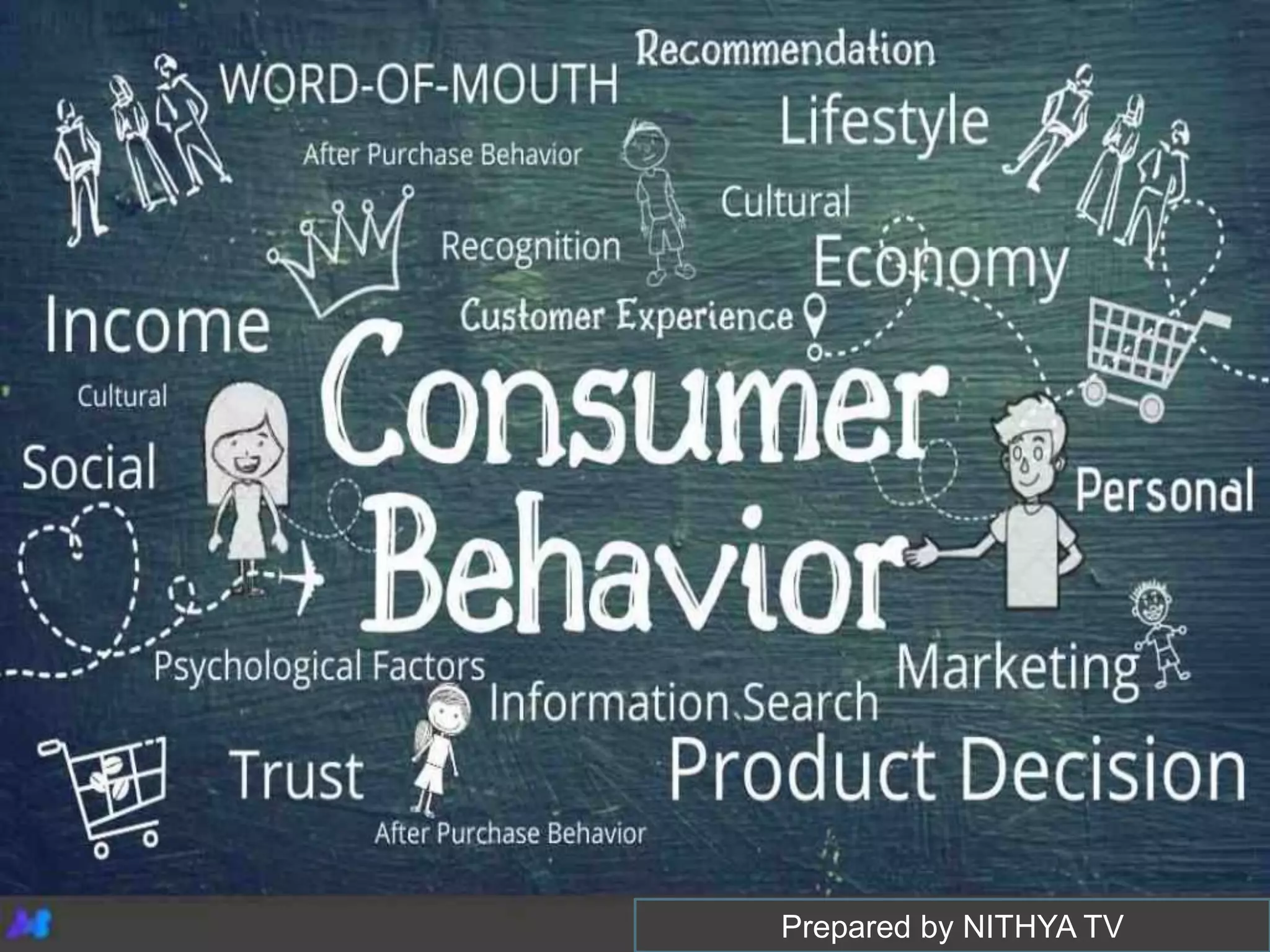
Prepared by NITHYA TV
Consumer Behaviour
Behaviour is the interaction with the ambient surrounding
environment ,inherent in living creatures and mediated by
their external and internal activities
thus consumer behaviour is actions of consumers in the
market place and the underlying motives for those actions
Consumer behaviour is the process whereby individuals
decide what,when,where,how and from whom to purchase
goods and services
Need of Consumer Behaviour
The key to a company’s survival, profitability and growth in a highly competitive
marketing environment is its ability to identify and satisfy unfulfilled consumer
needs better and sooner than the competitors. Thus consumer behaviour helps
in achieving marketing goals
1)vital importance for marketers in shaping the fortunes of the organization
2) Helps in regulation of Consumption of goods.
3) Solving marketing management problems in more effective manner
4) It gives information regarding color, design, size which the consumer wants.
Helps in formulation production policy
Cultural Social Personal
Psychologic
al
Culture
Social Class
Reference
Family
Role and
Status
Age
Life cycle
Occupation
Income
Life Style
Motivation
Perception
Learning
Values and
Attitudes
Buying Motives
We purchase goods due to certain motives. It refers to thoughts, strong feelings
urge which make a buyer to react in the form of decision. Motive is an inner
urge, which moves one to action.
TYPES OF BUYING MOTIVES
1) Emotional and Rational Motives
2)Product and Patronage Motives
3) Inherent and Learned Motives
4) Psychological and social buying Motives
PROBLEM RECOGNITION
INFORMATION SEARCH
EVALUATION ALTERNATIVES
PURCHASE
POST PURCHASE EVALUATION
Problem Recognition
 It occurs when a buyer becomes aware of a difference
between a desired state and an actual condition. The speed of
consumer problem recognition can be quite rapid or rather
slow.Process of buying starts with the consumers perception of a
problem with form of desire or need or requirement
Information search:
After recognizing the problem or need, a
buyer searches for product information that will help resolve the
problem or satisfy the need. It has two aspects. In internal search,
buyers search their memories for information about products that
might solve their problem.
Evaluation of Alternatives:
A Successful information search
within a product category yields a group of brands that a
buyer views as possible alternatives. This group of
brands is sometimes called as consideration set
Purchase and Related Decisions:
After searching and evaluating, the
consumers must decide whether to buy. Thus the first
outcome is the decision to purchase or not to purchase
the alternative evaluated as most desirable. Selecting a
source from which to make a purchase is one of the
buying decisions
Post Purchase Evaluation :
After the purchase, the buyer begins evaluating the product to
ascertain if its actual performance meets expected levels. Many
criteria in evaluating alternatives are applied again during post
purchase evaluation.

Consumer Behaviour

  • 1.
  • 3.
    Consumer Behaviour Behaviour isthe interaction with the ambient surrounding environment ,inherent in living creatures and mediated by their external and internal activities thus consumer behaviour is actions of consumers in the market place and the underlying motives for those actions Consumer behaviour is the process whereby individuals decide what,when,where,how and from whom to purchase goods and services
  • 4.
    Need of ConsumerBehaviour The key to a company’s survival, profitability and growth in a highly competitive marketing environment is its ability to identify and satisfy unfulfilled consumer needs better and sooner than the competitors. Thus consumer behaviour helps in achieving marketing goals 1)vital importance for marketers in shaping the fortunes of the organization 2) Helps in regulation of Consumption of goods. 3) Solving marketing management problems in more effective manner 4) It gives information regarding color, design, size which the consumer wants. Helps in formulation production policy
  • 5.
    Cultural Social Personal Psychologic al Culture SocialClass Reference Family Role and Status Age Life cycle Occupation Income Life Style Motivation Perception Learning Values and Attitudes
  • 6.
    Buying Motives We purchasegoods due to certain motives. It refers to thoughts, strong feelings urge which make a buyer to react in the form of decision. Motive is an inner urge, which moves one to action. TYPES OF BUYING MOTIVES 1) Emotional and Rational Motives 2)Product and Patronage Motives 3) Inherent and Learned Motives 4) Psychological and social buying Motives
  • 7.
    PROBLEM RECOGNITION INFORMATION SEARCH EVALUATIONALTERNATIVES PURCHASE POST PURCHASE EVALUATION
  • 8.
    Problem Recognition  Itoccurs when a buyer becomes aware of a difference between a desired state and an actual condition. The speed of consumer problem recognition can be quite rapid or rather slow.Process of buying starts with the consumers perception of a problem with form of desire or need or requirement Information search: After recognizing the problem or need, a buyer searches for product information that will help resolve the problem or satisfy the need. It has two aspects. In internal search, buyers search their memories for information about products that might solve their problem.
  • 9.
    Evaluation of Alternatives: ASuccessful information search within a product category yields a group of brands that a buyer views as possible alternatives. This group of brands is sometimes called as consideration set Purchase and Related Decisions: After searching and evaluating, the consumers must decide whether to buy. Thus the first outcome is the decision to purchase or not to purchase the alternative evaluated as most desirable. Selecting a source from which to make a purchase is one of the buying decisions
  • 10.
    Post Purchase Evaluation: After the purchase, the buyer begins evaluating the product to ascertain if its actual performance meets expected levels. Many criteria in evaluating alternatives are applied again during post purchase evaluation.