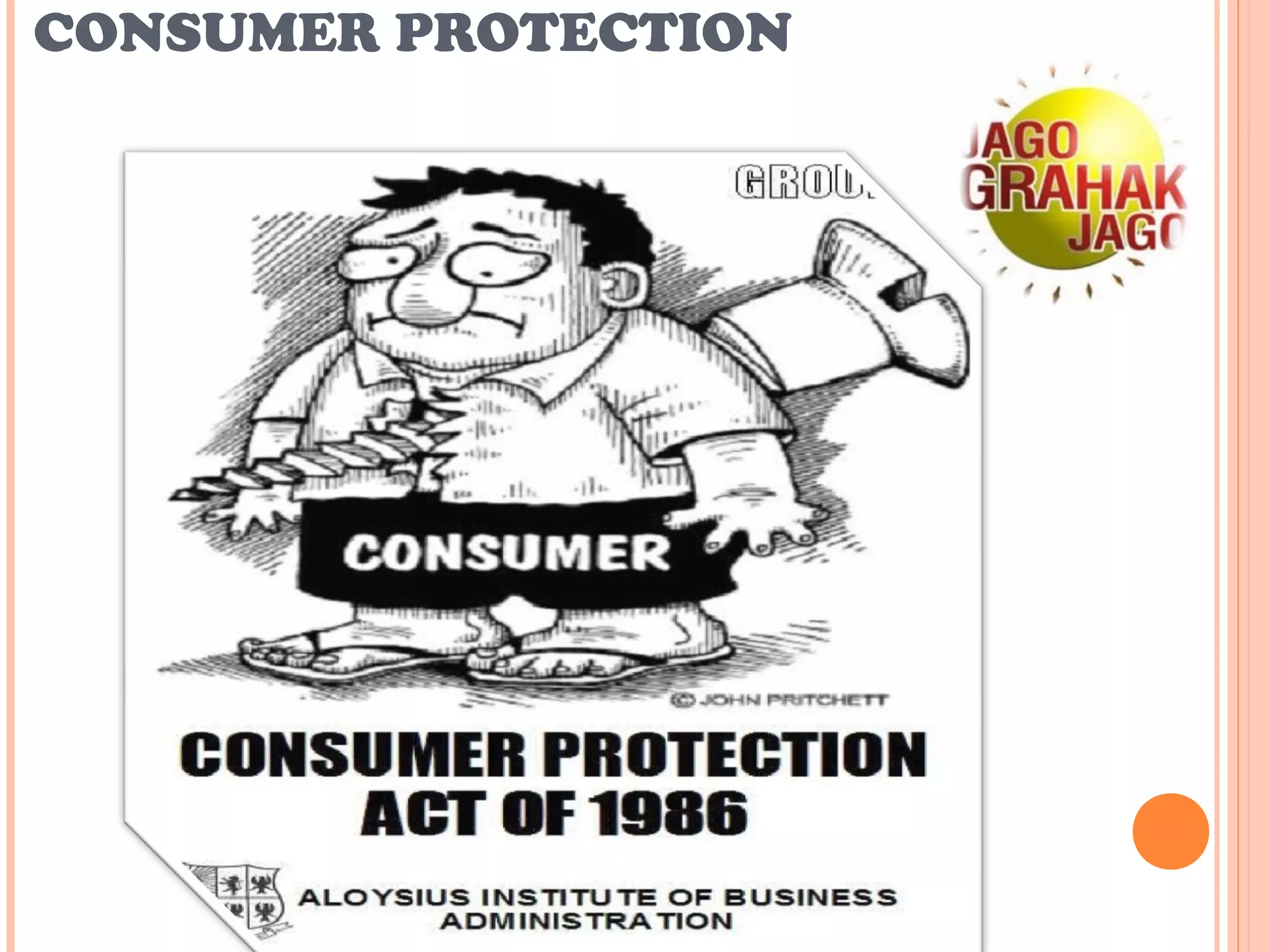
CONSUMER PROTECTION
INTRODUCTION TO CONSUMER
PROTECTION
 Protect consumers from exploitation and unfair
marketplace practices, to promote and advance the
social and economic welfare of consumers, to
empower consumers and to develop a culture of
consumer responsibility.
 Consumer protection consists of laws and
organizations designed to ensure the rights of
consumers as well as fair trade competition and the
free flow of truthful information in the marketplace.
HOW THE ACT WAS
ENACTED
 The act was passed in Lok Sabha
on9thDecember,1986
 Rajya Sabha on 10th December, 1986
 assented by the President of India on 24th
December, 1986 and
 was published in the Gazette of India on 26th
December, 1986.
WHO IS THE “CONSUMER”?
 Original definition limited to purchases for “personal
consumption”
 A person who has indicated his or her willingness to obtain
goods and/or services from a supplier with the intention of
paying for them.
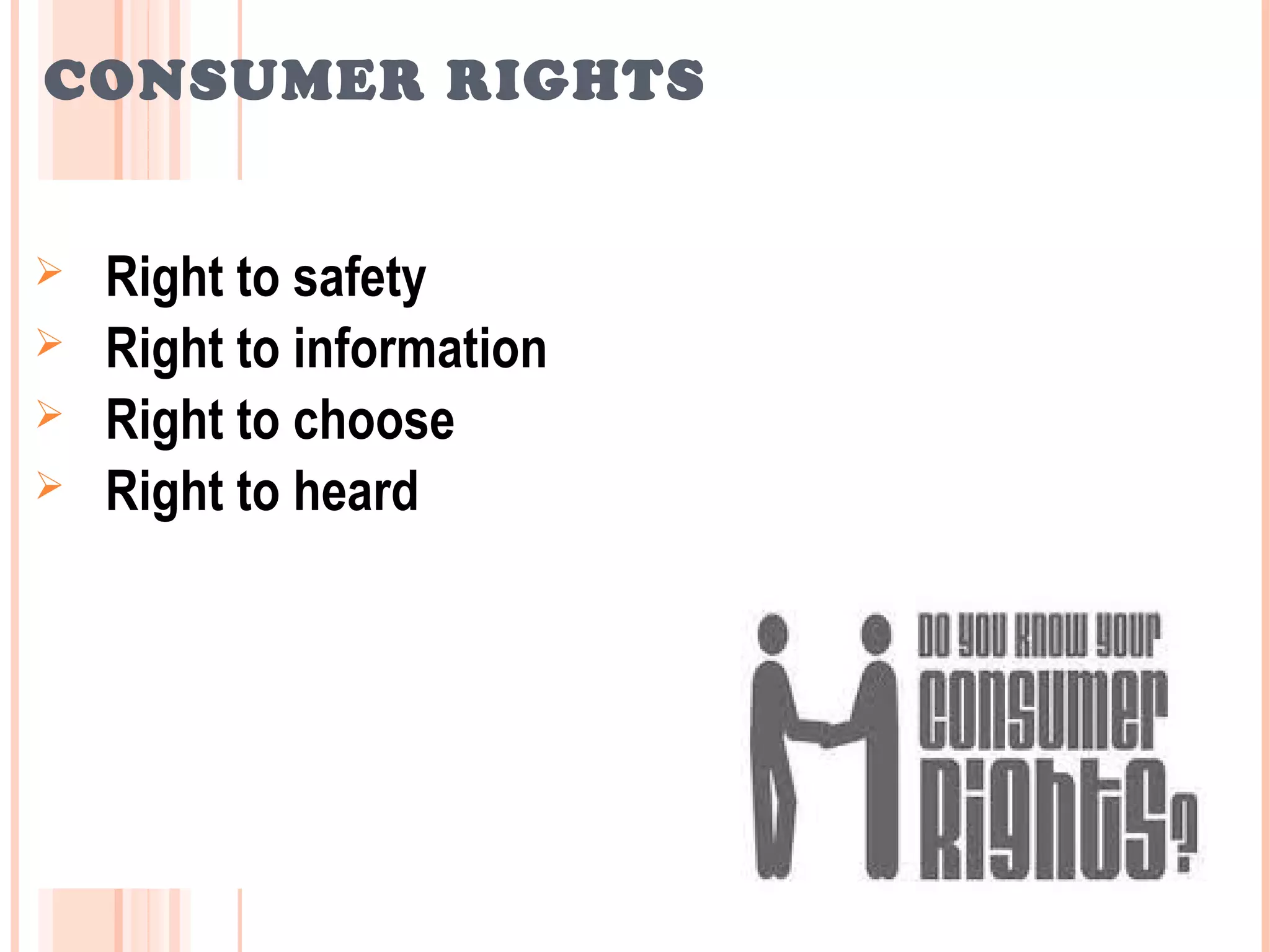
CONSUMER RIGHTS
 Right to safety
 Right to information
 Right to choose
 Right to heard
WHO IS RESPONSIBLE FOR
CONSUMER PROTECTION
Government agencies
Ministry of Commerce,
 Investment and Consumer Affairs
Professional/Industry associations
Consumer organizations
Functions of a consumer protection
agency
 Advise the government on consumer issues
 Represent the consumer interest in other governmental committees
 Enforce consumer protection and competition law
 Conduct market surveys and research into consumer protection problems
 Conduct product testing for safety and quality
ROLE OF CONSUMER
Consumers obtain optimum benefit from their
economic resources
Ensuring that goods meet production and performance
standards
Adequate distribution channels and after sales services
Fair business practices are employed
Protection against contractual abuses
Information is adequate for consumers to make
informed decisions and exercise choice
CONSUMER PROTECTION AND BASIC
NEEDS
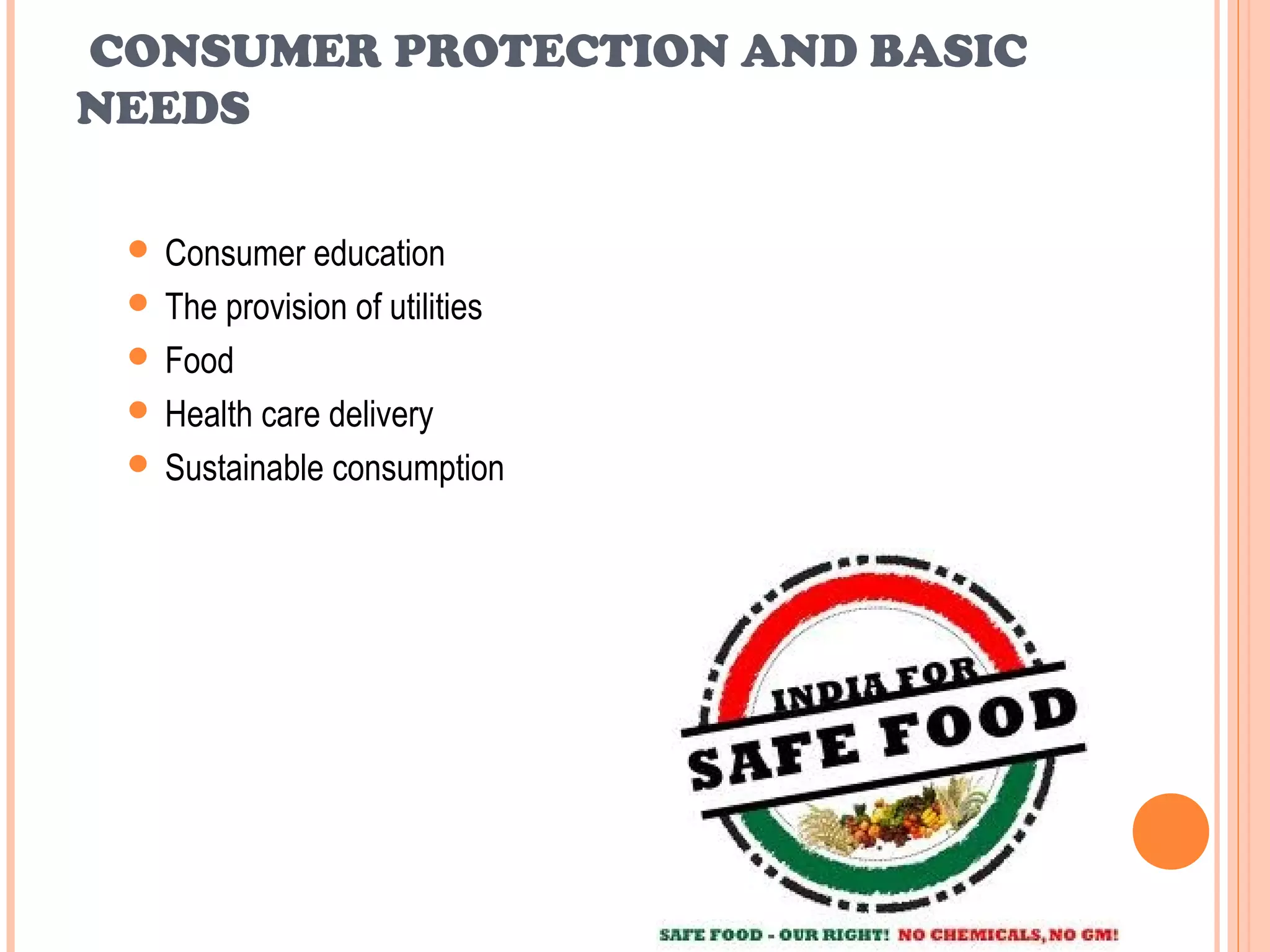
 Consumer education
 The provision of utilities
 Food
 Health care delivery
 Sustainable consumption
STANDARDS FOR SAFETY AND
QUALITY OF GOODS AND SERVICES
Ensure there are national standards for safety
and quality of goods and services
Such standards conform to international
standards
Facilities to test and certify goods and services
are encouraged
WHAT IS A COMPLAINT
“Complaint” means any allegation in
writing made my a compliant that :
I. An unfair trade practice or a restrictive trade practice has
been adopted by any trader or service provider;
II. The goods bought by him or agreed to be bought by him
suffer from one or more defects ;
III. The services hired or availed of or agreed to be hired or
availed off by him suffer from deficiency in any respect;
CONSUMER ORGANIZATIONS
 Need for an independent party that is non-political and
non-commercial
 Need for views of the under-represented and
vulnerable groups
 Some have wide membership and broad spectrum of
concerns
 Democracy involves participatory decision-making ;
consultation with these groups is part of the nation-
building process
CONSUMER CONCERNS WITH
MISLEADING ADVERTISING
Ads for products proven to be unsafe and/or
addictive (e.g., alcohol and tobacco)
Ads that target and mislead vulnerable communities
about the product
Ads that aggressively target children to consumer
foods high in fat, sugar and salt
Ads for products that contain toxic or cancer-
causing chemicals for which there is no scientific
proof of safety levels (e.g., pesticides, aspartame,
etc.)
CONSUMERS ARE ENCOURAGED TO
AVOID PRODUCTS THAT
Cause environmental degradation during the extraction of natural
resources or during their manufacture, use and disposal
Utilize large amounts of energy during their manufacture, use or
disposal
Cause unnecessary waste, due to over-packaging or unduly short
life span
Utilize materials derived from threatened species or environments
Adversely affect other countries and communities, especially those
in the South
ROLE OF (CGSI) IN CONSUMER
PROTECTION
 Formation of consumer group
 Placing consumer problem before businessmen and
government
 Solving the complaint of consumer through peaceful
 Encourage the consumer to fight in courts.
16
JURISDICTION
Forum / Commission Where the value of the goods or
services and the compensation, if
any claimed,
District Forum Does not exceed Rs. 20 lakhs
State Commission Rs. 20 lakhs and above but not
exceeding One Crore
National Commission Above One Crore
Besides, State and National Commission have appellate jurisdiction also.
17
APPEAL
 shall be filed within thirty days.
 Delay in filing appeal may be condoned if there
is sufficient cause.
SLOW GROWTH OF CONSUMER
PROTECTION ACT
 Illiteracy/poverty
 Lack of alertness among consumer
 Ignorance
 Inadequate government support
 Existing consumer association do not operate
efficiently.
EDUCATION AND INFORMATION
PROGRAMS
 Should involve consumer and business groups
 Particular attention to disadvantaged consumers in urban
and rural areas
 Should be included in school curriculum
 Training programs for educators, mass media professionals
and consumer advocates
LEADING CONSUMER
ASSOCIATION
 Consumer education and research centre(cerc)
 Akhil bhartiya grahak panchayat (pune)
 Consumer council of India
 Consumer unity trust and services(cuts)
 Consumer guidance society of India(CGSI)

Consumer protection

  • 1.
  • 2.
    INTRODUCTION TO CONSUMER PROTECTION Protect consumers from exploitation and unfair marketplace practices, to promote and advance the social and economic welfare of consumers, to empower consumers and to develop a culture of consumer responsibility.  Consumer protection consists of laws and organizations designed to ensure the rights of consumers as well as fair trade competition and the free flow of truthful information in the marketplace.
  • 3.
    HOW THE ACTWAS ENACTED  The act was passed in Lok Sabha on9thDecember,1986  Rajya Sabha on 10th December, 1986  assented by the President of India on 24th December, 1986 and  was published in the Gazette of India on 26th December, 1986.
  • 4.
    WHO IS THE“CONSUMER”?  Original definition limited to purchases for “personal consumption”  A person who has indicated his or her willingness to obtain goods and/or services from a supplier with the intention of paying for them.
  • 5.
    CONSUMER RIGHTS  Rightto safety  Right to information  Right to choose  Right to heard
  • 6.
    WHO IS RESPONSIBLEFOR CONSUMER PROTECTION Government agencies Ministry of Commerce,  Investment and Consumer Affairs Professional/Industry associations Consumer organizations
  • 7.
    Functions of aconsumer protection agency  Advise the government on consumer issues  Represent the consumer interest in other governmental committees  Enforce consumer protection and competition law  Conduct market surveys and research into consumer protection problems  Conduct product testing for safety and quality
  • 8.
    ROLE OF CONSUMER Consumersobtain optimum benefit from their economic resources Ensuring that goods meet production and performance standards Adequate distribution channels and after sales services Fair business practices are employed Protection against contractual abuses Information is adequate for consumers to make informed decisions and exercise choice
  • 9.
    CONSUMER PROTECTION ANDBASIC NEEDS  Consumer education  The provision of utilities  Food  Health care delivery  Sustainable consumption
  • 10.
    STANDARDS FOR SAFETYAND QUALITY OF GOODS AND SERVICES Ensure there are national standards for safety and quality of goods and services Such standards conform to international standards Facilities to test and certify goods and services are encouraged
  • 11.
    WHAT IS ACOMPLAINT “Complaint” means any allegation in writing made my a compliant that : I. An unfair trade practice or a restrictive trade practice has been adopted by any trader or service provider; II. The goods bought by him or agreed to be bought by him suffer from one or more defects ; III. The services hired or availed of or agreed to be hired or availed off by him suffer from deficiency in any respect;
  • 12.
    CONSUMER ORGANIZATIONS  Needfor an independent party that is non-political and non-commercial  Need for views of the under-represented and vulnerable groups  Some have wide membership and broad spectrum of concerns  Democracy involves participatory decision-making ; consultation with these groups is part of the nation- building process
  • 13.
    CONSUMER CONCERNS WITH MISLEADINGADVERTISING Ads for products proven to be unsafe and/or addictive (e.g., alcohol and tobacco) Ads that target and mislead vulnerable communities about the product Ads that aggressively target children to consumer foods high in fat, sugar and salt Ads for products that contain toxic or cancer- causing chemicals for which there is no scientific proof of safety levels (e.g., pesticides, aspartame, etc.)
  • 14.
    CONSUMERS ARE ENCOURAGEDTO AVOID PRODUCTS THAT Cause environmental degradation during the extraction of natural resources or during their manufacture, use and disposal Utilize large amounts of energy during their manufacture, use or disposal Cause unnecessary waste, due to over-packaging or unduly short life span Utilize materials derived from threatened species or environments Adversely affect other countries and communities, especially those in the South
  • 15.
    ROLE OF (CGSI)IN CONSUMER PROTECTION  Formation of consumer group  Placing consumer problem before businessmen and government  Solving the complaint of consumer through peaceful  Encourage the consumer to fight in courts.
  • 16.
    16 JURISDICTION Forum / CommissionWhere the value of the goods or services and the compensation, if any claimed, District Forum Does not exceed Rs. 20 lakhs State Commission Rs. 20 lakhs and above but not exceeding One Crore National Commission Above One Crore Besides, State and National Commission have appellate jurisdiction also.
  • 17.
    17 APPEAL  shall befiled within thirty days.  Delay in filing appeal may be condoned if there is sufficient cause.
  • 18.
    SLOW GROWTH OFCONSUMER PROTECTION ACT  Illiteracy/poverty  Lack of alertness among consumer  Ignorance  Inadequate government support  Existing consumer association do not operate efficiently.
  • 19.
    EDUCATION AND INFORMATION PROGRAMS Should involve consumer and business groups  Particular attention to disadvantaged consumers in urban and rural areas  Should be included in school curriculum  Training programs for educators, mass media professionals and consumer advocates
  • 20.
    LEADING CONSUMER ASSOCIATION  Consumereducation and research centre(cerc)  Akhil bhartiya grahak panchayat (pune)  Consumer council of India  Consumer unity trust and services(cuts)  Consumer guidance society of India(CGSI)

Editor's Notes

  • #7 Modern-day concept first articulated… i.e., not to be deceived, and to have access to information about products i.e., to have a variety of products at competitive prices i.e., consideration from the government of their concerns
  • #8 In an ideal economy, the market is in perfect equilibrium with the supply and demand side having equal power and functioning optimally. We know that doesn’t happen. State intervention ensures that suppliers behave responsibly and consumers have access to remedies. Consumer rights are seen as part of the new range of social rights that individuals are entitled to claim in a modern society. There are many areas where there is inequality of bargaining power: one example is use of the standard form contract; for example, in credit transactions. Consumers don’t have the right to bargain over the terms of the contract; “take it or leave it” How does it do this? By focusing on the expenditure side as well as the income side of the poverty issue. Highlights fact that the poor not only make less, they also pay more. (Substantiated in numerous studies and publications, such as Caplovitz’s “The Poor Pay More.”)
  • #9 Things we take for granted but millions in developing world lack
  • #11 What kind of society are we, and do we want to be? How we treat the vulnerable and disadvantaged is a reflection of the type of society we are. Development is hampered if there are substantial disparities in information, bargaining power and resources; these things prevent optimal operation of a market economy and thus development.
  • #13 In some cases they operate totally informally, and may be created to address limited, short-term goals (though sometimes they stay in operation) In others, they may be formally created and provided for in the nation’s law (or at least formally recognized –e.g., CI is recognized formally by many international bodies) Their role is premised on the following considerations:
  • #14 e.g., breast mild substitutes/ see materials p. 64
  • #16 In developing countries, this is as much of a concern as the quality and prices at which the products are sold to the ultimate consumer.