
By Soumya Das
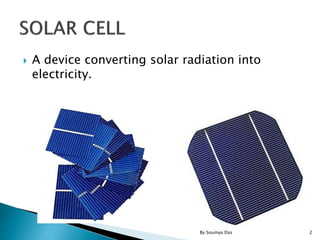
 A device converting solar radiation into
electricity.
2By Soumya Das
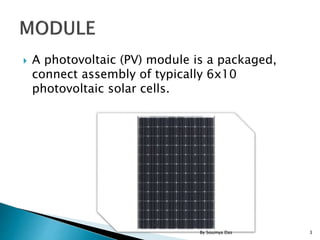
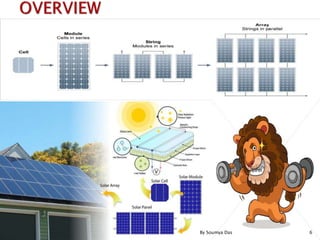
 A photovoltaic (PV) module is a packaged,
connect assembly of typically 6x10
photovoltaic solar cells.
3By Soumya Das
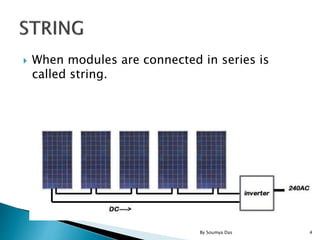
 When modules are connected in series is
called string.
4By Soumya Das
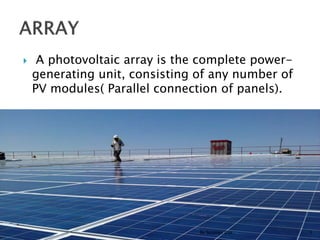
 A photovoltaic array is the complete power-
generating unit, consisting of any number of
PV modules( Parallel connection of panels).
5By Soumya Das
6By Soumya Das
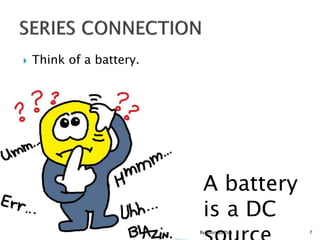
 Think of a battery.
A battery
is a DC
7By Soumya Das
 Think of a solar cell.
Solar cell
is also a
DC source 8By Soumya Das
 One solar cell can produce 0.5 volt.
 If we add solar cells in series, voltage will be
additive.
9By Soumya Das
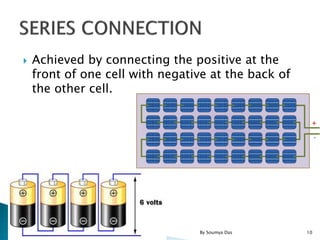
 Achieved by connecting the positive at the
front of one cell with negative at the back of
the other cell.
10By Soumya Das
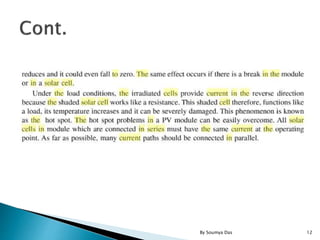
 When we connect two solar cells with
different current in series the current in series
circuit corresponds to that of the weakest
solar cell, same effect occur when a solar cell
is partially covered or completely covered due
to shadow of tree, fallen leaf etc. Power
immediately
11By Soumya Das
12By Soumya Das
 Achieved by all positive and all negative
together.
 Current through individual cells is added
together.
13By Soumya Das
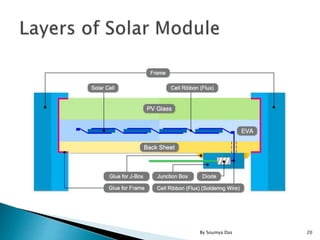
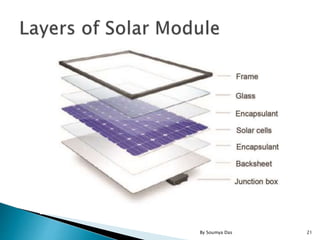
 Glass
 The front glass is the heaviest part of the
photovoltaic module and it has the function
of protecting and ensuring robustness to the
entire photovoltaic module, maintaining a
high transparency.
14By Soumya Das
 EVA
 One of the most important materials is the
encapsulant, which acts as a binder between the
various layers of the PV panel. The most common
material used as an encapsulant is EVA -
Ethylene vinyl acetate. It is a translucent polymer
sold in a roll. It must be cut in sheets and
deposited before and after the photovoltaic cells.
When subjected to a thermal process of vacuum
cooking, this particular polymer becomes similar
to a transparent gel and incorporates the
photovoltaic cells.
15By Soumya Das
 Backsheet
 The term backsheet literally means the sheet
on the back. It is made from a plastic material
that has the function to electrically isolate,
protect and shield the PV cells from weather
and moisture. This particular sheet is usually
white in color and is sold in rolls or sheets.
There are particular versions that can be
different in thickness, in color and in the
presence of particular materials for a greater
shielding or for a higher mechanical strength.
16By Soumya Das
 Cell Ribbon
 Interconnect ribbon is a hot dip tinned
copper conductor installed in
photovoltaic/solar panels. The interconnect
ribbon is soldered directly onto silicon crystal
to interconnect solar cells in a solar panel.
The interconnect ribbon carries the current
generated in solar cells to the PV bus bar.
17By Soumya Das
 Junction Box
 The junction box has the function of bringing
the electrical connections of the PV module
outside.
It contains the protection diodes for shadows
and the cables for the connection of the
panels in the field. In choosing the Junction
box we pay attention to the quality of plastic,
the goodness of sealing, the type of
connection of the ribbon and the quality of
by-pass diodes.
18By Soumya Das
 Frame
 One of the last parts to be assembled is the
frame. It is normally made of aluminium and
has the function to ensure robustness and a
practical and safe coupling to the
photovoltaic module. Together with the
frame, also a layer of sealant is deposited
around the walls of the panel as a moisture
barrier. For this purpose the most widely
used material is silicon, although sometimes
a special sealing tape is used.
19By Soumya Das
20By Soumya Das
21By Soumya Das
THANK
YOU
22By Soumya Das

Construction of solar module

  • 1.
  • 2.
     A deviceconverting solar radiation into electricity. 2By Soumya Das
  • 3.
     A photovoltaic(PV) module is a packaged, connect assembly of typically 6x10 photovoltaic solar cells. 3By Soumya Das
  • 4.
     When modulesare connected in series is called string. 4By Soumya Das
  • 5.
     A photovoltaicarray is the complete power- generating unit, consisting of any number of PV modules( Parallel connection of panels). 5By Soumya Das
  • 6.
  • 7.
     Think ofa battery. A battery is a DC 7By Soumya Das
  • 8.
     Think ofa solar cell. Solar cell is also a DC source 8By Soumya Das
  • 9.
     One solarcell can produce 0.5 volt.  If we add solar cells in series, voltage will be additive. 9By Soumya Das
  • 10.
     Achieved byconnecting the positive at the front of one cell with negative at the back of the other cell. 10By Soumya Das
  • 11.
     When weconnect two solar cells with different current in series the current in series circuit corresponds to that of the weakest solar cell, same effect occur when a solar cell is partially covered or completely covered due to shadow of tree, fallen leaf etc. Power immediately 11By Soumya Das
  • 12.
  • 13.
     Achieved byall positive and all negative together.  Current through individual cells is added together. 13By Soumya Das
  • 14.
     Glass  Thefront glass is the heaviest part of the photovoltaic module and it has the function of protecting and ensuring robustness to the entire photovoltaic module, maintaining a high transparency. 14By Soumya Das
  • 15.
     EVA  Oneof the most important materials is the encapsulant, which acts as a binder between the various layers of the PV panel. The most common material used as an encapsulant is EVA - Ethylene vinyl acetate. It is a translucent polymer sold in a roll. It must be cut in sheets and deposited before and after the photovoltaic cells. When subjected to a thermal process of vacuum cooking, this particular polymer becomes similar to a transparent gel and incorporates the photovoltaic cells. 15By Soumya Das
  • 16.
     Backsheet  Theterm backsheet literally means the sheet on the back. It is made from a plastic material that has the function to electrically isolate, protect and shield the PV cells from weather and moisture. This particular sheet is usually white in color and is sold in rolls or sheets. There are particular versions that can be different in thickness, in color and in the presence of particular materials for a greater shielding or for a higher mechanical strength. 16By Soumya Das
  • 17.
     Cell Ribbon Interconnect ribbon is a hot dip tinned copper conductor installed in photovoltaic/solar panels. The interconnect ribbon is soldered directly onto silicon crystal to interconnect solar cells in a solar panel. The interconnect ribbon carries the current generated in solar cells to the PV bus bar. 17By Soumya Das
  • 18.
     Junction Box The junction box has the function of bringing the electrical connections of the PV module outside. It contains the protection diodes for shadows and the cables for the connection of the panels in the field. In choosing the Junction box we pay attention to the quality of plastic, the goodness of sealing, the type of connection of the ribbon and the quality of by-pass diodes. 18By Soumya Das
  • 19.
     Frame  Oneof the last parts to be assembled is the frame. It is normally made of aluminium and has the function to ensure robustness and a practical and safe coupling to the photovoltaic module. Together with the frame, also a layer of sealant is deposited around the walls of the panel as a moisture barrier. For this purpose the most widely used material is silicon, although sometimes a special sealing tape is used. 19By Soumya Das
  • 20.
  • 21.
  • 22.