Course teacher:
Ms. Urmi Devi
Mr. Wahid Hasan
Course Name:

Details of Construction

Course No: CE 200
Group No: 04 Section- C
Construction Materials
ID
•
•
•
•
•
•
•
•
•
•

12-01-03-105
12-01-03-111
12-01-03-117
12-01-03-125
12-01-03-130
12-01-03-140
12-01-03-145
12-01-03-150
12-01-03-155
11-02-03-033

Name
•
•
•
•
•
•
•
•
•
•

S.M. Rafsan
Mamun Or Rashid
Asif Mahmud Tanvir
Asif Faisal
Lamiya Sharmeen
Mahamuda Khatun
Nur-A-Alam Munim
Anish kanti Karmakar
Abinash Paul
Tonmoy Kundu
• Cement is binder, a substance that sets and hardens
independently, and can bind other materials together.

Cement
Portland
Cement

Special
Cement
Ordinary Portland

Portland Pozzalana
Rapid hardening
Low-heat Portland
White Portland
Sulphate resisting Portland

Water-proof Portland
Water-repellent Portland
Portnand blast furnace
Quick Setting Cement

Calcium chloride Cement
High alumina Cement
Slag Cement
Expansive Cement
Constituents

Typical (%)

1. Lime (CaO)

60-70

2.Silica (SiO2)

20-25

3. Alumina (Al2O3)

3-8

4. MgO

1-4

5. Fe2O3

2-4

6. SO3

1-5

7. Alkalies
8. Gypsum (CaSO4.2H2O)

1
3-5
•
•
•
•
•

Fineness Test
Test for Setting Time
Test for Soundness
Test for Strength
Normal Consistency
42.5 N

• 28 days cube strength
• N is the ordinary
early strength

Specific
gravity

•3.15

Unit
Weight

•197 pcf
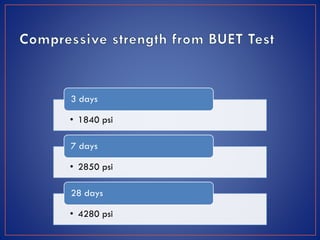
3 days
• 1840 psi
7 days
• 2850 psi
28 days
• 4280 psi
Rapid Hardening Cement
• Highway Slab
• In Cold Weather

Quick Setting Cement
• Under Running Water
• Bridge Piers

Low Heat Cement
• In Dams, Retaining Wall,
• Bridge Abutments, Large Piers
Air Entraining Cement
• For resisting frost action
• Fire incidents

Pozzolana Cement
• Where Higher plasticity is required
• Higher workability

Sulphate Resisting Cement
• To prevent Sulphate attack of soil
Each

cement bag contains 50 kg of
cement

The

price varies from 450-500 BDT
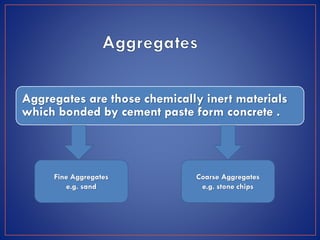
Aggregates are those chemically inert materials
which bonded by cement paste form concrete .

Fine Aggregates
e.g. sand

Coarse Aggregates
e.g. stone chips
Sand




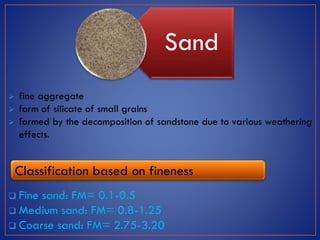
fine aggregate
form of silicate of small grains
formed by the decomposition of sandstone due to various weathering
effects.

Classification based on fineness
 Fine

sand: FM= 0.1-0.5
 Medium sand: FM= 0.8-1.25
 Coarse sand: FM= 2.75-3.20
Classification according to source
Extraction of sand from riverbed

Transportation by steamer

Carried by pipes

Transportation by truck
Mainly river sand is used in our country.
In local market there are two types of river sand:

Sylhet Sand (FM 2.5)

Local Sand (FM 2)
Sylhet Sand
In local market there are three types of sylhet sand available.

Sand from Fajilpur

Sand from Sunamganj

Sand from Dayer
Sylhet Sand

FM =2.5

Mymensingh Sand

FM =2.8
COST IN LOCAL MARKET
Type of Sand
Sylhet sand (From

Unit

Cost

per cft

25 tk

per cft

28 tk

Sylhet sand (From Dayer per cft

28 tk

Sunamganj)
Sylhet sand (From
Fajilpur )

)

Normal sand

per truck

900 tk
Coarse aggregate is that aggregate whose
particles completely pass through 7.5 cm
mesh sieve and which are entirely retained
on 4.75 mm sieve.
Coarse Aggregate

Brick Chips

Stone Chips
Preparation of Brick chips

Using Machine

Manually
Brick chips :
There are two types brick chips available in local market.

No 1:: Reddish in colour .
Use: used in columns,roof.
Price: 60 tk /cft
No 2::
Use: floor casting.
Price: 45 tk/cft
Preparation of Stone chips

Collection

Breaking

Transportation
67%
¾ inch stone chips

33%
½ inch stone chips

Used in the site
Stone chips :
Two types on local market :
No 1:: Collected from Volaganj.
Most preferable, good quality, fresh chips.
Mostly used as CA in concrete.
Price: 87 tk/cft.
No 2:: Collected from Sunamganj.
Contains dust, less quality.
Price: 65 tk /cft.
Rebar
(Reinforcement bar)





Rebar, a portmanteau for reinforcing bar or
reinforcement bar, is commonly used in reinforced
concrete and reinforced masonry structures.
It is usually formed from carbon steel.
Concrete is very strong in pure compression, but
relatively weak in tension .Steel reinforcing helps
share the tensile stresses
Classification of Rebar

According
to
pattern:

• Deformed
(have repeating
pair of edges)
• Straight
(no edges)
According
to Grade

• grade 40(equivalent of
metric grade 280), which
can resist tensions of 40
ksi.
• grade 60(equivalent of
metric grade 420), which
can resist tensions of 60
ksi and
• grade 75(equivalent of
metric grade 520), which
can resist tensions of
70ksi.
Type of Steels for a Concrete Rebar :

Basic Rebar

Stainless
Steel Rebar

Galvanized
Rebar

Epoxy-Coat
Rebar
Different Rebar
Sizes
Metric
Size
#10
#13
#16
#19
#22
#25
#29
#32
#36
#43
#57

Imperial
Size
#3
#4
#5
#6
#7
#8
#9
#10
#11
#14
#18

Metric
Diameter
9.5 mm
12.7 mm
15.9 mm
19.1 mm
22.2 mm
25.4 mm
28.7 mm
32.3 mm
35.8 mm
43.0 mm
57.3 mm

Imperial
Diameter
.375"
.500"
.625"
.750"
.875"
1.00"
1.128"
1.270"
1.410"
1.693"
2.257"

Metric
Weight
0.560 Kg/m
0.994 Kg/m
1.552 Kg/m
2.235 Kg/m
3.042 Kg/m
3.973 Kg/m
5.060 Kg/m
6.404 Kg/m
7.907 Kg/m
11.38 Kg/m
20.24 Kg/m

Imperial
Weight
0.376 lbs/ft
0.688 lbs/ft
1.043 lbs/ft
1.502 lbs/ft
2.044 lbs/ft
2.670 lbs/ft
3.400 lbs/ft
4.303 lbs/ft
5.313 lbs/ft
7.650 lbs/ft
13.600 lbs/ft
Reinforcing Bar Identification
Availability in Bangladesh
Some important steel industries in our country are :

BSRM steel- Bangladesh Steel Re-Rolling Mills Ltd.

SARM steel- S. Alam Cold Rolling Mill Ltd..
RSRM steel- Ratanpur Steel Re-Rolling Mills Ltd.
KSRM steel - Kabir Steel and Rerolling Mills
Abul Khair Steel Industries Ltd.

P.H.P. Cold Rolling Mill
In Columns
In St. Bar:
25 mm
KSRM- 60 Grade

In Ties :
12mm
KSRM- 40 Grade
In St. Bar:
25 mm
KSRM- 60 Grade

In Stirrups :
10mm
KSRM- 40 Grade
Present Cost in Local Market
SL#
01

Product Name

Product Size

Cost(per ton)

10 mm to 25 mm

TK.65,500

28 mm to 32 mm

TK.66,000

DEFORMED BARS (GR-60)

8 mm

TK.65,000

DEFORMED BARS (GR-60)

10 mm to 25 mm

TK.65,000

DEFORMED BARS (GR-60)

28 mm & 32 mm

TK.65,500

DEFORMED BARS (GR-40)

8 mm

TK.65,000

DEFORMED BARS (GR-40)

10 mm to 25 mm

TK.65,000

DEFORMED BARS (GR-40)

28 mm & 32 mm

TK.65,500

DEFORMED BARS (GR-300)

8 mm

TK.63,000

DEFORMED BARS (GR-300)
04

TK.65,500

DEFORMED BARS Xtreme-500W

03

8 mm

DEFORMED BARS Xtreme-500W

02

DEFORMED BARS Xtreme-500W

10 mm to 20 mm

TK.63,000

DEFORMED BARS (GR-75)

7 mm

TK.73,000

DEFORMED BARS (GR-75)

5.7 mm

TK.77,000

DEFORMED BARS (GR-75)

4.5 mm

TK.77,000
• Denotes structural wood obtained from tree

Mostly used in shuttering purposes
Bamboo Props

Door and Window
Wooden Stairs
Bricks
Definition :
Bricks can be defined in these ways: Regular sized
rectangular unit which is used for most of the
building work and as a substitute for stone, where
stone is not available.
Ingredients
Name of the ingredient

Proportion

Silica (SiO2)

55%

Alumina(Al2O3)

30%

Iron Oxide (Fe2O3)

8%

Magnesia (MgO)

5%

Lime(CaO)

1%

Organic matter

1%

“Durability of bricks depends on proper proportion of
alumina & silica”
1st class brick
(S-grade)
2nd class brick
(A-grade)

3rd class brick(Bgrade)
.
Over burnt or
Jhama brick

Under-burnt or
pilla brick

Used for lime concrete for foundation
Preparation of Brick
1st class brick (S-grade) used in our site
Grade

No-1 and Over burnt than no-1

Cost(Taka) per thousands of

pieces

4,500-5,000

No-2

3,800-4,000

No-3

2,000-2,500

Over burnt than No-3

3,000-3,500

Broken

700-800 (per troly)
• An artificial stone-like material used for
various structural purposes.
• General Components:

Cement
(7-15%)

Aggregate
FA(28-51%)
CA (31%)

Water
(14-21%)

Admixture
(2-5%)
Mix ratio =Cement: Sand :CA = 1: 1.5 : 3

W/C ratio> 0.35
Unit Weight of Concrete= 2400 kg/m or 150pef
Ready Mixed Concrete was used to accelerate the
construction work
• An intimate mixture prepared by mixing a binding
material, inert matter and water.
• Types:

Cement
Mortar

Mortar
Lime
mortar

Mud
Mortar
Brick Masonary

Plastering

CC Block
• Materials in the form of powder or fluids
• Added to the concrete to give it certain characteristics
• In normal use, admixture dosages are less than 5% by mass of
cement
•
•
•
•
•
•
•
•
•
•

Air-entraining admixtures
2. Water-reducing admixtures
3. Plasticizers
4. Accelerating admixtures
5. Retarding admixtures
6. Hydration-control admixtures
7. Corrosion inhibitors
8. Shrinkage reducers
9. Alkali-silica reactivity inhibitors
10. Coloring admixtures
•
•
•
•
•

Plastic Lumber
Cellular Polycarbonate Glazing
Insulating Concrete Forms
Recycled Wood
Recycled Steel
• Green Cement
 Produced by using Recycled Materials
 doesn’t emit Carbon-Dioxide, but absorbs it
 Resists Sulphate Attack
 Resistant to Chemical Attack
 Resistant to Heat
exposure
 Stronger than
ordinary cement
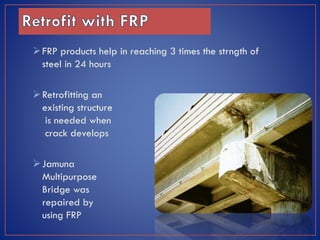
 FRP products help in reaching 3 times the strngth of
steel in 24 hours
 Retrofitting an
existing structure
is needed when
crack develops
 Jamuna
Multipurpose
Bridge was
repaired by
using FRP
Thank You
Construction materials

Construction materials

  • 1.
    Course teacher: Ms. UrmiDevi Mr. Wahid Hasan Course Name: Details of Construction Course No: CE 200 Group No: 04 Section- C
  • 2.
  • 3.
  • 5.
    • Cement isbinder, a substance that sets and hardens independently, and can bind other materials together. Cement Portland Cement Special Cement
  • 6.
    Ordinary Portland Portland Pozzalana Rapidhardening Low-heat Portland White Portland Sulphate resisting Portland Water-proof Portland Water-repellent Portland Portnand blast furnace
  • 7.
    Quick Setting Cement Calciumchloride Cement High alumina Cement Slag Cement Expansive Cement
  • 8.
    Constituents Typical (%) 1. Lime(CaO) 60-70 2.Silica (SiO2) 20-25 3. Alumina (Al2O3) 3-8 4. MgO 1-4 5. Fe2O3 2-4 6. SO3 1-5 7. Alkalies 8. Gypsum (CaSO4.2H2O) 1 3-5
  • 10.
    • • • • • Fineness Test Test forSetting Time Test for Soundness Test for Strength Normal Consistency
  • 12.
    42.5 N • 28days cube strength • N is the ordinary early strength Specific gravity •3.15 Unit Weight •197 pcf
  • 13.
    3 days • 1840psi 7 days • 2850 psi 28 days • 4280 psi
  • 14.
    Rapid Hardening Cement •Highway Slab • In Cold Weather Quick Setting Cement • Under Running Water • Bridge Piers Low Heat Cement • In Dams, Retaining Wall, • Bridge Abutments, Large Piers
  • 15.
    Air Entraining Cement •For resisting frost action • Fire incidents Pozzolana Cement • Where Higher plasticity is required • Higher workability Sulphate Resisting Cement • To prevent Sulphate attack of soil
  • 16.
    Each cement bag contains50 kg of cement The price varies from 450-500 BDT
  • 17.
    Aggregates are thosechemically inert materials which bonded by cement paste form concrete . Fine Aggregates e.g. sand Coarse Aggregates e.g. stone chips
  • 18.
    Sand    fine aggregate form ofsilicate of small grains formed by the decomposition of sandstone due to various weathering effects. Classification based on fineness  Fine sand: FM= 0.1-0.5  Medium sand: FM= 0.8-1.25  Coarse sand: FM= 2.75-3.20
  • 19.
  • 20.
    Extraction of sandfrom riverbed Transportation by steamer Carried by pipes Transportation by truck
  • 21.
    Mainly river sandis used in our country. In local market there are two types of river sand: Sylhet Sand (FM 2.5) Local Sand (FM 2)
  • 22.
    Sylhet Sand In localmarket there are three types of sylhet sand available. Sand from Fajilpur Sand from Sunamganj Sand from Dayer
  • 23.
  • 24.
    COST IN LOCALMARKET Type of Sand Sylhet sand (From Unit Cost per cft 25 tk per cft 28 tk Sylhet sand (From Dayer per cft 28 tk Sunamganj) Sylhet sand (From Fajilpur ) ) Normal sand per truck 900 tk
  • 25.
    Coarse aggregate isthat aggregate whose particles completely pass through 7.5 cm mesh sieve and which are entirely retained on 4.75 mm sieve.
  • 26.
  • 27.
    Preparation of Brickchips Using Machine Manually
  • 28.
    Brick chips : Thereare two types brick chips available in local market. No 1:: Reddish in colour . Use: used in columns,roof. Price: 60 tk /cft No 2:: Use: floor casting. Price: 45 tk/cft
  • 29.
    Preparation of Stonechips Collection Breaking Transportation
  • 30.
    67% ¾ inch stonechips 33% ½ inch stone chips Used in the site
  • 31.
    Stone chips : Twotypes on local market : No 1:: Collected from Volaganj. Most preferable, good quality, fresh chips. Mostly used as CA in concrete. Price: 87 tk/cft. No 2:: Collected from Sunamganj. Contains dust, less quality. Price: 65 tk /cft.
  • 32.
    Rebar (Reinforcement bar)    Rebar, aportmanteau for reinforcing bar or reinforcement bar, is commonly used in reinforced concrete and reinforced masonry structures. It is usually formed from carbon steel. Concrete is very strong in pure compression, but relatively weak in tension .Steel reinforcing helps share the tensile stresses
  • 33.
    Classification of Rebar According to pattern: •Deformed (have repeating pair of edges) • Straight (no edges)
  • 34.
    According to Grade • grade40(equivalent of metric grade 280), which can resist tensions of 40 ksi. • grade 60(equivalent of metric grade 420), which can resist tensions of 60 ksi and • grade 75(equivalent of metric grade 520), which can resist tensions of 70ksi.
  • 35.
    Type of Steelsfor a Concrete Rebar : Basic Rebar Stainless Steel Rebar Galvanized Rebar Epoxy-Coat Rebar
  • 36.
    Different Rebar Sizes Metric Size #10 #13 #16 #19 #22 #25 #29 #32 #36 #43 #57 Imperial Size #3 #4 #5 #6 #7 #8 #9 #10 #11 #14 #18 Metric Diameter 9.5 mm 12.7mm 15.9 mm 19.1 mm 22.2 mm 25.4 mm 28.7 mm 32.3 mm 35.8 mm 43.0 mm 57.3 mm Imperial Diameter .375" .500" .625" .750" .875" 1.00" 1.128" 1.270" 1.410" 1.693" 2.257" Metric Weight 0.560 Kg/m 0.994 Kg/m 1.552 Kg/m 2.235 Kg/m 3.042 Kg/m 3.973 Kg/m 5.060 Kg/m 6.404 Kg/m 7.907 Kg/m 11.38 Kg/m 20.24 Kg/m Imperial Weight 0.376 lbs/ft 0.688 lbs/ft 1.043 lbs/ft 1.502 lbs/ft 2.044 lbs/ft 2.670 lbs/ft 3.400 lbs/ft 4.303 lbs/ft 5.313 lbs/ft 7.650 lbs/ft 13.600 lbs/ft
  • 37.
  • 38.
    Availability in Bangladesh Someimportant steel industries in our country are : BSRM steel- Bangladesh Steel Re-Rolling Mills Ltd. SARM steel- S. Alam Cold Rolling Mill Ltd.. RSRM steel- Ratanpur Steel Re-Rolling Mills Ltd. KSRM steel - Kabir Steel and Rerolling Mills Abul Khair Steel Industries Ltd. P.H.P. Cold Rolling Mill
  • 39.
    In Columns In St.Bar: 25 mm KSRM- 60 Grade In Ties : 12mm KSRM- 40 Grade
  • 40.
    In St. Bar: 25mm KSRM- 60 Grade In Stirrups : 10mm KSRM- 40 Grade
  • 41.
    Present Cost inLocal Market SL# 01 Product Name Product Size Cost(per ton) 10 mm to 25 mm TK.65,500 28 mm to 32 mm TK.66,000 DEFORMED BARS (GR-60) 8 mm TK.65,000 DEFORMED BARS (GR-60) 10 mm to 25 mm TK.65,000 DEFORMED BARS (GR-60) 28 mm & 32 mm TK.65,500 DEFORMED BARS (GR-40) 8 mm TK.65,000 DEFORMED BARS (GR-40) 10 mm to 25 mm TK.65,000 DEFORMED BARS (GR-40) 28 mm & 32 mm TK.65,500 DEFORMED BARS (GR-300) 8 mm TK.63,000 DEFORMED BARS (GR-300) 04 TK.65,500 DEFORMED BARS Xtreme-500W 03 8 mm DEFORMED BARS Xtreme-500W 02 DEFORMED BARS Xtreme-500W 10 mm to 20 mm TK.63,000 DEFORMED BARS (GR-75) 7 mm TK.73,000 DEFORMED BARS (GR-75) 5.7 mm TK.77,000 DEFORMED BARS (GR-75) 4.5 mm TK.77,000
  • 42.
    • Denotes structuralwood obtained from tree Mostly used in shuttering purposes
  • 43.
    Bamboo Props Door andWindow Wooden Stairs
  • 44.
    Bricks Definition : Bricks canbe defined in these ways: Regular sized rectangular unit which is used for most of the building work and as a substitute for stone, where stone is not available.
  • 45.
    Ingredients Name of theingredient Proportion Silica (SiO2) 55% Alumina(Al2O3) 30% Iron Oxide (Fe2O3) 8% Magnesia (MgO) 5% Lime(CaO) 1% Organic matter 1% “Durability of bricks depends on proper proportion of alumina & silica”
  • 46.
    1st class brick (S-grade) 2ndclass brick (A-grade) 3rd class brick(Bgrade) .
  • 47.
    Over burnt or Jhamabrick Under-burnt or pilla brick Used for lime concrete for foundation
  • 48.
  • 49.
    1st class brick(S-grade) used in our site
  • 50.
    Grade No-1 and Overburnt than no-1 Cost(Taka) per thousands of pieces 4,500-5,000 No-2 3,800-4,000 No-3 2,000-2,500 Over burnt than No-3 3,000-3,500 Broken 700-800 (per troly)
  • 51.
    • An artificialstone-like material used for various structural purposes. • General Components: Cement (7-15%) Aggregate FA(28-51%) CA (31%) Water (14-21%) Admixture (2-5%)
  • 52.
    Mix ratio =Cement:Sand :CA = 1: 1.5 : 3 W/C ratio> 0.35 Unit Weight of Concrete= 2400 kg/m or 150pef Ready Mixed Concrete was used to accelerate the construction work
  • 53.
    • An intimatemixture prepared by mixing a binding material, inert matter and water. • Types: Cement Mortar Mortar Lime mortar Mud Mortar
  • 54.
  • 55.
    • Materials inthe form of powder or fluids • Added to the concrete to give it certain characteristics • In normal use, admixture dosages are less than 5% by mass of cement
  • 56.
    • • • • • • • • • • Air-entraining admixtures 2. Water-reducingadmixtures 3. Plasticizers 4. Accelerating admixtures 5. Retarding admixtures 6. Hydration-control admixtures 7. Corrosion inhibitors 8. Shrinkage reducers 9. Alkali-silica reactivity inhibitors 10. Coloring admixtures
  • 58.
    • • • • • Plastic Lumber Cellular PolycarbonateGlazing Insulating Concrete Forms Recycled Wood Recycled Steel
  • 59.
    • Green Cement Produced by using Recycled Materials  doesn’t emit Carbon-Dioxide, but absorbs it  Resists Sulphate Attack  Resistant to Chemical Attack  Resistant to Heat exposure  Stronger than ordinary cement
  • 60.
     FRP productshelp in reaching 3 times the strngth of steel in 24 hours  Retrofitting an existing structure is needed when crack develops  Jamuna Multipurpose Bridge was repaired by using FRP
  • 61.