Lime
By Aditi Kamlesh Shah
Lecturer
Civil Engineering Department
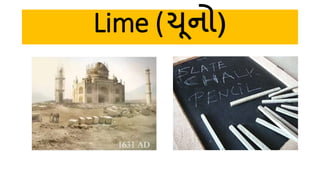
Lime (ચૂનો)
Lime (ચૂનો)
Used since ancient time: Egyptians,
Romans
In India: big palaces, bridges,
temples, forts, monuments
What is its replacement ???
Cement
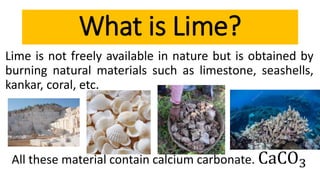
Lime is not freely available in nature but is obtained by
burning natural materials such as limestone, seashells,
kankar, coral, etc.
All these material contain calcium carbonate. CaCO3
What is Lime?
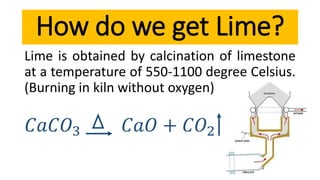
Lime is obtained by calcination of limestone
at a temperature of 550-1100 degree Celsius.
(Burning in kiln without oxygen)
𝐶𝑎𝐶𝑂3 𝐶𝑎𝑂 + 𝐶𝑂2
How do we get Lime?
•Good Plasticity
•Flexible and Easily workable
•Provides great strength to masonry
•Becomes solid in less time and hardens
•Excellent binding
•Durable
•Less shrinkage
•Highly resistant to moisture
Properties of Lime?
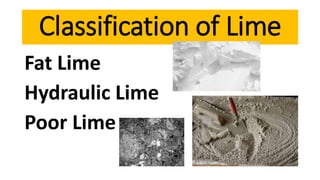
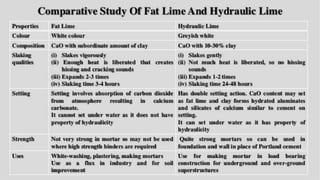
Fat Lime
Hydraulic Lime
Poor Lime
Classification of Lime
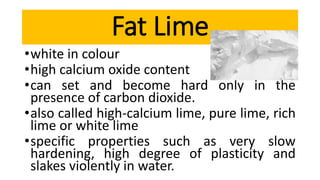
•white in colour
•high calcium oxide content
•can set and become hard only in the
presence of carbon dioxide.
•also called high-calcium lime, pure lime, rich
lime or white lime
•specific properties such as very slow
hardening, high degree of plasticity and
slakes violently in water.
Fat Lime
•used in plastered surfaces for whitewashing.
•used as lime mortar (a combination of lime and
sand) for plastering and pointing works.
• used as a Lime Surkhi mortar for foundations,
thick masonry walls, etc., where surkhi is the
powder obtained by pounding burnt bricks.
Fat Lime Uses
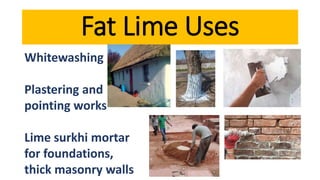
Whitewashing
Plastering and
pointing works
Lime surkhi mortar
for foundations,
thick masonry walls
Fat Lime Uses
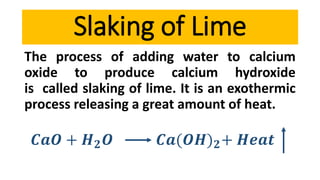
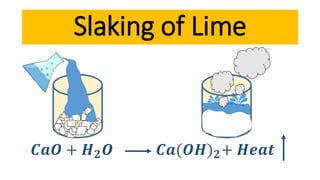
The process of adding water to calcium
oxide to produce calcium hydroxide
is called slaking of lime. It is an exothermic
process releasing a great amount of heat.
𝑪𝒂𝑶 + 𝑯 𝟐 𝑶 𝑪𝒂(𝑶𝑯) 𝟐+ 𝑯𝒆𝒂𝒕
Slaking of Lime
𝑪𝒂𝑶 + 𝑯 𝟐 𝑶 𝑪𝒂(𝑶𝑯) 𝟐+ 𝑯𝒆𝒂𝒕
Slaking of Lime
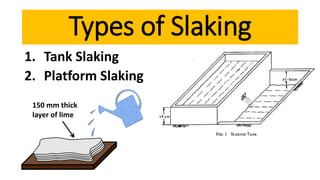
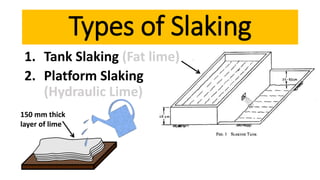
1. Tank Slaking
2. Platform Slaking
Types of Slaking
150 mm thick
layer of lime
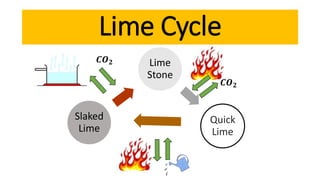
Lime
Stone
Quick
Lime
Slaked
Lime
Lime Cycle
𝑪𝑶 𝟐
𝑪𝑶 𝟐
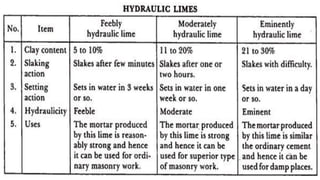
This lime is also known as the
hydraulic lime as it sets under
water. It cannot set without
presence of water.
Hydraulic Lime
1. Tank Slaking (Fat lime)
2. Platform Slaking
(Hydraulic Lime)
Types of Slaking
150 mm thick
layer of lime
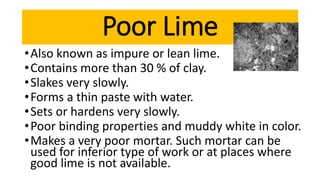
•Also known as impure or lean lime.
•Contains more than 30 % of clay.
•Slakes very slowly.
•Forms a thin paste with water.
•Sets or hardens very slowly.
•Poor binding properties and muddy white in color.
•Makes a very poor mortar. Such mortar can be
used for inferior type of work or at places where
good lime is not available.
Poor Lime
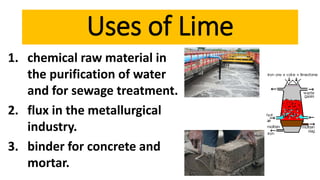
1. chemical raw material in
the purification of water
and for sewage treatment.
2. flux in the metallurgical
industry.
3. binder for concrete and
mortar.
Uses of Lime
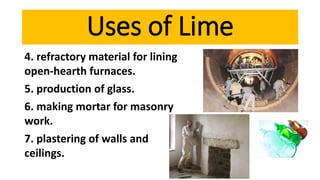
4. refractory material for lining
open-hearth furnaces.
5. production of glass.
6. making mortar for masonry
work.
7. plastering of walls and
ceilings.
Uses of Lime
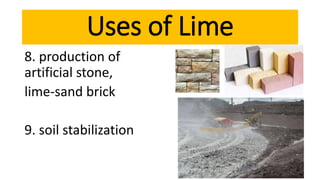
8. production of
artificial stone,
lime-sand brick
9. soil stabilization
Uses of Lime
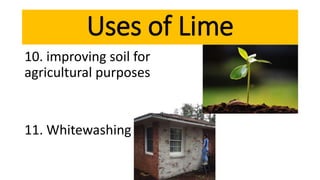
10. improving soil for
agricultural purposes
11. Whitewashing
Uses of Lime
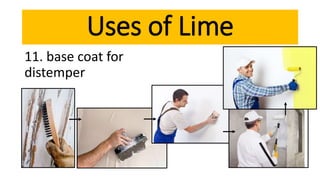
11. base coat for
distemper
Uses of Lime

Construction Material: Lime

  • 1.
    Lime By Aditi KamleshShah Lecturer Civil Engineering Department
  • 2.
  • 3.
    Lime (ચૂનો) Used sinceancient time: Egyptians, Romans In India: big palaces, bridges, temples, forts, monuments What is its replacement ??? Cement
  • 4.
    Lime is notfreely available in nature but is obtained by burning natural materials such as limestone, seashells, kankar, coral, etc. All these material contain calcium carbonate. CaCO3 What is Lime?
  • 5.
    Lime is obtainedby calcination of limestone at a temperature of 550-1100 degree Celsius. (Burning in kiln without oxygen) 𝐶𝑎𝐶𝑂3 𝐶𝑎𝑂 + 𝐶𝑂2 How do we get Lime?
  • 6.
    •Good Plasticity •Flexible andEasily workable •Provides great strength to masonry •Becomes solid in less time and hardens •Excellent binding •Durable •Less shrinkage •Highly resistant to moisture Properties of Lime?
  • 8.
    Fat Lime Hydraulic Lime PoorLime Classification of Lime
  • 9.
    •white in colour •highcalcium oxide content •can set and become hard only in the presence of carbon dioxide. •also called high-calcium lime, pure lime, rich lime or white lime •specific properties such as very slow hardening, high degree of plasticity and slakes violently in water. Fat Lime
  • 10.
    •used in plasteredsurfaces for whitewashing. •used as lime mortar (a combination of lime and sand) for plastering and pointing works. • used as a Lime Surkhi mortar for foundations, thick masonry walls, etc., where surkhi is the powder obtained by pounding burnt bricks. Fat Lime Uses
  • 11.
    Whitewashing Plastering and pointing works Limesurkhi mortar for foundations, thick masonry walls Fat Lime Uses
  • 12.
    The process ofadding water to calcium oxide to produce calcium hydroxide is called slaking of lime. It is an exothermic process releasing a great amount of heat. 𝑪𝒂𝑶 + 𝑯 𝟐 𝑶 𝑪𝒂(𝑶𝑯) 𝟐+ 𝑯𝒆𝒂𝒕 Slaking of Lime
  • 13.
    𝑪𝒂𝑶 + 𝑯𝟐 𝑶 𝑪𝒂(𝑶𝑯) 𝟐+ 𝑯𝒆𝒂𝒕 Slaking of Lime
  • 14.
    1. Tank Slaking 2.Platform Slaking Types of Slaking 150 mm thick layer of lime
  • 15.
  • 16.
    This lime isalso known as the hydraulic lime as it sets under water. It cannot set without presence of water. Hydraulic Lime
  • 18.
    1. Tank Slaking(Fat lime) 2. Platform Slaking (Hydraulic Lime) Types of Slaking 150 mm thick layer of lime
  • 19.
    •Also known asimpure or lean lime. •Contains more than 30 % of clay. •Slakes very slowly. •Forms a thin paste with water. •Sets or hardens very slowly. •Poor binding properties and muddy white in color. •Makes a very poor mortar. Such mortar can be used for inferior type of work or at places where good lime is not available. Poor Lime
  • 21.
    1. chemical rawmaterial in the purification of water and for sewage treatment. 2. flux in the metallurgical industry. 3. binder for concrete and mortar. Uses of Lime
  • 22.
    4. refractory materialfor lining open-hearth furnaces. 5. production of glass. 6. making mortar for masonry work. 7. plastering of walls and ceilings. Uses of Lime
  • 23.
    8. production of artificialstone, lime-sand brick 9. soil stabilization Uses of Lime
  • 24.
    10. improving soilfor agricultural purposes 11. Whitewashing Uses of Lime
  • 25.
    11. base coatfor distemper Uses of Lime