LIME
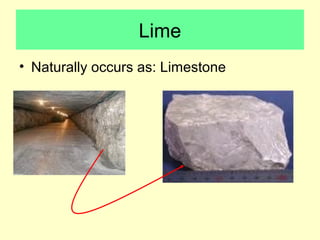
Lime 
• Naturally occurs as: Limestone
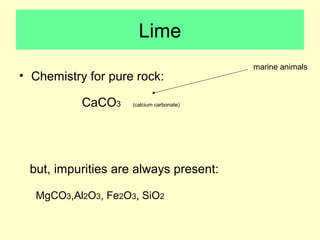
Lime 
• Chemistry for pure rock: 
CaCO3 (calcium carbonate) 
but, impurities are always present: 
MgCO3,Al2O3, Fe2O3, SiO2 
marine animals
Production 
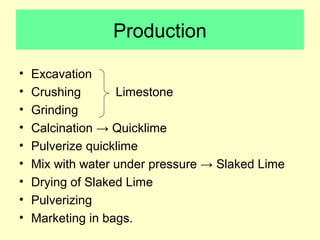
• Excavation 
• Crushing Limestone 
• Grinding 
• Calcination → Quicklime 
• Pulverize quicklime 
• Mix with water under pressure → Slaked Lime 
• Drying of Slaked Lime 
• Pulverizing 
• Marketing in bags.
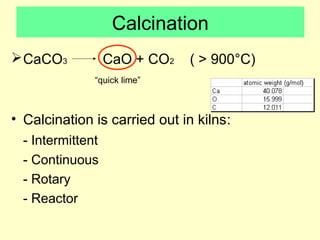
Calcination 
CaCO3 CaO + CO2 ( > 900°C) 
“quick lime” 
• Calcination is carried out in kilns: 
- Intermittent 
- Continuous 
- Rotary 
- Reactor
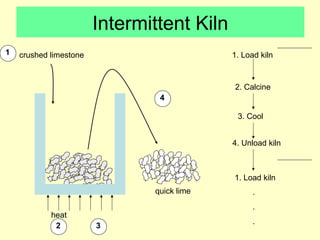
Intermittent Kiln 
1. Load kiln 
2. Calcine 
4. Unload kiln 
1 crushed limestone 
heat 
2 
4 
1. Load kiln 
. 
. 
. 
quick lime 
3. Cool 
3
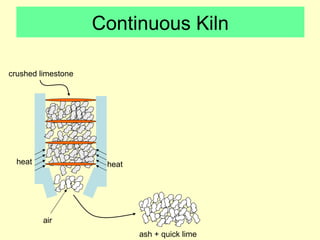
Continuous Kiln 
crushed limestone 
heat 
ash + quick lime 
heat 
air
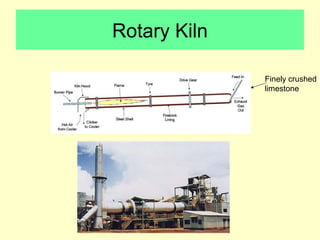
Rotary Kiln 
Finely crushed 
limestone
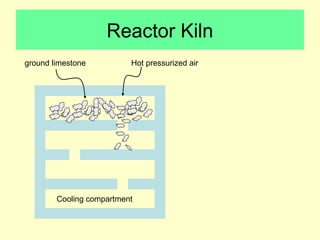
Reactor Kiln 
ground limestone Hot pressurized air 
Cooling compartment
Classification of Quicklime 
1. According to Particle Size 
• Lump Lime (10-30 cm lumps) 
• Pebble Lime (2-5 cm) 
• Granular Lime (~0.5 cm) 
• Crushed Lime (~5-8 mm) 
• Ground Lime (passes #10 sieve, by grinding 
crushed lime) 
• Pulverized Lime (passes #100 sieve)
Classification of Quicklime 
2. According to Chemical Composition 
• High-Calcium Quicklimes (~90% CaO) 
• Calcium Quicklime (75% CaO) 
• Magnesian Quicklime ( > 20% of MgO) 
• Dolomitic Quicklime ( > 25% of MgO) 
3. According to Intended Use 
• Mortar Lime 
• Plaster Lime
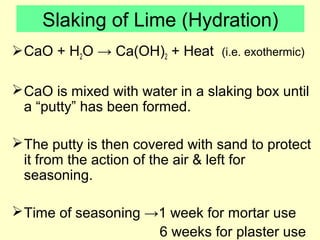
Slaking of Lime (Hydration) 
CaO + H2O → Ca(OH)2 + Heat (i.e. exothermic) 
CaO is mixed with water in a slaking box until 
a “putty” has been formed. 
The putty is then covered with sand to protect 
it from the action of the air & left for 
seasoning. 
Time of seasoning →1 week for mortar use 
6 weeks for plaster use
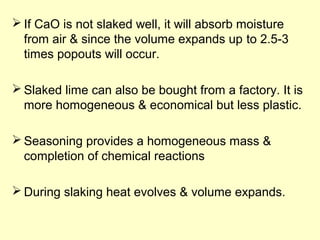
If CaO is not slaked well, it will absorb moisture 
from air & since the volume expands up to 2.5-3 
times popouts will occur. 
Slaked lime can also be bought from a factory. It is 
more homogeneous & economical but less plastic. 
Seasoning provides a homogeneous mass & 
completion of chemical reactions 
During slaking heat evolves & volume expands.
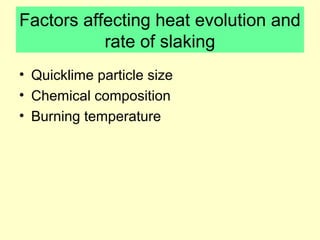
Factors affecting heat evolution and 
rate of slaking 
• Quicklime particle size 
• Chemical composition 
• Burning temperature
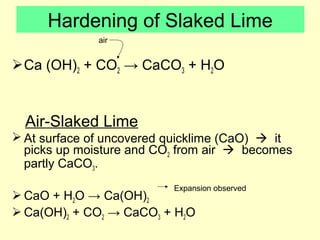
Hardening of Slaked Lime 
air 
Ca (OH)2 + CO2 → CaCO3 + H2O 
Air-Slaked Lime 
At surface of uncovered quicklime (CaO)  it 
picks up moisture and COfrom air becomes 
2  partly CaCO. 
3CaO + HO → Ca(OH)Expansion observed 
22 
Ca(OH)+ CO→ CaCO+ HO 
2 2 3 2
Lime Pops 
If quicklime is not mixed completely with 
water  some CaO will be carried to 
construction stage. 
In its final stage it will absorb water & CO2 
from air and will expand upto 2.5-3 times. 
This will cause cracking & pop-outs in the 
structure.
Properties of Lime Mortars 
Lime + sand lime mortar 
Adding sand: 
- Adjusts plasticity – otherwise too sticky 
- Provides economy 
- Decreases shrinkage effects
Strength of Lime Mortars 
Chemical composition of lime 
Magnesian Limes > Calcium Limes 
Sand amount & properties 
Adding sand decreases strength 
Amount of water 
Voids are formed after evaporation 
Setting conditions 
Lower humidity & higher CO2  higher strength
Properties of High-Calcium Limes 
Slakes faster 
Hardens faster 
Have greater sand carrying capacity
Durability of Limes 
Not resistant to moving water 
Not for use outside 
hydraulic binder ???
Uses of Lime 
In producing masonry mortars 
Plaster mortars – sets slower than gypsum 
White-wash 
In production of masonry blocks – slaked 
lime + sand under pressure
Hydraulic Lime 
Obtained by calcination of siliceous or 
clayey limestone at higher temperature 
It differs from quicklime: 
- Burned at higher temperature 
- It contains lime silicates 
- It can set & harden under water

3. lime

  • 1.
  • 2.
    Lime • Naturallyoccurs as: Limestone
  • 3.
    Lime • Chemistryfor pure rock: CaCO3 (calcium carbonate) but, impurities are always present: MgCO3,Al2O3, Fe2O3, SiO2 marine animals
  • 4.
    Production • Excavation • Crushing Limestone • Grinding • Calcination → Quicklime • Pulverize quicklime • Mix with water under pressure → Slaked Lime • Drying of Slaked Lime • Pulverizing • Marketing in bags.
  • 5.
    Calcination CaCO3 CaO+ CO2 ( > 900°C) “quick lime” • Calcination is carried out in kilns: - Intermittent - Continuous - Rotary - Reactor
  • 6.
    Intermittent Kiln 1.Load kiln 2. Calcine 4. Unload kiln 1 crushed limestone heat 2 4 1. Load kiln . . . quick lime 3. Cool 3
  • 7.
    Continuous Kiln crushedlimestone heat ash + quick lime heat air
  • 8.
    Rotary Kiln Finelycrushed limestone
  • 9.
    Reactor Kiln groundlimestone Hot pressurized air Cooling compartment
  • 10.
    Classification of Quicklime 1. According to Particle Size • Lump Lime (10-30 cm lumps) • Pebble Lime (2-5 cm) • Granular Lime (~0.5 cm) • Crushed Lime (~5-8 mm) • Ground Lime (passes #10 sieve, by grinding crushed lime) • Pulverized Lime (passes #100 sieve)
  • 11.
    Classification of Quicklime 2. According to Chemical Composition • High-Calcium Quicklimes (~90% CaO) • Calcium Quicklime (75% CaO) • Magnesian Quicklime ( > 20% of MgO) • Dolomitic Quicklime ( > 25% of MgO) 3. According to Intended Use • Mortar Lime • Plaster Lime
  • 12.
    Slaking of Lime(Hydration) CaO + H2O → Ca(OH)2 + Heat (i.e. exothermic) CaO is mixed with water in a slaking box until a “putty” has been formed. The putty is then covered with sand to protect it from the action of the air & left for seasoning. Time of seasoning →1 week for mortar use 6 weeks for plaster use
  • 13.
    If CaO isnot slaked well, it will absorb moisture from air & since the volume expands up to 2.5-3 times popouts will occur. Slaked lime can also be bought from a factory. It is more homogeneous & economical but less plastic. Seasoning provides a homogeneous mass & completion of chemical reactions During slaking heat evolves & volume expands.
  • 14.
    Factors affecting heatevolution and rate of slaking • Quicklime particle size • Chemical composition • Burning temperature
  • 15.
    Hardening of SlakedLime air Ca (OH)2 + CO2 → CaCO3 + H2O Air-Slaked Lime At surface of uncovered quicklime (CaO)  it picks up moisture and COfrom air becomes 2  partly CaCO. 3CaO + HO → Ca(OH)Expansion observed 22 Ca(OH)+ CO→ CaCO+ HO 2 2 3 2
  • 16.
    Lime Pops Ifquicklime is not mixed completely with water  some CaO will be carried to construction stage. In its final stage it will absorb water & CO2 from air and will expand upto 2.5-3 times. This will cause cracking & pop-outs in the structure.
  • 17.
    Properties of LimeMortars Lime + sand lime mortar Adding sand: - Adjusts plasticity – otherwise too sticky - Provides economy - Decreases shrinkage effects
  • 18.
    Strength of LimeMortars Chemical composition of lime Magnesian Limes > Calcium Limes Sand amount & properties Adding sand decreases strength Amount of water Voids are formed after evaporation Setting conditions Lower humidity & higher CO2  higher strength
  • 19.
    Properties of High-CalciumLimes Slakes faster Hardens faster Have greater sand carrying capacity
  • 20.
    Durability of Limes Not resistant to moving water Not for use outside hydraulic binder ???
  • 21.
    Uses of Lime In producing masonry mortars Plaster mortars – sets slower than gypsum White-wash In production of masonry blocks – slaked lime + sand under pressure
  • 22.
    Hydraulic Lime Obtainedby calcination of siliceous or clayey limestone at higher temperature It differs from quicklime: - Burned at higher temperature - It contains lime silicates - It can set & harden under water