DEFINITION 
Binders are substances that are used to bind 
inorganic and organic particles and fibers to 
form strong, hard and/or flexible components. 
2 HAILEMARIAM GIRMA 11/02/14
THE BINDING ACTION 
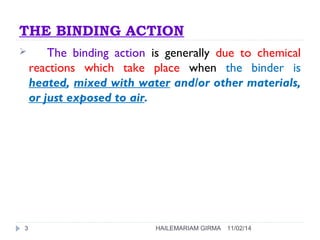
 The binding action is generally due to chemical 
reactions which take place when the binder is 
heated, mixed with water and/or other materials, 
or just exposed to air. 
3 HAILEMARIAM GIRMA 11/02/14
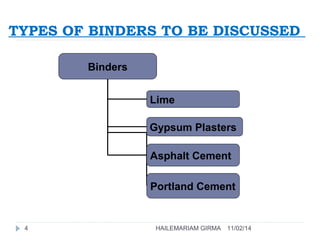
TYPES OF BINDERS TO BE DISCUSSED 
Binders 
Lime 
Gypsum Plasters 
Asphalt Cement 
Portland Cement 
4 HAILEMARIAM GIRMA 11/02/14
MAIN GROUPS OF BINDERS 
There are three main groups of binders: - 
1. Mineral binders 
2. Bituminous (Asphalt)binders 
3. Synthetic binders 
5 HAILEMARIAM GIRMA 11/02/14
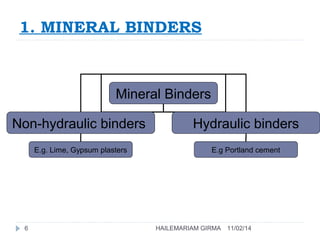
1. MINERAL BINDERS 
Mineral Binders 
Non-hydraulic binders Hydraulic binders 
E.g. Lime, Gypsum plasters E.g Portland cement 
6 HAILEMARIAM GIRMA 11/02/14
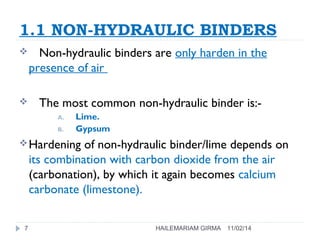
1.1 NON-HYDRAULIC BINDERS 
 Non-hydraulic binders are only harden in the 
presence of air 
 The most common non-hydraulic binder is:- 
A. Lime. 
B. Gypsum 
Hardening of non-hydraulic binder/lime depends on 
its combination with carbon dioxide from the air 
(carbonation), by which it again becomes calcium 
carbonate (limestone). 
7 HAILEMARIAM GIRMA 11/02/14
Cont’d 
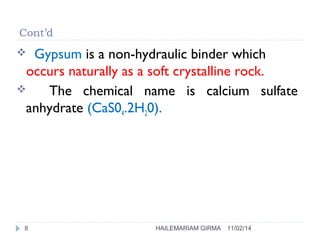
 Gypsum is a non-hydraulic binder which 
occurs naturally as a soft crystalline rock. 
 The chemical name is calcium sulfate 
anhydrate (CaS04.2H20). 
8 HAILEMARIAM GIRMA 11/02/14
Cont’d 
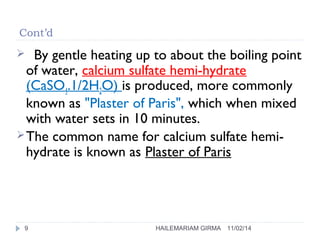
 By gentle heating up to about the boiling point 
of water, calcium sulfate hemi-hydrate 
(CaSO4.1/2H2O) is produced, more commonly 
known as "Plaster of Paris", which when mixed 
with water sets in 10 minutes. 
The common name for calcium sulfate hemi-hydrate 
is known as Plaster of Paris 
9 HAILEMARIAM GIRMA 11/02/14
1.2 HYDRAULIC BINDERS 
 Hydraulic binders require water to harden 
and develop strength. 
 The most common hydraulic binder is 
Portland cement. 
Hydraulic binders are usually available in the 
form of a fine powder. Why? 
10 HAILEMARIAM GIRMA 11/02/14
Cont’d 
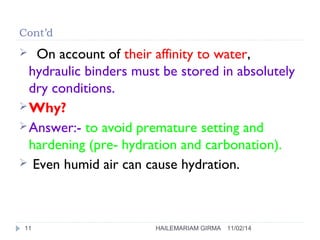
 On account of their affinity to water, 
hydraulic binders must be stored in absolutely 
dry conditions. 
Why? 
Answer:- to avoid premature setting and 
hardening (pre- hydration and carbonation). 
 Even humid air can cause hydration. 
11 HAILEMARIAM GIRMA 11/02/14
2. BITUMINOUS BINDERS/ASPHALT 
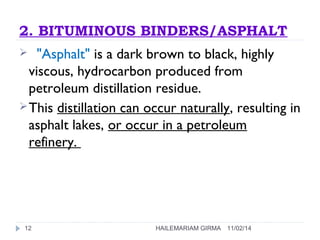
 "Asphalt" is a dark brown to black, highly 
viscous, hydrocarbon produced from 
petroleum distillation residue. 
This distillation can occur naturally, resulting in 
asphalt lakes, or occur in a petroleum 
refinery. 
12 HAILEMARIAM GIRMA 11/02/14
3. SYNTHETIC BINDERS 
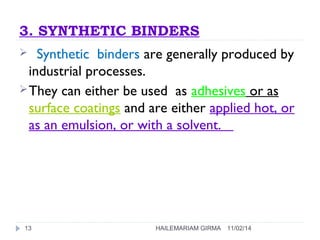
 Synthetic binders are generally produced by 
industrial processes. 
They can either be used as adhesives or as 
surface coatings and are either applied hot, or 
as an emulsion, or with a solvent. 
13 HAILEMARIAM GIRMA 11/02/14
Cont’d 
 Synthetic admixtures which bind loose 
particles together are mainly resins derived 
from plant materials or mineral oil. 
 Adhesives are used to stick larger particles, 
components, membranes, sheets, boards, tiles, etc. 
on another surface. 
14 HAILEMARIAM GIRMA 11/02/14
LIME 
15 HAILEMARIAM GIRMA 11/02/14
General 
Lime is one of the oldest known cementing 
material 
Lime is found in many parts of the world in its 
natural form as a rock of varying degree of 
hardness. 
Lime is mainly composed of calcium oxide (CaO). 
16 HAILEMARIAM GIRMA 11/02/14
Cont’d 
Lime in its pure form associates with CO2 to give white 
CaCo3. 
Lime deposits are generally found mixed with impurities 
such as CO2, Fe2 O3, and MgCO3. 
Depending on the impurities, lime deposits acquire 
different colors. 
17 HAILEMARIAM GIRMA 11/02/14
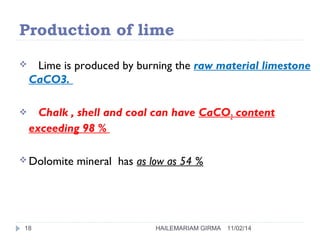
Production of lime 
 Lime is produced by burning the raw material limestone 
CaCO3. 
 Chalk , shell and coal can have CaCO3 content 
exceeding 98 % 
Dolomite mineral has as low as 54 % 
18 HAILEMARIAM GIRMA 11/02/14
Burning process 
19 HAILEMARIAM GIRMA 11/02/14
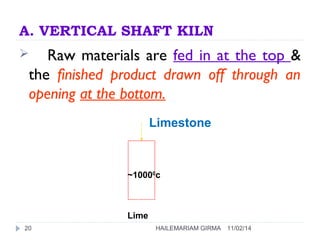
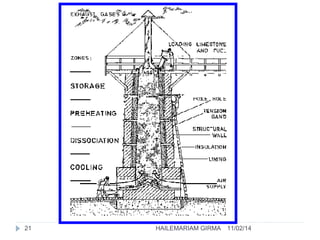
A. VERTICAL SHAFT KILN 
 Raw materials are fed in at the top & 
the finished product drawn off through an 
opening at the bottom. 
Limestone 
~10000c 
Lime 
20 HAILEMARIAM GIRMA 11/02/14
21 HAILEMARIAM GIRMA 11/02/14
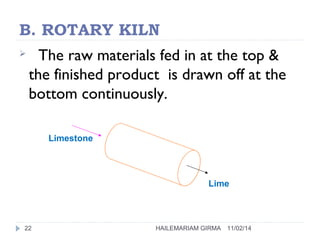
B. ROTARY KILN 
 The raw materials fed in at the top & 
the finished product is drawn off at the 
bottom continuously. 
Limestone 
Lime 
22 HAILEMARIAM GIRMA 11/02/14
CLASSIFICATION OF LIME 
 Commercial lime is classified into three 
groups:- 
1.Quick lime (Caustic lime) 
2.Hydrated lime (Slaked lime) 
3.Hydraulic lime 
23 HAILEMARIAM GIRMA 11/02/14
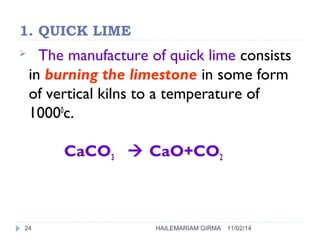
1. QUICK LIME 
 The manufacture of quick lime consists 
in burning the limestone in some form 
of vertical kilns to a temperature of 
10000c. 
CaCO3  CaO+CO2 
24 HAILEMARIAM GIRMA 11/02/14
Quick Lime: 
Is obtained by calcining (burning) the 
purest available calcium carbonate 
Gives out considerable heat 
Swells two to three times of its original 
volume upon addition of water 
Takes much time in hardening 
Is used for plastering and white washing 
Is not suitable for being used as mortar 
because of its poor strength and slow 
hardening 
25 HAILEMARIAM GIRMA 11/02/14
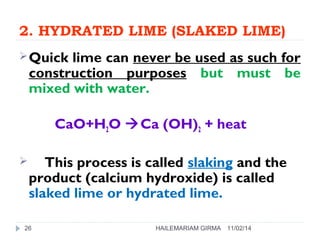
2. HYDRATED LIME (SLAKED LIME) 
Quick lime can never be used as such for 
construction purposes but must be 
mixed with water. 
CaO+H2O Ca (OH)2 + heat 
 This process is called slaking and the 
product (calcium hydroxide) is called 
slaked lime or hydrated lime. 
26 HAILEMARIAM GIRMA 11/02/14
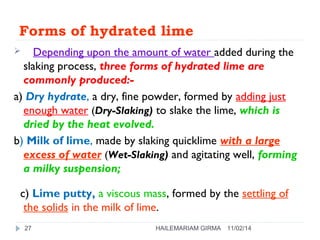
Forms of hydrated lime 
 Depending upon the amount of water added during the 
slaking process, three forms of hydrated lime are 
commonly produced:- 
a) Dry hydrate, a dry, fine powder, formed by adding just 
enough water (Dry-Slaking) to slake the lime, which is 
dried by the heat evolved. 
b) Milk of lime, made by slaking quicklime with a large 
excess of water (Wet-Slaking) and agitating well, forming 
a milky suspension; 
c) Lime putty, a viscous mass, formed by the settling of 
the solids in the milk of lime. 
27 HAILEMARIAM GIRMA 11/02/14
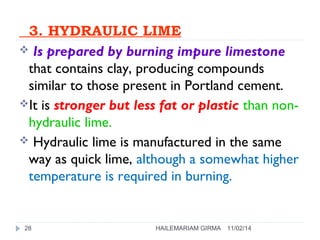
3. HYDRAULIC LIME 
 Is prepared by burning impure limestone 
that contains clay, producing compounds 
similar to those present in Portland cement. 
It is stronger but less fat or plastic than non-hydraulic 
lime. 
 Hydraulic lime is manufactured in the same 
way as quick lime, although a somewhat higher 
temperature is required in burning. 
28 HAILEMARIAM GIRMA 11/02/14
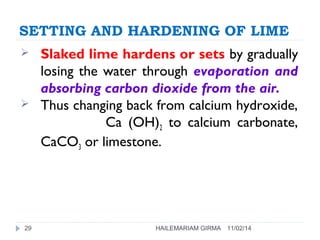
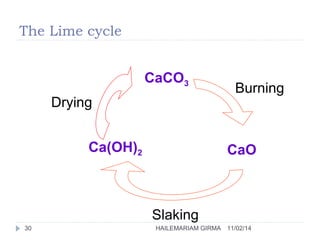
SETTING AND HARDENING OF LIME 
 Slaked lime hardens or sets by gradually 
losing the water through evaporation and 
absorbing carbon dioxide from the air. 
 Thus changing back from calcium hydroxide, 
Ca (OH)2 to calcium carbonate, 
CaCO3 or limestone. 
29 HAILEMARIAM GIRMA 11/02/14
The Lime cycle 
CaCO3 
Burning 
Drying 
Ca(OH)2 CaO 
Slaking 
30 HAILEMARIAM GIRMA 11/02/14
USES OF LIME 
1. Lime as a construction material 
 As mortar (lime mortar) mixed with sand. 
 Lime is used in cement mortar to make it 
more workable 
 As plaster (lime plaster) 
 As a whitewash, when it gives a sparkling 
white finished at a very low cost 
 As lime concrete 
 As a stabilizer in soil constructions with clayey 
soils 
31 HAILEMARIAM GIRMA 11/02/14
2. Lime as an industrial material 
In industry, lime finds many applications:- 
 As a flux in the metallurgical industry 
 As a refractory material for lining 
metallurgical furnaces; 
 As a raw material for the manufacture of 
glasses. 
3. Lime as an agricultural input 
 Lime is used for improving the productive 
qualities of soils. 
 It is added to the poor soils to enrich their 
lime content. 
32 HAILEMARIAM GIRMA 11/02/14
GYPSUM PLASTERS 
33 HAILEMARIAM GIRMA 11/02/14
General 
 Gypsum is a combination of sulfate of lime with 
water of crystallization. 
 Gypsum occurs naturally as: 
 Hydrous sulfate of lime (Ca SO4 
2H2O) which is generally 76% CaSO4 
and 24% H2O, 
 Anhydrate (Ca SO4). 
 Pure gypsum is known as alabaster 
and it is a white translucent crystalline 
mineral 
34 HAILEMARIAM GIRMA 11/02/14
Gypsum plasters 
 Gypsum plasters are used in the arts and 
in building construction. 
 Gypsum plasters are manufactured by 
heating the raw material gypsum at either 
moderate or high temperatures the results 
being plaster of Paris or hard-finish plaster 
respectively. 
35 HAILEMARIAM GIRMA 11/02/14
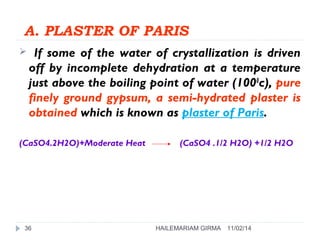
A. PLASTER OF PARIS 
 If some of the water of crystallization is driven 
off by incomplete dehydration at a temperature 
just above the boiling point of water (1000c), pure 
finely ground gypsum, a semi-hydrated plaster is 
obtained which is known as plaster of Paris. 
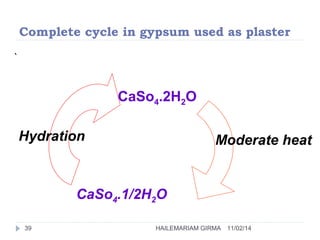
(CaSO4.2H2O)+Moderate Heat (CaSO4 .1/2 H2O) +1/2 H2O 
36 HAILEMARIAM GIRMA 11/02/14
Cont’d 
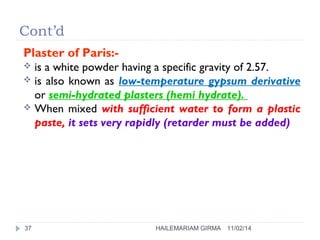
Plaster of Paris:- 
 is a white powder having a specific gravity of 2.57. 
 is also known as low-temperature gypsum derivative 
or semi-hydrated plasters (hemi hydrate). 
 When mixed with sufficient water to form a plastic 
paste, it sets very rapidly (retarder must be added) 
37 HAILEMARIAM GIRMA 11/02/14
Cont’d 
Glue, sawdust or blood can be added to Retard the 
setting time of the plaster. 
Owing to rapidity of setting, its use in structures is 
limited to ornamental work. 
38 HAILEMARIAM GIRMA 11/02/14
Complete cycle in gypsum used as plaster 
Hydration Moderate heat 
39 HAILEMARIAM GIRMA 11/02/14 
` 
CaSo4.2H2O 
CaSo4.1/2H2O
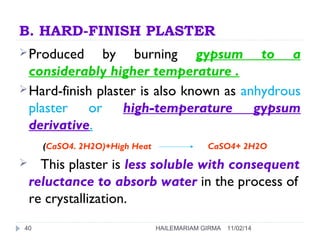
B. HARD-FINISH PLASTER 
Produced by burning gypsum to a 
considerably higher temperature . 
Hard-finish plaster is also known as anhydrous 
plaster or high-temperature gypsum 
derivative. 
(CaSO4. 2H2O)+High Heat CaSO4+ 2H2O 
 This plaster is less soluble with consequent 
reluctance to absorb water in the process of 
re crystallization. 
40 HAILEMARIAM GIRMA 11/02/14
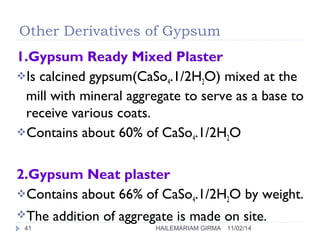
Other Derivatives of Gypsum 
1.Gypsum Ready Mixed Plaster 
Is calcined gypsum(CaSo4.1/2H2O) mixed at the 
mill with mineral aggregate to serve as a base to 
receive various coats. 
Contains about 60% of CaSo4.1/2H2O 
2.Gypsum Neat plaster 
Contains about 66% of CaSo4.1/2H2O by weight. 
The addition of aggregate is made on site. 
41 HAILEMARIAM GIRMA 11/02/14
3.Gypsum Wood fibered plaster 
Composed of not less than 66% of 
CaSo4.1/2H2O and about 1% wood fiber. 
4 . Gypsum bond plaster 
Used as a bonding scratch -coat over 
monolithic concrete. 
It contains not less than 93% of CaSo4.1/2H2O 
and not less than 2% or more than 5% of 
hydrated lime. 
42 HAILEMARIAM GIRMA 11/02/14
 5.Gypsum Gauging Plaster 
Is prepared for mixing with lime putty for the 
finish coat. 
Contains not less than 66% of 
CaSo4.1/2H2O 
43 HAILEMARIAM GIRMA 11/02/14
Thank you !!! 
44 HAILEMARIAM GIRMA 11/02/14

2 binders material

  • 1.
    DEFINITION Binders aresubstances that are used to bind inorganic and organic particles and fibers to form strong, hard and/or flexible components. 2 HAILEMARIAM GIRMA 11/02/14
  • 2.
    THE BINDING ACTION  The binding action is generally due to chemical reactions which take place when the binder is heated, mixed with water and/or other materials, or just exposed to air. 3 HAILEMARIAM GIRMA 11/02/14
  • 3.
    TYPES OF BINDERSTO BE DISCUSSED Binders Lime Gypsum Plasters Asphalt Cement Portland Cement 4 HAILEMARIAM GIRMA 11/02/14
  • 4.
    MAIN GROUPS OFBINDERS There are three main groups of binders: - 1. Mineral binders 2. Bituminous (Asphalt)binders 3. Synthetic binders 5 HAILEMARIAM GIRMA 11/02/14
  • 5.
    1. MINERAL BINDERS Mineral Binders Non-hydraulic binders Hydraulic binders E.g. Lime, Gypsum plasters E.g Portland cement 6 HAILEMARIAM GIRMA 11/02/14
  • 6.
    1.1 NON-HYDRAULIC BINDERS  Non-hydraulic binders are only harden in the presence of air  The most common non-hydraulic binder is:- A. Lime. B. Gypsum Hardening of non-hydraulic binder/lime depends on its combination with carbon dioxide from the air (carbonation), by which it again becomes calcium carbonate (limestone). 7 HAILEMARIAM GIRMA 11/02/14
  • 7.
    Cont’d  Gypsumis a non-hydraulic binder which occurs naturally as a soft crystalline rock.  The chemical name is calcium sulfate anhydrate (CaS04.2H20). 8 HAILEMARIAM GIRMA 11/02/14
  • 8.
    Cont’d  Bygentle heating up to about the boiling point of water, calcium sulfate hemi-hydrate (CaSO4.1/2H2O) is produced, more commonly known as "Plaster of Paris", which when mixed with water sets in 10 minutes. The common name for calcium sulfate hemi-hydrate is known as Plaster of Paris 9 HAILEMARIAM GIRMA 11/02/14
  • 9.
    1.2 HYDRAULIC BINDERS  Hydraulic binders require water to harden and develop strength.  The most common hydraulic binder is Portland cement. Hydraulic binders are usually available in the form of a fine powder. Why? 10 HAILEMARIAM GIRMA 11/02/14
  • 10.
    Cont’d  Onaccount of their affinity to water, hydraulic binders must be stored in absolutely dry conditions. Why? Answer:- to avoid premature setting and hardening (pre- hydration and carbonation).  Even humid air can cause hydration. 11 HAILEMARIAM GIRMA 11/02/14
  • 11.
    2. BITUMINOUS BINDERS/ASPHALT  "Asphalt" is a dark brown to black, highly viscous, hydrocarbon produced from petroleum distillation residue. This distillation can occur naturally, resulting in asphalt lakes, or occur in a petroleum refinery. 12 HAILEMARIAM GIRMA 11/02/14
  • 12.
    3. SYNTHETIC BINDERS  Synthetic binders are generally produced by industrial processes. They can either be used as adhesives or as surface coatings and are either applied hot, or as an emulsion, or with a solvent. 13 HAILEMARIAM GIRMA 11/02/14
  • 13.
    Cont’d  Syntheticadmixtures which bind loose particles together are mainly resins derived from plant materials or mineral oil.  Adhesives are used to stick larger particles, components, membranes, sheets, boards, tiles, etc. on another surface. 14 HAILEMARIAM GIRMA 11/02/14
  • 14.
    LIME 15 HAILEMARIAMGIRMA 11/02/14
  • 15.
    General Lime isone of the oldest known cementing material Lime is found in many parts of the world in its natural form as a rock of varying degree of hardness. Lime is mainly composed of calcium oxide (CaO). 16 HAILEMARIAM GIRMA 11/02/14
  • 16.
    Cont’d Lime inits pure form associates with CO2 to give white CaCo3. Lime deposits are generally found mixed with impurities such as CO2, Fe2 O3, and MgCO3. Depending on the impurities, lime deposits acquire different colors. 17 HAILEMARIAM GIRMA 11/02/14
  • 17.
    Production of lime  Lime is produced by burning the raw material limestone CaCO3.  Chalk , shell and coal can have CaCO3 content exceeding 98 % Dolomite mineral has as low as 54 % 18 HAILEMARIAM GIRMA 11/02/14
  • 18.
    Burning process 19HAILEMARIAM GIRMA 11/02/14
  • 19.
    A. VERTICAL SHAFTKILN  Raw materials are fed in at the top & the finished product drawn off through an opening at the bottom. Limestone ~10000c Lime 20 HAILEMARIAM GIRMA 11/02/14
  • 20.
  • 21.
    B. ROTARY KILN  The raw materials fed in at the top & the finished product is drawn off at the bottom continuously. Limestone Lime 22 HAILEMARIAM GIRMA 11/02/14
  • 22.
    CLASSIFICATION OF LIME  Commercial lime is classified into three groups:- 1.Quick lime (Caustic lime) 2.Hydrated lime (Slaked lime) 3.Hydraulic lime 23 HAILEMARIAM GIRMA 11/02/14
  • 23.
    1. QUICK LIME  The manufacture of quick lime consists in burning the limestone in some form of vertical kilns to a temperature of 10000c. CaCO3  CaO+CO2 24 HAILEMARIAM GIRMA 11/02/14
  • 24.
    Quick Lime: Isobtained by calcining (burning) the purest available calcium carbonate Gives out considerable heat Swells two to three times of its original volume upon addition of water Takes much time in hardening Is used for plastering and white washing Is not suitable for being used as mortar because of its poor strength and slow hardening 25 HAILEMARIAM GIRMA 11/02/14
  • 25.
    2. HYDRATED LIME(SLAKED LIME) Quick lime can never be used as such for construction purposes but must be mixed with water. CaO+H2O Ca (OH)2 + heat  This process is called slaking and the product (calcium hydroxide) is called slaked lime or hydrated lime. 26 HAILEMARIAM GIRMA 11/02/14
  • 26.
    Forms of hydratedlime  Depending upon the amount of water added during the slaking process, three forms of hydrated lime are commonly produced:- a) Dry hydrate, a dry, fine powder, formed by adding just enough water (Dry-Slaking) to slake the lime, which is dried by the heat evolved. b) Milk of lime, made by slaking quicklime with a large excess of water (Wet-Slaking) and agitating well, forming a milky suspension; c) Lime putty, a viscous mass, formed by the settling of the solids in the milk of lime. 27 HAILEMARIAM GIRMA 11/02/14
  • 27.
    3. HYDRAULIC LIME  Is prepared by burning impure limestone that contains clay, producing compounds similar to those present in Portland cement. It is stronger but less fat or plastic than non-hydraulic lime.  Hydraulic lime is manufactured in the same way as quick lime, although a somewhat higher temperature is required in burning. 28 HAILEMARIAM GIRMA 11/02/14
  • 28.
    SETTING AND HARDENINGOF LIME  Slaked lime hardens or sets by gradually losing the water through evaporation and absorbing carbon dioxide from the air.  Thus changing back from calcium hydroxide, Ca (OH)2 to calcium carbonate, CaCO3 or limestone. 29 HAILEMARIAM GIRMA 11/02/14
  • 29.
    The Lime cycle CaCO3 Burning Drying Ca(OH)2 CaO Slaking 30 HAILEMARIAM GIRMA 11/02/14
  • 30.
    USES OF LIME 1. Lime as a construction material  As mortar (lime mortar) mixed with sand.  Lime is used in cement mortar to make it more workable  As plaster (lime plaster)  As a whitewash, when it gives a sparkling white finished at a very low cost  As lime concrete  As a stabilizer in soil constructions with clayey soils 31 HAILEMARIAM GIRMA 11/02/14
  • 31.
    2. Lime asan industrial material In industry, lime finds many applications:-  As a flux in the metallurgical industry  As a refractory material for lining metallurgical furnaces;  As a raw material for the manufacture of glasses. 3. Lime as an agricultural input  Lime is used for improving the productive qualities of soils.  It is added to the poor soils to enrich their lime content. 32 HAILEMARIAM GIRMA 11/02/14
  • 32.
    GYPSUM PLASTERS 33HAILEMARIAM GIRMA 11/02/14
  • 33.
    General  Gypsumis a combination of sulfate of lime with water of crystallization.  Gypsum occurs naturally as:  Hydrous sulfate of lime (Ca SO4 2H2O) which is generally 76% CaSO4 and 24% H2O,  Anhydrate (Ca SO4).  Pure gypsum is known as alabaster and it is a white translucent crystalline mineral 34 HAILEMARIAM GIRMA 11/02/14
  • 34.
    Gypsum plasters Gypsum plasters are used in the arts and in building construction.  Gypsum plasters are manufactured by heating the raw material gypsum at either moderate or high temperatures the results being plaster of Paris or hard-finish plaster respectively. 35 HAILEMARIAM GIRMA 11/02/14
  • 35.
    A. PLASTER OFPARIS  If some of the water of crystallization is driven off by incomplete dehydration at a temperature just above the boiling point of water (1000c), pure finely ground gypsum, a semi-hydrated plaster is obtained which is known as plaster of Paris. (CaSO4.2H2O)+Moderate Heat (CaSO4 .1/2 H2O) +1/2 H2O 36 HAILEMARIAM GIRMA 11/02/14
  • 36.
    Cont’d Plaster ofParis:-  is a white powder having a specific gravity of 2.57.  is also known as low-temperature gypsum derivative or semi-hydrated plasters (hemi hydrate).  When mixed with sufficient water to form a plastic paste, it sets very rapidly (retarder must be added) 37 HAILEMARIAM GIRMA 11/02/14
  • 37.
    Cont’d Glue, sawdustor blood can be added to Retard the setting time of the plaster. Owing to rapidity of setting, its use in structures is limited to ornamental work. 38 HAILEMARIAM GIRMA 11/02/14
  • 38.
    Complete cycle ingypsum used as plaster Hydration Moderate heat 39 HAILEMARIAM GIRMA 11/02/14 ` CaSo4.2H2O CaSo4.1/2H2O
  • 39.
    B. HARD-FINISH PLASTER Produced by burning gypsum to a considerably higher temperature . Hard-finish plaster is also known as anhydrous plaster or high-temperature gypsum derivative. (CaSO4. 2H2O)+High Heat CaSO4+ 2H2O  This plaster is less soluble with consequent reluctance to absorb water in the process of re crystallization. 40 HAILEMARIAM GIRMA 11/02/14
  • 40.
    Other Derivatives ofGypsum 1.Gypsum Ready Mixed Plaster Is calcined gypsum(CaSo4.1/2H2O) mixed at the mill with mineral aggregate to serve as a base to receive various coats. Contains about 60% of CaSo4.1/2H2O 2.Gypsum Neat plaster Contains about 66% of CaSo4.1/2H2O by weight. The addition of aggregate is made on site. 41 HAILEMARIAM GIRMA 11/02/14
  • 41.
    3.Gypsum Wood fiberedplaster Composed of not less than 66% of CaSo4.1/2H2O and about 1% wood fiber. 4 . Gypsum bond plaster Used as a bonding scratch -coat over monolithic concrete. It contains not less than 93% of CaSo4.1/2H2O and not less than 2% or more than 5% of hydrated lime. 42 HAILEMARIAM GIRMA 11/02/14
  • 42.
     5.Gypsum GaugingPlaster Is prepared for mixing with lime putty for the finish coat. Contains not less than 66% of CaSo4.1/2H2O 43 HAILEMARIAM GIRMA 11/02/14
  • 43.
    Thank you !!! 44 HAILEMARIAM GIRMA 11/02/14