Chapter Fifteen & Sixteen
Types of Laws
Types of Laws
   There are four (4) types of laws in
    America:
    – “Constitutional” Law
    – “Military” Law
    – “Criminal” Law
    – “Civil” Law
Types of Laws
   Constitutional Law:
    – Law that relates to the practice, study,
      interpretation and administration of laws set
      forth by the US Constitution
    – Any legal issues that deal with constitutional
      rights or violations are a part of
      constitutional law.
Types of Laws
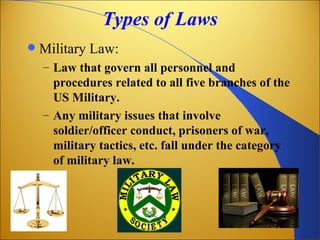
   Military Law:
    – Law that govern all personnel and
      procedures related to all five branches of the
      US Military.
    – Any military issues that involve
      soldier/officer conduct, prisoners of war,
      military tactics, etc. fall under the category
      of military law.
Types of Laws
   There are two (2) types of law that affect
    Americans directly today that help maintain
    a peaceful and orderly society:
    – “Criminal” Law
    – “Civil” Law
“Criminal” Law

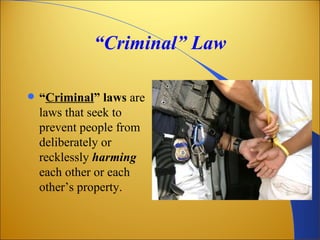
   “Criminal” laws are
    laws that seek to
    prevent people from
    deliberately or
    recklessly harming
    each other or each
    other’s property.
Our Court System
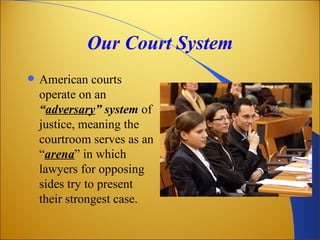
   American courts
    operate on an
    “adversary” system of
    justice, meaning the
    courtroom serves as an
    “arena” in which
    lawyers for opposing
    sides try to present
    their strongest case.
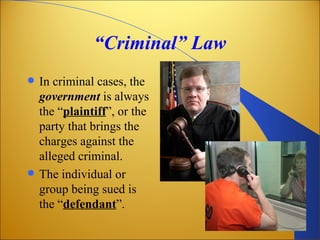
“Criminal” Law
   In criminal cases, the
    government is always
    the “plaintiff”, or the
    party that brings the
    charges against the
    alleged criminal.
   The individual or
    group being sued is
    the “defendant”.
“Criminal” Law

   There are two (2)
    types of crimes:
     – “Felonies”
     – “Misdemeanors”
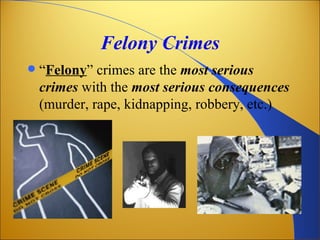
Felony Crimes
   “Felony” crimes are the most serious
    crimes with the most serious consequences
    (murder, rape, kidnapping, robbery, etc.)
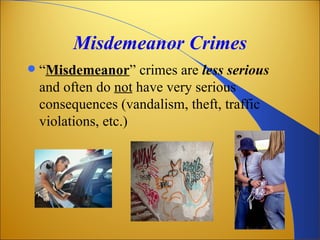
Misdemeanor Crimes
   “Misdemeanor” crimes are less serious
    and often do not have very serious
    consequences (vandalism, theft, traffic
    violations, etc.)
Criminal Process
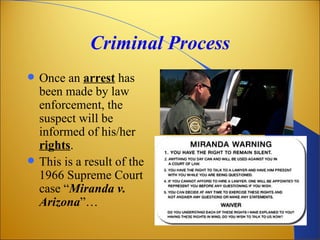
   Once an arrest has
    been made by law
    enforcement, the
    suspect will be
    informed of his/her
    rights.
   This is a result of the
    1966 Supreme Court
    case “Miranda v.
    Arizona”…
Criminal Process
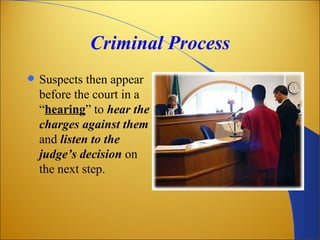
   Suspects then appear
    before the court in a
    “hearing” to hear the
    charges against them
    and listen to the
    judge’s decision on
    the next step.
Criminal Process
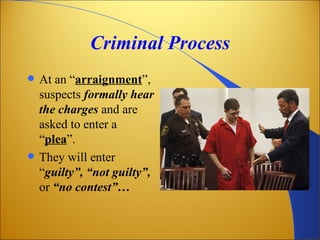
   At an “arraignment”,
    suspects formally hear
    the charges and are
    asked to enter a
    “plea”.
   They will enter
    “guilty”, “not guilty”,
    or “no contest”…
Criminal Process
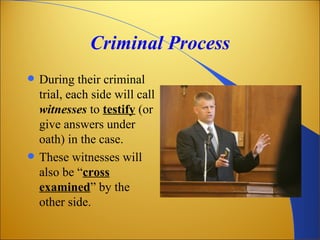
   During their criminal
    trial, each side will call
    witnesses to testify (or
    give answers under
    oath) in the case.
   These witnesses will
    also be “cross
    examined” by the
    other side.
Criminal Process
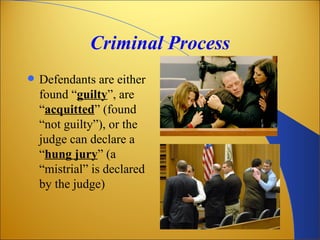
   Defendants are either
    found “guilty”, are
    “acquitted” (found
    “not guilty”), or the
    judge can declare a
    “hung jury” (a
    “mistrial” is declared
    by the judge)
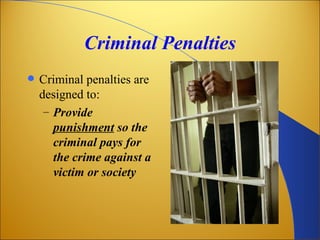
Criminal Penalties
   Criminal penalties are
    designed to:
     – Provide
       punishment so the
       criminal pays for
       the crime against a
       victim or society
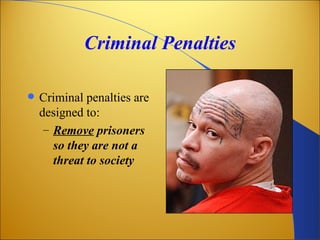
Criminal Penalties

   Criminal penalties are
    designed to:
     – Remove prisoners
       so they are not a
       threat to society
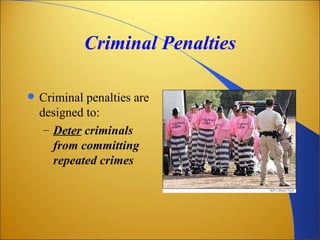
Criminal Penalties

   Criminal penalties are
    designed to:
     – Deter criminals
       from committing
       repeated crimes
Criminal Penalties

   Criminal penalties are
    designed to:
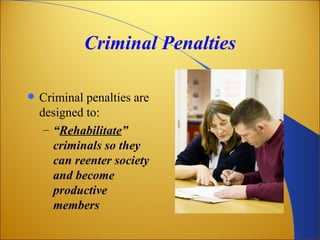
     – “Rehabilitate”
       criminals so they
       can reenter society
       and become
       productive
       members
“Civil” Law
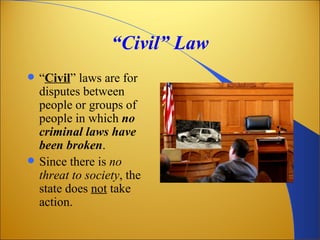
   “Civil” laws are for
    disputes between
    people or groups of
    people in which no
    criminal laws have
    been broken.
   Since there is no
    threat to society, the
    state does not take
    action.
“Civil” Law
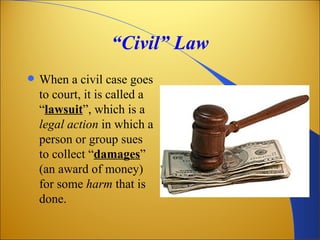
   When a civil case goes
    to court, it is called a
    “lawsuit”, which is a
    legal action in which a
    person or group sues
    to collect “damages”
    (an award of money)
    for some harm that is
    done.
“Civil” Law
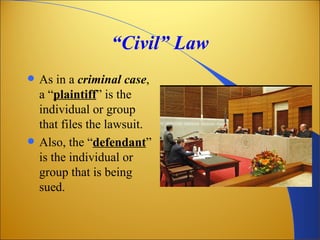
   As in a criminal case,
    a “plaintiff” is the
    individual or group
    that files the lawsuit.
   Also, the “defendant”
    is the individual or
    group that is being
    sued.
“Civil” Law
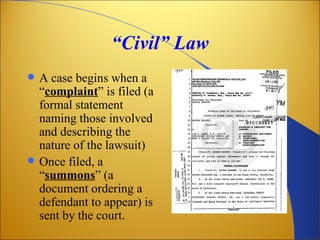
   A case begins when a
    “complaint” is filed (a
    formal statement
    naming those involved
    and describing the
    nature of the lawsuit)
   Once filed, a
    “summons” (a
    document ordering a
    defendant to appear) is
    sent by the court.
“Civil” Law
   A defendant may
    respond to the suit in a
    “pleading” (complaint
    and answer together).
   “Discovery” is the
    name of the process in
    which lawyers for the
    plaintiff and defendant
    check facts and gather
    evidence for the case
“Civil” Law
   In an “equity” lawsuit,
    issues are resolved by
    a judge based on the
    grounds of fairness.
   Judges often issue an
    “injunction” (or a
    court order
    commanding a person
    or group to stop a
    certain action)
Legal Protections in the
             U.S. Constitution
   Rulings in court cases
    are decided by written
    laws and precedents
    of earlier cases.
   “Stare decisis” means
    “let the decision
    stand”, or the practice
    of using earlier
    judicial rulings as a
    basis for deciding
    cases.
Legal Protections in the
             U.S. Constitution
   The Constitution
    protects certain basic
    legal rights:
    – “writ of habeas
      corpus”
    – “bills of attainder”
    – “ex post facto laws”
    – “due process”
Legal Protections in the
            U.S. Constitution
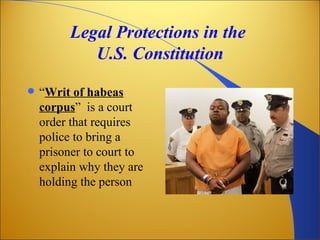
   “Writ of habeas
    corpus” is a court
    order that requires
    police to bring a
    prisoner to court to
    explain why they are
    holding the person
Legal Protections in the
             U.S. Constitution


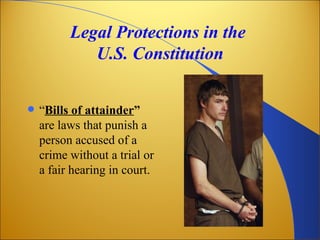
   “Bills of attainder”
    are laws that punish a
    person accused of a
    crime without a trial or
    a fair hearing in court.
Legal Protections in the
             U.S. Constitution


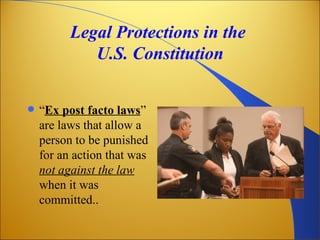
   “Ex post facto laws”
    are laws that allow a
    person to be punished
    for an action that was
    not against the law
    when it was
    committed..
Legal Protections in the
            U.S. Constitution


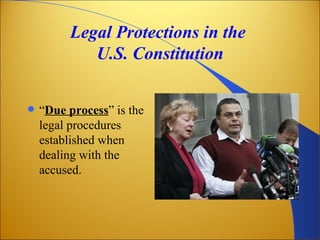
   “Due process” is the
    legal procedures
    established when
    dealing with the
    accused.
Amendment Protection
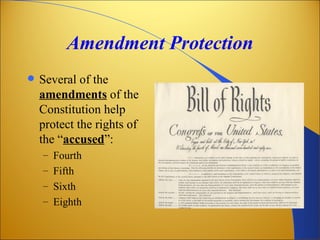
   Several of the
    amendments of the
    Constitution help
    protect the rights of
    the “accused”:
    – Fourth
    – Fifth
    – Sixth
    – Eighth
“Fourth Amendment”
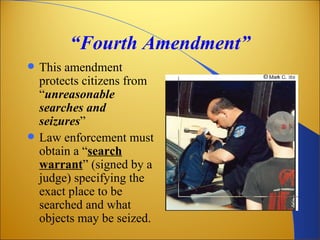
   This amendment
    protects citizens from
    “unreasonable
    searches and
    seizures”
   Law enforcement must
    obtain a “search
    warrant” (signed by a
    judge) specifying the
    exact place to be
    searched and what
    objects may be seized.
“Fifth Amendment”
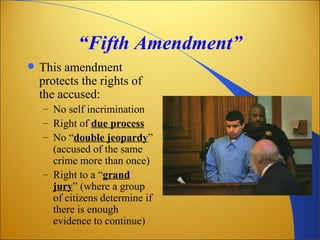
   This amendment
    protects the rights of
    the accused:
    – No self incrimination
    – Right of due process
    – No “double jeopardy”
      (accused of the same
      crime more than once)
    – Right to a “grand
      jury” (where a group
      of citizens determine if
      there is enough
      evidence to continue)
“Sixth Amendment”
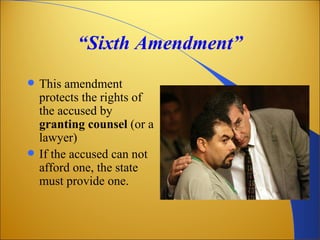
   This amendment
    protects the rights of
    the accused by
    granting counsel (or a
    lawyer)
   If the accused can not
    afford one, the state
    must provide one.
“Eighth Amendment”
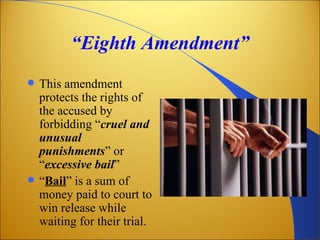
   This amendment
    protects the rights of
    the accused by
    forbidding “cruel and
    unusual
    punishments” or
    “excessive bail”
   “Bail” is a sum of
    money paid to court to
    win release while
    waiting for their trial.
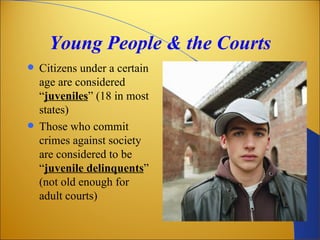
Young People & the Courts
 Citizens under a certain
  age are considered
  “juveniles” (18 in most
  states)
 Those who commit
  crimes against society
  are considered to be
  “juvenile delinquents”
  (not old enough for
  adult courts)
Young People & the Courts
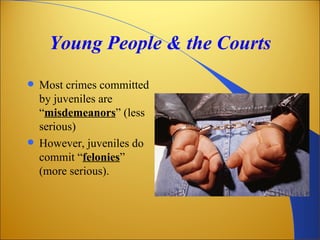
 Most crimes committed
  by juveniles are
  “misdemeanors” (less
  serious)
 However, juveniles do
  commit “felonies”
  (more serious).
Young People & the Courts
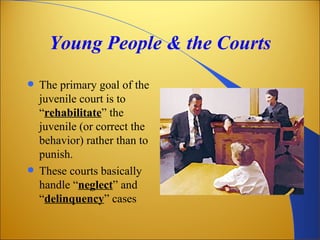
 The primary goal of the
  juvenile court is to
  “rehabilitate” the
  juvenile (or correct the
  behavior) rather than to
  punish.
 These courts basically
  handle “neglect” and
  “delinquency” cases
Young People & the Courts

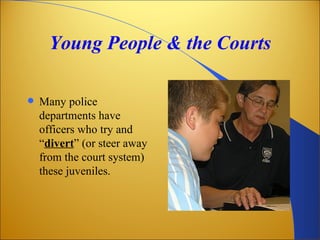
   Many police
    departments have
    officers who try and
    “divert” (or steer away
    from the court system)
    these juveniles.
Young People & the Courts

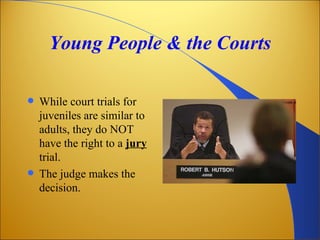
 While court trials for
  juveniles are similar to
  adults, they do NOT
  have the right to a jury
  trial.
 The judge makes the
  decision.
Young People & the Courts

   The rights of juveniles
    were established in the
    1967 “In re Gault”
    Supreme Court case
    (right to counsel, remain
    silent, confront
    witnesses etc.)
Young People & the Courts

   Unlike adult trials, the
    identity of juveniles is
    kept secret and the
    criminal records of these
    juveniles can be erased
    when they reach
    adulthood.

The Individual & the Law (Chap 15-16)

  • 1.
  • 2.
  • 3.
    Types of Laws  There are four (4) types of laws in America: – “Constitutional” Law – “Military” Law – “Criminal” Law – “Civil” Law
  • 4.
    Types of Laws  Constitutional Law: – Law that relates to the practice, study, interpretation and administration of laws set forth by the US Constitution – Any legal issues that deal with constitutional rights or violations are a part of constitutional law.
  • 5.
    Types of Laws  Military Law: – Law that govern all personnel and procedures related to all five branches of the US Military. – Any military issues that involve soldier/officer conduct, prisoners of war, military tactics, etc. fall under the category of military law.
  • 6.
    Types of Laws  There are two (2) types of law that affect Americans directly today that help maintain a peaceful and orderly society: – “Criminal” Law – “Civil” Law
  • 7.
    “Criminal” Law  “Criminal” laws are laws that seek to prevent people from deliberately or recklessly harming each other or each other’s property.
  • 8.
    Our Court System  American courts operate on an “adversary” system of justice, meaning the courtroom serves as an “arena” in which lawyers for opposing sides try to present their strongest case.
  • 9.
    “Criminal” Law  In criminal cases, the government is always the “plaintiff”, or the party that brings the charges against the alleged criminal.  The individual or group being sued is the “defendant”.
  • 10.
    “Criminal” Law  There are two (2) types of crimes: – “Felonies” – “Misdemeanors”
  • 11.
    Felony Crimes  “Felony” crimes are the most serious crimes with the most serious consequences (murder, rape, kidnapping, robbery, etc.)
  • 12.
    Misdemeanor Crimes  “Misdemeanor” crimes are less serious and often do not have very serious consequences (vandalism, theft, traffic violations, etc.)
  • 13.
    Criminal Process  Once an arrest has been made by law enforcement, the suspect will be informed of his/her rights.  This is a result of the 1966 Supreme Court case “Miranda v. Arizona”…
  • 14.
    Criminal Process  Suspects then appear before the court in a “hearing” to hear the charges against them and listen to the judge’s decision on the next step.
  • 15.
    Criminal Process  At an “arraignment”, suspects formally hear the charges and are asked to enter a “plea”.  They will enter “guilty”, “not guilty”, or “no contest”…
  • 16.
    Criminal Process  During their criminal trial, each side will call witnesses to testify (or give answers under oath) in the case.  These witnesses will also be “cross examined” by the other side.
  • 17.
    Criminal Process  Defendants are either found “guilty”, are “acquitted” (found “not guilty”), or the judge can declare a “hung jury” (a “mistrial” is declared by the judge)
  • 18.
    Criminal Penalties  Criminal penalties are designed to: – Provide punishment so the criminal pays for the crime against a victim or society
  • 19.
    Criminal Penalties  Criminal penalties are designed to: – Remove prisoners so they are not a threat to society
  • 20.
    Criminal Penalties  Criminal penalties are designed to: – Deter criminals from committing repeated crimes
  • 21.
    Criminal Penalties  Criminal penalties are designed to: – “Rehabilitate” criminals so they can reenter society and become productive members
  • 22.
    “Civil” Law  “Civil” laws are for disputes between people or groups of people in which no criminal laws have been broken.  Since there is no threat to society, the state does not take action.
  • 23.
    “Civil” Law  When a civil case goes to court, it is called a “lawsuit”, which is a legal action in which a person or group sues to collect “damages” (an award of money) for some harm that is done.
  • 24.
    “Civil” Law  As in a criminal case, a “plaintiff” is the individual or group that files the lawsuit.  Also, the “defendant” is the individual or group that is being sued.
  • 25.
    “Civil” Law  A case begins when a “complaint” is filed (a formal statement naming those involved and describing the nature of the lawsuit)  Once filed, a “summons” (a document ordering a defendant to appear) is sent by the court.
  • 26.
    “Civil” Law  A defendant may respond to the suit in a “pleading” (complaint and answer together).  “Discovery” is the name of the process in which lawyers for the plaintiff and defendant check facts and gather evidence for the case
  • 27.
    “Civil” Law  In an “equity” lawsuit, issues are resolved by a judge based on the grounds of fairness.  Judges often issue an “injunction” (or a court order commanding a person or group to stop a certain action)
  • 28.
    Legal Protections inthe U.S. Constitution  Rulings in court cases are decided by written laws and precedents of earlier cases.  “Stare decisis” means “let the decision stand”, or the practice of using earlier judicial rulings as a basis for deciding cases.
  • 29.
    Legal Protections inthe U.S. Constitution  The Constitution protects certain basic legal rights: – “writ of habeas corpus” – “bills of attainder” – “ex post facto laws” – “due process”
  • 30.
    Legal Protections inthe U.S. Constitution  “Writ of habeas corpus” is a court order that requires police to bring a prisoner to court to explain why they are holding the person
  • 31.
    Legal Protections inthe U.S. Constitution  “Bills of attainder” are laws that punish a person accused of a crime without a trial or a fair hearing in court.
  • 32.
    Legal Protections inthe U.S. Constitution  “Ex post facto laws” are laws that allow a person to be punished for an action that was not against the law when it was committed..
  • 33.
    Legal Protections inthe U.S. Constitution  “Due process” is the legal procedures established when dealing with the accused.
  • 34.
    Amendment Protection  Several of the amendments of the Constitution help protect the rights of the “accused”: – Fourth – Fifth – Sixth – Eighth
  • 35.
    “Fourth Amendment”  This amendment protects citizens from “unreasonable searches and seizures”  Law enforcement must obtain a “search warrant” (signed by a judge) specifying the exact place to be searched and what objects may be seized.
  • 36.
    “Fifth Amendment”  This amendment protects the rights of the accused: – No self incrimination – Right of due process – No “double jeopardy” (accused of the same crime more than once) – Right to a “grand jury” (where a group of citizens determine if there is enough evidence to continue)
  • 37.
    “Sixth Amendment”  This amendment protects the rights of the accused by granting counsel (or a lawyer)  If the accused can not afford one, the state must provide one.
  • 38.
    “Eighth Amendment”  This amendment protects the rights of the accused by forbidding “cruel and unusual punishments” or “excessive bail”  “Bail” is a sum of money paid to court to win release while waiting for their trial.
  • 39.
    Young People &the Courts  Citizens under a certain age are considered “juveniles” (18 in most states)  Those who commit crimes against society are considered to be “juvenile delinquents” (not old enough for adult courts)
  • 40.
    Young People &the Courts  Most crimes committed by juveniles are “misdemeanors” (less serious)  However, juveniles do commit “felonies” (more serious).
  • 41.
    Young People &the Courts  The primary goal of the juvenile court is to “rehabilitate” the juvenile (or correct the behavior) rather than to punish.  These courts basically handle “neglect” and “delinquency” cases
  • 42.
    Young People &the Courts  Many police departments have officers who try and “divert” (or steer away from the court system) these juveniles.
  • 43.
    Young People &the Courts  While court trials for juveniles are similar to adults, they do NOT have the right to a jury trial.  The judge makes the decision.
  • 44.
    Young People &the Courts  The rights of juveniles were established in the 1967 “In re Gault” Supreme Court case (right to counsel, remain silent, confront witnesses etc.)
  • 45.
    Young People &the Courts  Unlike adult trials, the identity of juveniles is kept secret and the criminal records of these juveniles can be erased when they reach adulthood.