American Constitutional LawAmerican Constitutional Law
Judicial Power
And
The American Court System
Text in Red indicate vocabulary you should know. Text in blue leads to
an external source explaining the word or phrase.
Goals of this SessionGoals of this Session
●
Introduce the American judicial system
●
Show how federalism impacts this system
●
Explain constitutional limitations on judicial
power
●
Describe how judicial review power was
developed
American Court SystemAmerican Court System
●
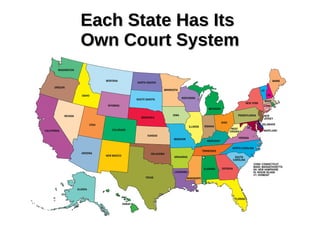
Fifty-one separate systems
– Each state has their own separate and distinct court
system.
●
95% of all cases are handled in state courts
●
This is because states make most of the laws.
●
The U.S. Constitution created federal court
system separate and distinct from the state
systems.
– Once a case begins in the state court system, it
stays there and vice versa (with minor exceptions).
Article IIIArticle III
●
Die richterliche Gewalt
der Vereinigten
Staaten liegt bei einem
Obersten
Bundesgericht und bei
solchen unteren
Gerichten, deren
Errichtung der Kongreß
von Fall zu Fall
anordnen wird.
●
"The judicial Power of
the United States,
shall be vested in one
supreme Court, and
in such inferior Courts
as the Congress may
from time to time
ordain and establish."
– NOTE: Congress
creates the federal
court system!
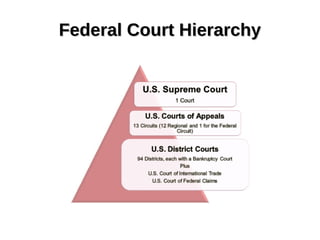
Federal Court HierarchyFederal Court Hierarchy
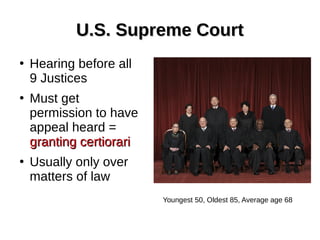
U.S. Supreme CourtU.S. Supreme Court
●
Hearing before all
9 Justices
●
Must get
permission to have
appeal heard =
granting certiorarigranting certiorari
●
Usually only over
matters of law
Youngest 50, Oldest 85, Average age 68
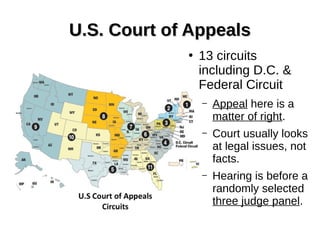
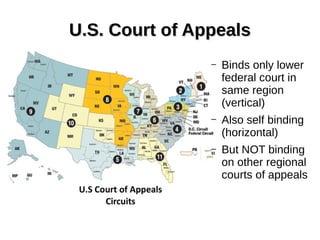
U.S. Court of AppealsU.S. Court of Appeals
●
13 circuits
including D.C. &
Federal Circuit
– Appeal here is a
matter of right.
– Court usually looks
at legal issues, not
facts.
– Hearing is before a
randomly selected
three judge panel.
Federal District CourtFederal District Court
●
Cases are heard before jury and/or one judge.
– This is a trial courttrial court
– Magistrates help judges with cases
●
Hear both civil and criminal matters
– 80% civil (including constitutional matters), 20%
criminal
●
Two special courts at this level
– International Trade Court, Federal Claims Court
Each State Has ItsEach State Has Its
Own Court SystemOwn Court System
Impact of Federalism on CourtsImpact of Federalism on Courts
●
Federalism = division of power between states
and the federal government.
●
When a law or power is challenged, question is
in which court can we file our lawsuitlawsuit.
●
General Rule:
– Cases dealing with federal law are filed in federal
courts.
– Cases dealing with state law in state law.
Court JurisdictionCourt Jurisdiction
●
The REAL Rule
– Federal courts have limited jurisdiction = cases
concerning questions of federal law.
●
Exception =Exception = Diversity JurisdictionDiversity Jurisdiction,, but not relevant for
constitutional law questions.
– State courts have general jurisdiction = cases
concerning all state law & federal civil law (including
U.S. Constitution!).
●
U.S. Supreme Court has final say on what U.S.
Constitution means.
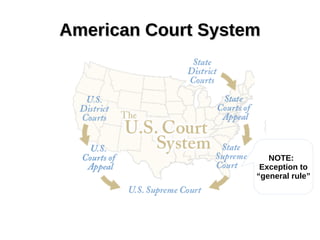
American Court SystemAmerican Court System
NOTE:
Exception to
“general rule”
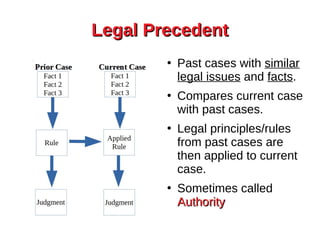
Legal PrecedentLegal Precedent
●
Past cases with similar
legal issues and facts.
●
Compares current case
with past cases.
●
Legal principles/rules
from past cases are
then applied to current
case.
●
Sometimes called
AuthorityAuthority
Stare DecisisStare Decisis
●
Generally = stand by a prior decision.
●
Rule established by prior court that must be
followed by current court.
●
Constitutional Law
– Interpretations of constitution made by some courts
are binding on others = binding precedent.
– We study the court hierarchy to find out which
courts can create binding precedent and which
courts must follow it.
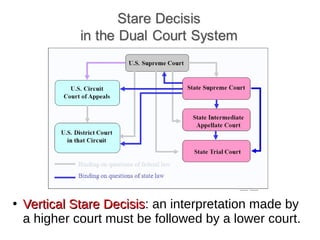
●
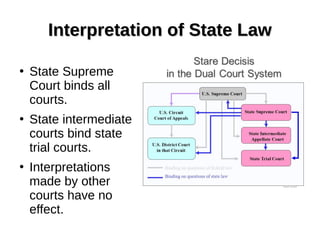
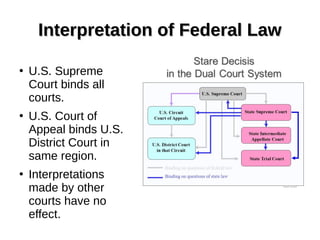
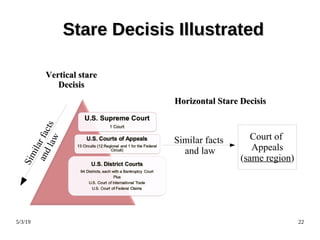
Vertical Stare DecisisVertical Stare Decisis: an interpretation made by
a higher court must be followed by a lower court.
Vertical Stare DecisisVertical Stare Decisis
in the Dual Systemin the Dual System
●
Only federal courts make binding precedent
regarding federal law.
●
Only state courts make binding precedent
regarding state law.
●
Lower federal courts follow rules made by
higher federal courts.
●
Lower state courts follow rules made by higher
state courts.
Interpretation of State LawInterpretation of State Law
●
State Supreme
Court binds all
courts.
●
State intermediate
courts bind state
trial courts.
●
Interpretations
made by other
courts have no
effect.
Interpretation of Federal LawInterpretation of Federal Law
●
U.S. Supreme
Court binds all
courts.
●
U.S. Court of
Appeal binds U.S.
District Court in
same region.
●
Interpretations
made by other
courts have no
effect.
Cliqr QuestionCliqr Question
●
Who has the final say (das letzte Wort) over
what the U.S. Constitution means?
a) The highest state court in the state where the case
is taking place
b) The United States Supreme Court
c) The United States Congress
d) The President of the United States
U.S. Court of AppealsU.S. Court of Appeals
– Binds only lower
federal court in
same region
(vertical)
– Also self binding
(horizontal)
– But NOT binding
on other regional
courts of appeals
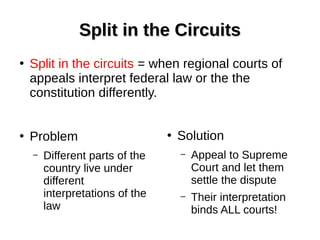
Split in the CircuitsSplit in the Circuits
●
Split in the circuits = when regional courts of
appeals interpret federal law or the the
constitution differently.
●
Solution
– Appeal to Supreme
Court and let them
settle the dispute
– Their interpretation
binds ALL courts!
●
Problem
– Different parts of the
country live under
different
interpretations of the
law
5/3/19 22
Stare Decisis IllustratedStare Decisis Illustrated
Court of
Appeals
(same region)
Similar facts
and law
Horizontal Stare DecisisHorizontal Stare Decisis
Vertical stareVertical stare
DecisisDecisis
Similarfacts
andlaw
Art. II und IIIArt. II und III
●
Die Richter sowohl
des Obersten
Bundesgerichts als
auch der unteren
Gerichte sollen im
Amte bleiben, solange
ihre Amtsführung
einwandfrei ist. . . .
– Artikel III, Abs. 1
●
Er (der Präsident)
nominiert auf Anraten
und mit Zustimmung
des Senats . . . die
Richter des Obersten
Bundesgerichts und
alle sonstigen Beamten
der Vereinigten
Staaten.
– Article II, Abs. 2
Selection of Federal Court JudgesSelection of Federal Court Judges
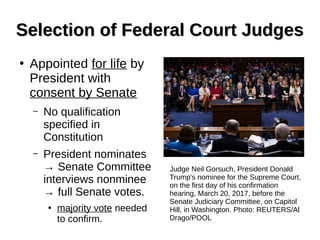
●
Appointed for life by
President with
consent by Senate
– No qualification
specified in
Constitution
– President nominates
→ Senate Committee
interviews nonminee
→ full Senate votes.
●
majority vote needed
to confirm.
Judge Neil Gorsuch, President Donald
Trump's nominee for the Supreme Court,
on the first day of his confirmation
hearing, March 20, 2017, before the
Senate Judiciary Committee, on Capitol
Hill, in Washington. Photo: REUTERS/Al
Drago/POOL
AmtsenthebungsverfahrenAmtsenthebungsverfahren
●
Artikel 1, Abs 2
– “Das Repräsentantenhaus .
. . . hat das alleinige Recht,
Amtsanklage zu erheben.”
●
Artikel 1, Abs 3
– Der Senat hat das alleinige
Recht, über alle Amts-
anklagen zu befinden. . . .
Niemand darf ohne
Zustimmung von zwei
Dritteln der anwesenden
Mitglieder schuldig
gesprochen werden.
●
Artikel 2, Abs 4
– wenn sie wegen
Verrats, Bestechung
oder anderer
Verbrechen und
Vergehen unter
Amtsanklage gestellt
und für schuldig
befunden worden sind.
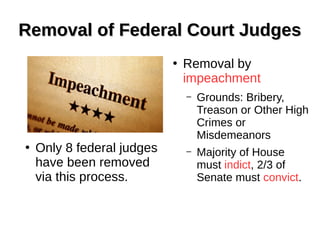
Removal of Federal Court JudgesRemoval of Federal Court Judges
●
Only 8 federal judges
have been removed
via this process.
●
Removal by
impeachment
– Grounds: Bribery,
Treason or Other High
Crimes or
Misdemeanors
– Majority of House
must indict, 2/3 of
Senate must convict.
Cliqr QuestionCliqr Question
●
Who selects federal judges?
a) the Congress
b) the President
c) the people
d) the President with the Consent of the U.S. Senate
Constitutional Questions
Regarding the Power of the Judiciary
GerichtsbarkeitGerichtsbarkeit
●
Die richterliche Gewalt erstreckt sich auf alle
Fälle nach dem Gesetzes- und dem
Billigkeitsrecht, die sich aus dieser Verfassung,
den Gesetzen der Vereinigten Staaten und den
Verträgen ergeben . . . — auf Streitigkeiten
zwischen zwei oder mehreren Einzelstaaten . . .
zwischen Bürgern verschiedener Einzelstaaten;
What can Federal Courts Hear?What can Federal Courts Hear?
●
“The judicial Power shall extend to all CasesCases, in
Law and Equity, arising under this Constitution,
the Laws of the United States . . . (andand) to
ControversiesControversies . . . .”
– Article III, Section 2
●
This “cases and controversiescases and controversies” language has
been the subject of numerous court decisions.
– Real issue = limitations placed on the court’s power
by the constitution.
Constitutional LimitationsConstitutional Limitations
●
Nature of the dispute – subject matter jurisdictionsubject matter jurisdiction
– Cases dealing with topics related to federal law
●
Extent of the dispute – there must be an active
controversy.
– standing – must have personal harm
– no advisory opinion – cannot simply give advice to one
of the other branches
– Mootness and Ripeness – the dispute must be current/
active.
Subject Matter JurisdictionSubject Matter Jurisdiction
– Ambassadors, public
Ministers and Counsels
●
Supreme Court has original
jurisdiction
– admiralty and maritime
– Parties from different states
– where U.S. is party
– between 2 or more
states
●
Supreme Court has
original jurisdiction
●
Generally, cases in which federal government has
an interest (federal question jurisdiction).
– Constitution, laws, treaties
●
Or the Court has been given express jurisdiction by
the Constitution:
Original Jurisdiction ExplainedOriginal Jurisdiction Explained
●
“In all cases affecting ambassadors, other public
ministers and consuls, and those in which a state
shall be party, the Supreme Court shall have
original jurisdiction. In all the other cases before
mentioned, the Supreme Court shall have
appellate jurisdiction, both as to law and fact, with
such exceptions, and under such regulations as
the Congress shall make.”
●
Article III, Section 2
●
When the Supreme Court has original jurisdiction,
a case begins and ends in the Court!
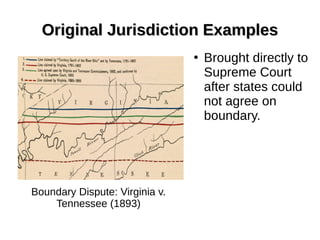
Original Jurisdiction ExamplesOriginal Jurisdiction Examples
●
Brought directly to
Supreme Court
after states could
not agree on
boundary.
Boundary Dispute: Virginia v.
Tennessee (1893)
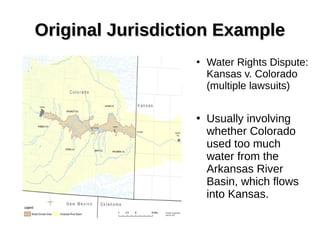
Original Jurisdiction ExampleOriginal Jurisdiction Example
●
Water Rights Dispute:
Kansas v. Colorado
(multiple lawsuits)
●
Usually involving
whether Colorado
used too much
water from the
Arkansas River
Basin, which flows
into Kansas.
From the Beginning:From the Beginning:
No Advisory OpinionsNo Advisory Opinions
●
“The lines of Separation drawn by the Constitution
between the three Departments of Government, their
being in certain Respects checks on each other, and our
being judges of a court in the last Resort, are
Considerations which afford strong arguments against
the Propriety of our extrajudicially deciding the questions
alluded to; especially as the Power given by the
Constitution to the President of calling on the Heads of
Departments for opinions, seems to have been purposely
as well as expressly limited to executive Departments.”
– Chief Justice John Jay (1793) in a letter to President
Washington rejecting his request for the Court to advise him on
the proper interpretation of the Neutrality Treaty which prohibited
the U.S. from siding with either France or England.
Advisory OpinionsAdvisory Opinions
●
Chief Justice Jay: it is
not the constitutional
role of the court to
give advice.
●
Congress is also not
allowed to ask the
Court for advice = no
abstract review like in
GG Art. 93, Abs. 2.
●
Das Bundesverfassungsgericht
entscheidet: . . . bei Meinungs-
verschiedenheiten oder
Zweifeln über die förmliche und
sachliche Vereinbarkeit von
Bundesrecht oder Landesrecht
mit diesem Grundgesetze oder
die Vereinbarkeit von
Landesrecht mit sonstigem
Bundesrechte auf Antrag der
Bundesregierung, einer
Landesregierung oder eines
Viertels der Mitglieder des
Bundestages;
– GG Art. 93, Abs. 2
StandingStanding
●
The Standing Question:
– “Whether the litigant is entitled to have the court
decide the merits of the dispute.”
– This is always the first question the court will
address whether parties raise the issue or not.
●
Requirements:
– Injury (including to rights)
– Injury is traceable to Defendant’s conduct
– Favorable court decision will remedy the injury.
National Emergency Standing?National Emergency Standing?
●
Trump plans to use national emergency power
to allocate unused military funds to build a
border wall, some of which will be built on
private property. Congress passed a resolution
stating Trump cannot use this money for his
wall, but Trump vetoed the resolution.
●
Who has standing to challenge this?
– Who is harmed by the shifting of funds to the wall
project?
– Who is harmed by the building of the wall?
RipenessRipeness
●
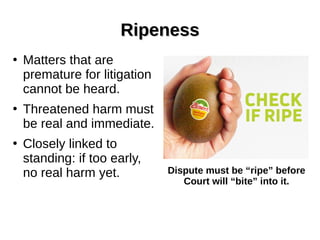
Matters that are
premature for litigation
cannot be heard.
●
Threatened harm must
be real and immediate.
●
Closely linked to
standing: if too early,
no real harm yet. Dispute must be “ripe” before
Court will “bite” into it.
Mootness: Roe v. WadeMootness: Roe v. Wade
●
Mootness defined:
– actual controversy
existing at all stages
of the court process.
– If events after filing
solve dispute before
FINAL decision, case
is moot.
●
Roe was pregnant and
denied an abortion
because Texas law
prohibited the procedure.
●
She challenged the law in
court.
●
At the time of the both the
first hearing and the
appeal she was no longer
pregnant. Moot case?
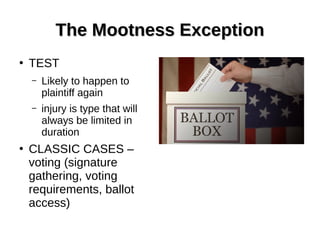
The Mootness ExceptionThe Mootness Exception
●
TEST
– Likely to happen to
plaintiff again
– injury is type that will
always be limited in
duration
●
CLASSIC CASES –
voting (signature
gathering, voting
requirements, ballot
access)
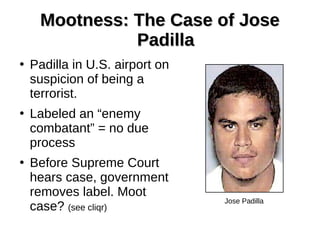
Mootness: The Case of JoseMootness: The Case of Jose
PadillaPadilla
●
Padilla in U.S. airport on
suspicion of being a
terrorist.
●
Labeled an “enemy
combatant” = no due
process
●
Before Supreme Court
hears case, government
removes label. Moot
case? (see cliqr)
Jose Padilla
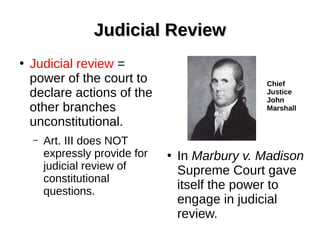
Judicial ReviewJudicial Review
●
Judicial review =
power of the court to
declare actions of the
other branches
unconstitutional.
– Art. III does NOT
expressly provide for
judicial review of
constitutional
questions.
●
In Marbury v. Madison
Supreme Court gave
itself the power to
engage in judicial
review.
Chief
Justice
John
Marshall

Judicial Power

  • 1.
    American Constitutional LawAmericanConstitutional Law Judicial Power And The American Court System Text in Red indicate vocabulary you should know. Text in blue leads to an external source explaining the word or phrase.
  • 2.
    Goals of thisSessionGoals of this Session ● Introduce the American judicial system ● Show how federalism impacts this system ● Explain constitutional limitations on judicial power ● Describe how judicial review power was developed
  • 3.
    American Court SystemAmericanCourt System ● Fifty-one separate systems – Each state has their own separate and distinct court system. ● 95% of all cases are handled in state courts ● This is because states make most of the laws. ● The U.S. Constitution created federal court system separate and distinct from the state systems. – Once a case begins in the state court system, it stays there and vice versa (with minor exceptions).
  • 4.
    Article IIIArticle III ● Dierichterliche Gewalt der Vereinigten Staaten liegt bei einem Obersten Bundesgericht und bei solchen unteren Gerichten, deren Errichtung der Kongreß von Fall zu Fall anordnen wird. ● "The judicial Power of the United States, shall be vested in one supreme Court, and in such inferior Courts as the Congress may from time to time ordain and establish." – NOTE: Congress creates the federal court system!
  • 5.
  • 6.
    U.S. Supreme CourtU.S.Supreme Court ● Hearing before all 9 Justices ● Must get permission to have appeal heard = granting certiorarigranting certiorari ● Usually only over matters of law Youngest 50, Oldest 85, Average age 68
  • 7.
    U.S. Court ofAppealsU.S. Court of Appeals ● 13 circuits including D.C. & Federal Circuit – Appeal here is a matter of right. – Court usually looks at legal issues, not facts. – Hearing is before a randomly selected three judge panel.
  • 8.
    Federal District CourtFederalDistrict Court ● Cases are heard before jury and/or one judge. – This is a trial courttrial court – Magistrates help judges with cases ● Hear both civil and criminal matters – 80% civil (including constitutional matters), 20% criminal ● Two special courts at this level – International Trade Court, Federal Claims Court
  • 9.
    Each State HasItsEach State Has Its Own Court SystemOwn Court System
  • 10.
    Impact of Federalismon CourtsImpact of Federalism on Courts ● Federalism = division of power between states and the federal government. ● When a law or power is challenged, question is in which court can we file our lawsuitlawsuit. ● General Rule: – Cases dealing with federal law are filed in federal courts. – Cases dealing with state law in state law.
  • 11.
    Court JurisdictionCourt Jurisdiction ● TheREAL Rule – Federal courts have limited jurisdiction = cases concerning questions of federal law. ● Exception =Exception = Diversity JurisdictionDiversity Jurisdiction,, but not relevant for constitutional law questions. – State courts have general jurisdiction = cases concerning all state law & federal civil law (including U.S. Constitution!). ● U.S. Supreme Court has final say on what U.S. Constitution means.
  • 12.
    American Court SystemAmericanCourt System NOTE: Exception to “general rule”
  • 13.
    Legal PrecedentLegal Precedent ● Pastcases with similar legal issues and facts. ● Compares current case with past cases. ● Legal principles/rules from past cases are then applied to current case. ● Sometimes called AuthorityAuthority
  • 14.
    Stare DecisisStare Decisis ● Generally= stand by a prior decision. ● Rule established by prior court that must be followed by current court. ● Constitutional Law – Interpretations of constitution made by some courts are binding on others = binding precedent. – We study the court hierarchy to find out which courts can create binding precedent and which courts must follow it.
  • 15.
    ● Vertical Stare DecisisVerticalStare Decisis: an interpretation made by a higher court must be followed by a lower court.
  • 16.
    Vertical Stare DecisisVerticalStare Decisis in the Dual Systemin the Dual System ● Only federal courts make binding precedent regarding federal law. ● Only state courts make binding precedent regarding state law. ● Lower federal courts follow rules made by higher federal courts. ● Lower state courts follow rules made by higher state courts.
  • 17.
    Interpretation of StateLawInterpretation of State Law ● State Supreme Court binds all courts. ● State intermediate courts bind state trial courts. ● Interpretations made by other courts have no effect.
  • 18.
    Interpretation of FederalLawInterpretation of Federal Law ● U.S. Supreme Court binds all courts. ● U.S. Court of Appeal binds U.S. District Court in same region. ● Interpretations made by other courts have no effect.
  • 19.
    Cliqr QuestionCliqr Question ● Whohas the final say (das letzte Wort) over what the U.S. Constitution means? a) The highest state court in the state where the case is taking place b) The United States Supreme Court c) The United States Congress d) The President of the United States
  • 20.
    U.S. Court ofAppealsU.S. Court of Appeals – Binds only lower federal court in same region (vertical) – Also self binding (horizontal) – But NOT binding on other regional courts of appeals
  • 21.
    Split in theCircuitsSplit in the Circuits ● Split in the circuits = when regional courts of appeals interpret federal law or the the constitution differently. ● Solution – Appeal to Supreme Court and let them settle the dispute – Their interpretation binds ALL courts! ● Problem – Different parts of the country live under different interpretations of the law
  • 22.
    5/3/19 22 Stare DecisisIllustratedStare Decisis Illustrated Court of Appeals (same region) Similar facts and law Horizontal Stare DecisisHorizontal Stare Decisis Vertical stareVertical stare DecisisDecisis Similarfacts andlaw
  • 23.
    Art. II undIIIArt. II und III ● Die Richter sowohl des Obersten Bundesgerichts als auch der unteren Gerichte sollen im Amte bleiben, solange ihre Amtsführung einwandfrei ist. . . . – Artikel III, Abs. 1 ● Er (der Präsident) nominiert auf Anraten und mit Zustimmung des Senats . . . die Richter des Obersten Bundesgerichts und alle sonstigen Beamten der Vereinigten Staaten. – Article II, Abs. 2
  • 24.
    Selection of FederalCourt JudgesSelection of Federal Court Judges ● Appointed for life by President with consent by Senate – No qualification specified in Constitution – President nominates → Senate Committee interviews nonminee → full Senate votes. ● majority vote needed to confirm. Judge Neil Gorsuch, President Donald Trump's nominee for the Supreme Court, on the first day of his confirmation hearing, March 20, 2017, before the Senate Judiciary Committee, on Capitol Hill, in Washington. Photo: REUTERS/Al Drago/POOL
  • 25.
    AmtsenthebungsverfahrenAmtsenthebungsverfahren ● Artikel 1, Abs2 – “Das Repräsentantenhaus . . . . hat das alleinige Recht, Amtsanklage zu erheben.” ● Artikel 1, Abs 3 – Der Senat hat das alleinige Recht, über alle Amts- anklagen zu befinden. . . . Niemand darf ohne Zustimmung von zwei Dritteln der anwesenden Mitglieder schuldig gesprochen werden. ● Artikel 2, Abs 4 – wenn sie wegen Verrats, Bestechung oder anderer Verbrechen und Vergehen unter Amtsanklage gestellt und für schuldig befunden worden sind.
  • 26.
    Removal of FederalCourt JudgesRemoval of Federal Court Judges ● Only 8 federal judges have been removed via this process. ● Removal by impeachment – Grounds: Bribery, Treason or Other High Crimes or Misdemeanors – Majority of House must indict, 2/3 of Senate must convict.
  • 27.
    Cliqr QuestionCliqr Question ● Whoselects federal judges? a) the Congress b) the President c) the people d) the President with the Consent of the U.S. Senate
  • 28.
  • 29.
    GerichtsbarkeitGerichtsbarkeit ● Die richterliche Gewalterstreckt sich auf alle Fälle nach dem Gesetzes- und dem Billigkeitsrecht, die sich aus dieser Verfassung, den Gesetzen der Vereinigten Staaten und den Verträgen ergeben . . . — auf Streitigkeiten zwischen zwei oder mehreren Einzelstaaten . . . zwischen Bürgern verschiedener Einzelstaaten;
  • 30.
    What can FederalCourts Hear?What can Federal Courts Hear? ● “The judicial Power shall extend to all CasesCases, in Law and Equity, arising under this Constitution, the Laws of the United States . . . (andand) to ControversiesControversies . . . .” – Article III, Section 2 ● This “cases and controversiescases and controversies” language has been the subject of numerous court decisions. – Real issue = limitations placed on the court’s power by the constitution.
  • 31.
    Constitutional LimitationsConstitutional Limitations ● Natureof the dispute – subject matter jurisdictionsubject matter jurisdiction – Cases dealing with topics related to federal law ● Extent of the dispute – there must be an active controversy. – standing – must have personal harm – no advisory opinion – cannot simply give advice to one of the other branches – Mootness and Ripeness – the dispute must be current/ active.
  • 32.
    Subject Matter JurisdictionSubjectMatter Jurisdiction – Ambassadors, public Ministers and Counsels ● Supreme Court has original jurisdiction – admiralty and maritime – Parties from different states – where U.S. is party – between 2 or more states ● Supreme Court has original jurisdiction ● Generally, cases in which federal government has an interest (federal question jurisdiction). – Constitution, laws, treaties ● Or the Court has been given express jurisdiction by the Constitution:
  • 33.
    Original Jurisdiction ExplainedOriginalJurisdiction Explained ● “In all cases affecting ambassadors, other public ministers and consuls, and those in which a state shall be party, the Supreme Court shall have original jurisdiction. In all the other cases before mentioned, the Supreme Court shall have appellate jurisdiction, both as to law and fact, with such exceptions, and under such regulations as the Congress shall make.” ● Article III, Section 2 ● When the Supreme Court has original jurisdiction, a case begins and ends in the Court!
  • 34.
    Original Jurisdiction ExamplesOriginalJurisdiction Examples ● Brought directly to Supreme Court after states could not agree on boundary. Boundary Dispute: Virginia v. Tennessee (1893)
  • 35.
    Original Jurisdiction ExampleOriginalJurisdiction Example ● Water Rights Dispute: Kansas v. Colorado (multiple lawsuits) ● Usually involving whether Colorado used too much water from the Arkansas River Basin, which flows into Kansas.
  • 36.
    From the Beginning:Fromthe Beginning: No Advisory OpinionsNo Advisory Opinions ● “The lines of Separation drawn by the Constitution between the three Departments of Government, their being in certain Respects checks on each other, and our being judges of a court in the last Resort, are Considerations which afford strong arguments against the Propriety of our extrajudicially deciding the questions alluded to; especially as the Power given by the Constitution to the President of calling on the Heads of Departments for opinions, seems to have been purposely as well as expressly limited to executive Departments.” – Chief Justice John Jay (1793) in a letter to President Washington rejecting his request for the Court to advise him on the proper interpretation of the Neutrality Treaty which prohibited the U.S. from siding with either France or England.
  • 37.
    Advisory OpinionsAdvisory Opinions ● ChiefJustice Jay: it is not the constitutional role of the court to give advice. ● Congress is also not allowed to ask the Court for advice = no abstract review like in GG Art. 93, Abs. 2. ● Das Bundesverfassungsgericht entscheidet: . . . bei Meinungs- verschiedenheiten oder Zweifeln über die förmliche und sachliche Vereinbarkeit von Bundesrecht oder Landesrecht mit diesem Grundgesetze oder die Vereinbarkeit von Landesrecht mit sonstigem Bundesrechte auf Antrag der Bundesregierung, einer Landesregierung oder eines Viertels der Mitglieder des Bundestages; – GG Art. 93, Abs. 2
  • 38.
    StandingStanding ● The Standing Question: –“Whether the litigant is entitled to have the court decide the merits of the dispute.” – This is always the first question the court will address whether parties raise the issue or not. ● Requirements: – Injury (including to rights) – Injury is traceable to Defendant’s conduct – Favorable court decision will remedy the injury.
  • 39.
    National Emergency Standing?NationalEmergency Standing? ● Trump plans to use national emergency power to allocate unused military funds to build a border wall, some of which will be built on private property. Congress passed a resolution stating Trump cannot use this money for his wall, but Trump vetoed the resolution. ● Who has standing to challenge this? – Who is harmed by the shifting of funds to the wall project? – Who is harmed by the building of the wall?
  • 40.
    RipenessRipeness ● Matters that are prematurefor litigation cannot be heard. ● Threatened harm must be real and immediate. ● Closely linked to standing: if too early, no real harm yet. Dispute must be “ripe” before Court will “bite” into it.
  • 41.
    Mootness: Roe v.WadeMootness: Roe v. Wade ● Mootness defined: – actual controversy existing at all stages of the court process. – If events after filing solve dispute before FINAL decision, case is moot. ● Roe was pregnant and denied an abortion because Texas law prohibited the procedure. ● She challenged the law in court. ● At the time of the both the first hearing and the appeal she was no longer pregnant. Moot case?
  • 42.
    The Mootness ExceptionTheMootness Exception ● TEST – Likely to happen to plaintiff again – injury is type that will always be limited in duration ● CLASSIC CASES – voting (signature gathering, voting requirements, ballot access)
  • 43.
    Mootness: The Caseof JoseMootness: The Case of Jose PadillaPadilla ● Padilla in U.S. airport on suspicion of being a terrorist. ● Labeled an “enemy combatant” = no due process ● Before Supreme Court hears case, government removes label. Moot case? (see cliqr) Jose Padilla
  • 44.
    Judicial ReviewJudicial Review ● Judicialreview = power of the court to declare actions of the other branches unconstitutional. – Art. III does NOT expressly provide for judicial review of constitutional questions. ● In Marbury v. Madison Supreme Court gave itself the power to engage in judicial review. Chief Justice John Marshall