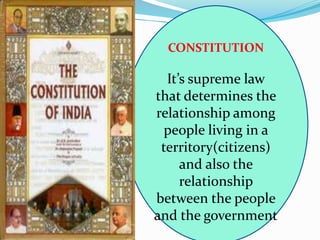
CONSTITUTION
It’s supreme law
that determines the
relationship among
people living in a
territory(citizens)
and also the
relationship
between the people
and the government
WHY DO WE NEED A CONSTITUTION ???
 It generates a degree of trust and co-ordination.
 It specifies how the governme`nt will be constituted.
 It lays down limits on the powers of the government
and tells us what the rights of the citizens are.
 It expresses the aspirations of the people about
creating a good society.
https://www.youtube.com/watch?v=TVz6qKbYBmE&list=PLAa8vphOlKtCIgx
Q5E0abnO_esick1qYn&index=2
https://www.youtube.com/watch?v=yfkHdttQSYM
https://www.youtube.com/watch?v=TVz6qKbYBmE&list=PLAa8vphOlKt
CIgxQ5E0abnO_esick1qYn&index=2
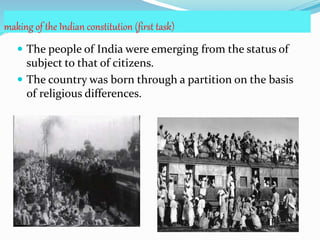
making of the Indian constitution (first task)
 The people of India were emerging from the status of
subject to that of citizens.
 The country was born through a partition on the basis
of religious differences.
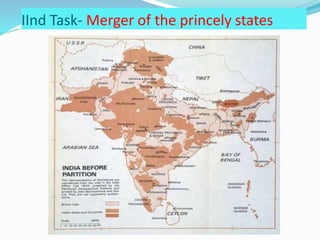
IInd Task- Merger of the princely states
SETTLEMENT OF THE REFUGEES
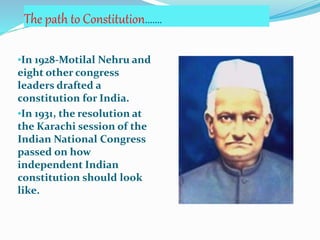
The path to Constitution…….
•In 1928-Motilal Nehru and
eight other congress
leaders drafted a
constitution for India.
•In 1931, the resolution at
the Karachi session of the
Indian National Congress
passed on how
independent Indian
constitution should look
like.
Indian Leaders Assemble (1946)
BIRTH OF INDIA: The
Constituent Assembly Declares
India as Sovereign Republic
Samvidhaan: The Making of the
Constitution of India
Exit card
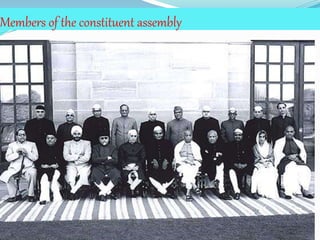
The constituent assembly
An assembly of indirectly elected
members who framed the
constitution of the country
The constituent assembly
Members of the constituent assembly
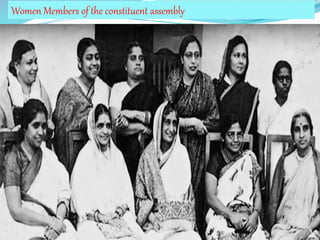
Women Members of the constituent assembly
https://www.youtube.com/watch?
v=UDYGjqKzFLg#action=share
BEFORE PARTITION 389 MEMBERS
AFTER PARTITION 284 MEMBERS signed the constitution
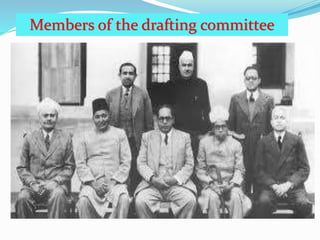
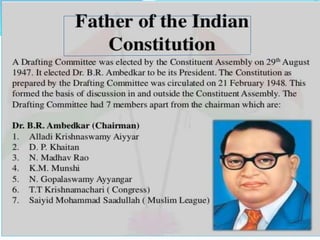
Members of the drafting committee
Why should we accept the
constitution made by this assembly
more than fifty years ago?
The reasons for acceptability of the constitution
till today are as follows:
• The constitution does not reflect the views of its members alone.
It expresses a broad consensus of tis time.
• The constitution assembly represented the people of India. Since
there was no universal adult franchise at that time, the
constituent assembly could not have been chosen directly by the
people. It was elected, mainly by the members of provincial
legislatures, which ensured a fair share of all the regions of the
country.
• The constituent assembly worked in a systematic, open and
consensual manner. The nature of work done by the constituent
assembly gave sanctity to the constitution.
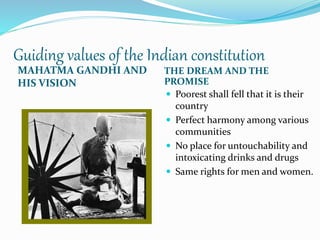
Guiding values of the Indian constitution
MAHATMA GANDHI AND
HIS VISION
THE DREAM AND THE
PROMISE
 Poorest shall fell that it is their
country
 Perfect harmony among various
communities
 No place for untouchability and
intoxicating drinks and drugs
 Same rights for men and women.
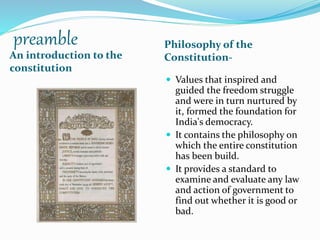
preamble
An introduction to the
constitution
Philosophy of the
Constitution-
 Values that inspired and
guided the freedom struggle
and were in turn nurtured by
it, formed the foundation for
India's democracy.
 It contains the philosophy on
which the entire constitution
has been build.
 It provides a standard to
examine and evaluate any law
and action of government to
find out whether it is good or
bad.
FEATURES OF THE INDIAN COSTITUTION
•WE THE PEOPLE OF INDI
•SOVEREIGN
•SOCIALIST
•SECULAR
•DEMOCRATIC
•REPUBLIC
INSTITUTIONAL DESIGN
Constitution is not merely
a statement of values and
philosophy
Other features
 Very long and detailed
document.
 Amended regularly to keep it
updated
 Describes in a legal language
 It defines who will have how
much power to take which
decisions
 It puts limits to what the
government can do by providing
some rights to the citizen that
can not be violated.
https://www.youtube.com/watch?v=gmaNi_
c2Dm8
Indias independence class viii

Ch 3 constitutional design- new

  • 2.
    CONSTITUTION It’s supreme law thatdetermines the relationship among people living in a territory(citizens) and also the relationship between the people and the government
  • 3.
    WHY DO WENEED A CONSTITUTION ???  It generates a degree of trust and co-ordination.  It specifies how the governme`nt will be constituted.  It lays down limits on the powers of the government and tells us what the rights of the citizens are.  It expresses the aspirations of the people about creating a good society.
  • 4.
  • 5.
    making of theIndian constitution (first task)  The people of India were emerging from the status of subject to that of citizens.  The country was born through a partition on the basis of religious differences.
  • 6.
    IInd Task- Mergerof the princely states
  • 7.
  • 8.
    The path toConstitution……. •In 1928-Motilal Nehru and eight other congress leaders drafted a constitution for India. •In 1931, the resolution at the Karachi session of the Indian National Congress passed on how independent Indian constitution should look like.
  • 9.
    Indian Leaders Assemble(1946) BIRTH OF INDIA: The Constituent Assembly Declares India as Sovereign Republic Samvidhaan: The Making of the Constitution of India
  • 10.
    Exit card The constituentassembly An assembly of indirectly elected members who framed the constitution of the country
  • 11.
  • 12.
    Members of theconstituent assembly
  • 13.
    Women Members ofthe constituent assembly
  • 14.
  • 15.
    BEFORE PARTITION 389MEMBERS AFTER PARTITION 284 MEMBERS signed the constitution
  • 16.
    Members of thedrafting committee
  • 18.
    Why should weaccept the constitution made by this assembly more than fifty years ago?
  • 19.
    The reasons foracceptability of the constitution till today are as follows: • The constitution does not reflect the views of its members alone. It expresses a broad consensus of tis time. • The constitution assembly represented the people of India. Since there was no universal adult franchise at that time, the constituent assembly could not have been chosen directly by the people. It was elected, mainly by the members of provincial legislatures, which ensured a fair share of all the regions of the country. • The constituent assembly worked in a systematic, open and consensual manner. The nature of work done by the constituent assembly gave sanctity to the constitution.
  • 20.
    Guiding values ofthe Indian constitution MAHATMA GANDHI AND HIS VISION THE DREAM AND THE PROMISE  Poorest shall fell that it is their country  Perfect harmony among various communities  No place for untouchability and intoxicating drinks and drugs  Same rights for men and women.
  • 24.
    preamble An introduction tothe constitution Philosophy of the Constitution-  Values that inspired and guided the freedom struggle and were in turn nurtured by it, formed the foundation for India's democracy.  It contains the philosophy on which the entire constitution has been build.  It provides a standard to examine and evaluate any law and action of government to find out whether it is good or bad.
  • 25.
    FEATURES OF THEINDIAN COSTITUTION •WE THE PEOPLE OF INDI •SOVEREIGN •SOCIALIST •SECULAR •DEMOCRATIC •REPUBLIC
  • 26.
    INSTITUTIONAL DESIGN Constitution isnot merely a statement of values and philosophy Other features  Very long and detailed document.  Amended regularly to keep it updated  Describes in a legal language  It defines who will have how much power to take which decisions  It puts limits to what the government can do by providing some rights to the citizen that can not be violated.
  • 27.