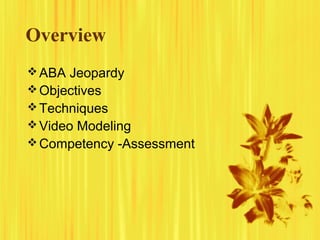
Overview
ABA Jeopardy
Objectives
Techniques
Video Modeling
Competency -Assessment
ABA Jeopardy
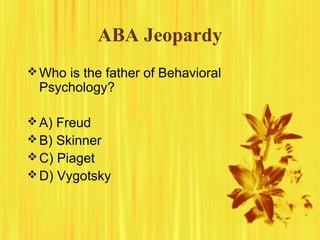
Who is the father of Behavioral
Psychology?
A) Freud
B) Skinner
C) Piaget
D) Vygotsky
ABA Jeopardy
A consequence is a punishment?
True or False
ABA Jeopardy
The best way to help someone learn a
new skill is to
A) Punish them
B) Provide food reinforcement
C) Provide prompts
D) Wait until they ask you for help
Learner Objectives
1. Participant will delivery appropriate instructional cues to another
participant during role play activities for 80% of opportunities for
one group session.
2. Participant will verbally identify and model all prompt types during
role play activities on first opportunity for one group session.
3. Participant will demonstrate a time delay procedure during a role
play activity on first opportunity for one group session.
4. Participant will demonstrate differential reinforcement for a target
response versus a non target response on first opportunity for one
group session.
5. Participant will demonstrate an error correction technique for an
incorrect response on first opportunity for one group session.
Technique 1: Instructional Cues
What types of instruction do you give to
kids when you need them to do a skill or
task?
Definition
An instructional cue is considered an
antecedent that a teacher gives to evoke a
response from the student
For students with disabilities, ensure that
the cue is specific, concrete and concise
Model & Role-play
Watch video link
http://www.youtube.com/watch?
v=_QMXacDKRiY
Prompting
When have you had to help a learner
engage in a correct behavior?
What are ways in which someone has
helped you learn a new skill?
Technique 2: Prompt types
Definition: some type of assistance given
to a student to help them engage in a
correct response
Types:
 (a) verbal=verbal behavior of another person results in the
correct response
 (b) gestural= any visual or gesture that leads to the correct
response
 (c)modeling=demonstration of correct behavior by another
person
 (d) physical = physically helping student engage in correct
response
Model & Role Play
Please click on the video link and watch
example
http://www.youtube.com/watch?
v=davpYDNu-bs
Time-Delay
What are some activities or skills that
someone had to teach you
How do you go from helping someone to
allowing them to do it by themselves?
How did you start doing something by
yourself?
Technique 3: Time Delay
Definition= waiting a certain number of
seconds to see if the student will
independently initiate the correct response
If the student does NOT, then you would
deliver a prompt
Technique 3: Time Delay
When teaching a skill use a 0 second
delay and immediately deliver the
prompt to ensure a correct response
After a certain number of teaching
opportunities, insert a 3 second wait and
determine if the child will begin to initiate
independently
Model & Role-Play
Please click on the video link and watch
example
http://www.youtube.com/watch?
v=TOH5IKT1ckI
Differential Reinforcement
Did you ever get A’s and B’s and C’s in
school?
Why do you think the teacher gives
different grades?
How do you let students or others know
they are doing the correct skills or
behaviors?
Technique 4: Differential
Reinforcement
Definition= reinforcing a specific desirable
behavior while other behaviors are not
reinforced.
The result is an increase in the desired
behavior and extinction of other behaviors.
Model & Role-Play
Please click on video link and watch
example
http://www.youtube.com/watch?
v=1NelgTwEcpM
Error Correction
 How have your teachers or family members
or friends told you that you were not doing the
right skill?
 How would you tell your student that they are
not doing the right behavior?
 Why is it important to tell your student they
are not engaging in the target behavior?
Technique 5: Error Correction
Definition= learner demonstrates an
incorrect response during instruction and
teacher provides precise corrective
feedback
Protocol
 Teacher says, “No”
 Wait 3-5 seconds
 Represent your instruction + a prompt
Model & Role-Play
Please view video example and practice
with your partner
http://www.youtube.com/watch?v=utQX-
crlDjs
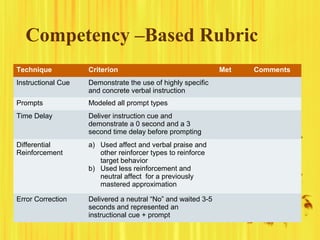
Competency –Based Rubric
Technique Criterion Met Comments
Instructional Cue Demonstrate the use of highly specific
and concrete verbal instruction
Prompts Modeled all prompt types
Time Delay Deliver instruction cue and
demonstrate a 0 second and a 3
second time delay before prompting
Differential
Reinforcement
a) Used affect and verbal praise and
other reinforcer types to reinforce
target behavior
b) Used less reinforcement and
neutral affect for a previously
mastered approximation
Error Correction Delivered a neutral “No” and waited 3-5
seconds and represented an
instructional cue + prompt

Aba effective instruction modules

  • 2.
  • 3.
    ABA Jeopardy Who isthe father of Behavioral Psychology? A) Freud B) Skinner C) Piaget D) Vygotsky
  • 4.
    ABA Jeopardy A consequenceis a punishment? True or False
  • 5.
    ABA Jeopardy The bestway to help someone learn a new skill is to A) Punish them B) Provide food reinforcement C) Provide prompts D) Wait until they ask you for help
  • 6.
    Learner Objectives 1. Participantwill delivery appropriate instructional cues to another participant during role play activities for 80% of opportunities for one group session. 2. Participant will verbally identify and model all prompt types during role play activities on first opportunity for one group session. 3. Participant will demonstrate a time delay procedure during a role play activity on first opportunity for one group session. 4. Participant will demonstrate differential reinforcement for a target response versus a non target response on first opportunity for one group session. 5. Participant will demonstrate an error correction technique for an incorrect response on first opportunity for one group session.
  • 7.
    Technique 1: InstructionalCues What types of instruction do you give to kids when you need them to do a skill or task?
  • 8.
    Definition An instructional cueis considered an antecedent that a teacher gives to evoke a response from the student For students with disabilities, ensure that the cue is specific, concrete and concise
  • 9.
    Model & Role-play Watchvideo link http://www.youtube.com/watch? v=_QMXacDKRiY
  • 10.
    Prompting When have youhad to help a learner engage in a correct behavior? What are ways in which someone has helped you learn a new skill?
  • 11.
    Technique 2: Prompttypes Definition: some type of assistance given to a student to help them engage in a correct response Types:  (a) verbal=verbal behavior of another person results in the correct response  (b) gestural= any visual or gesture that leads to the correct response  (c)modeling=demonstration of correct behavior by another person  (d) physical = physically helping student engage in correct response
  • 12.
    Model & RolePlay Please click on the video link and watch example http://www.youtube.com/watch? v=davpYDNu-bs
  • 13.
    Time-Delay What are someactivities or skills that someone had to teach you How do you go from helping someone to allowing them to do it by themselves? How did you start doing something by yourself?
  • 14.
    Technique 3: TimeDelay Definition= waiting a certain number of seconds to see if the student will independently initiate the correct response If the student does NOT, then you would deliver a prompt
  • 15.
    Technique 3: TimeDelay When teaching a skill use a 0 second delay and immediately deliver the prompt to ensure a correct response After a certain number of teaching opportunities, insert a 3 second wait and determine if the child will begin to initiate independently
  • 16.
    Model & Role-Play Pleaseclick on the video link and watch example http://www.youtube.com/watch? v=TOH5IKT1ckI
  • 17.
    Differential Reinforcement Did youever get A’s and B’s and C’s in school? Why do you think the teacher gives different grades? How do you let students or others know they are doing the correct skills or behaviors?
  • 18.
    Technique 4: Differential Reinforcement Definition=reinforcing a specific desirable behavior while other behaviors are not reinforced. The result is an increase in the desired behavior and extinction of other behaviors.
  • 19.
    Model & Role-Play Pleaseclick on video link and watch example http://www.youtube.com/watch? v=1NelgTwEcpM
  • 20.
    Error Correction  Howhave your teachers or family members or friends told you that you were not doing the right skill?  How would you tell your student that they are not doing the right behavior?  Why is it important to tell your student they are not engaging in the target behavior?
  • 21.
    Technique 5: ErrorCorrection Definition= learner demonstrates an incorrect response during instruction and teacher provides precise corrective feedback Protocol  Teacher says, “No”  Wait 3-5 seconds  Represent your instruction + a prompt
  • 22.
    Model & Role-Play Pleaseview video example and practice with your partner http://www.youtube.com/watch?v=utQX- crlDjs
  • 23.
    Competency –Based Rubric TechniqueCriterion Met Comments Instructional Cue Demonstrate the use of highly specific and concrete verbal instruction Prompts Modeled all prompt types Time Delay Deliver instruction cue and demonstrate a 0 second and a 3 second time delay before prompting Differential Reinforcement a) Used affect and verbal praise and other reinforcer types to reinforce target behavior b) Used less reinforcement and neutral affect for a previously mastered approximation Error Correction Delivered a neutral “No” and waited 3-5 seconds and represented an instructional cue + prompt