Predict,
Observe,
Explain (POE)
MARIZA R MAPALO
MED CHEM
Teaching and Learning Strategies
in Teaching Chemistry
Learning Objectives
To describe the nature of Predict, Observes and
Explain (POE) strategy
To apply the steps in designing lesson using POE
strategy
To appreciate the advantages and disadvantages
of POE strategy
Predict,
Observe,
Explain (POE)
ACTIVITY
https://kahoot.it/challenge/
Game PIN:
03741256
ACTIVITY
• developed by White and
Gunstone (1992)
• to uncover individual students’
predictions, and their reasons
for making these, about a
specific event.
Reference: White, R. T., & Gunstone, R. F. (1992). Probing
Understanding. Great Britain: Falmer Press.
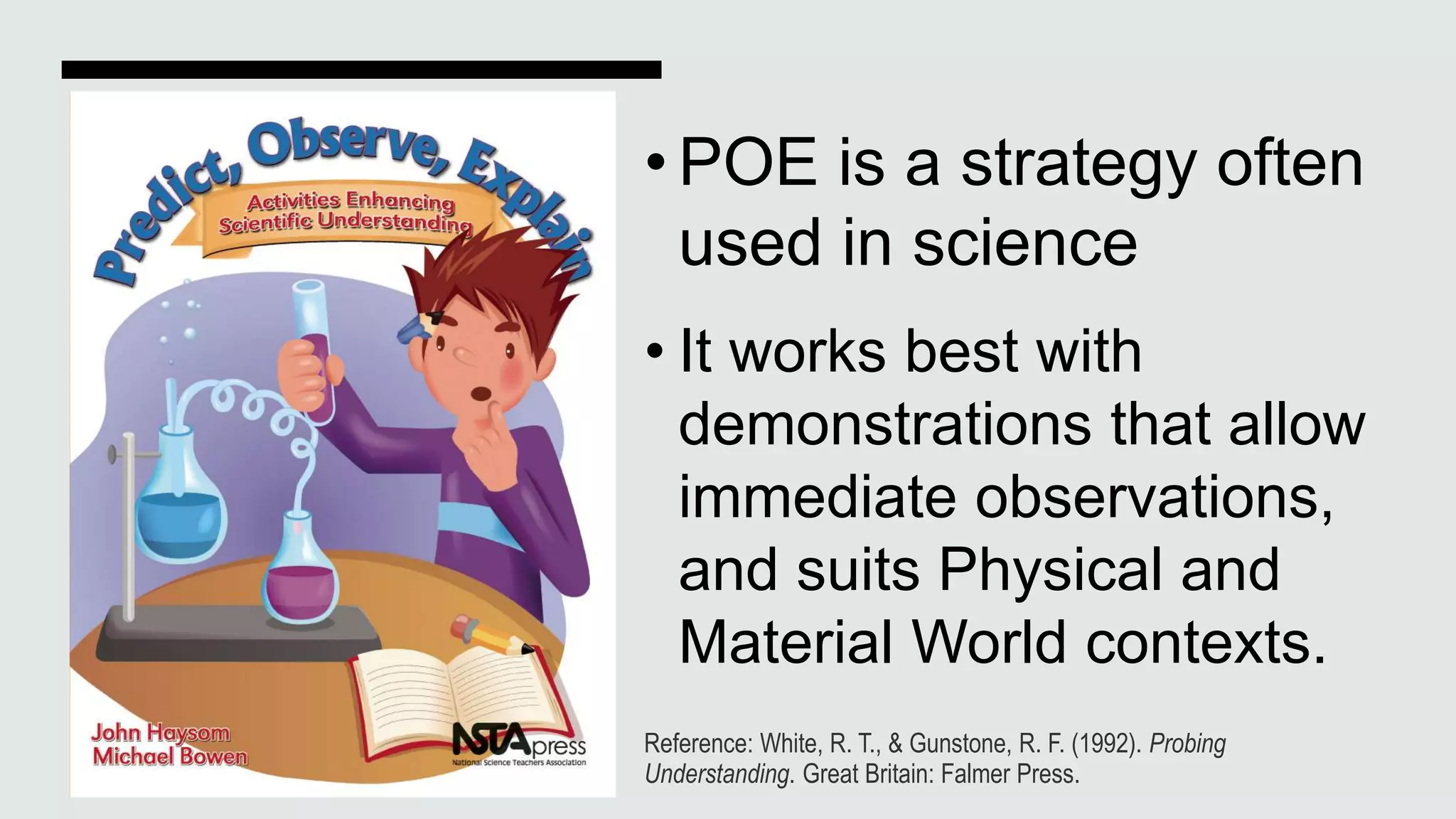
• POE is a strategy often
used in science
• It works best with
demonstrations that allow
immediate observations,
and suits Physical and
Material World contexts.
Reference: White, R. T., & Gunstone, R. F. (1992). Probing
Understanding. Great Britain: Falmer Press.
When to Use?
finding out
students' initial
ideas
When to Use?
providing
teachers with
information
about students’
thinking;
When to Use?
generating
discussion
When to Use?
motivating
students to
want to explore
the concept
When to Use?
generating
investigations
Educational Theory
Constructivism is the
theory that
says learners
construct knowledge
rather than just
passively take in
information.
Constructivism
 John Dewey's Cognitive
Constructivism
 Jean Piaget's Cognitive
Constructivism
 Lev Vygotsky's Social
Constructivism
 Bruner's Constructivist
Learning Theory.
POE: How the
strategy works
What to do
•Set up a
demonstration of an
event, related to the
focus topic, that may
surprise students, and
which can be observed.
•Tell the students what
you are going to be
doing.
POE: How the
strategy works
What to do
•Set up a
demonstration of an
event, related to the
focus topic, that may
surprise students, and
which can be observed.
•Tell the students what
you are going to be
doing.
POE: How the strategy works
Step 1: Predict
•Ask the students to independently
write their prediction of what will
happen.
•Ask them what they think they will
see and why they think this.
Step 1: Predict
POE: How the strategy works
Step 2: Observe
•Carry out the demonstration.
•Allow time to focus on observation.
•Ask students to write down what
they do observe.
Step 2: Observe
POE: How the strategy works
Step 3: Explain
• Ask students to amend or add to their
explanation to take account of the
observation.
• After students have committed their
explanations to paper, discuss their ideas
together
Step 3: Explain
References:
Palmer, D. (1995). The POE in the primary school: An
evaluation. Research in Science Education, 25 (3), 323-332.
Hipkins, R., & Kenneally, N. (2003). Using NEMP to inform the
teaching of scientific skills. (Pages 50-51).
https://www.studysmarter.de/en/explanations/english/language-
acquisition/constructivism/
https://www.youtube.com/watch?v=_CYgsqji_0k
Sample
ONLINE Class Using POE

POE MED CHEM.pptx

  • 1.
    Predict, Observe, Explain (POE) MARIZA RMAPALO MED CHEM Teaching and Learning Strategies in Teaching Chemistry
  • 2.
    Learning Objectives To describethe nature of Predict, Observes and Explain (POE) strategy To apply the steps in designing lesson using POE strategy To appreciate the advantages and disadvantages of POE strategy
  • 3.
  • 4.
  • 5.
    • developed byWhite and Gunstone (1992) • to uncover individual students’ predictions, and their reasons for making these, about a specific event. Reference: White, R. T., & Gunstone, R. F. (1992). Probing Understanding. Great Britain: Falmer Press.
  • 6.
    • POE isa strategy often used in science • It works best with demonstrations that allow immediate observations, and suits Physical and Material World contexts. Reference: White, R. T., & Gunstone, R. F. (1992). Probing Understanding. Great Britain: Falmer Press.
  • 7.
    When to Use? findingout students' initial ideas
  • 8.
    When to Use? providing teacherswith information about students’ thinking;
  • 9.
  • 10.
    When to Use? motivating studentsto want to explore the concept
  • 11.
  • 12.
    Educational Theory Constructivism isthe theory that says learners construct knowledge rather than just passively take in information.
  • 13.
    Constructivism  John Dewey'sCognitive Constructivism  Jean Piaget's Cognitive Constructivism  Lev Vygotsky's Social Constructivism  Bruner's Constructivist Learning Theory.
  • 14.
    POE: How the strategyworks What to do •Set up a demonstration of an event, related to the focus topic, that may surprise students, and which can be observed. •Tell the students what you are going to be doing.
  • 15.
    POE: How the strategyworks What to do •Set up a demonstration of an event, related to the focus topic, that may surprise students, and which can be observed. •Tell the students what you are going to be doing.
  • 16.
    POE: How thestrategy works Step 1: Predict •Ask the students to independently write their prediction of what will happen. •Ask them what they think they will see and why they think this.
  • 17.
  • 18.
    POE: How thestrategy works Step 2: Observe •Carry out the demonstration. •Allow time to focus on observation. •Ask students to write down what they do observe.
  • 19.
  • 20.
    POE: How thestrategy works Step 3: Explain • Ask students to amend or add to their explanation to take account of the observation. • After students have committed their explanations to paper, discuss their ideas together
  • 21.
  • 22.
    References: Palmer, D. (1995).The POE in the primary school: An evaluation. Research in Science Education, 25 (3), 323-332. Hipkins, R., & Kenneally, N. (2003). Using NEMP to inform the teaching of scientific skills. (Pages 50-51). https://www.studysmarter.de/en/explanations/english/language- acquisition/constructivism/ https://www.youtube.com/watch?v=_CYgsqji_0k
  • 23.