AGER 4560 090 Minority Elder Abuse Sharron A. Killebrew University of North Texas
Minority Elder Abuse There is significant number of respondents who have reported having had shelter or living arrangement needs denied by family members.  The findings of the past research samples show that denial of shelter, neglect, financial abuse and physical abuse supports the work of Chang and Moon (1997) [1] , who introduced elder mistreatment, in which mistreatment can be best understood in the context of cultural norms for family and parent-child relationships.  And each minority culture is different, and whether they treat their family members with respect, depending on the way they were brought up.  Also if the children have no moral obligation to the parent, they feel that they should not be saddled with their aging problems. [1]  Chang, J. and Moon, A, (1997).  Korean American elderly and knowledge and perceptions  of elder abuse:  A qualitative analysis of cultural factors.  Journal of Multicultural Social Work,  6(1/2), 139-154.
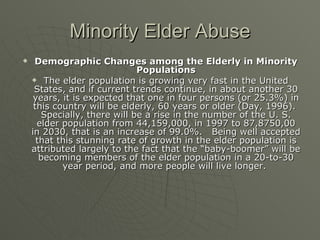
Minority Elder Abuse Demographic Changes among the Elderly in Minority Populations The elder population is growing very fast in the United States, and if current trends continue, in about another 30 years, it is expected that one in four persons (or 25.3%) in this country will be elderly, 60 years or older (Day, 1996).  Specially, there will be a rise in the number of the U. S. elder population from 44,159,000, in 1997 to 87,8750,00 in 2030, that is an increase of 99.0%.  Being well accepted that this stunning rate of growth in the elder population is attributed largely to the fact that the “baby-boomer” will be becoming members of the elder population in a 20-to-30 year period, and more people will live longer.
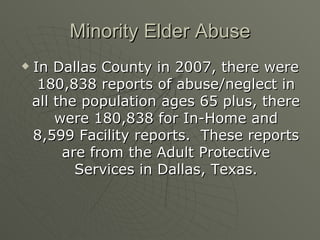
Minority Elder Abuse In Dallas County in 2007, there were 180,838 reports of abuse/neglect in all the population ages 65 plus, there were 180,838 for In-Home and 8,599 Facility reports.  These reports are from the Adult Protective Services in Dallas, Texas.
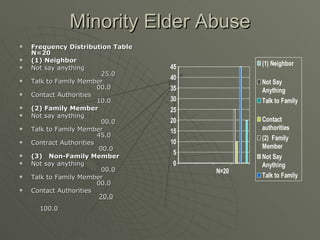
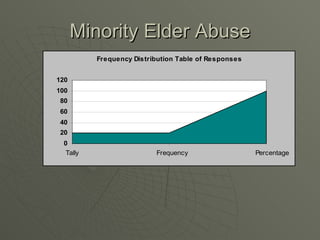
Minority Elder Abuse Frequency Distribution Table  N=20 (1) Neighbor   Not say anything  25.0 Talk to Family Member  00.0 Contact Authorities  10.0 (2) Family Member   Not say anything  00.0 Talk to Family Member  45.0 Contract Authorities  00.0 (3)  Non-Family Member   Not say anything  00.0 Talk to Family Member  00.0 Contact Authorities  20.0   100.0
Minority Elder Abuse
Minority Elder Abuse Findings These findings show that people are concerned for their neighbor’s welfare, and as I explained the laws regarding the abuse/neglect of the elderly, they all agreed to think about the future of their elderly family members.
Minority Elder Abuse Conclusions It is clear that that the reliability and generalized ability of these findings are hampered by issues related to research methodology.  The use of a non- probability sampling method and the small sample size limit the generalized ability of the findings.
Minority Elder Abuse References Chang, J. & Moon, A. (1997).  Korean American elderly knowledge and  perceptions of elder abuse:  A qualitative analysis of cultural factors.  Journal of Multicultural Social Work, 6 (1/2), 139-154. Day, J. C. (1996).  The U. S. Bureau of Census Current Population Reports, Series P-25, No. 1130.  Population projections of the United States by age, sex, race, and Hispanic origin :  1995 to 2050.  Washington, D. C.:  U. S. Government Printing Office. Adult Protective Services, Statistics 2007 Dallas, TX

Ager 4560 Minority Elder Abuse Ppt

  • 1.
    AGER 4560 090Minority Elder Abuse Sharron A. Killebrew University of North Texas
  • 2.
    Minority Elder AbuseThere is significant number of respondents who have reported having had shelter or living arrangement needs denied by family members. The findings of the past research samples show that denial of shelter, neglect, financial abuse and physical abuse supports the work of Chang and Moon (1997) [1] , who introduced elder mistreatment, in which mistreatment can be best understood in the context of cultural norms for family and parent-child relationships. And each minority culture is different, and whether they treat their family members with respect, depending on the way they were brought up. Also if the children have no moral obligation to the parent, they feel that they should not be saddled with their aging problems. [1] Chang, J. and Moon, A, (1997). Korean American elderly and knowledge and perceptions of elder abuse: A qualitative analysis of cultural factors. Journal of Multicultural Social Work, 6(1/2), 139-154.
  • 3.
    Minority Elder AbuseDemographic Changes among the Elderly in Minority Populations The elder population is growing very fast in the United States, and if current trends continue, in about another 30 years, it is expected that one in four persons (or 25.3%) in this country will be elderly, 60 years or older (Day, 1996). Specially, there will be a rise in the number of the U. S. elder population from 44,159,000, in 1997 to 87,8750,00 in 2030, that is an increase of 99.0%. Being well accepted that this stunning rate of growth in the elder population is attributed largely to the fact that the “baby-boomer” will be becoming members of the elder population in a 20-to-30 year period, and more people will live longer.
  • 4.
    Minority Elder AbuseIn Dallas County in 2007, there were 180,838 reports of abuse/neglect in all the population ages 65 plus, there were 180,838 for In-Home and 8,599 Facility reports. These reports are from the Adult Protective Services in Dallas, Texas.
  • 5.
    Minority Elder AbuseFrequency Distribution Table N=20 (1) Neighbor Not say anything 25.0 Talk to Family Member 00.0 Contact Authorities 10.0 (2) Family Member Not say anything 00.0 Talk to Family Member 45.0 Contract Authorities 00.0 (3) Non-Family Member Not say anything 00.0 Talk to Family Member 00.0 Contact Authorities 20.0 100.0
  • 6.
  • 7.
    Minority Elder AbuseFindings These findings show that people are concerned for their neighbor’s welfare, and as I explained the laws regarding the abuse/neglect of the elderly, they all agreed to think about the future of their elderly family members.
  • 8.
    Minority Elder AbuseConclusions It is clear that that the reliability and generalized ability of these findings are hampered by issues related to research methodology. The use of a non- probability sampling method and the small sample size limit the generalized ability of the findings.
  • 9.
    Minority Elder AbuseReferences Chang, J. & Moon, A. (1997). Korean American elderly knowledge and perceptions of elder abuse: A qualitative analysis of cultural factors. Journal of Multicultural Social Work, 6 (1/2), 139-154. Day, J. C. (1996). The U. S. Bureau of Census Current Population Reports, Series P-25, No. 1130. Population projections of the United States by age, sex, race, and Hispanic origin : 1995 to 2050. Washington, D. C.: U. S. Government Printing Office. Adult Protective Services, Statistics 2007 Dallas, TX