Coniferous Forest
Biome or Taiga
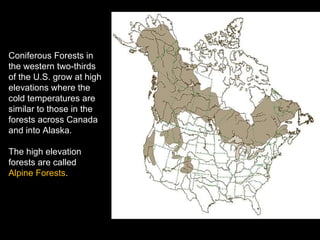
Coniferous Forests in
the western two-thirds
of the U.S. grow at high
elevations where the
cold temperatures are
similar to those in the
forests across Canada
and into Alaska.
The high elevation
forests are called
Alpine Forests.
Coniferous, when broken down means
Con = cone
fer – from Pherien – to bear
These are trees that bear cones.
Conifers include – Pines, Spruces, Firs, Hemlocks, and
Cedars. There are others but these are common
examples.
Conifers have reduced leaf surface area as an adaptation to
limited precipitation.
Spruces (left) have needle-like
leaves.
Cedars have scale-like leaves (right)
Limited leaf surface area means there will be fewer stomates
and hence less transpiration.
Coniferous Forest trees are evergreen. This is an adaptation
to the short growing season at northern latitudes.
Farther south, in Temperate Deciduous Forests, the growing
season begins in mid to late April and extends through early
October. During those 7 months, trees can make enough
food to last them all year even though they’re not able to make
food during the cold winter. Deciduous trees drop their leaves
so they don’t have to feed them while it’s too cold to
photosynthesize (you can review this in the Temperate
Deciduous Forest Biome Power Point).
Being evergreen allows Coniferous Forest trees to
photosynthesize and make food as soon as the weather
warms in the spring. If they, like deciduous trees, had to
grow new leaves, they would spend the first month of the
growing season making new leaves. Because the growing
season doesn’t start until June and it ends by August, they
would only have eight to ten weeks to photosynthesize food.
This would produce enough food to last them through the
year.
Mean precipitation in the Coniferous Forest Biome ranges
from 10 to 30 inches. The higher amounts of rainfall occur
in the southern regions of the Coniferous Forest.
In the northern regions of the Coniferous Forests, adjacent
to the Tundra, only about 10 inches of precipitation falls.
Temperatures during the winter may fall to -30o
F and in
summer the temperature may get up into the upper 70’s or
low 80’s.
Some species of coniferous
trees have branches that
hang at an angle or “sloop”.
If heavy snow piles up on
them, the branches simply
bend downward under its
weight and the snow slides
of the branches and piles up
below the tree on the
ground.
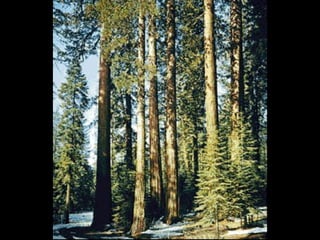
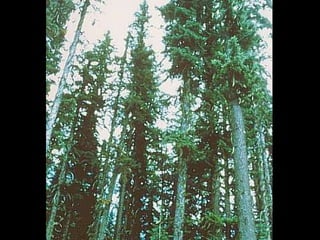
Another adaptation to snow is that the trees are tall
and triangular. This also helps shed snow.
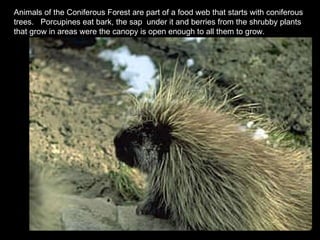
Animals of the Coniferous Forest are part of a food web that starts with coniferous
trees. Porcupines eat bark, the sap under it and berries from the shrubby plants
that grow in areas were the canopy is open enough to all them to grow.
Porcupines are large rodents. Most rodents are
much smaller. The Pine Vole (a mouse) and the
Red Squirrel tear open cones and remove the seeds
as their staple diet.
Many Coniferous Forest birds have
beaks that are adapted to reaching
in between the scales of cones to
extract the seeds. The bird on the
left is a Crossbill. Its upper and
lower beaks cross over which gives
it an added edge on grabbing the
tiny seeds. The Pine Siskin’s bill
comes to a precision point like a
surgical tool.
Barred Owls (left) and Great Gray Owls (right) control the
populations of rodents and small birds in the Coniferous Forests.
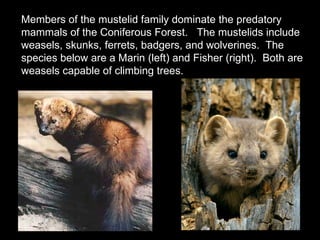
Members of the mustelid family dominate the predatory
mammals of the Coniferous Forest. The mustelids include
weasels, skunks, ferrets, badgers, and wolverines. The
species below are a Marin (left) and Fisher (right). Both are
weasels capable of climbing trees.
Wolverines are among the largest predators in the Coniferous Forests.
Weighing in at 50 to 70 pounds, these fearless predators can bring down a
deer or moose and bears generally back down from them.
The moose is the largest of all deer. They inhabit the northernmost edges of
Temperate Deciduous Forests and throughout Coniferous Forests.
Animals in the Coniferous Forest are adapted to the cold much the same
way those in the Temperate Deciduous Forests.
3.They hibernate
4.They migrate south to warmer climates (the Robins you see in Ohio
during winter have flown here from Canada. Our Robins move to the
coast along the Gulf of Mexico and Central America.
5.They endure the winter and survive the cold. How?
a. They insulate with dense fur.
b. Herbivores dig down to the ground level to find food or they get it
from the tree tops.
c. Some species may cache (store) food supplies for the winter.
Because the winter is so long, there are few ectothermic (“cold blooded”
animals that can survive such prolonged cold. There are a few freeze
tolerant frogs but over all, reptile and amphibian diversity is limited
compared to endothermic (“warm blooded”) animal diversity.
Diversity in the Coniferous forests is higher than in the Tundra Biome to
the north, but lower than in the Temperate Deciduous Forests to the south.
Some species of conifers, especially Pines in Alpine Forests, are controlled
by fires. Fires are ignited by lightning strikes. They burn away fallen
needles and dead branches, returning nutrients to the soil. Bacterial activity
is suppressed in the Coniferous Forest because their soils are acidic.
In the 1940’s a bear cub with burned feet
survived a fire and was found by rangers. He
became the icon for preventing forest fires.
For 50 years, fires were extinguished and the
layer of needles, dead branches and other fuel
piled up until 20 years ago a fire leveled much
of Yellowstone National Park.
Ecologists learned that small fires every few
years actually burn away the fuel and promote
the health of the forest. Some species of
pines have cones whose scales are “glued” by
thick resin that is warmed by the heat of the
fire allowing the scales to open and the seeds
to be released. New seedlings grow from
them and replace the old and dead trees to
keep the forest full of healthy trees.
In this photo, the effects of the fire are obvious. This is at Yellowstone a couple
of years after the fire. Notice all the young trees growing to replace the others.
Because the fire was so intense (because the fuel was allowed to build up for
50 years) even the living trees were burned. “Normal”, smaller fires don’t
cause extensive damage or kill healthy ones. The fire burns fast and is over.
Coniferous forests biome

Coniferous forests biome

  • 1.
  • 2.
    Coniferous Forests in thewestern two-thirds of the U.S. grow at high elevations where the cold temperatures are similar to those in the forests across Canada and into Alaska. The high elevation forests are called Alpine Forests.
  • 3.
    Coniferous, when brokendown means Con = cone fer – from Pherien – to bear These are trees that bear cones. Conifers include – Pines, Spruces, Firs, Hemlocks, and Cedars. There are others but these are common examples.
  • 4.
    Conifers have reducedleaf surface area as an adaptation to limited precipitation. Spruces (left) have needle-like leaves. Cedars have scale-like leaves (right)
  • 5.
    Limited leaf surfacearea means there will be fewer stomates and hence less transpiration. Coniferous Forest trees are evergreen. This is an adaptation to the short growing season at northern latitudes. Farther south, in Temperate Deciduous Forests, the growing season begins in mid to late April and extends through early October. During those 7 months, trees can make enough food to last them all year even though they’re not able to make food during the cold winter. Deciduous trees drop their leaves so they don’t have to feed them while it’s too cold to photosynthesize (you can review this in the Temperate Deciduous Forest Biome Power Point).
  • 6.
    Being evergreen allowsConiferous Forest trees to photosynthesize and make food as soon as the weather warms in the spring. If they, like deciduous trees, had to grow new leaves, they would spend the first month of the growing season making new leaves. Because the growing season doesn’t start until June and it ends by August, they would only have eight to ten weeks to photosynthesize food. This would produce enough food to last them through the year.
  • 7.
    Mean precipitation inthe Coniferous Forest Biome ranges from 10 to 30 inches. The higher amounts of rainfall occur in the southern regions of the Coniferous Forest. In the northern regions of the Coniferous Forests, adjacent to the Tundra, only about 10 inches of precipitation falls. Temperatures during the winter may fall to -30o F and in summer the temperature may get up into the upper 70’s or low 80’s.
  • 10.
    Some species ofconiferous trees have branches that hang at an angle or “sloop”. If heavy snow piles up on them, the branches simply bend downward under its weight and the snow slides of the branches and piles up below the tree on the ground.
  • 13.
    Another adaptation tosnow is that the trees are tall and triangular. This also helps shed snow.
  • 14.
    Animals of theConiferous Forest are part of a food web that starts with coniferous trees. Porcupines eat bark, the sap under it and berries from the shrubby plants that grow in areas were the canopy is open enough to all them to grow.
  • 15.
    Porcupines are largerodents. Most rodents are much smaller. The Pine Vole (a mouse) and the Red Squirrel tear open cones and remove the seeds as their staple diet.
  • 16.
    Many Coniferous Forestbirds have beaks that are adapted to reaching in between the scales of cones to extract the seeds. The bird on the left is a Crossbill. Its upper and lower beaks cross over which gives it an added edge on grabbing the tiny seeds. The Pine Siskin’s bill comes to a precision point like a surgical tool.
  • 17.
    Barred Owls (left)and Great Gray Owls (right) control the populations of rodents and small birds in the Coniferous Forests.
  • 18.
    Members of themustelid family dominate the predatory mammals of the Coniferous Forest. The mustelids include weasels, skunks, ferrets, badgers, and wolverines. The species below are a Marin (left) and Fisher (right). Both are weasels capable of climbing trees.
  • 19.
    Wolverines are amongthe largest predators in the Coniferous Forests. Weighing in at 50 to 70 pounds, these fearless predators can bring down a deer or moose and bears generally back down from them.
  • 20.
    The moose isthe largest of all deer. They inhabit the northernmost edges of Temperate Deciduous Forests and throughout Coniferous Forests.
  • 21.
    Animals in theConiferous Forest are adapted to the cold much the same way those in the Temperate Deciduous Forests. 3.They hibernate 4.They migrate south to warmer climates (the Robins you see in Ohio during winter have flown here from Canada. Our Robins move to the coast along the Gulf of Mexico and Central America. 5.They endure the winter and survive the cold. How? a. They insulate with dense fur. b. Herbivores dig down to the ground level to find food or they get it from the tree tops. c. Some species may cache (store) food supplies for the winter. Because the winter is so long, there are few ectothermic (“cold blooded” animals that can survive such prolonged cold. There are a few freeze tolerant frogs but over all, reptile and amphibian diversity is limited compared to endothermic (“warm blooded”) animal diversity. Diversity in the Coniferous forests is higher than in the Tundra Biome to the north, but lower than in the Temperate Deciduous Forests to the south.
  • 22.
    Some species ofconifers, especially Pines in Alpine Forests, are controlled by fires. Fires are ignited by lightning strikes. They burn away fallen needles and dead branches, returning nutrients to the soil. Bacterial activity is suppressed in the Coniferous Forest because their soils are acidic.
  • 23.
    In the 1940’sa bear cub with burned feet survived a fire and was found by rangers. He became the icon for preventing forest fires. For 50 years, fires were extinguished and the layer of needles, dead branches and other fuel piled up until 20 years ago a fire leveled much of Yellowstone National Park.
  • 24.
    Ecologists learned thatsmall fires every few years actually burn away the fuel and promote the health of the forest. Some species of pines have cones whose scales are “glued” by thick resin that is warmed by the heat of the fire allowing the scales to open and the seeds to be released. New seedlings grow from them and replace the old and dead trees to keep the forest full of healthy trees.
  • 25.
    In this photo,the effects of the fire are obvious. This is at Yellowstone a couple of years after the fire. Notice all the young trees growing to replace the others. Because the fire was so intense (because the fuel was allowed to build up for 50 years) even the living trees were burned. “Normal”, smaller fires don’t cause extensive damage or kill healthy ones. The fire burns fast and is over.