Paediatric 
Guidelines
Paediatric Guidelines 2013–14
ISBN: 978-0-9567736-1-6
These guidelines are advisory, not mandatory.
Every effort has been made to ensure accuracy.
The authors cannot accept any responsibility for
adverse outcomes.
Suggestions for improvement and additional guidelines
would be most welcome by Partners in Paediatrics,
please contact via http://www.networks.nhs.uk/nhs-networks/
partners-in-paediatrics/guidelines
ISSUE 5
Printed by: Sherwin Rivers Ltd, Waterloo Road, Stoke on Trent ST6 3HR
Tel: 01782 212024 Fax: 01782 214661 Email: sales@sherwin-rivers.co.uk
PaediatricGuidelines2013–14
2013-14
Bedside Clinical Guidelines Partnership
In association with
Paediatric Guidelines
2006
These guidelines are advisory, not mandatory.
Every effort has been made to ensure accuracy.
The authors cannot accept any responsibility for
adverse outcomes.
Suggestions for improvement and additional
guidelines would be most welcome by the
Partners in Paediatrics Coordinator,
Tel. 01782 552002 or Email nicky.smith@uhns.nhs.uk
In association with
Paediatric Guidelines
2006
These guidelines are advisory, not mandatory.
Every effort has been made to ensure accuracy.
The authors cannot accept any responsibility for
adverse outcomes.
Suggestions for improvement and additional
guidelines would be most welcome by the
Partners in Paediatrics Coordinator,
Tel. 01782 552002 or Email nicky.smith@uhns.nhs.uk
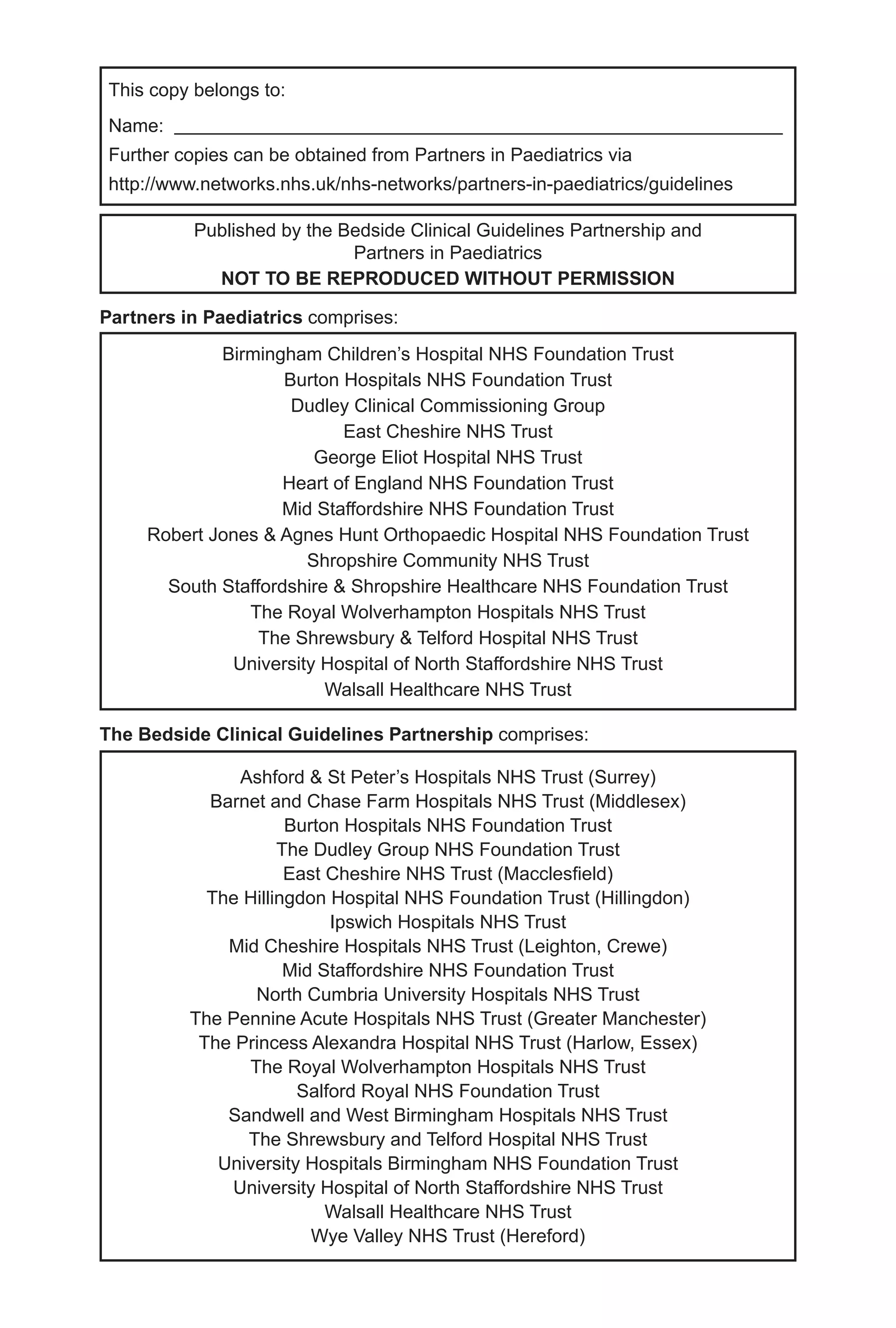
This copy belongs to:
Name:
Further copies can be obtained from Partners in Paediatrics via
http://www.networks.nhs.uk/nhs-networks/partners-in-paediatrics/guidelines
Published by the Bedside Clinical Guidelines Partnership and
Partners in Paediatrics
NOT TO BE REPRODUCED WITHOUT PERMISSION
Birmingham Children’s Hospital NHS Foundation Trust
Burton Hospitals NHS Foundation Trust
Dudley Clinical Commissioning Group
East Cheshire NHS Trust
George Eliot Hospital NHS Trust
Heart of England NHS Foundation Trust
Mid Staffordshire NHS Foundation Trust
Robert Jones & Agnes Hunt Orthopaedic Hospital NHS Foundation Trust
Shropshire Community NHS Trust
South Staffordshire & Shropshire Healthcare NHS Foundation Trust
The Royal Wolverhampton Hospitals NHS Trust
The Shrewsbury & Telford Hospital NHS Trust
University Hospital of North Staffordshire NHS Trust
Walsall Healthcare NHS Trust
Ashford & St Peter’s Hospitals NHS Trust (Surrey)
Barnet and Chase Farm Hospitals NHS Trust (Middlesex)
Burton Hospitals NHS Foundation Trust
The Dudley Group NHS Foundation Trust
East Cheshire NHS Trust (Macclesfield)
The Hillingdon Hospital NHS Foundation Trust (Hillingdon)
Ipswich Hospitals NHS Trust
Mid Cheshire Hospitals NHS Trust (Leighton, Crewe)
Mid Staffordshire NHS Foundation Trust
North Cumbria University Hospitals NHS Trust
The Pennine Acute Hospitals NHS Trust (Greater Manchester)
The Princess Alexandra Hospital NHS Trust (Harlow, Essex)
The Royal Wolverhampton Hospitals NHS Trust
Salford Royal NHS Foundation Trust
Sandwell and West Birmingham Hospitals NHS Trust
The Shrewsbury and Telford Hospital NHS Trust
University Hospitals Birmingham NHS Foundation Trust
University Hospital of North Staffordshire NHS Trust
Walsall Healthcare NHS Trust
Wye Valley NHS Trust (Hereford)
The Bedside Clinical Guidelines Partnership comprises:
Partners in Paediatrics comprises:
3
Issue 5
Issued: May 2013
Expires: May 2014
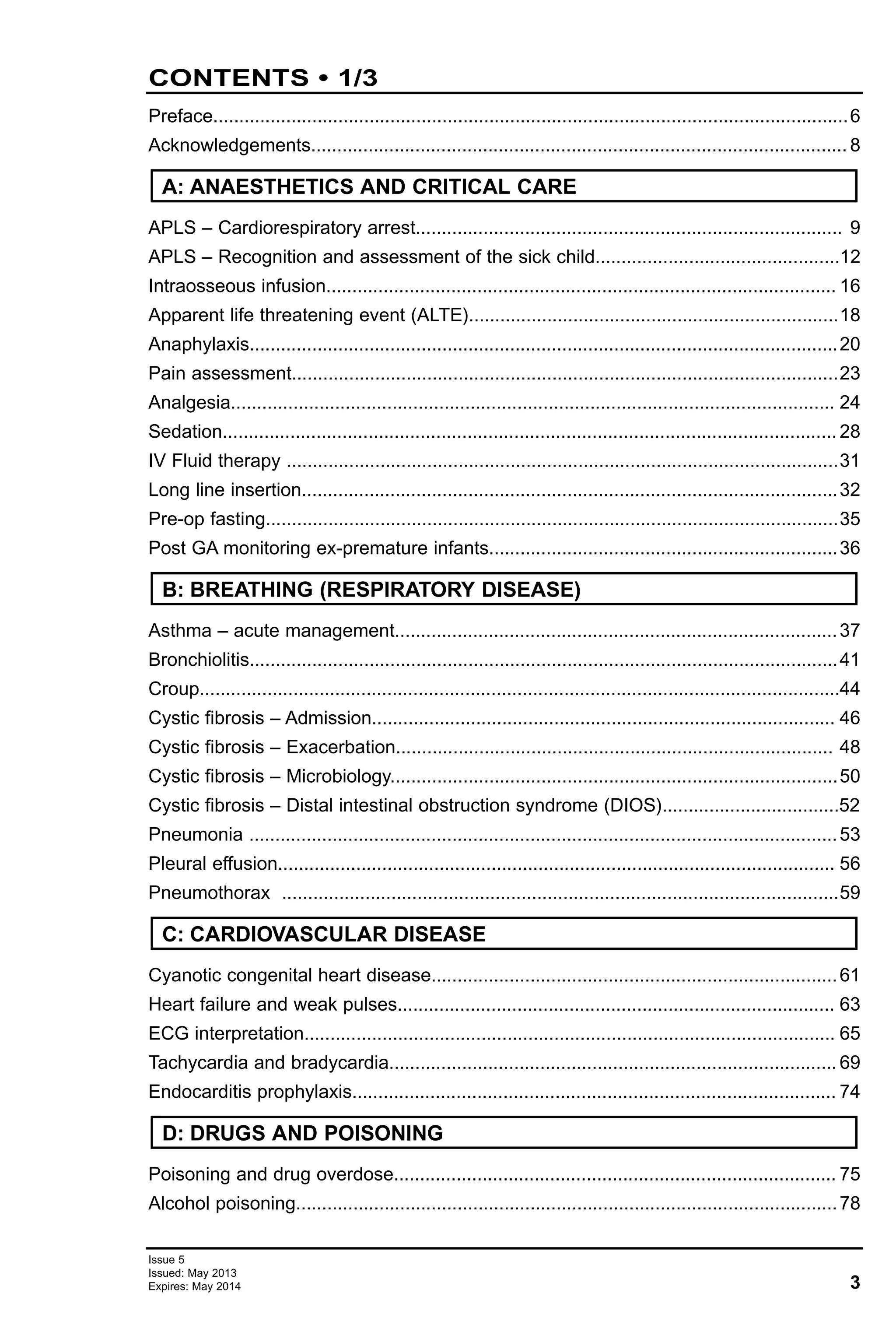
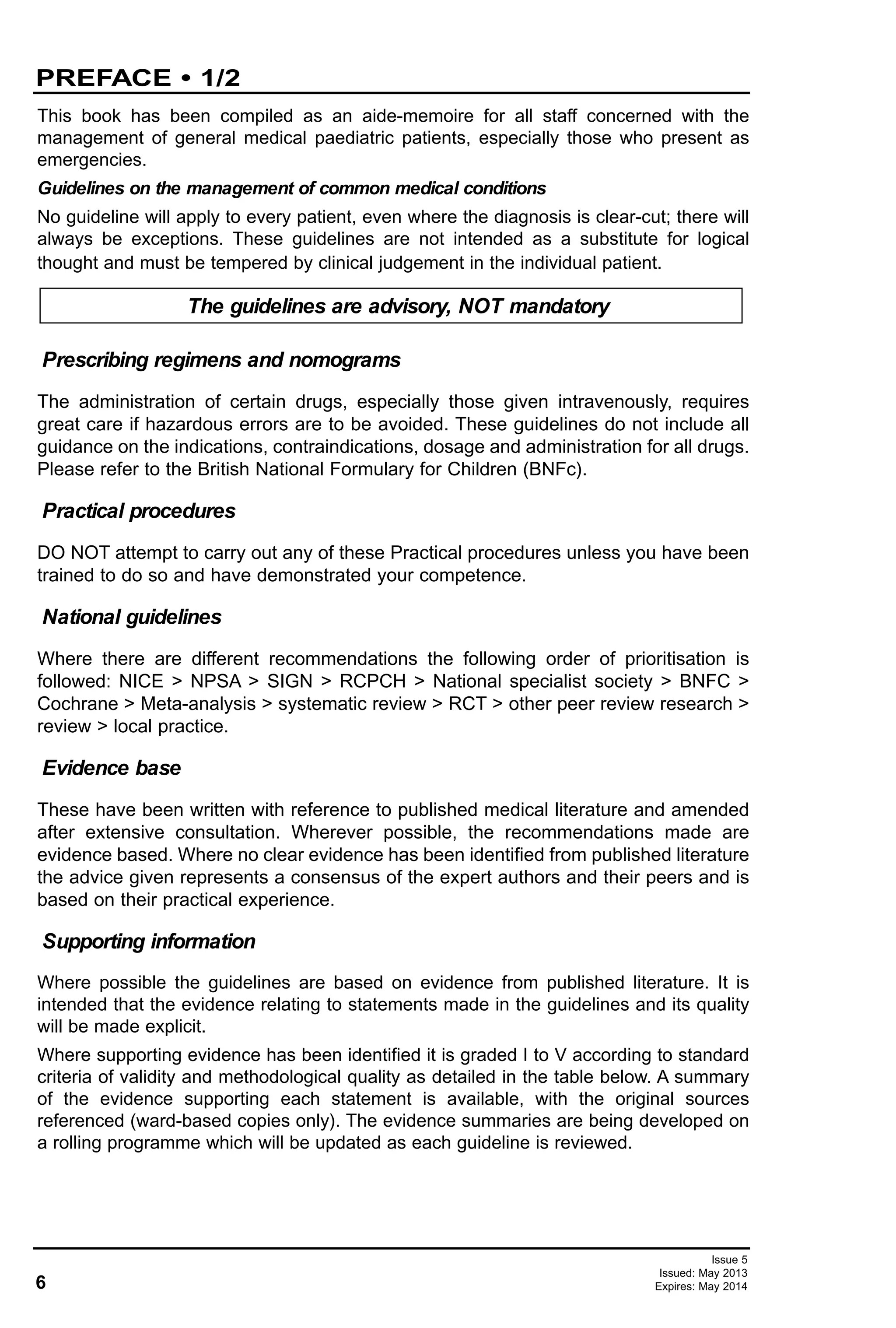
CONTENTS • 1/3
Preface..........................................................................................................................6
Acknowledgements....................................................................................................... 8
APLS – Cardiorespiratory arrest.................................................................................. 9
APLS – Recognition and assessment of the sick child...............................................12
Intraosseous infusion.................................................................................................. 16
Apparent life threatening event (ALTE).......................................................................18
Anaphylaxis.................................................................................................................20
Pain assessment.........................................................................................................23
Analgesia.................................................................................................................... 24
Sedation...................................................................................................................... 28
IV Fluid therapy ..........................................................................................................31
Long line insertion.......................................................................................................32
Pre-op fasting..............................................................................................................35
Post GA monitoring ex-premature infants...................................................................36
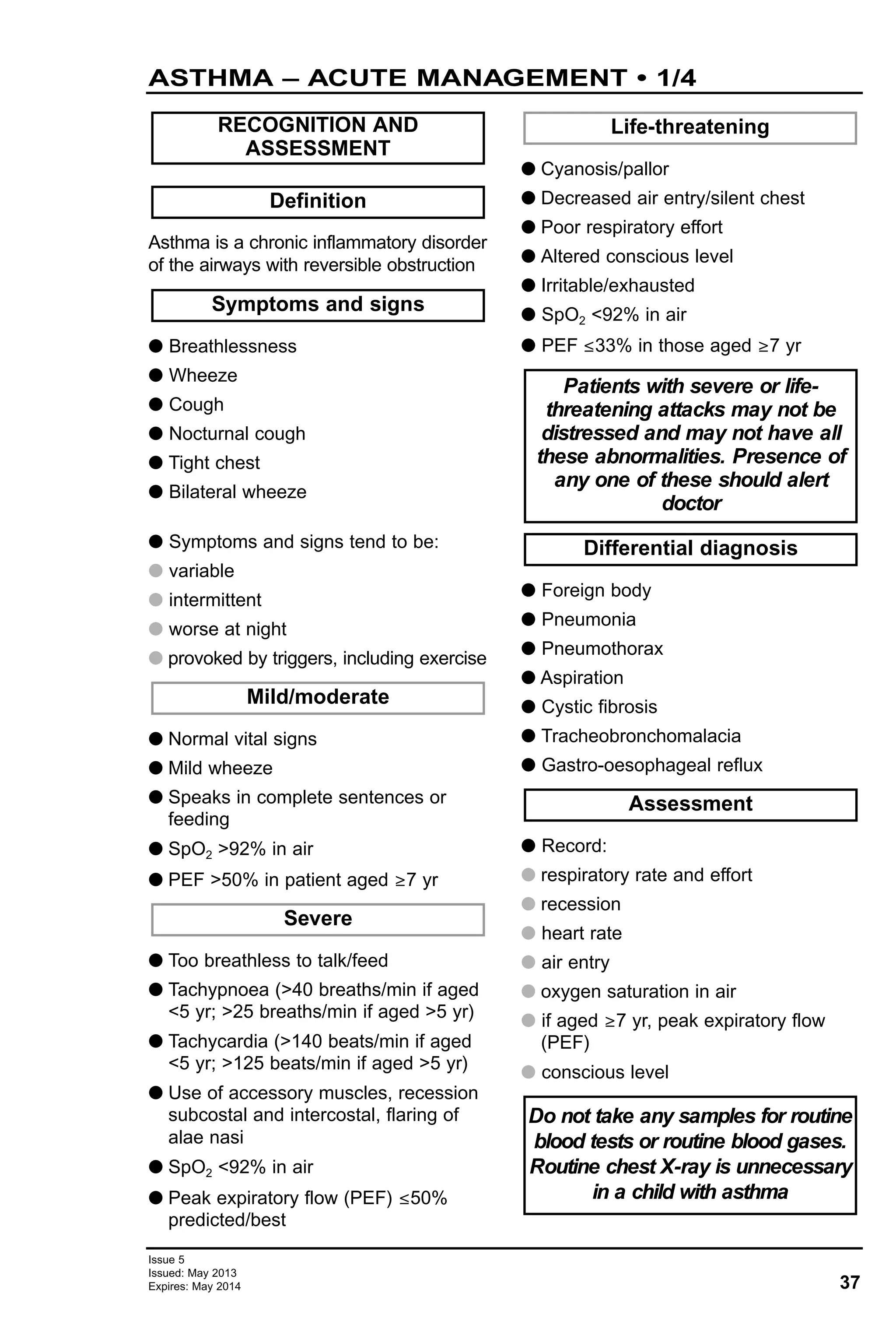
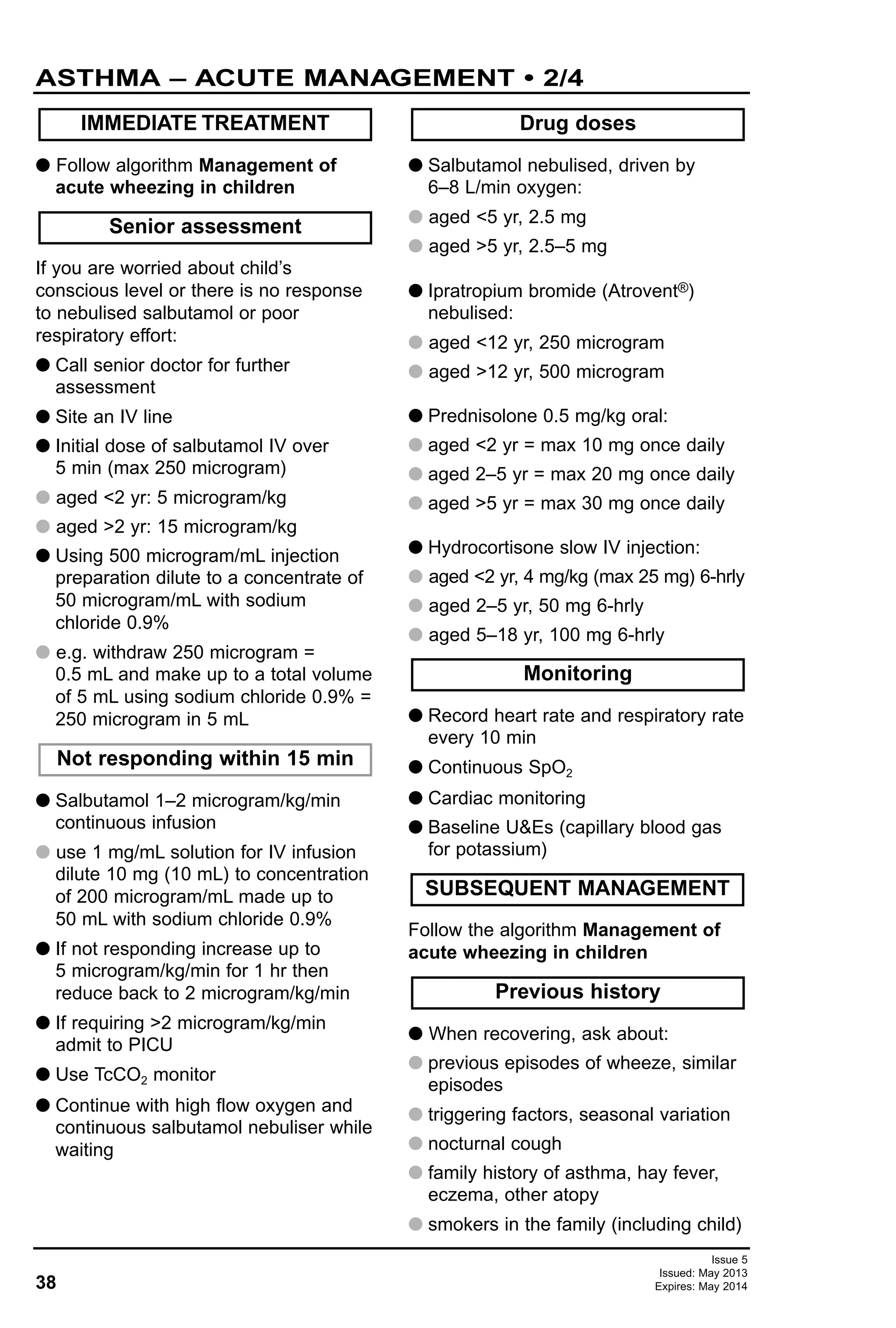
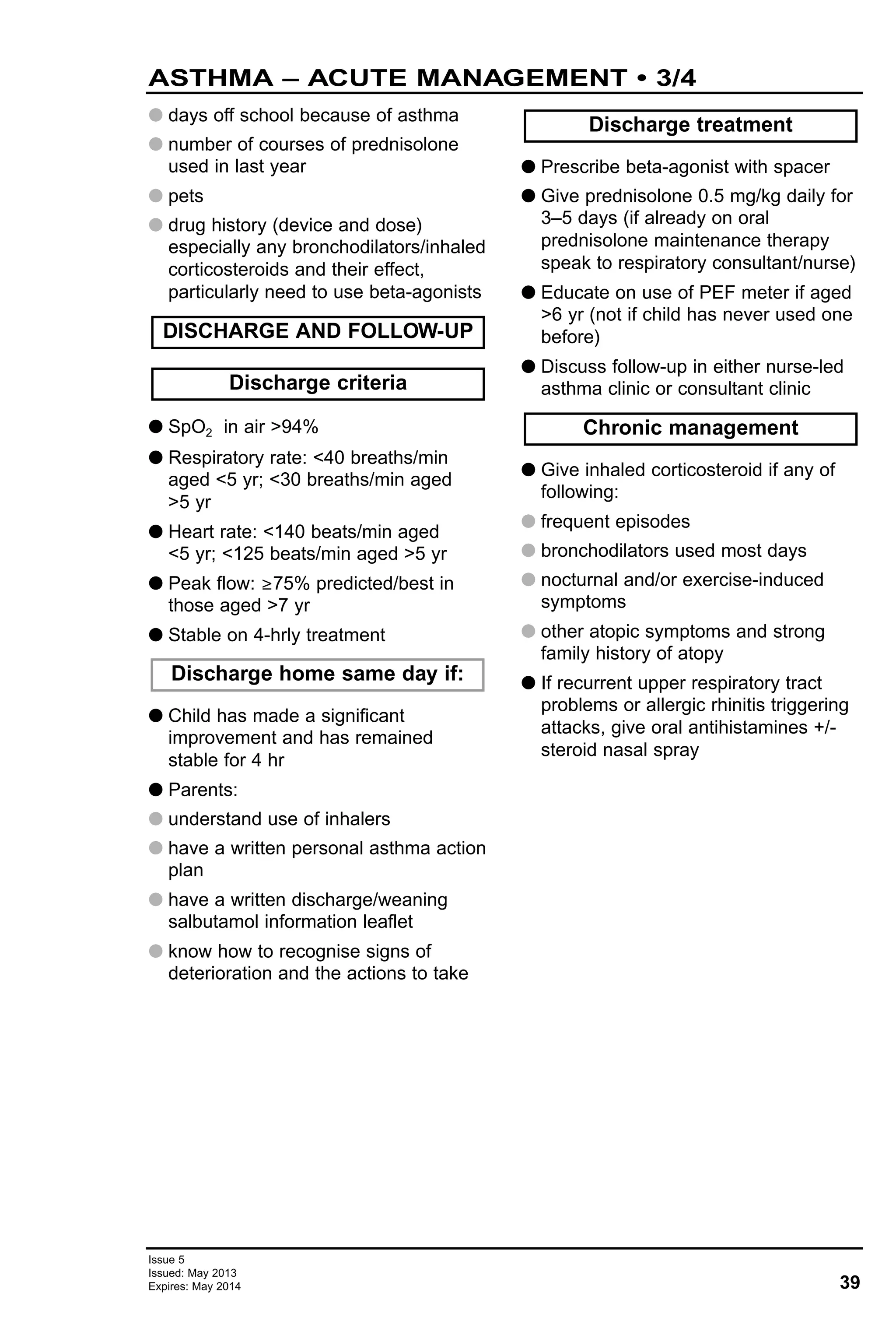
Asthma – acute management.....................................................................................37
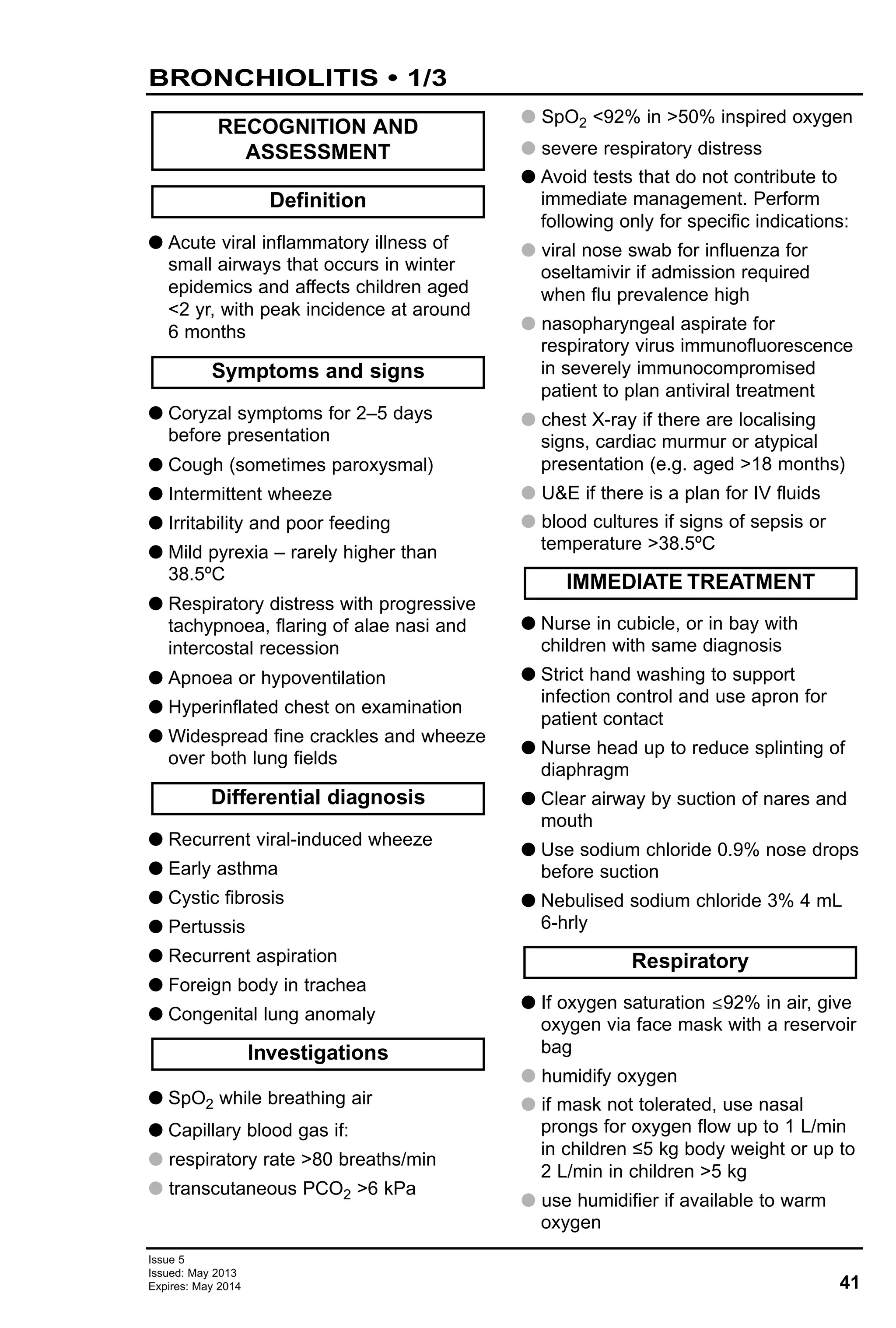
Bronchiolitis.................................................................................................................41
Croup...........................................................................................................................44
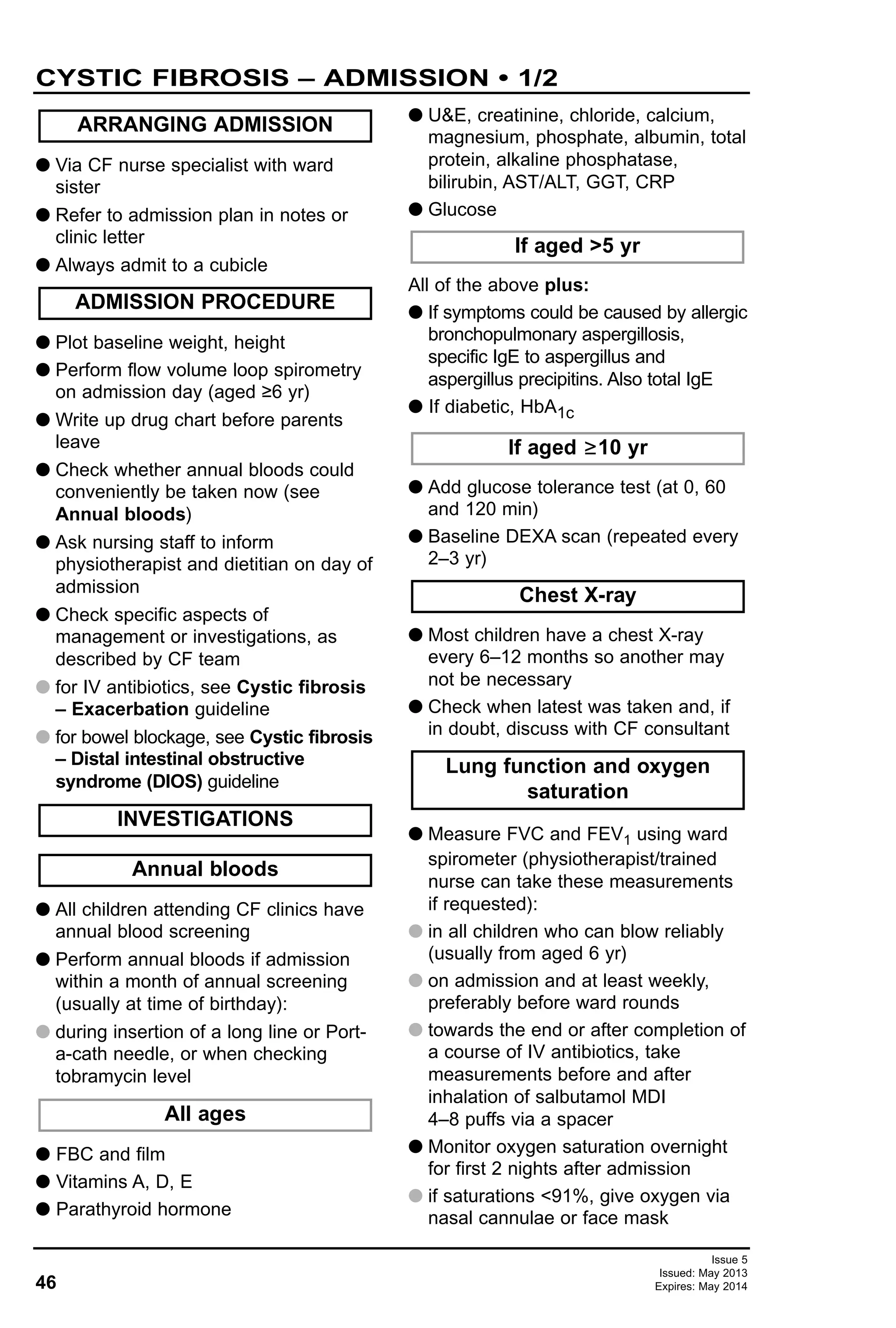
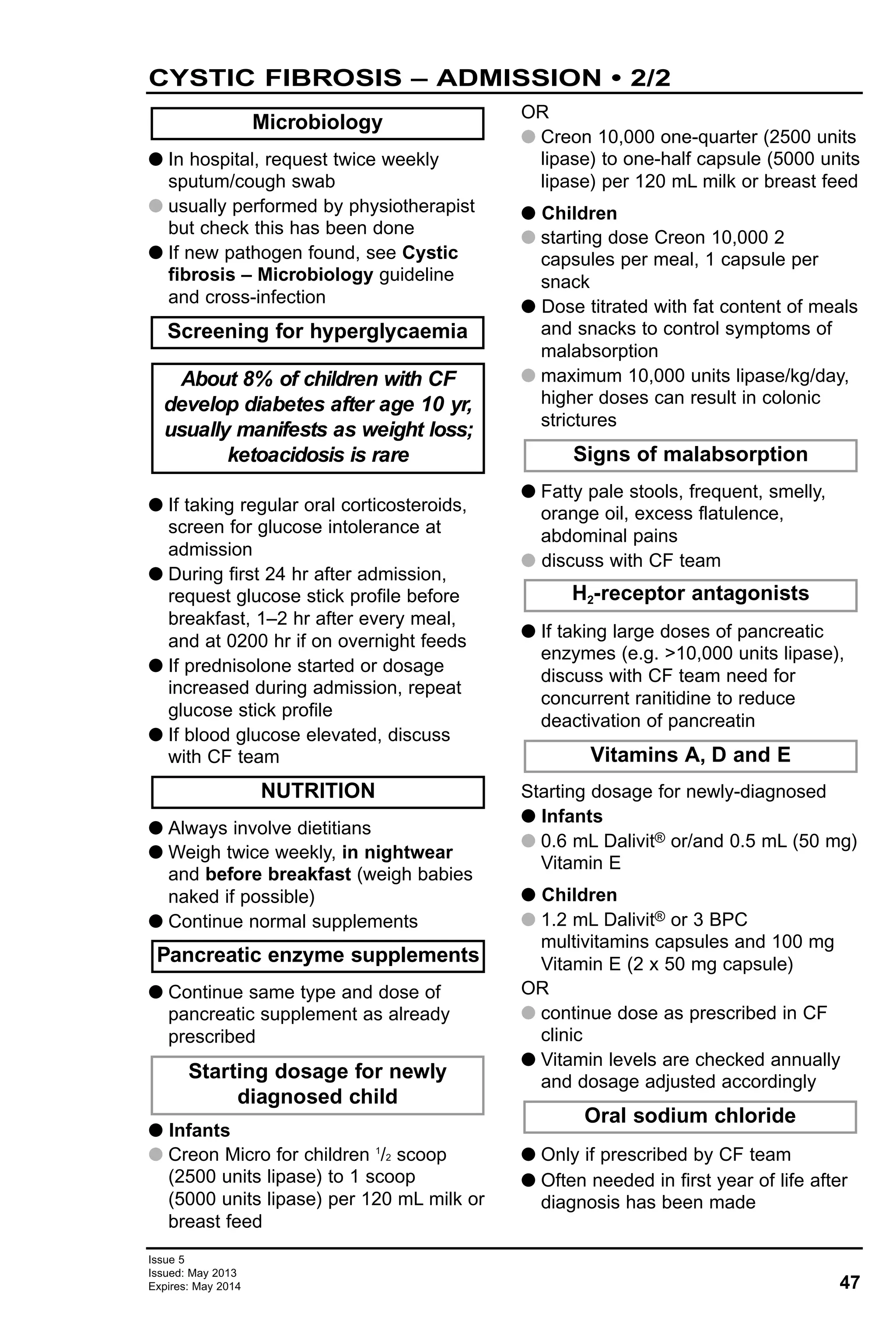
Cystic fibrosis – Admission......................................................................................... 46
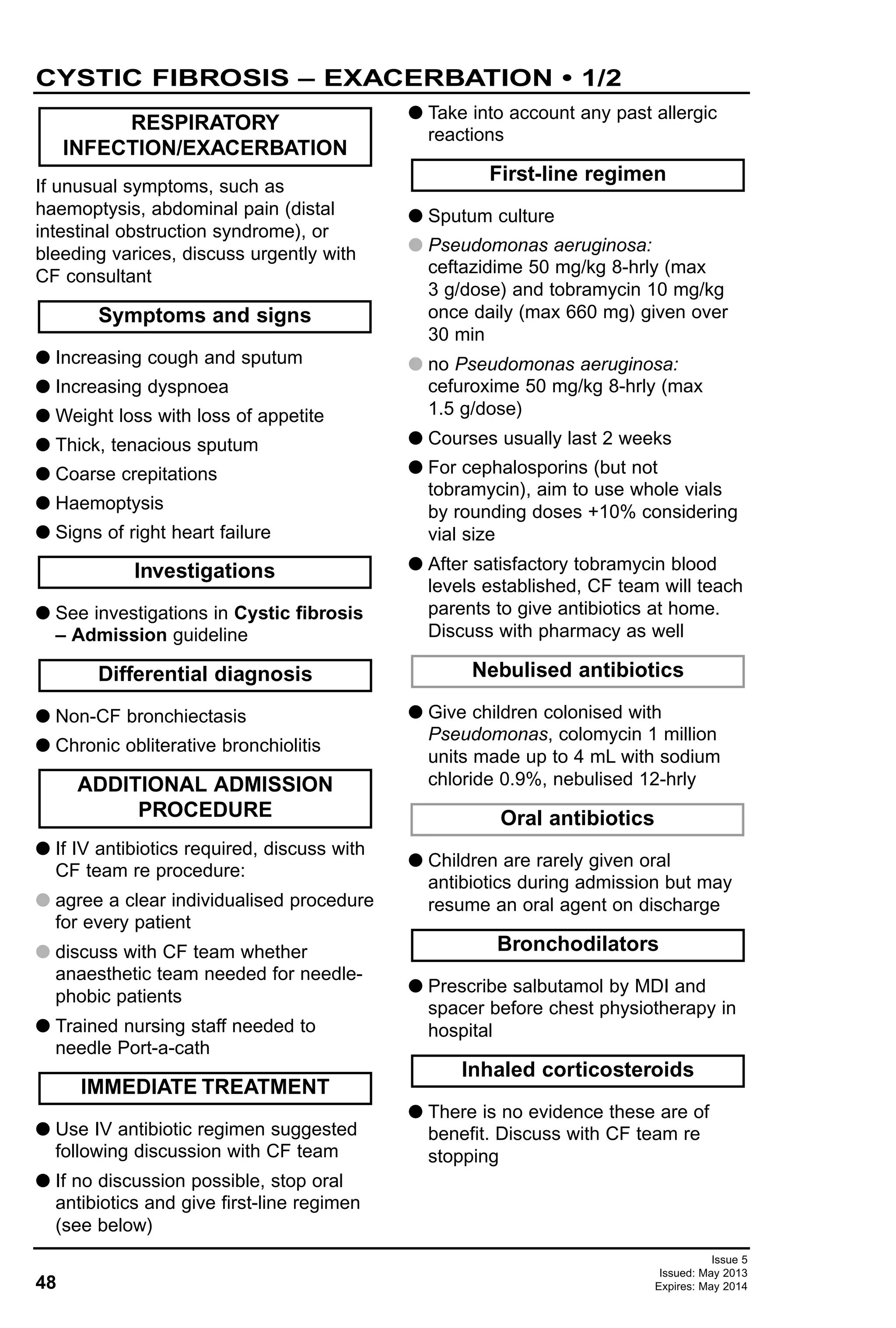
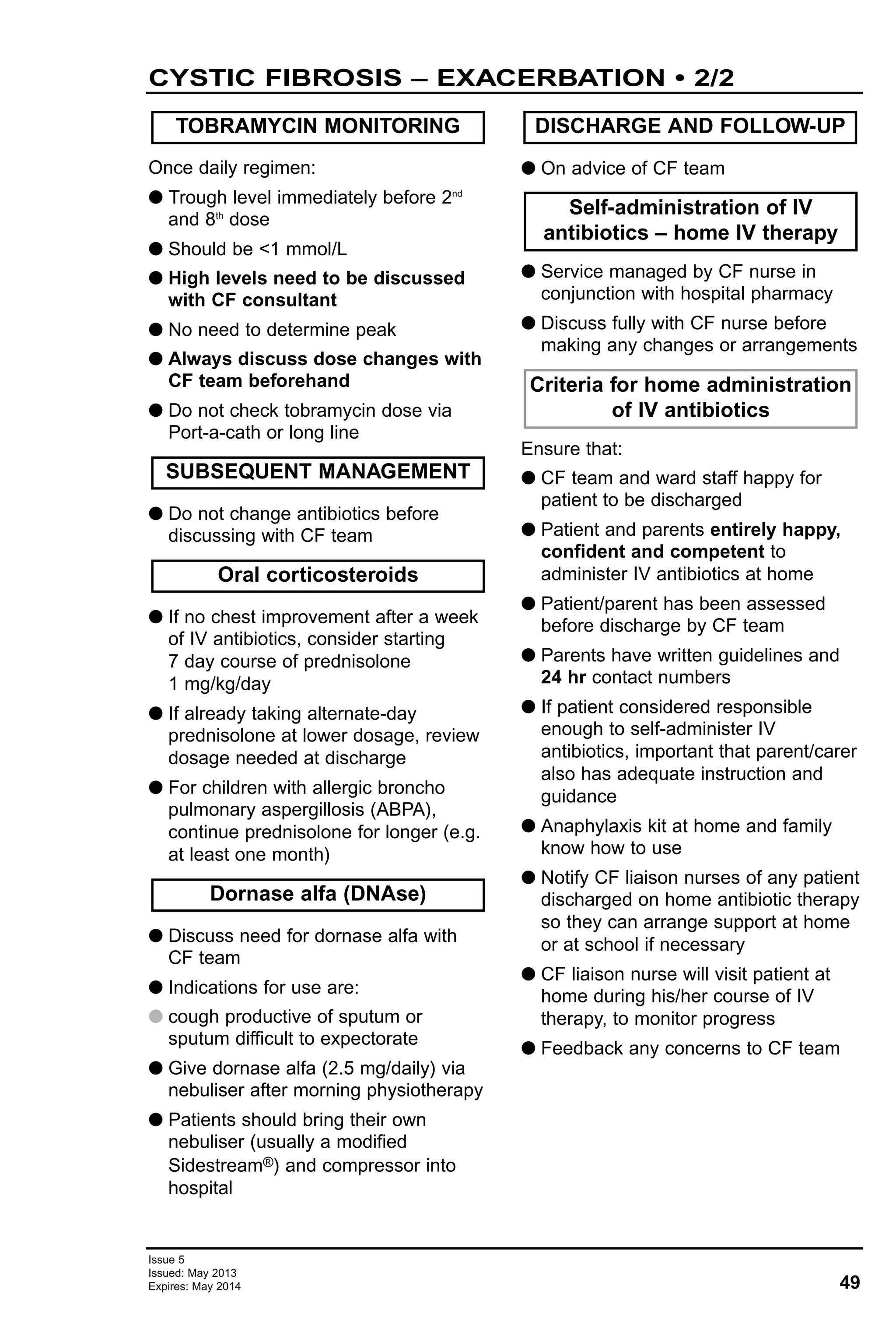
Cystic fibrosis – Exacerbation.................................................................................... 48
Cystic fibrosis – Microbiology......................................................................................50
Cystic fibrosis – Distal intestinal obstruction syndrome (DIOS)..................................52
Pneumonia .................................................................................................................53
Pleural effusion........................................................................................................... 56
Pneumothorax ...........................................................................................................59
Cyanotic congenital heart disease..............................................................................61
Heart failure and weak pulses.................................................................................... 63
ECG interpretation...................................................................................................... 65
Tachycardia and bradycardia...................................................................................... 69
Endocarditis prophylaxis............................................................................................. 74
Poisoning and drug overdose..................................................................................... 75
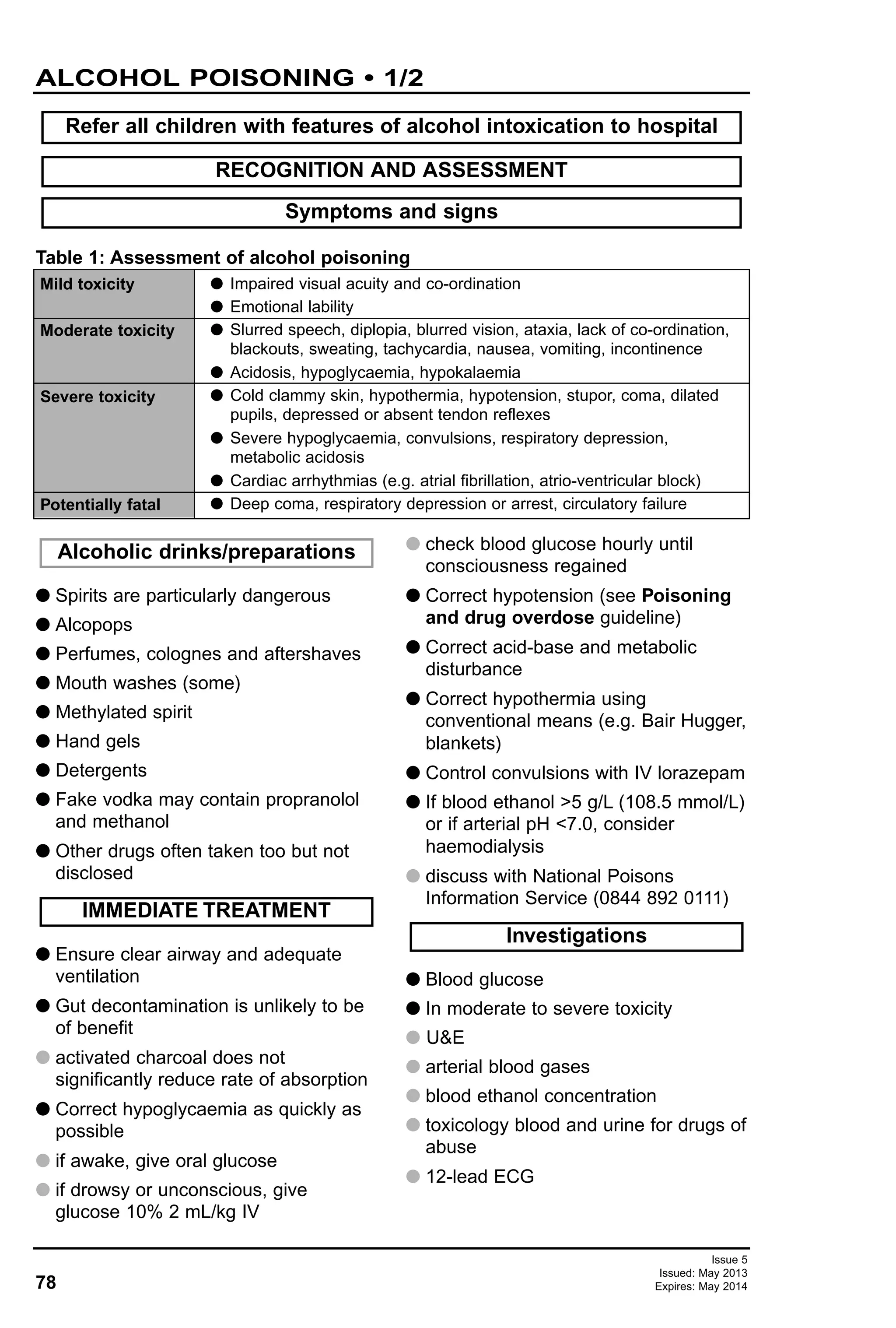
Alcohol poisoning........................................................................................................78
D: DRUGS AND POISONING
C: CARDIOVASCULAR DISEASE
B: BREATHING (RESPIRATORY DISEASE)
A: ANAESTHETICS AND CRITICAL CARE
Click on topic in contents to go to relevant page
4
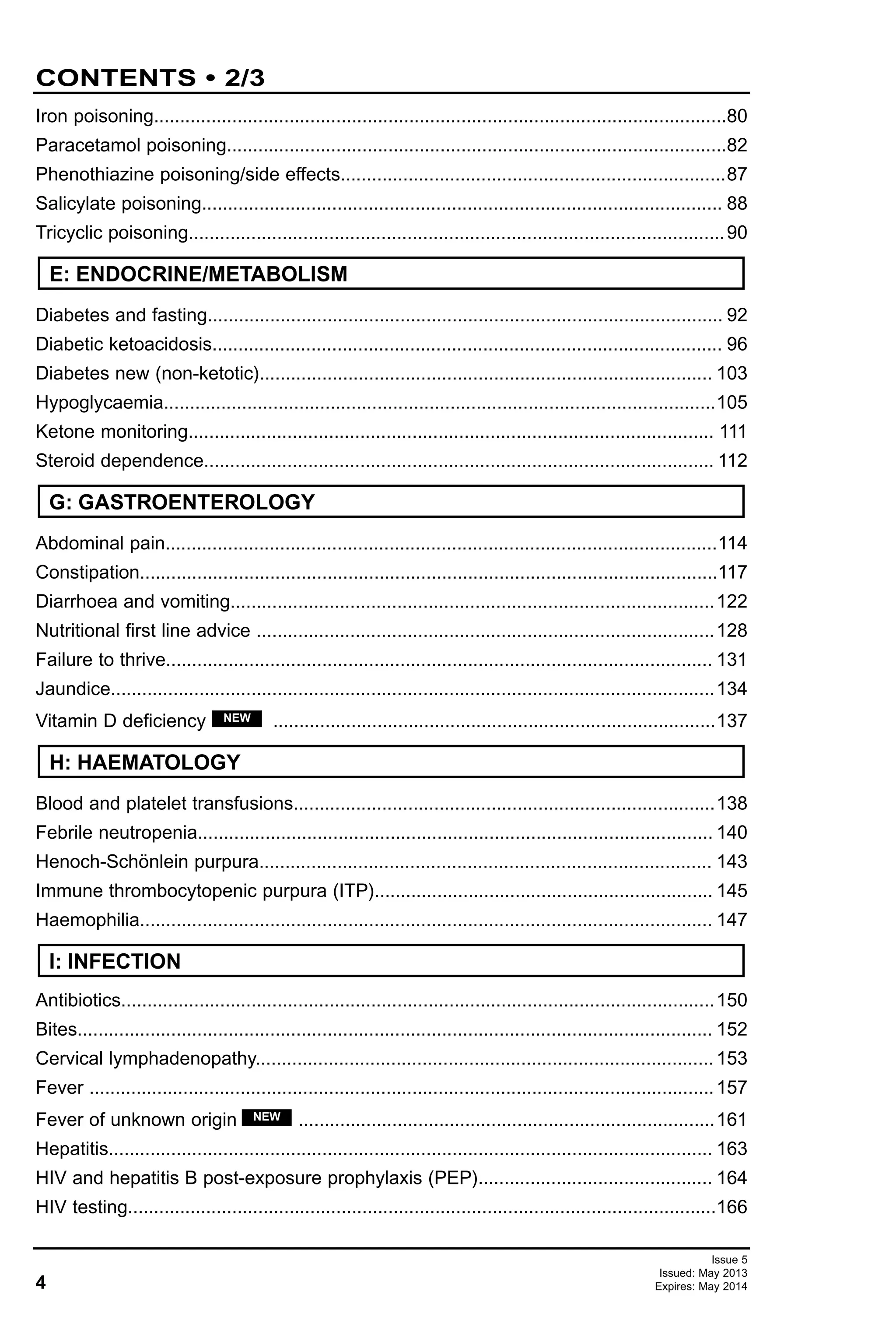
CONTENTS • 2/3
Issue 5
Issued: May 2013
Expires: May 2014
Iron poisoning..............................................................................................................80
Paracetamol poisoning................................................................................................82
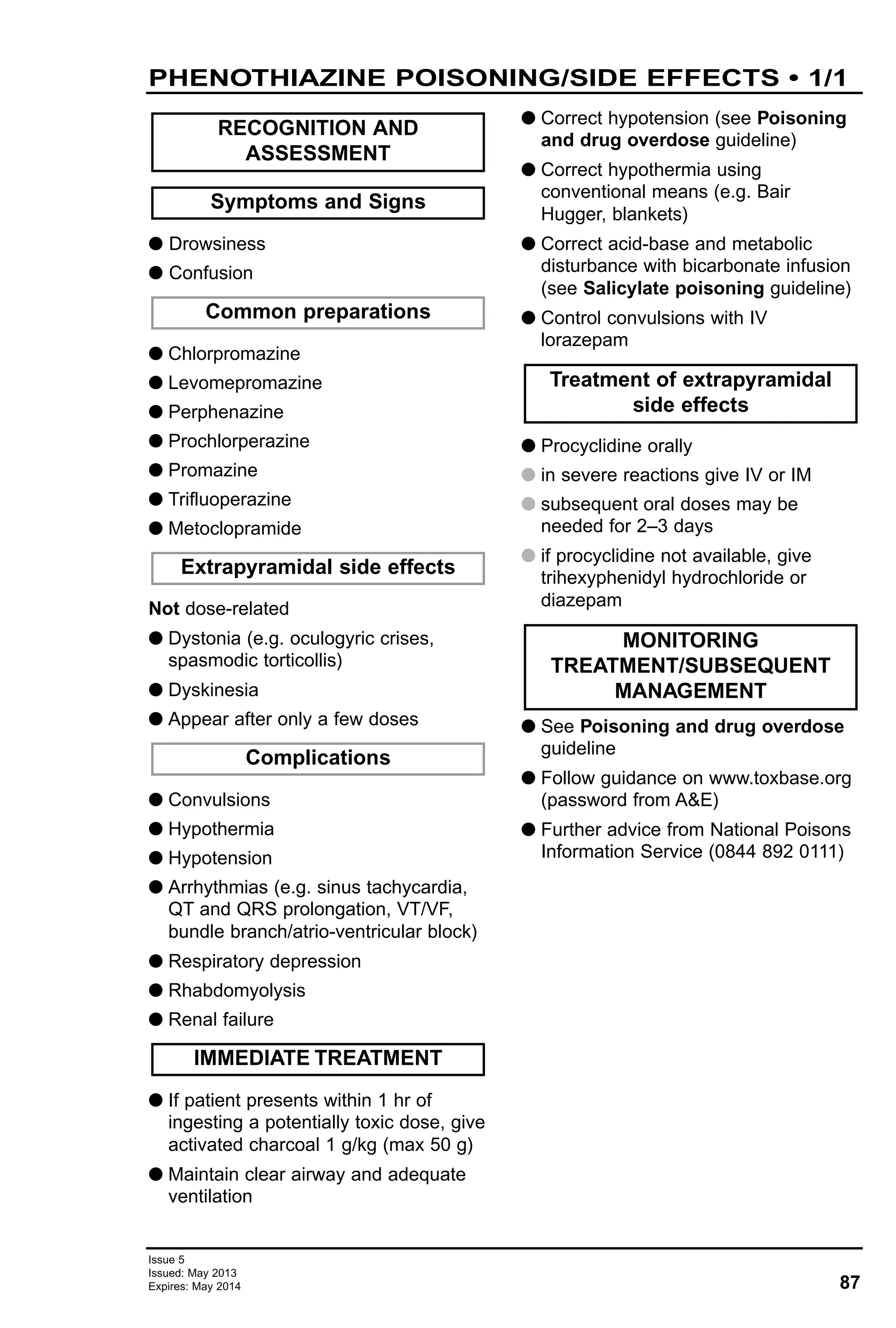
Phenothiazine poisoning/side effects..........................................................................87
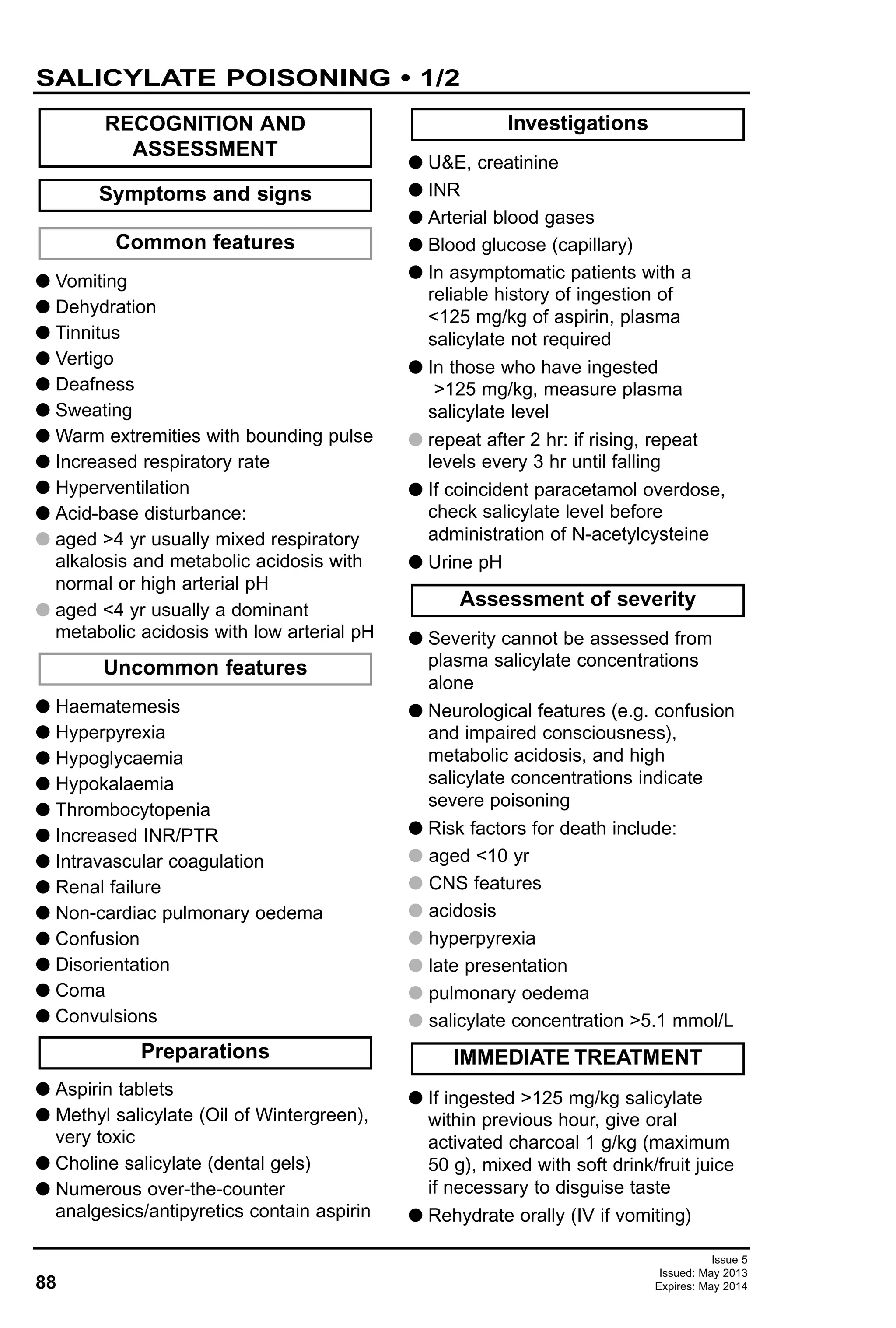
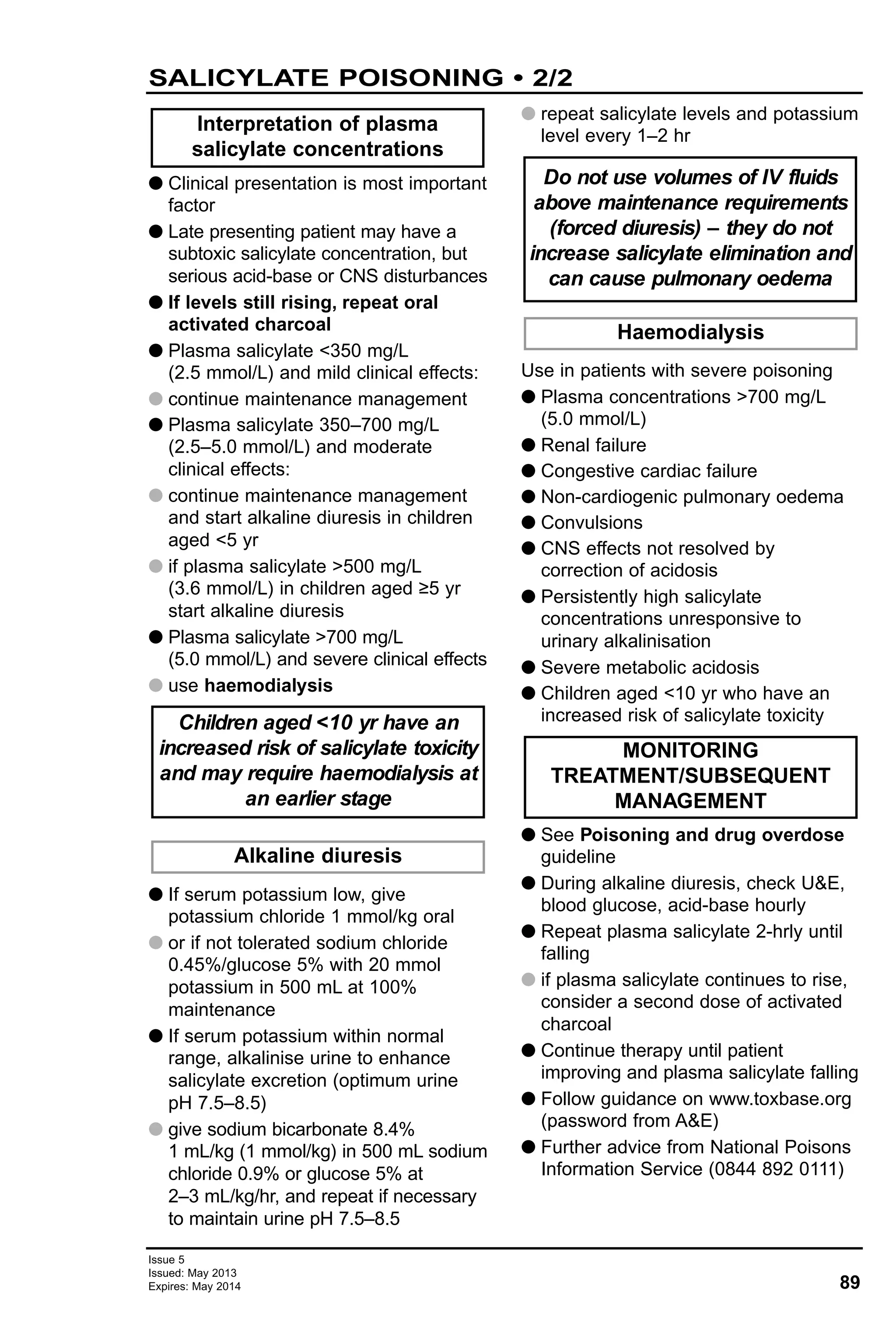
Salicylate poisoning.................................................................................................... 88
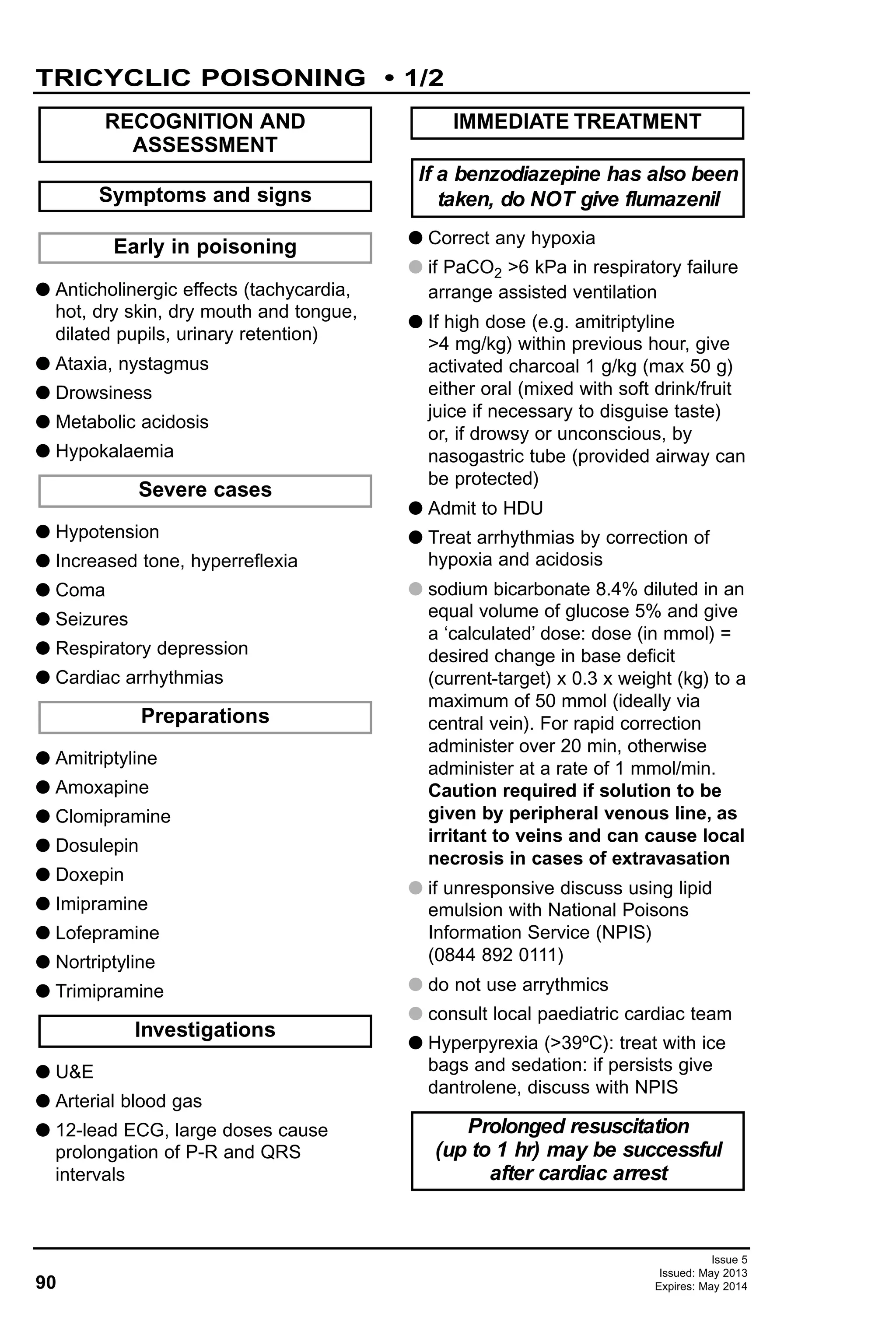
Tricyclic poisoning.......................................................................................................90
Diabetes and fasting................................................................................................... 92
Diabetic ketoacidosis.................................................................................................. 96
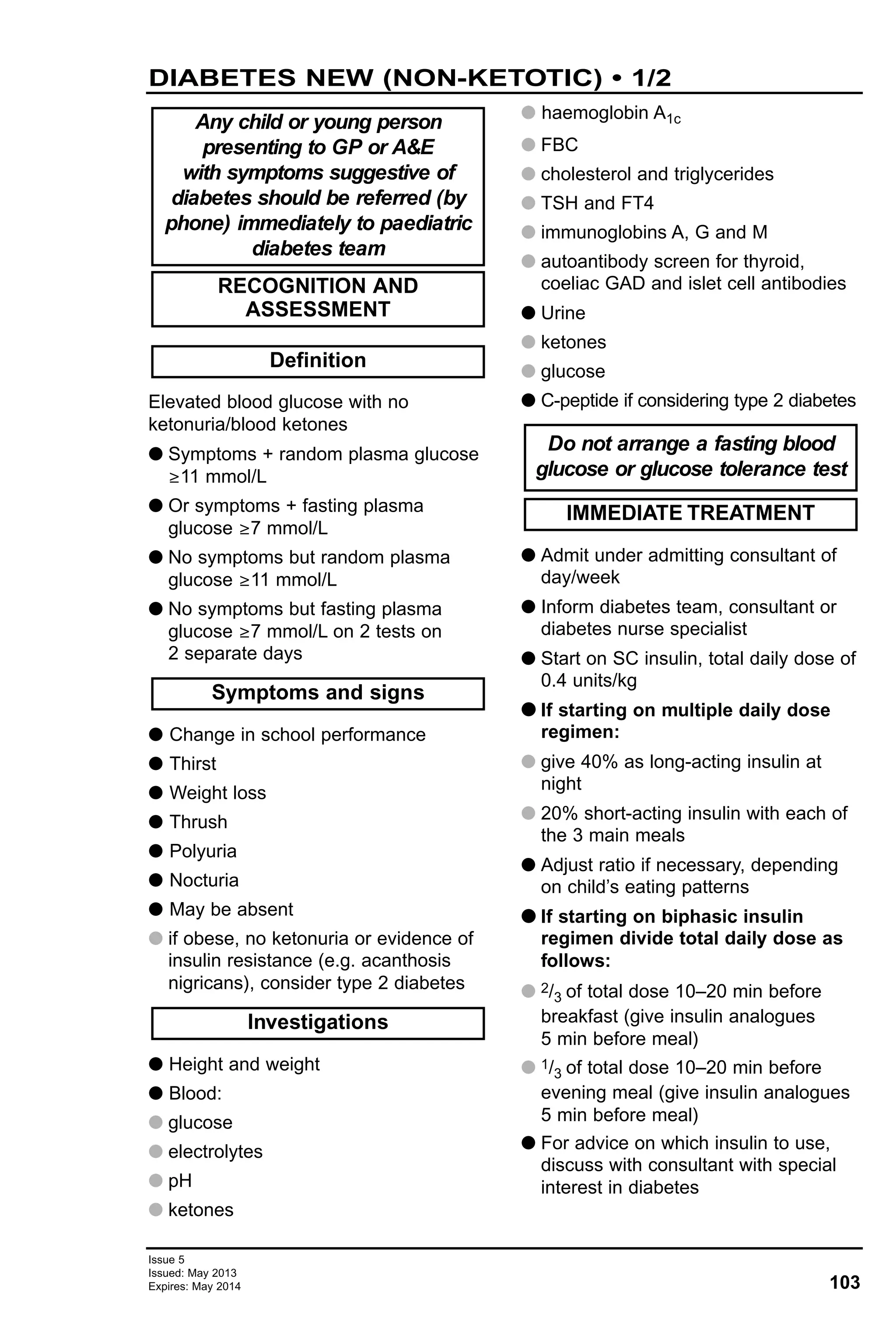
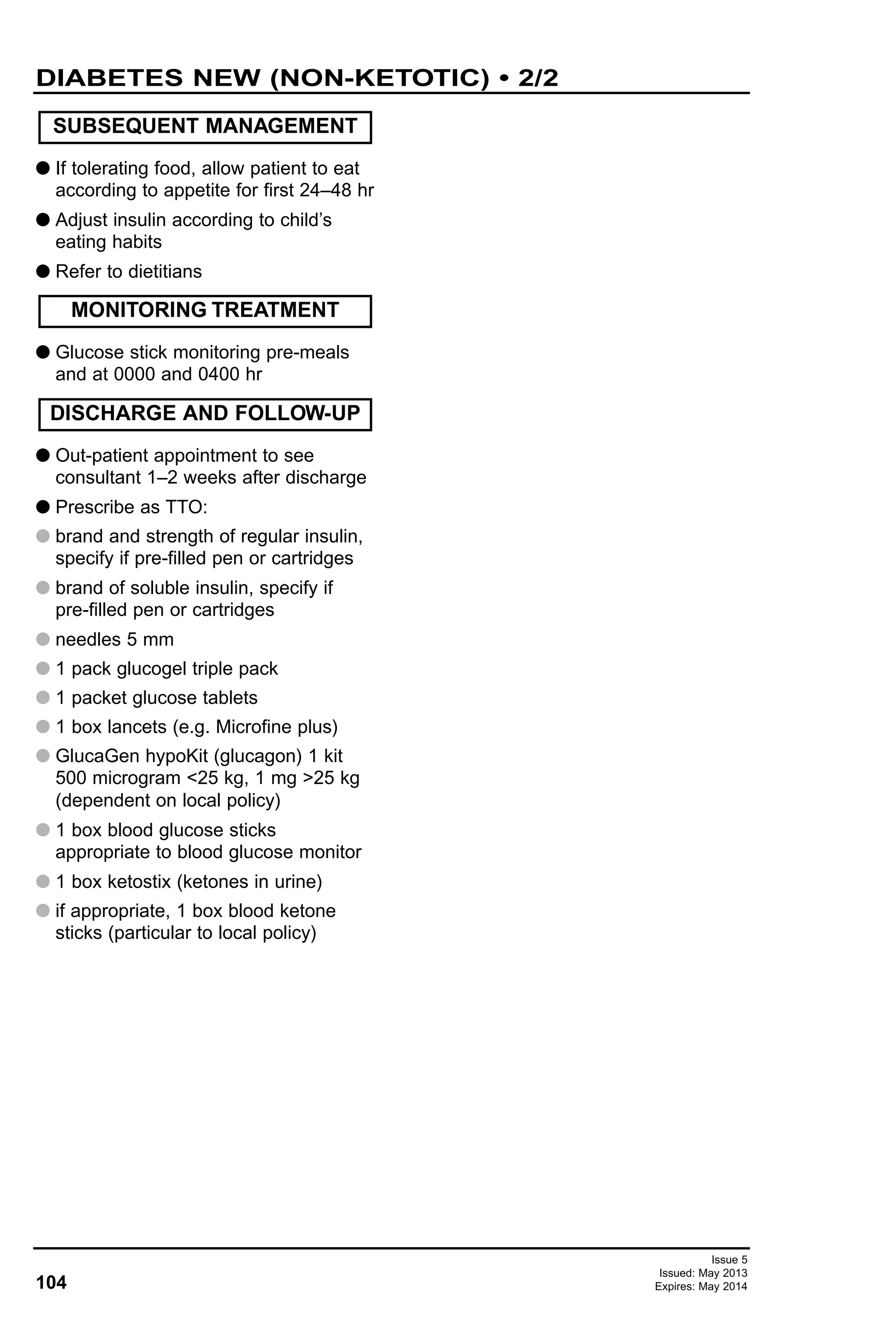
Diabetes new (non-ketotic)....................................................................................... 103
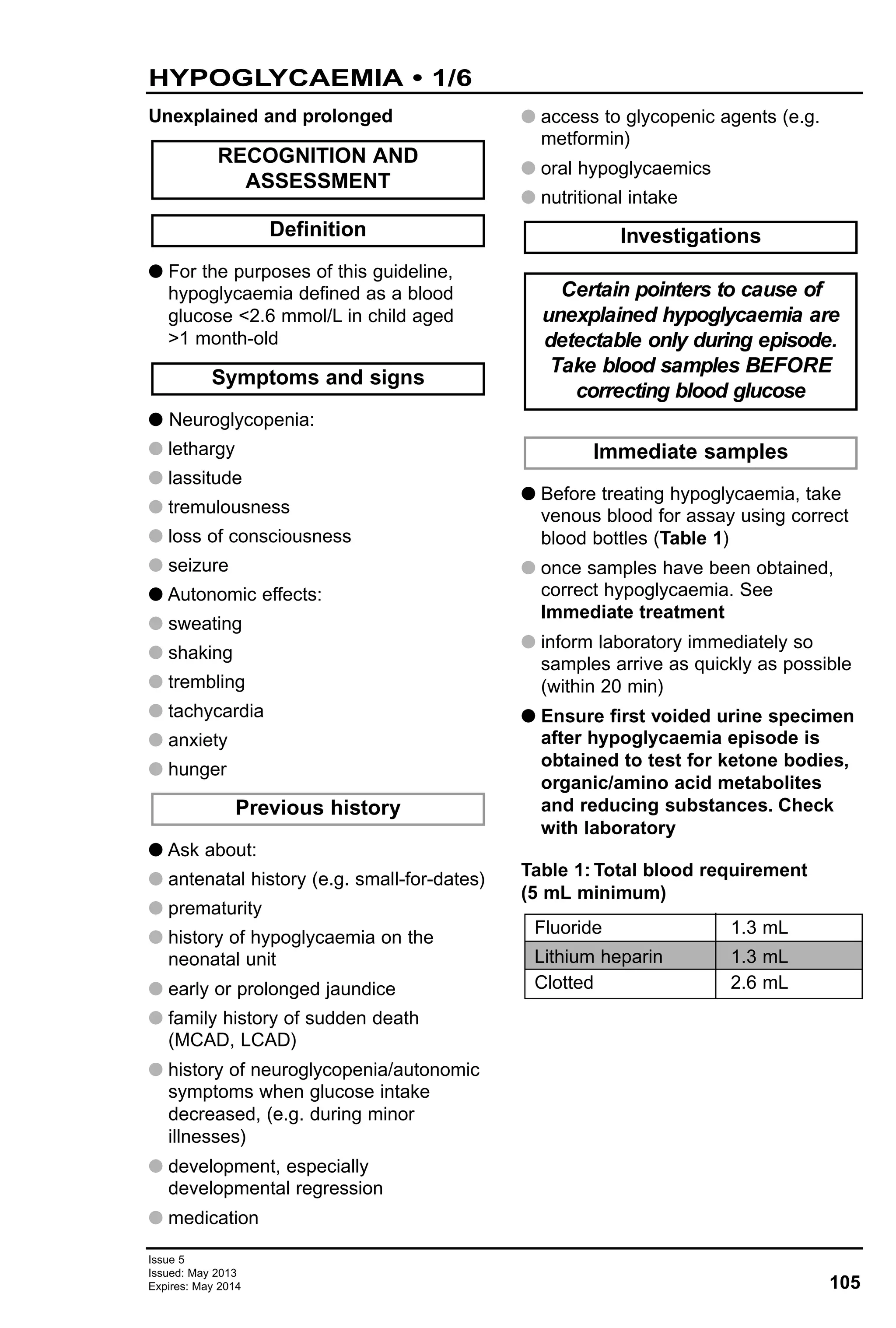
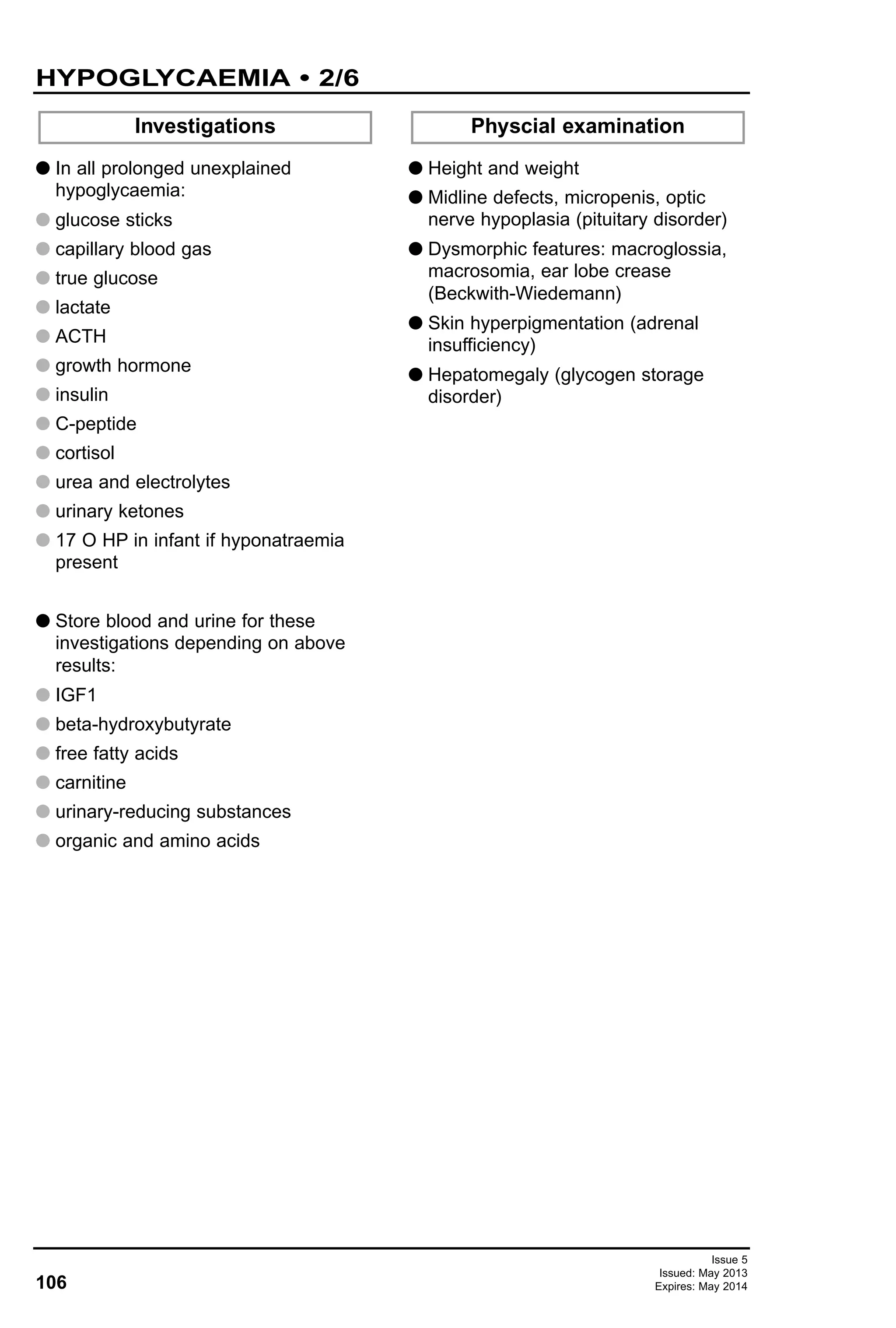
Hypoglycaemia..........................................................................................................105
Ketone monitoring..................................................................................................... 111
Steroid dependence.................................................................................................. 112
Abdominal pain..........................................................................................................114
Constipation...............................................................................................................117
Diarrhoea and vomiting.............................................................................................122
Nutritional first line advice ........................................................................................128
Failure to thrive......................................................................................................... 131
Jaundice....................................................................................................................134
Vitamin D deficiency .....................................................................................137
Blood and platelet transfusions.................................................................................138
Febrile neutropenia................................................................................................... 140
Henoch-Schönlein purpura....................................................................................... 143
Immune thrombocytopenic purpura (ITP)................................................................. 145
Haemophilia.............................................................................................................. 147
Antibiotics..................................................................................................................150
Bites.......................................................................................................................... 152
Cervical lymphadenopathy........................................................................................153
Fever ........................................................................................................................157
Fever of unknown origin ................................................................................161
Hepatitis.................................................................................................................... 163
HIV and hepatitis B post-exposure prophylaxis (PEP)............................................. 164
HIV testing.................................................................................................................166
NEW
I: INFECTION
NEW
E: ENDOCRINE/METABOLISM
G: GASTROENTEROLOGY
H: HAEMATOLOGY
5
Issue 5
Issued: May 2013
Expires: May 2014
CONTENTS • 3/3
Immunodeficiency......................................................................................................168
Kawasaki disease......................................................................................................170
Malaria ......................................................................................................................173
Meningitis.................................................................................................................. 176
Notifiable infectious diseases and food poisoning.....................................................180
Orbital cellulitis..........................................................................................................182
Osteomyelitis and septic arthritis.............................................................................. 183
Petechial/purpuric rashes..........................................................................................186
Septicaemia (including meningococcal)....................................................................187
Tuberculosis..............................................................................................................191
Facial palsy.................................................................................................................195
Epilepsy......................................................................................................................196
Status epilepticus.......................................................................................................201
Neuromuscular disorders..........................................................................................202
Glasgow coma score................................................................................................ 204
Glomerulonephritis.................................................................................................... 205
Haemolytic uraemic syndrome..................................................................................207
Hypertension............................................................................................................. 209
Nephrotic syndrome..................................................................................................215
Renal calculi..............................................................................................................219
Renal failure..............................................................................................................223
Renal investigations..................................................................................................226
Urinary tract infection ...............................................................................................230
Arthritis...................................................................................................................... 235
Limping child............................................................................................................. 237
Child protection......................................................................................................... 240
Self harm...................................................................................................................246
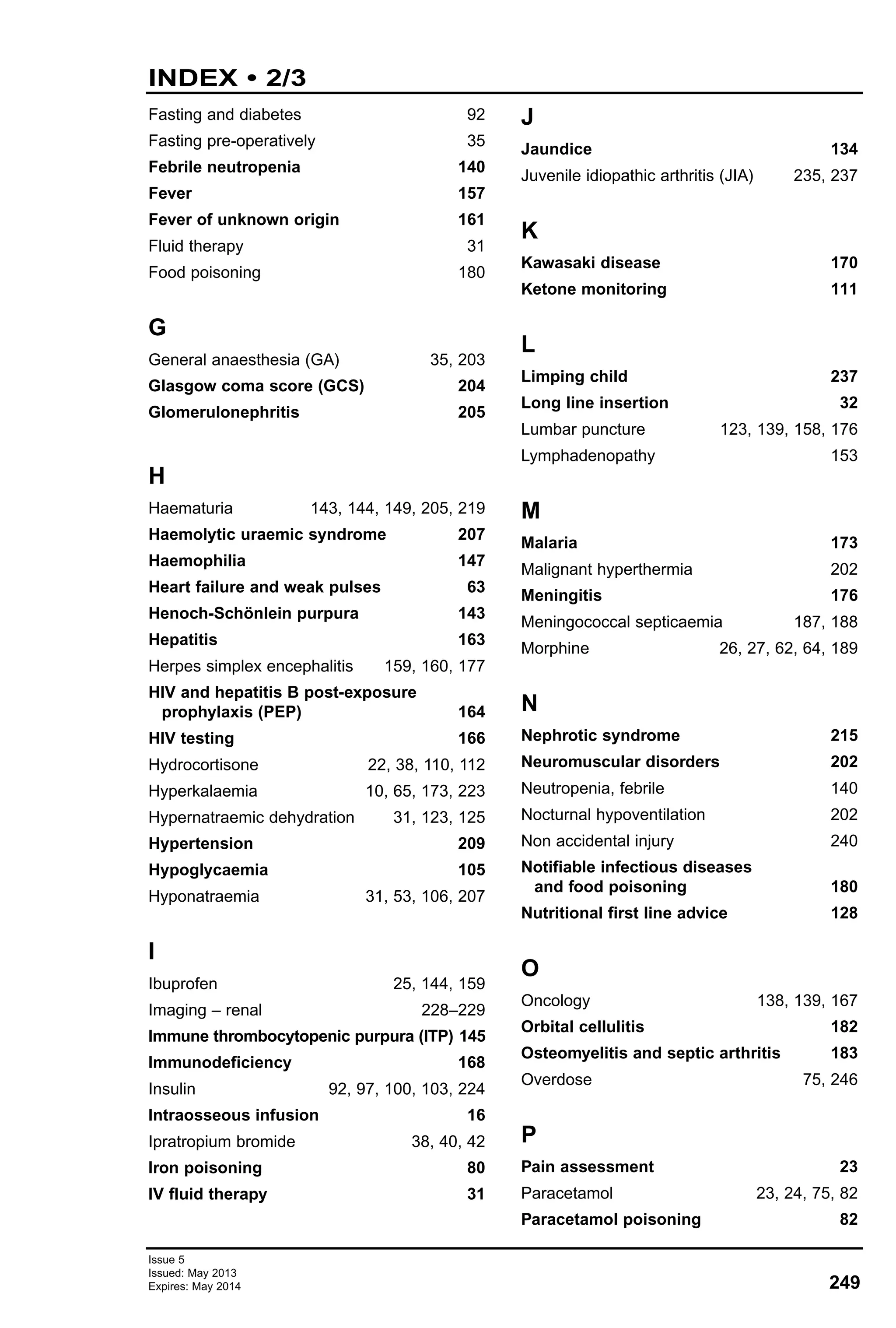
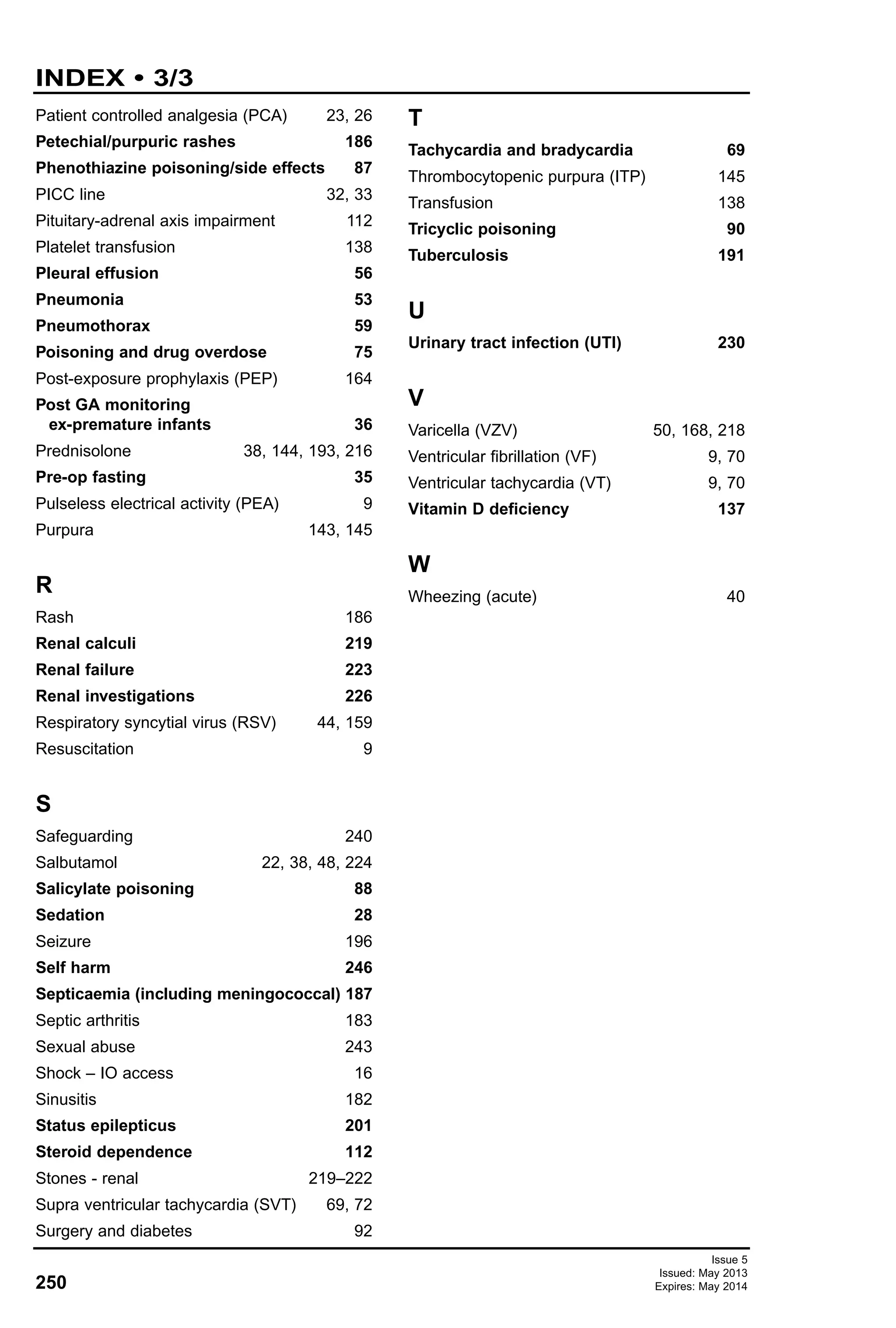
Index......................................................................................................................... 248
N: NEUROLOGY
R: RHEUMATOLOGY
R: RENAL
S: SAFEGUARDING
This book has been compiled as an aide-memoire for all staff concerned with the
management of general medical paediatric patients, especially those who present as
emergencies.
Guidelines on the management of common medical conditions
No guideline will apply to every patient, even where the diagnosis is clear-cut; there will
always be exceptions. These guidelines are not intended as a substitute for logical
thought and must be tempered by clinical judgement in the individual patient.
The administration of certain drugs, especially those given intravenously, requires
great care if hazardous errors are to be avoided. These guidelines do not include all
guidance on the indications, contraindications, dosage and administration for all drugs.
Please refer to the British National Formulary for Children (BNFc).
DO NOT attempt to carry out any of these Practical procedures unless you have been
trained to do so and have demonstrated your competence.
Where there are different recommendations the following order of prioritisation is
followed: NICE > NPSA > SIGN > RCPCH > National specialist society > BNFC >
Cochrane > Meta-analysis > systematic review > RCT > other peer review research >
review > local practice.
These have been written with reference to published medical literature and amended
after extensive consultation. Wherever possible, the recommendations made are
evidence based. Where no clear evidence has been identified from published literature
the advice given represents a consensus of the expert authors and their peers and is
based on their practical experience.
Where possible the guidelines are based on evidence from published literature. It is
intended that the evidence relating to statements made in the guidelines and its quality
will be made explicit.
Where supporting evidence has been identified it is graded I to V according to standard
criteria of validity and methodological quality as detailed in the table below. A summary
of the evidence supporting each statement is available, with the original sources
referenced (ward-based copies only). The evidence summaries are being developed on
a rolling programme which will be updated as each guideline is reviewed.
National guidelines
Prescribing regimens and nomograms
Supporting information
Evidence base
Practical procedures
The guidelines are advisory, NOT mandatory
6
PREFACE • 1/2
Issue 5
Issued: May 2013
Expires: May 2014
7
Issue 5
Issued: May 2013
Expires: May 2014
PREFACE • 2/2
Evaluating the evidence-base of these guidelines involves continuous review of both new
and existing literature. The editors encourage you to challenge the evidence provided in
this document. If you know of evidence that contradicts, or additional evidence in support
of the advice given in these guidelines please contact us.
The accuracy of the detailed advice given has been subject to exhaustive checks.
However, if any errors or omissions become apparent contact us so these can be
amended in the next review, or, if necessary, be brought to the urgent attention of users.
Constructive comments or suggestions would also be welcome.
Partners in Paediatrics, via www.networks.nhs.uk/nhs-networks/partners-in-paediatrics
or Bedside clinical guidelines partnership via e-mail:
bedsideclinicalguidelines@uhns.nhs.uk
Feedback
Contact
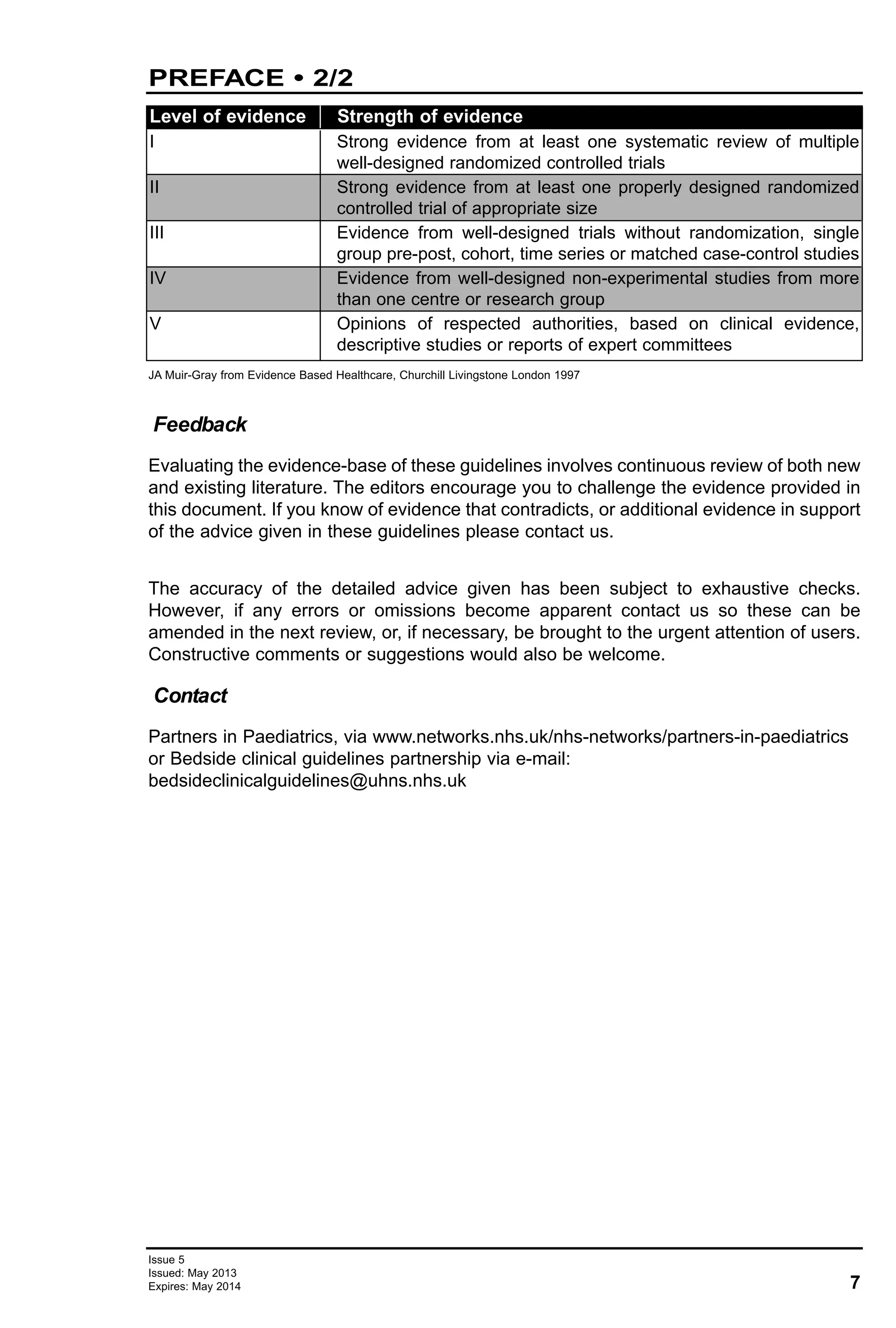
Level of evidence Strength of evidence
I Strong evidence from at least one systematic review of multiple
well-designed randomized controlled trials
II Strong evidence from at least one properly designed randomized
controlled trial of appropriate size
III Evidence from well-designed trials without randomization, single
group pre-post, cohort, time series or matched case-control studies
IV Evidence from well-designed non-experimental studies from more
than one centre or research group
V Opinions of respected authorities, based on clinical evidence,
descriptive studies or reports of expert committees
JA Muir-Gray from Evidence Based Healthcare, Churchill Livingstone London 1997
8
Issue 5
Issued: May 2013
Expires: May 2014
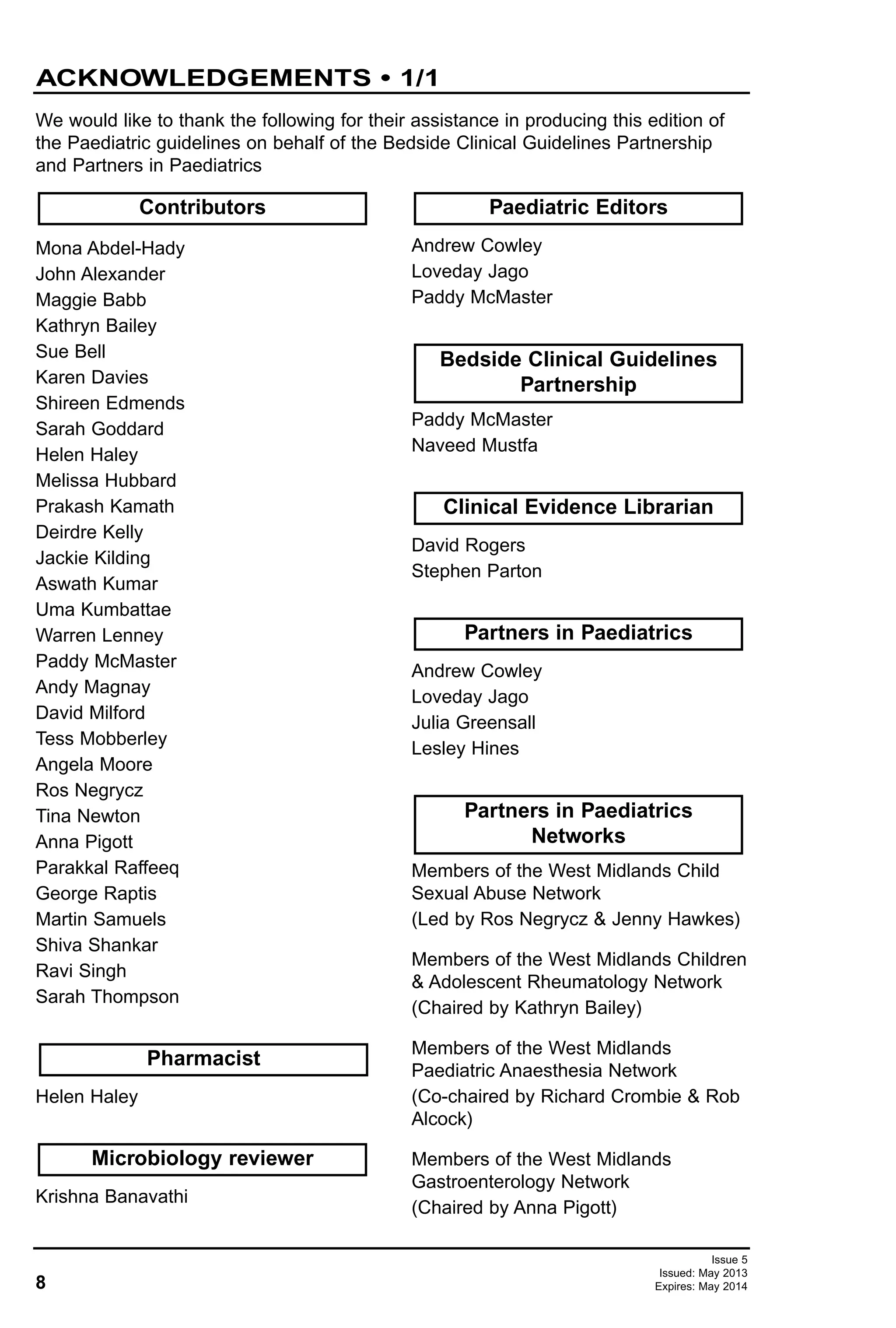
ACKNOWLEDGEMENTS • 1/1
Mona Abdel-Hady
John Alexander
Maggie Babb
Kathryn Bailey
Sue Bell
Karen Davies
Shireen Edmends
Sarah Goddard
Helen Haley
Melissa Hubbard
Prakash Kamath
Deirdre Kelly
Jackie Kilding
Aswath Kumar
Uma Kumbattae
Warren Lenney
Paddy McMaster
Andy Magnay
David Milford
Tess Mobberley
Angela Moore
Ros Negrycz
Tina Newton
Anna Pigott
Parakkal Raffeeq
George Raptis
Martin Samuels
Shiva Shankar
Ravi Singh
Sarah Thompson
Helen Haley
Krishna Banavathi
Andrew Cowley
Loveday Jago
Paddy McMaster
Paddy McMaster
Naveed Mustfa
David Rogers
Stephen Parton
Andrew Cowley
Loveday Jago
Julia Greensall
Lesley Hines
Members of the West Midlands Child
Sexual Abuse Network
(Led by Ros Negrycz & Jenny Hawkes)
Members of the West Midlands Children
& Adolescent Rheumatology Network
(Chaired by Kathryn Bailey)
Members of the West Midlands
Paediatric Anaesthesia Network
(Co-chaired by Richard Crombie & Rob
Alcock)
Members of the West Midlands
Gastroenterology Network
(Chaired by Anna Pigott)
Partners in Paediatrics
Networks
Contributors
Partners in Paediatrics
Clinical Evidence Librarian
Bedside Clinical Guidelines
Partnership
Paediatric Editors
Microbiology reviewer
Pharmacist
We would like to thank the following for their assistance in producing this edition of
the Paediatric guidelines on behalf of the Bedside Clinical Guidelines Partnership
and Partners in Paediatrics
9
Issue 5
Issued: May 2013
Expires: May 2014
APLS - CARDIORESPIRATORY ARREST • 1/3
Route Aged <12 yr Aged 12 yr – adult Notes
IV rapid bolus/
intraosseous
Endotracheal
tube (ETT)
10 microgram/kg
(0.1 mL/kg
of 1:10,000)
100 microgram/kg
(0.1 mL/kg of 1:1000
or
1 mL/kg of 1:10,000)
100 microgram/kg
(0.1 mL/kg of 1:1000
or
1 mL/kg of 1:10,000)
1 mg
(10 mL of
1:10,000)
5 mg
(5 mL of
1:10,000)
5 mg
(5 mL of 1:1000)
Initial and
usual
subsequent
dose
Exceptional
circumstances
(e.g. beta-
blocker
overdose)
-
If given by
intraosseous route
flush with sodium
chloride 0.9%
Maximum dose
5 mL of 1:1000
G Stimulate patient to assess for signs
of life and shout for help
G Establish basic life support: Airway –
Breathing – Circulation
G Connect ECG monitor: identify rhythm
and follow Algorithm
G Control airway and ventilation:
preferably intubate
G Obtain vascular access, peripheral or
intraosseous (IO)
G Change person performing chest
compressions every few minutes
G Inspect mouth: apply suction if
necessary
G Use either head tilt and chin lift or jaw
thrust
G Oro- or nasopharyngeal airway
G Intubation:
G endotracheal tube sizes
G term newborns 3–3.5 mm
G aged 1 yr 4.5 mm
G aged >1 yr: use formula [(age/4)
+ 4] mm for uncuffed tubes; 0.5
smaller for cuffed
G If airway cannot be achieved,
consider laryngeal mask or, failing
that, cricothyrotomy
G Self-inflating bag and mask with
100% oxygen
G Ventilation rate
G unintubated: 2 inflations for every 15
compressions
G intubated:10–12/min, with continuous
compressions
G Consider foreign body or
pneumothorax
G Cardiac compression rate:
100–120/min depressing lower half of
sternum by at least one third: push
hard, push fast
G Peripheral venous access: 1–2
attempts (<30 sec)
G Intraosseous access: 2–3 cm below
tibial tuberosity (see Intraosseous
infusion guideline)
G Use ECG monitor to decide between:
G a non-shockable rhythm: asystole or
pulseless electrical activity (PEA) i.e.
electromechanical dissociation
OR
G a shockable rhythm: ventricular
fibrillation or pulseless ventricular
tachycardia
Algorithm for managing these rhythms
follows:
G If arrest rhythm changes, restart
Algorithm
G If organised electrical activity seen,
check pulse and for signs of circulation
Circulation (C)
Breathing (B)
Airway (A)
MANAGEMENT
Adrenaline doses for asystole
10
APLS - CARDIORESPIRATORY ARREST • 2/3
Issue 5
Issued: May 2013
Expires: May 2014
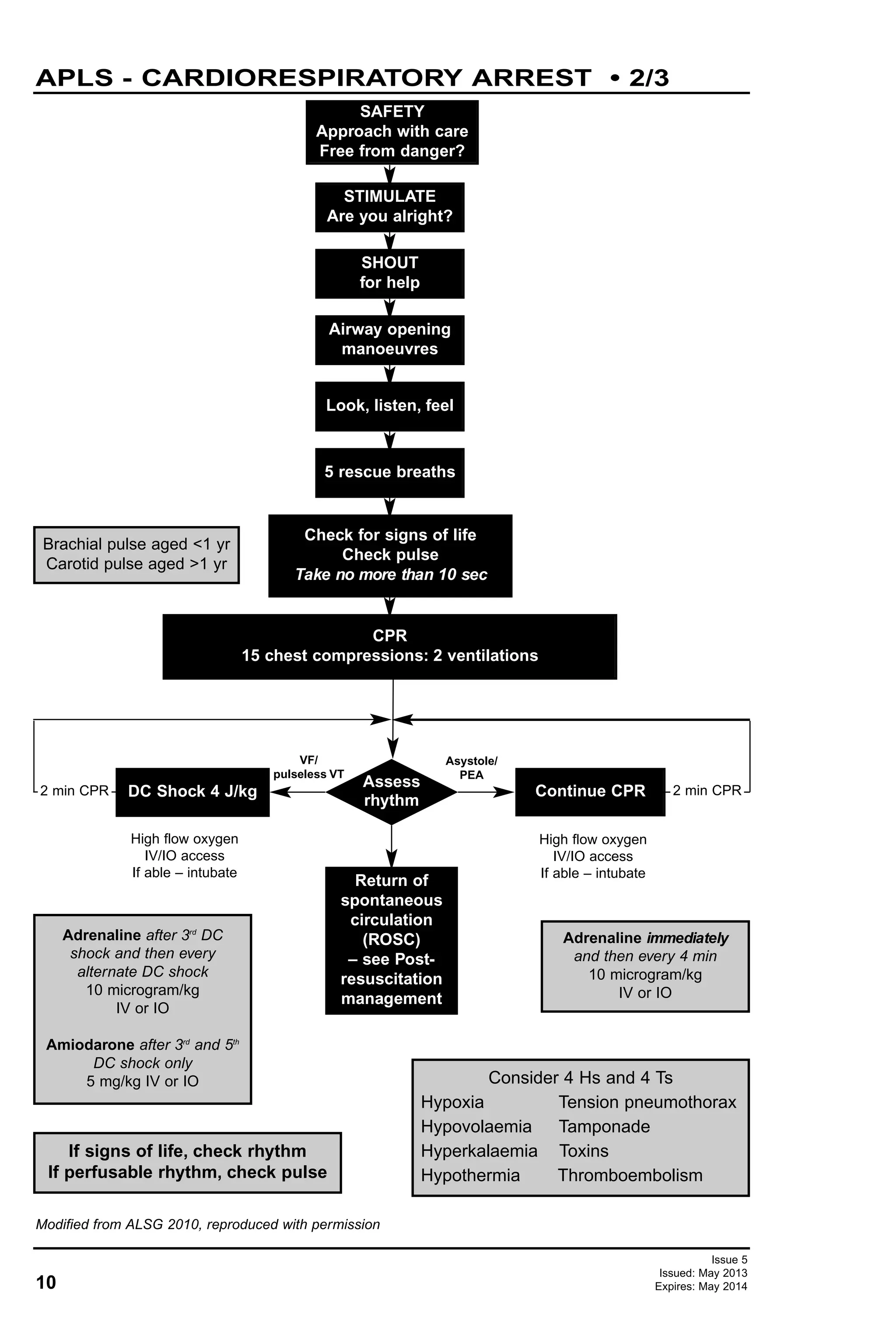
Brachial pulse aged <1 yr
Carotid pulse aged >1 yr
Consider 4 Hs and 4 Ts
Hypoxia Tension pneumothorax
Hypovolaemia Tamponade
Hyperkalaemia Toxins
Hypothermia Thromboembolism
If signs of life, check rhythm
If perfusable rhythm, check pulse
SAFETY
Approach with care
Free from danger?
STIMULATE
Are you alright?
SHOUT
for help
Airway opening
manoeuvres
Check for signs of life
Check pulse
Take no more than 10 sec
CPR
15 chest compressions: 2 ventilations
DC Shock 4 J/kg Continue CPR
High flow oxygen
IV/IO access
If able – intubate
High flow oxygen
IV/IO access
If able – intubate
Adrenaline after 3rd
DC
shock and then every
alternate DC shock
10 microgram/kg
IV or IO
Amiodarone after 3rd
and 5th
DC shock only
5 mg/kg IV or IO
Adrenaline immediately
and then every 4 min
10 microgram/kg
IV or IO
Look, listen, feel
5 rescue breaths
Assess
rhythm
VF/
pulseless VT
Asystole/
PEA
Return of
spontaneous
circulation
(ROSC)
– see Post-
resuscitation
management
Modified from ALSG 2010, reproduced with permission
2 min CPR 2 min CPR
11
Issue 5
Issued: May 2013
Expires: May 2014
APLS - CARDIORESPIRATORY ARREST • 3/3
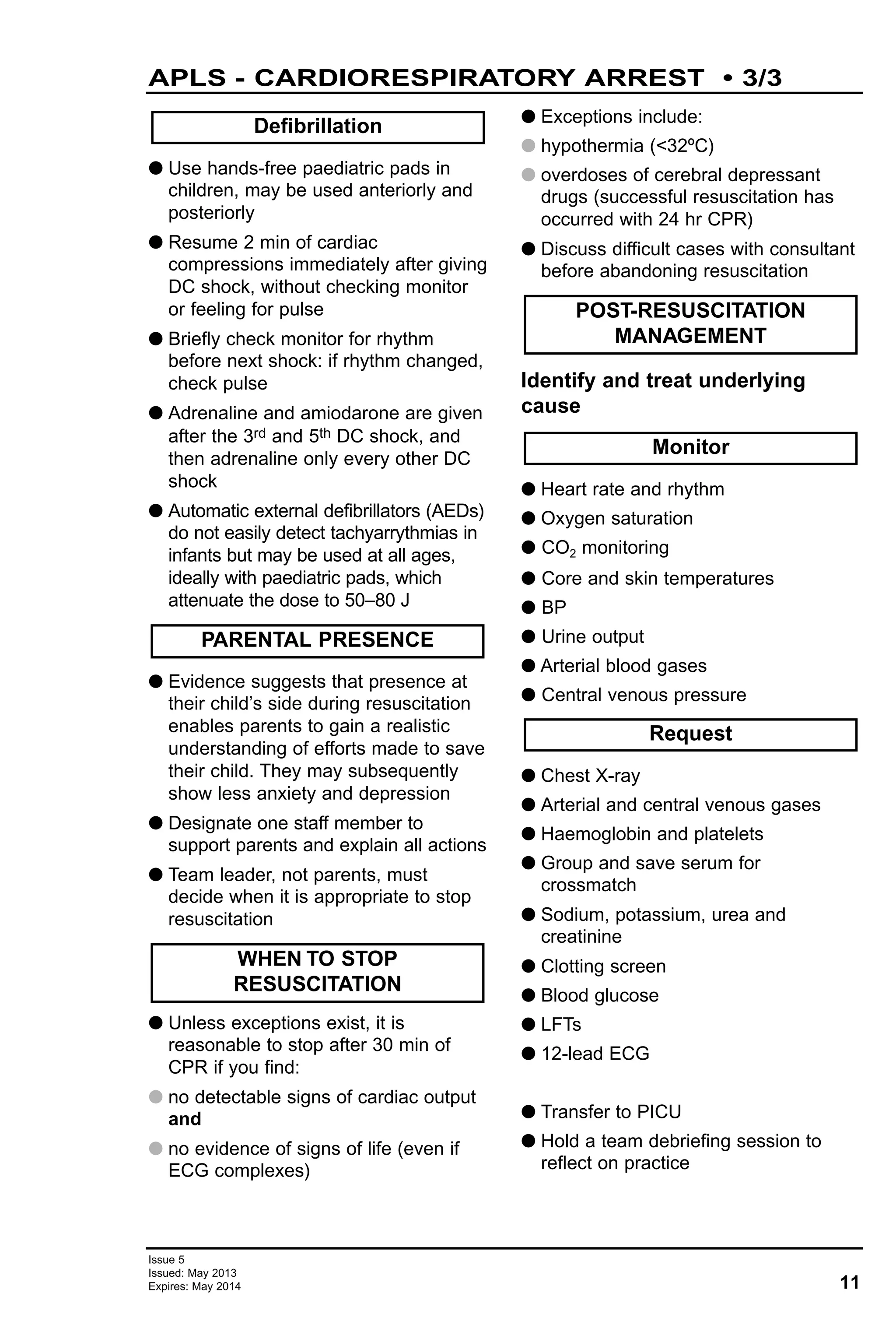
G Use hands-free paediatric pads in
children, may be used anteriorly and
posteriorly
G Resume 2 min of cardiac
compressions immediately after giving
DC shock, without checking monitor
or feeling for pulse
G Briefly check monitor for rhythm
before next shock: if rhythm changed,
check pulse
G Adrenaline and amiodarone are given
after the 3rd and 5th DC shock, and
then adrenaline only every other DC
shock
G Automatic external defibrillators (AEDs)
do not easily detect tachyarrythmias in
infants but may be used at all ages,
ideally with paediatric pads, which
attenuate the dose to 50–80 J
G Evidence suggests that presence at
their child’s side during resuscitation
enables parents to gain a realistic
understanding of efforts made to save
their child. They may subsequently
show less anxiety and depression
G Designate one staff member to
support parents and explain all actions
G Team leader, not parents, must
decide when it is appropriate to stop
resuscitation
G Unless exceptions exist, it is
reasonable to stop after 30 min of
CPR if you find:
G no detectable signs of cardiac output
and
G no evidence of signs of life (even if
ECG complexes)
G Exceptions include:
G hypothermia (<32ºC)
G overdoses of cerebral depressant
drugs (successful resuscitation has
occurred with 24 hr CPR)
G Discuss difficult cases with consultant
before abandoning resuscitation
Identify and treat underlying
cause
G Heart rate and rhythm
G Oxygen saturation
G CO2 monitoring
G Core and skin temperatures
G BP
G Urine output
G Arterial blood gases
G Central venous pressure
G Chest X-ray
G Arterial and central venous gases
G Haemoglobin and platelets
G Group and save serum for
crossmatch
G Sodium, potassium, urea and
creatinine
G Clotting screen
G Blood glucose
G LFTs
G 12-lead ECG
G Transfer to PICU
G Hold a team debriefing session to
reflect on practice
Defibrillation
PARENTAL PRESENCE
Request
Monitor
POST-RESUSCITATION
MANAGEMENT
WHEN TO STOP
RESUSCITATION
G Effort of breathing
G respiratory rate
G recession
G use of accessory muscles
G additional sounds: stridor, wheeze,
grunting
G flaring of nostrils
G Efficacy of breathing
G chest movement and symmetry
G breath sounds
G SpO2 in air
G Heart rate
G Pulse volume
G peripheral
G central (carotid/femoral)
G Blood pressure
G Capillary refill time
G Skin colour and temperature
G Conscious level
G Posture
G Pupils
G Fever
G Skin rashes, bruising
G Glucose stix
G Complete assessment should take
<1 min
G Treat as problems are found
G Once airway (A), breathing (B) and
circulation (C) are clearly recognised
as being stable or have been
stabilised, definitive management of
underlying condition can proceed
G Reassessment of ABCDE at frequent
intervals necessary to assess progress
and detect deterioration
G Hypoglycaemia: glucose 10% 2 mL/kg
followed by IV glucose infusion
G Give clear explanations to parents and
child
G Allow and encourage parents to
remain with child at all times
Anticipated weight in relation to age
Weight can be estimated using following
formulae:
G 0–12 months: wt (kg) = [age (m) / 2] + 4
G 1–6 years: wt (kg) = [age (y) + 4] x 2
G 7–14 years: wt (kg) = [age (y) x 3] + 7
G Vocalisations (e.g. crying or talking)
indicate ventilation and some degree
of airway patency
G Assess patency by:
G looking for chest and/or abdominal
movement
G listening for breath sounds
G feeling for expired air
Primary assessment of airway
Airway
Weight
RECOGNITION AND
ASSESSMENT OF THE SICK
CHILD
CHILD AND PARENTS
Assessment
Actions
Don’t Ever Forget Glucose
(DEFG)
Exposure (E)
Disability (D)
Circulation (C)
Airway (A) and Breathing (B)
SUMMARY OF RAPID CLINICAL
ASSESSMENT
12
APLS - RECOGNITION AND ASSESSMENT OF THE
SICK CHILD • 1/4
Issue 5
Issued: May 2013
Expires: May 2014
Age Weight (kg)
Birth 3.5
5 months 7
1 yr 10
G Infants: a neutral head position; other
children: ‘sniffing the morning air’
G Other signs that may suggest upper
airway obstruction:
G stridor
G intercostal/subcostal/sternal recession
G Assess
G effort of breathing
G efficacy of breathing
G effects of respiratory failure
G Respiratory rates ‘at rest’ at different
ages
G Respiratory rate:
G tachypnoea: from either lung or
airway disease or metabolic acidosis
G bradypnoea: due to fatigue, raised
intracranial pressure, or pre-terminal
G Recession:
G intercostal, subcostal or sternal
recession shows increased effort of
breathing
G degree of recession indicates severity
of respiratory difficulty
G in child with exhaustion, chest
movement and recession will decrease
G Inspiratory or expiratory noises:
G stridor, usually inspiratory, indicates
laryngeal or tracheal obstruction
G wheeze, predominantly expiratory,
indicates lower airway obstruction
G volume of noise is not an indicator of
severity
G Grunting:
G a sign of severe respiratory distress
G can also occur in intracranial and
intra-abdominal emergencies
G Accessory muscle use
G Gasping (a sign of severe
hypoxaemia and can be pre-terminal)
G Flaring of nostrils
G Breath sounds on auscultation:
G reduced or absent
G bronchial
G symmetrical or asymmetric
G Chest expansion and, more
importantly in infants, abdominal ‘see-
sawing’
G Pulse oximetry
G Heart rate:
G increased by hypoxia, fever or stress
G bradycardia a pre-terminal sign
Effects of respiratory failure on
other physiology
Efficacy of breathing
Exceptions
G Increased effort of breathing
DOES NOT occur in three
circumstances:
G exhaustion
G central respiratory depression
(e.g. from raised intracranial
depression, poisoning or
encephalopathy)
G neuromuscular disease (e.g.
spinal muscular atrophy, muscular
dystrophy or poliomyelitis)
Effort of breathing
Primary assessment of
breathing
Breathing
Re-assess after any airway
opening manoeuvres
13
Issue 5
Issued: May 2013
Expires: May 2014
APLS - RECOGNITION AND ASSESSMENT OF THE
SICK CHILD • 2/4
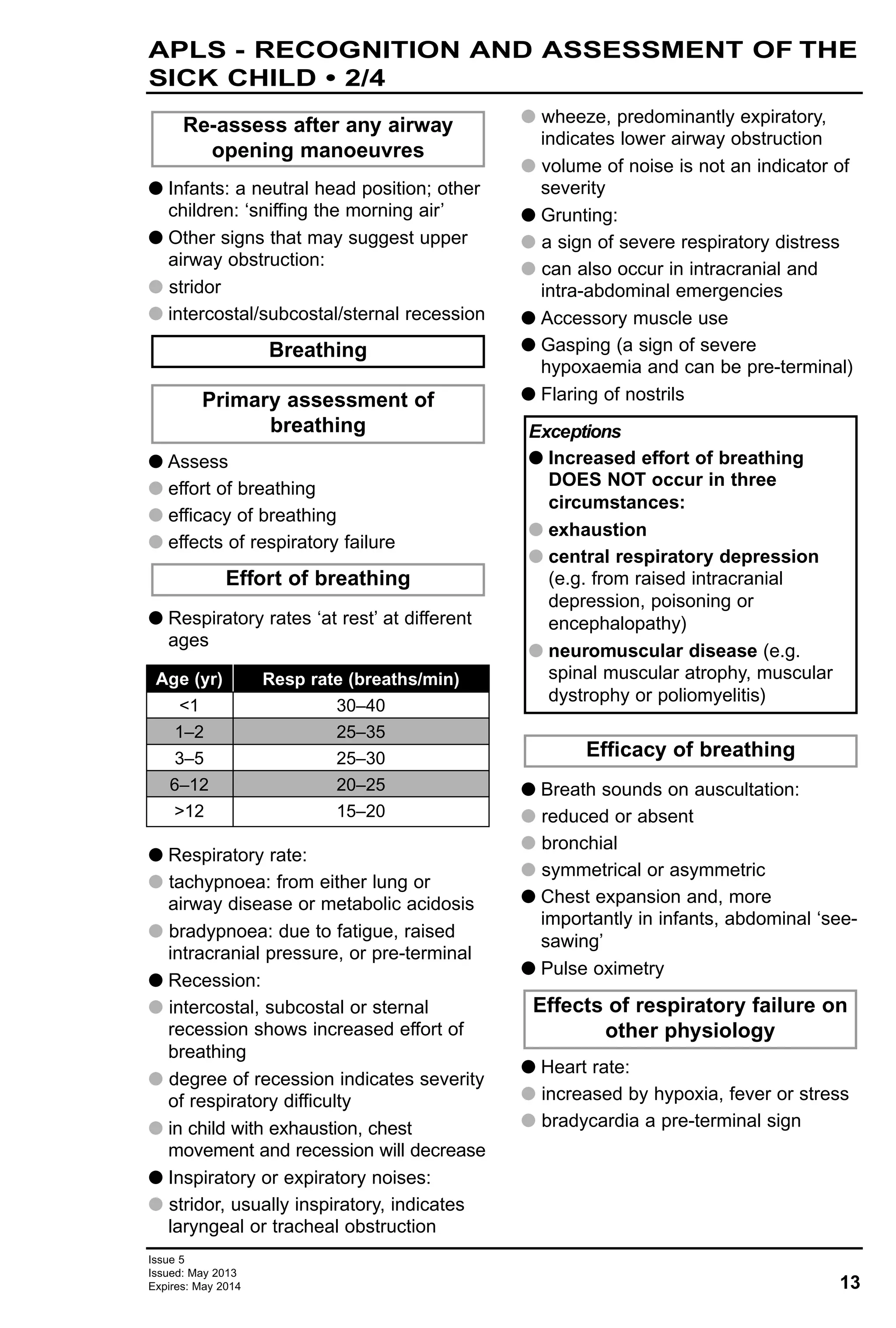
Resp rate (breaths/min)
30–40
25–35
25–30
20–25
15–20
Age (yr)
<1
1–2
3–5
6–12
>12
G Skin colour:
G hypoxia first causes vasoconstriction
and pallor (via catecholamine release)
G cyanosis is a late and pre-terminal sign
G some children with congenital heart
disease may be permanently cyanosed
and oxygen may have little effect
G Mental status:
G hypoxic child will be agitated first,
then drowsy and unconscious
G pulse oximetry can be difficult to
achieve in agitated child owing to
movement artefact
G Heart rates ‘at rest’ at different ages
G Absent peripheral pulses or reduced
central pulses indicate shock
G Pressure on centre of sternum or a
digit for 5 sec should be followed by
return of circulation in skin within
2 sec
G can be prolonged by shock or cold
environmental temperatures
G not a specific or sensitive sign of
shock
G should not be used alone as a guide
to response to treatment
G Cuff should cover >80% of length of
upper arm
G expected systolic BP = 85 + (age in
yrs x 2)
G Hypotension is a late and pre-terminal
sign of circulatory failure
G Respiratory system:
G tachypnoea and hyperventilation
occurs with acidosis
G Skin:
G pale or mottled skin colour indicates
poor perfusion
G Mental status:
G agitation, then drowsiness leading to
unconsciousness
G Urinary output:
G <1 mL/kg/hr (<2 mL/kg/hr in infants)
indicates inadequate renal perfusion
G Cyanosis, not relieved by oxygen
therapy
G Tachycardia out of proportion to
respiratory difficulty
G Raised JVP
G Gallop rhythm/murmur
G Enlarged liver
G Absent femoral pulses
G Always assess and treat airway,
breathing and circulatory problems
before undertaking neurological
assessment:
G respiratory and circulatory failure will
have central neurological effects
G central neurological conditions (e.g.
meningitis, raised intracranial
pressure, status epilepticus) will have
both respiratory and circulatory
consequences
Primary assessment of
disability
Disability
Features suggesting cardiac
cause of respiratory inadequacy
Effects of circulatory
inadequacy on other
organs/physiology
BP
Capillary refill
Pulse volume
Circulation
14
APLS - RECOGNITION AND ASSESSMENT OF THE
SICK CHILD • 3/4
Issue 5
Issued: May 2013
Expires: May 2014
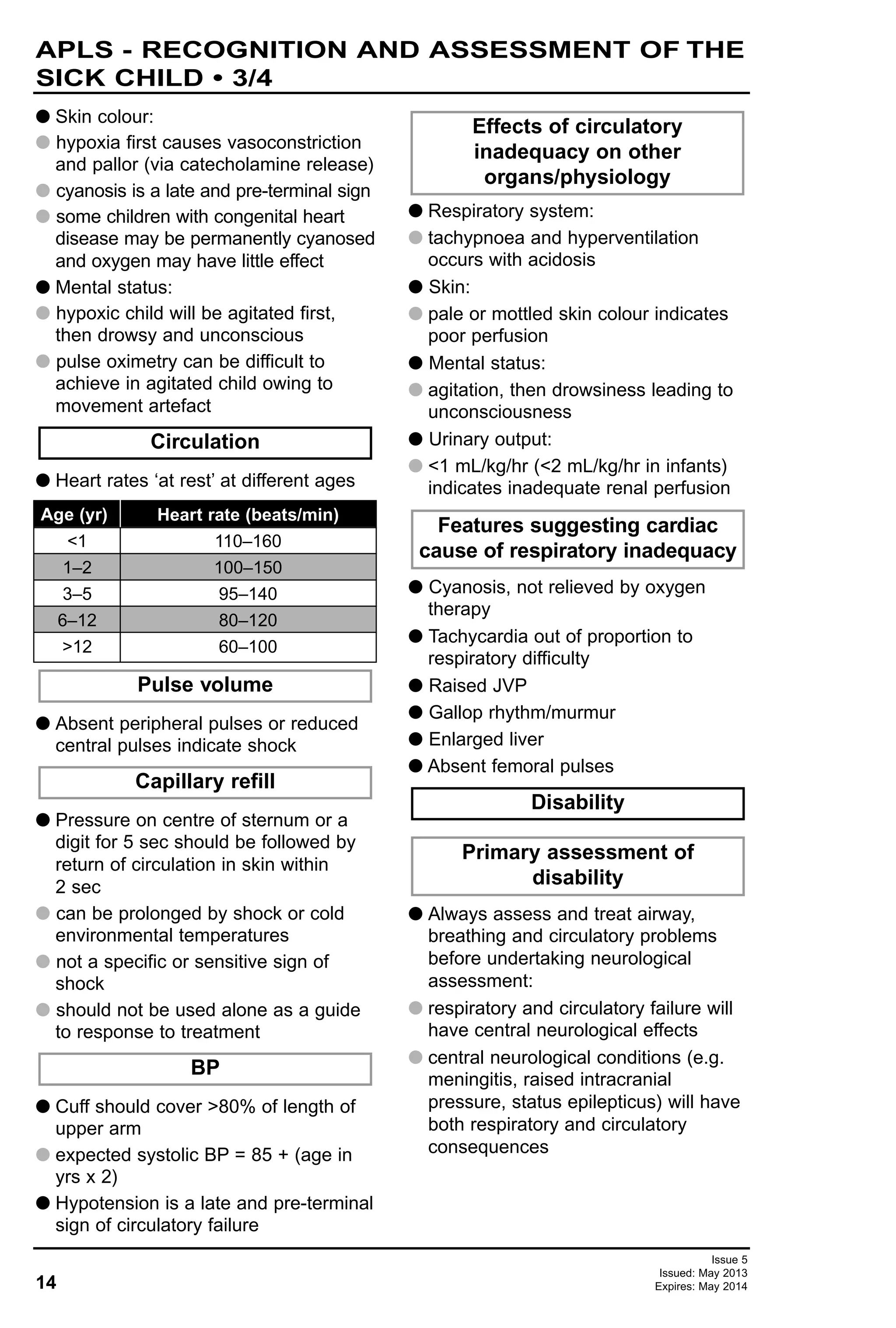
Heart rate (beats/min)
110–160
100–150
95–140
80–120
60–100
Age (yr)
<1
1–2
3–5
6–12
>12
G Conscious level: AVPU (Figure 1); a
painful central stimulus may be
applied by sternal pressure or by
pulling frontal hair
G Posture:
G hypotonia
G decorticate or decerebrate postures
may only be elicited by a painful
stimulus
G Pupils – look for:
G pupil size, reactivity and symmetry
G dilated, unreactive or unequal pupils
indicate serious brain disorders
G Raised intracranial pressure may
induce:
G hyperventilation
G Cheyne-Stokes breathing
G slow, sighing respiration
G apnoea
G Raised intracranial pressure may
induce:
G systemic hypertension
G sinus bradycardia
Circulatory effects
Respiratory effects
Neurological function
15
Issue 5
Issued: May 2013
Expires: May 2014
APLS - RECOGNITION AND ASSESSMENT OF THE
SICK CHILD • 4/4
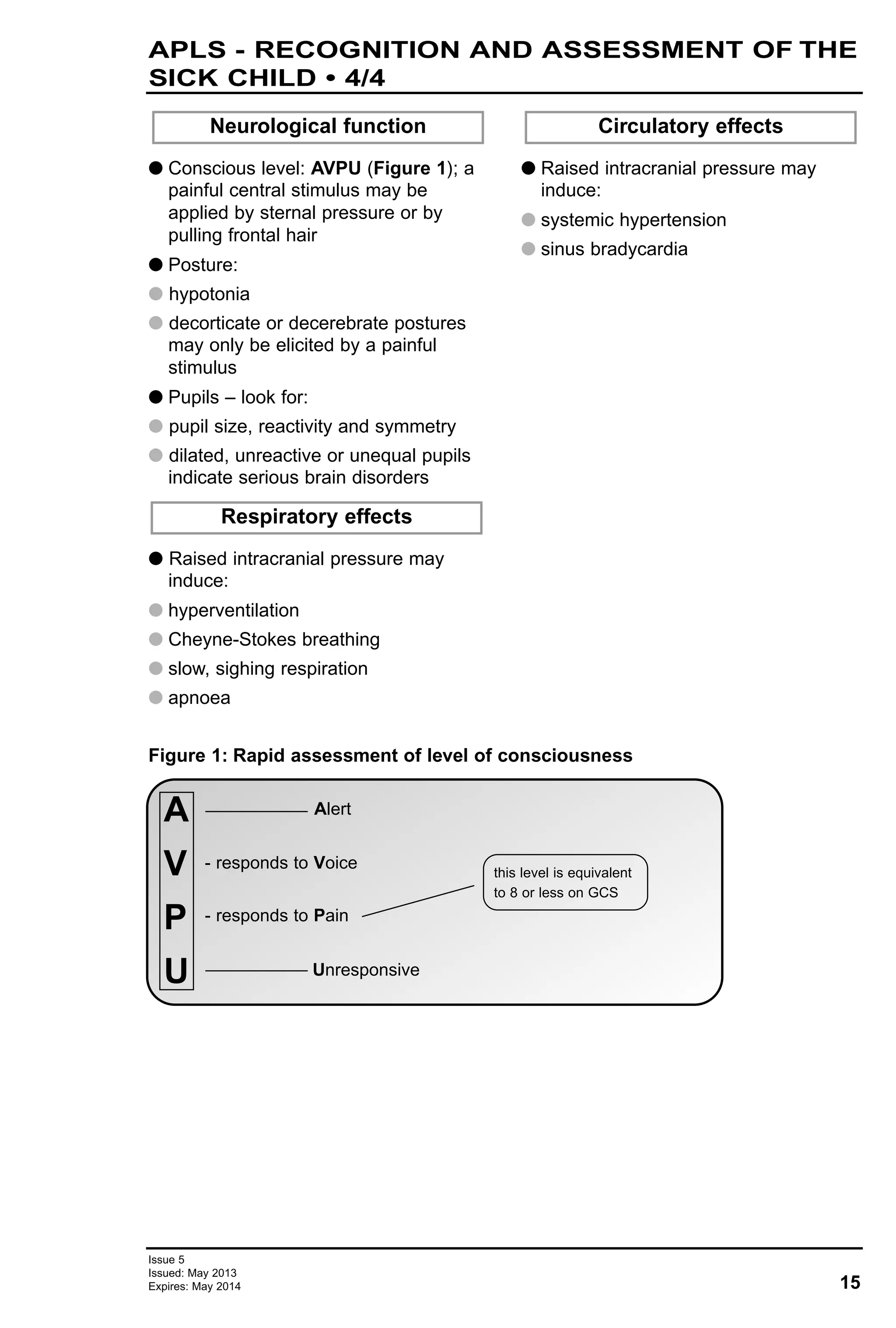
Figure 1: Rapid assessment of level of consciousness
A
V
P
U
Alert
- responds to Voice
- responds to Pain
Unresponsive
this level is equivalent
to 8 or less on GCS
G Profound shock or cardiac arrest,
when immediate vascular access
needed and peripheral access not
possible (maximum 2 attempts)
G allows rapid expansion of circulating
volume
G gives time to obtain IV access and
facilitates procedure by increasing
venous filling
G Intraosseous infusion needles for
manual insertion or EZ-IO drill and
needles (<40 kg: 15 mm pink; >40 kg:
25 mm blue) on resuscitation trolley
G Alcohol swabs to clean skin
G 5 mL syringe to aspirate and confirm
correct position
G 10 mL sodium chloride 0.9% flush
G 20 or 50 mL syringe to administer
fluid boluses
G Infusion fluid
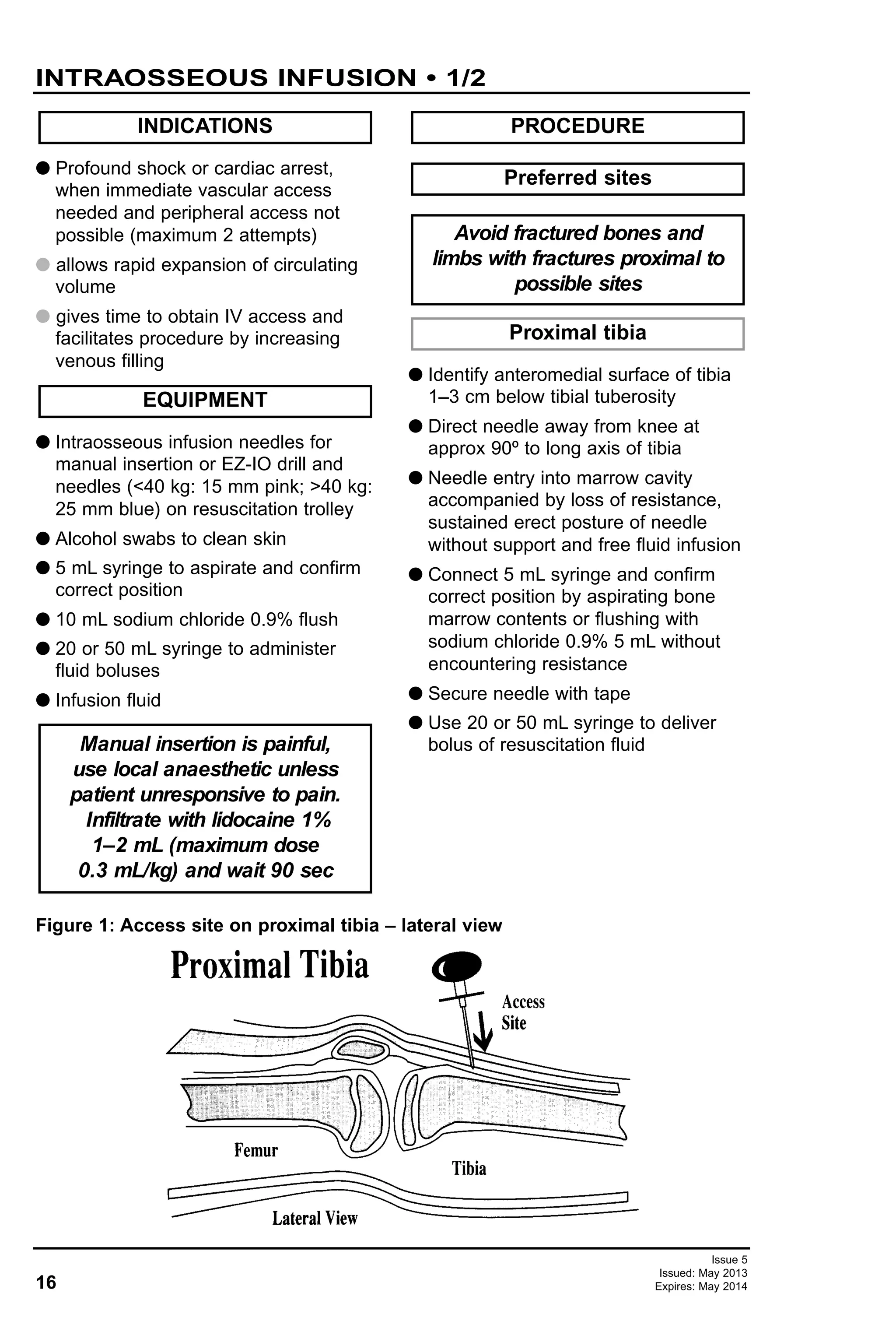
G Identify anteromedial surface of tibia
1–3 cm below tibial tuberosity
G Direct needle away from knee at
approx 90º to long axis of tibia
G Needle entry into marrow cavity
accompanied by loss of resistance,
sustained erect posture of needle
without support and free fluid infusion
G Connect 5 mL syringe and confirm
correct position by aspirating bone
marrow contents or flushing with
sodium chloride 0.9% 5 mL without
encountering resistance
G Secure needle with tape
G Use 20 or 50 mL syringe to deliver
bolus of resuscitation fluid
Proximal tibia
Avoid fractured bones and
limbs with fractures proximal to
possible sites
Preferred sites
PROCEDURE
Manual insertion is painful,
use local anaesthetic unless
patient unresponsive to pain.
Infiltrate with lidocaine 1%
1–2 mL (maximum dose
0.3 mL/kg) and wait 90 sec
EQUIPMENT
INDICATIONS
16
INTRAOSSEOUS INFUSION • 1/2
Issue 5
Issued: May 2013
Expires: May 2014
Figure 1: Access site on proximal tibia – lateral view
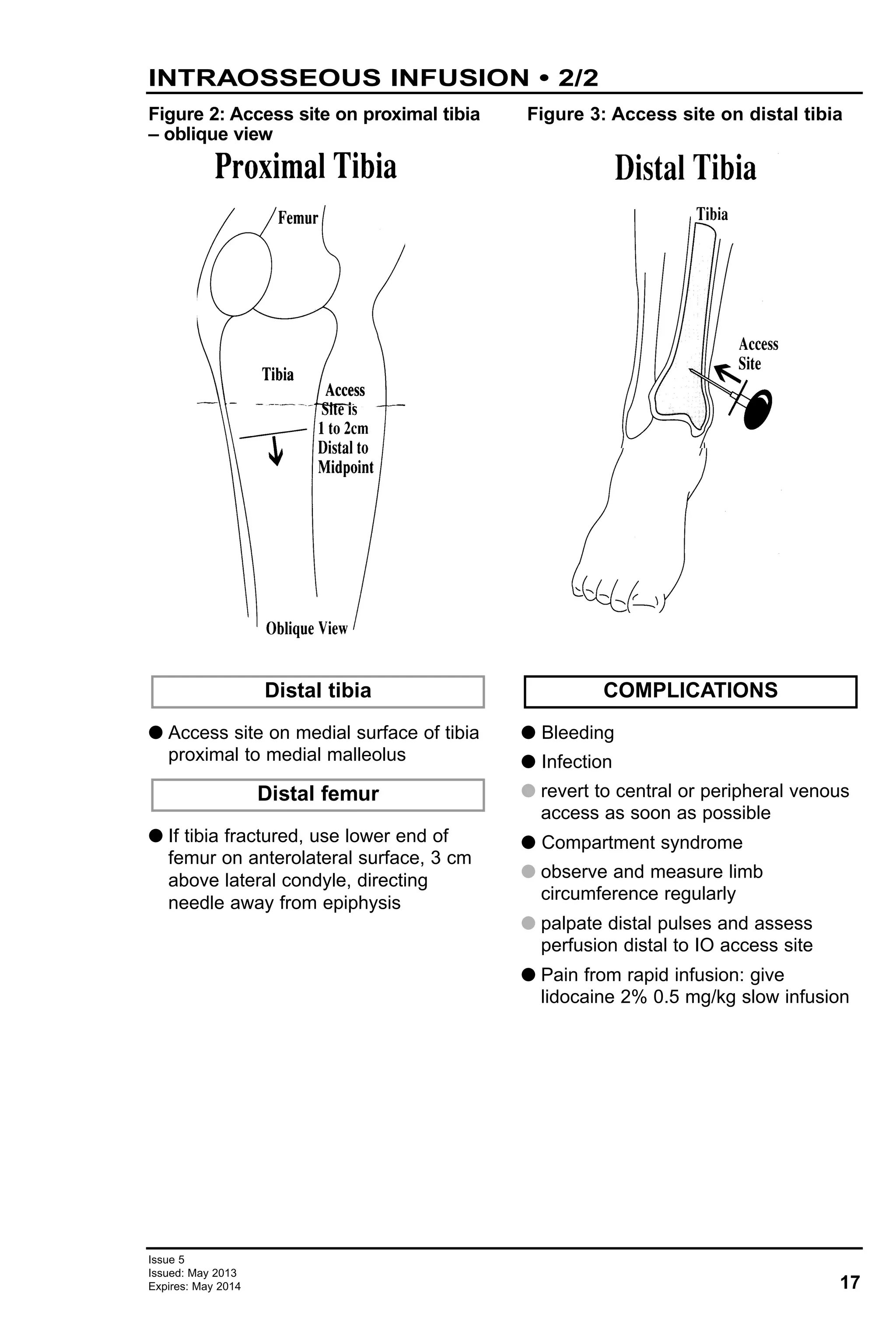
G Access site on medial surface of tibia
proximal to medial malleolus
G If tibia fractured, use lower end of
femur on anterolateral surface, 3 cm
above lateral condyle, directing
needle away from epiphysis
G Bleeding
G Infection
G revert to central or peripheral venous
access as soon as possible
G Compartment syndrome
G observe and measure limb
circumference regularly
G palpate distal pulses and assess
perfusion distal to IO access site
G Pain from rapid infusion: give
lidocaine 2% 0.5 mg/kg slow infusion
COMPLICATIONS
Distal femur
Distal tibia
17
Issue 5
Issued: May 2013
Expires: May 2014
INTRAOSSEOUS INFUSION • 2/2
Figure 2: Access site on proximal tibia
– oblique view
Figure 3: Access site on distal tibia
A sudden, unexpected change in an
infant’s behaviour that is frightening to
the observer and includes changes in
two or more of the following:
G Breathing: noisy, apnoea
G Colour: blue, pale
G Consciousness, responsiveness
G Movement, including eyes
G Muscle tone: stiff, floppy
G Feeding
G Sleeping
G Infant and family illness and medicines
G Gestation at delivery
G Full examination including signs of
non-accidental injury
G SpO2
G Fundoscopy by paediatric
ophthalmologist if:
G recurrent
G severe events (e.g. received CPR)
G history or examination raises child
safeguarding concerns (e.g.
inconsistent history, blood in
nose/mouth, bruising or petechiae,
history of possible trauma)
G anaemic
Indicated if:
G Aged <1 month old
G <32 weeks gestation
G Previous illness/ALTE
G Examination abnormal
G Severe ALTE
G FBC
G U&E, blood glucose
G Plasma lactate
G Blood gases
G Blood culture
G Nasopharyngeal aspirate for virology
G Per-nasal swab for pertussis
G Urine microscopy and culture
(microbiology)
G Urine biochemistry: store for possible
further tests (see below)
G Chest X-ray
G ECG
If events recur during admission,
discuss with senior role of further
investigations (see below)
G SpO2, ECG monitoring
G Liaise with health visitor (direct or via
liaison HV on wards)
G Check if child known to local authority
children’s social care or is the subject
of a child protection plan
G If event brief and child completely well:
G reassure parents and offer
resuscitation training
G discharge (no follow-up appointment)
Examination
After 24 hr observation
Admit for observation
MANAGEMENT
Urgent
Immediate
Investigations
Assessment
Clinical history
INVESTIGATION OF FIRST ALTE
DEFINITION
18
APPARENT LIFE THREATENING EVENT (ALTE)
• 1/2
Issue 5
Issued: May 2013
Expires: May 2014
G All patients in following categories
should have consultant review and be
offered Care of Next Infant (CONI)
Plus programme and/or home SpO2
monitoring:
G parents remain concerned despite
reassurance
G recurrent ALTE
G severe ALTE (e.g. needing
cardiopulmonary resuscitation/PICU)
G <32 weeks gestation at birth
G a sibling was either a sudden
unexplained death (SUD) or had
ALTEs
G family history of sudden death
G Multi-channel physiological recording
If events severe (e.g. CPR
given) or repeated events
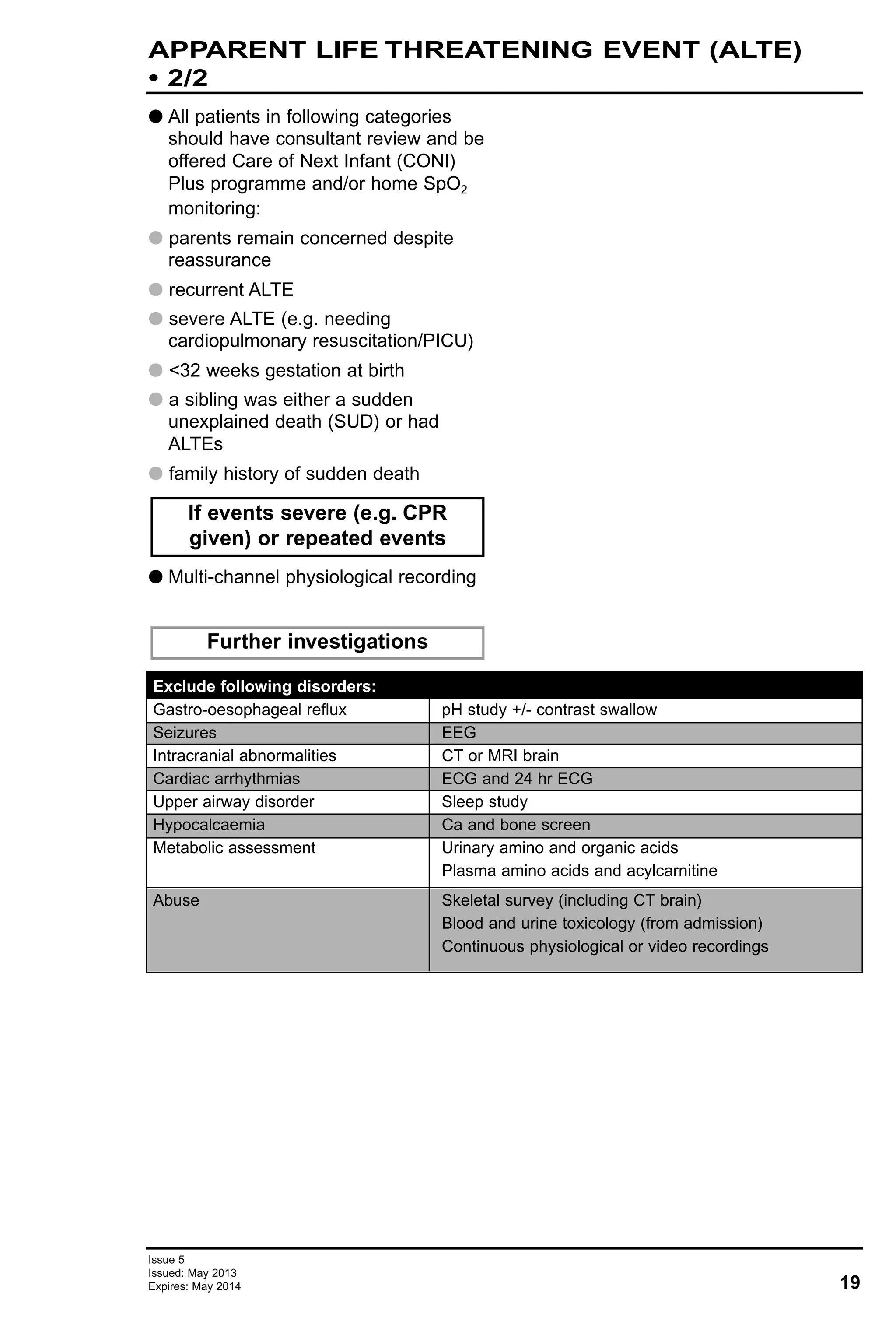
Exclude following disorders:
Gastro-oesophageal reflux pH study +/- contrast swallow
Seizures EEG
Intracranial abnormalities CT or MRI brain
Cardiac arrhythmias ECG and 24 hr ECG
Upper airway disorder Sleep study
Hypocalcaemia Ca and bone screen
Metabolic assessment Urinary amino and organic acids
Plasma amino acids and acylcarnitine
Abuse Skeletal survey (including CT brain)
Blood and urine toxicology (from admission)
Continuous physiological or video recordings
19
Issue 5
Issued: May 2013
Expires: May 2014
APPARENT LIFE THREATENING EVENT (ALTE)
• 2/2
Further investigations
Sudden onset systemic life-threatening
allergic reaction to food, medication,
contrast material, anaesthetic agents,
insect sting or latex, involving either:
G Circulatory failure (shock)
G Difficulty breathing from one or more
of following:
G stridor
G bronchospasm
G rapid swelling of tongue, causing
difficulty in swallowing or speaking
(hoarse cry)
G associated with GI or neurological
disturbance and/or skin reaction
G Acute clinical features
G Time of onset of reaction
G Circumstances immediately before
onset of symptoms
G See Management of anaphylaxis
algorithm
G Remove allergen if possible
G Call for help
G IM adrenaline: dose by age (see
Algorithm) or 10 microgram/kg:
G 0.1 mL/kg of 1:10,000 in infants (up to
10 kg = 1 mL)
G 0.01 mL/kg of 1:1000 (max 0.5 mL
= 0.5 mg)
G give in anterolateral thigh
G ABC approach: provide BLS as
needed
G if airway oedema, call anaesthetist for
potential difficult airway intubation
G if not responding to IM adrenaline,
give nebulised adrenaline 1:1000
(1 mg/mL) 400 microgram/kg (max
5 mg)
G treat shock with sodium chloride 0.9%
20 mL/kg bolus
G monitor SpO2, non-invasive blood
pressure and ECG (see Algorithm)
G Repeat IM adrenaline after 5 min if no
response
G Observe for a minimum of 6 hr to
detect potential biphasic reactions
and usually for 24 hr, especially in
following situations:
G severe reactions with slow onset
caused by idiopathic anaphylaxis
G reactions in individuals with severe
asthma or with a severe asthmatic
component
G reactions with possibility of continuing
absorption of allergen
G patients with a previous history of
biphasic reactions
G patients presenting in evening or at
night, or those who may not be able
to respond to any deterioration
G patients in areas where access to
emergency care is difficult
G Monitor SpO2, ECG and non-invasive
BP, as a minimum
SUBSEQUENT MANAGEMENT
Do not give adrenaline
intravenously except in
cardiorespiratory arrest or in
resistant shock (no response to
2 IM doses)
Document
Widespread facial or peripheral
oedema with a rash in absence
of above symptoms do not justify
adrenaline or hydrocortisone.
Give chlorphenamine orally
IMMEDIATE TREATMENT
DEFINITION
20
ANAPHYLAXIS • 1/3
Issue 5
Issued: May 2013
Expires: May 2014
G Sample serum (clotted blood – must
get to lab immediately) for mast cell
tryptase if clinical diagnosis of
anaphylaxis uncertain and reaction
thought to be secondary to venom,
drug or idiopathic at following times
and send to immunology:
G immediately after reaction
G 1–2 hr after symptoms started when
levels peak
G >24 hr after exposure or in
convalescence for baseline
G If patient presenting late, take as
many of these samples as time since
presentation allows
G Write mast cell tryptase on
immunology lab request form with
time and date of onset and sample to
allow interpretation of results
G Discuss all children with anaphylaxis
with a consultant paediatrician before
discharge
G Give following to patient, or as
appropriate their parent and/or carer:
G information about anaphylaxis,
including signs and symptoms of an
anaphylactic reaction
G information about risk of a biphasic
reaction
G information on what to do if an
anaphylactic reaction occurs (use
adrenaline injector and call
emergency services)
G a demonstration of correct use of the
adrenaline injector and when to use it
G advice about how to avoid suspected
trigger (if known)
G information about need for referral to
a specialist allergy service and the
referral process
G information about patient support
groups
G Discharge with an emergency plan,
including 2 adrenaline pen auto-
injectors after appropriate training
G If still symptomatic give oral
antihistamines and steroids for up to
3 days
G Refer as out-patient to a consultant
paediatrician with an interest in
allergy
DISCHARGE AND FOLLOW-UP
21
Issue 5
Issued: May 2013
Expires: May 2014
ANAPHYLAXIS • 2/3
22
ANAPHYLAXIS • 3/3
Issue 5
Issued: May 2013
Expires: May 2014
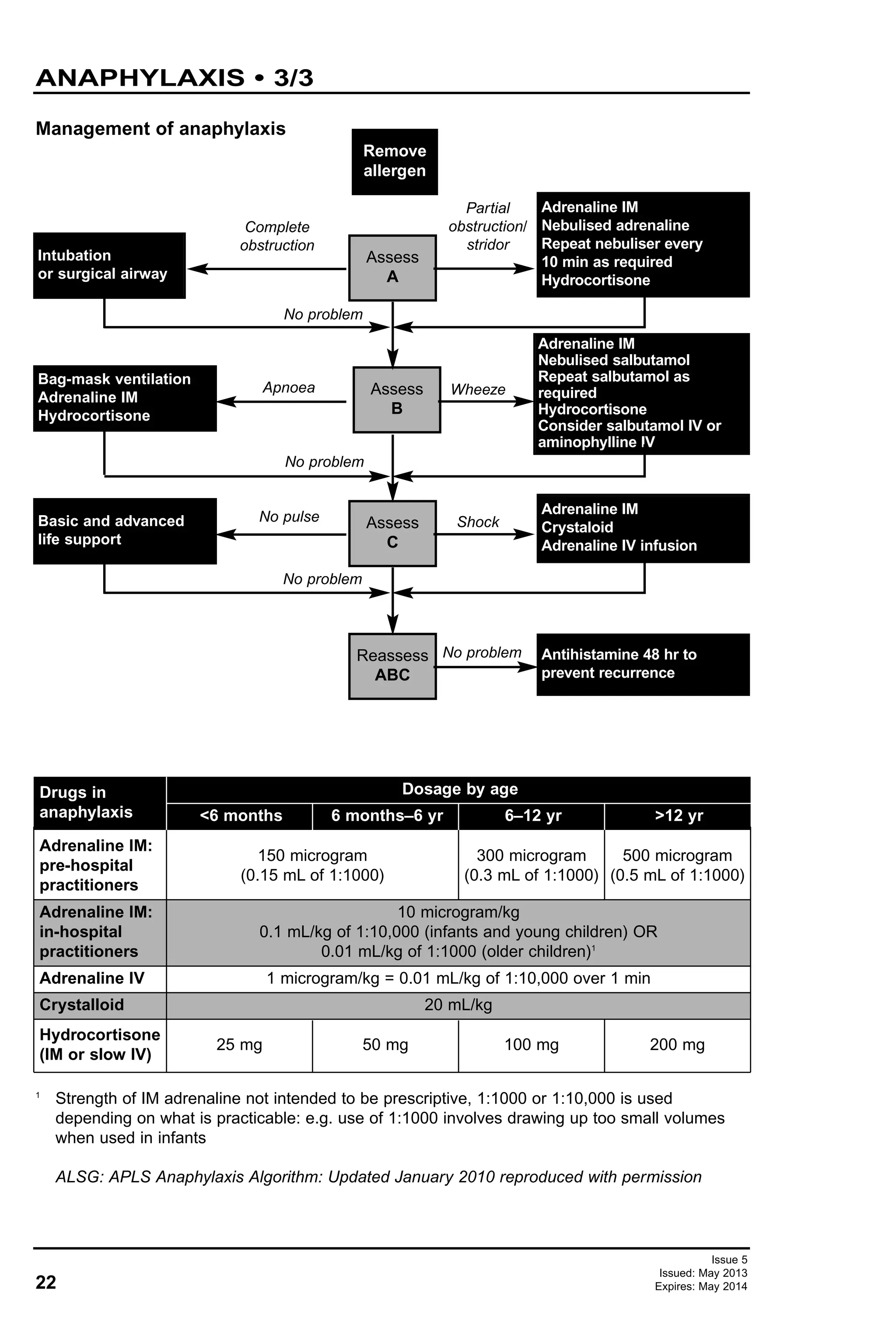
Management of anaphylaxis
Remove
allergen
Intubation
or surgical airway
Adrenaline IM
Nebulised adrenaline
Repeat nebuliser every
10 min as required
Hydrocortisone
Bag-mask ventilation
Adrenaline IM
Hydrocortisone
Basic and advanced
life support
Assess
A
Assess
B
Assess
C
Reassess
ABC
Complete
obstruction
Apnoea
No pulse
No problem
No problem
No problem
Partial
obstruction/
stridor
Wheeze
Shock
No problem
Adrenaline IM
Nebulised salbutamol
Repeat salbutamol as
required
Hydrocortisone
Consider salbutamol IV or
aminophylline IV
Adrenaline IM
Crystaloid
Adrenaline IV infusion
Antihistamine 48 hr to
prevent recurrence
Adrenaline IM:
pre-hospital
practitioners
150 microgram
(0.15 mL of 1:1000)
Adrenaline IM:
in-hospital
practitioners
Adrenaline IV
Crystalloid
Hydrocortisone
(IM or slow IV)
10 microgram/kg
0.1 mL/kg of 1:10,000 (infants and young children) OR
0.01 mL/kg of 1:1000 (older children)1
1 microgram/kg = 0.01 mL/kg of 1:10,000 over 1 min
20 mL/kg
25 mg 50 mg 100 mg 200 mg
300 microgram
(0.3 mL of 1:1000)
500 microgram
(0.5 mL of 1:1000)
Drugs in
anaphylaxis <6 months
Dosage by age
6 months–6 yr 6–12 yr >12 yr
1
Strength of IM adrenaline not intended to be prescriptive, 1:1000 or 1:10,000 is used
depending on what is practicable: e.g. use of 1:1000 involves drawing up too small volumes
when used in infants
ALSG: APLS Anaphylaxis Algorithm: Updated January 2010 reproduced with permission
23
Issue 5
Issued: May 2013
Expires: May 2014
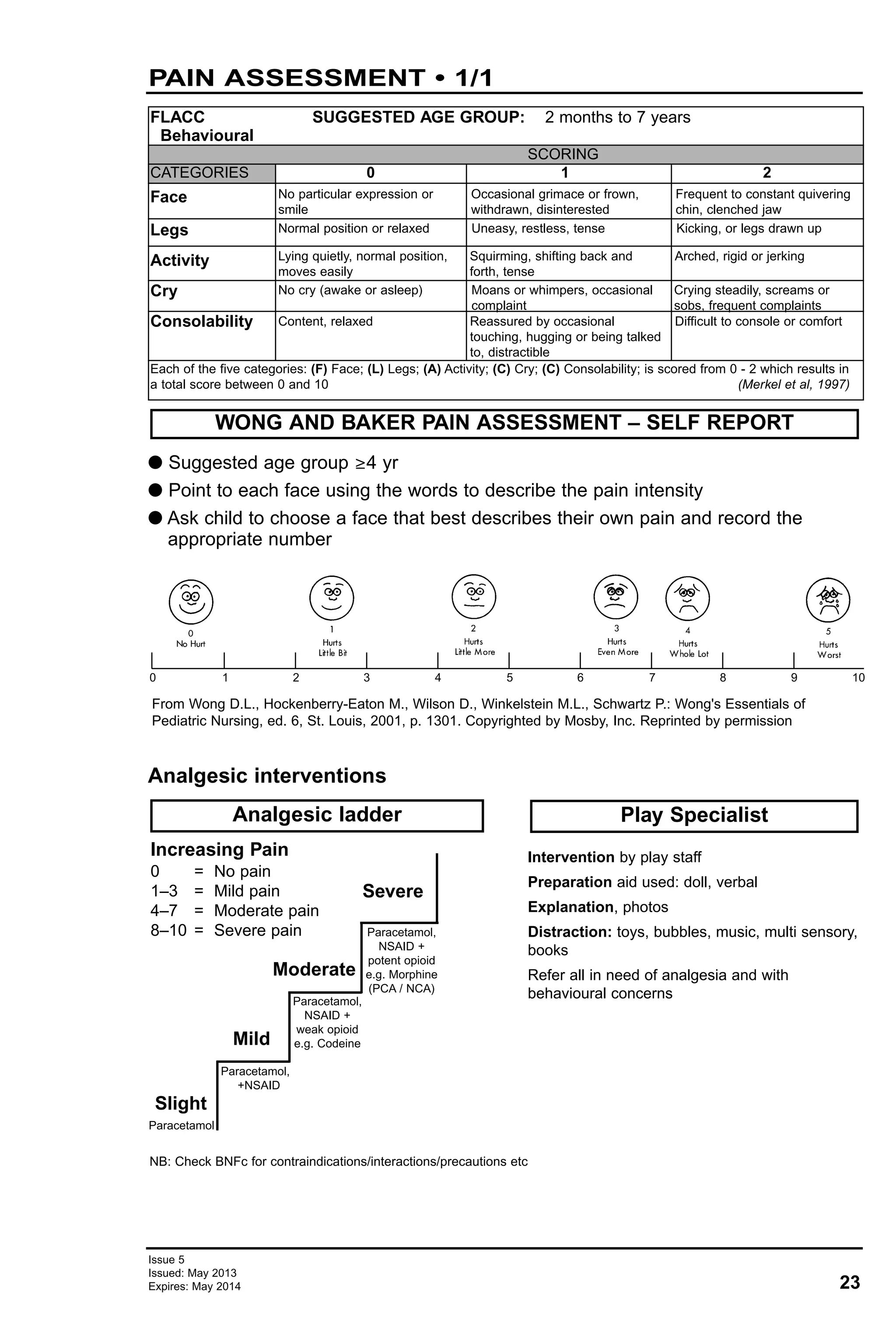
PAIN ASSESSMENT • 1/1
No particular expression or
smile
Normal position or relaxed
Lying quietly, normal position,
moves easily
Squirming, shifting back and
forth, tense
Arched, rigid or jerking
Content, relaxed Reassured by occasional
touching, hugging or being talked
to, distractible
Difficult to console or comfort
No cry (awake or asleep) Moans or whimpers, occasional
complaint
Crying steadily, screams or
sobs, frequent complaints
Uneasy, restless, tense Kicking, or legs drawn up
Occasional grimace or frown,
withdrawn, disinterested
Frequent to constant quivering
chin, clenched jaw
Face
Legs
Activity
Cry
Consolability
Each of the five categories: (F) Face; (L) Legs; (A) Activity; (C) Cry; (C) Consolability; is scored from 0 - 2 which results in
a total score between 0 and 10 (Merkel et al, 1997)
FLACC SUGGESTED AGE GROUP: 2 months to 7 years
Behavioural
SCORING
CATEGORIES 0 1 2
G Suggested age group ≥4 yr
G Point to each face using the words to describe the pain intensity
G Ask child to choose a face that best describes their own pain and record the
appropriate number
Analgesic interventions
Analgesic ladder
WONG AND BAKER PAIN ASSESSMENT – SELF REPORT
From Wong D.L., Hockenberry-Eaton M., Wilson D., Winkelstein M.L., Schwartz P.: Wong's Essentials of
Pediatric Nursing, ed. 6, St. Louis, 2001, p. 1301. Copyrighted by Mosby, Inc. Reprinted by permission
Intervention by play staff
Preparation aid used: doll, verbal
Explanation, photos
Distraction: toys, bubbles, music, multi sensory,
books
Refer all in need of analgesia and with
behavioural concerns
Play Specialist
0 1 2 3 4 5 6 7 8 9 10
Increasing Pain
0 = No pain
1–3 = Mild pain
4–7 = Moderate pain
8–10 = Severe pain
Severe
Moderate
Mild
Slight
Paracetamol,
NSAID +
potent opioid
e.g. Morphine
(PCA / NCA)
Paracetamol,
NSAID +
weak opioid
e.g. Codeine
Paracetamol,
+NSAID
Paracetamol
NB: Check BNFc for contraindications/interactions/precautions etc
24
Issue 5
Issued: May 2013
Expires: May 2014
ANALGESIA • 1/4
G For combination of analgesics to use, see Analgesic ladder in Pain assessment
guideline
TOPICAL
Age group
<1 month
>1 month
>5 yr
Preparation
Glucose syrup on pacifier
(available as a tootsweet)
Ametop
LMX4
EMLA
Ethyl chloride
Time to onset
During procedure
30 min
30 min
1 hr
Immediately
Comments
For venepuncture or
cannulation
Causes itch, lasts 4 hr
Wait 5 min after removing
cream before cannulation
Remove after 1 hr
If cannot wait for cream
Drug and
preparation
Paracetamol
[oral/nasogastric
(NG)]
G Suspensions:
G 120 mg/5 mL
G 250 mg/5 mL
G Tablets/soluble
500 mg
Paracetamol
(rectal)
G Suppositories
G 60 mg
G 125 mg
G 250 mg
G 500 mg
G 1 g
Paracetamol (IV)
10 mg/mL
(<33 kg use
50 mL vial
via burette or in
syringe)
Prescribe in mg
(not mL)
Dose
G First dose 20 mg/kg
THEN
G aged 1–3 months: 30–60 mg
8-hrly
G aged 3–6 months: 60 mg
G aged 6–24 months: 120 mg
G aged 2–4 yr: 180 mg
G aged 4–6 yr: 240 mg
G aged 6–8 yr: 250 mg
G aged 8–10 yr: 375 mg
G aged 10–12 yr: 500 mg
G aged 12–16 yr: 750 mg
G aged >16 yr: 500 mg –1 g
G First dose 30 mg/kg
THEN
G birth–3 months: 20 mg/kg
8-hrly
G aged 3 months–12 yr:
20 mg/kg 4-hrly
G aged >12 yr: 500 mg–1 g
4-hrly
G <10 kg: 10 mg/kg 6-hrly
G 10–50 kg: 15 mg/kg 6-hrly
G >50 kg: 1 g 6-hrly
Maximum dose
Max total dose in 24 hr
G Aged <1 month:
60 mg/kg/day
G Aged ≥1 month–18 yr:
90 mg/kg (max 4 g)
G Max total dose in 24 hr:
G aged <3 months:
60 mg/kg
G aged
≥3 months: 90 mg/kg
for 48 hr then 60 mg/kg
G aged >12 yr: 4 g
G Aged <1 month:
30 mg/kg/day
G <50 kg:
60 mg/kg/day
G >50 kg:
60 mg/kg/day
G Up to 4 g daily
Comments
G For mild
pain
G Increase
dose
interval in
renal
impairment
G Avoid large
doses in
dehydration,
malnutrition,
hepatic
impairment
G As for oral
paracetamol
G For mild
pain when
oral/NG
route not
possible
G Suspension
can be
given
rectally
G As for oral
paracetamol
G For mild
pain when
oral/NG/PR
route not
possible
G Give over
15 min
MILD PAIN (pain score 1–3)
25
Issue 5
Issued: May 2013
Expires: May 2014
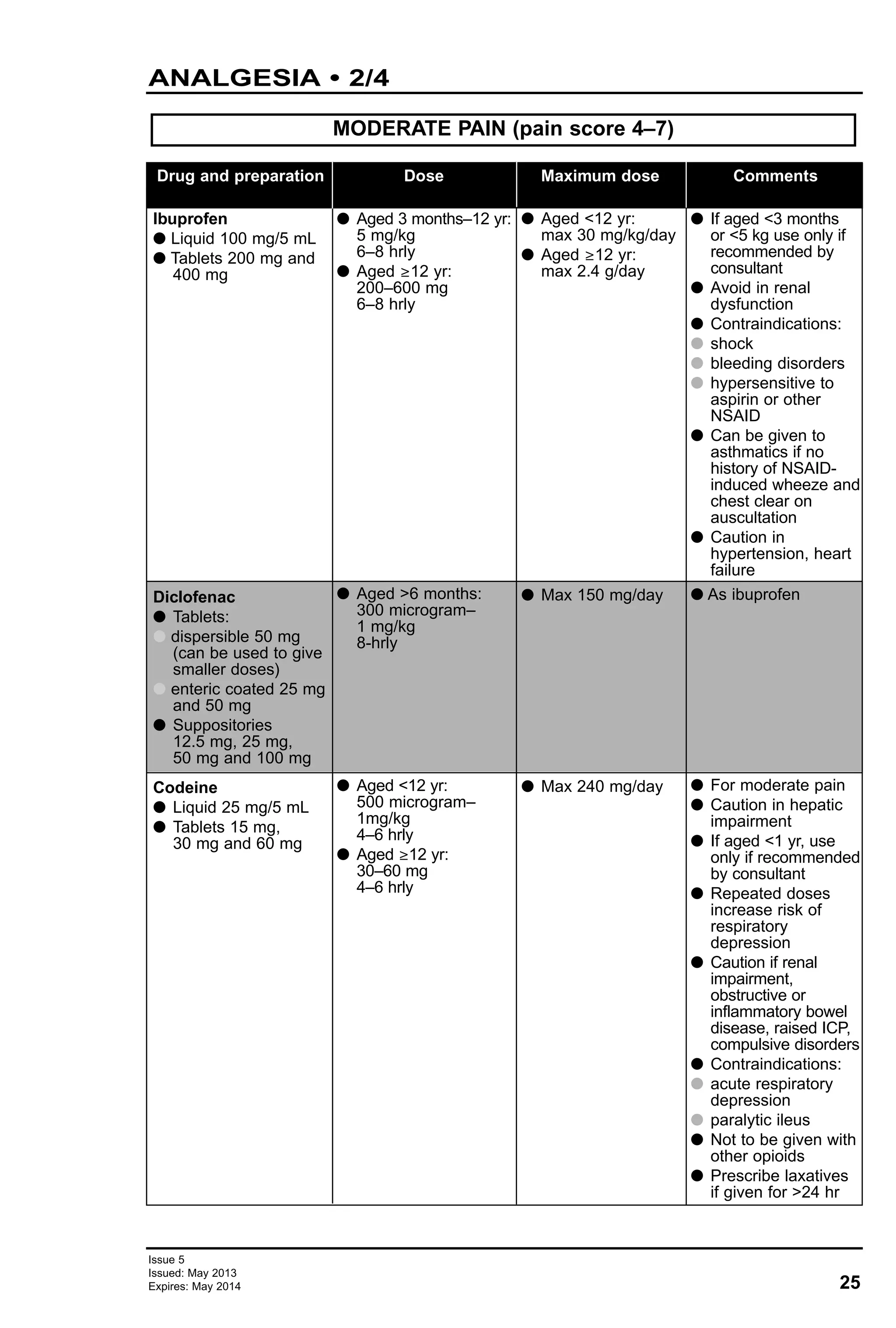
MODERATE PAIN (pain score 4–7)
Drug and preparation
Ibuprofen
G Liquid 100 mg/5 mL
G Tablets 200 mg and
400 mg
Diclofenac
G Tablets:
G dispersible 50 mg
(can be used to give
smaller doses)
G enteric coated 25 mg
and 50 mg
G Suppositories
12.5 mg, 25 mg,
50 mg and 100 mg
Codeine
G Liquid 25 mg/5 mL
G Tablets 15 mg,
30 mg and 60 mg
Dose
G Aged 3 months–12 yr:
5 mg/kg
6–8 hrly
G Aged ≥12 yr:
200–600 mg
6–8 hrly
G Aged >6 months:
300 microgram–
1 mg/kg
8-hrly
G Aged <12 yr:
500 microgram–
1mg/kg
4–6 hrly
G Aged ≥12 yr:
30–60 mg
4–6 hrly
Maximum dose
G Aged <12 yr:
max 30 mg/kg/day
G Aged ≥12 yr:
max 2.4 g/day
G Max 150 mg/day
G Max 240 mg/day
Comments
G If aged <3 months
or <5 kg use only if
recommended by
consultant
G Avoid in renal
dysfunction
G Contraindications:
G shock
G bleeding disorders
G hypersensitive to
aspirin or other
NSAID
G Can be given to
asthmatics if no
history of NSAID-
induced wheeze and
chest clear on
auscultation
G Caution in
hypertension, heart
failure
G As ibuprofen
G For moderate pain
G Caution in hepatic
impairment
G If aged <1 yr, use
only if recommended
by consultant
G Repeated doses
increase risk of
respiratory
depression
G Caution if renal
impairment,
obstructive or
inflammatory bowel
disease, raised ICP,
compulsive disorders
G Contraindications:
G acute respiratory
depression
G paralytic ileus
G Not to be given with
other opioids
G Prescribe laxatives
if given for >24 hr
ANALGESIA • 2/4
26
ANALGESIA • 3/4
Issue 5
Issued: May 2013
Expires: May 2014
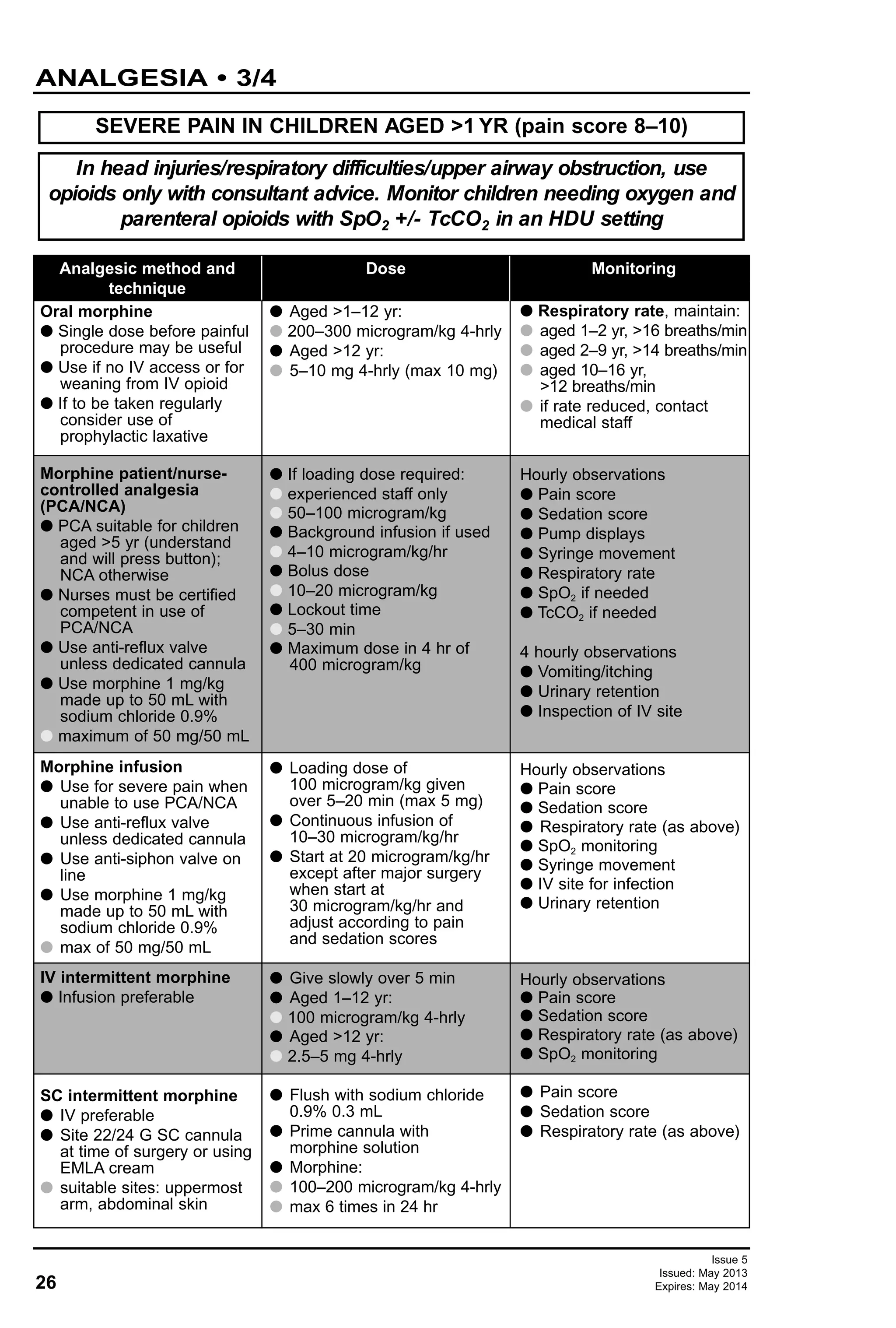
In head injuries/respiratory difficulties/upper airway obstruction, use
opioids only with consultant advice. Monitor children needing oxygen and
parenteral opioids with SpO2 +/- TcCO2 in an HDU setting
SEVERE PAIN IN CHILDREN AGED >1 YR (pain score 8–10)
Analgesic method and
technique
Oral morphine
G Single dose before painful
procedure may be useful
G Use if no IV access or for
weaning from IV opioid
G If to be taken regularly
consider use of
prophylactic laxative
Dose
G Aged >1–12 yr:
G 200–300 microgram/kg 4-hrly
G Aged >12 yr:
G 5–10 mg 4-hrly (max 10 mg)
Monitoring
G Respiratory rate, maintain:
G aged 1–2 yr, >16 breaths/min
G aged 2–9 yr, >14 breaths/min
G aged 10–16 yr,
>12 breaths/min
G if rate reduced, contact
medical staff
Morphine patient/nurse-
controlled analgesia
(PCA/NCA)
G PCA suitable for children
aged >5 yr (understand
and will press button);
NCA otherwise
G Nurses must be certified
competent in use of
PCA/NCA
G Use anti-reflux valve
unless dedicated cannula
G Use morphine 1 mg/kg
made up to 50 mL with
sodium chloride 0.9%
G maximum of 50 mg/50 mL
Morphine infusion
G Use for severe pain when
unable to use PCA/NCA
G Use anti-reflux valve
unless dedicated cannula
G Use anti-siphon valve on
line
G Use morphine 1 mg/kg
made up to 50 mL with
sodium chloride 0.9%
G max of 50 mg/50 mL
IV intermittent morphine
G Infusion preferable
SC intermittent morphine
G IV preferable
G Site 22/24 G SC cannula
at time of surgery or using
EMLA cream
G suitable sites: uppermost
arm, abdominal skin
G If loading dose required:
G experienced staff only
G 50–100 microgram/kg
G Background infusion if used
G 4–10 microgram/kg/hr
G Bolus dose
G 10–20 microgram/kg
G Lockout time
G 5–30 min
G Maximum dose in 4 hr of
400 microgram/kg
G Loading dose of
100 microgram/kg given
over 5–20 min (max 5 mg)
G Continuous infusion of
10–30 microgram/kg/hr
G Start at 20 microgram/kg/hr
except after major surgery
when start at
30 microgram/kg/hr and
adjust according to pain
and sedation scores
G Give slowly over 5 min
G Aged 1–12 yr:
G 100 microgram/kg 4-hrly
G Aged >12 yr:
G 2.5–5 mg 4-hrly
G Flush with sodium chloride
0.9% 0.3 mL
G Prime cannula with
morphine solution
G Morphine:
G 100–200 microgram/kg 4-hrly
G max 6 times in 24 hr
Hourly observations
G Pain score
G Sedation score
G Pump displays
G Syringe movement
G Respiratory rate
G SpO2 if needed
G TcCO2 if needed
4 hourly observations
G Vomiting/itching
G Urinary retention
G Inspection of IV site
Hourly observations
G Pain score
G Sedation score
G Respiratory rate (as above)
G SpO2 monitoring
G Syringe movement
G IV site for infection
G Urinary retention
Hourly observations
G Pain score
G Sedation score
G Respiratory rate (as above)
G SpO2 monitoring
G Pain score
G Sedation score
G Respiratory rate (as above)
27
Issue 5
Issued: May 2013
Expires: May 2014
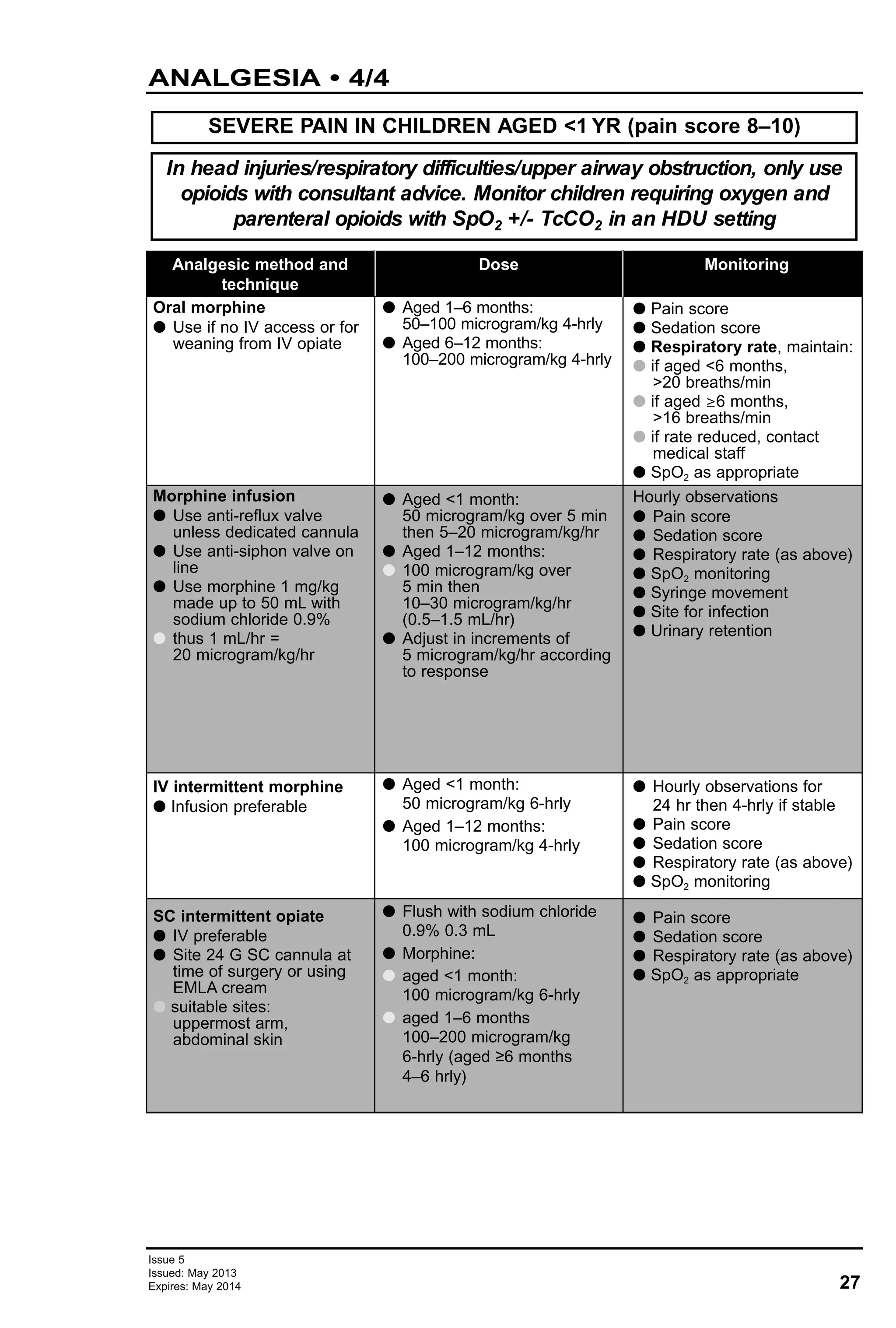
ANALGESIA • 4/4
In head injuries/respiratory difficulties/upper airway obstruction, only use
opioids with consultant advice. Monitor children requiring oxygen and
parenteral opioids with SpO2 +/- TcCO2 in an HDU setting
SEVERE PAIN IN CHILDREN AGED <1 YR (pain score 8–10)
Analgesic method and
technique
Oral morphine
G Use if no IV access or for
weaning from IV opiate
Morphine infusion
G Use anti-reflux valve
unless dedicated cannula
G Use anti-siphon valve on
line
G Use morphine 1 mg/kg
made up to 50 mL with
sodium chloride 0.9%
G thus 1 mL/hr =
20 microgram/kg/hr
IV intermittent morphine
G Infusion preferable
SC intermittent opiate
G IV preferable
G Site 24 G SC cannula at
time of surgery or using
EMLA cream
G suitable sites:
uppermost arm,
abdominal skin
Dose
G Aged 1–6 months:
50–100 microgram/kg 4-hrly
G Aged 6–12 months:
100–200 microgram/kg 4-hrly
G Aged <1 month:
50 microgram/kg over 5 min
then 5–20 microgram/kg/hr
G Aged 1–12 months:
G 100 microgram/kg over
5 min then
10–30 microgram/kg/hr
(0.5–1.5 mL/hr)
G Adjust in increments of
5 microgram/kg/hr according
to response
G Aged <1 month:
50 microgram/kg 6-hrly
G Aged 1–12 months:
100 microgram/kg 4-hrly
G Flush with sodium chloride
0.9% 0.3 mL
G Morphine:
G aged <1 month:
100 microgram/kg 6-hrly
G aged 1–6 months
100–200 microgram/kg
6-hrly (aged ≥6 months
4–6 hrly)
Monitoring
G Pain score
G Sedation score
G Respiratory rate, maintain:
G if aged <6 months,
>20 breaths/min
G if aged ≥6 months,
>16 breaths/min
G if rate reduced, contact
medical staff
G SpO2 as appropriate
Hourly observations
G Pain score
G Sedation score
G Respiratory rate (as above)
G SpO2 monitoring
G Syringe movement
G Site for infection
G Urinary retention
G Hourly observations for
24 hr then 4-hrly if stable
G Pain score
G Sedation score
G Respiratory rate (as above)
G SpO2 monitoring
G Pain score
G Sedation score
G Respiratory rate (as above)
G SpO2 as appropriate
28
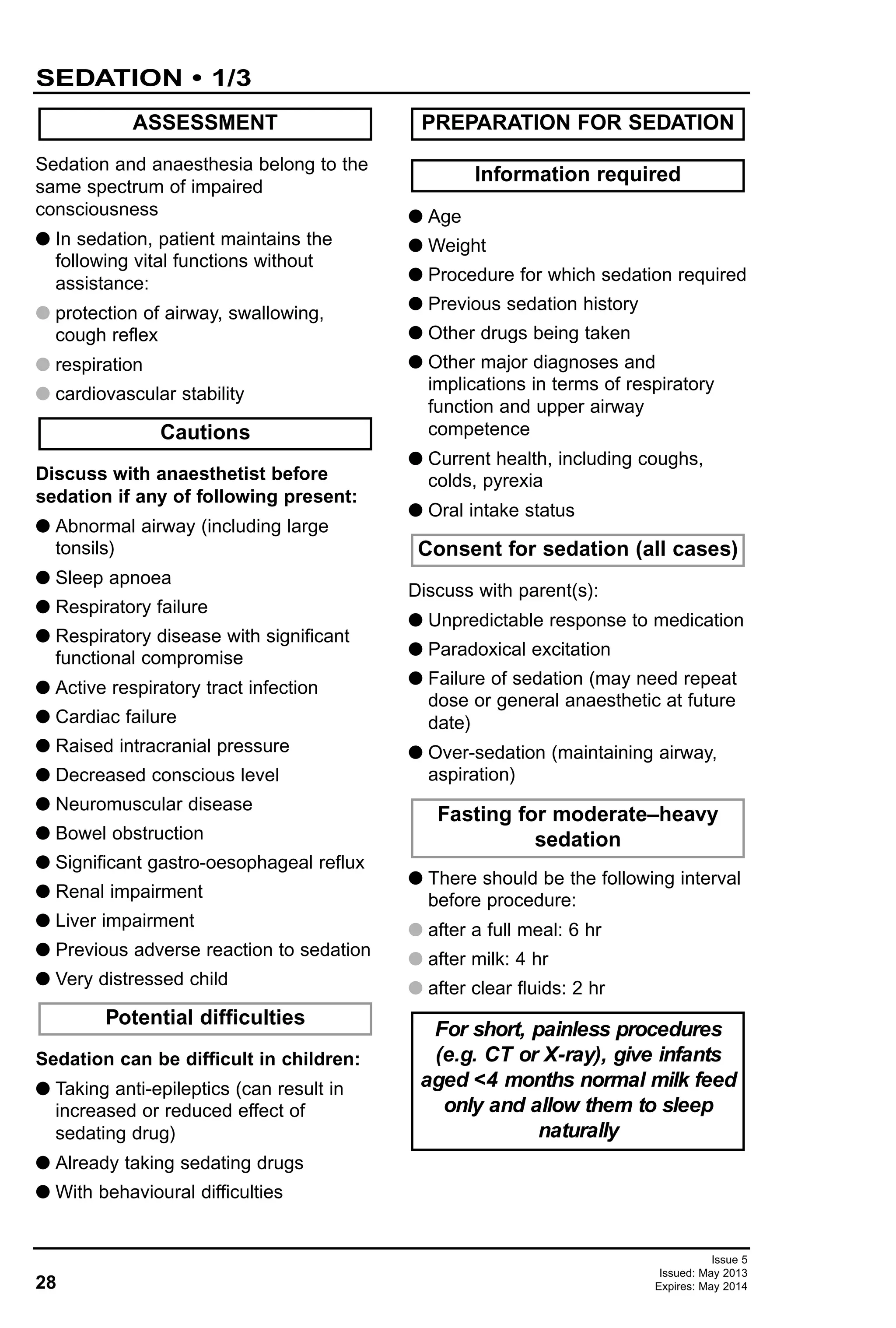
SEDATION • 1/3
Issue 5
Issued: May 2013
Expires: May 2014
Sedation and anaesthesia belong to the
same spectrum of impaired
consciousness
G In sedation, patient maintains the
following vital functions without
assistance:
G protection of airway, swallowing,
cough reflex
G respiration
G cardiovascular stability
Discuss with anaesthetist before
sedation if any of following present:
G Abnormal airway (including large
tonsils)
G Sleep apnoea
G Respiratory failure
G Respiratory disease with significant
functional compromise
G Active respiratory tract infection
G Cardiac failure
G Raised intracranial pressure
G Decreased conscious level
G Neuromuscular disease
G Bowel obstruction
G Significant gastro-oesophageal reflux
G Renal impairment
G Liver impairment
G Previous adverse reaction to sedation
G Very distressed child
Sedation can be difficult in children:
G Taking anti-epileptics (can result in
increased or reduced effect of
sedating drug)
G Already taking sedating drugs
G With behavioural difficulties
G Age
G Weight
G Procedure for which sedation required
G Previous sedation history
G Other drugs being taken
G Other major diagnoses and
implications in terms of respiratory
function and upper airway
competence
G Current health, including coughs,
colds, pyrexia
G Oral intake status
Discuss with parent(s):
G Unpredictable response to medication
G Paradoxical excitation
G Failure of sedation (may need repeat
dose or general anaesthetic at future
date)
G Over-sedation (maintaining airway,
aspiration)
G There should be the following interval
before procedure:
G after a full meal: 6 hr
G after milk: 4 hr
G after clear fluids: 2 hr
ASSESSMENT
For short, painless procedures
(e.g. CT or X-ray), give infants
aged <4 months normal milk feed
only and allow them to sleep
naturally
Fasting for moderate–heavy
sedation
Consent for sedation (all cases)
Information required
PREPARATION FOR SEDATION
Potential difficulties
Cautions
29
Issue 5
Issued: May 2013
Expires: May 2014
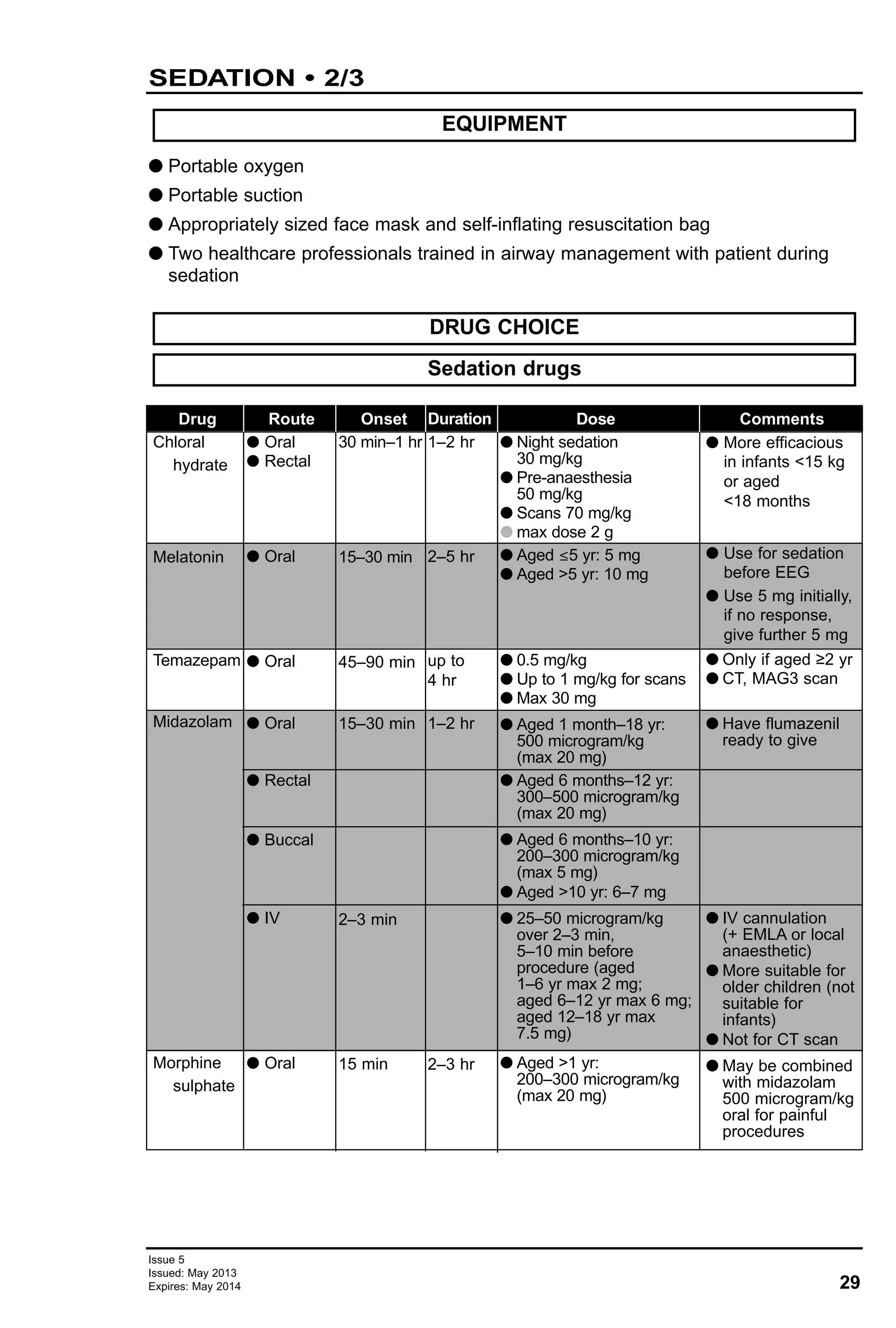
SEDATION • 2/3
Drug
Chloral
hydrate
Melatonin
Temazepam
Midazolam
Morphine
sulphate
Route
G Oral
G Rectal
G Oral
G Oral
G Oral
G Rectal
G Buccal
G IV
G Oral
Onset
30 min–1 hr
15–30 min
45–90 min
15–30 min
2–3 min
15 min
Duration
1–2 hr
2–5 hr
up to
4 hr
1–2 hr
2–3 hr
Dose
G Night sedation
30 mg/kg
G Pre-anaesthesia
50 mg/kg
G Scans 70 mg/kg
G max dose 2 g
G Aged ≤5 yr: 5 mg
G Aged >5 yr: 10 mg
G 0.5 mg/kg
G Up to 1 mg/kg for scans
G Max 30 mg
G Aged 1 month–18 yr:
500 microgram/kg
(max 20 mg)
G Aged 6 months–12 yr:
300–500 microgram/kg
(max 20 mg)
G Aged 6 months–10 yr:
200–300 microgram/kg
(max 5 mg)
G Aged >10 yr: 6–7 mg
G 25–50 microgram/kg
over 2–3 min,
5–10 min before
procedure (aged
1–6 yr max 2 mg;
aged 6–12 yr max 6 mg;
aged 12–18 yr max
7.5 mg)
G Aged >1 yr:
200–300 microgram/kg
(max 20 mg)
Comments
G More efficacious
in infants <15 kg
or aged
<18 months
G Use for sedation
before EEG
G Use 5 mg initially,
if no response,
give further 5 mg
G Only if aged ≥2 yr
G CT, MAG3 scan
G Have flumazenil
ready to give
G IV cannulation
(+ EMLA or local
anaesthetic)
G More suitable for
older children (not
suitable for
infants)
G Not for CT scan
G May be combined
with midazolam
500 microgram/kg
oral for painful
procedures
Sedation drugs
DRUG CHOICE
G Portable oxygen
G Portable suction
G Appropriately sized face mask and self-inflating resuscitation bag
G Two healthcare professionals trained in airway management with patient during
sedation
EQUIPMENT
30
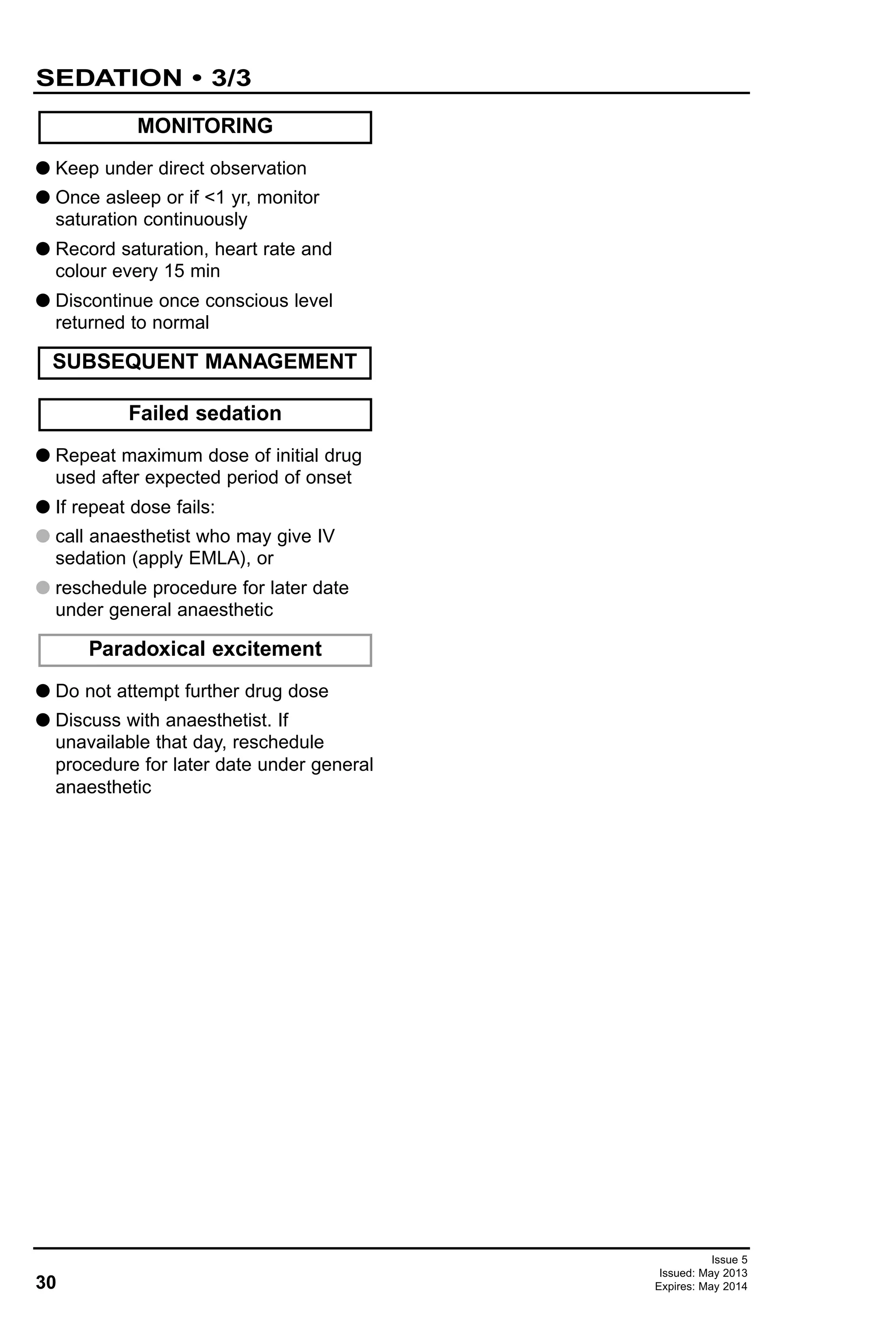
SEDATION • 3/3
Issue 5
Issued: May 2013
Expires: May 2014
G Keep under direct observation
G Once asleep or if <1 yr, monitor
saturation continuously
G Record saturation, heart rate and
colour every 15 min
G Discontinue once conscious level
returned to normal
G Repeat maximum dose of initial drug
used after expected period of onset
G If repeat dose fails:
G call anaesthetist who may give IV
sedation (apply EMLA), or
G reschedule procedure for later date
under general anaesthetic
G Do not attempt further drug dose
G Discuss with anaesthetist. If
unavailable that day, reschedule
procedure for later date under general
anaesthetic
Paradoxical excitement
Failed sedation
SUBSEQUENT MANAGEMENT
MONITORING
31
Issue 5
Issued: May 2013
Expires: May 2014
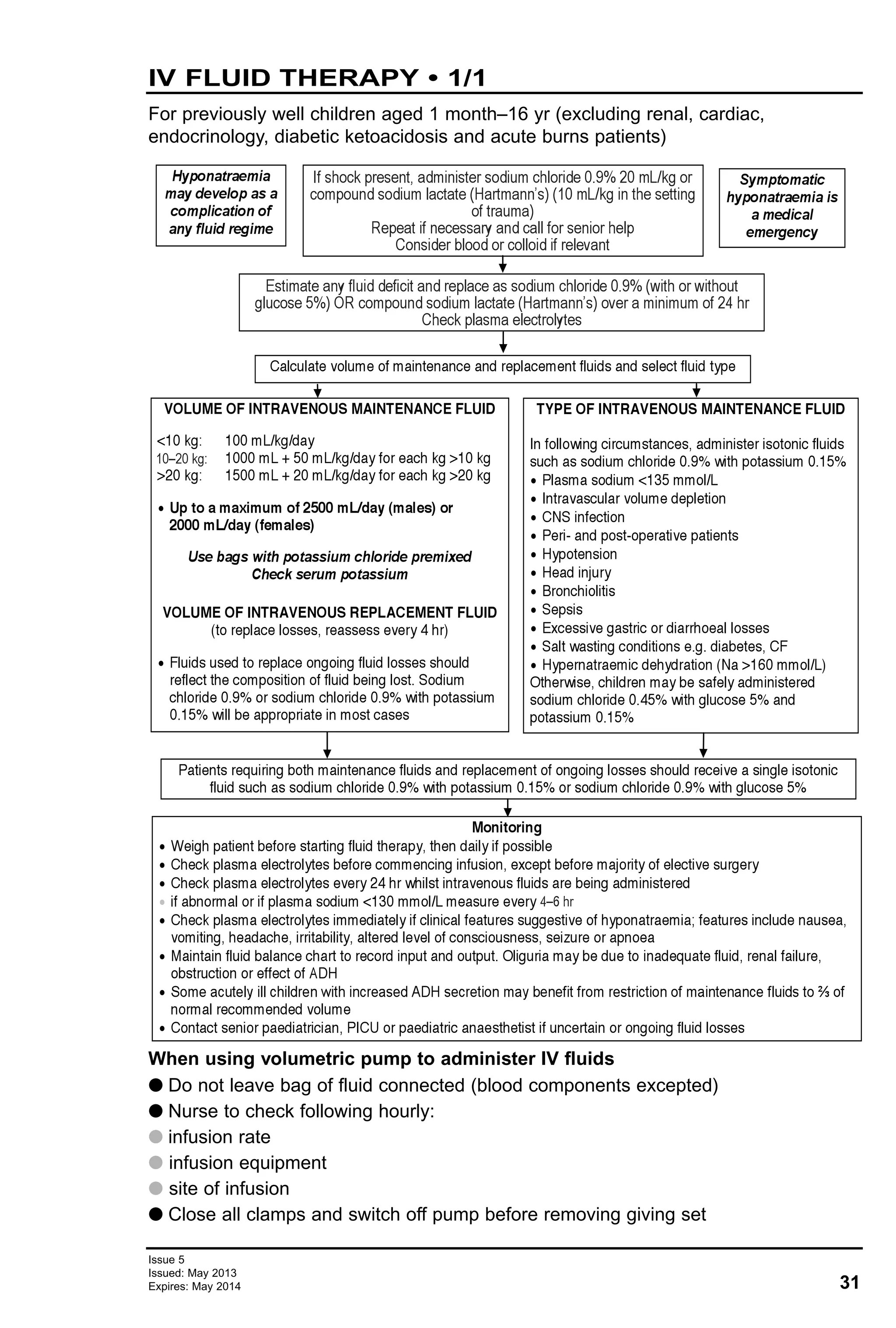
IV FLUID THERAPY • 1/1
For previously well children aged 1 month–16 yr (excluding renal, cardiac,
endocrinology, diabetic ketoacidosis and acute burns patients)
When using volumetric pump to administer IV fluids
G Do not leave bag of fluid connected (blood components excepted)
G Nurse to check following hourly:
infusion rate
infusion equipment
site of infusion
G Close all clamps and switch off pump before removing giving set
If shock present, administer sodium chloride 0.9% 20 mL/kg or
compound sodium lactate (Hartmann’s)(10 mL/kg in the setting
of trauma)
Repeat if necessary and call for senior help
Consider blood or colloid if relevant
Estimate any fluid deficit and replace as sodium chloride 0.9% (with or without
glucose 5%) OR compound sodium lactate (Hartmann’s) over a minimum of 24 hr
Check plasma electrolytes
Calculate volume of maintenance and replacement fluids and select fluid type
VOLUME OF INTRAVENOUS MAINTENANCE FLUID
<10 kg: 100 mL/kg/day
10 20 kg: 1000 mL + 50 mL/kg/day for each kg >10 kg
>20 kg: 1500 mL + 20 mL/kg/day for each kg >20 kg
Up to a maximum of 2500 mL/day (males) or
2000 mL/day (females)
Use bags with potassium chloride premixed
Check serum potassium
VOLUME OF INTRAVENOUS REPLACEMENT FLUID
(to replace losses, reassess every 4 hr)
Fluids used to replace ongoing fluid losses should
reflect the composition of fluid being lost. Sodium
chloride 0.9% or sodium chloride 0.9% with potassium
0.15% will be appropriate in most cases
TYPE OF INTRAVENOUS MAINTENANCE FLUID
In following circumstances, administer isotonic fluids
such as sodium chloride 0.9% with potassium 0.15%
Plasma sodium <135 mmol/L
Intravascular volume depletion
CNS infection
Peri- and post-operative patients
Hypotension
Head injury
Bronchiolitis
Sepsis
Excessive gastric or diarrhoeal losses
Salt wasting conditions e.g. diabetes, CF
Hypernatraemic dehydration (Na >160 mmol/L)
Otherwise, children may be safely administered
sodium chloride 0.45% with glucose 5% and
potassium 0.15%
Patients requiring both maintenance fluids and replacement of ongoing losses should receive a single isotonic
fluid such as sodium chloride 0.9% with potassium 0.15% or sodium chloride 0.9% with glucose 5%
Monitoring
Weigh patient before starting fluid therapy, then daily if possible
Check plasma electrolytes before commencing infusion, except before majority of elective surgery
Check plasma electrolytes every 24 hr whilst intravenous fluids are being administered
if abnormal or if plasma sodium <130 mmol/L measure every 4 6 hr
Check plasma electrolytes immediately if clinical features suggestive of hyponatraemia; features include nausea,
vomiting, headache, irritability, altered level of consciousness, seizure or apnoea
Maintain fluid balance chart to record input and output. Oliguria may be due to inadequate fluid, renal failure,
obstruction or effect of ADH
normal recommended volume
Contact senior paediatrician, PICU or paediatric anaesthetist if uncertain or ongoing fluid losses
Symptomatic
hyponatraemia is
a medical
emergency
Hyponatraemia
may develop as a
complication of
any fluid regime
If shock present, administer sodium chloride 0.9% 20 mL/kg or
compound sodium lactate (Hartmann’s) (10 mL/kg in the setting
of trauma)
Repeat if necessary and call for senior help
Consider blood or colloid if relevant
glucose 5%) OR compound sodium lactate (Hartmann’s) over a minimum of 24 hr
Check plasma electrolytes
10–20 kg:
4–6 hr
G ‘Short’ long lines in patients requiring
5–14 days IV therapy either in
hospital or at home
G Peripherally inserted central catheter
(PICC) for drugs that have to be given
centrally (e.g. if they cause phlebitis),
if risk of infection high (e.g. parenteral
nutrition) or for access >14 days
G Assistant
G Long line
G ‘Short’ long line:
G Leaderflex 22 G (2.5 F) line 8 or 20 cm
G PICC:
G Vygon PICC 3, 4 or 4.5 F 60 cm
Lifecath (expert silver coated)
G Vygon Nutriline 2, 3 or 4 F 30 cm
G Vygon Neocath or Epicutaneo-cave
catheter 2 F (23 G) 15, 30 or 50 cm
has different insertion technique, not
recommended except neonates
G Flush solution: sodium chloride 0.9%
5 mL
G Single dressing pack
G Sterile gloves
G Sterile scissors
G 2 extra sterile towels
G 5 mL syringe/green needle
G Tape measure
G Sterile clear dressing (e.g.
Opsite®/Tegaderm®)
G Incontinence pad
G 2 extra packs gauze swabs
G Alcoholic chlorhexidine (or other skin
antiseptic)
G 1 injectable bung
G 3 wide Steri-strips® (optional to
secure line)
G Sterile untoothed forceps (to feed line
up butterfly)
G Assess whether patient will need
sedation. Rarely, children with needle
phobia will need the line inserted
under general anaesthetic. Arrange
appropriate person to administer
sedation
G If necessary, shave arm to avoid hair
plucking when dressing removed
G Specify exactly where you would like
topical local anaesthetic cream sited.
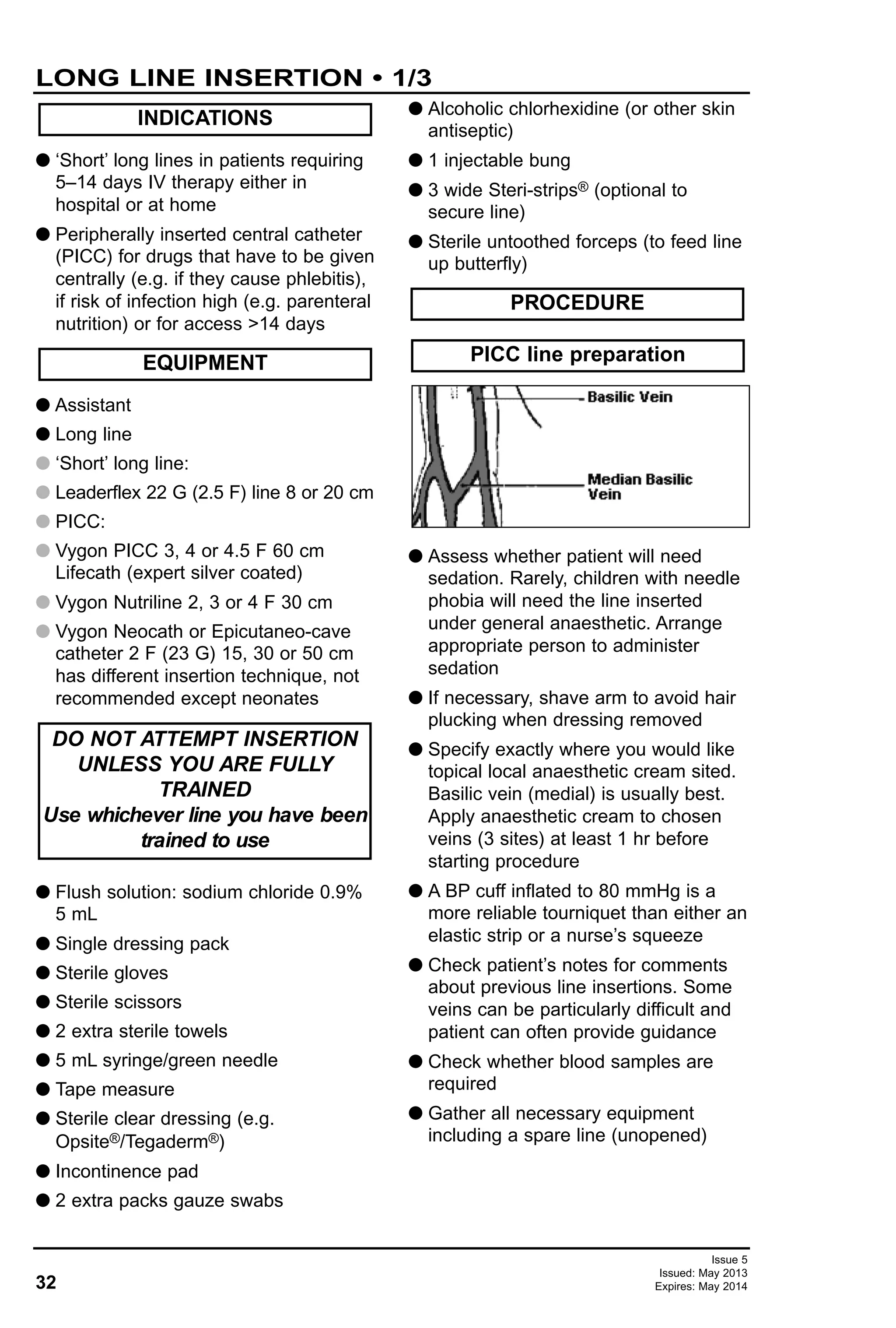
Basilic vein (medial) is usually best.
Apply anaesthetic cream to chosen
veins (3 sites) at least 1 hr before
starting procedure
G A BP cuff inflated to 80 mmHg is a
more reliable tourniquet than either an
elastic strip or a nurse’s squeeze
G Check patient’s notes for comments
about previous line insertions. Some
veins can be particularly difficult and
patient can often provide guidance
G Check whether blood samples are
required
G Gather all necessary equipment
including a spare line (unopened)
PICC line preparation
PROCEDURE
DO NOT ATTEMPT INSERTION
UNLESS YOU ARE FULLY
TRAINED
Use whichever line you have been
trained to use
EQUIPMENT
INDICATIONS
32
LONG LINE INSERTION • 1/3
Issue 5
Issued: May 2013
Expires: May 2014
33
Issue 5
Issued: May 2013
Expires: May 2014
LONG LINE INSERTION • 2/3
G Explain procedure and reassure patient
G Obtain and record consent
G Position patient seated in chair or
lying with his/her arm stretched out
and supported by table or bed (on a
utility drape)
G ensure patient in position and
comfortable, and lighting optimal
G Measure distance from site of insertion
to sternal notch (if inserting in arm) or
xiphisternum (if inserting in leg) so
catheter tip is placed outside heart
G Wash hands, and put on apron/gown
and sterile gloves
G Clean patient’s skin thoroughly with
alcoholic chlorhexidine and allow to
dry in area of planned insertion
G Drape sterile sheet to expose only
chosen vein, and cover surrounding
areas to provide working room and a
flat surface on which to rest your line,
forceps and flush
G Assemble line fully and flush with
sodium chloride 0.9%1 mL to ensure
patency
G Place everything you will need onto
sterile sheet within reach
G Ask assistant to apply tourniquet (or
squeeze patient’s arm), but remain
ready to release
G Check patient is ready for you to start
G Be careful: introducer for the PICC
line is much stiffer than a standard
cannula and more likely to perforate
the entire vein
G Insert peelable cannula until blood
flowing freely (it is not necessary to
thread needle into vein) in some
patients this will come quite quickly so
have catheter ready
G Ask assistant to release tourniquet to
reduce blood flow
G Taking the PICC line in forceps, pass
it up through cannula. At about 5 cm,
you will reach tip of the cannula. If
line passes easily beyond 6 cm, you
have probably succeeded. Resistance
at any point usually indicates failure
to thread vein, or curling of line.
Rotating butterfly needle so that the
bevel faces downwards may help to
introduce line into vein if it will not
thread more than 5 cm
G Insert line to previously measured
distance from site of insertion
G When tip of line is judged to be in
correct position, carefully withdraw
sheath and remove from around line
by pulling apart the two blue wings
G Pressing firmly on insertion site with a
piece of gauze, remove cannula
G Without releasing pressure on entry
site (it may bleed for a few minutes),
reassemble line and flush with sodium
chloride 0.9% 2 mL
G With sterile scissors, cut rectangle of
gauze (1 x 2 cm) to prevent hub of
line rubbing skin
G Check all connections are firmly
tightened. Coil any unused line next
to insertion site and secure with Steri-
strips®
G Cover entry site, connections and all
exposed line with one piece of clear
dressing (e.g. Opsite®)
G X-ray line with 0.5 mL of contrast (e.g.
Omnapaque 240) in the line to check
tip position if near heart or if no blood
flushes back up line. Do not draw
blood back up line (this increases risk
of line blockage)
G Flush once more and line is then
ready to use
Consent
Nutriline PICC line
Aseptic non touch technique
(ANTT)
Premedication and position of
patient
34
Issue 5
Issued: May 2013
Expires: May 2014
LONG LINE INSERTION • 3/3
G These are inserted using Seldinger
technique
G Cannulate target vein with either
needle provided or a blue cannula
G Feed guidewire into vein through
cannula sheath and remove sheath
leaving wire in situ
G Feed line over guidewire and into vein
with a gentle twisting action. It is
important that, at any time, operator is
able to grasp directly either free end
of wire or wire itself as it passes
through skin, to ensure that it does
not pass entirely into vein
G Remove guidewire and secure line in
place
G It is not necessary to verify position of
8 cm lines radiologically
G Aim to insert to 20 cm and tape
remaining silastic length to skin with
an adhesive dressing e.g. Steri-strip®
G Place a folded half gauze swab under
the blue hub before taping down with
adhesive, then cover with transparent
dressing, minimising contact between
gauze and transparent dressing in
case removal is required for
troubleshooting
G Flush after each use with sodium
chloride 0.9% 2 mL
G Keep dressing clean and intact
G Maintain aseptic technique for
accessing system and dressing
changes. Before accessing system,
disinfect hub and ports with
disinfectant compatible with catheter
(e.g. alcohol or povidone-iodine)
G Assess site at least daily for any signs
of infection and remove if signs of
infection are present (only short-term
CVCs)
G Replace administration sets every
24 hr and after administration of
blood, blood products and lipids.
Routine catheter replacement is
unnecessary
G Assess need for device daily and
remove as soon as possible
G Document insertion and all
interventions in patient notes
LONG LINE CARE
AFTERCARE
Use an aseptic technique when
accessing the system or for
dressing changes
Leaderflex lines
35
Issue 5
Issued: May 2013
Expires: May 2014
PRE-OP FASTING • 1/1
G Do not fast patients for longer than
necessary for their safety under
general anaesthesia
G Do not deny fluids for excessively
long periods; allow patients to drink
within these guidelines
G Use theatre time efficiently
G Solid food and milk (including
formula) up to 6 hr before elective
surgery
G Breast milk up to 4 hr before elective
surgery
G Encourage patients to take clear oral
fluids up to 2 hr before elective
surgery. Thereafter, sips of water may
be taken to enable tablets to be
swallowed
G clear fluids do not include fizzy drinks
G No solid food after midnight
G Water or diluted squash to finish
before 0630 hr
G Light breakfast (including toast, or
small bowl of cereal), to finish before
0700 hr
G Water or diluted squash to finish
before 1100 hr
G Last formula milk feed before 0230 hr
G Last breast milk feed before 0430 hr
G Water or diluted squash to finish
before 0630 hr
G Last formula milk feed before 0700 hr
G Last breast milk feed before 0900 hr
G Water or diluted squash to finish
before 1100 hr
Nursing and medical staff should
ensure that all children are
encouraged to drink clear fluids
(e.g. water or diluted squash) until
2 hr before anaesthesia/surgery
Afternoon operating lists
Morning operating lists
Infants/children aged <1 yr
Afternoon operating lists
Morning operating lists
All children aged ≥1 yr
PROCEDURE
POLICY
Ideally give all children (especially
those aged <2 yr) clear fluids up
to 2 hr pre-operatively. Liaise
closely with theatre to discover
approximate time of patient’s
operation
PRINCIPLES
36
Issue 5
Issued: May 2013
Expires: May 2014
POST GA MONITORING EX-PREMATURE INFANTS
• 1/1
G Risk of apnoea after general
anaesthetic (GA)
G increased if anaemic
G with chronic lung disease who have
required oxygen treatment within last
6 months
G Check haemoglobin
G if Hb <90 g/L, arrange transfusion
G Arrange overnight stay for post-
operative monitoring if age (weeks)
<[3 x (38 – gestational age in weeks)]
e.g. baby born at 30 weeks gestation
would be kept overnight after GA if
<24 weeks old. A 36 week baby
would be allowed home after GA if
>6 weeks old
G Transfer patient with oxygen supply,
continuous SpO2 monitoring and full
resuscitative equipment
G Admit patient to a designated HDU
ward area
G High dependency nursing care
G Monitoring to include:
G continuous pulse oximetry
G continuous ECG
G continuous respiratory rate
G transcutaneous CO2
G If apnoea >15 sec:
G immediate respiratory support by
nurse (airway manoeuvres, bag and
mask ventilation)
G contact on-call SpR
G liaise with anaesthetist responsible for
patient
G review period of HDU care
G Discharge patient home same day or
next day as calculated by above
formula providing there have been no
apnoeic episodes
DISCHARGE AND FOLLOW-UP
Subsequent post-GA
management
Immediate post-GA period
Pre-operative
MANAGEMENT
37
Issue 5
Issued: May 2013
Expires: May 2014
ASTHMA – ACUTE MANAGEMENT • 1/4
Asthma is a chronic inflammatory disorder
of the airways with reversible obstruction
G Breathlessness
G Wheeze
G Cough
G Nocturnal cough
G Tight chest
G Bilateral wheeze
G Symptoms and signs tend to be:
G variable
G intermittent
G worse at night
G provoked by triggers, including exercise
G Normal vital signs
G Mild wheeze
G Speaks in complete sentences or
feeding
G SpO2 >92% in air
G PEF >50% in patient aged ≥7 yr
G Too breathless to talk/feed
G Tachypnoea (>40 breaths/min if aged
<5 yr; >25 breaths/min if aged >5 yr)
G Tachycardia (>140 beats/min if aged
<5 yr; >125 beats/min if aged >5 yr)
G Use of accessory muscles, recession
subcostal and intercostal, flaring of
alae nasi
G SpO2 <92% in air
G Peak expiratory flow (PEF) ≤50%
predicted/best
G Cyanosis/pallor
G Decreased air entry/silent chest
G Poor respiratory effort
G Altered conscious level
G Irritable/exhausted
G SpO2 <92% in air
G PEF ≤33% in those aged ≥7 yr
G Foreign body
G Pneumonia
G Pneumothorax
G Aspiration
G Cystic fibrosis
G Tracheobronchomalacia
G Gastro-oesophageal reflux
G Record:
G respiratory rate and effort
G recession
G heart rate
G air entry
G oxygen saturation in air
G if aged ≥7 yr, peak expiratory flow
(PEF)
G conscious level
Do not take any samples for routine
blood tests or routine blood gases.
Routine chest X-ray is unnecessary
in a child with asthma
Assessment
Differential diagnosis
Patients with severe or life-
threatening attacks may not be
distressed and may not have all
these abnormalities. Presence of
any one of these should alert
doctor
Life-threatening
Severe
Mild/moderate
Symptoms and signs
Definition
RECOGNITION AND
ASSESSMENT
38
Issue 5
Issued: May 2013
Expires: May 2014
ASTHMA – ACUTE MANAGEMENT • 2/4
G Follow algorithm Management of
acute wheezing in children
If you are worried about child’s
conscious level or there is no response
to nebulised salbutamol or poor
respiratory effort:
G Call senior doctor for further
assessment
G Site an IV line
G Initial dose of salbutamol IV over
5 min (max 250 microgram)
G aged <2 yr: 5 microgram/kg
G aged >2 yr: 15 microgram/kg
G Using 500 microgram/mL injection
preparation dilute to a concentrate of
50 microgram/mL with sodium
chloride 0.9%
G e.g. withdraw 250 microgram =
0.5 mL and make up to a total volume
of 5 mL using sodium chloride 0.9% =
250 microgram in 5 mL
G Salbutamol 1–2 microgram/kg/min
continuous infusion
G use 1 mg/mL solution for IV infusion
dilute 10 mg (10 mL) to concentration
of 200 microgram/mL made up to
50 mL with sodium chloride 0.9%
G If not responding increase up to
5 microgram/kg/min for 1 hr then
reduce back to 2 microgram/kg/min
G If requiring >2 microgram/kg/min
admit to PICU
G Use TcCO2 monitor
G Continue with high flow oxygen and
continuous salbutamol nebuliser while
waiting
G Salbutamol nebulised, driven by
6–8 L/min oxygen:
G aged <5 yr, 2.5 mg
G aged >5 yr, 2.5–5 mg
G Ipratropium bromide (Atrovent®)
nebulised:
G aged <12 yr, 250 microgram
G aged >12 yr, 500 microgram
G Prednisolone 0.5 mg/kg oral:
G aged <2 yr = max 10 mg once daily
G aged 2–5 yr = max 20 mg once daily
G aged >5 yr = max 30 mg once daily
G Hydrocortisone slow IV injection:
G aged <2 yr, 4 mg/kg (max 25 mg) 6-hrly
G aged 2–5 yr, 50 mg 6-hrly
G aged 5–18 yr, 100 mg 6-hrly
G Record heart rate and respiratory rate
every 10 min
G Continuous SpO2
G Cardiac monitoring
G Baseline U&Es (capillary blood gas
for potassium)
Follow the algorithm Management of
acute wheezing in children
G When recovering, ask about:
G previous episodes of wheeze, similar
episodes
G triggering factors, seasonal variation
G nocturnal cough
G family history of asthma, hay fever,
eczema, other atopy
G smokers in the family (including child)
IMMEDIATE TREATMENT
Previous history
SUBSEQUENT MANAGEMENT
Monitoring
Drug doses
Not responding within 15 min
Senior assessment
39
Issue 5
Issued: May 2013
Expires: May 2014
ASTHMA – ACUTE MANAGEMENT • 3/4
G days off school because of asthma
G number of courses of prednisolone
used in last year
G pets
G drug history (device and dose)
especially any bronchodilators/inhaled
corticosteroids and their effect,
particularly need to use beta-agonists
G SpO2 in air >94%
G Respiratory rate: <40 breaths/min
aged <5 yr; <30 breaths/min aged
>5 yr
G Heart rate: <140 beats/min aged
<5 yr; <125 beats/min aged >5 yr
G Peak flow: ≥75% predicted/best in
those aged >7 yr
G Stable on 4-hrly treatment
G Child has made a significant
improvement and has remained
stable for 4 hr
G Parents:
G understand use of inhalers
G have a written personal asthma action
plan
G have a written discharge/weaning
salbutamol information leaflet
G know how to recognise signs of
deterioration and the actions to take
G Prescribe beta-agonist with spacer
G Give prednisolone 0.5 mg/kg daily for
3–5 days (if already on oral
prednisolone maintenance therapy
speak to respiratory consultant/nurse)
G Educate on use of PEF meter if aged
>6 yr (not if child has never used one
before)
G Discuss follow-up in either nurse-led
asthma clinic or consultant clinic
G Give inhaled corticosteroid if any of
following:
G frequent episodes
G bronchodilators used most days
G nocturnal and/or exercise-induced
symptoms
G other atopic symptoms and strong
family history of atopy
G If recurrent upper respiratory tract
problems or allergic rhinitis triggering
attacks, give oral antihistamines +/-
steroid nasal spray
Chronic management
Discharge treatment
Discharge home same day if:
Discharge criteria
DISCHARGE AND FOLLOW-UP
40
ASTHMA – ACUTE MANAGEMENT • 4/4
Issue 5
Issued: May 2013
Expires: May 2014
AssessmentCheck
MILD/MODERATE
Toobreathlesstotalk/feed
SpO2<92%inair
Useofaccessorymuscles
Respiratoryrate:>40breaths/minaged<5yr
>25breaths/minaged>5yr
Heartrate:>140beats/minaged<5yr
>125beats/minaged>5yr
Peakflow50%predicted/best
AssessABC
Cyanosis/pallor
Silentchest
Poorrespiratoryeffort
Alteredconsciousness
SpO2<92%inair
Irritable/exhausted
PEF33%inthoseaged7yr
Highflowoxygenviamaskornasalcannula
SalbutamolMDI10puffs(1000microgram)viaLVS
+/-facemask,or:
Salbutamolnebulised,drivenby68L/minoxygen:
Aged<5yr=2.5mg
Aged>5yr=2.55mg
Ifpoorresponse,giveipratropiumbromidenebulised:
Aged<12yr=250microgram
Aged>12yr=500microgram
Oncedailyoralprednisolone0.5mg/kg(ifalreadyon
maintenancetherapy,speaktorespiratory
consultant/nurse)
Aged<2yr=max10mgoncedaily
Aged25yr=max20mgoncedaily
Aged>5yr=max30mgoncedaily
Iforalsteroidsnottoleratedgivehydrocortisoneby
slowIVinjection
Aged<2yr=4mg/kg(max25mg)6-hrly
Aged25yr=50mg6-hrly
Aged518yr=100mg6-hrly
Haspatientreceived:
Continuoussalbutamolnebulised?
Ipratropiumbromidenebulised?
HydrocortisoneIV?
SALBUTAMOLBOLUS
Aged1month2yr=5microgram/kg(max
250microgram)
Aged218yr=15microgram/kg(max250microgram)
Using500microgram/mLinjectionpreparation,dilutetoa
concentrationof50microgram/mLwithsodiumchloride
0.9%(e.g.withdraw250microgram=0.5mLandmakeup
toatotalvolumeof5mLusingsodiumchloride0.9%=
250microgramin5mL).Calculatedoseperkgasabove
andadministerasaslowbolusover5min
MONITORING
Recordheartrateandrespiratoryrateevery10min
ContinuousSpO2andCO2monitoring
ECGmonitoring
BaselineU&E(capillarybloodgasforpotassium)
SalbutamolMDI210puffs(2001000
microgram)vialargevolumespacer(LVS)
+/-facemask
OxygenifSpO2<94%inair
Oncedailyoralprednisolone0.5mg/kg(if
alreadyonmaintenancetherapy,speakto
respiratoryconsultant/nurse)
Aged<2yr=max10mgoncedaily
Aged25yr=max20mgoncedaily
Aged>5yr=max30mgoncedaily
ADMIT
Continuehighflowoxygenviamask/nasalcannula
Nebulisedsalbutamol¼4hrly
Repeatipratropiumbromide.Ifpoorresponse,give
every2030minforfirst2hr
Informon-callconsultantandPICU
Highflowoxygenviamask/nasalcannula
Continuoussalbutamolnebulised,drivenby
68L/minoxygen
Ipratropiumbromidenebulised:
Aged<12yr=250microgram
Aged>12yr=500microgram
HydrocortisonebyslowIVinjection
Aged<2yr=4mg/kg(max25mg)6-hrly
Aged25yr=50mg6-hrly
Aged518yr=100mg6-hrly
Ifsignsofshock,sodiumchloride0.9%
20mL/kgIVbolus
Consideranaphylaxis
DISCHARGEHOME
Continueoncedailyoralprednisolone,
completea3daycourse
Reviewlong-termasthmacontrol+treatment
Checkinhalertechnique
Providepersonalasthmaactionplan
Agreefollow-upplan
Completerespiratorydischargeletter
DISCHARGECRITERIAMET
SpO2>94%inair
Respiratoryrate:<40breaths/minaged<5yr
<30breaths/minaged>5yr
Heartrate:<140beats/minaged<5yr
<125beats/minaged>5yr
Peakflow75%predicted/best
Stableon4-hrlyinhaledtreatment
Continuousnebulisedsalbutamol
Repeatipratropiumbromide.Ifpoor
response,giveevery2030minforfirst2hr
SalbutamolIV(seeSalbutamol
infusion)
ConsidermagnesiumsulphateIV
Bloodgas
ChestX-ray
SALBUTAMOLINFUSION
Using1mg/mLsolutionforIVinfusiondilutetoa
concentrationof200microgram/mLwithsodiumchloride
0.9%[e.g.take10mg(10mL)of1mg/mLsolutionforIV
infusionandmakeupto50mLwithsodiumchloride0.9%
=200microgram/mLsolution]
Infuseat60300microgram/kg/hr
=0.3mL/kg/hr1.5mL/kg/hrwhenusing200microgram/mL
solution
MONITORING
ContinuousSpO2andCO2monitoring
ECGmonitoring
Repeatbloodsat2hr,4hr,then4-hrly
Normalvitalsigns
Mildwheeze
Speakingincompletesentencesorfeeding
SpO2>92%inair
PEF>50%inthoseaged7yr
SEVERELIFE-THREATENING
RE-ASSESSEVERY1530MIN
YES
DISCHARGE
DISCHARGECRITERIAMETYES
NO
REASSESSFREQUENCYOF
BRONCHODILATORTHERAPY
SYMPTOMSIMPROVING
IMPROVING
REASSESS
REASSESS
SYMPTOMSIMPROVING
Ispatientstillnot
improving/worseningandmeets
severe/life-threateningcriteria?
NO
SYMPTOMS
IMPROVING
NOIMPROVEMENT
NOCHANGE
WORSENING
YES
NO
YES
YES
Algorithm: Management of acute wheezing in children
41
Issue 5
Issued: May 2013
Expires: May 2014
BRONCHIOLITIS • 1/3
G Acute viral inflammatory illness of
small airways that occurs in winter
epidemics and affects children aged
<2 yr, with peak incidence at around
6 months
G Coryzal symptoms for 2–5 days
before presentation
G Cough (sometimes paroxysmal)
G Intermittent wheeze
G Irritability and poor feeding
G Mild pyrexia – rarely higher than
38.5ºC
G Respiratory distress with progressive
tachypnoea, flaring of alae nasi and
intercostal recession
G Apnoea or hypoventilation
G Hyperinflated chest on examination
G Widespread fine crackles and wheeze
over both lung fields
G Recurrent viral-induced wheeze
G Early asthma
G Cystic fibrosis
G Pertussis
G Recurrent aspiration
G Foreign body in trachea
G Congenital lung anomaly
G SpO2 while breathing air
G Capillary blood gas if:
G respiratory rate >80 breaths/min
G transcutaneous PCO2 >6 kPa
G SpO2 <92% in >50% inspired oxygen
G severe respiratory distress
G Avoid tests that do not contribute to
immediate management. Perform
following only for specific indications:
G viral nose swab for influenza for
oseltamivir if admission required
when flu prevalence high
G nasopharyngeal aspirate for
respiratory virus immunofluorescence
in severely immunocompromised
patient to plan antiviral treatment
G chest X-ray if there are localising
signs, cardiac murmur or atypical
presentation (e.g. aged >18 months)
G U&E if there is a plan for IV fluids
G blood cultures if signs of sepsis or
temperature >38.5ºC
G Nurse in cubicle, or in bay with
children with same diagnosis
G Strict hand washing to support
infection control and use apron for
patient contact
G Nurse head up to reduce splinting of
diaphragm
G Clear airway by suction of nares and
mouth
G Use sodium chloride 0.9% nose drops
before suction
G Nebulised sodium chloride 3% 4 mL
6-hrly
G If oxygen saturation ≤92% in air, give
oxygen via face mask with a reservoir
bag
G humidify oxygen
G if mask not tolerated, use nasal
prongs for oxygen flow up to 1 L/min
in children ≤5 kg body weight or up to
2 L/min in children >5 kg
G use humidifier if available to warm
oxygen
Respiratory
IMMEDIATE TREATMENT
Investigations
Differential diagnosis
Symptoms and signs
Definition
RECOGNITION AND
ASSESSMENT
42
Issue 5
Issued: May 2013
Expires: May 2014
G In patients with impending respiratory
failure, review hourly. Consider
additional respiratory support with
CPAP or humidified high flow
cannulae (e.g. Vapotherm) if two or
more of following are present:
G respiratory rate >60 breaths/min or
bradypnoea
G severe intercostal recession and
indrawing
G need for >2 L/min oxygen via nasal
prongs: SpO2 <90% in >50% oxygen
or cyanotic episodes despite
supplemental oxygen (except cyanotic
congenital heart disease)
G rising PaCO2 (>3 kPa from baseline)
G respiratory acidosis (pH <7.20)
G Assess circulation and treat shock if
present
G Correct dehydration if present
G Use IV fluids if oral fluids not tolerated
or significantly increased work of
breathing
G restrict intake to 80% of estimated
maintenance requirements (see IV
fluid therapy guideline) using sodium
chloride 0.9% with 10 mmol
potassium chloride per 500 mL
G check U&E at least once every 12 hr
while giving intravenous fluids (more
frequently if abnormal), and adjust
volume and potassium content
accordingly
G Normal feeds (breast, bottle, solids) if
tolerated
G NG tube feeds if:
G oral intake by normal route insufficient
and
G airway protective reflexes test normal
on suctioning
and
G patient well enough to tolerate NG
feeds
G IV fluids (as above) if:
G persistent respiratory rate
>80 breaths/min
G persistent vomiting
G oxygen saturation <92% despite
supplemental oxygen
G deterioration of respiratory status
during nasogastric feeding
G marked increase in work of breathing
with poor coordination of sucking,
swallowing and breathing
G In immunocompetent patients, drug
treatment and physiotherapy (in acute
phase) are ineffective. Do not
routinely prescribe salbutamol,
ipratropium bromide (Atrovent®),
adrenaline, antibiotics or
corticosteroids
G For babies aged <6 weeks or patients
with temperature >39ºC, discuss
antibiotics with consultant
G If symptoms <48 hr and influenza test
positive or high prevalence influenza
(see www.hpa.org.uk) and risk factors
(chronic respiratory, renal, liver,
neurological or cardiovascular disease,
diabetic or immunocompromised) give
oseltamivir
G Apnoea
G Underlying cardiac defects, especially
large left to right shunt
G SpO2 <92% in air in a child in the
early phase of the illness
G Inadequate feeding
G Dehydration
G Diagnostic uncertainty
Absolute
Criteria for admission
Drug treatment
Circulation and hydration
Feeds
BRONCHIOLITIS • 2/3
43
Issue 5
Issued: May 2013
Expires: May 2014
BRONCHIOLITIS • 3/3
G Re-attends A&E in <48 hr
G Aged <6 weeks (corrected gestational
age)
G Unsatisfactory family circumstances
and impaired ability to care for unwell
child
G Younger children (i.e. aged <6
months), presenting earlier in illness
(<3 days symptoms)
G Pre-existing lung disease, including
chronic lung disease, ex-preterm,
cystic fibrosis: inform speciality
consultant
G Other pre-existing chronic disease
(e.g. neurodegenerative)
G Standard nursing observations
G Continuous oxygen saturation
monitoring if patient requires
supplemental oxygen
G Transcutaneous CO2 monitoring if
patient using oxygen via nasal prongs
at ≥2 L/min (approximately ≥60%
oxygen) or has history of apnoea or
colour changes
G Continuous heart and respiratory rate
monitoring if patient requires
additional respiratory support
G Fluid balance
G Oxygen support:
G test the need for support 6-hrly
G keep oxygen saturation ≥92% in
recovery phase
G wean from nasal prongs to air as
tolerated
G Discharge home when:
G fully fed orally
G SpO2 >92% in air
G Hospital follow-up if:
G ventilated on PICU
G consolidation on chest X-ray (first
reassess clinically, do not request
‘routine’ follow-up X-ray)
G ex-preterm with chronic lung disease
G GP follow-up in all other cases
Relative
DISCHARGE AND FOLLOW-UP
SUBSEQUENT MANAGEMENT
MONITORING TREATMENT
44
Issue 5
Issued: May 2013
Expires: May 2014
G Acute viral inflammation of upper
airway causing oedema of larynx and
trachea and presenting with stridor
G Causative agent: parainfluenza virus
(sometimes influenza, respiratory
syncytial virus, rhinovirus)
G Aged 6 months–6 yr (peak age 2 yr)
G Seasonal peak: Spring and Autumn
G Transmission: usually by droplet
spread
G Incubation period 2–6 days
G Croup
G Epiglottitis (rare since immunisation
against Haemophilus influenzae type B)
G Bacterial tracheitis
G Foreign body
G Allergic airways disease (recurrent
croup)
G Congenital abnormality e.g. laryngeal
haemangioma
G Laryngomalacia
G Foreign body
G Laryngeal papilloma
G Preceding coryzal illness
G Fever
G Harsh bark/seal-like cough
G Hoarse voice
G Inspiratory stridor
G Symptoms worse at night
G Child does not look toxic
G Record croup severity:
G C – Cyanosis
G R – Recession of chest
G O – Oxygen saturations (keep >92%)
G UP – Upper airway obstruction e.g.
stridor
G respiratory rate
G heart rate
G level of consciousness
G Do not examine throat as it may
cause acute severe/total
obstruction
G Do not distress child
G Any clinical concerns call consultant
paediatrician immediately
G Barking cough
G Stridor
G No recession
G No cyanosis
G Intermittent stridor at rest
G Mild recession
G Alert and responsive
G Stridor at rest
G Cyanosis
G Oxygen saturation <92% in air
G Moderate to severe recession
G Apathetic/restless
Severe croup
Moderate croup
Mild croup
Severity
Assessment
Symptoms and signs
CROUP
Chronic
Acute
Differential diagnosis of stridor
Aetiology
DEFINITION
CROUP • 1/2
45
Issue 5
Issued: May 2013
Expires: May 2014
CROUP • 2/2
G No investigations necessary, do not
attempt to take blood or put in cannula
G If diagnosis unclear, or child severely
unwell, call consultant as an
emergency measure
G Antipyretics
G Adequate fluid intake
G Leaflet on croup and reassurance
G Oral dexamethasone
150 microgram/kg, can be repeated
12 hr later if symptoms persist
G Admit/observe for 4 hr and reassess
G If better, discharge with 1 dose of
dexamethasone 150 microgram/kg
oral, telling parents to use if
symptoms persist 12–24 hr later. If
dexamethasone not available as TTO,
discharge with prednisolone 1 mg/kg
as a single dose 12–24 hr after
dexamethasone if symptoms persist
G Keep child and parents calm: do not
upset child e.g. by forcing oxygen
mask onto face or examining throat;
nurse on parents lap and in position
they find comfortable
G Nebulised adrenaline
400 microgram/kg to max 5 mg
(0.4 mL/kg to max 5 mL 1:1000)
relieves symptoms, but short duration
of action
G Dexamethasone 150 microgram/kg
oral (or if child refuses to swallow oral
medication, nebulised budesonide
2 mg)
G High flow oxygen 15 L/min via mask
with reservoir bag
G Contact on-call consultant
paediatrician urgently to assess
clinical situation
G discuss whether to involve on-call
paediatric anaesthetist and ENT
surgeon
G If no sustained improvement with
adrenaline and dexamethasone:
G secure airway in theatre by
experienced anaesthetist
G transfer to PICU
G Leaflet on croup
G Antibiotics, antitussives and
humidified air do not help
G Advise paracetamol to control fever
and encourage oral fluid intake
G Advise parents to seek help urgently
if any of the following are present:
G drooling
G laboured breathing
G persistent fever
G biphasic/worsening stridor
G cyanosis
G reduced level of
consciousness/confusion
G No need for follow-up of croup
Investigations
DISCHARGE AND FOLLOW-UP
Severe croup
If parents do not clearly
understand what to do, do not
discharge
Mild to moderate croup
IMMEDIATE MANAGEMENT
46
Issue 5
Issued: May 2013
Expires: May 2014
G Via CF nurse specialist with ward
sister
G Refer to admission plan in notes or
clinic letter
G Always admit to a cubicle
G Plot baseline weight, height
G Perform flow volume loop spirometry
on admission day (aged ≥6 yr)
G Write up drug chart before parents
leave
G Check whether annual bloods could
conveniently be taken now (see
Annual bloods)
G Ask nursing staff to inform
physiotherapist and dietitian on day of
admission
G Check specific aspects of
management or investigations, as
described by CF team
G for IV antibiotics, see Cystic fibrosis
– Exacerbation guideline
G for bowel blockage, see Cystic fibrosis
– Distal intestinal obstructive
syndrome (DIOS) guideline
G All children attending CF clinics have
annual blood screening
G Perform annual bloods if admission
within a month of annual screening
(usually at time of birthday):
G during insertion of a long line or Port-
a-cath needle, or when checking
tobramycin level
G FBC and film
G Vitamins A, D, E
G Parathyroid hormone
G U&E, creatinine, chloride, calcium,
magnesium, phosphate, albumin, total
protein, alkaline phosphatase,
bilirubin, AST/ALT, GGT, CRP
G Glucose
All of the above plus:
G If symptoms could be caused by allergic
bronchopulmonary aspergillosis,
specific IgE to aspergillus and
aspergillus precipitins. Also total IgE
G If diabetic, HbA1c
G Add glucose tolerance test (at 0, 60
and 120 min)
G Baseline DEXA scan (repeated every
2–3 yr)
G Most children have a chest X-ray
every 6–12 months so another may
not be necessary
G Check when latest was taken and, if
in doubt, discuss with CF consultant
G Measure FVC and FEV1 using ward
spirometer (physiotherapist/trained
nurse can take these measurements
if requested):
G in all children who can blow reliably
(usually from aged 6 yr)
G on admission and at least weekly,
preferably before ward rounds
G towards the end or after completion of
a course of IV antibiotics, take
measurements before and after
inhalation of salbutamol MDI
4–8 puffs via a spacer
G Monitor oxygen saturation overnight
for first 2 nights after admission
G if saturations <91%, give oxygen via
nasal cannulae or face mask
Lung function and oxygen
saturation
Chest X-ray
If aged ≥10 yr
If aged >5 yr
All ages
Annual bloods
INVESTIGATIONS
ADMISSION PROCEDURE
ARRANGING ADMISSION
CYSTIC FIBROSIS – ADMISSION • 1/2
47
Issue 5
Issued: May 2013
Expires: May 2014
CYSTIC FIBROSIS – ADMISSION • 2/2
G In hospital, request twice weekly
sputum/cough swab
G usually performed by physiotherapist
but check this has been done
G If new pathogen found, see Cystic
fibrosis – Microbiology guideline
and cross-infection
G If taking regular oral corticosteroids,
screen for glucose intolerance at
admission
G During first 24 hr after admission,
request glucose stick profile before
breakfast, 1–2 hr after every meal,
and at 0200 hr if on overnight feeds
G If prednisolone started or dosage
increased during admission, repeat
glucose stick profile
G If blood glucose elevated, discuss
with CF team
G Always involve dietitians
G Weigh twice weekly, in nightwear
and before breakfast (weigh babies
naked if possible)
G Continue normal supplements
G Continue same type and dose of
pancreatic supplement as already
prescribed
G Infants
G Creon Micro for children 1
/2 scoop
(2500 units lipase) to 1 scoop
(5000 units lipase) per 120 mL milk or
breast feed
OR
G Creon 10,000 one-quarter (2500 units
lipase) to one-half capsule (5000 units
lipase) per 120 mL milk or breast feed
G Children
G starting dose Creon 10,000 2
capsules per meal, 1 capsule per
snack
G Dose titrated with fat content of meals
and snacks to control symptoms of
malabsorption
G maximum 10,000 units lipase/kg/day,
higher doses can result in colonic
strictures
G Fatty pale stools, frequent, smelly,
orange oil, excess flatulence,
abdominal pains
G discuss with CF team
G If taking large doses of pancreatic
enzymes (e.g. >10,000 units lipase),
discuss with CF team need for
concurrent ranitidine to reduce
deactivation of pancreatin
Starting dosage for newly-diagnosed
G Infants
G 0.6 mL Dalivit® or/and 0.5 mL (50 mg)
Vitamin E
G Children
G 1.2 mL Dalivit® or 3 BPC
multivitamins capsules and 100 mg
Vitamin E (2 x 50 mg capsule)
OR
G continue dose as prescribed in CF
clinic
G Vitamin levels are checked annually
and dosage adjusted accordingly
G Only if prescribed by CF team
G Often needed in first year of life after
diagnosis has been made
Microbiology
Oral sodium chloride
Screening for hyperglycaemia
H2-receptor antagonists
Vitamins A, D and E
Signs of malabsorption
Starting dosage for newly
diagnosed child
Pancreatic enzyme supplements
NUTRITION
About 8% of children with CF
develop diabetes after age 10 yr,
usually manifests as weight loss;
ketoacidosis is rare
If unusual symptoms, such as
haemoptysis, abdominal pain (distal
intestinal obstruction syndrome), or
bleeding varices, discuss urgently with
CF consultant
G Increasing cough and sputum
G Increasing dyspnoea
G Weight loss with loss of appetite
G Thick, tenacious sputum
G Coarse crepitations
G Haemoptysis
G Signs of right heart failure
G See investigations in Cystic fibrosis
– Admission guideline
G Non-CF bronchiectasis
G Chronic obliterative bronchiolitis
G If IV antibiotics required, discuss with
CF team re procedure:
G agree a clear individualised procedure
for every patient
G discuss with CF team whether
anaesthetic team needed for needle-
phobic patients
G Trained nursing staff needed to
needle Port-a-cath
G Use IV antibiotic regimen suggested
following discussion with CF team
G If no discussion possible, stop oral
antibiotics and give first-line regimen
(see below)
G Take into account any past allergic
reactions
G Sputum culture
G Pseudomonas aeruginosa:
ceftazidime 50 mg/kg 8-hrly (max
3 g/dose) and tobramycin 10 mg/kg
once daily (max 660 mg) given over
30 min
G no Pseudomonas aeruginosa:
cefuroxime 50 mg/kg 8-hrly (max
1.5 g/dose)
G Courses usually last 2 weeks
G For cephalosporins (but not
tobramycin), aim to use whole vials
by rounding doses +10% considering
vial size
G After satisfactory tobramycin blood
levels established, CF team will teach
parents to give antibiotics at home.
Discuss with pharmacy as well
G Give children colonised with
Pseudomonas, colomycin 1 million
units made up to 4 mL with sodium
chloride 0.9%, nebulised 12-hrly
G Children are rarely given oral
antibiotics during admission but may
resume an oral agent on discharge
G Prescribe salbutamol by MDI and
spacer before chest physiotherapy in
hospital
G There is no evidence these are of
benefit. Discuss with CF team re
stopping
Inhaled corticosteroids
Bronchodilators
Oral antibiotics
Nebulised antibiotics
First-line regimen
IMMEDIATE TREATMENT
ADDITIONAL ADMISSION
PROCEDURE
Differential diagnosis
Investigations
Symptoms and signs
RESPIRATORY
INFECTION/EXACERBATION
48
CYSTIC FIBROSIS – EXACERBATION • 1/2
Issue 5
Issued: May 2013
Expires: May 2014
49
Issue 5
Issued: May 2013
Expires: May 2014
CYSTIC FIBROSIS – EXACERBATION • 2/2
Once daily regimen:
G Trough level immediately before 2nd
and 8th
dose
G Should be <1 mmol/L
G High levels need to be discussed
with CF consultant
G No need to determine peak
G Always discuss dose changes with
CF team beforehand
G Do not check tobramycin dose via
Port-a-cath or long line
G Do not change antibiotics before
discussing with CF team
G If no chest improvement after a week
of IV antibiotics, consider starting
7 day course of prednisolone
1 mg/kg/day
G If already taking alternate-day
prednisolone at lower dosage, review
dosage needed at discharge
G For children with allergic broncho
pulmonary aspergillosis (ABPA),
continue prednisolone for longer (e.g.
at least one month)
G Discuss need for dornase alfa with
CF team
G Indications for use are:
G cough productive of sputum or
sputum difficult to expectorate
G Give dornase alfa (2.5 mg/daily) via
nebuliser after morning physiotherapy
G Patients should bring their own
nebuliser (usually a modified
Sidestream®) and compressor into
hospital
G On advice of CF team
G Service managed by CF nurse in
conjunction with hospital pharmacy
G Discuss fully with CF nurse before
making any changes or arrangements
Ensure that:
G CF team and ward staff happy for
patient to be discharged
G Patient and parents entirely happy,
confident and competent to
administer IV antibiotics at home
G Patient/parent has been assessed
before discharge by CF team
G Parents have written guidelines and
24 hr contact numbers
G If patient considered responsible
enough to self-administer IV
antibiotics, important that parent/carer
also has adequate instruction and
guidance
G Anaphylaxis kit at home and family
know how to use
G Notify CF liaison nurses of any patient
discharged on home antibiotic therapy
so they can arrange support at home
or at school if necessary
G CF liaison nurse will visit patient at
home during his/her course of IV
therapy, to monitor progress
G Feedback any concerns to CF team
TOBRAMYCIN MONITORING
Criteria for home administration
of IV antibiotics
Self-administration of IV
antibiotics – home IV therapy
DISCHARGE AND FOLLOW-UP
Dornase alfa (DNAse)
Oral corticosteroids
SUBSEQUENT MANAGEMENT
50
Issue 5
Issued: May 2013
Expires: May 2014
In addition to standard precautions and
hand hygiene, the following precautions
are required for patients
infected/colonised with transmissible
pathogens
G Do not share equipment between
patients
G Nurse children with CF in a cubicle
G Prevent contact between CF patients
G Prophylaxis with flucloxacillin 125 mg
oral 12-hrly until aged 2 yr
G If newly diagnosed CF patient has
chest infection requiring IV antibiotics:
G commence cefuroxime IV for
2 weeks, then co-amoxiclav oral for
3–4 weeks
G Subsequent treatment depends on
microbiology
G If asymptomatic with first isolation
from sputum/cough swab:
G ciprofloxacin: aged 1 month–18 yr
20 mg/kg oral 12-hrly (max 750 mg)
and colomycin aged <2 yr 1 million
units 12-hrly, aged ≥2 yr 2 million
units 12-hrly via nebuliser for
3 months
G If recurrent isolation from
sputum/cough swab:
G ciprofloxacin and colomycin or
intravenous antibiotic – discuss with
CF team
G If symptomatic:
G tobramycin and ceftazidime IV for
2 weeks, followed by: ciprofloxacin
and colomycin as directed by CF
team
G Defined as 3 or more isolations in
6 months from sputum/cough swab
samples taken at least 1 month apart
G If chronically infected with
Pseudomonas, give colomycin
1 million units made up to 4 mL with
sodium chloride 0.9%, nebulised
12-hrly
G Nebulised tobramycin to be decided
by CF team
G Report any new cases to CF team
immediately
G Nurse children with B. cepacia
colonisation in a cubicle on a
separate ward from other CF children
G Use separate spirometer with
disposable filters
G Report any new cases to CF team
immediately
G Use normal spirometer with a
disposable filter
G Varicella infection can have serious
consequences in immunosuppressed
children
G CF patients taking oral corticosteroids
are at high risk
G If no history of chickenpox and no
antibodies, vaccinate
CHICKENPOX AND CF
MRSA COLONISATION
BURKHOLDERIA CEPACIA
COLONISATION
Nebulised antibiotics
Pseudomonas chronic infection
First isolations in sputum or
cough/throat swabs
PSEUDOMONAS AERUGINOSA
PATIENT NEWLY DIAGNOSED
WITH CF
CYSTIC FIBROSIS – MICROBIOLOGY • 1/2
51
Issue 5
Issued: May 2013
Expires: May 2014
CYSTIC FIBROSIS – MICROBIOLOGY • 2/2
G Ask about exposure to a known case:
G being in the same room (e.g. in the
house, classroom or hall in school) for
≥15 min
G face-to-face contact, for example
whilst having a conversation
G If exposure significant, check notes to
determine immune status (history of
chickenpox or antibody status before
corticosteroids)
G If non-immune and taking a high dose
of oral corticosteroid (prednisolone
1 mg/kg/day for one month or
2 mg/kg/day for 1 week), and
exposure occurred <1 week earlier,
give varicella-zoster immunoglobulin
(VZIG) aged <6 yr 250 mg; aged
6–10 yr 500 mg; aged 11–14 yr
750 mg; aged >15 yr 1 g, or IV
immunoglobulin 0.2 g/kg
G If non-immune and taking a modest
dose of oral corticosteroid
(prednisolone <1 mg/kg/day), give
aciclovir prophylaxis 6-hrly: aged
<2 yr 200 mg; aged >2 yr 400 mg
7–21 days after exposure
G If chickenpox appears in a child not
taking oral corticosteroid, give
aciclovir 10 mg/kg oral 6-hrly for
7 days and a course of oral antibiotics
(e.g. amoxicillin and flucloxacillin)
G Influenza vaccine every October
G Conjugate pneumococcal vaccine
(Prevenar13®)
G Usually prescribed by patient’s own
GP but obtainable from pharmacy
G Use in children requiring frequent IV
antibiotics
G Manufacturer's instructions found on
ward
G Observe sterile precautions whenever
Vascuport accessed
G Accessed only by trained nursing staff
G Every 4 weeks (coincide with clinic
appointment where possible)
G Use a straight Port-a-cath needle and
4 mL heparinised sodium chloride
0.9% 100 units/mL (e.g. Canusal®,
not Hepsal®), withdrawing needle
while injecting last mL
Exposure
Routine flushing of Port-a-cath
(usually by nursing staff)
PORT-A-CATH
INFLUENZA AND
PNEUMOCOCCAL VACCINE
Infected
52
Issue 5
Issued: May 2013
Expires: May 2014
G Faeces can accumulate in distal ileum
and caecum causing varying degrees
of intestinal obstruction
G Patients present with intermittent
abdominal pain, constipation and
faecal masses, usually in right or left
iliac fossa
G If symptoms mild, prescribe daily
macrogol laxative (e.g. Movicol) see
BNFc and encourage fluids
G Consider adjusting pancreatic
enzymes – but discuss with CF team
G If unresponsive, or symptoms more
severe:
G single dose of sodium amidotrizoate
(Gastrografin): see dose and
treatment practice in BNFc
G repeat dose after 12–18 hr,
encourage drinks, monitor fluid
balance and allow food
G If no effect after 24–48 hr or if patient
deteriorates, give balanced electrolyte
solution (discuss with CF team and
gastro team)
G Bowel lavage with Klean-Prep®
(usually requires a nasogastric tube)
G 1 sachet Klean-Prep® in 1 L give:
10 mL/kg/hr for 30 min
then 20 mL/kg/hr for 30 min
then 25 mL/kg/hr up to max total dose
of 100 mL/kg or 4 L
G Start early in the morning and
continue until stools are yellow,
watery and free of solid matter
G 2 L in first instance, increasing to 3 or
4 L depending on response, age and
size of child (most children with DIOS
will be teenagers)
G Withhold food but, if success not
achieved after 12 hr, stop, give an
evening meal and resume following
morning
G Monitor effectiveness with pre- or
post-plain abdominal X-ray before
and after lavage
G If signs of complete intestinal
obstruction, stop lavage, give IV fluids
and discuss contrast enema with CF
team
RECOGNITION AND
ASSESSMENT
MANAGEMENT
CYSTIC FIBROSIS – DISTAL INTESTINAL
OBSTRUCTION SYNDROME (DIOS) • 1/1
53
Issue 5
Issued: May 2013
Expires: May 2014
G Inflammation and consolidation of the
lung caused by a bacterial, viral or
mycoplasma infection
G Absence of clinical signs AND
negative CXR makes pneumonia
unlikely
G Up to 35% of lower respiratory tract
infections have single virus as
causative organism
G Can be presenting illness in cystic
fibrosis and immunodeficiency states
G Cough
G Fever
G Irritability
G Poor feeding
G Vomiting
G Tachypnoea at rest (most useful sign)
G Bronchial breathing, inspiratory
crackles
G Recession
G Abdominal pain (referred pleural pain)
G Aged >5 yr, headache, arthralgia,
sore throat (suggests mycoplasma)
G Pulse oximetry
G CXR
G Full blood count, blood culture
G Serum electrolytes (may have
hyponatraemia owing to SIADH), CRP
G If mycoplasma pneumonia suspected,
mycoplasma titre (indicate date of
onset on request form)
G Sputum if able to provide good quality
specimen
G Nasopharyngeal aspirate or nasal
swab in viral transport medium for
respiratory viruses
G If pertussis suspected, pernasal swab
in charcoal transport medium
G Pleural fluid culture and PCR if
aspirated
G If severe pneumonia, pneumococcal
antigen in urine
G Bronchiolitis with atelectasis (usually
aged <1 yr)
G Foreign body aspiration
G Tumour (‘round’ pneumonia)
G Empyema/lung abscess
G Tracheobronchitis
G Whooping cough
See Flowchart
G See Pleural effusion guideline
Pleural effusion
Beware: awake or unsettled
infants can have high respiratory
rate on a single measurement;
measure at rest and repeat
IMMEDIATE TREATMENT
Differential diagnosis
Investigations
Symptoms and signs
Definition
RECOGNITION AND
ASSESSMENT
If aged <1 month-old, refer to
Neonatal guidelines
PNEUMONIA • 1/3
Table 1: WHO definition of tachypnoea
Age Counted breath rate
<2 months ≥60/min
2–11 months ≥50/min
1–5 yr ≥40/min
54
Issue 5
Issued: May 2013
Expires: May 2014
G Change from IV to oral within
24–48 hr
G Total antibiotic course 5–7 days
G If atypical or staphylococcal
pneumonia, treat for 14 days
uncomplicated CAP and 14–21 days
for severe CAP
G Physiotherapy once cough productive
G important if neuromuscular
impairment results in poor clearance
G Maintain hydration
G oral fluids if tolerated
G if unable to take oral fluids and Na
>135 mmol give sodium chloride
0.45% with glucose 5% and
potassium chloride 10 mmol/500 mL
via IV infusion. If Na <135 mmol use
sodium chloride 0.9% with glucose
5% with potassium
G restrict IV fluid replacement to 80%
maintenance
G monitor electrolytes
G Continuous SpO2 monitoring if
needing oxygen
G 1–4 hrly observation depending on
severity of illness
G If no improvement in 24–48 hr, review
diagnosis (repeat chest X-ray) or
treatment
G Follow-up within 6–8 weeks with CXR
if:
G lobar collapse
G significant pleural effusion
G ‘round’ pneumonia on CXR
G previous lower respiratory tract
infections
G failure to thrive
G GP follow-up for all others within
6–8 weeks
G Convalescent mycoplasma titre can
be obtained at this visit (indicate date
of onset on request form)
SUBSEQUENT MANAGEMENT
MONITORING TREATMENT
DISCHARGE AND FOLLOW-UP
PNEUMONIA • 2/3
55
Issue 5
Issued: May 2013
Expires: May 2014
PNEUMONIA • 3/3
Flowchart: Management of community acquired pneumonia in a previously well
patient aged >1 month-old
ANY of following apply:
G Aged <3 months
G SpO2 <92% in air
G Intermittent apnoea/grunting
G Tachypnoeic
G Pleural effusion
G Very unwell*
*'Very unwell' implied by:
G Drowsiness/lethargy
G Lower chest indrawing
G Nasal flare
G Poor feeding/dehydrated
G Consider out-patient management
G If aged <1 yr, arrange review by
senior doctor before discharge
G Resuscitate
G Discuss case with PICU
G Change from IV to oral antibiotics
G Discharge
G Total antibiotic course for 5–7 days
G Follow up within 6–8 weeks. See
Discharge and follow-up
G Poor perfusion
G Altered level of consciousness
G Respiratory failure: hypoxia,
hypercapnia, acidosis
G Oral amoxicillin (or if pencillin allergy give macrolide e.g. azithromycin, clarithromycin)
G If vomiting, IV benzylpenicillin
G If severe symptoms, IV co-amoxiclav + macrolide
G FBC, U&E
G Fluid balance/observations
G Discuss with consultant
G Review chest X-ray
G ?organism
Admit to hospital
Pleural effusion?
Pneumonia with influenza
Suspected Staph. aureus
e.g. bullae on CXR
Aspiration
Improves in 24-48 hr
G Oxygen sats <92% in air: Give oxygen
G Gentle suctioning to clear nasal secretions
G Paracetamol for pyrexia
Pleural effusion guideline
Oseltamivir + co-amoxiclav
Add flucloxacillin
YES
NO
YES
YES
YES
Add metronidazole
YES
Hospital acquired
Change to piperacillin/tazobactam
YES
YES
NO
NO
YES
56
Issue 5
Issued: May 2013
Expires: May 2014
PLEURAL EFFUSION • 1/3
G Investigate for effusion if persistent
pyrexia or unwell 48 hr after treatment
started for pneumonia
G Uncomplicated pneumonia
G Malignancy
G Heart failure
G Pancreatitis
G Pulmonary embolism
G Chest X-ray PA or AP (no need for
lateral)
G Ultrasound (US) scan to:
confirm presence of effusion
ascertain volume
ask radiologist to mark optimal
position for chest drain
differentiate between simple and
complicated effusion (e.g. loculations,
heterogeneous material)
G If history, chest X-ray or US
suggestive of malignancy, request CT
chest
G If risk factors for coagulopathy or
thrombocytopenia check and correct
before drain insertion
G Pleural fluid analysis for:
Gram stain and bacterial culture
differential cell count
AAFB and TB PCR and culture
G LDH, protein, glucose and pH (via
blood gas analyser)
at same time, blood samples for
FBC, clotting screen, U&E, LDH,
protein, albumin, glucose
G CRP
G Blood cultures
G Sputum culture, if possible
G If recurrent infections, investigate for
immune deficiency (first line: FBC,
IgG, A, M, functional antibodies and
HIV antibody)
Symptoms and signs
It is not necessary to obtain
sample for pleural fluid culture
routinely before chest drain
insertion if cause likely to be
infective. If alternative cause
suspected, try to avoid
unnecessary chest drain insertion
by obtaining diagnostic aspirate
of pleural fluid for cytology
Investigations
Differential diagnosis
RECOGNITION AND
ASSESSMENT
Table: Fluid/serum protein and LDH ratios are best discriminators between
transudate and exudate
Appearance
Leucocyte count
Protein
Fluid/serum protein ratio
LDH
Fluid/serum LDH ratio
Glucose
pH
Gram stain/culture
Transudate
Serous
<10,000/mm3
≤30 g/L
≤0.5
≤200 IU
≤0.6
≥3.3 mmol/L
≥7.4
No organisms
Exudate
Cloudy, bloody
>50,000/mm3
>30 g/L
>0.5
>200 IU or >2
/3 local upper limit of serum LDH
>0.6
<3.3 mmol/L
≤7.3
Organisms on stain or culture
57
Issue 5
Issued: May 2013
Expires: May 2014
G ABC
G Oxygen and fluid resuscitation as
indicated
G Analgesia
G Remember that underlying cavitating
disease may lead to bronchopleural
fistulae. Assess likelihood of this
problem before inserting any chest
drain
G Small effusions (<2 cm deep) which
are not enlarging or compromising
respiratory function do not need to be
drained
G Early active treatment reduces length
of illness
Refer to respiratory
paediatrician
Antibiotic therapy
Supportive
IMMEDIATE TREATMENT
PLEURAL EFFUSION • 2/3
Type of effusion suspected
Effusion following community-acquired
pneumonia
Effusion following hospital-acquired
pneumonia or in immune-compromised child
Effusion possibly tuberculous
Choice of antibiotics
Co-amoxiclav IV + clindamycin IV or oral
Piperacillin/tazobactam
Discuss with TB team
G Narrow antibiotic spectrum with
culture results
G Drain inserted by experienced team
G Discuss with respiratory team,
consultant paediatrician, paediatric
anaesthetic team (usually GA used)
G support may also be required from
cardiothoracic team +/- interventional
radiologist
G Consider simultaneous insertion of
long line during general anaesthetic, if
possible
G Ensure vascular access before
starting procedure
G CXR after drain insertion
G Ensure nursing staff trained in care of
children with chest drains
G Attach chest drain to low level suction
(5–10 cm H2O) via underwater seal
G If altitude chest drainage system
used, set wall suction to
160 mmHg/22 kPa and set dial
on drainage system to 20
G Keep underwater seal below level of
chest at all times
G After 10 mL/kg has been drained,
clamp chest drain for 1 hr
G Never clamp a bubbling chest drain
– this indicates presence of
pneumothorax
G If clamped and chest pain or
breathlessness, unclamp immediately
G Ensure adequate analgesia (see
Analgesia guideline) and encourage
patient to move freely when well
enough
Chest drain management
Chest drain insertion
58
Issue 5
Issued: May 2013
Expires: May 2014
PLEURAL EFFUSION • 3/3
G Indicated if thick fluid with loculations
or pus
G Instill urokinase in all patients, as
follows:
G ≥10 kg, urokinase 40,000 units in
40 mL sodium chloride 0.9%
G <10 kg, urokinase 10,000 units in
10 mL sodium chloride 0.9%
G administer via chest drain 12-hrly for
3 days (total 6 doses)
G clamp chest drain for 4 hr after
instillation of urokinase, then drain for
8 hr
G Record fluid volumes into and out of
pleural space carefully and accurately
Act on response to treatment and
clinical assessment of patient
G Monitor symptoms and re-examine
patient to assess progress
G Repeat CRP as needed
G if falling rapidly, continue with current
regimen
G if not falling after 72 hr, treat as non-
resolution (see below)
G Chase pleural fluid aspirate results
G if unexpected organisms grown,
adjust antibiotic therapy with antibiotic
sensitivities
G if differential cell count shows
lymphocytosis, discuss with TB team,
send aspirate for cytology and
consider CT scan of chest
G Chase blood and sputum culture
results – if no growth, continue
empirical treatment until patient
improves
G Remove chest drain when drainage
minimal and in agreement with
respiratory paediatrician: appose skin
with Steristrips® rather than sutures
G Continue IV antibiotics at least until
afebrile. Change to oral co-amoxiclav
when clinical improvement obvious.
Complete minimum 14 days antibiotics
G Continue antibiotics until CRP <10
G Encourage early mobilisation and
exercise
G Non-resolution of effusion after 3 days
or further complications occur,
consider CT scan of chest
G If no fluid draining, check for
obstruction by flushing
G If drain can not be unblocked, remove
and replace if significant effusion
remains
G Discuss referral for thoracotomy with
respiratory paediatrician
G Discuss with paediatric thoracic
surgeon if:
G effusion has not resolved
G child is still septic
G Arrange review by respiratory
paediatrician, initial appointment
6 weeks after discharge (CXR on
arrival)
G if symptoms persist or recur, early
referral to respiratory paediatrician
Intrapleural fibrinolytics
SUBSEQUENT MANAGEMENT
Surgery
DISCHARGE AND FOLLOW-UP
Non-resolution
59
Issue 5
Issued: May 2013
Expires: May 2014
G Severe dyspnoea
G Circulatory compromise
G Trachea +/- apex beat displaced
G Give oxygen 15 L/min with mask with
reservoir bag
G Insert a large bore cannula of at least
4.5 cm in length into 2nd anterior
intercostal space, midclavicular line
G Insert intercostal tube
G Remove emergency cannula when
bubbling in underwater seal system
confirms intercostal tube system
functioning
G Sudden onset, occasionally at rest
G Chest pain (unilateral)
G Dyspnoea
G Resonance on percussion, with
reduced vocal fremitus and breath
sounds (if moderate-large)
G PA chest X-ray
G If findings are unclear on PA, lateral
(if possible, decubitus) film may help
G If findings obscured by surgical
emphysema or complex bulla
disease, CT scan may help
Treat immediately
Spontaneous pneumothorax
BEWARE: suspected basal
pneumothorax usually implies a
bulla. CT scan will differentiate
bullae from pneumothorax
Investigations
Tension pneumothorax
(very rare)
Symptoms and signs
RECOGNITION AND
ASSESSMENT
PNEUMOTHORAX • 1/2
IMMEDIATE TREATMENT
Chest X-ray
Small collapse
Rim of air <2 cm
Significant dyspnoea
Yes
Observe for 4 hr
Follow-up
Large collapse
Rim of air ≥2 cm
Chronic lung
disease
Intercostal
tube drainage
In-patient
observation
Aspirate
Chronic lung disease
Successful?
(asymptomatic)
Yes
Yes
No
No
No
No
60
Issue 5
Issued: May 2013
Expires: May 2014
PNEUMOTHORAX • 2/2
Management of intercostal drains
G 1: Chest X-ray
G keep underwater seal below level of
chest at all times
G 2: Removal of chest drain:
G bubbling stopped for at least 24 hr
G cut drain-securing suture
G withdraw tube while patient holds
breath in expiration
G close wound with remaining sutures
G 3: Check drain:
G if lung not re-inflated and no bubbling
in underwater bottle: Try to remove
block or kink
G if unsuccessful, remove drain. Insert
new drain through clean incision
G 4: Follow-up:
G at clinic in 7–10 days
G patient given discharge letter and
written advice to return immediately if
deteriorates
G no air travel until chest X-ray resolved
G 5: Respiratory paediatrician’s
opinion:
G if no re-expansion consider air leak,
displaced/blocked tube,
bronchopleural fistula, underlying
pulmonary disease
G use of high volume/low pressure
suction, 1–2 kPa/Barr, (8–16 mmHg;
8–20 cm H2O)
G if altitude chest drainage system used,
set wall suction to 160 mmHg/22 kPa
and set dial on drainage system to 20
G early thoracic surgery. Refer when
pneumothorax fails to resolve after
5 days of above management or after
3 days if patient has chronic lung
disease
Do not clamp chest tube unless
advised by respiratory
paediatrician or thoracic surgeon.
If clamped and chest pain or
breathless unclamp immediately
Chest X-ray next morning
Re-expanded?
Still bubbling?
Wait 24 hr
If no bubbling remove drain
Repeat X-ray
Collapsed again?
Follow-up Respiratory opinion
Still bubbling or swinging, or
surgical emphysema?
Check drain and underwater
seal
No
No
No
NoYes
Yes Yes
Yes
1
2
4 5
3
61
Issue 5
Issued: May 2013
Expires: May 2014
G Central cyanosis may be respiratory
or cardiac in origin
G Respiratory illness producing
cyanosis will usually have signs of
respiratory distress (e.g. cough,
tachypnoea, recession and added
respiratory sounds)
G Cardiac decompensation may occur
with a respiratory infection: they may
co-exist
G Cyanosis more likely due to cardiac
disease if:
G SpO2 responds poorly to high flow
oxygen (15 L/min) via face mask and
reservoir bag
G marked tachycardia
G enlarged heart (clinically or on CXR)
G gallop rhythm/murmur
G enlarged liver/raised JVP
G basal crackles
G absent femoral pulses
G finger clubbing occurs after a few
months (also consider endocarditis)
G Transposition with inadequate mixing,
pulmonary or tricuspid atresia
G Fallot’s tetralogy: hypercyanotic
episodes follow emotional or painful
upset
G Commonly presents in first 10–14
days of life
G severely blue, breathless or shocked
G pulmonary atresia
G critical pulmonary valve stenosis
G tricuspid atresia
G severe Fallot’s tetralogy
G transposition of the great arteries
without septal defect
G single ventricle anatomy
G Fallot’s tetralogy or other complex
congenital cyanotic heart disease
G severe pallor
G loss of consciousness
G convulsions
G Remember to check femoral pulses
G If coarctation of the aorta suspected:
check BP in upper and lower limbs –
normal difference <15 mmHg
G Check pre- (right arm) and post-ductal
(lower limbs)
G when breathing air before oxygen
given
G after giving 15 L/min oxygen by mask
with a reservoir bag for 10 min
G For cardiac conditions, specifically
record:
G cardiac situs (normal or right side of
chest)
G aortic arch left or right-sided
G bronchial situs (is right main bronchus
on the right?)
G cardiac size and configuration
G size of pulmonary vessels and
pulmonary vascular markings
Chest X-ray
SpO2
If infant cyanosed or in heart
failure, discuss urgency of
investigations with consultant
Investigations
Physical examination
Acute pulmonary outflow
obstruction (cyanotic episodes)
Duct-dependent pulmonary
circulation
Significant right-to-left shunt
Causes of cardiac cyanosis
Symptoms and signs
RECOGNITION AND
ASSESSMENT
CYANOTIC CONGENITAL HEART DISEASE • 1/2
62
Issue 5
Issued: May 2013
Expires: May 2014
CYANOTIC CONGENITAL HEART DISEASE • 2/2
See ECG interpretation guideline.
G Monitor SpO2 in air then in headbox
after breathing 100% oxygen for 10 min
G in cyanotic congenital heart disease,
PaO2 will remain below 20 kPa with
SpO2 unchanged
G not as reliable as echocardiogram
G Locally, if available, or refer to
regional paediatric cardiac centre
G Immediate treatment before transfer
to a paediatric cardiac centre:
G open duct with prostaglandin E1
(alprostadil) or E2 (dinoprostone)
same dose:
G 5–10 nanogram/kg/min IV infusion to
start
G increasing in steps of
5–10 nanogram/kg up to max
100 nanogram/kg/min
G then reducing to lowest dose needed
G May cause apnoea and patients may
need ventilation
G Beware of giving high concentrations
of oxygen as this encourages duct
closure
G Immediate treatment before transfer
to a paediatric cardiac centre:
G do not upset child
G give morphine 50–100 microgram/kg
IV over 5 min or IM
G provide high concentration face mask
oxygen (15 L/min with reservoir bag)
G if Fallot’s tetralogy has been
diagnosed by echocardiography,
discuss with cardiologist use of IV
beta-blocker
G On advice of consultant and
paediatric cardiac centre
Electrocardiogram
Echocardiogram
Nitrogen washout in cyanosed
babies
SUBSEQUENT MANAGEMENT
Acute pulmonary outflow
obstruction (cyanotic episodes)
Duct-dependent congenital
heart disease
If infant cyanosed or in heart
failure, discuss urgency of referral
to local paediatric cardiac surgical
centre with consultant
IMMEDIATE TREATMENT
63
Issue 5
Issued: May 2013
Expires: May 2014
G Congenital heart malformations
G aortic stenosis
G coarctation of the aorta
G hypoplastic left heart
G Cardiomyopathies
G Pericardial effusion
G Myocarditis
G Arrhythmias
G Hypoxia
G Hypovolaemia
G Acidosis
G Toxins
G Usually during first few weeks of life
G Later triggered by an intercurrent
infection, with associated myocarditis
or prolonged arrhythmia
G Failure to thrive
G Rapid weight gain
G Sweating
G Breathlessness, particularly during
feeding
G Tachypnoea
G Tachycardia
G Absent or low volume peripheral or
central pulses
G Enlarged heart
G Prominent cardiac impulses
G Quiet heart sounds in pericardial
effusion
G Thrill
G Gallop rhythm
G Enlarged liver
G For definition of shock see
Septicaemia guideline
G Following cardiopulmonary
resuscitation with adequate fluid
replacement in patients with:
G septic shock that fails to improve after
adequate fluid replacement (e.g.
≥40 mL/kg)
G a known heart condition and shock
G a large heart on chest X-ray but
previously well
G shock, who have a history of poisoning
G a murmur or pulmonary oedema, or
both
G Check BP in upper and lower limbs
(normal <15 mmHg difference)
G Check pre- (right arm) and post-ductal
(lower limbs)
G In air and after giving oxygen
G For cardiac conditions, specifically
record:
G cardiac situs (normal or right side of
chest)
G aortic arch left- or right-sided
G bronchial situs (is right main bronchus
on the right?)
G cardiac size and configuration
G size of pulmonary vessels and
pulmonary vascular markings
G See ECG interpretation guideline
G Locally, if available, or refer to local
paediatric cardiac centre
Echocardiogram
Recognition of cardiogenic
shock
Electrocardiogram
Chest X-ray
SpO2
INVESTIGATIONS
Symptoms and signs
Presentation
RECOGNITION AND
ASSESSMENT
CAUSES
HEART FAILURE AND WEAK PULSES • 1/2
64
Issue 5
Issued: May 2013
Expires: May 2014
HEART FAILURE AND WEAK PULSES • 2/2
G ECG monitor
G Non-invasive BP
G Pulse oximetry
G Core-skin temperature difference
G Daily weights
G Urine output (≥1 mL/kg/hr)
G If shocked or ≥40 mL/kg fluid
resuscitation:
G intra-arterial BP monitoring
G CVP
In all children with heart failure
1. If breathless, elevate head and trunk
2. If infant not feeding well, give
nasogastric feeds
3. In moderate-to-severe failure or if
patient hypoxic or distressed, give
oxygen therapy via nasal cannulae
(up to 2 L/min) or via a face mask
with reservoir bag (up to 15 L/min)
4. Diuretics: furosemide 1 mg/kg oral or
by slow IV injection (max 4 mg/min)
and amiloride 100 microgram/kg
(max 10 mg) oral 12-hrly (doses can
be repeated if not responding to
initial dose)
5. If serum potassium <4.5 mmol/L,
give additional potassium chloride
1 mmol/kg 12-hrly enterally
6. Correct acidosis, hypoglycaemia and
electrolyte imbalance
7. Relieve pain with morphine: loading
dose 100 microgram/kg IV over
5 min, followed by 50 microgram/kg
IV 4–6 hrly over 5 min or
10 microgram/kg/hr via IV infusion
(doses can be doubled if necessary)
8. If anaemic (Hb <100 g/L), correct with
infusion of packed cells over
4 hr to bring Hb to 120–140 g/L
If cardiogenic shock present
1. Monitor CVP and ensure adequate
pre-load: give Human Albumin
Solution (HAS) 4.5% 10 mL/kg as IV
bolus or, if HAS not available,
sodium chloride 0.9% 10 mL/kg as IV
bolus
2. If shock severe (see Septicaemia
guideline), start mechanical ventilation
with positive end-expiratory pressure
early; if pulmonary oedema present,
start urgently
3. If shock severe, give early inotropic
drug support: dopamine, dobutamine,
adrenaline or noradrenaline as per
NNU/PICU protocols
G May present in first two weeks of life
G Breathless, grey, collapsed, poor
pulses
G severe coarctation of the aorta
G critical aortic stenosis
G hypoplastic left heart syndrome
G Blue, breathless or shocked
G pulmonary atresia
G critical pulmonary valve stenosis
G tricuspid atresia
G severe Fallot’s tetralogy
G transposition of the great arteries
G See Cyanotic congenital heart
disease guideline
Treatment
Duct-dependent pulmonary
circulation
Duct-dependent systemic
circulation
DUCT-DEPENDENT
CONGENITAL HEART DISEASE
THERAPEUTIC MEASURES
MONITORING
G All ECGs, check:
G P-wave size and axis
G axis of QRS complex
G R-S pattern in chest leads
G P-R, QRS and Q-T intervals
G P- and T-wave configuration
G size of QRS in chest leads
G ECG normally recorded at 25 cm/sec
G 1 mm (1 small square) = 0.04 sec
G 5 mm (1 large square) = 0.2 sec
G Reflects atrial activity
G Duration shorter than in adults
G infants: 0.04–0.07 sec
G adolescents: 0.06–0.1 sec
G Height ≤2.5 mm
G Varying P wave morphology may
indicate wandering atrial pacemaker
G Increased P wave amplitude in leads
II, V1, and V4R
G Pulmonary hypertension
G Pulmonary stenosis
G Pulmonary atresia
G Tricuspid atresia
G Biphasic P wave (later depolarization
of LA)
G Mitral valve disease
G LV obstruction and disease
Causes
Left atrial hypertrophy (LAH)
Causes
Right atrial hypertrophy (RAH)
P WAVE
PAPER SPEED
65
Issue 5
Issued: May 2013
Expires: May 2014
G Normal
G Myocarditis
G Ischaemia
G Drugs
G Hyperkalaemia
G Wolff-Parkinson-White syndrome
G Lown-Ganong-Levine syndrome
G Glycogen storage disease
G Wandering atrial pacemaker
G Wenckebach phenomenon
G Ventricular activity
G Duration: 0.06–0.08 sec
G Ventricular hypertrophy
G Bundle branch block
G Electrolyte disturbance
G Metabolic disease
G Drugs (e.g. digoxin)
Prolonged
QRS COMPLEX
Variable interval
Short interval
Prolonged interval
ECG INTERPRETATION • 1/4
Normal range of P-R interval (time in sec)
Heart rate
<60
60–99
100–139
140–180
>180
0–1 month
-
-
0.08–0.11
0.08–0.11
0.08–0.09
0–12 months
-
-
0.08–0.12
0.08–0.12
0.08–0.11
1–12 yr
-
0.1–0.16
0.1–0.14
0.1–0.14
-
12–16 yr
0.1–0.19
0.1–0.17
-
-
-
P-R interval (sec)
G Atrial depolarization varies with age and rate
P-R INTERVAL
66
Issue 5
Issued: May 2013
Expires: May 2014
ECG INTERPRETATION • 2/4
G Normal in II; III; aVF; V5-6
G Depth 2–3 mm
G pathological if >4 mm (i.e. septal
hypertrophy)
G May be found in other leads in:
G anomalous coronary arteries
G hypertrophic obstructive
cardiomyopathy
G transposition of great arteries (with
opposite polarity)
Inversely proportional to rate
G Calculate ratio of Q-T interval to R-R
interval
G QTc = Q-T
R-R1
G QTc is usually less than 0.44 s
G prolonged QTc is associated with
sudden death: alert consultant
immediately
G Hypocalcaemia
G Myocarditis
G Jervell-Lange-Nielsen syndrome
G Romano-Ward syndrome
G Head injuries or cerebrovascular
episodes
G Diffuse myocardial disease
G Antiarrhythmics
G Hypercalcaemia
G Digitalis effect
G Ventricular repolarization
G T inversion V4R/V1 (from third day of
life until 10 yr)
G Amplitude is 25–30% of R-wave
G Aged <1 yr: V5 ≤11 mm; V6 ≤7 mm
G Aged >1 yr: V5 ≤14 mm; V6 ≤9 mm
G Adolescence reduces amplitude
G Hyperkalaemia
G LVH
G Cerebrovascular episode
G Post-MI
G Normal newborn
G Hypothyroidism
G Hypokalaemia
G Hyper/hypoglycaemia
G Hypocalcaemia
G Peri/myocarditis
G Ischaemia
G Digoxin effect
Flat T wave
Peaked T wave
Normal
T WAVE
Short interval
Prolonged interval
Q-T INTERVAL
Q WAVE
Normal range of R and S waves (height in mm)
Age
Birth
6–12 months
1–10 yr
>10 yr
V4-R
4–12
2–7
0–7
0–6
V1-R
5–20
3–17
2–16
1–12
V1-S
0–20
1–25
1–12
1–25
V5-R
2–20
10–28
5–30
5–40
V6-R
1–13
5–25
5–25
5–30
V6-S
0–15
0–10
0–7
0–5
R and S waves (height in mm)
67
Issue 5
Issued: May 2013
Expires: May 2014
G Birth +60° to +180° (av +135°)
G Aged 1 yr +10° to +100° (av +60°)
G Aged 10 yr +30° to +90° (av +65°)
G Right ventricular hypertrophy (RVH)
G Left posterior hemiblock
G Ostium secundum atrial septal defect
(ASD)/right bundle branch block
(RBBB)
G Left ventricular hypertrophy (LVH)
G Ostium primum ASD (+ RBBB)
G Often in conduction defects
G Transition at around V3
G S>R in V4 = RA/RV hypertrophy
G R>S in V2 = cardiac shift (e.g.
pneumothorax)
G SV1 + RV5 ≥40 mm (30 mm aged
<1 yr)
G +/- prolonged QRS
G Flat T wave
G T wave inversion V5-V6 (LV strain)
G Left bundle branch block
G Aortic stenosis
G Aortic regurgitation
G Hypertension
G Moderate VSD
G Hypertrophic obstructive
cardiomyopathy
G Patent ductus arteriosus
G Mitral regurgitation
G RAD and RV1 > SV1 (aged >1 yr)
G SV6 above maximum for age:
G 0–6 months 15 mm
G >6 months 10 mm
G >12 months 7 mm
G 10 yr 5 mm
G R waves in V4R/V1 >normal
G T wave changes
G upright in V1/V4R (aged from 3 days
to 10 yr)
G Pulmonary stenosis/atresia
G Transposition of great arteries
G Pulmonary regurgitation
G Total anomalous pulmonary drainage
G Tricuspid regurgitation
G Fallot's tetralogy
G Pulmonary hypertension
G R + S >50 mm in V3-V4
G LVH + bifid R <8 mm in V1
G RVH + LV strain
G Q waves V3-V6 imply septal
hypertrophy
MEAN QRS AXIS
Right axis deviation
Normal axis in vertical plane
Vertical plane (limb leads)
Diagnosis
BIVENTRICULAR
HYPERTROPHY
Causes include
Diagnosis
RIGHT VENTRICULAR
HYPERTROPHY
Causes include
Diagnosis
LEFT VENTRICULAR
HYPERTROPHY
Anticlockwise rotation
Clockwise rotation
Normal
Horizontal plane
(anterior chest leads)
Left axis deviation
ECG INTERPRETATION • 3/4
68
Issue 5
Issued: May 2013
Expires: May 2014
ECG INTERPRETATION • 4/4
TYPICAL ECG ABNORMALITIES
Heart lesion
PDA
VSD
ASD
Eisenmenger’s
Aortic stenosis
Aortic regurgitation
Coarctation
Mitral regurgitation
Pulmonary stenosis
Ebstein’s anomaly
Fallot's tetralogy
Pulmonary atresia
Tricuspid atresia
ECG abnormalities
LVH > RVH; LAH
LVH > RVH; +/- RBBB; T inv LV. leads
Secundum RAD; RBBB; +/- increased P-R; AF
Primum LAD; RBBB; BVH; RAH
RVH; P pulmonale
LVH + strain
LVH
Newborn: RVH
Older: Normal or LVH +/- strain; RBBB
LVH
RVH; RAH
Prolonged P-R interval; gross RAH; RBBB
Newborn: Normal or T +ve V1
Older: RVH; RAH
RAH
LAD; RAH; LVH
69
Issue 5
Issued: May 2013
Expires: May 2014
G Recurrent condition
G family may identify as ‘another attack’
G Infants
G gradual onset of increasing
tachypnoea
G poor feeding
G pallor
G occasionally more dramatic
presentation with a rapid onset of
severe cardiac failure
G Toddlers
G recurrent episodes of breathlessness,
cold sweats and pallor
G Older children
G recurrent palpitations, episodes of
dizziness and pallor
G Confirm diagnosis with 12-lead ECG
G Continuous ECG monitoring is
essential
G Assess for cardiac failure
G Sinus tachycardia, particularly in
infants, can be >200/min. However,
rates of 220–300/min are more likely
to be SVT
G If first presentation, check for any
other cause of cardiac failure
G Failure to respond to adenosine can
be used to distinguish origin of a
tachycardia in a stable patient
G Re-entrant congenital conduction
pathway abnormality (common)
G Poisoning
G Metabolic disturbance
G After cardiac surgery
G Cardiomyopathy
G Long QT syndrome
G Majority have a P wave before every
QRS complex, usually by >70 msec
(2 mm at 25 mm/sec)
G QRS complexes are generally normal
but may be wide
G Accessory pathway frequently
capable of anterograde as well as
retrograde conduction
G this will be revealed during normal
sinus rhythm by short P-R interval
and presence of a delta wave (classic
Wolff-Parkinson-White syndrome)
G Nodal tachycardias become more
common with increasing age
G characterised by fast, regular, narrow
QRS complexes without visible P
waves
G Wide QRS complex or bundle branch
block in childhood is rare
G changes also present in sinus rhythm
G review previous ECGs
If in doubt, seek more
experienced help
Older children
Infants
ECG DIAGNOSIS
Causes of tachyarrhythmias
Investigations
Differential diagnosis
Symptoms and signs
RECOGNITION AND
ASSESSMENT
Early diagnosis and effective
management of supraventricular
tachycardia (SVT) are vital as
there is a small risk of mortality
SUPRAVENTRICULAR
TACHYCARDIA
TACHYCARDIA AND BRADYCARDIA • 1/5
70
Issue 5
Issued: May 2013
Expires: May 2014
TACHYCARDIA AND BRADYCARDIA • 2/5
G Resuscitate (ABC) first
G If first presentation, refer to consultant
G See following Algorithms
These may include:
G Diving reflex
G wrap infants in a towel and immerse
their whole face into iced water for
about 5–10 sec
G in children, place a bag or rubber
glove containing iced water over face
G One side carotid massage
G Valsalva manoeuvre
G Where possible, maintain ECG
monitoring and recording during all
procedures
G Drug of choice as it has a rapid onset
of action and not negatively inotropic
G Very short half-life (10–15 sec) giving
short-lived side-effects (flushing,
nausea, dyspnoea, chest tightness)
G Effective in >80% of junctional
tachycardias and will not precipitate
ventricular tachycardias into
ventricular fibrillation
G Can be used in broad-complex
tachycardia of uncertain origin
G Must be given as a rapid bolus IV via
a large peripheral or central vein and
followed by sodium chloride 0.9%
flush
G In patients with sinus tachycardia,
heart rate will slow to bradycardia but
will rapidly increase again
G If adenosine ineffective, seek advice
from a paediatric cardiologist
G In refractory Wolff-Parkinson-White
tachycardia, flecainide is particularly
useful
G In refractory atrial tachycardia,
amiodarone is useful
IMMEDIATE TREATMENT
Adenosine
Do NOT use eyeball pressure
because of risk of ocular damage
Vagal manoeuvres
Do not use verapamil and
propranolol in same patient, as
both have negative inotropic
effects. Do not use verapamil in
children aged <1 yr
Other drugs
71
Issue 5
Issued: May 2013
Expires: May 2014
TACHYCARDIA AND BRADYCARDIA • 3/5
Supraventricular tachycardia
Shock
present
Vagal manoeuvres
Adenosine
G aged <1 yr: 150 microgram/kg
G aged 1–12 yr: 100 microgram/kg
G aged >12 yr: 3 mg
Repeat adenosine every 1–2 min
aged <12 yr increasing doses by
50–100 microgram/kg
aged >12 yr 6 mg, then 12 mg
Max dose adenosine
aged <1 month: 300 microgram/kg
aged >1 yr: 500 microgram/kg
max 12 mg
G Discuss with cardiologist
G Consider:
G synchronous DC shock
G other anti-arrhythmics (seek advice)
Vagal manoeuvres
(if no delay)
Synchronous DC shock
1 J/kg
Synchronous DC
2 J/kg shock
G Adenosine may be used in preference
to electrical shock
G An anaesthetic must be given for DC
shock if patient responsive to pain
Establish vascular
access if quicker
than obtaining defib
No
No
Yes
Yes
Amiodarone
G Ventricular tachycardia
G ≥3 successive ectopic ventricular
beats
G sustained if it continues >30 sec
G Underlying cause (e.g. myocarditis,
cardiomyopathy, or patient with
congenital heart disease)
G Poisoning (e.g. phenothiazines,
tricyclic antidepressants, quinidine
and procainamide)
G Electrolyte disturbance (e.g.
hypokalaemia, hypomagnesaemia)
G Ventricular tachycardia can
degenerate into ventricular fibrillation
Causes
Definition
RECOGNITION AND
ASSESSMENT
WIDE COMPLEX TACHYCARDIA
72
Issue 5
Issued: May 2013
Expires: May 2014
TACHYCARDIA AND BRADYCARDIA • 4/5
G Wide-QRS SVT (SVT with aberrant
conduction) is uncommon in infants
and children. Correct diagnosis and
differentiation from VT depends on
careful analysis of at least a 12-lead
ECG +/- an oesophageal lead
G Assess patient and obtain family
history to identify presence of an
underlying condition predisposing to
stable ventricular tachycardia
G SVT or VT can cause haemodynamic
instability: response to adenosine can
help identify underlying aetiology of
the arrhythmia, but adenosine should
be used with extreme caution in
haemodynamically stable children
with wide-complex tachycardia
because of the risk of acceleration of
tachycardia and significant
hypotension. This should not delay
definitive treatment in children with
shock
G Seek advice
G Ventricular tachycardia not always
obvious on ECG, clues are:
G rate varies between 120 and
250 beats/min (rarely 300 beats/min)
G QRS complexes are almost regular
though wide
G QRS axis abnormal for age (normal
for aged >6 months is <+90º)
G no preceding P wave, or A-V
dissociation
G fusion beats (normally conducted
QRS complex merges with an
abnormal discharge)
Diagnosis
Ventricular tachycardia
IMMEDIATE TREATMENT
VF protocol Pulse present
Hypotensive
An anaesthetic must be
given for DC shock if
patient responsive to pain
Amiodarone
5 mg/kg (max 300 mg)
over 30 min
Consider:
G synchronous DC shock
G seek advice
Synchronous DC shock
1 J/kg
Synchronous DC shock
2 J/kg
Yes
Yes
No
No
Amiodarone
73
Issue 5
Issued: May 2013
Expires: May 2014
G Treatment of haemodynamically
stable child with ventricular
tachycardia should always include
early consultation with a paediatric
cardiologist. They may suggest
amiodarone: can cause hypotension,
which should be treated with volume
expansion
G Use synchronous shocks initially, as
these are less likely than an
asynchronous shock to produce
ventricular fibrillation. If synchronous
shocks are ineffectual, and child is
profoundly hypotensive, subsequent
attempts will have to be
asynchronous
G Treatment of torsade de pointes
ventricular tachycardia is magnesium
sulphate 25–50 mg/kg (up to 2 g)
diluted to 100 mg/mL in sodium
chloride 0.9% over 10–15 min. Can
be repeated once if necessary
G Amiodarone 5 mg/kg (max 300 mg)
may be given over 3 min in ventricular
tachycardia if child in severe shock
G Urgently manage:
G pre-terminal event in hypoxia or
shock
G raised intracranial pressure
G vagal stimulation
G ECG to look for:
G conduction pathway damage after
cardiac surgery
G congenital heart block (rare)
G long QT syndrome
G ABC approach: ensure adequate
oxygenation and ventilation
G If vagal stimulation is cause, give
atropine 20 microgram/kg (min
100 microgram; max
600 microgram)
G Consider IV isoprenaline infusion
G Contact paediatric cardiologist for
advice
G fax ECG to cardiologist
Management
Investigations
BRADYARRHYTHMIAS
TACHYCARDIA AND BRADYCARDIA • 5/5
74
Issue 5
Issued: May 2013
Expires: May 2014
ENDOCARDITIS PROPHYLAXIS • 1/1
G Acquired valvular heart disease with
stenosis or regurgitation
G Valve replacement
G Structural congenital heart disease,
including surgically corrected or
palliated structural conditions, but
excluding isolated atrial septal defect,
fully repaired ventricular septal defect
or fully repaired patent ductus
arteriosus, and closure devices
judged to be endothelialised
G Previous infective endocarditis
G Hypertrophic cardiomyopathy
G Patients at risk of endocarditis should
be:
G advised to maintain good oral hygiene
G told how to recognise signs of
infective endocarditis, and advised
when to seek expert advice
G Investigate promptly any infection in
patients at risk of endocarditis and
treat appropriately to reduce the risk
of endocarditis
G If patients at risk of endocarditis are
undergoing a gastro-intestinal or
genito-urinary tract procedure at a
site where infection suspected seek
senior advice
Endocarditis prophylaxis is not
recommended unless undergoing
gastro-intestinal or genito-urinary
tract procedure at a site where
infection is suspected
Cardiac risk factors
MANAGEMENT
If there is uncertainty, seek advice
from cardiology team at local
paediatric cardiac surgical centre
INDICATIONS
75
Issue 5
Issued: May 2013
Expires: May 2014
POISONING AND DRUG OVERDOSE • 1/3
G Toddlers (accidental poisoning)
G Older children, particularly girls
(intentional self-poisoning)
G Most childhood poisonings are
accidental
G Intentional poisoning may be by the
child or an adult
G Inadvertent poisoning may occur in a
medical setting
G Children will eat and drink almost
anything
G Depressed respiration suggests
centrally-acting drug
G Skin blisters (between knees/toes)
common after barbiturates and
tricyclics
G Hypothermia after exposure or
barbiturates
G Venepuncture marks and pinpoint
pupils suggest opioid overdose
G Burns around mouth
G Coma
G Cyanosis
G Hypotension
G Paralytic ileus
G Ask patient, relatives, GP, ambulance
crew. Retain any containers found
G if identification doubtful, send parents
home for poison
G Ask about visitors to the house/visits
to other houses (e.g. grandparents)
G Quantity ingested: Difficult to quantify
but parents may know how full a
bottle should have been
G assume child has ingested something
even if found with a few tablets and
an empty bottle
G Time of ingestion, including multiple
doses
G Other possible poisons/drugs taken
G U&E
G Blood gases and acid-base
G Save blood and urine for toxicological
analysis. Urgent measurement of
plasma/serum concentrations essential
in diagnosis and management of
poisoning with ethylene glycol, iron,
lithium, methanol, paracetamol,
theophylline and salicylate. With
exception of paracetamol, no need to
measure concentrations of these
substances unless clear history of
ingestion. Specify which drugs
suspected or urine for ‘drugs of abuse’
G Use Toxbase: www.toxbase.org
access and password available in A&E
G if further information required, contact
National Poisons Information Service
(0844 892 0111)
Seek advice
Request plasma paracetamol
concentration in all unconscious
patients in whom drug overdose
considered
Investigations
Poison(s)/drug(s) information
Life-threatening features
Symptoms and signs
RECOGNITION AND
ASSESSMENT
The poison
The poisoners
The poisoned
76
Issue 5
Issued: May 2013
Expires: May 2014
G Maintain airway
G if airway not protected, may need
intubation and ventilation
G if cyanosed or rate and depth of
respiration obviously low, arterial
blood gases indicated
G if PaCO2 high or rising, mechanical
ventilation indicated
G Correct hypotension
G raise foot of bed
G if in haemodynamic shock, give IV
bolus of sodium chloride 0.9%
(20 mL/kg over 10 min). Assess and
repeat if still in shock
G consider need for central venous
pressure (CVP) monitoring
G Control convulsions
G if unconscious, treat as head injury
until proved otherwise
G Give antidote if appropriate
G Activated charcoal in patients who
have ingested life-threatening amounts
of a toxic agent up to 1 hr previously,
provided patient conscious or airway
can be protected. Give 1 g/kg (max
50 g) oral (disguised with soft
drink/fruit juice) or via nasogastric tube.
Activated charcoal does not affect
absorption of acids, alkalis, alcohols,
cyanide, ethylene glycol, iron or lithium
G Do not give ipecacuanha, it does not
empty the stomach reliably and can
be dangerous
G Stop any regular medication that
might enhance effect of substance
taken in overdose
G If unconscious, admit to a high-
dependency nursing area and attach
an ECG monitor
G Supportive care alone required for
majority of acutely poisoned patients
G If deliberate self harm, refer to
CAMHS – see Self harm guideline
G Monitor conscious level, temperature,
respiration, pulse and BP until these
return to normal
G No need to monitor drug concentrations
other than to guide use of measures to
enhance drug elimination
G If unconscious, make full head injury
observations
G Record pulse, respiratory rate, BP,
pupil size and reaction, and level of
consciousness hourly for at least 4 hr
then increase interval if stable
G Offer all patients admitted after
deliberate acute self-poisoning or
drug overdose an interview with the
psychiatric priority referral team within
24 hr of admission or regaining
consciousness
Always admit a child who
is symptomatic or who has
ingested iron, digoxin, aspirin or
a tricyclic antidepressant.
If child not admitted always
consult on-call paediatric SpR
before sending home
IMMEDIATE TREATMENT
Separate guidelines give more
detailed advice on management
of overdose with alcohol, iron,
paracetamol, phenothiazines,
salicylates and tricyclic
antidepressants
Assess airway, breathing and
circulation
PSYCHIATRIC REVIEW
MONITORING TREATMENT
SUBSEQUENT MANAGEMENT
Drug absorption
Neurological
POISONING AND DRUG OVERDOSE • 2/3
G When discharged from hospital
patients should have:
G been conscious and alert with normal
vital signs for at least 6 hr
G no evidence of significant organ
dysfunction as a result of
poisoning/drug toxicity
G been interviewed by a member of the
psychiatric priority referral team
where indicated
G follow-up appointment in psychiatric
clinic (if recommended by
psychiatrist)
G follow-up appointment in paediatric
clinic (if persistent sequelae of
poisoning require review)
DISCHARGE AND FOLLOW-UP
77
Issue 5
Issued: May 2013
Expires: May 2014
POISONING AND DRUG OVERDOSE • 3/3
78
Issue 5
Issued: May 2013
Expires: May 2014
Refer all children with features of alcohol intoxication to hospital
Symptoms and signs
RECOGNITION AND ASSESSMENT
ALCOHOL POISONING • 1/2
Table 1: Assessment of alcohol poisoning
Mild toxicity
Moderate toxicity
Severe toxicity
Potentially fatal
G Impaired visual acuity and co-ordination
G Emotional lability
G Slurred speech, diplopia, blurred vision, ataxia, lack of co-ordination,
blackouts, sweating, tachycardia, nausea, vomiting, incontinence
G Acidosis, hypoglycaemia, hypokalaemia
G Cold clammy skin, hypothermia, hypotension, stupor, coma, dilated
pupils, depressed or absent tendon reflexes
G Severe hypoglycaemia, convulsions, respiratory depression,
metabolic acidosis
G Cardiac arrhythmias (e.g. atrial fibrillation, atrio-ventricular block)
G Deep coma, respiratory depression or arrest, circulatory failure
G Spirits are particularly dangerous
G Alcopops
G Perfumes, colognes and aftershaves
G Mouth washes (some)
G Methylated spirit
G Hand gels
G Detergents
G Fake vodka may contain propranolol
and methanol
G Other drugs often taken too but not
disclosed
G Ensure clear airway and adequate
ventilation
G Gut decontamination is unlikely to be
of benefit
G activated charcoal does not
significantly reduce rate of absorption
G Correct hypoglycaemia as quickly as
possible
G if awake, give oral glucose
G if drowsy or unconscious, give
glucose 10% 2 mL/kg IV
G check blood glucose hourly until
consciousness regained
G Correct hypotension (see Poisoning
and drug overdose guideline)
G Correct acid-base and metabolic
disturbance
G Correct hypothermia using
conventional means (e.g. Bair Hugger,
blankets)
G Control convulsions with IV lorazepam
G If blood ethanol >5 g/L (108.5 mmol/L)
or if arterial pH <7.0, consider
haemodialysis
G discuss with National Poisons
Information Service (0844 892 0111)
G Blood glucose
G In moderate to severe toxicity
G U&E
G arterial blood gases
G blood ethanol concentration
G toxicology blood and urine for drugs of
abuse
G 12-lead ECG
Investigations
IMMEDIATE TREATMENT
Alcoholic drinks/preparations
G Blood ethanol is a guide to severity of
poisoning
G 0.2–1.0 g/L (4–22 mmol/L) mild
toxicity
G 1–2 g/L (22–43 mmol/L) moderate
toxicity
G >2–4 g/L (>43 mmol/L) severe toxicity
and potentially fatal
G Observe for at least 4 hr if >0.4 mL/kg
body weight of absolute ethanol had
been ingested (i.e. 1 mL/kg 40%
spirit, 4 mL/kg 10% wine or 8 mL/kg
5% beer)
G Monitor pulse, blood pressure and
body temperature
G See Poisoning and drug overdose
guideline
G Follow guidance on www.toxbase.org
(password from A&E)
G Further advice from National Poisons
Information Service (0844 892 0111)
Assessment of severity
SUBSEQUENT MANAGEMENT
79
Issue 5
Issued: May 2013
Expires: May 2014
ALCOHOL POISONING • 2/2
80
Issue 5
Issued: May 2013
Expires: May 2014
IRON POISONING • 1/2
G If ingested dose >20 mg/kg elemental
iron, measure serum iron 4 hr after
ingestion
G U&E, creatinine
G INR
G Blood glucose
G If presenting within 2 hr of ingestion,
request plain abdominal X-ray
G tablets are sometimes visible in the
stomach or small bowel
G if patient could be pregnant, do NOT
X-ray
G Estimate ingested dose of elemental
iron, BNFc lists quantity of elemental
iron in various preparations
G <20 mg/kg mild or no toxicity
G ≥20 mg/kg toxicity likely
G >200 mg/kg severe toxicity, possibly
fatal
G Coma and shock indicate severe
poisoning: urgent treatment required
G Serum iron taken at 4 hr after
ingestion is best laboratory measure
G <3 mg/L (55 micromol/L) mild toxicity
G 3–5 mg/L (55–90 micromol/L)
moderate toxicity
G >5 mg/L (90 micromol/L) severe toxicity
G Absence of visible tablets on X-ray
does not eliminate possibility of
ingestion
G Discuss all cases with National
Poisons Information Service (NPIS)
(0844 892 0111) for advice
G Assess airway, breathing, circulation
G Secure airway, treat shock, control
seizures
G IV fluids to replace losses
G Commence desferrioxamine IV (see
Desferrioxamine)
G if this is before time when serum iron
should be taken (4 hr), take sample
for serum iron immediately before
commencing desferrioxamine
G do not delay starting desferrioxamine
IV
Unconscious or in shock
IMMEDIATE TREATMENT
Action
Review both clinical and
laboratory features
Assessment of severity
Investigations
Symptoms and signs
RECOGNITION AND ASSESSMENT
Time
<6 hr after ingestion
6–12 hr after ingestion
>12 hr after ingestion
2–5 weeks after ingestion
Symptoms and signs
G Nausea, vomiting, abdominal pain and diarrhoea
G Vomit and stools often grey or black
G Polymorph leucocytosis and hyperglycaemia suggest toxicity but
their absence does not exclude it
G Early features improve in mild cases
G Possibly persistent hyperglycaemia/metabolic acidosis in more
serious cases
G In serious cases, evidence of hepatocellular necrosis appears with
jaundice, bleeding, hypoglycaemia, encephalopathy and metabolic
acidosis. Hypotension may occur
G Gastric stricture or pyloric stenosis may start to cause obstructive
symptoms
81
Issue 5
Issued: May 2013
Expires: May 2014
G Monitor cardiac rhythm, BP and urine
output
G Check U&E, FBC, blood glucose,
LFTs, INR and arterial blood gases
G Discuss whole bowel irrigation with
NPIS if ingested dose >60 mg/kg
and/or tablets seen on X-ray and child
presents within 1 hr
G do not use activated charcoal as it
does not adsorb iron
G Check serum iron concentration at
4 hr
G Interpret serum iron concentration in
view of child’s clinical condition and
history
G Repeat serum iron measurement after
further 2 hr, even if asymptomatic
G If concentration falling, no further
treatment required
G If concentration rising and child
symptomatic, give desferrioxamine IV
(see Desferrioxamine)
G If asymptomatic, repeat serum iron
after 2 hr: if concentration falling
treatment unlikely to be required
G If symptomatic, give desferrioxamine
IV (see Desferrioxamine)
G Before starting treatment, contact
NPIS (0844 892 0111) for advice
G Starting dose is 15 mg/kg/hr
G Reduce after 4–6 hr
G maximum 80 mg/kg in 24 hr
G desferrioxamine commonly causes
hypotension if infused more rapidly
than recommended rate and turns
urine red/orange but rarely causes
rashes or anaphylactic reactions
G See Poisoning and drug overdose
guideline
G If slow release preparations ingested,
repeat serum iron after further 6–8 hr
G In patients with severe toxicity:
G arterial blood gases and correct
acidosis
G If metabolic acidosis persists despite
correction of hypoxia and adequate
fluid resuscitation, give IV sodium
bicarbonate 1 mL/kg 8.4%
bicarbonate diluted in glucose 5% or
sodium chloride 0.9% 500 mL at
2–3 mL/kg/hr
G monitor renal and liver function
G be alert for evidence of gut
perforation or infarction
G Follow guidance on www.toxbase.org
(password from A&E)
G Further advice from NPIS (0844 892
0111)
Conscious and not in shock
Moderate poisoning:
serum iron 3–5 mg/L
Desferrioxamine
Severe poisoning:
serum iron >5 mg/L
SUBSEQUENT MANAGEMENT
IRON POISONING • 2/2
82
Issue 5
Issued: May 2013
Expires: May 2014
PARACETAMOL POISONING • 1/5
G Common: nausea and vomiting
G Rare: coma and metabolic acidosis
G Late: abdominal pain
G Paracetamol dose >6 g or >75 mg/kg
G Staggered overdose [including
chronic therapeutic excess
>75 mg/kg/d (>60 mg/kg in neonate)]
G Symptomatic
OR
G INR >1.3 or ALT >upper limit of
normal, or abnormal acid/base or
bicarbonate
G Follow guidance on www.toxbase.org
(password from A&E)
G Further advice from National Poisons
Information Service (NPIS) 0844 892
0111
G If there is absolute certainty that a
single dose of paracetamol of <6 g
and <75 mg/kg has been ingested,
plasma paracetamol need not be
measured and child requires no
antidote
G Plasma paracetamol 4–16 hr (but not
outside this interval) is a reliable
guide to the need for treatment after
single overdose ingested of <60 min
G If patient presents >8 hr after single
overdose; or after staggered
overdose; request baseline:
G FBC, INR
G U&E, liver function, phosphate
G acid-base (venous sample)
G Compare plasma paracetamol with
treatment graph (Figure 1)
G if above, or on, the ‘treatment line’,
give IV acetylcysteine in glucose 5%
G Time interval is critical in assessing
need for treatment. Detailed
questioning essential
If there is doubt about timing or
need for treatment, treat
IMMEDIATE TREATMENT
Investigations
Management for
Symptoms and signs
RECOGNITION AND
ASSESSMENT
<1
4–7
8–14
15–24
Multiple/
staggered
overdose
>24
Give activated charcoal 1 g/kg (max 50 g) oral or via nasogastric tube (gastric
lavage is not indicated)
Await paracetamol level if available <8 hr from ingestion. Treat if level ≥
‘treatment line’ OR if biochemical tests (INR, ALT) suggest acute liver injury
Give at once while awaiting paracetamol concentration result. Cease if concentration
well below appropriate ‘treatment line’ and ALT within normal limit, INR ≤1.3
Give at once. Cease at 24 hr after ingestion if patient asymptomatic, and INR
≤1.3, and ALT <upper limit of normal. Otherwise complete antidote course
Plasma paracetamol will confirm ingestion but cannot be related to nomogram.
Start acetylcysteine and discuss with NPIS
Give if paracetamol still detectable in the blood (>5 mg/L), or INR >1.3 or ALT
>twice upper limit of normal, or symptomatic.
If patient has, or is at risk of developing, fulminant hepatic failure (see life-
threatening features below), continue to give 50 mg/kg in 500 mL every 8 hr
Discuss with NPIS and follow Toxbase guidance
Time from
overdose (hr)
Guidance on use of acetylcysteine
83
Issue 5
Issued: May 2013
Expires: May 2014
PARACETAMOL POISONING • 2/5
Acetylcysteine dosage (see BNFC*)
Weight <20 kg
(including
neonates)
Weight
20–40 kg
Weight >40 kg
(dose capped
at 110 kg
body weight)
G First phase: 150 mg/kg IV in 3 mL/kg glucose 5% over 60 min, then
G Second phase: 50 mg/kg IV in 7 mL/kg glucose 5% over 4 hr, then
G Third phase: 100 mg/kg IV in 14 mL/kg glucose 5% over 16 hr
G Then careful review at 16 hr, in case of need to continue third infusion phase
G First phase: 150 mg/kg IV in 100 mL glucose 5% over 60 min, then
G Second phase: 50 mg/kg IV in 250 mL glucose 5% over 4 hr, then
G Third phase: 100 mg/kg IV in 500 mL glucose 5% over 16 hr
G Then careful review at 16 hr, in case of need to continue third infusion phase
G First phase: 150 mg/kg IV (max 16.5 g) in 200 mL glucose 5% over 1 hr, then
G Second phase: 50 mg/kg IV (max 5.5 g) in 500 mL glucose 5% over 4 hr, then
G Third phase: 100 mg/kg IV (max 11.0 g) in 1000 mL glucose 5% over 16 hr
G Then careful review at 16 hr, in case of need to continue third infusion phase
* BNFC dose calculation and prescription method is simple to prescribe and give.
Alternatively, the dosage calculation described in Toxbase yields the same drug dose but
is prepared differently and prescribed by volumes
G See Adult acetylcysteine dose and administration in the BNF
Alternative dosage chart for body weight >40 kg
Adult acetylcysteine prescription (each ampoule = 200 mg/mL acetylcysteine)
Regimen
Infusion fluid
First infusion
200 mL glucose 5% or
sodium chloride 0.9%
Second infusion
500 mL glucose 5% or
sodium chloride 0.9%
Third infusion
1000 mL glucose 5% or
sodium chloride 0.9%
Duration of Infusion 1 hr 4 hr 16 hr
Drug dose 150 mg/kg
acetylcysteine
Patient weight
kg
Ampoule
volume
mL mL/hr mL mL/hr mL mL/hr
40–49 34 234 12 128 23 64
50–59 42 242 14 129 28 64
60–69 49 249 17 129 33 65
70–79 57 257 19 130 38 65
80–89 64 264 22 131 43 65
90–99 72 272 24 131 48 66
100–109 79 279 27 132 53 66
≥110 83 283 28 132 55 66
Infusion
rate
Ampoule
volume
Infusion
rate
Ampoule
volume
Infusion
rate
50 mg/kg
acetylcysteine
100 mg/kg
acetylcysteine
G If for any reason glucose 5% unsuitable, substitute sodium chloride 0.9%
84
Issue 5
Issued: May 2013
Expires: May 2014
PARACETAMOL POISONING • 3/5
G Severe liver damage in the context of paracetamol poisoning has been defined as
a peak plasma ALT activity exceeding 1000 iu/L
MONITORING TREATMENT
Prepare and check infusion bags carefully.
Administration errors are common
Acetylcysteine can cause a pseudo-allergic reaction (wheezing, flushing,
hypotension) that is usually relieved by stopping infusion but occasionally
chlorphenamine and hydrocortisone are required. Once reaction has
subsided, recommence infusion at lower rate of 50 mg/kg/hr to complete
the 150 mg/kg (max 16.5 g), then start the second phase infusion of
50 mg/kg (max 5.5 g) over 4 hr
Time of
presentation
after overdose
(hr)
<8
8–15
Monitoring/continued treatment
G INR, AST/ALT, creatinine,
bicarbonate 24 hr after overdose or
when antidote treatment complete
G if INR >1.3 or creatinine raised, or
patient acidotic, repeat third infusion
phase until INR <1.3
G recheck INR and U&E 12-hrly until
clearly falling
G Do NOT correct INR with vitamin K
without prior discussion with tertiary
liver unit, see below for
management of life-threatening
conditions including use of FFP
G INR, AST/ALT, creatinine,
bicarbonate and phosphate 24 hr
after overdose or when antidote
treatment complete
G if INR >1.3 or creatinine raised, or
patient acidotic, repeat third infusion
phase until INR <1.3
G recheck INR and U&E 12-hrly until
clearly falling
G discuss with NPIS
Discharge policy
G Discharge if INR ≤1.3, AST/ALT and
plasma creatinine normal at 24 hr
after overdose, or after antidote
treatment complete, with warning to
return if vomiting or abdominal pain
occur
G If INR ≤1.3, AST/ALT and plasma
creatinine normal:
G discharge asymptomatic patients
12 hr after antidote treatment with
warning to return if vomiting or
abdominal pain occur
G if INR >1.3 and rises, and/or plasma
creatinine raised after antidote
treatment, monitor and observe until
these indices are falling and INR
<2.0
85
Issue 5
Issued: May 2013
Expires: May 2014
PARACETAMOL POISONING • 4/5
G A poor prognosis indicated by:
G INR >3.0
G serum creatinine >200 µmol/L
G blood pH <7.3
G signs of encephalopathy
G If any of these features are present
after overdose, seek advice from
local tertiary liver unit
G †insert urinary catheter to monitor
urine flow and rehydrate to maintain
urine output >2 mL/kg/hr or 100 mL/hr
whichever is smaller
G if unresponsive to IV fluids, give
furosemide and consider low-dose
dopamine
G insert CVP line to monitor response to
IV fluids only if INR normal
G Patients with incipient or established
hepatic failure may be candidates for
liver transplantation
G Treat haemorrhage with fresh frozen
plasma
G Hypophosphataemia usually occurs
after paracetamol poisoning and
correlates well with degree of hepatic
damage
G Offer all patients admitted after acute
self-poisoning or deliberate drug
overdose an interview with a member
of the psychiatric priority referral team
within 24 hr of admission or regaining
consciousness
G See Poisoning and drug overdose
guideline
G Advise all patients to return to
hospital if vomiting or abdominal
pains develop or recur
DISCHARGE AND FOLLOW-UP
Psychiatric reviewLife-threatening features
≥16 G Observe for signs of
encephalopathy (mental confusion,
drowsiness, spatial disorientation,
asterixis)
G Urine output (maintain good flow†)
G Capillary blood glucose 4-hrly
G Blood gases and acid-base daily
G INR, AST/ALT, creatinine,
bicarbonate and phosphate 24 hr
after overdose or when antidote
treatment complete
G if INR >1.3 and rises, or creatinine
raised, or patient acidotic, repeat
third infusion phase until INR <2.0
G recheck INR and U&E 12-hrly until
INR clearly falling and creatinine
<10% higher than start value
G If INR ≤1.3, AST/ALT and plasma
creatinine normal:
G discharge asymptomatic patients
12 hr after end of antidote treatment
with warning to return if vomiting or
abdominal pain occur
G if INR >1.3 and rises, and/or plasma
creatinine raised after antidote
treatment, monitor and observe until
these indices are falling and INR
<2.0
G Patients presenting 24–36 hr after
overdose can develop hepatic
dysfunction after this time, even if
INR, ALT and creatinine normal at
time of presentation: repeat these
indices 12 hr later
Time of
presentation
after overdose
(hr)
Monitoring/continued treatment Discharge policy
86
Issue 5
Issued: May 2013
Expires: May 2014
PARACETAMOL POISONING • 5/5
Figure 1: Treatment graph for paracetamol overdose
87
Issue 5
Issued: May 2013
Expires: May 2014
G Drowsiness
G Confusion
G Chlorpromazine
G Levomepromazine
G Perphenazine
G Prochlorperazine
G Promazine
G Trifluoperazine
G Metoclopramide
Not dose-related
G Dystonia (e.g. oculogyric crises,
spasmodic torticollis)
G Dyskinesia
G Appear after only a few doses
G Convulsions
G Hypothermia
G Hypotension
G Arrhythmias (e.g. sinus tachycardia,
QT and QRS prolongation, VT/VF,
bundle branch/atrio-ventricular block)
G Respiratory depression
G Rhabdomyolysis
G Renal failure
G If patient presents within 1 hr of
ingesting a potentially toxic dose, give
activated charcoal 1 g/kg (max 50 g)
G Maintain clear airway and adequate
ventilation
G Correct hypotension (see Poisoning
and drug overdose guideline)
G Correct hypothermia using
conventional means (e.g. Bair
Hugger, blankets)
G Correct acid-base and metabolic
disturbance with bicarbonate infusion
(see Salicylate poisoning guideline)
G Control convulsions with IV
lorazepam
G Procyclidine orally
G in severe reactions give IV or IM
G subsequent oral doses may be
needed for 2–3 days
G if procyclidine not available, give
trihexyphenidyl hydrochloride or
diazepam
G See Poisoning and drug overdose
guideline
G Follow guidance on www.toxbase.org
(password from A&E)
G Further advice from National Poisons
Information Service (0844 892 0111)
MONITORING
TREATMENT/SUBSEQUENT
MANAGEMENT
RECOGNITION AND
ASSESSMENT
Symptoms and Signs
Common preparations
Extrapyramidal side effects
Complications
IMMEDIATE TREATMENT
Treatment of extrapyramidal
side effects
PHENOTHIAZINE POISONING/SIDE EFFECTS • 1/1
88
Issue 5
Issued: May 2013
Expires: May 2014
SALICYLATE POISONING • 1/2
G Vomiting
G Dehydration
G Tinnitus
G Vertigo
G Deafness
G Sweating
G Warm extremities with bounding pulse
G Increased respiratory rate
G Hyperventilation
G Acid-base disturbance:
G aged >4 yr usually mixed respiratory
alkalosis and metabolic acidosis with
normal or high arterial pH
G aged <4 yr usually a dominant
metabolic acidosis with low arterial pH
G Haematemesis
G Hyperpyrexia
G Hypoglycaemia
G Hypokalaemia
G Thrombocytopenia
G Increased INR/PTR
G Intravascular coagulation
G Renal failure
G Non-cardiac pulmonary oedema
G Confusion
G Disorientation
G Coma
G Convulsions
G Aspirin tablets
G Methyl salicylate (Oil of Wintergreen),
very toxic
G Choline salicylate (dental gels)
G Numerous over-the-counter
analgesics/antipyretics contain aspirin
G U&E, creatinine
G INR
G Arterial blood gases
G Blood glucose (capillary)
G In asymptomatic patients with a
reliable history of ingestion of
<125 mg/kg of aspirin, plasma
salicylate not required
G In those who have ingested
>125 mg/kg, measure plasma
salicylate level
G repeat after 2 hr: if rising, repeat
levels every 3 hr until falling
G If coincident paracetamol overdose,
check salicylate level before
administration of N-acetylcysteine
G Urine pH
G Severity cannot be assessed from
plasma salicylate concentrations
alone
G Neurological features (e.g. confusion
and impaired consciousness),
metabolic acidosis, and high
salicylate concentrations indicate
severe poisoning
G Risk factors for death include:
G aged <10 yr
G CNS features
G acidosis
G hyperpyrexia
G late presentation
G pulmonary oedema
G salicylate concentration >5.1 mmol/L
G If ingested >125 mg/kg salicylate
within previous hour, give oral
activated charcoal 1 g/kg (maximum
50 g), mixed with soft drink/fruit juice
if necessary to disguise taste
G Rehydrate orally (IV if vomiting)
IMMEDIATE TREATMENT
Assessment of severity
Preparations
Investigations
Uncommon features
Common features
Symptoms and signs
RECOGNITION AND
ASSESSMENT
89
Issue 5
Issued: May 2013
Expires: May 2014
G Clinical presentation is most important
factor
G Late presenting patient may have a
subtoxic salicylate concentration, but
serious acid-base or CNS disturbances
G If levels still rising, repeat oral
activated charcoal
G Plasma salicylate <350 mg/L
(2.5 mmol/L) and mild clinical effects:
G continue maintenance management
G Plasma salicylate 350–700 mg/L
(2.5–5.0 mmol/L) and moderate
clinical effects:
G continue maintenance management
and start alkaline diuresis in children
aged <5 yr
G if plasma salicylate >500 mg/L
(3.6 mmol/L) in children aged ≥5 yr
start alkaline diuresis
G Plasma salicylate >700 mg/L
(5.0 mmol/L) and severe clinical effects
G use haemodialysis
G If serum potassium low, give
potassium chloride 1 mmol/kg oral
G or if not tolerated sodium chloride
0.45%/glucose 5% with 20 mmol
potassium in 500 mL at 100%
maintenance
G If serum potassium within normal
range, alkalinise urine to enhance
salicylate excretion (optimum urine
pH 7.5–8.5)
G give sodium bicarbonate 8.4%
1 mL/kg (1 mmol/kg) in 500 mL sodium
chloride 0.9% or glucose 5% at
2–3 mL/kg/hr, and repeat if necessary
to maintain urine pH 7.5–8.5
G repeat salicylate levels and potassium
level every 1–2 hr
Use in patients with severe poisoning
G Plasma concentrations >700 mg/L
(5.0 mmol/L)
G Renal failure
G Congestive cardiac failure
G Non-cardiogenic pulmonary oedema
G Convulsions
G CNS effects not resolved by
correction of acidosis
G Persistently high salicylate
concentrations unresponsive to
urinary alkalinisation
G Severe metabolic acidosis
G Children aged <10 yr who have an
increased risk of salicylate toxicity
G See Poisoning and drug overdose
guideline
G During alkaline diuresis, check U&E,
blood glucose, acid-base hourly
G Repeat plasma salicylate 2-hrly until
falling
G if plasma salicylate continues to rise,
consider a second dose of activated
charcoal
G Continue therapy until patient
improving and plasma salicylate falling
G Follow guidance on www.toxbase.org
(password from A&E)
G Further advice from National Poisons
Information Service (0844 892 0111)
MONITORING
TREATMENT/SUBSEQUENT
MANAGEMENT
Haemodialysis
Do not use volumes of IV fluids
above maintenance requirements
(forced diuresis) – they do not
increase salicylate elimination and
can cause pulmonary oedema
Alkaline diuresis
Children aged <10 yr have an
increased risk of salicylate toxicity
and may require haemodialysis at
an earlier stage
Interpretation of plasma
salicylate concentrations
SALICYLATE POISONING • 2/2
90
Issue 5
Issued: May 2013
Expires: May 2014
TRICYCLIC POISONING • 1/2
G Anticholinergic effects (tachycardia,
hot, dry skin, dry mouth and tongue,
dilated pupils, urinary retention)
G Ataxia, nystagmus
G Drowsiness
G Metabolic acidosis
G Hypokalaemia
G Hypotension
G Increased tone, hyperreflexia
G Coma
G Seizures
G Respiratory depression
G Cardiac arrhythmias
G Amitriptyline
G Amoxapine
G Clomipramine
G Dosulepin
G Doxepin
G Imipramine
G Lofepramine
G Nortriptyline
G Trimipramine
G U&E
G Arterial blood gas
G 12-lead ECG, large doses cause
prolongation of P-R and QRS
intervals
G Correct any hypoxia
G if PaCO2 >6 kPa in respiratory failure
arrange assisted ventilation
G If high dose (e.g. amitriptyline
>4 mg/kg) within previous hour, give
activated charcoal 1 g/kg (max 50 g)
either oral (mixed with soft drink/fruit
juice if necessary to disguise taste)
or, if drowsy or unconscious, by
nasogastric tube (provided airway can
be protected)
G Admit to HDU
G Treat arrhythmias by correction of
hypoxia and acidosis
G sodium bicarbonate 8.4% diluted in an
equal volume of glucose 5% and give
a ‘calculated’ dose: dose (in mmol) =
desired change in base deficit
(current-target) x 0.3 x weight (kg) to a
maximum of 50 mmol (ideally via
central vein). For rapid correction
administer over 20 min, otherwise
administer at a rate of 1 mmol/min.
Caution required if solution to be
given by peripheral venous line, as
irritant to veins and can cause local
necrosis in cases of extravasation
G if unresponsive discuss using lipid
emulsion with National Poisons
Information Service (NPIS)
(0844 892 0111)
G do not use arrythmics
G consult local paediatric cardiac team
G Hyperpyrexia (>39ºC): treat with ice
bags and sedation: if persists give
dantrolene, discuss with NPIS
If a benzodiazepine has also been
taken, do NOT give flumazenil
Prolonged resuscitation
(up to 1 hr) may be successful
after cardiac arrest
IMMEDIATE TREATMENT
Investigations
Preparations
Severe cases
Early in poisoning
Symptoms and signs
RECOGNITION AND
ASSESSMENT
91
Issue 5
Issued: May 2013
Expires: May 2014
G See Poisoning and drug overdose
guideline
G Cardiac monitor for at least 6 hr
G asymptomatic patients with normal
ECG after 6 hr are unlikely to develop
late complications
G See Poisoning and drug overdose
guideline
G Follow guidance on www.toxbase.org
(password from A&E)
G Further advice from NPIS (0844 892
0111)
G Consider second dose of charcoal
after 2 hr if:
G sustained-release formulation taken
G CNS/respiratory depression
G In severe cases, correct hypotension
by raising foot of bed or, if necessary,
expanding intravascular volume
G Control convulsions with lorazepam IV
G If patient hypothermic, rewarm slowly
using conventional means (e.g. Bair
Hugger, blankets)
G Treat skin blisters as burns
G monitor for rhabdomyolysis (look for
coca-cola coloured urine testing
positive for blood, measure creatine
kinase)
G Forced diuresis, haemodialysis or
haemoperfusion are of no value
G Agitation and visual and auditory
hallucinations are common during
recovery and may require treatment
with high doses of diazepam
MONITORING TREATMENT
SUBSEQUENT MANAGEMENT
TRICYCLIC POISONING • 2/2
92
Issue 5
Issued: May 2013
Expires: May 2014
DIABETES AND FASTING • 1/4
Management of children with diabetes
undergoing surgery and other
procedures that require fasting
Reasons to control diabetes well in peri-
operative period
G To prevent hyperglycaemia and keto-
acidosis, resulting from:
G omission of insulin
G stress hormone response to surgery
G catabolic state
G To minimise risk of infection,
enhanced by hyperglycaemia
G To prevent hypoglycaemia, resulting
from:
G starvation pre- and post-operatively
G anorexia post-operatively
G Diabetic patients should preferably be
first on morning list
G Give usual insulin evening before
procedure
G Recommend normal age-dependent
fasting – see Pre-op fasting guideline
G Advise usual doses of insulin on night
before procedure
G On day of procedure omit insulin and
breakfast
G Allow clear fluids, including sweet
drinks, up to 0600 hr
G Measure and record capillary blood
glucose pre-operatively and
half-hourly during operation
G Advise usual doses of insulin evening
before procedure
G Advise child to have normal breakfast
no later than 0700 hr
G Breakfast insulin dose
G if using multiple daily injection (MDI)
regimen, give usual breakfast insulin
G if using twice daily insulin regimen
give one-third of total morning dose as
rapid-acting insulin (e.g. Novorapid®)
G Allow clear fluids until 3 hr before
operation
G Measure and record capillary blood
glucose on arrival in theatre
G Measure and record capillary blood
glucose hourly once nil-by-mouth and
half-hourly during operation
G If any concerns (e.g. vomiting,
prolonged operation), start IV fluids
and insulin as for Major surgery (see
below)
G Monitor capillary blood glucose in
recovery and then hourly for 4 hr
G If well on return to ward and using
multiple daily injection (MDI) regimen
G give dose of rapid-acting insulin
appropriate for carbohydrate content
of next meal (if advice needed,
contact diabetes team) and
G give next dose of long-acting insulin at
usual time
G If using twice daily premixed insulin
regimen and able to eat by lunch on
same day of procedure, give one-third
of total morning dose as rapid-acting
insulin (e.g. Novorapid®)
G with meal
G teatime on same day of procedure, it
may be appropriate to give child’s
usual insulin dose or a reduced dose:
contact diabetes team for advice
Post-operative care
First on the afternoon list
First on the morning list
Pre-operative care
MINOR SURGERY (able to eat
within 4 hr of procedure)
If any concerns, contact diabetes
team
Careful regular monitoring of
blood glucose is required
throughout peri-operative period
PRINCIPLES
93
Issue 5
Issued: May 2013
Expires: May 2014
G If any concerns (e.g. vomiting or
prolonged operation), start IV fluids
and insulin as for Major surgery (see
below)
G when child ready to eat, see Post-
operative care
G Admit on day before surgery
G Check pre-meal and bedtime capillary
blood glucose measurements on ward
G If using multiple daily injections (MDI),
give usual mealtime short-acting insulin
but half usual dose of long-acting
insulin evening before procedure
G If using twice-daily insulin regimen,
give usual doses of insulin with meal
evening before procedure
G On day of procedure, omit insulin and
breakfast
G Allow clear fluids, including sweet
drinks, up to 0600 hr
G Insert 2 IV cannulae if possible. These
can be inserted in theatre, if necessary
G Start a glucose and sliding scale
insulin infusion in theatre – see below
G Measure and record capillary blood
glucose pre-operatively and
half-hourly during operation
G Advise usual doses of insulin evening
before procedure
G Advise child to have a normal
breakfast no later than 0700 hr
G Breakfast insulin dose
G if using multiple daily injection (MDI)
regimen, give usual breakfast insulin
G if using twice daily insulin regimen,
give one-third of total morning dose as
rapid-acting insulin (e.g. Novorapid®)
G Allow clear fluids until 3 hr before
operation
G Measure and record capillary blood
glucose on arrival in theatre
G Insert 2 IV cannulae if possible. These
can be inserted in theatre, if necessary
G Start a glucose and sliding scale
insulin infusion in theatre – see below
G Measure and record capillary blood
glucose hourly once nil-by-mouth and
half-hourly during operation
Emergency procedures differ from
elective ones as children run the risk of
developing ketoacidosis if they are ill.
Prolonged starvation associated with
delayed surgery poses additional
complications
G Inform diabetes team immediately
G Do not give any SC insulin while child
starved
G Check venous U&E, glucose, blood
gas when child cannulated
G Commence glucose and sliding scale
insulin infusion – see below
G Measure and record capillary blood
glucose hourly once nil-by-mouth and
half-hourly during operation
If patient ill or diabetes not well
controlled, follow Diabetic
ketoacidosis guideline and
postpone operation until patient
stabilised.
Operate once patient rehydrated,
with stable blood pressure, serum
sodium and potassium within
normal range and blood glucose
<17 mmol/L
Pre-operative care
EMERGENCY SURGERY
First on the afternoon list
First on the morning list
Pre-operative care
MAJOR SURGERY (unable to
eat within 4 hr of start of
procedure
DIABETES AND FASTING • 2/4
94
Issue 5
Issued: May 2013
Expires: May 2014
Table 1
Capillary blood glucose (mmol/L)
≥28.1
18.1–28
12.1–18
8.1–12
4.1–8
≤4
Insulin infusion rate (mL/kg/hr)
Call Doctor
0.1
0.075
0.05
0.025
Stop insulin, treat hypo. Recheck blood
glucose after 30 min and follow sliding scale
DIABETES AND FASTING • 3/4
G Use premixed 500 mL bags of sodium
chloride 0.9% and glucose 5% with
20 mmol/L of potassium chloride
G If blood glucose >14 mmol/L give
sodium chloride 0.9% with 20 mmol/L
potassium chloride
G If blood glucose <5 mmol/L stop
insulin, recheck after 10–15 min and if
still <5 mmol/L change fluid to glucose
10% with sodium chloride 0.9% and
20 mmol/L of potassium chloride
G Add 50 units soluble insulin (e.g.
Actrapid®) to 50 mL of sodium chloride
0.9% to make a 1 unit/mL solution
G Administer via syringe pump, do not
add directly to fluid bag
G Administer via a Y connector with one-
way valve (e.g. Vygon-Protect-a-Line
2 extension)
G Determine infusion rate from hourly
capillary blood glucose results,
according to sliding scale – see
Table 1
G Insulin sliding scale should always to
be given in conjunction with a
glucose infusion
G If blood glucose >15 mmol/L, check
for ketones, if positive, contact doctor
G Adjust insulin infusion rate according
to blood glucose – see Table 1. Aim
to keep blood glucose between 5 and
10 mmol/L
G Check capillary blood glucose
half-hourly during surgery and adjust
insulin infusion according to Table 1
Monitoring
Do not switch off insulin and/or
maintenance fluids in transit to
and from theatre
Do not give ANY SC insulin
until child ready to come off
sliding scale
Maintenance fluid infusion
INTRAVENOUS INSULIN AND
FLUIDS
Insulin infusion
95
Issue 5
Issued: May 2013
Expires: May 2014
DIABETES AND FASTING • 4/4
G Check capillary blood glucose
half-hourly for the first 2 hr and then
hourly
G Continue glucose and sliding scale
insulin infusion until taking adequate
oral fluids and snacks. While on
insulin sliding scale, child may safely
eat and drink
G If taking adequate oral fluids and
snacks and using multiple daily
injection (MDI) regimen
G give dose of rapid-acting insulin
appropriate for carbohydrate content
of next meal (if advice needed,
contact diabetes team) and
G give next long-acting insulin dose at
usual time. If child was treated using a
sliding scale overnight, and usual
dose of long-acting insulin was
omitted previous night, give half usual
dose of long-acting insulin with
breakfast if ready to eat
G If using twice daily premixed insulin
regimen and taking adequate oral
fluids and snacks by:
G lunch on same day of procedure, give
one-third of total morning dose as
rapid-acting insulin (e.g. Novorapid®)
G teatime on same day of procedure or
breakfast on next day, it may be
appropriate to give child’s usual
insulin dose or a reduced dose –
contact diabetes team for advice
G If after 48 hr, patient still unable to eat
or drink enough post-operatively:
G assess for enteral or parenteral
feeding – contact nutrition support
team
G contact diabetic nurse specialist for
advice on prescribing regular SC
insulin
Post-operative care Patients unlikely to resume
eating and drinking
Give non-analogue insulin 30 min
before meal. Give analogue
insulin 5 min before meal.
After 30 min stop infusion
96
Issue 5
Issued: May 2013
Expires: May 2014
DIABETIC KETOACIDOSIS • 1/7
G Thirst
G Weight loss
G Polyuria
G Abdominal pain/vomiting
G Tachypnoea
G Sighing respiration (Kussmaul
breathing)
G Odour of ketones
G Dehydration
G Drowsiness
G Coma
G Biochemical signs:
G ketones in urine or blood
G elevated blood glucose (>11 mmol/L)
G acidaemia (pH <7.3)
G Airway, breathing, circulation
G record respiratory rate, heart rate, BP,
peripheral pulse volume
G Conscious level: look for signs of
cerebral oedema (see Glasgow
coma score)
G Headache, confusion, irritability,
abnormal movements, slow pulse,
high BP, papilloedema, small and
irregular pupils
G Presence of infection
G Height, weight
G Assessment degree of dehydration as
3%, 5% and 8% (for most children
use 5–8% dehydration to calculate
fluids)
G Insert IV cannula (as large as
appropriate for child)
G Capillary blood glucose
G FBC
G Blood glucose
G Blood gas
G Haemoglobin A1c
G Blood osmolality, sodium, potassium,
urea, bicarbonate, creatinine, pH
G Urine ketones on urinalysis
G Blood ketones
G Infection screen: blood and urine
culture; if meningism consider lumbar
puncture
G Liver function tests and amylase
G Group and save
G Thyroid and coeliac disease antibody
screen
G Islet cell antibodies
G GAD antibodies
G Thyroid function tests, TSH, Free T4
G Immunoglobulin A
Newly diagnosed case
Moderate and severe cases
All cases
Investigations
Degree of dehydration
Assessment
Symptoms and signs
RECOGNITION AND
ASSESSMENT
97
Issue 5
Issued: May 2013
Expires: May 2014
No improvement
Blood ketones rising
Looks unwell
Starts vomiting
Diabetic ketoacidosis
Call senior staff
Immediate treatment
DIABETIC KETOACIDOSIS • 2/7
G Remember paediatric type 2 patients can present in DKA
ALGORITHM (cross-referenced to text)
Resuscitation
G Airway + NG tube
G Breathing (100%
oxygen)
G Circulation (sodium
chloride 0.9%
10 mL/kg repeated
until circulation
restored, max
3 doses)
Shock
See for definition2
2
1
Intravenous therapy
G Calculate fluid requirements
G Correct over 48 hr, never less
than 12 hr
G Sodium chloride 0.9%
G Use premixed bags with KCl
G Insulin 0.1 units/kg/hr infusion
(after first hour of fluids) starting
dose
Therapy
G Start with SC insulin
G Give oral fluids
Dehydration <5%
Clinically well
Tolerating fluid orally
pH >7.3
3
Re-evaluate
G Fluid balance + IV
therapy
G If continued acidosis,
may require further
resuscitation fluid
G Check insulin dose
correct
G Consider sepsis
Monitoring
G Blood glucose half-hourly, then
hourly
G Neurological status at least
hourly
G Fluid input/output hourly
G Electrolytes 2 hr after start of IV
therapy, then 4-hrly
5
Exclude hypoglycaemia
? cerebral oedema
Management
G Give sodium chloride 2.7%
5 mL/kg or 0.5–1 g/kg
mannitol
G Call senior staff
G Restrict IV fluids by half
G Move to PICU
G CT scan when stabilised
Neurological
deterioration
G Warning signs:
G headache, irritability,
slowing heart rate,
reduced conscious
level
G Specific signs
G raised intra-cranial
pressure
8
Insulin
Start SC insulin then
stop IV insulin
Subsequent management
G Change to sodium chloride 0.9%/0.45% + glucose 5%
G Use premixed bags containing KCl
G Continue monitoring as above
Improvement
G Clinically well, drinking
well, tolerating food
G Blood ketones <1.0 mmol/L
or pH normal
G Urine ketones may still be
positive
7 8
6
Blood glucose <14 mmol/L
7
No improvement
Dehydration >5%
Vomiting or
Biochemically acidotic
G If alert and not shocked, admit to
ward/HDU
G If shock or GCS <8, admit to PICU
G Discuss with PICU if:
G pH <7.1 and marked hyperventilation
G aged <2 yr
G Nil-by-mouth for first 8–12 hr
G if vomiting, abdominal pain, no bowel
sounds or decreased GCS, insert
nasogastric tube
G Place on weigh-bed (if available)
G Strict fluid balance: catheterise
children requiring HDU or PICU
G Start flow-sheet to record
biochemistry and blood gases
G Monitor ECG for T wave changes
G Initiate IV fluids and insulin (see below)
G Patient is shocked (very rare in DKA):
G tachycardia
G reduced peripheral pulse volume
G mottled cool peripheries
G prolonged capillary refill time (poor
sign)
G altered state of consciousness
G AND acidosis
G with or without hypotension
G Give sodium chloride 0.9% 10 mL/kg
rapidly and reassess; repeated until
circulation restored, max 3 doses
G When no longer shocked and
circulated blood volume has been
restored, calculate volume of fluid
required (see below)
G Total fluid requirement is the addition
of four categories:
G fluid to re-expand circulating volume if
shocked
G maintenance fluids
G deficit
G continuing losses, do not include
continuing urinary losses at this stage
G Patient will be nil-by-mouth and will
need normal fluid requirement IV
Maintenance fluids
Volume of fluid
INTRAVENOUS FLUIDS
Shock and resuscitation
If still shocked despite giving
2 boluses of sodium chloride 0.9%
10 mL/kg, discuss with consultant
General
Admission
Inform senior staff
IMMEDIATE TREATMENT
98
DIABETIC KETOACIDOSIS • 3/7
Issue 5
Issued: May 2013
Expires: May 2014
1
2
3
Weight (kg)
0–12.9 80 160
13–19.9 65 130
20–34.9 55 110
35–59.9 45 90
>60 35 70
Rate (mL/kg/24 hr) Rate (mL/kg/48 hr)
G Estimated amount of fluid patient has
lost, (i.e. how dehydrated – see
Assessment)
G Calculate from weight loss
G Most accurate method
G weigh child and compare with recent
weight
G gives good estimate of fluid loss (1 kg
weight loss = 1 L fluid deficit)
G Clinical assessment
G deficit in mL = % dehydration x body
weight (kg) x 10 (e.g. for a 10 kg child
with 5% dehydration, the deficit is
5x10x10 = 500 mL)
G do not use more than 8% dehydration
in calculations
G Hourly rate of fluid replacement =
(48 hr maintenance requirements +
deficit – resuscitation fluid already
given)/48
G Weight should rise gradually with
rehydration
G If available use weigh-bed to record
weight hourly to obtain accurate
assessment
G Initially use sodium chloride 0.9% with
potassium chloride and continue this
concentration for at least 12 hr
G Use commercially premixed bag
G Maximum rate potassium
0.2 mmol/kg/hr (ward)
G If femoral line used give dalteparin
100 units/kg/day (max 5000 units)
Type of fluid
Fluid deficit Total Amount
99
Issue 5
Issued: May 2013
Expires: May 2014
DIABETIC KETOACIDOSIS • 4/7
K+
<3.5
500 mL sodium chloride 0.9%
with potassium chloride
40 mmol via central line
K+
3.5–5.5
Sodium chloride 0.9% with
potassium chloride 40 mmol/L
K+
>5.5
Sodium chloride 0.9%
Table 1
G Further fluid and K+ as dictated by the patient’s condition and serum K+ (Table 1),
repeated until glucose fallen to 14 mmol/L, then move to Subsequent
management
YOU MUST obtain consultant authorisation before using bicarbonate
infusion (not recommended)
If serum potassium <2.5 mmol/L, transfer to PICU. Discuss with
consultant whether to give potassium chloride 0.2 mmol/kg in sodium
chloride 0.9% by separate infusion over 1 hr. Before infusing bag
containing potassium, connect patient to cardiac monitor.
If possible, use commercially premixed bag. Only in exceptional
circumstances (with consultant agreement and 2 doctors checking
procedure) should potassium chloride be added on the ward to a bag
of sodium chloride 0.9% (mix well)
G Start 1 hr after IV fluids
G Soluble insulin (e.g. Actrapid®)
infusion 1 unit/mL in sodium chloride
0.9% via IV syringe pump at
0.1 units/kg/hr (or 0.05 units/kg/hr if
local policy)
G If no fall in glucose after 2 hr (very
unusual, check pump and patency of
IV cannula), increase by 20%. If no
fall after 4 hr, consult senior medical
staff and re-evaluate (e.g. sepsis,
insulin errors)
G If blood glucose falls exceeds
5 mmol/L/hr, reduce insulin infusion
rate by 20%
G Do not stop insulin infusion. Check
capillary glucose in 1 hr
G If IV fluids and insulin given through
same cannula use anti-reflux valve
G Hourly capillary blood gas and
glucose
G Check U&E, glucose, osmolality pH
and capillary ketones 2-hrly until
improving, then 4-hrly
G Neurological status, heart rate and
blood pressure hourly
G Complete DKA summary sheets
G Maintenance fluid dependent on
sodium, glucose and potassium:
After a minimum 12 hr of initial
intravenous therapy, if plasma
sodium level stable or increasing,
change sodium concentration to
sodium chloride 0.45%
When blood glucose falls below
14 mmol/L add glucose to fluid
SUBSEQUENT MANAGEMENT
MONITORING TREATMENT
Do not give insulin bolus. Do not
add insulin directly to fluid bags
Insulin infusion
100
DIABETIC KETOACIDOSIS • 5/7
Issue 5
Issued: May 2013
Expires: May 2014
4 5
6
Table 2: Sodium
Blood sodium
First 12 hr and if
falling after 12 hr
After 12 hr if stable
or increasing
Fluid: with glucose (see Table 3) and potassium chloride
(see Table 4)
Sodium chloride 0.9%
Sodium chloride 0.45%
Table 3: Glucose
Blood glucose
0–8.0
8.1–14.0
>14
Fluid: sodium chloride (see Table 2) with potassium chloride
(see Table 4) and
Glucose 10%
Glucose 5%
No glucose
Table 4: Potassium
Blood potassium
K+ <3.5
K+ 3.5–5.5
K+ >5.5
Fluid: sodium chloride (see Table 2) and glucose (see Table 3)
and
Discuss with consultant
Potassium chloride 20 mmol in 500 mL
No potassium
101
Issue 5
Issued: May 2013
Expires: May 2014
DIABETIC KETOACIDOSIS • 6/7
G If pH >7.3 reduce insulin infusion rate
to 0.05 units/kg/hr
G Blood glucose may rise as a result,
but do not revert to sodium
chloride 0.9% unless plasma pH
falls
G if pH falls, reassess fluid deficit and
regimen
G If glucose falls below 4 mmol/L, give
2 mL/kg glucose 10% IV. Reduce
insulin infusion rate by 20%. Check
capillary glucose in 1 hr
G To make glucose 10% with sodium
chloride 0.45% (with or without
potassium): remove 50 mL from
500 mL bag of glucose 5%, sodium
chloride 0.45% (with or without
potassium) and add 50 mL of
glucose 50%
G Continue with IV fluids and insulin
infusion until urine is negative for
ketones and child tolerating oral fluids
and food
G Continue IV insulin pump after first
SC dose of insulin for 1 hr if SC dose
was soluble (e.g. Humulin S®) or
10 min if SC dose of insulin was
aspart or lispro (e.g. Novorapid®)
G Insufficient insulin to switch off ketones
G Inadequate resuscitation
G Sepsis
G Hyperchloraemic acidosis
G Salicylate or other prescription or
recreational drugs
G Observe for headache, any change in
symptoms, pH <7.2, or persistently
low serum sodium as glucose
corrects
G Exclude hypoglycaemia
G If cerebral oedema suspected, inform
consultant immediately
G Give 5 mL/kg of sodium chloride 2.7%
over 5–10 min
G if not available give mannitol 0.5 g/kg
(2.5 mL/kg of 20%) over 20 min,
repeat mannitol once or twice after
2 hr if required
G restrict IV fluid intake to half
maintenance and replace deficit over
72 hr
G if patient unconscious, insert urethral
catheter
G admit to PICU
G consider CT scan/MR scan
G Inform diabetes team (consultant,
diabetic nurse and dietitian)
G Children usually require insulin
0.25–1.0 units/kg/day (pre-pubertal
usually 0.6–0.8 units/kg/day; higher in
puberty)
G If converting to multiple daily dose
regimen:
G give 40% as long-acting insulin at
night
G 20% short-acting insulin with each of
the 3 main meals
G Adjust ratio if necessary, depending
on child’s eating patterns
GG If converting to biphasic insulin
regimen divide total daily dose as
follows:
G 2/3 dose 20 min before breakfast (give
insulin analogues 5 min before meal)
G 1/3 dose 20 min before evening meal
(give insulin analogues 5 min before
meal)
G Choose insulin preparation most
suitable for child: discuss with
diabetes team
G Continue IV insulin pump after first
SC dose of insulin for 60 min if SC
dose was soluble (e.g. Actrapid®) or
10 min if SC dose of insulin was
aspart or lispro (e.g.
Novorapid®/Humalog®)
Converting to SC insulin
Cerebral oedema
If acidosis not improving,
consider:
7
8
102
Issue 5
Issued: May 2013
Expires: May 2014
G Prescribe following as TTO for all new
patients:
G brand and strength of regular insulin,
specify if pre-filled pen or cartridges
G brand of soluble insulin, specify if pre-
filled pen or cartridges
G needles 5 mm
G 1 pack hypostop triple pack
G 1 packet glucose tablets
G 1 box lancets (e.g. Microfine plus)
G GlucaGen HypoKit (glucagon) 1 kit
500 microgram <25 kg, 1 mg ≥25 kg
(if local policy)
G 1 box blood glucose strips appropriate
to blood glucose monitor
G 1 box Ketostix (ketones in urine)
G 1 box blood ketone testing strips
(particular to local policy)
G Organise out-patient follow-up
DISCHARGE AND FOLLOW-UP
DIABETIC KETOACIDOSIS • 7/7
103
Issue 5
Issued: May 2013
Expires: May 2014
Elevated blood glucose with no
ketonuria/blood ketones
G Symptoms + random plasma glucose
≥11 mmol/L
G Or symptoms + fasting plasma
glucose ≥7 mmol/L
G No symptoms but random plasma
glucose ≥11 mmol/L
G No symptoms but fasting plasma
glucose ≥7 mmol/L on 2 tests on
2 separate days
G Change in school performance
G Thirst
G Weight loss
G Thrush
G Polyuria
G Nocturia
G May be absent
G if obese, no ketonuria or evidence of
insulin resistance (e.g. acanthosis
nigricans), consider type 2 diabetes
G Height and weight
G Blood:
G glucose
G electrolytes
G pH
G ketones
G haemoglobin A1c
G FBC
G cholesterol and triglycerides
G TSH and FT4
G immunoglobins A, G and M
G autoantibody screen for thyroid,
coeliac GAD and islet cell antibodies
G Urine
G ketones
G glucose
G C-peptide if considering type 2 diabetes
G Admit under admitting consultant of
day/week
G Inform diabetes team, consultant or
diabetes nurse specialist
G Start on SC insulin, total daily dose of
0.4 units/kg
GG If starting on multiple daily dose
regimen:
G give 40% as long-acting insulin at
night
G 20% short-acting insulin with each of
the 3 main meals
G Adjust ratio if necessary, depending
on child’s eating patterns
GG If starting on biphasic insulin
regimen divide total daily dose as
follows:
G 2/3 of total dose 10–20 min before
breakfast (give insulin analogues
5 min before meal)
G 1/3 of total dose 10–20 min before
evening meal (give insulin analogues
5 min before meal)
G For advice on which insulin to use,
discuss with consultant with special
interest in diabetes
IMMEDIATE TREATMENT
Do not arrange a fasting blood
glucose or glucose tolerance test
Investigations
Symptoms and signs
Definition
RECOGNITION AND
ASSESSMENT
Any child or young person
presenting to GP or A&E
with symptoms suggestive of
diabetes should be referred (by
phone) immediately to paediatric
diabetes team
DIABETES NEW (NON-KETOTIC) • 1/2
104
Issue 5
Issued: May 2013
Expires: May 2014
G If tolerating food, allow patient to eat
according to appetite for first 24–48 hr
G Adjust insulin according to child’s
eating habits
G Refer to dietitians
G Glucose stick monitoring pre-meals
and at 0000 and 0400 hr
G Out-patient appointment to see
consultant 1–2 weeks after discharge
G Prescribe as TTO:
G brand and strength of regular insulin,
specify if pre-filled pen or cartridges
G brand of soluble insulin, specify if
pre-filled pen or cartridges
G needles 5 mm
G 1 pack glucogel triple pack
G 1 packet glucose tablets
G 1 box lancets (e.g. Microfine plus)
G GlucaGen hypoKit (glucagon) 1 kit
500 microgram <25 kg, 1 mg >25 kg
(dependent on local policy)
G 1 box blood glucose sticks
appropriate to blood glucose monitor
G 1 box ketostix (ketones in urine)
G if appropriate, 1 box blood ketone
sticks (particular to local policy)
DISCHARGE AND FOLLOW-UP
MONITORING TREATMENT
SUBSEQUENT MANAGEMENT
DIABETES NEW (NON-KETOTIC) • 2/2
105
Issue 5
Issued: May 2013
Expires: May 2014
Unexplained and prolonged
G For the purposes of this guideline,
hypoglycaemia defined as a blood
glucose <2.6 mmol/L in child aged
>1 month-old
G Neuroglycopenia:
G lethargy
G lassitude
G tremulousness
G loss of consciousness
G seizure
G Autonomic effects:
G sweating
G shaking
G trembling
G tachycardia
G anxiety
G hunger
G Ask about:
G antenatal history (e.g. small-for-dates)
G prematurity
G history of hypoglycaemia on the
neonatal unit
G early or prolonged jaundice
G family history of sudden death
(MCAD, LCAD)
G history of neuroglycopenia/autonomic
symptoms when glucose intake
decreased, (e.g. during minor
illnesses)
G development, especially
developmental regression
G medication
G access to glycopenic agents (e.g.
metformin)
G oral hypoglycaemics
G nutritional intake
G Before treating hypoglycaemia, take
venous blood for assay using correct
blood bottles (Table 1)
G once samples have been obtained,
correct hypoglycaemia. See
Immediate treatment
G inform laboratory immediately so
samples arrive as quickly as possible
(within 20 min)
G Ensure first voided urine specimen
after hypoglycaemia episode is
obtained to test for ketone bodies,
organic/amino acid metabolites
and reducing substances. Check
with laboratory
Table 1: Total blood requirement
(5 mL minimum)
Immediate samples
Certain pointers to cause of
unexplained hypoglycaemia are
detectable only during episode.
Take blood samples BEFORE
correcting blood glucose
Investigations
Previous history
Symptoms and signs
Definition
RECOGNITION AND
ASSESSMENT
HYPOGLYCAEMIA • 1/6
Fluoride 1.3 mL
Lithium heparin 1.3 mL
Clotted 2.6 mL
106
Issue 5
Issued: May 2013
Expires: May 2014
G In all prolonged unexplained
hypoglycaemia:
G glucose sticks
G capillary blood gas
G true glucose
G lactate
G ACTH
G growth hormone
G insulin
G C-peptide
G cortisol
G urea and electrolytes
G urinary ketones
G 17 O HP in infant if hyponatraemia
present
G Store blood and urine for these
investigations depending on above
results:
G IGF1
G beta-hydroxybutyrate
G free fatty acids
G carnitine
G urinary-reducing substances
G organic and amino acids
G Height and weight
G Midline defects, micropenis, optic
nerve hypoplasia (pituitary disorder)
G Dysmorphic features: macroglossia,
macrosomia, ear lobe crease
(Beckwith-Wiedemann)
G Skin hyperpigmentation (adrenal
insufficiency)
G Hepatomegaly (glycogen storage
disorder)
Investigations Physcial examination
HYPOGLYCAEMIA • 2/6
107
Issue 5
Issued: May 2013
Expires: May 2014
HYPOGLYCAEMIA • 3/6
Differential diagnosis
Ketones absent Ketones present
See algorithm on
next page
Urinary non-glucose-reducing substances
Present Absent
Hereditary
fructose
intolerance or
galactosaemia
Serum insulin elevated
Serum insulin
>5–10 micro units/mL
Serum insulin
>100 micro units/mL
Fasting
glucagon test
(refer to
specialist
centre)
C-peptide
Serum insulin not elevated
High Low
Hyperinsulinaemia Insulinoma
Exogenous
insulin
Fatty acid
oxidation or
carnitine defect
First-line investigations before
correcting glucose:
GInsulin
GGrowth hormone
GC-peptide
GCortisol
GUrinary ketones
GACTH
108
Issue 5
Issued: May 2013
Expires: May 2014
HYPOGLYCAEMIA • 4/6
Algorithm: Ketones present
Growth
hormone and
cortisol normal
Hepatomegaly
Yes
Ketones present
No
Glycogen
storage
disease
Ketotic
hypoglycaemia
Cortisol <50 mmol/L +/- growth
hormone <10 mmol/L in presence of
confirmed hypoglycaemia
ACTH level
Low High
Hypopituitarism Adrenal
insufficiency
109
Issue 5
Issued: May 2013
Expires: May 2014
HYPOGLYCAEMIA • 5/6
IMMEDIATE TREATMENT
Glucose sticks
<2.6 mmol/L
GCS ≥8
and well
G Take blood for hypoglycaemia
investigation and obtain urine sample for
ketones
G If available check blood for ketones
Feed or, if not interested in
solids, give Lucozade®
(flat) or Glucogel
Recheck glucose sticks
after 10 min
≥2.6 mmol/L <2.6 mmol/L
Continue to reassess. Discuss further
management with consultant
G Failure of blood glucose to respond to extra glucose suggests possible underlying metabolic
problem related to either:
G excessive insulin production or exogenous insulin
G inability to utilise glucose owing to hypopituitarism or adrenal insufficiency
G In either case further therapeutic manoeuvres need to be used – see Subsequent
management
GCS <8
(seek help)
IV access
G Take blood for hypoglycaemia
investigation and obtain urine sample for
ketones
G If available check blood for ketones
Glucose 10% 2 mL/kg IV bolus followed by
infusion of glucose 10% and sodium
chloride 0.45%* at 4–5 mL/kg/hr
Recheck glucose
sticks after 10 min
Continue
glucose
infusion
Reassess
ABCD and
discuss further
management
with consultant
<2.6 mmol/L ≥2.6 mmol/L
* Remove 50 mL from 500 mL sodium chloride 0.45% and glucose 5%, add 50 mL glucose 50%
110
Issue 5
Issued: May 2013
Expires: May 2014
HYPOGLYCAEMIA • 6/6
SUBSEQUENT MANAGEMENT
<2.6 and ketone body production not known
Bolus dose of hydrocortisone 4 mg/kg IV
Recheck glucose sticks after 10 min
<2.6 mmol/L >2.6 mmol/L
Consider hydrocortisone infusion at
25 mg/24 hr for <10 kg,
50 mg/24 hr if 10–20 kg,
100 mg/24 hr >20 kg
If still no response in blood glucose
Increase glucose content to
14–20% (>14% needs to go
through a central line)
A high glucose load (>10 mg/kg/min)
suggestive of hyperinsulinism
G Endocrine opinion
G Consider:
G octreotide
G diazoxide
G glucagon
G Continue glucose infusion
G Reassess ABCD
G Correct electrolyte imbalance
G discuss with consultant re
further management (e.g.
hydrocortisone oral 4 mg/m2
8-hrly or hydrocortisone IV
boluses at 4 mg/kg 6-hrly)
111
Issue 5
Issued: May 2013
Expires: May 2014
KETONE MONITORING • 1/1
Applicable for all subcutaneous insulin regimes and insulin pump therapy
If unsure, especially if child aged <5 yr, contact children’s diabetes team
>3.0
mmol/L
0.1–1.0
mmol/L
1.1–3.0
mmol/L
Blood glucose ≥14 mmol/L, or blood glucose <14 mmol/L with associated dehydration or
symptoms of illness
Test blood ketones (beta-hydroxybutyrate)
Acceptable levels
Treat high
blood glucose
If unwell refer to
sick day dose
flowchart
Need to reduce
blood ketones to
≤1 mmol/L
Contact on-call
paediatric SpR to
children’s
diabetes team
Are signs and
symptoms of
DKA present?
NO YES
Give additional rapid acting insulin by SC injection
and refer to sick day dose flowchart
Dose calculation: either
(a) 10% of total daily dose to maximum of 10 units/dose
OR
(b) insulin 0.1 unit/kg body weight
If pump user, administer by insulin pen or syringe, then replace infusion set and check
insulin pump
Start DKA
protocol
Retest blood glucose and blood ketones in 1 hr
Blood ketones
falling
Blood ketones
falling
Recheck blood
ketones in 1 hr
≤1.0 >1.0
mmol/L mmol/L
Blood ketones not
falling
Recheck blood
ketones in 1 hr
G Repeat further
SC insulin dose
as above
G Blood ketones
should fall by
1 mmol/L/hr
Contact
on-call
paediatric
SpR or
children’s
diabetes
team
Blood
ketones not
falling
112
Issue 5
Issued: May 2013
Expires: May 2014
Pituitary-adrenal axis impairment
G Children with the following conditions
are corticosteroid-dependent with a
depressed or absent pituitary-adrenal
axis:
G hypopituitarism
G adrenal insufficiency
G congenital adrenal hyperplasia
G growth hormone insufficiency
G prolonged corticosteroid use for
immunosuppression
G severe asthma requiring oral
corticosteroids or high-dose inhaled
corticosteroids
G Corticosteroid-dependent children are
encountered in a number of ways:
G at presentation and first diagnosis
G for elective surgical and investigative
procedures
G for emergency surgery or when
acutely unwell
G with hyponatraemia, hyperkalaemia
+/- hypoglycaemia and hypotension
G Check whether pre-operative
discussion of endocrine management
has taken place
G if no plan for corticosteroid
manipulation, prescribe
hydrocortisone 2–4 mg/kg IV at
induction then 6-hrly until child
capable of taking oral medication,
then give double usual daily
maintenance dosage of
hydrocortisone for subsequent 48 hr
G Continue usual medication with:
G fludrocortisone
G growth hormone
G levothyroxine
G desmopressin
G During illness, corticosteroid-
dependent children can usually be
managed at home
G Moderate illness with temperature
≤38ºC give double hydrocortisone
dose, if temperature >38ºC give treble
hydrocortisone dose
G if unable to take oral corticosteroids
(e.g. vomiting or acute collapse),
parents to administer IM
hydrocortisone 2 mg/kg or aged <1 yr
25 mg, 1–6 yr 50 mg, 100 mg
thereafter
G If IM hydrocortisone required, hospital
assessment necessary with training of
parents to administer IM
G Continue usual dose of other
medication
G failure to do so may lead to
hypoglycaemia
G Some units do not prescribe IM
hydrocortisone. Check locally
G Patients must carry a steroid card
Acute illness
Elective surgical and
investigative procedures
MANAGEMENT
When shocked or stressed
corticosteroid-dependent children
cannot mount an appropriate
adrenal response
Definition
RECOGNITION AND
ASSESSMENT
STEROID DEPENDENCE • 1/2
113
Issue 5
Issued: May 2013
Expires: May 2014
STEROID DEPENDENCE • 2/2
Algorithm for the management of unwell corticosteroid-dependent
children
Resus ABC
BP, GCS
IV access
Hydrocortisone
4 mg/kg IV bolus
Commence hydrocortisone
IV 1–3 mg/hr (2–4 mg/kg
6-hrly)
Calculate maintenance + deficit fluids (see Diarrhoea and
vomiting guideline)
Commence infusion of glucose 10%* and sodium chloride 0.45%
Once electrolytes are known, it may be necessary to change to
glucose 10% and sodium chloride 0.9%
G Take blood for
G glucose stick
G FBC
G blood culture
G renal profile
G blood gas
G Once able to tolerate oral fluids, convert to oral corticosteroids (at double the patient’s normal
daily dose)
G consider treble usual corticosteroid dose initially
G for simplicity, double patient’s highest dose of the day (as may be different doses throughout
day)
G Continue double/triple normal daily dose of corticosteroid until 2–3 days after recovery from
acute episode
If glucose stick
<2.6 give bolus of
glucose 10%
2 mL/kg
Correct electrolyte
abnormalities (see
Diarrhoea and
vomiting guideline)
G Regularly monitor BP
and blood glucose
G Titrate infusion
accordingly, i.e. low
BP and/or glucose
stick then increase
infusion rate
* Glucose 10% can be made by adding 50 mL glucose 50% to a 500 mL bag of glucose 5% with
sodium chloride 0.9% or 0.45%
114
Issue 5
Issued: May 2013
Expires: May 2014
G Pain may be localised or generalised
G Vomiting
G Anorexia
G Fever
G Crying and irritability
G History of localised pain with
increased severity on RIF
G On examination:
G fever
G mid-abdominal pain migrating to RIF
G guarding and rebound tenderness
G pain on percussion
G young children may not have typical
features
G Typical age of presentation:
2 months–2 yr
G History of intermittent colicky
abdominal pain 2–3 times/hr initially
with increasing frequency
G Looks pale with pain
G Lethargic between episodes of pain
G Vomiting prominent feature
G Diarrhoea common
G Passage of blood and/or mucus per
rectum (redcurrant jelly stools) late
sign
G Follows respiratory or diarrhoeal
illness
G Clinical features of intestinal
obstruction
G On examination:
G a sausage-shaped mass crossing
midline in the epigastrium or behind
umbilicus
G may be associated with Henoch-
Schönlein purpura
G abdominal distension and
hypovolaemic shock late signs
G Presents mainly in neonatal period
G History of:
G bowel obstruction
G abdominal pain
G distension
G bilious vomiting
G On examination
G abdominal distension, tenderness
G History of fever and cough
G On examination:
G tachypnoea
G recession +/- focal signs at one base
G decreased breath sounds and
dullness to percussion
G Acute appendicitis
G Intussusception
G Intestinal obstruction
G Torsion of ovary or testis
G Meckel’s diverticulitis
G Hydronephrosis
G Renal or biliary calculus
G Enterocolitis secondary to
Hirschprung’s disease
Surgical problems
Differential diagnosis
Pneumonia and empyema
Mid-gut volvulus
Intussusception
Appendicitis
Typical features of some
important causes of acute
abdominal pain in children
Symptoms and signs
RECOGNITION AND
ASSESSMENT
ABDOMINAL PAIN • 1/3
115
Issue 5
Issued: May 2013
Expires: May 2014
G Mesenteric adenitis
G Constipation
G Gastroenteritis
G Inflammatory bowel disease
G Lower lobe pneumonia
G Acute pyelonephritis
G Henoch-Schönlein purpura
G Hepatitis
G Acute cholecystitis
G Gastritis/peptic ulcer
G Lead poisoning
G Diabetes
G Sickle cell crisis
G Acute porphyria
G Pancreatitis
G Primary peritonitis
G Non-accidental injury
G Ectopic pregnancy
G Torsion of ovarian cyst
G Miscarriage
G Pelvic inflammatory disease (PID)
G Mittelschmerz pain
G Urine testing and analysis
G FBC, ESR
G Blood and stool culture
G CRP, U&E, amylase, glucose, LFT
G Consider group and save
G Consider pregnancy test in
adolescent females (inform patient)
G Only if bowel obstruction or
perforation suspected: abdominal
X-ray
G If child stable and suspect
appendicitis, intussusception, torsion
of ovary or testis, renal problems,
pancreatitis or cholecystitis:
ultrasound scan of abdomen
G If respiratory symptoms: chest X-ray
G Do not delay surgical review awaiting
scans if acute surgical problem
suspected (e.g. torsion of testis,
intussusception)
G If present, treat hypotension and
shock
G Stop feeding if you suspect surgical
problem
G IV access if surgical cause likely
G Nasogastric tube free drainage if
bowel obstruction
G IV antibiotics if perforation (e.g.
cefuroxime and metronidazole)
G Localised right iliac fossa pain
G Rebound tenderness/pain on
percussion
G Migration of pain
G Redcurrant jelly stools and bleeding
per rectum
G Bile-stained vomiting
G Marked abdominal distension
G Inguino-scrotal pain or swelling
G Increasing abdominal pain with
progressive signs of deterioration
G If stable, period of observation may
be useful to make diagnosis
G Do not withhold analgesia pending
surgical review: opioids may be
necessary (see Analgesia guideline)
Medical problems – relatively
common
Gynaecological problems
Medical problems – rare but
important
Analgesia
Observation
Indications for surgical review
MANAGEMENT
Imaging
INVESTIGATIONS
ABDOMINAL PAIN • 2/3
G Discharge usually within 24 hr of symptoms settling (e.g. fever, abdominal pain)
G Follow-up usually appropriate in primary care/GP
DISCHARGE AND FOLLOW-UP
116
ABDOMINAL PAIN • 3/3
Issue 5
Issued: May 2013
Expires: May 2014
Management of acute abdominal pain
G History
G Physical
examination
Indications for surgical
review
Refer for surgical
opinionYes
Urine dipstick:
positive for leucocytes
and nitrites
See Urinary tract
infection guideline
Yes
Fever
Diarrhoea +/- fever or
vomiting
No
No
No
Is there blood in
stools?
Consider pregnancy test Consider constipation
No
No
YesYes
Consider:
G Gastroenteritis
G Urinary tract infection (UTI)
G Pneumonia
G Mesenteric lymphadenitis
G Appendicitis
Consider:
G Gastroenteritis
G Inflammatory bowel
disease
G Appendicitis
Yes
Consider:
G Inflammatory bowel
disease
G Haemolytic uraemic
syndrome
G Gastroenteritis
G Intussusception
Adolescent girl
History of infrequent
bowel motions
No
117
Issue 5
Issued: May 2013
Expires: May 2014
G Constipation: infrequent bowel
evacuation of hard faeces or
difficult/painful defecation for
≥1 month
G Faecal soiling (overflow as a result
of faecal impaction): passage of loose
and offensive stools in child’s
underwear over which child has no
control
G Encopresis (functional non-retentive
soiling): inappropriate passage of
normal stools in inappropriate places.
Often associated with behavioural
problems
G Faecal incontinence: soiling in the
presence of an anatomical or organic
lesion
G Faecal impaction: hard faecal mass
in lower abdomen, a dilated rectum
impacted with stool or excessive stool
in the colon identified radiologically
G Frequency, volume and type of stool
using Bristol stool chart
G Overflow soiling in older children
G Distress and/or straining on opening
bowels
G Holding behaviour (crossing legs,
back arching or tiptoeing)
G Time of passing meconium after birth
G Bleeding per rectum
G Any trigger factors i.e. diet change,
infection, potty training or starting
nursery/school
G Weight and height
G Abdominal examination to look for
abdominal distension, faecal loading
G Lower limb neuromuscular
examination in long standing cases
G Spinal examination
G Inspection of perianal area for
appearance, position of anus or
evidence of streptococcal infections
G Early onset of constipation (first few
weeks of life)
G Failure to thrive/growth failure
G Neuropathic bowel:
G lack of lumbosacral curve
G pilonidal dimple or tuft of hair
G sacral agenesis
G flat buttocks
G patulous anus
G absent cremasteric reflex/absent anal
wink
G decreased lower extremity tone
and/or strength
G absence or delay in relaxation phase
of lower extremity deep tendon reflex
G urinary symptoms
G Hirschsprung’s disease
G delayed passage of meconium for
more than 24 hr after birth in a term
baby
G abdominal distension
G tight empty rectum in presence of
palpable faecal mass
G gush of liquid stool and air from
rectum on withdrawal of finger
G rarely causes soiling
Symptoms and signs
suggestive of organic
constipation (‘red flags’)
KEY POINTS IN PHYSICAL
EXAMINATION
KEY POINTS IN HISTORY
Definition
RECOGNITION AND
ASSESSMENT
CONSTIPATION • 1/5
118
Issue 5
Issued: May 2013
Expires: May 2014
G Anteriorly displaced anus
G Anal stenosis:
G tightness or stricture felt when per
rectum digital examination done using
lubricated fifth finger in newborn and
infants up to 6 months
G Dairy protein intolerance in first 3 yr
of life
G Idiopathic functional constipation
(90–95%). Most common cause of
constipation beyond neonatal period
G Constipation secondary to anal
anatomic malformation (ano-rectal
examination required)
G Neurogenic constipation due to spinal
cord anomalies or trauma,
neurofibromatosis and tethered cord
(lower limb neurological examination
required)
G Constipation secondary to
endocrine/metabolic disorders
(hypothyroidism, hypercalcaemia,
hypokalemia, CF)
G Constipation induced by drugs
(opioids)
G Coeliac disease
G Most children with chronic
constipation require minimal
investigation:
G careful history and physical
examination will help determine
appropriate investigation
G Consider testing for coeliac disease
and thyroid function in intractable
cases
G Has little or no value in the diagnosis
of idiopathic constipation
G lower spine X-ray may be useful in an
encopretic child with no faecal
masses on abdominal and rectal
examination
G History of delayed passage of
meconium
G Constipation since neonatal period
G History of abdominal distension and
vomiting
G Failure to thrive or faltering growth
G Family history of Hirschprung’s
G See Constipation management
flowchart
G Refer children with organic cause to
gastroenterologist
G Education
G Diet and lifestyle
G Behavioural management
G Medication
G Supporting child and family
G Give parents clear explanation of
pathophysiology of constipation and
soiling
G Use in combination with laxatives
G Ensure adequate fluid intake
G High fibre diet is recommended
G Encourage physical activities
Diet and lifestyle
Education
Principles of treatment
MANAGEMENT OF
FUNCTIONAL CONSTIPATION
DIFFERENTIAL DIAGNOSIS When to consider referral for
rectal biopsy
Abdominal X-ray
INVESTIGATIONS
Organic constipation (suspected
in presence of red flags)
CONSTIPATION • 2/5
119
Issue 5
Issued: May 2013
Expires: May 2014
Disimpaction dosage
CONSTIPATION • 3/5
1–5
5–12
2
4
4
6
4
8
6
10
6
12
8
12
8
12
>12–18 4 6 8 8 8 8 8
G Use of behavioural management in
combination with medications
decreases time to remission
G regular toileting: unhurried time on the
toilet after meals
G correct toilet position
G maintain diaries of stool frequency
combined with reward system
G regular review and positive
reinforcement
G discourage negative responses to
soiling from family
G encourage older children to take
responsibility
G May need counselling or a
psychology referral in case of
motivational or behavioural problems
G Disimpaction in the presence of
impacted stools
1. A macrogol laxative [polyethylene
glycol (e.g. Movicol paediatric plain)];
faecal impaction dose, see below up
to a maximum of 7 days
2. Use stimulant laxative, senna or
sodium picosulphate (Picolax) if no
result with macrogol or if not tolerated
3. Review all children within/after one
week of disimpaction (in hospital or
by GP)
Behavioural management Medication
DISIMPACTION
Aged <1 yr, refer to paediatric
gastroenterologist
G Sodium citrate micro-enemas (Relaxit)
G Small volume sodium citrate enemas
(Microlax) is preferable to large volume
phosphate enemas
G Phosphate enemas (only if oral
medications and Microlax enemas
failed). Use only under specialist
supervision. Consider sedation if child
is distressed
G If all above have failed, consider
manual evacuation under general
anaesthetic. Consult with paediatric
gastroenterologist or paediatric
surgeon
G After disimpaction, or if child had no
impaction, focus treatment on
prevention of recurrence and
establishment of a regular bowel habit
to allow bowel to regain normal tone
and sensation
MAINTENANCE THERAPY
Rectal disimpaction
(only if oral disimpaction fails)
Manual evacuation
Age (yr) Day 1 Day 2 Day 3 Day 4 Day 5 Day 6 Day 7
Number of Movicol paediatric plain sachets daily divided into 2–3 doses
Number of adult Movicol preparation for children aged >12 yr
G Continue maintenance therapy for 4–6
months then reduce dosage gradually
G half the dismpaction dose of Movicol is
a useful guide for initial maintenance
dose
G Use macrogols as first line
maintenance treatment (1/2–1 sachet
daily in children aged <1 yr)
G If not improved within a month or to
prevent recurrence of impaction, add
a stimulant laxative such as senna,
bisacodyl or sodium picosulphate
syrup. Using stimulants is
recommended only for short periods
of time and intermittently. Use with
faecal softener e.g. sodium docusate
and/or fibre
G Aim for soft/loose stools initially daily
G High doses (up to 4–6 sachets daily of
macrogols) may be required and
doses may need frequent adjustment
by child and parent to maintain a
regular bowel action. Advise parents to
reduce doses gradually and to
increase again if no bowel action in
3 days
G If macrogols not tolerated, use sodium
docusate or lactulose
G Aged <6 months:
G give infant glycerol suppository
once/day
G change milk to hydrolysed formula if
dairy intolerance
G Organise review within a week then
regular and frequent local contact and
by telephone to prevent re-impaction
G Provide a contact telephone number
for parents if available
G discuss timing of doses for
convenience with bowel action
G emphasise need for good compliance
G Use outreach nursing support if
available
G Liaise with the child’s health visitor,
community paediatric nurse and/or
school nurse. Send copies of
consultations with parental agreement
to help provide a unified approach
G Child psychology support when
available is invaluable
G Once regular bowel habit has been
established for a few months, and child
has good sensation to pass stools,
gradually withdraw laxatives over a
period of months
G Organic cause of constipation
suspected
G Disimpaction orally/rectally
unsuccessful
G Soiling/abdominal pain continues
despite treatment
G Children aged <1 yr with faecal
impaction or not responding to
maintenance therapy
Laxatives
Withdrawal of laxatives
INDICATIONS FOR SEEKING
ADVICE OF PAEDIATRIC
GASTROENTEROLOGIST
Supporting child and family
120
CONSTIPATION • 4/5
Issue 5
Issued: May 2013
Expires: May 2014
121
Issue 5
Issued: May 2013
Expires: May 2014
CONSTIPATION • 5/5
CONSTIPATION MANAGEMENT
‘Red flags’ for underlying organic disease?
G History
G Physical
examination
Evaluate
further
Is there faecal impaction?
G Disimpact orally
G Only use rectal preparations if oral
medication fails. Ensure child consents
and is not distressed
G Movicol or docusate for
5 days to soften stools if
not used previously
G Re-assessment
G Compliance
G Re-education
G Change medication
Effective?
Is there faecal impaction?
Treatment effective?
G Blood tests:
G T4 and TSH
G Coeliac antibodies
Abnormal blood tests?
Consultation with paediatric gastroenterologist
and/or paediatric surgeon
G Treatment:
G education
G diet and lifestyle
G oral medication
G behavioural therapy
G close follow-up
G Use Movicol +/- stimulant
G Aim initially for one or more
‘sloppy’ stools per day
G Wean
G Observe
Treatment effective?
Reduce dose after few
weeks and monitor closely
Relapse?
Evaluate further
FUNCTIONAL CONSTIPATION
Yes
Yes
Yes
Yes
Yes
Yes
Yes
Yes
No
No
No
No
No
No
No
No
G Passage of loose watery stools at
least three-times in 24 hr
G Most common cause is acute infective
gastroenteritis
G Sudden onset of diarrhoea (D) or
vomiting (V), or both (D&V)
G Fever, malaise, lethargy
G Abdominal cramps
G Loss of appetite
G Ask about:
G duration of illness
G frequency of stools and associated
vomiting (>6 stools more likely to
become dehydrated)
G colour of vomit (if green bilious vomit,
consider obstruction)
G nature of stools, including presence of
blood in stool
G feeds (fluid and food intake)
G urine output (number of wet nappies)
G contacts/exposure to infection
G recent travel abroad
G recent antibiotic use
G symptoms of other causes of D&V
(e.g. high pyrexia, shortness of
breath, severe/localised abdominal
pain or tenderness, symptoms of
meningitis/septicaemia)
G weight loss
G underlying problems e.g. low birth-
weight, malnutrition, neuro-disability
G Weight, including any previous recent
weight
G Temperature, pulse, respiratory rate
G Degree of dehydration (see Table 1)
and/or calculate from weight deficit
G Complete systemic examination to
rule out other causes of D&V
G Children aged <1 yr are at increased
risk of dehydration
G Deficit in mL = % dehydration x
weight (kg) x 10
G e.g. for a 10 kg child with 5%
dehydration deficit is 5 x 10 x 10 =
500 mL
Calculating maintenance fluids
Calculating fluid deficit
Inform public health if outbreak of
gastroenteritis suspected
Assessment
Patient history
Symptoms and signs
Diarrhoea and vomiting in infants
may be a sign of sepsis
Definition of diarrhoea
RECOGNITION AND
ASSESSMENT
122
Issue 5
Issued: May 2013
Expires: May 2014
DIARRHOEA AND VOMITING • 1/6
<10
10–20
>20
100 mL/kg/day
1000 mL + 50 mL/kg/day for each
kg >10 kg
1500 mL + 20 mL/kg/day for each
kg >20 kg
Weight
(kg)
Fluid volume
123
Issue 5
Issued: May 2013
Expires: May 2014
DIARRHOEA AND VOMITING • 2/6
Table 1: Assessment of degree of dehydration
Increasing severity of dehydration
No clinically
detectable
dehydration (<5%)
Appears well Appears to be unwell
or deteriorating
–
Alert and responsive Altered responsiveness
(e.g. irritable, lethargic)
Decreased level of
consciousness
Normal urine output Decreased urine output –
Skin colour unchanged Skin colour unchanged Pale or mottled skin
Warm extremities Warm extremities Cold extremities
Alert and responsive Altered responsiveness
(e.g. irritable, lethargic)
Decreased level of
consciousness
Skin colour unchanged Skin colour unchanged Pale or mottled skin
Warm extremities Warm extremities Cold extremities
Eyes not sunken Sunken eyes –
Moist mucous membranes
(except for ‘mouth
breather’)
Dry mucous membranes
(except after a drink)
–
Normal heart rate Tachycardia Tachycardia
Normal breathing pattern Tachypnoea Tachypnoea
Normal peripheral pulses Normal peripheral pulses Weak peripheral pulses
Clinical dehydration
5–10% dehydrated
Symptoms(remote
andface-to-face
assessment)
Signs
(face-to-faceassessment)
Clinical shock
>10% dehydration
Normal capillary refill time Normal capillary refill time Prolonged capillary refill
time
Normal skin turgor Reduced skin turgor –
Normal blood pressure Normal blood pressure Hypotension
(decompensated shock)
G If vomiting a major feature or vomiting
alone, or if baby aged <3 months:
urine for MC&S
G If septicaemia suspected, child
immunocompromised, or if stools
bloody, mucous or chronic diarrhoea
present, send stools for MC&S and
virology
G If recent antibiotics, send stool for
Clostridium difficile toxin
G If severe dehydration, possible
hypernatraemic dehydration (see
Hypernatraemic dehydration below)
or diagnosis in doubt:
G FBC, U&E, chloride, glucose, blood
and urine cultures. Blood gas or
venous bicarbonate
G if decreased level of consciousness
consider lumbar puncture, especially
in babies
Investigations
See Flowchart – Management of
acute gastroenteritis in young
children (aged <4 yr)
G Adequate hydration important
G Encourage use of oral rehydration
solution (ORS)
G ‘clear fluids’ (water alone/homemade
solutions of sugar and fruit) lack
adequate sodium content and are
inappropriate
G sugar, fruit juices and cola have a
high osmolar load and little sodium,
and can worsen diarrhoea
G Recommend early re-feeding with
resumption of normal diet (without
restriction of lactose intake) after 4 hr
rehydration
G Do not use anti-diarrhoeal agents
G Anti-emetics (e.g. ondansetron melts)
can be given for vomiting
G Admit if:
G patient ≥10% dehydrated
G failure of treatment (e.g. worsening
diarrhoea and/or dehydration)
G other concerns (e.g. diagnosis
uncertain, child aged <3 months,
irritable, drowsy, potential for surgical
cause)
G Can be managed at home
G Emphasise to parents importance of
adequate hydration
G Rehydrate orally using ORS
(prescribe sachets and give clear
instructions: if genuinely not tolerated,
parents may substitute with diluted
sugar containing juice)
G calculate fluid deficit and replace over
4 hr with frequent small volumes (5 mL
every 1–2 min)
G continue to supplement with ORS for
each watery stool/vomit (10 mL/kg per
watery stool)
G Do not withhold food unless vomiting
G full feeding appropriate for age well
tolerated with no adverse effects
G If improving after 4 hr observation,
can be managed at home provided
social circumstances are
appropriate/parents are happy.
Otherwise, admit
G Calculate deficit and aim to replace
with ORS 50 mL/kg oral over 4 hr
G Give small frequent feeds (5 mL every
1–2 min)
G If not tolerating oral rehydration
(refuses, vomits, takes insufficient
volume), use NG tube
G Review after 4 hr
G when rehydrated start a normal diet,
and continue maintenance fluids and
supplementary ORS for each watery
stool or vomit (10 mL/kg per watery
stool)
G if dehydration persists, continue the
same regimen but replace fluid deficit
with ORS over the next 4 hr
G if this fails, e.g. vomiting ORS,
consider IV rehydration (see below)
G If improving move to Step 1
General advice to parents
IMMEDIATE TREATMENT
Step 2: Moderate dehydration
(6–10%)
Step 1: Mild dehydration (<5%)
Treatment of dehydration
Continue breastfeeding
throughout episode of illness,
ORS can be given in addition
124
Issue 5
Issued: May 2013
Expires: May 2014
DIARRHOEA AND VOMITING • 3/6
G If child in shock, first resuscitate with
sodium chloride 0.9% (20 mL/kg) and
reassess
G If >10% dehydration, obtain IV
access, especially if child drowsy
G Calculate deficit using recent normal
weight if available
G If alert, rehydrate orally with ORS,
replacing deficit (plus maintenance
requirement) over 4 hr
G Use NG tube if necessary
G If oral/NG rehydration not possible,
replace deficit with sodium chloride
0.9% with glucose 5% over 24 hr
G give isotonic fluid e.g. sodium chloride
0.9% or sodium chloride with glucose
5%
G if hypoglycaemic or at risk of
hypoglycaemia use sodium chloride
0.9% with glucose 5% and potassium
chloride
G start normal diet as soon as tolerated
G continue to replace ongoing losses
with ORS for each watery stool or
vomit (5 mL/kg per watery stool)
G when improves move to Step 2
G In hypernatraemic dehydration, there
are fewer signs of dehydration
G skin feels warm and doughy, child
lethargic and irritable/jittery with
hypertonia and hyperreflexic. They
may have seizures
G if in shock, resuscitate with sodium
chloride 0.9% 20 mL/kg bolus
G if Na >170 mmol/L, contact PICU
G if child has passed urine, add
potassium to IV fluid – initially at
10 mmol/500 mL, adjust according to
blood results when available
G After initial resuscitation, give ORS:
replace deficit (+ maintenance) over
48 hr – via NG if necessary
G Check U&E after 1 hr
G If ORS not tolerated or sodium drops
>0.5 mmol/L/hr, start IV rehydration
with sodium chloride 0.9%, replacing
deficit (+ daily maintenance) over 48 hr
G Recheck U&E after 1–4 hr (depending
on rate of drop of serum sodium and
starting value)
G If sodium dropping by >0.5 mmol/L/hr,
reduce rate by 20%
G Once rehydrated, start normal diet
including maintenance fluids orally
In hypernatraemic dehydration,
aim to reduce sodium by no more
than 10 mmol/L in 24 hr
Hypernatraemic dehydration
(Na >150 mmol/L)
Beware hypernatraemic
dehydration. See Hypernatraemic
dehydration section
Step 3: Severe dehydration
(>10%) – see flowchart
125
Issue 5
Issued: May 2013
Expires: May 2014
DIARRHOEA AND VOMITING • 4/6
126
Issue 5
Issued: May 2013
Expires: May 2014
DIARRHOEA AND VOMITING • 5/6
MANAGEMENT OF SEVERE DEHYDRATION
Shock
Oral/NG tube
rehydration possible
Rehydrate orally or
via NG tube
Sodium chloride 0.9%
20 mL/kg
Measure
serum sodium
Start sodium chloride 0.9%
with potassium chloride IV
Maintenance and replacement over 48 hr
Maintenance and
replacement over 24 hr
Yes
Reassess
Yes
No
No
Low/normal
(<150 mmol/L)
High (>150 mmol/L)
G If dehydration was >5%, ensure child
has taken and tolerated two breast or
bottle feeds, or at least one beaker of
fluid
G Check child has passed urine
G Tell parents diagnosis and advise on
management and diet
G Explain nature of illness, signs of
dehydration, and how to assess and
deal with continuing D&V (explain
flagged symptoms in table of
dehydration)
G Emphasise importance of adequate
hydration. If dehydration recurs will
need further rehydration
G If symptoms persisting, aged <1 yr or
low birth weight, continue to
supplement with ORS at 5 mL/kg per
watery stool or vomit
G Do not withhold food, (especially
breast milk), full feeding appropriate
for age if well tolerated after initial
rehydration
G Advise parents how to prevent
transmission to other family members
and contacts
G patient should not share towels with
others
G hand-washing with soap and warm
water after using toilet or changing
nappy. Dry hands properly
G Exclude from school/nursery until
48 hr from last episode of diarrhoea
or vomiting
G Exclude from swimming for 2 weeks
following last episode of diarrhoea
G Give open access if appropriate,
ensure parents aware of how to seek
help if needed
G If diarrhoea persists for >10 days,
advise to return for medical
reassessment
DISCHARGE AND FOLLOW-UP
127
Issue 5
Issued: May 2013
Expires: May 2014
DIARRHOEA AND VOMITING • 6/6
MANAGEMENT OF ACUTE GASTROENTERITIS IN YOUNG
CHILDREN (AGED <4 YR)
Detailed history
and examination
Clinician estimates %
dehydration and
current weight
One or more of
following present?
G >10% dehydration
G Signs of shock
G Patient drowsy
Is patient 6–9%
dehydrated by weight
loss or by clinical
estimation?
Is patient 3–5%
dehydrated by weight
loss or by clinical
estimation?
Begin ORS, replacing
deficit (up to 100 mL/kg)
over 4 hr plus
replacement of ongoing
losses (oral/NG)
Patient with diarrhoea
and <3% dehydration on
clinical estimation/current
weight
G Continue child’s regular diet
G Consider adding ORS to
replace ongoing losses
G NG rehydration
G Consider IV infusion
G Continue breastfeeding
G Resume foods
G Replace ongoing losses with ORS
G Hospitalise
G Give sodium chloride 0.9% IV bolus if
shock
G Re-evaluate and repeat if necessary –
see Management of severe dehydration
G Begin ORS, replacing deficit (up to
100 mL/kg) over 4 hr plus replacement of
ongoing losses (oral/NG)
Begin ORS, replacing
deficit (up to 50 mL/kg)
over 4 hr plus
replacement of ongoing
losses (oral/NG)
Continue ORS
for 4–6 hr or
until rehydrated
Yes
Yes
Yes
Yes
No
No
No
No
YesPatient
tolerating
ORS
128
Issue 5
Issued: May 2013
Expires: May 2014
NUTRITIONAL FIRST LINE ADVICE • 1/3
Initial guide to feeding when child not able to eat normally and dietitian not available
Gut
functioning?
NO
Total parenteral
nutrition (TPN)
Pharmacy
manufacturing
Mon–Fri
If not available,
use sodium
chloride 0.45% +
glucose 5%
with 10 mmol
potassium
chloride in 500 mL
(use commercial
pre-mixed bags)
– monitor U&E
Breast milk or
Nutramigen 1
If medium chain
triglycerides
(MCT)* needed,
use Peptijunior/
Pregestimil –
feeds above are
peptide based
If not tolerated,
try
Nutramigen AA
or Neocate LCP
both contain
L-amino acids
Malabsorption
Pre-digested/
hydrolysed
protein feed
Aged ≥1 yr
Wt 8–20 kg
Aged >6 yr
Wt >20 kg
Aged
<1 yr
Aged ≥1 yr
Wt 8–20 kg
Aged >6 yr
Wt >20 kg
Paediasure
Pepdite
Peptamen
junior
Pepdite 1+
OR use
<1 yr feeds
until dietitian
review
Peptisorb,
Peptamen –
peptide
based
If above not
tolerated:
Elemental
028 Extra-L
– amino
acids
YES
Normal gut
Whole protein
feed
Breast
milk/standard
infant
formula.
If failure to
thrive or fluid
restriction,
see below**
Nutrini
Paediasure
Frebini
original
Tentrini up
to 45 kg
Paediasure
up to 30 kg
Frebini
original up
to 30 kg
Over 20 kg:
Nutrison
Standard
Fresubin
original
Osmolite
G Contact dietitian to assess individual requirements and appropriate feed at the first available
opportunity Monday–Friday
G Feeds in bold must be prescribed
G Hospital pharmacy will advise which feed is used locally (all similar composition for ages but
different manufacturer)
G See Table 1 for daily fluid and nutritional requirements
* Indications for MCT: malabsorption, or problems with digestion, absorption or transport of long
chain fats e.g. cholestasis, short gut, pancreatic insufficiency
** If failure to thrive or fluid restricted:
G If using breast milk, dietitian to advise on fortification of breast milk
G nutriprem breast milk fortifier 1 sachet (2.1 g) per 50 mL expressed breast milk (EBM) can be
added until dietitian advice given
G If using standard infant formula, change to Similac High Energy or Infatrini
If patient nil-by-mouth see IV fluid therapy guideline before starting total parenteral nutrition
(TPN) to ensure hypotonic fluids are not used if contraindicated
Aged
<1 yr
<8 kg
129
Issue 5
Issued: May 2013
Expires: May 2014
NUTRITIONAL FIRST LINE ADVICE • 2/3
Table 1: Nutritional and fluid requirements
*EAR - estimated average requirements = BMR (basal metabolic rate) x 1.4–1.5
Nutritional composition of milks – for further information use BNFc
Age
0–3 months
4–6 months
7–9 months
10–12
months
1–3 yr
female
male
4 yr
female
male
5 yr
female
male
6 yr
female
male
7–10 yr
female
male
11–14 yr
female
male
15–18 yr
female
male
Average
weight
(kg)
6
7.5
9
10
12
12.5
16
16.5
18
18.5
20.5
21
27
27
43
40
56
62.5
Fluid
mL/kg per
day
150
130
120
110
95
95
95
85
75
55
50
Energy
*EAR/day
1165
1230
1460
1520
1550
1720
1620
1810
1740
1970
1845
2220
2110
2755
Energy
Kcal/kg
per day
100–115
95
95
95
95
95
87
94
82
88
76
84
70
70
47
55
40
45
Protein
g/kg per
day
2.1
1.6
1.5
1.5
1.1
1.1
1.1
1.1
1.0
1.0
1.0
Sodium
mmol/kg
per day
1.5
1.6
1.6
1.5
1.7
1.9
1.9
1.9
1.8
1.6
1.3
1.0
Potassium
mmol/kg
per day
3.4
2.8
2.0
1.8
1.6
1.6
1.6
1.6
1.8
1.8
1.6
1.4
Per 100 mL
Breast milk (mature)
Cow & Gate Premium
Infatrini
Similac High Energy
SMA High Energy
Nutramigen 1
Peptijunior
Neocate LCP
Nutramigen AA
Nutrini
Paediasure
Nutrison Standard
Osmolite
Paediasure Pepdite
Peptamen junior
Pepdite 1+
Peptisorb
Peptamen
Aged >6 yr
Elemental Extra 028
Kcal
70
67
100
101
91
68
67
71
68
100
100
100
100
100
100
100
100
100
85
Protein g
1.3
1.4
2.6
2.6
2.0
1.9
1.8
2.0
1.9
2.8
2.8
4.0
4.0
3.0
3.0
3.1
4.0
4.0
2.5
Fat g
4.2
3.5
5.4
5.4
4.9
3.4
3.6/50% MCT
3.5
3.6
4.5
5.0
3.9
3.4
4.0/50% MCT
3.9/60%MCT
3.9/35% MCT
1.7/47% MCT
3.7/70% MCT
3.5/35% MCT
CHO g
7.2
7.5
10.4
10.3
9.8
7.4
6.9
6.6
7.0
12.2
11.2
12.3
13.6
13.0
13.8
13.0
17.6
12.7
11
Na mmol
0.6
0.8
1.0
1.1
1.0
1.4
1.4
0.9
1.4
2.3
2.6
3.5
3.83
3.0
2.9
2.1
4.3
2.6
2.7
K mmol
1.5
1.7
2.6
2.3
2.3
1.9
1.9
1.6
1.9
2.6
2.8
3.5
3.8
3.9
3.5
3.0
3.8
2.8
2.4
Osmolality
276
330
310
333
415
290
190
360
348
250
320
310
288
320
260
465
520
240
700
130
Issue 5
Issued: May 2013
Expires: May 2014
G Choose appropriate feed for age. If
very underweight for age, use
appropriate feed for actual
bodyweight
G Calculate amount of feed to use in
24 hr based on:
G Kcal/kg in children aged <1 yr
G estimated average requirements
(EAR) for age/weight for aged >1 yr
G Calculate fluid requirement; if
restricted, continue to use feeds
above until reviewed by dietitian
G if extra fluid required, give water
G Feeding method depends on clinical
condition of child:
G if child at risk of re-feeding syndrome
(e.g. anorexia nervosa, Crohn’s),
introduce feed slowly over 3–4 days
starting at 25% of Kcal intake day 1.
Increase daily by 25% until full feeds
at day 4
G Bolus feed can be given 1, 2, 3, 4
hourly intervals depending on
tolerance
G If on continuous feeds (i.e. over
24 hr), start feed at a quarter of final
hourly requirement. Increase to half
requirement, three-quarters, and full
every 4–6 hr as tolerated. When full
feeds tolerated, aim to give full
requirement over 20 hr
G Check plasma electrolytes daily with
particular reference to phosphate,
potassium and magnesium: correct
accordingly. Stop once clinical
condition stable
G Re-feeding syndrome may occur in
the first few days of re-feeding but
can occur up to 2 weeks after.
Continue biochemical monitoring for
2 weeks or until electrolyte
parameters are stable
MonitoringHow to calculate energy
requirements for tube feeds
NUTRITIONAL FIRST LINE ADVICE • 3/3
131
Issue 5
Issued: May 2013
Expires: May 2014
G An infant or older child who fails to
gain weight as expected
G Growth below the 2nd percentile or a
change in growth that has crossed
downwards 2 major growth percentiles
in a short time (approximately
4 months, or longer period in older
child)
G Associated features include:
G developmental delay
G apathy
G misery
G Gastrointestinal problems
G vomiting
G voracious appetite
G anorexia
G diarrhoea
G Physical examination
G dysmorphic features
G heart murmurs
G abdominal distension
G wasting
G bruising
G Take a full feeding history
G type of milk given (breast milk, baby
milk, cow’s milk)
G volume given at each feed
G frequency of feeding
G method of making up feeds (correct
strength)
G introduction of solids: age and type of
solid
G any difficulty with feeding process
(e.g. breathless, uncomfortable)
G Perform direct observation of child at
mealtimes:
G oral, motor, co-ordination, behaviour
(e.g. crying, tantrums), appetite, family
interaction
Ask about socio-emotional factors
G Family composition (other children,
age, FTT?)
G Ask parental ages, health, educational
status
G were either parents in care during
childhood?
G do parents have a history of
psychiatric illness or depression
(including post-natal depression) or
had learning disability?
G parents with inadequate social or
problem solving skills?
G Has the family any support network
(e.g. grandparents)?
G Social isolation?
G Is there a lack of money in the home
or unemployment?
G Other sources of stress (e.g. divorce)?
G Substance abuse?
G Domestic violence?
Measurements must be carried out
properly and checked if there is doubt
G Record birth weight and gestation
G some ‘light-for-dates’ infants fail to
catch up, and grow parallel but below
the 2nd percentile
G Measure and plot
G weight (unclothed)
G head circumference
G length or height
G body mass index and plot on
appropriate chart (useful if height or
weight below 0.4th centile)
Family
Child
Patient and family history
Measurements
Symptoms and signs
Definition
RECOGNITION AND
ASSESSMENT
FAILURE TO THRIVE • 1/3
132
Issue 5
Issued: May 2013
Expires: May 2014
G Infant may be a small, normal child
growing below but parallel to the 2nd
percentile
G parents are often also small
G record height of parents and
grandparents
G Faeces: culture and sensitivity,
microscopy for ova, cysts and
parasites
G Urinalysis for protein, nitrites and
blood
G Haemoglobin, blood film (for signs of
iron deficiency), WBC and ESR
G Biochemical profile including
creatinine, bicarbonate, calcium and
albumin
G Coeliac screen (anti-tTG and IgA)
G If underlying pathology indicated by
history, clinical examination or results
of routine investigations, request
further tests, such as:
G chest X-ray
G bone age
G sweat test/cystic fibrosis (CF) gene
G Further gastrointestinal investigation
or management of malabsorption
disorders should be undertaken by
referral to specialist gastroenterology
team as appropriate:
G endoscopy
G gastrointestinal imaging
G Low genetic growth potential:
G familial
G ‘light-for-dates’ baby
G genetic syndrome
G Social factors:
G maternal depression
G poor parenting skills
G abuse
G Malabsorption:
G pancreatic insufficiency: CF,
Swachman-Diamond syndrome
G enteropathy: coeliac, cow’s milk
protein allergy
G inflammatory bowel disease (IBD)
G carbohydrate intolerance: lactose,
sucrose, post-enteritis syndrome
G infective: Giardia, bacterial
overgrowth
G others (rarer): abetalipoproteinaemia,
lymphangiectasia
G Vomiting/severe regurgitation
G Any chronic underlying disorder:
G renal failure
G liver disease
G congenital heart disease
G severe asthma
G immunodeficiency
G other rare conditions e.g.
chromosomal or metabolic conditions
if dysmorphic features present
G Most patients can be managed as
out-patient
G record height and weight at each visit
G seek dietitian opinion
G seek child psychologist opinion and
evaluation
G if treatable cause identified, treat
appropriately
MANAGEMENT
Differential diagnosis
Further tests
Routine tests
Investigations
Single set of measurements of
limited value and does not justify
complex investigations.
Serial measurements of more
value and should be plotted on
percentile charts
FAILURE TO THRIVE • 2/3
G If social problems responsible,
consider:
G admission to ward to demonstrate
good weight gain out of home
environment
G significant weight gain after admission
(>180 g/week in infant) supports
parenting issues as cause
G health visitor support
G social work support
G child psychology consultation, referral
and/or intervention (evaluation of:
child’s cognitive development, food
refusal etc; parents’ perception of the
child; family/child disturbances of
affect expression and family
dynamics)
G day care and nursery provision
G case conference
G care proceedings
133
Issue 5
Issued: May 2013
Expires: May 2014
FAILURE TO THRIVE • 3/3
134
Issue 5
Issued: May 2013
Expires: May 2014
Jaundice in neonates after discharge
from maternity unit
G Yellow colouration of skin in a pale-
skinned infant observed in natural
light
G Yellow conjunctivae in dark-skinned
infants
G Pallor (haemolysis)
G Poor feeding, drowsiness
(neurotoxicity)
G Hepatosplenomegaly (blood-group
incompatibility or cytomegalovirus)
G Splenomegaly (spherocytosis)
G Stools (pale, chalky) and urine colour
(dark, stains nappy: conjugated
hyperbilirubinaemia)
G Physiological
G Prematurity
G Increased bilirubin load (e.g. bruising,
blood group incompatibility)
G G6PD deficiency and other red cell
enzyme deficiencies
G congenital spherocytosis
G cephalhaematoma
G Rarely infection (e.g. UTI, congenital
infection)
G Metabolic disorder
G Breast milk jaundice
G Hypothyroidism
G Liver disease (e.g. extra hepatic biliary
atresia and neonatal hepatitis)
G Alpha-1-antitrypsin deficiency
G Galactosaemia
G TPN-induced cholestasis
G If bilirubinometer
≥250 micromol/L, total bilirubin
G Conjugated bilirubin on all babies with
very light yellow/pale stools
G Urgent bilirubin (result within 2 hr)
G Full blood count and film
G Baby’s blood group and direct
Coombs test
G Mother’s blood group and antibody
status (should be available from
maternal case notes)
G Full infection screen (in an ill baby)
G G6PD concentration (if indicated by
ethnic origin: Mediterranean, Middle
Eastern, South East Asian, and local
hospital policy)
G Total and conjugated bilirubin
G Liver function test (ALT, albumin,
GGT)
G FBC, blood group, direct Coombs test
and coagulation profile
G Urine MC&S
G Document stool colour
G Check routine metabolic screening
has been performed
Persistent jaundice aged >14
days old term/preterm infants
Jaundice in first 24 hours of life
or requiring treatment
All
Investigations
Persistent jaundice after 14 days
of age
Causes
Assess
Symptoms and signs
RECOGNITION AND
ASSESSMENT
JAUNDICE • 1/3
135
Issue 5
Issued: May 2013
Expires: May 2014
G If conjugated bilirubin >25 mmol/L
seek specialist advice
G G6PD screen in African, Asian or
Mediterranean patients
G Thyroid function tests: ask for ‘FT4
priority and then TSH’
G Congenital infection screen:
CMV PCR: in urine first 2 weeks life,
later test newborn blood spot card
G toxoplasma ISAGA-IgM and
G throat swab for HSV PCR
G Metabolic investigations:
G blood galactose-1-phosphate
G urine for reducing substances
G urine for amino acid and organic acid
G alpha-1-antitrypsin
Second line investigations
if indicated by associated
problems
If conjugated bilirubin elevated
(>20% of total or >20 micromol/L),
discuss with consultant urgently
JAUNDICE • 2/3
Limits (micromol/L) for phototherapy and exchange transfusion for infants
≥38 weeks gestation
* Result in this category repeat transcutaneous measurement in 6–12 hr
# Result in this category repeat serum bilirubin measurement in 6 hr whether or not
phototherapy started
Age
(hours)
Repeat transcutaneous
bilirubin/serum bilirubin
(6–12 hours)*
Consider
phototherapy #
Phototherapy Exchange
transfusion
0 >100 >100
>100 >112 >125 >150
>100 >125 >150 >200
>100 >137 >175 >250
>100 >150 >200 >300
>112 >162 >212 >350
>125 >175 >225 >400
>137 >187 >237 >450
>150 >200 >250 >450
>162 >212 >262 >450
>175 >225 >275 >450
>187 >237 >287 >450
>200 >250 >300 >450
>212 >262 >312 >450
>225 >275 >325 >450
>237 >287 >337 >450
>250 >300 >350 >450
6
12
18
24
30
36
42
48
54
60
66
72
78
84
90
96+
136
Issue 5
Issued: May 2013
Expires: May 2014
G Adequate fluid and energy intake
G Phototherapy
G Visible jaundice can be treated with
phototherapy after sample taken for
bilirubin measurement
G Bilirubin >100 micromol/L: repeat in
6–12 hr
G Commence phototherapy according to
following equation:
G for infants <37 weeks, start if serum
bilirubin (micromol/L) ≥ phototherapy
level [(gestational age in completed
weeks x 10) – 100]
G for infants ≥37 weeks, start if serum
bilirubin >340 micromol/L
(phototherapy level)
G If bilirubin near exchange threshold or
still rising:
G increase power number of lights
G increase area exposed (e.g.
biliblanket and overhead)
G See Exchange transfusion in
Neonatal guidelines
G Use as an adjunct to multiple
phototherapy in rhesus disease when
bilirubin continues to rise by
>8.5 micromol/L/hr
G If haemolysis present, check bilirubin
4–6 hrly until rate of rise flattens
G If bilirubin concentration approaching
threshold for exchange transfusion, or
rising rapidly (>10 micromol/hr), check
4-hrly
G When bilirubin concentration has
fallen below threshold for
phototherapy (see above), discontinue
phototherapy
G If jaundice persists after 14 days of
age, review and treat cause
G GP follow-up with routine examination
at 6–8 weeks
G If exchange transfusion necessary or
considered, request development
follow-up and hearing test
G In babies with positive Coombs test
who require phototherapy, check
haemoglobin at 2 and 4 weeks of age
because of risk of continuing
haemolysis and give folate
DISCHARGE AND FOLLOW-UP
SUBSEQUENT MANAGEMENT
IVIG
Exchange transfusion
After first 24 hours
MONITORING TREATMENT
Phototherapy
Jaundice presenting in first
24 hours of life
TREATMENT <7 DAYS
JAUNDICE • 3/3
137
Issue 5
Issued: May 2013
Expires: May 2014
VITAMIN D DEFICIENCY • 1/1
Serum 25-OHD
concentration
<25 nmol/L (<10 ug/L)
25–50 nmol/L (10–20 ug/L)
50–75 nmol/L (20–30 ug/L)
>75 nmol/L (>30 ug/L)
Vitamin D
status
Manifestation Management
Deficient
Insufficient
Adequate
Optimal
Rickets
Osteomalacia
Associated with
disease risk
Healthy
Healthy
Treat with high-dose vitamin D
Vitamin D supplementation
Lifestyle advice
None
G Aged <6 months: 3000 units daily
G Aged 6 months–12 yr: 6000 units daily
OR 20,000 units weekly
G Aged >12 yr: 10,000 units daily OR
40,000 units weekly
OR
G Aged >1 yr: as a one off high dose
G <40 kg: 160,000 units oral stat
G ≥40 kg: 300,000 units oral stat or
40,000 units once/day for 10 days
G Malabsorption or chronic liver disease
G aged 1–12 yr: 10,000–25,000 units daily
G aged >12 yr: 10,000–40,000 units daily
G Aged <1 month: 200 units daily
(400 units if exclusively breast fed
or maternal vitamin D deficiency)
G Aged 1 month–2 yr: 400 units daily
G Aged >2 yr: 800 units daily or
20,000 units colecalciferol weekly
G Malabsorption or chronic liver disease
G aged <1 yr: 800 units daily
G aged >1 yr: 800–1600 units daily
G All children who can swallow normal
food can take the small colecalciferol
capsules (e.g. Dekristol)
G Children who have swallowing
difficulties (aged <1 yr or disabled) a
liquid preparation may be used but is
unpalatable
G Colecalciferol and ergocalciferol liquid
preparation doses are equivalent
G Colecalciferol capsules may be initiated
by a paediatrician in children aged <6 yr
G GP can continue prescribing the
maintenance
G Healthy Start vitamin drops 300 units
colecalciferol per daily dose
G Abidec® (contains peanut oil) and
Dalivit® 0.6 mL dose 400 units
ergocalciferol
G Fultium-D3 800 unit capsule (contains
peanut oil)
G Dekristol 20,000 unit capsule (contains
peanut oil) unlicensed
G ProD3 10,000, 20,000 and 30,000 unit
capsules unlicensed
G May be very much more expensive:
check with pharmacy (use brand name
to ensure correct formulation)
G Zymad 10,000 units/mL (300 units
colecalciferol per drop) 5 drops
1500 units unlicensed
G Uvesterol 1500 units/mL ergocalciferol
unlicensed
G Sterogyl 20,000 units/mL ergocalciferol
unlicensed
G Vigantol 20,000 units/mL colecalciferol
Other unlicensed preparations
Colecalciferol capsules
Liquid
Preparations
Administration
For 6 months
Maintenance treatment or
treatment for insufficiency
Modified Stoss regime
For 12 weeks
Treatment for deficiency
138
Issue 5
Issued: May 2013
Expires: May 2014
G Explain indications for blood products
to parents
G Document indications and verbal
consent
G If previous reactions to blood products
have occurred, pre-medicate with
chlorphenamine (oral or IV), if severe
with hydrocortisone 4 mg/kg IV
G If haemoglobin ≤80 g/L or if >80 g/L
and symptomatic, transfuse
G If having radiotherapy, transfuse if Hb
<100 g/L
G If haemoglobin <60 g/L or >60 g/L
and symptomatic
G Aim for target haemoglobin of 120 g/L
or for 100 g/L if initial haemoglobin
<60 g/L
G In newly diagnosed patients with
leukaemia/profound anaemia, aim for
target Hb 80–90 g/L
G Calculate volume to be given as:
(round to nearest unit)
[Target Hb – actual Hb (g/L)] x
weight (kg) x 0.4 mL
G Total volume should not exceed
20 mL/kg
G Give total over 3–4 hr. Max rate
5 mL/kg/hr
G If Hb <60 g/L, give blood over 4–8 hr
(each unit must be used within 4 hr
once removed from fridge)
G Give furosemide 1 mg/kg oral if
tolerated, or IV half-way through
G Allogenic bone marrow transplant
(BMT) from start of conditioning
regimen
G Allogenic BMT donors
G If <7 days pre-harvest for autologous
BMT and stem cell transplant patients
(e.g. stage IV neuroblastoma)
G Hodgkin’s disease or if patient has
received fludarabine
G Children with severe
immunodeficiency (e.g. SCID)
G HLA-matched platelets
G For high risk neonates e.g. post
intrauterine transfusion
G All packed cells are leucodepleted
G All the packed cells are leucodepleted
and therefore CMV negative
G For neonates aged <28 days post
expected date of delivery and for
intrauterine transfusions CMV
serology negative blood requested
CMV negative blood
Leucodepleted blood
Non-oncology children
Oncology children
When to transfuse
Before transfusion
Use irradiated blood if
Rate of infusion
Target Hb and volume to be
transfused
BLOOD TRANSFUSION
Always check front sheet in
patient notes before prescribing
any blood product
BLOOD AND PLATELET TRANSFUSIONS • 1/2
G <10 x 109/L oncology children except
brain tumour
G <20 x 109/L oncology children except
brain tumour and unwell
G <30 x 109/L brain tumour
G <50 x 109/L brain tumour and unwell
G <50 x 109/L for lumbar puncture
G <15 kg: 15 mL/kg round off the
nearest unit
G ≥15 kg: one pack
G Transfuse within 15–30 min
Transfuse platelets if
platelet level
PLATELET TRANSFUSION IN
ONCOLOGY CHILDREN
Dosage and rate
Immune thrombocytopenic
purpura (ITP) – transfuse
platelets only if bleeding and see
Immune thrombocytopenic
purpura (ITP) guideline
139
Issue 5
Issued: May 2013
Expires: May 2014
BLOOD AND PLATELET TRANSFUSIONS • 2/2
140
Issue 5
Issued: May 2013
Expires: May 2014
G Temperature: ≥38°C at any time
G Neutrophils <1x10⁹ cells/L
See Figure 1 (see BNFc for dose
reduction in renal impairment)
G Culture both lumens/portacath. Take
FBC, group and save, coagulation
screen, U&E, Cr, LFTs, CRP
G Urinalysis in all children aged <5 yr
G CXR only if respiratory signs
G Do not wait for results, administer
antibiotics
G ‘Door to needle time’ must be within
1 hr
G Follow individual trust antibiotic policy
or individual patient plan if resistant
organisms
G Start piperacillin with tazobactam
(Tazocin®) 90 mg/kg 6-hrly (maximum
single dose 4.5 g) unless penicillin
allergy or previous Tazocin® resistant
gram negative infection:
G then use meropenem 20 mg/kg 8-hrly
(maximum single dose 1 g)
G If previous documented MRSA
infection, add vancomycin 15 mg/kg
6-hrly (maximum single dose 700 mg)
until levels available. Aim 10–15 mg/L
G Pre-dose vancomycin level before
third dose, and no post-dose sample
required
G Adjust pre-dose concentration (mg/L)
dose as follows:
G <10 give 6-hrly and recheck level
before dose 4 or 5
G 10–15 continue current dose and
recheck concentration in 3–5 days
G 15–20 reduce frequency of dosing and
recheck level before dose 4 or 5
(unless higher levels advised by
microbiology)
G >20 stop vancomycin and recheck
level next day to see if therapy can be
restarted
G Check A, B, C and initiate appropriate
resuscitation
G Give sodium chloride 0.9% 20 mL/kg
bolus
G Start meropenem 20 mg/kg 8-hrly
G No central access and
G Neutrophils >0.5x10⁹ cells/L and
G Clinically well
G consider discharge on oral antibiotics
after discussion with oncology team
G Reassess at 24 hr and chase blood
cultures
G Positive cultures: Discuss patients
with microbiologist or paediatric
oncology team for advice on
appropriate treatment. Where blood
cultures positive for yeast in presence
of suspected line infection, remove
suspected lines promptly
G Give culture-positive patients at least
7 days treatment
SUBSEQUENT TREATMENT
LOW RISK PATIENTS
Haemodynamic compromise
No haemodynamic compromise
ALL PATIENTS – with central
venous access
IMMEDIATE TREATMENT
Definition
RECOGNITION AND
ASSESSMENT
Frequent clinical re-assessment
of patients is a vital part of
effective management of febrile
neutropenia in children
FEBRILE NEUTROPENIA • 1/3
141
Issue 5
Issued: May 2013
Expires: May 2014
FEBRILE NEUTROPENIA • 2/3
G Negative cultures: Do not switch
initial empiric antibiotics with
unresponsive fever unless there is
clinical deterioration or a
microbiological indication
G If febrile after 48 hr:
G repeat blood cultures and discuss
with on-call consultant/paediatric
oncology team
G Initiate investigations for fungal
infection e.g. US abdo/CT chest
G If febrile after 96 hr or clinically
unstable between 48 and 96 hr:
G repeat blood cultures
G add liposomal amphotericin
(AmBisome®) 3 mg/kg/day (give test
dose 100 microgram/kg (max 1 mg)
G If clinically well and afebrile for 48 hr,
and no growth in blood cultures after
48 hr:
G stop antibiotics
G no need for routine in-patient
observation after stopping antibiotics
When to discharge
142
Issue 5
Issued: May 2013
Expires: May 2014
FEBRILE NEUTROPENIA • 3/3
Figure 1: Management of fever in neutropenic/immunocompromised child
No
haemodynamic
compromise
Commence piperacillin
with tazobactam
(Tazocin
®
) 90 mg/kg
6-hrly (maximum single
dose 4.5 g)
If penicillin allergy or
previous Tazocin
®
resistant gram negative
infection, use
meropenem 20 mg/kg
8-hrly (maximum single
dose 1 g)
Stop prophylactic
antibiotics apart from
co-trimoxazole
Haemodynamic
compromise
Clinical assessment
Blood/urine/stool
Other cultures as
appropriate: FBC, group &
save, coagulation screen,
U&E, Cr, LFTs, CRP
Do not wait for results,
administer antibiotics
Administer first dose of antibiotic within 1 hr of
presenting with diagnosis of possible neutropenic fever
Check A, B, C and
initiate appropriate
resuscitation
Give sodium chloride
0.9% 20 mL/kg bolus
Commence
meropenem 20 mg/kg
8-hrly (maximum
single dose 1 g)
Inform senior
colleague
Previous
documented
MRSA
infection
Add vancomycin 15 mg/kg
6-hrly (maximum single
dose 700 mg) then
according levels, target
10 15 mg/L
Reassess at
48 hrCultures positive
Discuss with consultant
microbiologist or
paediatric oncology
team for advice on
appropriate treatment
All cultures negative
Continued fever at 48 hr
Continue current antibiotic
Do not change antibiotic regimen
without discussing with consultant
Continued fever at 96 hr
Add AmBisome
®
3 mg/kg/day only
after discussion with consultant
Repeat blood
cultures
Initiate investigations
for fungal infection
e.g. USS abdo/CT chest
Afebrile for 48 hr
and well
Stop antibiotics
and discharge
? oral antibiotics if
appropriate
143
Issue 5
Issued: May 2013
Expires: May 2014
G Vasculitic condition of unknown
aetiology
G 50% have a preceding upper
respiratory tract infection
G Affects skin, gastrointestinal tract,
joints and renal tract
G Typical age group 2–8 yrs old
G Purpuric, raised on extensor surfaces
of legs, buttocks and arms, with
surrounding erythema
G Abdominal pain mostly idiopathic,
typically resolves in 72 hr
G if severe or persistent, exclude
intussusception, testicular torsion or
pancreatitis (rare)
G Nausea and vomiting
G Intestinal haemorrhage:
haematemesis, melaena, bloody
stools (rare)
G Arthralgia and swelling of large joints,
especially ankles and knees. Pain
typically resolves in 24–48 hr
G Microscopic haematuria (common)
G Proteinuria can present 4–6 weeks
after initial presentation
G Hypertension
G Nephritic syndrome: haematuria with
at least one of following:
G raised urea and creatinine
G hypertension
G oliguria
G Nephrotic syndrome: proteinuria +/-
oedema and hypoalbuminaemia
G Oedema of hands, feet, sacrum and
scrotum
G Headache (common)
G Seizures, paresis, coma (rare)
G Purpuric rash:
G meningococcaemia – clinical
diagnosis
G thrombocytopenia – FBC (rash looks
different, ITP not vasculitic)
G rarer vasculitides – more difficult to
exclude; differentiation requires review
over a period of time
G pancreatitis – suspect in abdominal
pain lasting >3 days
All patients
G BP
G Urine dipstick
G if proteinuria, send urine for early
morning protein:creatinine ratio
G if haematuria, send urine for
microscopy
Blood tests if urinalysis abnormal or
diagnosis uncertain
G FBC+ film
G U&E
G Albumin
G If fever, blood culture and ASO titre
G Coagulation
G Throat swab
Additional investigations
Investigations
Differential diagnosis
Neurological
Renal
Joints
Gastrointestinal tract
Rash
Symptoms and signs
Definition
RECOGNITION AND
ASSESSMENT
HENOCH-SCHÖNLEIN PURPURA • 1/2
144
Issue 5
Issued: May 2013
Expires: May 2014
G Condition is self-limiting, symptomatic
relief only
G Mortality <1% usually related to
kidneys
G Long-term morbidity related to renal
disease
G 1% of those with renal involvement
progress to end stage renal failure
G HSP accounts for 5–15% of patients
with end stage renal failure in children
G NSAIDs (ibuprofen first-line,
indometacin or diclofenac second-line.
Use with caution if renal involvement)
G Give prednisolone 1 mg/kg/day for
2 weeks
G Renal involvement not a
contraindication
G If severe and persists, exclude
pancreatitis, intussusception or
spontaneous bowel perforation
G No hospital follow-up required but GP
to follow-up as below
G GP follow-up in 1–2 weeks. Monthly
BP for 6 months and weekly urine
dipsticks at home until urine clear
G If blood or protein >1+, routine follow-
up in children’s out-patients
G Urinalysis blood or early morning
protein >1+ after 6 months
G Macroscopic haematuria or heavy
proteinuria at presentation
G Hypertension (see Hypertension
guideline)
G Significant proteinuria (early morning
urine protein:creatinine ratio
>100 g/mmol or 3+ proteinuria for
3 days)
G Impaired renal function
G Atypical or rapidly evolving rash
G Inform parents condition may fluctuate
for several months but recurrence rare
once settled properly
G Very rare risk of renal failure, hence
importance of monitoring urine
G Seek medical advice if child develops
headache, PR bleeding or severe
abdominal pain
G GP follow-up in 1–2 weeks. Monthly
BP for 6 months and weekly urine
dipsticks at home until urine clear
G If urine analysis is normal and
G If BP normal at 6 months of symptoms
onset
IMMEDIATE
TREATMENT/SUBSEQUENT
MANAGEMENT
Discharge from GP follow-up
DISCHARGE AND FOLLOW-UP
Joint pain
Uncomplicated HSP
Refer to rheumatologist if
Refer to nephrologist if
HSP with haematuria or
proteinuria >1+ and normal
renal function
Uncomplicated HSP (e.g. urine
analysis ≤1+ blood and protein,
and normal BP)
MONITORING
Abdominal pain
HENOCH-SCHÖNLEIN PURPURA • 2/2
145
Issue 5
Issued: May 2013
Expires: May 2014
G Platelets <100 x 109/L, usually
<20 x 109/L
G Self-limiting disease with shortened
platelet survival and increased
megakaryocytes
G Good prognosis
G Acute 0–3 months
G Persistent 3–12 months
G Chronic >12 months
G Acute onset bruising, purpura and
petechiae
G serious mucosal bleeding unusual,
look for other causes
G Preceding infection
G Absence of:
G hepatosplenomegaly
G lymphadenopathy
G evidence of serious cause/chronic
underlying illness
G FBC, blood film and clotting
G Blood group
G CMV and EBV IgM
G Consider HIV, Hepatitis B and C if risk
factors
G If ITP, headache and neurological
signs, urgent CT scan of head
G Bone marrow aspiration unnecessary
unless:
G neutropenia or severe anaemia
G hepatosplenomegaly
G lymphadenopathy
G pallor and lassitude
G pain limb/abdomen
G limp
G None regardless of platelet count,
unless life-threatening owing to
significant bleeding
G If significant bleeding (e.g.
uncontrollable epistaxis, GI
haemorrhage, intracranial bleed), give:
G platelets (see Blood and platelet
transfusions guideline)
G immunoglobulin 1 g/kg (see local
policy) can be repeated once within
3 days if required
G If moderate bleeding e.g. prolonged
mucosal bleeds, give prednisolone
4 mg/kg (max for 4 days)
G Consider tranexamic acid for small
bleeds
G Avoid NSAIDs e.g. ibuprofen
G Reassure parents
G Discuss newly diagnosed ITP with
paediatric haematologist
G Discuss treatment with platelets with
paediatric haematologist in event of:
G essential operations
G emergency dental extractions
G 75–80% resolve in 6 months
G favourable outcome irrespective of
treatment
G Avoid contact sports
G impossible to prevent fighting/rigorous
knockabout games at home
G Parents can find additional information
from ITP support association:
www.itpsupport.org.uk
G FBC and film monthly until diagnosis
clear or recovery
G Repeat sooner if bleeding or
increased bruising
MONITORING TREATMENT
SUBSEQUENT MANAGEMENT
IMMEDIATE TREATMENT
Investigations
Symptoms and signs
Definition
RECOGNITION AND
ASSESSMENT
IMMUNE THROMBOCYTOPENIC PURPURA (ITP) •
1/2
146
Issue 5
Issued: May 2013
Expires: May 2014
G Discharge from long-term follow-up
when platelets >100 x 109/L and
asymptomatic
G Advise of risk of relapse (20%)
G Note that mothers with history of ITP
(even if they have normal platelet
counts) can give birth to
thrombocytopenic babies
G Avoid NSAIDs
G Avoid contact sports
G Investigate for autoimmune disease
(ANA antinuclear antibody; APLA,
antiphospholipid antibodies; ACA,
anticardiolipin antibody; and LAC,
lupus anticoagulant) and immune
deficiency (HIV)
G Treat only:
G profound thrombocytopenia
(<10 x 109/L) with repeated mucosal
bleeding
G older girls with menorrhagia
G trauma
G acute neurological signs
G If treatment indicated, give
prednisolone 1–2 mg/kg/day until
count responds
G reduce gradually
G must have bone marrow aspirate
before treatment
G If unresponsive, discuss with
paediatric haematologist about
treatment with rituximab
DISCHARGE AND FOLLOW-UP
CHRONIC IMMUNE
THROMBOCYTOPENIC
PURPURA
IMMUNE THROMBOCYTOPENIC PURPURA (ITP) •
2/2
147
Issue 5
Issued: May 2013
Expires: May 2014
G Haemophilia is a serious disease.
Each child with haemophilia must:
G have open access
G be treated within 30 min of attending
the ward
G be registered with designated tertiary
haemophilia unit
G be registered locally (if shared care
appropriate) – for local registration,
there will be two copies of the
treatment sheet, one copy at front of
patient notes and a second copy on
ward
G Bleeding in mouth, neck, respiratory
passages or gastro-intestinal tract
G Suspected internal bleeding
(intracranial, intra-thoracic or intra-
abdominal)
G Haemorrhage endangering a nerve
(e.g. carpal tunnel – median nerve,
iliopsoas – femoral nerve) or other vital
structure
G Requiring surgical treatment, including
dental surgery
G Haemarthrosis, especially weight-
bearing joints (e.g. hips and knees)
G Any lesion requiring 12-hrly or more
frequent replacement therapy
G Patients present for treatment,
particularly when developing a
haemarthrosis before any physical
signs are present
G give immediate replacement therapy
as haemarthroses are very painful and
any delay may increase severity of
bleed and risk of joint damage
G if any doubt, contact haemophilia
nurse or haematologist
G When deciding dose, consider:
G type of lesion
G time of onset of symptoms
G factor level required to sustain
haemostasis
G half-life of therapy (varies with each
concentrate)
Inform haemophilia nurse of any
patient attending for treatment
Replacement therapy dosage
MANAGEMENT OF ACUTE
BLEEDING
INDICATIONS FOR ADMISSION
INTRODUCTION
HAEMOPHILIA • 1/3
Type of lesion
G Uncomplicated bleeding into joints and
muscles
G Haematoma in potentially serious
situations:
G bleeding in mouth
G neck
G respiratory passages
G endangering nerves
G Pre-dental extraction
G Major surgery
G Serious accident
G Head injury
Level of factor desired
G Non-weight bearing joint 30%
G Weight bearing joint 50% (may need twice
daily infusion)
G 30–50%
G 50%
G 80–100%
148
Issue 5
Issued: May 2013
Expires: May 2014
G Most boys with haemophilia receive
recombinant factor
G Calculate units of factor needed, X,
using following formula:
G X = % rise in factor required x wt (kg)
K
(where K is the recovery constant)
G Recovery constants vary. Common
factors used are:
G haemophilia A: Factor VIII
concentrates are: Advate, Kogenate,
ReFacto, Helixate and Recombinate,
with recovery constant (K) = 2
G haemophilia B: Factor IX concentrate
BeneFIX, with recovery constant (K)
= 0.8. It often has a short half-life in
children (aim 60% rise)
G Factor X deficiency: Beriplex blood
product, with recovery constant (K)
= 2.2
G von Willebrand’s disease: use
Haemate P, with recovery constant (K)
= 1.5
G For any other Factor concentrate,
contact on-call haematologist to
discuss treatment and ascertain
correct recovery constant
G On advice of consultant haematologist
for those with inhibitors to factors VIII
or IX
G Factor VIIa (recombinant: Novoseven)
90 microgram/kg 2-hrly with frequent
review
G Give intravenously over about 3 min
G adverse reactions rare but include
anaphylactic shock
G During prolonged treatment screen for
inhibitors every 5 doses
G Decided by local on-call haematologist
or designated tertiary haemophilia unit
(on-call haematologist). If in doubt, ask
G Subcutaneously, intranasally or IV
G may be used to raise Factor VIII
concentration
G response usually fourfold rise (IV) or
twofold rise (intranasal) in Factor VIII
and von Willebrand's antigen
concentration
G Consider only in mild (NOT severe)
haemophilia A
G Not appropriate in Factor IX deficiency
(haemophilia B)
G Do not use in child aged <1 yr
G caution in children aged <2 yr
G Check notes for outcome of previous
desmopressin challenge
G Intravenously: 0.3 microgram/kg IV in
sodium chloride 0.9% 50 mL over
20 min. May be repeated after 12 hr
G Intranasally: 4 microgram/kg once
G Side effects include hypertension
G measure pulse and BP every 5 min
during infusion. If either rises
unacceptably, reduce rate of infusion
G Ensure blood samples taken before
and after infusion to measure Factor
VIII level and ensure therapeutic level
reached
G tachyphylaxis can occur with depletion
of stored Factor VII with consecutive
days. After 3 days there may be an
inadequate rise of Factor VIII
G Restrict patient’s fluid intake to 50% of
maintenance (max 1 L/day) over the
following 24 hr
Calculation of replacement factor
Administration of desmopressin
Patient selection
DESMOPRESSIN IN MILD
HAEMOPHILIA A AND VON
WILLEBRAND’S DISEASE
Duration of treatment
Administration of factor
concentrate
Other treatment
HAEMOPHILIA • 2/3
149
Issue 5
Issued: May 2013
Expires: May 2014
HAEMOPHILIA • 3/3
G More common than haemophilia
G caused by deficiency (qualitative or
quantitative) of vWF protein, which
binds to Factor VIII (prolonging half-
life) and platelets
G Can present with acute episodes of
mucosal bleeding, helping to form
initial clot
G Before treatment, consider:
G von Willebrand’s disease (vWD) sub-
type
G bleeding history, including previous
response to any treatment
G nature of haemostatic challenge
G Treatment is often a combination of
tranexamic acid and desmopressin or
Haemate P
G Anti-fibrinolytic agent
G Contraindicated in presence of frank
haematuria (>2+ blood)
G Decrease dose in renal failure
G For minimal mucosal bleeding,
tranexamic acid mouth wash may be
sufficient to stop initial bleeding
G Oral tranexamic acid alone can be
used to treat minor problems such as
recurrent epistaxis, but main use is in
combination with desmopressin if
appropriate
G oral dose 15–25 mg/kg 8-hrly (max
dose 1.5 g) for max 5 days
G Intravenous tranexamic acid 10 mg/kg
(max 1 g) 8-hrly over 10 min
G Treatment of choice in responsive
patients for spontaneous bleeding,
trauma and minor surgery
G For administration – see
Administration of desmopressin
VON WILLEBRAND’S DISEASE
Desmopressin
Tranexamic acid
vWD Type
Type 1
Type 2A
Type 2B
Type 3
Advice
G Most patients responsive
G Some patients responsive
G ask about previous challenge
G DO NOT GIVE desmopressin
G it causes platelet agglutination and thrombocytopenia
G Not all responsive and some can be severe
G ask about previous challenge
G Avoid if at all possible
G Use in patients not responsive to, or
unsuitable for, desmopressin (e.g.
aged <2 yr)
G See above for administration of
replacement factor. Recovery constant
for Haemate P = 1.5
Haemate P (blood product)
150
Issue 5
Issued: May 2013
Expires: May 2014
ANTIBIOTICS • 1/2
Pneumonia:
Community acquired
1st line
2nd line
Flu
Empyema
Hospital acquired
Allergy
G azithromycin instead of amoxicillin
G clindamycin instead of co-amoxiclav or piperacillin/tazobactam
Mild/Moderate
Amoxicillin
(vomiting: benzylpenicillin IV)
Amoxicillin and azithromycin
Oseltamivir
Co-amoxiclav IV + clindamycin
Piperacillin/tazobactam
Severe respiratory distress
Co-amoxiclav IV + azithromycin
Piperacillin/tazobactom + azithromycin
Oseltamivir + co-amoxiclav
Once organism identified, change antibiotic to narrowest spectrum appropriate for
site of infection
Oral unless unavailable or IV stipulated; if not tolerating oral fluids use same antibiotic IV
EMPIRICAL ANTIBIOTICS
Meningitis
Sepsis from:
Community
Hospital
Encephalitis
UTI aged <3 months
aged >3 months:
Cystitis
Pyelonephritis
Osteomyelitis
and septic arthritis
Endocarditis
Prosthesis or ?MRSA
GI surgical
prophylaxis
Peritonitis treatment
Tonsillitis
Otitis media
Otitis externa
Impetigo
Erysipelas
Cellulitis
Periorbital cellulitis
Orbital cellulitis
Cefotaxime or ceftriaxone (high dose)
+ amoxicillin IV (aged <3 months)
+ teicoplanin IV (multiple antibiotics in last
3 months or recent travel outside UK)
Cefotaxime or ceftriaxone (high dose)
Piperacillin/tazobactam
Aciclovir IV (high dose)
Cefotaxime or ceftriaxone
Cefalexin
Co-amoxiclav
Cefotaxime or ceftriaxone aged <5 yr
Flucloxacillin (high dose) IV aged >5 yr
Flucloxacillin IV
+ gentamicin (low dose)
Co-amoxiclav IV
Piperacillin/tazobactam
Penicillin V (if can swallow tabs)
Amoxicillin (suspension)
Amoxicllin (1st line)
Co-amoxiclav (2nd line)
Flucloxaxillin (if can swallow tabs)
Co-amoxiclav (suspension)
Fusidic acid 2% ointment
Co-amoxiclav
Co-amoxiclav
Flucloxacillin IV (if severe)
Co-amoxiclav
Cefotaxime
Cefotaxime or ceftriaxone IV
If confirmed severe
anaphylaxis
chloramphenicol IV or
teicoplanin + gentamicin
Gentamicin
Gentamicin
Cefotaxime or ceftriaxone
Clindamycin
Vancomycin
+ gentamicin (low dose)
Gentamicin + metronidazole
Azithromycin
Azithromycin
Azithromycin
Azithromycin
Clindamycin
Azithromycin
Chloramphenicol IV
Penicillin allergy
Vancomycin + rifampicin + gentamicin (low dose)
151
Issue 5
Issued: May 2013
Expires: May 2014
ANTIBIOTICS • 2/2
G Follow your local Trust antibiotic formulary as appropriate
LOCAL ANTIBIOTIC POLICY
152
Issue 5
Issued: May 2013
Expires: May 2014
Prevention of infection after bites from
humans and other animals
G All human bite wounds ≤72 hr old,
even if no sign of infection
G Animal bite wounds if wound ≤48 hr
old and risk of infection high as follows:
G bites to hand, foot, and face; puncture
wounds; wounds requiring surgical
debridement; crush wounds with
devitalised tissue; wounds in genital
areas; wounds with associated
oedema; wounds involving joints,
tendons, ligaments, or suspected
fractures
G wounds that have undergone primary
closure
G patients at risk of serious wound
infection (e.g. immunosuppressed)
G asplenic patients, even after trivial
animal bites
G patients with prosthetic implants e.g.
heart valve, VP shunt
G antibiotics are not generally needed if
wound ≥2 days old and no sign of local
or systemic infection
G Advise patient and carers of signs of
developing infection and to attend
urgently for review should this happen
G Ask vaccination and HIV/Hep B and C
status of person bitten
G Ask if biter is willing to be tested
G Risk of HIV transmission is extremely
small. See HIV and hepatitis B post-
exposure prophylaxis (PEP) guideline
G Seek advice from consultant
microbiologist or consultant in
infectious diseases
G If significant risk of blood borne virus
transmission, offer to test person bitten:
Source is known or suspected
to be positive for HIV, hepatitis
B or C, or rabies
Give prophylactic antibiotics to
BITES • 1/1
Human, dog or cat†
If clinical infection present, send tissue, aspirate or swab for bacterial culture
If patient systemically unwell, blood cultures
Tetanus vaccine [e.g. combined diphtheria (low dose), tetanus, and
poliomyelitis] and immunoglobulin if indicated (see current BNFc)
First line Alternative (penicillin allergy)
Co-amoxiclav Clindamycin and cotrimoxazole
5 days
Antibiotic prophylaxis
† For bites from other mammals, contact consultant microbiologist or consultant in infectious
diseases
Type of bite
Specimen
Treatment
Duration
Time
clotted sample for archiving at time of incident
6 weeks
3 months
6 months
PCR
PCR and antibody
Antibody
Hepatitis C
HBsAg Antigen/antibody combined test
HBsAg
Anti-HBc antibody
(anti-HBs antibody)*
Antigen/antibody combined test if PEP
was given
Hepatitis B HIV
* Anti-HBs only needed at 6 months if vaccination only started at injury
153
Issue 5
Issued: May 2013
Expires: May 2014
CERVICAL LYMPHADENOPATHY • 1/4
Enlargement of cervical lymph nodes
>1 cm
G Short history (usually <2 weeks)
G Neck mass with features of acute
inflammation
G History variable
G Often non-tender but with overlying
erythema
G Longer history (usually >1 month)
G No feature of acute inflammation
G Duration
G Symptoms of URTI
G Fever
G Weight loss
G Night sweats
G Eczema/skin infection
G Bruising
G Pallor
G Bone pain
G Pruritis
G Contact with TB or cats
G Travel
G Site of node(s) (see Figure 1)
G Size of node(s)
G ENT examination
G Skin – especially eczema
G Axillae, supraclavicular and groin for
other nodes
G Abdomen for hepatosplenomegaly
G Reactive
G URTI (Strep. pneumoniae)
G skin infection (Group A Strep, Staph.
aureus)
G dental infection (anaerobes)
G Kawasaki (see Kawasaki disease
guideline)
G Cat scratch disease (Bartonella:
tender, axillary lymphadenopathy)
G Kikuchi-Fujimoto disease (histocytic
necrotising lymphadenitis)
G Reactive
G viral URTI
G EBV, CMV (generalised
lymphadendopathy,
hepatosplenomegaly)
G Non-tuberculous mycobacteria (aged
<5 yr, unilateral, non-tender, purple,
systemically well)
G Mycobacterium tuberculosis
G Toxoplasma gondii (generalised
lymphadenopathy, fatigue, myalgia)
G Reactive
G Neoplasia
G lymphoma
G leukaemia
G soft tissue tumours
G juvenile chronic arthritis
G SLE
Chronic
Subacute
Acute bilateral
Acute unilateral
DIFFERENTIAL DIAGNOSIS
Social
Symptoms
EXAMINATION
HISTORY
Chronic lymphadenopathy
Subacute lymphadenopathy
Acute lymphadenitis
154
Issue 5
Issued: May 2013
Expires: May 2014
G See Flowchart
G Serology for Bartonella, toxoplasma,
CMV and EBV
G CXR
G Hilar lymphadenopathy significantly
increases likelihood of neoplastic
disease
G Ultrasound
G high sensitivity and specificity for
abscess formation in acute
lymphadenitis
G value in chronic lymphadenopathy for
assessing size, site, shape and
vascularity
G CT only if suspected deep neck space
infection
G Atypical mycobacterial infection
G Features highly suggestive of
neoplasia:
G lymph nodes >3 cm diameter
G all supraclavicular nodes
G constitutional symptoms
G hepatosplenomegaly
G generalised lymphadenopathy
G FBC and film
G U&E, LDH, uric acid, LFTs
G CXR
INVESTIGATIONS Surgical excision biopsy
Children undergoing surgical
biopsy for suspected neoplastic
disease
CERVICAL LYMPHADENOPATHY • 2/4
Figure 1 Node sites
AT: Anterior triangle
PT: Posterior triangle
SM: Submandibular
triangle
SC: Supraclavicular
triangle
LC: Lower cervical
chain
MC: Mid cervical
chain
UC: Upper cervical
chain
P: Parotid
155
Issue 5
Issued: May 2013
Expires: May 2014
CERVICAL LYMPHADENOPATHY • 3/4
Acute cervical lymphadenitis
G Systemically well
G <3 cm
Continue co-amoxiclav
10 days
No treatment, GP to
review in 2 weeks
G Single node >1.5 cm
G Rash
G Peeling skin
G Red eyes
G Red lips, tongue
Hot, red, tender
USS
Improved?
Yes
See Kawasaki
guideline
Yes
Co-amoxiclav oral
for 48 hr
Yes
No
Solid
Yes
Yes
Refer to ENT
Pus
* For storage pending repeat titre in chronic course
No
G FBC, U&E, LFT, CRP
G Blood cultures, throat swab
G Serology for Bartonella,
EBV, CMV, toxoplasma*
?atypical mycobacteria
See Chronic cervical lymphadenopathy
flowchart
No
No
Fluctuant
156
Issue 5
Issued: May 2013
Expires: May 2014
CERVICAL LYMPHADENOPATHY • 4/4
Chronic cervical
lymphadenopathy
Does not meet either
criteria
Review with results
at 2 weeks
G All of:
G <1 cm
G mobile
G well child
Clinical
assessment
Yes No
G CXR
G USS neck
G FBC & film
G Serology for:
G EBV, CMV, HIV
G toxoplasma
G Bartonella
G Co-amoxiclav for
2 weeks
Improved or
positive
serology
G Any of:
G >3 cm
G supraclavicular
G constitutional symptoms
G generalised LN
G hepatosplenomegaly
G CXR
G FBC
G U&E
Discharge
Refer to ENT for
urgent surgical
biopsy
157
Issue 5
Issued: May 2013
Expires: May 2014
G Fever, in child aged <5 yr, usually
indicates underlying infection
G Parental perceptions of fever are
usually accurate and must be taken
seriously
1. Identify life-threatening features
(utilising Airway, Breathing, Circulation
and Disability assessment)
2. Assess risk of serious illness (see
Traffic light system for assessment)
3. Attempt to identify source of
infection/features of specific serious
conditions
Three stages of clinical
assessment
IDENTIFYING RISK OF
SERIOUS ILLNESS
This guideline applies until
underlying condition diagnosed, at
which point treat child according
to the guidance for that condition
ASSESSMENT AND INITIAL
MANAGEMENT
FEVER • 1/4
Colour
Activity
Respiration
Circulation
and
Hydration
Other
Low risk
G Skin, lips and
tongue normal
G Responds to normal
social cues
G Is content or smiles
G Stays awake/wakes
quickly
G Strong normal
cry/settled/smiles
G Normal
G Normal skin and
eyes
G Moist mucous
membranes
G No amber/red
features
Intermediate risk
G Pallor reported by carer
G Not responding normally to
social cues
G Wakes only with prolonged
stimulation
G Decreased activity
G No smile
G Nasal flare
G Tachypnoea
G respiratory rate ≥50/min
(aged <1 yr)
G respiratory rate ≥40/min
(aged >1 yr)
G Oxygen saturation ≤95%
G Crackles on auscultation
G Dry mucous membranes
G Poor feeding (infants)
G CRT ≥3 sec
G Reduced urine output
G Temperature ≥39ºC (aged
3–6 months
G Fever ≥5 days
G New lump >2 cm diameter
G Swelling of joint/limb
G Not using a limb/weight
bearing
High risk
G Pale, mottled, ashen or
blue
G No response to social
cues
G Looks ill
G Unrousable/doesn’t stay
awake after rousing
G Weak, high pitched or
continuous cry
G Grunting/nasal flare
G Tachypnoea
G respiratory rate >60/min
(any age)
G Chest wall recession
(moderate/severe)
G Reduced skin turgor
G Temperature ≥38ºC
(aged <3 months)
G Non-blanching rash
G Bulging fontanelle
G Neck stiffness
G Status epilepticus
G Focal neurological signs
G Focal seizures
G Bilious vomiting
Traffic light system for assessment
Age
<1 yr
1–2 yr
2–5 yr
Heart rate (bpm)
>160
>150
>140
158
Issue 5
Issued: May 2013
Expires: May 2014
FEVER • 2/4
Assess: look for life-threatening, traffic light
and specific diseases symptoms and signs
– see table Traffic light system for
assessment
Child aged
<3 months
G Observe and
monitor:
G temperature
G heart rate
G respiratory rate
Child aged
≥3 months
If any red features
and no diagnosis
reached
If any amber
features and no
diagnosis reached
If all green features
and no amber or red
G Perform:
G full blood count
G C-reactive protein
G blood culture
G urine test for urinary
tract infection
G if respiratory signs
present, chest X-ray
G if diarrhoea present,
stool culture
G Admit, perform
lumbar puncture and
start parenteral
antibiotics if child:
G aged <1 month
G aged 1–3 months,
appearing unwell
G aged 1–3 months,
with white blood cell
count of <5 or >15 x
109/L
Wherever possible,
perform lumbar puncture
before administration of
antibiotics
G Consider admission according to clinical and social circumstances and treat – see Subsequent
management
G If child does not need admitting but no diagnosis has been reached, provide parent/carer with
verbal and/or written information on warning symptoms and how to access further healthcare
G e.g. signs of dehydration: sunken fontanelle/eyes, dry mouth, no tears; non-blanching rash
G Liaise with healthcare professionals (including out-of-hours) to ensure parent/carer has direct
access for further assessment of child
G Perform:
G blood culture
G full blood count
G urine test for
urinary tract
infection
G C-reactive protein
G Consider (guided
by clinical
assessment):
G lumbar puncture
in children of all
ages
G chest X-ray
irrespective of
white blood cell
count and body
temperature
G serum
electrolytes
G blood gas
G Perform:
G urine test for
urinary tract
infection
G full blood count
G blood culture
G C-reactive protein
G if fever >39°C
and white blood
cell count
>20 x 109/L –
chest X-ray
G if child aged
<1 yr, consider
lumbar puncture
G Perform urine test
for urinary tract
infection
G Assess for
symptoms and
signs of
pneumonia
G Do not perform
routine blood
tests or chest
X-ray
G If no diagnosis
reached, manage
child at home with
appropriate care
advice
G Advise parents/
carers when to
seek further
attention from
healthcare
services
159
Issue 5
Issued: May 2013
Expires: May 2014
FEVER • 3/4
G Measure and record in all febrile
children:
G temperature
aged <4 weeks: electronic
thermometer in the axilla
aged >4 weeks: infrared tympanic or
electronic thermometer in the axilla
G respiratory rate, heart rate, capillary
refill time
G signs of dehydration: skin turgor,
respiratory pattern, weak pulse, cool
extremities
G travel history
G Re-assess all children with amber or
red features within 1–2 hr
G Tepid sponging not recommended
G Do not over or under dress a child
with fever
G If child appears distressed or unwell,
consider either paracetamol or
ibuprofen
G Do not routinely administer both drugs
at the same time with the sole aim of
reducing fever or preventing febrile
convulsions
G Alternate if distress persists or recurs
before next dose due
G Do not prescribe oral antibiotics to
children with fever without apparent
source
G if aged >3 months consider admission
and observation
G Increased respiratory and heart rate,
cold peripheries, prolonged capillary
refill time, pallor/mottled,
drowsy/agitated/confused
G Give immediate IV fluid bolus of
sodium chloride 0.9% 20 mL/kg. Give
additional boluses as necessary
G If signs of shock, SpO2 <92% or
clinically indicated, give oxygen
G Urgent senior support: discuss with
PICU
G See Septicaemia guideline
G Serious bacterial infection suspected:
G shock
G unrousable
G meningococcal disease
G aged <1 month
G aged 1–3 months with a white blood
cell count <5 or >15 x 109/L
G aged 1–3 months appearing unwell
G Ceftriaxone: <50 kg body weight or
aged <12 yr, 50 mg/kg once daily;
>50 kg or aged >12 yr, 1 g once daily
G if ceftriaxone contraindicated
(<41 weeks postmenstrual age;
neonates with jaundice,
hypoalbuminaemia or acidosis; or on
IVI calcium) give cefotaxime (aged
<1 month see BNFc for neonatal
doses)
G If no evidence of bacterial sepsis, stop
antibiotics 36 hr after time blood put in
culture bottle
G Decreased level of consciousness:
consider meningitis and herpes
simplex encephalitis
G give aciclovir: aged <3 months
20 mg/kg IV 8-hrly; aged >3 months–
12 yr 500 mg/m2; aged >12 yr 10 mg/kg
IV 8-hrly
G RSV/flu: assess for serious illness/UTI
G If rates of antibacterial resistance are
significant, refer to local policy
G See Septicaemia and Meningitis
guidelines
SUBSEQUENT MANAGEMENT
Antibiotics
Signs of shock
Antipyretic treatment
IMMEDIATE TREATMENT
Observations
G Non-blanching rash with one or more
of the following:
G ill-looking child
G lesions >2 mm in diameter (purpura)
G CRT ≥3 seconds
G neck stiffness
G Neck stiffness
G Bulging fontanelle
G Decreased level of consciousness
G Convulsive status epilepticus
G Focal neurological signs
G Focal seizures
G Decreased level of consciousness
G Tachypnoea, measured as:
G aged 0–5 months: respiratory rate
>60 breaths/min
G aged 6–12 months: respiratory rate
>50 breaths/min
G aged >12 months: respiratory rate
>40 breaths/min
G Crackles in the chest
G Nasal flaring
G Chest indrawing
G Cyanosis
G Oxygen saturation ≤95%
G Vomiting (in children aged >3 months)
G Poor feeding
G Lethargy
G Irritability
G Abdominal pain or tenderness
G Urinary frequency or dysuria
G Offensive urine or haematuria
G Swelling of a limb or joint
G Not using an extremity
G Non weight bearing
G Fever lasting >5 days and at least 4 of
the following:
G bilateral conjunctival injection
G change in upper respiratory tract
mucous membranes (e.g. injected
pharynx, dry cracked lips or
strawberry tongue)
G change in peripheral extremities (e.g.
oedema, erythema or desquamation)
G polymorphous rash
G cervical lymphadenopathy
Symptoms and signs of
specific diseases
Meningococcal disease
Kawasaki disease
Septic arthritis/osteomyelitis
Urinary tract infection
Pneumonia
Herpes simplex encephalitis
Meningitis
160
FEVER • 4/4
Issue 5
Issued: May 2013
Expires: May 2014
G Type of thermometer used, site, user
(factitious)
G Duration, height
G Pattern:
G intermittent [pyogenic, TB, lymphoma,
juvenile idiopathic arthritis (JIA)]
G baseline raised (viral, endocarditis,
lymphoma)
G sustained (typhoid)
G days between (malaria, lymphoma)
G weeks between (metabolic, CNS,
cyclic neutropenia, hyperIgD)
G Circumstances when fever (e.g.
exercise)
G Appearance
G when fever: well (factitious)
G between fever: ill (serious)
G Response to paracetamol and or
NSAID (no response: dysautonomia)
G Red eyes (Kawasaki)
G Nasal discharge (sinusitis)
G Recurrent pharyngitis with ulcers
(periodic fever)
G GI: salmonella, intra-abdominal
abscess, inflammatory bowel disease
(IBD)
G Limb pain (leukaemia, osteomyelitis)
G Human illness
G Animals
G Years ago (histoplasmosis)
G Part of country
G Prophylaxis and immunisations
G Contaminated water/food
G Bites (tick: arbovirus, malaria)
G Meat: undercooked (brucella,
toxoplasma, hepatitis)
G Pica (visceral larva migrans,
toxoplasmosis)
G Operations
G All, including any non-prescription
G Sephardic Jew, Armenian, Turkish,
Arab (Familial Mediterranean Fever)
G Ashkenazi Jew (familial
dysautonomia)
G Sinuses
G Lymph nodes
G Chest: murmur, crackles
G Abdominal: hepato/spleno-megally
(salmonella, cat scratch, endocarditis,
malaria)
G Genito-urinary: girls – pelvic
tenderness (child sex abuse – STI)
G Rash only during fever (JIA)
G No sweat (familial dysautonomia)
G Petechiae (endocarditis, rickettsia)
G Papules (cat scratch)
G Eschar (tularaemia)
G Erythema migrans (Lyme)
G Malar (SLE)
G Palpable purpura [polyarteritis nodosa
(PAN)]
G Erythema nodosum (JIA, SLE,
malignancy, IBD, TB)
G Seborrheic (histiocytosis)
G Sparse hair (ectodermal dysplasia)
G Scars (dysautonomia)
Skin
Examination
Ethnic group
Drug history
Medical history
Travel
Contact
Symptoms
Fever
RECOGNITION AND
ASSESSMENT
161
Issue 5
Issued: May 2013
Expires: May 2014
FEVER OF UNKNOWN ORIGIN • 1/2
G Conjunctivitis:
G palpebral (infectious mononucleosis)
G bulbar (Kawasaki)
G phlyctenular (TB)
G Retinopathy (PAN, miliary TB,
toxoplasmosis, vasculitis)
G Pupil dilation (hypothalamic or
autonomic dysfunction)
G Red, no exudates (EBV)
G Dental abscess
G Conical teeth (ectodermal dysplasia)
G Smooth tongue (dysautonomia)
G Gum hypertrophy, tooth loss
(leukaemia, histiocytosis)
G Tender:
G bone (osteomyelitis, malignancy)
G muscle (trichinella, arbovirus,
dermatomyositis, PAN)
G Trapezius (subdiaphragmatic abscess)
G Reflexes
G brisk (hyperthyroid)
G absent (dysautonomia)
G FBC, ESR, CRP, U&E, LFT, blood
culture, HIV antibody, urinalysis, urine
culture, CXR
G FBC:
G low Hb (malaria, endocarditis, IBD,
SLE, TB)
G high platelets (Kawasaki)
G blasts (leukaemia)
G eosinophils (fungal, parasites,
neoplastic, allergic, immune
deficiency)
G ESR/CRP: normal (factitious,
dysautonomia, drug fever)
G LFTs: abnormal (EBV, CMV)
G Blood cultures: several times
(endocarditis)
G Urine: pyuria (Kawasaki, intra-
abdominal infection, GU, TB)
G Stool (if loose)
G Bone marrow (leukaemia, histiocytic
haemophagocytosis)
G Serology (syphilis, brucella, EBV,
CMV, toxoplasma, bartonella)
G Auto-antibodies (rheumatoid arthritis,
SLE)
G IgG, A & M (recurrent infections)
G IgE (allergy, eosinophilia)
G IgD (periodic fever)
G Sinuses
G US/CT/MR abdo (IBD, abscess,
lymphadenopathy)
G White cell scan (abscess)
G Bone scan (osteomyelitis)
G PET scan (abscess)
G Echo (endocarditis)
G Ophthalmologist (uveitis, leukaemia)
G Biopsy (lymph node, liver)
G Critically ill: no focus – ceftriaxone or
cefotaxime (after blood and urine
specimens taken)
G TB treatment: after induced sputum,
lymph node biopsy, TB blood culture
G Otherwise avoid antibiotics until
organism isolated
G Rheumatology (JIA, connective tissue
disorder)
G Gastroenterology (IBD)
G Cardiology (endocarditis/Kawasaki)
Eyes
REFERRAL
EMPIRICAL TREATMENT
Other investigations (selective)
Imaging (selective)
Selective
All
Investigations
Musculoskeletal
Oropharynx
162
FEVER OF UNKNOWN ORIGIN • 2/2
Issue 5
Issued: May 2013
Expires: May 2014
Issue 5
Issued: May 2013
Expires: May 2014 163
HEPATITIS • 1/1
Discuss all children with hepatitis B or C
with infectious diseases team or regional
liver unit for counselling, information,
consideration for anti-viral therapy and
need for referral
G HBsAg (Hepatitis B surface antigen)
and HBcAb (IgM and IgG)
G HBsAb (anti-HBs: antibody) indicates
previous immunisation or infection
G If HBsAg positive then check HBeAg,
HBeAb, genotype and refer to regional
liver unit
G Clinical assessment
G Serology (clotted specimen)
G HBsAg
G if previously HBeAg positive, HBeAg
G HBeAb
G Hepatitis B DNA PCR viral load
(EDTA)
G LFT (bilirubin, ALT/AST, GGT, albumin)
G FBC
G Coagulation (INR, PT, PTT)
G Alpha-fetoprotein
G Abdominal ultrasound and fibroscan if
available (yearly if eAg +ve; 5 yearly if
eAb +ve or if rise in alpha-fetoprotein)
G If LFT or alpha-fetoprotein abnormal,
or viral titres are rising, inform regional
liver unit
(For neonates see Neonatal guidelines)
G Hepatitis C Virus (HCV) antibody (ab)
aged >18 months old
G HCV PCR if HCV ab +ve
G If HCV ab negative not infected.
Discharge
G If HCV ab positive and HCV PCR
negative in two samples taken
6 months apart, not infected (resolved
infection or maternal antibody if aged
<18 months). Discharge
G If HCV PCR positive, check genotype
and yearly bloods below, refer to
regional liver unit
G Clinical assessment
G HCV PCR viral blood
G LFT (bilirubin, ALT/AST, GGT, albumin)
G FBC
G Coagulation (INR, PT, PTT)
G Alpha-fetoprotein
G Abdominal ultrasound (and fibroscan if
available)
Action
Action
Yearly follow-up
Diagnostic tests
HEPATITIS C
Yearly follow-up
Diagnostic tests
HEPATITIS B
164
HIV AND HEPATITIS B POST-EXPOSURE
PROPHYLAXIS (PEP) • 1/2
Issue 5
Issued: May 2013
Expires: May 2014
INDICATIONS FOR PEP
Source HIV status
HIV positive
Viral load
detectable
HIV positive
Viral load
undetectable
Unknown high
prevalence
group/area
Unknown low
prevalence
group/area
Receptive anal sex Recommended Recommended Recommended Not
recommended
Insertive anal sex Recommended Not
recommended
Consider Not
recommended
Receptive vaginal sex Recommended Not
recommended
Consider Not
recommended
Insertive vaginal sex Recommended Not
recommended
Consider Not
recommended
Fellatio with ejaculation Consider Not
recommended
Not
recommended
Not
recommended
Fellatio without ejaculation Not
recommended
Not
recommended
Not
recommended
Not
recommended
Splash of semen into eye Consider Not
recommended
Not
recommended
Not
recommended
Cunnilingus Not
recommended
Not
recommended
Not
recommended
Not
recommended
Sharing of injective
equipment
Recommended Not
recommended
Consider Not
recommended
Human bite Not
recommended
Not
recommended
Not
recommended
Not
recommended
Needle-stick from a
discarded needle in the
community
Not
recommended
Not
recommended
Consider: recommend PEP if additional high risk factor for HIV
G <40 kg: zidovudine, lamivudine and Kaletra®
G ≥40 kg: Truvada® 1 tab daily and Kaletra® 2 x (200/50 tab) 12-hrly
G If source has drug-resistant virus, seek expert help
G If patient known to have HIV do not give PEP
G Start as soon as possible up to 72 hr after exposure
PEP
G Hepatitis B vaccine accelerated course
(0, 1, 2 and 12 months)
G Hepatitis B immunoglobulin only if
source known to be HBsAg +ve
G Before discharge, provide families
embarking on HIV PEP with:
G appointment to see a paediatrician
with experience in antiretroviral drugs
or member of ID/GUM team the same
day or next working day
G contact telephone number in case of
concerns about any aspect of HIV
PEP
G enough antiretroviral medication to last
until clinic appointment
G letter for GP
G After sexual exposure consider
emergency contraception and screen
for other sexually transmitted infections
G Arrange HBV, HCV and HIV antibody
test baseline and 3 months after
exposure
G Check FBC, U&Es and LFTs if starting
PEP
G Check need for tetanus immunisation
G If source is HCV RNA PCR positive,
arrange the following enhanced HCV
follow-up:
G at 6 weeks: EDTA blood for HCV PCR
G at 12 weeks: EDTA blood for HCV
PCR and clotted blood for anti-HCV
antibodies
G at 24 weeks: clotted blood for
anti-HCV antibodies
FOLLOW-UP
If HIV PEP indicated give
HEPATITIS PEP
165
Issue 5
Issued: May 2013
Expires: May 2014
HIV AND HEPATITIS B POST-EXPOSURE
PROPHYLAXIS (PEP) • 2/2
HIV PEP drugs
Drug
Zidovudine
(ZDV or AZT)
Lamivudine (3TC)
Truvada®
(TDF and FTC)
Kaletra®
[lopinavir (LPV)/
ritonavir (RTV)]
Dose
180 mg/m2/dose
(max 250 mg)
12-hrly
4 mg/kg/dose
12-hrly; max
dose 150 mg
12-hrly
>40 kg
1 tab daily
300 mg LPV/m2 +
75 mg RTV/m2
12-hrly
15–25 kg: 2 x
100/25 tab 12-hrly
25–35 kg: 3 x
100/25 tab 12-hrly
>35 kg: 2 x
200/50 tab 12-hrly
Formulation
Caps.
100, 250 mg
Susp. 10 mg/mL
Tab.
100, 150 mg;
Susp. 10 mg/mL;
5 mg/mL (room
temp)
Tab. 300 mg
Tenofovir (TDF)
200 mg
Emticitabine (FTC)
Tab 200 mg LPV/
50 mg RTV
Paed tab 100 mg
LPV/25 mg RTV
Liq 5 mL = 400 mg
LPV/100 mg RTV
Side effects
Neutropenia +/-
anaemia, nausea,
headache,
hepatitis
myopathy,
neuropathy
Peripheral
neuropathy,
nausea,
diarrhoea,
headache
Headache,
diarrhoea,
nausea,
renal tubular
dysfunction
Diarrhoea,
headache,
nausea, vomiting
Caution in liver
disease
Intake
recommendation
Can be given
with food;
capsules can be
opened and
dissolved in
water
Can be given
with food
Can be given
with or without
food
Give with or after
food
Issue 5
Issued: May 2013
Expires: May 2014166
G HIV is a treatable medical condition
G The majority of those living with the
virus are well
G Many are unaware of their HIV infection
G Late diagnosis is life-threatening
G HIV testing can be done in any medical
setting and health professionals can
obtain informed consent for an HIV test
in the same way they do for any other
medical investigation
G Doctor, nurse, midwife or trained
healthcare worker
G First-line investigation for suspected
immune deficiency: unusual type,
severity or frequency of infection. See
Table 1
G Take a sexual history in post-pubertal
children
G Symptoms typically occur 2–4 weeks
after infection:
G fever
G rash (maculopapular)
G myalgia
G pharyngitis
G headache/aseptic meningitis
G Resolve spontaneously within
2–3 weeks
G Consent must be obtained from
source patient before testing
G The person obtaining consent must be
a healthcare worker, other than
person who sustained the injury
G Purpose of pre-test discussion is to
establish informed consent and should
cover:
G benefits of testing
G details of how result will be disclosed
G Lengthy pre-test HIV counselling is
not a requirement
G Document patient’s consent to testing
G If patient refuses test, explore why
and ensure decision has not resulted
from incorrect beliefs about the virus
or consequences of testing
G Advise that, if negative, testing will not
affect patient’s insurance
G Some patients, (e.g. those whose first
language is not English) may need
additional help to reach a decision
G Document the offer of an HIV test in
medical notes, together with any
relevant discussion and reasons for
refusal
G Written consent not necessary but
record on laboratory request form
that consent has been obtained
G Arrange appointment for result to be
disclosed personally by testing clinician
G If still within window period after a
specific exposure, discuss need to
repeat test
G for definitive exclusion of HIV infection
a further test after three months is
recommended
G If reported as reactive or equivocal,
refer to infectious diseases (may be
seroconversion)
HIV negative result: post-test
discussion
POST-TEST
Pre-test discussion with
parents and children able to
give consent
Source patient in a needlestick
injury or other HIV risk exposure
Primary HIV infection
Who should be offered a test?
Who can test?
HOW
INTRODUCTION
HIV TESTING • 1/2
Issue 5
Issued: May 2013
Expires: May 2014 167
HIV INFECTION TESTING • 2/2
G For all new HIV positive diagnoses,
carry out appropriate confirmatory
assays and test a second sample
G Testing clinician must give result
personally to patient in a confidential
environment and in a clear and direct
manner
G arrange follow-up programme with
infectious diseases before informing
patient of positive result
HIV positive result: post-test
discussion
Respiratory
Neurology
Dermatology
Gastroenterology
Oncology
Haematology
Ophthalmology
ENT
Other
Others where testing should be offered
Bacterial pneumonia
Aspergillosis
Aseptic meningitis
Space occupying lesion of unknown cause
Guillain-Barré syndrome
Transverse myelitis
Peripheral neuropathy
Dementia
Leucoencephalopathy
Severe/recalcitrant seborrhoeic dermatitis/
psoriasis
Multidermatomal or recurrent herpes zoster
Persistent/recurrent oral candidiasis
Oral hairy leukoplakia
Chronic diarrhoea/weight loss of unknown cause
Salmonella, shigella or campylobacter
Hepatitis B/C infection
Hodgkin’s lymphoma
Castleman’s disease
Any unexplained blood dyscrasia
Infective retinal diseases
Lymphadenopathy of unknown cause
Chronic parotitis
Lymphoepithelial parotid cysts
Mononucleosis-like syndrome
Pyrexia of unknown origin
Anyone with a mother who is HIV +ve no
matter what age
Anyone who has a partner who is HIV +ve
Men who have sex with other men
Female sexual contacts of men who have sex
with men
Patients reporting use of injecting drugs
Anyone from a country of HIV prevalence >1%
Anyone who has had sex in a country of HIV
prevalence >1%
Anyone who has had sex with someone from a
country of HIV prevalence >1%
All pregnant women
AIDS-defining conditions
Pneumocystis pneumonia
Tuberculosis
Cerebral toxoplasmosis
Primary cerebral lymphoma
Cryptococcal meningitis
Progressive multifocal
leucoencephalopathy
Kaposi’s sarcoma
Persistent cryptosporidiosis
Non-Hodgkin’s lymphoma
Cytomegalovirus retinitis
Table 1: Clinical indicator diseases for HIV infection
Issue 5
Issued: May 2013
Expires: May 2014168
IMMUNODEFICIENCY • 1/2
G SPUR to recognition: Serious,
Persistent, Unusual, or Recurrent
infections
G The younger the onset, the more life-
threatening the immune defect likely
to be
G bacterial infection; early presentation:
antibody defect
G viral/fungal infection; later
presentation: cellular defect
G ≥8 new bacterial ear infections
G ≥2 serious sinus infections
G ≥2 months on antibiotics without
resolution of symptoms
G ≥2 episodes of pneumonia
G Failure to thrive with prolonged or
recurrent diarrhoea
G Recurrent, deep skin or organ abscess
G Persistent candida in mouth or napkin
area
G Failure of IV antibiotics to clear
infections
G ≥2 severe infections (e.g. meningitis,
osteomyelitis, cellulitis or sepsis)
G Family history of primary
immunodeficiency
G Delayed umbilical cord separation of
≥3 weeks, omphalitis
G Delayed shedding of primary teeth
G Severe adverse reaction to
immunisation e.g. BCGitis
G Unusually severe course of measles
or chickenpox
G Family history of any syndrome
associated with immunodeficiency,
(e.g. DiGeorge anomaly or Wiskott-
Aldrich syndrome); or of death during
early childhood
G High risk group for HIV and no
antenatal HIV test (a –ve antenatal HIV
test does not exclude HIV in the child)
G Autoimmune liver disease, diabetes,
vasculitis, ITP
G Poor wound healing
G Unexplained bronchiectasis or
pneumatoceles
G >1 unexpected fracture
G Congenital abnormalities: dysmorphic
features, congenital heart disease,
situs inversus, white forelock,
albinism, microcephaly
G Children who appear chronically ill
G Scarring or perforation of tympanic
membranes from frequent infection
G Periodontitis
G Enlargement of liver and spleen
G Hypoplastic tonsils and small lymph
nodes
G Lymphadenopathy
G Skin: telangiectasia, severe eczema,
erythroderma, granuloma, acneiform
rash, molluscum, zoster
G Ataxia
G Haemolytic anaemia
G Neutropenia
G Eosinophilia
G Hypocalcaemia
G Viruses: CMV, EBV, VZV, warts
G Fungi: candida, aspergillus,
cryptococcus, pneumocystis, nocardia
G Protozoa: cryptosporidium, toxoplasma
G Bacteria: salmonella, giardia,
mycobacterium (inc BCG), serratia
G Recurrent infection with common
organisms: H. influenzae,
S. pneumoniae, N. meningitidis,
S. aureus
Unusual organisms suggestive
of immune deficiency
Other investigations suggestive
of immune deficiency
Signs of immune deficiency
Symptoms of immune
deficiency
Warning signs of primary
immunodeficiency:
RECOGNITION AND
ASSESSMENT
Issue 5
Issued: May 2013
Expires: May 2014 169
IMMUNODEFICIENCY • 2/2
Investigations
Initial tests (complete all tests for any suspected immune deficiency)
FBC (note absolute lymphocyte
count) and ESR
IgG, IgM, IgA
IgG function (antibody response to
tetanus, Hib +/- pneumococcus)
Retest 4 weeks after vaccination
HIV antibody
Second-line tests (with immunology advice)
Lymphocyte subsets
Lymphocyte proliferation
Enzyme assay (ADA, PNP)
Neutrophil function test for CGD
Adhesion molecule assay
CH50 & Complement components
(if recurrent or case with family
history of meningococcal disease)
Sample
EDTA
Clotted
Clotted
Clotted
EDTA
Lithium heparin
EDTA
EDTA or
lithium heparin
EDTA
Clotted
Volume
Minimum Ideal
1.3 mL 4 mL
0.5 mL 4 mL
0.5 mL 4 mL
0.5 mL 4 mL
1 mL 4 mL
Haematology
Discuss with local immunology centre
3.5 mL 1 mL
Discuss with Guy’s Hospital
0.25 mL 4 mL
Discuss with local immunology centre
0.25 mL 4 mL
Discuss with local immunology centre
1 mL to reach 4 mL to reach
lab within 2 hr lab within 2 hr
or separate
and freeze
immediately
Table 1: Investigations
G Avoid live vaccines (e.g. BCG, MMR
and varicella)
G Ensure that any blood products given
to patients with suspected or proven
T-cell immunodeficiency are irradiated
and CMV negative
G For specific infections, use same
antibiotics as in immunocompetent
patients, at higher recommended
dosage
G Obtain throat, blood and other culture
specimens before starting treatment
G Treat infectious episodes for longer
than usually recommended
(approximately double)
G In patients with B-cell, T-cell or
phagocytic defects, request regular
pulmonary function tests and home
treatment plan of physiotherapy and
inhalation therapy similar to that used
in cystic fibrosis
G In children with significant primary or
secondary cellular (T-cell)
immunodeficiency (e.g. aged <1 yr
CD4 <25%, aged 1–5 yr CD4 <15% or
aged >5 yr <200 CD4 cells/mm3), give
Pneumocystis jiroveci (PCP)
prophylaxis with co-trimoxazole
SUBSEQUENT MANAGEMENT
Issue 5
Issued: May 2013
Expires: May 2014170
KAWASAKI DISEASE • 1/3
G Fever for at least 5 days and 4 of the
following:
G bilateral non-exudative conjunctival
infection
G oral changes (red lips/pharynx/tongue)
G peripheral oedema followed by
desquamation 10–15 days after onset
of fever
G polymorphous rash
G acutely enlarged cervical lymph nodes
with individual node(s) >1.5 cm
diameter
G absence of another diagnosis e.g.
group A streptococcal infection (GAS),
measles
G The presence of a coronary artery
aneurysm with any one of the above
features is diagnostic
G Most common in children aged <5 yr
G Atypical cases may not fulfil all the
above criteria
G Fever usually precedes the other
signs and is characteristically
unresponsive to antipyretics
G Other symptoms include irritability,
aseptic meningitis, uveitis, cough,
vomiting, diarrhoea, abdominal pain,
urethritis, arthralgia and arthritis
None is diagnostic
G FBC: platelets often high for
10–15 days after onset of fever
G ESR
G LFT’s, CRP
G ECG
G If full diagnostic criteria found,
echocardiogram not required until
6 weeks from onset of signs and
symptoms
G If criteria incomplete or presentation
atypical, aneurysms on echo are
diagnostic: discuss with cardiologist
G Throat swab for Gp A strep
G Anti-streptolysin O titre (ASOT) or
anti-DNase B for evidence of
streptococcal infection
G Blood culture
G Urinalysis, microscopy and culture
G If rash present, serology for
enterovirus, parvovirus, EBV, CMV; if
features of measles urine or throat
swab in viral transport medium for PCR
G Aspirin 7.5–12.5 mg/kg oral 6-hrly until
afebrile or a minimum of 2 weeks
G Intravenous immunoglobulin (IVIG)
2 g/kg
G check concentration (g/mL) for
preparation used in your Trust
* up to a maximum rate of 180 mL/hr
IMMEDIATE TREATMENT
Investigations
Other features
Symptoms and signs
RECOGNITION AND
ASSESSMENT
Early treatment reduces mortality
from coronary artery aneurysms
0.6 mL/kg/hr = ..........mL/hr
1.2 mL/kg/hr = ..........mL/hr
2.4 mL/kg/hr = ..........mL/hr
3.6 mL/kg/hr = ..........mL/hr
4.8 mL/kg/hr = ..........mL/hr
30 min
30 min
30 min
30 min
To completion
Rate* Duration
Administration of 100 mg/mL
(e.g. Flebogamma® DIF)
Issue 5
Issued: May 2013
Expires: May 2014 171
G Monitor temperature, heart rate, BP
and respiratory rate:
G every 5 min for first 15 min
G then every 15 min for first hour
G Anticipate anaphylaxis, flushing, fever,
headache, shivering
G If tolerated, increase infusion rate to
give total dose over remaining 10 hr
and monitor hourly
G If mild reaction, stop infusion for
15 min then restart at slower rate
G If fever persists 36 hr after completion
of IVIG, consider a single repeat dose
of IVIG
G If fever persists after second dose
IVIG give intravenous pulse
methylprednisolone, 30 mg/kg over
2–3 hr, administered once daily for
1–3 days with BP monitoring 4-hrly
G After 2 weeks, reduce dose of aspirin
to 5 mg/kg oral as single daily dose
for 6 weeks (until result of
echocardiogram known)
MONITORING IVIG INFUSION
Start IVIG as soon as possible
(delayed treatment increases risk
of aneurysm)
SUBSEQUENT MANAGEMENT
KAWASAKI DISEASE • 2/3
Product Infusion rates
Initial
0.5 mL/kg/hr
for 30 min
0.01–0.02 mL/kg/min
for 15 min
0.01–0.02 mL/kg/min
for 30 min
1.4 mL/kg/hr
for 30 min
0.3 mL/kg/hr
0.01–0.02 mL/kg/min
for 30 min
0.01 mL/kg/min
for 30 min
1 mL/kg/hr for
30 min
0.01–0.02 mL/kg/min
for 30 min
6 mL/kg/hr
(8 mL/kg/hr in PID)
0.04–0.08 mL/kg/min
0.04 mL/kg/min
(max 3 mL/min)
1.9 mL/kg/hr
4.8 mL/kg/hr
(7.2 mL/kg/hr in PID)
0.1 mL/kg/min
0.08 mL/kg/min
5 mL/kg/hr
0.12 mL/kg/min
100
250
500
640
125
200
125
241
83
Maximum
Infusion time of
70 g in minutes
at maximum rate
Baxter Kiovig
BPL Gammaplex
BPL Vigam
Biotest Intratect
CSL Privigen
Grifols
Flebogamma 5
Grifols
Flebogamma 10
Octapharma
Octagam 5
Octapharma
Octagam 10
G Discharge when fever settles
G Echocardiogram at 6 weeks from
onset of signs and symptoms
G Out-patient appointment 1 week after
echocardiogram
G Advise to avoid excessive strenuous
activity until out-patient appointment
after echocardiogram
G Advise to avoid all live vaccines (e.g.
MMR) for 3 months following IVIG
therapy
G No aneurysms at 6 weeks
echocardiogram
G stop aspirin
G no restriction on activity
G Single aneurysm <7 mm diameter
G aspirin 3–5 mg/kg (max 75 mg) once
daily until aneurysm disappears
G cardiologist will advise on limitation of
activity
G annual echocardiogram
G Multiple or giant aneurysm
G avoid strenuous activity
G discuss need for anticoagulation,
stress test and repeat echocardiogram
with cardiologist
DISCHARGE AND FOLLOW-UP
OUT-PATIENT MANAGEMENT
172
KAWASAKI DISEASE • 3/3
Issue 5
Issued: May 2013
Expires: May 2014
173
Issue 5
Issued: May 2013
Expires: May 2014
MALARIA • 1/3
G Test for malaria in anyone with fever
G who has travelled to a malarial area within last 12 months
G or febrile infant whose mother has travelled to a malarial area in pregnancy
Clinical features
Falciparum is a medical emergency:
immediate treatment is essential
G EDTA blood sample sent to
haematology for an urgent thick blood
film
G 3 blood films 12 hr apart
G Negative malaria ICT (stix test) does
not exclude malaria
G Do not treat unless proven on blood
test
G Admit all patients with falciparum to a
unit with experience in managing
severe malaria (e.g. infectious disease
unit)
G Opportunistic screen for other
imported diseases: hepatitis B, HIV
G Quinine dihydrochloride IV diluted to
2 mg/mL with sodium chloride 0.9% or
glucose 5%
G loading dose 20 mg/kg max 1.4 g as
infusion over 4 hr (NEVER as IV bolus)
G omit loading dose if mefloquine or
quinine used in previous 24 hr
G glucose stix 2-hrly during IV quinine,
cardiac monitor and daily ECG (check
QTc)
G then 8 hr after start of loading dose,
10 mg/kg infusion (max 700 mg) over
4 hr every 8 hr
G when able to swallow give Malarone®
(see Treatment of uncomplicated
falciparum malaria below)
G daily FBC, U&E and blood films as
in-patient until asexual parasites
undetectable
Anti-malaria treatment
SEVERE (COMPLICATED)
MALARIA
If malaria is diagnosed on
blood film, but type unclear,
treat as falciparum malaria
Investigations
Non-specific
G Fever
G Malaise
G Headache
G Sweating
G Diarrhoea
G Vomiting
G Abdominal pain
G Splenomegaly
G Anaemia
G Thrombocytopenia
G Jaundice
Severe (complicated) malaria
G Persistent vomiting, severe dehydration
G Shock, renal failure (oliguria <0.5 mL/kg/hr)
G Depressed conscious state, seizures
G Tachypnoea or increased work of breathing
G Hypoxia (SpO2 <95%)
G Metabolic acidosis (base deficit >8)
G Severe hyperkalaemia (K >5.5 mmol/L)
G Hypoglycaemia <3 mmol/L
G Severe anaemia (<80 g/L)
G Unable to walk
G Parasitaemia >2% or schizonts on film
174
Issue 5
Issued: May 2013
Expires: May 2014
MALARIA • 2/3
G If child can tolerate oral intake (can be crushed):
G Malarone® (proguanil with atovaquone) once a day for 3 days
TREATMENT OF UNCOMPLICATED FALCIPARUM MALARIA
(no clinical features of severe malaria)
Paediatric tablet contains proguanil 25 mg and adult tablet 100 mg
No second agent required
Or
Riamet® (artemether with lumefantrine)
No second agent required
Or
Weight (kg)
Dose
5–8
2 paed
tablets
9–10
3 paed
tablets
11–20
1 adult
tablet
21–30
2 adult
tablets
31–40
3 adult
tablets
>40
4 adult
tablets
G If parasitaemia >15% or from area of
quinine resistance (Thai/Cambodia
border, Papua New Guinea) or history
of arrhythmias, discuss with ID
specialist about artesunate instead of
quinine
G Artesunate 2.4 mg/kg IV [in 1 mL
sodium bicarbonate (vial provided with
drug), dilute further in 5 mL glucose 5%
and inject over approximately 2 min] at
0, 12 and 24 hrs and then daily
G When parasitaemia resolving and
patient improving, switch to oral agent:
G Malarone®, or if resistance suspected
Riamet®, or oral quinine (if neither
other agent available)
G Renal failure: discuss early
filtration/dialysis with PICU
G Hypovolaemia: cautious rehydration
(high risk pulmonary oedema)
G Shock: add cefotaxime
G Hypoglycaemia: common, give
glucose 10% 2 mL/kg IV bolus then
glucose 10% 5 mL/kg/hr with sodium
chloride 0.45%
G Anaemia: common, transfuse if Hb
<80 g/L
G Thrombocytopenia: expected,
transfuse only if bleeding and platelets
<20 x 109/L
Impaired level of consciousness
G Correct hypoglycaemia
G Monitor GCS, reflexes, pupils
G Plan for intubation and transfer to
PICU if:
G signs of raised ICP
G persisting shock after 40 mL/kg fluid
G or pulmonary oedema
Complications
CEREBRAL MALARIA
Weight (kg)
5–15
16–25
26–35
>35
(12–18 yr)
Dose
1 tablet initially followed by 5 further doses of 1 tablet each given at 8, 24, 36,
48 and 60 hrs (total 6 tablets over 60 hr)
2 tablets initially followed by 5 further doses of 2 tablets each given at 8, 24,
36, 48 and 60 hrs (total 12 tablets over 60 hr)
3 tablets initially followed by 5 further doses of 3 tablets each given at 8, 24,
36, 48 and 60 hrs (total 18 tablets over 60 hr)
4 tablets initially followed by 5 further doses of 4 tablets each given at 8, 24,
36, 48 and 60 hrs (total 24 tablets over 60 hr)
G With quinine give second agent
G aged >12 yr doxycycline 200 mg
once/day for 7 days
G aged <12 yr clindamycin 7–13 mg/kg
(max 450 mg) 8-hrly for 7 days
G Complications are rare
G Usually sensitive to chloroquine
(chloroquine-resistant P. vivax reported
in Indonesia, New Guinea and some
adjacent islands)
G If chloroquine resistance suspected
then refer to non-complicated
falciparum management
G Chloroquine 10 mg (base)/kg oral
initial dose (max 620 mg)
G then 5 mg/kg (max 310 mg) after 6 hr,
then once daily for 2 days
G Then give primaquine
250 microgram/kg oral (max 15 mg)
daily for P. ovale and 500
microgram/kg (max 30 mg) daily for P.
vivax for 14 days
G Liquid nivaquine 68 mg/5 mL is
equivalent to 50 mg/5 mL chloroquine
base
G Itch is common, does not respond to
antihistamines, if severe give quinine
G In mild G6PD-deficiency, primaquine
750 microgram/kg (max 30 mg) once
a week for 8 weeks
G Otherwise contact ID specialist
If in doubt treat as severe
(complicated) malaria
G6PD-deficient patients
Before giving primaquine, check
and review G6PD concentration,
as severe haemolysis can occur
if G6PD-deficient
Treatment of non-falciparum
malaria
NON-FALCIPARUM MALARIA
175
Issue 5
Issued: May 2013
Expires: May 2014
MALARIA • 3/3
Weight (kg)
5–7
8–12
13–17
18–22
23–27
28–39
40–49
50–60
>60
Paediatric dosing of oral quinine sulphate
50 mg (1/4 x 200 mg tablet)
100 mg (1/2 x 200 mg tablet)
150 mg (3/4 x 200 mg tablet)
200 mg (1 x 200 mg tablet)
250 mg (1/2 x 300 mg + 1/2 x 200 mg tablet)
300 mg (1 x 300 mg tablet)
400 mg (2 x 200 mg tablet)
500 mg (1 x 200 mg tablet and 1 x 300 mg tablet)
600 mg (2 x 300 mg tablet)
G 10 mg/kg (max 600 mg) oral 8-hrly
G Reduce to a 12-hrly regimen if severe cinchonism (severe tinnitus, deafness,
unsteadiness)
G Mild tinnitus and feeling of ‘blocked’ ears are expected on quinine and resolve once
therapy completed
G Continue until blood films negative or for a 7 day course (whichever is the longer).
A shorter course may be possible but only at infectious diseases consultant’s
discretion
Quinine sulphate
176
Issue 5
Issued: May 2013
Expires: May 2014
MENINGITIS • 1/4
If aged <28-days-old see Neonatal
meningitis in Neonatal Guidelines
G Pyrexia
G Petechial rash
G Evidence of raised intracranial
pressure in the older child
disc oedema (often late sign), any
localising neurological features,
reduced conscious level
G Neck stiffness
G Kernig’s sign positive
G Irritability
G Focal neurological signs including
squints
G Infants:
poor feeding
vomiting
irritability
fever
fits
full fontanelle (unless dehydrated)
G Older child may also have:
severe headache
photophobia
confusion
lower backache
G If rash or severely ill, see
Septicaemia (including
meningococcal) guideline
G Look for signs of viral meningitis e.g.
resolving mumps
G It is not possible to differentiate viral
from bacterial meningitis clinically
G Other intracranial sepsis
G Encephalitis
G Systemic sepsis
G Malaria in travellers
G Other causes of confusion or raised
intracranial pressure
G Perform LP before giving antibiotics if
child stable, do not delay antibiotics
by >1 hr
G Discuss with consultant if any of
following:
G signs suggesting raised intracranial
pressure
- GCS <9 or drop ≥3
- relative bradycardia and
hypertension
- focal neurological signs
- abnormal posture or posturing
- unequal, dilated or poorly responsive
pupils
- papilloedema
- abnormal ‘doll’s eye’ movements
G shock
G extensive or spreading purpura
G after convulsion until stabilised
G coagulopathy: on anticoagulants or if
already obtained platelets
<100 x 109/L or INR >1.4 or
suspected (e.g. purpuric rash)
G local infection over lumbar spine
G respiratory insufficiency
G If LP initially contraindicated, perform
LP as soon as no longer
contraindicated to confirm diagnosis
If any doubt about need for
lumbar puncture (LP) discuss
with consultant
Lumbar puncture
INVESTIGATIONS
Differential diagnosis
Symptoms and signs
Symptoms may be non-specific:
if meningitis considered, LP
RECOGNITION AND
ASSESSMENT
G Repeat LP if:
G no clinical response after 48 hr of
therapy
G re-emergent fever
G deterioration
G persistent abnormal inflammatory
markers
G One fluoride tube (and 4 CSF bottles)
G If tap traumatic, may need more
samples
G If insufficient CSF discuss priorities
with microbiology
Specimens
177
Issue 5
Issued: May 2013
Expires: May 2014
MENINGITIS • 2/4
Table 1: Collection of specimens (stated volumes represent minimum required)
Department
Biochemistry
Microbiology
Virology
Save
Specimens (6 drops = approx 0.2 mL)
G 0.2 mL in a fluoride tube for glucose (also send blood glucose)
G 0.2 mL in a CSF bottle for protein
G 0.2 mL for lactate if metabolic disorder suspected
G 0.2 mL in a CSF bottle for MC&S
G 0.5 mL for meningococcal and pneumococcal PCR
G 1 mL for TB culture if high clinical suspicion of TB meningitis
If possible viral meningitis or encephalitis:
G 0.5 mL for herpes simplex virus, enterovirus and VZV PCR
G 0.3 mL for Human Herpes Virus 6 if rash, high temperature or rapid recovery
G 0.5 mL plain bottle for additional neurology tests (e.g. oligoclonal bands)
depending on other results and progress
G White cell count showing
polymorphonuclear leucocytosis
usually indicative of bacterial
meningitis but can also be seen in
viral meningitis
G lymphocytosis can occur in partially-
treated pyogenic, TB and viral
meningitis and inflammatory
conditions
G in neonates with no specific signs of
meningitis up to 20 cells/microlitre
may be normal (but treat as meningitis
if symptoms suggestive of meningitis
e.g. fitting if any neutrophils)
G older children treat as meningitis if >5
white cells or >1 neutrophil/microlitre
G Protein usually elevated in bacterial
meningitis (upper limit of normal is
20 mg/L in infants and children, and
up to 60 mg/L in neonates)
G very high levels of CSF protein are
sometimes seen in TB meningitis
G CSF glucose normally about 1 mmol/L
below serum level
G CSF glucose likely to be depressed in
bacterial meningitis including TB
(lymphocytosis) or
G herpes or mumps encephalitis
G CSF glucose usually normal in viral
meningitis
G Not routine, does not exclude raised
intracranial pressure
G indicated if GCS <9 or focal
neurological signs: if no space
occupying lesion or sign of raised
intracranial pressure then LP if no
other contraindication
G do not delay treatment for CT
G stabilise before, and monitor closely
during CT
G FBC and differential WBC
G Blood cultures before start of
antibiotics
Other
CT scan
Interpretation of cerebrospinal
fluid results
178
Issue 5
Issued: May 2013
Expires: May 2014
G U&E, glucose and CRP
G If meningococcal disease suspected,
refer to Septicaemia (including
meningococcal) guideline; send EDTA
blood for meningococcal DNA PCR
G Viral titres plus mycoplasma IgM if
indicated or store to assay if other
results negative
G Stool or rectal swab and throat swab
for enteroviruses, if viral meningitis
suspected
G Give in children aged >3 months with:
G frankly purulent CSF
G CSF WBC count >1000/microlitre
G raised CSF WBC count and protein
greater than 1 g/L
G bacteria on Gram stain
G Do not give in septic shock,
meningococcal disease,
immunocompromised patients or if
post-operative
G If TB meningitis suspected, discuss
with infectious diseases team before
giving
G Dexamethasone sodium phosphate
150 microgram/kg (max 10 mg) IV
6-hrly for 4 days
G first dose before antibiotics or as soon
as possible up to 12 hr afterwards
G Ceftriaxone or cefotaxime
G infants aged <3 months, add
amoxicillin to cover listeriosis
G infants aged <3 months, ceftriaxone
may be used but not in premature
babies or in babies with jaundice,
hypoalbuminaemia or acidosis
G if suggestive of herpes encephalitis
(period of decreased level of
consciousness with fever or focal
signs) add aciclovir IV 8-hrly: aged
<3 months 20 mg/kg; aged
3 months–12 yr 500 mg/m2; aged
>12 yr 10 mg/kg
G If suggestive of TB (contact with TB,
other features of TB, long history),
discuss with infectious diseases team
G If recent travel outside UK, or
prolonged or multiple antibiotics in last
3 months add vancomycin
G If definite history of anaphylaxis to
cephalosporin give chloramphenicol IV
or vancomycin/teicoplanin and
gentamicin if chloramphenicol not
immediately available
G If unusual cause suspected, contact
infectious diseases
team/microbiologist
G Drugs of choice if child has seizures
(prophylaxis not recommended):
G phenytoin
G lorazepam for acute control
G If child shocked, give human albumin
4.5% or if not immediately available
sodium chloride 0.9%:
G initial dose 20 mL/kg over 5–10 min
and reassess
G Inform PICU if:
G depressed conscious level
G shock does not respond to initial
resuscitation
Intensive care
Do not give excessive fluid
boluses: risk of cerebral oedema
Other supportive measures
Anticonvulsants
Start immediately without waiting
for identification of organisms or
sensitivities
Antibiotics
Corticosteroids
IMMEDIATE TREATMENT
MENINGITIS • 3/4
G In a semi-conscious patient, monitor
hourly until improvement evident:
G respiratory rate
G pulse and BP
G level of consciousness and pupils
G in young infants, measure head
circumference daily
G If persistent pyrexia look for other foci
G repeat blood cultures and other
investigations according to signs
G CT scan at 10 days for microabscess
or hypodensity
G if CT normal, repeat LP
G Meningococcus: 7 days
G Haemophilus influenzae: 10 days
G Pneumococcus or Group B
Streptococcus: 14 days
G Gram-negatives: 21 days
G Listeria: 21 days (with gentamicin for
first 7 days)
G No organism identified: aged
>3 months, 10 days; aged <3 months,
14 days
G Other, discuss with microbiologist
Continue dexamethasone if:
G CSF WCC >1000/microlitre
G CSF protein >1 g/L
G Bacteria on Gram stain or culture
G Maintenance fluids: sodium chloride
0.9% with glucose 5% with potassium
chloride 10 mmol/500 mL if not
hyperkalaemic
G Restrict fluid to 80% maintenance if:
G severe illness
G hyponatramia
G raised intracranial pressure
G Measure urine and plasma
osmolalities daily whilst severely ill
G Inform Public Health consultant of a
case of suspected meningitis
G Public Health Department will arrange
prophylaxis for close contacts
G Meningococcal meningitis
G if ceftriaxone given as treatment,
eradication treatment not required for
patient
G Close contacts (all ages): ciprofloxacin
single dose
G Haemophilus influenzae
G close contact aged <10 yr, give
rifampicin 20 mg/kg oral once daily for
4 days
G Organise formal hearing test 6 weeks
after discharge from hospital
G If severely ill during admission,
discuss with consultant about follow-
up to monitor developmental progress
G If viral cause unconfirmed but still
possible, repeat viral titres 6 weeks
after day of admission
G If >1 episode of meningococcal
disease, not serogroup B, recurrent
serious bacterial infections or family
history of meningococcal disease or
immune deficiency, refer to
immunology or infectious diseases
DISCHARGE AND FOLLOW-UP
Public health
Fluid restriction
Steroids
Length of antibiotic course
SUBSEQUENT MANAGEMENT
MONITORING TREATMENT
179
Issue 5
Issued: May 2013
Expires: May 2014
MENINGITIS • 4/4
Issue 5
Issued: May 2013
Expires: May 2014180
G Urgent out-of-hours notifications (to be
followed by normal paper notification
later)
G meningitis (suspected bacterial)
G meningococcal infection (clinical
diagnosis)
G haemolytic uraemic disease
(suspected)
G infectious bloody diarrhoea
Admitting doctor is required to notify
suspected or confirmed cases of the
following to Health Protection Unit:
G Cluster or outbreak suspected (two or
more cases epidemiologically linked)
G Any other case where the potential for
transmission is significant (e.g. highly
infectious)
G Where contacts are particularly
susceptible (e.g. healthcare worker,
school)
G Where public health action is known to
be effective (e.g. prophylaxis,
immunisation)
G Other infections or contaminations
(e.g. chemical) not listed below if
potential risk of further harm
G Anthrax
G Botulism
G Brucellosis
G Cholera
G Diphtheria
G Diarrhoea, infectious bloody
G Encephalitis
G Food poisoning*
G Group A streptococcal invasive
disease
G Haemolytic uraemic syndrome
G Hepatitis (viral)
G Legionnaires’
G Leprosy
G Malaria
G Measles*
G Meningitis (viral, bacterial or fungal)
G Meningococcal disease
G Mumps
G Paratyphoid fever
G Plague
G Poliomyelitis
G Rabies
G Rubella*
G Severe acute respiratory syndrome
(SARS)
G Scarlet fever*
G Smallpox
G Tetanus
G Tuberculosis*
G Typhoid fever
G Typhus
G Viral haemorrhagic fever
G Whooping cough*
G Yellow fever
*Definitions
G Food poisoning or suspected food
poisoning: inform public health if
acquired abroad or if family member is
a food handler or healthcare worker
G Measles: fever, maculopapular rash
for ≥3 days and two or more of
following: Koplik’s spots, coryza,
conjunctivitis, raised measles IgM,
measles encephalitis or pneumonitis.
Inform public health of MMR or
measles vaccination history. Do not
bring children with suspected measles
in primary care to hospital for
diagnosis, only if hospital based
treatment required or if
immunocompromised: arrange for
immediate isolation on arrival
NOTIFIABLE DISEASES
URGENT NOTIFICATION
NOTIFIABLE INFECTIOUS DISEASES AND FOOD
POISONING • 1/2
Issue 5
Issued: May 2013
Expires: May 2014 181
G Rubella: rash and occipital
lymphadenopathy or arthralgia (if not
parvovirus), or congenital rubella or
raised IgM to rubella. Inform public
health of MMR vaccine history
G Scarlet fever: tonsillitis, fever, rash
with either culture of Streptococcus
pyogenes from throat or raised ASO
or anti-DNaseB titre
G Tuberculosis: diagnosed clinically,
not just microbiologically (atypical
mycobacterial infection or patients
given chemoprophylaxis but not
thought to have TB are not notifiable)
G Whooping cough: cough with a
whoop, with history of contact with
similar illness or positive pernasal
swabs for Bordetella pertussis or
raised IgM to B. pertussis in an adult
or child. Inform public health of
pertussis immunisation history
It has been agreed that, although they
are not statutorily notifiable, the following
diseases will nevertheless be reported to
the consultant in communicable disease
control:
G AIDS/HIV infection
G Legionnaires’ disease
G Listeriosis
G Psittacosis
G Cryptosporidiosis
G Giardiasis
G Creutzfeldt-Jakob disease and other
prion diseases
G Contact details for your nearest HPU
can be found on the Health Protection
Agency website
(www.hpa.org.uk/ProductsServices/
LocalServices)
G Template for reporting procedures
under topics/notifiable/reporting
procedures
Non-statutory notifiable
diseases
CONTACT DETAILS
NOTIFIABLE INFECTIOUS DISEASES AND FOOD
POISONING • 2/2
Issue 5
Issued: May 2013
Expires: May 2014182
G Infection of soft tissues surrounding
the eye
G Intracranial abscess
G Meningitis
G Cavernous sinus thrombosis
G Periorbital abscess
G Eye swab (send pus if present)
G FBC
G Blood culture
G CT scan if:
G orbital involvement suspected
G central neurological signs
G unable to assess eye movements/vision
or if eyelid cannot be opened
G bilateral oedema
G deterioration despite treatment
G Co-amoxiclav oral
G Review eye movements and red-
green colour vision twice daily
G If no improvement in 48 hr IV
antibiotics for 48 hr:
G if aged ≤4 yr or no Hib vaccination,
cefuroxime
G if aged >4 yr and has received Hib
vaccination, benzylpenicillin and
flucloxacillin
G if improving, convert to oral high dose
co-amoxiclav
G if penicillin allergy give clindamycin
G Total duration of treatment (including
IV) 14 days
G Urgent ophthalmology review within
4 hr
G ENT review
G IV cefotaxime or ceftriaxone
G If toxaemic add clindamycin
G If history of anaphylaxis to penicillin
give ciprofloxacin and clindamycin
G Consider surgical drainage
G if improving, convert to oral high dose
co-amoxiclav
G if penicillin allergy give clindamycin
G Total duration of treatment (including
IV) 21 days (up to 6 weeks if bone
involvement)
G Urgent neurosurgical review
G URTI symptoms ≥10 days and ≥1 of:
G nasal congestion and discharge
G persistent cough (often nocturnal)
G Treat with co-amoxiclav oral high dose
G Severe if:
G ill, temperature >39ºC, purulent
discharge
G Urgent CT, ENT, neurosurgical review
Sinusitis
Definition
Complications
Intracerebral complications
Orbital cellulitis
Preseptal peri-orbital cellulitis
MANAGEMENT
Investigations
ORBITAL CELLULITIS • 1/1
Preseptal
Facial erythema and tenderness
Normal eye movements
Normal vision
Preceding superficial trauma
Eye pain
Periorbital swelling
Fever
RECOGNITION AND ASSESSMENT
Orbital
Painful eye movements
Orbital pain and tenderness
Visual impairment (red-green colour differentiation lost early)
Proptosis
Chemosis
Ophthalmoplegia
Preceding sinusitis
Issue 5
Issued: May 2013
Expires: May 2014 183
G Fever
G Loss of function e.g. limp
G Pain in bone or joint
G localised, constant, increasing
G Restricted range of movement
G Soft tissue swelling
G Point tenderness of bone
G Effusion
G Ask about:
G duration of symptoms
G injuries
G fever
G antibiotics
G antipyretics/anti-inflammatories
G FBC
G ESR
G CRP
G Blood culture (before antibiotics)
G If cause of fever uncertain, collect
other specimens (e.g. urine) for
culture before antibiotics
G Plain X-ray AP and lateral of the
affected part
G Tissue or pus for Gram stain and
culture if surgically explored or needle
aspiration
G Aspiration of joint for Gram stain and
culture
G interventional radiologist or
orthopaedic registrar
G for sedation and analgesia contact
paediatric registrar or on-call
paediatric anaesthetist
G If plain X-ray normal, infection clinically
localised and urgent MR is available:
G consultant paediatrician or orthopaedic
surgeon to authorise urgent MR of bone
G if deep sedation or general
anaesthetic required, contact on-call
paediatric anaesthetist
G If plain X-ray normal, and infection
clinically localised and MRI not
available, request ultrasound scan of
bone
G If localising signs poor or possible
multifocal infection, request isotope
bone scan
G If cardiac murmur or multifocal Staph.
aureus, request echocardiogram
G Admit
G Nil-by-mouth and maintenance fluids IV
G Bed rest
G Refer immediately to orthopaedic and
paediatric registrar on-call
G confirm they will assess child within
4 hr of admission
G Early involvement of on-call consultant
orthopaedic surgeon
IMMEDIATE TREATMENT
Perform as soon as possible
(must be within 36 hr)
Further investigations
Septic arthritis
Osteomyelitis
Urgent investigations
Previous history
The above symptoms and signs
are indicative of osteomyelitis or
septic arthritis (in absence of clear
history of obvious trauma)
irrespective of WBC, CRP, ESR
and fever or radiological
appearance
Symptoms and signs
RECOGNITION AND
ASSESSMENT
OSTEOMYELITIS AND SEPTIC ARTHRITIS • 1/3
Issue 5
Issued: May 2013
Expires: May 2014184
G Severe sepsis with organ dysfunction
(e.g. hypotension, oxygen
requirement, GCS <12, platelet <80,
creatinine x 2 normal, abnormal LFTs)
G after blood and urine cultures taken,
start cefotaxime 50 mg/kg 6-hrly (high
dose; max 12 g/day) IV over 3–4 min
G No organ dysfunction; as soon as
possible (must be within 4 hr):
G if aged <5 yr: cefotaxime
50 mg/kg 6-hrly or ceftriaxone
80 mg/kg daily and flucloxacillin
50 mg/kg IV (max 2 g/dose)
G if aged >5 yr: flucloxacillin 50 mg/kg IV
(max 2 g/dose)
G Targeted antibiotic therapy
G If organism identified, use narrowest
spectrum possible with good
bone/joint penetration
G Staph aureus sensitive to flucloxacillin
50 mg/kg 6-hrly IV (high dose max
2 g/dose)
G Penicillin allergy, substitute
flucloxacillin for:
G history of rash: cefuroxime
G history of anaphylaxis: clindamycin
G If necessary initially, to allow
splintage, use morphine IV (see
Analgesia guideline)
G Elevate and splint affected limb
G plaster backslab for peripheral joints
G rest in skin traction on a pillow for
central joints
Ask parent(s) to stay with child until
consent obtained
G Resuscitate if severe sepsis
G Emergency theatres to be alerted as
soon as possible (must be within 36 hr
of admission)
G Contact:
G anaesthetic office to arrange
paediatric anaesthetist
G orthopaedic RSO to book patient onto
planned emergency list
G consultant paediatrician and
orthopaedic surgeon
G transfer to Trauma Theatre (nurse
escort)
Inform paediatric orthopaedic surgeon
and paediatrician
G Aspirate or drain joint in theatre
G Request long line insertion under GA
and repeat any blood tests required
G If discharged for hospital at home IV
treatment, change to ceftriaxone
G If treatment started within 24 hr of first
symptoms and clinically improving,
discuss with consultant about changing
IV to oral antibiotics after 72 hr if:
G recovery of joint movement
G absence of pyrexia after 4-hrly
monitoring for 48 hr
G WCC <11, CRP and ESR falling on two
successive specimens ≥24 hr apart
G If agreed by consultant, give oral
antibiotic to complete treatment
G no organism identified: co-amoxiclav
(high dose)
G organism identified: narrowest
spectrum with good bone penetration
- if Staph. aureus sensitive to
flucloxacillin: flucloxacillin oral (high
dose) if capsules tolerated; or co-
amoxiclav (high dose) if can only
take suspension
G allergic to penicillin: clindamycin oral
Antibiotics
(see BNFc for neonatal doses)
Uncomplicated septic arthritis
(not complicated by associated
osteomyelitis)
SUBSEQUENT MANAGEMENT
Surgery
Analgesia
OSTEOMYELITIS AND SEPTIC ARTHRITIS • 2/3
Issue 5
Issued: May 2013
Expires: May 2014 185
G Stop treatment only if CRP is normal:
agree duration of treatment with
orthopaedic consultant depending on
individual case
G If IV antibiotics started within 24 hr of
onset of symptoms with a good clinical
response as above, follow
Uncomplicated septic arthritis
G Presentation >24 hr after onset of
symptoms or partial treatment (e.g.
oral antibiotics)
G Formal debridement in theatre with
insertion of Hickman line
G Antibiotics IV as above. Discuss with
consultant about switch to oral
antibiotics after 14 days, if afebrile,
pain free for 48 hr and CRP <20
G Continue antibiotics until ESR <20
(minimum 6 weeks)
G Continue oral antibiotics until all
inflammatory markers are normal and
clear evidence of healing established
on radiographs
G Discuss with orthopaedic consultant
duration of antibiotics on individual
case
G Inform orthopaedic team for
exploration to drain pus
G Review culture result
G Discuss with consultant microbiologist
and paediatrician
G Arrange for repeat blood cultures
G consider a change of antibiotic
therapy or targeted antibiotic therapy
G Complete or repeat any investigations
listed above
G Consultant paediatric medical and
orthopaedic review
G Exclude important differential
diagnoses
G systemic inflammatory response as
seen in juvenile chronic arthritis
G transient synovitis, associated with
intercurrent infection
G acute leukaemia, septicaemia,
multifocal disease, endocarditis
G Continuing problems with local sepsis
G return to theatre for further
debridement and insertion of Hickman
line
G Peripheral colour, warmth, movement
of affected limb: hourly for first 4 hr
then 4-hrly for 24 hr
G Respiratory rate, pulse, temperature
4-hrly
Established osteomyelitis or
complicated septic arthritis
Early-presenting osteomyelitis
MONITORING TREATMENT
Septic arthritis or osteomyelitis
(deteriorating condition/failure
to improve within 48 hr)
OSTEOMYELITIS AND SEPTIC ARTHRITIS • 3/3
Issue 5
Issued: May 2013
Expires: May 2014186
PETECHIAL/PURPURIC RASHES • 1/1
RECOGNITION AND ASSESSMENT
Non-blanching rash
Purpura (>3 mm)
Unwell?
G Meningism
G Lethargy
G Irritable
G Capillary refill time >5 sec
G Respiratory rate >40 breaths/min
G Tachycardia
Treat
underlying
illness
Rash progressing?
G Check FBC
G Coagulation screen
G Blood culture
G CRP
Abnormal platelets/coagulation
screen?
G Observe over 4–6 hr
G Registrar review
G Discharge if:
G no purpura
G patient remains well with non-
progressive rash
G WCC 5–15 and CRP <10
Treat as
necessary
Treat as meningococcal disease
(see Septicaemia (including
meningococcal) guideline
G FBC
G U&E
G Coagulation screen
G Blood culture
G CRP
G Meningococcal PCR
G IV antibiotics
Mechanical?
G Local trauma
G Superior vena cava distribution after
vomit/cough
Yes
Yes
Yes
Yes
Yes
No
No
No
No
No
Issue 5
Issued: May 2013
Expires: May 2014 187
G Assess Airway, Breathing, Circulation
and resuscitate as required
G Disability: be alert to coexisting
meningitis, see Meningitis guideline
G Core Temp >38.5ºC or <36ºC
G Mean HR >2 SD for age or persistent
elevation over 0.5–4 hr
G If aged <1 yr: bradycardia HR <10th
centile for age
G Mean RR >2 SD above normal for age
G Assess severity of disease on
Glasgow Meningococcal
Septicaemia Prognostic Score:
G on admission and at least hourly for
first 4 hr then if improving at least
4-hrly for next 24 hr
G a score >8 indicates high risk of
mortality: refer to PICU
Meningococcal septicaemiaRECOGNITION AND
ASSESSMENT
Treat IMMEDIATELY (<1 hr) as
delay increases mortality
SEPTICAEMIA (INCLUDING MENINGOCOCCAL)
• 1/4
Glasgow Meningococcal Septicaemia Prognostic Score (GMSPS)
Criteria
Systolic BP (cuff width >2/3 upper arm length)
if <75 mmHg in child aged <4 yr
or <85 mmHg in child aged >4 yr
Skin/rectal temperature difference (measure for 2 min)
if axilla/rectal temperature difference >3ºC
Modified coma scale (see Glasgow coma score guideline)
if initial score <8
or deterioration of ≥3 points at any time
Deterioration in last hour (subjective)
ask parents or nurse; if yes, score
Neck stiffness
if no neck stiffness, score
Extent of purpura
widespread ecchymoses or extending lesions on review
Base deficit
if deficit >8 mmol/L
Maximum score
Score
3
3
3
2
2
1
1
15
G FBC and differential
G Blood culture (important to put in
maximum amount of blood bottle
designed to take)
G Blood gas and lactate
G Blood glucose
G Meningococcal PCR
G Group and save
G Clotting profile
G U&E, LFT, Ca++, Mg++, PO4
–, CRP
G Save for serum cortisol
G See Petechial/purpuric rashes
guideline
G If septicaemic treat immediately
G Be alert for septicaemia in any child
presenting with a purpuric rash
If macular rash
If purpuric rash
Investigations
Issue 5
Issued: May 2013
Expires: May 2014188
SEPTICAEMIA (INCLUDING MENINGOCOCCAL)
• 2/4
G In the early stages of meningococcal
septicaemia, a macular rash that
DOES blanch on pressure is often
present first. When in doubt, seek an
experienced opinion urgently
G Chest X-ray
G Urine culture (in severe sepsis,
catheterise)
G Lumbar puncture if not contraindicated
and where cardiovascularly and
haematologically stable
G Toxic shock syndrome
G Malaria
G Ensure patent airway and adequate
breathing
G Administer 15 L/min oxygen through a
reservoir mask
G if airway and breathing remain
compromised despite simple airway
manoeuvres and 100% oxygen, contact
consultant and on-call anaesthetist
G Assess circulation, if severe sepsis or
extensive rash, insert two large IV
cannulae or establish intraosseous
access and give 20 mL/kg sodium
chloride 0.9% over 5–10 min
G Give IV cefotaxime 50 mg/kg (max 3 g
6-hrly) over 20 min or ceftriaxone
80 mg/kg (max 4 g) daily over
30–60 min (not with calcium IV; not
<41 weeks postmenstrual age or
neonate with jaundice,
hypoalbuminaemia or acidosis) see
BNFc for neonatal doses
G if documented history of definite
anaphylaxis to cephalosporin discuss
with consultant microbiologist
G if MRSA suspected, add vancomycin
G if anaerobic infection suspected, add
metronidazole
G if pseudomonas suspected give
piperacillin with tazobactam (Tazocin)
G if multiple-resistant organisms
suspected (e.g. previous culture
results, hospital acquired) give
meropenem
G If hypotension continues, peripheries
remain cool, rash continues to evolve,
and capillary refill >2 sec, give sodium
chloride 0.9% or human albumin 4.5%
20 mL/kg over 5–10 min
G Contact on-call paediatric consultant
and anaesthetist and inform PICU
G If hypotension continues give human
albumin 4.5% or sodium chloride 0.9%
20 mL/kg boluses and start inotropes
G Dopamine 5–20 microgram/kg/min
(7.5 mg/kg in 50 mL sodium chloride
0.9% at 2–8 mL/hr peripherally)
G start at 5 microgram/kg/min
G increase in 5 microgram/kg/min
increments every 5 min
G up to 20 microgram/kg/min as required
G If still hypotensive, start adrenaline
0.1 microgram/kg/min (0.3 mL/kg of
1:1000 in 50 mL sodium chloride 0.9%
at 1 mL/hr)
G If still hypotensive, give hydrocortisone
1 mg/kg 6-hrly
G If still unstable (requiring >40 mL/kg
fluid resuscitation), arrange immediate
intubation with senior anaesthetist
G prepare atropine 20 microgram/kg
(max 600 microgram)
If no rash
Differential diagnosis
IMMEDIATE TREATMENT
Antibiotics
SUBSEQUENT MANAGEMENT
Circulation still compromised
Reassess ABC
G if no neck stiffness, ketamine 1 mg/kg;
if neck stiffness and BP stable,
thiopental sodium 3 mg/kg
G suxamethonium 2 mg/kg aged >1 yr;
1 mg/kg aged <1 yr
G then morphine 20 microgram/kg/hr
(1 mg/kg in 50 mL sodium chloride
0.9% at 1 mL/hr)
G and midazolam 1–2 microgram/kg/min
(6 mg/kg in 50 mL sodium chloride
0.9% at 0.5–1 mL/hr)
G and vecuronium 1 microgram/kg/min
(1.5 mg/kg in 25 mL sodium chloride
0.9% at 1 mL/hr)
G or other muscle relaxant as per local
practice
G Site nasogastric tube and urinary
catheter
G Prepare for central venous line with
portable ultrasound
G Monitor blood glucose hourly for first
6 hr: if <3 mmol/L give glucose 10%
2 mL/kg bolus and start maintenance
fluids with glucose
G If glucose >3 mmol/L give sodium
chloride 0.9% at 100% maintenance
requirement
G If passing urine, give IV fluids with
potassium 10 mmol/L, if hypokalaemic
give 0.2 mmol/kg over 1 hr (use
commercial pre-mixed bags)
G If hypocalcaemic, give calcium
gluconate 10% (0.22 mmol/mL)
0.5 mL/kg (max 20 mL) IV over 5–10
min (do not give ceftriaxone in same
line, give cefotaxime until stable)
G If INR >2, give fresh frozen plasma
(FFP) 10 mL/kg
G After 60 mL/kg, give packed cells
20 mL/kg
G Inform on-call consultant paediatrician
G Admit to general paediatric ward for
monitoring and continue treatment
G Administer oxygen via face mask or
nasal cannula to maintain continuous
oxygen saturation >95%
G Treat poor perfusion and hypotension
with aliquots of human albumin 4.5%
20 mL/kg solution
G Monitor the following every 30 min
for first 2 hr, hourly for next 2 hr, then
4-hrly:
G conscious level
G temperature
G respiratory rate
G heart rate
G BP
G capillary refill time
G Monitor urine output hourly
G Monitor blood glucose and electrolytes
6-hrly until stable. Treat
hypoglycaemia with bolus IV glucose
G Monitor clotting screen 12-hrly. Treat
deranged clotting with FFP 10 mL/kg
IV
G Adjust antibiotic treatment once
culture results available
G if meningococcal or no organism
identified give 7 days: cefotaxime
50 mg/kg 6-hrly IV
G or ceftriaxone 80 mg/kg IV daily, over
30–60 min (for cautions see
Antibiotics)
G Treat S. aureus sepsis for 2 weeks
G Give antibiotics to treat carrier states
in Haemophilus sepsis (see
Meningitis guideline)
G Avoid enteral feeds until acute shock
has resolved
SUBSEQUENT MANAGEMENT
MONITORING
Patient stabilises with
<40 mL/kg bolus fluids
Issue 5
Issued: May 2013
Expires: May 2014 189
SEPTICAEMIA (INCLUDING MENINGOCOCCAL)
• 3/4
G Meningococcal: inform Public Health
(see Notifiable infectious diseases
guideline)
G Public Health Department will arrange
prophylaxis for close contacts
G Organise formal hearing test after
discharge from hospital
G Arrange appointment in follow-up
clinic in 8–12 weeks to review
problems with:
G hearing loss
G orthopaedic complications
G scarring
G psychosocial
G neurology and development
G renal function
G Test for complement deficiency if:
G >1 episode meningococcal disease
G meningococcus other than type B
G other recurrent or serious bacterial
infections
G family history immune deficiency
Public health
DISCHARGE AND FOLLOW-UP
190
SEPTICAEMIA (INCLUDING MENINGOCOCCAL)
• 4/4
Issue 5
Issued: May 2013
Expires: May 2014
191
Issue 5
Issued: May 2013
Expires: May 2014
Suspect TB when following symptoms
persist for weeks:
G Persistent, non-remitting cough for
2–4 weeks
G Weight loss
G Failure to thrive
G Lack of energy
G Fever and sweats
G Lymph nodes, especially if painless
and matted
G Headache or irritability for >1 week
G Limp, stiff back
G Joint swelling
G Abdominal distension
G Delayed growth: plot weight and
height on growth chart and compare
with earlier records
G Fever
G Wasting
G Lymphadenopathy
G Chest signs
G Cardiac tamponade
G Ascites
G Meningism
G Conjunctivitis
G Limited flexion of spine
G Kyphosis
G Swollen joint
G Cold abscess
G Ask about recent contact with any
family member (specifically
grandparent or parent) who has:
G chronic cough
G previous treatment for TB especially
multi-drug resistant (MDR) TB,
failed/defaulted TB treatment, or
recurrent TB
G travelled to regions/countries with a
high prevalence of TB/MDR TB
G recently died
G Tuberculin skin test (Mantoux): does
not exclude TB, can be negative in
miliary TB
G avoid if other tests positive or clinical
diagnosis of TB
G Rapid diagnostic test on primary
specimen for rifampicin resistance if
contact with multi-drug resistant
(MDR) TB
G IGRA (interferon-gamma release
assay, e.g. QuanitFERON® TB Gold
or T-SPOT® TB) are not
recommended by NICE for diagnosis
of active TB
G Chest X-ray: look for hilar
lymphadenopathy, apical
consolidation, pleural effusion, miliary
nodules
G Sputum: send at least 3 (1 early
morning) for AFB and TB culture in
cooperative child, expectoration may
require physio +/- nebulised sodium
chloride 0.9% as necessary (with
FFP3 mask and HEPA filtered
ventilation if available)
Pulmonary TB
INVESTIGATIONS
Family and social history
Signs
Symptoms
History is most important factor
in diagnosing tuberculosis
RECOGNITION AND
ASSESSMENT
TUBERCULOSIS • 1/4
192
Issue 5
Issued: May 2013
Expires: May 2014
TUBERCULOSIS • 2/4
G If unable to provide sputum specimen,
send gastric aspirate (for TB culture
only as microscopy is unreliable) early
morning before feed, daily for
3 days
G if no aspirate, rinse stomach with
small volumes of sodium chloride
0.9% (5 mL aliquots maximum 20 mL)
G do not send saliva
G Discuss broncho-alveolar lavage for
AFB and TB culture via bronchoscopy
with respiratory consultant
G Pleural tap +/- biopsy for histology and
microbiology (AFB and TB culture)
G Discuss with cardiothoracic surgeons
about pleural biopsy
G If single node, excision biopsy
G If large matted nodes, ultrasound scan
+/- simultaneous guided aspiration
(discuss before scan)
G Lymph node aspirate: fine needle
aspiration biopsy (FNAB; 23 G needle)
G low risk, high yield with sedation and
local anaesthetic
G Send aspirate in two separate bottles:
G one to microbiology for TB culture with
no preservative
G one to histology in 10% formalin
G If atypical mycobacterial infection
suspected, prefer complete excision
biopsy, if possible, to aspiration biopsy
G CSF: request staining for acid-fast
bacilli (AFB) AND culture and sensitivity
for TB (Note: TB meningitis extremely
rare in the UK; often AFB negative)
G PCR: expensive, consider for CSF if
highly suspicious of TB meningitis,
poor sensitivity
G If tuberculoma suspected, CT or MR
brain
G Plain X-ray and CT or MR if available
G Biopsy/aspiration important for
diagnosis and sensitivities
G Ultrasound then CT abdomen
G Culture ascites/bowel biopsy
G Urinalysis: if blood and leucocytes
present, send for smear and culture
G non-tuberculous acid-fast bacteria
common in urine
G Ultrasound kidneys
G Early morning urine culture
G Echocardiogram
G Pericardial fluid
G CT thorax and ultrasound abdomen
G LP (CT or MR first if CNS signs or
symptoms)
G Bone marrow biopsy if diagnosis
uncertain
G Inform Public Health through TB clinic,
who will organise chest X-ray and
Mantoux for all close and visiting
contacts
G Inform infection prevention and control
team: advise anyone with cough to
avoid visiting ward
G Admission not mandatory but useful to
ensure adherence with treatment. If
supervision can be guaranteed, allow
treatment at home
IMMEDIATE MANAGEMENT
Disseminated (inc. miliary)
Pericardial effusion
Pyuria
Abdominal distension
Lymphadenopathy
Pleural effusion
Discuss treatment with local
TB team and lead paediatrician
for TB
Bone/joint pain
Meningism
193
Issue 5
Issued: May 2013
Expires: May 2014
G If sputum +ve and hospitalisation
necessary, strict nurse in single room
for 2 weeks or discharge
G Patient should wear a surgical mask if
leaves room
G Masks, gowns and barrier nursing
unnecessary unless MDR TB or
aerosol generating procedure
G Negative pressure room for aerosol
generating procedure if TB considered
(e.g. nebuliser)
G Isoniazid (H): 10 mg/kg once daily up
to max 300 mg
G (suspension; 50 mg, 100 mg tab)
G Rifampicin (R): 15 mg/kg once daily
up to max 450 mg if <50 kg; 600 mg
≥50 kg
G (suspension; 150 mg, 300 mg capsule)
G Pyrazinamide (Z): 35 mg/kg once daily
up to max 1.5 g if <50 kg; 2 g ≥50 kg
G (500 mg tablets can be crushed)
G Ethambutol (E): 15 mg/kg once daily
(100 mg, 400 mg tablets can be
crushed)
G check renal function first, do not
round dose up
G Round up doses of HRZ to give easily
measured volumes of syrup or
appropriate strengths of tablet.
Re-calculate doses with weight gain
G Use drug combinations if possible
G Rifater®: H 50 mg; R 120 mg; Z 300 mg
G Rifinah® 150/100: H 100 mg; R 150 mg
G Rifinah® 300/150: H 150 mg; R 300 mg
Drugs
TUBERCULOSIS • 3/4
Presentation
Respiratory TB: lungs, pleural cavity,
mediastinal lymph nodes or larynx
Meningeal TB
Other extra pulmonary lesions
Treatment
Rifampicin and isoniazid for 6 months
Pyrazinamide and ethambutol for first 2 months
Rifampicin and isoniazid for 12 months
Pyrazinamide and ethambutol for first 2 months
Prednisolone 1–2 mg/kg (max 40 mg), with gradual
withdrawal, starting within 2–3 weeks of initiation
As for respiratory TB
G Add pyridoxine to prevent isoniazid
neuropathy in malnourished or
breastfed infants, diabetes, HIV or
renal failure
G Pericardial TB: add prednisolone
1 mg/kg/day (max 40 mg/day)
G Inform patient/parents of both common
(gastrointestinal upset, rash) and rare
but important side effects (staining of
secretions, signs of hepatotoxicity)
G Advise patient/parents and GP of
indications for seeking advice: fever,
malaise, vomiting, jaundice or
unexplained deterioration. Consider
co-existent viral hepatitis. If AST/ALT
level rises to 5x normal, stop treatment
and seek advice re: alternate regimen
G HIV test
G Other drugs may be necessary once
sensitivities available: if resistant, seek
specialist advice
G If baseline ALT/AST raised but ≤2x
normal, repeat at 2 weeks; if falling
only recheck if fever, malaise,
vomiting, jaundice or unexplained
deterioration
G If ALT/AST >2x, monitor weekly for
2 weeks then 2-weekly until normal,
check viral hepatitis serology
MONITORING TREATMENT
SUBSEQUENT MANAGEMENT
G Stop treatment only if ≥5x normal
G If on ethambutol and unable to report
visual problems, check visual evoked
response
G Discharge if tolerating treatment and
adherence guaranteed
G If concerns about adherence, will
need direct observed therapy,
organised through TB team
G Review to ensure adherence:
G at least monthly for first 2 months
G 2-monthly until treatment complete
G for 3 months after end of treatment
G further as clinically indicated
G If symptomatic refer to TB team
G If asymptomatic neonate contact with
smear +ve case on treatment
<2 weeks, treat with isoniazid for
3 months then do Mantoux. If +ve:
CXR and refer to TB team; if –ve
repeat Mantoux and do IGRA: if both
–ve stop isoniazid and give BCG, if
either +ve do CXR and refer to TB
team
G If asymptomatic aged >4 weeks do
Mantoux
G If Mantoux +ve (≥15 mm with BCG/≥6
mm no BCG) request CXR and refer
to TB team for chemoprophylaxis
G If Mantoux –ve (<15 mm with BCG/<6
mm no BCG):
G if index case smear +ve, after 6 weeks
do IGRA and if aged 2–5 yr repeat
Mantoux: if Mantoux or IGRA +ve
refer to TB team
G if index case smear –ve, advise to see
GP if symptomatic
G if aged 4 weeks–2 yr and no BCG,
start isoniazid and repeat Mantoux
and do IGRA after 6 weeks: if both
–ve, stop isoniazid, if either +ve, do
CXR and refer to TB team
G if aged 4 weeks–2 yr and BCG, repeat
Mantoux and do IGRA after 6 weeks:
if both –ve, discharge, if either +ve, do
CXR and refer to TB team
Close contact with sputum +ve
TB or new entrant from high-
incidence country
LATENT TB
DISCHARGE AND FOLLOW-UP
194
TUBERCULOSIS • 4/4
Issue 5
Issued: May 2013
Expires: May 2014
Issue 5
Issued: May 2013
Expires: May 2014 195
FACIAL PALSY • 1/1
G Bell’s palsy: idiopathic lower motor
neurone facial nerve palsy
G Facial nerve palsy secondary to
infection, inflammation, tumour,
trauma, vascular event
G Asymmetry of face or smile and loss
of nasiolabial fold on same side
G Increased or decreased lacrimation
G Hyperacusis
G Altered taste
G Facial pain
G Difficulty in closing eye
G History of prior viral infection may be
present
G Abrupt onset with no progression
G No history of preceding seizure or
head injury
G Full neurological examination,
including other cranial nerves, and
fundoscopy
G demonstrable weakness in lower
motor neurone distribution (includes
loss of wrinkles on forehead)
G Ears, nose and throat to exclude
cholesteatoma, mastoiditis or herpes
infection
G Blood pressure to exclude
hypertension
G Check for lymphadenopathy,
hepatosplenomegaly, pallor or bruising
to exclude malignancy
G If all history/examination
unremarkable, no investigations
needed
G If difficulty in closing eye,
ophthalmology referral
G Bilateral facial palsy – consider Lyme
disease, Guillain-Barré syndrome,
brain stem pathology: discuss further
investigations with senior
G Recurrent facial palsy: discuss with
senior
G Recurrent infections: first line immune
deficiency investigations (including
HIV)
G Severe pain associated with VZV
G If difficulty in closing eye, provide eye
patch and hypromellose eye drops
G If no other signs, no other treatment
necessary
G If vesicles suggest HSV, prescribe
aciclovir, test for immune deficiency
G Within 72 hr prednisolone 1 mg/kg/day
for 10 days discuss with a senior
G 4 weekly GP follow-up until symptoms
and signs have resolved (95% by 1 yr)
G If facial palsy does not improve
considerably within 4 weeks discuss
imaging
DISHCHARGE AND FOLLOW-UP
IMMEDIATE TREATMENT
INVESTIGATIONS
Examination
History
Symptoms and signs
Definition
RECOGNITION AND
ASSESSMENT
Issue 5
Issued: May 2013
Expires: May 2014196
EPILEPSY • 1/5
G Seizures/convulsions: paroxysmal
disturbance of consciousness,
behaviour, motor function, sensation –
singly or in combination
G Epilepsy: recurrent seizures without
any provoking factor and happening in
different situations
G Seizure type: (focal, generalised or
any other type) based on history and
EEG
G Try to categorise into one of epilepsy
syndromes
G Detailed and accurate history from an
eyewitness (beginning, middle and
end of the episode)
G When history unclear, recording the
episode with a camcorder/mobile
phone can be very useful
G Episodes occurring only in certain
situations with certain provoking
factors (such as fall, emotions, certain
posture etc., except photosensitive
stimuli) are likely to be non-epileptic
G Any underlying problem: learning
difficulties, cerebral palsy, HIE, head
injury or other CNS insult
G Look for any co-morbidity
G Family history may be positive in
certain idiopathic generalised
epilepsies, some symptomatic
epilepsies (tuberous sclerosis),
autosomal dominant frontal epilepsies
G Genetic conditions (e.g. Angelman’s
syndrome)
G Neurocutaneous syndromes, café-au-
lait spots/depigmented patches, use
Woods Light
G Neurological examination
G If in doubt about diagnosis, do not
label as epilepsy but watch and wait
or refer to specialist
G Tonic-clonic/tonic
G Clonic
G Atonic
G Absence
G Myoclonic
G Without impairment of consciousness
(focal motor, sensory or other types)
G With impairment of consciousness
(previously known as complex partial)
G Focal with secondary generalisation
(clinically look like generalised
seizures) – history of aura, Todd’s
paralysis, focal features on EEG
G In most cases epilepsy is idiopathic
but a few cases have an underlying
cause
G actively look for the cause to guide
prognosis, other treatment and
recommendation for epilepsy surgery
G Based on:
G seizure type
G age of onset
G neurodevelopmental status
G appearance of EEG (ictal and interictal)
G Usually presents aged 3–8 yr
G More common in girls
G Several (up to 100) brief episodes in
a day
G Very quick recovery
G Typical EEG 3 per sec spike and wave
Childhood absence epilepsy
Underlying cause
Identification
EPILEPSY SYNDROMES
Focal
Generalised
Seizure types
Diagnosis of epilepsy is clinical
RECOGNITION AND
ASSESSMENT
DEFINITIONS
G 10–30% of children have generalised
seizures at some stage, usually in
teenage years
G Usually presents after age 9–10 yr
G Absence frequency is less than in
childhood absence epilepsy
G Cluster after awakening
G 90% of children have generalised
seizures in the same period while they
have absences
G EEG generalised spike and wave
G Usually presents between ages
12–18 yr
G Myoclonic jerks are hallmark of this
syndrome
G Jerks after awakening (myoclonic jerks),
common and often go unrecognised
G 90% of children have generalised
seizures at some stage
G 15–30% of children will have absences
G Usually nocturnal seizures
G Unilateral focal motor seizures of face
and arm with gurgling and salivation
G May become secondary generalised
G May present with nocturnal
generalised seizures
G Spikes in one or the other centro
temporal areas
G Awake interictal EEG could be normal
and sleep EEG would usually show
the abnormality
G Younger children (peak age 5 yr)
G usually nocturnal and happens in sleep
G Usually starts with vomiting and child
initially conscious
G Child continues to vomit repeatedly
and becomes unresponsive
G Subsequent deviation of eyes to one
side or may end in hemiclonic seizure
or (rarely) generalised seizure
G Other autonomic features very
common (e.g. dilated pupils, pale skin
or flushing, incontinence)
G Usually lasts for a few to 30 min,
occasionally for several hours
G Focal seizures with impaired
consciousness and complex
automatism
G Aura is common before the seizure,
which could be a sense of fear,
abnormal abdominal sensation or any
other
G Children are very tired and sleepy
after episode
G Children with history of prolonged
febrile seizure in the early years of life
may have mesial temporal sclerosis
as a cause of their seizures
G Other known causes: cortical
dysplasia, gliomas, disembryonic
neuroectodermal tumour
G Some patients can be a candidate for
epilepsy surgery
G Usually focal motor seizures
G Either tonic or clonic seizures – may
have speech arrest and head rotation
or complex partial seizures or focal
with secondary generalisation
G Multiple brief seizures in the night
G Repeated/multiple brief nocturnal
seizures are a characteristic feature of
frontal lobe epilepsy
G Ictal EEG can be normal
G Can mimic pseudo seizures
Frontal lobe epilepsy
Juvenile myoclonic epilepsy
(JME)
Juvenile absence epilepsy
Temporal lobe epilepsy (TLE)
Panayiotopoulos syndrome
Benign epilepsy of childhood
with rolandic spike
Issue 5
Issued: May 2013
Expires: May 2014 197
EPILEPSY • 2/5
G Epileptic encephalopathy in newborns
(myoclonic or Ohtohara syndrome)
G West’s syndrome (infantile spasms)
G Severe myoclonic epilepsy of infancy
(Dravet’s syndrome)
G Lennox-Gastaut syndrome
G Laundau-Kleffner syndrome
G For other epilepsy syndromes see
International League against Epilepsy
website (www.ilae-epilepsy.org)
G Clinically diagnosed epilepsy
G After an episode of status epilepticus
G Unexplained coma or encephalopathy
G Suspicion of non-convulsive status in
children with learning difficulties and
epilepsy
G Acquired regression of speech or
language function
G Developmental regression suspected
to have neurodegenerative condition
G To monitor progress in West’s
syndrome and non-convulsive status
G Funny turns, apnoeic attacks, dizzy
spells, strange behaviour
G Non-convulsive episodes [e.g. syncope,
reflex anoxic seizures, breath-holding
episodes (ECG more appropriate)]
G Febrile seizures
G Single uncomplicated generalised
tonic-clonic seizures
G To monitor progress in well-controlled
epilepsy
G Before stopping treatment
G Focal epilepsy (including TLE) except
rolandic seizures
G Epilepsy in children aged <2 yr
G Myoclonic epilepsy
G Intractable seizures
G Loss of previous good control
G Seizures continuing in spite of first line
medication
G Associated neurological deficits or
appearance of new neurological signs
G Developmental regression in children
with epilepsy
G Infantile spasms (West’s syndrome)
G Sleep or sleep-deprived EEG useful in
all children in whom there is a high
clinical suspicion but awake EEG
normal
G sleep EEG useful to pick up some
focal/generalised epilepsies and
sleep-deprived EEG useful in
generalised epilepsies in young adults
including JME. Perform sleep EEG
with melatonin
G Video telemetry useful if diagnostic
dilemma, pseudo seizures or before
surgery
G Drug levels: phenytoin, phenobarbitone
(other anticonvulsants only if concerns
about compliance and overdose)
G Biochemistry: glucose, calcium, LFT,
lactate, ammonia; metabolic and
genetic investigations where suspicion
of metabolic disorder (e.g. progressive
developmental delay)
G Epileptic encephalopathies, such as
West's Syndrome, need a series of
investigations (discuss with paediatric
neurologist)
G Discuss treatment with a consultant
before starting
G Start anti-epileptic only if diagnosis
certain (two or more unprovoked
seizures)
General guidelines
TREATMENT
Other investigations
Other epilepsy syndromes
INVESTIGATIONS
Indications for MRI of brain
EEG not indicated
Indications for EEG
Issue 5
Issued: May 2013
Expires: May 2014198
EPILEPSY • 3/5
Issue 5
Issued: May 2013
Expires: May 2014 199
EPILEPSY • 4/5
Table 1: Drugs of first, second and third choice in treatment of seizure types
* Lamotrigine can increase myoclonic seizures in some myoclonic epilepsy syndromes
† Carbamazepine should be avoided in childhood absences, juvenile absences and
juvenile myoclonic epilepsy and can increase seizures in some epileptic
encephalopathies and primary generalised epilepsies
Seizure type
Generalised epilepsy
Childhood absence
epilepsy
Focal epilepsy
including TLE
Infantile spasms
First
Sodium valproate
OR
Carbamazepine†
Sodium valproate
Ethosuximide
Carbamazepine
Prednisolone/tetracosactide
OR
Vigabatrin
Second
Carbamazepine†
OR
Sodium valproate
Lamotrigine*
Sodium valproate
Lamotrigine*
Topiramate
Levetiracetam
Sodium valproate
Nitrazepam
Third
Lamotrigine*
Levetiracetam
Topiramate
Levetiracetam
Topiramate
Clobazam
Phenytoin
Trial of pyridoxine
G Preferably after initial EEG results
obtained
G Start with small dose and build up to
half maintenance. If seizures continue,
increase to full maintenance
G Increase dose stepwise every 2–3
weeks
G See Table for choice of anti-epileptic
drug
G Carbamazepine: start with
2.5–5 mg/kg/day in two divided doses
gradually increasing to 20 mg/kg/day
OR
G Sodium valproate: start with
5–10 mg/kg/day in two divided doses
gradually increasing to 40 mg/kg/day
G Avoid polypharmacy; do not add a
second medication unless the full or
maximum tolerated dose of the first
medication has been reached (discuss
with a paediatrician with special
interest or paediatric neurologist
before adding second drug)
G Aim to switch to monotherapy after a
period of overlap
G Give liquids as sugar-free preparations
G Make sure you discuss potential
adverse effects with parents and
document these in notes
G If child develops adverse effects,
discuss and reduce dose
G Provide additional advice regarding
safety (e.g. supervision when swimming)
and document discussion in notes
G Discuss and prescribe rescue
treatment, especially in generalised
epilepsy, with training for parents
G Provide written information, including
information about national or local
epilepsy associations and website for
Epilepsy Action (www.epilepsy.org.uk)
G Explain how to gain access to
epilepsy specialist nurse
G Allow parents and children to ask
questions, especially about sensitive
issues such as sudden death
Discussion with child and
parentsFirst line drugs
G Compliance
G Career choices
G Driving
G Contraception and pregnancy,
including pre-pregnancy counselling
G Alcohol and drugs
G Increase dose of anti-epileptic gradually
towards full dose or maximum tolerated
dose until control good
G If control suboptimal with one drug or
unacceptable side effects, start
second-line drug
G Initial follow-up at 6–8 weeks
G Subsequent follow-up/structured
review every 3–12 months based on
clinical need
G Behavioural or developmental
regression
G Epilepsy syndrome cannot be
identified
G When one or more of the following are
present:
G child aged <2 yr
G seizures continuing despite being on
anti-epileptic drug (AED) for 2 yrs
G 2 AEDs have been tried and are
unsuccessful
G risk of unacceptable side effects of
medication
G unilateral structural lesion
G psychological or psychiatric co-
morbidity
G diagnostic doubt about seizure type
and/or syndrome
G Refer specific syndromes such as:
G Sturge-Weber syndrome
G Rasmussen’s encephalitis
G hypothalamic hamartoma
G Consider when child has been seizure
free for 2 yrs
G Discuss the risks of recurrence
(25–30%), if this occurs, recommence
treatment
G Recurrence is very high in some
syndromes (e.g. juvenile myoclonic
epilepsy, 70–80% usually requires
lifelong treatment)
G Postpone withdrawing anti-epileptic
medication if important events such as
GCSEs are looming
G Gradual withdrawal over 2–3 months
usual
G Some drugs (phenobarbital or
benzodiazepines) need very slow
withdrawal over 6–12 months
Refer immediately
FURTHER OPINION/REFERRAL
TO SPECIALIST SERVICE OR
TERTIARY CENTRE
(NICE GUIDELINES)
OUT-PATIENT MANAGEMENT
SUBSEQUENT MANAGEMENT
Epilepsy in adolescence –
additional factors to be
considered
WITHDRAWAL OF
ANTI-EPILEPTIC DRUGS
Refer
Refer soon
Issue 5
Issued: May 2013
Expires: May 2014200
EPILEPSY • 5/5
Issue 5
Issued: May 2013
Expires: May 2014 201
STATUS EPILEPTICUS • 1/1
G Follow each step until fits resolve, but do not treat post-ictal posturing as seizure
G Prepare next step in algorithm immediately after previous one administered
G Do not give more than 2 doses of benzodiazepine, including any pre-hospital doses
Airway
High flow oxygen
Glucose strips
Vascular access?
Lorazepam*
0.1 mg/kg IV/IO (max 4 mg) over 6 min
(dilute 1:1 with sodium chloride 0.9%)
Midazolam buccal†
0.5 mg/kg
(see Table below for dose)
Yes No
Step
1
Step
2
Step
3
If seizure continuing 10 min after start of step 1
If seizure continuing 10 min after start of step 2
If seizure continuing 10 min after start of step 3
Diazepam (IV)
Aged 1 month–12 yr
300 microgram/kg
(max 10 mg)
Aged >12 yr: 10 mg
Diazepam (rectal)
Aged 1 month–2 yr:
5 mg
Aged 2–12 yr:
5–10 mg
Aged >12 yr: 10 mg
Midazolam (buccal)
Aged <6 months:
300 microgram/kg
(max 2.5 mg)
Aged 6 months–1 yr:
2.5 mg
Aged 1–5 yr: 5 mg
Aged 5–10 yr: 7.5 mg
Aged >10 yr: 10 mg
Paraldehyde (rectal)
volume of 50:50 diluted
Aged 1–3 months:
0.5 mL
Aged 3–6 months: 1 mL
Aged 6 months–1 yr: 1.5 mL
Aged 1–2 yr: 2 mL
Aged 2–5 yr: 3–4 mL
Age 5–18 yr: 5–10 mL
* If lorazepam not available give IV diazepam
† If buccal midazolam not available give rectal diazepam
‡ If vascular access and intraosseous still not obtained give paraldehyde PR: 0.8 mL/kg ready
mixed solution or 0.4 mL/kg diluted with equal volume of olive oil
** If already taking phenytoin, give phenobarbital 20 mg/kg IV/IO over 20 min diluted 1:1 with
water for injection
Lorazepam* 0.1 mg/kg IV/IO‡
Pre-prepare phenytoin. Call for senior help
Phenytoin** 20 mg/kg IV/IO over 20 min with cardiac monitoring
Call anaesthetist/PICU
RSI with thiopental
Do not start sedation, aim for early extubation unless seizure starts again
CT scan not routine: only if history of head injury or new focal seizure
Issue 5
Issued: May 2013
Expires: May 2014202
G Ask parents if they have a copy of a
care plan
G Inform child’s long-term consultant
G Adequacy of cough and swallowing
G Previous sleep difficulties,
wakefulness at night (nocturnal
hypoventilation)
G Difficulty waking in morning, early
morning headache (nocturnal
hypoventilation)
G Poor appetite, weight loss (chronic
respiratory failure)
G Learning or behavioural problems,
school attendance (chronic respiratory
failure)
G Palpitations, breathlessness, chest
pain (cardiomyopathy)
G Muscle cramps, skeletal pain, back
pain (for fractures)
G Abdominal pain, distension, melaena
(GI perforation)
G May not show overt signs of respiratory
distress such as tachypnoea,
recessions and use of accessory
muscles even in respiratory failure
G Assess adequacy of chest wall
excursion and cough
G Look for pallor, tachycardia, signs of
circulatory compromise
G Assess for abdominal signs (GI bleed,
perforation, gastritis)
G Measure:
G SpO2 in air
G CO2 by blood gas, transcutaneous
CO2 or end-tidal CO2, especially if on
oxygen
G spirometry: FVC most useful if
previous readings available
G ECG
G Blood gas for cardiac status
G Chest X-ray: clinical signs can fail to
detect
collapse/consolidation/cardiomegaly
G Consider skeletal/spinal X-rays for
possible fractures
G Respiratory failure (hypoxaemia and
hypercapnia) without signs of
respiratory distress. Susceptibility to
respiratory failure due to:
G muscle weakness (upper airway,
intercostals, diaphragm)
G scoliosis
G poor secretion clearance
G aspiration, chest infections
G sleep disordered breathing
G cardiac failure
G Lower respiratory infection, aspiration
pneumonitis
G Cardiomyopathy and cardiac
decompensation
G Gastro-oesophageal reflux, gastritis
and gastric ulceration (especially if on
corticosteroids)
G Adrenal insufficiency (if on
corticosteroids)
G Fractures, especially vertebral, if on
long-term corticosteroids
G Malignant hyperthermia following
anaesthesia in certain muscular
dystrophies and myopathies
G If unwell, on long-term
corticosteroids, double usual daily
dose of steroids for 2–3 days. If
unable to tolerate oral steroids, use IV
hydrocortisone
MANAGEMENT
Medical problems commonly
found in children with myopathy
ASSESSMENT
CLINICAL HISTORY
ON ADMISSION
NEUROMUSCULAR DISORDERS • 1/2
Issue 5
Issued: May 2013
Expires: May 2014 203
G Carefully titrated administration of
oxygen by mask/nasal cannulae to
achieve SpO2 between 94–98%.
Monitor CO2 and respiratory effort as
risk of rising CO2 and respiratory
failure (despite normal oxygen
saturations) if hypoxic respiratory drive
overcome by oxygen therapy
G Mask ventilation (bi-level positive
airway pressure, BIPAP)
G Chest physiotherapy and postural
drainage
G Use in/ex-sufflator (e.g. Cough Assist)
if patient has one
G Suction
G if copious loose secretions use
glycopyrrolate 40–100 microgram/kg
oral max 2 mg 6-hrly (use
200 microgram/mL IV solution if
specials manufacturer solution not
available)
G Antibiotics
G obtain cough swab or sputum
specimen, ideally before starting
treatment
G check previous culture results
G choice same as for community
acquired pneumonia
G if bronchiectasis use broad spectrum
for 14 days to cover pseudomonas
(discuss with senior)
G if not improving on 1st line antibiotics
add macrolide for atypical pneumonia
G Consult senior to discuss need for ITU
care, escalation of respiratory support
G Fluid restriction
G Diuretics
G Oxygen and respiratory support
G Cardiology consultation
G Nil-by-mouth and IV fluids
G Ranitidine (omeprazole if reflux)
G Senior advice
G Analgesia
G Orthopaedic consultation
G IV biphosphonates for vertebral
fractures, discuss with metabolic bone
expert
G Occurs following general anaesthesia
and may be first presentation of a
neuromuscular disorder
G Check creatine kinase, calcium, renal
function, urine output and for
myoglobinuria: dialysis may be
needed
G In addition to temperature control and
general life support measures, use IV
dantrolene to control excessive
muscle contraction
G Obtain senior anaesthetic advice and
liaise with PICU
Malignant hyperthermia is a
medical emergency
Malignant hyperthermia
Fractures
GI tract bleed: prevention and
treatment
Cardiac failure
Respiratory failure
NEUROMUSCULAR DISORDERS • 2/2
Issue 5
Issued: May 2013
Expires: May 2014204
GLASGOW COMA SCORE • 1/1
Response aged ≥4 yr
Eye opening
Spontaneously
To speech
To pain
Never
Score
4
3
2
1
Response aged <4 yr
Eye opening
Spontaneously
To speech
To pain
Never
Score
4
3
2
1
Best motor response
Obeys commands
Localises pain
Withdrawal
Flexion to pain
Extension to pain
None
Score
6
5
4
3
2
1
Best motor response
Obeys commands (or
spontaneous, purposeful <2 yr)
Localises pain or withdraws to
touch
Withdrawal
Flexion to pain
Extension to pain
None
Score
6
5
4
3
2
1
Best verbal response
Alert and babbles, words to usual
ability
Less than usual words,
spontaneous irritable cry
Cries only to pain
Moans to pain
None
Score
5
4
3
2
1
Best verbal response
Orientated and converses
Disorientated and converses
Inappropriate words
Incomprehensible sounds
None
Score
5
4
3
2
1
Issue 5
Issued: May 2013
Expires: May 2014 205
GLOMERULONEPHRITIS • 1/2
G Acute inflammatory process affecting
the glomeruli leading to haematuria,
proteinuria, oedema, hypertension and
renal insufficiency
G Reduced urine output
G Macroscopic haematuria, coca-cola
coloured urine
G Headache/breathlessness, indicative
of severe disease
G History of sore throat in preceding 2–3
weeks
G Oedema variable, periorbital/pedal
G check weight, trend is useful
G check jugular venous pressure (JVP),
if raised, indicates volume overload
(cardiac failure)
G Oliguria (urine output: infant/child
<0.5 mL/kg/hr, neonate <0.6 mL/kg/hr)
G Hypertension +/- features of
encephalopathy (headache, nausea,
vomiting, visual disturbance,
restlessness, confusion)
G Signs of cardiac failure (tachypnoea,
raised JVP, gallop rhythm, basal
crackles, enlarged liver)
G Urine dipstick: >3+ blood and protein
G Urine microscopy: red cell casts
G U&E
G sodium may be low (dilutional effect)
G potassium, urea and creatinine
G bicarbonate may be low
G phosphate, uric acid
G albumin usually normal
G FBC: low haemoglobin (dilutional
effect)
G Immunology: complement C3, anti-
nuclear antibodies (ANA) and IgG, A
and M
G Serology: hepatitis B
G Antistreptolysin O titres (ASOT) and
Anti-DNAase B
G Throat swab for Group A streptococcus
G Renal ultrasound scan for evidence of
pre-existing disease
G Sequelae of other bacterial/viral
infections
G Chronic renal failure with acute
exacerbation
G Henoch-Schönlein purpura
G IgA nephropathy
G Alport hereditary nephritis
G ANCA positive vasculitis, anti GBM
disease
G Admit
G Strict fluid balance monitoring and
management
G see Renal failure guideline
G Treatment of volume
overload/hypertension
G furosemide
G see Hypertension guideline
G severe cases of fluid overload will
require dialysis
G Treatment of abnormal chemistry
consequent to renal failure
G see Renal failure guideline
G Oral antibiotics: phenoxymethyl
penicillin if able to take tablets or
amoxicillin suspension (if penicillin
allergy azithromycin) for 10 days
G Nutrition: encourage high
carbohydrate intake
IMMEDIATE TREATMENT
Differential diagnosis
Investigations
Symptoms and signs
Definition
RECOGNITION AND
ASSESSMENT
Issue 5
Issued: May 2013
Expires: May 2014206
G BP under good control
G Passing urine normally on free fluids
G Renal function improving
G Normal serum potassium
G Gross haematuria, oliguria and
abnormal chemistry usually resolves
by 2–3 weeks
G BP usually normal by 3–4 weeks
G Serum C3 usually normal by 4–6
weeks
G Proteinuria resolves by 6 months
G Microscopic haematuria usually
resolves by 12 months
Refer to nearest paediatric renal centre if:
G Atypical presentation
G Evidence of serious degree of renal
failure requiring dialysis
G Poorly-controlled hypertension/cardiac
failure/encephalopathy
G Heavy or persistent proteinuria leading
to hypo-albuminaemia
G Normal serum C3 at presentation (i.e.
not post-streptococcal)
G Failure of normalisation of C3 by
6 weeks, positive ANA, ANCA or anti
GBM
G Associated vasculitis
G Delay in recovery as indicated by
timescales above
G Recurrent episodes
G Normal BP (when not receiving
antihypertensive treatment)
G Normal renal function
G Normal urinalysis
DISCHARGE FROM HOSPITAL
Follow-up/progress
SUBSEQUENT MANAGEMENT
Tertiary referral
DISCHARGE FROM FOLLOW-UP
GLOMERULONEPHRITIS • 2/2
Issue 5
Issued: May 2013
Expires: May 2014 207
HAEMOLYTIC URAEMIC SYNDROME • 1/2
G Triad of features
G haemolytic anaemia
G thrombocytopenia
G renal insufficiency
G Diarrhoea with blood and mucus (HUS
can occur in absence of diarrhoea)
G Vomiting
G Abdominal pain
G Pallor, lethargy
G Bleeding tendency
G Reduced urine output/facial puffiness
G Pallor
G Mucocutaneous bleeding
G Tachycardia
G Reduced consciousness: consider
cerebral oedema, intracranial
haemorrhage
G Convulsions: consider hyponatraemia,
cerebral oedema, intracranial
haemorrhage
G Paralysis: consider intracranial
haemorrhage
G Over-hydration
G oedema (periorbital/pedal) variable
G weight gain, observe trend
G raised jugular venous pressure (JVP)
indicates volume overload (cardiac
failure)
G oliguria (urine output <1 mL/kg/hr)
G tachypnoea
G liver enlargement
G dehydration if diarrhoea has been
severe, see Diarrhoea and vomiting
guideline
G check BP: hypotension
G FBC and blood film (look for
fragmented red cells)
G low Hb and platelets
G Clotting studies
G U&E, creatinine
G Bicarbonate
G Calcium, phosphate, uric acid
G Glucose
G Liver function tests
G E. coli 0157 serology acute and
convalescent (10 days after onset of
symptoms)
G Urine stick test for significant blood
and protein (indicating glomerular
damage) and leucocytes
G Stool culture for E. coli (and typing for
0157 strain)
G Admit, discuss with regional paediatric
nephrology team in all cases
G Strict fluid balance monitoring and
management
G see Renal failure guideline
G Dehydration
G if signs of hypovolaemic shock give
circulatory support (sodium chloride
0.9% 20 mL/kg IV immediately)
G correct dehydration, see Diarrhoea
and vomiting guideline
G Over-hydration
G if signs of overload/cardiac failure,
furosemide IV 2–4 mg/kg (max rate
4 mg/min), repeated 6-hrly if response
obtained
G if furosemide ineffective, discuss
dialysis with regional paediatric renal
centre
G Hypertension – see Hypertension
guideline
IMMEDIATE TREATMENT
Investigations
Symptoms and signs
Definition
RECOGNITION AND
ASSESSMENT
Issue 5
Issued: May 2013
Expires: May 2014208
G Anaemia
G daily FBC: only transfuse after
discussion with regional paediatric
nephrology team as may require
dialysis. If asymptomatic, Hb can drop
as low as 60 g/L
G Thrombocytopenia
G do not transfuse platelets unless there
are life-threatening bleeds
G AVOID antibiotics
G Observe for non-renal complications
e.g. encephalopathy and seizures,
cardiomyopathy
G Patient may be discharged when:
G diarrhoea/abdominal pain resolved
G Hb stable (haemolysis ceased)
G drinking fluids freely and passing
normal amounts of urine
G urea and electrolytes improving with
serum potassium normal
G If significant renal impairment (anuria,
rising creatinine) dialysis required (see
Renal failure guideline), refer to
regional paediatric renal centre
G Weekly until renal function stable
G if impaired renal function or proteinuria
persists, arrange paediatric renal
follow-up
G Once renal function normal, arrange
GP or general paediatric follow-up
every year to check BP and early
morning urine (protein:creatinine ratio)
with a detailed renal specialist review
every 5 yrs
G Advise that women with history of
haemolytic uraemic syndrome require
close monitoring during pregnancy
G Renal function normal
G No proteinuria
G Renal growth and function satisfactory
at 5-yrly review for 15 yr
DISCHARGE FROM HOSPITAL
DISCHARGE FROM
FOLLOW-UP
Follow-up
Tertiary referral
SUBSEQUENT MANAGEMENT
HAEMOLYTIC URAEMIC SYNDROME • 2/2
Issue 5
Issued: May 2013
Expires: May 2014 209
HYPERTENSION • 1/6
Diagnosis is difficult because symptoms
can be minimal and often go
unrecognised
G Severe hypertension can cause:
G loss of consciousness
G convulsion
G hemiplegia
G Depends on age, sex and height of
child
G Measure on at least 3 separate
occasions with ausculatory method
G Normal: systolic and diastolic BP <90th
centile for age, sex and height
G High normal: systolic and diastolic BP
between 90th and 95th centile for age,
sex and height (>120/80 even if below
90th centile in adolescents)
G Stage 1 hypertension: 95th–99th
centile PLUS 5 mmHg
G Stage 2 hypertension: >99th centile
PLUS 5 mmHg
Listed in order of frequency with
common presenting features first:
G Infants
G congestive cardiac failure
G respiratory distress
G failure to thrive, vomiting
G irritability
G convulsions
G Older children
G headaches
G nausea, vomiting
G hypertensive encephalopathy (see
below)
G polydipsia, polyuria
G visual problems
G tiredness, irritability
G cardiac failure
G facial palsy
G epistaxis
G poor growth, weight loss
G cardiac murmur
G abdominal pain
G enuresis
G Any neurological sign associated with
grossly elevated blood pressure, most
commonly:
G severe generalised headache
G visual disturbance (+/- retinal
changes)
G seizure
G Family history of hypertension,
diabetes, cardiovascular and
cerebrovascular disease, obesity,
hereditary renal and endocrine
disease
G Past history of renal, cardiac,
endocrine or neurological problems
G Presenting complaints as listed above
G Drug intake such as corticosteroids,
ciclosporins, tacrolimus,
antidepressants
G Detailed clinical examination of all
systems
G Do not forget fundoscopy
Examination
History
Do not delay initiation of treatment
pending investigations once
diagnosis has been made
Hypertensive encephalopathy
(accelerated hypertension)
Hypertension
Symptoms and signs
Definition
RECOGNITION AND
ASSESSMENT
G Check for evidence of renal disease
G serum creatinine, urea and
electrolytes, calcium
G urinalysis for blood and protein
G if urine dipstick positive for protein
send early morning urine for
protein:creatinine ratio
G renal ultrasound scan
G DMSA scan may be required to
exclude scarring
G Check for cardiovascular causes
G check femoral pulses
G right arm and leg blood pressure
G ECG for left ventricular hypertrophy
(LVH)
G echocardiogram
G Check for endocrine causes
G fasting plasma glucose
G lipid profile
G plasma renin and aldosterone
concentration
G urine catecholamines (contact
biochemistry department for details of
how to perform test)
G urine metadrenalines (performed at
Manchester Children’s Hospital)
G 24 hr urinary free cortisol and/or
discuss with endocrinologist for further
investigations
G Incorrectly sized (too small) or placed
BP cuff
G Transient hypertension secondary to
pain, anxiety, distress
Abrupt BP reduction can result in
cerebral ischaemia with the risk of
permanent neurological sequelae, owing
to failure of cerebral auto-regulation after
sustained elevation of BP
G Excess BP = actual BP – acceptable
BP (Table 1 and 2)
G ‘acceptable BP’ given by the 90th
percentile according to height
G Reduce BP gradually. Aim to reduce
‘excess BP’ by 1/3 in first 8 hr, another
1/3 in next 12 hr, and final 1/3 in next
48 hr
G Mark target BP ranges on chart so
nurses know when to ask a doctor to
review
G Monitor perfusion: may need volume
expansion in first 12 hr if rapid BP drop
G Discuss choice of drug treatment with
consultant
G Options comprise in following order:
(Table 3)
G sodium nitroprusside infusion
- give in high dependency or intensive
care unit as close monitoring required
- starting dose 500 nanogram/kg/min
- increase in increments of
200 nanogram/kg/min
- maximum 8 microgram/kg/min for
first 24 hr, reducing to
4 microgram/kg/min thereafter
- only effective whilst infused as short
half-life
- stop infusion slowly over 15–30 min
to avoid any rebound effects
Investigations
Urgent treatment necessary but
bring BP under control slowly
Hypertensive encephalopathy
(accelerated hypertension)
IMMEDIATE TREATMENT
Differential diagnosis
Issue 5
Issued: May 2013
Expires: May 2014210
HYPERTENSION • 2/6
Issue 5
Issued: May 2013
Expires: May 2014 211
HYPERTENSION • 3/6
G labetalol infusion
- starting dose 0.5–1 mg/kg/hr
- increase by 1 mg/kg/hr every
15–30 min until effective
- maximum dose 3 mg/kg/hr
(max 120 mg/hr)
- stop infusion when effective
- restart as BP starts to rise again
- normally lasts 4–6 hr
G nifedipine oral
- quick acting: use modified release to
prevent large drop in BP
- can be crushed but may have more
rapid onset
- may be used to clip peaks of BP
- dose varies with product: check with
pharmacy
G High normal BP
G non pharmacological measures such
as weight loss, dietary modification,
exercise
G medication (Table 3) only if compelling
indications such as if symptomatic,
diabetes mellitus, heart failure, left
ventricular hypertrophy
G Stage 1 hypertension
G non pharmacological measures
G give medications (Table 3) if
symptomatic, presence of end organ
damage, diabetes, persistent
hypertension despite non
pharmacological measures
G Stage 2 hypertension
G non pharmacological measures
G start medications (Table 3)
G add drug therapy only after discussion
with a consultant
G In children with impaired renal
function, keep BP within same target
range as for children with normal renal
function
Renal hypertension
Essential hypertension
SUBSEQUENT MANAGEMENT
Issue 5
Issued: May 2013
Expires: May 2014212
HYPERTENSION • 4/6
Table 1: Blood pressure (BP) for boys by age and height percentiles
OUT-PATIENT MANAGEMENTHypertension 2012-14
Systolic (mmHg) percentile of height Diastolic (mmHg) percentile of height
Age
(years)
BP
percentile
5
th
10
th
25
th
50
th
75
th
90
th
95
th
5
th
10
th
25
th
50
th
75
th
90
th
95
th
1 90
th
94 95 97 99 100 102 103 49 50 51 52 53 53 54
95
th
98 99 101 103 104 106 106 54 54 55 56 57 58 58
99
th
105 106 108 110 112 113 114 61 62 63 64 65 66 66
2 90
th
97 99 100 102 104 105 106 54 55 56 57 58 58 59
95
th
101 102 104 106 108 109 110 59 59 60 61 62 63 63
99
th
109 110 111 113 115 117 117 66 67 68 69 70 71 71
3 90
th
100 101 103 105 107 108 109 59 59 60 61 62 63 63
95
th
104 105 107 109 110 112 113 63 63 64 65 66 67 67
99
th
111 112 114 116 118 119 120 71 71 72 73 74 75 75
4 90
th
102 103 105 107 109 110 111 62 63 64 65 66 66 67
95
th
106 107 109 111 112 114 115 66 67 68 69 70 71 71
99
th
113 114 116 118 120 121 122 74 75 76 77 78 78 79
5 90
th
104 105 106 108 110 111 112 65 66 67 68 69 69 70
95
th
108 109 110 112 114 115 116 69 70 71 72 73 74 74
99
th
115 116 118 120 121 123 123 77 78 79 80 81 81 82
6 90
th
105 106 108 110 111 113 113 68 68 69 70 71 72 72
95
th
109 110 112 114 115 117 117 72 72 73 74 75 76 76
99
th
116 117 119 121 123 124 125 80 80 81 82 83 84 84
7 90
th
106 107 109 111 113 114 115 70 70 71 72 73 74 74
95
th
110 111 113 115 117 118 119 74 74 75 76 77 78 78
99
th
117 118 120 122 124 125 126 82 82 83 84 85 86 86
8 90
th
107 109 110 112 114 115 116 71 72 72 73 74 75 76
95
th
111 112 114 116 118 119 120 75 76 77 78 79 79 80
99
th
119 120 122 123 125 127 127 83 84 85 86 87 87 88
9 90
th
109 110 112 114 115 117 118 72 73 74 75 76 76 77
95
th
113 114 116 118 119 121 121 76 77 78 79 80 81 81
99
th
120 121 123 125 127 128 129 84 85 86 87 88 88 89
10 90
th
111 112 114 115 117 119 119 73 73 74 75 76 77 78
95
th
115 116 117 119 121 122 123 77 78 79 80 81 81 82
99
th
122 123 125 127 128 130 130 85 86 86 88 88 89 90
11 90
th
113 114 115 117 119 120 121 74 74 75 76 77 78 78
95
th
117 118 119 121 123 124 125 78 78 79 80 81 82 82
99
th
124 125 127 129 130 132 132 86 86 87 88 89 90 90
12 90
th
115 116 118 120 121 123 123 74 75 75 76 77 78 79
95
th
119 120 122 123 125 127 127 78 79 80 81 82 82 83
99
th
126 127 129 131 133 134 135 86 87 88 89 90 90 91
13 90
th
117 118 120 122 124 125 126 75 75 76 77 78 79 79
95
th
121 122 124 126 128 129 130 79 79 80 81 82 83 83
99
th
128 130 131 133 135 136 137 87 87 88 89 90 94 94
14 90
th
120 121 123 125 126 128 128 75 76 77 78 79 79 80
95
th
124 125 127 128 130 132 132 80 80 81 82 83 84 84
99
th
131 132 134 136 138 139 140 87 88 89 90 91 95 92
15 90
th
122 124 125 127 129 130 131 76 77 78 79 80 80 81
95
th
126 127 129 131 133 134 135 81 81 82 83 74 85 85
99
th
134 135 136 138 140 142 142 88 89 90 91 92 93 93
16 90
th
125 126 128 130 131 133 134 78 78 79 80 81 85 82
95
th
129 130 132 134 135 137 137 82 83 83 84 85 86 87
99
th
136 137 139 141 143 144 145 90 90 91 92 93 94 94
17 90
th
127 128 130 132 134 135 136 80 80 81 82 83 84 84
95
th
131 132 134 136 138 139 140 84 85 86 87 87 88 89
99
th
139 140 141 143 145 146 147 92 93 93 94 95 96 97
84
213
Issue 5
Issued: May 2013
Expires: May 2014
HYPERTENSION • 5/6
Table 2: Blood pressure (BP) for girls by age and height percentiles
Hypertension 2012-14
Systolic (mmHg) percentile of height Diastolic (mmHg) percentile of height
Age
(years)
BP
percentile
5
th
10
th
25
th
50
th
75
th
90
th
95
th
5
th
10
th
25
th
50
th
75
th
90
th
95
th
1 90
th
97 97 98 100 101 102 103 52 53 53 54 55 55 56
95
th
100 101 102 104 105 106 107 56 57 57 58 59 59 60
99
th
108 108 109 111 112 113 114 64 64 65 65 66 67 67
2 90
th
98 99 100 101 103 104 105 57 58 58 59 60 61 61
95
th
102 103 104 105 107 108 109 61 62 62 63 64 65 65
99
th
109 110 111 112 114 115 116 69 69 70 70 71 72 72
3 90
th
100 100 105 103 104 106 106 61 62 62 63 64 64 65
95
th
104 104 105 107 108 109 110 65 66 66 67 68 68 69
99
th
111 111 113 114 115 116 117 73 73 74 74 75 76 76
4 90
th
101 102 103 104 106 107 108 64 64 65 66 67 67 68
95
th
105 106 107 108 110 111 112 68 68 69 70 71 71 72
99
th
112 113 114 115 117 118 119 76 76 76 77 78 79 79
5 90
th
103 103 105 106 107 109 109 66 67 67 68 69 69 70
95
th
107 107 108 110 111 112 113 70 71 71 72 73 73 74
99
th
114 114 116 117 118 120 120 78 78 79 79 80 81 81
6 90
th
108 105 106 108 109 110 111 68 68 69 70 70 71 72
95
th
104 109 110 111 113 114 115 72 72 73 74 74 75 76
99
th
115 116 117 119 120 121 122 80 80 80 81 82 83 83
7 90
th
106 107 108 109 111 112 113 69 70 70 71 72 72 73
95
th
110 111 119 113 115 116 116 73 74 74 75 76 76 77
99
th
117 118 119 120 122 123 124 81 81 82 82 83 84 84
8 90
th
108 109 110 111 113 114 114 71 71 71 72 73 74 74
95
th
112 112 114 115 116 118 118 75 75 75 76 77 78 78
99
th
119 120 121 122 123 125 125 82 82 83 83 84 85 86
9 90
th
110 110 112 113 114 116 116 72 72 72 73 74 75 75
95
th
114 114 115 117 118 119 120 76 76 76 77 78 79 79
99
th
121 121 123 124 125 127 127 83 83 84 84 85 86 87
10 90
th
112 112 114 115 116 118 118 73 73 73 74 75 76 76
95
th
116 116 117 119 120 121 122 77 77 77 78 79 80 80
99
th
123 123 125 126 127 129 129 84 84 85 86 86 87 88
11 90
th
114 114 116 117 118 119 120 74 74 74 75 76 77 77
95
th
118 118 119 121 122 123 124 78 78 78 79 80 81 81
99
th
125 125 126 128 129 130 131 85 85 86 87 87 88 89
12 90
th
116 116 117 119 120 121 122 75 75 75 76 77 78 78
95
th
119 120 121 123 124 125 126 79 79 79 80 81 82 82
99
th
127 127 128 130 131 132 133 86 86 87 88 88 89 90
13 90
th
117 118 119 121 122 123 124 76 76 76 77 78 79 79
95
th
121 122 123 124 126 127 128 80 80 80 81 82 83 83
99
th
128 129 130 132 133 134 135 87 87 88 89 89 90 91
14 90
th
119 120 121 122 124 125 125 77 77 77 78 79 80 80
95
th
123 123 125 126 127 129 129 81 81 81 82 83 84 84
99
th
130 131 132 133 135 136 136 88 88 89 90 90 91 92
15 90
th
120 121 122 123 125 126 127 78 78 78 79 80 81 81
95
th
124 125 126 127 129 130 131 82 82 82 83 84 82 85
99
th
131 132 133 134 136 137 138 89 89 90 91 91 92 93
16 90
th
121 122 123 124 126 127 128 78 78 79 80 81 81 82
95
th
125 126 127 128 130 131 132 82 82 83 84 85 85 86
99
th
132 133 134 135 137 138 139 90 90 90 91 92 93 93
17 90
th
122 122 123 125 126 127 128 78 79 79 80 81 81 82
95
th
125 126 127 129 130 131 132 82 83 83 84 85 85 86
99
th
133 133 134 136 137 138 139 90 90 91 91 92 93 93
214
HYPERTENSION • 6/6
Issue 5
Issued: May 2013
Expires: May 2014
Table 3: Drugs commonly used for management of hypertension in children
Drug
Atenolol
Labetalol
Nifedipine
Enalapril
Losartan
Sodium
nitro-prusside
Mechanism of action
Beta-adrenoceptor
blocker
Non-cardioselective
beta-blocker with
additional alpha-blocking
properties
Calcium channel blocker
Angiotensin-converting
enzyme (ACE) inhibitor
Angiotensin II receptor
blocker
Vasodilator
Advice
G Reduces heart contractility – contraindicated in
early stages of hypertensive heart failure
G Avoid in confirmed asthmatics
G Combining alpha- and beta-blockade reduces
tachycardia that can be a problem without beta-
blockade
G Contraindicated in asthmatics and in heart failure
G Can be used in heart failure as any negative
inotropic effect offset by a reduction in left
ventricular work
G Recommended in children with renal
hypertension. First dose should be given at night
to prevent transient hypotension
G In children with impaired renal function, check
serum creatinine and potassium 2–3 days after
starting treatment and consider withdrawal if they
have risen
G Contraindicated in bilateral renal artery stenosis
G Second line if enalapril contraindicated or not
tolerated
G In children with impaired renal function, check
serum creatinine and potassium 2–3 days after
starting treatment and consider withdrawal if they
have risen
G Contraindicated in bilateral renal artery stenosis
G Use for hypertensive emergencies
G Avoid in hepatic or renal impairment
G Monitor blood cyanide if used >3 days
Issue 5
Issued: May 2013
Expires: May 2014 215
NEPHROTIC SYNDROME • 1/4
A triad of features:
G Oedema
G Hypoalbuminaemia: plasma albumin
<25 g/L
G Heavy proteinuria, defined as:
G dipstick 3+ or more, or
G urinary protein >40 mg/m2/hr, or
G early morning protein:creatinine ratio
>200 mg/mmol
G Peri-orbital, pedal, sacral, scrotal
G Also ascites or pleural effusion
Difficult to assess due to oedema
Assess for hypovolaemia carefully
G Child with diarrhoea and vomiting and
looks unwell
G Abdominal pain: strongly suggestive
G Poor peripheral perfusion and capillary
refill >2 sec
G Pulse character: thready, low volume,
difficult to palpate
G Tachycardia or upward trend in pulse
rate
G Hypotension: a late sign
G Jugular venous pressure (JVP) low
G Tachypnoea and recession: suggest
pleural effusion
G Swelling and shifting dullness:
suggest ascites
G Tenderness with fever, umbilical flare:
suggest peritonitis
G Scrotal oedema: stretching can cause
ulceration or infection
G Urinalysis
G Early morning urine protein:creatinine
ratio first morning after admission
G normal value <20 mg/mmol; nephrotic
>200 mg/mmol, usually >600 mg/mmol
G U&E and creatinine
G Albumin
G FBC
G Immunoglobulins G, A and M
G Complement C3 and C4
G Zoster immune status: as a baseline
G Hepatitis B and C serology
Request only if features suggestive of
more aggressive nephritis (hypertension,
macroscopic haematuria, high creatinine,
no response to corticosteroids)
G Anti-streptolysin O titre and
anti-DNase B
G Antinuclear antibodies
G Anti-ds DNA antibodies
Second-line tests
Baseline bloods
Urine
Femoral blood sampling is
contraindicated because of risk
of thrombosis
Investigations
Abdomen
Respiratory
Muffled heart sounds suggest
pericardial effusion
Cardiovascular
Oedema
Symptoms and signs
Definition
RECOGNITION AND
ASSESSMENT
Issue 5
Issued: May 2013
Expires: May 2014216
G High haematocrit suggests
hypovolaemia
G Raised creatinine or urea suggests
hypovolaemia, tubular plugging or
other nephritis
G Serum cholesterol and triglycerides:
often elevated
G IgG usually low
G C3 normal
G Minimal change disease (95%)
G Focal segmental glomerular sclerosis
(FSGS)
G Multisystem disorders (e.g. HSP,
diabetes mellitus, SLE, and malaria)
G Congenital nephrotic syndrome very
rare
G Admit
G Strict fluid balance monitoring
G daily weight: mandatory
G Avoid added salt, but a low salt diet
not indicated
G Manage hypovolaemia – see
Complications
G seek senior advice before volume
resuscitation, as a risk of volume
overload
G Restrict to usual maintenance intake
(insensible losses plus output)
G If not tolerated, aim for:
G 600 mL/day in children aged <5 yr
G 800 mL/day in children aged 5–10 yr
G 1000 mL/day in children aged >10 yr
G Prednisolone 60 mg/m2 oral once
daily (maximum 80 mg), in the
morning (see BNFc for surface area)
G Phenoxymethylpenicillin (Penicillin V)
for pneumococcal prophylaxis
G If oedema upsetting to patient or
causing breathlessness, add
furosemide 1–2 mg/kg oral or 1 mg/kg
IV over 5–10 min
G may intensify hypovolaemia, in which
case use 20% albumin: discuss with
consultant
G If disease severe, especially with
hypovolaemia, as judged by poor
perfusion, high haemoglobin,
thrombophilia, or abdominal pain or if
relapse for >2 weeks, treat with
dipyridamole to reduce risk of
thrombotic complications. Discuss
need for heparin/warfarin with
specialist
G Abdominal pain, looks unwell,
tachycardia, poor perfusion, high Hb
G Seek senior advice before volume
resuscitation, as a risk of volume
overload
G give human albumin 4.5% (if
available) 10 mL/kg immediately or
sodium chloride 0.9% 10 mL/kg
immediately
G Start dipyridamole
Interpretation
Do not confuse 4.5% albumin
with 20% as the latter is
hyperosmolar and can easily
cause fluid overload
Differential diagnosis
Acute hypovolaemia
COMPLICATIONS
Medication
Fluid restriction
General
IMMEDIATE TREATMENT
NEPHROTIC SYNDROME • 2/4
Issue 5
Issued: May 2013
Expires: May 2014 217
NEPHROTIC SYNDROME • 3/4
G More common in corticosteroid-
resistant disease
G Looks unwell, abdominal pain and
vomiting
G Low JVP, rising urea and creatinine,
and poor response to diuretics
G Treatment: check with consultant first
G salt-poor hyperosmolar albumin 20%
0.5–1.0 g/kg (2.5–5.0 mL/kg) over
2–4 hr with furosemide 1–2 mg/kg IV
midway through infusion
G regular observations for signs of
circulatory overload (e.g. raised JVP,
tachycardia, gallop rhythm,
breathlessness)
G often required daily or twice daily:
liaise with a specialist centre
G Start dipyridamole
G Difficult to recognise
G steroids may mask signs, including
fever, or cause leucocytosis
G Abdominal pain
G consider hypovolaemia and
appendicitis: request an early surgical
opinion
G Obtain blood culture and peritoneal
fluid (for gram stain and culture) if
possible, then start piperacillin with
tazobactam (Tazocin®) IV pending
culture results
G Commonly caused by haemolytic
streptococci and pneumococci – treat
promptly
G Renal vein: an important differential in
abdominal pain
G Cerebral vasculature
G Pulmonary vein
G Femoral vein: femoral blood sampling
contraindicated
G A fall in platelets, rise in D-Dimers and
reduced PTT are suggestive
G USS with Doppler study to look at
perfusion and to image renal vein and
IVC can be helpful. If in any doubt,
seek advice from nephrologist
regarding investigation/management
G Discharge once in remission
G defined as trace/negative urine protein
for 3 days
G patients with normal BP and stable
weight who are well may be allowed
home on ward leave with consultant
approval. Normally twice weekly
review will be required until in
remission
G Arrange plan of care with patient and
carers – see below
G Out-patient review in 4 weeks
G Prednisolone 60 mg/m2 (maximum
80 mg) once daily for 4 weeks
G Then 40 mg/m2 (maximum 60 mg)
alternate days for 4 weeks
G gradually reduce dose
G Response usually apparent in
7–10 days
G No response after 4 weeks suggests
corticosteroid resistance
New patients
DISCHARGE POLICY AND
SUBSEQUENT MANAGEMENT
Cellulitis
Thrombosis
Peritonitis
Chronic hypovolaemia
Issue 5
Issued: May 2013
Expires: May 2014218
G Three consecutive days of 3+ or more
early morning proteinuria, having
previously been in remission
G Start prednisolone 60 mg/m2
(maximum 80 mg) once daily
G continue until nil or trace proteinuria
for 3 days
G then 40 mg/m2 (maximum 60 mg)
alternate days for a further 4 weeks
G If relapses frequent despite alternate-
day prednisolone, discuss with a
paediatric nephrologist
G While on prednisolone 60 mg/m2 once
daily advise to:
G carry a corticosteroid card
G seek prompt medical attention for
illness, especially zoster contacts
G Urine testing
G teach technique and provide
appropriate dipsticks
G test only first daily urine sample
G keep a proteinuria diary
G Corticosteroid diary with instructions
regarding corticosteroid dosage
G Avoid live immunisations for 3 months
after period of treatment with high-
dose corticosteroids
G Benefit of inactivated vaccines can be
impaired by high-dose corticosteroids
and so a similar delay advisable
where possible
G where not possible because of
frequent relapse, give INACTIVATED
vaccines after a shorter delay and
check for an antibody response
G Continue penicillin prophylaxis until
oedema has resolved
G If zoster non-immune (VZV IgG
negative) and on high-dose
corticosteroids, give intramuscular
zoster immunoglobulin:
G after definite zoster contact, a contact
will be infectious 2 days before onset
of rash, and cease when all lesions
are crusted over
G can be given up to 10 days after
exposure. Contact consultant
microbiologist on duty for release of
VZIG
G at first sign of illness give aciclovir IV
G varicella vaccine (live vaccine)
available and should be given if a
suitable opportunity arises between
relapses
G If child has not received
pneumococcal conjugate vaccine –
see BNFc for schedule
G Corticosteroid-resistant disease
G non-responsive after 4 weeks of daily
prednisolone, but start discussions
with specialist centre in third week
G Corticosteroid-dependent disease
G two consecutive relapses during
corticosteroid treatment or within
14 days of cessation
G Significant corticosteroid toxicity
G Aged <1 yr or >12 yr at first
presentation
G Mixed nephritic/nephrotic picture:
macroscopic (not microscopic)
haematuria, renal insufficiency or
hypertension
G Low complement C3/C4
Relapsing patients
Oral prednisolone
Other management
Infectious precautions
Refer for specialist advice if:
NEPHROTIC SYNDROME • 4/4
Issue 5
Issued: May 2013
Expires: May 2014 219
RENAL CALCULI • 1/4
G Presence of crystalline material within
urinary tract
G Non-specific recurrent abdominal pain
G Dysuria or painful micturition
G Classical renal colic
G Urinary infection (particularly Proteus
spp)
G Persistent pyuria
G Macroscopic or microscopic
haematuria
G Passage of stones
G Renal failure
G Renal ultrasound scan
G Urine microscopy and culture
G DMSA scan
G to determine function when calculi
multiple or large
G Repeat renal ultrasound scan
G to see if stones have been passed
G to monitor progress of stones
G six weeks after treatment (see below)
G Analgesia for severe pain
G If obstruction is present, urgent referral
to urology at renal specialist centre
G Cefalexin oral if symptomatic for
urinary tract infection, adjusted once
sensitivities available
G antibiotic treatment unlikely to
eradicate organism in presence of
stones
G Fasting (before breakfast) blood
sample for:
G creatinine
G calcium
G phosphate
G uric acid
G venous bicarbonate
G pH (warm arterialised capillary sample
to coincide with urine pH)
G Random mid-stream urine
G microscopy, culture and sensitivity
G Early morning urine (first voided
specimen) and 24 hr collection
(request ‘urinary stone screen’ and
record height and weight on request
form) for:
G calcium
G oxalate
G citrate
G uric acid
G cystine
G creatinine
G pH (to coincide with blood pH)
G May give useful information about
aetiology, discuss with biochemistry
department first
G If stone passage is frequent or
associated with symptoms, ask
parents to strain urine
Stone analysis
Investigations in patients with
proven renal calculi
OUT-PATIENT MANAGEMENT
IMMEDIATE TREATMENT
Further investigations
Initial investigations
Symptoms and signs
Definition
RECOGNITION AND
ASSESSMENT
Issue 5
Issued: May 2013
Expires: May 2014220
RENAL CALCULI • 2/4
Table 1: Characteristics of urinary stones
* Radiolucency depends on amount of calcium in the stone and individual patient can
have more than one type of stone, each with different radiolucencies
Type
Magnesium
ammonium
phosphate
Calcium oxalate
Calcium
phosphate
Cystine
Uric acid
Xanthine
Dihydroxyadenine
Appearance
Very soft, white,
toothpaste consistency or
gravel fragments
Hard grey-brown rough
surface
Large, smooth, pale,
friable
Pale-yellow, crystalline
Maple syrup
Hard, yellow
Smooth, soft,
brown yellow
Friable, grey-blue
Causes
G Infection with urea-splitting
organisms, especially in children
with urinary stasis
G Hypercalciuria (any cause)
G Hyperoxaluria
G Infection
G Renal tubular acidosis
G Vitamin D toxicity
G Idiopathic hypercalciuria
G Immobilisation
G Hyperparathyroidism
G Sarcoidosis
G Cystinuria
G Lesch-Nyhan syndrome
G Dietary
G Induction in haematological
malignancies
G Xanthinuria
G Adenine phosphoribosyl
transferase deficiency
Radio-
opaque*
No
Yes
Yes
Yes
No
No
No
G Urinary pH
G pH <5.3 in presence of normal
capillary pH and bicarbonate excludes
distal renal tubular acidosis
G when above criteria not met, a more
formal test of renal acidification
required in those with nephrocalcinosis
or in recurrent stone formers
G pH >6 with capillary bicarbonate
<18 mmol/L is seen in mild distal
tubular acidosis
G Calcium:creatinine (mmol/mmol) ratio
consistently >0.2 indicates
hypercalciuria
G Oxalate:creatinine (mmol/mmol) ratio
is age-dependent, and suggestive of
hyperoxaluria if it exceeds following
thresholds:
G aged <6 months: 0.35
G aged 6–11 months: 0.2
G aged 1–2 yr: 0.18
G aged 3–6 yr: 0.11
G aged 7–14 yr: 0.08
G aged >14 yr: 0.065
G Uric acid/creatinine (mmol/mmol) ratio
is age-dependent, and suggestive of
hyperuricaemia if it exceeds following
thresholds:
G aged <1 yr: 1.5
G aged 1–2 yr: 1.26
G aged 3–6 yr: 0.83
G aged 7–10 yr: 0.67
G aged 11–14 yr: 0.45
G aged >14 yr: 0.4
G Magnesium:creatinine ratio <0.2 may
increase stone formation
Interpretation of results
Issue 5
Issued: May 2013
Expires: May 2014 221
RENAL CALCULI • 3/4
G Calcium:citrate ratio <0.6 may
increase stone formation
G Cystine, if present, is indicative of
cystinuria
G Overall solubility index (RS value)
G negative value: stable urine
G value 0–1: metastable (liable to
precipitate if seeded)
G value >1: spontaneous precipitation
G Treat any metabolic disorder identified
by above investigations, seek advice
from regional nephrology service
G Keep urine free from infection,
particularly in those with history of
Proteus infection by prompt treatment
if symptomatic
G Advise liberal fluid intake
G adolescent 3 L/day
G pre-puberty (school age) 1.5 L/day
G Additional measures for recurrent
stone formation or idiopathic
hypercalciuria (in order):
G dietary assessment to optimise
oxalate, vitamin C, calcium, and
vitamin D intake
G reduced sodium intake in idiopathic
hypercalciuria, if sodium excretion
>3 mmol/kg/day
G high fibre diet with cellulose or whole
wheat flour to reduce calcium and
oxalate absorption
G potassium citrate at a starting dose of
0.5 mEq/kg 12-hrly in patients with low
urinary citrate
G bendroflumethiazide 1–2 mg/kg/day to
reduce calcium and oxalate excretion
(unlicensed). Usual dose
50–100 microgram/kg/day if aged
<2 yr, 50–400 microgram/kg/day if
aged >2 yr; then maintenance of
50–100 microgram/kg up to max
10 mg, aged 12–18 yr 5–10 mg/day
G pyridoxine can be used in
hyperoxaluria
G alpha-mercaptopropionylglycine or
penicillamine may be useful for
cystine stones under specialist
recommendation as can cause bone
marrow suppression and nephrotic
syndrome
G For large stones that are unlikely to
pass, surgical removal or lithotripsy
may be required
G modality of treatment determined by
location and size of stone
G generally, stones <2 cm suitable for
lithotripsy
G larger stones treated by percutaneous
nephrolithotomy (PCNL) or by open
operation
G nephrectomy may be advised where
kidney function poor
TREATMENT
222
RENAL CALCULI • 4/4
Issue 5
Issued: May 2013
Expires: May 2014
Paediatric stone patient
Stone analysis
Mg Ammonium
phosphate (struvite)
Total elimination of
stone (surgery/SWL)
antibiotics
Hyperparathyroidism
Alkali replacement
– potassium citrate
Allopurinol
Low purine diet
High fluid intake
Potassium citrate
Alpha-mercaptopropionylglycine
Penicillamine
Uric acid
stone
Cystine
Calcium stones
CaOX-CaPO
Elimination of stones by spontaneous passage or active removal
[extracorporeal shockwave lithotripsy (SWL), surgery]
Urine culture
Possibly urease
producing bacteria
Urine pH
Urine and serum
Uric acid levels
Urine-blood pH
Acidic urine
Hyperuricosuria
Hyperuricaemia
Urine pH
Urine cystine
level
Cystinuria
Algorithm for metabolic investigations
K-citrate
Diet (normal calcium low
sodium intake)
Bendroflumethiazide diuretic
Diet low in
oxalate
K-citrate
Pyridoxine
Alkali
replacement
(k-citrate)
Allopurinol
Citrate
replacement
K-citrate
Hypercalciuria Hyperoxaluria
Urine pH <5.5
Urine pH >5.5
Hyperuricosiuria Hypocitraturia
Hypercalcaemia
Serum parathyroid
hormone (PTH) Urine – blood Ca – uric acid levels,
Mg, phosphate urine Ca – oxalate –
citrate – Mg, uric acid – phosphate
Further investigation for renal tubular acidosis
223
Issue 5
Issued: May 2013
Expires: May 2014
G Acute renal failure: sudden deterioration
in renal function associated with
retention of nitrogenous waste and
acute disturbance of water and
electrolyte balance
G Poor/absent urine output (oliguria)
with puffiness/oedema:
G neonates <0.6 mL/kg/hr
G infant/child <0.5 mL/kg/hr
G Secondary to hypotension (e.g.
hypovolaemia from gastroenteritis or
septicaemia)
G Urine osmolality >300 mOsm/kg
G Urine:plasma urea ratio >5
G Urine sodium <20 mmol/L
G Good response to diuretics after
correction of hypovolaemia
G Haemolytic uraemic syndrome – see
Haemolytic uraemic syndrome
guideline
G Acute nephritis – see
Glomerulonephritis guideline
G Acute tubular necrosis or renal vein
thrombosis
G Unrecognised chronic renal failure
(oliguria usually not a feature)
G Acute-on-chronic renal failure (e.g.
dehydration or infection)
G Urinary tract obstruction (rare)
G Hydration (under/over)
G Weight
G Skin (turgor/oedema)
G Ascites
G BP/capillary refill
G Jugular venous pressure (JVP)
G Urine output
G See separate guidelines for specific
causes
G Blood
G U&E, creatinine, calcium, phosphate,
uric acid, magnesium, LFT’s and
bicarbonate
G FBC
G venous blood gas
G Urine
G urinalysis for blood, protein, nitrites
and leucocytes
G osmolality
G electrolytes
G Renal ultrasound scan
G size and appearance of kidneys
G inflammation and swelling
G evidence of obstruction
G Correct volume status and maintain
fluid and electrolyte balance
G Prevent hyperkalaemia
G Treat underlying cause where
appropriate
G Maintain adequate nutrition
G Dehydration
G for shock, give sodium chloride 0.9%
20 mL/kg immediately
G for correction of dehydration – see
Diarrhoea and vomiting guideline
G Volume overload/hypertension
G low serum sodium usually indicates
fluid overload
G furosemide 1 mg/kg IV immediately
(max rate: 500 microgram/kg/min up
to 4 mg/min): if no urine output after
30 min, give a further 1 mg/kg and if still
no urine a third 1 mg/kg after 30 min
Initial correction
Fluid and sodium balance
IMMEDIATE TREATMENT
Immediate investigations
Assessment
Post-renal
Renal
Pre-renal
Differential diagnosis
Presentation
Definition
RECOGNITION AND
ASSESSMENT
RENAL FAILURE • 1/3
224
Issue 5
Issued: May 2013
Expires: May 2014
RENAL FAILURE • 2/3
G Sodium bicarbonate may be required
– discuss with on-call consultant
G Hyperkalaemia can lead to cardiac
arrest or serious arrhythmias
G severely restrict potassium intake by
introducing low potassium diet and
avoiding potassium in IV fluids unless
serum potassium <3.5 mmol/L or
there are ongoing losses
G If potassium >6.0 mmol/L, ECG
monitoring essential
G watch for development of prolonged
P-R interval and/or peaked T wave
G as toxicity worsens, P wave is lost,
QRS widens and S-T depression
develops
G Once toxicity develops, the following
(see Table 1) are holding measures
whilst dialysis is set up
G give salbutamol IV or by nebuliser if
no IV access as first-line emergency
treatment, followed by oral/rectal
calcium polystyrene sulphonate (even
if salbutamol effective) to start to
reduce potassium load
G if ECG still unstable, give calcium
gluconate by slow IV injection
G if patient acidotic pH <7.30, give
sodium bicarbonate
G if further reduction required after other
measures implemented, use insulin
and glucose
G After starting treatment discuss with
on-call consultant
Potassium
Metabolic acidosis
Table 1: Emergency treatment of hyperkalaemia
Treatment
Salbutamol
nebuliser
Salbutamol
infusion
Calcium
gluconate 10%
Sodium
bicarbonate
4.2% infusion
(only if patient
acidotic)
Glucose/insulin
infusion
Furosemide
Polystyrene
sulphonate
resins
Dose
2.5 mg (<25 kg)
5 mg (>25 kg)
4 microgram/kg over 5 min
repeat as necessary.
Limited by tachycardia
0.5 mL/kg IV (max 20 mL)
over 5–10 min. Monitor ECG
Do NOT administer through
same line as bicarbonate
1 mmol/kg IV over 15 min
(2 mL/kg of 4.2% diluted 1 in
5 with sodium chloride 0.9%)
Do NOT administer through
same line as calcium
Glucose 10% 0.5 g/kg/hr
(5 mL/kg/hr) and when blood
glucose >10 mmol/L infuse
insulin 0.1 units/kg/hr stop
when glucose stops when
K+ falls by 0.5 mmol/L
1 mg/kg IV over 5 min
Calcium polystyrene
sulphonate
250 mg/kg 6-hrly (max
15 g/dose) oral/rectal 6–8 hrly
Onset
5 min. Lasts up to 2 hr;
repeat as necessary
Immediate. Effect
maximal at 60 min
1 min
Repeat after 5 min if
ECG changes persist
1 hr
Effect may last 2 hr
15 min. Effect may
last several hours
Frequent glucose stick
checks
May not be effective
in chronic renal failure
Oral 2 hr
Rectal 30 min (irrigate
to remove residue
before next dose)
Mode of action
Shifts potassium into
cells
Shifts potassium into
cells
Antagonises effect of
high potassium
Shifts potassium into
cells
Shifts potassium into
cells
Potassium excreted in
urine
Removes potassium
from body
225
Issue 5
Issued: May 2013
Expires: May 2014
G Hypokalaemia is also dangerous
G if patient becomes potassium depleted
from heavy ongoing losses (fistula or
diuretic phase), it is most important
that replacement is given
G amount and rate of replacement
depend on estimation of losses and
response to initial supplementation. If in
doubt, discuss with on-call consultant
G Once normal hydration restored, aim
to replace insensible loss
(300–400 mL/m2/day) + urine output +
other losses
G In anuric patients (as opposed to
oliguric), give fluids that are free of
electrolytes to compensate for
insensible loss; in patients having IV
fluids, glucose 5% is most appropriate
initially, although glucose 4%/sodium
chloride 0.18% may be required later
to compensate for sodium loss from
sweat
G Replace sodium losses in urine and in
other fluids (diarrhoea, gastric
aspirate, fistula)
G in most patients, dietary sodium will
suffice
G in those with large fluid losses,
consider IV sodium to match losses
G Involve a paediatric dietitian
G A low-protein high-energy diet is ideal
(aim for energy intake of 400 kcal/m2)
G Avoid high potassium foods
G Be realistic about what a child will take
G Fluid overload
G Uncontrolled hypertension (for height-
related 97th centiles – see
Hypertension guideline)
G Potassium toxicity (as indicated by
features listed previously)
G Metabolic acidosis (pH <7.2)
unresponsive to base supplementation
G Convulsions
G Loss of general well being +/-
alteration in conscious level – see
Glasgow coma score guideline
G Spontaneous resumption of renal
function likely to be delayed
G acute-on-chronic renal failure
G haemolytic uraemic syndrome
G Accurate fluid balance – maintain
strict input-output chart
G Re-assess fluid intake at least 12-hrly
G Record weights, plasma sodium and
PCV as indicators of hydration
G Check K+ hourly if >6 or <3 mmol/L
G Check U&E 12-hrly if K+ 3–6 mmol/L
in renal failure
G Respond promptly to increase in urine
volume, fall in serum creatinine and
increase in urine osmolality by
increasing fluid intake to prevent
prolonged oliguria
G Once diuresis begins, increase
electrolyte replacement, including
potassium
G once stable, reduce fluid intake
gradually to avoid prolonged diuretic
phase
MONITORING TREATMENT
Indications for dialysis
Nutrition
Fluid and sodium balance
SUBSEQUENT MANAGEMENT
RENAL FAILURE • 3/3
226
Issue 5
Issued: May 2013
Expires: May 2014
RENAL INVESTIGATIONS • 1/4
G As a diagnostic indicator in any child
thought to have an underlying renal
disorder
G To monitor progress in renal disorders
G Normally glomerular, rarely tubular in
origin
G Investigate as below in patients with
persistent proteinuria where cause is
unknown
G Request protein:creatinine ratio (must
be first urine specimen voided in the
morning); elevation confirms
glomerular proteinuria
G Best performed on first urine
specimen voided in the morning
G Upper limit of normal <20 mg/mmol
G Significant proteinuria >100 mg/mmol
G Heavy proteinuria (nephrotic)
>200 mg/mmol
G Only appropriate for older patients
(out of nappies)
G Night-time collection to rule out
orthostatic proteinuria
G empty bladder at bedtime and discard
sample
G collect all urine passed during the
night
G empty bladder on rising in morning
and collect urine
G record time from bladder emptying at
night to bladder emptying in morning
G Calculate protein output as mg/m2/hr
(see BNFc for surface area)
G Upper limit of normal = 2.5 mg/m2/hr
G Heavy proteinuria >40 mg/m2/hr
G Request retinol binding protein
(RBP):creatinine ratio, elevation
confirms tubular proteinuria
G Used to exclude urinary concentrating
disorders
G patients with polyuria (may present as
wetting or excessive drinking)
G Test early morning urine after
overnight fast >870 mOsm/kg virtually
excludes a concentrating defect
G if concern re diabetes insipidus, do
water deprivation tests during the day
G Fractional sodium excretion (FENa)
assesses capacity to retain sodium
G ensure normal sodium intake (dietitian
to advise)
G stop any existing supplements 6 hr
before taking samples
G document weight loss after
supplements stopped, may provide
useful supporting evidence
G random urine sample for urinary
sodium (UNa) and creatinine (Ucr)
G blood sample immediately after
voiding for plasma sodium (PNa) and
creatinine (Pcr)
G enter results into equation (using
same units for U and P;
1000 micromol = 1 mmol)
G FENa = UNa .PCr x 100
PNa .UCr
G normal values for FENa
aged 0 to 3 months <3
aged >3 months <1
SODIUM EXCRETION
OSMOLALITY
Tubular proteinuria
Timed urine collection
Protein:creatinine ratio
PROTEIN EXCRETION
227
Issue 5
Issued: May 2013
Expires: May 2014
RENAL INVESTIGATIONS • 2/4
G Mean and upper limit dependent on height but can be determined roughly from
child’s age if height not available
Table 1
PLASMA CREATININE
G Serial measurements of glomerular filtration rate (in mL/min/1.73 m2) predict rate of
deterioration when renal function impaired
Table 2
GLOMERULAR FILTRATION RATE (GFR)
Age
Up to 2 weeks
2 weeks to 6 months
6 months to 1 yr
2 yr
4 yr
6 yr
8 yr
10 yr
12 yr
Adult female
Adult male
Height (cm)
50
60
87
101
114
126
137
147
163
174
Mean (µmol/L)
66
44
34
28
33
38
42
46
52
68
86
Upper limit
87
58
49
39
43
52
57
62
69
89
108
Age
Up to 1 month
1–6 months
6–12 months
1–2 yr
2–12 yr
Mean GFR
(mL/min/1.73 m2
)
48
77
103
127
127
Range (2 SD)
28–68
41–103
49–157
63–191
89–165
G Estimates GFR in children with
reasonable accuracy from PCr and
height, using following formula:
GFR (mL/min 1.73 m2
) =
40 x height (cm)
PCr (µmol/L)
G Not suitable for children:
G aged <3 yr
G with muscle disease/wasting
G Use only when GFR needs to be
determined very accurately
G Request via nuclear medicine
G Provide height and weight of child
G ‘correct’ result for surface area and
expressed as per 1.73 m2
G if result expressed as mL/min ‘correct’
for surface area
51Cr-EDTA slope clearancePlasma creatinine method
228
Issue 5
Issued: May 2013
Expires: May 2014
RENAL INVESTIGATIONS • 3/4
G To indentify structural abnormalities of urinary tract
Table 3: Normal values for renal ultrasound measurement
Indications
ULTRASOUND
Age
Up to 3 months
3–6 months
6–9 months
9–12 months
1–3 yr
3–6 yr
6–9 yr
9–12 yr
Length (mm)
45
50
55
58
65
75
80
86
Range (mm)
35–60
50–60
52–60
54–64
54–72
64–88
73–86
73–100
G Measurements of pelvicalyceal size at
hilum of kidney (during 3rd trimester):
G <9 mm: mild (do not need any
intervention/follow-up)
G 9–15 mm: moderate
G >15 mm: severe
G To assess obstruction in dilated
system
G To assess drainage 6 months after
pyeloplasty
G Indirect cystography in older children
before and/or after surgical correction
of reflux
G Request via nuclear medicine
G SHO or nurse required to insert
venous cannula in young children
G Consider sedation if child has had
previous problems lying still during
examinations
G Maintain good hydration
G When assessing obstruction in dilated
system or outcome of pyeloplasty, give
furosemide 0.5 mg/kg slow IV bolus
over 3–10 min (max rate 4 mg/min)
15 min before giving isotope. Helps to
differentiate genuine obstruction from
isotope pooling, provided function of
affected kidney not severely impaired
G Do not use furosemide for indirect
cystography
G To assess differential function between
kidneys and within duplex kidneys
G To locate an ectopic kidney
G To identify renal scars after recovery
from acute infection
G atypical UTI aged <3 yr or recurrent
UTI any age
G Request via nuclear medicine
G Scan kidney 2–6 hr after injection
G Sedation rarely required
G Delay DMSA for 3–6 months after
infection to avoid false positive
Operational notes
Indications
Static imaging (99m
Tc-DMSA)
Operational notes
Indications
Dynamic imaging (MAG3)
ISOTOPE SCANS
To assess bladder for vesicoureteric
reflux
G Atypical or recurrent UTI aged
<6 months
G Recurrent or atypical UTI in children
aged >6 months, but <3 yr if:
G dilatation on ultrasound
G poor urine flow
G non-E. coli infection
G family history of VUR
G Give prophylactic antibiotics oral for
3 days with MCUG taking place on the
second day
G Urethral catheter will need to be
passed in X-ray dept
Micturating cystourethrogram
(MCUG)
X-RAY IMAGING
Indications
Operational notes
229
Issue 5
Issued: May 2013
Expires: May 2014
RENAL INVESTIGATIONS • 4/4
230
Issue 5
Issued: May 2013
Expires: May 2014
G The following should always be
recorded in suspected cases of UTI:
G poor urine flow in males
G history suggesting recurrent UTI
G recurrent fever of uncertain origin
G antenatally diagnosed renal or urinary
tract abnormality
G family history of vesico-ureteric reflux
(VUR) or renal disease
G constipation
G dysfunctional voiding
G enlarged bladder
G abdominal mass
G evidence of spinal lesion
G poor growth
G high blood pressure
G Dipstick test fresh urine for leukocytes
and nitrites in:
G all symptomatic children (see Table
above)
G all unexplained febrile admissions with
temp >38ºC
G with an alternate site of infection but
who remain unwell
G Culture urine if:
G aged <3 yr
G a single positive result for leukocyte
esterase or nitrite
G recurrent UTI
G infection that does not respond to
treatment within 24–48 hr
G clinical symptoms and dipstick tests
do not correlate
G suspected pyelonephritis
G If child seriously unwell, measure
serum electrolytes, take blood cultures
and insert cannula
InvestigationsRisk factors for UTI and serious
underlying pathology
URINARY TRACT INFECTION • 1/5
Symptoms and signs
Treat symptomatic urinary tract infection (UTI) in infants promptly
to reduce risk of renal scarring
RECOGNITION AND ASSESSMENT
Age group
Infants
aged
<3 months
Infants
and
children
aged
≥3 months
Pre-
verbal
Verbal
Most common
G Fever
G Vomiting
G Lethargy
G Irritability
G Fever
G Frequency
G Dysuria
Intermediate
G Poor feeding
G Failure to thrive
G Abdominal pain
G Loin tenderness
G Vomiting
G Poor feeding
G Dysfunctional voiding
G Changes to continence
G Abdominal pain
G Loin tenderness
Least common
G Abdominal pain
G Jaundice
G Haematuria
G Offensive urine
G Lethargy
G Irritability
G Haematuria
G Offensive urine
G Failure to thrive
G Fever
G Malaise
G Vomiting
G Haematuria
G Offensive urine
G Cloudy urine
231
Issue 5
Issued: May 2013
Expires: May 2014
URINARY TRACT INFECTION • 2/5
G Do not delay treatment if a sample
cannot be obtained and child at high
risk of serious illness
G Clean catch in sterile container is
recommended method:
G in babies too young to co-operate,
eliciting lateral abdominal reflex may
provoke micturition
G Collect mid-stream urine in those old
enough to co-operate
G Pad urine specimens can be used in
babies and young children (only useful
if negative)
G make sure napkin area thoroughly
cleaned before applying pad
G urine extracted from specially
designed pads with a syringe
G always follow manufacturer’s
instructions
G do not use cotton wool balls or ‘home
made’ equipment
G for urinalysis (do not send for culture:
if +ve nitrites and +ve leukocytes
collect another urine sample by clean
method)
G Suprapubic aspiration only required to
obtain urgent specimens in very ill
child or where there is continuing
diagnostic uncertainty
G always check there is urine in bladder
by ultrasound first
G lie patient supine with legs held in frog
position by assistant
G cleanse suprapubic skin with alcohol
G use 21G 3.5 cm needle
G insert midline 1–2 cm above
symphysis pubis, with needle
perpendicular to skin
G advance needle whilst applying gentle
suction, urine aspirated on insertion
G Use plain white-topped sterile bottles
for hospital-collected samples
G Use borate (red top) only when child
large enough to fill bottle
G Keep specimen in fridge at 4ºC until
transfer to laboratory
G During working hours, transfer
specimens to laboratory within 2 hr
G out-of-hours, keep specimen in fridge
until laboratory open
G State date and time of collection on
specimen bottle
Always take clinical symptoms into
account when interpreting results
G Children aged ≥3 yr: use dipstick to
diagnose UTI
G Both leukocyte esterase and nitrite
positive: start antibiotic treatment for
UTI
G Leukocyte esterase negative and
nitrite positive: start antibiotic
treatment, if fresh sample was tested.
Send urine sample for culture
G Leukocyte esterase positive and
nitrite negative: only start antibiotic
treatment for UTI if there is good
clinical evidence of UTI. Send urine
sample for microscopy and culture
G Both leukocyte esterase and nitrite
negative: do not send urine sample
for culture unless recommended in
indications for culture. Do not start
treatment for UTI
G Indications:
G aged <3 yr with fever
G aged >3 yr, fever with:
- specific urinary symptoms
- history of recurrent UTI
- seriously ill
- leukocyte esterase or nitrite on
urinalysis (see Interpretation of
results)
Microscopy of fresh sample
Interpretation of results
Collection of specimens
Handling specimens
232
Issue 5
Issued: May 2013
Expires: May 2014
G Very useful method of confirming
acute infection
G bacteria and leukocytes (UTI)
G bacteria only (UTI or contaminant)
G leukocytes only (treat if symptomatic)
G no bacteria or leukocytes (no UTI)
G Pyuria
G normal <10 x 106/L
G vulvitis, vaginitis or balanitis can also
give rise to high counts
G viruses (echovirus, adenovirus and
CMV) can cause sterile pyuria
G Colony counts
G organism count >105 organisms/mL
pure growth confirms infection in
properly collected and stored mid-
stream sample
G certainty reduced to 80% with pad urine
G low counts do not exclude infection
If child systemically unwell, do not delay
treatment while trying to obtain urine
specimen
G Ensure good hydration with
maintenance fluids
G Empiric antibiotics (narrow spectrum
as soon as organism and sensitivities
known)
G If pyelophephritis: systemic illness
(fever >38ºC or loin pain/tenderness)
G aged <3 months: cefotaxime, aged
>3 months: co-amoxiclav oral if
tolerated or IV for 7 days
- if penicillin allergy give gentamicin IV
(once daily dosage regimen) over
30 min for 48 hr minimum
- if shocked refer to Septicaemia
guideline
- ongoing treatment depends on
response
G if cystitis: minor systemic disturbance,
give cefalexin oral for 3 days
G high rates of trimethoprim resistance
(no longer first line)
G when child on prophylaxis already,
always give an alternative antibiotic
for acute infection
G Imaging: urgent ultrasound imaging is
only indicated in ‘atypical’ cases with:
G seriously ill child
G poor urine flow
G abdominal or bladder mass
G raised creatinine
G septicaemia
G failure to respond to treatment within
48 hr
G infection with organisms other than
E. coli
Dependent of age and type of
infection
G Simple UTI: responds within 48 hr
G Atypical UTI:
G seriously ill child
G poor urine flow
G abdominal or bladder mass
G raised creatinine
G septicaemia
G failure to respond to treatment within
48 hr
G infection with organisms other than
E. Coli
G Recurrent UTI:
G 2 or more episodes of UTI with acute
pyelonephritis/upper urinary tract
infection
G one episode of UTI with acute
pyelonephritis/upper urinary tract
infection plus one or more episode or
UTI with cystitis/lower urinary tract
infection
G 3 or more episodes or UTI with
cystitis/lower urinary tract infection
IMMEDIATE TREATMENT
Imaging
SUBSEQUENT MANAGEMENT
URINARY TRACT INFECTION • 3/5
G US 6 weeks after infection when not
indicated urgently (see above)
G Bladder scan pre/post micturition
helpful to exclude incomplete bladder
emptying
G DMSA (dimercaptosuccinic acid) scan
6 months after infection
G If child has subsequent UTI while
awaiting DMSA, review timing of test
and consider doing it sooner
G MCUG (micturating cysto-
urethrography) 6 weeks after infection
G also required where there are voiding
problems or abnormalities on US scan
requiring further investigation (discuss
with consultant)
G requires 3 days of prophylactic
antibiotics, usually nitrofurantoin
aged >3 months or cefalexin aged
<3 months at night (max 100 mg)
according to previous culture
sensitivities, with test on middle day;
MCUG for neonates with
hydronephrosis give a single dose of
IV gentamicin 5 mg/kg over 3–5 min
just before MCUG (avoid MCUG in
neonates with UTI)
G Home when:
G symptoms mild, or severe symptoms
controlled
G taking oral antibiotics and tolerating
them
G discuss and advise to avoid risk
factors at discharge:
- constipation
- poor perineal hygiene
- low fluid intake
- infrequent bladder emptying
G Repeat urine test not required on
asymptomatic children
G Prompt treatment of recurrences with
co-amoxiclav
G Out-patient review
G not required for simple UTI
G in 8–10 weeks where ultrasound
imaging has been indicated
G Prophylactic antibiotics
G not required following first simple UTI
DISCHARGE AND FOLLOW-UP
233
Issue 5
Issued: May 2013
Expires: May 2014
URINARY TRACT INFECTION • 4/5
Recurrent UTIAtypical UTISimple UTITest
Aged 0–6 months
US during acute infection
US within 6 weeks
DMSA
MCUG
Aged 6 months–3 yr
US during acute infection
US within 6 weeks
DMSA
MCUG
Aged >3 yr
US during acute infection
US within 6 weeks
DMSA
MCUG
No
Yes
No
No
No
No
No
No
No
No
No
No
Yes
No
Yes
Yes
Yes
No
Yes
No
Yes
No
No
No
Yes
No
Yes
Yes
No
Yes
Yes
No
No
Yes
Yes
No
G Required for:
G proven grade 3+ reflux until aged 2 yr
(provided infections well controlled)
G urinary tract obstruction pending
surgical management
G any child with frequent symptomatic
infections (>3 urinary tract infections
per year)
G aged >3 months: nitrofurantoin
1 mg/kg oral at night (max 100 mg)
G Surgical management
G antireflux surgery not routinely
indicated in VUR
G refer for antireflux surgery for
obstructive mega-ureters with reflux
G refer for antireflux surgery if failure to
control infections with prophylaxis in
grade 3+ reflux
G refer all neuropathic bladder patients
G Circumcision may be considered for
recurrent UTI in children with
structurally abnormal urinary tracts
G No follow-up for minor unilateral
parenchymal defect unless recurrent
UTI or family history or lifestyle risk
factors for hypertension
G In cases of significant scarring:
G annual BP measurement
G females must book early when
pregnant and inform obstetric team
G Where scarring bilateral:
G annual BP measurement
G assessment of urinary protein
excretion and renal function every
3–4 yr
G long-term follow-up in the renal clinic
G transfer to adult service
Management of children with
renal scars
234
URINARY TRACT INFECTION • 5/5
Issue 5
Issued: May 2013
Expires: May 2014
235
Issue 5
Issued: May 2013
Expires: May 2014
G Acute, chronic or recurrent
inflammation of a one or more joints
G Pain
G Stiffness
G Refusal to participate in usual
activities
G Swollen, hot, red and/or tender joint
G Reduced range of movement
G Juvenile idiopathic arthritis (JIA):
G arthritis of unknown aetiology before
age 16 yr (peak aged 1–5 yr)
G persisting for ≥6 weeks
G morning irritability, stiffness, gradual
refusal to participate in usual activities
G relatively little pain
G any or multiple joint (rarely hip initially)
G Reactive arthritis
G history of diarrhoea (salmonella,
shigella, campylobacter)
G viral illness (parvo, EBV, mumps,
rubella)
G monoarthritis of large joint
G 7–14 days after acute illness
G self-limiting in response to an infection
G Reiters syndrome: conjunctivitis,
sterile urethritis
G Rheumatic fever (migratory arthritis,
history of tonsillitis)
G Non-accidental injury (NAI)
G Systemic rheumatic diseases, such as
SLE, dermatomyositis, vasculitis
(including HSP and Kawasaki
disease)
G Arthritis associated with inflammatory
bowel disease
G monoarthritis in large joint or
peripheral arthritis associated with
bowel disease activity
G Malignancy, especially leukaemia or
neuroblastoma
G bone pain, lymphadenopathy,
hepatosplenomegaly
G Rickets and other endocrine disease
(e.g. type 1 DM, thyroid disease)
G Acute septic arthritis (if fever even if
history of chronic arthritis see
Osteomyelitis and septic arthritis
guideline)
G Infectious causes (e.g. TB, rheumatic
fever, Lyme disease)
G Serum sickness following drug
ingestion associated with urticarial
rash
G Inherited metabolic diseases and
other genetic disorders
G Chronic recurrent multifocal
osteomyelitis
G Auto-inflammatory diseases, including
chronic infantile neurological
cutaneous and arthritis syndrome
G Haemophilia
G X-rays of joints most affected if child
has features of other differential
diagnoses that have radiological
changes and, if severe, as a baseline
assessment to look for erosions
G FBC, ESR, CRP, ASOT, rheumatoid
factor, ANA and if SLE suspected, ds-
DNA auto-antibodies to exclude
differential diagnoses or for JIA
classification purposes (not useful to
confirm the diagnosis of JIA)
INVESTIGATIONS
Rarer causes
Differential diagnosis
Symptoms and signs
Definition
RECOGNITION AND
ASSESSMENT
ARTHRITIS • 1/2
G Telephone local paediatric
rheumatology team for advice for
management of musculoskeletal
conditions and assessment of pyrexia
of unknown origin
G Analgesia/anti-inflammatory
medications vary in individual side
effects and clinical effectiveness
G Use with caution in asthma,
angioedema, urticaria, rhinitis,
coagulation defect, cardiac, hepatic or
renal impairment
G Contraindicated in gastro-intestinal
ulceration or bleeding
G Give a proton pump inhibitor if taking
other medicines that increase the risk
of upper GI side-effects or with
serious co-morbidity
G Refer all children with suspected JIA
and autoinflammatory connective
tissue diseases (e.g. SLE,
dermatomyositis, scleroderma and
sarcoidosis) to paediatric
rheumatology service for urgent
appointment
G Management will involve:
G exploring differential diagnoses
G disease education
G physiotherapy and rehabilitation
G optimising medical treatment including
corticosteroid joint injections (nearly
always under general anaesthetic),
methotrexate, and the institution of
shared care monitoring
ACUTE MANAGEMENT DISCHARGE AND FOLLOW-UP
If JIA is a possible diagnosis,
arrange early referral to local
ophthalmologist to start screening
program for uveitis, chronic
anterior uveitis can be
asymptomatic initially and can
progress to irreversible loss of
vision if referral delayed
236
ARTHRITIS • 2/2
Issue 5
Issued: May 2013
Expires: May 2014
237
Issue 5
Issued: May 2013
Expires: May 2014
LIMPING CHILD • 1/3
Differential diagnosis varies with age (see also Arthritis guideline)
Common/important diagnoses
INTRODUCTION
Any age
Aged 0–4 yr
Aged 4–10 yr
Aged 11–16 yr
G Trauma (including NAI)
G Septic arthritis
G Reactive arthritis
G Juvenile idiopathic arthritis (JIA)
G Malignancy
G Referred pain (e.g. from hip to knee)
G Developmental dysplasia of hip (DDH)
G Transient synovitis
G Non-accidental injury (NAI)
G Perthe’s
G Transient synovitis
G Slipped upper femoral epiphysis (SUFE)
G Gonococcal septicaemia
G Commonest reason for a limp in the
pre-school age group
G Usually occurs aged 3–8 yr
G History of recent viral URTI (1–2 weeks)
G Child usually able to walk but with pain
G Child otherwise afebrile and well
G Mild-moderate decrease in range of
hip movement, especially internal
rotation
G Severe limitation of hip movement
suggests septic arthritis
G Exclude septic arthritis: discuss with
orthopaedics
G Avascular necrosis of the capital
femoral epiphysis
G Age range 2–12 yr (majority 4–8 yr)
G 20% bilateral
G Present with pain and limp
G Restricted hip motion on examination
G Late childhood/early adolescence
G Weight often >90th centile
G Presents with pain in hip or knee and
associated limp
G The hip appears externally rotated
and shortened
G Decreased hip movement, especially
internal rotation
G May be bilateral
Ask about:
G Trauma
G Fever: shivering/sweating
G Recent viral illness
G Swollen joints
G Stiff joints
G Sickle cell
G Delayed presentation
Slipped capital femoral
epiphysis
Perthes disease
Irritable hip (transient synovitis)
HISTORY
238
Issue 5
Issued: May 2013
Expires: May 2014
Look for:
G Fever
G Rash
G Pallor
G Bruising
G Impaired growth
Check:
G Gait
G Joint swelling
G Range of movement
G Leg lengths
G Weakness
G Spinal configuration/movement
G FBC and film
G ESR
G CRP
G If febrile, blood cultures
G X-ray symptomatic joint (and ‘normal’
side) and, if origin of pain uncertain,
request X-rays of adjacent joints
G where SUFE a possibility, request AP
and frog views of hips
G if effusion suspected, confirm with
ultrasound scan
G Other investigations (e.g. muscle
enzymes, bone scan) may be useful –
dependent on clinical assessment
G If there are any features consistent
with septic arthritis:
G severe pain or local tenderness
G range of movement <75% normal
G temperature >37.5ºC
G WBC >13 x 109/L
G ESR >20 mm/first hr
G CRP >10 mg/L
G effusion on USS
OR
G X-ray abnormal or suggests
orthopaedic problem (e.g. Perthe’s,
SUFE)
G Refer to orthopaedics for diagnostic
aspiration/washout – before starting
antibiotics (see Osteomyelitis and
septic arthritis guideline)
G If blood tests and X-ray normal,
irritable hip (reactive arthritis) likely
G discharge with analgesia and
reassurance
G advise return if fever occurs or
problem becomes worse
G If worse, refer for orthopaedic opinion
G If no worse, review after a further
5 days
G If still no better, arrange joint
orthopaedic/paediatric review, and
consider referral for paediatric
rheumatology opinion
G If normal at 5 or 10 days, discharge
General
EXAMINATION
INITIAL INVESTIGATIONS
Musculoskeletal
MANAGEMENT
Review after 5 days
DISCHARGE AND FOLLOW-UP
LIMPING CHILD • 2/3
239
Issue 5
Issued: May 2013
Expires: May 2014
LIMPING CHILD • 3/3
Thorough history and examination
G FBC and film
G ESR
G CRP
G Blood cultures if fever
G Plain films of affected joints (bilateral,
consider adjacent joints)
G USS if indicated and available
Any abnormality?
G Abnormal X-ray
G Severe pain
G Local tenderness
G Range of movement <75% of normal
G Temp >37.5°C
G WCC > 13 x 109
/L
G ESR >20 mm/hr
G CRP >10 mg/L
G Effusion on USS
Discharge home with
analgesia
Review at 5 days Review at 10 days
Joint
orthopaedic/paediatric
review
Consider paediatric
rheumatology referral
To return if much worse
or develops fever
Orthopaedic opinion
(withholding antibiotics)
DISCHARGE
Normal
Normal
Not worse
Abnormal
worse
YES
WORSE
NO
240
Issue 5
Issued: May 2013
Expires: May 2014
CHILD PROTECTION • 1/6
G 4 recognised categories of abuse
(rarely seen in isolation)
G physical abuse (non-accidental injury)
G emotional abuse
G neglect
G sexual abuse
Physical abuse may involve hitting,
shaking, throwing, poisoning, burning or
scalding, drowning, suffocating or
otherwise causing physical harm to a
child. Physical harm may also be caused
when a parent fabricates the symptoms
of, or deliberately induces, illness in a
child
There may be direct information from the
child or carer. The following
presentations need to be considered
G Delay in seeking medical attention
following an injury
G History incompatible with injury seen
G Numerous explanations suggested for
injury
G Changes in the history
G Parents ‘shopping around’ for medical
help (e.g. from GP, A&E, different
hospitals)
G History of domestic violence
G Odd or aggressive parental behaviour
G Any fracture in an infant without a
satisfactory explanation
G Any bruise on a child aged <6 months
old or pre-mobile
G Patterns of bruising, injury or
explanation not compatible with child’s
development
G Recurrent injuries
G Evidence of other forms of abuse (e.g.
failure to thrive, neglect)
G Previous evidence of injury or neglect
(check if child known to local authority
children’s social care or is the subject
of a child protection plan)
G Discuss referrals by GP with
consultant before arranging medical
assessment by on-call team
G consultant will decide whether referral
should be made to the child protection
agencies first
G Referrals from A&E or surgical wards
should be taken by a doctor SpR
grade or above
G discuss with a consultant first to
determine who should carry out initial
examination and whether social care
or police should be present
G If there is an urgent or life-threatening
situation, start necessary emergency
treatment
G Refer to your Trust on-call child
protection arrangements
G if you suspect harm, refer to social
care, and police if they are not already
involved
Definition
Immediate action
Always discuss referrals with the
on-call consultant for child
protection duties
Referrals
Unless there is an appropriate
explanation, discuss injuries with
a senior doctor. All child protection
cases must be dealt with by an
SpR (minimum ST4) or above
Recognition and assessment
NON-ACCIDENTAL INJURY
(NAI)
Always follow the Child
Safeguarding Policy and
Procedures in your Trust.
It is everyone’s responsibility
241
Issue 5
Issued: May 2013
Expires: May 2014
G if recommended by police, examine
child jointly with the Forensic Medical
Examiner (FME)
G Keep any social worker or police
officer present informed
G Always consider potential risks to
siblings or other children
G Where a referral is made from social
care and/or the police, the child may
have given a full history, often a visual
recording
G ask for this information from social
worker or police officer at beginning of
examination. It may not be necessary
to repeat this information unless
further detail is required
G If child first presents in a health setting,
particularly if story unclear, SpR (ST4
or above) or consultant should take
history and examine child before
discussing with social care or police
G Record findings accurately during or
immediately after examination, using a
dedicated child protection proforma
with body charts if available
G Complete and sign each page and
include:
G full family history
G persons present at interview
G source of your information (including
the child)
G person giving consent
G date and time of start and finish
G There should be only one
examination. Repeated examinations
are not in the child’s interest
G Keep your immediate senior informed
G Must include:
G state of child: cleanliness, appropriate
clothing, etc
G all body areas
G accurate description of all injuries
(size, colour, position and pattern) on
body charts
G mouth (torn frenulum of lip and tongue
especially)
G fundi: look particularly for
haemorrhages. With small children,
especially where head injuries are
suspected, this is usually the role of
the paediatric ophthalmologist
G a note of any birth marks, etc
G a full paediatric systemic examination
G plotting height and weight and head
circumference on growth charts
G child’s emotional state, demeanour
and degree of co-operation
G a comment on the developmental
state (or school progress)
G observations on relationships or
behaviour between parents and child
History
How
If this is a planned medical
assessment at the request of child
protection agencies, carers with
parental responsibility and the
child (depending on age and
understanding) must give their
consent (usually written) for
examination to take place. If
consent not forthcoming, social
care may obtain a legal order
giving permission for the child to
be examined. This does not apply
where a child needs urgent
assessment and treatment
Examination
Take care when talking to the
child not to ask leading questions
or make suggestions that could
contaminate evidence in a
subsequent trial, document clearly
what is said in child’s own words
CHILD PROTECTION • 2/6
242
Issue 5
Issued: May 2013
Expires: May 2014
CHILD PROTECTION • 3/6
A selection of the following tests will
usually be necessary; seek advice from
consultant as to which are appropriate:
G If personal history of abnormal
bleeding or concerning family history,
discuss with a paediatric
haematologist first as other tests may
be indicated
G Bone biochemistry (including vitamin
D) if there are unexplained fractures
G Investigations into other suspected
abuse (e.g. failure to thrive)
G Skeletal survey in children aged <2 yr
with unexplained injuries, ask radiology
if repeat views after 11–14 days
required. Head CT scan in children
aged <12 months and in older children
if focal encephalopathic features, focal
neurology or haemorrhagic retinopathy
G Further neuroimaging according to
RCR/RCPCH guidelines
G Document in notes if decision made
not to proceed with imaging
G Photographs (often a police
photographer is used)
When a bleeding diathesis suspected or
needs to be ruled out, perform following:
G Initial baseline investigations
G FBC and film (EDTA up to 1 mL)
G APTT and PT (not INR)
G thrombin time
G fibrinogen levels
G if thrombocytopenic, mean platelet
volume
G send 2 or 3 sodium citrate bottles,
filled to appropriate fill line level
G Identify all requests as NAI
investigations
G Interpret all test results with age
appropriate reference values
G If significant bruises, before further
investigations, discuss with a
paediatric haematologist:
G von Willebrand Factor antigen and
activity
G Factor 8, 9 and 13 assay
G blood group
G child aged <2 yr: platelet function
assay
G child aged <3 months, delayed cord
separation, slow healing, bleeding
after surgery or after cord separation:
Factor 13 assay
G Habitual harassment of a child by
disparagement, criticism, threat and
ridicule
G Present in most cases of physical and
sexual abuse, and neglect
G presents difficulties in definition,
recognition and management
G long-term consequences upon social,
emotional and cognitive development
can be more harmful than other forms
of abuse
G Part of the differential diagnosis if a
child presents with the following non-
specific behaviours:
G unhappy
G disturbed
G poor concentration leading to learning
difficulties/school failure
G poor social interactions
G unable to play
Subsequent investigations
Haematological investigations
Investigations
Presentation
Definition
EMOTIONAL ABUSE
Recognition and assessment
243
Issue 5
Issued: May 2013
Expires: May 2014
G problems with attachment to parents
or caretakers
G over-friendly or craving affection from
strangers
G Assessment is complex and requires
a multidisciplinary approach
G Social care take the investigative lead
G Neglect is persistent failure to meet a
child’s physical and/or psychological
needs
G Lack of care of physical needs that
can result in failure to thrive
G important to eliminate organic causes
G neglect of physical care most likely to
come to Child Health attention along
with developmental delay
G Child’s appearance
G note condition of clothing, hair, skin
G Growth
G height, weight, serial measurements to
check growth rate
G head circumference
G mid-upper arm circumference
G Non attendance (or repeat alterations)
of appointments
G Signs of medical problem not
appropriately treated
G Evidence of other forms of abuse
G Development
G gross motor skills, fine motor skills,
vision, hearing, language, behaviour,
play
G Forcing or enticing a child or young
person to participate in sexual
activities, whether or not the child is
aware of what is happening
G may involve physical contact,
including penetrative (e.g. rape or
buggery) or non-penetrative acts
G may include non-contact activities
(e.g. involving children in looking at, or
in production of, pornographic
material, watching sexual activities, or
encouraging them to behave in
sexually inappropriate ways)
G Information given by child
G Symptoms resulting from local trauma
or infection (e.g. bruises, bleeding,
discharge)
G Symptoms resulting from emotional
effects (e.g. behavioural changes,
enuresis, encopresis, self-harming,
eating disorders or psychosomatic
symptoms)
G Sexualized behaviour or sexual
knowledge inappropriate to age
G Under-age pregnancy
G Sexually transmitted infections
G Referrals usually come from local
authority children’s social care or the
police
G refer to your departmental child
protection rota
Referrals
Presentation
Definition
Recognition and assessment
SEXUAL ABUSEAssessment
NEGLECT
Neglect may not always be
intentional (e.g. parental mental
health problems)
Definition
Recognition and assessment
Presentation
Physical examination
CHILD PROTECTION • 4/6
G Where sexual abuse suspected,
whoever examines the child MUST
have training and experience in this
field
G In exceptional cases, particularly
where there is acute trauma and
bleeding that may require surgical
management, it may be appropriate
for the examination to be carried out
under anaesthetic by a gynaecologist
after discussion with the FME
G Purpose of medical examination is to:
G detect traumatic or infective conditions
that may require treatment
G evaluate the nature of any abuse
G secure forensic evidence
G reassure the child
G start process of recovery
G If penetration and/or passage of bodily
fluids are suspected consider sexually
transmitted diseases and pregnancy
G pregnancy test
G if assault within 72 hr, offer post-coital
contraception (ideally <12 hr) – usually
levonorgestrel 1.5 mg stat dose
G Contact genito-urinary medicine
department
G Post exposure prophylaxis should be
started within 1 hr of assault if
indicated (can be given up to 72 hr
after assault). See HIV PEP guideline
G Mid-stream urine
G Forensic tests (FME to determine)
G Photos/video recordings obtained with
a colposcope, stored in accordance
with local policy
G Majority of children seen will be
allowed home if it is safe and after
discussion with social care
G some children who have been abused
will be admitted while problems are
investigated
G Always keep parents and children
informed of concerns and what next
actions will be
G Be open and honest with parents
where possible unless this could put
child (or others) at risk of further harm
G If there is clear evidence of child
abuse and parents attempt to remove
child there are two courses of action:
G in an emergency, dial 999, the police
can use police protection powers to
keep child safe
G if there is time, a social worker can
obtain an Emergency Protection Order
from Court (Section 44, Children Act
1989)
G Put the child’s safety first
Preparation
IMMEDIATE ACTION – HISTORY
AND EXAMINATION
Examination
Initial management
Investigations
Always follow the Child
Safeguarding Policy and
Procedures in your Trust
If a child presents in a medical
setting and there are concerns
about sexual abuse, call the
on-call consultant for child
protection immediately.
Depending on any urgent
medical needs e.g. bleeding;
child protection agencies may
need to be contacted before
medical assessment
SUBSEQUENT MANAGEMENT
Keeping children safe
244
CHILD PROTECTION • 5/6
Issue 5
Issued: May 2013
Expires: May 2014
G Communicate with other staff involved
(e.g. nursing staff) so that situation
can be supervised
G Consider the safety of siblings
G usual for siblings to be examined at
same time as index child
G Consultant should make decision
regarding discharge, usually after
discussion with the police and social
care
G Send written report to GP without
delay, with a copy for social care and
the police
G If child referred from A&E, send copy
of report to them for feedback
G Ensure notes and dictation is available
to secretary, marked ‘for urgent
attention’
G Ensure report is signed in a timely
manner
G Complete ward discharge forms
G Check with consultant if follow-up is
required
G May be convened following a child
protection investigation to consider:
G whether child needs to be the subject
of a child protection plan
G Medical and nursing staff will be
invited if child has been admitted
G expected to contribute, usually in
person, or via a written report
G ensure reports are available for future
reference
Only a consultant may allow child
to go home
DISCHARGE AND FOLLOW-UP
Communication is vital
Child protection conference
245
Issue 5
Issued: May 2013
Expires: May 2014
CHILD PROTECTION • 6/6
Issue 5
Issued: May 2013
Expires: May 2014246
SELF HARM • 1/2
G Self harm can take a number of forms,
including:
G cutting or burning
G self poisoning with medicines or
tablets
G punching
G self strangulation
G pulling out hair or eyelashes
G scratching or picking at skin
G inhaling or sniffing harmful substances
G swallowing non-food substances
G inserting objects into the body either
through orifices or the skin
G head banging
G Identifying behaviour, intended
behaviour or self-harming thoughts
G Who knows about the behaviour
G How often this occurred
G If at risk from others
G Stressors e.g. bullying, bereavement,
relationships
G Difficulties, abuse, sexuality issues
G General health
G Use of drugs and alcohol
G Education
G Family and social issues
G Support network available
G Child protection issues
G Patients who have self harmed, admit
overnight
G See Poisoning guidelines
G Advise carers to remove all medications
or other means of self harm
G Manage child protection issues
according to local policy and
procedures. On-call consultant
available 24 hr for child protection
advice
G Assess risk/need for ongoing
psychological treatment or support.
The Connect Child and Adolescent
Mental Health Services (CAMHS) and
First Steps Priority Referral Team
(PRT) provides service for patients
aged up to 18 yr. Obtain valid consent
for a referral to CAMHS from
parent/other adult with parental
responsibility or the young person if
they are deemed to have capacity
(Gillick competence). Clearly
document in medical records who
obtained consent, who consent was
taken from and when it was obtained
i.e. date and time
G Clearly document assessment in notes
with any decisions made and reasons
G Deliberate self harm (e.g. overdose,
self strangulation, serious cuts)
G Deliberate harm from substance
misuse (e.g. poisoning from excessive
alcohol and/or illicit drugs if intention
was to self harm)
G Mental health symptoms:
G depression/low mood with active
suicidality
G psychotic symptoms.
G low weight anorexia nervosa i.e. BMI
<15 or accompanied by rapid weight
loss
G Referrals must be phoned through to
PRT before 1000 hr to be seen that
day. Where there are exceptional
circumstances (as determined by the
ward), referrals will be accepted up to
1230 hr
ASSESSMENT
Criteria for referral to PRT
REFERRALS
Documentation
MANAGEMENT
G Discharge when medically fit and
have been assessed by PRT
G Discuss with CAMHS to ensure child
has an agreed plan in place
G If there are safety concerns, refer to
children’s social care
G Ensure health professionals i.e. GP
and school nurse are aware of
admission and management plan
Local contact:
UHNS: PRT are based at the Ashlands
and can be contacted via 0300 7900 235
DISCHARGE AND FOLLOW-UP
247
Issue 5
Issued: May 2013
Expires: May 2014
SELF HARM • 2/2
248
Issue 5
Issued: May 2013
Expires: May 2014
INDEX • 1/3
A
Abdominal pain 114
Abuse 240–245
Adrenaline 9, 20, 22, 45, 188
Alcohol poisoning 78
ALTE 18
Amiodarone 10, 71, 72, 73
Anaesthesia 28, 35
Analgesia 24
Anaphylaxis 20
Antibiotics 150
Antipyretics 45, 88, 170, 183
APLS
Cardiorespiratory arrest 9
Recognition and assessment of
the sick child 12
Apparent life threatening events (ALTE) 18
Arthritis 235
Arthritis – septic 183, 235
Arthritis – JIA 235, 237
Asthma – acute management 37
Asystole 9, 10
AVPU 15
B
Bacterial infection 53, 159, 168, 179, 190
Bites 152
Blood pressure 12, 123, 209, 212, 213
Blood and platelet transfusions 138
Bradycardia 69, 176, 187
Bronchiolitis 41
C
Calculi – renal 219
Cardiac arrest 16, 90, 224
Cardiogenic shock 63, 64
Cardiopulmonary resuscitation (CPR) 19, 63
Cellulitis – orbital 150, 182
Cervical lymphadenopathy 153
Chickenpox 50–51, 168
Child protection 240
Coarctation 61, 63, 64, 68
Codeine 23, 25
Coma score 204
Congenital heart disease 14, 64, 74, 168
Constipation 117
Croup 44
Cyanotic congenital heart disease 61
Cystic fibrosis
Admission 46
Distal intestinal obstruction 52
Exacerbation 48
Microbiology 50
D
Desferrioxamine 80, 81
Diabetes and fasting 92
Diabetes new (non-ketotic) 103
Diabetic ketoacidosis 96
Diarrhoea and vomiting 122
Diclofenac 25
Dietitian 46, 104, 128, 225
Distal intestinal obstruction 52
DKA 96, 111
Duct dependant congenital heart disease 62
E
ECG interpretation 65
EEG 29, 196–199
Effusion – pleural 56
Electromechanical dissociation (EMD) 9
Empyema 53, 114, 150
Encephalitis 150, 159, 176
Encopresis 117, 243
Endocarditis prophylaxis 74
Epiglottitis 44
Epilepsy 196
Epilepticus, status 201
F
Facial palsy 195
Faecal impaction 117, 119, 121
Failure to thrive 131
Fallot’s tetralogy 61, 62, 64, 67, 68
Issue 5
Issued: May 2013
Expires: May 2014 249
INDEX • 2/3
Fasting and diabetes 92
Fasting pre-operatively 35
Febrile neutropenia 140
Fever 157
Fever of unknown origin 161
Fluid therapy 31
Food poisoning 180
G
General anaesthesia (GA) 35, 203
Glasgow coma score (GCS) 204
Glomerulonephritis 205
H
Haematuria 143, 144, 149, 205, 219
Haemolytic uraemic syndrome 207
Haemophilia 147
Heart failure and weak pulses 63
Henoch-Schönlein purpura 143
Hepatitis 163
Herpes simplex encephalitis 159, 160, 177
HIV and hepatitis B post-exposure
prophylaxis (PEP) 164
HIV testing 166
Hydrocortisone 22, 38, 110, 112
Hyperkalaemia 10, 65, 173, 223
Hypernatraemic dehydration 31, 123, 125
Hypertension 209
Hypoglycaemia 105
Hyponatraemia 31, 53, 106, 207
I
Ibuprofen 25, 144, 159
Imaging – renal 228–229
Immune thrombocytopenic purpura (ITP) 145
Immunodeficiency 168
Insulin 92, 97, 100, 103, 224
Intraosseous infusion 16
Ipratropium bromide 38, 40, 42
Iron poisoning 80
IV fluid therapy 31
J
Jaundice 134
Juvenile idiopathic arthritis (JIA) 235, 237
K
Kawasaki disease 170
Ketone monitoring 111
L
Limping child 237
Long line insertion 32
Lumbar puncture 123, 139, 158, 176
Lymphadenopathy 153
M
Malaria 173
Malignant hyperthermia 202
Meningitis 176
Meningococcal septicaemia 187, 188
Morphine 26, 27, 62, 64, 189
N
Nephrotic syndrome 215
Neuromuscular disorders 202
Neutropenia, febrile 140
Nocturnal hypoventilation 202
Non accidental injury 240
Notifiable infectious diseases
and food poisoning 180
Nutritional first line advice 128
O
Oncology 138, 139, 167
Orbital cellulitis 182
Osteomyelitis and septic arthritis 183
Overdose 75, 246
P
Pain assessment 23
Paracetamol 23, 24, 75, 82
Paracetamol poisoning 82
Issue 5
Issued: May 2013
Expires: May 2014250
INDEX • 3/3
Patient controlled analgesia (PCA) 23, 26
Petechial/purpuric rashes 186
Phenothiazine poisoning/side effects 87
PICC line 32, 33
Pituitary-adrenal axis impairment 112
Platelet transfusion 138
Pleural effusion 56
Pneumonia 53
Pneumothorax 59
Poisoning and drug overdose 75
Post-exposure prophylaxis (PEP) 164
Post GA monitoring
ex-premature infants 36
Prednisolone 38, 144, 193, 216
Pre-op fasting 35
Pulseless electrical activity (PEA) 9
Purpura 143, 145
R
Rash 186
Renal calculi 219
Renal failure 223
Renal investigations 226
Respiratory syncytial virus (RSV) 44, 159
Resuscitation 9
S
Safeguarding 240
Salbutamol 22, 38, 48, 224
Salicylate poisoning 88
Sedation 28
Seizure 196
Self harm 246
Septicaemia (including meningococcal) 187
Septic arthritis 183
Sexual abuse 243
Shock – IO access 16
Sinusitis 182
Status epilepticus 201
Steroid dependence 112
Stones - renal 219–222
Supra ventricular tachycardia (SVT) 69, 72
Surgery and diabetes 92
T
Tachycardia and bradycardia 69
Thrombocytopenic purpura (ITP) 145
Transfusion 138
Tricyclic poisoning 90
Tuberculosis 191
U
Urinary tract infection (UTI) 230
V
Varicella (VZV) 50, 168, 218
Ventricular fibrillation (VF) 9, 70
Ventricular tachycardia (VT) 9, 70
Vitamin D deficiency 137
W
Wheezing (acute) 40
Paediatric 
Guidelines
Paediatric Guidelines 2013–14
ISBN: 978-0-9567736-1-6
These guidelines are advisory, not mandatory.
Every effort has been made to ensure accuracy.
The authors cannot accept any responsibility for
adverse outcomes.
Suggestions for improvement and additional guidelines
would be most welcome by Partners in Paediatrics,
please contact via http://www.networks.nhs.uk/nhs-networks/
partners-in-paediatrics/guidelines
ISSUE 5
Printed by: Sherwin Rivers Ltd, Waterloo Road, Stoke on Trent ST6 3HR
Tel: 01782 212024 Fax: 01782 214661 Email: sales@sherwin-rivers.co.uk
PaediatricGuidelines2013–14
2013-14
Bedside Clinical Guidelines Partnership
In association with
Paediatric Guidelines
2006
These guidelines are advisory, not mandatory.
Every effort has been made to ensure accuracy.
The authors cannot accept any responsibility for
adverse outcomes.
Suggestions for improvement and additional
guidelines would be most welcome by the
Partners in Paediatrics Coordinator,
Tel. 01782 552002 or Email nicky.smith@uhns.nhs.uk
In association with
Paediatric Guidelines
2006
These guidelines are advisory, not mandatory.
Every effort has been made to ensure accuracy.
The authors cannot accept any responsibility for
adverse outcomes.
Suggestions for improvement and additional
guidelines would be most welcome by the
Partners in Paediatrics Coordinator,
Tel. 01782 552002 or Email nicky.smith@uhns.nhs.uk

Paediatric guidelines 2013 14 with links

  • 1.
    Paediatric  Guidelines Paediatric Guidelines 2013–14 ISBN:978-0-9567736-1-6 These guidelines are advisory, not mandatory. Every effort has been made to ensure accuracy. The authors cannot accept any responsibility for adverse outcomes. Suggestions for improvement and additional guidelines would be most welcome by Partners in Paediatrics, please contact via http://www.networks.nhs.uk/nhs-networks/ partners-in-paediatrics/guidelines ISSUE 5 Printed by: Sherwin Rivers Ltd, Waterloo Road, Stoke on Trent ST6 3HR Tel: 01782 212024 Fax: 01782 214661 Email: sales@sherwin-rivers.co.uk PaediatricGuidelines2013–14 2013-14 Bedside Clinical Guidelines Partnership In association with Paediatric Guidelines 2006 These guidelines are advisory, not mandatory. Every effort has been made to ensure accuracy. The authors cannot accept any responsibility for adverse outcomes. Suggestions for improvement and additional guidelines would be most welcome by the Partners in Paediatrics Coordinator, Tel. 01782 552002 or Email nicky.smith@uhns.nhs.uk In association with Paediatric Guidelines 2006 These guidelines are advisory, not mandatory. Every effort has been made to ensure accuracy. The authors cannot accept any responsibility for adverse outcomes. Suggestions for improvement and additional guidelines would be most welcome by the Partners in Paediatrics Coordinator, Tel. 01782 552002 or Email nicky.smith@uhns.nhs.uk
  • 2.
    This copy belongsto: Name: Further copies can be obtained from Partners in Paediatrics via http://www.networks.nhs.uk/nhs-networks/partners-in-paediatrics/guidelines Published by the Bedside Clinical Guidelines Partnership and Partners in Paediatrics NOT TO BE REPRODUCED WITHOUT PERMISSION Birmingham Children’s Hospital NHS Foundation Trust Burton Hospitals NHS Foundation Trust Dudley Clinical Commissioning Group East Cheshire NHS Trust George Eliot Hospital NHS Trust Heart of England NHS Foundation Trust Mid Staffordshire NHS Foundation Trust Robert Jones & Agnes Hunt Orthopaedic Hospital NHS Foundation Trust Shropshire Community NHS Trust South Staffordshire & Shropshire Healthcare NHS Foundation Trust The Royal Wolverhampton Hospitals NHS Trust The Shrewsbury & Telford Hospital NHS Trust University Hospital of North Staffordshire NHS Trust Walsall Healthcare NHS Trust Ashford & St Peter’s Hospitals NHS Trust (Surrey) Barnet and Chase Farm Hospitals NHS Trust (Middlesex) Burton Hospitals NHS Foundation Trust The Dudley Group NHS Foundation Trust East Cheshire NHS Trust (Macclesfield) The Hillingdon Hospital NHS Foundation Trust (Hillingdon) Ipswich Hospitals NHS Trust Mid Cheshire Hospitals NHS Trust (Leighton, Crewe) Mid Staffordshire NHS Foundation Trust North Cumbria University Hospitals NHS Trust The Pennine Acute Hospitals NHS Trust (Greater Manchester) The Princess Alexandra Hospital NHS Trust (Harlow, Essex) The Royal Wolverhampton Hospitals NHS Trust Salford Royal NHS Foundation Trust Sandwell and West Birmingham Hospitals NHS Trust The Shrewsbury and Telford Hospital NHS Trust University Hospitals Birmingham NHS Foundation Trust University Hospital of North Staffordshire NHS Trust Walsall Healthcare NHS Trust Wye Valley NHS Trust (Hereford) The Bedside Clinical Guidelines Partnership comprises: Partners in Paediatrics comprises:
  • 3.
    3 Issue 5 Issued: May2013 Expires: May 2014 CONTENTS • 1/3 Preface..........................................................................................................................6 Acknowledgements....................................................................................................... 8 APLS – Cardiorespiratory arrest.................................................................................. 9 APLS – Recognition and assessment of the sick child...............................................12 Intraosseous infusion.................................................................................................. 16 Apparent life threatening event (ALTE).......................................................................18 Anaphylaxis.................................................................................................................20 Pain assessment.........................................................................................................23 Analgesia.................................................................................................................... 24 Sedation...................................................................................................................... 28 IV Fluid therapy ..........................................................................................................31 Long line insertion.......................................................................................................32 Pre-op fasting..............................................................................................................35 Post GA monitoring ex-premature infants...................................................................36 Asthma – acute management.....................................................................................37 Bronchiolitis.................................................................................................................41 Croup...........................................................................................................................44 Cystic fibrosis – Admission......................................................................................... 46 Cystic fibrosis – Exacerbation.................................................................................... 48 Cystic fibrosis – Microbiology......................................................................................50 Cystic fibrosis – Distal intestinal obstruction syndrome (DIOS)..................................52 Pneumonia .................................................................................................................53 Pleural effusion........................................................................................................... 56 Pneumothorax ...........................................................................................................59 Cyanotic congenital heart disease..............................................................................61 Heart failure and weak pulses.................................................................................... 63 ECG interpretation...................................................................................................... 65 Tachycardia and bradycardia...................................................................................... 69 Endocarditis prophylaxis............................................................................................. 74 Poisoning and drug overdose..................................................................................... 75 Alcohol poisoning........................................................................................................78 D: DRUGS AND POISONING C: CARDIOVASCULAR DISEASE B: BREATHING (RESPIRATORY DISEASE) A: ANAESTHETICS AND CRITICAL CARE Click on topic in contents to go to relevant page
  • 4.
    4 CONTENTS • 2/3 Issue5 Issued: May 2013 Expires: May 2014 Iron poisoning..............................................................................................................80 Paracetamol poisoning................................................................................................82 Phenothiazine poisoning/side effects..........................................................................87 Salicylate poisoning.................................................................................................... 88 Tricyclic poisoning.......................................................................................................90 Diabetes and fasting................................................................................................... 92 Diabetic ketoacidosis.................................................................................................. 96 Diabetes new (non-ketotic)....................................................................................... 103 Hypoglycaemia..........................................................................................................105 Ketone monitoring..................................................................................................... 111 Steroid dependence.................................................................................................. 112 Abdominal pain..........................................................................................................114 Constipation...............................................................................................................117 Diarrhoea and vomiting.............................................................................................122 Nutritional first line advice ........................................................................................128 Failure to thrive......................................................................................................... 131 Jaundice....................................................................................................................134 Vitamin D deficiency .....................................................................................137 Blood and platelet transfusions.................................................................................138 Febrile neutropenia................................................................................................... 140 Henoch-Schönlein purpura....................................................................................... 143 Immune thrombocytopenic purpura (ITP)................................................................. 145 Haemophilia.............................................................................................................. 147 Antibiotics..................................................................................................................150 Bites.......................................................................................................................... 152 Cervical lymphadenopathy........................................................................................153 Fever ........................................................................................................................157 Fever of unknown origin ................................................................................161 Hepatitis.................................................................................................................... 163 HIV and hepatitis B post-exposure prophylaxis (PEP)............................................. 164 HIV testing.................................................................................................................166 NEW I: INFECTION NEW E: ENDOCRINE/METABOLISM G: GASTROENTEROLOGY H: HAEMATOLOGY
  • 5.
    5 Issue 5 Issued: May2013 Expires: May 2014 CONTENTS • 3/3 Immunodeficiency......................................................................................................168 Kawasaki disease......................................................................................................170 Malaria ......................................................................................................................173 Meningitis.................................................................................................................. 176 Notifiable infectious diseases and food poisoning.....................................................180 Orbital cellulitis..........................................................................................................182 Osteomyelitis and septic arthritis.............................................................................. 183 Petechial/purpuric rashes..........................................................................................186 Septicaemia (including meningococcal)....................................................................187 Tuberculosis..............................................................................................................191 Facial palsy.................................................................................................................195 Epilepsy......................................................................................................................196 Status epilepticus.......................................................................................................201 Neuromuscular disorders..........................................................................................202 Glasgow coma score................................................................................................ 204 Glomerulonephritis.................................................................................................... 205 Haemolytic uraemic syndrome..................................................................................207 Hypertension............................................................................................................. 209 Nephrotic syndrome..................................................................................................215 Renal calculi..............................................................................................................219 Renal failure..............................................................................................................223 Renal investigations..................................................................................................226 Urinary tract infection ...............................................................................................230 Arthritis...................................................................................................................... 235 Limping child............................................................................................................. 237 Child protection......................................................................................................... 240 Self harm...................................................................................................................246 Index......................................................................................................................... 248 N: NEUROLOGY R: RHEUMATOLOGY R: RENAL S: SAFEGUARDING
  • 6.
    This book hasbeen compiled as an aide-memoire for all staff concerned with the management of general medical paediatric patients, especially those who present as emergencies. Guidelines on the management of common medical conditions No guideline will apply to every patient, even where the diagnosis is clear-cut; there will always be exceptions. These guidelines are not intended as a substitute for logical thought and must be tempered by clinical judgement in the individual patient. The administration of certain drugs, especially those given intravenously, requires great care if hazardous errors are to be avoided. These guidelines do not include all guidance on the indications, contraindications, dosage and administration for all drugs. Please refer to the British National Formulary for Children (BNFc). DO NOT attempt to carry out any of these Practical procedures unless you have been trained to do so and have demonstrated your competence. Where there are different recommendations the following order of prioritisation is followed: NICE > NPSA > SIGN > RCPCH > National specialist society > BNFC > Cochrane > Meta-analysis > systematic review > RCT > other peer review research > review > local practice. These have been written with reference to published medical literature and amended after extensive consultation. Wherever possible, the recommendations made are evidence based. Where no clear evidence has been identified from published literature the advice given represents a consensus of the expert authors and their peers and is based on their practical experience. Where possible the guidelines are based on evidence from published literature. It is intended that the evidence relating to statements made in the guidelines and its quality will be made explicit. Where supporting evidence has been identified it is graded I to V according to standard criteria of validity and methodological quality as detailed in the table below. A summary of the evidence supporting each statement is available, with the original sources referenced (ward-based copies only). The evidence summaries are being developed on a rolling programme which will be updated as each guideline is reviewed. National guidelines Prescribing regimens and nomograms Supporting information Evidence base Practical procedures The guidelines are advisory, NOT mandatory 6 PREFACE • 1/2 Issue 5 Issued: May 2013 Expires: May 2014
  • 7.
    7 Issue 5 Issued: May2013 Expires: May 2014 PREFACE • 2/2 Evaluating the evidence-base of these guidelines involves continuous review of both new and existing literature. The editors encourage you to challenge the evidence provided in this document. If you know of evidence that contradicts, or additional evidence in support of the advice given in these guidelines please contact us. The accuracy of the detailed advice given has been subject to exhaustive checks. However, if any errors or omissions become apparent contact us so these can be amended in the next review, or, if necessary, be brought to the urgent attention of users. Constructive comments or suggestions would also be welcome. Partners in Paediatrics, via www.networks.nhs.uk/nhs-networks/partners-in-paediatrics or Bedside clinical guidelines partnership via e-mail: bedsideclinicalguidelines@uhns.nhs.uk Feedback Contact Level of evidence Strength of evidence I Strong evidence from at least one systematic review of multiple well-designed randomized controlled trials II Strong evidence from at least one properly designed randomized controlled trial of appropriate size III Evidence from well-designed trials without randomization, single group pre-post, cohort, time series or matched case-control studies IV Evidence from well-designed non-experimental studies from more than one centre or research group V Opinions of respected authorities, based on clinical evidence, descriptive studies or reports of expert committees JA Muir-Gray from Evidence Based Healthcare, Churchill Livingstone London 1997
  • 8.
    8 Issue 5 Issued: May2013 Expires: May 2014 ACKNOWLEDGEMENTS • 1/1 Mona Abdel-Hady John Alexander Maggie Babb Kathryn Bailey Sue Bell Karen Davies Shireen Edmends Sarah Goddard Helen Haley Melissa Hubbard Prakash Kamath Deirdre Kelly Jackie Kilding Aswath Kumar Uma Kumbattae Warren Lenney Paddy McMaster Andy Magnay David Milford Tess Mobberley Angela Moore Ros Negrycz Tina Newton Anna Pigott Parakkal Raffeeq George Raptis Martin Samuels Shiva Shankar Ravi Singh Sarah Thompson Helen Haley Krishna Banavathi Andrew Cowley Loveday Jago Paddy McMaster Paddy McMaster Naveed Mustfa David Rogers Stephen Parton Andrew Cowley Loveday Jago Julia Greensall Lesley Hines Members of the West Midlands Child Sexual Abuse Network (Led by Ros Negrycz & Jenny Hawkes) Members of the West Midlands Children & Adolescent Rheumatology Network (Chaired by Kathryn Bailey) Members of the West Midlands Paediatric Anaesthesia Network (Co-chaired by Richard Crombie & Rob Alcock) Members of the West Midlands Gastroenterology Network (Chaired by Anna Pigott) Partners in Paediatrics Networks Contributors Partners in Paediatrics Clinical Evidence Librarian Bedside Clinical Guidelines Partnership Paediatric Editors Microbiology reviewer Pharmacist We would like to thank the following for their assistance in producing this edition of the Paediatric guidelines on behalf of the Bedside Clinical Guidelines Partnership and Partners in Paediatrics
  • 9.
    9 Issue 5 Issued: May2013 Expires: May 2014 APLS - CARDIORESPIRATORY ARREST • 1/3 Route Aged <12 yr Aged 12 yr – adult Notes IV rapid bolus/ intraosseous Endotracheal tube (ETT) 10 microgram/kg (0.1 mL/kg of 1:10,000) 100 microgram/kg (0.1 mL/kg of 1:1000 or 1 mL/kg of 1:10,000) 100 microgram/kg (0.1 mL/kg of 1:1000 or 1 mL/kg of 1:10,000) 1 mg (10 mL of 1:10,000) 5 mg (5 mL of 1:10,000) 5 mg (5 mL of 1:1000) Initial and usual subsequent dose Exceptional circumstances (e.g. beta- blocker overdose) - If given by intraosseous route flush with sodium chloride 0.9% Maximum dose 5 mL of 1:1000 G Stimulate patient to assess for signs of life and shout for help G Establish basic life support: Airway – Breathing – Circulation G Connect ECG monitor: identify rhythm and follow Algorithm G Control airway and ventilation: preferably intubate G Obtain vascular access, peripheral or intraosseous (IO) G Change person performing chest compressions every few minutes G Inspect mouth: apply suction if necessary G Use either head tilt and chin lift or jaw thrust G Oro- or nasopharyngeal airway G Intubation: G endotracheal tube sizes G term newborns 3–3.5 mm G aged 1 yr 4.5 mm G aged >1 yr: use formula [(age/4) + 4] mm for uncuffed tubes; 0.5 smaller for cuffed G If airway cannot be achieved, consider laryngeal mask or, failing that, cricothyrotomy G Self-inflating bag and mask with 100% oxygen G Ventilation rate G unintubated: 2 inflations for every 15 compressions G intubated:10–12/min, with continuous compressions G Consider foreign body or pneumothorax G Cardiac compression rate: 100–120/min depressing lower half of sternum by at least one third: push hard, push fast G Peripheral venous access: 1–2 attempts (<30 sec) G Intraosseous access: 2–3 cm below tibial tuberosity (see Intraosseous infusion guideline) G Use ECG monitor to decide between: G a non-shockable rhythm: asystole or pulseless electrical activity (PEA) i.e. electromechanical dissociation OR G a shockable rhythm: ventricular fibrillation or pulseless ventricular tachycardia Algorithm for managing these rhythms follows: G If arrest rhythm changes, restart Algorithm G If organised electrical activity seen, check pulse and for signs of circulation Circulation (C) Breathing (B) Airway (A) MANAGEMENT Adrenaline doses for asystole
  • 10.
    10 APLS - CARDIORESPIRATORYARREST • 2/3 Issue 5 Issued: May 2013 Expires: May 2014 Brachial pulse aged <1 yr Carotid pulse aged >1 yr Consider 4 Hs and 4 Ts Hypoxia Tension pneumothorax Hypovolaemia Tamponade Hyperkalaemia Toxins Hypothermia Thromboembolism If signs of life, check rhythm If perfusable rhythm, check pulse SAFETY Approach with care Free from danger? STIMULATE Are you alright? SHOUT for help Airway opening manoeuvres Check for signs of life Check pulse Take no more than 10 sec CPR 15 chest compressions: 2 ventilations DC Shock 4 J/kg Continue CPR High flow oxygen IV/IO access If able – intubate High flow oxygen IV/IO access If able – intubate Adrenaline after 3rd DC shock and then every alternate DC shock 10 microgram/kg IV or IO Amiodarone after 3rd and 5th DC shock only 5 mg/kg IV or IO Adrenaline immediately and then every 4 min 10 microgram/kg IV or IO Look, listen, feel 5 rescue breaths Assess rhythm VF/ pulseless VT Asystole/ PEA Return of spontaneous circulation (ROSC) – see Post- resuscitation management Modified from ALSG 2010, reproduced with permission 2 min CPR 2 min CPR
  • 11.
    11 Issue 5 Issued: May2013 Expires: May 2014 APLS - CARDIORESPIRATORY ARREST • 3/3 G Use hands-free paediatric pads in children, may be used anteriorly and posteriorly G Resume 2 min of cardiac compressions immediately after giving DC shock, without checking monitor or feeling for pulse G Briefly check monitor for rhythm before next shock: if rhythm changed, check pulse G Adrenaline and amiodarone are given after the 3rd and 5th DC shock, and then adrenaline only every other DC shock G Automatic external defibrillators (AEDs) do not easily detect tachyarrythmias in infants but may be used at all ages, ideally with paediatric pads, which attenuate the dose to 50–80 J G Evidence suggests that presence at their child’s side during resuscitation enables parents to gain a realistic understanding of efforts made to save their child. They may subsequently show less anxiety and depression G Designate one staff member to support parents and explain all actions G Team leader, not parents, must decide when it is appropriate to stop resuscitation G Unless exceptions exist, it is reasonable to stop after 30 min of CPR if you find: G no detectable signs of cardiac output and G no evidence of signs of life (even if ECG complexes) G Exceptions include: G hypothermia (<32ºC) G overdoses of cerebral depressant drugs (successful resuscitation has occurred with 24 hr CPR) G Discuss difficult cases with consultant before abandoning resuscitation Identify and treat underlying cause G Heart rate and rhythm G Oxygen saturation G CO2 monitoring G Core and skin temperatures G BP G Urine output G Arterial blood gases G Central venous pressure G Chest X-ray G Arterial and central venous gases G Haemoglobin and platelets G Group and save serum for crossmatch G Sodium, potassium, urea and creatinine G Clotting screen G Blood glucose G LFTs G 12-lead ECG G Transfer to PICU G Hold a team debriefing session to reflect on practice Defibrillation PARENTAL PRESENCE Request Monitor POST-RESUSCITATION MANAGEMENT WHEN TO STOP RESUSCITATION
  • 12.
    G Effort ofbreathing G respiratory rate G recession G use of accessory muscles G additional sounds: stridor, wheeze, grunting G flaring of nostrils G Efficacy of breathing G chest movement and symmetry G breath sounds G SpO2 in air G Heart rate G Pulse volume G peripheral G central (carotid/femoral) G Blood pressure G Capillary refill time G Skin colour and temperature G Conscious level G Posture G Pupils G Fever G Skin rashes, bruising G Glucose stix G Complete assessment should take <1 min G Treat as problems are found G Once airway (A), breathing (B) and circulation (C) are clearly recognised as being stable or have been stabilised, definitive management of underlying condition can proceed G Reassessment of ABCDE at frequent intervals necessary to assess progress and detect deterioration G Hypoglycaemia: glucose 10% 2 mL/kg followed by IV glucose infusion G Give clear explanations to parents and child G Allow and encourage parents to remain with child at all times Anticipated weight in relation to age Weight can be estimated using following formulae: G 0–12 months: wt (kg) = [age (m) / 2] + 4 G 1–6 years: wt (kg) = [age (y) + 4] x 2 G 7–14 years: wt (kg) = [age (y) x 3] + 7 G Vocalisations (e.g. crying or talking) indicate ventilation and some degree of airway patency G Assess patency by: G looking for chest and/or abdominal movement G listening for breath sounds G feeling for expired air Primary assessment of airway Airway Weight RECOGNITION AND ASSESSMENT OF THE SICK CHILD CHILD AND PARENTS Assessment Actions Don’t Ever Forget Glucose (DEFG) Exposure (E) Disability (D) Circulation (C) Airway (A) and Breathing (B) SUMMARY OF RAPID CLINICAL ASSESSMENT 12 APLS - RECOGNITION AND ASSESSMENT OF THE SICK CHILD • 1/4 Issue 5 Issued: May 2013 Expires: May 2014 Age Weight (kg) Birth 3.5 5 months 7 1 yr 10
  • 13.
    G Infants: aneutral head position; other children: ‘sniffing the morning air’ G Other signs that may suggest upper airway obstruction: G stridor G intercostal/subcostal/sternal recession G Assess G effort of breathing G efficacy of breathing G effects of respiratory failure G Respiratory rates ‘at rest’ at different ages G Respiratory rate: G tachypnoea: from either lung or airway disease or metabolic acidosis G bradypnoea: due to fatigue, raised intracranial pressure, or pre-terminal G Recession: G intercostal, subcostal or sternal recession shows increased effort of breathing G degree of recession indicates severity of respiratory difficulty G in child with exhaustion, chest movement and recession will decrease G Inspiratory or expiratory noises: G stridor, usually inspiratory, indicates laryngeal or tracheal obstruction G wheeze, predominantly expiratory, indicates lower airway obstruction G volume of noise is not an indicator of severity G Grunting: G a sign of severe respiratory distress G can also occur in intracranial and intra-abdominal emergencies G Accessory muscle use G Gasping (a sign of severe hypoxaemia and can be pre-terminal) G Flaring of nostrils G Breath sounds on auscultation: G reduced or absent G bronchial G symmetrical or asymmetric G Chest expansion and, more importantly in infants, abdominal ‘see- sawing’ G Pulse oximetry G Heart rate: G increased by hypoxia, fever or stress G bradycardia a pre-terminal sign Effects of respiratory failure on other physiology Efficacy of breathing Exceptions G Increased effort of breathing DOES NOT occur in three circumstances: G exhaustion G central respiratory depression (e.g. from raised intracranial depression, poisoning or encephalopathy) G neuromuscular disease (e.g. spinal muscular atrophy, muscular dystrophy or poliomyelitis) Effort of breathing Primary assessment of breathing Breathing Re-assess after any airway opening manoeuvres 13 Issue 5 Issued: May 2013 Expires: May 2014 APLS - RECOGNITION AND ASSESSMENT OF THE SICK CHILD • 2/4 Resp rate (breaths/min) 30–40 25–35 25–30 20–25 15–20 Age (yr) <1 1–2 3–5 6–12 >12
  • 14.
    G Skin colour: Ghypoxia first causes vasoconstriction and pallor (via catecholamine release) G cyanosis is a late and pre-terminal sign G some children with congenital heart disease may be permanently cyanosed and oxygen may have little effect G Mental status: G hypoxic child will be agitated first, then drowsy and unconscious G pulse oximetry can be difficult to achieve in agitated child owing to movement artefact G Heart rates ‘at rest’ at different ages G Absent peripheral pulses or reduced central pulses indicate shock G Pressure on centre of sternum or a digit for 5 sec should be followed by return of circulation in skin within 2 sec G can be prolonged by shock or cold environmental temperatures G not a specific or sensitive sign of shock G should not be used alone as a guide to response to treatment G Cuff should cover >80% of length of upper arm G expected systolic BP = 85 + (age in yrs x 2) G Hypotension is a late and pre-terminal sign of circulatory failure G Respiratory system: G tachypnoea and hyperventilation occurs with acidosis G Skin: G pale or mottled skin colour indicates poor perfusion G Mental status: G agitation, then drowsiness leading to unconsciousness G Urinary output: G <1 mL/kg/hr (<2 mL/kg/hr in infants) indicates inadequate renal perfusion G Cyanosis, not relieved by oxygen therapy G Tachycardia out of proportion to respiratory difficulty G Raised JVP G Gallop rhythm/murmur G Enlarged liver G Absent femoral pulses G Always assess and treat airway, breathing and circulatory problems before undertaking neurological assessment: G respiratory and circulatory failure will have central neurological effects G central neurological conditions (e.g. meningitis, raised intracranial pressure, status epilepticus) will have both respiratory and circulatory consequences Primary assessment of disability Disability Features suggesting cardiac cause of respiratory inadequacy Effects of circulatory inadequacy on other organs/physiology BP Capillary refill Pulse volume Circulation 14 APLS - RECOGNITION AND ASSESSMENT OF THE SICK CHILD • 3/4 Issue 5 Issued: May 2013 Expires: May 2014 Heart rate (beats/min) 110–160 100–150 95–140 80–120 60–100 Age (yr) <1 1–2 3–5 6–12 >12
  • 15.
    G Conscious level:AVPU (Figure 1); a painful central stimulus may be applied by sternal pressure or by pulling frontal hair G Posture: G hypotonia G decorticate or decerebrate postures may only be elicited by a painful stimulus G Pupils – look for: G pupil size, reactivity and symmetry G dilated, unreactive or unequal pupils indicate serious brain disorders G Raised intracranial pressure may induce: G hyperventilation G Cheyne-Stokes breathing G slow, sighing respiration G apnoea G Raised intracranial pressure may induce: G systemic hypertension G sinus bradycardia Circulatory effects Respiratory effects Neurological function 15 Issue 5 Issued: May 2013 Expires: May 2014 APLS - RECOGNITION AND ASSESSMENT OF THE SICK CHILD • 4/4 Figure 1: Rapid assessment of level of consciousness A V P U Alert - responds to Voice - responds to Pain Unresponsive this level is equivalent to 8 or less on GCS
  • 16.
    G Profound shockor cardiac arrest, when immediate vascular access needed and peripheral access not possible (maximum 2 attempts) G allows rapid expansion of circulating volume G gives time to obtain IV access and facilitates procedure by increasing venous filling G Intraosseous infusion needles for manual insertion or EZ-IO drill and needles (<40 kg: 15 mm pink; >40 kg: 25 mm blue) on resuscitation trolley G Alcohol swabs to clean skin G 5 mL syringe to aspirate and confirm correct position G 10 mL sodium chloride 0.9% flush G 20 or 50 mL syringe to administer fluid boluses G Infusion fluid G Identify anteromedial surface of tibia 1–3 cm below tibial tuberosity G Direct needle away from knee at approx 90º to long axis of tibia G Needle entry into marrow cavity accompanied by loss of resistance, sustained erect posture of needle without support and free fluid infusion G Connect 5 mL syringe and confirm correct position by aspirating bone marrow contents or flushing with sodium chloride 0.9% 5 mL without encountering resistance G Secure needle with tape G Use 20 or 50 mL syringe to deliver bolus of resuscitation fluid Proximal tibia Avoid fractured bones and limbs with fractures proximal to possible sites Preferred sites PROCEDURE Manual insertion is painful, use local anaesthetic unless patient unresponsive to pain. Infiltrate with lidocaine 1% 1–2 mL (maximum dose 0.3 mL/kg) and wait 90 sec EQUIPMENT INDICATIONS 16 INTRAOSSEOUS INFUSION • 1/2 Issue 5 Issued: May 2013 Expires: May 2014 Figure 1: Access site on proximal tibia – lateral view
  • 17.
    G Access siteon medial surface of tibia proximal to medial malleolus G If tibia fractured, use lower end of femur on anterolateral surface, 3 cm above lateral condyle, directing needle away from epiphysis G Bleeding G Infection G revert to central or peripheral venous access as soon as possible G Compartment syndrome G observe and measure limb circumference regularly G palpate distal pulses and assess perfusion distal to IO access site G Pain from rapid infusion: give lidocaine 2% 0.5 mg/kg slow infusion COMPLICATIONS Distal femur Distal tibia 17 Issue 5 Issued: May 2013 Expires: May 2014 INTRAOSSEOUS INFUSION • 2/2 Figure 2: Access site on proximal tibia – oblique view Figure 3: Access site on distal tibia
  • 18.
    A sudden, unexpectedchange in an infant’s behaviour that is frightening to the observer and includes changes in two or more of the following: G Breathing: noisy, apnoea G Colour: blue, pale G Consciousness, responsiveness G Movement, including eyes G Muscle tone: stiff, floppy G Feeding G Sleeping G Infant and family illness and medicines G Gestation at delivery G Full examination including signs of non-accidental injury G SpO2 G Fundoscopy by paediatric ophthalmologist if: G recurrent G severe events (e.g. received CPR) G history or examination raises child safeguarding concerns (e.g. inconsistent history, blood in nose/mouth, bruising or petechiae, history of possible trauma) G anaemic Indicated if: G Aged <1 month old G <32 weeks gestation G Previous illness/ALTE G Examination abnormal G Severe ALTE G FBC G U&E, blood glucose G Plasma lactate G Blood gases G Blood culture G Nasopharyngeal aspirate for virology G Per-nasal swab for pertussis G Urine microscopy and culture (microbiology) G Urine biochemistry: store for possible further tests (see below) G Chest X-ray G ECG If events recur during admission, discuss with senior role of further investigations (see below) G SpO2, ECG monitoring G Liaise with health visitor (direct or via liaison HV on wards) G Check if child known to local authority children’s social care or is the subject of a child protection plan G If event brief and child completely well: G reassure parents and offer resuscitation training G discharge (no follow-up appointment) Examination After 24 hr observation Admit for observation MANAGEMENT Urgent Immediate Investigations Assessment Clinical history INVESTIGATION OF FIRST ALTE DEFINITION 18 APPARENT LIFE THREATENING EVENT (ALTE) • 1/2 Issue 5 Issued: May 2013 Expires: May 2014
  • 19.
    G All patientsin following categories should have consultant review and be offered Care of Next Infant (CONI) Plus programme and/or home SpO2 monitoring: G parents remain concerned despite reassurance G recurrent ALTE G severe ALTE (e.g. needing cardiopulmonary resuscitation/PICU) G <32 weeks gestation at birth G a sibling was either a sudden unexplained death (SUD) or had ALTEs G family history of sudden death G Multi-channel physiological recording If events severe (e.g. CPR given) or repeated events Exclude following disorders: Gastro-oesophageal reflux pH study +/- contrast swallow Seizures EEG Intracranial abnormalities CT or MRI brain Cardiac arrhythmias ECG and 24 hr ECG Upper airway disorder Sleep study Hypocalcaemia Ca and bone screen Metabolic assessment Urinary amino and organic acids Plasma amino acids and acylcarnitine Abuse Skeletal survey (including CT brain) Blood and urine toxicology (from admission) Continuous physiological or video recordings 19 Issue 5 Issued: May 2013 Expires: May 2014 APPARENT LIFE THREATENING EVENT (ALTE) • 2/2 Further investigations
  • 20.
    Sudden onset systemiclife-threatening allergic reaction to food, medication, contrast material, anaesthetic agents, insect sting or latex, involving either: G Circulatory failure (shock) G Difficulty breathing from one or more of following: G stridor G bronchospasm G rapid swelling of tongue, causing difficulty in swallowing or speaking (hoarse cry) G associated with GI or neurological disturbance and/or skin reaction G Acute clinical features G Time of onset of reaction G Circumstances immediately before onset of symptoms G See Management of anaphylaxis algorithm G Remove allergen if possible G Call for help G IM adrenaline: dose by age (see Algorithm) or 10 microgram/kg: G 0.1 mL/kg of 1:10,000 in infants (up to 10 kg = 1 mL) G 0.01 mL/kg of 1:1000 (max 0.5 mL = 0.5 mg) G give in anterolateral thigh G ABC approach: provide BLS as needed G if airway oedema, call anaesthetist for potential difficult airway intubation G if not responding to IM adrenaline, give nebulised adrenaline 1:1000 (1 mg/mL) 400 microgram/kg (max 5 mg) G treat shock with sodium chloride 0.9% 20 mL/kg bolus G monitor SpO2, non-invasive blood pressure and ECG (see Algorithm) G Repeat IM adrenaline after 5 min if no response G Observe for a minimum of 6 hr to detect potential biphasic reactions and usually for 24 hr, especially in following situations: G severe reactions with slow onset caused by idiopathic anaphylaxis G reactions in individuals with severe asthma or with a severe asthmatic component G reactions with possibility of continuing absorption of allergen G patients with a previous history of biphasic reactions G patients presenting in evening or at night, or those who may not be able to respond to any deterioration G patients in areas where access to emergency care is difficult G Monitor SpO2, ECG and non-invasive BP, as a minimum SUBSEQUENT MANAGEMENT Do not give adrenaline intravenously except in cardiorespiratory arrest or in resistant shock (no response to 2 IM doses) Document Widespread facial or peripheral oedema with a rash in absence of above symptoms do not justify adrenaline or hydrocortisone. Give chlorphenamine orally IMMEDIATE TREATMENT DEFINITION 20 ANAPHYLAXIS • 1/3 Issue 5 Issued: May 2013 Expires: May 2014
  • 21.
    G Sample serum(clotted blood – must get to lab immediately) for mast cell tryptase if clinical diagnosis of anaphylaxis uncertain and reaction thought to be secondary to venom, drug or idiopathic at following times and send to immunology: G immediately after reaction G 1–2 hr after symptoms started when levels peak G >24 hr after exposure or in convalescence for baseline G If patient presenting late, take as many of these samples as time since presentation allows G Write mast cell tryptase on immunology lab request form with time and date of onset and sample to allow interpretation of results G Discuss all children with anaphylaxis with a consultant paediatrician before discharge G Give following to patient, or as appropriate their parent and/or carer: G information about anaphylaxis, including signs and symptoms of an anaphylactic reaction G information about risk of a biphasic reaction G information on what to do if an anaphylactic reaction occurs (use adrenaline injector and call emergency services) G a demonstration of correct use of the adrenaline injector and when to use it G advice about how to avoid suspected trigger (if known) G information about need for referral to a specialist allergy service and the referral process G information about patient support groups G Discharge with an emergency plan, including 2 adrenaline pen auto- injectors after appropriate training G If still symptomatic give oral antihistamines and steroids for up to 3 days G Refer as out-patient to a consultant paediatrician with an interest in allergy DISCHARGE AND FOLLOW-UP 21 Issue 5 Issued: May 2013 Expires: May 2014 ANAPHYLAXIS • 2/3
  • 22.
    22 ANAPHYLAXIS • 3/3 Issue5 Issued: May 2013 Expires: May 2014 Management of anaphylaxis Remove allergen Intubation or surgical airway Adrenaline IM Nebulised adrenaline Repeat nebuliser every 10 min as required Hydrocortisone Bag-mask ventilation Adrenaline IM Hydrocortisone Basic and advanced life support Assess A Assess B Assess C Reassess ABC Complete obstruction Apnoea No pulse No problem No problem No problem Partial obstruction/ stridor Wheeze Shock No problem Adrenaline IM Nebulised salbutamol Repeat salbutamol as required Hydrocortisone Consider salbutamol IV or aminophylline IV Adrenaline IM Crystaloid Adrenaline IV infusion Antihistamine 48 hr to prevent recurrence Adrenaline IM: pre-hospital practitioners 150 microgram (0.15 mL of 1:1000) Adrenaline IM: in-hospital practitioners Adrenaline IV Crystalloid Hydrocortisone (IM or slow IV) 10 microgram/kg 0.1 mL/kg of 1:10,000 (infants and young children) OR 0.01 mL/kg of 1:1000 (older children)1 1 microgram/kg = 0.01 mL/kg of 1:10,000 over 1 min 20 mL/kg 25 mg 50 mg 100 mg 200 mg 300 microgram (0.3 mL of 1:1000) 500 microgram (0.5 mL of 1:1000) Drugs in anaphylaxis <6 months Dosage by age 6 months–6 yr 6–12 yr >12 yr 1 Strength of IM adrenaline not intended to be prescriptive, 1:1000 or 1:10,000 is used depending on what is practicable: e.g. use of 1:1000 involves drawing up too small volumes when used in infants ALSG: APLS Anaphylaxis Algorithm: Updated January 2010 reproduced with permission
  • 23.
    23 Issue 5 Issued: May2013 Expires: May 2014 PAIN ASSESSMENT • 1/1 No particular expression or smile Normal position or relaxed Lying quietly, normal position, moves easily Squirming, shifting back and forth, tense Arched, rigid or jerking Content, relaxed Reassured by occasional touching, hugging or being talked to, distractible Difficult to console or comfort No cry (awake or asleep) Moans or whimpers, occasional complaint Crying steadily, screams or sobs, frequent complaints Uneasy, restless, tense Kicking, or legs drawn up Occasional grimace or frown, withdrawn, disinterested Frequent to constant quivering chin, clenched jaw Face Legs Activity Cry Consolability Each of the five categories: (F) Face; (L) Legs; (A) Activity; (C) Cry; (C) Consolability; is scored from 0 - 2 which results in a total score between 0 and 10 (Merkel et al, 1997) FLACC SUGGESTED AGE GROUP: 2 months to 7 years Behavioural SCORING CATEGORIES 0 1 2 G Suggested age group ≥4 yr G Point to each face using the words to describe the pain intensity G Ask child to choose a face that best describes their own pain and record the appropriate number Analgesic interventions Analgesic ladder WONG AND BAKER PAIN ASSESSMENT – SELF REPORT From Wong D.L., Hockenberry-Eaton M., Wilson D., Winkelstein M.L., Schwartz P.: Wong's Essentials of Pediatric Nursing, ed. 6, St. Louis, 2001, p. 1301. Copyrighted by Mosby, Inc. Reprinted by permission Intervention by play staff Preparation aid used: doll, verbal Explanation, photos Distraction: toys, bubbles, music, multi sensory, books Refer all in need of analgesia and with behavioural concerns Play Specialist 0 1 2 3 4 5 6 7 8 9 10 Increasing Pain 0 = No pain 1–3 = Mild pain 4–7 = Moderate pain 8–10 = Severe pain Severe Moderate Mild Slight Paracetamol, NSAID + potent opioid e.g. Morphine (PCA / NCA) Paracetamol, NSAID + weak opioid e.g. Codeine Paracetamol, +NSAID Paracetamol NB: Check BNFc for contraindications/interactions/precautions etc
  • 24.
    24 Issue 5 Issued: May2013 Expires: May 2014 ANALGESIA • 1/4 G For combination of analgesics to use, see Analgesic ladder in Pain assessment guideline TOPICAL Age group <1 month >1 month >5 yr Preparation Glucose syrup on pacifier (available as a tootsweet) Ametop LMX4 EMLA Ethyl chloride Time to onset During procedure 30 min 30 min 1 hr Immediately Comments For venepuncture or cannulation Causes itch, lasts 4 hr Wait 5 min after removing cream before cannulation Remove after 1 hr If cannot wait for cream Drug and preparation Paracetamol [oral/nasogastric (NG)] G Suspensions: G 120 mg/5 mL G 250 mg/5 mL G Tablets/soluble 500 mg Paracetamol (rectal) G Suppositories G 60 mg G 125 mg G 250 mg G 500 mg G 1 g Paracetamol (IV) 10 mg/mL (<33 kg use 50 mL vial via burette or in syringe) Prescribe in mg (not mL) Dose G First dose 20 mg/kg THEN G aged 1–3 months: 30–60 mg 8-hrly G aged 3–6 months: 60 mg G aged 6–24 months: 120 mg G aged 2–4 yr: 180 mg G aged 4–6 yr: 240 mg G aged 6–8 yr: 250 mg G aged 8–10 yr: 375 mg G aged 10–12 yr: 500 mg G aged 12–16 yr: 750 mg G aged >16 yr: 500 mg –1 g G First dose 30 mg/kg THEN G birth–3 months: 20 mg/kg 8-hrly G aged 3 months–12 yr: 20 mg/kg 4-hrly G aged >12 yr: 500 mg–1 g 4-hrly G <10 kg: 10 mg/kg 6-hrly G 10–50 kg: 15 mg/kg 6-hrly G >50 kg: 1 g 6-hrly Maximum dose Max total dose in 24 hr G Aged <1 month: 60 mg/kg/day G Aged ≥1 month–18 yr: 90 mg/kg (max 4 g) G Max total dose in 24 hr: G aged <3 months: 60 mg/kg G aged ≥3 months: 90 mg/kg for 48 hr then 60 mg/kg G aged >12 yr: 4 g G Aged <1 month: 30 mg/kg/day G <50 kg: 60 mg/kg/day G >50 kg: 60 mg/kg/day G Up to 4 g daily Comments G For mild pain G Increase dose interval in renal impairment G Avoid large doses in dehydration, malnutrition, hepatic impairment G As for oral paracetamol G For mild pain when oral/NG route not possible G Suspension can be given rectally G As for oral paracetamol G For mild pain when oral/NG/PR route not possible G Give over 15 min MILD PAIN (pain score 1–3)
  • 25.
    25 Issue 5 Issued: May2013 Expires: May 2014 MODERATE PAIN (pain score 4–7) Drug and preparation Ibuprofen G Liquid 100 mg/5 mL G Tablets 200 mg and 400 mg Diclofenac G Tablets: G dispersible 50 mg (can be used to give smaller doses) G enteric coated 25 mg and 50 mg G Suppositories 12.5 mg, 25 mg, 50 mg and 100 mg Codeine G Liquid 25 mg/5 mL G Tablets 15 mg, 30 mg and 60 mg Dose G Aged 3 months–12 yr: 5 mg/kg 6–8 hrly G Aged ≥12 yr: 200–600 mg 6–8 hrly G Aged >6 months: 300 microgram– 1 mg/kg 8-hrly G Aged <12 yr: 500 microgram– 1mg/kg 4–6 hrly G Aged ≥12 yr: 30–60 mg 4–6 hrly Maximum dose G Aged <12 yr: max 30 mg/kg/day G Aged ≥12 yr: max 2.4 g/day G Max 150 mg/day G Max 240 mg/day Comments G If aged <3 months or <5 kg use only if recommended by consultant G Avoid in renal dysfunction G Contraindications: G shock G bleeding disorders G hypersensitive to aspirin or other NSAID G Can be given to asthmatics if no history of NSAID- induced wheeze and chest clear on auscultation G Caution in hypertension, heart failure G As ibuprofen G For moderate pain G Caution in hepatic impairment G If aged <1 yr, use only if recommended by consultant G Repeated doses increase risk of respiratory depression G Caution if renal impairment, obstructive or inflammatory bowel disease, raised ICP, compulsive disorders G Contraindications: G acute respiratory depression G paralytic ileus G Not to be given with other opioids G Prescribe laxatives if given for >24 hr ANALGESIA • 2/4
  • 26.
    26 ANALGESIA • 3/4 Issue5 Issued: May 2013 Expires: May 2014 In head injuries/respiratory difficulties/upper airway obstruction, use opioids only with consultant advice. Monitor children needing oxygen and parenteral opioids with SpO2 +/- TcCO2 in an HDU setting SEVERE PAIN IN CHILDREN AGED >1 YR (pain score 8–10) Analgesic method and technique Oral morphine G Single dose before painful procedure may be useful G Use if no IV access or for weaning from IV opioid G If to be taken regularly consider use of prophylactic laxative Dose G Aged >1–12 yr: G 200–300 microgram/kg 4-hrly G Aged >12 yr: G 5–10 mg 4-hrly (max 10 mg) Monitoring G Respiratory rate, maintain: G aged 1–2 yr, >16 breaths/min G aged 2–9 yr, >14 breaths/min G aged 10–16 yr, >12 breaths/min G if rate reduced, contact medical staff Morphine patient/nurse- controlled analgesia (PCA/NCA) G PCA suitable for children aged >5 yr (understand and will press button); NCA otherwise G Nurses must be certified competent in use of PCA/NCA G Use anti-reflux valve unless dedicated cannula G Use morphine 1 mg/kg made up to 50 mL with sodium chloride 0.9% G maximum of 50 mg/50 mL Morphine infusion G Use for severe pain when unable to use PCA/NCA G Use anti-reflux valve unless dedicated cannula G Use anti-siphon valve on line G Use morphine 1 mg/kg made up to 50 mL with sodium chloride 0.9% G max of 50 mg/50 mL IV intermittent morphine G Infusion preferable SC intermittent morphine G IV preferable G Site 22/24 G SC cannula at time of surgery or using EMLA cream G suitable sites: uppermost arm, abdominal skin G If loading dose required: G experienced staff only G 50–100 microgram/kg G Background infusion if used G 4–10 microgram/kg/hr G Bolus dose G 10–20 microgram/kg G Lockout time G 5–30 min G Maximum dose in 4 hr of 400 microgram/kg G Loading dose of 100 microgram/kg given over 5–20 min (max 5 mg) G Continuous infusion of 10–30 microgram/kg/hr G Start at 20 microgram/kg/hr except after major surgery when start at 30 microgram/kg/hr and adjust according to pain and sedation scores G Give slowly over 5 min G Aged 1–12 yr: G 100 microgram/kg 4-hrly G Aged >12 yr: G 2.5–5 mg 4-hrly G Flush with sodium chloride 0.9% 0.3 mL G Prime cannula with morphine solution G Morphine: G 100–200 microgram/kg 4-hrly G max 6 times in 24 hr Hourly observations G Pain score G Sedation score G Pump displays G Syringe movement G Respiratory rate G SpO2 if needed G TcCO2 if needed 4 hourly observations G Vomiting/itching G Urinary retention G Inspection of IV site Hourly observations G Pain score G Sedation score G Respiratory rate (as above) G SpO2 monitoring G Syringe movement G IV site for infection G Urinary retention Hourly observations G Pain score G Sedation score G Respiratory rate (as above) G SpO2 monitoring G Pain score G Sedation score G Respiratory rate (as above)
  • 27.
    27 Issue 5 Issued: May2013 Expires: May 2014 ANALGESIA • 4/4 In head injuries/respiratory difficulties/upper airway obstruction, only use opioids with consultant advice. Monitor children requiring oxygen and parenteral opioids with SpO2 +/- TcCO2 in an HDU setting SEVERE PAIN IN CHILDREN AGED <1 YR (pain score 8–10) Analgesic method and technique Oral morphine G Use if no IV access or for weaning from IV opiate Morphine infusion G Use anti-reflux valve unless dedicated cannula G Use anti-siphon valve on line G Use morphine 1 mg/kg made up to 50 mL with sodium chloride 0.9% G thus 1 mL/hr = 20 microgram/kg/hr IV intermittent morphine G Infusion preferable SC intermittent opiate G IV preferable G Site 24 G SC cannula at time of surgery or using EMLA cream G suitable sites: uppermost arm, abdominal skin Dose G Aged 1–6 months: 50–100 microgram/kg 4-hrly G Aged 6–12 months: 100–200 microgram/kg 4-hrly G Aged <1 month: 50 microgram/kg over 5 min then 5–20 microgram/kg/hr G Aged 1–12 months: G 100 microgram/kg over 5 min then 10–30 microgram/kg/hr (0.5–1.5 mL/hr) G Adjust in increments of 5 microgram/kg/hr according to response G Aged <1 month: 50 microgram/kg 6-hrly G Aged 1–12 months: 100 microgram/kg 4-hrly G Flush with sodium chloride 0.9% 0.3 mL G Morphine: G aged <1 month: 100 microgram/kg 6-hrly G aged 1–6 months 100–200 microgram/kg 6-hrly (aged ≥6 months 4–6 hrly) Monitoring G Pain score G Sedation score G Respiratory rate, maintain: G if aged <6 months, >20 breaths/min G if aged ≥6 months, >16 breaths/min G if rate reduced, contact medical staff G SpO2 as appropriate Hourly observations G Pain score G Sedation score G Respiratory rate (as above) G SpO2 monitoring G Syringe movement G Site for infection G Urinary retention G Hourly observations for 24 hr then 4-hrly if stable G Pain score G Sedation score G Respiratory rate (as above) G SpO2 monitoring G Pain score G Sedation score G Respiratory rate (as above) G SpO2 as appropriate
  • 28.
    28 SEDATION • 1/3 Issue5 Issued: May 2013 Expires: May 2014 Sedation and anaesthesia belong to the same spectrum of impaired consciousness G In sedation, patient maintains the following vital functions without assistance: G protection of airway, swallowing, cough reflex G respiration G cardiovascular stability Discuss with anaesthetist before sedation if any of following present: G Abnormal airway (including large tonsils) G Sleep apnoea G Respiratory failure G Respiratory disease with significant functional compromise G Active respiratory tract infection G Cardiac failure G Raised intracranial pressure G Decreased conscious level G Neuromuscular disease G Bowel obstruction G Significant gastro-oesophageal reflux G Renal impairment G Liver impairment G Previous adverse reaction to sedation G Very distressed child Sedation can be difficult in children: G Taking anti-epileptics (can result in increased or reduced effect of sedating drug) G Already taking sedating drugs G With behavioural difficulties G Age G Weight G Procedure for which sedation required G Previous sedation history G Other drugs being taken G Other major diagnoses and implications in terms of respiratory function and upper airway competence G Current health, including coughs, colds, pyrexia G Oral intake status Discuss with parent(s): G Unpredictable response to medication G Paradoxical excitation G Failure of sedation (may need repeat dose or general anaesthetic at future date) G Over-sedation (maintaining airway, aspiration) G There should be the following interval before procedure: G after a full meal: 6 hr G after milk: 4 hr G after clear fluids: 2 hr ASSESSMENT For short, painless procedures (e.g. CT or X-ray), give infants aged <4 months normal milk feed only and allow them to sleep naturally Fasting for moderate–heavy sedation Consent for sedation (all cases) Information required PREPARATION FOR SEDATION Potential difficulties Cautions
  • 29.
    29 Issue 5 Issued: May2013 Expires: May 2014 SEDATION • 2/3 Drug Chloral hydrate Melatonin Temazepam Midazolam Morphine sulphate Route G Oral G Rectal G Oral G Oral G Oral G Rectal G Buccal G IV G Oral Onset 30 min–1 hr 15–30 min 45–90 min 15–30 min 2–3 min 15 min Duration 1–2 hr 2–5 hr up to 4 hr 1–2 hr 2–3 hr Dose G Night sedation 30 mg/kg G Pre-anaesthesia 50 mg/kg G Scans 70 mg/kg G max dose 2 g G Aged ≤5 yr: 5 mg G Aged >5 yr: 10 mg G 0.5 mg/kg G Up to 1 mg/kg for scans G Max 30 mg G Aged 1 month–18 yr: 500 microgram/kg (max 20 mg) G Aged 6 months–12 yr: 300–500 microgram/kg (max 20 mg) G Aged 6 months–10 yr: 200–300 microgram/kg (max 5 mg) G Aged >10 yr: 6–7 mg G 25–50 microgram/kg over 2–3 min, 5–10 min before procedure (aged 1–6 yr max 2 mg; aged 6–12 yr max 6 mg; aged 12–18 yr max 7.5 mg) G Aged >1 yr: 200–300 microgram/kg (max 20 mg) Comments G More efficacious in infants <15 kg or aged <18 months G Use for sedation before EEG G Use 5 mg initially, if no response, give further 5 mg G Only if aged ≥2 yr G CT, MAG3 scan G Have flumazenil ready to give G IV cannulation (+ EMLA or local anaesthetic) G More suitable for older children (not suitable for infants) G Not for CT scan G May be combined with midazolam 500 microgram/kg oral for painful procedures Sedation drugs DRUG CHOICE G Portable oxygen G Portable suction G Appropriately sized face mask and self-inflating resuscitation bag G Two healthcare professionals trained in airway management with patient during sedation EQUIPMENT
  • 30.
    30 SEDATION • 3/3 Issue5 Issued: May 2013 Expires: May 2014 G Keep under direct observation G Once asleep or if <1 yr, monitor saturation continuously G Record saturation, heart rate and colour every 15 min G Discontinue once conscious level returned to normal G Repeat maximum dose of initial drug used after expected period of onset G If repeat dose fails: G call anaesthetist who may give IV sedation (apply EMLA), or G reschedule procedure for later date under general anaesthetic G Do not attempt further drug dose G Discuss with anaesthetist. If unavailable that day, reschedule procedure for later date under general anaesthetic Paradoxical excitement Failed sedation SUBSEQUENT MANAGEMENT MONITORING
  • 31.
    31 Issue 5 Issued: May2013 Expires: May 2014 IV FLUID THERAPY • 1/1 For previously well children aged 1 month–16 yr (excluding renal, cardiac, endocrinology, diabetic ketoacidosis and acute burns patients) When using volumetric pump to administer IV fluids G Do not leave bag of fluid connected (blood components excepted) G Nurse to check following hourly: infusion rate infusion equipment site of infusion G Close all clamps and switch off pump before removing giving set If shock present, administer sodium chloride 0.9% 20 mL/kg or compound sodium lactate (Hartmann’s)(10 mL/kg in the setting of trauma) Repeat if necessary and call for senior help Consider blood or colloid if relevant Estimate any fluid deficit and replace as sodium chloride 0.9% (with or without glucose 5%) OR compound sodium lactate (Hartmann’s) over a minimum of 24 hr Check plasma electrolytes Calculate volume of maintenance and replacement fluids and select fluid type VOLUME OF INTRAVENOUS MAINTENANCE FLUID <10 kg: 100 mL/kg/day 10 20 kg: 1000 mL + 50 mL/kg/day for each kg >10 kg >20 kg: 1500 mL + 20 mL/kg/day for each kg >20 kg Up to a maximum of 2500 mL/day (males) or 2000 mL/day (females) Use bags with potassium chloride premixed Check serum potassium VOLUME OF INTRAVENOUS REPLACEMENT FLUID (to replace losses, reassess every 4 hr) Fluids used to replace ongoing fluid losses should reflect the composition of fluid being lost. Sodium chloride 0.9% or sodium chloride 0.9% with potassium 0.15% will be appropriate in most cases TYPE OF INTRAVENOUS MAINTENANCE FLUID In following circumstances, administer isotonic fluids such as sodium chloride 0.9% with potassium 0.15% Plasma sodium <135 mmol/L Intravascular volume depletion CNS infection Peri- and post-operative patients Hypotension Head injury Bronchiolitis Sepsis Excessive gastric or diarrhoeal losses Salt wasting conditions e.g. diabetes, CF Hypernatraemic dehydration (Na >160 mmol/L) Otherwise, children may be safely administered sodium chloride 0.45% with glucose 5% and potassium 0.15% Patients requiring both maintenance fluids and replacement of ongoing losses should receive a single isotonic fluid such as sodium chloride 0.9% with potassium 0.15% or sodium chloride 0.9% with glucose 5% Monitoring Weigh patient before starting fluid therapy, then daily if possible Check plasma electrolytes before commencing infusion, except before majority of elective surgery Check plasma electrolytes every 24 hr whilst intravenous fluids are being administered if abnormal or if plasma sodium <130 mmol/L measure every 4 6 hr Check plasma electrolytes immediately if clinical features suggestive of hyponatraemia; features include nausea, vomiting, headache, irritability, altered level of consciousness, seizure or apnoea Maintain fluid balance chart to record input and output. Oliguria may be due to inadequate fluid, renal failure, obstruction or effect of ADH normal recommended volume Contact senior paediatrician, PICU or paediatric anaesthetist if uncertain or ongoing fluid losses Symptomatic hyponatraemia is a medical emergency Hyponatraemia may develop as a complication of any fluid regime If shock present, administer sodium chloride 0.9% 20 mL/kg or compound sodium lactate (Hartmann’s) (10 mL/kg in the setting of trauma) Repeat if necessary and call for senior help Consider blood or colloid if relevant glucose 5%) OR compound sodium lactate (Hartmann’s) over a minimum of 24 hr Check plasma electrolytes 10–20 kg: 4–6 hr
  • 32.
    G ‘Short’ longlines in patients requiring 5–14 days IV therapy either in hospital or at home G Peripherally inserted central catheter (PICC) for drugs that have to be given centrally (e.g. if they cause phlebitis), if risk of infection high (e.g. parenteral nutrition) or for access >14 days G Assistant G Long line G ‘Short’ long line: G Leaderflex 22 G (2.5 F) line 8 or 20 cm G PICC: G Vygon PICC 3, 4 or 4.5 F 60 cm Lifecath (expert silver coated) G Vygon Nutriline 2, 3 or 4 F 30 cm G Vygon Neocath or Epicutaneo-cave catheter 2 F (23 G) 15, 30 or 50 cm has different insertion technique, not recommended except neonates G Flush solution: sodium chloride 0.9% 5 mL G Single dressing pack G Sterile gloves G Sterile scissors G 2 extra sterile towels G 5 mL syringe/green needle G Tape measure G Sterile clear dressing (e.g. Opsite®/Tegaderm®) G Incontinence pad G 2 extra packs gauze swabs G Alcoholic chlorhexidine (or other skin antiseptic) G 1 injectable bung G 3 wide Steri-strips® (optional to secure line) G Sterile untoothed forceps (to feed line up butterfly) G Assess whether patient will need sedation. Rarely, children with needle phobia will need the line inserted under general anaesthetic. Arrange appropriate person to administer sedation G If necessary, shave arm to avoid hair plucking when dressing removed G Specify exactly where you would like topical local anaesthetic cream sited. Basilic vein (medial) is usually best. Apply anaesthetic cream to chosen veins (3 sites) at least 1 hr before starting procedure G A BP cuff inflated to 80 mmHg is a more reliable tourniquet than either an elastic strip or a nurse’s squeeze G Check patient’s notes for comments about previous line insertions. Some veins can be particularly difficult and patient can often provide guidance G Check whether blood samples are required G Gather all necessary equipment including a spare line (unopened) PICC line preparation PROCEDURE DO NOT ATTEMPT INSERTION UNLESS YOU ARE FULLY TRAINED Use whichever line you have been trained to use EQUIPMENT INDICATIONS 32 LONG LINE INSERTION • 1/3 Issue 5 Issued: May 2013 Expires: May 2014
  • 33.
    33 Issue 5 Issued: May2013 Expires: May 2014 LONG LINE INSERTION • 2/3 G Explain procedure and reassure patient G Obtain and record consent G Position patient seated in chair or lying with his/her arm stretched out and supported by table or bed (on a utility drape) G ensure patient in position and comfortable, and lighting optimal G Measure distance from site of insertion to sternal notch (if inserting in arm) or xiphisternum (if inserting in leg) so catheter tip is placed outside heart G Wash hands, and put on apron/gown and sterile gloves G Clean patient’s skin thoroughly with alcoholic chlorhexidine and allow to dry in area of planned insertion G Drape sterile sheet to expose only chosen vein, and cover surrounding areas to provide working room and a flat surface on which to rest your line, forceps and flush G Assemble line fully and flush with sodium chloride 0.9%1 mL to ensure patency G Place everything you will need onto sterile sheet within reach G Ask assistant to apply tourniquet (or squeeze patient’s arm), but remain ready to release G Check patient is ready for you to start G Be careful: introducer for the PICC line is much stiffer than a standard cannula and more likely to perforate the entire vein G Insert peelable cannula until blood flowing freely (it is not necessary to thread needle into vein) in some patients this will come quite quickly so have catheter ready G Ask assistant to release tourniquet to reduce blood flow G Taking the PICC line in forceps, pass it up through cannula. At about 5 cm, you will reach tip of the cannula. If line passes easily beyond 6 cm, you have probably succeeded. Resistance at any point usually indicates failure to thread vein, or curling of line. Rotating butterfly needle so that the bevel faces downwards may help to introduce line into vein if it will not thread more than 5 cm G Insert line to previously measured distance from site of insertion G When tip of line is judged to be in correct position, carefully withdraw sheath and remove from around line by pulling apart the two blue wings G Pressing firmly on insertion site with a piece of gauze, remove cannula G Without releasing pressure on entry site (it may bleed for a few minutes), reassemble line and flush with sodium chloride 0.9% 2 mL G With sterile scissors, cut rectangle of gauze (1 x 2 cm) to prevent hub of line rubbing skin G Check all connections are firmly tightened. Coil any unused line next to insertion site and secure with Steri- strips® G Cover entry site, connections and all exposed line with one piece of clear dressing (e.g. Opsite®) G X-ray line with 0.5 mL of contrast (e.g. Omnapaque 240) in the line to check tip position if near heart or if no blood flushes back up line. Do not draw blood back up line (this increases risk of line blockage) G Flush once more and line is then ready to use Consent Nutriline PICC line Aseptic non touch technique (ANTT) Premedication and position of patient
  • 34.
    34 Issue 5 Issued: May2013 Expires: May 2014 LONG LINE INSERTION • 3/3 G These are inserted using Seldinger technique G Cannulate target vein with either needle provided or a blue cannula G Feed guidewire into vein through cannula sheath and remove sheath leaving wire in situ G Feed line over guidewire and into vein with a gentle twisting action. It is important that, at any time, operator is able to grasp directly either free end of wire or wire itself as it passes through skin, to ensure that it does not pass entirely into vein G Remove guidewire and secure line in place G It is not necessary to verify position of 8 cm lines radiologically G Aim to insert to 20 cm and tape remaining silastic length to skin with an adhesive dressing e.g. Steri-strip® G Place a folded half gauze swab under the blue hub before taping down with adhesive, then cover with transparent dressing, minimising contact between gauze and transparent dressing in case removal is required for troubleshooting G Flush after each use with sodium chloride 0.9% 2 mL G Keep dressing clean and intact G Maintain aseptic technique for accessing system and dressing changes. Before accessing system, disinfect hub and ports with disinfectant compatible with catheter (e.g. alcohol or povidone-iodine) G Assess site at least daily for any signs of infection and remove if signs of infection are present (only short-term CVCs) G Replace administration sets every 24 hr and after administration of blood, blood products and lipids. Routine catheter replacement is unnecessary G Assess need for device daily and remove as soon as possible G Document insertion and all interventions in patient notes LONG LINE CARE AFTERCARE Use an aseptic technique when accessing the system or for dressing changes Leaderflex lines
  • 35.
    35 Issue 5 Issued: May2013 Expires: May 2014 PRE-OP FASTING • 1/1 G Do not fast patients for longer than necessary for their safety under general anaesthesia G Do not deny fluids for excessively long periods; allow patients to drink within these guidelines G Use theatre time efficiently G Solid food and milk (including formula) up to 6 hr before elective surgery G Breast milk up to 4 hr before elective surgery G Encourage patients to take clear oral fluids up to 2 hr before elective surgery. Thereafter, sips of water may be taken to enable tablets to be swallowed G clear fluids do not include fizzy drinks G No solid food after midnight G Water or diluted squash to finish before 0630 hr G Light breakfast (including toast, or small bowl of cereal), to finish before 0700 hr G Water or diluted squash to finish before 1100 hr G Last formula milk feed before 0230 hr G Last breast milk feed before 0430 hr G Water or diluted squash to finish before 0630 hr G Last formula milk feed before 0700 hr G Last breast milk feed before 0900 hr G Water or diluted squash to finish before 1100 hr Nursing and medical staff should ensure that all children are encouraged to drink clear fluids (e.g. water or diluted squash) until 2 hr before anaesthesia/surgery Afternoon operating lists Morning operating lists Infants/children aged <1 yr Afternoon operating lists Morning operating lists All children aged ≥1 yr PROCEDURE POLICY Ideally give all children (especially those aged <2 yr) clear fluids up to 2 hr pre-operatively. Liaise closely with theatre to discover approximate time of patient’s operation PRINCIPLES
  • 36.
    36 Issue 5 Issued: May2013 Expires: May 2014 POST GA MONITORING EX-PREMATURE INFANTS • 1/1 G Risk of apnoea after general anaesthetic (GA) G increased if anaemic G with chronic lung disease who have required oxygen treatment within last 6 months G Check haemoglobin G if Hb <90 g/L, arrange transfusion G Arrange overnight stay for post- operative monitoring if age (weeks) <[3 x (38 – gestational age in weeks)] e.g. baby born at 30 weeks gestation would be kept overnight after GA if <24 weeks old. A 36 week baby would be allowed home after GA if >6 weeks old G Transfer patient with oxygen supply, continuous SpO2 monitoring and full resuscitative equipment G Admit patient to a designated HDU ward area G High dependency nursing care G Monitoring to include: G continuous pulse oximetry G continuous ECG G continuous respiratory rate G transcutaneous CO2 G If apnoea >15 sec: G immediate respiratory support by nurse (airway manoeuvres, bag and mask ventilation) G contact on-call SpR G liaise with anaesthetist responsible for patient G review period of HDU care G Discharge patient home same day or next day as calculated by above formula providing there have been no apnoeic episodes DISCHARGE AND FOLLOW-UP Subsequent post-GA management Immediate post-GA period Pre-operative MANAGEMENT
  • 37.
    37 Issue 5 Issued: May2013 Expires: May 2014 ASTHMA – ACUTE MANAGEMENT • 1/4 Asthma is a chronic inflammatory disorder of the airways with reversible obstruction G Breathlessness G Wheeze G Cough G Nocturnal cough G Tight chest G Bilateral wheeze G Symptoms and signs tend to be: G variable G intermittent G worse at night G provoked by triggers, including exercise G Normal vital signs G Mild wheeze G Speaks in complete sentences or feeding G SpO2 >92% in air G PEF >50% in patient aged ≥7 yr G Too breathless to talk/feed G Tachypnoea (>40 breaths/min if aged <5 yr; >25 breaths/min if aged >5 yr) G Tachycardia (>140 beats/min if aged <5 yr; >125 beats/min if aged >5 yr) G Use of accessory muscles, recession subcostal and intercostal, flaring of alae nasi G SpO2 <92% in air G Peak expiratory flow (PEF) ≤50% predicted/best G Cyanosis/pallor G Decreased air entry/silent chest G Poor respiratory effort G Altered conscious level G Irritable/exhausted G SpO2 <92% in air G PEF ≤33% in those aged ≥7 yr G Foreign body G Pneumonia G Pneumothorax G Aspiration G Cystic fibrosis G Tracheobronchomalacia G Gastro-oesophageal reflux G Record: G respiratory rate and effort G recession G heart rate G air entry G oxygen saturation in air G if aged ≥7 yr, peak expiratory flow (PEF) G conscious level Do not take any samples for routine blood tests or routine blood gases. Routine chest X-ray is unnecessary in a child with asthma Assessment Differential diagnosis Patients with severe or life- threatening attacks may not be distressed and may not have all these abnormalities. Presence of any one of these should alert doctor Life-threatening Severe Mild/moderate Symptoms and signs Definition RECOGNITION AND ASSESSMENT
  • 38.
    38 Issue 5 Issued: May2013 Expires: May 2014 ASTHMA – ACUTE MANAGEMENT • 2/4 G Follow algorithm Management of acute wheezing in children If you are worried about child’s conscious level or there is no response to nebulised salbutamol or poor respiratory effort: G Call senior doctor for further assessment G Site an IV line G Initial dose of salbutamol IV over 5 min (max 250 microgram) G aged <2 yr: 5 microgram/kg G aged >2 yr: 15 microgram/kg G Using 500 microgram/mL injection preparation dilute to a concentrate of 50 microgram/mL with sodium chloride 0.9% G e.g. withdraw 250 microgram = 0.5 mL and make up to a total volume of 5 mL using sodium chloride 0.9% = 250 microgram in 5 mL G Salbutamol 1–2 microgram/kg/min continuous infusion G use 1 mg/mL solution for IV infusion dilute 10 mg (10 mL) to concentration of 200 microgram/mL made up to 50 mL with sodium chloride 0.9% G If not responding increase up to 5 microgram/kg/min for 1 hr then reduce back to 2 microgram/kg/min G If requiring >2 microgram/kg/min admit to PICU G Use TcCO2 monitor G Continue with high flow oxygen and continuous salbutamol nebuliser while waiting G Salbutamol nebulised, driven by 6–8 L/min oxygen: G aged <5 yr, 2.5 mg G aged >5 yr, 2.5–5 mg G Ipratropium bromide (Atrovent®) nebulised: G aged <12 yr, 250 microgram G aged >12 yr, 500 microgram G Prednisolone 0.5 mg/kg oral: G aged <2 yr = max 10 mg once daily G aged 2–5 yr = max 20 mg once daily G aged >5 yr = max 30 mg once daily G Hydrocortisone slow IV injection: G aged <2 yr, 4 mg/kg (max 25 mg) 6-hrly G aged 2–5 yr, 50 mg 6-hrly G aged 5–18 yr, 100 mg 6-hrly G Record heart rate and respiratory rate every 10 min G Continuous SpO2 G Cardiac monitoring G Baseline U&Es (capillary blood gas for potassium) Follow the algorithm Management of acute wheezing in children G When recovering, ask about: G previous episodes of wheeze, similar episodes G triggering factors, seasonal variation G nocturnal cough G family history of asthma, hay fever, eczema, other atopy G smokers in the family (including child) IMMEDIATE TREATMENT Previous history SUBSEQUENT MANAGEMENT Monitoring Drug doses Not responding within 15 min Senior assessment
  • 39.
    39 Issue 5 Issued: May2013 Expires: May 2014 ASTHMA – ACUTE MANAGEMENT • 3/4 G days off school because of asthma G number of courses of prednisolone used in last year G pets G drug history (device and dose) especially any bronchodilators/inhaled corticosteroids and their effect, particularly need to use beta-agonists G SpO2 in air >94% G Respiratory rate: <40 breaths/min aged <5 yr; <30 breaths/min aged >5 yr G Heart rate: <140 beats/min aged <5 yr; <125 beats/min aged >5 yr G Peak flow: ≥75% predicted/best in those aged >7 yr G Stable on 4-hrly treatment G Child has made a significant improvement and has remained stable for 4 hr G Parents: G understand use of inhalers G have a written personal asthma action plan G have a written discharge/weaning salbutamol information leaflet G know how to recognise signs of deterioration and the actions to take G Prescribe beta-agonist with spacer G Give prednisolone 0.5 mg/kg daily for 3–5 days (if already on oral prednisolone maintenance therapy speak to respiratory consultant/nurse) G Educate on use of PEF meter if aged >6 yr (not if child has never used one before) G Discuss follow-up in either nurse-led asthma clinic or consultant clinic G Give inhaled corticosteroid if any of following: G frequent episodes G bronchodilators used most days G nocturnal and/or exercise-induced symptoms G other atopic symptoms and strong family history of atopy G If recurrent upper respiratory tract problems or allergic rhinitis triggering attacks, give oral antihistamines +/- steroid nasal spray Chronic management Discharge treatment Discharge home same day if: Discharge criteria DISCHARGE AND FOLLOW-UP
  • 40.
    40 ASTHMA – ACUTEMANAGEMENT • 4/4 Issue 5 Issued: May 2013 Expires: May 2014 AssessmentCheck MILD/MODERATE Toobreathlesstotalk/feed SpO2<92%inair Useofaccessorymuscles Respiratoryrate:>40breaths/minaged<5yr >25breaths/minaged>5yr Heartrate:>140beats/minaged<5yr >125beats/minaged>5yr Peakflow50%predicted/best AssessABC Cyanosis/pallor Silentchest Poorrespiratoryeffort Alteredconsciousness SpO2<92%inair Irritable/exhausted PEF33%inthoseaged7yr Highflowoxygenviamaskornasalcannula SalbutamolMDI10puffs(1000microgram)viaLVS +/-facemask,or: Salbutamolnebulised,drivenby68L/minoxygen: Aged<5yr=2.5mg Aged>5yr=2.55mg Ifpoorresponse,giveipratropiumbromidenebulised: Aged<12yr=250microgram Aged>12yr=500microgram Oncedailyoralprednisolone0.5mg/kg(ifalreadyon maintenancetherapy,speaktorespiratory consultant/nurse) Aged<2yr=max10mgoncedaily Aged25yr=max20mgoncedaily Aged>5yr=max30mgoncedaily Iforalsteroidsnottoleratedgivehydrocortisoneby slowIVinjection Aged<2yr=4mg/kg(max25mg)6-hrly Aged25yr=50mg6-hrly Aged518yr=100mg6-hrly Haspatientreceived: Continuoussalbutamolnebulised? Ipratropiumbromidenebulised? HydrocortisoneIV? SALBUTAMOLBOLUS Aged1month2yr=5microgram/kg(max 250microgram) Aged218yr=15microgram/kg(max250microgram) Using500microgram/mLinjectionpreparation,dilutetoa concentrationof50microgram/mLwithsodiumchloride 0.9%(e.g.withdraw250microgram=0.5mLandmakeup toatotalvolumeof5mLusingsodiumchloride0.9%= 250microgramin5mL).Calculatedoseperkgasabove andadministerasaslowbolusover5min MONITORING Recordheartrateandrespiratoryrateevery10min ContinuousSpO2andCO2monitoring ECGmonitoring BaselineU&E(capillarybloodgasforpotassium) SalbutamolMDI210puffs(2001000 microgram)vialargevolumespacer(LVS) +/-facemask OxygenifSpO2<94%inair Oncedailyoralprednisolone0.5mg/kg(if alreadyonmaintenancetherapy,speakto respiratoryconsultant/nurse) Aged<2yr=max10mgoncedaily Aged25yr=max20mgoncedaily Aged>5yr=max30mgoncedaily ADMIT Continuehighflowoxygenviamask/nasalcannula Nebulisedsalbutamol¼4hrly Repeatipratropiumbromide.Ifpoorresponse,give every2030minforfirst2hr Informon-callconsultantandPICU Highflowoxygenviamask/nasalcannula Continuoussalbutamolnebulised,drivenby 68L/minoxygen Ipratropiumbromidenebulised: Aged<12yr=250microgram Aged>12yr=500microgram HydrocortisonebyslowIVinjection Aged<2yr=4mg/kg(max25mg)6-hrly Aged25yr=50mg6-hrly Aged518yr=100mg6-hrly Ifsignsofshock,sodiumchloride0.9% 20mL/kgIVbolus Consideranaphylaxis DISCHARGEHOME Continueoncedailyoralprednisolone, completea3daycourse Reviewlong-termasthmacontrol+treatment Checkinhalertechnique Providepersonalasthmaactionplan Agreefollow-upplan Completerespiratorydischargeletter DISCHARGECRITERIAMET SpO2>94%inair Respiratoryrate:<40breaths/minaged<5yr <30breaths/minaged>5yr Heartrate:<140beats/minaged<5yr <125beats/minaged>5yr Peakflow75%predicted/best Stableon4-hrlyinhaledtreatment Continuousnebulisedsalbutamol Repeatipratropiumbromide.Ifpoor response,giveevery2030minforfirst2hr SalbutamolIV(seeSalbutamol infusion) ConsidermagnesiumsulphateIV Bloodgas ChestX-ray SALBUTAMOLINFUSION Using1mg/mLsolutionforIVinfusiondilutetoa concentrationof200microgram/mLwithsodiumchloride 0.9%[e.g.take10mg(10mL)of1mg/mLsolutionforIV infusionandmakeupto50mLwithsodiumchloride0.9% =200microgram/mLsolution] Infuseat60300microgram/kg/hr =0.3mL/kg/hr1.5mL/kg/hrwhenusing200microgram/mL solution MONITORING ContinuousSpO2andCO2monitoring ECGmonitoring Repeatbloodsat2hr,4hr,then4-hrly Normalvitalsigns Mildwheeze Speakingincompletesentencesorfeeding SpO2>92%inair PEF>50%inthoseaged7yr SEVERELIFE-THREATENING RE-ASSESSEVERY1530MIN YES DISCHARGE DISCHARGECRITERIAMETYES NO REASSESSFREQUENCYOF BRONCHODILATORTHERAPY SYMPTOMSIMPROVING IMPROVING REASSESS REASSESS SYMPTOMSIMPROVING Ispatientstillnot improving/worseningandmeets severe/life-threateningcriteria? NO SYMPTOMS IMPROVING NOIMPROVEMENT NOCHANGE WORSENING YES NO YES YES Algorithm: Management of acute wheezing in children
  • 41.
    41 Issue 5 Issued: May2013 Expires: May 2014 BRONCHIOLITIS • 1/3 G Acute viral inflammatory illness of small airways that occurs in winter epidemics and affects children aged <2 yr, with peak incidence at around 6 months G Coryzal symptoms for 2–5 days before presentation G Cough (sometimes paroxysmal) G Intermittent wheeze G Irritability and poor feeding G Mild pyrexia – rarely higher than 38.5ºC G Respiratory distress with progressive tachypnoea, flaring of alae nasi and intercostal recession G Apnoea or hypoventilation G Hyperinflated chest on examination G Widespread fine crackles and wheeze over both lung fields G Recurrent viral-induced wheeze G Early asthma G Cystic fibrosis G Pertussis G Recurrent aspiration G Foreign body in trachea G Congenital lung anomaly G SpO2 while breathing air G Capillary blood gas if: G respiratory rate >80 breaths/min G transcutaneous PCO2 >6 kPa G SpO2 <92% in >50% inspired oxygen G severe respiratory distress G Avoid tests that do not contribute to immediate management. Perform following only for specific indications: G viral nose swab for influenza for oseltamivir if admission required when flu prevalence high G nasopharyngeal aspirate for respiratory virus immunofluorescence in severely immunocompromised patient to plan antiviral treatment G chest X-ray if there are localising signs, cardiac murmur or atypical presentation (e.g. aged >18 months) G U&E if there is a plan for IV fluids G blood cultures if signs of sepsis or temperature >38.5ºC G Nurse in cubicle, or in bay with children with same diagnosis G Strict hand washing to support infection control and use apron for patient contact G Nurse head up to reduce splinting of diaphragm G Clear airway by suction of nares and mouth G Use sodium chloride 0.9% nose drops before suction G Nebulised sodium chloride 3% 4 mL 6-hrly G If oxygen saturation ≤92% in air, give oxygen via face mask with a reservoir bag G humidify oxygen G if mask not tolerated, use nasal prongs for oxygen flow up to 1 L/min in children ≤5 kg body weight or up to 2 L/min in children >5 kg G use humidifier if available to warm oxygen Respiratory IMMEDIATE TREATMENT Investigations Differential diagnosis Symptoms and signs Definition RECOGNITION AND ASSESSMENT
  • 42.
    42 Issue 5 Issued: May2013 Expires: May 2014 G In patients with impending respiratory failure, review hourly. Consider additional respiratory support with CPAP or humidified high flow cannulae (e.g. Vapotherm) if two or more of following are present: G respiratory rate >60 breaths/min or bradypnoea G severe intercostal recession and indrawing G need for >2 L/min oxygen via nasal prongs: SpO2 <90% in >50% oxygen or cyanotic episodes despite supplemental oxygen (except cyanotic congenital heart disease) G rising PaCO2 (>3 kPa from baseline) G respiratory acidosis (pH <7.20) G Assess circulation and treat shock if present G Correct dehydration if present G Use IV fluids if oral fluids not tolerated or significantly increased work of breathing G restrict intake to 80% of estimated maintenance requirements (see IV fluid therapy guideline) using sodium chloride 0.9% with 10 mmol potassium chloride per 500 mL G check U&E at least once every 12 hr while giving intravenous fluids (more frequently if abnormal), and adjust volume and potassium content accordingly G Normal feeds (breast, bottle, solids) if tolerated G NG tube feeds if: G oral intake by normal route insufficient and G airway protective reflexes test normal on suctioning and G patient well enough to tolerate NG feeds G IV fluids (as above) if: G persistent respiratory rate >80 breaths/min G persistent vomiting G oxygen saturation <92% despite supplemental oxygen G deterioration of respiratory status during nasogastric feeding G marked increase in work of breathing with poor coordination of sucking, swallowing and breathing G In immunocompetent patients, drug treatment and physiotherapy (in acute phase) are ineffective. Do not routinely prescribe salbutamol, ipratropium bromide (Atrovent®), adrenaline, antibiotics or corticosteroids G For babies aged <6 weeks or patients with temperature >39ºC, discuss antibiotics with consultant G If symptoms <48 hr and influenza test positive or high prevalence influenza (see www.hpa.org.uk) and risk factors (chronic respiratory, renal, liver, neurological or cardiovascular disease, diabetic or immunocompromised) give oseltamivir G Apnoea G Underlying cardiac defects, especially large left to right shunt G SpO2 <92% in air in a child in the early phase of the illness G Inadequate feeding G Dehydration G Diagnostic uncertainty Absolute Criteria for admission Drug treatment Circulation and hydration Feeds BRONCHIOLITIS • 2/3
  • 43.
    43 Issue 5 Issued: May2013 Expires: May 2014 BRONCHIOLITIS • 3/3 G Re-attends A&E in <48 hr G Aged <6 weeks (corrected gestational age) G Unsatisfactory family circumstances and impaired ability to care for unwell child G Younger children (i.e. aged <6 months), presenting earlier in illness (<3 days symptoms) G Pre-existing lung disease, including chronic lung disease, ex-preterm, cystic fibrosis: inform speciality consultant G Other pre-existing chronic disease (e.g. neurodegenerative) G Standard nursing observations G Continuous oxygen saturation monitoring if patient requires supplemental oxygen G Transcutaneous CO2 monitoring if patient using oxygen via nasal prongs at ≥2 L/min (approximately ≥60% oxygen) or has history of apnoea or colour changes G Continuous heart and respiratory rate monitoring if patient requires additional respiratory support G Fluid balance G Oxygen support: G test the need for support 6-hrly G keep oxygen saturation ≥92% in recovery phase G wean from nasal prongs to air as tolerated G Discharge home when: G fully fed orally G SpO2 >92% in air G Hospital follow-up if: G ventilated on PICU G consolidation on chest X-ray (first reassess clinically, do not request ‘routine’ follow-up X-ray) G ex-preterm with chronic lung disease G GP follow-up in all other cases Relative DISCHARGE AND FOLLOW-UP SUBSEQUENT MANAGEMENT MONITORING TREATMENT
  • 44.
    44 Issue 5 Issued: May2013 Expires: May 2014 G Acute viral inflammation of upper airway causing oedema of larynx and trachea and presenting with stridor G Causative agent: parainfluenza virus (sometimes influenza, respiratory syncytial virus, rhinovirus) G Aged 6 months–6 yr (peak age 2 yr) G Seasonal peak: Spring and Autumn G Transmission: usually by droplet spread G Incubation period 2–6 days G Croup G Epiglottitis (rare since immunisation against Haemophilus influenzae type B) G Bacterial tracheitis G Foreign body G Allergic airways disease (recurrent croup) G Congenital abnormality e.g. laryngeal haemangioma G Laryngomalacia G Foreign body G Laryngeal papilloma G Preceding coryzal illness G Fever G Harsh bark/seal-like cough G Hoarse voice G Inspiratory stridor G Symptoms worse at night G Child does not look toxic G Record croup severity: G C – Cyanosis G R – Recession of chest G O – Oxygen saturations (keep >92%) G UP – Upper airway obstruction e.g. stridor G respiratory rate G heart rate G level of consciousness G Do not examine throat as it may cause acute severe/total obstruction G Do not distress child G Any clinical concerns call consultant paediatrician immediately G Barking cough G Stridor G No recession G No cyanosis G Intermittent stridor at rest G Mild recession G Alert and responsive G Stridor at rest G Cyanosis G Oxygen saturation <92% in air G Moderate to severe recession G Apathetic/restless Severe croup Moderate croup Mild croup Severity Assessment Symptoms and signs CROUP Chronic Acute Differential diagnosis of stridor Aetiology DEFINITION CROUP • 1/2
  • 45.
    45 Issue 5 Issued: May2013 Expires: May 2014 CROUP • 2/2 G No investigations necessary, do not attempt to take blood or put in cannula G If diagnosis unclear, or child severely unwell, call consultant as an emergency measure G Antipyretics G Adequate fluid intake G Leaflet on croup and reassurance G Oral dexamethasone 150 microgram/kg, can be repeated 12 hr later if symptoms persist G Admit/observe for 4 hr and reassess G If better, discharge with 1 dose of dexamethasone 150 microgram/kg oral, telling parents to use if symptoms persist 12–24 hr later. If dexamethasone not available as TTO, discharge with prednisolone 1 mg/kg as a single dose 12–24 hr after dexamethasone if symptoms persist G Keep child and parents calm: do not upset child e.g. by forcing oxygen mask onto face or examining throat; nurse on parents lap and in position they find comfortable G Nebulised adrenaline 400 microgram/kg to max 5 mg (0.4 mL/kg to max 5 mL 1:1000) relieves symptoms, but short duration of action G Dexamethasone 150 microgram/kg oral (or if child refuses to swallow oral medication, nebulised budesonide 2 mg) G High flow oxygen 15 L/min via mask with reservoir bag G Contact on-call consultant paediatrician urgently to assess clinical situation G discuss whether to involve on-call paediatric anaesthetist and ENT surgeon G If no sustained improvement with adrenaline and dexamethasone: G secure airway in theatre by experienced anaesthetist G transfer to PICU G Leaflet on croup G Antibiotics, antitussives and humidified air do not help G Advise paracetamol to control fever and encourage oral fluid intake G Advise parents to seek help urgently if any of the following are present: G drooling G laboured breathing G persistent fever G biphasic/worsening stridor G cyanosis G reduced level of consciousness/confusion G No need for follow-up of croup Investigations DISCHARGE AND FOLLOW-UP Severe croup If parents do not clearly understand what to do, do not discharge Mild to moderate croup IMMEDIATE MANAGEMENT
  • 46.
    46 Issue 5 Issued: May2013 Expires: May 2014 G Via CF nurse specialist with ward sister G Refer to admission plan in notes or clinic letter G Always admit to a cubicle G Plot baseline weight, height G Perform flow volume loop spirometry on admission day (aged ≥6 yr) G Write up drug chart before parents leave G Check whether annual bloods could conveniently be taken now (see Annual bloods) G Ask nursing staff to inform physiotherapist and dietitian on day of admission G Check specific aspects of management or investigations, as described by CF team G for IV antibiotics, see Cystic fibrosis – Exacerbation guideline G for bowel blockage, see Cystic fibrosis – Distal intestinal obstructive syndrome (DIOS) guideline G All children attending CF clinics have annual blood screening G Perform annual bloods if admission within a month of annual screening (usually at time of birthday): G during insertion of a long line or Port- a-cath needle, or when checking tobramycin level G FBC and film G Vitamins A, D, E G Parathyroid hormone G U&E, creatinine, chloride, calcium, magnesium, phosphate, albumin, total protein, alkaline phosphatase, bilirubin, AST/ALT, GGT, CRP G Glucose All of the above plus: G If symptoms could be caused by allergic bronchopulmonary aspergillosis, specific IgE to aspergillus and aspergillus precipitins. Also total IgE G If diabetic, HbA1c G Add glucose tolerance test (at 0, 60 and 120 min) G Baseline DEXA scan (repeated every 2–3 yr) G Most children have a chest X-ray every 6–12 months so another may not be necessary G Check when latest was taken and, if in doubt, discuss with CF consultant G Measure FVC and FEV1 using ward spirometer (physiotherapist/trained nurse can take these measurements if requested): G in all children who can blow reliably (usually from aged 6 yr) G on admission and at least weekly, preferably before ward rounds G towards the end or after completion of a course of IV antibiotics, take measurements before and after inhalation of salbutamol MDI 4–8 puffs via a spacer G Monitor oxygen saturation overnight for first 2 nights after admission G if saturations <91%, give oxygen via nasal cannulae or face mask Lung function and oxygen saturation Chest X-ray If aged ≥10 yr If aged >5 yr All ages Annual bloods INVESTIGATIONS ADMISSION PROCEDURE ARRANGING ADMISSION CYSTIC FIBROSIS – ADMISSION • 1/2
  • 47.
    47 Issue 5 Issued: May2013 Expires: May 2014 CYSTIC FIBROSIS – ADMISSION • 2/2 G In hospital, request twice weekly sputum/cough swab G usually performed by physiotherapist but check this has been done G If new pathogen found, see Cystic fibrosis – Microbiology guideline and cross-infection G If taking regular oral corticosteroids, screen for glucose intolerance at admission G During first 24 hr after admission, request glucose stick profile before breakfast, 1–2 hr after every meal, and at 0200 hr if on overnight feeds G If prednisolone started or dosage increased during admission, repeat glucose stick profile G If blood glucose elevated, discuss with CF team G Always involve dietitians G Weigh twice weekly, in nightwear and before breakfast (weigh babies naked if possible) G Continue normal supplements G Continue same type and dose of pancreatic supplement as already prescribed G Infants G Creon Micro for children 1 /2 scoop (2500 units lipase) to 1 scoop (5000 units lipase) per 120 mL milk or breast feed OR G Creon 10,000 one-quarter (2500 units lipase) to one-half capsule (5000 units lipase) per 120 mL milk or breast feed G Children G starting dose Creon 10,000 2 capsules per meal, 1 capsule per snack G Dose titrated with fat content of meals and snacks to control symptoms of malabsorption G maximum 10,000 units lipase/kg/day, higher doses can result in colonic strictures G Fatty pale stools, frequent, smelly, orange oil, excess flatulence, abdominal pains G discuss with CF team G If taking large doses of pancreatic enzymes (e.g. >10,000 units lipase), discuss with CF team need for concurrent ranitidine to reduce deactivation of pancreatin Starting dosage for newly-diagnosed G Infants G 0.6 mL Dalivit® or/and 0.5 mL (50 mg) Vitamin E G Children G 1.2 mL Dalivit® or 3 BPC multivitamins capsules and 100 mg Vitamin E (2 x 50 mg capsule) OR G continue dose as prescribed in CF clinic G Vitamin levels are checked annually and dosage adjusted accordingly G Only if prescribed by CF team G Often needed in first year of life after diagnosis has been made Microbiology Oral sodium chloride Screening for hyperglycaemia H2-receptor antagonists Vitamins A, D and E Signs of malabsorption Starting dosage for newly diagnosed child Pancreatic enzyme supplements NUTRITION About 8% of children with CF develop diabetes after age 10 yr, usually manifests as weight loss; ketoacidosis is rare
  • 48.
    If unusual symptoms,such as haemoptysis, abdominal pain (distal intestinal obstruction syndrome), or bleeding varices, discuss urgently with CF consultant G Increasing cough and sputum G Increasing dyspnoea G Weight loss with loss of appetite G Thick, tenacious sputum G Coarse crepitations G Haemoptysis G Signs of right heart failure G See investigations in Cystic fibrosis – Admission guideline G Non-CF bronchiectasis G Chronic obliterative bronchiolitis G If IV antibiotics required, discuss with CF team re procedure: G agree a clear individualised procedure for every patient G discuss with CF team whether anaesthetic team needed for needle- phobic patients G Trained nursing staff needed to needle Port-a-cath G Use IV antibiotic regimen suggested following discussion with CF team G If no discussion possible, stop oral antibiotics and give first-line regimen (see below) G Take into account any past allergic reactions G Sputum culture G Pseudomonas aeruginosa: ceftazidime 50 mg/kg 8-hrly (max 3 g/dose) and tobramycin 10 mg/kg once daily (max 660 mg) given over 30 min G no Pseudomonas aeruginosa: cefuroxime 50 mg/kg 8-hrly (max 1.5 g/dose) G Courses usually last 2 weeks G For cephalosporins (but not tobramycin), aim to use whole vials by rounding doses +10% considering vial size G After satisfactory tobramycin blood levels established, CF team will teach parents to give antibiotics at home. Discuss with pharmacy as well G Give children colonised with Pseudomonas, colomycin 1 million units made up to 4 mL with sodium chloride 0.9%, nebulised 12-hrly G Children are rarely given oral antibiotics during admission but may resume an oral agent on discharge G Prescribe salbutamol by MDI and spacer before chest physiotherapy in hospital G There is no evidence these are of benefit. Discuss with CF team re stopping Inhaled corticosteroids Bronchodilators Oral antibiotics Nebulised antibiotics First-line regimen IMMEDIATE TREATMENT ADDITIONAL ADMISSION PROCEDURE Differential diagnosis Investigations Symptoms and signs RESPIRATORY INFECTION/EXACERBATION 48 CYSTIC FIBROSIS – EXACERBATION • 1/2 Issue 5 Issued: May 2013 Expires: May 2014
  • 49.
    49 Issue 5 Issued: May2013 Expires: May 2014 CYSTIC FIBROSIS – EXACERBATION • 2/2 Once daily regimen: G Trough level immediately before 2nd and 8th dose G Should be <1 mmol/L G High levels need to be discussed with CF consultant G No need to determine peak G Always discuss dose changes with CF team beforehand G Do not check tobramycin dose via Port-a-cath or long line G Do not change antibiotics before discussing with CF team G If no chest improvement after a week of IV antibiotics, consider starting 7 day course of prednisolone 1 mg/kg/day G If already taking alternate-day prednisolone at lower dosage, review dosage needed at discharge G For children with allergic broncho pulmonary aspergillosis (ABPA), continue prednisolone for longer (e.g. at least one month) G Discuss need for dornase alfa with CF team G Indications for use are: G cough productive of sputum or sputum difficult to expectorate G Give dornase alfa (2.5 mg/daily) via nebuliser after morning physiotherapy G Patients should bring their own nebuliser (usually a modified Sidestream®) and compressor into hospital G On advice of CF team G Service managed by CF nurse in conjunction with hospital pharmacy G Discuss fully with CF nurse before making any changes or arrangements Ensure that: G CF team and ward staff happy for patient to be discharged G Patient and parents entirely happy, confident and competent to administer IV antibiotics at home G Patient/parent has been assessed before discharge by CF team G Parents have written guidelines and 24 hr contact numbers G If patient considered responsible enough to self-administer IV antibiotics, important that parent/carer also has adequate instruction and guidance G Anaphylaxis kit at home and family know how to use G Notify CF liaison nurses of any patient discharged on home antibiotic therapy so they can arrange support at home or at school if necessary G CF liaison nurse will visit patient at home during his/her course of IV therapy, to monitor progress G Feedback any concerns to CF team TOBRAMYCIN MONITORING Criteria for home administration of IV antibiotics Self-administration of IV antibiotics – home IV therapy DISCHARGE AND FOLLOW-UP Dornase alfa (DNAse) Oral corticosteroids SUBSEQUENT MANAGEMENT
  • 50.
    50 Issue 5 Issued: May2013 Expires: May 2014 In addition to standard precautions and hand hygiene, the following precautions are required for patients infected/colonised with transmissible pathogens G Do not share equipment between patients G Nurse children with CF in a cubicle G Prevent contact between CF patients G Prophylaxis with flucloxacillin 125 mg oral 12-hrly until aged 2 yr G If newly diagnosed CF patient has chest infection requiring IV antibiotics: G commence cefuroxime IV for 2 weeks, then co-amoxiclav oral for 3–4 weeks G Subsequent treatment depends on microbiology G If asymptomatic with first isolation from sputum/cough swab: G ciprofloxacin: aged 1 month–18 yr 20 mg/kg oral 12-hrly (max 750 mg) and colomycin aged <2 yr 1 million units 12-hrly, aged ≥2 yr 2 million units 12-hrly via nebuliser for 3 months G If recurrent isolation from sputum/cough swab: G ciprofloxacin and colomycin or intravenous antibiotic – discuss with CF team G If symptomatic: G tobramycin and ceftazidime IV for 2 weeks, followed by: ciprofloxacin and colomycin as directed by CF team G Defined as 3 or more isolations in 6 months from sputum/cough swab samples taken at least 1 month apart G If chronically infected with Pseudomonas, give colomycin 1 million units made up to 4 mL with sodium chloride 0.9%, nebulised 12-hrly G Nebulised tobramycin to be decided by CF team G Report any new cases to CF team immediately G Nurse children with B. cepacia colonisation in a cubicle on a separate ward from other CF children G Use separate spirometer with disposable filters G Report any new cases to CF team immediately G Use normal spirometer with a disposable filter G Varicella infection can have serious consequences in immunosuppressed children G CF patients taking oral corticosteroids are at high risk G If no history of chickenpox and no antibodies, vaccinate CHICKENPOX AND CF MRSA COLONISATION BURKHOLDERIA CEPACIA COLONISATION Nebulised antibiotics Pseudomonas chronic infection First isolations in sputum or cough/throat swabs PSEUDOMONAS AERUGINOSA PATIENT NEWLY DIAGNOSED WITH CF CYSTIC FIBROSIS – MICROBIOLOGY • 1/2
  • 51.
    51 Issue 5 Issued: May2013 Expires: May 2014 CYSTIC FIBROSIS – MICROBIOLOGY • 2/2 G Ask about exposure to a known case: G being in the same room (e.g. in the house, classroom or hall in school) for ≥15 min G face-to-face contact, for example whilst having a conversation G If exposure significant, check notes to determine immune status (history of chickenpox or antibody status before corticosteroids) G If non-immune and taking a high dose of oral corticosteroid (prednisolone 1 mg/kg/day for one month or 2 mg/kg/day for 1 week), and exposure occurred <1 week earlier, give varicella-zoster immunoglobulin (VZIG) aged <6 yr 250 mg; aged 6–10 yr 500 mg; aged 11–14 yr 750 mg; aged >15 yr 1 g, or IV immunoglobulin 0.2 g/kg G If non-immune and taking a modest dose of oral corticosteroid (prednisolone <1 mg/kg/day), give aciclovir prophylaxis 6-hrly: aged <2 yr 200 mg; aged >2 yr 400 mg 7–21 days after exposure G If chickenpox appears in a child not taking oral corticosteroid, give aciclovir 10 mg/kg oral 6-hrly for 7 days and a course of oral antibiotics (e.g. amoxicillin and flucloxacillin) G Influenza vaccine every October G Conjugate pneumococcal vaccine (Prevenar13®) G Usually prescribed by patient’s own GP but obtainable from pharmacy G Use in children requiring frequent IV antibiotics G Manufacturer's instructions found on ward G Observe sterile precautions whenever Vascuport accessed G Accessed only by trained nursing staff G Every 4 weeks (coincide with clinic appointment where possible) G Use a straight Port-a-cath needle and 4 mL heparinised sodium chloride 0.9% 100 units/mL (e.g. Canusal®, not Hepsal®), withdrawing needle while injecting last mL Exposure Routine flushing of Port-a-cath (usually by nursing staff) PORT-A-CATH INFLUENZA AND PNEUMOCOCCAL VACCINE Infected
  • 52.
    52 Issue 5 Issued: May2013 Expires: May 2014 G Faeces can accumulate in distal ileum and caecum causing varying degrees of intestinal obstruction G Patients present with intermittent abdominal pain, constipation and faecal masses, usually in right or left iliac fossa G If symptoms mild, prescribe daily macrogol laxative (e.g. Movicol) see BNFc and encourage fluids G Consider adjusting pancreatic enzymes – but discuss with CF team G If unresponsive, or symptoms more severe: G single dose of sodium amidotrizoate (Gastrografin): see dose and treatment practice in BNFc G repeat dose after 12–18 hr, encourage drinks, monitor fluid balance and allow food G If no effect after 24–48 hr or if patient deteriorates, give balanced electrolyte solution (discuss with CF team and gastro team) G Bowel lavage with Klean-Prep® (usually requires a nasogastric tube) G 1 sachet Klean-Prep® in 1 L give: 10 mL/kg/hr for 30 min then 20 mL/kg/hr for 30 min then 25 mL/kg/hr up to max total dose of 100 mL/kg or 4 L G Start early in the morning and continue until stools are yellow, watery and free of solid matter G 2 L in first instance, increasing to 3 or 4 L depending on response, age and size of child (most children with DIOS will be teenagers) G Withhold food but, if success not achieved after 12 hr, stop, give an evening meal and resume following morning G Monitor effectiveness with pre- or post-plain abdominal X-ray before and after lavage G If signs of complete intestinal obstruction, stop lavage, give IV fluids and discuss contrast enema with CF team RECOGNITION AND ASSESSMENT MANAGEMENT CYSTIC FIBROSIS – DISTAL INTESTINAL OBSTRUCTION SYNDROME (DIOS) • 1/1
  • 53.
    53 Issue 5 Issued: May2013 Expires: May 2014 G Inflammation and consolidation of the lung caused by a bacterial, viral or mycoplasma infection G Absence of clinical signs AND negative CXR makes pneumonia unlikely G Up to 35% of lower respiratory tract infections have single virus as causative organism G Can be presenting illness in cystic fibrosis and immunodeficiency states G Cough G Fever G Irritability G Poor feeding G Vomiting G Tachypnoea at rest (most useful sign) G Bronchial breathing, inspiratory crackles G Recession G Abdominal pain (referred pleural pain) G Aged >5 yr, headache, arthralgia, sore throat (suggests mycoplasma) G Pulse oximetry G CXR G Full blood count, blood culture G Serum electrolytes (may have hyponatraemia owing to SIADH), CRP G If mycoplasma pneumonia suspected, mycoplasma titre (indicate date of onset on request form) G Sputum if able to provide good quality specimen G Nasopharyngeal aspirate or nasal swab in viral transport medium for respiratory viruses G If pertussis suspected, pernasal swab in charcoal transport medium G Pleural fluid culture and PCR if aspirated G If severe pneumonia, pneumococcal antigen in urine G Bronchiolitis with atelectasis (usually aged <1 yr) G Foreign body aspiration G Tumour (‘round’ pneumonia) G Empyema/lung abscess G Tracheobronchitis G Whooping cough See Flowchart G See Pleural effusion guideline Pleural effusion Beware: awake or unsettled infants can have high respiratory rate on a single measurement; measure at rest and repeat IMMEDIATE TREATMENT Differential diagnosis Investigations Symptoms and signs Definition RECOGNITION AND ASSESSMENT If aged <1 month-old, refer to Neonatal guidelines PNEUMONIA • 1/3 Table 1: WHO definition of tachypnoea Age Counted breath rate <2 months ≥60/min 2–11 months ≥50/min 1–5 yr ≥40/min
  • 54.
    54 Issue 5 Issued: May2013 Expires: May 2014 G Change from IV to oral within 24–48 hr G Total antibiotic course 5–7 days G If atypical or staphylococcal pneumonia, treat for 14 days uncomplicated CAP and 14–21 days for severe CAP G Physiotherapy once cough productive G important if neuromuscular impairment results in poor clearance G Maintain hydration G oral fluids if tolerated G if unable to take oral fluids and Na >135 mmol give sodium chloride 0.45% with glucose 5% and potassium chloride 10 mmol/500 mL via IV infusion. If Na <135 mmol use sodium chloride 0.9% with glucose 5% with potassium G restrict IV fluid replacement to 80% maintenance G monitor electrolytes G Continuous SpO2 monitoring if needing oxygen G 1–4 hrly observation depending on severity of illness G If no improvement in 24–48 hr, review diagnosis (repeat chest X-ray) or treatment G Follow-up within 6–8 weeks with CXR if: G lobar collapse G significant pleural effusion G ‘round’ pneumonia on CXR G previous lower respiratory tract infections G failure to thrive G GP follow-up for all others within 6–8 weeks G Convalescent mycoplasma titre can be obtained at this visit (indicate date of onset on request form) SUBSEQUENT MANAGEMENT MONITORING TREATMENT DISCHARGE AND FOLLOW-UP PNEUMONIA • 2/3
  • 55.
    55 Issue 5 Issued: May2013 Expires: May 2014 PNEUMONIA • 3/3 Flowchart: Management of community acquired pneumonia in a previously well patient aged >1 month-old ANY of following apply: G Aged <3 months G SpO2 <92% in air G Intermittent apnoea/grunting G Tachypnoeic G Pleural effusion G Very unwell* *'Very unwell' implied by: G Drowsiness/lethargy G Lower chest indrawing G Nasal flare G Poor feeding/dehydrated G Consider out-patient management G If aged <1 yr, arrange review by senior doctor before discharge G Resuscitate G Discuss case with PICU G Change from IV to oral antibiotics G Discharge G Total antibiotic course for 5–7 days G Follow up within 6–8 weeks. See Discharge and follow-up G Poor perfusion G Altered level of consciousness G Respiratory failure: hypoxia, hypercapnia, acidosis G Oral amoxicillin (or if pencillin allergy give macrolide e.g. azithromycin, clarithromycin) G If vomiting, IV benzylpenicillin G If severe symptoms, IV co-amoxiclav + macrolide G FBC, U&E G Fluid balance/observations G Discuss with consultant G Review chest X-ray G ?organism Admit to hospital Pleural effusion? Pneumonia with influenza Suspected Staph. aureus e.g. bullae on CXR Aspiration Improves in 24-48 hr G Oxygen sats <92% in air: Give oxygen G Gentle suctioning to clear nasal secretions G Paracetamol for pyrexia Pleural effusion guideline Oseltamivir + co-amoxiclav Add flucloxacillin YES NO YES YES YES Add metronidazole YES Hospital acquired Change to piperacillin/tazobactam YES YES NO NO YES
  • 56.
    56 Issue 5 Issued: May2013 Expires: May 2014 PLEURAL EFFUSION • 1/3 G Investigate for effusion if persistent pyrexia or unwell 48 hr after treatment started for pneumonia G Uncomplicated pneumonia G Malignancy G Heart failure G Pancreatitis G Pulmonary embolism G Chest X-ray PA or AP (no need for lateral) G Ultrasound (US) scan to: confirm presence of effusion ascertain volume ask radiologist to mark optimal position for chest drain differentiate between simple and complicated effusion (e.g. loculations, heterogeneous material) G If history, chest X-ray or US suggestive of malignancy, request CT chest G If risk factors for coagulopathy or thrombocytopenia check and correct before drain insertion G Pleural fluid analysis for: Gram stain and bacterial culture differential cell count AAFB and TB PCR and culture G LDH, protein, glucose and pH (via blood gas analyser) at same time, blood samples for FBC, clotting screen, U&E, LDH, protein, albumin, glucose G CRP G Blood cultures G Sputum culture, if possible G If recurrent infections, investigate for immune deficiency (first line: FBC, IgG, A, M, functional antibodies and HIV antibody) Symptoms and signs It is not necessary to obtain sample for pleural fluid culture routinely before chest drain insertion if cause likely to be infective. If alternative cause suspected, try to avoid unnecessary chest drain insertion by obtaining diagnostic aspirate of pleural fluid for cytology Investigations Differential diagnosis RECOGNITION AND ASSESSMENT Table: Fluid/serum protein and LDH ratios are best discriminators between transudate and exudate Appearance Leucocyte count Protein Fluid/serum protein ratio LDH Fluid/serum LDH ratio Glucose pH Gram stain/culture Transudate Serous <10,000/mm3 ≤30 g/L ≤0.5 ≤200 IU ≤0.6 ≥3.3 mmol/L ≥7.4 No organisms Exudate Cloudy, bloody >50,000/mm3 >30 g/L >0.5 >200 IU or >2 /3 local upper limit of serum LDH >0.6 <3.3 mmol/L ≤7.3 Organisms on stain or culture
  • 57.
    57 Issue 5 Issued: May2013 Expires: May 2014 G ABC G Oxygen and fluid resuscitation as indicated G Analgesia G Remember that underlying cavitating disease may lead to bronchopleural fistulae. Assess likelihood of this problem before inserting any chest drain G Small effusions (<2 cm deep) which are not enlarging or compromising respiratory function do not need to be drained G Early active treatment reduces length of illness Refer to respiratory paediatrician Antibiotic therapy Supportive IMMEDIATE TREATMENT PLEURAL EFFUSION • 2/3 Type of effusion suspected Effusion following community-acquired pneumonia Effusion following hospital-acquired pneumonia or in immune-compromised child Effusion possibly tuberculous Choice of antibiotics Co-amoxiclav IV + clindamycin IV or oral Piperacillin/tazobactam Discuss with TB team G Narrow antibiotic spectrum with culture results G Drain inserted by experienced team G Discuss with respiratory team, consultant paediatrician, paediatric anaesthetic team (usually GA used) G support may also be required from cardiothoracic team +/- interventional radiologist G Consider simultaneous insertion of long line during general anaesthetic, if possible G Ensure vascular access before starting procedure G CXR after drain insertion G Ensure nursing staff trained in care of children with chest drains G Attach chest drain to low level suction (5–10 cm H2O) via underwater seal G If altitude chest drainage system used, set wall suction to 160 mmHg/22 kPa and set dial on drainage system to 20 G Keep underwater seal below level of chest at all times G After 10 mL/kg has been drained, clamp chest drain for 1 hr G Never clamp a bubbling chest drain – this indicates presence of pneumothorax G If clamped and chest pain or breathlessness, unclamp immediately G Ensure adequate analgesia (see Analgesia guideline) and encourage patient to move freely when well enough Chest drain management Chest drain insertion
  • 58.
    58 Issue 5 Issued: May2013 Expires: May 2014 PLEURAL EFFUSION • 3/3 G Indicated if thick fluid with loculations or pus G Instill urokinase in all patients, as follows: G ≥10 kg, urokinase 40,000 units in 40 mL sodium chloride 0.9% G <10 kg, urokinase 10,000 units in 10 mL sodium chloride 0.9% G administer via chest drain 12-hrly for 3 days (total 6 doses) G clamp chest drain for 4 hr after instillation of urokinase, then drain for 8 hr G Record fluid volumes into and out of pleural space carefully and accurately Act on response to treatment and clinical assessment of patient G Monitor symptoms and re-examine patient to assess progress G Repeat CRP as needed G if falling rapidly, continue with current regimen G if not falling after 72 hr, treat as non- resolution (see below) G Chase pleural fluid aspirate results G if unexpected organisms grown, adjust antibiotic therapy with antibiotic sensitivities G if differential cell count shows lymphocytosis, discuss with TB team, send aspirate for cytology and consider CT scan of chest G Chase blood and sputum culture results – if no growth, continue empirical treatment until patient improves G Remove chest drain when drainage minimal and in agreement with respiratory paediatrician: appose skin with Steristrips® rather than sutures G Continue IV antibiotics at least until afebrile. Change to oral co-amoxiclav when clinical improvement obvious. Complete minimum 14 days antibiotics G Continue antibiotics until CRP <10 G Encourage early mobilisation and exercise G Non-resolution of effusion after 3 days or further complications occur, consider CT scan of chest G If no fluid draining, check for obstruction by flushing G If drain can not be unblocked, remove and replace if significant effusion remains G Discuss referral for thoracotomy with respiratory paediatrician G Discuss with paediatric thoracic surgeon if: G effusion has not resolved G child is still septic G Arrange review by respiratory paediatrician, initial appointment 6 weeks after discharge (CXR on arrival) G if symptoms persist or recur, early referral to respiratory paediatrician Intrapleural fibrinolytics SUBSEQUENT MANAGEMENT Surgery DISCHARGE AND FOLLOW-UP Non-resolution
  • 59.
    59 Issue 5 Issued: May2013 Expires: May 2014 G Severe dyspnoea G Circulatory compromise G Trachea +/- apex beat displaced G Give oxygen 15 L/min with mask with reservoir bag G Insert a large bore cannula of at least 4.5 cm in length into 2nd anterior intercostal space, midclavicular line G Insert intercostal tube G Remove emergency cannula when bubbling in underwater seal system confirms intercostal tube system functioning G Sudden onset, occasionally at rest G Chest pain (unilateral) G Dyspnoea G Resonance on percussion, with reduced vocal fremitus and breath sounds (if moderate-large) G PA chest X-ray G If findings are unclear on PA, lateral (if possible, decubitus) film may help G If findings obscured by surgical emphysema or complex bulla disease, CT scan may help Treat immediately Spontaneous pneumothorax BEWARE: suspected basal pneumothorax usually implies a bulla. CT scan will differentiate bullae from pneumothorax Investigations Tension pneumothorax (very rare) Symptoms and signs RECOGNITION AND ASSESSMENT PNEUMOTHORAX • 1/2 IMMEDIATE TREATMENT Chest X-ray Small collapse Rim of air <2 cm Significant dyspnoea Yes Observe for 4 hr Follow-up Large collapse Rim of air ≥2 cm Chronic lung disease Intercostal tube drainage In-patient observation Aspirate Chronic lung disease Successful? (asymptomatic) Yes Yes No No No No
  • 60.
    60 Issue 5 Issued: May2013 Expires: May 2014 PNEUMOTHORAX • 2/2 Management of intercostal drains G 1: Chest X-ray G keep underwater seal below level of chest at all times G 2: Removal of chest drain: G bubbling stopped for at least 24 hr G cut drain-securing suture G withdraw tube while patient holds breath in expiration G close wound with remaining sutures G 3: Check drain: G if lung not re-inflated and no bubbling in underwater bottle: Try to remove block or kink G if unsuccessful, remove drain. Insert new drain through clean incision G 4: Follow-up: G at clinic in 7–10 days G patient given discharge letter and written advice to return immediately if deteriorates G no air travel until chest X-ray resolved G 5: Respiratory paediatrician’s opinion: G if no re-expansion consider air leak, displaced/blocked tube, bronchopleural fistula, underlying pulmonary disease G use of high volume/low pressure suction, 1–2 kPa/Barr, (8–16 mmHg; 8–20 cm H2O) G if altitude chest drainage system used, set wall suction to 160 mmHg/22 kPa and set dial on drainage system to 20 G early thoracic surgery. Refer when pneumothorax fails to resolve after 5 days of above management or after 3 days if patient has chronic lung disease Do not clamp chest tube unless advised by respiratory paediatrician or thoracic surgeon. If clamped and chest pain or breathless unclamp immediately Chest X-ray next morning Re-expanded? Still bubbling? Wait 24 hr If no bubbling remove drain Repeat X-ray Collapsed again? Follow-up Respiratory opinion Still bubbling or swinging, or surgical emphysema? Check drain and underwater seal No No No NoYes Yes Yes Yes 1 2 4 5 3
  • 61.
    61 Issue 5 Issued: May2013 Expires: May 2014 G Central cyanosis may be respiratory or cardiac in origin G Respiratory illness producing cyanosis will usually have signs of respiratory distress (e.g. cough, tachypnoea, recession and added respiratory sounds) G Cardiac decompensation may occur with a respiratory infection: they may co-exist G Cyanosis more likely due to cardiac disease if: G SpO2 responds poorly to high flow oxygen (15 L/min) via face mask and reservoir bag G marked tachycardia G enlarged heart (clinically or on CXR) G gallop rhythm/murmur G enlarged liver/raised JVP G basal crackles G absent femoral pulses G finger clubbing occurs after a few months (also consider endocarditis) G Transposition with inadequate mixing, pulmonary or tricuspid atresia G Fallot’s tetralogy: hypercyanotic episodes follow emotional or painful upset G Commonly presents in first 10–14 days of life G severely blue, breathless or shocked G pulmonary atresia G critical pulmonary valve stenosis G tricuspid atresia G severe Fallot’s tetralogy G transposition of the great arteries without septal defect G single ventricle anatomy G Fallot’s tetralogy or other complex congenital cyanotic heart disease G severe pallor G loss of consciousness G convulsions G Remember to check femoral pulses G If coarctation of the aorta suspected: check BP in upper and lower limbs – normal difference <15 mmHg G Check pre- (right arm) and post-ductal (lower limbs) G when breathing air before oxygen given G after giving 15 L/min oxygen by mask with a reservoir bag for 10 min G For cardiac conditions, specifically record: G cardiac situs (normal or right side of chest) G aortic arch left or right-sided G bronchial situs (is right main bronchus on the right?) G cardiac size and configuration G size of pulmonary vessels and pulmonary vascular markings Chest X-ray SpO2 If infant cyanosed or in heart failure, discuss urgency of investigations with consultant Investigations Physical examination Acute pulmonary outflow obstruction (cyanotic episodes) Duct-dependent pulmonary circulation Significant right-to-left shunt Causes of cardiac cyanosis Symptoms and signs RECOGNITION AND ASSESSMENT CYANOTIC CONGENITAL HEART DISEASE • 1/2
  • 62.
    62 Issue 5 Issued: May2013 Expires: May 2014 CYANOTIC CONGENITAL HEART DISEASE • 2/2 See ECG interpretation guideline. G Monitor SpO2 in air then in headbox after breathing 100% oxygen for 10 min G in cyanotic congenital heart disease, PaO2 will remain below 20 kPa with SpO2 unchanged G not as reliable as echocardiogram G Locally, if available, or refer to regional paediatric cardiac centre G Immediate treatment before transfer to a paediatric cardiac centre: G open duct with prostaglandin E1 (alprostadil) or E2 (dinoprostone) same dose: G 5–10 nanogram/kg/min IV infusion to start G increasing in steps of 5–10 nanogram/kg up to max 100 nanogram/kg/min G then reducing to lowest dose needed G May cause apnoea and patients may need ventilation G Beware of giving high concentrations of oxygen as this encourages duct closure G Immediate treatment before transfer to a paediatric cardiac centre: G do not upset child G give morphine 50–100 microgram/kg IV over 5 min or IM G provide high concentration face mask oxygen (15 L/min with reservoir bag) G if Fallot’s tetralogy has been diagnosed by echocardiography, discuss with cardiologist use of IV beta-blocker G On advice of consultant and paediatric cardiac centre Electrocardiogram Echocardiogram Nitrogen washout in cyanosed babies SUBSEQUENT MANAGEMENT Acute pulmonary outflow obstruction (cyanotic episodes) Duct-dependent congenital heart disease If infant cyanosed or in heart failure, discuss urgency of referral to local paediatric cardiac surgical centre with consultant IMMEDIATE TREATMENT
  • 63.
    63 Issue 5 Issued: May2013 Expires: May 2014 G Congenital heart malformations G aortic stenosis G coarctation of the aorta G hypoplastic left heart G Cardiomyopathies G Pericardial effusion G Myocarditis G Arrhythmias G Hypoxia G Hypovolaemia G Acidosis G Toxins G Usually during first few weeks of life G Later triggered by an intercurrent infection, with associated myocarditis or prolonged arrhythmia G Failure to thrive G Rapid weight gain G Sweating G Breathlessness, particularly during feeding G Tachypnoea G Tachycardia G Absent or low volume peripheral or central pulses G Enlarged heart G Prominent cardiac impulses G Quiet heart sounds in pericardial effusion G Thrill G Gallop rhythm G Enlarged liver G For definition of shock see Septicaemia guideline G Following cardiopulmonary resuscitation with adequate fluid replacement in patients with: G septic shock that fails to improve after adequate fluid replacement (e.g. ≥40 mL/kg) G a known heart condition and shock G a large heart on chest X-ray but previously well G shock, who have a history of poisoning G a murmur or pulmonary oedema, or both G Check BP in upper and lower limbs (normal <15 mmHg difference) G Check pre- (right arm) and post-ductal (lower limbs) G In air and after giving oxygen G For cardiac conditions, specifically record: G cardiac situs (normal or right side of chest) G aortic arch left- or right-sided G bronchial situs (is right main bronchus on the right?) G cardiac size and configuration G size of pulmonary vessels and pulmonary vascular markings G See ECG interpretation guideline G Locally, if available, or refer to local paediatric cardiac centre Echocardiogram Recognition of cardiogenic shock Electrocardiogram Chest X-ray SpO2 INVESTIGATIONS Symptoms and signs Presentation RECOGNITION AND ASSESSMENT CAUSES HEART FAILURE AND WEAK PULSES • 1/2
  • 64.
    64 Issue 5 Issued: May2013 Expires: May 2014 HEART FAILURE AND WEAK PULSES • 2/2 G ECG monitor G Non-invasive BP G Pulse oximetry G Core-skin temperature difference G Daily weights G Urine output (≥1 mL/kg/hr) G If shocked or ≥40 mL/kg fluid resuscitation: G intra-arterial BP monitoring G CVP In all children with heart failure 1. If breathless, elevate head and trunk 2. If infant not feeding well, give nasogastric feeds 3. In moderate-to-severe failure or if patient hypoxic or distressed, give oxygen therapy via nasal cannulae (up to 2 L/min) or via a face mask with reservoir bag (up to 15 L/min) 4. Diuretics: furosemide 1 mg/kg oral or by slow IV injection (max 4 mg/min) and amiloride 100 microgram/kg (max 10 mg) oral 12-hrly (doses can be repeated if not responding to initial dose) 5. If serum potassium <4.5 mmol/L, give additional potassium chloride 1 mmol/kg 12-hrly enterally 6. Correct acidosis, hypoglycaemia and electrolyte imbalance 7. Relieve pain with morphine: loading dose 100 microgram/kg IV over 5 min, followed by 50 microgram/kg IV 4–6 hrly over 5 min or 10 microgram/kg/hr via IV infusion (doses can be doubled if necessary) 8. If anaemic (Hb <100 g/L), correct with infusion of packed cells over 4 hr to bring Hb to 120–140 g/L If cardiogenic shock present 1. Monitor CVP and ensure adequate pre-load: give Human Albumin Solution (HAS) 4.5% 10 mL/kg as IV bolus or, if HAS not available, sodium chloride 0.9% 10 mL/kg as IV bolus 2. If shock severe (see Septicaemia guideline), start mechanical ventilation with positive end-expiratory pressure early; if pulmonary oedema present, start urgently 3. If shock severe, give early inotropic drug support: dopamine, dobutamine, adrenaline or noradrenaline as per NNU/PICU protocols G May present in first two weeks of life G Breathless, grey, collapsed, poor pulses G severe coarctation of the aorta G critical aortic stenosis G hypoplastic left heart syndrome G Blue, breathless or shocked G pulmonary atresia G critical pulmonary valve stenosis G tricuspid atresia G severe Fallot’s tetralogy G transposition of the great arteries G See Cyanotic congenital heart disease guideline Treatment Duct-dependent pulmonary circulation Duct-dependent systemic circulation DUCT-DEPENDENT CONGENITAL HEART DISEASE THERAPEUTIC MEASURES MONITORING
  • 65.
    G All ECGs,check: G P-wave size and axis G axis of QRS complex G R-S pattern in chest leads G P-R, QRS and Q-T intervals G P- and T-wave configuration G size of QRS in chest leads G ECG normally recorded at 25 cm/sec G 1 mm (1 small square) = 0.04 sec G 5 mm (1 large square) = 0.2 sec G Reflects atrial activity G Duration shorter than in adults G infants: 0.04–0.07 sec G adolescents: 0.06–0.1 sec G Height ≤2.5 mm G Varying P wave morphology may indicate wandering atrial pacemaker G Increased P wave amplitude in leads II, V1, and V4R G Pulmonary hypertension G Pulmonary stenosis G Pulmonary atresia G Tricuspid atresia G Biphasic P wave (later depolarization of LA) G Mitral valve disease G LV obstruction and disease Causes Left atrial hypertrophy (LAH) Causes Right atrial hypertrophy (RAH) P WAVE PAPER SPEED 65 Issue 5 Issued: May 2013 Expires: May 2014 G Normal G Myocarditis G Ischaemia G Drugs G Hyperkalaemia G Wolff-Parkinson-White syndrome G Lown-Ganong-Levine syndrome G Glycogen storage disease G Wandering atrial pacemaker G Wenckebach phenomenon G Ventricular activity G Duration: 0.06–0.08 sec G Ventricular hypertrophy G Bundle branch block G Electrolyte disturbance G Metabolic disease G Drugs (e.g. digoxin) Prolonged QRS COMPLEX Variable interval Short interval Prolonged interval ECG INTERPRETATION • 1/4 Normal range of P-R interval (time in sec) Heart rate <60 60–99 100–139 140–180 >180 0–1 month - - 0.08–0.11 0.08–0.11 0.08–0.09 0–12 months - - 0.08–0.12 0.08–0.12 0.08–0.11 1–12 yr - 0.1–0.16 0.1–0.14 0.1–0.14 - 12–16 yr 0.1–0.19 0.1–0.17 - - - P-R interval (sec) G Atrial depolarization varies with age and rate P-R INTERVAL
  • 66.
    66 Issue 5 Issued: May2013 Expires: May 2014 ECG INTERPRETATION • 2/4 G Normal in II; III; aVF; V5-6 G Depth 2–3 mm G pathological if >4 mm (i.e. septal hypertrophy) G May be found in other leads in: G anomalous coronary arteries G hypertrophic obstructive cardiomyopathy G transposition of great arteries (with opposite polarity) Inversely proportional to rate G Calculate ratio of Q-T interval to R-R interval G QTc = Q-T R-R1 G QTc is usually less than 0.44 s G prolonged QTc is associated with sudden death: alert consultant immediately G Hypocalcaemia G Myocarditis G Jervell-Lange-Nielsen syndrome G Romano-Ward syndrome G Head injuries or cerebrovascular episodes G Diffuse myocardial disease G Antiarrhythmics G Hypercalcaemia G Digitalis effect G Ventricular repolarization G T inversion V4R/V1 (from third day of life until 10 yr) G Amplitude is 25–30% of R-wave G Aged <1 yr: V5 ≤11 mm; V6 ≤7 mm G Aged >1 yr: V5 ≤14 mm; V6 ≤9 mm G Adolescence reduces amplitude G Hyperkalaemia G LVH G Cerebrovascular episode G Post-MI G Normal newborn G Hypothyroidism G Hypokalaemia G Hyper/hypoglycaemia G Hypocalcaemia G Peri/myocarditis G Ischaemia G Digoxin effect Flat T wave Peaked T wave Normal T WAVE Short interval Prolonged interval Q-T INTERVAL Q WAVE Normal range of R and S waves (height in mm) Age Birth 6–12 months 1–10 yr >10 yr V4-R 4–12 2–7 0–7 0–6 V1-R 5–20 3–17 2–16 1–12 V1-S 0–20 1–25 1–12 1–25 V5-R 2–20 10–28 5–30 5–40 V6-R 1–13 5–25 5–25 5–30 V6-S 0–15 0–10 0–7 0–5 R and S waves (height in mm)
  • 67.
    67 Issue 5 Issued: May2013 Expires: May 2014 G Birth +60° to +180° (av +135°) G Aged 1 yr +10° to +100° (av +60°) G Aged 10 yr +30° to +90° (av +65°) G Right ventricular hypertrophy (RVH) G Left posterior hemiblock G Ostium secundum atrial septal defect (ASD)/right bundle branch block (RBBB) G Left ventricular hypertrophy (LVH) G Ostium primum ASD (+ RBBB) G Often in conduction defects G Transition at around V3 G S>R in V4 = RA/RV hypertrophy G R>S in V2 = cardiac shift (e.g. pneumothorax) G SV1 + RV5 ≥40 mm (30 mm aged <1 yr) G +/- prolonged QRS G Flat T wave G T wave inversion V5-V6 (LV strain) G Left bundle branch block G Aortic stenosis G Aortic regurgitation G Hypertension G Moderate VSD G Hypertrophic obstructive cardiomyopathy G Patent ductus arteriosus G Mitral regurgitation G RAD and RV1 > SV1 (aged >1 yr) G SV6 above maximum for age: G 0–6 months 15 mm G >6 months 10 mm G >12 months 7 mm G 10 yr 5 mm G R waves in V4R/V1 >normal G T wave changes G upright in V1/V4R (aged from 3 days to 10 yr) G Pulmonary stenosis/atresia G Transposition of great arteries G Pulmonary regurgitation G Total anomalous pulmonary drainage G Tricuspid regurgitation G Fallot's tetralogy G Pulmonary hypertension G R + S >50 mm in V3-V4 G LVH + bifid R <8 mm in V1 G RVH + LV strain G Q waves V3-V6 imply septal hypertrophy MEAN QRS AXIS Right axis deviation Normal axis in vertical plane Vertical plane (limb leads) Diagnosis BIVENTRICULAR HYPERTROPHY Causes include Diagnosis RIGHT VENTRICULAR HYPERTROPHY Causes include Diagnosis LEFT VENTRICULAR HYPERTROPHY Anticlockwise rotation Clockwise rotation Normal Horizontal plane (anterior chest leads) Left axis deviation ECG INTERPRETATION • 3/4
  • 68.
    68 Issue 5 Issued: May2013 Expires: May 2014 ECG INTERPRETATION • 4/4 TYPICAL ECG ABNORMALITIES Heart lesion PDA VSD ASD Eisenmenger’s Aortic stenosis Aortic regurgitation Coarctation Mitral regurgitation Pulmonary stenosis Ebstein’s anomaly Fallot's tetralogy Pulmonary atresia Tricuspid atresia ECG abnormalities LVH > RVH; LAH LVH > RVH; +/- RBBB; T inv LV. leads Secundum RAD; RBBB; +/- increased P-R; AF Primum LAD; RBBB; BVH; RAH RVH; P pulmonale LVH + strain LVH Newborn: RVH Older: Normal or LVH +/- strain; RBBB LVH RVH; RAH Prolonged P-R interval; gross RAH; RBBB Newborn: Normal or T +ve V1 Older: RVH; RAH RAH LAD; RAH; LVH
  • 69.
    69 Issue 5 Issued: May2013 Expires: May 2014 G Recurrent condition G family may identify as ‘another attack’ G Infants G gradual onset of increasing tachypnoea G poor feeding G pallor G occasionally more dramatic presentation with a rapid onset of severe cardiac failure G Toddlers G recurrent episodes of breathlessness, cold sweats and pallor G Older children G recurrent palpitations, episodes of dizziness and pallor G Confirm diagnosis with 12-lead ECG G Continuous ECG monitoring is essential G Assess for cardiac failure G Sinus tachycardia, particularly in infants, can be >200/min. However, rates of 220–300/min are more likely to be SVT G If first presentation, check for any other cause of cardiac failure G Failure to respond to adenosine can be used to distinguish origin of a tachycardia in a stable patient G Re-entrant congenital conduction pathway abnormality (common) G Poisoning G Metabolic disturbance G After cardiac surgery G Cardiomyopathy G Long QT syndrome G Majority have a P wave before every QRS complex, usually by >70 msec (2 mm at 25 mm/sec) G QRS complexes are generally normal but may be wide G Accessory pathway frequently capable of anterograde as well as retrograde conduction G this will be revealed during normal sinus rhythm by short P-R interval and presence of a delta wave (classic Wolff-Parkinson-White syndrome) G Nodal tachycardias become more common with increasing age G characterised by fast, regular, narrow QRS complexes without visible P waves G Wide QRS complex or bundle branch block in childhood is rare G changes also present in sinus rhythm G review previous ECGs If in doubt, seek more experienced help Older children Infants ECG DIAGNOSIS Causes of tachyarrhythmias Investigations Differential diagnosis Symptoms and signs RECOGNITION AND ASSESSMENT Early diagnosis and effective management of supraventricular tachycardia (SVT) are vital as there is a small risk of mortality SUPRAVENTRICULAR TACHYCARDIA TACHYCARDIA AND BRADYCARDIA • 1/5
  • 70.
    70 Issue 5 Issued: May2013 Expires: May 2014 TACHYCARDIA AND BRADYCARDIA • 2/5 G Resuscitate (ABC) first G If first presentation, refer to consultant G See following Algorithms These may include: G Diving reflex G wrap infants in a towel and immerse their whole face into iced water for about 5–10 sec G in children, place a bag or rubber glove containing iced water over face G One side carotid massage G Valsalva manoeuvre G Where possible, maintain ECG monitoring and recording during all procedures G Drug of choice as it has a rapid onset of action and not negatively inotropic G Very short half-life (10–15 sec) giving short-lived side-effects (flushing, nausea, dyspnoea, chest tightness) G Effective in >80% of junctional tachycardias and will not precipitate ventricular tachycardias into ventricular fibrillation G Can be used in broad-complex tachycardia of uncertain origin G Must be given as a rapid bolus IV via a large peripheral or central vein and followed by sodium chloride 0.9% flush G In patients with sinus tachycardia, heart rate will slow to bradycardia but will rapidly increase again G If adenosine ineffective, seek advice from a paediatric cardiologist G In refractory Wolff-Parkinson-White tachycardia, flecainide is particularly useful G In refractory atrial tachycardia, amiodarone is useful IMMEDIATE TREATMENT Adenosine Do NOT use eyeball pressure because of risk of ocular damage Vagal manoeuvres Do not use verapamil and propranolol in same patient, as both have negative inotropic effects. Do not use verapamil in children aged <1 yr Other drugs
  • 71.
    71 Issue 5 Issued: May2013 Expires: May 2014 TACHYCARDIA AND BRADYCARDIA • 3/5 Supraventricular tachycardia Shock present Vagal manoeuvres Adenosine G aged <1 yr: 150 microgram/kg G aged 1–12 yr: 100 microgram/kg G aged >12 yr: 3 mg Repeat adenosine every 1–2 min aged <12 yr increasing doses by 50–100 microgram/kg aged >12 yr 6 mg, then 12 mg Max dose adenosine aged <1 month: 300 microgram/kg aged >1 yr: 500 microgram/kg max 12 mg G Discuss with cardiologist G Consider: G synchronous DC shock G other anti-arrhythmics (seek advice) Vagal manoeuvres (if no delay) Synchronous DC shock 1 J/kg Synchronous DC 2 J/kg shock G Adenosine may be used in preference to electrical shock G An anaesthetic must be given for DC shock if patient responsive to pain Establish vascular access if quicker than obtaining defib No No Yes Yes Amiodarone G Ventricular tachycardia G ≥3 successive ectopic ventricular beats G sustained if it continues >30 sec G Underlying cause (e.g. myocarditis, cardiomyopathy, or patient with congenital heart disease) G Poisoning (e.g. phenothiazines, tricyclic antidepressants, quinidine and procainamide) G Electrolyte disturbance (e.g. hypokalaemia, hypomagnesaemia) G Ventricular tachycardia can degenerate into ventricular fibrillation Causes Definition RECOGNITION AND ASSESSMENT WIDE COMPLEX TACHYCARDIA
  • 72.
    72 Issue 5 Issued: May2013 Expires: May 2014 TACHYCARDIA AND BRADYCARDIA • 4/5 G Wide-QRS SVT (SVT with aberrant conduction) is uncommon in infants and children. Correct diagnosis and differentiation from VT depends on careful analysis of at least a 12-lead ECG +/- an oesophageal lead G Assess patient and obtain family history to identify presence of an underlying condition predisposing to stable ventricular tachycardia G SVT or VT can cause haemodynamic instability: response to adenosine can help identify underlying aetiology of the arrhythmia, but adenosine should be used with extreme caution in haemodynamically stable children with wide-complex tachycardia because of the risk of acceleration of tachycardia and significant hypotension. This should not delay definitive treatment in children with shock G Seek advice G Ventricular tachycardia not always obvious on ECG, clues are: G rate varies between 120 and 250 beats/min (rarely 300 beats/min) G QRS complexes are almost regular though wide G QRS axis abnormal for age (normal for aged >6 months is <+90º) G no preceding P wave, or A-V dissociation G fusion beats (normally conducted QRS complex merges with an abnormal discharge) Diagnosis Ventricular tachycardia IMMEDIATE TREATMENT VF protocol Pulse present Hypotensive An anaesthetic must be given for DC shock if patient responsive to pain Amiodarone 5 mg/kg (max 300 mg) over 30 min Consider: G synchronous DC shock G seek advice Synchronous DC shock 1 J/kg Synchronous DC shock 2 J/kg Yes Yes No No Amiodarone
  • 73.
    73 Issue 5 Issued: May2013 Expires: May 2014 G Treatment of haemodynamically stable child with ventricular tachycardia should always include early consultation with a paediatric cardiologist. They may suggest amiodarone: can cause hypotension, which should be treated with volume expansion G Use synchronous shocks initially, as these are less likely than an asynchronous shock to produce ventricular fibrillation. If synchronous shocks are ineffectual, and child is profoundly hypotensive, subsequent attempts will have to be asynchronous G Treatment of torsade de pointes ventricular tachycardia is magnesium sulphate 25–50 mg/kg (up to 2 g) diluted to 100 mg/mL in sodium chloride 0.9% over 10–15 min. Can be repeated once if necessary G Amiodarone 5 mg/kg (max 300 mg) may be given over 3 min in ventricular tachycardia if child in severe shock G Urgently manage: G pre-terminal event in hypoxia or shock G raised intracranial pressure G vagal stimulation G ECG to look for: G conduction pathway damage after cardiac surgery G congenital heart block (rare) G long QT syndrome G ABC approach: ensure adequate oxygenation and ventilation G If vagal stimulation is cause, give atropine 20 microgram/kg (min 100 microgram; max 600 microgram) G Consider IV isoprenaline infusion G Contact paediatric cardiologist for advice G fax ECG to cardiologist Management Investigations BRADYARRHYTHMIAS TACHYCARDIA AND BRADYCARDIA • 5/5
  • 74.
    74 Issue 5 Issued: May2013 Expires: May 2014 ENDOCARDITIS PROPHYLAXIS • 1/1 G Acquired valvular heart disease with stenosis or regurgitation G Valve replacement G Structural congenital heart disease, including surgically corrected or palliated structural conditions, but excluding isolated atrial septal defect, fully repaired ventricular septal defect or fully repaired patent ductus arteriosus, and closure devices judged to be endothelialised G Previous infective endocarditis G Hypertrophic cardiomyopathy G Patients at risk of endocarditis should be: G advised to maintain good oral hygiene G told how to recognise signs of infective endocarditis, and advised when to seek expert advice G Investigate promptly any infection in patients at risk of endocarditis and treat appropriately to reduce the risk of endocarditis G If patients at risk of endocarditis are undergoing a gastro-intestinal or genito-urinary tract procedure at a site where infection suspected seek senior advice Endocarditis prophylaxis is not recommended unless undergoing gastro-intestinal or genito-urinary tract procedure at a site where infection is suspected Cardiac risk factors MANAGEMENT If there is uncertainty, seek advice from cardiology team at local paediatric cardiac surgical centre INDICATIONS
  • 75.
    75 Issue 5 Issued: May2013 Expires: May 2014 POISONING AND DRUG OVERDOSE • 1/3 G Toddlers (accidental poisoning) G Older children, particularly girls (intentional self-poisoning) G Most childhood poisonings are accidental G Intentional poisoning may be by the child or an adult G Inadvertent poisoning may occur in a medical setting G Children will eat and drink almost anything G Depressed respiration suggests centrally-acting drug G Skin blisters (between knees/toes) common after barbiturates and tricyclics G Hypothermia after exposure or barbiturates G Venepuncture marks and pinpoint pupils suggest opioid overdose G Burns around mouth G Coma G Cyanosis G Hypotension G Paralytic ileus G Ask patient, relatives, GP, ambulance crew. Retain any containers found G if identification doubtful, send parents home for poison G Ask about visitors to the house/visits to other houses (e.g. grandparents) G Quantity ingested: Difficult to quantify but parents may know how full a bottle should have been G assume child has ingested something even if found with a few tablets and an empty bottle G Time of ingestion, including multiple doses G Other possible poisons/drugs taken G U&E G Blood gases and acid-base G Save blood and urine for toxicological analysis. Urgent measurement of plasma/serum concentrations essential in diagnosis and management of poisoning with ethylene glycol, iron, lithium, methanol, paracetamol, theophylline and salicylate. With exception of paracetamol, no need to measure concentrations of these substances unless clear history of ingestion. Specify which drugs suspected or urine for ‘drugs of abuse’ G Use Toxbase: www.toxbase.org access and password available in A&E G if further information required, contact National Poisons Information Service (0844 892 0111) Seek advice Request plasma paracetamol concentration in all unconscious patients in whom drug overdose considered Investigations Poison(s)/drug(s) information Life-threatening features Symptoms and signs RECOGNITION AND ASSESSMENT The poison The poisoners The poisoned
  • 76.
    76 Issue 5 Issued: May2013 Expires: May 2014 G Maintain airway G if airway not protected, may need intubation and ventilation G if cyanosed or rate and depth of respiration obviously low, arterial blood gases indicated G if PaCO2 high or rising, mechanical ventilation indicated G Correct hypotension G raise foot of bed G if in haemodynamic shock, give IV bolus of sodium chloride 0.9% (20 mL/kg over 10 min). Assess and repeat if still in shock G consider need for central venous pressure (CVP) monitoring G Control convulsions G if unconscious, treat as head injury until proved otherwise G Give antidote if appropriate G Activated charcoal in patients who have ingested life-threatening amounts of a toxic agent up to 1 hr previously, provided patient conscious or airway can be protected. Give 1 g/kg (max 50 g) oral (disguised with soft drink/fruit juice) or via nasogastric tube. Activated charcoal does not affect absorption of acids, alkalis, alcohols, cyanide, ethylene glycol, iron or lithium G Do not give ipecacuanha, it does not empty the stomach reliably and can be dangerous G Stop any regular medication that might enhance effect of substance taken in overdose G If unconscious, admit to a high- dependency nursing area and attach an ECG monitor G Supportive care alone required for majority of acutely poisoned patients G If deliberate self harm, refer to CAMHS – see Self harm guideline G Monitor conscious level, temperature, respiration, pulse and BP until these return to normal G No need to monitor drug concentrations other than to guide use of measures to enhance drug elimination G If unconscious, make full head injury observations G Record pulse, respiratory rate, BP, pupil size and reaction, and level of consciousness hourly for at least 4 hr then increase interval if stable G Offer all patients admitted after deliberate acute self-poisoning or drug overdose an interview with the psychiatric priority referral team within 24 hr of admission or regaining consciousness Always admit a child who is symptomatic or who has ingested iron, digoxin, aspirin or a tricyclic antidepressant. If child not admitted always consult on-call paediatric SpR before sending home IMMEDIATE TREATMENT Separate guidelines give more detailed advice on management of overdose with alcohol, iron, paracetamol, phenothiazines, salicylates and tricyclic antidepressants Assess airway, breathing and circulation PSYCHIATRIC REVIEW MONITORING TREATMENT SUBSEQUENT MANAGEMENT Drug absorption Neurological POISONING AND DRUG OVERDOSE • 2/3
  • 77.
    G When dischargedfrom hospital patients should have: G been conscious and alert with normal vital signs for at least 6 hr G no evidence of significant organ dysfunction as a result of poisoning/drug toxicity G been interviewed by a member of the psychiatric priority referral team where indicated G follow-up appointment in psychiatric clinic (if recommended by psychiatrist) G follow-up appointment in paediatric clinic (if persistent sequelae of poisoning require review) DISCHARGE AND FOLLOW-UP 77 Issue 5 Issued: May 2013 Expires: May 2014 POISONING AND DRUG OVERDOSE • 3/3
  • 78.
    78 Issue 5 Issued: May2013 Expires: May 2014 Refer all children with features of alcohol intoxication to hospital Symptoms and signs RECOGNITION AND ASSESSMENT ALCOHOL POISONING • 1/2 Table 1: Assessment of alcohol poisoning Mild toxicity Moderate toxicity Severe toxicity Potentially fatal G Impaired visual acuity and co-ordination G Emotional lability G Slurred speech, diplopia, blurred vision, ataxia, lack of co-ordination, blackouts, sweating, tachycardia, nausea, vomiting, incontinence G Acidosis, hypoglycaemia, hypokalaemia G Cold clammy skin, hypothermia, hypotension, stupor, coma, dilated pupils, depressed or absent tendon reflexes G Severe hypoglycaemia, convulsions, respiratory depression, metabolic acidosis G Cardiac arrhythmias (e.g. atrial fibrillation, atrio-ventricular block) G Deep coma, respiratory depression or arrest, circulatory failure G Spirits are particularly dangerous G Alcopops G Perfumes, colognes and aftershaves G Mouth washes (some) G Methylated spirit G Hand gels G Detergents G Fake vodka may contain propranolol and methanol G Other drugs often taken too but not disclosed G Ensure clear airway and adequate ventilation G Gut decontamination is unlikely to be of benefit G activated charcoal does not significantly reduce rate of absorption G Correct hypoglycaemia as quickly as possible G if awake, give oral glucose G if drowsy or unconscious, give glucose 10% 2 mL/kg IV G check blood glucose hourly until consciousness regained G Correct hypotension (see Poisoning and drug overdose guideline) G Correct acid-base and metabolic disturbance G Correct hypothermia using conventional means (e.g. Bair Hugger, blankets) G Control convulsions with IV lorazepam G If blood ethanol >5 g/L (108.5 mmol/L) or if arterial pH <7.0, consider haemodialysis G discuss with National Poisons Information Service (0844 892 0111) G Blood glucose G In moderate to severe toxicity G U&E G arterial blood gases G blood ethanol concentration G toxicology blood and urine for drugs of abuse G 12-lead ECG Investigations IMMEDIATE TREATMENT Alcoholic drinks/preparations
  • 79.
    G Blood ethanolis a guide to severity of poisoning G 0.2–1.0 g/L (4–22 mmol/L) mild toxicity G 1–2 g/L (22–43 mmol/L) moderate toxicity G >2–4 g/L (>43 mmol/L) severe toxicity and potentially fatal G Observe for at least 4 hr if >0.4 mL/kg body weight of absolute ethanol had been ingested (i.e. 1 mL/kg 40% spirit, 4 mL/kg 10% wine or 8 mL/kg 5% beer) G Monitor pulse, blood pressure and body temperature G See Poisoning and drug overdose guideline G Follow guidance on www.toxbase.org (password from A&E) G Further advice from National Poisons Information Service (0844 892 0111) Assessment of severity SUBSEQUENT MANAGEMENT 79 Issue 5 Issued: May 2013 Expires: May 2014 ALCOHOL POISONING • 2/2
  • 80.
    80 Issue 5 Issued: May2013 Expires: May 2014 IRON POISONING • 1/2 G If ingested dose >20 mg/kg elemental iron, measure serum iron 4 hr after ingestion G U&E, creatinine G INR G Blood glucose G If presenting within 2 hr of ingestion, request plain abdominal X-ray G tablets are sometimes visible in the stomach or small bowel G if patient could be pregnant, do NOT X-ray G Estimate ingested dose of elemental iron, BNFc lists quantity of elemental iron in various preparations G <20 mg/kg mild or no toxicity G ≥20 mg/kg toxicity likely G >200 mg/kg severe toxicity, possibly fatal G Coma and shock indicate severe poisoning: urgent treatment required G Serum iron taken at 4 hr after ingestion is best laboratory measure G <3 mg/L (55 micromol/L) mild toxicity G 3–5 mg/L (55–90 micromol/L) moderate toxicity G >5 mg/L (90 micromol/L) severe toxicity G Absence of visible tablets on X-ray does not eliminate possibility of ingestion G Discuss all cases with National Poisons Information Service (NPIS) (0844 892 0111) for advice G Assess airway, breathing, circulation G Secure airway, treat shock, control seizures G IV fluids to replace losses G Commence desferrioxamine IV (see Desferrioxamine) G if this is before time when serum iron should be taken (4 hr), take sample for serum iron immediately before commencing desferrioxamine G do not delay starting desferrioxamine IV Unconscious or in shock IMMEDIATE TREATMENT Action Review both clinical and laboratory features Assessment of severity Investigations Symptoms and signs RECOGNITION AND ASSESSMENT Time <6 hr after ingestion 6–12 hr after ingestion >12 hr after ingestion 2–5 weeks after ingestion Symptoms and signs G Nausea, vomiting, abdominal pain and diarrhoea G Vomit and stools often grey or black G Polymorph leucocytosis and hyperglycaemia suggest toxicity but their absence does not exclude it G Early features improve in mild cases G Possibly persistent hyperglycaemia/metabolic acidosis in more serious cases G In serious cases, evidence of hepatocellular necrosis appears with jaundice, bleeding, hypoglycaemia, encephalopathy and metabolic acidosis. Hypotension may occur G Gastric stricture or pyloric stenosis may start to cause obstructive symptoms
  • 81.
    81 Issue 5 Issued: May2013 Expires: May 2014 G Monitor cardiac rhythm, BP and urine output G Check U&E, FBC, blood glucose, LFTs, INR and arterial blood gases G Discuss whole bowel irrigation with NPIS if ingested dose >60 mg/kg and/or tablets seen on X-ray and child presents within 1 hr G do not use activated charcoal as it does not adsorb iron G Check serum iron concentration at 4 hr G Interpret serum iron concentration in view of child’s clinical condition and history G Repeat serum iron measurement after further 2 hr, even if asymptomatic G If concentration falling, no further treatment required G If concentration rising and child symptomatic, give desferrioxamine IV (see Desferrioxamine) G If asymptomatic, repeat serum iron after 2 hr: if concentration falling treatment unlikely to be required G If symptomatic, give desferrioxamine IV (see Desferrioxamine) G Before starting treatment, contact NPIS (0844 892 0111) for advice G Starting dose is 15 mg/kg/hr G Reduce after 4–6 hr G maximum 80 mg/kg in 24 hr G desferrioxamine commonly causes hypotension if infused more rapidly than recommended rate and turns urine red/orange but rarely causes rashes or anaphylactic reactions G See Poisoning and drug overdose guideline G If slow release preparations ingested, repeat serum iron after further 6–8 hr G In patients with severe toxicity: G arterial blood gases and correct acidosis G If metabolic acidosis persists despite correction of hypoxia and adequate fluid resuscitation, give IV sodium bicarbonate 1 mL/kg 8.4% bicarbonate diluted in glucose 5% or sodium chloride 0.9% 500 mL at 2–3 mL/kg/hr G monitor renal and liver function G be alert for evidence of gut perforation or infarction G Follow guidance on www.toxbase.org (password from A&E) G Further advice from NPIS (0844 892 0111) Conscious and not in shock Moderate poisoning: serum iron 3–5 mg/L Desferrioxamine Severe poisoning: serum iron >5 mg/L SUBSEQUENT MANAGEMENT IRON POISONING • 2/2
  • 82.
    82 Issue 5 Issued: May2013 Expires: May 2014 PARACETAMOL POISONING • 1/5 G Common: nausea and vomiting G Rare: coma and metabolic acidosis G Late: abdominal pain G Paracetamol dose >6 g or >75 mg/kg G Staggered overdose [including chronic therapeutic excess >75 mg/kg/d (>60 mg/kg in neonate)] G Symptomatic OR G INR >1.3 or ALT >upper limit of normal, or abnormal acid/base or bicarbonate G Follow guidance on www.toxbase.org (password from A&E) G Further advice from National Poisons Information Service (NPIS) 0844 892 0111 G If there is absolute certainty that a single dose of paracetamol of <6 g and <75 mg/kg has been ingested, plasma paracetamol need not be measured and child requires no antidote G Plasma paracetamol 4–16 hr (but not outside this interval) is a reliable guide to the need for treatment after single overdose ingested of <60 min G If patient presents >8 hr after single overdose; or after staggered overdose; request baseline: G FBC, INR G U&E, liver function, phosphate G acid-base (venous sample) G Compare plasma paracetamol with treatment graph (Figure 1) G if above, or on, the ‘treatment line’, give IV acetylcysteine in glucose 5% G Time interval is critical in assessing need for treatment. Detailed questioning essential If there is doubt about timing or need for treatment, treat IMMEDIATE TREATMENT Investigations Management for Symptoms and signs RECOGNITION AND ASSESSMENT <1 4–7 8–14 15–24 Multiple/ staggered overdose >24 Give activated charcoal 1 g/kg (max 50 g) oral or via nasogastric tube (gastric lavage is not indicated) Await paracetamol level if available <8 hr from ingestion. Treat if level ≥ ‘treatment line’ OR if biochemical tests (INR, ALT) suggest acute liver injury Give at once while awaiting paracetamol concentration result. Cease if concentration well below appropriate ‘treatment line’ and ALT within normal limit, INR ≤1.3 Give at once. Cease at 24 hr after ingestion if patient asymptomatic, and INR ≤1.3, and ALT <upper limit of normal. Otherwise complete antidote course Plasma paracetamol will confirm ingestion but cannot be related to nomogram. Start acetylcysteine and discuss with NPIS Give if paracetamol still detectable in the blood (>5 mg/L), or INR >1.3 or ALT >twice upper limit of normal, or symptomatic. If patient has, or is at risk of developing, fulminant hepatic failure (see life- threatening features below), continue to give 50 mg/kg in 500 mL every 8 hr Discuss with NPIS and follow Toxbase guidance Time from overdose (hr) Guidance on use of acetylcysteine
  • 83.
    83 Issue 5 Issued: May2013 Expires: May 2014 PARACETAMOL POISONING • 2/5 Acetylcysteine dosage (see BNFC*) Weight <20 kg (including neonates) Weight 20–40 kg Weight >40 kg (dose capped at 110 kg body weight) G First phase: 150 mg/kg IV in 3 mL/kg glucose 5% over 60 min, then G Second phase: 50 mg/kg IV in 7 mL/kg glucose 5% over 4 hr, then G Third phase: 100 mg/kg IV in 14 mL/kg glucose 5% over 16 hr G Then careful review at 16 hr, in case of need to continue third infusion phase G First phase: 150 mg/kg IV in 100 mL glucose 5% over 60 min, then G Second phase: 50 mg/kg IV in 250 mL glucose 5% over 4 hr, then G Third phase: 100 mg/kg IV in 500 mL glucose 5% over 16 hr G Then careful review at 16 hr, in case of need to continue third infusion phase G First phase: 150 mg/kg IV (max 16.5 g) in 200 mL glucose 5% over 1 hr, then G Second phase: 50 mg/kg IV (max 5.5 g) in 500 mL glucose 5% over 4 hr, then G Third phase: 100 mg/kg IV (max 11.0 g) in 1000 mL glucose 5% over 16 hr G Then careful review at 16 hr, in case of need to continue third infusion phase * BNFC dose calculation and prescription method is simple to prescribe and give. Alternatively, the dosage calculation described in Toxbase yields the same drug dose but is prepared differently and prescribed by volumes G See Adult acetylcysteine dose and administration in the BNF Alternative dosage chart for body weight >40 kg Adult acetylcysteine prescription (each ampoule = 200 mg/mL acetylcysteine) Regimen Infusion fluid First infusion 200 mL glucose 5% or sodium chloride 0.9% Second infusion 500 mL glucose 5% or sodium chloride 0.9% Third infusion 1000 mL glucose 5% or sodium chloride 0.9% Duration of Infusion 1 hr 4 hr 16 hr Drug dose 150 mg/kg acetylcysteine Patient weight kg Ampoule volume mL mL/hr mL mL/hr mL mL/hr 40–49 34 234 12 128 23 64 50–59 42 242 14 129 28 64 60–69 49 249 17 129 33 65 70–79 57 257 19 130 38 65 80–89 64 264 22 131 43 65 90–99 72 272 24 131 48 66 100–109 79 279 27 132 53 66 ≥110 83 283 28 132 55 66 Infusion rate Ampoule volume Infusion rate Ampoule volume Infusion rate 50 mg/kg acetylcysteine 100 mg/kg acetylcysteine G If for any reason glucose 5% unsuitable, substitute sodium chloride 0.9%
  • 84.
    84 Issue 5 Issued: May2013 Expires: May 2014 PARACETAMOL POISONING • 3/5 G Severe liver damage in the context of paracetamol poisoning has been defined as a peak plasma ALT activity exceeding 1000 iu/L MONITORING TREATMENT Prepare and check infusion bags carefully. Administration errors are common Acetylcysteine can cause a pseudo-allergic reaction (wheezing, flushing, hypotension) that is usually relieved by stopping infusion but occasionally chlorphenamine and hydrocortisone are required. Once reaction has subsided, recommence infusion at lower rate of 50 mg/kg/hr to complete the 150 mg/kg (max 16.5 g), then start the second phase infusion of 50 mg/kg (max 5.5 g) over 4 hr Time of presentation after overdose (hr) <8 8–15 Monitoring/continued treatment G INR, AST/ALT, creatinine, bicarbonate 24 hr after overdose or when antidote treatment complete G if INR >1.3 or creatinine raised, or patient acidotic, repeat third infusion phase until INR <1.3 G recheck INR and U&E 12-hrly until clearly falling G Do NOT correct INR with vitamin K without prior discussion with tertiary liver unit, see below for management of life-threatening conditions including use of FFP G INR, AST/ALT, creatinine, bicarbonate and phosphate 24 hr after overdose or when antidote treatment complete G if INR >1.3 or creatinine raised, or patient acidotic, repeat third infusion phase until INR <1.3 G recheck INR and U&E 12-hrly until clearly falling G discuss with NPIS Discharge policy G Discharge if INR ≤1.3, AST/ALT and plasma creatinine normal at 24 hr after overdose, or after antidote treatment complete, with warning to return if vomiting or abdominal pain occur G If INR ≤1.3, AST/ALT and plasma creatinine normal: G discharge asymptomatic patients 12 hr after antidote treatment with warning to return if vomiting or abdominal pain occur G if INR >1.3 and rises, and/or plasma creatinine raised after antidote treatment, monitor and observe until these indices are falling and INR <2.0
  • 85.
    85 Issue 5 Issued: May2013 Expires: May 2014 PARACETAMOL POISONING • 4/5 G A poor prognosis indicated by: G INR >3.0 G serum creatinine >200 µmol/L G blood pH <7.3 G signs of encephalopathy G If any of these features are present after overdose, seek advice from local tertiary liver unit G †insert urinary catheter to monitor urine flow and rehydrate to maintain urine output >2 mL/kg/hr or 100 mL/hr whichever is smaller G if unresponsive to IV fluids, give furosemide and consider low-dose dopamine G insert CVP line to monitor response to IV fluids only if INR normal G Patients with incipient or established hepatic failure may be candidates for liver transplantation G Treat haemorrhage with fresh frozen plasma G Hypophosphataemia usually occurs after paracetamol poisoning and correlates well with degree of hepatic damage G Offer all patients admitted after acute self-poisoning or deliberate drug overdose an interview with a member of the psychiatric priority referral team within 24 hr of admission or regaining consciousness G See Poisoning and drug overdose guideline G Advise all patients to return to hospital if vomiting or abdominal pains develop or recur DISCHARGE AND FOLLOW-UP Psychiatric reviewLife-threatening features ≥16 G Observe for signs of encephalopathy (mental confusion, drowsiness, spatial disorientation, asterixis) G Urine output (maintain good flow†) G Capillary blood glucose 4-hrly G Blood gases and acid-base daily G INR, AST/ALT, creatinine, bicarbonate and phosphate 24 hr after overdose or when antidote treatment complete G if INR >1.3 and rises, or creatinine raised, or patient acidotic, repeat third infusion phase until INR <2.0 G recheck INR and U&E 12-hrly until INR clearly falling and creatinine <10% higher than start value G If INR ≤1.3, AST/ALT and plasma creatinine normal: G discharge asymptomatic patients 12 hr after end of antidote treatment with warning to return if vomiting or abdominal pain occur G if INR >1.3 and rises, and/or plasma creatinine raised after antidote treatment, monitor and observe until these indices are falling and INR <2.0 G Patients presenting 24–36 hr after overdose can develop hepatic dysfunction after this time, even if INR, ALT and creatinine normal at time of presentation: repeat these indices 12 hr later Time of presentation after overdose (hr) Monitoring/continued treatment Discharge policy
  • 86.
    86 Issue 5 Issued: May2013 Expires: May 2014 PARACETAMOL POISONING • 5/5 Figure 1: Treatment graph for paracetamol overdose
  • 87.
    87 Issue 5 Issued: May2013 Expires: May 2014 G Drowsiness G Confusion G Chlorpromazine G Levomepromazine G Perphenazine G Prochlorperazine G Promazine G Trifluoperazine G Metoclopramide Not dose-related G Dystonia (e.g. oculogyric crises, spasmodic torticollis) G Dyskinesia G Appear after only a few doses G Convulsions G Hypothermia G Hypotension G Arrhythmias (e.g. sinus tachycardia, QT and QRS prolongation, VT/VF, bundle branch/atrio-ventricular block) G Respiratory depression G Rhabdomyolysis G Renal failure G If patient presents within 1 hr of ingesting a potentially toxic dose, give activated charcoal 1 g/kg (max 50 g) G Maintain clear airway and adequate ventilation G Correct hypotension (see Poisoning and drug overdose guideline) G Correct hypothermia using conventional means (e.g. Bair Hugger, blankets) G Correct acid-base and metabolic disturbance with bicarbonate infusion (see Salicylate poisoning guideline) G Control convulsions with IV lorazepam G Procyclidine orally G in severe reactions give IV or IM G subsequent oral doses may be needed for 2–3 days G if procyclidine not available, give trihexyphenidyl hydrochloride or diazepam G See Poisoning and drug overdose guideline G Follow guidance on www.toxbase.org (password from A&E) G Further advice from National Poisons Information Service (0844 892 0111) MONITORING TREATMENT/SUBSEQUENT MANAGEMENT RECOGNITION AND ASSESSMENT Symptoms and Signs Common preparations Extrapyramidal side effects Complications IMMEDIATE TREATMENT Treatment of extrapyramidal side effects PHENOTHIAZINE POISONING/SIDE EFFECTS • 1/1
  • 88.
    88 Issue 5 Issued: May2013 Expires: May 2014 SALICYLATE POISONING • 1/2 G Vomiting G Dehydration G Tinnitus G Vertigo G Deafness G Sweating G Warm extremities with bounding pulse G Increased respiratory rate G Hyperventilation G Acid-base disturbance: G aged >4 yr usually mixed respiratory alkalosis and metabolic acidosis with normal or high arterial pH G aged <4 yr usually a dominant metabolic acidosis with low arterial pH G Haematemesis G Hyperpyrexia G Hypoglycaemia G Hypokalaemia G Thrombocytopenia G Increased INR/PTR G Intravascular coagulation G Renal failure G Non-cardiac pulmonary oedema G Confusion G Disorientation G Coma G Convulsions G Aspirin tablets G Methyl salicylate (Oil of Wintergreen), very toxic G Choline salicylate (dental gels) G Numerous over-the-counter analgesics/antipyretics contain aspirin G U&E, creatinine G INR G Arterial blood gases G Blood glucose (capillary) G In asymptomatic patients with a reliable history of ingestion of <125 mg/kg of aspirin, plasma salicylate not required G In those who have ingested >125 mg/kg, measure plasma salicylate level G repeat after 2 hr: if rising, repeat levels every 3 hr until falling G If coincident paracetamol overdose, check salicylate level before administration of N-acetylcysteine G Urine pH G Severity cannot be assessed from plasma salicylate concentrations alone G Neurological features (e.g. confusion and impaired consciousness), metabolic acidosis, and high salicylate concentrations indicate severe poisoning G Risk factors for death include: G aged <10 yr G CNS features G acidosis G hyperpyrexia G late presentation G pulmonary oedema G salicylate concentration >5.1 mmol/L G If ingested >125 mg/kg salicylate within previous hour, give oral activated charcoal 1 g/kg (maximum 50 g), mixed with soft drink/fruit juice if necessary to disguise taste G Rehydrate orally (IV if vomiting) IMMEDIATE TREATMENT Assessment of severity Preparations Investigations Uncommon features Common features Symptoms and signs RECOGNITION AND ASSESSMENT
  • 89.
    89 Issue 5 Issued: May2013 Expires: May 2014 G Clinical presentation is most important factor G Late presenting patient may have a subtoxic salicylate concentration, but serious acid-base or CNS disturbances G If levels still rising, repeat oral activated charcoal G Plasma salicylate <350 mg/L (2.5 mmol/L) and mild clinical effects: G continue maintenance management G Plasma salicylate 350–700 mg/L (2.5–5.0 mmol/L) and moderate clinical effects: G continue maintenance management and start alkaline diuresis in children aged <5 yr G if plasma salicylate >500 mg/L (3.6 mmol/L) in children aged ≥5 yr start alkaline diuresis G Plasma salicylate >700 mg/L (5.0 mmol/L) and severe clinical effects G use haemodialysis G If serum potassium low, give potassium chloride 1 mmol/kg oral G or if not tolerated sodium chloride 0.45%/glucose 5% with 20 mmol potassium in 500 mL at 100% maintenance G If serum potassium within normal range, alkalinise urine to enhance salicylate excretion (optimum urine pH 7.5–8.5) G give sodium bicarbonate 8.4% 1 mL/kg (1 mmol/kg) in 500 mL sodium chloride 0.9% or glucose 5% at 2–3 mL/kg/hr, and repeat if necessary to maintain urine pH 7.5–8.5 G repeat salicylate levels and potassium level every 1–2 hr Use in patients with severe poisoning G Plasma concentrations >700 mg/L (5.0 mmol/L) G Renal failure G Congestive cardiac failure G Non-cardiogenic pulmonary oedema G Convulsions G CNS effects not resolved by correction of acidosis G Persistently high salicylate concentrations unresponsive to urinary alkalinisation G Severe metabolic acidosis G Children aged <10 yr who have an increased risk of salicylate toxicity G See Poisoning and drug overdose guideline G During alkaline diuresis, check U&E, blood glucose, acid-base hourly G Repeat plasma salicylate 2-hrly until falling G if plasma salicylate continues to rise, consider a second dose of activated charcoal G Continue therapy until patient improving and plasma salicylate falling G Follow guidance on www.toxbase.org (password from A&E) G Further advice from National Poisons Information Service (0844 892 0111) MONITORING TREATMENT/SUBSEQUENT MANAGEMENT Haemodialysis Do not use volumes of IV fluids above maintenance requirements (forced diuresis) – they do not increase salicylate elimination and can cause pulmonary oedema Alkaline diuresis Children aged <10 yr have an increased risk of salicylate toxicity and may require haemodialysis at an earlier stage Interpretation of plasma salicylate concentrations SALICYLATE POISONING • 2/2
  • 90.
    90 Issue 5 Issued: May2013 Expires: May 2014 TRICYCLIC POISONING • 1/2 G Anticholinergic effects (tachycardia, hot, dry skin, dry mouth and tongue, dilated pupils, urinary retention) G Ataxia, nystagmus G Drowsiness G Metabolic acidosis G Hypokalaemia G Hypotension G Increased tone, hyperreflexia G Coma G Seizures G Respiratory depression G Cardiac arrhythmias G Amitriptyline G Amoxapine G Clomipramine G Dosulepin G Doxepin G Imipramine G Lofepramine G Nortriptyline G Trimipramine G U&E G Arterial blood gas G 12-lead ECG, large doses cause prolongation of P-R and QRS intervals G Correct any hypoxia G if PaCO2 >6 kPa in respiratory failure arrange assisted ventilation G If high dose (e.g. amitriptyline >4 mg/kg) within previous hour, give activated charcoal 1 g/kg (max 50 g) either oral (mixed with soft drink/fruit juice if necessary to disguise taste) or, if drowsy or unconscious, by nasogastric tube (provided airway can be protected) G Admit to HDU G Treat arrhythmias by correction of hypoxia and acidosis G sodium bicarbonate 8.4% diluted in an equal volume of glucose 5% and give a ‘calculated’ dose: dose (in mmol) = desired change in base deficit (current-target) x 0.3 x weight (kg) to a maximum of 50 mmol (ideally via central vein). For rapid correction administer over 20 min, otherwise administer at a rate of 1 mmol/min. Caution required if solution to be given by peripheral venous line, as irritant to veins and can cause local necrosis in cases of extravasation G if unresponsive discuss using lipid emulsion with National Poisons Information Service (NPIS) (0844 892 0111) G do not use arrythmics G consult local paediatric cardiac team G Hyperpyrexia (>39ºC): treat with ice bags and sedation: if persists give dantrolene, discuss with NPIS If a benzodiazepine has also been taken, do NOT give flumazenil Prolonged resuscitation (up to 1 hr) may be successful after cardiac arrest IMMEDIATE TREATMENT Investigations Preparations Severe cases Early in poisoning Symptoms and signs RECOGNITION AND ASSESSMENT
  • 91.
    91 Issue 5 Issued: May2013 Expires: May 2014 G See Poisoning and drug overdose guideline G Cardiac monitor for at least 6 hr G asymptomatic patients with normal ECG after 6 hr are unlikely to develop late complications G See Poisoning and drug overdose guideline G Follow guidance on www.toxbase.org (password from A&E) G Further advice from NPIS (0844 892 0111) G Consider second dose of charcoal after 2 hr if: G sustained-release formulation taken G CNS/respiratory depression G In severe cases, correct hypotension by raising foot of bed or, if necessary, expanding intravascular volume G Control convulsions with lorazepam IV G If patient hypothermic, rewarm slowly using conventional means (e.g. Bair Hugger, blankets) G Treat skin blisters as burns G monitor for rhabdomyolysis (look for coca-cola coloured urine testing positive for blood, measure creatine kinase) G Forced diuresis, haemodialysis or haemoperfusion are of no value G Agitation and visual and auditory hallucinations are common during recovery and may require treatment with high doses of diazepam MONITORING TREATMENT SUBSEQUENT MANAGEMENT TRICYCLIC POISONING • 2/2
  • 92.
    92 Issue 5 Issued: May2013 Expires: May 2014 DIABETES AND FASTING • 1/4 Management of children with diabetes undergoing surgery and other procedures that require fasting Reasons to control diabetes well in peri- operative period G To prevent hyperglycaemia and keto- acidosis, resulting from: G omission of insulin G stress hormone response to surgery G catabolic state G To minimise risk of infection, enhanced by hyperglycaemia G To prevent hypoglycaemia, resulting from: G starvation pre- and post-operatively G anorexia post-operatively G Diabetic patients should preferably be first on morning list G Give usual insulin evening before procedure G Recommend normal age-dependent fasting – see Pre-op fasting guideline G Advise usual doses of insulin on night before procedure G On day of procedure omit insulin and breakfast G Allow clear fluids, including sweet drinks, up to 0600 hr G Measure and record capillary blood glucose pre-operatively and half-hourly during operation G Advise usual doses of insulin evening before procedure G Advise child to have normal breakfast no later than 0700 hr G Breakfast insulin dose G if using multiple daily injection (MDI) regimen, give usual breakfast insulin G if using twice daily insulin regimen give one-third of total morning dose as rapid-acting insulin (e.g. Novorapid®) G Allow clear fluids until 3 hr before operation G Measure and record capillary blood glucose on arrival in theatre G Measure and record capillary blood glucose hourly once nil-by-mouth and half-hourly during operation G If any concerns (e.g. vomiting, prolonged operation), start IV fluids and insulin as for Major surgery (see below) G Monitor capillary blood glucose in recovery and then hourly for 4 hr G If well on return to ward and using multiple daily injection (MDI) regimen G give dose of rapid-acting insulin appropriate for carbohydrate content of next meal (if advice needed, contact diabetes team) and G give next dose of long-acting insulin at usual time G If using twice daily premixed insulin regimen and able to eat by lunch on same day of procedure, give one-third of total morning dose as rapid-acting insulin (e.g. Novorapid®) G with meal G teatime on same day of procedure, it may be appropriate to give child’s usual insulin dose or a reduced dose: contact diabetes team for advice Post-operative care First on the afternoon list First on the morning list Pre-operative care MINOR SURGERY (able to eat within 4 hr of procedure) If any concerns, contact diabetes team Careful regular monitoring of blood glucose is required throughout peri-operative period PRINCIPLES
  • 93.
    93 Issue 5 Issued: May2013 Expires: May 2014 G If any concerns (e.g. vomiting or prolonged operation), start IV fluids and insulin as for Major surgery (see below) G when child ready to eat, see Post- operative care G Admit on day before surgery G Check pre-meal and bedtime capillary blood glucose measurements on ward G If using multiple daily injections (MDI), give usual mealtime short-acting insulin but half usual dose of long-acting insulin evening before procedure G If using twice-daily insulin regimen, give usual doses of insulin with meal evening before procedure G On day of procedure, omit insulin and breakfast G Allow clear fluids, including sweet drinks, up to 0600 hr G Insert 2 IV cannulae if possible. These can be inserted in theatre, if necessary G Start a glucose and sliding scale insulin infusion in theatre – see below G Measure and record capillary blood glucose pre-operatively and half-hourly during operation G Advise usual doses of insulin evening before procedure G Advise child to have a normal breakfast no later than 0700 hr G Breakfast insulin dose G if using multiple daily injection (MDI) regimen, give usual breakfast insulin G if using twice daily insulin regimen, give one-third of total morning dose as rapid-acting insulin (e.g. Novorapid®) G Allow clear fluids until 3 hr before operation G Measure and record capillary blood glucose on arrival in theatre G Insert 2 IV cannulae if possible. These can be inserted in theatre, if necessary G Start a glucose and sliding scale insulin infusion in theatre – see below G Measure and record capillary blood glucose hourly once nil-by-mouth and half-hourly during operation Emergency procedures differ from elective ones as children run the risk of developing ketoacidosis if they are ill. Prolonged starvation associated with delayed surgery poses additional complications G Inform diabetes team immediately G Do not give any SC insulin while child starved G Check venous U&E, glucose, blood gas when child cannulated G Commence glucose and sliding scale insulin infusion – see below G Measure and record capillary blood glucose hourly once nil-by-mouth and half-hourly during operation If patient ill or diabetes not well controlled, follow Diabetic ketoacidosis guideline and postpone operation until patient stabilised. Operate once patient rehydrated, with stable blood pressure, serum sodium and potassium within normal range and blood glucose <17 mmol/L Pre-operative care EMERGENCY SURGERY First on the afternoon list First on the morning list Pre-operative care MAJOR SURGERY (unable to eat within 4 hr of start of procedure DIABETES AND FASTING • 2/4
  • 94.
    94 Issue 5 Issued: May2013 Expires: May 2014 Table 1 Capillary blood glucose (mmol/L) ≥28.1 18.1–28 12.1–18 8.1–12 4.1–8 ≤4 Insulin infusion rate (mL/kg/hr) Call Doctor 0.1 0.075 0.05 0.025 Stop insulin, treat hypo. Recheck blood glucose after 30 min and follow sliding scale DIABETES AND FASTING • 3/4 G Use premixed 500 mL bags of sodium chloride 0.9% and glucose 5% with 20 mmol/L of potassium chloride G If blood glucose >14 mmol/L give sodium chloride 0.9% with 20 mmol/L potassium chloride G If blood glucose <5 mmol/L stop insulin, recheck after 10–15 min and if still <5 mmol/L change fluid to glucose 10% with sodium chloride 0.9% and 20 mmol/L of potassium chloride G Add 50 units soluble insulin (e.g. Actrapid®) to 50 mL of sodium chloride 0.9% to make a 1 unit/mL solution G Administer via syringe pump, do not add directly to fluid bag G Administer via a Y connector with one- way valve (e.g. Vygon-Protect-a-Line 2 extension) G Determine infusion rate from hourly capillary blood glucose results, according to sliding scale – see Table 1 G Insulin sliding scale should always to be given in conjunction with a glucose infusion G If blood glucose >15 mmol/L, check for ketones, if positive, contact doctor G Adjust insulin infusion rate according to blood glucose – see Table 1. Aim to keep blood glucose between 5 and 10 mmol/L G Check capillary blood glucose half-hourly during surgery and adjust insulin infusion according to Table 1 Monitoring Do not switch off insulin and/or maintenance fluids in transit to and from theatre Do not give ANY SC insulin until child ready to come off sliding scale Maintenance fluid infusion INTRAVENOUS INSULIN AND FLUIDS Insulin infusion
  • 95.
    95 Issue 5 Issued: May2013 Expires: May 2014 DIABETES AND FASTING • 4/4 G Check capillary blood glucose half-hourly for the first 2 hr and then hourly G Continue glucose and sliding scale insulin infusion until taking adequate oral fluids and snacks. While on insulin sliding scale, child may safely eat and drink G If taking adequate oral fluids and snacks and using multiple daily injection (MDI) regimen G give dose of rapid-acting insulin appropriate for carbohydrate content of next meal (if advice needed, contact diabetes team) and G give next long-acting insulin dose at usual time. If child was treated using a sliding scale overnight, and usual dose of long-acting insulin was omitted previous night, give half usual dose of long-acting insulin with breakfast if ready to eat G If using twice daily premixed insulin regimen and taking adequate oral fluids and snacks by: G lunch on same day of procedure, give one-third of total morning dose as rapid-acting insulin (e.g. Novorapid®) G teatime on same day of procedure or breakfast on next day, it may be appropriate to give child’s usual insulin dose or a reduced dose – contact diabetes team for advice G If after 48 hr, patient still unable to eat or drink enough post-operatively: G assess for enteral or parenteral feeding – contact nutrition support team G contact diabetic nurse specialist for advice on prescribing regular SC insulin Post-operative care Patients unlikely to resume eating and drinking Give non-analogue insulin 30 min before meal. Give analogue insulin 5 min before meal. After 30 min stop infusion
  • 96.
    96 Issue 5 Issued: May2013 Expires: May 2014 DIABETIC KETOACIDOSIS • 1/7 G Thirst G Weight loss G Polyuria G Abdominal pain/vomiting G Tachypnoea G Sighing respiration (Kussmaul breathing) G Odour of ketones G Dehydration G Drowsiness G Coma G Biochemical signs: G ketones in urine or blood G elevated blood glucose (>11 mmol/L) G acidaemia (pH <7.3) G Airway, breathing, circulation G record respiratory rate, heart rate, BP, peripheral pulse volume G Conscious level: look for signs of cerebral oedema (see Glasgow coma score) G Headache, confusion, irritability, abnormal movements, slow pulse, high BP, papilloedema, small and irregular pupils G Presence of infection G Height, weight G Assessment degree of dehydration as 3%, 5% and 8% (for most children use 5–8% dehydration to calculate fluids) G Insert IV cannula (as large as appropriate for child) G Capillary blood glucose G FBC G Blood glucose G Blood gas G Haemoglobin A1c G Blood osmolality, sodium, potassium, urea, bicarbonate, creatinine, pH G Urine ketones on urinalysis G Blood ketones G Infection screen: blood and urine culture; if meningism consider lumbar puncture G Liver function tests and amylase G Group and save G Thyroid and coeliac disease antibody screen G Islet cell antibodies G GAD antibodies G Thyroid function tests, TSH, Free T4 G Immunoglobulin A Newly diagnosed case Moderate and severe cases All cases Investigations Degree of dehydration Assessment Symptoms and signs RECOGNITION AND ASSESSMENT
  • 97.
    97 Issue 5 Issued: May2013 Expires: May 2014 No improvement Blood ketones rising Looks unwell Starts vomiting Diabetic ketoacidosis Call senior staff Immediate treatment DIABETIC KETOACIDOSIS • 2/7 G Remember paediatric type 2 patients can present in DKA ALGORITHM (cross-referenced to text) Resuscitation G Airway + NG tube G Breathing (100% oxygen) G Circulation (sodium chloride 0.9% 10 mL/kg repeated until circulation restored, max 3 doses) Shock See for definition2 2 1 Intravenous therapy G Calculate fluid requirements G Correct over 48 hr, never less than 12 hr G Sodium chloride 0.9% G Use premixed bags with KCl G Insulin 0.1 units/kg/hr infusion (after first hour of fluids) starting dose Therapy G Start with SC insulin G Give oral fluids Dehydration <5% Clinically well Tolerating fluid orally pH >7.3 3 Re-evaluate G Fluid balance + IV therapy G If continued acidosis, may require further resuscitation fluid G Check insulin dose correct G Consider sepsis Monitoring G Blood glucose half-hourly, then hourly G Neurological status at least hourly G Fluid input/output hourly G Electrolytes 2 hr after start of IV therapy, then 4-hrly 5 Exclude hypoglycaemia ? cerebral oedema Management G Give sodium chloride 2.7% 5 mL/kg or 0.5–1 g/kg mannitol G Call senior staff G Restrict IV fluids by half G Move to PICU G CT scan when stabilised Neurological deterioration G Warning signs: G headache, irritability, slowing heart rate, reduced conscious level G Specific signs G raised intra-cranial pressure 8 Insulin Start SC insulin then stop IV insulin Subsequent management G Change to sodium chloride 0.9%/0.45% + glucose 5% G Use premixed bags containing KCl G Continue monitoring as above Improvement G Clinically well, drinking well, tolerating food G Blood ketones <1.0 mmol/L or pH normal G Urine ketones may still be positive 7 8 6 Blood glucose <14 mmol/L 7 No improvement Dehydration >5% Vomiting or Biochemically acidotic
  • 98.
    G If alertand not shocked, admit to ward/HDU G If shock or GCS <8, admit to PICU G Discuss with PICU if: G pH <7.1 and marked hyperventilation G aged <2 yr G Nil-by-mouth for first 8–12 hr G if vomiting, abdominal pain, no bowel sounds or decreased GCS, insert nasogastric tube G Place on weigh-bed (if available) G Strict fluid balance: catheterise children requiring HDU or PICU G Start flow-sheet to record biochemistry and blood gases G Monitor ECG for T wave changes G Initiate IV fluids and insulin (see below) G Patient is shocked (very rare in DKA): G tachycardia G reduced peripheral pulse volume G mottled cool peripheries G prolonged capillary refill time (poor sign) G altered state of consciousness G AND acidosis G with or without hypotension G Give sodium chloride 0.9% 10 mL/kg rapidly and reassess; repeated until circulation restored, max 3 doses G When no longer shocked and circulated blood volume has been restored, calculate volume of fluid required (see below) G Total fluid requirement is the addition of four categories: G fluid to re-expand circulating volume if shocked G maintenance fluids G deficit G continuing losses, do not include continuing urinary losses at this stage G Patient will be nil-by-mouth and will need normal fluid requirement IV Maintenance fluids Volume of fluid INTRAVENOUS FLUIDS Shock and resuscitation If still shocked despite giving 2 boluses of sodium chloride 0.9% 10 mL/kg, discuss with consultant General Admission Inform senior staff IMMEDIATE TREATMENT 98 DIABETIC KETOACIDOSIS • 3/7 Issue 5 Issued: May 2013 Expires: May 2014 1 2 3 Weight (kg) 0–12.9 80 160 13–19.9 65 130 20–34.9 55 110 35–59.9 45 90 >60 35 70 Rate (mL/kg/24 hr) Rate (mL/kg/48 hr)
  • 99.
    G Estimated amountof fluid patient has lost, (i.e. how dehydrated – see Assessment) G Calculate from weight loss G Most accurate method G weigh child and compare with recent weight G gives good estimate of fluid loss (1 kg weight loss = 1 L fluid deficit) G Clinical assessment G deficit in mL = % dehydration x body weight (kg) x 10 (e.g. for a 10 kg child with 5% dehydration, the deficit is 5x10x10 = 500 mL) G do not use more than 8% dehydration in calculations G Hourly rate of fluid replacement = (48 hr maintenance requirements + deficit – resuscitation fluid already given)/48 G Weight should rise gradually with rehydration G If available use weigh-bed to record weight hourly to obtain accurate assessment G Initially use sodium chloride 0.9% with potassium chloride and continue this concentration for at least 12 hr G Use commercially premixed bag G Maximum rate potassium 0.2 mmol/kg/hr (ward) G If femoral line used give dalteparin 100 units/kg/day (max 5000 units) Type of fluid Fluid deficit Total Amount 99 Issue 5 Issued: May 2013 Expires: May 2014 DIABETIC KETOACIDOSIS • 4/7 K+ <3.5 500 mL sodium chloride 0.9% with potassium chloride 40 mmol via central line K+ 3.5–5.5 Sodium chloride 0.9% with potassium chloride 40 mmol/L K+ >5.5 Sodium chloride 0.9% Table 1 G Further fluid and K+ as dictated by the patient’s condition and serum K+ (Table 1), repeated until glucose fallen to 14 mmol/L, then move to Subsequent management YOU MUST obtain consultant authorisation before using bicarbonate infusion (not recommended) If serum potassium <2.5 mmol/L, transfer to PICU. Discuss with consultant whether to give potassium chloride 0.2 mmol/kg in sodium chloride 0.9% by separate infusion over 1 hr. Before infusing bag containing potassium, connect patient to cardiac monitor. If possible, use commercially premixed bag. Only in exceptional circumstances (with consultant agreement and 2 doctors checking procedure) should potassium chloride be added on the ward to a bag of sodium chloride 0.9% (mix well)
  • 100.
    G Start 1hr after IV fluids G Soluble insulin (e.g. Actrapid®) infusion 1 unit/mL in sodium chloride 0.9% via IV syringe pump at 0.1 units/kg/hr (or 0.05 units/kg/hr if local policy) G If no fall in glucose after 2 hr (very unusual, check pump and patency of IV cannula), increase by 20%. If no fall after 4 hr, consult senior medical staff and re-evaluate (e.g. sepsis, insulin errors) G If blood glucose falls exceeds 5 mmol/L/hr, reduce insulin infusion rate by 20% G Do not stop insulin infusion. Check capillary glucose in 1 hr G If IV fluids and insulin given through same cannula use anti-reflux valve G Hourly capillary blood gas and glucose G Check U&E, glucose, osmolality pH and capillary ketones 2-hrly until improving, then 4-hrly G Neurological status, heart rate and blood pressure hourly G Complete DKA summary sheets G Maintenance fluid dependent on sodium, glucose and potassium: After a minimum 12 hr of initial intravenous therapy, if plasma sodium level stable or increasing, change sodium concentration to sodium chloride 0.45% When blood glucose falls below 14 mmol/L add glucose to fluid SUBSEQUENT MANAGEMENT MONITORING TREATMENT Do not give insulin bolus. Do not add insulin directly to fluid bags Insulin infusion 100 DIABETIC KETOACIDOSIS • 5/7 Issue 5 Issued: May 2013 Expires: May 2014 4 5 6 Table 2: Sodium Blood sodium First 12 hr and if falling after 12 hr After 12 hr if stable or increasing Fluid: with glucose (see Table 3) and potassium chloride (see Table 4) Sodium chloride 0.9% Sodium chloride 0.45% Table 3: Glucose Blood glucose 0–8.0 8.1–14.0 >14 Fluid: sodium chloride (see Table 2) with potassium chloride (see Table 4) and Glucose 10% Glucose 5% No glucose Table 4: Potassium Blood potassium K+ <3.5 K+ 3.5–5.5 K+ >5.5 Fluid: sodium chloride (see Table 2) and glucose (see Table 3) and Discuss with consultant Potassium chloride 20 mmol in 500 mL No potassium
  • 101.
    101 Issue 5 Issued: May2013 Expires: May 2014 DIABETIC KETOACIDOSIS • 6/7 G If pH >7.3 reduce insulin infusion rate to 0.05 units/kg/hr G Blood glucose may rise as a result, but do not revert to sodium chloride 0.9% unless plasma pH falls G if pH falls, reassess fluid deficit and regimen G If glucose falls below 4 mmol/L, give 2 mL/kg glucose 10% IV. Reduce insulin infusion rate by 20%. Check capillary glucose in 1 hr G To make glucose 10% with sodium chloride 0.45% (with or without potassium): remove 50 mL from 500 mL bag of glucose 5%, sodium chloride 0.45% (with or without potassium) and add 50 mL of glucose 50% G Continue with IV fluids and insulin infusion until urine is negative for ketones and child tolerating oral fluids and food G Continue IV insulin pump after first SC dose of insulin for 1 hr if SC dose was soluble (e.g. Humulin S®) or 10 min if SC dose of insulin was aspart or lispro (e.g. Novorapid®) G Insufficient insulin to switch off ketones G Inadequate resuscitation G Sepsis G Hyperchloraemic acidosis G Salicylate or other prescription or recreational drugs G Observe for headache, any change in symptoms, pH <7.2, or persistently low serum sodium as glucose corrects G Exclude hypoglycaemia G If cerebral oedema suspected, inform consultant immediately G Give 5 mL/kg of sodium chloride 2.7% over 5–10 min G if not available give mannitol 0.5 g/kg (2.5 mL/kg of 20%) over 20 min, repeat mannitol once or twice after 2 hr if required G restrict IV fluid intake to half maintenance and replace deficit over 72 hr G if patient unconscious, insert urethral catheter G admit to PICU G consider CT scan/MR scan G Inform diabetes team (consultant, diabetic nurse and dietitian) G Children usually require insulin 0.25–1.0 units/kg/day (pre-pubertal usually 0.6–0.8 units/kg/day; higher in puberty) G If converting to multiple daily dose regimen: G give 40% as long-acting insulin at night G 20% short-acting insulin with each of the 3 main meals G Adjust ratio if necessary, depending on child’s eating patterns GG If converting to biphasic insulin regimen divide total daily dose as follows: G 2/3 dose 20 min before breakfast (give insulin analogues 5 min before meal) G 1/3 dose 20 min before evening meal (give insulin analogues 5 min before meal) G Choose insulin preparation most suitable for child: discuss with diabetes team G Continue IV insulin pump after first SC dose of insulin for 60 min if SC dose was soluble (e.g. Actrapid®) or 10 min if SC dose of insulin was aspart or lispro (e.g. Novorapid®/Humalog®) Converting to SC insulin Cerebral oedema If acidosis not improving, consider: 7 8
  • 102.
    102 Issue 5 Issued: May2013 Expires: May 2014 G Prescribe following as TTO for all new patients: G brand and strength of regular insulin, specify if pre-filled pen or cartridges G brand of soluble insulin, specify if pre- filled pen or cartridges G needles 5 mm G 1 pack hypostop triple pack G 1 packet glucose tablets G 1 box lancets (e.g. Microfine plus) G GlucaGen HypoKit (glucagon) 1 kit 500 microgram <25 kg, 1 mg ≥25 kg (if local policy) G 1 box blood glucose strips appropriate to blood glucose monitor G 1 box Ketostix (ketones in urine) G 1 box blood ketone testing strips (particular to local policy) G Organise out-patient follow-up DISCHARGE AND FOLLOW-UP DIABETIC KETOACIDOSIS • 7/7
  • 103.
    103 Issue 5 Issued: May2013 Expires: May 2014 Elevated blood glucose with no ketonuria/blood ketones G Symptoms + random plasma glucose ≥11 mmol/L G Or symptoms + fasting plasma glucose ≥7 mmol/L G No symptoms but random plasma glucose ≥11 mmol/L G No symptoms but fasting plasma glucose ≥7 mmol/L on 2 tests on 2 separate days G Change in school performance G Thirst G Weight loss G Thrush G Polyuria G Nocturia G May be absent G if obese, no ketonuria or evidence of insulin resistance (e.g. acanthosis nigricans), consider type 2 diabetes G Height and weight G Blood: G glucose G electrolytes G pH G ketones G haemoglobin A1c G FBC G cholesterol and triglycerides G TSH and FT4 G immunoglobins A, G and M G autoantibody screen for thyroid, coeliac GAD and islet cell antibodies G Urine G ketones G glucose G C-peptide if considering type 2 diabetes G Admit under admitting consultant of day/week G Inform diabetes team, consultant or diabetes nurse specialist G Start on SC insulin, total daily dose of 0.4 units/kg GG If starting on multiple daily dose regimen: G give 40% as long-acting insulin at night G 20% short-acting insulin with each of the 3 main meals G Adjust ratio if necessary, depending on child’s eating patterns GG If starting on biphasic insulin regimen divide total daily dose as follows: G 2/3 of total dose 10–20 min before breakfast (give insulin analogues 5 min before meal) G 1/3 of total dose 10–20 min before evening meal (give insulin analogues 5 min before meal) G For advice on which insulin to use, discuss with consultant with special interest in diabetes IMMEDIATE TREATMENT Do not arrange a fasting blood glucose or glucose tolerance test Investigations Symptoms and signs Definition RECOGNITION AND ASSESSMENT Any child or young person presenting to GP or A&E with symptoms suggestive of diabetes should be referred (by phone) immediately to paediatric diabetes team DIABETES NEW (NON-KETOTIC) • 1/2
  • 104.
    104 Issue 5 Issued: May2013 Expires: May 2014 G If tolerating food, allow patient to eat according to appetite for first 24–48 hr G Adjust insulin according to child’s eating habits G Refer to dietitians G Glucose stick monitoring pre-meals and at 0000 and 0400 hr G Out-patient appointment to see consultant 1–2 weeks after discharge G Prescribe as TTO: G brand and strength of regular insulin, specify if pre-filled pen or cartridges G brand of soluble insulin, specify if pre-filled pen or cartridges G needles 5 mm G 1 pack glucogel triple pack G 1 packet glucose tablets G 1 box lancets (e.g. Microfine plus) G GlucaGen hypoKit (glucagon) 1 kit 500 microgram <25 kg, 1 mg >25 kg (dependent on local policy) G 1 box blood glucose sticks appropriate to blood glucose monitor G 1 box ketostix (ketones in urine) G if appropriate, 1 box blood ketone sticks (particular to local policy) DISCHARGE AND FOLLOW-UP MONITORING TREATMENT SUBSEQUENT MANAGEMENT DIABETES NEW (NON-KETOTIC) • 2/2
  • 105.
    105 Issue 5 Issued: May2013 Expires: May 2014 Unexplained and prolonged G For the purposes of this guideline, hypoglycaemia defined as a blood glucose <2.6 mmol/L in child aged >1 month-old G Neuroglycopenia: G lethargy G lassitude G tremulousness G loss of consciousness G seizure G Autonomic effects: G sweating G shaking G trembling G tachycardia G anxiety G hunger G Ask about: G antenatal history (e.g. small-for-dates) G prematurity G history of hypoglycaemia on the neonatal unit G early or prolonged jaundice G family history of sudden death (MCAD, LCAD) G history of neuroglycopenia/autonomic symptoms when glucose intake decreased, (e.g. during minor illnesses) G development, especially developmental regression G medication G access to glycopenic agents (e.g. metformin) G oral hypoglycaemics G nutritional intake G Before treating hypoglycaemia, take venous blood for assay using correct blood bottles (Table 1) G once samples have been obtained, correct hypoglycaemia. See Immediate treatment G inform laboratory immediately so samples arrive as quickly as possible (within 20 min) G Ensure first voided urine specimen after hypoglycaemia episode is obtained to test for ketone bodies, organic/amino acid metabolites and reducing substances. Check with laboratory Table 1: Total blood requirement (5 mL minimum) Immediate samples Certain pointers to cause of unexplained hypoglycaemia are detectable only during episode. Take blood samples BEFORE correcting blood glucose Investigations Previous history Symptoms and signs Definition RECOGNITION AND ASSESSMENT HYPOGLYCAEMIA • 1/6 Fluoride 1.3 mL Lithium heparin 1.3 mL Clotted 2.6 mL
  • 106.
    106 Issue 5 Issued: May2013 Expires: May 2014 G In all prolonged unexplained hypoglycaemia: G glucose sticks G capillary blood gas G true glucose G lactate G ACTH G growth hormone G insulin G C-peptide G cortisol G urea and electrolytes G urinary ketones G 17 O HP in infant if hyponatraemia present G Store blood and urine for these investigations depending on above results: G IGF1 G beta-hydroxybutyrate G free fatty acids G carnitine G urinary-reducing substances G organic and amino acids G Height and weight G Midline defects, micropenis, optic nerve hypoplasia (pituitary disorder) G Dysmorphic features: macroglossia, macrosomia, ear lobe crease (Beckwith-Wiedemann) G Skin hyperpigmentation (adrenal insufficiency) G Hepatomegaly (glycogen storage disorder) Investigations Physcial examination HYPOGLYCAEMIA • 2/6
  • 107.
    107 Issue 5 Issued: May2013 Expires: May 2014 HYPOGLYCAEMIA • 3/6 Differential diagnosis Ketones absent Ketones present See algorithm on next page Urinary non-glucose-reducing substances Present Absent Hereditary fructose intolerance or galactosaemia Serum insulin elevated Serum insulin >5–10 micro units/mL Serum insulin >100 micro units/mL Fasting glucagon test (refer to specialist centre) C-peptide Serum insulin not elevated High Low Hyperinsulinaemia Insulinoma Exogenous insulin Fatty acid oxidation or carnitine defect First-line investigations before correcting glucose: GInsulin GGrowth hormone GC-peptide GCortisol GUrinary ketones GACTH
  • 108.
    108 Issue 5 Issued: May2013 Expires: May 2014 HYPOGLYCAEMIA • 4/6 Algorithm: Ketones present Growth hormone and cortisol normal Hepatomegaly Yes Ketones present No Glycogen storage disease Ketotic hypoglycaemia Cortisol <50 mmol/L +/- growth hormone <10 mmol/L in presence of confirmed hypoglycaemia ACTH level Low High Hypopituitarism Adrenal insufficiency
  • 109.
    109 Issue 5 Issued: May2013 Expires: May 2014 HYPOGLYCAEMIA • 5/6 IMMEDIATE TREATMENT Glucose sticks <2.6 mmol/L GCS ≥8 and well G Take blood for hypoglycaemia investigation and obtain urine sample for ketones G If available check blood for ketones Feed or, if not interested in solids, give Lucozade® (flat) or Glucogel Recheck glucose sticks after 10 min ≥2.6 mmol/L <2.6 mmol/L Continue to reassess. Discuss further management with consultant G Failure of blood glucose to respond to extra glucose suggests possible underlying metabolic problem related to either: G excessive insulin production or exogenous insulin G inability to utilise glucose owing to hypopituitarism or adrenal insufficiency G In either case further therapeutic manoeuvres need to be used – see Subsequent management GCS <8 (seek help) IV access G Take blood for hypoglycaemia investigation and obtain urine sample for ketones G If available check blood for ketones Glucose 10% 2 mL/kg IV bolus followed by infusion of glucose 10% and sodium chloride 0.45%* at 4–5 mL/kg/hr Recheck glucose sticks after 10 min Continue glucose infusion Reassess ABCD and discuss further management with consultant <2.6 mmol/L ≥2.6 mmol/L * Remove 50 mL from 500 mL sodium chloride 0.45% and glucose 5%, add 50 mL glucose 50%
  • 110.
    110 Issue 5 Issued: May2013 Expires: May 2014 HYPOGLYCAEMIA • 6/6 SUBSEQUENT MANAGEMENT <2.6 and ketone body production not known Bolus dose of hydrocortisone 4 mg/kg IV Recheck glucose sticks after 10 min <2.6 mmol/L >2.6 mmol/L Consider hydrocortisone infusion at 25 mg/24 hr for <10 kg, 50 mg/24 hr if 10–20 kg, 100 mg/24 hr >20 kg If still no response in blood glucose Increase glucose content to 14–20% (>14% needs to go through a central line) A high glucose load (>10 mg/kg/min) suggestive of hyperinsulinism G Endocrine opinion G Consider: G octreotide G diazoxide G glucagon G Continue glucose infusion G Reassess ABCD G Correct electrolyte imbalance G discuss with consultant re further management (e.g. hydrocortisone oral 4 mg/m2 8-hrly or hydrocortisone IV boluses at 4 mg/kg 6-hrly)
  • 111.
    111 Issue 5 Issued: May2013 Expires: May 2014 KETONE MONITORING • 1/1 Applicable for all subcutaneous insulin regimes and insulin pump therapy If unsure, especially if child aged <5 yr, contact children’s diabetes team >3.0 mmol/L 0.1–1.0 mmol/L 1.1–3.0 mmol/L Blood glucose ≥14 mmol/L, or blood glucose <14 mmol/L with associated dehydration or symptoms of illness Test blood ketones (beta-hydroxybutyrate) Acceptable levels Treat high blood glucose If unwell refer to sick day dose flowchart Need to reduce blood ketones to ≤1 mmol/L Contact on-call paediatric SpR to children’s diabetes team Are signs and symptoms of DKA present? NO YES Give additional rapid acting insulin by SC injection and refer to sick day dose flowchart Dose calculation: either (a) 10% of total daily dose to maximum of 10 units/dose OR (b) insulin 0.1 unit/kg body weight If pump user, administer by insulin pen or syringe, then replace infusion set and check insulin pump Start DKA protocol Retest blood glucose and blood ketones in 1 hr Blood ketones falling Blood ketones falling Recheck blood ketones in 1 hr ≤1.0 >1.0 mmol/L mmol/L Blood ketones not falling Recheck blood ketones in 1 hr G Repeat further SC insulin dose as above G Blood ketones should fall by 1 mmol/L/hr Contact on-call paediatric SpR or children’s diabetes team Blood ketones not falling
  • 112.
    112 Issue 5 Issued: May2013 Expires: May 2014 Pituitary-adrenal axis impairment G Children with the following conditions are corticosteroid-dependent with a depressed or absent pituitary-adrenal axis: G hypopituitarism G adrenal insufficiency G congenital adrenal hyperplasia G growth hormone insufficiency G prolonged corticosteroid use for immunosuppression G severe asthma requiring oral corticosteroids or high-dose inhaled corticosteroids G Corticosteroid-dependent children are encountered in a number of ways: G at presentation and first diagnosis G for elective surgical and investigative procedures G for emergency surgery or when acutely unwell G with hyponatraemia, hyperkalaemia +/- hypoglycaemia and hypotension G Check whether pre-operative discussion of endocrine management has taken place G if no plan for corticosteroid manipulation, prescribe hydrocortisone 2–4 mg/kg IV at induction then 6-hrly until child capable of taking oral medication, then give double usual daily maintenance dosage of hydrocortisone for subsequent 48 hr G Continue usual medication with: G fludrocortisone G growth hormone G levothyroxine G desmopressin G During illness, corticosteroid- dependent children can usually be managed at home G Moderate illness with temperature ≤38ºC give double hydrocortisone dose, if temperature >38ºC give treble hydrocortisone dose G if unable to take oral corticosteroids (e.g. vomiting or acute collapse), parents to administer IM hydrocortisone 2 mg/kg or aged <1 yr 25 mg, 1–6 yr 50 mg, 100 mg thereafter G If IM hydrocortisone required, hospital assessment necessary with training of parents to administer IM G Continue usual dose of other medication G failure to do so may lead to hypoglycaemia G Some units do not prescribe IM hydrocortisone. Check locally G Patients must carry a steroid card Acute illness Elective surgical and investigative procedures MANAGEMENT When shocked or stressed corticosteroid-dependent children cannot mount an appropriate adrenal response Definition RECOGNITION AND ASSESSMENT STEROID DEPENDENCE • 1/2
  • 113.
    113 Issue 5 Issued: May2013 Expires: May 2014 STEROID DEPENDENCE • 2/2 Algorithm for the management of unwell corticosteroid-dependent children Resus ABC BP, GCS IV access Hydrocortisone 4 mg/kg IV bolus Commence hydrocortisone IV 1–3 mg/hr (2–4 mg/kg 6-hrly) Calculate maintenance + deficit fluids (see Diarrhoea and vomiting guideline) Commence infusion of glucose 10%* and sodium chloride 0.45% Once electrolytes are known, it may be necessary to change to glucose 10% and sodium chloride 0.9% G Take blood for G glucose stick G FBC G blood culture G renal profile G blood gas G Once able to tolerate oral fluids, convert to oral corticosteroids (at double the patient’s normal daily dose) G consider treble usual corticosteroid dose initially G for simplicity, double patient’s highest dose of the day (as may be different doses throughout day) G Continue double/triple normal daily dose of corticosteroid until 2–3 days after recovery from acute episode If glucose stick <2.6 give bolus of glucose 10% 2 mL/kg Correct electrolyte abnormalities (see Diarrhoea and vomiting guideline) G Regularly monitor BP and blood glucose G Titrate infusion accordingly, i.e. low BP and/or glucose stick then increase infusion rate * Glucose 10% can be made by adding 50 mL glucose 50% to a 500 mL bag of glucose 5% with sodium chloride 0.9% or 0.45%
  • 114.
    114 Issue 5 Issued: May2013 Expires: May 2014 G Pain may be localised or generalised G Vomiting G Anorexia G Fever G Crying and irritability G History of localised pain with increased severity on RIF G On examination: G fever G mid-abdominal pain migrating to RIF G guarding and rebound tenderness G pain on percussion G young children may not have typical features G Typical age of presentation: 2 months–2 yr G History of intermittent colicky abdominal pain 2–3 times/hr initially with increasing frequency G Looks pale with pain G Lethargic between episodes of pain G Vomiting prominent feature G Diarrhoea common G Passage of blood and/or mucus per rectum (redcurrant jelly stools) late sign G Follows respiratory or diarrhoeal illness G Clinical features of intestinal obstruction G On examination: G a sausage-shaped mass crossing midline in the epigastrium or behind umbilicus G may be associated with Henoch- Schönlein purpura G abdominal distension and hypovolaemic shock late signs G Presents mainly in neonatal period G History of: G bowel obstruction G abdominal pain G distension G bilious vomiting G On examination G abdominal distension, tenderness G History of fever and cough G On examination: G tachypnoea G recession +/- focal signs at one base G decreased breath sounds and dullness to percussion G Acute appendicitis G Intussusception G Intestinal obstruction G Torsion of ovary or testis G Meckel’s diverticulitis G Hydronephrosis G Renal or biliary calculus G Enterocolitis secondary to Hirschprung’s disease Surgical problems Differential diagnosis Pneumonia and empyema Mid-gut volvulus Intussusception Appendicitis Typical features of some important causes of acute abdominal pain in children Symptoms and signs RECOGNITION AND ASSESSMENT ABDOMINAL PAIN • 1/3
  • 115.
    115 Issue 5 Issued: May2013 Expires: May 2014 G Mesenteric adenitis G Constipation G Gastroenteritis G Inflammatory bowel disease G Lower lobe pneumonia G Acute pyelonephritis G Henoch-Schönlein purpura G Hepatitis G Acute cholecystitis G Gastritis/peptic ulcer G Lead poisoning G Diabetes G Sickle cell crisis G Acute porphyria G Pancreatitis G Primary peritonitis G Non-accidental injury G Ectopic pregnancy G Torsion of ovarian cyst G Miscarriage G Pelvic inflammatory disease (PID) G Mittelschmerz pain G Urine testing and analysis G FBC, ESR G Blood and stool culture G CRP, U&E, amylase, glucose, LFT G Consider group and save G Consider pregnancy test in adolescent females (inform patient) G Only if bowel obstruction or perforation suspected: abdominal X-ray G If child stable and suspect appendicitis, intussusception, torsion of ovary or testis, renal problems, pancreatitis or cholecystitis: ultrasound scan of abdomen G If respiratory symptoms: chest X-ray G Do not delay surgical review awaiting scans if acute surgical problem suspected (e.g. torsion of testis, intussusception) G If present, treat hypotension and shock G Stop feeding if you suspect surgical problem G IV access if surgical cause likely G Nasogastric tube free drainage if bowel obstruction G IV antibiotics if perforation (e.g. cefuroxime and metronidazole) G Localised right iliac fossa pain G Rebound tenderness/pain on percussion G Migration of pain G Redcurrant jelly stools and bleeding per rectum G Bile-stained vomiting G Marked abdominal distension G Inguino-scrotal pain or swelling G Increasing abdominal pain with progressive signs of deterioration G If stable, period of observation may be useful to make diagnosis G Do not withhold analgesia pending surgical review: opioids may be necessary (see Analgesia guideline) Medical problems – relatively common Gynaecological problems Medical problems – rare but important Analgesia Observation Indications for surgical review MANAGEMENT Imaging INVESTIGATIONS ABDOMINAL PAIN • 2/3
  • 116.
    G Discharge usuallywithin 24 hr of symptoms settling (e.g. fever, abdominal pain) G Follow-up usually appropriate in primary care/GP DISCHARGE AND FOLLOW-UP 116 ABDOMINAL PAIN • 3/3 Issue 5 Issued: May 2013 Expires: May 2014 Management of acute abdominal pain G History G Physical examination Indications for surgical review Refer for surgical opinionYes Urine dipstick: positive for leucocytes and nitrites See Urinary tract infection guideline Yes Fever Diarrhoea +/- fever or vomiting No No No Is there blood in stools? Consider pregnancy test Consider constipation No No YesYes Consider: G Gastroenteritis G Urinary tract infection (UTI) G Pneumonia G Mesenteric lymphadenitis G Appendicitis Consider: G Gastroenteritis G Inflammatory bowel disease G Appendicitis Yes Consider: G Inflammatory bowel disease G Haemolytic uraemic syndrome G Gastroenteritis G Intussusception Adolescent girl History of infrequent bowel motions No
  • 117.
    117 Issue 5 Issued: May2013 Expires: May 2014 G Constipation: infrequent bowel evacuation of hard faeces or difficult/painful defecation for ≥1 month G Faecal soiling (overflow as a result of faecal impaction): passage of loose and offensive stools in child’s underwear over which child has no control G Encopresis (functional non-retentive soiling): inappropriate passage of normal stools in inappropriate places. Often associated with behavioural problems G Faecal incontinence: soiling in the presence of an anatomical or organic lesion G Faecal impaction: hard faecal mass in lower abdomen, a dilated rectum impacted with stool or excessive stool in the colon identified radiologically G Frequency, volume and type of stool using Bristol stool chart G Overflow soiling in older children G Distress and/or straining on opening bowels G Holding behaviour (crossing legs, back arching or tiptoeing) G Time of passing meconium after birth G Bleeding per rectum G Any trigger factors i.e. diet change, infection, potty training or starting nursery/school G Weight and height G Abdominal examination to look for abdominal distension, faecal loading G Lower limb neuromuscular examination in long standing cases G Spinal examination G Inspection of perianal area for appearance, position of anus or evidence of streptococcal infections G Early onset of constipation (first few weeks of life) G Failure to thrive/growth failure G Neuropathic bowel: G lack of lumbosacral curve G pilonidal dimple or tuft of hair G sacral agenesis G flat buttocks G patulous anus G absent cremasteric reflex/absent anal wink G decreased lower extremity tone and/or strength G absence or delay in relaxation phase of lower extremity deep tendon reflex G urinary symptoms G Hirschsprung’s disease G delayed passage of meconium for more than 24 hr after birth in a term baby G abdominal distension G tight empty rectum in presence of palpable faecal mass G gush of liquid stool and air from rectum on withdrawal of finger G rarely causes soiling Symptoms and signs suggestive of organic constipation (‘red flags’) KEY POINTS IN PHYSICAL EXAMINATION KEY POINTS IN HISTORY Definition RECOGNITION AND ASSESSMENT CONSTIPATION • 1/5
  • 118.
    118 Issue 5 Issued: May2013 Expires: May 2014 G Anteriorly displaced anus G Anal stenosis: G tightness or stricture felt when per rectum digital examination done using lubricated fifth finger in newborn and infants up to 6 months G Dairy protein intolerance in first 3 yr of life G Idiopathic functional constipation (90–95%). Most common cause of constipation beyond neonatal period G Constipation secondary to anal anatomic malformation (ano-rectal examination required) G Neurogenic constipation due to spinal cord anomalies or trauma, neurofibromatosis and tethered cord (lower limb neurological examination required) G Constipation secondary to endocrine/metabolic disorders (hypothyroidism, hypercalcaemia, hypokalemia, CF) G Constipation induced by drugs (opioids) G Coeliac disease G Most children with chronic constipation require minimal investigation: G careful history and physical examination will help determine appropriate investigation G Consider testing for coeliac disease and thyroid function in intractable cases G Has little or no value in the diagnosis of idiopathic constipation G lower spine X-ray may be useful in an encopretic child with no faecal masses on abdominal and rectal examination G History of delayed passage of meconium G Constipation since neonatal period G History of abdominal distension and vomiting G Failure to thrive or faltering growth G Family history of Hirschprung’s G See Constipation management flowchart G Refer children with organic cause to gastroenterologist G Education G Diet and lifestyle G Behavioural management G Medication G Supporting child and family G Give parents clear explanation of pathophysiology of constipation and soiling G Use in combination with laxatives G Ensure adequate fluid intake G High fibre diet is recommended G Encourage physical activities Diet and lifestyle Education Principles of treatment MANAGEMENT OF FUNCTIONAL CONSTIPATION DIFFERENTIAL DIAGNOSIS When to consider referral for rectal biopsy Abdominal X-ray INVESTIGATIONS Organic constipation (suspected in presence of red flags) CONSTIPATION • 2/5
  • 119.
    119 Issue 5 Issued: May2013 Expires: May 2014 Disimpaction dosage CONSTIPATION • 3/5 1–5 5–12 2 4 4 6 4 8 6 10 6 12 8 12 8 12 >12–18 4 6 8 8 8 8 8 G Use of behavioural management in combination with medications decreases time to remission G regular toileting: unhurried time on the toilet after meals G correct toilet position G maintain diaries of stool frequency combined with reward system G regular review and positive reinforcement G discourage negative responses to soiling from family G encourage older children to take responsibility G May need counselling or a psychology referral in case of motivational or behavioural problems G Disimpaction in the presence of impacted stools 1. A macrogol laxative [polyethylene glycol (e.g. Movicol paediatric plain)]; faecal impaction dose, see below up to a maximum of 7 days 2. Use stimulant laxative, senna or sodium picosulphate (Picolax) if no result with macrogol or if not tolerated 3. Review all children within/after one week of disimpaction (in hospital or by GP) Behavioural management Medication DISIMPACTION Aged <1 yr, refer to paediatric gastroenterologist G Sodium citrate micro-enemas (Relaxit) G Small volume sodium citrate enemas (Microlax) is preferable to large volume phosphate enemas G Phosphate enemas (only if oral medications and Microlax enemas failed). Use only under specialist supervision. Consider sedation if child is distressed G If all above have failed, consider manual evacuation under general anaesthetic. Consult with paediatric gastroenterologist or paediatric surgeon G After disimpaction, or if child had no impaction, focus treatment on prevention of recurrence and establishment of a regular bowel habit to allow bowel to regain normal tone and sensation MAINTENANCE THERAPY Rectal disimpaction (only if oral disimpaction fails) Manual evacuation Age (yr) Day 1 Day 2 Day 3 Day 4 Day 5 Day 6 Day 7 Number of Movicol paediatric plain sachets daily divided into 2–3 doses Number of adult Movicol preparation for children aged >12 yr
  • 120.
    G Continue maintenancetherapy for 4–6 months then reduce dosage gradually G half the dismpaction dose of Movicol is a useful guide for initial maintenance dose G Use macrogols as first line maintenance treatment (1/2–1 sachet daily in children aged <1 yr) G If not improved within a month or to prevent recurrence of impaction, add a stimulant laxative such as senna, bisacodyl or sodium picosulphate syrup. Using stimulants is recommended only for short periods of time and intermittently. Use with faecal softener e.g. sodium docusate and/or fibre G Aim for soft/loose stools initially daily G High doses (up to 4–6 sachets daily of macrogols) may be required and doses may need frequent adjustment by child and parent to maintain a regular bowel action. Advise parents to reduce doses gradually and to increase again if no bowel action in 3 days G If macrogols not tolerated, use sodium docusate or lactulose G Aged <6 months: G give infant glycerol suppository once/day G change milk to hydrolysed formula if dairy intolerance G Organise review within a week then regular and frequent local contact and by telephone to prevent re-impaction G Provide a contact telephone number for parents if available G discuss timing of doses for convenience with bowel action G emphasise need for good compliance G Use outreach nursing support if available G Liaise with the child’s health visitor, community paediatric nurse and/or school nurse. Send copies of consultations with parental agreement to help provide a unified approach G Child psychology support when available is invaluable G Once regular bowel habit has been established for a few months, and child has good sensation to pass stools, gradually withdraw laxatives over a period of months G Organic cause of constipation suspected G Disimpaction orally/rectally unsuccessful G Soiling/abdominal pain continues despite treatment G Children aged <1 yr with faecal impaction or not responding to maintenance therapy Laxatives Withdrawal of laxatives INDICATIONS FOR SEEKING ADVICE OF PAEDIATRIC GASTROENTEROLOGIST Supporting child and family 120 CONSTIPATION • 4/5 Issue 5 Issued: May 2013 Expires: May 2014
  • 121.
    121 Issue 5 Issued: May2013 Expires: May 2014 CONSTIPATION • 5/5 CONSTIPATION MANAGEMENT ‘Red flags’ for underlying organic disease? G History G Physical examination Evaluate further Is there faecal impaction? G Disimpact orally G Only use rectal preparations if oral medication fails. Ensure child consents and is not distressed G Movicol or docusate for 5 days to soften stools if not used previously G Re-assessment G Compliance G Re-education G Change medication Effective? Is there faecal impaction? Treatment effective? G Blood tests: G T4 and TSH G Coeliac antibodies Abnormal blood tests? Consultation with paediatric gastroenterologist and/or paediatric surgeon G Treatment: G education G diet and lifestyle G oral medication G behavioural therapy G close follow-up G Use Movicol +/- stimulant G Aim initially for one or more ‘sloppy’ stools per day G Wean G Observe Treatment effective? Reduce dose after few weeks and monitor closely Relapse? Evaluate further FUNCTIONAL CONSTIPATION Yes Yes Yes Yes Yes Yes Yes Yes No No No No No No No No
  • 122.
    G Passage ofloose watery stools at least three-times in 24 hr G Most common cause is acute infective gastroenteritis G Sudden onset of diarrhoea (D) or vomiting (V), or both (D&V) G Fever, malaise, lethargy G Abdominal cramps G Loss of appetite G Ask about: G duration of illness G frequency of stools and associated vomiting (>6 stools more likely to become dehydrated) G colour of vomit (if green bilious vomit, consider obstruction) G nature of stools, including presence of blood in stool G feeds (fluid and food intake) G urine output (number of wet nappies) G contacts/exposure to infection G recent travel abroad G recent antibiotic use G symptoms of other causes of D&V (e.g. high pyrexia, shortness of breath, severe/localised abdominal pain or tenderness, symptoms of meningitis/septicaemia) G weight loss G underlying problems e.g. low birth- weight, malnutrition, neuro-disability G Weight, including any previous recent weight G Temperature, pulse, respiratory rate G Degree of dehydration (see Table 1) and/or calculate from weight deficit G Complete systemic examination to rule out other causes of D&V G Children aged <1 yr are at increased risk of dehydration G Deficit in mL = % dehydration x weight (kg) x 10 G e.g. for a 10 kg child with 5% dehydration deficit is 5 x 10 x 10 = 500 mL Calculating maintenance fluids Calculating fluid deficit Inform public health if outbreak of gastroenteritis suspected Assessment Patient history Symptoms and signs Diarrhoea and vomiting in infants may be a sign of sepsis Definition of diarrhoea RECOGNITION AND ASSESSMENT 122 Issue 5 Issued: May 2013 Expires: May 2014 DIARRHOEA AND VOMITING • 1/6 <10 10–20 >20 100 mL/kg/day 1000 mL + 50 mL/kg/day for each kg >10 kg 1500 mL + 20 mL/kg/day for each kg >20 kg Weight (kg) Fluid volume
  • 123.
    123 Issue 5 Issued: May2013 Expires: May 2014 DIARRHOEA AND VOMITING • 2/6 Table 1: Assessment of degree of dehydration Increasing severity of dehydration No clinically detectable dehydration (<5%) Appears well Appears to be unwell or deteriorating – Alert and responsive Altered responsiveness (e.g. irritable, lethargic) Decreased level of consciousness Normal urine output Decreased urine output – Skin colour unchanged Skin colour unchanged Pale or mottled skin Warm extremities Warm extremities Cold extremities Alert and responsive Altered responsiveness (e.g. irritable, lethargic) Decreased level of consciousness Skin colour unchanged Skin colour unchanged Pale or mottled skin Warm extremities Warm extremities Cold extremities Eyes not sunken Sunken eyes – Moist mucous membranes (except for ‘mouth breather’) Dry mucous membranes (except after a drink) – Normal heart rate Tachycardia Tachycardia Normal breathing pattern Tachypnoea Tachypnoea Normal peripheral pulses Normal peripheral pulses Weak peripheral pulses Clinical dehydration 5–10% dehydrated Symptoms(remote andface-to-face assessment) Signs (face-to-faceassessment) Clinical shock >10% dehydration Normal capillary refill time Normal capillary refill time Prolonged capillary refill time Normal skin turgor Reduced skin turgor – Normal blood pressure Normal blood pressure Hypotension (decompensated shock) G If vomiting a major feature or vomiting alone, or if baby aged <3 months: urine for MC&S G If septicaemia suspected, child immunocompromised, or if stools bloody, mucous or chronic diarrhoea present, send stools for MC&S and virology G If recent antibiotics, send stool for Clostridium difficile toxin G If severe dehydration, possible hypernatraemic dehydration (see Hypernatraemic dehydration below) or diagnosis in doubt: G FBC, U&E, chloride, glucose, blood and urine cultures. Blood gas or venous bicarbonate G if decreased level of consciousness consider lumbar puncture, especially in babies Investigations
  • 124.
    See Flowchart –Management of acute gastroenteritis in young children (aged <4 yr) G Adequate hydration important G Encourage use of oral rehydration solution (ORS) G ‘clear fluids’ (water alone/homemade solutions of sugar and fruit) lack adequate sodium content and are inappropriate G sugar, fruit juices and cola have a high osmolar load and little sodium, and can worsen diarrhoea G Recommend early re-feeding with resumption of normal diet (without restriction of lactose intake) after 4 hr rehydration G Do not use anti-diarrhoeal agents G Anti-emetics (e.g. ondansetron melts) can be given for vomiting G Admit if: G patient ≥10% dehydrated G failure of treatment (e.g. worsening diarrhoea and/or dehydration) G other concerns (e.g. diagnosis uncertain, child aged <3 months, irritable, drowsy, potential for surgical cause) G Can be managed at home G Emphasise to parents importance of adequate hydration G Rehydrate orally using ORS (prescribe sachets and give clear instructions: if genuinely not tolerated, parents may substitute with diluted sugar containing juice) G calculate fluid deficit and replace over 4 hr with frequent small volumes (5 mL every 1–2 min) G continue to supplement with ORS for each watery stool/vomit (10 mL/kg per watery stool) G Do not withhold food unless vomiting G full feeding appropriate for age well tolerated with no adverse effects G If improving after 4 hr observation, can be managed at home provided social circumstances are appropriate/parents are happy. Otherwise, admit G Calculate deficit and aim to replace with ORS 50 mL/kg oral over 4 hr G Give small frequent feeds (5 mL every 1–2 min) G If not tolerating oral rehydration (refuses, vomits, takes insufficient volume), use NG tube G Review after 4 hr G when rehydrated start a normal diet, and continue maintenance fluids and supplementary ORS for each watery stool or vomit (10 mL/kg per watery stool) G if dehydration persists, continue the same regimen but replace fluid deficit with ORS over the next 4 hr G if this fails, e.g. vomiting ORS, consider IV rehydration (see below) G If improving move to Step 1 General advice to parents IMMEDIATE TREATMENT Step 2: Moderate dehydration (6–10%) Step 1: Mild dehydration (<5%) Treatment of dehydration Continue breastfeeding throughout episode of illness, ORS can be given in addition 124 Issue 5 Issued: May 2013 Expires: May 2014 DIARRHOEA AND VOMITING • 3/6
  • 125.
    G If childin shock, first resuscitate with sodium chloride 0.9% (20 mL/kg) and reassess G If >10% dehydration, obtain IV access, especially if child drowsy G Calculate deficit using recent normal weight if available G If alert, rehydrate orally with ORS, replacing deficit (plus maintenance requirement) over 4 hr G Use NG tube if necessary G If oral/NG rehydration not possible, replace deficit with sodium chloride 0.9% with glucose 5% over 24 hr G give isotonic fluid e.g. sodium chloride 0.9% or sodium chloride with glucose 5% G if hypoglycaemic or at risk of hypoglycaemia use sodium chloride 0.9% with glucose 5% and potassium chloride G start normal diet as soon as tolerated G continue to replace ongoing losses with ORS for each watery stool or vomit (5 mL/kg per watery stool) G when improves move to Step 2 G In hypernatraemic dehydration, there are fewer signs of dehydration G skin feels warm and doughy, child lethargic and irritable/jittery with hypertonia and hyperreflexic. They may have seizures G if in shock, resuscitate with sodium chloride 0.9% 20 mL/kg bolus G if Na >170 mmol/L, contact PICU G if child has passed urine, add potassium to IV fluid – initially at 10 mmol/500 mL, adjust according to blood results when available G After initial resuscitation, give ORS: replace deficit (+ maintenance) over 48 hr – via NG if necessary G Check U&E after 1 hr G If ORS not tolerated or sodium drops >0.5 mmol/L/hr, start IV rehydration with sodium chloride 0.9%, replacing deficit (+ daily maintenance) over 48 hr G Recheck U&E after 1–4 hr (depending on rate of drop of serum sodium and starting value) G If sodium dropping by >0.5 mmol/L/hr, reduce rate by 20% G Once rehydrated, start normal diet including maintenance fluids orally In hypernatraemic dehydration, aim to reduce sodium by no more than 10 mmol/L in 24 hr Hypernatraemic dehydration (Na >150 mmol/L) Beware hypernatraemic dehydration. See Hypernatraemic dehydration section Step 3: Severe dehydration (>10%) – see flowchart 125 Issue 5 Issued: May 2013 Expires: May 2014 DIARRHOEA AND VOMITING • 4/6
  • 126.
    126 Issue 5 Issued: May2013 Expires: May 2014 DIARRHOEA AND VOMITING • 5/6 MANAGEMENT OF SEVERE DEHYDRATION Shock Oral/NG tube rehydration possible Rehydrate orally or via NG tube Sodium chloride 0.9% 20 mL/kg Measure serum sodium Start sodium chloride 0.9% with potassium chloride IV Maintenance and replacement over 48 hr Maintenance and replacement over 24 hr Yes Reassess Yes No No Low/normal (<150 mmol/L) High (>150 mmol/L) G If dehydration was >5%, ensure child has taken and tolerated two breast or bottle feeds, or at least one beaker of fluid G Check child has passed urine G Tell parents diagnosis and advise on management and diet G Explain nature of illness, signs of dehydration, and how to assess and deal with continuing D&V (explain flagged symptoms in table of dehydration) G Emphasise importance of adequate hydration. If dehydration recurs will need further rehydration G If symptoms persisting, aged <1 yr or low birth weight, continue to supplement with ORS at 5 mL/kg per watery stool or vomit G Do not withhold food, (especially breast milk), full feeding appropriate for age if well tolerated after initial rehydration G Advise parents how to prevent transmission to other family members and contacts G patient should not share towels with others G hand-washing with soap and warm water after using toilet or changing nappy. Dry hands properly G Exclude from school/nursery until 48 hr from last episode of diarrhoea or vomiting G Exclude from swimming for 2 weeks following last episode of diarrhoea G Give open access if appropriate, ensure parents aware of how to seek help if needed G If diarrhoea persists for >10 days, advise to return for medical reassessment DISCHARGE AND FOLLOW-UP
  • 127.
    127 Issue 5 Issued: May2013 Expires: May 2014 DIARRHOEA AND VOMITING • 6/6 MANAGEMENT OF ACUTE GASTROENTERITIS IN YOUNG CHILDREN (AGED <4 YR) Detailed history and examination Clinician estimates % dehydration and current weight One or more of following present? G >10% dehydration G Signs of shock G Patient drowsy Is patient 6–9% dehydrated by weight loss or by clinical estimation? Is patient 3–5% dehydrated by weight loss or by clinical estimation? Begin ORS, replacing deficit (up to 100 mL/kg) over 4 hr plus replacement of ongoing losses (oral/NG) Patient with diarrhoea and <3% dehydration on clinical estimation/current weight G Continue child’s regular diet G Consider adding ORS to replace ongoing losses G NG rehydration G Consider IV infusion G Continue breastfeeding G Resume foods G Replace ongoing losses with ORS G Hospitalise G Give sodium chloride 0.9% IV bolus if shock G Re-evaluate and repeat if necessary – see Management of severe dehydration G Begin ORS, replacing deficit (up to 100 mL/kg) over 4 hr plus replacement of ongoing losses (oral/NG) Begin ORS, replacing deficit (up to 50 mL/kg) over 4 hr plus replacement of ongoing losses (oral/NG) Continue ORS for 4–6 hr or until rehydrated Yes Yes Yes Yes No No No No YesPatient tolerating ORS
  • 128.
    128 Issue 5 Issued: May2013 Expires: May 2014 NUTRITIONAL FIRST LINE ADVICE • 1/3 Initial guide to feeding when child not able to eat normally and dietitian not available Gut functioning? NO Total parenteral nutrition (TPN) Pharmacy manufacturing Mon–Fri If not available, use sodium chloride 0.45% + glucose 5% with 10 mmol potassium chloride in 500 mL (use commercial pre-mixed bags) – monitor U&E Breast milk or Nutramigen 1 If medium chain triglycerides (MCT)* needed, use Peptijunior/ Pregestimil – feeds above are peptide based If not tolerated, try Nutramigen AA or Neocate LCP both contain L-amino acids Malabsorption Pre-digested/ hydrolysed protein feed Aged ≥1 yr Wt 8–20 kg Aged >6 yr Wt >20 kg Aged <1 yr Aged ≥1 yr Wt 8–20 kg Aged >6 yr Wt >20 kg Paediasure Pepdite Peptamen junior Pepdite 1+ OR use <1 yr feeds until dietitian review Peptisorb, Peptamen – peptide based If above not tolerated: Elemental 028 Extra-L – amino acids YES Normal gut Whole protein feed Breast milk/standard infant formula. If failure to thrive or fluid restriction, see below** Nutrini Paediasure Frebini original Tentrini up to 45 kg Paediasure up to 30 kg Frebini original up to 30 kg Over 20 kg: Nutrison Standard Fresubin original Osmolite G Contact dietitian to assess individual requirements and appropriate feed at the first available opportunity Monday–Friday G Feeds in bold must be prescribed G Hospital pharmacy will advise which feed is used locally (all similar composition for ages but different manufacturer) G See Table 1 for daily fluid and nutritional requirements * Indications for MCT: malabsorption, or problems with digestion, absorption or transport of long chain fats e.g. cholestasis, short gut, pancreatic insufficiency ** If failure to thrive or fluid restricted: G If using breast milk, dietitian to advise on fortification of breast milk G nutriprem breast milk fortifier 1 sachet (2.1 g) per 50 mL expressed breast milk (EBM) can be added until dietitian advice given G If using standard infant formula, change to Similac High Energy or Infatrini If patient nil-by-mouth see IV fluid therapy guideline before starting total parenteral nutrition (TPN) to ensure hypotonic fluids are not used if contraindicated Aged <1 yr <8 kg
  • 129.
    129 Issue 5 Issued: May2013 Expires: May 2014 NUTRITIONAL FIRST LINE ADVICE • 2/3 Table 1: Nutritional and fluid requirements *EAR - estimated average requirements = BMR (basal metabolic rate) x 1.4–1.5 Nutritional composition of milks – for further information use BNFc Age 0–3 months 4–6 months 7–9 months 10–12 months 1–3 yr female male 4 yr female male 5 yr female male 6 yr female male 7–10 yr female male 11–14 yr female male 15–18 yr female male Average weight (kg) 6 7.5 9 10 12 12.5 16 16.5 18 18.5 20.5 21 27 27 43 40 56 62.5 Fluid mL/kg per day 150 130 120 110 95 95 95 85 75 55 50 Energy *EAR/day 1165 1230 1460 1520 1550 1720 1620 1810 1740 1970 1845 2220 2110 2755 Energy Kcal/kg per day 100–115 95 95 95 95 95 87 94 82 88 76 84 70 70 47 55 40 45 Protein g/kg per day 2.1 1.6 1.5 1.5 1.1 1.1 1.1 1.1 1.0 1.0 1.0 Sodium mmol/kg per day 1.5 1.6 1.6 1.5 1.7 1.9 1.9 1.9 1.8 1.6 1.3 1.0 Potassium mmol/kg per day 3.4 2.8 2.0 1.8 1.6 1.6 1.6 1.6 1.8 1.8 1.6 1.4 Per 100 mL Breast milk (mature) Cow & Gate Premium Infatrini Similac High Energy SMA High Energy Nutramigen 1 Peptijunior Neocate LCP Nutramigen AA Nutrini Paediasure Nutrison Standard Osmolite Paediasure Pepdite Peptamen junior Pepdite 1+ Peptisorb Peptamen Aged >6 yr Elemental Extra 028 Kcal 70 67 100 101 91 68 67 71 68 100 100 100 100 100 100 100 100 100 85 Protein g 1.3 1.4 2.6 2.6 2.0 1.9 1.8 2.0 1.9 2.8 2.8 4.0 4.0 3.0 3.0 3.1 4.0 4.0 2.5 Fat g 4.2 3.5 5.4 5.4 4.9 3.4 3.6/50% MCT 3.5 3.6 4.5 5.0 3.9 3.4 4.0/50% MCT 3.9/60%MCT 3.9/35% MCT 1.7/47% MCT 3.7/70% MCT 3.5/35% MCT CHO g 7.2 7.5 10.4 10.3 9.8 7.4 6.9 6.6 7.0 12.2 11.2 12.3 13.6 13.0 13.8 13.0 17.6 12.7 11 Na mmol 0.6 0.8 1.0 1.1 1.0 1.4 1.4 0.9 1.4 2.3 2.6 3.5 3.83 3.0 2.9 2.1 4.3 2.6 2.7 K mmol 1.5 1.7 2.6 2.3 2.3 1.9 1.9 1.6 1.9 2.6 2.8 3.5 3.8 3.9 3.5 3.0 3.8 2.8 2.4 Osmolality 276 330 310 333 415 290 190 360 348 250 320 310 288 320 260 465 520 240 700
  • 130.
    130 Issue 5 Issued: May2013 Expires: May 2014 G Choose appropriate feed for age. If very underweight for age, use appropriate feed for actual bodyweight G Calculate amount of feed to use in 24 hr based on: G Kcal/kg in children aged <1 yr G estimated average requirements (EAR) for age/weight for aged >1 yr G Calculate fluid requirement; if restricted, continue to use feeds above until reviewed by dietitian G if extra fluid required, give water G Feeding method depends on clinical condition of child: G if child at risk of re-feeding syndrome (e.g. anorexia nervosa, Crohn’s), introduce feed slowly over 3–4 days starting at 25% of Kcal intake day 1. Increase daily by 25% until full feeds at day 4 G Bolus feed can be given 1, 2, 3, 4 hourly intervals depending on tolerance G If on continuous feeds (i.e. over 24 hr), start feed at a quarter of final hourly requirement. Increase to half requirement, three-quarters, and full every 4–6 hr as tolerated. When full feeds tolerated, aim to give full requirement over 20 hr G Check plasma electrolytes daily with particular reference to phosphate, potassium and magnesium: correct accordingly. Stop once clinical condition stable G Re-feeding syndrome may occur in the first few days of re-feeding but can occur up to 2 weeks after. Continue biochemical monitoring for 2 weeks or until electrolyte parameters are stable MonitoringHow to calculate energy requirements for tube feeds NUTRITIONAL FIRST LINE ADVICE • 3/3
  • 131.
    131 Issue 5 Issued: May2013 Expires: May 2014 G An infant or older child who fails to gain weight as expected G Growth below the 2nd percentile or a change in growth that has crossed downwards 2 major growth percentiles in a short time (approximately 4 months, or longer period in older child) G Associated features include: G developmental delay G apathy G misery G Gastrointestinal problems G vomiting G voracious appetite G anorexia G diarrhoea G Physical examination G dysmorphic features G heart murmurs G abdominal distension G wasting G bruising G Take a full feeding history G type of milk given (breast milk, baby milk, cow’s milk) G volume given at each feed G frequency of feeding G method of making up feeds (correct strength) G introduction of solids: age and type of solid G any difficulty with feeding process (e.g. breathless, uncomfortable) G Perform direct observation of child at mealtimes: G oral, motor, co-ordination, behaviour (e.g. crying, tantrums), appetite, family interaction Ask about socio-emotional factors G Family composition (other children, age, FTT?) G Ask parental ages, health, educational status G were either parents in care during childhood? G do parents have a history of psychiatric illness or depression (including post-natal depression) or had learning disability? G parents with inadequate social or problem solving skills? G Has the family any support network (e.g. grandparents)? G Social isolation? G Is there a lack of money in the home or unemployment? G Other sources of stress (e.g. divorce)? G Substance abuse? G Domestic violence? Measurements must be carried out properly and checked if there is doubt G Record birth weight and gestation G some ‘light-for-dates’ infants fail to catch up, and grow parallel but below the 2nd percentile G Measure and plot G weight (unclothed) G head circumference G length or height G body mass index and plot on appropriate chart (useful if height or weight below 0.4th centile) Family Child Patient and family history Measurements Symptoms and signs Definition RECOGNITION AND ASSESSMENT FAILURE TO THRIVE • 1/3
  • 132.
    132 Issue 5 Issued: May2013 Expires: May 2014 G Infant may be a small, normal child growing below but parallel to the 2nd percentile G parents are often also small G record height of parents and grandparents G Faeces: culture and sensitivity, microscopy for ova, cysts and parasites G Urinalysis for protein, nitrites and blood G Haemoglobin, blood film (for signs of iron deficiency), WBC and ESR G Biochemical profile including creatinine, bicarbonate, calcium and albumin G Coeliac screen (anti-tTG and IgA) G If underlying pathology indicated by history, clinical examination or results of routine investigations, request further tests, such as: G chest X-ray G bone age G sweat test/cystic fibrosis (CF) gene G Further gastrointestinal investigation or management of malabsorption disorders should be undertaken by referral to specialist gastroenterology team as appropriate: G endoscopy G gastrointestinal imaging G Low genetic growth potential: G familial G ‘light-for-dates’ baby G genetic syndrome G Social factors: G maternal depression G poor parenting skills G abuse G Malabsorption: G pancreatic insufficiency: CF, Swachman-Diamond syndrome G enteropathy: coeliac, cow’s milk protein allergy G inflammatory bowel disease (IBD) G carbohydrate intolerance: lactose, sucrose, post-enteritis syndrome G infective: Giardia, bacterial overgrowth G others (rarer): abetalipoproteinaemia, lymphangiectasia G Vomiting/severe regurgitation G Any chronic underlying disorder: G renal failure G liver disease G congenital heart disease G severe asthma G immunodeficiency G other rare conditions e.g. chromosomal or metabolic conditions if dysmorphic features present G Most patients can be managed as out-patient G record height and weight at each visit G seek dietitian opinion G seek child psychologist opinion and evaluation G if treatable cause identified, treat appropriately MANAGEMENT Differential diagnosis Further tests Routine tests Investigations Single set of measurements of limited value and does not justify complex investigations. Serial measurements of more value and should be plotted on percentile charts FAILURE TO THRIVE • 2/3
  • 133.
    G If socialproblems responsible, consider: G admission to ward to demonstrate good weight gain out of home environment G significant weight gain after admission (>180 g/week in infant) supports parenting issues as cause G health visitor support G social work support G child psychology consultation, referral and/or intervention (evaluation of: child’s cognitive development, food refusal etc; parents’ perception of the child; family/child disturbances of affect expression and family dynamics) G day care and nursery provision G case conference G care proceedings 133 Issue 5 Issued: May 2013 Expires: May 2014 FAILURE TO THRIVE • 3/3
  • 134.
    134 Issue 5 Issued: May2013 Expires: May 2014 Jaundice in neonates after discharge from maternity unit G Yellow colouration of skin in a pale- skinned infant observed in natural light G Yellow conjunctivae in dark-skinned infants G Pallor (haemolysis) G Poor feeding, drowsiness (neurotoxicity) G Hepatosplenomegaly (blood-group incompatibility or cytomegalovirus) G Splenomegaly (spherocytosis) G Stools (pale, chalky) and urine colour (dark, stains nappy: conjugated hyperbilirubinaemia) G Physiological G Prematurity G Increased bilirubin load (e.g. bruising, blood group incompatibility) G G6PD deficiency and other red cell enzyme deficiencies G congenital spherocytosis G cephalhaematoma G Rarely infection (e.g. UTI, congenital infection) G Metabolic disorder G Breast milk jaundice G Hypothyroidism G Liver disease (e.g. extra hepatic biliary atresia and neonatal hepatitis) G Alpha-1-antitrypsin deficiency G Galactosaemia G TPN-induced cholestasis G If bilirubinometer ≥250 micromol/L, total bilirubin G Conjugated bilirubin on all babies with very light yellow/pale stools G Urgent bilirubin (result within 2 hr) G Full blood count and film G Baby’s blood group and direct Coombs test G Mother’s blood group and antibody status (should be available from maternal case notes) G Full infection screen (in an ill baby) G G6PD concentration (if indicated by ethnic origin: Mediterranean, Middle Eastern, South East Asian, and local hospital policy) G Total and conjugated bilirubin G Liver function test (ALT, albumin, GGT) G FBC, blood group, direct Coombs test and coagulation profile G Urine MC&S G Document stool colour G Check routine metabolic screening has been performed Persistent jaundice aged >14 days old term/preterm infants Jaundice in first 24 hours of life or requiring treatment All Investigations Persistent jaundice after 14 days of age Causes Assess Symptoms and signs RECOGNITION AND ASSESSMENT JAUNDICE • 1/3
  • 135.
    135 Issue 5 Issued: May2013 Expires: May 2014 G If conjugated bilirubin >25 mmol/L seek specialist advice G G6PD screen in African, Asian or Mediterranean patients G Thyroid function tests: ask for ‘FT4 priority and then TSH’ G Congenital infection screen: CMV PCR: in urine first 2 weeks life, later test newborn blood spot card G toxoplasma ISAGA-IgM and G throat swab for HSV PCR G Metabolic investigations: G blood galactose-1-phosphate G urine for reducing substances G urine for amino acid and organic acid G alpha-1-antitrypsin Second line investigations if indicated by associated problems If conjugated bilirubin elevated (>20% of total or >20 micromol/L), discuss with consultant urgently JAUNDICE • 2/3 Limits (micromol/L) for phototherapy and exchange transfusion for infants ≥38 weeks gestation * Result in this category repeat transcutaneous measurement in 6–12 hr # Result in this category repeat serum bilirubin measurement in 6 hr whether or not phototherapy started Age (hours) Repeat transcutaneous bilirubin/serum bilirubin (6–12 hours)* Consider phototherapy # Phototherapy Exchange transfusion 0 >100 >100 >100 >112 >125 >150 >100 >125 >150 >200 >100 >137 >175 >250 >100 >150 >200 >300 >112 >162 >212 >350 >125 >175 >225 >400 >137 >187 >237 >450 >150 >200 >250 >450 >162 >212 >262 >450 >175 >225 >275 >450 >187 >237 >287 >450 >200 >250 >300 >450 >212 >262 >312 >450 >225 >275 >325 >450 >237 >287 >337 >450 >250 >300 >350 >450 6 12 18 24 30 36 42 48 54 60 66 72 78 84 90 96+
  • 136.
    136 Issue 5 Issued: May2013 Expires: May 2014 G Adequate fluid and energy intake G Phototherapy G Visible jaundice can be treated with phototherapy after sample taken for bilirubin measurement G Bilirubin >100 micromol/L: repeat in 6–12 hr G Commence phototherapy according to following equation: G for infants <37 weeks, start if serum bilirubin (micromol/L) ≥ phototherapy level [(gestational age in completed weeks x 10) – 100] G for infants ≥37 weeks, start if serum bilirubin >340 micromol/L (phototherapy level) G If bilirubin near exchange threshold or still rising: G increase power number of lights G increase area exposed (e.g. biliblanket and overhead) G See Exchange transfusion in Neonatal guidelines G Use as an adjunct to multiple phototherapy in rhesus disease when bilirubin continues to rise by >8.5 micromol/L/hr G If haemolysis present, check bilirubin 4–6 hrly until rate of rise flattens G If bilirubin concentration approaching threshold for exchange transfusion, or rising rapidly (>10 micromol/hr), check 4-hrly G When bilirubin concentration has fallen below threshold for phototherapy (see above), discontinue phototherapy G If jaundice persists after 14 days of age, review and treat cause G GP follow-up with routine examination at 6–8 weeks G If exchange transfusion necessary or considered, request development follow-up and hearing test G In babies with positive Coombs test who require phototherapy, check haemoglobin at 2 and 4 weeks of age because of risk of continuing haemolysis and give folate DISCHARGE AND FOLLOW-UP SUBSEQUENT MANAGEMENT IVIG Exchange transfusion After first 24 hours MONITORING TREATMENT Phototherapy Jaundice presenting in first 24 hours of life TREATMENT <7 DAYS JAUNDICE • 3/3
  • 137.
    137 Issue 5 Issued: May2013 Expires: May 2014 VITAMIN D DEFICIENCY • 1/1 Serum 25-OHD concentration <25 nmol/L (<10 ug/L) 25–50 nmol/L (10–20 ug/L) 50–75 nmol/L (20–30 ug/L) >75 nmol/L (>30 ug/L) Vitamin D status Manifestation Management Deficient Insufficient Adequate Optimal Rickets Osteomalacia Associated with disease risk Healthy Healthy Treat with high-dose vitamin D Vitamin D supplementation Lifestyle advice None G Aged <6 months: 3000 units daily G Aged 6 months–12 yr: 6000 units daily OR 20,000 units weekly G Aged >12 yr: 10,000 units daily OR 40,000 units weekly OR G Aged >1 yr: as a one off high dose G <40 kg: 160,000 units oral stat G ≥40 kg: 300,000 units oral stat or 40,000 units once/day for 10 days G Malabsorption or chronic liver disease G aged 1–12 yr: 10,000–25,000 units daily G aged >12 yr: 10,000–40,000 units daily G Aged <1 month: 200 units daily (400 units if exclusively breast fed or maternal vitamin D deficiency) G Aged 1 month–2 yr: 400 units daily G Aged >2 yr: 800 units daily or 20,000 units colecalciferol weekly G Malabsorption or chronic liver disease G aged <1 yr: 800 units daily G aged >1 yr: 800–1600 units daily G All children who can swallow normal food can take the small colecalciferol capsules (e.g. Dekristol) G Children who have swallowing difficulties (aged <1 yr or disabled) a liquid preparation may be used but is unpalatable G Colecalciferol and ergocalciferol liquid preparation doses are equivalent G Colecalciferol capsules may be initiated by a paediatrician in children aged <6 yr G GP can continue prescribing the maintenance G Healthy Start vitamin drops 300 units colecalciferol per daily dose G Abidec® (contains peanut oil) and Dalivit® 0.6 mL dose 400 units ergocalciferol G Fultium-D3 800 unit capsule (contains peanut oil) G Dekristol 20,000 unit capsule (contains peanut oil) unlicensed G ProD3 10,000, 20,000 and 30,000 unit capsules unlicensed G May be very much more expensive: check with pharmacy (use brand name to ensure correct formulation) G Zymad 10,000 units/mL (300 units colecalciferol per drop) 5 drops 1500 units unlicensed G Uvesterol 1500 units/mL ergocalciferol unlicensed G Sterogyl 20,000 units/mL ergocalciferol unlicensed G Vigantol 20,000 units/mL colecalciferol Other unlicensed preparations Colecalciferol capsules Liquid Preparations Administration For 6 months Maintenance treatment or treatment for insufficiency Modified Stoss regime For 12 weeks Treatment for deficiency
  • 138.
    138 Issue 5 Issued: May2013 Expires: May 2014 G Explain indications for blood products to parents G Document indications and verbal consent G If previous reactions to blood products have occurred, pre-medicate with chlorphenamine (oral or IV), if severe with hydrocortisone 4 mg/kg IV G If haemoglobin ≤80 g/L or if >80 g/L and symptomatic, transfuse G If having radiotherapy, transfuse if Hb <100 g/L G If haemoglobin <60 g/L or >60 g/L and symptomatic G Aim for target haemoglobin of 120 g/L or for 100 g/L if initial haemoglobin <60 g/L G In newly diagnosed patients with leukaemia/profound anaemia, aim for target Hb 80–90 g/L G Calculate volume to be given as: (round to nearest unit) [Target Hb – actual Hb (g/L)] x weight (kg) x 0.4 mL G Total volume should not exceed 20 mL/kg G Give total over 3–4 hr. Max rate 5 mL/kg/hr G If Hb <60 g/L, give blood over 4–8 hr (each unit must be used within 4 hr once removed from fridge) G Give furosemide 1 mg/kg oral if tolerated, or IV half-way through G Allogenic bone marrow transplant (BMT) from start of conditioning regimen G Allogenic BMT donors G If <7 days pre-harvest for autologous BMT and stem cell transplant patients (e.g. stage IV neuroblastoma) G Hodgkin’s disease or if patient has received fludarabine G Children with severe immunodeficiency (e.g. SCID) G HLA-matched platelets G For high risk neonates e.g. post intrauterine transfusion G All packed cells are leucodepleted G All the packed cells are leucodepleted and therefore CMV negative G For neonates aged <28 days post expected date of delivery and for intrauterine transfusions CMV serology negative blood requested CMV negative blood Leucodepleted blood Non-oncology children Oncology children When to transfuse Before transfusion Use irradiated blood if Rate of infusion Target Hb and volume to be transfused BLOOD TRANSFUSION Always check front sheet in patient notes before prescribing any blood product BLOOD AND PLATELET TRANSFUSIONS • 1/2
  • 139.
    G <10 x109/L oncology children except brain tumour G <20 x 109/L oncology children except brain tumour and unwell G <30 x 109/L brain tumour G <50 x 109/L brain tumour and unwell G <50 x 109/L for lumbar puncture G <15 kg: 15 mL/kg round off the nearest unit G ≥15 kg: one pack G Transfuse within 15–30 min Transfuse platelets if platelet level PLATELET TRANSFUSION IN ONCOLOGY CHILDREN Dosage and rate Immune thrombocytopenic purpura (ITP) – transfuse platelets only if bleeding and see Immune thrombocytopenic purpura (ITP) guideline 139 Issue 5 Issued: May 2013 Expires: May 2014 BLOOD AND PLATELET TRANSFUSIONS • 2/2
  • 140.
    140 Issue 5 Issued: May2013 Expires: May 2014 G Temperature: ≥38°C at any time G Neutrophils <1x10⁹ cells/L See Figure 1 (see BNFc for dose reduction in renal impairment) G Culture both lumens/portacath. Take FBC, group and save, coagulation screen, U&E, Cr, LFTs, CRP G Urinalysis in all children aged <5 yr G CXR only if respiratory signs G Do not wait for results, administer antibiotics G ‘Door to needle time’ must be within 1 hr G Follow individual trust antibiotic policy or individual patient plan if resistant organisms G Start piperacillin with tazobactam (Tazocin®) 90 mg/kg 6-hrly (maximum single dose 4.5 g) unless penicillin allergy or previous Tazocin® resistant gram negative infection: G then use meropenem 20 mg/kg 8-hrly (maximum single dose 1 g) G If previous documented MRSA infection, add vancomycin 15 mg/kg 6-hrly (maximum single dose 700 mg) until levels available. Aim 10–15 mg/L G Pre-dose vancomycin level before third dose, and no post-dose sample required G Adjust pre-dose concentration (mg/L) dose as follows: G <10 give 6-hrly and recheck level before dose 4 or 5 G 10–15 continue current dose and recheck concentration in 3–5 days G 15–20 reduce frequency of dosing and recheck level before dose 4 or 5 (unless higher levels advised by microbiology) G >20 stop vancomycin and recheck level next day to see if therapy can be restarted G Check A, B, C and initiate appropriate resuscitation G Give sodium chloride 0.9% 20 mL/kg bolus G Start meropenem 20 mg/kg 8-hrly G No central access and G Neutrophils >0.5x10⁹ cells/L and G Clinically well G consider discharge on oral antibiotics after discussion with oncology team G Reassess at 24 hr and chase blood cultures G Positive cultures: Discuss patients with microbiologist or paediatric oncology team for advice on appropriate treatment. Where blood cultures positive for yeast in presence of suspected line infection, remove suspected lines promptly G Give culture-positive patients at least 7 days treatment SUBSEQUENT TREATMENT LOW RISK PATIENTS Haemodynamic compromise No haemodynamic compromise ALL PATIENTS – with central venous access IMMEDIATE TREATMENT Definition RECOGNITION AND ASSESSMENT Frequent clinical re-assessment of patients is a vital part of effective management of febrile neutropenia in children FEBRILE NEUTROPENIA • 1/3
  • 141.
    141 Issue 5 Issued: May2013 Expires: May 2014 FEBRILE NEUTROPENIA • 2/3 G Negative cultures: Do not switch initial empiric antibiotics with unresponsive fever unless there is clinical deterioration or a microbiological indication G If febrile after 48 hr: G repeat blood cultures and discuss with on-call consultant/paediatric oncology team G Initiate investigations for fungal infection e.g. US abdo/CT chest G If febrile after 96 hr or clinically unstable between 48 and 96 hr: G repeat blood cultures G add liposomal amphotericin (AmBisome®) 3 mg/kg/day (give test dose 100 microgram/kg (max 1 mg) G If clinically well and afebrile for 48 hr, and no growth in blood cultures after 48 hr: G stop antibiotics G no need for routine in-patient observation after stopping antibiotics When to discharge
  • 142.
    142 Issue 5 Issued: May2013 Expires: May 2014 FEBRILE NEUTROPENIA • 3/3 Figure 1: Management of fever in neutropenic/immunocompromised child Figure 1: Management of fever in neutropenic/immunocompromised child No haemodynamic compromise Commence piperacillin with tazobactam (Tazocin ® ) 90 mg/kg 6-hrly (maximum single dose 4.5 g) If penicillin allergy or previous Tazocin ® resistant gram negative infection, use meropenem 20 mg/kg 8-hrly (maximum single dose 1 g) Stop prophylactic antibiotics apart from co-trimoxazole Haemodynamic compromise Clinical assessment Blood/urine/stool Other cultures as appropriate: FBC, group & save, coagulation screen, U&E, Cr, LFTs, CRP Do not wait for results, administer antibiotics Administer first dose of antibiotic within 1 hr of presenting with diagnosis of possible neutropenic fever Check A, B, C and initiate appropriate resuscitation Give sodium chloride 0.9% 20 mL/kg bolus Commence meropenem 20 mg/kg 8-hrly (maximum single dose 1 g) Inform senior colleague Previous documented MRSA infection Add vancomycin 15 mg/kg 6-hrly (maximum single dose 700 mg) then according levels, target 10 15 mg/L Reassess at 48 hrCultures positive Discuss with consultant microbiologist or paediatric oncology team for advice on appropriate treatment All cultures negative Continued fever at 48 hr Continue current antibiotic Do not change antibiotic regimen without discussing with consultant Continued fever at 96 hr Add AmBisome ® 3 mg/kg/day only after discussion with consultant Repeat blood cultures Initiate investigations for fungal infection e.g. USS abdo/CT chest Afebrile for 48 hr and well Stop antibiotics and discharge ? oral antibiotics if appropriate
  • 143.
    143 Issue 5 Issued: May2013 Expires: May 2014 G Vasculitic condition of unknown aetiology G 50% have a preceding upper respiratory tract infection G Affects skin, gastrointestinal tract, joints and renal tract G Typical age group 2–8 yrs old G Purpuric, raised on extensor surfaces of legs, buttocks and arms, with surrounding erythema G Abdominal pain mostly idiopathic, typically resolves in 72 hr G if severe or persistent, exclude intussusception, testicular torsion or pancreatitis (rare) G Nausea and vomiting G Intestinal haemorrhage: haematemesis, melaena, bloody stools (rare) G Arthralgia and swelling of large joints, especially ankles and knees. Pain typically resolves in 24–48 hr G Microscopic haematuria (common) G Proteinuria can present 4–6 weeks after initial presentation G Hypertension G Nephritic syndrome: haematuria with at least one of following: G raised urea and creatinine G hypertension G oliguria G Nephrotic syndrome: proteinuria +/- oedema and hypoalbuminaemia G Oedema of hands, feet, sacrum and scrotum G Headache (common) G Seizures, paresis, coma (rare) G Purpuric rash: G meningococcaemia – clinical diagnosis G thrombocytopenia – FBC (rash looks different, ITP not vasculitic) G rarer vasculitides – more difficult to exclude; differentiation requires review over a period of time G pancreatitis – suspect in abdominal pain lasting >3 days All patients G BP G Urine dipstick G if proteinuria, send urine for early morning protein:creatinine ratio G if haematuria, send urine for microscopy Blood tests if urinalysis abnormal or diagnosis uncertain G FBC+ film G U&E G Albumin G If fever, blood culture and ASO titre G Coagulation G Throat swab Additional investigations Investigations Differential diagnosis Neurological Renal Joints Gastrointestinal tract Rash Symptoms and signs Definition RECOGNITION AND ASSESSMENT HENOCH-SCHÖNLEIN PURPURA • 1/2
  • 144.
    144 Issue 5 Issued: May2013 Expires: May 2014 G Condition is self-limiting, symptomatic relief only G Mortality <1% usually related to kidneys G Long-term morbidity related to renal disease G 1% of those with renal involvement progress to end stage renal failure G HSP accounts for 5–15% of patients with end stage renal failure in children G NSAIDs (ibuprofen first-line, indometacin or diclofenac second-line. Use with caution if renal involvement) G Give prednisolone 1 mg/kg/day for 2 weeks G Renal involvement not a contraindication G If severe and persists, exclude pancreatitis, intussusception or spontaneous bowel perforation G No hospital follow-up required but GP to follow-up as below G GP follow-up in 1–2 weeks. Monthly BP for 6 months and weekly urine dipsticks at home until urine clear G If blood or protein >1+, routine follow- up in children’s out-patients G Urinalysis blood or early morning protein >1+ after 6 months G Macroscopic haematuria or heavy proteinuria at presentation G Hypertension (see Hypertension guideline) G Significant proteinuria (early morning urine protein:creatinine ratio >100 g/mmol or 3+ proteinuria for 3 days) G Impaired renal function G Atypical or rapidly evolving rash G Inform parents condition may fluctuate for several months but recurrence rare once settled properly G Very rare risk of renal failure, hence importance of monitoring urine G Seek medical advice if child develops headache, PR bleeding or severe abdominal pain G GP follow-up in 1–2 weeks. Monthly BP for 6 months and weekly urine dipsticks at home until urine clear G If urine analysis is normal and G If BP normal at 6 months of symptoms onset IMMEDIATE TREATMENT/SUBSEQUENT MANAGEMENT Discharge from GP follow-up DISCHARGE AND FOLLOW-UP Joint pain Uncomplicated HSP Refer to rheumatologist if Refer to nephrologist if HSP with haematuria or proteinuria >1+ and normal renal function Uncomplicated HSP (e.g. urine analysis ≤1+ blood and protein, and normal BP) MONITORING Abdominal pain HENOCH-SCHÖNLEIN PURPURA • 2/2
  • 145.
    145 Issue 5 Issued: May2013 Expires: May 2014 G Platelets <100 x 109/L, usually <20 x 109/L G Self-limiting disease with shortened platelet survival and increased megakaryocytes G Good prognosis G Acute 0–3 months G Persistent 3–12 months G Chronic >12 months G Acute onset bruising, purpura and petechiae G serious mucosal bleeding unusual, look for other causes G Preceding infection G Absence of: G hepatosplenomegaly G lymphadenopathy G evidence of serious cause/chronic underlying illness G FBC, blood film and clotting G Blood group G CMV and EBV IgM G Consider HIV, Hepatitis B and C if risk factors G If ITP, headache and neurological signs, urgent CT scan of head G Bone marrow aspiration unnecessary unless: G neutropenia or severe anaemia G hepatosplenomegaly G lymphadenopathy G pallor and lassitude G pain limb/abdomen G limp G None regardless of platelet count, unless life-threatening owing to significant bleeding G If significant bleeding (e.g. uncontrollable epistaxis, GI haemorrhage, intracranial bleed), give: G platelets (see Blood and platelet transfusions guideline) G immunoglobulin 1 g/kg (see local policy) can be repeated once within 3 days if required G If moderate bleeding e.g. prolonged mucosal bleeds, give prednisolone 4 mg/kg (max for 4 days) G Consider tranexamic acid for small bleeds G Avoid NSAIDs e.g. ibuprofen G Reassure parents G Discuss newly diagnosed ITP with paediatric haematologist G Discuss treatment with platelets with paediatric haematologist in event of: G essential operations G emergency dental extractions G 75–80% resolve in 6 months G favourable outcome irrespective of treatment G Avoid contact sports G impossible to prevent fighting/rigorous knockabout games at home G Parents can find additional information from ITP support association: www.itpsupport.org.uk G FBC and film monthly until diagnosis clear or recovery G Repeat sooner if bleeding or increased bruising MONITORING TREATMENT SUBSEQUENT MANAGEMENT IMMEDIATE TREATMENT Investigations Symptoms and signs Definition RECOGNITION AND ASSESSMENT IMMUNE THROMBOCYTOPENIC PURPURA (ITP) • 1/2
  • 146.
    146 Issue 5 Issued: May2013 Expires: May 2014 G Discharge from long-term follow-up when platelets >100 x 109/L and asymptomatic G Advise of risk of relapse (20%) G Note that mothers with history of ITP (even if they have normal platelet counts) can give birth to thrombocytopenic babies G Avoid NSAIDs G Avoid contact sports G Investigate for autoimmune disease (ANA antinuclear antibody; APLA, antiphospholipid antibodies; ACA, anticardiolipin antibody; and LAC, lupus anticoagulant) and immune deficiency (HIV) G Treat only: G profound thrombocytopenia (<10 x 109/L) with repeated mucosal bleeding G older girls with menorrhagia G trauma G acute neurological signs G If treatment indicated, give prednisolone 1–2 mg/kg/day until count responds G reduce gradually G must have bone marrow aspirate before treatment G If unresponsive, discuss with paediatric haematologist about treatment with rituximab DISCHARGE AND FOLLOW-UP CHRONIC IMMUNE THROMBOCYTOPENIC PURPURA IMMUNE THROMBOCYTOPENIC PURPURA (ITP) • 2/2
  • 147.
    147 Issue 5 Issued: May2013 Expires: May 2014 G Haemophilia is a serious disease. Each child with haemophilia must: G have open access G be treated within 30 min of attending the ward G be registered with designated tertiary haemophilia unit G be registered locally (if shared care appropriate) – for local registration, there will be two copies of the treatment sheet, one copy at front of patient notes and a second copy on ward G Bleeding in mouth, neck, respiratory passages or gastro-intestinal tract G Suspected internal bleeding (intracranial, intra-thoracic or intra- abdominal) G Haemorrhage endangering a nerve (e.g. carpal tunnel – median nerve, iliopsoas – femoral nerve) or other vital structure G Requiring surgical treatment, including dental surgery G Haemarthrosis, especially weight- bearing joints (e.g. hips and knees) G Any lesion requiring 12-hrly or more frequent replacement therapy G Patients present for treatment, particularly when developing a haemarthrosis before any physical signs are present G give immediate replacement therapy as haemarthroses are very painful and any delay may increase severity of bleed and risk of joint damage G if any doubt, contact haemophilia nurse or haematologist G When deciding dose, consider: G type of lesion G time of onset of symptoms G factor level required to sustain haemostasis G half-life of therapy (varies with each concentrate) Inform haemophilia nurse of any patient attending for treatment Replacement therapy dosage MANAGEMENT OF ACUTE BLEEDING INDICATIONS FOR ADMISSION INTRODUCTION HAEMOPHILIA • 1/3 Type of lesion G Uncomplicated bleeding into joints and muscles G Haematoma in potentially serious situations: G bleeding in mouth G neck G respiratory passages G endangering nerves G Pre-dental extraction G Major surgery G Serious accident G Head injury Level of factor desired G Non-weight bearing joint 30% G Weight bearing joint 50% (may need twice daily infusion) G 30–50% G 50% G 80–100%
  • 148.
    148 Issue 5 Issued: May2013 Expires: May 2014 G Most boys with haemophilia receive recombinant factor G Calculate units of factor needed, X, using following formula: G X = % rise in factor required x wt (kg) K (where K is the recovery constant) G Recovery constants vary. Common factors used are: G haemophilia A: Factor VIII concentrates are: Advate, Kogenate, ReFacto, Helixate and Recombinate, with recovery constant (K) = 2 G haemophilia B: Factor IX concentrate BeneFIX, with recovery constant (K) = 0.8. It often has a short half-life in children (aim 60% rise) G Factor X deficiency: Beriplex blood product, with recovery constant (K) = 2.2 G von Willebrand’s disease: use Haemate P, with recovery constant (K) = 1.5 G For any other Factor concentrate, contact on-call haematologist to discuss treatment and ascertain correct recovery constant G On advice of consultant haematologist for those with inhibitors to factors VIII or IX G Factor VIIa (recombinant: Novoseven) 90 microgram/kg 2-hrly with frequent review G Give intravenously over about 3 min G adverse reactions rare but include anaphylactic shock G During prolonged treatment screen for inhibitors every 5 doses G Decided by local on-call haematologist or designated tertiary haemophilia unit (on-call haematologist). If in doubt, ask G Subcutaneously, intranasally or IV G may be used to raise Factor VIII concentration G response usually fourfold rise (IV) or twofold rise (intranasal) in Factor VIII and von Willebrand's antigen concentration G Consider only in mild (NOT severe) haemophilia A G Not appropriate in Factor IX deficiency (haemophilia B) G Do not use in child aged <1 yr G caution in children aged <2 yr G Check notes for outcome of previous desmopressin challenge G Intravenously: 0.3 microgram/kg IV in sodium chloride 0.9% 50 mL over 20 min. May be repeated after 12 hr G Intranasally: 4 microgram/kg once G Side effects include hypertension G measure pulse and BP every 5 min during infusion. If either rises unacceptably, reduce rate of infusion G Ensure blood samples taken before and after infusion to measure Factor VIII level and ensure therapeutic level reached G tachyphylaxis can occur with depletion of stored Factor VII with consecutive days. After 3 days there may be an inadequate rise of Factor VIII G Restrict patient’s fluid intake to 50% of maintenance (max 1 L/day) over the following 24 hr Calculation of replacement factor Administration of desmopressin Patient selection DESMOPRESSIN IN MILD HAEMOPHILIA A AND VON WILLEBRAND’S DISEASE Duration of treatment Administration of factor concentrate Other treatment HAEMOPHILIA • 2/3
  • 149.
    149 Issue 5 Issued: May2013 Expires: May 2014 HAEMOPHILIA • 3/3 G More common than haemophilia G caused by deficiency (qualitative or quantitative) of vWF protein, which binds to Factor VIII (prolonging half- life) and platelets G Can present with acute episodes of mucosal bleeding, helping to form initial clot G Before treatment, consider: G von Willebrand’s disease (vWD) sub- type G bleeding history, including previous response to any treatment G nature of haemostatic challenge G Treatment is often a combination of tranexamic acid and desmopressin or Haemate P G Anti-fibrinolytic agent G Contraindicated in presence of frank haematuria (>2+ blood) G Decrease dose in renal failure G For minimal mucosal bleeding, tranexamic acid mouth wash may be sufficient to stop initial bleeding G Oral tranexamic acid alone can be used to treat minor problems such as recurrent epistaxis, but main use is in combination with desmopressin if appropriate G oral dose 15–25 mg/kg 8-hrly (max dose 1.5 g) for max 5 days G Intravenous tranexamic acid 10 mg/kg (max 1 g) 8-hrly over 10 min G Treatment of choice in responsive patients for spontaneous bleeding, trauma and minor surgery G For administration – see Administration of desmopressin VON WILLEBRAND’S DISEASE Desmopressin Tranexamic acid vWD Type Type 1 Type 2A Type 2B Type 3 Advice G Most patients responsive G Some patients responsive G ask about previous challenge G DO NOT GIVE desmopressin G it causes platelet agglutination and thrombocytopenia G Not all responsive and some can be severe G ask about previous challenge G Avoid if at all possible G Use in patients not responsive to, or unsuitable for, desmopressin (e.g. aged <2 yr) G See above for administration of replacement factor. Recovery constant for Haemate P = 1.5 Haemate P (blood product)
  • 150.
    150 Issue 5 Issued: May2013 Expires: May 2014 ANTIBIOTICS • 1/2 Pneumonia: Community acquired 1st line 2nd line Flu Empyema Hospital acquired Allergy G azithromycin instead of amoxicillin G clindamycin instead of co-amoxiclav or piperacillin/tazobactam Mild/Moderate Amoxicillin (vomiting: benzylpenicillin IV) Amoxicillin and azithromycin Oseltamivir Co-amoxiclav IV + clindamycin Piperacillin/tazobactam Severe respiratory distress Co-amoxiclav IV + azithromycin Piperacillin/tazobactom + azithromycin Oseltamivir + co-amoxiclav Once organism identified, change antibiotic to narrowest spectrum appropriate for site of infection Oral unless unavailable or IV stipulated; if not tolerating oral fluids use same antibiotic IV EMPIRICAL ANTIBIOTICS Meningitis Sepsis from: Community Hospital Encephalitis UTI aged <3 months aged >3 months: Cystitis Pyelonephritis Osteomyelitis and septic arthritis Endocarditis Prosthesis or ?MRSA GI surgical prophylaxis Peritonitis treatment Tonsillitis Otitis media Otitis externa Impetigo Erysipelas Cellulitis Periorbital cellulitis Orbital cellulitis Cefotaxime or ceftriaxone (high dose) + amoxicillin IV (aged <3 months) + teicoplanin IV (multiple antibiotics in last 3 months or recent travel outside UK) Cefotaxime or ceftriaxone (high dose) Piperacillin/tazobactam Aciclovir IV (high dose) Cefotaxime or ceftriaxone Cefalexin Co-amoxiclav Cefotaxime or ceftriaxone aged <5 yr Flucloxacillin (high dose) IV aged >5 yr Flucloxacillin IV + gentamicin (low dose) Co-amoxiclav IV Piperacillin/tazobactam Penicillin V (if can swallow tabs) Amoxicillin (suspension) Amoxicllin (1st line) Co-amoxiclav (2nd line) Flucloxaxillin (if can swallow tabs) Co-amoxiclav (suspension) Fusidic acid 2% ointment Co-amoxiclav Co-amoxiclav Flucloxacillin IV (if severe) Co-amoxiclav Cefotaxime Cefotaxime or ceftriaxone IV If confirmed severe anaphylaxis chloramphenicol IV or teicoplanin + gentamicin Gentamicin Gentamicin Cefotaxime or ceftriaxone Clindamycin Vancomycin + gentamicin (low dose) Gentamicin + metronidazole Azithromycin Azithromycin Azithromycin Azithromycin Clindamycin Azithromycin Chloramphenicol IV Penicillin allergy Vancomycin + rifampicin + gentamicin (low dose)
  • 151.
    151 Issue 5 Issued: May2013 Expires: May 2014 ANTIBIOTICS • 2/2 G Follow your local Trust antibiotic formulary as appropriate LOCAL ANTIBIOTIC POLICY
  • 152.
    152 Issue 5 Issued: May2013 Expires: May 2014 Prevention of infection after bites from humans and other animals G All human bite wounds ≤72 hr old, even if no sign of infection G Animal bite wounds if wound ≤48 hr old and risk of infection high as follows: G bites to hand, foot, and face; puncture wounds; wounds requiring surgical debridement; crush wounds with devitalised tissue; wounds in genital areas; wounds with associated oedema; wounds involving joints, tendons, ligaments, or suspected fractures G wounds that have undergone primary closure G patients at risk of serious wound infection (e.g. immunosuppressed) G asplenic patients, even after trivial animal bites G patients with prosthetic implants e.g. heart valve, VP shunt G antibiotics are not generally needed if wound ≥2 days old and no sign of local or systemic infection G Advise patient and carers of signs of developing infection and to attend urgently for review should this happen G Ask vaccination and HIV/Hep B and C status of person bitten G Ask if biter is willing to be tested G Risk of HIV transmission is extremely small. See HIV and hepatitis B post- exposure prophylaxis (PEP) guideline G Seek advice from consultant microbiologist or consultant in infectious diseases G If significant risk of blood borne virus transmission, offer to test person bitten: Source is known or suspected to be positive for HIV, hepatitis B or C, or rabies Give prophylactic antibiotics to BITES • 1/1 Human, dog or cat† If clinical infection present, send tissue, aspirate or swab for bacterial culture If patient systemically unwell, blood cultures Tetanus vaccine [e.g. combined diphtheria (low dose), tetanus, and poliomyelitis] and immunoglobulin if indicated (see current BNFc) First line Alternative (penicillin allergy) Co-amoxiclav Clindamycin and cotrimoxazole 5 days Antibiotic prophylaxis † For bites from other mammals, contact consultant microbiologist or consultant in infectious diseases Type of bite Specimen Treatment Duration Time clotted sample for archiving at time of incident 6 weeks 3 months 6 months PCR PCR and antibody Antibody Hepatitis C HBsAg Antigen/antibody combined test HBsAg Antigen/antibody combined test HBsAg Anti-HBc antibody (anti-HBs antibody)* Antigen/antibody combined test if PEP was given Hepatitis B HIV * Anti-HBs only needed at 6 months if vaccination only started at injury
  • 153.
    153 Issue 5 Issued: May2013 Expires: May 2014 CERVICAL LYMPHADENOPATHY • 1/4 Enlargement of cervical lymph nodes >1 cm G Short history (usually <2 weeks) G Neck mass with features of acute inflammation G History variable G Often non-tender but with overlying erythema G Longer history (usually >1 month) G No feature of acute inflammation G Duration G Symptoms of URTI G Fever G Weight loss G Night sweats G Eczema/skin infection G Bruising G Pallor G Bone pain G Pruritis G Contact with TB or cats G Travel G Site of node(s) (see Figure 1) G Size of node(s) G ENT examination G Skin – especially eczema G Axillae, supraclavicular and groin for other nodes G Abdomen for hepatosplenomegaly G Reactive G URTI (Strep. pneumoniae) G skin infection (Group A Strep, Staph. aureus) G dental infection (anaerobes) G Kawasaki (see Kawasaki disease guideline) G Cat scratch disease (Bartonella: tender, axillary lymphadenopathy) G Kikuchi-Fujimoto disease (histocytic necrotising lymphadenitis) G Reactive G viral URTI G EBV, CMV (generalised lymphadendopathy, hepatosplenomegaly) G Non-tuberculous mycobacteria (aged <5 yr, unilateral, non-tender, purple, systemically well) G Mycobacterium tuberculosis G Toxoplasma gondii (generalised lymphadenopathy, fatigue, myalgia) G Reactive G Neoplasia G lymphoma G leukaemia G soft tissue tumours G juvenile chronic arthritis G SLE Chronic Subacute Acute bilateral Acute unilateral DIFFERENTIAL DIAGNOSIS Social Symptoms EXAMINATION HISTORY Chronic lymphadenopathy Subacute lymphadenopathy Acute lymphadenitis
  • 154.
    154 Issue 5 Issued: May2013 Expires: May 2014 G See Flowchart G Serology for Bartonella, toxoplasma, CMV and EBV G CXR G Hilar lymphadenopathy significantly increases likelihood of neoplastic disease G Ultrasound G high sensitivity and specificity for abscess formation in acute lymphadenitis G value in chronic lymphadenopathy for assessing size, site, shape and vascularity G CT only if suspected deep neck space infection G Atypical mycobacterial infection G Features highly suggestive of neoplasia: G lymph nodes >3 cm diameter G all supraclavicular nodes G constitutional symptoms G hepatosplenomegaly G generalised lymphadenopathy G FBC and film G U&E, LDH, uric acid, LFTs G CXR INVESTIGATIONS Surgical excision biopsy Children undergoing surgical biopsy for suspected neoplastic disease CERVICAL LYMPHADENOPATHY • 2/4 Figure 1 Node sites AT: Anterior triangle PT: Posterior triangle SM: Submandibular triangle SC: Supraclavicular triangle LC: Lower cervical chain MC: Mid cervical chain UC: Upper cervical chain P: Parotid
  • 155.
    155 Issue 5 Issued: May2013 Expires: May 2014 CERVICAL LYMPHADENOPATHY • 3/4 Acute cervical lymphadenitis G Systemically well G <3 cm Continue co-amoxiclav 10 days No treatment, GP to review in 2 weeks G Single node >1.5 cm G Rash G Peeling skin G Red eyes G Red lips, tongue Hot, red, tender USS Improved? Yes See Kawasaki guideline Yes Co-amoxiclav oral for 48 hr Yes No Solid Yes Yes Refer to ENT Pus * For storage pending repeat titre in chronic course No G FBC, U&E, LFT, CRP G Blood cultures, throat swab G Serology for Bartonella, EBV, CMV, toxoplasma* ?atypical mycobacteria See Chronic cervical lymphadenopathy flowchart No No Fluctuant
  • 156.
    156 Issue 5 Issued: May2013 Expires: May 2014 CERVICAL LYMPHADENOPATHY • 4/4 Chronic cervical lymphadenopathy Does not meet either criteria Review with results at 2 weeks G All of: G <1 cm G mobile G well child Clinical assessment Yes No G CXR G USS neck G FBC & film G Serology for: G EBV, CMV, HIV G toxoplasma G Bartonella G Co-amoxiclav for 2 weeks Improved or positive serology G Any of: G >3 cm G supraclavicular G constitutional symptoms G generalised LN G hepatosplenomegaly G CXR G FBC G U&E Discharge Refer to ENT for urgent surgical biopsy
  • 157.
    157 Issue 5 Issued: May2013 Expires: May 2014 G Fever, in child aged <5 yr, usually indicates underlying infection G Parental perceptions of fever are usually accurate and must be taken seriously 1. Identify life-threatening features (utilising Airway, Breathing, Circulation and Disability assessment) 2. Assess risk of serious illness (see Traffic light system for assessment) 3. Attempt to identify source of infection/features of specific serious conditions Three stages of clinical assessment IDENTIFYING RISK OF SERIOUS ILLNESS This guideline applies until underlying condition diagnosed, at which point treat child according to the guidance for that condition ASSESSMENT AND INITIAL MANAGEMENT FEVER • 1/4 Colour Activity Respiration Circulation and Hydration Other Low risk G Skin, lips and tongue normal G Responds to normal social cues G Is content or smiles G Stays awake/wakes quickly G Strong normal cry/settled/smiles G Normal G Normal skin and eyes G Moist mucous membranes G No amber/red features Intermediate risk G Pallor reported by carer G Not responding normally to social cues G Wakes only with prolonged stimulation G Decreased activity G No smile G Nasal flare G Tachypnoea G respiratory rate ≥50/min (aged <1 yr) G respiratory rate ≥40/min (aged >1 yr) G Oxygen saturation ≤95% G Crackles on auscultation G Dry mucous membranes G Poor feeding (infants) G CRT ≥3 sec G Reduced urine output G Temperature ≥39ºC (aged 3–6 months G Fever ≥5 days G New lump >2 cm diameter G Swelling of joint/limb G Not using a limb/weight bearing High risk G Pale, mottled, ashen or blue G No response to social cues G Looks ill G Unrousable/doesn’t stay awake after rousing G Weak, high pitched or continuous cry G Grunting/nasal flare G Tachypnoea G respiratory rate >60/min (any age) G Chest wall recession (moderate/severe) G Reduced skin turgor G Temperature ≥38ºC (aged <3 months) G Non-blanching rash G Bulging fontanelle G Neck stiffness G Status epilepticus G Focal neurological signs G Focal seizures G Bilious vomiting Traffic light system for assessment Age <1 yr 1–2 yr 2–5 yr Heart rate (bpm) >160 >150 >140
  • 158.
    158 Issue 5 Issued: May2013 Expires: May 2014 FEVER • 2/4 Assess: look for life-threatening, traffic light and specific diseases symptoms and signs – see table Traffic light system for assessment Child aged <3 months G Observe and monitor: G temperature G heart rate G respiratory rate Child aged ≥3 months If any red features and no diagnosis reached If any amber features and no diagnosis reached If all green features and no amber or red G Perform: G full blood count G C-reactive protein G blood culture G urine test for urinary tract infection G if respiratory signs present, chest X-ray G if diarrhoea present, stool culture G Admit, perform lumbar puncture and start parenteral antibiotics if child: G aged <1 month G aged 1–3 months, appearing unwell G aged 1–3 months, with white blood cell count of <5 or >15 x 109/L Wherever possible, perform lumbar puncture before administration of antibiotics G Consider admission according to clinical and social circumstances and treat – see Subsequent management G If child does not need admitting but no diagnosis has been reached, provide parent/carer with verbal and/or written information on warning symptoms and how to access further healthcare G e.g. signs of dehydration: sunken fontanelle/eyes, dry mouth, no tears; non-blanching rash G Liaise with healthcare professionals (including out-of-hours) to ensure parent/carer has direct access for further assessment of child G Perform: G blood culture G full blood count G urine test for urinary tract infection G C-reactive protein G Consider (guided by clinical assessment): G lumbar puncture in children of all ages G chest X-ray irrespective of white blood cell count and body temperature G serum electrolytes G blood gas G Perform: G urine test for urinary tract infection G full blood count G blood culture G C-reactive protein G if fever >39°C and white blood cell count >20 x 109/L – chest X-ray G if child aged <1 yr, consider lumbar puncture G Perform urine test for urinary tract infection G Assess for symptoms and signs of pneumonia G Do not perform routine blood tests or chest X-ray G If no diagnosis reached, manage child at home with appropriate care advice G Advise parents/ carers when to seek further attention from healthcare services
  • 159.
    159 Issue 5 Issued: May2013 Expires: May 2014 FEVER • 3/4 G Measure and record in all febrile children: G temperature aged <4 weeks: electronic thermometer in the axilla aged >4 weeks: infrared tympanic or electronic thermometer in the axilla G respiratory rate, heart rate, capillary refill time G signs of dehydration: skin turgor, respiratory pattern, weak pulse, cool extremities G travel history G Re-assess all children with amber or red features within 1–2 hr G Tepid sponging not recommended G Do not over or under dress a child with fever G If child appears distressed or unwell, consider either paracetamol or ibuprofen G Do not routinely administer both drugs at the same time with the sole aim of reducing fever or preventing febrile convulsions G Alternate if distress persists or recurs before next dose due G Do not prescribe oral antibiotics to children with fever without apparent source G if aged >3 months consider admission and observation G Increased respiratory and heart rate, cold peripheries, prolonged capillary refill time, pallor/mottled, drowsy/agitated/confused G Give immediate IV fluid bolus of sodium chloride 0.9% 20 mL/kg. Give additional boluses as necessary G If signs of shock, SpO2 <92% or clinically indicated, give oxygen G Urgent senior support: discuss with PICU G See Septicaemia guideline G Serious bacterial infection suspected: G shock G unrousable G meningococcal disease G aged <1 month G aged 1–3 months with a white blood cell count <5 or >15 x 109/L G aged 1–3 months appearing unwell G Ceftriaxone: <50 kg body weight or aged <12 yr, 50 mg/kg once daily; >50 kg or aged >12 yr, 1 g once daily G if ceftriaxone contraindicated (<41 weeks postmenstrual age; neonates with jaundice, hypoalbuminaemia or acidosis; or on IVI calcium) give cefotaxime (aged <1 month see BNFc for neonatal doses) G If no evidence of bacterial sepsis, stop antibiotics 36 hr after time blood put in culture bottle G Decreased level of consciousness: consider meningitis and herpes simplex encephalitis G give aciclovir: aged <3 months 20 mg/kg IV 8-hrly; aged >3 months– 12 yr 500 mg/m2; aged >12 yr 10 mg/kg IV 8-hrly G RSV/flu: assess for serious illness/UTI G If rates of antibacterial resistance are significant, refer to local policy G See Septicaemia and Meningitis guidelines SUBSEQUENT MANAGEMENT Antibiotics Signs of shock Antipyretic treatment IMMEDIATE TREATMENT Observations
  • 160.
    G Non-blanching rashwith one or more of the following: G ill-looking child G lesions >2 mm in diameter (purpura) G CRT ≥3 seconds G neck stiffness G Neck stiffness G Bulging fontanelle G Decreased level of consciousness G Convulsive status epilepticus G Focal neurological signs G Focal seizures G Decreased level of consciousness G Tachypnoea, measured as: G aged 0–5 months: respiratory rate >60 breaths/min G aged 6–12 months: respiratory rate >50 breaths/min G aged >12 months: respiratory rate >40 breaths/min G Crackles in the chest G Nasal flaring G Chest indrawing G Cyanosis G Oxygen saturation ≤95% G Vomiting (in children aged >3 months) G Poor feeding G Lethargy G Irritability G Abdominal pain or tenderness G Urinary frequency or dysuria G Offensive urine or haematuria G Swelling of a limb or joint G Not using an extremity G Non weight bearing G Fever lasting >5 days and at least 4 of the following: G bilateral conjunctival injection G change in upper respiratory tract mucous membranes (e.g. injected pharynx, dry cracked lips or strawberry tongue) G change in peripheral extremities (e.g. oedema, erythema or desquamation) G polymorphous rash G cervical lymphadenopathy Symptoms and signs of specific diseases Meningococcal disease Kawasaki disease Septic arthritis/osteomyelitis Urinary tract infection Pneumonia Herpes simplex encephalitis Meningitis 160 FEVER • 4/4 Issue 5 Issued: May 2013 Expires: May 2014
  • 161.
    G Type ofthermometer used, site, user (factitious) G Duration, height G Pattern: G intermittent [pyogenic, TB, lymphoma, juvenile idiopathic arthritis (JIA)] G baseline raised (viral, endocarditis, lymphoma) G sustained (typhoid) G days between (malaria, lymphoma) G weeks between (metabolic, CNS, cyclic neutropenia, hyperIgD) G Circumstances when fever (e.g. exercise) G Appearance G when fever: well (factitious) G between fever: ill (serious) G Response to paracetamol and or NSAID (no response: dysautonomia) G Red eyes (Kawasaki) G Nasal discharge (sinusitis) G Recurrent pharyngitis with ulcers (periodic fever) G GI: salmonella, intra-abdominal abscess, inflammatory bowel disease (IBD) G Limb pain (leukaemia, osteomyelitis) G Human illness G Animals G Years ago (histoplasmosis) G Part of country G Prophylaxis and immunisations G Contaminated water/food G Bites (tick: arbovirus, malaria) G Meat: undercooked (brucella, toxoplasma, hepatitis) G Pica (visceral larva migrans, toxoplasmosis) G Operations G All, including any non-prescription G Sephardic Jew, Armenian, Turkish, Arab (Familial Mediterranean Fever) G Ashkenazi Jew (familial dysautonomia) G Sinuses G Lymph nodes G Chest: murmur, crackles G Abdominal: hepato/spleno-megally (salmonella, cat scratch, endocarditis, malaria) G Genito-urinary: girls – pelvic tenderness (child sex abuse – STI) G Rash only during fever (JIA) G No sweat (familial dysautonomia) G Petechiae (endocarditis, rickettsia) G Papules (cat scratch) G Eschar (tularaemia) G Erythema migrans (Lyme) G Malar (SLE) G Palpable purpura [polyarteritis nodosa (PAN)] G Erythema nodosum (JIA, SLE, malignancy, IBD, TB) G Seborrheic (histiocytosis) G Sparse hair (ectodermal dysplasia) G Scars (dysautonomia) Skin Examination Ethnic group Drug history Medical history Travel Contact Symptoms Fever RECOGNITION AND ASSESSMENT 161 Issue 5 Issued: May 2013 Expires: May 2014 FEVER OF UNKNOWN ORIGIN • 1/2
  • 162.
    G Conjunctivitis: G palpebral(infectious mononucleosis) G bulbar (Kawasaki) G phlyctenular (TB) G Retinopathy (PAN, miliary TB, toxoplasmosis, vasculitis) G Pupil dilation (hypothalamic or autonomic dysfunction) G Red, no exudates (EBV) G Dental abscess G Conical teeth (ectodermal dysplasia) G Smooth tongue (dysautonomia) G Gum hypertrophy, tooth loss (leukaemia, histiocytosis) G Tender: G bone (osteomyelitis, malignancy) G muscle (trichinella, arbovirus, dermatomyositis, PAN) G Trapezius (subdiaphragmatic abscess) G Reflexes G brisk (hyperthyroid) G absent (dysautonomia) G FBC, ESR, CRP, U&E, LFT, blood culture, HIV antibody, urinalysis, urine culture, CXR G FBC: G low Hb (malaria, endocarditis, IBD, SLE, TB) G high platelets (Kawasaki) G blasts (leukaemia) G eosinophils (fungal, parasites, neoplastic, allergic, immune deficiency) G ESR/CRP: normal (factitious, dysautonomia, drug fever) G LFTs: abnormal (EBV, CMV) G Blood cultures: several times (endocarditis) G Urine: pyuria (Kawasaki, intra- abdominal infection, GU, TB) G Stool (if loose) G Bone marrow (leukaemia, histiocytic haemophagocytosis) G Serology (syphilis, brucella, EBV, CMV, toxoplasma, bartonella) G Auto-antibodies (rheumatoid arthritis, SLE) G IgG, A & M (recurrent infections) G IgE (allergy, eosinophilia) G IgD (periodic fever) G Sinuses G US/CT/MR abdo (IBD, abscess, lymphadenopathy) G White cell scan (abscess) G Bone scan (osteomyelitis) G PET scan (abscess) G Echo (endocarditis) G Ophthalmologist (uveitis, leukaemia) G Biopsy (lymph node, liver) G Critically ill: no focus – ceftriaxone or cefotaxime (after blood and urine specimens taken) G TB treatment: after induced sputum, lymph node biopsy, TB blood culture G Otherwise avoid antibiotics until organism isolated G Rheumatology (JIA, connective tissue disorder) G Gastroenterology (IBD) G Cardiology (endocarditis/Kawasaki) Eyes REFERRAL EMPIRICAL TREATMENT Other investigations (selective) Imaging (selective) Selective All Investigations Musculoskeletal Oropharynx 162 FEVER OF UNKNOWN ORIGIN • 2/2 Issue 5 Issued: May 2013 Expires: May 2014
  • 163.
    Issue 5 Issued: May2013 Expires: May 2014 163 HEPATITIS • 1/1 Discuss all children with hepatitis B or C with infectious diseases team or regional liver unit for counselling, information, consideration for anti-viral therapy and need for referral G HBsAg (Hepatitis B surface antigen) and HBcAb (IgM and IgG) G HBsAb (anti-HBs: antibody) indicates previous immunisation or infection G If HBsAg positive then check HBeAg, HBeAb, genotype and refer to regional liver unit G Clinical assessment G Serology (clotted specimen) G HBsAg G if previously HBeAg positive, HBeAg G HBeAb G Hepatitis B DNA PCR viral load (EDTA) G LFT (bilirubin, ALT/AST, GGT, albumin) G FBC G Coagulation (INR, PT, PTT) G Alpha-fetoprotein G Abdominal ultrasound and fibroscan if available (yearly if eAg +ve; 5 yearly if eAb +ve or if rise in alpha-fetoprotein) G If LFT or alpha-fetoprotein abnormal, or viral titres are rising, inform regional liver unit (For neonates see Neonatal guidelines) G Hepatitis C Virus (HCV) antibody (ab) aged >18 months old G HCV PCR if HCV ab +ve G If HCV ab negative not infected. Discharge G If HCV ab positive and HCV PCR negative in two samples taken 6 months apart, not infected (resolved infection or maternal antibody if aged <18 months). Discharge G If HCV PCR positive, check genotype and yearly bloods below, refer to regional liver unit G Clinical assessment G HCV PCR viral blood G LFT (bilirubin, ALT/AST, GGT, albumin) G FBC G Coagulation (INR, PT, PTT) G Alpha-fetoprotein G Abdominal ultrasound (and fibroscan if available) Action Action Yearly follow-up Diagnostic tests HEPATITIS C Yearly follow-up Diagnostic tests HEPATITIS B
  • 164.
    164 HIV AND HEPATITISB POST-EXPOSURE PROPHYLAXIS (PEP) • 1/2 Issue 5 Issued: May 2013 Expires: May 2014 INDICATIONS FOR PEP Source HIV status HIV positive Viral load detectable HIV positive Viral load undetectable Unknown high prevalence group/area Unknown low prevalence group/area Receptive anal sex Recommended Recommended Recommended Not recommended Insertive anal sex Recommended Not recommended Consider Not recommended Receptive vaginal sex Recommended Not recommended Consider Not recommended Insertive vaginal sex Recommended Not recommended Consider Not recommended Fellatio with ejaculation Consider Not recommended Not recommended Not recommended Fellatio without ejaculation Not recommended Not recommended Not recommended Not recommended Splash of semen into eye Consider Not recommended Not recommended Not recommended Cunnilingus Not recommended Not recommended Not recommended Not recommended Sharing of injective equipment Recommended Not recommended Consider Not recommended Human bite Not recommended Not recommended Not recommended Not recommended Needle-stick from a discarded needle in the community Not recommended Not recommended Consider: recommend PEP if additional high risk factor for HIV G <40 kg: zidovudine, lamivudine and Kaletra® G ≥40 kg: Truvada® 1 tab daily and Kaletra® 2 x (200/50 tab) 12-hrly G If source has drug-resistant virus, seek expert help G If patient known to have HIV do not give PEP G Start as soon as possible up to 72 hr after exposure PEP
  • 165.
    G Hepatitis Bvaccine accelerated course (0, 1, 2 and 12 months) G Hepatitis B immunoglobulin only if source known to be HBsAg +ve G Before discharge, provide families embarking on HIV PEP with: G appointment to see a paediatrician with experience in antiretroviral drugs or member of ID/GUM team the same day or next working day G contact telephone number in case of concerns about any aspect of HIV PEP G enough antiretroviral medication to last until clinic appointment G letter for GP G After sexual exposure consider emergency contraception and screen for other sexually transmitted infections G Arrange HBV, HCV and HIV antibody test baseline and 3 months after exposure G Check FBC, U&Es and LFTs if starting PEP G Check need for tetanus immunisation G If source is HCV RNA PCR positive, arrange the following enhanced HCV follow-up: G at 6 weeks: EDTA blood for HCV PCR G at 12 weeks: EDTA blood for HCV PCR and clotted blood for anti-HCV antibodies G at 24 weeks: clotted blood for anti-HCV antibodies FOLLOW-UP If HIV PEP indicated give HEPATITIS PEP 165 Issue 5 Issued: May 2013 Expires: May 2014 HIV AND HEPATITIS B POST-EXPOSURE PROPHYLAXIS (PEP) • 2/2 HIV PEP drugs Drug Zidovudine (ZDV or AZT) Lamivudine (3TC) Truvada® (TDF and FTC) Kaletra® [lopinavir (LPV)/ ritonavir (RTV)] Dose 180 mg/m2/dose (max 250 mg) 12-hrly 4 mg/kg/dose 12-hrly; max dose 150 mg 12-hrly >40 kg 1 tab daily 300 mg LPV/m2 + 75 mg RTV/m2 12-hrly 15–25 kg: 2 x 100/25 tab 12-hrly 25–35 kg: 3 x 100/25 tab 12-hrly >35 kg: 2 x 200/50 tab 12-hrly Formulation Caps. 100, 250 mg Susp. 10 mg/mL Tab. 100, 150 mg; Susp. 10 mg/mL; 5 mg/mL (room temp) Tab. 300 mg Tenofovir (TDF) 200 mg Emticitabine (FTC) Tab 200 mg LPV/ 50 mg RTV Paed tab 100 mg LPV/25 mg RTV Liq 5 mL = 400 mg LPV/100 mg RTV Side effects Neutropenia +/- anaemia, nausea, headache, hepatitis myopathy, neuropathy Peripheral neuropathy, nausea, diarrhoea, headache Headache, diarrhoea, nausea, renal tubular dysfunction Diarrhoea, headache, nausea, vomiting Caution in liver disease Intake recommendation Can be given with food; capsules can be opened and dissolved in water Can be given with food Can be given with or without food Give with or after food
  • 166.
    Issue 5 Issued: May2013 Expires: May 2014166 G HIV is a treatable medical condition G The majority of those living with the virus are well G Many are unaware of their HIV infection G Late diagnosis is life-threatening G HIV testing can be done in any medical setting and health professionals can obtain informed consent for an HIV test in the same way they do for any other medical investigation G Doctor, nurse, midwife or trained healthcare worker G First-line investigation for suspected immune deficiency: unusual type, severity or frequency of infection. See Table 1 G Take a sexual history in post-pubertal children G Symptoms typically occur 2–4 weeks after infection: G fever G rash (maculopapular) G myalgia G pharyngitis G headache/aseptic meningitis G Resolve spontaneously within 2–3 weeks G Consent must be obtained from source patient before testing G The person obtaining consent must be a healthcare worker, other than person who sustained the injury G Purpose of pre-test discussion is to establish informed consent and should cover: G benefits of testing G details of how result will be disclosed G Lengthy pre-test HIV counselling is not a requirement G Document patient’s consent to testing G If patient refuses test, explore why and ensure decision has not resulted from incorrect beliefs about the virus or consequences of testing G Advise that, if negative, testing will not affect patient’s insurance G Some patients, (e.g. those whose first language is not English) may need additional help to reach a decision G Document the offer of an HIV test in medical notes, together with any relevant discussion and reasons for refusal G Written consent not necessary but record on laboratory request form that consent has been obtained G Arrange appointment for result to be disclosed personally by testing clinician G If still within window period after a specific exposure, discuss need to repeat test G for definitive exclusion of HIV infection a further test after three months is recommended G If reported as reactive or equivocal, refer to infectious diseases (may be seroconversion) HIV negative result: post-test discussion POST-TEST Pre-test discussion with parents and children able to give consent Source patient in a needlestick injury or other HIV risk exposure Primary HIV infection Who should be offered a test? Who can test? HOW INTRODUCTION HIV TESTING • 1/2
  • 167.
    Issue 5 Issued: May2013 Expires: May 2014 167 HIV INFECTION TESTING • 2/2 G For all new HIV positive diagnoses, carry out appropriate confirmatory assays and test a second sample G Testing clinician must give result personally to patient in a confidential environment and in a clear and direct manner G arrange follow-up programme with infectious diseases before informing patient of positive result HIV positive result: post-test discussion Respiratory Neurology Dermatology Gastroenterology Oncology Haematology Ophthalmology ENT Other Others where testing should be offered Bacterial pneumonia Aspergillosis Aseptic meningitis Space occupying lesion of unknown cause Guillain-Barré syndrome Transverse myelitis Peripheral neuropathy Dementia Leucoencephalopathy Severe/recalcitrant seborrhoeic dermatitis/ psoriasis Multidermatomal or recurrent herpes zoster Persistent/recurrent oral candidiasis Oral hairy leukoplakia Chronic diarrhoea/weight loss of unknown cause Salmonella, shigella or campylobacter Hepatitis B/C infection Hodgkin’s lymphoma Castleman’s disease Any unexplained blood dyscrasia Infective retinal diseases Lymphadenopathy of unknown cause Chronic parotitis Lymphoepithelial parotid cysts Mononucleosis-like syndrome Pyrexia of unknown origin Anyone with a mother who is HIV +ve no matter what age Anyone who has a partner who is HIV +ve Men who have sex with other men Female sexual contacts of men who have sex with men Patients reporting use of injecting drugs Anyone from a country of HIV prevalence >1% Anyone who has had sex in a country of HIV prevalence >1% Anyone who has had sex with someone from a country of HIV prevalence >1% All pregnant women AIDS-defining conditions Pneumocystis pneumonia Tuberculosis Cerebral toxoplasmosis Primary cerebral lymphoma Cryptococcal meningitis Progressive multifocal leucoencephalopathy Kaposi’s sarcoma Persistent cryptosporidiosis Non-Hodgkin’s lymphoma Cytomegalovirus retinitis Table 1: Clinical indicator diseases for HIV infection
  • 168.
    Issue 5 Issued: May2013 Expires: May 2014168 IMMUNODEFICIENCY • 1/2 G SPUR to recognition: Serious, Persistent, Unusual, or Recurrent infections G The younger the onset, the more life- threatening the immune defect likely to be G bacterial infection; early presentation: antibody defect G viral/fungal infection; later presentation: cellular defect G ≥8 new bacterial ear infections G ≥2 serious sinus infections G ≥2 months on antibiotics without resolution of symptoms G ≥2 episodes of pneumonia G Failure to thrive with prolonged or recurrent diarrhoea G Recurrent, deep skin or organ abscess G Persistent candida in mouth or napkin area G Failure of IV antibiotics to clear infections G ≥2 severe infections (e.g. meningitis, osteomyelitis, cellulitis or sepsis) G Family history of primary immunodeficiency G Delayed umbilical cord separation of ≥3 weeks, omphalitis G Delayed shedding of primary teeth G Severe adverse reaction to immunisation e.g. BCGitis G Unusually severe course of measles or chickenpox G Family history of any syndrome associated with immunodeficiency, (e.g. DiGeorge anomaly or Wiskott- Aldrich syndrome); or of death during early childhood G High risk group for HIV and no antenatal HIV test (a –ve antenatal HIV test does not exclude HIV in the child) G Autoimmune liver disease, diabetes, vasculitis, ITP G Poor wound healing G Unexplained bronchiectasis or pneumatoceles G >1 unexpected fracture G Congenital abnormalities: dysmorphic features, congenital heart disease, situs inversus, white forelock, albinism, microcephaly G Children who appear chronically ill G Scarring or perforation of tympanic membranes from frequent infection G Periodontitis G Enlargement of liver and spleen G Hypoplastic tonsils and small lymph nodes G Lymphadenopathy G Skin: telangiectasia, severe eczema, erythroderma, granuloma, acneiform rash, molluscum, zoster G Ataxia G Haemolytic anaemia G Neutropenia G Eosinophilia G Hypocalcaemia G Viruses: CMV, EBV, VZV, warts G Fungi: candida, aspergillus, cryptococcus, pneumocystis, nocardia G Protozoa: cryptosporidium, toxoplasma G Bacteria: salmonella, giardia, mycobacterium (inc BCG), serratia G Recurrent infection with common organisms: H. influenzae, S. pneumoniae, N. meningitidis, S. aureus Unusual organisms suggestive of immune deficiency Other investigations suggestive of immune deficiency Signs of immune deficiency Symptoms of immune deficiency Warning signs of primary immunodeficiency: RECOGNITION AND ASSESSMENT
  • 169.
    Issue 5 Issued: May2013 Expires: May 2014 169 IMMUNODEFICIENCY • 2/2 Investigations Initial tests (complete all tests for any suspected immune deficiency) FBC (note absolute lymphocyte count) and ESR IgG, IgM, IgA IgG function (antibody response to tetanus, Hib +/- pneumococcus) Retest 4 weeks after vaccination HIV antibody Second-line tests (with immunology advice) Lymphocyte subsets Lymphocyte proliferation Enzyme assay (ADA, PNP) Neutrophil function test for CGD Adhesion molecule assay CH50 & Complement components (if recurrent or case with family history of meningococcal disease) Sample EDTA Clotted Clotted Clotted EDTA Lithium heparin EDTA EDTA or lithium heparin EDTA Clotted Volume Minimum Ideal 1.3 mL 4 mL 0.5 mL 4 mL 0.5 mL 4 mL 0.5 mL 4 mL 1 mL 4 mL Haematology Discuss with local immunology centre 3.5 mL 1 mL Discuss with Guy’s Hospital 0.25 mL 4 mL Discuss with local immunology centre 0.25 mL 4 mL Discuss with local immunology centre 1 mL to reach 4 mL to reach lab within 2 hr lab within 2 hr or separate and freeze immediately Table 1: Investigations G Avoid live vaccines (e.g. BCG, MMR and varicella) G Ensure that any blood products given to patients with suspected or proven T-cell immunodeficiency are irradiated and CMV negative G For specific infections, use same antibiotics as in immunocompetent patients, at higher recommended dosage G Obtain throat, blood and other culture specimens before starting treatment G Treat infectious episodes for longer than usually recommended (approximately double) G In patients with B-cell, T-cell or phagocytic defects, request regular pulmonary function tests and home treatment plan of physiotherapy and inhalation therapy similar to that used in cystic fibrosis G In children with significant primary or secondary cellular (T-cell) immunodeficiency (e.g. aged <1 yr CD4 <25%, aged 1–5 yr CD4 <15% or aged >5 yr <200 CD4 cells/mm3), give Pneumocystis jiroveci (PCP) prophylaxis with co-trimoxazole SUBSEQUENT MANAGEMENT
  • 170.
    Issue 5 Issued: May2013 Expires: May 2014170 KAWASAKI DISEASE • 1/3 G Fever for at least 5 days and 4 of the following: G bilateral non-exudative conjunctival infection G oral changes (red lips/pharynx/tongue) G peripheral oedema followed by desquamation 10–15 days after onset of fever G polymorphous rash G acutely enlarged cervical lymph nodes with individual node(s) >1.5 cm diameter G absence of another diagnosis e.g. group A streptococcal infection (GAS), measles G The presence of a coronary artery aneurysm with any one of the above features is diagnostic G Most common in children aged <5 yr G Atypical cases may not fulfil all the above criteria G Fever usually precedes the other signs and is characteristically unresponsive to antipyretics G Other symptoms include irritability, aseptic meningitis, uveitis, cough, vomiting, diarrhoea, abdominal pain, urethritis, arthralgia and arthritis None is diagnostic G FBC: platelets often high for 10–15 days after onset of fever G ESR G LFT’s, CRP G ECG G If full diagnostic criteria found, echocardiogram not required until 6 weeks from onset of signs and symptoms G If criteria incomplete or presentation atypical, aneurysms on echo are diagnostic: discuss with cardiologist G Throat swab for Gp A strep G Anti-streptolysin O titre (ASOT) or anti-DNase B for evidence of streptococcal infection G Blood culture G Urinalysis, microscopy and culture G If rash present, serology for enterovirus, parvovirus, EBV, CMV; if features of measles urine or throat swab in viral transport medium for PCR G Aspirin 7.5–12.5 mg/kg oral 6-hrly until afebrile or a minimum of 2 weeks G Intravenous immunoglobulin (IVIG) 2 g/kg G check concentration (g/mL) for preparation used in your Trust * up to a maximum rate of 180 mL/hr IMMEDIATE TREATMENT Investigations Other features Symptoms and signs RECOGNITION AND ASSESSMENT Early treatment reduces mortality from coronary artery aneurysms 0.6 mL/kg/hr = ..........mL/hr 1.2 mL/kg/hr = ..........mL/hr 2.4 mL/kg/hr = ..........mL/hr 3.6 mL/kg/hr = ..........mL/hr 4.8 mL/kg/hr = ..........mL/hr 30 min 30 min 30 min 30 min To completion Rate* Duration Administration of 100 mg/mL (e.g. Flebogamma® DIF)
  • 171.
    Issue 5 Issued: May2013 Expires: May 2014 171 G Monitor temperature, heart rate, BP and respiratory rate: G every 5 min for first 15 min G then every 15 min for first hour G Anticipate anaphylaxis, flushing, fever, headache, shivering G If tolerated, increase infusion rate to give total dose over remaining 10 hr and monitor hourly G If mild reaction, stop infusion for 15 min then restart at slower rate G If fever persists 36 hr after completion of IVIG, consider a single repeat dose of IVIG G If fever persists after second dose IVIG give intravenous pulse methylprednisolone, 30 mg/kg over 2–3 hr, administered once daily for 1–3 days with BP monitoring 4-hrly G After 2 weeks, reduce dose of aspirin to 5 mg/kg oral as single daily dose for 6 weeks (until result of echocardiogram known) MONITORING IVIG INFUSION Start IVIG as soon as possible (delayed treatment increases risk of aneurysm) SUBSEQUENT MANAGEMENT KAWASAKI DISEASE • 2/3 Product Infusion rates Initial 0.5 mL/kg/hr for 30 min 0.01–0.02 mL/kg/min for 15 min 0.01–0.02 mL/kg/min for 30 min 1.4 mL/kg/hr for 30 min 0.3 mL/kg/hr 0.01–0.02 mL/kg/min for 30 min 0.01 mL/kg/min for 30 min 1 mL/kg/hr for 30 min 0.01–0.02 mL/kg/min for 30 min 6 mL/kg/hr (8 mL/kg/hr in PID) 0.04–0.08 mL/kg/min 0.04 mL/kg/min (max 3 mL/min) 1.9 mL/kg/hr 4.8 mL/kg/hr (7.2 mL/kg/hr in PID) 0.1 mL/kg/min 0.08 mL/kg/min 5 mL/kg/hr 0.12 mL/kg/min 100 250 500 640 125 200 125 241 83 Maximum Infusion time of 70 g in minutes at maximum rate Baxter Kiovig BPL Gammaplex BPL Vigam Biotest Intratect CSL Privigen Grifols Flebogamma 5 Grifols Flebogamma 10 Octapharma Octagam 5 Octapharma Octagam 10
  • 172.
    G Discharge whenfever settles G Echocardiogram at 6 weeks from onset of signs and symptoms G Out-patient appointment 1 week after echocardiogram G Advise to avoid excessive strenuous activity until out-patient appointment after echocardiogram G Advise to avoid all live vaccines (e.g. MMR) for 3 months following IVIG therapy G No aneurysms at 6 weeks echocardiogram G stop aspirin G no restriction on activity G Single aneurysm <7 mm diameter G aspirin 3–5 mg/kg (max 75 mg) once daily until aneurysm disappears G cardiologist will advise on limitation of activity G annual echocardiogram G Multiple or giant aneurysm G avoid strenuous activity G discuss need for anticoagulation, stress test and repeat echocardiogram with cardiologist DISCHARGE AND FOLLOW-UP OUT-PATIENT MANAGEMENT 172 KAWASAKI DISEASE • 3/3 Issue 5 Issued: May 2013 Expires: May 2014
  • 173.
    173 Issue 5 Issued: May2013 Expires: May 2014 MALARIA • 1/3 G Test for malaria in anyone with fever G who has travelled to a malarial area within last 12 months G or febrile infant whose mother has travelled to a malarial area in pregnancy Clinical features Falciparum is a medical emergency: immediate treatment is essential G EDTA blood sample sent to haematology for an urgent thick blood film G 3 blood films 12 hr apart G Negative malaria ICT (stix test) does not exclude malaria G Do not treat unless proven on blood test G Admit all patients with falciparum to a unit with experience in managing severe malaria (e.g. infectious disease unit) G Opportunistic screen for other imported diseases: hepatitis B, HIV G Quinine dihydrochloride IV diluted to 2 mg/mL with sodium chloride 0.9% or glucose 5% G loading dose 20 mg/kg max 1.4 g as infusion over 4 hr (NEVER as IV bolus) G omit loading dose if mefloquine or quinine used in previous 24 hr G glucose stix 2-hrly during IV quinine, cardiac monitor and daily ECG (check QTc) G then 8 hr after start of loading dose, 10 mg/kg infusion (max 700 mg) over 4 hr every 8 hr G when able to swallow give Malarone® (see Treatment of uncomplicated falciparum malaria below) G daily FBC, U&E and blood films as in-patient until asexual parasites undetectable Anti-malaria treatment SEVERE (COMPLICATED) MALARIA If malaria is diagnosed on blood film, but type unclear, treat as falciparum malaria Investigations Non-specific G Fever G Malaise G Headache G Sweating G Diarrhoea G Vomiting G Abdominal pain G Splenomegaly G Anaemia G Thrombocytopenia G Jaundice Severe (complicated) malaria G Persistent vomiting, severe dehydration G Shock, renal failure (oliguria <0.5 mL/kg/hr) G Depressed conscious state, seizures G Tachypnoea or increased work of breathing G Hypoxia (SpO2 <95%) G Metabolic acidosis (base deficit >8) G Severe hyperkalaemia (K >5.5 mmol/L) G Hypoglycaemia <3 mmol/L G Severe anaemia (<80 g/L) G Unable to walk G Parasitaemia >2% or schizonts on film
  • 174.
    174 Issue 5 Issued: May2013 Expires: May 2014 MALARIA • 2/3 G If child can tolerate oral intake (can be crushed): G Malarone® (proguanil with atovaquone) once a day for 3 days TREATMENT OF UNCOMPLICATED FALCIPARUM MALARIA (no clinical features of severe malaria) Paediatric tablet contains proguanil 25 mg and adult tablet 100 mg No second agent required Or Riamet® (artemether with lumefantrine) No second agent required Or Weight (kg) Dose 5–8 2 paed tablets 9–10 3 paed tablets 11–20 1 adult tablet 21–30 2 adult tablets 31–40 3 adult tablets >40 4 adult tablets G If parasitaemia >15% or from area of quinine resistance (Thai/Cambodia border, Papua New Guinea) or history of arrhythmias, discuss with ID specialist about artesunate instead of quinine G Artesunate 2.4 mg/kg IV [in 1 mL sodium bicarbonate (vial provided with drug), dilute further in 5 mL glucose 5% and inject over approximately 2 min] at 0, 12 and 24 hrs and then daily G When parasitaemia resolving and patient improving, switch to oral agent: G Malarone®, or if resistance suspected Riamet®, or oral quinine (if neither other agent available) G Renal failure: discuss early filtration/dialysis with PICU G Hypovolaemia: cautious rehydration (high risk pulmonary oedema) G Shock: add cefotaxime G Hypoglycaemia: common, give glucose 10% 2 mL/kg IV bolus then glucose 10% 5 mL/kg/hr with sodium chloride 0.45% G Anaemia: common, transfuse if Hb <80 g/L G Thrombocytopenia: expected, transfuse only if bleeding and platelets <20 x 109/L Impaired level of consciousness G Correct hypoglycaemia G Monitor GCS, reflexes, pupils G Plan for intubation and transfer to PICU if: G signs of raised ICP G persisting shock after 40 mL/kg fluid G or pulmonary oedema Complications CEREBRAL MALARIA Weight (kg) 5–15 16–25 26–35 >35 (12–18 yr) Dose 1 tablet initially followed by 5 further doses of 1 tablet each given at 8, 24, 36, 48 and 60 hrs (total 6 tablets over 60 hr) 2 tablets initially followed by 5 further doses of 2 tablets each given at 8, 24, 36, 48 and 60 hrs (total 12 tablets over 60 hr) 3 tablets initially followed by 5 further doses of 3 tablets each given at 8, 24, 36, 48 and 60 hrs (total 18 tablets over 60 hr) 4 tablets initially followed by 5 further doses of 4 tablets each given at 8, 24, 36, 48 and 60 hrs (total 24 tablets over 60 hr)
  • 175.
    G With quininegive second agent G aged >12 yr doxycycline 200 mg once/day for 7 days G aged <12 yr clindamycin 7–13 mg/kg (max 450 mg) 8-hrly for 7 days G Complications are rare G Usually sensitive to chloroquine (chloroquine-resistant P. vivax reported in Indonesia, New Guinea and some adjacent islands) G If chloroquine resistance suspected then refer to non-complicated falciparum management G Chloroquine 10 mg (base)/kg oral initial dose (max 620 mg) G then 5 mg/kg (max 310 mg) after 6 hr, then once daily for 2 days G Then give primaquine 250 microgram/kg oral (max 15 mg) daily for P. ovale and 500 microgram/kg (max 30 mg) daily for P. vivax for 14 days G Liquid nivaquine 68 mg/5 mL is equivalent to 50 mg/5 mL chloroquine base G Itch is common, does not respond to antihistamines, if severe give quinine G In mild G6PD-deficiency, primaquine 750 microgram/kg (max 30 mg) once a week for 8 weeks G Otherwise contact ID specialist If in doubt treat as severe (complicated) malaria G6PD-deficient patients Before giving primaquine, check and review G6PD concentration, as severe haemolysis can occur if G6PD-deficient Treatment of non-falciparum malaria NON-FALCIPARUM MALARIA 175 Issue 5 Issued: May 2013 Expires: May 2014 MALARIA • 3/3 Weight (kg) 5–7 8–12 13–17 18–22 23–27 28–39 40–49 50–60 >60 Paediatric dosing of oral quinine sulphate 50 mg (1/4 x 200 mg tablet) 100 mg (1/2 x 200 mg tablet) 150 mg (3/4 x 200 mg tablet) 200 mg (1 x 200 mg tablet) 250 mg (1/2 x 300 mg + 1/2 x 200 mg tablet) 300 mg (1 x 300 mg tablet) 400 mg (2 x 200 mg tablet) 500 mg (1 x 200 mg tablet and 1 x 300 mg tablet) 600 mg (2 x 300 mg tablet) G 10 mg/kg (max 600 mg) oral 8-hrly G Reduce to a 12-hrly regimen if severe cinchonism (severe tinnitus, deafness, unsteadiness) G Mild tinnitus and feeling of ‘blocked’ ears are expected on quinine and resolve once therapy completed G Continue until blood films negative or for a 7 day course (whichever is the longer). A shorter course may be possible but only at infectious diseases consultant’s discretion Quinine sulphate
  • 176.
    176 Issue 5 Issued: May2013 Expires: May 2014 MENINGITIS • 1/4 If aged <28-days-old see Neonatal meningitis in Neonatal Guidelines G Pyrexia G Petechial rash G Evidence of raised intracranial pressure in the older child disc oedema (often late sign), any localising neurological features, reduced conscious level G Neck stiffness G Kernig’s sign positive G Irritability G Focal neurological signs including squints G Infants: poor feeding vomiting irritability fever fits full fontanelle (unless dehydrated) G Older child may also have: severe headache photophobia confusion lower backache G If rash or severely ill, see Septicaemia (including meningococcal) guideline G Look for signs of viral meningitis e.g. resolving mumps G It is not possible to differentiate viral from bacterial meningitis clinically G Other intracranial sepsis G Encephalitis G Systemic sepsis G Malaria in travellers G Other causes of confusion or raised intracranial pressure G Perform LP before giving antibiotics if child stable, do not delay antibiotics by >1 hr G Discuss with consultant if any of following: G signs suggesting raised intracranial pressure - GCS <9 or drop ≥3 - relative bradycardia and hypertension - focal neurological signs - abnormal posture or posturing - unequal, dilated or poorly responsive pupils - papilloedema - abnormal ‘doll’s eye’ movements G shock G extensive or spreading purpura G after convulsion until stabilised G coagulopathy: on anticoagulants or if already obtained platelets <100 x 109/L or INR >1.4 or suspected (e.g. purpuric rash) G local infection over lumbar spine G respiratory insufficiency G If LP initially contraindicated, perform LP as soon as no longer contraindicated to confirm diagnosis If any doubt about need for lumbar puncture (LP) discuss with consultant Lumbar puncture INVESTIGATIONS Differential diagnosis Symptoms and signs Symptoms may be non-specific: if meningitis considered, LP RECOGNITION AND ASSESSMENT
  • 177.
    G Repeat LPif: G no clinical response after 48 hr of therapy G re-emergent fever G deterioration G persistent abnormal inflammatory markers G One fluoride tube (and 4 CSF bottles) G If tap traumatic, may need more samples G If insufficient CSF discuss priorities with microbiology Specimens 177 Issue 5 Issued: May 2013 Expires: May 2014 MENINGITIS • 2/4 Table 1: Collection of specimens (stated volumes represent minimum required) Department Biochemistry Microbiology Virology Save Specimens (6 drops = approx 0.2 mL) G 0.2 mL in a fluoride tube for glucose (also send blood glucose) G 0.2 mL in a CSF bottle for protein G 0.2 mL for lactate if metabolic disorder suspected G 0.2 mL in a CSF bottle for MC&S G 0.5 mL for meningococcal and pneumococcal PCR G 1 mL for TB culture if high clinical suspicion of TB meningitis If possible viral meningitis or encephalitis: G 0.5 mL for herpes simplex virus, enterovirus and VZV PCR G 0.3 mL for Human Herpes Virus 6 if rash, high temperature or rapid recovery G 0.5 mL plain bottle for additional neurology tests (e.g. oligoclonal bands) depending on other results and progress G White cell count showing polymorphonuclear leucocytosis usually indicative of bacterial meningitis but can also be seen in viral meningitis G lymphocytosis can occur in partially- treated pyogenic, TB and viral meningitis and inflammatory conditions G in neonates with no specific signs of meningitis up to 20 cells/microlitre may be normal (but treat as meningitis if symptoms suggestive of meningitis e.g. fitting if any neutrophils) G older children treat as meningitis if >5 white cells or >1 neutrophil/microlitre G Protein usually elevated in bacterial meningitis (upper limit of normal is 20 mg/L in infants and children, and up to 60 mg/L in neonates) G very high levels of CSF protein are sometimes seen in TB meningitis G CSF glucose normally about 1 mmol/L below serum level G CSF glucose likely to be depressed in bacterial meningitis including TB (lymphocytosis) or G herpes or mumps encephalitis G CSF glucose usually normal in viral meningitis G Not routine, does not exclude raised intracranial pressure G indicated if GCS <9 or focal neurological signs: if no space occupying lesion or sign of raised intracranial pressure then LP if no other contraindication G do not delay treatment for CT G stabilise before, and monitor closely during CT G FBC and differential WBC G Blood cultures before start of antibiotics Other CT scan Interpretation of cerebrospinal fluid results
  • 178.
    178 Issue 5 Issued: May2013 Expires: May 2014 G U&E, glucose and CRP G If meningococcal disease suspected, refer to Septicaemia (including meningococcal) guideline; send EDTA blood for meningococcal DNA PCR G Viral titres plus mycoplasma IgM if indicated or store to assay if other results negative G Stool or rectal swab and throat swab for enteroviruses, if viral meningitis suspected G Give in children aged >3 months with: G frankly purulent CSF G CSF WBC count >1000/microlitre G raised CSF WBC count and protein greater than 1 g/L G bacteria on Gram stain G Do not give in septic shock, meningococcal disease, immunocompromised patients or if post-operative G If TB meningitis suspected, discuss with infectious diseases team before giving G Dexamethasone sodium phosphate 150 microgram/kg (max 10 mg) IV 6-hrly for 4 days G first dose before antibiotics or as soon as possible up to 12 hr afterwards G Ceftriaxone or cefotaxime G infants aged <3 months, add amoxicillin to cover listeriosis G infants aged <3 months, ceftriaxone may be used but not in premature babies or in babies with jaundice, hypoalbuminaemia or acidosis G if suggestive of herpes encephalitis (period of decreased level of consciousness with fever or focal signs) add aciclovir IV 8-hrly: aged <3 months 20 mg/kg; aged 3 months–12 yr 500 mg/m2; aged >12 yr 10 mg/kg G If suggestive of TB (contact with TB, other features of TB, long history), discuss with infectious diseases team G If recent travel outside UK, or prolonged or multiple antibiotics in last 3 months add vancomycin G If definite history of anaphylaxis to cephalosporin give chloramphenicol IV or vancomycin/teicoplanin and gentamicin if chloramphenicol not immediately available G If unusual cause suspected, contact infectious diseases team/microbiologist G Drugs of choice if child has seizures (prophylaxis not recommended): G phenytoin G lorazepam for acute control G If child shocked, give human albumin 4.5% or if not immediately available sodium chloride 0.9%: G initial dose 20 mL/kg over 5–10 min and reassess G Inform PICU if: G depressed conscious level G shock does not respond to initial resuscitation Intensive care Do not give excessive fluid boluses: risk of cerebral oedema Other supportive measures Anticonvulsants Start immediately without waiting for identification of organisms or sensitivities Antibiotics Corticosteroids IMMEDIATE TREATMENT MENINGITIS • 3/4
  • 179.
    G In asemi-conscious patient, monitor hourly until improvement evident: G respiratory rate G pulse and BP G level of consciousness and pupils G in young infants, measure head circumference daily G If persistent pyrexia look for other foci G repeat blood cultures and other investigations according to signs G CT scan at 10 days for microabscess or hypodensity G if CT normal, repeat LP G Meningococcus: 7 days G Haemophilus influenzae: 10 days G Pneumococcus or Group B Streptococcus: 14 days G Gram-negatives: 21 days G Listeria: 21 days (with gentamicin for first 7 days) G No organism identified: aged >3 months, 10 days; aged <3 months, 14 days G Other, discuss with microbiologist Continue dexamethasone if: G CSF WCC >1000/microlitre G CSF protein >1 g/L G Bacteria on Gram stain or culture G Maintenance fluids: sodium chloride 0.9% with glucose 5% with potassium chloride 10 mmol/500 mL if not hyperkalaemic G Restrict fluid to 80% maintenance if: G severe illness G hyponatramia G raised intracranial pressure G Measure urine and plasma osmolalities daily whilst severely ill G Inform Public Health consultant of a case of suspected meningitis G Public Health Department will arrange prophylaxis for close contacts G Meningococcal meningitis G if ceftriaxone given as treatment, eradication treatment not required for patient G Close contacts (all ages): ciprofloxacin single dose G Haemophilus influenzae G close contact aged <10 yr, give rifampicin 20 mg/kg oral once daily for 4 days G Organise formal hearing test 6 weeks after discharge from hospital G If severely ill during admission, discuss with consultant about follow- up to monitor developmental progress G If viral cause unconfirmed but still possible, repeat viral titres 6 weeks after day of admission G If >1 episode of meningococcal disease, not serogroup B, recurrent serious bacterial infections or family history of meningococcal disease or immune deficiency, refer to immunology or infectious diseases DISCHARGE AND FOLLOW-UP Public health Fluid restriction Steroids Length of antibiotic course SUBSEQUENT MANAGEMENT MONITORING TREATMENT 179 Issue 5 Issued: May 2013 Expires: May 2014 MENINGITIS • 4/4
  • 180.
    Issue 5 Issued: May2013 Expires: May 2014180 G Urgent out-of-hours notifications (to be followed by normal paper notification later) G meningitis (suspected bacterial) G meningococcal infection (clinical diagnosis) G haemolytic uraemic disease (suspected) G infectious bloody diarrhoea Admitting doctor is required to notify suspected or confirmed cases of the following to Health Protection Unit: G Cluster or outbreak suspected (two or more cases epidemiologically linked) G Any other case where the potential for transmission is significant (e.g. highly infectious) G Where contacts are particularly susceptible (e.g. healthcare worker, school) G Where public health action is known to be effective (e.g. prophylaxis, immunisation) G Other infections or contaminations (e.g. chemical) not listed below if potential risk of further harm G Anthrax G Botulism G Brucellosis G Cholera G Diphtheria G Diarrhoea, infectious bloody G Encephalitis G Food poisoning* G Group A streptococcal invasive disease G Haemolytic uraemic syndrome G Hepatitis (viral) G Legionnaires’ G Leprosy G Malaria G Measles* G Meningitis (viral, bacterial or fungal) G Meningococcal disease G Mumps G Paratyphoid fever G Plague G Poliomyelitis G Rabies G Rubella* G Severe acute respiratory syndrome (SARS) G Scarlet fever* G Smallpox G Tetanus G Tuberculosis* G Typhoid fever G Typhus G Viral haemorrhagic fever G Whooping cough* G Yellow fever *Definitions G Food poisoning or suspected food poisoning: inform public health if acquired abroad or if family member is a food handler or healthcare worker G Measles: fever, maculopapular rash for ≥3 days and two or more of following: Koplik’s spots, coryza, conjunctivitis, raised measles IgM, measles encephalitis or pneumonitis. Inform public health of MMR or measles vaccination history. Do not bring children with suspected measles in primary care to hospital for diagnosis, only if hospital based treatment required or if immunocompromised: arrange for immediate isolation on arrival NOTIFIABLE DISEASES URGENT NOTIFICATION NOTIFIABLE INFECTIOUS DISEASES AND FOOD POISONING • 1/2
  • 181.
    Issue 5 Issued: May2013 Expires: May 2014 181 G Rubella: rash and occipital lymphadenopathy or arthralgia (if not parvovirus), or congenital rubella or raised IgM to rubella. Inform public health of MMR vaccine history G Scarlet fever: tonsillitis, fever, rash with either culture of Streptococcus pyogenes from throat or raised ASO or anti-DNaseB titre G Tuberculosis: diagnosed clinically, not just microbiologically (atypical mycobacterial infection or patients given chemoprophylaxis but not thought to have TB are not notifiable) G Whooping cough: cough with a whoop, with history of contact with similar illness or positive pernasal swabs for Bordetella pertussis or raised IgM to B. pertussis in an adult or child. Inform public health of pertussis immunisation history It has been agreed that, although they are not statutorily notifiable, the following diseases will nevertheless be reported to the consultant in communicable disease control: G AIDS/HIV infection G Legionnaires’ disease G Listeriosis G Psittacosis G Cryptosporidiosis G Giardiasis G Creutzfeldt-Jakob disease and other prion diseases G Contact details for your nearest HPU can be found on the Health Protection Agency website (www.hpa.org.uk/ProductsServices/ LocalServices) G Template for reporting procedures under topics/notifiable/reporting procedures Non-statutory notifiable diseases CONTACT DETAILS NOTIFIABLE INFECTIOUS DISEASES AND FOOD POISONING • 2/2
  • 182.
    Issue 5 Issued: May2013 Expires: May 2014182 G Infection of soft tissues surrounding the eye G Intracranial abscess G Meningitis G Cavernous sinus thrombosis G Periorbital abscess G Eye swab (send pus if present) G FBC G Blood culture G CT scan if: G orbital involvement suspected G central neurological signs G unable to assess eye movements/vision or if eyelid cannot be opened G bilateral oedema G deterioration despite treatment G Co-amoxiclav oral G Review eye movements and red- green colour vision twice daily G If no improvement in 48 hr IV antibiotics for 48 hr: G if aged ≤4 yr or no Hib vaccination, cefuroxime G if aged >4 yr and has received Hib vaccination, benzylpenicillin and flucloxacillin G if improving, convert to oral high dose co-amoxiclav G if penicillin allergy give clindamycin G Total duration of treatment (including IV) 14 days G Urgent ophthalmology review within 4 hr G ENT review G IV cefotaxime or ceftriaxone G If toxaemic add clindamycin G If history of anaphylaxis to penicillin give ciprofloxacin and clindamycin G Consider surgical drainage G if improving, convert to oral high dose co-amoxiclav G if penicillin allergy give clindamycin G Total duration of treatment (including IV) 21 days (up to 6 weeks if bone involvement) G Urgent neurosurgical review G URTI symptoms ≥10 days and ≥1 of: G nasal congestion and discharge G persistent cough (often nocturnal) G Treat with co-amoxiclav oral high dose G Severe if: G ill, temperature >39ºC, purulent discharge G Urgent CT, ENT, neurosurgical review Sinusitis Definition Complications Intracerebral complications Orbital cellulitis Preseptal peri-orbital cellulitis MANAGEMENT Investigations ORBITAL CELLULITIS • 1/1 Preseptal Facial erythema and tenderness Normal eye movements Normal vision Preceding superficial trauma Eye pain Periorbital swelling Fever RECOGNITION AND ASSESSMENT Orbital Painful eye movements Orbital pain and tenderness Visual impairment (red-green colour differentiation lost early) Proptosis Chemosis Ophthalmoplegia Preceding sinusitis
  • 183.
    Issue 5 Issued: May2013 Expires: May 2014 183 G Fever G Loss of function e.g. limp G Pain in bone or joint G localised, constant, increasing G Restricted range of movement G Soft tissue swelling G Point tenderness of bone G Effusion G Ask about: G duration of symptoms G injuries G fever G antibiotics G antipyretics/anti-inflammatories G FBC G ESR G CRP G Blood culture (before antibiotics) G If cause of fever uncertain, collect other specimens (e.g. urine) for culture before antibiotics G Plain X-ray AP and lateral of the affected part G Tissue or pus for Gram stain and culture if surgically explored or needle aspiration G Aspiration of joint for Gram stain and culture G interventional radiologist or orthopaedic registrar G for sedation and analgesia contact paediatric registrar or on-call paediatric anaesthetist G If plain X-ray normal, infection clinically localised and urgent MR is available: G consultant paediatrician or orthopaedic surgeon to authorise urgent MR of bone G if deep sedation or general anaesthetic required, contact on-call paediatric anaesthetist G If plain X-ray normal, and infection clinically localised and MRI not available, request ultrasound scan of bone G If localising signs poor or possible multifocal infection, request isotope bone scan G If cardiac murmur or multifocal Staph. aureus, request echocardiogram G Admit G Nil-by-mouth and maintenance fluids IV G Bed rest G Refer immediately to orthopaedic and paediatric registrar on-call G confirm they will assess child within 4 hr of admission G Early involvement of on-call consultant orthopaedic surgeon IMMEDIATE TREATMENT Perform as soon as possible (must be within 36 hr) Further investigations Septic arthritis Osteomyelitis Urgent investigations Previous history The above symptoms and signs are indicative of osteomyelitis or septic arthritis (in absence of clear history of obvious trauma) irrespective of WBC, CRP, ESR and fever or radiological appearance Symptoms and signs RECOGNITION AND ASSESSMENT OSTEOMYELITIS AND SEPTIC ARTHRITIS • 1/3
  • 184.
    Issue 5 Issued: May2013 Expires: May 2014184 G Severe sepsis with organ dysfunction (e.g. hypotension, oxygen requirement, GCS <12, platelet <80, creatinine x 2 normal, abnormal LFTs) G after blood and urine cultures taken, start cefotaxime 50 mg/kg 6-hrly (high dose; max 12 g/day) IV over 3–4 min G No organ dysfunction; as soon as possible (must be within 4 hr): G if aged <5 yr: cefotaxime 50 mg/kg 6-hrly or ceftriaxone 80 mg/kg daily and flucloxacillin 50 mg/kg IV (max 2 g/dose) G if aged >5 yr: flucloxacillin 50 mg/kg IV (max 2 g/dose) G Targeted antibiotic therapy G If organism identified, use narrowest spectrum possible with good bone/joint penetration G Staph aureus sensitive to flucloxacillin 50 mg/kg 6-hrly IV (high dose max 2 g/dose) G Penicillin allergy, substitute flucloxacillin for: G history of rash: cefuroxime G history of anaphylaxis: clindamycin G If necessary initially, to allow splintage, use morphine IV (see Analgesia guideline) G Elevate and splint affected limb G plaster backslab for peripheral joints G rest in skin traction on a pillow for central joints Ask parent(s) to stay with child until consent obtained G Resuscitate if severe sepsis G Emergency theatres to be alerted as soon as possible (must be within 36 hr of admission) G Contact: G anaesthetic office to arrange paediatric anaesthetist G orthopaedic RSO to book patient onto planned emergency list G consultant paediatrician and orthopaedic surgeon G transfer to Trauma Theatre (nurse escort) Inform paediatric orthopaedic surgeon and paediatrician G Aspirate or drain joint in theatre G Request long line insertion under GA and repeat any blood tests required G If discharged for hospital at home IV treatment, change to ceftriaxone G If treatment started within 24 hr of first symptoms and clinically improving, discuss with consultant about changing IV to oral antibiotics after 72 hr if: G recovery of joint movement G absence of pyrexia after 4-hrly monitoring for 48 hr G WCC <11, CRP and ESR falling on two successive specimens ≥24 hr apart G If agreed by consultant, give oral antibiotic to complete treatment G no organism identified: co-amoxiclav (high dose) G organism identified: narrowest spectrum with good bone penetration - if Staph. aureus sensitive to flucloxacillin: flucloxacillin oral (high dose) if capsules tolerated; or co- amoxiclav (high dose) if can only take suspension G allergic to penicillin: clindamycin oral Antibiotics (see BNFc for neonatal doses) Uncomplicated septic arthritis (not complicated by associated osteomyelitis) SUBSEQUENT MANAGEMENT Surgery Analgesia OSTEOMYELITIS AND SEPTIC ARTHRITIS • 2/3
  • 185.
    Issue 5 Issued: May2013 Expires: May 2014 185 G Stop treatment only if CRP is normal: agree duration of treatment with orthopaedic consultant depending on individual case G If IV antibiotics started within 24 hr of onset of symptoms with a good clinical response as above, follow Uncomplicated septic arthritis G Presentation >24 hr after onset of symptoms or partial treatment (e.g. oral antibiotics) G Formal debridement in theatre with insertion of Hickman line G Antibiotics IV as above. Discuss with consultant about switch to oral antibiotics after 14 days, if afebrile, pain free for 48 hr and CRP <20 G Continue antibiotics until ESR <20 (minimum 6 weeks) G Continue oral antibiotics until all inflammatory markers are normal and clear evidence of healing established on radiographs G Discuss with orthopaedic consultant duration of antibiotics on individual case G Inform orthopaedic team for exploration to drain pus G Review culture result G Discuss with consultant microbiologist and paediatrician G Arrange for repeat blood cultures G consider a change of antibiotic therapy or targeted antibiotic therapy G Complete or repeat any investigations listed above G Consultant paediatric medical and orthopaedic review G Exclude important differential diagnoses G systemic inflammatory response as seen in juvenile chronic arthritis G transient synovitis, associated with intercurrent infection G acute leukaemia, septicaemia, multifocal disease, endocarditis G Continuing problems with local sepsis G return to theatre for further debridement and insertion of Hickman line G Peripheral colour, warmth, movement of affected limb: hourly for first 4 hr then 4-hrly for 24 hr G Respiratory rate, pulse, temperature 4-hrly Established osteomyelitis or complicated septic arthritis Early-presenting osteomyelitis MONITORING TREATMENT Septic arthritis or osteomyelitis (deteriorating condition/failure to improve within 48 hr) OSTEOMYELITIS AND SEPTIC ARTHRITIS • 3/3
  • 186.
    Issue 5 Issued: May2013 Expires: May 2014186 PETECHIAL/PURPURIC RASHES • 1/1 RECOGNITION AND ASSESSMENT Non-blanching rash Purpura (>3 mm) Unwell? G Meningism G Lethargy G Irritable G Capillary refill time >5 sec G Respiratory rate >40 breaths/min G Tachycardia Treat underlying illness Rash progressing? G Check FBC G Coagulation screen G Blood culture G CRP Abnormal platelets/coagulation screen? G Observe over 4–6 hr G Registrar review G Discharge if: G no purpura G patient remains well with non- progressive rash G WCC 5–15 and CRP <10 Treat as necessary Treat as meningococcal disease (see Septicaemia (including meningococcal) guideline G FBC G U&E G Coagulation screen G Blood culture G CRP G Meningococcal PCR G IV antibiotics Mechanical? G Local trauma G Superior vena cava distribution after vomit/cough Yes Yes Yes Yes Yes No No No No No
  • 187.
    Issue 5 Issued: May2013 Expires: May 2014 187 G Assess Airway, Breathing, Circulation and resuscitate as required G Disability: be alert to coexisting meningitis, see Meningitis guideline G Core Temp >38.5ºC or <36ºC G Mean HR >2 SD for age or persistent elevation over 0.5–4 hr G If aged <1 yr: bradycardia HR <10th centile for age G Mean RR >2 SD above normal for age G Assess severity of disease on Glasgow Meningococcal Septicaemia Prognostic Score: G on admission and at least hourly for first 4 hr then if improving at least 4-hrly for next 24 hr G a score >8 indicates high risk of mortality: refer to PICU Meningococcal septicaemiaRECOGNITION AND ASSESSMENT Treat IMMEDIATELY (<1 hr) as delay increases mortality SEPTICAEMIA (INCLUDING MENINGOCOCCAL) • 1/4 Glasgow Meningococcal Septicaemia Prognostic Score (GMSPS) Criteria Systolic BP (cuff width >2/3 upper arm length) if <75 mmHg in child aged <4 yr or <85 mmHg in child aged >4 yr Skin/rectal temperature difference (measure for 2 min) if axilla/rectal temperature difference >3ºC Modified coma scale (see Glasgow coma score guideline) if initial score <8 or deterioration of ≥3 points at any time Deterioration in last hour (subjective) ask parents or nurse; if yes, score Neck stiffness if no neck stiffness, score Extent of purpura widespread ecchymoses or extending lesions on review Base deficit if deficit >8 mmol/L Maximum score Score 3 3 3 2 2 1 1 15 G FBC and differential G Blood culture (important to put in maximum amount of blood bottle designed to take) G Blood gas and lactate G Blood glucose G Meningococcal PCR G Group and save G Clotting profile G U&E, LFT, Ca++, Mg++, PO4 –, CRP G Save for serum cortisol G See Petechial/purpuric rashes guideline G If septicaemic treat immediately G Be alert for septicaemia in any child presenting with a purpuric rash If macular rash If purpuric rash Investigations
  • 188.
    Issue 5 Issued: May2013 Expires: May 2014188 SEPTICAEMIA (INCLUDING MENINGOCOCCAL) • 2/4 G In the early stages of meningococcal septicaemia, a macular rash that DOES blanch on pressure is often present first. When in doubt, seek an experienced opinion urgently G Chest X-ray G Urine culture (in severe sepsis, catheterise) G Lumbar puncture if not contraindicated and where cardiovascularly and haematologically stable G Toxic shock syndrome G Malaria G Ensure patent airway and adequate breathing G Administer 15 L/min oxygen through a reservoir mask G if airway and breathing remain compromised despite simple airway manoeuvres and 100% oxygen, contact consultant and on-call anaesthetist G Assess circulation, if severe sepsis or extensive rash, insert two large IV cannulae or establish intraosseous access and give 20 mL/kg sodium chloride 0.9% over 5–10 min G Give IV cefotaxime 50 mg/kg (max 3 g 6-hrly) over 20 min or ceftriaxone 80 mg/kg (max 4 g) daily over 30–60 min (not with calcium IV; not <41 weeks postmenstrual age or neonate with jaundice, hypoalbuminaemia or acidosis) see BNFc for neonatal doses G if documented history of definite anaphylaxis to cephalosporin discuss with consultant microbiologist G if MRSA suspected, add vancomycin G if anaerobic infection suspected, add metronidazole G if pseudomonas suspected give piperacillin with tazobactam (Tazocin) G if multiple-resistant organisms suspected (e.g. previous culture results, hospital acquired) give meropenem G If hypotension continues, peripheries remain cool, rash continues to evolve, and capillary refill >2 sec, give sodium chloride 0.9% or human albumin 4.5% 20 mL/kg over 5–10 min G Contact on-call paediatric consultant and anaesthetist and inform PICU G If hypotension continues give human albumin 4.5% or sodium chloride 0.9% 20 mL/kg boluses and start inotropes G Dopamine 5–20 microgram/kg/min (7.5 mg/kg in 50 mL sodium chloride 0.9% at 2–8 mL/hr peripherally) G start at 5 microgram/kg/min G increase in 5 microgram/kg/min increments every 5 min G up to 20 microgram/kg/min as required G If still hypotensive, start adrenaline 0.1 microgram/kg/min (0.3 mL/kg of 1:1000 in 50 mL sodium chloride 0.9% at 1 mL/hr) G If still hypotensive, give hydrocortisone 1 mg/kg 6-hrly G If still unstable (requiring >40 mL/kg fluid resuscitation), arrange immediate intubation with senior anaesthetist G prepare atropine 20 microgram/kg (max 600 microgram) If no rash Differential diagnosis IMMEDIATE TREATMENT Antibiotics SUBSEQUENT MANAGEMENT Circulation still compromised Reassess ABC
  • 189.
    G if noneck stiffness, ketamine 1 mg/kg; if neck stiffness and BP stable, thiopental sodium 3 mg/kg G suxamethonium 2 mg/kg aged >1 yr; 1 mg/kg aged <1 yr G then morphine 20 microgram/kg/hr (1 mg/kg in 50 mL sodium chloride 0.9% at 1 mL/hr) G and midazolam 1–2 microgram/kg/min (6 mg/kg in 50 mL sodium chloride 0.9% at 0.5–1 mL/hr) G and vecuronium 1 microgram/kg/min (1.5 mg/kg in 25 mL sodium chloride 0.9% at 1 mL/hr) G or other muscle relaxant as per local practice G Site nasogastric tube and urinary catheter G Prepare for central venous line with portable ultrasound G Monitor blood glucose hourly for first 6 hr: if <3 mmol/L give glucose 10% 2 mL/kg bolus and start maintenance fluids with glucose G If glucose >3 mmol/L give sodium chloride 0.9% at 100% maintenance requirement G If passing urine, give IV fluids with potassium 10 mmol/L, if hypokalaemic give 0.2 mmol/kg over 1 hr (use commercial pre-mixed bags) G If hypocalcaemic, give calcium gluconate 10% (0.22 mmol/mL) 0.5 mL/kg (max 20 mL) IV over 5–10 min (do not give ceftriaxone in same line, give cefotaxime until stable) G If INR >2, give fresh frozen plasma (FFP) 10 mL/kg G After 60 mL/kg, give packed cells 20 mL/kg G Inform on-call consultant paediatrician G Admit to general paediatric ward for monitoring and continue treatment G Administer oxygen via face mask or nasal cannula to maintain continuous oxygen saturation >95% G Treat poor perfusion and hypotension with aliquots of human albumin 4.5% 20 mL/kg solution G Monitor the following every 30 min for first 2 hr, hourly for next 2 hr, then 4-hrly: G conscious level G temperature G respiratory rate G heart rate G BP G capillary refill time G Monitor urine output hourly G Monitor blood glucose and electrolytes 6-hrly until stable. Treat hypoglycaemia with bolus IV glucose G Monitor clotting screen 12-hrly. Treat deranged clotting with FFP 10 mL/kg IV G Adjust antibiotic treatment once culture results available G if meningococcal or no organism identified give 7 days: cefotaxime 50 mg/kg 6-hrly IV G or ceftriaxone 80 mg/kg IV daily, over 30–60 min (for cautions see Antibiotics) G Treat S. aureus sepsis for 2 weeks G Give antibiotics to treat carrier states in Haemophilus sepsis (see Meningitis guideline) G Avoid enteral feeds until acute shock has resolved SUBSEQUENT MANAGEMENT MONITORING Patient stabilises with <40 mL/kg bolus fluids Issue 5 Issued: May 2013 Expires: May 2014 189 SEPTICAEMIA (INCLUDING MENINGOCOCCAL) • 3/4
  • 190.
    G Meningococcal: informPublic Health (see Notifiable infectious diseases guideline) G Public Health Department will arrange prophylaxis for close contacts G Organise formal hearing test after discharge from hospital G Arrange appointment in follow-up clinic in 8–12 weeks to review problems with: G hearing loss G orthopaedic complications G scarring G psychosocial G neurology and development G renal function G Test for complement deficiency if: G >1 episode meningococcal disease G meningococcus other than type B G other recurrent or serious bacterial infections G family history immune deficiency Public health DISCHARGE AND FOLLOW-UP 190 SEPTICAEMIA (INCLUDING MENINGOCOCCAL) • 4/4 Issue 5 Issued: May 2013 Expires: May 2014
  • 191.
    191 Issue 5 Issued: May2013 Expires: May 2014 Suspect TB when following symptoms persist for weeks: G Persistent, non-remitting cough for 2–4 weeks G Weight loss G Failure to thrive G Lack of energy G Fever and sweats G Lymph nodes, especially if painless and matted G Headache or irritability for >1 week G Limp, stiff back G Joint swelling G Abdominal distension G Delayed growth: plot weight and height on growth chart and compare with earlier records G Fever G Wasting G Lymphadenopathy G Chest signs G Cardiac tamponade G Ascites G Meningism G Conjunctivitis G Limited flexion of spine G Kyphosis G Swollen joint G Cold abscess G Ask about recent contact with any family member (specifically grandparent or parent) who has: G chronic cough G previous treatment for TB especially multi-drug resistant (MDR) TB, failed/defaulted TB treatment, or recurrent TB G travelled to regions/countries with a high prevalence of TB/MDR TB G recently died G Tuberculin skin test (Mantoux): does not exclude TB, can be negative in miliary TB G avoid if other tests positive or clinical diagnosis of TB G Rapid diagnostic test on primary specimen for rifampicin resistance if contact with multi-drug resistant (MDR) TB G IGRA (interferon-gamma release assay, e.g. QuanitFERON® TB Gold or T-SPOT® TB) are not recommended by NICE for diagnosis of active TB G Chest X-ray: look for hilar lymphadenopathy, apical consolidation, pleural effusion, miliary nodules G Sputum: send at least 3 (1 early morning) for AFB and TB culture in cooperative child, expectoration may require physio +/- nebulised sodium chloride 0.9% as necessary (with FFP3 mask and HEPA filtered ventilation if available) Pulmonary TB INVESTIGATIONS Family and social history Signs Symptoms History is most important factor in diagnosing tuberculosis RECOGNITION AND ASSESSMENT TUBERCULOSIS • 1/4
  • 192.
    192 Issue 5 Issued: May2013 Expires: May 2014 TUBERCULOSIS • 2/4 G If unable to provide sputum specimen, send gastric aspirate (for TB culture only as microscopy is unreliable) early morning before feed, daily for 3 days G if no aspirate, rinse stomach with small volumes of sodium chloride 0.9% (5 mL aliquots maximum 20 mL) G do not send saliva G Discuss broncho-alveolar lavage for AFB and TB culture via bronchoscopy with respiratory consultant G Pleural tap +/- biopsy for histology and microbiology (AFB and TB culture) G Discuss with cardiothoracic surgeons about pleural biopsy G If single node, excision biopsy G If large matted nodes, ultrasound scan +/- simultaneous guided aspiration (discuss before scan) G Lymph node aspirate: fine needle aspiration biopsy (FNAB; 23 G needle) G low risk, high yield with sedation and local anaesthetic G Send aspirate in two separate bottles: G one to microbiology for TB culture with no preservative G one to histology in 10% formalin G If atypical mycobacterial infection suspected, prefer complete excision biopsy, if possible, to aspiration biopsy G CSF: request staining for acid-fast bacilli (AFB) AND culture and sensitivity for TB (Note: TB meningitis extremely rare in the UK; often AFB negative) G PCR: expensive, consider for CSF if highly suspicious of TB meningitis, poor sensitivity G If tuberculoma suspected, CT or MR brain G Plain X-ray and CT or MR if available G Biopsy/aspiration important for diagnosis and sensitivities G Ultrasound then CT abdomen G Culture ascites/bowel biopsy G Urinalysis: if blood and leucocytes present, send for smear and culture G non-tuberculous acid-fast bacteria common in urine G Ultrasound kidneys G Early morning urine culture G Echocardiogram G Pericardial fluid G CT thorax and ultrasound abdomen G LP (CT or MR first if CNS signs or symptoms) G Bone marrow biopsy if diagnosis uncertain G Inform Public Health through TB clinic, who will organise chest X-ray and Mantoux for all close and visiting contacts G Inform infection prevention and control team: advise anyone with cough to avoid visiting ward G Admission not mandatory but useful to ensure adherence with treatment. If supervision can be guaranteed, allow treatment at home IMMEDIATE MANAGEMENT Disseminated (inc. miliary) Pericardial effusion Pyuria Abdominal distension Lymphadenopathy Pleural effusion Discuss treatment with local TB team and lead paediatrician for TB Bone/joint pain Meningism
  • 193.
    193 Issue 5 Issued: May2013 Expires: May 2014 G If sputum +ve and hospitalisation necessary, strict nurse in single room for 2 weeks or discharge G Patient should wear a surgical mask if leaves room G Masks, gowns and barrier nursing unnecessary unless MDR TB or aerosol generating procedure G Negative pressure room for aerosol generating procedure if TB considered (e.g. nebuliser) G Isoniazid (H): 10 mg/kg once daily up to max 300 mg G (suspension; 50 mg, 100 mg tab) G Rifampicin (R): 15 mg/kg once daily up to max 450 mg if <50 kg; 600 mg ≥50 kg G (suspension; 150 mg, 300 mg capsule) G Pyrazinamide (Z): 35 mg/kg once daily up to max 1.5 g if <50 kg; 2 g ≥50 kg G (500 mg tablets can be crushed) G Ethambutol (E): 15 mg/kg once daily (100 mg, 400 mg tablets can be crushed) G check renal function first, do not round dose up G Round up doses of HRZ to give easily measured volumes of syrup or appropriate strengths of tablet. Re-calculate doses with weight gain G Use drug combinations if possible G Rifater®: H 50 mg; R 120 mg; Z 300 mg G Rifinah® 150/100: H 100 mg; R 150 mg G Rifinah® 300/150: H 150 mg; R 300 mg Drugs TUBERCULOSIS • 3/4 Presentation Respiratory TB: lungs, pleural cavity, mediastinal lymph nodes or larynx Meningeal TB Other extra pulmonary lesions Treatment Rifampicin and isoniazid for 6 months Pyrazinamide and ethambutol for first 2 months Rifampicin and isoniazid for 12 months Pyrazinamide and ethambutol for first 2 months Prednisolone 1–2 mg/kg (max 40 mg), with gradual withdrawal, starting within 2–3 weeks of initiation As for respiratory TB G Add pyridoxine to prevent isoniazid neuropathy in malnourished or breastfed infants, diabetes, HIV or renal failure G Pericardial TB: add prednisolone 1 mg/kg/day (max 40 mg/day) G Inform patient/parents of both common (gastrointestinal upset, rash) and rare but important side effects (staining of secretions, signs of hepatotoxicity) G Advise patient/parents and GP of indications for seeking advice: fever, malaise, vomiting, jaundice or unexplained deterioration. Consider co-existent viral hepatitis. If AST/ALT level rises to 5x normal, stop treatment and seek advice re: alternate regimen G HIV test G Other drugs may be necessary once sensitivities available: if resistant, seek specialist advice G If baseline ALT/AST raised but ≤2x normal, repeat at 2 weeks; if falling only recheck if fever, malaise, vomiting, jaundice or unexplained deterioration G If ALT/AST >2x, monitor weekly for 2 weeks then 2-weekly until normal, check viral hepatitis serology MONITORING TREATMENT SUBSEQUENT MANAGEMENT
  • 194.
    G Stop treatmentonly if ≥5x normal G If on ethambutol and unable to report visual problems, check visual evoked response G Discharge if tolerating treatment and adherence guaranteed G If concerns about adherence, will need direct observed therapy, organised through TB team G Review to ensure adherence: G at least monthly for first 2 months G 2-monthly until treatment complete G for 3 months after end of treatment G further as clinically indicated G If symptomatic refer to TB team G If asymptomatic neonate contact with smear +ve case on treatment <2 weeks, treat with isoniazid for 3 months then do Mantoux. If +ve: CXR and refer to TB team; if –ve repeat Mantoux and do IGRA: if both –ve stop isoniazid and give BCG, if either +ve do CXR and refer to TB team G If asymptomatic aged >4 weeks do Mantoux G If Mantoux +ve (≥15 mm with BCG/≥6 mm no BCG) request CXR and refer to TB team for chemoprophylaxis G If Mantoux –ve (<15 mm with BCG/<6 mm no BCG): G if index case smear +ve, after 6 weeks do IGRA and if aged 2–5 yr repeat Mantoux: if Mantoux or IGRA +ve refer to TB team G if index case smear –ve, advise to see GP if symptomatic G if aged 4 weeks–2 yr and no BCG, start isoniazid and repeat Mantoux and do IGRA after 6 weeks: if both –ve, stop isoniazid, if either +ve, do CXR and refer to TB team G if aged 4 weeks–2 yr and BCG, repeat Mantoux and do IGRA after 6 weeks: if both –ve, discharge, if either +ve, do CXR and refer to TB team Close contact with sputum +ve TB or new entrant from high- incidence country LATENT TB DISCHARGE AND FOLLOW-UP 194 TUBERCULOSIS • 4/4 Issue 5 Issued: May 2013 Expires: May 2014
  • 195.
    Issue 5 Issued: May2013 Expires: May 2014 195 FACIAL PALSY • 1/1 G Bell’s palsy: idiopathic lower motor neurone facial nerve palsy G Facial nerve palsy secondary to infection, inflammation, tumour, trauma, vascular event G Asymmetry of face or smile and loss of nasiolabial fold on same side G Increased or decreased lacrimation G Hyperacusis G Altered taste G Facial pain G Difficulty in closing eye G History of prior viral infection may be present G Abrupt onset with no progression G No history of preceding seizure or head injury G Full neurological examination, including other cranial nerves, and fundoscopy G demonstrable weakness in lower motor neurone distribution (includes loss of wrinkles on forehead) G Ears, nose and throat to exclude cholesteatoma, mastoiditis or herpes infection G Blood pressure to exclude hypertension G Check for lymphadenopathy, hepatosplenomegaly, pallor or bruising to exclude malignancy G If all history/examination unremarkable, no investigations needed G If difficulty in closing eye, ophthalmology referral G Bilateral facial palsy – consider Lyme disease, Guillain-Barré syndrome, brain stem pathology: discuss further investigations with senior G Recurrent facial palsy: discuss with senior G Recurrent infections: first line immune deficiency investigations (including HIV) G Severe pain associated with VZV G If difficulty in closing eye, provide eye patch and hypromellose eye drops G If no other signs, no other treatment necessary G If vesicles suggest HSV, prescribe aciclovir, test for immune deficiency G Within 72 hr prednisolone 1 mg/kg/day for 10 days discuss with a senior G 4 weekly GP follow-up until symptoms and signs have resolved (95% by 1 yr) G If facial palsy does not improve considerably within 4 weeks discuss imaging DISHCHARGE AND FOLLOW-UP IMMEDIATE TREATMENT INVESTIGATIONS Examination History Symptoms and signs Definition RECOGNITION AND ASSESSMENT
  • 196.
    Issue 5 Issued: May2013 Expires: May 2014196 EPILEPSY • 1/5 G Seizures/convulsions: paroxysmal disturbance of consciousness, behaviour, motor function, sensation – singly or in combination G Epilepsy: recurrent seizures without any provoking factor and happening in different situations G Seizure type: (focal, generalised or any other type) based on history and EEG G Try to categorise into one of epilepsy syndromes G Detailed and accurate history from an eyewitness (beginning, middle and end of the episode) G When history unclear, recording the episode with a camcorder/mobile phone can be very useful G Episodes occurring only in certain situations with certain provoking factors (such as fall, emotions, certain posture etc., except photosensitive stimuli) are likely to be non-epileptic G Any underlying problem: learning difficulties, cerebral palsy, HIE, head injury or other CNS insult G Look for any co-morbidity G Family history may be positive in certain idiopathic generalised epilepsies, some symptomatic epilepsies (tuberous sclerosis), autosomal dominant frontal epilepsies G Genetic conditions (e.g. Angelman’s syndrome) G Neurocutaneous syndromes, café-au- lait spots/depigmented patches, use Woods Light G Neurological examination G If in doubt about diagnosis, do not label as epilepsy but watch and wait or refer to specialist G Tonic-clonic/tonic G Clonic G Atonic G Absence G Myoclonic G Without impairment of consciousness (focal motor, sensory or other types) G With impairment of consciousness (previously known as complex partial) G Focal with secondary generalisation (clinically look like generalised seizures) – history of aura, Todd’s paralysis, focal features on EEG G In most cases epilepsy is idiopathic but a few cases have an underlying cause G actively look for the cause to guide prognosis, other treatment and recommendation for epilepsy surgery G Based on: G seizure type G age of onset G neurodevelopmental status G appearance of EEG (ictal and interictal) G Usually presents aged 3–8 yr G More common in girls G Several (up to 100) brief episodes in a day G Very quick recovery G Typical EEG 3 per sec spike and wave Childhood absence epilepsy Underlying cause Identification EPILEPSY SYNDROMES Focal Generalised Seizure types Diagnosis of epilepsy is clinical RECOGNITION AND ASSESSMENT DEFINITIONS
  • 197.
    G 10–30% ofchildren have generalised seizures at some stage, usually in teenage years G Usually presents after age 9–10 yr G Absence frequency is less than in childhood absence epilepsy G Cluster after awakening G 90% of children have generalised seizures in the same period while they have absences G EEG generalised spike and wave G Usually presents between ages 12–18 yr G Myoclonic jerks are hallmark of this syndrome G Jerks after awakening (myoclonic jerks), common and often go unrecognised G 90% of children have generalised seizures at some stage G 15–30% of children will have absences G Usually nocturnal seizures G Unilateral focal motor seizures of face and arm with gurgling and salivation G May become secondary generalised G May present with nocturnal generalised seizures G Spikes in one or the other centro temporal areas G Awake interictal EEG could be normal and sleep EEG would usually show the abnormality G Younger children (peak age 5 yr) G usually nocturnal and happens in sleep G Usually starts with vomiting and child initially conscious G Child continues to vomit repeatedly and becomes unresponsive G Subsequent deviation of eyes to one side or may end in hemiclonic seizure or (rarely) generalised seizure G Other autonomic features very common (e.g. dilated pupils, pale skin or flushing, incontinence) G Usually lasts for a few to 30 min, occasionally for several hours G Focal seizures with impaired consciousness and complex automatism G Aura is common before the seizure, which could be a sense of fear, abnormal abdominal sensation or any other G Children are very tired and sleepy after episode G Children with history of prolonged febrile seizure in the early years of life may have mesial temporal sclerosis as a cause of their seizures G Other known causes: cortical dysplasia, gliomas, disembryonic neuroectodermal tumour G Some patients can be a candidate for epilepsy surgery G Usually focal motor seizures G Either tonic or clonic seizures – may have speech arrest and head rotation or complex partial seizures or focal with secondary generalisation G Multiple brief seizures in the night G Repeated/multiple brief nocturnal seizures are a characteristic feature of frontal lobe epilepsy G Ictal EEG can be normal G Can mimic pseudo seizures Frontal lobe epilepsy Juvenile myoclonic epilepsy (JME) Juvenile absence epilepsy Temporal lobe epilepsy (TLE) Panayiotopoulos syndrome Benign epilepsy of childhood with rolandic spike Issue 5 Issued: May 2013 Expires: May 2014 197 EPILEPSY • 2/5
  • 198.
    G Epileptic encephalopathyin newborns (myoclonic or Ohtohara syndrome) G West’s syndrome (infantile spasms) G Severe myoclonic epilepsy of infancy (Dravet’s syndrome) G Lennox-Gastaut syndrome G Laundau-Kleffner syndrome G For other epilepsy syndromes see International League against Epilepsy website (www.ilae-epilepsy.org) G Clinically diagnosed epilepsy G After an episode of status epilepticus G Unexplained coma or encephalopathy G Suspicion of non-convulsive status in children with learning difficulties and epilepsy G Acquired regression of speech or language function G Developmental regression suspected to have neurodegenerative condition G To monitor progress in West’s syndrome and non-convulsive status G Funny turns, apnoeic attacks, dizzy spells, strange behaviour G Non-convulsive episodes [e.g. syncope, reflex anoxic seizures, breath-holding episodes (ECG more appropriate)] G Febrile seizures G Single uncomplicated generalised tonic-clonic seizures G To monitor progress in well-controlled epilepsy G Before stopping treatment G Focal epilepsy (including TLE) except rolandic seizures G Epilepsy in children aged <2 yr G Myoclonic epilepsy G Intractable seizures G Loss of previous good control G Seizures continuing in spite of first line medication G Associated neurological deficits or appearance of new neurological signs G Developmental regression in children with epilepsy G Infantile spasms (West’s syndrome) G Sleep or sleep-deprived EEG useful in all children in whom there is a high clinical suspicion but awake EEG normal G sleep EEG useful to pick up some focal/generalised epilepsies and sleep-deprived EEG useful in generalised epilepsies in young adults including JME. Perform sleep EEG with melatonin G Video telemetry useful if diagnostic dilemma, pseudo seizures or before surgery G Drug levels: phenytoin, phenobarbitone (other anticonvulsants only if concerns about compliance and overdose) G Biochemistry: glucose, calcium, LFT, lactate, ammonia; metabolic and genetic investigations where suspicion of metabolic disorder (e.g. progressive developmental delay) G Epileptic encephalopathies, such as West's Syndrome, need a series of investigations (discuss with paediatric neurologist) G Discuss treatment with a consultant before starting G Start anti-epileptic only if diagnosis certain (two or more unprovoked seizures) General guidelines TREATMENT Other investigations Other epilepsy syndromes INVESTIGATIONS Indications for MRI of brain EEG not indicated Indications for EEG Issue 5 Issued: May 2013 Expires: May 2014198 EPILEPSY • 3/5
  • 199.
    Issue 5 Issued: May2013 Expires: May 2014 199 EPILEPSY • 4/5 Table 1: Drugs of first, second and third choice in treatment of seizure types * Lamotrigine can increase myoclonic seizures in some myoclonic epilepsy syndromes † Carbamazepine should be avoided in childhood absences, juvenile absences and juvenile myoclonic epilepsy and can increase seizures in some epileptic encephalopathies and primary generalised epilepsies Seizure type Generalised epilepsy Childhood absence epilepsy Focal epilepsy including TLE Infantile spasms First Sodium valproate OR Carbamazepine† Sodium valproate Ethosuximide Carbamazepine Prednisolone/tetracosactide OR Vigabatrin Second Carbamazepine† OR Sodium valproate Lamotrigine* Sodium valproate Lamotrigine* Topiramate Levetiracetam Sodium valproate Nitrazepam Third Lamotrigine* Levetiracetam Topiramate Levetiracetam Topiramate Clobazam Phenytoin Trial of pyridoxine G Preferably after initial EEG results obtained G Start with small dose and build up to half maintenance. If seizures continue, increase to full maintenance G Increase dose stepwise every 2–3 weeks G See Table for choice of anti-epileptic drug G Carbamazepine: start with 2.5–5 mg/kg/day in two divided doses gradually increasing to 20 mg/kg/day OR G Sodium valproate: start with 5–10 mg/kg/day in two divided doses gradually increasing to 40 mg/kg/day G Avoid polypharmacy; do not add a second medication unless the full or maximum tolerated dose of the first medication has been reached (discuss with a paediatrician with special interest or paediatric neurologist before adding second drug) G Aim to switch to monotherapy after a period of overlap G Give liquids as sugar-free preparations G Make sure you discuss potential adverse effects with parents and document these in notes G If child develops adverse effects, discuss and reduce dose G Provide additional advice regarding safety (e.g. supervision when swimming) and document discussion in notes G Discuss and prescribe rescue treatment, especially in generalised epilepsy, with training for parents G Provide written information, including information about national or local epilepsy associations and website for Epilepsy Action (www.epilepsy.org.uk) G Explain how to gain access to epilepsy specialist nurse G Allow parents and children to ask questions, especially about sensitive issues such as sudden death Discussion with child and parentsFirst line drugs
  • 200.
    G Compliance G Careerchoices G Driving G Contraception and pregnancy, including pre-pregnancy counselling G Alcohol and drugs G Increase dose of anti-epileptic gradually towards full dose or maximum tolerated dose until control good G If control suboptimal with one drug or unacceptable side effects, start second-line drug G Initial follow-up at 6–8 weeks G Subsequent follow-up/structured review every 3–12 months based on clinical need G Behavioural or developmental regression G Epilepsy syndrome cannot be identified G When one or more of the following are present: G child aged <2 yr G seizures continuing despite being on anti-epileptic drug (AED) for 2 yrs G 2 AEDs have been tried and are unsuccessful G risk of unacceptable side effects of medication G unilateral structural lesion G psychological or psychiatric co- morbidity G diagnostic doubt about seizure type and/or syndrome G Refer specific syndromes such as: G Sturge-Weber syndrome G Rasmussen’s encephalitis G hypothalamic hamartoma G Consider when child has been seizure free for 2 yrs G Discuss the risks of recurrence (25–30%), if this occurs, recommence treatment G Recurrence is very high in some syndromes (e.g. juvenile myoclonic epilepsy, 70–80% usually requires lifelong treatment) G Postpone withdrawing anti-epileptic medication if important events such as GCSEs are looming G Gradual withdrawal over 2–3 months usual G Some drugs (phenobarbital or benzodiazepines) need very slow withdrawal over 6–12 months Refer immediately FURTHER OPINION/REFERRAL TO SPECIALIST SERVICE OR TERTIARY CENTRE (NICE GUIDELINES) OUT-PATIENT MANAGEMENT SUBSEQUENT MANAGEMENT Epilepsy in adolescence – additional factors to be considered WITHDRAWAL OF ANTI-EPILEPTIC DRUGS Refer Refer soon Issue 5 Issued: May 2013 Expires: May 2014200 EPILEPSY • 5/5
  • 201.
    Issue 5 Issued: May2013 Expires: May 2014 201 STATUS EPILEPTICUS • 1/1 G Follow each step until fits resolve, but do not treat post-ictal posturing as seizure G Prepare next step in algorithm immediately after previous one administered G Do not give more than 2 doses of benzodiazepine, including any pre-hospital doses Airway High flow oxygen Glucose strips Vascular access? Lorazepam* 0.1 mg/kg IV/IO (max 4 mg) over 6 min (dilute 1:1 with sodium chloride 0.9%) Midazolam buccal† 0.5 mg/kg (see Table below for dose) Yes No Step 1 Step 2 Step 3 If seizure continuing 10 min after start of step 1 If seizure continuing 10 min after start of step 2 If seizure continuing 10 min after start of step 3 Diazepam (IV) Aged 1 month–12 yr 300 microgram/kg (max 10 mg) Aged >12 yr: 10 mg Diazepam (rectal) Aged 1 month–2 yr: 5 mg Aged 2–12 yr: 5–10 mg Aged >12 yr: 10 mg Midazolam (buccal) Aged <6 months: 300 microgram/kg (max 2.5 mg) Aged 6 months–1 yr: 2.5 mg Aged 1–5 yr: 5 mg Aged 5–10 yr: 7.5 mg Aged >10 yr: 10 mg Paraldehyde (rectal) volume of 50:50 diluted Aged 1–3 months: 0.5 mL Aged 3–6 months: 1 mL Aged 6 months–1 yr: 1.5 mL Aged 1–2 yr: 2 mL Aged 2–5 yr: 3–4 mL Age 5–18 yr: 5–10 mL * If lorazepam not available give IV diazepam † If buccal midazolam not available give rectal diazepam ‡ If vascular access and intraosseous still not obtained give paraldehyde PR: 0.8 mL/kg ready mixed solution or 0.4 mL/kg diluted with equal volume of olive oil ** If already taking phenytoin, give phenobarbital 20 mg/kg IV/IO over 20 min diluted 1:1 with water for injection Lorazepam* 0.1 mg/kg IV/IO‡ Pre-prepare phenytoin. Call for senior help Phenytoin** 20 mg/kg IV/IO over 20 min with cardiac monitoring Call anaesthetist/PICU RSI with thiopental Do not start sedation, aim for early extubation unless seizure starts again CT scan not routine: only if history of head injury or new focal seizure
  • 202.
    Issue 5 Issued: May2013 Expires: May 2014202 G Ask parents if they have a copy of a care plan G Inform child’s long-term consultant G Adequacy of cough and swallowing G Previous sleep difficulties, wakefulness at night (nocturnal hypoventilation) G Difficulty waking in morning, early morning headache (nocturnal hypoventilation) G Poor appetite, weight loss (chronic respiratory failure) G Learning or behavioural problems, school attendance (chronic respiratory failure) G Palpitations, breathlessness, chest pain (cardiomyopathy) G Muscle cramps, skeletal pain, back pain (for fractures) G Abdominal pain, distension, melaena (GI perforation) G May not show overt signs of respiratory distress such as tachypnoea, recessions and use of accessory muscles even in respiratory failure G Assess adequacy of chest wall excursion and cough G Look for pallor, tachycardia, signs of circulatory compromise G Assess for abdominal signs (GI bleed, perforation, gastritis) G Measure: G SpO2 in air G CO2 by blood gas, transcutaneous CO2 or end-tidal CO2, especially if on oxygen G spirometry: FVC most useful if previous readings available G ECG G Blood gas for cardiac status G Chest X-ray: clinical signs can fail to detect collapse/consolidation/cardiomegaly G Consider skeletal/spinal X-rays for possible fractures G Respiratory failure (hypoxaemia and hypercapnia) without signs of respiratory distress. Susceptibility to respiratory failure due to: G muscle weakness (upper airway, intercostals, diaphragm) G scoliosis G poor secretion clearance G aspiration, chest infections G sleep disordered breathing G cardiac failure G Lower respiratory infection, aspiration pneumonitis G Cardiomyopathy and cardiac decompensation G Gastro-oesophageal reflux, gastritis and gastric ulceration (especially if on corticosteroids) G Adrenal insufficiency (if on corticosteroids) G Fractures, especially vertebral, if on long-term corticosteroids G Malignant hyperthermia following anaesthesia in certain muscular dystrophies and myopathies G If unwell, on long-term corticosteroids, double usual daily dose of steroids for 2–3 days. If unable to tolerate oral steroids, use IV hydrocortisone MANAGEMENT Medical problems commonly found in children with myopathy ASSESSMENT CLINICAL HISTORY ON ADMISSION NEUROMUSCULAR DISORDERS • 1/2
  • 203.
    Issue 5 Issued: May2013 Expires: May 2014 203 G Carefully titrated administration of oxygen by mask/nasal cannulae to achieve SpO2 between 94–98%. Monitor CO2 and respiratory effort as risk of rising CO2 and respiratory failure (despite normal oxygen saturations) if hypoxic respiratory drive overcome by oxygen therapy G Mask ventilation (bi-level positive airway pressure, BIPAP) G Chest physiotherapy and postural drainage G Use in/ex-sufflator (e.g. Cough Assist) if patient has one G Suction G if copious loose secretions use glycopyrrolate 40–100 microgram/kg oral max 2 mg 6-hrly (use 200 microgram/mL IV solution if specials manufacturer solution not available) G Antibiotics G obtain cough swab or sputum specimen, ideally before starting treatment G check previous culture results G choice same as for community acquired pneumonia G if bronchiectasis use broad spectrum for 14 days to cover pseudomonas (discuss with senior) G if not improving on 1st line antibiotics add macrolide for atypical pneumonia G Consult senior to discuss need for ITU care, escalation of respiratory support G Fluid restriction G Diuretics G Oxygen and respiratory support G Cardiology consultation G Nil-by-mouth and IV fluids G Ranitidine (omeprazole if reflux) G Senior advice G Analgesia G Orthopaedic consultation G IV biphosphonates for vertebral fractures, discuss with metabolic bone expert G Occurs following general anaesthesia and may be first presentation of a neuromuscular disorder G Check creatine kinase, calcium, renal function, urine output and for myoglobinuria: dialysis may be needed G In addition to temperature control and general life support measures, use IV dantrolene to control excessive muscle contraction G Obtain senior anaesthetic advice and liaise with PICU Malignant hyperthermia is a medical emergency Malignant hyperthermia Fractures GI tract bleed: prevention and treatment Cardiac failure Respiratory failure NEUROMUSCULAR DISORDERS • 2/2
  • 204.
    Issue 5 Issued: May2013 Expires: May 2014204 GLASGOW COMA SCORE • 1/1 Response aged ≥4 yr Eye opening Spontaneously To speech To pain Never Score 4 3 2 1 Response aged <4 yr Eye opening Spontaneously To speech To pain Never Score 4 3 2 1 Best motor response Obeys commands Localises pain Withdrawal Flexion to pain Extension to pain None Score 6 5 4 3 2 1 Best motor response Obeys commands (or spontaneous, purposeful <2 yr) Localises pain or withdraws to touch Withdrawal Flexion to pain Extension to pain None Score 6 5 4 3 2 1 Best verbal response Alert and babbles, words to usual ability Less than usual words, spontaneous irritable cry Cries only to pain Moans to pain None Score 5 4 3 2 1 Best verbal response Orientated and converses Disorientated and converses Inappropriate words Incomprehensible sounds None Score 5 4 3 2 1
  • 205.
    Issue 5 Issued: May2013 Expires: May 2014 205 GLOMERULONEPHRITIS • 1/2 G Acute inflammatory process affecting the glomeruli leading to haematuria, proteinuria, oedema, hypertension and renal insufficiency G Reduced urine output G Macroscopic haematuria, coca-cola coloured urine G Headache/breathlessness, indicative of severe disease G History of sore throat in preceding 2–3 weeks G Oedema variable, periorbital/pedal G check weight, trend is useful G check jugular venous pressure (JVP), if raised, indicates volume overload (cardiac failure) G Oliguria (urine output: infant/child <0.5 mL/kg/hr, neonate <0.6 mL/kg/hr) G Hypertension +/- features of encephalopathy (headache, nausea, vomiting, visual disturbance, restlessness, confusion) G Signs of cardiac failure (tachypnoea, raised JVP, gallop rhythm, basal crackles, enlarged liver) G Urine dipstick: >3+ blood and protein G Urine microscopy: red cell casts G U&E G sodium may be low (dilutional effect) G potassium, urea and creatinine G bicarbonate may be low G phosphate, uric acid G albumin usually normal G FBC: low haemoglobin (dilutional effect) G Immunology: complement C3, anti- nuclear antibodies (ANA) and IgG, A and M G Serology: hepatitis B G Antistreptolysin O titres (ASOT) and Anti-DNAase B G Throat swab for Group A streptococcus G Renal ultrasound scan for evidence of pre-existing disease G Sequelae of other bacterial/viral infections G Chronic renal failure with acute exacerbation G Henoch-Schönlein purpura G IgA nephropathy G Alport hereditary nephritis G ANCA positive vasculitis, anti GBM disease G Admit G Strict fluid balance monitoring and management G see Renal failure guideline G Treatment of volume overload/hypertension G furosemide G see Hypertension guideline G severe cases of fluid overload will require dialysis G Treatment of abnormal chemistry consequent to renal failure G see Renal failure guideline G Oral antibiotics: phenoxymethyl penicillin if able to take tablets or amoxicillin suspension (if penicillin allergy azithromycin) for 10 days G Nutrition: encourage high carbohydrate intake IMMEDIATE TREATMENT Differential diagnosis Investigations Symptoms and signs Definition RECOGNITION AND ASSESSMENT
  • 206.
    Issue 5 Issued: May2013 Expires: May 2014206 G BP under good control G Passing urine normally on free fluids G Renal function improving G Normal serum potassium G Gross haematuria, oliguria and abnormal chemistry usually resolves by 2–3 weeks G BP usually normal by 3–4 weeks G Serum C3 usually normal by 4–6 weeks G Proteinuria resolves by 6 months G Microscopic haematuria usually resolves by 12 months Refer to nearest paediatric renal centre if: G Atypical presentation G Evidence of serious degree of renal failure requiring dialysis G Poorly-controlled hypertension/cardiac failure/encephalopathy G Heavy or persistent proteinuria leading to hypo-albuminaemia G Normal serum C3 at presentation (i.e. not post-streptococcal) G Failure of normalisation of C3 by 6 weeks, positive ANA, ANCA or anti GBM G Associated vasculitis G Delay in recovery as indicated by timescales above G Recurrent episodes G Normal BP (when not receiving antihypertensive treatment) G Normal renal function G Normal urinalysis DISCHARGE FROM HOSPITAL Follow-up/progress SUBSEQUENT MANAGEMENT Tertiary referral DISCHARGE FROM FOLLOW-UP GLOMERULONEPHRITIS • 2/2
  • 207.
    Issue 5 Issued: May2013 Expires: May 2014 207 HAEMOLYTIC URAEMIC SYNDROME • 1/2 G Triad of features G haemolytic anaemia G thrombocytopenia G renal insufficiency G Diarrhoea with blood and mucus (HUS can occur in absence of diarrhoea) G Vomiting G Abdominal pain G Pallor, lethargy G Bleeding tendency G Reduced urine output/facial puffiness G Pallor G Mucocutaneous bleeding G Tachycardia G Reduced consciousness: consider cerebral oedema, intracranial haemorrhage G Convulsions: consider hyponatraemia, cerebral oedema, intracranial haemorrhage G Paralysis: consider intracranial haemorrhage G Over-hydration G oedema (periorbital/pedal) variable G weight gain, observe trend G raised jugular venous pressure (JVP) indicates volume overload (cardiac failure) G oliguria (urine output <1 mL/kg/hr) G tachypnoea G liver enlargement G dehydration if diarrhoea has been severe, see Diarrhoea and vomiting guideline G check BP: hypotension G FBC and blood film (look for fragmented red cells) G low Hb and platelets G Clotting studies G U&E, creatinine G Bicarbonate G Calcium, phosphate, uric acid G Glucose G Liver function tests G E. coli 0157 serology acute and convalescent (10 days after onset of symptoms) G Urine stick test for significant blood and protein (indicating glomerular damage) and leucocytes G Stool culture for E. coli (and typing for 0157 strain) G Admit, discuss with regional paediatric nephrology team in all cases G Strict fluid balance monitoring and management G see Renal failure guideline G Dehydration G if signs of hypovolaemic shock give circulatory support (sodium chloride 0.9% 20 mL/kg IV immediately) G correct dehydration, see Diarrhoea and vomiting guideline G Over-hydration G if signs of overload/cardiac failure, furosemide IV 2–4 mg/kg (max rate 4 mg/min), repeated 6-hrly if response obtained G if furosemide ineffective, discuss dialysis with regional paediatric renal centre G Hypertension – see Hypertension guideline IMMEDIATE TREATMENT Investigations Symptoms and signs Definition RECOGNITION AND ASSESSMENT
  • 208.
    Issue 5 Issued: May2013 Expires: May 2014208 G Anaemia G daily FBC: only transfuse after discussion with regional paediatric nephrology team as may require dialysis. If asymptomatic, Hb can drop as low as 60 g/L G Thrombocytopenia G do not transfuse platelets unless there are life-threatening bleeds G AVOID antibiotics G Observe for non-renal complications e.g. encephalopathy and seizures, cardiomyopathy G Patient may be discharged when: G diarrhoea/abdominal pain resolved G Hb stable (haemolysis ceased) G drinking fluids freely and passing normal amounts of urine G urea and electrolytes improving with serum potassium normal G If significant renal impairment (anuria, rising creatinine) dialysis required (see Renal failure guideline), refer to regional paediatric renal centre G Weekly until renal function stable G if impaired renal function or proteinuria persists, arrange paediatric renal follow-up G Once renal function normal, arrange GP or general paediatric follow-up every year to check BP and early morning urine (protein:creatinine ratio) with a detailed renal specialist review every 5 yrs G Advise that women with history of haemolytic uraemic syndrome require close monitoring during pregnancy G Renal function normal G No proteinuria G Renal growth and function satisfactory at 5-yrly review for 15 yr DISCHARGE FROM HOSPITAL DISCHARGE FROM FOLLOW-UP Follow-up Tertiary referral SUBSEQUENT MANAGEMENT HAEMOLYTIC URAEMIC SYNDROME • 2/2
  • 209.
    Issue 5 Issued: May2013 Expires: May 2014 209 HYPERTENSION • 1/6 Diagnosis is difficult because symptoms can be minimal and often go unrecognised G Severe hypertension can cause: G loss of consciousness G convulsion G hemiplegia G Depends on age, sex and height of child G Measure on at least 3 separate occasions with ausculatory method G Normal: systolic and diastolic BP <90th centile for age, sex and height G High normal: systolic and diastolic BP between 90th and 95th centile for age, sex and height (>120/80 even if below 90th centile in adolescents) G Stage 1 hypertension: 95th–99th centile PLUS 5 mmHg G Stage 2 hypertension: >99th centile PLUS 5 mmHg Listed in order of frequency with common presenting features first: G Infants G congestive cardiac failure G respiratory distress G failure to thrive, vomiting G irritability G convulsions G Older children G headaches G nausea, vomiting G hypertensive encephalopathy (see below) G polydipsia, polyuria G visual problems G tiredness, irritability G cardiac failure G facial palsy G epistaxis G poor growth, weight loss G cardiac murmur G abdominal pain G enuresis G Any neurological sign associated with grossly elevated blood pressure, most commonly: G severe generalised headache G visual disturbance (+/- retinal changes) G seizure G Family history of hypertension, diabetes, cardiovascular and cerebrovascular disease, obesity, hereditary renal and endocrine disease G Past history of renal, cardiac, endocrine or neurological problems G Presenting complaints as listed above G Drug intake such as corticosteroids, ciclosporins, tacrolimus, antidepressants G Detailed clinical examination of all systems G Do not forget fundoscopy Examination History Do not delay initiation of treatment pending investigations once diagnosis has been made Hypertensive encephalopathy (accelerated hypertension) Hypertension Symptoms and signs Definition RECOGNITION AND ASSESSMENT
  • 210.
    G Check forevidence of renal disease G serum creatinine, urea and electrolytes, calcium G urinalysis for blood and protein G if urine dipstick positive for protein send early morning urine for protein:creatinine ratio G renal ultrasound scan G DMSA scan may be required to exclude scarring G Check for cardiovascular causes G check femoral pulses G right arm and leg blood pressure G ECG for left ventricular hypertrophy (LVH) G echocardiogram G Check for endocrine causes G fasting plasma glucose G lipid profile G plasma renin and aldosterone concentration G urine catecholamines (contact biochemistry department for details of how to perform test) G urine metadrenalines (performed at Manchester Children’s Hospital) G 24 hr urinary free cortisol and/or discuss with endocrinologist for further investigations G Incorrectly sized (too small) or placed BP cuff G Transient hypertension secondary to pain, anxiety, distress Abrupt BP reduction can result in cerebral ischaemia with the risk of permanent neurological sequelae, owing to failure of cerebral auto-regulation after sustained elevation of BP G Excess BP = actual BP – acceptable BP (Table 1 and 2) G ‘acceptable BP’ given by the 90th percentile according to height G Reduce BP gradually. Aim to reduce ‘excess BP’ by 1/3 in first 8 hr, another 1/3 in next 12 hr, and final 1/3 in next 48 hr G Mark target BP ranges on chart so nurses know when to ask a doctor to review G Monitor perfusion: may need volume expansion in first 12 hr if rapid BP drop G Discuss choice of drug treatment with consultant G Options comprise in following order: (Table 3) G sodium nitroprusside infusion - give in high dependency or intensive care unit as close monitoring required - starting dose 500 nanogram/kg/min - increase in increments of 200 nanogram/kg/min - maximum 8 microgram/kg/min for first 24 hr, reducing to 4 microgram/kg/min thereafter - only effective whilst infused as short half-life - stop infusion slowly over 15–30 min to avoid any rebound effects Investigations Urgent treatment necessary but bring BP under control slowly Hypertensive encephalopathy (accelerated hypertension) IMMEDIATE TREATMENT Differential diagnosis Issue 5 Issued: May 2013 Expires: May 2014210 HYPERTENSION • 2/6
  • 211.
    Issue 5 Issued: May2013 Expires: May 2014 211 HYPERTENSION • 3/6 G labetalol infusion - starting dose 0.5–1 mg/kg/hr - increase by 1 mg/kg/hr every 15–30 min until effective - maximum dose 3 mg/kg/hr (max 120 mg/hr) - stop infusion when effective - restart as BP starts to rise again - normally lasts 4–6 hr G nifedipine oral - quick acting: use modified release to prevent large drop in BP - can be crushed but may have more rapid onset - may be used to clip peaks of BP - dose varies with product: check with pharmacy G High normal BP G non pharmacological measures such as weight loss, dietary modification, exercise G medication (Table 3) only if compelling indications such as if symptomatic, diabetes mellitus, heart failure, left ventricular hypertrophy G Stage 1 hypertension G non pharmacological measures G give medications (Table 3) if symptomatic, presence of end organ damage, diabetes, persistent hypertension despite non pharmacological measures G Stage 2 hypertension G non pharmacological measures G start medications (Table 3) G add drug therapy only after discussion with a consultant G In children with impaired renal function, keep BP within same target range as for children with normal renal function Renal hypertension Essential hypertension SUBSEQUENT MANAGEMENT
  • 212.
    Issue 5 Issued: May2013 Expires: May 2014212 HYPERTENSION • 4/6 Table 1: Blood pressure (BP) for boys by age and height percentiles OUT-PATIENT MANAGEMENTHypertension 2012-14 Systolic (mmHg) percentile of height Diastolic (mmHg) percentile of height Age (years) BP percentile 5 th 10 th 25 th 50 th 75 th 90 th 95 th 5 th 10 th 25 th 50 th 75 th 90 th 95 th 1 90 th 94 95 97 99 100 102 103 49 50 51 52 53 53 54 95 th 98 99 101 103 104 106 106 54 54 55 56 57 58 58 99 th 105 106 108 110 112 113 114 61 62 63 64 65 66 66 2 90 th 97 99 100 102 104 105 106 54 55 56 57 58 58 59 95 th 101 102 104 106 108 109 110 59 59 60 61 62 63 63 99 th 109 110 111 113 115 117 117 66 67 68 69 70 71 71 3 90 th 100 101 103 105 107 108 109 59 59 60 61 62 63 63 95 th 104 105 107 109 110 112 113 63 63 64 65 66 67 67 99 th 111 112 114 116 118 119 120 71 71 72 73 74 75 75 4 90 th 102 103 105 107 109 110 111 62 63 64 65 66 66 67 95 th 106 107 109 111 112 114 115 66 67 68 69 70 71 71 99 th 113 114 116 118 120 121 122 74 75 76 77 78 78 79 5 90 th 104 105 106 108 110 111 112 65 66 67 68 69 69 70 95 th 108 109 110 112 114 115 116 69 70 71 72 73 74 74 99 th 115 116 118 120 121 123 123 77 78 79 80 81 81 82 6 90 th 105 106 108 110 111 113 113 68 68 69 70 71 72 72 95 th 109 110 112 114 115 117 117 72 72 73 74 75 76 76 99 th 116 117 119 121 123 124 125 80 80 81 82 83 84 84 7 90 th 106 107 109 111 113 114 115 70 70 71 72 73 74 74 95 th 110 111 113 115 117 118 119 74 74 75 76 77 78 78 99 th 117 118 120 122 124 125 126 82 82 83 84 85 86 86 8 90 th 107 109 110 112 114 115 116 71 72 72 73 74 75 76 95 th 111 112 114 116 118 119 120 75 76 77 78 79 79 80 99 th 119 120 122 123 125 127 127 83 84 85 86 87 87 88 9 90 th 109 110 112 114 115 117 118 72 73 74 75 76 76 77 95 th 113 114 116 118 119 121 121 76 77 78 79 80 81 81 99 th 120 121 123 125 127 128 129 84 85 86 87 88 88 89 10 90 th 111 112 114 115 117 119 119 73 73 74 75 76 77 78 95 th 115 116 117 119 121 122 123 77 78 79 80 81 81 82 99 th 122 123 125 127 128 130 130 85 86 86 88 88 89 90 11 90 th 113 114 115 117 119 120 121 74 74 75 76 77 78 78 95 th 117 118 119 121 123 124 125 78 78 79 80 81 82 82 99 th 124 125 127 129 130 132 132 86 86 87 88 89 90 90 12 90 th 115 116 118 120 121 123 123 74 75 75 76 77 78 79 95 th 119 120 122 123 125 127 127 78 79 80 81 82 82 83 99 th 126 127 129 131 133 134 135 86 87 88 89 90 90 91 13 90 th 117 118 120 122 124 125 126 75 75 76 77 78 79 79 95 th 121 122 124 126 128 129 130 79 79 80 81 82 83 83 99 th 128 130 131 133 135 136 137 87 87 88 89 90 94 94 14 90 th 120 121 123 125 126 128 128 75 76 77 78 79 79 80 95 th 124 125 127 128 130 132 132 80 80 81 82 83 84 84 99 th 131 132 134 136 138 139 140 87 88 89 90 91 95 92 15 90 th 122 124 125 127 129 130 131 76 77 78 79 80 80 81 95 th 126 127 129 131 133 134 135 81 81 82 83 74 85 85 99 th 134 135 136 138 140 142 142 88 89 90 91 92 93 93 16 90 th 125 126 128 130 131 133 134 78 78 79 80 81 85 82 95 th 129 130 132 134 135 137 137 82 83 83 84 85 86 87 99 th 136 137 139 141 143 144 145 90 90 91 92 93 94 94 17 90 th 127 128 130 132 134 135 136 80 80 81 82 83 84 84 95 th 131 132 134 136 138 139 140 84 85 86 87 87 88 89 99 th 139 140 141 143 145 146 147 92 93 93 94 95 96 97 84
  • 213.
    213 Issue 5 Issued: May2013 Expires: May 2014 HYPERTENSION • 5/6 Table 2: Blood pressure (BP) for girls by age and height percentiles Hypertension 2012-14 Systolic (mmHg) percentile of height Diastolic (mmHg) percentile of height Age (years) BP percentile 5 th 10 th 25 th 50 th 75 th 90 th 95 th 5 th 10 th 25 th 50 th 75 th 90 th 95 th 1 90 th 97 97 98 100 101 102 103 52 53 53 54 55 55 56 95 th 100 101 102 104 105 106 107 56 57 57 58 59 59 60 99 th 108 108 109 111 112 113 114 64 64 65 65 66 67 67 2 90 th 98 99 100 101 103 104 105 57 58 58 59 60 61 61 95 th 102 103 104 105 107 108 109 61 62 62 63 64 65 65 99 th 109 110 111 112 114 115 116 69 69 70 70 71 72 72 3 90 th 100 100 105 103 104 106 106 61 62 62 63 64 64 65 95 th 104 104 105 107 108 109 110 65 66 66 67 68 68 69 99 th 111 111 113 114 115 116 117 73 73 74 74 75 76 76 4 90 th 101 102 103 104 106 107 108 64 64 65 66 67 67 68 95 th 105 106 107 108 110 111 112 68 68 69 70 71 71 72 99 th 112 113 114 115 117 118 119 76 76 76 77 78 79 79 5 90 th 103 103 105 106 107 109 109 66 67 67 68 69 69 70 95 th 107 107 108 110 111 112 113 70 71 71 72 73 73 74 99 th 114 114 116 117 118 120 120 78 78 79 79 80 81 81 6 90 th 108 105 106 108 109 110 111 68 68 69 70 70 71 72 95 th 104 109 110 111 113 114 115 72 72 73 74 74 75 76 99 th 115 116 117 119 120 121 122 80 80 80 81 82 83 83 7 90 th 106 107 108 109 111 112 113 69 70 70 71 72 72 73 95 th 110 111 119 113 115 116 116 73 74 74 75 76 76 77 99 th 117 118 119 120 122 123 124 81 81 82 82 83 84 84 8 90 th 108 109 110 111 113 114 114 71 71 71 72 73 74 74 95 th 112 112 114 115 116 118 118 75 75 75 76 77 78 78 99 th 119 120 121 122 123 125 125 82 82 83 83 84 85 86 9 90 th 110 110 112 113 114 116 116 72 72 72 73 74 75 75 95 th 114 114 115 117 118 119 120 76 76 76 77 78 79 79 99 th 121 121 123 124 125 127 127 83 83 84 84 85 86 87 10 90 th 112 112 114 115 116 118 118 73 73 73 74 75 76 76 95 th 116 116 117 119 120 121 122 77 77 77 78 79 80 80 99 th 123 123 125 126 127 129 129 84 84 85 86 86 87 88 11 90 th 114 114 116 117 118 119 120 74 74 74 75 76 77 77 95 th 118 118 119 121 122 123 124 78 78 78 79 80 81 81 99 th 125 125 126 128 129 130 131 85 85 86 87 87 88 89 12 90 th 116 116 117 119 120 121 122 75 75 75 76 77 78 78 95 th 119 120 121 123 124 125 126 79 79 79 80 81 82 82 99 th 127 127 128 130 131 132 133 86 86 87 88 88 89 90 13 90 th 117 118 119 121 122 123 124 76 76 76 77 78 79 79 95 th 121 122 123 124 126 127 128 80 80 80 81 82 83 83 99 th 128 129 130 132 133 134 135 87 87 88 89 89 90 91 14 90 th 119 120 121 122 124 125 125 77 77 77 78 79 80 80 95 th 123 123 125 126 127 129 129 81 81 81 82 83 84 84 99 th 130 131 132 133 135 136 136 88 88 89 90 90 91 92 15 90 th 120 121 122 123 125 126 127 78 78 78 79 80 81 81 95 th 124 125 126 127 129 130 131 82 82 82 83 84 82 85 99 th 131 132 133 134 136 137 138 89 89 90 91 91 92 93 16 90 th 121 122 123 124 126 127 128 78 78 79 80 81 81 82 95 th 125 126 127 128 130 131 132 82 82 83 84 85 85 86 99 th 132 133 134 135 137 138 139 90 90 90 91 92 93 93 17 90 th 122 122 123 125 126 127 128 78 79 79 80 81 81 82 95 th 125 126 127 129 130 131 132 82 83 83 84 85 85 86 99 th 133 133 134 136 137 138 139 90 90 91 91 92 93 93
  • 214.
    214 HYPERTENSION • 6/6 Issue5 Issued: May 2013 Expires: May 2014 Table 3: Drugs commonly used for management of hypertension in children Drug Atenolol Labetalol Nifedipine Enalapril Losartan Sodium nitro-prusside Mechanism of action Beta-adrenoceptor blocker Non-cardioselective beta-blocker with additional alpha-blocking properties Calcium channel blocker Angiotensin-converting enzyme (ACE) inhibitor Angiotensin II receptor blocker Vasodilator Advice G Reduces heart contractility – contraindicated in early stages of hypertensive heart failure G Avoid in confirmed asthmatics G Combining alpha- and beta-blockade reduces tachycardia that can be a problem without beta- blockade G Contraindicated in asthmatics and in heart failure G Can be used in heart failure as any negative inotropic effect offset by a reduction in left ventricular work G Recommended in children with renal hypertension. First dose should be given at night to prevent transient hypotension G In children with impaired renal function, check serum creatinine and potassium 2–3 days after starting treatment and consider withdrawal if they have risen G Contraindicated in bilateral renal artery stenosis G Second line if enalapril contraindicated or not tolerated G In children with impaired renal function, check serum creatinine and potassium 2–3 days after starting treatment and consider withdrawal if they have risen G Contraindicated in bilateral renal artery stenosis G Use for hypertensive emergencies G Avoid in hepatic or renal impairment G Monitor blood cyanide if used >3 days
  • 215.
    Issue 5 Issued: May2013 Expires: May 2014 215 NEPHROTIC SYNDROME • 1/4 A triad of features: G Oedema G Hypoalbuminaemia: plasma albumin <25 g/L G Heavy proteinuria, defined as: G dipstick 3+ or more, or G urinary protein >40 mg/m2/hr, or G early morning protein:creatinine ratio >200 mg/mmol G Peri-orbital, pedal, sacral, scrotal G Also ascites or pleural effusion Difficult to assess due to oedema Assess for hypovolaemia carefully G Child with diarrhoea and vomiting and looks unwell G Abdominal pain: strongly suggestive G Poor peripheral perfusion and capillary refill >2 sec G Pulse character: thready, low volume, difficult to palpate G Tachycardia or upward trend in pulse rate G Hypotension: a late sign G Jugular venous pressure (JVP) low G Tachypnoea and recession: suggest pleural effusion G Swelling and shifting dullness: suggest ascites G Tenderness with fever, umbilical flare: suggest peritonitis G Scrotal oedema: stretching can cause ulceration or infection G Urinalysis G Early morning urine protein:creatinine ratio first morning after admission G normal value <20 mg/mmol; nephrotic >200 mg/mmol, usually >600 mg/mmol G U&E and creatinine G Albumin G FBC G Immunoglobulins G, A and M G Complement C3 and C4 G Zoster immune status: as a baseline G Hepatitis B and C serology Request only if features suggestive of more aggressive nephritis (hypertension, macroscopic haematuria, high creatinine, no response to corticosteroids) G Anti-streptolysin O titre and anti-DNase B G Antinuclear antibodies G Anti-ds DNA antibodies Second-line tests Baseline bloods Urine Femoral blood sampling is contraindicated because of risk of thrombosis Investigations Abdomen Respiratory Muffled heart sounds suggest pericardial effusion Cardiovascular Oedema Symptoms and signs Definition RECOGNITION AND ASSESSMENT
  • 216.
    Issue 5 Issued: May2013 Expires: May 2014216 G High haematocrit suggests hypovolaemia G Raised creatinine or urea suggests hypovolaemia, tubular plugging or other nephritis G Serum cholesterol and triglycerides: often elevated G IgG usually low G C3 normal G Minimal change disease (95%) G Focal segmental glomerular sclerosis (FSGS) G Multisystem disorders (e.g. HSP, diabetes mellitus, SLE, and malaria) G Congenital nephrotic syndrome very rare G Admit G Strict fluid balance monitoring G daily weight: mandatory G Avoid added salt, but a low salt diet not indicated G Manage hypovolaemia – see Complications G seek senior advice before volume resuscitation, as a risk of volume overload G Restrict to usual maintenance intake (insensible losses plus output) G If not tolerated, aim for: G 600 mL/day in children aged <5 yr G 800 mL/day in children aged 5–10 yr G 1000 mL/day in children aged >10 yr G Prednisolone 60 mg/m2 oral once daily (maximum 80 mg), in the morning (see BNFc for surface area) G Phenoxymethylpenicillin (Penicillin V) for pneumococcal prophylaxis G If oedema upsetting to patient or causing breathlessness, add furosemide 1–2 mg/kg oral or 1 mg/kg IV over 5–10 min G may intensify hypovolaemia, in which case use 20% albumin: discuss with consultant G If disease severe, especially with hypovolaemia, as judged by poor perfusion, high haemoglobin, thrombophilia, or abdominal pain or if relapse for >2 weeks, treat with dipyridamole to reduce risk of thrombotic complications. Discuss need for heparin/warfarin with specialist G Abdominal pain, looks unwell, tachycardia, poor perfusion, high Hb G Seek senior advice before volume resuscitation, as a risk of volume overload G give human albumin 4.5% (if available) 10 mL/kg immediately or sodium chloride 0.9% 10 mL/kg immediately G Start dipyridamole Interpretation Do not confuse 4.5% albumin with 20% as the latter is hyperosmolar and can easily cause fluid overload Differential diagnosis Acute hypovolaemia COMPLICATIONS Medication Fluid restriction General IMMEDIATE TREATMENT NEPHROTIC SYNDROME • 2/4
  • 217.
    Issue 5 Issued: May2013 Expires: May 2014 217 NEPHROTIC SYNDROME • 3/4 G More common in corticosteroid- resistant disease G Looks unwell, abdominal pain and vomiting G Low JVP, rising urea and creatinine, and poor response to diuretics G Treatment: check with consultant first G salt-poor hyperosmolar albumin 20% 0.5–1.0 g/kg (2.5–5.0 mL/kg) over 2–4 hr with furosemide 1–2 mg/kg IV midway through infusion G regular observations for signs of circulatory overload (e.g. raised JVP, tachycardia, gallop rhythm, breathlessness) G often required daily or twice daily: liaise with a specialist centre G Start dipyridamole G Difficult to recognise G steroids may mask signs, including fever, or cause leucocytosis G Abdominal pain G consider hypovolaemia and appendicitis: request an early surgical opinion G Obtain blood culture and peritoneal fluid (for gram stain and culture) if possible, then start piperacillin with tazobactam (Tazocin®) IV pending culture results G Commonly caused by haemolytic streptococci and pneumococci – treat promptly G Renal vein: an important differential in abdominal pain G Cerebral vasculature G Pulmonary vein G Femoral vein: femoral blood sampling contraindicated G A fall in platelets, rise in D-Dimers and reduced PTT are suggestive G USS with Doppler study to look at perfusion and to image renal vein and IVC can be helpful. If in any doubt, seek advice from nephrologist regarding investigation/management G Discharge once in remission G defined as trace/negative urine protein for 3 days G patients with normal BP and stable weight who are well may be allowed home on ward leave with consultant approval. Normally twice weekly review will be required until in remission G Arrange plan of care with patient and carers – see below G Out-patient review in 4 weeks G Prednisolone 60 mg/m2 (maximum 80 mg) once daily for 4 weeks G Then 40 mg/m2 (maximum 60 mg) alternate days for 4 weeks G gradually reduce dose G Response usually apparent in 7–10 days G No response after 4 weeks suggests corticosteroid resistance New patients DISCHARGE POLICY AND SUBSEQUENT MANAGEMENT Cellulitis Thrombosis Peritonitis Chronic hypovolaemia
  • 218.
    Issue 5 Issued: May2013 Expires: May 2014218 G Three consecutive days of 3+ or more early morning proteinuria, having previously been in remission G Start prednisolone 60 mg/m2 (maximum 80 mg) once daily G continue until nil or trace proteinuria for 3 days G then 40 mg/m2 (maximum 60 mg) alternate days for a further 4 weeks G If relapses frequent despite alternate- day prednisolone, discuss with a paediatric nephrologist G While on prednisolone 60 mg/m2 once daily advise to: G carry a corticosteroid card G seek prompt medical attention for illness, especially zoster contacts G Urine testing G teach technique and provide appropriate dipsticks G test only first daily urine sample G keep a proteinuria diary G Corticosteroid diary with instructions regarding corticosteroid dosage G Avoid live immunisations for 3 months after period of treatment with high- dose corticosteroids G Benefit of inactivated vaccines can be impaired by high-dose corticosteroids and so a similar delay advisable where possible G where not possible because of frequent relapse, give INACTIVATED vaccines after a shorter delay and check for an antibody response G Continue penicillin prophylaxis until oedema has resolved G If zoster non-immune (VZV IgG negative) and on high-dose corticosteroids, give intramuscular zoster immunoglobulin: G after definite zoster contact, a contact will be infectious 2 days before onset of rash, and cease when all lesions are crusted over G can be given up to 10 days after exposure. Contact consultant microbiologist on duty for release of VZIG G at first sign of illness give aciclovir IV G varicella vaccine (live vaccine) available and should be given if a suitable opportunity arises between relapses G If child has not received pneumococcal conjugate vaccine – see BNFc for schedule G Corticosteroid-resistant disease G non-responsive after 4 weeks of daily prednisolone, but start discussions with specialist centre in third week G Corticosteroid-dependent disease G two consecutive relapses during corticosteroid treatment or within 14 days of cessation G Significant corticosteroid toxicity G Aged <1 yr or >12 yr at first presentation G Mixed nephritic/nephrotic picture: macroscopic (not microscopic) haematuria, renal insufficiency or hypertension G Low complement C3/C4 Relapsing patients Oral prednisolone Other management Infectious precautions Refer for specialist advice if: NEPHROTIC SYNDROME • 4/4
  • 219.
    Issue 5 Issued: May2013 Expires: May 2014 219 RENAL CALCULI • 1/4 G Presence of crystalline material within urinary tract G Non-specific recurrent abdominal pain G Dysuria or painful micturition G Classical renal colic G Urinary infection (particularly Proteus spp) G Persistent pyuria G Macroscopic or microscopic haematuria G Passage of stones G Renal failure G Renal ultrasound scan G Urine microscopy and culture G DMSA scan G to determine function when calculi multiple or large G Repeat renal ultrasound scan G to see if stones have been passed G to monitor progress of stones G six weeks after treatment (see below) G Analgesia for severe pain G If obstruction is present, urgent referral to urology at renal specialist centre G Cefalexin oral if symptomatic for urinary tract infection, adjusted once sensitivities available G antibiotic treatment unlikely to eradicate organism in presence of stones G Fasting (before breakfast) blood sample for: G creatinine G calcium G phosphate G uric acid G venous bicarbonate G pH (warm arterialised capillary sample to coincide with urine pH) G Random mid-stream urine G microscopy, culture and sensitivity G Early morning urine (first voided specimen) and 24 hr collection (request ‘urinary stone screen’ and record height and weight on request form) for: G calcium G oxalate G citrate G uric acid G cystine G creatinine G pH (to coincide with blood pH) G May give useful information about aetiology, discuss with biochemistry department first G If stone passage is frequent or associated with symptoms, ask parents to strain urine Stone analysis Investigations in patients with proven renal calculi OUT-PATIENT MANAGEMENT IMMEDIATE TREATMENT Further investigations Initial investigations Symptoms and signs Definition RECOGNITION AND ASSESSMENT
  • 220.
    Issue 5 Issued: May2013 Expires: May 2014220 RENAL CALCULI • 2/4 Table 1: Characteristics of urinary stones * Radiolucency depends on amount of calcium in the stone and individual patient can have more than one type of stone, each with different radiolucencies Type Magnesium ammonium phosphate Calcium oxalate Calcium phosphate Cystine Uric acid Xanthine Dihydroxyadenine Appearance Very soft, white, toothpaste consistency or gravel fragments Hard grey-brown rough surface Large, smooth, pale, friable Pale-yellow, crystalline Maple syrup Hard, yellow Smooth, soft, brown yellow Friable, grey-blue Causes G Infection with urea-splitting organisms, especially in children with urinary stasis G Hypercalciuria (any cause) G Hyperoxaluria G Infection G Renal tubular acidosis G Vitamin D toxicity G Idiopathic hypercalciuria G Immobilisation G Hyperparathyroidism G Sarcoidosis G Cystinuria G Lesch-Nyhan syndrome G Dietary G Induction in haematological malignancies G Xanthinuria G Adenine phosphoribosyl transferase deficiency Radio- opaque* No Yes Yes Yes No No No G Urinary pH G pH <5.3 in presence of normal capillary pH and bicarbonate excludes distal renal tubular acidosis G when above criteria not met, a more formal test of renal acidification required in those with nephrocalcinosis or in recurrent stone formers G pH >6 with capillary bicarbonate <18 mmol/L is seen in mild distal tubular acidosis G Calcium:creatinine (mmol/mmol) ratio consistently >0.2 indicates hypercalciuria G Oxalate:creatinine (mmol/mmol) ratio is age-dependent, and suggestive of hyperoxaluria if it exceeds following thresholds: G aged <6 months: 0.35 G aged 6–11 months: 0.2 G aged 1–2 yr: 0.18 G aged 3–6 yr: 0.11 G aged 7–14 yr: 0.08 G aged >14 yr: 0.065 G Uric acid/creatinine (mmol/mmol) ratio is age-dependent, and suggestive of hyperuricaemia if it exceeds following thresholds: G aged <1 yr: 1.5 G aged 1–2 yr: 1.26 G aged 3–6 yr: 0.83 G aged 7–10 yr: 0.67 G aged 11–14 yr: 0.45 G aged >14 yr: 0.4 G Magnesium:creatinine ratio <0.2 may increase stone formation Interpretation of results
  • 221.
    Issue 5 Issued: May2013 Expires: May 2014 221 RENAL CALCULI • 3/4 G Calcium:citrate ratio <0.6 may increase stone formation G Cystine, if present, is indicative of cystinuria G Overall solubility index (RS value) G negative value: stable urine G value 0–1: metastable (liable to precipitate if seeded) G value >1: spontaneous precipitation G Treat any metabolic disorder identified by above investigations, seek advice from regional nephrology service G Keep urine free from infection, particularly in those with history of Proteus infection by prompt treatment if symptomatic G Advise liberal fluid intake G adolescent 3 L/day G pre-puberty (school age) 1.5 L/day G Additional measures for recurrent stone formation or idiopathic hypercalciuria (in order): G dietary assessment to optimise oxalate, vitamin C, calcium, and vitamin D intake G reduced sodium intake in idiopathic hypercalciuria, if sodium excretion >3 mmol/kg/day G high fibre diet with cellulose or whole wheat flour to reduce calcium and oxalate absorption G potassium citrate at a starting dose of 0.5 mEq/kg 12-hrly in patients with low urinary citrate G bendroflumethiazide 1–2 mg/kg/day to reduce calcium and oxalate excretion (unlicensed). Usual dose 50–100 microgram/kg/day if aged <2 yr, 50–400 microgram/kg/day if aged >2 yr; then maintenance of 50–100 microgram/kg up to max 10 mg, aged 12–18 yr 5–10 mg/day G pyridoxine can be used in hyperoxaluria G alpha-mercaptopropionylglycine or penicillamine may be useful for cystine stones under specialist recommendation as can cause bone marrow suppression and nephrotic syndrome G For large stones that are unlikely to pass, surgical removal or lithotripsy may be required G modality of treatment determined by location and size of stone G generally, stones <2 cm suitable for lithotripsy G larger stones treated by percutaneous nephrolithotomy (PCNL) or by open operation G nephrectomy may be advised where kidney function poor TREATMENT
  • 222.
    222 RENAL CALCULI •4/4 Issue 5 Issued: May 2013 Expires: May 2014 Paediatric stone patient Stone analysis Mg Ammonium phosphate (struvite) Total elimination of stone (surgery/SWL) antibiotics Hyperparathyroidism Alkali replacement – potassium citrate Allopurinol Low purine diet High fluid intake Potassium citrate Alpha-mercaptopropionylglycine Penicillamine Uric acid stone Cystine Calcium stones CaOX-CaPO Elimination of stones by spontaneous passage or active removal [extracorporeal shockwave lithotripsy (SWL), surgery] Urine culture Possibly urease producing bacteria Urine pH Urine and serum Uric acid levels Urine-blood pH Acidic urine Hyperuricosuria Hyperuricaemia Urine pH Urine cystine level Cystinuria Algorithm for metabolic investigations K-citrate Diet (normal calcium low sodium intake) Bendroflumethiazide diuretic Diet low in oxalate K-citrate Pyridoxine Alkali replacement (k-citrate) Allopurinol Citrate replacement K-citrate Hypercalciuria Hyperoxaluria Urine pH <5.5 Urine pH >5.5 Hyperuricosiuria Hypocitraturia Hypercalcaemia Serum parathyroid hormone (PTH) Urine – blood Ca – uric acid levels, Mg, phosphate urine Ca – oxalate – citrate – Mg, uric acid – phosphate Further investigation for renal tubular acidosis
  • 223.
    223 Issue 5 Issued: May2013 Expires: May 2014 G Acute renal failure: sudden deterioration in renal function associated with retention of nitrogenous waste and acute disturbance of water and electrolyte balance G Poor/absent urine output (oliguria) with puffiness/oedema: G neonates <0.6 mL/kg/hr G infant/child <0.5 mL/kg/hr G Secondary to hypotension (e.g. hypovolaemia from gastroenteritis or septicaemia) G Urine osmolality >300 mOsm/kg G Urine:plasma urea ratio >5 G Urine sodium <20 mmol/L G Good response to diuretics after correction of hypovolaemia G Haemolytic uraemic syndrome – see Haemolytic uraemic syndrome guideline G Acute nephritis – see Glomerulonephritis guideline G Acute tubular necrosis or renal vein thrombosis G Unrecognised chronic renal failure (oliguria usually not a feature) G Acute-on-chronic renal failure (e.g. dehydration or infection) G Urinary tract obstruction (rare) G Hydration (under/over) G Weight G Skin (turgor/oedema) G Ascites G BP/capillary refill G Jugular venous pressure (JVP) G Urine output G See separate guidelines for specific causes G Blood G U&E, creatinine, calcium, phosphate, uric acid, magnesium, LFT’s and bicarbonate G FBC G venous blood gas G Urine G urinalysis for blood, protein, nitrites and leucocytes G osmolality G electrolytes G Renal ultrasound scan G size and appearance of kidneys G inflammation and swelling G evidence of obstruction G Correct volume status and maintain fluid and electrolyte balance G Prevent hyperkalaemia G Treat underlying cause where appropriate G Maintain adequate nutrition G Dehydration G for shock, give sodium chloride 0.9% 20 mL/kg immediately G for correction of dehydration – see Diarrhoea and vomiting guideline G Volume overload/hypertension G low serum sodium usually indicates fluid overload G furosemide 1 mg/kg IV immediately (max rate: 500 microgram/kg/min up to 4 mg/min): if no urine output after 30 min, give a further 1 mg/kg and if still no urine a third 1 mg/kg after 30 min Initial correction Fluid and sodium balance IMMEDIATE TREATMENT Immediate investigations Assessment Post-renal Renal Pre-renal Differential diagnosis Presentation Definition RECOGNITION AND ASSESSMENT RENAL FAILURE • 1/3
  • 224.
    224 Issue 5 Issued: May2013 Expires: May 2014 RENAL FAILURE • 2/3 G Sodium bicarbonate may be required – discuss with on-call consultant G Hyperkalaemia can lead to cardiac arrest or serious arrhythmias G severely restrict potassium intake by introducing low potassium diet and avoiding potassium in IV fluids unless serum potassium <3.5 mmol/L or there are ongoing losses G If potassium >6.0 mmol/L, ECG monitoring essential G watch for development of prolonged P-R interval and/or peaked T wave G as toxicity worsens, P wave is lost, QRS widens and S-T depression develops G Once toxicity develops, the following (see Table 1) are holding measures whilst dialysis is set up G give salbutamol IV or by nebuliser if no IV access as first-line emergency treatment, followed by oral/rectal calcium polystyrene sulphonate (even if salbutamol effective) to start to reduce potassium load G if ECG still unstable, give calcium gluconate by slow IV injection G if patient acidotic pH <7.30, give sodium bicarbonate G if further reduction required after other measures implemented, use insulin and glucose G After starting treatment discuss with on-call consultant Potassium Metabolic acidosis Table 1: Emergency treatment of hyperkalaemia Treatment Salbutamol nebuliser Salbutamol infusion Calcium gluconate 10% Sodium bicarbonate 4.2% infusion (only if patient acidotic) Glucose/insulin infusion Furosemide Polystyrene sulphonate resins Dose 2.5 mg (<25 kg) 5 mg (>25 kg) 4 microgram/kg over 5 min repeat as necessary. Limited by tachycardia 0.5 mL/kg IV (max 20 mL) over 5–10 min. Monitor ECG Do NOT administer through same line as bicarbonate 1 mmol/kg IV over 15 min (2 mL/kg of 4.2% diluted 1 in 5 with sodium chloride 0.9%) Do NOT administer through same line as calcium Glucose 10% 0.5 g/kg/hr (5 mL/kg/hr) and when blood glucose >10 mmol/L infuse insulin 0.1 units/kg/hr stop when glucose stops when K+ falls by 0.5 mmol/L 1 mg/kg IV over 5 min Calcium polystyrene sulphonate 250 mg/kg 6-hrly (max 15 g/dose) oral/rectal 6–8 hrly Onset 5 min. Lasts up to 2 hr; repeat as necessary Immediate. Effect maximal at 60 min 1 min Repeat after 5 min if ECG changes persist 1 hr Effect may last 2 hr 15 min. Effect may last several hours Frequent glucose stick checks May not be effective in chronic renal failure Oral 2 hr Rectal 30 min (irrigate to remove residue before next dose) Mode of action Shifts potassium into cells Shifts potassium into cells Antagonises effect of high potassium Shifts potassium into cells Shifts potassium into cells Potassium excreted in urine Removes potassium from body
  • 225.
    225 Issue 5 Issued: May2013 Expires: May 2014 G Hypokalaemia is also dangerous G if patient becomes potassium depleted from heavy ongoing losses (fistula or diuretic phase), it is most important that replacement is given G amount and rate of replacement depend on estimation of losses and response to initial supplementation. If in doubt, discuss with on-call consultant G Once normal hydration restored, aim to replace insensible loss (300–400 mL/m2/day) + urine output + other losses G In anuric patients (as opposed to oliguric), give fluids that are free of electrolytes to compensate for insensible loss; in patients having IV fluids, glucose 5% is most appropriate initially, although glucose 4%/sodium chloride 0.18% may be required later to compensate for sodium loss from sweat G Replace sodium losses in urine and in other fluids (diarrhoea, gastric aspirate, fistula) G in most patients, dietary sodium will suffice G in those with large fluid losses, consider IV sodium to match losses G Involve a paediatric dietitian G A low-protein high-energy diet is ideal (aim for energy intake of 400 kcal/m2) G Avoid high potassium foods G Be realistic about what a child will take G Fluid overload G Uncontrolled hypertension (for height- related 97th centiles – see Hypertension guideline) G Potassium toxicity (as indicated by features listed previously) G Metabolic acidosis (pH <7.2) unresponsive to base supplementation G Convulsions G Loss of general well being +/- alteration in conscious level – see Glasgow coma score guideline G Spontaneous resumption of renal function likely to be delayed G acute-on-chronic renal failure G haemolytic uraemic syndrome G Accurate fluid balance – maintain strict input-output chart G Re-assess fluid intake at least 12-hrly G Record weights, plasma sodium and PCV as indicators of hydration G Check K+ hourly if >6 or <3 mmol/L G Check U&E 12-hrly if K+ 3–6 mmol/L in renal failure G Respond promptly to increase in urine volume, fall in serum creatinine and increase in urine osmolality by increasing fluid intake to prevent prolonged oliguria G Once diuresis begins, increase electrolyte replacement, including potassium G once stable, reduce fluid intake gradually to avoid prolonged diuretic phase MONITORING TREATMENT Indications for dialysis Nutrition Fluid and sodium balance SUBSEQUENT MANAGEMENT RENAL FAILURE • 3/3
  • 226.
    226 Issue 5 Issued: May2013 Expires: May 2014 RENAL INVESTIGATIONS • 1/4 G As a diagnostic indicator in any child thought to have an underlying renal disorder G To monitor progress in renal disorders G Normally glomerular, rarely tubular in origin G Investigate as below in patients with persistent proteinuria where cause is unknown G Request protein:creatinine ratio (must be first urine specimen voided in the morning); elevation confirms glomerular proteinuria G Best performed on first urine specimen voided in the morning G Upper limit of normal <20 mg/mmol G Significant proteinuria >100 mg/mmol G Heavy proteinuria (nephrotic) >200 mg/mmol G Only appropriate for older patients (out of nappies) G Night-time collection to rule out orthostatic proteinuria G empty bladder at bedtime and discard sample G collect all urine passed during the night G empty bladder on rising in morning and collect urine G record time from bladder emptying at night to bladder emptying in morning G Calculate protein output as mg/m2/hr (see BNFc for surface area) G Upper limit of normal = 2.5 mg/m2/hr G Heavy proteinuria >40 mg/m2/hr G Request retinol binding protein (RBP):creatinine ratio, elevation confirms tubular proteinuria G Used to exclude urinary concentrating disorders G patients with polyuria (may present as wetting or excessive drinking) G Test early morning urine after overnight fast >870 mOsm/kg virtually excludes a concentrating defect G if concern re diabetes insipidus, do water deprivation tests during the day G Fractional sodium excretion (FENa) assesses capacity to retain sodium G ensure normal sodium intake (dietitian to advise) G stop any existing supplements 6 hr before taking samples G document weight loss after supplements stopped, may provide useful supporting evidence G random urine sample for urinary sodium (UNa) and creatinine (Ucr) G blood sample immediately after voiding for plasma sodium (PNa) and creatinine (Pcr) G enter results into equation (using same units for U and P; 1000 micromol = 1 mmol) G FENa = UNa .PCr x 100 PNa .UCr G normal values for FENa aged 0 to 3 months <3 aged >3 months <1 SODIUM EXCRETION OSMOLALITY Tubular proteinuria Timed urine collection Protein:creatinine ratio PROTEIN EXCRETION
  • 227.
    227 Issue 5 Issued: May2013 Expires: May 2014 RENAL INVESTIGATIONS • 2/4 G Mean and upper limit dependent on height but can be determined roughly from child’s age if height not available Table 1 PLASMA CREATININE G Serial measurements of glomerular filtration rate (in mL/min/1.73 m2) predict rate of deterioration when renal function impaired Table 2 GLOMERULAR FILTRATION RATE (GFR) Age Up to 2 weeks 2 weeks to 6 months 6 months to 1 yr 2 yr 4 yr 6 yr 8 yr 10 yr 12 yr Adult female Adult male Height (cm) 50 60 87 101 114 126 137 147 163 174 Mean (µmol/L) 66 44 34 28 33 38 42 46 52 68 86 Upper limit 87 58 49 39 43 52 57 62 69 89 108 Age Up to 1 month 1–6 months 6–12 months 1–2 yr 2–12 yr Mean GFR (mL/min/1.73 m2 ) 48 77 103 127 127 Range (2 SD) 28–68 41–103 49–157 63–191 89–165 G Estimates GFR in children with reasonable accuracy from PCr and height, using following formula: GFR (mL/min 1.73 m2 ) = 40 x height (cm) PCr (µmol/L) G Not suitable for children: G aged <3 yr G with muscle disease/wasting G Use only when GFR needs to be determined very accurately G Request via nuclear medicine G Provide height and weight of child G ‘correct’ result for surface area and expressed as per 1.73 m2 G if result expressed as mL/min ‘correct’ for surface area 51Cr-EDTA slope clearancePlasma creatinine method
  • 228.
    228 Issue 5 Issued: May2013 Expires: May 2014 RENAL INVESTIGATIONS • 3/4 G To indentify structural abnormalities of urinary tract Table 3: Normal values for renal ultrasound measurement Indications ULTRASOUND Age Up to 3 months 3–6 months 6–9 months 9–12 months 1–3 yr 3–6 yr 6–9 yr 9–12 yr Length (mm) 45 50 55 58 65 75 80 86 Range (mm) 35–60 50–60 52–60 54–64 54–72 64–88 73–86 73–100 G Measurements of pelvicalyceal size at hilum of kidney (during 3rd trimester): G <9 mm: mild (do not need any intervention/follow-up) G 9–15 mm: moderate G >15 mm: severe G To assess obstruction in dilated system G To assess drainage 6 months after pyeloplasty G Indirect cystography in older children before and/or after surgical correction of reflux G Request via nuclear medicine G SHO or nurse required to insert venous cannula in young children G Consider sedation if child has had previous problems lying still during examinations G Maintain good hydration G When assessing obstruction in dilated system or outcome of pyeloplasty, give furosemide 0.5 mg/kg slow IV bolus over 3–10 min (max rate 4 mg/min) 15 min before giving isotope. Helps to differentiate genuine obstruction from isotope pooling, provided function of affected kidney not severely impaired G Do not use furosemide for indirect cystography G To assess differential function between kidneys and within duplex kidneys G To locate an ectopic kidney G To identify renal scars after recovery from acute infection G atypical UTI aged <3 yr or recurrent UTI any age G Request via nuclear medicine G Scan kidney 2–6 hr after injection G Sedation rarely required G Delay DMSA for 3–6 months after infection to avoid false positive Operational notes Indications Static imaging (99m Tc-DMSA) Operational notes Indications Dynamic imaging (MAG3) ISOTOPE SCANS
  • 229.
    To assess bladderfor vesicoureteric reflux G Atypical or recurrent UTI aged <6 months G Recurrent or atypical UTI in children aged >6 months, but <3 yr if: G dilatation on ultrasound G poor urine flow G non-E. coli infection G family history of VUR G Give prophylactic antibiotics oral for 3 days with MCUG taking place on the second day G Urethral catheter will need to be passed in X-ray dept Micturating cystourethrogram (MCUG) X-RAY IMAGING Indications Operational notes 229 Issue 5 Issued: May 2013 Expires: May 2014 RENAL INVESTIGATIONS • 4/4
  • 230.
    230 Issue 5 Issued: May2013 Expires: May 2014 G The following should always be recorded in suspected cases of UTI: G poor urine flow in males G history suggesting recurrent UTI G recurrent fever of uncertain origin G antenatally diagnosed renal or urinary tract abnormality G family history of vesico-ureteric reflux (VUR) or renal disease G constipation G dysfunctional voiding G enlarged bladder G abdominal mass G evidence of spinal lesion G poor growth G high blood pressure G Dipstick test fresh urine for leukocytes and nitrites in: G all symptomatic children (see Table above) G all unexplained febrile admissions with temp >38ºC G with an alternate site of infection but who remain unwell G Culture urine if: G aged <3 yr G a single positive result for leukocyte esterase or nitrite G recurrent UTI G infection that does not respond to treatment within 24–48 hr G clinical symptoms and dipstick tests do not correlate G suspected pyelonephritis G If child seriously unwell, measure serum electrolytes, take blood cultures and insert cannula InvestigationsRisk factors for UTI and serious underlying pathology URINARY TRACT INFECTION • 1/5 Symptoms and signs Treat symptomatic urinary tract infection (UTI) in infants promptly to reduce risk of renal scarring RECOGNITION AND ASSESSMENT Age group Infants aged <3 months Infants and children aged ≥3 months Pre- verbal Verbal Most common G Fever G Vomiting G Lethargy G Irritability G Fever G Frequency G Dysuria Intermediate G Poor feeding G Failure to thrive G Abdominal pain G Loin tenderness G Vomiting G Poor feeding G Dysfunctional voiding G Changes to continence G Abdominal pain G Loin tenderness Least common G Abdominal pain G Jaundice G Haematuria G Offensive urine G Lethargy G Irritability G Haematuria G Offensive urine G Failure to thrive G Fever G Malaise G Vomiting G Haematuria G Offensive urine G Cloudy urine
  • 231.
    231 Issue 5 Issued: May2013 Expires: May 2014 URINARY TRACT INFECTION • 2/5 G Do not delay treatment if a sample cannot be obtained and child at high risk of serious illness G Clean catch in sterile container is recommended method: G in babies too young to co-operate, eliciting lateral abdominal reflex may provoke micturition G Collect mid-stream urine in those old enough to co-operate G Pad urine specimens can be used in babies and young children (only useful if negative) G make sure napkin area thoroughly cleaned before applying pad G urine extracted from specially designed pads with a syringe G always follow manufacturer’s instructions G do not use cotton wool balls or ‘home made’ equipment G for urinalysis (do not send for culture: if +ve nitrites and +ve leukocytes collect another urine sample by clean method) G Suprapubic aspiration only required to obtain urgent specimens in very ill child or where there is continuing diagnostic uncertainty G always check there is urine in bladder by ultrasound first G lie patient supine with legs held in frog position by assistant G cleanse suprapubic skin with alcohol G use 21G 3.5 cm needle G insert midline 1–2 cm above symphysis pubis, with needle perpendicular to skin G advance needle whilst applying gentle suction, urine aspirated on insertion G Use plain white-topped sterile bottles for hospital-collected samples G Use borate (red top) only when child large enough to fill bottle G Keep specimen in fridge at 4ºC until transfer to laboratory G During working hours, transfer specimens to laboratory within 2 hr G out-of-hours, keep specimen in fridge until laboratory open G State date and time of collection on specimen bottle Always take clinical symptoms into account when interpreting results G Children aged ≥3 yr: use dipstick to diagnose UTI G Both leukocyte esterase and nitrite positive: start antibiotic treatment for UTI G Leukocyte esterase negative and nitrite positive: start antibiotic treatment, if fresh sample was tested. Send urine sample for culture G Leukocyte esterase positive and nitrite negative: only start antibiotic treatment for UTI if there is good clinical evidence of UTI. Send urine sample for microscopy and culture G Both leukocyte esterase and nitrite negative: do not send urine sample for culture unless recommended in indications for culture. Do not start treatment for UTI G Indications: G aged <3 yr with fever G aged >3 yr, fever with: - specific urinary symptoms - history of recurrent UTI - seriously ill - leukocyte esterase or nitrite on urinalysis (see Interpretation of results) Microscopy of fresh sample Interpretation of results Collection of specimens Handling specimens
  • 232.
    232 Issue 5 Issued: May2013 Expires: May 2014 G Very useful method of confirming acute infection G bacteria and leukocytes (UTI) G bacteria only (UTI or contaminant) G leukocytes only (treat if symptomatic) G no bacteria or leukocytes (no UTI) G Pyuria G normal <10 x 106/L G vulvitis, vaginitis or balanitis can also give rise to high counts G viruses (echovirus, adenovirus and CMV) can cause sterile pyuria G Colony counts G organism count >105 organisms/mL pure growth confirms infection in properly collected and stored mid- stream sample G certainty reduced to 80% with pad urine G low counts do not exclude infection If child systemically unwell, do not delay treatment while trying to obtain urine specimen G Ensure good hydration with maintenance fluids G Empiric antibiotics (narrow spectrum as soon as organism and sensitivities known) G If pyelophephritis: systemic illness (fever >38ºC or loin pain/tenderness) G aged <3 months: cefotaxime, aged >3 months: co-amoxiclav oral if tolerated or IV for 7 days - if penicillin allergy give gentamicin IV (once daily dosage regimen) over 30 min for 48 hr minimum - if shocked refer to Septicaemia guideline - ongoing treatment depends on response G if cystitis: minor systemic disturbance, give cefalexin oral for 3 days G high rates of trimethoprim resistance (no longer first line) G when child on prophylaxis already, always give an alternative antibiotic for acute infection G Imaging: urgent ultrasound imaging is only indicated in ‘atypical’ cases with: G seriously ill child G poor urine flow G abdominal or bladder mass G raised creatinine G septicaemia G failure to respond to treatment within 48 hr G infection with organisms other than E. coli Dependent of age and type of infection G Simple UTI: responds within 48 hr G Atypical UTI: G seriously ill child G poor urine flow G abdominal or bladder mass G raised creatinine G septicaemia G failure to respond to treatment within 48 hr G infection with organisms other than E. Coli G Recurrent UTI: G 2 or more episodes of UTI with acute pyelonephritis/upper urinary tract infection G one episode of UTI with acute pyelonephritis/upper urinary tract infection plus one or more episode or UTI with cystitis/lower urinary tract infection G 3 or more episodes or UTI with cystitis/lower urinary tract infection IMMEDIATE TREATMENT Imaging SUBSEQUENT MANAGEMENT URINARY TRACT INFECTION • 3/5
  • 233.
    G US 6weeks after infection when not indicated urgently (see above) G Bladder scan pre/post micturition helpful to exclude incomplete bladder emptying G DMSA (dimercaptosuccinic acid) scan 6 months after infection G If child has subsequent UTI while awaiting DMSA, review timing of test and consider doing it sooner G MCUG (micturating cysto- urethrography) 6 weeks after infection G also required where there are voiding problems or abnormalities on US scan requiring further investigation (discuss with consultant) G requires 3 days of prophylactic antibiotics, usually nitrofurantoin aged >3 months or cefalexin aged <3 months at night (max 100 mg) according to previous culture sensitivities, with test on middle day; MCUG for neonates with hydronephrosis give a single dose of IV gentamicin 5 mg/kg over 3–5 min just before MCUG (avoid MCUG in neonates with UTI) G Home when: G symptoms mild, or severe symptoms controlled G taking oral antibiotics and tolerating them G discuss and advise to avoid risk factors at discharge: - constipation - poor perineal hygiene - low fluid intake - infrequent bladder emptying G Repeat urine test not required on asymptomatic children G Prompt treatment of recurrences with co-amoxiclav G Out-patient review G not required for simple UTI G in 8–10 weeks where ultrasound imaging has been indicated G Prophylactic antibiotics G not required following first simple UTI DISCHARGE AND FOLLOW-UP 233 Issue 5 Issued: May 2013 Expires: May 2014 URINARY TRACT INFECTION • 4/5 Recurrent UTIAtypical UTISimple UTITest Aged 0–6 months US during acute infection US within 6 weeks DMSA MCUG Aged 6 months–3 yr US during acute infection US within 6 weeks DMSA MCUG Aged >3 yr US during acute infection US within 6 weeks DMSA MCUG No Yes No No No No No No No No No No Yes No Yes Yes Yes No Yes No Yes No No No Yes No Yes Yes No Yes Yes No No Yes Yes No
  • 234.
    G Required for: Gproven grade 3+ reflux until aged 2 yr (provided infections well controlled) G urinary tract obstruction pending surgical management G any child with frequent symptomatic infections (>3 urinary tract infections per year) G aged >3 months: nitrofurantoin 1 mg/kg oral at night (max 100 mg) G Surgical management G antireflux surgery not routinely indicated in VUR G refer for antireflux surgery for obstructive mega-ureters with reflux G refer for antireflux surgery if failure to control infections with prophylaxis in grade 3+ reflux G refer all neuropathic bladder patients G Circumcision may be considered for recurrent UTI in children with structurally abnormal urinary tracts G No follow-up for minor unilateral parenchymal defect unless recurrent UTI or family history or lifestyle risk factors for hypertension G In cases of significant scarring: G annual BP measurement G females must book early when pregnant and inform obstetric team G Where scarring bilateral: G annual BP measurement G assessment of urinary protein excretion and renal function every 3–4 yr G long-term follow-up in the renal clinic G transfer to adult service Management of children with renal scars 234 URINARY TRACT INFECTION • 5/5 Issue 5 Issued: May 2013 Expires: May 2014
  • 235.
    235 Issue 5 Issued: May2013 Expires: May 2014 G Acute, chronic or recurrent inflammation of a one or more joints G Pain G Stiffness G Refusal to participate in usual activities G Swollen, hot, red and/or tender joint G Reduced range of movement G Juvenile idiopathic arthritis (JIA): G arthritis of unknown aetiology before age 16 yr (peak aged 1–5 yr) G persisting for ≥6 weeks G morning irritability, stiffness, gradual refusal to participate in usual activities G relatively little pain G any or multiple joint (rarely hip initially) G Reactive arthritis G history of diarrhoea (salmonella, shigella, campylobacter) G viral illness (parvo, EBV, mumps, rubella) G monoarthritis of large joint G 7–14 days after acute illness G self-limiting in response to an infection G Reiters syndrome: conjunctivitis, sterile urethritis G Rheumatic fever (migratory arthritis, history of tonsillitis) G Non-accidental injury (NAI) G Systemic rheumatic diseases, such as SLE, dermatomyositis, vasculitis (including HSP and Kawasaki disease) G Arthritis associated with inflammatory bowel disease G monoarthritis in large joint or peripheral arthritis associated with bowel disease activity G Malignancy, especially leukaemia or neuroblastoma G bone pain, lymphadenopathy, hepatosplenomegaly G Rickets and other endocrine disease (e.g. type 1 DM, thyroid disease) G Acute septic arthritis (if fever even if history of chronic arthritis see Osteomyelitis and septic arthritis guideline) G Infectious causes (e.g. TB, rheumatic fever, Lyme disease) G Serum sickness following drug ingestion associated with urticarial rash G Inherited metabolic diseases and other genetic disorders G Chronic recurrent multifocal osteomyelitis G Auto-inflammatory diseases, including chronic infantile neurological cutaneous and arthritis syndrome G Haemophilia G X-rays of joints most affected if child has features of other differential diagnoses that have radiological changes and, if severe, as a baseline assessment to look for erosions G FBC, ESR, CRP, ASOT, rheumatoid factor, ANA and if SLE suspected, ds- DNA auto-antibodies to exclude differential diagnoses or for JIA classification purposes (not useful to confirm the diagnosis of JIA) INVESTIGATIONS Rarer causes Differential diagnosis Symptoms and signs Definition RECOGNITION AND ASSESSMENT ARTHRITIS • 1/2
  • 236.
    G Telephone localpaediatric rheumatology team for advice for management of musculoskeletal conditions and assessment of pyrexia of unknown origin G Analgesia/anti-inflammatory medications vary in individual side effects and clinical effectiveness G Use with caution in asthma, angioedema, urticaria, rhinitis, coagulation defect, cardiac, hepatic or renal impairment G Contraindicated in gastro-intestinal ulceration or bleeding G Give a proton pump inhibitor if taking other medicines that increase the risk of upper GI side-effects or with serious co-morbidity G Refer all children with suspected JIA and autoinflammatory connective tissue diseases (e.g. SLE, dermatomyositis, scleroderma and sarcoidosis) to paediatric rheumatology service for urgent appointment G Management will involve: G exploring differential diagnoses G disease education G physiotherapy and rehabilitation G optimising medical treatment including corticosteroid joint injections (nearly always under general anaesthetic), methotrexate, and the institution of shared care monitoring ACUTE MANAGEMENT DISCHARGE AND FOLLOW-UP If JIA is a possible diagnosis, arrange early referral to local ophthalmologist to start screening program for uveitis, chronic anterior uveitis can be asymptomatic initially and can progress to irreversible loss of vision if referral delayed 236 ARTHRITIS • 2/2 Issue 5 Issued: May 2013 Expires: May 2014
  • 237.
    237 Issue 5 Issued: May2013 Expires: May 2014 LIMPING CHILD • 1/3 Differential diagnosis varies with age (see also Arthritis guideline) Common/important diagnoses INTRODUCTION Any age Aged 0–4 yr Aged 4–10 yr Aged 11–16 yr G Trauma (including NAI) G Septic arthritis G Reactive arthritis G Juvenile idiopathic arthritis (JIA) G Malignancy G Referred pain (e.g. from hip to knee) G Developmental dysplasia of hip (DDH) G Transient synovitis G Non-accidental injury (NAI) G Perthe’s G Transient synovitis G Slipped upper femoral epiphysis (SUFE) G Gonococcal septicaemia G Commonest reason for a limp in the pre-school age group G Usually occurs aged 3–8 yr G History of recent viral URTI (1–2 weeks) G Child usually able to walk but with pain G Child otherwise afebrile and well G Mild-moderate decrease in range of hip movement, especially internal rotation G Severe limitation of hip movement suggests septic arthritis G Exclude septic arthritis: discuss with orthopaedics G Avascular necrosis of the capital femoral epiphysis G Age range 2–12 yr (majority 4–8 yr) G 20% bilateral G Present with pain and limp G Restricted hip motion on examination G Late childhood/early adolescence G Weight often >90th centile G Presents with pain in hip or knee and associated limp G The hip appears externally rotated and shortened G Decreased hip movement, especially internal rotation G May be bilateral Ask about: G Trauma G Fever: shivering/sweating G Recent viral illness G Swollen joints G Stiff joints G Sickle cell G Delayed presentation Slipped capital femoral epiphysis Perthes disease Irritable hip (transient synovitis) HISTORY
  • 238.
    238 Issue 5 Issued: May2013 Expires: May 2014 Look for: G Fever G Rash G Pallor G Bruising G Impaired growth Check: G Gait G Joint swelling G Range of movement G Leg lengths G Weakness G Spinal configuration/movement G FBC and film G ESR G CRP G If febrile, blood cultures G X-ray symptomatic joint (and ‘normal’ side) and, if origin of pain uncertain, request X-rays of adjacent joints G where SUFE a possibility, request AP and frog views of hips G if effusion suspected, confirm with ultrasound scan G Other investigations (e.g. muscle enzymes, bone scan) may be useful – dependent on clinical assessment G If there are any features consistent with septic arthritis: G severe pain or local tenderness G range of movement <75% normal G temperature >37.5ºC G WBC >13 x 109/L G ESR >20 mm/first hr G CRP >10 mg/L G effusion on USS OR G X-ray abnormal or suggests orthopaedic problem (e.g. Perthe’s, SUFE) G Refer to orthopaedics for diagnostic aspiration/washout – before starting antibiotics (see Osteomyelitis and septic arthritis guideline) G If blood tests and X-ray normal, irritable hip (reactive arthritis) likely G discharge with analgesia and reassurance G advise return if fever occurs or problem becomes worse G If worse, refer for orthopaedic opinion G If no worse, review after a further 5 days G If still no better, arrange joint orthopaedic/paediatric review, and consider referral for paediatric rheumatology opinion G If normal at 5 or 10 days, discharge General EXAMINATION INITIAL INVESTIGATIONS Musculoskeletal MANAGEMENT Review after 5 days DISCHARGE AND FOLLOW-UP LIMPING CHILD • 2/3
  • 239.
    239 Issue 5 Issued: May2013 Expires: May 2014 LIMPING CHILD • 3/3 Thorough history and examination G FBC and film G ESR G CRP G Blood cultures if fever G Plain films of affected joints (bilateral, consider adjacent joints) G USS if indicated and available Any abnormality? G Abnormal X-ray G Severe pain G Local tenderness G Range of movement <75% of normal G Temp >37.5°C G WCC > 13 x 109 /L G ESR >20 mm/hr G CRP >10 mg/L G Effusion on USS Discharge home with analgesia Review at 5 days Review at 10 days Joint orthopaedic/paediatric review Consider paediatric rheumatology referral To return if much worse or develops fever Orthopaedic opinion (withholding antibiotics) DISCHARGE Normal Normal Not worse Abnormal worse YES WORSE NO
  • 240.
    240 Issue 5 Issued: May2013 Expires: May 2014 CHILD PROTECTION • 1/6 G 4 recognised categories of abuse (rarely seen in isolation) G physical abuse (non-accidental injury) G emotional abuse G neglect G sexual abuse Physical abuse may involve hitting, shaking, throwing, poisoning, burning or scalding, drowning, suffocating or otherwise causing physical harm to a child. Physical harm may also be caused when a parent fabricates the symptoms of, or deliberately induces, illness in a child There may be direct information from the child or carer. The following presentations need to be considered G Delay in seeking medical attention following an injury G History incompatible with injury seen G Numerous explanations suggested for injury G Changes in the history G Parents ‘shopping around’ for medical help (e.g. from GP, A&E, different hospitals) G History of domestic violence G Odd or aggressive parental behaviour G Any fracture in an infant without a satisfactory explanation G Any bruise on a child aged <6 months old or pre-mobile G Patterns of bruising, injury or explanation not compatible with child’s development G Recurrent injuries G Evidence of other forms of abuse (e.g. failure to thrive, neglect) G Previous evidence of injury or neglect (check if child known to local authority children’s social care or is the subject of a child protection plan) G Discuss referrals by GP with consultant before arranging medical assessment by on-call team G consultant will decide whether referral should be made to the child protection agencies first G Referrals from A&E or surgical wards should be taken by a doctor SpR grade or above G discuss with a consultant first to determine who should carry out initial examination and whether social care or police should be present G If there is an urgent or life-threatening situation, start necessary emergency treatment G Refer to your Trust on-call child protection arrangements G if you suspect harm, refer to social care, and police if they are not already involved Definition Immediate action Always discuss referrals with the on-call consultant for child protection duties Referrals Unless there is an appropriate explanation, discuss injuries with a senior doctor. All child protection cases must be dealt with by an SpR (minimum ST4) or above Recognition and assessment NON-ACCIDENTAL INJURY (NAI) Always follow the Child Safeguarding Policy and Procedures in your Trust. It is everyone’s responsibility
  • 241.
    241 Issue 5 Issued: May2013 Expires: May 2014 G if recommended by police, examine child jointly with the Forensic Medical Examiner (FME) G Keep any social worker or police officer present informed G Always consider potential risks to siblings or other children G Where a referral is made from social care and/or the police, the child may have given a full history, often a visual recording G ask for this information from social worker or police officer at beginning of examination. It may not be necessary to repeat this information unless further detail is required G If child first presents in a health setting, particularly if story unclear, SpR (ST4 or above) or consultant should take history and examine child before discussing with social care or police G Record findings accurately during or immediately after examination, using a dedicated child protection proforma with body charts if available G Complete and sign each page and include: G full family history G persons present at interview G source of your information (including the child) G person giving consent G date and time of start and finish G There should be only one examination. Repeated examinations are not in the child’s interest G Keep your immediate senior informed G Must include: G state of child: cleanliness, appropriate clothing, etc G all body areas G accurate description of all injuries (size, colour, position and pattern) on body charts G mouth (torn frenulum of lip and tongue especially) G fundi: look particularly for haemorrhages. With small children, especially where head injuries are suspected, this is usually the role of the paediatric ophthalmologist G a note of any birth marks, etc G a full paediatric systemic examination G plotting height and weight and head circumference on growth charts G child’s emotional state, demeanour and degree of co-operation G a comment on the developmental state (or school progress) G observations on relationships or behaviour between parents and child History How If this is a planned medical assessment at the request of child protection agencies, carers with parental responsibility and the child (depending on age and understanding) must give their consent (usually written) for examination to take place. If consent not forthcoming, social care may obtain a legal order giving permission for the child to be examined. This does not apply where a child needs urgent assessment and treatment Examination Take care when talking to the child not to ask leading questions or make suggestions that could contaminate evidence in a subsequent trial, document clearly what is said in child’s own words CHILD PROTECTION • 2/6
  • 242.
    242 Issue 5 Issued: May2013 Expires: May 2014 CHILD PROTECTION • 3/6 A selection of the following tests will usually be necessary; seek advice from consultant as to which are appropriate: G If personal history of abnormal bleeding or concerning family history, discuss with a paediatric haematologist first as other tests may be indicated G Bone biochemistry (including vitamin D) if there are unexplained fractures G Investigations into other suspected abuse (e.g. failure to thrive) G Skeletal survey in children aged <2 yr with unexplained injuries, ask radiology if repeat views after 11–14 days required. Head CT scan in children aged <12 months and in older children if focal encephalopathic features, focal neurology or haemorrhagic retinopathy G Further neuroimaging according to RCR/RCPCH guidelines G Document in notes if decision made not to proceed with imaging G Photographs (often a police photographer is used) When a bleeding diathesis suspected or needs to be ruled out, perform following: G Initial baseline investigations G FBC and film (EDTA up to 1 mL) G APTT and PT (not INR) G thrombin time G fibrinogen levels G if thrombocytopenic, mean platelet volume G send 2 or 3 sodium citrate bottles, filled to appropriate fill line level G Identify all requests as NAI investigations G Interpret all test results with age appropriate reference values G If significant bruises, before further investigations, discuss with a paediatric haematologist: G von Willebrand Factor antigen and activity G Factor 8, 9 and 13 assay G blood group G child aged <2 yr: platelet function assay G child aged <3 months, delayed cord separation, slow healing, bleeding after surgery or after cord separation: Factor 13 assay G Habitual harassment of a child by disparagement, criticism, threat and ridicule G Present in most cases of physical and sexual abuse, and neglect G presents difficulties in definition, recognition and management G long-term consequences upon social, emotional and cognitive development can be more harmful than other forms of abuse G Part of the differential diagnosis if a child presents with the following non- specific behaviours: G unhappy G disturbed G poor concentration leading to learning difficulties/school failure G poor social interactions G unable to play Subsequent investigations Haematological investigations Investigations Presentation Definition EMOTIONAL ABUSE Recognition and assessment
  • 243.
    243 Issue 5 Issued: May2013 Expires: May 2014 G problems with attachment to parents or caretakers G over-friendly or craving affection from strangers G Assessment is complex and requires a multidisciplinary approach G Social care take the investigative lead G Neglect is persistent failure to meet a child’s physical and/or psychological needs G Lack of care of physical needs that can result in failure to thrive G important to eliminate organic causes G neglect of physical care most likely to come to Child Health attention along with developmental delay G Child’s appearance G note condition of clothing, hair, skin G Growth G height, weight, serial measurements to check growth rate G head circumference G mid-upper arm circumference G Non attendance (or repeat alterations) of appointments G Signs of medical problem not appropriately treated G Evidence of other forms of abuse G Development G gross motor skills, fine motor skills, vision, hearing, language, behaviour, play G Forcing or enticing a child or young person to participate in sexual activities, whether or not the child is aware of what is happening G may involve physical contact, including penetrative (e.g. rape or buggery) or non-penetrative acts G may include non-contact activities (e.g. involving children in looking at, or in production of, pornographic material, watching sexual activities, or encouraging them to behave in sexually inappropriate ways) G Information given by child G Symptoms resulting from local trauma or infection (e.g. bruises, bleeding, discharge) G Symptoms resulting from emotional effects (e.g. behavioural changes, enuresis, encopresis, self-harming, eating disorders or psychosomatic symptoms) G Sexualized behaviour or sexual knowledge inappropriate to age G Under-age pregnancy G Sexually transmitted infections G Referrals usually come from local authority children’s social care or the police G refer to your departmental child protection rota Referrals Presentation Definition Recognition and assessment SEXUAL ABUSEAssessment NEGLECT Neglect may not always be intentional (e.g. parental mental health problems) Definition Recognition and assessment Presentation Physical examination CHILD PROTECTION • 4/6
  • 244.
    G Where sexualabuse suspected, whoever examines the child MUST have training and experience in this field G In exceptional cases, particularly where there is acute trauma and bleeding that may require surgical management, it may be appropriate for the examination to be carried out under anaesthetic by a gynaecologist after discussion with the FME G Purpose of medical examination is to: G detect traumatic or infective conditions that may require treatment G evaluate the nature of any abuse G secure forensic evidence G reassure the child G start process of recovery G If penetration and/or passage of bodily fluids are suspected consider sexually transmitted diseases and pregnancy G pregnancy test G if assault within 72 hr, offer post-coital contraception (ideally <12 hr) – usually levonorgestrel 1.5 mg stat dose G Contact genito-urinary medicine department G Post exposure prophylaxis should be started within 1 hr of assault if indicated (can be given up to 72 hr after assault). See HIV PEP guideline G Mid-stream urine G Forensic tests (FME to determine) G Photos/video recordings obtained with a colposcope, stored in accordance with local policy G Majority of children seen will be allowed home if it is safe and after discussion with social care G some children who have been abused will be admitted while problems are investigated G Always keep parents and children informed of concerns and what next actions will be G Be open and honest with parents where possible unless this could put child (or others) at risk of further harm G If there is clear evidence of child abuse and parents attempt to remove child there are two courses of action: G in an emergency, dial 999, the police can use police protection powers to keep child safe G if there is time, a social worker can obtain an Emergency Protection Order from Court (Section 44, Children Act 1989) G Put the child’s safety first Preparation IMMEDIATE ACTION – HISTORY AND EXAMINATION Examination Initial management Investigations Always follow the Child Safeguarding Policy and Procedures in your Trust If a child presents in a medical setting and there are concerns about sexual abuse, call the on-call consultant for child protection immediately. Depending on any urgent medical needs e.g. bleeding; child protection agencies may need to be contacted before medical assessment SUBSEQUENT MANAGEMENT Keeping children safe 244 CHILD PROTECTION • 5/6 Issue 5 Issued: May 2013 Expires: May 2014
  • 245.
    G Communicate withother staff involved (e.g. nursing staff) so that situation can be supervised G Consider the safety of siblings G usual for siblings to be examined at same time as index child G Consultant should make decision regarding discharge, usually after discussion with the police and social care G Send written report to GP without delay, with a copy for social care and the police G If child referred from A&E, send copy of report to them for feedback G Ensure notes and dictation is available to secretary, marked ‘for urgent attention’ G Ensure report is signed in a timely manner G Complete ward discharge forms G Check with consultant if follow-up is required G May be convened following a child protection investigation to consider: G whether child needs to be the subject of a child protection plan G Medical and nursing staff will be invited if child has been admitted G expected to contribute, usually in person, or via a written report G ensure reports are available for future reference Only a consultant may allow child to go home DISCHARGE AND FOLLOW-UP Communication is vital Child protection conference 245 Issue 5 Issued: May 2013 Expires: May 2014 CHILD PROTECTION • 6/6
  • 246.
    Issue 5 Issued: May2013 Expires: May 2014246 SELF HARM • 1/2 G Self harm can take a number of forms, including: G cutting or burning G self poisoning with medicines or tablets G punching G self strangulation G pulling out hair or eyelashes G scratching or picking at skin G inhaling or sniffing harmful substances G swallowing non-food substances G inserting objects into the body either through orifices or the skin G head banging G Identifying behaviour, intended behaviour or self-harming thoughts G Who knows about the behaviour G How often this occurred G If at risk from others G Stressors e.g. bullying, bereavement, relationships G Difficulties, abuse, sexuality issues G General health G Use of drugs and alcohol G Education G Family and social issues G Support network available G Child protection issues G Patients who have self harmed, admit overnight G See Poisoning guidelines G Advise carers to remove all medications or other means of self harm G Manage child protection issues according to local policy and procedures. On-call consultant available 24 hr for child protection advice G Assess risk/need for ongoing psychological treatment or support. The Connect Child and Adolescent Mental Health Services (CAMHS) and First Steps Priority Referral Team (PRT) provides service for patients aged up to 18 yr. Obtain valid consent for a referral to CAMHS from parent/other adult with parental responsibility or the young person if they are deemed to have capacity (Gillick competence). Clearly document in medical records who obtained consent, who consent was taken from and when it was obtained i.e. date and time G Clearly document assessment in notes with any decisions made and reasons G Deliberate self harm (e.g. overdose, self strangulation, serious cuts) G Deliberate harm from substance misuse (e.g. poisoning from excessive alcohol and/or illicit drugs if intention was to self harm) G Mental health symptoms: G depression/low mood with active suicidality G psychotic symptoms. G low weight anorexia nervosa i.e. BMI <15 or accompanied by rapid weight loss G Referrals must be phoned through to PRT before 1000 hr to be seen that day. Where there are exceptional circumstances (as determined by the ward), referrals will be accepted up to 1230 hr ASSESSMENT Criteria for referral to PRT REFERRALS Documentation MANAGEMENT
  • 247.
    G Discharge whenmedically fit and have been assessed by PRT G Discuss with CAMHS to ensure child has an agreed plan in place G If there are safety concerns, refer to children’s social care G Ensure health professionals i.e. GP and school nurse are aware of admission and management plan Local contact: UHNS: PRT are based at the Ashlands and can be contacted via 0300 7900 235 DISCHARGE AND FOLLOW-UP 247 Issue 5 Issued: May 2013 Expires: May 2014 SELF HARM • 2/2
  • 248.
    248 Issue 5 Issued: May2013 Expires: May 2014 INDEX • 1/3 A Abdominal pain 114 Abuse 240–245 Adrenaline 9, 20, 22, 45, 188 Alcohol poisoning 78 ALTE 18 Amiodarone 10, 71, 72, 73 Anaesthesia 28, 35 Analgesia 24 Anaphylaxis 20 Antibiotics 150 Antipyretics 45, 88, 170, 183 APLS Cardiorespiratory arrest 9 Recognition and assessment of the sick child 12 Apparent life threatening events (ALTE) 18 Arthritis 235 Arthritis – septic 183, 235 Arthritis – JIA 235, 237 Asthma – acute management 37 Asystole 9, 10 AVPU 15 B Bacterial infection 53, 159, 168, 179, 190 Bites 152 Blood pressure 12, 123, 209, 212, 213 Blood and platelet transfusions 138 Bradycardia 69, 176, 187 Bronchiolitis 41 C Calculi – renal 219 Cardiac arrest 16, 90, 224 Cardiogenic shock 63, 64 Cardiopulmonary resuscitation (CPR) 19, 63 Cellulitis – orbital 150, 182 Cervical lymphadenopathy 153 Chickenpox 50–51, 168 Child protection 240 Coarctation 61, 63, 64, 68 Codeine 23, 25 Coma score 204 Congenital heart disease 14, 64, 74, 168 Constipation 117 Croup 44 Cyanotic congenital heart disease 61 Cystic fibrosis Admission 46 Distal intestinal obstruction 52 Exacerbation 48 Microbiology 50 D Desferrioxamine 80, 81 Diabetes and fasting 92 Diabetes new (non-ketotic) 103 Diabetic ketoacidosis 96 Diarrhoea and vomiting 122 Diclofenac 25 Dietitian 46, 104, 128, 225 Distal intestinal obstruction 52 DKA 96, 111 Duct dependant congenital heart disease 62 E ECG interpretation 65 EEG 29, 196–199 Effusion – pleural 56 Electromechanical dissociation (EMD) 9 Empyema 53, 114, 150 Encephalitis 150, 159, 176 Encopresis 117, 243 Endocarditis prophylaxis 74 Epiglottitis 44 Epilepsy 196 Epilepticus, status 201 F Facial palsy 195 Faecal impaction 117, 119, 121 Failure to thrive 131 Fallot’s tetralogy 61, 62, 64, 67, 68
  • 249.
    Issue 5 Issued: May2013 Expires: May 2014 249 INDEX • 2/3 Fasting and diabetes 92 Fasting pre-operatively 35 Febrile neutropenia 140 Fever 157 Fever of unknown origin 161 Fluid therapy 31 Food poisoning 180 G General anaesthesia (GA) 35, 203 Glasgow coma score (GCS) 204 Glomerulonephritis 205 H Haematuria 143, 144, 149, 205, 219 Haemolytic uraemic syndrome 207 Haemophilia 147 Heart failure and weak pulses 63 Henoch-Schönlein purpura 143 Hepatitis 163 Herpes simplex encephalitis 159, 160, 177 HIV and hepatitis B post-exposure prophylaxis (PEP) 164 HIV testing 166 Hydrocortisone 22, 38, 110, 112 Hyperkalaemia 10, 65, 173, 223 Hypernatraemic dehydration 31, 123, 125 Hypertension 209 Hypoglycaemia 105 Hyponatraemia 31, 53, 106, 207 I Ibuprofen 25, 144, 159 Imaging – renal 228–229 Immune thrombocytopenic purpura (ITP) 145 Immunodeficiency 168 Insulin 92, 97, 100, 103, 224 Intraosseous infusion 16 Ipratropium bromide 38, 40, 42 Iron poisoning 80 IV fluid therapy 31 J Jaundice 134 Juvenile idiopathic arthritis (JIA) 235, 237 K Kawasaki disease 170 Ketone monitoring 111 L Limping child 237 Long line insertion 32 Lumbar puncture 123, 139, 158, 176 Lymphadenopathy 153 M Malaria 173 Malignant hyperthermia 202 Meningitis 176 Meningococcal septicaemia 187, 188 Morphine 26, 27, 62, 64, 189 N Nephrotic syndrome 215 Neuromuscular disorders 202 Neutropenia, febrile 140 Nocturnal hypoventilation 202 Non accidental injury 240 Notifiable infectious diseases and food poisoning 180 Nutritional first line advice 128 O Oncology 138, 139, 167 Orbital cellulitis 182 Osteomyelitis and septic arthritis 183 Overdose 75, 246 P Pain assessment 23 Paracetamol 23, 24, 75, 82 Paracetamol poisoning 82
  • 250.
    Issue 5 Issued: May2013 Expires: May 2014250 INDEX • 3/3 Patient controlled analgesia (PCA) 23, 26 Petechial/purpuric rashes 186 Phenothiazine poisoning/side effects 87 PICC line 32, 33 Pituitary-adrenal axis impairment 112 Platelet transfusion 138 Pleural effusion 56 Pneumonia 53 Pneumothorax 59 Poisoning and drug overdose 75 Post-exposure prophylaxis (PEP) 164 Post GA monitoring ex-premature infants 36 Prednisolone 38, 144, 193, 216 Pre-op fasting 35 Pulseless electrical activity (PEA) 9 Purpura 143, 145 R Rash 186 Renal calculi 219 Renal failure 223 Renal investigations 226 Respiratory syncytial virus (RSV) 44, 159 Resuscitation 9 S Safeguarding 240 Salbutamol 22, 38, 48, 224 Salicylate poisoning 88 Sedation 28 Seizure 196 Self harm 246 Septicaemia (including meningococcal) 187 Septic arthritis 183 Sexual abuse 243 Shock – IO access 16 Sinusitis 182 Status epilepticus 201 Steroid dependence 112 Stones - renal 219–222 Supra ventricular tachycardia (SVT) 69, 72 Surgery and diabetes 92 T Tachycardia and bradycardia 69 Thrombocytopenic purpura (ITP) 145 Transfusion 138 Tricyclic poisoning 90 Tuberculosis 191 U Urinary tract infection (UTI) 230 V Varicella (VZV) 50, 168, 218 Ventricular fibrillation (VF) 9, 70 Ventricular tachycardia (VT) 9, 70 Vitamin D deficiency 137 W Wheezing (acute) 40
  • 251.
    Paediatric  Guidelines Paediatric Guidelines 2013–14 ISBN:978-0-9567736-1-6 These guidelines are advisory, not mandatory. Every effort has been made to ensure accuracy. The authors cannot accept any responsibility for adverse outcomes. Suggestions for improvement and additional guidelines would be most welcome by Partners in Paediatrics, please contact via http://www.networks.nhs.uk/nhs-networks/ partners-in-paediatrics/guidelines ISSUE 5 Printed by: Sherwin Rivers Ltd, Waterloo Road, Stoke on Trent ST6 3HR Tel: 01782 212024 Fax: 01782 214661 Email: sales@sherwin-rivers.co.uk PaediatricGuidelines2013–14 2013-14 Bedside Clinical Guidelines Partnership In association with Paediatric Guidelines 2006 These guidelines are advisory, not mandatory. Every effort has been made to ensure accuracy. The authors cannot accept any responsibility for adverse outcomes. Suggestions for improvement and additional guidelines would be most welcome by the Partners in Paediatrics Coordinator, Tel. 01782 552002 or Email nicky.smith@uhns.nhs.uk In association with Paediatric Guidelines 2006 These guidelines are advisory, not mandatory. Every effort has been made to ensure accuracy. The authors cannot accept any responsibility for adverse outcomes. Suggestions for improvement and additional guidelines would be most welcome by the Partners in Paediatrics Coordinator, Tel. 01782 552002 or Email nicky.smith@uhns.nhs.uk